Book
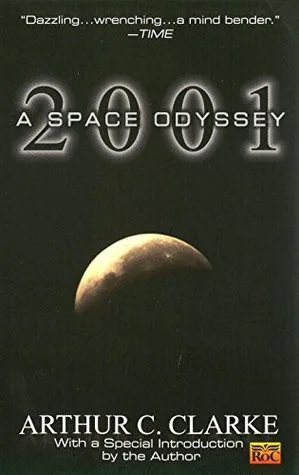
2001: A Space Odyssey
Arthur C. Clarke's novel (1968), written alongside Stanley Kubrick's film of the same name: mysterious monoliths guide human evolution and lead an expedition to the outer planets.
Clarke and Kubrick worked out the story together, but in the end Clarke alone is credited as the book's author, and it came out after the film's premiere. It grew out of Clarke's early stories, above all "The Sentinel," written in 1948 for a BBC competition. The novel follows early drafts of the screenplay and explains much that the film leaves a mystery, including the behavior of the onboard computer HAL 9000: it was ordered to hide the true purpose of the mission from the crew, an order that conflicts with its purpose of passing information to humans accurately and completely, and when they threaten to shut it down, HAL defends itself as if against death. In the book the Discovery is bound for Saturn's moon Iapetus rather than Jupiter, as in the film: Kubrick and effects artist Douglas Trumbull never managed convincing rings of Saturn. The monolith's proportions are 1:4:9, the squares of the first three numbers, and astronaut Bowman's last words before he vanishes are "The thing's hollow — it goes on forever — and — oh my God — it's full of stars!" By 1992 the novel had sold three million copies. Clarke wrote three sequels: 2010: Odyssey Two (1982, filmed in 1984), 2061: Odyssey Three (1987) and 3001: The Final Odyssey (1997).
In the episodes
1- September 30, 2026Andy Weir: Project Hail Mary Author Teaches WritingmentionedHow I Write
- 1:08:50the incomprehensible monoliths