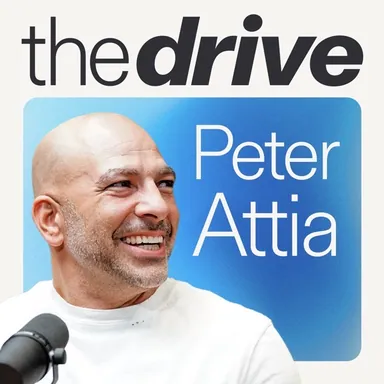
The Peter Attia Drive
Physician Peter Attia on the science of longevity: metabolism, heart disease, cancer, the brain, exercise, sleep, nutrition and mental health.
5 episodes
Episodes


 November 16, 2026 #416 ‒ The science of mitochondria: their role in health, aging, and disease, and what the evidence says about drugs and supplements aimed at improving their function | Navdeep Chandel, Ph.D. 2:06:32
 November 9, 2026Listener questions #415 ‒ AMA #91: Understanding lab testing: what blood work can and cannot tell you about your health and disease risk 17:02
 November 2, 2026 #414 ‒ Resistance training as we age: optimizing exercise selection and training intensity for muscle growth, function, and injury risk management | Jeff Cavaliere, M.S.P.T., C.S.C.S. 2:28:52
 October 26, 2026 #413 ‒ The neuroscience of emotion: challenging conventional theories of emotion, how the brain predicts and constructs our experiences, and gaining greater control over how we feel | Lisa Feldman Barrett, Ph.D. 2:34:05
- October 12, 2026Listener questions #411 ‒ AMA #90: Strong convictions, loosely held: how Peter's views on fasting, keto, metformin, rapamycin, whole-body MRI, and exercise have changed 18:29
About the podcast
The Peter Attia Drive is physician Peter Attia's podcast about the science of longevity: metabolism, the heart and blood vessels, cancer, brain disease, exercise, sleep, nutrition and mental health. The first three episodes came out on July 2, 2018; the guest on the very first was Tim Ferriss. By October 2025, according to CBS News, the podcast had more than 100 million downloads, and by November 2026 there were more than 400 numbered episodes.
Attia first trained as a mechanical engineer and applied mathematician. He graduated from Stanford's medical school, spent five years in surgical training at Johns Hopkins Hospital, two years researching immunotherapy for melanoma at the US National Cancer Institute, and then worked at McKinsey. In 2012 he co-founded the Nutrition Science Initiative with journalist Gary Taubes, and since 2014 he has run a private practice focused on longevity medicine. His book "Outlive," written with Bill Gifford and published in 2023, had sold nearly three million copies by the fall of 2025, according to CBS News.
An episode comes out every Monday. Most often it is a two-to-two-and-a-half-hour interview with a scientist or doctor; guests in 2026 included oncologist and author Siddhartha Mukherjee, neuroscientist Lisa Feldman Barrett and mitochondria researcher Navdeep Chandel. About once a month there is an "Ask Me Anything" episode where Attia answers subscribers' questions; full AMAs are only for paying subscribers, and the public feed gets a preview. There are also special episodes and reruns of older conversations.
In February 2026, after the US Justice Department released files in the Jeffrey Epstein case that included correspondence between Attia and Epstein, Attia stepped down from his newly announced role as a CBS News contributor and as chief science officer of the protein bar maker David Protein. Attia denies any involvement in Epstein's crimes. The podcast continues.
Memes
Running jokes, catchphrases and pet topics: what listeners know the show by.
ApoB
When it comes to the heart and blood vessels, Attia looks less at the familiar LDL cholesterol than at ApoB, the number of atherogenic particles. The marker comes up in all kinds of episodes: on the liver, on mitochondria, on preventing heart disease and Alzheimer's.
Lifespan and healthspan
Attia splits longevity into two parts: how many years you live (lifespan) and how many of them you live in good health, with a clear mind, a strong body and a good mood (healthspan). This framework underlies conversations about almost anything, from lab tests to training.
Quotes
What actually limits the car
“In the city of Chicago, you can only drive 50. It's just not rate-limiting.”
On his own conflict of interest
“If I want to make a living, I should tell people mitochondrial dysfunction is why you're aging.”
What he actually uses
“I got nothing other than a cheap drug called metformin and a glucose monitor.”
Testing mitochondria
“It's difficult for me to imagine how that test looks like and whether it reproducibly measures something that has value.”
What Warburg got wrong
“In fact, 95, 98% of cancers have a very intact electron transport chain, TCA cycle.”
A supplement over a drug
“It is always interesting that people do prefer a supplement over a drug. It's like I'd rather have something that's unregulated and I cannot verify the quality versus a drug.”
On hyperbaric chambers
“There's been absolutely no benefit to the lung being exposed to that level of oxygen.”
The scale of research
“We have never had a moonshot for metabolism, whether it's the government, whether it's a foundation, whether it's philanthropy.”
Hosts and guests
Sponsors of the podcast
All sponsors Peter Attia Premium Membership
Mentioned in the episodes
 Northwestern University
 Tadej Pogačar
 Nir Barzilai
 UK Biobank
 Otto Warburg
 University of Pennsylvania
 The Michael J. Fox Foundation
 Andrew Huberman
How the transcripts were made
How the sieve works5 episodes, 7 h 45 min of audio, 0 words of the original.
- Sources of the text
- our own speech recognition, Fluid Speech Pro, which gives the timecodes🤗 — in all 5 episodes, 16 min, 30× faster than real time
- a second recognition, Qwen3-ASR, in full🤗 — in all 5 episodes, 45 min
- YouTube's automatic captions — in 2 of 5 episodes
- speaker labels by pyannote🤗 — in all 5 episodes, 0 h 0 min
- machine time on Apple M4
- Checking
- 1,379 disagreements between the sources resolved by meaning and by ear. 19 places left to check by ear.
- Claude
- 115 million tokens: checking, translation, summary, chapters, notes. Of them 97% is re-reading text already loaded; 826K tokens written.