

The Peter Attia Drive
Chapters
Chandel sets ATP aside: the organelle has two other jobs, and the contested part of the conversation is the third one.
Read the chapter- ATP contracts a muscle and fires a neuron, and glycolysis makes some too, far less efficiently.
- Chandel calls the TCA cycle the anabolic engine, supplying metabolites for lipids, nucleotides and amino acids, and says people forgot that job.
- The third job is signaling: hydrogen peroxide, metabolites that drive epigenetics, and DNA escaping the organelle, which is why Chandel stopped thinking in terms of more or fewer mitochondria.
- Only red blood cells have none, hepatocytes hold thousands, and a handful may be enough for the third job.
Peroxide is not only damage: a cell uses it to talk to itself, and Chandel says almost everyone has the antioxidant capacity to keep it in range without supplements.
Read the chapter- Peroxide has three fates: catalase and peroxiredoxins reduce it to water, oxidation of cysteine residues changes protein activity, and with iron it becomes the hydroxyl radical and can end in ferroptosis.
- Selenium is scarce in northern New Zealand, Sweden and Finland, Chandel says, while vitamin C matters as an enzyme cofactor rather than as an antioxidant, and two oranges a day cover it.
- Antioxidant trials failed, in Chandel's reading, because most people already have enough and large doses interfere with signaling: mice that make less mitochondrial peroxide fail to form memory T cells.
The immune response to escaped DNA is measurable while the escape route is not, and that gap is where the inflammaging hypothesis sits.
Read the chapter- The receivers are known: cGAS–STING reads the DNA, MAVS the RNA, type I interferons follow, and poxvirus experiments showed exactly that response.
- The exit is not: peroxide has a mechanism and alpha-ketoglutarate has transporters, but for DNA there is neither a carrier nor a leak mechanism.
- Two or three decades of slow leakage would produce chronic low-grade inflammation, and Chandel says the hypothesis cannot be tested until the route is known.
- The release of cytochrome c was treated as the commitment to death, yet a small release lets the organelle recover, so leakage without death is possible.
Chandel has no mitochondrial test beyond a biopsy; Attia offers the lactate threshold, and both agree it measures more than mitochondria.
Read the chapter- With mitochondrial mutations, disease appears only once functional protein is down to 20 or 30 percent, so the reserve capacity is large.
- Chandel's analogy is the Aston Martin: 217 miles an hour against 140 for the 1964 car, and in Chicago you can only drive 50, so the top end is not rate-limiting.
- Attia's test is the wattage at which lactate stays below two millimoles per liter, about 230 watts for him and 350 for Pogačar.
- Three things can constrain it — stroke volume, oxygen delivery and extraction by mitochondria — and untrained people are likely limited at the periphery.
Chandel doubts that ordinary aging runs through mitochondria: the experiments on offer show sufficiency, not necessity.
Read the chapter- Break mitochondria — or lysosomes — and tissue degenerates, which, Chandel says, tells you nothing about what normal aging does.
- Mitochondrial DNA mutations at the rate of an old mouse do nothing; a phenotype appears near ten times that rate and does not look like aging.
- Chandel would look instead at signaling rather than ATP or metabolites: too little peroxide in immune cells, falling alpha-ketoglutarate, leaking DNA.
- Chandel names his own conflict of interest: it would pay better to tell people they age because their mitochondria fail.
Metformin is a gut drug: concentrations reach a millimolar there, and that is where the yeast-protein experiment pins down its target.
Read the chapter- Exposure runs up to 1 mM in the gut, 50–100 µM in liver and around 10 µM in blood, with almost nothing in brain, heart or muscle because the drug needs OCT transporters.
- The yeast protein NDI1 does complex I's job without binding metformin, and with it in the gut both the FDG PET signal and the glucose lowering disappear.
- Citrulline falls because its synthesis needs mitochondrial ATP, B12 falls as well, and GDF-15, GLP-1 and Lac-Phe rise, all of it from the gut.
- Blunted VO₂ max and hypertrophy gains look to Chandel more like a citrulline and vascular story than a direct block of complex I in muscle.
Blunting post-meal glucose is the one effect both men are sure of, and it still does not add up to a longevity argument.
Read the chapter- Taken about half an hour before a meal, metformin flattens the post-meal rise, visible on any continuous monitor.
- Attia's counterargument is that acarbose does the same and extended mouse lifespan in the ITP, while metformin, delivered the same way in the chow, did not.
- Attia treats metformin as a first-line drug in prediabetes and marked insulin resistance, while in established diabetes GLP-1 agonists and SGLT2 inhibitors do more.
- Both refuse the good-versus-bad microbiome framing and will say only that butyrate-producing bacteria increase on metformin.
In people the cancer case has failed, while the mechanism is clear: without a transporter the drug never reaches the tumor cell.
Read the chapter- The Bannister paper created the hope, a stricter reanalysis found nothing, and MA.32 in breast cancer and the prostate trial read negative.
- In a CRISPR screen of roughly a thousand viable knockouts, one clone survived metformin — the one lacking the organic cation transporter OCT3.
- Patients were never stratified by transporter status the way they are by EGFR or HER2, and Chandel adds that they could also be sorted by whether a tumor brightens on PET after a dose.
- Inhibiting complex I starves the tumor of growth metabolites, and the charged mitochondrial matrix concentrates the drug there 100- to 500-fold.
Inflammation is the only reason Chandel seriously considers metformin for himself, and it comes out of work down the hall at Northwestern.
Read the chapter- He already takes a low-dose statin, trains, sleeps and keeps up his social life, and has nothing for inflammation short of a daily NSAID he does not want to take.
- Scott Budinger and Gökhan Mutlu gave mice Beijing-level particulates: the particles reached mitochondria in alveolar macrophages, amplified the peroxide signal and drove IL-6, which makes blood more prone to clotting.
- In drinking water metformin lowered IL-6 in cells and in mice, and mouse models of flu and COVID showed less pathology on the drug.
- Nobody, Chandel says, has run a human trial measuring CRP in people exposed to polluted air.
Three papers landed on the same conclusion — metformin holds back the mutant blood clone — and nobody has tested it prospectively in people.
Read the chapter- The clone can reach 3 to 20 percent with age; among 450,000 people in the UK Biobank, metformin users had less of it, mice showed less, and NDI1 again pointed at complex I.
- The three papers appeared at once and agreed that inhibiting the electron transport chain prevents the clone from outgrowing, with metformin the safest drug for the job.
- No prospective trial in clonal hematopoiesis exists and it would take about five years, so Attia suggests testing metformin in high-risk patients whose stubbornly high CRP has no other explanation.
- Wrapping up, Chandel says the glucose lowering is certain and the anti-inflammatory effect plausible, while B12 and citrulline need watching and nausea costs some patients the drug.
- Chandel dismisses blood and breath tests sold as measures of mitochondrial function, because steady-state metabolite levels say nothing about flux.
The Warburg effect is real and its explanation is not: the lactate comes from cells with intact mitochondria that need material to grow.
Read the chapter- Warburg saw in the 1920s that tumor tissue made more lactate with oxygen present and inferred damaged respiration.
- By Chandel's estimate 95 to 98 percent of cancers have an intact chain and TCA cycle, needed both for ATP and for growth precursors.
- "Cancer is a mitochondrial disease" becomes an argument online that supplements prevent it, which Attia calls complete nonsense.
A decade on, nobody has named urolithin A's target, while berberine behaves exactly like metformin in Chandel's hands — minus the regulation.
Read the chapter- Free urolithin is barely detectable in plasma, the liver glucuronidates it, and the conjugate cannot enter cells, so something has to cleave it, probably near immune cells.
- Mitophagy is the claim, but Chandel says no target protein has ever been shown; he is waiting for data that makes him say aha and suggests a thermal shift assay.
- In mice urolithin helped T cells against a tumor and the effect faded without a mitophagy regulator, and older adults showed slightly less CD8 exhaustion.
- Berberine lowers glucose in mice and loses the effect with NDI1 in the gut, so it acts like metformin despite a different structure.
For every supplement Chandel asks the same question — what is this relieving in you — and the answer is usually nothing.
Read the chapter- Alpha-ketoglutarate has too many targets rather than too few, about 75 demethylases, but a hundred micromolar saturates them and cells already hold plenty.
- In work he admires, AKG protected the gut in colitis and against 5-FU, and that, he argues, is how to pose the question for a supplement.
- Even people who skip meat get enough carnitine, and CoQ10 makes more sense on a statin, though the trials have not delivered.
- NAD does not appear to fall enough in ordinary aging to limit reactions, and the interesting cases are specific, such as Joe Baur's liver regeneration work.
Each of these has a disease it is approved for and a hypothesis about healthy people with no data behind it.
Read the chapter- SS-31 is approved for Barth syndrome, where cardiolipin is deficient, the target is unsettled, and in a healthy person cardiolipin limits nothing.
- Methylene blue carries electrons from NADH to complex IV, bypassing I and III and making less peroxide, and the window is narrow because it inhibits monoamine oxidase.
- In mice on high oxygen Chandel saw senescence and death of lung cells, while interest in chambers rests on an Israeli telomere study whose premise Attia rejects.
- Red light trials show skin benefit and an unexpected improvement in glucose handling; Chandel suspects inhibition of cytochrome oxidase in the skin, testable with the sea squirt oxidase.
Chandel wants a Human Genome Project for metabolism — and says in the same breath that academic science has to be rebuilt to deserve it.
Read the chapter- Forty years of funding went to genomics while no comparable metabolism program came from government, foundations or philanthropy.
- The drugs that matter today — GLP-1 agonists, SGLT2 inhibitors, metformin — all run through metabolism and mitochondria.
- Chandel asks for triple the budget, but also a different model with less centralization, autonomous labs and a tolerance for risk.
- Four senior scientists set out in a PNAS paper how to rescue US biomedical research, and twelve years on, Chandel says, the opposite happened.
Quotes
What actually limits the car
“In the city of Chicago, you can only drive 50. It's just not rate-limiting.”
Navdeep ChandelRead from 35:40On his own conflict of interest
“If I want to make a living, I should tell people mitochondrial dysfunction is why you're aging.”
Navdeep ChandelRead from 46:43What he actually uses
“I got nothing other than a cheap drug called metformin and a glucose monitor.”
Navdeep ChandelRead from 1:30:58Testing mitochondria
“It's difficult for me to imagine how that test looks like and whether it reproducibly measures something that has value.”
Navdeep ChandelRead from 1:31:21What Warburg got wrong
“In fact, 95, 98% of cancers have a very intact electron transport chain, TCA cycle.”
Navdeep ChandelRead from 1:33:47A supplement over a drug
“It is always interesting that people do prefer a supplement over a drug. It's like I'd rather have something that's unregulated and I cannot verify the quality versus a drug.”
Peter AttiaRead from 1:40:14On hyperbaric chambers
“There's been absolutely no benefit to the lung being exposed to that level of oxygen.”
Navdeep ChandelRead from 1:52:05The scale of research
“We have never had a moonshot for metabolism, whether it's the government, whether it's a foundation, whether it's philanthropy.”
Navdeep ChandelRead from 2:00:00Academic science
“Are you being as efficient or are you being as innovative as you should be for the 21st century in academics current model? And I don't think we are.”
Navdeep ChandelRead from 2:02:51
Summary
When people say mitochondria are dysfunctional, what has actually stopped working? Navdeep Chandel describes three jobs to Peter Attia. Muscles need ATP, dividing cells need building blocks and the immune system reads signals from mitochondria. A VO₂ max test measures exercise capacity but cannot tell how well each of those jobs is being done.
Chandel traces metformin from the gut into circulation. Different tissues have different transporters, so exposure can vary sharply. The two compare findings from mice, people with diabetes and a large breast cancer trial. They then put urolithin A, CoQ10 and NAD precursors through the same exercise. Which effect would count, who might benefit and how would anyone measure it?
Mentioned
 Northwestern University01:04Chandel runs his lab here and draws on colleagues' work on air pollution and inflammation.
- James Bond35:16Chandel explains mitochondrial reserve with the 1964 Bond car and the one from No Time to Die.
 Tadej Pogačar38:03Attia uses his 350 watts as the ceiling of what human mitochondria can sustain.
 Nir Barzilai52:56Attia names him as the leading advocate of metformin as a geroprotector.
Show 13 more mentionsShow fewer mentions
 UK Biobank1:22:57its records showed less clonal hematopoiesis among people taking metformin.
 Otto Warburg1:32:38Chandel insists the Nobel was for the respiratory enzyme, not for the hypothesis about cancer.
 University of Pennsylvania1:46:58Joe Baur's group showed there that NAD-raising supplements speed liver regeneration.
 The Michael J. Fox Foundation2:00:28the foundation funds Chandel's work on complex I in Parkinson's disease.
- Metformin52:42Chandel uses it to set the two questions any compound should answer: where does it end up, and what protein does it act on.
 Andrew Huberman52:56Attia recalls going through both metformin epidemiology papers in a journal club on Huberman's podcast.
- Interventions Testing Program1:05:19the program where acarbose and canagliflozin extended mouse lifespan and metformin did not; Attia returns to it all conversation.
- Urolithin A1:35:12Chandel puts the supplement through the same two questions and notes that ten years on, nobody has named its target.
- Berberine1:39:24in his lab it lowers glucose like metformin and loses the effect with yeast NDI1 in the gut, despite a different structure.
- Elamipretide1:47:34approved for Barth syndrome, where cardiolipin is scarce; Chandel sees no reason cardiolipin would limit a healthy person.
- Methylene blue1:49:25Chandel explains how the dye shuttles electrons past complexes I and III, and why its window before serotonin toxicity is narrow.
- Human Genome Project2:00:00Chandel invokes it as the scale of effort he wants for metabolism.
 National Institutes of Health2:03:11Chandel asks for triple the agency's budget and a rebuilt model for university labs.
Sponsors of the episode
 Peter Attia Premium Membership00:46Attia describes the additional material available to members
Transcript
Hey everyone, welcome to The Drive podcast. I'm your host, Peter Attia. This podcast, my website, and my weekly newsletter all focus on the goal of translating the science of longevity into something accessible for everyone. Our goal is to provide the best content in health and wellness, and we've established a great team of analysts to make this happen. It is extremely important to me to provide all of this content without relying on paid ads.
AdThe Drive Premium Membership
To do this, our work is made entirely possible by our members, and in return, we offer exclusive member-only content and benefits above and beyond what is available for free.
If you want to take your knowledge of this space to the next level, it's our goal to ensure members get back much more than the price of the subscription. If you want to learn more about the benefits of our premium membership, head over to peterattiamd.com/subscribe.
My guest this week is Nav Chandel, returning for his second conversation on The Drive.1Chandel's first visit was episode 36 of The Drive, in January 2019, and it was mostly about how mitochondria make energy and what that has to do with cancer. In the seven years since, his own work has moved to the signals mitochondria send the rest of the cell. I believe Nav was on in late 2018 or early 2019. Nav is a distinguished professor of medicine, biochemistry, and molecular genetics at Northwestern University, where he studies mitochondrial biology and the role mitochondria play in aging and chronic disease. He's one of the most thoughtful scientists I know in this space, especially when it comes to separating what we think we know about mitochondria from what the data actually support.
And of course, everybody knows that “mitochondria” is almost a laughable buzzword2The buzzword grew out of the schoolroom line about the powerhouse of the cell and, through the 2020s, turned into a market: mitochondrial supplements, hyperbaric chambers, red light panels and tests that claim to grade “mitochondrial health.” Those are the products Attia and Chandel take apart one by one. at this point in health circles. So I thought it would be really important to have on the world's expert on this topic so that we could separate signal from noise. In this episode, we discuss what mitochondria actually do beyond ATP production, which I think is what everybody understands. Why their real job is often misunderstood. How mitochondria regulate signaling through reactive oxygen species, and why that matters for immune function. The role of mitochondrial metabolites in epigenetics, gene regulation, and cellular adaptation. How mitochondrial DNA can trigger inflammation, and how that intersects with aging. What “mitochondrial dysfunction” really means, and why it's often used too loosely in aging conversations. Why metformin3Attia lists the topics ahead, and metformin is the one that anchors them: of everything discussed here, it is the only compound whose tissue exposure and molecular target are both known, so Chandel uses it to set the questions any supplement should answer. The drug has treated type 2 diabetes since the 1950s and descends from goat's rue, a medieval remedy for excessive urination. remains one of the most interesting drugs from mitochondrial biology, despite decades of use. How metformin actually behaves in the body, including its distribution, tissue-level effects, and gut-centric mechanisms. The relationship between mitochondria, inflammation, and environmental stressors like pollution. A practical rundown of popular mitochondrial supplements and what Nav thinks the evidence does and doesn't support for each of them. Where compounds like urolithin A and alpha-ketoglutarate fit in under this broader mitochondrial conversation. The mechanistic appeal and real-world limitations of interventions like methylene blue and hyperbaric oxygen.
Going into this podcast, I thought I understood most of what the mitochondria did, and I have to say I came out of this scribbling down many notes, realizing that my own understanding of this space expanded significantly. And so for that reason, I'm pretty confident everybody listening to this is going to share my enthusiasm for this topic. So without further delay, please enjoy my conversation with Nav Chandel. Nav, good to see you again, my friend.
01What mitochondria do besides ATP
Chandel sets ATP aside: the organelle has two other jobs, and the contested part of the conversation is the third one.
Great to see you. Thanks for the invite.
Thank you for coming down.
I suspect that a number of people listening to us today may have not heard us speak eight, six, seven years ago. I don't remember. And if they did, I'm sure it's easy to forget. And there's so much new stuff to talk about. But I always like to kind of ground people in what the mitochondria are. Unfortunately, “mitochondria” has become one of the top ten buzzwords on social media.
So there's no chance that anybody listening or watching us hasn't heard the term, but that second and third order understanding might be a little foggy. And given that we're going to talk so much about mitochondrial health, which is a big buzzword, mitochondrial boosters and all these other things, we do need to ground this discussion in what mitochondria are. So take it away.
Yeah, thanks again, Peter. I agree with you. I think it's not only mitochondria, but the other big buzzword is mitochondrial dysfunction. That's the real buzzword, which you hear over and over. So if you're going to talk about mitochondrial dysfunction, you're absolutely right. Why don't we start with mitochondrial function?
Now, mitochondria do a lot of things, and I'm sure my colleagues will be like, “Nav, you didn't discuss X, Y, and Z.” Okay, so we're not going to discuss how mitochondria are made or degraded and how many different kinds of mitochondria there may be. There's a lot we can cover. We're going to focus on one thing: mitochondrial function. What do mitochondria functionally do? Most people know it as the powerhouse of the cell because it makes the ATP.
And that gives you the power for your muscles, your neurons to fire. And for a long time, most of us just thought about mitochondria as an ATP generator. So when mitochondrial dysfunction comes—does it happen in aging or in heart failure?—it's: you don't make enough ATP. Now remember, glycolysis4Glycolysis splits glucose into pyruvate in the cytoplasm, without oxygen or mitochondria. It yields 2 ATP per glucose against roughly 30 from full oxidation in a mitochondrion, and that gap carries the rest of the conversation: a cell with no working respiratory chain survives on glycolysis but stops doing its job. can also make ATP, but mitochondria are much more efficient and can give you a lot more. So, very simple. And all the great theories around mitochondrial dysfunction related to any particular disease, if it is causal, or the natural aging process, it's all about ATP.
Well, I'm here to tell you, we're not going to talk about the ATP because there's a lot more they do. So just to back up, the electron transport chain generates a proton-motive force,5Where the proton gradient forms. A mitochondrion has two membranes. Folds in the inner membrane are called cristae. The respiratory-chain complexes sit in that membrane. Electron transfer is coupled to a buildup of protons on one side. Protons flowing back through ATP synthase can power the enzyme. Chandel goes on to explain what else a cell needs the respiratory chain for beyond making ATP.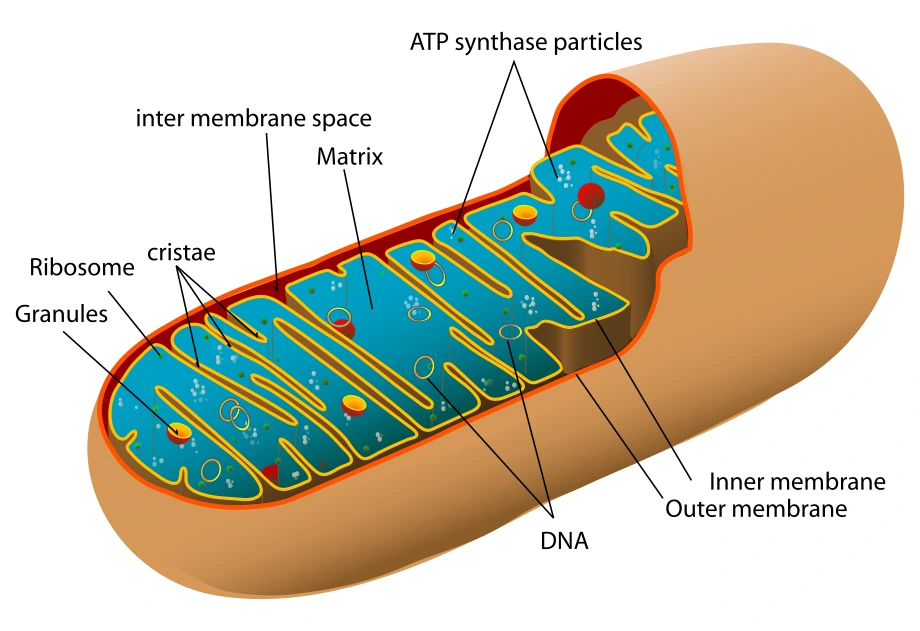 basically a voltage, which can be harnessed to make ATP. That process is coupled to something called the Krebs cycle6The Krebs cycle, also called the TCA or citric acid cycle, is eight reactions in the mitochondrial matrix that oxidize an acetyl group to carbon dioxide and hand electrons to NADH and FADH₂. Hans Krebs described it in 1937 and won the 1953 Nobel Prize for it. Chandel keeps stressing that it is not only combustion: its intermediates are what the cell builds lipids, nucleotides and amino acids from. or the TCA cycle. And it turns out that the TCA cycle is the anabolic engine also in your cells. So mitochondria do two things. They make ATP, and they can make the building blocks, the metabolites that are the building blocks for new lipids, new nucleotides like DNA, RNA, amino acids for the building blocks of the protein. And that's said a lot.
People forgot that mitochondria are an anabolic engine. We'll get into it with cancer in a second. So that's what classically the great biochemists of the 20th century taught us. And that's, like I said, it's in your textbooks. What has changed in the last 30 years, and I think I've been part of that revolution, is that mitochondria also communicate. They're not just an organelle sitting on the side.
And things like mTOR,7mTOR — the complex that decides whether a cell grows or conserves, switched down by AMPK when energy runs short. Chandel cites it as something that makes decisions, in contrast to the old picture of the mitochondrion as a passive battery. when they get activated or deactivated, mTOR is a big decision maker of metabolism. Your genes being turned on and off. They're deciding cell fate, how a cell becomes what it does. And mitochondria is just sitting there giving you ATP, giving you metabolites. It has no decision-making properties. Well, that's changed.
Can we back up for one sec, Nav, and just give folks maybe a sense of size and scale? So are there any cells in the body that don't have mitochondria?
Red blood cells.
Okay.
Absent red blood cells, when you consider all the other cells which have mitochondria, what is the approximate cellular density of mitochondria?
It depends.
Yeah, so let's talk about a neuron. A neuron might have approximately how many?
Actually, I don't know these numbers, to be honest with you. The hepatocytes are full of them.
We're talking thousands.
Yeah, for sure. Maybe more.
But again, instead of worrying about are they dense or they're not dense, I think if you look at them from what they're doing, there's the ATP, there's the metabolites, but what I really want to get into is the third aspect, which a few mitochondria could probably fulfill. And so that way you don't have to always think about mitochondrial biogenesis. I think that's why you're asking this question.
More thinking of it in terms of supply and demand mismatch, for example. So are they being paired to cells in density based on energy need or metabolite need? Because, for example, a hepatocyte doesn't actually need much ATP, but it needs a lot of anabolic precursor. It makes glucose, for example. I assume that in the hepatocyte, the density is optimized more towards anabolism, whereas in a very energy-dense cell, like a muscle cell, where ATP is probably more important than precursors to building blocks, you're optimizing around this other function of ATP generation.
That's basically what I was asking.
On a first approximation, that's true. Although, because there's a third function, that simple theory—I don't disagree with that. I just don't think about it anymore in those simple terms because there's a third function that is becoming very dominant. And I actually don't know, this third function I'm going to talk about, how it fits into that paradigm that you just explained.
And that's why I've stopped thinking about more or less mitochondria. And that third function is that mitochondria are constantly generating signals to the rest of the cell. These signals are optimized for cellular function. What are these signals? One of them is the electron transport chain is not a perfect system and it leaks electrons. It can leak a little bit of electrons or a lot of electrons to make H2O2, make superoxide first and then H2O2.
People used to think: H2O2, hydrogen peroxide in cells—damaging, damaging, damaging. In fact, the oldest theory of aging says that as you get older, your mitochondria degenerate and they make copious amounts of H2O2 to cause degeneration of the muscle, of the neuron.
I do want to just make sure people understand how that's happening and why it's happening. I think a little bit of biochemistry won't kill someone. So when acetyl-CoA is running through these four structures, these four complexes across the electron transport chain.
It's not that. Acetyl-CoA is part of the Krebs cycle. Yeah, we can get into it. Yeah, we can do a little biochemistry. It's okay. So you go from glucose to pyruvate.
Pyruvate comes into mitochondria. Pyruvate becomes acetyl-CoA, along with oxaloacetate, to jump-start the TCA cycle. Let's just look at that first step, the pyruvate to acetyl-CoA. It takes an NAD molecule and makes NADH.8NADH carries electrons and becomes NAD again once complex I takes them, keeping the TCA cycle turning. Chandel starts there because that turnover is the sales pitch for the NAD precursors NR and NMN: the assumption that aging leaves cells short of the cofactor. NADH is full of electrons. It goes to complex I9The conversation keeps returning to complex I, the target through which Chandel explains almost everything metformin does. It is the first and largest link in the respiratory chain — 45 subunits in mammals — taking two electrons from NADH and passing them down the chain toward oxygen. In the diagram it sits on the left, where the electrons enter.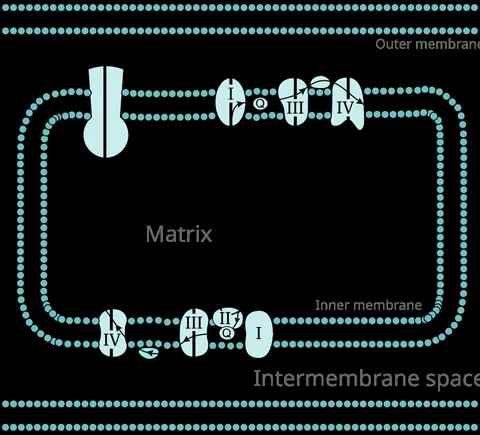 of the electron transport chain.
Complex I takes that NADH's two electrons and makes NAD. The reason why people are so interested in NAD precursors is they're thinking their complex I is not working so well because it's not giving back the NAD to make mitochondria run to generate ATP in the TCA cycle. So if I give a lot of NAD, maybe I can overcome the complex I deficit, which is found in Parkinson's, and whether it's linked to normal aging is debatable, and we'll get into that. And so those NADH electrons now are going to go down the electron transport chain, with the final acceptor of those electrons being oxygen. The best analogy I can think of is a waterfall through a tube, and it's going through a tube into a tank. The tank is like oxygen that's accepting all that water.
There are holes, very tiny little holes in that tube. That's that leak. And that leak can increase or decrease depending on how filled that tank is. If the tank is completely full, all of that water backs up, and now you get that leak happening because it has to go somewhere. So that's a simple way to think about it. The best analogy I can think of is you have this NADH, which has these two electrons, and it passes it down the electron transport chain, to keep it simple, and oxygen is the final acceptor of it.
This allows the NADH when it passes those two electrons, it regenerates NAD and it keeps the TCA cycle going. But that electron transport chain isn't perfect. Not every electron always gets to oxygen. There's a little bit of imperfection, a little bit of leak, and that one electron can take oxygen to something called superoxide, which becomes quickly converted by some enzymes called superoxide dismutase10Superoxide dismutases turn superoxide into hydrogen peroxide; mitochondria use the manganese form SOD2 and the cytoplasm the copper-zinc SOD1. Mutations in SOD1 cause an inherited form of ALS, which is why the system is so well characterized. to make H2O2. So what people thought is, well, the electron transport chain, this slightly imperfect system becomes more imperfect. So now it's leaking more electrons in neurodegeneration and cancer and everything.
And now it's making copious amounts of H2O2.
And is there evidence, by the way, Nav, that even in an absent disease state, as a person ages, as they go from 10 to 20 to 30 to 40 to 50 to 60—what we represent in the textbook, which is the final output after you've transferred all of the electrons and made all of the ATP, you have two outputs, carbon dioxide and water, which is what we are all breathing out.
Coupled to generating ATP.
Yep. Is the idea that, absent disease, just aging increases the fraction of H2O2 relative to just H2O?
I don't think so.
Okay, interesting.
02When hydrogen peroxide is a signal
Peroxide is not only damage: a cell uses it to talk to itself, and Chandel says almost everyone has the antioxidant capacity to keep it in range without supplements.
ExplainerWhy finding peroxide does not, by itself, establish damage
Cells continually produce and remove hydrogen peroxide. A brief, local change in its concentration can alter a sensitive protein, after which the system can return to its earlier state. To establish tissue damage, one would also ask which molecules were harmed and whether function was lost. A single measurement of total peroxide cannot resolve those questions.
I wanted to go through this just so people understand what H2O2 is relative to the normal process of H2O.
Right. What you're asking me is, in a normal person, does the system become leaky?
Just by age.
Just by age. I don't think so. This is one of the new paradigms.
It's not written in stone yet, but this is what we've been working on. Not only that, but let's back off. To begin with, do we make copious amounts of H2O2 to levels that become toxic? I don't think so.
We have a lot of antioxidants, Peter, that keep that in check.
Explain to folks what an antioxidant is. We're taking it for granted as we say.
This.
Yeah, yeah, yeah. So it's a protein that can detoxify different molecules of reactive oxygen species. So there's a family of proteins called superoxide dismutases. They take superoxide and make H2O2. H2O2, when you make it, has three choices. First choice, which is what almost always happens, is because we're full of proteins that degrade it to water.
So there's two classes. One is catalase,11Catalase is among the fastest enzymes known: one molecule can break down millions of molecules of hydrogen peroxide per second. That is the backbone of Chandel's argument that a cell's own defenses leave little for a supplement to add. the other one is peroxiredoxins, and we're full of—they really have high reactivity to it, and they convert it to H2O.
I don't want people to lose the thread. H2O is a very stable molecule.
Very stable.
Okay, so you have oxygen, it has these covalent bonds to hydrogen.
Very stable.
You have a couple electrons that can create polarity, but why is it not reactive in a way that H2O2 is reactive?
Actually, H2O2 is not that reactive. Superoxide is super reactive, but there are cysteines which can readily get12Cysteine residues — the one amino acid hydrogen peroxide oxidizes easily and reversibly, which is what makes peroxide usable as a signal: the protein's activity changes and the cell can change it back. oxidized, that is, by H2O2. And that's part of the second thing that I was going to talk about, which is this cysteine on certain proteins, and we don't quite know the code of that still. What that changes is the activity of that protein, and that's all signaling. That H2O2, with iron, can undergo a Fenton reaction13The Fenton reaction — hydrogen peroxide plus iron yields the hydroxyl radical, which survives a fraction of a second and attacks whatever it meets. It explains how a mild oxidant becomes dangerous only under particular conditions. to make a hydroxyl radical. It doesn't last long and is super toxic. It'll react with anything that it touches.
That can, with a polyunsaturated fatty acid, can make something called lipid peroxide and start a chain reaction, which is now called ferroptosis.14Ferroptosis — cell death driven by a chain reaction of lipid oxidation in membranes, described around 2012. Chandel raises it to mark the boundary: below it hydrogen peroxide is a signal, above it the cell is being destroyed. It's a new form of cell death discovered about 12 years ago.
So the more we create H2O2, the more we theoretically risk this process.
The ferroptosis process. Yes, exactly. So you make the H2O2. Lots of proteins to get rid of it. You always need a little bit, we think, for that signaling, that cysteine oxidation. But if you overwhelm these antioxidants for whatever reason, for some reason the antioxidant capacity goes down, you start to push that not only for the signaling, but you start to push it towards this ferroptosis.
And when people hear “antioxidant,” they automatically, I would assume, think of things that we eat that are known to have antioxidant properties, such as vitamin A or vitamin E or vitamin C.
Yeah. So how much of an individual's antioxidant buffer capacity is a function of how much antioxidant they consume, or is that an overly simplistic way to think of it?
No, no. So the toxic ones that I'm talking about, the lipid peroxide, so vitamin E is pretty good at that, at detoxifying that.
Okay.
Probably the biggest one is selenium. So the proteins that are responsible in our bodies to get rid of those lipid peroxides, it's a battle, right? You're making these hydrogen peroxide, you're making lipid peroxides, but we, most of us have enough of, for lack of a better word, antioxidant capacity, Peter, to keep those levels in check.
So selenium. There are countries, by the way, which are a little bit selenium deficient. Northern New Zealand, Sweden, Finland. The US has a high-selenium diet.
And that's based on the soil?
The soil.
So just to finish, selenium is required for the proper activity of proteins like GPX4,15GPX4 — the enzyme that clears lipid peroxides, built around a selenium atom. It carries Chandel's argument that antioxidant capacity depends on selenium in the soil and the diet rather than on supplements. which get rid of those lipid peroxides.
Because it accepts electrons easily, or selenium is part of the GPX4, the moiety to make it work?
But this is my point. If you have a proper diet, you should have enough antioxidant capacity. There are places that may be deficient in it. I just want to make one thing about vitamin C, the granddaddy of them all, as they say. Vitamin C, and we're going to talk about going back to my signaling, is a very important protein, not for its antioxidants, but as a cofactor for a whole class of enzymes called the alpha-ketoglutarate dioxygenases. All the epigenetic clock stuff16Chandel offers epigenetic clocks as an example of something resting on a mitochondrial metabolite: the demethylation reactions run on alpha-ketoglutarate. The clocks themselves are age estimates read off DNA methylation patterns, the basis of consumer “biological age” tests. that people like, this is run by these enzymes, and vitamin C is needed to make sure those enzymes run.
Two oranges a day is enough to make those enzymes run.
And so is it your point of view that all of the trials that have looked at supplementing with antioxidants, they've all failed?
Proven no health benefits. In some cases, worse with cancer.
Is your hypothesis for why that's the case that, A, we have sufficient enough antioxidants in the diet, so giving more doesn't really do anything? Is it B, that we're not taking enough? So the antioxidant trials failed because they failed to give enough, and you would have to give really, really, really high doses to get the benefit?
Or C, actually they do work, but they're taking away the reactive oxygen species, which we need to do something valuable, or D, something else.
A and C. In other words, most of us have enough.
I agree.
Some countries may have low selenium, so they may want to take selenium in them. There are people who don't eat enough oranges or have enough, they're not scurvy, but you know, there's actually quite a large level of differences in vitamin C levels in people. But generally if you're eating a healthy diet, I think it's the A.
The other part is that people who are taking gobs of it might be interfering with the normal function. So remember I said something like H2O2 can become damaging if it becomes lipid peroxide. Something like vitamin E can take care of that. But there's also this need to keep the cysteine oxidation, what I call signaling. And that's what my lab has really worked a lot on. And we've done genetic experiments where we decrease mitochondria's ability to make H2O2, for example. A T cell, when it sees a pathogen, will proliferate okay, but it won't make the memory T cell.17A memory T cell is the long-lived cell left behind after an infection or a vaccination, ready to respond faster the next time. It carries Chandel's point: without mitochondrial peroxide the T cell still divides but leaves no memory, so the signal is needed for development rather than being damage.
So it actually hurts the T cell.
It hurts the T—well, it hurts the immune cell. It hurts the immune system, yeah, for functioning properly. And there are some data, like in sepsis trials,18High-dose antioxidants have been tested repeatedly in sepsis, the body's life-threatening response to infection, and have not helped; in some trials intravenous vitamin C and selenium did worse than placebo on particular outcomes. which have failed, in fact made it worse, the antioxidant trials in those cases. So I think we have enough, and sometimes it might interfere with normal biology. And I think this is a paradigm shift.
It used to be anti—oh, sorry, oxidants: bad, bad, bad. Take antioxidants. It's a little nuanced. H2O2, good within levels. If it becomes lipid peroxides, they can be managed due to these selenium-dependent enzymes. Bingo, that causes, uh, DNA damage and everything.
All right, so let's go from function to dysfunction.
Can we just go back to function? Because I only talked about one of these, H2O2.
Sure, sure.
There's a lot of them. Let me just give you two more, which are important for this discussion. The second one is metabolites.
So those TCA cycle metabolites that are linked to the electron transport chain, including acetyl-CoA. You just mentioned alpha-ketoglutarate. So it turns out that protein acetylation, when proteins get acetylated at lysines, is a way to change their function. A lot of the acetyl-CoA comes from mitochondria. So you can see how mitochondria control acetyl-CoA levels.
Probably one of the three most important things that drives autophagy is acetylation of protein.
Yeah, well, the big one is also in the histones being acetylated to keep chromatin open or closed. That's mitochondrial control. So that's a signaling aspect of mitochondria now. It has nothing to do with ATP. Alpha-ketoglutarate. So there's 75 enzymes called the alpha-ketoglutarate dioxygenases..19Alpha-ketoglutarate dioxygenases — about 75 enzymes that need oxygen, iron and alpha-ketoglutarate from the TCA cycle. They strip methyl groups from DNA and histones and hydroxylate collagen, which is the mechanistic case behind the AKG supplement.
They use oxygen and alpha-ketoglutarate. They use iron, Fe²⁺, and they make succinate. To recycle that iron, you need vitamin C to make them functional. So when you don't have enough vitamin C, those enzymes aren't working. So let's just go through those. So now, again, you have alpha-ketoglutarate as an input from mitochondria into running 75, I would argue, some of the most important enzymes.
The enzymes that cause DNA methylation to be DNA demethylation are α-ketoglutarate dioxygenases. Histone demethylases, the collagen prolyl hydroxylases—you and I hopefully have good skin as we age—are α-ketoglutarate dioxygenases. In fact, the vitamin C that people like to put on their skin, I always argue, is because you keep the collagen prolyl hydroxylases working properly. So now you have—think about it—your DNA demethylation. If your DNA is hypermethylated, you typically turn off genes. The epigenetic clock phenomenon—and I think you've discussed a lot about whether it's of any value or, you know, and I'm not going to debate that—but all I'm going to say is that people who are so into their epigenetic clocks, α-ketoglutarate is controlling those clocks because it's needed to keep the demethylation reactions going properly. So that's our second major, major function. So you have H₂O₂, you have TCA cycle metabolites controlling, essentially, epigenetics.
Your third one is—so mitochondria have their own DNA and RNA. If it spills out, the same sensors that look at pathogens—we have things that say, “I'm infected with a pathogen. I have to turn on a cytokine.” Well, the mitochondrion is your bacterium. The current theory of how we have a normal eukaryote is an archaeon,20The endosymbiotic theory: roughly two billion years ago an archaeal cell engulfed a bacterium that stayed. Archaea are their own domain of life, not bacteria, and alphaproteobacteria are the group modern rickettsia belong to. Hence the two membranes, the circular genome, and an immune system that still reads mitochondrial DNA as foreign. which is not a bacterium—it's a kingdom by itself—and an alphaproteobacterium. The two of them had a symbiosis. That's before oxygen was around. So there's a bacterium within us.
And if that bacterium releases its DNA or its RNA, it's viewed as foreign, and the same inflammatory pathways…
And sorry, why is it that we didn't thymically, why were we not exposed to that? Basically, why did our thymus not account for that? Because there must have been some disruption of mitochondria during embryogenesis.
Great question. Actually, I don't know the answer to that. One thing could be that some of those antigens are not presented. They're not as easily presented because they're hidden and because they're in the mitochondrial matrix. But the key point, just to sort of wrap this up, I mean, there's many other things that mitochondria release, okay? And again, to the listeners, especially my colleagues, as just in the interest of time for our discussions, we're going to keep at least three of them.
There's many more. One is H₂O₂, needed for immune function, as we've needed for cell differentiation. α-Ketoglutarate, which we want to talk about later in the supplement section, and keeping the epigenetics going in a proper way. And lastly, sometimes mitochondrial DNA or RNA being released is to turn on immune function. And again, like with immune function, if it's chronically—you know, some people think it's not your ATP. Peter, you asked whether it's decreasing with age, or H₂O₂ increasing. Could it be we just have leaky DNA from mitochondria?
03When mitochondrial DNA leaves the organelle
The immune response to escaped DNA is measurable while the escape route is not, and that gap is where the inflammaging hypothesis sits.
Why is that a good thing, Nav?
Because—no, no, no, I'm not saying—chronically leaking is not a good thing.
No, no, no, but I'm saying, you mentioned earlier that if the mitochondrion releases its DNA21Mitochondria contain DNA of their own. The NHGRI illustration shows its location in the cell and its characteristic circular form. Attia is asking what happens when a molecule leaves its usual compartment. NHGRI.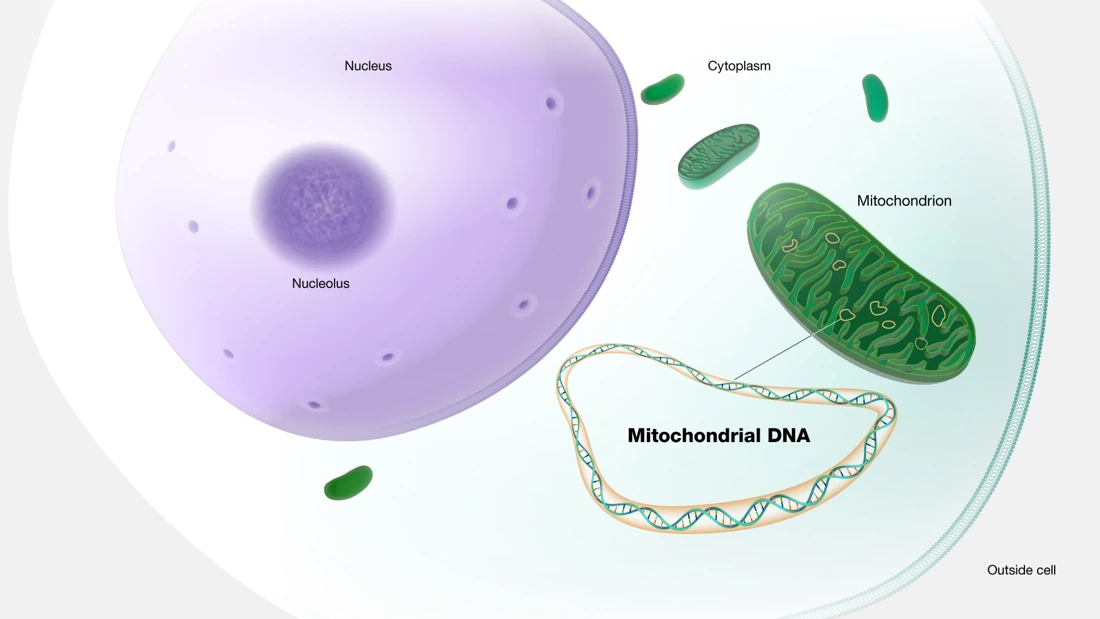 and/or RNA, it's going to activate the immune system because it's not identified as self. But that activation of the immune system is very specific. So what is it targeting besides the DNA and RNA of the mitochondrion?
So there's two big questions in that field. How it gets released is not known. It's not mitophagy22Mitophagy — the recycling of damaged mitochondria, and the central promise made for urolithin A. Chandel takes it seriously because the antitumor-immunity effect faded when a mitophagy regulator was removed.—or people argue that improper mitophagy might release it, or the normal turnover of fission, fusion. Whereas H₂O₂, we know how it's released. α-Ketoglutarate has actual transporters. This one is a bit of a black box.
But once it's released, we know the targets: cGAS–STING, MAVS for the RNA..23cGAS–STING and MAVS — intracellular sensors for DNA where none should be and for foreign RNA. They evolved against pathogens, and mitochondrial DNA trips the same wiring because the organelle descends from a bacterium.
So there's dedicated— And what do those T cells go and do? Who do they turn their ire on if they're activated?
Right, not only T cells, but any cell can release it. And the signals they release are type I interferons,24Type I interferons — the proteins a cell uses to announce an infection. Attia asks what the response is aimed at; Chandel's answer is that mitochondrial DNA raises a general antiviral alarm rather than targeting anything. which can then orchestrate the whole immune system. But I think the question you're asking is, is this a regulated system?
And is it for a net positive? In other words, is this something we are doing to amplify an immune response? So if a virus comes in you, if influenza comes along and attacks the endothelium—or the epithelium, rather—of your throat, is it also something that the mitochondria do, say, “How can I participate and help the organism? I'm gonna release RNA and DNA. It's going to make more interferon. It's gonna make more T cells, more B cells.” Is that the theory?
Absolutely. In fact, people have done those studies. They've taken different viruses. I did one—helped a colleague at Northwestern—where they did poxviruses,25Poxviruses are large DNA viruses, the family that includes smallpox and mpox. They make a convenient test of the antiviral response: the virus is big, infection is reproducible, and the cell's reaction to escaped mitochondrial DNA stands out clearly. good old poxviruses, and lo and behold, mitochondrial DNA gets released, at least to turn on exactly what you're saying.
What's the signal? How does it know?
Yeah, exactly. So the mitochondrial DNA—if I had to compare H₂O₂ versus the DNA, H₂O₂ is still a black box: what it hits, which proteins, which cysteines. We know how to manipulate mitochondrial DNA. We know the receptors it's gonna hit. I don't think—people might argue—I don't think we have a good explanation how it gets out. And if we knew if there was a select transporter or something, then we can manipulate it, maybe even make drugs against it, depending on what you want to do.
But what I was gonna get at is, you have this mitochondrion with two membranes. I could imagine, Peter, a scenario where you're making enough H₂O₂, you're making enough ATP, you're making enough TCA cycle metabolites like α-ketoglutarate. So everything is great, but you know what's not great is maybe the membranes are not perfect, and they're leaking a little bit of mitochondrial RNA or DNA. And releasing a little bit of mitochondrial RNA or DNA over 20, 30 years is causing a little bit of an immune response, a little low-grade inflammation all the time. So some people think maybe the autoimmunity that you get as you age, or the inflammaging, might be from leaky mitochondria. Not enough that it compromises DNA, not that it compromises α-ketoglutarate or even my beloved H₂O₂ signaling, but it just sort of leaks out at low levels, and that's the increase in inflammation that we're seeing.
It's a hypothesis. It's difficult to test because of exactly what you pointed out: how does it get out? Because if I knew how it got out, I could then come in and stop it in a mouse model or whatever and say, “Look, here's the aging, inflammaging, and now it's not happening.”
Do you know, Nav, that it gets out of a cell that remains? Or does getting out imply that that particular mitochondrion, that organelle, was destroyed, and it's binary? Any time DNA and RNA get out, it means that particular organelle is gone, versus this idea of a leaky organelle.
You hit it on the thing.
This is… I don't know that. Well, this is my problem with the idea. I've always assumed… You know what? We forgot to… Actually, this is a perfect segue. I forgot to mention the most important experiment done in signaling by Xiaodong Wang,26In 1996 Xiaodong Wang showed in a cell-free system that cytochrome c released from mitochondria is required to trigger cell death. Before that paper the organelle was treated as a power supply; afterwards researchers started looking for the other signals it sends, which is where Chandel dates his own interest. Liu et al., Cell. which got people like me inspired in the mid-’90s to think of H2O2 and other things, which was that he showed that cytochrome c, which is part of the electron transport chain, part of electrons flowing, making ATP, if it gets out from the mitochondria, that cell goes on to die. The mammalian death signal is cytochrome c getting released. Now, there's something called… where cytochrome c can get a little released and the mitochondrion can repair itself.
Many people think the mitochondrial DNA must be doing that. So, in other words, it's not during cell death. When I first saw it, I was like, the cell's about to die. It's just turning on inflammation, exactly on first principles. But it looks like there's improper, maybe, permeabilization or some leaky mechanism I don't understand. And I actually struggle with that. How does it really work? Because to me it would seem binary. But people argue now that cytochrome c even, which is binary, that there is… cytochrome c, a little bit gets released, and then it can repair itself, and it's turning on stress signaling. So more to be discovered on that front.
So let's put a bow on this because the two biggest and most obvious things that the mitochondria does, which is generate ATP. Anything that interrupts that significantly is incompatible with organism life.
That's not true.
I mean cyanide. If you interrupt that process, we're done. If you stop making ATP, you're dead, right? That's what I mean.
So the cyanide one is an interesting one, because if you do these experiments genetically… So cyanide binds to cytochrome oxidase,27Cytochrome c oxidase (complex IV) — the final step of the respiratory chain, handing electrons to oxygen. Cyanide and carbon monoxide stop there, and so, by various hypotheses, do methylene blue and red light, which is why the conversation keeps returning to it. and so does carbon monoxide and many other things. But if we genetically, in a heart or in a dopaminergic neuron or even in a muscle—three bioenergetically heavy things—there are signaling pathways, such as activation of AMPK,28AMPK is the cell's energy sensor: it switches on when ATP runs low and shuts down growth to cut spending. Metformin activates it too, which is where the old idea that the drug mimics fasting came from. which can turn down mTOR. That cell lives fine for months and months and months, and it's on glycolysis.
So you're saying it's not that it evolves a way around that particular complex within the mitochondria. It's very interesting. And why is that?
And by the way, so here's a crazy thing. A colleague of mine at Northwestern knocked out components of the electron transport chain. The heart continued to pump on glycolysis.
For how long?
Months. And then, but you know what happened? All this signaling that I'm talking about, and he doesn't understand all of it, but that signaling causes it to hypertrophy, and now it can't contract and the mouse dies.
But why is it then that cyanide is so lethal in seconds? Why can't the organism survive on glycolysis for a long while?
I think because when we genetically do it… And by the way, I actually don't know why, which organ failed. So the ones that we've done, we don't actually know. Same with rotenone,29Rotenone — a plant-derived insecticide that blocks complex I and reproduces features of Parkinson's disease in animals. Chandel uses it to separate a cell staying alive from a cell doing its job: the neurons survived for months but stopped making dopamine. which is a complex I inhibitor linked to Parkinson's. So if we do the same experiment in dopaminergic neurons, those neurons basically live off glycolysis for three months in a mouse, and then the neurons start to die. But during those three months, they stop making dopamine. So, in other words, they have enough energy to live, but not to be functional.
All right. I'll take my extreme statement back. It's not about death. It's profound dysfunction.
But it's dysfunction. And—but the question is, why is that dysfunctional?
Yeah. But clearly, top hierarchy function of mitochondria, make ATP. Another big function of mitochondria is make metabolic building blocks. And then the third one I'm calling 3A, 3B, 3C, and those are the three things you just talked about. So that's the H2O2, that's the protein acetylation and histone acetylation,30Histone acetylation — acetyl groups added to the proteins DNA is wound around, loosening the packaging so genes can be read. The acetyl groups come from mitochondrial acetyl-CoA, which is how metabolism reaches into epigenetics. all of the acetylation pathways. And then the third one, which is, I mean, three, call it 3C, the really radical sounding one is actually it's to release genetic material to heighten immune response.
Right, right. Also, the fourth one, you could argue, is cell death. Cytochrome c release. When it gets released, that cell typically goes on to die.
Oh, it's the whole cell, not just that mitochondrion.
Oh, no, no, no. Cytochrome c turns on caspases..31Caspases — the proteases that dismantle a cell during apoptosis. Cytochrome c release switches them on, which is the fourth mitochondrial job Chandel adds to his list.
It's the apoptosis signal.
Apoptosis signal. Yeah, the mammalian apop… the dominant mammalian apoptosis signal is when the cell gets neglected for whatever reason, it releases cytochrome c and that cell goes on to die. Yeah, so mitochondrial cell death clearly is a big theme. And there's many others as well. Your favorite, mTOR. When mitochondria… I think the reason in our experiments they can survive—the organism or the organelle, I mean, sorry, the cell can survive for long periods of time, even though it's not functional because it's not making the signals or metabolites—is that AMPK gets activated when mitochondria don't make enough ATP. And AMPK will tell mTOR to shut down the anabolic processes.
So it's just saying, let's hold on to the cell, live off glycolysis. Yeah, we can't make all the building blocks or dopamine for a dopaminergic neuron.
But then there's some cells, like the heart, that still start to grow.
It's crazy. We don't quite understand all of this. But this is a new way to think about, I mean, for the listeners, I want them to not only think about ATP as the hierarchy, not only the metabolites, but all of these interesting communication of signaling. The nice thing about all these signals is if we know how these signals are being released, maybe we can modify them in particular diseases.
So in a person listening to us or watching us who wants to know how well their mitochondria function, what test can they do? I have my favorite, but I want to know yours.
I have none.
You have none.
ExplainerWhat a muscle sample and an exercise test can show
A biopsy allows a particular tissue to be examined. Oxygen consumption during exercise depends on both oxygen delivery and tissue use. The same exercise-test result need not identify the same limiting factor.
I have none without taking a biopsy.
All right.
04What an exercise test measures
Chandel has no mitochondrial test beyond a biopsy; Attia offers the lactate threshold, and both agree it measures more than mitochondria.
Well, tell me, if you do a biopsy, what you're going to do. What are you going to look at? Where are you going to biopsy? The muscle?
Exactly.
Okay.
I don't know. What assay can you do in the lab?
You can do metabolomics..32Metabolomics — measuring many small molecules in a sample at once. Chandel's objection is that a single snapshot says nothing about flux: a metabolite can be abundant because it is piling up behind a bottleneck. That'll tell you your TCA cycle metabolites are up or down in a snapshot. It's not perfect. You can take those and do isolated mitochondria, and you can look at maximal efficiency. I don't know how useful that is, because here's the reason. What human genetics has taught us from mitochondrial mutations: the people who have genetic mutations either in their DNA, their nuclear DNA, or their mitochondrial DNA, which causes their proteins to be dysfunctional in their mitochondria—you have to lose 70% of mitochondrial protein function.
It's that redundant.
It is that much excess capacity.
Makes sense. I mean, if you're going to have something that is that critical to life. Right?
So you and I start, let's say, at 100%, and you can go all the way down to 70 and 80% in almost every tissue before
Twenty to thirty, you mean?
Yeah, yeah. Yeah, yeah, yeah. Twenty to thirty, sorry, left.
Remaining.
Yeah, remaining. So here's the analogy.
You're a car guy, remember. So we're going to use the good old Aston Martin33The Aston Martin DB5 Sean Connery drove in Goldfinger (1964) made about 282 horsepower and topped out near 145 mph. The same car returned in No Time to Die (2021), alongside models that go roughly twice as fast. because I like James Bond. The last one in No Time to Die, I think, in the last movie, that Aston Martin—I looked it up yesterday—217 miles an hour. My favorite one, the classic 1964 James Bond one, the Goldfinger one, goes about 140 miles an hour. Now you could look at those two and say, “I don't want this one, man. This one's not…”
In the city of Chicago, you can only drive 50. It's just not rate-limiting. That's the best way to think of it. So when you're measuring it, how do you figure out it's rate-limiting?
Okay, well, let me extend your car analogy then. This—I love that analogy. You're looking at one parameter of the car, which is speed. Is speed in your analogy ATP production?
It is just the ability to maximally consume oxygen.
Okay.
That's the first one, by the way.
Yeah, yeah. So my question, to build on your analogy, is: the newer Aston Martin doesn't only go faster. It's more fuel-efficient, it has better suspension, it handles better, the transmission is infinitely better and smoother, et cetera, et cetera. Can you infer from function one—remember, I'm going to talk about these now as function one, two, three A, three B, three C, et cetera—can you infer from function one the capacity of two and three?
You can, number two, because what you can do in an isolated mitochondrion is you can just feed it all sorts of carbons, fatty acids, pyruvate, whatever you want, and ask how fast it can run at top speed. But then you can also give it ADP and ask it how well it can make ATP. That's that fuel efficiency. So we can definitely do those two things. And there are people—and then also you can measure its ability to generate H₂O₂.
But we have no idea what that tells us about its ability to control the immune system or these other much more nuanced
Right, right.
And then there are parameters like the lactate-to-pyruvate ratio, beta-hydroxybutyrate to acetoacetate.34The lactate-to-pyruvate and beta-hydroxybutyrate-to-acetoacetate ratios are indirect readouts of how much NADH a cell holds relative to NAD. They are used in patients with mitochondrial mutations; in a healthy person a shifted ratio signals an acute problem such as shock or poisoning rather than weak mitochondria. That's an NADH/NAD surrogate that people use in patients with mitochondrial mutations. Those levels are—they have to be quite high. In a normal person, you're not going to—I mean, then there's something wrong. There's medically something wrong. So you're talking about something as a canary in the coal mine kind of thing.
So here is my test. Here is my favorite way to determine mitochondrial function. And it's purely focused on the first one. It is oxygen and ATP. You put a person on a bike or on a treadmill or something like that, and you see how much work they can do in watts or METs while keeping lactate below two millimolar. Because as long as lactate is below two millimolar in steady state, this person is maximizing mitochondrial capacity.
Once lactate starts to rise, you know that they have hit that threshold and now they are shunting through glycolysis. So the difference between me and Tadej Pogačar,35Attia uses Pogačar as the upper bound of human capacity: 350 watts at the same lactate level where Attia himself tops out around 230. The Slovenian rider has won four Tours de France and a world title and has dominated road racing through the 2020s. who's the greatest cyclist in the world, is—actually, just an article that came out in a medical journal36Fact-checkNot quite: it is an estimate, not a measurement, and not a record. In a 2026 peer-reviewed study, physiologists worked back from four of Pogačar's mountain climbs — power, mass and assumptions about pedaling efficiency — to 94 to 98 mL/kg/min, averaging 96. That matches the 96 measured in a lab for the Norwegian Oskar Svendsen in 2012. Pogačar has never published lab data of his own. The study, by Sebastian Sitko, Kristian Berg and Pedro Valenzuela, appeared in the International Journal of Sports Physiology and Performance; 96 mL/kg/min is Svendsen's lab figure. Oskar Svendsen. very recently that looked at the fact that his VO₂ max,37Chandel's objection is that no single number isolates mitochondria, and VO₂ max makes the point: it is the highest rate of oxygen consumption at maximal effort, and it folds in cardiac output and oxygen delivery before mitochondria ever extract anything. It is measured from expired gas during a test to exhaustion. NLM MeSH they predict, is the highest of any professional cyclist ever. And his ability—he can maintain seven watts of output per kilogram longer than any cyclist they believe has ever been able to do so. So if you put me and Pogačar on a side-to-side ergometer and we tested this, once I hit about 230 watts, my lactate's going to start going up. I can't keep it below two. Pogačar is going to get to 350 watts.
And if you normalize that for body weight, it's even more profound. He therefore has much healthier mitochondria than me. Would you agree?
Well, let me—more efficient. Well, again, I haven't thought about sports medicine as much as you have, so I'm going to ask you the question back. My understanding is that it's not only the mitochondrial efficiency, but the delivery of oxygen by the vasculature that's the other determinant.
100%. But at that point, neither of us are rate-limited by oxygen delivery.
How do you know that?
I know that because we're only at about 60 to 70% of VO₂ max when we're at that state. So, in other words, we're still well inside the envelope of what the cardiac output38Attia uses cardiac output to explain why the ceiling at maximal effort is the heart rather than the mitochondria: it is the volume of blood pumped per minute, heart rate times stroke volume. NLM MeSH The diagram multiplies blood flow by the arterial-to-mixed-venous difference in oxygen content to give whole-body oxygen uptake per minute. is determining. By the time cardiac output is limiting you, you are generally in a glycolytic state.
Okay, so just to be—also for the listeners and for my own idea—there is the heart, there is the blood flow. So those are two inputs in the system. And the third one is how efficient mitochondria is using that oxygen to make ATP to keep you going so you don't use your phosphocreatine39Phosphocreatine is the muscle's buffer of ready energy for the first seconds of effort: it donates a phosphate to regenerate ATP until glycolysis and respiration spin up. Topping up that buffer is the point of creatine supplements. and glycolysis or lactate goes up. Those are the three inputs. And you're saying that you're measuring this at a time when you're at least confident that you're not—you and this great cyclist and anyone, anyone, let's say—is not limited, rate-limited, by the contraction as well as the delivery, and it's simply the mitochondria.
Then I buy that.
We do this test on all of our patients. I've never seen a case where a person's what's called LT1, lactate threshold one,40LT1 — the first lactate threshold, the workload at which blood lactate still sits near two millimoles per liter; it is what fitness culture calls zone two. Attia uses it as the practical stand-in for a laboratory test of mitochondrial function. which is about this zone two, is not in the vicinity of 60 to 70% of ventilation max. Now, there are other components going on, and I want to be thoughtful about it. This—we're not going to go down the rabbit hole too much on this, but of course, the amount of type I muscle fiber41Type I muscle fibers are slow, fatigue-resistant and dense with capillaries and mitochondria; fast type II fibers are stronger but run largely on glycolysis. Fiber proportion is largely inherited, so a lactate threshold measures more than mitochondrial quality. a person has is going to play a role. There are other factors, but I guess my point, Nav, is this strikes me as a really good poor man's test for mitochondrial function.
You can't do this without healthy mitochondria, and you can't do what Pogačar does without very healthy mitochondria.
But let's go back to my Bond analogy. As I age, do I need to have fuel efficiency, all of that, even like the James Bond 1964 car? Probably not.
It depends on how much physiologic reserve you want to have because at some point—I mean, using VO₂ max as an analogy, let's assume I measured your VO₂ max today and it was 42. I don't have a nomogram in front of me, but I would put you in the top quartile for your age. That number's going down at about 10% per decade.42That is the usual figure from observational data: after about thirty, VO₂ max falls roughly 8 to 10% per decade, faster in people who do not train. Part of the decline is cardiac, as maximum stroke volume and heart rate come down.
Source: Kaminsky et al., Mayo Clinic Proceedings, 2015; 4,611 men free of cardiovascular disease, treadmill testing
Yeah, yeah, yeah.
Now, there is a point beneath which—meaning, there is a VO2 max point that, once you go below that, it impacts daily living. Now, that depends on what you define daily living as. For Peter Attia, that number is about 28 to 30. Once my VO2 max falls below 28 to 30 milliliters per kilogram per minute, my quality of life will suffer dramatically. For some people, that number is 20, but for virtually every human on this planet who wants to live independently, that number is about 15 or 16. So the argument I would have is everybody should have as high a VO2 max as possible to give them as much optionality as possible in the inevitable state of decline.
And I think that is true for mitochondrial function.
Two points. Going back to the car analogy, you should be able to go 45, 50 miles an hour. If you have a car that's below that, that's not a functional car, even in the city of Chicago.
Well, not only that, you don't want to be at the red line going 45.
You don't want to be at the red line to begin with because it's going to go down to 20. Violent agreement on that, okay? My point is, I am not convinced whether mitochondria—to go 200 miles an hour, yes. But whether mitochondrial function becomes rate-limiting…
I don't know that.
I don't know that. Right. So so you made the analogy, you can go 100 miles, but we want you to go 200 miles now. And guess what? We're going to boost your mitochondria to do that. Fair enough.
And I'm like, you know what, Peter? I'm happy. I just need to maintain 100 because I'm going to have a fall in it. But even that fall that happens, is that really because of mitochondria? Or is it because of the neuromuscular—
Totally agree.
And that to me is the exciting question. Because I think on some areas, I think when it comes to maximum aerobic output, I think the data look pretty clear that it's actually cardiac output that becomes limiting.
Which means it is heart rate and stroke volume and contractility.
Exactly.
Those are going to be your limit at max output. When that escalator is broken and you're late for your flight and you have to carry a suitcase that's 27 pounds and sprint up three escalators, that is going to come down to cardiac output. But when it comes to more sustained aerobic efficient activity, yeah, I don't know how much of it is cardiac output versus mitochondria, et cetera. And the reason I think that the mitochondrial topic is so interesting is because of how frequently it is implicated in metabolic disease. And that's why your life's work is a very interesting topic. And we're going to talk about things like all of the potential targets, including drugs like metformin.
So I don't want to spend too much time on the theoretical, but I want to set the stage for people. Why is this such a fascinating question?
I like this VO2 discussion because we're working on exercise now too, finally—I think I probably have to thank you for that—and just muscle health in general, to ask this question. But what I would say is, yes, could we find therapies to boost our mitochondria so we look like that cyclist? So Peter can maybe take a supplement or something, or a drug that helps increase that efficiency. I just want your opinion on this. All I'm arguing is, as we normally age, does the mitochondria become limiting for daily activities or even mild exercise to have a good quality of life? I am not convinced of the latter because other things, like what you said about stroke volume, oxygen delivery—you know, take your statin so you don't have atherosclerosis, you got good pipes giving you oxygen—that's, that's important.
And I think there's a component to this, which is it depends on the individual. So there was a study that came out somewhat recently that looked at VO2 max limitation in unfit and untrained individuals. So it was a longitudinal study that followed unfit, untrained, non-exercising population. And in those individuals, VO2 max turned out to be more limited by peripheral oxygen transfer. And you might look at that and go, oh my God, that's really interesting. But then when you read the fine print, you realize that doesn't apply to anybody who's exercising or training.
Once you start pushing the envelope a little bit, cardiac output becomes rate-limiting. And so I do wonder if, on the mitochondrial function side, it also may have implications under—well, if you have a disease, if you have one of these many diseases that directly implicate the mitochondria, the answer is this. If you are a very healthy, active person, the answer is this. And if you were a sedentary person, the answer is that. We have to figure out all those things.
Yeah, I mean, we can both agree the three inputs in the system, the heart stroke volume, how much is pumping, the blood going to the right place and mitochondria extracting it, and it could be in three different population. You have three different problems.
By the way, I should be a little more accurate. When I say cardiac output, I'm including hemoglobin in there. It's really oxygen delivery. So if you have a high cardiac output but a low hemoglobin, it's all for naught. But yeah, yeah, yeah.
I like what you just said here. We could have three different populations, and what's limiting is the delivery, but not the mitochondria or the mitochondria extraction, but not the delivery.
Let's pivot and now talk a little bit about dysfunction. And let's talk about it in the broadest sense we can, which is, do we believe that mitochondrial dysfunction is an inevitable consequence of aging, given that it is designated as one of the OG hallmarks of aging?43Hallmarks of aging — the 2013 list that put mitochondrial dysfunction alongside telomere attrition and senescence. Chandel's objection is that the list conflates sufficiency with necessity: breaking any one of them causes decline without showing that aging runs through it.
05Does dysfunction drive aging?
Chandel doubts that ordinary aging runs through mitochondria: the experiments on offer show sufficiency, not necessity.
Yes. I am skeptical. A few times I'm going to bring up conflict of interests. I think it's important to say your conflict of interest. It is almost a conflict of interest for me to say that. If I want to make a living, I should tell people mitochondrial dysfunction is why you're aging.
And lots of people do. I'm not so sure. Again, not in a diseased person. We can talk about the disease. We're talking about a normal, healthy person.
Let's talk about you and I. We're old men now, relatively speaking.
We're 10 years older. We're 10 years older than when we first met. Okay. I agree. The question is, going back to this analogy, if you have to go to 70, 80% of your efficient mitochondria for it to have a cell not work properly, do you ever get to that? The hallmarks, by the way, they're instructive, but they're misleading—all the hallmarks.
They are what's called a sufficiency experiment. What does that mean? That means if I take a mitochondrion and I perturb it, so healthy mitochondria is this high, and I make it here in a particular organ or an organism, it will degenerate and maybe it'll age or look like aging. You could do it with the lysosome. You can make lots of cells senescent, but that doesn't mean that in normal aging, that's what happens. In other words, is mitochondrial dysfunction necessary for normal aging?
And it might be sufficient. So people have done what's a sufficiency experiment, which is they take mitochondrial DNA and they cause mutations in it genetically. So the mouse gets mutations only in its mitochondrial genome. People have done it with the nuclear genome, and both of them age. I can tell you the nuclear genome mutations look more like normal aging. The mitochondrial ones that they've generated—in normal aging we'll have this many mitochondrial mutations, let's say. You have to go almost tenfold higher in mutations in order to start to see that organism degenerate in a mouse.
And it doesn't even look like a normal aging.
So let me make sure I understand that and replay it back to our listeners. We're talking about something that we're taking for granted. I'll just state it quickly. We have two genomes. We have a genome within the nucleus. That's the one we are almost always thinking about, but then the mitochondria have their own DNA.
We should just make sure everyone understands that. Okay. If you take the DNA in this cell, what we're calling the nuclear genome, and you apply mutations to it—because as we age, we are acquiring mutations—you're saying you're able to replicate an aging phenotype by adding mutations to the nuclear genome.
Not me.
This is the work of others in the field. Let me be very clear.
None of this—the field is.
Yeah, they've got some mouse models where you have some nuclear DNA mutations at the same level as a normal aged mouse would, and they have hallmarks of aging in that mouse somewhat.
Conversely, when you take the mitochondrial DNA, not you again, but when the field takes mitochondrial DNA and they insert mutations and let the mouse age. And let the mouse age, they do not see the same aging phenotype even when they make those mutations at a rate of 10x what occurs normally.
Right.
So normally you'll have this many mitochondrial mutations. If you make a mouse this early in life that has the same amount, nothing happens. Nothing happens. And then you get to this huge threshold, boom, you start to see this mouse degenerate. Some of it looks like aging, like hair loss, for example, but some of it doesn't. And some of the pathways that get activated—so we took a cell recently called the microglia,44Microglia are the brain's immune cells: they clear debris from dead neurons and prune synapses, and shift into an inflammatory state in brain disease. Chandel knocked out their mitochondrial function and a year later the mouse did not look old — another strike against the idea that broken mitochondria are aging. which is a very important cell for inflammation, for lots of things in the brain.
If you knock out mitochondrial function in that microglia, at one year it doesn't look like an aged mouse.
What if the dysfunction of mitochondria does not come through genetic mutation? What if it comes through proteomic degradation? What if it comes through membrane permeability? What if it comes through anything that is downstream of transcription? What if it's a translational problem?
Just to back off, the reason we went through what mitochondria functionally do is you can now go back to your three-level hierarchy thing. Do you lose ATP capacity as we age? Mitochondria? Probably not. Do we lose the TCA cycle, maybe not making enough metabolites? Likely not.
Do we lose some of the signaling? So, in other words, instead of making too much H2O2, maybe we're not making enough in a certain immune cell. Or we went through this whole thing, how mitochondrial DNA might be leaky. If it is leaky, you're not going to pick it up in the first two parameters of ATP, TCA cycle. It's a different thing that's happening. So I would define it: if mitochondrial dysfunction is related to aging, it isn't simply about running out of ATP or running out of metabolites.
It could be this miscommunication.
It's not the glib, obvious first and second order deficiency that probably gets us into trouble. It's one of these fourth order terms that is much more nuanced at a cellular level.
And we're trying to figure that out. We're trying to figure that out. So I can tell you, when we take mice and we genetically don't let them make H2O2 enough, their immune cells don't work, for example. They don't differentiate properly. Now, does that happen as we age? Our ability to regenerate and all of that doesn't work as well.
Is that because we're not making enough H2O2 from mitochondria or something else? It's an open-ended question, but I'm examining mitochondrial dysfunction not through the lens of ATP, not through the lens of just making metabolites for growth that may be not enough. For example, alpha-ketoglutarate levels go down as we age. So is that somehow causing problems for DNA methylation, which could cause, obviously, age-related defects?
So there are so many compounds I want to talk with you about. Can we turn to metformin as the starting place?
Yeah.
Okay. So you're one of the people who knows more about metformin than almost anybody. Listeners of this podcast have heard me talk about metformin quite a bit.
I've done many podcasts on it. I've had Nir Barzilai45Attia brings up Barzilai as the leading advocate of the claim he himself treats cautiously, that metformin slows aging. Barzilai studies Ashkenazi centenarians at the Albert Einstein College of Medicine, designed the TAME trial and has been a guest on this podcast twice. on at least twice. I've also been on Andrew Huberman's podcast, where I did a very, very thorough journal club looking at both the Bannister paper46The Bannister paper. In 2014 Craig Bannister's group reported that people with diabetes taking metformin outlived matched people without diabetes. That observation launched metformin as a longevity drug; a more careful reanalysis found no such effect. and the Keys paper,47The second study is a reanalysis of the same British records of survival among people with diabetes taking metformin, published by Keys and colleagues in 2022 in Diabetes, Obesity and Metabolism. Running the analysis with and without Bannister's statistical adjustment, they found no survival advantage. That is the more rigorous study Attia finds convincing. which were really the two massive epidemiologic studies. The Bannister paper was the one that really got people excited about metformin as a geroprotective agent. This is the study that looked at a cohort of the population and made an observation that non-diabetic people not taking metformin had worse outcomes than diabetic people taking metformin when it came to cancer. That basically got the idea going that metformin could be protective of cancer.
Roughly eight years later, a more in my opinion rigorous study came out that challenged those findings, ran the analysis two ways with and without a statistical tool used by the first analysis, and it didn't find that at all. And truthfully I found the second study more convincing. That doesn't mean metformin doesn't work. It just means that the epidemiologic argument was more shaky.
What about the phase three clinical trial in breast cancer that failed?48In the MA.32 randomized trial, adding metformin to standard treatment did not improve invasive disease-free survival in the primary analysis of patients with early breast cancer without diabetes. JAMA. The point marks the estimated hazard ratio and the horizontal line its 95% confidence interval. The vertical reference marks equal event hazards in the two groups.
Yeah, and then the prostate cancer trial.49The prostate trial is MAST, in which men on active surveillance received metformin or placebo and were followed for progression to treatment. Metformin showed no advantage over placebo and, as in MA.32, patients were not selected by whether their tumors carry a transporter for the drug. Let's talk about them.
But I agree with what you just said, by the way.
Yeah. So people have heard of metformin. I don't think there's anybody listening to us that hasn't, but I don't think a lot of people maybe understand the complexity of that drug and how many different things it does.
So can you explain to people how metformin works?
Yeah. Well, again, to the best of our knowledge, yeah, yeah. I think you and I have talked about this before. Let's just talk about any of the supplements that we'll go through, or any of the drugs. Most of them you take orally. Let's stick with that.
06Where metformin accumulates
Metformin is a gut drug: concentrations reach a millimolar there, and that is where the yeast-protein experiment pins down its target.
The first pass is the gut. So with metformin, it goes in the gut. And people have done this with C-11 PET imaging. They can see the gut light up. The intestines, the colon light up, then it goes through the portal vein to the liver, then it goes, there's the kidney, and then it gets excreted out in a couple of hours.
It doesn't get in the brain. It doesn't get in the heart.
It doesn't get in the muscle at appreciable levels. Why is that? Because metformin needs a transporter, the organic cation transporters..50Organic cation transporters (OCT1–3) — the proteins that carry positively charged molecules into cells. Metformin cannot cross on its own, so the entire cancer argument reduces to whether a tumor expresses one. There's one, two, and three. There's some other ones as well, but let's just keep it simple. The gut ends up taking it up quickly, but releasing it in the portal vein slowly.
So the highest concentration of metformin, up to a millimolar, wow, is in the gut. By the time it gets to the liver, it's less 50 micromolar, 100 micromolar max. By the time it's in the blood, uh, 10 micromolar. We have seen some immune cells, macrophages and T cells, certain types, and other people have noticed that they will also take it up that you can't have the resolution when you do a PET imaging analysis. But this part is really key, and it's gonna explain the cancer data in a second as well. You need the transporters.
So the highest concentration is in the gut.
The other thing is And everything after the gut, so when the gut absorbs, so the gut has the transporter, obviously, but does it otherwise diffuse into the portal circulation, or does it also require the transporter in the portal circulation?
It requires it to take it up. It needs a transporter to dump it out of the enterocytes. So the metformin gets accumulated in the intestinal or the colon cells, but it takes a little bit longer, less transporters to release it into the portal vein.
Because that's a huge drop to go from one millimole to 50 micromole is a 20x drop.
It's estimated as high as one millimolar, but there is a huge drop in it. Here's the experiment that got me super excited about why the gut. So the original idea was metformin goes in the liver, it decreases hepatic glucose production. So your liver, as you pointed out earlier, can make glucose. It's largely an anabolic organ. And so what people, oncologists have known this, and you probably remember this, that if you take metformin, and God forbid you have cancer, they tell you to get off it because they use an FDG PET,51FDG PET — an image of where a labeled glucose analog goes, lighting up tissues that take up glucose avidly. Oncologists ask patients to stop metformin before the scan, and that clue is where Chandel's case for the gut begins. a glucose tracer that they can easily see that lights up.
Well, if you take metformin and you give that glucose tracer, guess where it lights up? One place?
The gut.
So why would it light up in the gut so much? A, it's at a very high level. So every cell which has a mitochondria, if I inhibit the electron transport chain, the thing that's generating ATP and consuming oxygen, to compensate for it, it takes up glucose and goes through glycolysis to make the ATP deficit. So if you have a mitochondrial toxin, the only way you survive is by sucking up as much glucose, running it through glycolysis, making lactate anaerobic fermentation. So why would that happen? Well, about 25 years ago, biochemists noticed metformin can inhibit mitochondrial complex one.
So this is a complex one that takes the NADH and makes NAD to keep the TCA cycle and does a lot of other signaling functions. So metformin, this is interesting, at least in that tissue, might decrease mitochondrial NAD levels and increase mitochondrial NADH levels, the opposite of what NR is doing or the NAD supplements people want NR to do. And so Colleen Reczek in my lab, I want to give some shout-outs here, and Zach Sebo, who's been doing the recent work on it. Colleen made a mouse where she took a yeast protein from yeast. Mammalian mitochondrial complex one is 45 subunits.
Some are nuclear encoded genes, products, some are mitochondrial. It's the largest complex. It looks like a boot. Okay, it's huge. The yeast has a single protein, which can work as a homodimer. The same protein comes together and it could do the same function as a mitochondrial complex one.
In other words, take NADH to NAD, pass electrons through the rest of the transport. So there's some things it cannot do, but let's leave that aside. But basically it's a bypass. So if you get rid of mitochondrial complex one, in many cases, this yeast protein can overcome its loss. So we've done this in dopaminergic neurons. We lose complex one and genetically we put this protein is called NDI1..52NDI1 — a yeast protein that performs complex I's main job of passing electrons from NADH onward, and that metformin cannot bind. The NDI1 mouse is the control Chandel demands of any compound: restore the function with a drug-insensitive protein and see whether the effect disappears.
Guess what? The neurons are fine again. So she made a whole mouse, which expresses the mammalian complex one and the NDI1. And she just asked, if I give metformin, what happens? Metformin typically lowers the glucose levels. If NDI1 is there, it's largely refractory, arguing that complex one is the target.
And do we think that the majority of this is happening in hepatocytes?
Well, she did a whole body. So Zach said, well, the largest place it's going is in the gut. Let's start with the gut. Why the liver? So he takes the same NDI1, he puts it only in the gut. Nowhere else.
First he looks at that FDG PET scan. And in a mouse, it's huge with metformin, completely abrogated. So that implies that metformin must be inhibiting complex one, because NDI1 cannot be inhibited by complex one. So a normal mouse will have all this glucose uptake in the gut, but if you have the yeast complex one, which is refractory to metformin, bingo, it goes down. And so what he noticed is people have seen GDF-15 goes up with metformin.53GDF-15 heads Chandel's list of things metformin raises from the gut: the rise vanished when gut mitochondria were made metformin-insensitive. The protein itself is released by cells under stress and suppresses appetite, part of why people eat less on metformin.
I don't know if you know that.
So GDF-15, it tells you not to eat. It's an appetite suppressing. Not at high levels. GLP1 goes up all from the gut. There's one called Lac-Phe,54Lac-Phe — a lactate–phenylalanine conjugate produced during exercise that reduces food intake in mice. It rose with metformin in Sebo's experiments and stopped rising once the gut carried NDI1. lactate and phenylalanine, all of these abrogated. We haven't done the Colleen's doing the liver experiment to see how much the liver contributes.
By the way, our paper, the second one I just talked about the intestine, it's a preprint55A preprint is a paper posted publicly before peer review, usually on bioRxiv or medRxiv. Chandel flags it twice: his gut and berberine experiments have not been through review yet. that anyone can see.56The study by Zachary Sebo, Colleen Reczek and colleagues on intestinal mitochondria and metformin is also available in Nature Metabolism. The experiments were conducted in mice. Nature Metabolism.
We'll link to it, yeah.
But I'll tell you something that Zach noticed, which I think I give him a lot of credit for here. He was looking at metabolomics of people in metformin. Do you know what the number one metabolite goes down when people are on metformin? Citrulline.57Citrulline — the amino acid the kidney converts to arginine and then to vasodilating nitric oxide. Making it costs mitochondrial ATP, and Chandel suspects that shortfall, not a block in muscle, behind metformin's blunting of training gains. Citrulline and the sports junkies know this, citrulline is taken up, goes in the kidney, becomes arginine, and then the arginine can be used by the rest of the body for nitric oxide and keeping you vasodilated. So you can either absorb citrulline or you can make citrulline.
Citrulline in you make from ornithine, which requires mitochondrial ATP. So what he found is that in the intestine, when mitochondrial complex was being inhibited, those intestinal cells didn't make enough ATP and citrulline levels dropped in the blood. The NDI1, the citrulline levels didn't drop. Why am I making a big deal of citrulline? Because there is a study out there which argues that you should take metformin while you eat, and we'll get into in a second, but long-term metformin use might compromise the exercise-induced VO2 max.
And hypertrophy.
And potentially hypertrophy. I would argue that maybe might be because of the citrulline. It doesn't get into the muscle, but I can imagine lowering your citrulline. So I just wonder.
So you're saying if you're taking metformin, the without it, what it might be doing is inhibiting vasodilation, which inhibits the delivery of oxygen, oxygen and or alter other nutrients that are necessary for anabolism.
The other one is B12. So B12 levels go down with metformin, so people should take B12. People don't quite understand why, but the idea is that the gut doesn't absorb it as well. But it's amazing, Peter, if you think about metformin, when you and I started talking about it, we talked a lot about the liver effects, but the gut, I mean, whether it's the citrulline effect, whether it's the B12 effect, oh, I didn't even say. People on metformin have a very positive microbiome.58The organism usually meant is Akkermansia muciniphila, which lives in the mucus layer of the gut wall and is more abundant in people taking metformin. It has been linked to less body fat and better insulin sensitivity, though Attia immediately objects that “a positive microbiome” has no agreed definition. The Akkermansia muciniphila microbiome, again, I'm not a microbiome, but it's always positive.
Whatever the good microbiome is, metformin gives you that again, a gut effect. Now, how does that work? I don't know. But my point is the gut seems to be a central player now.
By the way, what happens when you give people intravenous metformin? Where does it get taken up?
Liver, more so in the liver.
Not in the gut at all, because the gut's not going to see it.
It's not going to see as much of it. It gets more liver. And by the way, you know, the new metformin, the delayed release one, hangs out in the gut even longer.
Does the muscle take it up with intravenous?
I don't know that.
So that would suggest, assuming it does not, it would suggest that any negative impacts of metformin on exercise performance probably are circulatory or they're basically coming from some metabolite upstream.
Right. And I'm going to argue maybe B12, because if you have B12 deficiency, you make something called methylmalonic acid, which can be a complex two inhibitor in the mitochondria. I'm not saying that's the mechanism, but I'm thinking exactly what you are, that it's got to be something circulating. Most of it's in the gut, some in the kidney in the liver. Something from those organs is affecting. I don't think this idea, oh, you have a complex one inhibitor now in the muscle and that's why your VO2.
And by the way, the data on the VO2 max and you should look at it yourself carefully, it's not like it completely abolishes it and it's a short-term study.
To me, the really important question is, are there geroprotective benefits to metformin? Let's examine the state of the science on it.
07Glucose spikes and the lesson of the ITP
Blunting post-meal glucose is the one effect both men are sure of, and it still does not add up to a longevity argument.
Right. So if you take metformin at the time you're having a meal, and we've seen this in our experiments, the postprandial, after eating a meal, you have a glucose spike. I'm sure people with glucose monitors can see that spike and depends on what kind of meal. Metformin abrogates that.
And that's again complex one dependent.
So there's pretty good data to suggest that all caused mortality is somewhat linked to those spikes.59Fact-checkOverstated: the mortality link rests on glucose two hours after a load: in the DECODE analysis that value predicted all-cause mortality better than fasting glucose did. That the height of a spike on a continuous monitor tracks mortality in people without diabetes has not been shown. Arch Intern Med. I mean there's some studies out there.
But acarbose does the same thing..60Acarbose — a diabetes drug that slows carbohydrate breakdown in the gut and flattens the post-meal glucose rise. It extended lifespan in the ITP, which is the argument against explaining metformin through glucose spikes.
Yes it does.
And acarbose did extend life in the ITP,61The ITP (Interventions Testing Program) — the National Institute on Aging program that tests longevity compounds in mice at three laboratories at once, on a shared protocol and with the same delivery route, the chow. Acarbose and canagliflozin extended lifespan; metformin did not, which is the result Attia keeps returning to. NIA. Richard Miller's, but metformin did not. Both were delivered in the chow. So why do you think acarbose, which clearly does that and metformin, which might do that, didn't work?
I don't have a good explanation to it. Not that that was being measured, right? They didn't have glucose monitors, but I would argue that now that we can clearly see this glucose spike happening, lots of people have zero and metformin can abrogate it. I wonder if that's a good tool for people to use. I don't know what you think of that. I'm just thinking aloud.
You have a glucose monitor or you do it for three months, you get a good, good increase, decrease, you get some idea. And now you're on metformin.
Source: ITP trials in Aging Cell, 2014, Aging Cell, 2016, JCI Insight, 2020 and Aging Cell, 2022
So look, there are three glucose regulating drugs that went into the ITP. There's canagliflozin,62Canagliflozin — an SGLT2 inhibitor that stops the kidney reclaiming glucose, so glucose leaves in the urine. It extended lifespan in male mice, and in people this class unexpectedly helps in heart failure, which Chandel returns to later. acarbose, and metformin. The way the ITP is designed, the drug is always in the food. So the vehicle of delivery is always the same. Canagliflozin and acarbose worked. Not many drugs work in the ITP, but those two did.
Yep. And metformin did not. And so what do you think explains that difference?
I don't have a good explanation for that. The cana drug, some people argue is a complex one inhibitor too, by the way. In addition to being an SGLT2, yeah, there's some papers on it. And I think it would be good for us to run those through our NDI1. I don't have a good explanation for the mice. All I'm just saying is that in humans, that glucose spike can be reduced by metformin.
I think you would agree with that. People should do that study carefully. There's small studies. Anyone can do it who's on a glucose meter who's taking metformin and anecdotally when I ask people they go, oh yeah, yeah, when I take metformin before a meal, that's the key.
How long before?
30 minutes before a meal probably within 30 minutes it's in the gut. And the data on the pre-diabetes people, metformin is much better than the full blown diabetes. It always has been. If you're on full diabetes, we know the Gs, GLP1, the triple G63The triple agonist is retatrutide, which hits the GLP-1, GIP and glucagon receptors at once; in phase 2 trials it produced more weight loss than tirzepatide or semaglutide. It was not yet approved as of 2026, which is why Chandel speaks of it as something still to come. that'll come, yeah, and then the SGLT2. So you and I would both agree it has some beneficial effect in keeping your glucose lower. I completely agree with I'm going to go through the four horsemen.
Yeah, and I think that metformin should always be considered a first-line drug in people who are pre-diabetic or very insulin resistant. But the real question is should a person who's insulin sensitive like you consider taking it for these jira protective purposes?
Right. So I'm gonna just argue that you get a better microbiome and you get a better glucose lowering if you're on metformin.
I will accept the second I will plead ignorance on the first because I don't know what a better microbiome.
But there are these microbiome community they say this is a I know we can these these are the same people who tell you that the microbiome is 10 to 1 your normal cells64The old claim that bacteria outnumber our own cells ten to one was recalculated in 2016: a 70 kg man carries about 3.8 × 10¹³ bacteria against 3.0 × 10¹³ human cells, close to parity. That is why Attia files it with the standard misconceptions about the microbiome. Sender et al., PLOS Biology. and blah, blah, blah.
And like all of that stuff has been proven to be wrong.
I know. I'm not, that is not the reason to do it. I'm just saying, and because it's in the gut, I always get people saying the whole thing is in the gut now. Is it going to make my gut leaky? What I'm saying is whatever that is, it's not affecting that in a negative way.
I'm gonna assign very low confidence to that point because I think that is very, very foggy. But the second point is true. It lowers blood glucose. Okay.
But you have to understand, Peter, if I'm gonna talk about the gut, these days, the large public is dying to know, will it give me a bad microbiome?
I want to make sure we're not feeding into yeah I just want to I don't want to feed into the scientific illiteracy that has become the way we talk about the gut good versus bad like I good cholesterol versus bad cholesterol. People still say that it is a meaningless concept.
There are microbes that generate butyrate,65Butyrate — a short-chain fatty acid gut bacteria make from fiber and intestinal cells burn as fuel. It is how Chandel makes the vague claim about a “better microbiome” specific. which has been shown mechanistically to be good. Those microbes are increased when you take metformin, so put it that way. But the second thing is cancer, which is where you started. So it's failed. We can both agree on that. On clinical trials, there's always some signal here and there.
08Metformin in oncology
In people the cancer case has failed, while the mechanism is clear: without a transporter the drug never reaches the tumor cell.
So the prostate one, and there was a subset of patients that it looked pretty good, but generally let's just say it's a negative. So why is it a negative? So we did an experiment mechanistically where we took cells that were very sensitive to metformin and we put it in a mouse, the tumor grew, we gave the mouse metformin, the tumor shrank. And that tumor, we put that yeast NDI1 back in. So it would be refractory. And guess what?
ExplainerWhat the MA.32 trial tested in people
MA.32 enrolled people with early breast cancer and no diabetes. Alongside standard care, random assignment determined who received metformin and who received placebo. In the primary hormone receptor-positive group, the hazard ratio for an invasive disease-free survival event was 1.01. Its 95% confidence interval, from 0.84 to 1.21, includes 1. The trial did not show a benefit on that endpoint. Chandel’s experiments address a separate question about mechanism. MA.32 results.
The tumors came back. So again, mitochondrial complex one inhibition by metformin explains the anti-cancer effects. I think that part is more widely accepted.
What was the cell of origin of that cancer?
That was we did it in two. We did it a lung cancer and we did a colon cancer.
And the metformin was delivered orally in both cases?
Again, orally, both cases. So how do you think it made its way into the lung cancer? I'm going to tell you in a second. So what we had noticed was not only we, many people had noticed that if I took 60 cell lines, 10 cell lines, one or two would respond in culture, the other 10 wouldn't care. I could go to 100 millimolar, they wouldn't care, barely. A student in the lab, Karthik Vasan, did a simple screen. He took a very sensitive cell line to metformin in culture, the same one in vivo that in a mouse reduced, and he added metformin to it and it killed that cells.
Okay, he added a dose, it killed it. He basically using CRISPR, the CRISPR technology to knock out every metabolic gene. So he's got 3,000 different clones now with all the metabolic genes knocked out. 2,000 of them, like a thousand of them are so fundamental for life.
Incompatible.
Incompatible. The other, I don't know, I don't remember what the numbers were. Let's say there was a thousand that lived. And then he asked, if I give those metformin, who lives? One guy lived. One, one, one.
One guy could live.
It lost the organic cation transporter.
So it couldn't bring metformin to the plasma membrane transporter.
If you lose it, it laughs at metformin.
It doesn't care.
Okay, why is that important? Wouldn't it be nice to do a clinical trial based on whether you're positive for that transporter or not?
Do we know when we screen human cells, can't we screen for that cation, at least in the I mean, that should be knowable. There's three of these transporters.
Three transporters, yeah, yeah.
Do all three of them transport metformin equally?
Seems like, at least in the cancer one is organic cation transporter three. But your point is, can you not come up with a diagnostic test?
So I'll play it one step forward. It's very important to know how frequently that's mutated, because if that's mutated a lot, it could explain why you have failures in clinical trials. If it's mutated very little, that would suggest that that's not the reason. In other words, it's not the failure to deliver metformin sufficiently to the tumor that causes the failure.
Right. But what I'm going to argue is tumor cells may not even have it to begin with. You're saying they lose them? No, no, no. So the experiment that we did, we made genetic knockouts in an unbiased way, and we said, let's lose in each cell, individually.
So the cells were what to start?
They were positive. They were positive, but lots of them are not positive to begin with.
Let me back up for a second. Are you telling me right now, you know my liver has these cells?
Let's just assume I don't have any mutations. You know my gut has them. Kidney has them. My kidney has them. You don't know if my pancreas has them?
Most of the cells don't have high robust organic cation transporters or else it wouldn't and high levels of it. And what I'm saying is when you look at the cancer profile.
Yeah, but you said it only gets in the blood at 10 micromolar. Right. So you have this huge drop-off when you go from gut to liver to blood.
So if the blood only has 10 to 20 micromoles. Sure if the gut only a peak it goes a little higher.
Okay, but still, is that even enough to get it into cells should they have the transporters?
Yeah. So when we've measured it in the tumors, as you can find it. And more importantly, the best experiment we can do is when we give NDI1 and we abrogate the effect. So there was sufficient amount of metformin.
So you see a big enough delta with the two different complex ones, even at that low a delivery.
Well, 10 micromolar gets enriched 100x in the mitochondria. If it gets delivered because of the potential, so it's cationic, metformin is positive, and you're pumping a negative electron transport's working, it's pumping negative and you bring it in. So people have estimated anywhere from 100 to 500x x metformin accumulation in the matrix where it binds to complex one.
But again, we can argue about did it work? You're saying we don't even know if a breast cell has this transporter on it?
No, what I'm saying is we didn't go back and try to figure out whether breast cancers that were given, we didn't stratify them by organic cation.
No, no, totally get it, but I'm saying in the wild type, for a woman who's listening to this podcast right now, it's likely that her actual mammary tissue does not contain the transporter. Probably doesn't. So then it seems very unlikely that when she develops cancer that it's somehow going to randomly mutate in developing the transporter. Right.
Not mutated, but maybe the oncogenes, because remember, these transporters are not designed to bring in metformin. They do have other functions to bring in other organic cations potentially. I don't know which It's active. It's ATP exchange? I don't actually know that.
Okay.
I actually don't know that. How positive is metformin? Serotonin, and I don't remember this, Peter. I want to say there's something important that it transports. Okay. I heard it's at a low level.
Forgive me. But the simple point being is that we didn't go back and stratify based on the transporter. EGFR inhibitors are given to someone who has a mutation in EGFR. Herceptin is given going back to the mammary tissue breast cancer to HER2 positive.66Herceptin (trastuzumab) is given only to patients whose tumors overexpress HER2, roughly one breast cancer in five, and the tissue is tested before treatment starts. Attia and Chandel regret that the metformin trials never selected patients the same way, by whether the tumor carries an OCT transporter. So we didn't do that. Another way you could do it is let's take a tumor that is not FDG positive for glucose.
It doesn't take up a lot of glucose. There's many tumors that don't, as you know. Now we give the patient metformin. If that tumor starts to light up with glucose, you bet metformin got in and inhibit mitochondrial complex one. You could stratify it based on that, right? Or is your tumor metformin responsive by FDG PET, low versus high?
Is it your hypothesis that if metformin is going to have efficacy in an oncologic setting, it's going to do so through mechanism number two, going back to the original four things we talked about, where mechanism number two is by inhibiting complex one, it's not so much that it's inhibiting the ability of the tumor to generate ATP, but more importantly, it's the ability of the tumor to generate building blocks for cellular growth. It's the anabolic target.
Absolutely. Absolutely. Because that electron transport makes the TCA cycle go. Oh, and you inhibit electron transport, TCA cycle, which makes the metabolize for growth, are lowered, and now you can't grow as well. But all of this depends on metformin being efficiently coming in through the transporters, probably through the mitochondria. We've been trying to find how it gets into the mitochondria.
We haven't figured that out.
Really?
Yeah, we haven't figured it out.
We don't know how mitochondria gets from the cytoplasm into the actual I don't know inner matrix.
I don't know how metformin gets into the mitochondria. I know how I know how it gets from the cell membrane. It needs those organic cation transporters one, two, or three, yeah. Actually the screen was designed to try to figure that out. We didn't, but we stumbled upon something simpler.
And this is just a very super naive question, but are we at the point technologically where we can do time lapse electron microscopy and actually watch something like metformin travel throughout the cytosol.
I think so, but someone did this fancy cryo EM technology,67Cryo-electron microscopy images molecules frozen in vitreous ice with an electron beam and reconstructs a three-dimensional structure from tens of thousands of shots. It won the 2017 Nobel Prize in chemistry, and it is how the binding site of metformin on complex I was located. which I'm not familiar with, the best of the structural, and now they can see where metformin binds to complex one.
That's assuming it's already inside.
It's already inside, yeah, yeah. This is different, but it's pretty cool. They figured out in this boot 45 subunit it exactly the binding sites of metformin. Very cool. And they also made a point that it didn't inhibit any of the other complexes because some people argue complex four might be a site. I don't buy any of that and nobody does in the field other than a few people, but I'm open to it.
Complex I clearly is inhibited by metformin. This NDI1 is a good way to test it. To test the necessity of complex one inhibition. So going back to should you and I take metformin, okay, it can lower my glucose, that's not a bad thing. The cancer effects, well, you could argue that for us prostate cancer, that if our prostate cancers, for whatever reason, God forbid, are lesions, if we were to get them as we age, they happen to be organic cation transporter positive. Big if.
Then maybe there's some efficacy there. But is that reasonable?
And even if you deliver it intravenously to put a higher concentration in circulation, it's either binary. Either you have the cation transporter or you don't. Doesn't even if you drove the blood concentration up to a log, you wouldn't no, no.
Exactly. Because we gave quite a high metformin to kill in that screen. When that cancer cell lost the organic cation transporter, it became totally refractory to metformin.
So then is it your suspicion that if you took a woman with breast cancer or a man with lung cancer, and you could screen their tumor, and indeed by some good fortune, they had the OCT on CTs, yeah. That metformin would be a potentially potent anti-tumor drug?
Potent is a famous last word.
Yeah, exactly. How much will it prevent proliferation?
It will not decrease proliferation, but the best thing it'll do is they'll stop consuming oxygen and the local oxygen concentrations will start to increase in a tumor, which would make it better for radiotherapy and immunotherapy. One of the challenges in immunotherapy, there's many, but one of the key ones is the hypoxic tumor microenvironment is very immunosuppressive. So anytime you can increase oxygen levels, that could be helpful for radiation as well as that, along with not making the building blocks. But we don't screen for any of this stuff. And because metformin is so cheap, who's gonna go and do these studies, go back and do all of this. But I guess from a jira protective, maybe you take it just in case.
09Dirty air, IL-6 and what Chandel takes himself
Inflammation is the only reason Chandel seriously considers metformin for himself, and it comes out of work down the hall at Northwestern.
So this is more bullish than where you were eight years ago or seven years ago I said are you gonna take metformin and you said no I need to see more data yeah yeah so at least I know now why it wouldn't work in cancer and why it may work in cancer I have a good explanation for it and I got a good explanation for the glucose lowering so I'm gonna give you the third one this is the one every day I wrestle with Peter should I do it should I inflammation I take a statin now even though I don't need to I take a very low dose statin and at 50 I decided go to my doctor who's a great doctor you know also with Indian genetics I had pretty good numbers listening to you of course so I have something for that I exercise I have something for my muscle be social et cetera all the sleep etc but for inflammation and I've been thinking a lot more about inflammation so the city of Chicago which had terrible pollution for a long time really cleaned up its act the last 20 years except this past summer thanks to the Canadian wildfires68Smoke from Canadian wildfires has reached the US Midwest every summer since 2023, when about 18 million hectares burned in Canada and Chicago spent a late-June day with the worst air quality of any city in the world. Those are the days Chandel has in mind when he goes looking for something to take against inflammation. it's raging but at one day I think we were the worst in the world.
Trust me the last 20 years you can look at the data we're not a terribly polluted city at least where I live we've done trees on top of trees on homes etc we've done a lot to make ourselves [unclear] and now we have this what are you going to fight against pollution pollution induced inflammation so my friend Scott Budinger and Gökhan Mutlu at Northwestern years ago they were giving Beijing level pollution to mice and one cytokine goes up robustly in humans and in mice IL6..69IL-6 — an inflammatory cytokine whose elevation tracks with cardiovascular risk. It is the one that rose with polluted air in his colleagues' work and fell in mice given metformin. And IL6 makes you prothrombotic therefore you're susceptible to cardiovascular injuries, an MI, for example. Okay. They started taking alveolar macrophages and giving it low dose pollution in vitro. And they noticed that the pollutants, this particulate matter,70PM2.5 — airborne particles under 2.5 micrometers, the standard measure of air pollution, small enough to reach the alveoli. Those are the particles that ended up inside alveolar macrophage mitochondria. these small particles were going in the mitochondria and increasing that H2O2 signal. And they could show that H2O2 signal was responsible for the IL-6 production.
So it's pollution, particulate matter pollution, mitochondria, increasing H2O2, not to kill as a signal for inflammation.
And by the way, does the pollution have to be PM 2.5?
I think so it was that one. That's what they did, yeah. The crazy thing is, I was like, oh, Scott, you got to put metformin. And he goes, what do you mean? Like metformin inhibits complex 1 and it'll prevent the H2O2 from being released. He's like, okay.
So they did it in vitro and in vivo. It's a paper in cell metabolism. And beautifully, they could show in vivo, giving it in the drinking water that it lowered the IL6.
And is that because the liver is making the alveolar macrophages.
It's the alveolar macrophages, they took it up because we could see in the alveolar macrophages. How are they getting the metformin? They're taking it up.
Out of the blood?
Out of the blood. So they have the transporters, but they're good at, I think, also taking up stuff. What we want to do is put NDI1 back in those macrophages to definitively show it did take it up and it inhibited complex I, because it could have been an effect from somewhere else, maybe the gut, everything. But the key point is we're still working on the mechanism, Peter. And we've done, by the way, we've given flu with metformin. There was always a COVID signal with metformin decreasing the inflammation. So in mouse models of SARS-CoV-2 or influenza, when people give drinking-water metformin, it lowers the pathology. But my simple point was, I'm going to be exposed to pollution.
Again, there's no human data with metformin and pollution measuring CRP71C-reactive protein — the inflammation marker available in any routine blood panel. Both speakers agree it is what a human trial of metformin against inflammation should measure, and that no such trial exists. or something like that for a couple of months and seeing if it was lower at a population level.
Do you think IL6 would be more sensitive than CRP?
I think CRPs would be equally sensitive, I think. But again, people just haven't designed the trials correctly to think about this. So here's the last one about inflammation. Do you know what clonal hematopoiesis72This is where Chandel sees metformin's most interesting signal. With age a blood-forming stem cell acquires a mutation and its descendants come to occupy a sizable share of blood cells. It is not blood cancer, but carriers run roughly double the risk of heart attack and stroke that conventional risk factors would predict. NLM MeSH is?
So this is as we age.
But tell people because it's an important part of heart disease, we probably don't spend enough time talking about it.
10Clonal hematopoiesis and inflammation
Three papers landed on the same conclusion — metformin holds back the mutant blood clone — and nobody has tested it prospectively in people.
So as we age, our hematopoietic stem cells, which make all our blood cells, including our T cells and our B cells and our red blood cells and our platelets, as we age, those can pick up a particular mutation, and actually mutation in the enzymes that run epigenetics largely, and they become rogue clones and they overtake and they somehow contribute to cardiovascular disease, definitely inflammation. And the level of clonal hematopoiesis can range from 3 to 20% and of these rogue clones taking over as we age. So UK Biobank did this study. They looked at clonal hematopoiesis and they somehow, and I'm not an epidemiologist, control for diabetes and everything. People on metformin had lower incidence of clonal hematopoiesis. 450,000 UK Biobank.
The same people made a mouse model of clonal hematopoiesis and they gave metformin a decreased clonal hematopoiesis.
How much? Very significantly it was quite remarkable.
Here's the best part. Some smart reviewer said you should put NDI1 and show me it's complex one. And it was. So in other words, metformin binding to complex one prevented those clones from outgrowing from the mechanism you pointed out because the building blocks weren't there.
But again, how are we getting so lucky that these cells have OCTs?
To be honest with you, the dosing they did was 50 micromolar in vitro to have some of these effects. I was shocked.
And they were doing this in human cells?
They did it in mouse cells. Three papers came out at the same time to the same conclusion. So speaking of reproducibility, three different ways. Two of them were in nature, the other one's in nature communications. All three of them said if you inhibit electron transport chain, you can prevent clonal hematopoiesis. And the best drug that is safe is metformin.
So Peter, let's just wrap up the metformin. There's a couple of lessons in the metformin on the mechanism side, and we're going to get into your some of your other favorite supplements, perhaps. We should first think about when you take an oral supplement or an oral drug, where does it go? Does it accumulate everywhere, or does it only go certain places? The second thing we have to know is what is its target. I've argued it's complex one because I've made a complex one that is refractory to metformin binding, but works like complex one.
So someone should always show me the target and make that target work perfectly fine, but not bind to metformin or whatever other drug or supplement. And the third one is maybe you don't even care about where it goes and what it binds to. Does it work in humans, not in mice only? And so the data suggest you tell me if you agree with this, in a normal person, it'll keep your glucose levels down if you take it before a meal, not a bad thing. If you get lucky if it has that transporter, then it will perhaps lower the cancer clones from arising. And if you're lucky to have that, the third one is clonal hematopoiesis that happens with age, it lowers according to these studies.
And in our study with pollution and in some studies that people have done with T cells, it seems to be a low inflamm anti-inflammatory agent. So is that enough for people to take it? So what are the risks? The risk is B12 deficiency, but you can fix that. The other one is citrulline. You can easily take supplement for that.
People get nausea, so people sometimes people don't take it, but many people don't. So that's where we're at.
Do you think it cross-reacts or interferes with other glycemic agents, such as GLP1 agonists?
What do you think? I I've asked people that they say no.
I don't think I have an informed enough opinion.
I just don't. Yeah, I don't either. There are people who do both, as you know. I just don't. So it's the inflammation part, because I'm not going to take an NSAID. I'm not going to take Aleve73Aleve — over-the-counter naproxen, the NSAID Chandel is unwilling to take daily; wanting something for inflammation is why he keeps looking at metformin. every day.
I take it sometimes. That's pretty potent.
But then the question becomes like why did aspirin fail in the ITP?74Fact-checkNot so: aspirin did work in the ITP. In the 2008 round it raised median lifespan in male mice, with no effect in females, though it did not shift maximum lifespan. Strong et al., Aging Cell. Why would cox inhibition, which should be reducing inflammation, had no impact on it produces different kinds of inflammation, perhaps.
We can show metformin inhibits the IL1 beta, IL6.
So what would we need to do in humans? I've lost track. Is TAME75TAME (Targeting Aging with Metformin) — Nir Barzilai's proposed trial, which would give metformin to several thousand older adults and measure not one disease but the accumulation of age-related ones. Funding has been sought since the mid-2010s and the trial had still not begun, hence Attia's question. happening? What's going on?
I don't know. I don't know. But again, the cancer trials, the TAME trials, every trial in metformin, because it's cheap, it's been guided smartly by whatever data is in humans, could we redo these trials based on mechanism? Mechanism being the insights we have now, put glucose monitors just to see over a year how well did the metformin that people took just to know whether it did anything. Maybe it doesn't. Maybe some people, for whatever reason, it doesn't get absorbed.
Maybe their transporters are low. So have some indication and maybe measure CRP or some other measure clonal hematopoiesis.
There's ways to do that.
There is all of this sort of stuff. As far as the cancer, that's almost impossible. You're just taking it something that may help protect against or if you get an early lesion, it might slow it down. But I like the inflammation and the lowering glucose as the two actionable ones.
And is there anything else that really can Well I think if you're lowering chip, that's pretty interesting.
Yeah, yeah, we'll have to see how well that manages.
And that hasn't been demonstrated in human cells yet?
Well, it has, and it's been also demonstrated in the UK Biobank as just a correlation.
But it hasn't been proactively tested in humans.
No, no, no. You mean as a clinical trial? No. Someone needs to do that, but it'll take five years.
But that would be a very interesting trial in a high risk population. You take a high-risk cardiovascular disease population that is otherwise well managed. Because one of the questions I find interesting in ASCVD is I'm interested in the topic of residual risk. So why is it that some people can have significant risk, then you manage them well with blood pressure and lipid control, but then they still progress, disease progression occurs at different rates. There's some residual risk beyond the Apo B and beyond the hypertension and let's assume they're not smoking. And how much of that is CHIP-related?
And if you can find that population and you you do an RCT there with and without metformin and you track the hematopoiesis, the clonal hematopoiesis question, I think that could be very interesting.
Yeah. By the way, speaking of heart disease or heart failure, speaking of metabolism, one of the best new drugs are these SGLT2 inhibitors. The SGLT2 is basically in the kidney. So you pee out, they call it sweet pee. The urine, you just pee out the glucose into the urine, and that somehow is communicating to the heart and telling it a failed heart that you're good to go now. The idea that heart failures due to mitochondrial dysfunction is the one I really have my doubts in humans.
I just don't think the evidence really points to that. You can make a mouse model where the heart fails because the mitochondria are failing.
Right, but that doesn't mean that's that's what's happening.
And the results are mixed in humans, but the best evidence to me is that you give put somebody on an SGLT2 inhibitor, it somehow globally reprograms their metabolism. And that's a very loosey goosey non-mechanistic term. Maybe increases a little ketones or fatty acids, but their heart works fine now, which means there could not have been intrinsic mitochondrial defects. Because if there were, SGLT2 inhibitors wouldn't work so well.
Now, I want to talk about a whole bunch of supplements that get talked about a lot. Before I do, though, I just want to go back to something you said at the outset. I asked you, hey, how would you measure mitochondrial function? And you said I'd put a needle in somebody and pull out tissue.
Oh, yeah.
But that's important because there are lots of people out there that are hawking tests that are claiming they have tests. They have blood tests, they have breath tests, they have all sorts of tests to measure mitochondrial function. As one of the world's experts on this topic, are you aware of any blood test, breath test, any sort of test that a person can do to measure their mitochondrial function? If they see this, what should they be thinking?
I have not looked at all these tests. I don't follow these tests. I don't care to. Simply because in a perfect world, I can't think of how I would design it for all the reasons we just talked about. That's the real problem. I mean, look, if I had one, then maybe this struggling scientist professionally and personally would come up with one, Peter, but I got nothing other than a cheap drug called metformin and a glucose monitor.
It's difficult for me to imagine how that test looks like and whether it reproducibly measures something that has value.
I'm assuming what these tests are trying to measure are just content. Well, yeah, I assume I'm also not an expert in this whatsoever. I assume they're measuring metabolic intermediates and they're somehow trying to impute based on your arginine, ornithine, citrulline levels, alpha-ketoglutarate levels. Oh, based on that, based on the ratios and levels of all these things, we can tell you how your mitochondrial is.
Or acylcarnitines.
Yeah, why is that bogus in your mind?
Well, because A, it's in steady state. It doesn't really tell you flux, which is how fast the system is running or not running. You could see an increase in something. Is that because you're running so fast and you still have a lot? Or is it something backed up? So that's problem one.
That's the whole CETP inhibitor problem76CETP inhibitors — drugs that raised HDL cholesterol sharply and then either failed or harmed patients in outcome trials. For Chandel they are the model case of a biomarker that looks good and means nothing. back when we were dealing with that drug. Yeah, so it's just when I myself haven't done a deep dive on something, I generally try not to be overly critical, but I'm just making a conceptual point that if you and I sat together for an afternoon and said, here, now tell me all the things I could measure and how would I measure it? Could I come up with a test? No.
All right. Let's talk about some of the most popular supplements that people promote.
11Why tumors make lactate
The Warburg effect is real and its explanation is not: the lactate comes from cells with intact mitochondria that need material to grow.
Can I just finish just with cancer real quick? We didn't touch cancer because this is another misnomer. So the original hypothesis of cancer, the number one hypothesis of cancer, not number one, but the oldest from the 1920s was by a gentleman in the Warburg effect77Chandel returns to the Warburg effect because it grew into the most durable misconception about cancer, that respiration in a tumor is broken. The effect itself is an observation: tumor cells release large amounts of lactate even with oxygen available. The diagram shows two routes for pyruvate, some to lactate and some into mitochondria. that many people have heard. So Otto Warburg78Chandel's point is that Warburg's Nobel Prize was for the enzyme, not for his hypothesis about cancer. The German biochemist won the 1931 prize “for the discovery of the nature and mode of action of the respiratory enzyme,” cytochrome c oxidase, which he had worked on since his doctorate. got a Nobel Prize for the discovery of cytochrome C oxidase, which is the main oxygen consuming enzyme of the electron transport chain. He actually did his PhD on cytochrome oxidase kinetics. So for me, Otto Warburg has a place for the discovery of that enzyme electron transport chain.
ExplainerHow lactate production can coexist with respiration
Glycolysis yields pyruvate. Some can become lactate, while some supplies acetyl-CoA for oxidation in mitochondria. Lactate concentration also depends on how quickly it is removed or taken up by nearby cells. Finding lactate near a tumor cannot, on its own, tell us the respiratory rate of every cell in it. Researchers studying human lung tumors traced lactate being used as a fuel. Faubert and colleagues, Cell.
So Otto Warburg in the 1920s noticed that cancer tissues make a lot of lactate on a tabletop compared to normal tissues. There's plenty of oxygen. And so if you have oxygen, you shouldn't be making lactate. So he actually made an intelligent guess, which is that mitochondria of those tissues of the cancer is dysfunctional. Their electron transport, he called it injury to respiration, his famous line, is a prerequisite for developing cancer. Today we know that many cancers that make a lot of lactate don't do it because electron transport or injury to respiration.
In fact, 95, 98% of cancers have a very intact electron transport chain, TCA cycle. And the reason is because they use it to make ATP, but also to make those anabolic precursor, the metabolites for growth. There are a few outliers that have a TCA cycle mutation or an electron transport chain mutation. Those tumors that arise, they basically take the macromolecules for growth, the metabolism from growth from the blood. They're good scavengers.
Yeah. This is an important point to tease out. So the Warburg effect is an effect. Most cancers adhere to it. It's the causality that's incorrect. It's not that the Warburg effect is the result of deficient electron transport.
It's that the Warburg effect is there as a result of a cell that needs to reproduce and grow and grow and grow and create building blocks. The first time I read this was in that very famous 2009 science paper79The paper is “Understanding the Warburg effect” by Matthew Vander Heiden, Lewis Cantley and Craig Thompson (Science, 2009), which flipped the explanation: in a dividing cell, lactate is a byproduct of consuming glucose fast for building blocks, not a sign of broken respiration. Science. with Matthew and Lou and the Craig. Yeah. So very important distinction. But unfortunately, this is sort of where the internet and people who maybe don't fully understand this will turn it into cancer is a mitochondrial disease and it's all about your mitochondria. And if you just take mitochondrial supplements, you'll never get cancer.
Or if you have cancer, just take mitochondrial supplements, you're going to be fine. This is complete and utter nonsense. Yes. Okay. So let's turn to some famous mitochondrial supplements. Urolithin.
What can you tell us about urolithin?80Urolithin A — a compound gut bacteria make from the ellagitannins in pomegranate and walnuts, sold as a mitochondrial supplement. Chandel's point is that the same two questions apply as to metformin: where does it end up, and which protein does it act on?
12Urolithin A and berberine
A decade on, nobody has named urolithin A's target, while berberine behaves exactly like metformin in Chandel's hands — minus the regulation.
We're going to use the metformin principles all over again. Oral, first pass, gut. The gut cells do take it up. The second pass very quickly, liver. I actually didn't know this until recently because I went back and read a very nice paper. I think one of your guests previously might have been on the, I think it was on the paper on inflammation and urolithin.
If you look at the supplementary data, how much is in the plasma of urolithin of those people who took it? Picograms, undetectable. Because the liver puts glucuronic acid on it..81Glucuronidation — the liver hangs a sugar group on a foreign molecule to make it easier to excrete. For urolithin this is the crux: plenty circulates, but in that form it cannot enter a cell. It says urolithin and conjugated, which then is in the plasma. So you can barely detect urolithin in the plasma. It's conjugate urolithin plus this sugar moody is higher, like five to 10 micromolar.
That moiety cannot get into a cell. Urolithin can.
So what breaks the conjugate?
So there are enzymes that can break that conjugate. They're usually found around immune cells, sometimes in muscle repair tumors, but this is a bit of a conundrum I don't quite understand. And I'm sure you appreciate where I'm going with this is like, well, hang on, how does this work? This thing rapidly becomes so either it's having effects on the gut directly, which it might, and we know how important the gut is. The other thing is that when it's made a conjugate, it has to be deconjugated, and that's happening in my reading of the enzymes that do this tend to be more related to immune cells.
Okay?
So that's part one. The second thing is like with metformin, what's its target? So with metformin, people debated, is it complex one? Is it not complex one? Is it complex four? Is it something else?
The way we went about showing it's complex one is we found a refractory version of metformin that wouldn't bind and to show it was complex one. So with urolithin they say it's mitophagy, that it promotes bad mitochondria, it gets rid of them.
I've missed three steps. How is it even getting into a cell?
Well I don't know that. So the only way it could get into a cell is that locally immune cells, for example, again, I don't know the literature that well on it.
Do we know if there's a urolithin transporter that can get unbound or unconjugated urolithin?
I don't think the conjugated one can get in. I think the unconjugated for sure gets in.
Clearly somebody could label urolith and give it to somebody and then look at where it's taken up. Has that experiment been done?
I've never seen it. So that's what the metformin experiment was. Someone took C-11. They said oh my God, it's in the gut. Someone did an FDG pet. Oh my God, it's in the gut.
People like me say okay let's focus on the gut. Again, I'm just using the principles of metformin which can be used the principles of urolithin. Where does it go? What I do know is that they measured it in the plasma. It seems like a lot of it is converted in the liver to this urolithin plus this sugar moiety. That was my simple point.
If that's the case, then it has to get deconjugated somewhere in the body, maybe in immune cells, because immune cells can supposedly release the enzyme that deconjugates it, and then the urolithin gets into that localized population.
So if you could assume it gets into a cell, how likely is it that it can induce mitophagy? Or what's the evidence that it is doing?
People have seen it induce mitophagy or mitochondrial biogenesis, but where's the target? It's been 10 years. Where's the target? I don't think anybody's ever told me a target or published a target.
And it's interesting because metformin is free. There's no money to be made in it, but yet the research has been done. Why is it not the case in urolithin that that's being done? In other words, is the argument that urolithin is a supplement and that it's over the counter and therefore it's not worth studying, whereas metformin is a regulated drug and that's why it's worth studying. I mean, like, I I'm trying to understand why there is such a glaring gap in knowledge for over-the-counter supplements.
I would argue there isn't. It's just how efficacious they are. Peter, forgive me. I have to go back to a supplement that's widely used, berberine.
Oh yes.
Oh, you're gonna like this. So berberine people take. News flash. Berberine doesn't look like metformin. In our studies, when we give mice berberine, it lowers the glucose levels.
Okay.
If we have NDI1, that yeast refractory in the gut, glucose levels go up. So berberine, as far as I can tell, works exactly like metformin. And gee whiz. Metformin is probably cheaper than berberine and is regulated. Use metformin if you're going to use berberine.
Sorry. Same concentrations you're seeing in berberine as metformin?
We are using the concentrations of berberine that were effective in lowering in mice. We just have to. So we use a concentration of metformin that's widely used to lower glucose levels. We use berberine to lower glucose levels, the lowest dose.
It is always interesting that people do prefer a supplement over a drug. It's like I'd rather have something that's unregulated and I cannot verify the quality versus a drug.
But my point is, as far as we can tell, and it's in our preprint paper, people can see it, it acts like metformin, even though structurally it's different. My point is it's probably like metformin.
But you don't have the granular detail for berberine in terms of you don't actually know where it's binding complex one. You just know it is working on complex one based on the experiment.
Right. So let's go back to urolithin. You could ask, nah, why don't you work on urolithin? You're a mitochondria guy. Here's another new fascinating drug. Well, okay, so we could start to figure out there's ways that you can figure out how a drug or a metabolite binds to a protein.
There are new techniques. They're called like proteome thermal shift assay. So there's ways to do this. I'm waiting for the aha data in humans or even in mice, and the data, so the human trial in muscle, I mean, again, the trials are small, they're not gee-whiz. The one that I have liked recently, there was a mouse trial with antitumor immunity that was pretty good. They gave it to see if urolithin would make T cells more effective against a tumor.
What did that experiment show? It helped. Why do you think it did? They argued through mitophagy, and they did a nice experiment. They knocked out the thing that controls mitophagy, and then it didn't work as well. So it's as good of a biological study.
So that got me thinking a little bit about urolithin. But the other one is they gave it to people and they looked at CD8 T cells, whether they were exhausted,82T cell exhaustion — the state in which a T cell stops killing and divides poorly after prolonged stimulation, implicated in both immune aging and immunotherapy failure. That is the readout urolithin modestly improved in older adults. and I think it was in the elderly. And you know, you have some amount of exhaustion and you had a little bit less with urolithin. And again, this is a paper where they show that in the plasma is mainly UDP. Sorry, it's a urolithin bound to sugar moity.
But again, there's an effect there, it decreased inflammation. If we're going to use metformin as our baseline, it's the one we know the most about. Where do you put the promise of urolithin relative to metformin?
I don't see it lowering glucose levels. I don't see any data. Well, I guess the anti-tumor data was good. I think with a lot of these supplements, there may be a window. For example, maybe urolithin could improve anti-tumor immunity and you should use it with CAR T cells.83CAR T therapy — a patient's own T cells re-engineered to recognize a tumor and returned to the bloodstream. Chandel offers it as the shape of a narrow indication: months of treatment and a measurable endpoint. People get CAR T cells for a couple of months.
Maybe you could do a urolithin trial in that. Why not? Based on that one study. But compared to metformin, I don't see how it's not remarkably lowering glucose effects or having other effects that we just discussed with metformin. Not enough to make me say, let's use that.
13Alpha-ketoglutarate, carnitine, CoQ10 and NAD
For every supplement Chandel asks the same question — what is this relieving in you — and the answer is usually nothing.
Okay, what about alpha keto glutarate?
I like that one a lot and I study it myself. Actually, I study a different version, something in the family of alpha ketoglutarate. The reason I like it is because alpha ketoglutarate, we do have targets, probably too many. 75. If alpha ketoglutarate is there, it's going to run your demethylase enzymes working well, and it'll potentially keep DNA methylation levels down, your so-called voodoo epigenetic clocks.
Is it keeping methylation down or is it reducing methyl groups?
No, no, no. So the methyl groups put it on, the DNA, the enzymes that get rid of it, it keeps those enzymes from working well. Here's the only issue. How much do you need for alpha ketoglutarate in a cell to run those enzymes maximally? 100 micromolar. You have a lot of alpha keto gluten around it.
Is it ever rate limiting?
Is it ever rate limiting? I don't know that. As we age, it does go down, but does it go down enough?
So what's the experiment?
So what's been done? Well, people are now giving alpha ketoglutarate. There's a famous study. I think Brian Kennedy's group84The study: in 2020 Brian Kennedy's group at the Buck Institute fed alpha-ketoglutarate to mice from midlife. Median lifespan rose about 12% in females and 8% in males, and the time lived without signs of frailty rose more than lifespan did. Asadi Shahmirzadi et al., Cell Metabolism. did that with the females had a better outcome than males did. The mice did, and they're doing human trials and hopefully they'll do them enough that we'll get parameters. But I could imagine like alpha ketoglutarate again working for inflammation under certain conditions.
One of my favorite studies and I wrote a perspective on it, it's not my study, it came out of other groups where they gave alpha ketoglutarate genetically, they manipulated it or a supplement and it helped against colitis and happened against 5FU,855-FU — a long-established chemotherapy drug that is hard on the intestinal lining. In the study Chandel praises, alpha-ketoglutarate limited that damage: a concrete indication instead of a longevity claim. the chemotherapeutic drug. So in other words, it maintained gut health. It promoted stem cells to become more secretory compared to absorptive, which helped maintain gut health. Could you imagine giving alpha ketoglutarate in those settings? So instead of thinking of a geroprotective, narrow it down, right? To me, they're going to be niche and I think people who are doing them maybe should think about them.
You love this study. I know I do the rapamycin vaccination86Rapamycin and vaccination. A 2014 trial found that a rapamycin analog improved older adults' antibody response to influenza vaccine. Attia and Chandel like it for its design: an aging drug tested against one measurable outcome. one.
Yeah I love that study. But to do this, you really need to go down an IND pathway as opposed to a supplement pathway. You have to turn this into a drug. You have to have an indication. You have to be able to make a claim. You have to be able to test a meaningful and serious hypothesis.
Okay, citrulline.
Well, we just said that it can potentially with metformin. Potentially with metformin.
Okay. Carnitine.
Well, carnitine helps get fatty acids into the mitochondria. That's what carnitine does. The question is Is it meaningful?
Is it rate limiting?
Is it rate limiting? I go back to the rate limiting. Do you, you and I, I assume you're still a meat eater. I am. And even people who don't eat meat, they probably get sufficient amount of carnitine to have your fatty acids working.
All right, the big one, CoQ10.87Coenzyme Q10 (ubiquinone) — the electron carrier shuttling between respiratory-chain complexes and the most popular mitochondrial supplement. Statins inhibit cholesterol synthesis upstream of the same pathway, which is where the discussion of CoQ10 starts.
I think statins, it makes sense sometimes because it can hit the CoQ pathway upstream. So you can imagine certain statins maybe that get in the muscle high enough or lowering coq levels. Does it get to the point where CoQ again becomes rate limiting? Anecdotally, I mean you know this better than I do, Peter. People say that the CoQ helps them.
I feel like the trials have not been successful.
Yeah. Again, there's a bioavailability problem, but for what else would you use it for? For normal health? No, you have enough CoQ.
Okay, now we've already talked a little bit about NAD. So anything you want to say about the NAD precursors, NR and NMN?88NR and NMN — nicotinamide riboside and nicotinamide mononucleotide, the NAD precursors behind the supplement market. Chandel reduces the question to whether NAD falls enough in ordinary aging to limit anything.
To the listeners, there was a nice article written in the New York Times recently about NAD.89What Chandel praises is the part usually missing from supplement coverage: the experts were asked whether they own a company selling NAD boosters. The market itself grew out of mouse work from the early 2010s; in people a rise in blood NAD can be measured, a benefit cannot. Does it work? And they got a lot of experts. I like that article a lot. The experts were very good about making their disclosures. They have a company, they don't have a company, so that was important.
If you read the article, even those experts say, does NAD again decline in normal aging to levels that become rate limiting? And the answer seems largely no. Could the NAD precursors be used in a special setting?
Certain disease.
Certain disease. So there was a nice paper that came that liver regeneration can be boosted yesterday by giving NAD supplements from a reputable group.
Sorry, what can be boosted? Liver regeneration.
And the mechanisms and what they talked about kind of made sense to me and it's a nicely done study from a very reputable person at University of Pennsylvania, Joe Baur.90Joseph Baur is a physiologist at the University of Pennsylvania and a leading researcher on NAD metabolism, known earlier for work on resveratrol. Chandel holds up his study as the right way to pose the question: not whether NAD extends life, but whether it helps a liver recover from surgery. So I like that study. So I can totally imagine that liver regeneration after liver surgery or after transplant surgery. I mean it's pretty pretty extreme. Pretty extreme, right? Same with could it work for anti-tumor immunity?
Could it work under special conditions, etc, etc.? Absolutely. I'm open to that, but not for geroprotective. I just don't see how. And it's based on mitochondrial dysfunction causes a mitochondria not to regenerate NAD, because that's what mitochondria do. Let's give NAD supplements.
14SS-31, methylene blue, oxygen and light
Each of these has a disease it is approved for and a hypothesis about healthy people with no data behind it.
Yeah, which again, we should point out was unsuccessful in the ITP. Okay, SS-31. Now this is actually pharmaceutical grade. This is treating what's it called?
Barth syndrome. So this is because there is a mutation in a gene that makes cardiolipin.91The shortage of cardiolipin is what SS-31 is approved for: it is a lipid of the inner mitochondrial membrane that cytochrome c oxidase depends on, and Barth syndrome leaves patients short of it. P marks the two phosphate groups; the four zigzags are the fatty acyl tails. Cardiolipin is found in mitochondria. Again, it is necessary for cytochrome C oxidase that Otto Warburg did his research on, did his PhD on, and cardiolipin levels dictate the efficiency of that enzyme to work. Uses the oxygen, makes ATP, etc. These people have low amounts and the FDA approved this SS-31 as a way to stabilize the little cardiolipin there to boost the efficiency of that enzyme.
Some people argue that this SS-31 interacts with a lot of proteins and overall is like a glue to the electron transport chain. Here's another one by the way I would say we don't know the mechanism at all.
The drug is delivered intramuscularly. I don't know how it's delivered.92Attia has the route wrong: the prescribing information specifies subcutaneous injection. Elamipretide (Forzinity) received US accelerated approval to improve muscle strength in patients with Barth syndrome weighing at least 30 kg. DailyMed.
There is not an exact target of that drug or even a good putative hypothesis other than it's cardiolipin.
It's a drug that's shown a very, very weak effect in a very, very extreme and rare genetic disease, but it is being touted as a mitochondrial boosting drug that should be taken by everybody. What is the case for that?
Again, our mitochondria being is your mitochondrial rate limiting right now?
No. Well, or is cardiolipin rate limiting?
ExplainerWhy membrane composition matters in Barth syndrome
Barth syndrome impairs tafazzin, a protein involved in remodeling cardiolipin’s fatty acyl tails. That changes the composition of the inner mitochondrial membrane. A treatment study in this population therefore starts with a particular defect, a defined group of patients and a measurable outcome. Extending an effect to healthy people would require evidence in that population. MedlinePlus Genetics.
Cardiolipin rate limiting. Yeah, because the trial was done in cardiolipin-depleted conditions, and I would argue no. Again, the drug could be repurposed in certain mitochondrial mutation patients, which might have some problems, and I'm sure they're gonna test it now in those settings, and I hope it works because there there is a deficiency, but for you and I and for most people, I just don't see that.
How about methylene blue, which again has a very clear clinical indication. Beyond the clinical indication, where do you see, is it something we should be just generally taking for mitochondrial health?
I'm glad you asked methylene blue. We're gonna go back to my old friend cytochrome oxidase again. Isn't it amazing how all these supplements somehow interact with the things we've been thinking about for years? So what it does is complex one has NADH. It goes to three and four. One and three can generate a superoxide in H2O2.
Four cannot. It takes electrons from complex I—methylene blue, from NADH—and it passes it on to complex IV, which gives it to oxygen. You bypass one and…
[unclear] two?
Goes from one. So usually you go from one and three.
Oh, I thought it was one and two for it.
So one and two both go into three of the electron transport chain. Three goes to four. I'm saying it takes electrons from one and gives it to four. That's what methylene blue does. Now one in three cannot generate as many electrons for H2O2. So you can imagine diseases where H2O2 signaling is a problem.
Maybe methylene blue is a way to decrease those electrons from generating. But again, that's a hypothesis that I have that that's how, if it could work, it would work, but how much does it get in? And as you know, it can inhibit monoamine oxidases,93Monoamine oxidase — the enzyme that breaks down dopamine and serotonin, inhibited by older antidepressants. Methylene blue inhibits it too, which is where its narrow therapeutic window comes from. which detoxify dopamine and serotonin and people on serotonin reuptake inhibitors. If you take too much of methylene blue, you could get serotonin toxicity.94The prescribing information for injected ProvayBlue carries a boxed warning about serious, potentially fatal serotonin syndrome when combined with serotonergic drugs and opioids. Its approved indication is acquired methemoglobinemia. DailyMed. The levels that people take are much lower, but the biology hasn't been really worked out.
Yeah, and also I think the therapeutic window of that drug is pretty narrow.
Very narrow for that reason.
Yeah.
But it is interesting how it works with cytochrome oxidase in the shuttle. There hasn't been enough research done on that, but the clinical trials haven't looked great, I don't think, even for dementia, right?
Not at all. What about hyperbaric oxygen? I get asked about this all the time. It's amazing how many times a week I get asked by somebody if they should buy a hyperbaric oxygen chamber.
No, please don't. People are both into high oxygen and low oxygen therapy. This one is for sure bad.
Outside of wound healing.
Outside of wound healing, yes, yes. I've worked a lot on both of them. In fact, I got my whole career started on working on low oxygen, and then we move to high oxygen. What I can tell you in high oxygen now, to be fair, people do this for a short amount of time, 60 minutes. If you take people in the ICU and you keep them on high oxygen, I work in an ICU department, I'm not a physician, but I talk to them. They are dying to get those people off high oxygen.
Because the longer you keep somebody on high oxygen, and we've done mice experiments on high oxygen, it causes senescence of your lung epithelial cells, it causes cell death. There's been absolutely no benefit to the lung being exposed to that level of oxygen. Now, is 60 minutes going to cause all sorts of? Probably not, but if you're doing it all the time, I don't think it's going to cause cell death, but it might cause cell senescence. And that's my one worry about it. I've worked with high oxygen mainly in cell culture, mainly in animals.
It's nothing good.
Do you realize why all of this attention exists? Why are people so obsessed with hyperbaric oxygen? I think it comes back to that Israeli study95The Israeli study: in 2020, 35 older volunteers went through 60 hyperbaric sessions, after which telomere length in blood lymphocytes rose by more than 20% and senescent helper T cells fell by about 37%. There was no control group, and what longer telomeres in blood cells mean for health is unknown. Hachmo et al., Aging. from a few years ago that looked at telomere length.96The whole interest in hyperbaric chambers rests on telomere length, and Attia calls that premise false: lengthening is easy to report in blood cells, but what it means for how long a person lives is unknown. Telomeres are repetitive stretches at chromosome ends that shorten with each cell division. NLM MeSH
Oh, yeah, yeah, yeah. In in this.
And so unfortunately, if you were to incorrectly believe that telomere length has anything to do with longevity, you would look at that study and say, but look, these people, they sat in hyperbaric oxygen chambers, their telomeres got longer. Clearly that has an anti-aging benefit.
Many holes there. Starting with the telomere length.
Yeah, yeah, exactly. These, these are the kind of holes you can drive 18-wheel trucks through. Yeah. Aside from that study, is there anything else that is generating this belief?
Well, I think the other one is more oxygen better for the mitochondria, maybe.
Okay. Let's talk about the other end of that spectrum. Low oxygen. Low oxygen therapy seems pretty good for athletes.
Yeah. So what's nice about low oxygen is that low oxygen, so high oxygen, there's no receptors for high oxygen. Okay, high oxygen largely, if it's very high, we've shown this, causes oxidative stress at damaging levels. So we can engineer a mouse and overexpress one of these antioxidant proteins and the mouse dies and now the mouse lives longer. The apoptosis cell death pathway, if we disengage that, the mice can survive hyperoxia. So hyperoxia, and we can show it causes senescence cell death.
So we have a pathways, but there's not a direct way hyperoxia is causing that. I think it's just causing so much oxygen that you just make a lot of free radicals or destabilizing the respiratory chain. The low oxygen has a very nice system, which is called the HIF prolyl hydroxylase VHL..97HIF and VHL — the oxygen-sensing system: with too little oxygen the prolyl hydroxylases stall, HIF escapes degradation and switches on genes such as erythropoietin. Chandel's point is the asymmetry — there is a sensor for low oxygen and none for high. Gregg Semenza, Peter Ratcliffe, Bill Kaelin got the 2019 Nobel Prize on this. So when we're hypoxic, this pathway gets activated. One of the consequences is epo, erythropoietin, which increases your hematocrit.
The other thing is the low oxygen increases your uh your ventilation, right? The pulmonary system, vasoconstricts, those are independent of HIF. Years ago we showed likely the sensor for those is mitochondrial. There's probably many other things hypoxia does.
Outside of an athlete who wants to increase red blood cell production, is there any reason for a normal person?
No. Well remember, so an athlete's okay and the people on high altitude have mechanisms, but you know a lot of people, especially the elderly get pulmonary edema98High-altitude pulmonary edema — fluid in the lungs after a rapid ascent, driven by hypoxic constriction of pulmonary vessels and rising pressure. Chandel studied it, which is why he is wary of hypoxic training fashions. when they go to altitude.
This is well known. In fact, we've studied hypoxia-induced pulmonary edema. So this idea that hypoxia is a panacea. Now again could hypoxia be used in certain control settings, certain ways?
Like should it be combined with chemotherapy, for example? Can it make a tumor cell more susceptible to chemo or radiation?
Well people argue that about hyperoxia as well, right? And more oxygen and more free radicals. So again, maybe in those sort of things, but just to take it for kicks because you're gonna live longer, I don't think so.
All right, let's bring it back to cytochrome again, red light therapy.99Red light therapy (photobiomodulation) — exposing skin to red or near-infrared light. The proposed mechanism lands squarely in this conversation: light is said to release nitric oxide bound to cytochrome c oxidase.
Apparently it hits cytochrome c oxidase, my my enzyme. It's weird. So people say that we always have a little bit of nitric oxide around in our bodies and NO can bind to cytochrome oxidase and red light therapy would pop it off and make it more efficient. I actually don't know how red light therapy is having its effects in vivo. By the way, the way we showed metformin and complex one inhibition with NDI1, there is an ancient enzyme, not from yeast, but from sea squirt. If you inhibit complex one, you can override it with this alternative oxidase..100Alternative oxidase — an enzyme that takes electrons to oxygen while bypassing complexes III and IV; mammals lack it but plants, fungi and sea squirts have it. It is Chandel's second tool next to NDI1 for testing whether a treatment works through cytochrome c oxidase.
So I have a way to test that. Again, will I test red light there? Well, unless it's having these clinical trials that show something amazing, we have a good way to test that.
I mean, the one thing where clinical trials have definitely shown efficacy for red light is in skin rejuvenation. I feel like I used to know how this worked.
Is that working through collagen synthesis? Yeah, but again, years ago we showed that a little bit of H2O2 in skin cells and epithelial cells promoted their differentiation. And people argue that red light therapy could increase a little bit of H2O2. And I wonder if it's the mechanism we found years ago. So I wouldn't mind studying it.
There's another interesting benefit that you see in some of the trials in red light therapy, which is if you get a significant enough portion of your body covered in red light, you see glucose uptake enhanced. It's actually pretty interesting. So there's there was one study that looked at oral glucose tolerance tests and the AUC, the area under the curve of glucose, went down when a person had X amount of time of their back being hit with red light. Now, I remember when I read this, it was actually a pretty significant reduction in AUC, but then I did sort of back of the envelope math to see how it compared to exercising. And of course, it wasn't as much glucose reduction as you would get from an equal amount of time of modest exercise, but it was a lot relative to just laying there, given the fact that you compare it to the placebo.
I don't recall thinking through the mechanism.
Wait, but doesn't that smell like maybe in the back of the skin, maybe it inhibited cytochrome oxidase, which would then force glucose uptake, kind of like the gut metformin. Maybe it's maybe, maybe as simple as that.
I remember wondering, and maybe they did, I don't know if they measured lactate, but you would expect to see lactate go up if it was forcing more glycolysis. Yeah.
But minute you make a lactate in your blood, your heart loves to take up lactate every lots of tissues love to take up lactate.
So you'd have to make enough to be to overwhelm the other cells.
But maybe there's something there. Or again, we can engineer mice where we can make a cytochrome oxidase homolog that is not red-light responsive and test formally whether red light therapy goes through modulating cytochrome oxidase. I think my big lesson with all of these is: find the target. I love your framework. The target. Where does it go? And then let's look at the human data and the efficacy.
And you know in all in all, when we just went through these things, to me, metformin, I'm not saying people go run out and use it, it's still better than all of these. It's approved lots of people use it, maybe low dose anti-inflammatory, maybe cancer, very weak, definitely lower glucose.
Take your citrulline and B12. Yeah, I have a feeling I'm going to be getting a lot of questions about this from patients who are going to be wondering, and I mean insulin-sensitive patients. We have lots of patients that do take metformin, but I have to be honest with you, Nav, I'm really on the fence.
I just don't know, man. Me too. My family members ask it. The inflammation part people like the best, I think. I think, but again, it has been the least studied.
Yeah. Maybe that's an interesting case as I take those patients that have persistently elevated CRPs that we otherwise can't come up with any reason for. And maybe we do a metformin trial in those patients and see if we can knock down some inflammation.
And measure their clonal hematopoiesis.
I was just about to say the CHIP is also a super interesting thing that I was unaware of. Anyway, Nav, this has been absolutely fascinating.
Can I make one other point?
Oh, please.
15A moonshot for metabolism
Chandel wants a Human Genome Project for metabolism — and says in the same breath that academic science has to be rebuilt to deserve it.
Just, and this is a bit self-serving. I have no conflict of interest, as I said. As we have gone through all this journey about what mitochondria do, and especially all the supplements and all the big drugs, as they all end up doing something. GLP one, we didn't talk about SGLT2, metformin, all the supplements.
They have something to do with metabolism, something to do with mitochondria. 40 years ago, we started to put money in the Human Genome Project,101The Human Genome Project — the 1990–2003 program, costing roughly three billion dollars, that read the human genome and seeded the sequencing industry. Chandel invokes it as the scale he wants for metabolism. which I think has been a complete spectacular success. We know the genome, all the sequencing technologies that came out. We've really gotten the granularity of human genetics more and more. UK Biobank, all of this has come of age. We have never had a moonshot for metabolism, whether it's the government, whether it's a foundation, whether it's philanthropy.
To be clear, places like Michael J. Fox Foundation for Parkinson's, and I have a grant from them, and we think Parkinson's is a complex one disease, and we're trying gene therapy with this NDI1, and they've given us some money, so I'm very thankful to them. And we get some money from the government over the years to do all our work, but it's not at scale. Nothing like the Human Genome Project. So my thing is, I know academia, there's some issues, but right now we should be doubling our efforts in science, especially in metabolism, which has been underfunded for 40 years. I mean, you make a great
Why do you think that is, Nev?
Well, because it's simply that it got dwarfed by the genomic revolution.
By the genomic revolution. And you remember when you were a student, they said, now we we know our genome, we're going to know everything about the human disease 30 years from now. This will not exist. Gene therapy, well, it works great for monogenic diseases and some other diseases, but everything else is idiopathic, unknown etiology.
All the toxins polygenic, yep.
Yeah, but and also the toxins that we're exposed to more and more, like the Parkinson's one, they all hit mitochondria. But there hasn't been a large scale, and people like me were early adopters to metabolism after the golden generation of metabolism people have passed away, the Krebs of the world. And so in my world, there hasn't been that many. Now in the next generation there's a lot more, but I'm afraid they will probably walk away because there won't be enough money for metabolism because it's dwarfed by the genomic revolution. So I really would like people to make a push for the moonshot of metabolism.
But Nav, do you think it needs to be philanthropy or government? Do you not think this could be biotech driven?
The best case scenario would be all three. That's what the genomics people did. There's biotech and genomics for sequencing machines that people buy. There's biotech for the drugs, but the basic science comes from the government and then you have the philanthropy filling in all the holes. I'm just saying yes, there is parts of it, but it isn't to scale. And I know people are down on academia.
I would argue we should double triple our money for biomedical research. So the last 10 years that you talk about, which I completely agree, is what we want to save. Then if we don't have a healthy population last 10 years, we're going to bankrupt the nation because of healthcare costs. You know it and I know it as people live. At the same time, I'm on record of saying this, I'm probably you'll get some flack for this. You have the right, Peter, you do and the taxpayers, and say, you know what?
Are you being as efficient or are you being as innovative as you should be for the 21st century in academics current model? And I don't think we are. I think it's time that academia change how its business model runs, but at the same time, give us three times as much money in return. Okay? So I'm not saying just give us money and we'll keep on doing what we did. We need to change.
We need a new model, a new system. I'm very open about it. I will encourage, I know you do notes. I hope you put this, the grand people in science 10 years ago, people who ran Princeton, NIH102It is the NIH budget Chandel wants tripled: the National Institutes of Health is the main US government funder of biomedical research, about $48 billion a year, most of it going to university labs as grants reviewed by panels of scientists. director, Nobel Prize, there's four of them, who wrote something called rescuing the biomedical research enterprise.
Rescuing.
They wrote like a white paper in the proceedings of the National Academy of Sciences103Chandel is referring to the 2014 paper “Rescuing US biomedical research from its systemic flaws” by Bruce Alberts, Marc Kirschner, Shirley Tilghman and Harold Varmus. PNAS. because they're national academy members, and they outlined what they thought were the problems and solutions. I am not saying we all have to agree on their solutions or even the problems, but it's a pretty good start. And that was 12 years ago.
And what came of it?
Nothing. Zero. We did the opposite in my opinion.
What were some of the things that they pointed out?
No, some of the things that like risk taking? Risk taking, maybe different style labs, how the costs that the universities impinge on the government. So in other words, having more skin in the game. So it's just not a revolving business model. They had a lot of good ideas in there. And I'm not the right person who's thought about all of this stuff.
What I will say, the biggest challenge is that like a lot of things in the US, it's become kind of an imperial power at the top, as opposed to decentralized labs and decentralized divisions of biochemistry or medicine. If you're Google, you have 10 separate divisions that answers to the top, but they're all kind of independent and decentralized. We're way too centralized at every level.
And you're saying that not just at the NIH level but at the university level?
Absolutely, at the biomedical research level, way too centralized. There's cancer centers, everything goes through the dean's office or the president's office. You want it decentralized, you know this better than I do.
They don't run like startups.
Yeah. So sorry for that.
No, no, no.
I think it's a really important I think that's a super, super interesting
we have to keep on and someone who wants to support a moonshot of metabolism. Give me a call. Not just for me, but for the field I'm talking about, okay? All righty.
Thanks, man.
Great. Thank you.
Thank you for listening to this week's episode of the Drive. Head over to peterattiamd.com forward slash show notes if you want to dig deeper into this episode. You can also find me on YouTube, Instagram, and Twitter, all with the handle Peter Attia MD. You can also leave us review on Apple Podcasts or whatever podcast player you use. This podcast is for general informational purposes only and does not constitute the practice of medicine, nursing, or other professional healthcare services, including the giving of medical advice. No doctor-patient relationship is formed.
The use of this information and the materials linked to this podcast is at the user's own risk. The content on this podcast is not intended to be a substitute for professional medical advice, diagnosis, or treatment. Users should not disregard or delay in obtaining medical advice from any medical condition they have, and they should seek the assistance of their healthcare professionals for any such conditions. Finally, I take all conflicts of interest very seriously. For all of my disclosures and the companies I invest in or advise, please visit peterattiamd.com forward slash about where I keep an up-to-date and active list of all disclosures.


