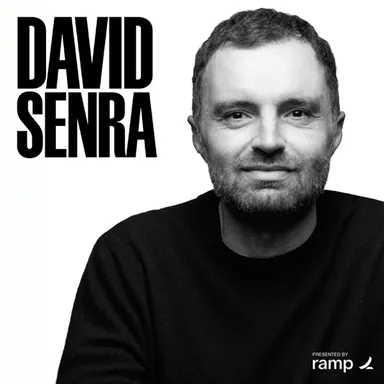
David Senra
David Senra, host of the Founders podcast, talks with great entrepreneurs and investors about how they built their companies.
6 episodes
Episodes


 November 22, 2026 Why Founders Like Jensen Huang Are Irreplaceable | Tobi Lütke, Shopify 1:09:42
 November 18, 2026 Divine Discontent, AI Agents & the Future of Money | Brian Armstrong, Coinbase 1:00:28
 November 15, 2026 What It Means to Be a “Real” Entrepreneur | Michael Rubin, Fanatics 1:08:19
 November 11, 2026 Building Robinhood, Surviving GameStop & A $500 Million Phone Call | Vlad Tenev 1:10:47
 November 8, 2026 How to Win Deals & Grow a $250B Business | Nikesh Arora, Palo Alto Networks 1:02:29
 October 25, 2026 Competition, Intensity & Building a $115 Billion Global Bank | Nik Storonsky, Revolut 1:07:01
About the podcast
An interview show from David Senra, host of the Founders podcast. He announced it in September 2025, nine years after starting Founders, and the first episode, a conversation with Spotify founder Daniel Ek, came out on September 28. Founders kept coming out every week: there Senra retells the biographies of entrepreneurs of the past, here he talks with living ones, "the greatest living founders," as the show's description puts it.
Over the years of Founders, Senra says, he has read about 400 biographies. He calls the new show conversations rather than interviews: each runs about an hour and a half and is almost entirely about how the guest built their business.
At first episodes came out every other week, weekly from spring 2026, and since the fall twice a week, on Wednesdays and Sundays. Guests include Michael Dell, Brad Jacobs, CAA co-founder Michael Ovitz, James Dyson, Tobi Lütke, Jimmy Iovine, Jason Fried, Marc Andreessen, Evan Spiegel, UFC CEO Dana White, producer Rick Rubin, Pixar co-founder Ed Catmull, Sam Altman, Travis Kalanick, Doug Leone, Ari Emanuel, Nik Storonsky and Vlad Tenev.
Memes
Running jokes, catchphrases and pet topics: what listeners know the show by.
The single most powerful pattern I have noticed
Senra's favorite quote, from Peter Thiel's Zero to One: successful people find value in unexpected places because they think about business from first principles instead of formulas. It came over from Founders with him.
Focus
If he had to boil the 400 biographies he's read down to one word, Senra says, it would be "focus": the best founders spend their time only on what makes them great.
Steve Jobs
Senra has read every Jobs biography and made about 40 Founders episodes on him and the people who influenced him, so comparisons with Jobs come up in every conversation.
How X Works
On Founders, Senra has episodes on how a particular person works, drawn from their own words and interviews. When he runs out of time with a guest, he promises to come back and record a "How X Works" with them.
The Defiant Ones
Senra keeps bringing up Jimmy Iovine and The Defiant Ones, the documentary series about him and Dr. Dre, which he considers one of the best films about entrepreneurship. Iovine has been on his show, and Senra happily retells advice he got from him over lunch.
The next 30 to 40 years
The legacy test Senra puts to founders: do I want to spend the next 30 to 40 years on this, or will I get to the end and realize I wasted my life?
Quotes
On what Nvidia makes
“Nvidia's product is that it takes essentially rocks and makes them think.”
On what's left after a founder leaves
“But really, in all situations, you're having a transition from one thing to another, and the company that was under the founder ends the day the founder is no longer in charge.”
On markets
“Markets are the original form of superintelligence. We are all part of markets that are vastly more intelligent than us.”
On why AI disappoints developers
“My main advice, when people are not quite able to get all the value out of this AI-driven development, it's usually insufficiently ambitious prompting.”
On how to think about AI
“I think AI is best thought of as an instrument.”
On the gap between agent users and everyone else
“I think it's the biggest gap of productivity that's ever existed in any industry, even in any time, probably.”
On who's to blame when computers frustrate you
“If you want to throw a computer across the room or in a garbage bin or so, that is not your fault. That is the computer's fault.”
How Armstrong stopped fearing hard conversations
“And so I remember writing this down a lot. It was like, I love conflict, I love conflict, I love conflict, right?”
Hosts and guests
Sponsors of the podcast
All sponsors AppLovin
 Deel
 Router by Ramp
 WorkOS
 Ramp
 Dots
Mentioned in the episodes
 Steve Jobs
 Shopify
 Amazon
 Elon Musk
 Tobi Lütke
 Revolut
 NVIDIA
 Meta Platforms
 ChatGPT
 Jeff Bezos
 Andrew Carnegie
 Michael Dell
 David Heinemeier Hansson
 Omarchy
 Claude Code
 Sam Altman
How the transcripts were made
How the sieve works6 episodes, 6 h 39 min of audio, 0 words of the original.
- Sources of the text
- the show's automatic transcript — in 2 of 6 episodes
- our own speech recognition, Fluid Speech Pro, which gives the timecodes🤗 — in all 6 episodes, 19 min, 21× faster than real time
- a second recognition, Qwen3-ASR, in full🤗 — in 5 of 6 episodes
- Qwen3-ASR for the ads and the parts without an official text🤗 — in 1 of 6 episodes
- YouTube's automatic captions — in 2 of 6 episodes
- speaker labels by pyannote🤗 — in all 6 episodes, 47 min
- machine time on Apple M4
- Checking
- 2,950 disagreements between the sources resolved by meaning and by ear. 58 places left to check by ear.
- Claude
- 119 million tokens: checking, translation, summary, chapters, notes. Of them 98% is re-reading text already loaded; 791K tokens written.