

David Senra
Chapters
Writing down a goal, or "I love conflict," again and again keeps it top of mind and over time changes how you act, Armstrong says.
Read the chapter- Armstrong sees no magic in it: repeat something often enough and it stays top of mind, so you notice chances to move toward it; he compares it to updating the weights of a neural network.
- In his twenties he wrote down that he wanted to start a billion-dollar tech company, though he hadn't built even a hundred-dollar company; six or seven years after moving to Silicon Valley he had done it.
- As a new CEO he avoided hard conversations, then used "I love conflict" to retrain himself to see them as a step toward the goal and to use anger as fuel for change.
- When he tells a team directly that the work isn't good enough, people thank him later, because everyone already sensed it was going the wrong way.
The best are never satisfied with their work, and Armstrong's goal is not happiness but fulfillment through hard work.
Read the chapter- Every day Armstrong pings 30–40 people about what is slow or broken in the Coinbase app, and he doesn't believe he'll ever consider it done.
- Senra calls this, in David Ogilvy's words, divine discontent, and tells how the pickiness of Ramp cofounder Karim Atiyeh, who likes almost nothing, led him to Profound and into its funding round.
- Armstrong barely celebrates wins and goes straight to "what's next," and in the morning he deliberately primes himself by repeating what he wants to believe.
- To him happiness is a fleeting high, while fulfillment comes from hard, meaningful work; life is like a video game where easy is boring.
- Senra retells how Daniel Ek pushed Dara to take the Uber CEO job by asking him since when life was about happiness rather than impact.
For Armstrong, business is the same strategy game as Civilization, only played over decades.
Read the chapter- Gather resources, build industry, expand: Armstrong's brain got hooked on it in Civilization and StarCraft.
- A printout of the Civilization tech tree hangs in his home office, and as a kid he wanted to add his own leaf to that tree.
- In one game he handed discoveries to a weak rival on another continent to keep his future main enemy busy.
- AI lets one person do more, but to get further Armstrong had to learn to work through people; Coinbase now has about 4,000 employees.
Coinbase moved from prompts to agents that own a whole area, and Coinbase Brain gathers the shared context they work from.
Read the chapter- The agent gets an area, say onboarding in different countries, studies the data itself and comes back proposing to start with opportunities one, two and three.
- An expensive frontier model does the planning, subtasks go to cheaper models, and most employees use "auto" mode, which picks the model for them.
- A small open-weight model fine-tuned on internal data writes compliance reports better than frontier models, Armstrong says, and open-weight models also tend to be faster and cheaper.
- Armstrong rates agents as L5 or L6 employees you can have in almost unlimited numbers, and notes that AI isn't a human, just as a submarine isn't a fish.
- In Coinbase Brain every employee, team and repository has a "brain" into which lessons from tests, outages, meetings and code reviews are distilled every night; people edit it and resolve contradictions.
When dozens of agents work for you, you need a prioritized decision queue rather than chats, and what protects the business is what can't be prompted into existence.
Read the chapter- Armstrong has seven or eight lead agents, each of which may have three to five subagents, with a chief of staff above them all.
- Decisions arrive in one format on one screen, and Armstrong answers with hotkeys and by voice, as if clearing email.
- He sees the next level as a VP-level agent you tell to "go launch in Brazil" and check on once a quarter.
- Software is ever easier to prompt into existence, but regulatory licenses, funded customer accounts, liquidity and USDC's network effects are not.
- A Coinbase prototype of a company operating system shows priorities, projects and the critical path, and suggests on its own how to rescue a lagging area.
Agents working across companies will need their own markets and stablecoin money, and AI itself, Armstrong argues, has to be decentralized.
Read the chapter- Just as people form teams, companies and countries, agents working across companies will need markets and financial infrastructure.
- At first agents pay by credit card, but stablecoins, Armstrong says, will become their real-time payment rails.
- In ten years, Armstrong predicts, 99.999% of transactions will be agent-to-agent, and Senra likens that economy to a world with a trillion people instead of 8 billion.
- Armstrong's bad scenario is one or two players with too much control; the good one is many small open models and a choice, like FedEx versus UPS.
- Banks are afraid to let AI near accounts, while Coinbase wants to be the most AI-friendly financial account and do it safely, as it did with crypto.
- Senra compares an agent that works on a task for a year to the hundred soldiers President Polk sent to take California.
Coinbase is rewriting vendors' software in-house, because vendors are one of its biggest risks as attacks keep growing.
Read the chapter- Cyber incidents in both crypto and traditional finance roughly double every year, Armstrong says; the industry dubbed October "Black October."
- Frontier agents review every line of code before it ships, and 99% of the crypto is kept offline, distributed around the world.
- Coinbase has less control over vendors, so it is cutting their number by rebuilding services in-house.
- Building is so exciting for Armstrong that he can't sleep, and he calls this moment a golden age.
Fear of change is an evolutionary trait, but rules against imagined risks can kill a whole industry, so Armstrong says to see what happens first.
Read the chapter- In Armstrong's view, people who feared change were more likely to survive, and society needs only a few who are excited by the new, or there would be chaos.
- Armstrong recalls an Amazon board member's point that almost everyone who worries about Amazon uses it; the same goes for AI.
- Senra retells Andreessen's stories about "bicycle face" and girls riding to the next village, and Armstrong recalls the congressional hearings on violent games like Doom and the push to ban cryptography.
- Rules against imagined risks, Armstrong argues, can kill a whole industry, as happened with new nuclear plants.
Armstrong isn't selling his agent tools yet, since generalizing them for other companies is many times harder, and he thinks revenue from the productivity gains is simply lagging.
Read the chapter- According to Senra, DHH wants to buy Shopify's internal AI tools, Ramp has started selling its own, and Bending Spoons and Long Lake prefer to buy companies and roll their tools out inside them.
- Building a tool for any company, Armstrong says, is 10–50 times harder than building one for your own, and coding harnesses will end up open source anyway.
- What Coinbase built for itself became Coinbase Developer Platform; about seven of the world's largest banks build on it, and Armstrong expects it to become Coinbase's AWS.
- Armstrong tries not to launch new products and to make the existing ones more efficient instead.
- Productivity is up but revenue isn't yet; Armstrong thinks it's a lag, not a Red Queen race where everyone runs to stand still.
Fintech's real rival is traditional finance, not other fintechs, and only a dramatically better product will make people switch.
Read the chapter- All fintech companies together capture about 4% of global financial services revenue, and Armstrong agrees with David Vélez that the big opportunity is taking share from traditional finance.
- For Armstrong the agentic economy is a blue ocean of unknown size, where crypto is the rails and AI is the interface.
- People don't change habits for years and pay rent with paper checks, and corporations, according to a founder Senra knows, stop looking once they've found a solution.
- Slightly better isn't enough, it has to be dramatically better; Armstrong thinks an account you can fully run through an AI agent will be that, and the agent itself can help you switch.
Armstrong lays out four levels of investing with AI, from a single stock order to an adviser who comes to you with ideas.
Read the chapter- At level one, as today, you have to know yourself which asset, which order type and how much.
- At level two you set a target, say 10% of the portfolio in Meta, and build the position gradually, buying the dips.
- At level three you describe a thesis about the world, such as a looksmaxxing boom, and get a basket of assets like Eli Lilly and Novo Nordisk with take-profit and stop-loss orders.
- At level four you consult an agent the way you'd consult a smart friend, or copy the trades of traders on a leaderboard; everyone gets a private banker, once available only to the rich.
AI still lacks hands, and Armstrong improves the Coinbase app together with agents that also bring him ideas of their own.
Read the chapter- AI is still just software, and with humanoid robots, Armstrong says, it could build factories and run biolabs.
- NewLimit, the biotech Armstrong cofounded, will let robots into the lab only once they can do the barista job and make espresso.
- The "Retail App Quality" agent suggested the post on X asking customers about problems with the app; it pulled out the top five issues and put five workers on them.
- Sometimes Armstrong nudges the agent, sometimes the agent comes to him with something it found in the data.
Quotes
How Armstrong stopped fearing hard conversations
“And so I remember writing this down a lot. It was like, I love conflict, I love conflict, I love conflict, right?”
Brian ArmstrongRead from 02:09On the point of life
“So the point of the game of life is not happiness, and it's not comfort or anything like that. It actually should be difficult. It's like a video game: if it was easy, it'd be boring, right?”
Brian ArmstrongRead from 09:20How Daniel Ek talked Dara Khosrowshahi into running Uber
“And so his whole thing is like, yeah, you should optimize for impact over happiness.”
David SenraRead from 09:41On whether AI is like a human
“AI is not exactly like a human. It's kind of like a submarine is not exactly like a fish, right?”
Brian ArmstrongRead from 20:09On what you can't prompt into existence
“Like, software is getting easier and easier to prompt into existence, but regulatory licenses are not.”
Brian ArmstrongRead from 27:13On why people don't leave their banks
“So in the real economy, if you have a bank, if you've been with, whatever, JPMorgan or whatever, it's like, why would I even change? It's like, yeah, you have to wait till these people die.”
Brian ArmstrongRead from 52:39On what will make customers switch banks
“And by the way, your agent might help you switch.”
Brian ArmstrongRead from 52:55On when robots will come to NewLimit's lab
“It can't do barista yet. So once it can do barista, I think we'll start testing it in the biolab, but we're not there yet.”
Brian ArmstrongRead from 57:34
Summary
David Senra sits down with Brian Armstrong, cofounder and CEO of Coinbase, for the second time, and builds the conversation around his recent posts on X. They start with how Armstrong rewires his own habits: in his twenties he wrote down over and over that he wanted to found a billion-dollar tech company, and as a new CEO he trained himself to face hard conversations by writing "I love conflict." The Coinbase app always feels broken to him, which Senra calls "divine discontent," and Armstrong sees the goal of life not as happiness but as fulfillment. He learned a lot about strategy from Civilization: a printout of its tech tree hangs in his office.
The core of the episode is how Armstrong works now. At Coinbase an agent gets not a prompt but an area of responsibility: Armstrong himself has seven or eight lead agents, each with its own subagents, plus a chief-of-staff agent, and he works through decisions in a prioritized queue, answering by voice. An internal system called Coinbase Brain builds a "brain" for every employee, team and repository, and small open-weight models fine-tuned on internal data beat frontier models at narrow tasks such as compliance reports. Agents, in Armstrong's view, are already L5-level employees, and in ten years 99.999% of transactions will be agent-to-agent, settled in stablecoins. That is why AI, like finance, has to be decentralized, and why Coinbase wants to be the most AI-friendly financial account.
Then: why people fear the new, from "bicycle face" and the congressional hearings over Doom to the precautionary principle, which Armstrong believes stopped the US from building nuclear plants. Coinbase is cutting back on outside vendors as cyberattacks double year over year, and it's in no hurry to sell its AI tools, since generalizing them for other companies is many times harder. The productivity gains haven't reached revenue yet, but the real prize is the 96% of financial services revenue still held by traditional players. Armstrong lays out four levels of investing with AI that end with a private banker in your pocket, and explains why his biotech company NewLimit will let humanoid robots into the lab only once they can work as baristas.
Advice
If you dread hard conversations, retrain yourself: write down again and again that you love conflict, and learn to see each such conversation as a step toward your goal rather than a source of stress.
Tell your team plainly when the work falls short of the bar, and set a deadline: people usually sense things are off already, and after an honest conversation they double down.
Give AI agents an area of responsibility and a goal rather than one-off prompts: let them study the data and come to you with proposals, while you approve and steer.
For narrow, repetitive tasks, fine-tune small open-weight models on internal data: they can beat frontier models, and they're faster and cheaper.
Cut down on outside vendors: they are one of the biggest cybersecurity risks, and with AI much of what they do can now be rebuilt in-house.
Don't rush to turn internal tools into products: making them work for any company is 10–50 times harder, and the effort is better spent on your own products.
Mentioned
 Tobi Lütke00:02retrained himself to love public speaking by writing it down every day
- Founders03:40Senra's other podcast; Armstrong listens to it at the gym
 Enzo Ferrari04:04talked about his cars like a lover
 Steve Jobs04:04an example of passion for one's product and the author of the "bicycle for the mind" metaphor
Show 39 more mentionsShow fewer mentions
 Coinbase04:48Armstrong's crypto exchange, whose app always feels broken to him
 David Ogilvy05:22coined "divine discontent," a phrase Senra loves
 Karim Atiyeh05:33Ramp cofounder who likes almost nothing
 Ramp05:33uses Profound and sells its internal AI tools
 Profound06:12the startup whose round Senra got into thanks to Karim
 Daniel Ek09:41talked Dara Khosrowshahi into running Uber
 Dara Khosrowshahi09:41left Expedia for Uber after a talk with Ek
 Uber09:41"one of the most important companies in the world," in Ek's words
- Sid Meier's Civilization12:40the game that taught Armstrong strategy; a printout of its tech tree hangs in his office
- StarCraft12:40a strategy game Armstrong played growing up
- The Battle of Polytopia13:11a strategy game whose world championship Coinbase sponsored
 USD Coin (USDC)27:13a stablecoin with a strong network effect, a defensible part of Coinbase's business
 OpenClaw27:55the agent that, Armstrong says, pioneered the chief-of-staff idea
 Scott Wu33:47expects agents that work on a task for a whole year
 Cognition33:47Scott Wu's company
 James K. Polk34:19the president who sent a band of men to take California
 Nikesh Arora35:32told Senra about the rise in cyberattacks
 Sam Altman38:14Senra asked him why everyone uses AI and everyone hates it
 ChatGPT39:40used by about a billion people a week
 Amazon40:13people worry about it and almost all use it
- Pessimists Archive40:49an archive of fears about new technologies
 Marc Andreessen41:10told Senra about "bicycle face"
- Doom41:54the violent game Armstrong's mom was scared of
 Nuclear Regulatory Commission (NRC)42:47the regulator under which the US stopped building nuclear plants
 David Heinemeier Hansson43:36wants to buy Shopify's internal AI tools
 Omarchy43:36the Linux setup DHH and Lütke work on between races
 Shopify43:56builds internal AI tools and doesn't want to sell them
- Coinbase Developer Platform45:56Coinbase's infrastructure, which seven of the world's largest banks build on
 Amazon Web Services46:22the model for what Armstrong wants Coinbase Developer Platform to become
 David Vélez49:42first told Senra that all of fintech is a few percent of the market
 Nubank49:42David Vélez's digital bank
 Nik Storonsky49:42confirmed that fintech is less than 10% of the market
 Revolut49:42Storonsky's fintech company
 Codex51:56Profound's engineers jump from it to other tools
 Claude Code51:56the tool engineers switch to the next day
 Eli Lilly54:22the largest maker of GLP-1 drugs, an example of a looksmaxxing bet
 Novo Nordisk54:22the second-largest maker of GLP-1 drugs
 Micky Malka56:28"fintech put a bank in your pocket, AI will put a banker there"
 NewLimit57:34Armstrong's biotech company, waiting for robots that can make coffee
Sponsors of the episode
 Router by Ramp10:11picks the most cost-effective AI model for every request to cut inference costs
 Deel11:07hiring, paying and managing workers anywhere in the world
 AppLovin23:32ads in mobile games reaching more than a billion people
 WorkOS37:13single sign-on, SCIM, audit logs: getting software enterprise-ready
- Founders1:00:09Senra's other podcast, about the biographies of entrepreneurs
Transcript
01Rewriting your own habits
Writing down a goal, or "I love conflict," again and again keeps it top of mind and over time changes how you act, Armstrong says.
I wasn't expecting to start here, but we were just talking before we started recording, and we were talking about brainwashing ourselves into behavioral change, things that we want to change about ourselves. We were talking about when I had Tobi Lütke1Tobi Lütke — cofounder and CEO of Shopify, the Canadian e-commerce platform; he has been a guest on this show. on the show. Yeah, and he said he used to be terrified of public speaking. And he would write down, I think, every day for like 10 minutes that he loves public speaking, and now he loves public speaking. He's talking about you can literally change the way you think and feel. And you're like, yeah, I resonate with that.
I think he's right. I mean, I've definitely experienced in my own life where, you know, I'll write down something that's like a goal or something I'm trying to work on. And I think some people have this kind of woo-woo thing about it, they're like, oh, you're manifesting something in the universe. I think it's actually much simpler than that, which is just: if you repeat something often enough, it's top of mind. And so during the day, you start to notice opportunities that might help you move a little closer to that, or practice it. And it's just a way of keeping things top of mind.
I guess another mental model of this would be like, you know, your brain is like a neural network, and every time you reinforce something, it just updates the weights in your model,2Weights — the numerical parameters of a neural network that change during training and determine how it responds. kind of like an AI model. And so it's literally just repetition. I mean, people have known this for thousands of years, right? Like prayer and meditation and repetition just strengthens the neural pathway. I don't know if that's accurate from a neuroscience point of view, but it's sort of a metaphor of how I think about it.
So some of the examples for me: I mean, in my 20s, I remember writing down, like, I want to start a billion-dollar tech company. And I didn't even have any business writing that down, because I had never started a million-dollar tech company or a hundred-dollar tech company. But I wrote that down a lot, and I was like, okay, I was starting to look for ideas and opportunities and try things. Some of them worked, some of them didn't. And, you know, then I moved to Silicon Valley when I was maybe 29. And within six or seven years, I was the founder of a billion-dollar tech company, right? So that was interesting.
And then early on as being a CEO, I think I was pretty conflict averse, right? And sometimes being CEO, you have to have just hard conversations with people all the time, right? It's like, these two people aren't getting along, you got to fire this one, you've got to go make a hard call. And so: who do I want to disappoint today? Because only the biggest problems come to you. Hopefully the rest are getting delegated.
And I started writing this down at one point. I was like, I need to reprogram my brain to not think of this as super stressful, but think of it as it's me getting valuable things done to move forward towards the goal. And so I remember writing this down a lot. It was like, I love conflict, I love conflict, I love conflict, right? And it doesn't mean I go out and actively seek that, just to piss people off or whatever, but if it does happen, I can get somewhat excited about it now. I'm like, okay, I'm about to do something difficult and meaningful, and let's move it forward.
Or if I'm in a meeting with the team, and I'm like, the work is not good enough, there's something wrong here, like, I'm feeling myself getting angry, I'm like, how can I use this as an empowered anger to actually help create change that'll create a better outcome? So anyway, those are some things I've written down and practiced.
Let's say you're in a product review meeting and you think the work is not high quality enough. You would previously suppress that anger.
Yeah, I think I was afraid of big emotions and saying something I would regret. And so I was kind of bottling it all up inside. People could kind of tell sometimes, too, and I'd be like, okay, guys, I think that this could be a little better, you know. And I sort of became more comfortable with it over time, right? And was like, look, this isn't good enough.
It's not meeting the bar. Change it by the time I meet with you tomorrow. Or maybe you're not the right person to work at this company, or whatever it is, right? And people sometimes afterwards will send me notes and say, thank you for saying that. Like, we could all sense that this thing wasn't going the right direction, and we're fired up, we're on it, and we just redoubled our effort, right?
Yeah, people respond to emotion. Like, if you're in a meeting, you're the leader of the company, and you're actually angry, and maybe even pounding the table, it's like, oh, he cares about this, it's very serious to him. The way I think about this: we talked... I think I saw you in New York like two months ago, and you're like, dude, I listen to your other podcast, Founders,3Founders — the podcast Senra has hosted since 2016: each episode retells an entrepreneur's biography and draws lessons from it. in the gym. And then me and you had dinner two weeks ago, and you're like... I'm like, I listen to Founders in the gym.
There is like a hype. It's almost like I'm transferring the emotion and the excitement that I have from this crazy life story of this entrepreneur to the listener. Yeah. And one way I think about this that I think is really important is, like, the people I admire, the way they talk about their products, like Enzo Ferrari4Enzo Ferrari (1898–1988) — Italian racing driver and founder of Ferrari; Senra has devoted episodes of Founders to him. or Steve Jobs. I think I said in the Enzo Ferrari episode, it's like he's describing the products the way you talk about your lover. Like, this is not a fucking car to him. In my own work, I'm like, listen, I want to be embarrassingly passionate about what I'm doing. Yeah. I think that's like the mark. It's like: am I embarrassingly passionate? We were talking right before we started recording. It's like, these aren't interviews, these are conversations.
And everybody's like, well, how do you pick who's on the show? It's just, like, a simple equation: who am I intensely interested in talking to?
02Divine discontent
The best are never satisfied with their work, and Armstrong's goal is not happiness but fulfillment through hard work.
Yeah. That's it. I don't know if you feel this way about your work, but I kind of always feel like it's not good enough, right? Like, I'm constantly stressing about things in the Coinbase app,5Coinbase — the largest crypto exchange in the US. Armstrong founded it in 2012 with Fred Ehrsam, and it went public on Nasdaq in 2021. like, oh, this thing sucks, it's too slow, it's broken. Why doesn't this feature work? And I'm kind of obsessive, it stresses me out, but I use that as motivation and fuel, right? And I'm pinging, you know, 30 or 40 people a day about, like, how's this part moving along? Why isn't this part... you know, and trying to create that sense of urgency in the company. But I don't think I'll ever feel like it's done or good enough. Like, to me, it's still so broken based on what it could be.
You know, all the top performers are like this. David Ogilvy6David Ogilvy (1911–1999) — British advertising man, founder of the agency Ogilvy & Mather and author of Confessions of an Advertising Man; he is called the father of modern advertising. has a great line describing these people that are just creating some of the greatest art, greatest products, greatest ads, greatest companies: they're divinely discontent.7Divine discontent — a permanent dissatisfaction with what you've done that pushes you to do better; Senra often quotes Ogilvy on it.
Yeah.
And I was just on the phone with my friend Karim Atiyeh,8Karim Atiyeh — cofounder of the fintech company Ramp and for many years its CTO. who is the co-founder and co-CEO of Ramp.9Ramp — an American fintech company founded in 2019: corporate cards, expense management, accounting automation. And he's like this. Every time I'm in Miami, we spend a bunch of time together. And to the point where I actually... I guess I'll tell the story, but I accidentally made a bunch of money, because I was at Karim's house for dinner, and it's always like, it doesn't matter how fast the company's growing and that they're creating all these new products, it's just like everything's fucking broken to him. He doesn't like anything going on in his company, which again, that's very common, because you see the real thing. But then he also has a very high bar.
He doesn't like other products, doesn't like other founders. And I remember hitting the table at dinner, I was like, goddamn it, just tell me who you actually like. Because I'm like, if you hate everything... Tell me something you like. And he told me about this founder named James, who did this company called Profound.10Profound — an American startup that tracks how AI models and chatbots mention brands and products. Its cofounder and CEO is James Cadwallader. Okay. And so I pull up X, and I was like, all right, I got to see... If Karim is saying this guy's good, and Ramp uses the product, and he likes it, that's a good signal.
And I see the guy had already followed my Founders podcast account. So I immediately follow him back, and then he hit me with a DM. He's like, dude, I've been listening to your podcast forever. And he's like, we're about to close a round, do you want to? Do it fast. So Karim's divine discontent accidentally made me a bunch of money. I love it.
It's one thing to be perpetually dissatisfied and never satisfied, but not, essentially, turn that into this negative inner monologue. So what's it like for you? Like, okay, I'm pissed about all these things that need to be better in the Coinbase app, but how is it internally? Like, are you super negative to yourself for letting that happen? Or is this more motivational, to improve?
What is my inner self-talk? I mean, sometimes I'm choosing consciously what my self-talk is, right? Like, in the morning when I wake up, I'm trying to get my head right for the day, and do some stretching, do some exercise, listen to, you know, listen to Founders, listen to audiobooks, and jumping in and starting to do some calls and work. I'm basically repeating things that I want myself to believe and feel. Even if something doesn't go well, I'm not beating myself up about it, but I'm just like, fuck, we got to make this better, and let's get after it. And I'm always thinking, like, what's next? What's next?
Even when something goes super well, I often don't really take a moment to celebrate very well. I'm just like, cool, that was great, what's next? What's next? You know? So I don't know, somebody could say, well, that's not being, you know, in the Buddhist sense, present in the moment and appreciative, but I also think it's fulfilling over time to try to go do things that you want to go do.
And I do feel a deep sense of fulfillment over time. At any given moment, it can feel like, man, I got my ass kicked today, or, like, that was pretty good, a bunch of cool stuff happened. But over the arc, I think the goal to me is fulfillment. It's not happiness or something. And you're not going to be getting fulfillment out of doing something that's easy, right? If I was just chilling all day, I don't think I'd feel very fulfilled by that.
Well, tell me the difference between fulfillment and happiness, though.
I think of happiness as kind of like a fleeting, temporary high or something like that, but fulfillment is like a deep satisfaction that can come from, I don't know, doing meaningful work, having meaningful relationships, seeing things progress over the long arc, being useful in the world. Like, that's probably one of my values, right? Is, like, I think everybody should try to contribute to civilizational progress and, you know, help our fellow people. There's a sense of fulfillment that comes from that. And that's a high bar, by the way. I mean, you can do it in small ways. Like, you can just, I don't know, cheer up somebody by saying thank you, or you could try to make a new financial system for the world that's more fair and free and efficient or whatever, you know.
Which is your mission.
Yeah. And try. But, you know, I think we're like 1% of the way there. It's like a massive thing, right? So the point of the game of life is not happiness, and it's not comfort or anything like that. It actually should be difficult. It's like a video game: if it was easy, it'd be boring, right? So you want to lean into things that are outside your comfort zone continually to try to make progress, and that's a sense of fulfillment.
Yeah, there's a great story that Daniel Ek,11Daniel Ek — cofounder of Spotify, its CEO for almost twenty years and executive chairman since 2026. His conversation with Senra opened this show on September 28, 2025. founder of Spotify, told on the very first episode I ever did of this show, where Dara12Dara Khosrowshahi — CEO of the travel company Expedia in 2005–2017 and CEO of Uber since 2017, when he replaced founder Travis Kalanick after a string of scandals. was offered the job as CEO of Uber. And I think originally he said, you know, I'm comfortable with Expedia, or wherever he was. And him and Daniel were having drinks, and Dara tells the story where it's like Daniel put his drink down and looked at him, he says: since when is life about happiness? It's about impact. He's like, this is one of the most important companies in the world, and you can have an impact on it. And so his whole thing is like, yeah, you should optimize for impact over happiness.
AdRouter by Ramp, Deel
One of the things I love about Ramp is their mission is easy to understand. They want to help your business save time and money, and that is why they have built Router.
Do me a favor: while you're listening to this, go to router.com. Router was built to reduce your company's inference costsaInference — running an already trained AI model: every answer it gives to a request. It is billed by the number of tokens processed. by matching every request to the most efficient AI model. Router automatically balances cost, speed, and quality of output. Router is built for CTOs and loved by CFOs. Your engineering team gets the best model for every workload, and your finance team gets lower inference spend.
One customer of Router has the perfect description of why your company should be using Router: "Choosing the right model makes a meaningful difference to our AI spend. We run billions of tokensbTokens — the pieces of text (a word or part of a word) an AI model reads and writes in; its work is billed by their number. through Router and have reduced our model costs by 92%." Tokens are money. Save both.c"Tokens are money" — a play on Ramp's slogan, "Time is money. Save both." Router is a Ramp service that routes requests to language models from different developers. And you can do that by going to router.com.
Deel is how the best founders turn the world into their talent pool. I've been studying how history's greatest founders operate for a decade, and one thing they all have in common is they understand that recruiting and hiring the very best talent is your most important priority. A players recognize other A players,dA players — the very best people. The phrase is associated with Steve Jobs: "A players hire A players; B players hire C players." which is why top companies like Ramp, Shopify, ElevenLabs, Uber, and DoorDash all use Deel. Many of the top founders I know have personally invested in Deel after using their product, and what they discovered is that Deel is the best company in the world at building infrastructure for global hiring.
Deel will help your business hire, pay, and manage any worker anywhere in the world, so you can retain the best talent anywhere and spend the rest of your time focusing on what you do best: delivering value to your customers. The founder of ElevenLabseElevenLabs — a company founded in 2022 that makes AI speech synthesis. has a great description of the value Deel can give your company. He said, "We built ElevenLabs to break down language and communication barriers. With Deel enabling us to hire and support exceptional talent anywhere, we can accelerate our innovation and bring more voices, stories, and ideas to every corner of the world." Deel is trusted by over 40,000 companies and growing fast. Learn how they can help your business by going to deel.com/senra. That is deel.com/senra.
03What Civilization taught him
For Armstrong, business is the same strategy game as Civilization, only played over decades.
Going back to when you're upset at the quality of the product, or you see all the flaws and things that can be improved. Take me through how you start thinking about that. You said it's not a negative monologue, but it's just like, are you excited because you see room for improvement? Like, what is the actual response that's happening inside of you?
Some of it is a competitive thing, I would say, with other products that are out there, or, like, how do we make it better? Some of it is just, even if there was no competitor, I think I'd still be pretty motivated to do it, for some reason, because my brain is very obsessed with building things and progress. It's like growing up playing video games like Civilization13Civilization — Sid Meier's series of turn-based strategy games, the first released in 1991: the player leads a people from the Stone Age to the space age. and StarCraft.14StarCraft — a real-time strategy game by Blizzard (1998), one of the most important games in the history of esports. It's basically just: you collect resources, you build industry, you expand to the next thing. It's addictive to my brain. Like, I just can't turn it off.
I don't really play those games now, because I don't have enough time. There are fun games like Polytopia,15The Battle of Polytopia — a turn-based strategy game by the Swedish studio Midjiwan (2016), a simplified Civilization for phones with games that last a few minutes. which Coinbase sponsored the world championship of, which was very fun. You know, I also don't have time to play, but these things are fun for my brain. And so I think those games are scratching the same itch, but they're very short-term. It's like a 20-minute game or something. But in business, it's very much the same thing, but you do it over the arc of decades, or hopefully a lifetime.
So wait, what did you learn from these video games that you applied to building Coinbase?
Civilization is a very interesting game. I don't know how many of your listeners have played it, but there's a tech tree,16Tech tree — the map by which technologies are unlocked in strategy games, each discovery requiring earlier ones. In the first Civilization, for example, monarchy requires ceremonial burial and the code of laws. In the diagram from Freeciv, a free Civilization clone, the arrows lead from a discovery to the technologies it unlocks.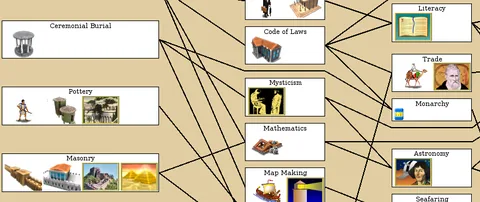 right? I actually have a printout of the Civilization tech tree in my office at home, because I think it's such a fascinating concept. You start... Civilization started with, like, agriculture and writing and pottery, and at the end state, you know, you're doing AI and biotech and, you know, financial markets and nanoscale manufacturing, or even going out into future tech that hasn't been invented yet. And so in some ways, playing that game growing up, I was like, I want to add a leaf to the tech tree and expand it a little bit. Like, civilizational progress is just so fascinating and exciting to me.
And the other fun thing about that game is there's various ways to win it, right? It's not so zero-sum. You can have a military victory and conquer, but you can also achieve a scientific victory, you can achieve a religious victory, a diplomatic victory. So there's different ways to win it. And I'd say strategically... I'll give you one example.
I remember this from a particular game of Civilization I played as a kid, where you're on one continent and you're battling with another civ on that continent, and that's consuming all of your resources, to be on that one frontier. Meanwhile, you notice on another continent one of the civs is starting to take over, and it's going to become massive while you're engaged in this other battle. You have some technologies you've achieved on the tech tree; you can gift them to the weaker opponent on the other continent, so that that battle continues and occupies your future opponent, so they can't get too out of hand and large while you're finishing this battle over here, right? So there's just so many layers to the game. I find it fun, but you can learn some simple strategies from it.
Do you feel, with the proliferation of AI, it's making building and running a business more video game-like?
Kind of, yeah. I mean, you can do more of it solo. Like, there probably are going to be these one-person billion-dollar companies. I don't know if that's actually technically been achieved yet. If not, we're probably close. But yeah, I mean, starting off as a programmer, I was doing lots of solo projects, and, you know, it's good for introvert mode. But I realized at some point, to achieve more and advance in the game of civilization or business or whatever, I had to find teams of people and work with them and empower them. And that is its own whole skill set that can be very frustrating for a nerdy introvert that's like, ah, why do I have to communicate through this channel and get this, you know? If I had just done it myself, it'd be faster.
That's the kind of initial thing a lot of managers struggle with. So, yeah, I really have made peace with that, and Coinbase is, what, 4,000 people now. And we can always be making it more efficient. We should probably talk about how AI is doing that. You can also have a team of agents, right, that are working for you 24/7. And actually, many employees, including myself, have that now at Coinbase, which is its own fascinating thing.
04Give an agent an area, not a prompt
Coinbase moved from prompts to agents that own a whole area, and Coinbase Brain gathers the shared context they work from.
Actually, let's talk about that now. So when we were hanging out a few weeks ago, I was like, dude, I want to do an entire episode, because I've just been loving your tweets. And I was like, this is going to sound weird for an episode, but what if I just read your tweets back to you and then you expand on them? So the first one, this one went viral, it got like a million or two million views, and it starts out with: "I've changed how I work over the last few weeks." So I'm going to read just a paragraph or two.
It goes on for a little bit. But the ending is really interesting: "What an exciting time to push the frontier of productivity, especially as we build the economy for agents and agentic finance.17Agentic finance — financial services in which AI agents carry out transactions on behalf of people or other agents: paying, trading, moving money. We should all keep pushing that direction." So that's where you end. But you were talking about, it's like, hey, "I have one lead agent for each focus area running all the time, and a chief of staff agent18Chief of staff — at American companies, an executive's right hand who runs their priorities, coordinates teams and follows up on decisions. that oversees them. Each lead manages its own subagents that write code, test it, chase reviews, and coordinate with team members." This goes on, and we'll link in the show notes to your tweets. But can you go into "I've changed how I work over the last few weeks" because of AI?
When we first started using AI at Coinbase a few years ago, the normal way people use it is you prompt it and it gives you a response. And what we did was we eventually shifted this to where you give the agent an area of responsibility or a goal, and it can have a team of people or agents under it, and it actually works on that area. And periodically it'll come back to you with important decisions, like, hey, I know you want me to optimize onboarding19Onboarding — a new customer's path from sign-up to first transaction; in finance it includes identity verification. at Coinbase so it works better in all these countries around the world. I looked at the data, I analyzed it, the five biggest opportunities are these. What I'm proposing to do is start with numbers one, two, and three. Do you agree?
I'm like, yep. And I click yes. And so it is coming back to me with ideas about what to work on, and I align it, I'm guiding it, right? Let me pause there.
Yeah. So the quality of the suggestions: do you put it on, like, C player, B player? Like, right now what you're getting... Or you're like, goddamn it, this is like a genius-level employee already.
When you're doing the planning, right, you're typically picking one of the best frontier models,20Frontier models — the most powerful AI models at the cutting edge, such as the latest from OpenAI, Anthropic and Google; usually also the most expensive. that's the most expensive. It's investigating and coming back with higher-level ideas and tasks. Now, as it gets subtasks, it can farm that out to the lower-level models. Most employees are using what we have as, like, auto in there; it's choosing the model for you at this point. Because I think even the overhead of a human being having to choose which model for which task is an unnecessary task at this point.
I should mention one other thing, which was we've been using a lot of open-weight models21Open-weight models — models whose trained parameters are publicly released, so they can be downloaded, run on your own servers and fine-tuned. Examples include Meta's Llama, Alibaba's Qwen and DeepSeek. too, and actually fine-tuning them22Fine-tuning — additional training of a ready model on your own dataset so that it does better at a specific task. to do specific tasks, trained on internal data. And in some cases now we've seen them outperform the frontier models. Like, a much smaller open-weight model that all it can do is file and draft compliance reports23Compliance — meeting the requirements of laws and regulators. In finance this means, for example, suspicious activity reports and anti-money-laundering checks. at Coinbase. That's all it knows how to do, but it outperforms the frontier models, because it has been trained on tons of internal data. So we're getting teams of agents like that too. And those open-weight models tend to be much faster and much cheaper.
Wait, before we go to what the employees have, like, what you're using, your setup, going back to the tweets, like, "I've changed the way I work." So when you're getting these responses back, hey, Brian, this is what you want me to do, this is what I think we should do... The feeling of it is just like, holy... Are you shocked? Or are you just like, okay, this is like a normal, you know, regular employee?
Well, it quickly becomes very normal. I mean, yeah, it's like working with other people.
But the quality of people is what I'm trying to get to.
ExplainerEngineering levels at tech companies
At big tech companies such as Google, Meta, Amazon and Microsoft, engineers move up a ladder of levels, usually an L plus a number; the level sets expectations, salary and equity. Sites like levels.fyi compare these ladders across companies.
- L3 — usually the entry level for new graduates, who get well-defined tasks.
- L4 — an independent engineer who sees their own tasks through.
- L5 — senior engineer: leads whole projects and decides how to do them. Many companies treat it as a "terminal" level: there's no obligation to grow past it.
- L6 and up — staff and principal engineers, who own a direction and shape the work of many teams; the highest numbers are close in rank to vice presidents.
So "an infinite team of L5 employees" means lots of experienced engineers you can hand an entire project to, but not the strategy.
So inside companies, a lot of companies in tech use these levels, like, you come in at level three or something, and a VP will be like level 11. I think these are easily like L5, L6 employees. Yeah, I think you can get almost an infinite team of these L5-type employees now.
Okay. And you think that's as high as it goes right now? You haven't had an experience where it's like, damn, this could be like my right-hand person, or like a direct report running a big part of Coinbase?
AI is not exactly like a human. It's kind of like a submarine is not exactly like a fish, right? In some ways it far exceeds human performance already, in the sense that, well, it works 24/7, for instance, it gives me answers very quickly every time, and it can make infinite copies of itself, right? Or spin up as many of them. So in that sense, it already exceeds human performance. In other ways, it's not there yet.
There are definitely times where it misses the big picture, right? Or it feels a little derivative of other stuff that's out there. The pace of improvement is very impressive. So a lot of people are using the generic models that come off the shelf; they've been trained on the corpus of all the data out there in the world that they can get their hands on, but they're not necessarily tailored to your preferences and your company's way of working.
So what we've been doing, in addition to fine-tuning our own open-weight models for narrow tasks... And by the way, we'll get back in a second to how I think this is going to create a new agentic economy, which is important. But we also are developing this thing called Coinbase Brain,24Coinbase Brain — an internal Coinbase service that Armstrong describes here: a knowledge base for every employee, team and repository that AI agents load into their context. which is a service internally that's getting context.25Context — everything a model "sees" when it answers: the request, documents, conversation history. Its size is limited, so what goes into it matters. And there's a brain now for every employee, every team, and every GitHub repository.26GitHub — a Microsoft-owned service for hosting code and collaborating on it; a repository holds the code of one project. The idea is that as humans are working on these teams and in these GitHub repositories, the brain is accumulating and distilling lessons and knowledge.
There was an A/B test27A/B test — an experiment in which one group of users sees one version of a product, another group a second version, and the results are compared. we ran, there was a user study we ran, there was an incident that happened, an outage, there was a meeting, and there are meeting transcripts. These things can all be ingested: code reviews, you know, these kinds of things, even policy documents that come, you know, like GAAP accounting standards28GAAP (Generally Accepted Accounting Principles) — the US accounting standards that American public companies report under. or whatever. So it can kind of ingest all this material, and every night it sort of pores through it and distills down key lessons and amends it into the brain. Then when the agent goes to work on something in that area, it puts the brains into its context, and it creates output that is more aligned to what we as the company internally are trying to create.
And so our jobs increasingly as human beings are to align the AI29Alignment — an AI term for getting a model to do what people actually want. Armstrong applies it to day-to-day work with agents. by editing and cultivating what's in the brains, and resolving discrepancies. Sometimes the brain has a contradiction in it. It's like, well, you know, David said this, and Brian said this 14 months ago, which one do you want to do? You know, these kinds of things. And it basically improves the rate at which the agents can one-shot the work30One-shot — when a model gets a task right on the first try, without corrections. without a ton of feedback from their human manager.
Now, I should clarify here: the humans are making the final decisions, the humans are making final code reviews. So it's eliminating tasks, and it's getting to the answer more quickly, with less kind of nudging and corrections, but the humans are still very much the ones deciding the direction. And that's our main job now, I think: to align the AIs that are working on the software factory that produces the output.
How do you think about what the brain is? It's just the operating system for the company now?
Yeah, I mean, you could argue that... What is the value of a company? It's a set of practices and people and know-how that have accumulated over time. And in some ways it's formalizing that, codifying it. But yeah, I mean, you still need people to actually go implement the thing, or agents in these cases. So I don't think it's ever going to be done or fully replaced. Like, people have this question a lot: could you run Coinbase with 100 people or something? And I don't know. I mean, my guess is we'll probably keep roughly the same amount of people, but they'll all just be able to do way more. Yeah, we'll see.
AdAppLovin
I found one of my all-time favorite quotes when I was reading the book Zero to One.fZero to One (2014) — a book by Peter Thiel, cofounder of PayPal and Facebook's first outside investor, written with Blake Masters and based on Thiel's Stanford course on startups. The quote says, "The single most powerful pattern I have noticed is that successful people find value in unexpected places, and they do this by thinking about business from first principlesgFirst principles — reasoning up from basic facts known to be true rather than by analogy with how things are usually done. The idea goes back to Aristotle. instead of formulas." That is exactly what AppLovin has donehAppLovin — a Palo Alto company founded in 2012: an advertising platform for mobile apps and games. with their advertising platform. AppLovin connects you with over a billion potential new customers in mobile games.
AppLovin allows you to capture undivided attention. AppLovin ads are full-screen videos that are watched for an average of 35 seconds. That is retention that blows other ad platforms out of the water. And you can launch on AppLovin in minutes. You set the goal, and AppLovin achieves it. No complex setup, no expertise needed. And AppLovin scales quickly.
They can put your ads in front of over a billion potential customers. Other businesses have seen immediate results, scaled to hundreds of thousands of dollars of spend per day, and increased their revenue by millions. So you want to get started quickly, before all of your competitors are on AppLovin. And you can do that by going to applovin.com. That's applovin.com.
05A decision queue instead of walls of text
When dozens of agents work for you, you need a prioritized decision queue rather than chats, and what protects the business is what can't be prompted into existence.
So go back to... You said you wanted to get into the fact that this is going to enable this agentic economy that you think is important.
As you start to get more and more agents that are working with you... By the way, the UI has to change for that too. Because this quickly overwhelmed me once I had more and more of these chat sessions open. There was a lot of context switching, of just going through all these walls of text to see what was going on.
So wait, could you take me into how many of these things you have open at one time? Like, what's going on?
Yeah. Well, right now I have probably seven or eight lead agents that are working on different areas that I'm focused on right now, and then one chief of staff, which kind of oversees them. But each of the leads can spin up agents to do subtasks. So I don't know, it depends if all of them are running, but at any time when one of them is running, it may have like three to five different subagents or something. So it quickly got to a place where I just couldn't keep up with all these walls of text, like, what's going on? So we've built this kind of internal view that we're prototyping, where it's more like a queue or an inbox of things that you need to review and decide.
And they're prioritized, too. So if you have a big backlog of them and you only have five minutes, you can knock out the decisions that would help move the team of agents forward the most, right? So, you know, it might say, here's a product review, here's a couple screenshots of this feature we just developed, and the next step is to do this. And I'm like, yes, no. Or I can do a little voice dictation to give it a couple bits of feedback verbally, which is much faster than typing, right? And so you can say, like, yes, no, no, no, yes, do this one a little bit differently.
Just start knocking out decisions, almost like in your email inbox, right? But using keyboard shortcuts and voice dictation is, I find, faster. And then the agents sort of keep track of all these projects that are going on, and decide who else on the team they should be collaborating with, getting approvals from. So that's reduced a lot of the cognitive overhead.
Why does the UI have to change? Well, I think because you can't just deal with all this wall of text. Yeah. So what's the UI that you want to see?
Well, I think having a queued inbox that you process, that's a prioritized set of tasks or decisions, with very simple... It's like everything just appears in the same screen at the same time, the buttons are in the exact same place, and you say one, two, three. You know, that alone is good. Now, I guess I have been thinking a little bit about what's the next layer beyond that. Because I think it's sort of like getting even higher-level employees up that stack, right? I mean, you might be able to have, like, a VP level or something, where it's just like: I think we need to expand into Brazil. Go do it. I'm going to check in with you every three months.
Like, that would be another layer of the stack, right? Where that person's like, all right, what's the team I need to recruit? Who are the partners I need to go meet with? Where do I need to sign these deals? You know. And there are still some areas which are a little bit difficult to prompt into existence. Like, software is getting easier and easier to prompt into existence, but regulatory licenses are not. You can't prompt those into existence yet, right? KYC'd funded accounts.31KYC (Know Your Customer) — the identity check financial companies are required to run on customers: documents, address, sometimes the source of funds. Like, we have to think about what the defensible parts of the business are in this world, right? Like the liquidity, the network effects32Network effect — a product becomes more valuable the more people use it. For an exchange this means liquidity: the more participants, the easier it is to buy and sell at a good price. from having the most liquid exchange in the US, or USDC33USDC — a stablecoin pegged one-to-one to the dollar. It is issued by Circle; Coinbase launched it together with Circle in 2018 and earns a share of the income from its reserves. has a big network effect, things like that, right? That interface has gotten more and more important.
Who's building the best interface for this?
I mean, a lot of folks are trying it, right? You've seen, like, Clawdbot34Clawdbot — the original name of OpenClaw, the open-source personal AI agent by Austrian developer Peter Steinberger (November 2025). In January 2026 the project went viral and, after a trademark complaint from Anthropic, was renamed Moltbot and then OpenClaw. kind of, I think, pioneered this chief of staff idea with all the different folks. I haven't seen somebody do the prioritized inbox kind of queue thing yet, but I'm sure there's other people playing with these ideas. We're working on a little prototype too of almost like an operating system for the company that all employees could jump in and view. And it's really just like, okay, what are our top priorities? What are all the projects that are contributing to that?
You can drill down and say, what are the subteams, what are the individual people, what are each of the tasks that they're working on, who needs to sign off on what? What's the most important thing at any given moment, you know, or what is the critical path?35Critical path — a project management term: the longest chain of interdependent tasks. It sets the length of the whole project, since any delay on it pushes back the finish. Like, from here to there, what is the longest set of dependencies? Who's working on them? The AI could even come back and say, here's the biggest risk in the company: this is a critical dependency for 14 downstream things, and right now it's understaffed, and its velocity is below the average of the company.

And it's like: proposed solutions. Move David over to that team. Number two, change out the leader. Number three, change the strategy. Number four, narrow the scope. And it's like, I recommend number three. And you're like, yes. And it just does it. And, you know, so you can get to a world where... It's like Steve Jobs's bicycle for the mind36"A bicycle for the mind" — Steve Jobs's famous metaphor. In efficiency of locomotion humans lose to many animals, but on a bicycle they beat them all; the computer is the same kind of bicycle for thinking. type metaphor. This is allowing people to have much, much greater productivity. As the models get better, they'll start to be that VP level.
06An economy where agents pay
Agents working across companies will need their own markets and stablecoin money, and AI itself, Armstrong argues, has to be decentralized.
I was going to say earlier, you know, on coordination amongst agents: if you think about it, this is all happening within one company right now, but agents are also starting to interact with other companies. And so you can kind of think about the metaphor of: there's an individual person working by themselves on something. Now you can get to a small team of people; you can get more done than the one person. Hopefully, at a company, you can get more done than a team. A country could get more done than just an individual company. Hopefully the whole world, collectively, humanity, we can actually get even more done than one country, because there are lots of dependencies between countries, like trade. And so, yeah, I mean, how do we start to get an economy, or teams of agents, working efficiently? We're seeing it now within one company, but as they start to interface with other countries or companies, they're going to need their own markets and financial infrastructure.
Like, that's actually how you get 8 billion humans on the planet to all, in some sense, collaboratively create an economy for the world. They need markets, they need money, they need specialists, right? Who can come together, like a great security person, a great designer, a great financial analyst, a great product person, and then come together on a team to achieve more than the sum of the parts. So that's kind of what we're doing now with building agentic finance and the payment rails for that.37Payment rails — the infrastructure money moves over: the Visa and Mastercard card networks, bank transfers, blockchains. I think credit cards are playing a role early on, where it's like, hey, buy me this pair of shoes or book me this plane ticket. Credit cards have a lot of importance for backward compatibility, but it's also going to be stablecoin rails on crypto.38Stablecoin — a cryptocurrency pegged to a regular currency, usually the dollar, and backed by reserves. The largest are Tether's USDT and Circle's USDC. And I think that's going to be the real-time payment rail for the agentic economy.
But if you can spin up an infinite amount of agents, and you actually have a functioning agentic economy, wouldn't that economy dwarf... It would be much larger than our existing human-based economy, right? Or no?
ExplainerHow agents pay each other
Card payments were designed for people: the buyer enters card details and confirms the purchase, the merchant pays a fee (in the US usually 2–3% of the amount plus a fixed charge), and the payment can be disputed for a long time afterward. For an agent making hundreds of purchases of a few cents each in a minute (an API call, a page of data, a minute of another model's work) that is too expensive and too slow.
Stablecoins such as USDC solve this differently: a digital dollar moves from wallet to wallet in seconds, around the clock and with no bank in between, and on fast blockchains the fee is a fraction of a cent. An agent can be given a wallet with limits set by a human.
To make such payments easy to build into the ordinary web, Coinbase proposed the open x402 protocol in May 2025. It revives the HTTP 402 Payment Required status code, reserved in the HTTP standard back in the 1990s but never put to use: the server tells the agent what a request costs, the agent pays in stablecoins on the spot and gets the response.
Yeah. I mean, someone was asking me today, like, what percent of transactions in global GDP do you think will be agent-to-agent in 10 years? And I was like, five nines,39Five nines — a reliability engineering term: 99.999% uptime, that is, no more than about five minutes of downtime a year. you know, 99.999 or whatever. So I think that tipping point could happen sooner than we think. But yeah, what was the follow-on question? Like, you're wondering what's the implication of that, or... yeah, what?
Oh, just like... Because you spend all day... I think you had another tweet I'm going to ask you about, you're like, I wake up every morning thinking about agentic finance. I wake up every morning thinking about podcasts.
Yeah. So, like, a little different.
Both doing what we should be doing. Yeah. So I'm just like, okay, well, if I'm trying to process what you're saying, where you're like, okay, well, every agent can spin up an infinite amount of agents and copies, as much as it wants. And then if you do have one where it's kind of, you know, free-functioning, you don't need a human in the loop,40Human in the loop — a setup in which the AI takes no important action without a human's approval. well, then they can make way more transactions. It's like the economy would be bigger if instead of 8 billion people, there were a trillion people. So why wouldn't that be the case, if you can actually build what you're talking about building?
Yeah, I think that's exactly right. And that's why I'm so excited about it. And I think crypto and AI really are better together in this world. You could say that what Coinbase is doing now is we're taking frontier technologies like crypto and AI, using that to build better financial services, and ultimately in service of creating more economic freedom in the world, right? Like, that's our mission. I think in the same way that crypto decentralized the financial system and, I think, improved freedom, we have an obligation to kind of make sure AI is decentralized too. Because the bad version of it, I think, would be there's one or two big players, they kind of have too much control, they could be biased. You know, in a decentralized world of AI, everyone has lots of small open-weight models.
You control it, you can customize it as much as you want. There's an economy of these agents all talking to each other, which means you have choice. You have choice in the economy: do I want to go with FedEx or UPS? You know, you can choose different agents with different specialties, different providers, and assemble them, using the financial markets, to come together.
A lot of folks right now, I think, in the financial services space, they're a little skeptical or afraid of AI, and they're saying, we don't want those AIs to touch our accounts, because they might do something bad. Now, we are building very strict controls and permissions, and the customer always has to be in control, but to me, this is an opportunity. I'm like, we should lean in and be the most AI-enabled financial account, and make it safe and trusted. That's what Coinbase can do. That's what we did with crypto.
I was going to say, that's what you did with Bitcoin.
Yeah, that's what we're sort of known as: the most trusted crypto brand. And we store more crypto than any other company. So why can't we do that with AI?
I want to go back to this idea that you said earlier, where you're like, hey, what if you had VP-level intelligence for AI, and you said, we should expand to Brazil, just go do it. Have you spent any time with Scott Wu from Cognition?41Scott Wu — cofounder and CEO of Cognition, which makes the AI software engineer Devin; in 2025 Cognition bought the code editor Windsurf.
A little bit, yeah.
So I'm going to see... He's coming back on the show in like two weeks. I think he said it on the show, maybe he said it off camera, but, you know, he's like, it's just a matter of time where you're going to have an agent where you set it on a task and it just runs on that task for an entire year. Like, it could build a company. It could be doing a lot. Like, what could a very competent human get done in a year?
I had a weird thing that came to mind. I'm listening to this audiobook where President Polk... I think, I don't know, he's like the seventh president of the United States...42Fact-checkJames K. Polk was the 11th president of the United States (1845–1849), not the seventh; the seventh was Andrew Jackson. Under Polk the US won the Mexican–American War and gained California under the 1848 Treaty of Guadalupe Hidalgo. Source: Wikipedia. he's doing the westward expansion. He really wants California. Mexico owns it at the time, and he sends like a hundred soldiers out there: just figure it out, go from Washington, go take California. And then it takes these guys like two years, but the hundred people wind up taking California. They lose it... But I thought, like, oh, there's kind of an analogy here. It's just like, okay, here's a hundred really competent people. I won't know what you're doing for two years. You kind of come back, and they actually have a new state.
Yeah. Yeah, high agency.43High agency — a prized quality in Silicon Valley: the ability to get results on your own without waiting for instructions or permission. I mean, that's one of the most important things to look for in anybody that you work with. And I guess in agents, that's what the word agent is: it's a model with agency.
07Fewer vendors, less risk
Coinbase is rewriting vendors' software in-house, because vendors are one of its biggest risks as attacks keep growing.
What is the thing that you've had an agent do inside Coinbase that most surprised you?
Okay, well, I don't want to say the name of the vendor, because it's probably bad for them, but we have so many vendors, and the vendors have their own cybersecurity issues. So I like the idea of having fewer vendors and having control of our own software. And if we can save money on it and have better security, let's do that more.
Say more about limiting the amount of vendors.
There's been a whole massive increase in cybersecurity events, right?
Just had Nikesh Arora44Nikesh Arora — CEO of the cybersecurity company Palo Alto Networks since 2018, previously a senior executive at Google and SoftBank. on the podcast. Yeah, he was talking about this.
Yeah, yeah. I think the number of cyber incidents, both in crypto and TradFi,45TradFi (traditional finance) — banks, brokers, insurers and payment companies, as opposed to crypto and fintech. by the way, it's happening everywhere, has roughly doubled year over year. October, in the industry they call it, like, Black October, because it was like every week there were multiple. Obviously, there's been a few in the crypto space too recently.
And security is kind of our bread and butter as the most trusted brand. And, you know, we use AI agents, like frontier agents, to review every line of code before it goes out in production, to look for vulnerabilities. We store 99% of the crypto entirely offline, disconnected from the internet, air-gapping it,46Air gap — keeping keys on devices that are physically disconnected from the internet, known as cold storage. distributed, decentralized around the world, resistant to natural disaster, nuclear war, all these kinds of things.
And there's a lot that we've been investing in security for a long time. We realized at a certain point that one of our biggest risks was actually third-party vendors, because we have less control over that. So the vendors we work with, generally we hold them to a pretty high standard. They have to pass these kinds of security audits. But we're looking for ways to just reduce the number of those vendors by rebuilding it in-house, because why take the risk?
It seems like it's also more fun for you. Like, now it seems like you're having more fun, because you're just building more shit.
Yeah, I mean, the cyber part of it is not... is that scary, but we've got to be vigilant about it. But yeah, in general, building, I'm having lots of fun. It's been very energizing. I almost worry about it sometimes, because, yeah, I mean, I'm just so excited, I can't sleep at night. I'm like, this is so interesting. And then, okay, I have to go to sleep, I have to go to sleep. And then I wake up, and the first thing I think about... It's like, yeah, we're living in a golden age of being able to build, in productivity, innovation. I really feel very lucky to be, I don't know, hopefully in the prime of my career, in this moment, because it's really cool.
AdWorkOS
I spent the last decade reading more than 400 biographies of history's greatest founders, and if I had to distill what I learned down to a single word, it would be focus. The best founders spend all their time on the thing that makes them great. They spend their time building products, serving customers, and growing their companies. The greatest founders would not spend time rebuilding authentication infrastructure. That is why more than 3,000 of the fastest-moving and most important companies in the world use WorkOS.iWorkOS — an American company founded in 2019 that offers, via API, what software products need to sell to enterprises: single sign-on, SCIM, audit logs.
Companies like Anthropic, OpenAI, and Cursor all use WorkOS. WorkOS makes it easy for you to sell your products to enterprise customers. If you build software and you want to sell to the largest companies in the world, there are some requirements that you cannot ignore, like single sign-on,jSingle sign-on (SSO) — logging in to all work services through one corporate account. SCIM,kSCIM (System for Cross-domain Identity Management) — a standard that lets a company's employee directory create and delete accounts in third-party services automatically, for example when people are hired or leave. role-based access, audit logs, and more. You could spend months building all this yourself, or you can use WorkOS. WorkOS provides the infrastructure to make your software enterprise-ready. Go to workos.com and get started today. That is workos.com.
08Why people fear the new
Fear of change is an evolutionary trait, but rules against imagined risks can kill a whole industry, so Armstrong says to see what happens first.
This is something I asked Sam Altman47Sam Altman — cofounder and CEO of OpenAI; he has been a guest on this show. when he was on the podcast, where it's just like: everybody uses AI, everybody hates AI, right? Obviously I don't hate AI. No, no, but, like, this is an audience full of entrepreneurs. If entrepreneurs don't use AI, they're fucked. I mean the general population. Like, you're super excited, you can't sleep, right? Because these are tools, and they drastically increase how creative you can be, and the stuff you could build, and the problems you can solve. Why do you think there's such a disconnect between the way you and I feel about it compared to the average person?
Most people are wired to be a bit cautious about change, right? It's probably like... You know, I find evolutionary psychology48Evolutionary psychology — a field that explains human behavior and thinking as adaptations shaped by evolution. to be very interesting, right? A lot of explanation of human behavior can be traced back to evolution. So probably people who were somewhat fearful of change lived longer and reproduced more, and there were more of them, right? Whether it's a giant flood, or half your tribe disappeared, or, you know, these things would all be scary and bad in an evolutionary psychology sense. So luckily there is a small percentage of people in society who, for whatever roll of the dice, you know, genetically or psychologically or whatever, are kind of excited enough about it, because society needs some of that to advance. But you don't want everyone to be a crazy entrepreneur, you know; that might be totally chaotic.
That'd be fun.
It'd be good for your podcast. Yeah. 8 billion people listen to Founders now.
Yeah. Yeah. Imagine that. The reason I brought that up with Sam Altman is because he said something on the podcast like a billion people using ChatGPT every week49ChatGPT — OpenAI's chatbot, released in November 2022. In October 2025 Altman spoke of 800 million weekly users. or something. It's like a crazy fucking number. Like, it's a big number. And I'm like, but everybody's using AI and everybody hates it. Like, outside of entrepreneurs and, you know, creative people and stuff like that. It's a very interesting disconnect to me.
Totally.
I mean, it doesn't help when they fucking go around telling you they're going to take all your jobs and kill you. Like... But that aside, there's also, like, every single person that hates AI, or the people that do, have all heard that message. It's just confusing to me.
Obviously I do think their messaging could have been better, but there's something deeper going on. Even if they had perfect messaging, I think people would still feel some fear and resentment about it. I remember talking to one of the board members of Amazon one time, and they were saying: you go into a room and say, you know, how many people are worried about Amazon and, you know, local businesses, or the workers, and a bunch of people raise their hand. And then they say, how many of you used Amazon in the last month? Everybody in the room. Okay, so people can hold these two things in their head at the same time, which is: this is a useful thing, and I have some concerns about it. I guess it's that simple.
There's a great X account, I think it's called the Pessimists Archive50Pessimists Archive — a project that collects old newspaper clippings and cartoons about fears of new technologies, from bicycles and novels to radio and video games. or something like that. Yeah, yeah. So you can go back and look at things historically. Like when the bicycle, I think, came out in America, people were freaked out about it, and they're like, what? Bicycles? And there were all these fears about, you know, you won't know where your children are anymore, they could be anywhere in town. Licentious behavior is going rampant.
Had Marc Andreessen51Marc Andreessen — co-creator of the Mosaic browser and cofounder of Netscape and the venture firm Andreessen Horowitz (a16z). on the show, and, you know, Mark... Like, you know, because you've been on the show now twice, we don't know what we're going to talk about. Like, I don't send you fucking questions. And so I was just prompting... I was like, I know there's a lot of business history in this guy's head. And obviously I'm embarrassingly passionate about business history. So I was just prompting him, and he's like, do you know about bicycle face?52"Bicycle face" — a supposed ailment that British and American newspapers wrote about in the 1890s: the strain and headwind of cycling would supposedly freeze riders' faces, especially women's, into a haggard, twisted expression. And there was literally, in the newspapers, where they're like... Before, you were walking, or maybe you're on a horse... You're going so fast on the bicycle that the wind, when you're going fast, spreads out your face, and it's going to get stuck like that.
People legitimately thought that. And then the other story he said was guys did not like it, because, you know, all the women are in the village, it's hard to get from village to village. Now you have this girl with a bicycle who's going to the other village, seeing the other guys. It was just a hilarious story.
You could imagine someone at that time saying that this was going to disrupt the fabric of society, right? Or I remember when I was a kid, violent video games were a big fear thing. And my mom was scared to death of... I was playing Doom53Doom — a first-person shooter by id Software (1993), one of the most influential computer games; its violence made it a recurring target in debates about harmful games. on the computer, and these things. There were congressional hearings about this.54Congressional hearings — in December 1993, Senators Joe Lieberman and Herb Kohl held hearings on violent video games, chiefly Mortal Kombat and Night Trap. In response the industry created the ESRB ratings board in 1994.
Congressional hearings. When cryptography first came out, you can go back and read the articles where Congress almost banned it for commercial, or civilian, use,55The crypto wars — in the 1990s the US treated strong encryption as military technology subject to export controls, and in 1993 the White House proposed the Clipper chip, with a key held for the government. Export rules were relaxed considerably in 2000. because they're like, this is going to be used by terrorists. And you know, like, well, I just don't want someone to read my email at the coffee shop. Like, can we... you know? So it's amazing how good we are as humans at just scaring the hell out of ourselves about the unknowns, you know? And then, you know, the precautionary principle56The precautionary principle — restricting or banning something new until it is proven safe. is like, well, we should enact all of these regulations in case something bad happens.
ExplainerThe precautionary principle and US nuclear power
The precautionary principle is the rule of banning or restricting something new until it has been shown to be safe. It entered international law through the 1992 Rio Declaration on Environment and Development: lack of full scientific certainty shall not be used as a reason to postpone measures against serious harm. Critics, Armstrong among them, argue that it regulates imagined risks while ignoring the cost of the bans: discoveries not made and plants not built.
The most common example is US nuclear power. The Nuclear Regulatory Commission began operating in January 1975, when the Atomic Energy Commission was split into a regulator and an agency to develop the industry. After the Three Mile Island accident in 1979, requirements were tightened sharply, dozens of ordered reactors were canceled, and from the late 1970s until 2012 the NRC did not issue a single construction permit for a new reactor. The only units built from scratch in decades, Vogtle 3 and 4 in Georgia, came online in 2023 and 2024, years late and at roughly double the budget.
But then oftentimes the thing you're imagining in your head is not actually the real risk. It's either something totally different or something much smaller. And you can accidentally just kill a whole industry. Like, the Nuclear Regulatory Commission57The Nuclear Regulatory Commission (NRC) — an independent US federal agency that licenses and oversees nuclear power plants. got created to help us against, I guess, the next Chernobyl,58Fact-checkThe Nuclear Regulatory Commission began operating in January 1975, eleven years before the Chernobyl disaster of April 1986. It was created when the Atomic Energy Commission was split into a regulator and an agency to develop the industry. Source: Wikipedia. but no new nuclear plants got... I have sort of a fun list of these on my personal website. So I think the precautionary principle is super dangerous.
You should wait to see what happens before you try to put a bunch of rules in place to prevent it, because it might be something totally different than what you think. Like, we're all pretty bad at predicting the future. And, I mean, somebody would say, well, Brian, you know, what if it's so bad that the whole world ends or something? And I'm just like, there's no historical precedent for that. I'm just kind of skeptical. And humans are usually good at solving problems when they're presented, you know, especially if they're some kind of existential threat.
09Should you sell your AI tools?
Armstrong isn't selling his agent tools yet, since generalizing them for other companies is many times harder, and he thinks revenue from the productivity gains is simply lagging.
So you know DHH?59DHH — David Heinemeier Hansson, the Danish programmer who created Ruby on Rails and cofounded 37signals (Basecamp, HEY). He races in endurance events together with Tobi Lütke. Yeah. He was telling me, because him and Tobi, they travel together, they race cars together, they're working on... how do I say it? Omarchy?60Omarchy — a ready-made Arch Linux setup DHH released in 2025. The name blends omakase (Japanese for "I'll leave it to the chef") and Arch.
Yeah, I don't know why sometimes people in Linux or open-source projects, they do this: it's not how it's pronounced, and you have to pronounce it differently. I don't know if it's a troll or whatever, you'd have to ask him, but I guess it's pronounced Omarchy.
So they'll work on it in between, like, when they're taking turns racing, in the middle of a race and stuff, which I think is funny. But he was saying that he's trying to convince Tobi, because the internal AI tools that they're building at Shopify61Shopify — the Canadian e-commerce platform founded and run by Tobi Lütke. are so good. He's just like, this is better than anything on the market, give it to me, I'll buy it from you. And I think they're saying no. And then right before I came here, I was on the phone with my friend Karim from Ramp.
And they've been building a ton of AI tools, all centered around a problem they had inside their business. Their organizing principle is very simple; it fits on a Post-it note. It's like: does it save a business time or money? And ideally time and money. And they decided, okay, these tools are so valuable to us, we're actually going to externalize them to the world and sell them.
Which area are you on? Are you going to keep the tools yourselves, or are you going to turn them into products for customers? Like, how do you think about this?
We had the same debate internally on a couple of these projects, like that internal harness62Harness — the software shell around an AI model: tools, memory, task queue, interface. A coding harness is one built for programming, such as Claude Code or Codex. I just told you about, with the prioritized queue and stuff. And where we are is that... I do think it could be useful for other companies, but it's actually much more difficult to build a tool that could be used in any company versus a tool just for our own company. It's not just twice as hard, it's probably like 10x or 50x as much work to generalize it and make it good, and then deal with every company's security needs and different billing preferences. And so it's a non-trivial amount of work. Now, the other thing we could do is just open-source it or something.
We could do that, but then you start to get tons of people making, you know, requests of different things. It is additional work. I also think that a lot of these coding harnesses and AI tools, there'll end up being open-source versions of them, which means every company should really just run that internally. I don't think that's going to be a massive revenue driver; a huge part of the value chain might not get captured with these coding harnesses. So that's just one example that we looked at.
There are other examples where we built certain infrastructure. Just to get our own products working, we had to connect to every single blockchain, and make secure custody,63Custody — holding crypto on clients' behalf, which in practice means storing and protecting their private keys. and make staking infrastructure.64Staking — locking up coins on proof-of-stake blockchains (Ethereum, for example) to take part in validating blocks and earn rewards for it. And we've now exposed all of these through our infrastructure product called Coinbase Developer Platform.65Coinbase Developer Platform — Coinbase's set of APIs and tools for companies building crypto into their products: wallets, payments, trading, staking. So there are lots of companies building on that. We've got, like, seven of the largest banks in the world now building on top of that, for stablecoin wallets and payments and trading things.
Is that going to turn into a big business for you?
It's still pretty early, but it's growing really well. Yeah, I think that's going to be kind of like AWS66AWS (Amazon Web Services) — Amazon's cloud division. It grew out of infrastructure Amazon built for itself and became the largest cloud provider and Amazon's main source of operating profit. for us. I'm pretty bullish on that product. So a lot of the crypto infrastructure we've built... We haven't really put out any of our agentic tools yet, but we'll see, maybe.
Okay, so still undecided.
Yeah. I haven't seen one yet that shouldn't just be an open-source free project.
The reason I asked you is, like, how do you think about Brain? Is that like an operating system? Because he went into detail about how he's running the company. And they were building AI tools in like 2011. And he essentially has, inside of Bending Spoons,67Bending Spoons — a Milan-based tech company that buys well-known internet services and overhauls how they run. Its acquisitions include Evernote, WeTransfer, Vimeo and AOL; its CEO is cofounder Luca Ferrari. a proprietary AI operating system. And it's getting better and better.
And he feels like that's why he's able to do the acquisitions he's doing, and then improve the product and make them way more profitable and everything. And I asked him, I was like, would you ever sell this to anybody else? He's like, it's not valuable to anybody else, it's so fine-tuned to us. And us selling it, as opposed to using it, is like a distraction, because I should just buy the whole company and then layer this on top of it.
Yeah.
Very similar to Alex Taubman of Long Lake,68Long Lake — Alex Taubman's American holding company, which buys traditional businesses and rebuilds how they work with AI. who was on the show, same thing. They have their own internal AI operating systems, and he found it better. Like, if you want to induce an organizational change, it's a lot easier to just own the company you want to change, as opposed to selling the tool to other companies and not having control over how they use it.
Yeah.
I thought that was interesting.
Yeah, totally.
Do you have any thoughts on this?
When selling B2B software,69B2B (business-to-business) — selling to companies rather than to individuals. you will get a very long list of customization requests, you know? And I feel like it's taking all of our time and energy just to stay on the frontier of our own stuff.
And the tool is better for you, because it's hyper-specialized to what you're doing. It knows everything about your company and what you're trying to do in the world.
And it can make our own products, where we already have billions in revenue, much more efficient, as opposed to trying to spin up a new product line. It's always a balance of how many things you should be doing. There's value in focus, but you can also get really powerful effects by having multiple pieces and being one of the only companies at scale, like economies of scale, that does all these things. So at the moment, I'm trying to be more disciplined about not launching too many more new products. We've got to focus on the ones we've got.
You said something fascinating when we had dinner a few weeks ago about the fact that: if productivity is increasing, why is revenue lagging? Do you want to elaborate on this?
Yeah, I mean, I think a lot of companies are trying to figure this out right now, because we are seeing a material, like very material, increase in productivity because of AI. And it depends on which firm you're talking about, but I think for us it has not materially moved revenue yet. So there's two theories on this. One is that it's a lagging indicator, and we're just now getting a step-function change, and it'll be there in six months or something. You'll start to... it's just a lagging indicator.
The other theory is that because, you know, we're getting higher productivity, but others are also getting higher productivity, it's like a Red Queen race:70The Red Queen race — a reference to Lewis Carroll's Through the Looking-Glass, where the Red Queen says: "It takes all the running you can do, to keep in the same place." you have to keep running faster to stay in the same place. I don't think it's the latter. I mean, there are some other companies certainly embracing and leaning into this in a big way in the fintech space, but I don't see it happening as much in TradFi, you know. So I think it's probably a lagging indicator, and we'll see it show up soon. That's my guess, but it is sometimes a bit of a paradox that it hasn't moved the needle more.
1096% of the market is still TradFi
Fintech's real rival is traditional finance, not other fintechs, and only a dramatically better product will make people switch.
Got it. All right, I want to go back to another tweet: "We got flying cars. Now it's time we get a modern financial system. Let me Coinbase-pill you for a minute. Financial services is a massive industry.
All fintech companies combined capture about 4% of total global financial services revenues, while TradFi, traditional financial services companies, account for the remaining 96%." This was something I was shocked at. I think it was David Vélez from Nubank71David Vélez — cofounder and CEO of the Brazilian digital bank Nubank. that said it, and then I asked Nik from Revolut,72Nik — Nik Storonsky, cofounder and CEO of the fintech company Revolut; he has been a guest on this show. who was also on the show, where all of fintech is something like four or five, less than 10%. Yeah. And everybody thinks, oh, fintechs are competing with each other, they're all kind of going to this super app73Super app — an app that bundles many services: payments, banking, shopping, ride-hailing. China's WeChat is the classic example. kind of idea.
Yeah. And David Vélez, and then I think you're making the same point, he says, well, actually, the huge market to tap into and to grab share from is TradFi.
Totally. I give David a lot of credit for articulating that point well, and he's right. I mean, the big opportunity is taking more share from TradFi. Also, think about the TAM74TAM (total addressable market) — the total size of the market a product could in theory reach. from the agentic economy I just mentioned, right? That's kind of a whole new TAM that nobody knows the size of. That's more like blue ocean.75Blue ocean — a market without competition. The term comes from W. Chan Kim and Renée Mauborgne's Blue Ocean Strategy (2005), as opposed to the "red ocean" where competitors tear each other apart. If we can just, at Coinbase, be good at, you know, using these frontier technologies, crypto, AI, to update the financial system... You know, crypto are the rails, AI is the interface. If we can do that, the expansion is enormous, right? It's less about any individual fintech that we're competing with.
When I heard that the first time and I read your tweet, I was like, how can that even be true? Because I feel like there's been fintechs around forever. Yeah. Coinbase is how old now?
Like 14 years.
14 years. Like, I think Revolut, obviously, same thing, Nubank's around that as well. There's a ton of other people. There's all these other, you know, applications inside of fintech. Why do you think it's so slow, and why traditional finance essentially still has the entire market?
As a kid, I would always sort of assume, if I saw something better, I'd be like, well, the whole world's going to be using that in a few years. And it turns out that the world has a lot of inertia. Maybe it comes back to this psychology point we were making earlier, about people fearing change, right? If there's something they've used for a long time... Like, a lot of people in America still pay rent with a paper check or something, right? It seems bizarre. But once you learn how to do something, and, you know, frankly, when you reach a certain age, people sometimes stop learning new things, right? They're just creatures of habit at that point. They don't want to change. So it takes a generational shift sometimes for these things to happen. Progress moves a lot slower than, you know, in my ideal world, would be the case.
There's a founder of a very big company that's going to come on the show soon, so I won't say who it is, but the point that he made was: if you keep trying to sell to tech startups, you're going to build a very small business. And because he sells to just Fortune 500,76Fortune 500 — Fortune magazine's annual ranking of the 500 largest US companies by revenue. he's like, let me tell you, Fortune 500 companies, they have a problem; when they find a solution, they think it's done. So he has almost no churn77Churn — the share of customers who stop using a product over a given period. on his product, because they're not out there looking around at what somebody else is doing. I mentioned James from Profound earlier. Me, him, and Karim just happened to randomly, like two weeks ago, three weeks ago, in New York, have lunch, and he was saying, it's fucking crazy: one day in his engineering department, everybody's using Codex,78Codex — OpenAI's AI coding agent. next day it's Claude Code,79Claude Code — Anthropic's AI coding agent, which runs in the terminal. next day it's something else. It's just like this switching is just intense.
Yeah. We see that a lot internally too. People are jumping; it's like there's a new announcement every few days. Yeah. So in the real economy, if you have a bank, if you've been with, whatever, JPMorgan or whatever, it's like, why would I even change? It's like, yeah, you have to wait till these people die. Like, what's going on?
Yeah, so in any industry, if you just make something a little bit better, most people won't switch, actually. It's got to be something dramatically better or different. It's like, okay, why did people stop doing Google search and start using, you know, an LLM,80LLM (large language model) — the technology behind chatbots such as ChatGPT and Claude. right? It was like, oh, because it was something dramatically... It wasn't just a slightly better Google search. I mean, there's a lot of people who wanted to use crypto early on; that's fine, that's how we got started. Now we've kind of brought together the everything exchange.81"Everything exchange" — Coinbase's name for its strategy: trading not just crypto but derivatives, stocks and prediction-market contracts in one app. Okay, that's a good step. But what's going to get them to switch is, I think, the billion-plus people using AI agents now: they're going to want to start to benefit from that in their financial account, right? And if the legacy players aren't going to allow that to happen, and be full-featured through the agentic interface, to me that is a reason to switch. And by the way, your agent might help you switch.
11A private banker in your pocket
Armstrong lays out four levels of investing with AI, from a single stock order to an adviser who comes to you with ideas.
How does a human benefit from agentic finance?
It can just help you make more money, right? Like, that's a good product. Selling money is very... Yeah. So I'll give you an example, right? So today, if you go in to trade in a traditional brokerage or something, you have to be like, all right, I want to buy one share of Meta or something, and you go in there to the Meta screen, and you type in one share, and you hit the button. That's not how people are going to trade. Okay, so I have to know what asset, and what type of order I want to do, and how much, and that's level one. Level two is like, okay, I want to buy Meta, but I want it to be 10% of my portfolio, and leg into that position over time.
Like, maybe when it dips, buy the dip,82Buy the dip — buying an asset after its price falls, betting on a rebound. you know, help me get there over time. So that's level two. Level three is: I don't really know what asset I want to buy and when, but I have a thesis that the bottleneck for AI is going to be energy and data centers, or, you know, some other thesis, maybe, like, I think the looksmaxxing economy83Looksmaxxing — internet slang for squeezing the most out of your looks, from skincare and exercise to cosmetic procedures. is going to be massive, like the longevity drugs or, you know, whatever. So you can type in a thesis about the world, and it'll say, all right, to get exposure to that, like looksmaxxing, you know, Eli Lilly and Novo Nordisk are the biggest GLP-1 manufacturers,84GLP-1 — a class of drugs that mimic a hormone regulating appetite and blood sugar: Novo Nordisk's semaglutide (Ozempic, Wegovy) and Eli Lilly's tirzepatide (Mounjaro, Zepbound). They are widely taken for weight loss. and here's some other instruments that might be useful in the supply chain or whatever.
We put together this basket of assets we think you should buy at this time, with, you know, take-profit and stop-loss85Take-profit and stop-loss — orders that automatically sell an asset when its price rises to a target profit or falls to the maximum acceptable loss. or whatever. You're starting to kind of work your way up the stack, right? And I think going maybe to level four would be: I don't really have a thesis about the world that I have super high conviction in, but I want to talk to my smart friend who's really good with money, you know? And that's where you would go into your agent, or see a community leaderboard of different ideas that other people are doing, and say, oh, that's smart. I follow this person who I think is a really good trader, has a great track record; they just did this trade, I'll copy-trade it,86Copy trading — automatically repeating another trader's trades. right?
If you just want to talk to your agent about, like, what should I be thinking about in the world, it's like everybody now has a private banker in their pocket,87Private banker — a personal manager in private banking, the service for wealthy clients; the banker comes to the client with investment ideas. right? Which previously only wealthy people had. So when I meet with my financial advisors, they come to me with ideas. I don't have to come to them with, like, I know I want to buy Meta. They're like, we have this whole team of people who came up with these things, we think you should make the following ones, or whatever, right? So come to me, bring me the ideas.
Like, I don't want to come to you with ideas on what to invest in. So that's how I think it's going to go up the stack, and AI is going to help you, in a truly AI-enabled financial account. It'll make you more money. It'll save you money on taxes. There's all these kinds of tasks that are just a nuisance, like, oh, I know my paycheck got put here, but it's not earning anything. So if I move it over here, I get 4%. You know, why doesn't it just do all that for you, right? So that's what AI is going to help you do.
12Barista robots and agents that fix the app
AI still lacks hands, and Armstrong improves the Coinbase app together with agents that also bring him ideas of their own.
Yeah, Micky Malka88Micky Malka — venture investor and founder of Ribbit Capital, which invests in fintech; he has been a guest on this show. said on this podcast, again, that fintech put a bank in your pocket, and AI will put a banker in your pocket, which is very similar to what you just said. Yeah. So in this scenario, right, you're talking about what's missing and hopefully coming in the financial aspect. To zoom out: what is the thing that you want AI to do for you that it's not yet able to do for you?
I think we need humanoid robots, right? Because it can't move things in the physical world yet. And it can't get on a plane and go represent me in some other country. It's still purely software. I think AI and robots, that's how we get a truly massive labor force. Right now it's kind of just knowledge work, because it's purely software, digital. It can do legal work, you know, financial analysis. But once it can start to physically go anywhere in the world and move things, like to build factories or mines or run biolabs, that'll be the next big thing.
That's the next step-function change. I mean, like at NewLimit,89NewLimit — a San Francisco biotech company cofounded in 2021 by Armstrong and Blake Byers, working on extending healthy lifespan through epigenetic reprogramming of cells. the biotech that I co-founded, we've sort of been debating when's the moment to bring in humanoid robots to the lab to try to really test it. And we don't think it's yet, because right now a lot of these humanoid robot companies are testing it on, like, the barista use case. It's like, can it make you an espresso? It can't do barista yet. So once it can do barista, I think we'll start testing it in the biolab, but we're not there yet.
Okay, I've got one more of your tweets that I want to read to you. And it's related; I don't think we ever closed the loop on the frustration that I think any entrepreneur feels. This divine discontent: they're always upset, never satisfied, it can always be better. So you have a tweet that kind of hints at this: "I'm spending a lot of my own time on Coinbase app quality right now. There are a lot of pieces that add up: instances where it's unclear why funds are on hold, making it simpler to go through ID checks, app startup times and speed, an error that doesn't tell you what went wrong, a button that leads to a dead end."
This is kind of like your frustration we were mentioning earlier. "Fixes are rolling out over the next few releases. If something frustrated you recently, reply and tell me. My agents and I are reading them."
Yeah. One of my agent leads is called Retail App Quality. And that was one of the ideas that it came back with, was: let's put out a post. And we have all kinds of ways to gather feedback, you know, like support transcripts and errors in production. But it was like, I wanted to actually show the company a little bit, too, that I was leading on this, because I've been telling people internally we need to raise it. So I wanted to show that I was contributing, throwing my hat in the ring, you know? So it was like, all right, let's put out an X post.
I mostly drafted that. I think the agent reviewed it, and then we put it out. I said, go look at all the feedback, summarize, bring me back the top five issues, and fire up an agent to work on it. And it put five workers on it. A couple of those are, I believe, almost live in the app now.
How many of the things that need to be improved are coming from you, compared to being found by AI?
It's a collaboration. Like, the best way to say it is it's like with a thought partner or a teammate or whatever. So oftentimes I'm pushing it along, and I'm like, hey, I'm still really worried about this. Can you figure out what's going on with this team? Like, why has this thing not happened yet? Help me figure out if there's something I can do to help.
Other times it's coming to me, like, hey, Brian, I know you wanted me to work on app quality, or, like, make sure that our Coinbase for agents product has full coverage across the whole app. I've been digging through the data, and here's the biggest things I think customers would benefit from. So it's coming back to me with stuff, I push it on stuff. It's a collaboration.
Awesome. Thanks for doing this again, man. Always good to hang.
Thank you.
I hope you enjoyed this episode. Please remember to subscribe wherever you're listening and leave a review.
AdFounders
And make sure you listen to my other podcast, Founders. For almost a decade, I've obsessively read over 400 biographies of history's greatest entrepreneurs, searching for ideas that you can use in your work. Most of the guests you hear on this show first found me through Founders.


