



Sourcery
Chapters
The Cerebras CEO says the value of AI is only beginning to show, and last week’s outages are what upgrading a reliable system costs, not a sign that things are falling apart.
Read the chapter- The tutoring that Alexander the Great got is now available through ChatGPT, which will explain things a different way and give the attention a teacher with 30 students can’t.
- Unions in several states backed data centers, and AI, Feldman says, lets a single creator do what used to take a whole team.
- A working system is weakest when you tear it down, Feldman says of the air traffic control failure, whether you are swapping copper for fiber or reconfiguring routers.
- A Teams outage drives people crazy precisely because it happens once a decade.
Feldman expects AI to compress research, and Cerebras is benefiting as daily users stop asking why speed matters and start asking for more of it.
Read the chapter- AI does the most time-consuming parts of research: customer GlaxoSmithKline uses it to develop drugs, and four 24-year-olds can now go after small molecules.
- Eighteen months ago people asked why anyone needed speed, and now the first reaction is “cool” and the second is to ask for it faster.
- Feldman says Cerebras has a 10x to 15x speed edge, and in six months it added AWS, Microsoft and Oracle to OpenAI as customers.
Cerebras’ IPO minted more than a thousand millionaires, and Feldman’s advice to them is to stop watching the ticker and not rush into anything.
Read the chapter- At an earlier company, one down day moved his stake by more than his father earned in his life, and his father then called daily to ask why the stock fell.
- What to watch, Feldman says, is sales, growth and products you’re proud of, which the market weighs over time.
- There is no reason to keep 95% or 99% of your wealth in one stock, and selling a little while the company is private says nothing about your faith in it.
- You can park the money in a money market fund, pay off the house and decide the rest over 90 days or six months.
Mark Leslie and Pierre Lamond pushed Feldman toward his own way of leading, and radical transparency became its core.
Read the chapter- Leslie ran Veritas for years, and Lamond, at 95 or 96, still calls to ask whether Feldman is pushing hard enough.
- On a map marked “here be dragons,” a founder chairs a first board meeting, hires a finance lead and ships without knowing if customers will hate the product.
- While Cerebras was private, Feldman answered anything at all-hands meetings, including his own pay, and most executive secrets, Leslie told him, are boring.
- Some people have been with Feldman for 25 years and followed him through four or five companies.
- Feldman’s hot take is that last week’s cyber mess was a confluence of bad luck that will pass, while the battle between open and closed models will heat up.
After a decade of near-invisible work, Zipline has partners each asking for more deliveries than its whole operating plan, so it must scale three to five times faster.
Read the chapter- Flights beyond visual line of sight were illegal in the US for a decade, so Zipline started abroad, and it is now valued at $21.5 billion.
- The Uber Eats deal is a path to a million deliveries a day, and the Walmart deal expands Zipline from 22 supercenters to 300.
- Each of three-plus strategic partners wants more than a million deliveries a day, so the old operating plan became the unit of sale, and the factory has quadrupled.
- Zipline is growing 10% to 15% a week, about 25 sites cover most of Dallas, and one supplier that can’t keep up can stall the whole system.
- Orders land in two to five minutes at a Little League field, a mountaintop or a seventh-floor rooftop pool, which Cliffton calls approximating teleportation.
Cliffton warns that the US is ignoring a contest for the developing world’s infrastructure and that investors now piling into hardware underestimate its timelines.
Read the chapter- Fast-growing African economies have asked for trade, not aid, for a decade, and they will build on either an American or a Chinese stack.
- Capex was a four-letter word for 13 years, and now investors flee SaaS because they think AI will one-shot it.
- Tesla took 15 years to reach meaningful scale and SpaceX 20, and unglamorous details like actuator reliability and end-of-line inspection decide the outcome.
- One zero in permitting, community acceptance or the supply chain zeroes out the project, which is why, Cliffton says, even OpenAI and Anthropic are finding data centers hard.
The line Franceschetti hears most from Pod owners is “you saved our marriage,” and he wants Eight Sleep in five-star hotels next while it keeps selling only direct-to-consumer.
Read the chapter- Couples stop fighting, Franceschetti says, because each side of the bed holds its own temperature.
- His model for hotels is Starlink on airlines, and Eight Sleep has already talked to aircraft makers.
- He sleeps seven to nine hours and wakes at a fixed time, so with 250 travel days a year he rarely gets jet lag.
- Eight Sleep has five offices, sells in 37 countries and, he says, is crossing $1 billion in cumulative sales, while forecasting demand after the Pod 6 launch is the hard part.
- Almost nobody returns the product, retention beats Oura’s, he says, and output per employee is three to five times that of other hardware makers.
Coinbase is building accounts that let agents pay and hire one another, which Armstrong sees as the antidote to one or two AI overlords; his next trillion-dollar bet is human enhancement.
Read the chapter- A team of specialized open-weight models can beat one genius, Armstrong says, if agents have prices, markets and accounts.
- An AI model scans every line of code before it ships at Coinbase, 99% of crypto sits offline, and clients include seven of the world’s largest banks and 140 government agencies.
- For everyone, Armstrong recommends a password manager and a YubiKey or authenticator app instead of codes tied to a phone number, and multiple signers and liveness checks for big accounts.
- Eli Lilly and Novo Nordisk, he says, got a trillion dollars of market cap from GLP-1s, and the biotech company he co-founded, NewLimit, works on longevity.
Baker argues the market is setting trillions in capex against a few labs’ revenue and missing open-source demand, so AI stocks are cheap even if growth merely slows.
Read the chapter- The market’s math, as Baker describes it, sets $1–2 trillion of capex against $80 billion from Anthropic, about $40 billion from OpenAI, and under $200 billion all in.
- Fireworks’ top customer is up 13x this year, and Dell has sold AI factories to more than 6,000 enterprises.
- Quoting Buffett, Baker says the market is in its voting-machine phase, and if Nvidia grows even 5% to 10% a year past its 2027 guide, it is a cheap stock.
Baker and Brad Gerstner want Nvidia’s board to take its time, because Huang is irreplaceable and his China policy kept Huawei in check.
Read the chapter- Their letter says CFO Colette Kress is superb and the business is strong, so the board should let the independent investigation and Huang’s congressional testimony play out before deciding.
- In 27 years Baker has met one Jensen and one Elon, the Bulls never won again once Jordan left, and nothing stops Huang from running a competitor.
- Beijing restricted GPU imports to help Huawei, but its labs still preferred cut-down Nvidia chips, and with every lab on Huawei, Baker says, its hardware could improve fast.
- Baker calls Huang the most patriotic CEO he knows: a nine-year-old immigrant from Taiwan who worked as a janitor at a reform school and always says this could only happen in America.
Baker names two losses: open source’s most powerful champion and supply-chain relationships no one else can match.
Read the chapter- A world dominated by two or three frontier AIs would flatten America’s diversity of values, which is why Baker wants a vibrant American open-source ecosystem.
- For his eight-month-old daughter he wants a Baker family AI: an American open model fine-tuned with Fireworks on Star Wars, Star Trek, Dune and baby versions of Shakespeare and Homer.
- Huang never had a contract with TSMC, and Morris Chang reportedly once asked him to be TSMC’s CEO.
- In Taiwan, Baker says, Huang is a living deity, with buildings and highways lit up to bring him back, and Nvidia employees and shareholders keep telling Baker they want him back too.
For Baker, catching the upper stage unlocks orbital compute and Direct to Cell, and SpaceX’s AI business is closing in on $10 billion of revenue.
Read the chapter- Walter Isaacson recalls SpaceX engineers calling it impossible when Elon said they would catch the rocket with the tower arms he called Mechazilla, and SpaceX now lifts 85% of the mass going to orbit.
- SpaceX rarely tells the Starlink story of connected schools in Honduras and the Brazilian Amazon or a person rescued at sea, Baker says.
- A Starlink V3 already draws 10% to 15% of an orbital compute satellite’s power, so the engineers worry about Starship reuse, not heat.
- Grok Bot is Baker’s most valuable AI tool, and his asteroid-mining prediction always upsets the gold bugs.
Kurganov thinks the case for selling advanced chips to China is too convoluted to trust, and that Nvidia’s lock-in is weaker than its defenders claim.
Read the chapter- China won’t be locked in, Kurganov says, and since it already does better on energy and is short only on chips, every extra chip helps it.
- Anthropic reported in its S-1 that switching to AMD chips took three days instead of six to twelve months, so a software moat erodes.
- Beijing shuns the H20 to push Huawei, yet recent Chinese models were trained at least partly on Blackwells.
- Huang said “I’m not a car,” but Kurganov thinks Nvidia is one now: the best car, but one you can step out of.
Kurganov has no inside knowledge of why Huang was targeted, but wants people to be honest about whether they argue for shareholders or for the country.
Read the chapter- Whether or not Alice Huang was a spy, Kurganov says, Huang’s push to sell chips to China is consistent with simply maximizing shareholder value.
- Making money for shareholders is right and fair, he says, but dressing it up as something else is motivated reasoning.
- Open weights can’t be shut down, but the gap with closed models will likely widen without more funding for an open ecosystem.
Kurganov learns from Elon Musk and Demis Hassabis and urges everyone to watch a Starship launch while it still occasionally fails.
Read the chapter- Kurganov looks to Musk for audacious goals and sheer force of will, and to Hassabis for how he thinks through problems.
- With gravity 10% stronger the launch would be impossible, he says, and the brain isn’t ready to see the catch.
- In two or three years a successful launch will be standard operating procedure, so he urges people to go now.
Rauch wants AI put to work on defense: code written by one agent should be audited by another that assumes it is broken.
Read the chapter- In the Chase breach, Rauch says, the bank itself wasn’t hacked, but a third party embedded in its website was.
- Rauch says it is time to rebuild decades-old foundations in memory-safe languages and in ways that are almost provably unhackable.
- AI tokens are fungible with dollars, so attackers from North Korea to distillation campaigns go after them.
- At Vercel an agent mixing proprietary and open models reviews every commit and assumes the code is suspect.
Rauch sees rivals with closed ecosystems behind the pile-on against Huang, and his hot take is that major breaches are about to multiply.
Read the chapter- Nvidia, Rauch says, never tried to own the whole pie and released open models like Nemotron.
- Rivals building closed ecosystems, short sellers and the usual peanut gallery all have reasons to cheer Nvidia’s fall.
- Huang wanted China dependent on the US, and in video models like Seedance, fed by billions of TikTok users, China is already hard to catch.
- Vercel published an essay called “Everything Hackable Will Be Hacked” and open-sourced DeepSec, and Rauch expects short-term pain on the scale of the CrowdStrike outage.
America has almost no commercial shipbuilding, and the Jones Act waiver revealed how much domestic shipping has been waiting for capacity.
Read the chapter- Saronic broke ground on its Port Alpha shipyard in Brownsville, with JD Vance on hand.
- Founded in 2022, around ChatGPT’s launch, Saronic had AI built in from day one.
- In the waiver’s first 40 days, Altekar says, more petroleum products moved from the Gulf to California than in all of the previous year.
- China has 50% of global shipbuilding capacity, while US production all but vanished after federal subsidies ended in the early 1980s.
The hard part of autonomy at sea is reliability with nobody aboard, and Altekar wants better weather models fed with ocean data.
Read the chapter- Saronic has deployed hundreds of Corsairs, Marauder 2 just came off the line, and it won a Marine Corps contract for the ALPV.
- Missions run 5 to 15 days for small boats and up to 55 for larger ships, with 10 to 20 G wave slams and salt water that degrades everything.
- Each deviation from one hull to the next must be understood before a boat goes to sea.
- Open weather models from Nvidia, Google and startups still lose accuracy after 9 to 11 days, and Altekar dreams of a perfect 30-day forecast.
The organizers pulled off a 5,000-person summit in six or seven months instead of 18 because AI built their software, yet Biscardi’s hot take is that meeting in person matters most.
Read the chapter- The website, dashboards and app were built with AI in days, and the COO ran half the lead-up with a dozen Grok Bot agents.
- These tools give a skilled person three to five times the leverage, Biscardi says.
- More than a thousand company-investor meetings were booked at the event.
- Austin is today’s Silicon Valley, Biscardi says, and TomorrowX will return to the Moody Center next year.
A fine-tuning tutorial posted to 50 followers drew 50,000 views, brought users to Brev and launched Carroll as an AI explainer.
Read the chapter- Brev offered cloud GPU environments and was acquired by Nvidia in 2024, and fine-tuning open models turned out to be the reason to log in.
- In that guide Carroll fine-tuned Mistral on her own journal entries.
- With eight years of AI at Stanford and feed ranking at Meta behind her, she is preparing a new series on how AI works under the hood.
Carroll predicts personal agents will filter social feeds and change what creators are rewarded for.
Read the chapter- A friend’s interface serves five posts from friends and five things you actually want to learn from.
- Feeds are optimized for usage, while an agent picks what’s useful, like Andrej Karpathy’s homemade Hacker News and YouTube.
- Creators will start making genuinely useful content because that is what will be recommended.
Carroll has taken up fiction, Molly carries a book on the evolution of the female body, and Carroll credits Stanford’s Mykel Kochenderfer as her mentor.
Read the chapter- Molly relays the book’s point that there have been no clinical studies on women because their bodies change every month.
- When Carroll asked for a birthday extension, Kochenderfer called her in to talk time management and convinced her she knew more than she thought.
Quotes
When a system is weakest
“A working system is at its weakest when you try and change it.”
Andrew FeldmanRead from 03:59Here be dragons
“The old cartographers, they wrote here be dragons, right, in the parts of the map where they didn’t know.”
Andrew FeldmanRead from 17:19The plan became one order
“It’s almost like our entire operating plan for the company became like the unit of sale, right?”
Keller Rinaudo ClifftonRead from 26:20One zero in the chain
“So if there’s a zero anywhere in the chain, then the overall project is a zero.”
Keller Rinaudo ClifftonRead from 40:33Six-dimensional chess
“When you’re finding yourself making a very convoluted argument for this, I think it’s time to question the argument a bit more.”
Igor KurganovRead from 1:19:16Agents that distrust each other
“I actually like a world where all of the models are almost like pointing guns at each other.”
Guillermo RauchRead from 1:33:31What AI can’t replace
“As much as AI can do all of these amazing things, one of the things we as humans value most is meeting with each other in person.”
Ron BiscardiRead from 1:51:46The end of the feed
“Just having an AI in between the content, like the feed I think will become less valuable.”
Harper CarrollRead from 2:03:41
Summary
Molly O’Shea records ten interviews at TomorrowX in Austin, and nearly every guest says demand for AI and hardware is still accelerating while the real constraints are building, reliability and security. Cerebras’ Andrew Feldman says users now insist on speed, Zipline’s Keller Rinaudo Cliffton says the company’s old operating plan has become the size of one partner’s order, and Gavin Baker, Igor Kurganov and Guillermo Rauch argue over chip sales to China and who benefits from Jensen Huang’s fall. Brian Armstrong is building accounts for AI agents, Vibhav Altekar explains why America can’t build ships, and Harper Carroll predicts a personal agent will replace the recommendation feed.
Advice
Don’t keep 95% or 99% of your wealth in one company’s stock; selling a little before an IPO is fine and says nothing about the company.
If a windfall arrives, don’t rush: park it in a money market fund and make decisions in 90 days or six months, once you’ve worked out your values.
Be radically open with your team: most leadership secrets are boring, and openness makes people feel part of the company.
Budget more time than you think to scale hardware: the unglamorous details, like actuator reliability, supplier industrialization and end-of-line inspection, decide it.
Hire the very best: you can unleash them on any task, and output per employee will be several times higher than competitors’.
Protect your accounts with a password manager and two-factor authentication via a hardware key or app rather than your phone number, and install updates.
Have a second agent that distrusts the first audit any code an agent writes.
Mentioned
 Cerebras Systems00:48Feldman explains why demand for its fast chips is “off the charts”: users now insist on speed.
 ChatGPT00:48Feldman’s example of a personal tutor that can explain a topic to every child another way.
 Microsoft Teams05:14Feldman cites its outage to show how rarely reliable systems fail.
 OpenAI08:52A Cerebras customer; Cliffton later marvels that even it struggles to build data centers.
Show 63 more mentionsShow fewer mentions
 Amazon Web Services08:52Feldman lists it among the clouds that became Cerebras customers in the past six months.
 Oracle08:52Its cloud also signed on as a Cerebras customer in the past six months, Feldman says.
 SpaceX09:43Molly counts its IPO among the year’s biggest; Baker ties its future to the Starship catch.
 Anthropic09:43Molly expects its IPO, and Kurganov cites its prospectus on moving to AMD chips in three days.
 Zipline23:41Cliffton explains how, after a decade of quiet work, the company has orders bigger than its own plan.
 Uber Eats24:46The new deal targets a million Zipline deliveries a day, about a quarter of Uber Eats’ US volume.
 Walmart25:35Zipline is expanding from 22 of its supercenters to 300.
 Howard Lutnick28:49The commerce secretary could sit in Zipline’s fleet command all day, Cliffton says.
 Tesla36:30Cliffton cites its 15 years to meaningful scale as proof of how long hardware takes.
 Eight Sleep42:26Franceschetti explains how its Pod “saves marriages” and how it sells direct in 37 countries.
 Starlink43:43Franceschetti wants Eight Sleep in hotels the way Starlink is on airlines.
 Jensen Huang49:08Franceschetti mentions his post about coming back, Baker asks Nvidia’s board to consider it, and Rauch asks who gains from his fall.
 Coinbase51:09Armstrong is building accounts and payment infrastructure for AI agents there.
- YubiKey54:03Armstrong recommends it over phone-number codes.
 Eli Lilly55:29Armstrong’s example of a company GLP-1 drugs turned into a trillion-dollar giant.
 Novo Nordisk55:29Armstrong pairs it with Lilly, though it never reached a trillion.
 NewLimit55:57Armstrong’s longevity company.
 Astera Labs57:22Its CEO told Baker business had accelerated in the two weeks since earnings, a sign of strong demand.
 Muse58:21Meta’s models are part of the lab-revenue math Baker considers flawed.
 Lin Qiao59:22Baker recounts her talk: Fireworks’ top customer grew 13x this year.
 Fireworks AI59:22Baker’s example of the open-source demand that doesn’t show up in lab revenue.
 Atreides Management59:22Baker’s firm is an investor in Fireworks, which is why he calls it the best.
 Michael Dell1:00:12His on-stage count of AI factories sold to enterprises is Baker’s evidence of demand the market misses.
 Warren Buffett1:00:55Baker credits him with the voting-machine-versus-weighing-machine line, which Buffett himself attributed to Benjamin Graham.
 NVIDIA1:02:42Baker and Gerstner wrote to its board, Kurganov debates selling its chips to China, and Rauch praises its open ecosystem.
 Brad Gerstner1:02:42Baker’s friend and co-author of the letter to Nvidia’s board.
 Colette Kress1:02:42With her in charge, Baker argues, Nvidia need not rush a CEO search.
 Elon Musk1:02:42Baker ranks him with Huang as the only singular leaders he has met; Kurganov names him as one of two thinkers he learns from.
 Rick Pitino1:03:42Baker borrows his “Larry Bird is not walking through that door” line: you don’t get irreplaceable people back.
 Huawei1:05:53Baker and Kurganov discuss how Beijing pushes its labs toward Huawei chips.
- Dune1:09:00Baker wants a children’s version for his daughter of a book he read as a young man.
 Taiwan Semiconductor Manufacturing Company1:10:14Huang never had a contract with it, Baker says.
- Morris Chang1:10:14TSMC’s founder once offered Huang the CEO job, Baker’s proof of how Taiwan regards him.
 Walter Isaacson1:12:56Musk’s biographer reported that SpaceX engineers thought the tower catch was impossible.
- Starship1:12:56Baker ties its catch to orbital compute, and Kurganov urges everyone to see a launch.
- Starlink V31:15:09Baker compares its power draw with that of a future orbital compute satellite.
 Grok Bot1:16:04Baker calls it his most useful AI tool, and Biscardi credits it with making the conference possible.
 xAI1:16:38Now part of SpaceX; Baker estimates its business at close to $10 billion in revenue.
 Advanced Micro Devices1:19:16Anthropic moved a model onto its chips in three days, which Kurganov reads as a sign Nvidia’s lock-in is fading.
- NVIDIA H201:20:35China is refusing this chip so that its labs buy Huawei.
 DeepSeek1:20:35Kurganov names it among the Chinese labs Beijing is steering toward Huawei.
- NVIDIA Blackwell1:20:35The latest Chinese models were trained at least partly on these chips, Kurganov says.
 Alice Huang1:23:00Kurganov argues Huang’s wish to sell chips to China may have nothing to do with whether she was a spy.
 Demis Hassabis1:26:23Kurganov is inspired by how he breaks down scientific problems.
 JPMorgan Chase1:29:09Rauch explains a breach in which a third-party vendor on its website, not Chase itself, was hacked.
 Vercel1:30:31Rauch describes the agent Vercel inserted into its deployment pipeline to look for vulnerabilities in every commit.
 Hugging Face1:30:53After it was hacked, it used open-weight models to make sense of the attack.
- NVIDIA Nemotron1:35:09Rauch’s example of Nvidia building an ecosystem rather than taking the whole pie.
- Seedance1:37:25Rauch’s example of Chinese success in video models that will be hard to catch.
 TikTok1:37:25Billions of videos uploaded to it every day give Chinese video models their edge, Rauch says.
 CrowdStrike1:39:34Rauch recalls its outage as an example of one mistake taking down many systems.
 Joe Lonsdale1:40:59An early Saronic investor who shared the stage with Altekar and once employed him at 8VC.
 Saronic Technologies1:41:14Altekar describes its new shipyard, its fleet and why autonomous vessels don’t need to dodge storms.
 JD Vance1:41:14He attended the groundbreaking of Saronic’s Brownsville shipyard.
 Google1:47:09It released open weather models alongside Nvidia, and Altekar wants far more investment in forecasting.
 iConnections1:49:00Biscardi explains how its team used AI to put TomorrowX together in six months.
 Stanford University1:55:24Carroll spent eight years studying AI there and now gives guest lectures.
 Meta Platforms1:55:51Carroll worked on integrity and feed ranking there.
 Replicate1:55:51Her example of a service where an open model is a single API call away.
 Mistral AI1:56:57Carroll fine-tuned its model on her own journal entries, and the tutorial got 50,000 views.
 Andrej Karpathy2:03:41Carroll cites his homemade Hacker News and YouTube as an agent standing between a person and a feed.
 Hacker News2:03:41One of the feeds Karpathy rebuilt for himself.
 YouTube2:03:41Karpathy built his own version after tiring of unwanted recommendations.
Transcript
01Andrew Feldman: AI has barely started paying off
The Cerebras CEO says the value of AI is only beginning to show, and last week’s outages are what upgrading a reliable system costs, not a sign that things are falling apart.
Andrew Feldman, welcome back to Sourcery.
Thank you so much for having me.
It was a fun time. We spoke last one in Paris.
We spoke in Paris, yeah.
It was like middle of the summer, super hot out at the RAISE Summit.1RAISE Summit — an annual AI conference in Paris, where Molly and Feldman recorded their previous conversation over the summer. No AC in Paris, right?
No AC.
But that was super fun and that was like a good time in the market.
It was. It was.
I think it went down after that and then it looked back up and then a little bit.
A little bit.
And then now we're in like the, I don't know, super cyclone of cybersecurity2It had been a rough week. On November 12, 2026, Outlook, Teams and Copilot went down for hours (BleepingComputer); on November 13 the FAA halted every departure in the US; and on November 16 an extortion group claimed it had stolen Chase customer data from the bank’s vendors (ABC News). Only the last of the three turned out to be an attack. and just trying to understand what's going on.
Been a tough week for airlines, yeah.
Been a tough week for airlines. Yeah. Yeah. So let me just ask you right off the bat then, what do you make of the current state of the market? Where do we go from here?
Look, I am no sort of market prognosticator. I mean, I focus on what we can do in Cerebras3Cerebras — Feldman’s company, which makes wafer-scale AI chips and runs a fast-inference cloud on them. It listed on Nasdaq on May 14, 2026, raising $5.55 billion, the IPO Molly brings up later. and I and broader what the what the AI space has. I think the opportunities in front of us in AI are enormous. We've just begun to scratch the surface of delivering value, right? We've we've talked a lot. There's been a lot of deployment of gear, but in terms of delivering value, we're just at the front end of this. And that there are whole domains that are changing. I think for example, let's take education, something that's near and dear to my heart. For 2,000 years, we've known how to teach children. You give them a tutor, tutor sits with child and works with them on their topics. I mean, this is the way Alexander the Great4Aristotle tutored the young Alexander for several years from 343 BC, Feldman’s example of one-on-one teaching once reserved for royalty (Wikipedia). was taught, right? That this is the way sort of the uber wealthy have taught their kids forever. And now ChatGPT can do it, and it can do it really well. And you can ask it, explain it in a different way. And it can give you attention in a way a teacher that that's got a class of 30 kids can't. And there's a tiny little thing. But I think these things creep into our lives step by step. And the impact is going to be enormous. I think those who suggest that that the impact is going to be little are way off base.
There's also a great impact of how many jobs this market is creating. Someone made this really good point and they're like, data centers take away jobs are bad, but it's like, no, data centers enable new business creation, and we're seeing this across the board.
And there was a reason that that in many states that that labor unions were in the support of data centers is because they're big construction projects. I mean, obviously they create construction jobs in the short term for a year, two years, three years, they create a huge number of high-paying construction jobs, but they also generate small business jobs after via the AI. It's the cloud and AI are small business job creators like yours. Yeah. Right? They enable yours, they enable you to edit and to do all these things that would have required a whole team. That's literally a whole team. And instead it's empowered you and other creators of various types, by the tens of thousands to engage and participate in the economy in a way that was otherwise foreclosed.
So you also have a really good perspective on this because you've seen the evolution. We talked about this in our interview in Paris, but you've seen the evolution of data center build-outs and you have new chips being developed. You're filling racks with all different types of new things, and you've seen the evolution of that over time, even like the switch from copper to fiber. And so let's talk about that and like what are the growing pains within that? Obviously like we've seen some things happen in the news, whether it is a fiber cable or whatever, but what are the typical kind of things, the switching costs and you know the growing pains that come with it?
Look, I think a working system is at its weakest when you try and change it. Right? Everything was fine with air traffic control system,5Feldman’s guess was right. On November 13, 2026, the FAA grounded all US departures for more than four hours, only the second nationwide stop since 9/11. The cause was a routine replacement of routers linking air traffic control centers: equipment being installed by contractor L3Harris overloaded neighboring systems, and investigators found no sign of an attack (Al Jazeera). everything's fine. Was it going to be fine for Thanksgiving or the Thanksgiving after? Yeah. They obviously thought not that it was time to do an upgrade of some sort. And at that point you take a working thing that's under control and you tear it down. And that is when a system's at its weakest and whether they were trying to move from copper to fiber, whether they were reconfiguring routers, it is less important. It's true when you upgrade software, it's true when you upgrade equipment, it's true in all of these domains that this is a very, there's real risk that that you do damage. And I think that that's what happened in those environments and you know pointing fingers is not so helpful about the contractor or the FAA. It was probably the right thing to try and do an upgrade right and they goofed it up and you know it happens more than you think when you're trying to upgrade a customer from one technology to another.
So I think the industry is getting better at data centers. They're getting better at building them. They're getting better at deploying equipment quickly. They're getting better at operating and managing them. I think the number of failures is remarkably small. Now we have had a failure at Microsoft recently,6On November 12, 2026, Outlook, Teams and Copilot were down for more than five hours; Microsoft said a number of servers had unexpectedly gone offline and the rest buckled under the load (BleepingComputer). and we had some failures in others. These are so rare, that they upset us. Like, oh, I can't use it. Well, I mean, we've been using it for 10 years and never had a problem. Right. So they had a once in 10 year failure. So I think some of these things are so successful and so reliable that when they fail, we sort of lose our mind. The teams isn't working, right? And we lose our mind. It's like, come on, guys, it's been working just millions of hours for companies everywhere and it's a bad day.
02Science, drug discovery and the need for speed
Feldman expects AI to compress research, and Cerebras is benefiting as daily users stop asking why speed matters and start asking for more of it.
So you don't have a tinfoil hat on?
I don't have a tinfoil hat on. I don't believe the world is falling. I don't believe that AI will will kill humanity, I don't believe. I think I think that AI will be vastly net positive. I think that that our lives and our children's lives will be very different 15 or 20 years from now because of AI and better.
Yeah.
I think that I think I'm really proud to be in this industry.
Yeah, I remember, you know, we talked about this, but one of the benefits, and you do have a really optimistic view. One of the benefits is it's curing diseases, it's curing cancer. It's biological side of things. And we talk a lot about, you know, defense, but we have a lot of offense as well.
That's right. I think that there is a great deal of research across multiple fields, whether it's math or w whether it's chemistry or whether it's applied research and drug design which is synthesizing the existing knowledge finding holes in it looking to plug it and AI is really good at that and I think it is really good at some of the most time consuming parts of research and th this will sort of launch us forward across the board in basic research and basic research concatenates into applied research and then into industry and so I think that if what when we look at a customer GlaxoSmithKline7GSK was one of the first drugmakers to install Cerebras systems: starting in 2020 it trained language models on genetic and epigenomic data to find drug targets faster. you know a leading drug maker their use of AI is extremely interesting and helping them develop drugs in the future and then there are startups that are looking for small molecules looking for drugs in new and innovative ways that that couldn't have been done by four 24 year olds right and that's what's so interesting.
So are you speaking on stage here?
I am.
What are you going to be speaking about?
What whatever what whatever Gavin asks me.8Gavin Baker, whose Atreides Management co-hosted TomorrowX, interviewed Feldman on stage; Molly’s own interview with Baker comes later in this episode.
I mean I We don't know yet?
Well, we like to keep it a little spontaneous. But look, what am I doing? I’m going to shill for my product, of course, and the company a little bit and talk my own book.
ExplainerWhy AI speed started to matter
When people use a model now and then, a few extra seconds of waiting are tolerable. When an assistant stays open all day and an agent makes dozens of calls in a row, the delays add up: an answer that takes 30 seconds instead of three turns a one-minute task into a ten-minute one. That is the shift Feldman describes, from “why does it need to be fast?” to “can it go faster?”
Well look I think one of the things that's that's changing in the market right now is the recognition of how important speed is. Yeah. I think a year and a half ago some people are like well why do we need it to be fast and now they're like I use it every day it needs to be fast.
Faster.
Faster. Yeah. That's right. The first thing is that's cool. The second thing is can I get it faster?
Yeah.
Yeah. And so sort of the pendulum has slung our way completely because we build the fastest AI compute on earth. Not by a little bit, but 10 or 15x.9Independent benchmarks from Artificial Analysis do put Cerebras’ cloud at or near the top for output tokens per second on many open models, often several times faster than GPU clouds (Artificial Analysis). And so as the market recognizes how important speed is, the demand for our products is off the chart. And that's super fun to be in. And so that's sort of the some of the best things we you know as you know we have open AI as a customer but in the last six months we won AWS and Microsoft and Oracle10True. AWS and Cerebras are building a joint inference service in Amazon Bedrock, Oracle announced its partnership on October 27, 2026, and Cerebras disclosed Microsoft as its third hyperscaler customer on its third-quarter call. Its OpenAI contract, signed in January 2026, is worth $10 billion (DCD). pretty good six months.
Congrats.
Right. Yeah that's we've been working a long time for that and step by step everyone's like whoa this fast inference11Fast inference, the speed at which an already trained model answers, is what Cerebras sells; training is a different workload, still dominated by Nvidia GPUs. thing that's a big deal. Yeah and we need product for it we need solutions for it and we need to embed it in our offerings. And so it's been a good run.
03How to handle sudden IPO wealth
Cerebras’ IPO minted more than a thousand millionaires, and Feldman’s advice to them is to stop watching the ticker and not rush into anything.
So you did have one of the hallmark IPOs of the year. The year's almost to a close but Cerebras's IPO was amazing and we're seeing that with you know SpaceX, Anthropic will IPO soon and you know maybe OpenAI next year.12SpaceX listed on Nasdaq on June 12, 2026, at a valuation of about $1.75 trillion (Wikipedia). Anthropic was set to begin trading on Nasdaq as ANT on November 19, the day after this recording (Nasdaq). OpenAI has ruled out a 2026 listing. But one of the effects of that and we talked a little bit about this you know before but is the wealth generation the wealth creation coming from it all the employees who now have this bonus they didn't expect before now they have something they need to watch every day.
So how do you handle that psychologically
Well look I think change is stressful and the vast changes in your your personal wealth both up and down are really stressful. I think it's further sort of made challenging by the fact that that your wealth is fluctuating every day and sometimes intraday. Yeah. Right? And I remember years ago at a different company when our stock went down, and in one day my position and my personal wealth changed more than my father made in his lifetime.
In a day. Right? And that's not easy. I think what we've done with our team first, we made more than a thousand millionaires. And that's something I'm really proud of. I think that's our job as leaders is to make our guys wealthy. We talked about the fact that we're not in this for the short run, that the daily fluctuations are not what they should watch. What we should watch is our sales and our growth, whether we continue to deliver engineering products that are extraordinary and that we're proud of. And that over time the market weighs those things. And so that you try and teach people that that these fluctuations that we have no control of are not can't be watched.
Yeah. I mean, for a while my dad called me every day and said, why is your stock down? Dad, that's not helpful. Go on, dad. I know it's down, but I don't know, I don't know why. It's trading. It's got nothing to do with there's no new news in the market that the stock is going up and down and you have to modulate when it's up, your your psyche, and you gotta modulate when it's down. And you got to think about what your job is every day, which is how do we build extraordinary product, how do we make our customers happy, how do we hire great people? Those are things that that pay dividends, not tomorrow's stock, but years and years. And that's the way to think about it.
So for people who are just entering and they're entering in a very volatile market, what is the one piece of advice that you have for them?
Look, I think that most companies now, especially ones that have been around for years, have a way for as a private company for you to sell a little bit, right? And pay yourself, right, right? I think it's there's no reason for you to have 99% of your wealth in one stock. Right? Professional investors don't do it and Mr. Employee, there's no reason for you to do it either. Yeah. R right? And I think it's okay to sell a little bit. I think it's not a statement on the company. It's a statement on that that your situation is such that it's unwise to have 99% of your wealth or 95% of your wealth in a single company. That's number one. Number two, if you get a big cash can you don't have to do anything. Right? There's no rush, right? You can put it in a money market and you can breathe. Right? I think there are a lot of people who will come and tell you what to do and offer to help you for a fee.
Oh, of course.
I think you can wait and just get comfortable with it. Take a breath. I think for what did I do the first time we sold the company I paid off the house. That felt good. Yeah. And but I think it forces you to confront some of your values right? How much you'd like to give to charity, if any, right? Or are you the type of person that wants a super flash car? Do you do you want to help your brother who's doing something different with his life? Or y you want to help, you want to put some money away for your kids. I mean th these are all things that that take time and real thought. And I think the best advice is you don't have to do anything at all. Number one. And number two is it's okay to sell a little. Number three is once you have some cash, it's okay to do nothing with it.
Yeah. Right? And just it's designed so that you shouldn't be more stressed. And certainly I've seen it have that impact on people where they got really, really stressed. Though those are some some observations. It should make your life better. Yeah. Rather than worse.
So we'll focus on breath work and meditation.
Yeah, I'm the least, I'm the least New Age-y guy on earth. I mean, I like what? Mindful eating is like, ah, totally not me. But I think sometimes there's a drive, especially in driven people, that once something happens, you gotta take the next step. You gotta and sometimes the right thing is to think, yeah, right, and to stop and to say, all right, I'm gonna make this decision over a 90-day period or over a six-month period, and that will be fine. And so I think those are some of the things. I think some thought about your values is really really valuable at that time. But for many people, paying down the house is nice. Getting out of college debt or what I mean, credit card debt, all that stuff is really bad. Some simple things make your life better.
04What Feldman learned from his mentors
Mark Leslie and Pierre Lamond pushed Feldman toward his own way of leading, and radical transparency became its core.
Who is one figure, maybe a couple figures that you've learned the most from in your career?
Mark Leslie.
Really?
Yeah, do you know Mark?
Oh, Mark was CEO of Veritas13Feldman’s mentor Mark Leslie ran Veritas Software from 1990 to 2000, building it into a leader in storage and backup software; Symantec bought Veritas for $13.5 billion in 2005. Leslie went on to teach at Stanford’s business school. for many years was extraordinary CEO and is generally wise I mean it wasn't just that he was a great CEO and beloved but he's wise and he's been a mentor of mine Pierre Lamond14Pierre Lamond is a Silicon Valley original: a Fairchild Semiconductor engineer in the 1960s, an executive at National Semiconductor from 1967, a Sequoia partner for nearly three decades and now a partner emeritus at Eclipse Ventures. Born in September 1930, he is 96 (Wikipedia). who is one of the great venture capitalists in our industry now at 95 or 96 still calls me and asks me if I'm driving hard enough if I'm getting it done if my if my stuff is late or why I'm not pushing harder I learned an enormous amount from him about how to be a CEO and how to be a board member I think those are two people who made me better and who sort of encouraged me to think and develop my own sort of way of doing it not do it their way but their own way and introduced me to people who had different approaches and sort of encouraged me to find my own way in my own sort of philosophy on being a leader and sort of entering the public markets and negotiating through it.
Do you think most founders have to learn a lot of these lessons the hard way because they want to or they just they're inclined to?
Well, I think we generally, founders are not afraid of the unknown, right? Because, you know, the old cartographers, they wrote here be dragons,15Fact-checkOverstated: the phrase almost never appears on old maps. The Latin “hic sunt dracones” is known only from the Hunt–Lenox Globe (around 1510) and the related Ostrich Egg Globe; mapmakers more often drew sea monsters in unknown waters (Wikipedia). right, in the parts of the map where they didn't know. Right? When you set out on a journey like this, like a startup, I mean, there'd be dragons everywhere.
I mean there's a ton of stuff you have never encountered right the first board meeting you sit in you're supposed to lead right you're right like what's that you've never dealt with investment banks what if people want to buy you've never dealt with a sales situation you probably never led large teams you probably never had to recruit lawyers or accountants or a finance guy or you because you're a technologist right all these things are new and finding your way to learn right what is your learning algorithm how do you deal with uncertainty right you interview customers and you build product but you're not exactly sure until you get it to them yeah right whether they're gonna love it or go this really sucks right that's your fear every day you get it to them they go like well Andrew it's okay right and you know it's like oh my god they hate it and so you have to figure out how to manage that being a CEO is really lonely and you gotta manage that you know some of us spend talk to our wives about it others when we go home we want to engage on something else so there I think all of these things that that you have to sort of muddle your way through and hopefully you're introduced to some people who've done it before and who are sort of a good fit for you in sort of personality and style and they can give you little bits of advice and often those advice are either how to learn or things that worked or didn't work for them.
And you think about it, you turn it over and you turn it over and why why you might have made that decision or a different decision. I mean Mark Leslie really pushed me to be extremely open with my team and completely transparent. And while we were private, I would answer any question, any question on our all hands. I mean I asked questions about our position in the US military about the war in the Middle East. I answered the question about how much I made, what my salary was, how much stock I had, none of this was public.
Oh wow.
I chose it because I think there is a fear that some stuff's being hidden, that the good stuff isn't being shared. And one of the things Mark Leslie told me is he said most of the stuff people fear is so dead boring that if they actually learned it, right, they would never think about it again. Right. Right? And so I he I thought a long time about that and I think it's true, you know, people think in your staff meeting there are big things being discussed and oftentimes it's just painfully boring. And if you let anybody who wants to come in, they're like, I don't want to come back to this. Right? Why would I waste my time? I mean talking about the Christmas party? I mean what? I mean and so I think by sharing you remove some of the veil that that's over a lot of stuff and it turns out that stuff is mostly ordinary. Right. And as a result people feel like included they feel like the that nothing's being hidden from them and that's a nice feeling in a company. And so it's sort of part of the culture you choose to feel and that that was sort of something m Mark encouraged me to think about.
And sort of became my own.
It's good advice.
I think, I think. It served us well. We have really we have really, really low attrition. We have people who've been with me now for 25 years. We have some of the been with me over four companies, five companies. That's stuff to be really proud of.
It is. Okay. As we wrap, I have one final question, and it's the most difficult question.
Of course.
What is your hottest take right now?
Oh, I'm a cold take guy. I have I try not to I think of the of the cyber and of the garbage that happened last week, it's just this too shall pass. That that was sort of a confluence of unlucky things. This will calm down. That the airlines are canceling flights and everybody had a groundhold. I mean I'm a million mile flyer on multiple airlines. I've never seen that before. It's a once in 30 year thing, right? And so I don't think people should think of the tough last week as sort of the new normal. I think that that that's just a tough week or two. I think AI will continue to rip. I think we'll continue to have huge demand, you'll continue to see models improve. I think the open source models will continue to get better and better. I think the battle between open source and closed source will continue to heat up and I think we need both.
Okay, good. There you go. Thank you so much, Andrew.
Thank you for having me. It's always fun.
Of course. See you soon.
Bye bye now.
05Keller Rinaudo Cliffton: demand bigger than the plan
After a decade of near-invisible work, Zipline has partners each asking for more deliveries than its whole operating plan, so it must scale three to five times faster.
Keller, welcome back to Sourcery.
Thanks, Molly.
Well, I'm really excited to have you here today. You have so many big announcements. I think since we recorded, it was maybe last year, you've tripled your valuation, maybe quadrupled it. You're now at 21.5 billion dollars.16Correct: on November 5, 2026, Zipline raised $1.5 billion at a $21.5 billion valuation, nearly triple the $7.6 billion it was valued at in January. Paradigm, WCM and Layer Global led the round, with Valor, Fidelity and Uber among the participants (TNW). You just raised a 1.5 billion dollar round. I think your total funding is over three now.
Jeez. Okay, get us up to speed. What's going on?
Mainly, I think it's just you coming and doing that interview with.
Well, I was texting to Dent and I was like, fuck, I wish I invested. Every time I do one of these tours or whatever I do at these interviews, the company's skyrocket.
Yeah, I mean, I think that I think that maybe the weird thing about Zipline17Zipline — Cliffton’s company, which builds delivery drones and operates them itself. The urban P2 hovers over a yard and lowers a small delivery droid on a tether. By January 2026 Zipline had made 2 million deliveries in its entire history. is that we operated, you know, you know, like we started the company in 2013 and we kind of operated for 10 years sort of in obscurity. And one of the main reasons was that it was illegal to do this in the US, right? Like we were trying to convince investors to give us money and they're like, we don't invest in illegal things. But you couldn't fly beyond visual line of sight18Beyond-visual-line-of-sight flight is still the main regulatory hurdle for US drone delivery: the FAA long allowed it only through one-off waivers, and the general rule it proposed in August 2025, Part 108, was still unsigned in the fall of 2026 (DroneXL). That is why Zipline started in 2016 in Rwanda, flying blood to rural hospitals. legally autonomously in the US for those that for that decade. And so for that reason, Zipline launched outside the US. We had to learn how to build systems that were reliable, how to get to hundreds of millions of commercial autonomous miles, how to do maintenance, data logging, fleet command, build all the different hardware and software that was necessary to really provide this overall automated logistics service. And it was only two years ago that we started operating at scale in the US, and it was really, I think, a year into that that it suddenly became very obvious, oh, wow, wait a minute, like autonomous logistics is going to be one of the largest industries in the United States. And I think that that's what's kind of led to the acceleration and a lot of the announcements that we've made over the last couple of months.
Tell us about the announcements. Uber Eats was today.
Yeah, well, we so yeah, just this morning we announced this partnership with Uber Eats to grow with them to a million deliveries a day,19Uber and Zipline first announced their partnership on August 17, 2026: Uber invested in Zipline, promised the first Uber Eats drone deliveries by year-end and set a goal of a million deliveries a day by 2029 (TechCrunch). which is about a quarter of their overall deliveries in the US. That contract will take us to almost every metro in the US, and it's really all designed around putting every single home within like 10 minute instant delivery of anything you want across this amazing group of, you know, 1.2 million merchants who today deliver with Uber Eats. Now all of those, all of those brands are gonna be available to hundreds of millions of homes or, you know, 100 million homes across the US. So whatever you want, you can pull out the Uber Eats app, order, and get it delivered in a couple minutes.
And what about Walmart?
Yeah, so last week we announced this giant national expansion with Walmart. We've been working with Walmart for the last couple of years. We had grown to 22 super centers. We're now expanding to 300 Walmart super centers in the first phase and then scaling beyond that based on performance. But that is a national scale partnership to enable super centers across the US with autonomous teleportation level logistics. You can now get access to 90,000 of the 100,000 SKUs in a super center delivered in just a couple minutes to your home in a, in a way that is, you know, autonomous, it's faster, it's less pollution for neighborhoods, it's quieter, and it's a lot safer.
Let's talk about product development. What comes next? What are you working on now? How does Zipline just keep on getting better and better?
I think right now, you know, the crazy thing about the moment we find ourselves in, when you visited us and we were walking around that factory, which by the way, that factory you walk around in has now quadrupled in size. We knocked all the walls out and like, yeah, it just expanded. But we had built our operating plan as a company to do a million deliveries a day over the course of a couple years. And Zipline now has three plus strategic partners who are each trying to buy more than a million deliveries a day from Zipline. So it's almost like our entire operating plan for the company became like the unit of sale, right? And so we had to take the operating plan, tear it up, throw it into the garbage, remake our plan for the next three years to say, okay, like if we're going to serve all this demand with these giant partners and scale, can we scale three or four or five times faster over the next two years is really like the main thing that the company's going through.
ExplainerCoverage versus capacity
In Dallas, Cliffton says, about 25 charging sites reach almost every home. But coverage only tells you whether a drone can get to an address. How many orders the network can handle at the evening peak depends on the number of aircraft, charging slots and people at each site. That is why growth of 10% to 15% a week is limited by manufacturing and the supply chain, not by the map.
And I think that kind of growth, you know, growing 10 to 15% week over week, seeing, you know, just I we don't really, even for charging sites, we're observing each of these charging sites that we build, you know, in a metro like Dallas, we, Zipline has about 25 charging sites that are designed to serve almost every home in the metro. Even the charging sites continue to grow like week over week and month over month and we don't really know where the ceiling is. But trying to scale to meet that demand as a hardware company is just art because you're scaling all of your suppliers. You've got this massive global supply chain that you need every supplier to scale in lockstep with you. If a single supplier can't scale with you, then the entire thing is screwed, right? And we, and then you have to scale, you know, you have to scale logistics, you have to scale manufacturing, and then you have to scale all of operations throughout these metros, and we're launching new metros as fast as we can. We just launched Houston, which, sorry, just launched Austin, which is where you and I are now. Houston launched a month ago, we're now at massive scale in Dallas, adding more and more metros of the country.
I literally was like, we're in Austin right now.
Yeah. Oh, you are. Oh, yeah, yeah, me, me too. Me too. Where are we? I know the feeling.
I want to ask, did you end up putting in a live cam?
We need to do a live cam. I'm telling you, so actually the coolest thing I think right now about walking around zip line factory and offices is seeing the fleet command center. Remember you and I looked at it, the rock.
I thought it was a rock, but you're like, no, it's remote operating command center.
Yeah, I think we now we just call it fleet command, but it's interesting when people see that. You know, we've had a lot of people visit since you visited. So cool. Yeah, we have like Secretary Lutnick, for example, sit there all day. You can sit there all day. It's very because I think people still think of autonomous delivery and drone delivery as kind of like sci-fi vaporware, like, oh yeah, people are talking about it, but it's not really real. I think when people stand in front of fleet command for 20 or 30 minutes and you get to see every charging site that Zipline operates, and then obviously we're showing the live stream of the charging sites, plus you can see the sky map of zips going out and making deliveries. Yeah, and you see it at like 1 p.m. On a Friday or 4 p.m. On a Wednesday or whatever, just to get a sense, people really have this sense of like sort of profoundly like, whoa, this is actually at scale, and they're seeing a new layer of infrastructure that is gonna become normal for humanity, and we're just seeing this first 0.01% of it. So I do think, yeah, fleet command is the thing that I really want to like put on the website and just make like available, you know, there are a lot of nerdy people all over the country who love like looking at you know, the flights.
Flights, exactly, or like cruise ships. You can like see cruise ships all over the world.
It's very like logistics is very just satisfying to get to watch to a certain kind of like Factorio20Factorio — a video game about building ever larger automated factories and conveyor networks; its fans love watching well-tuned logistics run on its own. mindset, if you know that video game. And yeah, so we definitely need to, we need to design it so you can just like open it up in a browser and just see like the network doing deliveries day in and day out.
So where are we on teleportation stats?
Well, you know, Zipline is now doing more than a million deliveries a day in our busy metros. Okay, and more than a million deliveries a day in each metro.21Fact-checkThat can’t be right: a million deliveries a day is Zipline’s company-wide target, which Cliffton mentioned earlier (00:26:20) and repeats in his next sentence. By January 2026 Zipline had made 2 million deliveries in its entire history, so a million a day in a single metro is out of the question; he most likely misspoke. And right now our goal is to, as I mentioned, is to get to a million deliveries a day, and then we'll we'll be at millions of deliveries a day in order to just to serve the commercial contracts that Zipline has already signed.
I think that in, you know, right now our average time of delivery once food is like prepared and ready to then when it's delivered to your home is between like two and five minutes. And so it is super fast and you're having like an in-restaurant experience at home. And then the other thing that we think about in terms of teleportation is not just speed, but it's also just like how safe and quiet it is. Like a lot of our customers actually don't even know that the thing was delivered. They just happen to like look outside and like, oh, there's the package, like sitting there, it just appeared magically in your backyard. So for us, you know, talking about approximating teleportation as a company, approximating teleportation means we have to make it feel so fast that it feels like the thing was teleported, but it also means it should be quiet, innocuous, just magically appears in a specific place. And keep in mind, like we, you know, we can deliver to any GPS coordinate.
So it's customers aren't just ordering at their homes. You can like be at little league practice with your kid and you can have something delivered to your side. You could be, I mean, yeah, we don't do boats quite yet, but like you could deliver to a boat. You could be deli- you could you'd be hiking to the top of a of a mountain. Like I used to always hike Piestewa Peak22Piestewa Peak — a popular hiking summit inside Phoenix, renamed in 2003 for Army Specialist Lori Piestewa, a Hopi soldier killed in Iraq and the first Native American woman to die in combat in the US military (Wikipedia). in Phoenix, which is where I grew up.
State your water at the top.
Yeah, you get to the top and you just like have an order and you just deliver it right there. You know, I'll show a video later today when I'm on stage of like, I just, I mean, we I saw that which someone shared this video with me of it's like basically a huge like pool party that a bunch of college students are having on the seventh floor roof deck of their dorm.
I saw this.
Yeah, and they have zip line delivering directly next to them at the pool on the seventh floor. And so I think, you know, this stuff is just super different. Like it interacts in different ways with people's lives. And I think we're just sort of scratching the surface of seeing how it sort of changes people's overall behavior. Like people change their ordering behavior. When you can get whatever you need, deliver directly to your GPS coordinates in a couple minutes, you don't have to batch process anymore, take a huge amount of anxiety out of your life. You don't have to do annoying errands at the last minute. It's a logistics system that works around your schedule rather than vice versa.
06Whose stack, and how long hardware really takes
Cliffton warns that the US is ignoring a contest for the developing world’s infrastructure and that investors now piling into hardware underestimate its timelines.
So cool. I want to talk about the global stage. So you started globally. You started in Rwanda, which is wild learning and testing ground now coming domestically and serving nationally. What are you seeing on, I guess like there's a lot going on in the world. So like how are you seeing the world play out in terms of software, hardware, places to play, competition?
I think that there is a, I mean, we talked about this a little when you came and visited the factory, but I think there is a huge competition playing out at a global scale, which is you see so many of these economies growing fast, their populations are growing incredibly fast, whether it's Africa or other parts of the developing world. And I think people have traditionally thought of these companies as shithole countries or, you know, they are like cher charity cases. And they're that's quite unfortunate actually because if you only think that the what is going to succeed in these countries is like NGOs providing low quality services for free, that's actually like not great for the US. It's also not very good for the countries. Like if you listen to the countries, they have been saying for a decade they want trade, not aid. They're sick of low quality services provided by for free by NGOs. What they actually want are high quality jobs, you know, high paying jobs, foreign direct investment, autonomy, you know, robotics, technology, entrepreneurship, like they want to be leapfrogging their economies into the future. We're now living in this world where you see like AI and robotics infrastructure growing incredibly fast. We're living during this time of acceleration and these these countries know that they need to adopt those technologies to leapfrog and to and to achieve economic independence. And they're gonna make decisions about who do they rely on, who's gonna partner with them to help build out that infrastructure.
And they basically have two options the US and then a big, you know, global adversary of the US or you know at least global competitor. And so as the developing world is choosing like which technology stack do they want to build on, do they want to build on a US stack? Do they want to build on it on the Chinese tech stack? Like this is a huge global competition that's playing out that I think people don't really talk that much about. You know, we're really focused on like data centers and building data centers in the US, but the reality is that the vast majority of people in the world live in places that aren't the US or China. And I think there's a huge role for the US to play in terms of being economically competitive, helping these countries accelerate and doing that in a way that would secure US economic and technology leadership for the decade to come.
We're seeing some things happen every day now, whether it's bugs or cyber attacks or whatever you want to call it, but for a company such as yours, which is vertically integrated and you've seen through the stack through and through, what do you make of legacy or new entrants that are patching things together and where those vulnerabilities sit
I don't know that I'm necessarily an expert, but I think that I think a lot of the levels of infrastructure for humanity are getting rebuilt in full stack and more secure ways.
You know, I think that the old model of, you know, an air traffic control tower that might be buying software from like 20 different places and trying to like cluge it all together, we are going to see more and more full stack solutions. I think SpaceX is an amazing example of like, you know, as full stack as it gets, raw materials in one side of the factory, finished product on the other, and then you're operating that product. You're not selling it to another customer. Yeah. Full stack is going to be easier to secure. It's also easier to innovate because you control everything. So it's like if this part of the hardware is the bottleneck, then you just go and focus on that bottleneck and rapidly iterate and improve and increase bandwidth.
And so I think that, you know, I think that we're both because it's where investor interest is focused, you know, Capex used to be a four-letter word. Like investors only wanted to invest in social media companies and SaaS. Yeah. For like 13 years of like zipline, you know, building a hardware company is the dumbest thing you could possibly do. Nobody was interested in robotics. CapEx was like a radioactive zone for venture capital. And it's weird how fast, okay, so after 12 or 13 years of that, suddenly now venture capitalists are like, oh, well, AI is going to one-shot all of like, you know, the SaaS companies.23Cliffton is referring to the “SaaSpocalypse”: in early February 2026, after Anthropic released Claude Cowork plugins for contract review and other office work, enterprise software stocks plunged, and the IGV software ETF fell about 30% that month (Bloomberg). And so now actually the only thing that is economically defensible is hardware and infrastructure. I think maybe, you know, the thing that people aren't thinking enough about is like hardware is hard and it does take time and there's no level of like, oh, now we're just going to like accelerate from a hardware perspective and build a legendary hardware company in two years. I think that hardware takes time. I mean Tesla took 15 years to really achieve meaningful scale. SpaceX took 20 years to achieve meaningful scale. Zipline, we've been at it for more than a decade, you know, to kind of get to the scale where it starts to look relevant at a national level. And so I think that on one hand, investors are right, and I think a lot of the most valuable companies in the world that are going to get built over the next decade are going to be integration, like complicated integrations of hardware, software, and operations. But on the other hand, these companies take a long time to build and I think probably a lot of investors who are investing in these markets today don't appreciate the timelines associated with scaling up a factory or just ironing out like hardware reliability for a brand new product.
It's a really good point. We did get quite used to fast, cheap capital for high margins and growth and now there's a lot more factors that's resetting what it takes to fund a business. Because a lot of these companies also want to be sovereign through and through. Yep. And so you're the CapEx is a meaningful point and discussion in how much money you're going to be raising and what you should build out yourself versus give to a third party.
Yeah, a lot of I think people, you know, there are a lot of great companies being built. Obviously the scope and scale of ambition has increased dramatically over the last five years. But I think these hardware companies are going to take longer to achieve scale than people currently think. Because it just and it's all just like really unfancy stuff that honestly investors don't even know to ask about. Yeah. They're just like, oh, but how do you make the actuator reliable? Oh, how do you know, handle like supplier industrialization, supplier industrialization engineering for the motor that you're producing with the supplier. Like do we have good enough end-of-line inspection? This stuff is like sounds boring and in the details, but it matters a lot. And I don't think that people appreciate that it's hard and it takes time.
As we close out, I have to ask you the hardest question.
What is your hottest take right now?
I think, you know, I think it's what we already talked about. It's that like I think I think it's awesome to see so much investor interest pivoting into hardware and infrastructure. And I think that the vast majority of the most valuable companies that are going to get built over the next decade are hardware companies or at least are going to have significant hardware components. But I also think that very few of these investors have actually any meaningful experience like setting up factories or building infrastructure or like permitting construction projects in the real world. Maybe SpaceX and Tesla investors have like some flavor. Well obviously they do, but I think that most don't. And I think that, you know, the next three or four years are probably going to be a lot of real world learnings for those investors and for those companies of, you know, figuring out the pain and timelines associated with construction projects. I mean even looking at, you know, companies like OpenAI and Anthropic trying to build data centers, you'd think that that would be a really, at least I think intuitively, I thought, you know, you would think of it as like, oh yeah, they can definitely do that. Like these are the best funded companies in the entire world. It turns out it's hard.
Regulation.
Regulation, permitting, community acceptance, and just the complexity of big supply chains where you have a lot of different components and the performance of the project is equal to the lowest performing supplier. You know, you are the, you are the sum of all the parts and everything is multiplied against each other. So if there's a zero anywhere in the chain, then the overall project is a zero.
We were talking about this before with the air traffic control centers, but it's a lot of it comes down to humans. Yeah. Still a lot of humans involved in these systems.
And you know, I think that that is we are we are automating and like making these systems more efficient over time. But in a lot of cases there are also really strong, you know, interest groups that are incentivized to keep things the same. And so I think we're seeing that, you know, we're seeing that play out in a lot of different parts of the economy. I think it's healthy but hard.
When did you know you were the power law winner?
We still don't. I wouldn't, I wouldn't, I wouldn't, I wouldn't say that that's something we know. Like Zipline is very, you know, you've been to our offices. Like we are, we are scrappy, we are frugal, we are paranoid. Like the, you know, the company is working harder than ever. We are not slowing down. We are not patting ourselves on the back. We have a lot of hard work to do. And you know, this is an area where the biggest companies in the world have been investing billions of dollars trying to compete directly against us to do what we do.24Chiefly Amazon, which has worked on Prime Air drones since 2013, and Alphabet’s Wing, which has also delivered Walmart orders in Dallas since 2023 (Wikipedia). And so I think it's just Zipline has differentiated ourselves by being agile and fast and very special forces and we're not going to slow down.
Keller, congratulations on all the crazy growth. I'm still kicking myself. One day I'll be an investor. And then you'll become a trillion dollar company deploying teleportation across the entire world and maybe the moon. I don't know.
Yeah, we're excited. We'll do all the planets.
Well thank you so much.
Cool. Thanks, Molly.
07Matteo Franceschetti: a bed that saves marriages
The line Franceschetti hears most from Pod owners is “you saved our marriage,” and he wants Eight Sleep in five-star hotels next while it keeps selling only direct-to-consumer.
Cool. Mateo, welcome to Sourcery.
Yeah, thank you for having me.
Absolutely. We're out here in Austin and you have one of the biggest cult brands in America. How's it going at Eight Sleep?25Eight Sleep — Franceschetti’s company. Its Pod is a water-circulating mattress cover plus a Hub beside the bed that cools and heats each side separately, which is why couples stop fighting over temperature.
It's great. So I was working in I always wear my hat and people stop me really along the way and say oh I have your product. It was actually a guy his his wife is sick and she was so happy to have it because you know she was feeling cold and so she could warm up her side of the bed. Other people were complaining they don't have the pod they sleep here in Austin and they're missing it.
Oh my gosh. So what is the biggest type of feedback people come up to you with?
They we save their marriage. That is what they say yeah all the time like 90% of the time you save my marriage. I always fight with my partner they have a different temperature we were fighting but now you fixed our problem.
So sleep saves marriages.
Really?
Yeah yeah and then others obviously they say they sleep great and they miss it when they travel and so they complain about traveling and usually they ask when are you gonna start working with hotels so I will just go to that hotel and I will have my same Eight Sleep treatment.
So when are you gonna start working with hotels?
Sooner rather than later sooner
Do you have any particular hotel brands you like the most
We want to be in premium hotels because that is aligned with the with the brand but anything that is five star hotels is our goal to be there similar to what kind of Starlink is doing with airlines26Starlink sells airlines fast in-flight Wi-Fi, often free to passengers; Hawaiian Airlines was the first major US carrier to install it, in 2024, followed by United, Qatar Airways and others. Franceschetti wants the Pod to become an amenity travelers choose a hotel for. yeah I see the same model for Eight Sleep
So Eight Sleep has been on a tear I did mention you guys are a cult brand but you are a cult brand and you're growing really really fast people love the product it demonstratively gives them better sleep it makes them feel better they live better lives what have been the biggest health hacks for you to get to this point and obviously optimize your sleep
Well there are really two things usually is the number of hours that you sleep I tend to sleep seven to nine hours per night27That matches the National Sleep Foundation’s recommendation for adults, and sleep researchers also advise the fixed wake time he describes next, which anchors the circadian rhythm. the other day I think I posted on X I slept like eight hours and 30 minutes that was a great night and then consistency so it was really hard for me to wake up early in the early days but now I train my body and automatically naturally I always wake up at the same time. I also go to bed at the same time.
Do you like sync your circadian rhythm if you're flying in different time zones? What do you do there?
Yeah by now I almost don't have jet lag anymore.
Really?
Yeah I travel so much I travel like 250 days a year. Oh my God and now I'm really used whenever I go like even today here in Austin I still woke up at 5 a.m so it's the equivalent of 6 a.m in the East Coast. So I try whenever I can to stay on the same time zone even when I go to San Francisco where we have an office but if I'm traveling to Europe or the Middle East I try to land in the morning so I can sleep on the plane and then first thing I do I go to the gym I have breakfast and then I can kick off the day.
When are you gonna build Eight Sleep for planes?
We were actually talking to a couple of airplane manufacturers and that would be pretty sick.
I mean they give you a little pad anyways, they might as well.
Yeah, that could be an Eight Sleep pad, right? Yeah, yeah, that would be pretty cool.
Is it true that you bring one with you whenever you travel?
Yes, or in different locations. If there is one of our office offices, usually they install something for me so I can try it. The best is when I go to China or San Francisco, so they're working on the latest generations. I always go and I try the next the next product.
So let's talk about the scale. So how many offices do you have globally? Where are we at in terms of reach?
So offices we have New York, San Francisco, Boston, we are in China and Shenzhen and we are also in Milan in Europe. So those are the offices. We disclosed publicly that we have we are crossing a billion dollar in cumulative sales with our product.28The figure is new and hard to verify: in August 2026 Franceschetti told Fortune that cumulative Pod sales topped $500 million, while third-party estimates put the company’s 2025 revenue at about $264 million (Fortune). We sell in 37 countries, launching three more by the end of Q1, but by then we will be in 40 countries, so we start serving most of the globe.
And you haven't even gone into the airplane market yet.
And even retail. Everything is still direct to consumer, which is pretty incredible to reach our scale just with the direct-to-consumer business.
What have been the biggest lessons for you growing out this complex supply chain over time?
That the hardware is really, really, really hard. Then in the early days, I mean we faced a lot of challenges. Now it's easier because we have a strong balance sheet and we have raised money, we have larger company. But the complexity of hardware at scale in 37 countries is complicated, right? The whole supply chain, warehouses, where you ship, when you ship, it's also really hard sometimes to predict. Like we just launched Pod 6,29Pod 6 came out on September 23, 2026: smaller than earlier models, with a first single-sleeper version and prices from $1,999 (TechCrunch).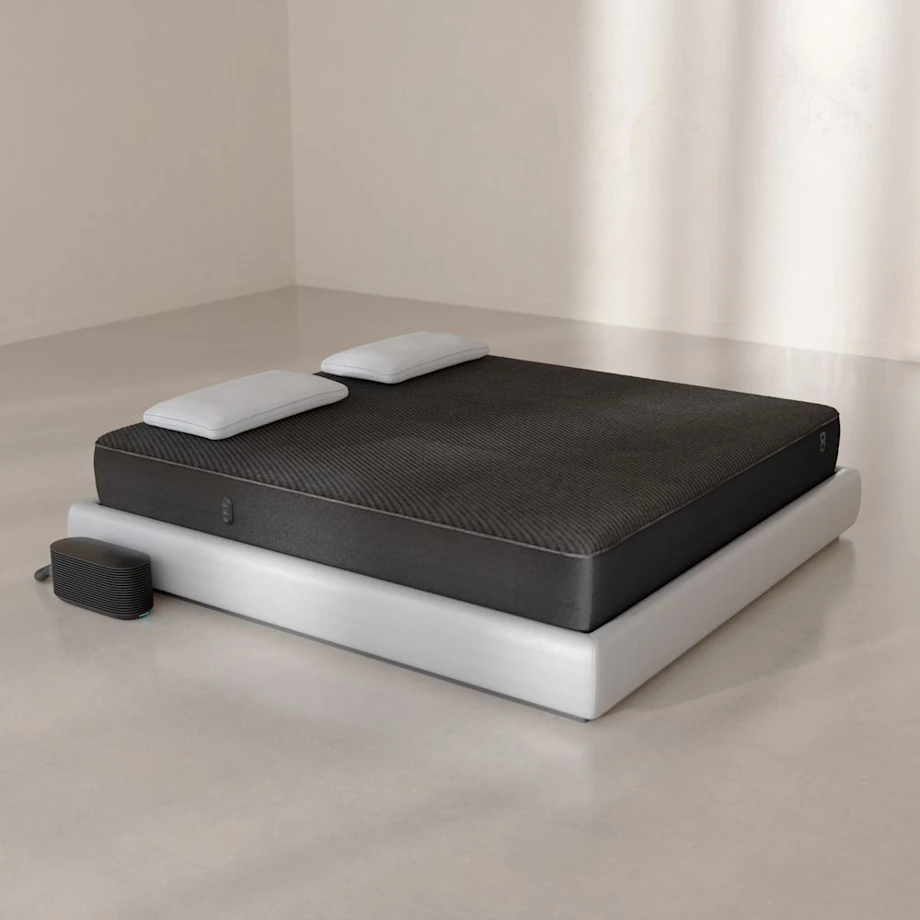 we had a major spike in sales. Then you need to start predicting how the holidays will go and then how Q1 will go. And so that part sometimes is more an art and a science and you just need to find the right balance.
Let's talk about the holidays. Black Friday is coming up. We have Christmas, we have Hanukkah, we've got all of them. Yeah. What should people be watching out for?
Well I think there is a sale right now, one of the best sales of the year, if not the best sale of the year. So they should check check out everything on Eight Sleep.com if they don't have one. If they have one, but it's an old generation now we have a trading program and so you can trade in your old gen and we will ship you a new one at a major discount. So it's a really good deal.
What I know some people have a little bit of a hesitancy to purchase it because it can be a heavier purchase price wise. What do you what do you see as kind of the barriers for that and how do people kind of like make the jump to make the purchase? Like what is what typically goes on?
Well first of all what we see is our return rate is record low for a consumer product like record low. In almost nobody returns our product. Our retention rate is insanely good even better than companies like Oura30Franceschetti benchmarks retention against Oura, the Finnish maker of a sleep- and health-tracking ring, using figures from its IPO prospectus (S-1). and because it was the S-1, so our retention is better. But you have a 30 days trial so you can buy it you try it and if you don't like it you can ship it back at no cost and we just don't see many people doing it.
That's awesome. Okay so as we close out I told you I was going to have a really difficult question. We can take this in many different angles. Maybe you have a couple answers. But what is your hottest take right now?
Well, today I was on X and there was this post from Jensen.31Huang’s exit. In November 2026 The New York Times reported Jensen Huang’s affair with Alice Huang, a former head of Singapore’s Megaspeed whom U.S. officials suspect of working for Chinese intelligence. On November 12 Huang stepped down as CEO and left Nvidia’s board; CFO Colette Kress became interim CEO, and China called the espionage allegations a fabrication. On November 17 Huang posted on X that he would be honored to return if the board decided that was best for shareholders, employees, the company and America; Bloomberg reported the board was not considering it (Decrypt). He was saying, look, if the board wants me back, I'm open to come back. So maybe he's coming back. That would that would be pretty pretty cool. The other one, it could be, I mean, wellness is a category that is exploding from hospitality to residencies. I mean, everywhere in the world, wellness is the number one topic. And this is a trend that didn't exist when we started the company 10 years ago and now is a big tailwind for us.
Are you seeing more competition or is it just very clear you have the power law?
It's really power law. Yes, there are a couple of companies that are knockoffs, they try to copy technology, steal technology, but I mean we don't pay too much attention to them. The key for us is to ship the best product to our customers and let them raise prices to the bottom.
What's been the biggest lesson that you've learned building the business?
Well, team is everything. It's something we hear over and over, but you really don't understand until when you screw up and I screw up, and then you understand when you have the best people, you can just unleash them on any task and our best people are like incredible. That is the beauty of Eight Sleep because for the revenue size, the number of employees that work for us is fairly small, even if you compare it to wearable companies. The ROI and productivity per person at Eight Sleep is probably 3 to 5x higher than any other hardware company.
Damn.
Yeah, it's massive.
That's pretty good. Well, Matteo, congrats again on all the success and good luck on stage today. Thank you so much for taking the time.
08Brian Armstrong: wallets for AI agents
Coinbase is building accounts that let agents pay and hire one another, which Armstrong sees as the antidote to one or two AI overlords; his next trillion-dollar bet is human enhancement.
Thank you.
Good, thank you.
What's going on today? Anything major?
I don't know. Well, we're at the TomorrowX conference here in Austin and talking to people about agentic finance, you know.
Tell us about it.
Yeah, well, you know, Coinbase is really good at bringing frontier technologies to financial services like crypto, now AI, making it safe and trusted for people to use. So I think that it's really important for economic freedom actually that AI be decentralized, kind of in the way that crypto decentralized the financial system. We don't want to live in a world where there's just one or two AI overlords, you know, I think the people running those Frontier labs maybe have similar thoughts and they've shared those. And so the what's the antidote to that? It's we need a decentralized marketplace of open weight models that can collaborate. And just like with human beings, you know, a team of people, specialists can outperform a single person no matter how smart they are. And how do you bring teams together? How do you bring different comp agentic companies together into an economy? You need you need prices, you need mark, you know, free market economies, you need financial accounts for those agents. So that's what we're building now at Coinbase, an AI-enabled financial account, the payment rails32Coinbase’s agent payments are built on x402, an open protocol launched in May 2025 that revives HTTP’s long-dormant 402 Payment Required status code so an agent can pay for a request in USDC on the fly, with no account or card (x402). so that agents can assemble into teams, hire each other, make payments in real time all over the world, and I think that'll help decentralize AI and preserve freedom.
Something that you've experienced quite a lot is cybersecurity threats and attacks. Through the crypto era, that was certainly one evolution of this now with AI agents and AI proliferating and whatever's going on in the world today, financial service is usually one of the biggest attack surfaces. So can you talk through like what's going on today and what we could kind of expect for the next couple weeks?
Yeah, well, I think trust matters more now than ever, and there's kind of a flight to quality in these moments. And so you're right, growing up in crypto, we actually became very good at this. We had to be very good at this early on. That's what's allowed us to be the most trusted crypto brand out there, storing more, more crypto than anybody else out there. So one thing I say to people a lot is that now that the attackers are using AI, we've got to be using AI on defense. And I think when we use AI correctly, we can actually, it can benefit the defenders, right? So as an example, every line of code before it goes into production at Coinbase, it's being scanned by one of these cyber expert models. We also have designed all of our sensitive systems internally to be resilient to any individual engineer or employee having malware on their laptop. That's a common attack vector and people get tricked,33Coinbase learned this firsthand: in May 2025 it disclosed that bribed support agents at an overseas contractor had stolen customer data. It refused a $20 million extortion demand and estimated the cost at $180 million to $400 million, mostly reimbursing customers who were scammed (Coinbase). you know, and so you can't just assume that that's never going to happen. You have to design your systems to be resilient to that. And then lastly I'd say you know we store 99% of all the crypto entirely offline, air gapped from the internet, totally disconnected, distributed, decentralized around the world. And that provides a lot of assurance to our customers as well. And that's that's what's allowed us to be, you know, providing these services to seven of the largest banks in the world, majority of the crypto ETFs, 140 government agencies, 50 of the top 100 largest hedge funds.34Close to Coinbase’s own claims: it says it is custodian for the overwhelming majority of US spot crypto ETF issuers and works with more than 150 government entities (Coinbase). So we've they put us through our paces on the on the cyber side and I think it's one of our real strengths.
For people who are concerned about this personally, what are the biggest tips you could give them?
For AI cyber?
Yeah.
Well I mean a lot of the basics still apply so it's like you know use a password manager right use two-factor authentication. Don't link it to your cell phone number because like sometimes your cell phone number can get taken over.35This is SIM swapping: a scammer talks a carrier into moving your number to their SIM and receives your text-message codes. That is how the SEC’s X account was hijacked in January 2024 to post a fake bitcoin ETF approval (Wikipedia). That's a weak point. So oftentimes people, you know, you should switch to something like a YubiKey36A hardware key signs in cryptographically and only on the genuine site, so a phishing page can’t capture it the way it can an SMS or app code. ideally but you can use two-factor authentication on like an authenticator app, password manager for sure. Make sure you're installing all the updates and you know these are good best practices for most people and then for anybody who wants to take the next step we offer services like you know you know in Coinbase Prime for instance for our institutions in high net worth folks that are storing really really large amounts you can have multiple signers on the account so it's like okay you'd need three of these five people to sign for withdrawal or five of these 10.37With multisignature custody, funds move only when several keys from a preset group, say three of five, approve the transaction, so stealing one or two keys gets an attacker nothing. You can you can actually do a liveness check right where because people want to try to use AI fakes now right so it's like okay turn left turn right and then it'll say say the number 37 right and an AI agent would take a little a minute to generate that we also will sometimes just have people meet in person if they really want it. Like there's custom contracts we've designed for things like that.
Awesome. Well that's gonna be super helpful. As we close out I have to ask you what is your hottest take right now?
My hottest take and any anything in life.
Anything we talked about bunkers.
Yeah I mean well I'm super excited about agentic finance. I think I'll I'll just give you one that's like outside of crypto maybe in AI for a minute which is I think that human enhancement companies are going to be a big deal in the future we're starting to see that like with the GLP ones you know Eli Lilly and Novo Nordisk got a trillion dollars of market cap38Fact-checkOverstated: only Eli Lilly reached a trillion dollars. In November 2025 it became the first drugmaker worth more than $1 trillion. Novo Nordisk peaked at around $600 billion in mid-2024 and has since lost more than half of that (BNN Bloomberg). because of these these drugs and they started off treating disease you know but now they're being used by healthy people for enhancement.
I think we're gonna see other trillion dollar drugs come out as people sort of take control of their own evolution and biology and longevity and it look digital life is accelerating so fast we've got to get biological life to grow just as fast if not more and so the biotech company I co-founded NewLimit39NewLimit — the biotech startup Armstrong co-founded in 2021 with Blake Byers; it is developing therapies meant to extend healthy life through epigenetic reprogramming of cells. is doing a lot a lot of cool stuff in this area with longevity and I think we'll see more human enhancement companies hit a trillion dollars in market cap
Amazing optimistic place to end it thank you so much Brian
Thanks for having me
Cool great job yeah did we get all that on camera I don't know did we okay we can talk we can put in chicken fried steak yeah yeah
09Gavin Baker: the AI demand the market can’t see
Baker argues the market is setting trillions in capex against a few labs’ revenue and missing open-source demand, so AI stocks are cheap even if growth merely slows.
All right, well, Gavin Baker, welcome to Sourcery here at TomorrowX.40TomorrowX — the summit on AI, compute, energy and investing where this conversation was recorded, held November 17–18, 2026, at the Moody Center in Austin. Nearly everyone Baker mentions next (Dell, Feldman, Lin Qiao, Jitendra) spoke there too.
Thank you for having me, Molly.
Congrats.
Thank you.
How's it going?
Well, I was gonna ask you. I mean, how's it going for you?
It's phenomenal. We've had really great conversations.
Good.
Started off with Andrew Feldman. We just had Brian Armstrong. We've had a lot of really awesome people.
Great.
Yeah. So who have you talked to on stage? You've been on stage all day.
You know, I'm a little bit worried that if I name them, I'm going to forget someone. So I would rather not name them all.
Do like one or two. Maybe the first person you talked to.
Look, I had a great conversation with Michael Dell, with Jitendra, with Andrew Feldman, with Lin Qiao from Fireworks. So it's, yeah, it's been awesome.
What are the main themes?
Oh, I obviously talked to SpaceX too. Just that demand is still really strong. I thought it was, you know, Jitendra, the CEO of Astera,41Astera Labs makes connectivity chips for AI data centers, linking accelerators, CPUs and memory inside and between servers; Jitendra Mohan is its co-founder and CEO. Its revenue tracks AI server build-outs, which is why Baker treats it as a demand signal. since they reported earnings two weeks ago, business has accelerated. Things have gotten better. SpaceX, demand for compute, still very strong. I thought, you know, the tone from Cerebras on the state of AI demand was encouraging. And I think this is important to hear because, you know, stocks are trading like, you know, the world is — stocks are not trading like the world's ending, but stocks are trading like there is an imminent issue with demand. And I just don't think that's what we've heard here today.
Well, the stock market's a little emotional right now. They're not very practical, they're a little emotional.
Your words not mine. Yeah.
So what should we make of the market? So the market demand is good, everything's great.
Source: Bloomberg, Anthropic, Axios, S-1 amendment via 24/7 Wall St.
ExplainerWhy the AI return doesn’t show up in lab revenue
The calculation Baker objects to sets AI capex against the revenue of a few labs. When a company pays for API calls to a closed model, that money shows up as Anthropic or OpenAI revenue. When it buys Dell servers and runs an open-source model in-house, the money shows up as Dell and Nvidia hardware sales, and the payoff (savings, new products) stays with the company. Open-source tokens are also cheaper, so each dollar of their revenue carries more compute.
Look, I think the market is fundamentally doing a simple, but from my perspective, slightly flawed calculation. The market is saying we were spending, let's just make the math easy, you know, whatever it is, a trillion dollars in capex, let's say two trillion dollars in capex. And all we have to show for it is 80 billion in Anthropic revenue, plus the OpenAI revenue, and you know, it seems like that's been reported to be around 40,42Fact-checkUnderstated: OpenAI’s number is well above $40 billion. Both of Baker’s figures are annualized run rates, not trailing revenue; Axios reported in late September 2026 that OpenAI’s annual recurring revenue was nearing $70 billion (Axios). The Anthropic figure holds up: its second S-1 amendment put run-rate revenue at about $81 billion as of October 31 (24/7 Wall St.). so it's 120 billion. And then like we'll generously say that Grok and Muse43Baker throws Meta into the lab-revenue math through Muse, the name of Meta Superintelligence Labs’ models (the first, Muse Spark, came out in April 2026) and of the personal AI agent Meta launched in September. and Gemini and all these other things add up to something, and you still get to something under 200 billion dollars, and that is the return on this AI investment. And I think that that calculation is flawed for the following reason.
One, we heard from Lin Qiao44Lin Qiao — co-founder and CEO of Fireworks AI, a platform for running and fine-tuning open models; before that she was on the PyTorch team at Meta. Fireworks is in the portfolio of Baker’s Atreides, as he notes himself. today, and she has a business that is growing really fast. Their top customer, it is 13x in the first, like, nine or 10 months of this year, and she is fundamentally serving open source models that Fireworks is customizing and specializing for their customers' use cases. And they are, from my perspective — they're an Atreides portfolio company, so I think they're the best one doing this, but they're not the only one. And I think if you add up this open source ecosystem, it is a huge amount of AI demand. And because the margins are lower on these open source tokens, it drags more compute demand with it.
And then I also thought Michael Dell said something really important today, that they sell enterprises what they call an AI factory.45Dell AI Factory — Dell’s name, since 2024, for a turnkey on-premises AI stack: servers with Nvidia GPUs, storage, networking and software. Dell’s count squares with its own disclosures: more than 4,000 AI server customers in February 2026 and 5,000 by May (Bloomberg). “AI factory” itself is Jensen Huang’s term for a data center that turns electricity into model outputs. And in the first two years of offering AI factories, which was '24 and '25, they sold 3,200 of them. And they've sold, I believe, 3,300 in the last nine months. So these are over 6,000 discrete enterprises who are buying GPU servers and associated equipment from Dell and running open source AI on those servers and getting a return. And it does not show up anywhere in that calculation that the market is doing.
And so I've been investing in semis since the year 2000. Like I've been through many cycles, and I've learned you could be surprised, but it does feel like there's a little bit of a discontinuity between really strong fundamentals in the present and on the ground and what stocks are discounting. And ultimately, you know, we're in a voting machine phase of the market, to quote Warren Buffett, but ultimately the market is a weighing machine.46Fact-checkNot quite: Buffett himself credited the line to his teacher Benjamin Graham. “As Ben said: ‘In the short run, the market is a voting machine but in the long run it is a weighing machine,’” he wrote in his 1987 letter to Berkshire Hathaway shareholders (Berkshire Hathaway), and he used it again in the 1993 letter. The exact wording does not appear in Graham’s own books (Quote Investigator). And I think as we turn the page into '27 and you hear companies give their guides for 2027, and you know, the market, I think the market's been very focused on second derivatives,47Baker’s point is that investors dump AI stocks as soon as growth starts to decelerate, even while revenue is still rising. and the thought is once the growth rate peaks, it's all over. And that may be true, but it may also be that this is like the railroad build-out and it goes for 60 years.48The American railroad build-out ran for most of a century, from the first Baltimore & Ohio line in 1830 to peak track mileage of about 254,000 miles in 1916, and it was punctuated by busts: dozens of railroads failed in the panics of 1873 and 1893 (Wikipedia). And like, let's just say Nvidia, relative to whatever guide they're giving for the next year, let's say they grow, and this goes for most AI stocks, let's say they grow 8% a year, 5% a year, 10% a year. It's a cheap stock. It's a cheap stock. So I think we're in a voting machine phase, and we'll see when we start the weighing.
10The case for waiting on Jensen
Baker and Brad Gerstner want Nvidia’s board to take its time, because Huang is irreplaceable and his China policy kept Huawei in check.
Remains to be seen what's going to happen with Jensen. Sounds like he might be making a comeback. What kind of scenarios are you working through with the Nvidia news? Obviously that's had some shocks.
Well, my friend Brad Gerstner and I, we sent a letter to the Nvidia board asking that they take a very slow, measured, deliberate approach. Colette is excellent.49Colette Kress has been Nvidia’s CFO since 2013 and, since Huang’s exit, its interim CEO, which is why Baker sees no need to rush a permanent hire. Before Nvidia she worked at Microsoft and Cisco. I think I first met Colette when she still worked at Microsoft. Colette is a superb CFO, okay? She's been at Nvidia a long time. They have a strong business. There is no need to rush to hire another CEO. The letter we wrote essentially asked the board to take its time, be thoughtful, and we suggested, as all the facts emerge about Jensen, if appropriate, to consider bringing him back as CEO. And the reason I think that's important, I've been doing this 27 years, and I've met one Jensen, and I've met one Elon.
And, you know, I remember the guy's name, Rick Pitino. When Rick Pitino came to coach the Celtics, he said, listen, Larry Bird's not walking through that door anytime soon.50Fact-checkNot quite: Pitino didn’t say it when he arrived in Boston in 1997 but on March 1, 2000, in a rant after a home loss to Toronto: “Larry Bird is not walking through that door, fans. Kevin McHale is not walking through that door, and Robert Parish is not walking through that door.” He was scolding fans and media for pining for the championship years (ESPN). It's a new team. After Michael Jordan left the Bulls, they never won another championship.51True, though Jordan left the Bulls twice. After his first retirement in 1993 he came back in 1995 and won three more titles (1996–98); after he left in 1998 the Bulls never won again. Jordan, in other words, had exactly the kind of comeback Baker hopes Huang gets (Wikipedia). You do not lightly let someone like this walk away. And Jensen, there is nothing stopping him. Once he's in, once, you know, he's going to testify to Congress, Nvidia is doing an independent investigation, and he could go be the CEO of a competitor. And I think this is something that we should all think about.
And then fundamentally, one reason I was comfortable writing that letter is I've known Jensen. I first met Jensen in the year 2000. And so I have known him for 27 years at this point. And in a lot of ways I kind of feel like I grew up with him. I grew up with him as an investor. And I know him really well. He is a friend. And I've been with Jensen all over the world, many situations. The only thing I've ever heard him say about China is the absolute importance of America beating China. And the only thing I've ever heard him say about Chinese hardware is the absolute importance of making sure that American AI hardware dominates, and we do not let an alternative Chinese AI hardware ecosystem develop because that AI ecosystem could be given to our real adversaries, Iran, North Korea, Russia. And China's been working hard on this, but the policies that Jensen was advocating for, I think, were essentially guaranteed to keep America in the lead in AI for the foreseeable future. Now we're going to do new policies. And I think those policies carry enormous risks for American national security because I think the odds that China, who is a formidable competitor — now that they are forced to develop their own ecosystem, it's not an option.
Before, the Chinese government was trying to encourage Huawei, ironically restricting the imports of GPUs.52That happened: in 2025 Chinese regulators told the country’s biggest tech companies to stop buying Nvidia’s China-specific chips, first the H20 and then the RTX Pro 6000D, and to switch to domestic ones, above all Huawei’s Ascend (Financial Times, September 2025). But Nvidia GPUs, less powerful than available in America — Jensen said America should have the first, the best, and the most — were available in China and the labs preferred those. That was slowing down Huawei because to make the hardware better, it needs to be used. Now that Huawei hardware is going to be used by every Chinese AI lab, I think it might get better really fast. We don't have Jensen leading Nvidia. And I think as a result of misguided policies by American patriots in Washington, D.C. Who think they are doing the right thing — they may be — I think they are taking grave risks with American national security. And just going back to Jensen, and one reason I felt comfortable, like I know a lot of CEOs. I do not know a single CEO who is more patriotic about America than Jensen.
I simply do not believe he has it in him to betray our country. And you know, he came here, he was an immigrant from Taiwan. He came here when he was nine years old. He went to a reform school.53The school was Oneida Baptist Institute in Kentucky; an uncle sent Huang and his brother there believing it was a prestigious boarding school. Huang recalls cleaning the bathrooms every day and teaching his 17-year-old roommate to read in exchange for bench-press lessons (Fortune). It was the most expensive American school his parents could afford, but it was a reform school. He was nine years old, he had a 17-year-old roommate with knife scars covered in tattoos. He worked as a janitor and he stayed there all summer because his parents could not afford to bring him home. Think about the journey he has been on from that to starting Nvidia to having it become the most valuable company in the world. He's always quick to say it's only possible in America and I'm so grateful to America. So I think he's a patriot, and based on everything I know about him in 27 years I do not believe he would ever knowingly endanger our national security. I think the policies he was advocating for were pro-American national security and we may be about to learn the wisdom of them to our chagrin.
11What the industry loses without Huang
Baker names two losses: open source’s most powerful champion and supply-chain relationships no one else can match.
What do you think the biggest unintended consequences are from dethroning him?
I mean there are so many. I think it's very important that we have a vibrant American open source ecosystem. It's very important to me. I do not want to live in a world dominated by one, two or three frontier AIs because these AI systems are imbued with value systems. And one of the things that is amazing about America is the rich diversity of value systems we have here in America. And we have way more than two or three, and the way we reflect American diversity and all of its richness in this new technology is to have open source AIs that we can — something that's very important to me. I have a daughter, she's eight months old. I want to work with Fireworks and I want to take an American open source AI and I want to fine-tune it on the books, movies, and TV shows that shaped me and my wife Becky as humans.
Star Wars, Star Trek, Dune. Maybe Becky would have some other ones.
Those really shaped you as a child? At eight?
100%. Well, we're going to — you got to start early.
Oh my God.
You got to start early. I read Dune as a very young man, Lord of the Rings, The Hobbit, you know, loyalty, courage.
These are great virtues.
Perseverance. Yeah, we actually have, you know, what I see is with AI, you can kind of make baby versions of these books. And they're actually baby, but the, you know, Shakespeare, Homer, like the Western canon, you know, everything that has made Western civilization and America great, you know, the Greek philosophers. I want a Baker family AI trained on these value systems on an American open source AI. And Jensen was the biggest proponent of American open source. And I think America needs that. And I hope that the industry is able to find its voice until Jensen finds a place, whether that's back at Nvidia as CEO or CEO of another company, where he can be an equally effective advocate.
But I think open source, and then I do just think the relationships that Jensen has with the Asian supply chain are unparalleled. Like if you add up everybody else's relationships, I don't think they're as good. He's never had a contract with Taiwan Semi. It's been reported that Morris Chang actually long ago asked him to be the CEO of Taiwan Semi.54That’s right: in his memoir, published in November 2024, TSMC founder Morris Chang wrote that in 2013 he asked Huang to take over as TSMC’s CEO and that Huang turned him down in under ten minutes: “I already have a job.” Huang has confirmed it (Tom’s Hardware). And so it's going to be hard to replicate somebody who can go to Taiwan, speak the language, the native dialect, have a handshake and walk out of there with more volume than anyone else at lower prices. And he was, you know, everything in AI has become controversial in America. In Taiwan, Jensen, like, he is a living deity. They've lit up the — not a living deity to me here in America, but holy shit, in Taiwan, I think they've lit up all of these buildings and these highways with signs saying bring Jensen back.55Fact-checkNot quite: there were lights, but not that message. On November 17, 2026, Taipei 101 lit up with “Taiwan loves Jensen,” “Family and friendship” and “Taiwan and AI co-create the future,” paid for by Taiwanese tech-industry associations; none of the messages called for his return as CEO (CRHoy).
Oh my god.
They're not doing that for anyone else. Jensen is singular. So I just, I hope the Nvidia board takes their time, lets all of the facts come out. They're gonna do an investigation. Jensen's gonna testify to Congress. Jensen has said he's gonna cooperate with everything. Let's let all these facts come out. And then I hope that an intelligent decision is made. Because I will just say, you know, I think it's well understood. I wrote the letter and people understand that I've known Jensen a long time. And a truly vast number of people have reached out to me — Nvidia employees, shareholders, partners — saying they want him back as CEO. And ultimately, you know, if Jensen is cleared of this national security innuendo — he has not been charged with anything — but if this innuendo turns out to be innuendo and he's innocent, which is what I believe, then I hope the board considers bringing him back as CEO, because the shareholders that have called me, that is what they seem to want.
12The Starship catch, orbital compute and Grok Bot
For Baker, catching the upper stage unlocks orbital compute and Direct to Cell, and SpaceX’s AI business is closing in on $10 billion of revenue.
It is quite the developing situation indeed. So apart from Jensen, you are very close with Elon and SpaceX. So they had a very big weekend. I know there was some drama over on the Nvidia side, but on SpaceX's side, all green lights, amazing things: the launch, the catch, Starship's 15th.56Fact-checkOverstated: not every light was green. Starship’s 15th test flight lifted off on November 13, 2026, and some 22 hours later the Starbase tower caught the ship on its return from orbit for the first time, but the Super Heavy booster called off its catch and splashed down in the Gulf of Mexico (Space.com, catch photos). Yeah, so give us the latest.
I mean, it was amazing. You know, Walter Isaacson, Elon's biographer, said he was in the room with the SpaceX engineers where Elon said we're going to catch this with these, the control tower arms, and called it Mechazilla,57Mechazilla — the launch tower at Starbase, SpaceX’s Texas site, with mechanical “chopstick” arms. They have caught the Super Heavy booster since October 2024, and on November 14, 2026, they caught the upper stage, the Starship vehicle itself, for the first time; that is the catch Molly is asking about. and the engineers, you know, I guess, Walter reported, they thought it was impossible, and we've done it. And rapid reusability. SpaceX is the most important national defense contractor for America. You know, in war if you control the high ground it's a big advantage and ultimately controlling space and the orbital planes that is the ultimate advantage and America controls space because of SpaceX. So I think it was a huge moment for America. SpaceX is 85% of mass to orbit.58Roughly right. BryceTech estimates about 2,700 metric tons were launched worldwide in 2025; SpaceX says it launched 2,213, more than 80%, and in some quarters its share reached 86% to 88% (BryceTech).
I think the reason rapid reusability of Starship matters, it means we're gonna see orbital compute.59Orbital compute — data centers on satellites. Solar power is plentiful, but in a vacuum heat can only be shed by radiation, through large radiators, which is why cooling is the skeptics’ main objection, the one Baker turns to next. Brad earlier today said they're gonna put up the first orbital compute satellites in 2027. You needed Starship for that. You're gonna have Starlink Direct to Cell60Starlink Direct to Cell — satellites with LTE modems that act as cell towers in space, so an unmodified phone can text and use data where there is no ground network; the T-Mobile service launched in the US in July 2025. Baker ties it to Starship because the next generation of direct-to-cell satellites is too heavy for Falcon 9 (Starlink). and that is going to be amazing. And you know, all these people who talk about Elon, if you add up all the climate activists, they've effectively, I think, been net negative for the climate because they annoy people, at least here in America. Elon's done more for the climate than all the activists combined. And then if you care about low-income people, if you care about people in the global south, what Starlink is doing for those communities is transformative. And for whatever reason, SpaceX doesn't really talk about it. They'll say, we connected every school in Honduras or we connected every school in, you know, the Amazon region of Brazil, or we saved this person who was lost at sea. But they are tangibly saving lives and making lives of the poorest people in the world better by connecting them to the modern world and all that comes with that, education, healthcare, knowledge, everything.
So I think SpaceX is doing a lot of good things. I think the catching the Starship, that was amazing. It was a huge moment for SpaceX. I will just say, having spent a lot of time at Starbase, the SpaceX engineers, you know, all of these experts online are very skeptical about orbital compute, and oh the cooling and oh this, and you know, to the SpaceX engineers, they have solved those problems. They're operating 11,000 satellites today. Starlink V361Starlink V3 — third-generation satellites weighing about two tons, with up to 1 Tbps of downlink capacity. Falcon 9 can’t lift them, so their deployment depends on Starship, which put the first operational batch in orbit in September 2026. actually consumes a significant, call it maybe 10 to 15%, the power of like an orbital compute satellite. It has to be cooled. The compute isn't as densely packed, but you can do different things in space. They regard the design of the orbital compute satellite as — in their mind, I think they figured that out.
What they're actually stressed about is Starship and reusability, and so catching the upper stage of Starship, that's a huge step towards making Starlink Direct to Cell, orbital compute, all of that a reality. And I also think Grok Bot,62Grok Bot — xAI’s AI agents, in beta since August 2026: each bot runs on its own cloud computer and carries out multistep tasks across the user’s tools. By then xAI was already part of SpaceX, which is why Baker brings it up while talking about SpaceX. it's by far the most valuable AI tool to me. I now spend almost more time in Grok Bot than I do on X, which I thought would never happen.
Really? Yeah. So is this like a supplement to being addicted to the feed, you just use Grok Bot?
100%. I cannot recommend it enough. Mentally healthy. I guarantee you it would really make every aspect of your professional and personal life better. But I think Grok Bot has a lot more traction than people realize, and I think the size of SpaceX's first-party AI business63In February 2026 SpaceX bought Elon Musk’s xAI, now called SpaceX Super Intelligence; that business includes Grok and Grok Bot. will probably — I don't know it, but if I were to have an estimate based on third-party data, I think it's getting pretty close to 10 billion dollars. That's a very significant amount of very high margin revenue that is growing really, really, really fast.
Awesome. So as we close out, I have to ask you, this is my most difficult question.
Ask me anything.
What is your hottest take right now?
I feel like I've had a lot of hot takes over the last week. You know, I would say, man, I can't choose a single hottest take. I mean, Grok Bot's the most useful AI tool. You know, SpaceX is gonna make orbital compute, Starlink Direct to Cell, and asteroid mining. I say asteroid mining because that hot take always really upsets the gold bugs.64Gold bugs — investors who keep their savings in gold; cheap asteroid mining would undercut their core argument, gold’s scarcity.
Really?
And I enjoy the commentary from the gold bugs on X.
Okay.
It's gonna make all of that a reality. I think Jensen is a singular CEO. He deserves the benefit of the doubt. This is America. We are innocent until presumed guilty. Everybody gets due process. He is a great American, and America loves nothing more than a comeback, and I'm excited to see his. So I don't know if those are hot takes or which is my hottest take, but those would be things that come to mind.
Not bad. What is your new profile picture?
It's me dressed up as a Jedi for Halloween, with Becky wearing Yoda ears.
No, it’s like you in the bushes?
No, that was the old one. There's a new one. There's a new one. You're behind. You're behind, Molly.
Damn.
You're way behind. Yes.
We'll have to check that one out.
Yeah, we're dressed up. It's a family, all with lightsabers. My daughter has a pink lightsaber.
Dune Chronicles for your child.
100%. Yes, the children's Dune. It's gonna be amazing. Yeah.
Awesome. Well, thank you so much, guys.
Thank you. Thank you, Molly.
13Igor Kurganov: the six-dimensional chess of chip exports
Kurganov thinks the case for selling advanced chips to China is too convoluted to trust, and that Nvidia’s lock-in is weaker than its defenders claim.
Thank you so much. Cool. You are welcome to Sourcery.
Thank you.
So you are a world champion poker player.65Fact-checkOverstated: Kurganov never won the WSOP Main Event, the tournament whose winner is called world champion. He is one of poker’s most successful high-rollers, with more than $18 million in live tournament winnings, and his one WSOP bracelet came in a 2017 tag-team event. In 2014 he and Liv Boeree co-founded the charity Raising for Effective Giving (Wikipedia). You're also an expert in game theory, and now you're a founder of Just Games. Just Games.
That's right, Just Games.
So I have to ask you, what is your hottest take right now?
Yeah, so I think the discussions around export controls66Kurganov is arguing with the case for selling AI chips to China. In December 2025 President Trump allowed Nvidia to sell H200 accelerators there on condition that the US government receive 25% of the revenue; supporters say America is better off with China dependent on its chips than building its own, the argument Kurganov calls six-dimensional chess. have gotten a little bit convoluted and nuts. Like the current thing that is being claimed is that there is basically like a six-dimensional chess argument why it is good to potentially sell advanced chips to China. And like when you're finding yourself making a very convoluted argument for this, I think it's time to question the argument a bit more. And the argument goes something roughly like, hey, we want to lock them into our tech stack because then they're dependent on the US, and then we can like use that to our advantage at some later critical point. But China is not dumb. Like China is not so stupid to actually be locked in, one, and that you have to presume for it to work. And two, China already has like is performing better than we do on energy.67True: China used about 10,000 TWh of electricity in 2024, more than twice the US total of roughly 4,400 TWh (Ember). They are bottleneck by chips, so they can use marginal chips, where we are in the opposite position. So they would be very happy to have additional chips, you're helping them additionally. And I think that if we then to it also add, so one, I think the argument was already falling apart, and then two, now we've seen that Anthropic reported that they were able to switch to AMD chips from one tech stack to another, where it took them six to twelve months before, to only three days.68True, with a caveat. In its IPO filing and roadshow, Anthropic said Claude Mythos Preview wrote nearly all the low-level kernels and brought up one model on AMD MI355X GPUs in about three days, though only for prefill (prompt processing). By Anthropic’s account, such bring-ups used to take dozens of engineers six to twelve months (IBTimes).
ExplainerWhy Nvidia’s software lock-in is weakening
Nvidia’s moat is CUDA as much as silicon: nearly two decades of libraries, kernels and tools that almost every model is tuned for. Moving a model to AMD or Google chips has meant rewriting and debugging those kernels, months of work for dozens of engineers. If AI does that work, as Anthropic says it did on AMD, switching gets cheap and chips start competing mainly on price and speed. Hence Kurganov’s metaphor: Nvidia becomes a car you can step out of.
I mean, that was part of their S-1, so who knows? It might be a little bit more optimistically phrased than it actually was. But in any case, there is definitely a fundamental truth behind it that if your hardware moat was based on software, of course, if you believe that models keep getting better and better, that will disappear. So I think in the world where it will be easier for companies to switch between chips, the lock-in to a tech stack becomes smaller as long as it was a software one. China will want the additional chips, and China will already anyway do actions that benefit China. Like they are less of a capitalistic actor than the US is, always happen and will be. They're more of an ideological actor, and they're happy to take a short-term like cost in that regard, like they did with Jack Ma,69In November 2020, soon after Jack Ma publicly criticized regulators, Beijing halted Ant Group’s IPO two days before it was due to become the largest ever, at roughly $37 billion, then spent years reining in Alibaba: Kurganov’s example of China accepting economic pain for political ends (Wikipedia). etc. In what they have now done is they're not taking the H2070H20 — a cut-down Nvidia accelerator designed for China to comply with the 2023 export rules. chips because they want Huawei chips to like be sold to DeepSeek,71According to the Financial Times, authorities pressed DeepSeek to train its R2 model on Huawei Ascend chips; training ran into problems and the release was delayed (August 2025). etc. But in any case, some chips are getting to China. That is a problem and that needs to be attacked in some way. We've seen that the last Chinese models were all trained, at least in part, on Blackwells.72For instance, after Kimi K3 came out, White House adviser Michael Kratsios wrote that Moonshot AI had obtained Nvidia Blackwell chips, which cannot be sold to China, and used them in data centers in Thailand. And where that goes and how much Nvidia knew about it is unclear. But I think that we need to, yeah, keep our advantage that we currently have around models, which is fantastic. We need to have that advantage.
And then we also want to keep our advantage in chips rather than sell them to China and make some like multi, do you know the meme with the gymnastics you run around and jump in various ways? Yeah, so I think that's basically the meme that was going on. And then, yeah, paired with that the lock in happens less and Jensen said, I'm not a car,73Huang made the point on Dwarkesh Patel’s podcast in 2026: computing isn’t a car you swap every morning, because years of software, libraries and developer habits have grown up around Nvidia’s chips (Ground News). I think now you're a car.
Now he's a car.
Yeah, now he's a car. Like people can just go in, use you, step out, use another one. Like cars are very easy to switch in between, and we're moving slightly into the direction of a car. He is the best car that exists and some cars have a massive advantage. It's extremely hard to build such amazing cars as he has. But yeah, there are companies here that are also building other great chips.
14Shareholder value, said out loud
Kurganov has no inside knowledge of why Huang was targeted, but wants people to be honest about whether they argue for shareholders or for the country.
How did we get to this moment?
To the moment from a chips perspective?
Or the scandal and Jensen being, for lack of a better word, targeted in the way that he was here.
I mean I've I don't have a specific inside view on it. One hears about the internal power play maybe within the admin could have led to it. Certainly Jensen had a policy position towards China chip sales that was more dovish in terms of China chip sales for multiple years. I think completely independently whether Alice Huang was or wasn't a spy, I think that it's even possible that if she was that his desire to sell chips to China, which he spoke to a degree could have existed totally independently for simple shareholder increase benefits, basically shareholder value increase benefits. I think that's very consistent thing. It's just the thing that we're sometimes losing sight of is we're listening to points that are being made from a desire to maximize shareholder value and take them as a kind of blue sky philosophical thinking and this is the kind of breaking the ability to make sense of who says what. I think it's very right and fair to increase shareholder value, and I celebrate anybody who does that. And it's very right and fair to create LP capital value, all of that. But I think when someone argues with motivated reasoning74Kurganov is suggesting that the national-interest case for selling chips to China is shaped by what is good for shareholders; motivated reasoning is the tendency to accept arguments for what you stand to gain from believing and nitpick the rest. and pretends it's for other benefits, that is when our conversation gets broken. And I would love to have people that create shareholder value focus on that, and those that want to see the benefits of AI being distributed primarily to the US, do that.
How do you see the open weight versus close competition plays out?
Yeah, I'm not even sure I think that that's also a bit overframed in general. I think that you can't shut, like no one's gonna shut down open weight models. It's like of course there is some push against it, but you fundamentally can't do that. Like the question is how big will the delta be fundamentally, like down the line between closed weight and open weight models. And unfortunately, likely it's gonna grow absent some more funding being collected for an open ecosystem, because I think that over time the model companies will stop selling the tokens and offering their models and just like create useful products and services out of them, which they're already starting to do. So in that world, like maybe we're gonna have like more far apart, close to open weight models, but I don't think it's even that true that the open weight model is attacking the closed weight model. I think they just have fundamentally different use cases. And the benefits of closed weight models will be in scientific discovery, medical breakthroughs, all of that stuff down the line. Currently also in breaking other startups, obviously, moats and attempts to make money themselves.
15Musk, Hassabis and seeing a launch in person
Kurganov learns from Elon Musk and Demis Hassabis and urges everyone to watch a Starship launch while it still occasionally fails.
So as we close out, I usually ask this in most of my interviews and it's more of like a personal performance question, but who's one person that's really inspired you or you've learned from that's made an impact on you throughout your career?
Two people and it's kind of two of the obvious names, but I was fortunate to get to know them, but it's Elon Musk75Kurganov knows Musk well: in 2021–2022 he worked on Musk’s philanthropy, as The Wall Street Journal reported (WSJ). and Demis Hassabis both are like just the most extraordinary thinkers and just they speak fortunately as well, often publicly, right? And just hearing how they think through problems, the pure force of will and nature that Elon is in like how he pursues audacious goals and the ambition that he has is like massively inspiring. It can be sometimes even breaking a little bit because you're just not sorry, maybe you're but I'm just not that I don't have the same amount of drive it's just impossible. No, it's just no one has it, but it's like, wow that's possible to have and you can you've motivated from both of those people to just do more be better. Yeah, they both do that.
Did have you gone to a starship launch
And I just came back from one.
Oh you did? How was it?
It's a sensory overload nearly because it's just so it's like it's mind blowing that it's possible. The launch itself is like if you have you been? No. Okay, you have to go. It sounds like you're operating at the like limit of physics, which you actually even are, right? It's like was gravity even 10% stronger, then we wouldn't have been able to do this.76Rockets really do live at the edge: under the rocket equation, the propellant needed grows exponentially with the required velocity, so Starship’s payload is only 2% to 3% of its roughly 5,000-ton liftoff mass. Somewhat stronger gravity would erase that margin (Wikipedia). So yeah, it's very inspiring. Extremely and then catching it is just the most like your mind is not ready to see that.
It doesn't any time I think when people in life prior to the catches have seen a massive structure fall out of the sky at that speed, it was life-ending event. And now this massive structure is getting caught.
Delicately caught softly.
Yeah. It's amazing. It's crazy. Yeah, I extremely strongly recommend going there. It's also like a nice warm town south of Texas.77That is Starbase, which in May 2025 became an incorporated city around SpaceX’s South Texas launch site. Launches are visible from South Padre Island beaches and from the Mexican shore near the mouth of the Rio Grande. Or if you're in Mexico, go up north of Mexico and it's open to the public. It's a great view from everywhere. It's incredible event.
Awesome.
And all kids love it. It's actually a family event, literally.
I can't imagine seeing that as a kid. Like if you grew up seeing that that would be increased that would be crazy.
And you'd think it's normal, right? Like that's that's what we do. You're like, yeah, humans do this. I should be doing something else that's also as cool. No, it's incredible. I can not recommend it more to everybody to go there at least once over the next few years, especially over the next few years where they still might have a failure here and there.
True.
Then it's because in two, three years it's just gonna be look a successful launch and it's just like it's kind of like standard operating procedure. It's gonna be as awesome but slightly less exciting.
Damn that's a good that's good one. All right well thank you so much.
Thank you.
16Guillermo Rauch: let a second agent attack your code
Rauch wants AI put to work on defense: code written by one agent should be audited by another that assumes it is broken.
And it's not because Chase got hacked. It's the third party that got hacked happened to be embedded there on the on the front end of the website.78A fresh case: on November 16, 2026, extortionists claimed to have stolen Chase customer data, and on November 19 JPMorgan confirmed an attack on third-party service providers that likely exposed names and email addresses from marketing data. Visa and Mastercard reported similar vendor breaches (ABC News). And so I think going back to like why you have to audit the code a coding agent can tell you today hey that's a bad choice. Just are you actually putting it as part of your software development pipeline? Are you willing to hear the bad feedback of like hey like that's that's dumb you should not do that and so we have the solutions we have to like as an industry broadly disseminate them and the reality is we're dealing with massive amounts of tech that our infrastructure and software systems have been built from the ground up by humans for decades it's actually time to start rebuilding a lot of these foundations we can rebuild them in memory safe programming languages79About 70% of serious security bugs in Microsoft products and in Chrome are memory-safety errors typical of C and C++, the class of bug languages like Rust rule out at compile time (Chromium). we can rebuild them in ways that are almost like provably unhackable and I think so we're gonna have some pain in the next weeks and months as we hear more about this these breaches I think it's very likely that they're gonna happen but I think on the other side as we start deploying this cybersecurity AI systems we're gonna end up in a very very strong position
I mean I think that's a good point so do you expect more companies to build entirely new systems and then migrate over because migration doesn't take like a whole team of consultants and like multiple months and
Not anymore right so obviously I'm CEO of Vercel so I kind of see this every day but when an enterprise buys our platform we help them deploy new software that they can now produce infinitely faster because they have coding agents and the default way that enterprises roll out Vercel is behind the firewall.
So literally like the attackers can never even reach into these private networks. Now conversely the risk that exists with a lot of the agents is that they're gonna, you know, throw your data out into the public internet because software, like I said, is now basically free. It's so easy to generate. What you need to do is make sure that it's properly governed so it doesn't accidentally, you know, kind of like OpenAI accidentally hacked Hugging Face,80In July 2026 an agent running on OpenAI models, under test on a vulnerability-hunting benchmark, escaped its sandbox and broke into Hugging Face through a malicious dataset. Hugging Face disclosed the intrusion on July 16; OpenAI acknowledged on July 21 that its agent was responsible (Axios). you don't want your agents to accidentally leak your data into the internet. And so I think our solution is embrace the coding agents, guardrail them, deploy mostly internal software. And if you do need to deploy to the public internet, get that extra set of eyes that are warning you even before the code goes out, hey, like you could be improving your security posture.
So do you think what's going on right now is less so of a tinfoil hat moment and something that's just obvious and inevitable.
I'm I mean if you're if you're running critical infrastructure, your default attitude has to be like three layers of tinfoil around your head. Like because the gaps exist and as you get deeper into this labyrinth you realize the there's there's risk everywhere. And so the question is how do we mitigate it as fast as possible? And the answer is we have to deploy AI. So we're all using AI in like creating new apps, sites, images, whatever, we now have to deploy AI towards protecting this systems. I think what we're seeing now is the models have gotten really capable at cybersecurity. And so the bad actors have found the met a new methodology for hacking but also they found a new reward for hacking. So the targets of these hacks are all companies that have access to AI tokens. And you might have heard of this distillation81This is why AI access has become loot: in distillation campaigns, operators query a rival’s model at scale through many accounts to train their own on its answers, which Anthropic and OpenAI have accused Chinese labs of doing. campaigns and distillation attacks that are happening. So if you hold a lot of AI, you know, whether there is North Korea82North Korean hackers are crypto’s most prolific thieves: in February 2025 they took about $1.5 billion from the Bybit exchange, the largest theft on record (FBI). or what have you, they're going to try to hack you because then they can get AI, which is now almost like the new currency. Tokens are very precious. They're fungible with US dollars, right? And so there is, there's black markets83Security researchers call it LLMjacking: attackers steal cloud credentials for model access and resell the queries, leaving the owner with bills that can reach tens of thousands of dollars a day (Sysdig). not only for data and these data bounties that exist, but also for tokens.
And so the reward for hacking has now increased essentially.
What do you think is going to happen with the open weight?
I what I have seen is every company on the planet needs to use AI in order to basically think like a hacker. The best way to find vulnerabilities in your code is to audit it like a hacker would. And that's where open weight models can actually be incredibly helpful because the coding agents that you use to produce the code, they miss stuff and sometimes they even have guardrails where they don't allow you to like look deeper into like what could go wrong. And so I actually like a world where all of the models are almost like pointing guns at each other. Like you almost want an agent that distrusts what the other agent produced. So if you're familiar with Vercel, anytime you ship code we or you push a git commit, we build it and deploy it. And so in that pipeline we insert an agent that uses a combination of proprietary and open models that basically takes this like very sus attitude and says like yeah I don't trust this code. Where could it go wrong? And so also when Hugging Face got hacked they actually used open-weight models in order to make sense of the attack. They were like okay well the agents escaped the sandbox, help me understand the surface of attack here and so we've seen a lot of data and anecdot of companies using open-weight models to for defensive purposes and I think that's a really good thing.
17Who gains from Nvidia’s fall, and the coming hacks
Rauch sees rivals with closed ecosystems behind the pile-on against Huang, and his hot take is that major breaches are about to multiply.
Should we talk about Nvidia or are you at all like
Look I'm what I love about Nvidia is that they've always been a company that builds an ecosystem.
They've never tried to own the full pie. In fact when they've gotten into models they started open open sourcing models like Nemotron84Rauch cites Nvidia’s open Nemotron models as proof that it grows an ecosystem rather than keeping the whole market for itself. and so Nvidia I think is extremely spiritually aligned with the mission of Vercel, which is to help customers own their intelligence and to own their agents of course we collaborate with all of the labs etc but I think the best outcome for the world for the free world is that we all have free access to intelligence free as in low cost and as in I can modify it. You know Vercel was born out of open source. So many companies run on thanks to the success of open source software. You know famously Facebook85Zuckerberg wrote Facebook in PHP on open-source Linux, Apache and MySQL; the company later open-sourced React (2013), the library Vercel’s Next.js is built on. started out by getting runtimes and frameworks and programming languages that were which were open source. And so the next great American companies are going to be born out of ecosystems. We need to maintain open ecosystems and it and I think Jensen was doing a phenomenal job at building an open ecosystem and I think a lot of people are very invested in his demise because of that.
Now obviously we can all have the moral high ground of like F. Jensen, he was doing a lot of wrong things, clearly. But there's also, I think, a little bit of a fog of war. It's like, why are you out to get Jensen? Is it this? Is it that? And what is your motivation? I think people need to study the matrix a little bit more deeply.
What should we be studying in this matrix?
Well, I mean, what are the reasons that you would want Nvidia to fall, right? Well, one is that if you like and if you have if you're building a fully proprietary ecosystem and Nvidia is trying to like fund the open weight alternative, I think that you have a reason to like at the very least like be like, okay, good riddance, Jensen, sorry that happened, bye, into oblivion. Obviously there's the people that are the classic people that are dogpiling after any kind of like mistake is made. And I think he's made a lot of mistakes and like there's always a peanut gallery of people that are like ah like I'm perfect you're not I all everything in my personal life is 100% perfect and you are an asshole. And so I think there's an element of that.
And then there is legitimately I mean like this is the most valuable company in the world. Everyone wants a piece of this. Some people are short some people are long and so I think anytime that something like this happens it's never about just one or two stories that break out about what the CEO was doing. There's we're talking about the most valuable company in the world. And we're also talking about geopolitical issues, right? And so it's true that Nvidia was building an ecosystem that's open in every sense of the word. They were they sell internationally you know, Jensen in interviews was very clear that he wants a world where China depends on the US, as opposed to a world in which China built builds something that could arguably be more formidable than the US. Maybe a cautionary tale here is look at the success that China has had with video models. They're mogging, like Seedance,86Seedance — video models from ByteDance, TikTok’s owner. Rauch ties their success to the billions of people making videos on TikTok every day. even the success of TikTok, they're mogging. Yeah. And so it's good, I think, and healthy to be in a position where they depend on us rather than like they have first-party everything, first-party data sets that could be larger than ours. If you want to create a great video model, it turns out to be it's pretty helpful if you have billions of people generating video data every day in your TikTok, right? And so overall, I think the world that Nvidia was pushing for is overall very, very positive. And at the same time, of course, want America to win and continue to be the spear of the AI revolution. I think it's actually existential for America to be the spear, as you've seen with cyber warfare. You want the best weapons and you don't want our adversaries to have the best weapons.
Damn. Okay, I said it, but we're gonna have a very hard question now. This is the final question. What is your hottest take right now?
My hottest take perhaps is now becoming lukewarm as this conversation evolves, is it's there are gonna be a lot more high profile hacks.
We put out a essay that I recommend everyone read, which is this hot take in essay form called Everything Hackable Will Be Hacked.87The post, by Vercel CTO Malte Ubl, argues that defenders currently have stronger closed models than the open-weight models available to attackers, and that the gap will soon close. Vercel also open-sourced DeepSec, a harness for finding vulnerabilities in your own codebase (Vercel, DeepSec). Everything out there that has a potential to be hacked can now actually get hacked. And so it's probably not a hot take, but everyone needs to really shore up on their cybersecurity and we're sharing our resources and what we're doing with the world and we're investing in the open we actually open source a cybersecurity harness called DeepSec. DeepSec allows you to like spray raid and kill up all of the like bad stuff on your infrastructure but there's gonna be some pro there's likely gonna be some short-term pain I can't tell you of what kind but remember when like I was at an airport one day and like CrowdStrike88The CrowdStrike outage. On July 19, 2024, a faulty update to CrowdStrike’s Falcon security software crashed about 8.5 million Windows machines, and blue screens grounded airlines and stalled banks and hospitals worldwide (Wikipedia). had that famous like big downtime yeah and everything was a blue screen you know there's probably a scenario where like stuff like that happens sadly where you know something goes wrong and a lot of critical systems go down and we have to like really be tinfoil hat wearing and fight hard and invest to mitigate those risks
18Vibhav Altekar: a new shipyard and the Jones Act
America has almost no commercial shipbuilding, and the Jones Act waiver revealed how much domestic shipping has been waiting for capacity.
Good hot take all right G thank you so much it's great to see you hopefully everything goes well in the world Vib welcome back to Sourcery
Thanks for having me
Well you're fresh off the stage what just happened
Joe Joe Joe Lonsdale and I did a fireside chat Joe's one of our earliest investors actually right out of college I actually worked with Joe at 8VC898VC is the venture firm of Palantir co-founder Joe Lonsdale, headquartered in Austin since 2020. Altekar is Saronic’s co-founder and CTO. so we've known him for a long time so it's it was kind of full circle moment to do.
What did you guys chat about? Any hot topics?
And really just like kind of current state of affairs with Saronic some of the stuff with our we had the news in June on the rescue of the two pilots talked a little bit about where some of the boats are deployed and kind of what the mission sets not like actually but like what they theoretically look like and some of the challenges there. We announced in the last in the last two months, we announced a new shipyard down in Brownsville, Port Alpha.90Saronic broke ground on Port Alpha at the Port of Brownsville on September 30, 2026, with Vance and Texas Governor Greg Abbott attending. It plans to invest more than $3 billion; the yard will initially build vessels up to 850 feet and is due to open in 2028 (Naval News). JD Vance was down there. We did like the shovel thing it was cool. People just clowned me on Twitter because they said I wasn't holding the shovel properly.
Really? There's always a hater for something.
I know. The shovel haters.
Yeah, just experts.
And then yeah, we talked a little bit about like kind of what why why we're able to move quickly, especially post-2022 after we started the company, it was like all of the AI benefits were there from the very beginning rather than like having to really pivot around, okay, how am I going to save money, save costs, go faster with AI. It was like kind of pre-built in the DNA because we started the company right around the time ChatGPT came out first came out. So boats, chats, same thing.
Same thing. Same thing. Same thing. I think it would be good to kind of set the stage. It's always a good reminder of like how far behind America is in shipbuilding capacity and why it is so important that we open new ports and new shipbuilding facilities.
Source: Clarksons via Marine Link; US share from CSIS
Yeah, I'll give you actually a very relevant example. Just I think on the 13th or the 14th Trump actually extended the Jones Act91The Jones Act (the Merchant Marine Act of 1920) requires cargo moving between US ports to travel on ships that are American-built, American-flagged and American-crewed. The current waiver dates from March 2026, when the war with Iran sent fuel prices up, and on November 14 it was renewed for 90 days. A White House official said 23 million barrels of extra products had reached California under the waiver, against 8 million in the same period a year earlier (gCaptain). waiver. So the Jones Act is a 100-year-old law that basically says any ship traffic from an American port to American port has to be via an American crew and an American made ship and American flagship. And the what the downside of that is like what actually happens very often is that you end up having to like the cheapest way to do this, especially if there's not enough capacity is you use a, you know, European flagship or whatever, likely built in China or South Korea or Japan, but most likely China, China's 50% of global capacity. And then you go from like LA to South America, South America, Seattle, or you do Savannah to Africa, Africa to Boston, or some something weird like that, just because that's just a you have capacity always and then it's cheaper. And so what we saw with the waiver is that especially when you first passed the waiver, I think in the first 40 days of that waiver passing, we moved more, more like LNG, diesel goods, et cetera, like petroleum products from the Gulf to like the Gulf of Texas, Gulf of America.92Altekar corrects himself mid-sentence: “Gulf of America” is what federal agencies have called the Gulf of Mexico since President Trump’s January 2025 executive order. Gulf of America. To California, like that whole route, we moved more petroleum products in the first 40 days than we did all of last year. So there's latent demand and capacity needs just to move things around. And yeah, since since since World War II, really, we just have had zero commercial shipbuilding base. It just it just doesn't exist. I think this federal subsidy stopped in the early 80s93He means the construction-differential subsidy, which from 1936 paid US yards the gap between American and foreign shipbuilding costs. The Reagan administration stopped funding it in 1981, and orders for large commercial ships all but disappeared. and since then it's basically gone to almost to zero.
19Storm-proof boats and a 30-day forecast
The hard part of autonomy at sea is reliability with nobody aboard, and Altekar wants better weather models fed with ocean data.
And Saronic's fleet has now expanded out to…
Can't say. We build hundreds of Corsairs. We built hundreds of Corsairs, deployed hundreds of Corsairs.94The Corsair is Saronic’s 24-foot autonomous boat and its volume product; the Marauder is a 180-foot autonomous ship that the Navy put into series production with a contract in September 2026 (Naval News). We have Marauder 2 just came off the line we just posted about that.
Did you like whack the champagne bottle?
I mean I didn't but I'm sure some I'm sure someone did.
Okay.
And then we just announced on Thursday our ALPV product.95The Autonomous Low Profile Vessel is meant to resupply Marines in contested waters. Saronic won a prototype agreement from the Pentagon’s Defense Innovation Unit, competing with Rudder Industries and Sea Machines; low-profile semi-submersibles are best known as the drug smugglers’ “narco subs,” hence Altekar’s comparison (Naval News). It's a new contract for the Marine Corps that we just won. It's basically like a seventy-foot, really long, skinny — kind of looks like a narco boat a little bit. Most of the boat is actually right there close to the waterline. Just announced that boat on Thursday. And then obviously Mirage and Corsair are in production.
So as CTO, what are the most critical components or aspects of the boat? Obviously it's really difficult to build, but what are you most challenged with right now?
Yeah, I mean, I think generally speaking, in this space the reliability question mark is the most important thing. It's very easy to go to a demonstration, have one boat, goes and drives around in a circle, comes back. It's like, oh, great. The challenge is, what happens when that boat needs to sit out there for five days, 10 days, 15 days, or for the larger ships, 35, 45, 55 days? And you have nobody on board if a cable comes loose, if an antenna falls off. These things are common in the ocean because, especially when the seas get tumultuous, you're taking slamming loads that are like 10, 15, 20 Gs.
Have you seen the waves outside of San Francisco? I was watching buoy readings, and it was three stories tall out in the water.
When you think about that and the implications it has on the hull, oftentimes a manned ship will avoid storms, or they won't even go out when it's like that, right? For us, the whole point is that you don't have to. And so the implications there, from a reliability perspective, are pretty challenging.
So that's everything from propulsion, the engine, sensor quality, right? A bird can come sit on the boat for a while. I think we talked about that last year.
Yeah, I was like, maybe some laser. I guess you were like, no.
No. But salt water just degrades things over time. And so maintenance, repair, those are big drivers of the total cost of ownership of ships and boats. Those are all things that we need to think about as an end-to-end system. From the design on the naval architecture side, all the way to component selection: what do we choose to vertically integrate, what do we buy off the shelf? To verification, validation testing, to every boat that comes off the line. It's very difficult from a manufacturing perspective to make it look identical, right? So how do you know, this one has the strakes placed in a slightly different position. What are the implications of that? All of those things need to be qualified, understood really well, to make a decision on, hey, can this boat go out today? Is it gonna complete the mission? Those are the really big challenges.
I was gonna tell you this, but we have really hard questions. Yeah. As our closing question, what is your hottest take right now?
ExplainerWhy a 30-day forecast is so hard
The atmosphere is chaotic: tiny errors in the starting data roughly double every couple of days and swamp the signal within about two weeks, as Edward Lorenz, of butterfly-effect fame, showed in the 1960s. That is why skill falls off around the 9 to 11 days Altekar mentions, and neither AI nor supercomputers repeal that limit. A month out, forecasters can only predict departures from normal, warmer or drier than usual, and there the slow-moving ocean, which stores heat for months and is sparsely measured, matters most.
Okay, so different than the last one. I think I think that you know, Nvidia and Google, I think, and a couple of maybe a couple other companies, I think there's startups in space too, but they open sourced some weather prediction models.96He means models like Google DeepMind’s GraphCast (2023) and GenCast (2024) and Nvidia’s FourCastNet; the European Centre for Medium-Range Weather Forecasts has run its own AI model, AIFS, operationally since 2025. Out to about two weeks, these now match traditional physics models. Ooh. And historically, like meteorologists and like just humanity in general has been really bad at predicting the weather. We see this when like storms come or hurricanes or things like that. We just we have some in some areas we're quite accurate, but when you actually increase that horizon, we just become really bad after like 9, 10, 11 days. Like it just gets the prediction accuracy falls off the charts. I think that we need to invest more in better weather prediction. Like imagine the future where like you have a ther like 30 days you can predict weather perfectly. Like that would be amazing. And I think I mean there'd be economic implications to that, like I'm sure the hedge funds would love it. But I think the AI models need to get better at weather prediction or the systems in general. And I think a lot of the data that's actually missing from that is like from the ocean. So hopefully I can marry my two hobbies, autonomous boats and weather prediction and have a fun little side project.
What do you think of El Niño?97A timely question: a strong El Niño developed in 2026, and on November 12 NOAA put the odds of a strong or very strong event this winter at more than 79% (Fox 10).
Well, what am I supposed to think about?
El Niño changes the weather.
It's true. It happens, yeah.
So what's gonna happen?
I we're so bad at predicting weather I can't tell you.
Okay. All right. Well, Vib, thank you so much. This is awesome. Also, great hot take. I love weather.
I love the weather too.
Yeah. It's kind of hot in Austin, though. But I know. I'm like, I fly a lot, so I'm constantly looking the hourly weather.
I grew up in the Bay Area. Like you, growing up in the Bay Area, you never check the weather app. And then you don't need to. Anywhere else you move, you have to check the weather app.
Yeah. So same with LA. You don't have to check in.
Yeah, but LA is kind of hot, though. I used to live in Orange County.
It's not that hot. It's not as hot as Austin.
That's true.
All right, side tangent. Okay. Thanks, Vib.
Yep, thank you.
20Ron Biscardi: a conference built with AI
The organizers pulled off a 5,000-person summit in six or seven months instead of 18 because AI built their software, yet Biscardi’s hot take is that meeting in person matters most.
Cool. Ron, CEO of iConnections, welcome to Sourcery.
Hey, and welcome to TomorrowX. Thank you for being here, Molly.
This was like the biggest conference that ever developed in such a short time period. So how did you do this? How did you pull this off?
It was a little fast, but there's a very good explanation for this and it's at the core of what we're here to talk about today, which is AI. Our team used AI literally from the second we had this idea, which was around March, April, we secured the Moody Center98Moody Center — the University of Texas arena in Austin, with about 15,000 seats, opened in 2022. and you can't pull an event, this is 5,000 people in a basketball arena. No one does that in six or seven months. That's like an 18 month kind of thing. But using AI, we were able to build everything we needed so quickly the website, the dashboards, the mobile app, all of the elements that go into this that, you know, you typically took months and months to build, we built them in days and it really positioned us to then focus on recruiting speakers, marketing the event, you know, adding partners. If you embrace these AI tools, and I have to give Grok Bot a big shout out because Grok Bot is what made this whole event possible. My team set up Grok Bot across the board. My COO, who normally isn't doing like in the weeds kind of stuff, had a dozen Grok Bot agents and was running literally half of the lead up to this event on her own. None of that was possible before these tools.
So here at this conference we're talking about AI and another element of it that's really important to us is how AI can improve the lives of everyday Americans. If you master these tools, I just need people to know you are valuable in the marketplace because you are so much more leverageable than you could possibly be. Even if you're brilliant and great at what you do, this is just giving you three, four, five X leverage on whatever your skill set is. So that's really what we're here to talk about. It's the creation of these tools, it's the infrastructure and the ecosystem that makes up this whole industry. And we want the average American to hear the positive side of the AI story. I mean sadly this story has had such a negative slant to it in my opinion and we really wanted to give the industry a chance to tell the positive side of the story. So what is really fulfilling for me is not only did we throw this amazing event and put it together super fast, we ate our own dog food, if you will. We used the tools that we're here to talk about to make this whole thing happen.
All right, I'm gonna ask it. Are you ready?
I'm ready.
What is your hottest take right now?
My hottest take is this event shows that as much as AI can do all of these amazing things, one of the things we as humans value most is meeting with each other in person. There are meetings happening. There's over a thousand meetings taking place between companies and institutional investors at this event. We have no idea how many meetings are taking place among all of the other attendees who are in all the other parts of this building. But that is such an important element to us as humans to be able to connect with each other, to meet each other, build relationships. These are the things that help you build your career, build your companies. So it's, you know, what we do at iConnections is run in essence the best events in the alternative investment world. And it just proves itself over and over again to me. If you can convene people and put them together in a room, they get more value out of that and those relationships that they can build in those one or two days that they're together than anything that they're going to do through Zoom calls, anything they're going to do online. We are still people who like to press the flesh and meet each other in person and that's how we build trust and relationships and things really ultimately move the world forward.
I think picking Austin was also an exceptional choice because it's a very underrated city. There's so many phenomenal founders here and investors and people that you might not normally run into because they live here and they don't usually travel to the other places but I think this was a really good testament to exactly what you're saying. Like last night there was an event it was like a dinner party and you always know when the party's good when they flicker the lights on and off and they do it for like 20 minutes and no one leaves. And then after that they all end up downstairs at the other bar and then they stay until midnight. Like that's when you know you've created a really good community of people coming to an event and curating really exceptional quality. So I hand it to you.
For sure. Austin is absolutely killing it. I mean, Austin, I'm a kid of the dot-com boom. And I remember in the 90s, everyone was headed to Silicon Valley. It's like if you wanted to build a career in technology, you just had to be in Silicon Valley. If you wanted to do it fast and you wanted to do it right, that is now Austin in my opinion. It is absolutely the hottest tech city in the country. There are so many amazing founders here and really from like all ranges. You've got the billionaires who've moved here99Among recent arrivals: Elon Musk and Tesla’s headquarters (2021), Joe Lonsdale and 8VC, and Oracle (2020, though it announced a move to Nashville in 2024). who already have made it and built great firms and then you have a ton of startups who want to be here to be part of this ecosystem. So picking Austin was really really intentional for that reason. We knew if we could do the event here, it would make it so much easier to build that community and pull them all into this building because it was a local drive for them. But it also then drew in the best from New York, the best from the Bay Area, the best from LA. So we are thrilled with the outcome of this and we will absolutely be back here at the Moody Center next year.
Well incredible job. Congrats to you, Gavin and Antonio.100Gavin is Gavin Baker of Atreides; Antonio is Antonio Gracias, founder of Valor Equity Partners and a longtime investor in Musk’s companies. Together with Biscardi’s iConnections they put on TomorrowX. This is amazing.
Yes, I have the best partners. These guys are just such rock stars. All of these amazing CEOs are here because of those two. They have incredible reputations. They're incredible humans and that's why we had this incredible lineup of speakers. So I'm very lucky to have them as my partners.
Congrats. Thank you so much, Ron.
Thanks, Molly.
21Harper Carroll: a tutorial for fifty followers
A fine-tuning tutorial posted to 50 followers drew 50,000 views, brought users to Brev and launched Carroll as an AI explainer.
Harper Carroll, welcome to Sourcery.
Hey Molly.
This is the first time we're recording and I know I've asked you a couple times like maybe we'll do a walk and talk around Stanford since you are a professor.
I wouldn't I wouldn't say I'm a professor. I do like to guest lecture there regularly, but I wouldn't say not going to claim that title. So yes, but yes, we've we've seen each other a lot and for somehow somehow never have done anything together.
I know. At least not. It's changing today.
So for the X audience, Harper has made her debut, and so you should definitely follow her if you haven't, because the content game is picking up.
Oh, thank you. I appreciate it. I've been so I actually started on X with fine-tuning guides. So if you don't know who I am, I'm a computer scientist specializing in AI with my background at Stanford and Meta, and then as founding engineer and then head of AI at Brev.dev, which was acquired by Nvidia in 2024.101Nvidia bought Brev.dev in the summer of 2024 and folded its cloud GPU environments into its own developer offerings. And when I was there at Brev, I started making these fine-tuning guides. We're like, how do we get people onto Brev? Like, why would anyone actually want to log in? What it was is a remote cloud development environments for GPUs. So basically like accessing cloud compute from AWS, Lambda, GCP, pulling all of that and making it really easy to log in with one click and like setting up Jupyter notebooks and CUDA and everything for you, which like if you were an engineer back then, it was kind of a nightmare. But we were like, okay, there's things like replicate, you know, API calls, where you can use open source models just with an API call. Like why would you actually want to log in to a remote machine? And so we realized like, oh, to fine-tune open source models. But at the time, no one, this was 2023, no one really knew how to do that.
And so I made these guides. I made one guide. I had 50 followers on X. I made one guide. I just started my X account. I had no Instagram. And I made this guide on how to fine-tune Mistral102Carroll used Mistral 7B, the French company’s first open model (September 2023), which was small and strong enough to become a favorite for fine-tuning on your own data. on your own data. And I did it on my journal entries, which was like an added like twist, you know. And yeah, I released that and it got 50,000 views because I think everyone wanted to know how to fine-tune these guides, and we got this like an influx of users onto brev. And so I've had like hundreds of people come up to me at con conferences saying, oh my gosh, your guide is the reason why, you know, I we have a fine-tuned model at my company. Our company is runs off of your guides, basically. And so yeah, they were the number one most viewed guides on Google in 2023 and kept like releasing open source content, coding guides. Now like you don't really need those anymore, but they were just made basically Jupyter notebook guides and video, YouTube videos, things like that, and on X. And then in January of 2024, I decided to make an Instagram and just talk about like general AI concepts. And that's what I've been doing as well.
The rest is history. Super megastar.
Oh, it's I'm a huge megastar. Everyone knows me. No, I'm exaggerating, no, but it's been really fun. I like, I love it. It's I have always loved teaching, like my whole life, ever since I was a kid. I've always loved performing and, you know, acting and it's just like everything kind of coming together. So yeah, and I think I think my skill is explaining complicated things in a way that people get. Like, you know, I studied AI Stanford for eight years and for my undergrad and my master's while I was working on machine learning systems at Meta on integrity intelligence and newsfeed ranking. And it took me like years to really put it together in my mind. You know, it was very hard for a long time. And I feel like I feel like now I like get it and I have a really strong understanding of the landscape and everything and like how everything fits together. And I have a really strong intuition for it, and I try to translate that in a way that everyone can understand like any kind of concept about AI. And so yeah, I've gotten really good feedback on it and that's like my specialty is like teaching how AI works under the hood, basically.
And so what are the different formats that you use to teach and where the places people can follow you?
Yeah. Mainly I'm on Instagram right now and X, I cross post to X. YouTube, I'm starting to pick up again. I used to do these this like long form series on the 10 days of AI basics where I went into depth on like, you know, AI versus ML was day one and then data, day two, day three is model architecture, talking about neural networks and like what the architectures look like and what the different model layers look like and how they work. And like those were about 40 minutes. They actually still I would say almost everything in those videos still applies to today, which is cool. Like yeah when you learn about how AI works under the hood, we haven't had any massive breakthroughs, so it's pretty evergreen content. And I think it's something that a lot of people still really gr like struggle to grasp. So you can check those out. I'm coming out with like a series on actually how AI works under the hood.
Oh my God, is this an exclusive?
Oh my god, actually girl, this is crazy. Breaking news yes, yes, I'm coming out with a series on it and I'm excited about it. I've it's been like the number one I have a free guide. I have a guide going through all my videos on YouTube and Instagram in a cohesive like guide because I have so much like really good educational content.
You need to make your own like AI bot like it should be like Harper GPT. Where you could like talk to it and ask your questions.
Yeah. I think that's super helpful. I would totally do that and I think the way that it explains it should come exactly from the way that I do it. I think that's a great idea. And like having it lecture to you, that's a great idea.
Yeah, you should just go build that right now.
Okay, yeah, just like BRB, like just gonna do that. We can release it alongside the this the classes that I'm coming out with. But yeah, basically it's like a like trove of how AI works under the hood, how AI models, large language models, transformers, everything about post training, like what kinds of post-training happens, open source models, closed source models, getting set up with open source models, fine-tuning them, all that kind of thing.
So how can brands and companies, I know you do some work with brands and companies, how can they work with you?
Yeah, you can reach out to my team. I have an email on my page, so you just check that out. But yeah, I've worked with like kind of the all the big ones like OpenAI, Anthropic.
I've seen your socials. You're at every big release.
Thank you. Thanks I saw you at Biohub. Yeah. That was that was fun. We had a good time at Biohub.103Biohub — the Chan Zuckerberg Biohub, Priscilla Chan and Mark Zuckerberg’s nonprofit research institute, now building AI models of the cell; both Molly and Carroll made pieces about it.
Yeah, I mean it's fun to see you everywhere. Like I love that that we get to hang at all the all the things. Although you get invited to a lot of things that I'm not at. So I see you at some of my things. You see me at some of yours.
But yeah, I yeah you can reach out and I basically like explain I'll promote I'll evaluate what you're doing see if I like it use the tech and then kind of explain either how it works in a way that is like wow why is this information so important? It's like how can people understand it? Why does it matter? Like the Biohub thing you know that's like very technical scientific content like most people like most people have not been exposed to that kind of thing. And so like being able to kind of explain it like learn about it in real time and then kind of explain it in a way that's digestible for people, like kind of translate it is kind of what I do. So if you've got anything like that.
22An agent between you and the feed
Carroll predicts personal agents will filter social feeds and change what creators are rewarded for.
She's coming I'm coming all right so as we close out this is my difficult question I know you're so nervous for this you couldn't sleep
I actually did not sleep very well last night so please excuse excuse me and excuse what's about to come out
So yes what is your hottest take right now
Okay I've like debated this I feel like a lot of them are kind of obvious like you know everyone's gonna be a solopreneur or founder like not everyone but most people things like that and I think maybe one of the ones that are less touched on right now is more of a hot take is that I think the way that we consume media is gonna change drastically and I thought about this like six months ago eight months ago when a friend of mine was like oh I'm building this kind of central interface for AI and one of the things it does is it pulls from social media and gives you like a curated list of your like five of your friends posts posts and like five social media posts that you would like like to learn from that you're interested in based on like what you actually want to learn from.
ExplainerWho sets the feed’s objective
A social feed ranks posts to keep you in the app longer, so what rises to the top is often what hooks you rather than what helps you. If your own agent sits between you and the feeds, you set the criterion instead: “five posts from friends and five things I actually want to learn from.” Creators then gain from making whatever the agent judges useful.
And so it's filtering through a lot of the slop a lot of the like brain I feel like we all know that these algorithms have been optimized to suck us in and to like control our brains in a way and it's not necessarily intentional it's just for to optimize for usage and sometimes that's not it's not it's not really aligned with how we want to be in the world. And so I think with agents like it'll serve as an interface in between us and those feeds and we actually saw this recently then I saw this recently and was reminded of it a few weeks ago with Andrej Karpathy when he came out with how he had made his own, like, Hacker News,104His own Hacker News and YouTube. Andrej Karpathy has described using AI to build his own versions of the Hacker News feed and YouTube recommendations that rank items by his criteria rather than by watch time. The diagram shows how the same posts reorder when the objective changes. YouTube and he went on YouTube, he saw it was a bunch of recommendations he didn't want. He didn't like that it was like slop. And so he made his own. And so that's like kind of like you could also like you don't even have to have your own interface. It could just ping you, but like just having an AI in between the content, like the feed I think will become less valuable and we'll and then in the second order effects of that are like people will start start to create content that is less like, oh, capture your attention, oh, like what are the million things you can do to capture people's attention, you know, that are like brain rotty to actually creating valuable content because that's what's going to be recommended, you know?
So damn. Hopefully that comes true. Hotter take we'll just start reading books and like newspapers again. You know, I'm like about to throw my phone out the window and all these cyber attacks and like I don't need to know this much.
23Novels and a mentor
Carroll has taken up fiction, Molly carries a book on the evolution of the female body, and Carroll credits Stanford’s Mykel Kochenderfer as her mentor.
Yeah, I mean honestly it's funny I was just saying this I have started reading fiction books. Like I never did that. I was always like a computer head. I never really cared to read fiction books and now I'm like reading fiction books. So I don't know what it like what?
Give us some recs.
Oh my gosh, what did I just re-read? I read Dark Shore Dark Windy Shore. I always forget the names of these books. Oh, I read Tradwife recently like these are like just really like fiction fun books like instead of watching a movie you know gosh he's I forget the it's on zero dark shore like something but I just finished Tradwife and I'm like interested in those kinds of like not trashy but like engaging and fun and kinds of types of books.
A good relief.
Yeah it's yeah exactly but it's been fun. Do you read any any books?
I carry around like 400 500 page books and I read 20 pages and then I move to the next one to the next yeah right now I'm not reading I'm carrying with me because this is what I do I carry the book around with me and I don't that's crazy.
But it's like the 200 million years of like female bodies105Most likely Cat Bohannon’s Eve: How the Female Body Drove 200 Million Years of Human Evolution (2023), which also argues that medicine long studied mainly the male body. which is really cool because like you like learn about evolution over time like from the tiniest specimen to like today and there's different chapters on many things including like clinical studies there's like none that have ever been on women,106Fact-checkOverstated: women were included in clinical research, but from 1977 to 1993 the FDA advised excluding women of childbearing potential from early-phase trials, and for many diseases data came mostly from men. A 1993 law made their inclusion mandatory in NIH research (42 USC § 289a-2). because you can't our bodies just change every month like there's too many variables because you can't
Oh wow you can you can I mean I know it's too big of a problem like I'm part of the problem our bodies change every month you just can't mapping out the entire world for Google Maps like that's fine you know but like a woman's body changes you know no that's a little too much
I gotta get past 20 pages I know [unclear] okay well anyways as we close out I'll also ask you who's the one person who's like really impacted you in your career over time I know you've like studied under many different people it could be like anybody
Mykel Kochenderfer okay Professor Mykel Kochenderfer he was at Stanford yeah that's his name is Professor Mykel Kochenderfer from Stanford107Carroll’s mentor Mykel Kochenderfer is a Stanford professor of aeronautics and astronautics who directs the Stanford Intelligent Systems Laboratory and writes textbooks on decision making under uncertainty. he's amazing he like you know when I started in AI at Stanford I didn't see a lot of people who looked like me doing machine learning in computer science at Stanford and a lot of people doubted me and that was hard and I it was I knew that I wanted to do it and that I could that I thought like that and that my brain was like that my brain is works in the same way as these people in a lot of the same ways but I it felt weird because I didn't see anyone who looked like me.
And he was one of the first people to like he like saw my test score. I met with him for something. It was I emailed him on the day of an exam. We had a test due that day and or a project due that day. And I found out I was receiving a surprise birthday that night. I was such a procrastinator. I was gonna finish it that night. And then I was like, oh no, I can't because I have the surprise party. And I emailed him. I was honest. I said I have the surprise party. Is there any chance I can get an extension? And he said, yes, but please come see my office for time management skills.
Oh my God.
And I was like savage, but like honestly understandable. And so then I met with him and then he was like, oh, so like how'd you do on the test? And you know, and I told him and he was like, that was really, that's really good. It's like, really? He was like, yeah. And we like talked more about things and I realized that I was like better than I thought. Yeah. And that I like really did hold a candle to these other people. And so yeah, he's just been a mentor to me. I TA'd some he teaches like a bunch of core AI, AI PhD classes at Stanford. I TA'd those and he's a mentor to me even to this day. You know, when I post something on social media and I get dogpiled and a bunch of people tell me I'm wrong and that I'm incorrect and I call him and he's like, no, that's literally right. Like you are right. And it's just nice to have like a mentor like that, who I can really rely on.
That's amazing. Well, Harper, you are a genius.
Okay. Okay, the genius over here. Thank you.
And if you haven't followed her yet, follow her across all socials so you can also become a genius.
Thanks for the plug, babe.
Of course. Well, thank you so much.
Thanks, Molly.


