


TBPN
Chapters
Biscardi took the banking-style conference, where CEOs are the stars, and opened it to everyday investors and X writers, because they now move markets.
Read the chapter- The summit drew 5,000 people to the Moody Center, more than 100 CEOs will speak on the main and side stages, and attendees came from about 30 countries.
- Antonio Gracias and Gavin Baker pitched the idea and wanted it this fall, though Biscardi says events like this usually take 18 months.
- The format copies Goldman's and Morgan Stanley's TMT conferences, but tickets are cheap and X contributors got free passes.
- In the story Gavin told in the opener, a Wall Street analyst downgraded a stock, Citrini added it to their portfolio, and it popped 7%.
Goldman's CEO on scrapping a decades-old dress code and why banking is still a business of human connection.
Read the chapter- Instead of hundreds of pages of rules, Goldman now has one policy: dress for your day and the clients you're seeing.
- The whole Goldman team pitched the Lululemon IPO head to toe in Lululemon, and the rival bankers in suits knew they'd lost.
- Technology, Solomon says, makes bankers more powerful connectors, but business is still won by people earning trust.
Over eight years Goldman pushed durable revenue to roughly 60%, and it has no plans to go down market.
Read the chapter- Goldman merged its asset managers into one platform supervising a little over $4 trillion and now lends far more to clients.
- Management fees bring in about $15 billion a year and are growing faster than 10%.
- The firm has two businesses: banking and trading, plus asset and wealth management for 45,000 ultra-high-net-worth clients and institutions.
- AI savings will go into reaching clients Goldman doesn't serve yet, not into the mass market.
After the Microsoft and FAA outages, Solomon expects more bumps and wants government and business to scan and upgrade all the software in the economy together.
Read the chapter- Solomon says cyber has kept him up at night for years, and he calls a full-day Microsoft outage unprecedented.
- Goldman has used the most powerful models for seven or eight months and runs tens of thousands of scans a day.
- Everyone is scanning and patching fast, which itself destabilizes systems, so he wouldn't rule out a major incident.
- His big idea is a public-private effort to scan and upgrade all the software in the economy, expensive and slow but doable.
Goldman's leadership works IPO clients personally, and Solomon warns against guessing what private markets will look like without Huang.
Read the chapter- Solomon makes dozens of calls a week to CEOs taking their companies public with Goldman.
- Jordi expects turbulence in 2027 for private AI companies without Huang's billion-dollar checks.
- Colette Kress, Solomon says, is a very competent executive who deserves time, and the ecosystem is bigger than one man.
- In his experience, good managers survive every cycle, while information arbitrage works for a year but not for decades.
Three advantages are pulling the U.S. away from other economies, and to Solomon AI is simply a technology whose biggest value will sit in applications.
Read the chapter- Solomon names three U.S. advantages: a risk-taking, entrepreneurial culture, the best capital markets, and smart people from around the world who want to come.
- Over the past 15 to 20 years the U.S. pulled away from other economies faster than anyone expected.
- Solomon dislikes calling the technology either "normal" or "unprecedented," and to him AI is just technology.
- The biggest value, he says, will be created not in the infrastructure but in the application layer.
- Jordi adds that a startup pitching itself as an "AI-native Goldman Sachs" just doesn't understand Goldman Sachs.
Solomon thinks about where a stock will be in years, and won't weigh in on Huang's offer to return without the facts.
Read the chapter- Solomon posts on X himself, but 2% moves on someone's post don't interest him.
- John reads breaking news: Huang says he would be honored to return if the board decides it's in the interest of shareholders, employees, the company and America.
- Solomon echoes Baker and Gerstner's letter that the board should go slowly, and won't comment without the facts.
To Baker, Huang's statement is like Jordan coming back: now everyone knows he wants the job, and that will rally his supporters.
Read the chapter- Baker expected Jordi to be 5'6" and was surprised to the upside, so now he calls him Tall Jordy.
- Baker compares the statement to Michael Jordan coming back to the Bulls, since until now nobody knew whether Huang wanted his job back.
- Since the letter, Baker hasn't talked to a single Nvidia shareholder, employee or partner against his return.
- John asks whether Nvidia could thrive without its founder the way Apple did under Tim Cook, and Baker doesn't call it impossible, praising Colette as an exceptionally capable CFO and a good interim CEO.
Unlike post-Jobs Apple, Nvidia faces fierce competition and runs on Huang's personal relationships, and open models protect it from a hyperscaler monopsony.
Read the chapter- Jordi pushes back that post-Jobs Apple didn't have buyers building their own iPhones, while Nvidia's customers build their own chips.
- Baker calls Huang irreplaceable: the supply chain runs on his handshakes, and Nvidia, as Huang has said, never had a contract with TSMC.
- It comes down to tokens per watt and competition among models: from 2012 to 2022 chipmakers had four or five buyers, and that returns if the model layer consolidates.
- Baker wants to post-train an American open model on Homer, Shakespeare, the Bible and Atreides shareholder letters to pass his values on to his daughter.
Baker argues that an ensemble of open models on fast chips is the way to fend off AI hacks, and that will make cyber defense-dominant.
Read the chapter- Every major hack so far, Baker says, came from closed models and was solved with open ones.
- Each model has its own jagged frontier, so defense means a swarm of models, each strong at something different.
- In war, Baker says, speed is everything: his firm backs Cerebras, with the fastest tokens, and Cognition, whose new security product uses a swarm of models.
- Baker cites Anthropic's Sholto Douglas, who expects cyber to become defense-dominant over time.
- Baker thinks we're in the teeth of peak AI hacking, with cyber budgets rising every day.
Genomics turned out to be too big a problem for humans but not for AI, and this year, Baker says, medicine has visibly sped up.
Read the chapter- Baker ran a biopharma fund for three years and remembers the 2000 hopes for personalized medicine.
- Genomics was too big a problem space for the human mind or human-written software, but not for AI.
- He expects AI to extend human lifespans and calls that the conference's key message.
Alex Davis's Disruptive has raised a concentrated $10 billion fund for companies that need huge amounts of capital, and behaves more like a public investor.
Read the chapter- Disruptive's new fund is $10 billion for 10 companies at $1 billion each, and check 11, Davis says, would start a new fund.
- The fund behaves more like a public portfolio manager than a VC fielding calls.
- Since Facebook, Davis says, companies have timed the IPO as a magic moment, which lets investors like Disruptive get into the best companies before the public market does.
Without giant corporate checks, Jordi predicts, great AI companies will take down rounds, and VCs will get in at better prices.
Read the chapter- Jordi expects great companies to take down rounds once the "gorilla" with $2–5 billion checks is gone.
- VCs who were forced to pay up could, he predicts, come back at better prices in four or five months.
- Jordi recalls that in 2021 and 2022 even great companies did down rounds, Stripe among them, and the investors who came in then did very well.
- Davis says the mega funds will also struggle to raise.
Oseary launched Get Access so that people who can actually help a company get into its rounds, not just a couple of institutions.
Read the chapter- Being on stage in Austin with Matthew McConaughey is, to Oseary, like being in Jamaica with Bob Marley, and it's a big week: Anthropic, one of his investments, goes public in two days.
- Get Access is a platform that lets musicians, actors and executives get into rounds at companies they can help.
- Fewer than 7% of applicants make it through, and Oseary wants cap tables full of people who help and cheer.
The instincts of an A&R man who signed bands off one song helped Oseary back OpenAI and Anthropic early and hold on when people told him to sell.
Read the chapter- Oseary signed the Deftones, Alanis Morissette and Muse after hearing a single song.
- Seeing ChatGPT on November 30, 2022, felt like hearing Nirvana for the first time, and he pestered everyone he met to try it.
- Oseary and Ashton Kutcher invested in Anthropic at $5 billion and OpenAI at $27 billion, and he believes they were the only ones to do both at that level back then.
- Smart people told him to sell, but that kind of conviction, Oseary says, comes from having seen the movie before.
- Jordi doubts more trillion-dollar companies will keep appearing, and Oseary says he just asks whether an idea excites him.
Feldman shows off the Wafer-Scale Engine, the largest chip ever made, and explains that Cerebras handles everything except the powered building.
Read the chapter- Feldman always carries "the largest chip in the history of the computer industry," because the beauty of hardware is that you can show and tell.
- TSMC makes a 12-inch wafer and etches the transistors, and Cerebras cuts out the largest square that fits.
- Cerebras builds the server and the cooling, so customers bring only a powered shell.
Speed decides cyber defense, which is why defenders need fast inference, and Feldman expects room for both big models and collections of small ones.
Read the chapter- Damage happens in minutes or seconds, Feldman says, so defense has to run in the background and fast enough to annoy no one.
- Cerebras, he says, is 10 to 20 times faster than GPUs.
- As in security, with Palo Alto's dozens of products next to niche vendors, AI will have both big models and collections of small ones.
- Simple tasks need simple models, since you don't need a Michelin chef for breakfast, and Feldman says the early router builders understood that.
Like David against Goliath, Cerebras avoids fighting Nvidia where size matters, plays for speed and sets itself hard deadlines.
Read the chapter- Cerebras uses TSMC's 5 nm node and no HBM, so it doesn't compete with Nvidia for capacity or memory.
- A small team, as in basketball, has to make the big opponent run.
- Feldman tips his hat to Huang, who took Nvidia from nothing to the most valuable company on Earth in 33 years, and calls him one of the top two or three CEOs of the quarter century.
- The AI industry's pace, Feldman says, is unreal, and public events plus yearly releases that double performance set hard deadlines.
Demand for Cerebras is overwhelming, but slowing permits push it to build abroad, and Feldman admits the data center industry lost the PR battle on its own.
Read the chapter- The company is constrained by how many data centers it can build, with demand for fast inference coming from the U.S., Europe, Latin America and Asia.
- Permitting delays, Feldman says, will hit what gets built in 2028, so in 2027 about three quarters of Cerebras's data centers will be outside the U.S.
- Jordi calls the "AI factories" rebrand dumb, and Feldman says they should have just been called computers.
- Builders faced no pushback for 20 years and, Feldman says, never offered towns football fields or a decade of free power for schools.
- Inference runs fine at 50 to 200 megawatts, while gigawatt campuses are for training.
In delivery drones, a class unlike China's quadcopters, the U.S. can dominate, and federal rules that long held Zipline back now give it clarity.
Read the chapter- Zipline has more than 20 charging sites in Dallas and launched in Austin a couple of weeks ago.
- China dominates small camera drones, while a Zipline aircraft weighs 50 to 60 pounds, has 700 unique parts and is FAA-certified.
- Zipline spent ten years operating outside the U.S., and the question now, Keller says, is whose technology stack the developing world builds on.
- Only the FAA regulates airspace, and full approval to fly beyond visual line of sight in all 50 states gave Zipline clarity that self-driving cars lack.
- Zipline flies below commercial aviation and kept flying while planes sat on the ground.
Demand for Zipline far outstrips its capacity, and partners hand orders to the drone through a "portal" in the wall.
Read the chapter- Three strategic partners each want more than a million deliveries a day, the size of the company's entire operating plan.
- Some sites run every aircraft from 6 a.m. to 11 p.m., each doing 20 to 50 deliveries a day, and 24/7 operation is coming.
- Keller's example is parents with a sick child at night, but when Jordi brings up beer, he's happy to talk about that too.
- At Chipotle, staff pass orders through the wall into a box where a droid lowered from the drone picks them up.
- To small mom-and-pop restaurants Zipline offers about 20 deliveries a day, which Keller says can be the difference between profit and loss.
Zipline builds everything itself, from motors to unmanned traffic management, and by flight count it is already, Keller says, the largest airline in the U.S.
Read the chapter- Zipline's roughly 700 engineers design motors, propellers, flight computers, autonomy, the app and unmanned traffic management systems in-house.
- By flight volume Zipline is already, Keller says, the largest airline in the U.S., and next year it will outfly all the others combined.
- Control towers, Keller says, still run on pencil and paper as if it were a century ago, and John notes the FAA outage was no "AGI god" waking up.
- Night is easier for Zipline because helicopters, hot air balloons and crop dusters, the aircraft drones worry about most, don't fly then.
Unlike a typical VC, Valor spent months helping Zipline fix its production line, and hardware, guest and hosts agree, is far harder than it looks.
Read the chapter- Antonio Gracias's Valor sent quality and manufacturing engineers to Zipline, and Tim Watkins lived in an airport motel for months.
- Every hardware launch, Keller says, bets the company, like the Model S and Model 3 did for Tesla.
- Jordi tells anyone who doubts that hardware is hard to try making apparel.
- In 2013 the peak of ambition for Keller was Dropbox's file sharing, and now teams build fusion and life extension.
Chantel Jeffries invests where her network can help and tells founders not to waste time on haters.
Read the chapter- The song no DJs play, for Jeffries, is "Party All the Time," Eddie Murphy's hit.
- Her first investment was Poppi, followed by Oura Ring and Get Access, where she's also an advisor.
- Celebrity deals can get complicated, and John notes that being a face of the brand is as real a value-add as Valor's factory help.
- Building a brand around the founder, Jeffries says, is risky: it's a different lifestyle, and you have to know how to handle the press.
- Jordi notes that many founders reach a Series B without hearing a negative word about themselves, and Jeffries calls fighting haters a waste of time.
Schmitt believes anything can be printed: materials differ only in software, and going from idea to a pair of shoes now takes a day and $50.
Read the chapter- Leather, velvet and springy mesh at Zellerfeld are one material that differs only in software, and the material itself costs cents.
- The company has grown 10x a year for five years, runs 1,700 of its own printers in Austin and is nearing a million pairs a year.
- With Claude extensions for Blender, idea to print takes a day and about $50 instead of 12–18 months and hundreds of thousands of dollars.
- Colonies on the moon and Mars, Schmitt says, can't wait for Starships full of iPhones, so every product on Earth needs to be digitized.
- The hosts ask for TBPN cowboy hats that fit over their headsets, printed by tomorrow.
Between guests the hosts work through the timeline: OpenAI ships new models, the NSA's network is down, and Aschenbrenner's book has taken a beating.
Read the chapter- OpenAI, according to the timeline, has released 6.2 Astra and Sol.
- A developer named Tyce rebuilt Earth in Minecraft at 1:1 scale, the same week GTA comes out.
- CNN reports the NSA's internal communications network is down.
- Situational Awareness's public book is down 92% in its 13F, but John says Aschenbrenner is still in the game.
Armstrong wants to decentralize AI the way crypto decentralized finance, and argues that AI used properly favors the defender.
Read the chapter- Instead of a couple of monolithic models, Armstrong wants an economy of open models, with Coinbase building the accounts and payment rails.
- Narrow open models trained on internal data, he says, beat the frontier, and prices and markets, as in Hayek, will coordinate the agents.
- A security expert model reviews every line of Coinbase code before it ships to production.
- More than 99% of Coinbase's funds sit offline in cold storage, and the company just won approval for a national trust charter from the OCC.
AI can test millions of hypotheses in silico, but drugs still hit the bottlenecks of wet labs, robots and clinical trials.
Read the chapter- At NewLimit, which Armstrong co-founded, AI scores millions of hypotheses, the best are tested in cells and mice, and the first human trials start next year.
- Selling a drug broadly, Armstrong says, still requires clinical trials.
- DeepMind won a Nobel for one protein, while a cell and an organism are many orders of magnitude harder.
- Until humanoids can work as baristas, Armstrong says, they won't be in the lab, and Jordi bets the lab is easier.
Coinbase lets agents into accounts with guardrails, designs its defenses assuming infected laptops, and is cutting its vendor list.
Read the chapter- Coinbase for Agents, which connects an agent to a Coinbase account, is growing about 20% a week, and agents not only trade but also save on taxes and set limit orders.
- An agent can get a segregated account and leverage limits.
- Coinbase's cold storage was designed from the start assuming a developer's laptop would get malware.
- Coinbase is whittling down its vendor list and rebuilding some of their products in-house, which Jordi sees as part of the SaaSpocalypse narrative.
Coinbase is helping Bitcoin prepare for post-quantum cryptography even though Armstrong sees no imminent threat, while Apple's services go down mid-show.
Read the chapter- Coinbase sits on a Bitcoin post-quantum council hosted by Dan Boneh and others, and proposals like BIP 360 chart the path.
- Armstrong sees no threat to Bitcoin's cryptography yet, though AI could speed up quantum computers, and John notes you can't vibe code a quantum computer in your garage.
- iCloud, Apple Pay and more go down, while TBPN's stream, to John's surprise, stays up.
Crusoe is expanding from Texas to Paraguay and Iceland, and Lochmiller expects fine-tuning to grow as companies want sovereignty over their data.
Read the chapter- Crusoe is building in Abilene and on other Texas campuses, in Iceland, Norway and Israel, plus a 280 MW project in Paraguay powered by the Itaipu Dam.
- The company sells data centers to hyperscalers, managed GPU clusters to quant firms and innovators, and serverless AI services.
- The fine-tuning market is far smaller than lab revenue, but companies want data sovereignty and get better results on narrow tasks.
With cheap geothermal power and cold air, Iceland is a natural home for data centers, as it was for aluminum smelters, and locals still feel positive about them.
Read the chapter- Volcanic hot rock close to the surface means ultra-cheap geothermal power, and the cold means low PUE.
- Iceland long drew energy-hungry aluminum smelters, and AI, Lochmiller says, does the same trade with data over subsea cables.
- Sentiment in Iceland is still positive: its whole grid is about 3 GW, while Texas, at 90 GW, got 400 GW of interconnection requests.
- What Greenland and Iceland have in common, Lochmiller jokes, is that both end in "land."
- Canada, he says, is attractive, but Crusoe hasn't closed a deal there yet.
Lochmiller calls most complaints about data centers misinformation, and says the modular Crusoe Spark removes construction and makes infrastructure distributed and resilient.
Read the chapter- One of Crusoe's giant buildings in Abilene uses as much water as ten single-family homes, mostly for bathrooms and plants.
- Crusoe Spark is a factory-built modular data center that removes on-site construction and taps stranded power in 10–50 MW chunks.
- Ten giant campuses, Lochmiller says, would be sitting ducks, while distributed infrastructure can fail over between sites.
- Crusoe makes its own switchgear and is vetting its software suppliers.
Quotes
Jordi on startups building an "AI-native Goldman"
“It's like, great, you're telling me that you don't understand Goldman Sachs.”
Jordi HaysRead from 33:09On why Huang is irreplaceable
“There's one Larry Bird, there's one Jensen.”
Gavin BakerRead from 41:19On the danger of open models
“So first, all the major hacks thus far have come from closed models. And they were solved with open models.”
Gavin BakerRead from 45:33On the conviction it took to back OpenAI and Anthropic
“You can only have that kind of conviction if you've seen this movie before.”
Guy OsearyRead from 1:08:32On rebranding data centers as "AI factories"
“I know, we could have just called them computers.”
Andrew FeldmanRead from 1:27:28On U.S. air traffic control towers
“People are using pencil and paper and little note cards and writing things down.”
Keller Rinaudo ClifftonRead from 1:51:12On an investor who actually helps
“But I mean, Tim Watkins, who is one of the managing directors and founders of Valor, lived in an airport motel for months on end, helping us solve very unfancy, desperate problems.”
Keller Rinaudo ClifftonRead from 1:56:58On what Greenland and Iceland have in common
“There are, you know, they both end in ‘land.’ So that's a big similarity.”
Chase LochmillerRead from 2:43:52
Summary
John Coogan and Jordi Hays broadcast from the Moody Center arena in Austin, home of the TomorrowX summit, with nearly three hours of back-to-back guests. Organizer Ron Biscardi explains how he built a banking-style investor conference for X and Substack writers. Goldman Sachs CEO David Solomon talks about scrapping the dress code and pitching the Lululemon IPO in head-to-toe Lululemon, about 60% of the bank's revenue now being durable, and about cyber risk: Goldman runs vulnerability scans around the clock with the most powerful models, and he argues the economy's software needs a public-private push to scan and patch everything. He warns against guessing how Nvidia will act without Huang.
Mid-show, Jensen Huang says he would be honored to return as CEO if the board decides that's best. Gavin Baker, co-author of the letter to Nvidia's board, calls him irreplaceable and explains why Nvidia isn't post-Jobs Apple and why it, and America, need open-weight models: to avoid a monopsony of hyperscalers and to defend against hacks with ensembles of models on fast chips. Alex Davis has raised a $10 billion Disruptive fund for ten $1 billion checks, and Jordi predicts down rounds and a revenge of the VCs once Nvidia's checks disappear. Guy Oseary describes his Get Access platform and how he backed OpenAI and Anthropic in early 2023 by "signing them off one song."
Andrew Feldman shows off Cerebras's wafer-sized chip: inference 10 to 20 times faster than GPUs and overwhelming demand, but in 2027 three quarters of the company's data centers will be outside the U.S., because permitting has slowed since the midterms and, he admits, the industry lost the PR battle. Keller Rinaudo Cliffton explains how Zipline kept flying during the FAA ground stop, why demand outruns capacity, and how Valor spent months on Zipline's factory floor.
In the back half: DJ and investor Chantel Jeffries, Cornelius Schmitt of Zellerfeld and his 1,700 shoe printers, and the news, as OpenAI ships GPT-6.2 Astra and Sol while the NSA's network and Apple's services go down. Brian Armstrong talks about agentic finance, AI reviewing every line of Coinbase's code, his biotech NewLimit and the quantum threat to Bitcoin. Chase Lochmiller covers Crusoe's projects in Paraguay and Iceland, data center water myths and the modular Crusoe Spark.
Advice
A small company shouldn't fight a giant where size matters: pick process nodes, components and suppliers you won't have to compete for, and win on speed.
Use public events and yearly releases as hard deadlines: they force clear thinking and make the team ship.
When building something big near people, work with the local community early and offer real benefits, from a high school football field to paying the school's power bill.
If you're creating a new industry, expect to be a full-stack company: nobody will build the components you need for you.
Build the brand around the founder only if the founder is ready for public life: the press, and haters not worth your time.
Design your key infrastructure assuming a developer's laptop is already infected: sooner or later someone will get tricked.
Mentioned
 iConnections00:10Ron Biscardi's company, organizer of TomorrowX
 Antonio Gracias00:40Biscardi's TomorrowX partner, a Zipline investor
 Citrini Research03:27a buy that sent a stock up 7%
 SemiAnalysis04:23research shop growing a fund and ratings
Show 62 more mentionsShow fewer mentions
 Lisa Su05:50speaking at the summit
 Goldman Sachs06:17Solomon's bank: durable revenue, cyber defense, IPOs
 Lululemon Athletica08:22the IPO pitch in the company's gear
 Advent International08:27Lululemon's owner before the IPO
 Microsoft16:06the outage that took down Outlook and Teams for a day
 Federal Aviation Administration (FAA)18:52the nationwide ground stop
 Jensen Huang23:57his exit from Nvidia and his offer to return
 Colette Kress25:38Nvidia's new CEO, who deserves time
 Elon Musk34:43the rocket catch post Solomon reposted
 Culper Research35:28short report on Nvidia
 Brad Gerstner35:56the letter to Nvidia's board with Baker
 Michael Jordan38:27the comparison to Huang's comeback
 Tim Cook39:20post-Jobs Apple as a model for Nvidia
 NVIDIA40:03whether it can work without its founder
 Larry Bird41:04"Larry Bird isn't walking through the doors"
 Taiwan Semiconductor Manufacturing Company41:42Huang's handshake relationships
- NVIDIA Nemotron44:04Nvidia's open model for Baker's family AI
 Cerebras Systems47:16the fastest tokens for cyber defense
 Sholto Douglas47:16cyber will become defense-dominant
 Cognition47:46a security product built on an ensemble of models
 Dario Amodei50:42the promise to cure all diseases
 Disruptive52:57Alex Davis's firm and its $10 billion fund
 Groq52:57the company Davis chairs
 Stripe58:57its 2023 down round
 Matthew McConaughey1:01:02shared the stage with Oseary
 Get Access1:01:50Oseary's platform for value-add investors
 OpenAI1:03:27Oseary's investment at a $27 billion valuation
 Anthropic1:03:27his investment at $5 billion, IPO in two days
 ChatGPT1:06:04"like hearing Nirvana"
 Ashton Kutcher1:06:58Oseary's Sound Ventures partner
- Cerebras Wafer-Scale Engine1:11:16the largest chip in computing history
 Jev1:14:23new architectures beyond "scale, scale, scale"
 Ben Thompson1:20:05on Huang's cadence and Zipline as the path to drone dominance
 Brian Chesky1:20:05keynotes as deadlines
 Crusoe1:25:512027 data centers already permitted
 Zipline1:31:57drone delivery in Dallas and Austin
- Zipline P21:35:40an aircraft designed from scratch
 Chipotle Mexican Grill1:45:23orders passed through the wall to the drone
 Valor Equity Partners1:53:42the investor that sends engineers to the factory
 SpaceX1:58:13better at building data centers than the AI labs
 Dropbox1:59:16the peak of ambition in 2013
- Oura Ring2:02:50one of Chantel Jeffries's investments
 Zellerfeld2:09:563D-printed shoes
 Blender2:13:073D modeling with Claude extensions
 Nike, Inc.2:13:39a Zellerfeld partner
- GPT-6 Astra2:18:476.2 Astra and Sol are out
- Minecraft2:18:47the whole world at 1:1 scale
- Grand Theft Auto VI2:19:19out this week
 Leopold Aschenbrenner2:20:08his fund's 13F
 Situational Awareness LP2:20:08public book down 92%
 Coinbase2:21:08Brian Armstrong's company and its agentic finance push
 Friedrich Hayek2:23:22prices and markets as coordination
 Office of the Comptroller of the Currency (OCC)2:24:21Coinbase's national trust charter
 NewLimit2:25:26Armstrong's longevity biotech
 Google DeepMind2:28:02the Nobel for protein folding
 Dan Boneh2:32:46the Bitcoin post-quantum council
 Apple2:34:17iCloud, Apple Pay and other services go down
 Stanley Druckenmiller2:36:02"It's over" at the long-AI conference
- Itaipu Dam2:37:23the power source for Crusoe's Paraguay project
- Hollywood Sign2:44:1213 unlucky letters
 Dylan Patel2:46:10data center water as three In-N-Outs
- Crusoe Spark2:47:10a factory-built modular data center
Sponsors of the episode
 Ramp06:26corporate cards, bill pay and accounting
 Public.com36:40investing across asset classes with AI agents
 CrowdStrike52:05securing AI and stopping breaches
 Shopify52:05commerce platform for online and in-store sales
 Cisco Systems1:00:33network infrastructure for the AI era
 Figma1:00:33AI agents that create and edit Figma files
 Console1:10:36AI agents for employee IT, HR and finance support
 MongoDB1:31:48data platform for AI
 Codex2:01:06a workspace with AI agents
 New York Stock Exchange2:09:48raising capital on the exchange
Transcript
01Ron Biscardi: an AI conference in an arena
Biscardi took the banking-style conference, where CEOs are the stars, and opened it to everyday investors and X writers, because they now move markets.
You're watching TBPN. This, this... There we are.
I should have gotten in on that. I should have gotten in on it. That was smooth. We are live from TomorrowX.1TomorrowX — a tech summit in Austin on November 17–18, 2026, run by iConnections together with Antonio Gracias and Gavin Baker. TBPN broadcast from it on both days.
We're here with Ron. Introduce yourself. Tell us where we are.
Ron Biscardi, CEO of iConnections,2iConnections — a platform and series of events where fund managers meet institutional investors, founded by Ron Biscardi. Its flagship is the annual Global Alts conference in Miami. and we are at TomorrowX Summit here in Austin, Texas, at the Moody Center.3Moody Center — the University of Texas's indoor arena in Austin, opened in 2022, with room for about 15,000 people. 5,000 people. And it is, I think it's safe to say, guys, this is the biggest AI conference in the country right now. We have an incredible lineup of CEOs. It's basically the entire tech ecosystem, AI ecosystem is at TomorrowX here.
We've been to a lot of these, as you can imagine, and this is different.
Yeah, it's a stadium. Usually hotel ballroom, but this is different. Well, I partnered with Antonio Gracias4Antonio Gracias — founder of the investment firm Valor Equity Partners and an early investor in Tesla and SpaceX. and Gavin Baker,5Gavin Baker — founder and CIO of Atreides Management; he's a guest later in this broadcast. and they just don't do anything small. We did a call in January, I believe it was, and they said, "Hey, we want to do this tech thing and we want to democratize it. We want to bring in the X contributors and Substackers." And I said, "Okay, that sounds great." And they said, "What do you think about, I don't know, like October, November?"
I was like, "Guys, this is an 18-month kind of game, you know." And they were like, "No, no, no, come on, we can do it." And here we are. Here we are. We pulled it off.
No, it's surprisingly smooth. The only thing missing is CO2 cannons, right? We need those when David Solomon's walking out. Fire off some T-shirts. That's the only thing we're missing, but no, the environment here is incredible, absolutely wild. You know, your timing is pretty insane given the Anthropic IPO,6Anthropic IPO — Anthropic's listing, scheduled for November 19, 2026. everything going on.
Yeah, we planned all that. You know, it's a major ouster of a CEO,7Ouster of a CEO — Jensen Huang's exit from Nvidia: the co-founder, who had run the company since 1993, stepped down as CEO on November 12, 2026, after the scandal over his relationship with Alice Huang and the company Megaspeed. a giant IPO.
Yeah, a lot of conspiracy theories around why and how that happened with the timing, but not enough people pointing a finger at iConnections.
People don't realize we were the mastermind behind the whole thing.
That's great. How much of the audience today is an evolution or just continuation of what you've done with iConnections?
Actually, not that much. So iConnections is really focused on institutional investors meeting really a wide range of fund managers. So at our events, we'll have everything from sovereign wealth funds8Sovereign wealth fund — a state-owned investment fund that invests national reserves, such as Norway's, Saudi Arabia's PIF or Abu Dhabi's ADIA. down to kind of the smallest investors, maybe a $100 million single family office.9Single family office — a private firm that manages the wealth of one rich family. But we have pension funds, the big consulting firms, the endowments, foundations. At those events, the fund managers and some of the LPs10LP (limited partner) — an investor who puts money into a fund but doesn't run it: pension funds, university endowments, family offices. The fund's manager is the GP (general partner). are like the stars of the show.
Here, it's the CEOs. The CEOs are the stars of the show. So this is much more modeled after a banking conference. You know, if you go to Goldman's TMT conference or Morgan Stanley's,11TMT — technology, media and telecom. Big banks hold annual conferences for the sector where public-company CEOs present to investors: Morgan Stanley's Technology, Media & Telecom Conference in San Francisco, Goldman Sachs's Communacopia + Technology. the CEOs are the center of attention, and all the investors. And the investors can be LPs, you know, those funds I described, but also hedge funds, venture funds, private equity attend those. So we have that caliber.
This is basically an institutional-grade event in the banking genre, delivered and accessible to the everyday investor. So, you know, we sold tickets very inexpensively. We gave a ton of comps to X contributors, because we wanted anyone who we felt was a major contributor to the conversation online, especially on X.
Not just contributor, but market-moving.
Yeah, exactly. I mean, you heard Gavin's story in the opener about how that one day, I forget which Wall Street analyst downgraded a stock substantially, and then Citrini12Citrini Research — an independent investment research shop that since 2023 has published thematic stock market ideas. Readers copy its model portfolios, so a Citrini buy can move a stock on its own. added it to their portfolio and the stock popped 7% instead of dropping. It's clear that the whole online community is much more influential now than ever before, and we wanted to give... You know, those guys don't get invited to a banking conference, but we wanted to give them access and create a similar experience for them here. And I think we've really done it. We have two side stages in one of the clubs downstairs, where we'll have over 100 CEOs collectively on the main stage and those side stages present and pitch, and they'll be interviewed by sell-side analysts,13Sell-side analysts — bank and broker analysts who write research and ratings on stocks for clients; the buy side is the funds that buy. and all these investors will get a chance to hear that story, interact with them and hopefully make investment decisions.
Do you see this growing into something that looks more like a traditional bank? I'm just thinking about, like, SemiAnalysis:14SemiAnalysis — Dylan Patel's research firm covering semiconductors and AI infrastructure; it began as a newsletter and now sells research and models to funds and companies. there's rumors of a fund, they're doing ratings. They have Citrini now. There's venture firms that have media properties. There's this trend of someone comes in with a narrow scope and then eventually grows into something that looks a little bit more traditional. Where do you think this goes in a decade?
I would say right now I'm just trying to survive this event. It's like day one. But I hear where you're going with that. And it is true, the power of convening people is pretty amazing. When you can get an industry to get together and put your event on their calendar in a way where everyone feels like, "You know what, I can't miss that thing." That's really what our Miami event is in the cap intro15Cap intro (capital introduction) — the business of introducing fund managers to potential investors, traditionally done by banks' prime brokerage desks. space. We hope that that's what this will become here in the AI space.
We just met somebody, a TBPN listener, that came in from Finland just for the event.
Yeah, there you go.
So it's global too. Yeah, I looked at a stat the other night, and I think we had people coming from like 30 countries around the world. It's amazing. Honestly, I gotta find who didn't come and short all those countries. With this event, you know, having Gavin and Antonio as partners, their ability to bring in the best CEOs is unparalleled.
I mean, Lisa Su16Lisa Su — CEO of the chipmaker AMD since 2014. down there right now.
Yeah, there you go. Right. We just had David Solomon on stage. We have no shortage of top talent at the event. As a first-time event, the challenge is just the marketing and building awareness.
But it's funny, in the last two weeks, like in the last three days, we had over a thousand signups. I think when people see what we did here, I think next year we're probably gonna fill this place.
Well, congratulations, and thank you so much for coming on here. Amazing. David Solomon, CEO of Goldman Sachs.17Goldman Sachs — one of the world's largest investment banks, founded in New York in 1869. David Solomon has run it since October 2018. Before he jumps on,
AdRamp
let me tell you about Ramp. Time is money, save both. Easy-to-use corporate cards, bill pay, accounting and a whole lot more, all in one place.
02David Solomon: the dress code and the Lululemon pitch
Goldman's CEO on scrapping a decades-old dress code and why banking is still a business of human connection.
David Solomon, welcome to TBPN. Thank you so much for taking the time to come chat with us. You're fine, you're fine. It looks great.
I like the quarter-zip.18Quarter-zip — a pullover with a short zip at the neck, the unofficial uniform of American finance, usually with a firm logo. Would it kill you to put on a suit? The Offshore19Offshore — apparently an Audemars Piguet Royal Oak Offshore, the sporty line of the Royal Oak; the TBPN hosts often compliment guests' watches. is fantastic.
I mean, for 40-some years I've worn a suit most days. This is like the new... This is like the cowboy boots.
Is it true or is it apocryphal that you're responsible for a little bit of the more casual dress on Wall Street, or at Goldman? Is that true?
Well, I think society is responsible for the fact that the world has gotten more casual. There's been a bunch written about the fact that shortly after I became CEO, I walked into the office one day in New York and I kind of looked around, and I was the only guy in a suit and tie. So I asked, "Do we have a dress code?" And I got this document that was, you know, pages and pages, that had been put together over decades and decades and decades. And I said, "You know, I think we need a clearer policy. I think the policy should be: dress in a way that's appropriate for your day and the clients you're going to see."
Sure.
And that could be a suit and tie, that could be dressed like this.
So you tore up the 500 pages.
I kind of put it on a shelf. You know, it's now in what we'd call the Goldman Sachs Museum, where it could be, you know, looked at as a historical artifact. But, you know, look, the world's much more casual. I've been at this for like 43 years, and I would say that literally every single morning for the first 35 years, I woke up and the decision was white shirt or blue shirt, you know, red tie or blue tie.
And, you know, now I've actually got to look at my calendar and say, "Who am I meeting with? What's appropriate? Do I have to change in the middle of the day?" Because, you know, I've got a government official, and then I've got some young entrepreneur, and, you know, he's gonna like it better if I'm dressed like this. And so it's much more complicated.
What about the Lululemon20Lululemon — the Canadian yoga and athletic apparel maker founded in Vancouver in 1998; it went public in July 2007. IPO? Is that story true?
No, that story is true.
Okay, tell it.
I mean, that story is, we went... It was up in Boston. The company was owned by Advent,21Advent International — a Boston private equity firm that bought a large stake in Lululemon in 2005. which is a private equity firm. And I can't take credit for the idea. The team... I was asked to join the pitch, and the team said, "We're gonna all put on Lululemon." I mean, head to toe.
Yeah, yeah, yeah.
Head-to-toe Lululemon, we walked in. At the time, I don't know if I was running all the capital markets businesses or investment banking, I don't remember exactly what it was, but, you know, I was a pretty senior guy in the firm, and I walked in, was the most senior guy at the pitch, and the whole team was head to toe in Lululemon gear. And I loved the reaction of the management team and the private equity firm, Advent, at the time, but the reaction I really loved is: after our pitch was done, we walked out of the conference room, and one of the competing firms was standing out there waiting to come in. And their faces... They were in suit and tie, and their faces...
They're like, "Oh, we just lost that."
Is that the craziest hijinks you've pulled to win a deal?
There are a lot of other, you know, gimmicky things that have been done, like deal toys22Deal toys — clear acrylic keepsakes that bankers hand out to clients and colleagues after a deal or IPO closes, often shaped like the company's product. and stuff. But look, when you think about our business, and this is really interesting, because with all the technology that exists in the world, our business is still a business of human connection.
And that's not going to change. The technology tools make us more powerful as connectors, but that human connection is not going to change. And, you know, the way you win business is by earning trust. It's by earning trust. It's by building relationships and earning trust. And so taking the time to do something that shows people that you really care about them, about their business, about what's important to them, you know, that's a great way to start.
Yeah, technology's table stakes. Brand is always in flux and in development. And then the real loyalty comes to the individual people.
People to people, people to people. That's, I mean, the power of Goldman Sachs. And I'm incredibly fortunate to steward this organization. But one of the things that I'm so fortunate about is it's an extraordinary collection of people that are really, you know, highly motivated, highly incented to really do great things. And people build trust with people. No matter what happens with technology in the world, in my humble opinion, that's not going to change.
03Durable revenue and Goldman's clients
Over eight years Goldman pushed durable revenue to roughly 60%, and it has no plans to go down market.
How has the business mix changed? I heard you on CNBC talking about an increasing proportion of Goldman's revenues actually being more durable, less cyclical, less transaction-driven. Can you explain the shape of the business and how it's changed for the last couple of years?
ExplainerHow Goldman Sachs reshaped its revenue
Goldman has historically made its money on deals and trading: fees on IPOs and mergers, bond and equity trading. That revenue swings with the market, and investors value it less.
- In October 2022 the bank reorganized into three divisions: Global Banking & Markets (investment banking and trading), Asset & Wealth Management, and Platform Solutions.
- It wound down its push into consumer banking, the online bank Marcus (2016) and the Apple Card: in 2023 it sold the lender GreenSky, and the Apple Card is moving to JPMorgan.
- What the bank calls "durable" revenue is asset management fees plus income from financing clients: loans and prime brokerage for hedge funds. Its growth is the main argument that Goldman's stock deserves a higher multiple.
Sure. One of our strategic objectives over the last eight years, during this leadership team's tenure, has been to take, you know, some very, very good businesses, but to really think about how we can continue to be really good at some of the things we've done forever that were more transactional, were more trading-oriented, but also build businesses around those activities that have more reliable revenue streams.
What's the flagship example of that?
Well, the flagship example is really: we had a number of different asset and wealth management businesses, but we put them together on a big platform, and we now run what is probably the fifth or sixth largest active asset management platform. We supervise a little over $4 trillion of assets. And so when we started, the collection of all these businesses had about four and a half billion dollars of management fees a year. That number was 3.6 billion in the last quarter. And we're growing it at better than 10% at the moment. So, you know, we've got $15 billion of management fees from our asset and wealth management business.
We also, in our global banking and markets business, we lend a lot more to clients. We finance our clients. We were not really a big lending institution, but lending revenues tend to be more durable. So we've kind of taken the firm to a place where now, depending on how you look at it, approximately 60% of the revenues would be considered more durable revenues. And that's a big increase from where it was eight years ago.
And, you know, we're growing that durable revenue base. We've kind of talked about how in the asset and wealth management business we can grow the durable revenue base by about 8 or 9% a year. We're doing better than that, but that's what we've highlighted publicly. And, you know, we still are a great trader, but you know what? We're building durable businesses around these businesses, with a very, very big franchise.
Does AI, and this idea that you want to keep that human connection in the relationship, lead you to a place where you think you'll be able to serve more clients, go down market? Or is it important for the brand that you stay up market? How do you think the shape of the Goldman client base will change over the next decade?
Well, when you think about the firm, we're really in two businesses. Global banking and markets, which is investment banking and fixed income and equity trading.23Fixed income and equity trading — the FICC (fixed income, currencies and commodities) and Equities desks. Together with investment banking they make up Goldman's Global Banking & Markets division. That's the thing we've always been known for. I think, you know, but I'm very biased, we have the best franchise in the world in those activities. And then we have our asset and wealth management business. Our wealth management business, and I said this on stage just a few minutes ago, is an ultra-high-net-worth24Ultra-high-net-worth (UHNW) — banking jargon for people with at least $30 million in net worth. business.
You really think about it, other than the 45,000 ultra-high-net-worth wealth clients, it's an institutional business. We deal with governments, enterprises and institutions, large-scale institutions. I don't see that really changing materially in the course of the next five to 10 years. We do, in our asset management business, have great product manufacturing capabilities. And there are, in other people's wealth channels, people that have interest in those. And so we sell those products through other people's wealth channels into the market. So we have partnerships with big wirehouses25Wirehouses — big brokerages with armies of financial advisors for individual clients: Morgan Stanley, Merrill (Bank of America), Wells Fargo, UBS. and broad distributors of wealth products, and more average investors get our products through those channels, but we don't have direct client privity with those clients. I don't see that likely changing. I think we're gonna stick to being an institutional firm for the moment. We're gonna stick to, you know, continuing to serve governments, enterprises, institutions, very wealthy individuals.
Now, the technology allows us to remake processes in the firm to make the firm more efficient. You could just take that margin and say, "Okay, we're running a higher-margin business." Or, because we run a very profitable business, you can take that extra margin and reinvest it in growth and broadening the footprint. Because there are lots of wealthy people that we don't touch, there are lots of institutions and businesses that we don't touch, there are lots of growing, important businesses in this totally tech-evolutionary ecosystem. And so I think we can use a bigger footprint. So I don't think new clients, but I think an expanded footprint is what you'll see over the next five to 10 years.
04Cyber risk: scan and patch everything
After the Microsoft and FAA outages, Solomon expects more bumps and wants government and business to scan and upgrade all the software in the economy together.
I want to get into some of the topics of the week, one of which is cyber. Every single CEO I've talked to over the last month that is running a company significant in whatever category it's in, whether it's, you know, social media, to these inference providers, they all are under attack, and it's a very scary time. What conversations are you having with other CEOs and at the firm around navigating this period of heightened cyber risk?
Yeah. Well, if we were sitting here a year ago, two years ago, three years ago, five years ago, and you asked me what kept me up at night, at any of those times I would have said to you cyber. So this is something that...
Now you're not sleeping.
Well, the reality of it is I'm very worried about this.
And can you remember a time in your career when Microsoft was down for an entire work day?
It's unprecedented, you know, what happened last week,26Microsoft outage — the Microsoft 365 outage began on Thursday, November 12, 2026; Outlook and Teams were down for more than a day. but unprecedented things are going to happen. You know, I think we're at a tricky moment. And of course, whenever a lot of things happen at the same time, I'm asking a lot of questions about why.
Of course, everyone wants to go to the darkest place, you know, as to why. So far there's no evidence that the why takes us to the darkest place, but you can't be 100%, you can't be 100% sure. But I think one of the things that's going on, and, you know, Goldman Sachs has benefited from this: this technology and these tools make people that want to do bad things more powerful more quickly.
But what's not getting talked about is they also let the good guys build defenses much more quickly.
So just using the microcosm of Goldman Sachs, we've had access to these models, the most powerful models, you know, kind of from day one, going back seven, eight months now. We've been running thousands of scans, tens of thousands of scans every single day, seven days a week, 24 hours a day, looking at the vulnerabilities, patching. And this doesn't mean that we still don't have vulnerabilities, because of course every network does, every system does, but I can look at you straight away and say the firm is more secure today than it was seven months ago. Now, that doesn't mean we can't have a problem.
But the tools are giving us the ability to strengthen, strengthen, strengthen. And that's one of the things that's going on now. Everybody's taking advantage of this, and people are scanning and they're patching, and they're scanning and they're patching. And when you do that, you create volatility in your systems if you don't get it exactly right. And I think one of the things that's driving this is people are scanning and patching and scanning and patching at a very, very quick pace, and, you know, new vulnerabilities are turning up. Now, the good news is you notice those and you can then correct them.
But I think we should expect that in this period of time, where people are scanning and patching and trying to make networks more secure, in a period of time when people are putting more capacity for AI on their networks and trying to put AI into their networks, we're going to have bumps like this. And it's concerning, and we should be cautious, but I think you're going to expect more. And what I hope doesn't happen is, I hope we don't have a significant cyber incident, but I wouldn't be surprised if we did have a significant cyber incident that in some way, you know, sapped confidence or slowed down economic activity. I mean, I'm hoping that's not the case. I feel lucky that we haven't had a really big one yet, but you can see just in these incidents, whether it's Microsoft last week or the FAA...27FAA — on Friday, November 13, 2026, the Federal Aviation Administration grounded all departures in the U.S. for more than four hours after a failure in its communications network.
The FAA... It's obviously hard to measure the economic impact of, you know, Teams going down for a full work day or people not being able to get where they need to be, but it is significant. The other thing that's interesting is, I'm very curious how you think about working... I'm sure you work with 10,000 individual vendors. How are you thinking about making sure that your software supply chain28Software supply chain — all the outside libraries, services and vendors whose code runs inside a company's systems. A supply chain attack breaks into a vendor to reach its customers, as in the SolarWinds hack of 2020. is in the right place? Because you guys can only scan, you know, your own sort of internal infrastructure.
These are huge vulnerabilities for businesses everywhere, for us, for businesses everywhere. And, you know, we're worried about it. I would say a couple of things. We all need to change our behavior around how we give access to information with outside vendors, how we think about the walls with outside vendors, what we expect of outside vendors when we connect their software into our networks, people's open source that gets connected. You know, I'd like to believe that as a firm Goldman Sachs is running a very high standard to that, but we're still vulnerable. And, you know, what I'd say is the average company doesn't have the resources or the expertise that a large-scale institution, large-scale financial institution, has.
And so, you know, one of the things that has to happen is we have to create incentives to get this capability and this information downstream into broader-based businesses. And we've really got to think. I think the big idea, the big obvious thing to think about, is how do we get the right resources? And this probably comes in some way from public-private partnership, to really scan and patch all software that's out there in the ecosystem. That's the big idea that I think we, as a society, as an enterprise society, as a government and private sector society, want to accomplish. How do we get, you know, all software scanned and patched and upgraded?
And there's so much legacy tech debt29Tech debt — accumulated shortcuts and outdated design in code that once saved time and now make a system hard to change; legacy tech debt comes from old systems nobody dares to rewrite. that that's going to be hard to do. It's going to take time. It's going to be very expensive. But in the overall scheme of things, it's a doable thing.
And we should be really starting to talk about... I'm talking to CEOs about it, I'm talking to government officials. People are talking about this. How do we advance a process of really upgrading and scanning and patching all the software infrastructure that our economy is so vitally connected to? And if you can imagine that we can do that, you can imagine a world some number of years in the future where we have more secure systems.
And cyber is never going to go away as an issue, but where cyber is less of an issue. And so I think that things are going to go wrong. There are going to be real problems, but I can certainly imagine a world five to seven years from now that's a lot more stable and more durable in this context.
Yeah.
05Blockbuster IPOs and private markets without Jensen
Goldman's leadership works IPO clients personally, and Solomon warns against guessing what private markets will look like without Huang.
Go for it. IPOs: it's been a blockbuster year. It looks like it will continue to be. What is your role in a blockbuster IPO? Are you hands-off? Do you let the bankers handle it?
Me personally?
You personally. I want to know, if I'm coming to you and I say I want Goldman Sachs to take my company public, do I get you on the conference call? Do you just dress up, or is there anything more? I don't want to be heavy-handed.
No, no, no, no. First of all, let's just start with the fact... My personal approach and personal philosophy, and by the way, it's not just me, it's also John Waldron,30John Waldron — president and COO of Goldman Sachs, the bank's number two. Dan Dees is co-head of Global Banking & Markets; Kim Posnett, Matt McClure and Anthony Gutman are leaders of its investment banking business. who's the president of the firm, of course, and Dan Dees, who's one of the two co-heads of global banking and markets. And then you've got the banking leadership: Kim Posnett, Matt McClure, Anthony Gutman, very, very senior people in the firm. We are convinced that when CEOs are doing something that is so strategically important to them, like taking their company public, they want to know, talk to and have access to the senior leadership of the firm.
And so we figure out as a collective team how to give, you know, every company access to the senior leadership of the firm. I mean, there isn't a week that goes by that I don't make tens of phone calls to CEOs to check in with them. "How's our team doing? Hey, you know, we want to support you. Is there more that we can do?" We are constantly giving companies access to the senior leadership of the firm.
And I think that gives companies, the management of companies that are taking on something like a public offering, confidence. And, you know, deeply, culturally, we believe our job in this process, and the senior leadership tries to lead by example, is to give the best advice, to always think about the company's long-term interest and give the best advice and be balanced and thoughtful. And, you know, we try very hard to do that. And so hopefully the involvement of the senior leadership helps us secure the roles that we want. We want to lead all these big IPOs for important companies. And, you know, touch wood, we've been pretty lucky, and the team's doing a reasonable job at the moment.
But I think, you know, it's a team sport. It's gang tackling, it's building trust. It's the things we were talking about before, and the senior leadership, including myself, play an important role in that process.
Yeah. What's your outlook on the private markets in '27? You know, losing Jensen in the capacity that he's acted over the last year. We're looking at a lot of companies that are now in the tens of billions of dollars in the private markets. They are far, far, far from being in a place where they could actually be a public company in many cases, whether that's, you know, negative margins, revenue scale. You know, Jensen was investing, for good reasons, often way ahead of where these companies were.
And in some way he was, I wouldn't call him the investor of last resort,31Investor of last resort — a play on "lender of last resort," the role of a central bank that rescues banks when there's no other money to be had. but he was the only one willing to show up and throw, you know, a billion, two billion down on the table to fund some of these companies. And so I see a lot of turbulence for the private markets in '27, despite the fact that I think the underlying technology is going to continue to progress dramatically.
Yeah. If there's turbulence... First of all, you know, you're talking about a narrow segment of the private markets, because you're kind of talking about the tech AI infrastructure build-out and the private companies around that. I mean, the broad private capital markets are growing, and I would just tell you that I think that we're still in the early innings of broad growth in private capital formation, broadly. With respect to where you're focused, around the AI build and these companies that are part of that ecosystem, there's no question that Jensen played a very powerful role in supporting and investing in lots of interesting startup companies.
The one thing I'd just say is, you don't know how Colette32Colette Kress — Nvidia's CFO since 2013 and, since Jensen Huang's exit on November 12, 2026, also its interim CEO. is going to approach that. I mean, everybody's making an assumption. I just want to say Colette is a very competent executive. I think in most things she and Jensen, from what I could see, walked very hand in hand. It's hard to read. There's reporting around their disagreements, but clearly they agreed on things more than they disagreed, because they did a bunch of deals, right? I would be very cautious on making any assumptions as to what happens next without having the facts.
I mean, I think, you know, Colette is a new CEO. She's a very, very competent executive. She is owed the opportunity and the timeframe to communicate how she's gonna handle some of these things, and I'm sure she's going to do some things differently. And that's fine. I would just say this whole ecosystem is much bigger than one guy, one company. And there's a lot of capital out there in the world, and the best companies will continue to get funded.
And, you know, whether the pace of that growth slows a little... I think the market's telling you that the expectation for the growth and the expectation for the capital formation is slower at the moment. That might be a healthy thing.
That might be a healthy thing.
Do you think more traditional hedge funds are going to be forced into playing these sort of crossover33Crossover investor — a fund that invests in both public and private companies, often in late rounds before an IPO: Tiger Global, Coatue, D1, Altimeter. roles? I think when I look back at this year, a lot of the investors that knocked it out of the park, that were ahead of both these rises and sell-offs, were able to be in that position because they had so much exposure to these private companies, and they got to see the future a little bit. And there's this sort of disconnect between private companies, which are updating their own cap table34Cap table — the table of who owns how much of a company. Private companies mark themselves to a new price only at each funding round, not every day on an exchange. on their performance, versus what the rest of the world is actually seeing.
Look, there's been a lot of very positive beta35Beta — the return that comes from the market as a whole, as opposed to alpha, the manager's own skill. "A lot of beta" means money was made simply from stocks rising across the board. just being invested in public equities over the last X number of years. You know, my experience would be, watching a whole variety of hedge funds or asset managers that manage small pools of capital: people that develop really deep expertise in deploying capital, whether it's public securities, private securities, venture, startup tech, growth, they do fine. They have good cycles and bad cycles, but they do fine. Where people get into trouble is when they're kind of chasing the me-too and they haven't developed the real core investing competency.
And, you know, a lot of those people tend to, as the cycles run, get a little more swept out with the tide. And so, if a hedge fund platform was asking me how to think about all this, I'd always say: decide where you want to play, what the capabilities are that you want to be really good at. But to really be a successful investor and have better relative performance, you have to have great capabilities.
Information arbitrage.
No, you've got to have great capabilities in everything you play in to do it on a sustained basis. By the way, you can do information arbitrage in one year and get it right, but to do it on a sustained basis, over years and decades, you have to be really, really good where you're choosing to deploy capital.
06Reindustrialization, America's edge and AI
Three advantages are pulling the U.S. away from other economies, and to Solomon AI is simply a technology whose biggest value will sit in applications.
How are you thinking about reindustrialization and the role Goldman plays in that? We talk to startups every day that are trying to build new manufacturing, drone motor factories, defense tech, energy, and it feels like there's a huge opportunity for energy. Knock-on effects beyond AI and data centers, obviously: cheap energy would be great for everyone. What's the role that Goldman plays?
Well, we finance a lot of these companies. We advise them, we finance them, we bring them capital. As an asset manager, we invest in a lot of these companies. And so, you know, we sit in a very powerful place in the ecosystem of tech innovation and business innovation in the United States, because we serve as an advisor, we serve as a capital former, distributor, and also investor. And so, you know, we see a lot, and we participate in a lot of that. You know, your comment about reindustrialization, I've loved the narrative around... I think there are a few things that really differentiate the United States.
The United States economy is the premier economy in the world, not by a little, but by a lot. There are three things I'd point to that I think really contribute to that. There are other things, but here are three things I'd point to. You know, the first is our tech innovation economy and our spirit of entrepreneurship and our risk-taking culture in the United States, kind of second to none.
Yeah. There's no tall poppy syndrome.36Tall poppy syndrome — the habit of resenting and cutting down people who rise above others, a phrase especially common in Australia, New Zealand and Britain.
It's second to none. And, you know, that is creating incredible companies, incredible businesses. And, you know, reindustrialization in the United States should be centered around technology innovation and getting those critical industries here. By the way, it can be on drug discovery, which also relies on technology too, but those critical industries more here again, I think, is a great growth vector for the U.S. economy. Second, we have the best capital markets and financial system in the world, not by a little, by a lot, by a lot. And, you know, that matters.
You know, the availability of capital, the fact that people want to take risk, the breadth of our capital markets, the strength of our banking system, that matters a lot. And I think that's something that really differentiates the U.S. And then third, lots of smart people around the world want to come here. And we absolutely should have firm borders, but we also have to have great policies that get smart, productive people that want to be here and want to participate in our way of life and innovate. We need to find ways to get those people into the United States to participate with Americans. And we also have to work to get more Americans involved in driving this economic engine.
And when you look at it relative to other economic engines in the world, those three things are distancing us. Go back and look at a comparison between other economies through the 20th century. The U.S. was bigger. They were all growing, but they grew in a pretty linear way. And the last 15 to 20 years, the United States has meaningfully accelerated in a way that people didn't expect. These three things are contributing to that.
And we've got to make sure we continue to invest in them, don't take those things for granted and get them right.
Totally. Do you view AI as a normal technology37"AI as Normal Technology" — a 2025 essay by Princeton researchers Arvind Narayanan and Sayash Kapoor arguing that AI will reshape the economy gradually, like electricity or the internet, rather than in a sudden leap to superintelligence. or something greater? You know, I would say, our view on Jensen the last couple of years is that despite being, you know, the number one promoter of the potential of AI, the way that he operated was very much as though AI was a normal technology, something like the internet, and it would impact the economy, but it was something that, you know, he wanted to distribute as widely as possible.
Yeah, if you put it in that lens, I actually agree with his thesis that, like the internet, you want to distribute it as widely as possible so people can participate. You know, I don't like words like "normal." You know, people say to me, "This is unprecedented," and I say, "Nah, probably not unprecedented." You know, it's technology.
Again, go back to where we started. People matter, relationships matter, judgment matters, brands matter. This technology can make all those things more powerful.
"We're building an AI-native Goldman Sachs."
It's like, great, you're telling me that you don't understand Goldman Sachs.
All those things matter, and they're still gonna matter. So is this going faster than certain other technological revolutions? Yeah, I think it's going a little bit faster, but you're really not gonna know what normal is until we get 10, 20, 30 years out. I just said on stage here: one of the big... Big value creation around all this, I don't think is going to be in the infrastructure build of the large language models or the hyperscalers.38Hyperscalers — the largest cloud providers with data centers around the world: Amazon (AWS), Microsoft (Azure), Google, Meta, Oracle. It's going to be in the application layer that's built over the next couple of decades. So many new companies, ideas, platforms that we can't even imagine. Think about health, wellness, food, supply chains.
I mean, it's an enormous, enormous opportunity. And that's super exciting, but that's going to be our normal. And I think when we get there, I'm still very confident: people, relationships, judgment, hard work, excellence, showing up.
You know, those things are still going to matter.
07Markets moved by X, and Huang's statement
Solomon thinks about where a stock will be in years, and won't weigh in on Huang's offer to return without the facts.
How do you think about X, the social platform? A lot of the reason, I think, this event is happening is because there's a handful of people in the audience where, when they put out a note on something, even though they might have like an animal as their profile picture and be anonymous, it ends up moving the market. How do you think firms like yours have had to adjust to this kind of new media environment, where anybody at any time, if they're compelling enough, can put out things that actually drive the markets?
Yeah. Well, first of all, I post on X occasionally. You know, when the rocket got caught39The rocket got caught — in November 2026 SpaceX's launch tower "Mechazilla" caught the Starship ship itself with its mechanical arms for the first time, not just the Super Heavy booster. Elon Musk is SpaceX's founder and CEO. the other day, I reposted Elon's post, and I was like, "Wow, this is super cool. Like, this is unbelievable. I've got to get down there and see this live." I think it's a very powerful platform. You know, when you talk about moving the market, I'd be cautious.
I'm not a guy that lives in the moment. I'm a guy that tends to think about things over time.
And so I really don't care that someone says something and a stock goes up 2% or down 2%. What I care about is where the stock is going to be two years from now, or five years from now, or 10 years. And it's hard for one individual to have any impact. One individual might say something that in the short run gets people pushing the stock around.
Well, the interesting thing is you had, what was it, Culper Research,40Culper Research — an American short seller that publishes investigations into companies whose stock it bets against. who put out the short report on Nvidia six months ago. No one really paid attention, didn't have an impact.
Profiled in the Wall Street Journal. Speaking of the Wall Street Journal, Jensen Huang just put out a statement. It's breaking news. I'd love your reaction. He says, "If the board decides that my return is in the best interest of shareholders, employees, company and America, I would be honored to return as CEO." What do you think about Jensen's latest statement?
Well, you just read the statement to me, and I'll say the same thing that I said earlier on stage. You know, I saw Gavin and Brad's letter41Gavin and Brad's letter — the open letter to Nvidia's board that Gavin Baker (Atreides Management) and Brad Gerstner (Altimeter Capital) published after Huang's exit, urging it not to rush the search for a new CEO and to leave the door open for Huang's return. saying the board should go slowly and thoughtfully. There are a lot of things. I certainly don't know all the facts around all this. I think it's important that the board goes slowly and thoughtfully and makes sure it understands all the facts, to make the best decision for this company and, you know, for shareholders.
And, you know, at the moment there's not enough information out for me to respond to any of this.
Yeah, I completely agree. It's been moving extremely, extremely quickly. Well, thank you so much for coming on the show.
Absolutely. It's my pleasure, guys.
Have a great rest of the show. Thank you very much. Appreciate it. Enjoy the event.
AdPublic
Let me move on and tell you about Public. Invest across all asset classes. Automate anything with AI agents: run trading strategies, risk management, money movements, and monitor markets with AI agents for investing on Public.
08Gavin Baker: Jensen wants back in
To Baker, Huang's statement is like Jordan coming back: now everyone knows he wants the job, and that will rally his supporters.
And we have Gavin Baker. Here he is. Man of the hour.
Man of the hour. Welcome to the show. Welcome back. Always great to see you.
He's got the cowboy boots on.
Is it funny if I call you tall Jordy?
No, you can. You can. So yesterday, Gavin and I hadn't met in person until yesterday. And normally people see John and they say, "Wow, I didn't really realize that you were tall in person." But Gavin was actually looking at me, because he thought I was 5'6". So we were eye to eye, and it was a, you know, surprise to the upside.
I'm calling you tall Jordy from now on.
There we go. There we go. Thanks for having us here. Disappointed, I told Ron: disappointed, no CO2 cannons, no confetti.
Next time, confetti, flashing lights. We got to get everything going. We're in a stadium, so fireworks, pyrotechnics.
You know, just wait. You might be surprised.
Okay, I'm excited.
Either way, I'm a big believer in kaizen,42Kaizen (Japanese for "improvement") — the philosophy of continuous small improvements made famous by the Toyota Production System. continuous improvement.
So hopefully this gets better next year. Pyrotechnics. Everything else is fantastic. I assume you've already been shown this breaking news.
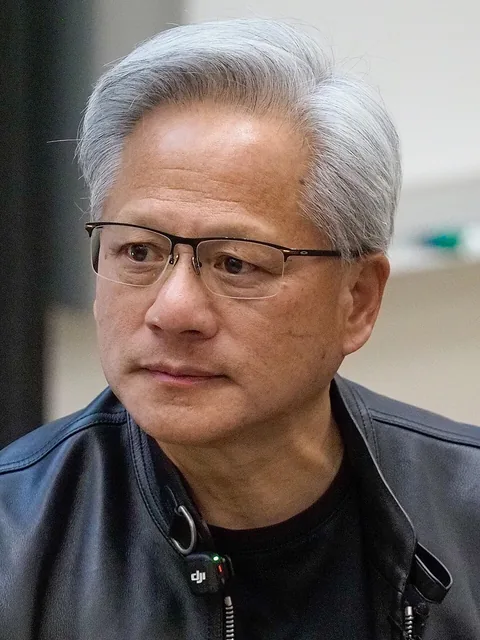
Do you want to talk about this? So literally it came out as I was going on CNBC. I still have not really had a chance to fully read it. I mean, I've scanned it. But listen, I think it's a very important statement, because we're talking about Jensen Huang.
He said, "If the board decides that my return is in the best interest of everyone, shareholders, employees, company and America, I would be honored to return as CEO." He's throwing his hat in the ring.
And I think this is important because until now, no one knew if Jensen wanted his job back. And that's pretty important. You know, it's a little bit like Michael Jordan retiring from the Bulls.43Michael Jordan retired in October 1993, after a third straight championship with the Chicago Bulls, and came back in March 1995 with a two-word statement: "I'm back." He then won three more titles.
And then, don't know what's gonna happen. And then he says, "You know what? I wanna come back and play another season." So I think that this is going to be a galvanizing moment. Since Brad and I wrote our letter, I have yet to speak to a single Nvidia shareholder, employee, corporate partner who is not supportive of Jensen's return. And these are, you know, just people reaching out to me and saying, "Wow." And I think that's important, but nobody knew.
Did he want this? Now everyone knows.
That makes sense. Can you steelman44Steelman — to state the other side's position in its strongest form before arguing with it; the opposite of a strawman. the idea that Nvidia can't work in manager mode?45Manager mode vs. founder mode — terms from Paul Graham's 2024 essay "Founder Mode": founders dive into details and skip levels, while hired managers run things through their reports. We've all talked about Jensen's incredible impact on the business, on the economy, on the industry, but there is a world where I look at a post-Jensen Nvidia and I see a post-Jobs Apple. And I think if you get Tim Cook46Tim Cook — succeeded Steve Jobs as Apple's CEO in August 2011. Under him Apple became the first company worth $1, $2 and $3 trillion. in there, or a Tim Cook-like person, you could run this company not in founder mode, as a manager, and it's such a great business that it can still deliver incredible returns, like what Tim Cook did during his reign at Apple, and it would be a great business even without Jensen. Is that impossible because of the nature of this business?
I wouldn't say it's impossible because of the nature of the business. And listen, there are a lot of really capable executives at Nvidia, who seem overwhelmingly loyal and supportive of Jensen. Colette is an extremely capable CFO who I think will be a good interim CEO, which means there's no pressure on the board to make a fast decision. I think Colette is a very safe...
No pressure, no pressure on her.
It's not like we have earnings.47Earnings — a public company's quarterly results; afterward management takes analysts' questions on a call.
A little bit of pressure, yeah.
09Why Nvidia isn't post-Jobs Apple
Unlike post-Jobs Apple, Nvidia faces fierce competition and runs on Huang's personal relationships, and open models protect it from a hyperscaler monopsony.
The thing with the Apple example, I would say, the pushback is: imagine a post-Jobs Apple where every single iPhone buyer was building a very capable iPhone at a much lower cost. And so the competitive dynamic is just wildly different. And then the thing that Steve wasn't doing was this deal-making machine. And so there's no Nvidia in manager mode that can do what... There's no single person that can do what Jensen... Jensen is an N of one.48N of one — from statistics: a single case you can't generalize from; said of someone without peers.
Yeah, Jensen is irreplaceable. It's just like, you know, I forget when the former Kentucky coach took over the Celtics. He said, "Listen, Larry Bird isn't walking through the doors of the Boston Garden.49Rick Pitino coached the University of Kentucky and then, in 1997–2001, the Boston Celtics. In March 2000 he answered fans' grumbling with a famous rant: "Larry Bird is not walking through that door, Kevin McHale is not walking through that door..." Bird was the Celtics' 1980s star, and the Boston Garden their old arena." Like, there's one Michael Jordan.
There's one Larry Bird, there's one Jensen. And so I think he's irreplaceable. I think those supply chain relationships are very unique. You know, they're lighting up streets and highways in Taipei in honor of Jensen and wanting him back. That wouldn't happen for anyone else. And those supply chain relationships, they're his. They're conducted over handshakes.
He said they've never had a contract with Taiwan Semi,50Taiwan Semi — TSMC (Taiwan Semiconductor Manufacturing Company), the world's largest contract chipmaker, which makes nearly all of Nvidia's GPUs. and yet they have the best relationship with Taiwan Semi. And I do think what you pointed out is spot on. Apple post-Jobs did not face anywhere near the degree of competitive intensity. I would say there are many ways that Nvidia could take its strategy, and there are really important choices they need to make.
And the path for Apple post-Jobs was so clear: just iterate faster, thinner, cheaper. No real competition, a little bit from Android, but I think everybody wants the blue bubble.51Blue bubble — in iMessage, messages between iPhones show up in blue bubbles and texts from Android phones in green; in American schools the green bubble became a social stigma that keeps teenagers in Apple's ecosystem. There is a lock-in: you have your messages in iMessage or iCloud, you don't want to move over. It's very different than, "Okay, we can bring up a different chip, and our customers aren't going to know if the tokens were generated on one chip or another."
ExplainerWhy Nvidia wants open models
The logic Baker lays out is a case of the old rule "commoditize your complement": a company benefits when whatever is sold alongside its product is cheap and widely available.
- Data center chips are bought by a handful of hyperscalers. The fewer the buyers, the harder they push on price and the more willing they are to build their own chips, like Google's TPU or Amazon's Trainium.
- If the best models belong to only two or three closed labs, there are even fewer buyers. If strong open-weight models are available to everyone, thousands of companies and governments run their own AI, and each of them needs GPUs.
- That's why Nvidia releases its own open models, the Nemotron family, and invests in startups and neoclouds that compete with the hyperscalers.
Yeah, what it comes down to is who can generate the most tokens per watt. And then, can we have a competitive model layer, such that you don't get back to the situation data center semiconductors were in from 2012 to 2022, which wasn't a fun time to be a data center semiconductor company, because you had like four or five buyers. You had AWS, Azure, GCP, Meta, maybe Oracle. You had very few buyers. It was a concentrated, monopsonistic52Monopsony — a market with one buyer, or very few, who can therefore dictate prices to sellers; the mirror image of a monopoly. buyer base who had a lot of power over the data center semiconductor companies. And if we go back to that world, because the model layer really consolidates, that's not going to be a fun world for anyone who is a supplier to the model layer or anyone above the model layer. That is why Jensen was such a big supporter of open-weight models,53Open-weight models — neural networks whose trained parameters are published, so anyone can download, run and fine-tune them. Closed models are available only through the developer's service or API. which I do think are important for America. We have our closed models.
We should have the best closed models. Like, if Anthropic always has the best closed models, great. If it ends up being Gemini or Grok, sure, great. But we also need a vibrant open source ecosystem, so that companies can own their own intelligence. Own your weights, own your destiny. And something that's important to me as a human is: I have an eight-month-old daughter.
I think it is possible...
Congratulations.
Yeah, it's great. We've decided to keep her, and I'm recommending it to everyone. It's the best. But it's important to me.
I want to be able to train my own... I hope it's a version of Nemotron54Nemotron — Nvidia's family of open language models. Megatron is its framework for training large models across thousands of GPUs. or Megatron from Nvidia: take an American open-weight model, and I want to post-train55Post-training — the stage after pretraining on a mass of text, where a model is taught to follow instructions, answer in the right style and hold to given values. it on the values that are important to me. Have a Baker family AI. Homer, Shakespeare, Plato, maybe the Bible, maybe the Tao Te Ching, the Quran, Shakespeare, Star Wars, Star Trek, Atreides shareholder letters. Letter to the board, letter to the Nvidia board.
Because these AIs, they are imbued with values. And I do not want to live in a world where there's just two or three value systems. And I don't think that is American. We want to democratize and diffuse this technology and have a lot of different value systems.
And Jensen was a great proponent of that.
10Open models and fast tokens in cyber defense
Baker argues that an ensemble of open models on fast chips is the way to fend off AI hacks, and that will make cyber defense-dominant.
Yeah. How do you react to... I'm sure there are Americans, I know there are Americans out there, that see the FAA, they see Microsoft going down. Those haven't been labeled as cyberattacks, they haven't been labeled as downstream of open source, but there's this fear that hackers will use open source models to wreak havoc on the global economy, wreak havoc on businesses that we rely on. How do you deal with the fact that maybe it's not nuclear weapons, but it sure feels like it's getting closer to a sharp knife occasionally?
So first, all the major hacks thus far have come from closed models. And they were solved with open models. And second, open models are very important for cyber defense, for the following reason. Each AI model... They talk about a jagged frontier56Jagged frontier — an image from a 2023 Harvard Business School and BCG study: AI excels at some tasks and fails at others that look no harder, so the edge of its abilities is uneven. for AI.
There is a jagged frontier for individual AIs. And, you know, in the same way you have a basketball team, and you have a center, you have a point guard. Each open source model, each closed source model, is specifically excellent at one or two particular things. So the way you defend against a new, heretofore unseen AI is not just with a closed source AI, but with an ensemble of open-weight models, each of which spikes in a different... You know, maybe one is really good at cyber defense activity A, the other is good at cyber defense B. And you put them all together in an ensemble, in a swarm, and that is the way you protect us. And I think that's another reason that open source is so important.
If we don't have that, I think you're going to see way more of these hacks, because it is going to be much harder for American companies and American institutions to defend themselves if they do not have this ensemble of models.
Yeah. Downstream of cyber risk, are there new companies that you're excited about? I'm thinking about the private companies that are doing cybersecurity specifically. There's also the open source models that you mentioned, but even specific chips that could do inference faster. And maybe if you're attacking me with a slow model, even if you've got a little bit more intelligence, if I have a faster model, maybe I'm fighting you off better. How are you thinking about that dynamic?
For sure. Speed is everything in war. And my firm is an investor in Cerebras.57Cerebras — an American maker of AI chips the size of an entire silicon wafer, whose main selling point is very fast inference. Its co-founder and CEO Andrew Feldman is a guest later in this broadcast. And they are currently the fastest tokens available, the fastest gun in the West, whatever we're going to call it. And I think that that is actually going to become really important in cyber, because if you can generate tokens much faster than the attacker, it is an advantage. Sholto Douglas58Sholto Douglas — an Anthropic researcher working on scaling reinforcement learning, formerly at Google DeepMind. from Anthropic said he thought cyber would eventually be defense-dominant. And I think this is a big part of that.
And, you know, I think the faster tokens with an ensemble of models is going to win. And, you know, Cognition,59Cognition — the startup behind the AI programmer Devin; in 2025 it bought the coding environment Windsurf. another Atreides portfolio company, they do have a security product that they just came out with. It's their fastest-growing product ever. I think they call it Security Swarm. I may not get it right, but it's the same idea: ensemble of models.
Cerebras has a partnership with CrowdStrike. So I think this is an area to watch. And, you know, it is a little funny. Somebody said it's a little bit like the fire brigades from ancient Rome.60Fire brigades from ancient Rome — according to Plutarch, the rich Marcus Licinius Crassus kept hundreds of slave builders and bought burning houses and their neighbors for a pittance, then put out the fires and rebuilt. The comparison hints that whoever fights the fire can also profit from it. It's like AI may be creating these attacks, but AI is the only way to fight.
No, and I've had a bunch of moments where I've looked down at X, seen a new hack, and been like, "Wow, the tech industry played itself." It's like we did it to ourselves. But that's the way, you know, technology must progress. But the interesting thing, when you look at an important category like inference: you almost have to assume that potentially every company in the category is going to get hacked over a long enough period of time. How are you thinking about... Is that a new part of your underwriting process, when you're looking at investing in a company, private or public, where you're like, "How much do I believe that this team actually has what it takes to defend?"
Because it's not enough now to build great products. We went through a period where you could just build great products. If you built great products, you were going to get customers, and you could figure everything else out. Now it feels like cyber needs to be in your DNA, and you need to be underwriting a company... There should be a section in the memo of, like, who's going to make sure that this company, you know, defends itself.
We have always taken into account, you know, cyber. I think it's an important part of any underwriting process. It's for sure more important than it was.
I know, but I don't know any VC that was looking at a SaaS company in 2020 saying, like, "Well, how can we make sure that these guys aren't going to get hacked?"
In all fairness, I think probably more VCs were doing that than you think. It's just, you know, it goes in the due diligence.
Yeah, you need to see that they have a cyber policy. I'm saying post-term sheet61Term sheet — a preliminary agreement on the terms of an investment: valuation, amount, investor rights. Detailed due diligence starts after it's signed. is one thing.
No, sure. It's clearly more important now. But listen, we've had the FAA, Microsoft Outlook, Workday. We now have a bunch of banks. We evidently have some United Airlines last night. We now evidently have some super-secure national security system that has been disrupted. But I do think, as long as we have a proliferation of open source AI and corporations invest in it, cyber is quickly going to become defense-dominant. And I think we are in the teeth of the peak moments of AI hacking. Like, the AI cyber budget at every company and institution in America went up on Monday of last week, then it went up on Tuesday, then it went up on Wednesday, went up again today.
11Biotech: a problem only AI can handle
Genomics turned out to be too big a problem for humans but not for AI, and this year, Baker says, medicine has visibly sped up.
That makes sense. How are you thinking about bio? Last question, we'll let you get out of here. Is it too early to be investing in that? I mean, Dario,62Dario Amodei — co-founder and CEO of Anthropic. in the Anthropic roadshow,63Roadshow — the series of meetings and presentations management gives institutional investors before an IPO to collect orders for the shares. brought it back home to curing all diseases. There's a lot of companies that are working on that.
How are you thinking about it?
So in a prior life, I ran a biopharmaceutical fund for three years. And if we go back to the year 2000, there's a lot of optimism about sequencing the genome.64Sequencing the genome — reading a full DNA sequence. The Human Genome Project presented its draft in 2000; since then the cost of sequencing one genome has fallen from tens of millions of dollars to hundreds. We're going to have personalized medicine.
We're going to cure cancer.
Getting cheaper every year, and it was on Moore's law as well. And it did. And it did. And, you know, I wouldn't say that the pace of medical progress really changed. I think you have begun to see an acceleration, in a pretty significant way, this year. And that is, I think, because genomics and personalized medicine, it was too big of a problem space for the human mind, or for software written by humans, but it's not too big for AI.
And I do think, you know, something that's very important that we want to get across here at this conference is how AI is helping make ordinary Americans' lives better. And I do think that this is where AI is going to have a massive impact. And I think we are going to see an extension of human lifespans, and that's from AI. And I think that's awesome.
Yeah, it's very exciting. Thank you so much for coming on the show, Gavin.
Thanks for having me. Tall Jordy.
Tall Jordy. There we go.
Thank you. I love it.
AdCrowdStrike, Shopify
Let me tell you about CrowdStrike. Speaking of security: your business is AI, their business is securing it. CrowdStrike secures AI and stops breaches. And I'll also tell you about Shopify.
Shopify is the commerce platform that grows with your business and lets you sell in seconds: online, in store, on mobile, on social, on marketplaces. And now with AI agents...
12Alex Davis: a $10 billion fund, $1 billion checks
Alex Davis's Disruptive has raised a concentrated $10 billion fund for companies that need huge amounts of capital, and behaves more like a public investor.
Here he is. This is Alex Davis. Welcome to the show.
Dallas guy, right here. I think you might have it on flipped. Wait, isn't it supposed to be going the other side? Yeah, if you flip it, it'll flow forward a little bit more. There we go.
Introduce yourself. Pull it up a little bit, because it's loud in here, just the mic. There you go. Perfect. Yeah, the production team loves it when we get the mic right.
Cheers. Yeah, thanks for having me. I'm Alex Davis.
I am an investor. I run a company called Disruptive.65Disruptive — Alex Davis's Dallas investment firm, which backs late-stage tech companies, among them Palantir and Groq. I'm also running a company called Groq,66Groq — an American maker of LPU AI chips and a cloud for fast inference, founded in 2016. In December 2025 Nvidia took a non-exclusive license to Groq's technology and hired its founder, Jonathan Ross. as their executive chairman.
And, you know, we're doing a lot of really interesting stuff. We just announced a fund. So big: a $10 billion fund.
10 billion. How many deals are you trying to do out of that fund?
A pretty concentrated 10 companies. 10 $1 billion checks is the idea.
Will there be a distribution? Will you do half a billion and then $2 billion checks?
Maybe. It just kind of depends on the company stage. But effectively, if we get to check 11, that starts a new fund.
Yeah. Is part of the underwriting thesis for this fund strategy the fact that this is the year of the trillion-dollar IPO, and that you can actually underwrite companies to stay private through the trillion-dollar mark, increasingly, in the new economy?
Yeah, I think there's a universe for these companies where we gotta act like public company portfolio managers, which is very different than a VC that's constantly fielding calls. So we're just looking at this very small subset of companies that need lots of capital. And it'll be really interesting to see what happens with Nvidia and other corporates, as to: are they gonna provide these very large checks?
And so how much more important do we get in the ecosystem, being able to consistently fund these companies that need much larger amounts of capital, 5, 10, 20 billion dollar rounds and things like that, that we could do. And we've been doing that for the last 15 years.
What do you think has changed that's let companies be comfortable burning billions of dollars pre-IPO? I mean, I was raised on the idea that when you go public, that should be sort of your last round. You have access to the capital markets, but you are a going concern67Going concern — the accounting assumption that a company will keep operating for the foreseeable future; if there's doubt, the auditor has to flag it. from an accounting perspective, you are default alive.68Default alive — a term from Paul Graham's 2015 essay: a startup that, at its current spending and revenue growth, will reach profitability without raising more money. The opposite is default dead. Now we have so many companies that are able to take down a billion dollars, reinvest and grow. Is there something structural that's changed? Is it just AI? Are you seeing this outside of the core AI trades? Is it all over the business ecosystem?
I think it's like we've seen for years, maybe all the way back to Facebook,69Back to Facebook — in 2009 Yuri Milner's DST Global put $200 million into Facebook at a $10 billion valuation, one of the first big investments in a late-stage private company. Facebook didn't go public until 2012. and that's when we first really started investing a bunch into later-stage privates, where they wanted more autonomy as big companies, and they'd make this IPO moment this magic moment that they're perfectly trying to time. And we see it with a lot of even our companies, and I think that just sort of continues. It's such a big event for them. In 10, 20, 30, 40 years, they'll remember it, but it's not going to mean that much. But it allows for, you know, people like us to almost be public market investors in a world where nobody really gets an opportunity to invest in the best companies before they do it.
And I think it'll just continue.
13Down rounds and the revenge of the VCs
Without giant corporate checks, Jordi predicts, great AI companies will take down rounds, and VCs will get in at better prices.
Yeah. So there's more news on Jensen this morning. He seems very open to going back, seems like he wants to go back. You know, Gavin was saying that at least up until now the world didn't really know that. I think if you're running a private company that would be the kind of company that Jensen and Nvidia would invest in, you still have to assume that he's not back in the chair, and you have to operate against that.
I was talking to a friend Saturday, a VC, and I was throwing out the possibility of some great companies having to do down rounds70Down round — a funding round at a lower valuation than the previous one, painful for founders and earlier investors. An up round is the opposite. over the next 12 months, just because, you know, they could meaningfully grow their business and yet not have that gorilla that's gonna come in and drop the two, three, four, five billion dollar check. I think prices could potentially reset. What advice are you giving some of these companies that are in the sort of decacorn71Decacorn — a private company valued at more than $10 billion, by analogy with a unicorn (more than $1 billion). range that you'd be investing in, around how to operate over the next 18 months?
It's super interesting, because all this stuff is brand new. Like, I would have maybe given you a different answer a week ago, and a week before that.
Even the idea of Jensen as the central bank of AI, that's a new concept. And then now he's gone. Just like that, we went from new regime to another new regime.
I think, and you'll probably hear people say the same thing, no one really knows how to react. And I don't think there's time to advise our companies. I mean, companies, at least at that sort of upper echelon or stratosphere, should be focused on the business at hand. Normally at that rate, they're not capital-raising machines, unless it's the LLMs. And there's really two companies that have been, you know, 50-plus, 50-plus billion dollar fundraisers fairly consistently, and are now getting ready to go public.
Obviously we'll see in a couple days. But the down round thing's probably real, right?
No, and it's interesting with your strategy: you really wanna be thinking about the deployment period right now, because maybe the worst time to be deploying into some of these companies was one month ago, and the best time is gonna be like four months from now, five months from now. Because there are some of these companies where they were raising a big up round, being like, "We need to raise even more by the middle of '27 if we want to keep executing on our roadmap." So my prediction would be you're gonna see a revenge of the VCs who were just being forced to pay up. Again: great companies, growing at unprecedented rates, but being forced to pay up because of corporate involvement.
And if you see some amount of pullback, you might see VCs like yourself licking their chops and having an opportunity to come in again and support these companies and give them the capital they need, but at potentially better prices.
I think that's right.
And we saw this in 2021, in '22: the great companies did have to reset expectations, and some of them did down rounds. Even the idea of Stripe doing a down round.72Stripe's down round — in March 2023 the payments company Stripe raised $6.5 billion at a $50 billion valuation, nearly half its 2021 valuation of $95 billion. People forget that, right? Stripe was in a situation where people weren't max bid, right? And the people that did come in were rewarded. Did really well for it.
And every single person needs to be basically getting comfortable with the idea of some of these great AI privates doing down rounds. And I think it's gonna be an amazing opportunity. I'm personally excited, because I'm like, "This is a great name. I want to be in it, but I don't want to pay the, you know, the late 2026 price."
Yeah, and we did that round, but it wasn't that we were sitting on the sidelines waiting for a Stripe down round. I think it'll be very different now, because you have a huge backlog of folks that have this great expectation. And I don't know that this had anything to do with what's happened in the last week with Jensen. I actually think they were going to pull back a little bit, at least from what you read publicly. And so I think the expectation is that capital coming from non-strategics is going to be incredibly important. And I also think it's gonna be hard for those folks to raise now, not just the companies but also the VCs, like these mega funds.
Well, congratulations on the fundraise. Great to meet. Let's do this again soon, and we'll see you around later. See you soon. Cheers, Alex, have a good one.
AdCisco, Figma
Let me tell you about Cisco. Critical infrastructure for the AI era. Unlock seamless real-time experiences and new value with Cisco. And let me also tell you about Figma. Agents, meet the canvas. Your AI agents can now create and modify your Figma files with design system context.
14Guy Oseary, McConaughey and Get Access
Oseary launched Get Access so that people who can actually help a company get into its rounds, not just a couple of institutions.
We have Guy Oseary here. Guy, welcome to the show. Welcome back. There he is. Second time on TBPN. Good friend. Guy, how you doing?
I'm doing great.
How's the talk? Not your first stadium show.
Oh yeah. It was a light day. I mean, being here with Matthew73Matthew McConaughey — the American actor, an Oscar winner for "Dallas Buyers Club" (2013). He was born in Texas, lives in Austin and teaches at the University of Texas. is like being in Jamaica with Bob Marley, you know.
Didn't he just move to Texas, though?
No, no, he's Texan.
Oh, okay, okay. I didn't put that together. I just always associated him with Hollywood, you know.
Expat.
So that was great. It's good to be up there with my friend.
What were you trying to elucidate for the audience? Like, what is Matthew's perspective on AI investing? How do you think about that?
Well, we're close friends, and I think we're just storytelling today. Being here in Austin, which is, you know, where he lives. And it's a big week for me, so I think he wanted to celebrate that.
With Anthropic going public.
Congratulations.
In two days. And then I launched this thing called Get Access.74Get Access — Guy Oseary's vetted membership platform through which musicians, actors, executives and other people useful to companies can invest in startups alongside big investors. So I was able to talk about that a little bit and share that with everyone. And he's helped me on that too. He narrated my story on the platform.
So it's a lot of connections. And just having some fun. What is the structure of Get Access?
Get Access is... I have so many friends who are talented, you know, musicians and actors and executives and people who could add value to companies.
But they have no deal flow. They can't get in, they don't even know about these companies.
Meanwhile, the companies want them in.
So there's no way to connect those dots. They'd have really valuable members, investors. And so usually, like today, you guys are probably reporting on, you know, a company today raised a billion dollars. But that's just institutional. That might just be five institutional investors. So amazing people who want to help aren't on the cap table. There's no way to do that.
So Get Access allows people... It's a membership platform. We curate it, so that companies are not just making it available to anybody. We make sure that these are value-added members. I think currently less than 7% of the people who sign up make it all the way through, and we just try to have the biggest collection of the greatest value-added people. When I invest in companies, I want them on. I want them helping.
I want them cheering. I don't want just two institutions, who do their part, but they're not going to be able to do the parts that these people can do.
15Signing off one song: OpenAI and Anthropic
The instincts of an A&R man who signed bands off one song helped Oseary back OpenAI and Anthropic early and hold on when people told him to sell.
I want to talk about storytelling specifically. I guess famously now, you backed both Anthropic and OpenAI. Was it four, five years ago? Four?
It was early 2023.
Okay. Quite early. You backed both. That ended up being the perfect decision. But when you're looking at other companies that are early stage now, how are you thinking about underwriting them from even a narrative, storytelling standpoint?
I think there's different situations where sometimes you have a founder that's already really good at telling their story, right? And that's great. But sometimes they're actually not good at telling their story, but there's something there that's just immediately newsworthy or interesting, or they have some talent that will allow them to be a really interesting story later. But I'm curious about your framework around that.
Well, my whole career has been to try to identify talent early. And, you know, I started in my teens and signed a lot of musicians, and I think what I was known for was signing them within one song. Almost all of them. I went to the Rock and Roll Hall of Fame the other day and I saw the Deftones,75Deftones — an alternative metal band from Sacramento. Their debut, "Adrenaline" (1995), came out on Maverick, where Oseary ran talent scouting; "My Own Summer (Shove It)" is from their second album, "Around the Fur" (1997). and the singer reminded me of a story where he's like, "Yeah, you stopped us after our first song and you're like, 'I'm good.' And we thought we had just bombed." And I don't remember the story, but that is what I did the whole time. I was always worried that I...
Was that before "My Own Summer"?
Yes. Way before. I signed them, you know, before the first album.
I was brought into the Deftones world through Tony Hawk's Pro Skater. And so "My Own Summer" is the jam.
And so I did that with every... You know, Alanis,76Alanis Morissette — the Canadian singer whose album "Jagged Little Pill" (1995), released on Maverick, sold more than 30 million copies. Maverick also released the British band Muse in the U.S. I signed off of one song, Muse and others. So I think there's a pattern recognition, or a gut instinct, that people have magic.
But what's the one song in this game?
In this game? Well, the one song could just be the energy from the talent, like Dario's mind. And you just go, "Oh my God."
But a lot of investors, like, they either got a preview of ChatGPT or Claude and they were talking to it. And I remember the scene of the first big OpenAI round, and all the investors, they're talking to the Sequoia team and they're like, "Why should we invest?" And they're like, "I've never seen anything like this." Because they'd never seen an LLM before that worked at that level. But for you it was more personal.
When I saw ChatGPT, November 30, 2022,77November 30, 2022 — the day OpenAI opened ChatGPT to everyone as a "research preview"; more than a million people used it within five days. my life... It was like, "This is it." And I mentioned earlier, I said it was like hearing Nirvana, where I pulled over the car and I went, "What is this record?" And that's what ChatGPT was like for me. And anyone who met me... We talked to Matthew earlier about it: anyone that I saw back then would have been harassed by me to check out ChatGPT.
So that's a hit song, you know what I mean? To me, that's a hit chorus. It's like, "Wow, this is the greatest thing I've ever seen."
Yeah. You could tell people were complaining about it not keeping you logged in. They only had Google authentication, I think, at the time, and it would log you out, and people were complaining. It's like, this magical technology, but the SaaS piece just didn't work. And yeah, very, very strong product-market fit.
And I think that my background in music allowed me to make those investments, allowed us to make those investments. I mean Ashton:78Ashton Kutcher — the actor and investor who co-founded the venture firm Sound Ventures with Oseary in 2015. In 2023 it raised a $240 million AI fund that invested in OpenAI and Anthropic, among others. his background in entertainment allowed us to think differently, because a lot of people passed.
Well, we did Anthropic at a $5 billion valuation. We did OpenAI at $27 billion. I think we're the only ones to do both back then at that level. And I think Ashton's background and my background, the way we see things, is just different, where for other people it did not make sense.
Yeah, they seem obvious now. At the time, there were like, "Okay, it's this nonprofit,79Nonprofit — OpenAI was founded in 2015 as a nonprofit lab and added a capped-profit subsidiary in 2019. Anthropic has been a for-profit public benefit corporation from the start. for-profit Anthropic." It was like a crazy revenue multiple at the time. There were questions that people had, but you had to zoom out and think about the actual impact of the technology, and then you get it right.
Yeah, I didn't care about any of that. I didn't care about it. I was obsessed. But that's back to my roots. You know, I hear it, I go, "I don't care, I'm gonna sign it, I'm gonna find it."
"I'm getting on a plane, I'm gonna go get that band." No, and just that... My job was called A&R,80A&R (artists and repertoire) — the record label department that finds and signs new artists and oversees their recordings. which is, you know, the guys at the record company running around trying to find the thing.
And I heard so many investors tell the story of, "Oh, I love Sam or Dario. My lawyer told me this didn't make sense." It's like, why are you talking about it? Lots of people told us don't do it.
Lots of people. Of course. And it didn't make sense. And I remember when they did their subsequent rounds, the amount of people, smart people, who sent me messages saying, "Sell now." You know, and just the conviction Brad talked about earlier today.
It's like conviction. You can only have that kind of conviction if you've seen this movie before. And I've seen enough of this movie over my years of finding talent to go, "We're not going anywhere. I'm standing firm. This is it."
Yeah. Do you still feel like we're early? I just mean: zoom out five, 10 years from now. Have you found another couple Anthropics or OpenAIs? Or were you uniquely at the right point in your career and had the ability to put together the capital, and had the access, and then there was this sort of blip where trillion-dollar companies were made? Because I think everyone else right now is underwriting that there's a bunch more Anthropics and OpenAIs. And I think there's still gonna be really big companies. The question is, are we going back to $100 billion being the... That was the regime in the 2010s.
Yeah, yeah. You did get an Uber, but you didn't get another Apple.
Set a really high bar, where it's like, "I gotta go find another." I'm sure it's harder to get as excited, right?
I mean, I think it was much clearer for me back then, because it just felt like these were gonna be the foundational AI companies that everyone's gonna plug into. But we're finding a few things now that... I don't know, you know, I don't look at anything like, "This could be a trillion-dollar company."
I know, that's now just the way to look at things. You have like a $100 trillion mindset. It has to be something outside of the core $100 trillion.
No, I just, like: does it excite me, and can it be big?
Well, when you find it, come back and tell us about it. Great to see you. We'll see you later. Congratulations on your week. Thank you so much for coming on the show.
AdConsole
I'm gonna tell everyone about Console. Console builds AI agents that automate 70% of IT, HR and finance support, giving employees instant resolution for access requests and password resets.
16Andrew Feldman: a chip the size of a wafer
Feldman shows off the Wafer-Scale Engine, the largest chip ever made, and explains that Cerebras handles everything except the powered building.
And we are very lucky to be joined by Andrew Feldman from Cerebras, the co-founder and CEO. And he has the chip with us. Always keeps it on him. Let's put this right there. There you go. Keep it on you. You gotta get a suit pocket that's specially sewn to tuck it in there. I think that was the best idea.
Yeah, you said it to me last night. I made a note, I sent it to my wife: any tailor can do it in your suit. You can sew it in there.
Look, one of the things that's so great about being a hardware guy is that you get show and tell. Software guys, there's nothing for them to show. But this is the largest chip in the history of the computer industry. The fastest AI chip. This is our Wafer-Scale Engine.81Wafer-Scale Engine — Cerebras's processor the size of an entire 300 mm silicon wafer, which would normally be cut into dozens of chips. The current generation, WSE-3 (2024), measures about 46,000 mm² with 4 trillion transistors and 900,000 cores.
Where does this begin? Does it start with sand?
It does.
Are you buying the wafers and just telling TSMC, "Don't cut them up"? Or how does that work?
It starts on the TSMC side, with sand, right? And they create a molten goo, they pull out an ingot, the ingot is sliced, it comes out as a round disk. The disk is 12 inches in diameter. They etch our transistors in it, and then we cut the largest square that we can fit out of it.
You're cutting a square out of a circle. You're by definition losing a little bit of surface area. Is there any hope for a true wafer-scale circular chip, or is that not functionally possible for some reason?
I think there were a bunch of technical reasons why we chose to remove the ears, cut off the edges. Square is a nice way to place the chip, and it has some nice characteristics with cooling and whatnot.
And you vertically integrated that, right? You have your own liquid cooling stack, is that correct?
That's correct. So we don't just make cool chips. We build the entire system, the server into which the chip goes.
So I need to bring a powered shell,82Powered shell — data center real estate jargon for a finished building with power connected but no servers or internal equipment. and you can handle almost everything.
You need to bring a powered shell, and we'll take care of everything else. We'll roll in the compute, we will deliver the API to the customer, and so you can just come to us and get fast, fast, fast inference, the fastest on Earth.
17Fast inference against hackers, and new architectures
Speed decides cyber defense, which is why defenders need fast inference, and Feldman expects room for both big models and collections of small ones.
Talk about the current moment and how Cerebras fits in specifically with cyber. I mean, I think it's on everyone's mind. Everyone's freaked out about it, everyone's trying to spend money to put themselves in a better position. What role has Cerebras played in arming defenders?
Yeah. So one of the things about cyber is time matters, right? A lot of damage can be done in minutes or even seconds. And so what you want is, the minute you are alerted to an issue, you want to take action quickly. Or better yet, you want to be able to prevent these things from happening without imposing these enormous taxes on us, right? There's always a balance. Your engineers are like, "Why do I have to log in 11 times to my work?"
Why does it have to be? You want all of that behind the scenes, and you want it done so fast that it annoys no one.
ExplainerWhy a wafer-sized chip is faster at inference
To generate each new token, a language model has to read all of its weights again: tens or hundreds of gigabytes. So inference speed is limited less by computation than by how fast data gets from memory to the compute units.
- On a GPU the weights sit in HBM, stacks of memory chips next to the processor die. That's fast, but data still moves between chips, and a single GPU's bandwidth is a few terabytes per second.
- Cerebras doesn't cut the wafer into separate chips and spreads the weights across fast SRAM right on the die, next to hundreds of thousands of cores. The company says this memory's bandwidth is orders of magnitude higher, hence the multifold gain in tokens per second.
- The price is the difficulty of manufacturing and cooling a whole wafer, and a limited amount of SRAM: big models have to be spread across several systems at once.
And that's what we do. We specialize in fast inference. And fast inference allows you to scrub traffic, right? Removing threats. It allows you, if there's already been an attack, to quickly understand and recognize what it is and take action. But in all of these cases, speed matters, and we're not a little bit faster than GPUs. We're 10, 15, 20 times faster.
So we set the bar in how fast you can get answers.
There was a recent viral launch from a company called Jev,83Jev — the decision model from TypeSafe AI, released on September 15, 2026: instead of text it returns typed decisions with a probability estimate, for other software rather than people. and I think OpenAI, and I believe Gemini, launched a decisions API. Are there any other new architectures that aren't just the linear progression of scale, scale, scale, bigger transformer, LLM that is maybe a little spiky but can kind of do everything? We've seen diffusion models,84Diffusion models — generative models that produce output by gradually cleaning up random noise. Image generators work this way, and recently diffusion language models have appeared that write the whole text at once rather than token by token. we've seen these decision API models. Are there any new models or architectures that you're particularly excited about plugging into the Cerebras ecosystem?
I think you're right. We've seen tremendous advances on the closed source side, you know, both OpenAI and Anthropic. You've seen tremendous advances on the open source side, with Kimi and GLM,85Kimi — models from the Chinese company Moonshot AI; GLM — models from China's Zhipu AI (Z.ai). Both release strong open-weight models. and you've seen new types of models in these decision models. I think that there is a battle for the hearts and minds of the AI community about whether we want large models to do many things or we want a collection of small models that each does one thing well. And that's a battle that's going to continue, and continues in most healthy ecosystems, right? It's true for many of the software landscapes, right?
You can buy a package that does one thing very well, or you can buy... Let's take security. There are specialized security vendors, or there's others like Palo Alto86Palo Alto Networks — one of the largest cybersecurity companies, selling dozens of products from firewalls to cloud security. that can give you 20 or 30 or 40 or 50 different software packages, all for security. And so there will be the same thing in the AI world. There'll be people who want one model to rule them all, and there'll be people who prefer a collection of models, each a specialist in a particular domain.
Won't the economics, and the sort of gravitational force of the economics, lead us to one or the other? Either the one model becomes the cheapest token per watt and you use it for everything, or we wind up in the ensemble approach, which I think is more likely, and there's a little bit of on-device inference, and then some wafer-scale inference, and then there's some big GPU racks that are orchestrating sub-agents, and there's teams, and there's some programmatic stuff running on CPUs. There's a whole host of these. That feels like the likely outcome. So who would be staying in the monolithic model world? And I'm not saying that the labs won't have their own ensembles internally.
Some of them might be running on Cerebras, but it feels like the end state here is: use every bit of silicon, use every power source combined.
100% agree. I think there is, just like in nature, in business ecosystems, a constant battle between the generalist and the specialist, right? The generalist wants to sell you one thing to rule them all, one platform.
One chip. One whatever. The 10-in-1 shampoo that you can brush your teeth with.
That's exactly right. And there are others. And in some cases you don't want 10 little tubes in your bathroom, right? When you travel, you don't want to. And so they all have their place. And I think you're exactly right that even in the background of the big models, what you're going to have are collections of models.
Because, abstracting it, as a consumer, I want just a text box, and I can say, "Go build this thing," and it spins off sub-agents and uses the best tool for the job. Sometimes it's just pulling an open source package. "I don't even need you to write it. Just pull that code."
That's right. I think the guys who were doing routers87Routers — services that decide which model gets a request: simple ones go to a cheap, fast model, hard ones to a big, expensive one. early on really sort of got to the nub of that issue. That traffic's going to come in, and you don't need a Michelin chef to make your breakfast, right? It's okay to have some eggs on toast. And that's okay, and the same in the model world.
But you're saying this to the guy who drives a Ferrari to the grocery store.
Don't do that, don't do that. And don't drive it to Home Depot.
18David vs. Goliath: supply chain and cadence
Like David against Goliath, Cerebras avoids fighting Nvidia where size matters, plays for speed and sets itself hard deadlines.
So, question. We've heard takes on the Jensen exit from public markets investors, private markets investors, employees, things like that. The people that aren't going on podcasts and talking about this really broadly are the people across the semi supply chain. What conversations are those groups having, and how are they thinking about heading into this next year, with what seems at least very unlikely, that Jensen's in the driver's seat?
You know, I'm not in the conversations with Nvidia and their supply chain partners. And one of the things that...
No, but I imagine there's some overlap.
There is some modest overlap. But one of the things you do when you're David going up against Goliath is you think really hard about how to not be in places where their size matters, and supply chain is one of those. And so we work really hard to build a supply chain that has as little overlap as possible. So, for example, at TSMC we're on the 5 nanometer node, where we don't compete with them for capacity on 3.
We don't use HBM88HBM (high-bandwidth memory) — stacks of DRAM chips placed right next to a GPU. Only three companies make it, SK hynix, Samsung and Micron, and it has become one of the AI industry's main bottlenecks. memory, where they're one of the largest buyers of memory on Earth. And so we've worked really hard, strategically, to not have to duke it out in the supply chain, where they have strength that's hard to compete with. We want to compete where we're good and where we're fast and where we have significant advantage. And that's no different: if they're big, make them run, right? Here we are in a basketball stadium, right? I mean, if you've got a small team, you better run.
And that's the same in everybody trying to think about the other guy's strengths and what those weaknesses are, and how to play into their weaknesses.
Can I ask about that running cadence that you mentioned? I'm interested... Ben Thompson89Ben Thompson — author of Stratechery, a newsletter on the business of tech companies. After Huang's exit he wrote a column on his era at Nvidia. was looking back on Jensen's tenure, and he was saying that when AI started happening, he really scaled up the intensity. You know, six keynotes a year, annual release cycle. What is your goal for release cadence of new chips, features? What is the cadence that you run the company on? Brian Chesky90Brian Chesky — co-founder and CEO of Airbnb. Since 2023 the company has shipped updates not continuously but in big releases twice a year, with an Apple-style presentation. from Airbnb said that there's an incredible value in just forcing the whole team to ship and have a keynote, even if it's an ever-evolving software product, in his case. How do you think about the cadence that Cerebras needs to continue and win?
Well, first, look, you gotta take your hat off to Jensen. A 33-year run from zero to building the most valuable company on Earth. Singular, that's right. That is unparalleled in our history. And what an amazing run, and unquestionably one of the top two or three CEOs of the first quarter of the century.
All right, so we set that bit aside. I think the pace right now in the AI industry is difficult for those outside the industry to comprehend. I mean, it's very common to go out for two dinners, right? To have a dinner at six and then meet someone at a second; two business dinners, right? The number of events that are being done, the fact that Saturday meetings at nine are very common, in the morning and in the evening, that everybody's on all the time. I mean, the intensity in this industry right now is unbelievable. And I've been an entrepreneur for the past 27 years, and we've never seen anything like the raw intensity and the drive right now. To the specific question of does it make sense to have an event: you know, my dad's a professor, and he used to say if there weren't conferences, nothing ever would be finished. And you can use these events to actually drive behavior.
Yeah, right: to force clear thinking, to force releases, to use the cadence of the public events to help motivate the team and drive the team and create hard deadlines. And I think that's something that we've seen across the industry. We're producing a new release of hardware about every year for the next several years, and we're doubling performance in each one.
Yeah. So you get fast in a hurry. And I'm sure you're also very reactive to where the technology is moving, what the labs want, what the buyers want, the different architectures. You can change and evolve as you iterate.
Of course. I mean, the way to think about it is, maybe the hardware is your muscle and the software's the brains, and you got to bring them together to meet what your customers need. And, you know, week to week, month to month, they don't even know what they need. I mean, the landscape is changing so fast that their requests change within a week, and certainly across several weeks.
19Demand, permits and the data center PR failure
Demand for Cerebras is overwhelming, but slowing permits push it to build abroad, and Feldman admits the data center industry lost the PR battle on its own.
Yeah, that makes sense. Last question for me. We talked about the arms race in cyber. What should we know about what's happening in trading? The market right now moves so violently off of individual headlines, or what individuals here are posting. And I imagine it's the same thing: these shops want to be faster. It's PvP,91PvP (player versus player) — from video games: a mode where players fight each other rather than the computer. Of a market: a zero-sum game where one side's gain is another's loss. they got to be the fastest, otherwise returns will be compressed.
Yeah, I think one of the things that is now common in the markets is the speed of diffusion of information is unparalleled. But you need to process that information and make a decision that's right. I think sometimes that information is bogus, as we've seen. And the gap is: people want information processed and good decisions made as fast as they can.
And right now what we're getting is whipsawed back and forth, right? Every burp or hiccup is causing wild fluctuations. I think one of the things that products like ours can do, when you're fast, is get that information, synthesize it, come up with recommendations that are thoughtful and interesting, and not just knee-jerk. And I think that's one of the roles AI will play in the markets in the future.
Yeah. Great. How much demand are you seeing for Cerebras in the United States versus anywhere else?
You know, our demand right now is overwhelming. Overwhelming. And we're constrained by the number of data centers we can put up. And even in the part of our business where we sell hardware, our customers are constrained by the number of data centers they can put up or they can rent.
And so we are seeing, across the U.S., in Europe, and starting in Latin America, in Asia, just overwhelming demand for fast inference, for getting answers in less time.
What is interesting in Latin America? I mean, we've heard a little bit about what's going on in Europe. I'm much less familiar with what's going on in Latin America. What countries are excited about build-out there?
I think we are embarking on a project in Brazil. And I think they've just changed some of their tax structure and made it easier to bring in equipment by lowering tariffs.
And a lot of it's got to be permitting. I mean, that was the fallout of the midterms.92Midterms — the U.S. congressional elections held halfway through a presidential term; in 2026 they took place on November 3. There's a question about whether permits are going to get approved. We have a bunch of other founders on the show who actually build the data centers and can contextualize that, but I'm interested to see. It does seem like if America is slowing down on permitting, there's a natural reaction from the international community.
For sure. I think, and you've got Chase coming on from Crusoe,93Crusoe — an American builder of AI data centers and cloud provider, which is building the campus in Abilene, Texas, for the Stargate project. Its co-founder and CEO Chase Lochmiller is a guest in this broadcast. one of the most interesting startups, doing really, really cool stuff. I think he'll tell you the following: the data centers for 2027 have already been permitted, of course, right? They've been permitted, concrete's being poured, bulldozers are moving, things are being deployed. So what we saw in the elections will have an impact in '28. It usually takes 15 to 18 months from the time a permit is delivered in order to build a facility. So, right, if permits start to slow, what we thought would be built in the U.S. in '28 gets pushed out, and that's a problem, for sure. We were a bit ahead of that. We saw this groundswell coming, and we began contracting for data centers outside the U.S. In '27, about 75% of our data centers will be out of the U.S.
Whoa. That's really high.
Yeah, it's high.
Canada? Canada really likes data centers being built. Some politicians there, I saw, kind of celebrating the midterms, being like, "This is our opportunity to get a piece of this industry."
I think, and it pains me, it pains us too, because part of it... I don't think the data center industry did ourselves any favors.
Of course, right? We could have gone in as a community and been good to the local...
No, the funny thing is, everyone was like, "Hey, the data center word is unpopular, let's call them AI factories," which I thought was dumb. Who wants a factory of any kind? Why would you want to live next to a factory? And we had "supercomputer" right there.
I know, we could have just called them computers. "We're creating a computer center, right? It's in your town. It's gonna give you a bunch of tax revenue, right? It's gonna give you tax revenue. The construction jobs are large and meaningful. The tax base changes. And while you're there, why don't you ask us to build a football field for the high school, or pay for the high school's power for the next 10 years?" I mean, those are things that we could be doing for these communities. And I think there was an opportunity missed by the early wave of data center builders in the U.S. It was just go, go, go. And it's been 20 years of no pushback.
That's right. All the pushback was on the chemical plants: send those overseas. The industrial factories: send those overseas, because smokestack, "I don't want a smokestack." And compared to those, these are the cleanest factories on Earth.
Totally. But the data center builders got complacent. Such a bad job of PR and marketing and community engagement that an opportunity was missed across the board.
Yeah, no, 100%. Are you hopeful that the data center mix for '28 and '29 for Cerebras could shift some market share back to the U.S., if some of these new approaches get dialed in?
I think they should. I think we would like data centers in the U.S. to serve U.S. customers. And I know guys like Chase and others who are doing this are working really hard with the local communities. There's a community that's a few hours outside of Austin, where we're sitting today, and, you know, we were thinking of a data center there, and I called the mayor, and I said, "Look, if you don't want us to work with this data center developer and you don't want this in your town, let's not do this." Right? It's just that easy. "Let's see if we can do something that's good for us and for you."
Yeah. What is the sweet spot for a Cerebras data center? We hear a lot about these massive data center campuses, a gigawatt. Those are the ones that make the headlines. But is 10 megawatts viable? Is that economical? Where is the curve?
What is the shape of the curve for delivering value?
That's a really important question. For training, you want a huge amount of compute and power in one location. So the gigawatt-scale facilities are generally for training. For inference, 50 or 100, just fine.
We can put them in different locations. In fact, there are benefits to having them in different locations, because the latency, the transport time to get to and from the data center, is reduced. And so 50s and 100s, 150s, 200s, those are all great for inference. We do not need these mega campuses that are so large and so power-consuming.
Yeah. It does seem like there's also... I don't know, maybe it's entirely misinformed, but there's something that's probably more reassuring to the average American voter of just like, "Oh, well, I have a PC over there, or a Mac mini, and it's running." And maybe I have a small data center hole in my town that's hosting my Netflix, and that's more relatable than "the Borg94The Borg — the cyborg race from "Star Trek" that assimilates everyone in its path with the line "Resistance is futile." West Texas is a region of cheap land and power where giant data centers are going up. is over there in West Texas." It's scary.
That's true. I think there are a couple things. I think they're afraid of AI, and data centers are the physical manifestation to point at.
And I don't think we've done a good job of sharing all the benefits AI can bring. I think there's been a focus on sort of the fear, and I think that was a mistake. I think what we want to explain to people is that you get a world-class tutor for your kids sitting right there on ChatGPT, right? It can teach your kid how to work on the problem for homework in a way that they understand it best.
You can just keep asking it, "Try teaching it to me in a different way," right? And there are amazing things that can be delivered. And instead, I think we've in part managed to create fear.
And the dislike of data centers, I think, is sort of the something to point at. You can't point at software, but you can point at a building. And that's unfortunate.
Well, hey, thank you guys for having me. Always great to see you guys. We'll do it again soon.
We need our own chip, by the way. Can we keep one at your office?
All right, we'll organize one for you.
Fantastic. Thank you. Great to see you.
AdMongoDB
Let me tell you about MongoDB. What's the only thing faster than the AI market? Your business on MongoDB. Don't just build AI, own the data platform that powers it.
20Zipline: a different class of drone, and federal rules
In delivery drones, a class unlike China's quadcopters, the U.S. can dominate, and federal rules that long held Zipline back now give it clarity.
I believe we have Keller Cliffton, surprise guest from Zipline, coming on. Or did we switch it up? Keller's here. Welcome back to TBPN.
Talked to you a couple weeks ago. Throw on a headset. Make sure it's the... Yeah, this is the right way. There we go. Good to see you in person. We just met for the first time last night. Very excited to finally meet in person. I feel like I've met you in person, because you've taken us on multiple full Zoom tours of the various facilities.
You show more on camera than maybe all but one or two other companies.
And those two companies were like pre-seed.
It's high stakes to do the full tour, but we always appreciate it.
You know, one of the advantages of being a hardware company is that it's visual. You can see the work that's going on.
So while I'm here in Texas, can I demo Zipline?
Yeah. So we just launched Austin. We have a site that's now commercial and live in Round Rock, which is 10 minutes away. So if you guys want to go, you totally should. It usually takes us about six months to get a metro to full scale. So, you know, last year we kind of got to full scale in Dallas.
Dallas: today we have over 20 charging sites, serving almost every home in the metro. We just launched Austin a couple weeks ago, so we have our first charging site online, and now we'll add in charging sites over the coming months.
Very cool. You probably saw this. Ben Thompson referred to you specifically. He said Zipline is the path to American reindustrialization in drone manufacturing and drone dominance. If you want America to have an amazing indigenous drone program, broadly, for whatever reasons, defense, national security, consumer, you have to legalize drone delivery.
Ben Thompson said this, yes. He's a deep cut. He's one of my heroes. I'm pretty sure it's like minute 48 of a two-hour podcast.
Source: The Next Web
I really like that thesis. And I'm wondering, do you agree with that? How much knock-on effect is there from your success, from the industry growing? Will there be a Zipline for X, Y and Z? Small suppliers, startup suppliers that you work with? I'm interested in the Zipline ecosystem, because you're getting to the scale now. The last round was $21.5 billion.
Congratulations. But it feels like there's going to be more people around you, not necessarily a wrapper95Wrapper — a startup whose product is a thin layer on top of someone else's technology, such as an OpenAI model. company, but there will be a whole ecosystem. So take me through the scale of the Zipline economy.
I think the point that it sounds like Ben was making is deeply true. And I think the reason it's actually confusing for people is, people will hear these things like, "Oh, you know, China makes more drones in a day than the United States makes in a year." And that's a true statistic, but it's true for a very specific kind of vehicle. It's like a five-pound, or even a two-pound, quadcopter camera drone. And because it's new technology, people sort of think, "Oh, drone." And actually, the weird thing is, even today, when you see journalists talk about drone delivery, they'll show some AI picture of a little quadcopter with a camera on it that somehow has a package. So I think people don't actually have a sense that, with any new technology like this, you're talking about significantly different classes of vehicles. And so it is true that when it comes to consumer electronics, like a teeny little two-pound quadcopter with a camera on it, China is at dominant scale for that.
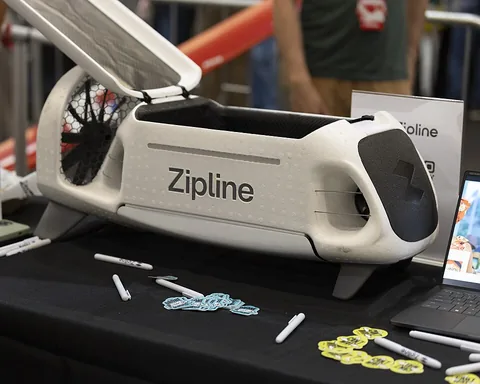
When you're talking about building an automated logistics network, you're suddenly talking about a vehicle that likely weighs more like 50 or 60 pounds, that can deliver 10 pounds of payload, that has to be designed probably almost entirely from scratch. You know, 700 unique components, 43 major subassemblies. You need to be able to operate in all weather. It's a safety-critical system that's operating over metros. It has to be certified by the FAA. And so the good news for the U.S. is that the U.S. actually is and can dominate in this totally different class. And the reason is that it's not so much about building a super cheap plastic widget.
It's much more about complex integrations, not just between hardware and software, but then between ground infrastructure and the businesses themselves that actually have to be able to deliver things in this way. So that's actually an area where U.S. startups and U.S. tech companies generally win. And one example of how we're winning is that there's a big question. You have the U.S., you have China. What about the entire rest of the world?
Who's going to win there? And, you know, Zipline spent the first 10 years of our company's history operating outside the U.S., because it was illegal in the U.S. And there's a whole huge game to be played about whether the developing world is going to be built on top of either the U.S. technology stack or an adversary's technology stack. And so this is why it's particularly important to the U.S. federal government. It's important for American dynamism, American competitiveness, to realize that we're in that competition and to play to win.
Yeah. You said it was illegal in the United States. Now you're in Dallas. Is it something where it's illegal at the federal level and we got a state-level exemption, or a city-level exemption? How has the structure of drone delivery permitting changed?
It was a big disadvantage that I think has now become an advantage. You know, when people think of scooters or autonomous cars or rideshare, all of those companies were having to negotiate on a city-by-city basis for approval, because that's where that regulation exists. Just by default, when they invented the technology, it was state-by-state regulation, or city by city even. And in Zipline's case, the way the airspace is regulated in the U.S., it is a federal regulation. I mean, it makes sense. If you're flying a plane from San Francisco to Boston...
You don't want to go through five different regulatory... like, "Oh, wait a minute, we just crossed into Texas, now we need to descend." So, you know, it's called federal preemption.96Federal preemption — the principle that federal law displaces state law in the same area. Only the FAA controls U.S. airspace, so states and cities can't set their own flight rules. The FAA regulates the entire airspace in a uniform way in the U.S. So it meant that for 10 years, before the FAA was ready to start certifying companies, it was very hard. That's kind of a hard filter.
It's fully illegal. But it meant that when Zipline became the first company to get full regulatory approval to fly in all 50 states beyond visual line of sight97Beyond visual line of sight (BVLOS) — flying a drone the operator can't see with their own eyes. FAA rules generally forbid it without a special approval. in the U.S., it suddenly means you have a lot of regulatory clarity, and you are able to expand across the U.S. under one regulatory paradigm. So I would think of it as a hard filter, where for 10 years it was very painful. And then today Zipline has a huge amount of regulatory clarity that maybe an autonomous car company doesn't.
Sure. Were you affected by the ground stop?98Ground stop — an FAA order holding planes on the ground. On November 13, 2026, a communications network failure halted all departures in the U.S. for more than four hours.
We weren't. We flew straight through it.
So how does that work? There's multiple tiers of FAA regulation, and you're in a different tier.
That's right. We fly below the commercial aviation floor. So we're fully deconflicted from that kind of manned aviation, by default we're fully deconflicted. We fly lower, we don't fly near airports. So, interestingly, I was watching Fleet Command while I was seeing this unprecedented ground stop. And in the back of my head I'm like, "Yeah, I mean, these systems are more reliable, they're more resilient."
They operate... Today we operate from 6 a.m. to 11 p.m., just constantly running and cycling. And, you know, there's a lot of simplicity in this level of automation and autonomy. You get way higher reliability than systems that depend on things like traffic or humans.
21Delivery demand and portals in the wall
Demand for Zipline far outstrips its capacity, and partners hand orders to the drone through a "portal" in the wall.
So what groundwork are you doing to open new markets? I mean, you're starting to open more.
The interesting thing is, I look at the business, and it's like: you have full FAA clearance. This feels like you're going to be in a supply-constrained regime for the next decade. So it's about allocating supply to the right metros.
That's very prescient. I mean, we had raised a round of financing at the beginning of this year, and we had this whole operating plan as a company to do a million deliveries a day. A million deliveries a day was kind of what we were focused on from a manufacturing, supply chain, operational scale perspective for the next couple of years. We now have three strategic partners, and more that we'll soon announce, that are each buying more than a million deliveries a day of capacity from Zipline. So it's like our operating plan sort of became the unit.
Talk about the capability of an individual drone on a day-to-day basis. What are you guys shooting for? Is it 50 deliveries a day?
You know, it's going to depend. It's a really interesting network design problem, because we have certain sites where we have very high vehicle utilization, but those are also sites that are sort of getting railed from a demand perspective, which isn't ideal. If you have perfect utilization, then you're kind of cutting off the peak in terms of the surging demand, because people order specific kinds of things. The whole point is speed.
So it's not like, "Oh yeah, I want my drone delivery in three hours."
Exactly, because I want it now. So we have some sites in the network right now that are... I mean, it's a little bit like the Twitter fail whale99Fail whale — the image of a whale lifted by birds that Twitter showed in the late 2000s when it couldn't handle the load; it became a symbol of an overloaded service. constantly, because they are so overwhelmed with demand that every vehicle at that site is fully utilized from 6 a.m. to 11 p.m. at night. And we're constantly telling customers, like, "Hey, we don't have quite enough capacity. Please come back in 20 minutes," or, "We can deliver for you a little bit later." So that's not ideal, but it is a pretty strong sign of the level of crazy demand that we're observing for this sub-10-minute, teleportation-like delivery.
So our goal: we're building Zips as fast as we possibly can. I give you guys tours of the factory, which we just quadrupled in size. We're trying to scale up every part of the business so that we can meet that demand. It also depends a lot on the hours you're operating. Today we operate from 6 a.m. to 11 p.m.
We'll soon be operating 24/7. Robots don't need to sleep. They can be delivering all the time. But you can think of each vehicle as doing anywhere from, you know, 20 to 50 deliveries a day.
Are there load balancing opportunities with other delivery types? I'm thinking of medical, like the blood deliveries, that might not happen at the same time people order dinner. Maybe it does. But is there an ensemble of products that you can...
That's one of the big advantages. You know, in the U.S., for example, we focus on three major industries, which are healthcare, quick commerce and food. And it's really helpful. When you're building a logistics network, each of those is going to have different peakiness and demand characteristics. And that's very helpful in terms of load balancing across the overall network.
What about night riding? When are we going to have Zip night riders, the ones that operate after dark?
Oh, okay. Oh yeah, I mean, we already operate until 11 p.m. every day.
I know, but 11... Everyone, at least in college, will go through an experience of wanting, you know, maybe a 30-rack after...
Oh, okay, yeah. Well, one example I use is, like, a lot of young parents. For example, if you have a kid who's sick at 2 a.m. or 3 a.m., the ability to just pull out a phone...
You don't use the beer example? Why?
Are you overly media-trained or something?
We can talk about beer too.
No, I like this example. Keller and my kids... He's like six months ahead of me, but all of our kids are the same age.
We have three kids who are almost perfectly lined up against each other. So, you know, Jordy, you know what that feels like. And especially if you have three little kids, taking all of the stress and planning and batch processing and errands, all of that stuff, you just take all of that anxiety out of life. It's like you can now just press buttons on a phone and get whatever you need teleported to you in five to ten minutes. This is pretty game-changing. It's not just game-changing for young parents.
I'll show a couple videos when I'm on stage in an hour. One of the videos is of a bunch of college kids on the seventh floor of a... It's like a pool roof deck of a dorm. And they have Zipline delivering right next to them at the pool on the seventh floor of this dorm building.
On that, do we need a new mailbox for Ziplines? Is that something that would be built in? Because I imagine when Zipline's in my area, I'm using it every day. I can imagine some type of physical infrastructure that would make it even more last mile, basically into the home. In the same way that, you know, a mailman might push mail.
Yeah, I think chimneys might be the... Chimneys.
So one of the really cool things: when you download the Zipline app, you type in your address, and we'll immediately show you a satellite image of your home.
And you can then pick on that satellite image.
You can say, "I want to deliver to my backyard." So, for example, if you're worried about porch pirates, just deliver it to your backyard. But we can also deliver to your driveway, to your front doorstep, to a table.
That's not enough for me. It's got to go down the chimney.
If you work in a tall building that has roof access, you can deliver to the roof. This is what these college students are doing. They're just literally ordering to the seventh-story roof deck. But the drop box... So your question about a mailbox: we actually do build those, but for our partners. So those we're installing, we basically enable through-wall loading. So that means that for Chipotle, for example, and we're now expanding to a whole bunch of Chipotle locations...
They literally just make it, and then they take two steps and they pass something through the wall into one of our drop boxes.
And is the drop box already extended from the drone, and the drone's up atop? Or is the drop box just like a little mailbox on the side of the building?
The way the system architecture works, we'll fly from our charging site to that Chipotle location, we lower the droid, grab the thing out of the drop box, and then continue on. So this is how all of these partners today are integrating. And it's great, because if you have a Walmart, or you have a restaurant, or you have a hospital system, or, you know, whatever it is, we really just think of what Zipline does as building a "Rick and Morty"100"Rick and Morty" — the American adult animated series (since 2013) about a mad scientist and his grandson who travel between worlds with a portal gun. portal, a sci-fi portal. We just install that portal in any wall. You know, like the portal guns, if you guys ever played Portal.101Portal — Valve's 2007 puzzle game in which the player gets through levels with a gun that creates pairs of linked portals on walls. That was one of my favorite video games. You just put the portal on the wall, and now any team member can pack whatever they need, pass it through the magical portal, and it's teleported directly to the customer's home.
Yeah. How advantageous is it to work with a company like Chipotle, that probably has more internal IT infrastructure, their own systems that they can adapt to whatever they need, versus the more homogeneous mom and pop? Is there a trade-off there? Or are they both equipped, because DoorDash and other systems have already come in, and they're used to working with third parties?
They're both super important. You can't do one or the other, in my opinion. You gotta do both, because, you know, if you were only doing the big enterprise partners, a customer is going to go on and be like, "Okay, all I'm seeing is Popeyes and McDonald's and Chipotle." Something is missing from the experience. You want to see the local açaí restaurant that you love. You want to see the local Mexican restaurant.
It is different, because you're integrating with these big enterprises, but then you're also integrating with this mom and pop store that is gonna have very low tech familiarity or capacity to adopt or integrate things. And so we design different processes for both of them. Most of our drop boxes are being deployed with enterprise partners, where they can actually do an integration through the side of a wall. And integration means construction. It's like we have a contractor show up for a couple hours, they cut a hole in the wall and install what looks like a vending machine.
For all of these mom and pops, like an açaí restaurant, we'll typically just go to them and be like, "Hey, we can give you 20 deliveries a day," which to them is probably the difference between profitability and not.
22700 engineers and America's largest airline
Zipline builds everything itself, from motors to unmanned traffic management, and by flight count it is already, Keller says, the largest airline in the U.S.
It looks like a vending machine. You have to make that too? Is that in-house as well?
That's why, I remember, when I was showing you guys around the factory...
You don't just make the drones, but you make the droids that drop down from the drones, and then you also make the towers and the docks, and then also the drop boxes. It's a lot. Are these separate teams? Are there engineers that can move between them? What is the engineering discipline like at Zipline?
Yeah. You know, Zipline today is probably 700 engineers. Everything from the electrical engineering teams that are designing the flight computers, power distribution boards. We design the electric motors completely from scratch. We design the propellers themselves, the powertrain team. And then you have all of the software teams that are writing the low-level embedded engineering running on all that avionics, plus the high-level software, like flight controls, autonomy, computer vision, machine learning, communications architecture, multi-vehicle deconfliction, the civil aviation authority software that we build, so basically the unmanned traffic management systems, plus the Zipline app.
So the FAA already has deconfliction. They've already thought ahead, and if there's a Zipline competitor in a city and you guys need to operate together...
That's what that... So, yeah, today there are, I think, two or three public companies that build air traffic management software, ATM software, that the FAA and air traffic controllers buy, certified. So these are public companies. There's a whole question about what the industry looks like in a world where Zipline is already, by flight volume, I think the largest airline in the United States. By flight volume, we'll be bigger than all other airlines combined by next year.
And so this is, you know, obviously it's a much smaller vehicle.
But I think it's just making the point that this is a totally different class. It's a different thing, and you're gonna need new kinds of traffic management systems that are built for autonomous vehicles rather than for a human-piloted 737. And, yeah, Zipline is designing those systems from scratch. We integrate with others to make sure that we can keep the U.S. airspace safe and predictable.
Yeah, yeah. I saw Casey Handmer.102Casey Handmer — a physicist and former NASA Jet Propulsion Laboratory engineer, founder of Terraform Industries, a startup that makes synthetic natural gas from sunlight and air. I don't know if you've had... Yeah, he's a legend. And he built an air traffic deconfliction system that, I think, runs in a browser, runs on your computer. At that scale, it runs on a TI-84.103TI-84 — the Texas Instruments graphing calculator used in schools since 2004, a byword for modest computing power.
But he would be able to do that.
But, yeah, I mean, the idea is, with the current volume of commercial air travel, it's actually not that computationally complex on modern hardware.
No. I don't want to freak people out. I mean, obviously you guys cover a lot of this stuff, but I think people are starting to grasp: if you go into an air traffic control tower in the U.S., you'll feel like you are transported back in time, like 100 years. People are using pencil and paper and little note cards and writing things down. That's not comforting. And, you know, you saw the press conference around the ground stop, and they're like, "The technology overwhelmed the system."
Everyone was like, "This is the AGI104AGI (artificial general intelligence) — hypothetical AI able to do any intellectual work as well as a human. god that's woken up." And it's like, no, this is the opposite of that.
Yeah, yeah, exactly. So I think people don't realize how by-hand and, I don't know, primitive a lot of these systems are.
But a lot of it's modernizing still. And I mean, it's good that you're in a place where you can build the software and then actually vend it in as well.
Yeah. And I guess, coming back to the main point, the goal has always been: you just gotta be a full-stack company. When you're trying to build this new industry, we were never able to rely on, "Oh yeah, this company is going to build this great off-the-shelf component for us." We're probably going to have to build it ourselves.
Why is flying at night so easy for you? Do you have lidar105Lidar — a sensor that measures distances with laser pulses to build a 3D map of the surroundings, used for example on self-driving cars. on the drone, or are the cameras okay?
Yeah. I mean, the system operates using a lot of different sensors. We use something called differential RTK GPS.106Differential RTK GPS (real-time kinematic) — satellite navigation corrected by a ground base station, accurate to centimeters rather than the few meters of ordinary GPS. So it's basically near-military-grade GPS. We can typically know where the vehicles are, plus the droid, within a centimeter. We also have computer vision systems on the Zip and on the droid that allow us to operate safely. But you're never relying on any one of those sensors, and also a lot of those sensors work better at night than you might think. Night is much easier for us, interestingly, because guess who isn't flying at night? Helicopters, basically the vehicles that we worry about. We typically worry about hot air balloons, crop dusters, GA pilots107GA pilots — general aviation: all civil flying other than scheduled passenger and cargo flights, such as private planes, crop dusters and flight schools. flying suicidally low to the ground, like under 300 feet. This is actually the majority of the risks. Those are the people we worry about. And so, the worse visibility is, whether it's at night or fog, you don't have people doing it.
I don't know, I feel like we might get into nighttime hot air ballooning in Dallas. I've certainly wanted to dabble in the Dallas hot air ballooning nighttime league.
23Valor and why hardware is hard
Unlike a typical VC, Valor spent months helping Zipline fix its production line, and hardware, guest and hosts agree, is far harder than it looks.
That's what you should do. I'm not sure what the advantage of hot air ballooning would be at night. I can see Zipline doing a company happy hour in hot air balloons, just to be present, you know, on the same level with the drones. I will say, Antonio looks like a movie star.
He does.
He's very handsome. I mean, he's giving McConaughey a run for his money. He's one of your investors, right?
Yeah. So Valor108Valor Equity Partners — Antonio Gracias's Chicago investment firm, founded in 1995, known for its investments in Tesla and SpaceX and for helping companies get manufacturing right. has been a big investor in Zipline since, I think, 2022. You know, in many ways, at Zipline we learned so much from observing how Tesla and SpaceX were built. And as you know, the Valor guys spent a huge amount... They were living inside those companies, trying to solve hard operational problems. Valor brings, as an investor, a huge amount of manufacturing know-how that frankly definitely does not exist in any normal venture capital firm.
I mean, Antonio started his career buying U.S. factories and trying to make them more efficient and then selling them, which sounds like a way to lose a fortune rather than make a fortune. How to lose a few billion dollars. And they did it very successfully. And, to their credit... I mean, at Zipline, you know, hardware companies, every time you're launching a new product, it's like an existential crisis for the company.
Everything is bet on this new thing. And if you look at Tesla, for example, the Model S and then the Model 3, the company nearly went bankrupt multiple times. As a hardware company, you don't get to spend four years developing a hardware product, pouring all the resources into spinning up the supply chain and manufacturing, and then be like, "Oops, it wasn't a hit." If it wasn't a hit, you're probably dead. And so, same with us. I mean, two years ago Zipline was in this position where we were six months behind schedule launching this next-generation technology, which is ultimately what we've been talking about.
We were having all kinds of reliability problems. We were at our test site until the middle of the night, Saturdays, Sundays, trying so hard to make this system work. And to their credit, Valor deployed quality engineers and process engineers and manufacturing engineers into Zipline, and they sat on the line with us for months on end, helping us solve these hard operating problems. They are singular as an investor in their ability and willingness to do that.
That's great. That's insane. I didn't have that backstory. Normally it's like, "Can I make any warm intros?"
"Are there any warm intros that would solve your hardcore manufacturing challenges right now?"
Well, every investor will tell you, like, "Oh, we're gonna be so helpful to you." I think it's a different level of...
No, it's so funny, because the helpful VC is such a meme that it ends up discrediting the very small number of investors that do go so far above and beyond. And then those ones are typically not the ones that go and brag about it. They're the ones that don't take credit for the work. Sometimes entrepreneurs will end up telling those stories, but they're never the ones to be like, "Well, actually, this business wouldn't exist without us, because we put 10 people into the company at this critical moment," right? They would never brag about it.
But I mean, Tim Watkins, who is one of the managing directors and founders of Valor, lived in an airport motel for months on end, helping us solve very unfancy, desperate problems. I mean, you're looking at a Pareto109Pareto — a Pareto chart: problems sorted by how often they occur or how much damage they cause. The Pareto principle ("80/20") says roughly 80% of effects come from 20% of causes, so you start at the top of the list. of quality issues that might be 50 to 100 things, and each one of these things needs to be burned down every morning.
A Pareto. It's just like a distribution: you want to do the 80/20.
Yeah, 80/20 is the same idea. And, you know, when people talk about "hardware is hard," "it takes time," people don't really, I think, have a physical sense for how painful and desperate...
No, what people should do is go try to make a piece of apparel.
Like, go actually try to make merch that's not a screen-printed logo on a shirt, and you will find that even just making a garment, which has no technology in it, it's just literally fabric that's sewn together, even that is incredibly difficult, and people botch it all the time. It's just harder than people think.
And, you know, I actually do observe it everywhere, right? You think, "Oh, you know, OpenAI and Anthropic, it'll be easy for them to build data centers." Oh, wow. Actually, SpaceX kind of came out of nowhere and is better at building data centers than they are. You might think... these kinds of systems, it takes decades to figure out manufacturing, manufacturing engineering and quality, and how to build stuff and make it reliable in the real world. And it's way harder. Yeah, I mean, your point about a T-shirt. But then imagine a system that's 100 times as complex. Or, you know, you have SpaceX competing against a country, China, and still a decade ahead, and people are trying to replicate it as hard as they possibly can.
Well, now they're just showboating on Europe, you know: more mass to orbit this year than Europe has ever done.
Wait, really?
In history?
In the history of humanity. Well, unless there's some hidden ancient history. Who knows? Maybe in Atlantis. In ancient Rome.
They were just going to Mars and back.
But this stuff matters. And, getting back to your original comment, or Ben Thompson's comment, about American dynamism. It is interesting to think about: when I graduated from college and then when I started the company, we moved the company to the Bay Area in 2013. And I remember at that time the most exciting, hottest company in probably the entire world, was what it felt like to me... This was me learning about the tech industry for the very first time: it was Dropbox. And Dropbox had, you know, a $4 billion valuation, and they had all of the best investors in the entire world.
They had all the best engineers. They were growing incredibly fast. Legendary founder. And so to me, in 2013, that was the pinnacle of what was achievable for a technology company. And they were a file sharing company.
And so I just think it's interesting. That was only 13 years ago. And in 13 years, the scope and scale of human ambition has grown so dramatically. You know, not only do we now have multi-trillion-dollar IPOs, but you have teams building out basically every part of the technology stack, whether it's nuclear fusion, or life extension, or autonomous delivery, or DNA computing, or superintelligence. It's crazy that in one decade...
It's amazing.
And that's what gives me so much optimism, despite how dynamic the market is. No, not even the market, but there's a lot of tension in the world right now. But there's so many of these teams that are going to transform whole parts of the economy. I wish we could hang out all day.
Well, hopefully hang later.
Always great to hang, dude. Thank you so much for coming on the show. Next week. Awesome.
AdCodex
Let me tell you about Codex. Codex is a powerful workspace for getting work done with AI agents. Whether you're writing code, analyzing data, creating content or automating business workflows, Codex helps you move projects forward from start to finish.
24Chantel Jeffries: DJ, angel and haters
Chantel Jeffries invests where her network can help and tells founders not to waste time on haters.
Our next guest. Welcome to the show. How are you doing?
Hi, I'm good. How are you?
Thank you so much for hopping on. Would you please introduce yourself for everyone?
I'm Chantel Jeffries. Yes, I am a DJ, investor.
What important song are no DJs playing?
That no DJs are playing? I personally love to hear a good "Party All the Time",110"Party All the Time" — Eddie Murphy's 1985 song, produced by Rick James, which reached No. 2 on the Billboard Hot 100. Many people don't know the comedian recorded music. a little Eddie Murphy throwback. And then I like to drop the knowledge, like, "Did you guys know Eddie Murphy made this song?"
Yeah, yeah, that's a deep cut. I like that one. What about on the investing side?
I'm super excited about all my investments.
What have you most recently invested in?
All of them. Not all, but most, especially the recent ones. I'm super excited about Get Access. It was my most recent investment. I'm also an advisor there.
We just had Guy on.
Oh yeah, yeah. I saw, it was in the corner.
And that was a product that I imagine you would have liked to have had access to, or had existed, when you started investing.
Exactly.
The thing about angel investing is, as you start getting access to deals, your deal flow should be getting better and better each month. And so that means your investing should be getting better every single month. But early on everything looks amazing, because you haven't seen a great pitch that didn't work out, or you haven't seen a great pitch from the wrong team, and so you can't really process all these things in the same way.
Yeah, it gives you a lot more data to be able to make a more informed decision. I think especially for me, coming out the gate with my first investment being Poppi,111Poppi — an American prebiotic soda founded in 2018. PepsiCo bought the company for $1.95 billion in 2025. it's like, okay. And then, you know, you're looking at all these things, whether it's prediction markets...
Big one.
Or Oura Ring,112Oura Ring — a smart ring from the Finnish company Oura that tracks sleep, heart rate and activity. which is super exciting as well. So I think just having as much information as possible, you can make the best decisions. And I think some people have the privilege of having the time to go out and actively, proactively find deals, but some people don't have that luxury. So I think something like Get Access is a great supplemental way to be able to get deal flow and just know overall what's going on in the space.
How do you think about the way founders should approach working with celebrities, influencers as investors? Sometimes the deals can get really complicated, because it's like, "Okay, well, every other person is just putting in a check and getting equity, but we have the opportunity to put you in our Super Bowl ad, or maybe you can be a spokesperson, or maybe we could give you advisor shares." And the deals can get really, really complicated. How are the best founders thinking about building relationships over time?
I think it really depends on the situation and the talent that you're working with, because some people are, you know, really passionate about the things that they're invested in and working with. So for me, I actually really enjoy working alongside the same brands in the long run and building a relationship. So I really look at, "Okay, where can I take equity?" But it's not always the best idea, right? So it's just kind of a case-by-case thing. And I think if you can find someone that aligns and has the same passions as your brand and as the company that you're building, bringing them in to be vested is a good idea.
And I guess in some ways every investor brings some value-add. I mean, we were just talking about Valor. Valor's badge of honor was that one of the partners went and lived in a hotel room for months to help Keller with Zipline. That's a different shape of a value-add. But also being a public individual, and a face of the brand, or an ambassador, can be something that you bring to the table, just like any other investor, even if you hold the same equity slot.
Yeah. I'm an advisor for a lot of the companies that I'm invested in, and I'm always just factoring them into my ecosystem and my network, and thinking, "Oh, this person should connect with this person," or, "This would be a great value-add there." So I'm just proactively trying to connect the dots and just bring opportunities.
But will you still look at... I imagine you'll look at investing in companies where... There's certainly companies I've invested in where I'm like, "Look, I'm not gonna be able to help you that much, but I promise I'm gonna be there for you personally." And I think that's okay sometimes. Are you still investing...? When I think of Oura Ring and Poppi, those are things where you can have a massive impact on cultural relevancy, getting them in the right rooms, getting them connected to other people. But will you make investments in categories where there's not specifically, like, "Here's this exact thing I'm gonna do for you"?
I do, but I kind of feel like there's almost always something I can do, between my network and me traveling and being boots on the ground in a lot of places all the time. I just think talking to the right people, meeting the right people, just even saying something... You know, you're talking about a company to someone, and then someone else becomes interested, maybe they invest. It can always lead to something.
So, you know, there's some things that I'm not as hands-on with, but I do still try to help if I can.
How are you talking to founders about owned media? Like a new beverage brand or something: should they build up their founder as the spokesperson? Should they have a light touch, just partner with influencers, build their own in-house media studio? How are you thinking about media and branding for more consumer-oriented products in the modern era?
Well, I think, you know, when you decide to make it very founder-focused, that also comes with some risks.
So we saw that last week.
But at the same time, you know, when you're living and breathing something, you are talking about it all the time, and it has a high chance to be successful. So, you know, if you're the founder, it's kind of up to you, you know what I mean? I think for me, I would feel comfortable, but some people might not. And I think it depends how much you've been in the public eye, because it is a different way of life. And if you haven't been there before and you're going on this new journey, it's like, "Okay, well, do you know how to deal with the press and the media?"
Can you deal with haters? Haters is a big thing.
I've dealt with a lot of haters.
Musician, or influencer, creator, whatever it is, you've gotten the 10,000 haters, right? But as an entrepreneur, a lot of people, you could get to the Series B and not have one person say something negative about you. The first time it happens, it's like, do you shrink in?
Or does it just consume you, and you spend four hours thinking of a response?
No, I know there's some founders that any time a negative thing is said about their company, they message the person: "Take it down, take it down." They get argumentative, all this stuff.
It's like total waste of time. But yeah, I think once you get that out of the way, like me, then you just don't care anymore. You're like, "Yeah, all right, whatever. I've seen way worse stuff. That's just not even worth my time."
Where do you want to take the investing? Do you want to raise a fund at some point? Would you join a fund?
Yeah, I think those are all great options. You know, I'm having a really great time just advising and investing right now, but I do have people every day always asking me, like, "Hopefully, can I get deal flow?" Or, "Can you send things my way?" Or, "Maybe give me your opinion about this," or, "We'd love to have you on the team, you have great ideas." So I think working in different ways, it's been developing as it's going along. But I do want to bring more content around investing and founders, because it's something that I find so interesting, and I think there's a lack of it. You guys do a great job, but there's not too many places to find, in the pop sphere, in pop culture, "Okay, here's a way to get you more interested in the space."
Last question for me, on Instagram. What do you think of the long-form shift? The new long form that's rolling out. Will you be watching 20-minute videos on Instagram personally? Will you be producing content for that new format?
I think long-form content can be great to just listen to. I don't really want to see it on a small phone, but if it's a podcast, okay, I can just listen, it can be on.
You might see a clip, click in, and then background it, and then just be listening to a podcast, basically.
But I would prefer to put it on the TV and do whatever tasks I'm doing and get the full experience.
I think they're launching, or already launched, an Apple TV app, and I'm pulling for them to launch a full physical TV. The Instagram TV just plays Instagram vertical.
Yeah, it's good. Are you playing a set while you're here, or is this all investing?
This is an investing-focused trip, but who knows. I have my USB on me at all times. So if we have a little fun after at some point, or if anybody here is available to book me for the... I'm sure there'll be options.
Yeah, plug it in. So great to have you. Thank you so much for coming on the show.
Great to hang.
Have a great rest of your day. When we're all back in...
Yes, let's do it.
We'll talk to you soon.
AdNew York Stock Exchange
We have to tell you about the New York Stock Exchange. Want to change the world? Raise capital at the New York Stock Exchange.
25Cornelius Schmitt: everything can be printed
Schmitt believes anything can be printed: materials differ only in software, and going from idea to a pair of shoes now takes a day and $50.
And we have Cornelius from Zellerfeld.113Zellerfeld — a German startup that 3D-prints entire shoes from a single material, founded by Cornelius Schmitt. It made the Air Max 1000 together with Nike. We met a few years ago. Apparently you have shoes for me in the mail already, but you brought socks. Introduce yourself.
How did you know I only brought white socks?
Oh, really? Well, when you've got the cowboy boots, no one can see the color of the socks. Got the Zellerfelds under the cowboy boots. I like this logo. Have you made a pair of cowboy boots?
Yes, actually.
Introduce yourself, introduce the company.
As if he needs an introduction.
So I'm Cornelius. I started Zellerfeld eight years ago in my student dorm in Germany. And I believe 3D printing should be way bigger. I think the gap between digital and physical needs to be bridged. And what I just love is stuff like this. I have more goodies. All of this is the same material. So this feels leather-like. Check this out. This: springy, right? Check it out: in one direction it's very... I have another one for you. In one direction it's... And this doesn't go at all. This software... I have another leather piece for you. All of those materials are basically the same, and this feels like velvet.
Can you do a jacket in just this? Full springiness. Move over, Bottega.114Bottega Veneta — the Italian fashion house known for its intrecciato woven leather.
I think I'm going... All this.
And what I want people to understand is: if that's all the same material and it's just software... You know, you can make handbags out of this, you can make jackets, as you said. But there are also ways how you can print electronic circuit boards in the same printer. And so I'm wondering, why don't we print everything? You know, why don't we print the laptop?
Like, I don't get it.
Maybe cost? Does it cost?
No, not really. Because, you know, this is a little bit of plastic. It's synthetic material. This is like, I don't know, five cents. So I really don't get it.
And do you think consumer sentiment around plastic has bottomed? Because I think plastic has broadly been so...
Bryan Johnson115Bryan Johnson — the entrepreneur who sold the payments company Braintree and is now known for Blueprint, spending millions of dollars a year to slow his own aging and publishing his regimen. bailed on his AstroTurf because there was too much plastic in there. That was viral.
There's a lot of people worried about plastics. But at the same time, it's one of the wonders of the world, one of humanity's greatest inventions. Everything is good and bad. And I feel like sentiment, for me at least, I think sentiment for sure bottomed out last year, and I think we're on the up again, and you're prime for it. And that's somebody who, like, I only drink glass bottle water, and I'm pretty obsessed with it.
But it doesn't have to be plastic. Lots of different materials are 3D printable. You can have wood fill, you can have all sorts of...
Particle board, basically.
Yeah. There's an Austin-based company that prints houses from concrete.116An Austin-based company — ICON, founded in 2017, which prints houses from a concrete mix with huge construction 3D printers.
I've seen that. Concrete. That's cool.
And I just love the fact that we can have basically a software file, and it governs what it can be. So I'm a big believer in this future where everything can be printed. There needs to be a marketplace where all of those digital products are basically sold.
How did you process the Astra launch? I feel like that weekend everyone was on Blender.117Blender — free, open source software for 3D modeling and animation. I 3D-modeled an entire house, turned it into a video game, turned it into a thing. Were you 3D printing that weekend? Have the models sped up your iterations?
Yes. And so we are 10xing every year, for five years. And the main thing is because it gets easier and easier to create 3D models. And, yeah, obviously now...
Take it off. Show us the shoes.
So Nike joined. Nike is just one, but, you know, Justin Bieber works with us, Drake works with us, all sorts of people.
Can we make a shoe?
Of course.
I think we got to. It's time.
But what I want you guys to understand is, it's not just shoes, it's anything. And, you know, if you think long term, if there's a colony on Mars, if there's a colony on the moon, what happens with a new iPhone? Elon's talking about that, with the mass driver118Mass driver — a device that uses magnets to accelerate cargo to the needed speed without rocket fuel. On the moon, with its weak gravity and no atmosphere, it could launch cargo into space. for the moon. We cannot wait three years until the planets align and then send lots of Starships that still take half a year by the time the iPhones arrive there. So Zellerfeld is a space bet. It's a space company. We need to digitize every product on Earth.
Okay, and show me these. You're teasing these. I want to see these.
This is crazy. Look at this. So they are soft on the top and hard on the bottom. Obviously now you're doing short show-and-tell, but touch this.
Oh yeah, this is cool. A lot of fun.
Everything will be printed.
What is the highest volume run that you've done?
Have you made 10,000 of roughly the same design, something like that?
Yeah, tens of thousands of a single design. I think this is so cool. So this year, or next year, we are just at the brink of getting to a run rate of a million pairs a year.
So what does that look like? Does that look like a warehouse of hundreds of 3D printers all working in parallel?
Yeah. So we have actually designed our own printers, because you can't get those printers. And they are all also CCP-controlled,119CCP — the Chinese Communist Party. Most consumer 3D printers are made by Chinese companies. all printers you can get. So we built our own printers, and we built them in Germany, and now soon also in Austin. And so we have now here in Austin 1,700, but we want to scale it to millions.
1,700 printers.
Yes, they're all running at the same time.
So with those we will get to like a thousand to two thousand pairs a day, before we scale to the next phase.
That's great.
And how quickly now can you go from idea to the printers running? Is it effectively instant? Like, I don't know, two minutes?
So from... There are, like, Claude extensions to Blender, where you can just, with one prompt, it generates an image, turns that image into a 3D model, turns that into something that's watertight, upload it to Zellerfeld Studio, and it turns it into printers running, like this. And what this does, especially in footwear... And I think footwear is just one example, but in footwear usually the product cycles are 12 to 18 months. And to make a sneaker it's like hundreds of thousands of dollars, and here it's like $50 and a day.
When are you doing a 3D-printed hat?
Cowboy hat. You should have done cowboy hats for everyone.
Can we get the printer... Wait, can we get the printer running on some TBPN cowboy hats for tomorrow? Let's do it.
Let's do it.
Let's do it.
We have these, but the real problem is that these cowboy hats, they don't fit over the headset. If we can get some for tomorrow that fit here, then we're in business. Cut out of the internal structure, so you have the cowboy hat that fits over the headset. The perfect use case for printing, right?
That's something you could do. And then we sell it, and you earn with every single headset.
Yeah, for all the people that want to wear cowboy hats over the Sennheiser headset. You get it. We got you covered. That is absurd. Everyone gets their own special thing, whatever they want.
And I believe there needs to be a marketplace for those digital products, because we cannot ship things all the time. We have to send them digitally, much like a video or photo.
Yeah. So what you're saying is the end state is there's Zellerfeld retail locations all over the world, or in your home.
I want to have a printer in your home where you can just push a button, and maybe it's a Nike or a Louis Vuitton handbag or a piece from IKEA, like a fork or whatever. And then you just press a button, you're gonna pay 10 cents for it.
One fork, please.
Yeah. 10 cents for the fork.
Have you seen the new 3D-printed koozies? It has a beer and a pack of cigarettes and a gun. People 3D-print these. Crazy.
I was thinking the TBPN official concealed carry holster.
Oh yeah, in the front. The holster.
By Zellerfeld.
But it needs to have something else in it. A gong mallet, perhaps. So, the special gong mallet. Concealed carry for a gong mallet. We brought a gong,120Gong — the TBPN studio has a gong the hosts strike when a guest announces a round, a deal or a record. They brought it along to the Austin summit. but we don't have a gong carrying case. And so Tyler121Tyler Cosgrove — the TBPN team member who reads out news and prediction market odds on air. on our team needs to lug this gong, and it's very risky, because it can bang and make all sorts of noises. But a 3D-printed case for the gong would be good. Is that too big for the printer?
What's the maximum size? Because shoe versus gong. I feel like...
So the printers we have right now can do it. It's fully doable. You just make all the axes longer. I would love to show you someday.
Yeah, yeah, yeah, that'd be great. Well, thank you so much for coming on the show. Always great to see you. Let's hang out later.
26News: GPT-6.2, the world in Minecraft and Aschenbrenner's 13F
Between guests the hosts work through the timeline: OpenAI ships new models, the NSA's network is down, and Aschenbrenner's book has taken a beating.
I think there's some breaking news. We have Brian Armstrong coming on the show in just a couple minutes, but did OpenAI launch 6.2 Astra and Sol?122Astra and Sol — OpenAI model lines: the flagship GPT-6 Astra came out on September 3, 2026, and the midrange GPT-6.1 Sol on September 29, 2026. They just launched this today. I think this just hit the timeline. We'll dig into it more tomorrow. Also, a coding dev who's been on the show, Tyce, who was working at OpenAI, I think, over the summer, he recreated the entire world in Minecraft123Minecraft — the 2011 sandbox game whose world is made of cubic blocks, the best-selling video game ever; owned by Microsoft since 2014. at one-to-one scale.
Finally. Every building on Earth, including your house.
The funny thing is, seeing this in the same week as GTA124Grand Theft Auto VI — the new installment of Rockstar Games' open-world crime series, out November 19, 2026. makes you think that the next GTA should just be the whole world.
Yes. There was a GTA knockoff that was a one-to-one representation of Los Angeles. I think it's called, like, "True Crime: Streets of LA"125"True Crime: Streets of LA" — a 2003 Activision action game that recreated about 240 square miles of Los Angeles from real maps. or something. And the game wasn't that fun, but it was very cool that you could go and find your house or your office or your building, because they modeled most of the... Some other news.
CNN says that the NSA126NSA — the National Security Agency, the U.S. signals intelligence agency, which also protects government communications.'s internal communications network is currently down.
Wow. This is insane. Someone else mentioned that on this show today. How does that even happen, or get out? Is it not air-gapped127Air-gapped — physically disconnected from the internet, as a security measure. or something? I wonder what's going on. But what else is going on in the news today?
Leopold128Leopold Aschenbrenner — a former OpenAI researcher and author of the 2024 essay series "Situational Awareness" on the coming of AGI, who then founded the hedge fund Situational Awareness LP, which bets on companies that benefit from AI.'s Situational Awareness 13F12913F — the quarterly filing in which managers with more than $100 million in U.S. stocks disclose their holdings to the SEC, within 45 days of quarter end. It doesn't show everything, short positions for example. dropped, and the coverage of this is very odd, because the 13F book shows that it's down 92%, but that's kind of known from the Ken Griffin story that emerged, that the public book was sold. So he still has something like half a billion dollars in equity and something like a billion dollars of notional call volume.130Notional — the value of the stock the options give the right to buy. The options themselves cost far less, so a billion in notional doesn't mean a billion invested. So he's still in the game, but very much down. And I don't think there were any big surprises with this 13F, given that, you know, so many of the names that he was associated with, it's very obvious that there was turmoil. Somebody says, "Situational Awareness discloses new position: $300 million on black, lost immediately." Which is ridiculous, and not nice. But he's gonna do very, very, very well on Anthropic.
27Brian Armstrong: agentic finance and Coinbase's defenses
Armstrong wants to decentralize AI the way crypto decentralized finance, and argues that AI used properly favors the defender.
Got the Silicon Data131Silicon Data — a startup that publishes GPU rental price indices, something like market quotes for compute. team over there hanging out. We're gonna bring Brian Armstrong on the show, CEO of Coinbase. Yeah, we're ready. Let's bring him on down to TomorrowX TBPN. There he is.
Great to see you guys. How you doing?
Throw that on. The microphone goes on the left side, and then it's gonna go right in front of your mouth, because it's a little bit loud here. But what do you think? What do you think?
So far so good. The scale is just wild. It's crazy. They've done a great job with it.
Yeah, the massive stadium. How are things going in your world? Give us the latest in Coinbase.
Yeah, well, we're really excited about agentic finance right now. You know, crypto has decentralized the financial system, very important for freedom. We also want to decentralize AI and make sure that there's not a couple of big monolithic ones. You know, it needs to be an economy of open-weight models that are all collaborating together to outperform the frontier. So we're building the infrastructure for that: accounts, payment rails.
I think it's going to be very good for the future.
ExplainerHow AI agents pay each other
Cards and bank transfers are designed for people: sign-ups, card details, captchas, SMS codes. An agent that needs to pay a couple of cents for a single call to someone else's API can't go through all that.
- In May 2025 Coinbase introduced x402, an open protocol that revives the long-reserved web status code HTTP 402 Payment Required: the server tells the agent "this costs so much," the agent pays at once in the USDC stablecoin and repeats the request.
- Payment settles on the blockchain, with no sign-up or API keys, so services can charge micropayments per request instead of selling subscriptions.
- This kind of infrastructure, wallets and accounts for agents and a way to settle between them, is what Armstrong means by "payment rails."
Yeah. I mean, what does it actually look like? I've noticed this with the video models. A lot of the big labs, they don't really have great video models. Some of them do, but it's kind of hodgepodge. And you can always use computer use132Computer use — a mode in which an AI model operates a computer itself: it looks at the screen, moves the cursor, clicks buttons and fills in forms. to go put down your credit card and get an API key, and it's just this extra step. And it feels like the weirdest thing, that it can write all this code, but it can't fill out a form for me. What does that look like in the future?
Yeah, well, right now the frontier models are great generalists. You know, they can do everything from scientific research to Shakespeare to bedtime stories. What we've seen is that open-weight models that are fine-tuned to a narrow task, like it could be compliance, or making an ad, or doing voice, or video, or even just ordering your pizza or whatever, especially if they're trained on proprietary data sets that are internal to companies, actually outperform the frontier. Then if you get a team of them collaborating, or a swarm of these agents working together, it can be really powerful. I mean, we see the same thing with human beings: a team of specialists can outperform a single person, no matter how smart they are. And then you start to get companies interfacing with each other.
So, you know, Hayek133Friedrich Hayek — the Austrian-British economist and 1974 Nobel laureate. In "The Use of Knowledge in Society" (1945) he argued that prices carry dispersed knowledge to market participants that no central planner could gather. is this economist who famously talked about this: how do you get millions of independent actors in an economy to coordinate? Well, you use prices and you use markets. And that's what we think the next step is for the agentic economy.
Yeah. What do you think the overall tech community can learn from crypto when it comes to security? I mean, the cyberattacks are all over the place. There's systems that are going down every other day. Bitcoin's famously never been hacked.134Bitcoin's never been hacked — the Bitcoin protocol itself has not been broken since its 2009 launch, although exchanges and wallets have been hacked many times, such as Japan's Mt. Gox in 2014. But what else can you tell us about what it takes to win as a defender in cyber?
Yeah, well, trust is definitely paramount in these moments. And our first reaction is normally to go collaborate with the other folks in the industry to mitigate the issue. But when I zoom out, the big thing I think about is that AI is very powerful on defense if you use it correctly. In fact, I think it favors the defender if you use it on defense. So an example is, every line of code that we write at Coinbase, before it goes to production, gets reviewed by one of these cyber expert models. And so we can look for any kind of issue or vulnerability up front, right?
I mean, there's other things that we do. More than 99% of the funds are stored entirely offline, in cold storage,135Cold storage — keeping crypto keys on devices that are never connected to the internet, so they can't be stolen remotely. distributed in places around the world, that we've gotten patents on and audited by all of these folks. That's kind of what allows us to be the largest custodian of crypto in the world and benefit in these moments. And then part of it's also, you know, we just got a national trust charter approval from the OCC.136OCC — the Office of the Comptroller of the Currency, the federal regulator of U.S. national banks. A national trust charter lets a firm hold client assets under federal supervision. So these regulatory audits that happen give people a strong sense of that security as well.
28NewLimit: from simulation to the wet lab
AI can test millions of hypotheses in silico, but drugs still hit the bottlenecks of wet labs, robots and clinical trials.
Yeah. I know you're also following bio very closely. What are you seeing there? Dario in the Anthropic roadshow was talking about the potential of curing all diseases in, I think he said, a decade. What are you excited to buy? More interestingly, it feels like the scenario where all diseases get cured the same week seems kind of crazy.
I feel like maybe peanut allergies go first and then cancer comes later or something. I don't know. Something's got to be more tractable. But how are you decompiling that industry and trying to understand what's going on there?
Yeah, well, so the AI layer is definitely getting much more powerful, but that's all in silico.137In silico — experiments run on a computer, as opposed to in vitro (in a test tube) and in vivo (in a living organism). A wet lab is an ordinary lab with reagents and cells. It's kind of hypothetical. And, you know, to be honest, we don't really fully understand how biology works yet. And so you need to come from the in silico layer, where you're testing millions of hypotheses, and then actually test them for real in a wet lab. So with NewLimit,138NewLimit — a San Francisco biotech founded in 2021 by Brian Armstrong and Blake Byers, developing therapies to extend healthy life by epigenetically reprogramming cells. which is the longevity biotech that I co-founded, that's exactly what we're doing. So we start with AI at the top to test millions of hypotheses, or, you know, evaluate them.
We take the most promising ones and go through our wet lab in high-throughput screens. We're trying to reprogram human cells to make them restore function that they had when you were younger. We take the most promising ones from those high-throughput screens and run them through functional assays and mouse models and things. And then the best of those we take to human trials. So our first human clinical trials will be happening next year.
Yeah, and we've gotten some really promising early results, but that's going to be the next bottleneck. It's really: what do you do with physical atoms moving around? Because we haven't gotten humanoid robots even to successfully be a barista.
So they're not ready to be in the wet lab in a biotech company. Once they solve barista, I think we'll get the humanoid robots in the lab.
I don't know. I think barista might be a higher art than the wet lab, personally. I think the wet lab might come first.
I want to agree with you, but this year was so weird, because Hugging Face happened before I saw someone book a haircut with AI. And so the diffusion of things happens in a really weird order, where you'll still get hallucinations and AI can't tell a funny joke, but then it can solve a Millennium Prize139Millennium Prize problems — seven of the most important unsolved problems in mathematics, named by the Clay Mathematics Institute in 2000 with a $1 million prize for each. math problem. But I take your point that the wet lab is a technical thing, and barista probably comes first.
Yeah, exactly. And of course, the regulatory pathway. I mean, we might see some of these compounding pharmacies, where people are doing their own GLP-1.140GLP-1 — drugs like semaglutide (Ozempic, Wegovy) that mimic a satiety hormone and became a mass treatment for obesity. During shortages, U.S. compounding pharmacies legally made cheaper copies. We might see sort of N-of-one-type experimentation that people do in the biohacking community and things like that, to sort of get data sooner. But there's gonna be no substitute: to really sell a drug into the broadest markets, you've got to go through these clinical trials, which still, for good reason, take quite some time.
Yeah. Talk about the potential to... You know, assuming continued breakthroughs, can we get to the point where we can perfectly simulate human biology? Which would, of course, need human studies to actually verify and things like that. But the full, you know, 1,000x speedup would come from one-to-one simulation, right? How does the industry actually think about that? Because it's easy for a podcaster to say.
I think we're still quite a ways off, right? So, you know, DeepMind and these folks kind of got the Nobel Prize141The Nobel Prize in Chemistry 2024: half went to Demis Hassabis and John Jumper of Google DeepMind for AlphaFold, a model that predicts the 3D structure of proteins, and half to David Baker for computational protein design. for simulating a single protein, protein folding. No one has actually gone from a single protein to a cell, which is orders of magnitude more complexity. That's just a single cell. Now, the cells in your body also have communication pathways between them. So to go from a cell to a whole organism is another many orders of magnitude.
So I think we're probably gonna have to have some quantum computing breakthrough or something to get to where you could simulate even just a human cell, or like a lab.
Okay, bet.
29Agent traders and cutting vendors
Coinbase lets agents into accounts with guardrails, designs its defenses assuming infected laptops, and is cutting its vendor list.
Yeah, we'll do it, we'll do it. Have you been acquisitive this year? Are you thinking about more acquisitions? Is crypto in a consolidation moment? Is that an opportunity? I know you've brought in some great talent in the past, but what's been the thinking this year and going forward?
Yeah. I mean, we acquired, I think, 10 companies or so last year. It's a rolling number. So we're always looking at different talent pools to bring in, especially around agentic finance; that's a big one coming together. I mean, we have this team... Coinbase for Agents is the product: you can connect your agent to your Coinbase account. And a lot of people are doing trading with it.
That's growing like 20% week over week right now. It's crazy. People are doing all these interesting trading strategies, but they're also doing it to just solve more mundane tasks, like, "Figure out my target portfolio allocation and help me save money on taxes," and, "Put in a bunch of limit orders,142Limit order — an order to buy or sell only at a set price or better. like if the market corrects down," so I can get better pricing over time. So we're seeing people do that kind of stuff. There's so many agentic finance teams out there. We're meeting a lot of them that could come in and be additive to that.
So I mean, we've seen other financial institutions kind of pull back from letting the agents run wild in their systems. What gave you confidence to take that stance?
Well, that's kind of what we're good at: we take frontier technologies like crypto, AI, and we make them trusted and safe. So yeah, you shouldn't just let an AI come in there willy-nilly, but what we can do is put controls and permissions around it, which probably already existed with APIs, right? The APIs already had many, but we're making new ones that are tailored to AI agents. So you can segregate funds into a certain account. You could give it certain permissions around how much leverage to use or not, things like that.
Yeah. The interesting thing to me about this moment for you guys is, because cyber has been keeping you guys up at night for your entire history, you are actually more prepared for this moment. Because there's more risk, but at the same time, you're not a software company or some cloud or inference platform that's like, "Wow, we need to care about this," and they haven't been doing this for a decade, right? It's a very new problem.
That's right. I mean, we always have to remain vigilant on this stuff, but one thing that we did more than a decade ago, when we were designing our cold storage system, is we said, "All right, we have to operate under the assumption that at some point a developer could get malware on their laptop," right? And it must be resilient to that. In fact, several developers could have malware on their laptop. And so I think that's a new sort of foundational principle every company has to think about: the key pieces of your infrastructure have to be resilient to that, because eventually someone's gonna get tricked.
Also the software supply chain too, that a lot of companies are figuring out right now. That's something that I think the crypto industry has had to be thinking about as well, right? Like, what data do other companies get, and what kind of access, and that kind of thing.
Yeah, it's always been higher stakes, because it's like, oh, you put your money on the line.
A lot of people... You know, October was just such a bad month for cyber incidents, and even for companies that didn't have an issue themselves...
Don't worry, November will be even worse.
Yeah. But you have to worry about your vendors. So I mean, a lot of our vendors, we put them through their paces on these SOC audits143SOC audits (System and Organization Controls) — independent reviews of how a vendor protects customer data; a SOC 2 report is a standard requirement of big customers. and things like that. But I mean, we're actually really trying to whittle down the list of vendors that we use now, because some of it you can recreate in-house, and it just gives you more control.
Yeah, that to me is part of the new SaaSpocalypse144SaaSpocalypse — the 2026 nickname for the sell-off in software stocks on fears that AI agents and homegrown code will replace subscription software. narrative that I've been thinking about: you just don't want to trust other vendors in the same way that you did a year ago.
Because if you have access to some frontier model and you want to review every line of code, and then there's a line that just says... I don't know.
Yes. It'll take us like three weeks to build, and more time to maintain.
But we own it.
30The quantum threat to Bitcoin, and Apple goes down
Coinbase is helping Bitcoin prepare for post-quantum cryptography even though Armstrong sees no imminent threat, while Apple's services go down mid-show.
Yeah, yeah, yeah. There is definitely a flight to quality145Flight to quality — market jargon for investors fleeing risky assets for safe ones in anxious times; here, companies picking proven vendors or building things themselves. in these moments. Can you take me through the recent history of quantum and its relationship to crypto? I know some of the timelines got pulled forward, and then I'm seeing all the math breakthroughs that the models are doing, and I'm thinking maybe things will go faster. But what is the true bottleneck there?
What is the risk? How have you been responding to that?
Yeah. Okay, well, one thing is that we put together this Bitcoin quantum advisory council. Or I should say, we're a member of it. Dan Boneh146Dan Boneh — a Stanford professor and one of the leading experts in cryptography. at Stanford and others have really been hosting it. And they've had some in-person meetings, which have been really great, with the community, just to kind of figure out what the path to upgrade Bitcoin to post-quantum cryptography147Post-quantum cryptography — encryption and signature algorithms meant to resist even a large quantum computer. Bitcoin's current elliptic curve signatures could in theory be broken by one. might be.
And the Bitcoin community has these Bitcoin improvement proposals, the BIPs, and there's a couple good ones out there, like BIP 360,148BIP 360 — a Bitcoin Improvement Proposal that adds a new address type resistant to attacks by quantum computers. that are creating a good path. And so we want to see, as a member of the community, what we can do to contribute to that, with engineers or open source contributions. You know, with all the AI research out there on math proofs and things, we haven't seen anything that makes me worried too much about the core cryptography that's in Bitcoin today. But I do think that the creation of quantum computers could be accelerated by AI. That's something that we have to get ahead of. I don't think the risk is imminent, but I think that it's better to be early than late to something like that.
You can't currently vibe code149Vibe coding — Andrej Karpathy's term (February 2025) for programming where a person describes the task in words and the AI writes all the code. a quantum computer in your garage. You need certain super-cold magnets and stuff. It's a hard tech project. So it's gonna take us...
Yeah. The thing that actually makes me more optimistic on this is that right now the world is having to contend with complex coordination specifically around cyber, which is gonna be the same set of capabilities that I think we're gonna need to use in some of these other domains, and potentially quantum as well.
Yeah, for sure.
Well, and as we're speaking, apparently Apple is having multiple system outages around iCloud, Apple Pay, Business Manager.
Okay. Well, we'll let you get back to your day. I'm sure it's gonna be a good one. Great to catch up. Hopefully see you around later.
Thanks, I appreciate you.
The stream's still up. The stream is still up, which is remarkable in this day and age. Thank you so much, Brian, for coming on the show. We have Chase Lochmiller from Crusoe coming on in just a minute. We will see how he's doing.
6.2 is out. Okay. The official OpenAI account says, "Some of you have been asking very politely, some of you have just been asking. 6.2 Astra and Sol are now available." Excited to see what people do with these new models. Trying to figure out what's happening with this Apple outage.
User reports show problems with Apple Support, iCloud and Apple Pay. Downdetector150Downdetector — a site that collects user reports of online service outages and shows them in real time. reporting this. Full list: Apple ID login, Sign in with Apple, Apple Card, lots of stuff.
Yeah, the crazy thing, when you start thinking about, okay, what is the economic impact of all this stuff, it's like, cool, Apple Pay going down, FAA.
Even one day is like billions and billions of dollars of economic activity. Truly, truly remarkable. Well, I hope that they can get everything back up very quickly. Tyler has the full list here, which is kind of everything in the Apple ecosystem. I don't see anything on here that's not an Apple service that I would see. Apple Music.
I guess Apple TV is still up. You can still watch the F1 movie.151"F1" — the 2025 Apple Original Films movie starring Brad Pitt as a Formula One driver, directed by Joseph Kosinski; Apple's highest-grossing film.
What about the Vision Pro?152Vision Pro — Apple's mixed reality headset, released in February 2024 starting at $3,499. That's what you're frantically... like, "Is the Vision Pro gonna be working today?" The red guy, apparently, is here at the event and says Druck153Druck — the nickname of Stanley Druckenmiller, the legendary manager who ran Duquesne Capital for 30 years and now runs a family office. just got on stage and said, "It's over," at the long AI conference. Chat.
31Chase Lochmiller: Crusoe around the world
Crusoe is expanding from Texas to Paraguay and Iceland, and Lochmiller expects fine-tuning to grow as companies want sovereignty over their data.
Wow. Insane. Well, we have Chase Lochmiller coming on the show to talk more about everything happening here at TomorrowX. Chase, welcome to the show. How are you doing?
Good to see you. Good to see you. Welcome back to TBPN. Throw that headset on. The microphone goes on the left, and we're gonna want that microphone as close as possible.
We had it right, John. And you... My bad. That looks great.
There we go.
There we go.
Great to see you. How you doing? We got cowboy hats. Yeah, we got cowboy hats, but they don't fit over the headsets. You're gonna wear them this way, I guess. I don't know. Anyway, are you a big cowboy hat guy when you're out here?
I got a couple cowboy hats. It's a functional product. I wear a cowboy hat quite a lot, purely for the function. The sun protection is fantastic.
Nice wide brim. High-quality sun protection.
Are you out here in Texas often? Is this the biggest project? Are you all over the United States now, all over the world? What is the footprint of Crusoe these days?
I'm in Texas a lot. We have a big footprint here, in Abilene154Abilene — the Texas city where Crusoe is building the first Stargate campus for OpenAI and Oracle. and other large campuses that we're developing in Texas. But, you know, we're building all over the United States and expanding globally. So doing a bunch of stuff in Iceland, with geothermal and hydropower. We just announced something big in Paraguay that's being powered by the 15-gigawatt Itaipu Dam155Fact-checkThe Itaipu hydroelectric dam on the Paraná River, on the border of Brazil and Paraguay, has an installed capacity of 14 GW, not 15 (Wikipedia, "Itaipu Dam"). down there.
That's huge.
It's a lot. So our project is 280 megawatts, what's been committed. But you can draw the power from that, because they have excess.
That's cool.
And, you know, we have something in Norway, we're doing something in Israel, maybe some plans in Asia, we'll see. But yeah, so we're sort of expanding globally right now.
International business, man.
What is the shape of the team that you show up with? Are you handing off to a government? Do you need to bring a hyperscaler or a lab on board with you to one of these projects? Or can you show up and just say, "Hey, there's power, we're gonna go build it, they will come"? Is it an "if you build it, they will come"156"If you build it, they will come" — a twist on the line from "Field of Dreams" (1989), in which Kevin Costner's character hears a voice say "If you build it, he will come" and builds a baseball field in his cornfield. problem at this point?
Sometimes we structure things that way. I think typically we like to have at least some anchor offtake157Anchor offtake — a customer who signs a long-term contract for a project's capacity or output in advance; banks lend against such contracts to finance construction. in hand to catalyze these bigger project investments. But, you know, broadly, when you think about Crusoe, it's a vertically integrated AI infrastructure platform. The key three products that we sell to customers are typically data centers, at one layer, where we'll typically work with hyperscalers, very large investment-grade customers; managed clusters of GPUs, where we're serving a lot of the innovators in the economy, and quant trading firms and folks like that; and then managed services.
So managed inference, managed fine-tuning and all sorts of managed AI services that are mostly serverless.158Serverless — services where the customer doesn't rent servers but pays per call, and the provider manages the capacity.
So how is managed fine-tuning growing? Because, like, open source, there's a lot of excitement, a lot of people support it, but it's very hard to actually compete against lab revenues, which are, you know, leaking every week at this point. And you can see that there's something like 150 billion dollars of revenue, or ARR,159ARR (annual recurring revenue) — usually the current monthly subscription revenue times 12. across Anthropic, OpenAI, Google. What's actually the scale of that industry?
You know, I think it's much smaller than frontier lab revenue today.
But it's like a Jevons paradox160Jevons paradox — economist William Stanley Jevons's 1865 observation that as steam engines used less coal, total coal use rose because they were used more widely. Here it's the reverse: efficiency saves money and revenue stays small. thing, where people are using it a lot, but they're saving money, so it's a small revenue base.
Yeah, well, I think there's that, and I think there's a sense of data sovereignty: people really wanting to control their models, own the models, and use what's unique to them, which is these private repositories of domain-specific data that they can apply to the use cases that they care about. And, you know, what we're seeing is there are customers that are able to get better results on things that they care about. It may not be the best benchmark result for some general-purpose thing, but for very domain-specific things, they can get better results with fine-tuning. And we think that's gonna be a trend that's gonna continue to grow and expand, as people think about using these rich private data sets to apply to general use cases.
Yeah, that makes sense.
32Iceland: geothermal, cold air and aluminum
With cheap geothermal power and cold air, Iceland is a natural home for data centers, as it was for aluminum smelters, and locals still feel positive about them.
Talk more about geothermal and what you guys are working on in Finland.
Yeah. It's in Iceland.
Sorry, Iceland.
Similar area of the world, yeah, close enough. A lot of snow. So Iceland's kind of this geological phenomenon in a lot of ways. It has this ultra-low-cost geothermal power. There's not a massive population there.
It's less than 400,000 people that live in Iceland, but they're rich in energy resources, and obviously it's a very attractive environment from a cooling perspective. So you get very low PUEs161PUE (power usage effectiveness) — the ratio of all the power a data center uses to the power that goes to the servers themselves. The ideal is 1.0; the colder the climate, the less goes to cooling. when you're managing data.
And what is it about the environment there that makes that geothermal energy so abundant? Is it effectively more shallow, because there's heat in the underlying geology?
It's just a very active volcanic...
Yeah, we all saw the explosion.162The explosion — Iceland sits on the Mid-Atlantic Ridge. Its most famous recent eruption, Eyjafjallajökull in 2010, shut down European air travel for a week; since late 2023 a series of eruptions has been under way on the Reykjanes peninsula.
And that means there's more heat closer to the surface. Whereas here, if you go far enough down, anywhere, you're gonna get...
Yeah, no, that's right.
It's all about how deep you have to drill to get to very, very hot rock. And then you're piping water down that's turning into steam that's turning a turbine, then you get electricity.
Exactly.
There's a couple different ways of doing it, but that's sort of one way.
Everything's boiling water.
We're always boiling water. That's the human story. I'm assuming you guys have spent a bunch of time with the local population, understanding how they think about this. I can imagine people there being somewhat pragmatic, and being like, "We have a lot of land, we have a lot of energy, we have a low population. This is a new industry that can create a bunch of economic activity here that doesn't necessarily disrupt our daily life." But, you know, what is sentiment like in the country?
Look, I think in Iceland the sentiment's still reasonably positive. It hasn't been overwhelmed in the same way. You know, I think the total grid in Iceland is something like three gigawatts, something like that.
And you look at the Texas grid, which is something like 90 gigawatts, and they had 400 gigawatts of large load interconnection requests,163Interconnection requests — the queue of applications to a grid operator to connect new consumers or power plants. Many data center requests are speculative, so the total far exceeds what will actually be built. and it was just sort of a bit of overload there. You know, I think energy-intensive use cases have sought out Iceland as a home in the past. It's actually been a very popular location for aluminum smelters. So a lot of aluminum smelters have set up shop in Iceland, where they're shipping raw aluminum ore164Aluminum smelters — aluminum is made by electrolysis of alumina, aluminum oxide extracted from bauxite ore. Electrolysis is the most energy-hungry stage, so smelters go where power is cheap; in Iceland they use most of the electricity the country generates. across the ocean, doing the very energy-intensive process of the smelting there, and then shipping finished products elsewhere. AI is a much better manifestation of that trade, right? You're moving data over subsea cables.
We have three redundant subsea cables that interconnect into Iceland. And then you're doing the energy-intensive compute workload on managed clusters of GPUs and then shipping the end result, whether it's inference or training, elsewhere, to where you end up consuming it.
I know Greenland's a different country, but are there any similarities between Greenland and Iceland? Because they are in a similar area, similarly cold.
There are, you know, they both end in "land." So that's a big similarity. You know, we haven't spent much time thinking about Greenland.
It's not industrialized enough.
I did see a very funny meme on X. It was, you know, Greenland, and then it was "Data Center Land." Data Center Land on top.
I mean, nobody's there. And we had Hollywoodland, where they chopped off the "land."165Hollywoodland — the 13-letter sign in the Los Angeles hills went up in 1923 as an ad for a housing development; in 1949 the letters LAND were removed, leaving HOLLYWOOD. Thirteen is considered unlucky in the U.S. 13 letters. It was bad luck. Bad luck. What about Canada?
I mean, we heard that there were some politicians that saw the American midterms as an opportunity to jump in. Are you seeing that on the ground?
Yeah, I mean, look, Canada has always been a very compelling market. It's a very energy-rich nation. They have a lot of hydropower. They have a lot of oil and gas in Alberta, and have invested a lot in renewables. So we think it's a very interesting market, and then obviously it has attractive cooling characteristics. So we think it's an interesting market. We've gotten close on a couple of things, but haven't quite gotten something across the finish line there.
33The data center of the future and Crusoe Spark
Lochmiller calls most complaints about data centers misinformation, and says the modular Crusoe Spark removes construction and makes infrastructure distributed and resilient.
Are you starting to think about what the compute campus of the future might look like, before they go to space? I'm just thinking, if you check the boxes on: it's underground, or it looks beautiful, and it's quiet, and it's solar-powered, you're checking off a lot of boxes that people have been, rightly or wrongly, critical of. What do you think? Where do you think this goes?
Well, look, I think there's a couple of characteristics when you think about the build of a data center in a neighborhood, that people have problems with. Number one is, when it's a big construction site... Anybody who's ever had their neighbor do construction on their house, you know how annoying it is when there's a big active construction site next door to you. So we're very empathetic to that. But a lot of the other big criticisms, like water usage, job creation, energy usage, I think a lot of them are oftentimes misinformed by things that are spread through social media that are misleading or oftentimes untrue.
So, you know, the modern data centers are typically closed-loop systems.166Closed-loop systems — cooling where liquid circulates in pipes between the chips and heat exchangers without evaporating, unlike cooling towers that lose water as steam. We use almost no water in these big AI-focused data centers.
Yeah, Dylan Patel167Dylan Patel — founder and chief analyst of SemiAnalysis. had a good quote. It was like, the same water as three In-N-Outs,168In-N-Out — the California burger chain with a cult following in the western U.S. which I thought was more grounded. You say golf course or something, that's abstract.
In-N-Out, it's a funny one. I mean, one of our giant buildings in Abilene uses 10 single-family homes' worth of water. It's basically the employees that go to the bathroom, wash their hands, water the plants. That's the water usage. It's not the GPUs boiling all of Abilene's water. So I think there's a lot of misinformation out there.
But we think there's other ways of building the data center infrastructure needed to power AI that's driving economic results for the world, that doesn't need to look like a giant gigawatt-scale campus, which is something that we're focused on. That gigawatt-scale campus is very uniquely suited for training next-generation frontier models. I think that's going to continue to be a thing. But as we serve these models, you don't need a gigawatt of compute in a coherent cluster. You can do it with much smaller clusters of compute.
So Crusoe has actually built this product called Crusoe Spark. It's a small, modular, manufactured AI data center, an AI factory, that we ship to site. It's basically a prefab data center. So it eliminates all of the construction that's going on on site, which is a huge part of the pushback. And also, oftentimes, where these are being installed, there's limited labor supply to actually do the construction work.
So oftentimes you have to bring in labor to support the big builds. In this case we're actually concentrating the labor in a high-volume manufacturing environment, where you can access the labor very cost-effectively and efficiently, and you don't have to heavily impact a local labor market with short-term construction work. And it's also very flexible, in the sense that there's actually a lot of areas of the grid where there is excess power and there may be limited transmission. There's too much generation on individual nodes within the grid, and it actually goes to waste. But it may not be a gigawatt; it may be 10 megawatts, 20 megawatts, 50 megawatts. And this is a very well-suited solution to basically say, "Where can we access power that's stranded169Stranded power — electricity that's generated but can't reach consumers for lack of transmission lines, so it's curtailed or sold for next to nothing. on the grid?" And we can plug in five of these, 10 of these, 20 of these modular data centers.
Back to the original thesis.
Exactly, exactly. So bring compute to where you can access low-cost energy, and mitigate a lot of the concerns around data center builds, with these small modular manufactured approaches. We also think it's an important thing from a national security standpoint. When you think about these giant campuses, and if you imagine a future where a lot of the economy is running, powered by AI, if you have 10 data centers that are running the whole U.S. economy, they become these sitting ducks, like attack points.
You see that when AWS goes down.
Exactly, exactly. But if you have widely distributed, ubiquitous AI infrastructure that's serving all of the inference needs that are powering the economy, it's way more resilient. You know, you can fail over to many different locations. And we think it's just a better, secure, distributed infrastructure solution.
That's great. Last question, you can answer in a minute. I think we have to jump for another event. Obviously you're focused on cybersecurity; every inference provider needs to be right now. We've seen a number of different hacks within the category. How are you thinking, though, specifically about your software supply chain? I think we're seeing more reason now for people to build their own versions of some products, because you don't want to rely on an external vendor for something, because you don't know if they're gonna have the same standards that you would.
Yeah, I mean, you know, we often take the build-it-ourselves approach. It's just ingrained in our DNA. We make our own electrical switchgear. We're not afraid to make certain software products. But, you know, security is something we're very focused on right now. I mean, obviously, all of the ongoing hacks and all of the things happening that are disrupting software systems: it's definitely a huge area of focus and investment for us, to harden our systems, to try to get ahead of any future issues. And part of that's evaluating some of our software suppliers.
Love it. Well, good luck out there. Thank you so much for coming on the show.
See you. Yeah.
Have a great rest of TomorrowX. And that is our show. We will see you tomorrow. Thank you so much for tuning into TBPN at TomorrowX. Leave us five stars on Apple Podcasts and Spotify. Sign up for our newsletter, TBPN.com.
Love that you're hanging out.
We'll see you tomorrow. Goodbye.
See you guys.
Goodbye.


