


SemiAnalysis Weekly
Chapters
Anthropic's business is already profitable, by the numbers Joey cites, and its customers keep spending more.
Read the chapter- Anthropic will come in as the sixth most valuable company in the world, Nanos says, and Joey adds that it and OpenAI will both be worth more than a trillion.
- Joey cites margins above 10%, two profitable quarters and 85% gross margins on inference.
- Net revenue retention is 900%: a customer who spent a dollar a year ago now spends nine, and in Q1 the figure was 500%.
Data center builders were waiting for Anthropic's IPO, and half a trillion in compute commitments, Jeremie says, isn't much for it.
Read the chapter- You can't finance a data center on a private Anthropic's credit, Jeremie explains, so builders need it to be investment grade.
- Anthropic has more than $100 billion on its books, and with new money and promises from Google and others it will have more than $200 billion after the IPO.
- Instead of gigantic contracts like OpenAI's Stargate, Anthropic has a mix of long-term deals like Nscale and shorter-term ones it can cancel.
- Last year OpenAI had $1.4 trillion in commitments on $20 billion of annualized revenue, Jeremie compares, while Anthropic has half a trillion on $80 billion ARR.
Anthropic's incremental margins, Doug says, are best in class and refute the bears who believed in subsidies.
Read the chapter- Incremental margins are 90% gross and 40% EBIT, which Doug calls as good as the hyperscalers or better.
- They sell a dollar of revenue for ten cents, Doug says, not for a dollar ten, and the subsidies the bears believed in aren't there.
- Doug notes that Ed Zitron hasn't tweeted and jokes that it might be a hard day to be Ed.
The top five customers account for only 25% of revenue, and the hosts guess who they are.
Read the chapter- Doug argues that the cloud marketplace share and the top five's 25% don't add together, but Nanos and Joey conclude that the biggest customers buy directly, which leaves 27% after the 48% through marketplaces.
- A Claude Enterprise user without Claude Code spends less than $75 a month, Doug says, while the top 5% of users, Joey says, spend about $18,000 a year.
- One of the lettered customers in the S-1, Nanos notes, started at 43% of revenue, dropped below 10% and is back above it.
- The hosts' guesses for the top five include Microsoft, Cursor, Nvidia, Jane Street and Google, while Joey rejects Doug's Kimi, MiMo and GLM meme: those, he says, are five-to-seven-percent customers.
- Nanos notes that 20% of Q3 revenue came from models released before April and sees that as a sign of sticky customers.
New financing de-risks Anthropic's 2027 compute, and Doug finds the promise never to miss expectations the most insane thing in the S-1.
Read the chapter- Nanos brings up the $70 billion NPA, and Jeremie explains it's extra cash: the remainder of the Google deal tied to milestones and $42 billion from Broadcom for TPUs.
- The 2027 compute roadmap, Jeremie says, is fully de-risked, and the question is whether revenue can accelerate enough.
- At 5% rates, Doug notes, the cash alone earns about $5 billion a year.
- Doug calls the promise never to miss expectations or be worth more than the company is actually worth an insane thing to put in an S-1.
Musk is talking his book when he buries the neoclouds, Doug and Jeremie say, since he is the largest neocloud himself.
Read the chapter- Doug thinks Musk, himself the largest neocloud in the world, is trying to lower SpaceX's cost of capital.
- If chips become the bottleneck, Jeremie says, the easiest way to keep rivals from buying them is to drive them bankrupt.
- New neocloud debt can't be placed right now, Doug notes, and the money flows to SpaceX as the only game in town.
- SpaceX capacity costs more than Nscale's, but the commitment, by Jeremie's math, is only about $15 billion per gigawatt.
Anthropic's compute efficiency has jumped, and the hosts argue over whether the credit goes to the hardware or to Anthropic.
Read the chapter- Inference revenue per megawatt, Joey says, went from about $16 million to more than $60 million.
- Nanos reads from the S-1: quarterly revenue grew 1,368% year over year while compute and infrastructure expenses grew 300%.
- Jeremie points out that GB is 50x better than Hopper, and Nanos counters that Anthropic is uniquely good at picking the right accelerator for the job: TPU, Trainium, Nvidia and AMD GPUs.
- Doug admits SemiAnalysis underestimated how fast models would learn to write kernels for any chip and breach the CUDA moat, and Anthropic's multi-chip bet totally paid off.
Jordan doesn't see how anyone catches Anthropic from here, and Doug leaves rivals only multimodality.
Read the chapter- OpenAI and DeepMind, Jordan says, started earlier and now carry older hardware, while newcomers lack money, data and compute.
- Anthropic, Jordan argues, has both a financial flywheel and research and data, so it's not only ahead but running faster.
- The only weak spot, Doug says, is vision and multimodality, where Anthropic has always been nearsighted.
- Next, Jordan says, Anthropic can point Claude at its own chip, voice models, decision models and drug discovery.
The S-1 numbers didn't surprise Joey, and he sees enormous room to grow.
Read the chapter- Most of it leaked in advance, and there's no number in it to nitpick, Joey says.
- AI is currently 0.1% of Fortune 500 operating budgets, Joey says, or less than eight dollars a month per employee.
- Joey recalls Doug's line: the AI boom is still paving the parking lot and painting the lines.
AI stocks are tired, Doug says, and Jordan's only disappointment in the S-1 is the warning about a holiday dip.
Read the chapter- Data center build-out companies were the day's winners, but the AI trade, Doug says, is exhausted.
- Over the Christmas weeks customer spend fell 20%, and Joey expects a smaller dip this year while Jordan expects a bigger one.
- Jeremie uses Muse and Perplexity Computer, with Fable 5.1 as his orchestrator.
Doug thinks OpenAI is the eternal number two; the others disagree.
Read the chapter- To Doug, OpenAI is number two in everything: between Gemini and Meta in consumer, between Anthropic and open models in enterprise.
- The leader charges a premium margin, and OpenAI, Doug says, will always be competing with Anthropic on price.
- Jeremie counters that OpenAI is better at enterprise sales, and Joey adds that it's going onto Bedrock and Vertex and had a very good Q3.
- Of a billion weekly active users, Joey says, only 6% of OpenAI's convert to paying.
Government brings Anthropic only about 1% of revenue, and the next market is ordinary office seats.
Read the chapter- Government is 1% of revenue, even though, as Nanos and Joey note, there are a lot of seats to sell there.
- There are hundreds of millions of commercial Microsoft 365 seats, Joey says, and even $30 a month from each is enormous money.
- Many companies, Joey says, make employees in certain roles use Sonnet, which Nanos calls the proletariat models.
- At the end Doug complains about the Wi-Fi in the new office, Nanos imagines benevolent hacker models, and everyone talks Halloween costumes.
Quotes
On why the data center market was waiting for Anthropic's IPO
“One, because maybe they have a team too small for what they're building, but two is mostly financial: you can't fund the data center on Anthropic credit.”
Jeremie Eliahou OntiverosRead from 02:09On why the S-1 refutes the AI bears
“Like, when you sell it, you're not selling a dollar for a dollar and 10 cents. You're selling a dollar for 10 cents, okay? That's margin, right?”
Doug O'LaughlinRead from 07:02On Anthropic's founders' letter
“You should never be worth one more dollar than what you're actually worth. And so we'll underpromise and overdeliver. I was like, oh my God, dude.”
Doug O'LaughlinRead from 19:18On why Musk wants the neoclouds dead
“And so one of the ways to make sure— that's in the game of Elon, dude— one of the ways to make sure others don't buy the chips is just make them go broke.”
Jeremie Eliahou OntiverosRead from 21:10On how far along the AI boom is
“We are still paving the foundation, the parking lot. We're painting the lines, the asphalt is— you know, we are that early.”
Joey BrookhartRead from 36:24On the market's reaction to the S-1
“I think the AI trade is exhausted. There's no other way to put it. The AI stocks are tired.”
Doug O'LaughlinRead from 37:57On why being number two is worse for OpenAI
“OpenAI will now always be competing with Anthropic on price. And that's just, like, such a shitty place to be.”
Doug O'LaughlinRead from 45:41
Summary
This episode was recorded the day Anthropic published its S-1 ahead of its IPO. Jordan Nanos, Doug O'Laughlin, Jeremie Eliahou Ontiveros and Joey Brookhart agree on the headline: the business is more profitable than the skeptics thought. Inference revenue per megawatt rose from $16 million to more than $60 million, customers spend nine times what they did a year ago, and each new dollar of revenue carries roughly 90% gross margin and 40% operating margin. Doug calls it the answer to the bears who spent years insisting that AI labs sell tokens at a loss.
Jeremie reads the filing through the eyes of the data center market. Builders had been waiting for the IPO, because you can't finance construction on the credit of a private Anthropic, and now the company has more than $100 billion on its balance sheet. He considers the half a trillion in compute commitments moderate: some capacity, SpaceX's for example, can be canceled on 90 days' notice. The hosts work out how the share of revenue coming through cloud marketplaces relates to the top five customers' share, guess who those customers are, and laugh at the founders' letter and its principle of "underpromise and overdeliver." The talk turns to Elon Musk declaring neoclouds dead, and to how Anthropic's multi-chip strategy and its models, which can write code for any hardware, have put it almost out of reach.
The numbers held no surprises for the analysts, since leaks had revealed most of them in advance, and AI, Joey notes, is still only 0.1% of the largest companies' operating budgets. Jordan's only disappointment is the warning about a holiday slowdown. Doug thinks OpenAI is stuck as the eternal number two and will compete on price. Jeremie counters that OpenAI is stronger at enterprise sales, and Jordan isn't ready to write off either lab.
Advice
Don't let your company be valued above what it's actually worth: underpromise and overdeliver, because expectations you can't meet will come back to hit you.
Diversify your suppliers of everything critical to the business, so that no single partner has power over you.
Mentioned
 Anthropic00:00Jordan opens the episode with its S-1 prospectus, filed ahead of the IPO
- Stargate03:34Jeremie's example of a gigantic OpenAI deal: $300 billion for 4.5 gigawatts
 Nscale04:29Jeremie's example of a long-term deal: about $100 billion in commitments per gigawatt
 xAI06:11SpaceXAI rents compute to Anthropic on contracts that, Jeremie notes, can be canceled almost anytime
Show 49 more mentionsShow fewer mentions
 Ed Zitron07:43Doug finds it telling that the AI industry's chief critic hasn't tweeted
 Jensen Huang07:43Doug recalls Zitron calling him a crook the week before
 Amazon Bedrock09:05the AWS marketplace through which, Doug assumes, customers buy Claude
 Vertex AI10:13Google Cloud's marketplace; Joey says none of the top five customers buy through it or Bedrock
 Claude Code11:19Joey and Doug compare spending by enterprise users with and without it
 Dylan Patel11:48Jordan jokes to his boss that spending on Claude is not a KPI
 Kimi12:37Doug's meme that Chinese models are among the top five customers
 Moonshot AI12:51Doug is sure someone there uses Claude Code
 DeepSeek12:51Doug recalls a benchmark where Claude Code verified the results
 Meta Platforms13:24Joey says it moved from an external provider to its own models in Q3
 Microsoft13:24Joey's guess for a top-five customer
 Cursor13:24another likely top-five customer, Joey says
 NVIDIA13:40Jordan's guess, possibly the customer behind 43% of 2023 revenue
 Jane Street13:40on Jordan's list of possible largest customers
 Hudson River Trading (HRT)13:40on Jordan's list of possible largest customers
 Claude Opus 4.615:21Jordan notes that older models still bring in 20% of revenue
- Claude Opus 4.516:03Jeremie guesses Microsoft is the one spending on it
 GitHub Copilot16:11Jordan's example of Microsoft consuming Claude tokens through its own products
 Microsoft Copilot16:11Copilot 365, another of Microsoft's spending channels in Jordan's account
 Google17:03Jeremie on its milestone-based funding of Anthropic
 Broadcom17:48Jeremie on its $42 billion in loans for TPUs
- Tensor Processing Unit17:48Jeremie says the Broadcom money will let Anthropic buy many more of them
 Dario Amodei18:51Doug notes he has long said Anthropic never wants to overextend itself
 Elon Musk20:25Jordan says he is calling for the death of all neoclouds
 Chamath Palihapitiya20:25joined Musk in declaring the neoclouds dead, Jordan says
 SpaceX20:46the world's largest neocloud, Doug says, which would gain from its rivals' demise
 InferenceX26:32Jeremie cites the SemiAnalysis benchmark to show how much hardware efficiency has grown
- AWS Trainium26:56one of the accelerators in Anthropic's fleet that Jordan lists
 Advanced Micro Devices26:56AMD GPUs are also in Anthropic's fleet, Jordan notes
 CUDA27:55Nvidia's moat, which Doug admits models are helping to breach
- Claude Fable27:55Doug suggests it can port code between chips
 Taiwan Semiconductor Manufacturing Company28:56Doug says Anthropic wants suppliers beyond TSMC
 Google DeepMind29:40Jordan says it started earlier and now carries older hardware
- NVIDIA H10029:40the dead weight, in Jordan's view, of those who started building in 2022
 GPT-6 Astra31:26better than Claude at vision, Doug says
- Jalapeño32:05OpenAI's chip, which Jordan compares with Anthropic's future one
 Jev32:05Jordan's example of decision models as a possible next direction
- SemiAnalysis33:26Jeremie praises Joey's model of Anthropic's financials, built months in advance
 Microsoft Teams36:54Jordan's benchmark for enterprise SaaS penetration
 Salesforce36:54Jordan's other benchmark for enterprise SaaS penetration
 Polymarket39:36Jordan jokes that people could bet on the holiday dip there
 Muse40:22Jeremie jokes that it's taking holiday dollars from Claude Code
 Perplexity40:22Jeremie now uses Perplexity Computer
 Codex41:16Jordan asks whether Jeremie has switched to its models from Claude
- Claude Opus 5.541:50Jordan says its release had a big impact on spending
- OpenAI42:47Doug asks whether OpenAI is cooked
 Google Gemini43:05OpenAI's rival with consumers, in Doug's account
- GPT-5.647:22Joey says OpenAI got serious about enterprise with its release
 Kevin Warsh54:03Jordan suggests dressing up as the new Fed chair as the grim reaper
Transcript
01Profits and customer retention
Anthropic's business is already profitable, by the numbers Joey cites, and its customers keep spending more.
All right, guys, welcome. Let's talk about the Anthropic S-1.1S-1 — the registration statement a company files with the US Securities and Exchange Commission (SEC) before an initial public offering: a description of the business, financial statements, risk factors. Anthropic published its prospectus on Monday, October 26, 2026, and this episode was recorded the same day. Anthropic's S-1 on the SEC website.
Once in a lifetime event, the biggest day of human history.
Certainly in the history of capitalism, right, Joey? No, no hyperbole there.
Source: Anthropic's S-1 prospectus, quarterly results; summary at sec-api.io
Zero hyperbole. What an amazing IPO it'll be. How capital efficient this growth curve was, how fast it happened. You can't ask for more.
They're gonna come in at like, what, the sixth most valuable company from the start of trading in the IPO, in the whole world.
It'll be up there. I think, yeah, like, tokenomics,2Tokenomics — here, the SemiAnalysis team that models the economics of AI labs: how much they spend on compute and how much they earn on tokens. Joey Brookhart is one of the team's leads. I think, covers like seven of the top 10.
Yeah.
So this will be— this and OpenAI will be trillion-plus.
And okay, what do you guys want to talk about first? Profitability?
I think that's a good place to start. You know, compute— they kind of give the compute margin numbers, but I think even on the GAAP basis,3GAAP — US generally accepted accounting principles; "non-GAAP" figures are adjusted ones from which a company strips out items such as stock-based compensation. According to the S-1, in Q2 2026 Anthropic posted its first operating profit of any period presented: $974 million, an 8.4% GAAP margin and 19% adjusted. you know, non-GAAP basis, 10% plus margins already, two quarters profitable, really solid. I think what we're seeing on the gross margin line just the past three years, like the scaling of compute and inference efficiencies,4Inference — running an already trained model: answering users' requests. Unlike training, it's what customers pay for. is amazing. And, you know, what they're able then to spend and increase, kind of the training splits, really impressive. So 85% inference gross margins,5Gross margin — the share of revenue left after the cost of revenue. Anthropic doesn't state it directly in the S-1, but cost of revenue, mostly compute for serving customers, was 14.6% of revenue in the first half of 2026, against 87.6% a year earlier; hence about 85%. Compute for training and research is booked not as cost of revenue but as R&D expense. S-1 analysis on sec-api.io. 41% compute margins, and then extremely capital efficient, like sales and marketing and partnership thing too. I think a lot of software and tech companies spend a ton to go acquire a customer, and, you know, their net dollar retention number:6Net dollar retention (net revenue retention) — how much the same customers pay now compared with a year earlier. According to the S-1, about 900% as of September 30, 2026. More in the explainer below. so a customer last year at this time that spent a dollar is now spending nine.
Explainer900% net revenue retention: how it's calculated
In the S-1, Anthropic puts its net revenue retention at "approximately 900% as of September 30, 2026." The metric shows how much the same customers pay now compared with what they paid a year earlier: new customers aren't included, and customers who leave drag it down.
- Take the customers who brought in at least a dollar of revenue in the base period, and divide their revenue in the current period by their revenue in the base period.
- Claude Pro and Max subscribers are excluded: a fixed subscription has none of the expansion or contraction the metric is meant to capture.
- 900% means that a customer who spent a dollar a year ago now spends nine on average.
In the S-1, Anthropic attributes the growth to companies rapidly expanding their use of Claude after trying it, especially with Claude Code. Anthropic's S-1
And in Q1, that was 500%. So a customer spending one was spending five. And that all falls just down to the bottom line. There's not much you have to do to upsell the usage-based side of that. So really solid headline numbers all around the business model.
02Compute commitments through the eyes of the data center market
Data center builders were waiting for Anthropic's IPO, and half a trillion in compute commitments, Jeremie says, isn't much for it.
Yeah, I would say really, really interesting to me, because if you talk to folks in the data center market— right, I'm the data center bro here— folks have been looking forward to this IPO for, you know, one reason, which is that Anthropic has the biggest compute demand of anyone, alongside OpenAI. They're on par with, you know, with hyperscalers,7Hyperscalers — the largest cloud companies, with their own giant data centers: Amazon (AWS), Microsoft (Azure), Google, as well as Meta and Oracle. and they can't deal directly with the folks actually building the data centers. One, because maybe they have a team too small for what they're building, but two is mostly financial: you can't fund the data center on Anthropic credit.
And so we saw the market kind of hating on Anthropic and OpenAI, like, naked exposure, whether it be on the data center side or on the GPU side, over the last few weeks. And so I think it's going to be very reassuring for folks to see the actual financials.
So the first thing I wanted to say is, like, talk to anyone in the data center market, everyone was just looking forward to this IPO. Like, dude, whenever these guys are going to IPO, I'm going to sell so many megawatts to these guys, it's all going to be so easy. Obviously that's contingent on Anthropic being investment grade.8Investment grade — a credit rating of BBB− or higher: the borrower is considered reliable, and banks readily lend against its commitments to finance construction. And so when you look at some of these numbers— how much cash they have on the books, you know, like over 100 billion dollars,9Over 100 billion — according to the S-1, as of June 30, 2026, Anthropic's cash and short-term investments stood at $131.7 billion, and over its history the company had raised $141.1 billion. how much they're going to have in addition with what they're raising and the promises they have from like Google and others— these guys are going to have over 200 billion.
And as Joey said, that's a company that in the last three years, despite being very unprofitable, barely burned any cash.10Barely burned any cash — according to the S-1, operating cash outflow over 2023–2025 totaled $10 billion, and in the first half of 2026 operating cash flow turned positive, at plus $3.9 billion. So I think it's really reassuring. Also the compute commitments, frankly, aren't that large, which clearly shows you that they've struck some good, fairly flexible deals with folks like Amazon, Google, where instead of having to commit for, like, gigantic deals like Stargate,11Stargate — OpenAI's AI data center project with Oracle and SoftBank, announced in January 2025. In July 2025 OpenAI agreed with Oracle on an additional 4.5 gigawatts of capacity, and in September The Wall Street Journal reported that OpenAI would buy about $300 billion of compute from Oracle over roughly five years. which is this huge, you know, $300 billion agreement for 4.5 gigawatts, they've managed to do something a bit more efficient on the commitment side, which I think is overall great, good news, and, you know, good for AI infrastructure as a whole market.
ExplainerHalf a trillion in commitments: what they're made of
Compute commitments are contracts under which Anthropic must pay for capacity even if it doesn't use it. The S-1 shows two large lines as of June 30, 2026, and they partly overlap, so they can't simply be added up:
- purchase commitments: $265.6 billion, 5.7 times the annualized revenue run rate of Q2;
- leases for capacity that hasn't started yet: $321.4 billion.
After June 30, the company signed about $245 billion in new commitments. The largest contracts: Google, at least $114.5 billion through 2033; Amazon, at least $110 billion through 2036; SpaceXAI, up to $120.5 billion through 2029; Microsoft, at least $44.9 billion; Nscale, up to $44.6 billion; Lambda, $41.3 billion; and the TPU lease from Broadcom, about $161.2 billion in lease payments over five years.
The contracts are structured differently. Long ones, years ahead, can't be terminated, while SpaceXAI capacity costs about $3.1 billion a month but, after initial terms that end in January and March 2027, can be canceled on 90 days' notice. That's why such contracts carry far smaller commitments per gigawatt. S-1 analysis on sec-api.io
Jeremy, can you walk us through— I think a lot of people see, like, the headline, you know, 500, 600 billion of compute commitments. Can you walk us through why that's not that large? No, it's a good— like, people ask that, and when you break it down, it's not that much.
Yeah, for sure. I mean, if you look at recent deals that have been done, such as Anthropic and Nscale,12Nscale — a British neocloud. According to the S-1, in August 2026 Anthropic signed a compute deal with it worth up to $44.6 billion. let's take this one, the compute-per-gigawatt commitment is 100 billion dollars. And so there's a world where these half a trillion dollars would be just five gigawatts, which is really not enough for Anthropic to serve their roadmap, right? What they have in terms of gigawatts contracted is actually materially higher than that.
And so their effective ratio of gigawatts contracted relative to commitments is really low. And I think, you know, right now the compute they have is under five gigawatts. That's going to go up materially as we get into the end of next year— plenty of compute to, you know, accelerate revenue growth, cut cost of models, keep finding efficiencies. And so it's pretty clear all of that is going to trigger an acceleration of revenue.
So these guys are going to be in the multiple hundreds of billions of annual revenue next year, and so, yeah, it doesn't feel that complicated for them to pay half a trillion dollars, given the revenue they're making, free cash flow profile, strong balance sheet. So I think overall very reassuring, especially when you compare it to— you know, what was the first freak-out about compute commitments? That was last year, that was OpenAI, and people were saying, dude, you're making, you know, 20 billion annualized and you have like 1.4 trillion,131.4 trillion — in November 2025 Sam Altman wrote on X that OpenAI's annualized revenue would top $20 billion by year-end and that its compute commitments over the next eight years came to about $1.4 trillion. right? So I think we're in much more reasonable ratios here: like, you know, 80 billion ARR,14ARR (annual recurring revenue) — at AI labs, the term usually means the current revenue run rate on an annualized basis. half a trillion commitments. It's a lot, but there's 200 billion dollars on the books post-IPO.
So overall I think it's going to be fairly easy for them. And as I was saying, they've done a mix of long-term deals like Nscale, but also more flexible, shorter-term deals with hyperscalers and folks like SpaceX,15SpaceX — more precisely SpaceXAI, Elon Musk's former xAI, which became part of SpaceX in 2026. According to the S-1, between May and October 2026 Anthropic signed contracts with it for compute on Nvidia GPUs worth up to $120.5 billion through 2029, about $3.1 billion a month; after their initial terms they can be canceled on 90 days' notice. which they can cancel effectively anytime. So overall pretty reassuring, I would say.
03Incremental margins and the bears
Anthropic's incremental margins, Doug says, are best in class and refute the bears who believed in subsidies.
Can I talk—
Greatest day in the history of capitalism. I'm not— I actually just made that shit up, in terms of history of capitalism, but it felt right.
I mean, like, look, it's a big business, dude. It is a big business. You know, I remember once upon a time, you know, a 1 billion run rate16Run rate — revenue for the latest month or quarter, scaled up to a full year. was, like, the grown-up number, and they obviously did a lot bigger than that. I think the thing I thought was best on that is, like, incremental margins17Incremental margin — the share of revenue growth that drops to profit. Calculated from the S-1, in Q2 2026 revenue grew $6.8 billion over Q1 while operating expenses grew $4.2 billion, for an incremental operating margin of 38.7%. are 90% gross margin and 40% EBIT,18EBIT — earnings before interest and taxes, close to operating profit. and that's like a best-in-class business.
Like, 40% EBIT is as good as it gets. It's as good, if not better, than the hyperscalers, in terms of, like, if they get there, right? Gross margins at 90% incremental— like, it's very clear, it's on a very large base. I think it's as clean as you possibly could want it to be. And I think people— we've been saying this shit for a long time, that there's obviously really great incrementals, like, there's real revenues, right? Like, when you sell it, you're not selling a dollar for a dollar and 10 cents. You're selling a dollar for 10 cents, okay? That's margin, right? I think the biggest bears19Bears — in market jargon, those who expect prices to fall; here, the skeptics who believe AI companies sell their services below cost. have always believed that there's a heavy subsidization— sorry, I can't say that word today— and it's very clear there isn't. So, like, I don't know what else you want to say.
I also think the fact that Ed Zitron20Ed Zitron — British PR man, author of the newsletter Where's Your Ed At and the podcast Better Offline, and one of the loudest critics of the AI industry: for years he has argued that AI labs sell tokens at a loss and that the industry is a bubble. hasn't tweeted is, like, probably the most interesting fact of all. Like, you know, him calling Jensen21Jensen Huang — cofounder of Nvidia and its CEO from 1993; he stepped down in November 2026. a crook last week was, like, pretty based, in terms of, like— he's kind of like, you're watching the speedrun of a short seller22Speedrun of a short seller — a speedrun is a gamer's race to finish a game as fast as possible; a short seller bets on a decline by selling borrowed shares in the hope of buying them back cheaper. Doug's joke is that within a week Zitron is running through the whole arc of a bear hit by news that goes against him. in real time. So, yeah, we'll see. I hope he's mentally okay, you know? Might be a hard day to be Ed.
Yeah. So inference is a good business model, I guess. Yeah, it's a great business model.
Controversial.
04Who pays Anthropic
The top five customers account for only 25% of revenue, and the hosts guess who they are.
Controversial. People actually want these tokens. How about the customer concentration? I mean, there was a comment in there saying that top five customers represent 25% of revenue2325% of revenue — according to the S-1, the five largest customers made up about 25% of revenue over the first nine months of 2026, and none exceeded 10%. In Q3, customers outside the top five accounted for 79% of revenue, against 64% in Q1. now, and then the CSP commitments24CSP (cloud service provider). Through their marketplaces, Amazon Bedrock, Google Vertex AI and Microsoft Foundry, companies buy Claude out of their cloud budgets.— the marketplaces are representing another 50%. So what's the leftover 25%? I mean, it's just a really big base, so the leftover 25% is still many billions, but—
I'm confused about what you mean. I think you think that it's either-or, mutually exclusive. 58% is the total,25Fact-check58% — in the S-1, this is the cloud marketplaces' share not of revenue but of Anthropic's net accounts receivable as of June 30, 2026. Their share of revenue in the first half of 2026 was 48%, just as Jordan says. Anthropic's S-1. and it's like the total distribution, and then 25% can look through that, if that makes sense. They don't add together. They could— like, you know, the entire top 10 customers could be 100% on a CSP, you know.
You think that some of the top five or top 10 customers are actually going through the CSP marketplaces?
It implies that the numbers show that, right? Because the— to be clear, I really want to make sure, Jordan, we get this straight on the podcast: that 58% of distribution is, like, their sources, right? But I don't think when they're talking about their net customer, they are talking about the CSP as the net customer. They're talking about the— look, you know, I'm assuming there is some kind of pass-through, meaning that when Anthropic gets billed, they get the customer who purchases through the distribution platform, aka Bedrock,26Amazon Bedrock — the AWS service through which cloud customers use models from various companies, Claude among them. right?
So let's just cut this part out where I'm being stupid then, and not talk about customer concentration.
Well, no, we can talk about the five. No, no, we should talk— like, Jordan— no, I mean it, dude. The fact that you didn't— like, it's important to know, people don't know that. It's just the top five doing 25, which is pretty good, honestly. Most of the companies are actually more concentrated than that.
ExplainerMarketplaces and top customers: two different cuts
The hosts get tangled up in two figures from the S-1 that can't be added together.
- Through cloud marketplaces, Amazon Bedrock, Google Vertex AI and Microsoft Foundry, came 48% of revenue in the first half of 2026 (11% in 2023, 32% in 2024, 47% in 2025). The cloud bills the customer, collects the money and passes it on to Anthropic minus its fee. This is a cut by sales channel.
- The five largest customers brought in about 25% of revenue over the first nine months of 2026; no single customer exceeded 10%. This is a cut by customer, and a customer can buy either directly or through a marketplace.
- 58% is also a figure from the S-1, but it's the marketplaces' share not of revenue but of net accounts receivable as of June 30, 2026: money the clouds haven't yet passed on.
So the "leftover 25%" in Jordan's arithmetic isn't a separate group of customers: the shares overlap. Anthropic's S-1
I know the top five are doing the 25, and then there's an additional 48% of the revenue that goes through the CSP marketplaces, which does not include the top five customers, because elsewhere in the S-1 they also talk about how they have a direct relationship with people who are making purchase commitments to get a discount long term, like any other—
Yeah. Doug, I think the point he's making is that, like, the 48% of revenue— none of the top five customers are going through Bedrock or Vertex.27Vertex AI — Google Cloud's platform for working with AI models, Claude among them.
Right.
Surprise. So then there's— which makes sense, like, yeah, it kind of makes sense. Yeah, why would those customers want to buy through that channel? So then you have the CSP marketplace, which we know is, like, going towards your traditional buyers, you know, just your large AWS accounts, your large Google GCP accounts that are buying through that, you know, a little more Fortune 500. And then you have another— so that's 48, then you have another 25, and then there's 27 left over. And I think even the point there— and there are some really interesting stats on, like, some of these customers— is, you know, I think that's still rather concentrated. I think if we look at any, you know, alternative data set, the top 1% of customers make up, you know, 70, 80% of the panel.
And they said this: you know, the top 5% of Claude Enterprise customers28Claude Enterprise — Claude's corporate plan, with access management and security controls for companies.— users, I should say, at these end companies— are spending 18,000 per user per year.2918,000 a year — what the S-1 actually says: in Q3 2026, Claude Enterprise users who didn't use Claude Code spent less than $75 a month on average, while the top 5% of users with Claude Code spent about 20 times more. That's about $1,500 a month, or $18,000 a year.
Your non-Claude Code user spends less than 75 a month. You're talking to three, maybe four of the top 5% ones.
Source: Anthropic's S-1 prospectus, chart "Rapid growth of enterprise customer base"
Well, I was wondering: there's 250 10-million-dollar customers on a trailing 12-month basis. I know we're in the million-plus group, one of 1,900.30250 and 1,900 — according to the S-1, as of September 30, 2026, Anthropic had about 250 customers that brought in more than $10 million in revenue over the trailing 12 months, more than 1,900 above $1 million and more than 11,900 above $100,000. We've got to be getting close at some point.
We're one of 1,900, yeah.
Yeah. At some point we'll be in that 250, I would think.
Yeah.
Some point.
Yeah. So that's not a— if Dylan's listening31Dylan Patel — founder and CEO of SemiAnalysis. to this, this is not a KPI— the result. It's a result of some other KPIs being enforced. Not that we have KPIs. Okay, but talk about the actual customers they named, customer A, B, C, D.32Customers A, B, C, D — the S-1 has an unnamed table of customers that brought in more than 10% of revenue. Customer C made up 43% of 2023 revenue, then fell below 10%, and in the first half of 2026 again accounted for 11%. Customers A and B each made up 12% in 2025, B 18% in the first half of 2025, and D 11% in 2023. Somebody started at 43% of their revenue, went below 10%, is now back up over 10%.
We've got our estimates for who those people are, but let's just say, like, you can't look at '23 numbers, I don't think.
Like, there were customers at OpenAI that were over 10% in 2023 that are nothing today. So I don't know if the 2023 numbers— I mean, we know some of those large customers, you know, today, that are— you know, there was a one, I think, 10% customer, and— what do you think?
Who do you think? Like, let's do some speculation. My meme was that it's Kimi, MiMo, GLM.33Kimi, MiMo, GLM — Chinese language models: Kimi from Moonshot AI, MiMo from Xiaomi, GLM from Zhipu AI.
No, no, no, no, Doug, that was five to seven percent.34Five to seven percent — Anthropic estimates in the S-1 that 5–7% of revenue over the first nine months of 2026 came from customers who violated its usage policies or contract terms. In August and September the company tightened enforcement, and it says this revenue won't recur. Yeah, yeah, yeah. Those are five-to-seven-percent customers.
That's my— well, okay, to be clear, there— I mean, even I don't know if their KYC35KYC (know your customer) — checking who is actually buying a service; for Anthropic, among other things, to avoid selling access to companies controlled from China. is good enough to completely cut them off, right? I'm sure someone at Moonshot36Moonshot AI — a Beijing AI company, the developer of the Kimi models. is using Claude Code. Like, if you saw on the benchmark— I forget which benchmark, I think on DeepSeek— they're using Claude Code to be the final verifier of, like, you know, to verify all the results. So they're using it, obviously, but maybe not distilling.37Distillation — training your own model on the outputs of someone else's stronger model. Claude's terms of use forbid building competing models this way.
So who do you think top five is? That's what I'm saying. Like, let's speculate.
We know Meta was the one that, you know, rationalized spend in Q3. Or not rationalized spend: they moved from an external provider to internal. The tokens are still there from an industry perspective. I think Microsoft is one. Cursor we talked about38Cursor — the AI code editor from Anysphere, one of the largest buyers of Anthropic's models. being another one.
Nvidia, hedge funds like Jane Street, HRT.39Jane Street — a New York trading firm and market maker. HRT — Hudson River Trading, another large algorithmic trading firm.
Do you think Nvidia is that big of a spender?
Yeah, definitely. I think they're probably the 43% that went lower. Who else is using that much stuff in 2023?
I mean, my understanding is they were really late to getting access to Claude. They were a Claude adopter in '24. I don't think Nvidia was using it in '23. That's my impression. I might be wrong, but I feel like Jane Street probably feels like the most rational, or maybe you can argue Google or something. I don't know. You know, Google.
I mean, that would be crazy. I know Jane Street is producing a ton of cash flow right now, but they have such big commitments with OpenAI already. It'd be crazy if they were also a top five and so big on Anthropic as well. But I mean, it's totally possible. There's only so many people that can be spending tens of billions of dollars on these tokens.
Oh, well, actually, no, I was gonna say— I feel like, yeah, I was gonna say, I don't know. We're gonna figure out who it is over time, and I bet you it's gonna be, like, someone really obvious that we just didn't think about.
I mean, the point of clarification for me is that, like, these top customers are not the CSP marketplaces, because they have this direct relationship with people through the CSP marketplace if they're using Bedrock or Foundry40Microsoft Foundry (Azure AI Foundry until November 2025) — Microsoft's platform for working with AI models; Claude has been available on it since November 2025. or Vertex. And I think that's also pretty interesting, because if people end up having this direct relationship with Anthropic and they make these purchase commitments ahead of time, the way they do with, like, an AWS MSA agreement,41MSA (master service agreement) — a framework contract with a cloud provider: the customer commits to spending a set amount over several years and gets a discount in return. that's a big lock-in for using those models.
Made another chart. They said that in Q3, 20% of the revenue was from models released before April.42Models released before April — according to the S-1, model versions released in the six months before September 30, 2026, brought in more than 80% of Q3 revenue. So models released before April accounted for less than 20%. So that's Opus 4.6, Sonnet 4.6, 4.5, which— they kind of said, okay, 80% is the latest model, so people move to the latest models. But I'm actually shocked that 20% of revenue is still stuck on models that are three— three months old. Like, how long does it take somebody to get off of the old models and onto the new ones? And I would think that somebody who buys through Bedrock, like a Fortune 500 who has to certify something, they're gonna have that lag time, whereas a startup's gonna be a little more nimble to move around. And so both of these things just point to me as being, like, really sticky.
I mean, if we're saying Microsoft is a top five customer, then, you know, they're probably the one spending on all the Opus 4.5.43Claude Opus 4.5 — Anthropic's model released on November 24, 2025, which Anthropic called the best model in the world for coding.
Yeah, I think via GitHub Copilot44GitHub Copilot — the AI coding assistant from Microsoft-owned GitHub; Claude is among the models it runs on. Microsoft 365 Copilot — the AI assistant in Microsoft's office apps. also, but, you know, Copilot 365 or something like that— like the Cursor or Perplexity equivalent,45Perplexity — an American company that builds an AI search engine and other products on top of other companies' models, Claude among them. where they don't pass through the relationship to the end user. It's kind of their API key that's doing all the spending. Microsoft has both the Foundry business, where they do pass through the relationship, and then also the GitHub Copilot stuff, where they consume so many tokens. And you could probably see, if they had more granular data, Microsoft spend be high at the beginning, dip down when they have all these OpenAI options, and then come back up now that they're actually more motivated to serve Anthropic and not tied so closely to OpenAI. We'll see.
05New money and "underpromise, overdeliver"
New financing de-risks Anthropic's 2027 compute, and Doug finds the promise never to miss expectations the most insane thing in the S-1.
Okay, what else? What else is hot? What else is hot about this S-1?
Compute commitments. Jeremy, talk about the $70 billion NPA.46NPA (note purchase agreement) — an agreement to buy debt notes. According to the S-1, Anthropic has undrawn facilities: up to $20 billion from Google through December 2030, $15 billion from Amazon as compute comes online, and up to $42 billion from Broadcom at 9% a year, only for lease payments on TPUs. About $77 billion in all.
Oh, sure. I mean, they're just essentially going to get even more money than they already have, which is mostly good news. A bunch of that was already known if you look through the filings of, like, Google and Amazon, but they've signed a bunch of, like, large fundraises. For example, there was a 40 billion with Google, which have, like, multiple milestones, right? So, like, Google— there was a remaining 20 billion, which is just going to be more cash for Anthropic based on milestones, such as, like, you know, getting public. So effectively, all of that is just additional funding, which, again, as I was saying earlier, just means these guys are going to have more money on the books, it's going to be easier to pay for stuff.
They got the Broadcom one47Broadcom — the American chipmaker that develops TPUs together with Google. According to the S-1, Anthropic takes TPU equipment from Broadcom on a five-year finance lease, about $161.2 billion in lease payments, and Broadcom's loans of up to $42 billion go toward those payments. as well, which is 42 billion dollars, which is going to enable them to buy a whole lot more TPUs.48TPU (tensor processing unit) — Google's AI accelerators, which it also sells and leases to other companies. And so, yeah, overall, the 2027 compute roadmap for Anthropic is fully de-risked, which kind of goes back to what we said in an article and on a podcast a few weeks ago about, like, the build-out. Like, yeah, most of what they're going to get next year is de-risked, and it is going to be huge.
So the implication is, okay, they're going to have all of that compute next year; then can they actually accelerate the revenue enough, right? And I think that's still the question. But maybe one thing that folks weren't aware of is, like, how much do they have on the books right now. And now we know, and it tells you these are not going to go under.
Yeah, and if rates go up, they'll even make more money, baby, you know.
Hell yeah.
They'll make— you know, rates are five per— let's say rates are 5% a year, they're making 5 billion ARR,49Interest — according to the S-1, Anthropic earned $1.1 billion in interest income on its cash in the first half of 2026. you know.
That gets us to 1 trillion almost, Doug.
Yeah, dude, just a little bit of the way. I honestly— the thing that I really thought was most interesting in the whole S-1 is the crap that they put in. And, like, honestly, I think they've been pretty consistent about this. Dario has been saying50Dario Amodei — cofounder and CEO of Anthropic. this for a long time, that's like, we never want to overextend ourselves, right? And then essentially just being like, we'll never miss your expectations, is an insane thing to put in the S-1. Like, that is insane. I think that this is the most nutty thing they could possibly do.
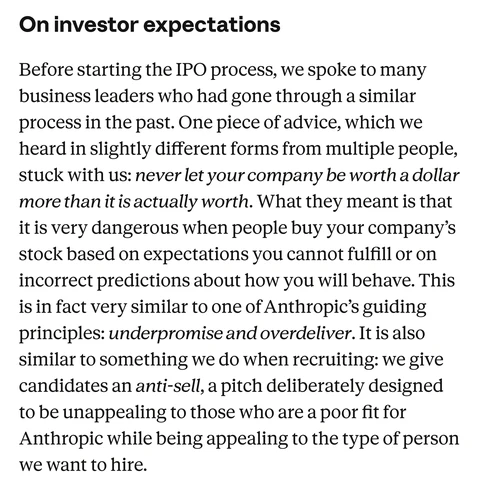
And then everyone is, like, really worried about Q4, because what they've been telling the bankers for ARR. And you're like, they just told you they're never going to miss your expectations. They're like, we've talked to all these— oh, I think Joey's frozen— we've talked to all these people and all this stuff. You should never be worth one more dollar than what you're actually worth. And so we'll underpromise and overdeliver. I was like, oh my God, dude.
Yeah, that's a core tenet of the business: underpromise and overdeliver, Doug.
Yeah, I guess maybe that's in their fit interview,51Fit interview — in the founders' letter in the S-1, next to the principle of "underpromise and overdeliver," Anthropic says it hires the same way: candidates get an "anti-sell," a pitch meant to put off those who aren't a fit for the company. dude. I mean, it's crazy.
All of this talk about— okay, wait, wait a second. So this is a core principle of the business. So all of this talk about cybersecurity ending the world and drugs and all of this stuff, this is them underpromising for the AGI that they're forecasting.52AGI (artificial general intelligence) — AI that can do any intellectual work at least as well as a human. 10% chance of death of humanity:5310% — in October 2023 Dario Amodei put the chance that something goes catastrophically wrong with AI on the scale of civilization at 10–25%. In 2026 Evan Hubinger, who leads alignment science at Anthropic, wrote on X that he personally puts the probability of AI killing humanity within the next decade at more than 10%. this is underpromising.
Yeah, apparently, according to Dario.
It can get worse.
It can get way worse. It's the— you saw— did you guys see the head of cybersecurity? He's like, if you think it's bad, it's gonna get way worse.
I'm laughing. It's scary, man.
It is actually scary. This is gonna be our last secure podcast.
06Elon Musk versus the neoclouds
Musk is talking his book when he buries the neoclouds, Doug and Jeremie say, since he is the largest neocloud himself.
I was, yeah, I was freaking out last week with all of the cybersecurity stuff,54The cybersecurity stuff last week — "Black October" was the name given to a string of cyber incidents on October 19–22, 2026, including two critical PHP vulnerabilities found with the help of AI models: governments and companies around the world temporarily took websites offline while they applied patches. and then interesting stuff over the weekend, as Elon and Chamath55Chamath Palihapitiya — venture investor, founder of Social Capital and cohost of the All-In podcast. are calling for the death of all neoclouds.56Neoclouds — cloud companies built specifically for AI that rent out GPUs. The best known are CoreWeave, Nebius and Lambda; many are built on debt. And then we have this counterweight to all of that, which is like, we'll save it with capitalism. I guess that's the thesis of today.
I don't know. Yeah, I mean, the money looks good to me. I think Elon is just— Elon's smart, and he knows when he has an advantage, and he's trying really hard to lower his cost of capital57Cost of capital — what a company has to pay investors and lenders for money: the lower it is, the cheaper it is to build. at SpaceX. And I think he's— I mean, he is a neocloud, dude, so he's saying that while being the largest neocloud in the world.58The largest neocloud — SpaceX reports its AI business as a separate segment; in Q3 2026 its revenue was $7.6 billion. According to the S-1, Anthropic rents up to $120.5 billion of compute from SpaceXAI. So yeah, it's kind of book.59Book — short for "talking one's book," market jargon for praising what you've put your own money on.
I would also say, like— or our view, and I think it's starting to— folks are starting to be really worried about that, is: hey, there might be an inversion of— like, right now it's data centers that are more constrained than chips, but maybe by the end of next year it's the other way around. And there you have this guy that says, hey, I'm single-handedly gonna build up to 20 gigawatts, maybe just 10, you know. So he's gonna make sure he has the chips, right? And so one of the ways to make sure— that's in the game of Elon, dude— one of the ways to make sure others don't buy the chips is just make them go broke. Yeah, just break markets. They can't fund all of them for you.
I mean, that's happening. Like, right now there's essentially a liquidity run60Liquidity run — investors fleeing a class of securities en masse: the existing paper is hard to sell and new issues are nearly impossible to place. on all the neocloud debt. And so anyone who wants to place new neocloud debt is unable to. And so if he presses his advantage, like, he presses his foot at their throat, and they essentially never get funding, that's all his opportunity, right? Because then everyone's like, dude, I want to invest, I want to invest, I want to do this SPV,61SPV (special purpose vehicle) — a separate company set up for a single deal, through which investors put money into a specific project or stake, such as a data center. and SpaceX is the only game in town, and he's like, great, that's a better cost of capital for me, right? Elon is a competitor.
Yeah, exactly. And then, as he said, he wants to do half a trillion dollars to a trillion dollars of ARR by the end of next year. The less these guys can fund their stuff, the more he can just build it himself and score deals at 50 million bucks a megawatt a year and, you know, just make a whole lot of money.
Yeah. I mean, Jeremy, how real do you think that is— that $14-an-hour GB300 contracts62GB300 — Nvidia's server system built on Blackwell Ultra chips: a GB300 NVL72 rack holds 72 GPUs and 36 Grace CPUs. Shipping since 2025. that are on demand and can be cancelled any month just continue to go, because Anthropic's ARR just continues to grow and they can't bring enough compute online, and so they just keep it?
I mean, look, there's many things that go into, like, understanding how sustainable this is. But one of them is— first of all, it's the basic supply versus demand. If demand continues to outperform supply growth— we've said very publicly we think supply growth is going to be huge, but hey, what if ARR and overall demand also outperforms that? Then that's perhaps even going to augment the premium, right? Like, that's a realistic scenario, because who else has as much capacity available in 2027, right? Now, if the equilibrium stays the same, then I think there's still probably, like, availability to sell.
And obviously, if demand starts to fade, then of course things are more complicated. Now, there's a few other things to look at. One— I mean, we talked about compute commitments. Kind of the beauty of SpaceX contracts is it's, like, much more balance-sheet efficient, or, like, compute-commitment efficient, than signing a six-year deal, right? So you saw Nscale at, like, 100 billion dollars per gigawatt; that's likely going up, so perhaps going to 120 or more. And this guy, actually, 50 a year, but 90 days.
So the commitment actually is extremely small, right? It's like 15 billion dollars a gigawatt. So yeah, it's more expensive, margins go down, but on the other hand, for your books, for what people are looking at, it's actually quite efficient. And the last thing is, obviously, as the drivers of this market remain, like, these small companies that don't have yet full trust of creditors, of lenders, it's going to be hard for them to fund an insane amount of supply. I mean, even for hyperscalers it's not that easy, right? Like, we saw tiny, tiny cracks on, like, Meta, for example, when spreads went up.63Spreads — the gap between the yield on a company's bonds and on government bonds: the more the market doubts a borrower, the wider the spread and the more expensive it is to borrow.
So obviously, like, this environment is very positive to companies that can take a lot of risk, and these guys are basically taking more risk than anyone else by just equity-funding all of that stuff— like, some debt as well— and, you know, building stuff without a customer.
07Compute efficiency and the multi-chip bet
Anthropic's compute efficiency has jumped, and the hosts argue over whether the credit goes to the hardware or to Anthropic.
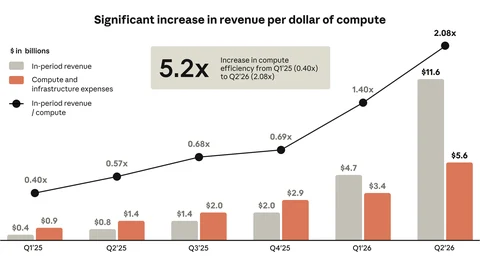
Yeah. Let me throw this chart on screen. Joey, what's your take when you saw this chart that they put up about compute efficiency?
I think it's great. I think even looking at just inference compute efficiency, the revenue per megawatt just in inference going from, you know, like 16 million a megawatt last year to 60 plus, you know, currently— it tells even more the story of how great a business model just inference is. And this is the entire fleet, so what you need to do to continue to invest in new models. This is great. Obviously in Q3 it went down a little bit, with some of the new SpaceX compute coming online, and then a little bit less monetization via Meta, distillation, and then some additional safety compute. But I think this really tells the story of, hey, AI model businesses are really solid, and they scale extremely, extremely well. To Doug's point, incremental margins are amazing.
Yeah, let me read the line from the S-1 that jumped out the most to me about compute efficiency. They said: "Our compute efficiency is demonstrated by revenue that grew 1,368% year over year for the three months ended June 30th, compared to compute and infrastructure expenses that grew 300% during the same period."
But, although, to be fair, how much of that is, like, Anthropic being geniuses versus the actual market-wide efficiency being higher, right? I mean, we run InferenceX.64InferenceX — SemiAnalysis's open benchmark comparing the speed and cost of inference on different hardware; it launched in October 2025 as InferenceMAX. What do you think, Jordan? Like, we're seeing, you know, GB being 50x better than Hopper,65Hopper — Nvidia's 2022 GPU architecture (H100, H200); GB refers to systems on the following Blackwell and Blackwell Ultra architectures (GB200, GB300). for example. Isn't that just a reflection of the silicon and systems market overall?
Yeah, I mean, the new stuff is better. I think maybe one of the other quotes that I can read from the S-1 is related to their fungibility across the fleet,66Fungibility — in the S-1, Anthropic writes that it manages compute as "a single fungible pool" from multiple partners and directs capacity wherever the next unit will do the most: research, training, serving customers or its own work with Claude. which is super fascinating. I think they do have a unique advantage to pick the right accelerator for the right job: TPU, Trainium,67Trainium — Amazon Web Services' AI accelerators, developed by its Annapurna Labs unit; Anthropic is the main customer. Nvidia GPU, and AMD GPU all online, whereas other people are kind of catching up there. And if you're gonna want to realize the true benefits of new hardware coming online, which is always, you know, more performant than the previous generation, you need the software to be able to use it. Who's got the best software for writing code for this stuff? Probably the company with the top engineers and the best model.
So yeah, I think you can blame the underlying hardware for sure, but I don't think there's any reason to think that's going to slow down as they ramp up compute commitments that all bring on the latest and greatest, and they have a track record of being able to adopt whatever the best silicon is for the job.
I think also in that same vein, I think we also, like, maybe underestimated the models, to be honest with you, because I think we were also in the camp where we're like, yeah, maybe not, like, the CUDA moat68CUDA — Nvidia's software platform for GPU computing (since 2007). Most AI software is written for it, which is why it's considered the main moat protecting Nvidia from competitors. will never be breached, but maybe the thought process was the kernel optimization69Kernels — small programs that run on a GPU and do the core computational work, such as multiplying matrices. For a model to run fast on a new chip, kernels have to be written and optimized for it. would be a harder problem. But we're watching, like, models, you know, reverse-engineer binary,70Reverse-engineering binaries — recovering a program's logic from compiled machine code without the source. In games this is hampered by anti-cheat protection. which was, like, the gold standard of, like, binary for gaming— which, like, reverse-engineering gaming was allegedly impossible because of all, like, the anti-hack stuff like that. Clearly it isn't. So I think that, you know, maybe we also underestimated the fact that, like, Claude is good enough that Fable 5.5 can probably port,71Fable 5.5 — there is no such model: at the time of recording the latest version was Claude Fable 5.1, and Fable 5.2 came out on November 9, 2026. Doug is apparently mixing it up with Opus 5.5. and it makes, like, the AMD versus Nvidia versus whatever actually not matter as much as it used to, because the same model that can do, you know, Navier-Stokes72Navier–Stokes equations — the equations of motion of a viscous fluid. Proving whether they always have a smooth solution is one of the Clay Mathematics Institute's seven Millennium Prize Problems, with a million-dollar prize. is able to also program a GPU to definitely make their economics work out.
And I think by pushing to be— they were the first to really push to be multi-chip. And I think that strategy totally paid out for them, versus, like, OpenAI was very much an Nvidia-first shop, at, like, almost anyone else's expense. I think that's been, like, part of the Anthropic catch-up story: supply availability. And I think they continue to be really smart and intelligent with supply availability. Like, they want to have vendors that aren't just TSMC. They want to make sure that every aspect is diversified so that no party has power over them and they have power over everyone else. Like, that's just good business and strategy. And it definitely played out. Like, the model is the differentiator.
08Can anyone catch Anthropic
Jordan doesn't see how anyone catches Anthropic from here, and Doug leaves rivals only multimodality.
Yeah, I think— like, I view it as a race where you have to start running at some point. And some people took off earlier than Anthropic, like OpenAI or even Google DeepMind, made a bunch of commitments, spent a bunch of money, brought on compute, and maybe now that compute is less efficient than the stuff Anthropic has, because they don't have the bloat of as many, like, H100s from 2022, when they weren't, like, doing anything or building any compute. But then vice versa, if you are a startup that's getting off the ground with a billion dollars of funding in the last three months, you're not profitable. You don't have the data flywheel,73Data flywheel — a self-reinforcing loop: more users produce more data, data improves the model, and a better model attracts more users. you're missing all of this compute. Anthropic has a bunch of advantages over somebody who's trying to get started right now.
And so I think the dynamic is they kind of struck it perfectly, where they both have this, like, financial flywheel as well as all the research and data that puts them so far ahead of somebody else that not only are they, you know, ahead, they're also running faster. So I don't know how anybody catches up from here. Like, there's kind of no moats left in terms of, oh, these guys have a bunch of researchers or compute or data that Anthropic doesn't have. Like, I think they're clearly in first or second place on any of those dimensions. And then you have to make a case for any of these neolabs74Neolabs — new AI labs founded by alumni of the big ones: Mira Murati's Thinking Machines Lab and Ilya Sutskever's Safe Superintelligence, for example. to catch them— maybe in specific industries where they have great researchers and great data. But I don't know how anybody possibly builds more compute than them at this rate.
So as far as compute being an advantage, they're ahead of anybody else, except, like, maybe Meta or Google have a flywheel that's better than the Claude API as a way to fund this build-out, with their ads business. But even that I'm kind of questioning, as Claude goes into next year and starts to grow so quickly.
Yeah, I think the only places that they'll win, or someone has the potential to win, is in multimodal, where I think Anthropic has always been nearsighted. Like, there's no other way to put it. Like, it's just not as good as, let's say, Astra for, like, vision.75Astra — GPT-6 Astra, OpenAI's flagship model, released on September 3, 2026. But, like, I think maybe you could argue that, like, we, you know, we love Aqua Boys, for example. Like, really niche applications that are very specialized can maybe take tiny slivers, but I think the big pie in the sky is definitely Anthropic's. And I'm sure they'll let little things lose, but, like, in the same way that they can just, you know, vibe-code a new model,76Vibe coding — programming where AI writes the code from a natural-language description and the human barely looks at the details. they can catch up if they ever had the time or attention.
I think it's just a— yeah, well, what's a— let's look at the domain, because let's say that inference efficiency, or, like, system engineering on hardware, was a domain that's important. They point Claude at it, they spend some time on it, they come out on top and first, even though others were ahead of them. Now they're going to build a chip. Is their CPU-derivative chip going to be better than Jalapeño?77Jalapeño — OpenAI's first in-house AI chip, an inference accelerator developed with Broadcom and unveiled on June 24, 2026. Is it going to be better than what all the startups can come up with? They've got Claude working for them. That's a bit of an advantage. They're classifying everybody else, where they can't work on designing chips using their models. And so what's next, right? You know, can they point that at the voice-to-voice interaction models? Can they point that at the decision models, where we saw Jev?78Jev — a "decision model" from TypeSafe AI, released on September 15, 2026: instead of text it returns typed decisions with probabilities in tens to hundreds of milliseconds, for example to classify requests. Can they point that at bio and start building cancer drugs?
I mean, I think the thesis that, like, AI research and software engineering is fundamental, and that, you know, comes first before you win any of the other domains, seems to be playing out exactly as their thesis was. I don't see any reason to doubt that at this point. Like, they're going to have more money, more compute, more researchers, more data than everybody else going into next year, it seems.
100%.
09No surprises, no disappointments
The S-1 numbers didn't surprise Joey, and he sees enormous room to grow.
I got two questions for you, Joey. First one: you had this great piece maybe six months ago— I loved the charts. That was so good. But yeah, great job. Like, your model of Anthropic financials was super accurate. So I'm just curious, like, how much of a surprise were the numbers that were there, relative to what we had? And the second one, I'm just curious: any disappointments for you overall on Anthropic as a company, as a business?
Yeah, I think we had the margin story, right? You know, obviously Q3 was a little tougher number internally for both OAI and Ant,79OAI and Ant — shorthand for OpenAI and Anthropic. but, you know, I think we had a pretty good understanding of the business model. So there wasn't anything massively— you know, I think most stuff got leaked too— there wasn't a massive surprise here today. And then, sorry—
That was so clean.
Everything was leaked, but the big— it's like seeing all the different parts of the picture, where you see the whole picture, and you're like, you couldn't nitpick a number in there. Like, any numerical disclosure, I don't think you could really go in and, like, nitpick or say, oh, that's not really— maybe you can be, like, really anal and be like, off-balance sheet, or, like, the debt commitments.
You could go to that, but yeah.
We all knew that too.
Like, it's nothing crazy, dude.
Jeremy, what was the second question? Sorry.
Yeah, any disappointments with regards to, like, the business overall in this one.
No, I think, like— I don't know, like, if you're of the view that, hey, every— like, the average employee at an enterprise is going to pick up their spend, or, like, even the median looks like what the 75th percentile is today— like, they don't have to get to the 90th or 99th percentile user— there is a ton of runway here just in enterprise work. I think the really, you know, interesting number— I shared the one earlier on the top 5% of users are at 18,000 per year, and then the non-Claude Code users are at, you know, sub-75 a month. Like, we're at 0.1% of their Fortune 500 opex budgets today. So, like, under, you know, eight bucks a month per employee— like, under eight bucks to under 50 per employee.
Joey, is it time to apply the 0.85% ARR per cohort SaaS number? So 900% is just going to be 0.85 for the rest of the cohort's life. Sorry, that's, like, some real brain-dead SaaS bubble stuff.80The SaaS bubble — in 2020–2021, shares of companies selling subscription software soared to record valuations, then crashed in 2022. Analysts at the time modeled revenue by cohorts, groups of customers who signed up in the same period, assuming that each cohort would pay more and more for years. I don't know if you remember that.
No, I think, like— you know, if you look at the cohorts, I think the other, like, big thing as we look towards '27— we can obviously talk about cyber. We can talk about this, like, traditional white-collar work, because, you know, Anthropic is obviously extremely, extremely heavily coding-based. There's a lot of other verticals. These cohorts are going to rip. Like, we're going through the first Q4, like, traditional enterprise IT budgeting cycle where AI— and, like, that's the point. Like, it's such a low percentage today of, you know, Fortune 500, Global 2000. Most people, that's not a top 1% customer.
What inning are we in, Joey?
I like Doug's comment today. We are still paving the foundation, the parking lot. We're painting the lines, the asphalt is— you know, we are that early.
The park has not been built. What are we doing?
Yeah, they're still grading. Yeah, they're still, like— yeah, they've got the dirt.
Oh, I was dying when you guys said this.
And the best part of this, Jordan, is we're already at, like, 120 billion of ARR combined between the two frontier labs.81Frontier labs — the companies training the most powerful AI models: OpenAI, Anthropic, Google DeepMind and a few others.
So if that's where we're at today, you know, maybe one day they can get to the enterprise SaaS revenue penetration of, like, Microsoft Teams or Salesforce, and start monetizing more than eight bucks a month per user, per seat.
Yeah, right, right. And no, that's, like, the big— I mean, that's a big thing. And, like, you know, some people might say, you know, that goes to 365 Cowork,82365 Cowork — in March 2026 Microsoft released Copilot Cowork, an agent based on Anthropic's Claude Cowork, which works with files and carries out multistep tasks on its own. but I'm— you know, there's a— no, I mean, there will always, always be demand for frontier intelligence. And so as we look towards next year, I think, like, the pieces are in place to have a really strong '27. You know, we'll look at '28 when we get there, but very early innings.
Beautiful.
10Tired AI stocks and the holiday slowdown
AI stocks are tired, Doug says, and Jordan's only disappointment in the S-1 is the warning about a holiday dip.
Doug, what's your take on the market reaction when this came out? How does this affect other things? We talked a little bit about neoclouds and debt generally. What do you think happens to everybody else when they come public?
I would think on the cleanest quarter— or not the cleanest, but a pretty clean S-1— the reaction in semis would be more— or semis, and let's just say all the AI beneficiaries, the land build-out companies, actually were the number one winners today, I think. So essentially, like, the data center side is really starting to pick up the bid. But it wasn't as strong as, like, the shit we've been seeing all year. I think the AI trade is exhausted.83The AI trade — investors' bet on companies that profit from the AI boom: makers of chips, memory and data center equipment, and power companies. There's no other way to put it. The AI stocks are tired. But we just got to refresh a Q4 budget. Who knows? They're so tired, dude. They've— you know, they've traveled so far.
So, you know, bro, this is gonna go viral on Twitter. You're gonna see, like, Taiwan pick up your face in a video: "AI stocks are so tired," SemiAnalysis says.
They're not gonna see it. They're not gonna see it, man. He's just, like, Batman with that light coming behind him. We just talked to a shadow of Doug now.
Yeah. Well done.
How about the— okay, maybe the one letdown I can come up with is that they talked about the low usage over the holidays.84The holidays — in the S-1, Anthropic writes that its revenue is seasonal: over holidays and vacations many companies freeze code changes, and developers work less. So for Q4, what sort of revenue impact are we expecting Christmas vacation to have on Claude Code usage?
Well, they said it was a 20% decline versus the two weeks prior. So on December— just on the month of December, it's a 10% cut, let's call it. I imagine it'll be less pronounced this year.
Why less? So I think it gets worse, man. Well, maybe we can see a Polymarket for this one.85Polymarket — a prediction market where people trade contracts on the outcomes of events. Founded by Shayne Coplan in 2020. But the line says: "Consistent with this pattern, for the two weeks ended January 2nd, 2026, total customer spend declined by approximately 20% compared to the prior two weeks ended December 19th." I feel like the mix has gone towards consumption over the all-in products, and so I think a lot of people log off over the Christmas holidays, right? Like, and they just don't use the API. That's what's going to happen.
For the average Claude Code user, though, Claude Code is more part of their daily routine now, even if they're working, like, two hours or four hours a day, than it was at this point, man.
Jeremy, Jeremy, are you going to be on your phone Claude-coding while you're having Christmas holidays?
You have Muse now,86Muse — Meta's personal AI agent, which carries out tasks in the background, including purchases and bookings; launched in the US on September 8, 2026. bro, and now Muse is for this. So Muse is actually taking vacation dollars out of Claude Code, man. So yeah, I don't know. I'm not sure. Well, I use Perplexity Computer now. Maybe I'm a weirdo.
Ooh, breaking news.
This is a call for, you know, frontier labs: please make the experience of using AI models on the phone and then continuing on the computer and the phone again better, because, you know, shout out Perplexity, they do really well.
I didn't see that as a material risk in their S-1: Jeremy moving to Perplexity. I'm surprised they missed that one.
Yeah, and you're gonna see it in the Q4 ARR. It might go down a bit.
Drops off.
They're gonna say it as another one-off here, after Meta cuts and SemiAnalysis.
We had a one-off: Meta left to use their own models, and somebody named Jeremie Eliahou Ontiveros said SemiAnalysis is gone. Okay, what models do you choose, though? Are you still using Claude, or have you gone for some Codex models87Codex — OpenAI's AI coding agent. through Perplexity?
We just use whatever state-of-the-art model and subagents at max effort88Subagents — helper AI agents to which the main orchestrator agent hands out parts of a task; "max effort" is a setting at which the model reasons longer over its answer. to figure it out. Just use the best stuff. So generally I think the orchestrator is Fable,89Claude Fable — Anthropic's line of most powerful generally available models, a tier above Opus: Fable 5 came out on June 9, 2026, and Fable 5.1 on September 1. though. Fable 5.1.
Okay. Yeah, yeah, yeah. So Fable 5.x hasn't even been considered here. We obviously saw Opus 5.5 come in,90Claude Opus 5.5 — Anthropic's model released on September 22, 2026: by the company's account, on par with Fable 5.1 on most tasks but much cheaper. According to the S-1, it cut customers' cost per task by about 40% compared with Opus 5. and that had a big impact. I love that model. Fable's still on 5.1. What happens when they just keep ripping that? Do we see that before the next version of Astra? I gotta expect so, right?
Yeah, we'll see 5.5 into, like, the IPO.
What happens when they release Fable 5.5 fast mode91Fast mode — a paid mode in which a model responds faster at a higher price per token. at $500 output tokens? That'll be a good one.
They don't like to disappoint expectations, is what I'm thinking, you know.
They are going to release a faster tier in Q4, too, with 5.5.
Underpromise, overdeliver.
Dude, the numbers people are saying for Q4 are so stupidly low. They're, like, not believable.
11Is OpenAI cooked?
Doug thinks OpenAI is the eternal number two; the others disagree.
Dude, they're actually gonna make a new class of model: Giga Fable. The unreleased models coming out. Honestly, okay, actually, let's talk about— you know what we haven't talked about is OpenAI. Is OpenAI kind of cooked? Because Astra is their best.
Maybe their Bell model, like, improves or something like that, but, like, where is OpenAI? Because it's actually— you know, Opus 5.5 accelerating is, like, pretty— it comes at someone's direct expense, and, like, at least within the SemiAnalysis spend, it's very clear who it is. It's Astra. What do we think about OpenAI? Because they're kind of caught in the middle of everything. They're in the middle between consumer on Gemini and Meta, right?
They are, like, between Anthropic and open-source models for enterprise, and they're just, like, kind of literally number two in everything, which in markets is the single worst place to be. I mean— yeah, I don't know.
I kind of said it earlier, when I was talking through Anthropic's, you know, justification for why they have a lead and why they have a moat. I think OpenAI got running a little quick, and they might be a little bit behind now. I mean, they're certainly behind in ARR, and I think they land some counterpunches in model capability, and then Anthropic comes beyond them. But if people make significant prepayment commitments to Anthropic, then that's tough for OpenAI. But I mean, I can't see all of this and not just be bullish on both of them. Like, isn't there a need for multiple models from multiple providers for different things?
I still use OpenAI models for lots of stuff that I don't think Claude is good enough at. I find them more reliable for data analysis, for example. So I don't know. I'm not an OpenAI bear by any means on this result.
I mean, like, I feel like every day someone gets a vibe that, hey, today Claude is retarded; hey, today Astra is retarded. And did you see Tarek—
Did you see Tarek left Claude? His first tweet is: is Opus 5.5 dumber? So genius.
Yeah. So, like, I don't know, I feel like every week we have, like, some big user shifting from one to another, because the model feels dumber for whatever reason. And so, yeah, if both are good, like— I don't know, why would OpenAI be done?
I mean, I just think— okay, so if the low— you know, it's like, they are the lowest-cost producer with the highest margins: Anthropic. And, like, you see this in semiconductors, right? Number two has less share and worse margins, right? And so OpenAI is just going to be mid, like— they're not done, okay? Obviously, 90% incremental gross margins tell you they can figure out a business, okay? They can definitely— if they put their heads down, I think they can figure it out, you know.
Pick up a few hundred billion dollars of scraps.
Yeah, there is some money to be made for them, okay? But I just think in many ways, because of their place, it makes their positioning, their competitive positioning, worse. Because if you're in the lead, you just charge a premium margin and you get a premium product, you get premium— you know, it kind of signals that you're a higher-quality luxury product. OpenAI will now always be competing with Anthropic on price. And that's just, like, such a shitty place to be. You don't want to be— you know, we've seen, like, you know, one of the big takeaways is that the number one thing is, like, AI is about best in breed. And if OpenAI isn't best in breed, then they're competing on best in price, and that's just a worse place to be.
So overall agree, okay. I guess one of the kind of pushbacks— I'm curious what you guys think— but what I'd throw out is, generally, OpenAI is much better right now at enterprise sales, and they've been more successful at signing large contracts with these— let's call them, like, you know, boomer Fortune 500 enterprises. And so, like, that's perhaps one good bull case for OpenAI: hey, as enterprise spend starts to pick up— as Joey was saying, it's such a small portion today if you exclude these, like, super power users— maybe that's good for OpenAI as the better enterprise sales platform.
Source: Anthropic's S-1 prospectus, section on customer and channel concentration
Yeah, they've been— OpenAI has been very bullish on their Q4, like, enterprise ramp. You know, they're like, Bedrock will ramp a ton for them. You know, just going on Vertex as well. Yeah, it's a different business model. They don't have the third-party share. They haven't had— you know, it was, like, majority consumer up until a few months ago.
And they're back on the right track. I think there's this argument that, you know, we're just ping-ponging between model share going forward of who's best. And, you know, there's certain things, like, if you're signing these one-, three-year enterprise deals, you're going to see less of that, and, you know, switching costs will be a little bit higher. But, yeah, it's like— and then there's been a lot of news in the last week just on them being aggressive, discounting against Anthropic accounts as well to win some of that business. So they're willing to fight for it. And they've definitely taken enterprise a lot more seriously since, you know, July, with the release of 5.6.92GPT-5.6 — OpenAI's model family unveiled on June 26, 2026; at first it was opened only to about twenty trusted partners. And they executed well. They had a really good Q3. Yeah, the business— their margins don't look anything like Anthropic's, but it'll get there.
They have just too much consumer.
Yeah, they have a lot of consumer subscription. I think, I mean, too, like, you have to support all the free users. If 6% of users— the billion, you know, weekly active users— if only 6% convert to paying, that's tough. And then, yeah, they had very little of this usage-based, like, API revenue that we talk about monetizing at, you know, 100 million— having the potential to monetize at 100 million per megawatt plus.
12Government, rank-and-file workers and Halloween
Government brings Anthropic only about 1% of revenue, and the next market is ordinary office seats.
How about government, as a proxy for what's going on there? They said something about government. Let me read the passage.
It's, like, sub-1%, right?
Yeah, sub-1%. "Our customers include U.S. and non-U.S. government agencies. Revenue from government agency contracts represented, in aggregate, approximately 1% of our revenue931% of revenue — a quote from the S-1's risk factors. The same section describes the conflict with the Trump administration: in February 2026 the president ordered federal agencies to stop using Claude, and the Department of War declared the company a supply chain risk; Anthropic is challenging this in court. in each of the periods presented in this prospectus." That's a huge market forever. There's—
There's a lot of seats you can sell in, yeah, in government.
Let's size this relative to what— all of GovCloud94GovCloud — isolated AWS cloud regions for US government agencies and their contractors, with special security requirements. or something?
Like, yeah, I mean, yeah, look at GovCloud, or, yeah, FedRAMP,95FedRAMP — the US federal program under which cloud services pass a security review before government agencies can buy them. or any of those programs. But then just look at, like— I think the big thing you can look at for a lot of this work is just, like, 365 seats out there. How many, like, Microsoft 365 commercial seats are there out there? And there's hundreds of millions. And if you can just collect 30 bucks a month from a lot of people, regardless— like, you can go sell to— you know, Microsoft has these— like, they've been selling the last few years, like, these lower tiers, like selling them to Walmart cashiers for enterprise usage.
Like people that don't— I think they've proven— I think this has proven that it's worth more than 30 bucks a month, though.
Like, even on the— exactly. But you have to start somewhere. And, like, the general, like, I don't know, middle, back-office, like, role isn't, you know, even front-office role— those people aren't gonna start out spending, even as they ramp, anywhere close to, like, what coding would be, or even, like, hundreds of dollars per month, for a lot of these. I mean, when we talk to enterprises, a lot of, like, enterprises don't let people use frontier. Like, you have to use Sonnet96Sonnet — Claude's midsize, mid-priced line of models, cheaper than Opus and Fable. if you're, like, of a certain, you know, job type.
The bourgeoisie models, or the proletariat models— sorry. Yeah, not the bourgeoisie models, like Jeremy does.
100% bourgeoisie, man. No other way. Max effort, max subagents, you know, launch hundreds of subagents to find those data centers.
All right, Doug, give us a hot take so we can wrap up. We've been going long enough.
I'm tired, brother. I don't have any more hot takes. I'm tired as a market. Yeah, tired. Oh my God, they're gonna clip this too, dude. I'm so— it's all over.
We can't even see you, man. The clip is gonna be fine.
You're gonna fix that. How's the new office, man? Is it looking good?
Nice, man. We're getting used to the Wi-Fi. Sucks. The Wi-Fi sucks, dude. AGI's here when it can fix the Wi-Fi.
Well, I mean, it found 10 vulnerabilities that they publicly disclosed at CVE 10.0 level97CVE (Common Vulnerabilities and Exposures) — the shared catalog of publicly known vulnerabilities. 10.0 is the maximum severity score on the CVSS scale. for Aruba Wi-Fi access points.98Aruba — a maker of networking equipment, including Wi-Fi access points; HP bought it in 2015, and it is now part of Hewlett Packard Enterprise, where Jordan used to work. So maybe AGI can hack into everybody's Wi-Fi and fix it with the CVEs it finds. Did you guys see the thing with the PHP vulnerability,99PHP — a programming language for websites; WordPress, for example, is written in it. On October 21, 2026, PHP's developers released fixes for two critical vulnerabilities that allowed unauthenticated remote code execution on servers in every version of the language; the vulnerabilities were found with the help of AI models. where somebody was proposing that you have AGI go and scan the internet for the vulnerable servers, log in, patch the server, and then lock it out?
They just need to spend 5% of training cost for that. The 5% of rev just goes to friendly agents on the internet that help you when you're lost.
Yeah, yeah. Benevolent offensive cybersecurity models that find vulnerabilities and then patch them themselves once they find them. That's the future. All right. Well, let's get creative on the upside here. Underpromise, overdeliver. Let's see if we can do that going forward. Good job, Anthropic. Good job, guys.
All right, we're done. Doug, please lean into the camera and give us a smile for the algorithm, guys. Here we go.
So beautiful.
Oh, Doug is looking good, yeah. I can make out your nose in this one. Oh, your teeth too.
I won't. That's for the— oh, there we go— type one videos.
We got a moment. Yeah, yeah. What are you gonna be? What are you gonna be for Halloween?
I have no idea, actually. I haven't thought that far ahead.
Can I log off? What are you gonna be for Halloween?
Is this still going on? Can I log off?
Yeah.
I'll be in Paris, so, you know, staying home, because otherwise I'm gonna die. No, just— he's gonna be a guy in a mask on the street.
What are you gonna dress as, Jeremy?
What am I doing at Halloween? I'm probably gonna read the Anthropic S-1, because it's the biggest event ever. So I need to read it again and again.
So if you have trick-or-treaters at your door, Jeremy, are you gonna hand them out Anthropic S-1 copies so they can study up at home?
Yeah, exactly. Kids, this is the future. Just read this. Underpromise, overdeliver— no, the other way around, sorry.
Underpromise, overdeliver. Joey, what are you going as for Halloween? Any special costume with the fam?
No, I'll be on a flight to Singapore. Geez. I'm gonna be enjoying a nice 17-hour flight to Singapore.
You should— I want to dress up as a 7% ten-year.100A 7% ten-year — the yield on 10-year US Treasury bonds. Mortgage rates and stock valuations are pegged to it, so a rise to 7% would be a nightmare for markets. That's my spooky.
I'd love that.
Everyone should be scared. That's real fear.
Yeah. Yeah. You can dress up as— who's the new Fed chair? Kevin, what's his name? Yeah, him as, like, the grim reaper.101Kevin Warsh — financier and member of the Federal Reserve Board of Governors in 2006–2011; in May 2026 the Senate confirmed him as Fed chair. The grim reaper, death with a scythe, is a popular Halloween costume. Yeah.
My daughter got a rocket costume. She's gonna go as a rocket this year.
As a rocket emoji or just a costume?
It's just, like, a costume. It's got, like, a little bit of suspenders, and then, like, the rocket front and tail with the firing. Very funny.
I hope she doesn't explode when she doesn't get candy. Or you just give her candy.
She's gonna get lots of candy. After— she went as the pizza slice, I was the rest of the pizza. So I held her, and she was, like, a slice of pizza.
Oh, that's so sweet.
Joey, you gotta steal that one, okay?
That's a good idea. Yeah.
It is a good one. You can just buy that costume on Amazon, I think. Yeah. Okay.
Well, anyways, happy Halloween. Spooky S-1.


