


Sourcery
Chapters
After some jokes about the show's wizardly name, Patel explains why the main risk for data centers isn't construction but permits.
Read the chapter- A gigawatt of data centers in orbit will most likely come around 2030, Patel guesses, so for the next three or four years space solves nothing.
- Governor Hinojosa publicly promises not to stop data centers, only to keep an eye on electricity prices and water use, and the sketchiest part, Patel says, is a union labor requirement in a state with almost no union labor.
- Wastewater, stormwater, water consumption and air permits let the state stop any project, even one not connected to the grid.
- Most of the spending flows out of Texas, but the industry still employs tens of thousands of people, and hundreds of thousands in the broader sense.
Permits are pushing data center timelines back, but bans, Patel says, land where there are no data centers, and many people don't know about the one next door.
Read the chapter- SemiAnalysis moved several gigawatts from 2027 into 2028, not because of labor or equipment but because of permits.
- Most jurisdictions that banned data centers never had any.
- In a poll SemiAnalysis ran with David Shor, 49% of people in counties with a 100-megawatt data center didn't know it exists and only 40% knew about one coming, while the election was about inflation and the war in Iran.
- The negativity, Patel says, is a mix of reasonable criticism, fake and astroturfed content, climate activists and outside actors, and companies could easily buy goodwill, for instance by subsidizing power for everyone within 30 miles.
- Counted honestly with embedded water, all of Musk's data centers use less than three In-N-Outs, while one book on the New York Times bestseller list overestimated data center water use by about a thousandfold.
The market smooths out the shifting lead among AI labs, and what wins now, Patel says, is product: Muse and Instinct beat OpenAI on weaker models.
Read the chapter- Anthropic crushed it in Q2, OpenAI in Q3, and now Anthropic is back on top thanks to Opus 5.5 and Fable 5.2, but valuations don't swing that much.
- OpenAI's Guardian system stops Codex and Dots from doing what users ask, so Dots, Patel says, loses to Muse and Instinct even though their models are weaker.
- In a few months persistent agents went from zero to 45% of SemiAnalysis's $15 million a year AI spend, almost all through Perplexity Computer.
- Developers switch easily between Claude Code and Codex, while Anthropic's enterprise contracts with a discount for 70% of spend hold customers tight.
- OpenAI's app confuses users with model sliders, and Meta knows how to build products, while OpenAI and Anthropic, Patel says, keep cycling through Meta VPs.
Most startups will fail, and SemiAnalysis is moving into venture.
Read the chapter- Sierra and Harvey are growing revenue fast, inference providers may not be worth their multiples, and some applications are just pass-throughs.
- Patel's base goals are to have fun, make money, know everything, influence the people who matter and spend time with loved ones, hence a research business.
- SemiAnalysis makes most of its money from selling data and from consulting for hyperscalers and funds, firewalled off from the research.
- Patel raised $500 million as a solo GP for seed and Series A rounds in infrastructure, from robotics to silicon and optics, and promises never to use his platform to pump his companies.
Patel invests only where his team has expertise.
Read the chapter- Patel says he doesn't know shit about applications: he doesn't know how to scale an app to a billion users, so he can't judge whether a founder will succeed.
- His team includes alumni of ASML, Applied Materials, Lam Research, TSMC, Intel, Nvidia and the hyperscalers, plus people who built data centers and power plants.
- In application software you can bet on a great founder, but in hardware you need both a great founder and the right idea.
- Patel keeps his check size confidential, and deals come from friends and his 115 employees.
Patel, an AI optimist, bought Citrini's AI bears to help them run a better company without changing their voice.
Read the chapter- Citrini has captured the market's imagination and been right many times, Patel says, and SemiAnalysis will help operationalize it but won't touch the team's voice.
- Citrini's research director Kyle decides what gets published, and the team is free to be bearish; its February paper shook the market even though it was a thought exercise.
- SemiAnalysis tracks every data center, chip and cable numerically, while Citrini tests ideas in the field, from an AI-designed scorpion antivenom to a trip to the Strait of Hormuz.
An information firm can monetize attention, Patel says, only if it never sells its opinions, because otherwise it loses its credibility.
Read the chapter- Gartner and IDC are useless, Patel says, and the Wall Street Journal, Bloomberg and New York Times brands have fallen off in quality.
- He calls Gartner a racket whose Magic Quadrant ranks IBM's coding agent above Cursor or Claude Code.
- SemiAnalysis takes no paid partnerships or ads and criticizes its biggest customers the most, and customers who tried to pull their contracts stayed for the data.
- SemiAnalysis has said IREN has terrible cloud technology but valuable powered land, and Patel invested heavily in Fluidstack yet publicly says its data centers are delayed.
- The fund is separate from SemiAnalysis and Citrini, and compliance guards information from consulting contracts.
Running a company is hard, Patel says, and many investors have never made such tough calls, while next year he expects the number of hardware companies to skyrocket.
Read the chapter- Lost sleep, missed moments, negotiations, fights within the team, firings and lawsuits are things investors, Patel says, usually never face.
- SemiAnalysis has about 115 people in 15 countries, with offices in New York, Chicago, San Francisco, Oregon, Singapore and Korea.
- Patel speaks English, Gujarati, some Hindi and Spanish, and just enough Chinese to make people laugh.
- His plans include testing chips from Huawei, Amazon and startups and the new GDPx benchmark, and he expects an explosion in the number of companies building hardware.
Patel is partially color blind, but he can see almost every color and only confuses blue with purple.
Read the chapter- Patel can't remember whether his favorite Takis are blue or purple.
- His type of color blindness is X-linked and usually comes from the maternal grandfather.
- He sees colors slightly worse but, he says, sees better in the dark.
Quotes
On data centers no one notices
“And funnily enough, 49% of people in counties that have a 100-megawatt data center did not even know there is a data center in their county.”
Dylan PatelRead from 06:43On how much water data centers use
“You know, all of Elon Musk's data centers use less water than three In-N-Outs.”
Dylan PatelRead from 09:16On why OpenAI is losing on product
“It's pretty clear Instinct and Muse, despite being worse models than OpenAI's models, are way better products than OpenAI's Dots.”
Dylan PatelRead from 14:35On OpenAI's and Anthropic's product teams
“It's this cycle of: hire a Meta VP that wasn't actually that important at Meta, create a bunch of garbage, hire a new Meta VP.”
Dylan PatelRead from 18:18On why Patel doesn't invest in apps
“I don't know how to scale a fucking app to a billion active users. Why would I be useful?”
Dylan PatelRead from 25:46On Gartner's rankings
“I think if you look at Gartner, the way they monetize it is they are like a racket.”
Dylan PatelRead from 35:27On how SemiAnalysis treats its customers
“And so our biggest customers are the ones we hate on the most, right?”
Dylan PatelRead from 36:08On what founders know that investors don't
“It's like, have you fired people? That fucking sucks. Have you been sued by someone you fired? That fucking sucks.”
Dylan PatelRead from 42:33
Summary
Molly O’Shea recorded this conversation at the SemiAnalysis office, in a room they jokingly call the Hogwarts library. Dylan Patel starts with data centers: space is a solution a few years out, and the main risk in the near term is permits. Texas governor Gina Hinojosa can stop any project through water and air permits, and SemiAnalysis has already pushed several gigawatts from 2027 into 2028. Yet data center opponents are largely fighting a ghost: in a poll SemiAnalysis ran with David Shor, 49% of people in counties with a 100-megawatt data center didn't know they had one, and water fears are overblown — all of Elon Musk's data centers use less water than three In-N-Outs, once you honestly count the water that goes into the cows.
Then the race among AI companies. The market smooths out the swings: Anthropic goes back and forth and is now on top again thanks to Opus 5.5 and Fable 5.2. But products increasingly matter more than models: Meta's Muse and Instinct beat OpenAI's Dots on weaker models, while OpenAI is held back by overcaution. 45% of the $15 million a year SemiAnalysis spends on AI now goes to persistent agents, and not through Anthropic or OpenAI but through Perplexity Computer. Enterprise contracts will lock customers in; developer tools won't.
The second half is about how Patel is building his "empire." SemiAnalysis makes most of its money from data and consulting, firewalled off from its public research; he bought Citrini Research, a team of AI bears, without trying to change their voice, and raised a $500 million solo-GP fund for seed and Series A rounds in hardware and infrastructure, because, he says, he knows nothing about applications. His core rule is never to sell opinions: SemiAnalysis criticizes its biggest customers the most and publicly calls out delays at Fluidstack, a company Patel has invested in. It ends with a founder's hard decisions, Chinese phrases that make people laugh, his favorite Takis and his color blindness.
Advice
Don't count on having the best model: the product wins. Instinct beats OpenAI on open models, and a well-made product holds users more tightly than model quality does.
Don't take it personally when an investor tells you something unpleasant, even in public: honest feedback isn't hostility, and good founders understand that.
Mentioned
 SemiAnalysis02:17Patel's firm: data, research and consulting on chips and data centers
 Elon Musk03:00wants to put a lot of capacity in space as soon as 2028
 Gina Hinojosa03:45Texas governor-elect and her levers against data centers
 David Shor07:05ran a data center poll with SemiAnalysis
Show 43 more mentionsShow fewer mentions
 Dina Powell McCormick08:47spoke about the benefits of data centers for local residents
 In-N-Out Burger09:16three restaurants use more water than all of Musk's data centers
- Empire of AI: Dreams and Nightmares in Sam Altman's OpenAI11:42the bestseller that overstated data center water use a thousandfold
 Karen Hao11:42author of Empire of AI
 SpaceX12:04this year's big IPO
 Anthropic12:04heading for an IPO, leading on models but bad at product
 OpenAI12:04delaying models, overcautious and confusing users with its interface
 Cerebras Systems12:22another IPO this year
 Apoorv Agrawal12:22the "four seasons of AI" theory
 Google12:22back in the model race
 Claude Opus 5.512:53put Anthropic back on top
- Claude Fable12:53Fable 5.2 put Anthropic back on top
 Meta Platforms13:34knows how to build products
 Muse13:34Meta's AI agent with the Jolly mascot
 Instinct14:35an AI assistant on open models, a better product than Dots
- Dots14:35OpenAI's agents, held back by overcaution
 Codex14:35OpenAI's coding agent with the Guardian system
 Claude Code15:41SemiAnalysis's main AI expense for most of the year
- Claude Tag15:41Anthropic's agent, which SemiAnalysis barely uses
 Perplexity Computer15:41SemiAnalysis's main persistent agent
- Perplexity15:41its margin on reselling models is unknown
 ChatGPT Work17:22the work section of OpenAI's confusing app
 Tesla18:11takes things off the production line
 Alexandr Wang18:18let Patel beta test Muse
 Sierra21:09growing revenue fast
 Harvey21:09growing revenue fast, but its margins swing
 Citrini Research22:46the research firm SemiAnalysis bought
 ASML26:26former employees work at SemiAnalysis
 Taiwan Semiconductor Manufacturing Company26:26former employees work at SemiAnalysis
 Intel26:26former employees work at SemiAnalysis
 NVIDIA26:26former employees work at SemiAnalysis; anti-competitive practices
- GDPx27:12SemiAnalysis's new benchmark
- James van Geelen30:40Citrini's founder
- The 2028 Global Intelligence Crisis31:34the Citrini essay that shook the market in February
 Gartner34:15the research firm Patel calls a racket
 International Business Machines35:27Gartner ranked its coding agent too high
 Cursor35:27ranked below IBM's agent by Gartner
 IREN Limited38:42bad cloud technology but valuable land
 Fluidstack39:07Patel invested in it but publicly reports its delays
- Huawei Ascend46:43chips SemiAnalysis is testing
- AWS Trainium46:43Amazon chips SemiAnalysis is testing
- Takis48:03Patel's favorite chips
- Wizards of Waverly Place50:17what Patel called the recording room
Sponsors of the episode
 Brex18:58corporate cards, expenses and banking with AI agents
- Harvey19:56an AI platform for lawyers
 Zone Frontier20:12data center campuses for AI
 Mercor44:50the APEX index of how AI handles professional work
 VCX45:05an exchange-traded fund holding stakes in private tech companies
 Public.com45:19investing across asset classes with AI agents
 Deel45:43hiring, payroll and visas for employees in any country
Transcript
01Space won't save us: data centers and Texas permits
After some jokes about the show's wizardly name, Patel explains why the main risk for data centers isn't construction but permits.
Dylan Patel, welcome to Sourcery.
Yeah, well, good to be here. It's wizards, wizards-themed. Is it Sourcery? I get that it's like source code or whatever, but like—
It's not source code at all. It's not based on source code. For, like, sourcing deals. Like, I come from the VC world. I was thinking, like, source code or, like, you know, we're magical. Magic would be cool. I mean, like, that makes a lot of sense. There was, like, a play.
Your aura1Aura — Gen Z slang for someone's charisma or cool, jokingly counted in points: do something embarrassing and you "lose aura." has gone down a lot.
Damn.
It was like source code. It's like wizards, source code, and then VC.
I know. I think this is where the hierarchy of things... I really need to go. So that's why I live in LA. It's like I'm closer to the witchery, or, like, what—I don't know what they call it, all the wizards and like—
There are wizards in LA?
There's, like, lots of stuff in LA. There's, like, crystals, there's Reiki.2Reiki — an alternative medicine practice that emerged in Japan in the 1920s, in which a healer supposedly channels "life energy" to a patient through the palms. There is no scientific evidence that it works. Yeah, I mean, there's a lot of crystal people, but like—
Crystal girls? Like, what's—what do you mean? What's Reiki? What's wizard people?
Oh, well, you need to—
Please explain.
You need to get into this. We're on Sourcery. Energy healing and the earth and, like, you know, kumbaya stuff. I think some of that has actually migrated up north, because you guys have taken a liking to mushrooms and, you know, psychedelics and ayahuasca.3Ayahuasca — a psychedelic brew made from Amazonian plants and used in shamanic rituals; ayahuasca "ceremonies" are fashionable in Silicon Valley.
I've never done a drug in my life.
Really?
Yeah.
No alcohol?
No, completely.
Holy crap.
Obviously.
That's crazy. So we're—I mean, this is kind of on theme, though, because we were calling it, like, the Hogwarts library over here. You have a deep secret library in the back of this office. That's actually quite nice.
Yeah.
Congrats.
Thank you. Thank you.
So I feel like for today, I was trying to come up with all the different things we could talk about, because we could talk about everything with you. There's obviously a lot of stuff going on, whether it's with the IPOs, models, data centers, new regulation, all the research you're putting out, and even how you've been growing SemiAnalysis.4SemiAnalysis — Dylan Patel's research firm covering semiconductors, data centers and the economics of AI; it sells subscriptions to reports, market models and consulting. It's probably most relevant to get into the shift in DC, but also the US and more regulation. A lot of that does come down to data centers, whether that's, like, pushing them out of states that usually applauded them before and now don't. How are you seeing the stress or the pressure from that? And do you see data centers in space as a solution?
I mean, I think space is a solution that's still a few years away. So there's a lot to say about what happens over the next few years in terms of regulations—at least a few years away, right, in terms of real, real high volumes. I know Elon's trying to do a shitload in 2028, but I'll take the over on that. But probably at some point in this decade there could be, you know, like a gigawatt in space. I bet it's this decade. Maybe 2030, if I had to guess. So as far as the space question, that doesn't solve anything in the next three, four years, or it's not a meaningful amount of the capacity. And potentially space is way more than a few years away too. Engineering's just very hard there.
I would say as far as the regulations domestically, I mean, there's, you know, Governor Hinojosa5Gina Hinojosa — a Texas Democrat who on November 3, 2026, defeated Governor Greg Abbott and will become the first Democratic governor of Texas since Ann Richards. During the campaign she opposed tax breaks for new AI data centers and promised a moratorium until new rules are in place. in Texas. She's been pretty positive, I think, and constructive in her discussions. We've tried to talk to people in her admin, or her close circle, and what she said publicly: she says she's not going to stop data centers. She's just going to make sure that they, you know, don't raise electricity prices, or have reasonable usage of water, which I think most data centers can do pretty easily. So that's solvable.
And then the union labor thing is the other one that's kind of sketchy, because there's very little union labor in Texas.6Unions in Texas. Texas is a right-to-work state: no one can be required to join a union or pay dues as a condition of employment, and its union membership rate is one of the lowest in the country. And so how do you mandate union labor? Do you tell all these people—electricians that are making 200K or more working on a data center, or industrial plumbers making 200K or more at a data center—all of a sudden, "Hey, you have to join a union," and you can't just work? That seems like a very unpopular thing. And all the other construction crews, right? So that seems like the biggest one, at least based on what she said publicly and what her admin says. But she has a lot of levers to fight back on any data center, right?
There's water permits—wastewater permits, stormwater permits—there's water consumption stuff, and there's air permits.7Air permits are needed for, among other things, the gas turbines and generators many data centers use to make their own power behind the meter, without connecting to the grid. In Texas they are issued by the Texas Commission on Environmental Quality (TCEQ). And those three things she can control and stop very easily. And if she does, a lot of data centers stop. There's data centers that aren't even connected to the grid that use very little water, but she can still stop them via the air permit. So it depends on how much of a stickler she is on the union labor point. I imagine it won't be that crazy, because it's a lot of money coming to Texas. It's a lot of workers coming to Texas. It's a lot of, you know, industry.
It's not the eye-watering numbers you hear about data centers, because most of that stuff is from outside of Texas, like the chips and the networking and a lot of the materials, but it is still a shitload of people working in the data center industry. You know, tens of thousands of people, and hundreds of thousands in the broader sense. So we'll see what happens there. But we've definitely adjusted—you know, we track every data center in the world and the timelines, and we've definitely been adjusting that.
02Moratoriums, a poll and water
Permits are pushing data center timelines back, but bans, Patel says, land where there are no data centers, and many people don't know about the one next door.
Source: SemiAnalysis, September 15, 2026
We pushed back, you know, multiple gigawatts out of 2027 into 2028. And in 2028 there's quite a few gigawatts that are getting pushed out, not because they can't build it, not because the labor is not there, not because of some shortage of equipment, but because permits are just not available. And I think that's the biggest sort of risk. And there's a lot of jurisdictions all around the US... The vast majority that have banned data centers have no data centers. Most of these jurisdictions that are banning data centers explicitly or running moratoriums8Moratoriums on data centers temporarily stop authorities from processing applications to build them. By SemiAnalysis's count as of September 2026, the US had more than 300 local moratoriums and bans, but they actually delayed only about 1.5 GW of the roughly 20 GW within their boundaries. don't have any anyways, or any meaningful capacity going up.
We ran a poll, funnily, in all the counties that have a 100-megawatt-plus data center already, or under construction, or planned in the next three years. And funnily enough, 49% of people in counties that have a 100-megawatt data center did not even know there is a data center in their county.
Oh my God.
So it's pretty fucking hilarious, because, like, how do you not know this? So we did this poll with David Shor9David Shor — an American data scientist and election analyst, co-founder and head of data science at Blue Rose Research, which works for the Democratic Party.—he collaborated with our team—and there were other things, like only 40% of people knew a data center was even coming where there was a 100-megawatt data center coming in the next three years. So I think it's a function of... And if you look at all the exit polls, data centers was not any of the top issues, right, for the election.10The midterm elections were held in the US on November 3, 2026: the entire House and about a third of the Senate were up for election. Democrats won majorities in both chambers. It was inflation and war in Iran11The war with Iran. In 2026 the US and Israel fought a military conflict with Iran; Iran closed the Strait of Hormuz, through which about a fifth of the world's oil passes. and, you know, these kinds of really pertinent things to people's lives. But it's pretty clear that most people don't realize that there's even data centers coming in their region, or that there are data centers already.
They just have a nebulous "data centers are bad" view because of stuff that's on the internet—you know, both reasonable stuff, as well as from bad sites, as well as completely unreasonable, fake, astroturfed stuff. And climate people need something to focus on. And then there is also some level of external actors wanting to push anti-data center narratives as well. Most people don't know about data centers that are coming, and the places that have them have not banned them yet. You know, Texas is an example. Ohio, there's some counties that ban them, but again, not the state as a whole. I think it'll become more and more pertinent, but these companies can do stuff to easily make it work, right?
We put out a post on how you could just subsidize the power of everyone in a 30-mile radius and it costs like nothing. You can, you know, subsidize things and just give people money, and it'll be fine.
So where does the negative narrative come from? I mean, I've heard amazing stories too. Like, I know Dina Powell12Dina Powell McCormick — president and vice chair of Meta since January 2026; previously a Goldman Sachs partner and deputy national security adviser in Trump's first administration. In September 2026, talking with the All-In hosts, she described how Meta tries to make data centers pay off for local residents, using Richland Parish in Louisiana as her example. was speaking about this on stage at the All-In Summit,13All-In Summit — the annual conference run by the hosts of the All-In podcast: Chamath Palihapitiya, Jason Calacanis, David Sacks and David Friedberg. and she brought, I think it was a city council leader, and they now can fund all the education in their area because of the benefits and the revenue that it brings to their county.
Yeah, yeah, there's a county in Louisiana14Counties in Louisiana are called parishes. The state's biggest AI project is Meta's Hyperion supercluster in Richland Parish, slated to grow to 5 GW; it was the example Dina Powell McCormick used for how data centers benefit locals. who got massive... They paid out all their teachers, like, 20K.
Yeah, I think that probably was it.
There's a rule that all the tax you collect, they just kind of have to credit it back to government employees. And so they're like, "Oh shit, okay." Look, if done improperly, a data center can be loud if your house is right next to it. If done improperly, data centers can use a lot of water, but if done properly, they use very little water. You know, all of Elon Musk's data centers use less water than three In-N-Outs.15In-N-Out Burger — a family-owned California burger chain founded in 1948, known for its very short menu. The comparison relies on the huge amounts of water that go into beef: growing feed and watering cattle.
Really?
Yeah. I mean, you have to count the supply chain of cows, but yes.
If you count the supply chain of cows? Oh my God, you got an asterisk.
No, I mean, I think it's fair, right? It's like, what's the embedded water usage?16Embedded water (or "virtual water") — all the water used along the whole production chain, for raw materials, electricity, animal feed and so on, not just the water consumed on site. And we did the same for the data center, right? All the embedded water usage of the materials that are in there, including the fabs that are building the chips, all the embedded water usage of all the power that's being generated from the turbines, and getting all the oil and gas. Even if you do the embedded water usage of the data center versus the embedded water usage of In-N-Out, three In-N-Outs is equal to all of the data center capacity Elon Musk has.
ExplainerHow much water a data center really drinks
Almost all the electricity a data center consumes turns into heat that has to be removed. The most power-efficient way is evaporative cooling towers: water evaporates and carries the heat away, so part of it is lost to the atmosphere for good. That's where the complaints about water come from.
But there are other designs. Closed-loop liquid cooling, which AI clusters with dense racks are moving to, circulates the same water and dumps heat through "dry" coolers: it uses little water but more electricity for fans and chillers. The choice depends on the climate and on the price of water and power.
There's also an argument about what to count. Direct on-site use is usually small next to agriculture, and the numbers grow once you add "embedded" water for power plants, fuel extraction and chipmaking. Patel's point is that by the same honest accounting you have to count a burger joint's water too: the water for raising cattle and growing their feed.
But that's just because agriculture wastes a lot of water and no one cares about that. But if a data center intakes that water and evaporates it for cooling, people will freak the fuck out. So, I mean, there are obviously ways that you can use water in data centers that are very inefficient, but no one does that.
Likewise, there's a lot on the front of—I think they don't return a lot to the community if done incorrectly, right? If you give them a property tax break,17Property tax in the US is paid to local governments (counties, cities, school districts) and funds most schools and local services. To attract data centers, localities often grant them years-long property tax abatements. and then they're grid-connected, it's possible that they could cause grid prices to increase. They can not give much property tax back, and almost no one works in a data center. So it's great while they're being constructed, but then afterwards it's like, who cares? And so there's this big boom and then a bust. Most people aren't paying attention to that. I think most people just don't like them because they're a little loud. And if you're close to them, sure.
But if you're not close to them, there's no noise. Which is the whole point of that survey, right? There's 100-megawatt data centers, and 49% of people don't know there's a fucking data center in the county. And it's a 100-megawatt data center. It's not like it's some small one.
Well, do you think it also kind of leans into—there's obviously a huge negative aura and narrative around AI, and data centers are a physical thing you can actually protest, versus, like, software.
I agree. I think there's also a lot of incorrect numbers. Like, I think one of the books on the New York Times bestsellers list18Empire of AI (2025) — journalist Karen Hao's bestselling book about OpenAI and Sam Altman. Blogger Andy Masley noticed that it overstated the water use of a proposed Google data center in Chile roughly a thousandfold: the Chilean source document had mixed up liters per second and cubic meters per hour. On December 17, 2025, Hao announced a correction. Karen Hao. overestimated the water usage of data centers by like a thousand X. And then they revised it, but no one pays attention. They just cite this, and it's like, okay. But yeah, I think people dislike AI more than they dislike data centers, but then data centers are an easy way to point at it.
03Product beats model
The market smooths out the shifting lead among AI labs, and what wins now, Patel says, is product: Muse and Instinct beat OpenAI on weaker models.
So let's talk about hating AI. So we have some awesome, huge IPOs coming out. SpaceX had a big one19The SpaceX IPO. On June 12, 2026, SpaceX listed on Nasdaq (ticker SPCX) and raised about $75 billion, the largest IPO in history. Back in February 2026 SpaceX had absorbed Elon Musk's AI company xAI. earlier this year, and they are now an AI company. We have Anthropic coming up.20The Anthropic IPO. On November 10, 2026, the day before this conversation was recorded, Anthropic set an IPO price range of $70 to $78 a share, implying a valuation of about $1.4 trillion. TechCrunch. If this doesn't land around that time, it'll be before or after, who knows? And then we have OpenAI.
We had Cerebras21Cerebras — a maker of wafer-sized AI chips. It listed on Nasdaq on May 14, 2026 (ticker CBRS), raised $5.55 billion and rose 68% on its first day of trading. earlier this year. We had a bunch, but there's a lot of stuff happening in the AI world. And I recently had Apoorv Agrawal22Apoorv Agrawal — a partner at the investment firm Altimeter Capital. His "four seasons of AI" is the idea that leadership in the industry rotates from one company to another, so you should plan for the climate, not the weather. on the pod, and he has this whole thing on the four seasons of AI, because Google will be in vogue, and then it'll be Anthropic, then it'll be OpenAI, and then it'll be—what was the fourth one—SpaceX. So how do you kind of deal with the juggling of who is the top dog at the moment?
Well, the thing is, the market doesn't actually shift the valuations that much. So, you know, people talk about "this company's doing well, this company's doing well, this company's doing well, this company's doing well," but the market doesn't go all over the place. It kind of smooths in the curve. You know, I think obviously Anthropic crushed it in Q2, and then OpenAI crushed it in Q3, and Anthropic kind of did pretty poorly—I mean, they did okay in Q3. Now they're back to crushing it because of Opus 5.523Claude Opus 5.5 — an Anthropic model released on September 22, 2026; by the company's assessment it matches the flagship Fable 5.1 on most tasks at a noticeably lower cost. and Fable 5.2.24Claude Fable 5.2 — an Anthropic model released on November 9, 2026, two days before this conversation was recorded. Fable is Anthropic's line of most powerful publicly available models, a tier above Opus. And OpenAI keeps delaying releases of models. And then Google got back in.
I think these are competitive markets where, you know, as people who watch this stuff and are terminally online, we're going to watch this and overindex on any individual data point. That is just human nature, to overindex on data points. Like, are we watching still the model releases? Are we watching applications now? It just seems like Meta is now winning with the release of—it's not called Jolly, what is it called—Muse.25Muse — Meta's personal AI agent, launched in the US on September 8, 2026: it runs errands in the background, including purchases and bookings, from its own cloud virtual machine. Do you name your Muse Jolly?
No, that's what it's called. I'm just, like, obsessed with the little—like, the bear is the, like, character. The thing is called Jolly?26Jolly — the fuzzy, rosy-cheeked character that became Muse's default avatar, unveiled at Meta Connect on September 23, 2026; users can change its look and name. Dazed described it as a cross between a lamb and Baymax from Big Hero 6.
Yeah.
Really?
Yes. Like the white thing.
Yeah.
Oh, I didn't realize.
I don't know if it's a bear either. I don't know what it is.
It's a teddy bear. It looks like a teddy bear.
Okay.
Right? Like, it's not a bear. It's a teddy something.
It's something. It's something fluffy.
Yeah. The fluffy thing. Got it.
The fluffy thing, that is Muse. How do you handle Muse coming into the scene and AI applications starting to pick up some of the momentum?
Yeah, I mean, I think applications are definitely important to watch. It's pretty clear Instinct27Instinct — a personal AI assistant you talk to by text message or phone, with no app of its own, made by Spear Street Technology, founded by former Sierra researcher Noah Shinn. It went viral in Silicon Valley in the summer of 2026 and in late September raised $1 billion at a $10 billion valuation. and Muse, despite being worse models than OpenAI's models, are way better products than OpenAI's Dots.28Dots — OpenAI's always-on AI agents built on GPT-6 Astra, each with its own cloud computer; OpenAI unveiled them on September 29, 2026. I think some of the safety focus of OpenAI restricts them, right? They have this thing called Guardian,29Guardian — Codex's automated review layer: it sits between the agent and risky actions (deleting files, network requests, git push) and approves them, escalates them to a human or blocks them. and it stops the model from doing certain things in Codex30Codex — OpenAI's AI coding agent. and in Dots, often overzealously. And so Dots is just a shitty product compared to Muse and compared to Instinct, whereas Instinct and Muse will run with what you want them to do. And there's something to be said about being safe, but good products need to be good products before, you know—and safety is important, but, like, I don't know.
Like, if it texts someone incorrectly or books an appointment incorrectly, like, fine, whatever.
What if it cancels something that's important or says something not good? Yeah, let me roll the dice. Oh boy, okay.
I mean, I don't know. No, I think obviously that's incorrect. But you're not hearing about Muse and Instinct doing this all the time. So I think it's just OpenAI's on the overzealous end.
You know, products are very important, right? For us, throughout the year our spend has seesawed all over the place in terms of what we're using, with the majority being Claude Code31Claude Code — Anthropic's AI coding agent, which works in the terminal. for most of the year. But over the last few months, we've gone from, you know, zero persistent agents32Persistent agents — AI agents that run continuously on their own cloud computer and carry out long tasks even when the user has closed the app. to 45% of our $15 million a year AI spend being persistent agents. And that 45%, the vast majority of it is not through, you know, Anthropic's Claude Tag33Claude Tag — Anthropic's agent for teamwork: you tag it in a work chat and hand it a task. It launched in beta in June 2026, starting with Slack. or OpenAI's Slack agent or Dots or anything like that. It's through Perplexity Computer,34Perplexity Computer — Perplexity's cloud AI agent, launched on February 25, 2026: it breaks a goal into tasks and hands them to sub-agents running models from several companies, including Anthropic and OpenAI. which on the back end is still using Claude and OpenAI—it's just a better harness.35Harness — the software around a model: tools, context, memory and the agent's working loop. The same model can perform very differently in different harnesses.
It's very interesting. I don't know if there's much of a sticking point for us long term. We're a small, nimble organization that moves fast, but it is something to be said that products are really important. Like, Instinct doesn't have the best model. They're primarily using open models.36Open models — models with open weights that you can download and run on your own servers, such as Llama, DeepSeek or Qwen. And yet OpenAI is terrible versus them, right? So I think product is very important. I think products will be stickier37Stickiness — how attached users are to a product and how reluctant they are to switch to a competitor. in general, right? Like, Muse is probably just going to be a lot more sticky, and Instinct is just going to be a lot more sticky. People are going to index to that use case. I think Claude Code and Codex are not going to be that sticky, because developers can switch easily.
But enterprise contracts will be sticky, and there's contracts floating around where Anthropic's like, "Oh, if 70% of your AI spend is with us, we'll give you this discount. And if it's not, you don't get that discount." 70% plus. I've seen them offer this to enterprise customers. Something like that is very sticky. And so we'll see what sort of stickiness happens.
I do, you know, wonder how much—because Anthropic and OpenAI are just bad at product... Have you seen the OpenAI chat app? It's so dumb. You open up chat, there's a chat section, there's a work section.38ChatGPT Work — OpenAI's agent inside ChatGPT for work tasks, launched in July 2026: it acts in connected apps and files and can run a project for hours. On each one you can do a sliding scale of what model you want. It can be instant response, it can be, you know, high, extra high, pro, medium amount of reasoning effort39Reasoning effort — a setting on reasoning models: the higher the level, the longer the model "thinks" before answering, and the slower and more expensive the answer. on the chat side. And then on the work side it selects the models, but there's no pro option. It's like, what the fuck is this?
I think most people just log in and start using it. They have no idea you can toggle between models, genuinely. I think probably 90% of the people.
I agree, but it's like, why do you have all these options then? I don't know. Yeah, it's bad product. This is a billion-user fucking app.
It's a fair point, because Tesla at least will take things off the production line.40Tesla is known for cutting the number of trims and options, simplifying both the buyer's choice and production; Elon Musk likes to say the best part is no part. Why don't the models do that?
Yeah. Or, like, you know, Meta is good at product, and Muse is actually intuitive. I was able to beta test Muse. Alex41Alex — Alexandr Wang, founder of Scale AI and Meta's chief AI officer since June 2025. texted me, he's like, "Hey, try this new product out." It was the week that Instinct was popping off. He's like, "We've been working on this for a while, but try it out." So I tried it out, and I was like, "Fuck, this is pretty good." It was clear and good UI. And this is not the case for OpenAI and Anthropic. I don't know what they're doing. It's this cycle of: hire a Meta VP42Meta VPs. Patel is alluding to a wave of hires of former Meta executives: for example, Fidji Simo, who ran the Facebook app and later became CEO of Instacart, took over OpenAI's applications business in 2025. that wasn't actually that important at Meta, create a bunch of garbage, hire a new Meta VP. It's just the cycle of—I don't know what's going on. But yeah.
AdBrex, Harvey, Zone
This episode is brought to you by Brex, my favorite. You become what you spend on, and I refuse to spend my time on work that shouldn't exist: expense reports, receipt chasing and manual closes. The companies building what's next, from Vercel, OpenAI, Anthropic, Granola and Deepgram, all made the same call: they all run on Brex. Brex is the intelligent finance platform that combines cards, expenses and banking into a single stack, with agentic finance built in: AI agents that handle expenses automatically, enforce policy before spend happens and close your books in minutes. That's why Sourcery runs on Brex, so I can spend time on building and not busy work. It's time to get Brex AF.b"Time to get Brex AF" — the slogan of a Brex ad campaign, where AF stands for "agentic finance" while also winking at the slang "as f*ck." Learn more at brex.com/sourcery. That's B-R-E-X dot com slash S-O-U-R-C-E-R-Y. Bye.
From handshake to signature, faster. Harvey, the AI platform built for legal work, is trusted by 80% of the Am Law 100cAm Law 100 — The American Lawyer magazine's annual ranking of the 100 highest-grossing law firms in the US. and over 20% of the Fortune 500. Learn more today at harvey.ai. That's harvey.ai.
AI needs more than chips. It needs power, land and infrastructure. Zone develops next-generation data center campuses, partnering with AI companies, site developers and technology leaders to bring compute online faster and at scale. Zone is building the foundation of the AI frontier. Visit zonefrontier.com to learn more. That's zonefrontier.com to learn more.
04Who will earn a return, and a $500M fund
Most startups will fail, and SemiAnalysis is moving into venture.
So as the market does shift into applications, do you remain bullish? I know your sentiment changed a little bit. How are you on, like, temperature check? Sentiment of: is the ROI there with the amount of spend that it takes to grow these companies, apart from the big leaders?
I think, I mean, look, most startups will fail. That's just a fact of life, but some of them will be successful as hell, right? Like, it seems like Instinct has some staying power. They've gotten a lot of users. Now, I don't know if it's worth the valuation they've got, but they're fucking kicking ass, right? And we'll see.
They have a legitimate shot of just having some staying power. I think you look at companies like Sierra43Sierra — an American company founded in 2023 by Bret Taylor and Clay Bavor that builds customer service AI agents and charges per resolved outcome rather than by subscription. and Harvey44Harvey — an American AI platform for lawyers, founded in 2022 and used by law firms and in-house legal departments.—they're growing revenue really fast. You know, maybe their customer acquisition cost45Customer acquisition cost (CAC) — how much a company spends on sales and marketing to win one customer. is really high, but they're solid and they're in there, right? And I think those companies have ROI. There's other companies that may not. Like, are the inference providers46Inference providers — companies that run other people's models, usually open ones, on their own GPUs and sell access through an API: Together AI, Fireworks AI, Baseten. Inference is running an already trained model to answer requests. worth the valuation multiples47Valuation multiple — how many times a company's value exceeds an annual metric, such as revenue. that they have? Potentially not, right? Or maybe they are, because they're growing revenue so fast and their margins are good. So it's just a question of... I mean, I think most startups will fail. I think some will succeed. I wouldn't want to rain on anyone's parade. I have my own thoughts on each company, but most of these companies are doing badass shit, right? It's just that the market dynamics are one in which you have to pivot and move really fast. Some application companies will work.
Some of them are just pure pass-through,48Pass-through — a company that hands almost all its revenue to a supplier: here, a startup reselling access to someone else's models and keeping a small markup. though, right? Like, I don't know if you saw Harvey's blogs—they showed their margins have just seesawed all over the place. Or, you know, yes, 45% of my company's AI spend now flows through Perplexity, but I don't know what Perplexity's margin is on that.
Yeah.
I don't think it's that high. Because if it was a more expensive way of consuming Claude than Claude itself, then I probably would switch off of it, right?
This is great. You're really getting into the investor seat, which will lead us into our next topic: you're starting a VC fund, or you started one.
Yeah, already started it.
So you can't talk about it too much, but why—
I can, I just don't want to.
You can? Okay. Then you just don't want to. Okay, well, then we're going to talk about it.
Yeah, yeah, sure, sure.
So why extend out? You're building out an empire here. You acquired Citrini,49Citrini Research — an independent investment research shop founded in 2023 by James van Geelen, focused on thematic stock market ideas such as AI, energy and robotics. On September 11, 2026, Patel and van Geelen confirmed to Bloomberg that SemiAnalysis had bought Citrini; terms weren't disclosed, and van Geelen stayed on as CEO. you started a VC fund. Like, what's the goal here? How are you building out SemiAnalysis to extend?
I think there's many ways to... I guess for me, what are the base goals in life—maybe that's a crazy thing—but what are the things I want to do professionally, and then life? It's like: I want to have fun, I want to make money, I want to know everything, which is obviously a crazy goal and impossible. I want to spend time with those that I love, like my family and stuff. I think those are the base goals. And then from there, what does that mean, right? Okay, if I'm trying to know everything, that kind of makes sense as a research business, as an analyst business. Oh, and I want to influence—sorry, the other one is, I want to influence the people and things that matter. And that makes sense if you're an analyst and research firm: you're influencing people based on your research and opinions and the facts that you provide. And you are the closest to knowing everything, although obviously it's impossible to know everything.
But there's many ways to monetize that, right? There's selling research, there's doing consulting, and that's the bulk of our revenue, right? It's either these data sets that we sell to people or these consulting projects we work on with hyperscalers or infrastructure funds or what have you. We work on these consulting projects that are one-on-one, and that stuff is sort of firewalled away50Firewalled — in finance, the rules and barriers inside a firm (also called a Chinese wall) that keep information obtained in one division, say from consulting clients, from leaking into another, such as public research or investing. from the research.
ExplainerHow a solo-GP fund works
A venture fund is run by general partners (GPs), who decide where to invest and earn a management fee, usually around 2% of capital a year, plus a share of the profits, the carry, usually 20%. The money comes from limited partners (LPs): pension funds, university endowments, family offices, wealthy individuals. A fund typically lives about ten years.
A solo-GP fund has just one general partner: decisions don't need sign-off from partners or an investment committee, so these funds move fast and rest on one person's reputation and network. Solo GPs usually manage small funds of tens of millions of dollars; a $500 million fund for one person is rare. LPs take on key-person risk: if something happens to the GP or he loses interest, the fund has no one to replace him.
But another way is: well, if you see something awesome super early... We started an early-stage venture fund. I raised $500 million, solo GP.51GP (general partner) — the manager of a venture fund. A solo GP fund is run by one person, with no other partners. We're focusing on seed, Series A52Seed — a company's first money, often before it has a product or revenue. Series A — the first big venture round, usually once the product has its first customers.—that's about all I'll say. It's in the infrastructure space, all the way from robotics to silicon and optics and manufacturing and all these aspects of hardware, networking. There's just many, many different places that we're investing, but all early stage. And I think we'll never use the platform I built to pump the companies I've invested in.
But there's many ways to help them, right? I have 115 people who work for me across SemiAnalysis and Citrini, and now the third company is the fund, which is separate and firewalled away. But there's many ways to help people. If this company needs help, maybe we sell them research, maybe we do consulting. If they're super early stage, we can invest and give them some help pro bono. There's a variety of different ways to help people. But the key thing being: I want to know everything, I want to have fun, I want to make money, I want to influence, and obviously spend a lot of time with those I love.
05Why hardware, not applications
Patel invests only where his team has expertise.
Yeah. So as you think about that... Obviously, there's so many advantages to having you as an investor, and there's obviously some conflicts with that too, but most investors do have their own thing or their own company. You do mention you have a lot of influence, and you do have a lot of knowledge, and it's clear that you're kind of compiling that together for the fund. Why did you choose the hardware side of it?
I mean, there's some software stuff too, right? There's software for hardware, software for infrastructure, software infrastructure. I think—I don't know shit about applications, so why would I invest in applications, right? I don't know how to scale a fucking app to a billion active users. Why would I be useful? I mean, I could be useful to, let's say, an Instinct, right, help them think about infrastructure and cost or whatever. I met the founder recently, and we talked about some of this stuff. But at the end of the day, I don't know shit about the product, and I don't know how to scale users. So I don't think I could even make the determination that he's going to succeed or not.
Seems smart. They seem like good people. But how am I supposed to invest in that? Whereas in my company, at SemiAnalysis, I have people who have worked at ASML and Applied Materials and Lam Research,53ASML, Applied Materials and Lam Research — the biggest makers of chipmaking equipment: Dutch ASML has a monopoly on extreme ultraviolet (EUV) lithography, while the American Applied Materials and Lam Research build tools for depositing and etching layers. all these companies making equipment for semiconductor makers. I have people who did R&D at TSMC54TSMC (Taiwan Semiconductor Manufacturing Company) — the world's largest contract chipmaker, producing processors for Nvidia, Apple, AMD and many others. and Intel. I have people who've designed chips and worked on kernels55Kernel — in AI, a low-level program that performs one neural network operation (such as matrix multiplication) directly on the GPU; training and inference speed depend heavily on kernel quality. and stuff at Nvidia, and people who've done infrastructure at Google, Microsoft, Amazon, and people who've worked on training models, people who've worked on compilers, people who built data centers, people who have built power plants. I have people who've done all of these things in my company, and I can tap into that expertise. I think we as a firm know more about data centers than anyone else. I think we as a firm know more about how power is being generated for these data centers behind the meter.56Behind the meter — when a data center gets power from its own plant, such as on-site gas turbines, rather than from the grid. SemiAnalysis estimates that by 2028 more than 40 GW of US data center capacity will be powered this way.
I think we know more about chips and just all the aspects of chips, and software, and evals,57Evals (evaluations) — test suites for measuring what an AI model can do. right? We've started testing models with GDPx.58GDPx — SemiAnalysis's benchmark for frontier AI models, launched in November 2026: tasks from 14 specialized companies in 11 domains, from chip design and cybersecurity to materials science, finance and law. There's all these different things that I think I have expertise in as a company, or we're trying to be experts in, and we're trying to sell data and we're trying to do consulting. But it's not application stuff. It's models, infrastructure, hardware. And there's places that are aspirational, right? Like robotics: no one really knows the whole robotics supply chain, but we're trying to be experts in the supply chain.
Hopefully we'd be experts in it, and then it makes sense, right? So anyways, I don't understand investing in shit you don't know anything about, right? I think one of the most toxic traits about, whether it be San Francisco or New York investors, is they think they know everything about something that they—
Don't know anything about.
Yeah. And I don't know shit about a lot of things. I think I know some about the things I'm investing in. I think I know more than the vast majority of people, but even in places I'm investing, I'm learning stuff all the time. So if I didn't know anything, I'd be so lost. Like, how do you invest like that? Obviously there's—you invest in founders and you invest in ideas, and obviously a great company is both of those things. I think in hardware it's harder to just have a great founder and they figure out their way. You kind of have to have a great founder and idea. Whereas in a lot of the application software world, you can just invest in a great founder that figures it out.
So what does early stage mean to you, though? Like, what is the check size59Check size — the amount an investor puts into a single company. you're going at? Because it's such a sliding scale.
I'll keep that confidential.
Confidential?
Yeah. Why would I tell people what I'm doing? That removes optionality for me to do something different.
Maybe someone wants your money.
If they're awesome, they'll find me, or I'll find them, right? Hopefully.
I guess it's a fair point. So are you doing a lot of outbound sourcing,60Outbound sourcing — when an investor reaches out to companies directly rather than waiting for them to come in (inbound). or is it kind of coming to you, or do you just kind of get it through your cabal?61Cabal — in Silicon Valley, a half-joking name for a tight circle of investors who share deals and invest together. The word originally means a secret group of plotters, hence Patel's objection.
Cabal's a strong word.
I don't really know if I'm even using that word right.
I think a cabal is a group of people that are conspiring and, like, you know, evil. It has some evil connotation to me.
What's the non-evil version of that? Your friends?
Yeah, my friends and team.
Besides your friends.
Friends, team, you know. I mean, I don't know, there's—again, like I said, there's 115 people who work for me. If they see something interesting, they'll refer it.
Oh, you're going to get inundated with pitches now.
Yeah, but, I mean, most people's pitches are boring and wrong. And, like, I don't know. I think that's the broad view that I have.
Yeah, VC life.
VC life. I don't know, yeah, but anyways, I think there's a lot of good ideas out there. There's a lot of interesting work and a lot of innovators, and so, yeah, we'll find them.
Fair.
The check size is—I mean, I don't want to talk about the specific details, because, like, yeah.
06Why SemiAnalysis bought Citrini
Patel, an AI optimist, bought Citrini's AI bears to help them run a better company without changing their voice.
Okay. We'll just leave that one up to the imagination, on a $500 million fund. Well, congratulations on that. I know you don't like to talk about it, so I appreciate you sharing. In terms of Citrini, can we talk about that? What was the thought process there? And, like, I mean, it seems like you guys kind of conflict sometimes in how you view the world.
Yes. They are bearish AI.62Bearish — expecting prices to fall, as opposed to "bullish." Being bearish on AI means thinking AI stocks are overvalued. That's okay. If they want to be bearish AI—look, James63James van Geelen — founder and CEO of Citrini Research and a former medic; he stayed at the helm after SemiAnalysis bought Citrini. is awesome. He's awesome, and the whole Citrini team is awesome. They have captured the market's imagination. They've been right a shitload of times. And their way of doing research is very different than the way SemiAnalysis research is done. So, like, let's operationalize it, let's help them be better, let's improve that. I think there's just a lot of things they can do better, from the ways that I see it, while at the same time not losing their ideal of who they are in research. And so I think it just made sense to join forces with them and help them on the things that we can help them with. It is a separate company; it remains a separate company.
Kyle, who's their director of research, has got the most sort of voice on what gets published or not. And, you know, I think at one point, when we acquired the company, they were like, "Oh, are we allowed to be bearish?" I'm like, "Dude, do whatever you want. I'm not here to change your voice. I'm here to help you run this as a better company," right? Make it a better company. And I think the team has been pretty positive on that. They've been nailing a lot of calls. I mean, they got bearish AI months ago, right? And I was like, "That's crazy." I mean, they've kind of always been a little bit bearish on something. But I remember when the Citrini paper64"The 2028 Global Intelligence Crisis" — a Citrini Research essay co-written with Alap Shah in February 2026, framed as a fictional dispatch from June 2028: AI triggers mass white-collar layoffs, unemployment tops 10% and markets crash. The authors called it a scenario, not a prediction, but on February 23 it set off a selloff in software and payments stocks, including DoorDash and Visa. broke out—it was probably February, right—and it shook the market, and then that was a whole topic. And that was just one thing, right? And it was just ripple effects. And I think some of the things they said have come true, but they said it was a thought exercise, right? It's not like what they believed is going to happen.
But anyways, I think they've been super bullish AI, but then they flipped and were super negative AI a few months ago. And I'm still super bullish AI in the long term. But I think our jobs are very different, right? SemiAnalysis is like: we're tracking the exact infrastructure, you know, each and every data center, every chip. We're testing the chips, we're testing the models. You know, we're testing the models on bio and security and cyber and chip design and all these different aspects. We're testing clusters, and we're tracking every bit of the supply chain: how many cables are shipping, how many servers are shipping, how many GPUs, how many tools are shipping for the fabs, what's the price of memory. All these questions are what SemiAnalysis is trying to seek an answer on, on a very technical and numerical basis.
Citrini, I think, tries to be technical, right? Like, they wanted to know what's going on with AI drug design, so they went and developed a scorpion antivenom65The scorpion antivenom. In 2026 Citrini Research ran an experiment on Anthropic's prompt: Claude designed 211 proteins meant to bind scorpion venom neurotoxins, the labs Adaptyv Bio and Twist Bioscience tested them, and 17 turned out to be working binders. They can't yet be called an antivenom, since whether they neutralize the venom wasn't tested. Anthropic. with AI, and it works, like, okay, right? It works okay. And it's pretty surprising. But they are super deep into... Or, like, they wanted to know if oil was going to stop being shipped, so they sent someone to the Strait of Hormuz,66The Strait of Hormuz lies between Iran and the Arabian Peninsula; oil equal to about a fifth of world consumption passes through it, and Iran closed it during the 2026 war. On April 5, 2026, Citrini published a report from "Analyst #3," who reached Oman's Musandam Peninsula by speedboat: he found the strait wasn't sealed but working as a checkpoint, with tankers running dark still getting through. The Strait of Hormuz and Oman's Musandam Peninsula seen by a NASA satellite. About a fifth of the world's oil consumption passes through the strait.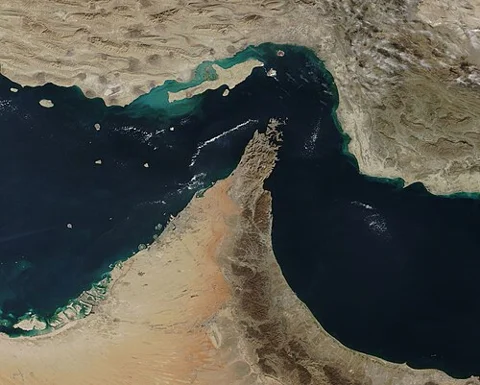 right? And they're going to keep doing crazy shit like this. So I think it just made a lot of sense. It's not that I'm going to make them become part of SemiAnalysis; it's a separate company. And, yeah, so I think they're awesome. There's a lot they can do better, and so we want to help them do better.
07Never sell opinions
An information firm can monetize attention, Patel says, only if it never sells its opinions, because otherwise it loses its credibility.
I mean, I'm really curious, because as you build out these multiple businesses, who is a business leader that you look up to? Like, are you going off the playbook of someone else? Or, like, how have you learned?
I think there's a lot of very interesting businesses across history and humanity, but ultimately no one has really done the mix of things that we're doing. And so I think it is uncharted waters. I mean, media is obviously being completely rewritten, information services businesses are being rewritten. Everyone recognizes the Gartners and IDCs67Gartner — an American IT research and advisory company founded in 1979; IDC (International Data Corporation) — an American firm that researches IT and telecom markets. and those kinds of companies just suck and are useless. And yet information is more valuable than it's ever been.
How come? You know, what is a new way an information firm exists? Media and attention: the old guard is in many ways bad. And I think obviously there's still awesome reporters at places like the Wall Street Journal or Bloomberg or the New York Times, but those brands have definitely taken a huge hit and fallen off in quality a lot. And there's a lot of the creator economy, and there's a lot of people who are just big on YouTube or some other platform—you know, Twitter, X, Instagram, Substack. Attention is important. How do you monetize attention? How do you not just attention-hack, but also provide useful things? And I think that's something—through the SemiAnalysis newsletter, the Citrini newsletter, through their social medias—there's a lot of valuable things that you can put out there.
ExplainerHow Gartner's Magic Quadrant works
Gartner is the world's largest IT research and advisory company, and it makes most of its money from subscriptions to its research and advice. Its best-known product is the Magic Quadrant: for each market, from databases to AI coding assistants, analysts place vendors on a chart with two axes, "ability to execute" and "completeness of vision."
The chart is split into four squares: leaders, challengers, visionaries and niche players. Landing in the top-right "leaders" square is a strong selling point with large companies, so vendors put a lot of effort into working with Gartner analysts, and many of them are also paying Gartner clients.
Hence long-standing suspicions of a conflict of interest. Gartner says a place in the quadrant can't be bought, and courts have dismissed suits from unhappy vendors, treating the quadrant as analysts' opinion. Patel calls the model a racket and contrasts it with SemiAnalysis, which takes no money for opinions.
And what's the correct way to monetize attention? I think if you look at Gartner, the way they monetize it is they are like a racket. You know, they'll be like, "Pay us or we're going to rank you poorly." It's not that explicit, but you could look at their AI software agent index, and it's like, yeah, they put IBM—whatever the fuck IBM's coding agent is—above... I think they put it above Cursor68Cursor — the AI code editor from Anysphere; in August 2026 SpaceX bought Anysphere for $60 billion in stock. or Claude Code, I don't remember which one. They put it above them.
Been sleeping on IBM.
You know, they have the Magic Quadrant, right? And it's like, how the fuck is IBM's coding agent better? It's like, whatever. And they've done this for a lot of folks. So obviously the correct way is not to do that kind of bullshit, because then you lose your credibility and no one cares what you say.
So one thing that we will never do is take paid partnerships. We've never done ads, we've never done, you know, "you pay us for an opinion." We never do any of that shit, right? And so our biggest customers are the ones we hate on the most, right? My biggest customers are hyperscalers and major semiconductor companies and AI labs, and I don't think there's one that we only say positive things about. You know, we fall in and out of love with Anthropic, and I will say that clearly. Not in and out of love, but we'll say positive and negative things, right? Same with any of these companies.
So I think for people to care what you say, you have to be objective and give what you truly believe, which is sometimes antithetical to... You know, we've had people try and pull their contract because they were mad at what we said, but then their team was like, "Well, no, actually, we still want their data," right? So it ends up being an interesting thing. You have this attention, you have this business where you're selling data and consulting services. People only care about your data and consulting services because you're an objective, truth-seeking player. The attention side of things, you could monetize via selling an opinion that is paid, right? Selling your opinion. But if you do that, then you lose the whole gambit.
So you don't ever want to do that, right? You always want to give your own opinion. And you can be wrong sometimes, right? I mean, I think I've totally been wrong sometimes. But I and my whole team will always only say what we believe, even if we're wrong. And so that, I think, is a little bit different.
We're a lot more cavalier. You know, we've said crazy things—or not even crazy things, I think they're accurate—but we've said things like, "Oh, we think some of Nvidia's practices are anti-competitive," right, with regards to how they treat certain neoclouds. And we're not going to shy away from that, even if they try and tell us that's false. We've seen plenty of data points that make us think otherwise. Or we've had opinions like, "Hey, OpenAI's product sucks in many cases," or "Anthropic's product team sucks in many cases," right?
Like, what is going on? Why is Perplexity my primary persistent agent supplier? Yes, they're doing a lot of things right, but OpenAI and Anthropic are fucking up, right? And yet at the same time we could be like, "Wow, these are the best companies in the world too." And I think as long as our opinion is true to our word... There will always be people who cast shadows and doubts. They're like, "Oh, you're just saying that because someone paid you to," right?
Or even separating opinion, right? Sometimes we'll talk about something technically publicly, and then our research will say something completely different. As an example, we've said IREN—Iris Energy69IREN (formerly Iris Energy) — an Australian company that started out mining bitcoin in its own data centers and now rents out computing capacity for AI; in November 2025 it signed a roughly $9.7 billion contract with Microsoft.—has terrible technology on the cloud services side. You know, their clusters can be unreliable, they don't have all these other things in ClusterMAX.70ClusterMAX — SemiAnalysis's rating of GPU clouds, published since 2025: it scores providers on cluster reliability, networking, storage, monitoring, support and more. At the same time, we've said, "Oh, but they have powered land,71Powered land — sites already connected to the grid or with an agreement for a large power hookup. Getting such a connection in the US now takes years, so these sites are expensive. and that's worth a lot," right?
And we've said both of these things. Or vice versa, right? I have an investment, a large investment, in Fluidstack,72Fluidstack — a neocloud founded in London in 2017 and headquartered in New York since late 2025; it builds data centers with Google TPUs, including for Anthropic. and yet we still said their data centers are delayed, publicly, right? You don't have to compromise your morals or beliefs. I think a lot of VCs, especially, think they have to be the tail that's wagged by the dog that is their companies. And actually it doesn't matter.
Good founders will recognize: "I'm going to give you honest feedback, and we are going to tell you what we think is true. If you disagree with us, that's fine. There's no animosity here." In fact, we criticize the things that we love the most, I think, at least as analysts. So just because you're invested in something or you have a financial interest doesn't mean you have to just be the tail that's wagged by the dog.
So is that the biggest difference you're going to make as an investor?
Oh yeah, yeah. I mean, I think—I will not shill. I'm like: one, we'll never push the companies that we invested in publicly, because those are separate companies, right? The fund is a completely separate entity and company from SemiAnalysis and Citrini. So they will never say anything to pump a company that is on the venture side. But at the same time, we have all these connections through those, right? We just happen to know people in every layer of the supply chain, so we can help you get introduced to them, or hire, or what have you, right?
And it's the same: if there's information that I have under some consulting contract, you know, there's compliance. We spend a lot of money on compliance. You can't just fucking willy-nilly do stuff. And even if I've invested in a company through my fund, or if that company is a big customer of SemiAnalysis data or even consulting, that does not mean that if we're testing something empirically or if we're tracking some supply chain number, we're not going to just say what we think. Or if we think technically the direction is wrong, we're not going to say what we think. I think that's the key point.
08Hard decisions, languages and the year ahead
Running a company is hard, Patel says, and many investors have never made such tough calls, while next year he expects the number of hardware companies to skyrocket.
I do think you've built a really unique business. You've built a phenomenal business, and you did it in quite a short amount of time, and you've ridden an incredible market. And it seems like you're creating some durability with it, with the fund and with other things, and how you're planning out research and how you're pricing things. But along this journey, I can't imagine it can all have been that great. So what have been the hardest lessons that you've had to learn, or the most challenging moments?
Running a company is very hard. Yeah, you, like, lose sleep, right? So—I don't know, like, that's fun. But, yeah, it's a lot of fun. You obviously miss a lot of things. You have to choose what you're going to work on, so you're going to miss a lot of things, whether it's in some people's lives or your own life, or, like, sleep or health. Obviously that stuff gets sacrificed sometimes. And it's really tough when you have to make tough decisions. And when you're running a business that does a lot of revenue, you have tons of tough decisions, whether it be negotiating with a customer, or team members, or fighting between team members, or, you know, kittens. Yeah, we had a kitten in the office. It was really cute. But I think, yeah, there's tough decisions to be made all the time.
And so I think that's another difference: a lot of investors have never made tough decisions, like... "Do I invest in this company or not?" It's like, have you fired people? That fucking sucks. Have you been sued by someone you fired? That fucking sucks. You know, these kinds of things are just annoying, and you have to learn how to deal with them and know the playbook. Like, how do you negotiate with a customer or a supplier? How do you hire someone? How do you convince someone to work for you? How do you keep everyone motivated? All these things—I don't know, I actually don't know the answer to these things, right? You just kind of fly blind. Maybe I've done it a few times, but I still haven't done it much.
But you've built it out to how many offices and how many employees?
You know, so we've got people in 15 countries. There's about 115 people, offices in New York, Chicago, SF, Oregon, Singapore, Korea, but then we've got people in a bunch of other countries.
You speak all those languages?
Fuck no. I speak English, Gujarati,73Gujarati — the language of the Indian state of Gujarat, the mother tongue of many Indians named Patel. some Hindi, Spanish. And I would say two of those languages I can get by, right? I'm decent. I can converse, but not good. No, I don't know that many. I wish—I should learn. I know enough Chinese that I can make people laugh.
Really? Is it because your Chinese is so bad, or—
Well, that's exactly it. Okay, it's—well, it's bad, and I only know phrases that are insane.
Really?
Yeah, yeah.
Should I dare to ask which ones you know?
No, I mean, it's up to people to ask me, right? I think there's some old Chinese proverbs. And I think there's some things you can say based on the body language of what's happening, even if you don't understand what the fuck is going on: you just say this phrase, or you say the word. An easy example is, you hear some people, and there's a certain intonation when people are speaking, and you say, "Weishenme?"74Weishenme (为什么, wèishénme) — Chinese for "why?"—which means kind of, like, "What? Why?" People will be like, "What the fuck?" And it kind of makes sense, and they'll think you know Chinese. You don't know Chinese.
But there's obviously much more complicated stuff. Like, okay, so if I talk about cows playing piano,75Cows and pianos. Chinese has the idiom 对牛弹琴, "playing the zither to a cow": talking over the head of someone who can't understand, like casting pearls before swine. and, like, how you can't share an umbrella with a fat person—there's all sorts of things like this that you can say that are really insane.
AdMercor, VCX, Public, Deel
How good is AI at real professional work? Mercor's AI Productivity Index, or APEX,dAPEX (AI Productivity Index) — Mercor's index measuring how well frontier models handle the work of lawyers, bankers, consultants and doctors. tracks it with every major frontier model release, built with partners like Harvey and Cognition. See where the frontier actually stands at mercor.com/apex.
Today's episode is sponsored by VCX by Fundrise,eVCX — a Fundrise closed-end fund whose shares trade on an exchange, giving buyers a stake in a portfolio of private tech companies. the public ticker for private tech, allowing investors of all sizes to invest in venture capital. Learn more at getvcx.com.
Public is a multi-asset investing platform where you can automate your investing with AI agents. Create your own custom agent with a simple prompt. Agents can monitor markets, execute trading strategies and manage your cash across stocks, bonds, options, crypto and more. Want to buy at market close and sell the next day's open? Just tell your agent. Automate your investing at public.com.
Founders scale faster on Deel. Set up payroll for any country in minutes, hire anyone anywhere, get visas handled fast and get back to building. Visit deel.com/sourcery. That's D-E-E-L dot com slash sourcery.
So if I wanted to show that I can hang, like, what should I say?
Don't ask me. I don't know shit.
But you just said those work.
I lived in Taiwan for a while, and, like, you know... I don't know. It's got context. You know, if you learn it, then I'm giving you the alpha, and then the alpha's decayed.76Alpha decay — a quant finance term: a trading edge ("alpha") disappears as soon as others learn about it. It's leaked.
All right, whatever, man. It's over.
You gotta come up with your own wizardly spells.
You're right. It all comes back to Sourcery. It's a good circle-around moment. Okay, so I think we're just about at time, if not more. But Dylan Patel, I have to ask you: what are you most looking forward to in the next 12 months?
I think there's a ton. I mean, there's just a lot of stuff that we're launching and doing. So there's testing of various chips, including Huawei chips,77Huawei chips — the Ascend AI accelerators Huawei develops despite US sanctions, China's main rival to Nvidia's GPUs. Amazon's chips,78Amazon's chips — AWS's in-house AI accelerators, Trainium (for training and inference) and Inferentia. various AI startups' chips, on inference performance. There is, you know, the new model releases—I think they're sick. We launched a new benchmark called GDPx. It tests across many domains: cyber, chip design, hardware design, materials science, bio, quant,79Quant — quantitative finance: trading algorithms and models of risk and prices. RSI.80RSI (recursive self-improvement) — an AI's ability to improve itself, for example by doing the research needed to train the next models on its own. And I'm excited to see the models get good at them, because the models suck at most of these benchmarks.
But they're very complicated tasks, and as the models get better at them, what does that unlock for society? I think we're going to see tremendous progress in technology, especially hardware, right? I think hardware is going to just accelerate like crazy. You know, I think in a year the number of companies making things in the hardware realm is going to skyrocket, and the number of companies that can do it well is going to skyrocket. That's going to be really fun to see, all the innovation in society from that. Robotics. Obviously there's tons of niche semiconductor technologies that I'm really excited for, especially on the packaging81Packaging — assembling chip dies into a single package. In AI accelerators it has become a bottleneck: GPUs and HBM memory stacks are joined on a shared substrate using technologies such as TSMC's CoWoS. and networking sides, memory side. So yeah, I think there's a lot of things I'm excited about.
09Takis and color blindness
Patel is partially color blind, but he can see almost every color and only confuses blue with purple.
Cool. Is your favorite chip still Takis?82Takis — spicy rolled corn tortilla chips made by the Mexican company Barcel, part of Grupo Bimbo; the Blue Heat variety is blue. Takis Fuego by the Mexican company Barcel: the bag is purple, while the Blue Heat variety has chips that are blue themselves.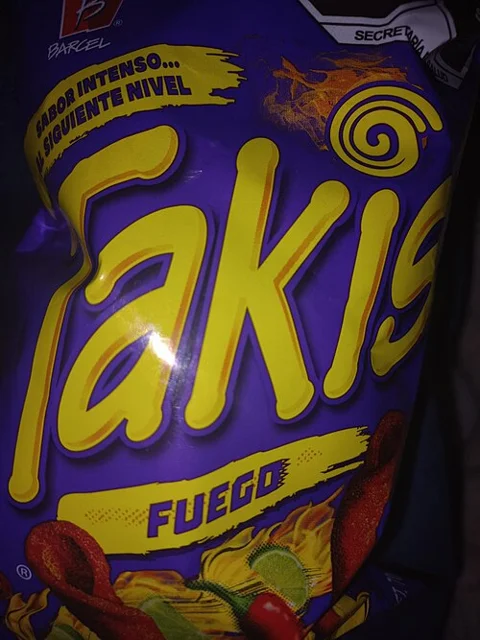 Is that what you said? Takis? Takis?
Takis.
You know what that is.
Takis. Blue Takis, the blue ones. Or purple ones? I don't remember what color they're—
Purple.
They're blue or purple. I'm bad at— I'm, like, partially colorblind.
Really?
Yeah. They say it's red-green colorblind,83Red-green color blindness — the most common form of color vision deficiency: because of mutations in genes on the X chromosome, one type of cone works differently or is missing, making it hard to tell apart shades of red, green and colors mixed with them. In the mild form (anomalous trichromacy) a person can tell red from green, just less well. but I can tell the difference between red and green, and, like, I don't fucking understand that. But it's a really interesting one, right? It lives on the X chromosome, the type that I have. I can see most colors, right? It's fine.
So this has been clinically confirmed.
Yeah. It lives on the X chromosome, and it can only express itself in men.84Fact-checkWomen can be color blind too, if the gene for red-green color blindness is on both of their X chromosomes; men have only one X chromosome, which is why it is much more common in them: about 1 in 12 men have a color vision deficiency (National Eye Institute). In the diagram, the mother is a carrier and the father has usual color vision. Each son has a one-in-two chance of being color-blind, and each daughter has a one-in-two chance of being a carrier.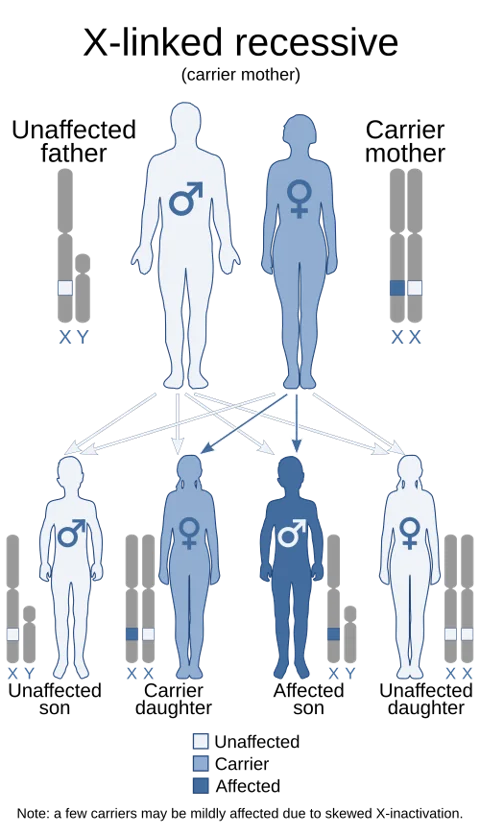 And it goes from the maternal grandfather to his daughter—his daughter always has it—and then, if you draw a Punnett square,85Punnett square — a grid geneticists use to work out the probabilities of gene combinations in offspring, named after the British geneticist Reginald Punnett. that daughter will pass it to 50% of her sons, because she has two X chromosomes. And for some reason, if the woman gives it to her daughter, it can skip a generation too, right? But it lives on the X chromosome, and it generally comes from your maternal grandfather. But it's an interesting thing: I see color a little bit worse, but I see way better in the dark. Because, like, the cones... I think it's rods versus cones,86Rods and cones — the light-sensitive cells of the retina. Rods are very sensitive to light and handle vision at dusk but don't see color; the three kinds of cones, for the red, green and blue parts of the spectrum, provide color vision in good light. like, the light detectors in your eyes. Your rods are better at, like, "Is it dark or light?" And cones are better at, like, "Here's a spectrum of color." And so, I mean, I can see every color around us, right? But my color skills are a little worse.
What color is this?
It's red.
What color is this?
It's blue.
Well, then you can't see purple? Is it—
No, I see purple too. I just see purple and blue as, like, similar.
Oh, okay.
But I'm also just kind of dumb.
No, I don't think so.
No, I think so, I think so. I think stylistically, right?
You're stylistically dumb?
Maybe.
Maybe less aware.
Less aware. There you go.
There you go.
Stylistically less aware.
There you go. That sounds much more sophisticated.
Anyways, I think it's a fun thing to be able to see better in the dark.
How did we start talking about this? I don't know. All right, Dylan Patel, thank you so much for your market update.
Yeah, yeah, for sure. Thanks for having me on the Wizards of Waverly Place.87Wizards of Waverly Place — a Disney Channel sitcom (2007–2012) about a family of wizards living in New York, starring Selena Gomez.
I know. I'm going to steal this room from now on. I think it's very fitting.
Awesome, awesome.
Hey, it's Molly. If you enjoy our interviews, check out our newsletter, sourcery.vc, where we deliver a once-a-week top deals and tech headlines email, and also go deeper on our podcast interviews. Subscribe to Sourcery today. And don't forget to subscribe to the podcast on YouTube, Spotify, Apple, or wherever you listen. Link in description to sign up.


