


Latent Space
Chapters
swyx expects a blockbuster listing around $80 a share, but the valuation rests on forecasts that span a huge range.
Read the chapter- A $70–78 range implies $1.3–1.4 trillion, and swyx expects pricing around $80 and a 19–20% first-day pop, like SpaceX’s.
- That is about 38 times trailing revenue and 20 times current revenue, while revenue forecasts for 2028–2030 run from $400 billion to $1 trillion.
- The October run rate was $81 billion, with $100 billion expected by year-end.
- Some 11,000–12,000 customers spend over $100,000 a year, and net retention is 900%, against 150% for the best software companies.
The roadshow centered on agents, chips and margins, and in swyx’s view rivals’ new models haven’t shifted the balance.
Read the chapter- Claude Cowork isn’t very cloud native, swyx says, and he thinks the future belongs to cloud agents like Claude Duet, Grok Bot and Instinct.
- Anthropic runs on Nvidia, AMD, TPUs and Trainium and described how it migrated far more easily from Nvidia to AMD; swyx sees both business sense and part of the self-improvement story.
- Adjusted margin slipped from 19% to 15%, GAAP shows a small loss, and the long-term target is above 35%.
- GPT-6.2 and Gemini 4 didn’t pull users away, and Fable 5.2 still leads.
- A failed IPO amid the Nvidia drama, swyx says, would have hurt the whole industry.
Tanay explains how Anthropic computes its run rate and pegs growth at 8–10% a month, without clear re-acceleration.
Read the chapter- Tanay has written IPO breakdowns on Substack for six or seven years and sees the SpaceX and Anthropic S-1s as generation-defining documents.
- Revenue, swyx notes, is up 13–14x from the same quarter last year.
- The run rate is 28 days of usage fees times 13, plus monthly subscriptions.
- Some read $80 billion as re-acceleration, others as a sign the company will miss a $100 billion exit run rate.
The S-1’s biggest surprise for Tanay is how little cash Anthropic burned; only Airbnb comes close on that efficiency.
Read the chapter- Anthropic raised about $140 billion and still has $132 billion on the balance sheet, so it burned less than $10 billion.
- On cash burned per dollar of run rate at IPO only Airbnb comes close, and in absolute dollars Anthropic spent less than Uber.
- Meta’s Reality Labs still loses billions a quarter; swyx wanted that money redirected to MSL and says the glasses are nothing compared to Muse.
swyx and Tanay credit Anthropic’s efficiency to a late start, its founders’ experience and its refusal to subsidize a mass free tier.
Read the chapter- In swyx’s view OpenAI’s burn looks more like Snowflake, Cerebras and CoreWeave, and unofficial charts showed this from the leaked S-1.
- Anthropic’s founders already paid their tuition at OpenAI on GPT-1 through 3 and could repeat the work without the dead ends.
- Gross margin on paid inference is 85%, and free-tier inference is booked as marketing and costs only about 4 points of margin.
- Tanay says OpenAI got rid of Sora because it didn’t make money and ate compute, while swyx defends the attempt at an “AI TikTok.”
For Tanay the big question is whether a use case the size of coding emerges next, and he names security and science as candidates.
Read the chapter- Anthropic added about $25 billion of run rate in Q2, and quarterly growth fell from over 100% to 40–45% in Q3.
- Skeptics say token-maxing is ending, OpenAI’s models have caught up and customers route requests across models.
- Tanay’s candidates are customer support, legal and above all security, now that attackers have unguarded models, as the PHP hacks showed.
- Long term, Anthropic is betting on drug discovery and its own wet lab.
Tanay is surprised that inference costs Anthropic only $10–15 billion a year and that its data spending is small, if rising fast.
Read the chapter- About 70% of compute goes to training and research and only about 30% to inference.
- Spending with outside data vendors ran at about $1 billion a year until the latest quarter, then about $600 million in the June-to-September quarter, a $2–2.5 billion run rate.
- Tanay reads the jump in spending on RL environments and company data as a sign reinforcement learning keeps paying off.
- Share of compute is a poor yardstick, he says, since Anthropic makes synthetic data itself and books it as compute.
Anthropic paid $1.5 billion not for training on books but for pirated copies it downloaded; swyx thinks training itself should be legal.
Read the chapter- The Bartz settlement appears as a separate expense in one quarter.
- Per Tanay, the payout was for torrented books, and had Anthropic bought them all, there might have been no settlement.
- An enthusiast built Books3, swyx explains, a pirated book set modeled on Books1 and Books2, and researchers got used to training on it.
- Training is transformative use, swyx argues: a person with perfect recall could also reproduce Harry Potter, and he sees a double standard for AI.
Tanay explains why selling through the API makes Anthropic’s revenue fragile: customers move to a better model the moment the company slips for a few months.
Read the chapter- Anthropic stopped disclosing Claude Code revenue after $2 billion, but swyx reckons products built on it bring in about $50 billion.
- Cloud partners bring in 44% of revenue and earn 30–35% fees.
- Revenue per employee is up to about $6 million a year.
- Models under six months old account for 80% of usage, so if Anthropic falls three months behind, API customers can swap it out.
- First-party apps, where scheduled tasks keep users in place, and a presence at every point on the price-performance curve are the defense.
Tanay says Anthropic should list as early as it can, even at a discount, because liquidity across the venture chain depends on these IPOs.
Read the chapter- Better to list at $1.25 trillion than delay indefinitely and spook investors.
- IPO proceeds flow back to LPs and on into new funds, neolabs and compute buildouts.
- Anthropic should list while revenue grows 5–10% a month, since a single month of negative growth could rattle the market.
- Employees ask swyx about the next 2x or 5x, $3, $7.5 or $10 trillion, and Anthropic’s answer is its “virtual collaborators” story.
Tanay thinks corporate token spending can grow 10–30x even without new breakthroughs, but part of that market will go to cheap open models.
Read the chapter- Only about half of the Fortune 500 spend more than $100,000 a year on Anthropic.
- At big customers Anthropic is under 0.1% of total expenses, and in three to five years tokens could be a few percent.
- Growth, Tanay says, depends less on smarter models than on closing the gap between what AI can do and how it’s used.
Tanay bets on the average neocloud over the average neolab and expects no one to earn high margins serving open models.
Read the chapter- One or two neolabs may become giants, but the average one will likely become a neocloud renting out the compute it bought.
- Citing DeepSeek’s roughly 80% inference margin, swyx thinks a GPU may pay back in a year.
- Tanay adds that SpaceX claimed sub-one-year paybacks on its buildouts.
- Debt markets are raising rates on neoclouds, which swyx reads as doubt about one-year paybacks.
- On OpenRouter small providers sell Kimi or GLM at a tenth of the labs’ price, so Tanay expects no one above 40% margins and providers moving into fine-tuning for customers.
For Tanay, science is a way to use contracted compute if enterprises adopt AI more slowly than expected.
Read the chapter- The commitments total about $900 billion: $70–80 billion on compute next year, then $100–120 billion a year, and only the SpaceX contract is flexible.
- Demand could fall short if no mass use case follows coding.
- Discoveries in biology, materials and robotics are something Anthropic can pursue itself, independent of customers’ adoption pace.
- Until the IPO everyone will watch month-over-month revenue growth, and swyx calls Anthropic’s IPO a turning point for OpenAI’s as well.
Quotes
On how unusual Anthropic's IPO is
“Usually you're unprofitable, deeply unprofitable, like negative 100% profits for, I don't know, three, four years before you even start to turn it around.”
Shawn Wang (swyx)Read from 04:40On what Anthropic spent before its IPO
“And even on an absolute dollar basis, I think Anthropic has literally burned less dollars than Uber did by the time it went public, which, given what they've created, is pretty remarkable.”
Tanay JaipuriaRead from 13:40On why OpenAI built Sora
“Sam has always wanted to build a social network for OpenAI, and what do you do if you're not Twitter, you're not Facebook or Instagram? You do AI TikTok, right?”
Shawn Wang (swyx)Read from 20:40On training AI on books
“I am allowed to go and read Harry Potter, and maybe I have a perfect memory and I can go somewhere else and write down Harry Potter word for word from memory. Is my brain illegal?”
Shawn Wang (swyx)Read from 30:53On the cost of falling three months behind
“You could find yourself in a scenario where, because people are just using you at the API layer in some system where they can easily swap you out, you have suddenly lost a lot of share and a lot of revenue.”
Tanay JaipuriaRead from 34:19On the fate of neolabs
“Yeah, I mean, the failure mode of a neocloud or neolab is to become a neocloud, that's for sure.”
Shawn Wang (swyx)Read from 44:15On why people doubt one-year paybacks
“And the reason is the debt markets are the smartest people in the world, right?”
Shawn Wang (swyx)Read from 45:22
Summary
On the eve of Anthropic's listing, swyx sums up the roadshow, with the $70–78 range, an $81 billion run rate and a long-term margin target above 35%, then walks through the S-1 with Tanay Jaipuria of Wing. Tanay's biggest surprise is the cash: Anthropic raised about $140 billion and still has $132 billion, so it burned less than $10 billion getting here, less than Uber did before its IPO, because it went straight to enterprises and developers and spends almost nothing serving free users.
The main risk comes from the same business model: 80% of revenue is usage-based and 80% of usage runs on models less than six months old, so falling three months behind could send API customers elsewhere overnight. With quarterly growth already down from over 100% to 40–45% and nearly $900 billion in compute commitments ahead, Tanay argues for listing as soon as possible and sees science as a hedge: if enterprises adopt AI more slowly, Anthropic can point its compute at its own discoveries.
Advice
If you sell a model through an API, move customers into your own apps: scheduled tasks and habits keep them even when your model briefly falls behind, while an API customer can leave for a rival in a day.
Go public while you're still growing, even at a 10–30% discount: an open-ended delay worries investors more than a lower price.
Don't count on margins above 40% reselling inference on open models: a newcomer will always undercut you, and the money is in models fine-tuned for a customer.
Mentioned
 Anthropic00:00swyx and Tanay go through its prospectus on the eve of its November 19, 2026 IPO: an $81 billion run rate, margins, compute and data spending, risks.
- Jamin Ball00:00swyx points to the previous episode in the series, where Jamin walked through Anthropic's S-1 and its profitability, unheard of at that size.
 SpaceX00:50swyx expects a modest first-day pop for Anthropic like SpaceX's; later Tanay cites its claim that compute capacity pays back in under a year.
 Claude Cowork03:02swyx sees it as the next chapter of Anthropic's investor story, but not cloud native: the agent runs on the user's computer.
Show 40 more mentionsShow fewer mentions
- Claude Duet03:02swyx calls it the cloud "autonomous teammate" Anthropic promises in the prospectus.
 Instinct03:02swyx cites the assistant as evidence that everyone is moving toward agents that run in the cloud on their own.
 Grok Bot03:02swyx puts xAI's cloud agents alongside Claude Duet as where the whole industry is heading.
 Cognition03:02swyx lists Cognition's bots among the cloud agents Anthropic will have to compete with.
 NVIDIA04:01swyx explains Anthropic's move to other chips by its being bottlenecked on Nvidia supply.
 Advanced Micro Devices04:01swyx recounts how Anthropic moved work from Nvidia to AMD accelerators much more easily, with the help of its own model.
- AWS Trainium04:01swyx lists Amazon's accelerators among the chips Anthropic wants to run on at once.
- Tensor Processing Unit04:01swyx lists Google's accelerators among Anthropic's four chip families.
 OpenAI05:32swyx thinks its new GPT-6.2 didn't pull Claude users away, and says OpenAI burned far more cash than Anthropic on the way to an IPO.
- Claude Fable05:32swyx says Fable 5.2 still leads on benchmarks and vibe checks, while the anticipated Fable 5.5 didn't arrive before the IPO.
 Gemini 4 Carbon06:37swyx notes Google's model did very well but didn't move investor sentiment.
 Airbnb13:00Tanay calls it the only recent IPO that comes close to Anthropic on cash burned per dollar of revenue.
 Uber13:40Tanay figures Anthropic burned fewer absolute dollars before its IPO than Uber did.
 Meta Platforms13:40Tanay and swyx are aghast that Reality Labs still loses billions a quarter, more than Anthropic has burned in its whole history.
- Meta Ray-Ban Display14:36swyx jokes that Reality Labs' losses come to a million dollars per pair of glasses sold.
- Meta Superintelligence Labs14:44swyx had pitched giving Meta's AI lab the $20 billion a year the company burns on VR.
 Mark Zuckerberg14:44swyx remarks that his pockets are deep enough to fund both VR and AI.
 Muse15:17swyx considers Meta's personal agent far more important than its glasses.
 Snowflake15:37swyx puts OpenAI's pre-IPO burn in the same range as Snowflake, Cerebras and CoreWeave.
 Cerebras Systems15:37swyx cites it among companies that burned a lot of cash per dollar of revenue before going public.
 CoreWeave15:37swyx cites the neocloud as an example of a path to IPO that looks wasteful next to Anthropic's.
- Sora20:14Tanay says OpenAI shut the app because it didn't make money and ate compute; swyx defends the attempt at an "AI TikTok."
 Sam Altman20:40swyx recalls that Altman always wanted to build a social network for OpenAI.
- Bartz v. Anthropic28:33Tanay spots a separate $1.5 billion line in the filing and explains that the payout was for pirated books, not purchased ones.
- Books329:19swyx tells how an enthusiast assembled a pirated book set modeled on Books1 and Books2, and why so many models trained on it.
 Claude Code31:53swyx explains why Anthropic stopped disclosing its revenue: the engine now sits inside other products, which by his estimate bring in about $50 billion.
- Claude Tag31:53swyx names the work-chat agent as one of the products that absorbed Claude Code.
- Claude Opus 5.534:19Tanay sketches a scenario where Anthropic falls three months behind and Opus 5.5 remains its best model.
 DeepSeek44:24swyx cites its open inference stack and roughly 80% margin as proof that profitable inference is within any neocloud's reach.
- NVIDIA GB300 NVL7244:24swyx suggests simply buying such a rack and paying it back, perhaps within a year.
 Fireworks AI45:45Tanay cites it among the big open-model inference providers that won't reach Anthropic's margins.
 Baseten45:45Tanay names it alongside Fireworks as a provider squeezed by price competition.
 OpenRouter46:38Tanay points to the aggregator to show small providers selling open models at a tenth of the labs' own price.
 Kimi46:38Tanay uses Kimi K3 as his example: the lab's official price, and a dozen resellers five to ten times cheaper.
 GLM-5.346:38Tanay offers Zhipu's model as a second example of an open model resold for next to nothing.
 MiniMax46:38Tanay mentions the Chinese lab whose prices third-party providers undercut.
 Dario Amodei48:20swyx notes how openly Dario talks about his personal stake in AI for science.
- Colossus49:00Tanay singles out the SpaceX compute contract as the one Anthropic commitment that isn't binding.
 Wing Venture Capital51:17swyx invites Tanay to pitch founders on his firm.
 Ode53:08swyx announces that Latent Space's new podcast track on forward deployed engineering launches with this company.
Transcript
01The last update before the IPO: price, demand and multiples
swyx expects a blockbuster listing around $80 a share, but the valuation rests on forecasts that span a huge range.
Good morning. Today we're doing our last Anthropic IPO podcast before the IPO,1swyx recorded this intro on November 18, 2026, the day before the listing. That evening Anthropic priced its shares at $83, and trading on Nasdaq under the ticker ANT began November 19 (Fortune). The conversation with Tanay was recorded earlier, about two weeks after the S-1 came out. and TBD on whether or not we'll actually continue covering it after the IPO, because that becomes the domain of finance podcasts. But I think it's still obviously very relevant to a lot of listeners, particularly those of you that work at Anthropic, but also those of you that work at OpenAI and everyone else connected in the ecosystem. The IPO roadshow2Roadshow — the series of meetings between management and big investors before a listing, where orders are gathered and the price is found. Anthropic began its roadshow on November 10, 2026, announcing a range of $70–78 a share the same day. has been going on for a couple weeks, and we know a bit more than we used to before. And we covered a lot of it in the Jamin Ball3Jamin Ball — a partner at Altimeter Capital and author of the Clouded Judgement newsletter on public software companies. His Latent Space episode on Anthropic's prospectus, "Deep Dive: Anthropic S-1 Myths and Mythos," came out on November 7, 2026. podcast, which went really well. Thank you for all the positive feedback. And, you know, I try to pull in people that I respect and look up to in terms of the crossover of technology and finance, because I think, if anything, my career has set me up to do that.
So we have a price for the Anthropic filing, I guess, between 70 to 78 dollars, which is an implied valuation of 1.3 to 1.4 trillion. It looks like it is roughly seven times oversubscribed4Fact-checkOverstated: press reports put orders at roughly six times the shares on offer. swyx's price call was nearly spot on: Anthropic priced at $83, above the marketed range, valuing it at about $1.5 trillion (The Next Web). and probably will price in the range of 80-ish. And then there are also forward contracts, or crypto contracts,5swyx means trading in contracts on shares that aren't listed yet: perpetual futures on crypto exchanges and bets on prediction markets. Their prices show in advance what traders expect from the first day. speculating on where the final pop is going to end up. If it looks anything like the SpaceX IPO, there will be a small pop:6SpaceX priced on June 11, 2026, at $135 a share and closed its first trading day, June 12, at $161, up 19% (Wikipedia). Anthropic did much the same: it opened at $111.50 but faded to close November 19 at $97.17, up 17% on the IPO price (Forbes). it will be about 19 to 20% on the first day. Maybe it would go up to 100 dollars. And so that is in the range of, let's call it, 1.4 to 1.6 trillion, you know.
And that represents roughly 38 times trailing twelve-month revenue,7Trailing twelve months — the last four quarters added up. For Anthropic at September 30, 2026, that's about $35 billion, so a $1.4 trillion valuation is roughly 40 times it. "Current revenue" is the third quarter ($17 billion) times four, about $68 billion. 20 times current revenue, and obviously forward revenue is just dependent on what your projections are. The October run rate was 81 billion;8According to the second amendment to the prospectus, filed November 10, 2026, Anthropic's run-rate revenue was about $81 billion at October 31, $10 billion more than a month earlier. At the end of 2025 it was about $9 billion. that was also a new disclosure. And they're still projected to end the year at 100 billion.
And what people are really thinking about is, well, where does it go from here, right? What is the market pricing? This is obviously the highest multiple that anyone's ever priced, especially at this size. And, you know, the ranges for future years, like 2028 or 2030, really range from 400 billion to a trillion in revenue. So that is a very wide range. But you kind of have to do this kind of math in order to underwrite long-term investments in Anthropic.
And so you can see why people are looking ahead. I think 11,000, 12,000 customers spend at least 100K per year, but once they land in a company, they also expand nine times in the following years. So there is very good NDR, net dollar retention.9The S-1 puts net revenue retention at about 900% as of September 30, 2026, and counts more than 11,900 customers spending at least $100,000 a year. Good SaaS companies run at 110–130%. Usually state of the art is, let's say, 150%, and this is 900%.
02Roadshow questions, and new models that changed nothing
The roadshow centered on agents, chips and margins, and in swyx’s view rivals’ new models haven’t shifted the balance.
So really the discussion about the roadshow has focused on three things. One is Claude Cowork.10Claude Cowork — Anthropic's agent for office work in the Claude desktop app, working with files on the user's computer. It launched as a research preview in January 2026, and the S-1 says it is gaining users faster than Claude Code did at the same point after launch: the company's main argument that it can grow beyond programmers. It is basically the next phase as far as the market narrative goes: how well are you extending outside of Claude Code? I think there is probably going to be a different form factor than Claude Cowork, because Claude Cowork — you know, we did the first Claude Cowork pod with Felix,11Felix Rieseberg — the Anthropic engineer behind Claude Cowork and Claude Code Desktop. His Latent Space episode, "Why Anthropic Thinks AI Should Have Its Own Computer," came out in March 2026. if you scroll back in our archive — is a form factor that's there, but I think it's not very cloud native.12Cloud native here means an agent that runs around the clock on the company's servers rather than on the user's laptop. Cowork lives in a desktop app, so when the laptop is closed, it stops. And definitely the sort of autonomous teammate that they are pitching in their S-1,13S-1 — the registration statement a company files with the SEC before an IPO, covering finances, risks and how the business works. Anthropic made its S-1 public on October 26, 2026, and filed a first amendment with third-quarter figures on November 2. which we covered in the first podcast, is going to have to be cloud native. That's Claude Duet.14Claude Duet — Anthropic's proactive cloud agent, unveiled on October 21, 2026, as a research preview: it watches the user's connected services and takes on tasks by itself. This is the "autonomous teammate" swyx means. That is Instinct, that is the Grok Bots, that is the Cognition bots:15All three compete with Claude Duet. Instinct is a personal AI assistant from the startup Spear Street Technology that you text over iMessage and WhatsApp. Grok Bot is xAI's cloud agents, each with its own computer. Cognition makes the coding agent Devin. everyone is trending in that direction, and I don't see why Claude would not do that. And probably that is going to be something different than Claude Cowork.
The second one is chips. Anthropic wants to run across Nvidia, AMD, TPUs, Trainium,16TPU is Google's AI accelerator, Trainium Amazon Web Services'. In the prospectus Anthropic says it treats all four chip families, Nvidia, AMD, Trainium and TPU, as a single pool of compute and shifts capacity to wherever it's most useful. The photo shows a third-generation Trainium accelerator. and they also released information about how they were able to migrate much, much more easily from Nvidia to AMD.17On the roadshow Anthropic said its Claude Mythos Preview model wrote the software to get one model's prompt processing running on AMD MI355X accelerators in about three days. That covers one workload, not a migration of all training (IBTimes). That is obviously part of the whole RSI18RSI (recursive self-improvement) — AI speeding up the development of the next AI. A model porting its own software to AMD chips is exactly that kind of example. In the second amendment to its S-1, Anthropic wrote that by its own assessment it had already reached the "dramatically accelerated progress" threshold for AI R&D in its Responsible Scaling Policy. narrative that people are concerned about. But I think it just makes a lot of business sense for them: hey, I'm bottlenecked on Nvidia, I'm sorry, I have to do this, right? And by the way, it's verifiable,19swyx's point is that porting code to new hardware has an objective check: the program either runs as fast and as correctly or it doesn't. Tasks with verifiable results are the easiest to hand to models: they can be trained on them with reinforcement learning, and mistakes show up at once. and by the way, it's one of the core tasks that is easy for LLMs to do.
Third is margins. We have a little bit more in terms of disclosures on margins. We know that margin went down from 19% to 15%,20This is adjusted operating margin, which excludes stock compensation, stock-based charitable contributions and the Bartz settlement. It was 19% in the second quarter of 2026 and 15% in the third. On a GAAP basis, $974 million of operating income turned into a $567 million loss; Anthropic blames $5 billion of pricier short-term compute and $2 billion of non-cash charges for matching employee donations. and that's adjusted margin. It went from a GAAP operating profit to a slight GAAP loss, and that is just intentional, not a big deal. Anthropic is projecting that it can get above 3521swyx means 35%: in its roadshow video on November 10, 2026, Anthropic said it expects a long-term adjusted operating margin above 35%, without giving a date. That would take compute costs falling to roughly 45–50% of revenue, from 58% in the third quarter (CryptoBriefing). in the long run. That would be a very big deal, because then it would be very profitable. And again, as we discussed in this podcast and the previous one with Jamin, that is just unheard of for a large tech company of this size IPOing. Usually you're unprofitable, deeply unprofitable, like negative 100% profits for, I don't know, three, four years before you even start to turn it around. And that's good. I mean, this is growth with profit, which never happens.
I think the final thing that happened this week is OpenAI's model launch. As we've already established, model launches are incredibly, incredibly important to the viability of the frontier labs. The shelf life of a frontier model is roughly six months. If you don't release the next model at the frontier, then obviously the usage is not going to come to you, and it is very sensitive to benchmarks and vibe checks.22Vibe check — developers trying a new model on their own tasks and sharing impressions on social media. When picking a model, these reactions often count as much as benchmarks. And so OpenAI shipped GPT-6.2,23GPT-6.2 — OpenAI released it on November 17, 2026, in two versions: the flagship Astra and the everyday Sol, with Astra's API prices cut by 20%. The "efficiency frontier" is OpenAI's claim that its model matches rivals on benchmarks at a much lower price: reviews said Astra was eight times cheaper than Fable 5.2, though users weren't impressed (Wccftech). and Fable — Anthropic shipped Fable 5.2.24Claude Fable 5.2 — Anthropic's most capable publicly available model, released November 9, 2026. Fable is the public version of a Mythos-class model, with filters for dangerous requests. And obviously Fable 5.2 is still on top, and I think the vibe checks are mostly holding up that Fable is on top. So there's that, and then there's the efficiency frontier, which OpenAI does claim. I think people are a little bit more mixed in practice: there are benchmarks, and then there's just practical use. I would say both model launches have not really changed camps either way. If you're a Claude person, you continue to be Claude. If you're happy with OpenAI, you continue to be OpenAI.
So those key risks for the IPO that may have dramatically changed the story, either for the positive or negative, haven't really changed. There was no Fable 5.5 that people were anticipating. And Gemini shipped Gemini 4; that did not affect the narrative, even though Gemini Carbon25Gemini 4 Carbon — a Google DeepMind model announced on October 28, 2026; cyber defenders got access first (Google blog). did very, very well. And that's about it, you know. So those key risks are behind us for the Anthropic IPO.
Anthropic is still the top model lab in the world, and it is IPOing tomorrow. It is going to be a blockbuster IPO, and that's really good for the ecosystem, because a failed Anthropic IPO would have read through really badly, together with the Nvidia drama26On November 12, 2026, Jensen Huang, Nvidia's co-founder and CEO of 33 years, resigned as CEO and from the board after reports of an affair with a woman US intelligence believes is linked to Chinese intelligence. CFO Colette Kress became interim CEO (Al Jazeera). that is also happening at the same time. So that is the overall update from the last week. You're mostly prepped. This is the podcast we recorded to go through some finer details in the S-1. I hope you enjoy, and good luck tomorrow.
03An $80 billion run rate: acceleration or not?
Tanay explains how Anthropic computes its run rate and pegs growth at 8–10% a month, without clear re-acceleration.
Okay, we're in the remote studio. This is another in our series covering the Anthropic IPO, with Tanay Jaipuria.27Tanay Jaipuria — a partner at the venture firm Wing, investing in AI applications and infrastructure, and formerly a product manager at Meta. On Substack he writes Tanay’s Newsletter, where he breaks down companies' IPO filings. Welcome.
Thank you for having me, swyx. Longtime listener of the podcast, and excited to be on.
Tanay, how come you're writing S-1 breakdowns?
Yeah, I think in general, for maybe the last six or seven years, I've been writing about various things, more long form, on Substack. And one of the topics I've been writing about is breakdowns of interesting companies as they go public. I think the S-1 is usually the time when, as an outsider, you get a look into all aspects of the business. And the reason I enjoy reading them so much is that you can get a sense of the story of the business so far. I feel like in every business there are some interesting lessons for people to take away, about business in general and about specific kinds of businesses.
So I used to follow them from that perspective. And then obviously over the last year or so, the ones we've had, like SpaceX and now the Anthropic S-1, these are truly generation-defining companies. So I think it's been even more fun to look into those. They give you a sense of the current state of those companies specifically, but also of the market much more broadly. The Anthropic S-1 gives you a view into everything from model development to inference,28Inference — running an already trained model to answer users' requests. Unlike training, customers pay for it, which is why inference is seen as the big market ahead. where everyone's talking about inference as the next big huge market.
It gives you a sense of the current state of all the compute needs and the neoclouds,29Neoclouds — new cloud companies that rent out AI accelerators: CoreWeave, Nebius, Lambda and others. Unlike AWS or Azure, they live almost entirely on AI. and also what's to come in the future, with things like science. So I think it's obviously a category-defining company, and one that's still relatively early in its innings, but it's kind of crazy that in five or six years it's created this much value so quickly. It's something we've never really seen before, across any company really.
Yeah, for sure. I'm happy to dive right in there. You have a lot of charts that have been prepared, and I can go wherever you want to take this. Headline numbers: they're ramping revenue a lot. It's really interesting, basically up 13, 14x from the same quarter last year.30According to the prospectus, Anthropic's second-quarter 2026 revenue ($11.56 billion) was 14.6 times the same quarter of 2025, and its third-quarter revenue ($16.96 billion) 12.3 times. I think the run rate numbers just leaked for October, which we knew was something they had in store; they kind of left it blank in the S-1. But now they're reporting an 80 billion run rate, right?
Yeah, so I think it's at 80.
Divide by four is 20, yeah.
ExplainerHow Anthropic counts run rate and retention
Run-rate revenue isn't reported revenue but a snapshot stretched over a year. In its S-1 Anthropic defines it as usage fees over the last 28 days times 13, plus monthly subscriptions times 12. A year is thirteen four-week periods, so the formula honestly annualizes the latest month; but when usage is growing fast, the run rate ends up well above revenue for the past twelve months.
Anthropic computes net revenue retention over "qualified" customers, those who brought in at least $1 in the base quarter a year earlier. Their revenue for the latest three months is divided by their revenue for the same three months a year before. Pro and Max subscribers are left out, since a flat subscription doesn't grow with usage. At September 30, 2026, the figure was about 900%. The $1 threshold explains a lot: a developer who spent pocket change on the API a year ago and now runs a coding agent shows growth of hundreds of times.
Yeah. And my guess is the way they calculated that 80 is more on a monthly basis. I think the exact definition they use is actually 28 days times 13, plus monthly subscription revenue. And it's interesting, because even on Twitter the reactions to that were mixed. Some people are saying, oh, this is a very good, very positive number and it signals re-acceleration, whereas some are saying it actually means they likely will fall short of the 100 billion exit run rate31Exit run rate — the run rate in the last month of the year. A $100 billion target means Anthropic would be earning about $8.3 billion a month by December 2026. they've been talking about. I think it's hard to tell, but it probably is in that 8 to 10% month-over-month growth range,32Figures disclosed later point to an acceleration: according to the second amendment to the prospectus, the run rate rose from about $71 billion at September 30 to $81 billion at October 31, 14% in a month. At the end of July, Bloomberg reported, it was about $65 billion, so August and September grew more slowly, around 4–5% a month. which, I don't know if it's re-acceleration, but it's at least roughly in line with what they did in the last few months, and it might be slightly up, is my guess. But it's hard to fully know at this point, because they haven't broken down Q3 by month.
Yeah, totally. 80% consumption, 20% subscriptions, which is kind of funny, because it's a pretty public secret how much of a discount the subscriptions get.33swyx means the Claude Pro, Max and Ultra plans: for a flat fee a heavy user, especially in Claude Code, gets far more model work than the same tokens would cost at API prices. According to the prospectus, 79% of Anthropic's revenue in the first nine months of 2026 came from usage-based fees and 21% from subscriptions. So actually people are incentivized to make this 80% consumption base lower, but you have to figure out the subscription system. And the number of customers over 100K is up eight times, to 12K. I'll let you drive. Let's assume that people have looked at the headline stuff and they know about the profitability. What are the major topics that you think are the main messages people should take away?
04How Anthropic burned less than Uber
The S-1’s biggest surprise for Tanay is how little cash Anthropic burned; only Airbnb comes close on that efficiency.
Yeah. I think at various points across the last few months there have been all these leaks about roughly their run rates and stuff, so to me those things were not as much of a surprise to anyone that's been following this, in terms of what to expect based on what had been publicly reported even before the S-1. I think perhaps the biggest surprise to people was just around the cash burn of the business, and I mean that in a positive way. They raised like 140 billion dollars of cash, and they literally still have on the balance sheet like 132 billion or so.34Tanay's numbers match the prospectus: by June 30, 2026, Anthropic had raised a total of $141.1 billion and held $131.7 billion in cash and short-term investments; at September 30 it was $131.8 billion. So they burned under 10 billion dollars to get to where they are. And other than the people who actually knew the numbers from being on the inside, I don't think anyone expected that the cash war chest on their balance sheet was actually that large, just based on expectations around the burn and the margins of the business.
And so it's actually been a very, very, very efficient business. I just did this quick analysis given the scale they've gone to, which is roughly 70 billion at the time of the IPO if you do the quarterly times four: what's the capital consumed, in terms of cash burn per dollar of revenue run rate at the time of the IPO? And there are very few businesses of any meaningful scale that we've seen go public over the last five, seven years that are anywhere close. I think Airbnb is probably the only one that comes close, on a revenue run rate basis, in terms of cash efficiency on the burn.
So I think this was something that was quite surprising. And even on an absolute dollar basis, I think Anthropic has literally burned less dollars than Uber did by the time it went public, which, given what they've created, is pretty remarkable. And when I was thinking about the cash burn: Meta is still burning like 10 billion dollars on their Reality Labs initiatives35Fact-checkNot quite: losses at Reality Labs, the Meta division that makes Quest headsets and smart glasses, have not come down to $16 billion a year. Its operating loss was $4.13 billion in the third quarter of 2026, Meta expects $18–19 billion for all of 2026, and only around $15 billion in 2027 (Anadolu). every two quarters or so. I think it's now down to like 16 billion a year, so maybe they burn like 8 billion, but they're still burning every year way more.
That's still absurd.
Yeah. Than this company that got off the ground and basically built long-horizon agents36Long-horizon agents — AI agents that work for hours without a human on multistep jobs: writing and testing code, fixing bugs. The first mass-market product of this kind was Claude Code, released in February 2025. and was the first at so many of these things.
Oh, wait, I expected them to take it to zero. Like, what the hell?
No, yeah, they're still losing like a fortune.

What? It's like they're burning a million dollars per spectacle,37swyx is dividing Reality Labs' billions in losses by the glasses sold. The line's headline product is Meta Ray-Ban Display, glasses with a small color display in the right lens, controlled by gestures through a wristband; they went on sale in the US on September 30, 2025. or per glasses or something. Like, what the fuck?
Yeah.
That's crazy. So my actual pitch for MSL38MSL (Meta Superintelligence Labs) — the Meta division that has housed all its AI work since June 2025, led by Alexandr Wang after Meta invested $14.3 billion in Scale AI. "He" afterward is Mark Zuckerberg. was: look, they were burning something like 20 billion per year on VR, and you just cut that 20 and reallocate it to MSL, and you have a new lab, right? And they now have it. It's just that his pockets are so deep that he can just do both.
Yeah, he was like, well, I'll do that, but maybe I won't do the cut fully, and I'll slowly do the cut.
I mean, clearly he's enjoying it, he's loving life, whatever, but, you know, these glasses are nothing compared to Muse,39Muse — Meta's personal AI agent, which runs errands in the background, including purchases and bookings; it launched in the US on September 8, 2026. In October Zuckerberg said Muse had topped 10 million accounts. swyx's point is that the agent matters more to Meta than the glasses. right? So it's so funny. Oh man, I can't believe they're still burning five billion a year — five billion per quarter. Come on.
05Why OpenAI burns so much more
swyx and Tanay credit Anthropic’s efficiency to a late start, its founders’ experience and its refusal to subsidize a mass free tier.
All right, so that's the cash burn. I feel like that's something that is underrated. The one number you're not seeing here is: where's OpenAI, right? Because we don't have the OpenAI S-1. It is way more inefficient. It is probably closer to the Snowflake, Cerebras, CoreWeave range.40swyx is comparing how much cash companies burned per dollar of revenue before their IPOs. Snowflake, the cloud data warehouse, went public in 2020; CoreWeave, the biggest neocloud, in March 2025; Cerebras, which makes AI chips the size of a whole silicon wafer, on May 14, 2026. And there have been unofficial charts. So this is not a completely new fact if people were paying close attention to the leaked S-1,41A draft of Anthropic's prospectus leaked to the press in late September 2026, a month before the S-1 came out; reports based on it cited an operating loss of about $8 billion and rapid revenue growth (SiliconANGLE). where people were already drawing charts: Anthropic was known to be doing like this, as a projection, and then OpenAI was way deep.
Way, yeah.
Something like that. So this is a known chart; we just didn't know how big it was.
Yeah, now we know the magnitude.
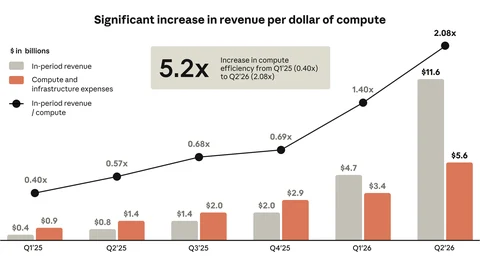
Yeah, yeah. And I attribute this to a couple of things, right? Anthropic started later. So they basically skipped GPT-1 to 3, because that was done on OpenAI's R&D; it was done on their dime. It's the same founding team.42Anthropic was founded in 2021 by people who left OpenAI. Dario Amodei had been VP of research there and led the work on GPT-2 and GPT-3, and another Anthropic co-founder, Tom Brown, was the first author of the GPT-3 paper. So they already paid the tuition there, and now they come out and they can just repeat that work from a clean-room perspective.43Clean room — reproducing someone else's work without copying their code, rebuilding it from a description of what it should do. swyx means the founders already knew which approaches worked and didn't spend money on dead ends. But, you know, what else? Why is Anthropic so efficient? I think that is a really, really underexamined thing. Partially, I think it's just straight up that they are now unit-economics profitable, which is cool, but they also didn't burn that much to get there, which is super unusual, basically unheard of in tech.
Yeah, yeah, yeah. And if you go to the chart right below, around gross margin,44Gross margin — the share of revenue left after the direct cost of delivering the service, which for an AI company is mostly inference compute. 85% is the level of mature software companies; AI labs were generally expected to land well below it because of compute costs. this also probably contrasts with OpenAI, which is that because Anthropic ended up focusing on coding, and on enterprise more generally, and more just "let's have the best models, let's distribute primarily through channel partners,45Channel partners here are the cloud platforms through which customers buy Anthropic's models: Amazon Bedrock, Google Vertex AI and Microsoft Foundry. According to the prospectus, cloud marketplaces brought in 44% of revenue in the first nine months of 2026; Amazon and Google are also Anthropic's investors and its main compute suppliers. but also let's leverage them for compute wherever possible," and because they weren't trying to do consumer, they didn't really have this massive consumer base that they had to support with mostly free inference. The economics are very positive for them on supporting their paid users. And so I think the most common number is this idea of 85% gross margins that they report.
And the way to think about that is that essentially, as a percent of revenue, their inference on paid users is about 15%. There's a chart further below that breaks that down. So they reported these 85% gross margins on essentially paid inference. But one thing a lot of these companies obviously have been doing is that there are these free tier users, and it's been common to put this into sales and marketing spend, because you could argue, oh, it's how we attract users to the platform, and then we monetize them if they become paid. And so they put that free tier inference in sales and marketing spend.
So you could say, oh, maybe that should go in COGS. But I think the point is that for Anthropic, because they primarily relied on enterprise and on coding, and Claude is not as big as ChatGPT is, from a margin perspective and from a cash burn perspective that's actually a positive, because you don't have this huge user base you have to support on the free plan. And so only about 4 margin points, or about 5, 6% of their compute spend, ends up going on free user inference. So I think that's the other aspect of it. I imagine when the numbers come out for OpenAI, that's going to be significantly higher, just given the size of that user base.
Yeah. 4% is small, right, for any free tier. I don't know how you look at other S-1s in investing. Usually people just treat free tier as marketing, right? Like, this is our marketing expense.
Yeah, exactly. And obviously this is specifically on the compute usage, and there aren't that many public companies that have free users with compute plans. But I think essentially they're not using up a ton of their compute on serving these free users, so most of it is either being used for training and research or to support these paid users.
If you think about it, remember OpenAI getting rid of Sora:46Sora — OpenAI's video model. On September 30, 2025, OpenAI launched the Sora app, a TikTok-style feed of short generated videos, which swyx goes on to call "AI TikTok." On March 24, 2026, OpenAI said it was shutting down the app and the API; according to Axios, it wanted to narrow its focus and free up compute (Axios). one reason for that, I think, was that, one, it was obviously not really monetizing, because it didn't intend to, but it was such a large use of compute that you probably had more productive uses for it, especially given that they weren't really trying to monetize it into some kind of AI video gen platform. So I think you see that with Anthropic.
I think there was a case where, you know, Sam has always wanted to build a social network for OpenAI, and what do you do if you're not Twitter, you're not Facebook or Instagram? You do AI TikTok, right? That was a reasonable bet, and it didn't work out. I think it was worth a try. I'm actually kind of an OpenAI defender here: yeah, you can do coding and B2B SaaS or enterprise, but AI is supposed to be a bit more broad and creative and weird than just "we help you code better." So I'll defend the DeepMinds and the OpenAIs for doing things that are not just work.
06What comes after coding
For Tanay the big question is whether a use case the size of coding emerges next, and he names security and science as candidates.
Yeah. And I think it's one of those where Anthropic has worked partially because of its focus, right? And if you see where they've gone, that's helped them a lot. But one big question that people have, and you start to see it in some of the numbers, is: hey, Q2 was this generational quarter for y'all, where y'all added like 25 billion of run rate revenue on an annualized basis. And already you see a decline in Q3, a massive slowdown, where you went from over 100% quarter-over-quarter growth to like 40, 45% or so quarter-over-quarter growth.47According to the prospectus, second-quarter 2026 revenue grew 2.4 times from the first quarter, from $4.73 billion to $11.56 billion, or 144%. Third-quarter growth slowed to 47%, to $16.96 billion. The second quarter's increase times four is about $27 billion of run rate: Tanay's "25 billion." And now people are like, oh, was that just the quarter of max token-maxing48Tokenmaxxing — spending tokens without counting: running dozens of agents around the clock and competing over who spends the most. For Anthropic, which charges by usage, that's straight revenue. and peak Anthropic share, because no one else had caught up on coding and on a good long-horizon reasoning model, and you basically captured all of that available market, and now everyone's caught up?
Now OpenAI models are strong, token-maxing is ending, everyone's talking about routing across models,49Routing across models — automatically sending each request to the model that can handle it most cheaply: simple ones to a cheap model, hard ones to a frontier model. For a lab, it means customers stop paying it for everything. and so you're going to suffer from that without maybe the next leg to go on. And I do think that is partially one of the risks. I don't think it's as big as that, in the sense that it's still so underpenetrated in terms of just diffusion of this core technology that's already available to us. But I do think there is this big question: is there going to be a next thing after coding that is actually the size of coding, where you can imagine some large base of people spending like $8,000 a month or $10,000 a month on tokens50Coding agents set this scale of spending: an engineer running several agents around the clock can easily burn thousands of dollars of tokens a month, more than the cost of their desk. for that kind of use case?
To me, if you think about product-market fit of various segments, obviously coding is number one. I think customer support and legal have probably been some of the others. The one that seems to be coming, and there have been various debates on X about what percent of token use next year is going to be around it, is security. I think that could be another one, where in some ways these labs have created the problem but also offer the solution: now attackers have access to all these models and can go ham on these. And I was starting to see some of this play out, right, with some of the PHP stuff51Tanay means two critical flaws in PHP, which runs most websites, including WordPress, nicknamed PHP2Shell. They were found with frontier AI models, including GPT-5.6 Sol, and fixes came out on October 21, 2026; working exploits were built with AI from the published fix within hours (Unite.AI). and just more and more of these hacks happening, and some of these models that are ablated52Ablated, from abliteration: a way to strip the safety guardrails from an open model by finding the "refusal direction" in its weights and removing it. Such uncensored copies show up on Hugging Face soon after each open model's release and help attackers. and that allow you to really use these.
So I see that as a promising area in terms of what's another massive source where a lot of tokens can be used. But then I think what they talk about a lot for the long term is science and life sciences: let's maybe use these to start doing drug discovery and all of those things. And they touch on some of the wet lab space53Wet lab — a lab with reagents, test tubes and living cells, as opposed to a "dry" one that works with data and models. Anthropic has described its life sciences research group, where Claude helped identify a new enzyme system with CRISPR-like repeats. they have and those things as well.
07Where the compute goes and what data costs
Tanay is surprised that inference costs Anthropic only $10–15 billion a year and that its data spending is small, if rising fast.
Right, right. We'll leave the wet lab stuff to the end, because obviously that's newer and we honestly just have less detail about it. So we've talked about a lot of the headline financial things. What really surprised you? What else?
Yeah, I mean, I personally was pretty surprised by the share of the compute that was still on training and research. They're using about 70% of their compute on training and research, and only like 30% is going towards inference. And that was surprising, one, because it just means that the inference is very efficient.
And it's going up, right? It was 50 at the start of last year.
Exactly. And so I think they're really squeezing out inference efficiency. If you think about it, for a business at the scale of Anthropic, if their quote-unquote inference costs are only, call it, 10 billion dollars this year, maybe 10 to 12 billion dollars a year, that's kind of crazy. And it does make you question a little bit some of the sizes of these buildouts. Now again, we're still very early in aggregate, but the fact that they've gone to this scale and they're only spending like 10, 15 billion a year on inference to support that size was surprising to me.
I think the other piece of it was that they didn't technically do this, but they vaguely gave you numbers that let you break out the spending on data. And even that was surprising to me, in that until this past quarter, which they only published through the amended filing a week or so ago, my best estimate was that there was about 900 million or a billion of run rate spend on data, which I thought was actually quite small, given how many of these companies there are in Silicon Valley selling various forms of data, like RL environments54RL environments — simulated workplaces with email, files, spreadsheets and tasks, where models learn by reinforcement and get scored on the result. Latent Space covered this market in depth with the Handshake AI team, who estimated the AI data market has grown from about $1 billion three years ago to $10 billion now. in all these different niches, and the scale that so many of them are at. So that was surprising to me. The one thing you did see is that, at least on a quarterly basis, there was a big jump: I think they spent about 600 million or so in the June to September quarter on data.
So it seems like they have very recently ramped up their spending quite a lot. And so today you could argue they're now spending close to two, two and a half billion a year run rate on data. And it's interesting, because now there's this renewed interest in buying operational data from companies, and these data brokers that are helping get real company data to people. So to me it's a sign that this RL environment paradigm we've been in, post-training55Post-training — everything done to a model after its main pretraining on internet text: fine-tuning on examples and reinforcement learning, so that it follows instructions, reasons and completes tasks. and using RL to keep scaling across every one of these domains, is working, and they're seeing good results from it, and they're continuing to ramp up their spend on that across all these forms.
So I thought that was interesting as well. Roughly, the spend on data has more or less been five to six percent of their spend on compute over time, although it did have this jump, as I mentioned, in the last quarter: it went from like 4-ish percent of compute to 6%. I think that's another thing to watch.
Yeah, that's something I've been tracking a little bit. Do you think that scaling it by percent of compute is the right way to do it?
I don't think so. I mean, one is just what's the absolute number, and let's talk about that. But if you think about it as ultimately a core input into training, maybe percent of compute that's going to training and research could be a good measure.
The other thing that's not captured in this is that this is the spend on external vendors. My guess is, or not my guess, but there is a sizable synthetic data effort56Synthetic data — training data generated by the model itself or its predecessor: problems, solutions, dialogues. What it costs is compute, so it doesn't show up in the data line. internally as well, to synthetically generate data, and that is probably just getting captured in training and research compute. So that is the other aspect.
08Pirated books and a $1.5 billion settlement
Anthropic paid $1.5 billion not for training on books but for pirated copies it downloaded; swyx thinks training itself should be legal.
They're also buying books and destroying them.57swyx is recalling how Anthropic got books for training legally: according to the Bartz case record, from 2024 the company spent millions of dollars on print books, often used, cut off the bindings, scanned the pages and threw away the originals. The court found scanning a purchased book for one's own use lawful.
ExplainerBartz v. Anthropic: what the $1.5 billion paid for
In August 2024 authors Andrea Bartz, Charles Graeber and Kirk Wallace Johnson filed a class action against Anthropic for training Claude on their books without permission. The case record showed that in 2021–2022 Anthropic staff downloaded millions of pirated books, the Books3 set and copies of the shadow libraries LibGen and Pirate Library Mirror, and that the company later began buying print books and scanning them.
In June 2025 Judge William Alsup split the two. Training a model on lawfully purchased books he ruled fair use: "exceedingly transformative," like a reader learning to write. Downloading and keeping pirated copies for a permanent library was not, and that part was headed for a jury trial where damages could reach $150,000 per book.
In September 2025 the parties settled: Anthropic pays $1.5 billion, about $3,000 for each of roughly half a million books, and destroys the downloaded files. The plaintiffs' lawyers called it the largest copyright recovery in US history. The case never reached the Supreme Court, so fair use for AI training remains unsettled.
Yeah, yeah. And so they had a separate line item in the S-1, for one of the quarters, for the settlement that they paid, for 1.5 billion.
What was that exactly?
Yeah, I didn't touch on it, but I think it's called the Bartz settlement or something. In one of the quarters there's a separate line item in the income statement specifically for that. And the thing I found funny with that whole thing was that the issue, or the things they ended up getting fined for, I believe, were not the ones that they actually bought, but that they torrented a bunch as well. So it was not that you bought some and used them; it's more that there were some you didn't pay for, which you used. And so if they had just bought all of them, I think they may not have had to pay that settlement.
So I have a tiny bit of context about this. This is actually probably from Books3. I don't know if you know the context, because this is kind of deep lore, and I can cover it briefly for people interested. So basically GPT-1 and 2 were trained on this dataset of Books1 and Books2.58Fact-checkWrong: Books1 and Books2 were used to train GPT-3 (2020), not GPT-1 and GPT-2. GPT-1 was trained on BookCorpus, about 7,000 unpublished books, and GPT-2 on WebText, a set of web pages (GPT-3 paper). OpenAI never disclosed what was in Books1 and Books2, so calling them "clean" is premature: authors' lawsuits against OpenAI allege that Books2 came from shadow libraries. It's literally called Books1 and Books2, you can go look it up. And these are sort of copyright-clear books.
Now a random person — I forget his name now, I think his name is Shawn as well — just from nowhere, just an open-source AI person, goes like, hey, Books1 and Books2 are a really good idea, let's keep going. And so he creates a very, very illegal dataset of actual books, including Harry Potter and whatever, and calls it Books3,59Books3 — a set of about 196,000 pirated books that open-source AI enthusiast Shawn Presser put together in 2020. It became part of EleutherAI's open corpus The Pile, and many models were trained on it. In 2023, after complaints from the Danish rights group Rights Alliance, it was taken down. According to the Bartz case record, Anthropic downloaded Books3 too. right? You can call things whatever you want, but clearly Books1 and 2 were official, copyright-clear. Books3 was not.
However, Books3 was pretty widely cited or used in the model training circuit. So I don't know if Anthropic was exactly caught by Books3, but it's going to be something like Books3, where it was included by somebody in some corpus, and researchers just got used to training on this for academic projects where it didn't really matter, but now it matters for Anthropic. And so this decision cost 1.5 billion.
Yeah. And I'm sure after that settlement they're going to be a lot more careful, and they have much better provenance60Data provenance — tracking where every piece of training data comes from and on what terms. After Bartz, it's a matter of money for labs: under the settlement, Anthropic had to destroy the pirated files it had downloaded. on everything else that goes into their training sets.
I mean, that was the whole discussion that I think should have gone to the Supreme Court. It did not; I don't think it went to the Supreme Court. But it should be transformative use.61Transformative use — the central argument in US fair use disputes: you may use someone else's work if you make something new of it, for a different purpose. In June 2025 Judge William Alsup actually agreed with swyx as far as purchased books go, calling the training of Claude "exceedingly transformative"; the dispute was over the pirated copies. We literally call it transformers,62Transformer — the neural network architecture behind every modern language model, the T in GPT. swyx is playing on its echo of the legal term "transformative use." right? I am allowed to go and read Harry Potter, and maybe I have a perfect memory and I can go somewhere else and write down Harry Potter word for word from memory. Is my brain illegal? That's effectively what we're doing. Just because there are machines involved, and you can kind of view LLMs as databases, maybe that's a bit more questionable. But I do think there's some amount of double standard when it comes to treating humans and AI differently. Anyway, fun questions for now.
09Claude Code, resellers and the risk of falling behind
Tanay explains why selling through the API makes Anthropic’s revenue fragile: customers move to a better model the moment the company slips for a few months.
So I think the other thing that I always press people on is: what percent is Claude Code, and do we care? We used to have these disclosures, like, oh, Claude Code is one billion in revenue, Claude Code is two billion in revenue. The last update we got, by the way, was two billion in February or March of this year.63Fact-checkUnderstated: the last time Anthropic gave a figure was February 12, 2026, announcing its $30 billion round, when Claude Code's run-rate revenue was over $2.5 billion, double what it was at the start of the year. It had reached $1 billion in its first six months (Anthropic). And then they stopped reporting, right? So when people stop reporting, usually you assume the number is bad. But the truth is that Claude Code as a CLI stopped being a thing. It basically just got adopted into Claude Tag64Claude Tag — Anthropic's agent for teamwork: you tag it in a work chat, starting with Slack, and give it a task. It entered beta in June 2026. and Claude Cowork, and now three out of the four products they list in the S-1 are Claude Code-based things. So arguably Claude Code is responsible for, I don't know, 50 billion in revenue. So I don't know if that matters. It's one of those things that people debate.
Yeah, yeah. I think the other thing I would have liked to see, but they did not disclose, and I don't fault them for not doing so, is what percent of actual revenue is coming from these first-party applications that they've built on top, versus resellers, or just anyone using you. A Harvey using you in their app, via an API, is pretty different from a consumer using Claude Cowork or Claude Code, where you have one more level of abstraction that you've built, which arguably allows you to have a little bit more retention over time.
And the reason I say that is a few things. One is that we do know, for example, that about half their revenue is coming from channel partners. I think that's actually now going down slightly; it was on the way up, and now it's down to 44% coming from these channel partners. And if you think about the big costs, it's pretty much compute, which we've touched on. Then people, which, as a percent of revenue, just keeps going down, because they are getting more and more efficient: I think revenue per employee is now up to like six million per year,65According to the prospectus, trailing-twelve-month revenue per employee topped $6.6 million at September 30, 2026, up from $1.4 million a year earlier. Anthropic has about 5,300 employees. from like a million or something. And the third is sales and marketing, but most of it is not brand-building sales and marketing. It's the fees they're paying these channel partners, which is about 30% of the revenue, 30 to 35% of the revenue that those channel partners are getting for them.
But I think the other reason this is important is that they disclose that about 80% of their model usage comes from models released in the last six months. And the dynamic that ends up creating, especially when you add the fact that most of their revenue comes from usage-based pricing as opposed to subscriptions, is that you can't fall behind at all, or you're putting a large percent of your revenue at risk. I think it would be hard for this to happen, but imagine that for whatever reason they just fall behind for three months: Gemini's new model is very good, OpenAI's new model is very good, and Anthropic's is just slightly behind for some reason, and Opus 5.566Claude Opus 5.5 — an Anthropic model released September 22, 2026. The prospectus cites it as an example: compared with Opus 5, it cut customers' cost per task by about 40% while keeping the company's margins. is still the best that they have and the others are further ahead. You could find yourself in a scenario where, because people are just using you at the API layer in some system where they can easily swap you out, you have suddenly lost a lot of share and a lot of revenue.
And so I think that's a tricky place to be in. So from a company strategy perspective, the more they can get people to use their apps, the better. If you're using Claude, you're not going to switch everything over to ChatGPT; you might have a bunch of scheduled tasks and everything. You won't do that switch if it's behind for a few months or something. But the more it's just API-driven usage, the more risk there is that the revenue can go away quickly as well. So I do think that's one of the things: you're in this game where you always have to stay not necessarily at the frontier, but at every point of the price-performance curve67Price-performance curve — the line of best available models: the strongest model at each price and the cheapest at each level of quality. Tanay's point is that for mass-market tasks customers want not the smartest model but the best value, and a lab has to be there too. that matters from a usage and workload perspective.
10Why go public now
Tanay says Anthropic should list as early as it can, even at a discount, because liquidity across the venture chain depends on these IPOs.
Yeah, amazing. I think that's a really good recap of the state of things. Okay, so it's been a couple weeks since the S-1, and a lot has changed. We are now tracking, what is it, like a 50-something percent probability of the IPO. How critical a moment are we in, whether or not this happens? If they don't IPO, is it the end of the world? If they do and it still flops, is that the end of the world? Or is there no end of the world, and actually you just keep on the fundamentals, screw that, forget the stock market?
I think my guess is that it definitely would be better for them to go out sooner rather than later, even if that means a 10, 20, 30% lower valuation, in that indefinitely delaying it might actually lead to more fear and uncertainty than just going out at 1.25 instead of 1.5 or whatever it ends up being.
I think the other area where this also ends up mattering is just that so much of the liquidity in the ecosystem rests on the IPOs of some of these companies. SpaceX is the one that has gone out. And I think a lot of the continued funding of these very large rounds, whether it's these neolabs68Neolabs — new AI labs founded by alumni of OpenAI, Google and other giants that raise billions at the outset: Mira Murati's Thinking Machines, Ilya Sutskever's Safe Superintelligence and others. or the compute buildout and the ecosystem stuff, also just relies on these things actually going public and providing liquidity to the venture community and then to their LPs,69LPs (limited partners) — the investors in venture funds: pension funds, university endowments, family offices. They get money back only when portfolio companies go public or are sold, and without that they don't fund new vintages. which then allows them to invest back in the next funds of the VCs, which then allows those to invest in the next set of companies.
So I do think from that perspective as well, it is important. Now, I don't think it's going to be the end of the world if it happens in January instead of November. But from an aggregate perspective, and I wonder what the Anthropic team thinks, it might actually be better to go out now, before the end of November, for example, than to wait for the new year, even if that does mean a slight discount on the valuation. Because I do think the fundamentals of this business are strong. I still think it will be easier for them to go out than it would be for OpenAI.70OpenAI filed a confidential prospectus with the SEC on June 8, 2026, a week after Anthropic, but hasn't named a date. Its last valuation was $852 billion after a $122 billion round (TechCrunch).
And I think if you're Anthropic, you probably still want to go out this year, while you're still growing this enormous amount, at least on a year-over-year basis. Because I do think the risk for them is that you could have some month with negative month-over-month growth, and that could actually freak people out a lot.
And so you want to go out while you're still growing 5, 10, 8% a month. Already people are viewing this as, oh, you went 10 to 100.71This is the revenue run rate: about $9 billion at the end of 2025, according to Bloomberg, and about $81 billion at October 31, 2026. I think that is true, and they likely will go 10 to 100, but there's also the "well, in the last three, four, five months, your growth is declining." But it still is growing at an amazing pace for the scale it's at. So you still want to get out in that period, I think.
Yeah, you know, look, there's the short term: is it this month, is it next month? Look, if it's within the next six months, it's mostly rounding error. When employees are thinking — you know, I talk to developers and engineers and researchers all the time, and they're asking me, look, okay, it's 1.5-ish, and now they're looking for the next 2x, the next 5x, right? Is it 3 trillion, is it 7.5 trillion, is it 10? And that's really the big unknown, right? They had this big jump in the past year plus. What are the ongoing prospects, right? And so that's the other thing I really want to emphasize: they're trying to also tell that story about the long-term growth.
It's basically agents. They call it virtual collaborators72Virtual Collaborators — the S-1's term for AI that does multistep professional work alongside people, with the access and tools an organization grants it. Taken to the limit, that's millions of parallel agents, "a country of geniuses in a data center," as Dario Amodei has long put it. in the S-1. And that's a bet that you have to take, right? Obviously the S-1 is not going to tell you anything beyond recent financial performance and maybe some risk discussion, but that's about it.
11How much companies will spend on tokens
Tanay thinks corporate token spending can grow 10–30x even without new breakthroughs, but part of that market will go to cheap open models.
Yeah. I think this question that people have been debating, around what is the right amount over time for a company to spend on tokens: people will have a view on how big this spend on tokens is going to be. And then they'll have a view on what Anthropic's share of that is going to be, and then how that's going to monetize based on where you are in the frontier, the profitability of that. Another stat that was interesting from the S-1 was that today only about half of the Fortune 500 spend over 100K a year on Anthropic. So I was just wondering, how are there still 250 companies in the Fortune 500 that aren't spending 100K a year on Anthropic?
That's kind of crazy to me. And then the other one was that, of the ones that are spending over 100K, Anthropic is under 0.1% of their aggregate expenses. Everyone has different views on this, but what is token spend as a percent of OpEx going to be for these companies over time? It's obviously going to vary depending on the kind of company, but my guess is that it's at least going to be in the few percentage points, and even that could be undercounting. And I'm talking about three, five years from now. So there's probably a 10 to 30x if you just think about what you're doing now, even without that much further. You don't need the intelligence to get smart.
It's more maybe just the things around it, this idea of the diffusion gap or the capability overhang73Diffusion gap, or capability overhang — the lag between how AI is actually used and what it can already do. In the S-1 Anthropic calls this gap one of its biggest growth opportunities: the world, it says, has only begun to use what today's models can do. that people talk a lot about. I think as that gets addressed, token usage should just continue to grow. But then the other questions become: if for most of the usage you don't need the frontier models, will more of that go to open weights?74Open-weight models — models whose trained parameters are public, so anyone can download them and run them on their own hardware. In 2026 the strongest come from Chinese labs: DeepSeek, Moonshot AI, Zhipu. Will the margins on those be low, because they're much more price-competitive, versus the frontier models, where people are willing to pay higher prices, but those might only apply to a smaller set of the use cases than everything that's being used in the enterprise?
12Neolabs, neoclouds and the price of inference
Tanay bets on the average neocloud over the average neolab and expects no one to earn high margins serving open models.
Yeah, yeah, that's great. Cool. I'm going to do a little bit of a read around the broader ecosystem, and then we'll end with the wet lab stuff and the science stuff. Are you more bullish or more bearish on neolabs and neoclouds? You can interpret that either way.
I think that at the current pricing of the neoclouds, post some of these dips, I'm probably more bullish on those, if you were just to take the average one and how that turns out. Now, if you were to take a basket of the neoclouds versus the neolabs, I think what's going to happen is that one or two of these neolabs may end up becoming extremely, extremely significant companies, and so that basket may end up outperforming the neocloud basket. But if you just take your average one, you definitely are better off with the neoclouds, I think. And the other thing is that many of these neolabs will end up being neoclouds, because they've already bought the compute, and if they can't find a productive use for it—
Exactly.
Yeah, because most of them ended up basically securing long-term compute in one way or the other, and so if they don't have a productive use for it, they'll end up being the supplier of it.
Yeah, I mean, the failure mode of a neocloud or neolab is to become a neocloud, that's for sure.
Yeah.
But just in terms of the profitability of inference, we now have a couple of data points: how profitable Anthropic inference is, and how profitable DeepSeek inference is, because they released the DeepSeek inference stack and they said it's something like 80-something percent.75On March 1, 2025, at the end of its "open-source week," DeepSeek published an overview of its inference system for V3 and R1 and calculated a theoretical cost-profit ratio of 545%, a margin of about 84%. The caveat: the calculation assumes every request is paid at full price, while actual revenue is lower (DeepSeek on GitHub). So I think that should make all neoclouds just generally more interesting as investments, because not only do we know that Anthropic is profitable, but also the state-of-the-art stack, with DeepSeek, is open source. So you can just buy a rack of GB300s76GB300 — Nvidia's GB300 NVL72 rack: 72 Blackwell Ultra GPUs and 36 Grace CPUs linked into one system that works like a single giant GPU. It's what neoclouds are buying for inference now. and go nuts. Obviously it's not that simple, but the payback period for a GPU is not 10 years, it's not four years, maybe not even three years; it might be a year.
Yeah. Yeah, I think SpaceX, on their earnings call,77SpaceX CFO Bret Johnsen said this in August 2026 on the company's first earnings call after its IPO: new compute deployments pay back in under a year. He didn't explain how payback was calculated, and the stock fell about 12% after the call (Nasdaq). said that they're seeing sub-one-year paybacks on their buildouts, right? Which is kind of crazy.
So then why are people skeptical? Why, if that is actually true? So this is probably not true. And the reason is the debt markets are the smartest people in the world, right? They do by far the most due diligence, and they are hiking interest rates on all these guys, right? The whole reason we're raising equity is because you can't raise debt. I don't know.
ExplainerWhy serving open models is cheap and thin-margin
A closed model has one seller, the lab itself, which sets the price: above cost by as much as the model beats its rivals. Open weights can be downloaded by anyone, so the same model, whether Kimi, GLM or DeepSeek, is sold by dozens of inference providers, from the lab itself to Fireworks, Baseten and small outfits with rented GPUs.
Aggregators like OpenRouter list them all side by side with price, speed and uptime, and route each request to the best deal. Switching providers costs nothing: same model, same answers. So prices fall almost to the cost of compute, and a newcomer can always take share by accepting a 10–20% margin.
The way out providers are looking for is to sell not bare tokens but versions of models fine-tuned for a customer: those can't be bought next door, and they command a higher price.
To me, one aspect of this is that obviously we are in this moment in time where there definitely is this imbalance of supply and demand, and so people just have a different view in terms of when that ends up clearing. I also do think that if you look at Anthropic's inference numbers, I don't think that at steady state, or even right now, the open-source inference market, where you're just serving inference on the models that are open source — you see different numbers thrown around for the at-scale players there, the Fireworks, the Basetens of the world78Fireworks AI and Baseten — American inference providers that run open and custom models on their own GPUs and sell access through an API. — I don't think at steady state these things end up close to what the Anthropic numbers are for inference, just because that model is available to everyone, and someone will undercut you on price to get share.
And I kind of see this playing out. I think OpenRouter79OpenRouter — an AI model aggregator: one API gives access to hundreds of models from dozens of providers and shows who sells the same model at what price. is just fascinating to look at. You can go look at a Kimi K3 or GLM 5.3;80Kimi K3 is an open model from Beijing's Moonshot AI, GLM-5.3 an open model from Zhipu AI (Z.ai), released in August 2026. MiniMax is another Chinese open-model lab, based in Shanghai. it doesn't really matter what model you look at. And you'll see the set of players: the official lab itself that made that model, like Kimi, and the price they charge. And there are like five to ten-plus players now that are basically at 20% of that price, or even 10% of that price, where they are undercutting the price that DeepSeek themselves might give it at, or that MiniMax or whatever might give it at. They're undercutting them by like 10x.
And these are smaller players, but I do think you're going to continue to see this trend: if you try to charge too much, especially on an open-source model, depending on the licensing requirements of that model, there'll just be some new player like, oh, I'll just capture share now, and I'll run it at like 20% gross margins or even 10%, and just capture that share. So I do think it'll be interesting to see how some of that plays out and settles out.
My guess is that I don't expect any open-source model inference provider to have more than like 40% margin long term on the vanilla open-source tokens. Which I think is partly the reason why you see many of them pushing into things like post-training and helping customize models, because then that becomes a slightly different model you're serving, with more lock-in, and you can benefit as you optimize it further and maybe have higher margins on those.
13Science as a hedge on $900 billion in commitments
For Tanay, science is a way to use contracted compute if enterprises adopt AI more slowly than expected.
Awesome. So I just want to wrap up with the wet lab and the science work. Dario81Dario Amodei — Anthropic's co-founder and CEO. In his essay "Machines of Loving Grace" (October 2024) he argued AI could compress 50–100 years of progress in biology and medicine into 5–10. has been pretty open about his personal relationship with AI for science. We haven't seen that much yet. First of all, what was disclosed, and what are people talking about there?
Yeah, I mean, maybe to step back: the other thing is that Anthropic obviously signed these 900 billion of compute commitments,82According to the first amendment to the prospectus, Anthropic's total committed spend on compute and infrastructure at and after September 30, 2026, is about $895 billion. Of that, $69.8 billion falls in the next 12 months, about $447.5 billion before the end of 2030 and the rest in 2031–2045; $213.8 billion comes with termination rights or contingent conditions (sec-api.io). which has been one of the eye-popping figures in the S-1 that has some people worried. And to me the question becomes: they have a rough schedule.
Let's say next year they might end up having compute expenses of 70 to 80 billion; the following year onwards it ramps to more like the 100, 120 billion dollar range. And so the question becomes, given that these are mostly contractual, other than the SpaceX one:83Since merging with xAI, SpaceX owns the Colossus supercomputers in Memphis. According to SpaceX's prospectus, Anthropic pays it $1.25 billion a month through May 2029 for that capacity, but Elon Musk described the deal on X as a 180-day lease either side can cancel on 90 days' notice: hence Tanay's caveat. The photo shows the Colossus data hall. what happens if you don't have enough demand to serve it? Which is obviously not a great scenario, but it could happen. And the reason it could happen doesn't have to do with anything around competition and things. It could just be that diffusion takes longer, and beyond coding, that next thing isn't using as many tokens yet. You don't have that next thing.
And so I think the life sciences stuff is important, because it provides some use of that compute that is more in Anthropic's own control, where you can focus your models: hey, we will be the primary user of our own models. You could partner with companies, obviously, but you would then be looking for these novel discoveries. And it doesn't have to be just life sciences; it could be any kind of science, new materials, new things like that. So I think it's really important there, because it then means that at least you have an avenue where you can direct compute, which has another way of being productive that isn't dependent on the timelines of enterprises and others adopting your technology.
So if this diffusion gap ends up being wider or takes longer, you have this other business segment where you can direct some of the compute, so I think it's important from that perspective. The other obviously big use of compute is RSI as well, just making the models better and better. But that may still not solve the customer demand piece. Whereas having these life sciences bets — and I think they also touched on robotics84In the prospectus Anthropic mentions the Model Hardware Standard, a standard for agents to operate lab and manufacturing equipment: microscopes, liquid handlers, off-the-shelf robotic arms. a little bit, but not as much as life sciences — having some of these other things that are expanding into the physical world, but also things that may be a bit more in your control, where you are operating these to try to make novel discoveries that you yourself, potentially with the pharma partners, are taking through the pipeline.
Yeah, awesome. All right. Any parting thoughts, messages for people, founders, talking to Wing,85Wing (Wing Venture Capital) — the Palo Alto venture firm where Tanay is a partner, founded in 2013 by Peter Wagner and Gaurav Garg. It invests in early-stage companies, including AI applications and infrastructure. whatever?
No parting thoughts. I mean, I think it's going to be very interesting to see how this plays out, and I'm curious to see what the next couple of months look like. I think until they go public, the number that everyone's going to be watching very closely is just the month-over-month actual revenue growth for them. Which is why it's better for them to do it sooner rather than later. Otherwise they have to somehow encourage everyone to token-max for the next...
Yeah, I mean, in that case, they need to release Fable 5.5, and whatever is beyond that. That would obviously be a driver of more attention and usage, and that is a lever that they have to pull. But regardless, thank you for taking us through. I'm really just trying to give people a good grounding on what they should know going into this.
I think a lot of engineers are wondering if they should join, if they should cash out; same thing for the general broad rest of the market. Because Anthropic is probably one of the three IPOs86The three IPOs are SpaceX, which went public in June 2026 already combined with xAI, the maker of Grok; Anthropic itself; and OpenAI, which filed a confidential prospectus in June 2026. of the leading frontier labs happening in this sort of one-year period. And I do think it really matters for the OpenAI IPO: if Anthropic fails in whatever shape or form, then OpenAI is just not going to do it, and that sucks for multiple reasons. So, pretty pivotal moment. We'll see. Thank you for covering.
Yeah, thank you for having me. It was great to discuss, and I love the stuff you put out, so we'll continue to listen, and excited to follow along.
Yeah, and same for your work. Everyone go read his Substack, as well as deploy codes. We're actually starting a forward deployed engineering track87Forward deployed engineer (FDE) — an engineer who works inside a customer's company to roll out the product; the term comes from Palantir. Anthropic is investing $100 million to train 10,000 such engineers by the end of 2027; it calls them Frontier Deployed Engineers. Latent Space has a separate feed on engineering and FDEs. podcast, and we're launching it with Ode,88Ode — a company created in July 2026 by Anthropic, Blackstone and other investors with $1.5 billion in capital: its engineers work inside midsize companies to roll out AI, using Claude models by default. which we're pretty excited about. Regardless, AI is here and we have to deploy it, right? Whether or not things are public, we have to deploy it.
Exactly.
All right, thanks, Tanay.
Awesome. Thanks, see you.


