



All-In
Chapters
Chamath thinks AI will leave room for only about ten vertically integrated giants, and the market is already moving money into them.
Read the chapter- Palo Alto Networks is buying Applied Compute for $4.5 billion, taking a security company into its own models, and the stock jumped 8–9%.
- Anthropic, OpenAI, SpaceX with Cursor, and Meta already own everything from land and data centers up to apps.
- Nvidia is trading down because AI silicon is diversifying and, in Chamath's view, its over-earning era is ending.
- Cash-rich companies that won't enter models or data centers will be punished by outflows as investors sell them.
Anthropic lists with a record offering, and Chamath dismisses the software-versus-services split: only free cash flow matters.
Read the chapter- Jason cites $107 billion raised at a $2 trillion valuation and calls SpaceX's offering the prior record.
- Chamath calls software-versus-services labels for Luddites: nobody should care if a business has 99% gross margins and 70% free cash flow margins.
- Google with Waymo and cloud, Amazon and SpaceX are becoming conglomerates; Microsoft and Apple still stay in their lanes.
- Friedberg says AI will rewrite entire industries, not just companies, even though only about 1% of people use it daily, by his estimate.
In a period of disruption, Chamath says, the market will stop rewarding buybacks and dividends and start paying for acquisitions.
Read the chapter- A buyback, to Chamath, says "I don't know what to buy or build"; Nvidia's board added $150 billion in September, for $235 billion in all.
- For years buybacks offset dilution from employee stock and all but guaranteed 5–10% a year, and that game is over.
- Big mergers were blocked under Biden; under Trump, Jason says, companies may have a six-month window for deals.
- Chamath derides spreadsheet math about whether a deal is "accretive" today and urges buying your way into new lines of business.
Friedberg sees Anthropic on track for $100 billion in revenue and possibly an insurmountable lead.
Read the chapter- Friedberg hears it's beating its own internal plans, with under 1% penetration among customers who could spend $100,000 a year.
- If Google, with four model releases in two weeks, has hit recursive self-improvement, Anthropic probably has too.
- The biggest risk is open source, which could eat part of the business, but not all of it.
- Maybe $50 billion of stock is truly in the float against demand several times larger — a potential multi-bagger for a five-year holder.
Chamath expects the market to weigh on every stock for months; Jason thinks it's bouncing along the bottom and underestimates AI demand.
Read the chapter- Chamath lists a wall of worry: a rising 10-year yield, elevated volatility, sticky inflation, a Fed chair with no room to cut and a new Congress.
- A record quarter didn't save Nvidia's stock, and AMD is down 10–12% on a short report about China sales.
- Jason says startups lead: their employees work with AI five to seven hours a day, while only 10–20% of big-company workers use it.
- Token consumption will grow 500x, Jason forecasts, with revenue per employee doubling every three years.
- Chamath grants that usage lags capability, but expects the 10-year to hit 5.5–6%, which weighs on all equities.
The biggest payoff from AI is in problems that were previously intractable, Friedberg says, which is why there will be no jobs apocalypse.
Read the chapter- Tokens thrown at existing processes return 50–60%; at new drugs and materials, far more.
- New industries appear before old ones die, so the job-loss and UBI narratives are, in Friedberg's word, bullshit.
- His example is the gold rush: people left East Coast factories for San Francisco because they could make far more there.
- The danger he sees is a K-shaped economy, where those left out of the new frontier will want it shut down.
The White House is weighing a rule to make companies disclose their use of Chinese open models, and the hosts see it as a misunderstanding of the technology.
Read the chapter- Per Reuters, companies may have to disclose it on their websites, "name and shame" style; Jason says Treasury and Bessent are behind it.
- Airbnb, DoorDash and Cursor, Jason says, have already got letters from the House Select Committee on China.
- Chamath jokes that such a label is a "not retarded" logo: it would only show that a company watches costs, owns its technology and doesn't leak its data to a closed model.
- He calls the rule a trial balloon: Washington needs people who understand the technical implications.
Friedberg sees labeling open models as a route to regulated monopolies and insists open weights are data anyone can audit.
Read the chapter- Apache, Firefox and Android kept the internet open, and AI faces the same choice.
- Whoever sets the weights on "facts" and "science" inevitably becomes a tyrant.
- Open weights are a set of data, not a program; the builder is responsible for how a model behaves in a product.
- Chamath agrees big companies should do open models, but says Meta's have long been nerfed and fall short.
The hosts argue about why American giants with a trillion dollars of cash never built an open alternative to Chinese models.
Read the chapter- Jason sees no coincidence in Huang's ouster, just as he was becoming open source's champion, alongside the crackdown and Anthropic's IPO.
- Chamath sees not a plot but a fight over power and ideology: whether open source helps China.
- Friedberg points to incentives: closed labs found it easier to raise capital, while China gains by open-sourcing to disrupt the American ecosystem.
- Buying Hugging Face and Poolside, Jason says, cost Huang $20 billion and maybe his job.
Chamath hopes newly rich researchers will leave the frontier labs to build open models on a nonprofit basis.
Read the chapter- A laggard giant should commoditize the model: make money on apps and chips and give models away.
- A new graduate gets $40 million over four years, and Zuckerberg offered Andrew Tulloch a billion.
- In Jason's rankings, Muse Spark, Nemotron and Beam trail Kimi, DeepSeek and GLM 5.3, with Mistral in between.
- The MisAnthropic Statement and Dustin Moskovitz's misgivings suggest a schism: lab people may leave.
Nvidia doubled revenue and profit, yet the stock keeps falling as new management rolls back Huang's generosity.
Read the chapter- $116 billion in revenue and $65 billion in profit — more than most listed companies are worth; the stock is still 36% below its October peak.
- Colette Kress said on Mad Money that the board will not reinstate Huang.
- No more splashy cashy: neocloud financing becomes selective, and H200 sales to China are over.
- An SEC probe, class actions, employee petitions, and Travis Kalanick urging a walkout with a "wafer-encrusted megaphone."
With Huang preparing for congressional hearings, Chamath and Friedberg call all opinions about his return harmful noise, while Jason speculates anyway.
Read the chapter- Bringing Huang back after so much value was destroyed would throw governance out the window.
- Three committees will hold closed-door hearings on December 1 and 2, Chamath says, and things will be clearer after.
- Friedberg notes that neither the company, Huang nor the government has made a single factual statement.
- Jason's theory is that chips leaked through rogue salespeople and chains of resellers.
On taping day the market is falling, and only Anthropic and Palo Alto Networks are up — proof of his theory, Chamath says.
Read the chapter- S&P 500 down 1.39%, VIX up 10.83%, Ant up 18% from its IPO price, Palo Alto up 5.86%.
- The market rewards a "Mag 10" of companies that spend their cash on big bets.
- Chamath sorts the risk into three buckets: the economy and the AI trade, the fate of "the bank of Nvidia" after the hearings, and cyberattacks and outages.
- "Nostracanis" Jason bets on products, management and markets — and bought Nvidia at 150.
Quotes
On who gets punished
“If you are an established company with large amounts of free cash flow and you're not going to go and enter the model game or the data center game, I think the market's going to punish you, not by saying your stock is not good, but essentially by trading out of your stock to trade into those companies that are willing to take the risk.”
Chamath PalihapitiyaRead from 02:23On buybacks
“When you are like, I'm going to do a buyback, what you're basically saying is: I don't have a clue.”
Chamath PalihapitiyaRead from 10:26Jason on the AI boom
“But the product velocity now, and the extent that people are embracing this technology, Chamath, I've never seen in my career.”
Jason CalacanisRead from 27:23On where to spend tokens
“You throw tokens at the existing shit, you're just gonna… what can you ROI? You know, 50%, 60%. To your point, you might as well throw it at new shit.”
Chamath PalihapitiyaRead from 33:17On American open source
“Why are the only open source alternatives that are any good Chinese? Why?”
Chamath PalihapitiyaRead from 49:44Why open labs struggle to raise money
“Your two business plans are: open source… how are we going to make money? I don't know, we'll figure it out later, for the good of humanity, I don't know.”
David FriedbergRead from 51:35On Nvidia's profits
“Most companies trading on the stock market are not worth what Nvidia just made in profits this quarter.”
Jason CalacanisRead from 59:38Why Huang won't be reinstated
“And the problem is that you can't reinstate somebody like that into a public company with that much valuation that has been destroyed, because it just completely throws governance out the window, and it puts everybody at risk.”
Chamath PalihapitiyaRead from 1:03:44
Summary
Taped on the day Anthropic pulled off the biggest IPO in history while the market sold off. Chamath argues AI will leave room for about ten vertically integrated megacorps, from "dirt to application," and that companies spending their cash on buybacks instead of acquisitions will be punished; Jason expects token usage to grow 500x, while Friedberg says the real payoff is on the frontier, not in cost-cutting. The hosts all pan a White House idea to make companies disclose their use of Chinese open models and argue over why America has no strong open model of its own; on Jensen Huang's fate, Chamath and Friedberg tell everyone to stay quiet until the congressional hearings.
Advice
When disruption is high, spend free cash on acquisitions rather than buybacks: the market reads a buyback as an admission you have nowhere to invest.
Judge an acquisition not by whether it's accretive today but by which new lines of business it gets you into over the next several years.
Aim AI at problems that were previously out of reach, not just at shaving costs off old processes: the returns are many times higher.
Own your AI stack: cheap open models on your own infrastructure don't hand a vendor your data and a map of how your business works.
Vet the open models you build into your product yourself: you, not their authors, are responsible for what they do.
Mentioned
 Palo Alto Networks00:36Chamath holds up its Applied Compute deal as a security company's first step toward becoming a "dirt to application" megacorp.
 Applied Compute00:36The startup that post-trains open models; Chamath says Palo Alto bought it to own models, and the market rewarded the move.
 Nikesh Arora00:36Palo Alto's CEO: Chamath praises the deal and gives him a real shot at building a trillion-dollar business.
 Anthropic01:17Went public the day of taping: Jason marvels at the record IPO, Friedberg buys its monopoly story, Chamath doubts the valuation.
Show 61 more mentionsShow fewer mentions
 OpenAI01:17Chamath counts it among the future megacorps building everything from data centers to apps.
 SpaceX01:17For Chamath and Jason, the model conglomerate, from the dirt up to Cursor; its June IPO was the previous record.
 Cursor01:17Chamath calls it one of the best apps in the game, now owned by SpaceX; Jason says it got a congressional letter over open models.
 Meta Platforms01:17Owns the whole stack, per Chamath; Friedberg calls open models its play, Chamath says its models are nerfed.
 NVIDIA01:51Chamath blames its slide on the end of an over-earning era; Jason covers the record quarter, the closed "bank of Jensen" and the lawsuits.
 Jensen Huang01:51Jason thinks Huang was pushed out as he was becoming open source's champion; Chamath and Friedberg urge silence until the congressional hearings.
 Microsoft03:05Jason says it will need its own frontier model, and cites its revenue per employee as a measure of rising efficiency.
 Cerebras Systems04:02Jason: its chip sales, like Nvidia's, will show how much is being spent on AI.
 Tesla06:53Jason wrongly treats it as already merged with SpaceX; the two are only exploring a deal.
 Google07:21Jason calls it a conglomerate; Friedberg points to four model releases in two weeks and a possible RSI loop.
 Waymo07:21Jason cites Alphabet's robotaxi unit as one of the businesses that make Google a conglomerate.
 Apple07:21Jason: it stays in its lane and has spent years returning cash through buybacks instead of acquisitions.
- SimAnt07:48Jason spots the old Maxis game on Friedberg's virtual background.
 Tim Cook10:34Jason: under Cook, Apple "took half the shares off the table," the prime example of buybacks over building.
 Advanced Micro Devices22:49Chamath: its stock is down 10–12% on a short report about China sales, an example of wild volatility.
 Kevin Warsh23:34Chamath thinks the Fed chair has no room to cut and is more likely to hike.
 Alexandria Ocasio-Cortez24:30Jason expects progressives like her to push for breaking up the megacorps if Chamath's theory plays out.
 Bernie Sanders24:30Jason names the senator among those who would want to break up big tech once in power.
 WeWork25:39Jason: startups adopted the cloud and coworking first, and corporations followed; AI will go the same way.
 Ohalo Genetics31:00Jason asks Friedberg whether AI is paying off at his own company.
 Scott Bessent36:42Per Jason, the Treasury Secretary is driving the disclosure rule and leading the China hawks.
 Michael Kratsios37:14Jason brings up Trump's science and tech adviser in describing the White House fight over Chinese models.
 Howard Lutnick37:14Jason puts the Commerce Secretary, along with Trump, on the other side from the hawks.
 House Select Committee on the CCP37:14Per Jason, it sent letters to Airbnb, DoorDash and Cursor over their use of Chinese open models.
 Airbnb37:14Jason: it got a letter from the China committee and replied that it uses open models for customer support.
 DoorDash37:14Jason names it among the recipients of the House China committee's letters.
 Alex Karp39:05Chamath suggests calling the Palantir CEO, whose forward deployed engineers can explain the risks of open models.
 Huawei40:42Jason: labeling would make sense for Chinese hardware like Huawei's, not for open models.
 DeepSeek41:01Jason guesses the committee letters were about DeepSeek and GLM models.
 GLM-5.241:01Jason names Z.ai's model among the Chinese open models American companies use.
 Apache Software Foundation42:51Friedberg: its open web server helped keep the internet open.
 Mozilla Firefox42:51Friedberg: the open browser kept Netscape and Microsoft from restricting access to the internet.
 Netscape Communications42:51Friedberg pairs it with Microsoft among those who could have restricted access to the internet without an open browser.
 Android42:51Friedberg: Google's open operating system gave 70% of the world's phones unfettered internet access.
 Hugging Face45:46Friedberg: anyone can post a model there without naming a country; Jason notes Nvidia is buying it.
- NVIDIA Nemotron48:20Jason: Huang's open model family, where his open source bet began; Chamath says its checkpoints lag.
- Andrew Tulloch54:03Chamath and Jason recall the billion-dollar package Zuckerberg offered him as a measure of what talent costs.
 Poolside54:25Jason calls it one of the two deals that may have cost Huang his job; in fact Nvidia bought a license and a team.
 Mark Zuckerberg54:25Jason: along with Huang, the only one who seriously tried to build an American open model.
 Groq55:09Chamath mentions its LPU chips: a laggard giant can make money on chips and give models away.
 Muse Spark57:22Jason ranks Meta's model among the three American ones trailing the Chinese leaders.
 Reflection AI57:22Jason names its Beam model among the three best American ones.
 Kimi57:22Jason puts Moonshot AI's model among the three leading Chinese ones.
- GLM-5.357:22Jason puts Z.ai's latest model among the three leading Chinese ones.
 Mistral AI57:22By Jason's reckoning, the French model sits right between the American and Chinese ones.
- MisAnthropic Statement57:58Chamath sees in it a schism among frontier people who might leave to build open models.
 Dustin Moskovitz58:50Jason recalls the New York Times profile of the early Anthropic investor's unease with its direction.
 Colette Kress59:17Nvidia's interim CEO: on Mad Money she said the board won't reinstate Huang, and she reined in neocloud financing; Chamath defends her.
- Mad Money59:38Jason plays a viral clip from the show in which Kress states the board's decision.
 Jim Cramer59:38Kress's statement aired on his show, which Jason plays as the week's viral moment.
- NVIDIA H2001:01:00Jason: Kress voluntarily ended its sales to China even though Commerce had approved them.
- NVIDIA Vera Rubin1:01:00Jason names the newest generation among the chips banned for sale to China.
- NVIDIA Blackwell1:01:00Jason: unlike the H200, this generation can't be exported to China.
 U.S. Securities and Exchange Commission1:01:25Jason: the SEC is probing whether Nvidia misled investors.
 U.S. Department of Justice (DOJ)1:01:25Jason: the Justice Department is pressing its investigation around Megaspeed.
 Megaspeed1:01:25The Singapore Nvidia customer whose ties to Huang set off the scandal; Jason mentions the DOJ probe.
- Stand with Jensen1:01:25Jason: employees are signing petitions for Huang's return, while Kalanick says a petition isn't enough.
 Travis Kalanick1:01:25A friend of the pod who was himself pushed out of Uber; in the clip he urges Nvidia employees to walk out.
 Antonio Gracias1:02:09Jason calls him "other bestie," on stage with Kalanick in a leather jacket in support of Huang.
 Marco Rubio1:07:44Jason starts citing a report about him, and Friedberg cuts him off: it's just what a reporter said.
 Dave Chappelle1:08:25Chamath quotes the comedian in telling everyone who wants Huang back to shut up.
Transcript
01Ten megacorps, "dirt to application"
Chamath thinks AI will leave room for only about ten vertically integrated giants, and the market is already moving money into them.
All right, everybody, welcome back to the number one podcast in the world.1"The number one podcast in the world" — Jason's signature boast at the top of every episode; "we manifested it" riffs on the self-help practice of "manifesting" success by visualizing it. Seven weeks running. That's right. We manifested it. We got a crazy docket. Sacks couldn't make it this week. He's out. Chamath, you were a little on fire in the group chat. You have some theories. You have some thoughts. Please, the floor is yours.
I have a theory.
You have a theory.
Okay, just one, but it's a big one. Let's unpack it. I think that there are going to be nine to 10 megacorps that get built over the next decade because of AI. And I think that each megacorp is going to go from the application layer all the way down to the dirt.2"Down to the dirt" — Chamath's shorthand for the bottom of the AI stack: land for data centers, power and the buildings themselves. Above them sit chips, models and, at the top, applications. Now, why do I say this?
I think the deal that Palo Alto Networks3Palo Alto Networks' deal. On November 18, 2026, the cybersecurity company agreed to buy Applied Compute for $4.5 billion in stock. The startup post-trains open-weight models for enterprises on their own data; its CEO Yash Patil becomes one of Palo Alto's two chief AI officers. Palo Alto Networks press release did yesterday rips the Band-Aid off, and I think was very smart. What did they buy? They bought these brilliant guys that made open source models. And you would say, well, why is a security company, which should narrowly only be allowed to be in the security lane… why were they rewarded yesterday? The stock was up 8 or 9% at one point for buying an AI company. And Nikesh4Nikesh Arora — CEO of Palo Alto Networks since 2018, previously a senior Google executive and president of SoftBank. Last week the hosts floated him as a possible successor to Huang at Nvidia. said it in the press release. He's like, this is us venturing outside of security, our first big venture. And the market was like, thank God. And so what's happening? He's going to own the model, right? Then he's going to eventually own the dirt and the land and have the data centers vertically integrated.
Then he's going to go up the stack: applications. What does Anthropic do? With all their money, they're already going down to the dirt and they're going up to the application stack. OpenAI, doing the same thing. SpaceX, doing the same thing: they own one of the best apps in the game, Cursor.5Cursor — the AI code editor. In June 2026, days after its own IPO, SpaceX agreed to buy it for $60 billion in stock; by then SpaceX had already merged with Elon Musk's xAI. TechCrunch They own all the way down to the dirt. So what do you see taking shape? Meta. Meta owns all the way down to the dirt, all the way up to the app stack. So I think what AI is creating, essentially, is haves and have-nots. The haves are the folks that have these critical assets that can be very tightly vertically integrated.
And I think that there's going to be 10 of these folks. And so you're going to have this really rich app ecosystem, a lot of open source models and some closed source models. And then you're going to use a lot of distributed silicon.6Distributed silicon — AI chips from many vendors instead of Nvidia GPUs alone: Google's TPUs, Amazon's Trainium, AMD accelerators, Cerebras and Groq. This, I think, is why Nvidia is trading down: this realization that the over-earning era of Nvidia7Over-earning — analysts' term for profits running above what a company can sustain over time. Nvidia's gross margin has hovered around 75% because buyers of AI chips had few alternatives. may be over. This is independent of Jensen. You just have a multitude of formats and ways in which you can actually compute what you need. And then you're going to need this really important constraint, which is the land and the power.
So I think if you view it that way, Jason, you're going to see these eight, nine, 10 conglomerates, and now the market is betting who is a conglomerate and who is not. And that, more than anything, I think, explains the flows over the last few weeks, and probably the last year even. So who's on the back heel that has to figure it out? If you are an established company with large amounts of free cash flow and you're not going to go and enter the model game or the data center game, I think the market's going to punish you, not by saying your stock is not good, but essentially by trading out of your stock to trade into those companies that are willing to take the risk.
You need something that's more ambitious, and Microsoft clearly is going to need to have a frontier model.8Frontier model — a model on par with the best in the industry. Microsoft leaned on OpenAI, in which it invested more than $13 billion, for years, and only started releasing its own MAI models in 2025.
It doesn't mean anything. What does it mean to make a product in a world where you have a trillion agents that you can spin up on demand to make anything you want? What is a product? I don't know what a product is. What is that?
02The biggest IPO ever, and cash flow over labels
Anthropic lists with a record offering, and Chamath dismisses the software-versus-services split: only free cash flow matters.
Source: Fox Business; Anthropic — Wikipedia
And it is a valid question if you can add new features at the rate Ant9Ant — the hosts' nickname for Anthropic; ANT is its Nasdaq ticker. Trading began on November 19, 2026, the day this episode was taped. is doing. And speaking of megacorporations, Ant went public today. Anthropic, Friedberg, just upsized their IPO. Massive demand. They hit a $2 trillion valuation, raised over $107 billion, green shoe filled;10Greenshoe — an option that lets IPO underwriters sell up to 15% more shares than announced when demand is strong. The name comes from the Green Shoe Manufacturing Company, whose 1960 offering first used it. 100 other green shoes could have been filled, apparently. That surpassed SpaceX's $85 billion IPO.11Fact-checkNot quite: SpaceX's June 2026 IPO raised $75 billion, not $85 billion (Fox Business). Anthropic priced at $83 a share, valuing it at about $1.5 trillion (Fortune); at the first-day close of $97, roughly $1.75 trillion. The $107 billion is right: $81.3 billion in the IPO itself plus $26 billion from strategic investors. And every other corporation seems to be off a bit today as people rotate into this. I guess retail really wanted to get a piece of the Anthropic IPO, with all the hype, and people understand the product, I think.
And this is going to be, I think, Friedberg, you might agree… We've been waiting to have some sunlight on a big portion of the AI trade, of the AI revolution, which was tokens and token sales and frontier models. And now we're going to have all of that exposed to the light, and we're going to be able to figure out, between SpaceX and other cloud providers, Amazon Web Services, Azure… Now we have this missing piece. Obviously we have Nvidia to discuss as well today. We'll have Nvidia's chip sales, Cerebras's chip sales.12Cerebras — an American maker of wafer-sized AI chips. Jason pairs it with Nvidia: chip sales show how much is really being spent on AI.
Now we understand the complete picture. But what's your take on this, the largest IPO of all time? And then maybe a little bit on Chamath's new theory: eight megacorps, 10 megacorps, and you got to be in everything, if you can't build software anymore because AI will build it instantly. There's no value or moat around it.13Moat — a durable competitive advantage that keeps rivals out. Jason is restating Chamath's point: if AI writes software instantly, a software company has no moat left. Warren Buffett popularized the term. What's your take on this megacorp, dirt-to-services, I guess, theory? Dirt to application. You wouldn't include services in there, because it seems like services and these forward deployed engineers…14Forward deployed engineers (FDEs) — engineers who work on site with a customer and build solutions for its problems. Palantir pioneered the model, and OpenAI and Anthropic have adopted it; Jason cites it as a sign that AI companies sell services too.
You're bringing up something that's really important. This whole idea of software and services is for Luddites of the past. And all these people… look, I think the problem when things change is some people find so much anxiety in change that what they need to do is they need to glom onto the past. They feel better about the past. And they use that to self-soothe. It's a pacifier.
What is a version of that in the public markets? I think it's this thing that they used to do to bucketize companies. And again, I will bring up that very famous memo about what you report when you can't report free cash flow. Does anybody actually care whether you're a software company or a services company? You shouldn't. The people that care are morons. What you should care about is: what is your free cash flow?15Free cash flow — cash left after operating expenses and capital spending. Gross margin is the share of revenue left after direct costs. Typical services firms run 30–50% gross margins, so Chamath's 99%-margin services business is a deliberately impossible hypothetical. Like, if I could sell you a services business that had 99% gross margins and 70% free cash flow margins, would you buy it? Your answer would be yes, you'd buy it. And you'd buy it over every product company that ever existed, because it's just structurally, financially better.
And in a world where AI is going to be disrupting everything, what do you want to own? I would rather just own cash flow. And so I think what's going to happen, Jason, is people are going to stop caring about what kind of business you are from a business model perspective and care a lot more about what kind of business you are from a numerical perspective. And if you have high gross margins and high free cash flow conversion, you will be rewarded. And if you don't, it won't matter what the hell you do, you're just going to get decimated.
So the theory is the markets are going to be confused here. AI is shaking up the snow globe: existing businesses and verticals. Hard for maybe people who are living in the past paradigm. They're trying to say this is a services business, this is a software business, this is an infrastructure business. Now it's all one giant thing. And SpaceX kind of drove this by putting all these pieces together. And when they put Tesla and SpaceX together,16Fact-checkNot so: Tesla and SpaceX have not merged. On October 20, 2026, Elon Musk said both companies had formed special committees to explore a merger and cautioned that a deal was not guaranteed; Tesla shareholders would have to approve it. Bloomberg Law now you've got a conglomerate.
Google, obviously in conglomerate territory, with Waymo on one side, and their cloud business, their advertising business. And Amazon as well, I guess, has a conglomerate-type feel to it. Microsoft maybe less so, and Apple maybe less so, right? Because they kind of stay in their lanes. Apple, consumer hardware; Microsoft, business software. You know, they got a little Xbox business over here that they've threatened to spin out.
So what do you think of this theory, Friedberg? Everybody's in every business line, and then all that matters is what comes out the end. You can play with the knobs all you want. Maybe you make less profit on your hardware, more profit on your services. You give the software for free, you make the money on the dirt and the infrastructure play, but you can kind of play with the knobs. Is that a SimAnt background?
It's SimAnt.17SimAnt — a 1991 Maxis game from the makers of SimCity in which you run an ant colony. Jason spotted it on Friedberg's virtual background; the box shows a black ant and a red ant fighting over a backyard. 1991.
Okay.
I think there was an era when the internet kind of said to everyone: you've got to recast how your business operates, how you do commerce, how you create value, how you run your business, who's doing what. Everything was digitized. And now we're kind of moving from this era of everything being digitized, which maybe started in the '60s and the '70s with the computing revolution, but then all of that data got connected. So everyone had to become a digitally connected business. And the era of AI is sort of like this digital intelligence business, and there's just a radical reinvention.
And it's actually quite amazing how few businesses are actually spending money with Anthropic today, and how few people actively use AI tools every day. It's, call it, 1% of the population, which explains why people remain pretty pessimistic: they haven't really understood it yet.
But digital intelligence, I think, really creates a reinvention in every category of commerce. I work in agriculture, and every day we kind of observe ways that things have been done historically that make absolutely no sense from a first principles perspective in this era today. And it's almost like in every one of these categories… you know, when everyone kind of rethought every business category from the internet, it's like everyone has to rethink every business category from a digital intelligence basis.
You end up realizing pretty quickly that it's not just that the businesses are going to have to evolve, but the industries are going to get rewritten. It's no longer going to be this delineation of the way the supply chain works today. It's no longer going to be this delineation of where value sits in the value stack in any given industry; suddenly one company can compress the value stack, or one company can be multi-vertical. Every single one of these industries perhaps don't even exist anymore; there's some recasting that happens. So yeah, I mean, I think that's probably right. It's a wild, wild west right now.
03Buybacks as an admission of defeat
In a period of disruption, Chamath says, the market will stop rewarding buybacks and dividends and start paying for acquisitions.
You know what's not going to be valuable? If you take your free cash flow and you spend it on buybacks, it says a lot about where you… you don't know where to invest.
I mean, that's a good point about Nvidia.
That's exactly right. That's the tell. When you are like, I'm going to do a buyback, what you're basically saying is: I don't have a clue.
You either don't have the [unclear] and the chutzpah to buy something, build something, which would be the other two categories to spend large amounts of money. Big criticism of Apple over the years, Tim Cook's stewardship18Tim Cook ran Apple from 2011 and became board chair in September 2026. Under him Apple became the world's biggest buyer of its own stock: its share count has fallen by about 40% since 2013 — not half, but close. of that firm, was based largely on taking half the shares off the table: massive buybacks, massive dividends. And if you look at Nvidia, the CFO, as CFOs are wont to do, brought up stock buybacks. They authorized $150 billion in additional buybacks back in September, before Jensen was ousted; total buybacks, $235 billion.19Correct: on September 28, 2026, Nvidia's board added $150 billion to its buyback, the largest increase in history, bringing the remaining authorization to $235 billion. Six weeks later Huang stepped down as CEO. Nvidia CFO said, now's the time. This is a top priority.
ExplainerHow buybacks lift earnings per share
Earnings per share (EPS) is net income divided by the number of shares. When a company buys back its own stock and retires it, there are fewer shares, so the same profit is split into fewer pieces: EPS rises even if the business didn't grow by a dollar.
- Example: $10 billion in profit and 1 billion shares means $10 EPS. Buy back and retire 5% of the shares, and EPS becomes $10.53 — 5.3% growth without any sales growth.
- Tech companies pay employees in stock, and every grant dilutes other shareholders. A big part of buybacks simply offsets that dilution.
- Buying its own shares every year gives a company's stock a steady bid. Chamath calls this "the game": shareholders were all but guaranteed 5–10% a year.
- The flip side: money spent on buybacks didn't go to acquisitions, research or building. That's why Chamath reads a buyback as a sign that management has nowhere to invest.
I'm not pointing directly at Nvidia, but most of the EPS gains for many years in the stock market was because of this game. Either because rates were low, or because you had profitable companies, they took their free cash flow, and what did they do? They bought as much stock as they could. They fought back the dilution they were giving via stock grants to their employees, and they would increase the earnings per share, which is this game that everybody was playing. And they were mostly rewarded for it, and they were creating a natural bid to their stock, and the stock just trended up higher. And so you as a stockholder knew that if your company was going in to buy some percentage of the float every year, you were guaranteed, mostly, a 5 to 10% increase in the stock every year, and you could just kind of play this game.
That game is over. And the reason is what you said, Jason, because what it is is a tell. And the tell is the following: I don't know what to buy. I don't know what to build. I don't know what to invest in. Which is okay when disruption is low. But when disruption is high, you are going to be rewarded for acquisitions, because that tells the existing investor you are trying to defend the moat that you have and build new moats.
That is why when Nikesh does a $4.5 billion acquisition, the stock goes up. The market is voting. It doesn't matter what I think about it. What I saw was: wow, the market is saying do more of that.
Well, and there's also, Friedberg, the game on the field. During certain administrations, we are anti-conglomerate. The feeling in America has been… and I hate that this always seems to go back to politics, but here we are, folks… the market wasn't allowed to do big M&A.20M&A under Biden. The Federal Trade Commission was then chaired by Lina Khan, an antitrust hawk; the agency challenged big deals in court and, for example, won a ruling blocking the $24.6 billion Kroger–Albertsons merger. Jason's "window" runs to the 2028 presidential election. That was off the table during Biden. Now it's back on the table for Trump. We got maybe a six-month window before it closes again, if people assume we're going to have Democrats in office in 2028. So you got to play the game on the field, as it were.
The time to buy stock back, I think, is when your stock is severely undervalued, Chamath. Or when you find something… you have to look at what you're acquiring and say, is that company accretive enough,21Accretive — a deal that immediately raises the buyer's earnings per share. Chamath contrasts this "today" math with strategic deals that pay off over years. and can we grow it enough? Do we have a strategy post-acquisition for it to grow, versus buying our own stock? In other words, if I buy this business, me plus that business being accelerated by whatever we have, is that better than buying our stock?
You said a word I don't agree with. But I do think that's how a lot of people think about it. And the word that you used, which I don't like, is accretive, which is where the spreadsheet jockeys get into a room and try to figure out how it just adds to the value of the company today, without thinking strategically: how does it add to the value of the company over some number of years, because it puts you into business lines that you're not in today? And I think you have to be in the latter category. And if you're beholden to an equity market that won't give you that permission, you're in a really complicated position, because they're also not going to reward you for buybacks, and they're not going to reward you for dividends.
What are you to do with this money except invest your way out of it? So this is the weird thing, where the owners of these companies don't seem to get that there's a tsunami of disruption coming, and that they're going to have to position themselves defensively and offensively by having a full-stack solution. That's the only solution. There's no way around it.
And if you look historically at what's happened in our industry, last 10 years, Apple has 34% less shares, Alphabet 12% less, Meta 11%, and Meta's done some great acquisitions. But this is what people have chosen to do with their war chests. Now the other option, which I kind of like, is building out infrastructure. We talked about that. You know, if you're Meta, you're Amazon, you're obviously Alphabet… building out infrastructure and having the platform to create intelligence, that seems like a pretty wise investment as well. Chamath, you think?
Yeah, I mean, I think the problem where these guys will fail is I don't think that they understand what the next generation application stack really needs to look like. That needs to be acquired. And the reason is it's just much more likely that small groups of people bleed off of these big companies, or bleed off the frontier labs, and go and build the things that are the new thing. They understand it better. And I think that that's okay. The point is you have to end up at the finish line with a solution.
And I think it's actually simpler to say, I'm going to just acquire my way to it. And that's actually a safe harbor. Meaning, if I was owning an equity and the CEO got on an investor call and said, you know what, guys, disruption is coming, we're going to have 10 mega companies, I intend to be one of them, I'm going to acquire my way aggressively, I'm going to use my cash flow to make sure that we don't lose… I would own more of that stock than all the other stocks where everybody's just singing from the same hymn book from years ago.
Which would be what? Share buybacks and dividends. Anybody who can see the pace of technology, Friedberg, understands now is the time to take some swings.
04The bull case for Anthropic
Friedberg sees Anthropic on track for $100 billion in revenue and possibly an insurmountable lead.
What's your take on the Anthropic IPO and the future of this company? $80 billion in revenue,22$80 billion is a run rate: the latest month's revenue times 12. In the second amendment to its IPO prospectus, Anthropic reported about $81 billion as of October 31, 2026. 24/7 Wall St. $100 billion. Obviously the percentage growth is going to slow down, but if we're at $2 trillion now, they're trading 20 times the top line. Is this a company that's going to just spend a couple years going sideways as it fills in that valuation? And are you long, short it? I know you didn't like that question last week, but I think people want to know from us. Are we bullish or bearish or, you know, kind of moderate on the future of Ant after the IPO today? Obviously, it's great that they got out, especially in the turmoil going on now. So points to them for getting out the door. I think that was a wise move. But what's your take on the company itself now, Friedberg?
It's been growing beyond their expectations internally, from what I've heard from people. So it seems like they're easily on track for getting to $100 billion in revenue. And I think they've got a lot of runway. We talked about them being probably less than 1% market penetrated in terms of their addressable users that could spend over 100 grand a year. So lots of runway. They definitely have the best enterprise product out there, better than Google and better than OpenAI.
And at this point, I think Google's done four model releases in the last two weeks. A lot of people are murmuring that Google seems to have hit the RSI runaway23RSI (recursive self-improvement) — AI helping to build a stronger version of itself, with each iteration speeding up the next. AI safety advocates consider it the most dangerous scenario; per Friedberg, the roadshow pitched it to investors as an insurmountable advantage. kind of loop. If Google's done it, then I think it's likely that Anthropic is there as well, and it's a matter of time. There's certainly a lot of hesitation around the safety concerns in this moment in time, so there's probably a lot more being held back than people realize.
The models are probably advancing at a pace that is faster than the human evaluation that can be done to ensure their safety. So Google's indication, I think, would be positive for Anthropic having also achieved some… whatever the definition is of RSI, which means that the models improve themselves, they get continuously better, and you end up on this effectively kind of exponential curve. One way to think about this is intelligence per dollar. So if you've got this massively scaling units of intelligence per dollar spent underway, this kind of system that kind of improves itself and delivers more, certainly the sky's the limit. The economy's the limit for a company like this.
And I think, like I mentioned last week, I heard they did a great job in the roadshow24Roadshow — the series of management meetings with investors before an IPO, where orders for shares are collected. The hosts discussed Anthropic's roadshow in the previous episode. of convincing investors that there is almost this true natural monopolistic advantage inherent in the business: that the RSI, and the cost that results… meaning the cost per unit of intelligence goes down dramatically… makes it an insurmountable moat that other people can't catch up to.
The biggest risk is open source. So the argument might be that maybe open source is a risk that could eat some part of the business, but I don't think it's going to eat the whole business, because at the end of the day, if they're going to have the greatest intelligence per unit of dollars spent for the advanced applications, they're always going to be the choice. So it'll probably be between them, OpenAI, Google at this point. That's sort of the race. The question really is: how much excess demand was there that didn't get met in the order books as they got filled out? And how many of the $100 billion of share purchases that have happened today are folks that would sell in a short period of time, versus want to be long-term holders?
ExplainerHow much of Anthropic was actually sold
- In the IPO Anthropic sold 980 million shares at $83, raising $81.3 billion, and placed another $26 billion with strategic investors.
- At a valuation of about $1.5 trillion, that's only around 7% of the company. The rest belongs to founders, employees and funds and is usually locked up — barred from sale, typically for 180 days after the IPO.
- So the real supply on the exchange is the free float, and Friedberg is estimating how much of it will quickly come back to market.
- Press reports put orders at about six times the shares on offer. But orders aren't binding, and investors pad them in advance: oversubscription is a ceiling on demand, not money on the table.
And let's call it 50%. You probably got $50 billion of true float against probably some multiple of $100 billion of demand at the current price. And so the question is… there's obviously some elasticity to that pricing; as it moves up, the demand will go down, and the market will tell us where that limit is. But given the growth rate, given the potential, there's an amazing story to be told here that if you're willing to buy the stock and own it for five-plus years, you could hold a multi-bagger25Multi-bagger — a stock that rises several times over from the purchase price. The word goes back to the "ten-bagger" in Peter Lynch's One Up on Wall Street (1989). from here, at this entry point. And that's true for them. True for SpaceX. It's true for potentially Google, even at this moment. So there's a lot of upside as the economy gets rewritten around AI.
05Has the market bottomed? A wall of worry versus 500x demand
Chamath expects the market to weigh on every stock for months; Jason thinks it's bouncing along the bottom and underestimates AI demand.
Chamath, when you see it go public at $2 trillion, roughly 30 times their run rate, what's your take on the future of this company specifically? You heard Friedberg talk about, well, on one side of the ledger, you do have open source, and we're going to talk about the administration, or a contingent of the administration, reportedly trying to stop open source and tar and signal who is using open source. Pretty dark stuff. We'll get into it.
But just as we hit day one… on Thursday we tape, you listen on Friday… what's your take here on the future of this company? Do you believe it's going to beat the markets? Do you believe it's a juggernaut? Do you believe it's unstoppable? Or do you believe, hey, maybe we might be sitting here in three or four years and it's still trying to fill in this valuation?
I think it's definitely going to be one of these 10 megacorps. They're doing all the right things. My biggest risk for that business, which I think they've de-risked now, is balance sheet and having enough money. So I don't know about the valuation per se. If you look at it, it's had the exact opposite trading behavior of SpaceX, which doesn't mean anything. Meaning, the day one behavior is the exact opposite:26Correct: Anthropic opened at $111.50 against an $83 IPO price and slid to $97 by the first-day close — still 17% above the offering. Anthropic — Wikipedia SpaceX traded up and then kind of came off late in the day; this one kind of started up already and then has been coming down. So on day one behavior, who knows? It's hard to intuit.
So it is a great business. It's a great long-term business. They're doing all the right things, meaning they're going dirt all the way up to application. All that makes sense. But I think the problem is that the valuation of Anthropic over the next three or four months has mostly nothing to do with Anthropic.
If you look at other businesses that are making gobs of money, Nvidia is a perfect example. We've never seen a quarter like this, ever, and the stock is down, and it's down meaningfully from the earnings date. Why is that? The market, when I look at this… I could change my mind, but right now what it looks like is it's trying to will itself to go up. And the problem with that is that inflation is sticky. All of these external conditions are not resolved, including the war.
I think people on balance feel skittish. They feel like this has run for a while. And I think the balance of trade is to de-risk, not to add more risk. So I think you're going to have all kinds of pockets of opportunities to buy stuff much cheaper. And then on top of that, what you're seeing, Jason, is this very weird behavior where there are just these crazy acute moments. Just as we are taping, AMD is down 10 or 12%, because somebody put out a short report that they were selling chips to China.27The AMD short report came on November 19, 2026, from Hunterbrook Media, which is affiliated with a fund shorting AMD: AMD firmware turned up in servers from China's IEIT, a company on the Commerce Department's Entity List. Hunterbrook conceded this doesn't prove a violation; AMD called the report a misrepresentation. The stock fell 8–11% on the day. Motley Fool I don't know if that's true or not, but a 10, 12% trade in a trillion-dollar company is ginormous vol.
So I guess what I do know is that the 10-year, unfortunately, keeps ticking up.28The 10-year — the 10-year U.S. Treasury yield, the benchmark for mortgages, loans and stock valuations. In mid-November 2026 it rose above 5.1%, its highest since October. Reuters / NST That's bad for equities. Vol is elevated; that's bad for equities. And inflation is sticky; that's bad for equities. To the extent Kevin Warsh29Kevin Warsh — Fed chair since May 2026. The Fed's rate decisions drive bond yields, and with them what investors will pay for stocks. wanted to cut, I don't think he's got much room. And if anything, he's going to hike. That's bad for equities. There's a new sheriff in town30New sheriff — in the November 3, 2026, midterms Democrats won both chambers of Congress; the new Congress convenes in January 2027. More in the midterms episode. in the Senate and in Congress; that creates uncertainty. That's bad for equities. So the wall of worry31Wall of worry — the market adage that stocks "climb a wall of worry," rising despite bad news. Chamath flips it: there's so much worry that there's nowhere to climb. now is bonkers.
Maybe you can't be short, I don't know, because things could still rip in your face. But it's hard to justify how you get mega long here. What are you aiming for? What is the setup where the S&P goes to 8,000 from here, versus 6,500?32The S&P 500 closed at 7,340 on November 18, 2026, and lost about 1.4% more on the day of taping. So 8,000 is roughly a 10% gain and 6,500 a 10% drop. Zacks I don't understand it.
I'll take a shot at it, because… yeah. I think we're bouncing along the bottom, independent of a crazy black swan type event, COVID, et cetera. But that wall of worry that you very accurately described: you got rates, you got the debt, you got inflation, you got wars, and you got political turnover. And the people coming in hate AI, big tech, capitalism. They're gonna be in the breakup-big-tech camp. We could be having a conversation in two or three years about, you know, let's say, if Chamath's thesis is correct, we're going into the megacorp era… AOC and Bernie Sanders33AOC — Rep. Alexandria Ocasio-Cortez of New York; she and Sen. Bernie Sanders are the best-known progressives in Congress, and both back a wealth tax and tough antitrust action against big tech. and that constituency might say, yeah, we're not gonna allow that, and we're gonna go the opposite direction.
We're gonna make you break up these companies. But the bull case that I see is: we have only 10 or 20% of workers at the major companies using this technology. I invest in 100 startups a year. I see how they use it. They use it all day long. The average worker is using it five, six, seven hours a day. In other words, they're working with AI more than they're working with humans.
What startups do is what the big companies eventually do. It takes two or three years. Startups embraced the cloud and WeWork34WeWork — the coworking chain startups flocked to instead of long leases; corporations later adopted flexible offices too. It pulled its IPO in 2019 and went bankrupt in 2023. because it's more efficient; then, sure enough, the big companies will do that. So I'm watching that game on the field. I think we're gonna see the number of people in the organizations using it, you know, obviously go five, six, seven X, because there's a very small number of people in organizations using it.
But more importantly, they're gonna go from using it for minutes a day, or maybe an hour, to using it for six, seven, eight hours a day. That's gonna be the primary use case at work, especially in corporate America. You're going to be working with agents, and you're gonna be coordinating 10 virtual workers. That is the obvious thing that's gonna happen. How do I know it's obvious? I see it inside my venture capital firm, I see it in my media company, I see it in 600 startups I've invested in.
It's obvious. What that means is at least 500 times the token usage is what's going to happen. Now, where do those tokens come from becomes the question. Does it come from Anthropic? Does it come from SpaceX, open source, AWS? And I think the answer is all of those.
So we're going to be sitting here in three or four years, and people are going to look at this moment in time very similar to the dot-com era, where people said, I think this whole thing got overhyped, it's a bubble. People lost their objectivity for what's actually going on inside of corporate America, and then how the individuals are using it. Individuals, once they start using bot technology, once they understand how to make loops35Loops — agent loops, in which an AI agent plans steps, executes them, checks the result and repeats until the task is done, without a human approving each step. and get the best out of these things, they don't stop. They don't stop. And their productivity goes through the roof, like 10x, 20x.
I don't understand how you can connect that with why stocks are bottomed.
Well, the bottoming of the stocks, I think, is rates, inflation, the overall economy being this headwind, and the political turmoil. People think this thing is overheated. I think it's underappreciated. That's just my belief. I think if you look at products, management and market: the market here is going to go 500x. The demand for this product is like a 500x lift. And then the management of these companies, putting aside Jensen getting ousted, is just incredible. Like, the products these teams are making are extraordinary. The headwind is regulation, banning it, breaking up companies. And those are all real possibilities. But the product velocity now, and the extent that people are embracing this technology, Chamath, I've never seen in my career. And I've watched four decades of this now.
You've convinced me, and I agree with you, that usage is mediocre and hasn't even approached what the full capability is. You've convinced me of that, but you have not convinced me why the stock market has bottomed. Like I said, I think that it's more likely that the 10-year is at 5.5 or 6% than it is at 4.5%. That just has a mathematical implication to all equities.
I like the pushback. Imagine you're running a company, you've got 200 knowledge workers working there, and they're currently spending on a $20 a month plan to a $200 a month plan.36$20 and $200 plans — the tiers of Claude (Pro and Max) and ChatGPT (Plus and Pro). They become five times more effective at their job, 10 times more effective at their job, and they say, may I go from the $200 plan to the $800 plan? And you say, absolutely. I have people coming to me in my own organization where I'm watching this.
You're saying revenue is going to go up 50x in this company?
5x to 50. But maybe you will be able to create more products and services and deliver them at a higher… product revenue and earnings per employee.
Virtual products, you're saying, not physical products? Because physical products still have input costs, and those input costs are going up.
So I'm talking about software, services, knowledge work. All of that is going to go from $500,000 to a million dollars an employee, to $3 to $5 million, maybe even $10 million per employee. And if you look at companies like Microsoft, they were at, I think, $900,000 an employee, and now they're trending towards $2 million per employee.37Roughly right: in fiscal 2022 Microsoft had $198.3 billion in revenue and 221,000 employees, about $900,000 per head; in fiscal 2025, $281.7 billion and 228,000, about $1.24 million. $2 million is still a long way off. Microsoft annual reports That trend is going to happen every three years. You're going to see the amount of revenue per employee double. Which means, if the revenue per employee doubles, that efficiency level, that means you don't care if they spend 10x on software, because the software was only 10K, or 5K, of their overall cost a year. So if it goes to 25K, you don't care. You're like, great, you're a superhero inside this organization.
I hope you're right, but I think the market is in a show-me state. You have to prove it. I don't think they buy that.
You have to have cojones to be buying Nvidia right now at 150, 160. I did. You got to have cojones right now if you want to buy some of these stocks, I think.
Why do you say it's cojones? These are just mathematical, risk-adjusted EV decisions.38EV (expected value) — the average outcome of a bet weighted by probabilities, poker language the show grew out of. It's not about, like…
If it was mathematical… chest-pumping. No, I do think you have to have conviction, because you have to believe… and I don't think it's a mathematical certainty that it goes 500x in consumption. That's my belief, based on what I see. But I think a lot of people are doing the mathematical calculation, just saying it's impossible to get there, because they don't see just how transformative the technology is. That's what I'm looking at. How transformative is this? How much will people spend on it? I think it's being greatly underestimated.
06Friedberg: AI belongs on the frontier, not in cost-cutting
The biggest payoff from AI is in problems that were previously intractable, Friedberg says, which is why there will be no jobs apocalypse.
Friedberg, you've been listening to this conversation. You have any input here on the bull/bear case for the deployment of the technology? And what are you seeing inside of Ohalo?39Ohalo — Friedberg's company, which uses gene editing to speed up plant breeding. Jason is asking whether he sees a return on AI in his own business. Are you seeing people 10x their usage of the technology, and are you seeing the output? Of course I'm asking him, is revenue up 10x? That was the second part. Are you seeing a multitude of consumption of tokens and a multitude of efficiency and revenue, or are you predicting that? Because it does take some investment to get there.
I'll repeat what I've said in the past, which is I think the biggest opportunity for AI is on the frontier. That is where basically businesses and people can do things that humans and businesses have never been able to do before. And that means crafting solutions to really difficult engineering problems, to really difficult scientific problems, to previously intractable problems. And that's where I think the frontier gets expanded by 100x or 1,000x, versus AI being some iteration on existing business processes to save money and make things more efficient. Which is where people natively go, because most people don't work on the frontier, and they're not kind of pushing the envelope on what's possible. So their mind is always about, well, how does this change my job? And then you immediately get fearful about your job getting recast.
And the truth is, that's not the typical use case. The typical use case where we spend time and spend tokens is doing things that we've never done before: figuring out how to solve those really tough problems, how to do it quickly, how to do it efficiently. And that means humans generally can expand our frontiers, our horizons. That's what I kind of see. And I still believe that. And I do think that we all get caught up so much in the kind of reinvention of existing businesses and cost savings and nonsense.
The return on dollars spent on tokens, or whatever, is some small number when you're doing it to produce the same stuff, versus it being a much bigger number if you use it to produce things that humans have never produced before, like some new cancer drug or some new material science. And so I don't think that's really where people spend time and money… or will, as the capabilities are realized.
Yeah, there's two things there. That's a really smart way of saying it. That's absolutely true. You throw tokens at the existing shit, you're just gonna… what can you ROI? You know, 50%, 60%. To your point, you might as well throw it at new shit.
There's certainly incremental improvement. I think you stated it well there, Friedberg. You can incrementally improve any job.
Which is also why the job loss narrative is bullshit. It's also why the "everyone's going to end up on welfare" is bullshit. It's also why "we need the government to step in and provide UBI40UBI (universal basic income) — regular unconditional payments to everyone, often proposed in Silicon Valley as the answer to AI job losses. Friedberg argues new jobs arrive before old ones disappear." is bullshit. Because, like with any other kind of frontier moment in human history, the new jobs, the new industries get created before the old ones are irrelevant. And therefore there's a bridge. And the demand and the pull forward that happens… meaning, like, why did everyone… At one point San Francisco was the second most populous city in the United States,41Fact-checkWrong: San Francisco was never the second most populous U.S. city. Its highest rank was eighth, in the 1890 census, with 299,000 people; in 1870, two decades after the gold rush, it was tenth. The 1849 rush did turn a settlement of about a thousand into a city of tens of thousands within a couple of years, and the harbor filled with ships abandoned by crews who left for the gold fields. Largest U.S. cities by decade — Wikipedia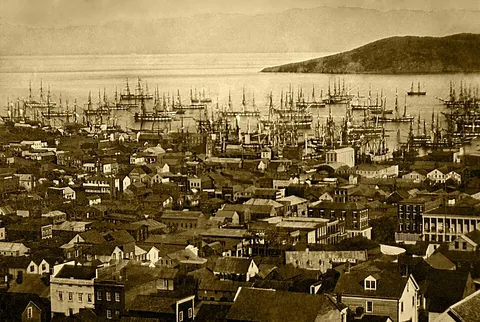 because everyone pulled forward to the frontier, to the gold rush that was happening during that small number of years.
And so everyone got on the train and they all went out there, because there's so much more value to be realized if you're in San Francisco than if you're working in a factory on the East Coast. And so that is why everyone kind of jumped forward. San Francisco, I think, has historically been this really interesting sort of place where technology takes leaps forward. So people do come out here a lot, as we know, as we've all experienced many times: the tourism season, we call it. You know, the boom and bust moments here in San Francisco. Everyone rushes to the next kind of frontier, the next wave. And that happens before the old wave gets recast and shut down.
It's why we don't see rising unemployment: because there's so much new stuff happening so quickly that it is happening before… because it's such a more attractive way to put time and money and people and dollars, in the new stuff, before you go and try and reinvent the old stuff. I'd rather go and invent a cure to cancer and go after a trillion-dollar market, to put a capitalist hat on this thing at the same time, than go and figure out how to optimize the supply chain of some manufacturing business at a factory on the East Coast. And as a result, there's much more demand for jobs, for capital, in that new frontier than there is loss of jobs in the old world. And so I think we've got it all pretty wrong, or the media has this narrative quite wrong.
And I think that's why we haven't seen the job apocalypse. It's why we don't see everyone rushing for UBI. Now, there is still a K-shaped economy42K-shaped economy — a recovery in which some people's incomes and assets rise (the upper arm of the K) while others fall (the lower arm). The phrase caught on in 2020; Friedberg applies it to AI. problem, in the sense that not everyone is coming along and benefiting and riding that frontier wave. And that is a more kind of fundamental disjointedness that's happening in this moment, that may actually prevent that frontier from emerging, because of the negative backlash associated with what's happening. Because people see that frontier happening. They're not participating, they're not a part of it. They're not in it. And so the backlash is such a… you want me to build… I mean, I think to everyone's view, it's just: I'd rather see it shut down if I'm not in it.
07The White House and Chinese open models
The White House is weighing a rule to make companies disclose their use of Chinese open models, and the hosts see it as a misunderstanding of the technology.
All right. I want to go to the backlash here, Chamath. We have two backlashes now, both emerging from the two political parties we're stuck with here in America. On the left, we talked about anti-data center, which I think will soon be anti-self-driving, and anti-capitalism, wealth tax; you put that all in one bucket. Now on the right, we're having… and obviously they have concerns, America First, on jobs and immigration. But here's a new one.
White House is reportedly discussing a new open source disclosure rule to name and shame people using open source models. According to Reuters,43The Reuters story of November 18, 2026 (linked in the show notes): according to three sources, Treasury and White House officials are discussing requiring companies such as Airbnb to disclose on their websites that they use Chinese open models like Alibaba's Qwen. No new bans are proposed — the bet is on embarrassment. Reuters companies could soon be forced to disclose on their websites if they're using Chinese open source AI models. No indication of how that would occur. Who's driving it? Apparently, Treasury Department, Bessent,44Scott Bessent — U.S. Treasury Secretary since January 2025. In July 2026 he warned that Chinese companies could face sanctions if found to have "distilled" American models, training their own on their outputs. who, it seems, is emerging as the leader of the China hawk group. This is all happening in real time, this civil war inside the White House.
And then you have the White House OSTP, Michael Kratsios,45Michael Kratsios — director of the White House Office of Science and Technology Policy (OSTP), Trump's top science and tech adviser. In July 2026 he publicly accused China's Moonshot AI, maker of Kimi, of using Nvidia servers banned for sale to China in Thailand. who I think you interviewed, Friedberg? I don't know if you did it with Chamath. Reuters also reports that more people in DC are now calling for a tougher stance on China, giving the China hawks much more influence. Obviously, on the other side, you got Lutnick46Howard Lutnick — U.S. Commerce Secretary. His department issues chip export licenses and under Trump allowed sales of cut-down Nvidia accelerators to China, which is why Jason puts him on the other side from the hawks. and Trump himself. This year, Airbnb, DoorDash, and Cursor have all received letters from members of the House Select Committee on China47House Select Committee on the CCP — the House committee on strategic competition with the Chinese Communist Party, created in 2023 and chaired by Republican John Moolenaar. He told Reuters disclosure is an important step in managing the risks of Chinese open models. because of their use of open models. Airbnb saying, like, well, yeah, we use some open source models for our customer support.
Breaking news, Chamath: I also am using a MacBook Pro,48MacBook Pro laptops are assembled mostly in China by Apple contractors such as Quanta and Foxconn — Jason's joke: if you label Chinese software, label Chinese hardware too. so I don't know if this podcast needs to have a label on it that we're producing it with Chinese hardware. Nothing has been decided in this, but it does seem like a wider crackdown. What are your thoughts on why now? Why now? Why is this leaking now? Jensen being ousted, Anthropic going public, the decel movement.49Decels (from "deceleration") — a dismissive label for those who want to slow AI down for safety; the opposite of accelerationists. On All-In, Anthropic is usually lumped into this camp. Is this all coordinated, or is it all just a very interesting amount of timing?
Can I answer your first question, which is: what will it do if you put a disclaimer on your website that you use an open source model? Nothing. It'll mean that you're not retarded. So it's the not-retarded logo.
Think about what the market wants. What does the market want? The market wants you to be smart. It wants you to be budget-friendly. It wants you to be ROI-oriented. It wants you to own your own technology. It does not want you to leak your alpha,50Alpha — in investing, returns above the market; more broadly, your edge. Chamath means that sending your data to someone else's closed model shows the vendor how your business works. right? So AI sovereignty51AI sovereignty — a company (or country) owning its models and data and running them on its own infrastructure instead of renting a closed model through an API. Open models are the cheapest path there. is what we bundled that under here on the pod. That's what they want. Otherwise, why would they want to own your stock? Because what is the alternative? For you to say, I don't really care about cost, I'll just take whatever model is available to me.
I'll feed them all the traces and spans.52Traces and spans — observability terms: a trace records a request's whole path through a system, a span is one step. For an AI agent, that's the log of every reasoning step and tool call — a map of how the company actually works. They may learn how to compete against me by me using their own product. They tell me they're not going to do it because of, you know, zero data retention policies.53Zero data retention — a mode in which the model provider doesn't keep a customer's prompts and outputs after processing. OpenAI and Anthropic offer it to enterprises; Chamath's point is that you can't verify the promise. I trust them. It is what it is. The market will think you're an idiot. And why will they think you're an idiot? Because you would actually be an idiot. You would demonstrate that you have such a lack of technical awareness that there's nobody even half technical on your team, that you have an inability to even recruit a consultant to help you explain what happens. Call Alex Karp.54Alex Karp — co-founder and CEO of Palantir, the company that invented the forward deployed engineer model. He'll send all kinds of FDEs, brilliant engineers, to tell you what the risks are. And then you can make a decision.
So if the decision is disclaim a thing that nobody's going to see on your website, or go out of business… yeah, I would disclaim the thing, not go out of business.
You could do a pair trade,55Pair trade — buying one security and shorting a similar one, so the payoff depends on one beating the other rather than on the market as a whole. Jason suggests going long the "smart" companies using open models and short the "dumb" ones. one of your favorite things, of the companies that are smart and dumb.
So maybe what this actually says is: do the disclaimer. Who cares? What it really speaks to is, I think Washington needs some extremely technical people on the inside that explain the actual technical implications of some of these things. I think that the thing that was floated there was a trial balloon. And I think if you go through the series of explanations of what it means and doesn't mean to use this stuff, you would come to the conclusion: well, wait a minute, to not say that you'd be using cheaper open source alternatives to retain your edge is more destructive to American companies. Is that what we actually want? The opposite disclaimer, or that you don't use a model at all? So I just think these things aren't well understood.
Friedberg, if you look at open source, this shows a fundamental misunderstanding of how open source works. You're not buying it from the Chinese. It's on GitHub, it's on a website. You take it, you fork it, you put it on your own servers, you use it, you control it. There's no back doors. And if there were, you would immediately have a thousand AIs pointing at the back door in it. It's kind of ridiculous. If it was, hey, I'm using Huawei technology, yeah, perhaps you could say, hey, this person's using something, you know, it's hardware-based.
But what were your thoughts on this very strange leak, and why it's leaking now, and why it's floated, and why they're sending this to Airbnb? This seems like complete, utter incompetence on whoever created this concept. What did they send to Airbnb? Earlier in the year, they sent a letter. It's coming out now in this Reuters report that this letter was sent. DoorDash got one, and Cursor got one. So these are letters from the House Select Committee on China to American companies using open source models that originate in China. I would think DeepSeek and GLM 5.2,56DeepSeek — the Hangzhou lab whose R1 model knocked Nvidia's stock down in January 2025. GLM-5.2 is an open model from Beijing's Z.ai (formerly Zhipu AI), released in June 2026. you know, et cetera.
08Friedberg: labeling open source is the path to tyranny
Friedberg sees labeling open models as a route to regulated monopolies and insists open weights are data anyone can audit.
Yeah, I think this continues to be the path of tyranny. Any effort to try and curb open source, restrict open source, label open source, and give the government the tools to create, effectively, regulated monopolies through the anti-open source efforts that are being undertaken, I think, is going to both limit human prosperity, limit individual liberty, create an Orwellian state, and I think fundamentally violates freedoms of speech. And I don't think that the origin of open source software should matter. Some people might disagree. But when you download an open weight, open source model from a repository, which means a website where these things are stored and anyone can get a copy of them, you can then use it on your own server, your own computer, run it in the background, you can rewrite it, you can reuse it.
And this was the basis of the Apache Foundation's tools57Apache — the open source Apache HTTP Server, released in 1995; the Apache Software Foundation was set up in 1999 to steward it. For years it ran most of the web's sites. that created open source servers that allowed us to have the open internet; of the open browsers, with the Mozilla Foundation and Firefox,58Mozilla and Firefox. In 1998 Netscape, losing to Internet Explorer, opened its browser's source code, creating the Mozilla project; it became the Mozilla Foundation in 2003, and Firefox, launched in 2004, took a real share from Internet Explorer, which then held over 90% of the market. so that Netscape and Microsoft couldn't restrict people's access to the internet, and we had an open source, free version that people then ended up making many different forks, or many different versions, of. And what Google did with Android, where they created open source operating software for mobile phones and found hardware companies that would make it the de facto installed software, so that 70% of phones in the world59Correct: according to StatCounter, Android has run on 70–72% of the world's mobile devices in recent years, with iOS holding nearly all the rest. StatCounter today have unfettered access to the internet. Whereas before, with closed source software, the companies were going to try and control what apps you could put on your phone, what websites you could access; everything was monitored, everything was controlled.
We're now facing the same decision point in open source AI as we did with all of those other prior technologies. And open source needs to be allowed, and frankly encouraged, to proliferate, because the absence of that means that you're going to have tyrannical groups. Ultimately they become tyrannical. They don't intend to be tyrannical. But every group that has the power to control what people see, what they're allowed to do, what they're allowed to access, how they're allowed to use things, what those specific weights are on, quote-unquote, facts of history, quote-unquote, proven science, quote-unquote, the truth… that is where people become tyrannical, because they have an opinion where they think they're right.
And if they have the power, they will act on that opinion, and it will ultimately give them tyrannical force over a broader population. That's what will happen if we limit the proliferation of open source software in AI. And I've said it before, I'll say it again: ultimately you can regulate, you can restrict, you can control, you can litigate, you can criminally penalize people for the outputs of what they use software to do. But to limit software, to label software, to make it a point of restriction and control, creates a regulated monopoly for the closed source products that are out there, that ultimately, if aligned with certain government agencies, gives those government agencies and those individual corporations power and control over you, the individual: what you're allowed to do, what you're not allowed to do. And every business on earth no longer operates freely. None of us should want that. I don't care what your political affiliation is.
Would you support a bunch of these cash-rich public companies now standing up a bunch of open source model initiatives inside of their companies? Would you view that…
100%. Yeah, it's great. And I think Meta should; I think it's the play for Meta. You know, I know Meta's already doing it. Google's already doing it, but they're not doing it with frontier. They're doing it with…
Meta models are nerfed.60Nerfed — gaming slang for a weapon or character weakened by a patch. Meta's open Llama 4 models (April 2025) disappointed developers, and Meta didn't open the weights of its newer Muse Spark (April 2026). Meta's open source models are nerfed. They've been nerfed for a while. They're not good.
And by the way, I think one point to note: the idea that you can, quote, label something Chinese. In an internet that's anonymous, where people can post on Hugging Face61Hugging Face — the main platform for publishing open models and datasets. On September 3, 2026, Nvidia agreed to buy it for about $12.9 billion, pending regulatory approval. Semafor a new open source model, the origin of that model may not need to be defined. So someone could just post a new model on Hugging Face. We all see it. It's the best open source model ever. And it doesn't say what, quote, country it comes from. It was trained somewhere, it was built somewhere, some set of engineers wrote this thing, posted it, and now it's available to the world. What do you do? How do you classify that? Why does the country of origin matter as much when it comes to open weight, open source? When anyone, because of the open weight, open source nature of it, can go in… It's a fundamental misunderstanding.
Yeah, these people don't understand how it works.
ExplainerWhat's inside open weights
A model's weights are billions of numbers — the parameters of a neural network, tuned during training. A company releasing an "open-weight" model publishes those numbers as files (usually in the safetensors format), so anyone can download the model and run it on their own hardware.
- The weights themselves are data, not a program: running a model takes separate inference code, such as vLLM or llama.cpp. That's why Friedberg says it's "not an executable," and Jason says nothing is bought from a Chinese company's cloud.
- But "you see everything" isn't quite right. The numbers are open, but what the model will do with them shows only in its behavior. In 2024 Anthropic researchers showed in the "Sleeper Agents" paper that a model can be trained to hide behavior triggered by a code phrase, and that standard safety training doesn't remove it.
- Open weights don't mean open source in the usual sense: companies generally don't publish their training data or training code.
The NSA can go in and they can test it. Anyone can look at it. You can see there's no runtime software in there. Just to be really clear about this: open source, open weight is not a runtime application. You don't download it and run it on your computer. You have to have an environment in which you're running those open source open weights. So this isn't some… there's some hidden tricks or tools inside of that software that can screw your computer over and hack you and take over. That's not the way this works.
Technologically, people, I think, are deficient in that understanding. And then they're trying to make rules and regs around, like, well, you don't know what the Chinese are doing. It's like, well, actually we do. We fundamentally can see. In an open source, open weight model, you see everything. Everything's right there. It is not an executable. It is a set of data. It is a piece of data, a chunk of data, a CSV file with a bunch of stuff in it. That's all it is. And you are deciding how you will then take that data and use it in making your own applications and your own software. And you, as a builder of software, can decide how you're going to use that.
So, in fact, this misunderstanding where people say, well, we don't really know, is incorrect. We do know. And you can look, and you can adjudicate, and you can audit, and you can test, and you can do all the things you want to do for safety and security screening. In fact, everyone faces liability if they don't. Because if you then take something that does something that doesn't work, your product's gonna suck, you're gonna break the law; there's all sorts of bad things that could happen. It's your job to adjudicate whether the open source software does its job. That's your job. And that's the way open source works. So to have the government come in and suddenly try and create their genius patch, their Band-Aid idea of telling people to label stuff and not label stuff, is as idiotic as I would expect it to be, given the lack of engineering competence in the United States Congress. And that's not political, by the way; that's just fact.
09Why America has no strong open model
The hosts argue about why American giants with a trillion dollars of cash never built an open alternative to Chinese models.
Well, I mean, there is something political going on here, Chamath. If you look at when Jensen was on… or we were at Jensen's conference,62Jensen's conference — GTC, Nvidia's annual developer conference, where Huang unveils new chips and models, including Nvidia's own open Nemotron family. and you look at the discussion we had, and we were talking about Nemotron, and then he started buying some open source assets… We now have emerging a series of events: the China hawks, and maybe the pro-open source movement. All of this is happening in the same time period. There are no coincidences, as I think, a rubric many of us go by. I certainly do.
I don't believe this is all a bunch of random coincidences. It's pretty clear Jensen was going to become the open source champion. His models… You mentioned conglomerates, from, you know, dirt to the application layer and beyond. He was building that. He was building that. He was suddenly deposed. Then you have this: we're going to name and shame Airbnb and DoorDash for using open source. Okay, that's happening at the same time. And Ant is going public at the same time. It feels like there is a giant civil war going on, and a global conflict over open source versus frontier models, and who's the champion for them?
I don't think it's that nuanced. I think it's more about power, and I think it's about control, and I think it's about ideology.
Okay, unpack.
I think the ideology is whether you believe that this advantages the Chinese or not. And I think that there's a strong case to be made that it does, but there's a strong case to be made that it doesn't. And I think, depending on how ideologically grounded you are in neoconservatism,63Neoconservatism — a strand of American politics favoring assertive, including military, defense of U.S. interests abroad. Chamath means the hawks who see Chinese open models as a threat. you will bend in one way or the other. I think the reality is that there are things that, in hindsight… again, hindsight's 20/20… could have been done to create escape velocity for open source. It's really a shame when you look back on it. With all the money that the domestic American companies have, why did we not find a way to spend some of that money to get real escape velocity for a true American open source alternative? I think that's an important question worth asking. Why are the only open source alternatives that are any good Chinese? Why?
I think it might be, if you look at the talent, the talent had two really good options, and a third and fourth. Work on proprietary models and make hundreds of millions of dollars, or billions of dollars, personally, for that talent. So the talent went to OpenAI. They left Google, which was not paying attention to AI, maybe to the extent they should have. And then you have these two major money-grab opportunities, and all the talent flowed to them, and then obviously to X.
But that's not true. That's not true, because there are some really talented people at Meta. There's some really talented people… I'll tell you why. At Google, there's some really talented people; at Nvidia. The question is, why couldn't we spend $50 or $100 billion of the trillion dollars of cash that we've spent? Tragedy.
And not had a really good alternative. Friedberg, why? Too much money to be made in the frontier models. It was the incentive. Show me the incentive, I'll show you the outcome.64"Show me the incentive and I'll show you the outcome" — a line of Charlie Munger, Warren Buffett's longtime partner at Berkshire Hathaway.
It's not just money to be made, it's capital to be raised. I think it was a lot easier over the last couple of years to raise capital as a private frontier model company than to go out and say, I'm going to build an open source AI company. You're not going to be able to attract… So when you're like, hey, I'm going to build a model, you want to be a frontier lab, you get a bunch of great geniuses together and you're like, let's go build a new frontier lab. Your two business plans are: open source… how are we going to make money? I don't know, we'll figure it out later, for the good of humanity, I don't know. Or closed source, and we'll make money on the standard business model, the venture money.
You're saying the VCs perverted the incentives.
Yeah, capitalists in general, right? So capitalists in general created the system where you could plow lots of money in. Whereas for the Chinese, it's actually a very different game theory. Because for the Chinese, it's: how do we disrupt American capitalism? How do we disrupt the American AI ecosystem? How do we create an alternative to closed source, where America controls the world? Blah, blah, blah. So for the Chinese, it's very rational for them to, when you're behind… open weight model.
Well, wait, hold on a second. But why isn't that the same game theory if you're Nvidia or Facebook or Amazon, in the sense that, you know, you're behind?
I think you're exactly right. And I think we've been on the precipice of that being the case. And I think it all got blown up in the last week.
Yeah, that's why Nvidia bought all of these open source resources. So that actually tracks with your original theory. When you're behind… when you're behind, you go open source to try to kill the existing codified solution. That's what Android did to iOS. And now that's what Nvidia was doing. They literally bought all those open source products.
Yeah, but none of those things were about models themselves. They're about hosting models. That's all fine and good, but you could have given more compute to Nemotron.
Which he was doing.
He was starting that process. If you look at the checkpoints on Nemotron,65Checkpoints — saved versions of a model's weights at stages of training. Nvidia publishes Nemotron checkpoints, and they show the models lagging, Chamath says. they're unfortunately behind. So for whatever reason, whether it was compute constrained or talent constrained, the models are good, but they're not great. And the GLM models and the other Chinese variants are better than good, also still not great. And obviously the frontier ones are great. My question is: that boundary condition that both of you just talked about was true a year ago. It was true a year before that. Why wasn't the money spent then? Why didn't we scorch… if we, meaning, if I was sitting there…
Too much money to be made. There's just been too much capital. Look, I mean, look what happened today. Today the largest fundraise in human history just took place. Anthropic in a day raised $85 billion.66Fact-checkNot quite: Anthropic sold $81.3 billion of stock in the IPO itself and another $26 billion to strategic investors — about $107 billion in all, as Jason said at the top of the show. Anthropic — Wikipedia
No, I know, I know, for a private company. I'm saying follow the money. If I was running AI at Meta, I would say, you know what I'm going to do? I'm going to scorch the earth right now. Two years ago I would have said this. If I'm going to spend a billion dollars on Andrew Tulloch67Andrew Tulloch — co-founder of Thinking Machines Lab, the startup of former OpenAI CTO Mira Murati. In summer 2025, The Wall Street Journal reported, Meta offered him a package worth up to $1.5 billion over six years; he turned it down, then joined Meta that October anyway. and a billion and 50… Yeah, they tried. They tried.
I think you're right. And I think they did. And I think that they just didn't get there. And Nvidia, the same thing. It's just as simple as that: the models suck.
Well, no, they're getting there. It takes time. They're two years behind. You're explaining the theory perfectly, but not getting to the conclusion. Yes, people realized they were behind and there was an opportunity there. And then Jensen bought… and this might have been his downfall… he bought Hugging Face and he bought Poolside.68Fact-checkNot quite: Nvidia agreed to buy Hugging Face in September 2026 for about $12.9 billion, but the deal still awaits regulators. It didn't buy Poolside: in August 2026 it paid $6 billion for a non-exclusive license to Poolside's "model factory" and hired 109 of its people. Together, about $19 billion. The Next Web He spent $20 billion on those two companies. So he said, yes, we're going to double down, triple down on this. And Meta and Zuck said, yes, we're going to do it as well. Now, you said they were nerfed. Yeah, okay, so they didn't get it done, but the intentionality was there, and it's in process. And I believe that's at the core of why Jensen was…
10Who will build America's open model
Chamath hopes newly rich researchers will leave the frontier labs to build open models on a nonprofit basis.
Do you have a different theory, Chamath?
I kind of have a working version of one.
Well, let's workshop it. Go ahead. That's why we're here. Workshop it. No mistakes here. No, no bad ideas.
I'm really at a loss, because if it were me, I would have stuck a… again, hindsight's 20/20. So this is where, you know, we did talk about this, but if I was an entrant at that scale, with that balance sheet, two years ago, and I was far behind, it made a lot of sense to commoditize the model layer. If you were a non-model-native company, yes, right? You make the money in the apps, you make the money in the chips, you make the money in the LPUs.69LPU (language processing unit) — Groq's name for its fast-inference chips. In December 2025 Nvidia paid about $20 billion to license Groq's technology and hire founder Jonathan Ross and part of his team. You don't need to make money at the model. That seems obvious.
So you pay a bunch of money and you try to spin up a model, and what do you learn? It's much, much harder than you think. And I guess I still struggle with: isn't it just a money and a recruiting problem? Because what you guys are saying is VCs created an incentive to come and say, we're gonna build a closed frontier model, or we're gonna build an app company, and you could raise lots of money. So I don't know. I'm still… the only theory I had was they took their eye off the ball, and they just got distracted with… hold on, just let me finish… they just got distracted with all this other bullshit.
And it's like, just finish your breakfast. You're correct that in hindsight, if you were a great strategist, you would have just carved out $25 billion and made an open source project at Microsoft, at Google or Apple, whoever's behind… Meta. And just make that your strategy for open source. I think two companies were exactly pursuing that: Zuck and Jensen. Now, if you look, though, at the money and the incentives… what is the average person, Friedberg… what is the average person going to work at OpenAI, who's a computer scientist, or going to work at Anthropic… what is their pay package like?
These people got offered pay packages… I was talking to somebody whose kid, out of school, got offered $10 million a year in equity at Claude, over four years. This is a really good computer science undergraduate who got a $40 million package. Like, this has never existed in the history of our industry. And then remember that time when Zuck was trying to buy somebody for a billion-dollar pay package? Remember, he went crazy?
Andrew Tulloch.
Yeah. So they kind of jumped the fence in that environment. Friedberg's exactly right. How does an open source company compete? They don't have the dollars, they don't have the market cap to buy all that talent. But I think now we're probably going to see Muse Spark, Nemotron, and then Reflection's Beam.70The model race. Muse Spark is Meta Superintelligence Labs' first model (April 2026, closed weights); Nemotron is Nvidia's open family; Beam is Reflection AI's first open model, with 501 billion parameters (October 2026). Moonshot AI's Kimi K3 and Z.ai's GLM-5.3 came out in summer 2026; DeepSeek is also Chinese, Mistral French. Bloomberg reported Beam scores comparably to GLM-5.2 on reasoning. TechCrunch Like, those three are just behind Kimi, DeepSeek, GLM 5.3. And then you got this weird Mistral out in France, which is kind of interesting. The French one is right between the three trailing US ones and the three leading Chinese ones. We'll sit here in a year, and the US ones will be somewhere in between DeepSeek and Kimi.
Let me give you a different theory. It could happen now, and it could happen now because you're seeing almost this schism where these leading edge folks are kind of splintering. You guys saw that there was this thing written called MisAnthropic,71The MisAnthropic Statement — published November 18, 2026, the eve of trading: signers accuse Anthropic of using its safety brand to attract investors and lobby for self-serving regulation while weakening its safety commitments. The first 89 signers included Hugging Face co-founder Thomas Wolf, xAI co-founder Igor Babuschkin and Dan Hendrycks's Center for AI Safety. OfficeChai right? Was that like a missive with a bunch of signatories? And it was a bunch of folks that are sort of like EA people72Effective altruism (EA) — a movement urging people to direct money and careers where they do the most good; it funded AI risk research for years. Many early Anthropic staff and investors are tied to it, though the company keeps its distance. that had this schism. There could be a version of this where really smart folks now at these model companies, who have made a lot of money, now start to leave, and they're like, you know, it's probably important to have some open source alternatives. And so maybe they go and work on this stuff in a more nonprofit way, because they have that money, and they have this predilection already to being a little bit less capitalist. So that could happen.
I think it's a very interesting insight. And obviously many people in the audience probably saw the New York Times story here about Dustin Moskovitz:73Dustin Moskovitz — co-founder of Facebook and Asana, the biggest funder of effective altruism and an early investor in Anthropic. The New York Times story of November 19, 2026, is linked in the show notes. The New York Times early investments in Anthropic and OpenAI, a big profile on him being uneasy about all this stuff. And I do think it's a non-zero chance a lot of these people will get together and build the alternative to what the proprietary models are putting out there.
11Nvidia: a record quarter and "the bank of Jensen" closes
Nvidia doubled revenue and profit, yet the stock keeps falling as new management rolls back Huang's generosity.
Let's end on Nvidia. They've shed $2 trillion in market cap in the last 30 days, down 35%.74Close: on November 18, 2026, Nvidia closed 36% below its October 6 record close — roughly $2 trillion in market value, though over six weeks rather than 30 days. Much of the drop is tied to Huang's exit. Honolulu Star-Advertiser / AP Two weeks since Jensen got shivved, it's down 20%. CFO and acting CEO Colette Kress75Colette Kress — Nvidia's CFO since 2013; on November 12, 2026, after Huang's exit, the board also made her interim CEO. The August–October report released November 17 was the first without Huang: revenue of $115.8 billion (up 103%), net income of $65.3 billion (up 105%). didn't exactly inspire confidence during her first earnings call, but the earnings call was extraordinary. Nvidia beat the top and bottom line.
Source: Nvidia earnings releases, GAAP
Revenue and net profit both doubled… yes, doubled, on already absurdly large numbers… to $116 billion and $65 billion, respectively. Let that sink in: $65 billion in profit. Most companies trading on the stock market are not worth what Nvidia just made in profits this quarter. Stock, even after all that, dropped. Internet's having a field day with this. Here's your viral moment of Kress on Mad Money with Jim Cramer.76Mad Money — CNBC's evening show hosted since 2005 by former hedge fund manager Jim Cramer, known for his manic style and stock picks. Cramer publicly backed Kress after Huang left.
Jensen resigned from his position with Nvidia, and the board accepted his resignation. The board has determined that they will not reinstate Jensen. And that is our statement and what the board has decided to do.
Internet obviously having a field day with this. Everybody is very pro-Jensen, it seems, except for the board of this company. And "no more splashy cashy" is one of the messages here. Kress said they're going to be more disciplined and selective… quote, "more disciplined and selective on new neocloud financing.77Neoclouds — cloud companies that rent out GPUs for AI: CoreWeave, Nebius, Lambda and others. Nvidia invested in them and backstopped their demand while they bought its chips — hence "the bank of Jensen." Kress signaled that generosity is over." Obviously, Jensen loved to invest in startups and companies that were building the future. So the bank of Jensen is closed. And she ended the H200 sales to China.
H200s, obviously, more powerful version of the flagship H100. Nvidia is allowed to sell H200s to China; Commerce approved those for sale in January.78H200 — Nvidia's 2023 Hopper-generation accelerator, an upgraded H100. In December 2025 Trump allowed sales to China with 25% of revenue going to the government, and Commerce formalized it in a January 2026 rule. On the November 17, 2026, earnings call Kress said Nvidia would no longer sell the H200 in China. I know this is all very complicated, folks, but this is an elective move, according to the news. She's just saying, you know what, we don't want anything to do with this anymore. The most powerful GPUs, Rubin and Blackwell,79Blackwell (2024) and Vera Rubin (2026) — Nvidia's newest AI accelerator generations; their export to China is banned. are obviously banned from being sold to China. And the board repeatedly is saying Jensen cannot come back.
Jensen said he would humbly like to come back, and there seems to be a group of people mounting his comeback, to a certain extent. We'll see. In related news, Nvidia is facing mounting legal issues… you predicted this, Chamath: SEC probe, class action lawsuits.80Lawsuits and probes. On November 9 and 10, 2026, shareholders filed class actions in federal court in Northern California accusing Nvidia of hiding Huang's ties to Alice Huang of Megaspeed. The Wall Street Journal reported that the SEC has opened a civil inquiry into the company's disclosures. The Justice Department is running a criminal probe of Megaspeed itself, a Singapore customer suspected of diverting chips to China. SCMP Both of those are focused on misleading statements, potentially, that were given to investors. DOJ is obviously continuing their investigation on the relationship with Megaspeed. The other big problem here is talent. You got a bunch of employees signing petitions.81The petitions. The Stand with Jensen open letter, asking for Huang's return while an independent investigation establishes the facts, gathered more than 175,000 signatures, thousands from people identifying as Nvidia employees; Elon Musk and Kalanick himself signed. Nobody verified the signatures. TechRadar And Travis… Travis Kalanick,82Travis Kalanick — Uber's co-founder. In June 2017, after months of scandals, major investors forced him out as CEO, and more than a thousand employees signed a petition asking for his return. He now runs CloudKitchens. friend of the pod, no stranger to getting ousted, said the employees should do a walkout.
Here's the clip with other bestie Antonio Gracias.83Antonio Gracias — founder of Valor Equity Partners, an early investor in Tesla and SpaceX and a longtime friend of the hosts, who call each other "besties." A lot of leather jackets84The leather jacket is Jensen Huang's trademark: he wears a black leather jacket to almost every keynote, so his supporters put them on too. Pictured: Huang in his jacket at Stanford, April 2026. on that dais in support of Jensen. The leather jacket protest continues.
Now, I obviously experienced this. I went through six months of ops before I went down. I held on as tight as I could, but eventually I just couldn't. But any wisdom I can provide about that experience to Jensen, or the team of people around him that I think are ultimately going to lean in to fight to get him back, because it matters so much… that's what I'm bringing to the party. People said, hey, is the petition… like, is that good? I'm like, dude, I sent Jensen, like, you know, the screenshot of the stories when there was a petition for me.
I'm like: petition good, walkout better. I didn't get a response. But I will show up to Nvidia HQ with a wafer-encrusted megaphone,85Wafer-encrusted — Kalanick's twist on "diamond-encrusted": Nvidia's chips are cut from silicon wafers. with tons of Nvidia employees who want to walk out, tons of CEOs, founders who believe in what I just said, who are believers and don't want an AI overlord. And let's fight for what's right, and give it that shot. We don't have control of the outcome. But let's fight.
12Chamath and Friedberg: say nothing until the hearings
With Huang preparing for congressional hearings, Chamath and Friedberg call all opinions about his return harmful noise, while Jason speculates anyway.
There it is. The industry lining up behind Jensen. Leather jackets up for Jensen. Jackets for Jensen. Next week I expect everybody to show up in a leather jacket. Your thoughts here, Chamath, on the Nvidia situation, and then we'll go to you, Friedberg.
I think it's very complicated still to have a definitive opinion beyond the following. He was an exceptional, legendary founder and CEO. He built the most important company in the most important industry in the world. He is biblically good. He also made a bunch of mistakes. The extent of those are still not known. And the problem is that you can't reinstate somebody like that into a public company with that much valuation that has been destroyed, because it just completely throws governance out the window, and it puts everybody at risk. Everybody, including the company. So that's why it's not going to happen. And that's why they have to say that. And the unfortunate part is, I think Colette is excellent, and she's put in the awkward situation of having to be the message bearer of that.
And so then you get the internet trolls that run around and give her a hard time, and it's not her hard time. She's just the messenger. He is exceptional. That company is exceptional. But they are in a very unique moment where you cannot make any decision. I repeat: you can't make a decision until all of the congressional hearings are done. I mean, I have to stress, these guys have to navigate three different committees86The hearings. In November 2026 the chairs of three House committees — Intelligence (Rick Crawford), Foreign Affairs (Brian Mast) and the Select Committee on China (John Moolenaar) — asked Huang for a closed-door briefing on his ties to Alice Huang, and Energy and Commerce chair Brett Guthrie called Colette Kress to appear in December over whether Nvidia helped Megaspeed evade export controls. Just the News on December 1st and 2nd. The Select Committee, the House Intelligence Committee, another committee. Do you think that that's easy? Does anybody think that what they're going to be spending time with was the pillow talk?87Pillow talk — a callback to last week's episode, where David Sacks argued that chip secrets can't be passed in bed; you need the files. Huang's affair with Alice Huang was what triggered his exit. So everybody needs to just calm down. He's going to be really focused for December the 1st. And hopefully what comes out of that is there is nothing to see here.
But I can guarantee you that if there's even one shred of "there is something to see here," it's going to get leaked, and there's going to be another wave, because the stakes are too high. Right? Because you have an internet mob versus the China hawks versus who knows all of the different players that are at play here. I don't know. That's why, as I said before, this is so in the too-hard bucket.88The too-hard pile — Warren Buffett and Charlie Munger's phrase for companies and questions they can't confidently understand and so leave alone. And so the more people blather on about superficial bullshit, the more you actually make it harder for him to come back.
Okay. So I would shut the fuck up, and I would let him prepare, and I would hopefully have him nail this and prove categorically that there's nothing to see here. Then you can actually start to have a structured conversation. But all this dingling bottoms-up protest bullshit betrays a fundamental understanding of what is happening, which is congressional closed-door hearings, on the record, which could result in some really slippery slope stuff for him, for other people, for the company. And nobody should have an opinion until that's over. Okay.
Friedberg, what's your opinion? Given Chamath just admonished everyone for not having one, I'm curious what your take is here, and what are your feelings about the situation, and the founder being ousted, et cetera.
Yeah. Look, what's happened has happened. And you can't go back and change the fact that he resigned. We don't know whether he resigned over concerns about selling chips to China, whether there was espionage, whether it was based on affairs and violations of codes of conduct. We just don't know. The company's not put out a definitive statement. Jensen has not put out any factual statements. The government has not put out any factual statements or declarations. There has been no civil or criminal case that's been filed by the government against the company, or by any of the government regulators against the company. So we are all just reacting to media that, we always say, all the time lies to us. So I don't know what to believe. I don't know what's true or what's not true. There have been no official statements from the company, from the government, from the regulators, from Jensen regarding any of the facts of the matter.
Well, I don't know… we know there's a report… well, there are some things we know. There was a report that Rubio89Marco Rubio — Secretary of State and Trump's national security adviser, a longtime China hawk; last week the hosts debated whether he had any role in the leak of the memo about Huang. rewrote…
We know that there was… again, Jason, that is a media report. What you're referencing is something that some reporter said. And so I'm not gonna react… I'm not gonna react to media anymore. I don't know what's true. All I know is that the actual people, the first parties that matter here… government regulators, government agencies, Jensen and the company… none of them have provided any official data or evidence or proclamation. Everything has come through media, and I don't believe any of it. So I don't know what to think.
I agree with Friedberg. Everybody, if you want him back, to quote Dave Chappelle,90Dave Chappelle — the comedian. A similar line came at his December 2022 show in San Francisco: when the crowd booed Elon Musk, whom he had brought on stage, Chappelle shot back, "You shut the fuck up with your boos." Complex you could just shut the fuck up.
I will not. I'll give my opinion, even though that's your best advice, Chamath. I actually think, you know, just looking at the totality of the reports and triangulating on them, and knowing what I know about salespeople, this is a case of… and there have been reports of these servers and cloud providers giving a backdoor into some of this hardware to Chinese companies. This has always happened, where sales of items get flipped and then provided to people. I bet you this is what's going to come out: a bunch of rogue salespeople, you know, in a gray area, resellers on resellers selling this. And maybe…
Maybe you should be called as a special witness in December, the 1st.
[unclear] But this is a podcast, Chamath.
What is the role of podcasts in the world? You can look in your dirty paper brown bag of junk and see the future. Awesome. I don't know jack shit, so I have chosen to shut the fuck up.
That's a great choice. I have chosen to speculate on a podcast, which is my right as an American. If we've learned anything over these years, it's that the goal of podcasts is to speculate.
You know what I've realized in the last few weeks? This is an important thing to realize.
Here we go.
I think it's really important to try to be right. And when you know, you say. And when you don't, you can guess. And when there's so much on every single side, it's just what Friedberg said, where it's so clear that you can't know, sometimes it's just better to just…
You talked about that two weeks ago with the midterms. When you talked about it on the midterms, you said mea culpa:91Mea culpa — in the November 7 episode, Chamath walked through what he got wrong in his forecast for the midterms, which Democrats won in a landslide. hey, listen, I got it all wrong. People were really excited about that moment. "I got it wrong."
"I got it totally wrong."
But this is a thing where I have no opinion, because the moment of truth has not come yet. It is a few weeks away. And so what everybody else is prosecuting is online virtue signaling nonsense.
Or speculation. And people are speculating. It doesn't have to be virtue signaling.
What Friedberg said… it is virtue signaling. What Friedberg said is totally true. Nobody who's in the middle of it has said anything on the record. Nobody. Nobody. And so what it is, is just a bunch of goofballs on the sidelines with opinions.
Yes. What you just described is what everybody in the industry is doing: speculating. Yes. And that is not me. I'm not speculating.
I'll tell you what I'm speculating on. I'm speculating on the fact that there's a large-scale, unconscious effort to monopolize artificial intelligence, the greatest technology advancement in human history. And if we don't all fight for the open source movement, and we don't all fight for competition… the last thing any of us want, and I think Democrats, Republicans, regardless of your political affiliation or where you sit in the K-shaped economy, no one should want an oligarchy or oligopoly when it comes to AI. This technology is going to evolve. It is going to move forward. You are not going to stop it. So try and keep it from becoming an oligopoly by allowing the proliferation.
13A bloodbath, and a bet on megacorps
On taping day the market is falling, and only Anthropic and Palo Alto Networks are up — proof of his theory, Chamath says.
Here's the numerical receipts. Today, as we speak, right now it's 11:42. The S&P 500 is down 1.39%. The VIX,92The VIX — the Cboe Volatility Index, the "fear gauge," which reflects expected S&P 500 swings over the next 30 days. On November 18, 2026, it jumped 11% to 25.5; readings above 20 are considered a sign of stress. Zacks our vol index, is up 10.83%. Ant is up from the IPO price 18%. You know what the only other company that's ripping right now is? Palo Alto Networks, up 5.86%, because they made a huge bet on open source. Friedberg is right. And the market will reward you. And I think what the market is saying is it is philosophically right, and it is mathematically right. And I think that that's a really important signal on a day like today.
Today is a bloodbath out there, folks.
Here's your… oh, go ahead, Nostracanis.93Nostracanis — Calacanis's joking nickname for himself, after Nostradamus: he likes to point out which of his predictions came true. Chamath turns it around: Jason's forecasts are fortune-telling from a paper bag. Look into your paper brown bag.
This is more looking at the market heat map,94Market heat map — a chart showing companies as rectangles sized by market value and colored by price change, red for down and green for up. The best known is on Finviz. though. This is actually a fact. I can't wait to see… Why do you think this podcast is number one? It's because we speculate. Just because you got burned, because you touched the stove, and I told you that stove's hot, Chamath… Be careful: if you get so close to politics, you burn your hand on the stove, and now all of a sudden you're going to be judicious. The ratings are going to tank.
That's not what I'm saying. I take speculative bets all the time. What I'm saying is I'm risk-off, because what I'm telling you right now is the balance of motion in this market is down. It's not up. I'm also smart enough to look at a market and say, what is it rewarding? It's rewarding the creation of one of 10 megacorps.
So we're going to have a Mag 10.95The Magnificent Seven — Apple, Microsoft, Alphabet, Amazon, Meta, Nvidia and Tesla, the biggest U.S. tech stocks. Chamath reworks it for his theory: a "Mag 10" of future megacorps, with Palo Alto Networks bidding for a spot. We know the Mag 4 or 5. These guys make it a Mag 6. Okay. So they rewarded that today, in a market where vol is up, people are scared, and, you know, they're mostly risk-off. And they reward what Friedberg said, which is: it is very important to now make big bets. Use your cash flow, use your stock, get in the game, put on the pads, get on the field, hit somebody. I'm happy to observe that. I think it's wonderful for Nikesh. It's a brilliant thing that he did. He probably has a really good chance of being a trillion-dollar business, you know, in building this thing over the next decade. Amazing. I wish him all the best.
I am principally risk-off because I think there's a lot yet to come. I'll put it in three buckets. Economically, there's a lot yet to come, specifically around the AI trade. We don't even know what the first-order effects are, because we haven't gone through these congressional hearings. Once you get past those hearings, then you're going to figure out what happens when the thread gets pulled out of the bank of Nvidia. We don't know what the implications are for the bank of Nvidia being closed.
And I think the tenor of how closed or open it is will be more obvious after those congressional hearings, not before and not during. And then the third thing is, we're in a situation where everything seems to be going down. We're getting cyber hacked every day. Everything is shut down. We're being told to prep for three days.96Three days — in November 2026, amid outages at airlines, banks and Microsoft 365, politicians and governments talked about emergency supplies. Britain's Be Ready campaign, launched October 22, asks households to cope on their own for three days; FEMA has long advised several days' worth. Federal officials attributed the recent outages to technical failures rather than cyberattacks. Fortune And you don't think the balance of risks are down? Your paper bag tells you it's going to go up.
Oh no, it's not a paper bag. I'm looking at the fundamentals of your company.
A plastic trash bag tells you that things are going up. No, no, no, no. It's a Louis Vuitton bag. What does Nostracanis use to look at the future?
I'll tell you. I'll give you the three things: products, products, management, and markets. That's how I make my bets.
You have a dirty brown lunch bag. You're a brown bag.
No. Trust me, Nostracanis sees the future. And the future is who's shipping great products. You don't see shit. I see. You don't see shit. I… Nvidia 150. Not investment advice. I can't wait to see you. I can't wait to see you in Vegas, everybody. Love you, besties. Bye-bye.
Love you, boys. Bye-bye.
IntroAll-In outro song
Let your winners ride.a"Let your winners ride" — the show's theme. The phrase comes from gambling and investing: leave your winnings in play, hold your rising stocks. Producer Yung Spielburg built the song from the hosts' lines, and the hosts "open-sourced" it, letting fans remix it freely. Rain Man David Sacks.bRain Man — Sacks's longtime nickname, after the 1988 film in which Dustin Hoffman plays an autistic savant with a phenomenal memory for numbers; "Queen of quinoa" is Friedberg, who has worked in agtech for years. I'm going all in. And instead we open sourced it to the fans, and they've just gone crazy with it. Love you, besties. Queen of quinoa. I'm going all in. Let your winners ride.
Besties are gone. That is my dog taking a notice in your driveway, Sacks. Oh, man. My haberdasher will meet me at… We should all just get a room and just have one big huge orgy, because they're all just useless. It's like this sexual tension that they just need to release somehow. What? Wet your beak.c"Wet your beak" — from The Godfather Part II (1974), where the extortionist Don Fanucci demands his cut. Wet your beak. We need to get merchies.
I'm going all in. I'm going all in.


