


Sourcery
Chapters
AI spending already dwarfs earlier booms, Agrawal says, but that is how every technology supercycle starts: chips earn first, applications later.
Read the chapter- Big tech is spending about $860 billion a year on AI, triple two years ago, close to the US defense budget and more, as a share of GDP, than railroads, oil, telecom or shale.
- Salesforce, Adobe and ServiceNow earn $600 billion on $300 billion of cloud infrastructure and $80 billion of chips, while in AI the models and apps on top bring in only $140–150 billion.
- In the mobile era, value went first to semiconductors, then to infrastructure and devices, and only from the third inning to apps.
- The AI economy grew 6x in two or three years, while apps and models grew 100x.
Adoption is just beginning: usage has shifted from finding answers to agents, and the gap between power users and everyone else is widening.
Read the chapter- In the chatbot era that began with ChatGPT in November 2022, 80% of use was finding answers and planning, while since late last year 80% of agent use is coding and automation.
- Agrawal’s candidates for a third phase include proactive agents like Muse, Instinct and Dots, swarms of agents, and large models “operating” on small ones.
- He calls it a tale of two cities: OpenAI’s top 10% of customers grew usage 17x over 18 months, the median customer 2x, and at Cursor 10% of users generate two thirds of tokens.
- Fortune 500 customers spending over $100,000 on Anthropic say it is less than 0.1% of their spend, and going from 0.1% to 1% is where 10x growth comes from.
The S-1 shows a rare mix: explosive growth, a long runway, profitability and capital efficiency.
Read the chapter- Anthropic’s revenue has grown 10x a year for three years, reaching about $17 billion in the third quarter.
- About 12,000 customers pay over $100,000 a year and 1,900 over $1 million, net revenue retention is 900%, and no single customer matters much.
- Asked how much cash it burned to reach a $70 billion run rate, Molly guesses $16 billion, and Agrawal says less than $10 billion.
- Compute per dollar of revenue fell from 88 to 15 cents, revenue per watt rose from $16 to $60, and Anthropic runs across TPUs, Trainium and Nvidia GPUs.
More than half of data center capex goes to IT equipment, and in his class Agrawal walks students through the whole AI stack, convinced every layer will make money.
Read the chapter- Chips, memory and other equipment take more than half of the money and construction the rest, a split Crusoe’s Chase Lochmiller broke down in detail for the class.
- The course is an annual class in Stanford’s engineering school for about 150 students, with two weeks each on chips, data centers, infrastructure, models, applications and agents.
- Guest speakers included Sunny Madra of Groq, Ali Ghodsi of Databricks, and people from Anthropic, Chai and Baseten.
- Calling himself a maximalist, Agrawal expects chips, data centers, infrastructure and models all to make money.
After the recent US election results, Agrawal expects the country to fall 10–15 gigawatts short of planned capacity next year, hurting neoclouds and young startups far more than hyperscalers.
Read the chapter- The US should end this year with 35–40 gigawatts, with another 40–50 expected next year, and permitting and regulation will cut into that.
- Amazon, Microsoft, Google and SpaceX hold the largest pools of capacity and become the market’s bottleneck, a net positive for them even if their build plans are at risk.
- For neoclouds and startups that were 17th in line for capacity, Agrawal says, the shortfall is existential.
Anthropic is far ahead, but OpenAI has shown antifragility: new models and a stronger sales team gave it a record third quarter.
Read the chapter- On the building side, Agrawal credits a set of models including Astra with defining the frontier, and Codex and ChatGPT Work with a strong third quarter.
- On the selling side, OpenAI hired Dali Rajic from Wiz and Brian McCarthy from Cursor and SpaceX.
- ChatGPT has more than 1.2 billion users, and OpenAI hit a run rate of about $50 billion by the end of September.
- SpaceX and Google, Agrawal says, have monetized infrastructure brilliantly, a thread the conversation picks up later.
Open models will take 20–30% of AI spend, Agrawal says, and the money will settle with inference clouds that look more and more like hyperscalers.
Read the chapter- AI natives like Cursor, Instinct, Decagon and Harvey fine-tune their own smaller models for control, cost and sovereignty, and banks and healthcare companies are following.
- The best open model today is where closed models were six months ago, and on the morning of the recording Ricursive launched a new American open model.
- Through OpenAI’s new partnership with Baseten, OpenAI customers can spend part of their commitments on open models.
- Baseten is adding routing and sandboxes and, like SpaceX, heading toward the hyperscaler model, only via open source.
SpaceX has turned out to be an AI business renting compute at twice neocloud prices, Agrawal says, while Google’s TPU-powered cloud is growing eight times faster than Search.
Read the chapter- SpaceX runs at about $60 billion a year, half from the SI unit and a third from Starlink, and targets $100 billion by the end of this year and half a trillion by the end of next.
- Neoclouds lease capacity for years at $10–20 a watt and SpaceX at spot prices of about $50; Anthropic pays because it earns $50–100 a watt, and SpaceX recoups its capex in under a year.
- Musk, in Agrawal’s view, is the best at building physical infrastructure and layering a business model on top; 13 gigawatts at $50 a watt means more than half a trillion, if Anthropic keeps renewing.
- Google Search runs at $250 billion and grows 12%, while Cloud runs at $120 billion and grows 103%; Anthropic and others rent TPUs, and Anthropic has a commitment to rent TPUs through Broadcom.
Every layer of the stack will win, but so far the biggest balance sheets have; Agrawal hopes cheaper models will shift value to apps and startups.
Read the chapter- For now, Agrawal says, it is a game of emperors that the biggest balance sheets win, but he is hopeful about the app and model layers.
- The software rule of “triple, triple, double, double, double” is no longer best in class: that is now 10x at single-digit billions of revenue, 3x at double digits and 2x at triple digits.
- Google Cloud is growing 103% at $120 billion, OpenAI is going from $20 billion to $70–80 billion in a year, Cursor is rumored to go from $1 billion to $10 billion, and Baseten has grown 10x two years running.
- The leading indicator, Agrawal says, is the team, like Michael Truell at Cursor or Bob McGrew at Arda, whom Altimeter just partnered with, while the numbers lag.
After coding, Agrawal sees cybersecurity as the biggest emerging consumer of AI, with the frontier labs capturing most of the demand.
Read the chapter- AI gives attackers a tool that checks “every single door and window,” and XBOW found a Chrome vulnerability that let an attacker take over a computer when a user just clicked a link.
- More attacks mean more defense, and Agrawal says you have to fight fire with fire.
- He expects OpenAI and Anthropic to earn most of it, with XBOW and similar firms as harnesses for continuous testing instead of an annual pentest.
Agrawal expects a very successful IPO: even at $2 trillion, Anthropic trades at 14 times forecast revenue, and he likens it to a private Mag 7.
Read the chapter- Declining to guess at the next 12 months, Agrawal says what he looks forward to most in the next 12 days is Anthropic’s IPO, and he calls himself an “anthropologist” of the company.
- By his math, about $140–150 billion of GAAP revenue next year against a $1.5–2 trillion valuation gives 11–14 times forward revenue.
- Agrawal allows for choppy waters in the short term but is confident about the long run.
- Molly records at the Lark interior design studio, which she found through Revel’s founder.
Quotes
On Anthropic’s capital efficiency
“I think it'll be very hard to beat this level of capital efficiency.”
Apoorv AgrawalRead from 13:52How far open models trail closed ones
“And the answer is: not at point in time, but the frontier open-source model today is where the closed frontier was six months ago.”
Apoorv AgrawalRead from 28:06On SpaceX’s spot pricing for compute
“It's like, you know, renting your home on a long yearly lease versus renting your home on Airbnb.”
Apoorv AgrawalRead from 37:02On the new growth benchmarks
“Yeah, look, I think, one, what was true in software, which is that, hey, you could triple, triple and double, double, double, is no longer best in class.”
Apoorv AgrawalRead from 41:39How AI changed cyberattacks
“Meaning that offensive actors now have this new toolkit, which is incredibly potent, that can go check every single door and window and make sure if it's unlocked, find the most critical vulnerability and exploit it.”
Apoorv AgrawalRead from 45:28On Anthropic’s IPO price
“Like, it's not a heroic multiple. It's completely reasonable based on current market comps.”
Apoorv AgrawalRead from 49:44
Summary
Apoorv Agrawal of Altimeter calls Anthropic the best business he has ever studied: revenue up tenfold three years running, 1,900 customers paying over $1 million a year, and less than $10 billion burned along the way. A $1.5–2 trillion IPO valuation works out to 11–14 times his forecast for next year’s revenue, which he sees as nothing heroic.
He splits the market into “four seasons”: two frontier labs, Anthropic and a resurgent OpenAI, and two infrastructure plays, SpaceX, which rents out AI compute at spot prices, and Google, whose cloud is growing 103% a year. Open source is the evergreen fifth season, taking 20–30% of AI spend, with the money going to inference clouds like Baseten. AI adoption, he argues, is in the first inning, and after coding the next big market is cybersecurity.
Advice
Check whether your company is at the frontier: OpenAI’s top 10% of customers grew usage 17x while the median grew only 2x, and the gap keeps widening.
If you are an AI-native company, fine-tune your own smaller model on data from customer interactions: inference gets cheaper and you own the intelligence instead of renting it.
Measure growth against the new benchmarks: 10x a year at single-digit billions of revenue, 3x at double digits, 2x at triple digits; T2D3 is no longer the bar.
When evaluating a startup, look at the founders first: the team is the leading indicator, and revenue only confirms it later.
Test your defenses continuously, with every software update, not once a year: AI-armed attackers are probing all the time.
Mentioned
 Anthropic00:00Agrawal calls its S-1 “a total treat” and the best business he has studied: 10x growth three years running, 900% net revenue retention and less than $10 billion burned.
 Altimeter Capital00:57Agrawal’s firm: Molly values its view from both the public and private side, and Agrawal says its investment team works with swarms of AI agents.
 Brad Gerstner00:57Molly recalls interviewing him about Invest America; Agrawal recalls him pressing Altman on BG2 about a trillion in commitments against $13 billion of revenue.
- Trump Accounts00:57Molly praises the children’s investment accounts she discussed with Gerstner.
Show 53 more mentionsShow fewer mentions
 Coatue Management05:46Molly recalls Altimeter talking about AI’s early innings at Coatue’s East Meets West conference two years ago.
 Elad Gil05:46Molly recalls his episode in the fall of 2025, before Claude and agents took off.
 ChatGPT06:57Agrawal dates the chatbot era, where 80% of use is finding answers, to its November 2022 launch.
 Muse07:59Agrawal cites Meta’s agent as a candidate for AI’s “phase three” of proactive agents.
 Instinct07:59Agrawal lists it among proactive agents and later among startups fine-tuning their own models on open source.
 Dots07:59OpenAI’s agents that look for ways to help on their own, Agrawal’s example of phase-three proactive agents.
- OpenAI08:42Agrawal uses its data on the gap between customers, describes its 2026 comeback and praises its Baseten partnership as a lab becoming a platform.
 Cursor10:09Agrawal cites its data that 10% of users generate two thirds of tokens, and its revenue growth from $1 billion to $10 billion in a year.
- AWS Trainium14:32Amazon’s chips, which Anthropic runs alongside TPUs and Nvidia GPUs to squeeze out maximum efficiency, Agrawal says.
 Chase Lochmiller15:19Agrawal praises his breakdown, in Agrawal’s class, of where every dollar of a data center build goes.
 Crusoe15:19Lochmiller’s company, Agrawal’s example of a data center builder that knows the economics down to the dollar.
 Stanford University16:06Agrawal teaches an annual course there on the economics of the AI stack, in the engineering school.
 Jensen Huang16:34Agrawal structures his course around Huang’s image of AI as a “five-layer cake.”
- Sunny Madra17:03Spoke in Agrawal’s class about chips, including Groq’s own.
 Groq17:03Madra’s company; later Agrawal cites its former CEO Jonathan Ross.
 Ali Ghodsi17:03Covered the infrastructure layer in Agrawal’s class.
 Databricks17:03Ghodsi’s company, Agrawal’s representative of the infrastructure layer.
 Chai Discovery17:03Its people, Agrawal says, joined Anthropic in covering models in his class.
 Amazon21:03Agrawal’s big takeaway from the S-1: what a great business Amazon is as Anthropic’s main compute supplier.
 Meta Platforms22:31Molly asks where Meta fits among the four seasons now that Muse has put it back in the picture.
- GPT-6 Astra23:17Agrawal credits OpenAI’s models led by Astra with defining the frontier.
 Codex23:17Agrawal points to a strong third quarter for OpenAI’s coding agent.
- ChatGPT Work23:17Another OpenAI product that, Agrawal says, performed well in the third quarter.
- Dali Rajic23:17Agrawal calls him one of the best sales leaders on the planet and OpenAI’s key hire.
 Wiz23:17The company OpenAI hired Rajic away from.
- Brian McCarthy23:17The second sales leader Agrawal credits OpenAI with landing, from Cursor and SpaceX.
 Sarah Friar24:17Agrawal cites her for OpenAI’s roughly $50 billion run rate at the end of September.
 Baseten24:51The business Agrawal knows best: an open-model cloud growing 10x a year and moving up the stack toward the hyperscaler model.
 Fireworks AI24:51Agrawal groups it with the inference clouds for open models where he expects margin to settle.
 Modal24:51Agrawal names it among the open-model inference clouds he expects to become big businesses.
 Jonathan Ross25:29Agrawal cites his estimate that about 35 companies account for 99% of inference.
- Ricursive Intelligence28:47Agrawal congratulates it on releasing an American open model the day of the recording.
 fal29:31Molly relays its view that every company now has a different storefront for compute.
 SpaceX31:51An AI business in disguise, per Agrawal: half its revenue comes from renting compute at spot prices with paybacks under a year.
 xAI31:51Formerly xAI, now SpaceX Super Intelligence: the SI unit that brings in half of SpaceX’s revenue.
 Starlink31:51Agrawal puts the satellite internet business at about a third of SpaceX’s revenue.
 Elon Musk32:50Agrawal calls him the best entrepreneur at orchestrating atoms, who followed Altman in betting early on compute.
 Sam Altman32:55Per Agrawal, he bet on compute early and right, even when Gerstner questioned his trillion in commitments.
 CoreWeave33:35Agrawal’s example of a typical neocloud leasing capacity for years at $10–20 a watt.
 Nebius Group33:35A second example of a neocloud on long-term leases, in contrast to SpaceX’s spot pricing.
 Google37:22Agrawal describes it as a tale of two cities: slowing Search and a cloud growing 103%.
 Google Cloud37:36Google’s cloud, at a $120 billion run rate and 103% growth, Agrawal’s example of best-in-class growth at huge scale.
- Tensor Processing Unit38:11Google’s chips, part of its cloud business, rented by Anthropic and reportedly considered by OpenAI.
 Broadcom38:11Agrawal mentions Anthropic’s TPU commitment with Broadcom.
 Cognition42:31Agrawal’s example of a startup growing 10x a year at single-digit billions of revenue.
 Michael Truell43:32Agrawal calls him one of the best young founders he has met.
 Bob McGrew44:04Agrawal’s former Palantir colleague, whose company Altimeter just backed: a founder with a record of the most ambitious bets.
 Arda Industries44:04McGrew’s company, which Altimeter just backed.
 Palantir Technologies44:04Agrawal recalls McGrew as its second engineer and a co-developer of forward-deployed engineering.
 XBOW45:28Agrawal cites its Chrome exploit as an example of what AI has done to cyberattacks.
- Oege de Moor45:28XBOW’s founder, whose team, Agrawal says, found the Chrome vulnerability.
 Google Chrome45:28The browser with a billion daily users where XBOW found its exploit chain.
- Revel50:16Molly found the recording studio through Revel’s founder, whose new office Pamela Jewell designed.
Sponsors of the episode
 Brex18:15corporate cards, expenses and banking with AI agents
 Harvey19:13AI platform for legal work
 Zone Frontier19:29data center campuses for AI
 Mercor39:04the APEX index of how AI handles professional work
 VCX39:19a listed fund holding stakes in private tech companies
 Public.com39:33multi-asset investing with AI agents
 Deel39:58hiring, payroll and visas for employees anywhere
Transcript
01AI capex has outgrown every prior boom
AI spending already dwarfs earlier booms, Agrawal says, but that is how every technology supercycle starts: chips earn first, applications later.
Apoorv, welcome back to Sourcery.
Thanks for having me. This is becoming an annual tradition.
I know. Hopefully we can make it, like, quarterly at some rate. I just gonna need to get my editors to be on board with the increase in volume.
Let's do it. Let's do it.
So we talked over a year ago. The markets were completely different then. They're changing every week and they're going to change again every week for the foreseeable future. I really enjoy talking to you and the team at Altimeter.1Altimeter Capital — Brad Gerstner’s investment firm, which backs both public and private tech companies; Agrawal is the partner who leads its AI investing. We recently talked to Brad2Brad Gerstner — founder of Altimeter and co-host of the BG2 podcast. at the All-In Summit,3All-In Summit — the annual conference run by the All-In podcast, drawing founders, investors and politicians. but mostly around, you know, like Invest America.4Invest America — Gerstner’s initiative that became “Trump accounts”: the One Big Beautiful Bill Act (July 2025) gives every American child an investment account, and the government deposits $1,000 for children born in 2025–2028. Hence Molly’s “kids accounts.”
Yeah, that was great.
The kids accounts, which is awesome. But I love talking to you guys because you have a deep sense of the markets, seeing it both from the public side and the private side, the really high growth analysis, and then, you know, you also see the emerging players. So for our conversation today, I really want to focus on how do we make sense of this market? How do you evaluate it as a private, close-to-public-markets investor?
Happy to do it. Well, thanks for having me. It's a treat to do this again and chop it up. You know, there's a lot to talk about. I'm sure we'll get into all of it. But I thought we'd start today just, you know, 20,000-foot view of like what's going on in the state of AI.
And maybe to frame it, for people who are not living and breathing AI every day, we start with how big is this AI thing as it compares to everything else we've done in the past, all the technologies that we've built in the past. Second, where's all the money going? We hear big numbers on screens, big capex numbers, big data center numbers. Where's all that going? And then third, what is it being used for? Is it being used for good ideas? Is there positive ROI to that? And frame sort of the AI landscape. So I'll start with that.
You know, the first thing I'll say is that the big tech capex on AI, it's a big number. It's not only a big number, it's also growing fast. It's about $860 billion5$860 billion is Altimeter’s estimate; others run lower. Reuters put 2026 AI spending by Alphabet, Amazon, Meta and Microsoft at about $730 billion, and Moody’s put capex at the six largest tech companies at $785 billion. The same four companies spent roughly $410 billion in 2025. this year, over tripled in the last two years. And to put that in perspective, it's now rivaling the US defense spend, which is a big number. And, you know, to put that in context across the last hundred years of human history, if you look at every prior boom, railroads and oil and gas and telco and shale,6Prior booms — the classic American investment manias: 19th-century railroads, oil, the late-1990s telecom and fiber build-out and the 2010s shale revolution. Each ended with overcapacity and bankruptcies. we're already way past what we spent in those booms as a percent of GDP.
Now, if we can share these slides on the pod, readers might ask, hey, are we at the top end of that railroad spend, or are we still going to keep growing? And I think that's the right question to ask. So that takes us to the second question, which is, hey, let's look at what's happening with these dollars. This, I mean, this is a phenomenal chart. This is dollar for dollar: you can see that there's a trade happening between the big tech capex and large semiconductors.
And, you know, to analyze whether this AI build-out looks similar to some of the other technologies we've built, you know, internet, mobile, cloud, we studied all of them, and the good news is that the start of most technology supercycles7Supercycle — a long wave of growth set off by a new technology, in which money flows first to hardware and infrastructure and later to software and applications. Agrawal traces the pattern through the internet, mobile and cloud. looks like it. So here's a chart that talks about what is the revenue that's happening at the semis layer, the infra layer and the application layer. And, you know, we've got the cloud economy on the left side. This is the software economy that we know and love: you know, Salesforce and Adobe and ServiceNow together make up about $600 billion of revenue across them, that is supported by an infra spend of about 300 billion, these are the clouds, and a semis spend of about 80 billion dollars a year.
The AI economy on the right side looks completely different, right? On the top you've got models and apps that, you know, make up about 140, 150 billion of revenue, but a much, much bigger semis number at the bottom that supports them.
So you might ask the question, like, hey, how does this compare to prior supercycles? And so, you know, the good news is that this is an example of what the mobile era monetization looked like. And you see the first inning, a lot of value accrues into semiconductors. The second inning, a lot of that in infrastructure and enabling devices. And then finally inning three and onwards into the software and apps layer. And so this is something similar to what's playing out in the AI economy, which is, you're seeing, you know, while the economy has grown 6x in the last two, three years, the apps and models side of it has grown about 100x in the same time. So the economy's grown 6x, the apps and models have grown over about 100x.
Let me pause here. Does that all make sense? Any follow-ups to that? If not, we'll talk about where's all this money going, what are people using it for.
02From chatbots to agents, still in the first inning
Adoption is just beginning: usage has shifted from finding answers to agents, and the gap between power users and everyone else is widening.
I mean, I think it's kind of wild to put the numbers out there. People have been trying to measure, and we'll see these measurements over and over again in different ways of how AI is modeled out and what this economy means and where are we in this cycle. I remember, like, Brad and the team at Altimeter back at Coatue's East Meets West,8East Meets West — Coatue’s annual conference, where founder Philippe Laffont and his partners present big decks on technology trends. like maybe two years ago or something, just talking about the early innings, and this was, like, ChatGPT's inflection point very early on. Even last year, like, I had Elad Gil9Elad Gil — investor who backed Airbnb, Stripe and Coinbase early and later many AI companies; he was on Sourcery in the fall of 2025. on the episode in, like, October or so, and this was before Claude really took off, before these agents took off, and so we were not even in the, like, inference zone10Inference — running a trained model to answer user requests. Molly means the moment when most compute spending shifts from training models to using them. yet. And so things have been evolving faster and iterating faster, and we're, like, at this precipice of, like, ascendance that has really… Like, it's interesting hearing the railroad analogy. It's like, how do you layer those time horizons against each other, and, like, where they layer off in terms of the build?
Yeah, and, you know, that transition is what happened, I would say, sometime last year. So you're right, you know, obviously the modern AI era kickstarted with the launch of ChatGPT in November 2022. All our listeners, you, me use this product. It's a phenomenal product. And, you know, the number one use case, as in the slide, for this, call it chatbot era of AI, is find the answers: knowledge retrieval, plan your trips, et cetera. That's about 80% of the use case.
But sometime end of last year, the start of this year, we entered what I call the agentic AI era. You know, these are long-running agents, swarms of agents.11Swarms of agents — many AI agents splitting one task in parallel, for example one writing code while others test and review it. Agrawal says even Altimeter’s investment team works this way. And the primary use case for those is very different. It's coding, agentic automation. And by the way, this is not just for technical users. You know, this is for sales, marketing, support teams, investment teams. You know, the Altimeter investment team uses swarms of agents. And it's a dramatic shift. And now this makes up about 80% of the uses for agentic AI.
And so I think the phase shift is happening. You know, I don't think this is the last phase shift we'll see. I'm sure there'll be a phase three of AI that people use. You're starting to see some of that. We have some candidates of what those modalities might be. You're seeing proactive agents, with Muse12Muse — Meta’s personal AI agent, launched in the US on September 8, 2026, which runs errands in the background, including purchases and bookings, from its own cloud virtual machine. and Instinct13Instinct — an AI assistant you reach by text or phone call that handles email, bookings and messages on its own. In late September 2026 it raised $1 billion at a $10 billion valuation. and Dots.14Dots — OpenAI’s always-on AI agents running on GPT-6 Astra, unveiled September 29, 2026. While the user is busy elsewhere, a Dot looks for ways to help, which OpenAI calls “proactive research.” You're seeing really long-running agents and swarms of agents. You're seeing agents, and particularly larger models, be very good at performing surgeries on smaller models. So lots of, I would say, ideas for what this phase three might look like. We'll see where it settles. But I think there's definitely a phase shift happening.
And then to your earlier question, Molly, which is, you know, where are we on that, call it, inflection point, as it relates to: are you at the peak of this or are you at the start of this? We think we are at the start of this. I framed it in the slide, I call it the tale of two cities, which is: this is data from OpenAI that they've publicly released. Over the last year, year and a half, the top 10% of their customers have grown their usage 17x, while their median customer has grown their usage 2x. And so the gap between a frontier firm and a median firm using AI is widening. And so what that implies is, for investors like us, and, you know, those in the audience: are your companies at the frontier? Are you seeing acceleration into the trend, or are you lagging behind?
And, you know, one of the questions that we debate a lot on the team is: are we accelerating into this AI adoption or are we plateauing? It's kind of like, if you ask me, hey, are we accelerating or plateauing on internet adoption, I'd say, you know, it's near fully penetrated, right? And we think on AI we're very early, we're still accelerating, as this chart shows. And then we double-click into it, and, you know, we ask that question at the individual level: like, okay, the enterprises are showing that, but the same is true at the individual level.
This is data from Cursor15Cursor — the AI code editor from Anysphere, one of the fastest-growing AI startups. SpaceX bought Cursor for $60 billion in August 2026. that they've publicly released: the top 10% of users make up two thirds of all tokens, and the usage gap is wide. There's a power law in usage, but that is what creates the opportunity for a catch-up for the rest of the population as AI adoption grows. And I would say that's the biggest gap in AI right now, which is not everybody is using it like the power users are. So I'd say that's how we think about the opportunity ahead. That's why we have the confidence that we are early in the supercycle, with long, long ways to go.
One of the other proofs that we're very early in the adoption is: Fortune 500 customers that spend more than 100,000 on Anthropic say that it is less than 0.1% of their total expenses. Adoption is early. We're in inning one of this whole thing. You know, it's going to go from 0.1% of their expenses to 1%, and, you know, that's how you get the 10x gains. Anthropic's been growing 10x every year16The tenfold pace holds up: Anthropic’s third-quarter 2026 revenue was up roughly 1,127% year over year. Renaissance Capital for the last three years. And this is how it's done. They've got 1,900 customers that spend more than a million dollars. So it's not that there's one or two or three very concentrated customers. It's a very diversified customer base, and even for the largest customers, for them it's a small expense item.
03Why Anthropic is the best business Agrawal has seen
The S-1 shows a rare mix: explosive growth, a long runway, profitability and capital efficiency.
That was one of the craziest things I saw from the S-1. Hopefully this goes out before Anthropic IPOs,17Anthropic’s IPO came after the recording: on the evening of November 18, 2026, the company priced its shares at $83, above its $70–78 range, for a valuation of about $1.5 trillion, and trading on Nasdaq under the ticker ANT began on November 19. Fortune or who knows what happens now with the markets. But to get into that further, break down the S-1. Like, what were the biggest takeaways for you?
Yeah, as you and I have joked, Molly, you know, there's four seasons of the year. I call them Anthropic, OpenAI, SpaceX, and Google. And honestly, the Anthropic S-1 has been a total treat. So as a growth investor, the biggest things I care about is: is this a great business and is it available at a great price? We're going to get into the price in a second, but this is a phenomenal business. This is a phenomenal business. Why do I say that? It's growing at rapid pace with long runway to grow. It's profitable and hyper capital efficient. This mix is very, very rare to find, and I'm sure we can get into each one of these in depth with numbers. But that was my biggest takeaway. This is a phenomenal business, available at a price that is, you know, 11 to 14 times forward,18Forward revenue multiple — a company’s valuation divided by the revenue expected next year. How Agrawal gets to 11–14 is explained near the end of the episode. which is a great price. And so I think it'll be a very successful IPO.
So why do you think it's a great business?
Well, as I said, you know, they're growing at incredible pace. They've grown 10x every year for the last three years. Q3, they did about 17 billion dollars of revenue.19According to the amended prospectus, Anthropic’s third-quarter 2026 revenue was $17.0 billion, up 47% from the second quarter. But growth slowed and costs jumped: expensive short-term compute left it with a $567 million operating loss, after an operating profit in the second quarter. Fortune It's the fastest scale-up in history, and it's not even close. They've got about 12,000 customers that pay over 100,000 a year, and they've got about 1,900 customers that pay over a million dollars.20Per the prospectus, as of September 30, 2026, Anthropic had more than 11,900 customers generating over $100,000 in trailing-12-month revenue, more than 1,900 over $1 million and about 250 over $10 million. VKTR And even despite all of that, they're early, right? The net revenue retention21Net revenue retention (NRR) — how much revenue the same customers bring in compared with a year earlier, counting both expansion and churn. 100% means customers pay the same; 900% means nine times as much. Anthropic measures it on quarterly revenue from large customers, excluding Claude Pro and Max subscribers; strong SaaS companies typically run 110–130%. is 900%. Customers who pay more than 100K, as we discussed, in the Fortune 500 say it's less than 0.1% of expense. So, you know, this is a very rare sauce. Like, I've never seen this before: a business that's growing this fast, with no customer concentration and a long runway to grow.
Now, one of the biggest fears that everybody had was, hey, how much are they burning? I would say that's my favorite thing from the S-1: this is a deeply profitable and capital-efficient business. Take a guess on how much they burned22How much they burned. Analysts put Anthropic’s total net cash burn at about $9 billion based on the prospectus; its huge paper losses are mostly revaluations of convertible notes and other financial instruments, not cash spent. Morningstar getting to, you know, whatever, 70 or so billion of revenue run rate.23Run rate — the latest month’s or quarter’s revenue annualized. About $17 billion a quarter works out to roughly $70 billion a year.
Less than 10 billion of cash.
Yeah, I thought it was 16 billion.
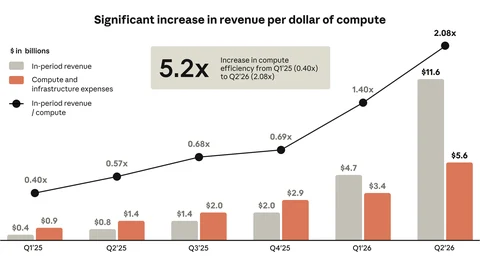
I mean, even 16 is like, yeah, wild, right? Like, they burned less than 10 billion dollars to get to that number. And, I mean, that has got to be the… Like, this will go down in the museum, like the history, like the books of history. I think it'll be very hard to beat this level of capital efficiency. While being deeply profitable: I mean, serving a dollar of revenue has gone down from 88 cents of compute to 15 cents. That's why they've got maybe 85% margins.24About 85% is the gross margin analysts calculate from the prospectus’s cost of revenue, which includes only compute used to serve customers. For the first nine months of 2026 it comes to 85.5%, up from 29.4% a year earlier; add training and research compute and the margin falls to about 45%. FourWeekMBA And they're monetizing their compute capacity, which is a scarce resource. That's gone from, like, you know, 16 a watt to about 60 a watt.25Revenue per watt — dollars of annual revenue earned per watt of compute capacity. Agrawal’s figures match SemiAnalysis’s estimate that Anthropic’s inference revenue per megawatt rose from $16 million a year to more than $60 million.
You know, a portion of their compute is used for inference, and that portion of the compute that's used for inference is incredibly efficient. So, you know, they talk a lot about that in their S-1. They talk about how they're orchestrating heterogeneous compute,26Heterogeneous compute — running on chips from different vendors at once. Anthropic trains and serves models on three platforms, Google’s TPUs, Amazon’s Trainium and Nvidia GPUs, which gives it more capacity and leverage with suppliers. from TPUs to the Trainiums27Trainium — Amazon Web Services’ AI accelerators. Their main customer is Anthropic, for which AWS built a cluster of hundreds of thousands of the chips. Pictured: the third-generation Trainium. to the Nvidia GPUs. And I think there's a lot of hard work that has gone into eking out maximum compute efficiency, which I think gives them a lot of moats in the business.
04Where the money goes, and Agrawal’s Stanford class
More than half of data center capex goes to IT equipment, and in his class Agrawal walks students through the whole AI stack, convinced every layer will make money.
With comparisons to GDP and expenditure to defense budget, how… I guess the question would be, like, where is all the money going? Like, how are you seeing this play out? How do you get to the second level?
Yeah, I would say the, you know, the chart that we discussed, which is: the number one destination of this capital is the build-out, is the data center build-out. A good chunk of that, more than half of that, goes into the, you know, IT equipment. This is your chips, memory, et cetera. And then the remaining into actually getting the data center off the ground. And so I think Chase from Crusoe28Chase Lochmiller — co-founder and CEO of Crusoe, which builds AI data centers, including the Stargate campus in Abilene, Texas, for OpenAI and Oracle. had a great breakdown in my class about the exact split of the dollars. Maybe we can flash that up for those who are curious, and he did an incredible job of mapping it down to every single dollar. But that's a rough split.
For those that don't know, Apoorv taught… And do you still teach at Stanford?
It's an annual thing.
Business school? That's pretty cool.
Engineering school.29Agrawal’s course — MS&E 435, “Economics of the AI Supercycle,” in Stanford’s Management Science & Engineering department, part of the School of Engineering; each session is led by a practitioner from one layer of the AI stack. Stanford Review
So okay, explain some of this. Who are some of your guests that you've had on? We're gonna take a little tangent, but, like, explain this.
Sure.
Because these have gone viral plenty of times. And I remember reaching out to you and being like, can we do it at Stanford? Like, your talks keep on going viral on many different, like, topics that you've been doing.
Well, you know, that's a labor of love. I wanted to recreate what I wish I had when I was an undergrad. And, you know, so what we do is, it's an intro to AI course that we go through the entire stack of AI, as Jensen calls the five-layer cake.30“Five-layer cake” — Jensen Huang’s image of AI as a stack of energy, chips, infrastructure, models and applications. Agrawal’s course follows a similar scheme, with agents on top instead of energy at the bottom. We start at the chips layer. We then talk about data centers, infrastructure, models, applications and agents. And we spend about two weeks on each part of the stack at the class.
And for each part of the class we have the good fortune of being joined by leaders in that space. So we had Chase from Crusoe talking about the data center build-out. We had Sunny from Groq31Sunny Madra — president and COO of Groq, which makes chips for fast inference. In December 2025 Nvidia licensed Groq’s technology for $20 billion and hired most of its team. talking about the chips and their chips. We had Ali Ghodsi32Ali Ghodsi — co-founder and CEO of Databricks, the data and AI platform where companies store and process data and train models. from Databricks talking about the infrastructure layer, folks from Anthropic and Chai33Chai Discovery — a San Francisco startup building AI models for drug discovery; its Chai models design antibodies. on the models, and, you know, so we did, and from Baseten. And so it's an incredible lineup, and the goal is to, you know, for the 150 or so students that come to the class, which is, hey, you're about to dedicate your career to this. You're about to either go build a company or join a company or invest in a company in a totally new economy.
So at least you have a mental model to understand that part of the stack. Each part of the stack is big and growing, and I'm a maximalist in that I think that they'll all be very good parts of the stack, and I think the chips will make money, and I think the data centers will make money, and the infra will make money, and the models will make money. But just so you know the key questions on the minds of the builders of the frontier. And so it's been an incredible experience. I think we're going to run it again next year, and, you know, hopefully it's helping the students.
AdBrex, Harvey, Zone
This episode is brought to you by Brex, my favorite. You become what you spend on, and I refuse to spend my time on work that shouldn't exist: expense reports, receipt chasing and manual closes. The companies building what's next, from Vercel, OpenAI, Anthropic, Granola and Deepgram, all made the same call. They all run on Brex. Brex is the intelligent finance platform that combines cards, expenses and banking into a single stack with agentic finance built in: AI agents that handle expenses automatically, enforce policy before spend happens, and close your books in minutes. That's why Sourcery runs on Brex, so I can spend time on building and not busy work. It's time to get Brex AF.d“Time to get Brex AF” — a Brex campaign slogan: AF stands for “agentic finance” here, and doubles as the slang “as f*ck.”
Learn more at brex.com/sourcery. That's B-R-E-X dot com slash S-O-U-R-C-E-R-Y. Bye.
From handshake to signature, faster. Harvey, the AI platform built for legal work, is trusted by 80% of the Am Law 100eAm Law 100 — The American Lawyer’s annual ranking of the 100 highest-grossing US law firms. and over 20% of the Fortune 500. Learn more today at harvey.ai. That's harvey.ai.
AI needs more than chips. It needs power, land and infrastructure. Zone develops next-generation data center campuses, partnering with AI companies, site developers and technology leaders to bring compute online faster and at scale. Zone is building the foundation of the AI frontier. Visit zonefrontier.com to learn more. That's zonefrontier.com to learn more.
05What the election means for data centers
After the recent US election results, Agrawal expects the country to fall 10–15 gigawatts short of planned capacity next year, hurting neoclouds and young startups far more than hyperscalers.
With the recent US results34The midterms on November 3, 2026, turned into a referendum on data centers: in nearly all of 41 local ballot measures, voters backed bans or pauses on construction, and candidates who campaigned against data centers won handily. Al Jazeera that came out on data centers, how does this affect the whole stack? Where does this hit and hurt most?
Well, the biggest one is the compute capacity that's going to come online. You know, in rough numbers, we think we'll end the year at about 35 to 40 gigawatts of compute capacity online in the United States. There's been lots of estimates about, you know, adding another, call it, 40 to 50 gigawatts of capacity next year. I think that's probably the place where there's the biggest haircut. Now, exactly what the haircut is, exactly what the permitting and regulation will slow down, is hard to say, but I'd estimate that, like, you know, maybe there's a shortfall of 10, 15 gigawatts to what we had forecasted for next year. I think that's the primary impact. There's all sorts of other secondary impacts for hyperscalers, for the labs, for neoclouds, startups, that we can get into, but that's roughly how I see it.
And then let's get into that. So explain how that'll affect the players on the board.
Sure. I think, look, if you are holding on to the largest pools of capacity, you're in a great position, right? And so those are hyperscalers35Hyperscalers — the largest cloud providers with their own data center networks: Amazon (AWS), Microsoft (Azure) and Google (Google Cloud). Agrawal adds SpaceX, which rents out AI capacity. today. One of my takeaways from the Anthropic S-1 was what a great business Amazon36Amazon is Anthropic’s biggest cloud partner and one of its main investors. Nearly half of Anthropic’s revenue (47% in 2025) flowed through cloud marketplaces, mostly Amazon’s and Google’s, each taking a cut. The Star / Reuters is, right? What a great business the other hyperscalers, Microsoft and Google and SpaceX, have been in supporting the AI economy. So I think it's net beneficial for them, because they're in a position of being the bottleneck where compute is bought and sold. But also, as the people with the biggest ambitions in building the largest data centers, their ambitions on adding capacity are at risk.
Now, you can take the other side of it, which is, hey, what happens to the neoclouds?37Neoclouds — newer cloud companies that rent out GPUs for AI, such as CoreWeave, Nebius, Lambda and Crusoe. They usually build with debt against long-term contracts. What happens to new startups that were, let's say, not the top five in the line, but let's say 17th in the line? You know, I think for them this is existential, right? For them, this is a much bigger question than it is for the hyperscalers. And so, you know, I think that's, yeah, probably a much bigger impact if you're one of those businesses.
06The four seasons: how OpenAI got back in the race
Anthropic is far ahead, but OpenAI has shown antifragility: new models and a stronger sales team gave it a record third quarter.
So zooming back out to the four seasons of AI, whether it's Anthropic, SpaceX, OpenAI and Google: how do you make up when it's their season? Like, we've gone through this, and I would kind of argue, like, where's Meta in the picture? Like, Muse really has propelled them back into the picture, whereas some of them might have fallen out.
Yeah, look, I think it's a game of emperors, and it's clear that Anthropic is far out in the lead. There's two frontier labs,38Frontier labs — the companies training the most capable AI models and setting the edge of what they can do. Anthropic and OpenAI. And I would say that both of them have gone sort of neck and neck. You know, maybe to give you a snapshot of what's happening at OpenAI since we last chatted. I think we spoke about it last summer.
Yeah.
I mean, OpenAI has shown incredible resilience and antifragility39Antifragility — Nassim Taleb’s concept from his 2012 book Antifragile: systems that don’t just survive shocks but get stronger from them. since we chatted. So ChatGPT continues to grow and is now over 1.2 billion users. But more notably, you know, they went into code red40Code red — in early December 2025, Sam Altman declared a “code red” at OpenAI after Google released Gemini 3, shelving side projects to focus on improving ChatGPT. at the end of last year, start of this year. And I think about two jobs to be done, building and selling. On the building side, they've had an incredible set of models that have come out, with Astra,41GPT-6 Astra — OpenAI’s flagship model, released September 3, 2026, and the first the company rated “critical” for cyber capabilities under its own risk framework. that have defined the frontier. And in Q3, you know, I would say both the products, so the Codex42Codex — OpenAI’s coding agent, a rival to Anthropic’s Claude Code. product, the ChatGPT Work43ChatGPT Work — OpenAI’s agent inside ChatGPT for work tasks, launched in July 2026; it runs projects for hours across connected apps and produces documents, spreadsheets and reports. product, the models have shown incredible performance. On the selling side, you know, they've added a couple of great leaders to their roster: Dali Rajic,44Fact-checkNot quite: at Wiz, Dali Rajic was president and COO, not chief revenue officer. He became OpenAI’s CRO in August 2026, replacing Denise Dresser, who held the job for less than a year. TechCrunch former CRO at Wiz,45Wiz — the Israeli-American cloud security company Google bought for $32 billion; the deal closed in March 2026. one of the best, if not the best, sales leaders on the planet; Brian McCarthy,46Brian McCarthy ran global revenue and field operations at Cursor and moved to SpaceX when it bought Cursor in August 2026. In September OpenAI hired him as vice president of worldwide sales, shortly after cutting Cursor off from its models. Fortune former CRO of Cursor, from SpaceX; and my friend Chad Beats.
Together, I think this is the best team you could ask for. And so all those upgrades have led to an incredible Q3 for OpenAI. As Sarah47Sarah Friar — OpenAI’s CFO. The “about $50 billion run rate” figure was reported by Bloomberg on October 8, 2026, citing people familiar with the matter; Friar’s own public statements in 2026 were that the 2025 run rate topped $20 billion and that July revenue exceeded the whole second quarter. Bloomberg Government has publicly shared, you know, they ended September at about $50 billion of revenue run rate, more than what they'd guided for by the end of the year. And so I would say those are the two labs that are on the frontier, to your question. And then, you know, we've got SpaceX and Google that are showing incredible signs of infrastructure prowess. They've monetized infrastructure incredibly well. SpaceX, I'm sure we'll get into, and Google we'll get into.
07Why open source will always be around
Open models will take 20–30% of AI spend, Agrawal says, and the money will settle with inference clouds that look more and more like hyperscalers.
And then I won't count out open source, which is kind of the evergreen season. You know, the rough mental model we have for open source is that about 20 to 30% of all AI spend will be on open source. You know, the majority will be on closed source, but there'll be a smaller part that'll be on open source. And that's also going to monetize, and the place in the open-source stack where the cash register rings is the inference layer. You know, this is Baseten48Baseten — an American inference platform that runs open and customers’ own models on its GPUs; it was valued at $13 billion in 2026. and Fireworks49Fireworks AI — an inference platform for open models, founded by alumni of Meta’s PyTorch team. and Modal50Modal — a cloud platform where AI startups run models and agent sandboxes without managing their own servers. and others. And we think those are going to be large businesses as well.
Explain that further. Why is open source evergreen? These are all different seasons, but open source will forever be evergreen.
Sure. Look, I think there's a large enough set of customers who care about a confluence of control, cost and sovereignty. Meaning that, let's pick the example of Cursor or Instinct or Decagon51Decagon — a startup building AI agents for customer support. or Harvey. You know, pick an AI-native company that wants to leverage their learnings from their interactions with the customer to fine-tune a smaller specific model that allows them to serve their customer better, while, by the way, having a much smaller model, a much cheaper cost of inference, and fully harnessing the data flywheel52Data flywheel — a self-reinforcing loop: the product collects data from customer interactions, the model is fine-tuned on it, the product improves and draws in more customers and data. within themselves: you own that intelligence as opposed to renting that intelligence. So I think that enough AI natives today have made that choice. And as Jonathan Ross, the CEO of Groq,53Fact-checkNot quite: Jonathan Ross hasn’t been Groq’s CEO since late 2025, when he moved to Nvidia with most of the team as part of its $20 billion deal. And in his 20VC interview he cited a statistic he had heard: 35 or 36 companies account for 99% of revenue or token spend in AI. Fortune said, you know, there's about 35 companies that run 99% of all inference.
You know, the top five are the labs we spoke about: Anthropic, OpenAI, Google, SpaceX. But the next 30 are AI-native startups, like Cursor, like Instinct. And I think this set today is making that decision, and it's what's driving, I would say, the fastest adoption of open-source tokens. The next set is enterprises. You know, this is enterprises that you and I know: the banks, the healthcare companies, et cetera. I would say they're following suit. We're starting to see some of them make that preference.
In fact, OpenAI made an announcement a couple of weeks ago where they have a partnership with Baseten54The OpenAI–Baseten partnership was announced on September 29, 2026, more than five weeks before the recording: OpenAI enterprise customers can pay for open models on Baseten out of their existing OpenAI spending commitments and call them directly in Codex. Digital Today now. And so if you were a large customer of OpenAI, let's say you had, making it up, a 100 million dollar commit on OpenAI, and you wanted to use a portion of that on open source, you could burn down your OpenAI credits. And so I think that is a proof point to your question, Molly, which is: you now have the big labs, OpenAI, making the choice that, hey, you can take your spend on my models, on OpenAI, and spend it on open-source models. And I think that's another, you know… It's the reality that is too large to not acknowledge, and I think it's very smart of OpenAI to rise above the level of being a lab to becoming a platform.
That's really interesting. That's a very good point. In terms of the open-source companies, you mentioned Baseten. So can you describe and explain the differentiation between Baseten and the Fireworks and the Modals and that kind of environment?
Sure. Look, I think the first thing on open source is, a lot of people ask us the question of, like, hey, are the open-source models good enough? Are they close? Are they at the frontier? And the answer is: not at point in time, but the frontier open-source model today is where the closed frontier was six months ago. So, you know, basically, if you are willing to buy the frontier from six months ago, open source gives you that, and it has consistently delivered that. You know, we have incredible open-source models both in the US and outside the US.
Actually, just this morning, you know, congrats to the Ricursive team:55Ricursive Intelligence released Ripple-65B Preview on November 4, 2026: an open-weight 65-billion-parameter coding model under the Apache 2.0 license that the company says beats every other American open model on two coding benchmarks. Let’s Data Science launched a great American open-source model. And so I'd say that's playing out. Now, open source is not free. As open source, you still have to go build the cluster that'll serve your model. And that's, we believe, the primary place a lot of gross margin will accrue. And so that layer is the players that you mentioned: Baseten, Fireworks, Modal, all great companies. You know, just like the clouds were: you have AWS, GCP, Azure, all great businesses, no dominant player. I suspect that a similar market shape will emerge for the open-source clouds.
The underlying conversation between all these conversations that I've been having with different investors or companies… We recently just did an interview with Fal,56Fal — a platform where developers run generative models for images, video and audio. and Fal's great, their generative media company. Their point of view is that every company now has a different storefront for compute. And I think this kind of goes back to that. We're, like, in the land of hyperscalers and neoclouds. How do you make sense of that? How do you make sense of that against, you know, the four seasons of AI, when all of these kind of end up looking like hyperscalers at the end of the day? We saw SpaceX go public,57SpaceX’s IPO — on June 12, 2026, SpaceX listed on Nasdaq under the ticker SPCX and raised $75 billion, the largest IPO in history. and now they're really talking about being an AI company.
They're talking about how over 50% of their revenue is related to AI. And so as we think about that, like, is the end state a hyperscaler? Like, is the end state that plus some differentiation? Like, how do you make sense of that versus people that also, like, have really committed to getting their own compute, their own capacity, or selling that out, or that business line, versus, like, renting and all that kind of stuff?
Let me answer that for the open-source players, and I'm sure we'll come to SpaceX in a second. But look, what's happening, and I can speak to Baseten because I know that business the best, is you're seeing a clear sign of them moving up the stack, right? And so, enabled by compute and the scale of compute that they have, their customers are now making the choice that, hey, I want to run a portfolio of models. You know, a portion of them will be open source, some of them will come from closed source, some of them will be, you know, as you said, coding models, image models, et cetera. What's needed for that portfolio to run effectively is an ecosystem, an ecosystem that gives you the tools that you need to run this.
This is, you know, routing and sandboxes and a series of things. And, you know, Baseten had a big announcement yesterday where they're launching a series of platform tools.58Baseten’s tools. On November 4, 2026, Baseten introduced Grid, a gateway that routes coding-agent requests across models and controls spending, and on November 5, Sandboxes, isolated environments where agents keep files and state between tasks. Unite.AI And I think they're heading towards looking more and more like a hyperscaler. So I would say there's a lot of roads that lead to people looking like a hyperscaler. And, you know, I would say Baseten and others are taking, call it, the open-source route to that. Let's talk about SpaceX. You know, SpaceX is taking the infra route to that.
08SpaceX and Google: the money in infrastructure
SpaceX has turned out to be an AI business renting compute at twice neocloud prices, Agrawal says, while Google’s TPU-powered cloud is growing eight times faster than Search.
Source: Axios
And, I mean, phenomenal earnings call from SpaceX two weeks ago. Where do we even begin? I mean, we thought SpaceX was a space business, but turns out it's an SI business.59SI — SpaceX Super Intelligence, SpaceX’s AI unit. It is Elon Musk’s former xAI: SpaceX absorbed it in February 2026, renamed it SpaceXAI over the summer and SpaceX Super Intelligence in October. Most of its revenue comes from renting data center capacity to Anthropic, Google and Reflection AI, plus Cursor and Grok. You know, the rough makeup of SpaceX's revenue from their last earnings release: they do about $60 billion of revenue run rate, half of which comes from their AI, you know, their SI unit. About a third of it comes from Starlink, and the remaining from their launch business. And actually this SI business is growing rapidly, right? I think it went from… It's actually, I had a tweet about this: it added over 20% relative market share in Q3. So it's, you know, just incredible growth, and now they're guiding with great confidence to having 100 billion of run rate by the end of this year, and half a trillion, is that right, or more by the end of next year.60On the call, SpaceX’s CFO reaffirmed the target of a $100 billion annualized run rate by the end of 2026, and Musk floated $500 billion to $1 trillion by the end of 2027. Analysts are more cautious: SemiAnalysis, for one, models about $305 billion by the end of 2027. Crypto Briefing
Well, I think Elon once had a trillion and then a hundred trillion dollar market cap.
So I'm sure… I trust Elon on those. But, you know, I think that's the other path, right? So what is the other path? The other path is the infrastructure path. And so there were two players, I would say, who got the compute bet early and right: Sam and Elon. You know, you know the Sam side of the house. Last October, Brad and Sam had an exchange on BG2 Pod61The BG2 exchange. In a BG2 episode released October 31, 2025, Gerstner asked Altman how OpenAI, with about $13 billion in annual revenue, could commit to $1.4 trillion of compute. Altman replied that revenue was higher, offered to find a buyer for Gerstner’s shares and said, “Enough.” TechCrunch where Brad asked him the question of, like, hey, you've got a trillion dollars of compute commitments, but 13 billion of GAAP62GAAP — US generally accepted accounting principles. GAAP revenue is reported revenue, not a run rate or an “adjusted” figure. revenue to support it. Turns out Sam was prescient, and procuring compute early and building those resources.
ExplainerRenting compute: long-term leases vs. spot
Neoclouds like CoreWeave and Nebius usually lease capacity on one- to three-year contracts at a fixed price, and, Agrawal says, take two to three years to earn back what they spent on chips and data centers. Spot rental means capacity at the going market price for a short term, like a hotel room instead of an apartment. Agrawal quotes prices in dollars per watt of capacity per year: $10–20 on a long-term lease, $25–50 on SpaceX's spot market. Paying double makes sense for a tenant that earns even more on each watt: Anthropic, by his estimate, takes in $50–100 of revenue per watt, and when it is short of capacity, every missing watt is lost revenue. The risk sits with the landlord: if demand cools or the tenant finds cheaper capacity, the premium price won't last.
And Elon and team were the second. You know, they got a lot of great compute set up. Now, what they've done with this compute is they've started to rent it out, and not just rent it out like a neocloud would. You know, a typical neocloud would let you buy a lease, a long-term lease, for one to three years. But SpaceX is renting this at spot prices. And so the rough mental model for the prices of compute is, you know, if you got a long-term lease from CoreWeave63CoreWeave — the largest neocloud, a former crypto miner that rents out Nvidia GPUs; its biggest customers are Microsoft and OpenAI. or Nebius64Nebius — an Amsterdam-based neocloud that grew out of Yandex’s international business; its customers include Microsoft and Meta. or one of the neoclouds, it would be available at, like, 10 to 20 dollars a watt. Short-term compute from SpaceX is roughly double that. It's probably, like, 25 to 50 dollars a watt. Actually, in the earnings call, their CFO said that it was on the higher end of that, so $50 a watt. Now, you might ask the question: who can pay for that?
Well, Anthropic can, because Anthropic is monetizing that at, you know, $50 to $100 a watt. And so if you are in the position of having a leading model that monetizes so well, and you're out of compute, it's a win-win-win. It's a win for Anthropic: you have a product that is, you know, leading, and you can make gross margin serving this. It's a win for SpaceX: they get to recoup their capex in less than a year,65On the third-quarter call, SpaceX CFO Bret Johnsen said: “At current pricing, new compute deployments are generating a payback of less than a year.” Constellation Research which is incredible, because most neoclouds take about two to three years to recoup the payback on their capex. And, you know, I think SpaceX has shown incredible innovation on that model.
Another thing we were talking about with SpaceX was how they've built out their business in atoms and bits. And you provided, like, really good, like, understanding of this and examples. So can you break that down?
Elon is probably the best entrepreneur we know today in orchestrating atoms. We've seen that with the SpaceX business. We've seen that with Tesla, we've seen that with Neuralink and Boring Company66The Boring Company — Musk’s tunneling company; in Las Vegas, Teslas carry passengers through its tunnels. and a series of his businesses over the years. But now we're also starting to see that with atoms. You know, this is the SpaceX SI business. And so on the bit side of the house, they're using their prowess in atoms, you know, their ability to build large-scale infrastructure, not only to build that but to get it up fast, and then business model innovation on top to earn max rent.
Now, their guidance of half a trillion to a trillion of revenue next year, we'll, you know, we'll see how that plays out. But the rough mental math on how I think about that… I mean, this would make it larger than the frontier labs that we spoke about, if they achieve this revenue, right? How is that possible? I think it comes from their prowess in being really good at orchestrating bits and really good at orchestrating atoms, and a combination of those. You know, we estimate they'll end this year at about three gigawatts of compute. They're guiding to ending next year at about 13 gigawatts67SpaceX plans to bring about 10 gigawatts of new AI capacity online by the end of 2027, for a total of more than 13 gigawatts. It had 1.7 gigawatts as of September 30, 2026. Crypto Briefing of compute, maybe more than that, maybe less than that, we'll see. And at the monetization that they have, you know, top end or even more than $50 a watt, like, that's how you get to over half a trillion in revenue run rate.
Now, there's lots of questions in whether that can be achieved, of whether you can continue to earn short-term prices. It's like, you know, renting your home on a long yearly lease versus renting your home on Airbnb. Like, there's obvious questions with that, whether Anthropic will renew and so on, but I guess we'll find out.
And then where does Google come into the picture? Yeah. TPUs, let's talk about that. How are you seeing them take up their season? Which season has… Yeah, how do you define which season? Are they months? Like, what?
Source: 9to5Google
You know, Google is one that, every time I think of Google, I say: don't forget Google. I would describe Google right now as a tale of two cities. On one side they've got a search business that is, you know, slowing down, and, you know, it's about 250 billion dollars of revenue run rate, growing at 12%. But you've got this cloud business68In the third quarter of 2026, Google Cloud revenue grew 103% to $30.7 billion, while Search grew 12% to $63.4 billion, down from 17% in the second quarter. Hence Agrawal’s run rates of roughly $120 billion and $250 billion. 9to5Google that is half the size of search, but growing 8x faster. So, I mean, what are we even talking about here? This is a business that is 120 billion of revenue run rate, growing at 103% year over year. That is insane.
And so honestly, I mean, and, you know, by the way, this cloud business is what incorporates TPU,69TPU (Tensor Processing Unit) — Google’s in-house AI chips; for years Google used them only internally, and now it rents them out through Google Cloud and sells them to others. Pictured: a TPU v4 board, four chips under liquid-cooling tubes. their TPU product, their cloud sales. Anthropic is a customer, amongst others. I think there were some rumors about OpenAI considering the TPUs as well.70In the summer of 2025, Reuters and The Information reported that OpenAI had begun renting TPUs through Google Cloud, its first serious use of non-Nvidia chips. Oracle, I believe, was the first outside cloud provider. And then now Anthropic has this commitment with Broadcom71Broadcom co-designs and manufactures TPUs with Google. In December 2025, Broadcom CEO Hock Tan disclosed that the customer behind a $10 billion order for Ironwood TPU racks was Anthropic, which had ordered another $11 billion. to lease TPUs as well. So, you know, there's a growing business inside of Google that is starting to look quite a bit more lucrative, certainly in terms of its growth, than people have thought. So that's why I call it the tale of two cities inside of Google. And as it is for the season, you know, I don't know, it's probably a change of guard and change of seasons inside of Google.
AdMercor, VCX, Public, Deel
How good is AI at real professional work? Mercor's AI Productivity Index, or APEX,fAPEX (AI Productivity Index) — Mercor’s benchmark that tests AI models on real tasks from lawyers, bankers, consultants and doctors. tracks it with every major frontier model release, built with partners like Harvey and Cognition. See where the frontier actually stands at mercor.com/apex.
Today's episode is sponsored by VCX by Fundrise, the public ticker for private tech, allowing investors of all sizes to invest in venture capital. Learn more at getvcx.com.
Public is a multi-asset investing platform where you can automate your investing with AI agents. Create your own custom agent with a simple prompt. Agents can monitor markets, execute trading strategies, and manage your cash across stocks, bonds, options, crypto, and more. Want to buy at market close and sell the next day's open? Just tell your agent. Automate your investing at public.com.
Founders scale faster on Deel. Set up payroll for any country in minutes, hire anyone anywhere, get visas handled fast, and get back to building. Visit deel.com/sourcery. That's D-E-E-L dot com slash sourcery.
09Who wins, and the new benchmarks for growth
Every layer of the stack will win, but so far the biggest balance sheets have; Agrawal hopes cheaper models will shift value to apps and startups.
Is the winner in AI cloud? Is it chat? Is it agents? Is it cloud?
I think the answer is all of them. I think the answer is: chips are going to win, data centers are going to win, clouds are going to win, models are going to win.
Everyone's going to win.
I think we're going to win, but I think maybe the question behind your question is, like, the relative scale of winning. And, you know, I think there's lots of smart people who say everybody's going to win. I agree, but I think it's a relative scale of winning. And I think, honestly, so far it has been a game of emperors, and you've seen the biggest players with the biggest balance sheet win. But I'm very hopeful, you know, as I call them the blue triangles, I'm very hopeful for the app layer, for the model layer, for the startup ecosystem: as compute efficiency starts to kick in, as models get cheaper, that more and more value will accrue at the top of the stack, which is, you know, in models and applications and new startups.
So this trillion-dollar class of company is far different than any other that has ever existed, and obviously companies that came from zero to a trillion in, like, five or six years. But I'm curious: so with this set of trillion-dollar companies that all are kind of servicing the same markets, how do you think about market comps, especially when there's new entrants that are just growing really fast and we don't know when they plateau, if they plateau?
Yeah, look, I think, one, what was true in software, which is that, hey, you could triple, triple and double, double, double,72“Triple, triple, double, double, double” — the T2D3 rule, coined in 2015 by Neeraj Agrawal of Battery Ventures: a SaaS company’s path to $100 million in annual revenue, tripling twice and then doubling three times after its first $2 million. is no longer best in class. I don't know if somebody's done a better benchmarking exercise, but, like, roughly speaking: I think we just went through Google. Like, if you're doing 120 billion dollars of revenue run rate, there's now an example or two of businesses that are growing over 100% at that scale. So that's best in class. At the double-digit billion range, you've got, you know, OpenAI ended last year roughly at about 20, 21 billion of revenue run rate,73That checks out: in January 2026, OpenAI CFO Sarah Friar said the company’s annualized revenue topped $20 billion in 2025, up from $6 billion in 2024. you know, projected to end, we estimate to end this year at 70, 80. That's more than a 3x of that at double-digit billion dollar range, so, you know, triple at that scale. And at the single billion scale, you've got several startups.
You've got, you know, Cursor, rumored to go from one to 10 this year; Cognition74Cognition — the startup behind the AI software engineer Devin; in 2025 it bought the code editor Windsurf. at a similar level of scaling; you know, Baseten has grown 10x for the last two years at that scale. So I feel like at the single-digit billion range, that's the benchmark, right? And so it's 10x at single billion, 3x at double-digit billion, and maybe doubling at triple-digit billion is probably best in class. But maybe there's somebody who's done a better market comps exercise of growth at that scale.
Those are the metrics, or at least the measurement, that you're using when you're evaluating new companies that are coming to you? Because we're seeing this every week. It's either… I can't tell the difference between, because I don't sit on this side anymore, like, I don't do this every day, but I can tell the difference between pure momentum plays and pure, like, freaking crushing it, we don't know how they're taking up all market share type of companies.
Well, look, ultimately, I mean, maybe take the question of how we evaluate startups. I think it all starts with a great team and founders, and that is the leading indicator of all success. And by the way, I would say the same for Cursor, right? Like, Michael Truell,75Michael Truell — co-founder of Anysphere, the company behind Cursor, which he started in 2022 with MIT classmates. probably one of the best founders, young founders I've met in recent history, and not a surprise that, you know, he's built an incredible business. And, you know, there's a series of others.
We just partnered with one, you know, my former colleague Bob McGrew from Arda,76Bob McGrew — OpenAI’s former chief research officer, who earlier spent years at Palantir, where he overlapped with Agrawal. His company Arda builds AI tools for manufacturing engineers; in 2026 it raised about $230 million at a $1.5 billion valuation in a round Agrawal led for Altimeter. Let’s Data Science who I think is a phenomenal founder. Who, you know, started his career at PayPal, was then the second engineer at Palantir, led engineering, co-developed the forward-deployed engineering77Forward-deployed engineers — Palantir’s model of engineers who work on-site with customers and tailor the product to their problems. OpenAI, Anthropic and many AI startups have since adopted it. motion, led research at OpenAI and has now started this grand ambition. Which, you know, the guy's got a track record of just picking the most ambitious bets. You know, I think it's talent like that that is a leading indicator. Obviously, the numbers are a lagging indicator. It's hard to foresee that with the… But what we can, you know, at least look for is just great, great founding teams.
10Cybersecurity, AI’s next big market
After coding, Agrawal sees cybersecurity as the biggest emerging consumer of AI, with the frontier labs capturing most of the demand.
So we've covered the four seasons of AI. We've covered the state of the AI economy. What is left there to talk about? Like, what are the biggest questions you have?
One of the biggest things I think about, in addition to what we've spoken about: I think the four seasons of AI, that's right, you know, Anthropic, OpenAI, SpaceX, Google, with an evergreen of open source. The other thing I think about is: what is the biggest industry that is consuming AI, right? So software engineering is the biggest workload, as we know about. Financial markets, actually, you know, the quant firms78Quant firms — hedge funds and trading firms that trade on mathematical models, such as Renaissance Technologies, Two Sigma, Citadel and Jane Street. They have long spent heavily on compute and AI talent. spend a significant amount of money on AI labs. But that's very concentrated. I would say the biggest emerging market is cyber.
As you reminded me, Elon said, "Zero day79Zero-day — a software flaw the vendor doesn’t yet know about, so it has had “zero days” to fix it. every day." And I think a lot is happening in cyber that is worth paying attention to, in that cyber is a cat-and-mouse game. Meaning that offensive actors now have this new toolkit, which is incredibly potent, that can go check every single door and window and make sure if it's unlocked, find the most critical vulnerability and exploit it. You know, one such vulnerability was, you know, the one Oege de Moor80Oege de Moor — founder and CEO of XBOW. He previously founded Semmle, which GitHub bought in 2019, and led the creation of Copilot at GitHub. and the XBOW team found in Google Chrome.81The Chrome hack. XBOW, whose AI agents hunt for vulnerabilities, chained three unknown Chrome bugs into an exploit that ran code on Windows when a user merely opened a page. It took about $40,000 of compute and six days of one researcher’s time; Google paid its top reward of $250,000, and XBOW estimated about a billion users were exposed. CSO Online Now, Google Chrome is used by billions of users. About a billion users use it every day.
I use that.
I use that. Everybody uses that.
What happened?
And, you know, they found a vulnerability that would allow an offensive actor to take control of your computer with just you clicking a link. You don't even have to press any buttons, you don't have to provide your number or place a call. And that's scary. Now, this is just one event. There's a series of such events that are happening, and, you know, I think that because the offensive activity has gone up a lot, I think defensive activity will go up quite a bit. And I think that that is an increasing area of use of AI tokens. You've got to match fire with fire.
How come there hasn't been a breakout winner?
Well, I think the edge that you get in using frontier models is so high that I think it'll be the frontier companies. I think it'll be, you know, the AI frontier companies, today that's OpenAI and Anthropic, that are likely to serve that demand. Now, there might be harnesses82Harness — the software around a model, such as tools, memory, workflows and checks, that turns it into an agent for a specific job. around them, you know, like XBOW and others, that'll help you shape your cyber strategy and, you know, make sure that you're not doing, like, your once-a-year annual test,83Penetration test — a commissioned simulated attack, which companies typically run once a year to find weaknesses in their defenses. but do a continuous test as you update your software. But I think capability matters quite a bit, and so most people want frontier capability.
11Anthropic’s IPO at 11–14 times forward revenue
Agrawal expects a very successful IPO: even at $2 trillion, Anthropic trades at 14 times forecast revenue, and he likens it to a private Mag 7.
As we close out, what are you most looking forward to in the next 12 months? I always, like, regret saying this question when I say it, because it's going to change in hours.
I can't tell you about the next 12 months, but I can tell you about the next 12 days.
Okay.
I'm most looking forward to the Anthropic IPO, as I'm sure are many, many people in Silicon Valley and beyond. I think this is the best business I've had the good fortune, as an anthropologist, as a student of the markets, to study, and I can't wait for them to go public, and, you know, wish them all the best.
Is anthropologist a pun?
Good eye.
Well, I'm curious about this before we go. Have you done scenario analysis on what happens if the IPO goes one way or another? Obviously, the market is contingent on many different macro factors, whether it's war or cyberattacks or credit or whatever. But Anthropic and OpenAI, their premiums have absolutely propped up the private markets. People all think now they'll become a trillion-dollar company. I have no doubt they're a trillion-dollar company, but what happens if this hits the markets and it becomes volatile?
ExplainerWhere 11–14 times forward revenue comes from
A forward revenue multiple is a company's valuation divided by the revenue expected a year out. Agrawal takes Altimeter's forecast for 2027, $140–150 billion of GAAP revenue, and divides the expected IPO valuation of $1.5–2 trillion by it, which gives roughly 11 to 14. For a company whose revenue is multiplying within a year, he considers that a modest price, "not a heroic multiple" next to market comps. The risk lies in the forecast itself: if growth slows, the same multiple turns expensive.
Yeah, look, I think maybe to answer that with a couple of numbers to frame the conversation, Molly: you've seen their numbers that have come out. They did about 17 billion dollars of revenue in Q3. We think next year they'll do, let's say, 150, 140 billion dollars of GAAP revenue. The rumored IPO price range, as you said, is about 1.5 to 2 trillion.84Valuation figures vary. The prospectus range of $70–78 a share implied roughly $1 trillion to $1.4 trillion depending on the method; the shares priced at $83, about $1.5 trillion. A $2 trillion valuation was expected over the summer, and on the first trading day it was cited on a fully diluted basis. Fortune At the low end, that's 11 times forward GAAP revenue. At the high end, that's 14 times.
Like, it's not a heroic multiple. It's completely reasonable based on current market comps. And so I think in the contemplated pricing range, I think it'll be a phenomenal short-term success, and certainly long term. I think this is the private Mag 7. This is likely to be the leading companies for the next decade and more. So I think we're looking at a very successful IPO. Now, in the short term, you might have choppy waters, but I'm quite excited.
Apoorv, thank you so much for joining us. I know we're in this really funky studio space. So I normally will come up… And we have a studio at the New York Stock Exchange up here in SF. If you didn't know, like, the New York Stock Exchange is here. But this is a lovely interior design studio called Lark, by Pamela Jewell, and she helped design Revel. I don't know if you know Revel, but Revel is a software-for-hardware company.85Revel — a Los Angeles company that makes software for testing and controlling hardware such as rocket engines, robots and defense equipment. It raised $150 million in February 2026. Business Wire They're based in LA. They are opening an office up here. Scott Morton's the founder. And so I was like, I need a space. I'm like, I know Scott's getting a new office. Where's the office? Blah, blah, blah. Does it have whatever? And he was like, I'm going to connect you to Pamela. And then Pamela got us a space, and it's, like, amazing. So if anybody out there needs interior design for their growing startups and their offices, contact her. But, Apoorv, thank you so much for the recent update on everything, and hope we can do this again soon.
Thanks for doing that.
Hey, it's Molly. If you enjoy our interviews, check out our newsletter, sourcery.vc, where we deliver a once-a-week top deals and tech headlines email and also go deeper on our podcast interviews. Subscribe to Sourcery today, and don't forget to subscribe to the podcast on YouTube, Spotify, Apple or wherever you listen. Link in description to sign up.


