


BG2Pod
Chapters
The SpaceX IPO is two days away, and both firms at the table already own the stock and plan to buy more in the offering.
Read the chapter- Gerstner sets the agenda: the SpaceX IPO, yesterday's Mythos release, and Clark's trip to Taiwan with Jensen for Computex and GTC.
- The IPO is priced at $135 a share for a $1.77 trillion valuation, and The Wall Street Journal reports that Goldman Sachs and Morgan Stanley both see $160 billion of revenue in 2028.
- Gavin is a big shareholder, Altimeter is a shareholder too, and both expect to buy in the IPO.
Gavin names the two variables that matter most: how fast SpaceX brings terrestrial data centers online and whether xAI gets to the Pareto frontier.
Read the chapter- Clark's analysis shows xAI's cloud deal with Google earning more operating profit per gigawatt than Anthropic, Meta, Google or OpenAI, and his Altimeter colleague Freda calculated a 55% IRR on Colossus 1.
- Elon, as Jensen has said, brings data centers up faster than anyone, in 122 days, and Gavin points out that speed is literally cost, since every day you're paying electricians and plumbers.
- Cursor and Anthropic, as Gavin understands it, each have more proprietary coding tokens than the whole open internet, and Composer 2.5, built on Kimi K2.5 and trained for three weeks on Colossus 2, was Pareto dominant 12 days ago.
- Gavin cautions that this is on Cursor's own benchmark, CursorBench, but thinks the data gives xAI a shot at being a real player in coding.
SpaceX's whole business rests on reusable launch, and the panel thinks Starlink could plausibly grow fivefold in three years.
Read the chapter- Fox calls reusability the crown jewel of SpaceX and rapid reuse of both Starship stages, flying 30, 40 or 50 times before refurbishment, the next goal.
- Fox expects launches to go from about 160–165 last year to the high hundreds in the next several years and into the thousands three years after that, which Gerstner works out to two or three a day.
- Under 1% of the world's households have Starlink, and Fox sees a path to hundreds of millions of terminals, while Gavin adds that this depends on rapid reusability and a lack of competition.
- Bank models show connectivity revenue going from $10 billion to $50 billion by 2028, which Gavin puts at about 0.3% of the global telecom market.
- Gavin, a big video gamer, finds Starlink the fastest, lowest-latency connection wherever he travels, while Gerstner complains that he can't hold a call on Sand Hill Road.
In a matter of weeks SpaceX became the number four AI hyperscaler, a business that was missing from almost everyone's models a few months ago.
Read the chapter- Gerstner calls "Elon Web Services," the huge compute deals with Anthropic and Google, the biggest surprise of the past six weeks.
- The hosts play a clip from an earlier BG2 episode in which Jensen says xAI stood up 100,000 GPUs in 19 days, when a supercomputer like that usually takes three years to plan and another year to get working.
- Clark credits Elon's ability to secure power, build sites faster than anyone, keep supplier relationships and finance deals at attractive rates.
- Fox suggests Google may be paying a premium on terrestrial compute to get first in line for space compute, which Gerstner calls a call option.
- After the Google deal, Gavin and Fox say, SpaceX will be the number four hyperscaler, having passed companies including Oracle in 30 days.
Baker rejects the idea that data centers are all alike: Musk designed his from first principles, the way he did the rocket and the electric car.
Read the chapter- Gavin even told the xAI team to be less public about data center design choices that seem obvious to them and are revelations to everyone else, and he says that is how they hit 122 days.
- Only two or three players, Clark says, can reliably engineer a behind-the-meter data center today.
- Gerstner asks whom Vernova would sell its limited gas turbines to, xAI or a startup neocloud, and Gavin answers that speed to energize GPUs is money for every supplier of power, land and turbines.
Orbital data centers aren't needed for the IPO valuation, but a gigawatt in space could cost far less than one on the ground, as long as the satellites don't fail too often.
Read the chapter- Gavin thinks what Cursor could mean for xAI matters more than orbital compute and cites Replit founder Amjad Masad's "bitter-lesson-adjacent" point that coding may be the fastest path to AGI.
- The leaked forecast, by Fox's math, assumes monetization of about $14 billion per gigawatt per year, while Anthropic signed at 22–23 and Google at 50.
- Reusing both stages, Fox says, takes launch costs from about $1,500 per kilogram on Falcon to $250 or lower, and one Starship carries about five megawatts of compute.
- Putting a gigawatt in space costs about $5 billion of capex versus $20–25 billion for switchgear, generators, shell and power on the ground, and Gavin sums it up as $30 billion per gigawatt in space versus $60 billion on land.
- Gavin sees reliability as the main risk, since GPUs melt and lasers fail, but as long as the satellites aren't failing at an astronomical rate, "the math maths."
Gerstner thinks xAI's own model gets the least attention and could be the biggest upside surprise.
Read the chapter- Cursor, with 700–800 people, had a team capable of building a frontier-level model but was compute-constrained, and Altimeter's projections had it exiting the year at up to $10 billion of revenue.
- Gavin expects Grok 4.3, a 1.5 trillion parameter model with Cursor data injected into pre-training, to be a better base model than Kimi K2.5.
- Clark hears xAI has secured maybe up to 20% of early Vera Rubin capacity and has shown it can rent out spare capacity at the best margins in the industry.
- Gerstner recalls that Bezos built capacity for Black Friday and turned it into AWS, while investors in 2009 and 2010 hated that it was eating all the free cash flow.
Gerstner concedes that few companies have ever grown revenue eightfold in three or four years, but piece by piece the SpaceX forecast looks achievable.
Read the chapter- The bears compare last year's $18 billion of revenue with the banks' $160 billion forecast and point out how rarely anything has grown that fast.
- Broken down from first principles, Starlink and terrestrial AI compute look achievable over three years to Gerstner, and the model after the Cursor deal could be an upside surprise.
- Gerstner isn't there to pump the IPO at $1.77 trillion but calls SpaceX a set-it-and-forget-it position for institutions that want a real bet on both space and AI.
Post-IPO volatility is almost a given, so the core position is set and forgotten while its size moves with the market.
Read the chapter- Gerstner shows a chart: the average max drawdown after IPO for about 20 companies, from Facebook to Shopify, is over 50%.
- Gavin compares position sizing to ballast you shift from side to side so the ship leans into the wind without tipping over.
- There has never been an IPO this big or one that enters the index this fast, and Elon, with his 50%, is locked up for a year.
- The valuation, Gavin notes, went from 100 times trailing revenue to 39 within a month because the deals added $29 billion.
- SpaceX employees and investors could sell every six months for about a decade, and many chose to hold, which is why Gerstner calls companies like this quasi-public.
Gavin argues we don't know how smart the new models are because no one has let them run nonstop for a year.
Read the chapter- Fable 5, Gerstner explains, is basically Mythos with classifiers and safeguards, and Karpathy tweeted that long-running tasks are what make it special.
- Noam Brown argued that snapshot benchmarks no longer mean much and the x-axis should be time, tokens or compute, since most problems can be solved if a frontier model runs long enough.
- Gavin asks listeners to imagine Albert Einstein thinking about physics for a year without eating, sleeping or aging, and says it made him even more bullish on compute.
Contrary to the consensus going into the year, frontier models take about 90% of the revenue, even if open models may serve most of the tokens.
Read the chapter- Gerstner recalls the debate at the start of the year that cheap open tokens would catch up with the frontier, and six months later frontier tokens capture the overwhelming share of revenue.
- Clark fed Fable 5 about seven of Altimeter's models and three years of his notes and got back the inconsistencies in his assumptions and the sources that best predicted what actually happened.
- Gavin thinks the frontier might be 90% of the economic value and open source 80% of the tokens, citing Harvey, whose open model with a router beat Opus at a lower cost.
- The better open models do, Gavin argues, the more gets spent on compute, which makes them bullish for hardware.
- Clark observes that Silicon Valley believes in closed models while Asia believes in the right model for each workload without overspending.
Nvidia has held its share against ASICs against expectations, and Gavin thinks it could release a frontier open model and undercut the economics of rival chips.
Read the chapter- If Nvidia's customers compete with it through their own ASICs, Gavin says, Jensen could push open models like Nemotron to the frontier and leave them without the revenue or margins to fund those chips.
- Clark came back from Taiwan seeing that Nvidia hasn't lost share as everyone expected, and that the new topic is custom accelerators such as MediaTek's 8t and Broadcom's 8i for TPUs.
- In a watt-constrained world, Gavin says, a chip that gets more tokens per watt literally brings in more revenue.
- Meta's and Microsoft's ASICs have disappointed, in Gavin's view, while OpenAI made a great chip in Jalapeño, though it needs more cooling.
Roughly $1.5 trillion of 2027 capex against $300 billion of AI lab revenue works for the panel, because the revenue is underestimated and compute prices are rising.
Read the chapter- Google just raised $80 billion, Morgan Stanley raised its 2027 capex forecast from $950 billion to $1.1 trillion, and Gerstner, adding SpaceX and CoreWeave, expects closer to $1.5 trillion.
- Gavin puts gross margins above 50%, at 60 or 70, expects well over $200 billion of inference revenue by year-end, and notes that about 35% of spending goes into making the next model.
- Compute prices, Fox says, are rising instead of falling, and fewer than 0.2% of people use AI in an agentic way, so the shortage may last.
- Monetization per gigawatt, Clark says, has gone from about $20 billion at the start of the year to 30 and even close to 40 now.
- To Chamath's "token maxing" charge, Gerstner answers that millions of independent businesses and consumers wouldn't keep paying for AI if it didn't make their lives and businesses better.
After the run in semiconductors, Altimeter has cut its exposure from large to medium-small and expects consolidation on the way to new highs.
Read the chapter- Semis doubled and tripled this year while internet stocks fell 16% and software 8%, so the broad market, Gerstner says, has kind of struggled.
- Gerstner cut exposure over geopolitics, short-term inflation and higher expectations: the morning's CPI came in at 4.2%, and this year has brought a war with Iran and $100 oil.
- Gavin pictures stocks as runners that have sprinted up a sheer cliff and need rest, and calls the hunt for the next bottleneck the last game.
- Students use less AI in the summer, Gavin warns, but Gerstner's 15-year-old is building swarms of agents and a DCF model of SpaceX.
By Gerstner's math, three companies will add a trillion dollars of revenue twice as fast as the Magnificent Seven did.
Read the chapter- The Mag 7 added their second trillion of revenue over seven years, along with $17 trillion of market cap, and SpaceX, Anthropic and OpenAI are forecast to add the same in four or five years.
- Gerstner has no doubt AI will transform 5–15% of global GDP, and 10% is $10 trillion.
- Gavin thanks Gerstner for the Trump Accounts, which give people an equity stake from a very young age.
Quotes
On why data center build speed is money
“Speed is literally cost, because every day you're paying electricians and plumbers, that's cost.”
Gavin BakerRead from 03:42On rockets before reusability
“Gavin has used this analogy before, but the old rocket industry was kind of like: imagine boarding a plane, flying to California, getting off the plane, the plane explodes after.”
Andrew FoxRead from 07:21On why we don't know how smart the models are
“Because nobody has run Mythos for a year continuously. And we may never know how smart each generation of models actually is or was, because we don't have time to appropriately evaluate their intelligence before the next model comes out.”
Gavin BakerRead from 44:22On why businesses need cheap open models
“You don't need Albert Einstein to book you a trip.”
Gavin BakerRead from 53:09On who gets the money and who gets the tokens
“Frontier might be 90% of the economic value. Open source might be 80% of tokens.”
Gavin BakerRead from 53:32On how AI lab skeptics keep retreating
“The first argument against the frontier labs was they'll never generate revenue. Okay. And then that got blown up. Then it was like, even if they generate revenue, it'll be really shitty gross margins, and they'll never be able to make money. And then kind of that's blown up. And, you know, I think now, you know, people are falling back, and they're saying, ‘Well, they're overcharging.’”
Brad GerstnerRead from 1:10:42On how Baker watches for risk
“I always assume a bullet is coming for me, head on a swivel. It's the bullet you don't see that gets you, so I'm trying to spin as fast as I can.”
Gavin BakerRead from 1:17:05On the next trillion of revenue
“The forecast now is that we're going to add another trillion of revenue in just three companies, SpaceX, Anthropic and OpenAI, over the next four to five years.”
Brad GerstnerRead from 1:18:35
Summary
Recorded two days before the SpaceX IPO and the day after the release of Fable 5 and Mythos. Brad Gerstner takes apart the offering with Gavin Baker and Andrew Fox of Atreides and his Altimeter partner Clark Tang. The banks expect SpaceX revenue to grow from $18 billion to $160 billion by 2028, and the panel breaks that number into pieces. Starlink and direct-to-cell connectivity look quite achievable; everything else rests on rapid reusability of both Starship stages. The big surprise of recent weeks is "Elon Web Services": Google and Anthropic rent compute from xAI, and these deals earn more operating profit per gigawatt than anyone else in the industry.
Orbital data centers, by Fox's and Baker's math, aren't needed to justify the IPO valuation, but their economics are strong: about $5 billion of capex per gigawatt in space versus $20–25 billion on the ground, not counting chips. Brad thinks the most underrated variable is xAI's own model: SpaceX is buying Cursor with its coding data, and it has compute to spare. The panel sees all of this as a must-own long-term holding for institutional investors, even though drawdowns after the IPO are likely.
Fable 5, Baker argues, shows that we don't know how smart the models are, because no one has run them nonstop for a year. Six months into the year it is clear that almost all the revenue, about 90%, goes to frontier models, even if open models process most of the tokens. Clark reports from Taiwan: Nvidia is holding its share against ASICs, while new kinds of accelerators keep multiplying.
The episode ends with a reality check: about $1.5 trillion of capex in 2027 against roughly $300 billion of AI lab revenue. Baker thinks the revenue is underestimated and margins are above 50%; Fox and Tang note that compute prices are rising, against all expectations. With inflation at 4.2% and a war with Iran, Altimeter has cut its exposure from large to medium-small and expects consolidation on the way to new highs.
Advice
Don't rush to talk publicly about what seems obvious to you in your technology: if you worked it out from first principles, it may be a revelation to others, and your edge.
Before taking on a side project like your own chip, ask whether it is the best use of your time: stay focused on what the company exists to do, because the revenue from the core product is what pays for its growth.
Mentioned
 Atreides Management00:40Gavin Baker and Andrew Fox's fund
 SpaceX01:01the IPO in two days and three lines of business
 Claude Mythos01:01released the day before the recording
 Goldman Sachs01:46the 2028 SpaceX revenue forecast
Show 41 more mentionsShow fewer mentions
 xAI02:53deals with Google and Anthropic, the best profit per gigawatt
 Google02:53rents SpaceX compute at a premium
 Anthropic02:53rents Colossus 1, the revenue leader
 Altimeter Capital02:53the analysis of xAI's deals and Colossus 1's IRR
- Colossus02:53xAI's supercomputer: a 55% IRR and a 122-day build
 Elon Musk03:42brings data centers up faster than anyone
 Cursor04:51coding data and Composer 2.5
- Composer04:51Composer 2.5, trained on Colossus 2, reached the Pareto frontier
 Kimi04:51Kimi K2.5 under Composer
 Starlink06:46broadband and direct-to-cell connectivity
- Starship07:21rapid reusability of both stages
 Jensen Huang14:20"Elon is an N of one"
- Tensor Processing Unit15:10Google sells TPUs to Anthropic; the new TPU 8t and 8i
 CoreWeave18:45a neocloud in Altimeter's portfolio
 Jeff Bezos21:33timelines for space data centers and the AWS story
 Amjad Masad22:05coding as the fastest path to AGI
- Falcon 925:26$1,500 per kilogram versus $250 for Starship
 Grok30:32Grok 4.3 and the 1.5-trillion-parameter model with Cursor data
 Michael Truell31:14his team is moving to SpaceX
- NVIDIA Vera Rubin32:20xAI has reserved up to 20% of capacity
 Amazon Web Services33:36the model for "Elon Web Services"
 Gwynne Shotwell39:40runs the business skillfully alongside Musk
 Cerebras Systems41:12a staged lockup release and a gigawatt for OpenAI
- Claude Fable42:38Mythos with classifiers and safeguards
 Andrej Karpathy42:38a tweet about Fable 5 and long-running tasks
 Noam Brown43:12an article on why snapshot benchmarks are outdated
 GPT-5.543:12can also work on a task for a long time
 Full Self-Driving44:22a driver who is never distracted
- Claude Opus46:06Opus 4.6 as the first long-running model
 Bill Gurley46:45the debate about cheap open tokens
 Harvey51:24an open model with a router, cheaper than Opus
 Reflection AI55:43a US frontier open lab
 NVIDIA57:19open models and share against ASICs
- NVIDIA Nemotron57:53Nvidia's compute-efficient open models
 Broadcom59:33TPUs for Google and accelerators for OpenAI
- OpenAI1:02:24its own chip, Jalapeño
- Jalapeño1:02:24a good chip, but it needs heavy cooling
 Morgan Stanley1:03:39the 2027 capex forecast
 Sam Altman1:04:10the capex payback debate on BG2
 Dario Amodei1:05:55the revenue forecast through 2030
 Chamath Palihapitiya1:11:00"token maxing" with no ROI
Transcript
01Two days to the IPO
The SpaceX IPO is two days away, and both firms at the table already own the stock and plan to buy more in the offering.
All right, here we go. Early morning, Silicon Valley, BG2 is back. We're chopping it up on all things tech and markets. To do that, I have none other than GB in the house, Gavin Baker from Atreides.1Atreides Management — the Boston investment firm Gavin Baker founded in 2019; it invests in public and private technology and consumer companies. He's brought his main guy, Andrew Fox. And of course, I had to draft Clark Tang into the mix, my partner, to talk about some of the big questions of the day.
You know, how should we be thinking about the SpaceX IPO? You know, what are the big levers? There are big numbers out there for what's going to happen over the course of the next few years. So let's break that down a bit, help simplify it for folks. Mythos launched yesterday.2Claude Fable 5 and Claude Mythos 5 — Anthropic models released on June 9, 2026. Both names run the same model: Fable 5 is open to everyone and hands risky requests, including many questions about cybersecurity, chemistry and biology, to Opus 4.8; Mythos 5, with some restrictions lifted, went only to vetted partners. Before that, from April 2026, a small group of companies had access to Claude Mythos Preview. I want to talk a little bit about, like, who's up, who's down in the race for superintelligence.
Where are we? What did we learn with the Mythos launch? And Clark was in Taiwan last week with Jensen3Jensen Huang — co-founder of Nvidia and, at the time of recording, its CEO. at Computex and GTC.4Computex — the annual computer trade show in Taipei, held on June 2–5 in 2026. GTC Taipei is Nvidia's conference held alongside Computex; Jensen Huang gave the keynote on June 1. So what was our takeaway there? What's going on with GPUs,5GPU (graphics processing unit) — built for graphics, now the main type of accelerator for training and running neural networks; Nvidia has almost all of this market. "Memory" here means above all HBM, fast memory placed right next to the accelerator, which is also in short supply. memory? Where are the bottlenecks?
And where do we go from here? To start everything off, you know, maybe just kick it over to you, Gavin, talking about the SpaceX IPO. The IPO is in two days. You're a big shareholder. Congratulations. We're also a shareholder.
You know, we also expect to be buying in the IPO. The Wall Street Journal's reporting, you know, that Goldman Sachs and Morgan Stanley are both saying 160 billion in revenue in 2028.6Goldman Sachs and Morgan Stanley — lead underwriters of the SpaceX IPO. According to The Wall Street Journal, both banks projected SpaceX revenue of about $160 billion in 2028.
We know that the IPO is $135 a share, 1.77 trillion.7The SpaceX IPO. The company priced its shares at $135, valuing it at $1.77 trillion. Trading on Nasdaq under the ticker SPCX began on June 12, 2026; the company raised about $75 billion, the largest IPO in history. So when we think about kind of what the big levers are, there's so many moving parts in this IPO. Nobody's better than you at just breaking it down, simplifying it. What are the key levers that we ought to be thinking about, that you're thinking about, over the course of the next few years?
Sure. So great to be here, thank you for having me. I thought we were going to call it BGGB,8BGGB — Baker's joke: BG2 is named after the initials of its hosts, Brad Gerstner and Bill Gurley, both B. G. Gavin Baker's initials are G. B. but…
We can stick with BG2. Hey, that's subject to revision.
02The two key variables
Gavin names the two variables that matter most: how fast SpaceX brings terrestrial data centers online and whether xAI gets to the Pareto frontier.
Okay, that's okay. So I think there's two big levers or variables that I think people should focus on, and, you know, I'm not going to comment on where I think those variables go. But one is, you guys have this chart. Did you post this on X?
I did. I did before, and then we also included a new edition with xAI's new deals as well.
Yeah, yeah. So Clark, who I've known for many years, did a great analysis here, and he shows that xAI's deal with Google for cloud computing9The xAI deals. On May 6, 2026, Anthropic agreed to use all the capacity of xAI's Colossus 1 supercomputer; according to the SpaceX prospectus, it pays about $1.25 billion a month through May 2029. On June 5, 2026, SpaceX disclosed in SEC filings a deal with Google: from October 2026 to June 2029 Google will pay about $920 million a month for capacity of roughly 110,000 Nvidia GPUs. generates more operating profit per gigawatt10Gigawatt. AI compute is usually measured by the electrical capacity of data centers. A gigawatt is roughly the output of a large nuclear reactor; a data center that size holds hundreds of thousands of accelerators. than Anthropic, than Meta, than Google, than OpenAI. Their deal actually with Anthropic also generates probably more operating profit than anyone but Anthropic. And so, you know, your colleague at Altimeter,11Altimeter Capital — the investment firm Brad Gerstner founded in 2008; it invests in public and private technology companies. Clark Tang is a partner there. Freda, also, she calculated a 55% IRR12IRR (internal rate of return) — the annual rate of return at which the present value of a project's future cash flows equals the investment. on Colossus 1. You know, if you can borrow money at 6, 7, 8% and invest in something with a 55% IRR, I'm not the most sophisticated thinker, but that math maths.
Right.
And so I think the most important variable, one of the two most important, is how quickly they bring on terrestrial data centers. We do know from Jensen that Elon brings data centers up faster than anyone, 122 days.13Colossus — xAI's supercomputer in Memphis, Tennessee. Its first 100,000 Nvidia H100 GPUs came online in September 2024, 122 days after construction began. Colossus 2 is xAI's next, larger cluster, also in Memphis. Speed is literally cost, because every day you're paying electricians and plumbers, that's cost. And they're now monetizing them at arguably the highest rate. And so I think, you know, everybody should run their own math on that, but that is a massive variable, truly massive variable. The second thing is, you know, we have a chart, and it's wildly out of date now.
It's kind of freaking amazing. This chart is, I think, is this chart from 10 days ago? But in, like, the 10 or 12 days since we made this chart, which shows the Pareto curves14Pareto frontier (curve) — here, the set of models that deliver the most quality for their price: no other model beats them on both quality and price at once. A model that beats the rest on this frontier is "Pareto dominant." for Opus 4.7 for coding, for Codex from OpenAI, and now we've had Opus 4.8,15Claude Opus 4.7 was released by Anthropic on April 16, 2026, and Opus 4.8 on May 28, 2026. Codex is OpenAI's coding agent. it was already out of date, and now we have Fable and Mythos, which is freaking wild. In 10 days, like, we would have had to update the chart twice. But what the Pareto curve shows is how much intelligence you can get for a given amount of cost.
And I do think all revenue will accrue to the Pareto curve, or at least kind of frontier model revenue16Frontier models — the most capable models of the day, from the "frontier" labs: Anthropic, OpenAI, Google DeepMind, xAI. The frontier is the edge of what AI can do. will accrue to the Pareto curve. And this is the Pareto curve for coding. And what I think is so impressive is that you could see in the chart that Composer 2 was Pareto dominant, or, you know, at the lowest level of intelligence, with very little training. This just reflects… And I know you know Cursor well, I think you know Cursor a shitload better than I do, a vast amount better than I do. But my understanding is that Cursor and Anthropic have more tokens of proprietary coding data17Token — the unit of text for a language model: part of a word, a word or a symbol. Models are trained on trillions of tokens, and their use is sold at a price per million tokens. than anyone else, and each have more tokens of proprietary coding data than exist on the public internet. And so Cursor used Kimi K2.5, used their own private data, did some RL,18RL (reinforcement learning) — the model tries to solve tasks itself and is rewarded for successful solutions, rather than only learning from ready examples. some supervised fine-tuning,19Supervised fine-tuning (SFT) — further training of a finished model on example pairs of a prompt and a correct answer. and they got a really good model. And then they spent three weeks in the Colossus 2 cluster, and they got a model that 12 days ago was Pareto dominant with Composer 2.5.20Composer — Cursor's own model for agentic coding. Composer 2 came out on March 19, 2026; the next day Cursor confirmed it was built on the open model Kimi K2.5 from China's Moonshot AI, fine-tuned and then trained with reinforcement learning. Composer 2.5, on the same base, came out on May 18, 2026. CursorBench is Cursor's own benchmark.
Now, it's on their own benchmark, CursorBench, so maybe take it with a grain of salt. But I think this just suggests that the Cursor data is very valuable for coding, and when it is trained, you know, Chinchilla-optimal or beyond Chinchilla-optimal21Chinchilla — DeepMind's 2022 model, which showed how to split a fixed compute budget optimally between model size and data: roughly 20 training tokens per parameter. Training "beyond Chinchilla-optimal" means giving the model more data than this rule suggests. with reinforcement learning, I think it suggests that xAI and SpaceXAI has a shot of being a real player in coding.
I mean, I think one of the interesting things is, you know, the way you answered the question, right? We didn't talk about launch, right? We didn't talk about Starlink or communications. Those, up until really six months ago, were the business, right? And, you know, and then we merged in xAI,22SpaceXAI. In February 2026 SpaceX absorbed Elon Musk's AI company xAI, maker of Grok; SpaceX's AI unit became known as SpaceXAI. and we merged in Cursor,23The Cursor deal. In April 2026 SpaceX agreed with Anysphere, maker of the Cursor code editor, on a partnership with an option to buy the company later for $60 billion. The purchase agreement was signed on June 16, 2026, a few days after this recording, and the deal closed in August. and then we announced these deals where it was very clear he was kind of building an AWS24AWS (Amazon Web Services) — Amazon's cloud division, the largest cloud provider in the world. right under our nose, you know, in terms of this. But what I want to do is go to Fox.
03Launch and Starlink
SpaceX's whole business rests on reusable launch, and the panel thinks Starlink could plausibly grow fivefold in three years.
Give us the breakdown. Three big lines of business, right? We've got the communication, Starlink, launch business, we've got the, you know, AI compute business, and then I want to come back to xAI that you were just clicking on. But if we just go to the core business, what do we have to assume goes right in the core business, both with launch and with Starlink, in order to achieve the numbers that are out there?
Yeah, sure. So look, I think the thing that's foundational to everything is the launch business, right? This is the kind of crown jewel of SpaceX. It's something that no one else really has, notably reusability,25Reusability. Since 2015 the first stage of Falcon 9, SpaceX's workhorse rocket, has come back, landed on the ground or a drone ship and flown again; the second stage burns up. Rapid reusability means flying again after refueling, without a long refurbishment, like an airliner. right?
And soon rapid reusability, right? This is, I think, what you need to believe in to get to the economics in AI that make orbital compute something that's very economically attractive, outside of the idea that we are in shortage for power, shortage for chips, right? So I think rapid reusability is the main thing that we're watching for, and I think most people should watch for. You know, Elon talks about it a lot, but getting these rockets to fly at a cadence that's comparable to an airline, right? And Gavin has used this analogy before, but the old rocket industry was kind of like: imagine boarding a plane, flying to California, getting off the plane, the plane explodes after. So I think what SpaceX are ultimately trying to achieve is have a Starship fly both stages, not just the booster, 30, 40, 50 times before you have to retrofit that ship.26Starship — SpaceX's two-stage super-heavy rocket: the first stage is the Super Heavy booster, the second a ship also called Starship. Since October 2024 returning boosters have been caught by the "chopstick" arms of the launch tower; the ship has not yet been brought back to the pad.
And when you do that, you're amortizing the cost of the vehicle over many flights, right? And that's what brings the cost down significantly.
But that's a really hard problem to solve.
Extremely difficult. And look, I think the company, you know, have been loud and clear they're going to attempt to bring back the second stage of Starship later this year and then make it reusable, you know, refly the second stage next year. And from there, ramp up the cadence. But at the end of the day, driving down the cost of launch is what enables all of these other businesses and is what makes them so attractive relative to incumbents.
So how many times are… Starship, just Starship 3, you know, just launched.27Starship V3 — the third version of the rocket; it first launched on May 22, 2026, on the 12th test flight: the ship flew its planned suborbital trajectory and splashed down in the Indian Ocean, while the Super Heavy booster broke up soon after stage separation and never came back. How many launches are, you know, do you think kind of the consensus out there is assuming, you know, two or three years from now? Like, what is the launch cadence? Are we launching one of these every day? Are we launching one of these every week or every month? Like, where are we in terms of expectations?
Yeah, so look, I think expectations for now, you know, we're going from, you know, call it 160, 165 launches last year,28165 launches of Falcon rockets in 2025 — a SpaceX record; with them the company put about 2,400 tonnes of payload into orbit (Wikipedia, "List of Falcon 9 and Falcon Heavy launches"). up into the high hundreds of launches in the next several years, and, you know, getting into the thousands of launches probably in the next three years thereafter. I think the company has aspirations.
Thousands of launches, you're launching, you're doing two or three launches a day. Right. Right. And then talk to us a little bit, what does this enable? Obviously, you know, I'm here in Silicon Valley. I can't even keep a call on Sand Hill Road29Sand Hill Road — the street in Menlo Park lined with the offices of Silicon Valley's biggest venture firms. two decades into the mobile revolution.
It is, I mean, it's the craziest thing.
It's like a third world. It's a major business problem when you're out here.
It's crazy. It's crazy. Right by the Rosewood dead zone.30Rosewood Sand Hill — a hotel on Sand Hill Road, a regular meeting spot for investors and founders. I'm like, how can this possibly be? It's almost like it's a joke. It's the epicenter of technology in America, and you can't maintain a call.
Okay, so we're all going to switch to Starlink mobile when it comes along, because I don't want to lose that call on Sand Hill Road. So walk me through a little bit, just again, high level. It's a big portion of the revenue growth expected in the business over the course of the next two to three years. My hunch is a lot of this is driven by direct-to-cell connectivity.31Direct to Cell — the Starlink service in which satellites talk directly to ordinary smartphones, with no separate terminal. In the US T-Mobile offers it (the T-Satellite service, launched in July 2025), and in September 2025 SpaceX agreed to buy spectrum for it from EchoStar for about $17 billion. Walk me through a little bit those economics.
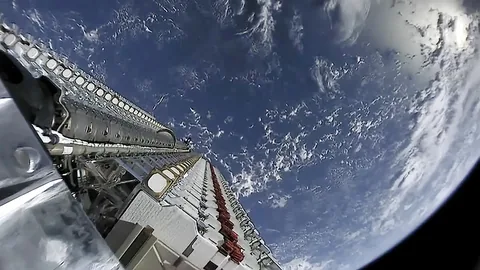
Yeah, so look, it's actually interesting. The broadband business is still very early stage when you think about the percent of households that have actually been penetrated to date. You look at the percent of global households with Starlink, it's less than 1%. And that's the broadband, you know, you kind of have a base terminal at your house, on your car, on your boat, and in airlines now as well. So I actually think broadband can scale to hundreds of millions of terminals, hundreds of millions of users. And today the subscriber base…
Hundreds of millions if they get rapid reusability of Starship, which is really hard, you know, if there's not competition. Hundreds of millions, it's possible, but maybe…
I always say around here, it's funny, I love seeing PM and kind of analyst32PM (portfolio manager) — the person who makes the investment decisions; the analyst researches companies and industries for them. in this situation.
It's exactly what I do with Clark. Clark will say something, I'll say the future is a distribution of unknown probabilities. It's either more likely or less likely. So give me the distribution. Are we talking 20%, 30%? It's hilarious.
Well, no, 100%, same thing. And, like, I've watched Elon do many hard things, and this is a really hard thing. So I think it's reasonable to think that they're going to succeed with rapid reusability, but I just think it's important to acknowledge that, like, orbital compute, you know, Starlink, you know, Starlink V3, Starlink Direct to Cell,33Starlink V3 — third-generation Starlink satellites: up to 1 Tbps down from each, about ten times V2. They weigh about two tonnes, too much for Falcon 9, so Starship will launch them, up to 60 at a time. we need first reusability for Starship V3, and then rapid reusability unlocks a lot of this.
Source: SpaceX prospectus (S-1/A), June 2026, Connectivity segment
When I see the models that the banks are putting out there, right? And Wall Street Journal, everybody's reported on these. These things have been widely leaked. They largely have the revenue on connectivity, so let's call it Starlink, direct-to-cell, etc., going from, you know, let's call it 10 billion to 50 billion by 2028. And so I'm not asking you guys to, you know, to tell me your specific numbers, but when I'm talking to Clark, all I'm trying to size up is order of magnitude.
Do we think we can 5x the business over the course of the next three years? Is there enough TAM, both in terms of broadband and direct-to-consumer? And I think the answer to that is yes.
Yeah, here's what I'd just say very simply: I travel with Starlink. I'm a big video gamer. And very consistently, wherever I am in the world, Starlink is the best connection. It's the fastest, it's the lowest latency.34Latency (ping) — the time a signal takes to reach a server and come back; in online games it matters more than speed. Starlink satellites fly in low orbit, and their latency is tens of milliseconds, versus 600 ms or more for satellite internet through geostationary satellites (Wikipedia, "Starlink"). And I do think once they get to rapid reusability, they're going to have the cheapest cost per gigabyte or megabyte delivered, and better, faster, cheaper has been a winning formula.35Better, faster, cheaper — echoes "faster, better, cheaper," the motto under which NASA, led by administrator Daniel Goldin (1992–2001), shifted to small, inexpensive missions.
And so 50 billion, that's, you know, 0.3% penetration of the global telecom market.36The size of the telecom market. Global telecom services revenue, by Insight Research's estimate, is $2.2–2.4 trillion a year (Wikipedia, "Telecommunications industry"): $50 billion is about 2% of that. Gavin apparently measures "penetration" differently, by number of subscribers, for example. Now, maybe there's some deflation with Starlink pricing. But that's the way I'd frame it up. I like betting on better, faster, cheaper.
04Elon Web Services
In a matter of weeks SpaceX became the number four AI hyperscaler, a business that was missing from almost everyone's models a few months ago.
Clark, I would say probably the biggest surprise of the last six weeks is that Elon… You know, we talked about it on the All-In podcast.37All-In — the podcast on technology, economics and politics hosted by Chamath Palihapitiya, Jason Calacanis, David Sacks and David Friedberg. We called it EWS, Elon Web Services,38EWS, Elon Web Services — a joke modeled on AWS (Amazon Web Services): like Amazon, Musk rents out his compute to other companies. right? That he struck these huge deals with Anthropic and Google. I don't even think people were thinking about SpaceX in the AI compute game, right? If you looked at the models as of a few months ago, it was connectivity, so Starlink, and then it was xAI, the model. But this whole category of taking all of this compute, which he's uniquely good at standing up, right, and then reselling it in a way that's highly profitable was not in a lot of people's forecasts.
Now it's a major component of the forecast. You know, you and I did this podcast with Jensen where Jensen said Elon is an N of one.39The Jensen Huang interview — Brad and Clark recorded it for BG2 in October 2024. According to Huang, it took xAI 19 days to go from the decision to start to having all 100,000 GPUs running in a single Colossus cluster; the whole build took 122 days.
What they achieved is singular. Never been done before. Just to put in perspective, 100,000 GPUs, that's, you know, easily the fastest supercomputer on the planet as one cluster. A supercomputer that you would build would take normally three years to plan. And then they deliver the equipment, and it takes one year to get it all working. We're talking about 19 days.
N of one is right. Elon is an N of one.
And his ability to secure supply, stand up the supply, you know, deploy it in a way that's, you know, coherent and effective for both himself and, I guess, now for others. So walk us through kind of that. It looks to me, again, like this is a major component of the revenue story.
Totally. I mean, so we were all at the Macrohard data center,40Macrohard — Musk's AI project conceived as an answer to Microsoft (macro instead of micro, hard instead of soft). In October 2025 the word was painted in giant letters on the roof of xAI's Colossus 2 data center in Memphis. and it was just very evident the amount of engineering that had gone into building these sites. You know, people always talk about Google and their ability to build a TPU and sell the TPU to Anthropic41TPU — Google's in-house AI accelerators. In October 2025 Anthropic and Google announced a deal letting Anthropic use up to a million TPUs, more than a gigawatt of capacity, as early as 2026. to generate revenues for AI. I think it's a pretty similar dynamic here, with Elon able to secure power, build these sites faster than anyone else, and also be able now to monetize it to this massive AI market that's ahead of us. If you look at the relationships that he's forged with a lot of his suppliers, you know, be it Jensen, be it, you know, all of these different sites that actually want xAI as a tenant, his ability to finance these deals at very attractive financing rates relative to a lot of the other players in the space, you know, these are advantages that compound over time.
And when you've built the credibility to stand up these sites and monetize at these levels, you know, it's actually a very attractive proposition for a lot of folks involved. And actually, you know, if you look at these deals in particular, Gavin, you pointed out, but, you know, they're actually monetizing, you know, perhaps better than other players in the space by selling this infrastructure. A lot higher.
Google is obviously paying SpaceX a huge premium for this compute. Fox, you said something that I thought was really important, which is, you know, it may very well be that in order to get, you know, first in line on space compute, which Google certainly wants to do, that they're willing to pay a premium for their terrestrial compute. And so to me, that's how you kind of square the circle as to why the premium. Any thoughts?
Yeah, look, I think there's some of that embedded there. But look, at the end of the day, SpaceX can stand up compute quickly. They can stand it up coherently, and they can stand up a lot of it in one place and have it readily available. So look, I think that's most of the premium, but outside of that, certainly people are going to space over time.
Pay a little call option42Call option — the right, but not the obligation, to buy an asset in the future at a price agreed in advance; the buyer pays a premium for that right. to get first in line for space. There you go. Good one. We've all been investing in the neocloud space.43Neoclouds — new cloud companies that specialize in renting out GPUs for AI, as opposed to the general-purpose clouds of the hyperscalers. So, like, there's a fundamental belief around this table that we lack the compute needed to continue to push the frontier on intelligence. So we have to build a lot of compute.
Okay. Now there's a competition going on. On one end, you have the hyperscalers44Hyperscalers — the biggest cloud companies, which build data centers by the hundreds of megawatts and gigawatts: Amazon, Microsoft, Google, Meta, Oracle. who are building out that capability, then we have AI-dedicated clouds that are building out that capability, and now literally in a matter of weeks, right, we have a, you know, a giant that's emerged in this category, which is SpaceX. The question to you, Gavin, is: can they consolidate this market, right? Because if I think about a marketplace, Elon has a unique ability to get the supply, he has a unique ability to cut deals on the other side, and nobody can stand it up like he can stand it up. So I think there might be a real consolidation in the AI compute market where you have the hyperscalers on the one hand, and on the other hand, you know, he may emerge as the largest, strongest player in the AI compute market.
Yeah, so I think they are… Are they the number four or number five hyperscaler today, after the Google deal?
It will be number four.
Kind of wild. In 30 days, we went from not being an AI hyperscaler to being number four, and we passed a lot of companies, including Oracle.45Oracle — American company known for databases and enterprise software. The AI boom made its cloud a major compute supplier: in 2025 Oracle joined the Stargate project with OpenAI and SoftBank and, according to the WSJ, signed a contract with OpenAI for about $300 billion of capacity over five years.
CoreWeave is a huge business, right, that we're investors in, you know, and have been investors in, right? But there are a lot of other players, the Nebiuses of the world, the IRENs of the world.46CoreWeave — the American neocloud, the largest lessor of Nvidia GPUs. Nebius — a neocloud headquartered in Amsterdam that grew out of Yandex's international business after the company was split up in 2024. IREN (formerly Iris Energy) — an Australian company that moved from bitcoin mining to renting out GPUs for AI. And I would say that there are probably 50 neolabs47Neolabs — new AI labs founded by alumni of the big ones, such as Mira Murati's Thinking Machines Lab or Ilya Sutskever's Safe Superintelligence. being funded in Silicon Valley right now, as we speak, because of the shortage in compute.
05Data centers aren't commodities
Baker rejects the idea that data centers are all alike: Musk designed his from first principles, the way he did the rocket and the electric car.
Absolutely. So that's kind of crazy, in 30 days. That's just extraordinary. What I would say is, I think there is a belief that these data centers are commodities. And I do not share that belief. I don't think anybody around this table shares that belief.
And in the same way that Elon was able to re-engineer a rocket from first principles48First principles — Musk's favorite method: break a problem down to the basic physical facts and build the solution up from them rather than by analogy with what others do. For example, work out what a rocket should cost from the price of its materials, not from the price of existing rockets. and make it reusable, he engineered an electric car from first principles. You know, everyone else was trying to, you know, make an electric car like an internal combustion engine car, and he thought about it differently. And I think he looked at data center design from first principles, and he designed something fundamentally different. And I did actually ask the team, I said, "Hey guys, maybe be a little less public about things that are very obvious to you about how to design a data center but are revelations to other people," because I think what you're doing is maybe more differentiated than you perhaps realize, because what you're doing is so logical to you, but maybe not logical to everyone else.
And that's how he was able to do it in 122 days.
Yeah, I mean, to that point, Brad, yesterday we were meeting one of our portfolio companies, and we were talking about behind the meter,49Behind the meter — power generation that sits on the customer's site and feeds it directly, bypassing the public grid. and we're, you know, really thinking about it. There's only maybe two or three players now that can actually reliably engineer a behind-the-meter data center. And, you know, there's real engineering work that goes into all of this.
So if you think about this, if you're a gas combustion… if you're Vernova50GE Vernova — the energy company spun off from General Electric in 2024, one of the world's largest makers of gas turbines. and you say, "We only have a certain number of gas combustion engines, now we can sell them to xAI, or we can sell them to one of these startup neoclouds." Who are you going to sell them to?
Well, and there's another dynamic. Everyone starts making more money when the GPUs get energized and sold faster. So literally speed is money for all of the suppliers: power, land, turbines. So I think we'll see. Hey, Brad…
06The economics of orbital compute
Orbital data centers aren't needed for the IPO valuation, but a gigawatt in space could cost far less than one on the ground, as long as the satellites don't fail too often.
But this is just… we're just talking terrestrial. I do want to hit on, and then you can flip it back on me… Talk to me. Okay, so let's assume, right, that they continue to build out the terrestrial landscape. They continue to find buyers for that. Walk us through, you know, what this unlocks, you know, and how this is related to space data centers, because I think, you know, once you start talking Terafab capacity51Terafab — Musk's chip manufacturing project in Austin, Texas, announced in March 2026. and beyond, so we're talking a thousand gigs, right? And this year, what we're doing, 25 or 30 gigs, just to put it all in perspective.
20, 25 gigs.
Okay. So once we start scaling up, walk us through: do we have to have space data centers in order to get excited about buying the IPO, right? And then there's obviously this debate in the world. I heard Jeff Bezos say, you know, "I think it's more like six years," but Elon's going to say three, because if he says six, then it will take even longer. So say three, and we may get it in four or five. But are space data centers integral and essential to, you know, the IPO, and what do you think the timeline is, to either of you guys?
So I don't think… I think if you think about those variables around what Cursor could mean for xAI… And we do have an existence proof that once you really get on that Pareto frontier, revenue can scale rapidly, and it's called Anthropic. And there does seem to be a lot of demand for coding. And I do think Amjad Masad52Amjad Masad — co-founder and CEO of Replit, a browser-based coding platform with a built-in AI agent. posted something very interesting.
The founder of Replit.
The founder of Replit, yeah. He called it bitter-lesson-adjacent:53"The Bitter Lesson" (2019) — computer scientist Richard Sutton's essay: over 70 years of AI research, general methods that scale with computing power have again and again beaten approaches built on human knowledge of the task. that coding may be the fastest path to AGI and ASI,54AGI (artificial general intelligence) — AI that matches humans at most tasks; ASI (artificial superintelligence) — AI that surpasses them. because if you're really good at coding, you can write code, if a model's good at coding, to do anything. So I think that's a profound point, and I think coding is going to continue to be very important. So I think if you think about that variable, if you think about Starlink Direct to Cell enabled by Starlink V3, and you think about how quickly they can or cannot bring on terrestrial compute, I don't think orbital compute is necessary for the IPO valuation, but it's certainly important, and it's… well, maybe…
Another way to say it is, you may think we're going to get to ASI faster than we're going to get to orbital compute.
That may take us from 300 IQ to 400 IQ, 500 IQ and beyond, and the ability to scale it up to consume 10% of, you know, global GDP. But maybe that's where we should move next.
No, no, I think on orbital compute, I think Foxy would be great, or Clark, to lay out the math from first principles on… You know, Clark has this great chart on, you know, the gigawatts it costs, you know, the dollars per gigawatt. Great. Walk us through the economic case.
Yeah. Yeah, so I mean, on this point of: is orbital key to investing here? I don't think it is. And the first point I'll make is, what are the implied monetization rates based on expectations today for the AI business? You know, I think you threw out the $160 billion number that's been leaked out there that people are talking about. The implied monetization rate on that number is something like $14 billion per gigawatt per year for the AI business.
They just signed Anthropic at 22 to 23. They just signed Google at 50. Right? So I think you can invest behind the AI business terrestrially and still be excited about it. But with orbital…
Excited about it if they can get the land and the power.
Right. But I mean, I think for most investors, yes, right, they have an easier time getting their head around how SpaceX wins terrestrially. Like, can they go get land, power and chips? The answer to that is high probability yes. Yeah. Okay.
And what we're saying is, at the rate they're monetizing that, that gets you to the numbers that are being leaked out there before you even have to take the leap of faith that they're going to extend the lead with orbital data centers. But take us there on that too.
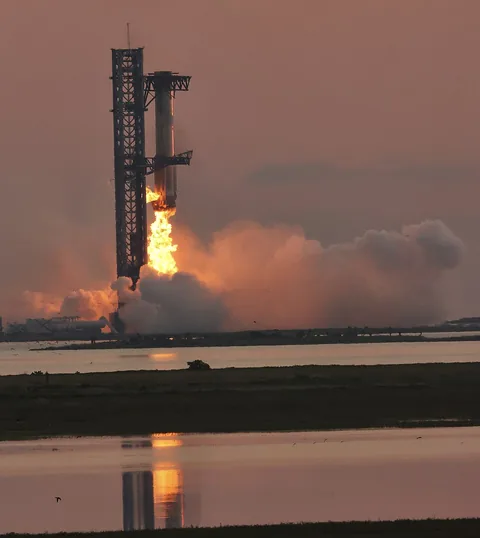
Yeah, so look, with orbital, I think the key thing is two-stage reusability. And beyond that, rapid two-stage reusability. So today with Starship, they've shown that they can successfully re-land the booster. The second stage, we'll see what happens later this year. I think they're attempting to bring that back and then make it reusable by next year. But the thing that's important about two-stage reusability when it comes to the economics for orbital compute, right, is the cost per kg comes down significantly.
We're talking about going from $1,500 per kg on Falcon, somewhere in that range, to 250 per kg, something lower. And the more that you can reuse the rocket, the more that price comes down, right? Because you're just depreciating the cost of the launch. And eventually you asymptote to the cost of the fuel, right? Assuming you can use a rocket forever, which will take a very long time for us to really achieve. But at that point, we're talking about something well south of 250 per kg. So then you look at the specs of these AI satellites. You know, Elon did a great…
Yeah, that pod was incredible, that he laid out the other day, the specs on the satellites.
It was really great, because I think they are finally showing people, here's how you could viably design one of these satellites, and how heavy is the satellite, how many could you fit into a Starship launch? And when you back into the numbers, you get to something like five megawatts of capacity per Starship launch. There's 100 metric tons in one of those Starships, so you can back into the math of how much will it cost per gigawatt to launch these satellites into space, launch this compute into space. And the math that you get to, before you account for things like bad GPUs, bad satellites, right, these will all be things that happen, but the math you get to is it's about $5 billion per gigawatt of capex55Capex (capital expenditures) — investment in long-term assets such as buildings, equipment and chips; here, what it costs to build compute capacity. to put these in space, right? For comparison, terrestrially, talk about the switchgears, the generators, the transformers, the shell, getting the power, that today is about 20 to 25 billion per gigawatt. So we're talking about a 5x reduction in cost on half of your bill of materials for the data center, which is a huge number.
ExplainerWhat's good and what's hard about a data center in orbit
In a sun-synchronous "dawn-dusk" orbit along the terminator, a satellite is in sunlight almost all the time, and above the atmosphere each square meter receives about 1.36 kW of solar radiation. Because of night, clouds and a low sun, a panel on the ground produces only 10–25% of its peak output over a year, while in such an orbit it runs near its maximum, with no batteries for the night, no land, no permits and no grid connection.
The weak points are different:
- cooling. A vacuum has no air or water, so heat can only be radiated away by radiators: at room temperature that takes on the order of a thousand square meters per megawatt, so "free cooling" is actually the bulkiest part of the satellite;
- radiation upsets and ages ordinary chips, so they need shielding or spare capacity for failures;
- repairs. No one will replace a burned-out GPU or transceiver in orbit; broken hardware is simply switched off.
So the whole economics comes down to the cost of putting a kilogram into orbit: at today's prices the project doesn't work, but with a fully reusable Starship it might.
Just very simply, I mean, just to put it: it costs 60 billion dollars to put a gigawatt on the ground today, and we'll call it 35 of that is the GPUs and the silicon that's doing the training and the inference,56Inference — running an already trained model: answering users' requests. Training creates the model; inference brings in the revenue. and 25 billion is the land, the shell, the power and the cooling. I would hypothesize that those elements are probably going to be inflationary. So that 25 billion may not go down. And because space, power, cooling are effectively free in space, and when I say space, I mean land…
There's no land in space, but there is a lot of space.
There's a lot of space in space. You're talking about putting a gigawatt into space for 30 billion and having lower operating costs. Now, the dynamic: versus 60 billion that's inflationary, that 30 billion, that five, may be deflationary over time. But what we need to consider is, you know, the reliability and the maintenance. And so as long as, you know, everybody can do the math, but as long as these satellites in space aren't failing at an astronomical rate, the math maths. And by the way, we know GPUs melt and lasers fail.57Lasers — that is, the optical transceivers linking GPUs in a cluster, in which lasers send the signal over fiber. We know this happens in data centers, particularly during big training runs. Yeah, I mean, GPUs melt.
So as long as the reliability and maintenance is not dramatically lower, the math is there once we have reusability and then rapid reusability for Starship V3.
07The most underrated variable: the model
Gerstner thinks xAI's own model gets the least attention and could be the biggest upside surprise.
When we look at this, okay, so we went through Starlink, and we said, okay, like, it just stands to reason we're going to have direct-to-cell on Starlink. Like, the assumptions there are, you know, again, seem like you can get your head around. Then when it comes to building terrestrial data centers, again, not a hard one to think that, based on these couple deals, Elon's going to build a much bigger… Starlink's going to build, or SpaceX is going to build a much bigger business there. And then you have this call option on space that would drop the price even further. The one thing we haven't talked about is their model, right? And I find this surprising, right?
Six months ago, xAI was competing, they were doing pretty well, but they've done something dramatic over the course of the past couple months, which is they bought Cursor, right? Cursor is 700, 800 people, was already doing incredibly well from a revenue perspective. Our own projections were that they could exit this year at up to 10 billion dollars of revenue.58Exit the year at — reach an annualized revenue run rate by year-end: monthly revenue that, multiplied by twelve, gives that figure. So they were growing very fast. One of the leading coding agents, but they also had this incredible team with the potential, right, to really build a frontier-level model, but they were compute-constrained. So all of a sudden they get bought by X.59X here means Musk's companies in general: in March 2025 xAI absorbed the social network X, in February 2026 SpaceX absorbed xAI, and it is SpaceX that is buying Cursor.
X has massive compute that they can now train on. And when I think about the revenue in AI, that, like, if I look at that line item in the models, having it go from $10 billion to $150 billion, yes, a lot of that will be the CoreWeave-type business that they have. But the question is how much of that is going to be the core xAI business that's really powered by the new team from Cursor. So any thoughts on that, Gavin?
Right now, so Composer 2.5 was Pareto dominant 12 days ago. It was trained on the Kimi K2.5 base model.60Base model — a model after pretraining, before fine-tuning and reinforcement learning; finished models are built on top of it. Now what's happening is the Grok 4.3,61Grok — xAI's family of models. In late May 2026 xAI finished training its V9 base model with 1.5 trillion parameters; on June 28 Musk announced internal testing at SpaceX and Tesla of Grok 4.5, built on it and fine-tuned on Cursor data. 1.5 trillion parameter model62Parameters — the numbers (weights) of a neural network that are tuned during training; their count is a rough measure of model size. Kimi K2, for example, has a trillion parameters. is training. One would hypothesize, based on scaling laws,63Scaling laws — empirical regularities: model quality rises predictably with the number of parameters, the amount of data and the compute spent on training. that that might be a better base model. And then the Cursor data is being injected into the pre-training process,64Pretraining — the first and most expensive stage of training: the model learns to predict the next token on a huge body of text. Reinforcement learning comes afterward, on top of it. not just reinforcement learning. And we'll see, and I think that is going to be a very important data point when that comes out.
And I just think everyone should keep in mind that once you are at multiple places on that Pareto curve, if you have compute, you can scale really rapidly.
You know, that to me is, if I had to say what the one piece that's being lost in the story, right? Like, it's easy for everybody to get excited about the deals with Anthropic, because you can put your hands around that, you know how much revenue it is. I see debate about, you know, the 90-day termination65The 90-day termination. Under terms SpaceX disclosed before the IPO, either side can end the compute leases on 90 days' notice: the Google contract, for instance, from 2027 on. and how long they last and what multiple do you put on those revenues.66Multiple — how many times a company's valuation exceeds its annual revenue or earnings. The more reliable the revenue, the higher the multiple, so revenue from contracts that can be ended on 90 days' notice is valued more cautiously. But I think the thing that's getting lost is, I think they've dramatically advanced their capability when it comes to building a frontier model. People outside Silicon Valley may not know, you know, Michael and the team at Cursor67Michael Truell — co-founder and CEO of Cursor. as well. This is an extraordinary team that he just downloaded right into SpaceX.
SpaceX was already building good models. And what they have is this way to monetize compute that gives you this call option that you can pull all that compute in-house, right, to train a model and then to run the model. I suspect if there's an upside surprise, if we went around the table, I'd say this is the place that's getting the least amount of attention and could have the biggest upside surprise. Any thoughts, Clark, on what you think is being overlooked, or areas that you think are misunderstood about the business today?
I would say what the last few weeks have proven is that Elon, their team can stand up all this compute. Actually, if you just, you know, went back one and a half years, you know, they were behind in the race to stand up compute. They didn't have that many H100s.68H100 — Nvidia's AI accelerator on the Hopper architecture, unveiled in March 2022; for several years it was the main chip for training large models. They brought in Colossus, then they brought in Colossus 2 at a scale much larger than anyone else. And now, you know, as we gear for Vera Rubin,69Vera Rubin — the Nvidia platform succeeding Blackwell: the Vera CPU and the Rubin GPU. Systems based on it start shipping in the second half of 2026. you know, from a lot of my conversations, it looks like they've secured maybe up to 20% of Vera Rubin capacity, especially in the early days, when, you know, these chips are very scarce, that they're going to have a lead on all of this, because, you know, people think that they can stand up this compute better.
So I think, you know, what the last few weeks have actually shown is that Elon will take, you know, take a shot at hitting the frontier, but if for whatever reason they have overprocured some capacity, this is a very scarce asset that they have shown that they can monetize at actually, you know, best-in-class margins and payback periods.
The irony is, like, you know, you and I've been doing this long enough to know. I mean, that's why Bezos built AWS, right? He had to build capacity for Black Friday.70Black Friday — the shopping day after Thanksgiving in the US that kicks off the holiday season. AWS launched in 2006. The story that Amazon started renting out capacity left idle after the holiday rush has long been popular, but Amazon has denied it: CTO Werner Vogels called it a myth.
Yeah.
Right. But then the rest of the year he sat on all this capacity they had to build, and he figured out a really incredible way to monetize this. And by the way, investors at the time, 2009, 2010, when he was building out the capability around AWS, hated it because he was consuming all that free cash flow.71Free cash flow — the cash a company's operations generate after capex; it funds dividends and buybacks. Meanwhile, he was digging the biggest gold mine in the history of the world. One of the biggest. Among them at the time was probably the biggest. Yeah, Google Search might want to have a discussion.
By the way, I do think it is important: Grok 4.3… I think the Cursor, if they acquire it, that may end up being very important, but Grok 4.3 was on the Pareto frontier as of 10 or 12 days ago, and these things move fast. Most intelligent 500 billion parameter model in the world. And they were on the frontier, and there are four companies on the frontier: xAI, SpaceXAI; Google, one with Gemini 3.1 Pro;72Grok 4.3 was released by xAI on April 30, 2026, and Google's Gemini 3.1 Pro on February 19, 2026. and then the rest of it was dominated by Anthropic and OpenAI. But they were on the Pareto frontier, and now we'll see what they do with Cursor.
I want to come back to that in a second. By the way, man, I want to ask you some questions.
What do you think? So you think the biggest source of potential upside is the model?
08Bulls and bears
Gerstner concedes that few companies have ever grown revenue eightfold in three or four years, but piece by piece the SpaceX forecast looks achievable.
Yes. I think that's the thing that's least talked about. Right. And so listen, when I look at the bull-bear case on the IPO, right, the bears are looking at last year's revenue, so it was $18 billion, and they're looking at the forecast from the banks of $160 billion, you know, three years from now, and they're saying, "Listen, not many companies in the history of the world have basically 8x'd their revenue over three to four years," right? So that's where, you know, I think people get nervous about the valuation.
When I look at this, again, when you break it down as an analyst, first principles, part by part, which is what I tried to do here, right? When you look at Starlink, it looks totally doable. When I look at what they're building in AI compute terrestrially, looks totally doable over the course of the next three years. When I look at the model itself after the acquisition of Cursor, you know, combining those things around the compute they have, that looks to me like it could be an upside surprise. So I would say that, you know, in the IPO… but I think when you look back three years from now, there's a decent chance that everybody's like, "Oh my God, that was super obvious," right? Even though today all of these things have risk associated, back to where we started.
None of us are here to pump the IPO at 1.77 trillion. It's really to just break it down as we do inside our shop and to say, what is that distribution of future probabilities? What's the probability that it's higher from here? What's the probability… And I think we're all pretty AI-pilled. And if you're AI-pilled, that means we got to build a lot more compute than the world thinks, and that these models are going to be a lot more valuable than people think. You combine that with their core business.
I don't know another entrepreneur or another business that's a better bet on the future, right, than SpaceX. And so I think for most institutional investors, it's a must-buy, a must-own. It's set it and forget it, right, in order to have a real bet on both the space and the AI future.
From your lips to God's ears.
09Post-IPO drawdowns and lockups
Post-IPO volatility is almost a given, so the core position is set and forgotten while its size moves with the market.
I mean, listen, again, I think that you're going to have to wait, but, you know, we had this chart last week, right, that came out, everybody was sending around Twitter, conveniently timed, and, you know, it shows the average max drawdown post-IPO73Max drawdown — the largest fall in price from a peak to the following trough, in percent. for, like, 20 companies, from Facebook, Twitter, Alibaba, Shopify, is, you know, over 50%. And so maybe that, again, we'll end this section here. You know, Gavin, you and I have been doing this a long time. We know it's going to be bouncy around the IPO. You know, how do you as a manager try to manage that? Do you try to trade around the IPO?74Trading around a position — holding a core position while adding on dips and trimming on spikes.
Do you set it kind of and forget it? I would say from an Altimeter perspective, what we tend to do is we take a base position that we set and forget, right? And then we may size up or size down depending upon how the market reacts in, you know, a particular moment. But any thoughts on this chart, or, you know, how you guys are thinking about it in particular? You obviously own a lot going into it.
First, agree with absolutely everything you said, and I actually think about it the same way: set it and forget it. You've talked about you have ballast, you move around, and you move the ballast to one side of the ship when you want a ship to lean into the wind to go faster, and you move it to the other side. You don't want the ship to tip over. I think that's a great analogy. Think about all important companies in the portfolio the same way. So 100% agree.
I mean, this chart is a bummer. What I would say is, you know, this data on IPOs… but what I would just say is this is a really unprecedented situation. We've never had an IPO this big. We've never had an IPO that's going to go into an index this quickly.75Fast index inclusion. In March 2026 Nasdaq adopted a rule for fast-track inclusion of the largest new listings in the Nasdaq-100. SpaceX joined the Nasdaq-100 on July 7, 2026, less than a month after it began trading. We simply do not know how much selling there will be from investors.
I would hazard a guess… I mean, I don't know, but Elon, I don't think he needs liquidity, and I think he owns… what does he own, Foxy, 50%?
50%. And by the way, he's locked up for 365 days, 366 days, so we know he's not selling.76Lockup — a ban on shareholders selling for a set period after an IPO. According to the SpaceX prospectus, Musk and some large shareholders can't sell for 366 days; other insiders are released gradually, with the first big tranche freed after the first quarterly report.
So I just think it's an unprecedented situation, and the right answer is I don't know what's going to happen in the short term. And the right answer that I would just, you know, encourage every investor making their own decision is to just think exactly the way you articulated it. We have these different levers, we have these different variables. Think about each one of them from first principles, make your own decision, do your own due diligence, be thoughtful, but there are a lot of variables here. And then it is a little funny to me that, you know, it was 100 times trailing TTM revenue.77TTM (trailing twelve months) — revenue over the last twelve months. Well, after the deals they signed, I think it's at 39 times. That can change fast. So they added 29 billion dollars in a month.
Yes. No, by the way, have you ever seen that happen?
Never. Never.
And, you know, it just goes to show, first, Elon is not only a great engineer, he and Gwynne78Gwynne Shotwell — president and COO of SpaceX, with the company since 2002. and the team are great at business, and they understand what needs to be done to raise the capital to get to the next phase. They have a long-term mission in the business. And so to me, again, what we saw in the course of the last few weeks with Cursor, what we saw with these deals that they cut, I don't know that any of the Mag 779The Magnificent Seven — the seven largest US tech companies: Apple, Microsoft, Alphabet, Amazon, Meta, Nvidia and Tesla. could have moved that quickly to adjust the business the way they did. It's exceptionally entrepreneurial at scale, which we very rarely see in businesses. Two other things I would just say…
Can I give you a hug, Brad?
Two other things I would just say. Number one is, people talk a lot about the total amount of capital being raised. If you add up the capital here, right, for Anthropic, what they may raise, what OpenAI may raise, what, you know, SpaceX may raise, let's call it 250 billion dollars. That's 1% of the Mag 7. Okay, it's 1% of the Mag 7. Yeah, and we will as well. You know, like, that to me is, like, a bet on the future that we all believe in.
And so if I said, where are we out of consensus, what is our variant perception?80Variant perception — investor Michael Steinhardt's term for a well-founded view that differs from the market consensus. We actually think it's going to be bigger, faster, and we've thought that for a couple years. So first, it's only 1% of the Mag 7 market cap. And then, you referenced it, the amount of selling. I've got a chart we'll post here. This is, you know, the dribbled share release for SpaceX shareholders. You know, so there's not a lot that can be released up until after the first earnings.
We saw this in the Cerebras IPO.81Cerebras — American maker of wafer-sized AI chips. The company listed on Nasdaq in May 2026; its insider lockup was also lifted in stages tied to quarterly reports. There's a version of it here in this IPO. And so, again, I think the banks have been thoughtful here, knowing that this is a very large IPO. And I'm not saying that won't trade down. Like, there's possibility, you know, these things trade down. But again, for me, telescope out: is there any company better positioned as a bet on the future?
I think what they've shown over the course of the last five weeks, they're probably number one. But let's move on.
No, no, can I just say one thing about the employees? I think another thing that's unprecedented here is the employees, and to a large degree the investors here, have had liquidity every six months,82Liquidity — here, the chance to sell shares in a private company for cash. SpaceX regularly held tender offers in which buyers purchase shares from employees and early shareholders at an announced price. for, like, the last 10 years. So if you're a SpaceX employee or former employee and you wanted to sell, you've had, whatever that is, close to 20 chances. And it is a matter of historical record that large investors have been able to sell.
So I would think a lot of the people, they've chosen to own it. Now there's a new valuation, we'll see what they do, but just, this is utterly unprecedented, and we'll see.
Yeah, no, it's a great point. We've in fact called these companies quasi-public. You and I both know that SpaceX, and I put Anthropic in this category as well, Databricks in this category.83Databricks — American company that makes a data and AI platform. These things in many ways have been more liquid over the course of the past three years than some public biotech companies we know. And so there's a continuum of liquidity here.
10Fable 5 and snapshot benchmarks
Gavin argues we don't know how smart the new models are because no one has let them run nonstop for a year.
We treat it as a binary, private versus public, but it's really about this continuum. You know, let's keep going on models. You know, Anthropic launched Fable 5, which you referenced, yesterday, which is basically Mythos with some classifiers84Classifiers — separate models that check the main model's requests and responses and stop dangerous ones, such as instructions for making biological weapons. Anthropic calls its filters constitutional classifiers. and safeguards around cyber and biology, chemistry, and distillation.85Distillation — training one model on the outputs of another; this safeguard makes it harder to harvest Fable's answers to train other companies' models. When those things get triggered, it fails back to Opus 4.8. You know, there's a Karpathy tweet86Andrej Karpathy — AI researcher, a founding member of OpenAI who led AI at Tesla from 2017 to 2022. On June 9, 2026, he wrote that Fable 5 is the same base model as Mythos with extra safeguards, that it is the best by a wide margin on every benchmark, and that above all it is a qualitative leap, most visible in long sessions on very hard problems. Post. about this yesterday. He said, you know, it's SOTA on all the benchmarks, but what really makes it special is long-running tasks.
Okay. You retweeted our good friend, you know, Noam Brown.87Noam Brown — OpenAI researcher, one of the creators of the o1 reasoning model; before that he built the poker AIs Libratus and Pluribus. On June 9, 2026, he published an article on X, "Implications of Large-Scale Test-Time Compute": the stronger models get, the more their results depend on compute at inference, and the ceiling of their abilities is probably unknown because measuring it is too expensive, so benchmark results should be shown as a function of tokens, cost or time. His example was GPT-5.5, which OpenAI released on April 23, 2026. Post. You know, ChatGPT 5.5 also exhibited these capabilities. You know, it led Noam, right, to suggest that it's not very relevant to do these snapshot benchmarks anymore. Like, the x-axis has to be time or tokens or compute, because we can solve most problems now if we just let these frontier models run for a very long point in time. So, Gavin, what is this new class of model, right?
Fable 5, ChatGPT 5.5. What does it mean for the race in superintelligence? Who's up? Who's down? Who's still on the frontier? Give us your thoughts.
I mean, it's hard to say that Anthropic's not up. Like, after the revenue numbers they put up, after the Fable 5 release, and Mythos is evidently even better. But I just think that Noam Brown post from yesterday, polynoamial, is so profound. And just the idea that we do not know how smart these models are.
ExplainerHow AI agents' stamina is measured
In March 2025 the research organization METR proposed rating agents not by test scores but by "task horizon." Take programming and research tasks, time how long each takes an experienced professional, and see at what task length the model succeeds half the time. GPT-4 (2023) had a horizon of a few minutes, Claude 3.7 Sonnet (February 2025) about an hour, and since 2019 the horizon has doubled roughly every seven months.
The measure has a ceiling: the set has a finite number of tasks, and the longest take people hours, at best days. Once a model passes almost all of them, the test no longer shows what it can do over weeks of continuous work. That is Noam Brown's point when he proposes plotting results against time, tokens or money spent.
And maybe say more about that. Why don't we know how smart they are?
Because nobody has run Mythos for a year continuously. And we may never know how smart each generation of models actually is or was, because we don't have time to appropriately evaluate their intelligence before the next model comes out. I mean, this is a profound statement. And just imagine, okay? So I always say, like, when you think about FSD,88FSD (Full Self-Driving) — Tesla's driver-assistance system, officially FSD (Supervised): the car drives itself, but the driver must watch the road. just imagine a human being who never gets distracted, never gets tired, never talks on the phone in the car, never drinks and drives, never yells at their kids, never has to go to the back seat to give their baby a bottle. And, like, of course you would think that over time that is superior to humans who are distracted.
I don't know how long… How long can you think deeply about one topic, Brad?
Well, it can be, like, an hour. It's like an hour. A bit.
Yeah. That makes me feel terrible, because I think I can think deeply about one topic continuously, before having a stray thought enter my mind, for, like, maybe five minutes.
And then I can come back to that. Imagine if Albert Einstein had been able, instead of, you know… and maybe he could think for three hours at a time. Exactly. Clearly an exceptional intellect. But imagine Albert Einstein had just thought about fundamental physics 24 hours a day. He doesn't have to eat, he doesn't have to sleep, he doesn't have to relax, he doesn't drink, and never gets old.
Never gets old. Never has diminution of intelligence.
And he thought for one year. I mean, we might already, you know, have solved a lot of these intractable problems. So I just think that's an extraordinary thought. And just my takeaway was, however bullish I was on compute before then, I'm just a lot more bullish.
Right, right, right. So that is a… You know, we saw… that was probably what really unlocked Opus 4.6.89Claude Opus 4.6 — Anthropic model released on February 5, 2026. It was the first really long-running model that could maintain that context,90Context — everything a model keeps "in mind" in one working session: the request, documents, the history of its actions. Its size is limited by the context window, and on long tasks the model must not lose the thread. maintain that memory, solve some of these longer-running problems, right? For us, the signal was in January. We knew… we felt like that was a big moment, but then when you started to see the revenue go up, we knew that lots of people were voting independently that that was a profound moment, that they became much, much more useful. So, but one of the things that the consensus going into this year, right?
11The frontier versus open models
Contrary to the consensus going into the year, frontier models take about 90% of the revenue, even if open models may serve most of the tokens.
So the big question going into this year was: was the AI revenue going to show up? Were we going to get to these thresholds of intelligence that cause enterprises and consumers to use them more? And I think the consensus at the time, at least on this podcast, the debate with Bill,91Bill Gurley — BG2 co-host and venture capitalist, for many years a partner at Benchmark. was that open-source models, cheap tokens, were catching up on the frontier, that perhaps these models were beginning to asymptote, that people wouldn't really pay for premium tokens. And it seems to me that the evidence on the field six months into the year is just the opposite, right? That frontier tokens are capturing the vast majority of all the revenues. And that, in fact, if you believe in the long-running capabilities, and more compute allows you to do that, they may actually be extending their lead, right, on some of these models that were built on distillation. So I just open it up to anyone around the table: what are your thoughts on whether or not, you know, have we challenged this thesis that cheap open-source tokens are going to always, you know, close the gap on these frontier models, or are they extending their lead?
I think this same debate has existed since the beginning, since we started training these models to begin with, which was: hey, we're always kind of three, six months behind the frontier. But empirically, like, you can just see all of the revenue has actually just accrued at the frontier. And I think that's because every time we release the frontier, a whole new, like, slew of use cases that previously we could have never tackled before, like coding… But also, just, you know, we've just been locked at our desk for the last day, just, you know, hammering Claude, because, you know, it's just fascinating the things that now we can do with Fable 5 that we just couldn't do with Opus 4.8 just a day before.
So what are some of those things, man? I'm curious.
So I think it's really, really good at multi-agent orchestration92Agent — a model that doesn't just answer but carries out multi-step work itself: uses tools, runs code, checks the result. Orchestration is when a lead agent hands out subtasks to other agents and assembles the outcome. now. So Anthropic released a blog post about, like, six different agent orchestration patterns that, you know, they've talked about, but really, like, once you start being able to manage all these agents, the harness93Harness — the software wrapper around a language model: it gives the model tools, stores and loads memory and runs the agent loop of think, act, check. and the model itself is being RL'd with one another. They're actually being, you know, fused closer and closer together, but the model can understand, you know, the extent of your work. So, you know, one of the things, for instance, is I just threw in, like, seven of our models and just said, "Okay, like, I want to create a master view of, like, my beliefs, given all of these assumptions of all these companies, TSMC capacity,94TSMC — the Taiwanese contract chipmaker, the largest in the world; it makes chips for Nvidia, Apple, AMD and many others." like, and then, "produce me a report on all this stuff."
And, you know, the model is able to reason through all of our assumptions. Like, actually, if you believe this, this thing is inconsistent with this. Yeah, it was fascinating. And, you know, before, we'd never do that, but now, you know, I think we're just step one into multi-agent orchestration. We're going to do this even further. And that's one example. I've also dumped all my notes into it, and it's reasoned across all my notes from the last three years and said, you know, "Here are some of your ideas that were consistent.
Here are, like, you know, the sources that were actually the highest signal to what actually played out." You know, and then it was actually just super fascinating what you could do, and we've just blown through our limits.
It's unlocking all this. I mean, like, they gave examples yesterday in the release, Anthropic did, you know, a 50 million line Ruby code base at Stripe95Stripe — the payments company founded in 2010 by brothers Patrick and John Collison: payment infrastructure for internet businesses. Ruby is the programming language most of its code is written in. that was, you know, refactored in a day96Refactoring — reworking code without changing what it does, to make it easier to read and extend. versus many weeks with many people. You think about where this is impacting biology and life sciences, just across the spectrum. And to me it really gets back to this fundamental point. Number one, if you believe this to be true about long-running agents, then we're going to produce and consume more tokens in the future as far as the eye can see. So the world… this gets me back to, you know, Terafab and space orbital and all this, because we may in fact unlock real thresholds of intelligence, but we're going to have to let these horses run for a long time in order to get there.
Yeah, I'll just say two things… Two things can be true. The majority of economic value may continue to accrue to the frontier. And man, has it ever accrued to the frontier thus far, and for sure the first six months this year. But the majority of tokens consumed in the world may be open source.
And they are today.
Yes. And I think that this current state is likely to persist.
Harvey had a great blog post that they put out on X, and they used… And it's just amazing how everything gets out of date, like, in five days, you know. But they used their own proprietary legal data to do reinforcement learning and supervised fine-tuning with Fireworks97Harvey — American startup that makes an AI assistant for lawyers. Fireworks AI — a platform for running and fine-tuning open models. on an open-source model. And then they used a router, a router being something that picks which model you send which query to and which model you use to check which model. And they got better outcomes than an Opus 4, either 4.7 or 4.8, at a lower cost. And I think that is the future. And the reality is they were still consuming a lot of Opus, but a majority of the tokens they were processing probably were in their own open source.
We hear the same thing. We did an enterprise survey that we'll post of 300 companies: which ones were optimizing. So these are folks who are kind of looking at model routing and saying, "We're going to send certain tokens over here." Which ones are thinking about optimizing, which ones aren't optimizing yet. And then what is their expected use of frontier model tokens, right? And they're all expecting to consume a lot more, even though they're already in the process of optimizing. Think of it in the context of JPMorgan.
If they're doing some back-of-the-house stuff, right, on customer service or whatever, they may very well use an open-source model. Now, I think they're loath to use Chinese open-source models.98Chinese open models — DeepSeek, Alibaba's Qwen, Moonshot AI's Kimi and others: their weights are published openly, so anyone can download a model and run it themselves. So they're waiting on kind of US open-source models to, you know, be able to really deliver the bang that they need. But my hunch is, for these enterprises, a lot of that back-of-the-house stuff will get routed there. That will probably be a majority of the tokens. But I think the really high-value stuff, you know, coding as an example, they don't want to write second-tier code. I think the vast majority of that will continue to be on the frontier.
You don't need Albert Einstein to book you a trip. You don't need Albert Einstein to do KYC.99KYC (know your customer) — the mandatory check of a client's identity and standing at banks and other financial firms.
But this is the debate we had literally at this table two years ago. However, if you just look at the revenue curves, right? What Bill… what folks concluded when they said that, they said, therefore the frontier models will not accrue most of the revenue. And what we're seeing right now, it's 90% of that.
That has been decisively wrong. Probably more than 90%, and it may continue to be decisively wrong. Frontier might be 90% of the economic value. Open source might be 80% of tokens. Something that I think is very important on open source is that, you know, I think there's this belief that it's bearish for AI. It may be very bearish for the frontier models, there's that bear case you talked about, but it's actually really bullish for compute and hardware, because if the frontier models are capturing less of the margin, then you're going to spend more on compute. So the better open source does, the better it is for compute providers.
I will say, I would say between spending time in the heart of, like, the West, Silicon Valley, and also spending time in Asia, there is, like, a very big, like, deep-seated belief in one versus the other, which is, like, if you spend a lot of time here, it's, like, all closed source, cloud, all traffic is going to go, you know, by way of this direction. And then you spend time in Asia, you know, the overwhelming belief is that we're going to find the right model for the right workload and we're not going to overspend. And I think, you know, I would say the next year is probably going to be the most indicative of which way this falls, because I think the reason why closed-source models have captured so much of the value is because the models actually get the intention and actually carry through the work.
And this was the first year where we actually had agents that actually carried out user intention, from just answering a chatbot request to actually producing useful work. Now the level of this intelligence has scaled so rapidly, and we continue to push against, like, the most economically valuable tasks, which are coding and finance and all these, like, knowledge work tasks. But, like, for the long tail of tasks,100Long tail — the mass of small and rare tasks: individually each matters little, but together they add up to a large volume. if open source continues to maintain a six-month lag, we might actually see a lot more open source used for, you know, our everyday tasks that we might actually… And that's basically Jensen's argument.
Right. Jensen's argument is you're going to have model routing, and we're just in a moment in time where the frontier models gained the advantage, can do long-running tasks, the open-source models couldn't do it very well. And so they're accruing all of the value, but as soon as the open-source models can do the long-running tasks as well, which is not far away, they too will grab a bunch of this revenue. Are you investors in Reflection?101Reflection AI — American AI lab founded in 2024 by former Google DeepMind researchers Misha Laskin and Ioannis Antonoglou; it develops frontier models with open weights. In October 2025 it raised $2 billion at an $8 billion valuation. No? Okay, nor are we, but I'm very impressed by Misha and the team and what they're doing. I very much want a frontier open-source US lab to win. We know that, you know, I heard you say recently, and I believe it to be true, NVIDIA, any day that they really wanted to, right?
They already have some great open-source models. They could absolutely build a frontier open-source model whenever they chose to do it. And so it's not a question in my mind as to whether or not the US is going to have a frontier open-source model. It's just a question about timing. And then, like, at that point in time, is the… you know, let's assume they get these long-running capabilities. Have the frontier labs now achieved something yet again that allows them to keep the stranglehold on the revenues?
12Nvidia versus ASICs
Nvidia has held its share against ASICs against expectations, and Gavin thinks it could release a frontier open model and undercut the economics of rival chips.
Yeah, and I just think it's… if you're… "Wow, that's a cute ASIC102ASIC (application-specific integrated circuit) — a chip built for one task. Here, the in-house AI accelerators of cloud companies and labs (Google's TPU, Amazon's Trainium) with which they hope to replace expensive Nvidia GPUs. you've built there. That is so cute. How would you like open source to join the frontier? How would you like that?"
"How do you like them apples?" So, I mean, I'm not sure that's the explicit calculation, but I do think Jensen is…
Just double-click on that for everybody at home. Yeah. If they were to put an open-source model out there, how does that impact the ASIC landscape?
Well, you might not have the revenue or the margins to fund that ASIC. And I do think NVIDIA is highly likely to be the world's dominant provider of open-source AI. And I do think Jensen will bring open source… You know, right now it's, whatever, six months behind the frontier. We might see it creep closer and closer and closer. And I do think Jensen has a big business decision. I see this, you know, chart here, so let's, you know, chop it up about NVIDIA, as you say.
But if all of his customers are going to compete with him, then why not compete with his customers? And we have all these neoclouds. So that's a cloud computing business that can compete with all these cloud computing businesses. He has his own models that are really, really good. Nemotron 3 or 3.1103Nemotron — Nvidia's family of open models; it introduced the Nemotron 3 models in December 2025. was actually really, really cool from a compute efficiency perspective. And he's always careful to release small models so as to not tread on Anthropic, OpenAI, Google's toes.
But I do think that is a choice he is making, and just, you know, if the economics change, I think Nvidia can join the frontier and become one of the world's largest cloud computing companies much faster than people think.
Interesting. Interesting. Clark, walk us through this chart.
Yeah, so I think one of the takeaways from spending time in Taiwan was there is certainly a lot of excitement around the next wave of ASICs. But I think it's, like, a very clear moment now where NVIDIA… It used to be an argument of NVIDIA versus ASIC, one or the other, and, you know, total domination of one or the other. Now, I think, every year everyone assumed that NVIDIA was going to lose share dramatically, on a revenue scale, on a gigawatt scale, on a unit scale. And actually, if you actually look at the last few years, you know, they've actually maintained their share very, very handsomely. Actually, if you accounted for the fact that Anthropic was not really using NVIDIA, they probably actually gained share, if not for… in '25, '26.
So I think what was very interesting, though, was a new class of accelerators, or ASICs. MediaTek with their new 8t versus, you know, Broadcom's104Broadcom — American semiconductor and software company; among other things it builds custom AI accelerators for big cloud companies, including Google's TPU. MediaTek is a Taiwanese chip designer known above all for smartphone processors. 8i for TPUs105TPU 8t and 8i — eighth-generation TPUs, which Google unveiled at its Cloud Next conference in April 2026, for the first time as two separate chips: TPU 8t for training and TPU 8i for inference. Google doesn't name its design partners; analysts, including SemiAnalysis, link the 8t to Broadcom and the 8i to MediaTek. actually was a big topic of discussion. And, you know, I think for ASICs the argument now is that more and more will look custom to the actual workload, and that is, like, one vector that people are moving in, versus NVIDIA now has kind of shown itself as the predominant provider of compute to a lot of the world. And for, you know, internal workloads, perhaps it will go more and more custom and more and more down the stack. And I remember just, you know, one year ago, when it was kind of a Broadcom or NVIDIA battle. It seems there's a lot more nuance now to, you know, what type of accelerators will fit which workloads and fit which customers and fit which business models. And, yeah, I thought that was a new topic… a new realization, though. I think we all kind of shared this view for a long time.
Yeah, I was just shocked. I mean, I'm out here, I did a board meeting with one of our companies, and just, you know, the biggest one thing they emphasized is, "We thought the world would be consuming less NVIDIA than it is." And if anything, Nvidia is accelerating, and they just continue to out-execute their competitors. And I think a lot of people are indexing to this OpenAI gigawatt…106OpenAI's gigawatts. In the fall of 2025 OpenAI signed three big accelerator deals: with Nvidia for at least 10 GW of systems (Nvidia planned to invest up to $100 billion in OpenAI), with Broadcom for 10 GW of OpenAI-designed accelerators, and with AMD for 6 GW of GPUs; AMD gave OpenAI a warrant to buy up to 160 million of its shares. And, you know, Nvidia has 10, Broadcom has 10. Who has six?
AMD. AMD has six, and they have warrants.107Warrant — a right, issued by the company itself, to buy its shares at a set price. If AMD's stock rises, OpenAI profits on the warrant and in effect gets a discount on the GPUs it ordered. And then Cerebras, our shared portfolio company, has a gigawatt. And that is what's on paper. What actually gets deployed, let's see. I will be very surprised if, you know, that 10 out of 27… what's that math? Let's see who's best at math. What percentage market share is that?
Yeah. I'll be very surprised if that is where they land. I think that is an extremely unlikely outcome. And especially as long as we are in a watt-constrained world, if you can get more tokens per watt, which is literally revenue, with NVIDIA than a lot of alternatives… Just, if you build your factory108AI factory — Jensen Huang's name for an AI data center: it "manufactures" tokens the way a plant makes goods, and its revenue depends on how many tokens it produces per watt. with another chip, you may save some money, but you're going to have less revenue, and the margins may be lower. And that's a point that Jensen keeps hammering, and I think is really important. And by the way, credit where credit is due.
One of the most surprising things to me in this ASIC landscape… I would say Meta and Microsoft109Meta's and Microsoft's ASICs — MTIA, Meta's in-house accelerators for training and inference (first generation in 2023), and Maia, Microsoft's accelerators for its Azure cloud. have been probably disappointing. You know who made a good ASIC?
Well, I know you know.
Yes. Jalapeño, from OpenAI.110Jalapeño — OpenAI's first in-house inference chip, developed with Broadcom; it was officially unveiled on June 24, 2026, with the first systems planned for deployment by the end of 2026.
They made a great chip. Now, unfortunately, it needs to run at a much lower temperature than the NVIDIA GPUs, which means you need to spend more money on cooling, and that consumes more power. They made a great chip.
I mean, I think the question there, and the question for everybody, is going to be: is that the highest and best use of your time? Right? Like, I, you know, I tend to think that the frontier companies… like, there's this belief that they got to be vertically integrated.111Vertical integration — a company making the whole chain itself, from chips and data centers to the model and the product, rather than buying links from suppliers. But if you believe, like I do, that the race to superintelligence, particularly as we get these recursive loops112Recursive loops — that is, recursive self-improvement: AI speeding up the research and development of the next generations of AI. working, may be over in the next two to three years, then I think focus, focus, focus, focus. You exist to build the best intelligence in the world and deliver the best intelligence in the world. And that means you have to have all the revenue, because if you want to build out the compute that's going to be required to continue to push the frontier, you have to have the revenue in order to support it.
13Does the capex math work?
Roughly $1.5 trillion of 2027 capex against $300 billion of AI lab revenue works for the panel, because the revenue is underestimated and compute prices are rising.
Source: Alphabet annual report (10-K) for 2025, purchases of property and equipment
So I think that, you know, subject to the focus question, I think they certainly did. This all brings me back to kind of a reality check, though. You know, we just got done talking about test-time compute, inference-time compute,113Test-time compute — the compute a model spends on answering rather than on training: the longer it reasons over a problem, the better the result and the more compute it uses. long-running agents. This is really the thing that's unlocked the revenue this year. It all pushes us in the direction of more CapEx. Google just raised $80 billion,114The Alphabet offering. On June 1, 2026, Alphabet announced a sale of $80 billion of new shares to fund AI infrastructure; demand let it upsize the deal, and Berkshire Hathaway bought some of the shares. right?
We've now taken the Mag 5 or Mag 7 free cash flow, you know, down dramatically, 80%, from just a few years ago. And Morgan Stanley, you've got this chart in front of you, upped their 2027 CapEx forecast from 950 billion to 1.1 trillion. I mean, we were talking about this with Jensen. That was his forecast two years ago. You know, obviously this doesn't even include SpaceX, CoreWeave, et cetera. So I think the number on 2027 is likely closer to 1.5 trillion.
And if we compare this to the total incremental inference revenue… So the thing that the market gets worried about, you know, back to my Sam Altman podcast,115The Sam Altman episode. In BG2's episode with Altman and Satya Nadella in the fall of 2025, Brad asked how OpenAI, with revenue of about $13 billion a year, could take on $1.4 trillion of compute commitments. Altman replied that the company's revenue was well above that and offered to find Brad a buyer for his shares. you know, in October of last year: can we really afford to spend 1.5 trillion of CapEx a year if we're only generating X amount in inference revenue? The thing I think that lit the fuse this year was Anthropic showed up in a major way with revenue, right? And so we have, you know, the AI lab revenue, everybody combined, at around $300 billion next year, right? So, you know, roll that out to 2027… or that is 2027, 300 billion. So we're spending 1.5 trillion of CapEx on 300 billion of inference revenue.
Does that math math for you? And what would cause you, you know, to get more nervous again about our ability to continue to make these investments? Because the second we get nervous about it, the entire semi complex is going to come down a lot.
Well, what do you think the gross margins116Gross margin — the share of revenue left after the direct costs of the product; for AI labs that is above all the compute for inference. are on that 300 billion?
Yeah, let's call it 50%.
I would guess they're probably a little bit higher than that. I might say 60 or 70. But I mean, that math starts to math. And what I would just say is I think that 300 billion is low, man. I just think it's low.
From your mouth. Yeah, exactly.
I think we end this year well over 200 billion in inference revenue, well over. And so I think the math really maths, and I do think we have to give Jensen, our friend, some credit, because he said some things that seemed outlandish. And he was conservative. He was low. He said a trillion two years ago.
And I mean, he was really low. Right. And so, like, let's give the guy some credit and think about what he is saying right now.
For sure, for sure. And listen, I would say consistently, Elon's been taking the over. Sundar's been taking the over. Sam, Dario… You know, Dario did the podcast with Dwarkesh117Dario Amodei — CEO of Anthropic; his interview on Dwarkesh Patel's podcast came out on February 13, 2026. "A country of geniuses in a data center" is an image from Amodei's essay "Machines of Loving Grace" (October 2024). Sundar Pichai is the CEO of Google and Alphabet. when he was talking about a country of geniuses in a data center. He said that will be here by 2028. He said revenues will go into the low hundreds of billions by 2028.
So let's call that, you know, 300, 400 billion of revenue by 2028. And he said that a while ago now, so he may even be revising up his number. And he said, "It's hard for me to see that there won't be trillions of dollars in revenue before 2030." And if you're on that revenue trajectory, if we're on a trajectory to 200 by the end of this year, let's call it 400 or 500 by next year, and a path to a trillion plus by 2029, then the math maths.
And we got to keep in mind that half of the spending is there for training, maybe a little less than half. What is it, Foxy?
That depends on the lab, but I would say it's increasingly less than half.
Yes. Okay. So we'll call it 35% is spending that's not revenue-generating, that is going to kind of make the next model. So I think the math maths. And there's still this prisoner's dilemma118Prisoner's dilemma — the game theory problem devised by Merrill Flood and Melvin Dresher at the RAND Corporation in 1950: each of two players gains by betraying the other, even though both would be better off cooperating. Here, no one can afford to be first to cut AI spending while competitors keep raising theirs. where, if you opt out, that may be an existential decision.
And I think, like, coming into this year, going back to this kind of what narratives were violated, you know, I think into this year everyone expected token pricing, the price of compute, it's all deflationary, and it will be kind of a smooth line, deflationary over time. But I think this year what we've seen is the opposite, and, you know, it all comes back to supply-demand. The demand side of the equation seems to be far outstripping the supply, right? And I think you look at the deals signed by SpaceX and others, the monetization rates per watt are increasing. And look, that is on a pretty nascent, small base of users, right? Like, Alex at Whale Rock119Alex Sacerdote — founder of the hedge fund Whale Rock Capital Management, which invests in technology companies. has this great way to frame it.
Less than 0.2% of people on Earth are actually using AI in an agentic way. Right? Like, I'm not a technical person, but I'm consuming 500 CPU cores in a VM instance, five GPUs, 24/7. I mean, if you draw that out to any meaningful percentage of the population, I mean, we're going to be in, you know, this kind of shortage environment maybe for some time. So I think that is all positive for this ROI question.
Man, Foxy, 100-to-one CPU-to-GPU ratio? What kind of agentic workflow?
Of course, fine. Fine. Yes. Being smart with my spend.
Good, good, good. Excellent. I will say also that ratio of 300 to 1… You know, call it 1.2, 1.5. There is also a rate that now, physically, we can only expand how much we can produce and how much we can actually increase that spend by. Whereas we're seeing the opposite right now on the willingness to pay for these tokens.
And actually, like, when the willingness to pay for these… when the monetization per gigawatt is actually increasing from, you know, call it, like, 20 billion in the best of cases at the beginning of the year to now, like, 30, to even pushing 40 per gigawatt. All of that is… it's a very heavy fixed cost base,120Fixed costs — expenses that don't depend on sales volume: here, the data centers already built and the chips already bought. Once they are paid, nearly every extra dollar of revenue goes to profit; this is called operating leverage. but all of that is, like, pure margin flow-through now. And you're actually, you know, as we scale, like, the willingness to pay for all of this, and now all of this stipulated by, like, you know, everything we're talking about, of, like, how much is open source versus not and all of these different flows, but really, like, as we're climbing this curve, you know, the revenue might actually outstrip our fixed cost base by a significant amount.
And I think that's why all the labs are pushing, you know, the gas pedal, because they all see, like, if we continue this curve, within, like, three years, you know, we're just going to be so short on all the compute.
Well, that's a… go ahead.
That's a great… I'm sorry, but, like, it's a great point. Like, if you thought you were getting… when you made these decisions in November of 2025, you thought you were getting a certain return. You may be getting triple that return today.
No way, then, no way did they think they were going to be anywhere close to break-even in this part of the curve. And the reason, like, I called it accidental profitability, that, you know, people have been talking about that, because they want to spend a lot more money on compute. They've just had a hard time doing it. Now maybe with SpaceX, you know, they could take some of those dollars and go spend them other places. But that to me is, you know, a fundamental change.
The first argument against the frontier labs was they'll never generate revenue. Okay. And then that got blown up. Then it was like, even if they generate revenue, it'll be really shitty gross margins, and they'll never be able to make money. And then kind of that's blown up. And, you know, I think now, you know, people are falling back, and they're saying, "Well, they're overcharging."
"This is token maxing." My good friend, you know, Chamath said121Chamath Palihapitiya — investor and All-In co-host. Token maxing — chasing maximum token use: employees' AI adoption was measured by how many tokens they burned, and usage ballooned for the sake of the metric itself. there's no ROI on any of this spend, it's all this token maxing. My best evidence for why… We all know, of course, when somebody puts on this much spend, like at Altimeter, we're not optimally spending every single dollar. But the question is, why are millions of independent businesses, small, medium and large, why are millions of consumers all choosing to do the same thing? They're not dumb.
These are, you know, rational economic actors that are all simultaneously saying, "I want to do this because it makes my life better, it makes my business better," et cetera. To me, that is the best evidence as to why I think this revenue can continue.
Yeah. And Clark, I think the point you made is dead on, because, I mean, you want to own asset-heavy businesses122Asset-heavy business — a company that needs a lot of physical assets to operate: plants, networks, data centers. Under inflation those assets grow more valuable, while building new ones gets ever more expensive for competitors. in inflationary environments, and token pricing is going up, and supply-demand is tightening. So totally agree.
14Market check
After the run in semiconductors, Altimeter has cut its exposure from large to medium-small and expects consolidation on the way to new highs.
You know, as we begin to find our way to the exit ramp and wrap here, one of the things I… You know, you and I have been doing this for a long time, Gavin, a couple decades, you maybe even a stretch longer than me, even though I'm a little bit older than you. You know, I always like to do a market check, because I find a lot of times that analysts come on these things and they talk their book, and, you know, there are a lot of people who listen to these things, retail investors and others, and it's just kind of like: what do we really think? And so I always characterize it as kind of small, medium and large. Like, what am I doing? Do I have small exposure on?
Do I have medium exposure on? Do I have large exposure on? You know, and if you look at what's happened in the markets, semis ripped this year. I mean, like, you've been doing this a long time. I've never seen it before, right? I've never seen, you know, the doubles and the triples across the board like we saw. But there's been huge dispersion,123Dispersion — how far the returns of individual stocks and sectors diverge: some rise, others fall, even when the index as a whole barely moves. right, in the market. Internet's down 16%, software's down 8% on the year. You know, SPY and Nasdaq124SPY — the oldest US exchange-traded fund (ETF), which tracks the S&P 500, the 500 largest US public companies. Nasdaq here is the index of the tech-heavy Nasdaq exchange. are up, but really up because of their components that are related to AI and compute.
And so the market itself has kind of struggled. Meanwhile, if you were in the stuff that we were invested in, we've all done pretty well. I think, you know, I've said it a couple times: I think if the Anthropic revenue had not shown up this year, because that was the overhang on the market, I think the whole market could be down this year, right? But that showed up. You know, we just had these huge months in April and May. For us, you know, because prices came up so much, because I have some worry about, you know, geopolitics, the macro backdrop with, you know, what's going on with inflation in the short run, and just, like, you know, needing a little consolidation in this market125Consolidation — in markets, a period when prices, after a strong move, trade in a narrow range without a clear rise or fall. to answer some of these questions, because now expectations are higher…
You know, we dialed back from what I would call large for Altimeter to something kind of like medium-small. Again, it's never all or nothing for us. It's like, what is the risk-reward at a given price? And so we think this is, you know, maybe going to be a period of consolidation on the way to much higher highs. Curious just how you run the book, how you think about it, like a portfolio manager.
Very similarly, man. I always think of stocks, the markets, I imagine them as runners. Okay? And, like, in '22,1262022 — a bear market amid surging inflation and rising rates: the S&P 500 fell 19% for the year and the Nasdaq Composite 33% (Wikipedia, "2022 stock market decline"). that runner had gone downhill. It had a lot of energy, man. It was painful, it wasn't fun. But coming out of that, there was a lot of kind of pent-up upside in the market. And, you know, the market, particularly in the last two months, has run up a very steep hill, and a lot of companies, semiconductor companies in particular… You know, ironically, Nvidia and Broadcom, they have been laggards. And so… but a lot of these… Like, I do see a lot on X about finding the next bottleneck. I think that was the last game. That game is over. You've had a lot of stocks that, forget climbing a mountain or hill, they've gone straight up a cliff. Okay? They're tired, they need to rest. And we'll see: do they just rest at the top of that cliff they climbed?
Do they hang out in their harness for a while? And we've seen, the last week, you know, we've seen some retracement. Or do they need to go downhill for a bit? We'll see. But I'm thinking very similarly to you. But it is… and I think, you know, the market is seasonal. There's real concerns around inflation and rates. What was CPI this morning?
It was 4.2.127CPI — the US consumer price index; the May 2026 figures came out on the morning of June 10: annual inflation accelerated to 4.2%, the highest since 2023, mostly because of energy, while the core index rose 0.2% for the month against a forecast of 0.3%. PCE is the personal consumption expenditures price index, the Fed's preferred gauge. I think core came in at, like, 0.2 versus 0.3, so a little bit better. But, you know, clearly we're above four again. And there's short-term pressure on, you know, core PCE, et cetera, and we have some unknown unknowns.128Unknown unknowns — the phrase of US Defense Secretary Donald Rumsfeld at a briefing on February 12, 2002: there are known knowns, known unknowns and unknown unknowns, the things we don't know we don't know. But the market, I mean, if I had told you the fact pattern for this year: that we're going to be in a war with Iran,129The war with Iran. In 2026 the US and Israel were in a military conflict with Iran; Iran closed the Strait of Hormuz, through which about a fifth of the world's oil passes. that, you know, oil was going to be at 100 bucks, that CPI was going to be creeping back up, that internet was going to be down 15%, software is going to be down 8%, you would have said, "I want nothing to do with that market," right?
Yeah. And here we are, the market's done pretty good in the stuff that we traffic in, because the world underestimated AI revenues and underestimated the amount of compute that was going to be needed.
And so I'll just say, you know, we're heading into a seasonally weak period with all these fears. AI has actually been seasonal for the last three summers. Token consumption has kind of plateaued, slowed down, and that's because, you know, college kids are big AI consumers, and they don't use as much AI… You know, hopefully they're all using it to learn and not cheat.
But that may happen.
It may not happen, because my 15-year-old is building swarms of agents, building a SpaceX model. He's going to the SpaceX IPO with me at the exchange on Friday. But he had to build a model using AI agents, he had to build a model, a DCF,130DCF (discounted cash flow) — a valuation model that prices a company by discounting its future cash flows to today's value. before we go to the exchange. He is mesmerized. He is absolutely… and it's extraordinary what he's built.
So he's one kid who's not using less compute. He's burning… Yeah, but, you know, if token consumption plateaus, if open source takes some share… There's a Silicon Data index131Silicon Data — American company that publishes price indexes for AI compute, including GPU rental. that has showed… which is an index of kind of consumption and pricing. I think there may have been a little bit of a shift over the last two weeks to open-source tokens that are cheaper. I think people looking at that data as bearish are not understanding it.
But nonetheless, like, I just think there's reasons, you know, to look around, be careful, be thoughtful. I always assume a bullet is coming for me, head on a swivel. It's the bullet you don't see that gets you, so I'm trying to spin as fast as I can. But, yeah, the market may need to take a breather. But man, when I think about what Noam Brown said, and when I see the capabilities of Fable, it's just hard for me to get too bearish.
15The next trillion
By Gerstner's math, three companies will add a trillion dollars of revenue twice as fast as the Magnificent Seven did.
I mean, like, to me… And we got two, I think, of the most extraordinary guys of, you know, the next generation, you know, sitting in the room. We at Altimeter have deep admiration for the work that you guys do. I always appreciate when you send me a note about the work that we do and we publish. But for the guys who are newer to the business, they might think this is the way that it kind of always was, right? And, like, this line, the steepening of the line of creative destruction,132Creative destruction — the concept popularized by Austrian-American economist Joseph Schumpeter in "Capitalism, Socialism and Democracy" (1942): new technologies and companies constantly destroy old industries and so drive the economy forward. the steepening of the line of, you know, scale advantages… I always believed it was going to be true.
I never thought it would be true at this rate. I went back last night. In the last seven years, we've added one trillion of revenue to the Mag 7, okay? To get to the first trillion took over 20 years. In the last seven, we added another trillion, and that trillion dollars added 17 trillion in market cap. Okay.
The forecast now is that we're going to add another trillion of revenue in just three companies, SpaceX, Anthropic and OpenAI, over the next four to five years. Okay? Like, not seven companies, three companies, and in half the time, right? And so I would say that, you know, we are going to have bumps in the road. I know that it's going to be like this, but we're going to higher highs, because the size of the prize… This is going to transform 5, 10, 15% of global GDP. There is no doubt in my mind.
And 10% of global GDP is $10 trillion. It's an exciting future to be a part of. It's fun to do it with you guys. I think we're going to have to do our work to do the things to make sure America wins, and that we evolve the social contract, keep everybody… you know, lift the floor, take everybody with us on this ride. But it's a really exciting time to be doing what we're doing. It's fun to be doing it with you guys.
Yeah, I just want to say, Brad, thanks for having us, and thank you for what you've done with the Trump Accounts.133Trump Accounts — investment accounts for children created by the One Big Beautiful Bill Act (July 2025): the government deposits $1,000 into the account of every US citizen child born in 2025–2028, and the money is invested in funds tracking US stock indexes. Gerstner promoted the idea for years through his Invest America initiative. I actually think it's super important for America, for the world, to give people an equity stake at a very young age. They will see it compound over their lifetimes. This is a great thing you've done for the world, so thank you. I'd echo all your comments: like, deep admiration for you, your team, gratitude for the collegiality and friendship between our firms. I know Clark and Foxy, they hang out, like, all the time.
That's what people think, that, you know… And there are people in our business who don't want to share anything. Our view is, like, we open-source it. But there are very few people who we actually call and ask their opinion, because there are very few people who do the thousands of hours of work that we do, that, you know, that are adding to that. And you do it, and we appreciate that, and you do as well, Gavin. We appreciate that. So with that love fest, let's call it a wrap. Thanks for being here.
Thank you.


