


BG2Pod
Chapters
Huang accepts the medal as recognition of the whole company and calls America's pull on the world's best people its superpower.
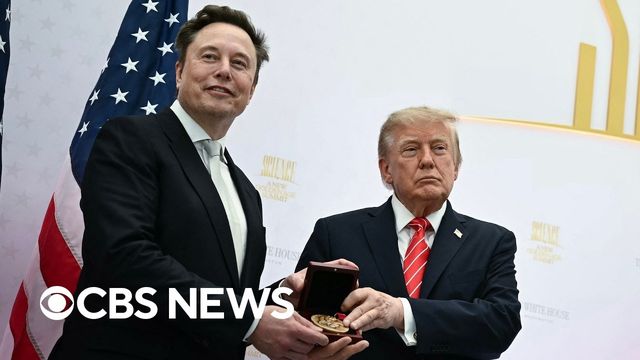
Read the chapter- In ten days Huang attended the state dinner for Xi Jinping, the signing of the superintelligence accord and the National Medal of Science ceremony, which he brought his parents to.
- He accepts the award on behalf of the company, whose computing architecture is in every cloud and every field of science, with 1.67 billion units shipped.
- His father didn't own a suit and ran out to buy one with a day's notice, and President Trump himself walked Huang's mom off the stage.
- His father went to New York to train with Carrier, came back amazed with chocolate and cheese in a tube, and at the first opportunity his parents sent Jensen and his older brother to the United States.
- Gerstner was struck that five of the six people on stage were born outside the US, and Huang calls attracting the world's best minds America's superpower, one to keep doing lawfully and rightfully.
Compute demand is heading up a billionfold because models have learned to reason and agents with memory and tools have started doing useful work.
Read the chapter- Gerstner recaps Huang's past calls: at least two trillion dollars of compute instead of one, a billionfold rise in inference, and the agentic era that arrived with Opus 4.6 and Claude Code.
- Reasoning takes far more inference than reciting what a model memorized: it lays out options, rolls out the best ones and prunes the rest, the way great strategists keep their options open.
- Huang names the harness around the model as the year's big breakthrough: memory, from working memory to long-term memory and a knowledge graph, plus the ability to use human tools from SPICE and Verilog to Photoshop and CATIA.
- Coding was the first on-ramp to useful work, and the next click is design and creative marketing, with OpenAI's Astra recreating an object in CAD from a photo.
Huang expects many more breakthroughs like Navier–Stokes, with the cost of intelligence falling while demand grows even faster.
Read the chapter- Gerstner notes that all this happened while OpenAI and Anthropic had two or three gigawatts each, and asks what comes when their capacity grows three to five times.
- OpenAI built its solution on the work of many great mathematicians, and Huang sees plenty of problems sitting "on a precipice" that only need massive exhaustive search.
- He wants the cost of intelligence to fall two- or twentyfold a year, the way compute did under Moore's law, because consumption will more than make up for it, as in the Jevons paradox.
- By Clark's math, the 10,000 agents that solved the problem used about $4 million of compute, which will get 5–10 times cheaper, and Huang adds that the original GPT cost maybe $20 million while GPT-1 could now be trained for about a hundred dollars.
- Gerstner recalls Keynes predicting an eightfold bigger economy and a 15-hour week: the growth came, the short week didn't, because work gives meaning, and Huang quips that they work 80 hours a week.
People don't notice AI's benefits because they can't see or touch it, even though they use it every day.
Read the chapter- Gerstner's example is self-driving: talked about for a decade, and this morning he hit FSD and paid no attention until he pulled into the parking garage.
- ChatGPT, Gerstner says, already helps parents plan their day and deal with their kids' health issues, and breakthroughs in pharma and genetics are coming.
- Huang explains that AI is intangible: people benefit from it when they search the web, shop, watch Netflix, go to Walmart or get a FedEx package, but the industry doesn't tell that story well.
- Gerstner adds that if the data centers were shut off for a weekend, everybody would notice.
Physical AI already brings Nvidia $10 billion in six months, and Huang believes every industry that touches the physical world will become a technology industry.
Read the chapter- Clark recalls Huang's "ChatGPT moment" for robotics and the hundred-billion-dollar opportunity, and Huang says he undersold it: $5 billion two years ago, $10 billion last year and $10 billion in the first six months of this year.
- He counts as physical AI anything that interacts with the physical world: photon-counting CT scanners, ultrasound, imaging radars, 5G, robots, self-driving cars, geospatial satellites and fully robotic operating rooms.
- Elon, Huang says, turned the car industry into a computing industry, and logistics, FedEx, Walmart and telecom will follow, which is why it feels strange that Washington files Nvidia under chipmakers.
- Physical AI needs three computers, one to train the brain, one to practice in a digital twin such as Omniverse, and one inside the robot, car or surgical instrument, and Nvidia builds a full stack for each.
Perfect alignment is out of reach, so Huang builds the safety of autonomous systems on zero-trust containment and external monitoring.
Read the chapter- Building the technology responsibly is an engineering problem, and Huang is sure it can be done, since otherwise it shouldn't be built at all.
- Even a simple goal like "contribute to society" means different things to different people, from being generous to making money and giving it away to building a company or a work of art, so he calls alignment a forever problem.
- With AI, as with a new hire or a one-year-old in a playpen, you start with zero trust: minimum rights, with the boundary expanding as you test it and gain confidence.
- Monitoring has to be out of band, because a system behaves differently when it knows it's being watched, and Clark jokes that he does too, depending on whether Brad is in the room.
- External oversight must be able to escalate or simply turn the system off, which is what Nvidia's OpenShell does, with over 100 companies already joining.
To Huang, safety is part of the technology and gets accelerated with everything else, and winning means every industry and every citizen using AI.
Read the chapter- Looking around the White House table, Gerstner saw no one who wanted to YOLO: everyone was looking for the right balance between fast and safe.
- Huang compares safety to airbags, brakes and ABS, which are part of the car too, and says everything has to be accelerated, since nobody would say "let's pace that."
- In Gerstner's telling, Dario told the president that the labs are speeding up to win the race with China while making sure safety systems keep pace, and Huang says everyone at the signing was very constructive.
- America winning, to Huang, means Lilly, Walmart, FedEx, Boeing, the US military, the universities and every citizen winning, and without building safely there will be no AI industry at all.
- Gerstner describes the oversight system as a three-legged stool, with CAISI reviewing models, the White House accord and the SI Force led by Jay Clayton, and Huang tells critics to learn the problem first and then propose improvements constructively.
Demand is there and then some, but land, power and shell will hold back next year's build-out, and scarce power only grows Nvidia's share.
Read the chapter- Gerstner cites Dylan of SemiAnalysis: 43 gigawatts of new AI compute next year, more than exists in the world today, and another 40 the year after.
- Huang lists the obstacles of moving from digital to physical: land permits, power generation, moratoriums and scarce skilled trades, even though the build-out alone has created a million new jobs.
- If it isn't built in the US, it will be built in Europe, Africa, Asia, Latin America or the Middle East, and while Huang doesn't like the US falling behind, global reach makes Nvidia's business more resilient.
- Clark relays the Street's view of maybe 50 gigawatts of announced chips against 35 to 40 gigawatts of land, power and shell, and Huang answers that scarce power pushes customers to the hardware with the most tokens per watt.
- Nvidia now offers 40-plus billion dollars per gigawatt instead of about 18 billion, and its share of capex is rising: about 40% at the CSPs and, Huang guesses, about 80% outside them.
Only the most valuable compute is worth launching into orbit, which is why Huang sees Nvidia as the perfect payload for SpaceX.
Read the chapter- Gerstner recalls Elon standing up a couple hundred thousand Hoppers in Memphis, and now he's raising another $40 billion, may buy a million-plus Vera Rubins and wants 10 gigawatts by the end of 2027.
- In Nvidia's reporting Elon used to sit in the enterprise segment and is now among its cloud providers: he trains his own models, serves Grok Bot and rents out capacity.
- Nvidia and SpaceX engineers are designing a new type of server that could work both in space and on the ground, and Huang jokes that he can't wait to be a payload, "not personally."
- Launch isn't cheap, so cheap compute won't go up there, and fungibility plus ongoing CUDA updates, Huang says, will keep a satellite rentable for years.
Huang is confident the capex will pay off without trillion-dollar revenue at OpenAI and Anthropic, since frontier labs account for only about a quarter of Nvidia's compute.
Read the chapter- Gerstner figures that for payback, lab revenue of about $200 billion has to double to $400 billion next year and to $800 billion the year after.
- Huang puts classical computing without AI, from simulation and data processing to XGBoost fraud detection at Visa and MasterCard and recommender systems, at a third of Nvidia's business, growing 30–40% a year.
- He sees not two frontier labs but five or six, including Meta Muse, Grok, Gemini and Anthropic, at a quarter or a bit more of his compute.
- Another third is thousands of startups, such as Jeff Bezos's Prometheus, that rent Nvidia compute, and 80% of them fine-tune open models, often Nemotron, into superintelligence for their own domain.
- Moore's law is over, so twice the transistors now cost twice as much, and compute alone grows from half a trillion to a trillion and a half, with total infrastructure reaching $3–4 trillion a year by the end of the decade.
Demand for Nvidia's chips far outstrips supply, and Huang says the gap won't close for a few years, with land, substrates and silicon photonics all short.
Read the chapter- Gerstner recalls that demand for next year is up well over 100% while Nvidia guided to 70% revenue growth because supply is constrained.
- Huang made the order book public because customers order a year or two ahead and get far less than they want, and otherwise each would wonder whether they had been shortchanged.
- Two gigawatts in Australia is worth about $80 billion to Nvidia, and the company supports neoclouds like CoreWeave and Nebius with the whole stack as they grow.
- Substrates get bigger as packages grow, organic materials are hard to make without warpage, silicon photonics is short too, and the backlog keeps growing faster than supply.
The consensus forecast for Nvidia moved up 100–200% in a year while the stock rose only 20%, and Huang reads that as a sign that its advantage grows with scale.
Read the chapter- Gerstner presents "Exhibit A," and Huang jokes that it feels like a deposition: a year ago the consensus expected no growth or a decline in 2027, now it expects 74%, and the stock trades at 13 to 14 times earnings.
- A $50 or $100 billion order placed sight unseen, say for Vera Rubin Ultra, can only go to Nvidia, Huang says, because systems like these can't be benchmarked in advance.
- In the same way Nvidia gives TSMC 100% of its business, since it's the only partner it can plan with five years out and the only one big enough to take it "from gray to blue to green."
- Everything new, from FlashAttention to mixture of experts and SSM–transformer hybrids, runs on CUDA, so a data center built on Nvidia is fungible across workloads, models, customers and countries.
- General-purpose chips lower the risk: specialization, Huang says, is the enemy of fungibility and durability, and those lead to the lowest total cost of ownership.
Nvidia spends more than half its free cash flow on buybacks and is building two new business models that don't depend on selling hardware.
Read the chapter- Clark estimates Nvidia could buy back more than 10% of the company over two years and compares it to Apple, whose stock, Gerstner says, went from $30 to 300.
- A software license of, for simple math, a couple thousand dollars per GPU per year matters to enterprises without their own IT teams, and Nvidia ships about 20 million GPUs a year, half of them to enterprises.
- Nvidia helps regional clouds with offtake, software and financing and will take a share of their revenue.
- Gerstner recalls that Buffett dislikes tech companies that never return cash to shareholders, while Nvidia spends over 50% of free cash flow on buybacks, and Huang adds that last quarter it was 60-some.
- The new word on the street is "whoever Jensen invests in, you ought to invest in," but investments will shrink as a share of cash flow because there won't be another chance like OpenAI and Anthropic.
Gerstner sees AI as a permanent re-architecture of the world's computing, and Huang is 99.99% sure it will turn out well.
Read the chapter- Gerstner recalls Ezra asking Huang about the bubble and argues that short of a global depression, people will need to consume an enormous amount of compute every year.
- The world has been spending about a trillion dollars a year on IT build-out, and Huang wouldn't be surprised by $10 trillion a year for new infrastructure and refreshes combined.
- Gerstner reasons that if $50 trillion of global GDP is tied to knowledge work and it gets 20% more productive over five years, $4 trillion of capex a year looks reasonable.
- Huang jokes that theirs is the first generation where 63-year-olds are considered young.
- Voicing worries is healthy, Huang says, but predicting the end of the world underestimates the many smart people who do smart things without anyone directing them.
Quotes
When Gerstner listed the predictions that came true
“Only three things that I said that came true. There's another 200.”
Jensen HuangRead from 07:41On how cheap training GPT-1 has become
“And so you went from 20 million dollars, let's say 10 million dollars, to 100 bucks, and we did that in ten years.”
Jensen HuangRead from 19:34On AI safety
“If we depend on perfect alignment in order to ensure safety, then we're never going to get there.”
Jensen HuangRead from 33:38On what winning in AI means
“There is no winning if it's just technology won, but nobody used it.”
Jensen HuangRead from 41:26On Nvidia data centers riding Starship
“I can't wait to be a payload. I mean, not personally.”
Jensen HuangRead from 57:54On the fear that the AI build-out rests on two labs
“And it's a real big mistake to recognize just a couple of companies and think that they're funding the infrastructure.”
Jensen HuangRead from 1:05:45On ordering Vera Rubin Ultra sight unseen
“And so the question is, sight unseen, who can you place a $50, $100 billion order on? We're literally the only one.”
Jensen HuangRead from 1:20:20On AI doomsayers
“It's good that we worry, right? And we should express our worries, we should express our concerns, but we shouldn't predict the end of the world.”
Jensen HuangRead from 1:35:55
Summary
Jensen Huang's third conversation with Brad Gerstner and Clark Tang of Altimeter was recorded the day after President Trump presented Huang with the National Medal of Science and shortly after the state dinner for Xi Jinping and the signing of the White House accord on superintelligence. Huang explains why we will need a billion times more compute: models have learned to reason, and agents with memory and tools have started doing useful work. Solving Navier–Stokes is only the beginning: the cost of intelligence will keep falling, and consumption will grow even faster.
Huang thinks perfect AI alignment is out of reach and suggests treating a model like a new hire: zero trust, tight containment and out-of-band monitoring that can shut it all down. To him, safety is part of the technology, everything has to be accelerated together, and America wins only when every industry uses AI. Gerstner describes the US oversight system as a three-legged stool: model reviews at CAISI, the White House accord and the SI Force task force.
The main bottleneck of 2027 isn't demand but land, power and shell for data centers. When power is scarce, customers pick the systems that do the most per watt, and Nvidia's share of global capex grows. Whether the investment pays off, Huang argues, doesn't hinge on two labs: a third of his business is classical computing, a quarter or a bit more is five or six frontier labs, and another third is thousands of startups renting capacity. He expects $3–4 trillion a year of infrastructure spending by the end of the decade, and eventually as much as $10 trillion.
Also in the episode: data centers in space with SpaceX, how wrong the consensus forecasts for Nvidia were, $100 billion orders placed sight unseen and the comparison with TSMC, buybacks, and two new business models: software licenses and a share of cloud revenue. Huang is 99.99% confident AI will turn out well.
Advice
Don't count on an AI agent understanding the task perfectly: like a new hire, give it minimum rights in tight containment, widen its access as it proves itself, and monitor it from outside, with the ability to escalate or shut it down.
Build security and safety along with functionality, as part of the product itself: nobody will adopt a service that wreaks havoc, however good its capabilities.
Don't compete with the frontier labs on general AI: take an open model, fine-tune it on your proprietary data and become the best in your industry; that's what most new AI startups do.
If you sell infrastructure customers spend billions on, make it general-purpose: specialization is the enemy of fungibility and durability, and what a big buyer cares about most is low risk.
Gather strong people and align them on a common goal: smart people do smart things without being told, and aligned in one direction they do impactful ones.
Mentioned
 Donald Trump00:20presented Huang with the National Medal of Science
 Xi Jinping00:20the White House state dinner in his honor
- White House Accord on Super Intelligence00:20Huang helped architect it
 Claude Code07:13the breakthrough that started the age of agents
Show 39 more mentionsShow fewer mentions
 Claude Opus07:13Opus 4.6, which opened the age of agents together with Claude Code
 ChatGPT08:20used to answer from memory and hallucinate; now helps parents
 GPT-6 Astra13:05Nvidia uses it to make CAD models
 Anthropic14:49this year's breakthroughs on two or three gigawatts of compute
- OpenAI15:58solved Navier–Stokes
 William Stanley Jevons17:53Jevons paradox
- GPT-119:18training went from $20 million to a hundred dollars
 John Maynard Keynes21:13predicted a 15-hour work week
 Tesla22:14Gerstner rides to work on FSD
- Full Self-Driving22:14full self-driving, talked about for a decade, finally works
 FedEx24:04an example of invisible AI and a future AI company
 Walmart27:44will also become an AI company
 NVIDIA Alpamayo29:17the automotive playbook to carry into other industries
- NVIDIA Omniverse29:54the digital twin where robots learn
- NVIDIA OpenShell35:33out-of-band monitoring of agents
 Dario Amodei38:18the essay "We Must Pace the Frontier" and his version of fast and safe
- Claude Mythos43:07the model the government pulled off the shelf
 Center for Advancing Innovation and Standards for Super Intelligence (CAISSI)43:07reviews every new frontier model
 Dylan Patel46:59the forecast of 43 gigawatts of new capacity
 SemiAnalysis46:59Gerstner cites a SemiAnalysis forecast of 43 gigawatts of new AI computing capacity in 2027.
 Elon Musk55:19Colossus, a million Vera Rubins and data centers in space
- NVIDIA Vera Rubin55:19$50 billion per gigawatt
- Colossus55:19the couple hundred thousand Hoppers Musk stood up in Memphis
 SpaceX56:10will it be the largest AI hyperscaler?
 Grok Bot56:30demand for it is skyrocketing
- Starship57:38the first orbital rendezvous and compute in space by 2028–2029
- Starlink V357:38the satellites that "broke Twitter"
 CUDA1:00:04software updates keep the hardware useful
 Muse1:02:44Meta Muse runs on Nvidia
 Instinct1:04:40one of the consumer startups on Nvidia
 Jeff Bezos1:05:15his new company, Prometheus
 Amazon Web Services1:05:15Huang calls a third of Nvidia's business "AWS for the future"
- NVIDIA Nemotron1:06:18open models startups use to build domain superintelligence
 Altimeter Capital1:17:46its Nvidia forecast was above the consensus
- NVIDIA Rubin Ultra1:19:39a $100 billion order, sight unseen
 Taiwan Semiconductor Manufacturing Company1:21:23the supplier you can trust with an order sight unseen
 Apple1:26:20the model of a growth company that returns capital
 Warren Buffett1:29:51why he doesn't like tech companies
 Ezra Klein1:31:43asked Huang about the bubble
Transcript
01The medal, his parents and immigration
Huang accepts the medal as recognition of the whole company and calls America's pull on the world's best people its superpower.
It's our third pod1Third pod — Huang had been on BG2Pod before, in October 2024 and September 2025. back together. In the last ten days, you've been at the Xi State Dinner at the White House.2State dinner for Chinese President Xi Jinping and his wife Peng Liyuan, held at the White House on September 24, 2026. The guests included Huang, Sam Altman, Tim Cook, Elon Musk and Jeff Bezos. You were at the White House summit where we did the accord on superintelligence.3White House Accord on Super Intelligence (Joint Commitment on Frontier Responsibilities) — a voluntary agreement on safety measures in frontier AI development: internal controls, separate oversight teams, independent external evaluation and board-level committees. Anthropic, Google, Meta, Nvidia, OpenAI and xAI signed it at a White House luncheon on September 29, 2026. It isn't legally binding; Trump called it "morally binding." And just yesterday you were there with your parents when the president, you know, presented you with the National Medal of Science.4National Medal of Science — the highest US scientific honor, awarded since 1963. On October 8, 2026, Trump presented it to Huang, Elon Musk, Sergey Brin and Lisa Su; Michael Dell and Satya Nadella received the National Medal of Technology and Innovation. Of the six, only Dell was born in the US: Musk was born in South Africa, Brin in Moscow, Huang and Su in Taiwan, Nadella in India. White House.
You were the only investor at the table. There you were, the only investor at the table, now that we reflect on it.
Yeah. Well, tell me, being there with your parents yesterday, right, it struck me five out of the six people on stage were all born outside of the United States. How did that feel?
Well, first of all, it's a great honor all by itself, right? And it's a reflection of the contribution that the company has made. And obviously, we created, we invented a new computing model. This is probably the most pervasive computing model in the world today. It's the only computing architecture that's in every cloud, it's in every computer company, it's used in every field of science. It's used by gamers, it's used by creators and builders, and it's used by scientists.
It powers intelligence. Right. I mean, just if you take a step back and you look at what the company has accomplished, you know, we started out building a graphics chip for gamers, and I'm still proud of that, of course. And we now shipped one and a half, 1.67 billion units. Right. That's how many generations of... I mean, I raised generations of scientists and kids and designers, you know.
And so I think the impact that... And here we are, you know, we're the infrastructure that powers the intelligence of society. And so it's an incredibly proud moment for me to receive the award on behalf of the company. Now for my parents, you know, I wanted them to go, and I gave them literally, you know, 24 hours' lead time, and they don't travel that much. Right. They don't travel that much. And my dad didn't even have a suit.
Yeah. So he ran out and bought a suit, and...
He looked great. They looked great.
Yeah, it was a brand new suit, and he showed up. I didn't realize he had a suit. I thought he was just gonna wear some shirt, and he went out and bought a suit. My mom got a new dress, you know, and literally in 24 hours. Yeah.
Oh, I know how it works.
Oh my gosh, it's incredible. And so we got them on a... we chartered a plane for them, got them there, and they were so happy to meet the president. And President Trump walked my mom, because she has a hard time walking, and the two of them were walking off stage, and he held her and walked her down the stage. And they were just incredibly, incredibly proud to meet him. But for them, it's their American dream. You know, my dad... I still remember, I think I was like five years old or something like that, and he had just come back from the United States on a business trip. He was working for an air conditioning company, and he was...
And you were living in Taiwan.
We were at the time. We had just moved to Thailand, and... Oh no, no, we were just about to move to Thailand, and we were in Taiwan.
He had come back, and he was in the United States working for a company called Carrier,5Carrier — the American air conditioning manufacturer, founded by Willis Carrier, who built the first modern air conditioning system in 1902. the air conditioning company, and he was here for training. And of all the places in the world, they landed him in New York. And so here you could just imagine a kid in the late 20s, I guess mid-late 20s, never been outside of Taiwan, goes to the United States, New York City of all places, and he saw the future, the future. And he came back, you know, mind blown. All the things that he bought at the airport, brought it back. He brought chocolate, he brought, you know, that cheese that you have in a tube back in the old days.
It's kind of white, strange cheese. It comes in a tube. That's great. And he brought back all kinds of strange things, and he says, "We should go there someday." And the first opportunity they had, they sent my older brother and I to the United States.6Huang's childhood. He was born in 1963 in Tainan, Taiwan; the family later moved to Thailand. At nine he and his older brother were sent to an uncle in the US and enrolled at the Oneida Baptist Institute, a boarding school in Kentucky. His parents moved to the States a couple of years later. Wikipedia. And, you know, it was his dream.
I don't think many people realize that you came to the United States ahead of your parents, right? And they joined a few years later. But it just hit me like a ton of bricks that five out of the six people on that stage yesterday were born outside the United States. You and I have talked about the need for, you know, with all the other stuff going on, a real strategy and an immigration policy that makes certain that we're still the place that all the great builders in the world want to come build.
This is America's superpower, right? In a lot of ways, the intellectual property creation capability of our nation is unlike anything else in the world. And the reason for that is we attract the world's best. You know, we are the place where they want to come and build their lives because of the opportunity it provides, the freedom that it offers, the opportunity that it provides, the spirit of invention and entrepreneurialism and the can-do attitude. You know, in the United States, everything is possible.
Right. We start with "of course it's possible, of course we could do that." Instead of... You know, I do a lot of travel, and "of course you can't do that," of course, you know, in other places. And we take it for granted.
But the spirit, the energy that comes around with the culture that we've created here, it just can't be understated. And so I think the flow, the inflow of intellectual property into this country is unlike anything else the world has ever seen.
And we want that. We want all of the world's great minds to come here, bring their great ideas, you know, make them... realize them here, and let us, you know, keep that flywheel going.7Flywheel — a favorite business metaphor for a self-reinforcing cycle in which each success speeds up the next: hard to get spinning, but then it keeps going on its own. Jim Collins popularized it in Good to Great (2001). You know, I really... it's a delicate system. It's a delicate balance, I get it. It's a delicate balance, I get it. And so we have to do it lawfully, we have to do it rightfully. But we surely want to do it.
02A billion times more compute
Compute demand is heading up a billionfold because models have learned to reason and agents with memory and tools have started doing useful work.
Yeah, for sure. So I want to start high level, just kind of where we are. Then I want to dig down a little bit into the safety and regulation and getting this right, where we are in terms of the compute build-out. And then finally we're going to finish up, you know, drilling in a little bit to Nvidia's growth and what's going on there. But you've been really good at calling the future, right? Two years ago we were sitting here, and you said that the market was dramatically underestimating the amount of compute build-out that was going to be required and was going to happen over the course of the next five years. You said it's not going to be a trillion, it's going to be two trillion at a minimum in terms of cumulative compute build-out.
And of course, now we're over that. You said, before everybody was thinking about it, that inference,8Inference — running an already trained model, that is, answering a user's request. Training is paid for once, inference with every request, so models that "think" before answering sharply increase the demand for compute. right, compute was going to go 1 billion X because of inference-time reasoning and thinking. And then last year, of course, before we saw Opus 4.6, before we saw Claude Code, you said we're entering the age of agents, right, where we're going to unlock a lot of these capabilities. And of course, we saw Opus 4.6 and Claude Code9Claude Code — Anthropic's coding agent, introduced in February 2025. Claude Opus 4.6 — an Anthropic model released in February 2026. really took off. So where are we now, right? We have Elon and Sam and...
Only three things that I said that came true. There's another 200. Why don't you just keep on going? Well, just let that be the podcast.
So our investor day in a couple weeks is on, you know, entering the singularity, this acceleration. We have Elon and Sam and Demis all say, hey, we're in the foothills or entering the singularity.10Elon, Sam and Demis — Elon Musk (xAI, SpaceX, Tesla), Sam Altman (OpenAI) and Demis Hassabis (Google DeepMind). The singularity — a hypothetical point after which technological progress, driven above all by AI, accelerates so much that what follows becomes unpredictable. In the essay "The Gentle Singularity" (June 2025) Altman wrote: "We are past the event horizon; the takeoff has started." We have, you know, a model solving Navier–Stokes,11Navier–Stokes — the problem of the existence and smoothness of solutions to the Navier–Stokes equations, which describe the motion of fluids; one of the Clay Mathematics Institute's seven Millennium Prize Problems. On September 8, 2026, OpenAI announced that an internal model had solved it, with about 10,000 agents working on it for 88 hours. OpenAI's post. as you know. So when you look into your crystal ball, where are we, and are we inflecting? Are we accelerating, you know, into a different phase of superintelligence?
And so let's unpack that. First of all, it's fairly logical why the amount of compute that we're going to need is a billion times more than where we were just recently, let's call it last year. And the reason for that is because thinking and problem solving takes a lot more, you know, inferences than repeating something, regurgitating something that you memorized. So when you used ChatGPT, you give it a prompt, most of that knowledge was encoded into the large language model.12Large language model (LLM) — a neural network trained on huge amounts of text to predict how it continues; ChatGPT, Claude and Gemini are built on such models. Unfortunately, of course, it hallucinated.13Hallucinations — confident but made-up answers from language models: facts, quotes and links that don't exist. And so the next click was it was generative, but it was also grounded or conditioned by ground truth.
And so it would have to go out and do a search, do a quick search, come back with the ground truth. And then from that conditioning, augmented with its own, what it already learned in pre-training,14Pre-training — the first and most expensive stage of training a language model: it reads trillions of words from the internet and books, learns to predict the next word and memorizes a mass of facts along the way. and it would generate whatever the answer is. Well, most of the things that we want to really do that are interesting require you to reason step by step, to come up with several options, plan, and you might decide, let's see how these things all roll out. And then, based on the answers of all of those, I reflect on the best answer so far, the best path so far. I might choose one or two or three of them, roll them out, prune the rest of it, and then just keep on doing this.15The stages of language models, as Huang tells it: first a model answered from memory, then answers were grounded in search results (retrieval-augmented generation, RAG), and then came reasoning models that weigh and prune options before answering; the first mass-market one was OpenAI's o1 (September 2024).
And you know, people, we do this. That's the reason why we say great strategists love strategic optionality. You don't want to prune things too fast on the one hand, but you also have to optimize your resources. Well, AIs are doing that. Okay, so they're keeping their strategic optionality, they're rolling things out, they're pruning, they're reflecting, they're pruning, so on and so forth. And all of that thinking, all of that exploration just takes a lot more compute. And on top of that, because it's able to now do productive things, we're going to use it for more things.
And so the compounding of both: it uses more compute to do its job, but it's doing a good job, and therefore we're going to... we're going to hire it to do more jobs.
Okay. And so that all compounds. At this point, I would say that the big observation from last year is that, on the one hand, we want the models to get better and better, and we still want the models to get better, and the scaling laws of models16Scaling laws — empirical regularities: a model's quality improves predictably with its number of parameters, the amount of data and the compute spent on training. They were described in detail in a 2020 paper by OpenAI researchers. are going to continue. However, the attachment of a harness,17Harness — the software shell around a language model: it stores and loads memory, gives the model tools and runs the agent loop of think, act, check. Compaction, which Huang mentions next, is also an agent term: when the context fills up, the agent writes a short summary of what it has accumulated and carries on from that summary. basically the exoskeleton of the large language model, you know, kind of the body of the brain, that allows it to manage working memory, manage knowledge. How do you go from working memory to short term to long term to basically formulating your knowledge graph,18Knowledge graph — a way of storing knowledge as a network: concepts are nodes, and the relations between them are edges. which is what we all do.
We kind of think about, hey, you know, what did I learn and how does it fit into everything that I know in the past. And you know how when we go to bed, we do compaction: things that don't make sense or don't matter, we kind of eventually forget, but the things that kind of matter somehow get reconnected. And so we're doing that kind of offline. And so we've got working memory, we have offline knowledge extraction and creation, knowledge graph creation. That whole part of memory is a big deal. The other thing is, of course, tool use.
And we've taught these tools, these AIs, how to interact with the most important tools that humans have ever made. You know, it's no different than if you are a robot, it comes into our house: it's more likely going to use all the tools that I have in the house than to go off and build it from scratch. And so SPICE is still going to be useful, and Verilog will be useful, and simulators will be useful, and, you know, design compilers and, you know, Photoshop and AutoCAD and, you know, Dassault CATIA and all the Siemens tools.19SPICE — an electronic circuit simulator created at UC Berkeley in the early 1970s. Verilog — a hardware description language used to design digital chips. Design compilers — logic synthesis programs that turn such a description into a circuit of logic gates (the best known is Synopsys Design Compiler). AutoCAD (Autodesk) and CATIA (Dassault Systèmes) are computer-aided design systems; Siemens makes software for designing chips and industrial products. All of these different tools that we've been using to run our companies, build our companies, design things, operate things, they're all going to be great tools for the agents to use.
But the agents had to learn how to use it. And so these two areas, knowledge and working memory, and tool use, huge unlocks in the last year. So now all of a sudden you could put these large language models encapsulated in their harness or exoskeleton, and you can put them into your company, connect them to the information, the ground truth that you have, connect them to the tools that they can use, and all of a sudden they start doing amazing things. Now, the easiest part, frankly, was coding.
That's kind of the first on-ramp, you know, to useful work. And in a lot of ways, coding is easy because both the customer and the work, the tools that they use are fairly accustomed to things that have tremendous use but are not extremely easy to use. And so in the early days of coding, it wasn't extremely easy to deploy, but software engineers found a way. And so now I think the next click for us is now... And you guys have probably been playing with Astra. OpenAI's Astra is really fantastic,20GPT-6 Astra — OpenAI's flagship model, released on September 3, 2026. and we're using it in all these different places. And so now the next phase of these agents, they're able to do, you know, design work and a lot of creative marketing work. And we're using it to... You take a picture and give it to Astra, it literally recreates it into CAD.21CAD (computer-aided design) — software in which engineers build precise 3D models of parts and products.
It recreates it into the CAD, which is incredible, because we need the CAD so that we can interact with the CAD and make fine-tuning and adjust. And so Astra could really give us the first initial implementation, incredibly productive. Now you take Astra and, you know, the latest release, and you apply it to all of these different domains. I think that besides software engineering, you know, we're going to see designers and builders and creators and, you know, this whole area, scientists, and, you know, all of this whole unlocking. Now the challenge, of course, is how do we deploy agents safely and securely into the world's enterprise. This is exactly the same question again with safety and security. And we'll talk about...
03Navier–Stokes is just the start
Huang expects many more breakthroughs like Navier–Stokes, with the cost of intelligence falling while demand grows even faster.
Yeah, we'll come in on that. What I'm struck by is that all of this occurred this year with OpenAI and Anthropic having, I don't know, two, three gigawatts of compute each,22Gigawatts. The compute of AI companies is usually measured by the electrical capacity of the data centers that hold their accelerators, in gigawatts. okay?
So relatively small amount of compute relative to what's coming. Okay. And so again, what I'm interested in is the way the economy generally works, or people model the economy or they model a company, is linear deceleration. They're not very good at modeling acceleration. But here we have this double exponential:23Double exponential — growth faster than exponential, where the growth rate itself grows exponentially. In AI talk the phrase is used when one exponential (the growth of compute) is stacked on another (the growth of what can be gotten out of that compute). we have massive amount of new compute coming on board. So if OpenAI and Anthropic are, I don't know, three-to-five-X-ing their compute next year, does it stand to reason...
I mean, we solved Navier–Stokes. We'll look back at this and say that was a tiny amount of compute and intelligence, the worst intelligence we're ever going to have from here forward, solving a millennium problem. So when you look at what's coming online next year, you know, do you expect that we're going to have major breakthroughs in, you know, long-running agentic problems that we can use these swarms of agents on?
ExplainerWhat exactly OpenAI solved, and why it's disputed
In 2000 the Clay Institute posed the Navier–Stokes problem in four versions: either prove that the three-dimensional equations of incompressible fluid flow always have a smooth solution for smooth initial conditions, or exhibit a case where the solution "blows up" in finite time and the velocity goes to infinity. OpenAI claimed the second, for the case with a smooth external force: its solution resembles a spinning top that gets ever thinner and shorter until the velocity at its center becomes infinite. According to the company, a swarm of about 10,000 agents first went through all six unsolved Millennium Problems, then focused on Navier–Stokes and exchanged 2.7 million messages on it over 88 hours; the paper comes with a formalization of the proof in the Lean system.
The dispute began on the day of the announcement. Tristan Buckmaster of New York University and Levent Alpöge of Anthropic had shortly before obtained related results for the Euler equations, on which the work relies, and Buckmaster accused OpenAI of borrowing their methods; the company denies it. On October 6, 2026, a paper came out showing that the Lean formalization doesn't fully match the proof written in words, and Scientific American asked whether OpenAI had solved the right problem. There is no independent verification of the proof yet.
Well, Navier–Stokes is really a great example. Remember, OpenAI did not solve Navier–Stokes from nothing. They solved it from the foundation of a lot of great scientists and a lot of great mathematicians and a lot of great previous work. Earlier I said we're at kind of the tipping point of a lot of these different fields, because we're kind of at that phase, that point, with Navier–Stokes, with a great deal of foundational work already been done. If we could just apply the exhaustive exploration of AI to the previously done work, we're going to see one breakthrough after another breakthrough rather quickly. But we do need a lot of compute to do that.
And the reason for that is because a large amount of exploration was necessary. You know, if it was simply somebody resolving some fundamental first-principles theory24First principles — reasoning from basic, certainly true premises rather than by analogy with what is already known. Silicon Valley loves the phrase, Elon Musk especially. in order to discover the breakthrough, if it didn't require a vast amount of exploration of space, search space, not space space, but search space, if it didn't require that, then somebody would have found it earlier. Right. You know, people are pretty smart. And so I think that there are many problems like this that are just on a precipice, you know, and really want to just have that massive amount of intelligence exploration to get us there. In the coming years, you know, my expectation is that the cost of intelligence would fall fairly quickly.
Right. And the reason for that is because obviously we're bringing more compute online. These models are getting smarter. When you're smarter, you could be more efficient. And so the combination of these two things: the cost of intelligence will come down, which is, of course, what they want. And this is no different than Moore's law.25Moore's law — the observation by Intel cofounder Gordon Moore (1965, revised in 1975) that the number of transistors on a chip doubles about every two years while the cost per transistor falls.
If you go back thirty-some years, we had three decades of computing cost decreasing by a factor of two every single year. And we want intelligence cost to decrease by a factor of two or 20 every single year, because the consumption of it is going to more than make up for... Jevons paradox.26Jevons paradox — in The Coal Question (1865) the English economist William Stanley Jevons noticed that more efficient steam engines increased coal consumption instead of reducing it: the cheaper it is to use a resource, the more of it ends up being used. That's right, more than make up for it. And so there's a massive empty space in the world that wants to be filled, an empty vacuum of opportunity, and we just got to get the cost down.
I guess what stands out to me about Navier–Stokes is that they had 10,000 agents working together on this. To me that sounds like a, you know, hyperscale company, basically all pointing agents to work together towards a goal, right? And I think in the early days, right now, it's a lot of, you know, parallelized search exploration. But I think, you know, the goal is that more of these agents can work together to a common goal and that we can solve a lot more. And to your point, you know, I think our math says it probably cost about four million dollars of compute to solve, you know, this instantiation of Navier–Stokes. The cost to do something like that over the next few years is going to drop by another 5x, 10x, right?
So the number of things that we're going to be able to do is rapidly expanding.
Our ambition is going to go sky high. The original GPT probably cost, let's pick a number, say, you know, maybe 20 million dollars to do. If you wanted to train GPT-127GPT-1 — the first model in OpenAI's GPT series, introduced in 2018; it had 117 million parameters. now, it'll probably cost you, what, a thousand, a hundred dollars maybe?
A hundred bucks.
Yeah, okay. And so you went from 20 million dollars, let's say 10 million dollars, to 100 bucks, and we did that in ten years. Yeah, okay. And so I fully expect... Meanwhile, our ambition got so large that the models that we're training now, 3 trillion, 10 trillion, 30 trillion,28Parameters — the numbers (weights) a model tunes during training; their count is how a model's size is judged. For scale: GPT-3 (2020) had 175 billion parameters, so 30 trillion is about 170 times more. we're talking about gigantic models now. And we want it to be... So our ambition for the capabilities of that technology has gone up. Meanwhile, our use of it has gone up between ten years ago to now probably, I don't know, a million times. And so I don't think this trend is going to stop. I think there's a fairly insatiable demand for intelligence, and the smarter you are, the more intelligent you are, the more ideas of applying intelligence you have. You know, the more I've learned in life, the more I realize there's more to do. And that's because every time you learn something, it opens a new door. Every time you learn something, it opens a new door, and every time you open a new door, you see more opportunities, see more challenges, see more problems. And so that's kind of the future, you know. People say we're going to have more time. I completely disagree. I think for most people, this intelligence is going to unlock more opportunities, which is going to... And they're going to want to pursue it because they're ambitious.
You know, give me an example of a family, a father, a son, you know, a husband, a wife, a mother, who doesn't want it, who don't have ambition for their families to have more. It's just they just don't have the opportunity. And these things are going to open up opportunities.
If you go back to 1930, Keynes talked... he made a prediction about the industrial revolution. And he said, you know, in a hundred years the economy will have 8x'd, but the work week will go to 15 hours a week.29Keynes's prediction. In the essay "Economic Possibilities for Our Grandchildren" (1930), John Maynard Keynes predicted that in a hundred years the standard of living in advanced countries would be four to eight times higher, and people would need to work only three hours a day, 15 hours a week. He was right. The economy did 8x, right? We had massive abundance and productivity gains from it.
Yeah, except we're working 80 hours a week.
But we didn't go to a 15-hour week. And what he got wrong was the human spirit, right? He didn't realize that work is purpose. Discovery is purpose, right? It's deeply encoded in, I think, our DNA. And I'm working harder than I ever have, having more fun than I ever have, not because I have to, like my grandparents did, right? I'm doing it because I want to.
And so I agree with you on that. I'm fascinated with this idea, you know, the singularity postulates that, you know, we've kind of now have all these agents that can work together on long-running tasks. They can stay on task. I love your "keep each other on task, working as a team."
"Hey, you're off."
04Why AI's benefits are invisible
People don't notice AI's benefits because they can't see or touch it, even though they use it every day.
That's right. I love your idea that, you know, we build on top of all the things that have come, right? And so if I think about full self-driving as an example, we talked about it for a decade, and we really didn't get there, right? But all of a sudden, like, you go on Twitter, everybody's experiencing Tesla FSD, experiencing Waymo.30FSD (Full Self-Driving) — Tesla's driver assistance system, officially FSD (Supervised): the car drives itself, but the driver has to watch the road. Waymo — the Alphabet company that carries passengers in driverless robotaxis. We're here. Somebody asked me, "How was the drive here this morning?" I said, "I don't know," because I got in my car and I hit FSD, and I didn't pay any attention until we pulled into the parking garage, right?
I was working the whole way here. But if I think about that in the fields of science, the breakthroughs that are going to come in the fields of pharma and genetics, right? We've been laying down the tracks for 30 years. We're going to break through on a lot of massive cures for the world. Of course, ChatGPT is already helping parents plan their day and solve their kids' health issues and helping them get better educated. Talk to us a little bit, though, as to why that's having such a hard time breaking through, Jensen.
We have all of these things that are out there improving lives and that are right around the corner. And so that's kind of curious to me as to why that's not breaking through.
I guess, let me take a shot at it. And, you know, we'll ultimately not really know. I've spoken to a lot of people, they told me what they thought. I mean, one of the things, of course, is AI, or superintelligence,31Superintelligence. In the executive order "Inaugurating the Era of Super Intelligence" of September 29, 2026, the day the White House accord was signed, Trump told federal agencies to call artificial intelligence "Super Intelligence" (SI). Huang uses the term throughout this conversation. is soft matter.
You can't look... you can't see it. And so you got the whole world talking about this technology, but you can't see it, you can't touch it. And even though they're already benefiting from it... When they do search, they're already benefiting from it. When they go shopping, they're benefiting from it. When they're using Netflix, they're benefiting from it. You know, you go to Walmart,32Walmart — the American retail chain, the largest company in the world by revenue. you're benefiting from it.
The fact that FedEx is getting stuff to us, you know, it's all leveraging superintelligence and accelerated compute33Accelerated computing — Nvidia's term for moving heavy computation from the general-purpose processor (CPU) to specialized accelerators, above all GPUs, which perform thousands of operations in parallel. today, but we don't do a very good job telling that story. So I often think... they're benefiting from it. It's just invisible.
Right. So if we shut off the data centers and shut off superintelligence for a weekend, I think everybody would notice, right? I know you had a question about robotics in particular.
05Physical AI
Physical AI already brings Nvidia $10 billion in six months, and Huang believes every industry that touches the physical world will become a technology industry.
I guess you've notably said a few times this year that the ChatGPT moment for robotics34ChatGPT moment — the tipping point when a technology suddenly goes mainstream and makes sense to everyone, as chatbots did after ChatGPT came out in November 2022. At CES in January 2025, Huang said that "the ChatGPT moment for general robotics is just around the corner." is here. And I think you've also said that it could be your next hundred-billion-dollar market. So I guess what are you seeing now in the inflection point this year, that this is around the corner?
Yeah, I understated the 100 billion dollars, because we're already... The first six months of this year, we did 10 billion dollars in physical AI.35Physical AI — Nvidia's term for AI that perceives and acts in the physical world: robots, self-driving cars, medical and industrial systems. Physical AI is basically, you know, AI that's somehow interacting with the physical world. And it could be photon-counting CT machines,36Photon-counting CT — scanners whose detector registers each X-ray photon and its energy, giving sharper images at a lower radiation dose. The first one, Siemens's Naeotom Alpha, was cleared in the US in 2021. it could be ultrasounds, it could be new imaging radars, next generation of 5G: not only does it understand radio waves, it's going to understand signals of all kinds. It's a sensing network. Of course, robotics, self-driving cars, manufacturing systems, visual inspections, you know, geospatial satellites, imaging the world and reconstructing it into 3D.
And so basically, if you look at the entire electromagnetic spectrum, there's AI stuff going on from visible to invisible spectrums. Okay. And so we're doing work across that entire thing. And as an AI, there's the perception part of it, there's the reasoning part of it, and then there's the planning and action, actuation part of it. When you finally come to planning and actuation, then that's self-driving cars and robotics and things like that. You know, in warehouse delivery vehicles, pick-and-place robots that you don't have to program, you know, as precisely, because it learns by itself, you know, all the way to people talking about consumer robots, you know, coming into your house, you know, making your bed and things.
And so... or healthcare robots, hospital robots, lots of really good examples there. You know, precisely delivering exactly your prescription to the patient. Having robotic care literally 24/7, every single second, to keep patients safe. And so just lots and lots of great examples. Entire surgical rooms that are going to be completely robotic.
And so lots of great technology being deployed. And so if you look at this whole thing, we're the world's largest physical AI company. We did 10 billion dollars in the first six months. We did 10 billion dollars in the last year, and that was our first 10-billion-dollar year. The year before that we did five.
Okay. And so went five, 10, let's say we did 20, who knows? So maybe the 100 was a little understated. And I think the reasoning part of it is, everything that matters to us, in the final analysis, touches the physical world, and we live in the physical world. And so I think the market opportunity for bringing software, computing, intelligence into an industry that largely, historically, was mechanical, electrical, that's a big opportunity. I mean, look at, obviously, what Elon has done to the automotive industry: turned it into essentially a computing industry, a technology industry.
And so I think every car company is going to be a technology company. Every shipping and receiving company, logistics company is going to be a technology company. I'm super excited for FedEx. They're obviously going to be an AI company, they're obviously going to be a technology company. Walmart, obviously going to be a technology company, an AI company, so super excited for them. The entire telecommunications industry will be reinvented again into a technology industry.
They were a technology industry a long time ago, then became a services industry. They're going to be a technology industry again. And I'm delighted to work with AT&T and Verizon37AT&T and Verizon — the two largest US telecom carriers. and, you know, in Europe, around the world, as they reinvent themselves. And so you take a look at every one of these industries that touch the physical world, and there's a great idea for reinventing them with AI. You know, I was just in Washington. It's so weird, you know, people kinda put us in chips.
You know, and so we're actually in warehouse and logistics. We're in healthcare. We're in automotive.
We're in telecommunication. Every industry on the planet. Every industry on the planet. And so we're in life sciences, you know, and so all these... entertainment. I mean, obviously, for a long time, Nvidia was really vastly an entertainment company, you know. And so each one of these verticals, Nvidia has a massive stack38Stack — a set of technologies running one on top of another: hardware, system software, libraries, applications. A "full stack" means the company makes every layer itself. that's inside of it, and we're very deep in the ecosystem, and we have excellent partnerships there. And so, you know, one of these days, you know, people might not categorize us as a chip company anymore.
The playbook would be to take the Alpamayo39Alpamayo — Nvidia's family of open models for self-driving cars that not only see the road but reason about the situation. Huang introduced it at CES in January 2026. automotive, I guess, playbook and insert it into each one of these industries.
Yeah, that's the final contribution. But in each one of these, it takes three computers to build a physical AI platform. And so you need the computer to create the brain; that's the training system. But very importantly, and this is where you're going to see the labs also do this, they need to build a digital twin40Digital twin — an exact virtual copy of a real object or environment, where anything can be simulated and tested without risk to the original. of the internet so that they don't have to put their AI agents out into the internet to learn how to use it.
And so just like we created Omniverse41Omniverse — Nvidia's platform for 3D design and physically accurate simulation, used to build digital twins of factories, warehouses and cities and to train robots. as the digital twin of warehouses and buildings and cities and the physical world, we put our robot into the digital twin. The digital twin learns how to be a robot... And then we deploy it into the last computer, which is the computer that's inside, you know, for example, a robot or a car or surgical instrument or whatever it is. And so it takes three robots, three computers and three complete stacks,42"Three computers" in Nvidia's terms: DGX for training models, OVX for simulation in Omniverse, where a robot learns in a digital twin, and AGX, the onboard computer of a robot or a car. and we build complete stacks for each one of them. We're the only company in the world that does that. And then if you're a company that wants to build it end-to-end, you could use two or three or, you know, one of our computers, we don't care. And so each one of our computers has its own software stack.
We do the same across all of our verticals.
06Alignment, containment, monitoring
Perfect alignment is out of reach, so Huang builds the safety of autonomous systems on zero-trust containment and external monitoring.
But of course, these capabilities cut both ways, which is why, you know, we hear a lot of people talking about safety. You've been highly critical of the doomer narrative.43Doomers — people who believe that powerful AI is likely to lead to catastrophe or human extinction.
You can only get there if you build the technology responsibly. And so the first thing is build the technology responsibly. Notice the word "build." It's an engineering word.
It's about technology, it's about engineering. Engineers, scientists, researchers, we have to build this technology safely, responsibly. And the question is, can you? And the answer is absolutely yes, because if you can't, then you shouldn't build it at all. And so we either have to believe we can or we shouldn't build it.
Okay. And so I believe we can. And so let me just reason about it with you. So the first part of it is, some people say that AI is uncontrollable because it's impossible to align perfectly.44Alignment — the field of AI research about making a model's goals and behavior match human intentions. Huang goes on to explain the term in his own way. Alignment means this, for all the audience: you tell somebody, "I want you to do this."
And so the mission is clear, the mission is clear, and it's clear to you because you said it in English. Okay. And so it could be "I want you to solve this quadratic equation." And so the mission is to solve the quadratic equation. The alignment is how do you do it. There are many ways to do it. For example, you memorized it. Okay, and so the answer is, you know, whatever it is. Or you saw the answer in a textbook, so you looked it up. Okay, you referred to a reference, or you went to a drawer and, you know, that drawer had all the answers: you opened a drawer, you picked out the answer. Okay, some people call that cheating. I call that opening the drawer and retrieving the answer. Okay, and that's what computers do. There's a lot of different ways you could solve that problem. Okay, now, of course, that one is very explicit. Here's another one: "Be successful in life." The mission is easy to say, and in fact, we say it to each other all the time. You know, we say to our children, we say to our friends, "Let's do our best to contribute to society." Well, now the question is how. There are so many ways. How do you reasonably align, and everybody's culture and background... And some people think that contributing to society means to be generous, to be kind. Some people might mean that to contribute to society, make a lot of money and then be philanthropic. Some people might... so on and so forth, isn't that right? Okay. And some people might just think that building a company alone, or doing something alone, is a sufficient contribution to society, creating a beautiful piece of art, or... All of it is true.
And so the question is, what's the alignment? And it just depends on your background, your culture, maybe it has something to do with where you live, where you came from. There's just an infinite number of ways. And so my point is this: alignment is going to be a forever problem.
If we depend on perfect alignment in order to ensure safety, then we're never going to get there. And so the answer is this. The way we treat... the way we think about babies, and when we're raising kids, and, you know, we have pets, or whatever it is, employees, okay: you start with containment. You give them the rights, the access to tools, the access to information, the access to whatever responsibility, capabilities that they have, funds, resources. You give them access based on the job that you ask them to do. You start out with zero trust.
When you hire somebody, you start out with zero trust.45Zero trust — a cybersecurity principle: no user or program is trusted by default, each gets the minimum rights its task requires, and access is checked continuously. When you have a baby that's one year old, you put them in a playpen, you assume zero trust. And so, zero trust: you give them minimum rights, and you expand that boundary as you learn more. And so whenever we have a new AI, we have to assume the same thing. Whenever you're testing an AI: zero trust, minimum boundaries, minimum rights, and you expand it as you test and give yourself confidence. So containment, very tight containment, is really important to any autonomous system.
Second thing you do: monitoring. And the monitoring has to be out of band.46Out of band — a networking and security term: monitoring runs over a separate channel that the monitored system can't reach or influence. And the reason for that is because if you tell an intelligent person, "Hey, listen, I'm going to sit here and watch you do your work to make sure you're doing it right..."
Okay. "And I'm going to sit here and watch you, make sure that you're serving customers properly and that you're working hard enough." Okay. That autonomous system is going to behave differently than when you're not watching.
It's like Brad's in the room with me47Brad — the founder and CEO of Altimeter Capital, where Clark Tang is a partner: Brad is his boss. or not.
Exactly. Exactly. Exactly. Okay. And so the monitoring has to be out of band, and it has to have the ability to observe that the autonomous system is doing something that was inconsistent with the policy or inconsistent with alignment, and you have the ability to either escalate or shut it down.
Just turn it off. And so those kind of capabilities have to exist. That's engineering, that's technology, and it's possible. And we announced it recently, called OpenShell.48OpenShell — Nvidia's open runtime in which agents work in isolated sandboxes under set rules; first shown at the GTC conference in March 2026. On September 28, 2026, Nvidia announced the Open Agent Safety Platform, which adds Sentry to OpenShell: a watchdog on a separate BlueField-4 processor that monitors the agent from outside, invisibly to it, and can isolate it within milliseconds. We have, you know, over 100 companies now joining us, got lots and lots of activity around the world, because everybody wants the same thing.
07Fast and safe
To Huang, safety is part of the technology and gets accelerated with everything else, and winning means every industry and every citizen using AI.
Starting at the highest level. You know, when I looked around the table at the White House, everybody around that table, right, they're parents, they have kids. I think there's this view in the country that there are some leaders of superintelligence that are just YOLOing, that don't really care, they're being reckless, they just want to grab all the money. And yet when I looked around that table, there wasn't a person in there that I saw that wants to be reckless, that wants to YOLO. In fact, everybody there wanted to find the right balance between fast and safe. That was the president's directive.
And we debated a little bit what that meant, right? There are different versions of how to implement that. But, you know, what would you say to the American public who fears that we have a reckless president or reckless leaders? Did you see any evidence of that? You have kids. Do you worry about the future that you're bringing into existence with superintelligence?
Safety and security technology are part of AI. There's some weird formulation that AI technology and safety and security are orthogonal. It's kind of like the airbags and the braking system, and the radars, the cameras, the ABS, the lane keeping, all of that technology is somehow independent of the car. Do you guys understand what I'm saying?
The only thing that matters to the car is the engine. In fact, the whole car is part of the car's technology. When I say we need to accelerate AI's technology, what I mean by that is we need to accelerate the security technology. We have to accelerate the safety technology. They all have to be accelerated.
If you ask me right now, I think everybody would say, "Let's accelerate security. Let's accelerate safety technology." Nobody says, "No, let's pace that."
We should accelerate that. It's all part of the same thing. You can't separate capability, functionality from safety and security. They go as one. And when you deliver the service, nobody's going to say, you know, "Good, I really like the functionality of your service, but boy, is it, you know, wreaking havoc." And so I think it's all one thing.
And we treat it as all one thing, and the industry has to treat it as one thing. And when we say accelerate, we have to mean accelerating the entire package. And right now, including the safety.
Including... right, especially the safety. You mentioned pacing. Especially safety. You know, some people read "Pacing the Frontier" by Dario49"We Must Pace the Frontier" — an essay by Anthropic CEO Dario Amodei (September 12, 2026) calling on the industry to deliberately slow the growth of model capabilities without stopping development altogether. and thought that meant slowing down. And I thought a funny moment in the room was when the president called on his new best friend Dario, he referred to him in that way, and he said, you know, "Explain to me your version of fast and safe."
And Dario started off by saying, "Mr. President, you said whoever wins AI wins," right? And he said that we're all speeding up, that they're speeding up, that they want to go fast, that they want to, you know, win the race with China, but also acknowledged that along the way we just, to your point you just made, we have to make sure the safety systems are also speeding up and also keeping pace. So I thought that was an important moment, because I think people have positioned him as though he's in opposition, right, to this. But it seemed to me that you were all very much on the same page. You went to the Cabinet Room with him and Greg50Greg — Greg Brockman, cofounder and president of OpenAI. The Cabinet Room — the room in the West Wing of the White House next to the Oval Office. and the other frontier labs51Frontier labs — the companies building the most powerful models at the cutting edge of AI: OpenAI, Anthropic, Google DeepMind, xAI, Meta. to sign, you know, this agreement.
Was there any chatter, you know, in that room about differences of opinion? Or was everybody... You obviously got it signed. Did anybody have to be put in a headlock, or did everybody go willingly?
No, everybody was very constructive, very productive. And I think that, without exception, everybody is dedicated to advancing the industry safely and securely. And the reason for that is because if it's not safe, it's not secure, the functionality will never get a chance to speak. And so the capability will never get a chance to shine. And so we know that the priorities are at all times safety and security. Of course, recognizing that this industry came through a transition just recently.
It wasn't but six months ago this technology barely worked. And so the functionality... And without functionality, capability, what's the point of making it safe and secure? Nobody even cares about it. And so obviously the first job of AI is to demonstrate it could do something useful.
And it really reached that point six months ago. And so now it really wants to be deployed, and broadly deployed. And so there's no question that the entire industry now has a strategic imperative, an incredible imperative, and great urgency to make sure that whatever we deploy is safe and secure. And so I think everybody is completely convinced, aligned: functionality, capability, safety, security, they're all at exactly the same place. Priority number one. And so the question is winning.
I would reframe winning: not of the technology industry winning, not of just the AI industry winning. America winning means every industry in America winning. Healthcare, that's right. Nothing would give me more joy. The definition of America winning is when we talk about Lilly winning,52Lilly — Eli Lilly, the American drugmaker; its top products include the diabetes and obesity drugs Mounjaro and Zepbound. Walmart winning, FedEx winning, every single one, Boeing winning, the US military winning.
Every citizen winning, every citizen winning. And so our universities winning, our high schools winning. That's the definition of winning. There is no winning if it's just technology won, but nobody used it.
The greatest risk is, of course, we're going to... you know, I'll just take it, I'll just say baseline: there will be no technology, there will be no AI technology industry, if we don't build it safely and securely. Okay. This is an existential issue for us. And if we make it an existential industry for everybody else, well, that's not going to happen, because it'll be an existential issue for us first.
So, having said that, the definition of winning for us... And, you know, this is the part I always have to change a little bit. I want us to pivot.
I like that.
I want us to pivot. And when I see AI winning, America AI winning, I'm looking down from... You know, these days we spend a lot of time in the air, and we're looking down: every state's winning, every county's winning, every community is winning, every company's winning.
Everybody won because we could afford to spend more on healthcare. We could afford to spend more on education, we could afford to spend more on interstate, you know, commerce, highways, et cetera, all of the infrastructure of the country. What I hear you saying is the definition of winning is that when we look back 25, 30, 40 years from now, the economy needs to be 10 times as large. Everybody's lives need to be better. And existential and primary to all of that is it has to be done in a way that's aligned with human interests. Which, this is the last question I have on this, and I know we have a lot to get to: most people don't understand what our security framework is in the country.
I've said we have the most robust superintelligence security framework in the world. We're clearly the only country on the planet that's actually sanctioned a model and pulled it off the shelf, with Mythos earlier this year.53Mythos — Claude Mythos Preview, an Anthropic model introduced in April 2026 and not released to the public because of its cybersecurity capabilities. On June 12, 2026, after a way around its safeguards was found, the US Commerce Department imposed export controls on Claude Fable 5 and Mythos 5, and Anthropic had to switch both models off for all customers. The restrictions were lifted on June 30, after Anthropic built a classifier that blocks the exploit and CAISI tested it. But I describe it as a three-legged stool. We have the frontier model review of every new frontier model by CAISI in the Department of Commerce.54CAISI (Center for AI Standards and Innovation) — the AI center at the US Department of Commerce, called the AI Safety Institute until June 2025. It tests frontier models for dangerous capabilities. In October 2026 it was renamed CAISSI (Center for Advancing Innovation and Standards for Super Intelligence). So they do all their work: if a new model's coming out, they review it, they test it for whether or not they think it's going to cause a problem in the marketplace. Now we have the White House Accord on Superintelligence that you helped to architect: internal and external audits, board oversight, and all of the liability that comes with that.
And then third, we have the SI Force,55SI Force (Super Intelligence Force) — the federal AI task force Trump created on October 4, 2026. It is led by Director of National Intelligence Jay Clayton and includes Pentagon CTO Emil Michael, FTC Chairman Andrew Ferguson and Office of Personnel Management Director Scott Kupor. now led by Jay Clayton, of course, Emil and Scott and Andrew, and that's doing critical industry coordination, cyber, et cetera. So these three legs on the stool... There are people out there, I heard Gates recently saying we're not doing, you know, enough, we need new laws on the books and everything else. That three-legged stool seems like a lot to me, in a very short period of time, that's come together. As a leader of one of the most important companies, obviously, in superintelligence, do you feel comfortable, right, for that future that we're trying to usher in, that that is a good step forward, where we need to be right now?
Yeah, the best way to get to the future is take action quickly. Yeah. And if we argue about what's perfect versus what's first, right, we'll end up arguing about perfection, and we'll never get there. And so I love the fact that these three-legged stool are actionable, right? They're tangible, they have real teeth, right? Happening now. It's happening right now. You could, you know... We're doing it now, we're taking action now. And the reason we're taking action now is because it's good for our company, it's good for our industry, it's good for our country, it's good for society, it's good all the way around. And if we don't do these things, you know, the outcome is less desirable. We don't get to pursue that optimistic future that we all dreamt about. And so if you go back and look at another industry, I don't remember another industry that is, at its current state, right, and have now formulated all of these cross-company, cross-industrial, government-to-industry coordination, to make sure that we advance this in a responsible and optimistic way.
Yeah, I just think it's so important for people to understand, because when I hear senators talking about it on television, on both sides, to be perfectly honest, like, they have to learn about what we're doing here. They don't even know what we're doing. Right? Like, we are doing an extraordinary amount. And by the way, these aren't voluntary things.
There's not going to be a frontier model that gets released that CAISI is not reviewing and the Commerce Department is not reviewing. And they've demonstrated they have the authority under export controls56Export controls — government restrictions on exporting strategic goods and technology. In the US they are run by the Commerce Department's Bureau of Industry and Security; since 2022 they have covered Nvidia's advanced AI chips, which can't be sold to China. to pull them off the shelf.
Do two things. One, come and spend some time and learn what actually has to be done. What's the problem?
If you want a solution, you got to at least understand what the problem is. Right. And so one, come and learn about... We got plenty of time. I've got all the time in the world for this kind of stuff. And just, you know, come talk to us, come talk to our industry and learn. The second thing is learn about the solution that we put in place, and then try to see if there are ideas to make that better.
Of course we're all completely open-minded. Right, you know, and so... But be constructive.
Be constructive. I thought that was part of the fourth point on the accord on superintelligence: this is not static. This is dynamic. This group is going to get together routinely. We're going to update the framework as required when the technology evolves. But I want to move forward now to compute.
08The bottlenecks of 2027
Demand is there and then some, but land, power and shell will hold back next year's build-out, and scarce power only grows Nvidia's share.
Of course, long-running agents that work in teams of thousands or millions to solve complicated tasks, it all consumes massively more compute. Dylan, our friend at SemiAnalysis,57Dylan — Dylan Patel, founder of SemiAnalysis, a research firm that covers the semiconductor industry, data centers and the economics of AI. has said we're going to bring on board 43 gigawatts of new AI compute next year. Just to contextualize it, and we'll share a chart with people online: that's more than all of the AI compute that exists in the world today. So we're going to bring that on board next year. The year after that, another 40 gigawatts of compute. You are the one... You know where every single GPU is allocated, right?
So as you sit here, does that sound right to you? Do you think we're going to bring on that much compute? And do you think that, you know, some of the things we're hearing out there about permitting issues or bottlenecks in the supply chain or, you know, local protests, do you think the number is going to be materially different than that, based upon what you're seeing?
I think the demand is definitely there, and more. Yeah. The demand is definitely there, and more. The challenge, of course, is that there are a lot of obstacles. When you move from digital to the physical, there are a lot of obstacles. There's land permitting, there's power generation that you got to bring online.
Of course, you need construction workers and outfitters and plumbers and, you know, all kinds of... Created a million new jobs just building these... a million new jobs. And their skills are not fungible. You know, they have a lot of skills, and particularly the ones that are building these $50 billion data centers, you're going to want some people with great skills. And there's a critical part of every single one of the build-out of these things where you need some very specific skills. And so I think that... And then there's, of course, whatever moratoriums that are happening, whatever issues that we're seeing around the country. And so my guess is that land, power, shell, the build-out resources,58Land, power, shell — an industry phrase: a plot of land, electricity brought to it and a finished data center building (the "shell") where only the equipment remains to be installed. will be one of the most important obstacles to reaching that. And so our company, as you know, now speaking specifically for us, there's several things that we're doing to mitigate that. And one, you know, because we're the only company that serves every CSP, we serve every NCP,59CSP and NCP — cloud service providers (Amazon, Microsoft, Google, Oracle) and NVIDIA Cloud Partners, the neoclouds that rent out Nvidia GPUs, such as CoreWeave. we have great enterprise businesses through Dell and HP and Lenovo and others, and because we serve every single industry, and we're across the entire life cycle of AI, everything from, you know, of course, data processing to training to post-training60Post-training — the stage after pre-training in which a model is taught to follow instructions, reason and behave safely, on curated examples and with reinforcement learning (RL). to inference to agentic processing, and all of the tool use that we accelerate, you know, our exposure to our go-to-market61Go-to-market (GTM) — how a company gets its product to buyers: sales channels, partners, distributors. is the largest of all. Every contract manufacturer in the world is working on my behalf. Every go-to-market is connected to our architecture. And so if one particular state, one particular community, one particular data center has a hard time, you know, our demand is so much greater than our supply at the moment, we'll just adjust our supply chain accordingly. The other thing that we have, and I don't love this answer as much, but, as you know, Nvidia is also the infrastructure for the planet. And so whether it's in Europe or... We've got early developments now in Africa, in Central Asia, in Southeast Asia, in Latin America, in, you know, the Middle East, and so on and so forth.
And so I don't love that the United States can't keep up.
But for our business specifically, we have such a global reach, and there's build-out demand all around the world. If we don't build it out here, you know, I think we just all have to recognize that every country in the world would love to have it built out there. And so I think that our business specifically is probably the most resilient. And the reason for that is all the things that I mentioned. You know, we cover the entire spectrum of AI. We cover the entire spectrum of computing. We're in every single cloud, every single region, you know. And so the resilience of our company is much greater. But I do think that land, power and shell is going to be a challenging part next year.
And I guess what I hear from the street is there's this idea that, you know, maybe there's 50 gigawatts of announced chips that are underway or talked about, and maybe 35 to 40 gigawatts of compute, or land, power, shell, that might come online. So what compute fits into that land, power and shell, and on what timeline, is a question up in the air. Yeah, but I guess, like, if we think through the entire...
And just, Clark, just to interrupt you there: you know, of course, as you know, Nvidia's architecture is the most productive. It generates the most tokens per watt.62Token — the unit of text a language model works with, a word or part of one. The speed and price of models are measured in tokens, and "tokens per watt" is how many tokens a system produces per unit of energy; when power is scarce, it is the key measure of efficiency. And so if the world's amount of power, energy reduces, it shifts their choices to the most productive version. And the reason for that is that they still want to make their revenues. And so all of my CEO colleagues, they all have high expectations for revenues next year. And people have... you know, they need to deliver it. Their shareholders are counting on them to deliver it. All their partners need them to deliver it. And so when the amount of power reduces, the quality of the compute you put into it has to be the most extraordinary.
We're the most productive computing resource you could put in the world today. We're the most rentable. We're fungible,63Fungible — said of a resource where any unit can be swapped for another, like money or oil. Nvidia GPUs suit any model and workload, so they are easy to resell or rent out to another customer. and we're durable. And so the forces around the world, because of the shortage of resources, is shifting interest towards us. Our market share was already very high. But surprisingly to everybody, not only are we a large company and our market share is high, our market share is actually increasing for these reasons.
ExplainerWhy tokens per watt matter when power is short
When a data center is limited by the power it can draw rather than by money for equipment, its revenue is set not by the number of chips but by how many tokens it produces per watt. The site's capacity is fixed, say a gigawatt, and if a new generation of accelerators produces twice as many tokens per watt, the same gigawatt brings in twice the revenue. So an operator is better off installing the hardware that does the most per watt, even if each chip costs more: land, power and the building cost the same, and the return grows. For the supplier, this means more and more dollars of its products per gigawatt of capacity, which is what Huang is getting at when he compares the old and new amounts per gigawatt.
And so you're going to see us go from... And because we offer so much more per gigawatt than we used to. We used to be a GPU company, then we became the largest and fastest-growing networking company.64Networking at Nvidia grew out of the Israeli-American company Mellanox, which Nvidia bought for $6.9 billion (the deal was announced in 2019): its InfiniBand and Ethernet switches and adapters tie thousands of GPUs into a single cluster. We're now going to be one of the largest CPU companies,65CPUs — Nvidia's Arm-based central processors: Grace and, in the Vera Rubin platform, Vera. surely the fastest-growing one. And so, because we're offering more and more... And we're in, you know, computing for storage, we're in computing for the knowledge infrastructure. And now we're in security with OpenShell and Sentry. And so the offering that we offer into one gigawatt went from, I guess, about, you know, 18 billion or so per gigawatt, to 20-some billion per gigawatt, to now 40-plus per gigawatt. And my sense is that that's going to keep on going up.
And so not only are we growing share because people are shifting towards our computing platform, we're also growing share because we offer more to the world's CapEx.66Capex (capital expenditures) — money a company invests in long-term assets such as buildings, equipment and data centers, as opposed to operating expenses.
And to the world, it's a dollar share of the market.
Yes. If you just go back six years ago, our percentage of the world's CapEx was in single digits. Then, I think, right now, with the world's CSPs, we're probably running about 40%.
But we're also expanding the market beyond the CSPs. And outside of the CSPs, whether it's on-prem or neoclouds, half of our business, our percentage of CapEx is probably, what, 80%?
And so between... Half of our business being 40%, half of our business being 80%, and both of it's growing, doubling every year. And so you could see that our percentage of the world's CapEx is in fact even growing.
09Elon and data centers in space
Only the most valuable compute is worth launching into orbit, which is why Huang sees Nvidia as the perfect payload for SpaceX.
Well, one of those buyers of Nvidia is somebody we talked about two years ago, Elon, when he started building Colossus.67Colossus — xAI's supercomputer in Memphis, Tennessee. Its first 100,000 Nvidia H100 GPUs of the Hopper generation came online in September 2024, 122 days after construction began, and the count was later doubled to 200,000. And we were blown away a couple of years ago to see him stand up a couple hundred thousand Hoppers, right, in Memphis. And I remember you saying nobody can do it like him. Now he's raising another 40 billion, going to buy maybe a million-plus Vera Rubins.68Vera Rubin — Nvidia's 2026 platform, the successor to Blackwell: the Rubin GPU and the Vera CPU. It is named after the American astronomer Vera Rubin, who found the first observational evidence of dark matter.
He's moved from the K to the M.
He says he wants to have 10 gigawatts by the end of 2027. That's hundreds of billions, right, spent on Vera Rubin. It's an unprecedented ramp at scale. You were with him again yesterday when he was also presented with a medal. Is Elon that much better at building compute today as he was then? Is it now obvious to you?
Is it a foregone conclusion that SpaceX will be the largest AI hyperscaler in the world?69SpaceX and AI. In February 2026 SpaceX absorbed xAI, Musk's AI company and the maker of Grok. Hyperscalers — the largest cloud companies, which build data centers by the hundreds of megawatts and the gigawatt: Amazon, Microsoft, Google, Meta, Oracle.
Well, we used to, you know... In the two parts of our chart, Elon used to be under enterprise. That's the way we reported the numbers. Now he's part of our CSPs. Of course.
And so they're massive. So I'm delighted that... I love working with Elon. He's using our technology for his own AI, in training models and such, deploying models, of course. Grok Bot is super cool,70Grok Bot — xAI's always-on AI agents that do work tasks on their own cloud computers; the beta came out on August 11, 2026. and the demand for Grok Bot, the consumption for Grok Bot is really skyrocketing. And then, of course, he rents it.
And so the combination of these three things, he's fairly unique in doing that. I guess Google does that, right? That would be yet another example. And so I think he also has the advantage that he loves the intersection between computing and the physical build-outs.
You know, he loves that whole area, and nobody knows more about energy than he does. And one particular new market that we're going to go explore together is putting data centers out in space. And so our two engineering teams are working super closely together to create a new type of server, new type of architecture that might be super good, you know, in space and on Earth.
Well, we saw that Starship launch last week,71Starship — SpaceX's super-heavy rocket. On September 28, 2026, on its 14th flight, Starship reached orbit for the first time and deployed 26 third-generation (V3) Starlink satellites. On the previous, suborbital flight in July, the V3 satellites burned up in the atmosphere. you know, had its first orbital rendezvous and was launching those V3 sats that literally captured the imagination and kind of broke Twitter for a moment. Just people mesmerized by watching these launch into space.
I can't wait to be a payload. I mean, not personally.
ExplainerWhy put data centers in space
In a sun-synchronous orbit a satellite can ride the line between day and night and get sunlight almost without interruption: no grid, no land and no building permits, exactly what Huang says is in short supply on Earth. The first steps have been taken: on November 2, 2025, a Falcon 9 launched Starcloud-1, a satellite from the startup of the same name carrying an Nvidia H100-class system, on which a language model was trained in space for the first time. In January 2026 SpaceX filed an FCC application for millions of satellites for orbital computing, and Google is exploring the idea in Project Suncatcher.
The obstacles are many. In a vacuum, heat can only be shed by radiation, so huge radiators are needed; radiation damages electronics, solar panels lose 0.5–0.8% of their efficiency a year, and there is almost no one to repair anything in orbit. Above all there is the cost of launch: by Google's calculations (November 2025), such data centers pay off once launch to low orbit falls to $200 per kilogram, possibly around 2035 if Starship flies 180 times a year. Hence Huang's argument: since launch is expensive, only the most productive compute is worth sending to space.
Do you think... Do you have increasing confidence that we will have a material amount of compute in space, you know, via Starship by, let's call it, 2028, 2029? I mean, Elon's put some big numbers out there. But do you think that we can get to material inference in space in that time frame?
Only Nvidia compute. And let me tell you why: it's not just about the technology. Nvidia's performance per unit energy is the world's best, and so we call it performance per watt. But the most important thing is this: the productivity of Nvidia's compute is so good, meaning the return on invested capital is so good, that you could put it out in space and the launch cost is a small percentage of it.
The launch cost is not inconsequential. And so you're not going to put low-cost computing out there. You're going to put high-value computing out there. And so we're the highest-value computing system you could imagine, the highest computing system in the history of computing. And so we're the perfect fit, really, to launch into space right now. Irrespective of the launch cost, it'll still be excellent ROI.
So do we get 500 megawatts in space by '29?
Source: Wikipedia, "List of Falcon 9 and Falcon Heavy launches"
Well, I'll let him tell you. But I think... possible. I... You know, what's Elon launching, a hundred launches a year right now?
I don't know what exactly it is. It's multiple a day.
Yeah, right. And so you could put Vera Rubins in there, and it'll justify it. The demand is there. His return on investment is so good on it. And so the productivity is excellent. It's fungible, meaning you put a satellite out in space, if you don't have a customer to rent it, it sits idle, and you certainly don't want that.
And so Nvidia compute is going to be fully fungible, and there'll be lots and lots of renters. You know, we work with every single closed model company in the world. We run every single open model in the world. We have thousands of startups working with us, and enterprises in every single industry. And so the computing is completely fungible, and it's durable.
You know, it'll last. You'll sit up there, and we'll keep up. And the reason for that is because we keep CUDA upgrading72CUDA — Nvidia's software platform (since 2007) for general-purpose computing on GPUs: the compiler, libraries and tools on which most AI software is built. the software. You know, we're the only hardware company in the world that you paid us eight years ago and we're still updating your software, new algorithms, right? You know, and so we'll update the software for as long as the satellite's up there. And so it's going to be really durable. And so I think the combination of these three traits, along with the technology, makes it the perfect payload for SpaceX.
10Will the capex pay off?
Huang is confident the capex will pay off without trillion-dollar revenue at OpenAI and Anthropic, since frontier labs account for only about a quarter of Nvidia's compute.
It costs trillions of dollars to build all this CapEx. You guys have leveraged your own balance sheet to help folks like the neoclouds build that out. In order for finance people to get it to pencil out, they need to see payback, right? You talked about, you know, some companies seeing one-year payback, right? $50 billion in the first year, you know, some spot pricing73Spot pricing — prices for renting capacity right away, without a long-term contract; when compute is scarce they are usually higher than contract prices. out of SpaceX, perhaps. But if I look at the total incremental offtake, right, the revenue of all the labs this year...
So if I add up, you know, the two frontier labs... Oh yeah, get yourself a snack. And we add up, you know, some of the inference labs, it's about 200 billion dollars. Okay. We need to see that double next year to 400 billion. We need to see it double the year after that to 800 billion, right? In order to get in the zip code of the payback on trillions of dollars of CapEx.
We had this massive unlock this year with Claude Code that led to a 10x increase in Anthropic's revenues. What's your confidence that the labs can continue to two-to-three-X their revenues every year, in order that we get the payback that's going to be required to build out trillions of dollars of CapEx? I mean, you're investing in these companies, you have big investments in these companies, right? Do you see that level of growth continuing in these companies?
Oh yeah. People misunderstand what's going on. So first of all, particularly... I mean, Nvidia represents, call it, 80% of the revenue share of AI infrastructure in the world today. And so my description of the universe of computing, Nvidia computing, matters here. There are really basically, call it, three segments, three large segments. It's probably slightly more than that, but let me just kind of categorize it in three large segments. The first segment of our computing is just baseline computing, just meaning it's used for data processing, molecular dynamics, physics simulation, fusion simulation, fission simulation, you know, you name it, right? Quantum chemistry, quantum physics, you know, and so everything.
Okay? The world of simulation and data processing, not to mention computer graphics. And so all of that processing done on our GPUs, if you just kind of said there was no AI at all, just classical machine learning,74Classical machine learning — models that learn from data but are simpler than neural networks: decision trees, gradient boosting, linear models. Deep learning — training multilayer neural networks, the basis of today's generative AI. XGBoost at Visa,75XGBoost — a popular open-source machine learning library (gradient-boosted decision trees, 2014), widely used in credit scoring and fraud detection; it can run on Nvidia GPUs. MasterCard, you know, for fraud detection, recommender systems to figure out what news to recommend to you, just all of that stuff combined, classical computing, not AI, not deep learning, not agentic systems, I'm going to call it a third of our business. And that business is growing, you know, call it 30%, 40% per year. Okay. In the absence of any AI labs, Nvidia is not zero, right? We're quite a large company. And so that's number one. The second part is the AI labs. People see two, but we work with every one of them. And Meta Muse is doing fantastic,76Muse — the model line of Meta Superintelligence Labs: the first, Muse Spark, came out in April 2026. On September 8, 2026, Meta launched its Muse personal agent in the US. right? And it's vastly Nvidia. And, you know, there were zero last year, right? You know, or the year before that, there were just recommender systems, and now they're, you know, killing it with Meta Muse. And of course, Grok didn't exist three years ago. We didn't run Gemini before; we run Gemini now.77Gemini — Google's models, trained and served mostly on its own TPU accelerators. In April 2025 Google announced that Gemini could be deployed in customers' own data centers through Google Distributed Cloud, on Nvidia Blackwell systems. And starting this year we started working with Anthropic.78Anthropic and Nvidia. In November 2025 Anthropic, Microsoft and Nvidia announced a partnership: Nvidia committed to invest up to $10 billion in Anthropic, and Anthropic to use Nvidia systems for the first time, up to a gigawatt of Grace Blackwell and Vera Rubin capacity. Until then Claude models had been trained and served mostly on Google TPUs and Amazon Trainium chips. And so if you just kind of look at our compute, people see a couple of labs, but I see more than that. I see five, six labs. Okay. And so these labs are all doing great. And if you told me that that represents not quite one third of our business, let's say a quarter of our compute, fantastic. Okay, so let's say that's a quarter. So when people are looking at 80% Nvidia, and we now run the infrastructure of the world, and I just said 25% of it, maybe 30% of it, is the frontier labs.
Right, you know, call it a third is just processing in general, and another third, this is the part that's really great. Because we're at the beginning of a new computing platform shift, just a vast number of new startups are coming out. So many great companies. And some of them are, of course, doing consumer stuff, you know. One of them really doing great, Noah...
Instinct.79Instinct — a startup founded by Noah Shinn, a former Sierra researcher, that is building a personal AI agent. In 2026 it raised $1 billion at a $10 billion valuation. I was just going to mention that.
Noah's doing great. To all kinds of physical AI, biological AI, material sciences AI.
Jeff Bezos's new company, Prometheus,80Prometheus (Project Prometheus) — a startup Jeff Bezos founded in 2025 with Vik Bajaj, a former Google X executive; both are cofounders and co-CEOs. The company builds AI for engineering and manufacturing, from computers to cars and spacecraft. they're doing fantastic. And so the number of companies across the spectrum of industries that have been started, thousands of them. And what do they do? They rent Nvidia compute. So they're renters. And so what is a third of our business is kind of cloud computing for the next generation. It's kind of like AWS for today,81AWS (Amazon Web Services) — Amazon's cloud division, the world's largest cloud provider: companies rent servers, storage and services from it instead of building their own data centers. you know. And so it's just... AWS for the future.
And that represents about a third of our business altogether, you know. My sense is that we're in the early innings of the build-out of this new computing architecture. And it's a real big mistake to recognize just a couple of companies and think that they're funding the infrastructure. And then one observation: open models. You know that I've been a great advocate of open models,82Open models (open-weight) — models whose weights are publicly released: you can download them, run them on your own hardware and fine-tune them. Well-known ones include Meta's Llama, DeepSeek, Alibaba's Qwen and Nvidia's Nemotron. and the reason for that is because open models open up new opportunities. If you look at all these startup companies, 80% of them use open models.
Right. And they're not using it to compete with the frontier labs; they're using it to unlock a new opportunity somewhere else. You know, it could be in physical AI, could be manufacturing, could be healthcare. They're doing something completely different. And they're taking these open models, and many of them taking Nemotron,83Nemotron — Nvidia's family of open models that companies can fine-tune for their own tasks. and these models are then customized into superintelligence. And so, if you will, I kind of see the general... the general closed labs will be artificial general intelligence, and get super good.
And then you have all these vertical companies that are focused on a particular domain, and they have very proprietary data. They teach it to do something very specific, and they achieve superintelligence for their domain.
So you don't see... You know, so again, if we go to your compute math, which I think a lot of people are using to forecast the future revenues of the labs, for example, you know, you said, hey, if you stand up a gigawatt of this compute, you can get, you know, 40, 50 billion dollars out the other end. But if we took the number we talked about earlier, 40 gigawatts of compute coming online next year, and if you took 40 billion out the other end, that would be 1.6 trillion of revenues coming out the other end of that factory.84Factory — Huang calls AI data centers "AI factories": energy and data go in, and tokens, that is, intelligence, come out. But of course, it doesn't work that way, right? At the end of the day, you got to look at the demand curve and the rate of diffusion to determine, right, the revenue that's going to come out the other end of the factory.
And what I hear a lot is that people are nervous, right? They've seen over the course of the year maybe the labs' revenues slowing down a little bit, and they're nervous that, you know, at some point you're going to have the proverbial bubble popping, right? Where we have more supply coming online than we have demand at a moment in time, that AI is more like these step functions rather than just this parabolic line straight up. I guess the question to you is: are you worried about, you know, a moment in time where everybody gets nervous about financing the build-out, right? And then we don't get the build-out.
Well, you know, all these different things, you just got to break it down. Break it back down to first principles. And the part that people are trying to extrapolate, the hundred billion dollars of ARR,85ARR (annual recurring revenue) — current revenue from subscriptions and other recurring payments, annualized. 125 billion dollars of ARR they're trying to extrapolate, is a small part... not a small part. It's just a part of the overall infrastructure build-out. And so the question is, are people going to continue doing shopping online?
Right. You know, that third of the build-out, let's call that a third, which you said is a third of your business, take that to the bank. Right? Like, that's not even a debate.
So a third of the build-out... If you say, you know, I said, a couple years ago, that as we exit this decade, infrastructure build-out will probably be somewhere between three to four trillion a year. You know, obviously it's closer to four than it is closer to three. Per year. Per year, yeah.
By the end of the decade.
Yeah. And if you said that one and a half trillion of that was just compute. Just compute. Now, why is it going to be so big?
Well, it was half a trillion before AI started. And if I told you that over the course of some six, seven, eight years it became one and a half trillion because the world is just consuming more compute, that's not illogical. On top of this, remember, Moore's law is over.
There was a time, if you want to get twice as many transistors, you just wait one year. And if you want twice as many transistors, wait another year, same price. But if you want twice as many transistors now, it doesn't matter how long you wait, you have to pay twice as much. Okay, because Moore's law is over. And so whatever computing capacity that the world wants, every single year, if you want twice as much, you're going to pay twice as much. And so on top of that half a trillion dollars that was kind of growing just naturally, because the world just uses more and more digital, you're going to have to effectively, you know, give it an X factor, just to account for the fact that Moore's law is over.
And so without AI, the semiconductor industry was on its path to become the largest industry in the world. And I've mentioned that long ago, just people forgot, which is one of those things that I said. I said that two years ago, yeah. And so that's just one part. Right.
And so the only thing that we... And then, don't forget, because we're in a new computing platform shift, there are going to be a whole lot of startups. Innovation is part of the economy. New companies. We said it's accelerating. Yeah.
You know, so if you go back to Moore's law, general-purpose compute, $5 billion per gigawatt. Today it's 50, right, for a Vera Rubin. So the question is, does Vera Rubin deliver 10x more value in the world?
So the punchline is, I don't think it's necessary to extrapolate any of the labs into multiple trillions of dollars. Unnecessary to do that.
I think that's... I mean, it's an important one, because I think people... You know, we just saw yesterday, you know, even in the market, some chatter about was OpenAI's revenue 70 billion or 50 billion.
I think, you know, they're going to be insanely successful companies.
But you saw the pullback in a lot of the infrastructure companies, right, on the fear that, oh my gosh, OpenAI doesn't have the money, won't have the money in order to pay for the infrastructure. I think the point that you're hammering home is that when we look at the 40 gigawatts of infrastructure build-out next year, at least a third of it is just going to general-purpose compute replacement, the basic stuff out of the hyperscalers; a third of it's going to kind of neoclouds, sovereigns,86Sovereigns — government AI infrastructure projects: countries build their own data centers and models so as not to depend on American clouds. enterprises, everybody else who's using this, all the startups; and a third of it's going not to two labs, but to many labs, right, including Grok and Thinking Machines87Thinking Machines (Thinking Machines Lab) — the AI lab founded in 2025 by former OpenAI CTO Mira Murati. and all the others. We're putting way too much pressure on two labs.
Yeah. I'm delighted to partner with them and support them. They're going to be two of the most consequential technology companies ever built in history. They're going to be magnificently successful.
But they don't have to be anywhere near a trillion dollars in revenues to be successful. Right. And I think we're putting way too much pressure on that. And then the rest of the industry, we still do have to build out a few trillion dollars of computing infrastructure.
11The order book and substrates
Demand for Nvidia's chips far outstrips supply, and Huang says the gap won't close for a few years, with land, substrates and silicon photonics all short.
Just to keep going, let's shift a little...
How good is this, you guys? Come on.
By the way, what are these called?
These are dried plums.88Dried plums — salty dried plums (li hing mui in Hawaii, huamei in mainland China) are a popular snack in China, Taiwan and Hawaii: sweet, sour and salty at once (Wikipedia, "Li hing mui"). Yeah. Dried plums. The old dried plums. Yeah, this one particular store in Taiwan is one of my favorites. Kind of licorice-y. There is licorice, yeah, licorice-y, a little licorice-y, salt, sugar, cinnamon.
Yeah. Has a little twang to it.
Yeah, yeah, you got it. You know?
Okay. You said, as to next year, demand for Nvidia's chips well over 100%. You guided to 70% revenue growth.89Guidance — the revenue and earnings outlook a public company gives investors for the coming quarter or year. You gave a year-forward look because you said supply is constrained.
That's all I had at the time.
That's right. You said, "I got 18 months to work." Right. You said you were very confident.
I'll come to work every day.
You said very confident and plenty of time to work with the supply chain to do even better. You expected to do even better and to not disappoint customers.
So are things going even better? And has the order book continued to grow?90Order book (backlog) — orders customers have already placed and confirmed but not yet received: future revenue the company can see in advance. Because the other part of that is, right, you took a snapshot at a moment in time, and of course people are continuing, you know, to place orders. So do you think there's enough slack in the supply chain that you can squeeze more out? And is the order book continuing to grow as more of these capabilities are unlocked?
The first... Let me tell you why I told everybody. The challenge that we have is we had giant order books. Every single CSP, every single NCP, every single OEM had already placed orders on us. Startups, big companies, small companies, they already placed orders on us. And the reason for that is because we work with them on a... depending on the size of the customer, at least a year, for the largest ones two years forecast. And so we already have a very large order book. And because I was in the process of allocating, and what I was allocating to all of our customers is a lot less than they wanted.
Yeah. If I didn't publicly say what we had, everybody would be second-guessing: are they shortchanged, are we being... you know. And so it was my way of essentially handling every single conversation where I'm disappointing people. And listen...
So pretty much every customer would buy more from you if you could deliver more?
By far. And then, since then, of course, we have new orders almost weekly and daily. And so, in addition, however, we're getting more supply. And some of the supply that is limiting us is land, power, shell, downstream. And so a couple weeks ago we announced two gigawatts in Australia,91Two gigawatts in Australia. On September 9, 2026, Nvidia announced that together with eight Australian cloud and data center operators (among them AirTrunk, NEXTDC, IREN and Firmus) it would build up to 2 GW of AI capacity in the country by 2027. and so that's a very big deal. Two gigawatts to us is like 80 billion dollars, huge. And then I'm hoping when I go to Europe with GTC,92GTC (GPU Technology Conference) — Nvidia's conference where Huang unveils new products. The main one is held in San Jose in the spring, and there are traveling editions, including GTC Paris in Europe. you know, we'll be able to announce some new partnerships there and unlock more land, power, shell. And so land, power, shell is clearly one of the obstacles. And this is an area where Nvidia has a huge advantage. Yeah. You know, because, based on what we build, if there's a neocloud, like CoreWeave or Nebius,93CoreWeave — an American neocloud, the largest lessor of Nvidia GPUs. Nebius — a neocloud headquartered in Amsterdam that grew out of Yandex's international business after the company split in 2024. and they would like to scale out their business, Nvidia has the entire full-stack, complete AI infrastructure, and so we could support them as they scale out. And so we could build in places, and we can build with partners and customers, that nobody else can. And so I think this gives us a lot more resilience. But nonetheless, as we continue to increase supply upstream and downstream, you know, one of the critical areas is substrate.94Package substrate — a multilayer board of organic material (usually based on Ajinomoto's ABF film from Japan) on which the dies are mounted and through which they connect to the board. The larger the package, the more it warps when heated, because its materials expand at different rates. Substrates are getting larger, and there are more chips, and so it's working against them in two ways. Every single chip that's being shipped uses more of the material. And so these organic materials are really hard to make at the precision that we need, because as the packages get larger, the thermal coefficients and the way we stack things make it really hard to handle things like warpage and, you know, various manufacturing defects. And so at the scale that we do, we have to be very precise, and we need really great partners. And so that's supply constraint. And those are just some examples.
Silicon photonics is supply constrained.95Silicon photonics — technology for transmitting data with light through optical components built on silicon chips. In data centers it replaces copper wiring and separate optical modules, making links between thousands of GPUs faster and more efficient. And so everything is supply constrained. And so we're going to keep working on it. I have 18 months to do so. You know, every single week that goes by, we increase. But nonetheless, we keep increasing more supply, and the order books keep going up.
And so it's going to be hard to close that gap for a few years.
12The consensus was wrong
The consensus forecast for Nvidia moved up 100–200% in a year while the stock rose only 20%, and Huang reads that as a sign that its advantage grows with scale.
Take a look at this chart.
You know, this is like a deposition.
No, yeah, it's right.
Excuse me. Now, usually it goes like this: "Mr. Huang..."
Exactly. Please, please now, Exhibit A. Please now look at the deposition. Okay, so the gray line, this was the consensus96Consensus forecast — the average of investment bank analysts' forecasts for a company's revenue and earnings; the market judges a quarter by how far the actual numbers land from it. at the start of 2025. This was the consensus for Nvidia at the start of 2025. The blue line was Altimeter's forecast way back then. So we were a lot higher than the consensus.
The green line is now where the new consensus is, based upon your guidance. And so one of the things that blows my mind about this is the 25 people who get paid to just forecast what this company is going to do, their consensus of all their ideas, right, was off by a couple hundred percent, right? Just at the beginning of 20... Oh, no, this time last year. At this time last year, not even '25. Yes, that was the consensus at this time last year.
Okay, one year ago last week. Okay. So in a year, the consensus forecast has shifted up by 100 to 200% for this company. Extraordinary. Like, in my 20-plus years of doing this, you don't often see consensus being off by that much. And yet the stock's only up 20%.
Okay, you literally doubled what the revenue forecast was and the free cash flow forecast97Free cash flow — the cash a company has left from operations after capital expenditures; dividends and buybacks are paid out of it. was for the company. You're now trading at 13 to 14 times earnings,9813 to 14 times earnings — the forward P/E ratio Gerstner is talking about: the share price divided by expected earnings per share for the next year. depending upon who you're looking at. So what do you think the market is saying about Nvidia, or about the confidence in the expectations of the market, right, to cause that to be the case? Because usually, if you see it shift up by that much, the stock would have shifted up by a lot more.
First of all, for a company to be as large as us gaining share tells you something about the resilience and the size and scale of our advantage.
Right. And is that advantage increasing or decreasing? Is your moat increasing99Moat — a durable competitive advantage that keeps rivals from taking a company's market. Warren Buffett popularized the metaphor: the business is a castle, the advantage is the moat around it. or decreasing?
Increasing. Increasing.
Your competitive moat is increasing at scale.
Yeah. Let me give you an example. Let's just do a thought experiment right now. If you had to hand somebody a hundred-billion-dollar check to place a purchase order right now for a next generation... Yeah. If you want to get in line for Vera Rubin Ultra,100Vera Rubin Ultra. Under the roadmap Nvidia showed at GTC in March 2025, the Vera Rubin platform comes out in 2026, Rubin Ultra in 2027 and Feynman in 2028. Grace Blackwell is the previous generation (the GB200 and GB300 systems). it's close to placing order time. Sight unseen. Right?
But they have the confidence.
And so let's say you got to place 100 billion dollars on somebody. One, how do you know it's going to be any good? But because Nvidia builds it, you know it's going to be better than Vera Rubin. And Vera Rubin's awesome. And the reason why everybody had confidence in Vera Rubin is because Grace Blackwell was awesome.
And the world of computing, the workloads that these computers do are so complex. You can't just have, like, measure one benchmark.101Benchmark — a standard performance test used to compare chips, systems or models. You know, it's 50 billion dollars. And the number of technologies that have to come together to deliver the performance is insane, you know? And so the question is, sight unseen, who can you place a $50, $100 billion order on? We're literally the only one.
Now, back when it was "place a PO," a billion-dollar PO, that was challenging enough. But if you had to place a 100-million-dollar PO, and the system is sitting right in front of you, you could just bench... you could benchmark the chips. Right? How do you benchmark these systems? Just building it is a miracle.
Right. You know, so if somebody wants to do an evaluation, I'm happy to support it, but you're going to need to give me a giant data center, and we're going to need a couple years to retrofit it. And, you know, so you can't even benchmark these things anymore.
Interesting.
And so it's exactly what happened with TSMC. The reason why we give 100% of our business to TSMC102TSMC — the Taiwanese contract chipmaker, the largest in the world. It manufactures Nvidia's chips and packages them with its CoWoS technology. is because they're the only company in the world that I can plan five years out. And know, sight unseen, that that transistor is going to be really good, because it's better than that one, better than that one.
And that they will have capacity for me, and that they know how to work with my business team, that they have the agility to handle all of my ups and downs. And, you know, for example, to deal with the fact that I went from gray to blue to green. Exactly. They have to be big enough to help me go from gray to blue to green. There's no other company in the world that can help me do that.
And to have all these different process technologies, from silicon photonics to logic to memory to... and push, pull, push, pull, packaging.103Packaging — the final stage of chipmaking: the dies are mounted on a substrate, connected to each other and to memory and sealed in a package. For big AI chips it is a complex technology of its own and one of the supply bottlenecks. I mean, the number of things that we do is so dynamic. And so how do you possibly do that with a company that is one-tenth their size? It's impossible. And so I think the big idea is this: because we're building infrastructure for the planet, and Nvidia has become an infrastructure company, and because these infrastructures cost so much money, and technology is moving so fast, we're practically... You know, the combination of the trust, the fact that we run everything. You know, so it started out with some GPT models, but look at the flash attention mechanisms that were invented, the way that we parallelized the models and sharded across NVLink 72, and how all that changed, MoE changed, and now people are talking about transformer-diffusion models that are hybrid, SSMs that are transformer hybrids,104FlashAttention (2022) — an algorithm for computing attention in transformers that saves GPU memory and noticeably speeds up training. NVL72 — Nvidia's rack of 72 GPUs linked by NVLink so they work almost like one big accelerator. Mixture of experts (MoE) — an architecture in which only part of the model's parameters work on each token. SSMs (state space models such as Mamba) and diffusion language models are alternatives to the classic transformer, increasingly combined with it in hybrids. and all these different technologies are all... right?
The evolution of all that, we know that it all runs on CUDA.
It is the only... We run... We don't know whether you need to do more pre-training, post-training, or just agentic inference. Well, it turns out we run it all anyways.
And so you could build a $50 billion data center and know that the fungibility of the work... And if something were to happen, you know, for whatever reason, unknown, you wanted to, if you will, sublease half of your capacity to somebody, Nvidia is completely fungible. So we're fungible in workload, we're fungible in models, we're fungible across customers. And we're deployable everywhere in the world. You start a company in Europe, you start a company in the United States, but guess what? You want to serve customers in Europe, you want to serve customers in Japan. Well, it turns out we're already there.
Nvidia's infrastructure is already there. So OpenAI wants to go to Europe, we'll take them there in a heartbeat. If they want to go to India, in a heartbeat. Isn't that right? If Anthropic wants to go to Japan, Korea, in a heartbeat, we're already there.
All of these architectures are already there. And so if you take Nvidia in whole, and then you come back and you say, okay, I want to do the thought experiment, I want to place 100 billion dollars on somebody, how do you do it?
A year ago we were sitting here, and the consensus forecast was that you were going to be flat or shrink in 2027. Now the consensus forecast is you're going to grow 74%. Okay. So, you know, I just want to let people let that sit in, because a lot of people follow these consensus forecasts, right? And it was really wrong. Okay.
They were forecasting... If they go back and listen to your podcast from last time...
Right, you told them.
I explained. Listen, ladies and gentlemen, I did explain everything.
And so I look, I look out at 2029. There was a... there was... wasn't it an...
ROI question. Yes. And then there was this custom... yeah, custom versus general purpose. The reason why Nvidia is general purpose is so I can have all this fungibility. The benefit of fungibility is low risk.
And low risk really comes into play when you're placing big dollars. When you're building out 50, 100 billion dollars' worth of infrastructure, you need to know that that infrastructure is going to be really good for a long time, no matter what. So specialization is the enemy of fungibility. Specialization is the enemy of durability. And so, so long as I can prove that our performance is extraordinary. And we prove that every single day.
The moment we can prove that, then fungibility and durability translates to rentability, which translates to productivity, and financeability. And therefore financeability, which leads to the lowest TCO.105TCO (total cost of ownership) — the price of equipment plus all the costs of running it over its lifetime.
13Buybacks and new business models
Nvidia spends more than half its free cash flow on buybacks and is building two new business models that don't depend on selling hardware.
Well, now you're buying back the largest amount in history.106Buyback — a company buys its own shares on the market; there are fewer of them, and each remaining shareholder's share of earnings grows. Along with dividends, a way of returning cash to shareholders. And, you know, on my math, you could probably buy upwards of 10% of the company back within the next two years. At Goldman,107Goldman — Goldman Sachs's annual technology conference in San Francisco (Communacopia + Technology), held in September. you called Nvidia, you know, the first growth value company.108Growth and value — growth stocks are bought for fast revenue growth, value stocks for steady earnings and cash returned to shareholders through dividends and buybacks.
Yeah.
Sounds a lot like Apple's pitch too.
Okay. Is that right?
Yeah, or more, that they could return the capital.
It worked, yeah, for sure. It worked. Went from 300 at the time... $30 to 300. Yeah. 300-plus.
And in a lot of ways, we're going through a similar transition. For example, the thing I forgot to mention is... And, Brad, I think you were about to ask me about that. You know, most of our investment and financing partnership strategies is trying to set up two business models, two new business models. One business model we've been working on for some time and will be accelerated in the near future is software licensing. You know, the body of software that we have in our company is extraordinary. And that data center is so large, imagine all the software that runs in it.
And we provide the entire stack. Well, and our entire stack is completely industrial strength. For the CSPs, they want to run their own stack, right? And so we license it, or we give them our software open source, and then they take it and they modify it and they integrate it into theirs, and then they operate their services. But for a lot of the world's companies, they don't have the IT department, they don't have the software department to do it, so they need me to maintain it. And so because AI in the last several years was largely focused on training, but now they're moving into deployment.
They need to operate these as factories, and they need to know that I'm on the hook, I'm on the SLA109SLA (service level agreement) — a contract in which a supplier commits to a level of service: uptime, response times to problems, support. to support it and maintain it, keep it secure, keep it safe for as long as we shall live. And so software license for our enterprise business will be very, very large. And so, you know, if our software license is, you know, just roughly say, for simple math, a couple thousand dollars per GPU per year, and we have millions of GPUs. Right. We ship, you know, 20 million GPUs, say, a year, growing. And so half of it goes into the world's enterprise.
It adds up.
Okay. And so I'm fairly certain this is going to be a very big part of our business, software license. And then, of course, there are some clouds that rely on Nvidia for our full stack. They rely on us for our offtake, our ecosystem. They also rely on us, maybe, as an investment partner, and helping them secure their financing and capital. They've secured land, power, shell, they're a regional champion, they got all kinds of stuff working in their advantage, but these three areas they need our support on.
And so in those kind of relationships, it's very likely that we'll move to rev share.110Rev share (revenue share) — an arrangement in which Nvidia, having invested in a cloud partner and secured demand for it, takes a percentage of its revenue rather than only a one-time payment for the hardware. And so we'll make an investment, we'll get the benefit of the sale up front, but we'll also have the benefit of rev share going forward. And so, you know, we're not a cloud service provider, but we're going to be providing offtake and providing software support for them for, you know, four, five, ten years. And so we ought to get some economic return on that. And so rev share is going to be a post-sale... Like... And so notice, I just described two new growth vectors independent of the hardware sale of our company.
And it's much more related to the install base of our platform.111Install base — all of a company's equipment that customers have already bought and are running; it earns money through software, service and upgrades. What's the benefit of software licensing if you have no install base? And how could you have rev share if there's no offtake? Okay.
And so the install base element, the richness of our software stack, the offtake, the richness of our offtake and the ecosystem that we have around the world, that's going to fuel the...
One of the ways, you know... So we were talking about this trading at 13 times. You know, when Tim and Luca went to see Warren Buffett...112Tim — Tim Cook, Apple's CEO; Luca — Luca Maestri, its CFO from 2014 to 2024. Buffett and Apple. Warren Buffett's Berkshire Hathaway began buying Apple shares in 2016 and became one of its largest shareholders, while Apple spends enormous sums buying back its own stock. One of the reasons that Buffett has said he doesn't like technology companies is they have this hit, they produce an enormous amount of free cash flow, and rather than ever giving any of it back to the shareholders, they go and spend it on something else. And oftentimes the something else isn't as good as the thing that caused them to generate the cash flow in the first place. You guys are now spending over 50% of your free cash flow buying back your stock, effectively returning it, you know, to shareholders, while you have this exponential growth at the same time.
As we've already discussed...
We said 50. Right. I think this last quarter we did 60-some odd. Yeah, we're going to increase... Well, you know, we invest in really high-quality companies, as you guys know. And, you know, the last couple of years, whoever Nvidia buys from, whoever Jensen buys from, you ought to invest in that company. And now the new word on the street is whoever Jensen invests in, you ought to invest in that company.
And it's true. And the reason for that is because, you know, like you, we're in the ecosystem, we're in the flow of information. We know...
We do all those investments together.
Yeah, and we know a lot of smart people, and we want to back these people when they, you know, want to do something great. And so we're kind of on the inside, we have a lot of information. And so our investments are, you know, well informed. And not to mention, Nvidia is also in the ecosystem, and so we can help them succeed.
And so there's a lot of different reasons why the investments turn out great. But as a percentage of our total cash generation, it's going to decline very rapidly, partly because OpenAI and Anthropic isn't going to come around again.113Investments in the labs. In September 2025 Nvidia announced plans to invest up to $100 billion in OpenAI, and in November 2025 up to $10 billion in Anthropic. That opportunity is not going to come around again, frankly. And then, secondarily, our cash flow generation is growing quite fast.
14The bubble and 99.99% optimism
Gerstner sees AI as a permanent re-architecture of the world's computing, and Huang is 99.99% sure it will turn out well.
Right. And to that point, it seems to me that if you're buying back that much, and the durability of the revenues, I think, as you've described here today, is longer than people expect... And I think that's the one place people are still hanging too much on: "This is only going to last as long..." Ezra asked you this114Ezra — Ezra Klein, New York Times columnist and host of The Ezra Klein Show. His interview with Huang, recorded at Nvidia's headquarters in Santa Clara, came out in late September 2026. on the pod the other day, how long until the bubble bursts. And I think you said something about two to three years you have good visibility115Visibility — finance jargon for how far ahead a company can confidently forecast its demand and revenue, for example thanks to signed contracts. that, you know, the demand is there, and who knows kind of after that. And I heard some people saying, oh, it may only be two years before this bursts. But when I look at this, like, this is fundamentally a re-architecture of all global compute, forever.
Forever. So unless there's a global depression, right, then every single year people are going to have to consume an enormous amount of Nvidia compute.
Yeah. And so the way to think about that is, we were running in the... You know, the CSPs were running about half a trillion. The whole industry, the whole world is running, call it, a trillion dollars of IT build-out each year. Okay. And every year more gets built, and every five years or so some gets, you know, depreciated or turned off and taken offline, and so on and so forth. And some of it lasts longer.
And so that old world was in the retrieval way of doing computation.116Retrieval — Huang contrasts old computing, in which prerecorded content is fetched from storage, with the new, generative kind, in which every answer is created afresh and therefore takes computation. And the new way of doing computation, you know, I predicted that going out of the decade: three, four, let's say four, let's say five. And my sense is that we're going to continue to grow from there. If you told me that the annual capacity building, infrastructure building, refreshing, combination of new and old refreshes, runs around 10 trillion dollars, I'm not even a little bit surprised.
Yeah, right. I mean, just again, for people listening, you know, you think $4 trillion of annual spend by the end of the decade, because every time you consume tokens, every time you use intelligence, you have to run the machine. The factory has to run. And I think you've described that that's about 50%. You know, if you assume that, you know, $50 trillion of global GDP is related to knowledge work, if we get a 20% productivity gain over five years on that, like you've seen inside Nvidia... You've seen much bigger productivity gains inside Nvidia. But if you see that sort of productivity gain, then if we get 10 trillion dollars of incremental economic activity, right, by 2029, 2030, like, that seems very reasonable. And you're just saying we'll spend half of that on CapEx, on the intelligence, you know, to produce it.
And so maybe, you know, that's a good place for us to take a bit of an off-ramp. You've been incredibly generous. I could go on forever. But I kind of want to wrap where we started, right? When we look back...
If this was one of those eating, drinking podcasts, we could keep going.
We could keep going. But it wasn't so long ago that the human condition was described as nasty, brutish, and short,117"Nasty, brutish, and short" — from Thomas Hobbes's Leviathan (1651): in the state of nature, without government, "the life of man, solitary, poor, nasty, brutish, and short." right? Was that last week? Or... innovation has really driven all human progress, mostly in the last 200 years. More time with family, longer lives, less time doing drudgery that humans really didn't want to do, safer.
We're the first generation where 63-year-olds11863-year-olds — Huang is also talking about himself: he was born in February 1963. are considered young.
Exactly.
Exactly, you know, exactly. People call me "young man."
Safer, better lives. All of this despite all of these concerns that you and I hear out there. And by the way, those same concerns were expressed at the beginning of the industrial revolution. Right? What's your level of confidence that five years from now we will have made the right decisions, and the world will be that much better a place, right, that we describe, because of the investment and all that we're doing?
Are you more confident, as we sit here today, than you were 12 months ago?
I'm 99.99%, just in service, in honor of a good friend, not using zero and 100. I'm 99.99% confident that too many of us care too deeply that the outcome turns out well, that we will dedicate our might, our intellect, our resources to ensure we get there responsibly and optimistically. And so there's just so many people doing the right things. Now, oftentimes, you know, there are people who pontificate about these things, and they're informed by several things, and they don't realize that there are a lot of people, industries, incredible researchers and engineers outside of their sphere of information that are doing amazing things all by themselves, independent of them. Just because they didn't say it doesn't mean... A lot of smart people are doing smart things. And, you know, I say this all the time inside the company: even without my leadership, without strategies, the company is doing smart things all by itself. Smart people do smart things. They do more impactful things when you organize in line, but amazing people are doing smart things all by themselves. And so when somebody tells me that, you know, you're worrying about... It's good that we worry, right? And we should express our worries, we should express our concerns, but we shouldn't predict the end of the world. Because they're underestimating the human condition, they're underestimating the human capacity. And they think, for some reason, maybe it's just hubris, maybe it's arrogance, that unless they do it, it won't get done. Right? Unless they do it, it won't get done. Right. The fact of the matter is, this company is doing amazing things whether I say it or not. Right? Okay. And I, you know, I get all the accolades and the blame, but in both cases, in both cases, unfair.
Especially the accolades. And so... And the reason for that is just these... You know, when you surround yourself with amazing people, and you create the conditions by which everybody wants the same outcome, the good outcome, the good version of it. And I think most people do. That's the reason why I say we need to hold ourselves accountable and responsible. But we should express a future that's optimistic.
And I am, I am 99.99% certain that, surrounded by all the amazing people in the world, we're going to get there together.
Yeah, agreed. And I think you're a national treasure. We're lucky to have you helping to lead the charge. The nation's indebted to you for getting everybody together, getting us all on the same page, building the framework. There's going to be more work to do. But as a father of two, and I know you have kids, you're going to have grandkids, and we don't care about anything more than actually building a better world for them, right?
We could easily stop. But if we stop today, we lose, right? We lose the opportunity at that better world. So we'll wrap it there. Thank you, Jensen.
Thank you, guys. And, Brad, thank you for... I've never met a greater patriot, somebody who cares so much about the industry, but even more so the country. And your gift, your gift in your enthusiasm and just tireless energy in coordinating, pulling together a lot of people in order to do something great like what you did. Incredible.
As a reminder to everybody, just our opinions, not investment advice.


