


The Peter Attia Drive
Chapters
Jeff went from the Mets' training room to YouTube, and he still makes long videos because advice without the "why" doesn't stick.
Read the chapter- Jeff was the Mets' head physical therapist in 2006, 2007 and 2008, started making YouTube videos in 2009, and now has nearly 15 million subscribers and about 1,700 videos.
- He sees rehab and performance as one continuum, where an injured person is simply less functional and an athlete sits at the far end.
- In rehab the protocol never survives contact with the patient, and in the gym, he says, you need exercise number two or three for the people the first one doesn't suit.
- "Sets and reps, please" is the in-house joke about commenters who skip the explanation; he now hooks short-video viewers in the first three seconds and says he dislikes having to.
Neglected flat feet and a shoulder torn on a thousand-dollar dare taught Jeff to train around pain instead of quitting.
Read the chapter- Jeff skipped his orthotics as a young man because flat feet felt like an old man's problem, and his knees pay for it every day.
- In his second year with the Mets an All-Star outfielder bet him $1,000 he couldn't throw from the warning track to third base; the ball died near second, and he came away with a torn labrum and a 50% supraspinatus tear that was never repaired.
- He was told at 50 that he had the shoulder of an 80-year-old, yet he trains almost fully, pressing with dumbbells instead of a barbell and steering clear of deep dips and muscle-ups.
- A year later he threw a football 60 yards pain-free and collected the $1,000, which he puts down to a quarterback's throwing plane sparing the cuff.
Greatness takes both genes and work; any career can be ended by an injury, and longevity comes from consistency.
Read the chapter- Elite athletes have more fast-twitch fibers, better coordination and proprioception, Jeff says, and 20,000 hours still won't turn an unathletic person into one.
- Jeff describes two careers cut short by injuries that healed badly: Bo Jackson's hip and David Wright's back, which left bone spurs pressing on the nerves.
- Peter raises Tom Brady as the model of a long career, and Jeff credits consistency, including the stretching Brady can't have enjoyed.
- Peter wants everyone to think of themselves as an athlete whose sport is life, which means training with a purpose rather than just exercising.
After 40, start by accepting the decline; joint pain in place of muscle soreness is the cue to change your volume and your preparation.
Read the chapter- Jeff spent three or four years refusing to accept that one warm-up set was no longer enough.
- The warning signs he names are achy joints rather than sore muscles, waking up tired and getting irritable over nothing.
- Two things are worth examining: the workout itself, which may simply be too much volume, and the preparation around it — warm-up, food, sleep.
- Bands became his warm-up tool because resistance rises as the band stretches and the joint gets ready for more.
The biggest lever after 40 is fewer sets taken much closer to failure.
Read the chapter- Every rep is a rotation on a tire with limited tread, Jeff says, so he won't spend rotations on sets with four or more reps in reserve.
- Most people stop one to three reps short, and you can't gauge RIR 1 or 2 until you've hit RIR 0.
- Psychological failure doesn't count for him, form failure with slower reps and a little cheating is fine, and joint pain means stop.
- On cable work and curls he goes all the way to failure; on squats and other big lifts he stops one or two reps short and practices failure in a rack with safety pins or onto a box.
Poor sleep and stress hold you back, but age matters most: fast-twitch fibers and hormones fade.
Read the chapter- Peter says that into his early 40s he could burn the matches every day, even on recovery rides, and now many days something refuses to let him past the pain.
- Sleep, stress and diet decide whether you can tap the next level of intensity, Jeff says, though not whether you show up.
- Type II fibers and muscle mass decline with age, and so do the hormones that make hard efforts easier and sleep deeper, in women as in men.
Everyone needs a vertical press, and a bad shoulder calls for an easier version, down to a landmine press, not for dropping it.
Read the chapter- The overhead press hits all three heads of the delt and takes the joint through its full range, which Jeff calls nutrition for the joint; his real-life test is lifting a suitcase into an overhead bin.
- Pressing behind the neck goes in his graveyard, because pressing in front gives the same benefit without the risk.
- Wedging a bar into a corner for a landmine press takes about 45 degrees off the overhead angle, and stepping closer over time makes it more vertical.
- An injury closes one road, not the city, so if every press hurts, he rows instead and keeps the shoulder moving.
- His own version is mostly one dumbbell at a time, standing, wrist over elbow over shoulder; with a barbell he narrows the grip to bring the elbows into the scapular plane.
The middle delt makes the shoulder look round; the rear delt keeps the joint healthy and is best loaded with a wide-elbow row.
Read the chapter- The front delt separates shoulder from chest, the middle delt gives the roundness, and the rear delt shows only from the side.
- In a cable lateral raise the tension starts at the bottom and holds as long as the cable stays perpendicular to the forearm.
- Rear delts are the most skipped of the three, and Jeff loads them heavy with a seated cable row, elbows flared 45 to 60 degrees, pulling to the upper chest.
- For looks he would still add a front raise from a stretched start, such as on a 60- or 70-degree incline bench.
- Eight to ten sets a week at or near failure covers the shoulder.
Three exercises cover the triceps: a heavy lying extension, a pushdown, and a kickback to fully shorten the long head.
Read the chapter- The long head is the only one that crosses the shoulder, so arm position decides whether it is stretched overhead or fully contracted behind the body.
- Jeff's workhorse is a lying extension with the arms taken about 30 degrees past vertical, where the lats can help at the top; the PJR pullover uses that help on purpose.
- He picks rope or bar for pushdowns by how the wrists feel, since stiff wrists flare the elbows away from the triceps, and a reverse grip lets the elbows travel back.
- A kickback is the only way to extend elbow and shoulder together so the long head fully contracts.
- Pairing triceps with biceps changes weekly volume rather than exercise choice, and if the triceps lag he trains them first.
Jeff bets on heavy, slow lowering, and picks arm position to bias one head of the biceps or the other.
Read the chapter- He calls eccentric overload the number one stimulus: cheat curls lowered slowly and slow chin-up descents, held as long as he can.
- Incline curls with the arm behind the body bias the long head, preacher and cable curls with the arms in front the short head, and "what you see is what you train."
- Eight to ten sets a week or fewer is enough, since presses and rows already work the arms.
- For forearms he uses wrist curls and extensions, reverse curls for the brachioradialis, bands for rotation, and a wrist roller.
The chest needs both a press and an adduction: the best press is an incline with dumbbells, and heavy flyes give way to cable crossovers.
Read the chapter- Through a spell when no press was pain-free, Jeff trained his chest with cable crossovers alone and worked his way back to pressing.
- If he had one press it would be an incline at about 30 degrees, never more than 45, with dumbbells and a slow eccentric when the shoulder complains.
- Heavy dumbbell flyes go in the graveyard because the front of the shoulder capsule is exposed in that position; he does them on the floor or switches to cables, leaning back as he squeezes.
- About half the sets are presses and half crossovers, and dips are fine if you control the depth and keep the shoulders down.
Diet decides whether abs show; what shows depends on direct work, because compound lifts barely train them.
Read the chapter- Ninety-nine times out of a hundred, body fat determines what you see.
- The functions to cover are top-down flexion, bottom-up flexion, both with rotation, movements that bring both ends together, and resisting rotation under load.
- Rather than counting to 40, Jeff goes slowly to failure or runs 30-second intervals with little rest for five to ten minutes.
- For rotation he likes standing cable or band "sledgehammers," explosive but controlled, and isometric holds against a band.
For the lats, keeping the elbows in matters more than a wide grip; the upper and lower back need their own work.
Read the chapter- Elbows tight to the sides shift a row to the lats, and flared elbows shift it to the mid and upper back.
- A chest-supported row is a bridge while the lower back gets stronger, not a destination.
- The lower back gets hyperextensions and supermans with the glutes squeezed first, done as "15 sets of one" so every rep is a good one.
- A wide grip is unnecessary for most people, because it shifts work to the teres major, the lats' helper.
- Jeff's favorite for the upper back is the face pull with two ropes, square stance, hands driving back into external rotation, then a raise overhead.
Legs need heavy loads and two sessions a week, and the glute med needs side-to-side work that squats and lunges never give it.
Read the chapter- For quads Jeff lists front, goblet and belt squats, his banded "Spanish squat," and Bulgarian split squats with an upright torso.
- He does few leg extensions because of his own knee history, and calls them a fine isolation exercise for anyone they don't hurt.
- Rather than piling more sets into one day he adds a second leg session, and says leg and calf size are largely genetic.
- The glute med needs frontal-plane work such as hip drops against a wall, and even the best athletes he tested were weak there.
Calves are built to bounce, so they only grow once you take the bounce away.
Read the chapter- Straight-knee calf raises load the gastrocnemius, and seated, bent-knee raises load the soleus.
- To take the bounce out, Jeff pauses four seconds at the bottom and rises slowly, ideally one leg at a time.
- He trains calves two to four times a week for a couple of sets, as he does abs.
- Training only the stretched bottom of the range is a trend Jeff thinks went "a little wayward" over the past year.
Most "graveyard" exercises can be fixed with one adjustment, but Jeff has no patience for the upright row.
Read the chapter- Jeff calls the upright row the dumbest single exercise ever created, because leading with the wrists and keeping the elbows lower keeps every benefit without loading internal rotation.
- Presses and pulldowns behind the neck can be softened by letting the elbows drift forward, but he would rather people worked in front.
- Dumbbell side bends are pointless to him, since rotation trains the obliques far better.
- His closing principle is to keep stressing tissues rather than immobilizing them, because doing nothing is the fastest way to slow recovery.
Quotes
On his shoulder
“I was told that I had the shoulder of an 80-year-old person. So, I'm only 50.”
Jeff CavaliereRead from 12:41On what Tom Brady teaches
“Consistency is the key that unlocks every single door when it comes to physical performance, or just overall health and longevity.”
Jeff CavaliereRead from 26:36On the athlete's mindset
“Life is a sport. Luckily, it's not as demanding a sport as being on a football field, but it's still a sport.”
Peter AttiaRead from 27:59On junk volume
“At some point, the tires on that car have to get changed. You're going to run out of rotations on the tire. Why waste them in a repetition that is completely non-productive for, you mentioned, building muscle?”
Jeff CavaliereRead from 41:05On training with an injury
“Any injury you're dealing with is not a mandate to completely rest. It's not. It's a mandate to choose safer, more appropriately loaded and progressed exercises.”
Jeff CavaliereRead from 54:46On a painful joint
“If you thought of an injury to a certain joint, or a painful exercise like this overhead press, it shouldn't be looked at as a city shutdown. It's just a single road closure for now.”
Jeff CavaliereRead from 55:47On "I've done it my whole life"
“My grandmother smoked her entire life and didn't die of lung cancer. That doesn't mean that everybody should smoke.”
Peter AttiaRead from 2:21:41On the upright row
“[The upright row] is the dumbest single exercise that was ever created, simply because I can fix it by just changing one position of the elbow and the wrist.”
Jeff CavaliereRead from 2:22:16
Summary
Physical therapist Jeff Cavaliere, the Mets' former head PT and the man behind ATHLEAN-X, argues that lifting past 40 means doing less but harder: cut the junk volume, take most sets close to true failure, and save the grinding reps for lifts where failing is safe. An injury, in his view, is a road closure rather than a city shutdown, so the answer is to modify the movement and keep loading the tissue, never to stop. Peter and Jeff then go muscle by muscle, from delts to calves, and finish with the exercises Jeff would retire for good, led by the upright row.
Mentioned
 ATHLEAN-X01:04The fitness platform and YouTube channel Jeff founded; Peter introduces him as one of the most influential voices on training.
 New York Mets03:24Jeff describes his three seasons there as head physical therapist before he turned to YouTube.
 Bo Jackson20:20Peter cites him as an athlete who seemed born ready; Jeff, as a career cut short by a hip injury that he says healed badly.
 David Wright23:19Jeff's friend from the Mets: Jeff says a spinal fracture that healed badly ended his career early; in fact Wright retired with spinal stenosis.
Show 6 more mentionsShow fewer mentions
 Tom Brady24:42Peter calls him the best example of a long star career; Jeff credits consistency and pliable muscles.
- Voltra I1:02:51The motorized cable machine Peter has fallen for: it sets the load for lifting and lowering separately.
 Arnold Schwarzenegger1:30:26Jeff points to his "Golden Six": six basic lifts are enough for most people.
 Nautilus1:40:01Peter recalls the old Nautilus fly machine: he says you could load it heavy without hurting your shoulders.
 Dorian Yates1:52:38Peter invokes him as the benchmark for back development and asks Jeff for a back program for ordinary lifters.
 Lee Haney2:24:27Jeff recalls his behind-the-back "Haney shrugs" as an exercise people do "by feel".
Sponsors of the episode
 Peter Attia Premium Membership00:15Peter Attia's paid membership
Transcript
Hey everyone, welcome to the Drive Podcast. I'm your host, Peter Attia.
AdPeter Attia premium membership
This podcast, my website, and my weekly newsletter all focus on the goal of translating the science of longevity into something accessible for everyone. Our goal is to provide the best content in health and wellness, and we've established a great team of analysts to make this happen. It is extremely important to me to provide all of this content without relying on paid ads. To do this, our work is made entirely possible by our members, and in return, we offer exclusive member-only content and benefits above and beyond what is available for free.
If you want to take your knowledge of this space to the next level, it's our goal to ensure members get back much more than the price of the subscription. If you want to learn more about the benefits of our premium membership, head over to peterattiamd.com/subscribe.
01From the Mets to YouTube
Jeff went from the Mets' training room to YouTube, and he still makes long videos because advice without the "why" doesn't stick.
My guest this week is Jeff Cavaliere. Jeff is a physical therapist, strength coach, and founder of ATHLEAN-X, one of the most trusted and influential fitness education platforms in the world. Prior to that, Jeff served as the head physical therapist for the New York Mets, and he has spent decades bridging the gap between rehabilitation, performance, and strength training. This is Jeff's second appearance on the Drive after joining us last year for our strength roundtable.1The roundtable — Peter is referring to episode #365, "Training for longevity" (September 22, 2025), where Cavaliere appeared with Gabrielle Lyon and Mike Boyle.
In this episode, we talk about how to train for strength and hypertrophy while minimizing injury risk, especially as you move from your 40s into your 50s and beyond; why junk volume2Junk volume — Jeff's main target in this episode: sets that add fatigue and joint wear but give almost no growth stimulus, usually because they stop too far from failure. is one of the biggest mistakes lifters make and how to think about productive reps instead; reps in reserve,3Reps in reserve (RIR) — the yardstick behind all of Jeff's advice on intensity: how many more good reps you could have done when you ended the set. RIR 0 is failure; RIR 2 means you stopped two reps short. Jeff walks through the scale later on. how to use them correctly, when to train to failure4Failure — the point where the next rep can't be done with good form. When to go there and when not to is one of the episode's main threads. and when not to; Jeff's own injury history, including shoulder and foot issues, and how they shaped his philosophy on training around pain; the differences between training for aesthetics and functional training and why they're not actually at odds; Jeff's list of common graveyard exercises that increase injury risk without delivering enough gains to potentially justify them; why calves, glutes, and smaller stabilizing muscles deserve far more attention than they get; how to adjust training variables like volume, intensity, and frequency as you age without giving up performance.
And finally, a body part by body part breakdown of some of the best bang-for-your-buck exercises. So without further delay, please enjoy my conversation with Jeff Cavaliere.
Jeff, man, thank you again for coming back to Austin. So good to see you again.
Super happy to be back here.
You've been here in the heat, you've been here in the cool.
It's all great. This is a beautiful place. We were talking to the driver on the way over and I said, "Where's the one place in Texas that I should, if you were to choose one place?" He says, "Honestly, Austin, because it offers the most diverse opportunities." And not just the nightlife, but it has the scenery, the culture. So I love it.
Awesome. We'll try to get you to move here.
Yeah.
Well, there's a lot I want to chat about with you today. And I also realize that for some people listening or watching right now, they might not know a lot about you. So maybe just briefly tell us a little bit about your journey to here. We didn't talk about it really on the roundtable, so maybe just explain a little bit about how you found your way to doing what you're doing right now.
Growing up, I always wanted to get ultimately involved in some career where I could help people or educate, because I always loved doing that. My father was a doctor. I had aspirations at one point, as the third kid of three, to maybe become a doctor because no one else had. But for me, I always had this other love of sports, though, too. So if I could figure out a way that I could get into working with athletes at the same time that I could help people, not just athletes, because that's a smaller population, that I would find, I would feel, would be my perfect fit. Well, I started being able to work strictly with athletes as I got a job with the New York Mets.
I'm a physical therapist. I was our head physical therapist for three seasons and then left to pursue whatever this was ultimately going to become. But I started pretty early making videos for YouTube, educational videos for YouTube, focused on trying to take the lessons that I learned from training with top-level athletes and apply them to people who are never going to get paid to do this, were never going to get a pro contract, but just wanted to be able to benefit from what they need to focus on to perform at such a high level. Because I think we all have a lot more we can do if we focus on the right things. And I started off with a couple of videos, and the next thing you knew, a couple more subscribers, and I saw that there was an opportunity to continue to pursue that path.
And I did. And ultimately, here we are now, almost 15 million subscribers, doing what I've done since day one, which is just trying to use the platform to educate and empower people with the techniques and strategies from both the realms of rehab as a physical therapist and strength and conditioning, as my other role was with the Mets, because to me they're all one continuum. If you're hurt, you're just less functional at the moment. But as you become able to get higher and higher levels of function, you could get to extreme levels of function and capabilities, and that's athleticism.
What year did you start the channel in earnest?
2009 is when I actually started to make content for it. My years with the Mets were 2006, '07, and '08.
When you think about the evolution of the channel, there's so much content on there. How do you think about that from the standpoint of injury prevention to a lot of the stuff that I actually probably discovered maybe on Instagram a few years ago, maybe a little longer than that? I've been following you for quite a while. But a lot of it is, honestly, like, why is it that when you're doing a lat pulldown,5Lat pulldown — Peter's example of the kind of question Jeff's videos answer: why the right muscles don't engage when you pull a cable bar down to your chest. you're not getting the right engagement? This is geared towards function and hypertrophy. As you said, this is not about an injury, this is about making progress.
Has that been an evolution for you, or have you always provided information on that continuum?
I've always provided people information on that continuum, because I feel that's the part where my skill as a physical therapist comes in. Because if you're in a rehab setting and somebody comes to you with whatever ailment they have at the moment and they need help, you will never be able to follow the playbook as instructed, or as written, or as the protocol comes that says this is what you're doing one week later, two weeks later, three weeks post-op, whatever. Something always comes up where that individual has something that doesn't feel right, or they don't have the range of motion that's expected, or something is preventing the playbook from being able to be executed. That's where you need to be flexible enough to be able to say, "Well, okay, try this instead." It could just be simply moving your leg further out into abduction to then go do a leg lift.
All of a sudden, pain-free motion again, they're able to do the activity. So if you don't have that ability to have a lot of flexibility in your approach, then I don't think you can effectively perform a rehab on somebody. It's no different in weight training and strength training. Not every exercise will feel great for every person or feel as effective as it should. There's tips that you can give them to increase the stimulus that you're feeling. And that might work for almost everybody, but there's still going to be people who don't have that effect with the exercise they're doing.
So you need to find exercise number two or three. And the beautiful thing about strength and conditioning is there's never just one option. There's usually, like, hundreds of options to go to. So if you're diverse in your playbook, you're going to be able to do that. So I think over the years, my ability to navigate even similar issues… I've done 1,700 videos at this point.
I mean, we've covered a lot of the same issues twice, but coming at it from a different angle and making it click for somebody for the first time because we're explaining it slightly differently is probably where the power is.
You've probably observed the same thing that many people have observed, which is some combination of: the human attention span appears to be getting shorter and shorter, and platforms seem to recognize that and prioritize shorter and shorter content. Now, I think I'm a bit of an unusual person in that I don't like short-form content. I really like long-form content. I like watching a 20-minute video where I will learn something in depth that's at the master's level, as opposed to a one-minute video that just shows me something at a superficial level that, obviously, even if it's correct, it's incomplete. How has your ability to provide content evolved in that environment?
And are you still making a lot of long-form content? And how have you basically struggled with trying to educate people as much as you can, but understanding that your opportunity to do so, like every one of us who's trying to educate people, it's narrowing?
It's been a huge challenge for me personally. And I think even for obtaining the information that I do like to obtain, because I, like you, I like to find that long-form content. I like to dive deep. I have no problem taking a three-hour podcast or even just a 40-minute video and chunking it down into sessions so that I can watch 10 minutes now and then watch 10 minutes again later. I have no problem with that. What I don't like is the watering down or the thinning out of the content, specifically because it needs to fit this format, this short-form format.
What you're forced to do as an educator is to pick and choose the things that you think are going to be the most impactful, but you're not really even given the opportunity to explain why. I'll give you a great sound bite, but is the sound bite really valuable if you don't also understand why? Because unless you remember or memorize that sound bite and can implement whatever the sound bite's telling you to do, if you forget the why, then you may never be able to actually understand why you're doing what you were told. That is why I've always done long-form content, because I want to have the opportunity to explain the why. We have a joke internally at my company where they say, "Sets and reps, please," because that's what people literally will say in comments. They'll bypass the entire explanation of why, which, again, I feel is not just… I'm not trying to make a long video.
I'm trying to give you the information that you need to be able to implement this, not just whatever I'm teaching you in that video, but other things too. "Sets and reps, please" is basically the punchline to, like, "I don't want to hear any of that. I just want to know, tell me the what." I struggle. I still struggle, but I will always continue to make long-form content. Now, we've had to make short-form content.
I've had to take clips from these longer videos and convert them into things that we can present in short-form format. I have had to make them more intentionally engaging in the first three seconds, because I know that is the attention span of the person who's about ready to flip that thumb one more time and skip right past me to have something that's going to catch their eye, just so that I can have the opportunity to teach them whatever I think is going to be valuable. I think that's a game that kind of sucks, to be honest with you, but it's sort of part of what social media is evolving into.
02Jeff's injuries
Neglected flat feet and a shoulder torn on a thousand-dollar dare taught Jeff to train around pain instead of quitting.
Well, the good news is, I don't know how many minutes we're into this discussion, probably 10 or so. I can assure you that any of the people that need to get hooked in the first three seconds are not only gone from this, they're, like, 10 steps removed. Anybody who's still sticking around is in this for the long haul. So we should not be apologetic for the fact that we're going to talk about many topics in depth. Let's start with, well, one other kind of personal question that I think helps set the stage, Jeff, is help people understand your own personal injury history. You don't get to be in your 50s like we are without a lot of stripes on your back.
And I think that can also explain sort of where you're coming from. So I know of at least two injuries you've had. You've probably had more. Like, what are some of the major sports injuries, training injuries that you've experienced?
The most significant injuries that I deal with on a daily basis are probably a result of poor training advice, overzealous attempts to become something that I wasn't, you know, in my teens and early 20s, in terms of being a lifter or a bodybuilder. Most of all, not correcting some of the issues that I knew were there, but I felt were, like, old-man issues when I was 20. So for instance, I have incredibly flat feet.6Flat feet — the first thing Jeff wishes he'd dealt with as a teenager: with a collapsed arch the foot absorbs less shock, so the knees, hips and back take the hit on every step.
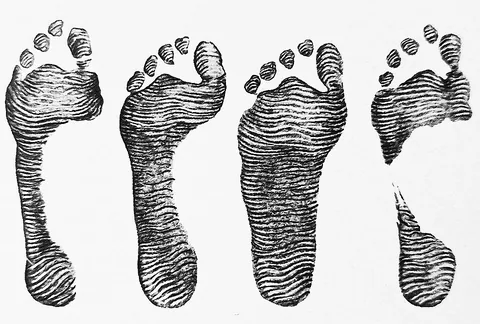
If I took my shoes off now and stood, you'd think I have flippers on my feet. That is how bad they are.
There's no arch in my feet. Knowing now what the implications of that could be, with every single step you take having the consequences of those absorbed somewhere else up the kinetic chain,7Kinetic chain — how Jeff explains flat feet showing up in his knees: the body works as linked segments from foot to spine, and a fault in one link loads the others. my knees, my hips, and my back, I would have done something back then to become a lot more diligent with finding the right orthotic, with actually staying true to wearing the damn thing, not taking it out because it was uncomfortable in one shoe or I wasn't really going to wear my favorite shoes because of it. So that had a lot of repercussions on my knees that I feel every day, every day. Now, there's things that I've been able to do and work around, which we can talk about, because I believe you should be training no matter what your pains are. There's ways to train around them.
But I have been able to navigate that. Now, the other one that I significantly deal with is in my right shoulder: torn labrum,8Labrum — what Jeff tore on his throw to third: the rim of cartilage that deepens the shallow shoulder socket and keeps the ball of the humerus in place. Without it the joint moves too freely and arthritis speeds up, as he says. 50% tear of my supraspinatus, rotator cuff,9Rotator cuff — Jeff's other shoulder injury: four small shoulder-blade muscles whose tendons hold the humerus in the socket through every arm movement. The supraspinatus, which he partly tore, is the one throwers and overhead pressers tear most often. The drawing shows a supraspinatus tear like his.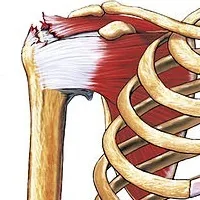 degeneration in that shoulder as a result of the torn labrum. Your labrum is basically there to provide a nice level of support inside the joint. When you tear that and that bone is able to kind of move around a lot more freely than it should without the stability, you can get a lot more accelerated arthritis and degeneration in that shoulder. I was told that I had the shoulder of an 80-year-old person. So, I'm only 50.
That's a little disconcerting, but right now that doesn't actually hurt. So I'm able to do almost anything in the gym that's not unwise, because I've learned how to sort of train around those things, but it's always going to be persistent there.
To be clear, you have a 50% labral tear and, independent of that, tore the rotator cuff?
And you have at least a 50% tear in, did you say infraspinatus or supraspinatus?
Supraspinatus.
And the other three muscles are…
They're pretty intact, yeah.
And how many years ago was that?
So that was actually the funny part about that injury, because… I've told this story before. That was on a dare, or on a bet.
Oh, I know this story.
Yeah. So I was coaching with the New York Mets and it was my second year with them. And so I was very comfortable around the guys at that point.
Definitely would be known to ride each other's weak points and where their insecurities would be. And I think they all knew I wanted to be an athlete one day. I wish I was a baseball player on the other side, in uniform. But I picked up a ball one day and I was standing next to one of our All-Star outfielders and I said to him, just casually, because we used to do our conditioning out in right field, I said, "You know what's crazy? It doesn't look that far from here to third base. It just doesn't." And he's like, "Really?"
And he hands me the ball. He goes, "Why don't you try throwing it there?" I said, "It's not…"
How close are you to the wall?
We're on the warning track. So just in front of the warning track.
To me, it looks far as hell, by the way.
To me it didn't look so bad. Maybe, again…
No, but I think when you're on the field, it's different.
It is different.
It's definitely different. Things look a little closer.
So he handed me the ball. I said, "What do I get if I do it?" He says, "A thousand bucks." And so I said, "All right, give it to me." And I basically crow-hopped about three steps or so. I backed up a little bit, threw it as soon as I let it go.
I don't even remember seeing the ball land. I think it was somewhere around second base that it landed and bounced and rolled pathetically towards third base. I felt, like, a zipper-like pain in my shoulder. And I knew that I had just screwed up. It was pretty debilitating for the next couple of weeks in terms of that really acute injury, but then I was able to… Of course, I still had to go to work every day, and there was a lot of laughing that went on at my expense. My ego was hurt way more than my shoulder at the time, but I've since lived with that, because that was never repaired.
And I went through some periods where I could not train with a variety of exercises without pain. Impossible. Impossible. And I tried all different ways. I did everything I just mentioned to you before, the slight angling of the arm and the changing of the… Nothing would work, except for completely getting away from some of those irritating exercises and then getting into some other movement patterns.10Movement pattern — a basic type of movement: press, pull, squat, hinge, lunge, rotation. Jeff got his shoulder back by switching patterns for a while, loading the same muscles through movements that didn't hurt. And I was able to get back to the point where now I can bench press. I don't barbell bench press, but I dumbbell bench press.
I'm able to, I'd say, pretty much do a full training routine without limitation from the shoulder. I do know that if I were to go do something, like, let's say, a dip too low, and I do this sometimes trying to demonstrate the wrong way to do things, and I'll show, "Okay, don't do this," I'll feel it for days after. So unless I'm intentionally trying to show a mistake, if I were to do something dumb, like if I were to try to attempt a muscle-up11Muscle-up — the move Jeff now forbids himself: a pull-up that turns into a dip above the bar or rings, which puts the shoulder at an extreme, vulnerable angle during the transition. again, which I've done, that could go from feeling so good right now to back to feeling awful, and it could be for a long period of time. So I'm very careful in terms of the things that I do engage in and don't do.
When you had that failed throw to third base, did you sublux as well? Or was the torn labrum a totally separate injury that resulted from presumably subluxation12Subluxation — Peter is trying to work out where the labral tear came from: in a partial dislocation the ball slips out of the socket and pops back. Repeated subluxations often tear the labrum, but Jeff never had any.s elsewhere in your life?
No, no, I had never had any other shoulder issues my whole life.
So that labrum, you think, came from that as well?
ExplainerHow a throw tears the labrum
The long head of the biceps starts not on the humerus but above the shoulder socket, on the supraglenoid tubercle and the upper rim of the labrum. In the windup of an overhead throw, the arm goes into maximal abduction and external rotation: the biceps tendon twists backward and peels the upper labrum off the bone. Surgeons Stephen Burkhart and Craig Morgan described this "peel-back" mechanism in 1998.
Right after release, the biceps brakes the elbow as it straightens at enormous speed and pulls the labrum upward. That is why SLAP tears are so common in pitchers. In the same position, the supraspinatus and infraspinatus tendons get pinched between the head of the humerus and the back of the socket (internal impingement), so a single throw can damage both the labrum and the cuff.
Oh yeah, yeah, yeah. Because when you try to throw that hard, at that quick velocity, you can get a SLAP13SLAP tear — the injury Jeff says one all-out throw gave him: the top of the labrum peels off from front to back where the long head of the biceps attaches. It's the classic overhead thrower's injury. tear from that one extreme effort that was overreaching by everything I had, basically adrenaline driving me to not look stupid. I did have a nice punchline to that story. I don't know if I shared this one last time, but I was subsequently challenged, just goes to show you how dumb I can be with that mentality of an athlete. The following year, at home plate, we're looking at first base. Now, that looks very close.
I don't care, even if you're sitting in the stands, it doesn't look that far, but that's 30 yards. And so I said, "Isn't it crazy how, like, quarterbacks who throw the ball 60 yards in the air, it's like that's a huge feat, or they talk about how incredible it is?" I said, "That's 30. That's half the distance right there. You could throw this on a regular pass." Knowing what I did the previous year, another player stepped up and challenged me to see if I could throw a football 60 yards. 60 yards.
60 yards.
Well, how did you go from 30 to 60?
Because I said it was only half the distance to this accomplishment of 60 yards. Like, I could do that with my eyes closed right now. You can see how I tend to put myself in horrible situations quickly. But I was then challenged to do that. And we got out of spring training, went to Miami, where we opened up our season. And of course there's a football field there.
So we played on a converted football field,14The converted football field — the then-Florida Marlins played at the Miami Dolphins' stadium through 2011, which is why there was a football field handy for Jeff's 60-yard bet. The team moved into a new ballpark in 2012 and became the Miami Marlins. back before they moved into the new stadium, and they walked off 60 yards for me. This time it wasn't just one player. The whole team gathered around, everybody's there, and they had someone pace out 60 yards, and I had the football. I crow-hopped a few times, I threw it. I threw it 60 yards.
Some redemption.
Some redemption.
But sorry, this is only one year after you'd torn the rotator cuff.
And this is what's so great about this story. It's not that I threw it 60 yards, which, by the way, I was handed a thousand dollars in cash shortly thereafter.
So they did hold up their end of the bargain. What's interesting about that is the only difference was the plane that you're throwing in. When you're a baseball player and you're throwing and you're out here, there's so much stress on the shoulder and the rotator cuff from here. When you're in this position here, like a football player, there's so much less stress. You're putting your body into what we call the scapular plane.15Scapular plane — Jeff's explanation for why the football throw didn't hurt: about 30 degrees forward of straight out to the side, the angle the shoulder blade sits at. Lifting the arm in that plane pinches the shoulder's structures the least. You get a lot of triceps that are helping this movement.
It feels completely different. I don't have the pain and stress in my shoulder when I throw from there. How is it that one person not only destroys their shoulder doing the other thing, but does something that somebody from the outside would be looking at as the same thing? "Oh, he's throwing again." But it's not. It's a completely different throw.
Pardon my ignorance, Jeff, but I understand why a pitcher would be out here, because they often want to put spin on the ball. But if you're the outfielder and you don't need to put spin on the ball and you're just going for distance, why wouldn't you mimic the quarterback's mechanics?
Probably a good question, but I think that you're able to get more torque from out here. Obviously, that's because you have that longer distance in the arm. So you're able to throw that ball further and faster. With a football, usually your targets aren't as far down the field. And when they are, your desire is going to be to arc them and lead them. It's more timing than anything.
I think when you're trying to throw for maximum velocity, you're going to want to rely on that longer arc of movement. And when you're an outfielder, the ball's got to get there fast. You've got to throw the guy out at second base, third base, like I tried, or home. So to get maximum velocity, you're going to probably want to be out there, mechanically. With a football player, they can do it with a strong arm at distances of 20 or 30 yards, 15 yards, 10 yards. But when you're throwing long and deep, you usually get so much arc that you don't have to have as much of that speed, just the arm strength to get it out there.
03Great athletes and the cost of injury
Greatness takes both genes and work; any career can be ended by an injury, and longevity comes from consistency.
When you look at some of the greats, let's take Bo Jackson16Bo Jackson — Peter's example of an athlete who seemed born ready: he played Major League Baseball and in the NFL at the same time and was the first to make the All-Star game in both. A hip injury in January 1991 led to avascular necrosis of the femoral head; he had the hip replaced in 1992, left football and played baseball through 1994. as an example. And obviously, for you and I, I mean, we can remember every single play he ever had. I realize that some people may be too young to remember what it was like to watch Bo Jackson, but one never got the impression that Bo got that way through training. He literally just seemed like he, I don't know, was somehow born knowing how to do what he did. Is that because his natural innate talent was around the mechanics of throwing? Or do you think that there are innate differences in the structure of the rotator cuff that would enable him to get away with a higher-torqued position?
I think that the idea that athletes are born is not entirely accurate. And I also think that "athletes are made" is not entirely accurate. I don't think that people who are unathletic can achieve the highest levels of athleticism simply by spending the 20,000 hours,1720,000 hours — Jeff doubles the "10,000-hour rule" popularized by Malcolm Gladwell's "Outliers" (2008). His point is that no amount of practice turns an unathletic person into an elite athlete. right? And vice versa. So when you look at a guy like Bo Jackson, like these outliers, these just tremendous athletes, they are always going to have characteristics that make them the outlier. They're going to have a higher percentage of type 2 fibers.18Type II fibers — Jeff's explanation for elite athletes' built-in edge: these "fast-twitch" fibers contract quickly and powerfully but tire fast, while type I fibers are slow and enduring. The mix is largely inherited.
They're going to have… because we have a lot of muscles where we have a distribution of type 1 and type 2, slow-twitch, fast-twitch. They're going to be a lot more twitchy, is what we say. They're going to have a stronger mind-muscle connection. So when they go to do something, the reason why it looks so easy when they pick something up for the first time is that the coordination requirements that are tough for a lot of us, even just getting on a bike and trying to coordinate that, they pick these things up so easily, most of all because I think they have great neuromuscular efficiency.19Neuromuscular efficiency — Jeff's phrase for how well the nervous system drives the muscles: how many fibers it recruits at once, and how fast and in what sequence. They can do what they're telling their muscles to do. And I believe they have amazing proprioception, which is another… perception of your body's position in space, or really what your joints' positioning is in space, that a lot of us have to learn and practice and get good at.
They have inherently great proprioceptive intelligence. I think when you can put all those things together, and then you have someone who's actually very fast, because speed isn't something everybody has either. When they're fast, when they're explosive, twitchy, as I said, strong, now you're able to do things. And again, when you can pick these skills up so quickly, you're able to do things that look almost effortless, that others would require a lot of effort to even make it look like they're doing it right, let alone doing it at the level that they're doing it. So I mean, Bo Jackson, he was a once-in-a-lifetime athlete. It's just amazing how short his career was because of injury.
And that's another thing. No matter who you are, you might recover faster because of some of the things we talked about. But injury is injury. Injury can happen to anybody at any time, especially in a contact sport like that.
But his was such a freak injury too. Awful. And again, you don't see that injury a lot. Like, if you said, "Oh, it was an ACL" or something like that, you'd say, "Yeah, yeah, yeah." But to have avascular necrosis20Avascular necrosis — what ended Bo Jackson's football career: bone dies when its blood supply is cut off. In the hip it usually strikes the femoral head, and the joint gradually collapses. of a hip that comes out of… I mean, it's just…
Even, like, even not knowing… Because I remember, actually, when that happened and he went down, he got injured. And what it could have been at that time could have been a bunch of different things, but when it was determined, okay, it's a hip fracture, then to heal that way, heal improperly, and then he develops avascular necrosis.21Fact-checkNot quite: Bo Jackson didn't have a fracture that healed badly. He dislocated his hip, with a fracture of one of the hip bones, and the femoral head died because the dislocation damaged its blood supply; Jackson himself believed he did that by popping the joint back in on the field. Wikipedia That's just sort of tragic, especially as a sports fan, to see that have to happen to him. Because it could have healed normally, but it didn't. That's somewhat tragic. One of my best friends from the Mets, David Wright,22David Wright — Jeff's example of an injury derailing a star: the Mets' third baseman from 2004 to 2018, team captain and a seven-time All-Star. Back, neck and shoulder problems kept him off the field for most of his last seasons, and he retired in 2018. amazingly talented, All-Star, perennial All-Star, he was fielding a ground ball at third base, coming in, and Carlos Lee,23Carlos Lee — the Panamanian slugger nicknamed "El Caballo," playing for the Houston Astros in 2011, whom Jeff remembers colliding with Wright at third base. big… they call him, like, El Caballo or something, like, big guy, came down the line and collided with him.
He broke his back, a transverse fracture of his lumbar spine. It healed improperly. Basically healed with a lot of bony spur formation.24Bone spurs — how, in Jeff's account, Wright's fracture healed: bony growths along the edges of bones, which in the spine can press on nerves and send burning down the leg. Now he gets a lot of compression on the nerves there. Feels like a hamstring injury25A hamstring injury — what Wright's nerve pain felt like, Jeff says: a pinched sciatic nerve in the lower back can mimic a hamstring strain, burning down the back of the thigh. the following year, because he's getting burning down the leg, but it's not the hamstring that's causing the problem.26Fact-checkNot quite: Wright's lower-back stress fracture came in April 2011, after a collision with Carlos Lee at third base, and cost him more than two months. The "hamstring injury" came not the following year but in April 2015, when he was diagnosed with spinal stenosis; neck, shoulder and back surgeries followed, and he retired in 2018. A link between the stenosis and the 2011 fracture was never made public. Wikipedia And ultimately that led to his retirement, or to him not being able to play the game that he was.
He was a surefire Hall of Famer, surefire Hall of Famer. A freak accident that just continued to cascade in terms of its healing going wrong basically took him out of the game early. So some of the greatest athletes we've ever seen can still be brought down by injuries, and it's tragic when it happens, because it has so much…
So when you see athletes that combine the best of both worlds, which is to say they have the skill to be All-Stars, but then they also end up having the career longevity to realize that dream… I can't think of a greater example than Tom Brady. It always annoys the hell out of me when people talk about his lack of athleticism.27Brady's "lack of athleticism" — the stereotype Peter can't stand: at the 2000 NFL Combine Brady ran the 40 in 5.28 seconds, one of the slowest times among quarterbacks, and the photo of his soft physique became a meme. He went 199th in the draft. I mean, it's the dumbest thing I've ever heard, right? Like, that guy's a better athlete than anyone you've ever seen. Let's forget that.
But again, what also allows Tom to go down in history as the greatest football player in the history of the sport is that he played so long and that he did so relatively injury-free. I mean, he had an ACL injury28Brady's ACL — the one major injury of his career that Peter mentions: he tore it in the 2008 season opener and missed the whole year, then played 14 more seasons. that didn't derail him at all, missed a year. And when you think about something like that, Tom is one of the most deliberate people in the world when it comes to how he thinks about conditioning his body. And one of the things he talks about a lot is pliability.29Pliability — what Brady says matters more than strength: the core idea of the TB12 method he built with his trainer Alex Guerrero, long, soft, elastic muscles, laid out in his 2017 book "The TB12 Method." The term has no scientific definition. And he talks about how, at least at his position, it's less important how strong he is, it's more important how pliable he is. How trainable do you think that is across the board?
I think it's trainable. I think it's basically sometimes avoiding some of the things that take away pliability. So if you're focused on just strength and just building as big muscles as you possibly can, then you're going to be trading off some of the elasticity of that muscle. So being able to build to a certain point, or try to create as much growth as possible, to a point where you're still able to functionally use that muscle and to have the elasticity in that. So that means you still have to work on your flexibility. You still have to work on your mobility.
I hate the term "muscle-bound," because it just sounds like such a cliché from the old days, but that is really essentially what's happening. When you become muscle-bound, you're not also working in the elements of flexibility and mobility. And I think Tom Brady has always done that. He's never been worried about being Mr. Olympia. It wasn't his physique that was leading his success on the field.
It hasn't been for any quarterback, and yet it still strikes me that there's something Tom is doing different than all the other quarterbacks, or most of them.
I mean, to me, when I think of Tom Brady, and I've actually heard this from some players, he is the epitome of… and this is great, because it segues into anything we're talking about later on in fitness: consistency. He is the epitome of consistency. Consistency is the key that unlocks every single door when it comes to physical performance, or just overall health and longevity. If you can stay consistent with what you do, then you're going to have a lot more resilience to injury. You're going to have that ability to focus on the things you know you need to focus on, even if you don't like them. I don't like stretching.
I hate stretching, but being able to show up and continue to do that, that's the consistency part of it. He, I'm sure, has so many things that he did in his preparation that weren't his favorite things, but it was never a negotiable, him not doing them. So to me, I think his superstardom and his legendary status comes from his consistency in doing even the things that he didn't really want to do. I think what happens to a lot of people, and even a lot of athletes, is that they tend to narrow down to the areas that they like the best or they perform well at. You're never going to be as good as you can be if you always focus on the things you do well. You have to focus on the things you don't do well at, to sort of round out and fill in those gaps, so that you're able to create an end product that is more fortified than not.
And that's really a lesson that goes far beyond trying to be the best player in the history of the NFL. That's true for all of us, and you've heard me talk about this a lot, is I do want everybody to think of themselves as an athlete. And then the sport, it's not football and it's not tennis or necessarily anything like that. It's just life. Life is a sport. Luckily, it's not as demanding a sport as being on a football field, but it's still a sport.
It's a sport where you get to define the rules. You get to define the objective of the game. But if you treat it like that, and then you start to adopt an athlete's mindset… The athlete's mindset says there's a distinction between training and exercise. Training has specificity.30Specificity — Peter's line between training and exercise: the body adapts to the exact demands placed on it, so a program is built around a goal. Training has sometimes doing things I don't want to do. It means creating a well-balanced and structured program.
04Training after 40
After 40, start by accepting the decline; joint pain in place of muscle soreness is the cue to change your volume and your preparation.
And I want to talk about all these things with you today. So let's start with the idea of transitions and stages in life. So I'm sure you feel the same way I do, but we're half the men we used to be already, and we're not even there.
Being reminded every day.
Yeah. Sometimes people… I've said this to people, and they're like, "I don't know what you're talking about. I feel amazing, and I'm your age." And I'm like, "That's great. I'm very happy for you that you do, but it's also, you didn't do half of what I did when I was younger. You were sort of a fat, out-of-shape bump on a log until two years ago.
And so that's why at 55 you feel better than you did at 53." And that's great. Nothing makes me happier than seeing somebody who's never done anything their whole life and they're now finding their own. That's great. But there's another subset of people, like you and I, who have been insanely active our whole lives, and we're still doing fine. But if we're being brutally honest, we're a fraction of what we used to be.
We don't have the recovery, we don't have the speed, we don't have any of those things.
Knowing and understanding the inevitability of some decline, how should people who have been active their whole life, who are showing up in their 40s and their 50s and their 60s with the, I don't want to say inevitable, but the very probable wear and tear that came from doing dumb things when you were young, and experiencing a decline because you're starting from a higher place… How do you think about coaching these people such that they get to 90 and they can still do everything they want to do? And, by the way, do it at the level of what we would think of as a fit 65-year-old.
That's a good question. First of all, I think you have to do what we've done, which is come to the realization that it isn't exactly like it was when we were younger. Because some people will fight that. They'll fight the fact that things have changed. They'll fight the fact that it might require a longer warm-up than you used to do, or "I used to be able to do this." Like, for instance, I'll say, I used to be able to do just one quick warm-up set before I get into my working sets.
Why can't I do it now? Like, I think we fight that for a while. I did fight it for a while. Probably in the last three to four years was my transition period to start to realize and see some of these changes.
And what was the signal for you that you needed to do that?
More achiness in the morning when I would wake up from training. I'm okay… I'm accustomed to feeling sore when I wake up the next day. I think that makes me feel alive. The soreness that I'm talking about is not joint soreness. I'm talking about muscle soreness.31Delayed onset muscle soreness — what Jeff considers normal, even welcome: muscle soreness a day or two after unfamiliar work that fades within days. His warning sign is joint pain, not muscle soreness.
I know I worked a muscle two days ago or a day ago. But when it starts to get to be more joint feel and joint-related, I know that I'm maybe not allowing myself to recover enough, or I'm doing too much at too quick of a pace, or I'm not preparing myself to do whatever I am doing. And therefore, I think that's the part of the warm-up that I wasn't really doing enough of. And you just have to be honest with yourself and say, "Hey, what am I not doing that I could try that is going to potentially change whatever it is I'm feeling?" I think you are going to feel something, though, and that is going to be your sign as to where you should start. And that, for me, is usually in the form of either that joint soreness, like I said, or too much fatigue, waking up fatigued, maybe even irritability at things that wouldn't have made you irritated before.
These are signs that you might want to start looking into your recovery. From the recovery standpoint, the two factors of that are: what is the actual work you're doing, and then what are you doing to prepare to do that work?
Sorry, in that second category, Jeff… Just to make sure: the first category is, what are the activities I'm doing to recover? And then the second is, how am I eating, sleeping, all the other things that go into…
What is the actual workout that you're doing? What is the training look like that you're doing? So the training itself could be problematic, because it could be too much volume. Or, what am I doing to prepare myself? And that does occur not just in terms of the warm-up, or right before the workout, but your eating, your nutrition, your sleep, the other elements that will go into recovery. I'm sure we're going to find, all of us will find one or two or five areas that we're probably not doing the things that we could or should that might make us feel better. And I say "might," because I don't believe that there's one recommendation for people, when it comes to preparing to do something or recovering from what they're doing, that's going to work for everybody. I think we have to conduct our own experiment on ourselves and see what the end result is.
How do you feel after doing whatever it is that you're doing? So try something different. For me, I actually tried to utilize bands before training. I could take my bands out and work on warming up my rotator cuff, or doing some of the movement patterns I'm going to be doing that day, but just doing them with bands. And then, I always say that the beauty about bands is that they're perfect for warming up, because they stretch as you're able to do more. So they have that built-in capacity to handle more as you can give more.
So if you're just doing the first few repetitions with bands and you're just kind of feeling creaky, or you're not really warmed up yet, as you're able to do more, they can handle more. They can absorb more of what you can handle. I like the fact that bands can be used to warm up. And it's something that I started doing just individually. I'm not saying that everyone should run out and try bands, but it is a good recommendation. And when you do that, you warm up your joints, the muscles actually get more prepared to do what they're going to do.
Now, even if I handle the same loads that I did in a workout without that warm-up, my joints are more ready to handle it. Proprioceptively, my joints can feel what I'm about to do, because I just did something similar to that, in that motion. And then I actually can get into using the weights, which provide a different source of tension. The weights are going to be differently felt than the bands will. I'm more prepared to handle that. The joints are more prepared.
And as I said before, that muscle-up, all it takes is one bad repetition to make this shoulder go from 100 back to zero again. So you can imagine the accumulation of however many repetitions you're going to do in a workout, ill-prepared or not prepared well enough, can pile up and start to have some negative consequences. So I think that's what people have to do. They need to come to grips with the fact that not everything is going to remain the same. I've mentioned before that I've always had great eyesight after I had them fixed with LASIK, but I've had great… near vision,32Presbyopia — what Jeff is describing when he can't read a pill bottle: age-related loss of near focus as the lens stiffens. It reaches almost everyone after 40, and LASIK doesn't prevent it, which is why Jeff uses it as an example of decline you can't train away. last two or three years, I struggle every time I pick up something to read, a pill bottle or anything. It's very difficult to read, and it frustrates the hell out of me, because I didn't do anything to merit that type of decline.
Nothing. I'm very consistent with what I do in all aspects of my life. So that is simply just an age-related decline that has nothing to do with anything that I'm doing to cause that acceleration of that. I take care of my eyes, have regular eye visits. It's something else that's causing that. I have to understand that that is going to come from age.
What are you going to do about it?
05Volume, failure and reps in reserve
The biggest lever after 40 is fewer sets taken much closer to failure.
Yeah, no, it certainly will. When you think about this transition from your 40s to your 50s to your 60s, and I focus on that not because there aren't people listening to us who are 20 or 30, but I do think that there's a huge cycle between that 40, 50, 60. So I want to kind of focus there for a moment. What do you think is the most prudent strategy for reducing risk? And I'm just going to limit this to resistance training for the moment. Is it reducing overall volume?
So if I said to you, "Jeff, when I was in my 30s and early 40s, I would be doing 25 sets per body part33Sets per body part — the volume measure Peter asks about: working sets per muscle group, usually per week. The 25 Peter used to do in his 30s is a lot; 10 to 20 is the usual recommendation for growth. in the gym," should I be taking that down to 10 to 15 sets? Is it reducing absolute weight and therefore increasing reps a little bit? So, "Hey, I've always trained at one to two reps in reserve, and I'm going to continue to train at two reps in reserve, but that weight is actually coming down." What it's taking me to get to one to two RIR is a lower and lower weight as I age. Is it frequency of training, the number of times, how many days go in between training muscle groups?
How do you think about all the potential levers a person can pull to still maximize their performance while minimizing the risk of injury?
That is the essence of what we try to do. That is what we have to master. So there's a couple parts to this. So first thing, I'll give you the short answer of those three options. I want volume to come down. I want productive repetitions to go up.
I want repetitions to actually mean something. And when I do that, that means the intensity is going to go up. So you'll have to train harder, but I will save a lot of the junk volume that I believe just winds up wearing and tearing and creating an accumulation of wear and tear. That's not only not necessary, but, again, it's ultimately unproductive. So we have to look at it, though, starting from this concept of reps in reserve, and whether or not you actually prescribe to the exact reps in reserve specifications of, "Hey, one RIR or two RIR." Some people don't train that way, but they…
Can you explain?
Yeah. I rattled it off quickly, but I want to make sure everybody knows what I mean. So reps in reserve is essentially a measure of how hard, let's say, you've taken a set.
So zero reps in reserve is you've taken that set to full mechanical failure, where you cannot lift that weight anymore in good form. One RIR would basically mean that if you were to do a grinder, if you were willing to grind out one more repetition, you probably have one more repetition in you. Two to three RIR is essentially where you've got another one or two left in the tank, but it's still difficult, but you're stopping at that point. Nobody that was watching you from the outside would visibly really be able to tell that you've reached your maximum. Four RIR or more, to me, already starts to become junk volume. And it's exasperated by the…
Outside of a warm-up set.
Yeah, outside of a warm-up. It's exasperated by the fact that we as a whole, and I'm talking about even some trainers themselves, we don't fully appreciate, or have the internal scaling tuned in, to measure what real effort is. And that's for a variety of reasons. I would guess that we undershoot what we're capable of doing by one to two to three repetitions often.34Stopping short. A meta-analysis backs this up: people underestimate how many reps they have left before failure by about one on average, training experience barely helps, and estimates are most accurate close to failure. Halperin et al., 2022 So when you don't have this measurement of zero, what zero means, then everything else is very difficult to gauge, especially if you don't have a lot of training experience to be able to feel the nuanced difference between a one or a two, or a two and a three. So to me, what I want people to do is to start, at almost every opportunity, training as close to mechanical failure as possible.
Now, there's a few things that get in the way here. There's psychological failure. Psychological failure is not necessarily "I can't mechanically lift or make my muscles contract to lift this weight again." It's "I don't really feel like doing another repetition, because the discomfort that's caused by this repetition is something I'm not really willing to put up with." There's a big difference between that and what your muscle can actually do. So when we push ourselves past psychological failure, then we get into what we call form failure.
And form failure is where the speed of the repetition might go down. I'm okay with that. I actually advocate for slower repetitions anyway, but the speed might go down a little bit. The form might get a little loose, in terms of, like, a little bit of cheating, but that's okay too, because as long as you're properly stabilizing your body when you're doing it and you don't look like you're performing a different exercise, that's still okay, acceptable. What's not okay is joint pain. If you feel joint pain at any step of the way, you should stop, because you're probably not even training the muscle at that point anymore.
You're obviously putting the joints in the middle. And then allowing yourself to just push to that point where the exercise can't physically be completed, where, in the exercise you're doing, a bench press, you can't move the weights anymore. That's where you stop. And that's where I believe people need to get themselves to more often. And most of us have that calibration that's not calibrated correctly. So we're not gauging that effort correctly. Even if it looks like we're doing the right things and we're accumulating the right volumes, like you said, on paper, the signal's not there.
The intensity is not there. You need to get to a point where you can objectively say, "Well, the signal is here, because I can't move this weight anymore." And the more you do that, you can take away a lot of those sets. And so even though it might be counterproductive to think, "Well, by training harder, I'm going to apply more stress to my body and make it harder for me to recover…" No, you're actually… because you're applying less of that junk volume, and certainly, in terms of joints, less of that wear and tear. Because even just raising my arm up here every single time is another, as I say, rotation on the tire.
At some point, the tires on that car have to get changed. You're going to run out of rotations on the tire. Why waste them in a repetition that is completely non-productive for, you mentioned, building muscle? Because that is what we're trying to do in this case. We're training for hypertrophy. So if you're not pushing yourself to a point where you can stimulate those high-threshold fibers,35High-threshold fibers — why Jeff wants sets taken close to failure: the nervous system calls on these mostly type II fibers last, only under heavy effort or when the others are tired, and they have the most capacity to grow. the ones that can grow, then what are we doing? We're not accumulating anything that's going to build strength or hypertrophy.
So therefore we're not building that resilience that we're trying to build. So, objectively getting you to do more of your sets to good form failure, not talking about ugly repetitions and losing stability of your body while you're doing it, I'm talking about good form failure, then you can bring down those repetitions in those sets quite a bit, get rid of a lot of that volume, and through the increased intensity have a way better outcome.
So for certain exercises, it's safe and relatively straightforward to determine a zero RIR. To your point, and I agree with you completely, this is exactly the thing we explain to our patients, especially people who are new to resistance training and we're trying to build these habits: you can't know what one or two RIR is until you know what zero is. You have to fail.
Yeah.
And so I want you to start to learn what failure looks like. It's safe and straightforward to learn what failure is if you're doing an overhead triceps extension,36Overhead triceps extension — Peter's example of a lift where learning failure is safe: on a cable, a missed rep costs nothing. because the cost of failure is really low, especially if you're doing it on a cable pulley or something like that. But how do we map that out to somebody who's doing front squats37Front squat — Peter's counterexample, where failure is risky: the bar sits across the front of the shoulders, and a missed rep means dumping it. or back squats?
When we're talking about the big compound lifts,38Compound lifts — multi-joint lifts such as squats, deadlifts, presses and rows, where Jeff advises leaving one or two reps in reserve. especially if you're trying to train for strength, where your rep range is going to be lower, I don't believe training all the way till failure is the way to go. I think saving one repetition there, maximum two repetitions.
Well, I'm just saying, to learn. When you want to teach them what one or two RIR is, how does someone figure that out in a squat?
Obviously, with the right setup, you can put somebody in a rack39Power rack — Jeff's setup for learning failure in the squat: a cage with adjustable safety pins that catch the bar if you can't stand up. and have the safety pins there. And then you can even have them squat to a box,40Box squat — another safety net Jeff suggests: you squat down to a box or bench behind you, which limits depth. so they have a little bit of the assuredness of knowing that they're not going to bottom out. Yeah, they can get to a box. So I think there's things we could do to manipulate that. Deadlift, one of the things we do oftentimes is elevate the bar, either through a trap bar,41Trap bar — Jeff's way to make the deadlift safer: you stand inside the hexagonal bar, with the handles at your sides and often raised, which is easier on the lower back.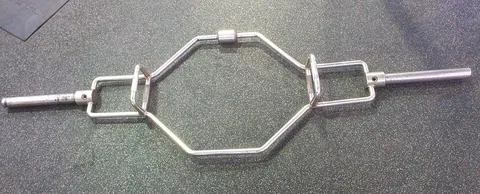 so the handles are elevated, or put the plates on… Just to be able to give them a little bit more security in knowing that when I do fail here, it will feel like I'm in a safe, secure position.
You could always strip away the pads at that point, or you can take away the box. But again, in those big compound lifts, it's not really even necessary to do that, to go all the way to failure, to see those benefits. You can take that one rep short. Because, again, remember, I said that the zero RIR is really, truly that maximum last rep that is going to look like a grinder to people. Doing these things on those front squats or other lifts can become a recipe for disaster, especially for people that…
That's a sport. It's called powerlifting.
Right, exactly. Right. It's not necessary when we're talking about those exercises. But something like a lat pulldown, like you said, or a barbell curl… Like I said, a barbell curl, there's nothing safer in the world. When you're going to fail, you could simply just release it from your body. I'm not advocating to throw the weights around the gym, but it's in front of you and it's going to safely go down to the ground, to the floor, or to the bench, whatever's in front of you.
You don't have to worry about that. It's not like you're getting crushed under the weight in a bench press. I gauge a lot of the train-to-failure or absolute-failure recommendations based upon the environment of the exercise you're performing and how safe it is to actually do that. Because there's no benefit that you're going to gain that's going to outweigh the risk that could come from a poorly performed repetition with a weight that's already in a fatigued state, where you're handling a weight in a fatigued state already.
06Why some days you can push and others you can't
Poor sleep and stress hold you back, but age matters most: fast-twitch fibers and hormones fade.
I know from all of my time training that there are just certain days when I'm not able to push as hard as other days. And this is not just true in the weight room. It's true on the bike, it's true in the pool. So it's true with cardio, it's true with resistance. And I've long wondered why. What is it that allows me on some days to push so much harder?
And why are there some days where there's almost like a built-in governor, and it just says, "I'm not going to let you go past this threshold of pain today"? I'll be honest with you, that is something that I've probably noticed a little more of lately than I noticed in my 30s and my early 40s. Even up until my early 40s, I had almost a supernatural ability to do what I called "burn the matches42Burning matches — Peter's term for daily all-out efforts, borrowed from cycling: a rider has a limited box of matches, and every attack burns one." every single day. And I would do this very strange thing. Even on a recovery day, if I was out for a recovery ride, I would still always do a four- or five-minute all-out hill climb. Even an easy swim, I would still do an all-out set for 400 yards or 300 yards or something. Today, there are many days when I could never do that.
So do you think that's a consequence of aging? Do you think that's a consequence of stress in life, or other things, that the body can only manage so many things? And if you have too much stress in your life about work and kids and things like that, you just can't bring all of your energy to a workout. I mean, what do you think is driving that? I'll add one final question, which is really the question at hand, which is: how can an individual understand, are they at a psychological limit or a mechanical limit?
Those are definitely the two biggest contributors, the psychological and mechanical factors. However, psychological could be driven by your recovery. So whether you're getting good enough sleep that night, whether you are undergoing stress outside the gym in your life, these factors chip away. They chip away at your ability to tap into that next level. I think they don't chip away at your ability to show up; that's just part of your habit at that point. They chip away at your ability to tap into that next level of intensity, to train and do what you're saying, burn the matches, because that does take a reserve.
You're tapping into reserves there. And if the reserves are already tapped out because of these other stresses, or, again, your lack of sleep and other factors, poor nutrition, that lead to the feeling that you're having, then that's going to prevent you from tapping in. I think what contributes more to that, though, and it sucks, because it's sort of the inevitable part of what we're dealing with, is the aging contribution. We know that as we age, obviously, we're losing type 2 muscle fibers,43Fast-twitch fibers and age. Biopsies bear this out: in men around 70, type II fibers in the quadriceps are 29% smaller than in 23-year-olds, which fully accounts for the difference in muscle size. Six months of resistance training grew the older men's fast-twitch fibers by 24%. Nilwik et al., 2013 we're getting weaker, we're losing the muscle mass itself. So things that used to be achievable with less effort, because of higher levels of strength and the higher distribution and proportion of type 2 fibers, that's starting to physically go away. So things that you used to be able to do are going to become more challenging.
Now, we try to, like, push through that and say, "Okay, I've got to push harder." But then we have the hormonal contributions to that too, that make pushing harder and doing harder things more easy. That is starting to get challenged too as we get older. So we start to get a decrease in the hormones, the male hormones that are driving, and women see the same effects here too. They're getting a decrease in their hormones that provide that level of effort, and also the hormones that help to regulate stress and help to regulate sleep and help us to have undisturbed sleep. These are all starting to get disturbed as we get older.
And I think that whole picture makes it more difficult to do the things that we used to do.
07Shoulders: the overhead press and its modifications
Everyone needs a vertical press, and a bad shoulder calls for an easier version, down to a landmine press, not for dropping it.
Let's stay on this sort of physique, hypertrophy side of things for a while, and let's take kind of a nuanced look at muscle and muscle groups specifically, head to toe. And I want to talk about the most common misconceptions, the biggest mistakes people are making, and maybe what the greatest unlocks are for folks who have been frustrated in lack of gains in these areas. And whenever possible, or whenever you feel that it adds value, feel free to distinguish between male and female. But I also kind of assume, at the end of the day, male and female training has to be pretty similar, right? I mean, the same principles of progressive overload44Progressive overload — the principle Peter says applies to men and women alike: to keep growing, muscles need gradually more load, reps or sets. apply. So I don't know if that even makes sense as a valid question.
I also realize that, of course, men and women sometimes have different goals with respect to what they want physique-wise, but anyway, feel free to handle that part in any way you choose. So where would you say we're starting? At the top? Shoulders, traps?
Shoulders.
Okay. So you've got somebody like me with salmon shoulders.
They don't really bulge out at all. And, by the way, I'm taking notes for myself. What are the biggest mistakes people make? And when people want to beef up their shoulders, what should they be doing? What are they doing wrong?
The shoulders are a three-headed muscle:45Deltoid — the muscle this chapter is about: it caps the shoulder and has three heads, front, middle and rear. posterior deltoid, middle deltoid, and front deltoid. So people do take an approach where they try to choose exercises that will focus more on one head versus the other. There's a lot of people who say that the front delt doesn't need to be trained, because it gets a lot of work in pressing and overhead pressing. It depends on how detailed you want to get, or how specified you want to get, in terms of building up shoulder development, but it's a head of the deltoid, it's a muscle, and it needs to be trained. I think if you were to try to develop optimal size of your shoulders, you're going to want to choose exercises that do focus on each one of the heads of the delt individually, and then with the most attention.
You're not going to isolate one versus the other, but with the most attention. And then you're going to want to make sure you're still doing your compound lift, which is always part of every muscle we're going to talk about. Like, what's the compound lift you could do where you have other muscles assisting that work, so you can push that muscle to and through its failure point, like we talked about? For me, it starts with a vertical pressing movement of some sort, to be able to do some vertical pressing, which is really a point of contention for some people, because that's going to be orthopedically one of the things that hurts the most. But there's always some modification to that that I believe you should be able to do.
And sorry, let's just say, why is the vertical press so important to you? Is it because it's getting all three heads simultaneously?
It gets all three heads simultaneously. It's a functional requirement of life to be able to lift our arms up overhead. I'm not saying that we have to lift our arms up overhead with weight in our hands, 40, 50, 80 pounds, whatever we're doing. If you want to put a suitcase into an overhead bin… I just witnessed it as we were flying here, someone trying to lift their suitcase. I was wondering if I had to step in and jump in and help, because it looked like a struggle to get it up into that overhead bin. You need to be able to handle weight overhead.
And so I also think that it also uses full range of motion to do that. We never want to forego full range of motion. Full range of motion is the nutrient to the joint. If we only stuck with movements that work the front, middle, and rear delts, we could theoretically stay below shoulder level our entire training session. I want to see you get your arm up overhead, so we're getting that shoulder through its full range of motion, the joint itself through its full range of motion. It's not always about just the muscle itself.
It's about the joint that you're trying to train around, to get the full function that we're looking for.
Now, someone like you, Jeff, with some arthritis already in your right shoulder, let's just assume you had a little bit of AC arthritis46AC joint — the small joint where the collarbone meets the shoulder blade at the top of the shoulder. Peter asks about it because arthritis there often hurts during overhead presses. as well.
I do have some of that too.
So there you go. So what are the modifications you make? How do you safely accommodate that motion? Because obviously, gosh, I mean, back when I was a kid in high school, we were doing it behind the head.47Behind-the-neck press — the lift of Peter's high school days that Jeff has put in his graveyard: lowering the bar behind the head forces the shoulder into extreme abduction and external rotation, where it's most vulnerable.
I don't think people are doing that anymore, are they?
Most people are doing an overhead press in front, I guess. If they've been watching me, I hope not, no. But this is the thing that people get a little bit disturbed by, if I say this, or if I throw an exercise, as I say, into my "iron graveyard.48The iron graveyard — Jeff's list of exercises whose risk he thinks isn't worth the payoff; he runs through it at the end of the episode." It's not because I want to have an issue with the exercise. It's that I know I can give you an exercise that will give you the same benefits without the risk.
Yeah.
What's the point?
Right. We should just make that disclaimer now, because I can already see the hate comments coming in. Because there is always going to be at least 100 people on planet Earth that love every single exercise and have a great argument for why you should be doing back squats on a piano, standing on one leg, with an elephant strapped to your testicles. And anybody who says that's a dumb idea is a total poser. Yeah, totally. And it's like, no, you're right.
If you can do that without getting injured, you should absolutely do that.
Well, that's my answer to that, is, like, if that's what you do, and, again, go back to what we mentioned before, if you can feel a greater stimulus that way, "No, that's the best way I feel my middle delts work," then do it. I'm not saying don't do it, but I have to make recommendations for people that I think are largely appropriate for the majority of people. And I don't think that that exercise is going to give people this superior benefit that they can't get from just simply getting your elbows out in front of your body and doing the press from in front of you. For me specifically, I can do things like a landmine press,49Landmine press — Jeff's first fix for a cranky shoulder: one end of a barbell is wedged into a corner or a floor pivot, and you press the other end up and forward along an arc, so the arm never goes straight overhead. where I can get my elbows out even a little bit further in front of my body.
So tell folks how you do a landmine.
So a landmine press is essentially: take a barbell, put it into a corner of a room. If you're training at home, put a towel there so you're not ruining the corner of your room. But you basically put the empty bar in the corner, you load up your weight on the front side of the barbell, you put two hands on that end of the barbell, and you're pressing up and away from your body, like that.
All you're doing there is taking away some of the verticality of the exercise. Again, going straight up is going to require the most range of motion at the shoulder. And people that have orthopedic issues might find that all that range of motion is tough to tolerate right now. So when you put it out in front of your body, you're cutting down that angle by about 45 degrees.
And you want people doing this symmetrically, meaning not off to one side, straight up and down the middle? I love asymmetric loading.50Asymmetric loading — weight on one side only, as in a one-arm press; Peter and Jeff both like it because the trunk has to resist being pulled sideways.
I love that too. Oh, yeah. I love it.
So you'll do one arm?
You can do that too, yeah. Absolutely. I could do them up and over. I love to do things that are a little bit more challenging in the multiple planes when we can, but if we're starting out and we're trying to get somebody to actually just feel this motion, definitely I would have them start right center chest and push up and out. But you're basically cutting down some of that overhead requirement, some of the range of motion requirement, which is going to make the exercise feel a little bit more tolerable. You're also, as I mentioned earlier, getting a little bit more triceps involvement the closer those elbows get in, because you're getting more flexion at the elbow.
So they have to extend. So you're getting some assistance from triceps on your way to being able to do your shoulders, which is, I think, a good point to point out here. Any injury you're dealing with is not a mandate to completely rest. It's not. It's a mandate to choose safer, more appropriately loaded and progressed exercises. That's the requirement here, not to completely rest, because resting in and of itself actually contributes to more of the dysfunction.
ExplainerHow load heals tissue
Jeff's refrain throughout is that an injury is no reason for complete rest. The reason lies in how tissue responds to force.
- Cells in tendon, muscle, cartilage and bone sense stretch and compression and respond by remodeling: laying down collagen and strengthening along the lines of load. This is mechanotransduction, and treating injuries with dosed load is called mechanotherapy.
- Take the load away and the response stops: immobilized tendons and muscles weaken, and cartilage, which has no blood supply, is nourished only when the joint moves.
- The classic case is chronic Achilles tendinopathy, treated not with rest but with slow, weighted heel drops (the Alfredson protocol: three sets of 15, twice a day, for 12 weeks).
- The dose matters: a bit more than the tissue is used to, without pain that keeps building. That's the logic behind Jeff's "detours," easier versions of an exercise that don't hurt.
Time is one part of recovery, but the loading of the tissues themselves is another promoter of recovery. So when you remove that load entirely, things start to go wrong at an accelerated pace. So what you want to be able to do is find the exercise modification that you can do. And then you progress. You add more weight to that, or you start to step closer to this landmine, so that your positioning is now a little bit more vertical, and then to the point where you can actually press overhead vertically. And it's not going to always be limited, potentially, if you follow the right progression.
There's an analogy I use. If you thought of an injury to a certain joint, or a painful exercise like this overhead press, it shouldn't be looked at as a city shutdown. It's just a single road closure for now. That's it. We can take that overhead press that I can't do, let's say just the dumbbells overhead, and then we reroute it and we do this landmine press instead. Okay, great.
We didn't shut the whole city down to do this. Now, let's just say, though, that all of those are harmful at the moment. They all hurt. And I use pain as the guidance, joint pain as the guidance. Then we take the back roads and we do something completely different, like a row. Because if I row, I'm not training my overhead pressing at this point, but I'm putting the shoulder through range of motion.
I'm going into extension at the shoulder. I'm bathing that synovial fluid51Synovial fluid — why Jeff wants even an injured joint moving: the fluid lubricates and feeds cartilage, which has no blood supply of its own and gets nourished only when the joint moves and is loaded. into that joint. I'm helping to promote recovery. These little steps along the way, though they might look remedial, are part of the overall progression back to function. So when we talk about, again, this landmine press, don't think that you're married to this exercise for the rest of your life. Understand it's a step in the way to being able to overhead press.
I think that's what people do a lot of times, is they just… they feel like they're not able to do the thing, so therefore don't do any of it, or choose something completely different that's not going to provide the same stimulus that we're looking for. And we talked about that with squats a little bit the last time we were here. Just doesn't feel right for you.
But there's other things you could do to maybe progress yourself to the point where squats would feel right again.
But for overhead pressing, I need that, and I need to have that as my compound movement, whatever form it might take, whatever step in the progression it might take.
In the hierarchy of barbell straight in front of you to dumbbells, is the idea that with dumbbells, look, I'm going to allow you to take a little less pressure off the AC joint by bringing them… like, the more midline you're going, you're approximating the landmine? So for you personally, with your shoulder history, are you using a barbell or are you using dumbbells?
I'll use barbells infrequently, maybe 20% of the time. And again, sometimes because I want to retest my abilities, to see how close I've come to being able to use them pain-free again. And I can, I can use them pain-free now. One of my best modifications when you're doing a barbell press, if you have shoulder issues, is to narrow up the grip, because the narrower the grip is, you can see the elbows follow. So as I start to narrow my grip, my elbows will follow, and the elbows start to bring, obviously, a change in shoulder alignment with it. So now I'm back into sort of that scapular plane, and I'm able to press from there.
So that's one modification I'll make if I use the barbell. I will almost always opt for dumbbells. One of my favorite things to do with dumbbells is simply do one at a time. So, you mentioned the asymmetrical. I love being able to do one dumbbell at a time. I can handle more weight that way. So that's back to that idea of increasing the stimulus, increasing the intensity.
I can increase the intensity, improve the mechanics of the exercise on the joint, because I can take that one dumbbell, push it up and overhead, and then stack the joints. I talk a lot about joint stacking: wrist over elbow over shoulder, and have that good stability from underneath. When I'm pressing from out here, we don't get that same level of stacking. So if you have any instability-type injuries, like a labrum tear, you're not going to feel as comfortable out there, unsupported, as you are with everything stacked on top of each other. So I like to do that variation of the exercise. It also feels… some exercises are just more fun.
It feels fun to be able to do that.
Seated or standing?
Standing. I like to do as many things as I can standing, because even for a shoulder exercise, again, if I'm advocating not trying to always go so light, and, again, increasing some of the weight you're using here, then I like the fact that I can have my legs to rely on if I need a little bit of that extra cheat to push myself through to those higher-intensity repetitions. I'm not saying that you always have to do them with cheat, or with a push press,52Push press — the backup Jeff likes about pressing standing: a short leg drive gets the weight moving and the arms finish the press. but they're there if you need them. Otherwise, you could simply do them as a strict rep, but still, standing is just a more athletic position for people to be in. I think that has the best carryover.
What I'm hearing you say is, if you only have time for one deltoid exercise, it should be the overhead press, because it's the compound movement that hits all three heads.
Yeah. Okay. I believe so.
08Middle and rear delts
The middle delt makes the shoulder look round; the rear delt keeps the joint healthy and is best loaded with a wide-elbow row.
So now, if you could add a second or a third movement, presumably you're not going to want to bang on the anterior portion again, because you're getting enough of that through presses. Are you going to want to do something for the lateral head or the posterior head?
Yeah. So either of those other two options. Again, I agree with your question there entirely. And that would be the third choice. The front delt would be the third choice of the three. But I think, back to what I said originally, if you were trying to maximize hypertrophy of the shoulder, you could still do front delt exercises. Again, there's a lot of fear around…
Can I ask a silly question? You know, when you see somebody who's… And this, again, is both male and female, both tend to prioritize having a nice separation. Is that visually created by the lateral delt or the anterior delt?
So that's where I think the front delt is a little underappreciated, because I think it does create, if you're talking about the visual aesthetic of it, that separation between the chest and the deltoid, because you're getting that line that comes in on the anterior part of the shoulder. But when you're looking at that roundedness of the shoulder, that is almost entirely coming from the middle delt. You're not even really seeing the rear delt there. The visual benefit of the rear delt is when someone turns to the side, and then you see whether they have a rounded shoulder there, or whether they have, like, an emptiness to their shirts in the back side of their shoulder there. But the rear delt is one of the most functionally important for maintaining proper balance of the joint itself.
So I think, as a physical therapist, my next answer should be the rear delt, because I know the exercises that go to training that are going to have a lot of other benefits to you posturally, and, again, maintaining joint health for the long run. But if you're talking about strictly aesthetics, and what you wanted to do to have a better appearance when looked at from the front, then it's going to be the middle delt.
So what's a middle delt exercise?
So any lateral raise53Lateral raise — Jeff's go-to for the middle delt: raising dumbbells or cable handles out to the sides to shoulder height. is good. I do like the cable lateral raise54Cable — why Jeff prefers cable raises: the resistance runs along the cable rather than straight down, as with a dumbbell, so tension holds over almost the whole range. a lot, because it's got tension throughout the exercise for a longer portion of the range of motion. If we do a lateral raise with our arms at our side, the exercise has basically zero tension at the bottom, and it starts to rise up as I raise the dumbbell up. But with the lateral raise on the cable, first of all, I have a stretch tension on the delt itself in that starting position. And as soon as I start to pull, I'm already getting higher levels of tension in the middle delt. And they are maintained, as long as you sort of manipulate your body or your arm position in space as you go.
We're always trying to get, when we use cables, this perpendicularity between the cable and that moving structure. So if I have my arm here, it's my forearm that's really the moving structure that I'm focused on. How long can I maintain this relationship of the cable and my forearm in this perpendicular alignment? If I can do that and pull up, again, I sort of manipulate my arm in space to feel where that is, then I'm going to feel that middle delt working at a high level throughout almost the entire range of motion.
For people who are just listening to us and not watching us, you're doing kind of a cable… "Raise" is almost the wrong word. You're basically doing a cable movement across your body. Across, like a row.
Yeah, because you don't need gravity when you have the cable.
You're doing an across-the-body kind of row. And by the way, what we'll do in the show notes for this podcast is we'll link to videos you've made on each of these, because that'll actually make it really productive for people to go and see, like, "Okay, that's exactly what he means." Okay. And by the way, I have no affiliation with the company, but I have become completely enamored with and obsessed with Voltra.55Voltra I — the machine Peter has fallen for: a portable cable trainer from Beyond Power whose electric motor supplies up to 200 pounds of resistance and lets you set the lifting and lowering loads separately. Manufacturer's site Have you been using this thing?
Do you know what I'm talking about? It's kind of electromagnetic. I really, really like it.
Oh yeah. What have you been using it for?
One of my patients gave it to me. I loved it. I actually bought a second one. So now you can pair them, and I use it for a lot of things right now.
Like, where you can manipulate the separate tensions, eccentric tension and…
Yeah, that's the first thing that I fell in love with, was the manipulation of concentric and eccentric tension.56Concentric and eccentric tension — why Voltra's separate settings make sense: a muscle lengthening under load (the eccentric phase) can produce more force than one shortening (the concentric phase). It's, frankly, I mean, just a space-saving device.
Like, I've got one of those big FreeMotion things. I'm selling it. I've got all these other things I'm just getting rid of, because it just replaces them. Frankly, if I didn't already have a lat pulldown machine, I'd get rid of that thing too, because you can do pulldowns on this thing. You can do belt squat57Belt squat — one reason Peter is ditching other machines: the load hangs from a belt at the hips rather than resting on the shoulders, so the legs work while the spine is barely loaded.s with this thing. I mean, all you need is a really good rack and this device, because it clicks into…
Yeah, we had one in the gym for a while, by a company, Kineo, who had lent the piece to me. We were able to do some really cool things with it, but it was hard for me to show them to people on YouTube, because nobody had the machine and nobody could do it. But as far as, like, geeking out on the stuff myself, I love that. I mean, I love the ability to increase the eccentric load even more than we can concentrically, because our bodies are able, obviously, to handle a lot more eccentrically than we can concentrically. So if you can take a load that you can handle concentrically, then double that load eccentrically, you're getting challenged in a big way.
And I've been so interested in which exercises I have more eccentric strength than others. You know, and it might just be a function of the absolute weight, but it's been amazing to me, on some areas, where having a big eccentric load is manageable, and in others, where the eccentric addition above concentric can't be that much. It can only be, like, 10 or 15%. So I think I'm scratching the surface of how to use this thing, but I am enjoying that.
There's a million things you can do with those. They even have the different modes, of the elastic. You can make it feel like a band.
Or like a chain.58Chains — a Voltra mode Peter mentions: lifters hang chains on the bar so more links come off the floor as it rises, and the load grows toward the top, where you're strongest.
Right, right, right. Like a chain, where you're increasing… Yeah. So, I mean, it's really cool stuff. It's definitely for the nerdier types like ourselves who like to do this, but as long as we know how to use it and apply it with the people who see us, then they can benefit too.
Okay. So that's your go-to middle delt. Obviously, the rear delt is something you already alluded to, where you could be doing a row, you could be doing face down on a bench doing a lateral raise or something like that. What would be your kind of number one go-to rear delt?
I believe that, though a smaller muscle group, and though one that doesn't often get trained directly, it definitely gets skipped the most out of the three of the delts by most people.
So number one skipping is leg day, number two skipping is rear delt.
The rear delt, yeah. It doesn't get the love it should. But again, as a physical therapist, I know its importance in more than just looking a certain way. I at the same time believe that it doesn't get loaded anywhere near what it's capable of being loaded, or it doesn't get subjected to the stresses that… most, when they actually don't skip the day, they actually do the exercises, they're not loading it enough. So for me, the most effective way to hit the rear delt, and hit it with a lot of weight, is a seated cable row.59Seated cable row — Jeff's number one rear-delt exercise, with a twist: normally a lat exercise, but he flares the elbows and pulls to the upper chest. And we do the seated cable row with wide elbows.
So you have your elbows lifted up away from your sides, and your goal is to drive the elbows back behind your body. And all you have to do is just simply… you could even do it sitting in your chair. If you drive your elbows back behind your body in a row, you'll feel that rear delt really, really contract strongly. Well, with a row like that, we can utilize good weights, and we're getting good assistance from the other upper back muscles and from the lats60Lats — the muscles that take over a row from the rear delts if you don't watch your elbows; they give the torso its V-shape. to do the exercise, but the rear delts will feel the brunt of that load, especially if you're focused on… This is where I think sometimes it's never just the movement. It's not just A to Z. It's A through Z when you do a movement.
I don't ever want people to just look at an exercise and say, "Oh, I see he's going from here to here on this row, just moving those elbows back." How are you moving it back? If you focus on driving it with your rear delts and contracting your rear delts as you pull, you'll feel less on the lats. You'll feel less of the contribution from the other areas that are contributing but not dominating. It's easy to let the muscles that are usually dominating that movement, like the lats, come in and dominate. But if I focus on that rear delt doing the move, which relies on the knowledge of knowing the rear delts are going to pull the elbows back behind the body… That's part of this whole why these shorts versus long videos, we have problems, because I want you to not just see the exercise, but understand why this works.
When you understand it's the moving of the elbows back into extension behind the body that drives the rear delts, then you know why that exercise could work, and you could actively work to make that movement recruit more of the rear delts when you do it. And your load is going to be significantly more than you'd ever use if you were doing an I, Y, or T,61I, Y, T raises — what people usually do for rear delts and what Jeff considers too light: lying face down, you lift straight arms so that, with the body, they form the letters I, Y and T. which a lot of people will do if they say, "I'm going to do some rear delt work." Nothing against those exercises, they're fine, but those are light work for a muscle group that can definitely handle more.
Again, for people who aren't able to watch us, one of the things that you did that I think stands out is the elevation with which you're doing it. So the higher those arms… So you're almost pulling to your face.
Upper chest. The elbows are going to drift away from your sides around 45 degrees, or maybe up to 60 degrees or so. They're going to drift out, away from your sides. Yeah.
So if you're just doing a normal narrow-grip cable row, you're not getting enough rear delt.
And that's how… Again, and this is why I love exercise so much, because that is how you shift the focus. It's still the same exercise. It's still a row. It's still a seated row. But if my elbows are driven tight to my sides and adducted tightly against my sides, I'm going to get more lats. If I allow my elbows to drift, I shift it away from the lats into the upper back and rear delt.
So movement is not enough to describe what you're doing. It's the muscles that contribute, and how you do the exercise, that determines the effect you get.
Should we say anything then about the anterior delt as a dedicated activity, or have we kind of hit it?
It's simple enough. As I said, if aesthetics were your goal and you wanted to build the ideal shoulders that way, I would still do a front delt exercise. Something as simple as a front dumbbell raise could do the job, or a cable stretch raise, because I can hold on to the cable, step away from the machine a little bit. My arm is now behind my body to start. So I'm getting a good stretch on the front delt to start, and then I can rise from there. So you could also do this in an incline position, sitting on an incline bench, maybe 60-degree or 70-degree incline. You sit there, your arms will be behind your body just because of the positioning of the incline bench to start.
So you have a little bit of a stretch on the front delt before you go into your front raise. Any injury considerations with that? Are there any people whose shoulders are going to hurt with that pre-stretch?
No, I don't think so. No, I think that's a pretty safe position to be in. I mean, just getting back behind, I think a lot of us don't do enough of that, actually.
We don't get behind our body enough. That's a good, safe position of the shoulder, because you're not in an elevated position. More problems with the shoulder come when it's elevated than when it's down at your side. Any of the impingement62Impingement — the shoulder's main hazard, which Jeff raises to explain why an arm held low is safe: the rotator cuff tendons and bursa get pinched between the humerus and the acromion as the arm goes up.-type issues, or things that you feel that are uncomfortable, come more when you get past this area, they call it a painful arc,63Painful arc — the zone Jeff tells people with bad shoulders to respect: pain raising the arm to the side from about 60 to 120 degrees that eases above and below that range, a classic sign of rotator cuff trouble. which is beyond 60 degrees of elevation and abduction, into, like, the 120 degrees, or past shoulder level. And then, of course, when you get towards terminal range of motion, that stuff can become more problematic. But positions of the shoulder down, with your arm at your side, don't tend to be aggravating.
And when you're starting from that preset position and lifting, let's say you're at that 60-degree incline, how high do you need to lift? Just arm parallel to the ground?
Parallel to the ground, yeah.
All right. So that's pretty good on delt. Everything you just described, how many sets are you thinking? How many working sets, meaning one-to-two-RIR working sets, total?
ExplainerHow many sets a muscle needs
Jeff's number is 8–10 hard sets per muscle group per week, but only close to failure. Here is what the research on volume says:
- Muscles grow more the more working sets they get each week. In a meta-analysis of 15 studies (Schoenfeld et al., 2017), the biggest gains came with 10 or more weekly sets per muscle group; higher volumes had barely been studied.
- Each extra set adds less, while fatigue and joint stress keep piling up. That is Jeff's "junk volume."
- Compound lifts also load neighboring muscles: the bench press works the triceps, rows work the biceps. That's why, as Jeff says, the arms need fewer direct sets.
Right. That's key, because without the intensity indicator there, it's going to vary completely. So, given that I'm a big believer in the intensity being near failure, at failure, you're looking at eight to 10 sets in a week is needed. Some people separate those depending upon what split they're following, but, I mean, if you're doing just, let's say, a traditional bro split,64Bro split — the setup Jeff uses to explain weekly volume: one muscle group per day, bodybuilder style, so all 8–10 sets for a muscle land in one session. we call it, where you're just doing one muscle group at a time, when you've hit eight high-intensity sets across the exercises… You could mix them up.
You don't have to do them all each week.
No, no, you could vary. I mean, I like to always include the compound. I might shift the focus between the rear delt and middle delt specifically, if I was limited to time or volume.
09Triceps
Three exercises cover the triceps: a heavy lying extension, a pushdown, and a kickback to fully shorten the long head.
Okay. Where do you want to go next? You want to go down the arm, or talk chest and back?
Well, let's go down the arms.
Okay, let's hit the triceps. Okay. So there's, again, three heads of these bad boys.
ExplainerWhy shoulder position matters for triceps and biceps
The lateral and medial heads of the triceps start on the humerus and only straighten the elbow. The long head starts on the shoulder blade, just below the socket, so it also crosses the shoulder joint and pulls the arm back and in toward the body.
- With the arm overhead, the long head is stretched: that is why skull crushers and overhead extensions load it.
- With the arm behind the body, it is shortened: that is how you take it to a full contraction, as in the "extension with a pull-through" Jeff describes.
The biceps works the same way: the long head attaches above the shoulder socket, the short head to the coracoid process. On an incline bench the arms hang behind the body and the long head is stretched more, while on a preacher bench the arms are in front and the short head does more.
Three heads here again. So you don't have to be as specific here, because really there's one differentiator between the long head of the triceps and the other two heads, the lateral and medial head. All three of them extend the elbow, so they straighten the elbow out. The long head, because it has an attachment that crosses the shoulder joint onto the scapula, is affected by positioning of the arm itself, the shoulder itself. So when you put your arm up overhead, you're putting that long head in a more stretched position to start the exercise. When you put that arm back behind your body and extend your elbow, you're having an effect on the degree of contraction of that long head, because you're getting a more complete contraction if your arm is back behind your body.
So what I always recommend is, though there's three heads, I really like to see you do a good compound exercise that just focuses on extending the elbow. Do an exercise that places tension, or a higher amount of tension, on the long head in that stretched position, and do an exercise that places more tension on that long head, or takes advantage of the fact that the long head could be in a position of greater contraction, with the arm back behind the body. So those are my three real staples, or requirements. The compound exercise is not as big or as important to me in terms of, let's do something like a bench press, where I'm getting assistance… like a close-grip bench press,65Close-grip bench press — Jeff's example of a compound triceps lift where the chest and shoulders help; he prefers the lying extension. where I'm getting assistance from the chest and shoulders too. I think you can still do a heavy lying triceps extension66Lying triceps extension (the skull crusher) — Jeff's triceps workhorse: lying on a bench, you lower the bar toward your forehead or behind your head by bending only the elbows. The farther back the arms go, the more the long head is stretched. as your compound exercise, and you're also checking off that box of the stretching of the triceps long head at the same time.
That's my favorite exercise, for a number of reasons. So, laying on the bench, you've got a bar. You could use an easy-grip bar67EZ bar — the short, cambered bar Jeff suggests for skull crushers: you hold it at an angle, which is easier on the wrists. or a regular straight bar, but that could be harder on people's wrists.
Okay, but you would prefer a bar to dumbbells?
Dumbbells are okay. I don't mind dumbbells at all. I use dumbbells a lot myself, but people sometimes can feel it to be a little awkward, because they can't ever time the dumbbells right in terms of extension.
So again, the technical term for what you just described, right, would be humeral extension, or extension of the elbow.
And so how much do you need to get enough long head pre-stretch? Are you doing that with… So again, for people listening, I'm trying not to use my hands that much. If I'm laying on the ground and I bring my arms up, my humerus up, to perpendicular to the ground, is that enough stretch?
Or does it need to be really opening the axilla up?
Yeah, you have to open up those armpits for sure. You've got to get your body to a position where, I'd say… So if you're laying on your back and your arm was directly pointed to the ceiling, you would be at 90 degrees, right? So I'd say you're going to want to be at least 120 degrees or so, more. You go another 30 degrees back behind your head. A nice ballpark area for that is that your arm is sort of approximating towards your ear. So your biceps is sort of getting close to your ear.
So this is the workhorse of the triceps.
I believe this is the best exercise you can do. It could be loaded up really well. Again, I like the compound nature here; it comes from the fact that the lats can assist you in coming back to the top. So if you have a little bit of fatigue, you always have that lat that can actually pull and kick in and help to pull that arm back up towards the top of the extension. Matter of fact, there's a great exercise that utilizes that on purpose. It's called a PJR pullover,68PJR pullover — an exercise that uses the lats on purpose: you lower a dumbbell behind your head with bent elbows, then bring it back by first straightening the elbows and then pulling with the lats. where you're just taking a dumbbell, in this case, two hands on the dumbbell, allowing it to go back into what would traditionally look like an old Arnold pullover,69Pullover — the old-school lift Jeff compares the PJR to: lowering a dumbbell behind the head on nearly straight arms; Arnold believed it "expanded" the rib cage. but you let the elbows bend.
So they bend at the bottom. Now you've got that good stretch on the long head of the triceps. You extend first to get the momentum going, use the triceps to extend the elbows, and then you continue it by using your lats to drive the dumbbell up to the top.
If you compare this exercise to an overhead triceps extension, where you can easily be starting in the same position, but when we're doing the overhead triceps extension, our humerus stays generally fixed…
You're saying with the dumbbell?
No, with a cable. I'm sorry, with the cable.
How do you compare those two? Do you prefer the lying one, or would you do them both and just say, "I'm going to use much more weight in the lying-down one, because I'm getting lat to help me lift it back to a perpendicular, 90-degree position"?
I don't like that exercise performed that way very much, because I think that, again, we talked about that perpendicularity of the cable and the moving segment; that is lost pretty quickly in that exercise, to become pretty parallel pretty quickly. So you lose a lot of the tension. What I advise when people do that push-away-type exercise is to get the arms up overhead in a higher position. So if you're using a rope, when you pull down, you can see that that's pretty perpendicular there. And as you come to the top, the rope is still sort of perpendicular to the forearm, to a greater degree. You'll feel it much more in the triceps throughout the entire exercise, as long as you are doing it from a higher arm position throughout.
When you start to lean forward and do that, again, you can see, like, as I'm leaning forward, the cable is going to be right about here, almost in line with my forearm, and you're going to lose some of that tension. The dumbbell variation, which is… I thought you were asking about the dumbbell overhead variation, where you have two hands on one dumbbell and extend overhead. That one gets more elbow flexion, but doesn't get as much of that shoulder flexion up behind the body, relatively. So you could feel it less in the triceps for that reason, but it does create some internal rotation of the shoulder to grab the dumbbell in that position. That could be very uncomfortable for some people. The more you can get your elbows out in front of your body, externally rotating your shoulders, and getting your hands to almost squeeze the dumbbell and your elbows almost to pinch together, that will alleviate some of that shoulder discomfort. But you can manage that by simply taking an incline bench and performing it on an incline bench, because now your arms don't have to be back like they would in a vertical position here, all the way to here.
I could be on an incline bench and get that level of extension at the elbow, but not have to have this arm as high on my body as I have to. And so it feels more comfortable to people. And when you're in this vertical position, again, you're bearing the weight of gravity completely, and you're going to have the most range of motion at the shoulder to do that, than you would in a… We talked about 120 degrees on the lying version. So there's less of that overhead range of motion that's required in the lying version of that.
Okay. So clearly you've established what the workhorse is on that one: lying triceps extension, with a bar ideally. What would be the, for lack of a better word, the accessory or additional triceps activities you would add to that?
Then, if we wanted just the one that hits the medial, lateral head, the function of just extending the elbow, I still love a classic triceps pushdown.70Triceps pushdown — Jeff's second triceps staple, for the lateral and medial heads: standing at a high pulley, you straighten the arms down with the upper arms pinned to your sides. I don't care if you do ropes, if you do a straight bar, whatever seems to be most comfortable.
What are the pros and cons of each?
I think it depends on people's health of their wrists. Some people might find the rope gives the wrist a little bit of a break, whereas if you have the bar, you have two hands on a fixed bar. Because of that, if you have some immobility issues in your wrist, then what happens is the shoulders actually do get affected by that. The position of the shoulders, the position of the elbows gets affected, because if I can't grab onto a straight bar, because I lack the ability to get a fully flattened wrist, then what happens is your elbows will flare, your shoulders will internally rotate. So now, all of a sudden, you're doing your pushdowns from what I call this jackhammer position, which is like this, because I can't get there, so I have to do this. When I do that, now, all of a sudden, I'm pushing down, if I have a straight bar, a lot with my chest. I basically turn this into a straight bar dip.
And so I'm taking a lot of focus away from the triceps.
So is there a difference between… Let's just say you're doing it with a single arm, to make life easy. So you're doing a press-down where your palm is facing laterally. I'm trying to be descriptive for folks not watching, but you're sort of coming down this way, versus turning the palm to the floor, this way. Assuming your wrist can accommodate both, does it have any bearing on the triceps, provided the upper arm's in the same spot?
If the upper arm is in the same spot, no. And that's where there's some controversy around, because people… I've actually talked about the underhand triceps pushdown that people can do. And there are benefits to the underhand triceps pushdown if you are not… You have to be conscious about what's happening to the rest of your anatomy. We're not just a disconnected arm. We have multiple joints here. So what I'm saying is that when people do this underhand grip, what happens is the elbows will tend to become more approximated to the body.
And then what that will do is it will actually give you a chance to stay in this closer position and get into a deeper position back behind your body, to get that long head into a more contracted state. Whereas if I'm here and my elbows are in front of me, I can't… I almost get blocked by the bar. I can't really get back to that position. So it's a subtle difference. But again, when we talk about training like an athlete, I always say that the reason why we say that is because athletes would care about the subtle differences, because it matters. And when you're looking for every edge, when you're looking for every possible nuance that might contribute to a better exercise, you need to consider these things.
So the arm position gets affected by that wrist position. And so if you are able to get into that position more effectively because of the change in wrist position, then you might want to consider that too. The trade-off there is it's a weaker wrist position. So you can't handle as much weight as you could when your palms are on top of that bar. So, trade-off. But again, tension is the language that muscles speak, not necessarily the exact… right.
And even though you have less weight, if you're able to get the elbow behind you and get that huge amount of… you're going to get a little bit more stimulation on the long head, added to the other two that you're getting just from the extension itself at the elbow.
That is, again, this dance that we play between, well, a little less tension, but more effective contraction. So I feel… what is the end result? It's all going to factor into that tension, that language the muscles are speaking, to determine how much of an effect you're feeling.
Okay. What other exercise would you consider a very important one for someone who is struggling to add mass or strength to the upper arm?
This is another controversial one, but it's true. You need to do an exercise that would get that long head in its fully shortened position. So something that contracts that elbow with your arm behind your body. So we're talking about some form of a triceps kickback.71Kickback — the exercise Jeff calls controversial but necessary: bent over, upper arm against the body, you straighten the elbow back. It's the only way to fully shorten the long head, with both elbow and shoulder extended. You could do it with a cable, you could do it with dumbbells, you could do it on an incline bench, face down, but the long head of the triceps will be in its fully contracted state when you are able to get full elbow extension and shoulder extension at the same time. And that is one of the only exercises that allows you to do that, other than some of these pushdown variations that I've talked about, where you can get a straightened elbow and get your elbow positioned back behind you a little bit.
You could do that on a pushdown if you had a long rope, right? A long rope that you could position your arms behind your body, and we call it a drag pushdown, where you're actually dragging your hands down your body. So when you finish, your hands will be on the side of your legs, your elbows will be back behind your body. You'll have the same type of effect there, but not everybody has a rope long enough to pull that off. A regular gym rope won't cut it. If you attach two ropes, you could possibly do that.
Before we move on to biceps, maybe we can talk about this after or before, but benefits and cons to supersetting72Superset — what Peter asks about: two exercises back to back, usually for opposing muscles like biceps and triceps. Jeff says it changes weekly volume, not exercise choice. triceps with biceps with deltoid. How do you think about the entire complex? Because it's not uncommon for somebody to say, "I'm going to do arms on a day." And that might just be delt, biceps, triceps, if they're going to do chest and back on another day. So how do you think about the trade-offs of that?
All that does is really affect your overall volumes for the week and how you're distributing your volumes for the week. It wouldn't impact my exercise selection, I don't think, for triceps, if I was training biceps on the same day, unless I had some kind of an orthopedic issue where the accumulation of multiple positions from these different exercises is causing me to feel more joint soreness. Again, if we're choosing the right exercises, it shouldn't be doing that anyway. So if that's not the case, I don't have any objection to people doing biceps and triceps together. They tend to look at them as two smaller muscle groups that, because they're antagonistic to each other, it feels good to train them on a day. While you're fatiguing one, you're not necessarily fatiguing the other.
So I feel fresh on both sides of that. People that do triceps at the end of shoulders or chest, it's another good thing to do when you're talking about maximizing recovery, because all those pushing muscles73Pushing and pulling muscles — the split Jeff recommends for recovery: chest, front delts and triceps push; back, rear delts and biceps pull. It's the basis of the push-pull-legs split. that have a similar function are going in the same day. So when I come back the next day, if I'm doing pulling, biceps and upper back and back, then I'm getting a complete reprieve of those muscles. And if I go do legs the next day, I'm getting a reprieve of two days of rest before I come back to them again. So that's really the consideration, is how it impacts recovery. But from an individual exercise selection, my choices wouldn't change on the triceps if I trained them with biceps.
If I did train them with something that was doing a similar function, like chest and tris and shoulders, then I might decide on how I want to change exercises up. Like there, the bench press, we know, is going to act as a secondary compound to the triceps, or it's going to help the triceps.
So let's say you did that split. You said, "I'm going to do chest, shoulder, triceps one day, back, biceps another day." You would still start, presumably, with your chest exercises, because that's the biggest compound movement, and you would move probably from chest to shoulder toward triceps.
Unless… Again, it depends on how aesthetically driven somebody is and what they're trying to accomplish here. If they had weaker triceps, or weaker development of their triceps, you might want to prioritize your triceps first, and go do your triceps training first, when you're most fresh, and then come back and do the others, if they weren't of as high a priority.
10Biceps and forearms
Jeff bets on heavy, slow lowering, and picks arm position to bias one head of the biceps or the other.
So for those of us with puny biceps, what are we doing wrong? What are the most common mistakes people make, and how do they fix it?
When it comes to biceps, I believe the number one stimulus for biceps growth is the eccentric overload of the biceps.74Fact-checkOverstated: eccentrics help, but they aren't the main driver of growth. In a meta-analysis of 15 studies (Schoenfeld et al., 2017), muscles grew 10.0% on average with eccentric training and 6.8% with concentric, a difference that wasn't statistically significant; the authors recommend including both. PubMed The fact that, especially when we're talking about most of these pulling muscles, the eccentric is going to be the part where you're lowering the weight under a slower tempo, trying to accentuate the stretching tension that we get, in addition to the fact that the weight itself is applying tension. So we're getting tension two separate ways. We could do that with a heavier barbell curl. We could do a cheat curl, where you're actually… yeah, you do some repetitions that are as strict as you can, but you get a little bit loose on the form to get the weight up, and then you have to really fight the weight on the way down. You will always be stronger on that way down than you are on the way up.
So if you never really do that and tap into some of the cheating of the concentric to get up, then you're never really going to apply the same level of eccentric overload that you can. So I like doing the barbell curl with a cheat. Chin-ups75Chin-ups — Jeff's favorite eccentric biceps exercise: palms facing you, the biceps work harder than in a pull-up, and a slow descent supplies the eccentric overload. are one of my favorite ways to eccentrically challenge the biceps. So if I get up there and lower myself down… I could change the exercise to be a little bit more focused on the biceps by just opening the angle a little bit of the chin-up. A lot of times people will do a chin-up and they'll pull until their biceps are touching their forearms. And that's going to get a lot of lat engagement.
But if I can just open the angle and get my body a little further away from the bar, now I've shifted some of that focus to the biceps. And I want to, again, handle those eccentric repetitions as slowly, as painfully, in a good way, as possible. I was always a fan of doing chin-ups and trying to challenge myself to hold on to the bar for as long as I can. I used to win the flexed arm hang76Flexed-arm hang — the school fitness test Jeff won every year at field day: chin above the bar for as long as you can hold it. every year at field day, because I used to basically work at it in the off-season of field day. I was, like, determined to win that every year. I enjoy trying to hang and hold myself in a flexed-arm position.
What did it take to get the top mark?
I remember this vaguely. I bet you I was around 45 seconds to a minute I was able to do it for. Like, I think that was, like, the winning requirement, which is still tough now. I usually do them only in a fatigued state, though. So at the end of a workout, it's a great way for me to finish.
Reminds me… It's taking me back to third grade. You had to keep your chin above the bar?
Chin above the bar, yeah. Get up there, chin above the bar, and just hold for as long as possible.
Now, I extend it past that, though. So now what I'll do is, it's not just chin below the bar. I keep going until my feet hit the floor. So as long as I can go for a set is what I'll do. But again, I like to do that as a finisher at the end of what I'm doing, not as the primary source. Any type of eccentric overload is great.
And again, when it comes to biceps, where is the risk? If I'm on a chin-up bar, I simply let myself go and my feet hit the floor. If I have a barbell and it's going down, it's going to accelerate faster; I put it on the bench, or wherever I have to put it, back in the rack. It's not like the stress that we have when we are doing a bench press of some sort, where the weight's coming down on top of us, or a squat, when the weight's coming down on top of us. We have such a safety net when we do these exercises that not utilizing them is a big opportunity missed.
Now, what about hitting different parts of the biceps? How about, for example, like a preacher curl77Preacher curl — Peter asks how it differs from the incline curl: the upper arms rest on a pad in front of the body, which biases the biceps' short head. It's named after Larry Scott, the first Mr. Olympia (1965), who made it famous.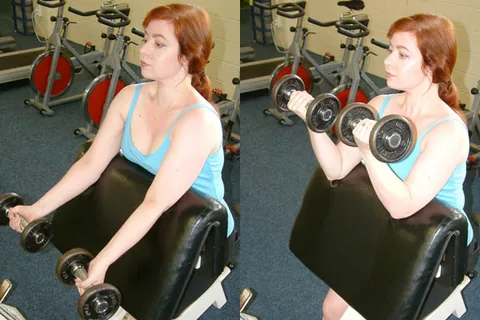 versus an incline bench, with arm behind you, curl? Like, what are the trade-offs or advantages?
So short head, long head is the differentiator here. The two heads of the biceps are the short head and long head. The long head gets its name because its attachment is higher in the shoulder. It's actually attaching inside the shoulder joint, to that labrum. And then the short head has an attachment that's lower. The long head is going to be better hit, because, again, it's crossing that shoulder joint, with things that place it on stretch by getting it back behind the body, which is the incline dumbbell curl that you mentioned.
The incline position, when my arms are hanging, is going to put them back behind the body a little bit. And it gives you that slight pre-stretch on the exercise. That slight pre-stretch is supposed to allow for a better recruitment of the muscle fibers to the exercise, but also, I believe that's the main driver, it just gives that second level of tension, that second source of tension beyond just the dumbbells itself. You're getting a stretching tension on top of the dumbbells themselves. So an incline dumbbell press is good. That could become a little bit irritating to people that have shoulder issues, though, if they go too low on that.
You would incline at what, 60, 45?
45 might be a little on the edge there. I'd say 60 degrees is more comfortable for me. The short head is really, again, just flexing the elbow, getting your arms out in front of your body. So that's the preacher curl, cable curls, just a standard cable curl; the traditional barbell curl would hit more of the short head. And then there's also this concept of "what you see is what you train."
So when you're looking in the mirror, if your arms are rotated outwards and you can see the inner portion of your biceps more, that's your short head. This portion you see on the inside is the short head; that would be working more of the short head. So I have an exercise variation we call the no-money curl. So, "I have no money." Like, my hands are out here at the side, I've got nothing. External rotation of the arms there, curling from that position there, is going to work more of that short head.
When I have my arms internally rotated more, and curling from that position, like I would from a drag curl,78Drag curl — Jeff's long-head example: the bar travels up against the body as the elbows move back. anything around a drag curl, then I'm seeing more of that outer portion of the biceps visibly in the mirror, then I'm going to be working more of that long head also. So that's another indicator of how you can differentiate between the exercises.
Now, for someone who's not a bodybuilder, or really in the minutiae of trying to differentiate, is biceps one of those things where, as long as you are adhering to really good principles of eccentric loading, getting something on long head and short head, exact arm position might not matter? It's: get the volume right, get the stimulus right, and go.
Yeah. I think for most of these muscle groups, if people did even just these basics, and they were just trying to make sure that they're checking off the boxes of actually doing some exercises for biceps, shoulders, chest, all these muscles we're going to talk about, they're going to see amazing results from them. Arnold was famous for having his Golden Six,79Golden Six — Jeff's proof that the basics are enough: Arnold's beginner program of six lifts, the squat, wide-grip bench press, chin-up, behind-the-neck press, barbell curl and sit-up. which is having six exercises that you can do that are going to essentially provide the biggest bang for their buck. You worry about progressively overloading on them and getting stronger, they're going to create a good physique at the end of the day. But the nuances, I think, help a lot when it comes to training around and navigating around injuries or limitations, because, again, back to what we said at the beginning, if you have the understanding of where you can go when you do hit one of these roadblocks or closures, then you have the rerouting possibilities.
And if you don't understand what's part of making up that movement, you don't have the ability to do that so freely.
And would you put biceps and triceps in the same category as delt, where you're talking about eight to 10 working sets per week to make gains, or do you need a little more?
I don't think you need a little more. I think, if anything, you could get away with less. I mean, as long as they're high-effort, taken-to-failure sets. I mean, they're a smaller muscle group; they don't need as much. And they are definitely going to get additional benefits from the other compound movements that you do. When you're training chest, you're going to be training your triceps; when you're training your back, you're going to be training your biceps.
So you're going to get some additional volume in anyway, in their accessory role.
Okay. What are your favorite forearm exercises, that aren't obviously getting all the work already with biceps and stuff like that?
Forearms, I think it's rather boring when it comes to forearms, because if you look at the wrist function side of forearms, meaning the extending and flexing of the wrist, you can get a lot done with two basic exercises: just simple barbell wrist curls, or barbell wrist extensions, or dumbbell wrist extensions, dumbbell curls, or cable, you could do the same thing. Whichever position or whichever device you want to use, you can do that. When you extend the benefits beyond that to the forearm itself, we can move our forearm in space and still work forearm muscles. So the brachialis is a muscle… the brachioradialis80Brachioradialis — why Jeff goes beyond wrist curls: the large forearm muscle that reverse and hammer curls load, and that gives the forearm its bulk. is a muscle that crosses from the upper arm down to the forearm itself, that we can get with reverse curls and exercises that we can load more heavily, but it is a big muscle that sticks out and provides a lot of forearm development.
So just limiting it to wrist curls and wrist action is not enough to train your forearm. You can get even more into the minutiae when you start to do radial deviation and ulnar deviation and pronation and supination,81Pronation and supination — rotating the forearm palm down and palm up; radial and ulnar deviation tilt the hand toward the thumb and the pinky. Jeff loads all four with a band. and those are all amazing movements. I like to just resist them all with bands. I've actually done a video where I show you how to do all those movements with just bands. And, again, it's something that can match your ability level, based on just how much resistance, or how far away you step from the anchoring point. I do like one other functional-type exercise, which we used to do in baseball a lot.
It's just a roll of some sort. So an over-under roll: you could take just a barbell itself and roll forward until you fatigue, and then you roll backwards until you fatigue. All that's doing is basically, the rolling forward is essentially creating wrist flexion and getting the flexors, and the rolling backwards of the bar is getting wrist extension, training the extensors on the back of the forearm.
And you're doing that on the ground?
Just standing in space with a barbell in my hand, just rolling over that barbell until you can't do it anymore. We've shown before a more elaborate version, which is really pretty cool, but you take a band and you wrap it around the edge of a barbell that's in a rack.
You take that band and then anchor it to a kettlebell or dumbbell. You just tie it around the kettlebell or dumbbell you have. And now what you do is you roll over the top of that end of the barbell until you lift that kettlebell weight all the way to the top. And then, more importantly, you unroll it just as slowly and under control, because what it wants to do is just go right back down to the ground. So you have to unroll it very slowly and go back down to the ground. So it's another way to, like, almost gamify forearm training, because, again, forearm training can be pretty boring and straightforward, but effective.
11Chest
The chest needs both a press and an adduction: the best press is an incline with dumbbells, and heavy flyes give way to cable crossovers.
Okay, let's go to everybody's favorite. Let's talk pecs.
Pecs. International Chest Day every day.
I was talking to a buddy of mine yesterday, and I hadn't talked to him in a while, and he's a really serious guy when it comes to his training, and I was like, "All right, what's new in your workouts, man?" And he goes, "Chest day every day." Yeah, yeah. Which, of course, he's being facetious, but the fact that that was his joke…
I mean, it's a centerpiece on the torso. So I think when people… That and abs. So when people see themselves in the mirror every day, that is the thing that catches their eye first. So I think that's why it gets so much attention. When it comes to the chest, there's two major requirements here. You want to get some type of pressing movement, and you want to get some type of movement that adducts,82Adduction — the second movement Jeff says the chest needs besides pressing: bringing the arm across toward the midline, as in flyes and crossovers. or brings the arm across the chest.
So when it comes to the pressing movements, you have options of, obviously, barbells, dumbbells, machines. They're all going to do pretty much the same thing in terms of the movement itself, but how it feels can be drastically different. And this is where, when you have shoulder issues, and I can speak from experience here, some of them are going to feel a lot more uncomfortable than others. When I was going through that period of inflammation in that joint, which was long after, by the way, long after the injury itself, I had kind of re-aggravated that injury in demonstrating some of these bad exercises to do early on on my channel, I couldn't do any pressing. I could not do any pressing at all. There wasn't a pressing variation that I could find that was comfortable for me.
So I did all of my work through the adduction crossover-type exercise:83Cable crossover — what Jeff trained his chest with when his shoulder wouldn't let him press: two pulleys on either side, with the handles brought together in front of the chest. It's what he recommends instead of dumbbell flyes.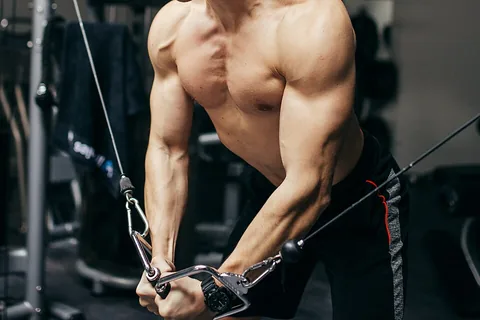 taking a cable, grabbing onto the handle, and then crossing my arm over my body. I think the ability to pull the cable in with your biceps, to kind of get it going, or know you have that option, takes away some of the instability that might come from having your arm way out in front of you, and that long moment arm that could be placed on the chest. So I found that to be a good rerouting option for me. I was able to, after doing those exercises, get back to the point where I could press. But when it comes to the press itself, incline, flat, decline, if I had to choose one, I'd say incline, because most people have weaker development of their upper chest relative to their lower chest or middle chest.
So an incline bench press will cover the weakest point of development and still do a really good job of hitting the rest of your chest. But I think dumbbells give people with any issues the most opportunity to train pain-free. And if you still have pain when you train with dumbbells, slow it down. The slowing of the dumbbell, especially during the eccentric portion of it, is going to give your joint the opportunity to feel safe and overcome any instability that might be causing some of your pain. I believe that a lot of times, even though there's structural problems in the shoulder, when you combine structural issues with instability, they feel really vulnerable. Those structures feel very vulnerable.
So when you can provide stability, mostly just by slowing the pace down, then that structure itself could feel a lot more supported and safe, and it doesn't cause the pain and discomfort that it would. And you're able to get into those fine-tuned positions we talked about before, where you know it feels good there.
Yeah, you can sort of bring the elbows down a little bit. And so you're at an angle that maybe doesn't allow for the maximum… I mean, you're using more triceps potentially, but you're also taking more stress off the AC joint.
It feels like something that is overall…
But it's interesting that you would preferentially say, look, if you've only got time for one pressing movement, make it the incline over the flat, and then let's get you over doing flies or cables or something as well. That's probably a common mistake people make, is maybe spending a disproportionate or too much time pressing and not enough time using the adduction.
Definitely. And I think that you should not over-exaggerate the angle of your press, though, when you're doing the incline bench. I like to keep it around 30 degrees or so. The higher you start to go, the more you start to shift that focus into the shoulders and that front delt again. So I think 45 degrees would be the maximum for me, but 30 degrees is where I like to train from on that incline.
And then let's talk a little bit about different ways that one can do adduction. You obviously referred to cables. Of course, all of us grew up watching Arnie do flies.84Dumbbell flyes — the exercise Peter remembers watching Arnold do and Jeff has put in his graveyard: lying on a bench, you lower dumbbells out to the sides on nearly straight arms. At the bottom, the front of the shoulder capsule is under the most strain.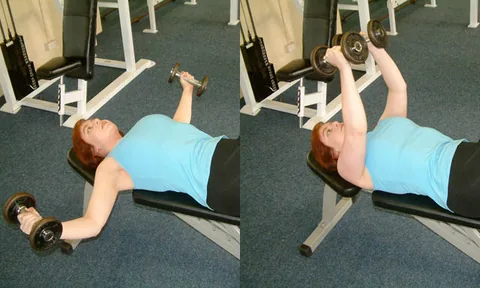 It looks like there's a lot of risk on the shoulder with just a heavy fly on a bench.
I've thrown that one in my iron graveyard too.
And again, only because I cannot wait to see the comments of people who are just so angry that you've said that.
I'm… So, look, they say it's fear-mongering. I'm not fear-mongering. I'm saying I hate the exercise. I'm recommending people do the alternative, because the alternative can give you many of the same benefits without the risk. The anterior shoulder capsule85Joint capsule — what Jeff says is at risk at the bottom of a flye: the tough sleeve around the joint. Its front portion keeps the humerus from sliding forward and is pulled taut when the arms are spread and drawn back. is quite vulnerable in that position, period. You have a weight in your hands, and they'll argue, "Just use lighter weights."
What if I want to use weights that are somewhat heavier, because I want to challenge myself more eccentrically? Well, I could take the exercise down to the floor. I'm still doing the fly. You like the fly? I'll do the fly. I'll do it down on the floor. Now I have…
But can you get as much stretch when you're on the floor?
You can't get as much, but, again, we're doing these little trade-offs back and forth. If I wanted to get a little bit more stretch, I could stand up and go do a cable crossover. And because I can position myself differently in a cable crossover, and I could get my arms in a slot that is more comfortable for me, and because I can control some of that vulnerability to stretch, because I can utilize the biceps to offload that in any way, by engaging them more or not in that back position, then I have a safer exercise option that still, most importantly, gives me the adduction, and also gives me better resistance through more range of motion of adduction.
If I take a dumbbell fly and I pull it to the top, once I get to the top, I don't have much resisted adduction anymore. If I have my cables and I pull them, I could go to midline and still go past midline and still get more of that effect.
Do you remember the old Nautilus86Nautilus — the brand whose machines Peter rates among the best ever made: founded by inventor Arthur Jones in 1970, with a nautilus-shell cam that varied the resistance to match the muscle's strength through the movement. machine? You'll never see these things anymore, but I feel like they were some of the best machines ever engineered. But this machine that was just a fly machine, it had round bolsters that… I'm sure other companies make it besides Nautilus, but it allowed you to do a fly with your arms at 90 degrees.
And so you could actually load this thing up to the ends of the earth, and your shoulders didn't hurt. Whereas today, you go into most gyms, the fly machine87Pec deck — the seated fly machine. Peter remembers the old Nautilus model with forearm pads; today's versions use handles, and in his view you can't load them as heavy. is a handle. You just can't go that heavy. Why the difference?
Because I think people didn't take to that machine as much, because they didn't feel that big stretch as much. And what happens a lot of times is, when you extend your arm out, the elbow out, you start to involve other muscles that get subjected to stretch, that get perceived to be stretch itself, like on the pec itself. The only thing that's going to dictate that stretch on the pec is the position of the humerus relative to the body. So if I get to here, whether I'm here or whether I'm here is not really affecting the stretch of the chest. But you feel the biceps stretch, you feel other muscles start to get involved, the coracobrachialis;88Coracobrachialis — one of the muscles whose stretch on straight arms, Jeff says, people mistake for a chest stretch: a small muscle on the inner upper arm. you start to feel other things get involved that give the perception of more stretch.
And when that happens, people feel like, "I like this exercise more, because I can feel this stretching me more." Again, it's the unsupported nature of that that I don't like as much. When we're doing that cable crossover, it may seem unsupported, but it is supported, because the stacks89Weight stack — the "support" Jeff sees in a crossover: the plates you bottom out against at the end of the range. are going to engage at some point, depending upon how far away I get. So I know I've got that bottomed-out position, depending upon how far away from the machine I get, or how much I pull.
Do you like the cable fly with single arm or double?
I like them both. When I'm really trying to focus on one side is when I'm trying to get, like, a really good contraction on that side. If I'm just trying to move heavier weight, then I want to grab them both together and make sure I do that. What I always advise people against when doing that exercise is, like, leaning too much into that, because they'll lean in as they do it. And basically that promotes the rounding of the shoulder. They'll get too much dominance of the shoulder to do it.
I always say, as you're pressing, you want to lean back, almost want to stand upright. So your chest is out in front of the movement and doing the majority of the work, and not your shoulders tending to round out and dominate the movement. I don't care what direction you go there. You can go straight across midline. You could go high to low. When you go from this position, from a higher grip position down towards a lower grip position, you're going to work more of your lower chest, because you're basically simulating more of a dip. And then if you go from a lower hand position to start, to a higher hand position at the finish, then you are simulating more of that orientation of the upper pec fibers.
You are mirroring their direction more. So you hit those more effectively. That's, again, that's more of a weak point.
And would you say, like, 50-50? If you're going to do 10 to 12 working sets of pec, would you say half of that should be pressing, half of that should be fly?
I think that's fair, yeah.
You mentioned dips. Where do they belong in our toolkit for triceps and lower pec?
I like dips. I know that people find them to be, they believe them to be, somewhat of a risky exercise, but I think if they're done responsibly, through reasonable ranges of motion, not extreme ranges of motion… I've seen recommendations of people saying to get really, really low. And things change when you're fatigued. So when you start to get more and more fatigued in a set, even something that started out, that seemed to be a good, safe exercise, can become unsafe because of the fatigue. The dip is one of those exercises that can become more and more unsafe because of fatigue, because all of your body weight is being basically sunk downward as you're trying to hold and push yourself back up. But as it sinks down, it's putting more and more internal rotation onto your shoulder.
But if you're aware of that as a negative feedback point, like, that is something you're trying to avoid, then you stop yourself in that range of motion, higher than the point that becomes vulnerable. And if you start to perceive that your fatigue is overcoming your ability to control yourself in that range of motion, then you stop the set. So I think there's ways that you can do that exercise. You could also put a band there and do an assisted dip. So you're just basically hanging it over the handles and you're putting your knees on top. There's a lot of things you can do, but I don't like to avoid the exercise entirely, because I think it's one of the best ways to stimulate, especially the lower chest, with that good stretch from the bottom position.
So you're basically using depth and range of motion to manage, because, again, you're the perfect candidate of somebody who shouldn't like that exercise, with your torn labrum.
Yeah, always. I use depth, and control of that depth. When I do try to get a little bit more into a stretch position, I feel, like, how stable can I keep my body position? One of my big keys, I say, is to be able to drive your shoulders down. You want your shoulders away from your ears. If you start to feel that your shoulders are riding up towards your ears, or you feel like you're shrugging, you don't have control anymore. You should, at any point in time, be able to keep your shoulders depressed and have that distance between your shoulders and ears, as a check, a form check, in regards to your stability, being in control of your shoulders in those bottom positions. Then when I get to the top too, same thing, because when you get to the top, your whole body weight is going to want to sink you down into that shrugged position.
You want to actually actively drive your elbows down, unshrug the shoulders. But the dip would fall into the pressing category, as would a push-up. Any of these where you're just pushing your arms out, down, overhead, in terms of a chest activation, it's usually the push-up, the dip, and the bench press as your main pushing options. The adduction exercises are going to be the ones that cross that arm across midline.
12Abs
Diet decides whether abs show; what shows depends on direct work, because compound lifts barely train them.
You want to do back next, or abs? I mean, stay on the front of the body, or… Stay with the abs. All right, let's talk abs. They say that most of the ab work is done in the kitchen. That is so true.
Strengthening the abs and getting aesthetically pleasing abs is really two different things, too. I think that when we look at the contributions of nutrition and whatever ab exercises you're doing, this is nutrition, 99 times out of 100, is what is responsible for what you're seeing. Nutrition is going to control your body fat levels, period. What you see when you get rid of that body fat is determined by your dedication to ab training. I do not believe that doing the compounds is enough for your abs. I never believed that.
I think that there's so many other things that your abs are responsible for, in terms of motions and movement patterns. You're not doing that all from a series of compound exercises. Matter of fact, in the compounds, their role is mostly just to stabilize. They're not creating rotation. They're not preventing rotation… Sometimes they're preventing rotation, but they're certainly not creating rotation, and not creating rotation under load.
So how do we do that? The exercises that you pick, once you get your body fat levels low enough, should hit these major functions. My major functions when it comes to abs are: their ability to create top-down movement, which means pulling my rib cage towards my pelvis, because the flexion of the spine is really the main responsibility of the movement of the abs. Their stabilization requirements are huge, but there's no movement going on there. So the flexion of the spine is coming from top-down movements; bottom-up movements, where the pelvis is moving towards the rib cage itself, any type of reverse crunch;90Reverse crunch — Jeff's "bottom-up" movement: lying on your back, you curl the knees toward the chest, lifting the pelvis off the floor. the same two things, but done with rotation. So it's now not just top-down, but it's top-down and rotating.
So we call it top-down rotation. Bottom-up with rotation. So anything where you're bottom-up, you're pulling that pelvis up but rotating at the same time, or twisting. Then we have the obliques91Rectus abdominis and obliques — as Jeff lists the abs' jobs: the rectus, the "six-pack," flexes the spine, while the obliques at the sides rotate and bend the trunk and work with it. themselves, that are going to be feeding right into and working in conjunction with the abs. And then sort of mid-range movements, where both rib cage and the pelvis move towards each other at the same time. So those are, like, V-ups,92V-up — Jeff's example of a movement where rib cage and pelvis move toward each other: lying on your back, you lift straight legs and torso at once into a V. and exercises that do that.
How you do these: anything done on the floor is generally going to be easier than if you were to perform them hanging from a bar, because we have more of our body weight being subjected to gravity that we have to lift. Anything like a leg raise done from the floor is a hell of a lot easier than a leg raise done from a bar.
How do you do top-down on a bar?
If you're going to do it with weight, you're going to do a cable, like a crunch pull-down. Okay. Yeah.
And how does one think about their portfolio when they think about all those things? So obviously the easiest top-down is a crunch, and then crunch with rotation is top-down with rotation, leg up from the floor with rotation, hanging leg raise with rotation. You're basically picking from those. How are you defining sets and reps for this funky muscle group?
So I believe it's hard to define sets and reps for people when it comes to ab work, because of a couple things. Number one, we all can do different amounts. More so, we do a better job of creating good-quality contractions when we're not just focused on a number. If I really just wanted to get a good ab workout, I'd really just focus on getting slower, meaningful, concentrated contractions on the abs, because it's too easy to involve the hip flexors.93Hip flexors — what, in Jeff's view, steals work from the abs when reps get fast: the muscles that pull the thigh toward the trunk, chiefly the iliopsoas. It's too easy to involve momentum. And we get so lost in the ability to say, "Yep, 30, 35, 40." Of what?
40 of what? Of waste. Like, there was nothing that actually was very productive there. So I'd rather see you either just do it until you can't do them anymore, so just train the exercise to failure, whatever that is, and know that you've done them slowly and concertedly, so you're doing the right thing for what you're trying to develop. Or I'd like to see you just do them for a series of specific amounts of time, but focus on rotating through them as fast as possible.
So I might not get complete fatigue from the one 30-second bout that I'm doing, but knowing that I'm going to go immediately into the next one, mechanically offset, so it's a little bit… so I can still do it even if I'm fatigued from the other one, right? There's always a mechanical drop-down effect94Mechanical drop set — Jeff's trick for ab circuits: instead of dropping the weight at failure, you switch to a slightly easier variation and keep going on tired muscles. that's happening. So I can still keep doing exercise, but knowing that the end result of this will be, at the end of these six minutes, seven minutes, whatever, I'm going to be toast. I can do that if I shift the focus a little bit around the abs. From the top-down movement to the bottom-up, moving those focuses around is going to allow me to keep going for 30-second intervals, with very little rest periods in between, that at the end of it all will have a cumulative effect.
So those are the two ways that I usually like to do it. We've got plenty of workouts that I've posted where I do it in follow-along fashion, where I just program it and tell you what to do. But there's a lot of variety within those, because it's the movement pattern that's most important. The exercise itself isn't as important. The ones that you tend to feel the most, and feel the best contraction on, are the ones I try to push people towards.
What would be your favorite pure rotation exercise? If you're going to pick one pure rotation exercise, would it be one knee up, one knee down, with a crossbody cable?
So I like any type of… we call them sledgehammers, where you just basically take two hands on a cable and you're trying to rotate. What I also like from those is, when you get out to that position, having to hold them and then step out even further. So especially if you're doing it with a band.
And you would prefer… You want to see that standing? You want to see that in a split stance, or standing?
Yeah, standing. Well, I mean, this is standing. This is a squared-up stance, standing. If we wanted to get really powerful with it, I could split your stance a little bit more, because now I'm focused on driving as much power from the ground up, and I could do that too. And those are explosively performed, but still under control. Everything that I say is explosive is still under control, because it's not enough to just get yourself out into that position, but to control it on the way back, always.
So I like to do any of those variations. Again, we could do them even isometrically,95Isometric — holding a position without moving: Jeff hops out to the side with a band and doesn't let it turn his trunk. where, if I have, let's say, again, a band in my hand and it's out in front of my body, I can jump out even further laterally, which is going to increase the tension on the band and want to whip myself back and to rotate towards the anchor point. Don't let it. You keep your body facing straight ahead. You're undergoing, like, these spontaneously increased rotational demands, or these isometric rotational demands. And that's a great way to… That's a really good athletic way to train, because, A, you're on your feet, but because we do get subjected to so many spontaneous forces that try to change body…
Yeah, try to change body position, and we don't allow it. Some people that have a hard time being able to do this well, you might have seen it before, they'll take a physio ball and they'll hug the physio ball with a cable. So they're doing the rotation with it. It's a great way to go for beginners too, because they feel like, "Okay, I'm hugging, and I'm moving as a unit." I'm not just, like, moving my hands in space, because a lot of the tendency, if you're just doing these band exercises, for beginners, is to try to move with their hands only.
I want you to think of your hands being united with your belly button and core, and you're moving it as a unit, because that's how you're actually going to train the core itself. So if you find that your arms are independently moving, lock them up with that physio ball, and that sort of helps to do that.
13Back
For the lats, keeping the elbows in matters more than a wide grip; the upper and lower back need their own work.
Let's talk about Dorian Yates96Dorian Yates — Peter's benchmark for back development: the British bodybuilder who won six Mr. Olympia titles (1992–1997). and the back. Again, notwithstanding the fact that, like, a bodybuilder will break this down into every possible angle of the back. But if we're just talking about this through the lens of normal people, who are going to throw eight to 12 sets per week at the entirety of their back, inclusive of traps, rhomboids,97Traps and rhomboids — upper-back muscles Peter counts in his weekly back volume: the traps run from the base of the skull to mid-back and move the shoulder blades; the rhomboids lie beneath and pull them together. lats, the whole thing, even the lower muscles, the erector spinae98Erector spinae — the long muscles along the spine that Peter calls the "lower muscles" of the back; "lower-back muscles" usually means them. muscles, how would you create a protocol? And again, always for the person who is saying, "Look, I want more of a V shape. I want to taper down here a little bit. I have to get my lats bigger."
What are the mistakes, and how do we need to train?
The back is obviously made up of a lot of muscles, and it's a big area. The most effective way, I think, to look at it programmatically is to think vertical pulling, horizontal pulling, low back specific, upper back focus, right? Upper back, scapular-type retraction work. So the upper back work, pulling, versus the vertical or horizontal pulling, is mostly dictated, again, by the positioning of those elbows, like we referenced earlier. Like, the more those elbows drift during, like, say, a seated row, and they drift higher, the more you're going to get into that extension of the arm as the main focus. You're going to get more of this mid-back: rhomboids, upper traps, mid-traps. That's going to be tapped into the most when you allow the elbows to drift.
If you do a row, which should be a basic compound exercise to perform, then you're going to get more of the lats if you're doing that with a tighter arm position. The issue with the row could be that someone with low back issues or weakness might find that any freestanding row position could be challenging, where they start to fatigue more in the low back prior to their lats. In that case, the chest-supported row, done face down on an incline bench, gives you the option to continue to overload your lats as you start to build up your low back strength. I don't ever recommend you do chest-supported rowing and that's where you stay. I think everyone should be able to row under load from a standing position. And so you just have to work your way up to the point where you can do that.
That's where the low back strengthening comes in. Okay, so you're working your way up from your chest-supported row to your standing barbell row99Barbell row — where Jeff wants you to end up after chest-supported rows: bent over almost horizontal, you row a bar to your stomach while the lower back holds the position. variation, but at the same time, you're working on your low back. You've got to strengthen your low back. And there's a lot of ways to do that. I like classic hyperextensions100Hyperextensions — Jeff's fix for a weak lower back: extending the trunk face down over a bench or a ball. In a reverse hyper the torso stays put and the legs rise; the machine was invented by powerlifter Louie Simmons. over a physio ball. I like reverse hyperextensions.
There's two of my favorite ways to do that. I like Superman-type exercises, where you're laying flat on the ground and you're raising your thighs off the ground at the same time that you're raising your arms up, because then we could stimulate some of the upper back muscles too. Those are the things that look a little rehab-ish, but at the same time, they're only looking rehab-ish because they're exercises that you never do, and they're exercises that target smaller areas relative to their larger neighbors.
Let's go through the Superman as an example. So if you're doing that, what constitutes a working set? Failure? How many reps? How long a hold? How do you think about it?
Anything where… especially these corrective-type exercises, because I say corrective, like you're correcting a weak low back in this case. So these corrective exercises, they should always be done with a mentality of really good, high-quality repetitions. So I hate when we say, "Do a set of 15 of these." I'd rather you think of that as doing 15 sets of one, right? I want you to feel every single one of those purposely in the low back. And also, in a Superman, you're trying to teach the low back to be supported by the glutes.
One of the biggest reasons why we get low back issues is because the glutes are not doing their job to basically support the pelvis from below. And so it's causing the low back to have to take on more of the brunt of that. So the low back gets overworked.101Fact-checkOverstated: for the vast majority of people with low back pain, no specific cause can be identified. This "nonspecific" pain is tied to many factors, from physical load to sleep and stress. Weak glutes do turn up in people with chronic back pain, but there's no evidence they are one of the main causes. The Lancet, 2018 If you can do the exercise where you squeeze, in this case, squeeze your glutes together first, get that stability, then lift off the ground and get into this extension, then you're going to feel it differently, but you're going to feel it properly. So doing enough of those, in this 15-sets-of-one mentality, will start to get that neuromuscular re-education that's lost. It's not so much about being able to overcome huge loads there.
It's about being able to train the muscle neuromuscularly, to start to respond more effectively. So I think when you start to do some of those exercises and work them in, and I work them into regular back day, at the end, but it's just no less important than the heavier vertical pull or push exercises.
I see. So we're going to hit lower back primarily through the horizontal and vertical stuff. So, for example, a seated, unsupported cable row, when you're going heavy, your lower back has to do a lot of work, if you're doing a standing row…
More so in the standing row, yeah.
Yeah. So that's where you're getting lower back, but then you'll finish it with the Superman.
With direct work, yeah.
Got it.
Yeah. And try not to be bored with them, thinking that there's something remedial. They're just as important as the other exercises, because they help to connect those weak links that are probably taking away some of the capacity you have on the bigger exercises, because they are the weak link.
Going back to the kind of workhorses of this, are the vertical and horizontal pulling. But the key is, if you're doing this for the purpose of your lats, keep the elbows in.
Elbows are going to be tighter, yeah.
So you do not need wide-grip activity here. You don't need a wide-grip lat pulldown. Like, if you used to think, "Yeah, well, I want a V shape, I should be grabbing the thing out as far as possible," but really you don't need to.
No. The wider the grip, actually, you start to shift the focus to the muscle called the teres major,102Teres major — where Jeff says a wide grip shifts the load: a muscle from the bottom of the shoulder blade to the humerus, nicknamed the lats' little helper. which is, they call it the lat helper. So it does functionally very much the same, but the angle of the hands being that far out actually shifts more of the load away from the lats to the teres major. Again, aesthetically, something that a bodybuilder would want. It's going to actually support the overall appearance of what you're seeing back there, but functionally, for 99% of us, you don't need to go that wide to do that. And you're probably just inviting some awkwardness to the shoulder joint that you might feel the repercussions of down the road.
And then upper back and scap specifically, what are sort of your favorite activities?
My favorite is the face pull.103Face pull — Jeff's favorite upper-back exercise, which he has championed for years: pulling a rope toward the face with elbows high and the shoulders turning out, for the rear delts, the muscles between the shoulder blades and the external rotators. I talk about the face pull all the time. I like the face pull because it isn't necessarily just corrective in nature. It could actually be loaded up enough to cause hypertrophy of the rear delt, the mid-traps, the rhomboids, the rear delts. Like, it's got a lot of benefits.
Tell people how you like to do it. You're doing it with a rope, you're standing in front of the cable machine.
So it's definitely become a lot more popular since I've talked about it for many years, which I love seeing. I see people literally do it in the gym now, but there's two ways to do it. The first thing is, you really should attach two gym ropes to the device to be able to do this properly. When you do one, like the regular gym rope that we see in all the gyms, it's not long enough to get the elbows open enough to a 90-degree angle. What's going to happen is your elbows are going to be bent in this position.
The bending of the elbows, once you add weight, starts to drive what? Starts to drive your hands forward and your shoulder into internal rotation.104Internal and external rotation — why Jeff wants two ropes for face pulls: a short rope drags the shoulder into internal rotation, while the point of the exercise is external rotation, which usually lags in people who press a lot and sit a lot. So if I can get my hands wider, it's still going to promote internal rotation, but I wind up being able to get into a stronger position here and work external rotation. Like, I have a target to go towards external rotation. I can't here. With the short rope, I can't.
So by attaching the two ropes, now I have enough length in each hand. And then what I try to do is, again, get a good, stable base. I don't usually perform these out of a split stance. I usually do them out of a squared-up, feet-even-with-each-other stance. And the reason why I do that is I think it's a good way to limit the amount of load that you're using there. So while I think you can go a little heavier here, I don't think you should be loading these up so heavy that you're relying on a split stance to get so much stability that you can pull that weight back.
So it gives you a nice top end: when you can't balance yourself anymore and you're being pulled forward on the exercise, because you're probably doing too much. Now, we use the pulling of the hands as the guideline. I don't want to just pull the elbows back, because I might let the hands lag behind. To get external rotation at the shoulder, I need to drive with the back of my hands. So if I can think about opening my elbows up, or opening my chest up, squeezing those scapular muscles together, and then pulling my hands back, that's how you want to perform the face pull. At the end of it, you want to have… it almost looks like you're doing a double biceps flex,105Double biceps — the bodybuilding pose Jeff says the end of a face pull should resemble: arms raised to the sides and bent at 90 degrees. for someone who's looking at you from the front or the back.
You have those 90-degree angles and you're pulling straight back. At that point, there's one other little tweak that I think is amazing, if people can handle it, is you then, from this position, not only you increasing your tension and time under tension106Time under tension — seconds the muscle spends loaded in a set; Jeff adds some with a pause at the end of the face pull. in that spot, but you raise your arms up overhead. So what you're doing there is, in this peak contracted position, now you're raising your arms up, and that starts to get into the lower traps. So lower traps have a lot of control and function when you raise up overhead and the shoulder blades are rotating. They provide good stability there. So you're adding one other element to the exercise at very little extra cost, and it just simply requires a raising and then a lowering of the hands back again to where they started, and then you let the weights go back to the beginning position.
So you're just basically adding one additional raise at the end position, and then let the arm go back. So it's basically a face pull and press.
And again, you're really overlapping rear delt here as well, correct? I mean, you're hitting that rear delt again. Is that an argument for doing delts on the same day you do back?
I do that a lot. I look at upper back and delts as having a lot of shared functions. So I think that you can pair them up, if you're trying to do the agonist muscles107Agonists — muscles that perform the same movement; Jeff pairs rear delts and upper back on one day because both pull the arm back. working together.
14Legs
Legs need heavy loads and two sessions a week, and the glute med needs side-to-side work that squats and lunges never give it.
All right, let's talk about legs in any way you see fit. Do you want to talk about the quads, hamstrings, or you want to talk about everything from the knee to the hips as one, and let's just go through it?
No, I think you split them up. I think of them sort of as anterior, posterior, but even within that, I think there's exercises that stress the hamstrings from a lengthened position and those that stress them from a knee-flexed position. And anteriorly, I mean, I think when we're talking about the quads, we have a lot of different options from squatting that will do a great job. The squat will hit the posterior chain108Posterior chain — the muscles along the back of the body that work together: calves, hamstrings, glutes and spinal erectors. Jeff notes that squats hit them too, not just the quads. too. So let's start with anterior. If you were to do the anterior and you wanted a more quad-focused option, then there's a couple of things that you could do.
Number one, you can carry the weight more anteriorly. So that's why we have the front squat, cyclist squats,109Cyclist squat — one of Jeff's quad-focused options: heels raised, feet close together, torso upright, knees traveling far forward. all these. That gives us a chance to direct some of the load a little bit more effectively towards the quads. I love the front squat. You have to be okay with the fact that you're not going to be able to handle as much weight there.
But again, that's almost irrelevant when we're talking about… at the end of the day, it's the tension the muscle feels; it's not the actual weight that's on the side of the barbell, or dumbbells. So that gives you that chance. A goblet squat110Goblet squat — another of Jeff's front-loaded squats: you hold a dumbbell or kettlebell at your chest with both hands. would be another option for that. The transition between the two is a belt squat, because that weight gets directed more directly downward.
I love the belt squat, because it doesn't require the loading on the back, for people that don't have the strength to support that.
And I have an exercise that I like to do, which is a squat variation called the Spanish squat. And you basically take a band and you put it around the back of your knees, take your pair of dumbbells, usually done with dumbbells, you back away from the band. So it's already… if you were to let the band pull you, it's already pulling your knees into flexion. It's trying to drive you into flexion. The only way to get that band to get into the proper position is to drive your knees back against the resistance of that band. So you're getting really resisted terminal knee extension.
Now you have your dumbbells at your sides. You reach down to the ground, you pick them up. Now you squat down. As you squat down, obviously, your knees are flexing. You get down to the bottom of the squat, and you can go pretty… as heavy as you can hold the dumbbells here. So you can go 60s, 80s, 100s, whatever you can hold.
As you come back up to the top, you get toward that last 20 degrees or so, you have to drive your knees up against the resistance of that band to get that fully extended knee. It's basically taking the elements of a leg extension, but because you're doing it in a closed-chain111Closed chain — why Jeff's Spanish squat is harder than a leg extension: the feet stay planted, so the knee straightens under the load of the whole body, while on the machine the shin swings freely. way, with your feet in contact with the ground, it's brutal, but it's a great combination exercise. It takes a regular squat and it adds an element of resisted knee extension at the end. That's just amazing. I like doing that. If people are limited by their grip strength, they're not able to load heavy enough because they can't hold that weight, then that may not be a great option for them.
But a lot of times they're overcoming that because of the added resistance of the band. That makes it so difficult. I also have taken to Bulgarian split squats112Bulgarian split squat — Jeff's favorite quad exercise: a one-leg squat in a split stance with the back foot on a bench. The more upright the torso, the more the quads work; the more you lean, the more the glutes take over. as a favorite of mine, because I know that I can effectively hit the quads more, one leg at a time, which is another benefit.
So when you're doing a Bulgarian, or rear-foot-elevated, you're fatiguing in the front of your leg more than the back of your leg?
If you maintain your upright posture. So the big cue there is to maintain as tall of a chest position as you can. A lot of times what we'll do is we'll go down into the exercise and angle forward. As we angle forward, that is going to quickly and significantly shift the load to your posterior chain, to the glutes, and, of course, the quads too, but more so to the glutes as you start to lean forward more. If you maintain an exaggerated, and not in a harmful way, but an exaggerated way, your upright posture, just don't allow yourself to sink forward, then you're going to hit the quads very strongly in that. Same thing with a reverse lunge.
Absolutely one of my favorite exercises, for posterior, anterior, depending upon how much angle of my torso I allow. Okay. It's funny, because we're kind of talking legs in general anyway.
Yeah, it's impossible for me to think about legs as anterior, posterior. I just think of legs as legs, and the balance shifts a little bit between "Am I lifting my heels? Am I not lifting my heels?"
Yeah. And you don't hear me talk much about… If my exercise favorites were the leg extension, you might hear me speak a little bit more like that. But anteriorly, I know I can shift the focus by positioning the body differently in space, but I don't have a lot of go-to specific "Hey, quads, I'm really focused on the quads here," because I don't do a lot of leg extensions. They're not a great exercise, personally, for me, for my knees, given my history of knee issues. And for a lot of people, they don't feel so great. If you can do the exercise and there are no issues with pain, it's the equivalent of a concentration curl113Concentration curl — what Jeff compares leg extensions to: a seated dumbbell curl with the elbow braced on the thigh, the textbook isolation exercise. for the biceps.
If somebody is saying, "You know, my legs are just so skinny, I really just want to put some muscle mass on my legs," what are you saying? Is this where, "Hey, we've got to go up to 16 working sets in a day"? "I want you to focus just on the compound lifts"? Or, like, what guiding principles do you give that person who's trying to put some muscle on their legs?
Definitely have to go heavy enough. I think that a lot of times people don't go heavy enough with their leg training. And I think that legs respond a little bit more to slightly higher volumes. So I think rather than potentially doing more and more in one day, which you really start to… You know how fast you can tap out when it comes to leg training. It'd be better to probably just schedule a second session in the week, volume-wise, increasing the number of sessions that you're training legs. So that's where these options of being able to shift the focus a little bit around anterior, posterior gives you some flexibility, and not doing the same exact workout twice, but it gives you a chance to train your legs and stimulate them twice. So you have more opportunity.
But being able to build bigger legs, I mean, some of us are just never going to be able to build them as big as others, because it tends to be one of those areas, like the calves, that are just genetic. I call them "calves" or "calf-nots," and I'm a calf-not for sure. The leg growth in size and strength and power, even from the athletes, like, it's quite oftentimes something you're born with. Not that you can't improve it at all, but that's something that's heavily influenced by genetics.
So what we want to have is a good rotation of movements, and basically say, "Look, if I'm going to just try to do it all in one day, I'm going to get 12 to 14, 16 working sets for legs on a given day, I'm going to pick and choose from these exercises, and I'm not necessarily doing the same workout every time."
Yeah, definitely not. You don't have to do the same workout every time. Even just between… if I had to choose between reverse barbell or dumbbell lunges and Bulgarian split squats, both similar, in that you wouldn't do those two on the same day necessarily. I don't need to, because the positioning of the legs is similar enough. I don't necessarily need to do that. One's more dynamic than the other.
So I factor that in when I think about programming. Like, the lunge is going to be more dynamic, whereas you're more fixed in the Bulgarian split squat. But I'd want to have something that I wasn't potentially being limited by balance or coordination, that every time I train my legs, it was some sort of a squared-up, balanced-out squat, two-footed squat.
I mean, the problem I have with training legs, which I enjoy, I really… for whatever reason, I've always enjoyed it since I was very young, there's just too much to do, because in addition to all of the exercises you just went through, which are important for strength, hypertrophy, there are all these sort of unsexy things that we have to do as well. We've got to get all that glute med114Gluteus medius — the "unsexy" work Peter complains about: a muscle on the side of the pelvis that moves the thigh out and keeps the pelvis level when you stand on one leg. Jeff says even elite athletes are weak here. training in. We've got to make sure we get the adductors working. And they're not really adding size, but they are adding time to the workout. So how do you think about making sure people are doing a lot of the lateral movement with the legs, like really dumb-looking things, curtsy squats115Curtsy squat — Peter's example of a "dumb-looking" lateral exercise: a lunge in which one leg steps back and across behind the other. and things? Like, you just got to kind of do those things.
The same way that we talked about the low back being the stuff that can be relegated towards the end of the workout, requiring less of your energy, but it's still part of the workout and it's no less important. As a matter of fact, it's just as important. For me, that is the glute med training. It is the fact that we don't get a lot of frontal plane116Frontal plane — what Jeff says popular lower-body exercises miss: squats, lunges and split squats all move forward and back (the sagittal plane), while the glute med needs side-to-side work. stimulus from the bigger, more popular exercises. All the ones we just mentioned, lunging, split squatting, and squatting, are all sagittal plane exercises. So unless we are lunging laterally, or if we're, like…
Cossack.117Cossack squat — Peter's example of a lateral exercise: a deep one-leg squat in a wide stance with the other leg straight out to the side.
Cossack, we could do.
But that's not going to give you much hypertrophy, right?
It depends. I mean, depends on how… A Cossack, I mean, if you're getting deep into that squat, and you're… Yeah, I mean, again, it's that same tension equation. Like, as long as the tension is high enough, and you're overcoming it, and fatiguing because of it, and reaching failure because of it, then you're going to gain benefits and hypertrophy. But the ones that I think about for glute medius… Like, I have a series of exercises where we do hip bumps against a wall. All you're doing is letting yourself drop down to… This one's a little bit hard to describe, but you're essentially standing close to a wall. You're standing on your outside leg, so not the inside leg.
The inside leg is just lifted off the floor. You're letting your hips get lazy, I say. You're letting your hips drop out to the side, straight in the frontal plane, just letting it come away from the wall. Okay. And then from there, all you're going to do is just drive yourself back to where you're… because at that point your pelvis is going to be tilted towards the wall. You're going to drive yourself to a level pelvis. That's coming strictly from the glute medius, and abducting the hip in to get into that position.
And sorry, what do you call that exercise?
I call it just a hip drop or hip bump. You'll feel that very quickly, and you'll realize how weak you are in that plane, even if you are a heavy squatter. Because if you're not… totally different. If you're not doing it, you're not doing it. Those muscles aren't really as active, nearly as active, in that position as they are when you're doing a regular squat. These are humbling exercises, but they're no less important to do.
You need to get over the fact that, "Okay, I'm pretty weak here." We had some of the best athletes in the world that I would have do these exercises, or even we would test people by having them get on their stomach and essentially bend their knees, and then I would rotate their leg in or out, right? So from that, I'm using their leg as a fulcrum, and I'm basically rotating in and out. The degree to which I can control that leg in space when I tell them, "Don't let me move it," is crazy. They just don't have the external rotation strength. No, none.
I mean, and we're talking about the best athletes in the world. Yeah, seriously powerful people, because they don't train that enough. And you could actually train that motion specifically, by literally getting a band anchored to something stable, and then putting yourself in that position on your stomach and rotating against that resistance. You can work it. Is it goofy-looking? Yeah.
I mean, if you're doing that in a gym, it would be goofy-looking. Would you feel self-conscious, because it's hard to do and you can't even imagine why you can't make your leg move like that? Sure, but it doesn't negate how important it still is. And when we're talking about people with low back issues or hip pain, these become a factor, because it matters. Getting those weak muscles to become more in balance with the other dominant muscles is going to provide more stability for that joint, and then take some of the load and stress off the muscles that are trying to do too much, like the low back.
15Calves
Calves are built to bounce, so they only grow once you take the bounce away.
Okay. Now, again, I'm keeping this deliberately away from the recovery side, because there's so much more we could talk about on how to stabilize a knee and things like that, but I'm trying to keep this to the aesthetic. Let's finish it up with calves, two big muscles. What are the principles around training calves? Again, we're talking about those of us who don't have the genetically perfect calves you see on the odd specimen.
So you mentioned two muscles. So there's the gastrocnemius and the soleus.118Gastrocnemius and soleus — the two calf muscles Jeff builds his calf advice on: the gastrocnemius starts above the knee and works with the leg straight; the soleus starts below the knee, so seated, bent-knee raises load it.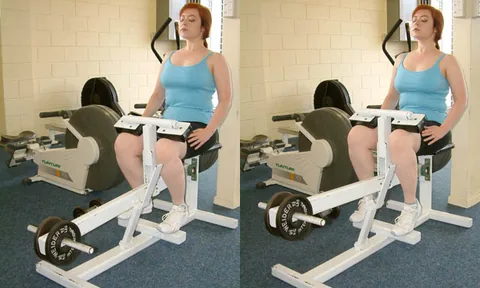 Gastroc is one that crosses the knee. That's, again, these muscles, right? We talked about before the triceps, some of these that cross those joints. It crosses the knee, and the soleus does not.
So how you train them is determined by the position of the body when you do it. So to hit the gastroc most effectively, you're doing them from these straight-knee-positioned exercises, like a standing calf raise, or toes in, toes out, whatever that variation might be. To do the soleus, you wouldn't necessarily need to have that knee straight. You could have a knee bent. So any of those seated calf raises are going to do that. The biggest thing that I think I've advocated for when it comes to calf training is the removal of the ballistic element119The ballistic element — what Jeff wants out of calf training: the quick, bouncing rebound. In walking and running, the calves and Achilles store elastic energy on landing and release it at push-off, so the muscles do little of the work. of the exercise, because the calves, the Achilles, is so accustomed to handling the ballistic transition from foot on the ground, midfoot absorbing those forces, and then locking up and propelling you into the next step.
So good at handling those quick transitions.
By the way, I just want to pause on that for a second, Jeff. Sorry to interrupt. I just don't think, from an anatomic perspective, we appreciate how remarkable that part of our body is. Oh gosh. The ability of the foot-Achilles-calf complex to navigate us through the world. It is in many ways sort of heartbreaking when you come across somebody who's never taken advantage of it.
They've never run, they've never jumped, and they're now in mid-late life and they're shuffling around, and that Achilles has atrophied away. Those muscles are not reactive anymore. The tendon doesn't have the supple nature to do all those things. And yet you realize we were all born with the capacity to do something as dramatic as a broad jump or sprint, jump off a box. The forces that are required…
ExplainerThe foot: shock absorber and lever
When the foot lands, it pronates: the arch flattens slightly, the midfoot joints unlock, and the foot acts as soft suspension, absorbing the impact and adapting to uneven ground.
For push-off it has to become a rigid lever. Supination and the "windlass mechanism," described by the anatomist J. H. Hicks in 1954, do that: as the heel lifts and the big toe bends back, the plantar fascia winds around the head of the first metatarsal, tightens, draws the heel toward the toes and raises the arch.
With a flat arch or weak foot muscles that transition comes late, and the fascia itself and the Achilles tendon take the load: hence the plantar fasciitis and tendinitis Jeff mentions.
To me, it's the timing too. The timing is so precise. You're basically asking your foot, from the moment it hits the ground… The midfoot, which is just a series of bones in there, right, that are all sort of aligned to become adaptable to the surface. So they loosen, they literally loosen, they loosen through that act of pronation of the ankle complex120Foot pronation — the first phase of a step in Jeff's description: on landing the foot rolls in, the arch flattens and absorbs the impact; at push-off the foot turns into a rigid lever. and the foot complex. So as it starts to hit the ground, you're getting this loosening of those bones so that you can adapt to the surface. They call it a mobile adapter function of the foot.
So you can adapt, because maybe the ground's rocky, you're on a hill, you're running. You can't just be rigid. So it gets into that position. And then it has to be able to, within a moment's notice, if you're running especially, as it's being brought back behind you again into extension, quickly shift from being mobile and loose, to be able to absorb the forces there and not just jolt your entire knee and hip joint, to then becoming rigid and locked up, to become basically a propulsion maneuver, like a lever that's going to then drive you into the next step. So it happens in microseconds, to be able to go from this to this to this to this, completely opposite functions. And if it doesn't handle it well, and it stays a mobile adapter for too long, when you go to propel yourself, you don't have that rigidity to basically lever your body off the ground.
Now you're going to rely too much on the structures in there to try to do that. That's where you start to get plantar fasciitis,121Plantar fasciitis and Achilles tendinitis — where, Jeff says, a foot that can't switch roles ends up: irritation of the thick band under the sole (heel pain with the first steps of the morning) and overload of the Achilles tendon. you start to get Achilles tendonitis, all these things start to go wrong. Same thing if you don't have a good enough adapter to the surface: then every step you take becomes too jolting to all those joints up that kinetic chain. They're going to have to absorb the force that the foot couldn't. It is definitely remarkable.
And so, with all of that said, we could do an entire podcast on just how you do that. Fortunately, we've done a bunch of content on that. But now, coming back to this main principle, you're saying, look, if you want those muscles, the soleus and the gastroc, to get bigger, you can't let the body cheat its way out of doing what it's so good at, which is what it was designed for.
That's what it's designed for. So I think there's a hack to calf training: it's to try to turn off that responsibility of the Achilles tendon, so that it's not trying to jump in and ballistically do what it does, but it forces the muscles to, almost inefficiently, temporarily, because what we're trying to do is inefficiently stretch them so they can grow, it makes them do more of the work. So you go into a bottomed-out position, you stay there for four seconds, and then you start to come out of that position. You do it slow and controlled. You don't try to explode out of that position, because you can quickly turn back to that tendon and elasticity to do the job. I'm talking about making the muscles inefficiently have to slowly contract and drive your body out of that position.
And doing it one leg at a time tends to allow for the overload that people don't get when they're just doing these two-legged exercises. So if you don't have external load from a machine or a calf raise or something like that, you can do it more effectively one leg at a time. But the biggest key is to lower yourself slowly, stay down in that position for four seconds, and then kind of drive yourself up out of that over a slower, graded pace than just explosively getting out of that position. And that's the same thing whether you're doing the seated calf raise, focused more on soleus, or whether you're doing the standing calf raise.
There's so much literature on this, and I've seen it, and it's very interesting, that shows that if you're just training for hypertrophy and strength, and not sort of injury recovery… I've seen different things that say range of motion doesn't matter as much as people think it does, or it's the bottom half versus the top half of the range of motion. Any thoughts on that?
For hypertrophy?
Yeah.
I think that all of that content got, like, a little wayward in the last year or so, to the point where I was seeing recommendations of avoiding the concentric on exercises, like, working on the stretch position,122Lengthened partials — the trend Jeff pushes back on: social media advice to train only in the bottom, stretched part of the range. that sort of terminal position of the exercise, and the contracted position didn't matter as much. First of all, it didn't sound right to me back then. And I think research is starting to already prove that not to be the case.123Fact-checkNot quite: the research so far suggests lengthened partials build muscle about as well as full range of motion, neither better nor worse. In an eight-week trial by Wolf and colleagues (2025), trained lifters' arms that worked only in the stretched part of the range gained as much muscle thickness and strength as arms trained through the full range. PeerJ, 2025 None of that makes sense to me as a physical therapist, from a function perspective. 100%. And ultimately, even hypertrophy is going to still require normal functioning to maximize that muscle.
ExplainerMuscle length and growth
The lengthened-partials debate Jeff takes on grew out of real research.
- A muscle loaded in a stretched position gets tension from two sources, the weight and the stretch itself. That's Jeff's explanation for why stretch-focused exercises work well.
- The triceps are a good example. In a 2023 study by Maeo and colleagues, the arm that did cable extensions overhead, where the long head is stretched, grew its long head about 1.5 times as much (+28.5% vs. +19.6%) as the arm that did ordinary pushdowns.
- Social media drew the conclusion that you should do only the bottom, stretched part of each rep. But head-to-head trials find such partials build about as much muscle as full range of motion, not more.
- Which lines up with Jeff's advice: choose exercises that load the muscle in a stretch, and still go through the full range.
So I think that you want to apply… Like, I think where that all came from is that stretching a muscle is another form of stimulus. It's another form of tension. The weight itself provides that tension; when you stretch the muscle, you're adding a second form of tension. To believe that stretching positions of exercises cause better results is not a surprise, because it's providing more accumulated tension. But to think that that would mean, "Okay, let's just hang out in this position, and let's not focus on this other range of motion requirement," certainly not for strength, but even for hypertrophy, I don't think it really adds up or makes too much sense.
What about a volume perspective on the calves? They're kind of an unusual muscle, in that they're being used a lot throughout the day, every day. Is there an argument that you can't just train them once a week if you want to make gains?
I actually think that's true. I think that they're similar almost to the abs in a way, in that the abs are also highly responsible for postural stability, and they're working very often, not under high loads, but they're working very often. So I think that when it comes to the calves, they're used to handling very high loads; they're carrying your own body weight around, one leg at a time, for many, many steps in a day. Subjecting them to more of this focused, inefficient hypertrophy work more than once a week is certainly worthwhile, probably two to three times a week, maybe even four times a week. It's like, again, like abs, you don't have to do it for a long period of time. A couple sets, just do it focused and get it done.
I don't think, for ab training, I don't spend more than… I hate to say it, like six-minute abs. Five to 10 minutes, you're done. You don't need to do a whole hell of a lot, but you need to do it consistently, yeah.
16The exercise graveyard
Most "graveyard" exercises can be fixed with one adjustment, but Jeff has no patience for the upright row.
Yeah. Okay. Not to create rage bait, but can you give me some of the other graveyard exercises? We've talked about a couple. You've actually got a great video on this, which we'll link to, but just to give people a precursor for what goes on the… And again, we'll frame it as: not that these are absolutes, just for the people who can't work in gray. These are things that, for most people, you're not getting enough juice out of the squeeze.
Your risk of injury is going up disproportionate to the gains, and you might be able to get somewhere between 90 and 100% of these gains doing something at far lower risk.
That's what we're talking about. That's the whole premise. And I believe that you're always going to find the person who says, "I've done these my whole life, and I've never…"
Yep. And my grandmother smoked her entire life and didn't die of lung cancer. That doesn't mean that everybody should smoke. That's the way to think about that.
My answer sometimes, if I want to get them a little irritated, I say, "Yeah. 'Been doing it my whole life'… Well, it hasn't done it yet. Who knows?" Because I'm pointing to the parts of the exercise that are just not biomechanically ideal. And therefore, just like the exercise I described before, where, especially, you start to add fatigue into the equation, they increase the risk that you're going to break form enough to potentially cause issues. In that regard, I hate the upright row.124Upright row — the exercise Jeff hates most: you pull a bar with a narrow grip up the body to the chin, elbows above the shoulders, so the arm rises while turned inward, the position where the rotator cuff tendons are most easily pinched. His fix is to lead with the wrists and keep the elbows lower. The data back up the risk: among recreational lifters, signs of impingement are linked specifically to lateral raises and upright rows with the arms above 90° (Kolber et al., 2014). The drawing shows the top position: elbows above the shoulders, the arm turned inward.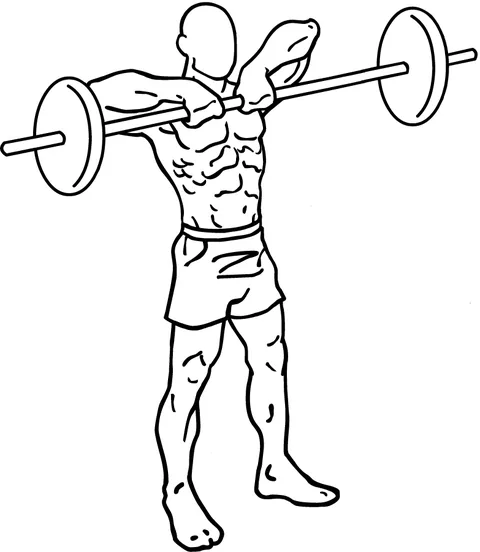
I have no problem expressing my hatred for that exercise. It is the dumbest single exercise that was ever created, simply because I can fix it by just changing one position of the elbow and the wrist. That's it. And you can still have your upright row, but just, let's call it something different. Let's call it a high pull. Because the upright row is essentially relying on the fact that you're going to pull this barbell or dumbbells as high as you can towards your chin, lead with your elbows, get as high as you can, which I can't even do because of these shoulders of mine, but get as high as you can with your elbows, to the point where… some people, you've probably seen them, they look like their elbows are almost vertical, right?
Exactly. You do a much better job than me of doing the wrong thing. But I basically think not only are you getting into this extreme position, but you're loading it. What am I loading? I'm loading internal rotation. I'm driving this arm, this shoulder, into internal rotation under load and elevation, when all I have to do is just lead with the wrist, rather, and keep the elbows down, and I'm still pulling high, and I'm still getting up into this position.
I'm still getting abduction of the shoulder, which is why you feel it in the shoulders. I'm still getting trap work, which is what you're going to feel when you do the upright row also. And all I've done was just change one position. That doesn't sacrifice any of the benefit of the exercise. It sacrifices none of the benefits. So if you ever wanted to heat me up and talk about one exercise that belongs in the graveyard, that's the one that will always be in the graveyard for me.
And there really is not a defense of it. If you've done it and you like it and you haven't gotten injured with it, then keep doing it. But why would you not at least consider an alternative that sacrifices… You said maybe 90% of the value; this still has 100% of the value, without the risk. So why wouldn't you try that? So that's one. These behind-the-neck positions that we talked about, the press, overhead press, lat pulldown, but there's leeway there.
Some people feel it more, I think, when they do it behind the neck, for whatever reason. Depends what it means, though. You know what I mean?
Like, as you said earlier, you might feel it in terms of a stretch more when you're doing a deep fly off the bench.
But… Be careful what you're feeling.
Like, yes, of course you feel it more.
You're going to feel more of a stretch in the lower biceps, but that's not why we're doing the exercise.
I always wonder, when people say "I feel it more," if they feel it more where they should feel it more.
Another guy… You mentioned Dorian Yates; I used to watch Lee Haney125Lee Haney — the bodybuilder Jeff remembers for his behind-the-back "Haney shrugs"; he won eight straight Mr. Olympia titles (1984–1991). a lot. Remember Lee Haney? So Lee Haney had a shrug126Shrugs — raising the shoulders toward the ears with weight in hand, for the upper traps; Haney did them with the bar behind his back. that he did behind his back.
Oh, I remember this.
Right. He called it Haney shrugs, and they asked him, "Why do you do it behind your back?"
He says, "Where are the muscles? They're back there, aren't they?" So it's like, okay.
But when you're an eight-time Mr. Olympia, or whatever he is, I think you can get away with saying anything.
Right. And, you know, along the same lines of the barbell positioning for front squat versus squat, I understand what he's talking about, but I do think that there's this feel element that comes into play there. So if you do the behind-the-neck pulldown, you can soften that up a little bit by just allowing the elbows to not flare back when you're doing it, but let them drift a little bit more towards the front. I could still pull behind my head but have my elbows drifted more towards that scapular plane.
So there's some modifications I can make that would make that exercise better. It's not necessarily a horrible graveyard exercise with this modification, but, again, for many, or for most, why not pull to the front? I think you're going to get a better pull when you pull to the front anyway. You're going to get a better engagement of the muscles you're trying to build. Same thing with the overhead press. You could press more safely there.
You can actually get the elbows out in front of you even when doing that, which would allow you to do that. But personally, I feel like the press from the front just feels better, for me and for most. What else? I think I have these dumbbell side bends in my graveyard. I mean, that's just a pointless exercise. It's just basically riding the seesaw by yourself, up and down.
No additional benefit. You're going to more effectively train the obliques with rotational work every day than you are with just straight side bending. They have a function of side bending, but they're going to be way more effectively targeted and trained with rotational work than they are with that. That one's in my graveyard. There's not many more. The fly we talked about was in the graveyard. There's not many more, honestly. I might get the criticism from now and again of creating this graveyard for certain exercises, but I think, more than anything else, I'm adaptable to most things, because I think that, as we talked about earlier, like, my biggest asset is my ability to take an exercise and figure out ways to adapt it, to become something someone can do even in the face of discomfort at that moment.
Because I know how important it is to continue to stress tissues and not immobilize them, or not completely get away from them. The fastest way to slow recovery from an injury is to not do something for it. You want to be able to still stress those tissues. Time is not the only thing that heals injuries. Time and the stress, the particular stresses of those tissue structures, is what's really important. Mechanical stress is super important to that recovery process.
Well, Jeff, this was a super interesting conversation. It's actually given me a lot of ideas for things I want to tweak and modify in my training. I suspect it will be for others. Like I said, we're going to put together, in the show notes, videos from your archives that will actually demonstrate all these exercises. So my hope is that people can go right to that and become their own trainers, basically, right? It's like, how do I formulate my own workouts here?
So anyway, as always, so much fun sitting down with you, Jeff. Really appreciate it.
Appreciate you having me on.
Thank you for listening to this week's episode of the Drive.
Head over to peterattiamd.com/shownotes if you want to dig deeper into this episode. You can also find me on YouTube, Instagram, and Twitter, all with the handle PeterAttiaMD. You can also leave us a review on Apple Podcasts or whatever podcast player you use.
This podcast is for general informational purposes only and does not constitute the practice of medicine, nursing, or other professional healthcare services, including the giving of medical advice. No doctor-patient relationship is formed. The use of this information and the materials linked to this podcast is at the user's own risk. The content on this podcast is not intended to be a substitute for professional medical advice, diagnosis, or treatment. Users should not disregard or delay in obtaining medical advice from any medical condition they have, and they should seek the assistance of their healthcare professionals for any such conditions.
Finally, I take all conflicts of interest very seriously. For all of my disclosures and the companies I invest in or advise, please visit peterattiamd.com/about, where I keep an up-to-date and active list of all disclosures.


