Lithography machine
EUV lithography machine
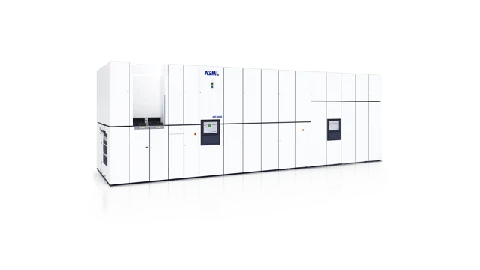
ASML’s TWINSCAN NXE:3800E EUV lithography system.
A machine for extreme ultraviolet photolithography (13.5 nm wavelength) that prints the smallest features on advanced chips. Only the Dutch company ASML makes them commercially; they have been used in volume chip production since 2019.
The idea was proposed in the mid-1980s by Hiroo Kinoshita, a Japanese engineer at NTT, but the road to a production machine took more than thirty years: light at this wavelength is absorbed by both glass and air, so mirrors in a vacuum replace lenses, and a bright enough light source proved elusive for years. Canon and Nikon eventually gave up, and ASML perfected the technology with Germany's Zeiss, which polishes what are called "the most precise mirrors in the world" for it. The light is produced in an unusual way: a generator fires droplets of molten tin about 25 microns across, and a powerful CO2 laser hits each one twice, first flattening it into a cloud and then turning it into plasma that glows at the right wavelength, tens of thousands of times a second. The machine weighs almost 200 tons and costs about $180 million; MIT Technology Review called it "the machine that saved Moore's law." The next generation, High-NA, with a wider aperture, costs on the order of $380 million; ASML shipped the first such scanner to Intel in December 2023. Under US pressure, the Netherlands banned selling EUV machines to China, and in December 2025 Reuters reported that China had secretly assembled a prototype of its own in Shenzhen.
In the episodes
4- November 21, 2026How AI Is Forcing China to Reshape Industrial PolicymentionedOdd Lots
- 24:51Chan calls the cutoff of EUV machines to China a huge wake-up call for Chinese lithography.
- November 20, 2026Jensen’s Not Coming Back, Adventures in Agentic Commerce, Q&A on United, GTA VI, iPhone DuomentionedSharp Tech
- 21:09Ben is sure that since these machines exist, China will eventually build its own.
- November 10, 2026The US is building the smartest AI. China is running a different race | Luisa RodriguezmentionedThe 80,000 Hours Podcast
- 05:03not sold to China since 2019; ASML spent two decades developing it
- October 22, 2026What will computer chips look like in 2045?mentionedDwarkesh Podcast
- 04:59what EUV is, and why Intel adopted it four years after TSMC