



Odd Lots
Chapters
The hosts see China's long arc bending toward vertical integration and self-reliance, even though its companies rarely make much money from it.
Read the chapter- Joe asks whether Chinese AI companies will always need Nvidia GPUs now that China has Huawei and its Ascend chips.
- Tracy says the long arc of history points China toward self-reliance, and the word she keeps hearing about AI there is diffusion.
- Baidu, Joe notes, has chips, data centers, search, the Ernie model and self-driving cars, and he expects anything physical to end up built in China.
- Tracy points out that overcapacity keeps Chinese companies from earning much and that investors seem resigned to lackluster returns.
- Joe complains about $25 headphones that broke and Li-Ning running shoes that squeak, while Tracy swears by her Chinese back massager.
Chinese companies, in Chan's account, sit where industries overlap and grow by drawing on suppliers and expertise the country already has.
Read the chapter- Chan studies the nexus of firms, central and local governments and industrial policy, and the spillovers between sectors.
- His diagram has more than a dozen circles, from EVs and batteries to robotics, smartphones and AI, with specific companies sitting in the overlaps.
- BYD started as a battery maker, which is partly why it became so strong in EVs, and it now makes its own chips and is moving into autonomous driving and robotics.
- Lei Jun took a big bet moving Xiaomi into EVs, Chan says, but he drew on supply chains and talent other sectors had built.
- Joe finds it blackpilling that Apple couldn't go from phones to cars while Xiaomi could.
US tech giants build full stacks too, but in China far more companies do it, they go all the way down to the factories, and the state signals where to go.
Read the chapter- Joe lists Amazon, Microsoft and OpenAI designing chips, and Chan matches Google's stack against Alibaba's layer by layer.
- What's different in China, Chan says, is the sheer number of companies: even food delivery companies build foundation models, and Xiaomi makes its own chips.
- Meta outsources the manufacturing of its VR goggles, while Chinese companies control the factories and go down to components.
- Tracy brings up Ricardo Hausmann's monkeys, and Chan agrees that firms jump to adjacent trees, pulled out of low-margin EVs toward robotics.
- "It's the government, stupid," Chan says: the five-year plan lists priorities down to fusion and brain-computer interfaces, and some think a crackdown on hedge funds pushed DeepSeek into AI.
Huawei is close to training large models on its own chips, but it is boxed in by fabs, lithography tools and HBM memory.
Read the chapter- ByteDance's agentic phone with ZTE was blocked by big Chinese platforms that want their own agents in control, and Joe sees the same knife fight over agentic commerce.
- Joe calls Huawei the beating heart of Chan's diagram: if it could make enough good chips, there would be no Megaspeed story, no smuggling and no export-control fight.
- Ascend's big problem, Chan says, was a chicken-and-egg gap in CUDA-style software; now Beijing pushes AI labs to co-design with Huawei, and DeepSeek and Huawei staff sit in each other's offices.
- Huawei bundles weaker chips into superpods, and rumor has it the next DeepSeek model will be fully pre-trained on them.
- Output is capped by SMIC's capacity, most of which already goes to Huawei, by DUV tools from ASML, and by HBM, which Huawei reportedly tells customers to bring themselves.
US export controls, Chan says, galvanized China into trying to replicate the entire global chip supply chain at home.
Read the chapter- Tracy asks whether the controls gave China its Sputnik moment.
- Chan grants that national chip plans date to the 2010s, but says the new part is the full-stack effort: equipment, materials, photoresists, etch and deposition.
- China long neglected lithography until the first Trump administration effectively cut off EUV machines from ASML.
- Huawei has recruited engineers worldwide, including from ASML, and a site in Shenzhen is rumored to be working on an EUV prototype.
- Chips are now priority number one in the five-year plans: China went from "we should probably make our own" to "at all costs."
Beijing is choosing chip self-reliance even if its AI labs fall behind, and the interests of companies and the state diverge.
Read the chapter- Joe notes that China raced past the frontier in batteries, but in AI the gap is measured in months, and asks whether falling nine or twelve months behind is worth it.
- Chan frames the choice: close the gap with US models today, or build a self-reliant supply chain that is good enough to ignore Washington.
- DeepSeek, Z.ai and Alibaba would rather keep building on Nvidia, he says, while Beijing wants sovereignty in the supply chain.
- Chinese AI companies rushed to order the H200s Trump allowed, and Beijing told them to work with domestic chipmakers, who love the export controls.
Xi Jinping, in Chan's view, cares more about winning the industries of the future than about consumption or household wealth.
Read the chapter- Tracy asks whether thin margins and households that feel no richer would still count as success for Beijing.
- Chan's controversial take is that Xi doesn't care much about the economy or consumers in the Western sense, and that the property collapse was a deliberate popping of a bubble.
- If the goal is high-tech self-reliance rather than GDP growth, stimulus and bailouts become secondary, Chan says.
- The buzzword is "new quality productive forces": win the high-tech industries, back them with a complete industrial system, and growth and purple-collar jobs will follow.
Xi is AI-pilled, Chan says, but doesn't see AI as the last technology; Beijing wants to fold it into every other industry.
Read the chapter- Joe relays a Silicon Valley view that there will be no biotech industry, only an AI industry that finds all the molecules.
- Chan says Beijing's plans still treat biotech, quantum and other future industries as pillars in their own right.
- China's biotech push began with agriculture and food production and only later moved into pharmaceuticals, and AI will be adapted into biopharma.
- Joe jokes that Dario disagrees, and Tracy describes Citrini using a model to develop an antivenom for scorpion bites.
The chip frontier is hard to catch because it keeps accelerating, and the key bottleneck is lithography.
Read the chapter- Joe asks why Huawei might not reach the chip frontier in five years when China has succeeded in so many other industries.
- Chan compares it to chasing a bullet train: TSMC invests enormous sums and runs the best equipment from Japan, the Netherlands, Germany and the US.
- Keeping Chinese AI on its current pace depends on DUV immersion and eventually EUV; the workarounds are Huawei's "logic folding" and multi-patterning, which lowers yields.
- Every link has its own supply chain, from Trumpf lasers to Zeiss lenses, and each one is another chokepoint.
Chinese companies struggle to hold on to profits because competitors keep piling in and barriers to entry are low.
Read the chapter- It's hard to build a sustained moat in China, Chan says, with exceptions like DJI in drones and CXMT in memory.
- He doesn't know why DJI stands alone; it may be timing, and a flood of rivals may still come.
- Rivals poach engineers and get local-government money, so industries fill with overcapacity, but they also become fiercely competitive globally.
- Joe notes that Moutai, a baijiu maker, is once again the biggest member of the CSI 300, with CATL second.
- The Shanghai Composite since 2000, Tracy says, is almost a horizontal line with big ups and downs.
The hosts debate whether China can afford to lag on models and land on the idea that most of the economy can absorb only so much intelligence.
Read the chapter- Joe expects Huawei to catch Nvidia and TSMC eventually, but the model layer moves so fast that sticking with homegrown chips may cost too much.
- Tracy adds that if recursive self-improvement is real and the West gets there first, falling behind becomes unaffordable.
- Her counterpoint: AI exists to run businesses and production more efficiently, so China's focus on diffusion makes sense, while in the US the model itself is the be-all and end-all.
- Joe relays finance people saying that past a point they can't use more intelligence, so closed US labs may earn big margins on a small frontier while the rest gets commodified.
Quotes
On Xiaomi doing what Apple couldn't
“And so you think, like, Apple could not go from phones to cars, but Xiaomi can, apparently, and all these other things.”
Joe WeisenthalRead from 09:34On the force behind Chinese tech
“Like, I have a line where it's like, for a lot of things in China, including in China tech, it's the government, stupid, right?”
Kyle ChanRead from 13:24On the scale of China's chip push
“China is almost trying to replicate the entire global semiconductor supply chain in China, which I don't think any country has ever done before.”
Kyle ChanRead from 24:02On Xi Jinping's priorities
“Yeah, I mean, I'll throw out a controversial take, which is: Xi Jinping does not really care that much about the economy or about consumers or about households, in the sense that, you know, in the traditional sense that we might think about in the US or in the West.”
Kyle ChanRead from 30:44On why TSMC is so hard to catch
“And in that way, I kind of compare the whole chip industry to, like, trying to catch a bullet train, because you're, like, trying to run as fast as possible and accelerate as fast as possible, but the goal that you're trying to catch, or the frontier you're trying to catch up to, is itself accelerating.”
Kyle ChanRead from 37:40On why Chinese stocks go nowhere
“A big part of it is it's hard to make profits in China. It's hard to have a sustained competitive moat.”
Kyle ChanRead from 41:08On the limits of useful intelligence
“As in, there is a point where we cannot absorb more intelligence per se. And once you hit that point, you could make the models 10 times smarter. We can't use this.”
Joe WeisenthalRead from 45:43
Summary
Joe Weisenthal and Tracy Alloway ask Kyle Chan of the Brookings Institution whether Chinese AI companies will always need Nvidia chips. Chan explains how Chinese firms hop into neighboring industries — batteries to EVs, phones to cars and chips — drawing on supply chains and talent that already exist, while five-year plans tell them where the state wants them to go.
His central argument: Beijing values technological self-reliance more than consumption or profits, so it steers its AI labs toward Huawei's chips even though Huawei is held back by SMIC's capacity, lithography tools and HBM memory. The same crowded competition that builds globally dominant industries keeps margins thin, which is why Chinese stocks rarely reward investors.
Mentioned
 Megaspeed01:10Joe recalls an earlier episode on Megaspeed and the Southeast Asian data centers that serve Chinese companies.
 NVIDIA01:10Joe asks whether Chinese AI companies will always need its GPUs.
- Huawei Ascend01:10Joe raises Ascend as a possible substitute for American GPUs; Chan later explains what it still lacks.
- Baidu02:37Joe's classic example of full-stack integration: chips, data centers, search, an LLM and self-driving cars.
Show 44 more mentionsShow fewer mentions
- ERNIE02:37Baidu's LLM, which Joe says you rarely hear about; Tracy didn't even know its name.
- Brookings Institution05:36Joe introduces Chan as a fellow there.
- High Capacity05:36Joe names Chan's newsletter on Chinese tech and industrial policy.
 BYD08:34Chan's example of a company that began with batteries and became a powerhouse in EVs because of it.
- Xiaomi08:34For Chan, the maker of cheap phones and air purifiers that jumped into EVs on the back of existing supply chains.
- Lei Jun09:03Xiaomi's founder, hailed as a visionary for his EV bet, as Chan puts it.
- Xiaomi SU709:03Xiaomi's first EV; Joe says it seems to be a very good car.
 Apple09:34Joe contrasts it with Xiaomi: Apple never made the leap from phones to cars.
- AWS Trainium10:12Joe's example of an American company, Amazon, designing its own chips.
 OpenAI10:12Joe says it wants to design its own chips too.
 Anthropic10:12Joe thinks it also wants to design chips.
 Google10:50Chan grants that it runs a full stack too: self-driving, robotics, its own TPUs.
- Tensor Processing Unit10:50Google's in-house AI accelerators, which Chan cites as part of its full stack.
 Alibaba Group10:50Chan says its stack can be matched against Google's almost layer by layer.
 Meta Platforms11:10Chan's example of an American company that outsources manufacturing of its VR goggles, partly to China.
- Ricardo Hausmann12:05Tracy recalls his image of monkeys jumping from tree to tree, and Chan calls it an apt analogy.
 DeepSeek14:52Chan relays the theory that pressure on hedge funds pushed it into AI; later, its tight partnership with Huawei.
 ByteDance16:56Joe asks whether it has a smartphone, and Chan tells the story of its blocked agentic phone.
- ZTE17:01Chan says ByteDance worked with it on the agentic smartphone.
 Doubao17:01ByteDance's assistant on that phone, which major apps locked out.
 Tencent17:01Chan's example of a platform that wants its own agents in control.
 Huawei17:37Joe calls it the beating heart of Chan's diagram, and Chan walks through its chips and production limits.
 CUDA18:27Chan explains that Chinese AI labs grew up on this Nvidia ecosystem, which made it hard for Huawei to offer a substitute.
 Zhipu AI19:11Chan cites Z.ai's latest models as ready to run on Huawei chips from day one.
- Huawei CloudMatrix 38420:09Huawei's superpod: Chan explains how it makes up for weaker chips with quantity.
 Semiconductor Manufacturing International Corporation21:41Chan calls it China's premier foundry, limited by equipment and largely booked by Huawei.
 Taiwan Semiconductor Manufacturing Company21:41Chan's comparison for SMIC, and later the runaway frontier that is hard to catch.
 ASML21:41Chan says it still supplies most of the DUV tools for Chinese fabs, while EUV machines are off-limits to China.
- ChangXin Memory Technologies22:37Chan describes its push from DRAM into HBM, and later cites it as an exception with its own niche in memory.
 SK hynix22:37One of the big three HBM makers that, per Chan, Chinese firms still lag.
 Samsung Electronics22:37The second of Chan's big three HBM makers.
 Micron Technology22:37The third of Chan's big three HBM makers.
- EUV lithography machine24:51Chan calls the cutoff of EUV machines to China a huge wake-up call for Chinese lithography.
 Donald Trump24:51Under his first administration, Chan says, EUV sales to China were effectively banned; now he has allowed H200 exports.
- NVIDIA H20029:13Chan describes Chinese AI companies rushing to order these chips while Beijing held them back.
 Xi Jinping30:44Chan argues he cares more about tech self-reliance than consumption, and calls him AI-pilled.
 Dario Amodei36:36Joe jokes that Dario thinks the models will just come up with the biotech.
- James van Geelen36:40Tracy describes Citrini using an AI model to develop an antivenom for scorpion bites.
- Trumpf39:54Chan's example of one link in an EUV machine's supply chain, joking that it has no relation to the president.
- Carl Zeiss AG39:54Chan calls its lenses the best in the world and another chokepoint in the chip supply chain.
 DJI41:08Chan's rare exception: a Chinese company that has kept its market concentrated.
- Kweichow Moutai43:00Joe notes that the baijiu maker is once again the biggest member of the CSI 300.
- Contemporary Amperex Technology43:16Per Joe, the second-biggest member of the CSI 300.
- Navier–Stokes existence and smoothness46:10Tracy's example of a problem a widget manufacturer doesn't need a superintelligent AI for.
Sponsors of the episode
- Economy of Scale00:00a Bloomberg Media Studios series on Dubai's regulation of virtual assets
- Ending Alzheimer's00:15David Cameron's podcast on the fight against Alzheimer's disease
- Disclosure33:24a Bloomberg podcast about prying secrets out of the government
Transcript
AdEconomy of Scale, Ending Alzheimer's
Finance is increasingly being built on digital rails, but as the adoption of virtual assets, tokenization, and stablecoinsaStablecoin — a cryptocurrency pegged to a conventional currency, usually the dollar; the largest are USDT (Tether) and USDC (Circle). Issuers hold reserves, mostly in short-term US government debt. grows, can regulation not only keep pace, but help accelerate it? Find out more later in the podcast.
Dementia is a cruel thief. It robs us of our memories, our personalities, the things that make us who we are. Join me, David Cameron,bDavid Cameron — UK prime minister from 2010 to 2016 and foreign secretary in 2023–2024. Since 2017 he has been president of the charity Alzheimer's Research UK. as I search for answers on my podcast from Bloomberg and Kaleidoscope. It's called Ending Alzheimer's.
This is the best time we've ever been in Alzheimer's.
I'm confident that no child born today will have to say a long goodbye to their parents.
Listen to Ending Alzheimer's wherever you get your podcasts.
Bloomberg Audio Studios. Podcasts, radio, news.
01Homegrown chips or American GPUs
The hosts see China's long arc bending toward vertical integration and self-reliance, even though its companies rarely make much money from it.
Hello and welcome to another episode of the Odd Lots1Odd Lots — the Bloomberg podcast Weisenthal and Alloway have hosted since November 2015. The name is a trading term: an odd lot is an order smaller than the standard round lot of 100 shares. podcast. I'm Joe Weisenthal.
And I'm Tracy Alloway.
Tracy, we're recording this on November 11th, 2026. Earlier, we recorded an episode about the whole Nvidia–Megaspeed2Megaspeed — a Singapore cloud company that in under three years became the biggest buyer of Nvidia chips in Southeast Asia; US and Singapore authorities suspect it of diverting AI chips to China. In the fall of 2026 the story grew into a scandal over Jensen Huang's affair with its former head, Alice Huang, and on November 12 Huang stepped down as Nvidia's CEO. stuff and trying to wrap our heads a little bit around the, I guess, ecosystem of data centers that serve Chinese companies, many of them based in Southeast Asia specifically. But like, as we talked about it a little bit in the conversation that we did, there's also this question of like, okay, for now, Chinese AI companies, like, they want to get access to Nvidia GPUs one way or another. Is that always going to be the case? Or eventually will China... you know, China has Huawei and Ascend.3Ascend — Huawei's line of AI accelerators, China's main substitute for Nvidia GPUs. Pictured: the Ascend 910 and Ascend 310 at Huawei's 2019 launch. Like, eventually could it just be that this race to get American GPUs is not as intense as it used to be?
Yeah, I think when you look at China's technological development, I mean, the long arc of history has kind of pointed towards vertical integration and self-reliance. Self-reliance sounds like a Communist Party slogan, technological self-reliance,4Self-reliance (自力更生, zili gengsheng) — a slogan from the Mao era. The 14th Five-Year Plan (2021–2025) and Xi Jinping's speeches updated it to "self-reliance and self-strengthening in science and technology" (科技自立自强). but I think it's true, right? And the thing with AI that we keep hearing out of China is this idea of diffusion.5Diffusion — spreading AI across the whole economy rather than racing for the single strongest model. In August 2025 China's State Council adopted an "AI+" plan: by 2027 the adoption rate of smart devices and AI agents in six key areas is to exceed 70%, and 90% by 2030. Right. And so it's really interesting to see some companies that you wouldn't necessarily expect, they're not just developing their own models, but they're also developing their own components for those models.
Totally. Yeah, and this is so... because we were in Hong Kong earlier this year. I remember we did that episode with the CFO of Baidu.6Baidu — China's largest search engine. Besides search it has a cloud, its own Kunlun AI chips, language models and the Apollo Go robotaxi service — the "full stack" Joe describes. You know, I know that Baidu has their own LLM. It's called Ernie.7Ernie (ERNIE) — Baidu's language models; the Ernie Bot chatbot launched in March 2023, one of the first in China. You don't hear about it very much.
I didn't know it was called Ernie.
But like, you don't hear about it that much. It's not one of the ones that gets that much attention. But here is a classic example of like, they have a chip design business, they have a data center business, they have the search engine business, they have the LLM model, they have self-driving cars, this sort of full-stack integration,8Full stack — a company building every layer of a technology itself, from chips and data centers to models and apps. so to speak. When you said the arc of history, the thing that I think of is, if there is something that gets built, if it is a built product, there's a good chance that in the future it'll be built in China. You know what I'm saying? Anything that is physical, there's a good chance that either currently or at least on the trajectory the world is going in right now, it will have been built in China.
But that also reminds me, so one of the main tensions when it comes to China manufacturing or technology production is like, okay, yeah, they build things really efficiently and cheaply and maybe better than a lot of other people do, but often they don't make that much money by doing so, right? Because you have the classic overcapacity problem,9Overcapacity — the West's main complaint about Chinese industry: more factories get built than the market needs, and the surplus is exported at low prices. Since 2024 Beijing itself has campaigned against "involution" (内卷), ruinous price wars among domestic companies. where like the Chinese government will say, we want you all to go develop your own chips, and then suddenly there's like a billion chip developers or EV manufacturers or whatever. And then also it seems like Chinese investors, I don't know if they've just gotten comfortable with lackluster returns or what.
I've read so many galaxy-brain takes about why... or I don't know if they're galaxy-brain takes, but takes about how all these companies are doing so well, but the stocks never go anywhere. And it's like, you know what, maybe I'll just give up trying to understand that question. Can I say one more thing about China's manufacturing prowess? So I bought these headphones.
You need to do your China-maxxing disclaimer. No, no, no. "I went to China once and now I'm totally China tech AI-pilled."
I was going to say the opposite, which is I bought these headphones. They broke recently. They seemed to be as good as Beats headphones. Like, they were like, oh, these are as good as Beats, and they cost me like, in whatever the equivalent of $25. They broke.
That's interesting. I have a bunch of random China-made tech and it's doing pretty... I showed you that back massager with the little hands. That thing, I use it like every night before I go to bed, and it's great.
Oh, I have an eye massager.
You have the eye massager.
Wait, I'm going to say another thing too, actually.
Did your eye massager break?
No, that still works, but you know, I bought a pair of Li-Ning10Li-Ning — a Chinese sportswear and sneaker brand founded in 1990 by gymnast Li Ning, who won three Olympic golds in 1984. running shoes.
Oh, yeah.
They sort of squeak.
Oh no, you said this before, yeah.
So it's like, I don't know. Maybe I should still just stick to some of these American brands.
All right, we've turned this into a product review episode, which we didn't mean to do. Let's get to the perfect guest.
02The Venn diagrams: from batteries to EVs
Chinese companies, in Chan's account, sit where industries overlap and grow by drawing on suppliers and expertise the country already has.
Let's talk to... we really do have the perfect guest, sort of talking to some pretty high-stakes questions, actually, about future Chinese manufacturing, chips, all of that. Someone whose work we've admired for a long time and have wanted to have on the podcast for a long time, and now it's timely. We're going to be speaking with Kyle Chan. He's a fellow at Brookings.11The Brookings Institution — one of Washington's oldest think tanks, founded in 1916. Chan works at its John L. Thornton China Center. He also has a newsletter called High Capacity.12High Capacity — Chan's newsletter on China's technology and industrial policy; it has a companion podcast. He talks about all of these things. So Kyle, thank you so much for coming on the podcast.
Just for those who don't know — we've followed your work for a while — tell us a little bit about the type of work that you do. Why are we talking to you today?
Good question. So I focus on Chinese technology and industrial policy, and I think I started doing this before it was cool, I would want to say, but now it is very much in vogue. And the question here is not just sort of looking at individual technologies. I think we're all familiar with the rise of Chinese EVs or Chinese models that look almost as good as some of the American ones. But there's a bigger story underlying all this, which is sort of this nexus of the firms that are pioneering a lot of this technology, the government that is trying to promote this, the local governments and the central government, and the industrial policy activist strategy to make a dent in some of these areas.
And then to tie it all together, that's sort of the big-picture question that I have, which is: don't just see these as individual sectors and individual companies, but how do they actually have all these spillovers? Are those spillovers deliberate? How do the EV companies feed into the robotics industry or into the semiconductor industry, and vice versa?
So on this nexus point, in some of your writings, you have these epic Venn diagrams.13Chan's diagrams — charts in which circles stand for industries (EVs, batteries, robots, smartphones, AI, chips) and the overlaps hold the companies that work in several of them at once. I don't know, do they even qualify as Venn diagrams when you have like 30 circles overlapping each other? But the point is that you have all these different industries or tech businesses in China that on the surface seem to be doing specific things. So maybe one of them is doing autonomous vehicles, another one is doing EVs, another one is doing robots, semiconductors. But when you start to look at the relationships between them, you can see that they're actually overlapping, and I guess they're drawing on expertise in one area to develop other types of technology. Walk us through that particular ecosystem, as your very complicated Venn diagrams, as you see it.
So for those who are not looking at this very messy, complex diagram, it has a bunch of these circles. A typical Venn diagram might have two. This has more than a dozen. And they're different technologies, like electric vehicles, batteries, robotics, smartphones, consumer electronics, AI, blah, blah, blah. And they all overlap. So the point here is that there are companies, they're literally specific firms that sit at the intersection of these different sort of circles.
There is BYD,14BYD was founded in Shenzhen in 1995 by chemist Wang Chuanfu as a maker of phone batteries; it got into cars in 2003 by buying an automaker. Since March 2022 it has made only EVs and hybrids, and in 2024 its revenue overtook Tesla's. for example, who I think we mostly know as an EV company, but they sort of got started as a battery maker, actually, and that's partly why they became such a powerful EV company. And they also make their own chips. They're getting into autonomous driving. So they're sort of one part of it. Also robotics as well. Xiaomi, the smartphone company15Xiaomi — a Beijing company founded in 2010; one of the world's three largest smartphone makers by shipments and a maker of smart home appliances, from vacuums to air purifiers. — I think to a lot of people who are familiar with them, known for cheap smartphones and cheap consumer electronics, household appliances, stuff like that, air purifiers.
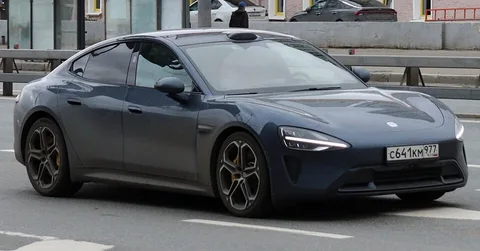
I used to have a Xiaomi air purifier. It was okay. It might have squeaked too. But then they jumped into electric vehicles. And some people are like, wow, Lei Jun,16Lei Jun — Xiaomi's founder. In 2021 he announced the company would invest $10 billion in EVs over ten years, calling it the last major entrepreneurial project of his life. Its first car, the SU7 sedan, launched in March 2024. the founder of Xiaomi, is such a visionary. He took this big bet. But also he was drawing on a kind of supply chain foundation and a sort of pool of expertise and resources that already existed in China, partly due to these other sectors that have flourished for a while now.
From an American perspective, thinking about big global industrial competition, the Xiaomi story I find to be a little bit blackpilling, because when Xiaomi came out, when we first heard about this company, Xiaomi, the iPhone was like in ascendance. But in the 2010s, at one point, Apple was looking for the next thing, and like, oh, maybe we'll make cars. And then they didn't, and that fizzled.17Apple's car — the project, code-named Titan, ran from about 2014; Apple shut it down in February 2024 without ever showing a car. And then Xiaomi not only makes cars, but seemingly makes very good cars. And so you think, like, Apple could not go from phones to cars, but Xiaomi can, apparently, and all these other things.
03Why Chinese companies jump from industry to industry
US tech giants build full stacks too, but in China far more companies do it, they go all the way down to the factories, and the state signals where to go.
Now, just real quickly, like, I'm looking at your Venn diagram, and American companies are kind of getting into... they're not that different right now. I mean, we know, like, Amazon, they have their own chips that they design, Trainium.18Trainium — Amazon's AI training chips, designed by Annapurna Labs, the Israeli chip designer Amazon bought in 2015. Anthropic trains its models on Trainium clusters. Microsoft designs chips, OpenAI wants to design chips.19In-house chips — Microsoft has its Maia AI accelerator. In October 2025 OpenAI agreed with Broadcom to co-develop its own accelerators totaling 10 gigawatts. I think Anthropic wants to design chips, etc. Alphabet20Alphabet — Google's parent company; its self-driving taxis are Waymo. obviously has the self-driving cars, etc. How much of this would you confidently say this is a Chinese tech thing, versus in 2026 all big tech companies are kind of going to have to compete at every level, or want to compete at every level?
It's a bit of both, for sure, because as you point out, we see some of this happening in the US tech sector. You just have, like, Google going into autonomous driving, robotics, making their own TPUs,21TPU (tensor processing unit) — Google's in-house AI accelerator, first unveiled in 2016. Google trains its Gemini models on TPUs and rents them out to others, including Anthropic. doing this full-stack approach. And some people compare them to Alibaba,22Alibaba's full stack — the Alibaba Cloud platform, its own chips from the T-Head unit, the Qwen models and apps from the Taobao marketplace to an AI assistant. which you can almost level by level match up each layer of the stack.
What I think is different in the Chinese case are two things. One is just the number of companies that are doing this. It's not just a small handful that are doing this full-stack approach. It seems like even food delivery companies23Food delivery companies — above all Meituan, China's biggest: since September 2025 it has released its own open-weight LongCat language models. are jumping into making their own foundation AI models. And you have smartphone companies like Xiaomi making their own chips and foundation models as well. So that's one thing that's different. The other thing that's really different is that these are kind of more full stack in terms of the actual manufacturing of the hardware itself, right? So ultimately, when Meta makes their VR goggles, I think a lot of that is outsourced, the actual manufacturing is outsourced,24Meta Quest headsets are assembled by Goertek, a Chinese contract manufacturer of earbuds and VR headsets. including partly to China. Whereas some of these other companies in China, they're controlling the factories, they're building even further down to the components. So I think that's another difference.
What would you argue are the driving forces for Chinese companies doing this? Is it just a sort of, I guess, natural progression? This reminds me very much of the Ricardo Hausmann25Ricardo Hausmann — a Harvard economist, founder of the Growth Lab at the Kennedy School and a former planning minister of Venezuela. Monkeys jumping from tree to tree are his metaphor for how countries move into new industries. monkey-swinging-from-trees thing, where you have like one industry and then it leads to the next industry, and it sort of builds on itself. But then in China you also have, to your professional expertise, a lot of industrial policy, where the ruling authorities will come out and they'll say, hey, we don't want so many, like, digital internet companies, or such an emphasis on them. We want everyone to move into making, like, actual hardware. And you get very strong signals from the Chinese government about what matters to them at any given point in time.
ExplainerHausmann's monkeys: how countries move into new industries
The image comes from "The Product Space Conditions the Development of Nations" (Science, 2007) by César Hidalgo, Bailey Klinger, Albert-László Barabási and Ricardo Hausmann. The authors mapped world trade so that each product is a tree, and two products sit close together if countries tend to export both: they call for similar skills, equipment and suppliers.
Firms and countries are the monkeys. They can easily jump to a nearby tree but can't cross a bare stretch of forest. At the center of the map the forest is dense (machinery, electronics, chemicals) and the jumps are short. At the edges the trees are sparse (oil, raw materials, simple farming), and a country sitting there finds it hard to move into anything new.
That is Chan's point about Chinese companies: they jump to neighboring trees. A battery maker moves into EVs, a phone maker into cars and chips, drawing on suppliers and engineers the country already has.
Absolutely. Yeah, the way I would break it down is kind of demand- versus supply-side factors. By supply side I mean, like, the resources, the supply chains and the talent that exists to be able to jump into one of these sectors, especially if you are already in an adjacent sector. So that's your Hausmann monkeys jumping across different trees. I think that's a really apt analogy for what we see with Chinese tech companies themselves. They're jumping from tree to tree, not making a huge leap into quantum or something like that, but into kind of adjacent, overlapping industries.
And then on the demand side, right, there are reasons to want to move away from a low-margin industry like EVs and try to tap into maybe the next big thing, maybe robotics or some other faster-growing market. And then of course, as you're pointing out, there is the government itself, right? Like, I have a line where it's like, for a lot of things in China, including in China tech, it's the government, stupid, right? That is such a crucial factor in all of this. And to ignore that would be to kind of miss the bigger political economy, which is really crucial in China.
And so here you have signals from the government, both positive and negative. And I think the positive signals include identifying priority areas that companies, that local governments, that ministries and agencies should focus on. There's a five-year plan26Five-year plan — the current one is the 15th (2026–2030). Its "industries of the future" are quantum technology, biomanufacturing, hydrogen and nuclear fusion, brain-computer interfaces, embodied AI and 6G. that comes out, and it literally lists out what some of these priority areas are, whether they're chips, AI, robotics, also sort of industries of the future: quantum, fusion, biotech, brain-computer interface — whatever Elon is up to,27Elon Musk works on almost everything on that list: brain-computer interfaces at Neuralink, robots at Tesla (Optimus), AI at xAI. it's probably on that list. So you have sort of those positive signals, and that tells the firms, if you go in this direction, that will unlock a whole bunch of resources for you, whether it is local government support or whether it is special state-backed investment funds28State-backed funds — the best known is the National Integrated Circuit Industry Investment Fund, the "Big Fund": its first phase was set up in 2014, the third, worth 344 billion yuan (about $47.5 billion), in May 2024. targeting those sectors. So you kind of want to swim with the current rather than against.
And there's also negative signals too, right? So a negative signal is a crackdown on the hedge fund industry in China.29The hedge fund crackdown — after Chinese stocks slumped in early 2024, regulators turned on quant funds: in February the exchanges barred Ningbo Lingjun from trading for three days over a burst of selling, and new rules on program trading followed. And in some ways, this is a bit of a tenuous link, but some people hypothesize that one reason why DeepSeek30DeepSeek was founded in 2023 by Liang Wenfeng as the AI arm of his quant hedge fund High-Flyer. In January 2025 its R1 model caused a sensation, and Nvidia shares fell 17% in a day. even started to go into the whole AI space was partly because they felt pressure being a traditional financial institution.
AdEconomy of Scale, Ending Alzheimer's
What's next for virtual assets? I'm Jacob Grease, host of Economy of Scale, a series exploring growth in key global sectors. And in this episode, we're diving into the digital forces shaping finance. Sean McHugh from the Dubai-based Virtual Assets Regulatory AuthoritycVARA (Virtual Assets Regulatory Authority) — Dubai's crypto regulator, set up in 2022; it bills itself as the world's first independent regulator of virtual assets. has this to say.
We're seeing a lot of institutional players come in: digital-asset-dedicated hedge funds, high-frequency traders, and that sort of thing, and folks who service institutional clients.
As more capital enters the market, adaptive regulation is likely to become increasingly key. Reece Merrick of RippledRipple — a US fintech company building a blockchain payments network for banks, associated with the XRP cryptocurrency. Reece Merrick is its managing director for the Middle East and Africa. says:
A lot of regulators globally would like to keep the industry at arm's length. That's the opposite here. I think also what you'll find is that regulation and frameworks can come out, but some of them are maybe a slight iteration on some 80-year-old policy and not actually in line with what the technology can do and offer. And again, that's very different in Dubai.
Listen to the full episode wherever you get your podcasts. This series is brought to you by Bloomberg Media Studios and the Dubai Department of Economy and Tourism.
Dementia is a cruel thief. It robs us of our memories, our personalities, the things that make us who we are. Join me, David Cameron, as I search for answers on my podcast from Bloomberg and Kaleidoscope. It's called Ending Alzheimer's.
This is the best time we've ever been in Alzheimer's.
I'm confident that no child born today will have to say a long goodbye to their parent.
Listen to Ending Alzheimer's wherever you get your podcasts.
04How Huawei is catching up with Nvidia
Huawei is close to training large models on its own chips, but it is boxed in by fabs, lithography tools and HBM memory.
And I'm just looking at your Venn diagram. ByteDance,31ByteDance — the owner of TikTok and Douyin; its Doubao chatbot is the most popular in China. do they have a smartphone?
They were working with, actually, ZTE32ZTE — a Shenzhen maker of telecom equipment and smartphones. In 2018 a US ban on selling it American components nearly shut it down; it reopened after paying a $1 billion fine. on this agentic smartphone.33The agentic phone — ZTE's nubia M153 with ByteDance's Doubao assistant built in, released in December 2025: the AI taps through apps by itself. Within days WeChat, Taobao, Alipay and banking apps began blocking logins from it, and ByteDance turned off its control of WeChat. It had a little bit of controversy, though, because it was supposed to be able to operate apps on your phone like a normal person would. But then — and this is like a classic Chinese story — they got blocked by a lot of the major Chinese platforms, because they wanted their own control and they wanted their own agents to kind of take over, like Tencent.
This is going to be a big deal with all agentic stuff, which is no one wants... I mean, there's already a knife fight happening with agentic commerce,34Agentic commerce — purchases made for the user by an AI agent. In November 2025 Amazon sued Perplexity over its Comet browser, which shops on Amazon on users' behalf. where no one wants to just be a passive door for someone else.
This is like the walled garden stuff35Walled garden — a closed ecosystem where the platform decides who gets in. In the 2010s China's tech giants blocked each other: Taobao links wouldn't open inside WeChat until China's Ministry of Industry and Information Technology ordered an end to it in 2021. all over again.
There's going to be a lot of that. Okay, so I'm looking at your mega-Venn diagram, and in the middle, the beating heart, and that is in almost everything, is Huawei.36Huawei has been on the US Commerce Department's Entity List since May 2019: without a license it can't buy American technology, and since 2020 it can't have chips made at TSMC. And obviously it's interesting that they're in basically everything that you have listed here, but it's particularly crucial when we're talking about AI. We know that one of the ingredients is chips, and we wouldn't even be talking about a company called Megaspeed getting Nvidia chips. We wouldn't be talking about chip smuggling.37Chip smuggling — in 2025 the US Justice Department charged several people with routing Nvidia GPUs to China through third countries, including Malaysia and Singapore. We wouldn't be talking about export controls or any38Export controls — since October 2022 the US has barred sales of advanced AI chips and chipmaking equipment to China, and it has tightened the rules several times since. of this if Huawei had enough capacity to make good enough chips to compete with Nvidia. Why don't you give us, like, right now, your read on where Huawei is today, both in terms of their capabilities and their capacity to produce them, and their scale.
ExplainerWhy it's hard to leave CUDA
CUDA is the platform Nvidia released in 2007 so that GPUs could be programmed for more than graphics. Over almost two decades a whole layer of neural-network libraries grew up around it (cuDNN, cuBLAS, NCCL), and popular frameworks such as PyTorch are optimized for it first. Code written for CUDA runs only on Nvidia chips.
So a new accelerator maker needs more than a fast chip: it needs the whole software layer, and developers go where that layer already exists. That is the chicken-and-egg problem Chan describes: without users no libraries appear, and without libraries no users come.
Huawei's counterpart is CANN, the software stack for Ascend, which the company pledged in August 2025 to open-source. What helps Huawei break the loop is that export controls cut Chinese labs off from Nvidia's best chips, so they have to move to Ascend whether they like it or not.
Yeah. So up until now, the main problem was getting Huawei's AI chips, the Ascend series, to be reliable enough and functional enough to be used by Chinese AI companies who had grown up building on Nvidia and the Nvidia CUDA ecosystem. So there was a long process where you did not have that entire sort of library of software that had been optimized for CUDA. You didn't have that equivalent for Huawei's sort of ecosystem. And they have been trying to build this up, but they had this sort of chicken-and-egg problem, which is that they didn't have the user base to contribute and build that up, and because they didn't have the libraries, they couldn't attract the user base. So they had this chicken-and-egg problem.
But now, in part thanks to the export controls and restricted access to Nvidia GPUs, there's been a push, especially from Beijing, to close the loop on this relationship and get the Chinese AI companies to work with the AI chipmakers, especially Huawei, to sort of almost co-design future hardware. And in particular, you have a really tight partnership between DeepSeek and Huawei, where they literally have personnel situated at each other's companies. They have a lot of intensive, sort of technical back-and-forth, trying to figure out how to have these chips run, at least for inference,39Inference — running an already trained model to answer queries. Training needs far larger and more tightly linked clusters, so a chip that is fine for inference may fall short for training. for DeepSeek models. And you see actually now increasingly other Chinese AI companies announcing that their latest models, like Z.ai's latest models,40Z.ai — the international name, since 2025, of Beijing-based Zhipu AI, maker of the GLM models; the US Commerce Department put it on the Entity List in January 2025. are, on day one, ready for running on Huawei chips, as well as other domestic AI chips in China.
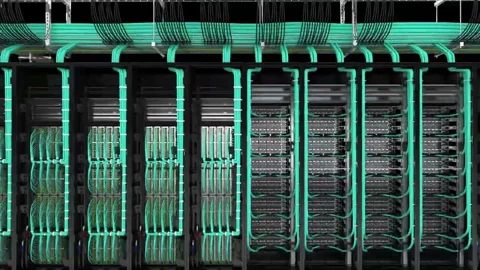
And then more recently, we have this push for the training side, right? So up until now, the Huawei Ascend chips were good enough for inference, but were not quite good enough for training, especially for these really massive two-, three-trillion-parameter models.41Parameters — the adjustable numbers inside a neural network. For scale: DeepSeek-V3 has 671 billion, Moonshot AI's Kimi K2 about a trillion. And Huawei have been trying to improve not just their capabilities at the single-chip level, but try to leverage their expertise as a networking technology company to bundle more of these chips together, to tightly connect them together, and to kind of make up for what they lacked in quality with quantity. So these chips were less efficient, they were less powerful on an individual chip basis, but you could bundle them together and you could start to build up these sort of superpods.42Superpod — hundreds of accelerators linked into a single machine. Huawei's 2025 flagship, the CloudMatrix 384, joins 384 Ascend 910C chips with optical links; SemiAnalysis estimated it delivers almost twice the compute of Nvidia's GB200 NVL72 but uses nearly four times the power. And the goal there was to build up enough sort of compute capacity that was concentrated that you could run a large pre-training run successfully.
And so that's the tipping point I think we're starting to see with the Chinese AI models. And there's rumors that the next DeepSeek model, for example, will be fully pre-trained on Huawei chips. Okay, so that's sort of, like, on the capability side. But then there's a production capacity side, which is another story altogether, because basically, even if you're trying to do this sort of quality-for-quantity trade-off, you do need enough quantity, you do need enough volume of chips in order to satisfy all that demand. And at this point, Huawei is constrained.
So Huawei works a lot with SMIC.43SMIC — China's largest contract chipmaker, founded in Shanghai in 2000 and on the US Entity List since 2020. Pictured: the 7-nanometer Kirin 9000S that SMIC made for Huawei without EUV tools (right), next to the TSMC-made Kirin 9000. SMIC is sort of like the premier foundry in China for chipmaking. They are kind of like the analog of TSMC,44TSMC — the Taiwanese company that is the world's largest contract chipmaker; it makes the most advanced chips for Nvidia, Apple and AMD. and they are limited by their equipment, by the lithography machines that they have, and by their own supply chains. So Huawei has been working closely with them, but they have limited capacity, and a lot of their capacity is actually allocated towards Huawei. Huawei itself has been leading its own efforts to build kind of a separate network of fabs, also trying to supply its own sort of chip needs. And that is still sort of ramping up as well. And so the big question is, how quickly can you get that production scale up over time, and how limited is that by not just the number of fabs you have, but the equipment that goes into them, by, for example, lithography machines, especially DUV immersion machines,45DUV immersion lithography — 193-nanometer machines with a layer of water between the lens and the wafer. With multi-patterning they can reach 7 nanometers. Since 2023 the Netherlands has restricted exports of ASML's most advanced models to China. that largely at this point still come from ASML in the Netherlands.46ASML — the Dutch company that is the largest maker of lithography machines and the world's only maker of EUV systems.
And then there's also the HBM bottleneck47HBM (high-bandwidth memory) — DRAM dies stacked on top of one another and placed right next to the processor; its capacity and speed largely set how fast an AI accelerator runs. Since December 2024 the US has banned HBM sales to China. as well. You have Chinese companies like CXMT48CXMT (ChangXin Memory Technologies) — a DRAM maker based in Hefei, founded in 2016; China's largest. trying to move from DRAM into HBM. And while they still lag behind the big three — Hynix, Samsung, and Micron — they're trying to, in the next two to three years, get to at least good enough HBM to then pair up with Huawei chips. But at this point, there's even been reporting that Huawei is saying to customers, like, we can make the NPUs, the neural processing units, but it's sort of BYOH: bring your own HBM.49BYOH — a play on BYOD, "bring your own device." The Information reported that Huawei has asked some customers to source HBM from Samsung and SK Hynix themselves for its upcoming accelerators, because it can't get enough of its own. You're going to have to source that from elsewhere. So that's another bottleneck in the near term. Yeah. So that's sort of where we stand in terms of the shifting capabilities, but then also the bottlenecks on the production side.
05Export controls as a Sputnik moment
US export controls, Chan says, galvanized China into trying to replicate the entire global chip supply chain at home.
This is sort of a tangential question, but on the other hand, I think it's actually a very fundamental question. When you look at the export controls around chips, the US export controls, there was an argument when these first started being applied that this was going to — I think people called it the sort of, like, three-body effect50The Three-Body Problem (2006) — Liu Cixin's trilogy, the best-known Chinese science fiction, adapted by Netflix in 2024. In it, the threat of an alien invasion pushes humanity to mobilize its science and industry. — that it was going to have the effect of speeding up China's own technological development, and lending even more of a sense of urgency to develop their own chip competitors. When you look at what's happening with Huawei chips now, does it feel like that's happened, that China has had its kind of Sputnik moment,51Sputnik moment — after the Soviet Union launched the first satellite on October 4, 1957, the US sharply raised spending on science and education and created NASA in 1958. In January 2025 Marc Andreessen used the phrase for DeepSeek R1. I guess?
Yeah, absolutely. So I think that US export controls had a massively galvanizing effect on China's push for semiconductor self-reliance. People who argue against that point to the fact that China has had a longer effort predating US export controls to try to develop their own sort of national chip industry. You have national semiconductor plans52National chip plans — in 2014 the State Council adopted a plan to develop the integrated-circuit industry, and in 2015 "Made in China 2025" set a goal of meeting 70% of domestic chip demand with homemade chips by 2025. going back into the 2010s. But what's really different here is sort of this full-stack effort to build not just the chips, but the equipment, the materials, the photoresists,53Photoresist — a light-sensitive polymer onto which a lithography machine projects a circuit pattern. The market for advanced photoresists belongs almost entirely to Japanese firms: JSR, Tokyo Ohka Kogyo and Shin-Etsu. the etch and deposition equipment,54Deposition and etch — deposition lays ultra-thin layers of material onto the wafer, and etching removes what isn't needed according to the lithography pattern. The leaders in this equipment are Applied Materials and Lam Research in the US and Tokyo Electron in Japan. to build up the entire supply chain. China is almost trying to replicate the entire global semiconductor supply chain in China, which I don't think any country has ever done before. And some indicator of how big a switch this has been is lithography.
Lithography was one area that China had really deprioritized for a long time. They had not really invested in building up that capability, I think largely because they expected to be able to have access to lithography machines for the foreseeable future. And when that switch happened, when, for example, during the first Trump administration, you got the effective ban on EUV lithography machines from ASML to China,55The EUV ban — in 2019 the Dutch government, under pressure from the Trump administration, withheld ASML's license to ship an EUV machine to China's SMIC; no such machine has been sold to China since. Pictured: ASML's NXE:3800E EUV system. that was a huge wake-up call, because that basically capped the ability of Chinese chipmakers to make chips of a certain process node,56Process node — a generation of chipmaking technology, labeled with nominal nanometers: the smaller the number, the denser the transistors. The most advanced chips, at 3 and 2 nanometers, can be made only with EUV machines. of a certain kind of scale and degree of performance. It was a huge moment. It basically kind of limited China's chip ambitions as long as they were reliant on the rest of the world.
And so from then on, you see this long-term effort — and building lithography machines in particular requires a very long-term, sustained effort — but you have this long-term effort, especially pioneered by Huawei, who, not ironically, was the main target of a lot of these export controls from the US, to figure this whole thing out by hook or by crook: by trying to recruit engineers from all around the world, including from ASML, by investing in the R&D in a couple of different sites. There's one rumored site in Shenzhen where there's supposedly an EUV lithography machine prototype in the works.57The Shenzhen prototype — in December 2025 Reuters reported that a secret lab in Shenzhen, with help from former ASML engineers, had built a prototype EUV machine that can generate EUV light but has not yet made working chips. So all these efforts are a sign that China's kind of switched from "yeah, we should probably make our own chips" to "we must, at all costs." And it's priority number one on the five-year plans.
06Months behind versus self-reliance
Beijing is choosing chip self-reliance even if its AI labs fall behind, and the interests of companies and the state diverge.
You, like, set your sights on being able to match global scale, and eventually you just grind and grind and you get there. And China has obviously done that in several areas, and beyond just getting to the frontier, racing past the frontier. Batteries is one58Batteries — CATL and BYD together make more than half of the world's EV batteries. of the obvious categories that just comes to mind, just far ahead of the frontier. When it comes to AI models themselves, you know, I understand this impulse. It's like, okay, like, use the Huawei chips and let's work together and build up this ecosystem. But at the same time, like, that could potentially entail falling a little bit behind the frontier. And this is a brutal fight for the frontier that is literally measured in months in many cases.
And we talk about, you know, the next best models being six months behind or three months behind or whatever it is. Is there a tension with AI specifically, where the Chinese model — and here I'm not talking about AI, but the Chinese model of, like, let's work on our self-reliance, let's build this network — does have the risk of, like, yeah, but what if we do that and now we're nine months behind? Or what if we do that and now we're 12 months behind? And these sacrifices of not just trying to get the Nvidia chips by hook or by crook are not worth making, even if it's good on a national basis.
Absolutely. The trade-offs here are really sharp, and there are trade-offs all over the Chinese industrial policy landscape. It's, like, one of the big themes that I focus on. And in this specific case, you have this trade-off between today — can you close the gap with the US AI frontier? Can you narrow that gap? — or are you focused on tomorrow, being able to build a fully self-reliant semiconductor supply chain that may not be completely on par with what TSMC and Nvidia can produce, but is good enough and will basically allow China to continue to make AI progress, regardless of what Washington decides.
And I think here what's interesting is the tension between the firms and the government in China. And even across industry in China, there's different views, right? So there are the Chinese AI companies, like DeepSeek or Z.ai or Alibaba, who want to build better and better models. They would probably prefer to just keep building on Nvidia chips if they could. They are very familiar with that. It doesn't require much extra work. So they're sort of optimized on running on that platform. But Beijing doesn't like that. And for the Chinese central government, the goal is not just to have really incredible models today. The goal is to build up that kind of independence and sovereignty, essentially, in supply chains in the long run.
So you see this tension where you have the Chinese AI companies clamoring to get the H200s59H200 — Nvidia's previous-generation Hopper accelerator. In December 2025 Trump allowed its sale to Chinese buyers on condition that the US government gets 25% of the revenue; Beijing reportedly responded by telling companies to limit purchases. that Trump allowed to be exported to China. They seem very eager. They were putting in their orders, they were trying to negotiate how much they could get, and you have Beijing itself saying, hold on, hold on, hold on. We don't want so many of these Nvidia GPUs. We want you guys to focus on partnering with domestic chipmakers in China, to close that loop and to help them make their chips better. And of course, there's this disagreement within the industry in China, because the AI companies want to run faster on the models, but of course all the chipmakers, they love the export controls and they love Beijing's push for self-reliance, because they have seen an astronomical surge in demand for their chips that didn't exist before.
07What Beijing actually wants
Xi Jinping, in Chan's view, cares more about winning the industries of the future than about consumption or household wealth.
Can you talk a little bit more about, I guess, the long game here, or what Beijing would regard as a success? Because it's very easy to imagine a scenario where China becomes very good at a bunch of new technologies, partly by integrating a lot of its existing firms or doing this sort of vertical integration that we've been discussing, but margins, you know, remain pretty thin. Maybe households don't feel particularly wealthier than they did in the past, which is something we've been talking about on the show as well. Like, would that count as a success for Beijing, if all those products were, I guess, integral to global supply chains?
Yeah, I mean, I'll throw out a controversial take, which is: Xi Jinping does not really care that much about the economy or about consumers or about households, in the sense that, you know, in the traditional sense that we might think about in the US or in the West. I think up until now, you have all these calls for an adjustment of imbalances: why isn't China boosting consumption? Why aren't they offering, if not handouts to consumers, some kind of stimulus measures to stimulate demand, right? There's a big demand slump, especially after the real estate collapse,60The property collapse — in 2020 Beijing imposed "three red lines," debt limits for developers, and a sector that with related industries made up about a quarter of GDP crashed: Evergrande defaulted in 2021, and in January 2024 a Hong Kong court ordered it liquidated. which was a deliberate sort of popping of a bubble and a pivot towards something else.
And the answer to all that is, if you start with the premise that the goal is not GDP growth in and of itself, the goal is high-tech self-reliance, of sort of, like, winning the industries of the future — if you start with that premise, everything starts to make a lot more sense. So those who have been wondering, like, well, is the stimulus coming? Are they going to finally bail out whoever it is that needs to be bailed out in order to get demand going? That, I think, is ultimately seen as secondary, downstream to this high-tech push. And the idea is — there's this very clunky term that has become sort of, like, the buzzword, which is the "new quality productive forces.61New quality productive forces (新质生产力) — a Xi Jinping formula first used in September 2023: growth driven by advanced technology and innovation rather than construction and cheap labor. Since 2024 it has appeared in every major party document." If you have these particular high-tech industries, growth sectors, industries of the future, if you can start to win in those areas and also have the supply chains, sort of the complete industrial system62Complete industrial system — Chinese officials like to stress that China is the only country with every industrial category in the UN classification: 41 major, 207 intermediate and 666 minor ones. — which is like a term in Chinese that's very common — to back all that up, then everything else will kind of follow.
You will end up having the kind of robust economic growth. You will have jobs, you will have high-tech jobs, right? In this shift away from sort of blue-collar factory jobs, you might have purple-collar jobs,63Purple collar (紫领) — a Chinese term for workers who combine engineering knowledge with hands-on work: technicians, set-up specialists, operators of complex equipment. The color mixes blue and white collars. jobs that require more advanced degrees and have more technical know-how, maybe maintaining and repairing robots, for example, rather than actually sort of making widgets on the factory floor. So to take a step back, basically, I see that there is this sort of all-in push to try to become, if not the dominant, a dominant global player in a number of these key industries. And everything else is sort of like, you know, if that works, that's great, but that's not really the main goal right now.
AdDisclosure
Want to know how three words might have changed our understanding of the biggest espionage case in US history? Or the lengths the SEC might go to investigate a golf tee time? The answers are out there. The trick is getting the government to share them. From Bloomberg and No Smiling, this is Disclosure,eDisclosure — a Bloomberg podcast hosted by investigative reporter Jason Leopold, who pries secret records loose with Freedom of Information Act (FOIA) requests. a podcast about prying those secrets loose and the unexpected places that takes us. Listen or watch wherever you get your podcasts.
08Will AI replace biotech?
Xi is AI-pilled, Chan says, but doesn't see AI as the last technology; Beijing wants to fold it into every other industry.
So we did a few episodes a couple of years ago about biotech in China and how that's growing and expanding. But there is a view in Silicon Valley that there won't be a biotech industry, that there'll be an AI industry, and that the AI will find all the biotech. And that actually it may even be stupid to try to invest in, quote, what we call biotech per se today, that you should really just be building more advanced AI models, because those models are going to be what finds all the molecules of the future, et cetera. And I'm sort of curious the degree to which either Xi or people in China have this view that's like, forget biotech, forget all this other stuff, forget quantum, just build the great AI model, and then the AI model will solve these other things in science.
Yeah, that's interesting, because at first I was going to say Xi Jinping is for sure AI-pilled. That is a really key priority, and maybe at the top of the list of sort of these more general-purpose technologies that they think are going to sort of fuel their growth and development going forward. But the way that you phrased it was really interesting, because I don't think that he or the powers that be in Beijing see this as the be-all and end-all.
The last technology.
That's right. That's right. I think they want to integrate this into everything else. They want it to turbocharge drug discovery and healthcare innovation and manufacturing, and they want to infuse sort of, like, the physical world with physical AI64Physical AI — AI that acts in the material world: robots, self-driving vehicles, automated warehouses. Nvidia's Jensen Huang has been the term's biggest promoter. and have robotics and autonomous delivery systems everywhere. But whether that will just completely eclipse the traditional — you know, it's funny to have this term, like, the traditional high tech of the future — but yeah, basically, I don't see that happening. And in fact, when you see the kinds of policy documents, the blueprints, the plans going ahead, these different technology sectors are still laid out as, like, critical, you know, so-called future pillar industries, basically.
Yeah, but actually biotech is an interesting example here, because I think it tells you something about how China actually approaches a lot of these technological development projects. Because the original big biotech push,65Early Chinese biotech — the state's Program 863, launched in 1986, funded biotechnology alongside space, information technology and lasers, and new crop varieties were among its early priorities. that was mostly from an agrarian perspective, right? That was like, we're going to develop new technologies in order to boost food production. And then it morphed into, like, biomedical stuff, like actual pharmaceuticals. And so you can envision now that, like, they probably don't think that models are going to, you know, solve the entire biomedical thing, but, like, there absolutely will be an adaptation of, like, biopharma with AI.
I'm sure Dario66Dario Amodei — CEO of Anthropic. In his essay "Machines of Loving Grace" (2024) he argued that powerful AI could compress the progress in biology and medicine expected over 50–100 years into 5–10. thinks the models will just come up with it.
Well, I mean, we've had interesting examples. So Citrini,67Citrini — the pen name of James van Geelen, founder of the investment research firm Citrini Research and a former medic; he has been a guest on Odd Lots. who we've had on the show, has been working with one of the models to develop an antivenom for scorpion bites, which apparently didn't really exist before. This was like for all different types of scorpion bites. And they're showing some progress on it. Yeah, I think it's going into some sort of clinical trial. So, you know, it's an interesting one, for sure.
09Chasing a bullet train
The chip frontier is hard to catch because it keeps accelerating, and the key bottleneck is lithography.
Let's go back to chips for a second. You know, I sort of at this point still have this view that eventually, like, the trajectory of the world is that if something is built, it'll be built in China. Now, that may change, and there's a lot of efforts to, like, fight against this, I don't know, [unclear] or whatever it is, but that is the trend. I'm curious, like, in five years, if Huawei is not at the frontier of chip production and scale, et cetera, why not? What would be a reason to think that maybe they are not going to be able to do in chips what they've been able to do in many other industries?
Yeah, so it depends on what you mean by sort of, like, not succeeding. Because on the one hand, there is, like, not catching up to the frontier and sort of keeping pace. And in that way, I kind of compare the whole chip industry to, like, trying to catch a bullet train, because you're, like, trying to run as fast as possible and accelerate as fast as possible, but the goal that you're trying to catch, or the frontier you're trying to catch up to, is itself accelerating.
So, you know, while Huawei is improving, and while some of the other Chinese chipmakers are also sort of improving, they're trying to catch companies like TSMC, which is just investing, like, an incredible amount, and they're already at the frontier, and they're operating with the best technology, the best equipment in the world, from Japan and the Netherlands and Germany and the US. And so when you put that all together, that's a formidable sort of... there's not, like, a finish line that you'll reach and you'll say, like, I got to the global frontier. That finish line is also running away from you. But if you're asking about, you know, will they be able to have sort of, like, good enough chips that have decent enough supply, where Chinese AI can sort of continue roughly at the pace that it's going at now, what would be the major barriers to that?
ExplainerHow to get by without EUV
The densest layers of today's chips are printed with EUV machines working at a wavelength of 13.5 nanometers; only ASML makes them, and none are sold to China. Chinese fabs are left with DUV immersion tools at 193 nanometers, and Chan names two workarounds.
Multi-patterning. The pattern for a single layer is split into two to four parts and printed in several passes, each aligned to within nanometers of the last. That is how SMIC made the 7-nanometer Kirin 9000S for Huawei's Mate 60 Pro (2023). The price is more steps, a longer production cycle and more defects, so such a chip costs more than one made with EUV.
Advanced packaging. Instead of shrinking transistors, several dies are placed side by side or stacked in one package and wired together with dense connections (chiplets, 3D stacking). The whole system gets faster even though each die uses an older process. Nvidia uses the same trick: Blackwell is two dies in one package.
Probably then it would be bottlenecks in the equipment, in particular lithography. And so there's a huge sort of range of uncertainty around how effectively China can develop its own lithography, especially DUV immersion and then potentially EUV, or whether China might be able to bypass some of that technology, right? There's been some hype around Huawei's efforts to do this sort of logic folding, where they're arguing — some people just say it's fancy chip packaging — but they're trying to, rather than just drive down the process node further and further, as if you had an EUV machine, they're trying to basically double back and sort of use better packaging, so that you can build connections sort of within the chip itself. And that's supposed to be another workaround. There's other sort of techniques, like multi-patterning, where you kind of, like, redo the design multiple times, but that can get messier in terms of lowering your yield rate68Yield — the share of working chips on a wafer. The more lithography passes, the higher the risk of defects and the more each good chip costs. and causing more errors along the way.
So there's sort of, like, workarounds, but ultimately, I think the key bottleneck is the lithography machines and whether China can get there. And then those... right, this is the thing that's, like, so wonderful and also so frustrating about the chip business, which is you can pick any one of these parts of the chip stack, like lithography, and it in and of itself has supply chains numbering in the hundreds, if not thousands. And so, for every ASML EUV machine, there's going to be a Trumpf69Trumpf — a German maker of industrial lasers. In ASML's EUV machines its CO2 laser strikes droplets of tin in flight, and the flash of plasma produces EUV light. lasers company — no relation to the president. There's going to be special lenses made by Zeiss70Zeiss — the German optics company that is the sole supplier of mirrors for ASML's EUV machines. ASML likes to say that if a mirror were blown up to the size of Germany, its biggest bump would be about 0.1 millimeter high. that are the best in the world. And, you know, there's always the stats about how they're so perfectly level, but every single one of those in and of itself is another chokepoint, essentially, in the whole sort of complicated global chip supply chain.
10Why stock investors in China don't make money
Chinese companies struggle to hold on to profits because competitors keep piling in and barriers to entry are low.
What's your answer for why stock investors never seem to make any money in China? And actually, we haven't talked about it much on the podcast. I mean, it's been a very bad year for Chinese...
Stocks. Yeah, it really has.
It's actually been a pretty brutal year. Surprise, surprise. Stock investors, they're like, no, this is the year. It's finally... What's your answer that you would give for why, like, all the progress, et cetera, stock investors never seem to make any money?
A big part of it is it's hard to make profits in China. It's hard to have a sustained competitive moat.71Moat — a durable competitive advantage that shields a company's profits from rivals; Warren Buffett popularized the metaphor. There are some exceptions to that. So, you know, one company that I always find kind of interesting is DJI.72DJI — a Shenzhen drone maker founded in 2006 by Frank Wang; analysts estimate it holds about 70% of the global civilian drone market.
Oh, yeah.
Why aren't there, like, a bazillion Chinese drone companies? How did that market get so concentrated? You know, you have, like, CXMT, as I mentioned earlier, with memory, and it has carved out a special space within that sector.
But in general... Wait, do you have an answer for why DJI is singular within the drone space, like the way they are?
I actually don't know. It could just be a quirk of timing, and we may actually start to see the flood coming, right? So there seem to be new players emerging, but at least at this point, it's sort of, you know, in its own category. But more broadly, you do have this phenomenon where it's hard to have a sustainable moat. You have other companies jumping into the mix that also have access to, frankly, some of the best engineers, including your own engineers, who can jump ship. They have access to financing from local governments.
So the barrier to entry for a lot of these industries is actually relatively low. And so they end up getting kind of flooded with overcapacity, redundancy, but then also building these overall very, very globally competitive industries that, once China starts to export to the rest of the world, well, good luck to the rest of the world. So I think that's part of the reason why we see this effect. If you don't have long-term profits, or don't expect that to really be sustainable, then it's hard to justify rising or high valuations.
All right, Kyle Chan, great chatting with you. Great to finally have you on the podcast. Let's stay in touch.
You know, Tracy, the Chinese stock market sell-off is so bad that once again — and I think this was not the case, but once again — the Moutai company73Kweichow Moutai — the state-owned maker of the premium baijiu Moutai, from Guizhou province; by market value one of the largest companies on China's stock market. is the biggest member of the CSI 300 index.74CSI 300 — an index of the 300 largest stocks on the Shanghai and Shenzhen exchanges, the main benchmark for China's stock market.
Everyone's drinking because stock market trends are so bad. Yeah.
No, like, you know, number two is CATL.75CATL — the world's largest maker of EV batteries: according to SNE Research, it held about 38% of the global market in 2024. So that's the battery company.
Yeah.
Source: SSE Composite Index — Wikipedia (data from stooq.com)
And then there's some other... but we're back to the world where the baijiu company76Baijiu — a strong Chinese liquor, usually 40–60% alcohol, most often distilled from sorghum. is the big one. It is amazing if you look at, like, a long-term chart of the Shanghai Composite77The Shanghai Composite — an index of all stocks on the Shanghai exchange. It ended 2000 at 2,073 points and 2025 at 3,969: less than double in a quarter century, about 2.6% a year on average, excluding dividends. since 2000. You just don't make any money there.
It's pretty much almost a horizontal line.
Yeah.
I mean, there are some pretty big ups and downs, but the overall direction of travel is sideways. It's pretty sideways, yeah.
11How much intelligence does the economy need?
The hosts debate whether China can afford to lag on models and land on the idea that most of the economy can absorb only so much intelligence.
And every once in a while, like, there's a hype cycle. But I thought that was really interesting. This idea that, like, AI strikes me as a real tricky thing for the Chinese model of development. Because intuitively, it's like, yes, I suspect that, like, on enough time, absolutely, it seems that Huawei would get as good as Nvidia, and eventually have the scale to produce as much as TSMC on a long enough timeline. But in the meantime, the pace of improvement in the model layer is so fast. How long can you afford to go with the homegrown technology if it's not good enough? And that's a very interesting question to me.
The other thing — we didn't even really get into sort of self-recursive improvement78Recursive self-improvement (RSI) — a hypothetical stage at which AI designs its own next versions and progress starts to snowball. for model development, but that also seems like... cliff isn't the right word, but like, if the Western models get there before China, you can't afford... if that's a thing, and we don't even know if it's a thing.
But if that's a thing, then it's like, that really, I think, puts a limit on the degree to which any model maker can really... it's like, we're going to go with the indigenous technology. Yes, it'll slow us down, but it's good for the nation. If there is this day in which you can get to, like, RSI, and then it's off to the races, if that's real.
But the counterpoint to all of that is basically, like, well, what are these AI models for, right? Like, the AI is supposed to help us, like, run our businesses more efficiently, produce things more efficiently, maybe make some technological breakthroughs here and there. And so the focus on actual diffusion throughout the economy makes a lot of sense from that perspective. Whereas in, like, in the US, it very much feels like AI is the sort of, like... the model itself is the be-all and end-all of development.
No, totally. I was talking to some folks the other day in finance, and they're saying, look, like, there is a point where AI is good enough for us. As in, there is a point where we cannot absorb more intelligence per se. And once you hit that point, you could make the models 10 times smarter. We can't use this. And then what are you doing it for? And then the list of things that can actually absorb that intelligence starts to shrink.
You're a widget manufacturer. You're not going to be solving Navier–Stokes79The Navier–Stokes equations describe the flow of liquids and gases. Proving that smooth solutions to them always exist is one of the Clay Mathematics Institute's seven Millennium Prize Problems, with a $1 million prize. or something like that. You just want to automate a few things.
Right. And this is, if you were to make the bull case for the commodification of intelligence,80Commodification — turning a product into a commodity: offerings from different makers become interchangeable, and prices fall close to cost. it would be some version of: most economically productive things in the economy can only absorb so much intelligence, unquote. And that the American closed-source labs,81Closed labs — OpenAI, Anthropic and Google DeepMind, which don't publish their models' weights. Leading Chinese models, by contrast, usually come out with open weights. like, yes, they might have big margins on the very frontier, but that's not that big of a market. The market is smaller, and then the rest of it gets really commodified and there's no money there. That's a very plausible way that... I don't know that that's going to be, it's just plausible.
All right, shall we leave it there?
Let's leave it there.
This has been another episode of the Odd Lots podcast. I'm Tracy Alloway. You can follow me at @tracyalloway.
And I'm Joe Weisenthal. You can follow me at @thestalwart.82TheStalwart — the markets blog Weisenthal ran from 2005 before joining Business Insider; hence his handle. Follow our guest, Kyle Chan. He's at @kyleichan. Follow our producers: Carmen Rodriguez at @carmenarmen, Dashiell Bennett at @dashbot, Cale Brooks at @calebrooks, and Kevin Lozano at @kevlloydlozano. And of course, you can chat about all of these topics 24/7 in our Discord, discord.gg/oddlots. And for more content, you can check out our daily newsletter. Please subscribe. That's over at bloomberg.com/oddlots.
And if you enjoyed this conversation, if you like it when we talk about complicated Venn diagrams, then please leave us a positive review on your favorite podcast platform. And if you're watching on video, then please like or leave a comment, or better yet, subscribe.
And remember, if you're a Bloomberg subscriber, you can listen to all of our episodes absolutely ad-free. Just go to the Bloomberg channel on Apple Podcasts and follow the instructions there.
Thanks for joining.
AdEnding Alzheimer's
Dementia is a cruel thief. It robs us of our memories, our personalities, the things that make us who we are. Join me, David Cameron, as I search for answers on my podcast from Bloomberg and Kaleidoscope. It's called Ending Alzheimer's.
This is the best time we've ever been in Alzheimer's.
I'm confident that no child born today will have to say a long goodbye to their parents.
Listen to Ending Alzheimer's wherever you get your podcasts.


