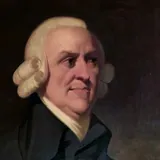
Adam Smith
A Scottish economist and philosopher (1723–1790), one of the founders of economics and author of "The Theory of Moral Sentiments" and "An Inquiry into the Nature and Causes of the Wealth of Nations."
Born in Kirkcaldy on Scotland's east coast, he entered the University of Glasgow at 14, studied under the philosopher Francis Hutcheson, then went to Balliol College, Oxford, on a scholarship and later wrote that its professors had long given up even the pretense of teaching. From 1751 he was a professor at Glasgow, and "The Theory of Moral Sentiments" (1759), which explained morality through sympathy, made him famous. In 1764 he left his chair to tutor the young Duke of Buccleuch and spent more than two years with him in France and Switzerland, meeting Voltaire in Geneva and Benjamin Franklin and the physiocrats led by François Quesnay in Paris; in dull Toulouse, by his own account, he began writing a book "to pass away the time." The result was "The Wealth of Nations" (1776), with its division of labor, free trade and the famous "invisible hand" that steers private interest toward the common good. From 1778 Smith served as a commissioner of customs in Edinburgh, and before he died he had nearly all his manuscripts destroyed. In 2007 his portrait appeared on the Bank of England's £20 note, the first Scot on English money.
Books and works
In the episodes
2- November 9, 202620VC: Mistral CEO on Why Energy Is Not the Bottleneck to AI | Why OpenAI and Anthropic Will Come for Your Business | The Future of the Inference Market | Are Chinese Open-Source Models Truly Safe?mentioned20VC
- 16:56the "invisible hand" of the market
- November 5, 2026A Model For Everyone: How Ronak From Trajectory Is Building Products For Continual LearningmentionedTraining Data
- 29:54specialization as the road to abundance