


Training Data
Chapters
Today's agents, Ronak says, learn only "pseudo-continually," offline and in whole batches like a paper map, and the goal is learning that updates with every drive, like Google Maps.
Read the chapter- Ronak holds up the human brain as the model: people learn online and constantly update, and agents can't do that yet.
- When Ronak was a kid, AAA highlighted the family's road-trip route, and changing it meant calling or visiting an office; agents are likewise updated offline, in whole batches.
- Trajectory's first goal is like MapQuest: give everyone the ability to train and customize models themselves, even if offline for now.
- Real continual learning, like Google Maps, learns from every drive: which route is fastest and where the traffic is.
Pat notes that Sutton and Silver doubt continual learning is possible with today's architectures; Ronak answers that architectures are already changing and the missing layer is turning a company's idea of "good" into model improvements.
Read the chapter- LLM scaling long meant stacking transformers, while recent models like DeepSeek-V4.1-Flash, Ronak says, have fast and slow memory within the weights and skip connections between layer two and layer 50.
- Ronak agrees such changes will be a key component of continual learning, and Trajectory wants to build on that work.
- Companies have an idea of what good looks like in their heads, and the hardest part is turning it into model improvements.
A custom model still takes months, a huge team and hand-holding, but since every company is doing the same thing, it can be packaged as a product, and a big lab can't justify one model per customer.
Read the chapter- SWE-1 took Windsurf six to nine months, a huge team and hundreds of millions of dollars in R&D and compute, all in a hand-holding, consulting mode.
- When every company keeps doing the same thing over and over, Ronak says, it can be packaged into an interface with the right knobs and levers.
- Ronak trained models on Windsurf users' edits and retries, Michael at DeepMind built daily-updating Gemini Robotics robots, and Arjun at Apple used artist feedback for multimodal models; all three were solving one problem: how to improve models with real-world feedback.
- DeepMind trains one massive model for everyone, and building infrastructure for a single customer's model is too much for a big lab.
By training a model on its own data, Harvey got the powers of a research lab and a model six times cheaper than the frontier.
Read the chapter- Harvey built products on top of closed frontier models and couldn't use its accumulated knowledge of what law firms care about.
- From its expert data, Harvey built and released a legal agent benchmark.
- The model trained with Trajectory is six times cheaper than frontier models and lifts an open-source model's accuracy from about 4% to about 18%, with plenty of room left to grow.
- Since the model is cheaper, each task can get far more tokens.
The unit of work, Ronak argues, is not the token but the task.
Read the chapter- The world counts tokens, but with coworkers we think in tasks, or trajectories.
- In RL a trajectory is a synonym for a rollout; in continual learning, real-world inference becomes the rollout engine, and trajectories become economically valuable tasks.
- The name has a second meaning too: companies own their path and grow on their own.
To train a model on its own production today, a company needs traces, a way to replay them and a training algorithm, and Trajectory wants to cut that down to one ingredient: a notion of what good looks like.
Read the chapter- Ideally, Ronak says, a company should only have to bring its notion of what good looks like.
- A trace is a complete timeline of the agent's work, including main calls, subagents and user feedback, and products like LangChain, Braintrust and Raindrop collect them.
- A trace has to be replayable for evaluation or training, and Trajectory needs only the traces plus an environment description such as a Dockerfile.
- The training stack, loss function and reward function are the hardest part for a company to build in-house, and that's the part Trajectory abstracts away.
Trajectory works around two bottlenecks, the environment and the reward, by learning from single rollouts instead of groups and extending grades for a hundred labeled traces to the rest.
Read the chapter- A perfect environment is often impossible to build, and legal and investment banking workflows have no perfect verifiable reward.
- GRPO compares 8 or 16 plays of the same task, while Trajectory's modified algorithm learns from single rollouts of different tasks, say 10,000 trajectories, so no environment is needed.
- Instead of labeling all 10,000 traces, the customer spells out what good looks like for a hundred selected ones, and a meta-grader generalizes to the rest.
- Ronak's ideal is an observability interface where you circle five things your agent is good at and five it's bad at and hit "train."
Trajectory puts training, evaluation and deployment in one place to close the loop, the way Apple combined the phone and the internet, and Ronak sees the harness as the next step.
Read the chapter- The platform takes agent traces and a notion of what good looks like, trains a model in one click, and then lets you evaluate and deploy it.
- Just as Apple combined the phone and the internet, a single loop lets you ship a model back to production, gather new traces and train again.
- The product is aimed mainly at AI-native companies with their agent harness in order, such as Harvey and Rogo, though larger companies like Nvidia already use it too.
- The model brings efficiency and the harness brings new capabilities; eventually, Ronak suggests, a frontier model like Fable might handle 10% of tasks while 90% are routed to your own, more efficient model.
A finance agent needs to be concise, not verbose.
Read the chapter- Rogo wants an agent that doesn't spit out a bunch of garbage but does the work you care about, including autonomously on the side, and comes back efficiently.
- The model Rogo trained with Trajectory is several times more token-efficient, cheaper and faster, and climbs on the metrics Rogo cares about.
To learn on their own, agents lack curiosity, and continual learning, unlike RSI, keeps humans in the loop, which Ronak sees as the safer path for alignment.
Read the chapter- Agents complete tasks but accumulate no experience of the world, while a person who throws a football a hundred times builds a heuristic, and kids constantly explore.
- In Markov decision process terms, LLMs jump from state to state as next-token predictors but don't encode the transition function in between.
- An agent should know what it doesn't know about the world and set out to test it, which is how Ronak proposes to quantify curiosity.
- Recursive self-improvement turns a black-box model into the best AI researcher, and it's unclear whether it will be aligned, while continual learning learns from interacting with humans and keeps them in the loop.
Trajectory keeps research and product on one team and runs its training code at production grade, and a product builder, in Ronak's view, becomes a gardener guiding growth that happens on its own.
Read the chapter- The team includes people who contributed to Gemini 3, Gemini Robotics, GPT-4o and Muse, plus product engineers from Stripe and Netflix.
- The training code is production-grade, with microservices, Kubernetes and autoscaling, and the design engineers kick off training runs themselves.
- The team argues about system design at the whiteboard, and a software factory of coding agents writes the implementation.
- The product grows on its own from real-world experience while its builder sets the trellises and imbues it with taste; a self-improving model and harness lead to a self-improving company.
Continual learning is the next learning paradigm, Ronak says, and in the optimistic scenario AI adoption goes from 1% of enterprises to 99%, each with its own model.
Read the chapter- Google, Amazon and Facebook ran on continual learning, in recommender systems and ads, and nothing like that exists for agents yet.
- Over time every agent should attune itself to each company and eventually to each user, which Ronak describes as a massive recommender system.
- Modal with its sandboxes and Thinking Machines work a few blocks away, and Trajectory takes on the product interface.
- Pat recalls Ronak's idea that continual learning makes the experience people have earned legible to foundation models.
- As in Adam Smith, Ronak says, abundance comes through specialization, with custom models and harnesses instead of a single oracle.
Quotes
On what real continual learning should look like
“But the final stage of continual learning is something more like Google Maps, where every single time you're driving, every route that you take, it is updating its learning in aggregate: what the fastest route is and where the traffic is.”
Ronak MaldeRead from 02:14On what Harvey got from its own model
“With Trajectory, what they were able to do is train a model that is six times cheaper, and goes from around 4% accuracy for an open-source model to around 18%.”
Ronak MaldeRead from 08:13On why the unit of work is a task, not a token
“It's funny, because the world right now is very focused on tokens, and I think a lot of people view tokens as the unit of work. But if you think about the way we interact with other humans, I'm not counting the number of words you're saying.”
Ronak MaldeRead from 09:03On what training an agent should ideally look like
“The ideal goal is that you have some sort of observability interface where you say, here are the five things my agent is good at, here are the five things it's bad at, and I just circle those five things and hit train.”
Ronak MaldeRead from 15:58On what makes recursive self-improvement scary
“The thing is, RSI is all about taking a model, putting it in a black box, and making it the best AI researcher itself, so it can improve itself. But that's kind of a scary world, because it begs exactly the question of whether these models and agents are actually going to be aligned and have the best interests of humans in mind.”
Ronak MaldeRead from 23:32On how Trajectory writes code
“Most of the time now, we're whiteboarding. We'll spend a lot of time arguing about system design, and then the actual implementation is a software factory of agents that go in and implement it.”
Ronak MaldeRead from 25:52On the product builder's new role
“I think products and product builders start to become almost like gardeners. You have your plant, and it's going to grow autonomously on its own. Your goal as a product builder is to set these trellises in the ground: here's where I want to shape my product.”
Ronak MaldeRead from 26:55On where AI is today
“It seems like in AI right now, we're in a pre-industrial society, or even a hunter-gatherer society, where everyone is doing the same work over and over again. We're consulting one oracle of technology.”
Ronak MaldeRead from 30:24
Summary
Ronak Malde, co-founder of the startup Trajectory (previously at Windsurf and Google DeepMind), argues that today's AI agents are stuck in "pseudo continual learning": they're smart, but they get updated offline in big batches, like paper maps from AAA that can't reroute you mid-trip. Real continual learning looks more like Google Maps, which learns from every drive. The first step toward it is letting any company train its own model: that used to take months, a huge research team and hundreds of millions of dollars, and Trajectory puts training, evaluation and deployment into one interface.
That takes three things: traces of everything an agent does in production, a way to replay them in an environment, and a reward, a notion of "what good looks like." The environment and the reward are the hardest to build, and Trajectory has two research bets on them: a variant of GRPO with a "group size of one" that learns from single real-world rollouts and does away with the simulated environment, and a meta-grader that takes criteria written for a hundred selected traces and extends the reward to the other 10,000. Customer examples include Harvey, whose model came out six times cheaper than frontier models and lifted an open model's score on Harvey's legal benchmark from about 4% to about 18%, and Rogo, which wants "intelligence density."
The next missing piece, in Malde's view, is curiosity: an agent should know what it doesn't know about the world and go test it. Unlike recursive self-improvement, continual learning learns from interacting with people and keeps them in the loop, which makes alignment less worrying. Product builders will become gardeners setting trellises for products that grow on their own, and the optimistic scenario is Adam Smith-style specialization: everyone with their own model and harness instead of a single oracle of technology. Today only 1% of enterprises have truly adopted AI; the goal is 99%.
Advice
Look for a product wherever every company keeps doing the same thing over and over: package that work into a simple interface with clear knobs and levers, and hide everything else under the hood.
If you're building an AI agent, trace everything it does in production, the main call, the subagents, user feedback: without a complete timeline you'll have nothing to evaluate or retrain it on later.
Think about how to turn traces and real users' experience into product improvements without manual work: when the model and the harness improve themselves, the whole company grows.
Mentioned
 Trajectory02:14Ronak's company: a platform for training models on agent traces
 MapQuest02:14offline routes, but no trip to AAA: Trajectory's first goal
 Google Maps02:14a map that learns from every drive: the picture of real continual learning
 Rich Sutton02:47a recent guest on the show: today's architectures stand in the way of continual learning
Show 22 more mentionsShow fewer mentions
 David Silver02:47also a recent guest on the show
 DeepSeek-V4.1-Flash03:12an example of a new architecture: fast and slow memory in the weights, connections that skip layers
- DeepSeek03:12the developer of DeepSeek-V4.1-Flash
 Windsurf04:45where Ronak helped train the SWE-1 model
- SWE-104:45Windsurf's own model: six to nine months and hundreds of millions of dollars
 Cursor04:45also trained its own model
- Composer04:45Cursor's own model
 Google DeepMind06:08where the co-founders worked; one model for everyone
 Gemini Robotics06:08robotics models that co-founder Michael Elabd worked on
- Apple Vision Pro06:08co-founder Arjun Karanam worked on it
 Harvey06:46its own legal model, six times cheaper than frontier models
 LangChain11:20one of the services for tracing agents
 Braintrust11:20one of the services for tracing agents
 Raindrop11:20one of the services for tracing agents
 Apple16:53the model for Trajectory's product thinking: combining the internet and the phone
 NVIDIA17:42already uses the Trajectory platform
 Claude Fable18:07the frontier model for 10% of tasks
 Rogo19:04a finance agent and "intelligence density"
 Modal28:30the sandboxes that power much of Trajectory's infrastructure
 Thinking Machines Lab28:30a neighbor in the continual learning ecosystem
 Adam Smith29:54specialization as the road to abundance
- An Inquiry into the Nature and Causes of the Wealth of Nations29:54Malde draws on Adam Smith to explain how specialization lets workers build expertise instead of constantly switching tasks.
Transcript
01Paper maps and Google Maps
Today's agents, Ronak says, learn only "pseudo-continually," offline and in whole batches like a paper map, and the goal is learning that updates with every drive, like Google Maps.
Ronak, thank you for joining us. It's a pleasure to have you. We would love to dig into a bunch of what you're building, how you see the world of research, and where you think the future is going. Maybe to start: you've spent a lot of time thinking about continual learning.1Continual learning — a model's ability to keep learning from new experience while it is in use, without forgetting what it learned before. Today's models are trained in advance and don't change after release until the next version. Can you define it for us? I think you've also said this field is in a state of pseudo continual learning. What is real, and how will we know when we get to the real thing?
That's a great question. When I think about continual learning, I actually think the human brain is a really good model for where we should aspire to get to. In some sense, we are true continual learners. We learn online. We are constantly updating, iterating. And I think the world we're in right now with agents2AI agent — a program built on a language model that carries out a multistep task on its own: it plans, calls tools, writes and runs code and checks the result. and AI is, like you said, pseudo continual learning.
When I was growing up, my family used to do a bunch of road trips. I don't know how you guys did things, but we would go to AAA3AAA — the American Automobile Association, founded in 1902. At its offices, members could pick up road maps and personalized trip routes (TripTiks). back in the day, and they would give us a bunch of these maps. They would highlight everything, and then we'd go on our road trip. If at any point we wanted to change our route, we'd have to either call AAA or go to a physical location. I feel like that's the world we're in right now. We have these amazing agents. They're very intelligent. We have these mapping algorithms, but you can only consult them offline in a couple of places, and any time you want to update your course, you have to do an entire batch update.4Batch update — instead of learning from every new example, the model is retrained from time to time on an accumulated batch of data, and a new version is then released.
The first goal, and what we're building at Trajectory, is the ability to democratize that access to even just training these models and customizing them for what people want. I think of that as kind of like MapQuest:5MapQuest — a web mapping and route-planning service launched in 1996. People usually printed out its turn-by-turn directions before a trip. it's still offline, but at least everyone has the ability to run these algorithms without going to AAA. But the final stage of continual learning is something more like Google Maps, where every single time you're driving, every route that you take, it is updating its learning in aggregate: what the fastest route is and where the traffic is. That's the world I want to get to.
02Do we need new architectures?
Pat notes that Sutton and Silver doubt continual learning is possible with today's architectures; Ronak answers that architectures are already changing and the missing layer is turning a company's idea of "good" into model improvements.
That's a really good analogy. We recently had Rich Sutton and David Silver6Richard Sutton — one of the founders of reinforcement learning and a winner of the 2024 Turing Award; he appeared on Training Data with Khurram Javed in the episode of August 18, 2026 (episode page). David Silver led the development of AlphaGo at DeepMind; he discussed his company Ineffable Intelligence with Lasse Espeholt in the episode of October 13, 2026 (episode page). on the show, and both of them made the comment that continual learning isn't really possible with today's architectures. I'm curious, in your point of view, what's doable? What's not doable? What's the state of play? Do we need major architectural leaps to bring this to fruition? Where are we today?
It's funny, because when you think about a transformer7Transformer — a neural network architecture proposed by Google researchers in 2017 in the paper "Attention Is All You Need." It is built from attention blocks, in which each piece of text "looks at" the others and decides which ones matter; almost all modern language models are transformers. and LLMs,8LLM (large language model) — a neural network trained on a huge body of text to predict the next token. ChatGPT, Claude and Gemini run on such models. I feel like a lot of people have seen Karpathy's “tiny GPT” video9Andrej Karpathy — a founding member of OpenAI who led AI at Tesla from 2017 to 2022. In the video "Let's build GPT: from scratch, in code, spelled out" (2023), he writes and trains a small GPT from scratch; his teaching projects also include minGPT and nanoGPT. or something like it, where you basically have this stack of attention blocks and transformers built on top of each other. A lot of LLM scaling10Scaling — improving models by increasing the number of parameters, the amount of data and compute. The relationship is described by the "scaling laws" OpenAI published in 2020. has just been stacking these transformers on top of each other. But when you look at any recent paper, like DeepSeek-V4.1-Flash11DeepSeek-V4.1-Flash — the smaller model in the DeepSeek V4.1 family, released September 10, 2026. that just came out, their architecture has actually changed a lot of that base architecture, where you have things like fast and slow memory within the weights, and skip connections12Skip connections — paths along which the signal bypasses one or more layers of a network. The classic version is the residual connection from ResNet (2015), present in every transformer between adjacent blocks; here Ronak means connections that jump across dozens of layers. that go between layer two and layer 50. So I think these architectural changes are already happening within the base models,13Base model, or foundation model — a large general-purpose model trained on a huge body of data, which is then fine-tuned for specific tasks and built into products. A multimodal foundation model works not only with text but also with images, audio and video. and I do agree they will be a key component for continual learning.
Where I want to sit is basically to leverage all of that technology and research that's happening at the architectural level, but then actually connect the dots to the real world. Because at the end of the day, the real value of any AI progress, but certainly continual learning, is how people are actually using models in the real world. Companies have this idea of what good looks like in their mind, and the hardest part of this entire loop is translating that into actual improvements for the model. I think that's where the missing layer is.
03From consulting to product
A custom model still takes months, a huge team and hand-holding, but since every company is doing the same thing, it can be packaged as a product, and a big lab can't justify one model per customer.
So how do you connect the dots to the real world? And how much of that is product, or productizable, and how much of that is just hand-holding and helping people through the process?
Up until now, it's been really hard to go from data to intelligence. That's only been possible in the labs,14The labs — the industry's name for the companies that train frontier models themselves: OpenAI, Anthropic, Google DeepMind, Meta, xAI. and you need a massive research team. In the last couple of years, we started to have vertical companies15Vertical company — one that builds a product for a single industry or profession: lawyers, financiers, programmers. A horizontal company builds for everyone at once. going into this space as well and building out massive research teams. I was previously at Windsurf,16Windsurf — an AI code editor from Codeium, which renamed itself Windsurf in 2025; in May 2025 it unveiled its own SWE-1 coding models. In July 2025 Google paid $2.4 billion to license Windsurf's technology and hired its CEO Varun Mohan and some of its researchers into Google DeepMind, and Cognition bought the rest of the company. where we embarked on this journey and trained a model, SWE-1. So did Cursor with Cursor Composer.17Composer — Cursor's own agentic coding model, introduced in October 2025 together with Cursor 2.0. But the problem was you needed hundreds of millions of dollars of R&D in compute. You needed a really massive research team to invest in. And you also needed a lot of time. It took us six to nine months to actually get to the point where we could train a frontier model.18Frontier model — one of the most capable models available at a given moment; these come from the leading labs. And that is with a hand-holding, consulting sort of model. That's still the world we live in.
I think any good product exists when you have every single company in the world trying to do the same thing over and over and over again. If you can package that into a really beautiful interface that says, here are the knobs and levers you care about to translate what good looks like, and everything else is packaged away, I think that's a beautiful interface to build.
What did you and your co-founders see when you were at Windsurf, and when they were working on models as well, that helped you realize this is repeatable, that there is a product to be built? When did you have that moment and that realization?
Part of it was that we were training these models on production at Windsurf, basically saying, what are all the edits and retries happening in the product, and learning from that. Combined with that, my co-founder Michael was at DeepMind, working on Gemini Robotics, and they were starting to see the same thing: you could deploy these robots in the real world and build continual learning infrastructure to allow those robots to update every single day. And then Arjun was at Apple working on the Vision Pro, and the same thing: he was asking, how can we take artist feedback and use that for multimodal foundation models?19Trajectory's co-founders — Michael Elabd (previously at Google DeepMind) and Arjun Karanam (previously at Apple, working on generative foundation models); all three studied together at Stanford. Gemini Robotics is Google DeepMind's family of models for controlling robots, introduced in March 2025.
So in one way or another, all of us were figuring out this grand alignment problem20Alignment — the problem of getting AI to do what people actually want and to act in their interests. Ronak uses it in a practical sense here: fitting a model to what its users need. of how you take feedback from the real world and improve the models. The problem was we were all at these big research labs. I started to realize continual learning is going to be the next learning paradigm. Is there a way I can actually do this within the labs? And the thing I very quickly realized is that at DeepMind, our entire focus was training one massive model and then distributing that one model to everyone in the world. That's been a winning business model, obviously, across the board. But if you want to take one model, customize it for a single customer, and then distribute that one model just for that customer, which is what our platform does with Harvey, that is an immense amount of infrastructure for a massive lab to build for one customer.
04Harvey: its own model, six times cheaper
By training a model on its own data, Harvey got the powers of a research lab and a model six times cheaper than the frontier.
Harvey,21Harvey — an American AI platform for lawyers, founded in 2022 and used by law firms and corporate legal departments. up until now, was writing on top of the frontier closed-source models.22Closed model — one whose weights the developer doesn't publish, so it can only be used through the developer's API, like GPT, Claude or Gemini. An open model's weights are public: you can download it, run it yourself and fine-tune it on your own data. They've been able to build incredible interfaces and products on top of those that help tons of law firms in the world. But what they realized is they have an immense amount of knowledge and data, all of this nuance built up, so they can see what the law firms actually care about, the built-up experience of 30 years of working in this domain. And with frontier models, they're unable to take that data and use it to their advantage.
So what they realized is that they're able to construct, for example, a legal agent benchmark, which they released,23Legal Agent Benchmark (LAB) — an open benchmark (a set of tasks for comparing models) that Harvey released in May 2026: more than 1,200 tasks across 24 areas of legal practice, with grading criteria written by experts. Harvey's blog. using all of the expert information they have. And if they get the power to use that data to train a model, then they get to shape their own destiny. With Trajectory, what they were able to do is train a model that is six times cheaper, and goes from around 4% accuracy for an open-source model to around 18%. There's still so much room to grow, obviously. But now suddenly they get the power of a research lab. And on top of that, these models end up being six times cheaper than the frontier, so you're able to spend so many more tokens24Token — a chunk of text (a word or part of a word); models read and write in tokens, and both the amount of work a model does and its price are counted in them. to achieve these tasks.
05Why "Trajectory"
The unit of work, Ronak argues, is not the token but the task.
You picked the name Trajectory, and it's related to this continual learning concept. How did you pick the name, and tell us how it fits into what you're doing?
It's funny, because the world right now is very focused on tokens, and I think a lot of people view tokens as the unit of work. But if you think about the way we interact with other humans, I'm not counting the number of words you're saying. With coworkers, a lot of the time we're thinking about a task, or a trajectory. That's the unit of work I really want to get to.
In RL,25Reinforcement learning (RL) — a training method in which a model acts by trial and error, receives a reward for the outcome and reinforces the behavior that leads to more reward. it's basically synonymous with a rollout,26Rollout — one attempt by a model to go through a task from start to finish; the record of it, the sequence of states, actions and rewards, is called a trajectory. In an RL stack, the "rollout engine" generates these attempts and the trainer updates the model based on their results. what you would actually do in a training stack. With continual learning, you have an RL training stack that's a rollout engine and a trainer. A rollout engine is like a simulation, doing a bunch of rollouts and trajectories. In the real world, for continual learning, your rollout engine becomes just the inference27Inference — the work of an already trained model: taking a request and producing a response. Ronak's point is that the model's ordinary work for customers itself becomes the source of rollouts for training. and the tokens in the real world. And now suddenly your trajectories are the tasks of economic value that are happening. So I want this paradigm to propagate, where the unit of work we think about is a trajectory.
Beyond that, for people who don't understand RL, it's also nice that we are letting companies own that path and really grow on their own. So I think it has a nice double entendre.
06The ingredients: traces, environment, algorithm
To train a model on its own production today, a company needs traces, a way to replay them and a training algorithm, and Trajectory wants to cut that down to one ingredient: a notion of what good looks like.
I like this idea of a trajectory as a unit of economically valuable work. You've also a couple of times talked about what good looks like, which sounds like an eval or a benchmark. What are the core primitives for continual learning? What are the key ingredients that go into this?
Our goal at Trajectory is to limit these ingredients so that it is literally just what good looks like. However, right now there are a lot of components that companies need, and we, as a product, try to bridge that gap and make it as easy as possible.
Right now, as a company, you need a couple of things. One, you need to be able to trace all of your trajectories that are happening in production. There are lots of AI-native companies28AI-native company — a company whose product was built around AI models from the start rather than having them added later. that have gone through this transformation where they're logging not just the main agent call, but also all the subagents, what's happening in the product, any feedback the user is giving. The ideal world is you get this kind of perfect timeline of all of those things so you can track them. That's the first step.
In my view, the entire ecosystem of continual learning needs a lot of players building up all of this infrastructure. Some companies are doing this in-house, but there are also a lot of great products out there, like LangChain, Braintrust and Raindrop,29LangChain (with its LangSmith platform), Braintrust and Raindrop — services that record AI agents' traces, monitor them in production and help evaluate them. where you can plug into your infrastructure or your production agents and trace all of these things. What we're finding is a lot of AI-native companies will use those products to get that first step out of the way.
So that's traces. The second part is making these replayable. You need some sort of infrastructure to say, given a trace I've seen in production, how can I replay that for an eval to see what good looks like, or for training as well? That's where companies also need to invest some time. What we make really easy in our product is to bridge that gap. If you bring your traces and you bring the concept of an environment,30Environment — in reinforcement learning, everything the agent interacts with: it takes the agent's actions, changes its state and returns a reward. For an AI agent this might be a sandbox with files, a browser and tools that resembles real production. which in more technical terms is a Dockerfile31Dockerfile — a text "recipe" from which Docker builds a container image: the operating system, libraries and settings. It lets the same environment be reproduced on any machine. or some sort of system requirements, then you can replay that entire trace. That's the second part.
And then the third part is the actual modification, or the algorithm. I think that's where it's really difficult to do this in-house as a company: the entire training stack, the loss function, the reward function,32Loss function — the quantity a training algorithm tries to reduce: how far the model's outputs are from the desired ones. Reward function — the rule by which an agent's result is scored in RL. all of the components that need to be built to translate these tasks into actual improvements for the model. That's the main part we want to abstract away off the bat.
07Group size one and the meta-grader
Trajectory works around two bottlenecks, the environment and the reward, by learning from single rollouts instead of groups and extending grades for a hundred labeled traces to the rest.
To your point on abstracting away some of that, what has been abstracted thus far? What's next? What's further out? How does this product come together over time?
Right now it's mainly: you bring traces and reward and some notion of an environment. The two parts that require a bunch of manual work are the environment, actually constructing something that matches real production, and a lot of the time it's impossible to create a perfect environment, and the reward. A lot of the time a legal workflow or an investment banking workflow doesn't have some perfect, verifiable reward33Verifiable reward — a reward that can be computed automatically and unambiguously: the tests pass, the answer matches the correct one. Models are taught math and programming on such rewards; a legal memo has no single correct answer. you can train off of. So these are the two areas we're really pushing on the research side.
ExplainerGRPO and "a group size of one"
In the classic PPO method, a second model works next to the one being trained: a critic that predicts what reward the model usually gets in a given situation, and an answer is reinforced the more its reward exceeds that prediction. The critic is nearly as large as the model itself and doubles the memory and compute bill.
GRPO, introduced by DeepSeek in 2024, drops the critic: the model answers one task with a whole group of attempts (64 per question in the DeepSeekMath paper), and each answer is compared with its group's average reward. An answer is good if it beats its neighbors.
The price is repeatability: the same task has to be run many times from the same starting state. That is easy for math problems, but an agent in production, with a real customer and a real database, needs an environment that recreates the situation. A group size of one means learning from a single real rollout with nothing to compare it to, so the baseline has to come from somewhere else; Malde doesn't say how Trajectory does it.
For the environment, there's an algorithm called GRPO34GRPO (Group Relative Policy Optimization) — a reinforcement learning method that DeepSeek described in 2024 in its DeepSeekMath paper and used to train the reasoning model DeepSeek-R1 (January 2025): the model produces a group of answers to one task, and each answer is scored relative to the group average. that's the main post-training algorithm35Post-training — everything done to a model after pretraining on a huge body of text: fine-tuning on examples and reinforcement learning, which turn a base model into a useful assistant or agent. that exists right now. Imagine you have a player in a video game, hopping around a bunch of platforms, and at the end of the day you get some reward. What GRPO needs is to compare the same task, the same level of the video game, and you need to play that out eight times or 16 times. We call that a group. Now, with humans, a lot of the time we don't need to replay the exact same environment over and over again. We're just in the world, experiencing it, doing one rollout. So the goal is, could we modify GRPO as an algorithm to get to a world where it is what we call group size one, instead of needing a group of 16? We've made a lot of strides here. Now, if you take 10,000 trajectories that are all from different tasks, we can learn from just that one behavior, that one rollout. That's one algorithm we released a blog post about, going into this group-size-one paradigm. It actually eliminates the need for an environment and all of the infrastructure that needs to be built out.
The second part is reward. This is another factor where, let's say I have, again, 10,000 traces. The default is that I need to go and label every single one of those traces to say, here's the verifiable reward, here's what good looks like. That's tractable; it's just a lot of work. So our goal is to reduce the amount of time needed to take this notion of what good looks like and do it with much less work. What we've realized is, if I have 10,000 traces and I can smartly select 100 of them that are representative of the broader 10,000, and then have the customer densely say, okay, here's what good looks like, here's a rubric or verifiable criteria for just those 100 traces, then we can train a meta-grader that learns from the behaviors of those 100 and generalizes to the broader 10,000. With that, you get a really clean interface that lets you propagate this reward across the board.
Obviously that's not the perfect solution. The ideal goal is that you have some sort of observability interface36Observability — tools that show what is going on inside a running system: logs, metrics, traces. where you say, here are the five things my agent is good at, here are the five things it's bad at, and I just circle those five things and hit train. That's the world I want to get to, and that's the research direction we're pushing in.
08A one-click platform
Trajectory puts training, evaluation and deployment in one place to close the loop, the way Apple combined the phone and the internet, and Ronak sees the harness as the next step.
So you have a product that you just released to do some of this. Tell us about it. What are you releasing, and who is it for?
Up until now, it has taken a massive research team, a ton of time and a ton of compute to train these models. What we wanted to do is make the easiest and most intuitive interface to train models and customize them for what you care about. Trajectory, the platform we released, is a very simple system where you take your agent traces and what good looks like. It's a one-click train interface that just takes a couple of agent prompts, and then you can eval the model and deploy it, all in one place.
I think the really magical part about this, and a lot of our philosophy in product, actually comes from Apple. In the early 2000s, you had a computer that had access to the internet, and you had a phone that you could make phone calls on. No one really thought to put the two together until Apple said, okay, what if you actually put the internet on a handheld device and combined the two? By putting training, eval and deployment in one place, making that dead simple for every single person to do, you can close the loop: upload that model back to production, gather new traces. It suddenly is this magical paradigm that I think every single company is going to adopt very soon.
What we want to do is make this very simple for companies that already have their agent harness37Harness — everything around the model in an agent: system prompts, tools, memory, the logic for calling subagents. The same model can perform very differently in different harnesses. in order. They've spent a lot of time there. But that next step, modifying the most valuable part, which is the model, we want to make super easy. Right now the product is meant mainly for AI-native companies like Harvey and Rogo, and some larger companies as well, like NVIDIA, which are already using the platform.
The next step after this is to move beyond just the model. Another important piece is the harness, because the model gets you efficiency. It gets you a model that has seen a task 100 or 1,000 times over and makes that faster, cheaper and more reliable. What a harness gets you is new capabilities, something that wasn't possible before. A lot of larger companies that are adopting AI haven't done the work to optimize the harness for subagents, or to squeeze out that last mile even from the frontier tokens. So the eventual world is maybe you use a frontier model like Fable38Claude Fable — Anthropic's line of frontier models; the first, Claude Fable 5, came out in June 2026. for 10% of the tasks, and 90% of the time you smartly route to a model you've trained that is far more efficient and gets you better margins.
09Rogo and intelligence density
A finance agent needs to be concise, not verbose.
Tell us some stories about customers you've worked with so far. You gave us a hint at Harvey, but maybe a couple more examples.
One really interesting one is Rogo.39Rogo — a New York company building an AI platform for investment banks, private equity firms and asset managers. I think Rogo is taking a very interesting approach to agents that I think will become the future. Right now, the way people use agents is very synchronous: you prompt the agent, it goes and does its thing, and then it comes back. What Rogo is interested in is not a verbose model that will go and spit out a bunch of garbage. What they want is a very concise, clear finance agent that does the work you care about. It can autonomously do things on the side, but then it comes back and is very efficient.
So what good looks like for Rogo is the idea of intelligence density: a model that can do the same task, but far more efficiently than the frontier models. They have the data to do that. With Trajectory, what they were able to do is train a model that is several times more efficient in terms of its tokens, and also happens to be cheaper and faster, but is also able to climb on the things they care about.
10Curiosity, and why continual learning beats RSI
To learn on their own, agents lack curiosity, and continual learning, unlike RSI, keeps humans in the loop, which Ronak sees as the safer path for alignment.
Very cool. Okay, so we talked a little bit about group size one with GRPO. What's next? Where is continual learning headed?
A lot of what we've been talking about is mainly helping these companies translate what good looks like for them into improvements for the model. To get to the true world, where, like humans, we are extremely efficient about learning from the real world and have inbuilt curiosity about the world, I'd say that's one of the missing pieces to get agents actually learning autonomously on their own via continual learning.
The models right now do a task, but they don't actually accumulate any experience or learn anything about the real world. Whereas think about throwing a football. As a human, if I've never seen a football before, I have no idea what's going to happen. But if I do it a hundred times over, I suddenly build a heuristic. And the important part is that as kids, we are constantly exploring the world. We see a soccer ball, we see a football, and we try things out to build this mental model. That makes us incredibly intelligent. With agents, that doesn't exist right now.
ExplainerHow to measure curiosity
In reinforcement learning, curiosity has long been turned into an intrinsic reward: the agent scores points not only for reaching the goal but for learning something new.
- In 2017, Berkeley researchers (Pathak et al.) gave an agent a model that predicts the consequences of its actions and rewarded it for prediction error: where the world surprises you is where it pays to explore. Such an agent made real progress through the first level of Super Mario Bros with no external reward at all.
- The approach has a famous trap, the "noisy TV": a screen of random static is always unpredictable, and a curious agent gets stuck in front of it forever. So the reward has to be for what can be learned, not for pure randomness.
- In 2018, OpenAI's Random Network Distillation, another novelty-based method, became the first method to beat average human performance without human demonstrations on Montezuma's Revenge, an Atari game where rewards are so sparse that ordinary agents found almost nothing.
Malde proposes the same for agents in the real world: estimate how well the model knows the transition function and steer it toward where its knowledge falls short.
So we've done a lot of thinking about how you quantify curiosity. One interesting way to think about this is an idea in RL called a Markov decision process.40Markov decision process (MDP) — the standard mathematical model in reinforcement learning: states, actions, a transition function (the probability that an action moves you from one state to another) and rewards. "Markov" because the next state depends only on the current state and action. You can characterize the world as a bunch of state-action pairs. A state is: I'm holding the ball in my hand. An action is: I throw it. And the following state is wherever the ball ends up. What LLMs are really good at right now is going straight from state zero to state one. They're next-token predictors. What's missing is the intermediate part: what is the transition function that happens when you go from S0 to S1? LLMs don't really have a way of encoding that right now.
The interesting thing is that humans are very aware of when we don't know what a transition function is, and we say, I'm going to try to figure it out. That's where curiosity comes in. If there's a way to quantify, here's all of the world I don't know about right now, and my goal as an agent is to figure out, if I do this task, what happens, so I build this mental heuristic, then I think we start to solve this curiosity problem and get to a world where you can autonomously and continually learn from the world.
That's actually one of the reasons I'm very passionate about working on continual learning. There are two directions research seems to be going right now. There's RSI, recursive self-improvement,41Recursive self-improvement (RSI) — a scenario in which an AI improves itself or builds a stronger next version, which builds the next one, and so on. It is linked to the idea of an "intelligence explosion," put forward by mathematician I. J. Good in 1965. and there's continual learning. Both of these are very tightly tied together. They're very similar concepts. They're essentially just: how does an agent learn from experience?
The thing is, RSI is all about taking a model, putting it in a black box, and making it the best AI researcher itself, so it can improve itself. But that's kind of a scary world, because it begs exactly the question of whether these models and agents are actually going to be aligned and have the best interests of humans in mind. Where I think continual learning takes a very different approach is it says, I want to learn from experience, but learn from the experience of actually interacting with humans, and then get better at the tasks they set out and want to do. That's the key difference. You need to build the algorithms so that they keep humans in the loop. I don't want to end up in a world where these agents are going rogue, and I think the way to do that is to keep on this alignment path.
11Research and product under one roof
Trajectory keeps research and product on one team and runs its training code at production grade, and a product builder, in Ronak's view, becomes a gardener guiding growth that happens on its own.
You've done a bunch of unique things across product and research at Trajectory to bring these two halves of the whole together. Tell us more about what makes building at Trajectory unique, and who are some of the people you bring together to make it happen?
The cool part is that we're sitting at the intersection of frontier research and product. We have to modify the core RL algorithms to get to a place where you can actually learn from the world, but also package that into a really beautiful, clean interface for people to train these models. Some of the research team we've built contributed to Gemini 3 and Gemini Robotics, in the case of the co-founders, and others to GPT-4o at OpenAI and to building Muse infrastructure at MSL.42MSL — Meta Superintelligence Labs, Meta's AI division, set up in the summer of 2025. Muse is its model series; the first, Muse Spark, came out in April 2026. On the product side, we have people who built scalable infrastructure at Stripe for payment SDKs, and the youngest design engineer at Netflix. The intersection between them is where the magic starts to happen.
The way we've structured the team: normally you have a research stack, which is the spaghetti codebase in one corner of the company, and then you have the product, which is well built out. What we've done is productionize the codebase for training as well. That means microservices, Kubernetes scaling,43Kubernetes — an open-source system for managing containers: it places applications across servers, restarts the ones that crash and scales them with load. Google open-sourced it in 2014. autoscaling of every single part of the trainer and the rollout engine. And on the design side, our design engineers are kicking off training runs all the time and understanding deeply what the research experience is. I think this is a really interesting and cool place to be in.
A lot of this is also only possible because of frontier coding agents. Most of the time now, we're whiteboarding. We'll spend a lot of time arguing about system design, and then the actual implementation is a software factory of agents that go in and implement it.
So building a product here is not easy. What is the role of a product builder in a world of continual learning?
As a product builder, you should be thinking about how you take these traces and this experience in the real world and start to shape and improve the product autonomously. We're starting with the model at Trajectory, and there's some interesting work to do there. Eventually that will be the model and the harness, self-improving both of them. Once you have the harness, and products are becoming more AI-native, the harness is becoming most of the product for a lot of these companies. If you have the right to self-improve the harness, and then the product, then you have the right to self-improve the entire company.
I think products and product builders start to become almost like gardeners. You have your plant, and it's going to grow autonomously on its own. Your goal as a product builder is to set these trellises in the ground: here's where I want to shape my product. This is going to be a very exciting world, where you can put a product out to a couple hundred users and it grows on its own, and you just imbue your taste into where the company grows. Companies should start building toward that.
12Why join Trajectory, and where it all leads
Continual learning is the next learning paradigm, Ronak says, and in the optimistic scenario AI adoption goes from 1% of enterprises to 99%, each with its own model.
For somebody listening who's thinking, boy, Trajectory sounds like a cool place to work, what's the pitch? Why might somebody want to work at Trajectory?
There are a couple of things. The first is that continual learning as a paradigm is the next learning paradigm. Any massive company you can think of from the previous age, Google or Amazon or Facebook, was doing continual learning, basically. If you think about recommender systems or ads,44Recommender system — an algorithm that picks content, products or ads for a user based on their past behavior and that of similar people. Such systems are constantly retrained on fresh clicks and purchases. the idea is taking all of these preferences from the real world and creating online systems that learn and get smarter the more they're used. For agents, that hasn't existed yet, and that's exactly the place Trajectory wants to be in. We're starting with V1 of the product, which is a very easy way to train models. But in aggregate, I want it to be a massive recommender system, where every single agent is attuned to what companies want and, eventually, what every single user wants. That's going to be a fundamentally exciting world to get to.
There's a lot of work that needs to happen, and Trajectory is not the only company in the ecosystem that needs to work really well to make this happen. Two blocks down from our office is Modal,45Modal — a cloud platform for running code and AI models, including on GPUs, without managing your own servers. Its products include sandboxes: isolated containers where AI agents can safely execute code. which works on sandboxes and powers a lot of the infrastructure we have. Two blocks down from that is Thinking Machines,46Thinking Machines Lab — the AI lab founded in 2025 by former OpenAI CTO Mira Murati. Its first product, Tinker (October 2025), is a service for fine-tuning open models. also in SF. There are all these companies that need to be built to power the infrastructure that makes continual learning work. But I think the product interface is where a lot of the exciting work can happen.
One of the things you said when we were first getting to know you, many months ago, was this idea that the world right now has plentiful intelligence, thanks to the foundation model labs, and plentiful experience, thanks to all the people who do hard work in lots of different domains every day. But there's this big gap between the two. In some ways, continual learning is the thing that bridges that gap. It's the thing that honors all of this earned experience people have and makes it legible to the intelligence coming out of the foundation models. I thought that was a very elegant and beautiful way to think about what you're doing. So the question that leads to is: what is your most optimistic view of the future, in terms of where continual learning can take us?
I love that question. A good example is Adam Smith's Wealth of Nations.47"An Inquiry into the Nature and Causes of the Wealth of Nations" (1776) by Adam Smith opens with chapters on the division of labor and the example of a pin factory: ten workers who split up the operations made more than 48,000 pins a day, while each working alone could hardly have made twenty.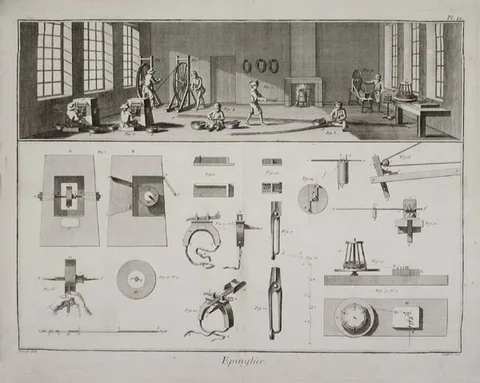 We started out in the 1700s in a world where everyone was doing the same thing. You would do this end-to-end workflow; you could call it the work of an artisan. What he theorized is that a world of abundance needs specialization, where you want someone to not be context-switching all the time, and to work on the thing they've built up experience in.
It seems like in AI right now, we're in a pre-industrial society, or even a hunter-gatherer society, where everyone is doing the same work over and over again. We're consulting one oracle of technology. What needs to happen is to get to a world where it's no longer just one manufacturer of a car, one manufacturer of every single unit, but a world of specialization, where everyone can customize every single part of the harness and the model. That's where we get to a world of abundance.
There's a reason only 1% of enterprises have actually adopted AI. There are so many workflows out there that are super manual and could be automated, and could actually increase intelligence based on all of these agents that could be in production. So my goal is to take that 1% and turn it into 99%, so that we are actually learning from all of the built-up experience that lives in the world right now.
Thanks so much for having me.


