

Signals and Threads
Chapters
Ian came to Jane Street from consumer apps for the functional programming he had fallen for in side projects.
Read the chapter- Before Jane Street, Ian worked on Trello's iOS app and web frontend and on iOS at Warby Parker, and since 2016 at Jane Street he has worked first on exchange software and now on tools for options traders.
- ReactiveCocoa made complex iOS interfaces much simpler for him in 2013, then came Overtone, a music environment in Clojure, and Ian took up Haskell to find out what a monad was.
- Ian thought Jane Street wouldn't hire him without a PhD, and Ron says there aren't many PhDs here except around the OCaml language team, and the firm's reputation is fiercer than the reality.
- Ian built a MIDI keyboard that sends web requests and a Slack bot that plays a synthesizer, and admits the tools for making music interest him more than the music.
On an exchange-like platform time was counted in microseconds, and OCaml, Ian and Ron argue, works well even for that kind of imperative code.
Read the chapter- Internet companies measure time in milliseconds, here it's microseconds, and a millisecond, Ian says, meant "something has gone horribly wrong."
- The single-dealer platform is built like an exchange, with an order book, a matching engine and trades printed to a tape, but counterparties trade only against Jane Street.
- Phantom type parameters in GADTs make imperative programming safe, while the tests and other code around the hot loop are written in a high-level style in the same language.
- Ron calls OCaml a broad-spectrum language: web, testing, low latency and even hardware synthesis fit together in it without any FFI.
An options trader has to see hundreds of instruments as one whole, and the Trader Tools team builds interfaces for that in place of Excel, Bash and curses.
Read the chapter- The Trader Tools team builds data collection, visualization, alerting, monitoring and configuration of automated systems for Jane Street's manual traders.
- A trader in Nvidia stock thinks about one symbol, while a trader in Nvidia options thinks about hundreds of strikes and expirations.
- As Ron puts it, behind the many options sits a vol surface, and in effect you're trading properties of the distribution of future price moves.
- Until recently the desk's interfaces were Excel, a lot of Bash and a bespoke curses app, which is still alive.
- Ian sorts the tools into two classes: exploring the market, with charts and summaries by underlying and expiration, and managing attention, with alerts and handoffs of responsibility between people.
Building software for 150 experts is easier thanks to instant feedback and harder because of the domain and the users' particular habits.
Read the chapter- The users sit one aisle over, so you can discuss a feature, write it, ship it and watch them use it the next day.
- Engineers aren't traders, and designing a feature means understanding how traders think, with help from patient users and senior traders who have a feel for UX.
- Traders, Ian says, have fighter pilot eyes: they want rows six pixels high and never touch the mouse, so everything works from the keyboard and discoverability suffers.
- There are no tutorials and your neighbors teach you, but as the firm grows, Ron notes, tooltips and wiki links are showing up.
Internal software needs no accounts, payments or npm, and OCaml across the stack plus in-house protocols spare the team the usual API plumbing.
Read the chapter- There's no login, sign-up, payments or CDN to build, so new web apps are easy to spin up, and Jane Street has tons of them.
- Ron says Jane Street has lived in its own parallel software universe for 20 years and wraps third-party JavaScript libraries selectively, for stability and security.
- Backend and frontend are both OCaml with shared types, serializers are generated automatically, and computation can move between server and client.
- Instead of HTTP, REST and GraphQL there are generated protocols over in-house streaming RPC, and the users' browsers are "ours," so they can be forced to refresh.
- Ron laments that HTTP has become a synonym for a network connection, and Ian points out that Jane Street's exchange protocols run on UDP multicast anyway.
Since nobody has cracked UI, Jane Street wrote its own framework, Bonsai, and it leans above all on OCaml's sum types.
Read the chapter- Ron is struck that new grads think UI work is boring, though it's one of the hardest problems in programming, and Ian adds that at least Jane Street is spared the browser zoo, with everyone on one version of Chrome.
- Since nobody has cracked UI yet, Ian says, Jane Street wrote Bonsai instead of bindings to an off-the-shelf library.
- "Loading, or loaded, or error" is expressed directly in the type, and pattern matching checks that every case is handled.
- Ron thinks creating a new language after 2000 without sum types is a disaster, and in languages with implicit null you have to remember the possibility yourself.
Ian calls Bonsai "React but principled": a graph of incremental computations in which every input is declared explicitly.
Read the chapter- Bonsai is a library for incremental state machines in which the virtual DOM is just one of the values in the computation graph.
- Trading UIs get new data constantly, so, as Ron explains, it's not just rendering that needs to be incremental but also merging and transforming the data.
- Re-rendering can be split up inside a single component, with each piece of virtual DOM depending only on its own inputs.
- State in Bonsai is something like a promise that you can't just drop into the DOM, a computation's inputs are declared explicitly, and a forgotten input is a type error.
- Ron compares it with the trade-off between C++ and Rust, where the contract between pieces of code is written down, and Ian adds that the cost is lower, since anything you can do in React can be expressed in Bonsai.
An engineer on the tools team has to know a little about every part of options trading, but not deeply.
Read the chapter- Ian is sure he'd make a bad trader, even though Jane Street's internal education is very good.
- The tools team needs to understand a little of each of the 40 or so things shown to traders, while specialized teams go deep on pricing and implied volatility.
- Ian wouldn't compute early exercise decisions off the top of his head.
To keep traders from going numb to alerts, Ian builds stateful rules and desk-wide knobs instead of per-user settings.
Read the chapter- You can't miss anything interesting, but you can't nag either, so stateful rules help, raising the threshold for the next alert after one fires.
- As Ron says, Jane Street traders are used to putting up with friction and rarely complain, so it pays to overreact to their complaints.
- Global interestingness thresholds let a trader halve the number of alerts on a busy day or raise the bar for one asset class.
- If something bothers one trader, it probably bothers the whole desk, so settings are made desk-wide where possible.
In Bauble a few lines of code describe a 3D shape with signed distance functions, which are easy to combine and fast to render.
Read the chapter- Bauble is a live coding environment in the browser: a high-level functional language compiles to a shader hundreds of lines long that draws the shapes with ray marching.
- A distance function takes a point in space and returns the distance to the nearest surface, and for a sphere it's the distance to the center minus the radius.
- You can call two functions at the same point and blend the results, and transforming the input coordinates turns a cube into a twisted cube, which is hard to do with triangle meshes.
- Ron catches Ian out: after such operations the function is no longer a true distance function, and Ian agrees it's more a "signed proximity function" that ray marching can overshoot, though those shapes are more fun to play with.
Bauble, Ian says, looks more impressive than it is: it's assembled from other people's work over a few months of parental leave.
Read the chapter- The editor is CodeMirror, and the primitives and methods come from Inigo Quilez and the Shadertoy crowd, while Ian's own parts are the high-level compiler and numbers you can drag with the mouse right in the code.
- Ian worked on Bauble seriously for about five months, mostly on parental leave while his son napped.
- Ian added mesh export for 3D printing and built a mechanical keyboard, MIDI instruments and a chorded keyboard where buttons shift pitch by a semitone, none of which he actually plays.
It seemed obvious to Ian that shapes belong in a Lisp, so Bauble is written entirely in the obscure Janet, and Ian wrote a book about the language.
Read the chapter- Ian wanted a terse notation, with S-expressions and variadic functions, and a Lisp seemed the obvious choice for shapes.
- Bauble has what Ian calls Lisp blasphemy, postfix and infix function application, and macros give him the syntax he wanted without a parser of his own while keeping GLSL niceties like swizzling.
- Janet compiles easily to WebAssembly, so Bauble and its compiler are both written in it.
- Ian wrote Janet for Mortals to make things easier for the next enthusiast, and someone built a music environment, Trane, on the code from the book.
Everything Ian did for fun ended up useful at work, and Janet taught him to appreciate macros and program images.
Read the chapter- In Ian's experience, everything he's done for fun has turned out to be useful at work within a year.
- A couple of years of Haskell taught Ian to think about immutable state and gave him more ways to model problems.
- Janet writes program state to disk after compilation, coroutines and closures included, and Ian uses it deterministically, while Ron finds Smalltalk's "binary soup" approach terrifying.
- As Ron puts it, the OCaml, SML and Haskell world is strong on types and the Lisp world on macros, and Jane Street is now working on adding runtime code generation to OCaml.
Ian finds expect tests, which write their own output into the source code, so useful that he can no longer write code without them.
Read the chapter- The test prints output, the output is written straight into the test file, and on the next run any difference shows up as a diff that you can accept with one button.
- Ron compares them with Python notebooks, except that the test runs from start to finish every time, so the file always reflects how the code actually behaves.
- You can just print out a board game's board, and with property tests a failing case gets written into the test's source.
- To Ron, expect tests combine compact code with visible data, and code review shows both the change to the code and the change to the trace, as long as people don't dump garbage into the output.
- Ron explains that Jane Street borrowed the idea from Mercurial's tests and the Cram tool, Ian implemented expect tests in Janet first thing, and Ron found nothing good for C when teaching his kids to program.
Quotes
On the speed of exchange software
“At Jane Street, the software I was working on, we would use a millisecond as sort of shorthand for something has gone horribly wrong and it took an infinite amount of time.”
Ian HenryRead from 04:37On trading UIs
“Everyone at Jane Street has roughly fighter pilot eyes and they say, I want this to be about six pixels high because then I can see more of it on my screen.”
Ian HenryRead from 15:13On Jane Street's homegrown software
“Jane Street has to a kind of weird degree been on its own parallel universe software adventure for the last 20 years, where it’s built lots of custom stuff and it doesn’t hook into the outside ecosystem as much as you might expect.”
Ron MinskyRead from 18:56On sum types
“The idea that one would generate a new language past the year 2000 without adding sum types just seems like a disaster.”
Ron MinskyRead from 27:30On the Bonsai framework
“The description that I just gave is this weird functional programming nightmare, but what it actually amounts to is React but principled”
Ian HenryRead from 29:49On a doubly linked list in safe Rust
“I think it’s not difficult. I think it’s impossible.”
Ron MinskyRead from 37:21On traders' pain threshold
“If every day you need to come in and pick up a hammer and hit yourself on the head three times and then slap your hand on the desk in order to turn the crank and make the money, people will just do that over and over.”
Ron MinskyRead from 42:49On expect tests
“Jane Street’s not the only place that does this, but it was my first exposure to this and I kind of just can’t believe that it’s not the industry standard thing that everyone is doing everywhere. It’s so much better in so many ways that I kind of can’t live without it.”
Ian HenryRead from 1:09:52
Summary
Ian Henry started out in consumer apps (iOS and the web frontend at Trello, iOS at Warby Parker) and came to Jane Street in 2016 for the functional programming, which he had fallen for through ReactiveCocoa, Overtone (a music environment in Clojure) and Haskell. First he worked on a single-dealer platform built like an exchange, where a millisecond meant "something has gone horribly wrong." Now he's on the options desk's Trader Tools team, building tools for traders: charts and summaries across hundreds of strikes and expirations, and alerts that manage where a trader's attention goes.
With Ron Minsky he digs into how software for 150 experts differs from software for the mass market. The users sit one aisle over, ask for UIs "about six pixels high" and never touch the mouse; there are no accounts, payments or endless npm updates, backend and frontend are both written in OCaml with shared types, and instead of HTTP there are in-house RPC protocols. Ian calls the Bonsai framework "React but principled": it's a graph of incremental computations where every input is declared explicitly and a forgotten input is a type error. A separate thread is how to tune alerts so traders don't get numb to them: fewer per-user knobs, more desk-wide ones.
The second half is about side projects. Bauble is an environment where 3D shapes are described in Janet, a little-known Lisp dialect, as signed distance functions and compiled into a shader; it came with a book, Janet for Mortals, and homemade MIDI instruments nobody plays. Janet taught Ian to appreciate macros and program images, and from Jane Street he took expect tests, tests that write their own output into their source code. He says he can't write code without them anymore, so the first thing he did in Janet was implement them there too.
Mentioned
 Trello00:32Ian's earlier job: the iOS app and the web frontend
 Warby Parker00:32where Ian did iOS before joining Jane Street
 Jane Street00:32Ian joined in 2016 for the functional programming
 ReactiveCocoa01:16the library through which Ian discovered functional programming in 2013
Show 22 more mentionsShow fewer mentions
 Clojure01:16Ian's functional education began with it and Overtone
 Overtone01:16a music environment in Clojure that Ian used to hook up a MIDI keyboard and a Slack bot
 Haskell01:16Ian learned it to find out what a monad was
 OCaml05:57the language of both the low-level exchange code and the web UIs
 npm17:28the endless treadmill of updating external libraries that Jane Street is spared
 Bonsai23:25Jane Street's own framework for web UIs
 Google Chrome25:11Jane Street's internal web apps target a single version of it
 Rust26:31a mainstream language with sum types; Ron compares Bonsai and React to Rust and C++
 React29:49what Ian compares Bonsai with
 Winamp45:50an example of old software whose UI you could change however you liked
 Bauble45:50Ian's side project: 3D shapes from signed distance functions
 Shadertoy46:31the shader site whose methods Bauble builds on
 Inigo Quilez47:22Ian learned rendering from him and borrowed his primitive functions
 CodeMirror54:53the code editor Bauble is built on
 Janet58:25the obscure Lisp that Bauble and its compiler are written in
- Janet for Mortals1:00:54Ian's book about Janet
 Trane1:01:46a music live coding environment built on the code from Ian's book
 Smalltalk1:04:15a language where the program lives in an image
 Jupyter1:11:30Ron compares expect tests with Python notebooks
 Microsoft Excel1:14:18the opposite of a text program: the data is visible, but the code is smeared over cells
 Mercurial1:17:02Jane Street borrowed the idea of expect tests from its tests
 Emacs1:18:42where Jane Street has its expect test tooling
Transcript
01From Trello to functional programming
Ian came to Jane Street from consumer apps for the functional programming he had fallen for in side projects.
Welcome to Signals and Threads, in-depth conversations about every layer of the tech stack from Jane Street.1Jane Street — a New York trading firm and market maker founded in 2000. Nearly all of its software is written in the functional language OCaml; Signals and Threads is its tech podcast. I’m Ron Minsky. It’s my pleasure to introduce Ian Henry. Ian is a software engineer here at Jane Street who’s worked actually on a bunch of different areas and we’ll talk about that a little more in a second. I also should apologize to the listeners in that my voice is a little raw, so sorry about that, but hopefully it won’t be too rough to listen to. Anyway, Ian, thanks for joining me.
And just to start off, can you tell me a little bit about what you did before you worked at Jane Street?
Yeah, so I joined Jane Street in 2016 and before that the bulk of my work experience was a company called Trello,2Trello — a kanban-board service for project management. It was launched in 2011 at Fog Creek Software, and Atlassian bought it in 2017 for $425 million. Wikipedia. project management software. I worked on a lot of the iOS app and also the web frontend. I worked a little bit on the backend too, but most of my time there I was doing more frontend engineering. After Trello, I worked at Warby Parker3Warby Parker — an American company (2010) that sells its own eyeglass designs online and in its own stores. doing iOS and then came to Jane Street and I’ve worked on our internal exchange software and most recently on the options desk4Desk — a trading unit responsible for one class of instruments, here options. working on tools for traders.
That transition is a little bit of a record scratch moment, started off working on front end and iOS apps and now you’re working on exchange software. Can we just talk for a little bit, how did you get here? Why did you come here? How did you find yourself in this very different corner of the tech stack?
Yeah, the thing that attracted me initially to Jane Street was the functional programming reputation. I had started doing functional programming in my spare time, both in iOS using more functional libraries. Back in 2013, we had something called ReactiveCocoa5ReactiveCocoa — an open-source functional reactive programming library for Cocoa, Apple's frameworks for macOS and iOS; GitHub engineers started it in 2012. GitHub. and functional reactive programming,6Functional reactive programming (FRP) — an approach in which values that change over time (user input, events, data) are represented as streams combined with functions. The idea goes back to Conal Elliott and Paul Hudak's paper "Functional Reactive Animation" (1997). and it was this really big wake-up call that just made it a lot easier to build complex, interactive UIs using the iOS UIKit framework,7UIKit — Apple's framework for iOS app interfaces; it's imperative and object-oriented, and screen state has to be updated by hand. and that was just such a big productivity boost and then my functional education continued with Clojure.8Clojure — a Lisp dialect for the Java virtual machine created by Rich Hickey; the first version came out in 2007. It bets on immutable data structures. There was actually this library for making music in Clojure. It was this creative coding environment called Overtone9Overtone — an open-source environment for programming music in Clojure; the sound is synthesized by the SuperCollider engine. GitHub. and I’d never used Clojure before. I hadn’t really used a functional programming language at all, but I was playing around with it and making music and having a real actual programming language attached to the music software meant that I could do really dumb things like have a MIDI keyboard10MIDI — a 1983 standard by which electronic instruments and computers exchange not sound but commands: which note was pressed, when and how hard. hooked up that I could send web requests with or make a Slack bot that you would type a message and webhooks11Webhook — an HTTP request a service sends to a given address on its own when something happens, for example when a message arrives in Slack. would cause it to play music using a synthesizer that you programmed. The experience with Clojure, it sort of got me into this functional programming world and I started learning Haskell12Haskell — a purely functional language with lazy evaluation and static typing; the first standard dates from 1990. It's named after the logician Haskell Curry, and its I/O is built on monads. because I was curious what a monad was.13Monad — an abstraction from Haskell for chaining computations with extra "context": a possible error, I/O, state. Each step receives the previous one's result, and the context is threaded through automatically. People kept talking about how it was this great thing that would make your programs easier to express and I wanted to know what that meant. So I was just doing Haskell for fun and then Jane Street was a company in New York City that was known for functional programming. I didn’t actually think I could get a job at Jane Street, but I had a friend who started working here and I feel like at the time it had this reputation for being like, you have to have a PhD and various things in order to work here, and I don’t know.
I think that’s a reputation we’ve had for a long time and it’s kind of never been true. I have a PhD, that’s true, but there’s really not a lot of PhDs wandering around. If you go to the OCaml language team14OCaml — a functional language from the ML family, created at the French research institute INRIA in 1996. Jane Street is its largest industrial user and has its own team that develops the compiler. and the people who are doing type theory stuff, it’s like not everyone, but there’s a fair number of PhDs kicking around there. I do think somehow our reputation has become more fierce than is exactly accurate.
Yeah, I feel like our public-facing image is more on the OCaml compiler type theory, extreme side, and we like hiring engineers.
This is a little bit my fault,15My fault — Ron Minsky brought OCaml to Jane Street and became the language's chief evangelist: he's a co-author of the book Real World OCaml and the host of this podcast. I guess. Can we go back to the music thing for a second though? Because I’ve seen a lot of these tools. I am basically a musical ignoramus and I’ve been to fun live coding events16Live coding — performing music or visuals by writing and changing code live in front of an audience, usually with the code projected on a screen. Parties with this kind of music are called algoraves. where people are off writing little programs to generate music. I’ve never experienced the music generated this way as being particularly good. I’m curious what your experience has been in this space.
Well, again, MIDI keyboard that is sending web requests and making collaborative— I was definitely not making music. I’d say I was enjoying sound synthesis from a theoretical standpoint, which is most of my experience with music is the tools to make it are more interesting than actually trying to make music to me.
02Exchange software and microseconds
On an exchange-like platform time was counted in microseconds, and OCaml, Ian and Ron argue, works well even for that kind of imperative code.
Amazing. Okay, so you arrived at Jane Street with experience as an iOS developer
And you said, we do a lot of that here. Yeah, you should go work on this exchange software with no interfaces or UIs or anything. It was a change of pace, but I didn’t find the transition particularly— It was a good opportunity to do something different. It was my first time that I’d really thought about low latency programming17Low latency — the time from market data arriving to the system reacting. In electronic trading it's measured in microseconds, millionths of a second. in any capacity. We measure things in microseconds. Working in Internet-facing companies, everything is measured in milliseconds. That was a bit of a change.
Three orders of magnitude right there
At Jane Street, the software I was working on, we would use a millisecond as sort of shorthand for something has gone horribly wrong and it took an infinite amount of time. It’s over a millisecond, we can’t even measure it.
It’s also maybe worth saying exchange software. What are we talking about? Like Jane Street doesn’t run an exchange. What does this kind of software actually for?
So it’s not really an exchange, but it is a program that looks like an exchange and exposes an API like an exchange to other counterparties who can come and trade with us using the same roughly protocols that they use to trade on real exchanges, but it’s really a single dealer platform,18Single-dealer platform — a trading system where clients trade with one market maker rather than with each other, as they would on an exchange. which means that people can come in, they can put in orders, but they’re only necessarily trading against Jane Street. They’re not trading against one another. It’s not an exchange in that sense, but from a software perspective, it looks like an exchange. We have an order book.19Order book — the list of all live buy and sell orders for an instrument, sorted by price. We send in orders. There’s a matching engine20Matching engine — the core of an exchange: it pairs opposing orders by price and time of arrival and generates trades. that causes trades to happen. We have software that will print the trades to a public tape21Tape — the public feed of executed trades: price, size, time. The name comes from the stock ticker machine that printed quotes on paper tape. after the trade occurs. It is very exchange-like.
Okay, so you did all this weird low latency high performance work. Also by the way you came here for functional programming. That’s a very imperative code base.
But we use some fancy type system tricks to make the imperative programming very, very safe. We use the phantom type parameters in our GADTs22GADT (generalized algebraic data types) — algebraic data types in which each variant can have its own type parameter. A phantom type parameter isn't stored in values at all and exists only so the compiler can do extra checks. to make sure that we’re efficiently serializing data, but we’re not actually ever actually serializing it. You get a little bit of that—
You still get to leverage the language. I mean, I guess a general point is people think of OCaml as a functional programming language and it surely is that, but it’s actually a really good language for imperative programming also, and a lot of the type system features that are useful in the context of functional programming work perfectly well in imperative programming, and that’s a large part of what we do here as well.
In addition to that, although most of the core of this application is this very imperative style, very low latency style, there’s so much code surrounding that core tight hot loop23Hot loop — a piece of code that runs constantly and accounts for most of a program's running time; the latency of the whole system depends on it. that can be written in this very, very high level style, which is something that’s so nice about using OCaml for. You can go from this very low level style to this very, very high level style in your test frameworks or something where you’re not concerned about this but you’re using the same language, you’re using the same types, you’re doing everything in the same code base. You don’t have this context switch from calling into a C FFI24FFI (foreign function interface) — a mechanism for calling functions written in another language, most often C. At the boundary, data has to be translated from one language's representation to the other's. or something.
Yeah. What’s nice about having what you might call a broad spectrum language,25Broad spectrum language — usually called a wide-spectrum language: one you can use for both high-level specifications and low-level code without switching languages. the language that can be used in lots of different styles for solving lots of different kinds of problems, but the whole thing fits together as a cohesive whole. It’s just easy to plug things together whether you’re doing as we’ll talk about soon web programming or testing systems or low latency stuff or whether you’re doing hardware synthesis26Hardware synthesis — turning a circuit description into a chip configuration. Jane Street describes its FPGA hardware in OCaml too, with its own open-source library Hardcaml. GitHub. and having all of this kind of stuff fit together is really great. So now you’re doing something very different. Again, you’re no longer working on that exchange-like infrastructure. Tell me more about the spot where you are now.
03The options desk and its interfaces
An options trader has to see hundreds of instruments as one whole, and the Trader Tools team builds interfaces for that in place of Excel, Bash and curses.
So a few years ago I started working on the options desk, specifically in a team called Trader Tools. We make tools that Jane Street’s manual traders use to understand what’s going on in the options markets and then also to manipulate different things—systems, configure our automated trading systems and manual orders, various interactions—but it’s mostly data collection, visualization, and alerting and monitoring. Options are weird because there are so many of them, and a trader who is trading Nvidia has one symbol that they’re thinking about. A trader who is trading Nvidia options has to think about hundreds of different strikes and exps at different times.
Can you say just what’s a strike and what’s an exp?
And actually while we’re here, what’s an option?
Notably at a given price
At a given price. So the strike is the price that you are able to buy or sell the option before the expiration date, which is when you lose the option if you have not exercised it.
ExplainerWhy one stock has hundreds of options
A call gives the right to buy a stock at the strike price until the expiration date; a put gives the right to sell. The exchange lists a whole grid of contracts on one stock: strikes a few dollars apart around the current price, and expirations that are weekly, monthly, quarterly and long-dated, years out. Strikes times dates times two option types make hundreds of contracts, and thousands for the most popular stocks.
An option's price depends on the stock price, the strike, the time left, the interest rate and how much the stock will swing. Everything is known except future volatility, so it's "backed out" of each option's market price with the Black–Scholes model (1973): that's implied volatility. If the model were exact, it would be the same for every option on a stock; in reality it changes with the strike (the "volatility smile") and with time to expiration. These points on the strike-by-expiration grid make up the volatility surface: a trader thinks about a few of its parameters (level, slope, curvature), but has to trade in hundreds of separate order books.
And this low-level description is maybe a little bit obscure and hard to understand. It’s like why do I want the option to buy or sell a security at a given price? One way of thinking about what’s going on in the options market is even though it’s expressed through a lot of individual derivatives, things that are derived from the actual underlying, say Nvidia options derived from Nvidia, there’s a bunch of, it might be a hundred things in what we might call the vol surface,27Vol surface (volatility surface) — the implied volatility of options on one underlying as a function of strike and time to expiration. this kind of collection of different securities that’s parsing out different parts of the space. Really what’s the thing that you care about in this space is actually a relatively low-dimensional thing of we’re in some sense trading things like the volatility of a given underlying. How valuable is it to have the option to buy something at a given price? Depends on how likely it is for the underlying to get to that price, which is something about how much volatility, how much likely movement is there in a given security. So in some sense it’s a way of trading these deeper underlying properties of securities that go beyond just what is it trading at right now and more about various distributional properties of how that’s going to move around in the future.
And this sort of impedance mismatch between we are thinking about these as these collection of moments28Moments of a distribution — numbers that characterize it: the first is the mean, the second the variance (for a price, its volatility), the third skewness, the fourth kurtosis, the "fatness of the tails." and that is the thing that we are actually trying to trade, but the way that we’re doing this is trading on markets with central limit order books29Central limit order book (CLOB) — a single book of limit orders, orders with a price limit, shared by all participants; most exchanges work this way. and we’re trying to express this opinion across the entire individual markets, which all have individual orders and we need software that sort of helps us move from the way that we actually want to think about the options and the way that we actually trade the options in the real world.
And it’s maybe worth saying that this whole effort on the options desk to build a bunch of really high quality user interfaces for people is relatively new. It’s only a few years old and the options desk, the rest of Jane Street mostly spent its time acting as if user interfaces were not a thing or to the degree we had user interfaces, they might have been in Excel or a surprising amount of Bash30Bash — the Unix shell and its scripting language, created in 1989 for the GNU project. It's handy for gluing utilities together, but large programs in it are painful. went into and probably there’s still more of that Bash kicking around the desk than maybe is entirely optimal.
Yes, that’s right.
Right. And here curses31curses — a library for text interfaces in the terminal. Ken Arnold wrote it for BSD Unix, and the game Rogue, for one, was built on it; today the free implementation ncurses is usually used. Wikipedia. is a library from the eighties for abstracting over different terminal emulators.
And the terminal emulators were emulators for physical hardware32Physical terminals — a screen and keyboard connected to a bigger machine. The best known is the DEC VT100 (1978); almost every terminal emulator still understands its escape sequences. Wikipedia. The photograph shows a 1978 DEC VT100 at Seattle’s Living Computer Museum.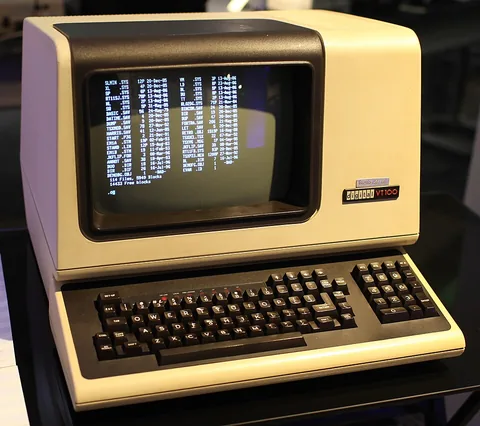 that people used to use when using computers in the past and that hardware has not existed for 30 or 40 years and here we are still writing terminal apps through this very strange pipeline of software, but we kind of changed our approach here even though we still have some of those curses apps kicking around, we’ve now gone off and built a bunch of different user interfaces. Can you maybe sketch a little bit of what are the purposes of these interfaces? How are they trying to help the end users?
I think there’s two broad classes which is: exploration, understanding what’s going on in the markets and these are more tools for data aggregation. We have a lot of charts or graphs of how things have moved over the course of a day. We have ways to view not just an individual option and what it is doing but maybe an entire und and expiration date, what’s going on across all the options in that und. We have tools for understanding this and then the second class of application are tools for managing traders’ attention: tools for alerting, tools for getting their attention and saying, Hey, something interesting is happening that you probably aren’t thinking about because you have a million different things that you’re thinking about. Trying to get their attention, alerting them to interesting trading opportunities that we can either find automatically or that traders have said, I want to know when the following thing happens, I suspect this might happen. I want to know as soon as it does.
And the trading day is busy and part of what’s going on is also about apportioning responsibility to different groups of people. The option desk is big and there are lots of different people paying attention to different things and being able to hand off responsibility between people and groups of like, you’ll pay attention to this and I’ll pay attention to that. A kind of workflow aspect of it.
Routing the interesting thing that’s happening to the correct person is not very technically glamorous or interesting problem but is surprisingly hard and extremely important.
04Software for 150 experts
Building software for 150 experts is easier thanks to instant feedback and harder because of the domain and the users' particular habits.
Zoomed out way too far, your previous experience working on Trello and your current experience working on tools here, parts of that seem the same workflow parts and guiding people’s attention to the thing they’re supposed to be watching and stuff—maybe not as real time, that’s part of what tools like Trello are like. How do those two activities feel different to you? Working at this product-oriented company that’s facing hundreds of thousands or millions of users, versus working at Jane Street on tools where 150 is a pretty big number of people who might use the particular tool you build?
Yeah, it’s very, very different in two ways. It’s very different socially. We’re working on tools for Jane Street traders, they’re all internal and we sit near them and we can walk over, they’re on the next aisle down. We can watch them using our tools and they can directly ask for features. We can understand what they want, we can talk about it, we can write code for them and ship it and see them use it the next day. It’s not this large mass market software, where we’re making something that is going to be used by millions of people and we can’t directly talk to millions of people at once and see what they’re looking for. So we have this immediate feedback loop, which is really great. There’s also this flip side to it, which is we’re not making mass market software that is going to be used by millions of people. We’re making extremely niche software that’s going to be used by a few really, really smart people and the things that they want are— sometimes just understanding the domain: we are not traders, we are engineers. We have to learn enough about how traders think about things and what they’re trying to do in order to give them the features that they want. So it’s in some sense easier. You can do this iterative design process to see exactly what features you want and get feedback that you have built the correct feature. And also harder because the features themselves require some amount of domain knowledge. So in addition to just implementing the feature is difficult, understanding and designing the feature is more difficult.
I imagine there’s just a hard generalization problem here. I think you have the usual experience you have with users everywhere. If you ask people what they want, they will tell you some particular thing which is kind of related to what they want, but it’s some complicated mix of what they think is easy to achieve and what they have in their head and what narrowly solves the problem that they just saw. And you have to stand back and see something broader than that and see a simpler thing which will solve more problems. And I guess it seems hard to do that in a case where you’re to some degree at an information disadvantage where the users understand more deeply what they’re doing. How do you come to grips with that question?
So something that helps a lot is people are very patient and want you to understand their problems. They’re not just saying, I want this feature, go do it. You’re working with the traders and you can say, okay, you need to get me on the same page as you. You’re asking for this thing. I want to understand this thing. This is true generally of Jane Street. We have a lot of educational resources. You want to understand the domain well in order to do your job better. But at the same time a huge help is we have some senior people on the desk who have been trading for a long time and also have a lot of UX intuition and ability to design and we do lean on their experience for help as we’re working on some of the features.
Another thing I wonder about in terms of the difference between working on a consumer-facing product and working on the tools you’re building here, which are essentially tools for experts, is whether that influences the way you behave down to the level of relatively small-scale UI decisions.
It absolutely does. One of the strangest things when I started working on UI tools at Jane Street is a lot of your intuition from general, what does good design look like? Everyone at Jane Street has roughly fighter pilot eyes and they say, I want this to be about six pixels high because then I can see more of it on my screen. You’re designing these tools with extremely high information density. If you try to do something like that for a general product company, you’d be like, this is unreadable, this is unusable. Traders don’t ever want to touch their mouse. Everything is accessible from the keyboard, which is a good additional feature to have, but there’s a lot of discoverability problems that comes from that. You can’t hover to see more, to see interactions, because you don’t have a mouse to hover with because you’re trained on using curses apps for your whole career.
And it’s not just you’re trained on it, it’s actually better. It is just a higher bandwidth input mechanism to be able to quickly smash things out with your fingers and it is to move the mouse and click on a thing, it’s just dramatically different.
Not that we don’t have tools with mouse interactions, but the information density is a big difference and we don’t spend as much time on things like discoverability of features. It is important, but ultimately your users are expert users who know these tools and live in these tools and use them all the time. So we don’t have tutorials necessarily. We have vaguely written help documents and getting started and then the people around you teach you how to use the tools to the expert level that you have to.
Although I have seen nice features come in, one of the great things you can have in a web UI as opposed to a terminal app is you can have tooltips, and that’s pretty good, and you can have links to webpages so you can have things that show up and then you could click a link and it can show up on the appropriate page on our wiki where someone can go in and in fact if the documentation isn’t good, you can just crowdsource and dive in and go and modify it. And I’ve seen some of those things kind of pop up in the apps that you guys are building. As the firm grows and there are more people using these applications, it does become more sensible to lean more in the direction of having the tool teach you what to do and incrementally less have just the people around you always teach you how to use it.
05How internal software gets written
Internal software needs no accounts, payments or npm, and OCaml across the stack plus in-house protocols spare the team the usual API plumbing.
So we just talked a bunch about how the goals are different and the things you’re building and the shape of the designs you come up with. How about just the process of writing code here? How does that differ from things you’ve experienced in the past?
So writing internal software, there are so many things that we would spend time on making broad market internet distributed software that we just don’t have to think about at all. So when we’re writing code at Jane Street, we’re almost always thinking about the specific application and the application logic and we spend so much less time thinking about these ancillary things that we used to spend time on at Trello for example. And these are just things like having accounts and logging in and signing up and forgetting your password or processing payments or distributing resources over the internet because everything is internal and we have these very fast internet connections, we can just download five megabytes of JavaScript and never have to think about it. So we can focus much more on the core application logic that we’re working on, and this has maybe unexpected good and bad— which is it’s very easy to spin up new applications as opposed to this is the Jane Street app and we’re all working on the Jane Street app. We actually have tons of web apps and if you’re working on a new feature, maybe you’re going to start a brand new app from scratch and deploy it because all of this surrounding infrastructure of setting up your CDN33CDN (content delivery network) — a network of servers around the world that serves a site's files from the node closest to the user. and configuring domains and all of this is roughly free and the work that you’re doing is just working on the application. I think another thing that I like about working at Jane Street is we don’t have just npm update34npm — the JavaScript package manager and the largest registry of open-source packages (2010). npm update updates a project's dependencies, and a typical web app has hundreds of them, counting dependencies of dependencies. dependency constant treadmill of keeping up to date with all of the external libraries that you’re using. Something that took a surprising amount of my time in a past life.
I mean there’s a little bit of some good and bad in that. Part of what’s going on is Jane Street has to a kind of weird degree been on its own parallel universe software adventure for the last 20 years, where it’s built lots of custom stuff and it doesn’t hook into the outside ecosystem as much as you might expect. There are real compromises with this. On the JavaScript side, there are lots of cases where we’ve brought in useful third party libraries and wrapped them up, but we definitely don’t do this whole, like, oh, just bring in whatever packages like npm decided to bring in. It’s kind of problematic from a stability perspective.35Stability — the textbook example: in March 2016 an author pulled the tiny left-pad package from npm, and thousands of projects, Babel and React among them, stopped building. It’s also kind of a security nightmare.36Security — npm has repeatedly served as a channel for supply chain attacks: in 2018, for instance, code that hunted for bitcoin wallets was slipped into the popular event-stream package through a new dependency. So anyway, there are lots of reasons why we want more control over the ecosystem than that. Another thing that we’ve talked about in the past that seems pretty different is, and that I’ve noticed myself in my own working is just at the level of file formats and protocols and whatever, there’s ways in which we just use different sets of things.
So at a very high level you’re focusing on the application and then the application that you’re writing. Everything is written in OCaml, the backend and the front end, and most Jane Street engineers who are working on these tools are really working on the full stack, backend to frontend, and there’s very, very blurred lines between the two. Not only blurred lines in the codebase sharing types, but as you said, we have automatic serializers37Serializer — code that turns a value into bytes or text for sending over the network, and back. At Jane Street it's generated from the type definition by preprocessors like ppx_bin_prot and ppx_sexp_conv. that generate stable protocols between the client and the server such that if you have a value on the server, it’s roughly one line of code to have the value on the client. You sort of get that for free so you’re not spending a lot of time building your JSON API v1 and v2 and then writing the parser on the client that consumes them and creates these mirror image types that are hopefully compatible with what your backend types represent. We really just have the same types and the same logic. This is really powerful. We can do things like offload computation from the server to the client to sort of parallelize something across all of the users who are doing something and we can just run the same code.
Oh, that’s interesting. You can move it from the server to the client to parallelize it and you can also move it from the client to the server to make it faster and parallelize it depending on how you have your resources distributed.
Nice. Another point on this, which has always struck me is just the degree to which we don’t use HTTP for everything.
It’s kind of like this historical thing where we’ve had OCaml RPCs38RPC (remote procedure call) — calling a procedure on another computer as if it were local. Jane Street has its own library, Async_rpc: requests and responses are described with OCaml types, and there are streams of updates too. and client–server communication all the time and when we stuck it in the browser, we just sort of tried to move our existing OCaml ecosystem into the browser pretty closely, so you’re immediately able to use all of the existing servers and talk to them the way that you want to. And we don’t use HTTP, we don’t use REST,39REST — a style of web API on top of HTTP, described by Roy Fielding in his 2000 dissertation: each resource has its own address, and actions on it are the standard methods GET, POST, PUT and DELETE. we don’t use any of these traditional GraphQL40GraphQL — an API query language created at Facebook and open-sourced in 2015, in which the client describes exactly which data fields it needs. like anything that you would see in the outside world. Instead, we have bespoke generated OCaml protocols that work over these preexisting live-update streaming RPC things that we have built. When you’re talking to your server, you open a socket connection and you speak this language and everything happens over this channel. If we ever wanted to make software for the outside world and we suddenly had to support the conventions that people are used to and expose JSON RPCs, I think we’d be at a pretty big disadvantage. But not having to think about those things internally and getting all of that for free within the tools that we’re writing, it’s a huge accelerator for adding a new feature. I want to add this new piece of data. You add it to the record type, you populate it, you’re kind of done. There’s no more type bumping or anything. We do have to think a lot about stability as we upgrade and clients are running different versions of the server—but for the most part we own the users, we own their browsers and we can just force them to refresh when they need to pick up a newer version
And there’s a certain amount of joy of not having to think about versioning. We care about versioning in lots of places. It’s complicated and messy, but the cases where you can just not worry about it are glorious. I think that’s in some ways I think of as weirder about the outside world and about us, which is that HTTP has become synonymous with network connection.
There’s this thing underneath called TCP,41TCP — the internet transport protocol that guarantees data arrives without loss and in order. HTTP traditionally runs on top of it; only HTTP/3 moved to QUIC over UDP. Which you might’ve heard of, which actually for a lot of the things that people use, HTTP, you could totally use TCP. It works fine, somewhat lower overhead, you have more freedom. There are other ports. Turns out it’s not all on like port 80.42Port — a number that distinguishes network services on one computer. 80 is the standard HTTP port, 443 the HTTPS one. There are other ports that you can use and other protocols and somehow the outside world has forgotten all of that and been like, no, no, no, there’s HTTP and HTTPS and actually there’s just HTTPS. Everything should go over that and that’s just not the way our ecosystem is shaped at all. There are custom protocols that we build. There are lots of things that are just kind of rawly on top of TCP/IP.
Also TCP, you’re getting high-level already! We built our exchange protocols. This is all UDP multicast.43UDP multicast — UDP sends packets without setting up a connection and without delivery guarantees, but with minimal overhead; multicast sends one packet to many recipients at once. That's how exchanges distribute market data. We don’t have this TCP thing.
That’s right. Too fancy.
06Bonsai and sum types
Since nobody has cracked UI, Jane Street wrote its own framework, Bonsai, and it leans above all on OCaml's sum types.
So another way in which the programming ecosystem specifically on the front end side is different is not to break out of the usual Jane Street doing our own different thing. We have built our own frameworks for building web UIs. There’s a framework called Bonsai,44Bonsai — Jane Street's open-source library for web UIs. It's built on Incremental, a library for incremental computation, and the OCaml code is compiled to JavaScript with js_of_ocaml. GitHub. and I’m kind of curious how you think of that as changing the experience of building UIs here.
So because we’re writing, we sort of had this question of, okay, we want to use OCaml to build UIs. What do we do UI framework wise? Building UIs is pretty complicated. Managing state is pretty complicated. Manipulating the DOM45DOM (Document Object Model) — the tree of objects a browser uses to represent a page. Scripts change the page by changing the DOM, and in a complex UI it's easy for what's on screen to drift out of sync with the program's state. is kind of fraught
And just to say there’s a weird fact about the world that you talk to kids out of school from fancy undergraduate institutions and they’re like, ah, UI stuff. I don’t ever want to do that UI stuff. And at the same time, it’s actually one of the richest, most complicated, most interesting programming problems you’ll ever run into and it’s actually really hard to do well. So this odd mismatch where it doesn’t get a lot of respect and yet it’s obviously important building user interfaces that are good matters to people and it’s really challenging and interesting.
Yeah, it’s really difficult and you end up thinking about so many different pieces of state and ongoing, especially if you’re building something that is interactive or building something like drag and drop, modeling these interactions as explicit data types in ways that are both accurate and robust. It’s all pretty difficult. I think part of the reputation comes from a lot of front-end work is also working around browser differences and incompatibilities, learning how to do CSS layout that works in different versions of Edge or something, and we are fortunate to be able to ignore a lot of the things that make frontend development less pleasant and really just focus on the interesting difficult parts of it.
We do not support all the browsers in the world, just the browser. We like one version of Chrome.
And everyone’s on the same version, so that makes it, I think, not to undercut your point of the general frontend reputation is low, but yeah, it is bizarre. I think building UI is incredibly hard and there’s so many different approaches and it kind of seems like no one has exactly nailed it and it is the reason there are so many different UI frameworks out there is that it’s a very difficult problem and no one’s really cracked it. So of course we built our own to try to crack it instead of trying to write OCaml bindings46Bindings — wrappers that let one language call a library written in another. to an off-the-shelf library and we use Bonsai. A lot of what makes writing front-end code at Jane Street feel very different is that we’re writing it in OCaml, not only this type-sharing isomorphic server client47Isomorphic — code that runs the same way on the server and in the browser. At Jane Street that's possible because OCaml compiles both to machine code and to JavaScript. easy protocol connection stuff that I was talking about before, but also just we have types: really, really good types. We have sum types, which are really valuable for modeling a lot of the state that you have in a frontend application where you might have a value on the client that you want to sync to the server but it has not been synced yet and the server thinks that the value is this thing and you can build this composite complex type and wrap all of your types around it and have an interaction monad. I’ve used “sum type” several times…
I was just about to say, what is a sum type and why does it matter here?
So, many programming languages give you a way to say, I have this and that and that. And more and more increasingly languages are giving you now a way to say I have this or that or that. And I think Rust48Rust — a systems programming language that started at Mozilla; the first stable version came out in 2015. Memory safety without a garbage collector comes from its ownership system and borrow checking. has this as a big mainstream language that has algebraic data types49Algebraic data types — types built from others with two operations: product ("this and that," a record or struct) and sum ("this or that," a variant, like enum in Rust). for the sum and product and which is just, I dunno a fancy word for a very intuitive idea, but in OCaml you can express something like, I have got this result from the server, or I am still loading this result, or I got an error from the server and this is a sum type, it just means that I have this or that or that. And a lot of the just basic types that you’re thinking about when you’re writing frontends benefit immensely from being able to say just exactly that. I want to load this thing and then if I get a response, I want to load this next thing and expressing that as soon as I get an error, I want that to propagate through the whole chain and you can make a monad to do this and it makes it easier.
The monad thing is for chaining some of this error handling together in a nice way. The basic underlying property of these sum types is that they let you say this or that or the other in a clear way. And then maybe most importantly, there’s a good language facility for doing the case analysis, this thing called a pattern match50Pattern matching — a construct that takes a value apart by its variants; in OCaml it's match … with. The compiler warns if any variant isn't handled. where it lets you make sure that you are exhaustively considering all the cases. And it turns out just an enormous amount of programming is case analysis and having tools that help you do the case analysis and make sure you do the case analysis correctly exhaustively, making sure that you don’t mix cases from different things, that you’re actually looking at the thing that you should be looking at, it’s just incredibly useful and comes up all the time and it’s kind of shocking that more languages don’t have it. You say it’s like, oh, increasingly there’s more of it. It’s sort of in the same way that Rust is sort of a mainstream language. It’s just barely in the top 20 or something. But actually the vast majority of languages don’t have any good support for this and it really is kind of a crying shame. The idea that one would generate a new language past the year 2000 without adding sum types just seems like a disaster.
You kind of forget when you work at Jane Street for a long time, how do you write software without this? So a little bit spoiled there, but especially on the frontend, I don’t just have this string, I have this string that is embellished in some complicated way and in order to actually display that to the user, I need to think about, well, what if it failed to load? What do I do? And depending on the tools you’re using, it can be easy to forget about that and OCaml makes you think about that every time the type system reminds you, anytime you want to use a value, well, what if you failed to load that? What do you want to do then?
So there’s a fundamental trade off here about explicitness. Part of what the type system is doing is just forcing you to explicitly consider various cases. This goes back to another difference in the languages. Many, many languages have some kind of null pointer51Null — a special "nothing" value that, in such languages, can turn up in place of almost any value. Tony Hoare, who introduced the null reference in ALGOL W in 1965, called it his "billion-dollar mistake" in 2009. Wikipedia. or a null value as an implicit part of every value. So you have a type system that tells you what’s going on, but it doesn’t let you distinguish when you do and don’t have null and you just have to think about it carefully on your own and make sure you get it right. And it’s all just kind of implicit in the code and in a language like OCaml, this kind of analysis is explicitly forced for you to think about. Okay, so that’s some ways in which OCaml makes the process of writing things different here. How about Bonsai itself? Are there interesting aspects of the design of that library that affect what it’s like to work in?
07Bonsai versus React
Ian calls Bonsai "React but principled": a graph of incremental computations in which every input is declared explicitly.
Yes. So Bonsai is actually pretty familiar if you’re used to something like React,52React — a JavaScript library for user interfaces, created at Facebook and open-sourced in 2013. UIs are assembled from components; it's the most widely used library of its kind. it is a library that uses VDOM patching,53Virtual DOM — a lightweight in-memory copy of the page tree. The framework builds a new copy, compares it with the old one (diffing) and applies only the difference to the real DOM (patching). diffing and patching, but unlike React where you have this component tree, Bonsai is sort of this pure functional core of, okay, what if we built a library for expressing incremental state machines with internal state at any levels of this complex computation graph, and then you put virtual DOM nodes as some of the values in that computation graph, and you hook up a machinery to apply virtual DOM patching to a browser. The description that I just gave is this weird functional programming nightmare, but what it actually amounts to is React but principled, where instead of having your implicit component tree which can sort of magically implicitly contain local state through something called hooks, instead, you’re just very explicit about, okay, a component is a value that can change over time. We have this VDOM structure and it can change over time. We have these other things over here that are strings and ints and they can change over time and we can produce UIs that are pure functions of those strings and ints.
And so the things I’m hearing you saying is one difference is that you have a more general computation model. The React stuff is in some sense specialized to computing a tree of DOM nodes and Bonsai gives you a system for computing any computation that you want, and then we happen to use it for computing some DOM nodes or virtual DOM nodes.
I think that we did set out to write a good front-end framework. It’s just that it turns out that a good way to solve the front-end framework is to solve this more general higher level problem.
And I think part of the motivation there had to do with actually some of the performance driven issues. I think one of the things that makes building UIs in a trading environment different is you have this constantly changing stream of data that’s coming in that changes what you need to display to users. And so there’s all sorts of incremental computations that you want to do efficiently where you’re just reacting to the new data and not having to refresh everything. React has a lot of work to let you not have to refresh the entire page, but here there’s also a complex computation where you’re merging and combining and transforming data and you also don’t want to redo all of that. And so I think part of what drove us in a more general direction was the desire to be able to optimize more deeply the computations that were going into what you were displaying in the UI.
And then you can also use that same mechanism by which you can express this computation graph at whatever level of granularity you want to break up your UI into whatever level of granularity you want. You’re not necessarily limited by like, okay, this component is going to re-render when its internal state changes and it contains these sub components. You can say, okay, I have a single logical component. I have a single function and these two pieces of UI, I’m not going to re-render the whole thing whenever any of my state changes. Instead, this piece, this particular bit of virtual DOM is a function of these inputs. This other piece is a function of these other inputs and you can choose how granular you want to go with that to really control your re-rendering and get better VDOM diffing behavior even as lots and lots of things are changing all the time.
So it’s a more general system that gives us some extra powers in performance space. We can optimize things better. It also gives us some extra ability to break things down into meaningful components that are easy to think about independently that aren’t necessarily just computing chunks of VDOM. So that’s one difference. What are the other differences that you see?
Another big difference is this explicitness. I’m contrasting this to React because I think that a lot of people know React, but I am not really one of them. The last time I used React professionally was more than 10 years ago and I’m out of date now. There are hooks,54Hooks — functions like useState through which a React component gets state. Hooks arrived in React 16.8 in February 2019. The "rules of hooks" say to call them only at the top level of a component, not inside conditions or loops: React figures out which state belongs to whom by the order of the calls. React docs. and I only have a layman’s understanding of this. So a lot of the things that I’m going to say about React are going to be probably wrong in subtle ways. People can hopefully not discount everything that I’m saying based on that, but React does a lot to give you this apparently simple API. When you’re writing a component and using hooks, there’s really this very complicated reconciliation process55Reconciliation — the process in which React matches the new component tree against the old one and decides what to re-render and which state belongs to which component. happening under the hood in order to associate the state with the correct component as you’re rendering things that amounts to, I can create a state hook that contains a string, but I just have a string when I’m writing my code. But you’re sort of limited in what you are allowed to do with that string. You can’t conditionally inspect the string and then decide to create some other amount of state based on the value of the string. There are various ways that you can illegally write a React component if you’re conditionally creating a hook or calling something a variable number of times between component invocations. These are things that linters can catch56Linter — a program that looks for suspicious spots in code without running it. For React there are the eslint-plugin-react-hooks rules, which check the rules of hooks. for you, and there are rules that you have to follow in order to use React correctly and the rules, they’re not super onerous, but there are certain refactors that have the possibility to introduce bugs. Bonsai sort of does not try to do any of this implicit magic, sort of make it look like you’re creating this just regular variables that you can just use. They’re variables. Instead, it uses OCaml type system to really enforce this separation of, okay, you have a bit of state that’s changing over time. Well, that is sort of like a promise,57Promise — a JavaScript object for a result that will be ready later. You can't just take the value out of it; you can only subscribe and handle it when it arrives. essentially. It’s something that you can’t just look at it. You can’t just put that value into some DOM node. You have to construct a new computation that explicitly takes that as an input and produces an output. We have very good notation for expressing like, I have an input of these five computations. It’s not quite as annoying as useMemo58useMemo — a React hook that caches the result of a computation and recomputes it only when something in a hand-written dependency array changes. Forgetting a dependency is a common bug. and listing out every single input, but you do have to be explicit at the level of this particular computation has these particular inputs. We use OCaml’s type system to ensure that you can’t forget to do this. If you did not explicitly register an input, you just can’t use it on the other side. You’re just going to get a type error. So although there are things that you could write that would be wrong, the compiler will check them for you immediately and you get this immediate feedback that like, ah, you have done this thing that is illegal.
This sounds to me a little bit like the trade-off between C++ and Rust, which is in C++ or C for that matter, there’s a bunch of things you have to do quite carefully when you’re writing code. There’s all these disciplines around when code is created and freed and shared and modified and how you are supposed to handle pointers that are to values that are on the stack and all of that. And there’s nothing explicitly forcing you to do it. You just have to get it right. And when you don’t get it right, you’re in crazy undefined behavior land59Undefined behavior — a term from the C and C++ standards: after an out-of-bounds array access, a use of freed memory and similar errors, the language guarantees nothing, and the program may crash, keep going or do anything at all. and you’re going to have a bad time and things are now kind of hard to debug. And in Rust there’s a much more explicit system for tracking this. You essentially have guarantees that you’re getting it right and the trade-off is there’s a bunch of extra complexity. There’s a fancy type system that you have to wrestle with, and there’s just more typing. More characters are required because you have to be explicit about what is their discipline for managing memory between these two parts of the code and what’s the contract between them. You actually have to write that contract down rather than just hoping that people roughly infer what it is. They kind of know the style of how this particular piece of code is written. How well do you think that maps onto what you see in the kind of Bonsai versus React case?
So the explicitness is definitely there. You’re definitely typing more characters when you’re using Bonsai than when you’re using React. But I think an important difference, and I wouldn’t want people to get the wrong idea, is there is certain things that are actually just harder to do in Rust and they might be perfectly safe things like, I want to create a doubly linked list60Doubly linked list — a list where each element points to both the next and the previous one, so every node has two pointers to it. Rust won't allow that with ordinary references; in safe Rust it's built from the reference counters Rc and Weak with RefCell, and the standard LinkedList uses unsafe internally. in Rust and I want to do that safely using the borrow checker.61Borrow checker — the part of the Rust compiler that makes sure data has one owner and that there's only one mutable reference to it at any moment. It’s like, I don’t know how to do that. That’s fundamentally very difficult to do in Rust—
I think it’s not difficult. I think it’s impossible.
You literally cannot create a doubly linked list because it violates the core constraints of safe Rust, and so you need to go off and use some of the extensions or explicitly use the unsafe extensions of Rust. So it’s like it’s doable, but it is not trivial.
I don’t want people to think that we’re paying such a high cost. Everything that you can do in Bonsai, you can express exactly what you would be doing in React. There’s nothing that is sort of forbidden or off limits, it’s just that it all has to be extremely explicit. But you can model all of the state. But for example, in React, a mistake you can make is you can render a list of components without giving them an explicit key62Key — an attribute React uses to tell list items apart between renders. Without it, when items are inserted or removed, state can end up attached to the wrong item, and React issues a warning. and it’ll warn you. And it’s not like it’s impossible to write React code correctly.
It’s also not impossible to write C code directly. We have Valgrind,63Valgrind — a suite of debugging and profiling tools; the best known, Memcheck, finds memory errors in C and C++ programs. valgrind.org. we have lint,64lint — a C code analyzer that Stephen Johnson wrote at Bell Labs in 1978; the word "linter" comes from it. all sorts of linters and stuff.
It’s very similar in some ways.
The only way to render a dynamic number of components forces you to provide a key in order to do that. So it’s not as difficult. The rules are more directly mapping from the rules that you are already following to write correct React code. We just have a type system for it.
08How an engineer learns options
An engineer on the tools team has to know a little about every part of options trading, but not deeply.
Let’s leave the world of code for a second. I want to pop back to trading for a bit. So we were talking before about the difficulty of dealing with the kind of information imbalance of a lot about software engineering that the traders don’t know about. They know a lot about what they’re trying to do that you don’t know about. I imagine some of the process for you has been learning more about it. How has that gone? What has the process been like for you of coming to understand a little bit more options is an especially complicated domain in the trading world, I think for a variety down to even understanding symbology,65Symbology — the system for naming instruments. Since 2010, US options have been identified by a 21-character OCC code: the underlying's ticker, the expiration date, the type (call or put) and the strike. Splits and other corporate actions produce nonstandard options, and figuring out what exactly you're trading gets harder. what security am I trading? What does it mean is a surprisingly complicated affair. And I’m curious, how has it been coming to grips with everything from how we think about modeling options, prices to the details of the technology? What’s that process been like for you?
It’s very humbling. I would say it definitely shows that I would not make a good trader and I’m better suited to stay an engineer. We have really good internal education for, I think this is true for all desks and all specific domains that people have to understand at Jane Street, but there is a lot of education, a lot of explicit learning. The tools that we work on are very broad, and I feel like at times I have to understand a lot of different areas of options trading at a sufficient level that I can program it. But we don’t go extremely deep into any particular small aspect of options as a domain. And we have more specialized teams on the desk, people who work on pricing, people who work on computing options fairs or finding implied volatility66Implied volatility — the volatility that, plugged into an option pricing model, reproduces the option's market price: the market's expectation of future swings, "backed out" of prices. from the markets, and they go very deep into these more narrow domains and really understand this. I wish that I did a little bit more of this, to be honest. I feel like building the tools for understanding all of options trading at once requires some amount of like, okay, we have this piece of the domain. I have to understand that well enough. But that is one of the 40 different things that we’re trying to present to traders. So it is a little bit of, I dunno, I definitely don’t feel like I can come out of this and become an options trader. Instead, I have this very broad picture of all of the different pieces that fit together. But if you ask me to compute early exercise decisions,67Early exercise — exercising an option before its expiration date. An American option, unlike a European one, can be exercised at any time before expiration, so you have to decide when it pays to do so. US single-stock options are American. I’d be like, okay, hang on. I need to go work out the math for a little bit because it’s not something that I’ve done. So education is very good, but the tools specific team is at this weird… You have to know a little bit of everything, and it’s difficult and it’s humbling. There’s a lot of things to learn in this kind of environment.
09Alerts without fatigue
To keep traders from going numb to alerts, Ian builds stateful rules and desk-wide knobs instead of per-user settings.
What is it like actually improving something? Can you give me an example of a problem that you’ve run into of something where the tools aren’t doing quite the right thing and you need to work with people and with the traders and try and make things better? Can you communicate a little bit more concretely what one of these efforts might look like?
So something that I worked on recently is we have a type of alerting of an interesting thing is happening in the market. We want to tell traders. And there’s this frequent tension between we don’t want traders to miss an interesting thing, but we also don’t want to annoy them with constant, this thing is happening, this thing is happening. And they’re like, all right, come on, I don’t care. So balancing noisiness and building more complicated rules for whether something actually is important and then maybe stateful interesting things where conditional on the fact that I have already told someone about this, how much less do I want to tell them about the next time this happens? And we have time-based rules for don’t alert on this too frequently or increase the threshold by which it’s moved this amount. It needs to move more in order for us to tell people again. So a common type of improvement is I’m hearing this alert too much and I would like to hear it less. So all of the things we do are very full stack. So it’ll start with, okay, we need some new piece of data to say, evaluate the interestingness of a certain opportunity, and that requires learning various things about the market or how much it usually trades in order to say that this is more interesting than usual. And then ultimately we’re going to do our best and build these heuristics and talk to traders, and they’re going to try it out and say like, yeah, this seems better. I’m not annoyed as much as I was before. But then we often have these thresholds or configurations. We want traders to be able to ultimately, they know how often they want to hear about things and they want to be able to configure these things. So Jane Street has internally a lot of trader configurable things, and we leverage existing infrastructure that we have for traders to go in and tweak values, tweak parameters, edit things about how often they want to hear certain alerts.
Yeah, so there’s two problems I see you talking about here. One is there’s a general kind of alerting the appropriate amount problem, like alert fatigue.68Alert fatigue — when there are so many signals that people stop reacting to them and miss the important ones. The term comes from medicine and systems monitoring. It’s kind of a fundamental issue. And actually I think a problem I imagine you run into, because I feel like it’s a problem we see everywhere with traders is they under complain about this issue. I think they are subject to alert fatigue, but also Jane Street traders just are socialized to have high pain thresholds. If every day you need to come in and pick up a hammer and hit yourself on the head three times and then slap your hand on the desk in order to turn the crank and make the money, people will just do that over and over. But in the end, it’s actually not good for them in their efficacy and their happiness. And so there’s an issue of actually you kind of want to overreact to people’s concerns in this space. So that’s one problem. And then one way you can deal with that problem is you can give them dials. It’s like, oh, I’ll give you some configurations and you can modify it and then you can push things back and now you have another problem.
And we don’t want to outsource all of this work to traders and be like, all right, it’s your problem. Now we do want to get it as close as possible, but things happen, things change. We want to be able to react to, okay, wait. Whoa, whoa, because things are so busy today. The typical thresholds that we’ve set are not working well. So I want some way to tweak that intraday, and that’s more why we give configurable knobs rather than just, okay, it’s your problem. You have to go figure out what the threshold should be.
So do you end up taking lots of different kinds of data and situations and conditions and then packing them all into one interestingness number, or are there many different notions of interestingness that float around inside of the system?
For some systems we do, for systems that are looking at lots of different types of interesting events and who want to surface those and decide which of those to surface, we have metrics for roughly sorting them by interestingness, sorting them by value, by how valuable we think telling a trader about this is. And then we have sort of global thresholds that we can set for. Okay, because today is so interesting, I want to hear half as many alerts. I want to double the interestingness metric, the threshold by which you’re going to actually play sounds on my computer. I just want to take this up, or I want to take this up for this particular asset class today. So we have these knobs and often the thresholds get sort of tuned stably over time, and then we just sort of relatively change them to respond to changes in the market or changes in busyness.
How do you avoid ending up with just an unbounded amount of configuration that persists over lots of different people when new traders hired and they start like, why is everything terrible? Oh, it’s because you have all the wrong knobs set. How do you make it so that the default experience of a new person is actually good when you give people the ability to adjust and tweak the system to match their needs?
Yeah, we’ve gotten better at this over time, and that is making fewer per-user knobs and more desk wide. So if you particularly want to hear less about this thing, probably that means the entire desk wants to hear less about that thing after having built too many bespoke configurable things such that the people sitting next to each other using these tools or using completely different tools, we try our best to unify these and give desk wide configuration more than user-specific configuration.
10Bauble and signed distance functions
In Bauble a few lines of code describe a 3D shape with signed distance functions, which are easy to combine and fast to render.
Some of the, again, maybe different from what you might see in some consumer products, well, or maybe the same, but there’s some amount of trying to make a better experience by constraining what people can do by taking away various kinds of choice, which I guess actually has totally happened in consumer stuff. I remember in the good old days when you used Winamp69Winamp — Nullsoft's media player (1997), famous for its swappable skins that completely changed its look. Wikipedia. or something, you could have all the UIs, any UI you wanted, and now the world has settled on, you have one bit, you could be in light mode or dark mode and that’s it. And everything else is going to be managed centrally. So we’ve talked a bunch about the stuff you’ve done here. You also have done a bunch of interesting personal projects over the years. I think one I’ve personally enjoyed watching a lot is a thing called Bauble.70Bauble — Ian's environment for live coding 3D images in the browser, at bauble.studio. Can you maybe say a few words about what Bauble is?
Yeah, so Bauble is sort of a live coding environment. It is a website you can go to and type a few lines of code, and you’ll get 3D images and animations from that code. And if you’ve heard of shaders71Shader — a small program the graphics card runs in parallel for every vertex or pixel; a fragment shader computes a pixel's color. OpenGL is an open standard API for 3D graphics. or Shadertoy,72Shadertoy — a site where people write and publish shaders right in the browser, launched in 2013. shadertoy.com. it’s a very similar idea where you’re writing a program. It gets compiled to an OpenGL shader, which is essentially a function that runs on every pixel in an image and says, what color should this pixel be and you can write very interesting functions that say, okay, depending on the position in the image, I’m going to maybe do ray marching.73Ray marching — a rendering method: a ray is cast from the camera through each pixel and advanced in steps until it hits a surface. A sphere and a cube defined by signed distance functions and smoothly blended into one shape; a frame from a ray-marched animation. I’m going to do ray casting to compute the color. And you can do surprisingly complicated and intricate images just in this pure function from pixel to color.
So I think of this as roughly a thing that has been designed to run efficiently on modern GPUs so that you can do it really fast and at real time and get high responsiveness.

Exactly. Doing chunks of pixels in parallel such that it happens very quickly and you can do some really incredible real time rendering and a lot of people have, if you look at Shadertoy or the work of Inigo Quilez,74Inigo Quilez — a computer graphics specialist, one of the creators of Shadertoy, formerly at Pixar. His articles on signed distance functions and ray marching are the classics of the subject. iquilezles.org. it’s really impressive how much you can get the GPU to do. But doing that requires writing this kind of low level language called GLSL,75GLSL (OpenGL Shading Language) — a C-like shader language for OpenGL; in the browser, WebGL runs a dialect of it. the OpenGL shader language, and then compiling it using WebGL and rendering it. It’s very low level, which you’d expect for programming a GPU, but I wanted something extremely, extremely high level. I wanted to be able to say, okay, I have a sphere and I want to union that with a cube, and then I want a 3D rendered version of this thing that I have just expressed. So Bauble is a tool that gives you this very, very high level expression-oriented functional language that it will, then you use it to express 3D shapes and then it compiles down to hundreds of lines, long shader that will do the ray tracing for you, and it’s based around signed distance functions, which are this really exciting and really interesting way of modeling 3D space as pure functions.
Let’s talk about this more. So what is a signed distance function and why is it interesting and why is it different from the way that this is not the only programmatic system for building 3D designs? There are plenty of others out there, but the signed distance function is not something that all of them do. So what’s the point of that as an abstraction here?
Yeah, so a signed distance function is literally a function that takes a point in 3D space and returns a float. And what that means is what is the distance from this point in space to the nearest point on a surface? So for example, if you have a sphere, the distance function is very easy. It’s an easy function to write. You take the distance between the point you’re asking for and the center of the sphere and subtract the sphere’s radius and that’s it. That’s the function. The interesting thing about them is that you can compose them. So given two signed distance functions, you can call them with the same point. They’ll give you two different values for the distance and then you could average those two values together and now you have a new shape, which is if you had a sphere and a box, now you have something that’s kind of halfway in between the two, or you could average them only when they’re very close together in value. So the sort of edges of the surface, the boundaries blend smoothly together and you can build a lot of interesting shapes using these just function composition, just calling two functions, doing something interesting with the value or doing something interesting with the input to the function, and you can use this to express crazy interesting transformations in 3D space, like I have a cube and now I want a twisted cube. You can just do that by manipulating the input coordinate that you evaluate the cube with at every point. It sounds very abstract, but it—
It actually gives you something. It gives you a richer kind of composability to make it easier to take different things and actually smash them together in ways that make sense and in a way where you could have somewhat predictable visual outcomes of the operations that you’re doing.
To contrast this with traditional 3D modeling, you have points, you have triangles.76Polygon mesh — the usual representation of a 3D model: vertices joined into triangles. That's how games and editors like Blender store models. It’s kind of hard to do the thing that I just described. If I have two shapes and I want to smoothly blend them together, well okay, I have to compute the surfaces of those points and add a bunch of additional points in order to express the curvature because everything has to be a triangle and you sort of have this very different representation that can do operations that are hard to do if you were doing it on a 3D mesh.
The other thing that’s weird about where you triangularize everything or you just turn these into polygons is you have to kind of in advance decide what is the granularity at which you want to combine things and then do the operations for joining things together, which first of all can lead to weird artifacts where it’s like I create a sphere over here and a square over there or a cube over there. The sphere has some, it’s not really a sphere, it’s now some weird triangulated shape. And then the edge where the two things merge is going to have weird zigzag pieces because of where the two grids now interact
Is this idealized idea of a sphere. It is this pure function that represents a sphere and if you actually wanted to 3D print that you could materialize that function into a triangle mesh if you wanted to export it to another program or do something else with it. But as you’re writing your program to produce these 3D shapes, you just think of it as this pure function. It is an infinite resolution sphere and I can do anything with it and compose it with anything else.
Right. In some sense, you step away with these triangulation tools from the infinite resolution thing very early and in this kind of system you step away late.
ExplainerThe algebra of distance functions
Signed distance functions combine into shapes through simple operations (Inigo Quilez's catalog):
- Primitives. A sphere of radius r centered at the origin is
length(p) − r; the formulas for a cube, cylinder or torus are a little longer but of the same kind. - Union, intersection, subtraction. The union of two shapes is the minimum of their distances, the intersection the maximum, and subtracting shape B from A is
max(a, −b). - Smooth union. Instead of a hard minimum, the values are blended when they're close to each other (smooth min), and a smooth bridge grows where a sphere meets a cube; a parameter sets the width of the seam.
- Transforming space. You don't move the shape, you move the point: to shift a cube, subtract the offset from the point's coordinates; to twist it, rotate the point by an angle that grows with height, and only then compute the distance to an ordinary cube.
Translation and rotation keep the distance exact, but smooth blending, twisting and non-uniform stretching don't: the function starts to err. If it overestimates the distance, the ray-marching ray jumps past the surface, so the step is shrunk by multiplying it by a number less than one, at the cost of extra steps.
Actually you talked about these signed distance functions where you can now compose things together. I think you were lying to me because you said they were a signed distance function and I think I don’t believe you, which is to say, I think I can write the signed distance function for a sphere, and I think I could maybe write the signed distance function for a cube, but that’s swizzling operation you described that takes something and transforms it together, I feel like the thing you have at the end probably is not literally a signed distance function anymore.
Ron, Ron, yes, that is exactly right. And I probably shouldn’t call these signed distance functions, but if you want to research or learn more, that is the literature that will describe these, but they’re no longer signed distance functions as soon as you start performing certain transformations to them. There are ways to compose signed distance functions and get a perfect distance function as a result, but a lot of the really fun parts of it sort of violate this invariant and you end up with approximations of a distance function.
Signed distance ish.
Yeah, it’s like a signed proximity function maybe. The neat thing is that you can compose these, but there is another really important aspect of this, which is that you can ray trace them efficiently. It’s called ray marching when you do it77Sphere tracing — the name for ray marching on a distance function: each step of the ray equals the distance to the nearest surface, the radius of a sphere around the point that's guaranteed to be empty. John Hart described the method in 1996 in "Sphere tracing: a geometric method for the antialiased ray tracing of implicit surfaces." to a signed distance function because you can say, okay, I am looking at this point in space. How close is the nearest shape? And you ask your signed distance function, it says, ah, you got like 60 units and then you can just jump ahead 60 units because that is the nearest shape. You don’t necessarily know if it’s in this direction, but you know that in every possible direction you could travel space is empty up to a distance of 60. So you can ray trace these in a very, very few number of steps, which is what makes you able to write real time animations that run on your GPU at high resolution. You’re not literally ray tracing it. You’re using the distance function information in order to skip parts of space. When you don’t have a perfect signed distance function, you do things like skip past it or jump into the middle of a shape because the approximation at this point is not the same as the approximation when I actually jump forward. So these are things that you have to think about if you’re using signed distance functions to make art and animations and there’s various mitigations that you can use to make evaluations slower, but at the same time it’s more fun to play with these bizarre not quite distance safe shapes that you’ve constructed.
So the ones that violate the rules are fun in their own right because they create weird visual artifacts when you render them and have strange behaviors all their own.
Or I want to take this 3D shape and extrude it along a bezier curve78Bézier curve — a smooth curve defined by a few control points, named after the Renault engineer Pierre Bézier, who used it to design car bodies in the 1960s; fonts and vector graphics are drawn with it too. that produces something that is, it’s so close to a signed distance function that you can still get a good looking image out of it, but if you then want to use that as the input to another operation, now you’re kind of in trouble because you started with an approximation, then you did some math to it, now you have a really bad approximation. So there’s a lot of these rules and things that you learn as you play around with these shapes.
11How Bauble is built, and homemade instruments
Bauble, Ian says, looks more impressive than it is: it's assembled from other people's work over a few months of parental leave.
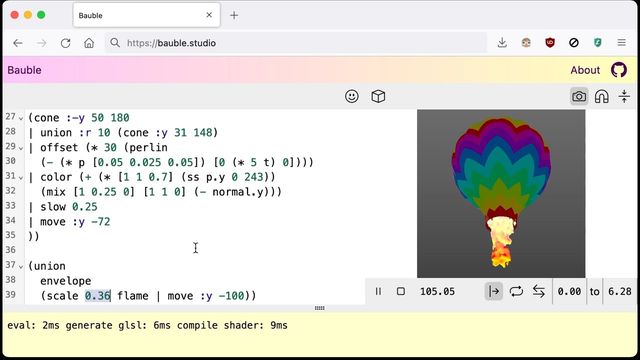
So if you go to bauble.studio and I encourage people who are listening to go to bauble.studio, one thing you will immediately notice is it’s way too nice, it’s a really fun, really pleasantly designed little app. You get to on the left hand side of the screen, write a little program in literally your Ian’s favorite dialect of Lisp79Lisp — a family of languages John McCarthy invented in 1958. Programs are written as the same nested parenthesized lists as data, so code is easy to generate and transform with code. that describes the image there. And I just wonder how did you find the time to do this kind of project? It seems like really quite an investment.
I think part of the fun of signed distance functions is that they’re way easier than they look. It’s so easy to write this sort of ray marcher. People have been doing this a lot and they’ve learned how to do this. So I am in some sense just packaging up a lot of different things that other smart people have already figured out into a single tool. It uses CodeMirror,80CodeMirror — an open-source code editor for the browser by Marijn Haverbeke, who also wrote the book Eloquent JavaScript. codemirror.net. which gives you this very polished environment when I have a small amount of code to generate autocomplete and stuff. But mostly that’s just CodeMirror and CodeMirror is really good so it looks polished and you can produce some pretty good looking 3D renders. But I learned how to do all of this from watching what Inigo Quilez is doing and using a lot of his primitive functions that he is already figured out and a lot of the methods that are used by other people on Shadertoy. So I think it’s actually looks a lot more impressive than it really is. I spent a lot of time building this high level compiler and there’s some bits of it that are more bespoke things that I wanted. You can interactively edit numbers in the code editor because it’s kind of hard to create a 3D image just by typing in numbers. If you’re writing a color, it’s nice to just be able to drag and drop things or if you’re positioning things, you can just drag vector literals around the screen.
Oh, I think we go to a number and click on and drag to the right or the left and have the number interactively move and then also the image interactively changes as you do that. So you can try and pick the number that actually looks right in a nice way.
So there’s some amount of bespoke work that went into that. But yeah, it took a long time.
How long did the project actually take?
It’s hard to say exactly. I think I’ve probably worked on it seriously for around five months. It’s been my main side project. Total, hard to say. I worked on a lot of it while I was on parental leave, so that is where I found the time during naps, but I don’t have nearly as much time to improve it since.
Great. And now you have a kid who probably naps less. So you’ve also done a bunch of fun physical projects. Maybe you can tell us a little bit about some of those.
Sure. So a recent one is adding 3D mesh export to Bauble so I can do 3D printing. That’s been kind of fun getting a little bit into that. I’ve built some musical instruments. That’s something that I don’t really play any musical instruments, but it’s surprisingly easy to solder together a microcontroller to a bunch of buttons and then program it to do interesting MIDI things. I built a mechanical keyboard81Mechanical keyboard — a keyboard with a separate mechanical switch under each key. Hobbyists build their own from a PCB, switches and keycaps and program the microcontroller, for example with the open-source QMK firmware. and it’s like shockingly easy to do and I was like, okay, I can design and build bespoke MIDI instruments now just using a lot of the same techniques and that’s one of my hobbies.
Do you ever play them and make music with ‘em or is it purely just
Don’t be ridiculous, Ron! I try to get my baby to play them, but he is so far not taken to them.
You also made a chorded keyboard.
One of my MIDI keyboards was this experimental chorded input mechanism82Chorded keyboard — an input device where a character is entered by pressing a combination of keys at once, like a chord on a piano. Douglas Engelbart showed a five-key chorded keyboard at the "Mother of All Demos" in 1968. where holding down different sets of keys would give you different notes in a stable way that, I don’t know, it was an interesting experiment that doesn’t really have a physical analog. Part of the fun of making electronic instruments is you’re not constrained by I need to put holes on a tube somewhere to get the right frequencies. You can do all these weird things and have instruments that move relative to one another. This button just goes up by a semitone rather than having absolute pitch. There’s a lot of freedom and fun design space to explore building custom instruments
And then never performing with them.
Yeah, it’s fun to build them. Also ask me how many things I’ve made in Bauble. It’s much more fun to build Bauble than to actually make art with it.
12Janet, Lisp and a book
It seemed obvious to Ian that shapes belong in a Lisp, so Bauble is written entirely in the obscure Janet, and Ian wrote a book about the language.
Although I’ve seen some of them. They’re pretty cute. Another fun aspect of Bauble itself is you ended up using this somewhat obscure Lisp variant called Janet83Janet — a small embeddable language from the Lisp family by Calvin Rose. Instead of lists it has arrays, tables, structs and tuples, and the whole language takes up less than a megabyte. janet-lang.org. as the programming language. And I’m curious what got you there? Why did you end up using this? I often describe OCaml as comically obscure, but I think Janet is even more comically obscure than OCaml.
Extremely obscure. Yeah. It seemed obvious, and I can’t justify this, but it seemed obvious that the way that you should express 3D shapes in a programming language would be some kind of Lisp.
That’s a very hipster opinion
Just the notational, like—I wanted something extremely concise and I wanted things like variadic functions. I dunno, in contrast to OCaml, OCaml is a little bit verbose and I liked that for building a real application, but I wanted something where I could build a very concise notation for expressing different combinations. So it clearly seemed like S-expressions84S-expressions — writing programs and data as nested parenthesized lists, such as (+ 1 (* 2 3)); the basis of Lisp syntax. were a good way to do this.
For those who are not Lisp aficionados, it’s just a really unpleasant number of parentheses. Every single thing is parenthesized in, so it’s almost the only syntax affordances like paren function arguments, close paren and everything just kind of builds off of that.
Bauble actually has a lot of Lisp blasphemy built into it to give you sort of postfix function application and also infix functions.
Yeah, you’re not supposed to do that.
You’re not supposed to do that, but it is very, very nice for expressing GLSL languages. I wanted some amount of notational freedom also because GLSL, despite being relatively low level, has surprisingly nice notational affordances for manipulating vectors. So something that you can do in GLSL is if you have a three dimensional vector, you can write vec.xxy and you get a new vector that’s the first component and the first component again and then the second component. And there’s this neat concise swizzle operation that you can do and also various operations that are overloaded to do the right thing on vectors and that’s all very nice. I didn’t want to lose that notational concision even as I added more notational concision. So the language that Bauble uses is really modified Janet with some custom macros, it makes it a little bit easier to type sequentially without having to go and wrap your parens and keep them balanced.
And I guess that’s the other thing that makes Lisps different is they have really good macro systems.
The fact that I could get this level of control over, I really want the program to look exactly like this. I can get that syntax without having to write my own parser without having to do that. That was an appealing aspect of it.
And then you wrote a book about Janet.85Janet for Mortals — Ian Henry's free online book about Janet, with a built-in REPL you can open anywhere in the book. ianthehenry.com. How did that happen?
So I had so much fun building Bauble in part because I wanted to use Janet because Janet can very easily compile to WebAssembly86WebAssembly (Wasm) — a compact binary format for programs that browsers run at nearly native speed; all major browsers have supported it since 2017. Janet is written in C, and C code compiles to Wasm. and I don’t know, I thought it would be more fun to do the whole compiler in the language that you use to express the language as opposed to parse this notation and then execute it in JavaScript or in OCaml or something else. So really all of Bauble and its compiler are written in Janet. I thought this was really fun to write this web app that is not heavily JavaScript and embedding Janet in the web was both really nice and really pleasant and also very difficult to get started with. But I wanted more people to be able to do this. I wanted to make it easier on the next person who comes along and says, I want to make a live coding environment using an obscure lisp in the browser
And so many people are in that position.
So I wrote a book about Janet because I think it’s a really well thought out and really well considered language that just matches my personal taste very well. And I found I really liked it a lot more than I was expecting to when I started using it and I wanted it to have more exposure. So I wrote a book that no one’s read about Janet and it actually worked. Someone actually made a live music coding environment inspired by the live coding environment in the book and based on the source code, forked it and made a live music environment called Trane.87Trane — a browser environment for live coding music in Janet.
Is that named after Coltrane?88John Coltrane (1926–1967) — the American jazz saxophonist and composer; "Trane" was his nickname.
I kind of guessed that when I read it, but I don’t know the actual etymology. And it’s a delightful site. It has this very idiosyncratic UI that looks like a Windows command prompt. It’s nice. It was nice that someone actually was like, yeah, I also want to build a weird art playground using this weird language.
13What side projects teach
Everything Ian did for fun ended up useful at work, and Janet taught him to appreciate macros and program images.
So you’ve spent an enormous amount of time on lots of different kinds of personal projects. I’m curious to what degree that experience has changed how you think about programming in other contexts.
So I feel like everything that I’ve done for fun, I’ve ultimately ended up using somehow at work. And I think maybe part of that is because I’ve worked on a lot of different areas, so I have more opportunities for this, but not that I would ever have expected this and it’s not the reason why I am making goofy side projects or art projects, but I’ve always learned something and then within a year somehow unpredictably something comes up such that I get to use the knowledge that I learned. And I think having exposure to a lot of different programming languages, I’ve always been interested in programming languages from a theoretical standpoint and I think that thinking about how different languages solve problems helps immensely for modeling problems in any specific language. The experience of using Haskell for a couple years to build what I thought were trivial applications and building them in completely different ways because I’m dealing with immutable state for the first time and learning how to think differently about that, I think that that’s very mind expanding and has given me more tools to approach modeling problems. Also, I dunno still learning obviously I wouldn’t say that I’ve gotten good because I’ve written a bunch of different side projects, but I have learned a lot of different ways to approach problems that have helped me out in real life.
Have you learned anything from Janet in particular?
Janet was my first experience with a language. I’m not a Lisp person and I wasn’t really looking for a Lisp language apart from this dabbling with Clojure earlier in my life. I never got into the macro system. I never really appreciated this aspect of Lisp, but I kind of thought this was like a dumb weird, I don’t know, I don’t really like it and it seems weird. And with Janet, it was the first time that I had really used a language with a powerful macro system and really embraced that and tried to really learn it and understand how I could use it to write programs better. And I think it’s very mind expanding to think about writing code that is executing at compile time but is producing code that will execute at runtime, and this blend between the compile time and runtime environment. Janet, when you compile a program, it produces like an image,89Image — a snapshot of a running program's memory saved to disk. That's how Smalltalk, created at Xerox PARC in the 1970s, works: the whole development environment, program included, is stored and loaded as a single image. In the Squeak screenshot, the star object and its inspector belong to the same image. SNAPSHOT in the Transcript window records when it was saved.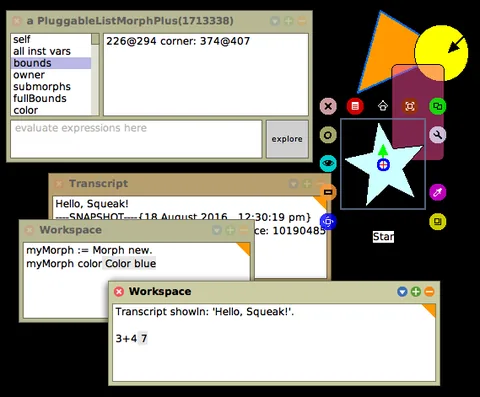 which is something that no language that I had used before. Janet, I know that’s like an old technique and Smalltalks do this and Lisps have done this forever, but Janet was my first experience of this type of programming where instead of compiling to a bunch of machine code that exists and is static sort of building this full runtime state and then writing that down to disk and then later when you run your program you’re resuming from this snapshot in time and what this means is you can do compile-time computation and produce a complex object graph at compile time and then write it down and restore it later and keep going. I thought that was really mind expanding and a really powerful technique that I don’t have a good way to apply to any other language because it kind of takes a lot of language buy-in to be able to serialize arbitrary program state to disk. And this isn’t just values, this is like I have a co-routine that is in the middle of executing and I’m able to suspend that exactly as it is and write that to disk and then resume it later. You can serialize closures over the network and send them to a remote process and then execute the closure. Having this live code that you can freeze and then restore later is kind of a mind expanding thing.
I’ve always thought of this as a terrifying feature of Smalltalk because the way Smalltalk people use it historically, at least the way I’ve understood it is not just I write my program and then there’s a kind of multi-stage process where it does some stuff and then you freeze it and then maybe you take that thing and ship it and then that’s your final program as their development environment. So they just have this binary soup of artifacts that they’ve just made over time as they have been working. It’s no longer a program that you can read really. There’s some code and there’s some data and it all just kind of lives together in this complicated soup. I don’t know how to build careful high assurance software in that kind of mode.
It kind of sounds crazy to me and I haven’t tried it. And you can do this in Janet as well. You can start running your program, you can modify it and then you can at any point save it back to this. You can take a snapshot. But the way that I have used it, and I think Janet’s a small enough language that I shouldn’t say idiomatic, but the normal thing that you do is this really two phase thing where you are running your program up to a point and then you stop and then you’re always resuming the program from that exact same point. So all of your code, all of the things that you’ve written on disk, you can always sort of deterministically—as long as your compilation is deterministic—get back to that state. The state of your image is a reflection of the code as you’ve written it, as you have it in source control. It’s not this mutable target that you’re interactively changing. It sounds very error prone. I know that Smalltalk gives you the history of every change that you’ve ever made so that you can, you’re not totally hosed, but it still sounds wild to me and I’ve never tried to program like that.
Yeah, I mean I feel like it could be a good environment for playing around with data, but it doesn’t feel to me like a great environment for building a very careful piece of software that you need to make sure is actually doing the right thing all the time.
I mean beyond the image and the fact that you’re working on the same program interactively over a long period of time because you’re able to serialize the entire state to disk, but a common way that you write Lisp programs is this interactive thing as well where it’s not maybe quite as long running, but you write code then you evaluate chunks of your code at a time and you’re redefining your program at runtime.
Yeah, I think multi-stage programming is a good90Multi-stage programming — a program generates code and runs it at a later stage: at compile time, like macros, or at run time. For OCaml the classic example is the research dialect MetaOCaml. and important thing among the various good ideas embedded in Lisp, the macro system and more generally, this kind of notion of multi-stage programming is something that Lisps have done really well from a long time ago and very few other language ecosystems have done a good job of it. There’s the whole OCaml SML Haskell world.91SML (Standard ML) — a functional language from the ML family, a relative of OCaml; its formal definition was published in 1990 by Robin Milner, Mads Tofte and Robert Harper. I think that’s a world that’s been really good at types and very mediocre at macros and multi-stage programming. Then the Lisp world is one that’s been the reverse. Very good at thinking about macro systems and how to use them effectively and the types story being much weaker and more complicated and harder to use. You’re talking about it’s hard to use this in other contexts. We are actually literally at the moment working on stuff to add some of this power to OCaml at the moment in a kind of more static and limited way. I think it sounds like the Janet story is fairly flexible and arbitrary multi-stage programming and we’re looking more at stuff where you can do runtime code generation and maybe do runtime code generation in multiple spots in your program, but not quite the same thing as stopping and freezing your whole program and restarting it again with all of the state there. But that itself I think is already very useful and I think having an understanding of how to work in that environment I think is a thing that’s going to become more relevant as we get more of those language features landed. So anyway, that’s a lessons learned by working on personal projects that you’ve been able to adopt more generally or at least influenced your thinking beyond there. How about the other direction? Are there things that you’ve learned from the way you’ve programmed here at Jane Street that’s influenced what you do in your personal projects and what you’ve learned beyond that domain?
14Expect tests
Ian finds expect tests, which write their own output into the source code, so useful that he can no longer write code without them.
So Jane Street has this way of writing tests, this expect test workflow.92Expect tests — tests in which the expected output of the code is written right in the test file; if the output changes, the test shows the difference, and the new version can be accepted with one command. At Jane Street this is done with the ppx_expect library. For more, see James Somers's 2023 post "What if writing tests was a joyful experience?" on the Jane Street blog, linked in the show notes. blog.janestreet.com. Jane Street’s not the only place that does this, but it was my first exposure to this and I kind of just can’t believe that it’s not the industry standard thing that everyone is doing everywhere. It’s so much better in so many ways that I kind of can’t live without it.
It’s also the image-based programming thing in that at first it sounds like a really bad idea.
ExplainerWhat an expect test looks like
In OCaml with the ppx_expect library, a test is code that prints something, with a block of expected output right below it, for example print_s [%sexp (List.rev [1; 2; 3] : int list)] followed by [%expect {| (3 2 1) |}].
- You first write the test with an empty block,
[%expect {| |}], and rundune runtest. - The printed
(3 2 1)doesn't match the empty expectation: the test fails, shows a diff and puts a corrected copy of the file next to the original. dune promote, or a single key in the editor, rewrites the source: the actual output goes into the block, and you have a finished test.- On later runs, any mismatch shows up as a diff again; if the behavior changed on purpose, the new output is accepted with the same command.
The same trick exists outside Jane Street: Mercurial's tests in .t files and Cram, inline snapshots in the insta library for Rust, and toMatchInlineSnapshot in Jest for JavaScript.
A lot of people when they hear about this, they sort of are objecting to it. So what this is specifically is I’m going to write a test and it’s going to do something and it’s going to produce some output and I’m just going to save that output to the file. I write a test that edits itself, it’s going to modify the test code itself to embed the output of some function or whatever into that test, and then I can sort of use this an interactive REPL93REPL (read–eval–print loop) — a language's interactive console: you type an expression, it evaluates it and prints the result. The tradition goes back to Lisp. where I write some code, I run it and then I have the result in my file in the exact same file that I wrote it. It is literally patched to the file on disk. It’s not like I’m running it in a REPL and I see some transient result. And then it’s saved and when I go back, if I run the test again, it’ll tell me if it is different. So the way that I can use this to write code is very similar to the way that I wrote code without any tests at all, which is I write some code and then I run it and then I see if it did what I wanted and if it did great, I move on and if it didn’t, I go and I fix it until it is good. And then once I’ve done that, I sort of save it and mark it as, okay, that was the thing that I wanted and I use this interactive workflow when I’m just developing code and exploring it because it’s just this really great feedback loop for seeing results.
And maybe the most relatable analogy of this is it’s kind of like a plain text Python notebook.94Jupyter — the most widely used Python notebooks: the code is split into cells, and each cell's output is stored right in the document.
In Python notebooks, you write some code, there’s like a block that has the output of the code that you wrote and then you kind of do that over and over again except in the Python notebook case you have this sort of interesting property that there are no guarantees that the stuff that’s in the notebook reflects what would happen if you reran the notebook from beginning to end. The experience of a notebook is this kind of choose your own adventure of which cell do I want to evaluate now, which is I think often important in the python notebook world because various of the steps could be really slow, so you kind of want to make the choice of which parts you want to actually redo. But with expect tests, the idea is we have a file with one of these tests every time you rerun the test, it just runs from beginning to end. It regenerates all of the output it checks. It’s the same as it was last time, and if it’s the same as it was last time, that’s the test passing and if it’s different, that counts as a failure and it rewrites it with a new data and you can choose with a click of a button, do I want to adopt this new version of the output or do want to keep with what was there before?
Yeah, and this sounds a little bit crazy. It sounds crazy in a lot of ways. The description that I gave initially is not the best way to write tests just playing around in a REPL. You kind of want to be thoughtful about the exact things that you’re testing. You want to test precise properties, but it is both a valuable workflow as you’re writing code. But then you can also produce very high quality tests because you’re not just writing a traditional test where you’re writing some assertion about some property, which of course we do a lot and is a very useful tool to have. But you can write something that is more a general observation of my program state. I have some property, I want to observe it and I want to know if this property is ever different. So we have some interesting examples of I want to do a bunch of work and I’m producing a side project where I’ve used this for example, as a board game. A bunch of things happen. I have some state—just print out the board game and that’s an expect test.
That I have done this too. This is an excellent use case.
It’s great. Not only are you going to know when, if you ever break your board, you’re going to be able to see that, but it’s useful when a bug happens. You kind of have this observation of your program state that helps you debug it. It’s not just, oh, some assertion failed, some test failed. It’s like some test failed and also here is the state and here’s what the state was supposed to be. And you can sort of immediately be like, oh, okay, I see how this happened. And this of course is still compatible with traditional assertion based testing. We still write property tests,95Property-based testing — checking a claim against many randomly generated inputs. The approach started with the QuickCheck library for Haskell, described in 2000. but we use the same technique when we write property tests such that you found a failing case. Okay, I’m going to go and edit the source code of your test to insert the failing case and remember it so that future randomized runs will make sure that they handle this interesting regression. It is this mechanism for writing tests that can modify themselves that is really useful for observing properties of your program, but then is also just a really good UI for writing all kinds of tests.
Another thing I like about it is it I feel like it helps resolve what I think of as one of the fundamental trade-offs in building programming systems. I often think about two extremes of you write a traditional program in some text file versus you write some computation in Excel, right? And I think the good thing about the text file version is you get this very compact, easy to read version of the code, and the downside is you can’t see what it’s doing. You can’t see the data as it flows through the program. And then in something like Excel, the data is really easy. It’s just like cells out there. You can just inspect and understand what’s going on in any particular computation. You can just kind of poke at it and see where the data came from and what it’s doing. But the program is smeared over the spreadsheet, all over these cells and it’s non-compact, very hard to read, and this lets you resolve this duality and that you both get the compact representation of the program and you can pick custom laying out of essentially program traces so you can see and visualize aspects of the execution of the program. It’s really cool for code review because when you make a change that’s supposed to change the behavior you get to read in the same commit both the change to the code and the delta to the program trace. Which is not to say that the whole thing can’t be abused. I think one of the reasons people think of this at first blush as kind of a bad idea is it just seems like you’ll get a bunch of tests where people dump garbage and say, and now I’ve tested it and that’s a real problem.
People in fact do get this wrong. A really good expect test is where one has really thought carefully about what data do I actually want to visualize? How do I actually want to represent this and kind of minify it so you don’t have a bunch of distracting nonsense and the end result is actually readable and worth reading.
Yeah, it’s a real failure case to just say like, oh, okay, tell me if anything possibly changes, but you really need to be careful and diligent. But the work that you do, it’s not just in order to write your tests better, the work that you do to visualize your state better also makes it easier to change your program over time. You get this virtuous feedback where you spend time building these test visualizers to make your test clearer and easier, and then they also just make it easier to make changes. So it was the first time where I really felt like, okay, I’m writing tests for myself. It is actually just making my job easier. The more tests I write, the easier it is to build more and more complex interesting software and it doesn’t feel like it’s adding this cost. We’re like, ah, okay, now I got to go write tests after.
It’s kind of fun.
In the same way that playing in a notebook is a fun way to knock around. Writing expect tests is fun.
So if you want to use Janet, first thing I had to write of course was a complex macro that does this patching of the source code so that I have the same workflow in Janet because I’m spoiled and I can’t write code without it anymore.
The history of expect tests is kind of interesting in that it’s definitely not our idea. We stole it actually very concretely from Mercurial,96Mercurial — a distributed version control system that Matt Mackall started in 2005. Its tests, in .t files, look like recorded command-line sessions: commands interleaved with their expected output. Wikipedia. which has this set of tests that they built internally, which are basically expect tests for Bash, where you write some bash commands and you see the output and there’s a little single unified file format. I think they called it their unified test because it unifies the output of the test and the code that generates it. And then somebody went off and built a tool called Cram,97Cram — Brodie Rao's framework for testing command-line programs in the same format as Mercurial's tests. PyPI. I think hasn’t been touched in several years, but it’s another version of this idea generalized beyond Mercurial. Then we built some version of it and did a lot of blogging about it. We thought it was kind of fun and there’s several Python versions of this that have been built. I think the idea didn’t come from us, but I think we’ve been involved in the set of people slowly popularizing it and spreading it out in more cases and it’s kind of been nice to see it get out into the world.
Yeah, it’s also something that Jane Street does that’s a little bit idiosyncratic, but unlike using OCaml or using Bonsai for everything it’s something that anyone could do, this is an idea that is completely language agnostic and there are libraries for doing this in almost every language, and if there’s not, you should write one because it’s a very good workflow
The tooling is frustratingly hard every now and then. So I’ve now had the experience of teaching my kids how to program, which I guess you’re not quite there yet, almost, give it a few years. And one of the frustrating things is how poor the testing frameworks are. You get something in class of write the following system and they’re often fairly hard assignments and they’re hard to get right, and maybe you’re doing it in languages like C and C++ where there’s all sorts of weird cliffs you can fall over and then just no good testing tools and that’s no way to live. And so I’ve looked around for good ways of doing things like expect tests in C programs and the landscape’s not great there.
Yeah, Jane Street’s OCaml tooling in Emacs98Emacs — an extensible text editor; the best-known version is Richard Stallman's GNU Emacs (1984). Jane Street has built its own code tooling on it. around this. You save the file and you immediately see a diff of all of your tests, and then there’s one button that lets you copy in the output to promote it to this is the good version. That tooling is actually really important to making this pleasant. So yeah, I’ve had to reimplement that, unfortunately.
Amazing. Alright, well thank you so much for joining me. This was a lot of fun. You’ll find a complete transcript of the episode along with show notes and links at signalsandthreads.com. One thing I wanted to mention is that, as you may have noticed, the pace of releasing new episodes has slowed down a bit. Don’t worry, we’re not going anywhere. In fact, we’ve got a bunch of episodes planned that I’m really excited about. Things have been busy and I do expect the pace to be a bit slower going forward. Anyway, thanks for joining us. See you next time.


