


TBPN
Chapters
Coogan summarizes the essay "The Boomer Bubble": rising asset prices rested for forty years on protecting boomer wealth, and that support weakens as they leave the stage.
Read the chapter- Coogan admits he did not expect Huang to return: Ben Thompson put it at 0%, and he himself took the under against Travis Kalanick, thinking even 10% was high.
- The essay's thesis is that boomers were the dominant voters, consumers and asset owners, so governments kept cutting rates and rescuing markets; as they go, the young have less wealth to protect, and rates and volatility may rise.
- Coogan explains the Greenspan put: the Fed promised that markets would not be allowed to crash, like handing investors an option to sell stocks at a set price.
- In James Mackintosh's column, Intel, Oracle, Cisco, Micron, Qualcomm, Seagate and NVIDIA have fallen almost as far as in the dot-com crash, but back then rates were cut, and now they are not.
With the Fed not cutting, the boomer put took a new form, in Coogan's telling: a call to NVIDIA's board and Huang's reinstatement.
Read the chapter- Kevin Warsh is not a boomer and is not promising cuts; Jordi calls Trump's call a form of government intervention in markets.
- On Monday the Nasdaq rose 6.5% and NVIDIA 30%, as if rates had been cut.
- Coogan cites Tae Kim: NVIDIA is a Formula One car built around one driver, and none of its executives is at Huang's level.
- Jordi sees a bearish sign: if one person can move the market that much, the market is full of fear and does not believe the old narratives. Coogan wishes he had put it all together sooner: he would have been more optimistic.
Stripe is discussing a tender offer at a valuation above $200 billion, and CrowdStrike is buying Zscaler for $44 billion in stock.
Read the chapter- Stripe's new valuation is 20% above last year's $159 billion; it bought OpenRouter for more than $7 billion, plus Metronome and Parafin, but the bid for PayPal with Advent International fell through.
- The Link wallet has become one of the default payment options for AI agents; Jordi compares Stripe with LVMH, McDonald's, Verizon and Dell, all worth about $200 billion.
- Zscaler shareholders will receive 1.135 CrowdStrike shares for each of theirs; the deal is expected to bring $1 billion of revenue synergies within 30 months and $500 million a year in cost savings.
- Jordi retells the story of Zscaler founder Jay Chaudhry: he and his wife started their first company on their savings and sold it for $70 million, then built and sold three more, and the $50 million of his own money in Zscaler grew to about $14 billion.
Microsoft declared an internal code red after its email outage, and Tidal is removing wholly AI-generated tracks starting December 9.
Read the chapter- Coogan reads from Reuters: the outage hit Outlook, Teams, Exchange and Copilot, the cause was named as a Windows bug found in July rather than a cyberattack, engineers exchanged more than 11,000 messages, and Microsoft promises to fix such problems within an hour in future.
- The Nanotyrannus skeleton Jodi sold for $47.3 million; the seller is Christian Angermayer, and bidders at Sotheby's fought for it for more than 12 minutes.
- By Tidal's numbers, the AI badge is on 6% of the catalog, 27 million tracks, and 94% of those tracks are attributed to Suno; Coogan and Jordi doubt the line can be drawn.
- Coogan jokes that you can generate a track with AI, play one note live and be back on Tidal, since the ban covers only "100% AI."
The new Bond's bare wrist has set off a fight in the watch industry: he wore an Omega for almost 30 years, but the first image shows no watch.
Read the chapter- Coogan guesses it comes down to a contract: Pattinson is a Jaeger-LeCoultre ambassador; in the books Bond wore a Rolex, and Omega paid for product placement starting with "GoldenEye" in 1995.
- The K-shaped economy is hollowing out the middle watch segment, and Zenith is moving up and out of it; the hosts joke that Bond should switch to Richard Mille, and Tyler to Jacob & Co.
Quotes
On the boomer compact
“The baby boomers were America's dominant voters, consumers, and asset owners. And so governments wound up repeatedly cutting rates, injecting liquidity, and rescuing markets because protecting accumulated wealth aligned with protecting the median voter.”
John CooganRead from 01:19On Huang's return
“If you just looked at the market and you didn't know any of the news about Jensen coming back, and you had to determine, wait, why is the NASDAQ up 6.5%? Why is Nvidia up 30%? And someone told you, oh, the reason is they cut interest rates. You'd be, oh yeah, okay, that makes sense.”
John CooganRead from 07:38On private valuations
“very, very, very few people that I know actually sort of mentally write down their private market positions when public comps correct.”
Jordi HaysRead from 15:01
Summary
Coogan walks through the essay "The Boomer Bubble": for forty years the state rescued markets to protect the boomers, and now that the Fed is not cutting rates, he argues, Jensen Huang's return to NVIDIA after a call from Trump became the new put. The hosts then take up Stripe's valuation above $200 billion, CrowdStrike's $44 billion purchase of Zscaler, Microsoft's code red and the Jodi dinosaur. They finish with Tidal's ban on AI music and the bare wrist of the new Bond.
Mentioned
 Jensen Huang00:41Coogan reads his return to NVIDIA as a new form of the boomer put: the market reacted as if rates had been cut.
 Ben Thompson00:53Coogan says he put Huang's return at 0%, and later cites Tae Kim's interview with him about Huang's role.
 Travis Kalanick00:53Coogan took the under against Kalanick, who believed Huang would return, and lost.
- Alan Greenspan02:52Coogan explains the Greenspan put: with it the Fed for the first time promised to guarantee the security of asset prices.
Show 52 more mentionsShow fewer mentions
- Federal Reserve02:55Coogan explains that with the Greenspan put the Fed first came to the market with a guarantee on asset prices; now, he notes, it is holding rates high and sees no case for cuts.
- James Mackintosh04:17Coogan agrees with his column "Has the AI bubble already burst?", which compares today's tech drawdowns with 2000.
 The Wall Street Journal04:17ran Mackintosh's column on the AI bubble and the story on the new Bond's bare wrist that Jordi reads.
 Intel04:49in Mackintosh's comparison it fell 60% after the dot-com bust and is down 64% now.
- Seagate Technology04:49in Mackintosh's comparison it fell 37% after the dot-com bust and is down 60% now.
 Kevin Warsh06:42Coogan notes that the Fed chair is not a boomer and is not promising to cut rates, so the put arrived in another form.
 Donald Trump07:28Jordi calls his call to NVIDIA's board a case of government intervening in markets.
 Tae Kim08:02Coogan retells his point that no other NVIDIA executive reads a hundred "top five things" emails a day, so without Huang the machine cannot stay on the track.
 Dwarkesh Patel08:02Coogan recalls that Huang told him "I'm not a car," even though Huang himself compared NVIDIA to a race car.
 Formula One08:02Huang describes NVIDIA as a car built for one driver; Coogan adds that with the best car the winner is often not the best driver.
 Colette Kress09:50the market, Coogan says, did not believe her "we'll get through it" while Huang was gone.
 OpenRouter12:13the AI-model request router Stripe bought for more than $7 billion, its largest acquisition.
 Metronome12:13the usage-based billing service Stripe bought to widen its footprint.
- Parafin12:13another Stripe purchase, a small-business lending platform.
 PayPal12:13Stripe bid for it together with Advent International; Coogan regrets the deal fell through because it would have added revenue to Stripe.
 Advent International12:13the private equity firm that bid with Stripe to buy PayPal.
 Patrick Collison12:58Jordi says investors have great faith in the Collisons' future, and Coogan invites the brothers to the exchange.
 John Collison12:58while Stripe is private, Coogan jokes, his podcast Cheeky Pint stands in for earnings reports.
 Peter Thiel13:08Coogan jokes about a Thiel-backed fintech buying a Thiel-founded one: "Thiel all the way down."
 Link13:20Stripe's wallet has become one of the default payment options for AI shopping agents.
 Muse13:20an example of an AI agent where Stripe's payment wallet is a default payment option.
 Databricks14:12Coogan names it among companies that manage to hold valuations in the hundreds of billions in private markets.
- LVMH Moët Hennessy Louis Vuitton14:38Jordi lists it among public companies worth about $200 billion, like Stripe and Databricks.
 McDonald's14:38Jordi says Stripe would be worth more than the restaurant chain.
- Verizon Communications14:38Jordi compares its market cap with Stripe's new valuation.
- Dell Technologies15:01Jordi compares Dell's market cap with Stripe's and notes it is easier for a private company, whose employees do not watch the stock every day.
 CrowdStrike15:35buying Zscaler for $43.9 billion in stock and expecting about $1 billion of added annual revenue from the deal.
- Zscaler15:35the cloud security company CrowdStrike is buying; Jordi admires that its founder put in $50 million of his own and turned investors away for five years.
- Jay Chaudhry16:39Jordi retells his path: a first company built on the family's savings, three more sold, and $50 million that grew to about $14 billion.
 Lightspeed Venture Partners18:04per Jordi, Zscaler's first outside investor, in 2012.
- TPG18:04put $100 million into Zscaler in 2015.
- George Kurtz18:22Coogan quotes the CrowdStrike CEO: security used to keep the adversary out and now has to let AI in.
 Microsoft Outlook19:24the main casualty of the outage; Coogan remarks that the world runs on Outlook, email and pie charts.
 Microsoft Teams19:39during the outage engineers exchanged more than 11,000 messages across 11 Teams chats.
- Suno21:43Jordi thinks of it when discussing the song "Can't Hack Beer"; Coogan later learns that 94% of AI tracks on Tidal come from Suno, and Tesh says he does not like it.
- Jodi21:53the skeleton sold for $47.3 million, and the hosts figure the seller made about ten times his money.
- Christian Angermayer22:23the seller of Jodi; Coogan reads his post about how his firm "opens new asset classes."
- Sotheby’s23:02where several bidders fought over Jodi for more than 12 minutes; Coogan thinks the estimate was set low on purpose.
 Pangram25:20Coogan guesses Tidal will catch AI tracks with a detector like Pangram, and Tyler notes his image model finds individual parts too.
 Block26:04Jordi asks what the owner of Tidal is worth on $24 billion of revenue; Coogan says $35 billion, and the right answer is $44 billion.
 Jack Dorsey26:34Coogan notes Dorsey is very AI-pilled, but apparently for operations and efficiency, not for music.
 Cash App26:34Coogan calls it Block's second act and its cash cow.
 Google Gemini27:32Coogan notes the Gemini app also generates music but has not taken share from Suno.
 Spotify28:51to compete with it, Coogan says, Tidal would have to take on podcasts and video, so he understands the bet on being different.
 Omega29:28Bond's watch supplier for almost 30 years, yet missing from Pattinson's first image; its models cost $8,000 to $10,000 and that segment is being hollowed out.
- James Bond29:28the first image of the new Bond shows no watch, and Coogan goes through the history of the agent's watches in the books and films.
- GoldenEye30:26Coogan says Bond has worn an Omega Seamaster since this 1995 film.
 Robert Pattinson30:55the new Bond and a Jaeger-LeCoultre ambassador; Coogan guesses his contract kept Omega off his wrist.
- Jaeger-LeCoultre30:55Pattinson is its ambassador, and Coogan allows that the brand could take Omega's place in the film.
 Rolex30:55per Coogan, Bond wore one in the books, and the brand had no reason to pay for an aura it got anyway.
- Zenith31:48the K-shaped economy is hollowing out the middle segment, and Zenith, Coogan says, is moving up and out of it.
- Richard Mille31:48the hosts joke that Bond should switch to RM to stir up scandal.
Transcript
01The boomer bubble and the market drawdowns
Coogan summarizes the essay "The Boomer Bubble": rising asset prices rested for forty years on protecting boomer wealth, and that support weakens as they leave the stage.
On my mind has been the boomer bubble from Jason Lupacin and his partner over at Astari Capital Management. New hedge fund, very, very interesting. It's a 10-page PDF, very digestible, takes you through his thesis on what changes in a post-Boomer America, in a post-Boomer economy, goes all over different corners of the global economy, gives you a view of history, as well as all the different places where the boomers have had their effect as the primary holder of wealth, the marginal investor, the marginal voter.
It's gotten me in this mode of thinking, how does this apply to all the current moments? And I've noticed that a lot of people were not predicting Jensen would come back.1The return happened the day before. On November 12, 2026 Huang stepped down as NVIDIA's CEO and board member after reports of his affair with Alice Huang of Singapore's Megaspeed, which US authorities suspect of routing NVIDIA chips to China; CFO Colette Kress became interim CEO: NVIDIA. A few days later board chair Harvey Jones told investors there were no plans to bring Huang back, and on November 23 the board reinstated him, citing the views of senior US government officials; the board's investigation continues: Form 8-K.
Ben Thompson was saying, ah, 0% chance. I was in that, I was taking the under against Travis Kalanick. I was looking at the 10% odds, and that still seemed like pretty high. And then it happened.
And that was a surprise to well the other thing is even if it was gonna happen, it felt like it was gonna be at least a month. Totally, right? Totally. In post investigation. Two months, yes, three months, after he spends a little bit of time in Washington.
But after reading this, I think it makes a lot more sense, and I want to summarize this, then synthesize it to apply it to the current moment because NVIDIA reinstating Jensen is all over every newspaper he's on the cover because it is one of the most fascinating stories in business history for sure. So the core thesis of the boomer bubble is basically the last 40 years of rising asset prices were sustained by a political compact built around the baby boomers, basically up only. The baby boomers were America's dominant voters, consumers, and asset owners. And so governments wound up repeatedly cutting rates, injecting liquidity, and rescuing markets because protecting accumulated wealth aligned with protecting the median voter. The boomers were the median voter, they had the wealth, and so you have to protect them.
And so as they retire and die, that alignment breaks, even though some of the assets might pass down. Younger generations have less wealth to protect and more reason to favor cheaper housing, redistribution, economic restructuring. So things are going to change. People have been talking about this a lot, but the actual implications, near-term knock-on effects are very interesting. So this could lead to higher interest rates, greater volatility, because you don't have as much pressure. Hey, lower the interest rates.
My assets are going down in value. If people have less assets, they're less likely to vote for a president who can, you know, push low interest rates or low interest rate agenda.
If you're not super familiar with the Greenspan put.
This was the first time that the Federal Reserve came to the market and said, we are basically going to guarantee security of asset prices. And that's what that means. The put is a put option. It is the option to sell a given asset at a given price. And so Greenspan, Alan Greenspan, who was the head of the Fed at the time, was saying, I'm basically giving you a put option. So you will always be able to sell your stocks at this price.
And so he's creating this bottom floor for asset prices that creates, you know, there's still upside and there's still drawdowns, but at no point will the market be allowed to crash. Stocks go up in this country. Exactly, exactly.
The recent market drawdowns are starting to look worthy of another government intervention.
If you squint, it looks like, okay, well, there's been a hedge fund that blew up, there's been significant market sell-offs. Interestingly, I asked Jordy this morning, I was like, when was the last high for the market? And I was thinking the same thing as you before I looked it up. I was like, oh, it must have been this summer because the vibes have been kind of off since summer. That's actually when semiconductors peaked. The NASDAQ had its last all-time high in October, it's only been basically less than two months.
crazy. But it still has the James Mackintosh at the Wall Street Journal.
Still has room to fall.
Still has room to fall. Well, that was the interesting question posed by James Mackintosh2James Mackintosh is The Wall Street Journal's markets columnist. He had compared the AI boom with the dot-com bubble before: in December 2025 he wrote about "eerie parallels" between them and recalled Cisco in 2000: WSJ. in the Wall Street Journal on Sunday. He said, has the AI bubble already burst? And this was our joke for a long time. The market would go down by 2%. We'd be like, oh, well, the bubble popped, time to start rebuilding.
Like it's a good time to go back up.
And we joked about that in Q4 of last year, and we did have a momentary correction. And then we got a new leg up with agents.
Yeah, yeah, exactly. And so James Mackintosh in the Wall Street Journal highlighted seven key tech companies that were around during dot com saw incredible stock market volatility in dot-com, in the aftermath of dot com, and compared it to today. So, for Intel, Oracle, Cisco, Micron, Qualcomm, Seagate, and Nvidia, how do they do in dot com? And then how are they doing today? And so Intel in 2000 dropped by 60%. Today it's down 64%.
Oracle was down 37% in 2000, it's down 60% today. Cisco was down 52%, today it's down 30%, Micron 63%, today it's down 53%, Qualcomm 54% to 42% today, Seagate 37% to 60% today, and Nvidia 62% drawdown during dot com bubble. Now it's down 48%. And so you good. More reason, more opportunity to go up.
Opportunity to show your conviction.
Exactly. So if you look at it this way, I you know, I read this headline and I was like, oh, that's kind of like silver lining, it's kind of like looking on the positive side. I like it, but am I really gonna buy this thesis from James Mackintosh in the Wall Street Journal? And after seeing those stats, I'm like, yeah, that actually makes a lot of sense. So some are almost identical, some worse, some better, but just from these, it would be hard to say one was obviously a bubble burst and the other not. And so if you look at those, stats from 2000, that's what the dot-com bubble bursting looked like.
And we have the same numbers today. Did this just happen? Like did we actually go through this? And we're just dealing with the knock-on effects. And so the question is, well, in 2000 they were cutting rates. We're not cutting rates today.
02Huang as the new put
With the Fed not cutting, the boomer put took a new form, in Coogan's telling: a call to NVIDIA's board and Huang's reinstatement.
Kevin Warsh is not a boomer3Right: Kevin Warsh was born in 1970, and boomers are those born between 1946 and 1964. He became Fed chair in May 2026, succeeding Jerome Powell, who was born in 1953: Wikipedia. and he hasn't been signaling that he will cut rates. There hasn't been a really good reason to cut rates from an employment or inflation perspective, but from a stock market perspective, there has been, but historically that's been okay, but now maybe it's not. And so the question is, is there a different put? Is there a different way that the government can inject confidence into markets? And so the boomer urge for another put is on the rise, but the Fed has kept interest rates high and doesn't have a strong argument for cutting them. As a result, the boomer put takes on different shape and results in a call to NVIDIA's board and a push for reinstatement of Jensen Huang.
And Trump calling in to an NVIDIA board meeting and saying like, we're putting this guy back in is a form of a government intervention into the markets.
Exactly. And if you looked at the results on Monday, it looked like, oh, they cut interest rates. If you just looked at the market and you didn't know any of the news about Jensen coming back, and you had to determine, wait, why is the NASDAQ up 6.5%? Why is Nvidia up 30%? And someone told you, oh, the reason is they cut interest rates. You'd be, oh yeah, okay, that makes sense.
yeah, all the tech stuff, the tech trades back on because of that. But that's not what happened. Interest rates have held steady, but Jensen was returned. And I think the best summary of why the market has more confidence about Jensen Huang coming back, even though it's such a complicated story and there's still so many more investigations happening around exactly how many chips moved where, exactly what happened, what was going on in his personal life, how the lines were blurred. Tae Kim4Tae Kim is a journalist and the author of "The Nvidia Way" (2024), a book about Huang and NVIDIA based on more than a hundred interviews. The image of NVIDIA as a Formula One car built around one driver comes from that book; Ben Thompson put it to Huang himself in a 2025 interview: Stratechery. illustrated the role that Jensen played at NVIDIA in an interview with Ben Thompson really well. So Jensen describes building NVIDIA as, and this is a hilarious irony because he told Dwarkesh, I'm not a car, but when asked about his role at Nvidia, he said NVIDIA is a car and he's the race car driver, but it's a Formula One car and everything is designed around him specifically and only he can pilot it.
Someone else was like, is it like a Gundam suit that you put on? he's like, no. NVIDIA is a car. And then a couple years later he's like, it's not a car, not a commodity. But F1 cars are not commodities. Having the right car does mean you win the race often, even if you're not the top driver.
But you know, you put the top driver with the top car, you usually get a championship. So he says, I built NVIDIA in a way, this is Jensen, he says, I built NVIDIA in a way where I could drive it and manage it and steer it perfectly. So without Jensen, Tay was asking, like, is there another CEO that's reading 100 top five emails5Top 5 Things (T5T) are regular emails in which NVIDIA employees at any level list the five most important things they are working on and what they have noticed in the market: customer complaints, competitors' moves. Huang reads them himself, per Tae Kim's book most of them if not all, and often replies: Fortune. a day? I guess this is a practice at NVIDIA where everyone says their top five priorities, that is looking at all the AI discussion email lists inside the company, trading AI papers with top engineers. Tae Kim doesn't think so. He says, I've met all the top NVIDIA people.
They're all impressive, but they're not Jensen level. And so only Jensen coming back could keep the car on the track, basically. And I think that's what we saw while the market was reacting to Colette saying, we got this. And a lot of people are saying like if one
person being in or out can move the market that much, it's actually bearish because the market clearly is just like has so much kind of like fear and not overall sort of there's not enough overall belief in the sort of like narratives that got us to this point.
Yeah, no, 100%. So it's interesting. I like the Boomer Bubble as a piece. I highly recommend reading it. It feels like the nature and structure of those puts is changing, getting more odd and unique and unorthodox, unclear how many more there are, but I wish I had put this together with the Jensen story last week because I feel like I would have been more optimistic. The wild card of government intervention amid a falling stock is not crazy to reason about if you think back for the last 40 years.
It's happened again and again and again. I just wasn't expecting it to take this shape. And so I wrote it off and said, well, the board has lawyers and it's business and it's suits, and so it's unlikely to happen. And that's why I was not able to predict this. And I, and I think a lot of other people were surprised by it and surprised by how fast it happened because it's a new format for a 40-year-old strategy, right?
Yeah.
03Stripe at $200 billion and CrowdStrike with Zscaler
Stripe is discussing a tender offer at a valuation above $200 billion, and CrowdStrike is buying Zscaler for $44 billion in stock.
Stripe's valuation set to top 200 billion in latest investor talks.
There isn't a whole bunch of details in here, but the privately held company is discussing a tender offer for shares outstanding that would likely be completed early next year, the people said Stripe has been buying back employee shares annually, often announced early in the year, to allow employees to cash out stock. New valuation will be 20% higher than last year's mark of 159 billion. The offer is likely to include existing investors purchasing some shares, according to some people. In last year's tender offer, Stripe said it was using a portion of its own capital to repurchase shares. So I think the business is in a very strong position. They also have been on an acquisition spree to some degree.
In August they acquired OpenRouter, a buzzy AI startup that steers users' requests to different models, the deal worth more than 7 billion was Stripe's largest ever acquisition.6Stripe confirmed the deal on August 19, 2026 and the parties did not disclose the price: Bloomberg reports more than $7 billion, The New York Times $7.5 billion and Axios more than $8 billion. It is Stripe's largest acquisition; the previous record, the stablecoin platform Bridge, cost more than six times less: The Next Web. They also acquired Metronome, a startup that allows software companies to build customers based on usage, and Parafin, a small business lending platform. So they're really, really growing the footprint. Its boldest potential move, though, never materialized. Oh yes, I remember this. We never followed up on this. Stripe joined with private equity firm Advent International on a bid for PayPal,7In July 2026 Stripe and Advent offered $60.50 a share in cash for PayPal, about $53 billion for the whole company and a 28% premium to the market. PayPal's board judged the price too low, and in late August the buyers walked away without raising the offer: The Irish Times. and that never happened.
Interesting. I was still, I forget how optimistic I was about the merger there, but it would have really put a lot of revenue and like meat on the Stripe's bones, I guess, you know? It would have just been like a whole pool of liquidity.
Yeah, it was an interesting arbitrage. Yeah. It's like investors just have way more confidence in the future of the Collisons than they do of. Yeah. And they do.
And it was also an awesome headline that a Thiel-backed fintech8Peter Thiel was among Stripe's first investors in 2011, and his fund Founders Fund invested later; he co-founded PayPal with Max Levchin. "Thiel all the way down" riffs on "turtles all the way down," about an endless chain in which every link rests on the same thing. was attempting to acquire a Thiel-founded fintech.
It's all it's Thiel all the way down, I suppose.
Get the red string out.
Meanwhile, Stripe has placed itself in the middle of the fast-growing field of agentic shopping, or when an AI bot makes purchases on behalf of human, the company's consumer-facing checkout tool and digital wallet link has become one of the default payment options for the AI agent tools that have already launched, including Meta Platforms' Muse, Stripe, founded in 2010 by brothers Patrick and John Collison, has stayed private in part because of its ability to give employees and investors liquidity in their stakes intermittently. And they really, really created the whole stay private forever playbook that I feel like a movement, yeah. And I feel like a lot of founders have sort of adopted this. It's very hard. It's not like it's just like, oh yeah, pick that path, but yeah, but it did sort of unlock a new venture capital strategy, venture capital underwriting model that enabled this.
And it would be hard to imagine, I mean, there's probably like 10 companies in the 100 billion range roughly at any given time across Databricks and Anthropic and OpenAI and SpaceX before the IPO and XAI and stuff. So there were a number of companies that have sort of been able to play in the private markets at an extra zero, at an extra order of magnitude.
Yeah, but it's interesting to look at the other companies in that sort of 200 billion dollar range that Databricks and Stripe are in. You have LVMH, Alibaba, Disney, American Express. Stripe would actually be worth more than McDonald's. Verizon is also in that range.
Dell, also in that range. And amazing, you know, if you don't need to raise huge amounts of capital, right? These businesses are pretty capital efficient. Great time to be private because you don't have thousands of employees, you know, worried day to day about movement. It's a funny thing, you know, very, very, very few people that I know actually sort of mentally write down their private market positions when public comps correct. Yeah. Totally.
It's very easy to just ignore.
Yeah.
Some big news in the CrowdStrike world. They're buying Zscaler in a $44 billion stock swap. Deal brings together two of the cybersecurity sector's largest pure play companies.
The Financial Times said US technology group, CrowdStrike, has agreed to buy cloud security company Zscaler in a deal valued at 44 billion that is set to create a cybersecurity giant. Very good news. So CrowdStrike is up, Zscaler's up. They agreed to buy cloud security firm Zscaler in a deal valued at $43.9 billion, uniting two of cybersecurity's biggest names in a moment when high profile hacks and rapidly evolving artificial intelligence threats have made digital defense a boardroom priority. The all-stock transaction marks one of the bigger deals in what has been a blockbuster year for mergers and acquisitions. Under the terms, Zscaler shareholders will receive 1.135 shares of CrowdStrike common stock for each Zscaler share they own.9CrowdStrike announced the deal on November 23, 2026 along with its fiscal third-quarter 2027 results (the quarter ended October 31): at the November 20 closing price the 1.135-for-1 exchange works out to about $260 per Zscaler share. The deal still needs regulatory and shareholder approval: CrowdStrike, Form 8-K.
The tie-up brings together two of the sector's largest pure play companies. Zscaler
founder Jay Chaudhry has an amazing history of lifting himself up by his bootstraps. So his first company, he and his wife, Jyoti, quit their jobs and invested half a million dollars, which was their life savings at the time, to start their first company, which was called Secure IT. Yeah. Turned that into a 70 million dollar exit.
Wow.
So nice little trade there. Yeah. And he went he used the proceeds from that to bootstrap and sell three more companies.
No way.
Core Harbor, which was acquired by AT&T, CipherTrust, which merged with Secure Computing and Air Defense, which was acquired by Motorola. Wow. Then later he is sitting pretty, 2007 Zscaler time, put a humble $50 million dollars of his own money. So he really just does the whole incubation round. Yeah, and with Zscaler, I think, I think
they turned down investors for five years. Wow. Just built and built and built. And so apparently with this deal, it's like 50 million into like 14 some billion.10Plausible: Chaudhry and affiliated entities own about 34% of Zscaler, roughly $15 billion at the deal price. By Fortune's account he put in not $50 million but about $60 million across the first two rounds; Lightspeed put in $38 million in 2012: CrowdStrike, Form 8-K, Fortune. The guy's pretty, pretty good.
Pretty good. Pretty good. Pretty good at business.
Roll the dice again. Why don't you put that 14 billion into something else? Maybe you will
I don't know.
But yeah, Zscaler didn't take outside money until 2012. Yeah. Their first round was led by Lightspeed. Let's give it up for Lightspeed. Amazing. Followed by 100 million by TPG in 2015.
Yeah. And yeah, pretty amazing story.
Yeah. George Kurtz, CEO of CrowdStrike, said, security used to be about keeping the adversary out. Today security is required to let AI in. The network used to connect people to places. Now it connects agents to data. The companies currently share more than 2,000 customers through an existing alliance, but combining them will give them a 10 billion ARR closing.
Zscaler recorded 3.9 billion in annual recurring revenue. CrowdStrike expects the deal to generate roughly 1 billion in annual run rate revenue synergies within 30 months of closing. CrowdStrike also projected $500 million in annual cost savings within 18 to 24 months after the deal closing, driven by optimizing data center infrastructure, vendors, and operations. Also earlier this month, CrowdStrike agreed to buy two AI security startups for a combined $495 million, expanding its push to monitor and safeguard autonomous AI agents as businesses rush to adapt the technology.
04Microsoft's code red, the Jodi dinosaur and AI music at Tidal
Microsoft declared an internal code red after its email outage, and Tidal is removing wholly AI-generated tracks starting December 9.
Well, the other interesting story is Microsoft declared a code red. Microsoft has internally declared code red after last week's outage that put Outlook on the naughty list back then.
There was an outage that affected Outlook, Teams, Exchange, Copilot, per Reuters. According to the Microsoft team, it was not a cyber attack, but a Windows bug that was found in July and that it was the most customer impacting incident in Exchange's online history. So we're still unclear on the role AI played in this because it's possible that you discover a bug that's so serious, no one's exploiting it, but you still just patching the bug takes so much time that you actually have to pull the whole system offline, and that's very disruptive to business, very disruptive to your SLA revenue and profit potentially, lots of, lots of issues. So important to lock in with the code red. Microsoft also said that during the outage, the engineers exchanged over 11,000 messages across 11 different Teams chats to try and figure out what was going on.
One executive described it as the fog of war. Under the code red, the company plans to solve any future cybersecurity issues within one hour rather than last week's outage that lasted around 24 hours. So they're going Baja Blast mode.11A pun: Code Red is not only a "code red" but also the cherry flavor of Mountain Dew soda. Baja Blast is another of its flavors, sold since 2004 only at Taco Bell. They're going to try and Baja Blast any bugs that come up in under an hour, but certainly chaotic times at all of the tech companies. So good luck to everyone at Microsoft during the code red. Hopefully there's a lot of lessons, a lot of learnings, and more reliable products in the near future because the world runs on Outlook and emails and pie charts, for better or worse. Who was talking smack about pie charts? He said
something to the effect of pie charts add no real value in the world. And he was being sort of facetious, but he was saying that, you know, AI can instantiate a pie chart very quickly and that is of course efficient.
Mark has a great idea for a country song.
He's calling it can't hack beer. This sounds. It's a country song I just imagined that would go platinum right now. Can't hack a beer.
I like it.
This is one of those things where it's almost as funny to just talk about the concept as it would be to hear the sort of Suno version of the song.
No, you can just take the prompt and imagine the song in your head and get the laugh and you don't actually need to instantiate it, but I'm sure someone will. And I'm sure somewhere on Instagram there's an AI-generated video of this whole concept. People are already having fun with it. We have some news about dinosaurs. Big, you know, you come to the show for dinosaur updates. Jodi, the nano Tyrannus,12Nanotyrannus is a small predatory dinosaur, a relative of the tyrannosaur that paleontologists long thought was a juvenile T. rex. The Jodi skeleton, found in Montana in 2019, sold at Sotheby's on October 27, 2026 for $47.3 million against an estimate of $6 to $9 million, the second-highest price for a dinosaur after the T. rex Gus ($50.1 million that summer): CTV News. sold for 47.3 million dollars. The seller has been revealed.
It's Christian Angermayer, who is the founder of Atai, Apeiron Investments, Enhanced Games, lots of other things, and he posted a very thoughtful post-exit deep dive here. Victory lap. Yeah, victory lap, but also just like a reflection on what it means to be in the dinosaur game, I suppose. He said every good exit is a reason to celebrate, but some are a bit more special than others. The sale of my Nanotyrannus Jodi for 47.3 million some weeks ago is one of those special ones.
Fun fact, Jodi was originally named Chomper13Chomper is the baby T. rex from Universal's "The Land Before Time" animated films, first appearing in the second film (1994). That name is why copyright trouble could arise. until potential copyright issues forced us to find a new name. I guess people are naming their T-Rex skeletons and then enforcing copyright laws against them. Fascinating. Making Jodi the first gender fluid dino. Several bidders battled for more than 12 minutes at Sotheby's in New York, driving Jodi's price to more than five times And again, they put the estimates so low here.
They were giving it away.
Yeah. They thought, I think, and clearly that was smart because it got a lot of people interested. And anyone that's ever bid on an auction knows that once you start bidding, you don't want to lose. Yeah.
And clearly there was quite the battle.
Oh yes. Tell me.
Tidal, Tidal, Tidal. Has now deleted the Whoa, they deleted it.
Well, I have it saved. I have a screenshot so we can sort of talk about it perhaps. Let's see if I can zoom in. He said the Tidal official account, which is owned by Square, Apple. Square. Square. Says buy AI music starting December 9th. And they shared some stats and they said AI music is banned and it was a quote of RSA. Interesting. On December 9th, we will begin removing wholly AI generated tracks from our catalog. You'll see them completely gone by the beginning of the year. I think that it there's definitely a space for a service that doesn't have AI, and there's a space for a service that's entirely AI and there's spaces for services. Yeah, the reason that this doesn't work is like where do you draw the line, right?
Because Google's been going through this with like schools and classrooms but schools are saying we don't want AI, remove AI from search, and Google's like, we can't do that.
I think you draw the line at 2023. And Tidal turns into an archive of music that was created before 2023.
Yeah, which is not a business that is ever going to work because you can just search all the other music services and just play music from you know prior to the 2020, so yeah, no, I agree. I wonder if they will reverse their position.
I wonder where this will go. It does feel like having some sort of differentiation for Tidal does make sense. They've had a number of different differentiators over the time around music quality. The post is back up, actually, as of an hour ago by AI Music starting December 9th. It will be very difficult to define what AI music is. I imagine that they'll use a Pangram-like service to just detect if the entire song is AI generated. But if there's an AI generated guitar riff in there, gonna be hard to sort that out.
I mean, the Pangram image model can do specific parts of an image. It's not just the entire thing. So you can imagine. So they might
Set a threshold 50% or 10% or 1%, but at a certain point yes. Block, aka Square, Yes. parent company of Tidal, yes, does 24, did 24 billion in annual revenue14Block's 2025 revenue was about $24.2 billion, but its gross profit was $10.4 billion: revenue includes the bitcoin customers buy through Cash App, on which the margin is thin: Block Q4 2025 shareholder letter. in fiscal year 2025, what do you think their market cap is?
24 billion in revenue? Yeah. I think their market cap is 35 billion.
You went under. You knew where I was getting. It's 44 billion.
But the low multiple for a fintech company, for sure. And I feel like they've done a great job of having a second act with Cash App and whatnot, but what I mean, they just did that huge riff, right? Didn't they lay off half the company?15Almost: on February 26, 2026 Block announced cuts of more than 4,000 people, taking headcount from just over 10,000 to a little under 6,000. Dorsey explained it as a shift to AI tools: The Irish Times. And so they've certainly been in, you know, AI-pilled mode. Jack Dorsey's been very AI-pilled, but maybe not for music, maybe more for operations and efficiency and whatnot. They say since July we've demonetized and labeled 100% AI generated recording.
So there's our answer. It needs to be 100%. So you can just AI generate something, go on the piano, play one note at the very end, 99%, you're back on Tidal. You're gonna hear a lot of AI slop. Tidal hates this one at the end. But played on a traditional snare drum. Now we're banning these tracks from Tidal entirely. If a distributor tells us a track was created solely using generative AI tools, or if we detect that it was, we'll remove it from Tidal. 6% of the entire catalog has an AI badge. That's 27 million tracks. 43% of all tracks delivered, average of the last 90 days, have received the AI badge.
96% of all AI badge tracks got, zero streams in the last 90 days. 94% AI badge tracks are attributed to Suno.16Suno is an American service that generates a whole song with vocals from a text prompt; it is the most popular AI music generator, which is why nearly all the tracks with the "AI" label on Tidal come from it: Wikipedia. That's a very interesting stat because I've heard of other AI music generation tools. I believe Gemini has one in the stock Gemini app that I think like a billion people are using. Like Google has gotten penetration on that, but they haven't taken market share from Suno. So interesting, like a little kind of bullish for Suno that they have such incredible market share here for people that are actually just trying to distribute the songs.
Although, of course, this is probably a headwind because if you can't distribute the songs, you're in a little bit of a tricky scenario. So they've taken down 66,000 AI tracks automatically due to suspected artist name impersonation approximately. So Tidal is carving out their little niche and we'll see for some people I mean being AI free is a trend, it's something you can put on a billboard, it's something you can use to drive trial and downloads and I don't know. Do you think this is a big piece of their business at all? It seems like it's more of like a side project for them generally.
No, I'm surprised they haven't wound it down.
Cash Cow has been Cash App. And of course like the Square terminals have been very profitable, I'm sure. But yeah, they just kept it going. And so why not create a different brand around it? Something to differentiate, because to compete with Spotify means podcasting and video and you're just like you're on this endless treadmill when you're fighting with one hand tied behind your back because you're a subunit of a large organization that is probably not prioritizing it entirely, right? Yeah.
05Bond without a watch
The new Bond's bare wrist has set off a fight in the watch industry: he wore an Omega for almost 30 years, but the first image shows no watch.
James Bond's bare wrist sets off watch industry war.
Yes.
In the Wall Street Journal, 007 has worn an Omega watch for three decades, but the brand was missing from the big reveal. So look at this picture. What do you see? Bare wrist.17The first official image of the new Bond, Robert Pattinson, who was announced in November 2026: a tuxedo, a gun in his hand, no watch on his wrist. Two months earlier Pattinson had become a global ambassador for Jaeger-LeCoultre (JLC), the Swiss brand and Omega's competitor: FashionUnited.
The funny thing is when this photo came out, everyone was like, it's AI generated. There are two thumbs, but when you hold a gun, you put both thumbs there. So that was actually not a tell. It's a real photo. There's a video. And also, why would they use an AI photo for this? Clearly just dress them up.
Yeah, I was a little bit no watch on the wrist. The AI accusation did get me a little bit before I realized. But in my head I was like, oh, this seemed like Sunday. I had a friend who was like you know had friends that were in the know and he was thinking like okay it's Robert but it's did seem like there was a lot of deliberation. Yep. And so I thought like maybe they just didn't have time to get him in the studio.
Yeah, no, no, no, no. It is possible. They could just say, hey, we'll face swap you or do some body double. But it is in fact a real image, but he's also not wearing a watch, and that has everyone wondering. There's a very interesting history with James Bond. In the movies, ever since Goldeneye was released in 1995, James Bond has worn an Omega Sea Master.18In "GoldenEye" Pierce Brosnan wore a quartz Omega Seamaster Professional 300M (model 2541.80.00) with a blue wave-pattern dial; Bond has worn no other brand on screen since. In Fleming's novels Bond does wear a Rolex.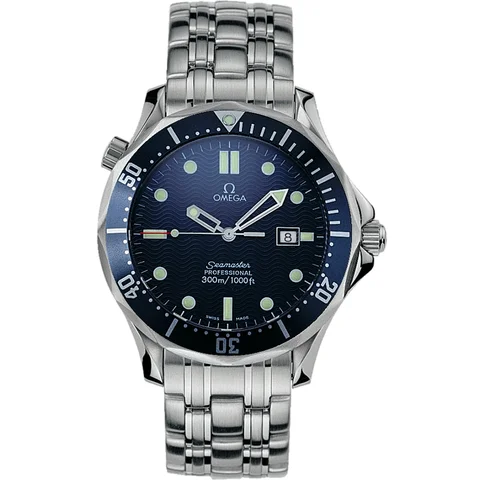 And so Omega has had a deal with the James Bond franchise for going on 30 years. But he has a bare wrist there.
And it's interesting because Robert Pattinson is a brand ambassador for JLC. And so they're thinking like it could just be, hey, for this launch image, he's still on his JLC contract. Let's not throw him in Omega. But then in the movie, maybe he can be, or maybe JLC wants to step in. And I believe that back in the books, James Bond wore a Rolex. And so Omega came into the movie series and said, this is a super valuable product placement.
We will pay up. Rolex was kind of like, well, we're getting the aura for free because we're in the books. Why would we pay? And I think that might have been the thesis between behind the bond sponsorship over time. So Omega models largely sit in a harsh part of the watch industry, the $8,000 to $10,000 price range. JLC's models tend to cost a bit more, but are still mostly in the mid-tier luxury range.
The K-shape economy19A K-shaped economy is one in which wealthy buyers get richer and keep spending while everyone else's incomes stall or fall, the two arms of the letter K. The term came into use during the recovery from the 2020 pandemic. For watches it means expensive brands hold up while the middle segment sags. is hollowing out this part of the business, so much so that one rival brand Zenith has decided to abandon it altogether to move up market. So you think he should go RM.20RM is Richard Mille, a Swiss brand founded in 2001 that makes lightweight sports watches costing from about a hundred thousand dollars to several million. The hosts joke that Bond should not step up to JLC but jump straight to the most expensive segment. I was going to say RM. Oh, RM. That would really get people riled up.
They need some controversy to really sell the new stuff. It sounds like he's still kind of like MTL mid-tier luxury so he needs to go kind of HTL.
Yeah. He needs to step it up with a Jacob & Co.
Sign up for our newsletter, tbpn.com. Leave us five stars on Apple Podcasts and Spotify, and we will see you on Friday. Have a happy Thanksgiving. Goodbye.


