


The a16z Show
Chapters
OpenAI had a strong model for biology but no product scientists could use it through, and Orchestra Bio filled that gap.
Read the chapter- Jiao names three pillars of OpenAI's life sciences work: train the best model, build the best product for scientists, and show what AI can do together with biotech and pharma.
- Models can do more than people get out of them, she says: ChatGPT made a model reachable through chat, Codex became a copilot for programmers, and scientists need something just as good.
- GPT Rosalind picked up chemistry and structural biology skills in training, but people did not even know which prompts to write.
- Rajendra recalls his father, a cancer doctor, hoping that his current treatments would soon be seen as barbaric, and says the model is already superhuman at understanding clinical information.
Rajendra walks through Rughani and Conde's three-D framework and shows that AI is needed for something different at each stage of a drug's path.
Read the chapter- In discovery, from target to IND, OpenAI wants to amplify expert drug hunters and capture tacit knowledge, such as why a molecule was chosen and what evidence argued against it.
- Development, Rajendra says, is about time, cost and piles of documentation, because the process is the product, and language models are good at unstructured information.
- For distribution he leans on ChatGPT: 1.2 billion users, 330 million of whom ask health questions.
Jiao argues that in biology the bottleneck is human attention rather than a lack of data, and teams of agents remove that limit.
Read the chapter- In math, Jiao says, 10,000 agents are thrown at a problem and Millennium Prize-level problems get solved, while biology problems are exploratory: the insight has to be pulled out of huge sequencing and high-throughput datasets.
- On a PerturbAI dataset of about 2,000 perturbations and 8 million mouse brain cells, 2,000 agents found a pattern humans had missed: two genes of the same protein complex affect one cell type differently, which matters for tuberous sclerosis.
- Rajendra says scientists are already running subagents in Codex and going back to their PhD data, and that what makes a great drug hunter is knowing what to do next.
- Jiao expects molecule design with AI to change a lot within three to six months, as models start to act like the 10 to 100 people in the world who can picture a protein's 3D shape from its sequence.
A well-designed trial cannot be made faster, but agents can keep it from veering off course and help find the right patients.
Read the chapter- Rajendra lists the work of a trial: protocol design, choosing and activating sites, patient subtypes, and data in the EDC, CTMS, EHR and TMF that easily drifts out of sync.
- Trials never go to schedule, he says: enrollment lags, responses are unexpected and adverse events appear, and people must dig through data across all the systems, which agents handle well.
- Matching patients to inclusion and exclusion criteria defeated the rules engines of ten years ago, and now ChatGPT can tell a patient, or a clinician with 20 to 25 minutes per chart, that a suitable trial exists.
Regulatory paperwork is where AI is being adopted fastest in life sciences, and the process itself could become continuous.
Read the chapter- Rajendra explains that an IND, a CSR or a BLA requires assembling an enormous body of knowledge no one can hold in their head, and today that is solved by adding people.
- This year's models, he says, have moved from helping you do it faster to catching problems and outliers before documents reach the FDA.
- Conde recalls paper filings driven to Washington in rented U-Hauls and asks whether the regulator is modernizing too.
- Rajendra sees encouraging signs at the FDA, such as getting to phase one sooner, continuous submission of trial data and AI in staff workflows, and suggests replacing one-off meetings like pre-IND with ongoing feedback.
Making drugs rests on tacit know-how and handwritten records, so Rajendra thinks CMC is ripe for agents.
Read the chapter- Rajendra compares tech transfer to a contractor with the recipe of a Michelin star chef: reading the recipe does not make you that chef.
- Agents can reconcile the developer's process against the CDMO's, read handwritten batch records and check parameters while batches wait for release in quality control.
- His example from a large pharma company: an agent sees that a refrigerator went out for three or four hours and works out whether that is tolerable, whether there is a systemic facilities problem and whether it will delay the trial.
Rajendra says the burden of insurance rules should not fall on a patient armed with ChatGPT, and OpenAI is starting to work with both sides.
Read the chapter- Rughani lists the paperwork between a drug and a patient: insurance, prior authorizations, denials that make no sense.
- Rajendra says people already use ChatGPT to prepare for a 20-minute visit with their doctor and to deal with insurers.
- Having worked at a Medicare company, he saw that even actuaries struggle with prior authorization rules, and that the system runs on blunt cost-containment instruments.
Jiao calls data one of the biggest bottlenecks in training, and in biology the most valuable data is clean and low-noise.
Read the chapter- According to Jiao, the same protocol in two labs gives different results, and knockdown experiments carry biases in how molecules are captured and read; sequencing and structural biology data are nearly noiseless, while electronic health records are very noisy.
- Conde describes a whole class of startups, data factories; Jiao says OpenAI is offered both raw experimental data and expert data with rubrics for post-training, and that it checks quality with simple tests for raw data and with another model for the rest.
- Jiao thinks the value of any one dataset decays exponentially while demand for data may grow linearly, and that biology will stay hungrier than coding because a human cannot be simulated.
- Rajendra advises founders of AI tools for life sciences to build plugins and connectors through MCP: work is moving into ChatGPT and Codex the way it once moved into Microsoft Office.
Back in the o3 era, the model found the cause of a disease where doctors had searched for years, because it examined every case with full attention.
Read the chapter- With Boston Children's Hospital, OpenAI gave o3 with deep research 300 to 400 unsolved cases that came with genomic sequences.
- Jiao tells of a girl who became sick at nine and waited 20 years for a diagnosis until o3 found the underlying cause.
- In another case the model decided the input file had too little information, went back to the raw sequencer reads, redid the analysis and named a cause, and follow-up sequencing confirmed it.
Trust in AI conclusions rests on traceable evidence, and protection against misuse rests on vetting organizations rather than prompts.
Read the chapter- Rajendra carries traceability and chain of custody over from life sciences: the model should compile supporting evidence so a human can check a conclusion faster than reaching it alone.
- Jiao explains that intent is almost impossible to read from prompts: a question about a plant disease could be a search for an exploit or ordinary research.
- So OpenAI gives full model capabilities through trusted access to vetted organizations such as Moderna, where scientists are already monitored by their employers, who track the provenance of every reagent and log everything a scientist does.
The guests expect foundational breakthroughs from the bottom of the stack of life up, but warn that neither the speed of biology nor regulation will go away.
Read the chapter- Jiao pictures a stack from physics to chemistry, biology and people, and expects Navier-Stokes-level breakthroughs first in atomic systems and then higher up, to a noise ceiling, probably within two years.
- Rajendra sees two versions of the future: one person founding a biotech and taking several programs to trials, and everyone in the industry working at the top of their license.
- Asked by Rughani whether one-person biotechs are coming soon, Rajendra answers, "Very much so, yes."
Quotes
On a cancer doctor's hope
“I hope that by the time that, you know, you get out of medical school, which I unfortunately never went down that pathway, but I think I've maybe made up for it now that we'll look at the treatments that I'm giving my patients, he's a cancer doctor, as being barbaric.”
Ashoka RajendraRead from 05:44On new data landing on a scientist's desk
“when the data lands back on your desk, you get this feeling of, you know, intense excitement. I was like, okay, there's like some insight in here. But then you also get this like paralyzing anxiety of how am I going to find it because this data set and the search space is so big.”
Joy JiaoRead from 13:36On the scarcest thing in science
“the what to do next and why is like the ultimate kind of scarce resource and like the most rare thing to find.”
Ashoka RajendraRead from 18:08On paper filings to the FDA
“I'm old enough to remember that when you filed with the FDA, you used to have to print everything out and you would load up thousands of documents and people would rent U-Hauls.”
Jorge CondeRead from 33:10On transferring know-how
“just because like I can read, you know, a recipe of a Michelin star chef's, you know, something that they're going to cook does not make me a Michelin star chef.”
Ashoka RajendraRead from 36:37On the value of data
“most data sets have a half-life. The type of data changes maybe the half-life, but I think there is in general an exponential decay in how valuable a data set is over time.”
Joy JiaoRead from 50:03On a model's attention
“no human clinician is going to have the time and attention to do this for every single potential mutation in every single patient.”
Joy JiaoRead from 56:05On the biotech of the future
“envisioning a world where one person can start a biotech company and launch many programs and get those to clinical trials”
Ashoka RajendraRead from 1:04:01
Summary
OpenAI's Joy Jiao and Ashoka Rajendra tell a16z's Jay Rughani and Jorge Conde how the company wants to speed up the whole path of a drug: in discovery, thousands of agents go through biological data that no human has time to read, and in trials, regulatory filings and manufacturing, agents take over mountains of documents. Jiao names noisy data as the main bottleneck, while Rajendra thinks one person may soon be able to found a biotech and run several programs at once, though AI will not change the speed of biology itself.
Advice
If you generate data to train biology models, aim for clean data: noise and biases of experimental methods compound, and a model trained on such data learns nothing useful.
If you sell data to an AI lab, expect it to be checked: raw experimental data is tested at once for signal and cleanliness, and post-training data is read and graded by another model.
If you build AI tools for life sciences, build plugins and connectors for ChatGPT and Codex: scientists' work is moving there, and it is easier to meet them where they are than to make them wire up scattered systems.
If you build an AI system for drug development, build in traceability: every conclusion should lead to supporting evidence so an expert can check it faster than reaching it alone.
Mentioned
- Karan Singhal01:36Rughani recalls his recent conversation with the head of OpenAI Health about medical intelligence in everyone's pocket; Rajendra points to talking with him as the reason he thinks the model already beats a human at reading clinical information.
 OpenAI02:14Jiao describes the three pillars of its life sciences work: the best model, the best product, and demonstrations of benefit with academics, biotechs and pharma.
- GPT-Rosalind03:32Rughani and Jiao discuss OpenAI's life sciences model: it has chemistry and structural biology skills, but people need a product to use them.
- Orchestra Bio03:32Rajendra's company, acquired by OpenAI: in Jiao's words, OpenAI had a model without a good way to use it, and Orchestra was building amazing products.
Show 22 more mentionsShow fewer mentions
 ChatGPT03:54Jiao calls the chat the first harness that made a model easy to talk to; Rajendra cites its 1.2 billion users and 330 million health questions as the basis for distributing medicines.
 Codex03:54Jiao wants to give scientists what Codex became for coders; Rajendra says scientists already run subagents in it and revisit their PhD data.
 Michael Polanyi08:55Coined the idea of tacit knowledge: Rajendra says this kind of knowledge, such as why a molecule was chosen and what data argued against it, is what a drug program most needs to capture.
- Millennium Prize Problems12:16Jiao points to math, where 10,000 agents take on Millennium Prize problems, and asks what the Millennium Prizes of biology would be.
- Navier–Stokes existence and smoothness12:16Jiao names the Navier-Stokes equations as a problem tackled by agent teams, and at the end predicts Navier-Stokes-level breakthroughs, first in atomic systems.
- PerturbAI14:34An OpenAI partner: on its in vivo Perturb-seq data from mouse brains, 2,000 agents, Jiao says, found a pattern tied to tuberous sclerosis that humans had missed.
 AlphaFold19:47The model that learned to predict a protein's 3D shape from its sequence: Jiao says only 10 to 100 people in the world can picture it in their heads, and models are starting to behave likewise.
- Flatiron Health26:51Rajendra recalls Rughani wrestling, early in the digital health boom, with matching patients to trials from clinical and genomic data; Rughani worked at Flatiron Health then.
- Food and Drug Administration29:49Conde and Rajendra discuss filing with the regulator: from trucks of paper to electronic filing, continuous trial data and AI in FDA staff workflows.
- U-Haul33:10Conde recalls paper FDA filings driven in rented U-Hauls; Rajendra picks up the image and proposes a regulatory process without a U-Haul of documents at the very end.
- Medicare41:22Rajendra worked at a Medicare company and saw that even actuaries struggle with the rules for prior authorization and payment.
- Tahoe Therapeutics47:17An example of a data factory, the class of startups Conde describes: they run mass experiments to produce datasets for training models.
 Scale AI48:14One of the suppliers of data from human experts, who, Jiao says, try to sell OpenAI descriptions of what a good answer looks like.
 Mercor48:14Another supplier of expert data for post-training, of the kind Jiao describes.
- HealthBench48:47OpenAI's medical benchmark, built on the rubrics Jiao talks about: did the model give background, cover the key points and state its certainty.
 Microsoft52:53Rajendra compares work moving into ChatGPT and Codex to how it once moved into the Microsoft Office suite.
 Model Context Protocol53:42Rajendra calls the plugin, MCP and connector ecosystem critical and urges founders to build plugins.
- Boston Children's Hospital54:22Conde asks about the joint project; Jiao tells how o3 reviewed 300 to 400 unsolved cases there and found the cause of disease for a girl who had waited 20 years for a diagnosis.
- OpenAI o354:44Jiao stresses that the diagnoses were found by o3, "many, many model generations behind."
- Deep Research54:44Jiao: Boston Children's Hospital gave the unsolved cases to o3 together with deep research.
- GPT-6 Astra56:51Jiao asks us to imagine what today's model can do if even o3 managed such diagnoses.
- Moderna1:00:42Jiao's example of a legitimate organization that, once vetted, can get full model capabilities because it makes vaccines.
Transcript
Introthe show's opening music
And so I think what happens when scientists are no longer limited by human attention. In this episode, a16z's Jay Rughani and Jorge Conde sit down with OpenAI's Joy Jiao and Ashoka Rajendra to discuss how AI could reshape drug discovery and development. They cover how thousands of agents can search biological data for insights humans might miss, how AI could compress clinical trials, regulatory work, and manufacturing, and why Ashoka believes we may soon see one-person biotechs launching multiple drug programs.
01Why OpenAI bought Orchestra Bio
OpenAI had a strong model for biology but no product scientists could use it through, and Orchestra Bio filled that gap.
Hi everyone, I'm Jay, a partner at a16z, where I lead investments in health and biotechnology companies. I'm joined by my partner Jorge, and we are joined by our friends Joy and Ashoka of OpenAI Life Sciences. Welcome.
Thanks for having us.
Joy, I want to dive straight into it. I was fortunate to have your colleague Karan Singhal,1Karan Singhal leads medical AI at OpenAI. Before that, at Google Research, he was one of the authors of the Med-PaLM medical models. His conversation with Jay Rughani came out on this podcast on October 20, 2026: Singhal explained why OpenAI teaches medicine to its general frontier models rather than to separate ones. the head of OpenAI Health, on the podcast just a few weeks ago, and we talked about the promise of medical intelligence at unlimited rates in everyone's pocket, which sounds amazing and seems like we're not too far away from happening. But even the best doctors in the world sometimes have to tell their patients that no treatment exists for the condition that they have. Tell us about the work you're doing at OpenAI. Are you optimistic that one day with the tools you're building, AI will help us identify and design a treatment for every condition out there?
Yeah, I think this is a goal that I would say most people in the field are the most excited about. I think zooming back out, what is OpenAI's general strategy and goal in the life sciences. And I would say there's really three pillars. The first is to train the best model. This is the thing that we have been doing since, you know, the very beginning. And then also to make the best product to accelerate the work of scientists and drug makers.
And that is where Ashoka comes in. And the third one is to really demonstrate these capabilities in collaboration with academics, with biotechs and pharma companies to showcase what real good that AI can do. So OpenAI's mission is to ensure that AGI benefits all humanity. I think the life sciences is one of the most unambiguous, uncontroversial good that we can do for the world and possibly the most impactful. And so we have made a ton of huge investments here in terms of both capital, head count, GPUs to train the models. So yeah, I think the North Star really is getting to a point where we can see we are meaningfully accelerating both basic academic science and really pushing the frontiers there and also seeing accelerated timelines and identifying targets all the way to bringing things to and through the clinic.
You all are building tools for scientists, Joy. You and your team have built a lot of the work around GPT Rosalind,2GPT-Rosalind is OpenAI's line of models for the life sciences. The first came out on April 16, 2026, as a reasoning model for biology, chemistry and drug discovery, and in September it left preview and became available to vetted organizations. It is named after Rosalind Franklin, whose X-ray images helped establish the structure of DNA (OpenAI). building a number of tools for scientists. And then the reason why Ashoka is here is Ashoka was the founder of Orchestra Bio,3Orchestra Bio is a platform where people and AI agents run drug development programs together: agents track studies and timelines, and when something breaks (say, a manufacturing batch is rejected), they work out which work and deadlines will slip. OpenAI announced the acquisition on October 20, 2026; the price was not disclosed (OpenAI). who was recently acquired by OpenAI, also to expand the amount of tools that you're making available for scientists. Tell us about the tools that you've been building and tell us why you acquired Ashoka's company.
Yeah, I think one of the biggest things that we see with models today is that there's what we call a capability overhang.4A capability overhang, in AI-industry talk, is the gap between what a model can already do and what people actually get out of it. Jiao's example is ChatGPT: GPT-3.5 models had been available to developers through the API before it, and it took an easy chat interface to put them in front of millions. And this means that there's a lot of things the models can do, but no one knows about it. And so no one has access to that. And so for example, thinking about the original AI product was like ChatGPT, that harness5A harness is everything around a model in a product: the interface, tools, access to files and commands, memory between steps. In a chat the model only answers; in the Codex harness the same model runs code and edits files itself. was basically a chat interface that allowed you to talk to the model so much more easily. And then we have Codex that was kind of the next iteration that allowed the model to both control your computer and also become a really good copilot for programmers. And what we really want to do is bring something that is as good as Codex for coders to scientists and to biotechs and pharma.
So I think when we are training GPT Rosalind, we have all these interesting capabilities in the model in both chemistry and structural biology. We see that the models are doing really well on the benchmarks. But one repeated thing we've seen is that people don't know how to use the models. They don't know even what prompts to use, what questions to ask. And I think this is really where you need a exceptionally good product or a good harness around the model to really make that capability accessible to people. And this is where Ashoka came in because I think we had a model, there wasn't a great way to use it, Orchestra was building amazing products.
I think we're very aligned in the roadmap of the future that we see for Orchestra and how to accelerate discovery and development. So yeah, that was kind of how we got connected.
Okay, so Ashoka, let's get you in the conversation. At Orchestra, you and the team built some amazing tools to help coordinate scientists with their partners and the work that's happening all in a single drug program and then work across drug programs. Why did joining OpenAI make so much sense and what's it been like working with Joy and the team?
Yeah, so kind of coming back to the mission of AGI to benefit all of humanity, I think when I think about my own personal life and experience, when I was younger, you know, my dad's a physician, and he said that I hope that by the time that, you know, you get out of medical school, which I unfortunately never went down that pathway, but I think I've maybe made up for it now that we'll look at the treatments that I'm giving my patients, he's a cancer doctor, as being barbaric. And I think we've seen such incredible advances in terms of new platform technologies,6Ashoka's father watched platform technologies change medicine: methods that yield not one drug but a whole series. An mRNA vaccine needs only a new sequence to become a vaccine for a different disease, and antibodies can be aimed at ever new targets. antibodies, mRNA, cell and gene therapies, and so on. And I truly believe AI is one of those capabilities.
The other thing that I learned growing up is just that the experience people have with the health system is so limited by the expertise of the clinician treating them.
So in my experience and the experience of probably many of my friends who have talked to my parents. They're world class. They give you the time of day. They understand your condition. And as you talk to Karan and the OpenAI team, it's the model is already superhuman at the ability to understand clinical information and to help scale the expertise of clinical care when we have a shortage of that. So in building and scaling Orchestra, my interest has been how do you push the frontier of drugs forward and how do you build technology that enables the industry to discover and develop drugs and focus on doing their best work.
And the opportunity to bring the capabilities of how you run studies and drug programs and campaigns and clinical trials alongside the bleeding edge model, where every three to four months there's just amazing new capabilities coming. I do think it's that inflection point of how can we bring the capabilities of running drug programs and clinical trials and other capabilities to the entire industry and make that really tightly knit with the model capabilities that we're developing as well.
02Discovery, development, distribution: three different jobs
Rajendra walks through Rughani and Conde's three-D framework and shows that AI is needed for something different at each stage of a drug's path.
Okay, so we've talked about the ambition to build the very best models and then deploy that in the very best harness and be available to scientists for whatever work they want to do. Let's talk about how to bring that to industry and where that will play out and all the things that you'll build. Jorge and I wrote a blog post7Conde and Rughani wrote about this in a16z's "Big Ideas" predictions for 2023: software is "eating" every link in the life sciences value chain, from discovery through development to distribution of new drugs. a few years ago about the opportunity for software and AI to touch every part of the life sciences value chain. And we used a cute framework from discovery, development, and distribution. And so we'd love to kind of use that to run through the conversation and understand what you all are going to do. So maybe Ashoka, I'll just go over to you.
How does OpenAI think about building tools across the three Ds that we mentioned in the life sciences value chain? Is it equal across the three? Are you starting in the earlier areas and moving later? Help us understand what to look forward to.
I think we have huge ambitions across all three areas, but we also have to recognize how different they are and how different the workflows are. So on the discovery side, if you think about from Target to IND,8IND (Investigational New Drug application) is a filing with the FDA for permission to test a new drug in people. "From target to IND" is the whole preclinical path: from choosing the protein a drug will act on to earning the right to start clinical trials. what we're really focused on is how do we scale and amplify the abilities of expert drug hunters?9Drug hunters is industry slang for scientists who find new drugs and carry them into the clinic. It is also the title of Donald Kirsch and Ogi Ogas's 2017 book about the history of the craft, "The Drug Hunters." And that comes in many, many forms. That could be model and other capabilities to that are that can perform highly specialized scientific tasks, like search through an enormous corpus of literature or analyze genomic data at scale, or even generate chemical structures and candidates. So there are core capabilities, but those things are tasks. And those tasks sit on a long chain of different studies, campaigns, and other workflows that all move up to an overall drug program.
And so creating not only the ability to help folks do these highly specialized tasks and maybe use superhuman ability of models to help amplify that expertise, but also make sure that that is actually orchestrating an entire workflow, be that a study or an entire drug program, and at every step of the way, capturing all of the evidence that's generated, particularly the tacit knowledge,10Tacit knowledge is a concept from the philosopher Michael Polanyi: what a specialist can do but cannot fully put into words. For Ashoka it is the reasons behind decisions, such as why this molecule was chosen and what data argued against it, which stay in people's heads rather than in databases. like the last wave of software as a service, companies that I have worked in really helped in structuring and storing the information. But all of that tacit knowledge, like why do we select that molecule? What are some of the counterfactuals or the confounding evidence against this claim? All of that is really what comprises the chain of evidence that advances you through the early stages of discovery. So what can we do to help you manage that at scale and also run a lot more experiments concurrently to explore wide space in less time.
Development is really about time and cost. When you think about regulatory submissions, manufacturing and clinical, this is where you're touching patients. So the regulation and the quality is incredibly important. But what that turns out to in practice for the industry is massive, massive, massive piles of documentation, which is critically important because again, the process is the product.11"The process is the product" is a saying in biologics manufacturing: a protein drug cannot be fully described by testing the finished substance, so the regulator approves the way it is made along with it, and any change to the process has to be justified again. How do you know that you're putting in the right drug that passed the quality bar to admit it to the right patient at the right encounter and the right dose? So there's a lot of opportunity and LMs are phenomenal at understanding unstructured and semi-structured information.
So we find a lot of opportunities in compressing time to do things like regulatory submissions, monitor and track what's going on in your clinical trials. And then lastly, when we get into distribution, this is where it's, you know, exciting to collaborate with our partners on the health side of OpenAI because, you know, OpenAI has 1.2 billion users of ChatGPT, but 330 million of those users are asking health questions. On the consumer side, on the clinician side, on the payer side,12Payers are those who pay for care in American health care: insurance companies and government programs such as Medicare and Medicaid. Their decisions determine whether a new drug reaches patients. all of these groups suddenly have access to a capability that can reason through a lot of the complexities of clinical medicine. So, you know, some of the ways that, you know, medicines are distributed is like, did you go to the right conference? Did you read the right paper? Did you hear the right thing?
You know, I think there's a lot of opportunity to really upend how people get the right treatment at the right time for the appropriate diagnosis.
03Discovery: thousands of agents instead of limited attention
Jiao argues that in biology the bottleneck is human attention rather than a lack of data, and teams of agents remove that limit.
You know, if we dig in on the discovery piece for a second here, cause I spent a lot of time in biotech and to me this is the most, you know, promising and fascinating area for, you know, superhuman intelligence, the superhuman intelligence that AI can bring us can really have to bear. But like if we tease it apart, the name discovery, the implication here is that the fundamental unit of what matters here is an insight. How do we generate an insight? And how do we actually make decisions that will help us advance that insight into something that will ultimately be impactful in the form of a medicine?
So if we think of discovery in its sort of most basic way, when you think about product, you talked about Codex. When you think about the product that a scientist could have alongside them to enable and to support this, call it search for a unique insight. Where are we today? Where is OpenAI today in terms of product and supporting scientists in that endeavor.
I think something that I personally find incredibly exciting is, you know, the math results13On September 8, 2026, OpenAI announced that about 10,000 agents of its internal model had, in 88 hours, solved the Navier-Stokes problem: they proved that for a well-chosen smooth external force, a solution of the equations can lose smoothness in finite time. The Clay Institute has not recognized the problem as solved: by its rules a solution must be published and survive two years of scrutiny. that have been rolling out, right? These kind of agent teams that, you know, deploy 10,000 agents to throw out a problem. And because math is verifiable, you can verify also partial progress. You can solve incredibly complicated problems like the Millennium Prize problems,14The Millennium Prize Problems are seven mathematical problems for each of which the Clay Mathematics Institute set a million-dollar prize in 2000; only one, the Poincaré conjecture, has been officially solved. The Navier-Stokes equations describe the motion of viscous fluids, including turbulent flow. The picture shows a turbulent jet in false color, the kind of flow these equations describe. Navier-Stokes, et cetera. And I think, you know, there's a natural question that comes from that was like, when are we going to see something similar in biology? And, you know, what are the millennium Prizes in biology?
I think biology tends to have a very different form of problem than math, and that a lot of things are really exploratory. And I think, you know, since the last 10, 20 years, we've had a huge amount of data generated from next-gen sequencing,15Next-generation sequencing (NGS) reads millions of DNA fragments in parallel: in two decades the cost of reading a human genome has fallen from millions of dollars to a few hundred. High-throughput assays are automated experiments that test thousands of samples or compounds at once. from high-throughput assays. And I think the limiting factor has actually been like gaining insight from this massive amount of data and not necessarily just, you know, not having enough data, which is like a very different regime from math, right? Where just here is a question statement and I need you to prove this question statement.
That's fascinating. So you think that the answers are there? We have the data, the answers are there, it's just a matter of applying enough superhuman intelligence to the task.
Yeah, I mean, it's not always there. I think there are definitely some data sets where the answer is there, but it just, you know, human attention span is limited, right? And, you know, in my past life, I did a PhD in systems biology16Systems biology studies the cell as a network of interacting genes, proteins and metabolites rather than one molecule at a time, so it depends on large-scale measurements, the same high-throughput data Jiao has just mentioned. and I've also generated some of these high throughput assays. And then when the data lands back on your desk, you get this feeling of, you know, intense excitement. I was like, okay, there's like some insight in here. But then you also get this like paralyzing anxiety of how am I going to find it because this data set and the search space is so big.
And I think we're entering a different regime now where we have these tens of thousands of agents that can go after every single possible hypothesis in this data set. And they can also talk to each other. They can talk to the humans. And I think for the first time now, we are no longer limited by human attention. You can pay attention to everything in this data set and squeeze all the juice and insight out of them. And I think that is one of the applications that I find to be really exciting.
ExplainerPerturb-seq: thousands of genetic experiments at once
The method was devised in 2016 in the labs of Aviv Regev and Jonathan Weissman. A set of CRISPR guide RNAs is introduced into cells: each cell gets one, switches off one gene and carries a barcode that identifies that gene later. Single-cell sequencing then reads both the barcode and the activity of all the genes in each cell. The result is a huge table of "which gene was switched off → what changed in the cell," thousands of experiments in one.
In vivo means not in a dish but in a living animal: PerturbAI switched genes off directly in mouse brains and obtained an atlas of about 8 million cells of different types. This is the table Joy describes: a human would have to go through it perturbation by perturbation, while agents split it among themselves.
And this, you know, has to do with, you know, for example, the work that we did with Perturb AI,17PerturbAI is a startup whose founders include the neuroscientist Xin Jin of Scripps Research. On October 21, 2026, OpenAI, PerturbAI and Scripps Research announced that thousands of agents running on GPT-Rosalind had analyzed the company's atlas in 32 minutes; by their estimate humans would have spent anywhere from several months to a year on such an analysis (OpenAI). which has been one of our early collaborators, where they did this in vivo perturbation seek in mice brains, and we got, I think, 2,000 perturbations, 8 million different cells, which is just like such a massive data set. And when we threw 2,000 agents at this problem, some of the insights that it found were not found before when humans did a manual pass. And this is like many, many months of human work. An example is, for example, two different genes that work together in the same protein complex. And we found that if you knock down both of these genes in most cell types, they have similar outcomes, but in one specific cell type, one of these genes, you knock it down, a bunch of things change, the other gene, you knock it down, nothing changes.
And so this has implications for basic biology and also for a specific disease, in this case it's tuberous sclerosis.18Tuberous sclerosis is an inherited disease: benign tumors in the brain, skin and kidneys, often epilepsy and learning difficulties. It is caused by mutations in the TSC1 or TSC2 genes, whose proteins together restrain mTOR, a regulator of cell growth. The agents noticed that in the cerebellum knocking out Tsc2 changes the activity of dozens of genes for signaling between neurons, while knocking out Tsc1 changes almost nothing; in patients, cerebellar involvement is also more strongly linked to TSC2 mutations (OpenAI). But imagine how long it would have taken for a grad student to find that pattern out of this like 8 million cell by 2000 gene matrix. So I think this is, you know, just a new regime now where we can get all of these insights that are living in the data set just by scaling tokens and agents.
And is that already reflected in product? Like if I'm a scientist today, do I have access to this capability if I'm a wet lab scientist at pharma company X?
Yeah, not necessarily with the 2,000 or 10,000 agents yet, but you know, certainly like the ability of a scientist using Codex to use many, many subagents,19Subagents are helper agents to which a main agent hands out parts of a task: each works in its own context and reports its result back to the main agent. you know, even an agent orchestrating many other agents.
I think that's probably been one of the fastest adoptions in the use of things. It's that, you know, a tool ostensibly that's amazing at software engineering can suddenly allow so many different scientists to explore such a wide space of data that they have. I think you've, you know, seen a lot of exciting results where people go back to the data they looked at from their PhD or other experiments that they've run. And they were sort of limited by, you know, what are the number of hypotheses I can put through and the number of analyses that I can actually run. So even without this full, you know, team of thousands of agents.
I think we're already seeing that. But it does, you know, in our collaborations, we're seeing a lot of exciting promise when you scale that up massively.
And one of the things that, you know, if we talk about insights, one of the fascinating things about, you know, your average discovery effort is, because so much of it is about trying to navigate through uncertainty, one of the biggest sources of value is knowing what to do next. So you have a hypothesis, you run an experiment, you get a result, you generate, you know, you analyze a large data set, you generate a novel insight. The what to do next question is always, you know, in some ways, that's really what makes a great drug hunter a great drug hunter, is they know what to do next. Are the tools capable of helping the average scientist today think through the what to do next challenge when it comes to discovery?
Yeah, I mean, I think that's why we think about like amplifying the expertise of folks, where, you know, those same folks who are looking through these really complex data sets, and then in deciding what to do next, their own skill and their own taste, they're like, you know what, I really want to like look at the literature. I really want to talk to a world class expert. I really want to do this. And we can really amplify that expertise by saying, okay, you want to look at the literature. What if you looked at, you know, a thousand papers or 5,000 papers?
What if you looked at, you know, experts and groups that you had never even thought of? What if we looked through the whole corpus of knowledge, you know, on the internet and things like that, or, you know, on the kind of harness side, what about all the other experiments that you actually ran? And the accumulated knowledge you have internally? So I think that's where, you know, ultimately the what to do next and why is like the ultimate kind of scarce resource and like the most rare thing to find. That's what makes an outstanding scientist, an outstanding drug hunter. So we view the tools and systems today as great amplifiers of that.
And I think, you know, you will see, you know, a huge breakthrough when you get to the point at which, you know, some of the best in the field are like, wow, that's a novel insight that, you know, I don't know that would have come up with myself.
Okay, so just at a very high level, the challenge of discovery, right? And we talked about it. It's, you know, you're looking for a novel insight, you're trying to figure out what to do next. But at a very high level, it's really, there's two parts is you're trying to figure out what to target to have an impact on disease. And then you're trying to figure out can you design a molecule that will hit that target and to have the appropriate clinical effect, right? At the earliest stages of discovery, those are the sort of the two giant questions.
What do I target and can I make something to hit that target in a safe and effective manner? And then the rest of the Ds are about, you know, actually proving that out.
Where is OpenAI today in supporting the ability to help find the target or make and design the molecule that will hit the target.
Yeah, I will say that a lot of the work and kind of the target discovery side is similar to, you know, the agent teams work that we were talking about, where now you can get all these insights that you otherwise wouldn't be able to just because you're able to now pay infinite attention and just maximally do test time scaling20Test-time scaling: the more tokens a model spends reasoning when it answers, the better the result. This is how reasoning models work, and a team of agents multiplies that budget by the number of agents. on the number of tokens that you can spend on a problem. I think once you have a target and it comes to more on the molecular design part, I think it becomes a much more concrete optimization problem, which is also interesting in a different way, because now you can think about, you know, can the model orchestrate these different chemistry or specialized protein design tools to make a new protein. I think something that is even more interesting that we're starting to see glimmers of is the model's ability to act like, you know, these probably 10 to 100 people in the world that can kind of look at a protein sequence, just like the primary letters of a protein21A protein's primary structure is its sequence of amino acids, written in the 20-letter alphabet. The sequence determines how the chain folds into a 3D shape, and the shape determines what the protein binds to; predicting the shape from the sequence is what Google DeepMind's AlphaFold learned to do.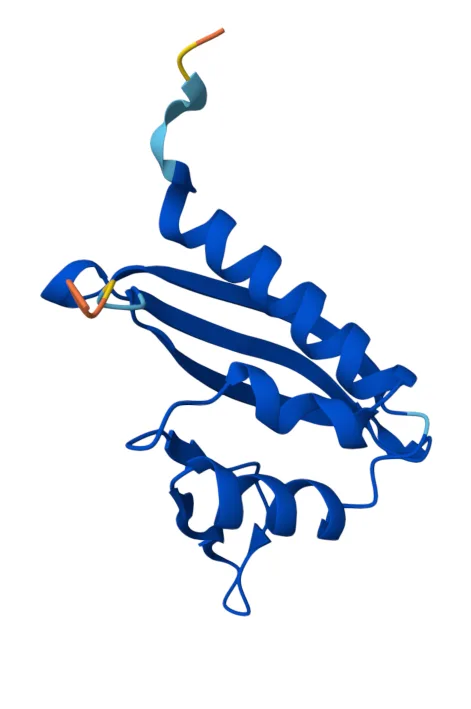 and visualize the 3D structure in their head, or they can look at a molecule and say, okay, this particular product molecule is a liability or we need to change it in this special way to bind to the protein better.
These capabilities is what, you know, starting from the very beginning, what we want to build into Rosalind. And I think, you know, starting to see these things emerge out of our internal model training is, I think, one of the most exciting things of the last few weeks that I've seen. And so I think, you know, the way that we design molecules with AI, I think is gonna change a lot in the next, I would say, three to six months.
Okay, excellent. So to synthesize, you're really describing two sets of capabilities. One set of capability, which is scaling the throughput of human capacity. So you're talking about 1,000 agents, 10,000 agents that can do the work of 10,000 grad students, but do it in a matter of seconds. And then the second set of capabilities that you all are describing are around superhuman capabilities. You know, maybe there is one or two drug hunters in the world that can visualize a protein and think about liabilities in the structure and so on and so forth and make suggested edits, but that's not the capability of an average human.
04Clinical trials: keeping them on track
A well-designed trial cannot be made faster, but agents can keep it from veering off course and help find the right patients.
Let's say, let's use that lens to talk about development. So the next D is all about once you've got a promising scientific hypothesis, you want to test the safety and effectiveness of that therapeutic candidate in mammals and then in humans. And so let's talk about the complexity of trial work. And Ashoka, I'm curious from a harness perspective, what are some of the tools that you're looking to build for clinical development folks in pharma and biotech who are designing clinical trials, what are some of the tools that those folks can look forward to?
Yeah, it's a great question. And I think, you know, clinical trials and clinical development is this, you know, massive set of activities. It's where most of the money is spent. You know, it ranges from things like, you know, how do I design the protocol for the trial itself and how do I, you know, scan the corpus of all the trials that have been run to date and all the publications and collaborate with a number of individuals to triangulate to the appropriate protocol and trial design. Then there's, you know, where am I going to run this trial? What sites should I use?
What are the patient populations that I should be subtyping in order to enter this trial in the first place. How do I get those sites activated? A lot of the work in clinical trials is externalized to other partners, and there's a lot of work that sponsors need to do to maintain oversight of everything that's going on at the sites, everything that's going on with the patients in the trial itself. Then you get into like the day-to-day clinical operations where depending on the structure of the study, you may be looking for, you know, purely safety signals. It could be, you know, like a, you know, trial where you're looking for safety and some early efficacy signals. Then you want to use that to design your phase twos and threes.22Ashoka describes an early trial whose results are used to design the next two phases. In phase I a drug is tested for safety and dosage in 20 to 100 volunteers, in phase II for effectiveness and side effects in several hundred patients, and phase III confirms the benefit in 300 to 3,000 patients (FDA).
And running the day-to-day operations of that trial is a massive effort and endeavor, both on the folks on the sponsor side trying to monitor everything that's going on against the protocol, but then on the trial site side, where there's a lot of rote work that needs to be done in compliance with SOPs, in compliance with the protocol, spanning all these different systems, the EDC, the CTMS, the EHR, the protocol, the TMF,23Ashoka lists the systems between which trial data drifts apart. EDC (electronic data capture) is the electronic forms where sites enter patient data; CTMS (clinical trial management system) manages sites, schedules and budgets; the EHR is the hospital's electronic health record; TMF (trial master file) is the trial's core document archive, which regulators inspect. and every three and four letter system. It's an enormous amount of work and it's really easy for that work to get out of sync with one another, to, you know, for the data to not agree, all of which impacting, you know, your ability to use that data in a statistically valid way to understand the efficacy of your treatment. So in every single step in that process, we're working closely with different partners in industry, biotechs and large pharma organizations, CROs and CDMOs,24These are the contractors to which, Ashoka says, a large share of the work is outsourced. CROs (contract research organizations) run clinical trials on a sponsor's behalf, from choosing sites to monitoring and statistics; CDMOs (contract development and manufacturing organizations) develop the manufacturing process and produce the drug. trying to develop what are the product capabilities that you need in each.
But, to use, as an example, you know, what, you know, Joy mentioned of like how can scaling compute and scaling what agents can do help in a day-to-day basis, that could be as straightforward as, you know, what is the attention and oversight required. You have a protocol, you have an enrollment target, you have all the things that you expect to happen in terms of the schedule of activities, but that's never how the trial actually goes. You know, your enrollment could be off, you know, at your sites. The actual response that they're getting to the treatment might be unexpected. You may have adverse events25An adverse event is any worsening of a trial participant's health, even when it is unclear whether the drug is to blame. Each one is recorded and reviewed, and the sponsor reports serious, unexpected events that may be related to the drug to the FDA within 15 days. that you need to triangulate. And doing all of that work requires people to dig into and analyze a huge amount of data split across all these different systems.
And that is something that agents can be really, really good at. And, you know, can we make a trial that is well designed happen faster? There are limits to biology. So the answer is no on that, but there's a lot that you can do to prevent it veering off track. And so many trials don't actually finish on time, you know, because of enrollment issues, because of, you know, issues with their sites. So how can we really like scale the expertise and the operational capacity for people to run trials at scale?
And that's where we see, you know, as an example, a big opportunity.
Source: BIO, Informa Pharma Intelligence, QLS: Clinical Development Success Rates 2011–2020
So Ashoka, so as you just said, you know, clinical development is the long pole in the tent when it comes to getting a drug to a patient. It's where we spend the most time, it's where we spend the most money, and it's where we make the most, where we find out we've made the mistakes, right? Where things fail, right? That's where you know, that is, these are the big, costly, expensive failures. One would think that the potential for AI to make that process more efficient, the potential for that is enormous. So the first question I would love to ask you guys is given all of the complexity here, where are we starting to see some inroads with where AI has proven to be helpful in making this a more efficient process.
So one way to think about it is like three areas. So can we design better trials? Can we get the right patients into the trials? And then the third is like, can we reduce the operational burden that it takes to actually execute that trial? So, you know, I just recently just talked about that third one, but maybe this middle one. So we talk about enrollment of folks into a trial.
And, you know, I remember 10 plus years ago, the, you know, the digital health, you know, boom was kind of, you know, at its earliest innings. And, you know, as I'm sure Jay26Ashoka alludes to Jay Rughani's past: before a16z he was one of the first employees of Flatiron Health, which built electronic health records for oncology and gathered real-world clinical data from them; Roche bought it in 2018 for about 2 billion dollars (a16z). has met many a late night trying to figure out, you know, how do we get this clinical data and this genomic data and how do we match patients to trials? And you go to any conference and like, you know, the number of patients who are actually in trials versus who want to be in trials, and it's a really, really complex reasoning problem where some of the tools in the toolkit that we had, you know, 10 years ago were, you know, extracting all this information, you know, handwritten rules and rules engines to try and match people to the trials.
And it really wasn't able to, you know, get to the complexity of like the inclusion-exclusion criteria,27Inclusion and exclusion criteria are the protocol's conditions for who may take part in a trial: type and stage of disease, prior treatment, lab results, other illnesses. Checking a specific person's history against them is exactly the reasoning task that, in Ashoka's words, rules engines could not handle. you know, where the patient was on their journey, how you match that against the protocol and things like that. So that's something where we see immense opportunity. Again, given, you know, the huge user base that we have in on the consumer side, given, you know, the use of ChatGPT in clinical settings, bringing that together with what is happening on the clinical trial side, because, you know, just getting the patients enrolled into the trial in the first place can be one of the single biggest determinants of how long it ultimately takes, and did you get the right population for the cohort that you were looking for? So that's one where I think we've actually seen a step function change in, you know, you can't just like fit everything into a relational database table to match somebody to a clinical trial.
That's why these inclusion-exclusion criteria are there. That's why you need experts reviewing them. But I do think that we are at the point where we can make a big leap in terms of the ability to get and screen people for their eligibility and bring the consumer and enterprise side of our business together.
That's fascinating. So there's a world where ChatGPT could help a consumer realize that there's a trial that they would be a match for.
Yeah, it could be the consumer themselves. It could be the clinician who, again, when you think about when they're looking at their chart and they have 20 minutes or 25 minutes and that scarce time, you know, the same system that can pull, you know, all their encounters and their problem lists and so on can also be searching through not just the literature, but what's going on at my academic medical center28An academic medical center is a hospital affiliated with a medical school, where patients are treated, doctors are trained and clinical trials are run. That is why a system that knows a patient's history could also see the trials open at the same hospital. right now based on the progression somebody has had in this disease, where, you know, it's really just the scarcity of physician and clinician time, right? And how could that be teed up as something that, you know, a clinical trial coordinator could get in as somebody to screen for their eligibility of a trial? And then there's a whole set of workflows downstream of that.
All of that gathering of evidence and information to clear through that. That is something that feels, you know, quite possible with the model's capabilities today. And there are different opportunities on, you know, the pharma side, sponsor side, as well as the academic medical center side, and health system where we can bring these two sides closer together.
05Regulatory filings: from a truck of paper to continuous submission
Regulatory paperwork is where AI is being adopted fastest in life sciences, and the process itself could become continuous.
Yeah, so maybe let's take the next step downstream from that. So you've designed a clinical trial, you've enrolled it successfully, you know, you run the clinical trial experiment, you've generated the necessary data. Now you have to take all of that and document it and submit it to the, to the regulatory authorities, for approval, in this case, the FDA. So two questions there. One is, for the listeners, talk through how painful and painstaking the process for assembling all the documentation necessary for regulatory filing is. And the second part of that question is, and you know, where do we see the obvious leverage that we can get from artificial intelligence?
ExplainerDocuments on the road to approval
Before the first trial in humans, a company files an IND with the FDA: preclinical data, manufacturing information and the trial protocol. If the FDA does not object within 30 days, the trial can begin. After each trial a CSR (Clinical Study Report) is written, a detailed account of its methods, patient data and statistics.
When all phases are done, the company asks for permission to sell the drug: small molecules go in an NDA (New Drug Application), biologics in a BLA (Biologics License Application). The application includes reports on all trials, preclinical data and a manufacturing section. The standard review time for a new drug is 10 months after the FDA accepts the application for review, and 6 months for priority review.
Yeah, it's a great question. So, you know, the regulatory process, whether you're submitting your IND, you're creating the CSR from your clinical trial, you're trying to submit your BLA, is this moment in time where you need to collect all of the knowledge and all of the findings and all of the know-how into something that is legible for regulators. So it's an incredibly painful process because, again, you're talking about managing this enormous corpus of human knowledge that no single person or set of persons can keep in their heads. So what we do with that today is scale the ability to manage that context by scaling the number of people involved. So it's fundamentally people and time, and it's how you documented the processes leading up to it, how you can organize that information, knowledge, how do you present that to regulators?
And that is also something that large language models specifically are extremely well attuned for. How can you reason over large amounts of structured or semi-structured, unstructured, or semi-structured information to compile it into this package of evidence and organize this information at scale is where you both need the model to be able to interpret that information, but also this harness and context layer to manage that information at scale. So I think what we see in life sciences broadly is that's where you've seen some of the fastest uptake because there is one, the technology matches the problem. Two, it is something where the ability to manage this context at scale can be radically accelerated and compressed. And three, there is a huge benefit to all parties involved. Nobody's rushing through this.
What they're actually looking at this is how do we scale the ability of our teams to ensure we have documented and recorded and submitted everything accurately to an appropriate quality threshold because ultimately doing that is both a speed thing. How do we get to market faster? But it's also a quality thing because as much as you scale that human attention, what are you missing? And I think particularly with models that have come out this year, you've sort of at that tipping point from you are helping me do something faster to you are effectively scaling my team's ability to catch problems, and issues and outliers and things like that that need to be reconciled before they go in front of the FDA.
So I'm old enough to remember that when you filed with the FDA, you used to have to print everything out and you would load up thousands of documents and people would rent U-Hauls.29Conde is recalling the paper era, when an application to approve a drug filled so many boxes that it went to the FDA by truck. U-Haul is the American chain that rents out moving trucks and vans. They used to take photos of this and they would like drive it down to D.C. it was wild. Obviously we don't do that anymore. The other thing that's true, though, is that all of the potential here for AI in generating the regulatory submissions is there. The FDA has signaled they want to modernize and they want to also deploy technology to review, evaluate, and ultimately, you know, help render a judgment on whether you approve or not a regulatory submission.
From your vantage point, are you seeing the regulatory agencies moving in that direction to enable efficiency to come on the evaluation side as well?
Yeah, I think like there are, you know, certainly, in recent years, the FDA has looked at a lot of different levers to pull, right? You know, how do we ensure US companies can get to phase one trials sooner? How do we, you know, do maybe continuous submission of data for clinical trials30The FDA announced continuous data submission in April 2026: in pilot trials by AstraZeneca and Amgen, signals on pre-agreed safety and efficacy measures go to the agency as they appear rather than after the trial ends (FDA). instead of waiting till the end? And then, you know, a willingness and openness to use AI,31In June 2025 the FDA launched a generative AI tool for its staff called Elsa: it helps reviewers and inspectors go through trial protocols, speeds up scientific review and suggests which facilities to inspect first (FDA). you know, in the workforce of folks in the FDA. So I think we're seeing a lot of promising signals there. And I think you've also, you know, hit the nail on the head of like, you know, we went from like a U-Haul filled with documents to, you know, electronic submission of documents.32Electronic submission: since May 2017 the FDA has accepted marketing applications (NDAs and BLAs) only in the electronic eCTD format, and since May 2018 commercial INDs as well (FDA).
But really now we're moving into, you know, what are people doing, you know, with their team plus their teammates in the form of agents to help generate and aggregate this. But, you know, on the regulatory side, I think it's, you know, a really exciting opportunity for the regulators to up level their own capabilities. How do they search for the needle in the haystack problems that they're looking for, how can you make this a much more continuous process? You know, you have things like, you know, have your PIND meeting33Ashoka gives it as an example of regulator feedback arriving at isolated moments. A pre-IND meeting is a consultation with the FDA before an application is filed: the company presents preclinical data and the plan for the first trial and gets comments. and your IND meeting, you have these like singular points in time where you provide feedback. So I do think there's opportunities to make the regulatory process rather than like a single point in time a more continuous process because, you know, you were sort of bounded by how much effort it took to do before.
And there's a lot of work to do to make these systems, you know, really reliable to the point at which, you know, you have these human experts, with their teammates. But I do think we should start thinking about different paradigm that is much more continuous and iterative, rather than a U-Haul full of documents that you get at the very end.
06Manufacturing: the chef's recipe and paper batch records
Making drugs rests on tacit know-how and handwritten records, so Rajendra thinks CMC is ripe for agents.
So the last, the last big sort of boulder to break when you're thinking about development is manufacturing. And manufacturing is extraordinarily complex, as many of the steps in the process of making a medicine are. The complexity there is also it's a very expensive part of the process, right? Companies invest an incredible amount of money in getting their manufacturing processes right and making sure that they meet, you know, the regulatory requirements, for ultimate approval. Any mistake, and you talk about this in your experience with orchestra bio, any mistake in the manufacturing side of the house can have ripple effects or even tsunami-like effects on delaying clinical trials, delaying approvals. You talk a little bit about what you saw in the trenches and what can go wrong with respect to manufacturing and what AI can help make things go right.
Yeah, absolutely. So, you know, folks in the industry are really familiar with like, how do you transfer knowledge between parties and groups, right? And we talk a lot about managing context at scale managing information at scale. And, you know, to use an analogy, you know, just because like I can read, you know, a recipe of a Michelin star chef's, you know, something that they're going to cook does not make me a Michelin star chef.
I tell that to Jorge all the time. So so when you think about the manufacturing of biologics, small molecules.34Small molecules are conventional chemically synthesized drugs, like aspirin; biologics are antibodies, other proteins, vaccines and cell therapies, made by living cells. These are the most incredibly complex set of recipes, procedures, and know-how that increasingly for cost and speed reasons are being externalized to CDMOs, you know, domestically and overseas. And the trade-off of that is you need to take your knowledge and know-how of what worked at lab scale or at pilot scale, you know, the equivalent being like in your kitchen or in a restaurant and get that to clinical trial scale and commercial scale. So, you know, in manufacturing, there is the tech transfer process.35This is the "chef's recipe" of Ashoka's analogy. Tech transfer is moving a worked-out manufacturing process from the developer to a contractor's plant or to a larger scale: documents, assay methods and trial batches proving that the same product comes out at the new site. How do I take my know-how and transfer it to this other organization? Then there is the actual manufacturing runs required to get these batches created and into clinical trials.
And then lastly, the scale up for actual commercial launch. And at every step in the process, you need to constantly surveil every single parameter of every single component of your process, how people physically move in the facility, the environmental signals, every single thing people scribble down, you need to be constantly surveilling and monitoring that. So that is a prime example of where agents can help because when you think about you're transferring your process to another organization, you're trying to do this reconciliation and gap analysis effort of what can we do and what can they do, and meticulously reconcile your process that works to their process that they're trying to replicate or scale up. Then when you get into just the manufacturing of the batch, there are so many instances, you know, even in cell therapy,36In cell therapy, such as CAR-T, a batch is often made from the patient's own cells, and several weeks pass between collecting the cells and infusion. While a batch waits for release after quality review, the patient waits for treatment. where the batches could be waiting in quality control and they're not released yet to patients because you need to go through a very meticulous process of reviewing all the different parameters and attributes that were recorded in the manufacturing of this.
So agents can help with things like, look, today a lot of manufacturing is on paper batch records,37A batch record is the production log of a specific batch: every step, time, temperature and operator signature. Before release, the quality unit reviews it in full; at many plants, as Ashoka says, it is still filled in by hand. reading the handwriting, looking through all the different parameters, reconciling that against the established ranges, but then doing investigations, figuring out, you know, we had a temperature deviation. And an example that somebody at a, you know, well-known pharma said is like, how do we know if a temperature deviation in a refrigerator issue can delay our clinical trial? And it's like, well, what do you mean by that? Well, if an agent scans through and sees that you had a temperature deviation where, you know, the freezer went out for a refrigerator went out for three or four hours, do we have data to know that that's tolerable? And in fact, do we actually have a facilities issue?
And if we have a facilities issue, that might be a systemic problem that we need to address where we need to possibly rerun this batch. We need to solve this facilities problem. All of that can converge in delaying a batch being ready for the trial itself. So you're tracing through complex procedures and a corpus of knowledge of how do we run a very precise process at scale properly within the appropriate tolerance ranges. And this, I think, a lot of attention has been placed on clinical and regulatory, of course, but I think CMC38CMC (Chemistry, Manufacturing and Controls) is the section of an FDA application describing how a drug is made and tested, and more broadly the whole manufacturing side of development that Ashoka has been describing. is actually an area that is very ripe for agents to make a big impact.
07Insurance and approvals: the patient should not have to figure it out alone
Rajendra says the burden of insurance rules should not fall on a patient armed with ChatGPT, and OpenAI is starting to work with both sides.
So across both discovery and development, I feel like we've talked about an extraordinary data problem and how AI and reasoning models can help parse through enormous amounts of data, as well as enormous amount of paperwork, certainly in regulatory, manufacturing, clinical trials. It's a lot of human paperwork that's done that AI is just very good at doing. And you all are, it sounds like, building tools to help researchers and drug developers across the value chain deal with a lot of paperwork. When we talk about distribution and distributing a medicine to patients, there's a lot of paperwork that patients have to go through and physicians have to go through in getting access to the medication, insurance, paperwork, prior authorizations,39Rughani gives it as an example of paperwork between a patient and a drug. Prior authorization is a rule of American health insurance: a doctor must get the insurer's approval in advance for an expensive drug or procedure, or it will not be paid for. denials that don't make sense, and so on and so forth. When you all look at the medicine distribution part of the value chain and you think about tools that you're going to build, what can consumers look forward to from you all on solving the distribution problem?
Yeah, I mean, I think like one of the things is that consumers are already using the tools like so extensively in how to get the care that is appropriate and relevant for them. So many, many folks will use this to prepare for how do I talk to my doctor about this condition I have. And one of the biggest problems is even translating the symptoms that they have into something a doctor in a 20-minute encounter can understand and triangulate to what's actually going on. But from there, they might need to navigate insurance. And I worked at a Medicare company.40Medicare is the US federal health insurance program for people 65 and older and some younger people with disabilities. Many enrollees get it through private insurers (Medicare Advantage plans), each with its own rules for prior authorization and payment. And when you sit around a bunch of brilliant actuaries who they themselves are struggling to understand all of our prior authorization rules and our benefits and how people can use them.
How would the average person who is not an actuary navigate the, you know, the benefits that they have and how to get their care reimbursed? So I think there's a lot of organic usage and adoption of the system of, hey, I have, you know, this medicine that I want to take or the procedure, you know, maybe I had an insurance denial, like, and oftentimes I think the entire system is engineered with very, very blunt instruments41By "blunt instruments" Rajendra means the ways American insurers restrain use of care, above all prior authorization. In 2024 Medicare Advantage insurers made almost 53 million such determinations; denials were appealed in only 11.5% of cases, and 80.7% of appeals ended with the denial overturned (KFF). where, you know, we are going to throttle utilization or we're going to make sure that this is justified. And these very, very blunt instruments exist to contain cost, but they're very, very difficult for people to manage and navigate. People do not wake up being care navigators and knowing how to appeal to their insurance providers and so on.
So I think today a lot of folks are using their ChatGPT to help navigate that with both the providers and the payers to understand how to compile that evidence. And I think, you know, we're starting to do some exciting work both with the clinicians as well as the payers, to help on both sides of that equation, because I don't think anybody wants to have these incredibly blunt instruments that really create enormous barriers to care. And nor do I think should it just be on the patient and the consumer to use ChatGPT to help navigate that, though exciting and amazing as that is, I think these systems on the healthcare and the health system and the insurer side are in the midst of being upgraded. So we can apply the appropriate level of precision to helping people get their care.
08Data: noise, data factories and plugins
Jiao calls data one of the biggest bottlenecks in training, and in biology the most valuable data is clean and low-noise.
Let's shift gears a bit to we'll add a fourth D, which is data. And you started, when we started this conversation, you made that comment that I just found fascinating, which is this idea that if you can bring infinite attention to bear on massive sets of data, there are sort of hidden or latent insights that we could draw from that. Where are the shallow pockets that where we need more data. If OpenAI could wave a magic wand and say, I wish this kind, these kinds of data sets existed to help make our models even better, do you have a wish list of what those data sets could look like or would be?
Yeah, definitely. I think data is one of the biggest bottlenecks when it comes to training models, because I think, you know, as people tend to say, trash in, trash out, if you don't have really high quality data, generally your model's not going to learn anything useful. We see this a lot in biology versus, you know, things like coding or even ChatGPT conversations where, you know, a user is going to type a sentence and that sentence is what it is. There's kind of no noise around that. But in biology, you know, you can't, one lab can do a set of experiments, get one set of results, another lab can do exactly the same protocol, and maybe it's an elevation difference, maybe it's like a temperature difference or something in the air, they just get something completely different.42Biologists call this a batch effect: systematic differences between batches of experiments that come from reagents, instruments, the lab and the day of the run, not from the biology. A model trained on such data easily learns the lab instead of the biology.
And so I think noise is one of the more, it's what makes life sciences very difficult to train on. And, you know, we see this a lot with, you know, cell perturbation data,43Perturbation data: in a cell, a gene is deliberately dampened or a drug is added, and the change in the activity of thousands of other genes is observed, usually by single-cell RNA sequencing. A gene knockdown, unlike a knockout, does not delete the gene but lowers its activity, for example with interfering RNA or CRISPRi. "Virtual cells," models that predict how a cell responds to an intervention, are trained on such data. for example. And there's also a lot of biases in the experimental techniques that you do. So for example, when you do gene knockdowns for perturbations and you measure what happens to a cell afterwards, there's biases in the way that you capture the molecules and in the way that you read the molecules. And so all of these noise will just kind of amplify. So I think, you know, the type of data I wish we had more of is, you know, really clean, low noise data where, you know, the signal is highly penetrant and we can be able to train on that signal.
And our team really, you know, kind of adds in this like life science knowledge across the pipeline of model training, and that means you know like things in pre-training, things in mid-training44The stages of training a language model that Jiao lists: pre-training on a huge body of text; mid-training, continued training on selected data from the relevant fields, such as science or code; and post-training, where the model is taught to follow instructions, reason and answer, including through reinforcement learning. and things in reinforcement learning or post-training. And so a lot of the bottleneck too is after we get the data, trying to shape the data into a way that the models can use in our training process. Concretely, you know, what I think is like noiseless and biology are kind of like sequencing data. You know, here's like the genome of the tree of life. Like that is not noisy because once you know what a letter is in a genome, that letter is what it is. And then you know things, for example, like structural biology,45Structural biology determines the 3D structure of proteins and other molecules by X-ray crystallography, cryo-electron microscopy and NMR. The open archive of such structures, the Protein Data Bank, holds more than 200,000 entries; AlphaFold was trained on it.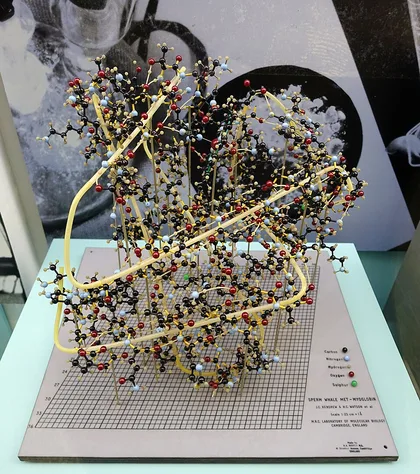 which is also a lot more low noise because you roughly know the shape of a protein.
Of course, the proteins move around, they can change shapes, what we call conformations,46Conformations are the different 3D shapes of one and the same molecule. Many proteins work precisely by switching between them: receptors and membrane transporters, for example, open and close. but this is still kind of a lot less noisy than if you look at, for example, human health data, electronic health records47Electronic health records are kept first of all for treatment and billing insurers, not for analysis. A patient's data is scattered across clinics, and the record captures only what happened at a visit, hence the noise Jiao describes. are notoriously noisy. And this is because human health in general is a point in time, right? But you're kind of moving through time where there is like the current state of health is not your permanent state. People get sick, people get better. There's also noise in what doctors write down. There's noise in, you know, when patients choose to go to the hospital or not.
And so that data is actually incredibly difficult to train on than something that is, you know, just very low noise, high signal, like structural biology.
So we spend a lot of time with founders. We're working on, you know, their startups and, you know, we see many founders whose ambition is to generate data that will be interesting to you. And in fact, there is an entire crop of company emerging, the data factory company.48This is what people call startups that build automated labs not to make their own drug but to produce large, uniform datasets for training models. One example is Tahoe Therapeutics: in February 2025 it released Tahoe-100M, profiles of 100 million cells from 50 cancer lines under about 1,100 drugs (Arc Institute).
They're out there, they're listening to you intently, they're sitting on the edge of their seats. What would you advise a founder that has the ambition to build a data factory?
That is a good question. I definitely have, you know, personally experienced the flood of people trying to sell us different types of data. I think the data takes many different forms. There are people just trying to sell us kind of experimental data. Like, hey, I did an experiment. Do you just want the raw numbers?
Here's like a CSV file. There's also people who, you know, more kind of do what we might call like human expert data49Such data is sold by companies like Scale AI, Surge AI and Mercor: they hire doctors, lawyers, scientists and programmers to write tasks, reference answers and grading criteria for training models. or, you know, things that are like here's like what a person is doing. Maybe a person asks a question and then here's like a definition of what a good answer is. I think there's different uses for these two types of data. For, you know, the kind of like CSV file of numbers. This is a maybe fundamental capability of the model in order to understand the natural world.
And that is very useful. The other type is, you know, kind of more what we think about post-training, which is you have a model now, it has a lot of raw intelligence, but you need to bring out that intelligence in a way that it's able to communicate with the user. And so here's, you know, where a lot of these rubrics50A rubric is a list of checkable criteria for a good answer, used to score a model's response, including in reinforcement learning. OpenAI's medical benchmark HealthBench (May 2025) is built on rubrics: 5,000 health conversations and 48,562 criteria written by 262 physicians (OpenAI). come in. That's like, did the model like give you a proper background? Did it talk about these different points? Did it talk about its certainty or uncertainty in its final answer.
And so I think, you know, we do need both in order to make a model that is maximally useful for everyone. I don't have like specific advice. I do think, you know, the things that we look for is generally high quality and you know for raw experimental data there are some just very obvious tricks that we would do to see okay does this data contain signal? Is it clean? And I think, you know, for the kind of more post-training shaped data, a lot of that is just kind of we have to read it and see if it makes sense. The models are actually getting quite capable now that we can kind of, you know, have another model evaluate the data51The technique is called LLM-as-a-judge: one model grades another's answers or data against given criteria. In HealthBench, too, the answers are graded against the physician rubrics by a model, GPT-4.1, hence "gone full circle." and tell us if the data is good. So it's kind of like gone full circle in a way.
Does your appetite for new data asymptote over time, or is it something you just expect will persist?
I would say that most data sets have a half-life. The type of data changes maybe the half-life, but I think there is in general an exponential decay in how valuable a data set is over time. And that's just because, you know, we're very hungry for data. And if we can't train on one data source, we'll find another substitute. And generally when data sets are somewhat correlated, if they're from the same field, then there's what we call positive transfer52Positive transfer is when training on one task or dataset improves a model on another, related one; with negative transfer it makes the model worse. between the data sets. And so let's say we're unable to get one type of data, we'll train on lots and lots of other types of data, and we'll eventually get that capability that we truly wanted anyway.
So I would say that, you know, there's not all data will be permanently useful, but I think the need for more and more complex data is going to be constant.
To build on Jorge's question, so you're saying that the demand for an individual data set might experience exponential decay.
But let's say OpenAI or the large labs demand for training data in general, do you expect that to exponentially increase over time, linearly grow, decay over time as well?
I don't think it'll decay over time. I would expect it to grow possibly linearly. And some of this is because you, know, we're just getting really good at generating our own data, either through partners or through, you know, the model just thinking really hard and generating new synthetic data53Synthetic data is training examples generated by the model itself or by another model: solved problems, reasoning, dialogues. The good ones are kept after a check, and in coding the check is easy because code can be run against tests, which is why, as Jiao goes on to say, the loop closes more easily there than in biology. for us. And so I think we're still going to need kind of like fresh new data. I think the difference between life sciences and coding is that we're very grounded in the physical world. And so you can't really fully simulate like a human.
If you gave a human a chemical, how are they going to react? That is, we don't have, you know, today a physically mechanistically grounded way to model that. But versus, you know, something like coding, you can have the model generate a code base and you can have other agents operate on that code base on, like, your synthetic data, right? That doesn't quite apply to biology. And so I do expect biology to kind of, you know, remain more data hungry than something like coding over time.
So by the way, for all of the founders out there that are building their data factory startups, what we'll do is we'll just have your cell phone show up on screen and they can just reach out to you guys directly. Okay, so another question. There are so many founders out there that are building AI tools for the life sciences. How should they think about how they exist alongside OpenAI or how they partner with OpenAI or, you know, how they run away from OpenAI? Like how do they think about what is the, you know, given your North Star and your ambition in this space, how should founders that are building AI companies for the life sciences think about OpenAI as a front door for partnership.
Well, that is the open and OpenAI.54A pun on the company's name. OpenAI was founded in 2015 as a nonprofit lab promising open research, but since GPT-3 (2020) it has not published the weights of its main models, and the "open" in the name has long been a target of irony. Rajendra reads it as the platform's openness to other people's tools. Like I think we really want to be a platform that, you know, the industry uses to do all of their day-to-day work, but we won't be a platform to allow that if we don't have all this huge ecosystem around it. So I think when you look at, you know, ChatGPT and Codex and all the different things that made it take off, it's how it plugged in to all the other places where people did their work. So there are so many different specialized tools that people can develop and different components in the drug discovery and drug development journey that I would say the thing I would say to those founders is that more and more of where people are doing their work, much like, you know, went into, you know, the Microsoft Office Suite and to desktop computers and mobile and so on, is moving into ChatGPT and Codex.
And increasingly people are realizing that the easiest way to interact with all these different computational tools and products is with that as the front door. And from our perspective, the ability to plug into and integrate to as many of those systems as possible allows, you know, scientists to use all the tools and systems that they need to get their work done without needing to figure out how to connect all those pieces together. So I think the, you know, the plugin and MCP55MCP (Model Context Protocol) is an open protocol introduced by Anthropic in November 2024: a standard way to connect external tools and data to an AI assistant. OpenAI adopted it in 2025, and many third-party connectors in ChatGPT work through it. ecosystem, the connectors are critical because people are changing how they work today. And we really want to meet them where they are. So I would say, you know, create some plugins and let's work together.
09A diagnosis after twenty years: the Boston Children's Hospital project
Back in the o3 era, the model found the cause of a disease where doctors had searched for years, because it examined every case with full attention.
So one of the pillars you brought up, Joy, was working with various groups, be they academia, be they pharma, to generate the evidence that, you know, AI can be a very powerful tool here in this endeavor. You've worked with Boston Children's Hospital.56A joint effort of OpenAI, Harvard and the Manton Center for Orphan Disease Research at Boston Children's Hospital: o3 with Deep Research went through de-identified clinical and genomic data of 376 patients who had never received a diagnosis, and from its hypotheses doctors found the cause of disease in 18. The paper appeared on June 18, 2026, in NEJM AI (OpenAI). Can you talk a bit about what that project entailed and what it showed us?
Yeah, this is one of the projects that I think is a most beautiful demonstration of how AI can meaningfully and positively impact human lives today. This is actually a project that my team did with Boston Children's Hospital more than a year ago, and you know, back in o3 time, if people still remember what this model was. And what they did was they gave the model o3 deep research57Deep Research is an OpenAI agent in ChatGPT that searches for and reads dozens of sources on its own and writes a detailed report with citations. It launched in February 2025 and ran on a version of o3 tuned for search and data analysis. around 300 to 400 unsolved cases of people who we knew were sick. We had their genomic sequences, but we couldn't figure out a diagnosis for, you know, why they were sick, what is actually wrong with them. So
these are children that are going through what is the horrible diagnostic odyssey.58A "diagnostic odyssey" is the established name for the years-long search for a diagnosis in a rare disease: tests, specialists, wrong diagnoses. In a survey of 6,507 patients from 41 countries by EURORDIS, the average time from first symptoms to a confirmed diagnosis was 4.7 years (Eur J Hum Genet).
Yes, exactly. And not all of them are children anymore. So I'll talk about this one particular case which was really inspiring in which this girl became sick when she was nine and she waited 20 years for a diagnosis. And it wasn't until we deployed o3 to her file that we figured out what the underlying cause of disease was. And generally, you know, this is not a cure for a disease, but it is kind of the first step on this journey. And just thinking about, you know, how long people had to wait for answers about themselves and how if we just can deploy these models widely, this is something that everyone should have access to, right?
And then there was another case too, you know, kind of calling back to the infinite attention example, we had a case where the model didn't only read the input file of, you know, here's the patient, here's all the different mutations that they have. The model decided there wasn't enough information in that file and it actually went back to the raw data and the raw reads59Reads are short DNA fragments read by a sequencer. Millions of them are aligned to a reference genome, and mutations are found from them; a doctor usually receives a final table of variants filtered by software, the "input file" Jiao mentions. that were coming out of the sequencing machine and it redid this analysis. I was like, okay, all of these things were low quality, but it analyzed it anyway and said, I think this is actually the cause of disease. And then we actually did follow-up sequencing and turns out that the model was right. And no human clinician is going to have the time and attention to do this for every single potential mutation in every single patient.
It's just impossible to pay that much attention, but now we can do that with the models. And so I think, you know, and this was o3 time, right? This is like many, many model generations behind. So imagine what we can do with, you know, GPT 6 Astra60OpenAI's flagship model, the first of the GPT-6 family, came out on September 3, 2026; at launch the company declared the arrival of the "AGI era." Between o3 (April 2025) and Astra, OpenAI released GPT-5 and its versions up to GPT-5.6. today. And this is a line of research that we're very excited to continue with our clinician partners.
That's a fantastic story.
10A chain of evidence and trusted access
Trust in AI conclusions rests on traceable evidence, and protection against misuse rests on vetting organizations rather than prompts.
Okay, so we spoke about data and generating new data to ident and run that through models to identify novel insights from a human judgment perspective, if a AI system identifies or comes to a conclusion that experts don't immediately understand how it arrived at that conclusion, it's similar to the Boston children's example as one example. What evidence do we need to generate from there to make sense of that? And how can where does human judgment come in making sense of a AI system conclusion that we don't fully understand?
Yeah, it's a really great question. And I think this is where you go from model capability to where the harness and the underlying context becomes critical. You know, a concept in the industry for life sciences is traceability and chain of custody.61Chain of custody is the documented trail of who handled a sample or a piece of evidence, when and how. In pharma, good-practice rules require it so that an assay result or a drug batch can be traced back to its source materials. Like how do I know and how do I follow every single step to know that I can trust the outcome that was generated in an experiment. And in this case, there's almost an equivalent concept of like chain of evidence, right? So when a model comes up with a conclusion, how can you compile all of the supporting evidence and trace that all the way back so that a human can evaluate that in less of the amount of time than it would have taken them to come to that conclusion.
So I think this is a critical and foundational component if you want to use these systems at scale in discovery and development, that the traceability of inputs and the explainability of inputs could allow somebody with, the appropriate amount of time to actually review those outputs and come to the same conclusion. And you're going to see this in, a lot of product capabilities across discovery and development, because, you know, instead of like you want to make sure you're not amplifying errors, you want to actually build trust in the core system. And over time, the system gets better and better at understanding what is the appropriate evidence to come to a conclusion.
So maybe just to pull on that thread, because the importance of judgment, of human judgment, the importance of being able to build trust. How does OpenAI think about the implications of not getting things wrong, but someone intentionally trying to misuse the technology to do something dangerous. So this question of trust and safety, how have you all approached that and how do you find the right balance between not having it be overly restrictive? So you're actually restricting people's ability to use OpenAI for genuine scientific discovery, but guardrailing sufficiently so that, you know, we're not creating dangerous situations with this technology.
Right. I think one of the earliest things we noticed when we were thinking about, you know, biosafety and biosecurity62Biosafety is protection against accidental harm when working with pathogens; biosecurity is protection against deliberate misuse. Since July 2025, starting with ChatGPT Agent, OpenAI has classed its models as "High" capability in biology under its Preparedness Framework risk assessment and put extra safeguards on them (OpenAI). is that it is almost impossible to tell what a person's intention is from reading their prompts. And I think, you know, if a person is talking about a plant disease, you could ostensibly think that maybe they're trying to find an exploit in the plant or they're trying to just study like a normal academic study or trying to find a cure. And very early on we decided that because we can't easily pick up signal from these kind of conversations, the right way to think about beneficial deployment of model capabilities should really be based on trusted access. And trusted access means that, you know, you work at a legitimate institution. Maybe this is like a pharma company, maybe this is a biotech company, but we know that you have a legitimate use case for these model capabilities.
ExplainerTrusted access to OpenAI models
This is how OpenAI opens its strongest models where a single prompt cannot tell a researcher from a bad actor. GPT-Rosalind, a model for the life sciences, was the first released this way: on April 16, 2026, it went only to vetted enterprise customers in the US. An organization must do legitimate research with a clear public benefit, have its own policies and controls against misuse, and let only approved staff use the model. In September 2026 GPT-Rosalind left preview and became available to such organizations worldwide; OpenAI names Amgen, Moderna, the Allen Institute and Thermo Fisher among its customers (OpenAI).
The release of GPT-6 Astra works the same way: approved organizations got the model first, while ChatGPT subscribers got a version that declines some requests, for example on cybersecurity.
So for example, you work at Moderna63Moderna is the American biotech company behind one of the first mRNA COVID vaccines; Jiao uses it as an example of an organization whose work with viruses is legitimate and easy to understand. because you're making vaccines. And from validating that you really are who you say you are, the company you're working for is a legitimate place, then we can say, okay, well, we trust you now. We can give you the full model capabilities without, you know, trying to guess what you're trying to do and blocking you on specific things. And, you know, this has been really a huge unlock for a lot of our partners because now it's kind of like they have the freedom to ask the model whatever they want and they don't have to be worried about kind of like a red box showing up. And the reason why I think this, you know, actually more secure than if we had just a like very intense monitoring system is because when you look at a biotech or pharma company, they generally track the provenance of all the reagents.
They log everything that a scientist is doing. And this kind of tracking and logging is impossible for us as an AI company to do. It would just be hugely invasive. And so I think this gives you the best of both worlds where we can say, okay, you are a trusted person. We want to give you the maximum amount of model capabilities for you to push the frontiers of science to discover new cures for diseases. And we also know that, you know, what they're doing is monitored by their employers, by their labs.
11The stack of life and the one-person biotech
The guests expect foundational breakthroughs from the bottom of the stack of life up, but warn that neither the speed of biology nor regulation will go away.
I'd love to talk a little bit about the future. We covered a lot of ground. I mentioned this to your colleague Karan on the OpenAI Health team, that it is amazing and inspiring and humbling that ChatGPT just came out just a few years ago. And so if we start making predictions about the distant future, even three to five years from now, sounds academic. Who knows what might happen, but to sort of give us something to look forward to, what is something across discovery, development, distribution, or elsewhere in the life sciences where today it feels impossible, but a small team in just a few years could do something pretty extraordinary. Just give us something to look forward to about the work that you all are doing.
I think you can really imagine kind of the [unclear] stack of life as, you know, physics at the bottom. And you think about atoms and how they interact and how that grows into chemistry and then biology and then humans. I think the type of Navier-Stokes level breakthroughs that we're going to see is going to first happen at more of the atomic systems level. And I think that will kind of grow from few atom systems to chemical reactions to structural biology and eventually build up to, you know, systems of cells and higher organisms. But I think all of these will become quote unquote solved up to some noise ceiling64The noise ceiling is the limit of accuracy a model cannot exceed because the measurements themselves are noisy: a repeated experiment does not exactly match the first. Earlier Jiao said that sequencing and structural biology data are nearly noiseless, while cell perturbation data and electronic health records are very noisy, so the ceiling differs between these levels. in the system, probably over the, next two years, but I expect we will start closer to math.
And of course, when I say solve, I just mean, you know, having foundational breakthroughs in an area. I think there's a lot of things, you know, especially when it comes to drug discovery that are just limited by the rate of biology. And I don't think that, you know, we're going to be able to fundamentally change those rate constants.65Rate constants are, in chemical kinetics, the coefficients that set how fast a reaction proceeds at given concentrations. Jiao extends the term to biology as a whole: cells, animals and patients in trials respond to a drug at their own pace, and a smarter model will not speed it up. But I think there are a lot of really exciting things that will come out of the model capability world.
Yeah. And I think on the discovery and development side, like I think, you know, envisioning a world where one person can start a biotech company and launch many programs and get those to clinical trials and really amplifying that those abilities and expertise is one, you know, version of this future. But I also think, you know, really like massively scaling the ability of any individual at any organization to do their, like to operate at the top of their license.66Operating at the top of one's license is a phrase from American health care: every professional, whether doctor, nurse or pharmacist, spends time on what their training and license allow and hands simpler work to assistants. Rajendra extends it to everyone in pharma, from manufacturing to clinical operations. KevinMD. So whether you are in, you know manufacturing and a pharma company and clinical operations and discovery and so on, how can these systems help you do the existing work you're doing faster and a higher quality, explore a wider space. Like I think it will, that's a rising tide that will lift the entire industry.
There are some substantial constraints, right? Like, you know, human biology only moves so quickly. Regulation is a big lever that needs to be changed. But, you know, the industry has seen, you know, in its biotech versus pharma,67Biotech versus pharma is how the industry contrasts small companies built around one technology or a few programs with large pharmaceutical corporations that have their own sales and plants. Many breakthrough drugs of recent years came from small companies: the mRNA COVID vaccines from Moderna and BioNTech (the latter brought its vaccine out together with Pfizer), and sofosbuvir, which cures hepatitis C, from Pharmasset, which Gilead bought in 2012 for about 11 billion dollars. like what can small teams do in order to make breakthrough medicines. And I do think this is a great amplifier, for the whole industry, with some fundamental limits, of course, in biology.
You think we'll see one person biotechs anytime soon?
Very much so, yes.
Congratulations to OpenAI again on acquiring Orchestra Bio. It sounds like a lot of exciting work to come and thank you again for joining the a16z podcast.
Thanks for listening to this episode of the a16z podcast. If you liked this episode, be sure to like, comment, subscribe, leave us a rating or review, and share it with your friends and family. For more episodes, go to YouTube, Apple Podcasts, and Spotify. Follow us on X at a16z and subscribe to our Substack at a16z.substack.com. Thanks again for listening, and I'll see you in the next episode. As a reminder, the content here is for informational purposes only, should not be taken as legal business, tax, or investment advice, or be used to evaluate any investment or security and is not directed at any investors or potential investors in any a16z fund.
Please note that a16z and its affiliates may also maintain investments in the companies discussed in this podcast. For more details, including a link to our investments, please see a16z.com forward slash disclosures.


