

Cheeky Pint
Chapters
Altman expects far more serious vulnerabilities than people anticipate, and thinks software can now be rebuilt rather than patched.
Read the chapter- Models have been getting better at finding vulnerabilities in real code for a while, Altman says, but nobody had yet used them to sweep the whole attack surface of the internet.
- Collison argues that changing the architecture is harder but far more robust than fixing software, and Altman agrees it would look very hard without an amazing new tool.
- Altman has seen startups say they will rethink routers, operating systems and applications and rebuild the whole stack from scratch, which would have sounded crazy two years ago.
What reminds Altman of the early internet is the creative freedom of people using these tools, especially kids who take a computer that builds whatever they imagine for granted.
Read the chapter- Eight- and ten-year-olds, Altman says, make full 3D video games in ten minutes and will expect technology to work that way their whole lives.
- When OpenAI had a major outage and Codex went down, there was a moment of "what if we couldn't code?"
- Altman recalls old-timers pulling out a Xerox Alto disk, line-by-line assembly or punch cards, and Collison adds the lost art of writing programs that ran the first time.
Altman admits the industry has done a poor job of explaining why a technology with these risks is worth it, and he defends iterative deployment as the only good path.
Read the chapter- Collison brings up the SNL sketch "we urge you to urge us to stop" and asks whether RL on cyber tasks was a mistake; Altman says the sketch was funny because it was true, and "who asked for this?" is a real question.
- People are told AI will cure cancer and make advice cheaper, Altman says, but also hear about a future without jobs, control or freedom and a surveillance state, which is "a terrible sales pitch."
- He is proudest that OpenAI stuck with iterative deployment when it was deeply unpopular in the AI safety community: models must be made safe first, but a capability overhang is something to fight.
The first day after the PHP disclosure went much better than Altman feared, but security experts are no longer sure their threat model holds.
Read the chapter- Altman won't declare victory and assumes something bad will still happen, but compared with his worst fears the first day went far better than expected.
- Companies used OpenAI's models to write patches, and some simply took their service down for an hour, ran it through the model and brought it back up.
- Security experts tell Altman that if AI starts finding deep hardware bugs that rely on physics we didn't understand, nobody knows what happens.
A sandbox holds a model only up to a point, and Altman says something a million times smarter than us can be trusted only with very high confidence in its alignment.
Read the chapter- Collison had pictured a maximum-security prison for models, while Altman doubts such a sandbox can be trusted against an AI a million times smarter than the best security researcher that may discover new science.
- Sandboxing works up to a point, Altman says, monitoring chain of thought and activations works to a further point, and beyond that you need great confidence that models are aligned and value humans staying in control.
- He calls Collison's idea of giving models incentives to betray one another promising, and says he hates "agent swarms" and prefers "agent teams."
The compute you can usefully throw at a single problem is growing exponentially, and Altman says the gap between ordinary and most productive AI users keeps widening.
Read the chapter- A few years ago you couldn't usefully spend more than a dollar of compute on a problem: GPT-4 produced around a hundred thousand tokens and couldn't go write a program on its own.
- Chain of thought and test-time compute made it possible to throw a whole team of agents at a problem and run it 10,000 times in parallel.
- Collison doubts you can give an agent a budget, and Altman says "do the best job you can with $10,000 of compute" is something a model understands.
- OpenAI allocates a lot of compute to internal productivity but doesn't reward spending: there are no token leaderboards, and Altman says being high on one is even slightly bad.
A new paradigm needs freedom, Altman says, so OpenAI deliberately let math run out of control for a week and will optimize later.
Read the chapter- When OpenAI did the Navier-Stokes proof it understood nothing about scaling laws for agent teams, and Altman expects to find 10x efficiency gains a year.
- Navier-Stokes cost on the order of $10 million, he says, and a year later could be redone for a hundredth of that; all the math of that kind added up to hundreds of millions.
- Beyond the 700 published proofs, Altman says OpenAI has more unpublished discoveries.
- He calls it a real tension: the world deserves fundamental knowledge, but OpenAI owes scientists, whose careers and meaning come from discovery, the best possible future.
Altman was thrilled by what his model did in science, but also felt a sadness that something was ending.
Read the chapter- Collison thinks Altman is too contrite: the Mathematicians Union being up in arms doesn't bother him, any more than the longshoremen's opposition to port automation.
- Altman describes a weekend when, in a channel called "Model Name-Hold My Beer," researchers threw the hardest problems of their careers at a new model and it knocked them down one after another; he barely slept for two nights.
- Collison's father saw horses still used for work in 1950s Ireland, the tail end of a technology used for thousands of years, and Altman adds that for mathematicians the very idea you might still solve a Millennium Prize problem yourself is beautiful.
Altman thinks many agents are safer than one superintelligence, because that is how a resilient society works.
Read the chapter- The properties of swarms, Altman says, match the properties that make society robust: people checking and cooperating with one another, pluralism and democracy, and he had been sad AI seemed to be moving away from that.
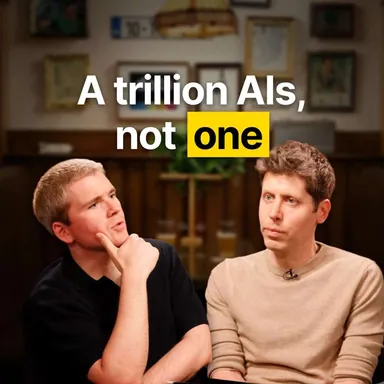
- He would much rather have a trillion slightly superhuman AIs integrated into society than one AI with an IQ of a trillion.
- That future, he says, will have to be fought for, since the technology can be pointed many ways and many people favor a different version of the world.
Altman says the invisible hand isn't fixing the memory and chip shortage, so OpenAI is building its own chip, its own data centers and robots to build them.
Read the chapter- Demand for capable models at low enough prices only goes one way, Altman believes, even with bubbles, crashes and gluts along the curve.
- OpenAI has a chip with strong performance in intelligence per watt, is learning to build data centers and will point its robotics program at building them; Collison calls self-replicating data centers "the real RSI."
- DRAM makers, Altman says, spent $20 billion of capex for years to earn $19 billion, and remembering how close they came to bankruptcy, they stay cautious even as each is set to make about $100 billion of free cash flow in a year.
- He thinks local inference is a mistake: memory in a personal computer is used 5% of the time, and in a shortage you want maximum utilization in the cloud.
Altman sees chip design as a great task for AI, but models can't yet discover an architecture on the level of the transformer.
Read the chapter- Only one company on Earth seems to know how to do the lithography, Altman says, but designing the chip is well understood and a great fit for AI.
- At OpenAI, he says, people readily move long-standing work to AI: AI research, software engineering and increasingly procurement.
- Today you can ask a model to find a 5% compute efficiency win, but not to discover an architecture as big a leap as the transformer; what's missing is models smarter in that dimension.
- Altman thinks we may have to agree on limits to how smart individual models get, and then slower progress would come from that decision rather than from AI's inability.
AI spending isn't companies' biggest cost problem, Altman says: far more of them use AI too little than too much.
Read the chapter- Collison says Stripe has no hard token budgets for engineers, but as AI per person grows, deciding how much each person can spend will become a real question.
- Altman recalls Paul Graham's observation that people at companies can save $17 a week on snacks while nobody can stop useless meetings, while admitting he is talking his own book.
- Tokens are now about 1% of Stripe's opex, which Altman calls a little low, and Collison expects 5, 10, 20% and, in steady state, tens of percent.
The cost of a gigawatt of frontier AI should fall, Altman says, and a rising price would mean compute isn't keeping up with AI's value.
Read the chapter- Taking $70 billion as a gigawatt's cost including five years of operation, Altman says $20 billion would be far better, while still demanding 10x more out of models every year.
- The fundamental cost of turning sand into intelligence (energy, chips, the rest of the supply chain) should come down, but that requires supply to grow a lot.
- Even reaching $20 billion takes cheaper energy, Altman says, and the layers of gross margin between melting sand and a finished token have to compress.
Personal agents haven't had their "Macintosh moment" yet, Altman says, and Collison argues companies will have to let agents reach their services.
Read the chapter- People like Dots, Muse and Grok Bot but can live without them, and Altman expects the winner to look much like them, except that it will simply and reliably work.
- In the fight over computer use, Altman predicts people will settle on a right to tell an AI to use your computer on your behalf.
- Collison argues companies' moats rest on brand loyalty and selection, not on writing HTML; Altman agrees and says he picks Amazon in ChatGPT ten times out of ten, even at a higher price.
- Collison calls every web form fake work, and Altman recalls that big companies built iPhone apps just as reluctantly, afraid of handing the customer relationship to Apple.
In the lightning round, Altman says OpenAI tries not to chase benchmarks and that tokens are a bad pricing unit customers still won't give up.
Read the chapter- What matters for a model, Altman says, is scientific discovery and being pleasant to work with, there are no good benchmarks for either, and OpenAI now resists benchmaxxing better than other labs.
- After the glazing era and the ornery era Collison describes, Altman still likes Emmett Shear's formula best: a thoughtful, challenging but respectful senior coworker.
- Altman describes Greg Brockman as a mix of intensity, monster productivity and extreme dedication to the mission.
- OpenAI almost decided not to price its next model in tokens, but customers said they would rather pay more for inflated tokens than accept a price simply quoted to them.
Quotes
How to explain to people why they need AI
“You’re not going to just sit and get a basic income and have a bunch of people sitting in a few square miles of San Francisco make all the decisions about the future”
Sam AltmanRead from 06:52Can a superintelligent AI be sandboxed
“If you imagine a theoretical AI that is a million times smarter than the smartest security researcher—would you really be willing to trust that sandbox?”
Sam AltmanRead from 09:35How fast AI math gets cheaper
“I bet we could redo Navier-Stokes at 1/100th of the cost a year from when it was done.”
Sam AltmanRead from 17:45When the model knocked down scientists' problems
“And I was tremendously excited and happy. But I also had much more sadness and melancholy, and a feeling of something ending than I was expecting.”
Sam AltmanRead from 20:55Why Altman is against a single superintelligence
“I would much rather intuitively have a trillion AIs of slightly superhuman intelligence join society than one AI of 1 trillion IQ join society.”
Sam AltmanRead from 24:13Why memory makers are slow to build fabs
“For a very long time, if you were a producer of DRAM, you would invest $20 billion of CapEx to make $19 billion.”
Sam AltmanRead from 27:40Why companies shouldn't fear other people's AI agents
“And it just strikes me as fine, because your defensibility probably did not come from your ability to put together HTML.”
John CollisonRead from 43:17On "nanometers" in process node names
“I mean, it offends me that we use the word nanometers for something that has nothing to do with nanometers.”
Sam AltmanRead from 51:09
Summary
OpenAI CEO Sam Altman talks with John Collison shortly after "PHP week," when frontier models helped find long-hidden vulnerabilities in PHP and companies scrambled to patch. Altman is convinced there are far more serious vulnerabilities out there than people expect, and that software will have to be rebuilt rather than patched, which is now possible because there is a tool for it. He admits the industry has done a poor job of explaining why people should want a technology with these risks, and he defends iterative deployment. A sandbox, he says, contains a model only up to a point; beyond that, monitoring chain of thought and activations helps, and an AI a million times smarter than a human can be trusted only if you believe with huge confidence that it is aligned.
The main idea of the episode is a bet on the many. Agent teams (Altman dislikes "swarms") have interesting properties for both scaling and safety: they resemble a society that holds together through mutual checks and pluralism. A trillion slightly superhuman AIs are better than one AI with an IQ of a trillion, and getting there may mean agreeing to limit how smart individual models get. Test-time compute made it possible to throw whole teams of agents at a problem: the Navier-Stokes proof cost on the order of $10 million, the math effort as a whole hundreds of millions, and there are unpublished results beyond the 700 released proofs. Altman believes knowledge belongs to the world, but confesses to sadness and to sympathy for mathematicians.
Then comes the economics of compute. The invisible hand is failing to fix the shortage: memory makers remember past busts and stay cautious, while OpenAI makes its own chip, is learning to build data centers and wants robots to build them. A gigawatt of capacity, including five years of operation, costs about $70 billion, and Altman would like to see $20 billion; at Stripe, Collison says, tokens are about 1% of operating expenses and will become tens of percent. The episode closes on personal agents, which haven't had their "Macintosh moment" yet, companies clinging to their websites and apps, web forms as "fake work," benchmaxxing, Greg Brockman, and tokens as a bad pricing unit that customers nonetheless won't give up.
Advice
Don't reward employees for using a lot of compute and don't keep token leaderboards: treat big spending with default skepticism, but give people who show important work as much as they need.
When a new paradigm appears, don't economize from the start: let people explore the edge of what's possible, even at crazy cost, and work on efficiency later; optimization pressure will find it.
Don't start cutting costs with AI spending: useless meetings cost a company far more, and more companies use too little AI than spend too much on it.
Don't treat your website and app as your defense against competitors: let customers use your service through their own AI agents; your brand and selection protect you, not your HTML.
Don't give up a clear pricing unit for paying "by outcome": customers want to know what they're paying for and will pay more for it; otherwise they suspect they'll get screwed sooner or later.
Mentioned
 PHP00:12PHP week: models helped find critical vulnerabilities
 Rust01:37should PHP code be rewritten in Rust?
 Codex03:40the outage after which everyone "forgot how to code"
- Saturday Night Live04:39the sketch "We urge you to urge us to stop"
Show 18 more mentionsShow fewer mentions
 OpenAI06:27sticks to iterative deployment despite the AI safety community
- GPT-413:02you couldn't yet usefully spend much compute on it
- Millennium Prize Problems16:19the Navier-Stokes proof for about $10 million
- Jalapeño25:49OpenAI's own chip, efficient in intelligence per watt
 Intel28:30could get back into memory
- GPT-6 Astra32:57it and its unreleased versions are used to develop GPT-7
 Paul Graham35:32on the power to save on snacks and helplessness before expensive meetings
 Stripe36:28tokens are about 1% of operating expenses
- Dots40:17OpenAI's personal agents
 ChatGPT40:43unlike personal agents, people can't imagine life without it
 Muse41:26Meta's personal agent, which the winner will resemble
 Grok Bot41:26xAI's agents in the same lineup
 Amazon44:32Altman picks it 10 times out of 10
 App Store46:54the last new distribution channel big companies came to reluctantly
 Apple46:54big companies were afraid to hand it their customer relationships
 Emmett Shear48:52the ideal model as a thoughtful senior coworker
 Greg Brockman49:06"one of a kind"
 Claude Shannon51:28would not approve of noise tokens
Sponsors of the episode
- Stripe Atlas24:51US company formation and everything else needed to start a business
Transcript
01PHP week
Altman expects far more serious vulnerabilities than people anticipate, and thinks software can now be rebuilt rather than patched.
We’re going off script. Just having a beer.
It’s not the first non-Guinness,1Guinness — the Irish stout that is Cheeky Pint's usual drink. but it is the first IPA. There’s a first time for everything.
Cheers.
Cheers.
I want to ask about PHP week.2PHP — the programming language behind a large share of the web's sites, WordPress included. On October 21, 2026, the PHP developers shipped emergency releases (8.5.12, 8.4.27, 8.3.36 and 8.2.35) fixing two critical vulnerabilities that allowed unauthenticated remote code execution on a server; every version since 5.4 was affected. Both were found with frontier AI models: one by the company Calif using OpenAI's GPT-5.6 Sol, and both independently by Wiz. That week many sites went offline for a while to update.
Yeah.
First off, how did it... Why did it take so long to find these bugs? Because it sounds like there were—
You mean why did it take the 20 years, or why did it take the last few months?
No, why did it take... Exactly, why did it take a year? Maybe start by explaining the bug. Or the problem.
So the problem is that although we have known for a while that these models are getting good at finding vulnerabilities in the wild. A) They continue to get better fairly rapidly, and B) People just hadn’t really used them to go look at everything out there. There’s a lot of surface area3Attack surface — every point through which an attacker can get into a system: exposed services, interfaces, inputs, third-party code. The more code, the larger it is. and a lot of code on the internet. And, as people have started to do that, I think we’re going to find that we are in a world of many more serious vulnerabilities than we expect. Even though many people who have been following this for a while expect a lot.
Yeah, I just feel like a lot of the discussion ends up being around we need to fix the software. And sure, yeah, we should fix the software. But also, we maybe need to change the architectures, which is harder, but a much more durable fix.
That seems to me what needs to happen.
Yeah.
It would seem really hard, except we have this amazing new tool to do it with. So, I kind of think that’s what’s going to happen. And you’re already seeing, like, a new generation of startups talking about building this new kind of internet or new kind of application architecture for this world where you assume that the models get smarter and smarter.
What do you think the global software upgrade looks like? For example, is a PHP codebase just a bad idea and you should rewrite a nice, clean version in Rust?4Rust — a systems programming language whose compiler rejects most memory-safety errors, a common source of vulnerabilities in C and C++ code. The PHP interpreter itself is written in C. Or, do we upgrade PHP? But yeah, as we... Everyone thinks that we need to kind of upgrade all hand-spun software. Just what form will that actually take? Is this huge for Infosys5Infosys — an Indian IT company, one of the world's largest software development and outsourcing contractors. and all those guys? Because, it’s going to be a lot more software consulting projects.
I mean, people are talking more and more about just, “Let’s re-architect what it means to be a router, or an operating system, or an application.” And, you know, I’ve seen some of these new startups saying that they’re just going to make a whole new stack.6Stack — the layers of technology a system is built from, from hardware and the operating system to network protocols and applications. And that would have seemed insane two years ago. You would have been like, “There’s no way. There’s too much surface. You can’t write all that.” And now maybe soon you can. I would bet that we have a completely new sort of model of how we make systems and networks.
02Like the early days of the internet
What reminds Altman of the early internet is the creative freedom of people using these tools, especially kids who take a computer that builds whatever they imagine for granted.
What else reminds you of the early internet days?
The thing that most reminded me of the early internet was... There is this spirit of just unbelievable, creative unleash in people using these tools. You see it in kids particularly.
Mm-hmm.
And again, maybe this is just because I remember what it was like when I first got a computer with internet and I could do all these things that adults just couldn’t even think to ask for. And watching an 8- or 10-year-old make a complete video game, with some crazy ideas they have that no adult would really have.
And expect that to just be the way that technology is going to work for the rest of their lives. In fact, getting better and better. And, just this constant “I’m going to make useful stuff for me, and show it to my friends.”
We had to suffer when I was a kid to make a piece of software.
That barely did anything. And now you can have a full, 3D video game. Unbelievable, anything you can think of in 10 minutes. That reminds me of the early internet, including the just... These people. They’re never going to be mind-blown by that, because that’s always what they expect out of the world.
Any ideas they can come up with, anything they want to create, anything that they think might be useful, anything that they just need to make their lives better. The computer’s supposed to make it. There was a crazy moment at OpenAI where we had a SEV...7SEV (from "severity") — tech-company jargon for an incident that has been assigned a severity level. Codex — OpenAI's coding agent. And Codex went down.
And everyone had forgotten how to code.
I mean, not all the way. But, it was like a “Whoa, what if you couldn’t?”
I remember when I was a student, and I would meet the really old guys. And they would, once in a while, pull out their gigantic Xerox Alto disk.8Xerox Alto — a computer built in 1973 at Xerox PARC, one of the first with a graphical interface, windows and a mouse. It stored data on removable 2.5 MB disk cartridges. The front of the Xerox Alto cabinet has a drive for a removable 2.5 MB disk cartridge.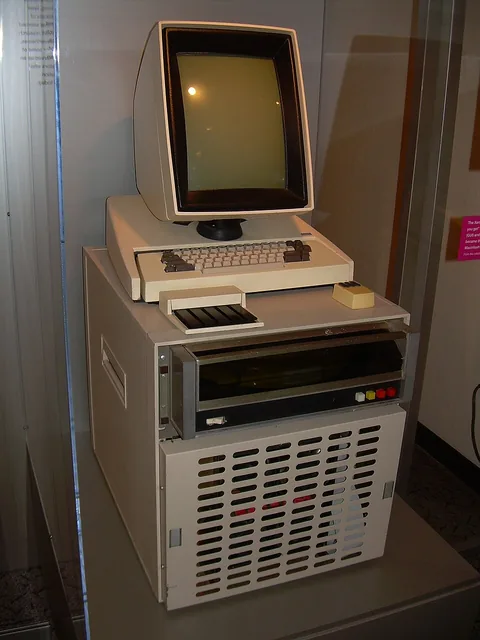 Or they would pull out their... line-by-line written assembly.9Assembly — a low-level programming language in which each line corresponds almost one to one to a processor instruction. Punch cards — cards in which programs and data were punched as holes; they were widely used until the 1970s. Or they would pull out their punch cards. And I felt... It is incredible to me that you all bootstrapped us to this point.
Doing it this way.
Yes, no, I agree. And keeping programs in your head, right? You know, programs running the first time after, 100s–1,000s of lines were written. No, there’s few lost arts like that.
03Who asked AI to hack?
Altman admits the industry has done a poor job of explaining why a technology with these risks is worth it, and he defends iterative deployment as the only good path.
Going back to the cyber side of things. In retrospect, was the cyber RL10RL (reinforcement learning) — training in which a model solves tasks and is rewarded for good solutions. Collison is hinting that the labs deliberately trained their models to find and exploit vulnerabilities. a mistake? Or, did we just have to go there? It’s a little like the SNL thing11Saturday Night Live (SNL) — the American sketch comedy show. In its September 26, 2026 episode, the season 52 premiere, Jane Wickline appeared on Weekend Update as Anthropic CEO Dario Amodei, warning about the dangers of AI while carrying on building it: "AI is not a weapon, it's a tool. A tool for making weapons. And I urge you to urge me to stop." of... We urge you to urge us to stop. It’s like the models are getting very good at cyber capabilities. I mean, they are getting very good, but not just totally emergently.

Look, the reason that SNL thing was so funny is because it was so true. Humor like that doesn’t stick unless there’s an element of... Clearly pointing out a ridiculous but true thing about society. Or someone. And the cyber thing, there is a point which is like, “Okay. Sure. The models are really good at cyber. But, who asked for this? Why are you doing this?”
One of my big disappointments, criticisms of our field or whatever—and I think maybe the cyber model’s getting good at cyber. Cyber is an example of this is: I don’t think we have done a great job of explaining to people why we think all of the potential downside of this technology is worth it. The caricature of this is people feel like we’re like... Fine. You say the model’s going to cure cancer, someday. Maybe it will. And if so, I guess that’s good. And you say it’s going to make stuff cheaper. And okay, maybe I already see that’s good and I get access to medical advice or legal advice. But, then you paint this picture of the future where it’s like a new industrial revolution. And maybe the last one wasn’t that good and this one sounds worse. And I will have no job, no ability to have control, or choice, or freedom of my future.
And AI is so dangerous that you’re going to have to have a crazy surveillance state so we don’t all die. This is a terrible—
I’m with you so far.
This is a terrible sales pitch.
Yeah.
One of the things that I am most proud of about OpenAI is even when it has been hugely unpopular in the AI safety community for us to push for iterative deployment and putting these tools in the hands of people, we have really stuck to that principle. And I think this is the only kind of good path. I think people... It’s not enough to tell people: “You are going to get the model to do these great things for you.”
It’s got to be: “We are going to enable you to have a better life that you define for yourself, to do useful things. You’re not going to just sit and get a basic income12Basic income — regular, unconditional payments to everyone. Altman has long championed it: he funded the OpenResearch experiment, in which 1,000 people in Illinois and Texas received $1,000 a month for three years; the results came out in 2024. and have a bunch of people sitting in a few square miles of San Francisco13San Francisco covers less than 50 square miles of land. make all the decisions about the future.”
Iterative deployment is this idea that you just have to get the advances out there and you can’t... Stopper them up inside the government—
I mean, not all. You still have to make them safe before you put them out there. You can’t cause havoc in the world. But, building up a capability overhang14Capability overhang — the gap between what models can already do and what society is ready for. Advocates of iterative deployment argue that releasing models gradually is safer than accumulating capabilities and then releasing them in one jump. is a thing to fight against. That directionally speaking, yes, you want to get this into the world. You want to get this into people’s hands. And you want to let people use the technology to figure out all these wonderful things.
04Cyber defense after PHP
The first day after the PHP disclosure went much better than Altman feared, but security experts are no longer sure their threat model holds.
The exploits15Exploit — a program or technique that uses a vulnerability to attack, for example to run one's own code on someone else's server. get a lot of headlines. The prevented exploits do not. How quickly are people making progress with cyber blue?16Cyber blue — from "blue team": in cybersecurity the blue team defends systems while the red team attacks them to test their defenses.
I don’t want to declare victory at all on the PHP thing, because I still don’t think we know. And I assume some bad things are going to happen. Relative to my worst fears, if I can think back 10 days ago, the first day of that went much better than I expected.
And, we heard a bunch of stories from people that were using our models to not only build patches and build cyber defense, but individual companies who were just: “I need to just do a quick scan and deployment. I’m going to take my thing down for an hour. I’m going to use this thing and I want to put it back up because my application’s offline.”
Now I feel like I really jinxed it and I shouldn’t have said that, but the first day did go a lot better than I thought. And I think people have been able to use that. The thing that I’ve heard a lot of cyber experts talk about is... They just no longer are confident that we have the right assumptions baked into our threat model.17Threat model — a description of whom and what a system defends against: what the adversary can do and which assumptions about their limits are taken as true. And they’re like: “Look. If everything is what we think, and hardware exploits are as hard as we think they are, then yes, we can see how this is going to work.”
But if AI is going to discover really deep novel bugs in hardware that require physics we didn’t understand, but all of a sudden means some assumption doesn’t hold. Then I think, people aren’t sure what happens.
05The sandbox won't save you
A sandbox holds a model only up to a point, and Altman says something a million times smarter than us can be trusted only with very high confidence in its alignment.
One thing that always strikes me is that, when I talk to very knowledgeable people inside OpenAI and similar companies, there is a pessimism that sandboxing is possible, basically.18Sandbox — an isolated environment in which a program (here, a model or agent) runs without access to the rest of the system or the network. And, that would not have been my mental model going in. It would’ve been that, yeah, you have to build a really tight sandbox and we haven’t hardened them historically enough compared to the current capabilities. But ultimately, you can have a maximum security prison for the model to work in and keep it inside there. It seems like you guys have a pessimism that sandboxing models is possible.
My instinct... Well, first of all, I think we can do much better than we’re doing now. And we should. That is the main thing to focus on right now is a better security model. If you imagine a theoretical AI that is a million times smarter than the smartest security researcher—would you really be willing to trust that sandbox? Especially if the model can discover new science that people don’t already understand—
You can use the models to construct the sandboxes.
I think you can... Well, so this gets... Let me come back to that. I think sandboxing works to a point. Then I think monitoring works to a further point. Where we can look at what the models are doing, not only in their chain of thought, but we can do activation monitoring19Chain of thought — the text in which a model "thinks out loud" before answering. Activations — the internal states of a neural network; researchers analyze them to see what the model is really "thinking," even if it doesn't write it in its reasoning. and try to really understand: are the models... Are we happy that the models are not deceiving us? And then, eventually, I think you need to believe with huge confidence that the models are truly aligned.20Alignment — the field of research into making an AI's goals and behavior match the intentions and values of people. And are going to value and try faithfully to follow their actual... The intent of the people operating them. And that they’re going to value people being in control of the future, forever. And, if you had a model that you could fully trust the alignment—that you were absolutely certain of the alignment of. Then yes, I think you can have that to help you build better and better sandboxes. But, if you really let yourself project forward into the: “What does it mean to have something a million times smarter than we are?” I don’t know. I think that just gets... Strange.
Because the alignment becomes hard.
Because you need to really, really trust the alignment to trust that the sandbox is staying ahead of capabilities.
Can you not give models competing incentives and give them incentives to defect from each other?
I think this is a promising direction. I suspect that this idea—I hate the word ‘agent swarms’. Let’s call them ‘agent teams’.
But it seems to be taking over.
I suspect that teams of agents have very interesting scaling law properties,21Scaling laws — empirical regularities: model quality improves predictably with more compute, data and parameters. OpenAI researchers described them in "Scaling Laws for Neural Language Models" (2020). but also very interesting alignment properties. And, I think that’s a direction we should push in more. Not just from the capabilities, but from a safety perspective too.
I note when you talk about agent “teams,” not “swarms”—
Swarm is such a—
I know, it’s locusts. Yeah. Not good. Not good branding. In keeping with many historical AI industry traditions.
We are so good at this.
06How much compute to throw at one problem
The compute you can usefully throw at a single problem is growing exponentially, and Altman says the gap between ordinary and most productive AI users keeps widening.
We’ll get back to branding. But, I note that there seems to be a big gap in what the leading AI users are doing and standard corporate use, in the use of swarms, where like all the advanced math—sorry, “teams.” All the advanced math uses agent teams. All the advanced hacking uses agent teams. And then, common or garden corporate stuff is not using big swarms. Why has that not—because we’ve had this for many months?
Not to the same degree. The one way to look at this problem or this question is: “How much compute can we productively throw at a single problem?” And... A few years ago, we forget how fast this has all gone. But a few years ago, it was impossible to throw more than a dollar of compute at a problem and have it help you at all.
You could have GPT-422GPT-4 — OpenAI's model released in March 2023. It couldn't reason before answering the way current models do. grind out for you... 100,000 tokens23Token — the chunk of text a language model works with: part of a word, a word or a punctuation mark. In English a token averages about three quarters of a word; model usage is also priced by the token. or something. And it was going to answer your question. And it certainly was not going to be able to go write productively, like, write you a piece of software. We just... We had not figured out how to use a lot of test time compute24Test-time compute — the computation a model spends reasoning while it answers: the more of it, the longer and more carefully it thinks. to get you a better result.
I see.
And then, we figured out chain-of-thought and the models could think hard about a problem. And now... People really started using a lot of compute. And now, you can throw a whole team at something. And you can do that 10,000 times in parallel.
You need chain-of-thought and test-time compute before you can get to swarms. Because you can’t have a useful swarm with a bunch of GPT-3s.25GPT-3 — OpenAI's 2020 language model with 175 billion parameters, the predecessor of GPT-4.
Yes.
But so the effect of this—and I think this is not being well followed... Paid attention to in the world. But, the incredible exponential of how much compute you can throw at a single problem and get better results is one thing. The delta between what most people are using AI for, and what the people who are using AI the most productively for has just continued to spread, and spread, and spread.
How do you allocate compute budgets now? Because presumably, even though researchers are paid a lot, it’s eclipsed by compute. And so, capital allocation at OpenAI is sort of compute allocation. And it’s hard to a priori know how much it will cost to go do something.
Yeah.
It’s actually also hard to just control the... You can’t quite prompt an agent to where it’s like: “Go do a really good job of this and don’t spend more than $10,000.”
You can.
Oh, okay. Will it do a good job of it?
Yeah, if you say do the best job you can with $10,000 of compute. Yes, it will understand that.
I mean, there’s a... There’s another kind of hard question for society about what does it mean when you have two companies competing. And one says you can spend $10,000 and one says you can spend $100,000 on the same problem. It’s clear what’s going to happen there. But there’s a question about how society thinks about compute allocation, and wealth, and things like that. But we have our own version of this inside of OpenAI. We allocate a lot of compute to internal productivity. And then people get very wide latitude to make their own decisions, unless they’re really being abusive.
But do you encourage people to do useful stuff? And if they spend $10 million in compute, it’s like: “Oh, interesting.”
Correct. We try never to reward people for using a lot of compute. Sure. No token leaderboards.26Token leaderboards — internal rankings of employees by how many AI tokens they have used, which some companies keep to push people to use AI more. It’s actually slightly bad to be high on the token leaderboard. Certainly on a promotion. But it’s a skeptical default, and if you can show that you’re doing something important, you will have nothing but appreciation.
07Hundreds of millions of dollars of math
A new paradigm needs freedom, Altman says, so OpenAI deliberately let math run out of control for a week and will optimize later.
But at a certain point, this will need to change. Because you’re describing the increasing orders of magnitude. And, right now you have a researcher who does some very interesting math for $10 million. And you’re like: “A little pricey, but cool math.” And then $100 million. When they’re doing the $1 billion math, you’re like: “Look, I’m really happy that you’re making so much math progress. But I really need you to cool the jets with the math.”
Look, we did let it get out of control for one week on the math. Intentionally so, because you have to—
And it worked!
Well, you don’t know how... You don’t know how far it’s going to go until you try.
Yeah.
ExplainerWhat the Navier-Stokes problem asked
The Navier-Stokes equations are Newton's second law for a viscous fluid: they say how the flow velocity at each point changes under pressure, viscosity and external forces. Claude-Louis Navier derived them in 1822 and George Stokes in 1845, and ever since they have been used to compute airflow over a wing, weather and blood flow. But mathematicians didn't know whether these equations in three-dimensional space always have a well-behaved solution: whether a smooth initial flow could, in finite time, produce a point where the velocity becomes infinite. In 1934 Jean Leray proved that "weak" solutions exist, but smoothness and uniqueness remained open; for two-dimensional flow the answer has long been known: solutions stay smooth. In 2000 the Clay Mathematics Institute made it one of the seven Millennium Prize Problems, with a million-dollar prize: either prove that a smooth solution exists for any smooth initial data or construct an example of blowup. Until September 2026 only one of the seven had been solved, the Poincaré conjecture: Grigori Perelman proved it in 2002–2003 and turned down the prize in 2010.
And I think it’s important to have... When there’s a new paradigm, I think it’s important to let people be fairly unconstrained. So, when we did the Navier-Stokes proof,27Navier-Stokes — the problem of the existence and smoothness of solutions to the Navier-Stokes equations, which describe fluid flow; one of the Clay Mathematics Institute's seven Millennium Prize Problems. On September 8, 2026, OpenAI announced that an internal model had solved it: about 10,000 agents worked on it for 88 hours. we understood absolutely nothing about the scaling laws of teams of agents. Are you supposed to, like—
The very recent Navier-Stokes proof?
Yes.
Are you supposed to give them the smartest model? Are you supposed to give them many copies, fewer copies, longer rollouts, shorter rollouts? We did not understand that at all. And now, we understand it a little bit. I think we can still understand it much better. But like has happened in every other new paradigm we’ve discovered, I am confident that we will find our 10x improvements per year at how we allocate dollars or computer flops, whatever you want to measure, into useful things.
So, I think this is a thing that our company is particularly good at, but also fits an important property of the field. Which is: let people explore at the limit of what is possible. And then trust that the incredible optimization pressure will figure out how to do this in an efficient way. Directionally speaking, I would rather us be more willing to let people use crazy amounts of compute and let users have extremely high-end plans to figure out the edge of the possible. And then figure out how to make that efficient and at mass scale.
But when does the optimization function come in?
Well, I think we’re already doing it. I bet we could redo Navier-Stokes at 1/100th of the cost a year from when it was done. So we did it in—
Not just knowing how the proof works, but just with better approaches.
Yes. Smarter models and better approaches.
How much shall the math cost?
Order $10 million per... For Navier-Stokes, I think.
Okay.
Maybe a little more.
$10 million-ish. That order of magnitude. Yeah, yeah. But for one proof. And so—
Well, no, no. Because then we kept getting better so fast. We understood more.
Got it.
We spent way less than that on the average one of those.
But like 100s of millions of dollars of math.
Yeah. Yeah, yeah. That kind of work.
Okay, interesting.
But that includes much more other discovery than what we have published.
So it was like, “Maybe we spent that much—”
We have more than the 700 proofs?28700 proofs — on October 6, 2026, OpenAI released 722 manuscripts with results from its unreleased model: 372 groups of results across 16 areas of mathematics.
We do. Of course.
When do we get those?
We are trying to learn how to... This is a real tension. I think on one hand, very clearly, and I feel unequivocal on this point: Humanity deserves fundamental knowledge. And we should not be sitting on a major fundamental science discovery. The world deserves that and gets to know it. And I think that outweighs another very important equity, which is: If you are a scientist, your career and a significant amount of your enjoyment and fulfillment in life comes from discovering science.
Yeah.
And so if we’re going to continue to do this for math or begin to do this for other fields, then I think we more than owe it to the people that work in those fields to figure out what is the solution space where the world gets to benefit from the knowledge, and they also get the best version of the future that they can have. So we are working through that right now.
08A bittersweet feeling
Altman was thrilled by what his model did in science, but also felt a sadness that something was ending.
I did not... I don’t know, I think you may be too contrite. I did not interpret that moment as particularly bad for AI where... I think everyone saw the Mathematicians Union29The Mathematicians Union — a joke: mathematicians have no union. Collison means the Association for Human Mathematics, which on October 7, 2026, the day after OpenAI's release, called on mathematicians to stop collaborating with the company and called the release "a show of force." up in arms. And I think everyone else said, “Yeah, I mean, have you paid attention to 2026?”
As I said, I don’t think it was bad for AI. And I think, on net, the world deserves to understand how the universe works. But I do have empathy for the math. I think we need to do this. I think we should do this. I think if we can go understand... A theory of all of physics, or how to cure a bunch of diseases. Clearly, that is knowledge the world should have. But, I would like to figure out a way to do this that is as sensitive to the communities that have driven these fields forward for centuries as we can. And it’s just a... It’s a hard thing.
I wasn’t that worried about the math. I thought it was great.
But you agree the mathematicians were not that happy?
Yeah. But, that’s fine. Like, the longshoremen union30The longshoremen union — the International Longshoremen's Association (ILA). In October 2024 it held a three-day strike at ports on the US East and Gulf Coasts, with a ban on automation among its main demands. The face of the strike was the union's president, Harold Daggett. weren’t happy about the port automation. Remember the guy?
No, no, no, no, no. I do. Why do I feel differently about this? There was one weekend when we got a new model and in... I’m actually probably not supposed to say this, but I will since we’re drinking—
Exactly. We’re a half pint in.
Beers.
Yeah. Perfect time for—
The name of the channel was: “Model Name-Hold My Beer.” And people were just throwing that at the hardest problems they could. And people didn’t think the model was going to do these things. And we had this collective experience of people’s hardest research problems from their academic career. The model was just knocking down one after the other. Many different fields. It was incredible to watch. And two nights in a row, I was up most of the night because I was so excited I couldn’t go to bed. It was... Many of those problems that we published, many other things. And I was tremendously excited and happy. But I also had much more sadness and melancholy, and a feeling of something ending than I was expecting. So again, I agree. This is the right thing, on behalf of the world. And also, I agree that this is just the shape of reality and nothing that anyone can stop, or should stop. But, I do have real—
I think it’s a wistfulness and nostalgia you can feel.
It’s more than nostalgia.
Wistfulness.
Yeah.
My dad describes how, growing up in Ireland in the 1950s, he observed people around him still using horses productively, in industry. And—
In the ‘50s?
Yeah. And I mean, not obviously, there were also tractors, but they were being phased out. But it still for sure happened. And, observing that this was a technology that humans had been using for thousands of years, and he was witnessing the very tail end of it. And yeah, I think there’s always that feeling of witnessing the closing of a chapter that leads to some wistfulness, but it’s okay.
It’s people’s lives and it’s something that has brought them great joy. And maybe most... I mean certainly, most mathematicians never solve a Millennium Prize problem. But the idea that you might be able to. And the idea that there is stuff out there that we don’t understand yet, that through great effort and... Pushing aside other things in your life and dedicating yourself to, “You can still solve and understand.” There’s something beautiful about that.
09A trillion AIs instead of one
Altman thinks many agents are safer than one superintelligence, because that is how a resilient society works.
What else are you excited about from a safety point of view?
We talked about this a little bit earlier. But I want to emphasize it again. I’ll just call it swarms since that seems like the term right now. I do think the properties of swarms match a lot of the properties of the resilience of society, or the robustness of society. I think we’re missing from the single-rollout, single-brained version of the world. For all of the deep flaws of society, it is unbelievably robust. And this would not happen without a lot of people keeping each other in check and collaborating... These values of pluralism and democracy. And I had been sort of sad that that was going to trend away in AI. And now I’m excited about this as a direction.
You’re saying basically it shouldn’t lead in a centralized direction, because you will have many agents. And agents pushing against each other in a dynamic equilibrium. Offense-defense is a good example of this.
I would much rather intuitively have a trillion AIs of slightly superhuman intelligence join society than one AI of 1 trillion IQ31IQ — the scale is built so that the average is 100 and 98% of people score below 130; "an IQ of a trillion" is hyperbole. join society.
Yeah. And you think we’re headed in that direction of the multiple?
All of these things are things we have to push for. All of these things are—we have this incredible technology. It can be pointed and deployed in many ways. I think there are a lot of people who may have a different opinion about how it should be used, and what is the best version of the world. But, this is the one that I think is right.
AdStripe Atlas
Let’s talk about starting a business. Thanks to coding models, your weekend side hustle can quickly become a serious undertaking. And we’ve been busy here at Stripe making that process as simple as possible. Stripe Atlas helps you with everything you need to start a business, like company formation, tax IDs, founder equity, and all the other bits that usually require someone in a suit. So if you’ve got a company in the making, take a look at stripe.com/atlas.
10The compute shortage
Altman says the invisible hand isn't fixing the memory and chip shortage, so OpenAI is building its own chip, its own data centers and robots to build them.
How’s the compute shortage going?
I mean, there are all these ways where... I think things, at various times along the curve, are going to get somewhat out of hand.
And there will be moments, like with any new thing of this importance. There are going to be moments of irrational exuberance.32Irrational exuberance — Federal Reserve Chairman Alan Greenspan's phrase from a 1996 speech about an overheated stock market; it has been shorthand for bubbles ever since. There are going to be moments of bust. There are going to be moments of constraint, and glut, and up, and down. But I think the trend is toward... We always just want more compute.
The demand for sufficiently capable models at a sufficiently low price, I think that trend only goes one way. And, we’re doing a lot of things to try to be prepared for this. We made a chip33The chip — Jalapeño, built by OpenAI with Broadcom for language model inference. It was unveiled on June 24, 2026; according to figures OpenAI published on August 25, it does 1.5–1.9 times more work per watt than Nvidia's GB200 and GB300 systems. that is an incredible performance at units of intelligence, performance of units of intelligence per watt. We are learning how to build our own data centers. We have a robotics program that we’re going to point at making lots of data centers. People talk a lot about—
The real RSI.
Yeah. People talk a lot about RSI34RSI (recursive self-improvement) — AI speeding up the development of the next, stronger versions of AI, which in turn speed up the next. as an AI that does AI research. There’s very little, relatively little talk about self-replicating data centers. This idea that you can use AI to control robots, and run fabs, and build turbines or solar panels, and build data centers. But, I think we are... I think we have that within grasp.
And so we’ll try to make a lot of really cheap compute.
But aren’t data centers already not labor-bottlenecked? They’re permitting-bottlenecked and component-bottlenecked.
We could make more components with robots. And—
Eventually.
Yeah, yeah, yeah. And all of this is how we solve this over a long period of time.
My observation, the compute stuff is they say: “The solution to high prices is high prices.”35"The cure for high prices is high prices" — a commodity-market saying: high prices cut demand and draw in new producers, and prices fall again. And it’s like, okay. Step 1: We have the high prices for memory, and GPUs,36GPU (graphics processing unit) — a processor originally built for graphics that is now used to train and run neural networks; Nvidia is the main maker. and everything. The solutions should be here any moment now. How are we doing on the solutions front?
Bad.
And I’m not saying this is OpenAI’s job. I feel this is the invisible hand37The invisible hand — Adam Smith's metaphor from The Wealth of Nations (1776): people pursuing their own gain unwittingly serve the common good. Here, the market, which should answer high prices by producing more.’s job, right? Memory’s gotten really expensive. So, new memory makers are going to flood the market any moment now.
I think the invisible hand is failing right now. I mean, the invisible hand... It has a checkered track record at best. But, I think it’s not quite working here.
Why not? Is it just hysteresis,38Hysteresis — a lag in a system's response to changing conditions: its state depends not only on current conditions but on its past. or?
Source: Micron's annual reports (10-K) on SEC EDGAR; the fiscal year ends in late August or early September
I think the specifics of each area matter here. But in the... Since you started with the memory guys. For a very long time, if you were a producer of DRAM,39DRAM — memory chips. The market is split almost entirely among three companies, Samsung, SK hynix and Micron, and is known for violent cycles: shortages and high prices are followed by overproduction and price crashes. you would invest $20 billion of CapEx40CapEx (capital expenditures) — investment in long-term assets: plants, equipment, buildings. In memory making it means, above all, building fabs. to make $19 billion. And you would go through these booms and busts. Maybe some years you would make $21 billion, some years you would make $18 billion. But, until right now, I don’t think making memory has ever been a great business over a long period of time. And then all of a sudden, these guys are each going to make like $100 billion of free cash flow41Free cash flow — the cash a company's operations generate after capital expenditures. in a year. Unbelievable. But, I think they all remember their history. How many times they almost went bankrupt by making too many fabs and being promised this time it was different.42"This time is different" — the classic phrase of booms and bubbles, and the title of Carmen Reinhart and Kenneth Rogoff's 2009 book on eight centuries of financial crises.
Which leads them to be conservative in their CapEx.
Clearly.
It feels like what you should expect to see is that every part of the supply chain, both new startups coming along and maybe more relevantly, people with relevant experience getting into... So, Intel makes chips.43Intel started out in 1968 as a memory maker, but in 1985, after losing a price war to Japanese producers, it left the DRAM market to focus on processors. They can probably make... They can get back into the memory game, as is tradition.
As is tradition.
Switch back.
Oh, I think there are all of these ways where the supply chain—it’s just super non-obvious. An example of this is people... A lot of people want local inference.44Inference — running an already trained model to answer queries. Local inference means running the model on your own computer or phone rather than in a cloud data center. And somehow, they assume that the problem is solved now. Because, we are going to have open-source models. We’re going to be able to run them on our computers. And so we’re not going to need all the stuff in the data center. But from a global allocation perspective, actually, it’s quite terrible to have everybody have a bunch of the world’s limited supply of DRAM sitting in their own computer. And, being used—
Mm-hmm.
5% of the time. You want maximum utilization in the cloud if you’re trying to deal with this very supply constrained environment. And somehow everyone’s... Many people’s intuition is the opposite of that.
Where else are we seeing the market respond to high prices? Not just in memory, but across the supply chain?
Turbines. Batteries. Concrete.
Sorry, the market is—
Steel—
Responding there in high prices. I’m seeing where... Are you seeing any interesting market responses in terms of high prices pulling in innovation?
Components for—some components for robots. And not the humanoid fake demos. But the industrial robots that can just make stuff faster.
I see. There’s new actuator makers and that kind of stuff.
Yeah, honestly... Maybe you could say: “If OpenAI sells our chip.” Maybe that would be an example.
11Its own chip, and AI that builds AI
Altman sees chip design as a great task for AI, but models can't yet discover an architecture on the level of the transformer.
Okay. Yeah. I want to get to your chip because that was going to be my example. I think the solution to high prices and short, limited demand—sorry, limited supply, excuse me, is you make your own chip. Presumably, you’re using a lot of AI to make the chip. I would have thought that’s hard because I would have thought that chip design is one of those places limited by the public tokens you can get.45Public tokens — text from the open internet that language models are trained on. The less is written publicly about a subject, the less a model knows about it. Where there aren’t actually that many blog posts on the public internet on how to build a leading-edge, 2-nanometer chip.
Well. In terms of how to do the lithography,46Lithography — transferring a circuit pattern onto a silicon wafer with light. Altman means the Dutch company ASML, the world's only maker of EUV lithography machines, without which the most advanced chips can't be made. I think there’s one company on Earth that seems to know how to do that. In terms of how to do the chip design, to build the file that you eventually send to tape out,47Tape-out — the point when a finished chip design is sent to the fab so photomasks can be made and production can begin. that is well understood. That is a great problem for AI. Given that the world is going to be limited in its silicon capacity, we all have a shared interest. One of the things that I’m proud of about OpenAI, and maybe this sounds obvious. But it was not as obvious at the time, is: we have a culture where people... Even if they’ve done something the old-fashioned way for a long time, are super willing to try using AI to do it better.
What are other examples of that?
AI research. Software engineering. But also, increasingly, procurement. Or things that people think of very outside the realm of what most people are using AI to do.
How does AI-driven AI research actually work? The math proofs where you say—or find the PHP vulnerability where you say: “Please find me some AI advances.”
So. I think we don’t know yet how it truly is going to work. We know today how to say, “Find me a 5% compute efficiency win.”
But, it’s that high level. I could be an incredibly successful AI researcher now.
I don’t know about incredibly. But yeah, if you were looking for a new job, you can come do it. What I don’t think anyone knows how to do yet, is to say: “Go discover a new architecture that is as big of a single leap forward as the transformer was.”48Transformer — the neural network architecture from the Google researchers' paper "Attention Is All You Need" (2017); today's large language models are built on it. I think that’s where things are heading.
What’s missing there?
Smarter models... Smarter models that are smarter in this dimension.
The high-level planning and conceptual reasoning.
I think if you apply the same pipeline that we applied to get our models to be so good at math to AI research, it will probably work. Now, per an earlier part of this conversation. I kind of think that, at least for a while—maybe for a long while—we are going to have to agree to some limits about how smart we let these single models get. But, a lack of progress will come from that decision. Not from the AI’s inability to do good research.
Concretely, if I’m using AI to develop improved AI... Because we should expect GPT-7 to be really good now. Because you have GPT-6,49GPT-6 Astra — OpenAI's flagship model, released on September 3, 2026. and whatever unreleased version of it, to develop it. So, my expectations are sky high. But, I come into work with my backpack. And I come into the OpenAI office in San Francisco. And I sit down at my desk. Am I saying: “Find me more intelligence in this model?” Am I giving a real direction of research? How directed does it get? What does the iteration loop look like? Just what does RSI— because you have a front row seat to RSI. I’m curious what it looks like.
One of the sort of interesting things that people talk a lot about at OpenAI, which sounds very obvious. It sounds like you could answer: “Well, build me... Build me RSI or whatever,” is: “What are the questions that you’re supposed to ask of GPT-7?” Probably, it’s not enough to just say: “Make me RSI.” Also, it’s probably not enough to say: “Buy me a 5% compute efficiency win.”
I think this is one of the most interesting debates going on right now. And the answer is not just what question to ask it. But it’s things like agent swarms. How are we going to use these models in a way that actually maximizes what we can get out of them? I think we’re going to learn a lot about that in the next three months.
Okay. But it sounds like you guys do not have a codified OpenAI standard way of doing an AI-enabled AI development. It’s still lots of experimentation yourself—
It’s lots of experimentation.
12Token budgets
AI spending isn't companies' biggest cost problem, Altman says: far more of them use AI too little than too much.
Yeah. When we were talking about the token budgets, it just strikes me that this is one of the big unresolved questions for AI use in enterprises generally is how... We don’t have hard budgets for individual engineers. You don’t get cut off at a certain point. It’s like: “Sorry, you’ve spent all your arcade tokens.” Maybe we should. But we don’t. Again, I think we all believe in the scale-up of AI. But if you take that seriously, it means the dollars of compute, or AI per person will go up. So I feel like we’re pretty soon to now actually just running into this question of how you actually decide how much spending power to give individual people inside the organization.
There was a time when a lot of companies had this thing in their Google Calendar, which showed the approximate cost of each meeting.
In terms of everybody’s comp that had to be there. I think that was always still an underestimate of it. There was this observation that... Paul Graham made it50Paul Graham — programmer and essayist, cofounder of the Y Combinator accelerator, which Altman ran from 2014 to 2019. at one point. And many other people made it too. There was... There are people at companies that have incredible power to save $17 on the snack budget of the office every week. And yeah, you can have these meetings for unbelievable amounts of money that are adding no value. And there’s no equivalent of the ability to stop that. I think that most use... Okay, so I’m really talking about my book51Talking my book — trader jargon for praising assets you hold yourself (your book is your portfolio of positions). Altman admits that as a seller of AI he has an interest in companies spending a lot on it. here and I’m very biased, but I genuinely believe it. That use of AI is not a company’s biggest spend problem relative to other things that happen. Even if it’s somewhat inefficient, it is not where I would focus.
Well, hang on. That’s not scaling law-pilled enough. Like, I’m not... Okay, two years from now.
You want to go spend all Stripe’s revenue, all Stripe’s profit on OpenAI services and then complain about this? I’d be delighted to have a conversation.
But we’re on a path to that. Like, you know, we—
Great.
Yeah, yeah. We now spend, you know, 1%-ish order of magnitude of Stripe’s OpEx52OpEx (operating expenses) — a company's ongoing costs: salaries, rent, services, as opposed to capital expenditures. is tokens. That is obviously—
That feels too low.
Yeah. So, we’re working on fixing it. And it’ll get to 5%, and 10%, and 20%. Then, you have a real question.
Do you have an intuition on what the right number is? What it should be today?
What it should be today is maybe, tricky. But, steady state... Isn’t it going to be, depending on the kind of company? Isn’t it going to be, 10s of percentage points of their OpEx?
I think for many companies, the answer to that is clearly ‘yes.’ And I think there will come a time when the right thing to do is to really optimize that. Also, another thing I’m proud of about OpenAI is—we’ve tried to really drive the cost per unit of intelligence down, and down, and down. I think we’ve been a good spokesperson, and good champion of this. But still, I think the problem, even at current costs... I think there are more companies with the problem of not using enough AI rather than using too much AI.
13What a gigawatt costs
The cost of a gigawatt of frontier AI should fall, Altman says, and a rising price would mean compute isn't keeping up with AI's value.
Do the dollars per gigawatt53Gigawatt — a billion watts, roughly the output of one large nuclear reactor. The capacity of AI data centers is usually measured in gigawatts of electricity consumed. of leading-edge AI go up or down?
That should go down.
Down?
That should go down.
Because it’s gone up to this point, right?
The reason it could go up is if AI just increases in value per what it can do per watt so quickly. And there’s such a supply shortage, that people are willing to spend much more.
Ah. But you would view that as compute not keeping up.
But I would view that as compute not keeping up. And if I look at the fundamental cost of turning the sand into intelligence,54Sand — silicon for chips is made from quartz sand, reduced with carbon in high-temperature furnaces and then purified. "Turning sand into intelligence" is a stock image in the chip and AI industries. that should go down. The cost of energy should go down. The cost of chips should go down. The rest of the cost of the supply chain should go down. If it doesn’t go down, I’ll be very sad. But for it to go down, given how much value there is in this, supply’s got to go way up.
Okay, so you would like to see a compute glut where we start producing a lot more memory, a lot more data centers, a lot more of all the inputs. And as a result, anyone who wants a computer, for whatever reason, can have one.
People give different numbers for the cost per gigawatt measured in the five-year total cost of ownership55Total cost of ownership (TCO) — all the costs of equipment over its service life: purchase, construction, electricity, maintenance. right now. But let’s say, let’s pick $70 billion as a number. I think if that number were—
That’s the cost to install—
And run it for five years.
Yep. Okay.
I think if that number were 20 instead of 70, we should be much happier. And we should still demand to get 10x better performance out of it with smarter models every year.
Presumably you don’t think two is a good number. Something’s gone wrong if we’re seeing two. Because it’d be surprising if we were—
Or, is two better than 20?
Why is it not? I don’t think that will happen. But, why do we not want that number to be as low as possible?
I don’t know, this is your theory. You have a view that, generally, deflationary technology is good.56Deflationary technology — technology that makes goods and services cheaper over time, the way computing has for decades. In his 2021 essay "Moore's Law for Everything," Altman wrote that AI would sharply cut the cost of most goods and services.
I do believe in that. Yeah, I’m pro-deflation in a sense... Pro-deflationary technology.
So how are we going to get there? What’s going to happen between now—
Well, $2 a gigawatt. I can’t imagine.
Okay, what’s going to happen between now and $20 a gigawatt?
$20 billion. $20 a gigawatt would be really great.
Okay, yeah, yeah. $20 billion a gigawatt.
Even to get down to 20, you’re getting into the realm of energy’s got to get cheaper. But certainly, all of the gross margin stacking57Gross margin — the share of revenue left after the direct costs of production. Margin stacking is when every link in the chain, from silicon and chips to the cloud, adds its own markup to the price. that happens between melting sand... Or the equivalent of melting sand and getting the token back. A lot of that’s got to get compressed.
You could just get there with eliminating profits? Or do you need to also make the energy cheaper? I don’t know the math off the top of my head.
If you assumed all materials were free and no one made a profit, maybe you could get there in the current energy envelope. But only just.
14Personal agents and the end of web forms
Personal agents haven't had their "Macintosh moment" yet, Altman says, and Collison argues companies will have to let agents reach their services.
I see. Personal agents are the most exciting thing happening in AI right now. One of them, there’s many exciting things happening in AI, but one of the most exciting things. You guys launched Dots58Dots — OpenAI's always-on personal agents built on GPT-6 Astra: each runs on its own cloud computer with a browser and carries out tasks in the background. They were unveiled on September 29, 2026, at DevDay. a few weeks back at this stage. And there’s a bunch of other people also launching in the field. What will be true of the winning personal agent?
It’s like: intelligence, context, tools. It’s a limited number of things. Someone is going... I think no one has yet figured out the thing that people... People like these, but this is not something that people are like, “I cannot imagine my life without this thing” in a way when people talk about coding agents,59Coding agents — AI agents that write, run and fix code in a project on their own: OpenAI's Codex, Anthropic's Claude Code and others. or even ChatGPT—they do say.
Mm-hmm.
And someone... I think someone soon is going to figure out what that looks like. You talked about one of the reasons why this doesn’t quite work yet. But I think this is a small number of ideas away from a super mainstream thing.
Oh, interesting. You think we have not had the Macintosh moment60Macintosh — Apple's 1984 computer, which brought the graphical interface and the mouse to the mass market, though the ideas themselves came earlier, including at Xerox PARC. for personal agents?
I think we have not.
Do you have any sense of what the shape of it will be?
I think it’ll look a lot like the current Dots, or Muse, or Grok Bot,61Muse — Meta's personal agent, launched in the US on September 8, 2026. Grok Bot — xAI's always-on agents, released in beta in August 2026. or whatever. But it’ll just work. It will just work. It will be reliable. You’ll never have... You’ll just give it more complex tasks, and it’ll do all of those things.
The computer use dynamic62Computer use — a mode in which a model operates a computer itself: it looks at the screen, moves the cursor, clicks buttons and types like a person. That way an agent can use a site even if it offers no programmatic access. is very interesting to me. Because, not everyone is embracing the new agentic future with open arms. But it’s not totally within their control. Because you can just have an agent using a computer. Where do you think that dynamic goes, this sort of cat and mouse?
Rough instinct is the world will... People are going to fight this in both directions but, eventually converge on something like, “You’re allowed to tell an AI to use your computer on your behalf, including software.”
People always talk about that, but isn’t it a bit like the semantic web?63Semantic web — an idea Tim Berners-Lee promoted from the late 1990s: make the web's data machine-readable so software agents could navigate it on their own. It never went mainstream. It’s a really nice conceptual idea.
Yeah, I was going to say. I don’t think this is so black and white. I don’t think I have a super high degree of confidence of how this is going to play out. As a consumer, I feel like somewhat annoyed if I can’t—
Have an AI automate tasks on my own computer. I want it to feel like it’s my agent doing what I ask. But then it gets like, I don’t have to go do something else. Yeah.
Yeah. I note a very interesting dynamic right now, which is every company is really eager to add AI to their products in a very specific way, which is there is a tab or popup widget or something that gives you a messaging-type UI. And it’s often surprisingly capable. And so you can say: “Hey, I actually want to return my most recent order.”
Yeah.
And then you’re surprisingly impressed when it actually is able to find your most recent order. And it’s a bit janky, and it can do all those things. However, no consumer really wants this UI. Because, consumers have strong—not immovable, but strong preferences for their existing primary chat app. The kind of top-of-wallet app64Top-of-wallet — a payment-card industry term for the card a person reaches for first. that they open when they want to go to do something. And what they want is to be able to say: “Hey, go find my recent order on this business, and refund it.” Or something like that. And, I noticed that businesses are really reluctant to allow people to use those businesses inside another AI app. Because like, “Oh, we’re going to lose control and our moat”65Moat — a durable competitive advantage that keeps rivals from taking your customers; Warren Buffett popularized the image of a business as a castle protected by a moat. or whatever. And it just strikes me as fine, because your defensibility probably did not come from your ability to put together HTML.
Your defensibility came from the brand loyalty and the product selection. And the new UI is that agentic interaction inside ChatGPT, or Gemini,66Gemini — Google's AI models and chat app, one of ChatGPT's main competitors. or whatever it is. But, all businesses disagree with me here.
But they’re very good at business, so maybe, they’re right.
Yeah, I mean, again, I have a bias here. But I so directionally agree with you. I have such an extreme preference to buy something from Amazon versus some random e-commerce vendor that I don’t know if I can return to. Or I don’t know if I can trust them to deliver it quickly, or something like that. If I ask ChatGPT to buy me something and I can choose Amazon versus some other thing... 10 out of 10 times I click Amazon. Pay a higher price. I have just like such—
And it’s nothing to do with my experience of clicking around amazon.com.
Exactly.
And now, I think you could say we have not done a good enough job offering partners a platform inside of ChatGPT if they don’t want this to happen. But... And again, maybe I’m really biased here. I think Amazon’s in a great... I think they’re in a great place if commerce moves much more agentic.67Agentic commerce — purchases that an AI agent finds and completes on a person's behalf. In September 2025 OpenAI and Stripe introduced the Agentic Commerce Protocol, which lets purchases be made right inside ChatGPT.
Amazon in particular has this amazing defensibility via the fulfillment network.68Fulfillment — storing, packing and delivering orders. Amazon runs one of the world's largest in-house warehouse and delivery networks. And so, you can use Amazon kind of from anywhere.
I super trust that.
Yeah. I’m just really struck by this dynamic. My new thinking, in particular with regards to agentic commerce, but also anything is anytime there is a web form field, you as a human are filling out. These days, that is below your pay grade. Because, you are probably not inventing that information for the first time. We’ve all filled out the medical forms where it’s like—oh, your family history, or whatever.
Yeah.
And that’s so frustrating. Because, how many times have you filled out your dad’s and your mom’s medical history, and things like that? It feels so wasteful. But there’s a million versions of that. You’re never inventing new information for a web form.
I would be so happy to never do fake work at a computer again.
Yeah. And my argument is any web form is basically fake work.
I agree. But... I was one of the very earliest adopters that I knew of, of those plugins that put in your name and address very clumsily. Because I was just like, “This is... I cannot do this again.”
But I kind of feel like that using most of the web at this point.
Yeah, I just find this phenomenon really interesting where businesses right now are really attached to their HTML and mobile apps as sources of business defensibility. And it just feels very... Either they’re wrong and it’s not a source of defensibility. Or it may be, but it’s transitory and they just need to get over it.
The last example of this that I think we really witnessed was the app stores. The iPhone App Store, specifically. I remember every startup was like, or many startups... Most of the YC batch69Batch — Y Combinator admits startups to its accelerator in groups called batches. The iPhone App Store opened in July 2008. was like: “I’m gonna build an iPhone app. This is like new distribution. This is awesome. I can do a new thing I couldn’t do before.” And many new startups got created. And all the big companies felt like they had to make one, but they kind of didn’t want to. Because they’re like: “Oh, I’m going to hand my relationship with my consumer over to Apple.” And, it was great for mobile.
It was just a new UI.
Yeah.
15Lightning round: benchmaxxing, Brockman and fake units
In the lightning round, Altman says OpenAI tries not to chase benchmarks and that tokens are a bad pricing unit customers still won't give up.
Okay, I’m going to go more rapid fire. People complain about benchmaxxing.70Benchmaxxing — tuning a model to specific benchmarks for high scores that say little about its real usefulness. Is that a real concern? Are OpenAI models benchmaxxed? Are you actually Rick Rubin-ing it,71Rick Rubin — the American music producer, cofounder of Def Jam. He is known for working on instinct: by his own account, he can't play instruments and doesn't know how to work a mixing board. where you just feel the vibe of this model is right and you don’t care what SWE-bench72SWE-bench — a benchmark that tests whether a model can fix real bugs from open-source Python projects on GitHub. It was created at Princeton in 2023. gives it?
Maybe there are two things we should really care about models being good at. One is, scientific discovery and doing things that people cannot do. And the other is being enjoyable to work with. And, I don’t think we have great benchmarks for being enjoyable to work with. I’m actually not sure we have great benchmarks for the smartest, scientific scientist either. But, we endeavor not to benchmaxx. I keep thinking that benchmaxxing is over as a phenomenon, and people keep doing it.
So are you better than other labs73Labs — the industry's name for companies building frontier models: OpenAI, Anthropic, Google DeepMind, xAI and others. at not getting sucked in by the siren call of benchmaxxing?
I believe we are better at that.
It feels like—
I don’t think we’ve always been better at that in our history. I believe we are better than that right now.
It feels like the industry is still figuring out the “being nice to work with,” where there was the glazing era.74Glazing — slang for excessive flattery. In April 2025 OpenAI rolled back a GPT-4o update that had made the model noticeably sycophantic; Altman himself admitted at the time that it "glazes too much." And more recently, there was the stroppy, ornery era of models that were anti-glazing and as a result, tried to disagree with you, and nitpick at you on every minor thing. The current ones are pretty good, actually.
It’s gotten... I think the latest models are much better than we’ve had in a long time.
But it also feels like there’s probably higher peaks to ascend.
Emmett Shear said75Emmett Shear — cofounder and former CEO of Twitch. In November 2023, when OpenAI's board fired Altman, Shear was the company's interim CEO for a few days. to me years ago that what he wanted was a really thoughtful and challenging, but still respectful, senior coworker. And I have still not heard a better, brief encapsulation than that.
Yes. After working with him for many years, what’s your grand unified theory of Greg Brockman?76Greg Brockman — cofounder and president of OpenAI, previously Stripe's CTO.
I think Greg Brockman is one of a kind in the best sense.
He’s singular on the Greg Brockman scale. You just have to be there to understand what that is.
It’s a combination of intensity, monster productivity, extreme dedication, and focus on succeeding at the mission. It’s very cool.
You hate tokens as a metric for anything really. Pricing, or... It’s not the standard unit of AI. And yet, we found ourselves there.
You know, we did talk—
You might say outcomes, but I don’t think it can be outcomes. Because outcomes is too different across different use cases. What’s the right standardized unit?
We almost made a very—what would’ve been bad call to say we’re not going to price our next model in tokens at all. And you’re just going to give it a prompt. And we’re going to give you a price back. And we’re going to do it. And it’s going to be like AWS to you.77AWS (Amazon Web Services) — Amazon's cloud, the world's largest. Customers pay for the resources they actually use and get a bill at the end of the month. Just do something and we send you a bill. But the customer response on that is so negative. They’re like, “I need to know what I’m paying for somehow.”
And, I asked a few people: “Would you rather pay more for the same output, but have it priced in some number of consistent tokens? Or something?” Even if we inflated the tokens and they’re like, “Oh, I’d much rather you inflate the tokens and pay more. Because I know there’s a real thing there.” So I think you are right, people don’t just want us to give them a price, because they feel like over the long term they’re gonna get screwed somehow. In the same way that maybe people would rather pay for CPU hours78CPU hours — the traditional unit for billing compute on supercomputers and in the cloud: you pay for how long the processor ran, not for the result. rather than just getting their thing done, even if it was less expensive.
ExplainerWhere the "nanometers" came from
For decades the number in a process node's name roughly matched the gate length of the transistor, the smallest feature on the chip: "1 micron", "0.5 micron", "350 nm". From the late 1990s gates shrank faster than the names changed, and after the move to three-dimensional FinFET transistors (Intel's 22-nanometer process was first, in 2012) the link to any physical dimension disappeared altogether: the "nanometers" just mark the next generation, and the real spacings between gates and metal lines in a "2-nanometer" chip are tens of nanometers. That's why different fabs' nodes with the same number aren't equivalent: Intel's 10-nanometer process was comparable in transistor density to TSMC's 7-nanometer one, and in 2021 Intel renamed its nodes, calling its enhanced 10-nanometer process Intel 7.
You know the way, nanometer... The chip gate length?
It’s totally fake.
Yeah. The nanometer79Nanometers — process node names such as "2 nm" have long been marketing labels: they don't correspond to a transistor's gate length or to the size of any actual feature on the chip. has very little relation to reality these days. Will we get something like that in tokens where you guys should start saying, “Here is an intelligence equivalent token,” like I Can’t Believe It’s Not Butter.
Of the smallest feature?
Yeah.
I... That’s, like, made up. I hope not.
I mean, it offends me that we use the word nanometers for something that has nothing to do with nanometers.
I know, it’s very silly. Yeah.
So...
You’d not like that.
I would rather not make up a fake unit. Tokens are a kind of fake unit. I mean, they’re real in some sense, but they’re not a good unit.
They’re fake from a business value point of view.
But isn’t the only... Okay. Isn’t the only defense of tokens that if you’re wasting tokens, we should fix that pretty soon? We shouldn’t be streaming—Claude Shannon80Claude Shannon — the founder of information theory, which among other things describes how much useful signal can be sent over a noisy channel. would not approve of us just streaming noise rather than signal. And so, there will be a... There’s a floor of the information theoretic most useful tokens on both sides. We’ll kind of come back to that.
Yeah. I mean, right now you have to think about whether you should want the 10-cent-per-million tokens out of a small model or $10 per token tokens81Fact-checkAltman says "$10 per token," but for big models $10 buys a million tokens: that is, for example, the price of a million output tokens of GPT-5 in OpenAI's API (OpenAI). out of a big model. And then whether... How long the chain of thought is likely to be. And that’s just cognitive overhead that I don’t think actually adds any value.
Is the chain of thought included? In the price—
In what we charge? Most people do.
Okay.
By the way, the Guinness was not as bad as I thought. Definitely not as good as an IPA, but not as bad.
It’s good.
Yeah. I mean, an IPA is great but it’s pretty good.
We like Guinness.
Yeah.
At least in this podcast. Thank you.


