

Conversations with Tyler
Chapters
Burgis hopes the age of pessimism will end but warns it may get worse first, and he sees a way out in a "good contagion" of optimism.
Read the chapter- Cowen introduces Burgis as author of the bestseller Wanting and the new The One and the Ninety-Nine: Forging Identity in the Age of Social Contagion, and as founder of the Cluny Institute.
- Accelerationist friends expect the pope to come down hard on tech in his coming encyclical, but Burgis thinks he'll be optimistic about AI, which he says performs a via negativa on the human person and helps us discover who we are.
- Negative contagion can't go on forever, Burgis argues, because society has release valves such as vibe shifts and the scapegoat mechanism, and optimism can sometimes arise out of tragedy.
- He blames the Anglo world's unhappiness on the Calvinist "achievement subject" that Byung-Chul Han describes in The Burnout Society: we feel there is always more to achieve and forget what makes for a good life.
- Back from three and a half weeks in Italy, Burgis wonders whether Italians, for all their stagnation, have something right, since they seem more joyful than most Americans he knows who are doing well.
Dostoevsky is the sharper critic of modernity, Burgis says, and the main risk of mimetic theory is turning it into a theory of everything.
Read the chapter- Burgis is sympathetic to Thomas Mann because his hilltop seminary in Italy felt like a sanatorium, but he picks Dostoevsky, whose Demons shows what happens when social contagion runs rampant.
- Cowen reads a question from GPT about who could be made worse off by taking the book seriously, and Burgis answers that the danger is over-psychologizing everything and losing sight of concrete circumstances.
- It's said that a novelist who understands Girard is ruined, believing he has no original ideas, and the antidote, Burgis says, is to stop thinking about it so much and get back to the particulars of life.
- Cowen compares it to efficient markets theory, which may be better not to believe even if it's true, and Burgis agrees.
Burgis bets AI will weaken social contagion, and he turned down an unpaid trip to confer with Anthropic because something about the invitation felt off.
Read the chapter- We are leaving the age of information for an age of intelligence, Burgis says, and personalized learning will let autodidacts follow ideas to the end, which isn't a mimetic process.
- Anthropic invited 14 or 15 Christians for a couple of days to comment on Claude's constitution, and Burgis kept asking what it means for Claude to "be" good and what would come after the two days.
- In his view, the company's discovery of virtue ethics and discernment was something Ignatius and the Jesuits had figured out 500 years ago, and he suspected it was looking for a way to say it had conferred with Christians and was building the good AI.
- The trip was framed as a moral imperative, even by fellow Christians, but Burgis says flying out to San Francisco to consult for Anthropic for free is not one of his moral responsibilities.
- Effective altruism, Burgis thinks, hasn't achieved much of what it set out to do and is ultimately materialistic, ignoring things like the quality of relationships, depth and culture that can't be measured.
Burgis largely blames technology for the gap between men and women, and as dictator he would open a jazz club in every city and add friction to pornography.
Read the chapter- Cowen lists the signs of the gap: men lean right and women left, there is less sex, childbearing and dating, and everyone says the dating apps are broken.
- Burgis blames algorithms that sort what men and women see and exacerbate their differences, and notes he would never have found his wife on a dating app.
- Girard would be mortified at how mimetic and popular mimetic theory became, Burgis says, and his new book's message is not to become the rugged-individualist "one" but to think about the relationship between the one and the 99.
- As dictator of the US, Burgis would find an entrepreneurial musician in every city of over 100,000 people and fund a jazz club as an intermediary institution, since nothing like jazz and alcohol helps men and women like each other.
- The norm at the top of his list is pornography: about 90 percent of the men in his class watch it, he says, and he favors making it harder to find.
In Girard's terms, Burgis says, the world of cathartic scapegoats is gone, and fleeing the messy world is no answer.
Read the chapter- Christianity, as Burgis reads Girard, has created the conditions for runaway violence precisely because scapegoats no longer work.
- The West is still very much a Christian society, Burgis says, and Japan would be more likely to have a scapegoat than any Western country.
- Rod Dreher is easy to strawman, Burgis says, but he is right that every family will have to put boundaries between its children and the culture, though there's no single prescription.
- Society is Manichean and craves purity, which Burgis finds dangerous; he prefers to roll up his sleeves, since every time he tried to flee the world he ended up less happy.
Both men see Genoa and Naples as Italy's most underrated cities, and Burgis finds Northern Italian sameness charming.
Read the chapter- Cowen's escape fantasy is a third-tier city in Mexico, while Burgis's is moving his family to Genoa on a US income and working less.
- Genoa, Burgis says, is medieval, vertical and cosmopolitan, its people indifferent to tourists, and it's within striking distance of Cinque Terre, Turin and Bra, where the Slow Food movement began.
- Cowen sees fewer dimensions of status in Northern Italy, and Burgis finds the sameness charming while calling sprezzatura itself highly mimetic.
- A person's reaction to Naples is Burgis's number-one test for whether they'll get along, and he calls Luigi Barzini's The Italians a fantastic book.
- On Barzini's idea that Italians show a cheery face to higher-status outsiders, Burgis says the Italian face may be like the Thai smile, with a thousand meanings.
Italians, Burgis says, are tired of their Catholicism, and how often a parish offers confession tells him how healthy it is.
Read the chapter- During Holy Week in Italy, Burgis found old churches without heating, with terrible acoustics and people wandering in and out, and a lower liturgy than in the American revival.
- Priests tell him that offering confession more often makes the lines form, and Burgis says that from this one signal, as from a stance on gun control, he can predict ten other things about a parish.
- Catholicism in Italy, he says, now feels almost like cultural Judaism, and Mussolini and the Christian Democrats may have had something to do with it.
- On his last trip Burgis met many Italians who cross themselves when an ambulance passes but probably haven't been to mass in years.
Three years in Rome shaped Burgis, and a Pixar animator's master class helped him see he wasn't called to be a priest.
Read the chapter- Rome will either strengthen your faith or lose it, Burgis was told, but he came out not much different, though those were probably the three most formative years of his life.
- At 31, having owned a house in Las Vegas, he lived in a dormitory with 250 mostly younger men and a shared bathroom on each floor, a mimetic environment that was also one of the funniest places he's known.
- Asked why he didn't become a priest, Burgis cites Newman's advice not to tell such a story between tea and dessert, and says years of discernment showed him it wasn't his calling.
- Pixar animator Matthew Luhn, who worked on the first Toy Story, was shut out of his Rome venue by bureaucracy and held his storytelling master class at Burgis's pontifical university.
- Burgis skipped fundamental theology, talked his way in and was so lit up that he realized he craved creative work, which ruined theology for him for the rest of the year.
Burgis calls himself a von Balthasar Catholic: one of the ways to truth is through beauty.
Read the chapter- Von Balthasar, Burgis says, understood the story of the incarnation like the acts of a play, and for Burgis the beauty of the church is bound up with its truth.
- Aesthetically, what matters most to him is a beautifully celebrated mass; he came back to the faith through the Latin mass, though he doesn't think it's the only real one.
- Burgis doesn't believe Eastern churches preserve an older, truer Christianity, but finds that the Orthodox liturgy preserves mystery and otherness even better than the Novus Ordo.
- What worries him is that the church has become mimetic with the world, with priests performing skits on TikTok.
- Many good things have come from the tension between Catholics and Protestants, Burgis says, but AI is changing the form of the written word, so he doesn't know where that goes.
Burgis came to the faith through beauty and the witness of the saints rather than argument, and he believes demons are real.
Read the chapter- Ross Douthat may be more of a rationalist, Burgis says, while his own best case for the church is to take someone to Rome for a beautiful mass, good wine and late-night conversation.
- He wouldn't be surprised by a major Marian apparition in his lifetime, and sees today's UFO discourse as a longing for the supernatural.
- Cowen mentions J. D. Vance's view that UFOs are demons, and Burgis, who believes in demons, doesn't find it crazy.
- In the story of the Gerasene demoniac, Burgis notes, the demonic is contagious, and the whole herd is driven into the sea.
- Exorcists seem to be on the rise, he says, at least anecdotally, and admitting that evil is real is not Manichean.
In Catholicism the truth has been fully revealed in Christ, Burgis says, but the Gnostic reading of the lost sheep fits our times.
Read the chapter- Cowen sees a kinship between Shiite Islam and Catholicism in an enchanted world, hidden truths and many intermediaries.
- Burgis contrasts full revelation in Christ with Gnosticism, which, like Scientology, always promises one more thing to learn.
- In the Gnostic Gospel of Thomas, as Burgis tells it, the lost sheep is the smartest one, and Jesus praises it for leaving the herd, a reading he thinks people today would find more attractive than the traditional one.
- Cowen points to the four Gospels and the Avignon papacy, and Burgis to private revelations such as Sister Faustina's diaries.
Burgis is shocked by open antisemitism on the right and hopes it is a mimetic fad rather than people's true colors.
Read the chapter- Burgis says he has been totally shocked and scandalized by how open antisemitism has become.
- He sees two explanations: either it was always there and people are now showing their true colors, or it's a mimetic fashion for being edgy, fed by figures like Nick Fuentes.
- Burgis hopes it's the second, so that people will snap out of it once it's exposed for what it is.
Wall Street taught Burgis he wanted to take risks, Silicon Valley's builders impress him, and Michigan formed his character.
Read the chapter- Less than two years as an investment bank analyst taught him that he hated Wall Street and that efficient markets theory is BS, and he left when he started his first company.
- In his late twenties he walked away from a company to take time off, which eventually led him into the seminary.
- He would give his 23-year-old self The Burnout Society, since back then he was ready to work 80-hour weeks at Goldman Sachs and thought the banker who talked him down was lame.
- Burgis admires how Silicon Valley's small teams build things and solve real problems without sorting by politics, and wishes the church built more and talked less about the ethics of AI.
- His father was a truck driver and his mother an art teacher, he grew up in Grand Rapids and has suffered as a Detroit Lions fan all his life, and he calls the Upper Peninsula a hidden gem.
Burgis describes the Cluny Institute as a talent network for people with a religious sensibility, modeled on the medieval abbey of Cluny.
Read the chapter- Burgis calls it a talent network, artist colony and workshop for smart people open to the transcendent who want to build real things and ask what is worth building.
- Cluny acts as a bat signal to draw the right people out, and Burgis bets that in 10 or 20 years the network will be building important companies, cultural things and new institutions where Athens, Jerusalem and Silicon Valley meet.
- The original Cluny, he says, was a new kind of institution whose donor renounced any say in how it ran, and it grew into a network of over 1,200 monasteries.
- Asked about accounting, Burgis says a Franciscan unconnected to Cluny invented double-entry bookkeeping, but Cluny was a center of innovation and hospitality that popularized the Camino de Santiago, and he wants a lay version of it.
Burgis hopes to face death as well as Ben Sasse has, and next he plans to build Cluny, write a novel and one day open a restaurant in Italy.
Read the chapter- Burgis admires how Sasse has been talking openly to people while facing his death, and hopes, in C. S. Lewis's words, to "die before they die" through small deaths to the ego.
- At his conference this summer a Benedictine monk speaks right after Bryan Johnson and his live-forever campaign, and Burgis keeps a brightly painted Mexican skull on his desk.
- He plans to build Cluny for a long time and someday write a novel, perhaps after living in Italy for a year.
- He wants to open a restaurant, probably in Italy, but not for another 30 years, until he can afford to lose a lot of money.
Quotes
On why mimetic theory is dangerous for a writer
“it’s been said that once a novelist reads the work of René Girard and understands mimetic theory and mimetic desire, it will ruin them as a novelist because now they don’t think that they have any original ideas, everything’s just mimetic.”
Luke BurgisRead from 05:57On why AI will weaken social contagion
“Because we’re leaving the age of information and entering what I would call the age of intelligence.”
Luke BurgisRead from 06:46On why Burgis didn't consult for Anthropic for free
“I do think I have some moral responsibilities, and there’s some moral imperatives in my life, but flying out to San Francisco to consult for Anthropic for free is not one of them.”
Luke BurgisRead from 09:16On how to bring men and women together
“I think jazz clubs in every city would go a long way toward helping men and women. … nothing like jazz and alcohol to help men and women learn to like each other.”
Luke BurgisRead from 15:02On a test for new acquaintances
“My test for whether or not I’ll get along with somebody is their reactions to Naples after they’ve been there.”
Luke BurgisRead from 21:29On how to spot a living parish
“The first thing I notice about any Catholic church is how many times they offer confession. I look at it right away, and I can tell you 10 other things about that same church and predict it with a very high degree.”
Luke BurgisRead from 23:21On how to bring someone to the faith
“I think the best chance that I have to help somebody see what I see in the church is not to try to convince them of the argument of why Christianity is true, which is the only good reason to be Christian, in my opinion. It’s to take them to Rome, and bring them inside a beautiful church to witness a beautiful mass, to drink a lot of good wine, and have conversations late into the night about the good, the true, and the beautiful.”
Luke BurgisRead from 32:54On what Wall Street taught him
“How much I hate working on Wall Street. I learned that efficient markets theory is BS.”
Luke BurgisRead from 40:28
Summary
Tyler Cowen talks with Luke Burgis, author of the bestseller Wanting, a book about mimetic desire, on the occasion of his new book, The One and the Ninety-Nine, about the self and the crowd in an age of social contagion. Burgis hopes the age of pessimism will end, though it may get worse first. He blames the unhappiness of the Anglo world on the Calvinist "achievement subject" that Byung-Chul Han writes about, and thinks Dostoevsky's Demons diagnoses modernity better than Thomas Mann does. The main danger of his own ideas, he says, is turning them into a theory of everything: sometimes it helps to stop thinking about mimetic desire.
AI, in Burgis's view, will weaken social contagion, because personalized learning lets everyone follow their own interests. He explains why he didn't fly out to advise Anthropic on Claude's constitution for free (the invitation was pitched as a moral duty, and something about it felt off) and faults effective altruism for its materialism. He largely blames algorithms for the gap between men and women, and if he were dictator, he would open a jazz club in every city and make pornography harder to find.
The second half is about faith and Italy: Genoa and Naples as underrated cities, Barzini and sprezzatura, why Italians are tired of Catholicism, and how often a parish offers confession as a tell of its health. Burgis recalls how a Pixar animator's master class helped him see he wasn't meant to be a priest, calls himself a von Balthasar Catholic (beauty as a way to truth), and talks about demons and exorcists, a Gnostic reading of the parable of the lost sheep that he thinks fits our times, and the sudden mimetic antisemitism on the right. To finish: Wall Street and Michigan, the Cluny Institute as a talent network modeled on the medieval abbey of Cluny, and how to face death, with Ben Sasse in mind.
Mentioned
- Wanting: The Power of Mimetic Desire in Everyday Life00:25Burgis's bestseller on mimetic desire
- The One and the Ninety-Nine: Forging Identity in the Age of Social Contagion00:25the new book and the occasion for the conversation
 Cluny Institute00:46the institute Burgis founded and runs
 Pope Leo XIV01:04the AI encyclical the accelerationists were worried about
Show 26 more mentionsShow fewer mentions
 René Girard02:25the scapegoat mechanism and mimetic theory
 Byung-Chul Han03:11the "achievement subject"
- The Burnout Society03:11a diagnosis of achievement culture and a book for the young Burgis
 Fyodor Dostoevsky04:28diagnoses modernity better than Mann
 Thomas Mann04:28a seminary that felt like a sanatorium
- Demons04:32a novel about social contagion
 Anthropic07:53the invitation to confer that Burgis declined
- Claude's Constitution08:06what Christianity might add to it
 Claude08:31what it means for Claude to "be good"
 Rod Dreher17:16easy to strawman
- The Benedict Option: A Strategy for Christians in a Post-Christian Nation17:16setting boundaries rather than fleeing the world
 Luigi Barzini21:29Italians are sad but smile at outsiders
- The Italians21:29a fantastic book on Italy
 Matthew Luhn27:31the master class after which Burgis doubted his vocation
 Hans Urs von Balthasar28:49theological aesthetics
 TikTok31:03influencer priests performing skits: the church imitating the world
 Marshall McLuhan31:34oral and print culture
 Ross Douthat32:09a more rationalist Catholic who is fascinated by UFOs
 Pope John Paul II32:26faith and reason as two wings; a death in public
 JD Vance34:56UFOs as demons
- Gospel of Thomas37:15the Gnostic version of the parable of the lost sheep
 Faustina Kowalska38:38a private revelation of Divine Mercy
 Nick Fuentes39:48the face of mimetic antisemitism
- Cluny Abbey46:47the medieval network of monasteries as a model
 Ben Sasse48:44an example of how to face death
 C. S. Lewis49:41"die before you die"
Transcript
01Is the age of pessimism ending?
Burgis hopes the age of pessimism will end but warns it may get worse first, and he sees a way out in a "good contagion" of optimism.
Hello, everyone, and welcome back to Conversations with Tyler.1Conversations with Tyler — the podcast of economist Tyler Cowen, a professor at George Mason University and author of the blog Marginal Revolution, running since 2015. Cowen is known for rapid-fire questions with no warm-up and abrupt jumps from topic to topic. Today I am sitting here personally with Luke Burgis,2Luke Burgis — American writer and entrepreneur who popularized René Girard's mimetic theory. Before his books he founded several companies and studied at a seminary in Rome; in 2024 he founded the Cluny Institute. one of my favorite current thinkers. He’s author of the bestselling book Wanting,3Wanting: The Power of Mimetic Desire in Everyday Life (St. Martin's Press, 2021) — the book in which Burgis retells Girard's mimetic theory for a wide audience and works through it with examples from business, politics and personal life. and his recent work is just coming out. It is called The One and the Ninety-Nine: Forging Identity in the Age of Social Contagion.4The One and the Ninety-Nine — the title refers to the Gospel parable of the shepherd who leaves ninety-nine sheep to find the one that is lost. The book came out from St. Martin's Press in June 2026; the UK edition is subtitled How to Break Free from the Tribe. Luke, welcome.
Thanks for having me, Tyler. Good to be here.
I should add you are also director and founder of the Cluny Institute.5Cluny Institute — a project Burgis founded in 2024 at the Catholic University of America: a network and workshop for people with a religious sensibility where philosophy, technology and art meet, with a journal, grants and gatherings. It is named after the medieval abbey of Cluny, which comes up at the end of the conversation. What is your title?
I’m assistant professor of practice6Professor of practice — a post at American universities for people with long experience outside academia, in business, politics or the arts: they teach but are not on the usual research track toward tenure. in the business school at Catholic University.7The Catholic University of America — a private research university in Washington, D.C., founded in 1887 by the American bishops with the approval of Pope Leo XIII; one of two pontifical universities in the US.
Great. I have questions about your latest book and your thought more generally. Is the current age of pessimism and despair ending?
I think it might get worse before it gets better. I hope it ends. There’s been a lot of talk among friends of mine who are very pro-tech accelerationists8Tech accelerationists — advocates of developing technology, AI above all, as fast and as freely as possible. In Silicon Valley the movement is called effective accelerationism (e/acc), a jab at effective altruism and its worry about AI risk. that the pope9The pope — Leo XIV, born Robert Francis Prevost (b. 1955), elected on May 8, 2025: the first American-born pope and an Augustinian friar. is going to really come down on tech in his new papal encyclical, which at the time of our conversation is not out yet.10The new encyclical — Leo XIV's first encyclical, Magnifica humanitas, on protecting the human person in the age of artificial intelligence, was signed on May 15 and presented at the Vatican on May 25, 2026, less than a month after this conversation was recorded (April 30). The pope called for AI to be disarmed and strictly regulated so the technology serves people rather than concentrating power in a few hands. There’s been a lot of speculation about it. I think they’re absolutely wrong, for instance, in that case. I think he’s going to be very optimistic about what AI can do for humanity, of course, with some cautions about the way that it develops.
I think that even among my tech friends, I’m seeing a lot of pessimism for what a thinker like the pope might say and not even giving him the benefit of the doubt that we might be entering an age where we can actually learn more about what it means to be human than less. That might lead to a renaissance in the humanities, for instance. I think AI is performing a kind of via negativa11Via negativa ("the negative way") — in theology, the apophatic approach: speaking of God in terms of what He is not. on the human person, maybe even the human soul, in helping us discover who we are. To me, that’s very exciting.
I agree with you about the pope, but if social contagion is such a dominant force, how does the age of pessimism get turned around? What’s the mechanism by which things will flip?
We need some more optimists, and then we can hope for a good contagion with the optimists.
Why doesn’t the negative contagion just get stronger and stronger and overwhelm everything, and we all drown in a sea of terribleness?
The negative contagion and pessimism can’t go on forever. I think that there are cultural and societal release valves for that kind of thing. Vibe shifts happen.12Vibe shift — a sudden change in the general mood and fashion; the phrase took off with Allison P. Davis's 2022 piece in The Cut, "A Vibe Shift Is Coming," which drew on trend forecaster Sean Monahan. There’s the scapegoat mechanism. I don’t know if we’ll talk about Girard today.13René Girard (1923–2015) — French philosopher and literary scholar who taught at Stanford for many years and author of mimetic theory: we don't desire on our own but by imitating the desires of others, our "models." Imitation breeds rivalry, and the violence that builds up in a group is discharged on a scapegoat: killing the victim together reconciles everyone for a while. A member of the Académie française from 2005. I think that there are things that correct. Sometimes we over-correct. I just don’t see the age of pessimism lasting. I think sometimes if something happens that is traumatic and tragic, like a serious war, even worse than the wars that we currently see in the world today, maybe it will take something like that to actually help people build something. It sounds a little bit paradoxical, but I think sometimes optimism can arise out of tragedy.
Why does it seem in the data, at least, that the Anglo world is especially so unhappy?
The Anglo world, I think, especially in the US, I really believe that we have some bad ideas, what Byung-Chul Han has called the achievement subject. It’s this very Calvinist idea14A Calvinist idea — a nod to Max Weber's The Protestant Ethic and the Spirit of Capitalism (1905): in Weber's account, Calvin's doctrine of predestination drove believers to look for signs of their salvation in tireless work and worldly success, hence the Western culture of work for work's sake. that I think has affected even the way that we think about entrepreneurship, which I’m extremely pro-entrepreneurship, but I think that it’s in his book, The Burnout Society,15Byung-Chul Han (b. 1959) — Korean-born philosopher who writes in German, a professor at the Berlin University of the Arts. In The Burnout Society (2010) he argues that the disciplinary society of prohibitions has given way to an achievement society: the "achievement subject" exploits itself and mistakes this for freedom, hence the epidemic of burnout and depression. which was one of my favorite books. I think he diagnoses the problem very well.
We’ve internalized this idea that we always have to be doing something. There is always more to achieve. We’ve forgotten some of the fundamental things that actually make for a good life. Family structures, people are not having children. You and I have talked about the fertility crisis before. I think that that achievement subject mentality has affected the West through everything from media to our business culture.
I think we’re going to need to reevaluate that as a society. I just got back from three and a half weeks in Italy and I came back—I was going to say I came back refreshed, but I traveled with the toddler, so I can’t say that—I came back wondering. For all of the economic stagnation and problems that Italy has, do they also have something right? People there actually seem more joyful and optimistic, even than most Americans that I know that are doing pretty well.
02Dostoevsky, Mann and the harm of a big idea
Dostoevsky is the sharper critic of modernity, Burgis says, and the main risk of mimetic theory is turning it into a theory of everything.
As a critique of modernity, is Dostoevsky or Thomas Mann more on the mark?
I’m very sympathetic to Thomas Mann because I went to a seminary on top of a hill in Italy for three years that almost felt like a sanatorium16Sanatorium — a nod to Thomas Mann's novel The Magic Mountain (1924), set in a tuberculosis sanatorium high in the Alps at Davos, where the hero comes for three weeks and stays for seven years. in some ways. I’m going to go with Dostoevsky, though, because I think his book Demons diagnoses what can happen at a psychic and spiritual level when social contagion runs rampant. Of course, having just written a book about social contagion, I don’t think he’s mentioned in the book, but Dostoevsky and some of the demonic elements, whether you believe in demons or not, we can speak of the demonic as something that seems to be characterized by social contagion usually.
Here’s a question from GPT, and I quote, “Name the kind of person who reads your book, takes the thesis sincerely, applies it carefully, and yet ends up worse off.” What’s the story there?
The new book or Wanting or both?
The new book. Both, but they’re of a piece, right?
ExplainerGirard's mimetic theory in four steps
- Triangular desire. We want a thing not for itself but because someone else, a model, wants it. Girard drew this subject-model-object scheme from the novels of Cervantes, Flaubert, Stendhal, Proust and Dostoevsky in Deceit, Desire and the Novel (1961). While the model is far away, as the knight Amadis is for Don Quixote, it is safe; when it is close (a neighbor, a colleague, a classmate), it becomes a rival.
- Mimetic crisis. Rivals copy each other, the differences between them blur, and hostility spreads through the whole group like a contagion.
- The scapegoat. The crisis is resolved by the unanimity of all against one: violence is discharged on a victim, and killing it reconciles the group. The victim is later deified, and myths and rituals retell the event through the eyes of the persecutors (Violence and the Sacred, 1972).
- Exposure. The Gospels are the first to tell a collective killing through the eyes of the innocent victim, and the mechanism stops working (Things Hidden Since the Foundation of the World, 1978).
In Wanting, Burgis carries the scheme over into everyday life: "Celebristan" is the world of distant models, "Freshmanistan" the world of neighbors you compete with; social media has turned almost all of life into the latter.
They’re connected. Wanting is about mimetic desire, and this book is a continuation of that and how it plays out in social dynamics, the self versus the crowd. I actually think there’s a risk with my books and with any nonfiction book or the exposure to any big idea, especially one that purports to explain some fundamental first principle about social life, of thinking about it too much, making it a theory of everything, over-psychologizing everything, and losing sight of the concrete realities and circumstances that we’re in.
To give you an example, it’s been said that once a novelist reads the work of René Girard and understands mimetic theory and mimetic desire, it will ruin them as a novelist because now they don’t think that they have any original ideas, everything’s just mimetic. The way out of that problem actually is to stop thinking about it so dang much and to not impose that frame on everything and to get back to the concrete and the particulars of life, which is a kind of antidote. I’m not saying don’t reflect and don’t think and that we shouldn’t think about these things, but there is such a thing as overthinking.
It’s a little bit like efficient markets theory.17Efficient markets theory (its main author, Eugene Fama, won the 2013 Nobel Prize in economics) holds that asset prices already reflect all available information, so the market can't be beaten systematically. There is also the Grossman-Stiglitz paradox (1980): if nobody looked for undervalued securities, prices would stop reflecting information. Even if it’s true, it’s better not to believe it?
03AI, Anthropic and effective altruism
Burgis bets AI will weaken social contagion, and he turned down an unpaid trip to confer with Anthropic because something about the invitation felt off.
Yes.
Better for the world and maybe better for you too. Speaking of AI, will it make social contagion stronger or weaker or in which ways?
I would bet that it’s going to make social contagion weaker.
Why?
Because we’re leaving the age of information and entering what I would call the age of intelligence.18The age of intelligence — OpenAI CEO Sam Altman used the same name, "The Intelligence Age," for his September 2024 essay on the future with AI. AI, to give one example, I think, will lead to highly customized, personalized education and learning experiences. People being able to construct and follow. If you’re an autodidact, I think it will be very good for you because you’ll be able to follow ideas to the end. We used to have to just read the footnotes and try to track down obscure books. I think AI will make that process a lot easier and more exciting. That is not a mimetic process. It’s not a social contagion process. That is using the AI to follow your own intellectual interests. I could probably think of other ways that it will make us less contagious, but that’s just one of them.
That might be part of what flips us out of the pessimism?
I think so.
Is that new emancipation?
I’m incredibly excited by that. I’m thinking about my own writing and my own work. I’ve got all kinds of blind spots and limitations. When I write something or when I’m thinking about something, asking the AI, what are all the implications of what I’ve said here to a bunch of domains of life that I don’t really know that much about, I’m always amazed by what it says.
What’s the story behind you declining to work for Anthropic?19Anthropic — American AI developer and maker of the Claude models, founded in 2021 by OpenAI alumni led by Dario and Daniela Amodei, with AI safety as its central theme.
Well, it wasn’t to work for them, just to set the record straight.
Not to work for pay, but to confer with them, right?
Just to confer with them, yes. There’s a lot that I don’t want to say, but I can tell you more than I think I’ve said so far.
Sure.
I always probe people’s motivations. In this case, I had a back and forth with some folks at Anthropic. I was asking basic questions like, what’s next after this? They basically invited 14, 15 people out for a couple of days to comment on Claude’s constitution.20Claude's constitution — the document setting out the values and character the models are trained on; Anthropic published a detailed new version in January 2026. In late March 2026 Anthropic held a closed two-day meeting at its San Francisco headquarters with about fifteen Christian leaders, Catholics and Protestants from churches, universities and business, on how Claude should behave on questions of morality and faith; The Washington Post broke the story in April. I think they were all Christians, and they were interested in virtue ethics21Virtue ethics — an approach to ethics going back to Aristotle: the central question is not "which rule to follow" or "which consequences are better" but "what a good person is like," which traits of character (virtues) to cultivate. In Christian theology it was developed by Thomas Aquinas. and what Christianity might have to add to the development of making Claude be good.
I asked basic questions like, “What do you mean by be? Philosophically, like that. What does that mean? What does it mean for Claude to be good? It seems like your discovery of virtue ethics, and they were using the word discernment, is you’ve landed on something that Ignatius and the Jesuits22Ignatius of Loyola (1491–1556) — founder of the Jesuit order (1540). His Spiritual Exercises set out rules for the "discernment of spirits": how to tell which inner movements lead toward God and which lead away. had figured out 500 years ago. What’s next? Is it just the two days, and what comes after that?” The more that I talked to them—people do this all the time; it’s why people like to meet the pope, for instance—I didn’t know how genuine it was. I thought that they were looking for a way to say, “We did this thing, we conferred with some Christians, we’re the good guys, we’re building the good AI.” Then the way that it was pitched to me was very much like, if I care about the future and the good of humanity, then this is definitely something that I could do.
It was framed like a moral imperative, not only by people at Anthropic, but even by people that know me, by fellow Christians. I said, “I do think I have some moral responsibilities, and there’s some moral imperatives in my life, but flying out to San Francisco to consult for Anthropic for free is not one of them.” I don’t think that makes me a bad person. It was just in the communication with them, I felt like something was off.
Just philosophically, putting aside your theological views, but what do you think of effective altruism23Effective altruism — a movement that arose in Oxford in the late 2000s around philosophers Toby Ord and William MacAskill, which uses evidence and reasoning to find ways to do the most good. Many of its adherents see AI as one of the main risks to humanity and work on AI safety. as a normative philosophy? That has guided, at least, some parts of AI production, right?
Yes. It seems to have guided many parts of it. I think ultimately it hasn’t proved very successful in doing some of the things that it set out to do. I guess when we go back to the beginning of effective altruism, I’m unclear on how effectiveness is defined by each person that practices it in different ways. I don’t think that there’s enough conversation on what the goals really are, and it’s—and this will not surprise you—ultimately very materialistic and doesn’t account for things like the quality of relationships, depth, culture. The things that can be measured, usually with effective altruism, are often not the things that I think are most important in life.
04Men, women and jazz clubs
Burgis largely blames technology for the gap between men and women, and as dictator he would open a jazz club in every city and add friction to pornography.
If I ask you a question like, why do men and women seem to be so far apart these days, politically and aesthetically, you think you would have a better answer to that than the effective altruists would.
What’s their answer to that question?
I’m not sure, but what’s your answer?
I’m not sure if that’s true.
Source: Gallup, "Exploring Young Women's Leftward Expansion," September 2024
It’s political polarization. If you poll them on politics, men are more right-wing.24Men to the right, women to the left — Financial Times columnist John Burn-Murdoch charted this gap in 2024: in the US, Britain, Germany and South Korea, young women have moved markedly to the left in recent years, while young men haven't, or have even moved right.
Oh, we’re talking specifically about politics.
Women are more left-wing, but as you know, measured sex seems to be going down;25Less sex — Kate Julian wrote about the "sex recession" in The Atlantic in 2018: according to the General Social Survey, the share of young Americans with no sexual partner in the past year had risen markedly compared with earlier generations. certainly, childbearing, which we measure pretty well, is going down. Marriage is a more complicated story, but for some socioeconomic groups, it’s down. There’s just much less dating. Everyone claims the dating apps are broken. There was a piece in New Statesman26New Statesman — a British center-left political weekly founded in 1913. Its cover story "Meet the Angry Young Women" by Emily Lawford came out on April 15, 2026. In a Merlin Strategy poll commissioned by the magazine, British women aged 18–30 were the most progressive group in the country; about 72% of young men felt positively about women, but only half of young women felt that way about men. about, in Britain, angry young women are very upset at the men that they encounter. It just seems to be worse than usual, the gap between men and women?
Yes. I think technology is largely to blame for that, the way that it sorts things that it thinks men should see versus things that women should see. It increases the political polarization for everybody, but in particular, between the genders, I think that it plays a huge role. I think that the way that men and women even meet each other, the way that dating works, is very, very different than the way that it used to be.
We often sort based on what we think our preferences are before we’ve had a chance to encounter a flesh and human person of the opposite sex, and perceptions are formed, often wrongly. The woman that I eventually married, I never would have found her if I was using a dating app, for instance. I think technology has exacerbated some of the false perceptions that we have about the opposite sex and what people believe.
That’s especially true when it comes to men and women because the algorithms, the way that the social contagion works, it knows that we are different. We are men and women, and it exacerbates all of the differences and doesn’t do much to promote common understanding. I believe that men and women are complementary, different but complementary, and that’s not necessarily a very popular view anymore.
At what point does being anti-mimetic itself become a mimetic identity, and do you see some signs of that in Silicon Valley? Everyone’s supposed to be contrarian.27Contrarian — in Silicon Valley, going against the consensus is close to an article of faith: in Zero to One (2014), Peter Thiel names his favorite interview question, "What important truth do very few people agree with you on?" There’s a kind of false contrarianism. You don’t even know anymore what’s a contrarian point of view. Are we at that stage with Girardianism?28Girardianism — in Silicon Valley, mimetic theory was made famous by Peter Thiel: he studied under Girard at Stanford, calls him one of his main teachers, and his foundation funds Imitatio, an organization that promotes Girard's ideas.
I think Girard would be relatively mortified that mimetic theory was very mimetic and so popular. I think he himself worried about that, and that was a running joke while he was still alive in his circle at Stanford. I do think it’s an issue. It goes back to why I said we shouldn’t think about it too much. The book is titled The One and the Ninety-Nine. The message, as you know from having read it, is not that everybody should become a rugged individualist29Rugged individualism — the American ideal of a person who achieves everything on their own and doesn't wait for help from the government. Herbert Hoover coined the phrase in a 1928 campaign speech. and that the goal is to become the one.
I think that’s incredibly dangerous. It’s actually, in a world where all of the focus is on the one, maybe we need to think more actually about the 99 and the relationship between the one and the 99 and the way that the group and the self affect one another. I think the focus has actually swung way too far in the direction of the one. I mean, all of us are the one in some sense, but the challenge of today is how do we live in communities without clustering in communities where everybody shares the same values and thinks the same things? Those are the most boring communities for me. I don’t want to be in one of those communities, but I get invited to them almost on a daily basis, and I usually decline.
Let’s say we put you in charge, either of the government or of certain voluntary norms, and you can change one thing. What’s the thing you would change within the realm of it being somewhat feasible?
In charge as a political leader or a CEO?
You can either be dictator, or you can be pope, or you can just be the most influential person on moral norms, and you can change one thing.
If I were the dictator of the United States—my fiscally conservative friends will hate this one—I think we lack mediating intermediary institutions30Mediating institutions — family, church, neighborhood, clubs and voluntary associations that stand between the individual and the state. Sociologists Peter Berger and Richard John Neuhaus proposed the concept in To Empower People (1977), and Tocqueville had already written about such associations' importance to American democracy. between individuals and the state and that communities, places are healthier to the extent that they have these odd places in between, whether third places31Third places — sociologist Ray Oldenburg's term from The Great Good Place (1989): places to socialize outside home (the "first place") and work (the "second"), such as cafés, bars, barbershops and clubs. or just intermediary institutions.
I would probably find a good musician in every city who had some entrepreneurial spirit and was interested in bringing people together—let’s call it cities with over 100,000 people—and I would give them startup funds to open jazz clubs in every single city, and I would fund them from my government. I would do probably a public campaign to encourage—actually, I don’t know; maybe the public campaign would backfire on me because nobody likes being told what to do.
Become too mimetic.
Forget that part. I think jazz clubs in every city would go a long way toward helping men and women. It would probably actually go a long way toward—I mean, nothing like jazz and alcohol to help men and women learn to like each other.
Changing a voluntary social norm, what would you pick? Like young men lose interest in pornography?
That one I’d definitely want to change.
What’s at the top of your list? It gives us a sense of your priorities.
It is. You named one that is at the top of my list. I think it’s absolutely destroying young men and women. The data is very clear that women are watching a lot of porn, too. I think that there are certain things that should be made taboo. Porn is taboo in the sense that nobody talks about it. I actually bring it up often in my class because the data are something like 90 percent of the men in my class are watching porn, and not quite that number with the women.
I’ll often bring it up in class, and then I’m shocked at how many students over the course of a few years actually come talk to me about it. I’m actually relatively in favor of introducing friction into the process32Friction — in product design, anything that slows a user down on the way to an action: an extra step, a confirmation, a wait. Friction is usually removed, but sometimes it's deliberately added where an action should be made harder. and how easy that stuff can be found. It’s being found by accident. There was a story in the Free Press33The Free Press — the online publication journalist Bari Weiss founded in 2021 after leaving The New York Times; Cowen himself has written a column there since April 2025. last year. I think it was a 13-year-old girl found it by accident. She said the discovery of it has become like a rite of passage for people, and it’s not even one that they’re seeking. It just happens to them. I think there has to be some friction introduced in that process, and I would do that.
05Scapegoats and The Benedict Option
In Girard's terms, Burgis says, the world of cathartic scapegoats is gone, and fleeing the messy world is no answer.
In Girardian terms, is there going to be a scapegoat that leads to catharsis for us, or things remain unresolved?
My understanding of Girard is that that world is gone, the world in which we can have a scapegoat that will lead to catharsis. We’re past that. We’ve seen too much. One of his fundamental points is that Christianity has created the conditions for the runaway violence34Runaway violence — according to Girard, the Gospels are the first to tell the story of a collective murder from the point of view of the innocent victim, and in doing so they expose the scapegoat mechanism. Once it stops working, society loses its old way of containing violence, and violence threatens to escalate without limit. Girard develops this idea in, for example, Things Hidden Since the Foundation of the World (1978) and Battling to the End (2007). precisely because the scapegoats don’t work anymore.
Are we still in a Christian society, ideologically?
Yes, absolutely. I think even people that would consider themselves very secular have obviously adopted a lot of Christian ideas, in the West, I assume you mean.
Sure, but say Japan. Is Japan going to have a scapegoat?
It would be more likely for Japan to have a scapegoat than for any country in the West. I think we’re very much in a Christian society, and there are some people on the integralist right35Catholic integralism — a current whose adherents hold that political power should be subordinate to the spiritual authority of the church and grounded in Catholic teaching; in recent years it has gained visibility among American right-wing intellectuals. that don’t realize how Christian of a society we actually do live in.
You must know Rod Dreher.36Rod Dreher (b. 1967) — American conservative writer, author of The Benedict Option (2017) and Live Not by Lies (2020). He converted from Catholicism to Orthodoxy in 2006 and lives in Budapest. What do you think of The Benedict Option?37The Benedict Option — Rod Dreher's 2017 book. He urges Christians who find themselves a minority in a post-Christian culture to build close-knit communities with their own schools and way of life, on the model of St. Benedict of Nursia, who after the fall of the Western Roman Empire founded a monastic community and so preserved faith and culture. Withdraw.
I want to do Rod justice, and I think it’s easy to strawman Rod and say that he’s just recommending that everybody move to a small farm. I don’t think that’s what he’s saying. I think what he gets right is that every person, every family—my wife and I are thinking through this right now—is going to have to probably, in the world of social contagion, if it’s as bad as some people think that it is, and I think that there are many things that are bad, will have to take certain actions to protect themselves.
If I don’t want my children watching porn at a very young age, there’s certain things that I’m going to have to do, and it will involve putting boundaries between them and the broader culture. I don’t think it can be very prescriptive. I think everybody’s case is very unique. I don’t plan to move to Montana, but other people might.
They have the internet in Montana. I would worry all the more in Montana, right?
They have great internet in Montana. I think that we live in a relatively Manichean society.38Manichaeism — a religion founded by the prophet Mani in Persia in the 3rd century: the world is the battleground of two equal principles, Light and Darkness. Figuratively, a view that divides everything into pure good and absolute evil. There’s a desire for purity. I think the desire for purity is relatively dangerous. It’s my disposition, I think it’s my wife’s disposition, to roll up my sleeves and just deal with the messy world. I’ve noticed that every time in my life where I’ve tried to flee it in some way, I’ve actually ended up less happy.
06Genoa, Naples and the Italians
Both men see Genoa and Naples as Italy's most underrated cities, and Burgis finds Northern Italian sameness charming.
I’m not saying you’ll ever do it, but what does your escape fantasy look like? One of mine is I’ll go live in a third-tier city in Mexico. I’m not going to do it, but sometimes I think about it. Cost of living would be very low. The food would be amazing. I could improve my Spanish.
It is moving to Genoa with my family, making my US income, living in Italy. I love Italy. I love the food. I love the people. I love the culture. I feel lighter while I’m there. I laugh more. We eat dinner later. I love everything about it. It would probably be living in Italy for the most part, or at least making that my home base, brushing up on my Italian, working less.
Why Genoa? It’s a wonderful city. It’s still medieval, right, in a funny way?
It’s medieval. I think it’s the most underrated city in Italy.
In Italy, I mean, yes. I agree. Yes.
I think it’s the most underrated city. You agree.
I took my wife there. She was stunned. “How come no one goes to Genoa?” She was telling me.
It’s close to Cinque Terre.39Cinque Terre ("Five Lands") — five old villages on the rocky Ligurian coast southeast of Genoa; a UNESCO World Heritage site and one of the most touristy places in Italy. It’s this city that’s elevated. It has a fascinating history. It was still a very functional port city. It was really the most important city in Italy, arguably the world, during when Spain was a great power.40Genoa in the 16th and early 17th centuries was the financial center of Europe: the historian Fernand Braudel called 1557–1627 the "age of the Genoese," when Genoese bankers financed the Spanish crown and a large share of American silver passed through their hands. Genoa from the Castelletto belvedere: the old city runs down the hillsides to a working port.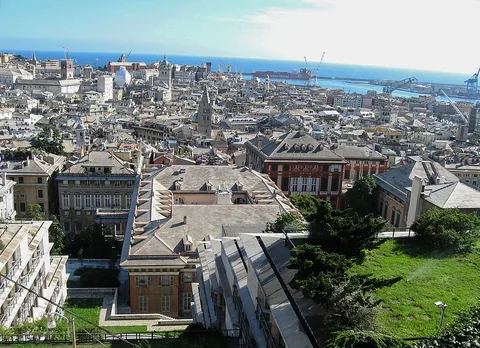 It’s very cosmopolitan. It reminds me of Marseille a little bit. It’s vertical, breathtaking views. The people there, they’re not very touristy. The Italians there seem indifferent to you as a tourist.
It just feels very, very homey. It’s so close to a lot of other great things in Italy. You can get to Torino relatively easily. That whole area up there, Bra, where the Slow Food movement originated,41Slow Food — a movement for local, traditional, unhurried food founded by journalist Carlo Petrini in the town of Bra in Piedmont: the Arcigola association was formed there in 1986, and the international movement's manifesto was signed in Paris in 1989. you’re just in striking distance from everything. Nobody I know that goes to Italy goes to Genoa. I plead with them. I’m like, “Please, just go to Genoa.”
I am the exception. My wife sometimes talks of wanting to live in the smaller towns nearby, which we’re not going to do because we’re slated for a third-tier city in Mexico, but we’re not going to do that either. I sometimes think of Northern Italy as a place where there were fewer different dimensions for mimetic desire. That is, more people dress the same. There are fewer status dimensions, maybe less room for eccentrics compared to America. Do you think that’s true, or do you think I’m off base? Paris is a bit like this also. There’s a certain notion of what kind of shoes an Italian man should wear. They wear them, and they’re amazing, and actually more affordable than here. There’s a sameness to some things.
I don’t think the sameness is a bad thing. I think the sameness is very charming. The sprezzatura of an Italian man,42Sprezzatura — the word was coined by Baldassare Castiglione in The Book of the Courtier (1528) for the art of doing difficult things with effortless nonchalance, hiding the effort. the way that an Italian man dresses, something I’ve never been able to pull off in my life. For those that don’t know what that sprezzatura means, it means you put tremendous care into putting on an outfit that looks like you didn’t think about it at all, and somehow it comes together and looks amazing. Even that seems highly mimetic to me, the idea of sprezzatura. I love Naples. Naples is maybe my second-favorite city in Italy.
It’s my second favorite, too. Maybe it’s my favorite. That and Genoa, to me, are the two undiscovered, less discovered gems.
It makes sense why we get along. Nobody goes to Naples either. It’s too dirty. It’s endless. I’ve heard all the excuses.
It’s become somewhat more popular, though. There’ve been some New York Times articles. The food has drawn some people, I think.
My test for whether or not I’ll get along with somebody is their reactions to Naples after they’ve been there. That’s my number one test. To the Northern Italian question, there’s a great book on Italy, if you haven’t read it. It’s called The Italians by Luigi Barzini43Luigi Barzini Jr. (1908–1984) — Italian journalist and member of parliament. His book The Italians (1964), written in English, became a bestseller in the US. in the ’60s. It’s just a fantastic book. I think that the North has a little bit less of the animated Italian gestures and spectacle that you get in the South. It’s a little more reserved. I would say that because of that, it’s less mimetic than the South. I think that disposition, that flamboyant way of being, is the more mimetic thing about the South, about Naples.
Speaking of Barzini, what do you think of his hypothesis that the face an Italian will show you, in terms of level of cheeriness, depends on how your status is perceived? He thinks they’re somewhat of a sad people, but they seem happy to outsiders because they put on that face for the higher-status outsiders.
I wouldn’t disagree with Barzini on Italian culture, so I’m not going to disagree with him on that. He knows Italians much better than I do. I think that the face in Italy, maybe it’s like the smile in Thai. There’s 1,000 different smiles, and they all mean something different. Italians are incredibly good at reading the face and facial expressions, but I think they have a different standard for foreigners like me than they do for each other.
07Italian Catholicism
Italians, Burgis says, are tired of their Catholicism, and how often a parish offers confession tells him how healthy it is.
How is Italian Catholicism different?
Depends on what part of Italy you’re in.
Say, Genoa, whatever part you know best.
I think that, having spent a few weeks there very recently and went to mass quite a few times—I was there during Holy Week—it is aesthetically very different. You typically will walk into a very old church that has no heating or AC, has absolutely terrible acoustics, and you’ll find people wandering in and out, like you would in an orthodox church. It’s like walking around. I would say that it’s relatively low liturgy44Low liturgy — in Catholic tradition, a low mass is said simply, with almost no singing, while a high mass is celebrated solemnly, with choir, incense and many participants. Figuratively, low and high liturgy mean plain and elaborate worship. compared to what you see.
A lot of the revival in Catholicism here in the US are high-liturgy things. I actually found it to be somewhat difficult. I couldn’t even hear the priests most of the time because the sound system is really bad. I think that the liturgy is really the test for me about everything else that’s going on, and that’s the sacramental life. The first thing I notice about any Catholic church is how many times they offer confession. I look at it right away, and I can tell you 10 other things about that same church and predict it with a very high degree.
What does that tell you? Let’s say they offer confession frequently. What do you then infer?
I infer that it’s thriving. One could say they offer confession frequently because they just have a lot of people there that believe in the sacrament of confession. I think it’s quite the opposite. It turns out from every priest that I’ve talked to that if you offer confession frequently, maybe a few times a week or daily, the lines just start to form. It’s actually quite the opposite. You’ll have a lot of priests that just start offering it more.
The extremes are confessions available by appointment only on Saturdays versus confession before every mass. That is the number one signal for me, and then how often they have adoration.45Adoration (Eucharistic adoration) — the Catholic practice of praying before a consecrated host displayed in the church. This is Catholic inside baseball here. It is like politics. If I know your position on gun control, I can, with a high degree of accuracy, predict your position on 10 other clustered things.
Why is it that, at least in formal terms, Italy has become so nonreligious? I get that underneath the cultural structure, it may be quite Catholic still, but the number of people who go to church or who profess, say, a belief in the Trinity seems fairly low. How did that happen?
It seems like they’re almost tired of their Catholicism. They’ve had it for so long. It almost seems like cultural Judaism46Cultural Judaism — belonging to the Jewish tradition without belief: secular Jews keep holidays, customs and identity without considering themselves religious. to me. It’s maybe like the familiarity breeds contempt. I don’t know, but that’s the sense that I get. Like some politics in Italy, I think Mussolini had something to do with it, the Christian Democrats.47Mussolini and the Christian Democrats — in 1929 Mussolini's government signed the Lateran Treaty with the Holy See: Vatican City became an independent state, and Catholicism the state religion of Italy. From the war until 1994 the country was governed almost without interruption by the Christian Democracy party, which collapsed after the Mani Pulite ("Clean Hands") corruption investigations. I think that it was such a part of their identity for so long, it wasn’t handed down by the last few generations, and there’s just a sense in which it has become cultural.
I met many Italians on this last trip that would make the sign of the cross if they heard an ambulance drive by or they walked by an image of Madonna on a street corner48The Madonna on the corner — the corners of buildings in Rome and Naples are full of street shrines with images of the Virgin; in Rome they are affectionately called madonnelle. or something like that, but they probably haven’t been to mass in years. This has become very cultural. I don’t know why, but I think that they’re tired.
08Rome, seminary and Pixar
Three years in Rome shaped Burgis, and a Pixar animator's master class helped him see he wasn't called to be a priest.
What was it like living next to Vatican City?
Speaking of this, I was mortified when one day I had to walk directly by St. Peter’s very often just to get home up on the Janiculum Hill.49Janiculum Hill — a hill on the west bank of the Tiber, next to the Vatican. According to Burgis's biography, in Rome he lived at the Pontifical North American College, the seminary for American students on the Janiculum, not far from St. Peter's. I walked by St. Peter’s one day and I didn’t look at it, I didn’t think about it, and then I was mortified and I realized it was too late to go back because I had to be somewhere. Rome can be a very difficult place to live as a person of faith. When I got there, somebody said, Rome will either strengthen your faith or lose it as a Catholic because you will see the dark underbelly of everything.
You will see a lot of worldliness and you will either come out of it with a more supernatural vision of what the church is or you will come out of it with your tail between your legs, really worried about things. For me, it was really not one of those two extremes. It was like I came out of it not that much different than when I went in. It was probably the three most formative years of my life when I lived next to the Vatican because it was an incredibly strange situation.
I was a 31-year-old man who had owned my own house in Las Vegas and suddenly lived in what was essentially a dormitory with 250 other men, most of them younger than me. The typical age for a seminarian is 20, 25 probably, with a shared bathroom on every floor. Talk about a relatively mimetic environment where we share so much in common. I would also say because of that, it was one of the funniest places that I’ve ever been because one of the ways that you learn to live in a situation like that is through comedy.
Why didn’t you become a priest?
John Henry Newman50John Henry Newman (1801–1890) — English theologian: an Anglican priest who became a Catholic in 1845 and a cardinal in 1879. He told the story of his conversion in his autobiography Apologia Pro Vita Sua (1864). He was canonized in 2019, and in 2025 Leo XIV declared him a Doctor of the Church (Wikipedia, "John Henry Newman"). said that one should never tell the story of their conversion or their vocational discernment between tea and dessert. It’s just too complex of a question. The easy answer that I’ll give you, it’s not a cop-out, is that I carefully discerned for a number of years that it was not what I felt like I was being called to do. I’ll tell you one of the little parts of that story that helped me realize that. I was studying theology at a pontifical university in Rome, right in Piazza Navona.51The Pontifical University of the Holy Cross — a Roman university founded by the prelature of Opus Dei, where Burgis earned a bachelor's degree in theology (2016). It stands on Piazza di Sant'Apollinare, right next to Piazza Navona.
I was on my way to a fundamental theology class in my second year in Rome. I was having nagging doubts. Something felt a little bit off in my discernment process. It turned out that there was a Matthew Luhn who was a Pixar animator. He played an instrumental role in the development of the first Toy Story.52Matthew Luhn was one of the first twelve animators on Toy Story (1995) and then worked at Pixar for about twenty years as a story artist and story supervisor, on Toy Story 2, Monsters, Inc., Finding Nemo, Cars, Ratatouille and Up. He is now a storytelling consultant and speaker. He was a storyboard guy. He worked with all of these guys at Pixar. He happened to be in Rome giving a master class on storytelling that day. This is a very typical Italian story. The venue you’re supposed to give the workshop at in Rome did not allow him in due to some kind of bureaucratic maintenance of the building.
Very Italian already.
It’s incredibly Italian. He had to find an emergency place to hold his workshop, and he held it at my pontifical university. I don’t know the backstory there, but he was there. I saw a sign, “Matthew Luhn, Pixar, storytelling master class.” It was not cheap. All these Italians paid to go. I talked my way in, and I skipped class, and I went to the storytelling class that day. I was so lit up by that class that I realized that there was something in me that craved this creative, artistic, aesthetic thing. I think it ruined theology for me for the rest of the year.
09To truth through beauty
Burgis calls himself a von Balthasar Catholic: one of the ways to truth is through beauty.
Aesthetics trumped theology?
Von Balthasar wrote a whole aesthetic treatise, the theological aesthetics.53Hans Urs von Balthasar (1905–1988) — Swiss Catholic theologian. His major work is a trilogy: The Glory of the Lord (Herrlichkeit, 1961–1969), a theological aesthetics; Theo-Drama (Theodramatik, 1973–1983), which treats the history of salvation as a drama between God and man; and Theo-Logic. Theology and aesthetics go hand in hand, really. He understood the whole story of the incarnation, like the acts of a play. I think that I’m very much a von Balthasar Catholic in the sense that I do see a lot of the goodness and beauty and aesthetic characteristics of the church as related to truth. It’s one of the ways that we can come to the truth is through beauty.
Aesthetically, what is it in Christianity that’s most important to you personally? If it were me—I’m not Christian—but I might say Bach’s B minor mass or maybe Monteverdi’s Vespers.54The Mass in B minor (assembled in its final form in 1749) is one of Johann Sebastian Bach's last major works. Claudio Monteverdi's Vespers for the Blessed Virgin (Vespro della Beata Vergine) was published in 1610. What would you say?
Aesthetically, it is the liturgy. It is a beautifully celebrated Catholic mass. I’m not one of these pre-Vatican II guys55The Second Vatican Council (1962–1965) opened the way to liturgical reform: in 1969 Paul VI approved the new order of mass (Novus Ordo), usually celebrated in local languages, and the old Latin, Tridentine, mass became rare. where I think that the Latin mass is the only real mass. I do think that is incredibly beautiful, though. I go to it every once in a while because I think it’s very beautiful. I actually came back to my faith through that practice. It’s not one particular thing or piece of artwork for me; it is the beauty of the ritual.
We’ve lost ritual in the world today in many cases. Seeing that, seeing the reverence, seeing a church full of people shoulder to shoulder on their knees in itself is beautiful to me. I remember just seeing everybody drop to their knees for the first time when I went back to mass after not having gone in a very long time. I remember being struck by that’s not something I would see anywhere else in the world.
If I speak to people who are Ethiopian Christians or maybe Egyptian Coptic Christians, possibly Armenian Christians,56The Ethiopian, Coptic and Armenian churches — Oriental Orthodox (non-Chalcedonian) churches: they rejected the Council of Chalcedon's ruling in 451 on the two natures of Christ and have lived apart from both Catholics and the Eastern Orthodox ever since. they will communicate a sense that somehow they’re in tune with an earlier, more fundamental Christianity than what we have in many other places. Does that argument carry any weight with you? Are you tempted by that or no?
A little bit. I don’t think that it’s true, but I’m very attracted to orthodoxy, to the liturgy. It is incredibly beautiful. Even the divider that they have, where the priest consecrates the Eucharist behind a wall,57The divider — in an Orthodox church this is the iconostasis: a wall of icons separates the altar from the rest of the church, and part of the liturgy, including the consecration of the Eucharist, takes place behind it. there’s a sense of mystery and transcendence to that I really like. I think the world could use more sense of mystery and more otherness. I think one of the things that worries me a lot about the church today is that the church has become highly mimetic with the world.
You have priests and influencers, they’re on TikTok performing skits and things like that. I think it’s incredibly unhelpful because there needs to be a level of otherworldliness, alterity, that I think the Eastern Orthodox liturgy preserves in a way even better than the new Mass, the Novus Ordo does.
Do we need Protestantism in America to keep print culture front and center?58Protestantism and print — the Reformation spread along with printing: the principle of sola scriptura ("scripture alone") required everyone to read the Bible for themselves, and Luther translated it into German. Hence the long link between Protestant culture and reading and literacy. Isn’t Catholic culture in some ways too visual or too theatrical, and the Protestant impulse is very good for broader society because print is a more thoughtful medium?
I love my Protestant brothers and sisters, so I don’t want them to go away. I might want them all to become Catholic, but I think that many, many great things have come out of this tension. I think generally good things do come out of tension, and yes, the church is oral to more of an extent than Protestantism is. I think it’s interesting now because we’re entering a world in which—I’m a big fan of Marshall McLuhan59Marshall McLuhan (1911–1980) — Canadian media theorist, author of the formula "the medium is the message." In The Gutenberg Galaxy (1962) he wrote about how printing reshaped the thinking of Western man.—but it seems to me like the traditional forms of written word, even traditional essays, that is changing incredibly fast in the world that we’re entering. AI is just going to change the form of that, so I don’t know where that goes.
10Douthat, miracles and demons
Burgis came to the faith through beauty and the witness of the saints rather than argument, and he believes demons are real.
Now, you and Ross Douthat,60Ross Douthat (b. 1979) — American conservative writer, a New York Times columnist from 2009 to 2026, who became a Catholic at 17. Author of The Decadent Society (2020) and Believe (2025), on why religious belief is reasonable. you both self-identify as Catholics. He’s been on this podcast several times. We’ve talked about religious issues. If you had to pin down exactly where your religious vision of Catholicism differs from his in as fundamental a manner as possible, how would you describe that?
He might take more of a rationalist approach than I do. And I believe in faith and reason, as John Paul II said, are like two wings by which one rises to the contemplation of the truth.61Faith and reason as two wings — the opening words of John Paul II's encyclical Fides et ratio ("Faith and Reason," 1998): "Faith and reason are like two wings on which the human spirit rises to the contemplation of truth." It goes back, for me, I mentioned, aesthetics and beauty, so it’s the witness of the saints that initially attracted to me. It was the beauty, it was the tradition, the continuity of the church and the world through such a long time. Reading the lives of the saints as a witness, for me, that has always been the first step, not trying to think my way to it.
I think Augustine had this beautiful phrase of faith seeking understanding.62Faith seeking understanding (fides quaerens intellectum) — the formula belongs to Anselm of Canterbury, whose Proslogion (1077–1078) originally bore that title. It continues Augustine's idea "believe so that you may understand" (crede, ut intellegas). What I’m not saying is that we should not see—because the church has a wonderful intellectual tradition—but I’m less of an apologetics guy,63Apologetics (from the Greek apologia, "speech in defense") — the branch of theology that defends and argues for the truth of the faith with rational arguments. maybe. I think the best chance that I have to help somebody see what I see in the church is not to try to convince them of the argument of why Christianity is true, which is the only good reason to be Christian, in my opinion. It’s to take them to Rome, and bring them inside a beautiful church to witness a beautiful mass, to drink a lot of good wine, and have conversations late into the night about the good, the true, and the beautiful.64The good, the true and the beautiful — a classical triad going back to Plato; in scholasticism, the "transcendentals," properties of all being through which one can come to God. That, to me, is the more circuitous route. Maybe it’s not the fastest route, but I would say it’s more of an aesthetic approach.
If the world today is enchanted,65An enchanted world — a nod to Max Weber, who in his lecture "Science as a Vocation" (1917) called the "disenchantment of the world" (Entzauberung der Welt), the retreat of magic and mystery from our picture of the world, the fate of modernity. Those who expect religion's return speak of "re-enchantment." or we should think of it as enchanted, what are the most literal manifestations of that? Of course, it would be the world itself, but specific things. Are there miracles happening commonly, or how do you think about specific events within that framework?
I wouldn’t be surprised if there’s a Marian apparition in my lifetime, like a big one. I don’t know if it’ll be Our Lady of Guadalupe,66Our Lady of Guadalupe — according to tradition, in December 1531 the Virgin Mary appeared several times to an Indigenous man, Juan Diego, on Tepeyac hill near Mexico City. Her image on his cloak is kept in the Basilica of Our Lady of Guadalupe, one of the most visited shrines in the world. but I think that sometimes, the enchantment requires that people need to be open to enchantment to see it. There are enchanting things going on all around us. The world is not necessarily becoming more enchanted. It’s us that are perceiving and noticing the things to be enchanted by. That’s why I say maybe I just have a sense that maybe there will be some openness to things that seem supernatural. I don’t know nearly enough about this. Speaking of Ross, I know that he’s fascinated by the question of UFOs—
Sure. UAPs, yes.67Unidentified anomalous phenomena (UAP) — the official term the Pentagon and NASA adopted in the early 2020s in place of "UFO," to get away from associations with flying saucers.
—but it seems as if even this discourse that we’re in right now points to a desire for some extraterrestrial, supernatural, enchanted things. We’re really trying to find them, and we’re having a hard time.
J. D. Vance said he thought they were demons.68J. D. Vance — vice president of the United States since 2025, a Catholic since 2019. He said it in an interview with podcaster Benny Johnson in late March 2026: he doesn't think they are aliens, he thinks they are demons, but that is a long conversation. I don’t agree with that, but I don’t find it crazy.
I don’t find it crazy either, as one who believes in demons. That’s a better explanation than others that I’ve heard.
Do you think he, and maybe you, have a Manichean approach to Christianity, if demons are relevant?
Well, demons are fundamental to Christianity. The gospels are full of stories of Jesus driving out demons. The Gerasene demoniac is the most famous example of that. He says, “We are legion,” and this is the quintessential gospel story where the demonic has and always has an element of contagion because the entire herd is infected by this demon and is driven off into the sea.69The Gerasene demoniac — Mark 5:1–20: in the country of the Gerasenes, Jesus drives a multitude of demons out of a possessed man, who, asked his name, answers, "My name is Legion: for we are many." The demons enter a herd of about two thousand swine, which rushes down a steep bank into the sea. Dostoevsky took Luke's version of this episode (8:32–36) as the epigraph to Demons. Jesus casts the demons out of the Gerasene demoniac into the swine, which rush into the sea: a mosaic in Ravenna, early 6th century.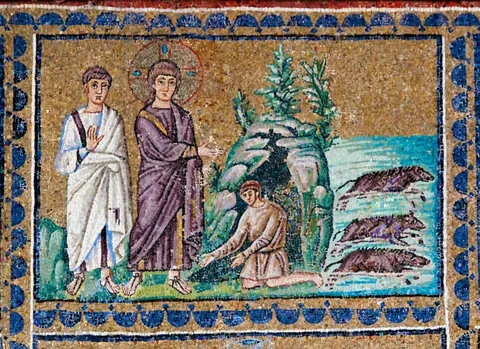 There’s nothing Manichean about that to me, living in a world where demons are real, where evil is real, and exorcisms are real.
I’ve known my fair share of exorcists, and they seem to be on the rise, by the way, from what the data shows. Most of it’s anecdotal. I don’t know how rigorously they’re actually tracked. I think they are by the church, but that is not public data. Anecdotally, it seems like they’re on the rise. Manichean is kind of there’s good, and then there’s evil, and we have to purify. Just admitting a world that might have the demonic element in it, there’s nothing Manichean about that.
11Hidden truths and the Gnostic sheep
In Catholicism the truth has been fully revealed in Christ, Burgis says, but the Gnostic reading of the lost sheep fits our times.
If you think of Shiite Islam,70Shiite Islam — the second-largest branch of Islam (about 10–15% of Muslims): Shiites recognize only Muhammad's descendants, the imams, as his rightful successors. Twelver Shiites believe that the twelfth imam has been in occultation since the 9th century and will return at the end of time. Sunnis, the majority of Muslims, don't grant the imams a special intermediary role. which sometimes is compared a bit to Catholicism, relative to Sunni Islam at least, do you feel any affinity to that approach? Obviously, it’s missing the Trinity and Jesus and many other fundamental things from your point of view, but is there any kinship?
I don’t know enough about Shiite Islam. What would be one thing that might be similar to Catholicism about it?
The world being enchanted, things and truths being hidden, and the multiplication of intermediaries as a way to get to those truths seem to me much more Catholic, if I had to say, and Sunni Islam seems much more Protestant with an emphasis on the Quran itself.
Well, given what you’ve just shared, I probably would be if I learned more about it. Seems to share some elements. The idea that there are truths that are hidden is something I would like to just drill down on just for a second, because in Catholicism, it’s that the truth has basically been revealed fully in the person of Jesus Christ. The alternative to that is Gnosticism,71Gnosticism (from the Greek gnosis, "knowledge") — religious movements of the 1st to 3rd centuries that taught that salvation comes through secret knowledge open to the elect, and that the material world was created by a lesser deity. The church condemned them as heresy. which is generally the idea that there’s always some hidden truth. It’s like Scientology.72Scientology — a religious movement founded by science fiction writer L. Ron Hubbard in the 1950s. Its teachings are revealed to followers in stages, at ever higher and more expensive "levels," and the most secret texts are kept from outsiders. There’s always this one more thing. If you just learn this next thing, then that’s the pathway to salvation is more and more knowledge.
Very interestingly, when I read the parable of the lost sheep in the gospels, where Jesus tells the story of a shepherd that has 100 sheep. One of them goes missing, is lost. He leaves the 99 to go find it and brings it back. There is a Gnostic gospel of Thomas version of that same parable. In the Gnostic gospel of Thomas, the sheep is not a sinner that Jesus finds. The one lost sheep was the smartest sheep. When Jesus finds the one, he does not bring him back to the flock. He pats him on the head and praises him for not being like all of the other sheep, for being smart enough to forge his own way, and to leave the herd and the crowd, and all of the other dumb sheep. Now, that is the Gnostic interpretation, just to be clear. I find it very, very interesting and very indicative of the times that we live in today, where I think people would be more attracted to the Gnostic interpretation than the traditional one.73The Gospel of Thomas — an early Christian collection of sayings of Jesus; its full text in a Coptic translation was found in 1945 at Nag Hammadi, Egypt. In its version of the parable of the sheep (saying 107), the kingdom is like a shepherd with a hundred sheep; the one that strays is the largest, and when the shepherd finally finds it, he tells it that he loves it more than the ninety-nine. In the canonical Gospels the parable appears in Matthew (18:12–14) and Luke (15:3–7); Luke's version ends with more joy in heaven over one sinner who repents than over ninety-nine righteous persons. Page 50 of Nag Hammadi Codex II contains sayings 104–109 in Coptic. Saying 107 is the parable of the lost sheep.
The revelation of Jesus, again, within a Christian framework, it’s not fully transparent. There’s four Gospels. They have some differences, if only of emphasis. There was a period where there’s an Avignon papacy.74The Avignon papacy — the period from 1309 to 1377 when the popes lived in Avignon rather than Rome. Two popes at once came later, in the Western Schism (1378–1417): rival popes sat in Rome and Avignon, and from 1409 there were three. The schism ended at the Council of Constance. You can count on the church to interpret, but there’s a claim that there’s two popes, who’s the real pope, which is the real church. One way or another, people had to make up their minds. Isn’t there room again for hiddenness in that framework, even if you adhere to a Catholic perspective as fully as you might try to?
Yes. One of the exciting things about the faith, and being Catholic, is the adventure of navigating a spiritual life and a religious life that ultimately is your own. One part of the tradition that I always find interesting is personal divine revelation to individuals. This goes to the heart of the question, the hidden. Sister Faustina75Sister Faustina — St. Faustina Kowalska (1905–1938), a nun of the Congregation of the Sisters of Our Lady of Mercy. Her diary is known as Divine Mercy in My Soul. In 1934 in Vilnius, following her instructions, the painter Eugeniusz Kazimirowski painted the image "Jesus, I trust in You." In 2000 John Paul II canonized her and established the Feast of Divine Mercy. is a very famous Polish saint. She was a nun. She died in her 20s,76Fact-checkIn the conversation, Faustina died in her twenties; in fact she was born on August 25, 1905, and died of tuberculosis in Kraków on October 5, 1938, at 33 (Wikipedia, "Faustina Kowalska"). lived in a convent, barely left her whole life. Then, when she died, there were just diaries and diaries filled with personal conversations that she claimed to have with Jesus. This is where the divine mercy, the famous painting. She said that Jesus actually showed her how he would like to be depicted in the painting to show the world his divine mercy. That’s an example of this personal revelation, which the church has probed and decided that it’s worthy of sharing and belief. The hiddenness is certainly there.
12Mimetic antisemitism
Burgis is shocked by open antisemitism on the right and hopes it is a mimetic fad rather than people's true colors.
On the political right these days, why do you think there’s now so much mimetic antisemitism? It seems to have come from nowhere. Maybe that’s an incorrect impression, but haven’t you been shocked by how much there is, and how open it’s become?
I’ve been totally shocked by it.
What happened?
Scandalized by it. I don’t know. I hate to think that it’s always been there. There’s two ways I think that one could explain it. It’s either always been there, and something has happened that makes people show their true colors. I hope that version of the story is not true. The other version of the story, which I think imputes less culpability to people, is that there is some crazy mimetic thing happening right now. It’s cool to be edgy or something like that and to say things. You’ve got Nick Fuentes.77Nick Fuentes (b. 1998) — American far-right streamer, leader of the "groyper" movement, known for antisemitic and racist statements. I think he’s incredibly influential, especially to a younger generation, and that it is a mimetic thing that, hopefully, people will snap out of once it’s been exposed for what it really is.
13Wall Street, Silicon Valley and Michigan
Wall Street taught Burgis he wanted to take risks, Silicon Valley's builders impress him, and Michigan formed his character.
The Luke Burgis production function.78Production function — in economics, how output depends on the inputs used: labor, capital, technology. Asking about a guest's "production function" is a Cowen signature: what a person is made of and how their work gets done. What did you learn in your Wall Street years?
How much I hate working on Wall Street. I learned that efficient markets theory is BS. All of the things that I learned in a very good undergraduate business school did not actually seem to be used in the day-to-day. Maybe it was because I was a lowly analyst at an investment bank. If I had worked at a hedge fund, I would have been enthralled by seeking alpha.79Alpha — returns above what the market as a whole would have delivered. Unfortunately, I didn’t get to do that as an analyst who just put together pitch decks and built financial models in Excel. I learned that I wanted to take risks, and I couldn’t wait to take those risks, so I did not spend very long on Wall Street. It was less than two years that I actually worked on Wall Street. I left when I started my first company.
What did you learn starting those businesses in Italy?
Well, I never started a business in Italy.
You ran them from Italy?
No, no, I was in Italy as a seminarian.
Okay.
I ended up walking away from a company in my late 20s to take up some time off, and that eventually led me to enter the seminary as I was on the pathway to becoming a priest. I did organize my life so that I was on a board while I was there. I didn’t let go completely, but I let go of all of the operational stuff. It was still a little distracting for me as I was trying to study philosophy and theology, and then would get reports about something super technical going on a few thousand miles away back home. I slowed down a lot in Italy. Being an entrepreneur is incredibly difficult because nobody ever tells you to stop, and there’s always something else to do. It helped me bring some balance back into my life.
Is there a book that the current Luke would recommend to the 23-year-old Luke that he would have hated but you still think he should have been reading?
Byung-Chul Han, The Burnout Society, I would have hated that book as a 23-year-old. I remember having an older investment banker come speak to me when I was a senior and tell me that I was gung-ho. I was saying, “If I can come work at Goldman Sachs,80Goldman Sachs — American investment bank founded in 1869, one of the largest and most prestigious on Wall Street. Junior analyst jobs at investment banks are notorious for 80- to 100-hour workweeks. I’ll work 80-hour weeks, I’ll sleep in the office.” He really walked me back from all of that language. He was like, “Young man, that’s really not what you want to do. That’s not really the best approach here.” I thought he was really lame. I thought, “This guy, he’s not going to make it.” He wasn’t that old. He’d been doing it for a few years. I thought that he was just not ambitious enough. The Burnout Society would have been a struggle for me.
What part of Silicon Valley, if any, do you secretly admire more than perhaps your audience expects from you?
I really admire people getting together to build things, usually, without sorting by things like political preference. The thing that I love about Silicon Valley is solving real problems in the world with the best people you can find working in small teams together—wish the church did more of this, should do more building, maybe, and less talking about the ethics of AI—to actually try to build things, experiment with things.
I think the church probably needs a workshop in Rome to actually start building things. You can speak much more intelligently about it. I admire so many things about Silicon Valley. I miss the energy of it. DC is very different energy. It has created a culture. There are some parts of it that I think can be dangerous, but San Francisco is still the most important city in the world, particularly because of the AI boom, because it’s never been replicated anywhere else. I think there’s a reason for that.
Why do you remain personally so tied to the state of Michigan?
Well, I spend my summers in Michigan, most of my summers. I think it’s the greatest state in the country. It has a lake81The lake — Lake Michigan, one of the five Great Lakes and the third largest by area (about 58,000 km², or 22,000 square miles): you can't see the far shore, and it gets real storms. that looks like an ocean when you’re standing on it. There’s something about the Midwest that I’ll never be able to take it out of me, even having lived in big cities. My dad was a truck driver. My mom was a grade school art teacher and artist. There’s kind of an earthiness, and it was great growing up there. I hated it at the time, but now I think about how wonderful it was to have to go through the four seasons every year.
Where did you grow up, exactly in Michigan?
Grand Rapids, Michigan,82Grand Rapids — Michigan's second most populous city after Detroit. It was shaped largely by Dutch Calvinist immigrants: it is home to the headquarters of the Christian Reformed Church in North America and to Calvin University. on the west side of the state. Scraping the ice off of the windshield at seven o’clock in the morning on my way to school. All of those things, I think, they do form some character. I love it. I love the grittiness. I love Detroit. I’m a little partial to the West side of Michigan just because that’s where I’m from. I’ve suffered as a Detroit Lions fan83The Detroit Lions — a National Football League team; the Lions last won the league championship in 1957 and have never played in the Super Bowl. my entire life. I think that the Upper Peninsula84The Upper Peninsula (UP) — the northern part of Michigan between Lakes Superior, Michigan and Huron, separated from the rest of the state by the Straits of Mackinac. A sparsely populated land of forests and waterfalls; locals are called Yoopers. is one of the hidden gems in the entire world. I don’t know if you’ve ever been to the UP.
Of course, it’s wonderful.
It’s just wonderful.
Highly underrated—
It’s highly underrated.
—like Genoa.
Yes. I try not to talk about Michigan too much because Northern Michigan, like the Traverse City area, is getting written up in the New York Times, which I hate to see anytime I see it, because it is wonderful. Prices are totally out of control, so I should probably just stop talking about all the wonderful things about Michigan.
14The Cluny Institute and the abbey of Cluny
Burgis describes the Cluny Institute as a talent network for people with a religious sensibility, modeled on the medieval abbey of Cluny.
Now, your own Cluny Institute, do you think of it as closer to a monastery, a salon, a talent network, a way of organizing a Christian counter elite, all of those? How’s the way you would present what it is or what it does?
I would think of it as trying to build a talent network and forming a kind of artist colony and workshop for people that have a religious sense or sensibility, that are open to the transcendent, that are smart, that care about serious ideas, and that want to build real things in the world, that really care about the vector of innovation. It’s not just building, but it’s like a step back, what should we be building? Trying to find as many of those people as possible in the world. It’s got a couple of different functions.
One of them is it’s trying to operate as a bat signal, putting things out into the world that bring the right people out of the woodwork. That’s certainly happening. Then there’s a part of it where I want to work with people that are able to work at the intersection of what I call Athens, Jerusalem, and Silicon Valley.85Athens and Jerusalem — a nod to the theologian Tertullian's question (around 200 AD): "What has Athens to do with Jerusalem?", that is, Greek philosophy with Christian faith. We don’t have to silo those things. I think that Silicon Valley, for instance, would be healthier if it actually wasn’t as allergic to religious thinking, for instance. I think religious thinking could do Silicon Valley a lot of good. I’m betting that if we can begin to find that network, and invest in that talent network, that 10 or 20 years from now, it will be building some of the most important things in the world. I don’t just mean companies. I mean cultural things, aesthetic things, workshops, things that will produce new forms of community, maybe even a model for a new institution.
The reason that I am so struck by the story of the original Cluny is that it was an entirely new kind of institution in its day. Even legally speaking, right? Its original charter, the guy that gave all of the money renounced his right to have anything to do with the way that it operated. It formed a network of over 1,200 Cluniac monasteries.86Cluny Abbey — a Benedictine monastery in Burgundy founded in 910 by Duke William I of Aquitaine. In its founding charter he renounced all power over the monastery, freed it from the authority of secular rulers and placed it under the protection of the pope. A network of dependent monasteries across Europe grew up around Cluny, and its third church, consecrated in 1130, remained the largest in Christendom until the new St. Peter's was built in Rome. A model of the third abbey church of Cluny (consecrated 1130), of which only a small part survives. My imagination is struck by, “Well, what does that look like today if we can have networked workshops of people that are all drawing inspiration, and talking about ideas that are open to the religious sense?”
The original Cluny was also a pioneer of accounting techniques. Is that correct?
I know that a Franciscan invented double-entry accounting.87Fact-checkIn the conversation, a Franciscan invented double-entry accounting; in fact Italian merchants and bankers were keeping double entries as early as the 13th century (one of the earliest known examples is a 1211 ledger of Florentine money changers, and full double entry appears in the books of the Florentine firm Farolfi in 1299–1300), and the Franciscan friar Luca Pacioli was the first to describe the method in detail in print, in his Summa de arithmetica (Venice, 1494) (Wikipedia, "Double-entry bookkeeping"). I know that, but he wasn’t associated with Cluny. There were all kinds of innovations, architectural innovations, agricultural, winemaking innovations that happened. It was really the largest church in the world for 300 years, the most important institution in Europe, in my opinion. It was the center of innovation in Europe, out of the liturgical renewal that it instituted, and it welcomed people in. Monasteries, the Benedictine tradition,88The Benedictine tradition — monastic life under the Rule of St. Benedict of Nursia (6th century); Cluny was a Benedictine abbey. Chapter 53 of the Rule tells monks to receive every guest who comes as Christ himself. has always been known for hospitality. No matter who you were, if you’re sick, if you’re poor, if you’re traveling, if you’re a pilgrim, you could knock on the door, and you would be let in, and you could stay for a day or two or longer, and then you would be sent on your way.
Cluny actually popularized the Camino de Santiago.89The Camino de Santiago — the pilgrimage route to the tomb of the apostle James at Santiago de Compostela in northwestern Spain. The Cluniacs founded monasteries and pilgrims' hostels along the roads leading to it. They’re the first ones that would send people on the Camino de Santiago. I could go on and on about all the things that Cluny did, but the people that came into contact with it—it was worldly in the sense that it interacted with politicians, with builders, with the Romanesque,90Romanesque — the architecture of Western Europe in the 11th and 12th centuries: thick walls, round arches, massive vaults. Cluny was one of its main centers. the masons in Italy. It was incredibly worldly in that it opened its door to all of those people and interacted with them, and then somehow shaped them. Is there a lay version of that? I’m obviously not trying to build a monastery. I’m not a monk, but I’m inspired by the way that it existed in the world as a sign of something completely different.
15Death and what comes next
Burgis hopes to face death as well as Ben Sasse has, and next he plans to build Cluny, write a novel and one day open a restaurant in Italy.
Before the last two questions, just another plug for your book. The title is The One and the Ninety-Nine: Forging Identity in the Age of Social Contagion. Last two questions. First, I’m sure you’ve been following the case of Ben Sasse91Ben Sasse — Republican senator from Nebraska from 2015 to 2023 and president of the University of Florida from 2023 to 2024. On December 23, 2025, he announced that he had stage 4 metastatic pancreatic cancer and called the diagnosis a death sentence. as of late. How do you think you will deal with your pending death?
I hope I can deal with it as good as he has dealt with his. It’s interesting because there’s Bryan Johnson in the live forever campaign.92Bryan Johnson — entrepreneur and founder of the payments company Braintree, which eBay bought in 2013. He spends millions of dollars a year trying to slow aging and promotes a movement under the slogan "Don't Die." He’s speaking at a conference that I’m hosting this summer, and directly following him is a Benedictine monk who, part of the Benedictine tradition, is literally meditating on your death every single day.93Meditating on death every day — among the "tools for good works" in chapter 4 of the Rule of St. Benedict is the instruction to keep death daily before one's eyes. There’s the memento mori. The tradition of keeping a skull on your desk, which I do. I learned that when I was in seminary. It’s not a macabre-looking skull. It’s actually from Mexico.94A painted skull from Mexico — a calavera, a brightly painted skull, symbol of Mexico's Day of the Dead (November 1–2), when the dead are remembered cheerfully, with flowers, sweets and music. It’s incredibly painted with all these bright colors. It is on my desk. It’s about this big, but meditating on it and actually going through it are two different things.
I suppose that my hope is I draw a lot of inspiration from Ben Sasse, that in C. S. Lewis’s words, “One should die before they die and die a series of small deaths to our ego.”95C. S. Lewis (1898–1963) — English writer and Christian apologist, author of The Chronicles of Narnia. In Lewis's own words, in his novel Till We Have Faces (1956), a retelling of the myth of Cupid and Psyche, the god tells the heroine: "Die before you die. There is no chance after." I’ve certainly had to do that several times in my life. I’m sure they won’t be the last, and I think that’s really the key. I can’t tell you how much I admire him going and talking to people. I can’t remember anybody that has died in public since John Paul II, who really died a slow death in public over many years.96John Paul II suffered from Parkinson's disease in the last years of his life but kept appearing in public even when he could barely speak. He died on April 2, 2005. Unfortunately, Ben Sasse, it’ll probably be much faster. There’s a Catholic tradition of actually praying for a good death. It’s to St. Joseph.97St. Joseph — the patron saint of the dying and of a "happy death": according to tradition, he died in the arms of Jesus and Mary.
Final question: What will you do next?
I plan to be building Cluny for a very long time. I’ve had an itch for a long time to do something more artistic. I’ve had a novel that I’ve thought about writing for a long time, but it’s not easy to write serious nonfiction, and then flip into a different mode. I don’t know if that will take some kind of detox period from the world of ideas. Maybe I’ll need to go live in Italy for a year.
I’m really inspired by creating new environments and experimenting with new forms. I don’t think it’s unrelated to the artistic project, but I feel a really strong desire to do that. I hope that Cluny is a place where I can do that out of. So I often think of: I am one artist in the colony that is Cluny, and maybe whatever art that I create, whether it’s a novel, a book, or whether it’s a gallery, or some kind of experience, or something like that. It will just be a manifestation of what I hope Cluny will help other people do. I want to open a restaurant, but I probably won’t do that for another 30 years, until I can afford to lose a lot of money.
That’s in the US or in Italy?
Probably in Italy.
Luke Burgis, thank you very much.
Thanks for having me, Tyler.


