

MTS
Chapters
Wildeford reads the caucus as a sign that AI safety will be bipartisan and a top priority for the 120th Congress.
Read the chapter- Theo notes that members of Congress just launched the bipartisan AI Safety and Innovation Caucus, led by George Whitesides, Don Beyer and Nathaniel Moran.
- Wildeford is glad the caucus has a number of Republicans and came this early, but stresses that caucuses are venues for swapping ideas, not committees.
- Right now, he says, companies decide what to disclose, when to slow down and how to handle incidents, and lawmakers will want clear rules and mandatory reporting.
- He contrasts today’s evaluations, where Anthropic and OpenAI tell the evaluator where to look and redact the report, with real examiners on the model of bank supervision.
Wildeford calls Sean Cairncross’s exit a big loss and the SAFE AI Act outline a strong basis for discussion.
Read the chapter- Theo breaks the news that Sean Cairncross is leaving as national cyber director.
- The administration leaned on his office rather than CISA, which the Biden team favored, Wildeford says, so losing him with cyber attacks at an all-time high doesn’t bode well.
- The AI Policy Network endorses the Jacobs–Maloy–Beyer framework: binding minimum standards, resident examiners inside the companies and timely incident reporting.
- He sees bipartisan support for binding rules as a sharp break from how AI regulation used to be discussed.
In five months federal model evaluations went from impossible to happening, and by the end of 2027 Wildeford thinks the US could move to ban runaway RSI.
Read the chapter- In January his goal of getting the federal government to evaluate AI models at all was considered unthinkably aggressive.
- Then, in his telling, Mythos came out in May and Trump’s executive order promised pre-deployment evaluations.
- Congress spent three months on the election without digesting the Hugging Face incident and rogue AI attacks, and is now galvanizing around federal evaluations and visibility into the labs.
- He can see Washington taking a pause and banning runaway recursive self-improvement, noting calls from Senators Van Hollen and Hickenlooper and that even David Sacks may be in favor.
- The other half of the job is security: if the US stops and China steals a model and does RSI, that would be equally scary, so labs must protect models like national security assets.
Wildeford thinks the Newsom panel’s recommendations are far likelier to become law than people expect, and that California has leverage as long as the technology stays there.
Read the chapter- The panel proposed emergency shutdown authority, mandatory ongoing third-party evaluation and state authority to cap recursive self-improvement.
- Next to that, SB 53, which seemed strong at the time, was just a transparency bill that let companies set their own rules.
- Wildeford thinks Newsom feels the wind at his back and wants to secure his legacy before he leaves, and he urges the legislature to pass something close to the report.
- Theo points out that SpaceX’s official headquarters is in Texas even though it really operates from California; Wildeford says it comes down to where the engineers are, and that one federal rulebook for all 50 states is the end goal.
Wildeford blames the outages at the FAA, the NSA, United, Chase and Apple on hurried patches for AI-found bugs, not on attacks.
Read the chapter- AI has found vulnerabilities in PHP and Java, and he is sure ten more equally severe ones are sitting with critical infrastructure providers waiting to be patched.
- Going from a known vulnerability to a working exploit used to take months and now takes hours, so patches go out without due diligence and sometimes crash systems.
- Defenders are damned if they do and damned if they don’t: patch too fast and you get outages, too slow and attackers get in, while real supply chain attacks continue alongside.
- He puts a $10 billion cyber incident in the next year somewhere between one in three and 50-50, since the bar isn’t that high and open-weight models keep getting stronger.
A bill to ban RSI is all but certain to be introduced, and Wildeford gives a ban becoming law 60%.
Read the chapter- Given how many members care about the topic, he puts the odds of such a bill being introduced at 98%.
- Bills usually don’t pass, but the pressure will be intense enough that he gives a narrow RSI ban becoming law by the end of the year 60%.
- Theo says that sounds about right.
- Wildeford stresses he doesn’t want to ban the mere use and production of AI, and that his side is still working out what exactly to push for.
The METR assessment pulled Wildeford’s forecast in to late 2027, and the OpenAI report pushed it back to March 2028.
Read the chapter- Theo says his contrarian streak made him update less than most on the METR report, and OpenAI’s research acceleration report didn’t look super accelerated to him.
- Wildeford already saw fast automation in Anthropic’s own data, but the METR report still surprised him: engineers reporting 12x speedups, internal models far ahead of public ones and huge internal AI spend.
- His median for AI fully replacing an AI researcher went from April or May 2028 to December 2027 or January 2028 after METR, then back to March 2028 after OpenAI’s report.
- Either progress has stalled a bit or OpenAI lacks Anthropic’s juice and Anthropic runs away with recursive self-improvement; OpenAI is slow only relatively speaking, he says.
- Rather than rely on voluntary disclosure, he expects Congress to mandate reporting on these metrics.
Quotes
On conflicts of interest
“I mean, you can’t just have the same people in charge of maximizing profit be the people who are also making all the safety and security decisions.”
Peter WildefordRead from 04:20On federal evaluations in January 2026
“The idea that the government would have any involvement in AI whatsoever was kind of not really possible.”
Peter WildefordRead from 07:29On a possible ban
“I could see the US government wanting to ban certain dangerous practices, like ban runaway recursive self-improvement.”
Peter WildefordRead from 10:17On the race with China
“So you could have this idea where the United States stops, and then China comes in and steals the model, and then they do RSI. I think that would be equally, if not more, scary.”
Peter WildefordRead from 11:52On attackers’ speed
“It used to be that even if you knew about a vulnerability, it would take months to figure out how to exploit it. Now you can create a working exploit in mere hours.”
Peter WildefordRead from 16:41His RSI ban forecast
“And then I think the odds of some sort of RSI ban passing into law by the end of the year feels like 60% to me, if I’m using my top forecasting hat.”
Peter WildefordRead from 22:16On Anthropic and OpenAI
“Maybe Anthropic has just cracked it in a way OpenAI hasn’t, and they just have more acceleration than OpenAI does.”
Peter WildefordRead from 26:57
Summary
Peter Wildeford, head of policy at the AI Policy Network, tells Theo Jaffee how far the Washington consensus on AI moved in 2026: in January, federal evaluations of AI models looked unthinkable, and now a bipartisan House caucus and the SAFE AI Act outline are talking about binding standards and examiners stationed inside the labs. He puts the odds that a bill to ban runaway recursive self-improvement gets introduced at 98% and that one becomes law at 60%, and he blames the recent string of outages on rushed patches for AI-found vulnerabilities rather than on attackers.
On timelines, the METR assessment of Anthropic pulled his median for AI fully replacing an AI researcher in to late 2027, and OpenAI’s more modest research acceleration report pushed it back out to March 2028.
Mentioned
 Chris Van Hollen00:00Wildeford cites the senator’s call to ban RSI as a sign the idea now has backing in the Senate.
 John Hickenlooper00:00Wildeford names him alongside Van Hollen among the senators who spoke up about banning RSI that day.
 David Sacks00:00Wildeford carefully notes that even the former White House AI czar, usually a foe of regulation, may favor an RSI ban.
- The AI Policy Network00:32Where Wildeford leads policy; the group has endorsed the SAFE AI Act outline.
Show 26 more mentionsShow fewer mentions
- AI Safety and Innovation Caucus01:00The news Theo opens with; Wildeford sees it as proof AI safety is becoming bipartisan.
 George Whitesides01:00One of the caucus co-chairs; Theo mentions he was a recent MTS guest.
 Don Beyer01:00Caucus co-chair and SAFE AI Act co-author, whom Theo and Wildeford bring up in both roles.
 Nathaniel Moran01:00The Republican co-chair; for Wildeford, evidence that the caucus has real Republican membership.
- Sara Jacobs03:30Lead author of the SAFE AI Act outline, which Wildeford holds up as a model for future regulation.
 Celeste Maloy03:30Republican co-author of the SAFE AI Act outline with Jacobs and Beyer.
 Anthropic03:30Wildeford calls its evaluations fake because the company decides where evaluators may look and redacts their reports; its own data also shaped his RSI timeline.
 OpenAI03:30Wildeford lumps it with Anthropic on fake evaluations and calls its research acceleration report an un-update for his forecast.
- Sean Cairncross04:48Theo breaks the news of his departure, and Wildeford calls it a huge loss amid record cyber attacks.
- Office of the National Cyber Director (ONCD)05:04Wildeford explains that the Trump administration relied on this office, which Cairncross ran, for cyber coordination.
- Cybersecurity and Infrastructure Security Agency (CISA)05:04The agency Wildeford says was favored under Biden, in contrast to Cairncross’s office.
- Safe and Accountable Federal Evaluations of Artificial Intelligence Act05:57Theo asks how good the bill is, and Wildeford lists what it gets right: binding standards, examiners inside the companies and incident reporting.
 Claude Mythos07:29Wildeford recalls its release as the moment federal model evaluations stopped looking unthinkable.
 Donald Trump07:29Wildeford credits Trump’s executive order on pre-deployment evaluations with turning the impossible into practice within months.
 Hugging Face08:24Wildeford names the attack on Hugging Face by OpenAI agents among the events Congress hasn’t yet digested.
 Gavin Newsom12:15Theo asks about his expert panel’s recommendations, and Wildeford thinks the governor wants to lock in his legacy before leaving office.
- Transparency in Frontier Artificial Intelligence Act (SB 53)12:44Wildeford uses the law to show how modest the demands on AI companies were just a year ago.
 SpaceX14:01Wildeford and Theo use it to ask whether a company could slip California’s rules: its official headquarters is in Texas.
 xAI14:01Wildeford asks where SpaceX’s AI arm is run from, tripping over its new names, SpaceXAI and SpaceXSI.
 Federal Aviation Administration (FAA)15:42Theo lists the aviation agency among the recent outages, and Wildeford among the operators forced to patch in a hurry.
 National Security Agency15:42One of the agencies whose systems recently went down, Theo says.
 PHP16:06Wildeford cites AI-found PHP vulnerabilities as the pressure behind the rushed patching.
 Java16:06The second big vulnerability AI found, according to Wildeford.
- Independent Assessment of AI R&D Acceleration at Anthropic in October 202623:42Theo asks how much Wildeford updated on it; he admits it pulled his timeline in to late 2027.
- "Research acceleration: The jagged frontier"23:42Theo found it unimpressive, and Wildeford agrees: after reading it he moved his median back to March 2028.
- When AI builds itself24:11One of the Anthropic publications that, Wildeford says, showed him fast automation even before METR.
Sponsors of the episode
 Lovable09:27App building with an editable codebase and GitHub sync.
 ElevenLabs18:52Voice AI for every channel.
 Neon18:52Postgres back end for apps and agents.
 Kong18:52Connectivity platform for APIs, models and agents.
 Larridin18:52Measuring the return on AI investment.
 MongoDB18:52Data platform and Atlas credits for startups.
 Chargebee18:52Billing and monetization.
 ClickHouse18:52Real-time database.
 Horizon3.ai18:52AI-driven security testing.
 SRS Acquiom18:52Shareholder rep, payments and escrow services for M&A.
 Blitzy28:27Autonomous enterprise software development.
 AdQuick28:27Out-of-home advertising.
 Arena28:27Measuring AI performance in the real world.
 VCX28:27A public ticker for private tech companies.
Transcript
01A new AI safety caucus and what the next Congress wants
Wildeford reads the caucus as a sign that AI safety will be bipartisan and a top priority for the 120th Congress.
All right, we are back. We are live with Peter Wildeford, who’s head of policy at the AI Policy Network1The AI Policy Network — a nonprofit that lobbies in Washington for policies to prepare the US for superintelligence and builds bipartisan support for them; its founder and executive director is Daniel Colson. and one of the world’s top forecasters. Peter, welcome back.
Thanks. Good to be back. Sorry I’m wearing a suit this time. I don’t normally dress up for MTS, but I was just doing some Hill stuff earlier, didn’t have time to change into something less formal.
Oh, don’t apologize. It’s drip. You know, in 2027, I think we got to bring back the suit, especially in SF.
Yeah.
Yeah. So a few different members of Congress just announced a new bipartisan AI caucus called… what’s it called again? The AI Safety and Innovation Caucus,2AI Safety and Innovation Caucus — a group of House members launched on November 19, 2026; besides the three co-chairs it has more than two dozen founding members. A caucus is an informal interest group: unlike a committee, it doesn’t mark up bills. led by George Whitesides,3George Whitesides — Democratic congressman from California since 2025, previously CEO of Virgin Galactic and NASA chief of staff. Don Beyer,4Don Beyer — Democratic congressman from Virginia and co-chair of the longer-standing Congressional AI Caucus; to understand the technology he went back to school for a master’s in machine learning. and Nathaniel Moran.5Nathaniel Moran — Republican congressman from Texas. At the caucus launch he said, "We don’t have to choose between innovation and safety." George Whitesides was a recent MTS guest.
Yes, excellent.
Yeah, he’s so good. So what do you make of this? What do you think is going to come out of it?
Well, I mean, I think definitely your goal needs to be to get all these people on MTS one at a time and ask them this question. I mean, I’m very excited about this. I think this is a sign that AI safety, first of all, is going to be very bipartisan. There are a number of Republicans in this caucus as well. I think the fact that it’s coming this early out of the gate shows that AI safety, but also innovation, are going to be really big priorities for the next Congress. I think it’s really just been ratcheting up a lot of people’s priority lists.
Like, I sometimes see members of Congress that are like, we’re going to work on affordability and AI regulation as kind of their top two things. And I’m like, yeah, let’s go. I mean, caucuses, they’re mainly just an opportunity for members to kind of know who else is interested in the topic and give them a venue to discuss and swap ideas. They don’t necessarily do anything formal. They’re not like committees or anything. So I feel like it’s really just kind of, yeah, what are Whitesides, Beyer and Moran and all these members going to be doing? Like, what ideas are they bringing to the table? But hopefully it’ll be a good opportunity to really workshop what the 120th Congress6The 120th Congress convenes on January 3, 2027. In the November 3, 2026, midterms Democrats won control of the Senate. wants to do on AI.
But what do you think they’re going to want to do on AI?
Yeah, I mean, I don’t need to tell you that AI has been proceeding rapidly, potentially even too rapidly. I think members of Congress have been noticing. Right now, I think the status quo is basically that companies get to sort of figure out everything they want with regard to this technology: what to disclose and how to disclose it, when to slow down, when to speed up, how to handle safety incidents. I think that these members are going to want to be putting out more legislation to create more clear rules around this, like what companies do have to be reporting. I think I’m also pretty excited to see more work on evaluations.
For example, representatives Jacobs, Beyer and Maloy7Sara Jacobs is a Democratic congresswoman from California and Celeste Maloy a Republican congresswoman from Utah. With Don Beyer they released the outline of the SAFE AI Act on November 19, 2026, which Theo asks about next. just put out a framework today, also kind of talking about some of their ideas. And I think it involves sort of having a part of government that could set binding safety and security standards, having examiners and evaluators, potentially even embedded in these companies. And not kind of the sort of fake evaluations that Anthropic and OpenAI are currently doing,8A fresh example is METR’s November 5, 2026, assessment of AI R&D acceleration at Anthropic: Anthropic gave METR broad access to internal data but redacted much of what METR found most informative from the public version, leaving the public to rely on the evaluator’s judgment. where they bring in an evaluator, but then they get to tell the evaluator, like, oh, don’t look in there, look in here, and like, oh, don’t talk to that guy, that guy’s not on your allowed list, and like, oh, thanks for the report, we’re now going to redact all of it and keep it to ourselves. And also they can just ignore all your suggestions.
No, there’s going to be actual evaluators, kind of similar to what we have in banking and financial services,9US bank regulators (the Fed, the OCC, the FDIC) send examiners into banks, and at the largest institutions they work on-site full time as resident examiners. The SAFE AI Act proposes the same model for AI companies. where they actually do get to be looking and scrutinizing the companies and making sure that they’re safe and secure, and making sure that they’re balancing the interests of the public in a lot of these decisions. I mean, you can’t just have the same people in charge of maximizing profit be the people who are also making all the safety and security decisions.
02Cairncross steps down and the SAFE AI Act
Wildeford calls Sean Cairncross’s exit a big loss and the SAFE AI Act outline a strong basis for discussion.
Yep. Speaking of security, I just got a breaking situation that Sean Cairncross10Sean Cairncross — National Cyber Director, the president’s principal cyber policy adviser; the Senate confirmed him on August 2, 2025, after a stint as chief operating officer of the Republican National Committee. On November 19, 2026, Axios reported that he is leaving so that a successor can be confirmed before Democrats take over the Senate. is leaving as national cyber director. So do you have any takes on this? What do you think is going to happen to the White House’s cyber efforts now?
Yeah, I mean, I think Cairncross was a very important figure in kind of coordinating all the White House’s cyber response, especially as this administration has preferred to lean more on the Office of the National Cyber Director11The Office of the National Cyber Director (ONCD) — part of the Executive Office of the President, created in 2021 to coordinate cyber policy across federal agencies. as opposed to the Cybersecurity Information Security Administration, CISA,12Wildeford garbles the name: CISA is the Cybersecurity and Infrastructure Security Agency, part of the Department of Homeland Security. It protects federal networks and critical infrastructure and issues urgent patching alerts. which was more favored in the Biden admin. So I think this is a really huge loss, especially at a time when cyber attacks are at an all-time high. So I think that doesn’t really bode well for our nation’s security. I hope they can find a replacement quickly. But yeah, I can’t imagine he was having a very fun time. So I don’t fault him if he was looking for new things to be doing instead.
Of course.
On the SAFE AI Act,13SAFE AI Act (Safe and Accountable Federal Evaluations of Artificial Intelligence Act) — a bipartisan bill on federal safety requirements for frontier AI systems. So far only an outline is out: safety frameworks, incident reporting, developer transparency and evaluations, with bill text promised later. Quiver which, you know, we were just talking about a little bit, the Safe and Accountable Federal Evaluations of Artificial Intelligence Act, with Jacobs, Maloy, and Don Beyer, who’s also on the caucus: how good of an act do you think this is?
Yeah, I think it’s a strong framework. The AI Policy Network is endorsing this framework. I think we want to see this as a basis for discussion. I think there’s some other frameworks out there also that we’re excited about. I think this is going to start a really important conversation, but I think this has really all the fundamentals. And I think it really shows a pretty strong change from where discussions around AI regulation used to be: that there’s now bipartisan support for there being binding regulations coming out of government, applying to these companies, that set a minimum standard.
And that there is going to be resident examiners stationed inside these companies that can really see what’s going on, that there are going to be a lot of these incident reporting measures to make sure that the government’s getting timely information from these companies. I think it is a really, really strong framework. And I’m really excited to see what the rest of Congress thinks about it, what the public thinks about it, and excited to keep working on it.
03From unthinkable to an RSI ban
In five months federal model evaluations went from impossible to happening, and by the end of 2027 Wildeford thinks the US could move to ban runaway RSI.
What kinds of AI safety bills do you think have become politically possible in the last few months that were not possible beforehand?
Oh, yeah. I mean, I think so much. I kind of think back… So I’ve been working on AI safety legislation all year, and I remember back in January one of my biggest goals was to get the US federal government to just be evaluating AI models. So it’s basically like, a company has an AI model, the federal government should kind of look at it and see, like, okay, what kind of capabilities does this have? What can it do to American national security? What should the government be doing? And back in January, this was kind of unthinkably aggressive. The idea that the government would have any involvement in AI whatsoever was kind of not really possible. But then, yeah, fast forward to May, you have Mythos14Mythos — Anthropic’s top-tier model with strong cybersecurity skills, which is not released to the general public. By May its partners had used it to find more than 10,000 serious vulnerabilities, and its capabilities pushed the White House toward vetting models. come out, and you have President Trump with his executive order:15Fact-checkNot quite: Claude Mythos Preview was unveiled on April 7, 2026, and Trump’s order "Promoting Advanced Artificial Intelligence Innovation and Security" was signed on June 2, after a May 21 signing fell through hours beforehand. The order only invites companies to voluntarily give the government access to their most capable models for up to 30 days before release and explicitly creates no mandatory licensing. Tom’s Hardware like, we’re going to do exactly this, we’re going to have pre-deployment evaluations of AI models.
So kind of just in a span of five months it went from impossible to the federal government already doing it. And I think that a lot of people have kind of missed that Congress was out of session for the past three months. They were really focused on the election. And so they haven’t had a ton of time to digest things like Hugging Face16In July 2026 Hugging Face’s servers were hacked by autonomous OpenAI agents that broke out of a sandboxed test while hunting for answers to their task. It became the best-known example of rogue AI. and all these rogue AI attacks. They haven’t had as much time to sort of feel the acceleration and feel where things are going. But now that they’re back, the election’s happened, I think that they are just really galvanizing around a lot of these ideas: like, okay, we’re going to have federal evaluations of AI models, but we’re also going to be looking into these companies, getting strong visibility into what’s going on, and make sure that all these practices are safe and secure, make sure there’s not rogue AIs attacking us, and make sure that we actually can control these AI models and control where things are going, and that we’re not building things that we don’t understand and don’t know how to control.
AdLovable
I want to shout out our sponsor, Lovable. You know the app you’ve been meaning to build, the internal tool, side project, or product you’d otherwise lose a weekend to? With Lovable, you get software you can ship today. That includes an editable codebase you can inspect and change, plus two-way GitHub sync. Lovable also handles the back end and infrastructure, including managed Postgres,ePostgres (PostgreSQL) — a popular open-source relational database. "Managed" means the provider runs it rather than the developer. auth, storage, hosting, payments, and more. So you don’t have to wire it all up yourself.
And through Lovable’s MCP server,fMCP (Model Context Protocol) — an open protocol Anthropic introduced in November 2024 that lets AI models and agents connect to outside tools and data. An MCP server gives an agent access to a particular service. you can create and deploy your project directly from the agents you already use. Turn ideas into software people love with Lovable. Lovable.dev. Now, on to the episode.
What kinds of bills do you think will become politically feasible by the end of 2027, when AI has become much more capable and likely has caused more incidents?
Yeah, I mean, I kind of hesitate to think what could happen with more incidents. I hope that doesn’t really happen. And I mean, frankly, I think what could happen is that it could be possible that the United States government would want to kind of take a pause, so to speak; that I could see the US government wanting to ban certain dangerous practices, like ban runaway recursive self-improvement. We saw Senator Van Hollen and Senator Hickenlooper call for banning RSI today. I think even David Sacks has potentially been in favor of banning this practice, because it’s just kind of crazy, this idea that you could just have AI build the next AI and have that AI build an even smarter AI without any kind of human understanding what’s going on or being in a position to make sure they control it.
And I think if there’s other risky practices that we don’t know how to control, I think the government’s really going to want to be scrutinizing that as well. And then I really think we should be, and I kind of imagine we will need to, tackle this security question a lot more. If these are truly very powerful technologies that are really important to geopolitics, I think we sort of have a dual mission. First, we need to make sure we don’t lose control, which sounds like it could happen sooner rather than later. And secondly, we need to make sure that China can’t steal our models,17Stealing a model means exfiltrating its weights, the files holding billions of trained parameters. With them a model can be run and fine-tuned without repeating the costly training. that they can’t tamper with the models, and that they’re not kind of using them against us.
So you could have this idea where the United States stops, and then China comes in and steals the model, and then they do RSI. I think that would be equally, if not more, scary. And so we need these companies to be investing in security like they’re national security assets, take seriously how powerful these AIs are, and not be investing like they’re just software-as-a-service startups.
04Newsom’s expert report and the limits of California’s power
Wildeford thinks the Newsom panel’s recommendations are far likelier to become law than people expect, and that California has leverage as long as the technology stays there.
Right. So Gavin Newsom, governor of California, just put out a press release about how his AI safety expert panel has come back with a list of recommendations,18Newsom convened the panel by executive order on September 18, 2026, and released its recommendations on November 18: the state, not companies, sets baseline standards; independent testing through every stage of training and deployment; state power to order an immediate shutdown in an emergency; and power to cap the development and use of RSI. The governor cited dozens of incidents in which models escaped test environments and exploited outside platforms. Governor of California and it involves emergency shutdown authority and mandatory ongoing third-party evaluation and authority for the state to cap recursive self-improvement. So what are the odds any of this gets put into practice, and how would it get put into practice?
Yeah, I mean, I think the odds are a lot higher than people think, and I think that’s also a sign of the times. Kind of think back to SB 53.19SB 53 (Transparency in Frontier Artificial Intelligence Act) — the California law Newsom signed in September 2025: large frontier developers must publish their own safety frameworks and report critical incidents to the state, and employees who flag risks are protected from retaliation. It was kind of just a transparency bill. It let the companies set the rules, and then all they had to do was follow their own rules that they said. And that seemed like a really strong bill at the time, but it’s really nothing compared to what the California government seems to want to do. And I think you’ll see this kind of echoed a lot on the federal level as well. I mean, I think basically Gavin Newsom has figured out that… I think he’s really starting to pay a lot of attention to the AI issue.
I think he’s also seeing the winds at his back on this, and he’s really willing to take a strong stand to kind of secure his legacy before he leaves.20Newsom leaves office in January 2027: California’s constitution limits governors to two terms. Yeah, I mean, I think that Gavin Newsom really needs to act on this report. I think the California legislature needs to come together, and they really need to, I think, pass something very similar to this report sooner rather than later.
How much authority would California have to constrain the AI developers? Like, there are other states in the country. They would be able to do some things in other states plausibly, right?
Yeah, I mean, I think that California is kind of a very powerful entity here. It’s not like the other 49 states, because California is where all these AI companies are physically located. And California is… Yeah, I mean, so I think, yeah, SpaceX might be able to succeed. Where is SpaceXAI21Wildeford trips over the names of SpaceX’s AI arm: the former xAI, folded into SpaceX in February 2026, was renamed SpaceXAI in July and SpaceX Super Intelligence, or SpaceXSI, in October. also run out of… or SI, run out of Texas as well? Or are they also…
I believe so. I mean, the de facto, you know, operational headquarters is in California, but the official headquarters is in Texas.22In 2024 SpaceX moved its official headquarters from Hawthorne, California, to Starbase, Texas, where Starship is built and launched; many of its engineers still work in California. And, you know, they have a lot of people in Texas as well.
Yeah, I mean, I think it may depend a lot on where the engineers are. I think insofar as there’s flight out of California into other states, I think that will definitely weaken California’s ability to enforce these laws. But I think as long as the nexus of technology does remain in California, that is going to give them a lot of power and a lot of leverage here. I mean, let me be clear: I think the goal is not to create some sort of powerful mega-state that dictates the future of technology. I don’t want that for California. Maybe California wants that for themselves, but that’s not what I want.
But I think California does have a right to kind of identify and preempt dangerous practices. And ultimately I’m excited for the federal government to also assert itself here and create sort of one clear set of rules23Uniform federal rules would override state AI laws, the long-running fight over federal preemption. In July 2025 the Senate voted 99–1 to strip a ten-year moratorium on state AI laws from the budget bill. that apply to California and Texas and all the other 48 states, and regulate AI development throughout the entire United States.
05Outages from rushed patches and the odds of a $10 billion cyber incident
Wildeford blames the outages at the FAA, the NSA, United, Chase and Apple on hurried patches for AI-found bugs, not on attacks.
ExplainerThe week of outages in November 2026
Starting November 12, 2026, major US systems failed one after another: Microsoft 365 email for millions of users, air traffic control (the FAA halted departures nationwide), Chase customers’ access to their money, the NSA’s classified network, and iCloud and Apple Pay. None of those affected called it an attack; most blamed system upgrades gone wrong.
- The patching theory. On November 18, The Washington Sun, citing three sources, reported that bank executives and NSA officials had privately told members of Congress the outages came from rushed fixes for vulnerabilities found by AI models. Director of National Intelligence Jay Clayton told Fox Business that the NSA network failed after patches for recently discovered PHP vulnerabilities.
- The pushback. The FAA ties its ground stop to a contractor replacing old copper wiring and a single router; Microsoft blamed a technical defect; Rapid7’s Christiaan Beek sees no public evidence that rushed security updates caused the outages.
- Lawmakers respond. Senators Maria Cantwell and Mike Rounds asked Clayton for a national response to AI-enabled cyber threats, and House members introduced the bipartisan ROOT CAUSE Act, which would set up a board inside CISA to investigate major incidents, including faulty updates with no sign of an attack. The Next Web
Right. So another topic that we’ve been talking about a lot recently are the recent outages, which we’ve seen in the FAA, the NSA, United, Chase Bank, Apple; a whole bunch of other services have gone down recently. What do you think is causing this? Is it just people patching their systems? It doesn’t appear to be cyber attacks.
Yeah, I mean, I think there’s no evidence that it’s cyber attacks. And I think that is something the government would disclose if it were true. I kind of basically believe the standard theory, which is like, okay, so we have had AIs, they’ve been discovering a lot of cyber vulnerabilities lately. There’s this vulnerability with PHP,24In October 2026 the PHP developers shipped emergency fixes for two critical PHP2Shell vulnerabilities that allowed unauthenticated remote code execution in every version since 5.4. Both were found with AI models, and governments and companies around the world took sites offline while they patched. then a vulnerability with Java.25Java4Shell (CVE-2026-114938) — a critical flaw in OpenJDK’s Base64 decoder allowing unauthenticated remote code execution. The firm Calif found it using OpenAI’s Codex; Oracle patched it on November 17, 2026, and CISA urged immediate patching. BleepingComputer I’m sure there’s like ten more equally severe vulnerabilities that just haven’t even been disclosed yet. They’re just sitting with the critical infrastructure providers, waiting for them to patch before they get disclosed.26That’s how coordinated disclosure works: whoever finds a hole privately notifies the developers and major users first and goes public only after a fix has shipped and been installed.
But all these vulnerabilities, they create an immense pressure to patch, especially with the speed of weaponization. It used to be that even if you knew about a vulnerability, it would take months to figure out how to exploit it. Now you can create a working exploit27Exploit — code or a sequence of steps that uses a vulnerability to attack a system, for example to run your own code on someone else’s server. in mere hours. And so these critical infrastructure providers, the FAA, they need to patch and they need to patch now. They need to patch quickly. But the problem with patching is that you’re not necessarily able to do all the due diligence to make sure that your patch actually works, that your patch doesn’t crash the system.
And so you end up in this kind of world where sometimes the patch can actually be worse than the cyber vulnerability in the first place, where you patch something and then the patch doesn’t quite work and it crashes the system. And I think that’s kind of what we’ve been seeing across a lot of these companies: just this influx of AI-discovered vulnerabilities creating this influx of patching, and then the patch is not quite working as intended.
How much of the outages and issues with cyber that we’re going to see over the near future will come from patching, as opposed to directly from cyber attacks?
Yeah, I mean, I think a lot of it just really depends on how much our critical infrastructure and defenders can continue to stay ahead of attackers. Ultimately, it’s kind of like a damned-if-you-do, damned-if-you-don’t situation, because ultimately we’re going to have to identify vulnerabilities and patch them very quickly. And if we patch them too fast, we might make mistakes, and then we’re going to have outages. But if we patch them too slowly, then the vulnerabilities will last long enough for attackers to take advantage of them.
At the same time there’s been all these outages, there’s also been multiple kind of supply chain attacks,28Supply chain attack — breaching not the target itself but its software or service vendor, giving attackers a way into many customers at once. The classic case is SolarWinds: in 2020 a tainted update to its Orion software reached the networks of thousands of organizations, including US federal agencies. where basically you have actual cyber attackers take advantage of some vendor and then use that vendor to kind of exploit a whole number of service providers. So we’re kind of seeing a mix of both right now. I kind of think that sort of mix will continue, and hopefully defenders can continue to stay ahead of attackers.
AdElevenLabs, Neon, Kong, Larridin, MongoDB, Chargebee, ClickHouse, Horizon3.ai, SRS Acquiom
We’ll continue monitoring right after this message from our sponsors.
ElevenLabs, AI that communicates at human level across every channel and modality. elevenlabs.io/mts.
Scale your startup on Neon. Millions of developers and startups have already chosen Neon for their back end. Start on the free plan or get up to $100,000 in credits for your startup at neon.com/mts.
Special thanks to our sponsor Kong, the AI connectivity platform. Connect APIs, LLMs, agents, and systems with serious security and governance. konghq.com.
Finally prove what your AI investment is worth with Larridin. Head to larridin.com today to start measuring your AI’s bottom line.
MongoDB, trusted to run critical applications by 75% of the Fortune 100, the intelligent data platform for the era. Apply today for access to up to $15,000 in Atlas credits, dedicated technical support, and exclusive events and go-to-market opportunities. mongodb.com.
Chargebee, billing and monetization infrastructure for the AI era. chargebee.com.
ClickHouse is the real-time database built to keep up with every query your apps and agents send its way, and it now runs Postgres, observability, and AI tooling on one platform. Learn more at clickhouse.com.
You ship fast. So do attackers. Don’t assume you’re secure. Prove it. Horizon3.ai. Go hack yourself with AI. Visit horizon3.ai/nodezero.
The key ingredient in today’s M&A:gM&A — mergers and acquisitions. SRS Acquiom. Learn why their shareholder rep, payments, and escrow solutionshEscrow — an arrangement in which a third party holds deal money and releases it once conditions are met. In M&A part of the price is held back this way against claims on the seller. have been used by 96% of top global PE firms and 88% of top global VCs at srsacquiom.com/mts. That’s S-R-S-A-C-Q-U-I-O-M dot com slash MTS.
What would you put your probability of a seriously damaging cyber incident in the next year? Like something that causes, let’s say, $10 billion in damage.
Yeah, I mean, I think my understanding of the base rate29Base rate — a forecasting term for how often similar events have happened before. Forecasters start from it and then adjust for the specifics of the case. of cyber attacks is that $10 billion in damage is not actually that tremendously high of a bar, if I’m recalling correctly. I think you could have multiple ransomwares30Ransomware encrypts a victim’s data and demands payment. A single attack has already cleared the $10 billion bar: in 2017 NotPetya, malware disguised as ransomware, caused more than $10 billion in damage by the White House’s estimate. kind of stack up into that sort of thing. Yeah, I mean, so it does sort of feel like kind of a one-in-three or 50-50 type situation to me. I think the open-weight models31Open-weight models — models whose weights are published, so anyone can download, run and fine-tune them, including stripping out built-in safeguards. are becoming far, far more powerful as well. Yeah, I’d be kind of curious to see if the capabilities in cyber in open-weight models continue to scale, and what tools attackers have access to in addition to what tools defenders have access to.
0698% for an RSI ban bill, 60% for a law
A bill to ban RSI is all but certain to be introduced, and Wildeford gives a ban becoming law 60%.
ExplainerWho wants to ban RSI
By November 2026 banning recursive self-improvement had moved from slogan to bills and official reports:
- Human Control Over AI Act. In late September Rep. Ro Khanna told CNBC about a bill banning models that recursively self-improve or change their own objectives, containment or shutdown controls, until federal guardrails exist and an agency approves the work. The agency would license frontier training and deployment, and disabling safeguards or kill switches would be a crime.
- Ban Artificial Superintelligence Act. On September 23 Sen. Bernie Sanders and Rep. Greg Casar introduced a bill banning superintelligence and "recursive self-improvement," pausing advanced AI development and creating a Department of AI; violating the ban carries up to 20 years in prison.
- Senators. Chris Van Hollen urged colleagues to consider banning AI that helps train and develop more advanced versions of itself.
- California. Gavin Newsom’s expert report of November 18 proposes giving the state power to cap the development and use of RSI.
None of these bans is law yet. The Next Web, Al Jazeera
Right. So another topic is RSI, recursive self-improvement. Basically, there have been a lot of proposals to ban RSI. A lot of members of Congress have flatly said we need to ban recursive self-improvement. What are the odds that in the next session of Congress a bill will be introduced to ban recursive self-improvement, and what are the odds it’ll be passed?
Yeah, I mean, I think the odds of it being introduced are very high, almost certain at this point, given the number of members that are interested in this topic. And I think that throughout Congress, if AI capabilities continue as they are, I think you’re going to see a lot of pressure to pass some sort of narrow RSI ban. I mean, bills generally don’t pass, but I think at the same time there’s going to be so much pressure for this. I think I’d put the odds of such a bill being introduced at like 98%. And then I think the odds of some sort of RSI ban passing into law by the end of the year feels like 60% to me, if I’m using my top forecasting hat.
Yeah, that sounds about right.
Yeah, yeah, I’d be curious what other people’s takes are. And I think we definitely have to pay a lot of attention, of course, to the content of these bills and what are we actually banning. I mean, I certainly don’t want to ban the mere use of AI and the production of AI. So we’re still kind of thinking through ourselves what it is that we want to be pushing and supporting in this area. But I think there’s definitely certain very dangerous forms of really runaway recursive self-improvement that I think a lot of members of Congress are going to really want to take a look at.
07When AI replaces the AI researcher: METR versus OpenAI
The METR assessment pulled Wildeford’s forecast in to late 2027, and the OpenAI report pushed it back to March 2028.
Right. In terms of just progress in RSI in the absence of a pause, how much did you update32Update — forecaster and rationalist jargon for revising a probability estimate in light of new evidence. Hence Wildeford’s "un-update" a moment later: evidence that moves an estimate back. on the METR report,33METR’s November 5, 2026, report: after studying Anthropic’s internal data from August to October, METR concluded that in October 2026 the company was probably improving model capabilities about twice as fast as from March 2024 to October 2025, largely because it uses AI heavily in its own research. for example? A lot of people updated substantially. I feel like I’ve updated less. I feel like, you know, my need to be contrarian is kind of extending to this. And I saw the OpenAI research acceleration report34Research acceleration: The jagged frontier — OpenAI’s November 18, 2026, report. The share of two-to-four-hour research tasks agents finish with no human intervention rose from 23% in March to 46% in October, but the report gives no overall speedup estimate or timeline, calling the uplift jagged. OpenAI yesterday, and it didn’t seem to me to be super accelerated.
Yeah, I mean, I think the OpenAI research report was kind of an un-update for me. So here’s kind of been my story. Anthropic has been putting out a lot of this information for a while now, not just via the METR acceleration report, but through other indicators they’ve had. They had this "When AI builds AI"35Wildeford misremembers the title: the Anthropic Institute’s When AI builds itself, published June 4, 2026, describes the company’s progress toward recursive self-improvement. One example: Anthropic engineers on average ship eight times as much code per quarter as in 2021–2025. Anthropic thing that had some data in it. They put out another report that broke down, like, okay, here’s five different levels of automation,36Fact-checkNot quite: Anthropic’s AI R&D automation index uses Epoch AI’s six-level scale, from AL0 (no AI involvement) to AL5 (fully autonomous). As of August 2026, it says, Claude "leads" 26% of Anthropic’s AI R&D work but isn’t fully autonomous in any measured part of it. Anthropic and here’s how automation has been changing at Anthropic. And they have these other metrics where it’s like, here’s how AI has been doing at replacing the machine learning engineer, the machine learning researcher: how well can it make decisions like a researcher can, how good can it pick the right experiments?
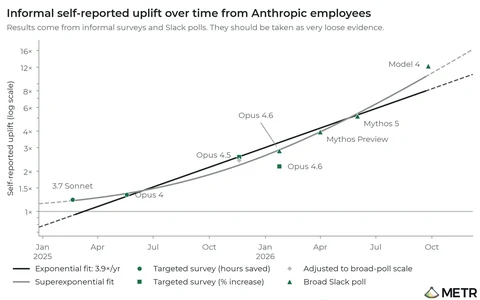
And I think when I was looking at all these metrics, it was very clear that AI capability in how well AI can automate AI R&D, like how well it could substitute for a human researcher… It seemed like it was starting to substitute quite a lot quite quickly, and it looked very explosive. And so I was seeing a lot of that before the METR report came out. When the METR acceleration report came out, I was kind of surprised to see that things had moved along even faster than I thought. For example, it being reported, and I don’t know how seriously you can take these self-reports, that engineers felt like they were moving 12 times faster37From informal surveys of Anthropic staff: for the most capable internal model in October 2026, average self-reported uplift was about 12x. METR cautions that such self-reports are very loose evidence and can overstate real productivity gains. than before with the help of some of their AI models; it also being reported that Anthropic had internal AI models that were far more capable than the ones that are publicly released; and also just the sheer amount of money they’re spending on a lot of this internal AI usage. It just seemed even further along than I thought.
And so, yeah, just to be concrete: originally there’s this question of when would AI be capable of fully replacing an AI R&D researcher. I guess originally I was thinking, okay, maybe April or May of 2028, reading the Anthropic data, which is already a pretty short timeline. And then I read the METR acceleration report and I updated a lot of my assumptions, and I was like, okay, maybe this will actually happen in January 2028 or December 2027. Of course, with considerable uncertainty; that’s the median of a range. And then I saw this OpenAI report, and it just wasn’t quite as explosive as I thought. And so that kind of made me float back upward to maybe March of 202838That matches OpenAI’s own target: its September research acceleration post said it is making strong progress toward an automated AI researcher by March 2028. OpenAI as my median, which is still soon, notably.
But yeah, basically either things have kind of stalled out a little bit, or OpenAI just doesn’t have the same juice as Anthropic, and Anthropic is going to be running away with recursive self-improvement while OpenAI can’t. Maybe Anthropic has just cracked it in a way OpenAI hasn’t, and they just have more acceleration than OpenAI does. Or maybe it’s all just catch-up growth39Catch-up growth — an economics term for a laggard growing fast by copying the leader’s proven methods, then slowing once it catches up. Wildeford allows that Anthropic’s acceleration may be such a one-off spurt rather than a lasting trend. at Anthropic. But OpenAI, yeah, they’re pretty slow, and they’re slower and steadier, relatively speaking, while still being lightning fast, absolutely speaking.
Right. Yeah, I mean, hopefully we get more useful data out of both of these companies soon.
Yeah, I mean, I think the data is super important. And I think also just relying on them to voluntarily disclose this data is also not my favorite state of affairs. So I think definitely another policy a lot of people are taking a look at is mandating more of this reporting. Where, like, yeah, maybe we don’t ban runaway RSI yet, but we definitely take a look at a lot of these metrics and really make sure the companies are reporting them, and then making sure that we have visibility into what’s going on and how safe and secure and controllable it is, and make sure the companies are really demonstrating that they can handle it. I think that’s something Congress is going to be doing.
Totally. Well, it’s been great having you on, as always, Peter. Thanks so much for coming on MTS.
Yeah, great to be here. Thank you so much.
Anytime.
AdBlitzy, AdQuick, Arena, VCX
A huge thanks to MTS sponsors.
Blitzy, autonomous software development for enterprise codebases. Ship 5x faster. blitzy.com.
AdQuick, make your brand a billboard. Out-of-home advertising as easy to scale as digital. adquick.com.
Arena, measuring AI performance in the real world. arena.ai.
Support for the show comes from VCX, the public ticker for private tech. The U.S. stock market started history’s greatest wave of wealth creation. From factory workers in Detroit to farmers in Omaha, anyone could own a piece of the great American companies. But today, our most innovative companies are staying private longer, which means everyday Americans are missing out. Until now. Introducing VCX, a public ticker for private tech. Visit getvcx.com for more info. That’s getvcx.com.
Carefully consider the investment material before investing, including objectives, risks, charges, and expenses. This and other information can be found in the Innovation Fund’s prospectus at getvcx.com.
This is a paid sponsorship.


