
Y Combinator Startup Podcast
Chapters
The skills science rewards more often get in a founder's way.
Read the chapter- Google, Anthropic, Databricks and Together AI were founded by people with PhDs, but academic-led startups more often fail.
- Skills Chaubard picked up in Fei-Fei Li's lab later held him back as a startup CEO.
- To become a formidable founder, you have to "kill" part of your academic identity.
Shift one: academia teaches you to chase grades, while a founder asks what people will actually pay for.
Read the chapter- Chaubard's vanity metrics are grades, citation counts and the number of talks you give.
- Paul Graham said the most damaging thing you learn in school is how to get good grades.
- What matters is not what people say they'd pay for but what they actually pay for, and most of the time they won't adopt your shiny new algorithm.
Shift two: a researcher digs into mechanisms, a founder builds what matters to users.
Read the chapter- Interesting research gets published but often has no effect on anyone's daily life.
- A founder has to be comfortable saying "It just works, ship it" without knowing exactly why, because empiricism is fine.
- As Marc Andreessen says, the only thing that matters is getting to product-market fit.
Shift three: in science novelty is everything, in startups copying is often a good strategy.
Read the chapter- In Joe Lonsdale's framing, "MIT-style" startups are built around a patented "black box" and rarely get big, while "Stanford-style" ones iterate forever on one boring customer problem.
- Instacart didn't invent delivering groceries from online orders, it just executed it better than anyone, and after 15 years it is still iterating on the same problem.
- Rival pairs like Lyft and Uber, Anthropic and OpenAI, or Rappi and Instacart show that copying is fine.
- Chaubard cites Steve Jobs: start with the customer experience and walk backward to the technology.
Shift four: a startup has no submission date after which you can rest.
Read the chapter- A founder needs a long-horizon vision, without constant wavering.
- Researchers juggle five ideas at once, smearing the peanut butter too thin, and while breadth-first search suits academia, a founder cranks on the same problem every day for decades.
- Many academics get bored, and that distracts the team from the core mission.
Shift five: product-market fit is found by brute force and constant conversations with customers, but not with investors.
Read the chapter- Years spent on a problem nobody cares about are wasted runway.
- Most investors have no clue what a great product will be, so ask the people who have the problem.
- Focal spent three months on a model that tracked shoppers, and retailers refused to pay for its finding that people spend a lot of time at checkout and at the deli counter at lunchtime.
- A few hand-labeled videos would have given the same result, so an AI company should start with a human in the loop and validate demand before spending millions on training a model.
Shift six: scientific precision gets in the way of sales; don't lie, but the language has to grab people.
Read the chapter- "15 minutes could save you 15% or more on your car insurance," one of the most successful slogans ever, is a beautifully inexact claim with no study behind it.
- Obsessing over rigor in your marketing, Chaubard warns, will destroy you.
Shift seven: decide without waiting for complete information.
Read the chapter- Jeff Bezos said most decisions should be made with about 70% of the information you wish you had.
- 70% confidence won't get you into NeurIPS, but in a startup, if you wait for 100%, you're too late.
- In the database wars Michael Stonebraker had the technically superior QUEL, but Larry Ellison got SQL to market faster and won.
Shift eight: a startup CEO doesn't do research; they're responsible for everything.
Read the chapter- A startup CEO is responsible for team management, cash runway, hiring, firing, marketing, sales and product development.
- Hiring an MBA to do the business stuff while doing cool research on a VC's dime is a terrible idea.
- If you distance yourself from sales and marketing, you'll never develop empathy for customers or build the product they really want.
Shift nine: a founder needs an aggressive, capitalist psychology.
Read the chapter- A founder has to be comfortable charging people money, winning talent, making 80% margins, raising capital and beating the competition.
- To paraphrase Larry Ellison, Chaubard says, your competitors want to kill your company and take the food out of your child's mouth.
Shift ten: smarts don't sell; listening does.
Read the chapter- Riffs on finite automata or P versus NP don't work in sales, in product development or when pitching VCs.
- You only get the user's perspective by listening, whether you're selling to an IT department, an intern, a procurement officer or a consumer.
- Chaubard quotes Dale Carnegie: you make more friends by becoming interested in other people than by trying to get them interested in you.
The summary: validate demand yourself and read the right books.
Read the chapter- The main advice is to get out of your office, get on a flight and meet users where they live and work, because otherwise your competitors will.
- Chaubard recommends four books: "SPIN Selling," "High Output Management," "The 7 Habits of Highly Effective People" and "How to Win Friends and Influence People."
- He closes with a quote from Gandhi, "If you want to change the world, start with yourself," and says you already have the intelligence, so the question is whether you have the will.
Quotes
On "MIT-style" startups
“MIT startups often revolve around a brand new invention, a brilliant black box that we patented that does some unprecedented magic, but they rarely turn into massive companies, because frankly, no one really wants your black box.”
Francois ChaubardRead from 02:47Why not to ask investors about your product
“Most investors have no clue what is going to be a great product or not. This is why they so often miss in venture.”
Francois ChaubardRead from 04:58On the three months Focal Systems spent on a model retailers wouldn't pay for
“I could have manually labeled a few videos a day and given them the same data and gotten the same conclusion. And that would have saved me three months.”
Francois ChaubardRead from 05:21On scientific rigor in marketing
“If you obsess over rigor in your marketing, it will destroy you. By no means should you lie, but using punchier language is necessary to get people excited.”
Francois ChaubardRead from 06:07How Larry Ellison saw the rival language QUEL
“Ellison famously said, ‘QUEL might be better than SQL. I don't care. SQL is going to win.’ And he was right.”
Francois ChaubardRead from 06:51On academics who don't want to run the business themselves
“They think, ‘Oh, I'll just hire an MBA to do the business stuff and I will do the cool research on VC's dime.’ This is a terrible idea.”
Francois ChaubardRead from 07:09On competition
“To paraphrase Larry Ellison, your competitors want to kill your company and take the food out of your child's mouth.”
Francois ChaubardRead from 07:46Why smarts don't sell
“Academics love explaining how smart they are to the world, completely unprompted.”
Francois ChaubardRead from 08:16
Summary
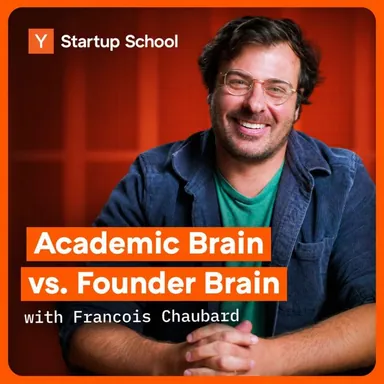
A Startup School talk. Francois Chaubard, a visiting partner at Y Combinator, founder of Focal Systems and before that a researcher in Fei-Fei Li's lab at Stanford, explains why startups founded by academics fail more often than not. Successes like Google, Anthropic and Databricks are the exceptions: the skills science rewards tend to hurt a founder, or at best don't help. To become a formidable founder, you have to "kill" part of your academic identity.
Chaubard walks through ten mindset shifts. Instead of vanity metrics like grades and citations, think about what people will actually pay for; instead of what's interesting, focus on what matters to users. Novelty isn't required: copying is fine, and Instacart didn't invent grocery delivery, it just executed it better than anyone. There is no finish line: you work on one problem every day for decades. Talk to customers, not investors. Hyperbole in a pitch is fine, lying is not. Make decisions with about 70% of the information, as Bezos advises: speed beats completeness. Don't hand sales and hiring to a hired manager, embrace capitalism and fierce competition, and remember that nobody cares how smart you are: listening is what sells.
The central example is Focal's own mistake: three months went into a model that tracked shoppers in stores, and retailers refused to pay for its conclusions, which a few hand-labeled videos would have produced just as well. Hence the advice to AI companies: start with a human in the loop and validate demand before spending millions on training a model. The talk's bottom line is to get out of the office, get on a plane and meet your users; Chaubard recommends four books on sales, management and people skills and closes with a quote from Mahatma Gandhi.
Advice
Don't chase novelty: you can execute someone else's idea better than anyone, like Instacart, which didn't invent grocery delivery. All that matters is solving a real customer problem the market still handles badly.
Pick one problem and work on it every day for years instead of spreading yourself across five ideas at once: jumping between ideas distracts the team from the core mission.
Validate demand not with investors but with the people who have the problem: ask them directly whether they'd pay if you built X. Investors usually don't know what a great product will look like.
An AI startup should start with a human in the loop: deliver the result to customers by hand and make sure they want it before spending millions on training a model.
Make decisions with about 70% of the information you need: while you wait for the full picture, a competitor will launch first.
Don't hand sales and marketing to a hired MBA: without them you'll never learn to understand customers or build the product they really need.
Mentioned
 Google00:08an example of a company founded by academics
 Anthropic00:08also founded by academics; later Chaubard cites Anthropic vs. OpenAI as proof that copying is fine
 Databricks00:08another company founded by academics
 Fei-Fei Li00:08Chaubard was a researcher in her lab
Show 18 more mentionsShow fewer mentions
 Paul Graham00:53Chaubard quotes him: the most damaging thing school teaches is how to get good grades
 Marc Andreessen02:06Chaubard cites his point that the only thing that matters is product-market fit
 Joe Lonsdale02:24Chaubard retells his split between MIT-style and Stanford-style startups
 Instacart02:47didn't invent grocery delivery, but did it better than anyone
 Steve Jobs03:23Chaubard quotes him: start with the customer experience and work backward to the technology
 Focal Systems04:58Chaubard's company: three months on a model nobody would pay for
 Jeff Bezos06:26Chaubard cites his rule of deciding with about 70% of the information you want
 Michael Stonebraker06:51Chaubard's example: Stonebraker's technically superior QUEL lost to SQL
 QUEL06:51Stonebraker's query language, which lost to SQL in the database wars
 Larry Ellison06:51got SQL to market faster; later Chaubard paraphrases his line about competitors who want to take the food out of your child's mouth
 Oracle06:51Ellison's company
 SQL06:51won the database wars
 Dale Carnegie08:33Chaubard quotes him: taking an interest in others wins more friends than trying to get others interested in you
- SPIN Selling08:59one of the four books Chaubard recommends
- High Output Management08:59one of the four books Chaubard recommends
- The 7 Habits of Highly Effective People08:59one of the four books Chaubard recommends
- How to Win Friends and Influence People08:59one of the four books Chaubard recommends
 Mahatma Gandhi09:32Chaubard closes the talk with a quote attributed to him: "start with yourself"
Transcript
01Why academics struggle at startups
The skills science rewards more often get in a founder's way.
Some of the most successful companies in the world were created by founders with PhDs, including Google,1Google was founded in 1998 by Larry Page and Sergey Brin while they were PhD students at Stanford; they never finished their dissertations. Anthropic, Databricks,2Databricks — a cloud platform for data analytics and machine learning, founded in 2013 by the creators of Apache Spark from UC Berkeley's AMPLab. Together AI,3Together AI — an American company (2022) offering a cloud for running and fine-tuning open models; its co-founders include Stanford professors Christopher Ré and Percy Liang. and more. But these are exceptions to the rule. It's actually more common for academic-led startups to fail, because many of the skills you're rewarded for as a researcher can be antithetical, or at least orthogonal, to succeed as a founder. I know this in part because before I was a founder, I was a researcher in Fei-Fei Li4Fei-Fei Li — a Stanford computer science professor and creator of ImageNet, the labeled image database on which deep learning for computer vision grew up.'s lab, and many of the skills I learned there, in retrospect, held me back as a startup CEO. To make it as a founder, academics need to unlearn many instincts that have been beaten into them by their principal investigators over years of bleary-eyed, coffee-fueled nights solo in a lab. To become a formidable founder, you will literally have to kill part of your academic identity, which is quite difficult to do.
02Vanity metrics versus what people want
Shift one: academia teaches you to chase grades, while a founder asks what people will actually pay for.
So today, I want to break down the 10 most important perspective shifts academics need to make in order to build a successful startup. Number one, focusing on vanity metrics5Vanity metrics — numbers that paint the rosiest picture but don't reflect what actually drives the business. The term was popularized by Eric Ries, author of the "lean startup" methodology. versus what people want. In academia, you are optimizing for what I call vanity metrics: grades, the number of citations, the number of talks you give, etc. Paul Graham6Paul Graham — programmer, essayist and investor, co-founder of Y Combinator (2005) and author of well-known essays on startups. has a great quote about this. He said, "The most damaging thing you learned in school wasn't something you learn in any specific class.
It was learning to get good grades."7"The Lesson to Unlearn" — Paul Graham's essay (December 2019) opens with these words. The essay. That is an academic mindset. The founder mindset is entirely different. It asks, what is something people actually want? What will they actually pay money for versus what they say they would pay money for? You might think they want your new shiny algorithm, but will they actually adopt it? So often the answer is no, and you don't realize this until you try to start talking to people and asking the tough questions.
03Interesting versus important
Shift two: a researcher digs into mechanisms, a founder builds what matters to users.
This leads directly into number two: interesting versus important. Academics often optimize for what is interesting research, and that is a good thing. You should double-click into the things to understand the mechanisms behind something. That gets you published, but it often has absolutely no real ramification on anyone's daily life. Founders must focus on what is important to their users.
In founder mode,8Founder mode — a concept from Paul Graham's essay "Founder Mode" (September 2024), written after Airbnb's Brian Chesky spoke at a YC event: the founder runs the company directly and dives into details instead of only delegating, the way hired managers are taught. you have to be okay with saying, "It just works. We don't know exactly why, but that's good enough. Ship it." Empiricism is completely fine. As Marc Andreessen9Marc Andreessen — co-founder of Netscape (1994) and of the venture firm Andreessen Horowitz (a16z, 2009). says, the only thing that matters is getting to product-market fit.10Product-market fit — in Andreessen's definition, being in a good market with a product that can satisfy that market. He popularized the concept in his 2007 post "The Only Thing That Matters." That means caring only about what is important to your users and working backwards from there.
04Novelty isn't required; copying is fine
Shift three: in science novelty is everything, in startups copying is often a good strategy.
Number three, novelty and plagiarism. In academia, novelty is everything. When you submit a paper, the reviewer judges the original nature of your work. If it's not completely novel, it's rejected. In the startup world, plagiarism is often a really good strategy. Pioneers often get arrows in the back, as they say. Joe Lonsdale11Joe Lonsdale — co-founder of Palantir and founder of the venture firm 8VC. makes a brilliant distinction between MIT-style startups and Stanford-style startups.
MIT startups often revolve around a brand new invention, a brilliant black box that we patented that does some unprecedented magic, but they rarely turn into massive companies, because frankly, no one really wants your black box. A Stanford-style startup, on the other hand, starts with a single boring customer problem and iterates on it forever. Something simple like listening to music online or getting people a local hotel room or getting people their groceries. Instacart has been around12Instacart — an American grocery delivery service founded in 2012 by Apoorva Mehta; a Y Combinator alum, listed on Nasdaq since 2023. for 15 years and is still iterating on that single core problem today. And Instacart didn't invent delivering groceries from an online order. Countless startups tried it before them.
Instacart was just the most successful at executing it. Plagiarism is completely okay. See Lyft versus Uber, Anthropic versus OpenAI, Rappi13Rappi — a Latin American delivery service founded in Colombia in 2015; a Y Combinator alum. versus Instacart. As long as you are solving a real problem that your customers have, one that the market has not adequately addressed, you're in business. Novelty is not required. Often it's not even preferred. As Steve Jobs famously said, "You have to start with the customer experience and walk backwards to the technology, not the other way around."14Steve Jobs at WWDC 1997 — from his answer to an audience question at Apple's developer conference, shortly after his return to the company.
05There is no finish line
Shift four: a startup has no submission date after which you can rest.
Number four, there is no finish line. In academia, there is always some cathartic submission date or final. A moment where the paper or test is sent off and you can finally rest. Startups don't have that.
You have to develop a long-horizon vision of where things will go and not waver constantly. Researchers are quite bad at this. They work on five different ideas all at once, smearing the peanut butter too thin.15Spreading the peanut butter too thin — spreading effort and resources across everything a little at a time. The phrase was made famous by the "Peanut Butter Manifesto," a 2006 internal memo by Yahoo senior vice president Brad Garlinghouse. That's a good idea for academic research, breadth-first search.16Breadth-first search — a graph traversal algorithm that explores all the nearest options first and only then moves on to the next level out. However, in founder mode, you have to wake up every single day and crank on that exact problem without getting sidetracked for decades. Many academics just get bored, and this distracts their team from the core mission.
06Get on a plane and talk to people
Shift five: product-market fit is found by brute force and constant conversations with customers, but not with investors.
Number five, get on a plane and talk to some people. Finding product-market fit is a brute-force exercise. It requires iterating quickly and talking to customers constantly. Academics like doing this in a vacuum. They presume they know what their customer problem is without talking to anyone, without leaving their office, but very often if you spend years solving a problem, it turns out that problem isn't big enough for anyone to care, and you just wasted years of runway.17Runway — how many months a company's cash will last at its current burn rate if it raises no more money. And when I say talk to people, I do not mean investors.
Most investors have no clue what is going to be a great product or not. This is why they so often miss in venture. Talk to the people who have the problem you are trying to solve and ask them, if you did X, would they pay money for it? We made this mistake at Focal.18Focal Systems — Chaubard's San Francisco company, a Y Combinator alum (Winter 2016), which automates brick-and-mortar stores with computer vision. We spent a lot of time collecting training data, training models to solve people tracking for retailers to know where people are and when in retail stores. Every retailer told us this was a major problem.
Three months of work later, we gave it to the stores and it told them that people spend a lot of time in the checkout counter and the deli counter at lunchtime. I asked them, "Will you pay for this?" And they said, "Absolutely not," because there was no value delivered. I could have manually labeled a few videos a day and given them the same data and gotten the same conclusion. And that would have saved me three months. So that's why I advise, if you are an AI company, start with a human in the loop.19Human in the loop — a setup in which a person does or checks part of the work that a model is eventually supposed to take over. Validate that your customers actually want what you're serving before you spend millions on compute training a model.
07Hyperbole in a pitch is fine
Shift six: scientific precision gets in the way of sales; don't lie, but the language has to grab people.
Number six, hyperbole is okay in a sales pitch versus being scientifically exact. Think about one of the most famous advertising slogans of all time. "15 minutes could save you 15% or more on your car insurance."20GEICO — an American car insurance company, wholly owned by Warren Buffett's Berkshire Hathaway since 1996; this is its advertising slogan. What a beautifully inexact statement. What does that even mean?
Where was that measured? Was there some ablation study21Ablation study — an experiment that removes a model's components one at a time to see what each contributes; a standard section of machine learning papers. somewhere? Was it independently reviewed in some double-blind22Double-blind review — a process in which reviewers don't know whose paper they're reading and authors don't know who the reviewers are; the major machine learning conferences select papers this way. conference submission? Absolutely not. Yet this was one of the most successful slogans of our lifetime. If you obsess over rigor in your marketing, it will destroy you. By no means should you lie, but using punchier language is necessary to get people excited.
08The 70% rule
Shift seven: decide without waiting for complete information.
Number seven, the 70% rule. Jeff Bezos famously said that most decisions should probably be made with somewhere around 70% of the information you wish you had.23Bezos's 70% rule — from his 2016 letter to Amazon shareholders: "Most decisions should probably be made with somewhere around 70% of the information you wish you had. If you wait for 90%, in most cases, you're probably being slow." Publishing with 70% confidence in your results isn't exactly a great strategy to get into NeurIPS.24NeurIPS — one of the main scientific conferences on machine learning; it accepts roughly a quarter of submitted papers. So it's natural for academics to hate this. In startups, if you wait for 100% of the data, you are way too late. By that point your competitor has already launched and you've lost your first-mover advantage.
In the great database wars, Michael Stonebraker25Michael Stonebraker — a database scientist, professor at Berkeley and later MIT, creator of the Ingres and Postgres database systems and winner of the 2014 Turing Award. had a technically superior product, QUEL, but Larry Ellison,26Larry Ellison — co-founder of Oracle (1977) and its CEO until 2014, then its chairman and chief technology officer. founder of Oracle, pushed SQL27QUEL — the query language of Ingres, the database system Michael Stonebraker and Eugene Wong began building at UC Berkeley in the early 1970s. Ellison's company, then called Relational Software, released the first commercially available SQL implementation, the Oracle database, in 1979. In 1986 SQL became an ANSI standard. into the market faster. Ellison famously said, "QUEL might be better than SQL. I don't care. SQL is going to win." And he was right. Speed beats perfect information.
09Don't delegate the hard stuff
Shift eight: a startup CEO doesn't do research; they're responsible for everything.
Number eight, you can't delegate the hard stuff. Researchers love doing research, but as CEO of a startup, you can't be doing research, likely ever. In a startup, you are responsible for everything: team management, cash runway, hiring, firing, marketing, sales, product development. A lot of academics love the idea of a startup, but they don't actually want to do these messy jobs. They think, "Oh, I'll just hire an MBA28MBA (Master of Business Administration) — a graduate degree in business management; in Silicon Valley the term is also used, often ironically, for hired managers who hold it. to do the business stuff and I will do the cool research on VC's dime." This is a terrible idea. If you abstract yourself away from sales and marketing, you will never develop empathy for your customers. And without customer empathy, you cannot build a product they really want.
10Outdoor animal psychology
Shift nine: a founder needs an aggressive, capitalist psychology.
Number nine, outdoor animal psychology. To be a successful founder, you must adopt a more aggressive psychology. You must become a capitalist. Starting a company is the most capitalistic thing you can possibly do, and frankly, a lot of academics are deeply uncomfortable with that. You have to be comfortable charging people money for things, winning talent, making 80% margins,29Gross margin — the share of revenue left after the direct costs of the product itself. 80% is the level of good software companies; retail and delivery margins are many times lower. raising capital, and most importantly, beating your competition. To paraphrase Larry Ellison, your competitors want to kill your company and take the food out of your child's mouth. This is the world you're walking into.
11Nobody cares how smart you are
Shift ten: smarts don't sell; listening does.
Number ten, nobody cares how smart you are. Academics love explaining how smart they are to the world, completely unprompted. They will talk your ear off about finite automata30Finite automaton — the simplest mathematical model of computation: a system with a finite number of states that moves between them according to input symbols; a staple of theory of computation courses. or their point of view on P versus NP,31P versus NP — the central open question of computational complexity theory: can every problem whose solution can be checked quickly also be solved quickly? It is one of the Clay Mathematics Institute's Millennium Prize Problems, with a million-dollar prize. but this does not work in sales. It doesn't work in product development, and it certainly doesn't work when pitching VCs.
You need an innate curiosity about people. You need to think from your user's perspective constantly, and you only get that perspective by listening. Whether you're selling to an IT department, an intern, or a procurement officer, or a consumer, you must empathize with them. As Dale Carnegie32Dale Carnegie (1888–1955) — an American writer and public speaking teacher. The quote is from his book "How to Win Friends and Influence People" (1936), which Chaubard recommends at the end of the talk. once wrote, "You can make more friends in two months by becoming interested in other people than you can in two years by trying to get others interested in you." This is exactly how sales and product development work.
12Get out of the office
The summary: validate demand yourself and read the right books.
To summarize, the most common piece of feedback I give to academics turned founders is this: get out of your office, get on a flight, and go meet with your users where they live and work. Validate your assumptions. Will people actually pay you for this? Because that is exactly what your competition is doing, and if you don't do it, they will beat you to it. It will be uncomfortable, but it is entirely necessary. If you want to quiet your academic brain and start growing your founder brain, I highly recommend reading SPIN Selling,33"SPIN Selling" (1988) — Neil Rackham's book on large-account sales. SPIN stands for the four types of questions a salesperson asks: Situation, Problem, Implication and Need-payoff. High Output Management,34"High Output Management" (1983) — a book by Andrew Grove, Intel's longtime leader, arguing that a manager's output is the output of their team. The 7 Habits of Highly Effective People, and How to Win Friends and Influence People.
I'll leave you with a quote from Mahatma Gandhi: "If you want to change the world, start with yourself."35"Be the change" — the usual paraphrase of Gandhi's thought. The closest thing he actually wrote is from 1913, in the newspaper Indian Opinion: "If we could change ourselves, the tendencies in the world would also change. As a man changes his own nature, so does the attitude of the world change towards him." You already have the intelligence. The only question left is, do you have the will?


