

Acquired
Chapters
Costco looks like a simple bulk store, but it runs on fifty clever, interlocking details, and the deeper you dig, Ben says, the more you fall in love with it.
Read the chapter- Ben lists what you can get under one roof, from cashews and tires to a 10-carat diamond ring and a $1.50 hot dog and soda, a price David says hasn't moved in 47 years.
- David tells Buffett's joke: hijackers grant a last wish, Munger asks to give his speech on the virtues of Costco one more time, and Buffett asks to be shot first.
- Costco has grown revenue about 10% a year for more than 30 years, Ben says, and its sales per square foot belong in a conversation with Tiffany rather than Walmart.
- Kirkland Signature sells $52 billion a year, about a billion more than all of Nike, and that's without Kirkland gas.
Fedco, FedMart, Price Club and Costco are really one company, and its true story starts with Sol Price, the son of Jewish immigrants in New York.
Read the chapter- David and Ben describe Costco as the end of a chain running Fedco, FedMart, Price Club, with every link built on Sol Price's stacked learnings.
- Sam Walton wrote in Made in America that he stole more ideas from Sol than from anyone, and Jim Sinegal said he didn't learn a lot from Sol, he learned everything.
- Sol's parents worked in Lower East Side garment factories, and David traces his politics to the labor movement and New York's socialists of the time.
- Like Walton, Sol marries a Helen from one of the town's wealthiest families, scrap metal dealers, and starts practicing law in San Diego just before the wartime boom.
- The hosts' main source is a rare biography of Sol, written and self-published by his son Robert.
After spotting Fedco, a nonprofit club for postal workers, Sol opens a for-profit clone called FedMart and invents the discount store along the way.
Read the chapter- Fedco was started by about 800 Los Angeles postal workers, charged $5 for a lifetime membership, and drew shoppers who drove hundreds of miles round trip.
- Sol offers Fedco first a joint venture, then a franchise, gets turned down twice, and in November 1954 opens FedMart in his wife's family's empty warehouse.
- Laws at the time let manufacturers set a minimum retail price, but Sol figured out that a membership club, closed to the general public, could sell below it.
- David says FedMart is why Walmart and Kmart are called what they are, and the discount store Sol invented was then copied by Walton, Kmart and Target.
FedMart is an instant hit, and in it Sol lays down what Costco still does today: gas, a pharmacy, a house brand, and ranked priorities with no loss leaders.
Read the chapter- The first store does $3 million in its first year against hopes of a million, and the second, in Phoenix, draws lines half a mile long.
- College student Jim Sinegal joins FedMart as a part-time bagger, works for Sol for 22 years, and ends up running distribution and centralized warehousing.
- Sol's four principles come in order: best value for customers, good wages and health insurance, honest business practices, and only then money for investors.
- David and Ben say loss leaders amount to treating customers like they're stupid, and neither Sol nor Costco uses them.
- Today, Ben says, Costco pays $26 an hour on average against $19.50 at Walmart, has 7% turnover after the first year against a retail norm of 20%, and shrinkage of just 0.15% of sales.
Unable to keep up with Kmart, Sol goes looking for a growth investor, gets a buyout instead, and loses his own company.
Read the chapter- Sol tells his son Robert, "We're good at creating businesses, we're not as good at running businesses," and by the early '70s goes to Europe for capital.
- With German retailer Hugo Mann, Sol hoped to turn FedMart stores into hypermarkets on the model of France's Carrefour, which Walmart would do 15 years later.
- Ben names two cardinal sins: Sol never asked Mann why he wanted the deal, and he sold him the majority while treating him like a minority investor.
- At the very first board meeting Mann fires Sol and changes the locks on his office, and Jim Sinegal is the one tasked with telling the company.
- Ben thinks Mann only wanted FedMart's real estate: he made a fortune on it, the chain was dead within five years, and a furious 60-year-old Sol starts over.
Sol builds Price Club around FedMart's most profitable part, Sinegal's warehouses, and it becomes a cash geyser because suppliers effectively finance the inventory.
Read the chapter- Sol and Robert realize almost all of FedMart's margin was made at the warehouse level, and plan a warehouse for gas stations, restaurants and small stores stocking 3,000 top items, against about 50,000 at Walmart and Kmart.
- The first Price Club in San Diego struggles until young CFO Giles Bateman strikes a group membership deal with the San Diego City Credit Union, which opens the gusher of consumers.
- When hot dog vendors ask to set up carts at the exit, Sol calls Hebrew National instead, and the $1.50 combo is born, which Costco now sells 130 million times a year, Ben says.
- Costco turns its inventory 12.4 times a year against eight at Walmart and five at Home Depot, so, Ben explains, goods usually sell before the 30-day supplier invoice is due.
- Ben credits the fast turns to a tiny assortment: about 3,800 SKUs against 100,000–250,000 at Walmart.
Walton, Marcus and the Brotmans copy Sol's model, his protégé Sinegal grows Costco faster than Price Club ever grew, and in 1993 the two merge.
Read the chapter- In 1979 Price Club passes 500 shareholders and, under SEC rules, has to file as a public company without raising money or listing anywhere.
- After a dinner with Sol in La Jolla, Sam Walton opens Sam's Club within 12 months, and Bernie Marcus, ousted from Handy Dan, takes Sol's playbook and starts Home Depot.
- The Brotmans are refused a Price Club franchise, Price Club's head of merchandising, Sol's nephew, points them to Jim Sinegal, and Costco hits a billion dollars in revenue in under three years.
- David calls the 1993 deal about as close to a merger of equals as the show has seen, 52% to Costco shareholders and 48% to Price Club's, rushed by a fast-growing Sam's Club.
- Sol dies in 2009 at 93 after devoting his last 15-plus years to philanthropy and Democratic politics, and Sinegal speaks at the 2012 Democratic convention.
The membership fee selects for affluent, loyal shoppers, and a strict markup cap keeps their trust.
Read the chapter- Ben explains that the upfront fee and bulk buying screen out cash-flow-sensitive shoppers: the typical Costco household earns about $125,000 a year, against about $80,000 at Walmart.
- Costco marks nothing up more than 14%, or 15% for Kirkland Signature, while Walmart marks up 25% and department stores 100%, Ben says.
- Sinegal says nobody would notice ketchup going from $1 to $1.03, and it would add 50% to pre-tax income, but raising prices "is like heroin."
- Ben runs through Costco's code of ethics in order: obey the law, take care of members, take care of employees, respect suppliers, and then reward shareholders.
- David tells how, after a 2001 coffee with Sinegal, Bezos reversed Amazon's price increases.
A house brand and the elimination of choice, with buyers choosing in advance, make Costco simpler and cheaper than its rivals.
Read the chapter- Kirkland Signature is named after Kirkland, Washington, where headquarters was, and, David says, it was a name they could clear in every country they planned to enter.
- Ben puts Kirkland Signature at a little under a quarter of $230 billion in revenue, closer to a third with gas, and David notes that even wine snobs drink the Kirkland wine.
- In the late '90s Costco expands to the UK, Korea, Taiwan, Japan and later China, and the format, David says, works even in dense Asian cities.
- Ben argues shoppers don't need selection when buyers preselect the best one or two items, and Sol practiced "intelligent loss of sales" at FedMart, stocking only the eight-ounce can of oil and not the three-ounce one.
- Ben says 92% of Costco's merchandise is cross-docked, going straight from suppliers' trucks to Costco's, against only 10% at Walmart.
Membership brings in about 70% of operating profit, retail runs on razor-thin margins, and the whole thing rests on members coming back.
Read the chapter- Ben says about $4.5 billion in fees generates roughly 70% of the operating income of a business with $230 billion in revenue.
- Executive membership costs $120, pays 2% cash back and breaks even at about $3,000 a year in spending, and if you don't use it, Costco refunds it.
- Executive members are 45% of paid members worldwide but account for 73% of sales.
- Ninety-three percent of US members renew every year, while streaming services, Ben notes, lose half their subscribers annually.
- Price Club started with cash and checks only, so, Ben explains, Costco never depended on card companies and now holds an auction for the right to issue its card.
A model cast in stone back in the late '80s has grown about 10% a year for decades, and Costco now outperforms every discounter on efficiency.
Read the chapter- Ben cites $230 billion in revenue, 124 million members, 860 warehouses and just over 300,000 employees, almost an order of magnitude fewer than Walmart.
- Revenue per square foot is $1,800 against $600 at Walmart and $450 at Target, and the average warehouse brings in $269 million a year.
- Costco publishes results by store cohort, and year one of a store opened last year beats year five of a store opened in 2014.
- About a quarter of SKUs, David says, are treasure hunt items meant to run out, and Ben adds that fresh food sits at the back of the store.
Costco's main power is scale economies shared with customers, and against Amazon it has counter-positioning, rare for an incumbent.
Read the chapter- Ben walks through investor Nick Sleep's formula: volume wins the best supplier prices, minimal overhead and markup pass the savings to members, and the flywheel spins again.
- David compares Costco to Nike: both could take more margin and instead spend their power on accessible prices.
- Costco's overhead is 10–11% against close to 30% at Amazon, and David sees counter-positioning in that: the whole point of Costco is going to the warehouse, not getting delivery.
- Ben calls members' trust in the buyers latent branding power: it never shows up as margin, but it drives volume and retention.
- David argues Costco does well in both recessions and booms, which is why the market pays a much higher multiple for it than for Walmart.
Costco rests on fifty aligned little trade-offs, and breaking any one of them breaks the whole thing.
Read the chapter- Sinegal likes to say it isn't a tricky business, but David points to the half of the quote he leaves off: anybody can sell goods for cheap, the trick is making money while doing so.
- Prices inside Costco don't affect prices outside, David and Ben argue, which is why Apple, Dom Pérignon and even Nike sell there, and many suppliers make Costco-only versions of their products.
- To avoid depending on four or five chicken processors, Costco built its own plant in Fremont, Nebraska, which processes 2 million chickens a week.
- Costco people talk in cents, executives sit in cubicles, the company promotes from within and, Ben says, has never done a layoff, not even after the merger.
- A Deutsche Bank analyst said it is better to be a Costco employee or customer than a shareholder, but $10,000 invested at the 1985 IPO would be $3.3 million today, by Ben's math.
The hosts struggle to find a bear case, while room to grow, in the US, in China and in Costco-style e-commerce, is plentiful.
Read the chapter- Ben concedes Costco was 15 years late to e-commerce, because running at 11% overhead rules out Amazon-style home delivery.
- Physical limits, not cash, keep Costco from growing much faster than 10% a year, which is why it returned 80% of net income to shareholders over the last decade.
- The average Sam's Club makes about half the revenue of a Costco, per The Science of Hitting, and Costco keeps being surprised that the US market isn't saturated.
- The first store in China opened in 2019 and reached 400,000 members within two years, against 68,000 at the average US warehouse.
- Ben sees Costco-flavored e-commerce in delivering big and bulky items through Costco Logistics and in Costco Next, which gives members discounts on other sites.
The hosts close with Costco trivia, from fine wine to a no-limit return policy, and recommend running glasses, a mashup and a podcast.
Read the chapter- Ben says Costco is the world's largest seller of fine wine, meaning $20–$300 bottles, and sells a third of the world's jumbo cashews.
- Returns are unlimited and no questions asked, even for diamond rings, an idea that came from Nordstrom, David says.
- David recalls Sol throwing tires off the high shelves onto the floor so customers could actually pick them up.
- Market managers fly to Issaquah for two days every month, and Sinegal visited every warehouse every year.
- Ben recommends Tifosi glasses and a Radiohead and Kendrick Lamar mashup, and David recommends Jeremy Giffon's Invest Like the Best episode and San Francisco's Dogpatch neighborhood.
Quotes
Warren Buffett's joke about Munger's love of Costco
“Charlie says, I would like to give my speech on the virtues of Costco one more time before I die. The hijackers turned to Warren, and he said, shoot me first.”
David RosenthalRead from 02:50Jim Sinegal on what he learned from Sol Price
“No, that's inaccurate. I didn't learn a lot, I learned everything. Absolutely everything I know, I learned from Sol.”
David RosenthalRead from 09:10Sol Price on being the father of modern American retail
“You know, maybe I should have worn a condom.”
David RosenthalRead from 19:57Jim Sinegal on why Costco doesn't raise prices
“You could raise the price of a bottle of ketchup to $1.03 instead of $1, and no one would know. Raising prices just 3% would add 50% to our pre tax income. Why not do it? It's like heroin. You do it a little bit, and you want a little more. Raising prices is the easy way.”
Ben GilbertRead from 1:22:44What Bezos told Amazon after coffee with Sinegal
“There are two types of companies in this world, companies that work hard to charge their customers more and companies that work hard to charge their customers less. Henceforth, as of today, Amazon is a company that works hard to charge its customers less.”
David RosenthalRead from 1:28:43Jim Sinegal to his successor on the $1.50 hot dog
“If you raise the price of the hot dog and drink combo, I will effing kill you.”
Ben GilbertRead from 2:18:58The second half of Sinegal's favorite line, which he usually leaves off
“Anybody can sell goods for cheap. The trick is to make money while doing so.”
David RosenthalRead from 2:23:47What patient Costco shareholders made
“If you bought $10,000 of shares in their IPO in 1985, you would have $3.3 million today, a 330X.”
Ben GilbertRead from 2:36:10
Summary
Costco is Charlie Munger's favorite company and, in Ben Gilbert's words, a business you fall more in love with the deeper you dig. It has the lowest prices of any major US retailer and the most affluent shoppers, pays hourly workers about a third more than Walmart does, and stocks around 3,800 items against hundreds of thousands at its rival. Ben Gilbert and David Rosenthal show how these contradictions add up to a single system.
The story begins long before 1983, with Sol Price. The son of Jewish immigrants and a San Diego lawyer, in 1954 he copies Fedco, a nonprofit club for government employees, and creates FedMart, the first big discount store, which inspired the names Walmart and Kmart. After losing the company in a deal with the German Hugo Mann, the 60-year-old Sol builds Price Club around the most profitable part of FedMart: the warehouse, where suppliers effectively finance the inventory. The model is copied by Sam Walton (Sam's Club), Bernie Marcus (Home Depot) and the Brotman family, who bring in Sol's protégé Jim Sinegal to found Costco; in 1993 Costco and Price Club merge.
The second half of the episode is about mechanics: a membership that selects for affluent, loyal shoppers and delivers about 70% of operating profit, a 14% markup cap, Kirkland Signature, a small assortment and cross-docking, the refusal to take most credit cards, and a culture that counts pennies and promotes from within. In 7 Powers terms, Costco's main power is scale economies shared with customers, and against Amazon it has counter-positioning, rare for a giant. The hosts' conclusion: Costco deliberately leaves profit on the table that it could take, and that's exactly why it lasts.
Advice
Before taking money from a partner, find out why they want the deal and what they plan to do with the company, and don't sell them a controlling stake expecting them to behave like a minority investor: that's how Sol Price lost FedMart.
Don't cheat your customers even once: break their expectations for easy profit one time and you'll have to keep cheating, and trust built over years will be gone.
Keep your product count to a minimum: Acquired has a single "SKU" for sponsors, the season, so it needs neither an ad sales team nor an outside ad network, and the business runs without extra overhead.
Integrate vertically only where it gives customers enough value to justify the added overhead, for example when suppliers are so few that they can inflate prices.
If you preach promoting from within, back it up at the very top: Costco's executives are people who started as baggers, not hires from McKinsey.
Mentioned
 Charlie Munger00:20Costco board member and its biggest fan
 Costco Wholesale01:41the company this episode is about
 Warren Buffett02:45the joke about Munger's Costco speech
 Berkshire Hathaway02:50the joke was told at its annual meeting
Show 37 more mentionsShow fewer mentions
 Walmart03:29the main rival and the yardstick for prices, wages and assortment
 Kirkland Signature03:47Costco's private label
 Nike, Inc.03:47sells less than Kirkland Signature, and likewise doesn't use its brand power for margin
 Jim Sinegal05:29Costco co-founder and CEO, Sol Price's protégé
 Jeffrey Brotman05:29Costco co-founder
 Sol Price06:00founder of FedMart and Price Club, teacher of every retailer
 FedMart06:00Sol Price's first big discount store
 Price Club06:00the first membership warehouse club, merged with Costco
 Fedco (Federal Employees Distributing Company)06:23the nonprofit government employees' club Sol copied
 Sam Walton08:50stole more ideas from Sol than anyone and opened Sam's Club
- Sam Walton: Made in America08:57Walton's autobiography
- Sol Price: Retail Revolutionary and Social Innovator09:30the rare biography of Sol, the episode's main source
 Robert Price09:30Sol's son, Price Club co-founder
 Recreational Equipment, Inc.17:06a similar membership that isn't a profit center
 Craig Jelinek33:40Costco CEO who started at FedMart
 Hugo Mann39:03bought FedMart and ousted Sol
 Richard Galanti56:29Costco's CFO, who walked Ben through the company's economics
 Sam's Club1:04:53Walmart's Price Club clone and the main competitor
 Bernie Marcus1:05:48founded Home Depot from the Price Club playbook
 The Home Depot1:06:20a Price Club for home improvement
 Jeff Bezos1:27:59dropped price hikes after coffee with Sinegal
- The Everything Store: Jeff Bezos and the Age of Amazon1:27:59the book that describes that meeting
 Amazon1:28:25the rival Costco is counter-positioned against
 Visa Inc.1:56:06Costco's current credit card partner
 Amazon Prime1:56:23Amazon's subscription, largely inspired by Costco's membership
 American Express1:58:11Costco's former card partner
- 7 Powers: The Foundations of Business Strategy2:09:19the analysis framework
 Nick Sleep2:09:48author of the "scale economies shared" formula
 TikTok2:17:33TikTokers promote Costco for free
- The Science of Hitting2:23:03analyses of Costco's financials, a source for the episode
 Zoom2:40:34grew without limits in the pandemic, which Costco can't do
 Threads2:40:49hit 100 million users instantly, the opposite of Costco
- MacBook Air2:49:30Ben is thinking of buying one at Costco for the 90-day return window
 Nordstrom2:50:38the model for the return policy
 Tifosi Optics2:54:07Ben's carve-out
 Jeremy Giffon2:55:52David's carve-out: his Invest Like the Best episode
 Patrick O'Shaughnessy2:55:52host of Invest Like the Best
Sponsors of the episode
 Blinkist09:59book summaries, including the rare biography of Sol Price
 ServiceNow35:38Super Intelligence Control Tower: tracking and governing a company's AI agents
 Legora1:00:40an AI platform for legal work
 Vanta1:38:48automated prep for SOC 2 and ISO 27001 audits, $1,000 off
 Statsig2:08:15experiments, feature flags and product analytics
 Acquired LP2:59:02paid Acquired membership: calls with the hosts and a vote on the next episode
Transcript
Hey, Acquired listeners. We've placed this episode on Costco toward the top of the podcast feed since people frequently say it is one of their favorite episodes and a great place to start listening. It was released on August 20th, 2023.
01Charlie Munger's favorite company
Costco looks like a simple bulk store, but it runs on fifty clever, interlocking details, and the deeper you dig, Ben says, the more you fall in love with it.
I don't think I have ever been more in love with a company and a business model.1Costco zealotry — from this episode on, the hosts' love of Costco became one of Acquired's running jokes: they call it "Costco zealotry" themselves and keep measuring other companies against Costco; Vanguard is "Costco for finance," and Home Depot is "not just Costco for tools."
What are you, Charlie Munger?2Charlie Munger (1924–2023) — Warren Buffett's longtime partner and vice chairman of Berkshire Hathaway; he sat on Costco's board from 1997 until his death.
It's just the deeper you dig, the more good things you find. Usually, it's the exact opposite of that. It's like the opposite of being an early stage venture capitalist.3Early-stage venture capitalist — Ben's own profession: he worked at the venture firm Madrona Venture Group and in 2015 co-founded the Seattle startup studio Pioneer Square Labs. The joke is that in venture, the deeper you dig into a company, the more problems you usually find.
Welcome to season 13, episode 2 of Acquired, the podcast about great technology companies and the stories and playbooks behind them. I'm Ben Gilbert.
I'm David Rosenthal.
And we are your hosts. What if I told you that there was one place where you could get all these things under one roof? A 2½ pound container of cashews, prescription eyeglasses, a tank of gas, new tires for your car, 96 rolls of toilet paper, a new refrigerator, an outdoor shed, a 10 carat diamond ring, some freshly prepared sushi, fine wine at a great price. And you could even grab a hot dog with a soda and a free refill on your way out for just $1.50.
Ben, I don't believe you.
Hey, it has been the same price for 40 years now.
47 years.4Costco has sold its hot dog and soda combo for $1.50 since 1985.
Yes. Most of you are very familiar with this Disneyland of consumer value that I'm referring to. It is Costco. This company seems very simple on the face of it. If you sell in bulk, you have the opportunity to offer great deals to your customers. But what really makes it work are the 50 clever innovations that they've refined over the years, that all work together like an orchestra that's been rehearsing for decades.
Nothing about Costco is an accident from the extra wide parking spaces to the whole rotisserie chickens. If your goal is to offer extremely great value to your customers on high quality products at the lowest possible prices, there are a lot of ways that you could go about doing that.
Today, we will walk through the very specific path of decisions and trade-offs that Costco has chosen to accomplish just this. Listeners remember that: extreme value, high quality products, lowest possible prices. David, my God, does this method work well? There is a reason Charlie Munger loves this business.
Does he ever? You know the great Warren Buffett joke about Costco, right?
Okay, here it goes. Warren and Charlie are flying on a plane that gets hijacked. It's kind of macabre. The hijackers each grant one of them one last wish. They asked Charlie first. Charlie says, I would like to give my speech on the virtues of Costco one more time before I die. The hijackers turned to Warren, and he said, shoot me first. It's so great. This actually happened at a Berkshire annual meeting.5The Berkshire Hathaway annual meeting — the yearly shareholder gathering of Warren Buffett's conglomerate in Omaha, Nebraska, where Buffett and Munger spent hours answering questions from the audience. It's been dubbed "Woodstock for Capitalists." It's on YouTube. We'll link to it in the show notes.
That is awesome. Charlie Munger, of course, on the board of Costco and longtime fan of the model as you should be, too. Here are some insane stats.
Costco has grown revenue right about 10% for over 30 years in a row. Their revenue per square foot6Revenue per square foot of selling space is the main measure of a store's efficiency in US retail. of their warehouses belongs more in a conversation with Tiffany than Walmart.7Tiffany & Co. — the American jewelry house founded in New York in 1837, owned by LVMH since 2021. Jewelry boutiques are the classic example of huge revenue from a small floor area. They seem to have incredible running room ahead of them to expand internationally and here in North America.
David, here's one that is just for you. Their store brand, Kirkland Signature, does more revenue alone, not including anything else in the store, than all of Nike.8Kirkland Signature — Costco's private label, launched in 1995 and named after the city of Kirkland, Washington, where the company was headquartered at the time.
I know. It's so great. I found Kirkland Signature as a unified brand. I think it might be the largest brand in the world by revenue.
It's the largest consumer packaged brand9Consumer packaged goods (CPG) — everyday items that get used up quickly and bought again regularly: food, drinks, household cleaners, cosmetics. Hence David's objection: Kirkland sells far more than that. in the world.
Yes, which is a misnomer, because they sell everything. Most other brands only sell shoes.
But their 52 billion a year that they sell, which inches by Nike by just about a billion dollars, doesn't even include the Kirkland Signature gas.
All right, listeners, if you want to know every single time a new episode drops, you can sign up for email updates at acquired.fm/email. And two brand new things: we will be including little hints at what the next episode will be to the email list now. And two, we'll be including follow-ups from episodes when listeners share things with us after release, be it little corrections or just additional insights. So sign up at acquired.fm/email. Come talk about this episode with us at acquired.fm/slack and learn from other listeners who may be closer to these topics than even David and I are. If you want more from David and I, check out our second show, ACQ2,10ACQ2 — Acquired's second show: Ben and David's interviews with founders, CEOs and investors, rather than the hours-long company histories of the main feed. available in any podcast player. Just search ACQ2. And our next few episodes are about AI with CEOs who are leading the way as the world very rapidly changes in front of us.
Without further ado, this show is not investment advice. David and I may have investments in the companies we discuss, and this show is for informational and entertainment purposes only. David Rosenthal, what are the history and facts?
02Sol Price: from the Bronx to San Diego
Fedco, FedMart, Price Club and Costco are really one company, and its true story starts with Sol Price, the son of Jewish immigrants in New York.
Costco was founded, as many people know, in the lovely city of Seattle in 1983 by retail veterans, Jim Sinegal and Jeffrey Brotman.11Jim Sinegal (born 1936) ran Costco as CEO until 2012; Jeffrey Brotman (1942–2017) was chairman of the board until his death. Jeff came from a long line of Seattle retailers. His dad was a retailer, his brother is a retailer. Jeff was one of the first investors and board members of Starbucks. Super cool. We'll talk about Jim as we go here.
If you were around in the shopping age, shall we say, in 1983, you know that the true history of Costco dates way further back than that. To someone that we talked a lot about on our Walmart episode, the legendary Sol Price12Sol Price (1916–2009) — American businessman who founded the FedMart discount stores (1954) and the Price Club warehouses (1976); he's called the father of the warehouse club format. and his two companies, FedMart and Price Club.
Although "Costco" was founded in 1983, the organization that we know and love today is actually the result of a merger between Costco and its predecessor company, Price Club. Price Club is really, of course, the actual result of Sol's previous company, FedMart, which itself really came out of Fedco in the 1940s.13Fedco (Federal Employees Distributing Company) — a membership department store for government employees, opened in Los Angeles in 1948.
In some ways, we have to tell a whole industry history here. But in other ways, these are all the same company, because they're all stacked learnings from Sol Price and his various brain children over the years to create the Costco that it is today.
Totally. We start history and facts in January 1916 in New York City, in the Bronx, where one Solomon, Sol Price, is born. Sol's parents were Jewish immigrants from Belarus. They'd arrived just a couple of years before at Ellis Island14Ellis Island — an island in New York Harbor that housed the main US immigration station from 1892 to 1954; about 12 million people passed through it. as teenagers. They had absolutely nothing. They spoke no English, they had no money, nothing.
Sol's parents, like many Jewish immigrants around then in New York, ended up getting jobs in the garment factories in the Lower East Side.15The Lower East Side — a neighborhood in southeastern Manhattan; around the turn of the 20th century it was the main quarter of poor immigrants, including Jews from the Russian Empire, with cramped tenements and garment workshops. The conditions in these factories were just absolutely terrible. If you went to school here in the US, you might remember learning in American history class about the Triangle Shirtwaist Factory fire in 1911.16The Triangle Shirtwaist Factory fire in New York on March 25, 1911, killed 146 people, mostly young immigrant women workers. It led New York State to tighten its labor laws considerably. The photograph from March 25, 1911, shows why the firefighters could not reach the factory. Their ladders reached the sixth floor, while the workshops occupied the eighth through tenth floors.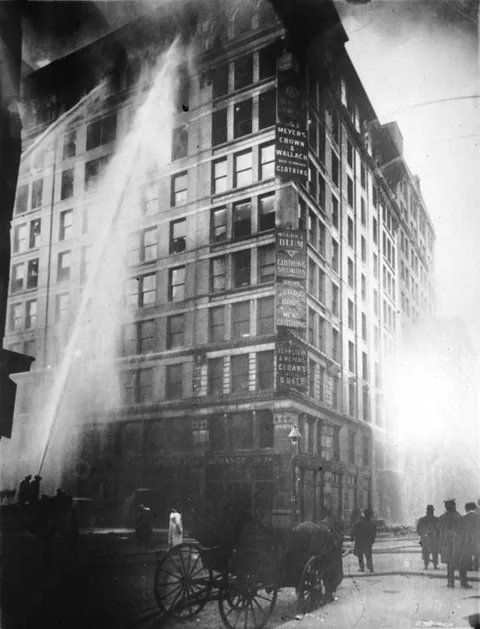 You remember that? This is the start of the American labor movement. The Communist Party and the Socialist Party emerged as a reaction to this in America,17Fact-checkThe hosts say the Communist and Socialist parties emerged in America as a reaction to the 1911 fire. In fact, the Socialist Party of America was founded in 1901, ten years before the fire, and the Communist Party in 1919, in the wake of the October Revolution (Wikipedia, "Socialist Party of America" and "Communist Party USA"). because it's a terrible disaster.
Literally, the factory owners had locked the doors to keep the workers in the building so they wouldn't steal. Then a fire breaks out, 146 people are killed, mostly women and young girls. This is terrible.
Sol's parents didn't work at Triangle, but they worked at other factories just like this. Crazy, and you can't make this up. Sol, maybe the most influential American retail capitalist in history, comes out of the Triangle Shirtwaist Factory movement, communism, socialism, and everything that's happening in New York and the Jewish community at this time.
Wow. You say, one of the most influential. I do think he's top two, top three with Sam Walton,18Sam Walton (1918–1992) — American businessman who founded Walmart (1962) and Sam's Club (1983). By 1989 Walmart was the largest US retailer by revenue. of course.
Sam Walton actually wrote in Made in America,19"Made in America: My Story" (1992) — the autobiography of Walmart founder Sam Walton, written with journalist John Huey. that he stole more ideas from Sol than anyone else in his business career.
All right. Very credible argument that he is the most important American retail capitalist.
Jim Sinegal, of course, co-founder and CEO of Costco, tells the story that a reporter once asked him if he learned a lot from Sol. Jim replied, no, that's inaccurate. I didn't learn a lot, I learned everything. Absolutely everything I know, I learned from Sol.
We found this awesome biography of Sol that's really rare. It's out of print. It was written by his son, Robert. If you are a fan of Costco, want to learn about retailing, or just like all these business practices, you absolutely should try to get your hands on this thing.20Robert E. Price, "Sol Price: Retail Revolutionary and Social Innovator," San Diego History Center.
It's self-published too.
It's self-published. I don't think there's anywhere else in the world that lays out in detail exactly how Costco works and its predecessor companies. It's amazing.
AdBlinkist
Also super fun, Blinkist, sponsor of the show, made a summary for us.
Yes. I was texting David before this, listeners. I was like, I don't think a lot of people are going to be able to get this book if they want it. Blinkist agreed to order a copy and then turn it into a blink. You can get the Blinkist summary. We'll link to the show notes on how to do that.
David, the other crazy thing is, I think Robert may have signed every copy of this book because he signed yours, and he signed the one that I got.
Amazing. That's how rare this thing is. Back to Sol's growing up years, he says in the book, there's a quote from him, "In the New York Jewish community at the time, there was no such thing as Republicans. The Socialists were the Conservatives and the Communists were the radicals."
It really illustrates where Sol's political ideology comes from.
Absolutely. As a young child, he develops an eye defect that causes his left eye to droop. He's really self-conscious about this, as you can imagine. But as a result, he channels all of this insecurity into being a massive overachiever in school. He skips two grades in school growing up. Then in the middle of his high school years, his parents moved the family from New York City to San Diego, California.
San Diego is a town of 150,000 people. This is not the San Diego we know today. There's no Qualcomm, there's no Illumina.21Qualcomm (founded in 1985) — a mobile chip designer that holds key wireless patents; Illumina (founded in 1998) — a maker of DNA sequencing instruments. Both are San Diego companies. There's only just the beginnings of the US Navy and the defense industry there, but it's a small town.
When Sol gets out there to San Diego in a parallel moment to Sam Walton's early life, Sol meets his future wife while he's in high school. It turns out that Sol's future wife's first name is Helen, just like Sam's wife's name is also Helen,22Helen Walton (1919–2007), née Robson, was the daughter of Oklahoma banker and rancher Leland Robson. Her father lent Sam Walton about $20,000 for his first store, a Ben Franklin in Newport, Arkansas, bought in 1945. and Sam's wife would be very influential on him along with her family. Same thing with Sol. Just like Helen Walton, Helen Moskowitz, soon to be Price, comes from one of the wealthiest families in San Diego.
This is literally just like the San Diego Walmart.
Literally, that's what's about to happen here just like 10 years before Sam and Walmart.
Wow.
Helen's family owns and operates a scrap metal business. A scrap metal business in the 1930s in San Diego is about as well-positioned as you can possibly be, because San Diego is about to go through a huge transformation during World War II. It's going to become the principal part of the US Navy's Pacific Fleet, which is going to be the main naval operations of World War II. The city is going to absolutely boom, and it's going to be shipbuilding. It's going to be Navy, it's going to be metal.
David, you and I were just down in San Diego doing our episode with Doug DeMuro.23Doug DeMuro — American car reviewer and YouTuber, founder of the online car auction Cars & Bids. I went and stopped by the Midway Museum24The Midway Museum — the aircraft carrier USS Midway, decommissioned in 1992 and moored as a museum in San Diego Bay since 2004. because we had just done our Lockheed Martin episode. You can feel the history dripping off that thing on all the old airplanes and everything. San Diego has been obviously a huge Navy culture for 75 years now.
Totally. During and after the war, all these sailors and GIs come through the city. When the war is over and they come back home, wherever they lived in the country before, they're like wait, why am I living in Kansas? I should be living in San Diego.
San Diego is pretty great.
It's really nice there. From 150,000 people, when Sol moves there, after the war, San Diego is on the path to becoming today. It's the eighth largest city in America.25Eighth largest: by the 2020 census San Diego had 1.39 million residents, eighth among US cities, ahead of Dallas and San Jose. Seattle and San Francisco aren't in the top ten. It's larger than Seattle. It's larger than San Francisco.
I wouldn't have guessed that.
Yup. This is going to become quite the fertile market, shall we say, for a new retail enterprise in postwar America. But before then, Sol goes to USC and gets his law degree. They come back to San Diego, and he starts practicing as a lawyer.
Sol's timing is just, you could not script this any better. He becomes a lawyer right before this boom. When you're a lawyer in a small town—my parents were lawyers in a small town growing up—you're a lawyer for your clients, but you're also a consigliere.26Consigliere — the adviser to a mafia boss, familiar from "The Godfather": the trusted confidant with whom all business is discussed. You're advising on business, real estate, negotiations, divorces, trusts, estates. You're super deep with your clients.
03Fedco and the birth of FedMart
After spotting Fedco, a nonprofit club for postal workers, Sol opens a for-profit clone called FedMart and invents the discount store along the way.
After the war, Sol starts counseling all these entrepreneurs with these new retail concept startups that are emerging in San Diego. One of these startups is called The Seven C's Locker Club, which ostensibly the premise for this business is literally a club of lockers, where Navy sailors can store their uniforms when they're on leave and wearing their civilian clothes. When they go out to sea, they can store their personal clothes and effects while they're away on the ships.
Actually, that's just a Trojan horse to get all of these consumers into the door, and then they offer all kinds of goods and services to them within the locker club. There's laundry, there's dry cleaning, there's clothing, there's jewelry, there's food, there’s haircuts. This might start to sound a little familiar here.
Another client is a jewelry store called Four Star Jewelers. In addition to operating their own jewelry store, these guys also sell jewelry wholesale to other retailers. It turns out that there's one account in particular, that accounts for the vast majority of their outside wholesale business. It's this odd retail concept operating out of Los Angeles called Fedco. You're like, Fedco, what is Fedco? What is happening here?
It's also like, okay, how are they doing so much volume? We should go check it out and see what's going on.
Exactly. Fedco, it turns out, was a non profit membership club. It was a customer collective. It was called Fedco because it was only open to federal employees, primarily postal workers. After the war, about 800 postal workers in the Los Angeles area decided somehow that they wanted to pool their buying power together and they're federal employees. They start this club so that they can pool the buying power and get better prices on goods that they can all participate in together.
It turns out, there are a lot of federal employees out there, especially in San Diego. They charged a membership fee. They charge dues to join. But unlike Costco today, they didn't really make any money on the memberships. Remember, they're a non-profit. The cost was $5 one time for a lifetime Fedco membership.
Yeah, hard to see that working. But actually, it's not so different, inflation-adjusted,27Inflation-adjusted — Ben's favorite move: he converts old sums into today's money to show their real scale. from REI membership today.28REI (Recreational Equipment, Inc.) — an American consumer cooperative selling outdoor gear; membership is a one-time lifetime fee. Very clearly, REI is not interested in making money off the membership program. I pay $85 or something once just to grant me a higher affinity to the store, and the money's not really relevant.
That is the perfect analogy. That's exactly what Fedco is. As you can imagine, Fedco becomes quite popular amongst government employees in the LA area. Not just the LA area, people start driving from all over Southern California, including San Diego, sometimes up to hundreds of miles round trip to do the majority of their shopping at Fedco.
It was time to expand, yeah. But Fedco is a nonprofit. They're not looking to expand and build this huge empire.
Exactly. Sol and the jewelry guys see what's happening with all of the wholesale business that they're sending to Fedco up in LA. They're like, man, we got to find a way to open a Fedco here in San Diego. Sol's like, actually, I might have just the location. It turns out that Helen's family owned a 21,000 square foot warehouse in San Diego's industrial district that's currently sitting empty. The three of them go over, they check it out, and they're like, oh, yeah, we could totally recreate Fedco in this building right here in San Diego.
If Sol were Sam Walton, that would be the end of the story right there. He'll just be like, great. I'm going to clone Fedco. No. This is how Sol is different from Sam. I think it probably harkens back to his upbringing in New York and everything that was happening.
He calls up the Fedco board of directors in LA and says, hey, we want to partner with you guys. We think that a Fedco would do great in San Diego. Can we create a joint venture together? We've got the building, we'll operate the store, let's go into business together and be partners. Fedco, though, like you said, they're a nonprofit. They're not interested in expansion, so they turned them down.
Sol, God bless him, calls him back. He's like, no, no, guys, we really want to do this. How about this? You can own the whole business. We'll just be a franchise down in San Diego. You get all the upside, you get all the enterprise value, we don't care. We just want to bring this to San Diego. They say no again, because that's like a nonprofit board of directors.
On the one hand, you might think, Sol Price, not a very savvy business person, just take the gift and go with it. On the other hand, a ridiculously principled guy.
There's a really funny Sol quote from later in his life. He's asked about how he feels about essentially being the father of modern American retailing. He thinks about it, he laughs, and says, you know, maybe I should have worn a condom.
It's not that he's a rube, he's a really good businessman. He's just also incredibly principled. This is going to flow through directly into Costco as we'll see. Okay, back to Fedco.
After this second rejection, Sol and the guys are like, I guess we now can go do it ourselves. In November 1954, they open the store in this warehouse location. They had to think about what to call it. They're like, basically, this is a clone of Fedco, but we can't use that name, and it's a bad name anyway. What if we draft off the same brand recognition though and call it FedMart?
An equally bad name.
An equally bad name that would have historic impact. Why do you think Walmart is called Walmart? Why do you think Kmart was called Kmart?
It was the first Mart?
It's because of this. Yes, literally. Sam Walton talks about this in Made in America. By the time Walmart was starting, people knew what FedMarts were. They were expanding across the country and he was like, oh, great, we're going to draft off the FedMart brand.
It was the same thing with Kmart. FedMart becomes the first scaled quasi-national discounter. People are like, what are discounters? Discounters are Walmarts, Kmarts, Targets. That is the industry that Sol births here.29The first Walmart, Kmart (a chain of the S. S. Kresge company) and Target (a chain of the Minneapolis department store company Dayton's) all opened in the same year, 1962.
Very specifically, we are not talking about what Costco is today as a wholesaler. FedMart is not big pallets with enormous quantities of things. It is much more like a Walmart. You want to go grab a can of beans off the shelf, you grab a can of beans off the shelf. Importantly, it is both packaged food and sundries or general merchandise under one roof.
Correct. On the one hand, FedMart is obviously a clone of Fedco. On the other hand, the huge single key difference that makes all the difference, it's a for-profit company. It's not a nonprofit. Just like all capitalist for-profit companies, Sol, the jewelry guys, and FedMart have the impetus to expand.
That makes sense. Just to put some other fine points around what it is and what it isn't, it is still only for federal employees, right?
Yes, at this time.
Okay, and it's not a membership club.
It is still a membership club. You do still have to be a federal employee, you do still have to buy a membership. I think they maybe took the lifetime membership price down to $2, so they undercut Fedco or something like that. But obviously, it's not about the membership.
The reason they did this, and the reason that no other discounters had really scaled before—this is crazy—there were actually laws on the books30"Fair trade" laws allowed manufacturers to set minimum retail prices. Their federal antitrust exemption was repealed in 1975 by the Consumer Goods Pricing Act. in the US at the time that manufacturers of goods could set a minimum selling price for retail. It was actually illegal for retailers to offer products below that price to the general public.
ExplainerHow the US banned selling for less
- 1931. California passes the first "fair trade" law: a maker of a branded product can set a minimum retail price, and selling below it becomes illegal. By the late 1930s most states have such laws, pushed by small shops and drugstores squeezed by the chains.
- 1937. The federal Miller–Tydings Act exempts these price agreements from the Sherman Antitrust Act.
- 1951–1952. The Supreme Court rules that a minimum price binds only the stores that signed an agreement with the manufacturer, and Congress promptly passes the McGuire Act: the price binds every store in the state, even those that never signed.
- 1975. The Consumer Goods Pricing Act repeals both federal exemptions, and minimum retail pricing once again becomes illegal collusion.
The term discounters, discounting meant selling below the manufacturer's minimum price. How did you get around this? Sol stumbles into figuring out that if you are a membership club, you're not open to the general public. You can skirt these laws and sell below the manufacturer's minimum price.
Interesting.
This is crazy, and this is why I think there's a strong argument that Sol really is the GOAT among American capitalist retailers. We haven't even gotten to Price Club, wholesaling, and Costco yet. He also invents that later. First, he invents the discounter, which then Sam Walton, Kresge with Kmart,31S. S. Kresge — a five-and-dime chain founded by Sebastian Kresge in 1899. In 1962 it opened the first Kmart, and in 1977 it renamed itself Kmart Corporation. Dayton with Target, copy and becomes the dominant retail form of America. Two totally separate things, he invents both of them.
Crazy.
04FedMart's principles
FedMart is an instant hit, and in it Sol lays down what Costco still does today: gas, a pharmacy, a house brand, and ranked priorities with no loss leaders.
When Sol and the guys opened the first FedMart in 1954 in San Diego, it is a huge and immediate success. Their wildest dream expectation is that they do a million dollars in sales in the first year. The store does $3 million in sales in 1954, in one year.
Wow. Why do you get the sense that it worked?
It worked because it was already working. This was a no risk bet. Clearly, Fedco had proved the model in LA. They just did the same thing as a for-profit company.
Makes sense.
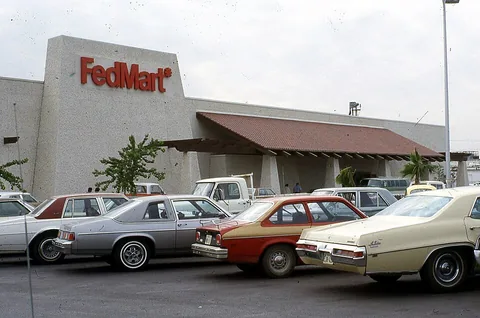
A year after San Diego, they opened the second FedMart in Phoenix, Arizona right off the bat, going multi-state. They want to go big here. It's another absolute banger. Literally when they opened it, there are lines half a mile long to get into the parking lot of the store, like going out in every direction from the store. They take it to Texas, they go to San Antonio, they go to Houston, they go to Dallas. All of these stores are huge successes.
At this point, two things happened that are going to prove very fateful, both for FedMart and for Costco. (1) Sol fully stops practicing law and goes full time with FedMart. He becomes the president of FedMart. (2) He hires a young college student from San Diego City College as a part time bagger in the San Diego store, one Jim Sinegal. Jim would end up working for the next 22 years at FedMart directly for Sol.
Eventually, Jim ends up running FedMart's entire distribution and centralized warehousing operations, warehouses. You can see the Costco picture coming together here. Put a pin in that.
FedMart goes public in 1959. They raised $2 million. They plowed that money into both expanding the number of stores across the country, but also remember back to Seven C's Locker Clubs, the suite of goods and services that they're offering under the roof, or in some cases, not under the roof. This is when they add gasoline to FedMart. The Costco gas lines started with FedMart. They would intentionally price a few cents lower than whatever the other gas stations were charging in the area.
A few cents at that time was a lot because gas was 25¢. Unlike gas stations, FedMart is making money on consumers shopping in the store as well. They can price at cost on the gasoline, get all the traffic coming to the store, and then monetize through the store. They add a pharmacy to FedMart, Costco Pharmacy today. People are religious about it.
There's a crazy story. The guy who sets up the pharmacy division for FedMart starts getting death threats from people in the industry. He has a rock thrown through his window. That's literal mafia stuff because they're undercutting the fat margins in these pharmacy counters so much. That guy's protégé, who then takes over the pharmacy division for FedMart when he retires, goes on to start Costco's pharmacy division and run it. Amazing.
Most importantly, for the Costco story here, after they go public, FedMart uses part of this capital to develop their own house brand for some of the popular products that they're selling on the shelves.
It's like the FM brand. Is that right?
The FM brand, yup. If you ever see FM branded old photos and stuff of newspaper articles referring to FM Cola, FM whatever, that's what it is. It's FedMart.
One more piece of FedMart playbook, shall we say, that clearly makes its way over, as Sol is running the company during these first few years, he starts to codify some retail management philosophies. He famously canonizes these as FedMart's four priority order principles. He teaches every new employee throughout the whole company about this.
(1) First priority, provide the best possible value to customers. (2) Second priority, pay good wages to employees and provide good benefits, including health insurance. This is in the 50s. This is progressive stuff. (3) Maintain honest business practices. (4) The last one, make money for investors. If you're a Costco nerd out there, and there are probably many Costco investor nerds listening right now, those all probably sound very familiar to Costco's priority order values.
Right. Not the same, but rhymes. Put a pin in it. When it comes to Costco, we'll bring those up and go into each of them in depth.
You might be listening and saying, yeah, that sounds good. Maybe I go to Walmart today, or I walk into Target, and I see some similar things written on the walls there, isn't this all the same? If you really mean them? No. There are some very, very clear trade-offs that Sol is going to make with FedMart that Costco makes today that are very different from what their competitors do.
Like do you sell loss leaders32Loss leader — an item a store sells below cost to lure shoppers; the loss is covered by their purchases of other goods at the usual markup. in the store, loss leaders being when you mark down items below your cost in order to attract people into the store with sales? If you're those other retailers, yeah, of course, this is a time-honored tactic in retailing. Of course, you're going to use this.
Sam Walton bragged about it in Made in America about, we could get this incredible number of, I don't even remember what the thing was, but build a pyramid of them in the parking lot, blow them out to get people to come, and participate in the spectacle.
If you're Sol and Costco today, you're absolutely not going to do this stuff.
No, they won't sell something unless they can make money on it.
The flip side of doing loss leaders is that you have to make up for it somewhere. You got to mark up other goods in the store to fat margins to make it worth doing the loss leader for you. Basically, it means you're treating your customers like they're stupid.
Totally. That's exactly my read on this, too. I feel like Acquired number one tenet: treat the audience like they're smart. If you're going to ever do loss leaders, you're violating that tenet and saying like, we're going to get one over on our customers.
Totally. This is anathema to Sol. He passes that down to Jim Sinegal. It's anathema to Jim. That's one trade-off. Here's another really big one. What do you pay your employees? In 2006, Harvard Business Review published a really great piece called The High Cost of Low Wages,33Wayne F. Cascio, "The High Cost of Low Wages," Harvard Business Review, December 2006. where they very directly compare Costco and Walmart employee salaries and benefits.
For our listeners, if you want those numbers today, Costco's average hourly wage is $26 and Walmart's is $19.50. Huge, huge difference if you are going to go get an equivalent job at one or the other. On top of that, at Costco today, you also are eligible for a 401(k) with a match34401(k) — an American retirement savings plan: the employee sets aside part of their pay before taxes, and the employer often adds a matching contribution. and very, very good healthcare, shockingly good health care, even for hourly workers. If you're going to go work at one or the other today, you'd be very lucky to go work at Costco.
Obviously, the trade-off of this is for FedMart at the time and straight through to Costco today. This creates meaningfully higher per employee labor costs for the company.
Totally but what are the benefits? This is where we get this beautifully interlinked set of trade-offs that play well together. What do you get? You get low employee turnover. When I say low, I mean very low. After the first year, Costco today has only a 7% attrition rate among their workforce.
This is for hourly labor.
Yes, typical retail is 20%. It is a meaningfully lower cost to onboard and train new employees. You normally have to spend a lot of your money ramping people to get them up to speed. Costco, Price Club, FedMart doesn't have to do any of that because they're really rewarding their employees.
Employee loyalty also reinforces the idea that people shouldn't steal. They feel grateful for this job. They're excited to be in it. The shrinkage35Shrinkage (or shrink) — the gap between recorded and actual inventory: theft by customers and employees, accounting errors, spoilage. The US retail average is 1.4–1.6% of sales (National Retail Federation data for 2021–2022), an order of magnitude more than Costco's. or the unaccounted-for merchandise at Costco today is astonishingly low. It is 0.15% of sales.
That's crazy.
Merchandise does not walk out the door. Their strong bias also is to promote internally. If you look at Costco today, 36% of US employees have over 10 years of service.
This is truly unique, I think, about Costco among major American elite corporations and was true at Price Club and FedMart before it. The senior senior management, this is the same story. Jim started as a grocery bagger in the 50s at FedMart. Craig Jelinek36Craig Jelinek was Costco's CEO from 2012 to 2023, succeeding Jim Sinegal. started his career as an hourly employee at FedMart. This is how long the tenure is of these people and how linked these stories are.
If you look at their executive team at Costco today, basically all of them have been there for over 25 years. The only vice-presidents at the company who have not are the digital ecommerce people that they had to bring in to address some issues.
Decades ago.
It's crazy.
05Losing FedMart
Unable to keep up with Kmart, Sol goes looking for a growth investor, gets a buyout instead, and loses his own company.
What happens? FedMart truly was the first discounter that scaled nationally. All of these innovations, even though Sol came up with them, as these other companies are scaling and I think particularly Kmart, they don't really have the large scale operational expertise, nor the access to capital to really fend off the competition.
Kmart, if you remember back to our Walmart episode, came out of the Kresge department store chain, which was huge. They had so much more access to capital certainly than FedMart. Even then, Sam Walton and Walmart, Sam had to fight bitterly last mile by last mile, building out his distribution network to beat Kmart. Sol and FedMart don't really have the firepower to compete.
So they need capital, or they need to sell the business, one or the other. It seems like what they did was accidentally both.
Yeah. In the biography, Sol comments to his son, Robert, who had also joined FedMart at this time. He says, "We're good at creating businesses, we're not as good at running businesses."
Yeah.
AdServiceNow
All right, listeners, now is a great time to thank our longtime friend of the show, ServiceNow. So David, here's a question that I do not think most enterprise CIOs or CEOs could actually answer today if they were asked: how many agents actually run inside your business?
Yes, I don't think anybody really knows. And of course, then there's the harder questions, like, what can they access? And who gave them that access? And is any of this paying for itself?
ServiceNow has an answer to all those questions: the Super Intelligence Control Tower. As friend of the show, CEO Bill McDermott says, it's the one place to see, secure, measure, and help govern your agents, models, and workflows across your entire business, no matter who built it.
Yep. So for example, it finds the agent that someone in procurement spun up on their own and then tracks what it's doing and its ongoing cost. When the CFO inevitably asks whether any of this is working and if there's ROI, you'll be ready with the number.
And importantly, if something goes wrong, it can detect and revoke access immediately. There's even a kill switch built into the product. And ServiceNow is uniquely positioned for this because they've spent the last 20 years building the operating backbone of the enterprise, from IT to HR, sales, service, and cybersecurity.
They know how work gets done, helping support over a hundred billion workflows a year across more than 90% of the Fortune 500. The world's most complicated businesses, like many that we've covered here on Acquired, already run on ServiceNow, and now they're running their AI there too. If you're trying to turn AI ambition into real outcomes, just go to servicenow.com/acquired and just tell them that Ben and David sent you.
All right, David, what happens with FedMart?
Like you said, by the time we get to the end of the 60s, early 70s, Sol's burned out, he and Robert. They don't want to be running this business at scale. First, he brings in "professional management" and moves up to chairman of the board. Second, he starts looking around for a capital partner to help the business compete on a more level playing field with the other discounters. They end up going to Europe. This is super important, both for the drama that happens, but also leading into Price Club and Costco.
At the time in the 70s, this new retail concept in Europe was getting going, actually pioneered by the French company Carrefour,37Carrefour opened the first hypermarket in 1963 in Sainte-Geneviève-des-Bois, outside Paris. which is still a huge global retailer today. That concept is the hypermarket.
What are hypermarkets? Hypermarkets are smashing together everything we were just talking about with the discounters, the general goods retailing, with a full scale grocery store supermarket, so fresh food, everything. This is what almost every Walmart is today, the Super Centers.38Walmart Supercenter — the Walmart format that combines a discount store with a full grocery supermarket. The first Supercenter opened in 1988 in Washington, Missouri. It's grocery and hard goods in one huge, enormous warehouse, you might say.
Which is funny. You would have assumed that the Americans would pioneer that. It's hilarious that the French did.
It was the French, of all people. This concept didn't exist yet. It wasn't until the late 80s that Walmart would really embrace it and roll it out across America.
As Sol and Robert are looking for partners to take FedMart to the next level and going across Europe, they're meeting with all these hypermarket operators. They end up getting into bed with one of the German clones run by a retail entrepreneur named Hugo Mann.39Hugo Mann (1913–2008) — German businessman, founder of the Wertkauf hypermarket chain. In 1975 he bought two-thirds of FedMart, and in 1982 he shut the chain down. The idea was that Mann was going to help Sol and FedMart take this hypermarket concept and morph the existing FedMart stores into hypermarkets, which Walmart would do to great success but 15 years later. Had this happened, we would be telling a very different story today.
And we might be shopping at FedMarts.
Totally.
In practice, what ended up happening is this weird thing, where Sol Price was an innovator and a great merchant, but not a deal guy. It seems like there are two cardinal sins that get committed. (1) Not really asking Hugo Mann, why do you want to do this deal, what is interesting about this to you, and what do you want to do with the combined company. (2) Selling the majority of it40Controlling stake — enough shares to run the company: to appoint the board and management. A minority investor has no such power. and treating them like a minority investor.
Sol is looking for a growth investor, and he ends up getting a buyout.
Yeah, one with misaligned interests.
Within a few months of when the deal actually closes, perhaps predictably, Sol and Hugo get in a huge fight.
At the very first board meeting.
At the very first board meeting, they're yelling at each other. This is not going well. Mann literally fires Sol, I think and Robert, too, and changes the locks on their office doors. Literally boots Sol out of his own company. It's super ugly. The person at FedMart of the remaining executives, who they tasked doing an all-hands, the equivalent of, and informed the rest of the company what's just happened, do you know who that was?
Jim Sinegal.
No way.
Wow.
Isn't that hilarious? Oh, my gosh.
That is crazy. I think what was going on here is Hugo Mann just realized that FedMart was sitting on a goldmine of real estate and just wanted the real estate portfolio. What Sol and Robert wanted was operating capital41Working capital — money tied up in day-to-day operations: inventory and accounts with customers and suppliers; for a retail chain, above all the goods on the shelves of new stores. from the parent company, from Hugo Mann to invest more and aggressively opening more FedMart stores.
And pioneering hypermarkets in America.
Yeah, which of course, Hugo Mann had no interest in.
Yup. Had this not gone down like this, I think Sol probably would have just retired as new management, took over at FedMart, and all would have been amicable. He wasn't really interested in continuing his career. But because of how this went down with him getting locked out of his office, he is pissed. He is now 60 years old at this point, and he is a man on a mission.
Great time to be a founder.
Totally, amazing. I love it. He's like the Morris Chang of American retail.42Morris Chang (born 1931) left Texas Instruments in 1983 and founded TSMC in 1987, at 56. Morris Chang, of course, being the founder and CEO of TSMC, who was booted out of Texas Instruments at age 56, I think.
Something like that.
Yeah, and then would go on to start TSMC. Sol and Robert together get a lease on an office literally the next day after they're booted out. They're like, we're doing it again. We're back in the saddle, let's go. But they know they're not going to compete directly with FedMart because FedMart is failing at that. They're going to get steamrolled by Walmart, Kmart, Target, and everybody else.
By the way, FedMart within five years was completely dead after this acquisition.
Totally ran into the ground.
Hugo Mann did make a fortune on the real estate, but FedMart's dead.
06Price Club and supplier money
Sol builds Price Club around FedMart's most profitable part, Sinegal's warehouses, and it becomes a cash geyser because suppliers effectively finance the inventory.
Yup. Sol and Robert are sitting around in their new office, brainstorming what's their angle of attack here. They keep coming back to one part of the FedMart business that they felt was underappreciated and they didn't really exploit enough while they were at FedMart. That is the division that Jim Sinegal ran, the centralized warehousing operations.
The two of them are like, if we zoom out, there really is a different and orthogonal way to think about the FedMart business. You really could say that Jim ran our warehouse operations like its own business. They were supplying the individual FedMart stores, which were smaller businesses. When you look at it that way, almost all of the margin that we made at the company was at the warehouse level. The stores themselves were not particularly profitable and pretty hard to compete with the competition out there.
I didn't realize that they thought to slice the margin up into those two, almost like places in the value chain.43Value chain — for economist Michael Porter, the chain of activities within a single company; more broadly, the sequence of links a product passes through from maker to buyer, with each link earning its own margin.
Yeah. They're like, well, is there a way that we could take Jim's operation, recreate it, and make that the core business instead? The business plan that they come up with is literally that. Create warehouses for other individual small businesses, other retailers. They're envisioning gas stations, restaurants, small variety stores in the independent chains, that they can come and shop to stock their own shelves at the centralized warehouse that we're going to operate.
Just business owners can be members.
Just business owners. They're like, man, if we did that, I think that would be providing a huge service to these small businesses, because one of their big problems that we know from operating the FedMart stores is actually how you manage your inventory, like physically where you put it. You need a centralized warehouse to hold your inventory. If you're a small gas station, you don't have your own warehouse. We can be your warehouse.
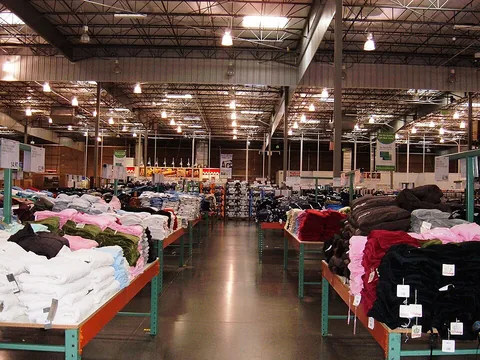
Right. To put a finer point on it, the reason why it's awesome to just run warehouse operations is because the logistics are simple. You are taking pallets of stuff, and you are moving it to a location in a warehouse, and then the customer comes and takes a huge amount of it off your hands. You don't really have to turn and make sure the labels are facing out. You don't have to deal with little one-offs. We've only sold 16 units, but there are actually 127 units on this thing.
Everything is nice, easy, big quantities, and doesn't require a lot of attention from your staff. Being in the wholesale business is good if you can get it, but their inclination at this time is well, the only people who would be willing to shop and buy in that way are business owners. This would never work as a consumer concept.
Yup. All of that, totally true and amazing parts of the Costco model. There's one piece in particular that really, really makes this a crown jewel. It's the reason why they were so enamored of what Jim was doing. If you're operating a wholesale warehouse, you don't have to operate any logistics. The manufacturers deliver the product right into your warehouse. You don't need to run trucks, you don't need to operate other warehouses, you don't need to move stuff around the country.
Right, and the business owners just come to you and pick it up right from the warehouse where it was delivered right from the manufacturer.
Totally. Because of all this, because this new business, this Costco, going to be called Price Club, is providing such a valuable service to the small businesses that are shopping there and managing all these logistics for them. I shouldn't say managing because Price Club doesn't manage it either, the manufacturers do. They're like, we can actually go back to that original Fedco membership idea. Instead of having it just be like a way to skirt around the law, we can charge real money for this membership because we're providing real value out of this to the businesses.
Once they hit on this business plan, Sol and Robert poach a few people from FedMart and elsewhere. They hired this super bright young guy from Harvard Business School named Giles Bateman44Giles Bateman — co-founder of the Price Company, which ran Price Club: its CFO from 1976 to 1991 and vice chairman from 1986. From December 1993 he was chairman of CompUSA (per CompUSA's SEC filings). as their CFO, and then they go get started. Giles would later go on to become chairman of—do you know this, Ben?
CompUSA.45CompUSA — an American chain of computer and electronics stores, the largest in its niche in the 1990s.
Really?
A big part of my childhood. Part of the enormous diaspora of retailers that come out of not only FedMart but Price Club, Jim Sinegal, I think, was probably locked up at FedMart under new management for a while. After that, he would come over and briefly work at Price Club a couple of years later. The best of the best are coming through this place.
They decide as they're getting started, that in order to keep the operations really tight and realize the maximum benefit, Ben, of everything you were describing of how these warehouses operate, they're only going to stock about 3000 of the highest volume items that they think most other retailers are going to sell to their customers. At the time, Walmarts and Kmarts had on the order of about 50,000 SKUs,46SKU (stock keeping unit) — a single item, counting each size, color, package and so on separately. and even FedMart had probably close to that many at the time. Going all the way down to 3000, this is a non consensus move.
Totally. But if you're really someone who has businesses and they have small stores, it's not like we need to stock basically everything under the sun. It just needs to be sufficient.
Right, super important. Remember, they are not thinking about consumers just yet. However, when they launched the first store, when they opened the first Price Club in San Diego, unlike FedMart, it's not an initial gangbuster success. It turns out it's a lot harder to sell and recruit businesses to come be your customers than it is just putting out a shingle and attracting consumers.
There's not a viral word of mouth necessarily among these business owners. They're not just encountering each other everywhere all the time.
Exactly. They're worried after a couple of months that this thing might not work. They might need to shut it down. And then they have the greatest stroke of luck. They're going around San Diego trying to sell memberships to businesses. They get a meeting with the San Diego City Credit Union.47Credit union — a nonprofit financial cooperative owned by its member-depositors.
The credit union management are like, we're a credit union, we're not a retailer. We don't really buy much stuff, we're not interested in this. But you know what? Our members, if we could find a way to get them access to what you're doing here, that might be a really good benefit that we could offer of like, oh, you can get wholesale prices on goods.
Giles, the wunderkind, young CFO, goes over to the credit union and hammers out a deal whereby any credit union member can qualify for a new "group membership plan" at Price Club, and be allowed to shop there just at slightly higher prices than the business members. It turns out that this does two things. This unlocks the gusher of consumers into Price Club.
Which allows for not only volume but word of mouth. These are the seeds that are sown of Costco today doesn't really advertise. This is the first moment that they realize, oh, my gosh, consumers are going to tell each other about this thing.
Exactly, and it's even better than that. Because not only do consumers tell other consumers, it turns out that a lot of small business owners are also consumers. It also drives small business owner membership. Because the business members get slightly better pricing on things, all of a sudden, all these consumers are running around and be like, oh, hey, I think my aunt owns a nail salon or something like that. Let me get her to go sign up and get a membership, and then I can use her card and get better prices.
Yup. David, do you know what I did this week?
I suspect that you drove to a Costco.
And do you know what now has a business membership to Costco?
Hell yeah. Where's my card?
Actually, I think you need to go in and have your picture taken. I was on a personal one before. But while I was there, I was like, you know what would be appropriate this week? So we now have a business membership.
Hey, we're a small business.
That's right.
I love it. Another fun story. As this unlocks the viral consumer word-of-mouth channel—of course traffic at this first San Diego Price Club store starts growing and growing and growing—Sol and Robert start getting calls from local hot dog vendors that want to set up carts at the store's exit.
If you got traffic...
You're going to attract hot dog vendors.
That's right.
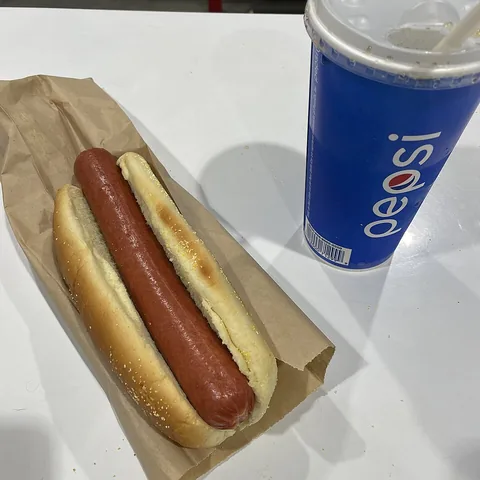
At first, they ignore them. Eventually, though, they start getting enough calls. They're like, maybe we should do something about this. Maybe rather than letting these guys come set up their carts, what if we do it ourselves? Sol calls up Hebrew National hotdogs48Hebrew National — an American brand of kosher hot dogs and meats, founded in New York in 1905. and asks them if they can supply them with hotdogs to sell at the stores. Hebrew says, not only will we sell you hotdogs to sell, we'll supply the cart too. Thus, the Costco $1.50 hot dog and soda deal is born. Still to this day, it's $1.50 47 years later.
There's a decent chance this is the one and only loss leader that Costco sells today.
Yeah, they're a little cagey about what the actual costs are. I do know that they've gone through many, many iterations, in-housing, all the operations to try and keep their cost down.
They actually make the hotdogs now.49In 2009 Costco replaced Hebrew National hot dogs in its food courts with its own Kirkland Signature franks. They also sell 130 million of them per year.
That's not all in America. But if it were, that's a third of America going to Costco and getting a hot dog every year. There is this interesting question that has now been answered, which is, there's this horrible way of shopping, where I need to go buy in bulk directly from the warehouse. No good retail experience. Are consumers actually going to do that?
This whole thing was intended for business owners. There are all these benefits that come from selling to business owners. Again, you don't need a separate retail area and wholesale area, the logistics are all much easier, you don't have to ever have your own logistics to move stuff from your warehouse to a different store to sell it, but are consumers going to do this? They learned immediately, yes. It's this shocking thing where it's like, whoa, consumers are willing to just go to a warehouse and buy stuff right off the pallet. That's a pretty unexpected thing that happened.
It turns out that there is really one pretty sure thing, at least in America, probably the whole world, that if you sell something at lower prices than anywhere else, you're going to sell a lot of it, no matter what hoops people have to jump through.
Yup. One other fun thing. Do you know what the building that this warehouse was in was previously?
I do, and it's super cool.
It is, listeners, the airplane hangar of the Howard Hughes Aircraft Corporation.50Howard Hughes (1905–1976) — American businessman, aviator and film producer, founder of the aircraft maker Hughes Aircraft.
One of the many, I'm sure, that Howard Hughes had. We got to cover Howard Hughes at some point on Acquired.
Definitely.
On the back of this wild success in San Diego, once again, Sol and Price Club quickly expand. Just like with FedMart, first to Arizona and then beyond. This time, though, it's way different than FedMart vis-a-vis competition and capital dynamics. Whereas FedMart was capital-constrained relative to the competitors, because of the genius aspects of this Price Club model, they are cashflow geysers, these stores. The suppliers handle the logistics, delivered directly into the warehouses.
Let's just follow the cash flow cycle. They deliver to the warehouse. The moment they drop off that pallet is when they invoice Price Club. Invoices tend to be about net 30,51Net 30 — a standard term on American supplier invoices: the amount is due within 30 days of the invoice date. that means the pallet gets dropped off and you have 30 days to pay the supplier.
But the minute that the pallet gets dropped off in the warehouse, those goods are for sale.
Right. No more internal supply chain, no more unpacking, no more shelving. It's just available to buy now.
In many, if not close to all cases with Price Club and then with Costco today, those goods are sold before Price Club has to pay the invoice to the supplier. It's amazing.
All right, David, I got a bunch of great stuff for you on this one. We're going to flash forward a little bit to today, but I have a huge thank you for the Costco Chief Financial Officer, Richard Galanti.52Richard Galanti was Costco's CFO from 1993 to 2024. He spent an entire afternoon with me walking through a lot of these characteristics that really make Costco work. I got a bunch of great tidbits while I was hanging out on their campus outside Seattle.
Where was my invite?
I invited you. You could have gotten on a plane.
True.
All right, here's how it all works today. Costco actually turns their inventory 12.4 times per year.53Inventory turnover — how many times a year a company sells through and replenishes its average inventory: annual cost of goods sold divided by average inventory. Twelve turns a year means goods sit for about a month on average. Just for comparison, Walmart turns their inventory eight times per year, Home Depot is more like five times per year. At this number north of 12 times a year, David, exactly what you're saying, it means Costco can sell through its inventory faster and more often than every 30 days. To be specific, they're on about a 26-, 27-day sale.
This is amazing.
ExplainerHow suppliers finance Costco's inventory
The cash conversion cycle shows how many days a company's money is tied up in goods: the days inventory sits in the warehouse, plus the days customers take to pay, minus the days of credit suppliers extend.
From Costco's annual report for fiscal 2023: year-end inventory of $16.7 billion, accounts payable of $17.5 billion and cost of goods sold of $212.6 billion for the year. So goods sit for about 29 days on average, while Costco pays suppliers after roughly 30. Customers pay on the spot at the register, so the cycle is about zero: Costco owes its suppliers more than all its inventory is worth.
An ordinary retailer has to finance its inventory with its own money or with loans. A business with a zero or negative cycle works the other way around: the faster it grows, the more supplier money it has working for it, and a new warehouse partly finances itself.
With typical payment terms being net 30, it means they literally have $0 tied up in inventory. In fact, they're able, to your point, to make a few dollars on the float.54Float — money a company temporarily holds that really belongs to others: here, revenue from goods sold but not yet paid for to the supplier, which can sit on deposit. Warren Buffett made the term famous talking about Berkshire Hathaway's insurance premiums. This is, of course, an average. There are some things that will sell in a week or two, other big ticket items might sit for a month or two. Sometimes Costco can even turn things two or three times before they have to pay a supplier for it. This is called a negative cash conversion cycle,55Cash conversion cycle — the time between paying a supplier for goods and getting paid for them by the customer. When it's negative, the company collects from customers before it pays its suppliers. where vendors effectively finance Costco's inventory for them.
You know what? I'm in. I capitulate. I'm with Charlie on this one. He can come in here and give the speech 10 times in a row about how great Costco is. I will listen to all of it. I am in love with this company.
There are a couple of interesting components here. There are companies that can achieve a negative cash conversion cycle. But the way they do it is by having predatory terms, where they go to their suppliers and say, I'm not going to pay you for three or six months. That is one way to do it. Costco is using standard payment terms here.
Right, 30 days.
There are two unique things that enable them to do it. One is this warehouse model, where things are instantly available for sale, customers come right to the place where they were dropped off. Not quite anymore, and we'll get to that later. But at Price Club, that's definitely what it was, and grab stuff right off the pallet.
The other thing that makes it all work is to this day, Costco has kept their SKU count very low, SKU being a unique item that a store has for sale. I think, David, you mentioned before, about 3000 at Price Club is what they had available for sale. If you look at a Walmart today, they have something like 100,000–250,000 different SKUs that they sell.
Super Centers, indeed.
Costco, in the last 10 years, was around 4500, and then they looked and said, can we bring it down? It went to 4000. Today, they're sitting at 3800. This number is still going down, not up. If you do the math and you start thinking, geez, if you're not selling a lot of SKUs, but you have a lot of customers coming through your stores, what does that mean? It means that any given item is going to turn faster. It's this magical unlock, in addition to the instantly available for sale in the warehouse thing. It is the low SKU count that directly gives you the ability to turn your inventory over quickly.
It's just so awesome. If you look at a Price Club then and certainly a Costco today, "capital light"56Capital light — a business that needs little investment of its own in buildings, equipment and inventory to grow. would be the farthest thing from your mind. You're like, these are massive structures, there must be so much money that goes into this. Yes, that's true, but it's a capital light business model.
It's wild.
It's all being financed for you by your suppliers because of these dynamics.
Of course, today, as Costco opens new warehouses, they can very tightly predict how they'll perform because they know how all the other ones perform. Sure, there's a lot of upfront money in opening a new store. But once it happens, you know exactly what it's going to mature to, and exactly how your ROI is positive on all your fixed costs to invest in that new location. You have this negative cash conversion cycle with all of your inventory being effectively free, if not profitable for you while it sits there.
Amazing.
AdLegora
All right, listeners, now is a great time to talk about one of our favorite companies, Legora, the agentic operating system for legal work.
Yes. Most of you have dropped a contract into a chatbot by now, but as a lawyer, how far can that really take you? It's never seen your firm's precedents. It doesn't respect confidentiality, and you can't check where its answer came from.
So Legora's founders approach this the way that great founders do. Early on, the team moved into the office of a big law firm in Stockholm and learned for months how the work actually gets done. A couple of thousands of enterprise customers and a hundred thousand users later, they still work that way. They employ a hundred legal engineers on staff. These are lawyers sitting inside of firms and legal departments to deploy Legora onto live situations, like the deal closing this week or the policy review due Friday.
The product has gotten very powerful in a short period of time. A year ago, the goal was a good answer from a chatbot. With the Legora agent, you hand it the work and it comes back with a plan. Tasks like running diligence on a data room or reviewing a new vendor contract get completed inside the tool you use every day, like Microsoft Word, and against your own precedents and playbooks. Every finding is sourced, the lawyer directs the work and signs off before the system executes any steps.
Every legal team can get access to the same AI models, so the models themselves do not give you an edge. What you can do with your own data, people, playbooks, that's the whole game.
Today over a hundred thousand legal professionals at more than 1,800 law firms and in-house legal teams in over 50 markets use Legora. And when Legora goes head to head with its top competitor in a pilot, it wins 70% of the time.
A demo is one thing, but what matters most is an associate who reaches for it at two in the morning during a closing, or whether a general counsel trusts what it says before the board meeting. So if your legal team wants to check it out, whether you're at a firm or in-house, go to legora.com/acquired and be sure to tell them that Ben and David sent you.
07From Price Club to Costco
Walton, Marcus and the Brotmans copy Sol's model, his protégé Sinegal grows Costco faster than Price Club ever grew, and in 1993 the two merge.
Okay, David, take us from the first Price Club through to Costco.
On the back of these eighth wonder of the world cash flow dynamics that these Price Club warehouses have, Price Club goes public in 1979, three years after founding. I say go public not in an IPO, not in a direct listing.57Direct listing — going public without issuing new shares: existing shares are admitted to trading, and the company raises no money. Spotify (2018) and Slack (2019) went public this way. They don't list anywhere. They don't raise any money because they don't need any capital.
What happens is, there's so much buying and selling activity among the original shareholders, because this thing has become so valuable, that this is the first time I've actually ever heard of this happening. Price Club crosses the 500 shareholder mark that at the time, the SEC mandated58SEC (Securities and Exchange Commission) — the federal regulator of the US securities markets, to which public companies report. if you had more than 500 separate shareholders of a company, you had to start filing as a public company.59Under a rule introduced in 1964, a company with 500 or more shareholders and assets above a set threshold had to register with the SEC and file reports like a public company. In 2012 the JOBS Act raised the threshold to 2,000 shareholders. Price Club's just like, okay, we'll file, we'll be a public company. They don't list on an exchange. They're just like, sure, we don't need the money.
That's crazy. They're registered with the SEC, but they're not listed on a...
Yeah, it's traded over the counter.60Over the counter (OTC) — trading in shares through dealers rather than on an exchange. Small companies' stocks trade there, with lower disclosure requirements and less liquidity. They're not on the New York Stock Exchange, on the NASDAQ,61NASDAQ — the American exchange that began in 1971 as the first electronic quotation system; today, along with the New York Stock Exchange, one of the world's two largest exchanges by market cap. or anything like that.
Wow. For those first three years, I need to know a Price Club shareholder in order to buy the shares.
Yeah, there probably are some market making systems.62Market maker — a market participant who constantly quotes buy and sell prices for a security so it can be bought or sold at any moment. I think this is what the over the counter market does, but you can't just get traded on an exchange.
Hilarious. In 1982, they do ultimately list on NASDAQ probably just to get more liquidity63Liquidity of a stock — how easily and quickly it can be bought or sold without moving the price. in the trading. Also in 1982, Sol gets a call from his old buddy, Sam Walton. He wants to come out. He wants to see Sol, wants to have dinner with the two Helens, and get the families together.
He wants to shop his competitor like he always does.
Yeah, and he's like, you're doing so great with these Price Clubs. I love your second act.64Second act — a new venture or career in the second half of life. The phrase plays on F. Scott Fitzgerald's line "There are no second acts in American lives." I want to come see it in action. Sol is like, sure, come on out. I think he knows what Sam is up to, but he doesn't really care.
What, he's going to stop him from going into a store?
Totally. Sam and Helen come out. They all have a nice dinner in La Jolla.65La Jolla — an upscale seaside neighborhood of San Diego. Sol tells them all about Price Club, how the model works, the cash flow dynamics, everything. Sam, of course, goes back to Bentonville.66Bentonville — the town in Arkansas where Walmart is headquartered. Within 12 months, guess what pops up? Sam's Club.
Sam's Club.67The first Sam's Club opened in April 1983 in Midwest City, Oklahoma.
Amazing. This is really the major difference here between Sol and Sam. Sol doesn't care. He's like, sure. Again, what am I going to do, stop you? They stay friends.
There's this amazing story that Sam tells in Made in America, where a few years later, Sam is going around again to Price Clubs, shopping his competitors with his tape recorder, making notes about how they're doing pricing, inventory, and stuff. The security at the store confiscates Sam's tape recorder. Sol ends up just mailing it right back to Sam and he's like, keep your notes, it's all good. It's so funny.
Right around the same time, another person comes out to San Diego to visit Sol and Price Club, a guy named Bernie Marcus. For some listeners, that is going to ring a lot of bells. Bernie has a story very much like Sol's. He was the president running the Handy Dan hardware store chain. He had gotten kicked out by the board, was pretty salty about it, and was looking for a second act.
Sol has him out to San Diego. He shows him the Price Club warehouse. He gives him the playbook and says, look, Bernie, you've got all this hardware expertise, take the Price Club playbook, go kick their butt and open the Price Club of hardware stores. Bernie Marcus, of course, then goes home, turns around, and starts Home Depot.68Bernie Marcus (1929–2024) founded Home Depot in 1978 with Arthur Blank, shortly after both were fired from Handy Dan. Acquired's Home Depot episode came out in September 2026.
Which we've heard from listeners 10 times that we need to do the Home Depot story at some point. I actually did not know Bernie Marcus's name or that he was the founder of Home Depot. I think now we have to.
Now we have to. This now brings us finally to one more call that Sol gets also in 1982. There are these years in retailing, 1962, when Walmart, Kmart, and Target started, 1982, when all this is happening. Another Bernie, this time a Seattle retailer named Bernie Brotman and his son Jeff, call up Sol. They say, Sol, this Price Club thing is fantastic. We're retailers up in the Northwest up in Seattle. We'd love to open a franchise up here, a Price Club franchise in Seattle. It's just like the Fedco, FedMart days.
Sol and the Price Club management team think about it. They make the very poor decision to say no. In the same echo of what happened 30 years earlier, Bernie and Jeff say, okay, we understand. We're going to do it anyway. We're going to clone the Price Club model and start the same thing up in Seattle. Again, I think Sol is totally fine with this.
Was Price Club growing aggressively?
They were, but they weren't planning to go to the northwest. They were following the old trade routes of the FedMart playbook of Arizona, Texas, Florida, going out across the South and the Midwest. What happens next is pretty hilarious.
Jeff Brotman cold calls Price Club's head of merchandising, and says, hey, my family and us, we're starting up a Price Club clone up in Seattle. We actually think that Northwest is a great market for this. Would you be willing to leave Price Club and come up and be my co-founder? The head of merchandising is like, well, no, not because I don't think it's a good idea, but you see, Sol Price is my uncle.
He's like, but let me give you the number of somebody else who you really should call. I think this guy is the right guy for you. We've worked with him for a long time here at FedMart and Price Club. He's now left. He's doing some retail consulting, so he'll probably be willing to talk to you. His name is Jim Sinegal.
This is how it all comes together. Jeff calls Jim, convinces him to come up to Seattle, he's ready. He's ready to run his own show, as they say. Jim moves up to Seattle, they start Costco. The business plan is really pretty much exactly, just clone Price Club.
Jim really is Sol's protégé. It's like clone Price Club, but with a guy at the helm who is built for scale and absolute focus on the details.
Yup. Not only was he Sol's protégé, not only is he a tremendous generational talent executor, he also is the guy who ran the division that inspired the whole thing. He really is the perfect guy.
Listeners, you might be realizing now. When we were saying at the top of the episode, this really is all one company story. It really is. There is a straight line through from Fedco to FedMart. Let's even just start it at FedMart since it's all the same people through to Costco today.
Jim moves up to Seattle. He and the Brotmans raised $7½ million to get going.
Yup. They sell 50% of the company to do that. They recruit eight people immediately, mostly from FedMart, some from Price Club, and they're all 40s and 50s. This is like a gang of 10–12 people who have all worked together before, industry veterans, have shorthand, and they are just like, we've got the money, okay, go, we know exactly what to do.
Literally, it's like the TSMC story.
Or like the Zoom story. It's like Eric Yuan69Eric Yuan left Cisco, where he ran WebEx engineering, in 2011 and founded Zoom; about 40 engineers left with him. finding 40 people who knew exactly how to build Zoom and then just doing it.
Yup, so great. Within a couple of months, they opened the first Costco warehouse in Seattle.70The first Costco warehouse opened in Seattle on September 15, 1983. Then a few months later, they opened the second in Portland. Of course, both of them take off immediately. Then they go to Utah, to Northern California, to British Columbia.
This is where you can see that what Sol said about being really great creatively in business at the Prices in Price Club, but not great at execution. Why was Price Club not in Northern California, given that they started in Southern California? These are the mistakes that they made. This new Costco under Jim hits a billion dollars in revenue in less than three years after getting started. This is in the 80s.
And $3 billion in less than six years, which is the first company ever to hit that milestone, too.
It's wild. They go public in two plus years after founding.
Yeah, in 1985, they go public.
Crazy. Once this plays out, and of course, Sam's Club is also becoming a juggernaut at this point in time, Price Club is doing fine. Again, capital is not the competitive vector here, but they're not being as aggressive. They're not expanding as fast as Costco and Sam's Club. What happens with Price Club is, in some ways, the same as what happened with FedMart. As Sol readily admits, he and Robert are great at creative ideas in retail. They're not so great at scale execution.
It's different in that capital is not a competitive vector here. Back in the FedMart days, FedMart was constrained. The whole reason they went looking for a capital partner was they needed more capital in order to be able to grow stores and compete with Walmart and Kmart. These Price Club warehouses were paying back their capital investment quite quickly, especially relative to FedMart because of the cashflow dynamics that we were talking about.
Price Club was certainly doing fine. It wasn't declining. But Jim, Jeff at Costco, and certainly Sam at Walmart and Sam's Club, they are pedal to the metal aggressively expanding. That's not really Sol and Robert's MO.
No, and it does. If you read between the lines in some of this stuff, it does seem like Costco wasn't poaching people from Price Club, but a lot of really good people found their way and went and got jobs at Costco. Costco definitely had, at this point, the base of the most aggressive, talented wholesalers of the West Coast.
Yup, totally. Sol, at this point in his life, proved himself again. He's made his point after his terrible exit out of FedMart. He steps back from the day to day of the business. He hands that over to Robert. He gets really into real estate. He's not as aggressive as he once was.
In June 1993, Costco and Price Club merged together to form71The combined company was called PriceCostco; in 1997 it was renamed Costco Companies, and in 1999 Costco Wholesale Corporation. the united Price Costco. As we've talked about, this really is a reuniting of them.
ExplainerWhat became of Price Club after the merger
- 1994. Part of the real estate and some side businesses are spun out of the combined PriceCostco into a separate company, Price Enterprises, run by Robert Price.
- 1997. Price Enterprises hands everything except real estate to PriceSmart, which lists on NASDAQ. PriceSmart builds membership warehouse clubs in Central America, the Caribbean and Colombia.
- 1997. PriceCostco takes back the Costco name, and the remaining Price Club stores are rebranded as Costco.
At the end of the day, Price Club was either going to land with Walmart or with Costco. Sol Price didn't want it to be Walmart and very, very much wanted to join forces with Jim Sinegal, so they made that happen. This was the natural successor for this combined business in Jim Sinegal.
Interestingly, the transaction really is about as close to a merger of equals72Merger of equals — a combination of two companies of comparable size in which neither formally takes over the other and both sets of shareholders get roughly equal stakes. as I think we've ever seen on the show, with the caveat that Jim is clearly going to be the CEO that's going to run the combined company. At the transaction, 52% of the equity in the combined company goes to Costco shareholders, 48% to Price Club shareholders. They're about the same size, about a hundred stores each at the time of the transaction. But Costco is growing way faster, so had they just waited a couple of years, the balance of favor would have been way far in the Costco side of things.
Yeah. You get the sense that the Costco folks were being very respectful of the Price Club folks, because I believe it was something like a 30%-plus premium73Takeover premium — the amount above the market share price that a buyer pays the target company's shareholders. paid for Price Club stock. I think everyone is looking at each other and Costco, knowing that they could really buy Price Club for a much smaller relative percentage in the future, but why don't we just do this today? I know it's a good deal for Price Club folks. Let's just say, pseudo merger of equals, let's call it, and let's be one team from now on.
Yup, and there was a forcing function to this. It wasn't just that Jim had a soft spot for his mentor Sol and for Price Club. Sam's Club and Walmart was aggressively expanding at this point in time. If they had waited too much longer, Sam's Club would have just gotten huge and potentially run away with the market. After the merger happens, even the newly combined Price Costco is still only a hair bigger than Sam's Club in terms of number of stores and revenue. They needed to do it pretty quickly, or Sam's was going to run away with it.
Fascinating, which is so funny because it's a much less disciplined business. Every bit of DNA in Costco and Price Club is just so unbelievably disciplined and an admirable way to run a business. Sam's Club strikes me as a bunch of cowboys who are changing strategies all the time.
It's a second business line under Walmart, of which the main Walmart Supercenter business line is one of, if not the greatest retail business of all time. It's certainly the biggest still to this day.
Sol, amazingly, lives to be 93 years old. He passes away in 2009. After the merger, he really devotes the rest of his life, the next 15-plus years to philanthropy and politics. He does a ton of charitable development in San Diego. He gives back to USC. USC's public policy school is the Price School of Public Policy,74The University of Southern California's public policy school has carried Sol Price's name since 2011, after a $50 million gift from his family. because he also becomes super involved in democratic politics.
Actually, when Obama is running for president in his first campaign in 2008, he comes to San Diego and meets with 92-year-old Sol Price. That's how influential he is, how much money he's giving to the Democratic Party in this last chapter of his life.
Do you know who speaks at the 2012 DNC75The 2012 Democratic National Convention was held in Charlotte, North Carolina. Jim Sinegal spoke there on September 5 in support of Obama and talked about wages and benefits at Costco. when Obama is getting reelected?
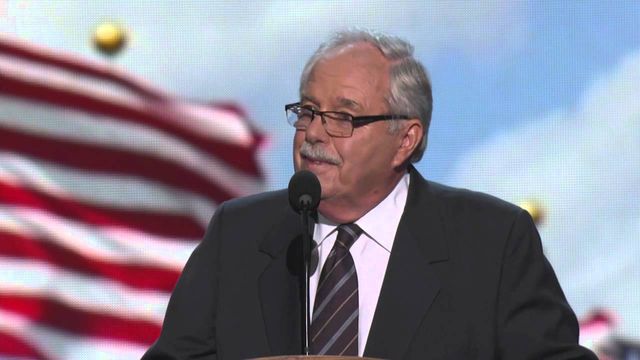
I do, Jim Sinegal.
Yup. They really are, when I say ideologically similar, the natural successor, or almost like another son of Sol Price, Jim Sinegal and Sol Price really are of one mind in many ways.
Except Jim is a way better executor.
08The economics of membership
The membership fee selects for affluent, loyal shoppers, and a strict markup cap keeps their trust.
All right, let's talk about the execution of this business a little bit. There are some concepts that I think we've talked about at a high level, but we haven't really drilled into why they work so well. Honestly, I have 10 or 12 of these, David. We're going to talk about two important ones now, and then we'll get into more as we make our way to modern day a little bit.
Yeah, let's do it.
One that we haven't talked about is the economics of membership. There are the obvious ones that everyone realizes. Today, the base level membership is $60.76In September 2024 the basic US Costco membership went up to $65 a year. As a consumer, I assume I'm getting some good deal by paying $60. Even before learning too much about Costco, I'm aware that that $60 is something I'm paying up front to get the benefit of some low prices later. Let's analyze some of the second order effects of membership,77Second-order effects — the indirect consequences of a decision, the consequences of its direct consequences; they're usually noticed later. which I think are potentially even more interesting than the obvious ones.
There's a lot of psychology happening here.
Yes. The first one is that it actually selects for wealthy customers.
Yes, this is amazing.
As does buying in bulk. The items that you're buying are literally cheaper per unit. You're saving money, but you need to buy a lot of it upfront, just like you need to pay a membership fee upfront, which means that they tend to get members who are not sensitive to cash flow. They also tend to get members who have space to store stuff at home.
I looked into some of the data on this to try and put some numbers to it. There was an independent research firm that found that the typical Costco consumer makes about $125,000 a year in household income and has a four-year degree. Walmart, by comparison, has a median income of about $80,000. Keep in mind, the median US income is $71,000, so Costco shoppers have a 70% higher income than the US median.
This is one of the most surprising things about Costco. They have the lowest prices, but they have the wealthiest consumers of any major retailer.
It's totally fascinating, and very smart consumers. People who can look at the deal and go, actually, I know I'm coming out ahead on this.
Another interesting psychology around this is when you pay $60 up front, it encourages you to come and use the membership. You are more likely to shop because you've prepaid some of your margin dollars.
I think this is called The Endowment Effect,78The endowment effect — the tendency to value something more once you own it. The behavior Ben describes is usually linked by psychologists to the sunk cost effect. if I remember, back to my psychology classes.
Yes. You just assume that you're getting some good deal by pre-paying for a membership upfront, so you want to go maximize the margin dollars that you're able to get on their discounts, which is totally fascinating.
Another one is that membership further decreases shrinkage. We already talked about the fact that employee retention is great for making sure people don't steal things. This membership makes it so members don't want to lose their membership. You feel like you're part of some club.
On top of that, these items are huge. They're hard to steal. How do you steal a TV? How do you steal a 2½ pound thing of nuts? There are all these factors, membership is one of them, that really contribute to low shrinkage.
Yes. You mentioned getting a good deal. We talked earlier, back in the FedMart days, about how loss leaders and sales was an anathema to Sol Price. How does that play into this?
This is super interesting. Costco basically wants to provide insane value to consumers. They want you to get a better deal as a member than you could possibly get by shopping anywhere else. How do they go about doing this? They have enforced a strict cap on the margin that they are willing to make on any product. They have decided internally that they are not allowed to mark up anything more than 14% above79Markup and margin are different percentages of the same thing: markup is calculated on the purchase price, margin on the selling price. A 14% markup gives a margin of about 12.3% (14 out of 114); a 100% markup gives a 50% margin. what the suppliers sell it to them for.
I'll tell you, they are tough but fair with their suppliers and making sure that they get a great price for their members. Costco decides, we will only mark up anything a maximum of 14%. They actually do mark other things up less than that because things like electronics, they actually can only mark up 6%, 7%, 8%. Maximum is 14%. The only exception to this is Kirkland Signature, where they cheat a little bit and let themselves go up to 15%. Quite indulgent.
How does this compare? I think that's the interesting thing here. A common practice at department stores is literally 100% markup.80A 100% markup is called keystone pricing in US retail: the retail price is double the wholesale cost. It's especially common in department stores, apparel and jewelry. Someone gets a good for $50, they sell it for $100. Even at Walmart, a "discounter" marks up 25%, which is almost twice as much as Costco's margin.
Jim Sinegal has a great quote on this. He was asked about it, and his response was, "You could raise the price of a bottle of ketchup to $1.03 instead of $1, and no one would know. Raising prices just 3% would add 50% to our pre tax income. Why not do it? It's like heroin. You do it a little bit, and you want a little more. Raising prices is the easy way."
What I think also, back to the membership, it all comes back to member trust. The members have to trust that they are going to get the absolute best price on everything and that Costco isn't going to be playing these games. Otherwise, they would just go shop at Amazon, Walmart, or wherever.
You're exactly right. The value proposition81Value proposition — the reason a customer picks a company: the benefit it promises and how it differs from competitors. 40 years ago was you are going to get the very best deal possible on the goods that you're buying here. Extreme Value Proposition is what they like to say. The fact that they've just made that true every year for 40 years is something that really does stick in people's psyche.
I totally get the heroin line. I think it's so easy to decide to cheat one year, and then in all the future years, you're going to cheat because you've broken expectations with customers, with shareholders. There's something magical, even in the relationship between Costco and a supplier, where a supplier knows that when Costco is being really tough on them to give the lowest price, Costco is not going to turn around, then mark it up 50%, and make a bunch of money. Costco is going to make the same margin that they've always made on that good.
Totally. It's worth double clicking on the supplier relationship for a sec. Costco's relationship with their suppliers is worlds apart from Walmart's relationship with their suppliers. You go to Bentonville as a supplier, and you are getting put through the gauntlet. It is designed to squeeze you as much as possible. That is not how the supplier relationships work with Costco. They'll work with their suppliers, they'll understand your business, and they'll come see you.
Yup. Okay, I was going to save this for later, but we got to do it now. The Costco code of ethics. As it exists today, largely inspired by the FedMart values from 40–50 years before are in order. (1) First and foremost, obey the law. We will save that for a moment. I've got a fun story of how that came to be. (2) Take care of our members.
Listeners, when you're listening through these, the order is important, the subject of each statement is important, and the phrasing of each statement is important. (1) Obey the law. (2) Take care of our members. (3) Take care of our employees. (4) Respect our suppliers. I find it fascinating that they use the word respect, because they have a posture of tough but fair.
There's this great anecdote. I heard one, but there are 50 examples of this that you can find in various Tegus calls82Tegus — a platform for investors with recorded interviews with industry experts: former employees, suppliers, customers. or talking with people who are suppliers to the company, where Costco buyers always ask why when a supplier tries to increase the price. That part's not that novel. I imagine a Walmart buyer also tries to ask why.
The buyers are very deep. They actually know the commodity prices of ingredients83Commodities — uniform raw materials such as cocoa, sugar, milk or oil, traded on commodity exchanges; their prices are public and change daily. from suppliers. Let's take a chocolate company, for example, that sells a chocolate product. If the chocolate company said, hey, the chocolate cost more now, the Costco buyer would say, I know the price of cocoa, I've been watching the commodities market, I understand milk, sugar, butter, why is it more expensive, just give me feedback on that.
A lot of the times, it is like the commodity price has gone up, or they use labor in a certain area that's gone up, or maybe they have a long-dated contract with a supplier of their own that has an artificially high price for some reason until the contract expires.
The Costco buyers will write all of this down, and will keep track of it. Because they manage so few accounts, they actually can keep track of it. Each buyer is only really adding 3, 5, 10, maybe 15 new SKUs a year, but you've managed a very tight set of relationships. They'll just call a supplier back and say, hey, the last time we talked, you'd mentioned that cocoa prices were high, I've noticed they've gone down, are you lowering the prices so that we can lower it for our members? It's this really amazing side benefit of having the low SKU count. They can be tough but fair with suppliers and really stick to it.
So awesome.
And because of Costco’s gross margins84Gross margin — the share of revenue left after the cost of goods sold, before the company's other expenses. always being targeted at 11% capped at 14%, this means that for every dollar that Costco gets a supplier to reduce the price on something—again, tough but fair—the customer actually sees most 89% of the benefit. Costco really does just get to pass whenever they get a benefit, 89% of that benefit goes to the member.
The way I look at this is some companies always look for ways to make more margin. Costco specifically does the opposite. They look for ways to provide more value to members, retain them for members as longer, and get them to get their friends to be members. They try hard across the board to get lower overhead costs through cleverness and efficiency, not through squeezing, underpaying, or anything like that.
There's a really fun Acquired canon, Acquired cinematic universe85The Acquired cinematic universe — the show's running joke: the hosts delight in every link between the heroes of different episodes and declare it a crossover. Here Costco and Amazon meet in a single scene. story related to this, which is the famous as chronicled by Brad Stone in The Everything Store,86"The Everything Store: Jeff Bezos and the Age of Amazon" (2013) — Bloomberg journalist Brad Stone's history of Amazon. Coffee Date between Jim Sinegal and Jeff Bezos in 2001, which occurs at the Starbucks inside of the Bellevue87Bellevue — a city east of Seattle. Jeff Bezos founded Amazon in 1994 in the garage of a rented house in Bellevue, and Costco's headquarters is next door, in Issaquah. Barnes & Noble,88Barnes & Noble — the largest US bookstore chain; its in-store cafés serve Starbucks coffee. In the 1990s it was Amazon's main competitor in selling books. of all places. It's so perfect.
At the time—this is 2001—Amazon stock was in the dumps.89In the dumps: from its peak in December 1999 to September 2001, Amazon stock lost about 94% of its value (CNBC, "Amazon stock lost more than 90 percent in the dotcom bubble"). They were under pressure from Wall Street. Jeff and the organization were embarking on a campaign of raising prices on amazon.com to get profitable. They just started this rolling out. It was super important.
Jeff has this coffee with Jim. Jim explains this philosophy to Jeff. Jeff comes back to Amazon HQ the next day. He's like, I'm reversing the policy and says exactly what you just said. There are two types of companies in this world, companies that work hard to charge their customers more and companies that work hard to charge their customers less. Henceforth, as of today, Amazon is a company that works hard to charge its customers less, and that is directly from Jim Sinegal.
Wow. That's awesome. On this point number four of suppliers, here's some quick math that illustrates why they do have to be so careful and why they do wield such an enormously large stick.90A big stick — the phrase goes back to Theodore Roosevelt's motto "Speak softly and carry a big stick": power you may not use, but that everyone knows about. Walmart's revenue today is about three times Costco in the US. But since Costco sells so few items, they are a massive customer for any given supplier. They always have this super lopsided relationship. The average revenue per product because of the SKU count at Costco is about 10 times Walmart.
Anytime they're in a negotiation, almost every time, the person sitting across the table is looking at Costco like, you are my largest customer.
You're 50% of my business.
I think they try not to have that be the case, but it's very easy for it to become that. It is really important that they have it as one of their four main tenets, respect our suppliers.
Notoriously missing from these four is the notion of a shareholder. Jim Sinegal articulates, if we do these four things throughout our organization, and again, those four things are obey the law, take care of our members, take care of our employees, respect our suppliers in that order, then we will achieve our ultimate goal, which is to reward our shareholders.
It's so funny going back to our previous episode and Rob Strasser's 10 principles91Rob Strasser (1947–1993) — one of Nike's first executives and author of the company's internal "Principles." Acquired's previous episode, which opened Season 13, was about Nike. at Nike. On the one hand, the Nike principles and the Costco principles are about as far apart as you could imagine. On the other hand, Rob Strasser and Nike principle number 10 is if we do the right things, we'll make money damn near automatic. That really is the same thing at Costco.
A hundred percent. Fun story of how these codes of ethics came to be. In the mid 80s, the Washington State Liquor Control Board92Liquor sales in Washington State: until 2012 hard liquor was sold there only in state-run stores. Retail sales opened up after a referendum on Initiative 1183, whose main backer was Costco. was putting Costco through the wringer when Costco was applying to sell alcohol. I think at the time, it was just beer and wine. Basically, the Liquor Control Board was looking for any possible reason to deny them. I think there might have been some corruption going on.
The state had a vested interest in preventing very large retailers from becoming the volume of selling beer and wine. Costco, because they were started with this ethos, came through squeaky clean and actually got the permit. There was literally nothing that you could dredge up on them to deny them.
The company was fortunate to realize at very early days, how much it would pay off to be truly above reproach. No matter how tempting anything was, they had to build a culture that was completely obsessed with this code of ethics.
You just see it everywhere. The wages, the way they treat suppliers, the fierce fixed cap on markups, the discipline not to raise memberships constantly. I think it's been six years between the last two times they raised the membership, even $5. It's a ludicrously squeaky clean and long-term–oriented mindset.
09Kirkland Signature and a small assortment
A house brand and the elimination of choice, with buyers choosing in advance, make Costco simpler and cheaper than its rivals.
Back to the story. At the time of the merger, the combined company was about 16 billion in revenue. That was up from Costco alone. It was $3 billion in 1989. By the merger in 1993, Costco and Price Club are each about $8 billion in revenue, and then $16 billion together. Fast growing impressive scale already.
And stores are more concentrated on the West Coast but around America by this point?
Yeah, combined 200 stores, so pretty large footprint. They're in Canada, they're in Mexico. They've already started international expansion, which then is going to become huge throughout the 2000s as we'll see for Costco. But right around the time of the merger, Costco takes a pretty important step that unlocks a huge part of the next chapter for the company. That is the creation of the famous Kirkland Signature house brand.
There's a fun story around this. When they were talking about creating their house brand, the company's corporate headquarters was in Kirkland, Washington, right near Bellevue, right across the lake from Seattle. That's where the Kirkland Signature name came from. I think by the time they actually launched it, they had relocated to Issaquah, a little farther south. They're like, we can't call this Issaquah Signature.
No, Kirkland Signature is good.
But it was tied in with international expansion, because they needed a brand name and a trademark that they could clear across all the countries that they were operating in and planning to operate in. Kirkland Signature is like, that works in Japan, that works in Korea, that works in Taiwan.
It sounds so generic. I didn't even put it together when I first moved to Seattle 12 years ago, that the Kirkland over there was of Kirkland Signature, because Kirkland just meant nothing to me. What's the Whole Foods version,93Whole Foods Market — an American chain of natural and organic supermarkets from Austin, Texas, owned by Amazon since 2017. Its private label is called 365. the 365? Interestingly, over time, Kirkland Signature has come to mean something, and that is a certain level of quality.
Nobody is attesting that this Kirkland Signature sweatshirt is a Lululemon sweatshirt94Lululemon — a Canadian company from Vancouver, founded in 1998: it started with premium yoga wear and now sells athletic and casual clothing and shoes. that has fancy materials and the most cutting edge technology in it, but it is of a certain bar of quality that is sufficient for Costco members. That is the ethos that Costco has around Kirkland Signature, that we're only going to put something out there if we feel that we can create value for you, that it's going to be a lower price than what you could get otherwise, or the flip side of that, that we can make a better product than you could get from any of these branded products that we were either previously stocking or evaluating stocking.
Maybe the most obviously and perhaps most famously, where this comes to bear is in wine and liquor sales. The Kirkland Signature wine, you'll get people who are wine snobs that will drink Kirkland Signature wine. They're like, yeah, it's Costco, but this is actually good stuff. Tequila and vodka, it's the same thing.
Especially for these things that are very clearly difficult to make, and therefore it's made by one of a few people. It is made by a real winemaker, or the battery's definitely made by a company that makes other batteries. It's not like they're low quality batteries. I do think, much like their 11% target gross margin on everything, Costco looks at their house brand as an opportunity to provide value to members, not an opportunity to capture more margin for themselves.
Yup. They also have a pretty unique opportunity, they realized, with their house brand. Because of the very small number of SKUs that they're putting in the warehouse, there's much less competition on the shelves for any given product category for the house brand.
You mentioned, Whole Foods has the 365 house brand, Walmart has their house brand, blah-blah-blah, all these big retailers do; Safeway certainly does.95Safeway — an American supermarket chain operating mainly in the western US, part of Albertsons since 2015. But in a standard retail environment, the house brand is going to be one of 5, 6, or 10 different brands of a given product category on the shelves. At Costco, it's one of two, three.
Or one of one. If you go by the mixed nuts, the mixed nuts are Kirkland Signature mixed nuts. The jumbo cashews are Kirkland Signature jumbo cashews. In part, because the buyers were evaluating the whole landscape, and they determined, we can do something better for less.
I think the Costco fancy mixed nuts is the best mixed nut blend. But I think that that was an enterprising buyer who was being creative, working with suppliers, and thought, I actually think we can provide a better product for a lower price than what exists on the market. I don't know, I think there are a lot of scenarios where they have.
Certainly, consumers agree, $52 billion of Kirkland Signature sales were done last year. That does not include the Kirkland Signature gas. Out of Costco's 230 billion top line, a little under a quarter of it was Kirkland Signature sales and closer to a third if you include the gas.
Wow, that's incredible.
It's America's largest consumer packaged brand.
At the same time, too, as they're spinning up Kirkland Signature in the mid to late 90s, they also start expanding internationally. First, they go to the UK,96Costco abroad: its first UK warehouse opened in 1993, South Korea in 1994, Taiwan in 1997, Japan in 1999 and mainland China (Shanghai) in 2019. then they go to Korea, to Taiwan, to Japan, ultimately China, which is now a big initiative for them.
What's interesting is I think at the time, I suspect there were very few other Western style, globally aspiring retailers that were entering Asian markets, because it's not exactly obvious that a huge warehouse with bulk packaging would work in cultures like (say) Japan, where people live in tightly packed, dense urban environments, much smaller houses and apartments than in America. This is not the land of SUVs and suburbs, but it works great.
Yeah. At the end of the day, people really like value. High quality products at a great value is a super compelling value proposition for anyone in the entire world.
Totally.
I want to go back to something that we've been wading into in the discussion of Kirkland Signature, which is, why is it okay that at Costco, they can only have 3800 SKUs? Why are people okay with this deal where I don't need selection when I shop here? I think there are a few illustrative examples of the story from here that get into that.
AdVanta
All right, listeners, now is a great time to tell you about longtime friend of the show, Vanta.aVanta — an American company that automates preparation for security audits, founded in 2018 by former Dropbox employees Christina Cacioppo and Erik Goldman. So David, I want to paint a picture that many founders listening will recognize. You're about to close your biggest customer yet. The product team has hit a bunch of milestones. The sales team built this fantastic relationship. Everyone at the potential customer is fired up. Your legal team has the contract done, but then an email comes in from the security team.
Ah, yes, it's usually a very polite email asking something like, "Before proceeding, could you share your SOC 2 report?bSOC 2 — an independent auditor's report on how a service company controls security and access to customer data, under rules set by the American Institute of Certified Public Accountants (AICPA). Large customers often require it from software vendors. Or do you mind sharing your ISO 27001?cISO 27001 — the international standard for information security management systems: a company is certified when an auditor confirms it complies." If you don't have one, that deal just went from closing this month to closing next quarter, maybe. Now you have to go find an auditor, go through every system, write the policies, and then prove that you follow them.
Right. Or you could just use Vanta. They are the leading agentic trust platform, which means that you can connect it to your systems at your company and it automatically pulls all the relevant data, and it tells you exactly what's missing for a SOC 2, an ISO 27001, or whichever framework your customer asked for. Vanta gets you through the audit and then it keeps going. It watches your controls every day afterwards, so the report that you hand to the next customer is still true.
Yep. And even more impressive is the Vanta agent. It continues to run in the background, so it can find the issues and draft the fixes. This is the work that eats weeks of an engineer's time before an audit, and now it mostly just gets done before anyone has to ask.
And the results are super impressive. A recent industry report says that Vanta's customers see a 526% return over three years and that it pays for itself within the first three months. If you've ever had one of these security emails stall a deal, you know exactly how that math works.
More than 16,000 companies now run on Vanta.
16,000. Listeners, there were 2,000 when David and I started working with Vanta.
That's incredible what they've accomplished. And these are companies from large enterprises like Atlassian and Snowflake to the new guard like Ramp and Cursor.dAtlassian (Jira, Confluence) and Snowflake (a cloud data warehouse) are public companies; Ramp (corporate cards and expense management) and Cursor (a code editor with built-in AI) are startups founded in 2019 and 2022.
We've been fans of Vanta for years, and hundreds, like literally hundreds, maybe even at this point thousands of Acquired listeners have become Vanta customers over that time. If you want a thousand dollars off, check out vanta.com/acquired. That's V-A-N-T-A.com/acquired, and just tell them that Ben and David sent you.
David, let's talk about low selection and how that's okay. Walmart and other retailers operated under the assumption that shoppers require selection. It seems like a reasonable assumption unless you started your life as a B2B wholesaler that then fell backwards into consumer and then realized it was fine for consumers, too.
Obviously, if you have selection, it makes the life of a retailer very difficult in a lot of ways, but it was just assumed that you had to. But Costco makes the opposite bet. They bet that you don't need selection, as long as you ensure that everything you can buy is high quality. That is the crazy thing that has worked.
Costco essentially has its entire buying team's ethos shopping for you. They're pre-selecting the best one or two items in every category. Consumers, because they do all that work ahead of time, are basically just okay, sacrificing selection entirely and saying, yeah, as long as you give us good value on great stuff, we're totally okay with that.
That's an important unlock. You can't just have low selection and be like, well, it's all cheap stuff. It has to be high quality in its category and the best deal on the market in order for people to be okay with low selection, which drives low SKU count, which drives all the amazing things we've talked about so far.
Yup, it comes back to trust. Part of this, too, also harkens back to Sol and the FedMart days. Sol developed this principle back in FedMart that he called the intelligent loss of sales.97Intelligent loss of sales — Sol Price's principle: deliberately give up some sales if winning them would mean widening the assortment; fewer items mean lower costs and prices.
Yes, I was waiting for you to bring this up.
Yeah. This isn't necessarily the number of brands in terms of the selection out there. This is about product sizes. Today, Costco has taken this to the extreme of like, you can only buy the 2½ pound jar of nuts. There's no eight ounce jar of nuts.
You can buy a whole bunch of little packs of afternoon packs of nuts.
Either way, you're walking out with a lot of nuts. But other retailers and everybody back in the FedMart days had all sorts of different sizes of products. The idea was that, by having different sizes, you would maximize the surface area of customers in-market that you could reach. Sol uses the example in the book of household lubricating oil, like WD-40 type stuff.98WD-40 — an all-purpose penetrating lubricant in an aerosol can. Its formula was invented in 1953 in San Diego, FedMart's hometown, and it went on sale in 1958.
He's like, we only carried the eight ounce can, even though there was a three ounce can out there. We lost some sales from customers that only needed one or two ounces, and thus would only buy a three ounce can, and they just didn't buy the eight ounce can. But it was worth it to us to forgo that, because by only having the eight ounce can, we could reduce the number of SKUs that we had and get all these benefits that you're talking about, Ben.
Yes. You and I have been trying to do this without having a name for it for years. People sponsor Acquired seasons. There are lots of other podcasts that let you do all kinds of crazy stuff. We're just like, look, we have a SKU, it's called the season. We would love to work with you on that. It makes our lives so much better, and we can run our business in a completely different way by having a low SKU count.
Totally. If we didn't do it this way, we would need to have an ad sales team, work with an outsourced network, or something like that. That would add way more overhead to our business that we don't want.
Right. This stuff is all about the trade offs you were willing to make and just daisy chaining them together such that the benefit of each trade-off plays into the benefit of another trade-off that you are making in a way that's aligned.
Yup. I knew we were going to love Costco.
Honestly, it's maybe my favorite business that we've studied. Let's wait till the end to talk about that. There are a few more things along the way that happened in the 90s and 2000s before we get to today that I think are important to touch on.
We've mentioned logistics a few times and that the low SKU count means that they can meaningfully simplify their logistics. To put a point on that, they only have so many suppliers who are bringing goods to Costco. The fact that they sell in bulk means that they can bring a whole pallet into a warehouse and consumers just come and pluck it off the pallet. It's wholesale. It's a wholesale club, but there's something we haven't talked about, which is Costco's distribution centers.
They use something called a cross dock system99Cross-docking — a way of running a distribution center in which goods aren't stored but are moved straight from suppliers' trucks to trucks bound for the stores. for their distribution centers. Remember, I mentioned back in the Price Club days, it's a little bit more complicated today. Not all the suppliers just show up to the one store or the one warehouse with all the goods. They actually do need some system to receive things from suppliers and bring them to stores.
Back in the Price Club days, there were no distribution centers.
Exactly, but here's how the distribution centers work. Trucks pull up on one side and unload pallets, that's where the suppliers trucks are. On the other side of the warehouse, there are Costco trucks.
What happens is, since they move stuff entirely by the pallet, no partial pallets, these few things go to this store, these few things go to that store, the supplier trucks unload the pallets. They just get scooted across the dock to go directly to a Costco warehouse. Within minutes to hours, that truck leaves, and there's no unwrapping of individual boxes. There's nothing sitting overnight in the facility.
This is so much simpler, and it really plays into that cash flow dynamic, where things can be available for sale so fast. Just to underscore how differentiated the system is, 92% of Costco's merchandise is crossdocked. Only 10% of Walmart has crossdocked merchandise on a pallet system like this.
It's not like Walmart hasn't invested many tens of billions in their distribution and logistics systems.
Totally. It's just that Costco has made a trade-off that makes it so that they just have a much simpler operation. They've got all the downsides that come with the trade-off—no selection—but they get all the upside that comes from it too.
This also plays into this labor thing. You can totally pay your employees more when you need less people to generate the same amount of sales. You don't have wasted manpower unwrapping items from pallets, no one turning the labels out to look pretty. The customers do all of this. It legitimately means they just need less people. This is why they generate over $730,000 of revenue per employee. They're just efficient in aligning their trade-offs.
I love it. This is the bricks and mortar retail version of the SaaS business fallacy,100SaaS (software as a service) — software sold by subscription and run in the cloud. Such companies have very high gross margins: selling one more subscription costs almost nothing. which we fall prey to all the time on the show. If you invest in or build around SaaS companies and SaaS company margins, you can fall into the trap of thinking, well, why would I ever want to be involved in a business that doesn't have 90% margins?
Actually, what you should really care about, especially as an investor, is not your margin percentage but your absolute margin dollars. Yes, Costco has much lower margins than their competitors, but the volume that they drive and the actual dollars end up being worth it.
Yeah. Even though Costco is only an 11% gross margin business and only ever will be an 11% gross margin business, it's still a pretty amazing business to own.
Yeah. It's $230-plus billion of revenue.
And $7½ billion of operating income off that.101Operating income — revenue minus the cost of goods and all operating expenses (wages, rent, logistics), before interest and taxes. Again, tiny little sliver margins, but $7½ billion of operating income falling out the bottom is pretty awesome.
Yup, especially $7½ billion of highly defensible operating income.
Yeah, seriously. As you've been talking about, because of the way that their inventory is financed, reasonably capital light business, all things considered. They're building these warehouses on huge pieces of real estate with gigantic shelving and all this headcount, and it's an amazingly capital efficient business. It's weird.
10Two businesses under one roof
Membership brings in about 70% of operating profit, retail runs on razor-thin margins, and the whole thing rests on members coming back.
Yeah. Okay, I think it's time to talk about investing nerds' favorite aspect of the Costco story, which is that there really are two different businesses here under one roof. There is the retailer, and then there is the membership business. It's almost like way back, Sol and Robert sitting in the office after FedMart thinking, you know what? We actually had two different businesses at FedMart. Costco is also two different businesses. There's the operations of the retailer, and then there is the membership business.
Psychologically, they're one thing. It's one experience for the customer. But financially, it's two entirely different things. A lot of people like to make a lot of hay about the idea that Costco generates all their profit on memberships and that retail is just a break-even business. This has been popular to say because they run the retail business at such thin margins. Memberships are nearly a 100% margin business. Really, what does it take to run a membership business?
With 90% renewal rate?
Something crazy high like that.
Talk about a SaaS company.
Yeah, but it's not quite true. It is accurate to say that membership fees represent about 70% of the company's operating income with the other 30% of the profit margins coming from retail. It's been a little bit more than 30% in recent years, but that's the historical split. Think about it as a 70/30 thing.
It really is staggering that a business that does $230 billion top line, 70% of the profits can come from the $4 billion of revenue they generate from memberships. That tells you how razor-thin the margins are on their retail business, almost to the point where you're like, why do they care about growing sales at all? All they should care about is increasing retention of members.102Retention — the share of customers who stay with a company; for Costco, the share of members who renew for another year.
The split is just significant enough for the retail business where you're like, okay, yeah, we should care about growing sales in the retail business. But if it wasn't 70/30, if it was 90/10, or 95/5, you'd be like, well, I'm actually not sure why we care about making a single nother sale of toilet paper, because unless it is increasing the likelihood someone retains, I don't care about it. They're not quite there, but they're almost there.
Except though, the way that you grow memberships is you grow retail sales.
Right, but for the last several years, they have totally been growing retail sales per member. If it was like a 95/5 split, you could make the argument of like, why do they care about growing the retail sales per member but at this more 70/30-ish split? There are just enough profit dollars coming from the retail side of the house where you care about that, too.
I love it. It's like Amazon and AWS103AWS (Amazon Web Services) — Amazon's cloud platform, the world's largest cloud provider. It brings in less revenue than Amazon's retail business but more than half the whole company's operating profit: $45.6 billion in 2025. versus Amazon retail.
Yes. In the last 25 years, membership has grown from nearly nothing. If you look at what the numbers were in the early 90s compared to today, $4½ billion.
When we were talking about the FedMart days, it was $2 for a lifetime membership.
Crazy. Again, David, this membership business takes almost no investment.
They don't do any advertising.
Right. To quote our friend Andrew Marks, "I basically think that Costco has decided to only be a decent return on invested capital104Return on invested capital (ROIC) — how much after-tax operating profit a business earns on each dollar invested in it by shareholders and lenders. retailer, which allows them to have an insane return on invested capital membership club business." It's so true. Again, to quote Andrew, "Insanely stable growth on a huge capital light fee stream."
That sounds like a venture capital management company.105A venture fund's management company collects a management fee from investors, usually about 2% of the fund's size a year regardless of results. It's a steady stream of money that needs almost no capital of its own.
It's pretty wild.
All right. Speaking of membership, let's talk about the last big innovation piece of the puzzle before we get to the business today. That is the two-tiered Costco membership system and the executive memberships, which they launched in 1998. Is that right?
Yes. 1998, the executive membership. What is the executive membership and why are we bothering to spend time on it? Isn't it just a second higher price membership? It is super illustrative of management's thinking, so I love this as a microcosm for all of Costco.
You can spend an extra $60, so a total of $120 instead of $60. What you get for that is 2% cashback on your transactions. That 2% cashback is limited, but it's limited at something crazy. You can only get $1000 back.106Executive membership: in September 2024 the US price rose to $130, and the cash back cap rose to $1,250 a year.
A $60 incremental investment for $1000 back is pretty good.
Right. If you actually hit that $1000, it would mean you're spending $50,000 at Costco a year.
Wow. I'm sure there are people who have been doing it.
The break even point of this $60 is $3000, which is not that hard to hit. In fact, it's right around, and I suspect this is why management priced it that way, it's right around the average household spend at Costco. They want to make it basically breakeven for basically everyone.
Which is so awesome and also different from other retailers. Now there are all sorts of fancy technology systems to do this, but Costco has always been able to track customer spend at the individual level because they're all members. They have accounts for all of them.
A hundred percent. Other people might invent something like this to say, well, we're going to bet that they won't use it. They won't shop here enough, and we'll get to make some money on the people who are infrequent shoppers. We're excited about that, and we'll basically get the breakage on people who pay for the upgraded membership but don't shop enough. That's not at all what Costco is doing here.
To illustrate that, here's the insane part of it. If you do not use it, they will refund it. Is there anything more Costco than that? It is an amazing value for members. It is such a good value that 55% of US members now do it.
But much like everything else we've talked about with Costco, it is also amazing for Costco, because they get your money at the beginning of the year further advantaging their cash flow position. It gets even better because it makes you more likely to go shop there now since you get even better deals with the cashback.
Effectively, instead of getting the 14% gross margin, Costco is now only making a 12% margin on you when you shop there. As long as you're spending $3000 or more, it basically just makes Costco's margin even lower for everything you purchase. Interestingly, 45% of paid members worldwide are executive members, but those members represent 73% of sales.
Whether by causation or correlation, executive members just spend more. Estimates are that regular members buy less than 1/3 of what executive members do. It's this fascinating customer segmentation thing, where Costco just gets to know and reward the most frequent shoppers who do the highest volume purchasing. Executive members, as you would guess, also renew at a higher rate. It helps with retention. On top of that, which they call the triple play membership.107Triple play — a telecom term for a bundle of TV, internet and phone from one provider. At Costco it means signing up for the Costco credit card from Citi along with an Executive membership.
These guys are so folksy. I love it.
If you get the Costco-issued Citi Visa card, you renew at an even higher rate. They have these layers of letting you opt into loyalty. All of this, David, as you mentioned earlier, is on top of a high renewal rate anyway. Ninety-three percent of members in the US renew every single year.
Amazing. You can really see the fingerprints of this DNA in Amazon Prime.108Amazon Prime — Amazon's paid subscription, launched on February 2, 2005: unlimited free two-day shipping for $79 a year. Video, music and other services were added over time. Obviously, the whole thing is inspired by the Costco membership writ large. But the same dynamics definitely play out for Prime members at Amazon of order more frequently, much more likely to renew, access a whole suite of services.
It keeps you in the Amazon ecosystem, and it makes sure that you're buying more stuff. Amazon makes money on the stuff, Costco makes money on the membership, but at the end of the day, it is nice to retain a loyal customer. To contextualize the 93% member retention, again, that's just all members. That's not even the executive members or the credit card owners.
Subscriptions to streaming services renew half of their customers every year. Consumer subscriptions retaining at 93%-plus is nuts. That's the monthly retention of most streaming services. It's crazy. On top of all of this, I'm pretty sure that this has never been disclosed, and I haven't asked anyone about it. But if you read trade publications, people seem pretty convinced that Costco is making money, which of course they are, on the deal that they cut with Citi and Visa, in order to have the Costco card be the Citi Visa card.109The Costco co-branded card: from 1999 American Express was the only credit card Costco accepted, and in 2016 Citi and Visa became its co-branded card partners.
Most of the time, when you are processing payments, you owe 2%–3% of each transaction to the issuer of the card.110Issuer — the bank that issued the shopper's card. The main part of the fee a store pays on every card purchase is the interchange fee, which the store's bank pays to the shopper's bank. I think the dynamics are actually the opposite way with Costco, where Costco gets to hold an auction and say, we have an enormous amount of payment volume with enormously good customers with good credit. Would you like to do business with us? And who would like to pay us for the privilege of being the Costco card rails?111Payment rails — fintech jargon for the infrastructure money moves along: card networks, bank transfer systems.
I imagine there are not a lot of defaults in the Costco customer segment base. There's also some fun history to all this, too. That deal, as you may know, Ben, used to be with American Express. And then they essentially held an auction as you say. I think the origins of this though start all the way back with the original Price Club business plan. Not to offer credit, but specifically not to offer credit.
Another one of the big benefits of moving to this business wholesale model was they could get out of the credit card game that they had to play at FedMart. When they were only selling to businesses, when that was the plan, it was like, hey, cash or check? That's it. No credit card exchange fees that we're going to have to bear. When they opened to consumers in the group model, they kept that. For a long, long, long time, you couldn't use credit cards at all in Price Club Costcos.
That's the importance of doing the hard thing first. By proving that they could exist and set customer expectations around where only cash and check, it meant that they never had some scary moment, where if credit card companies were putting the screws to him, they had a bunch of fear around, will customers not shop here. They were, just from the very beginning, getting 100% of the dollars rolling in.
They knew the counterfactual. They knew customers are going to shop with us no matter what. Credit card companies, if you want to work with us, you're welcome to, but we do not need to pay for the privilege, because we know that our customers are not going to leave us for a fact.
Yup. You'll be happy to have our business, not the other way around.
It's crazy. Of course, with Costco's margin structure, they literally couldn't. Speaking of trade-offs, they literally couldn't ever accept credit. How with an 11% gross margin are you going to go give three percentage points of that 11% to a Visa? It actually would flip the business upside down. We talked about it a minute ago. They make $7½ billion of operating income on $230 billion of sales. The credit card companies eat all your profitability if you let them in the door. It's a pretty incredible position, toughing it out and doing the hard thing first, and then being able to flip to the other side of the table.
Anyway, I love that point on the payment processing. I think it's an amazing playbook that Costco ran over the years and a necessary one. Every single time Costco does something amazing, they needed to because of the trade-offs that they chose.
11Costco today
A model cast in stone back in the late '80s has grown about 10% a year for decades, and Costco now outperforms every discounter on efficiency.
Yup. I think that's the last big piece. Let's take it to the business today.
Definitely. David, to your point, we talked about very few things between, to be honest, the late 80s and today, and it's because the model was basically cast in stone. They added things like gas, they added ancillary services, you can go get glasses, and you can go buy diamond rings. Maybe some of that was done earlier.
I think a lot of that was from the FedMart days.
Big yard goods, I bought a shed there. The story is intentionally boring. What if you grow it 10% for decades doing exactly the same thing, having a well-understood set of trade-offs and a strong culture? Where does it go?
Yup, and you operate in arguably the second or maybe third biggest market in the world, which is global retail.
Right, and you're the third biggest player in the largest market, America behind Amazon, and Walmart. This Acquired episode is different because so much of it is just nerding out over the awesome nuances of Costco's business model. Then this crazy thing happened because it was a bunch of stand-up guys making an intelligent set of trade-offs, really thinking hard, and then a whole bunch of people working hard for a long time. That's the story.
Once Sol got things figured out in the second iteration with Price Club, really straight line to today. Let's paint the picture today. I think what's interesting to talk about next is, okay, everybody knows how this all works. How is it defensible? Why does only Costco do Costco? But first, tell us about Costco today.
I don't think people realize, maybe by this point of the episode they do, but certainly not before, how big Costco is. It's a sleepy story since it's tucked away in the Seattle suburbs. They don't do a lot of chest pounding. They just are quiet.
They do $230 billion in revenue. They're the third largest retailer in the US. They have 124 million members worldwide. One-third US shoppers are Costco customers. They have a little over 300,000 employees at 860 stores. We talked about this. They do $750,000-ish of revenue per employee.
Yeah, that's wild. If I remember from our Walmart episode, Walmart (I think) has over 2 million employees. I believe Amazon has well over a million.
Yeah, so Costco is doing somewhere between a third-and-a-half the total revenue of Walmart, but they're doing it with almost an order of magnitude fewer people. It's crazy. They have the highest revenue dollars per square foot of any wholesaler or discount store. Target's about $450 per square foot of revenue. Walmart's about $600. Costco is $1800 per square foot of revenue.
Wow. Is that a Costco or an Apple store?
And they have a lot of square feet. Let me look at this graph. In 1998, they had $600 a foot, and now they're at $1800 a foot, so meaningfully grown it. It's important to point out, you'd made the comment about Apple, Costco's margins are a lot lower than Apple. They're generating a huge amount of revenue dollars, not so much on the margin dollars, but as we've been talking about, that's the point.
Yup. The individual warehouses these days, you may have the stats exactly, but I think an average Costco warehouse generates over $200 million in revenue, and the top ones generate $300 million, $400 million of revenue for a single store. Single Costcos could be scaled public companies on their own.
Yeah, $269 million of sales per store on average per year. Nuts. Just for fun, let's go north of $1800 just to see who else is out there. Tiffany is $3000, so within spitting distance. It's only 2X, or it's less than 2X, and they sell diamonds.
So does Costco.
That's true. Apple, of course, is the GOAT at $5500 a square foot with high margins. Apple is just a nuts business, but it's worth pointing out. Lululemon is approaching Costco level, too. They're around $1600 a foot, but of course, much smaller stores than Costco. Costco is just unbelievably efficient. We talked earlier about how that's illustrated in the headcount efficiency, but now we see it in the real estate efficiency, too.
This point on growing revenue per foot is interesting. I mentioned it went from $600 to $1800 over the last 25 years, because it reminds us to look at an important similar metric in retail, which is same store sales.112Same-store sales — revenue growth at stores that were also open the previous year, excluding new openings. Costco grew this by 14% last year. Same store sales, 14%, which is how you get to that $269 million of revenue per store.
They are so good at this that they actually publish their stores by cohort year in their annual report, which almost no other company and certainly no other retailer does. They clearly illustrate that not only does the average store increase meaningfully over the previous year, in most years, but new stores also inherit a lot of the learnings. The first year of a new store is dramatically better than what first years of stores were years ago. To illustrate this, year one of a store opened last year was better than year five of a store opened in 2014. It's crazy.
It's also wild that these stores are still growing at those rates year over year, given that many Costco stores have been open for 30-plus years at this point.
Right? It's crazy. Part of it is the addition of gas and other big ancillary items they're selling, but part of it also is just being really good merchants and finding these little things that members love, find value in, and doing little optimizations everywhere.
Yeah. Exactly to that point, one of the famous aspects today of the Costco shopping experience is the treasure hunt nature of it.113Treasure hunt — Costco's term for items that appear briefly and in limited quantities: you have to grab them right away, and shoppers come back for them. This is something that they've learned over time. The original Sol Price, Price Club business plan was just the 3000 core SKUs for businesses and then opening that up to consumers. Along the way, they realized that, hey, if in addition to the core staples we have, which pretty much don't change, we could change the brands, we could change the exact details of what they are, but we're always going to have nuts. We're always going to have chicken, stuff like that.
If we have a small number of additional ooh, ahh, and wow, one time items, such that every time as a member you come into the store, there's something new and different for you to find and buy at a really low price, that would drive repeat traffic and make coming to Costco more of a novelty, more of an entertainment event. Today, I think about 25% of their SKUs are these treasure hunt items.
I did not realize that. I know they've learned a bunch of things over the years. When they brought in fresh food for the first time, they didn't optimize the place in the store where they put that, but they still saw a huge spike because it drove repeat. When you have fresh food, people come in, they want to buy that, they add some other stuff. But they've been very clever in figuring out where to put it in the store to make sure that you have to walk by a bunch of other stuff to get them.
The fresh food is in the back. If you're coming in for fresh food, congratulations, you get to see all these other cool things that our buyers have managed to find out in the world for you. Of course, you get some of those, too.
Yup. I think for the items again, the non-staples, the treasure hunt type items, they intentionally want to run out so that they're not going to be there next time you come.
Yes, that's a good point.
AdStatsig
All right, listeners, now is a great time to talk about one of our favorite companies, Statsig.eStatsig — an American company from Bellevue, Washington, founded in 2021 by former Facebook engineer Vijaye Raji. In September 2025 OpenAI announced it would buy it for about $1.1 billion.
Yes. There is a reason why the best product teams rely on Statsig, whether they are iterating on their core product features or shipping AI-powered experiences at scale.
Yep. In the crazy speed of today's AI world, shipping fast is just table stakes now. It's basically trivial to build and deploy your app constantly. The real advantage is how quickly you learn what changes actually created value for customers and how fast you can use that signal to guide what you ship next.
This is where Statsig comes in. It brings experimentation, feature flags,fFeature flag — a switch in the code that turns a new feature on for some users without a new release, for example to compare it with the old version in an experiment. and product analytics into one unified system, so teams can ship safely, test rigorously, and directly link what they changed to how users actually behaved.
So if you want to make learning your competitive advantage, whether you're building new AI experiences or just evolving your existing core product, go to statsig.com/acquired to get started.
12Powers
Costco's main power is scale economies shared with customers, and against Amazon it has counter-positioning, rare for an incumbent.
Okay, analysis time?
Analysis, let's do it.
Because we haven't been analyzing this business yet. Yes. The first segment that we're going to do in our analysis here is power, which is adapted from Hamilton Helmer's Seven Powers book,114"7 Powers: The Foundations of Business Strategy" (2016) — Hamilton Helmer's book on the seven sources of durable competitive advantage; Acquired relies on it in analyzing every company. which is an amazing framework for business strategy. The question here is, what is it that enables the business to achieve persistent differential returns? Or put it another way, how can a business be way more profitable than their closest competitor and do so sustainably?
The seven options are counter positioning,115Counter-positioning — in Helmer's terms, a newcomer adopts a business model the leader can't profitably copy: imitating it would undermine the leader's own profitable business. scale economies,116Scale economies — unit costs fall as volume grows, so a big player can sell cheaper than its rivals and still make money. switching costs,117Switching costs — the money, time and hassle it would cost a customer to leave for a competitor. network economies,118Network economies — a product becomes more valuable to each user the more other users it has, like a phone or a social network. process power,119Process power — an edge built on internal organization and culture that competitors can see but can't quickly replicate; Helmer's classic example is the Toyota Production System. branding, and cornered resource.120Cornered resource — exclusive access on favorable terms to a valuable asset: a patent, a deposit, a rare expert. There's one here that is so painfully obvious that has been observed over and over again over the years. The original credit goes to an investor, Nick Sleep.121Nick Sleep — British investor who with Qais Zakaria ran the Nomad Investment Partnership (2001–2014), whose portfolio included Costco and Amazon. The phrase "scale economies shared" comes from his letters to investors. The power is scale economies. It's Hamilton Helmer's notion that Costco has the ability to leverage their scale to compete for items that their competitors can't get, or perhaps get a better price from suppliers than any of their competitors.
Nick Sleep has this phrase that I think is possibly the best way to describe Costco. Scale economies shared with customers. The flywheel122Flywheel — a self-reinforcing loop in which each step speeds up the next. Jim Collins popularized the image in "Good to Great" (2001); inspired by it, Jeff Bezos sketched his famous "Amazon flywheel." looks like this. Costco has enormous volume. What they do with that volume is they go to the supplier and they say, what is your absolute lowest price where you're still making an honest margin on this, but you're willing to sell it to us?
Costco makes sure of that, they do their research, they come to a price, and they say, great. Then Costco looks at their own business and they say, how can we have the lowest possible overhead? What is the smallest amount of dollars we can spend at our head office, turning the lights on at facilities? What is literally the leanest we could possibly run and still breakeven or generate a small profit? That's how they come up with this 11% target gross margin number.
What they do then is they mark up the goods, literally the smallest amount that they can in order to share the most value with their shoppers, with their members. And then the cycle repeats. They get more members, they get better deals from suppliers. To be honest, this scale economies that they then share with customers, I don't know how anyone could ever catch them in this moat123Moat — Warren Buffett's image for a durable competitive advantage that, like a moat around a castle, protects a business from rivals. that they've built from that.
Because as we were talking about, for most, if not all of their suppliers, they are by far the biggest buyer of their goods, even bigger than Walmart because they have so many fewer SKUs in the store.
This is so fun. I feel like there's such a resonance between Costco and Nike, even though on the surface they're so different. Maybe this is like a Pacific Northwest thing. But I really think Nike has incredible brand power, but they choose not to use it to increase their margins. They choose to use it to keep prices low and accessible for customers.
Costco does the exact same thing here. Costco could definitely make a higher margin than they do now and still charge lower prices than Walmart, but they choose not to. Instead, they share that benefit back with customers.
That is an investment in their enterprise value. Costco is choosing to invest those dollars in making the franchise more durable124Franchise — here not a franchising agreement but investor-speak, after Buffett: a business with a strong market position and loyal customers. by getting more customer love.
Yup. It really is a choice in durability, I think.
Yes. In fact, it's what Jeff Bezos meant when he said your margin is my opportunity,125"Your margin is my opportunity" — Jeff Bezos's famous line: a competitor's high margin is a chance to take its customers by selling for less. but Costco just runs the playbook so consistently. When you look at their overhead, the fact that Costco runs at 10%–11% overhead, and Amazon runs closer to 30% overhead, Costco has chosen a business model, where they actually can just have lower margins on stuff because they don't need to do things like ship goods to your home.
They need way fewer people. They need way fewer investments in technology to do crazy robotic sorting at warehouses, picking and packing. The Costco business model is one where they've just gotten rid of all that. They said, we're not even going to play that game. Our goal is to lower our overheads so we can pass along the most savings to customers.
Lower overhead and lower the prices that we're paying suppliers so we can pass that on to customers, too. This is amazing. This might be the first example, I think, that we've found in the history of the show. I think Costco has incredible counter positioning power today as a large incumbent126Incumbent — the established market leader, as opposed to a newcomer. In Helmer's framework, counter-positioning usually serves newcomers against incumbents, which is what makes Costco's case so rare. in a way that they did not have when they got started.
This is rare.
They probably had some counter positioning in other ways, but today I think they have huge counter positioning versus Amazon and ecommerce. We should talk as we go here about Costco's ecommerce operations, but they are famously Spartan, shall we say. To me, the whole point of Costco is you go to the Costco.
And the Costco HQ believes that, too.
It is completely counter positioned to Amazon's whole reason for being, which is convenience. Certainly, if price is no object, it is way more convenient to just click, click, click in the shopping cart in Amazon and have it show up at your door.
Different set of trade-offs, for sure. It is rare that as an incumbent, you have the counter positioning power. It's usually a thing that startups do against incumbents, but Costco is a $230 billion company that none of the other big companies can copy. Walmart is trying and still is not succeeding at it.
As we've been researching this episode, naively in the past, I always thought, oh, yeah, Costco is great, but they really don't get the Internet.
I think that also was true. Fifteen years ago, I think they thought the Internet was going to be a fad, which is why they missed it at first, and now they're intentionally missing it. I won't get into it, but they're doing it in their own way. I actually do think they underestimated it at first.
Yup. I think where they've ended up is actually in a pretty good place and in a better place, I think, than Walmart. That place being that, no, no, the whole point is we are not an ecommerce company. The whole point is you come to the warehouse. Because you come physically to the warehouse, and you take the stuff off the shelves, you're going to be able to get absolutely the best price versus anywhere else. Amazon today has really become something else from what Jeff wanted it to be after his coffee with Jim Sinegal.
It's not always the lowest price. Often, you are paying for convenience.
Far, far from it. You are very much paying for the convenience of shopping on Amazon, I think on almost every product these days.
Or the brand. Very often, I will buy something that's a little bit more expensive on Amazon because I'm like, well, it's going to be easy to return. Or well, I trust this company. That's a very different premise than the original idea.
Yup. I really think that Costco, amazingly as this huge incumbent, has developed a lot of counter positioning power.
That's a good point. Switching costs, I guess there are some. I'm not going to go join BJ's Wholesale Club127BJ's Wholesale Club — an American chain of membership warehouse clubs competing with Costco and Sam's Club; founded in 1984 by the Massachusetts discount chain Zayre, it operates mainly in the eastern US. or Sam's Club when I already have a membership to some extent, but I don't think that's the reason that they win. Network economies, not really.
No, I think it's scale economies.
Yeah. Process power, definitely. There's a culture at Costco that others have failed to replicate or haven't tried hard enough to replicate.
I don't think there's a cornered resource, but branding is an interesting one. Let's talk about that.
Right. Recently, a bunch of folks from Costco got to go ring the bell at the NASDAQ.128Ringing the bell — the ceremony that opens or closes trading on an exchange, performed by guests such as representatives of listed companies. Costco's shares trade on NASDAQ. They're all wearing their Kirkland Signature sweatshirts. A joke is made about the idea of Kirkland couture. It's worth footnoting this. It's not the main point here, but it is weird how Kirkland has a passionate following in a way, where it's turning into a real brand when that was not the intention.
The brand identity is that it's the anti-brand.
Right. There's a lot about our current consumerism climate that I think fuels that. Also, quick aside, Costco has never tweeted. The account has a lot of followers and zero tweets. They're not really a participant in social media, but they have a massive tailwind from all the Costco TikTokers. There are people constantly sharing videos about, here's this amazing thing I found, or here's how I structured my day to work Costco in, or...
Here's my haul.
Yes, they've benefited enormously from influencers.
This has always been part of the strategy, even going back to the FedMart and Price Club days. Sol and then now Costco doesn't advertise either at all or very, very minimally. But they very intentionally, back in the day, tried to get local 6:00 news stories about like, oh, the lines at Costco, oh, crazy treasure hunt item at Costco, and it always worked. Whenever there is a store opening, news crews would go nuts. It's like the Nike athletes wearing the shoes on the cover of Sports Illustrated129Sports Illustrated — the leading American sports magazine, published since 1954; making its cover is a mark of recognition for an athlete. thing. That's worth a lot more in earned media than anything you could ever buy.
All right, David, while we're here, we have to tell the hotdog story. This comes up literally every time there's any writing, podcast, book, or anything about Costco. Very famously, as David and I talked about, the hotdog and drink combo has been $1.50 for many, many years.
When Jim Sinegal handed over the reins to Craig Jelinek, Craig went to him and said, hey, we're close on margin here, or maybe we're upside down, nobody really knows, on the hot dogs, we might need to raise the price. Of course, Jim Sinegal looks at him and goes, if you raise the price of the hot dog and drink combo, I will effing kill you. That is why it's still priced the way it is today. This story has gotten so much airtime.
And it's classic Costco. I'm sure this didn't actually happen. They just made up this story.
It might have actually happened.
Craig has been working in FedMart since the 70s. He would never raise the price of the hotdog.
He would have known. Anyway, back to earned media branding, there's this interesting thing where it's almost like Nike, where I think they have latent branding power. I'm not talking about Kirkland here. I'm talking about trusting the buyers. Members trust the pre-selected inventory from Costco, and I don't know where that shows up. It definitionally doesn't show up in price.
Costco will never generate excess margin because of their brand, but their brand earns them something. People become members and trust them, and that leads to something. I assume it leads to volume, it leads to willingness to buy, which leads to volume, or it leads to retention. This is the second episode, where it's not branding power under Hamilton's definition. It's latent branding power.
Yup, just like the big one was scale economies here.
In a lot of ways, I think what Costco is doing is, they realize that they have latent branding power and latent scale economies. They choose not to recognize short-term profits from those. I think it's all this super long-term game, where this is why the market is willing to pay a much higher multiple130Multiple — the ratio of a company's market value to its profit (P/E) or another metric. The higher it is, the more investors pay for each dollar of today's profit in anticipation of the future. for Costco than any of their competitors. There are a lot of ways that if Costco wanted to, they could make more money today than they currently do, but they've decided not to.
It's the same result, whether you look at it as, let's assume that they did take a little bit more margin, let's assume that they did raise prices on members, or let's assume that they leaned into their branding power in some way and actually charged the prices that they've earned. Would the multiple then be reasonable? Yes, absolutely.
The other way to look at it is, is this business just going to be around predictably for a longer period of time than any of their competitors because they're doing all these things? You get to the same answer, which is, it is worth paying a higher multiple of the dollars that are recognizing today for a company that has made these choices.
Totally. Let's just say, I don't think we've talked about market cap yet. Costco does $240 billion in revenue today?
Yup, and Walmart does $620 billion.
There you go. Costco obviously trades at a much higher multiple than Walmart. You're exactly right. I think it's because of this. It's because of the durability. It's because of the membership model. You know that that revenue is not going anywhere.
And there are profits that they could take today and they choose not to.
Costco, I think, is pretty uniquely positioned in that they're going to do well (I think) in any economic climate. In a recessionary environment, they're going to do well because they are the lowest priced retailer of goods out there. In a boom environment, I think they're also going to do well because of the nature of their customer base. As more people become affluent, they're going to be more likely to shop at Costco.
I think that's exactly right. You can see it in the numbers. They do very well in every economic environment.
Whereas Walmart is getting squeezed in both directions, I think. In recessionary times, they probably do well, but not as well as Costco because they don't have the absolute lowest prices. In boom times I think people migrate out of Walmart into shopping on Amazon, shopping at Costco.
13Playbook
Costco rests on fifty aligned little trade-offs, and breaking any one of them breaks the whole thing.
Should we move into playbook themes?
Let's do it.
Awesome. To start, I want to say a huge thank you to Alex Morris, who writes the investment substack,131Substack — an American platform for newsletters and blogs with paid subscriptions, founded in 2017; it usually takes 10% of paid subscriptions. The Science of Hitting.132The Science of Hitting — Alex Morris's investment newsletter; the name is borrowed from baseball player Ted Williams's book, which Warren Buffett often cites. He has two pieces that were just excellently written, analyzing Costco's financials. He was also very kind, David. I spent a lot of his Sunday last Sunday, emailing him and asking clarifying questions. He shared a bunch of data with me. It was super helpful, so thank you, Alex. We'll put a link to The Science of Hitting in the show notes.
To open this section. I want to say a Jim Sinegal quote, "This isn't a tricky business. We just tried to sell high quality merchandise at a lower cost than everybody else." I think it's hilariously farcical. He's both right and so cheeky. This is an extremely tricky business.
Yeah. I have heard him say that many times, too, in my research, and I occasionally hear him say the second part of the quote that he selectively leaves off. The second part is, "Anybody can sell goods for cheap. The trick is to make money while doing so."
We've talked about a bunch of it in this episode. It's the 50 little things that they do that all synchronize with each other that makes it work. You don't do one of those and it falls apart.
Oh, I want 10,000 SKUs. Oh, I want to be a leader in ecommerce. Oh, I don't want a membership fee. Oh, I want to blow out a bunch of merchandise and do a sale. Any of these trade-offs you break them, the whole thing breaks.
There are so many fun, little paradoxical things about this company. They sell goods at the lowest possible price, but that means that they have a wealthy customer base. It always breaks my brain when I keep coming back to this point. I think it broke the brain of a lot of name brand companies too who refuse to sell at Costco.
Until 10 years ago, a lot of brands just had this idea that low prices had too much of a negative signal about their brand. It took decades for Costco to prove that they really did care about quality that was part of their value proposition. Also, it took decades to prove that they could facilitate a huge amount of volume. They've won over everyone from Apple to Dom Perignon.133Dom Pérignon — the vintage Champagne brand of Moët & Chandon (LVMH group), one of the best-known symbols of luxury.
I think this is a critical playbook theme for them. They've managed to create this walled garden inside of Costco.134Walled garden — in tech, a closed ecosystem where the company controls all apps, services and purchases, like Apple's iOS. The term is usually critical: it's hard for users to leave. I use that in not the typical walled garden term of being consumer-unfriendly, you're keeping them in the walled garden. It's exactly the opposite. Within the garden walls of a Costco warehouse, whatever price products are, doesn't in consumers mind equate to their value or what their price should be outside of the walls of the garden.
A hundred percent. You can go and buy right now, $500 on Southwest Airlines,135Southwest Airlines — the Dallas-based US airline, the first mass-market low-cost carrier. for $450 at Costco. You can literally buy dollars for smaller dollars. With an enormous company that a huge swath of the US uses, it's not so obscure restaurant, movie theater, or something, it's like, here's the thing that you're likely going to spend money on anyway. And this company has decided to put it in here for a lower price.
And that works somehow.
Another big piece of this is for the majority of suppliers, Costco mandates that the item you sell them is a unique SKU that the shopper can't buy anywhere else. There's not even any comparison shopping. If you're buying a blender, the Costco version will come with some extra cups, or maybe a two pack of Sonicares136Sonicare — Philips's line of sonic electric toothbrushes. comes with a bunch of extra toothbrush heads. It's these things that are custom, uniquely made for Costco shoppers. It is such a walled garden.
David, check this out. Nike normally refuses to sell at Costco, because of course they do. They're Nike, they won't even sell on Amazon.
Except right now, as we talked about in our last episode, they have a lot of inventory. They need to discount it to move it through the channel. Nike can't really discount anywhere. I guess they have their Nike outlets. But for the next couple of years, they're going to be moving a lot of merchandise through Costco, because it's Costco, it's different. People pay to get in there. It's a whole different thing.
Whatever the psychology is, Nike is actually willing to sell through Costco. Until they work through these inventory challenges, then I'm sure they won't do business with Costco again for a while. But even Nike, the most brand-conscious company in the world, plays ball sometimes.
Yup. You mentioned Apple, Apple sells through Costco.
You can buy iPads there, buy computers there. Okay, there is a thing that we haven't addressed yet, and that is the conflict between operationally light, low overhead, and a tremendous amount of vertical integration.137Vertical integration — a company takes over adjacent links of its supply chain itself, for example making what it used to buy from suppliers. When you're selling $50 billion of Kirkland, you have some vertical integration. You do some things yourselves. The finest illustration of this is chickens.
Yes, I knew you were going to get to the chickens. I was just waiting the whole time. I was like, when is Ben going to talk chickens?
I want to do a whole episode on Costco chickens.
We need to have Richard, Costco's CFO, on the show to talk chickens.
I know, right? We should ask him. Okay, when do they vertically integrate? They will do it when they can provide enough value to members to make it worth increasing their overhead. Here's the chickens example. They sell 500 million chickens a year, not pounds, chickens.
That's like a US and Canada population worth of chickens a year.
That is exactly right. Don't think about it too much. That's also the thing with the chickens. A hundred and thirty million of which are rotisserie chickens.
Even just the rotisserie chicken business alone, that's a third of the US eats rotisserie chicken every year. The rest, of course, are chicken breasts, chicken thighs, legs, and everything. The chickens used in the food court for the chicken bake138Chicken bake — a signature Costco food court item: baked dough filled with chicken, bacon, cheese and Caesar dressing; it has cost $3.99 since summer 2022. because of course, when they make stuff, they actually make it themselves. When you go buy muffins, those are baked at Costco in their bakery.
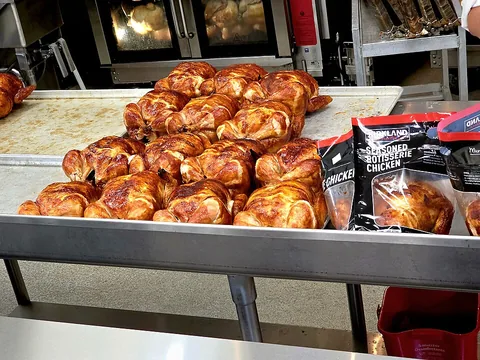
There are really only four or five chicken processing companies in America. When you have supplier concentration like that, prices can get artificially inflated. You could be on the wrong end of the stick as the buyer when there are so few suppliers.
Costco decided, we're going to be doing this for a long time. We think our members might be getting a raw deal, so what should we do? We can provide more value to members by doing the insane work of processing this ourselves. First, they figured out, we can rent 100% of the capacity of a plant in Alabama to learn the ropes of like, we're warehouse merchants, now we're becoming chicken processors. How does this work?
They learned, and then they proceeded to build their own fully-owned facility in Fremont, Nebraska,139The Fremont plant: Lincoln Premium Poultry, built for Costco in Fremont, Nebraska, opened in 2019. outside of Omaha, and build relationships with 150 local farmers in the surrounding area. This is nuts. That facility processes 2 million chickens a week now. It worked.
To take that even further, there are two other dedicated facilities that they don't fully own but that just are for Costco. They can now process 200 million chickens a year. While they're still working with the other big chicken processors, at least Costco can keep them honest on pricing now by taking on this huge amount of vertical integration themselves.
Wow, we're going to convert a lot of people to vegans in this part of the episode.
And we didn't even talk about the hotdogs.
Yeah. Okay, let's move on.
A much nicer example is the fancy mixed nuts that I was talking about earlier. They saw an opportunity to make a better product, worked directly with farmers and suppliers, and clean up that whole supply chain. They do the same thing in coffee, bring down the price, increase the amount of fairtrade stuff140Fair trade — here not the pricing laws from earlier in the episode but a certification system: producers in developing countries, such as coffee farmers, are paid a higher price and must meet social and environmental standards. going into the little Keurig pods.141Keurig — a single-serve coffee machine system whose main product is disposable K-Cup pods. The machines are made by Keurig Dr Pepper.
It is just fascinating to watch when they are willing to leverage their scale to take on additional complexity, when they feel that's in the interest of members versus when they say, you know what? I think we're going to be a merchant on this one. That's the chickens.
One thing is whenever you talk to any of these current or former Costco employees, or you watch any of the YouTube videos of the talks, or you read anything, they talk in cents. It's the craziest thing.
You hear most executives talk, and they talk in dollars, especially Jensen and NVIDIA.142Jensen Huang — co-founder of Nvidia and its CEO from 1993 to 2026. You listen to him talk, he has CEO speak. I can't remember exactly what he said, CEO language, something like that. It's all in these like plus or minus 10% swags.
Few billion here, few billion there,143A few billion here, a few billion there — a riff on "A billion here, a billion there, and pretty soon you're talking real money," attributed to Senator Everett Dirksen, though there's no direct evidence he said it (Wikipedia, "Everett Dirksen"). whatever. We're talking 70% gross margin business for NVIDIA.
Exactly. I love the concept, previous to this episode, of CEO math.144CEO math — Jensen Huang's joking term for estimates where the order of magnitude matters, not precision. In a June 2024 talk in Taiwan he explained it as "It's not accurate, but it's correct." It's like, get the high level concepts right, and the rest will follow. You talk to someone at Costco, and then what they tell you is that that cost $3.89. It's not just $3 things, they'll tell you that that cost $180.89. It's ingrained in the culture that every cent matters. I love that because it's just so different from other companies.
Yup. It's so fitting to the nature of the business and their margins. When you have 11% gross margins, you're like, yeah, I care about every penny.
You bet. The thing that kept echoing in my head is that these people, and this isn't quite a hero's journey,145The hero's journey, or monomyth — the common story template Joseph Campbell described in "The Hero with a Thousand Faces" (1949): the hero sets out, prevails in a decisive trial and returns transformed. the way that some of our episodes are, it's not the same person all the way through because it's Sol Price, it's Jim Sinegal. It's all the executives who are currently on the team today, because most of them have been there for 30-plus years. The way that all these people think and act are a different type of hero's journey, because they're a different type of hero.
A lot of the times, in our society, the people we've built up are these crazy sociopath, shoot-the-moon type people. This is just a group of people who spent their life's work all working at the same combined company just trying to improve the model in little ways. There's so little personal ambition. None of these people have LinkedIn profiles. They do, but they have one job on it, no picture, and no description. The Costco Twitter account made no tweets ever.
There's a crazy consistency to the culture. I walked into the headquarters, and the coffee was Kirkland pods from a Keurig when you sit down in the lobby. Someone says, oh, would you like water? You bet, the water that they hand you is a Kirkland Signature water bottle. If you walk by the executives, they're in cubicles. It's exactly as you would imagine it. It's perfectly consistent with Costco.
Yes, it's so great. A few more things to say on this. I literally just looked up as you're talking, Craig Jelinek's LinkedIn profile, it still says he's an EVP at Costco. The dude has been CEO for a decade. Amazing.
The reason I looked up his LinkedIn profile is that the backgrounds of these people are so different, too, than what you would typically think of as the management team of an American Fortune 50 company.146Fortune 50 — the top fifty of the Fortune 500, Fortune magazine's list of the largest US companies by revenue, compiled since 1955.
Jim went to San Diego City College.147San Diego City College — a community college: an inexpensive two-year school from which students can transfer to a university. Hence the contrast with Harvard Business School. Craig went to San Diego State University. They started as baggers at FedMart when they were teenagers, and they've just worked through the business all the way through. Occasionally, there's somebody like Giles Bateman, who comes in who went to Harvard Business School, but that is the exception, not the rule.
And it's a hundreds of billion dollar market cap company now. It's amazing. I will say, too, that there's this famous quote about Amazon being a charity that's run for the benefit of customers.148"A charity": the line that Amazon is "a charitable organization being run by elements of the investment community for the benefit of consumers" belongs to journalist Matthew Yglesias (Slate, 2013). Do you remember that?
I do. It's actually Costco.
It's actually Costco. On $230 billion of sales, they keep $7½ billion in operating income. I've just never seen a company give more consumer surplus149Consumer surplus — the difference between what a buyer would be willing to pay and what they actually pay: the benefit that stays in their pocket. than Costco. They just leave so much on the table for their ecosystem around them.
Yup. While we're talking about the people here, I think a related but separate playbook theme is truly the promoting from within culture there. It's always been the case going all the way back to FedMart and really carries through to this day.
It's just astonishing to me that a $250 billion market cap company, this is so ingrained in the culture. Other companies talk about this. But then you'll see like, oh, they go do a CEO search, and they bring in somebody from McKinsey150McKinsey & Company — the American management consulting firm founded in 1926, one of the largest in the world; its alumni often go on to run big corporations. or something like that. Nobody walks the walk on this, except Costco.
They're a very noble company. All the decisions they make are very noble. You get the sense that they're having a lot of fun being noble, but you only earn the right to be noble if your machine works. Their machine really works.
I think that's the point. They've earned the right acting this nobly partially got them to where they are, but where they are earns them the right to continue to be noble. The company has never done a layoff. If they needed to, they would have done a layoff, but they've run the business in such a way and figured out the way that they've never needed to do that. Even after they did a merger. They merged two nearly identical companies, and they did not lay anybody off.
That's wild.
It's crazy. Amazing management. All right, my last big playbook item is an old quote. There was a Deutsche Bank analyst151"It is better to be an employee or a customer than a shareholder" — the words of Deutsche Bank analyst Bill Dreher, quoted by The Wall Street Journal in 2004. that said, "It is better to be an employee or a customer than a shareholder," which Costco management would say, yeah, that's literally like we've printed it. It's in a PDF on our website that's called our code of ethics.
Yeah, do you read our annual report?
In the short-term, maybe that is a totally reasonable thing to say, and no one would argue with it. But in the long-term, it has been fantastic to be a shareholder. I did the math. If you bought $10,000 of shares in their IPO in 1985, you would have $3.3 million today, a 330X. And this does not include the dividends you would have earned along the way, which they've actually done a lot of dividends, including four-ish special dividends152Special dividend — a one-time payout to shareholders on top of regular dividends, usually from accumulated cash. too that were huge.
It's funny how, if you want to dip in and out of the stock in a year or two, it's not going to be great for you. It'll be predictable. It'll be high-priced when you come in, but it's not going to be world-changing. But there's a chance that over 30 years, it is world changing for you.
There are no hard and fast rules in investing, obviously. If you think there are, that's a great way to lose your shirt. It's funny to note that every time we've used a version of that phrase on Acquired when studying a company, that Wall Street analysts think XYZ company is a charity being run for the benefit of X, it turns out that those are pretty great stocks to own.
And great for the long-term. Those are the ones that are the most enduring, as our friends at NZS Capital153NZS Capital — the investment firm of Brad Slingerlend and Brinton Johns, proponents of "complexity investing": the future is unpredictable, so they bet on resilient companies that create value for themselves, their customers and their partners alike (NZS stands for non-zero-sum). NZS's people were Acquired guests twice, in 2021 and 2022. would remind us.
Indeed.
14Bear and bull cases
The hosts struggle to find a bear case, while room to grow, in the US, in China and in Costco-style e-commerce, is plentiful.
All right, David, bear and bull.
Yeah, let's do it. We'll start with the bear case.
Yes. Starting with the bear case.
How are you ever going to find a bear case about this company? Can we bring Charlie in here and lecture you on this?
For better or for worse, they have been very slow to ecommerce.
Maybe for better as we talked about, but maybe for worse.
We talked about most of it, but there's a thing that we haven't really discussed yet, which is Amazon's overhead is 30%. Target and Walmart's is something like 20%. The fact that Costco needs to run at 11% for it to work really did blind them to ecommerce. I don't think this was a conscious choice. This was a miss that they got really lucky on and happened to work out well for them, where they could continue to run their same playbook and skip ecommerce for a long time. They were 15 years late to ecommerce.
Structurally, Costco can provide things at a far lower cost than Amazon. But at the end of the day, there really is no way that Costco can do ecommerce like these other companies. Even Walmart's figured it out. Walmart is as good for most use cases as Amazon, but they're paying the price. It's a huge amount of overhead to set up the infrastructure to do home delivery.
One of the things we're going to talk about here in bear and bull, and I think we should transition, is what Costco is doing that is Costco-flavored ecommerce instead of Amazon-flavored ecommerce, but I will save that for my bull case.
A second bear case, it was popular in the past to say that Costco would have an issue with young people. I guess this isn't really a bear case. This is false for a couple of reasons.
There is nothing more Gen Z than Costco.
I know. Costco has been blowing up on TikTok as we've talked about. But also, from all available data, young people are getting memberships at the same rate they always have. Of course, the bulk of members will be people in their 40s and 50s with a family and a house, but that hasn't really changed over time. If you liked the Costco business in the last decade as an investor, all signs are it's going to be pretty similar in the next decade, too, in terms of the ramp of when people become members.
There's another one that's like, I'll put it in a bear case, but again, I'm not really sure it's a bear case. It is worth pointing out. It is either true that this business cannot grow at more than 10% per year on average. They've had little years where they've spiked but on average, or management just doesn't want it to, which also would be fine because there are lots of benefits to slow, steady, durable. But the company has a lot of cash on the balance sheet and regularly does dividends and buybacks.154Buyback — a company buys its own shares on the market and usually retires them, so each remaining shareholder's stake grows. Along with dividends, it's a way to return money to shareholders.
There's this crazy stat from The Science of Hitting that the company has returned 80% of net income to shareholders in the last decade rather than reinvesting it in growth. The key reason for this is that it's just really, really hard to expand. They need to hire the right people, train them well, promote internally, and the work to scale is so physical. The new construction, expanding suppliers, shipping large pallets into new geographies.
Cash is not the constraint stopping them from expanding. There is a physical limit to the speed at which this company can grow. I'm calling that a bear case because it's more like, you should be aware that this thing can't scale like Zoom scaled during the pandemic.
That's the polar opposite of the spectrum. Zoom, Slack, or any of these has basically no bottlenecks to infinite instant growth, or Instagram launching Threads,155Threads — Meta's text-based social network, launched in July 2023 as a companion app to Instagram; 100 million people signed up in five days. instantly has 100 million members. Costco is the literal opposite. There are bottlenecks everywhere to scaling, and no amount of cash is going to solve that problem. Got any bear cases?
I think I'm going to quote Charlie on this one and say, I have nothing more to add.156"I have nothing to add" — Charlie Munger's signature line at Berkshire Hathaway annual meetings, his most frequent reply when Buffett finished answering a question from the audience.
I thought you might go there. All right, bull case. The biggest one is the flywheel is spinning, and I'm not really sure who can catch them.
Here's, again, from The Science of Hitting substack. "The average Sam's Club only generates about half the revenues of a Costco, and that gap has widened over time." Given the unit economics157Unit economics — revenue and costs per unit of the business: here, per warehouse. of the business, that's a tough hurdle to overcome, which explains why Sam's Club has a smaller unit base today than it did a decade ago. Crazy, right? Over the same period, Costco increased its US warehouse count by 1/3. Anyone who could have challenged them is just done.
Yup. Maybe part of that is because Walmart has just been placing their resources elsewhere, particularly in the ecommerce fight against Amazon. I think Walmart has basically decided, look, we're not going to kill the Sam's Club business, but this is not where we're focusing our competitive energies right now.
To be more fair, this is no longer a market share fight for the warehouse retail business. This is global retail. The question is, how much of global retail can Costco's model address? It's not Costco versus a specific competitor. It's Costco versus human behavior.
Yeah. How big is this market?
Exactly.
That I think is actually a bull case for Costco, because you could argue maybe they are, maybe they aren't saturated in North America.
They're not. They're totally not.
Yeah, I think they're not. They are definitely not saturated in Asia, in the rest of the world, in Europe, in Africa, and Australia. They have a lot of global room to run.
This is my second bull case, which you touched on the domestic thing just as an aside. Every five years on earnings calls158Earnings call — a conference call at which a public company's management discusses quarterly results and answers analysts' questions. and in annual letters, Costco management reveals that they're surprised by how unsaturated they are in the US market. They'll open a store in a city where they already have three or four stores. They're like, and this one did just as well.
Of course, it doesn't have as many members because you do actually saturate the population of a city, but the convenience of having the store closer means that it hits the payback targets that you'd want it to hit just as fast as a store that was in a brand new market for them. At some point, they'll stop being surprised, or at some point, they actually will saturate the North American market, but it's amazing that they keep thinking it soon and it's never soon.
My third one is international expansion, exactly as you're saying. In particular, China, there is incredible pent up demand. Here's an illustration from The Science of Hitting, which is just so good. “The average US store has 68,000 members. The first store in China opened in 2019, which popped to 400,000 members within two years. The US at maturity is at 68,000.”
I miss doing our China tech episodes, because I feel like every 10 minutes in those episodes, we just be like, China. Things are of a different scale there.
If you can operate there. That's the big thing. For US companies, it is very complicated to operate there. There are going to be six stores in China within the next year. All indicators are that this concept performs just as well, if not better than it does in the US. They have a lot of running room.
So much running room.
And they've been very deliberate about the China strategy. They got a permit to open their first store 20 years before they actually did. The Chinese government issued them a permit. What is more Costco than waiting 20 years after you're allowed to do something to do it when you feel you're in a good place to do it?
(a) They're playing the long game, and (b) the executives at the time probably were reasonably assured they were still going to be the executives 20 years from then, so why not?
It's awesome. All right, here's my fourth bull case, and it's actually ecommerce. Bear with me for a minute on this. They're approaching ecommerce in a very Costco way. They have a bunch of different approaches, but there are two specific ones I want to highlight.
Where they have differentiation, which is on big and bulky items, that's where they're putting a lot of their energy. They spent a billion dollars to buy a company that became Costco Logistics.159Costco Logistics: in 2020 Costco paid a billion dollars for Innovel Solutions, which delivered and installed bulky goods, and renamed it Costco Logistics. They do things like deliver sheds to your house. This is a pretty difficult thing to do from a traditional ecommerce company or any ecommerce-native company.
This is sheds, this is refrigerators, this is washing machines, this is water heaters.
Right. Didn't you almost just order a fridge this morning at Costco?
Exactly. I'm saying this because I almost had to replace my refrigerator. It turns out I was able to get it repaired, thankfully. I was briefly in the market for a refrigerator, and it was super interesting dynamics. Costco had the lowest price on the model that I was looking at, but only by $20 versus Best Buy160Best Buy — an American consumer electronics chain from Richfield, Minnesota, founded in 1966. and Home Depot.
It's like $1500, or something like that.
Yeah, a $1500 refrigerator, which I'm glad I didn't have to buy. But all the other players, clearly the manufacturers of Samsung refrigerators, was running a promotion. The MSRP was $2000. All those other retailers were saying, oh, this week only, it's on sale for $1500, and Costco had it for $1470. Next week, Costco will still have it for $1470, and it'll be $2000 at Best Buy.
Yup, it's exactly right. I do think this is an interesting area for Costco and ecommerce. The second one is costconext.com.161Costco Next — a program launched in 2017 and expanded in late 2021: Costco members buy at a discount directly on partner brands' websites, while Costco itself neither stocks nor ships the goods. Do you know what this is, David?
No, I didn't find this.
It allows you to shop directly on other websites, put in your Costco number, and get a discount.
That's awesome.
Costco cuts a deal with those companies to say, we're going to send you traffic as long as the traffic we send you once you verify it, you give those people a discount.
This is literally like Ebates or Rakuten162Ebates — an American cash back service for online shopping, renamed Rakuten in 2019. for Costco.
Yes. Costco looks at it like, oh, great, we get to give yet another value to our members without having to take on the ecommerce logistics that they hate that complicates their business, that changes people's impression of what Costco is.
Fascinating.
It's the obvious way for them to play this market for anyone who's willing to partner with them.
Which again, to the supplier dynamics, it's the same thing here. On the surface, if you're XYZ ecommerce player, that'd be crazy. But then you think about it and you're like, well, we could get a lot of very high value traffic. Maybe we should do this.
It's like selling through Costco without having to sell through Costco, without having to physically drop stuff at their warehouse. It's the Internet way to sell through Costco.
Amazing.
My last bull case, really is Costco's culture. It just outlives any given quarter, a year, an economic cycle, or even any CEO. Normally, when companies get bigger things get worse, standards of excellence fall, execution gets sloppy, and Costco has just been exactly the opposite of that.
Costco was technically founded in 1976 with Price Club. You can really say it started with FedMart before that. Let's just say it was 1976. Here we are in 2023, there have been three CEOs in the history of Costco, Sol Price, Jim Sinegal, Craig Jelinek, all of whom worked at FedMart.163Ron Vachris became Costco's CEO on January 1, 2024; he too started at the bottom, as a forklift driver at Price Club.
15Fun facts and carve-outs
The hosts close with Costco trivia, from fine wine to a no-limit return policy, and recommend running glasses, a mashup and a podcast.
Yes, crazy. Okay. I have a bunch of Costco trivia before we get to carve outs.
Yeah, let's do it.
All right. Costco is the largest seller in the world of fine wines. Fine wines are defined as $20–$300 bottles. You're like, what, Costco? But they're just the largest seller of things.
The most amazing encapsulation of their demographic. It's wealthy people who like value.
Or deal. Yes, exactly. Do you know their refund policy?
No questions asked, right?
No questions asked. How long do you think it lasts?
Infinite.
There is an exception on things like electronics. Those are 90 days, but that's 75 more days than anywhere else.
Yup, Apple is two weeks.
If I buy a MacBook Pro at Costco, it's a 90-day return policy. If I buy it at Apple, it's a 14-day return policy. In fact, I'm sitting here. I really want to buy a 13-inch MacBook Air, but I'm afraid that the 13-inch MacBook Air is about to become the M3164M3 — the third generation of Apple's own chips for Mac computers. Apple announced the M3 MacBook Air on March 4, 2024. later this year. I should just go buy it at Costco.
That is not really the behavior that they want to encourage. I do know that if you take advantage of it over and over and over again, they do take you aside and say, hey, it seems like we're not providing enough value to you, let us refund the membership. We're so sorry, we couldn't do a great job.
What a great way to phrase kicking you out.
I will tell you, the infinite return policy includes things like diamond rings.
Whoa. If you get divorced, you can return the engagement ring?
Last year, they sold a 10-carat diamond ring. That diamond ring, to my knowledge, has a lifetime, no questions asked, full value return policy.
Wow. There's some fun Seattle history around this. Do you know where the inspiration for this policy came from?
Nordstrom. It's funny.165Nordstrom — the American department store chain founded in Seattle in 1901, famous for its generous return policy. I didn't know, but Nordstrom is such a famous local story around their favorable return policy.
Yeah. Jim and Jeff Brotman, before he tragically, too young, passed away a few years ago, they would talk about this. Especially Jeff and the Brotmans being Seattle retailers, they were hugely influenced by Nordstrom. And Nordstrom famously has the same return policy.
Do you know the potentially apocryphal story about the famous return at Nordstrom?
It may not be real, but at some point, somebody brought tires back to Nordstrom and said, I'd like to return these. Instead of saying, we don't sell tires, the person thought about it for a while and said, well, could you just tell me a little bit more information? They said, I bought these here and they named a year. It turns out that before that real estate was a Nordstrom, it was actually a tire center. Nordstrom gave the guy money and took the tires.166The tire story is usually dated to 1975 and the Nordstrom store in Fairbanks, Alaska, which took over the building of the Northern Commercial Company department store, which had sold tires among other things.
Amazing. While we're on Costco trivia and tires, there's a famous Sol Price story. I think this was in the Price Club days when they were opening one of the early non-San Diego locations, the first new expansion sites. He showed up and he saw tires. Their tires was one of the things that they sold at Price Club, and the tires were all neatly stacked on the warehouse shelves.
He walks up, and he starts throwing them off the shelves onto the floor. Employees are like, Sol, what are you doing? Have you gotten crazy? What's happening? He's like, you effing idiots. How are the customers going to be able to pick up the tires when they're up high on the shelves? They got to be down on the floor.
Wow. I do know by the way, Nordstrom has since adjusted its return policy to actually be capped, not infinite. Now, Costco has a better return policy than Nordstrom.
Amazing.
Wild. All right, more stats just for fun. They sold 2.2 million pumpkin pies in the three days leading up to Thanksgiving last year. They sell 1/3 of the jumbo cashews in the entire world. They, of course, sell eyeglasses. This is one of the areas where they felt they should vertically integrate. I actually don't know why, but I suspect it's because prices are artificially high in the entire glasses supply chain.
Yeah, the eyeglass industry is notoriously brutal in this.
Costco now owns and operates three optical grinding labs to make prescription eyeglasses.
It's so great.
It's the craziest thing. Lastly, here's an illustration of their culture. I think they definitely believe that you must work long, smart, and hard if you're going to be a leader there. None are optional, you just have to do it.
To illustrate this, all of their market managers and country managers come to headquarters for two days every single month. No matter what market you manage, you fly to Issaquah, that's 160 people, to all sit in a room for two days and just talk about what's working, what's not, what you're seeing, and how the whole company can get better and share learnings.
Jim talks about this a lot in the talks I watched on YouTube. When he was CEO, and I think Craig does the same thing to this day, he visited every store every year.
Yes, he did.
And there are hundreds of stores around the world. There are way more Costco stores out there than there are days in the year.
Yup. The dedication is incredible. Crazy. All right, carve outs?
Carve outs.
All right, I have two, and I'm going to do them both because they're fast and small. The first one, there's a brand called Tifosi167Tifosi Optics — an American maker of inexpensive sunglasses for running, cycling and other sports. Tifosi is Italian for "fans." that makes sunglasses for running, and you can wear them for other stuff, too. I love them because they are sunglasses that don't slip off my face when you're running or doing something and you get sweaty.
They have these little grippy pads that sit on the nose. I feel like I've solved this thing that was mildly annoying in my life for a very long time, which is continually pushing up my sunglasses while running. I highly recommend Tifosi. They're also pretty cheap. I bought three pairs. They're goofy in different colors and they're fun.
Amazing. You are becoming Phil Knight168Phil Knight (born 1938) — Nike's co-founder and the hero of Acquired's previous episode. during his Oakley phase.169Oakley — an American sports sunglasses brand founded in 1975 by Jim Jannard, now owned by Italy's Luxottica.
Exactly. The second is a mash-up that I found last night when I was looking for cool stuff to listen to while finishing the research and editing the script. Thank you to Jason Kottke,170Jason Kottke — American blogger who since 1998 has run one of the oldest blogs on the internet, kottke.org. author of kottke.org, for posting this. There is a New York City DJ named Dwells who released a mash-up about four months ago of Everything In Its Right Place by Radiohead and Kendrick Lamar’s N95.171"Everything In Its Right Place" — the opening track of Radiohead's album "Kid A" (2000); "N95" — a track from Kendrick Lamar's album "Mr. Morale & the Big Steppers" (2022). It is so sick.
That sounds awesome.
I don't listen to Radiohead that much anymore, but in college.
You used to be really into it.
Seven hours a day or something, yeah. Whenever I was programming, it was just Radiohead all the time. It instantly took me back to that place in my life and is honestly one of the best mash-ups I've ever heard.
I didn't know mash-ups were still a thing. That's awesome. I used to love mashups.
In some DJ subculture, it is crazy how mainstream Girl Talk and the White Panda172Girl Talk (Gregg Gillis) and The White Panda — American mashup artists popular around the turn of the 2010s. were for a while.
Mash-ups, I love it.
Yeah. Radiohead and Kendrick Lamar, we'll link to it in the show notes.
All right, inspired by you since you did two carve outs, I'm also going to do two carve outs. The first is a great episode of Invest Like The Best, a friend of the show, Patrick over there with Jeremy Giffon.173Invest Like the Best — investor Patrick O'Shaughnessy's podcast. Jeremy Giffon — investor who previously led deals at Tiny, a holding company that buys small internet businesses.
It's so good.
Also friend of the show.
This was going to be my third also.
Yeah, it was so good. One of the best podcast episodes, just period, all year, I think, especially because we know Jeremy pretty well from Tiny, and we know Patrick very well. Even hanging out with them a lot, learned a ton, still listening to their conversation.
This conversation, I'll tell you, is exactly like hanging out with Jeremy but in higher density. His personality is exactly how he comes across on the podcast, but it's definitely a best of. Whenever I hang out with Jeremy, I get six or seven mind-blowing one liners, these insights that just come to him out of nowhere. The podcast has 30 in an hour-and-a-half. It's just awesome.
Yeah, it's just awesome. Go listen to it. Well worth your time.
My second carve out—this is a fun local one—Jenny and I did a date night last week. I highly recommend for any parents out there. We have a standing babysitter who we love Friday night, weekly date night, unless something changes. I highly recommend that.
We went out to Dogpatch in San Francisco,174Dogpatch — a neighborhood on San Francisco's eastern bayfront: an old working-class district of shipyards and factories, rapidly gentrifying since the 1990s. The San Francisco chapter of the Hells Angels is still headquartered there (Wikipedia, "Dogpatch, San Francisco"). which I hadn't been to in a long time. It's become such a cool neighborhood. We went to this awesome wine bar there. We walked around. We got ice cream at Humphrey Slocombe175Humphry Slocombe (the official spelling) — a San Francisco ice cream chain whose first shop opened in the Mission in 2008; known for unusual flavors such as Secret Breakfast, ice cream with bourbon and cornflakes. afterwards.
Dogpatch is right on the water in the bay. It's got an interesting history. It was the headquarters (I think) of Hells Angels176Hells Angels — the world's largest "outlaw" motorcycle club, founded in 1948 in Fontana, California. for a long time during the 50s and 60s. You worked there, didn't you when you were an intern?
Dogpatch Labs177Dogpatch Labs — a startup coworking space on Pier 38 in San Francisco, where Kevin Systrom and Mike Krieger launched Instagram in 2010. The pier was closed in 2011 as structurally unsafe. on Pier… I'm trying to remember the actual number. There was a co-working space when I worked at CoTweet.178CoTweet — a San Francisco startup offering a service for managing corporate Twitter accounts; email marketing company ExactTarget bought it in March 2010. Actually, they condemned the pier and took it down because it was like we were the last year that it was still… I don't know. We probably shouldn't have had an office in it. I worked at CoTweet. Above us was the coworking space where the Instagram guys launched Instagram.
That's right. You probably remember back then, Dogpatch was a random outskirts of San Francisco, sleepy little neighborhood. It's become awesome. We walked by a game shop where they have ladies D&D night going on. It's just super cool. Going to hang out there more often.
If you come to San Francisco, don't hang out downtown. Downtown is not a good place. The rest of the city is awesome. Go to Dogpatch. It's a very different experience.
Thank you for saving me from… I was going to stay at a hotel on Market Street,179Market Street — the main thoroughfare of downtown San Francisco, lined with many of the big hotels. and you were like, do not do that.
Dear God, do not do that. I may never see you again.
But that's where all the hotels are. It's a big problem.
I know. Airbnb is a thing.
Airbnb.
All right. With that, sign up for notifications of new episodes. We just flipped this thing live, acquired.fm/email. We are going to be including little tidbits after we release episodes, including listener corrections and little fun stories that we didn't have in time for recording. We'll also be teasing future episodes. So if you want, play a little trivia game with us to try and guess what next episode is going to be. That is where we're going to be dropping those hints.
AdAcquired LP
You can become an LP,gLP (limited partner) — a passive investor in a venture fund. That's what Acquired calls members of its paid membership program. acquired.fm/lp. Become closer to the show, do Zoom calls with us every other month or so, and at least once a season, help pick the next episode. Acquired.fm/lp.
LPs chose Nike, our most recent episode before this one.
They did.
One thing we should say in case you don't follow us on social media and didn't see the tweets about it. Friend of the show, David Lidsky180David Lidsky's article about Acquired appeared in the business magazine Fast Company in 2023. did a truly awesome piece in Fast Company about Acquired. We're super grateful that he took the time, dove deep, and spent...
Many hours with both of us. It was super cool.
Lots and lots of time, basically tracking us as we were preparing the Nike episode. Since he's been listening since 2017–2018, he knew a lot of the history of the show. He wrote this really cool piece.
If you are one of the people who has emailed us over the years and said, it'd be great if you guys did something talking about how your research process for Acquired works, David chronicled that much better than David or I ever could have. Thank you, David Lidsky. I really appreciate it. We will link to the Fast Company piece in the show notes, too.
Look for ACQ2 if you want to learn more about AI in any podcast player, and check out the Slack. Come discuss it with us, acquired.fm/slack.
Listeners, we'll see you next time.
I'm going to go get a hotdog and a soda.
I'll see you there and get a chicken bake.
How much are the chicken bakes?
More than $1.50, but it's more substantial than hotdog.
It's like 3000 calories.
It's like 900 calories, but you're not doing a lot of other eating that day.
I love it. All right, listeners.
We'll see you next time.
We'll see you next time.


