

Acquired
Chapters
Formula 1 is three sports at once and the world's most popular annual series, finally dragged into professional management after more than a hundred teams went bust.
Read the chapter- Ben calls F1 a showcase for the world's best drivers, a World Cup of Engineering in which every team must build its own car from scratch, and, in one listener's phrase, a World Cup of Office Politics.
- Twenty drivers race at over 200 mph in 24 cities, the whole circus flies on seven Boeing 777s, and more than 827 million viewers make it the most popular annual series, which came as news to two Americans.
- Over 100 teams have entered and exited, mostly through bankruptcy, and the sport now belongs to the publicly traded Liberty Media, which, David recalls, once owned Excite@Home too.
- The season starting in five days brings new regulations, Cadillac as an 11th team, Audi and Ford, and a new US broadcast partner in Apple TV.
The championship grew out of European automobile club races run to a common FIA formula, and its heart settled in postwar England, with its empty airfields and out-of-work pilots.
Read the chapter- The Automobile Club of France's 1906 race at Le Mans was called a Grand Prix, literally "the big prize," and, as David stresses, Formula 1 is named after the rule book.
- The first drivers' world championship opened at Silverstone on May 13, 1950, and the Constructors' Championship arrived only in 1958.
- Britain had just won the war but needed entertainment, and it had empty airfields and unemployed RAF pilots and mechanics, which is why 70% of the teams are still based in the UK.
- Colin Chapman founded Lotus in 1952 with £25, valued lightness over power ("Subtracting weight makes you faster everywhere") and was the first to paint his cars in a sponsor's colors, those of Gold Leaf tobacco.
- His story ends sadly, David says: Chapman and John DeLorean were accused of embezzling government incentives, and Chapman died of a heart attack at 54.
Monaco brought glamour, Ferrari brought a luxury business and legitimacy, and mortal danger was part of the appeal in the early decades.
Read the chapter- David likens Prince Rainier III's 1956 marriage to Grace Kelly to Travis and Taylor: the Monaco Grand Prix, timed next to the Cannes Film Festival, fused old-world Europe with Hollywood.
- Ben notes nobody would add Monaco's narrow streets to the calendar for today's cars, but David says they will never drop it, because it is what brings luxury into the sport.
- Enzo Ferrari was the first to see a business in selling fast cars to the rich and famous, and David argues Ferrari may be the only real luxury brand founded in the second half of the 20th century.
- Ferrari is the only team in every season, and Ben's point is that Ferrari legitimizes F1, not the other way around.
- After a Mercedes crash at Le Mans killed 82 people, Mercedes stayed out of F1 for 40 years, and for three decades one or two drivers died a year, which David puts at 5 to 10% of the field.
Luxury car dealer Bernie Ecclestone bought a team, took over negotiations for everyone, and used the Concorde Agreement to lock up the sport's commerce and its future TV rights.
Read the chapter- Bernie encouraged rumors that he planned the 1963 Great Train Robbery, and at 75 said there wasn't enough money on that train for him to be involved.
- After the death of his friend and client Jochen Rindt, Bernie bought Brabham in 1972 for £100,000 and saw that, apart from Enzo Ferrari, none of the owners had money or business sense.
- Nine teams each negotiated with each Grand Prix separately, roughly 135 deals by Ben's count, so Bernie offered to negotiate for all of them and guarantee payments, then took 8% instead of the 2% he had verbally promised, as court cases later showed.
- The average payment per team per race went from about $10,000 to $40,000 in his first year and $200,000 by the end of the decade.
- The first Concorde Agreement in 1981 left the rules with the FIA, committed the teams to every Grand Prix, and gave Bernie and the Constructors Association the race fees and all future TV rights.
Bernie gave the TV rights away almost free so public broadcasters would build the market, then, once pay TV arrived, made himself the only seller and kept more than half the TV money.
Read the chapter- He sold the rights to the European Broadcasting Union, covering 92 countries, for a couple of million a year on one condition: show every race, not just the home ones, which Ben calls growth mode rather than value capture.
- His company FOPA produced a single feed from England, and the second Concorde Agreement split TV money 30% to the FIA, 47% to the teams and 23% to FOPA.
- In 1992 Bernie bought out the FIA's share for a flat $5 to $9 million a year, reached 53%, and ran auctions that lifted TV income to $40 to $50 million a year.
- Ken Tyrrell publicly accused Bernie of stealing F1 from the teams, but most owners were grateful, because television made the logos on their cars valuable.
- Tobacco companies, for whom a car on TV was a loophole around advertising bans, poured $4.5 billion into team sponsorships before the EU ban in 2006.
The teams poured the new money into downforce, engines and electronics, and after Senna's death slowed the cars, the arms race moved into hunting for loopholes in the rules.
Read the chapter- Ben's physics lesson is "downforce good, drag bad": the Lotus 78 and 79 turned the car into an upside-down wing sucked onto the track by ground effect, and Lotus won both titles in 1978.
- Ground effect was banned in 1983 and returned for 2022–2025, and in Las Vegas, Ben recalls, the cars kicked up clouds of dust and one even sucked up a welded-shut drain cover.
- Williams won both titles in 1992 and 1993 with traction control, anti-lock brakes, active suspension and a semi-automatic gearbox, but the FIA banned them just as Senna arrived in 1994.
- After Senna's death the cars were slowed down, the halo, mandatory since 2018, has saved at least three lives, and there have been no fatalities since 2014.
- Winning now means finding daylight in the rules that rivals miss and sinking $50 million of R&D into it, Ben says, and David compares it to Moore's law for TSMC and ASML.
Bernie never legally owned F1, yet he cashed it out again and again through an IPO attempt, debt, private equity and the banks, and stayed in charge every time.
Read the chapter- In 1993 Bernie, Britain's highest-paid executive at $44.5 million, ran F1 from his London house while also owning a team, promoting the Belgian Grand Prix at Spa and serving as FIA vice president, with his ally Max Mosley installed as FIA president.
- Ben quotes Eddie Jordan: Bernie sold F1 four times, never bought it back, never lost control, and never owned it in the first place.
- An EU antitrust probe killed the SLEC Holdings IPO at an expected $4 billion valuation, so Morgan Stanley issued the $1.4 billion "Bernie Bonds" against future TV rights, and three days later Bernie had triple bypass surgery.
- Hellman & Friedman owned its stake for one month and made £241 million selling to EM.TV, and after the dot-com crash EM.TV and Kirch went under and 75% passed to the banks.
- The banks won control in court, but Bernie said the verdict meant "nothing at all" and brought in CVC, which bought 100% with him for about $2 billion and kept him as CEO.
Under CVC, Bernie squeezed new circuits for money, while teams spending $400 to $500 million a year and hit by the 2008 crisis threatened to break away.
Read the chapter- Bahrain and China paid $30 to $50 million a year, India $40 million in race fees alone, and Abu Dhabi committed $1 billion, including a new track in the desert.
- Russia built a $270 million track in Sochi and agreed to pay $50 million a year for seven years, and Bernie refused to go meet Putin until the signed contract came back first.
- After 2008, Honda, BMW and other carmakers could no longer justify their teams, but Ferrari and McLaren blocked the cost cap that Bernie, CVC and the FIA proposed.
- In 2009 eight of ten teams threatened their own FOTA series and won Max Mosley's exit, but never broke away: Zak Brown told Ben such attempts always fell apart over how to split the pie.
- Ben recalls Spygate, when McLaren ended up with a binder of Ferrari's car specifications, and Crashgate, when a team apparently had its driver crash to bring out the safety car.
Two newcomers bought for a pound, the marketing company Red Bull and Brawn GP, which became Mercedes, rescued the sport, and their bosses became the first team CEOs.
Read the chapter- Red Bull arrived as the EU pushed tobacco out, bought Ford's Jaguar team for £1 in 2004, and brought the open-door Energy Station with DJs and a rooftop pool, which David calls a giant middle finger to the establishment.
- Christian Horner secretly invited McLaren's Adrian Newey, the designer who, as Ben hears it, "can see air," to the Energy Station, and with him Red Bull won four straight double titles in 2010–2013.
- When Honda quit in 2008, Ross Brawn bought the team for £1, got Mercedes engines, and with the double diffuser won both 2009 championships, with Jenson Button taking six of the first seven races.
- Mercedes bought 75% of Brawn for $200 million and, after Michael Schumacher's comeback failed, hired Toto Wolff and Lewis Hamilton and won eight straight Constructors' Championships.
- The Mercedes racing team alone is now valued at $6 billion, which David says is about twice what Bernie pulled out of F1 in his heyday.
Liberty Media bought F1, pushed Bernie out and repaired relations with the teams, the tracks and the fans, and the cost cap turned the teams into real businesses.
Read the chapter- In 2016 Liberty bought F1 for $4.4 billion of equity and $8 billion including debt, and Ben calls the key asset the 100-year commercial rights Bernie got from the FIA in 2001 in a no-bid deal for $360 million.
- In January 2017, after 45 years, Bernie was made chairman emeritus, which David calls a firing, and Chase Carey, who helped launch Fox Sports, took over.
- A $145 million cost cap on the car made every team at least close to break-even, and by Ben's numbers the average team now brings in about $430 million while Mercedes makes about $200 million in operating income.
- Toto Wolff negotiated almost a third of Mercedes when he joined in 2013, when the team was worth about $165 million, and is now a billionaire from it.
- Liberty asked the race promoters to share data and treat every race as one of 22 Super Bowls a year, and told Lewis Hamilton, who had a stack of Bernie's cease-and-desist letters over his Instagram posts, to post all he wanted.
Drive to Survive worked because it was about human drama rather than racing, and even hardcore fans loved finally seeing behind the curtain.
Read the chapter- Ben says the killer unlock was the World Cup of Office Politics, with fast cars, yachts and parties only as flair on top.
- Amazon reportedly bid about twice as much, but Liberty took Netflix for its audience, and Box to Box Films, makers of the 2010 Senna documentary, got full creative control and final cut.
- Mercedes, then Ferrari, declined to take part, leaving Netflix with the bottom eight teams, until after the hit third season their sponsors demanded to know why they weren't in it.
- Ben estimates 40 to 50 million people watch a season, and his wife scolded him for spoiling Christian Horner's firing, which had happened six months earlier.
Liberty is winning over the US with new races and media deals, and sponsors pay so much because F1 works as a traveling customer briefing center around the world.
Read the chapter- Miami drew 3.1 million US viewers in 2024 against about half a million per race in 2018, Ben counts 52 million US fans, and David cites reports that women went from 7% of the audience to about 40%.
- After nine failed US races came Austin, Miami and Las Vegas, where F1 is its own promoter, but Ben doubts the more than half a billion dollars sunk into Vegas will pay back soon.
- Atlassian CEO Mike Cannon-Brookes calls F1 a mobile executive briefing center, Oracle reportedly pays Red Bull about $100 million a year, and LVMH pays F1 itself the same.
- ESPN first showed F1 for free, then paid $80 to $90 million a year from 2022, and after the F1 movie grossed $630 million, Apple reportedly offered $150 million a year for five years.
- For 2026 Cadillac enters with Ferrari power and a $450 million fee and Ford becomes an engineering partner of Red Bull Powertrains, while Ben calls the hybrids' sustainability a farce when logistics, by his math, emit 64 times more than the cars.
F1 is a fat league with its own profits and a $25 billion enterprise value, but the teams already get 72% of what they would if they owned it, which is why they don't break away.
Read the chapter- By Ben's 2024 numbers, Formula One Group has $3.4 billion in revenue: 33% media rights, 29% race promotion, 19% advertising and sponsorship, and 19% hospitality, merch and licensing.
- About 37% of revenue, $1.27 billion, goes to the teams, with the top team getting around 14%, the bottom around 6% and Ferrari a heritage bonus, and Ben argues the gap keeps the back of the grid stuck.
- Forbes puts the average team at $3.6 billion, up 89% in two years, with Haas the cheapest at $1.5 billion and Ferrari at $6.5 billion, and even Mercedes trades at 30 times operating income.
- Liberty turned $4.4 billion of 2017 equity into a $22 billion market cap, and with the teams and the races Ben and David put the whole sport at about $70 billion.
- Handing all of F1's $492 million operating income to the teams would lift their take only from $1.27 billion to $1.76 billion, a balance Ben calls just right.
David is sure F1 needed a street fighter like Bernie to become what it is, and the hosts find plenty of Power in F1 itself, above all its status as the pinnacle of motorsport.
Read the chapter- David sees Pete Rozelle as an N of 1 case and argues that a global, multi-party F1 of teams, tracks, broadcasters and the FIA needed a ruthless entrepreneur, not a hired commissioner.
- Ben argues that durable team advantages like Mercedes' eight titles come from operational excellence and drivers, not strategy, so the teams are powerless, which David says is what you want in a league.
- In F1 itself the hosts find network economies, scale, brand, switching costs and a cornered resource: the FIA's designation as the pinnacle of motorsport.
- The NFL earns $127 per fan a year and F1 earns $7, and the bull cases include a spring mini-season in the US, competitive European TV bidding, an American champion, a female champion and Apple's camera technology.
- The main bear case, Ben says, is that a race is more parade than race with little overtaking, and that Liberty has already picked the low-hanging fruit.
For Ben, F1 is a sport loved by a huge audience that never watches it, and for David it is the most complex sports league they have ever studied.
Read the chapter- Ben can't think of another sport where people call themselves fans, know the drivers, buy merch and sponsors' products, yet never tune in live.
- Ben likens F1 to boxing or UFC, except with ten teams of $300 million cars instead of two fighters, David notes nobody would ever draw up such a league on paper, and Ben adds that it took 70 years.
- Ben recommends Cirque du Soleil's ECHO and NFL Films' Super Bowl Mic'd Up, and David recommends the Tonal home gym and Princess Peach: Showtime!, his daughter's new favorite game.
- The hosts thank the authors of The Formula, Zak Brown, Greg Maffei, Eddy Cue, Chase Carey and about two dozen other people.
Quotes
Bernie on rumors that he took part in the Great Train Robbery
“There wasn't enough money on that train for me to be involved. I could have done something bigger.”
David RosenthalRead from 32:34On Bernie's early years in F1
“Basically, Bernie's sort of first act in F1 reminds me of one of my favorite sayings that I heard earlier in my career from a mentor. He may be a thug, but at least he's our thug.”
David RosenthalRead from 46:51Eddie Jordan on Bernie Ecclestone
“Bernie Ecclestone was someone who sold Formula 1 four times, has never bought it back, has never lost its control, and still owns it. And do you know the most important thing? He never effing owned it in the first place.”
Ben GilbertRead from 1:29:46Red Bull founder Dietrich Mateschitz on sponsoring in F1
“If an insurance company sponsors a team and that team loses, people don't change their insurance company. But when the Red Bulls lose, people get a new drink.”
David RosenthalRead from 2:07:22Ben's wife on Drive to Survive spoilers
“That's her mental model is real life is irrelevant, Drive to Survive is canonical.”
Ben GilbertRead from 3:12:29On the "sustainability" of F1's hybrid engines
“During the 2019 season, the logistics operation, moving these cars in the circus around, accounts for 64 times the emission of the cars themselves, even when you include practice, qualifying, and races.”
Ben GilbertRead from 3:37:59Why Formula 1 needed Bernie specifically
“I think you need somebody truly with Bernie's background. Ruthlessness. You need a street fighter to do this.”
David RosenthalRead from 3:57:26On the complexity of Formula 1
“I was going to make the point earlier in the episode that it'd be like if the equipment manager and an NFL team was the most important person on the team and had 800 people who worked for him or her.”
David RosenthalRead from 4:16:41
Summary
Formula 1 is three competitions in one: a race between the best drivers in the world, a world championship of engineering in which every team builds its own car from scratch, and, as one listener put it, "The Real Housewives of the garage," a soap opera of billionaires and office politics. Ben Gilbert and David Rosenthal tell how a dangerous, disorganized European series became the most popular annual sports championship on the planet and a business worth around $70 billion counting the teams and circuits. The roots are the first Grands Prix and the FIA, whose rulebook gave the sport its name, and three pillars of the 1950s: Britain's empty airfields and engineers like Colin Chapman, the glamour of Monaco after Grace Kelly's wedding, and Ferrari, the one team that managed to turn racing into a real business.
The protagonist is Bernie Ecclestone, a London car dealer who bought the Brabham team in 1972. He centralized negotiations with the circuits, took the TV rights for himself under the first Concorde Agreement (1981), gave them away almost for free to Europe's public broadcasters and then, once the market matured, auctioned them off. While the teams spent hundreds of millions on wings, ground effect and electronics, and Senna's death finally forced the sport to take safety seriously, Bernie "sold Formula 1 four times": bonds backed by TV rights, Hellman & Friedman, EM.TV and Kirch, the banks and finally CVC. In 2009 the teams nearly broke away, and the sport was saved by newcomers: Red Bull, which turned a team into a marketing machine and lured away Adrian Newey, and Brawn GP, bought from Honda for one pound, which grew into Toto Wolff's Mercedes.
In 2017 Liberty Media bought Formula 1 for $8 billion, fired Bernie and, under Chase Carey, made peace with the teams, the circuits and the fans. The cost cap made the teams profitable (the average team is now worth $3.6 billion), Drive to Survive brought in a new and largely female audience, and the F1 movie and the Apple deal are opening up America. In the analysis David argues that without Bernie the street fighter, F1 would never have become what it is; the hosts see no Powers in the teams, while F1 itself has a cornered resource: its status as the pinnacle of motorsport. Ben's quintessence is a sport loved by a huge audience that barely watches the races; David's is that this is the most complex sports league they have ever studied.
Mentioned
 Liberty Media01:13has owned Formula 1 since 2017
 Formula One02:07the series' history and business
 Apple TV04:05F1's new US broadcast partner
- The Formula: How Rogues, Geniuses, and Speed Freaks Reengineered F1 into the World's Fastest-Growing Sport05:14the episode's main source
Show 66 more mentionsShow fewer mentions
 Joshua Robinson05:14co-author of The Formula, helped with the episode
 Jonathan Clegg05:14co-author of The Formula, helped with the episode
 Fédération Internationale de l’Automobile07:33the rulebook that gave the sport its name
 Colin Chapman11:35pilot and engineer, founder of Lotus
 Team Lotus12:08sponsor liveries, wings and ground effect
 Grace Kelly18:45her marriage to Monaco's prince brought glamour to the sport
 Enzo Ferrari20:42the first to build a business on racing
 Ferrari20:42the only team in every season
 Niki Lauda27:01badly burned, back racing within weeks
 Bernie Ecclestone27:53ran Formula 1 for 45 years
 Jochen Rindt34:15Bernie's friend, a posthumous champion
 Brabham35:17the team Bernie bought in 1972
 Pete Rozelle41:57the NFL's "anti-Bernie"
- Lotus 791:09:23the legendary ground-effect car
- Lotus 781:09:53the "wing car"
 Williams Racing1:16:05electronic driver aids
 Alain Prost1:16:571993 champion with Williams
 Ayrton Senna1:17:23his death in 1994 changed the sport
- Senna1:18:55documentary about Senna
 Max Mosley1:27:28Bernie's right-hand man and FIA president
 Eddie Jordan1:29:38"sold it four times and never owned it"
 Morgan Stanley1:39:22the "Bernie bonds"
 Hellman & Friedman1:41:32owned Formula 1 for one month
 CVC Capital Partners1:46:33owned Formula 1 before Liberty
 Vladimir Putin1:51:29the Russian Grand Prix deal
 McLaren Racing1:56:15against the cost cap, Spygate
 Zak Brown1:59:38why the teams don't start their own series
 Red Bull Racing2:02:18the energy drink that became a championship team
 Dietrich Mateschitz2:03:32founder of Red Bull
 Ford Motor Company2:07:42sold Jaguar Racing for a pound, now Red Bull's partner
 Christian Horner2:10:52Red Bull Racing team principal
 Adrian Newey2:12:52the designer who "sees air"
- How to Build a Car: The Autobiography of the World's Greatest Formula 1 Designer2:13:47Newey's book
 Michael Schumacher2:14:39the era of Ferrari dominance
 Max Verstappen2:15:26the best driver in today's F1
 Ross Brawn2:18:41bought Honda's team for a pound
- Schumacher2:19:34the Netflix documentary Ben recommends
- Brawn: The Impossible Formula 1 Story2:25:12docuseries on Brawn GP with Keanu Reeves
 Brawn GP2:27:322009 champion on a shoestring budget
 Jenson Button2:28:542009 champion
 Mercedes-AMG Petronas Formula One Team2:32:04grew out of Brawn GP
 Toto Wolff2:34:51Mercedes team principal and co-owner
 Lewis Hamilton2:35:16six titles with Mercedes
 Nico Rosberg2:35:42beat Hamilton in 2016
 John Malone2:40:54Liberty Media
 Greg Maffei2:40:54Liberty Media, helped with the episode
 Chase Carey2:42:50F1's first boss under Liberty
 Instagram3:00:09Bernie made Hamilton delete posts; Liberty allowed them
- Formula 1: Drive to Survive3:03:17the most influential sports media
 Netflix3:03:17got the series for less money
 Amazon3:05:29lost the series to Netflix
 Ben Thompson3:20:10interview with Atlassian's CEO
 Oracle3:21:10Red Bull Racing's title sponsor
 ESPN3:25:08broadcast F1 in the US
 Apple3:26:44the F1 movie and US broadcast rights
- F13:26:44the highest-grossing sports film
- Ford v Ferrari3:27:44a rare box-office hit among racing films
 Dee Hock3:55:28compared with Pete Rozelle
 Charlie Munger3:57:43"I have nothing to add"
- 7 Powers: The Foundations of Business Strategy4:03:50the analysis framework
- Apple Vision Pro4:13:50Apple technology for F1 broadcasts
 Cirque du Soleil4:18:25Ben's carve-out
- Super Bowl LX Mic'd Up4:19:23Ben's carve-out
 Tonal4:19:48David's carve-out
- Princess Peach: Showtime!4:20:47David's carve-out
 Arvind Navaratnam4:22:09Worldly Partners' study of Formula 1
Sponsors of the episode


Transcript
01Three competitions in one
Formula 1 is three sports at once and the world's most popular annual series, finally dragged into professional management after more than a hundred teams went bust.
I was just listening to the F1 theme song1The F1 theme — Formula 1's official music, written for Liberty Media by the American composer Brian Tyler; it has been used since the 2018 season. to get pumped up.
Me too, were you really?
Yes, it's so good.
I just got new speakers here in Acquired HQ North, and actually thanks to a recommendation from a listener in the Acquired Slack, and yeah, it was bumpin'.
Amazing.
All right, let's do this.
Let's do this.
Welcome to the spring 2026 season of Acquired, the podcast about great companies and the stories and playbooks behind them. I'm Ben Gilbert.
I'm David Rosenthal.
And we are your hosts. Today, we dive into a sport that started in the 1930s that began for the pure love of auto racing, extremely dangerous auto racing. Then, after World War II, the British Air Force veterans and mechanical engineers joined the sport to push the limits of technology and physics. It eventually became the sport of rich guys who want to own teams to gallivant around Europe, losing colossal sums of money along the way.
And in fact, David, since the sport began, over 100 separate teams have entered and exited the competition, mostly because they went bankrupt. Today, the sport has been dragged kicking and screaming into being professionally managed and is now owned by the publicly traded U.S. company that has owned the Atlanta Braves,2Atlanta Braves — Major League Baseball club from Atlanta. Liberty Media owned it from 2007 and spun it off into a separate company in 2023. Sirius XM, and Live Nation.3Live Nation — the world's largest concert promoter and, since its 2010 merger with Ticketmaster, also the main seller of concert tickets. Liberty Media was its largest shareholder for many years. That is Liberty Media.4Liberty Media — American media holding company founded by John Malone in 1991; it has owned Formula 1 since 2017 and, since 2025, the MotoGP and World Superbike motorcycle championships as well. And against all odds, Liberty has managed to turn the sport, the teams and the drivers the world's premier motorsport series.
Woo. I was going to save this for later in the episode, but do you know what else among the many other like hundreds of companies that Liberty has owned? Do you know what else they owned? You won't guess it because there's so many. Excite@Home.5Excite@Home was formed in 1999 by merging the Excite search engine with the cable internet provider @Home, and went bankrupt in 2001. In 1999 Excite turned down the chance to buy Google for $750,000.
No way.
From our Google series.
Throwback. That's awesome. Well, listeners, really what we're doing here today with Formula 1, it's three sports in one. It is of course the world's best race car drivers showcasing their skills, but it's also the World Cup of Engineering. These days, it's fair to say that the races are more determined by the design feats of the thousand plus people that work on each car than the drivers.
And Formula 1 is the only motorsport in the world that requires a team to design and build their own car from scratch, which is an insane engineering feat to enter the competition. And as one listener put it to us, it's also the World Cup of Office Politics, or as another one put it, it's Real Housewives of the Garage,6The Real Housewives — Bravo's reality TV franchise about the lives of wealthy women, famous for its feuds and fights; it has been on the air since 2006. which that makes for a fantastic Netflix show.
Oh, does it ever? We might talk about that towards the end of the episode here.
Yes, the sport itself is completely insane. It is a grid of 20 drivers7The grid — the starting markings where the cars line up in a staggered formation; places on it are decided by qualifying. competing at over 200 miles per hour in races that last 190 miles.8190 miles — by regulation a Grand Prix runs the fewest laps that add up to more than 305 km (about 190 miles); Monaco is the exception. And they do this every week or two in a different city around the world. They load the entire circus,9The F1 circus — the long-standing nickname for everything that travels from race to race: the teams, their equipment, the journalists and the guests. the cars, the teams, the hospitality onto a fleet of seven Boeing 777s between races.
And they set up shop in 24 different cities from Monaco to Bahrain to Melbourne, Australia. Each car costs $20 million to make and hundreds of millions of dollars to develop. The cars have three to 600 sensors on them. And shockingly to me as an American, David, I don't know if you knew this before we started researching, it's actually the world's most popular annual sporting series with over 827 million viewers.
Yeah, I had no idea until we started researching because we're Americans.
And the Olympics and the World Cup don't count as they're every two and four years. So pretty crazy. Listeners starting in just five days, a season will kick off that's going to see some of the biggest changes in the sport in decades. We've got new regulations,10The 2026 regulations — the biggest change in technical rules in decades: the cars are smaller and lighter, with movable aerodynamic elements, about half the power unit's output comes from the electric motor, and the fuel is fully sustainable, either synthetic or bio-based. which means all new car designs, and expansion to an 11th team with Cadillac.11Cadillac — General Motors' luxury brand. Its team, built together with TWG Motorsports, has raced since 2026, the first new team since Haas (2016); GM promises its own engines from 2029 (Wikipedia, "Cadillac in Formula One").
Audi12Audi bought the Swiss Sauber team and from 2026 races in Formula 1 as a works team with its own engines (Wikipedia, "Sauber Motorsport"). and Ford13Ford returns to Formula 1 as Red Bull Powertrains' partner: from 2026 the two build power units for the Red Bull teams together. are also entering the sport and a brand new broadcast partner in the US in Apple TV.14Apple TV — Apple's streaming service (Apple TV+ until 2025); from 2026 it replaces ESPN as Formula 1's US broadcaster. And while everything got much more professionalized, it's still owned by a bunch of rich guys who love auto racing.
They're just no longer money losing rich guys.
That's right. So listeners, just like our NFL, NBA, and IPL cricket episodes,15IPL (Indian Premier League) — India's professional cricket league in the short Twenty20 format, founded in 2007 (first season 2008); one of the world's most valuable sports leagues by TV rights. this show is about the business of F1. We apologize in advance if we don't spend time in your favorite rivalry or regulation detail or the V10 engine sound.16V10 — a ten-cylinder V engine. F1 cars used them until 2005 (Toro Rosso until 2006), and fans still get nostalgic about their high-revving scream.
You can join the email list to get updates every time an episode drops at acquired.fm/email. You get to vote on future episodes, and the email list is just getting much, much better. So we now have episode summaries, our big takeaways, and exclusive photos from our research process. That's acquired.fm/email. Chat about this afterwards with us, with the whole Acquired community, in the Slack, acquired.fm/slack.
So with that, this show is non-investment advice. David and I may have investments in the companies we discuss, and this show is for informational and entertainment purposes only. David Rosenthal, where do we dive in?
Well, first off, we owe a huge thank you to Joshua Robinson and Jonathan Clegg, who are the sports editors over at The Wall Street Journal, and just recently published, I think the best business history book of Formula 1 called The Formula.17The Formula — Joshua Robinson and Jonathan Clegg's book (2025) about how Formula 1 turned from a European racing series into a global business. Full title: The Formula: How Rogues, Geniuses, and Speed Freaks Reengineered F1 into the World's Fastest-Growing Sport. It was one of the main sources for this episode, and they both actually helped us in the research, so thank you guys.
02Origins: the Grands Prix, the FIA and Britain's airfields
The championship grew out of European automobile club races run to a common FIA formula, and its heart settled in postwar England, with its empty airfields and out-of-work pilots.
So Ben, Formula 1, as we know it, really started after World War II in 1950, but unlike a traditional company or even many of the sports leagues that we've studied over the years, it doesn't have an exact sort of founding moment. Its origins are really part and parcel with the beginning of motor racing itself.
It didn't take long after the invention of the modern automobile, which is generally agreed upon to be by Carl Benz18Carl Benz (1844–1929) — German engineer whose three-wheeled Benz Patent-Motorwagen of 1886 is considered the first gasoline-powered automobile. in Germany in the late 1800s, that people had the idea to start racing things. I mean, after all, people raced horses. Why wouldn't they race cars, too? Throughout the first few decades of the 1900s, various automobile clubs popped up across Europe, and they would host these races.
They'd sell tickets and advertising to fund prize purses, and drivers and manufacturers would travel from all over the world to compete in these races. 1906, the Automobile Club of France, which was the largest in Europe at the time, hosts an inaugural race just to the southwest of Paris called Le Mans, L-E-M-A-N-S.
And this group of organizers, they decided to call this Le Mans race by a very literal name in order to attract spectators and participants. They call it the Grand Prix de Le Mans,19The first Grand Prix — the Automobile Club of France's 1906 race, held on roads around Le Mans. The famous 24 Hours of Le Mans came later, in 1923. literally translated as the big prize.
It's great. It carries all the way forward to this day.
Yes, the names in this sport are very literal. The success of this Le Mans Grand Prix causes a bunch of similar races to pop up across Europe all throughout the teens and 20s, copying the same rules or formula as the Automobile Club of France. You had Monza20Monza — the circuit in the royal park outside Milan, built in 1922; one of the oldest in the world, known as "the temple of speed." pop up in Italy, the Monte Carlo race in Monaco, you had the Nürburgring in Germany,21Nürburgring — circuit in the Eifel mountains of western Germany, opened in 1927. Its old Nordschleife, more than 20 km long, is so dangerous that Jackie Stewart nicknamed it "the Green Hell." et cetera, et cetera, et cetera. You probably heard of all these places.
Eventually in the 1920s, all the major European automobile clubs get together in Paris and they say, "Why don't we centralize oversight of this formula into one international organization?" And that becomes, after a series of name changes over the years, the Fédération Internationale de L'Automobile or the FIA,22FIA — Fédération Internationale de l'Automobile. Its predecessor, the Association Internationale des Automobile Clubs Reconnus (AIACR), was founded in Paris in 1904; the FIA name dates from 1946. which still exists today and still administers the rules of Formula 1. And as Josh and Jonathan point out in the book, the sport is literally named after the rule book.
There's a lot of fighting about the rules in this sport, both when they're setting the rules every few years and in races when they're going up to yell at the race stewards,23Stewards — the race officials appointed by the FIA; they rule on incidents and hand out penalties such as time penalties and grid drops. "Oh, this is illegal. This is not illegal." Anyone who is sort of complaining that this sport is too into the rules needs to remember it is named after them.
It's named after the rule book, yes. Okay, so at this point, you've got all these Grand Prix and these famous racetracks that you know today and you have the FIA as this sort of rules body overseeing the common regulations amongst them, but they're all independent events. There's no championship series, there's no league. There's one winner at the end of each race and then you go to the next race.
There are a couple attempts before World War II to create a championship series, but they all fizzle and then of course, the war disrupts everything. After the war, however, there's renewed interest. Everybody wants to have a world drivers championship and so in 1949, the FIA announces the inaugural Grand Prix World Championship for Formula 1 drivers.
A global drivers competition of seven of the most prestigious Grand Prix races24The seven races of the first championship included the Indianapolis 500: from 1950 to 1960 the American race formally counted toward the F1 championship, though European drivers almost never went. set to begin the following May 13th with the running of the British Grand Prix at the Silverstone Circuit25Silverstone — circuit in Northamptonshire laid out on the runways of a former World War II Royal Air Force airfield; the main home of the British Grand Prix, and its only one since 1987. in England and that becomes the first race of the first season officially of F1.
1950.
Now, there really are three sort of foundational pillars of this early era of the sport. There's one in the UK, there's one in Monaco and there's one in Italy. Taking them in turn, first in the UK, Britain was and is the heart of the sport, both in the early days and all the way through to today. Today, 70% of the F1 teams are based in the UK. Really, the only notable exception is Ferrari, which of course is in Italy.
Yes, all of these teams, despite having such different cultures and opinions and rivalries, a giant amount of their employees, at least on the technical side, work in a very small area in the English Midlands26The Midlands — central England. So many racing firms are clustered around Oxford, Northampton and Milton Keynes that the area is known as Motorsport Valley. within tens of miles of each other.
Yes, it's very seemingly random. Why was the UK and this weird part in the middle of the country, the natural home of F1? If anything, given the proto history, it should have been France or maybe Germany. Well, after World War II, Britain had been, as you alluded to in the intro, absolutely the right set of circumstances for this all to come together.
One, unlike Germany, they'd actually just won the war, but the country was in bad shape and in desperate need of entertainment and redevelopment. And then unlike France, Britain had a ton of empty airfields and lots and lots of newly unemployed British fighter pilots and mechanics. What better way to redevelop the infrastructure in the heart of the rural area of the country than to put all of these people and abandon airfields to work, racing fast cars.
And much like the development of Silicon Valley, which we talked about in our Lockheed Martin episode, there's sort of this positive feedback loop that keeps that area the main area for this. There's universities that specialize in aerodynamics and engine design and mechanical engineering. It's still the best place to source talent to build an F1 team.
Yeah, even the teams that are owned and nominally operated by companies in other countries, most of them still base their actual operations in the countryside in the UK for this reason. One of these newly unemployed Royal Air Force pilots is a man named Colin Chapman,27Colin Chapman (1928–1982) — British engineer and designer, founder of Lotus; his Team Lotus won the Constructors' Championship seven times. who also happened to be a mechanical engineer in addition to a former pilot. And who, along with Enzo Ferrari, probably did more than any single person to shape the first era of F1.
Chapman founded the Lotus Racing Team in 1952 with 25 pounds as his initial startup capital in a set of empty stables in North London. Even then, 25 British pounds was not enough to build a car capable of racing at F1. He had to have another way of making money. In parallel, he also started the Lotus Road Car business, which quickly became, look, it's not Ferrari, but decently successful.
In fact, the first Tesla Roadster28Tesla Roadster (2008) — Tesla's first car, an electric sports car. Its chassis was derived from the Lotus Elise, and it was assembled with its body at the Lotus plant in Hethel, England. was based on a Lotus Elise chassis.
That's right. In 1958, Chapman finally has enough capital together to build an F1 car. He enters his first car in Formula 1, and he revolutionizes the sport. I mean, today teams are super professional operations with hundreds of engineers and tons of equipment. Back then, it was much more like the early days of the NFL. You have like one or a couple people who are team owners, managers, coaches, and sometimes also players or drivers.
Yes, and it says a lot that there actually was not a Constructors' Championship29Constructors' Championship — Formula 1's team standings, which count the points of both of a team's drivers. Today a team's place in it also determines its share of prize money. when it first got started. That wasn't until 1958.
Yes, it was just about the drivers.
Right, it was just the Drivers' Championship.
Because often these were the same people.
Right, so for anybody who follows the sport today, there's sort of two different things you're competing for. Can the driver individually win the season, or can the team between its two drivers win the Constructors' Championship, called Constructors' Championship, of course, because each of these teams is required to construct their own vehicle?
Yep, and enter two cars and thus two drivers in the competition. Chapman was the first constructor to realize that building a winning race car wasn't just about adding more horsepower to the engine.
Which was kind of the Ferrari prevailing viewpoint at the time.
That was Enzo's, arguably till he died, what he really cared about was power. Chapman had a great quote on this. He said, "Adding power makes you faster on the straights. Subtracting weight makes you faster everywhere." He realized a whole bunch of stuff. Being lighter is better. Having better handling is better, because it's not like these race tracks or NASCAR race tracks where the cars just go around in a circle.
There's all these technical corners. There's hairpin turns. There's chicanes.30Chicane — an artificial S-shaped sequence of corners used to slow cars before a dangerous section. Hairpin — a turn of almost 180 degrees. There's double apexes.31Apex — the point in a corner where the car comes closest to the inside edge. In a double-apex corner the driver touches the inside twice, which makes the right line especially hard to find. It's a very technical sport, not just from the engineering for the cars, but also for the drivers. There's one other very important element that Colin Chapman introduces to the sport during his time in F1, which was sponsor logos on the cars. Until Chapman adds sponsorship to his cars, all the F1 cars had just been painted whatever color the FIA'd assigned their country.
Yes, and that's how you have silver with Mercedes32Silver Arrows — the nickname for racing Mercedes. Legend has it that in 1934 the cars came in overweight, and the mechanics scraped off their white paint, Germany's national racing color, overnight, exposing the silver aluminum. and British racing green,33British racing green — Britain's dark green national racing color. One theory is that green was chosen in honor of Ireland, which hosted the 1903 Gordon Bennett Cup race. and of course Ferrari red.
And they stick to this day. Chapman, when he goes out in the '60s and finds a sponsor to finance his building activities, he paints his lotuses red and white in the corporate colors of his new sponsor, Gold Leaf tobacco.34Gold Leaf — cigarette brand; Lotus first raced in its red, white and gold colors in 1968, right after the FIA allowed sponsor advertising on cars. And this is the start of one of the most important partnerships in F1 history, fast cars and cigarette companies.
Yes, and this was illegal for a long time. The FIA did not allow you to have sponsorship. And then they realized, okay, we're being too much a purist about this. These teams are all going to go out of business, but there are companies lining up to try to pay them to put the logo on it. Okay, this is the way to make the sport viable.
Yep, ironic because then the EU would legislate tobacco advertising and sponsorship out of existence35The tobacco advertising ban — a 2003 European Union directive barred tobacco companies from sponsoring international events from 2005. in the early 2000s once again. But it's actually really weird. Go look at any of the sports historical greats like Ayrton Senna36Ayrton Senna (1960–1994) — Brazilian driver, three-time world champion (1988, 1990, 1991) with McLaren; he was killed in 1994 while driving for Williams. or Michael Schumacher37Michael Schumacher (born 1969) — German driver, seven-time world champion: two titles with Benetton (1994, 1995) and five straight with Ferrari (2000–2004). or Alain Prost.38Alain Prost (born 1955) — French driver, four-time world champion (1985, 1986, 1989, 1993); at McLaren he was Senna's teammate and chief rival. They all had the Marlboro logo all over them.
Or John Player Special.39John Player Special — cigarette brand of Britain's Imperial Tobacco. The black-and-gold Lotus cars in its colors, first seen in 1972, are among the most recognizable liveries in F1 history. I mean, there were these cigarette companies, some of which I'd never even heard of, but they're so dominant on the cars for a long time there that you actually don't see the team name. At least on the liveries now you see the team name and their big sponsors. This looked like it was Team Marlboro Racing or Team John Player Special, not, you know, McLaren40McLaren — British team from Woking, founded in 1963 by the New Zealand driver Bruce McLaren; after Ferrari it is the oldest team still racing. or--
Yeah, I mean, they actually painted the cars to look like cigarette boxes going down the track.
Yep.
Unfortunately, his story has a sort of strange and sad ending. Did you find this, Ben?
Oh, yes. Yeah, so in the late 70s and early 80s, he gets tied up in an embezzlement scheme with John DeLorean.41John DeLorean (1925–2005) — American engineer, former General Motors executive and creator of the Pontiac GTO; he founded DeLorean Motor Company in 1975. Chapman designed the chassis for the DMC-12,42DeLorean DMC-12 — a sports car with an unpainted stainless steel body and gull-wing doors. It was built in 1981–1982 at a plant near Belfast with British government subsidies, and in "Back to the Future" (1985) it became the time machine. like the Back to the Future car.
Which would be awesome if the car didn't suck and the company didn't end in a giant scandal.
Totally, the company collapsed and British prosecutors accused John DeLorean and Colin Chapman of each embezzling $8 million in government incentives that they supposedly were going to use to build the factory. Chapman dies of a heart attack once this comes out at age 54, truly sadly. And then DeLorean goes on to be arrested by an FBI sting in LA, attempting to buy 220 pounds of cocaine with the intent to distribute to like pay off his debts for DeLorean.43The DeLorean case: he was arrested in October 1982, and in 1984 a jury acquitted him after his defense showed that the FBI had entrapped him. Chapman died in December 1982. Man, you can't make this stuff up.
He was a man with a dream, David.
Through all of this though, the cowboy nature of the teams, the individual iconoclastic owner/mechanic/designer/drivers, the cigarette money, the vague or not so vague whiff of fraud, that totally embodies the early era of F1. It was the Wild West in Europe.
Yep, and just so people can really picture it, I think you kind of know what an F1 car looks like now. An open wheel car with a giant spoiler or rear wing,44Wing — on a race car, a wing mounted upside down: instead of lift, as on an airplane, it creates downforce that presses the car onto the track. it's got a front wing. When we first started here in 1950, and really even into the '60s too, these cars didn't look anything like that.
They look like soapbox derby cars.
That's exactly right, almost like little bullets.
03Monaco, Ferrari and mortal danger
Monaco brought glamour, Ferrari brought a luxury business and legitimacy, and mortal danger was part of the appeal in the early decades.
Yep, the UK contribution and the Chapman story really reflects this Wild West aspect of F1. If that's all there was in the beginnings of the sport, I don't think we'd be doing this episode today. Right around the same time that Lotus is coming into the league, there's another very different founding pillar number two of F1 taking place in Monaco, which is that in 1956, the sovereign Prince Rainier III of Monaco.45Rainier III (1923–2005) — Prince of Monaco from 1949 until his death; under him the tiny principality became a resort and financial center.
As we talked about at great length in our Hermes episode, married the American movie actress, Grace Kelly,46Grace Kelly (1929–1982) — American film actress, Oscar winner for "The Country Girl" (1954), who starred in Hitchcock films. After marrying Rainier III in 1956 she left the movies and became Princess of Monaco. and brought her to live in the Prince's Palace of Monaco. This brings together all of the old world luxury and heritage and legitimacy of Europe with the glitz and the glamor of Hollywood and the new world in a way that's still very much part of F1 today.
I mean, basically this marriage was like the 20th century's version of Travis and Taylor,47Travis Kelce — tight end for the NFL's Kansas City Chiefs. His romance with Taylor Swift, which began in 2023, brought millions of her fans, the Swifties, to football. the NFL and the Swifty crossover. It was the crossover event of the century. As we said a minute ago, there had been Grand Prix races on the streets of Monaco for many years going back to before World War II and the track and the location was already quite prestigious. But when Princess Grace comes to the party, things go to a whole new level.
All of her Hollywood circles start coming out to the race to visit her. And conveniently on the race calendar, it just happens to coincide with the Cannes Film Festival right up the road in Cannes in France. Frank Sinatra becomes a regular attendee to the Monaco Grand Prix, the Beatles, the Rolling Stones, et cetera, et cetera. Eventually, most of the F1 drivers start moving to Monaco and becoming stars themselves. I mean, like today, Lewis Hamilton, Max Verstappen,48Max Verstappen (born 1997) — Dutch Red Bull Racing driver, four-time world champion (2021–2024). Charles Leclerc,49Charles Leclerc — Monaco-born Ferrari driver, runner-up in the 2022 world championship. Lando Norris,50Lando Norris — British McLaren driver, 2025 world champion (Wikipedia, "Lando Norris"). they all live in Monaco.
Well, it also has some tax benefits.51Taxes in Monaco: residents of the principality pay no income tax (French citizens excepted), which is why so many drivers and billionaires live there.
Yeah, it also has some tax benefits.
But for anybody who has been to Monaco or seen pictures of Monaco or really any towns sort of on the French Riviera in that area, you might think, wait, but it's like cliffside. And the streets are all really narrow and old and winding. These cars that we were talking about at that time, it kind of made sense to race those cars in these types of environments. It makes a lot less sense now. There's no chance they would add Monaco with the cars being the size that they are today to the race calendar.
But there is also no chance that they would ever get rid of Monaco. This is what brings luxury into the sport. And today, again, also, this doesn't seem that radical. It's part of Sports League Setup Playbook 101, like look at our episode on the IPL. This was so far ahead of its time back in the 1950s and also totally by accident, which leads us then to the third Italian founding pillar of F1, Ferrari, undeniably the most important team company and person of this first stage of F1 was Enzo Ferrari.52Enzo Ferrari (1898–1988) — Italian racing driver and entrepreneur. He founded Scuderia Ferrari in 1929, at first as Alfa Romeo's racing arm, and in 1947 built the first car under his own name. Enzo actually founded the company before World War II purely as a racing company.
Yeah, wasn't he racing Alfa Romeo cars?
Yes, that was the purpose of the company was to race Alfa Romeo cars.
Also a red racing team because they were Italian.
Yes, indeed. Ferrari itself didn't start making cars until after World War II. But of course, when the F1 championship series starts in 1950, Enzo has to join. This is the pinnacle of racing. And Ferrari is the only team that's been part of every single F1 season going all the way back to the beginning.
There's a funny thing here where you might think, oh, Formula 1, that's the big established series that legitimizes an automaker by being a part of it. It actually works the other way with Ferrari. Ferrari participating in Formula 1 legitimizes the series. Ferrari, if they ever decided to stop racing in Formula 1 would make people go, oh, so what is the big racing series?
Yes, totally. Formula 1 is actually the marriage of two separate things, the teams and the racetracks. Unlike just about every other sport out there, these are separate entities. It'd be like if the Seahawks, were a team that would play wherever--
Whenever they could get a game going.
And they didn't have any relationship with Lumen Field in Seattle. What Formula 1, the organization is doing is they are bringing this set of teams and this set of racetracks on the calendar, this set of Grand Prix together.
In the early days, it was kind of a different set of teams and drivers at each of the Grand Prix. Who can we get to come race at this track when? And it would come together in a very haphazard way.
So back to Enzo and Ferrari. Unlike Chapman and Lotus and the Brits, Enzo actually had business sense. He was an entrepreneur and he was the first person who realized that there was an absolutely incredible business opportunity at the intersection of these really fast cars, these sort of legitimizing racing heritage and all the glitz and the glamor and the wealth of the celebrity that was represented by Monaco.
And that opportunity was selling fast cars to the rich and famous. Ferrari pretty quickly after World War II becomes a legitimate luxury brand. I think you could maybe even argue they are the only legitimate luxury brand established in the second half of the 20th century.
Oh, that's interesting. Yeah, and it's very impressive how fast it happened.
Before the war, it was Enzo racing a bunch of Alfa Romeos.
And then suddenly it's Ferrari.
Right, because as he's participating in F1, Enzo's also hand making cars for all the European royalty and all the American movie stars that are flowing through F1. Just like the equestrian heritage kind of serves as the legitimizing soul of Hermès, motor racing in F1 serves as the legitimizing soul of Ferrari. It's just that they were co-developed together here in the '50s and '60s after World War II. So we need to talk much more about Ferrari on another episode of its own.
Oh yeah, we should do a Ferrari episode.
For the purposes of F1, they really were that unifying factor that pulled together the glitz and the glamour and the luxury and the hardcore racing. Because the Ferrari cars became this tangible way that fans, even though they couldn't afford to buy them, could relate to what was happening on the track by dreaming about buying these road cars that they saw their favorite celebrities or royal monarchs driving around.
Because a lot of these other teams are building one or two or three cars, period, and they're racing them, and then that's it.
Yep, totally, whereas with Ferrari, probably every boy growing up around the world, myself included, probably you too, has had a poster of a Ferrari or a model of a Ferrari in their bedrooms.
Okay, so you might be wondering, where are the Germans in all of this? We've talked about the Brits with Colin Chapman, we talked about Monaco, we talked about Ferrari. In the '50s, Mercedes actually was a major player in Formula 1 and auto racing, but while they were racing one of their cars in Le Mans, it actually crashed and killed 82 people.53The 1955 Le Mans disaster on June 11, 1955, was the worst in motorsport history: Pierre Levegh's Mercedes hit an embankment by the grandstand and debris flew into the crowd. Levegh and more than 80 spectators died. At the end of that season Mercedes withdrew from motor racing.
Oh yeah, it was one of the worst disasters in motor racing history.
They actually pulled out of, I think, all racing, and they didn't return to Formula 1 for another 40 years.54Mercedes' return: the brand came back to Formula 1 in 1994 as an engine supplier (first for Sauber, from 1995 for McLaren), and as its own team only in 2010. That accident was so devastating that four of the remaining Grand Prix were canceled. Racing was just so dangerous in this time. I mean, you had 14 deaths in F1 alone, not even counting other racing series or audience attendees across this first decade.
Totally, mortal danger was actually, I think, a core part of the appeal of the sport in those early days. What better to go along with all your glitz and glamour than an element of mortal danger? These guys were gladiators. They were risking their life every time they got in a car.
In the 1950s, you had 14 deaths, so that's 1.4 a year. In the 1960s, you also had 14 deaths, plus 15 spectators in the 1961 Italian Grand Prix crash.55The Monza crash at the 1961 Italian Grand Prix: after a collision Wolfgang von Trips's Ferrari flew into the crowd, killing von Trips and 15 spectators. In the 1970s, didn't get much better. You had another 12 deaths, and then it starts to get safer from there, and we'll talk about all that later, but the first three decades, you were on about a one to two death per year rate.
That's five to 10% of the entire racing field would die every year.
Yep, and there were many, many more crashes and many, many more injuries. These were just fatalities. Famously, Niki Lauda's56Niki Lauda (1949–2019) — Austrian driver, three-time world champion (1975, 1977, 1984); he later founded the airline Lauda Air. head caught on fire, and he was scarred for the rest of his life.
Yeah, and then he was back out racing several weeks later,57Lauda's crash: he crashed and was burned at the Nürburgring on August 1, 1976, and just six weeks later, on September 12, started the Italian Grand Prix at Monza and finished fourth. it's insane.
It's unbelievable.
Back to Ferrari, though. He's really the entrepreneur that figures out how to build a real big business at the intersection of everything that's going on here. He's just doing it through his road car business. There's a great quote from another team owner during this era. It goes, Formula one is Ferrari, and Ferrari is Formula one. It's that simple. This is another team owner that is saying that, like a competitive team to Ferrari. And you might know who the team owner was who said that quote.
Hmm, oh, it's Bernie.
Yep, it was the person who quite literally would replace Enzo in that quote. Bernie Ecclestone,58Bernie Ecclestone (born 1930) — British businessman and former owner of the Brabham team; from the late 1970s until 2017 he controlled Formula 1's commercial rights, and the press called him the F1 Supremo. the Supremo impresario owner of F1.
Owner of some part of F1, but controller of all of F1.
So Josh and Jonathan in the formula book have a great quote about Bernie and Ferrari. As it turned out, no one would get richer off the Ferrari Mystique than Bernie, a man who was never once employed in Maranello.59Maranello — the small town near Modena that has been home to Ferrari's factory and headquarters since 1943.
Yep.
And that will be our protagonist today.
AdServiceNow
But before we begin Bernie's tale…
All right, listeners, now is a great time to thank our longtime friend of the show, ServiceNow. So David, here's a question that I do not think most enterprise CIOs or CEOs could actually answer today if they were asked: How many agents actually run inside your business?
Yes, I don't think anybody really knows. And of course, then there's the harder questions, like: What can they access? And who gave them that access? And is any of this paying for itself?
ServiceNow has an answer to all those questions: the Super Intelligence Control Tower. As friend of the show, CEO Bill McDermott says, it's the one place to see, secure, measure, and help govern your agents, models, and workflows across your entire business, no matter who built it.
Yep. So for example, it finds the agent that someone in procurement spun up on their own and then tracks what it's doing and its ongoing cost. When the CFO inevitably asks whether any of this is working and if there's ROI, you'll be ready with the number.
And importantly, if something goes wrong, it can detect and revoke access immediately. There's even a kill switch built into the product. And ServiceNow is uniquely positioned for this because they've spent the last 20 years building the operating backbone of the enterprise, from IT to HR, sales, service, and cybersecurity.
They know how work gets done, helping support over 100 billion workflows a year across more than 90% of the Fortune 500. The world's most complicated businesses, like many that we've covered here on Acquired, already run on ServiceNow, and now they're running their AI there too. If you're trying to turn AI ambition into real outcomes, just go to servicenow.com/acquired and just tell them that Ben and David sent you.
04Bernie Ecclestone takes over
Luxury car dealer Bernie Ecclestone bought a team, took over negotiations for everyone, and used the Concorde Agreement to lock up the sport's commerce and its future TV rights.
Okay, so David, enter Bernie Ecclestone.
Bernie Ecclestone. Bernie was born in 1930 and he was a hard scrabble kid. He grew up in Suffolk, which is to the Northeast of London. His dad was a commercial fisherman and his mom was an authoritarian homemaker, according to many biographies about him. Well, you never really know what the legend's about Bernie. That's the story at least as he wanted it told.
Yup.
After the war, Bernie ends up getting into the wheeler dealer business in London with surplus cars and motorcycles from the war. He opens his own showroom in the outskirts of London where he starts to specialize in selling luxury automobiles to the newly rich and famous. Basically he becomes like the London celebrities car guy. You know, you got your jewelry guy, your clothes guy, you got your drugs guy in the sixties, you got your car guy, Bernie's the car guy.
People refer to him as a former used car dealer, but that's not really right.
Yeah, well, I mean, it is right. He started that way.
It's like calling someone else's puzzle dial Rolex60Rolex Puzzle — the 2023 Day-Date 36 with an enamel dial shaped like a jigsaw puzzle, words instead of weekday names and emojis instead of dates. a used watch. You know, it's not really used.
No, no, it's like, you want a Ferrari or you want a Bugatti? Hold the phone, let me make some calls and see if I can get you one.
Right.
There's also always been plenty of gossip over the years that Bernie was involved in more underground activities, shall we say, at the time. And Bernie himself would encourage this. Specifically there was a longstanding rumor that Bernie was the mastermind behind the great train robbery of 1963,61The Great Train Robbery — on August 8, 1963, a gang stopped the Glasgow–London mail train in Buckinghamshire and got away with £2.61 million, about £50 million in today's money (Wikipedia, "Great Train Robbery"). where 2.6 million pounds was stolen from a British Royal Mail train. This is like one of the most famous train robberies in history. Bernie loved this speculation. And so in 2005, a long time later, he finally addressed it.
When he's, what, 70 years old or something?
Yeah, 75 years old. He gives a quote to the media when asked about it. There wasn't enough money on that train for me to be involved. I could have done something bigger. You start to get a flavor of, you know, who Bernie is.
Which actually is correct given what he would go on to do.
Very correct. 2.6 million pounds, that's chump change. Criminal mastermind or not, Bernie is smart. Once he gets into hawking cars to the new money rich folks in London, he doesn't just sell them the cars. He also steers them into financing, which I think is basically how car dealers make money. They mark up the cars a little bit, but then they really get you on the financing and the servicing fees, et cetera, et cetera.
When you're selling really expensive cars, the financing fees start to add up. This nets Bernie his first small fortune. Now, the deeper that he gets into this luxury auto world, Bernie has the same realization that Enzo Ferrari had a decade or two earlier, which is that motor sport and racing is the legitimizing heritage of all of these fast luxury cars. Just like Enzo himself, Bernie wants to have his dealership and his brand associated with Formula 1.
In the mid ‘60s, Bernie starts hanging around with F1 drivers and being the wheeler dealer that he is, he pretty quickly becomes the agent for a few of his pals, negotiating better deals for them with their teams for their salaries,
for a small fee, of course.
Yes, of course.
Eventually, he cooks up a scheme with one of his star clients who actually drives for Lotus, for Colin Chapman, a driver named Jochen Rindt62Jochen Rindt (1942–1970) — Austrian Lotus driver; he was killed in practice for the Italian Grand Prix at Monza and remains the only posthumous world champion. to leave Lotus and buy a team together for themselves. They're going to become, not just the talent, Jochen's going to become an owner. Jochen at the time, he's one of the best drivers in the world.
He's on top of the standings in F1. He is blowing away the field throughout the 1970 season. And then tragically, during his practice session at the fourth to last Grand Prix of the season, he crashes and is killed. Rindt and Chapman were constantly fighting about the safety of the lotuses that he was driving. Rindt was so far ahead of the pack in the standings when he was killed that he would actually win the driver's championship that year.
Oh, he still won, right?
Yeah, posthumously. He's the only driver ever to win a championship posthumously.
He got zero points in all of the races after his death, but he was so far ahead that he still won.
Bernie, as the story goes, is devastated after Rindt's death. And to honor the memory of his friend, he decides that he's going to carry through on the plan that they had together, the dream they had. In 1972, Bernie buys the Brabham F1 team63Brabham — British team founded by the Australian world champion Jack Brabham and the designer Ron Tauranac. Under Ecclestone its driver Nelson Piquet won the world title twice (1981, 1983). for 100,000 British pounds, which would be about $2.3 million today. Today, I think every single F1 team is worth at least one and a half billion, I think is the floor.
That's exactly right.
Bernie doesn't make that much money on the Brabham team, as we will see, but-
He sells it for what, five million later?
Five million a couple of years later.64Fact-checkHe says Bernie sold "a couple of years later"; in fact Ecclestone bought Brabham at the end of 1971 and sold it only in 1988, to Alfa Romeo (Wikipedia, "Brabham"). So, you know, a nice return. But definitely the fact that team valuations go from a hundred thousand pounds to a floor of one and a half billion is thanks to Bernie.
Well, thanks to Bernie for part of it, and then specifically thanks to Bernie leaving after that.
Yes, for the other part of it, as we will get into. When Bernie buys the Brabham team in 1972, along with it, he also gains membership into the "Formula One Constructors Association.65FOCA (Formula One Constructors' Association) — the association of Formula 1 teams. It has gone by this name since 1974; before that it was called F1CA (Wikipedia, "Formula One Constructors' Association")." Now, this is a very loose organization, organization is being generous here of all the team owners that Colin Chapman has actually kind of taken the lead in pulling together back in 1963.
With the original purpose solely of coordinating joint travel and transport logistics to getting their teams and cars to all the various races around the world. It's like, "Hey, you're my bitter rivals. I never want to associate with you. I battle to the death with you out on the tracks."
But we are going to the same place.
We're going to the same place. Why don't we share a ride, so to speak?
And today actually Formula One Management66Formula One Management (FOM) — the company that manages Formula 1's commercial rights: broadcasting, circuit contracts, logistics. Ecclestone created it; today it is part of Liberty Media's Formula One Group. does handle all this. I think they make a little bit of profit on it. Like it's a service that they sort of sell to teams a tiny amount of profit relative to the rest of it, but they handle the logistics of moving the whole circus around the world.
Yep. Well, one thing I can guarantee is that once Bernie takes it over, he's definitely making a profit on it. Bernie, when he joins this owners table, shall we say, pretty quickly realizes a couple things. One, except for Enzo Ferrari, none of these other guys have a lick of business sense.
All they care about is fast cars and winning races. Whatever money they have or don't have, it's all going down the tubes in pursuit of victory. The second thing he realizes is that except for Ferrari, and by this point in time, Enzo has sold half the company to Fiat.67Fiat bought 50% of Ferrari in 1969; after Enzo Ferrari's death in 1988 its stake rose to 90%. He has major resources behind him in Italy. None of these other guys actually have any real money. I mean, for God's sakes, Colin Chapman is about to nearly go to jail over a $8 million embezzlement case with DeLorean. $8 million went a lot farther back in the 70s, but--
These cars are quickly becoming very expensive and the teams are becoming very expensive to run. There is not a sustainable way to run a team. I think the average tenure over the entire existence of Formula 1 is about six years for a given team.
Just to make this exact point, here is the list of F1 teams in 1972, the year that Bernie buys into the league. Lotus, Tyrrell, McLaren, probably know that. Ferrari, you definitely know that. Surtees, March, BRM, Matra, and Brabham.68The 1972 teams: of this list only McLaren and Ferrari still race today. Surtees was the team of John Surtees, the 1964 world champion; March was a firm whose founders included Max Mosley; BRM (British Racing Motors) won the 1962 title with Graham Hill; Matra was a French aerospace and arms group.
So there's two that exist today.
And at that point in time, only one of them is a real business. Bernie sees this and he's like, dang, there's an opportunity here. All these other guys are focused on winning races. I'd like to win, but I really care about getting rich. There's quite a void of power here that I can insert myself into.
Just to paint the picture of the business state of F1 when Bernie came into the league, each individual team negotiated their appearance fees69Appearance fees (start money) — what a race organizer paid a team to show up and start the race. with each individual grand prix separately. They're like a whole bunch of grand prix, each with their own race promoters and organizers. There are a whole bunch of teams, nine of them to be exact. And they're all negotiating separately with each other.
Assuming there's, I don't know, 15 races or something, that would be 135 distinct agreements between teams and local races.
Everybody's getting paid wildly different amounts and usually not very much.
And these things sort of need to depend on each other because how valuable is a race to go to if the other teams aren't going to show up to that one?
Right, I mean, this is like the sports business world's worst practice number one. Not only is it bad for overall revenue, you have no centralized leverage over the tracks if you're all negotiating separately. To your point, Ben, it's just plain bad for the sport.
How are you supposed to sell tickets and tell fans they should come if--
Right, you don't know if Ferrari's going to show up or if McLaren's going to show up. There's no way to know as a fan until you actually showed up at the racetrack who was going to be there. The other aspect of the sport that I say would be in shambles but wasn't even in shambles because it didn't exist was broadcast and television and promotion. There was none of it.
Yeah, thankfully, Bernie came along before that became too big. I mean, can you imagine if each of these racetracks was trying to do their own media rights deal?
I mean, he came along at the perfect time. It was already criminally too late that F1 and the Grand Prix hadn't gotten to television. I mean, we're talking about the mid '70s. If you look over at the NFL in America, they're already making like 50 million plus a year in broadcast rights.
Yeah, it was 10 years into there. I think 1961 was their first national broadcast deal.70Sports Broadcasting Act — the 1961 US law that let leagues sell TV rights as a league without violating antitrust law. In 1962 the NFL signed its first national contract, with CBS.
I mean, they'd already launched Monday Night Football71Monday Night Football — the weekly prime-time NFL broadcast on Monday nights, launched by ABC in 1970. in 1970. It's not like there wasn't a playbook for this out there.
Yes.
F1, meanwhile, is just as if not more popular is a global sport, has great demographics, and is making $0 in media rights. So Bernie shows up. He's hardly a media professional here, but even he can see that there's room for improvement on both of these fronts.
Even before realizing, hey, media rights are going to be super valuable, the thing that he clearly sees is centralizing these negotiations is going to be the way to extract the most value.
Yes, there's two opportunities here. The near-term easy one is centralize the negotiations with the racetracks, extract the most value, capture a bunch of it for myself, and then there's a longer-term play of like, ooh, what can I do about these television deals? I think it's actually worth one more quick pause here to compare, contrast Formula 1 in the NFL and Bernie and Pete Rozelle,72Pete Rozelle — NFL commissioner from 1960 to 1989. Before that he was a PR man and then general manager of the Los Angeles Rams. Under him the league began selling broadcast rights centrally and splitting TV money equally among the clubs. because these are sort of happening at the same time.
But Bernie is like the anti-Pete Rozelle. Pete Rozelle was this consummate manager, professional media guy from Los Angeles. He started as the LA Rams PR guy, and then he gets drafted by the owners of the NFL to be an employee of the league, to serve them and their interests as commissioner.73Commissioner — the top executive of an American sports league: the club owners hire him, and he runs the league on their behalf.
And the league is owned 32 ways by the owners of the teams.
Right, so Rozelle's unifying vision to the NFL owners was communist capitalism,74Communist capitalism — the term Acquired's NFL episode used for the league's model: the clubs are private businesses, but the league splits TV money equally among them and caps player salaries. as we talked about on that episode. Like, hey, this league first, we're all in this together. Let's centralize our negotiating and our media rights so that we can all grow the pie and share the spoils evenly. Bernie's MO doesn't league first, it's me first.
He does centralize things, but it's not like Formula 1 becomes owned by all the teams equally. It's more like he says, okay, I'm going to start a company, and that company is going to go sign agreements with racetracks, and then you're all open to do business with me to figure out what it's going to be like for you to race at those racetracks.
Yep, so the way he does this, he proposes to the other team owners, hey, obviously we need to centralize our negotiations, and I can tell that you guys don't want to do this, or you would've already done it. Why don't you just leave it to me? I'll take care of everything.
You give me your rights for your team appearances, and I will go fight with these race promoters, many of whom are probably gangsters themselves, and I will get us the best collective deal. I'll tell you what, I will even take all the risk and guarantee to all of you other guys up front that you're going to get paid at least as much as you're making now.
You must come to the races. That was the teeth. No more of this, like I might show up, I might not.
Yes, that was also part of the motivation of, we got to fix the sport. Nobody says, so I'll do all this, and I'll just take a small fee off the top for my services. Supposedly in the meeting of the Constructors Association, he verbally says that he will only take 2% of the total race fee revenue off the top for his services.
Really?
But of course, nobody writes anything down, because Bernie never writes anything down, and when the dust finally gets settled and many decades later, all of the books and stuff become public through whole series of court cases, turns out Bernie's actually taking 8% off the top for his fees, which is a healthy amount. In addition, he's also an owner of one of the teams, he's getting his owner split.
Honestly, 8% is not bad. If you are massively increasing the amount that every team is getting paid by doing this, and you are sort of organizing and orchestrating the sport, taking 8% for those services seems quite reasonable.
Absolutely great point, and you are 100% correct. Bernie is doing a great service for all the F1 teams and owners. He is instantly making the sport a lot more valuable.
And sustainable.
And sustainable, totally.
Every single team would go bankrupt except Ferrari otherwise.
Yep, so before Bernie gets there, the average prize purses and payments that teams would get from a Grand Prix, and obviously they varied wildly, but on average, it was like $10,000 per team, so like, nothing.
In Bernie's first year running the show, he takes the average prize and fee payment up to $40,000 a year, so 4x in one year, and then a couple years later, by the mid-70s, it's up to $150,000 per race, and then by the end of the decade, he's gotten it up to $200,000. So like, massive, massive improvements.
Per team per race. Yeah, so suddenly you can start to actually fund your operation if you know that every time you show up to the track, you're getting $200,000 to do it.
As Bernie would never fail to point out, all of the other team owners should be massively grateful to him for essentially saving their asses here and funding their teams. And back to the original purpose of the Constructors Association of Coordinating Travel Costs.
Bernie also goes out and negotiates competitive rates with freight providers and massively improves travel cost on the logistics side of the business for the teams. Basically, Bernie's sort of first act in F1 reminds me of one of my favorite sayings that I heard earlier in my career from a mentor. He may be a thug, but at least he's our thug.
Yes, so it's worth taking a pause to say the FIA is still the governing body of the sport of this racing series. And so Bernie takes over this thing called the Constructors Association, but really the FIA and their set of rules is still governing what happens between these teams at the racetracks. He's just the one sort of organizing the commerce through the Constructors Association.
Yes, and importantly, the FIA is the one who blesses each of the racetracks with being a grand prix part of Formula 1. What happens next, as you might imagine, these race promoters are none too happy about this little guy from England coming and beating them up.
Right, someone's aggregating all this power in the ecosystem and they're negotiating with us and it doesn't feel good because they've got all this leverage now.
Yep, they go to the FIA and say, "hey, you got to do something about this Ecclestone guy." He thinks he's running F1.
Yep.
ExplainerThe Concorde Agreement
The Concorde Agreement is the contract between the FIA, the holder of Formula 1's commercial rights and the teams. The teams commit to racing at every round, so that television can be sure a race will happen, and in return they get a share of commercial revenue. The agreement sets out how TV money and prize money are divided and how the rules are made.
The first agreement was signed on January 19, 1981, at the FIA's headquarters on the Place de la Concorde, after 13 hours of negotiations. It ended the FISA–FOCA war, which had led to races being canceled, gave the television rights to the constructors' association, and the association handed them to Ecclestone's company. It also promised the teams stable rules, protecting them from the regulator's "whims."
The terms have always been kept secret. Only the 120-page agreement of 1997 has been published: the journalist Forrest Bond put it online in 2005. There have been nine agreements in all, in 1981, 1987, 1992, 1997, 1998, 2009, 2013 and 2021, plus the current one for the 2026–2030 seasons; the 2021 agreement, the first under Liberty Media, introduced the cost cap.
This results in a whole series of protracted negotiations between Bernie and the Constructors Association and the FIA that finally get hammered out in 1981 with the first Concorde Agreement,75The Concorde Agreement: the first was signed in 1981, after the so-called FISA–FOCA war between the FIA's sporting body and the team association. It divided the powers: rules for the FIA, commerce for the teams and Ecclestone. which is still the name of the roughly every five-year agreements that govern F1 to this day. Do you know why they're called the Concorde Agreements?
I do. That is the physical location in Paris of where they were negotiated, right?
Yes, of the FIA headquarters at the Place de la Concorde, which gives you76Place de la Concorde — the largest square in Paris and home to the FIA's headquarters. In French, concorde means "harmony," so the name of the agreement is apt. a sense here, the Place de la Concorde in Paris is one of the ritziest, most famous parts of Paris. It was a bunch of stuffy bureaucrats.
And so what is the FIA? Is it a nonprofit? Is it a government body? Is it like an NGO?
It is an NGO. That's exactly what it is. It is an international organization that was formed by all of the respective European country motoring clubs. The FIA also regulates rally sports, endurance racing, et cetera, et cetera. It's not just Formula 1. It's just that Formula 1 is the pinnacle of racing.
It's a standards body.
Yeah, exactly. In this first Concorde Agreement, the two sides, Bernie and the Constructors Association and the FIA and racetracks by proxy, agree on four things. One, the FIA will have full unilateral and unchallenged jurisdiction over the rules of the sport going forward. The Constructors Association and Bernie, they have no say over the technical rules of the sport.
Two, the Constructors Association teams will commit to showing up and participating in every official Grand Prix race. In return, all of the race fees and prize money now contractually must be paid centrally to Bernie and the Constructors Association. And two, Bernie and the Constructors Association will control all rights and income from any future televising of F1 races for the next five seasons. No rights to the race organizers. No rights to the FIA. All the TV money flowing through Bernie.
05Television: how Bernie took the media rights
Bernie gave the TV rights away almost free so public broadcasters would build the market, then, once pay TV arrived, made himself the only seller and kept more than half the TV money.
Which if you look today, that is the single largest revenue stream of the whole thing.
Of course, how could it not be?
Yep.
What's interesting is both sides here actually feel like they're getting a pretty good deal. And to be fair, the reason that they thought that was the TV media rights weren't actually worth anything yet.
Well, did they put in that the TV media rights when they do happen, Bernie still only gets 8% and the teams get the rest of the 92% or is that yet to be negotiated?
Gray area.
Okay.
Bernie thrives in the gray zone. At the time, European and British television was A, mostly state controlled with organizations like the BBC and its peers all across Europe. And B, very far behind the US in terms of monetization and sophistication of televising sports especially, but any kind of media. And again, these are mostly like the equivalent of PBS77PBS (Public Broadcasting Service) — the US nonprofit public television network without regular commercials, founded in 1969. in the US, they're public broadcasters.
There's not a competitive ecosystem. There's really one party to go to.
Yep. The teams and the FIA and the tracks, even though they're giving up all the TV rights to Bernie, they don't look that valuable to them. They're like, all right, you want to go have a boondoggle and see if you can figure this out, good luck to you.
Right, and to be honest, it sounds hard to film. You got these racetracks with 15 turns and cars that whiz by real fast and crappy technology at the time to try to film them. And you want to go do business with the government to try to get them to broadcast, okay. Have fun!
Yep. Bernie, unclear if he had a vision for this all along or if he was like, oh, here's something I can grab. Let me go see what I can do with it. Either way, he basically executes it perfectly. Once he gets the TV rights, he goes to an umbrella group of all the public broadcasters all across Europe called the European Broadcasting Union.78European Broadcasting Union (EBU) — the association of public TV and radio broadcasters in Europe and neighboring countries, founded in 1950; among other things, it runs Eurovision.
And it represents 92 different countries, national public broadcasters, including the BBC in the UK and says, hey, you have a lot of F1 fans in your respective countries. That's a big sport in Europe. I now have the rights to broadcast this sport. How about I'll sell them to you for super, super, super cheap. A couple million a year for all 92 countries.
So like amortized in aggregate, basically nothing for any individual broadcaster to take these rights. The only thing I want them all to do is promise to show every single race on the calendar, not just the ones that are in their home country. Seems like a pretty good deal, right?
He's in grow the sport mode, right? Not capture value right here. This is a growth opportunity.
Yep, this is a long game. So they all say yes. And then Ben, as you were saying a minute ago, it pretty quickly becomes clear, hey, all 92 public broadcasting entities don't really have the expertise or the interest in figuring out how to televise this sport. Seems hard.
It's still true today. The way that most of the broadcasters around the world take F1 is they take one main feed that is produced and then they do more stuff on top of it.
So this is when that starts. Bernie says, all right, no problem. I'll take the risk. I'll fund the investment upfront personally to create a central single television feed79The world feed — the common race coverage that the championship shoots itself and distributes to every broadcaster, who add their own commentary and graphics. Today Formula One Management produces it. for each race that Formula 1, quote unquote, slash me, Bernie.
Yeah, what is Formula 1 at this point?
Yeah, what is Formula 1? So we should say Bernie loved to operate without contracts. Here's his exact quote. I carry out my business in a very unusual way. I don't like contracts. I like being able to look someone in the eye and then shake them by the hand rather than do it the American way with 92 page contracts that no one reads or understands. If I say I'll do something, I'll do it. If I say I won't, I won't.
Yeah.
And who owns these things? I don't know. I'm making sure it happens. Bernie goes and sets up a new company. Formula One Promotions and Administration, or FOPA.
Not to be confused with FOCA, F-O-C-A, which was the Constructors Association that just did that deal with the FIA.
Right, that Bernie is now de facto head of but doesn't have any legal ownership of.
Right.
The first thing that he has FOPA do is create this centrally produced TV feed from England and then distribute it out to all the various broadcasters all across Europe.
He just keeps running this playbook over and over again of, okay, cool, I'll centralize something. I'll aggregate something. And now I have leverage to go and do business with the rest of the ecosystem.
Yep. And his plan has been like you identified, I'm going to get all of these public broadcasters across Europe to basically go develop the market for me.
Right, they're making the next negotiation much more favorable to me. They're out there right now. Sure, we didn't really exchange much money, but they're out there building the brand, getting people are excited. And then as soon as that agreement period is up, then I'll go to them and say, okay, it's really expensive. And I am the one who you have to pay.
Yes, I'm going to be sitting in the middle as the choke point for what will now be a hugely in demand television product, which is exactly what happens. Now, Bernie also gets really lucky here because in the intervening years, the pay TV ecosystem in Europe80Pay TV arrived in Europe in the 1980s: France's Canal+ began broadcasting in 1984, Britain's Sky in 1989. Before that almost all the major channels were state-owned. finally comes online.
So one of the reasons why America was farther ahead in developing the television market is that cable and pay TV had become a thing earlier in America. And so there's just a lot more bidders for content out there in America. When Bernie started this adventure, it wasn't clear that the same thing was going to happen in Europe, but it did.
Yeah, and there was one other element that developed in all this too. In addition to these agreements that Bernie was having everyone sign, race organizers were required to surrender income from trackside advertising and corporate hospitality81Corporate hospitality — VIP areas where companies host clients and partners with food, drinks and the best seats. In F1 the main one is the Paddock Club. to Formula 1 owned entities. This now means that the race organizer, the track business model is really just ticket sales.
Yep. As it's becoming clear that TV rights are now going to be really valuable, the original 1981 Concorde Agreement term comes up and Bernie now needs to go negotiate a new deal.
Oh, because FOPA and the TV rights were actually not a party to the previous Concorde Agreement.
Right, exactly, it didn't exist yet. Bernie created it in the interim. So the other two sides of course come in and they're like, hey, thank you for making TV rights a thing. We're pretty sure they're going to be valuable going forward. We deserve a cut. No teams, no tracks, no races. We want in on this.
Yep.
So Bernie says, okay, okay. He starts with, why don't we just divide it all up a third, a third, a third. FOCA and the teams, you'll get a third. FIA, you guys can get a third, but then a third really should officially go to FOPA. I'm the one that created this and we're producing the broadcast. So after a whole bunch of negotiation, it ends up splitting out that the FIA gets 30%. FOCA and the teams get 47%. And FOPA, Bernie's company gets 23%.
FOPA is just a guy. You're just saying, and 23% of it goes to me, a thing I fully own.
Yes, this company that I created. Bernie is a master at playing everyone off here. This split gets negotiated before Bernie really ramps up running bidding processes in each country for the TV rights. He actually renews the European Broadcasting Union deal for another three year term to sort of keep growing the sport and not value maximize just yet because he doesn't want a lot of money to start going to the other organizations. That was the second Concorde Agreement.
When the third Concorde Agreement comes up for negotiation in 1992, Bernie goes to the FIA and he's like, you guys, you're getting the TV money, but you can't be happy because it's really not that much. And there's a lot of complexity here. You're a international organization, what if I just make this easy for you? I'll pay you a flat fee.
Rather than you taking 30%, I'll pay you $5 million a year going up by 1 million every year, up to 9 million at the end of this term in exchange for your percentage of the TV rights. This will be way easier for you. And the FIA is like, great, that sounds like a great deal. Let's do that.
So Bernie now has the 23%, he originally had plus another 30% that used to belong to the FIA for which he has to pay 5 to $9 million a year.
And you can actually imagine if you're an international regulatory standards body, the fact that a guaranteed payment is being made available to you so you're not taking risk anymore might actually be great.
Of course, and this is the justification that they all give to the press when the deals are done. So deal gets done. Bernie's now got 53% plus all of his cuts that he's taking from the Constructors Association for his services plus his team ownership, et cetera, et cetera.
Deal gets signed, he goes out, runs auctions across Europe and really across the globe with any TV provider who's interested in showing F1. All of a sudden TV rights go from small single digit millions in aggregate to F1 to over 25 million a year just flowing into FOPA and Bernie from the TV rights.
Oh, wow.
But call it 40 to 50 million a year. So a big, big step up.
Okay, so how do the teams feel about this? I mean, then suddenly there's this guy that's getting half-ish of the revenue from the broadcasts of their sport.
That is the key question. You would think that the other owners would be pretty pissed and some of them were, to be fair. One of the other owners, Ken Tyrrell of Tyrrell, which fun fact is actually the forerunner of the Mercedes team today.82Tyrrell — Ken Tyrrell's team. In 1998 he sold it to British American Tobacco; it became BAR, then Honda, in 2009 Brawn GP, and since 2010 it has raced as Mercedes.
Publicly accuses Bernie of quote stealing F1 from the teams but that's kind of a minority opinion. By and large, they're all still pretty grateful to Bernie at this point because turning F1 into this major TV sport meant that all of a sudden, all of their individual team sponsorship deals just got way, way, way more valuable.
Ah, that makes sense.
Before F1 was televised, all that sponsors were getting when they got their logos on the cars was just exposure to whoever happened to show up at any given track for any given race. And really it wasn't even the totality of the fan base that showed up. It really was only fans that were sitting close enough for at the right angles where they could actually read the logos on the cars.
It's interesting because at this point in time, the more valuable real estate would have probably been the track side advertising. Whereas today, the track side advertising is not nearly as valuable as the space on the car because the cameras stay fixed on the cars and on the drivers. That's the valuable space that people are after and unless you're televising it, the cars are the thing in motion whizzing by.
Right, yeah, there's no way you're going to be able to read what's on an F1 car when it's whizzing by live.
Right.
So this is when sponsorship money and in particular tobacco money really starts funneling into the sport. In aggregate, until it finally gets banned by the EU in 2006, tobacco company advertising poured $4.5 billion into team sponsorships in F1 over the years. That is a lot of money and that was just one category.
And in particular, part of the reason why tobacco is so interested here is there was sort of a loophole that as there was all this pressure to ban tobacco advertising on TV and on radio and on billboards and in newspapers, putting it on a car that happened to show up in a TV broadcast. Oh, that was a sponsorship of a team.
It's sort of this way that the tobacco companies got to stay on TV. And it was heavily associated with a brand image that they wanted to cultivate. It's glamorous, there's speed, it's risk-taking. They get to do these full takeovers of the liveries of the cars. I mean, it is a full screen ad. It's just not classified as a TV advertisement.
Okay, so finally, thanks to tobacco companies and TV media rights and Bernie, there's all this money flowing into Formula 1 to fund these ever increasingly expensive operations. And of course, the question then is what do they do with all this money? These teams want to just go out and beat each other. And so they're going to spend into an infinite limit to attempt to do so.
Oh yes, and of course they come up with some pretty clever ways to invest/burn that money and make the cars go faster on the grid.
AdLegora
But first, all right, listeners, now is a great time to talk about one of our favorite companies, Legora, the agentic operating system for legal work.
Yes. Most of you have dropped a contract into a chatbot by now, but as a lawyer, how far can that really take you? It's never seen your firm's precedents. It doesn't respect confidentiality, and you can't check where its answer came from.
So Legora's founders approach this the way that great founders do. Early on, the team moved into the office of a big law firm in Stockholm and learned for months how the work actually gets done. A couple of thousands of enterprise customers and 100,000 users later, they still work that way. They employ 100 legal engineers on staff. These are lawyers sitting inside of firms and legal departments to deploy Legora onto live situations, like the deal closing this week or the policy review due Friday.
The product has gotten very powerful in a short period of time. A year ago, the goal was a good answer from a chatbot. With the Legora agent, you hand it the work and it comes back with a plan. Tasks like running diligence on a data room or reviewing a new vendor contract get completed inside the tool you use every day, like Microsoft Word, and against your own precedents and playbooks. Every finding is sourced. The lawyer directs the work and signs off before the system executes any steps.
Every legal team can get access to the same AI models, so the models themselves do not give you an edge. What you can do with your own data, people, playbooks, that's the whole game.
Today, over 100,000 legal professionals at more than 1,800 law firms and in-house legal teams in over 50 markets use Legora. And when Legora goes head-to-head with its top competitor in a pilot, it wins 70% of the time.
A demo is one thing, but what matters most is an associate who reaches for it at 2:00 in the morning during a closing, or whether a general counsel trusts what it says before the board meeting. So if your legal team wants to check it out, whether you're at a firm or in-house, go to legora.com/acquired and be sure to tell them that Ben and David sent you.
06The engineering arms race and the price of speed
The teams poured the new money into downforce, engines and electronics, and after Senna's death slowed the cars, the arms race moved into hunting for loopholes in the rules.
We're in this era now, where team owners have a lot more resources at their disposal. And boy, are they deploying it. Ben, what are some of the crazy things that they start doing during this time?
In 1968, Colin Chapman from Lotus had become a really big believer that the way that his drivers could go faster in the turns was applying more downforce.83Downforce — the aerodynamic force pressing a car onto the track. The tires press harder into the asphalt and grip better, so corners can be taken faster without adding weight. They'd have better traction on the road. And they put the first air foils, or wings, on the car. And in '68, that was just really small wings. They almost look like early Formula 1, the cars that were just these long tubes, but with little hints of what Formula 1 would become on them. It's this kind of amazing transitional period. We'll link to it in the show notes.
And then don't they go to like big wings before the FIA regulates those out of existence, right?
There is a lot of experimentation that happens in this period. It's really fun. In the email, we'll put a bunch of pictures of crazy F1 cars that were technically within regulation when they were first tried before all these tactics were made illegal. But it's probably time to stop and do a little physics lesson here. I never really understood this.
This is listener's education for me. Lighter cars are faster. Why would you want to put a spoiler on a car that pushes it into the ground harder? You don't want a heavier car. And so you sort of have to separate this idea of downforce pushing down on the ground from just weight. There are ways to get downforce, which can be good that is different than a heavy car.
Yeah, it's funny. Before doing this episode and learning all this alongside you, I always just sort of assumed that at least road car manufacturers put this stuff on cars to make them look cool, not to actually do anything.
Right. But you want downforce to make it stick to the road better on turns. But the issue, of course, is that with a big spoiler, yeah, you're creating downforce. But you're actually creating a ton of drag also.84Drag — the force with which air slows a moving car; it grows with the square of speed. The car is facing resistance to going forward as a byproduct of what you're attempting to really do is force the car down. If you focus too much on optimizing for downforce on the turns, you end up slowing yourself down in the straightaways.
The takeaway from lesson number one here is downforce good, drag bad. Let's flash forward nine years from that 1968 initial aerodynamics experiment. We're now here in the late 1970s. Lotus is still working on this issue. They were trying to figure out a way to produce downforce that doesn't produce a lot of drag. And what followed is the stuff of F1 lore. You will hear racing nerds talk about the Lotus 7885Lotus 78 (1977) — the championship's first ground-effect car: its sidepods were shaped like an upside-down wing. and the Lotus 79 as if these are like gilded vehicles.
Mythical beasts.
Yes. The first breakthrough is. Wait, what if we can turn the whole car into a wing? I mean, rather than our traditional shaped car with a wing slapped on top, what if we made it actually part of the body style itself so the whole thing gets pushed down? And when you look at the Lotus 78, it really does look like one big wing. I mean, Google it. We'll put it in the email. It's really cool.
The second breakthrough is a fun one from the world of fluid dynamics. Everyone listening is probably familiar with how airplanes generate lift. The wing is shaped in a special way such that when the plane moves forward, you generate high air pressure underneath the wings, low air pressure over the wings, and thus the airplane is pushed up into the air. Well, what if you did the opposite? That is what the Lotus team did.
They shaped a car like an upside down airplane wing. The bottom of the car had a special skirt on it86Skirts — movable panels along the sides of the floor that slid along the asphalt and kept air from leaking under the car from the side, preserving the low pressure beneath it. that shaped airflow to speed up under the car, squeezing air into a very small space since it's super close to the road as the air molecules move along at high speed under the car, which creates that low air pressure zone and then carefully control the air with a gradual upslope and a diffuser87Diffuser — an expanding channel at the rear of the floor: air accelerated under the car slows down smoothly as it exits, which strengthens the low pressure under the floor. to guide how the air comes out from underneath the car in the back.
The effect this had was to create low air pressure under the car, high air pressure over the car, and essentially suck the car onto the ground. And in physics, this is called the Venturi effect.88Venturi effect — in a narrowing pipe the flow speeds up and its pressure drops; named after the Italian physicist Giovanni Battista Venturi (1746–1822). The areas under the car are called Venturi tunnels.
Ah, that's why. It is funny when you and I were at the Vegas Grand Prix89Las Vegas Grand Prix — a night race through the streets of Las Vegas, including the Strip; in its current form it has run since 2023, with Formula 1 itself as promoter. and we kept saying, oh my God, these are like fighter jets on the ground. They actually are like fighter jets on the ground.
Yes, they really are like upside down fighter jets. So did it work? Absolutely. And he won both the driver's championship and Lotus won the constructor's championship in 1978.90Lotus 79: the American Mario Andretti won the 1978 title in this car. Interestingly, by the 1980s, it was producing so much downforce that the drivers could take these corners at super fast speeds and it actually became a safety hazard.
Especially because if the car would go up on a curb or the skirt slipped in any way, the cars were then going way faster than they otherwise could have without that sort of sucking to the ground, the ground effect91Ground effect — downforce created by low air pressure under the car's floor rather than by wings on top. to cause the traction. In 1983, these ground effects were outlawed and regulations were updated to say that you must have a flat bottomed car.
Interesting.
ExplainerWhy ground effect was banned and brought back
After the Lotus 78 and 79, every team copied and amplified the idea of sucking the car onto the track, and cornering speeds became dangerous. The sliding skirts that sealed the space under the car were banned, and after several serious crashes in 1982, flat floors became mandatory from the 1983 season.
The boldest version came from Brabham, Ecclestone's own team. The 1978 Brabham BT46B had a huge fan at the back: officially it cooled the engine, but in reality it sucked air out from under the car. Niki Lauda won the Swedish Grand Prix in it, after which Brabham itself withdrew the "fan car" from racing.
Forty years later, in 2022, ground effect was brought back on purpose: the downforce generated by the floor is disrupted less by the turbulent wake of the car in front than downforce from wings, so drivers can attack more closely. The side effect was porpoising: on the straights the cars bounced up and down, and George Russell complained of chest pain.
Yes, but for fans of ground effects, they would make their way back for the 2022 to 2025 regulations, which that's what we saw in Vegas, David. It was crazy cool to watch because I think 70% of the downforce from those cars is created by the ground effects, not from the pushing down of the spoiler, but the sucking of the car onto the track.
And so it was kicking up all that dirt, especially during qualifying,92Qualifying — timed laps before the race that decide the starting grid. In F1 it runs in three knockout sessions: Q1, Q2 and Q3. because it's driving around on these Las Vegas roads that just have sand and dirt and silt that sort of builds up and creates these just like huge clouds of dust in the air from all the sucking.
And then qualifying in the rain was insane, seeing like all the rainwater just shooting up off of these cars.
Yeah, the rooster tails, as they call it. And I think it was two years before we went in Las Vegas. One of the cars even sucked up a drain cover that had been welded shut and basically wrecked the car.93The Las Vegas manhole cover: it happened in the first practice of the 2023 Las Vegas Grand Prix, when Carlos Sainz's Ferrari hit a loose drain cover and was badly damaged. But these cars produce so much downforce that if you drive over even a welded shut manhole cover, chunk, it sucks it right up.
Yeah, so ground effects, very, very powerful. There are a few other just giant leaps forward that would happen in areas other than aerodynamics also. Engines over the years have gotten way more fuel efficient with only 50% of energy in an F1 engine lost to heat94Thermal efficiency — the share of fuel energy turned into work. F1's hybrid power units passed 50% in the late 2010s, versus about 30–35% for an ordinary gasoline engine. compared to 70 or 80% in a road car being lost to heat.
This obviously is something that F1 teams care a lot about because if it's more efficient, you can carry less fuel, have a lighter car, go faster. Huge, huge advantage. They've also gotten a massive increase in horsepower, tripling from 300 something horsepower engines when we first started in the '50s to 1,000-ish horsepower coming out of these engines today.
Insane. In cars that are light enough that you could basically pick them up, a half to a third as heavy as an average road sports car.
The F1 cars are that light because of all the carbon bodywork.95Carbon fiber monocoque — the car's load-bearing shell made of carbon composite, light and extremely strong. The first in F1 was the 1981 McLaren MP4/1.
Yeah, so 1,000 horsepower in something that's basically light as a feather as far as cars go.
And then of course there's turbochargers,96Turbocharging was first used in Formula 1 by Renault in 1977. In the 1980s turbo engines made more than 1,000 horsepower in qualifying; they were banned from 1989 and returned in 2014 as part of the hybrid power units. which are an insane invention. This harnesses the unused energy from the exhaust gases to spin a turbine and then use that to compress the air that is going into the engine, which ultimately means then there's more oxygen in each engine cycle, you can have a more powerful combustion every single engine cycle and thus more power again in the car.
Which actually raises an important point too. It's not like any of these teams, even the ones that were backed by actual car manufacturers, were doing this with the goal of advancing technology for consumer road cars. But as a byproduct, a lot of this technology over the years did make its way into the consumer landscape.
Yes, and it did become an intentional strategy over time and it provided air cover for a lot of spend, especially for these constructors that were also consumer car makers, if they could say, "Oh, this is R&D and stuff's going to go into cars." And it did, I mean, you had paddle shifters97Paddle shifters — gear-change levers behind the steering wheel. In F1 they first appeared on the Ferrari 640 in 1989; today many road cars have them. and carbon.
Or even just turbos, I mean, so many cars, even like not sports cars are turbos these days and a lot of that technology got perfected in F1.
Yeah, I think people sort of overstate this when they say there's all this technology that came from F1 cars, but I think it's more like the technology was sort of iterated and perfected or they would explore new material science or something in F1 cars that would eventually go into road cars.
That's engines on top of aerodynamics. Then there's this whole third category where they really had a breakthrough in electronics. So all the cars we've been talking about at this point were very, very manual and analog. And in the early '90s, the Williams team98Williams — British team founded in 1977 by Frank Williams and the engineer Patrick Head; it has won the Constructors' Championship nine times. comes along and realizes, "Oh, this technology is finally good enough for us to try to automate some of the systems in the car in real time."
Let's add software, baby.
This is the early '90s. I mean, this is pre-internet. They come up with this whole crazy broad set of ideas and remarkably they implement basically all of them and they work very, very well. The systems are traction control,99Traction control — electronics that cut power as soon as the wheels start to slip. anti-lock brakes, active suspension,100Active suspension — computer-controlled suspension: hydraulics keep the ride height and body attitude right in real time so the aerodynamics work consistently. semi-automatic transmission. Speaking of road relevance, David, and transferability to consumer cars.
Yeah, totally.
All of these worked together and the car even automatically adjusted its ride height, customized to each corner on each racetrack. Competitors saw this and got so mad and accused Williams of making a car that drove itself. But for a couple of years, this was legal and they won both Drivers and Constructors Championships in 1992 and 1993 with Nigel Mansell101Nigel Mansell — British driver, 1992 world champion with Williams. and Alain Prost.
In fact, the car was so dominant that Prost's old teammate and rival from McLaren, the great Ayrton Senna, who we have not yet talked about on this episode, the three-time world champion wanted to jump ship from McLaren to join Williams. And Prost was actually retiring after that '93 season. A spot did open up for Senna to join Williams in '94.
But then the FIA made it illegal to do all this software stuff.
Changed the rules as soon as he gets there and says, "Hey, you can't have all these electronic driving aids. I mean, I know it makes the car really desirable, but no, this is not the same sport anymore because it actually decreases the amount that the driver matters so much
that we aren't really willing to go there."
Senna is then left on a new team with a car that's just on par or quite possibly behind the quality of the whole rest of the grid when they had to take out all these electronic innovations. And sadly, early in that 1994 season, the racing world would witness its most infamous and fatal crash in that Williams car.
Yeah, which is obviously Senna's death in 1994,102Senna's death: Ayrton Senna crashed on May 1, 1994, at the San Marino Grand Prix at Imola; the day before, in qualifying, the Austrian Roland Ratzenberger was killed at the same circuit. An estimated three million people lined the streets for Senna's funeral in São Paulo. which becomes this global moment. I believe still to this day, Ayrton Senna's funeral in Brazil is the largest attended public funeral in history. I think three million people showed up in the streets for his funeral.
It's this horrible tragedy. He had just sort of gone from rising star to clearly the best race car driver in the world, just this natural talent. There's a beautiful documentary released in 2010103"Senna" (2010) — a documentary by the British director Asif Kapadia, edited entirely from archival footage; it won two BAFTAs. for anybody who's interested to go learn about his life and this crash.
I mean, one, it shined this light on just the sport in general in a way that hadn't happened since the modern television era began. Two, it specifically shined a light on how unsafe it still was.
Yeah, so it's interesting because by this time the fatalities had really dropped off. We mentioned, I'll just go through the counts here by decade. 1950s, there were 14. In the '60s, there was another 14. In the '70s, there were 12.
Yeah, more than one a season.
Yes, so then they start implementing a bunch of obvious stuff. The FIA has to inspect every track and make sure it is complying to all the rules before every race. You can't have straw bales anymore.
That's right, the barriers used to be straw bales.
Yes, now you need these guard rails. They have to be double reinforced. You need separation on the pit walls.104Pit lane — the road along the team garages where cars come in for pit stops; there is a speed limit on it. There was a lot of stuff going on sort of near the pits that drivers were going too fast or accelerating too fast. Finally, you get fireproof overalls in the 1970s. You get fuel safety cells, mandatory seat belts, multi-point harnesses. So big steps in the '70s.
Yeah, this is one of the craziest things to me in doing the research was for a long period of time, F1 drivers actually refused to wear their seat belts because they wanted to get thrown out of the car so they didn't catch fire after it crashed, insane.
They didn't want to limit their options in a dangerous situation. So after all that, then in the 1980s, you have four deaths, a lot better than 14 or 12. And in the '90s, the only two deaths were this one weekend, Roland and Senna. And so it did kind of come as a shock because I think people felt like, oh, we're through this era, things are a lot safer, but obviously they still have a long way to go.
What happened after Senna's death from a safety perspective and what impact did it have? The biggest one is they just slowed down the cars. I mean, all this R&D and sticking to the road and getting crazy traction and taking high-speed turns, the faster you go, the more dangerous it is. Interestingly, F1 racing today is not that much faster than it was in 1950. The top speed is like 40 miles per hour faster than the old top speed.
I would have thought, oh, all this R&D, these cars are probably two, three, four times faster. No, they're not. And so right after Senna's death, they limited the aerodynamics of the cars. You couldn't use as big of wings. You couldn't use as big of diffusers. In 1998, a few years later, they grooved the tires105Grooved tires — from 1998 to 2008 the rules required longitudinal grooves on the tires to reduce grip and cornering speed; slicks returned in 2009. to reduce cornering speed.
They actually looked a little bit more like the tires we use on the roads instead of the flats or the slicks106Slicks — racing tires with no tread pattern: on a dry track the whole surface touches the asphalt, giving maximum grip. that you see real race car tires. There were also some structural things they put into the cars. Deformable crash structures, survival cells, front impact testing, higher sides on the cockpits. They changed the tracks too. A lot of corners were given larger runoffs and upgraded barriers. That all did help. But in the 2010s, there were also two fatalities. This is when the really big noticeable change happened.
The halo.107Halo — a titanium hoop of about 9 kg over the cockpit, mandatory in Formula 1 since 2018 (Wikipedia, "Halo (safety device)"). Fernando Alonso’s McLaren is testing the halo at the Malaysian Grand Prix.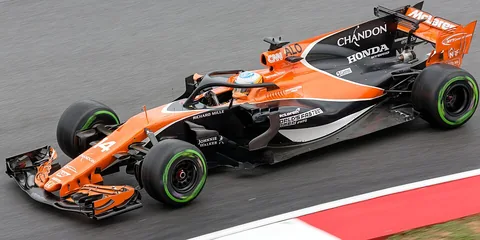
In 2018, in response to the 2014 crashes,108Jules Bianchi's crash: at the 2014 Japanese Grand Prix he hit a recovery vehicle removing another car on a wet track. Bianchi died in July 2015 without regaining consciousness; it is the most recent death of an F1 driver from a crash at a Grand Prix. the FIA says enough is enough. We are going to mandate that every car has this really, really rigid, robust, heavy thing that you put right on top of the driver. And there's a giant bar directly in the center of the driver's field of view. There's a giant compromise here, but it has saved at least three people's lives since then because it can protect a driver even when a car is upside down and skidding. These innovations have made it so we've had zero fatalities since 2014. It's, I think, the longest stretch in F1 history without a fatal accident.
Yep, it certainly seems like the sport is a lot safer these days.
Yeah, it's still dicey, but over the last 70 years, they've observed all the lowest hanging fruit of ways that they can protect the driver.
Yep. So bringing it back to the business narrative here, what are the kind of great ironies here of the obvious right decision to focus on safety and slow the cars down? Is it just further fuels this sort of spending spiral amongst the teams because the harder you make it to go fast, the more they're going to be incentivized to spend every last dollar and look in every last little corner and find every last little loophole to get an advantage?
Yeah, I mean, when the sport first started, there were giant gains to pick up left and right and you could sort of do all sorts of crazy stuff. And we were talking about all the different car designs with spoilers that are up on giant poles and I mean, truly wacky ideas. There was a six wheeled car109Tyrrell P34, with four small front wheels, raced in 1976–1977 and won the 1976 Swedish Grand Prix. The rules later limited cars to four wheels. at one point, because it wasn't in the rules that you only had to have four wheels.
And over time, as they start adding more and more guidelines for safety and for all these other reasons, the way to succeed in Formula 1 shifted from making a more powerful engine or figuring out the very best aero to figuring out how to exploit the rules.
And do more and more exotic stuff.
Yes, what is left unclear in the rules where I can see a little bit of daylight between what they intended to write and what they did write and what can I catch that the other teams won't catch and how do I sink $50 million of R&D into achieving some speed outcome with that?
It's really funny. I hadn't thought about this till now, but actually the right analogy is the semiconductor industry and Moore's law.110Moore's Law — the observation by Intel co-founder Gordon Moore (1965) that the number of transistors on a chip doubles roughly every two years. Keeping that pace gets more expensive with each generation of chips. It's like a different set of rules. It's like the rules of physics instead of the rules of the FIA. But as you progress like TSMC111TSMC — Taiwanese company, the world's largest contract chipmaker: it makes chips for Apple, Nvidia and many others. and ASML,112ASML — Dutch company, the world's only maker of EUV lithography machines, without which the most advanced chips can't be made. they got to spend incrementally more and more CAPEX113Capex (capital expenditures) — spending on equipment, factories and other long-term assets. and more R&D every year to push the boundaries farther and farther and all the low hanging fruit is gone and they get more and more exotic with lasers melting tin114EUV lithography: in ASML's machines a laser hits flying droplets of tin tens of thousands of times a second, turning them into plasma that emits light with a wavelength of 13.5 nm, which is used to print circuits on silicon. just in time, et cetera, et cetera.
Good point, yeah, I hadn't thought about it that way.
07Selling Formula 1 four times
Bernie never legally owned F1, yet he cashed it out again and again through an IPO attempt, debt, private equity and the banks, and stayed in charge every time.
Meanwhile, while the teams are spending themselves into unprofitable oblivion, Bernie, starting in 1993, becomes the highest paid corporate executive in Britain, taking home in 1993, $44.5 million in cash. And that's only what's reported to Her Majesty the Crown in that year as we'll get into. He's also getting older.
By this point in time, he's in his late sixties. He's on his second marriage. He has two young daughters with his second wife, Slavica.115Slavica Ecclestone (née Radić) — Croatian model, Ecclestone's wife from 1985 to 2009 and mother of his daughters Tamara and Petra (Wikipedia, "Bernie Ecclestone"). And he starts to think about estate planning and maybe some liquidity for his family and his estate. But in doing so, he just about causes the whole thing to fall apart. Because even though he was the highest paid corporate executive in Britain, that didn't necessarily mean that he was running FOPA and F1 like any kind of professional organization.
He did everything himself and intentionally didn't keep any records. He minimized the number of contracts that he would sign intentionally. He kind of operated F1 like a sole proprietorship, shall we say. The whole corporate operation was run out of a building in London that was also his house.
Seriously, like the bottom floors of the building were F1 offices and then he had the floors above. And supposedly he had all the rooms in the offices bugged. He could listen to what everybody was saying at every point in time. And famously, he would kick everyone out at 6 p.m. He'd be like, "All right, leave my house now. It's time for y'all to go home."
This continued until Liberty takes over at 2017. He had a few lawyers and finance people to make it all function, but there was no marketing department for F1. There was no research or data department. There was no sales department besides Bernie.
Well, there weren't actually that many things to sell. They weren't selling a lot of sponsorship at the league level at that time. That was pretty much all teams. I guess TV rights you have to sell.
Exactly, like yes on the sponsorship side, but TV rights, they're in 90 soon, 100, 120, 130 countries all with different contracts and different providers. Bernie's just out there doing this more or less all by himself that we should say. He also had a right hand man and essentially number two in the business. A former Formula Two driver and also owner of another team in the league, the March team, a man named Max Mosley,116Max Mosley (1940–2021) — son of the British Union of Fascists founder Oswald Mosley and co-founder of the March team. FIA president from 1993 to 2009. who happened also to be a lawyer.
Very useful for Bernie's activities. There's this great quote that Bernie recalls saying to him when they first start working together. "Your problem, Max, is you always want things absolutely clear. And sometimes it's better if things are not clear." So he gets with the program and they pretty quickly become two peas in a pod.
In 1993, that same year that Bernie becomes the highest paid executive in the UK, he kind of shadow arranges to get Max installed as the new president of the FIA. Meanwhile, he had already somehow connived to get himself, Bernie, already an official role at the FIA as the vice president in charge of promotional affairs. In addition to all this, at one point along the way, he also took over as the promoter of the Belgian Grand Prix at Spa.117Spa-Francorchamps — circuit in Belgium's Ardennes, one of the longest on the calendar and one of the drivers' favorites; famous for the Eau Rouge corner sequence.
Oh, so he was paying a race fee to himself.
Yes, so at various times, Bernie was serving in a principal role in all of the major F1 stakeholder categories. Team owner, race promoter, official FIA representative, and of course, CEO and owner of FOPA and de facto, the league itself. And I think at every point in time, he was always in at least two, if not three or four of those roles simultaneously.
Unbelievable.
He really takes the no conflict, no interest phrase to new heights.
Absolutely unbelievable. There's a great quote from Eddie Jordan,118Eddie Jordan (1948–2025) — Irish businessman, founder of the Jordan Grand Prix team (1991–2005), later a TV pundit and Adrian Newey's manager. who is a Formula 1 legend. Do you know this quote?
No, no, no.
He said that Bernie Ecclestone was someone who sold Formula 1 four times, has never bought it back, has never lost its control, and still owns it. And do you know the most important thing? He never effing owned it in the first place.
Yeah, yes, so let's tell that story about how he sells it four times, never buys it back and still owns it, and never owned it in the first place. That is such a great quote. I hadn't found that, I love it, I love it.
AdVanta
All right, listeners, now is a great time to tell you about longtime friend of the show Vanta. So David, I want to paint a picture that many founders listening will recognize. You're about to close your biggest customer yet. The product team has hit a bunch of milestones. The sales team built this fantastic relationship. Everyone at the potential customer is fired up. Your legal team has the contract done, but then an email comes in from the security team.
Ah, yes. It's usually a very polite email asking something like, "Before proceeding, could you share your SOC 2 report?" Or, "Do you mind sharing your ISO 27001?" If you don't have one, that deal just went from closing this month to closing next quarter, maybe. Now you have to go find an auditor, go through every system, write the policies, and then prove that you follow them.
Right. Or you could just use Vanta. They are the leading agentic trust platform, which means that you can connect it to your systems at your company and it automatically pulls all the relevant data, and it tells you exactly what's missing for a SOC 2, an ISO 27001, or whichever framework your customer asked for. Vanta gets you through the audit, and then it keeps going. It watches your controls every day afterwards, so the report that you hand to the next customer is still true.
Yep. And even more impressive is the Vanta agent. It continues to run in the background so it can find the issues and draft the fixes. This is the work that eats weeks of an engineer's time before an audit, and now it mostly just gets done before anyone has to ask.
And the results are super impressive. A recent industry report says that Vanta's customers see a 526% return over three years and that it pays for itself within the first three months. If you've ever had one of these security emails stall a deal, you know exactly how that math works.
More than 16,000 companies now run on Vanta.
16,000. Listeners, there were 2,000 when David and I started working with Vanta.
That's incredible what they've accomplished. And these are companies from large enterprises like Atlassian and Snowflake to the new guard like Ramp and Cursor.
We've been fans of Vanta for years, and hundreds, like literally hundreds, maybe even at this point thousands of Acquired listeners have become Vanta customers over that time. If you want $1,000 off, check out vanta.com/acquired. That's V-A-N-T-A.com/acquired, and just tell them that Ben and David sent you.
Okay, so Bernie's many sales and monetization opportunities. Here in the mid '90s, he starts exploring liquidity options for himself. And in particular, he wants to funnel that liquidity into a new set of offshore vehicles to avoid British estate taxes119Inheritance tax in the UK is 40% of an estate's value above the tax-free threshold. for his family after he dies. And this is like a natural activity for somebody approaching their 70th birthday. What Bernie didn't foresee or anybody else is-
He had another 25 years at least in him.
At least because he's still alive in 2026. Now, also to be somewhat fair here, protecting his estate from the heavy British inheritance taxes is a legitimate concern because otherwise there would be no way that his family could keep control of F1 after his death. It would have to be broken up and sold just purely to fund the estate taxes.
If you actually are a team, this is starting to become kind of an existential risk of what if Bernie dies suddenly and then they have to sell F1 off into different parts with different owners.
And you say, you know, if you're a team owner, it's not just if you're a team owner. If you're a team owner or a race promoter, you want a plan here. So it just so happens here in the mid to late '90s that we're in the height of the dot com era.120The dot-com bubble — the stock market boom in internet companies in the late 1990s. The Nasdaq peaked on March 10, 2000, and by October 2002 had lost almost 80%.
Wait, that plays into this?
Oh yeah. What's the natural thing to do? Bernie's going to IPO F1.
Oh, I've totally missed this.
Oh yeah. There is so much delicious chaos that gets unleashed here. By this point in time, Bernie's various companies, and there are even many more than we have talked about on this episode, just for simplicity. Collectively, they're earning about 250 million British pounds a year in revenue, and they have 50% plus EBITDA margins.121EBITDA — earnings before interest, taxes, depreciation and amortization; the EBITDA margin is its share of revenue. Above 50% signals a very profitable business. And remember, this is at a time when the British pound is worth call it 60% to 70% more than the US dollar. This is a very IPO-able business, if it were a regular business.
Nonetheless, times are so crazy that Bernie hatches a plan with his bankers at Salomon Brothers122Salomon Brothers — American investment bank made famous by Michael Lewis's book "Liar's Poker"; Travelers bought it in 1997, and it became part of Citigroup. to consolidate all the various F1 companies that he owns into a single holding company called SLEC Holdings, S-L-E-C Holdings. And he's going to transfer his ownership of that new company to his then second wife, Slavica, for tax reasons. So S-L-E-C was short for Slavica Ecclestone and float it in a dual listed IPO in the US and England with an anticipated valuation of around $4 billion.
We should also note here too, we being a little glib in this episode, in 2023, Bernie ultimately pleaded guilty to tax fraud as a result of all the machinations we're about to talk about and had to pay a 653 million pound payment123Ecclestone's tax case: in October 2023 he admitted failing to declare to the British tax authorities a trust account in Singapore holding more than £400 million. The court gave him a 17-month suspended sentence, and he agreed to pay more than £652 million. to the crown in back taxes and fines. And he also received a, I think 17 month jail sentence, which was then suspended, probably in large part to his advanced age.
Crazy.
All of this lurking in the background may have been part of the reason that famously he turned down several offers of knighthood throughout his life.
Although you'd think it would actually bode better for you if you're a knight going into some lawsuit with the government over owing the government money.
Good point. Yeah, does the crown see one of their own? I don't know. Anyway, as he starts formulating all these plans with Salomon Brothers, they're like, "Well, I see your revenue. I see your EBITDA."
And what were those again?
250 million British pounds of revenue and call it a 50 plus percent EBITDA margins on that.
Good business.
Yeah, great business. What they don't see is any sort of formal legal control or document that he has from anybody giving him the actual rights to a lot of this. He's got the actual rights to the TV stuff, but the promoter fee stuff, the transportation, we haven't even mentioned the paddock club124Paddock Club — Formula 1's VIP area above the garages, with restaurants and a view of the pit lane; a weekend pass costs thousands of dollars. that gets set up along the way here. There's a lot of money flowing through that.
And to be clear, these are all income streams to Bernie. I mean, so of course we've talked about the media rights, but what a race promoter does is if F1 is thinking about going to a racetrack, the person who owns the racetrack or a company affiliated with the racetrack or a government affiliated with the racetrack pays a giant amount of money to Bernie for the privilege of having a race there. That's a promoter fee.
Yup. Conveniently, right at this same time as they're doing IPO preparations, it comes time to negotiate the fourth Concorde Agreement with the teams and the FIA. In this new agreement, Bernie swaps in a new entity called Formula One Constructors Association Administration Limited, a new company owned by Bernie, FOCA-A, for the original FOCA, so that he can now legally have all the rights to everything he's doing. And remember who the new president of FIA is that just got installed, Max Mosley.
Yeah. So he's just going to rubber stamp it.
Of course.
Or that's at least the belief.
Yeah, well, it passes. Let's just say that. The path is now paved to IPO, except there's one snag that comes up. News of the plans, as well as Bernie's recent sort of consolidation of legal power gets leaked to the press, and this causes the European Union antitrust investigators to start poking around.
You don't say.
Bernie is doing so much self-dealing here that there's no way he's going to survive an investigation. Bernie shelves the IPO idea and also resigns from his official role as a vice president at the FIA. The combination of those two things is enough to at least get the EU off his back for the moment.
ExplainerWho owned Formula 1
- 1996. Ecclestone transfers the holding company SLEC, which owns the commercial rights, to his wife Slavica and prepares a stock market listing; it never happens.
- October 1999. Morgan Grenfell Private Equity buys 12.5% of SLEC for £234 million.
- February 2000. Hellman & Friedman buys 37.5% for £625 million and combines both stakes, 50%, in a company called Speed Investments.
- March 2000. Munich's EM.TV buys Speed Investments for £1.1 billion.
- 2001. Kirch Group rescues EM.TV, takes over Speed Investments and, with money from BayernLB, Lehman Brothers and JPMorgan, raises the stake to 75%.
- 2002. Kirch goes bankrupt, and the stake passes to the creditor banks; the other 25% stays with the Ecclestone family (Bambino Holdings).
- 2005–2006. CVC Capital Partners buys out Bambino and the banks; Ecclestone reinvests part of the money and stays in charge.
- January 2017. The Liberty Media deal closes, and Bernie steps down as CEO.
But he needs another plan for getting liquidity. So he switches banks to Morgan Stanley and convinces them that instead of IPOing, they should issue debt on F1 and use the proceeds from the debt to pay himself and his new offshore entities a special $1.4 billion dividend.125Special dividend — a one-off payout to shareholders on top of regular dividends. When it is funded with borrowed money, it's called a dividend recapitalization.
What?
Secured by the future TV rights streams, by the revenue streams from the future TV rights. This deal actually happens. It's called the Bernie Bonds.126The Bernie bonds — a securitization: bonds backed by a future stream of cash, here TV rights payments. A famous example of the same technique is the 1997 "Bowie bonds," backed by David Bowie's future royalties.
It is always something you should be a little bit worried about if a company is raising a giant amount of debt principally to pay out its primary shareholder a special dividend.
Yes, especially if it's Bernie.
Why would you buy that debt?
That's a really good question. The offering I believe was intended to be $2 billion but there was not enough demand and Morgan Stanley could only rustle up 1.4 billion worth of money that was willing to do this deal. Either way, the deal happens on a Friday. All gets done, debt's issued, Bernie gets his dividend, money gets transferred to the offshore entities.
On the following Monday, Bernie calls up his bankers and says, "Oh, there was something else that I didn't tell you. I'm having triple bypass heart surgery today." Today, so they just did the debt deal. Just issued the special dividend, took $1.4 billion out. Three days later, Bernie is having triple bypass heart surgery.
The entire future success of this thing is heavily dependent on Bernie being in the seat.
Yes. Fortunately for him and everybody else, he survives the surgery, gives a quote to the press from the hospital room, "I have disappointed so many people." Which later one of his principal bankers would recall her response being, "If you make it out alive, I'm going to come kill you myself."
Well, Bernie survives. Later that year, we're in 1999 now, his wife Slavica, i.e. really Bernie, starts selling off equity stakes in SLEC Holdings to various private equity firms,127Private equity — funds that buy stakes in private companies, often with borrowed money, in order to sell them for more a few years later. including, cannot make this up, in February of 2000, they sell a 37% stake in F1 to Hellman and Friedman,128Hellman & Friedman — private equity firm from San Francisco, founded in 1984 by Warren Hellman and Tully Friedman. the giant private equity firm based in San Francisco.
H&F then goes and buys out some of the other minority owners that Slavica/Bernie had been selling stakes to, and Hellman and Friedman collectively gets a 50% ownership stake in F1. And then they go negotiate with Slavica and Bernie an option to buy another 25%129Option — the right, but not the obligation, to buy an asset at a set price before a certain date. from them for 600 million pounds and gain 75% majority ownership of F1. So they get the option, the option's papered one month later in March of 2000.
This was in March of 2000, right when the dot-com crash happened?
The dot-com crash is about to happen, but it gets crazier before the bubble burst.
Really?
In March, H&F gets an unsolicited over-the-top bid from a German new media company called EM.TV130EM.TV — Thomas Haffa's Munich media company, a star of Frankfurt's Neuer Markt, the German exchange segment for young tech companies. By the end of 2000 its shares had collapsed. to buy their entire stake in SLEC/F1 immediately right away. This is the height of dot-com craziness right before the crash. This German company, EM.TV, they had just previously bought the Jim Henson company131The Jim Henson Company — the studio of Jim Henson, creator of the Muppets. EM.TV bought it in 2000 for $680 million, and in 2003 the Henson family bought the company back (Wikipedia, "The Jim Henson Company"). in the US, which of course makes the Muppets.
And they were just trying to roll up all of these media properties and they were going to bring them into the digital era or something, some sort of dot-com fever dream. H&F hits the bid. They sell out.
So how long did H&F own Formula 1?
One month.
One month?
H&F owns Formula 1 for one month. They make an immediate 241 million pound profit in one month.
On how much invested?
1.1, 1.2 billion invested.
Oh my God.
So, you know, a 20% return, but like--
In a month.
I got more. So 50% of F1 is now in the hands of EM.TV. They want to exercise the 25% option that H&F had negotiated, but they don't have any more cash. They blew it all on the first transaction.
And the Muppets.
The Muppets. So EM.TV goes out and does another 1.6 billion euro debt deal to raise the money. They take 600 million from JP Morgan and Lehman Brothers132Lehman Brothers — American investment bank whose bankruptcy on September 15, 2008, was the climax of the global financial crisis. and they take a billion from a local German bank called Bayern LB.133BayernLB — Bavaria's state-owned regional bank. Its chief risk officer Gerhard Gribkowsky, who sold the bank's stake in F1 to CVC, received about $44 million from Ecclestone and was convicted of bribery in 2012; Ecclestone himself ended his German trial in 2014 by paying $100 million (about £60 million) without admitting guilt (Wikipedia, "Bernie Ecclestone"). They use this debt. They exercise the option. They now own 75% of F1 and Bernie and Slavica hold the last 25%.
And then the bubble burst.
Wow, so all that was done like in days, weeks.
Like right up to the end times. The music is ending as this is all happening. Bernie, meanwhile, is just getting tons of money into his bank accounts. The bubble burst, EM.TV misses their interest payments to the banks.
Shocking.
Another German media mogul named Leo Kirch134Leo Kirch (1926–2011) — German media mogul who owned TV channels and a huge film library. In 2002 his KirchMedia went bankrupt, the largest bankruptcy in postwar Germany. comes in and saves the company. His company, KirchMedia, takes over EM.TV. They now assume F1 ownership. 18 months later, they go bankrupt. So 2002, the net result of which is that ownership of the 75% stake in F1 transfers to the debt holders.
Which is who?
Bayern LB, the German bank, JP Morgan, and Lehman Brothers. With Bernie and Slavica still owning the 25% minority share.
Oh my God, crazy.
Okay, so it all comes to a head. In 2004, when the banks are super frustrated, because Bernie's still running the thing, as he always did, paying himself everything. The banks keep trying to tell Bernie what to do. They're issuing him directions as if he's their employee. And Bernie just keeps ignoring them. The bank consortium sues Bernie for control of the sport. The judge rules in favor of the banks.
However, Bernie addresses the media after the court proceedings, and says that the verdict would mean, quote, nothing at all, and he's planning to continue business as usual. Because he's got an ace up his sleeve. Separately, he has been negotiating with CVC Capital Partners, the large European private equity firm. The deal gets done with CVC.135CVC Capital Partners — European private equity firm; it took control of Formula 1 in 2006 and owned it until the sale to Liberty Media in 2017. They buy out the banks. They also buy out Bernie and Slavica's 25%. More money going to Bernie now here.
Whoa.
But Bernie will remain CEO.
He's just an employee. He's hired by CVC to continue being Bernie.
And he gets the opportunity to use some of his proceeds to invest with CVC alongside them in the deal.
Amazing.
All told, CVC and Bernie for his portion spend about $2 billion, acquiring 100% ownership. They finance 1.1 billion of it with another set of debt. They put 900 million of cash equity into the deal. Compared to, I believe, over three billion that Bernie and his trust had pulled out of the company through all the debt and equity machinations that we discussed earlier.
Unbelievable.
Oh my goodness.
This is important to know. The CVC/Bernie buy-in to this new F1 entity is about 900 million of equity.
$2 billion total purchase price, including the debt.
08New Grands Prix and a team revolt
Under CVC, Bernie squeezed new circuits for money, while teams spending $400 to $500 million a year and hit by the 2008 crisis threatened to break away.
Bernie resumes his job with renewed vigor now that he is newly incentivized to grow revenue and profits again. The first thing that he does after CVC cleans up the ownership is he kind of goes right back to his original bag of tricks, which is extracting more money from race promoters. So by this point in time, 2005-ish, there are basically three types of Grand Prix races. You have the prestigious historic ones like Monaco and Monza and Silverstone. They're not going anywhere.
The European heritage tracks, if you will.
Exactly. They don't pay nearly as much in race fees to F1, but they're sort of there to build and maintain the brand.
Then you have a new set of races like Bahrain and China136The Bahrain and Chinese Grands Prix were first held in 2004: Bahrain was F1's first race in the Middle East, and the Chinese race is held in Shanghai. that had just come on.
The flyaway races.137Flyaway races — F1 jargon for races outside Europe, where cars and equipment travel by air rather than by truck.
They are paying huge fees to F1 in order to have their races on the calendar.
We're talking two to three X.
Yes, 30, 40, 50 million a year-ish.
And today even into the 60 millions.
Yes. The problem/opportunity at this point in time is you had a whole bunch of races in the middle. Canada, Australia, Spain, Belgium, the second race in Germany138Second races: in the 1990s and 2000s Germany hosted both the German Grand Prix at Hockenheim and the European Grand Prix at the Nürburgring, and Italy, besides Monza, hosted the San Marino Grand Prix at Imola. that wasn't the Nurburgring, the second race in Italy that wasn't Monza, et cetera, et cetera, et cetera. Those other races actually made up most of the calendar, but they neither brought in a lot of revenue nor were they any sort of strategic value. Nobody got excited.
Right. They weren't an expansion opportunity for the sport. They weren't a way to find new audience.
Yup. Bernie goes out and he courts Abu Dhabi, Singapore139The Singapore Grand Prix has been held on the city's streets since 2008; it was the first night race in F1 history. and India to come in140The Indian Grand Prix was held only three times, in 2011–2013, at the Buddh circuit near Delhi. and displace some of those middle races and be new Grands Prix. And just like Bahrain and China, these are big money deals. India is 40 million a year just in race fees to F1.
Abu Dhabi is the biggest. They commit to a billion dollar total F1 investment over the coming years, including constructing a whole new track from scratch in the desert141Yas Marina — the circuit on Yas Island in Abu Dhabi, which hosted its first Grand Prix in 2009. The race starts in daylight and finishes under floodlights. outside the city. Bernie's on a roll with these new races. Then in the early 2010s, Bernie lands the big one, Russia. He'd been trying to get a Russian Grand Prix for a long time. Russia had just won the 2014 Winter Olympic bid for Sochi.142The Sochi Olympics (2014) — the most expensive Games in history, with total costs estimated at about $50 billion.
And put $50 billion into the ground and infrastructure at Sochi for the Olympics. Bernie in F1 goes and convinces them that the best way to sort of amortize the cost of this investment in Sochi is to put a race there after the Olympics.
Probably not wrong.
Totally not wrong. They sign a deal with Russia. And of course it's a deal with the state. Anytime you're negotiating with Russia, you're negotiating with the state.
Increasingly, a lot of these flyaway races are.
Yes, it's not unique to Russia here.
It's not a local entrepreneur race promoter with a racetrack. These are sovereign deals.
Yes, to construct a new $270 million F1 track around the Olympic park and pay F1 $50 million a year for seven years to host the race. It is an amazing Bernie and Putin story. As they're in final negotiations for the deal, the Russian contingent asks Bernie to fly over to Sochi and sit down with Putin to finalize the deal. To which Bernie responds, do I look stupid? If they think I'm going to go negotiate this contract with Putin, no way.
If they want me to go, they can send back the contract first, signed, which they do. And then Bernie goes to Sochi and sits down with Putin and do a press conference and announce the whole thing. I guess that's how you negotiate with Putin is you don't negotiate with Putin. Ultimately the Russian Grand Prix would get canned early in 2022 after Russia invaded Ukraine.
I was going to say, it's not on the calendar I saw.
No, no. Bernie would get asked on a British morning TV show after the Ukraine invasion what he thinks about all this. And he famously says that Putin is a "first class person" and that he, Bernie, would take a bullet for him.143Ecclestone on Putin: in June 2022, on Good Morning Britain, he called Putin a "first-class person" and said he would still "take a bullet for him." The Russian Grand Prix was held in Sochi from 2014 to 2021; in March 2022 Formula 1 terminated its contract with the race promoter.
Wow, okay.
Yeah, okay.
I did hear from some folks that I talked to and I always ask the question, what's it like working with Bernie? Overwhelmingly, people said "delightful."
I can believe that.
That like when all the dust settled, like the term, you kind of look at the terms and go, "Oh, whoa, there's actually not much here for me."
But just delightful to work with.
He's a very loyal partner. So anyway, that's the racetrack side of things under the reinvigorated Bernie and CVC. The other big piece of course is the team relations side of things. We previewed this earlier, but at this point, the whole shtick of, "Hey, I'm getting rich, but you're getting rich too," has way worn out its welcome.
There's also the fact too that now it's not just Bernie getting rich, it's the private equity firm that's also getting rich on the backs of the teams and all the investments that they're making into the cars and R&D. And by this era, in the kind of mid late 2000s, it's truly gotten out of control. The top teams are spending like $400 to $500 million a year on their cars.
And the race calendar is insane because it started in the '50s, '60s of, "Hey, we'll go wherever we can get enough teams to race." And then it turned into, "We'll go wherever anybody will write a $40 million or larger check."
Let's put this circus on a plane to Russia and China.
And now the like, by this point in history, we're talking about here, the mid late 2000s, the broadcast calendar makes no sense. You've only optimized for who will pay us the biggest race promotion fees.
These races are being run at all hours of the day and night.
Team relations are pretty bad. And then 2008 hits. The biggest teams with the biggest budgets, yes, they're spending themselves way into the red, but at least they were sort of backstop by actual consumer car manufacturers that own them and were investing into them for all sorts of strategic or R&D or brand marketing purposes. You had Honda in the sport, Toyota, BMW, obviously Ferrari.
Renault.
Yep. As we hit 2008 in the financial crisis, the consumer car businesses for all of these guys except Ferrari just fall off the cliff. All of a sudden it becomes no longer tenable either financially or just public perception wise for Honda or BMW,144The carmakers' exit: Honda announced it was leaving Formula 1 in December 2008, and BMW and Toyota left after the 2009 season. et cetera, to keep operating these money sinkhole F1 teams.
So as they get into 2008, Bernie, CVC and the FIA all team up and they float a solution, a lifeline to the teams. We are going to help you guys institute a cost cap on manufacturing145Cost cap — a limit on how much a team can spend in a season. The 2009 attempt to introduce one failed; it arrived only with the 2021 season. and we'll help you design it. Let's get it approved by all the teams. This will save you. Basically what they're proposing is the F1 equivalent of a salary cap146Salary cap — a limit on a club's total player salaries. In the NFL it is a hard cap, in place since 1994; in the NBA it is a "soft" cap with exceptions. in other sports like the NFL or the NBA. Except instead of on the players, the salary cap is going to be on the investments into the cars.
Yes. And there are some teams that are a fan of this and there are other teams who hate this more than anything they could possibly imagine.
Yes, specifically Ferrari and McLaren.
Ferrari would like nothing more than to lose half a billion dollars a year taking their F1 cars as long as they get to win. They do not care. It pays back infinitely in brand marketing if they are just a winning F1 team for their particular line of business.
You know what car manufacturer is basically unaffected by a global financial recession? Ferrari.
Their customers are staying on the wait list no matter what the financial climate is out there. Ferrari and McLaren has a lot of the same dynamics. They threaten to pull out of the sport and ultimately they bully all the other teams into joining them in opposition to the cost cap.
There's also all of this pent up bad will against Bernie, all these deals that have happened, CVC, the FIA, et cetera.
In 2009, 8 of the 10 teams threatened to pull out of the sport and start a rival breakaway league called FOTA,147FOTA (Formula One Teams Association) — the team association founded in 2008 and led by Ferrari president Luca di Montezemolo. It broke up in 2014. the Formula One Teams Association.
Yeah.
And they announced that they're doing it and they're creating their own series starting in 2010.
Yeah, so the Formula One Teams Association or FOTA was really two things in one. One, it's can we band together as a team to negotiate as one to get leverage in whatever we're negotiating over? And in this instance, it's we don't want a cost cap. The other thing is it is a legitimate breakaway series, which would be a really hard thing to start.
I mean, to go figure out how to sign all these new deals with the best tracks in the world and media rights deals, there's a lot of value in what Bernie and the series are actually doing. It works. The cost caps didn't happen.
They did impose a 10 year freeze on engine development. In the short term, this is kind of how these negotiations go. The teams got what they wanted without actually having to leave by having a credible threat to leave.
Yep. And specifically what they got was Max Mosley's resignation from the FIA or at least agreement not to stand for reelection.148The FOTA revolt: in 2009 the FIA proposed a voluntary £40 million budget cap from 2010. In June the FOTA teams announced their own series, but made peace a few days later: Mosley agreed not to run for another term, and in October 2009 Jean Todt was elected FIA president.
It's hard for them to actually link arms for too long because of two reasons. One, Bernie and Max could offer different things to different teams to get them to individually cave. They can go to the Brawn team and we'll talk about the Brawn team in a minute, but there was this shoestring budget team, scrappy upstart. Bernie had been withholding their payments from the previous year when they had raced as Honda because Bernie's opinion was, well, you're not the same team, you don't deserve your payout. Brawn really needs the cash.
So it's very easy to go and get them to capitulate when you owe them a few million bucks and you're going to wire the money immediately as long as they break ranks with the other team. That's a great way to bust a strike.
But the biggest thing is, where all these constructors actually have very different reasons for racing and different incentives. It's hard for them to be unified on anything given the wildly different incentive set.
I don't know if you knew this, David. I talked to Zak Brown,149Zak Brown (born 1971) — American businessman, founder of the sports marketing agency Just Marketing International; CEO of McLaren Racing since 2018. the CEO of McLaren Racing to prep for this episode. I specifically asked him why teams don't form a breakaway series now. And we'll talk about the economics of what the business looks like today. And he had a great answer.
So he said, prior to Liberty's acquisition of F1, there had been many discussions and even attempts at a breakaway series.
Of course the teams would unite around the sport themselves, but it always fell down when the teams had to discuss how to share the pie. And it's one of these things where Ferrari is going to say, we're entitled to this and our heritage for the sport.
And McLaren and Mercedes, they're going to say, oh, we're really good. So we deserve more. They just never would agree on how to divide up the pie.
Yep. The net of this is that team and league relations in F1 are at an all-time low here at the end of the 2000s.
Yeah, and we didn't even talk about, if you're a fan of F1 during this time period, you know about Spygate and Crashgate. Both of these McLaren magically wound up with a giant binder full of the complete specification of Ferrari's car150Spygate (2007): McLaren's chief designer Mike Coughlan was found with hundreds of pages of Ferrari technical documents obtained from its engineer Nigel Stepney. McLaren was fined $100 million and stripped of all its 2007 Constructors' Championship points. for that year. And there was all giant hullabaloo and court hearings and everything about the stolen documents and did they use them to win. At the same time, you have Crashgate.
Yeah, this is bad.
Where it ended up looking pretty conclusive that a team intentionally had one of their drivers crash in order to get a safety car to come out,151Safety car — comes onto the track after a crash; drivers follow it without overtaking, the gaps between them shrink, and a pit stop costs less time. which would advantage their other driver to do better in that race, putting one of their drivers' life at risk.152Crashgate — the 2008 Singapore Grand Prix: Renault driver Nelson Piquet Jr. crashed deliberately on the team management's orders, and the resulting safety car helped his teammate Fernando Alonso win the race. When this came out in 2009, team principal Flavio Briatore was banned from motorsport for life (a court later overturned the ban).
Not just one of their drivers, like other drivers, too, could be involved in the crash.
And they're covering it up.
These are major sports integrity issues.
Yes, public trust is at an all-time low.
09Red Bull and Brawn GP
Two newcomers bought for a pound, the marketing company Red Bull and Brawn GP, which became Mercedes, rescued the sport, and their bosses became the first team CEOs.
Yeah. Ironically, miraculously, and certainly despite all of Bernie's best efforts to the contrary, pretty much this whole situation gets fixed by two new teams that enter Formula 1, who nobody saw coming, one of which was a auto manufacturer and a dark horse reentrant into the sport. The other was, well, I was going to say energy drink manufacturer, but I don't think we can say manufacturer because they don't actually make the drink.
An energy drink company.
An energy drink marketing company named Red Bull.
AdStatsig
But before we tell their stories, all right, listeners, now is a great time to talk about one of our favorite companies, Statsig.
Yes, there is a reason why the best product teams rely on Statsig, whether they are iterating on their core product features or shipping AI-powered experiences at scale.
Yep. In the crazy speed of today's AI world, shipping fast is just table stakes now. It's basically trivial to build and deploy your app constantly. The real advantage is how quickly you learn what changes actually created value for customers and how fast you can use that signal to guide what you ship next.
This is where Statsig comes in. It brings experimentation, feature flags, and product analytics into one unified system, so teams can ship safely, test rigorously, and directly link what they changed to how users actually behaved.
So if you want to make learning your competitive advantage, whether you're building new AI experiences or just evolving your existing core product, go to statsig.com/acquired to get started.
All right, so David, you mentioned an energy drink company.
Yes. Let's start with Red Bull. The Red Bull company story itself absolutely deserves its own Acquired episode someday because it is truly insane. Briefly, Dietrich Mateschitz153Dietrich Mateschitz (1944–2022) — Austrian entrepreneur and co-founder of Red Bull; before that a marketer at Unilever and at the toothpaste maker Blendax, later bought by P&G. was an Austrian toothpaste salesman for Unilever and P&G who goes on a business trip to Thailand in 1984, decides to radically change his life, and brings back a local Thai energy tonic154Krating Daeng (Thai for "red gaur") — Chaleo Yoovidhya's Thai energy tonic. In 1984 Mateschitz founded Red Bull with him, 49% each, and in 1987 launched a carbonated version adapted to European tastes in Austria. to start bottling and selling.
I can't even really say that because he outsources manufacturing, bottling, and selling it, and turns it all into a company that now does over $10 billion a year in annual sales. Astonishing. The key pillar of what Red Bull the company actually does is, of course, marketing. And one of the main pillars of its marketing strategy has always been extreme sports.
Red Bull, their entire business model is, yeah, we sell these drinks, but really you're buying the drinks to associate with a lifestyle, and we need to educate you about the lifestyle that you are associating yourself with.
In 1989, actually five years pretty quickly after Dietrich starts the company, Red Bull sponsors its first F1 driver. Then they steadily grow their investment in the sport until ultimately they become the title sponsor of the Sauber team155Sauber — Peter Sauber's Swiss team, in Formula 1 since 1993. Audi bought it in 2024, and since 2026 it has raced as the Audi F1 Team (Wikipedia, "Sauber Motorsport"). in 1995.
Is that the team that's now Audi?
Sauber Stake.156Stake — an online casino with crypto betting, Sauber's title sponsor in 2024–2025; where gambling ads are banned, the team raced as Kick Sauber.
Sauber Stake, yep. This is where Red Bull starts. The Red Bull entrance into F1 was so perfectly timed because this is right as the EU regulation is coming online, forcing tobacco finally out of the sport. The great irony is that it's actually an energy drink company that replaces the cigarettes. There's a great quote that Josh and Jonathan have in The Formula.
"Two decades after Marlboro execs looked at F1 drivers and saw the heirs to the American cowboy,157The Marlboro Man — the cowboy hero of Marlboro cigarette ads from the 1950s, one of the best-known advertising images of the 20th century. Mateschitz recognized them for what they really were, over-caffeinated adrenaline junkies with scant regard for their personal safety. It was a match made in marketing heaven."
Perfect. Red Bull totally breaks the mold of what an F1 sponsor should be doing. Previously, the sponsors were all leaning into the prestige aspect of the sport, the luxury, the aristocraticness of it, all the Monaco stuff, the oil companies, the watch companies. None of these sponsors are rocking the boat. And importantly, just like F1 and Bernie itself, none of these sponsors, except maybe the cigarette companies, are interested in younger audiences.
Bernie has a great quote about this when he's asked about the challenges F1 faces of its aging demographic. He says that younger audiences are not a priority because they, quote, "don't buy Rolexes.158Rolex — a long-time Formula 1 sponsor: since 2013 the Swiss brand has been the championship's global partner and official timekeeper."
Yet, that is the key thing, Bernie, yet, yet. Anyway, Red Bull, though, of course, is the opposite of this. They are all about young people, the extreme lifestyle. They don't just sponsor F1. They sponsor all these extreme sports, like jumping out of planes in the stratosphere.159Red Bull Stratos — a 2012 project in which the Austrian Felix Baumgartner parachuted from a stratospheric balloon at about 39 km and broke the sound barrier in free fall. They are unique among the F1 sponsor set.
The problem, though, for Red Bull is that Sauber isn't very good. There's another great quote from Mateschitz in The Formula. "If an insurance company sponsors a team and that team loses, people don't change their insurance company. But when the Red Bulls lose, people get a new drink."
In 2004, Red Bull dumps Sauber and makes the radical decision that rather than sponsoring another team, they are going to directly get into the business. And Mateschitz and Red Bull buy the failing Jaguar racing team,160Jaguar Racing — Ford's works team under the Jaguar brand (2000–2004), which grew out of Stewart Grand Prix, founded by the three-time world champion Jackie Stewart. which was, at this point in time, owned by Ford.
Because Ford had acquired Jaguar, and with it came the F1 racing team. Jaguar was going through all sorts of trouble, as was Ford during the financial crisis and the lead up to it. Things are so bad for the team that Ford is willing to sell the whole team to Red Bull for one British pound.
Really? I didn't realize that.
Yep. The purchase price that Red Bull paid was one British pound to establish Red Bull Racing. Now, the problem is they still got to make the team good.
Can we talk about the amazing full circle moment of this year now that Ford is partnering with Red Bull on their power units?161Red Bull Powertrains — Red Bull's own engine division in Milton Keynes. The Ford partnership was announced in 2023, and the first joint power units raced in the 2026 season.
Yes, yes. It's so full circle. It's amazing.
Also, Ford actually did make engines for F1 for a long time.162Ford Cosworth DFV — the V8 that the British firm Cosworth built with Ford's money. From 1967 to 1983 cars using it won 155 Grands Prix, more than with any other engine in history. It's interesting that their exit from the sport was they were no longer an engine manufacturer. Then they had this weird team with Jaguar. They divested that. And then they're dormant in the sport for--
20 years, yeah. Back to Red Bull taking over. Yes, they need to make the team good. Obviously, that's not going to happen overnight, but they start putting steps in place. What they can do now that they actually own a team, instead of just being a title sponsor, is they can act however they want within the paddock.163Paddock — the restricted area behind the garages where the teams' motorhomes stand; entry is by pass only.
When Red Bull rolls up to the paddock the next year in 2005, which, remember, is the first year of CVC's ownership in the new Bernie regime, they bring, no joke, a mobile nightclub named the Energy Station as their team paddock facility to all the Grand Prix around the world. They have a radical open door policy. Previously, the paddock was like the sacred place. Corporate sponsors and high rollers could spend for paddock club access. It was very limited.
Red Bull rolls in and we're like, the door is open all the time. Anybody who is in the paddock can come in to our Energy Station. You could be from any other team. You could be any other sponsor. You could be a guest. Just come on in and party with us. They have DJs at all hours. They have a team of girls, the Red Bull Formula Unas team of hostesses who are there. They have a swimming pool on the roof.
Do you know what they did in Monaco?
I read about this, but I can't remember.
There is not room for the Red Bull Energy Station164Energy Station — Red Bull's motorhome in the paddock: the team's hospitality building with a bar and kitchen, where it hosts guests, journalists and people from other teams. because it's Monaco and there's not room for anything. And so they constructed a temporary building that they put on pontoons and they have it out in the harbor.
Amazing, amazing. They're just like giant middle finger to the whole establishment. There's alcohol everywhere. Drinks are flowing. And of course, there is Red Bull. I mean, it's genius. It's absolutely genius. All of this is masterminded by Dietrich. And the young team principal that he hires takes a chance on to run the team, Christian Horner,165Christian Horner (born 1973) — British executive, team principal and CEO of Red Bull Racing from 2005 to 2025, during which the team won six Constructors' Championships. Red Bull fired him on July 9, 2025 (Reuters). who if you watch Drive to Survive,166Drive to Survive — Netflix documentary series about Formula 1, made together with F1 itself: behind the scenes with the teams, the drivers and their rivalries. It has come out once a year since 2019; the eighth season was released on February 27, 2026. you probably know all about Christian Horner.
The other team owners and principals and Bernie hates this, like hate it. They hate it so much. They're trying to control everything. This is a serious sport. This is a serious enterprise. And here's Red Bull just partying.
Red Bull got much better as a racing team, but the essence of the strategy is basically still the same. They generate zero profit, despite being one of the best teams and the highest revenue teams, or near zero profit, very thin to create the biggest marketing spectacle that they can to sell energy drinks. It's just a super different business model than anyone else in the--
It's almost like Amazon and streaming, like Prime Video,167Prime Video — Amazon's streaming service. It comes with an Amazon Prime subscription along with fast free shipping: video helps keep subscribers, while Amazon makes its money on what they buy. which we'll talk about later. The business model is not the streaming. It's the retailer. Anyway, obviously, all the other team owners hate it, but the drivers and the staffs love it. These are all young people, mostly, who are driving the cars, working on the engineering as mechanics, et cetera.
All of a sudden, there's like a 24/7 party following them around the world. Hell yeah. McLaren goes so far, they even forbid all members of their team from entering the energy station. It's like a fireable offense, if you're caught.
No fun. And honestly, you're going to go have drinks. You're probably going to share team secrets. It's probably a good policy.
Exactly. One night, back to Christian Horner and the strategy of how do we actually start building a winning team here, he clandestinely invites McLaren's legendary technical director168Technical director — an F1 team's chief engineer, responsible for the car's design and in charge of the designers, aerodynamicists and engineers. over to the energy station for a chat, late at night, against rules. And that technical director just happened to be a man named Adrian Newey,169Adrian Newey (born 1958) — British aerodynamicist considered the greatest designer in F1 history: his cars have won 14 drivers' titles and 12 Constructors' Championships. Since 2026 he has been team principal, technical director and co-owner at Aston Martin. the single most legendary car designer, probably in history.
The way people talk about Adrian Newey is basically the same way that they talk about Kelly Johnson from Skunk Works,170Kelly Johnson (1910–1990) — American aircraft designer at Lockheed, creator of the U-2 and SR-71 Blackbird spy planes. Skunk Works — Lockheed's secret advanced development unit, which he led. from our Lockheed Martin episode. I have heard the comment from more than one person, it's like he can see air.
Yes. He is a savant of aerodynamic design.
And Adrian's book is great,171How to Build a Car (2017) — Adrian Newey's book about his career as a designer. He moved from McLaren to Red Bull in 2006 and left for Aston Martin in 2025. talking about sort of his career in F1 and what he's learned. He still draws by hand.
Yeah. In the age of CAD172CAD (computer-aided design) — software in which engineers draw and analyze parts. and AI and everything.
He just sort of envisions physical forms of cars, how air will flow around them, and then draws with a pencil.
Yep. Horner and Dietrich lure Newey into joining Red Bull. And this is how they build a winning team. It takes a couple of years to ramp. But starting in 2010, so what's that? Five seasons after they enter the league, Red Bull starts a run of four consecutive drivers and constructors titles from 2010 to 2013.
And importantly, for the product on the field, up until this point, the racing had gotten pretty boring. Because Ferrari had been on this huge run where Michael Schumacher was just dominating the sport and like blowing away all competition.
Well, there were some years where it really came down to the wire or didn't go Schumacher's way. But if you were an F1 fan in the '90s and early 2000s, it is totally fair to say there was Schumacher and then there was everyone else.
That had started to fade, as we'll get into in a minute.
And was this Sebastian Vettel173Sebastian Vettel (born 1987) — German driver, four-time world champion: he won all four titles in a row, in 2010–2013, with Red Bull. He retired in 2022. in 2010 that kicked off the Red Bull run?
This starts a new dynasty within F1 of an energy drink company.
I know, and it's so fun watching. I mean, they are truly a central figure of the Drive to Survive narrative, starting with Sebastian all the way through. Max is arguably the best driver in the sport today. It's so fascinating that he's on an energy drink team. The most insane thing about Red Bull, I used to think they were like a sponsor. Like, oh, this energy drink company uses F1 for marketing. But they have developed so much competency in actually being a constructor that--
They're building a car, right? Like a road car.
Yeah, they're like a real car company now. Not technically a road, but track. They're building a supercar, limited production and all that. But a car that you can go buy and race on a racetrack. I think it's the RB17.174Red Bull RB17 — a track-only hypercar, Red Bull's first production car, designed mainly by Newey. Production is limited to 50 cars at £5 million each (Wikipedia, "Red Bull RB17"). It's the last thing Adrian Newey did when he was there, is design this car.
And I mean, you look around at what does a car company do? It makes the body.
It makes the power units. Red Bull has Red Bull powertrains, which is a lot of former Honda people that they've hired and now they're working with Ford. But they do a lot of the things that a car company does.
Yep, it's an incredible story. As you start to think about dragging this sport kicking and screaming into the 21st century and positioning for the social media era, you could imagine that this is a really good thing. Meanwhile, during this era, as we alluded to earlier, there is another hugely successful team that builds its own dynasty--
That comes out of nowhere.
Also gets purchased for one British pound. And listeners, I suspect unless you are a hardcore F1 fan, you probably will not be able to guess what team this is. But see if you can figure it out as we go along.
But who is it in 2006, David? What does the team start as?
So we talked a second ago about Michael Schumacher's dominance of the league in the late '90s and early 2000s at Ferrari.
Side note, did you know he is one of the first athletes to pass a billion dollars in career earnings?175A billionaire athlete: in 2005 the magazine EuroBusiness named Schumacher the world's first billionaire athlete (Wikipedia, "Michael Schumacher"). It was apparently right around the same time as Tiger Woods.176Tiger Woods (born 1975) — American golfer, one of the most decorated players in the game's history and one of the richest athletes in the world.
No way. I didn't know that.
Michael Schumacher was getting paid $60 million a year in that era. That's what Max and Lewis make today. And with all the inflation that's happened with the growth of the sport, I mean, this illustrates just how much Ferrari is perfectly willing to burn money to win. They will generate an infinite amount of losses in order to win in Formula 1. You had the driver of his generation, sort of the person who took the torch post-Senna, and is so obviously the best driver.
And obviously, most athletes that you would think of who have become billionaires didn't become billionaires because of their sport salaries, it was off the field.
And Schumacher had a lot of off-the-field stuff, too.
Interesting. One thing we didn't talk about in Schumacher's dominance at Ferrari was, like, yes, it was him. He was the driver of his generation. But it was also the engineering team behind him. And specifically, the engineering team led by technical director at Ferrari at the time, Ross Brawn.177Ross Brawn (born 1954) — British engineer, technical director at Benetton and Ferrari and the mastermind behind all seven of Schumacher's titles. He took a break in 2007 and returned as Honda's team principal for the 2008 season. From 2017 he ran the sporting side of Formula 1 under Liberty Media.
Okay, and the whole tires thing. We got to talk about that just real quick.
Well, we got to do it. What Brawn realized, maybe not first, but I think better than anybody, was the dynamic we talked about earlier, that after the FIA started clamping down so much on the rules, the way to win was to exploit loopholes. Brawn figured out a whole bunch of stuff together with Schumacher.
And Schumacher's work ethic was unbelievable. I mean, there's another great documentary that people should watch, Schumacher, on Netflix.178"Schumacher" (2021) — Netflix documentary about Michael Schumacher, made with his family's participation. But he was like a driver and an engineer, or like a driver and a mechanic. He's always in the garage.
He's there at all hours. He's getting as many test laps in as he can. And this is an era where you could do that. He's spending, if he's not on the track, and he's not in the garage, then he's working out. And his work ethic is just, like, unbelievable.
Yeah, he's an animal. He's the Max Verstappen of his era.
But he's got a wrench in his hand. And he's like the ultimate collaborator for the engineers.
So they figure out that there's a loophole with the way tires work in F1.
For a brief period of time, you could pick between one of two tire manufacturers.179The tire war: from 2001 to 2006 two companies supplied F1 tires, Michelin and Bridgestone, and each team picked its supplier. Ferrari was Bridgestone's lead team. From 2007 Bridgestone became the sole supplier, and from 2011 Pirelli (Wikipedia, "Formula One tyres"). Bridgestone had a big issue. Almost everyone said, oh, we're going to move away from Bridgestone to Michelin. And Ferrari, and Ross Brawn in particular, realized, well, wait a minute. If we're the only ones that stick with Bridgestone, like, yeah, it's counterintuitive to do that because these tires apparently have a big problem.
But if we send a bunch of engineers over there, they send a bunch of engineers over here, we can effectively have custom-made tires just for our car and just for Michael's driving style. And so they spent a year working together, basically getting to develop their own custom tires, whereas everyone else who were on the Michelins had to use this common denominator tire that worked with all the cars and all the driving styles.
It's important. We should note here, for folks who are not deep F1 fans, I think maybe the only part of F1 cars that is common mandated across the whole league.180Standard parts: besides the tires and the halo, F1 has other standard components; for example, since 2008 all cars have used a single electronic control unit from McLaren.
Tires and the halo.
Tires and the halo, yep. Whereas if you look at NASCAR or other motorsports out there a lot of stuff is mandated to be common. And the degrees of freedom of parts of the car that you can actually engineer is much, much, much narrower. It's part of what makes F1 unique. And so expensive is that every car truly is custom engineered except for the halo and the tires.
Yeah, teams are designing their own bolts.
Yes, yes. So here, Brawn and Schumacher and Ferrari are like, oh, wow, we just found a way to custom engineer our own tires. That was a big part of Schumacher and Ferrari's dynasty. The FIA eventually closes the tire loophole. Brawn leaves Ferrari and becomes the team principal of Honda, which he joins in 2007 ahead of the 2008 season.
Now, remember, we said a minute ago that in 2008 with the financial crisis, Honda exits the sport. Brawn is one year into the job. And they come to him and they're like, ah, sorry. We're going to shut the team down. We got to get out of the sport. This is untenable in this environment.
We can't be operating an F1 team. Brawn is scrambling. He just went from top of the world at Ferrari to getting to be team principal at Honda. And now he's out of a job with, as good as he is, no real prospects for another one because this is bad times for the sport.
And there are very limited chairs in this world.
Yes. He's scrambling. And he's like, wait a minute, Honda. You're worried about looking bad to the public and shareholders by continuing to operate an F1 team in this climate. You know what's going to make you look even worse if you lay off the 1,000 people that are part of this team? So how about instead--
You just give me some time. I understand you might need to lay everyone off. Look, that business reality. Give me a few months, and I will find a buyer for the team. I just need you to keep everyone employed so that there's something to sell.
Yes, yes.
Looks around, can't find anything, as you would expect.
2008, the world's falling apart.
Back to Honda and says, look, I know we have very limited time left. We're not going to find another buyer. What about a management buyout?181Management buyout (MBO) — a deal in which management itself buys a company or division from its owners, often with borrowed money or, as here, for next to nothing.
Yeah, I'll take it off your hands.
When I say buyout, I'm also not really going to give you any money. But what if there's some period of time where you agree to keep funding people's salaries, I'll give you one British pound, you give me the team and then at some point you're fully out, but we have some sort of consulting agreement in the meantime, some contract at least.
Some runway down to do a soft landing here for the team and these people.
But you get to tell your board and the shareholders that you are no longer wasting money on this extraneous thing.
And you're not going to lay off 1,000 people in England. So apparently, I don't know if you're at this, Bernie, of course, gets wind of what's going on.
Oh, Bernie does not like Ross Brawn.
No, no, no, no, he doesn't like Brawn anyway. He definitely doesn't like somebody else buying a team for one pound. He tries to swoop in and convince the Honda board that they should sell it to him instead.
Oh, I didn't realize that.
Yes, yes, never mind that he's like head of F1. He's still willing to buy the team.
He just generally doesn't like the idea that there's a transaction that doesn't go through him.
Yes, or that there's a good deal to be had and he's not getting in on it. Great drama. If only this drama could be televised.
In fact, there is a great Keanu Reeves documentary on--
Called Brawn.
Called Brawn on this team.182"Brawn: The Impossible Formula 1 Story" — a 2023 Disney+ documentary series hosted and narrated by Keanu Reeves, who also conducts the interviews. It's awesome.
Anyway, back to the story at hand. Amazingly, Honda doesn't go with Bernie. The board decides, you know what? We're going to stick with who brung us. We'll sell the team to you, Ross, for one pound. But when we say we're out, we'll fund you for the year. But we're really out. We're not going to give you an engine anymore.
Right, right. Ross is like, but surely I can just like enter into a commercial agreement and pay you like $15 million or whatever it is to be the engine supplier and you'll give me an engine. Like you've already made the engines in the years past. They're going to be the same or similar.
This used to be your team.
Right.
Nope. This is where we draw the line. We can't be putting any more money besides the salaries these people into F1.
So quick pause. It is worth noting not every team makes their own engines. There's only at any given time a handful of engine suppliers. Mercedes today makes the engine for the Mercedes car. But McLaren also goes and buys the engine from Mercedes. So this is like a reasonably common--
Yeah, Ferrari all supply engines to other teams.
Like Cadillac is racing in a Ferrari engine.
Yep, exactly. Ross is desperate. He goes and chats with Mercedes, who as you said,
Ben had been out of the sport since I think 1955 or whatever we said earlier.
Yeah, they at this point in time do not have a team. And since that horrific crash all those decades before, not in F1.
Not in F1. But they had been supplying engines to McLaren. Mercedes says, OK, Ross Brawn, we have our McLaren relationship. That's very important to us. But we respect you and your body of work at Ferrari. And we respect what you're trying to do here. We will supply you an engine for 2009. We're still loyal to McLaren. But we will give you an engine so that you can compete with your team this season and not shut it down.
And it sort of doesn't fit in the chassis that Honda had developed. They had to do some real aftermarket janky stuff. Everyone thinks this car is going to absolutely suck.
Suck, yes.
By the way, the team is called Brawn GP.183Brawn GP — a team that raced for a single season, 2009, with drivers Jenson Button and Rubens Barrichello. It was created through a buyout of the Honda team; Honda provided a $100 million budget for the season, and Mercedes supplied the engines (Wikipedia, "Brawn GP"). It's not even like a real company. The team just looked at Ross Brawn, and they were like, you're a leader, so how about calling it Brawn? Like the whole thing--
Yeah, they couldn't even line up a title sponsor.184Title sponsor — the main sponsor, whose name is part of the team's official name: Oracle Red Bull Racing, Atlassian Williams.
And they're even landing sponsors for individual races, because they can't actually land full season.
It's the financial crisis. Nobody expects anything performance-wise out of this team.
Well, it turns out that before the Honda engineers got pulled away back to Japan, they had come up with a new aerodynamic innovation called the double diffuser.
Oh, yes.
I have no idea how this thing works. I just know that it performs like a beast.
And most things you read about it really don't explain how it works either. In general, what diffusers do is they direct the airflow that is coming out from the bottom of the car up and sort of out of the way to ideally shape the aerodynamics as the air escapes the back of the car.
Somehow they came up with a double version of it.
But everyone is challenging it at the beginning of the season, going, wait, wait, wait, this isn't legal. It performs so well that by mid-season, everyone else has adopted a double diffuser too.185The double diffuser: at the start of the 2009 season three teams had it, Brawn, Toyota and Williams. In April the FIA's court of appeal ruled it legal, and the other teams began copying it.
Yeah, I mean, you're burying the lead, which is first race of the season in Australia in Melbourne. These two Brawn GP Franken cars roll out. And they win first and second place. They blow away the field. Jensen Button,186Jenson Button (born 1980) — British driver who raced in F1 from 2000 to 2017, 2009 world champion with Brawn; 15 Grand Prix wins. In Melbourne in 2009 his teammate Rubens Barrichello finished second behind him. who was the first driver on the team, he wins six of the first seven races of the season. It's like sending the sport into chaos.
Yes, and I wish I had known this, David. We had just started our research on F1.
And we met Jensen.
We met Jensen. We went to the Las Vegas Grand Prix with ServiceNow.187ServiceNow — American cloud platform for automating large companies' workflows: IT support tickets, HR requests, customer service. And part of the whole weekend of festivities they had planned for us was a luncheon with Jensen Button. He was telling the stories of the Brawn GP.
I did not appreciate this is the outlier of outliers. No team has been on this shoestring of a budget with this type of Franken car and this real underdogness and performed in such spectacular success the way they did.
Yeah, usually it's like either you're Ferrari and you invest hundreds and hundreds of millions of dollars, or you're Red Bull, you hire away Adrian Newey. And even then it takes several years to develop a winning car. This just doesn't happen in F1.
No, and so David, how does the season end?
By a hair's width, Jensen and Brawn had accumulated enough of a lead in the first half of the season that even though they don't win a single race in the second half188Fact-checkHe says Brawn didn't win a single race in the second half of the season; in fact Rubens Barrichello won the European Grand Prix in Valencia and the Italian Grand Prix at Monza for the team (Wikipedia, "Rubens Barrichello," "2009 Italian Grand Prix"). of the season after everybody else also figures out the double diffusers, they still end up winning both the constructors and the drivers championships. In one year, this team and Ross Brawn went from new Honda team principal to nearly out of the sport to owner of his own team for one pound to world champion.
This is what makes F1 great.
It's really not watching the races.
The races are fine.
There's not that much passing.
Once you get through the first turn,
you kind of know who's most likely to win.
And it's probably from one of the top four teams anyway.
It's not any given Sunday, the way that an NFL game is.
But this act of heroics and teamwork and personality
and perseverance--
And engineering.
And engineering. This is what makes F1 great.
So there's just one problem for the new world champions.
They don't have funding for the next year.
There's no way as cool as it would
be to continue the Cinderella story.
Brawn GP and its current financial state and ownership
can't continue for the 2010 season.
There's just not enough money to invest
in developing the next car, et cetera, et cetera.
So Ross knows that he has to sell the team.
And of course, who's the logical buyer now?
Mercedes.
They don't currently have a motorsport team.
They clearly are interested. They make your engine--
make the engine. They've just had all of this success with Brawn. Yeah, they have the strategic partnership with McLaren. But hey, what's McLaren compared to an opportunity to own their own team? They announce in the off season that they're dumping McLaren, Mercedes is, and buying a 75% majority share in Brawn for $200 million and renaming the team to Mercedes.
The storied Mercedes team that you know of today, where Lewis Hamilton won six driver's championships and the team won eight straight constructors championships, is the team that rises out of the ashes of Brawn GP.
Incredible, just incredible. The first thing they do after they buy their team, they're so excited, they hire Michael Schumacher to come out of retirement. Lewis Hamilton is still a young kid at this point in time. They hire Schumacher out of retirement to come reunite with Brawn, the dream team, and drive this monster car. Yeah, it doesn't work out.
It's like Jordan on the Wizards.
Yeah, this is the Jordan in the Wizards era.189Jordan with the Wizards: Michael Jordan came out of his second retirement and played for the Washington Wizards in 2001–2003, but the team never made the playoffs. Tom Brady, by contrast, won the Super Bowl (2021) in his very first season with the Tampa Bay Buccaneers after 20 years with the New England Patriots.
Although, I mean, I was going to say it's like Tom Brady. But Tom Brady won a Super Bowl with the Bucs.
Yeah, yeah, no. Schumacher and Brawn and Mercedes do not win another Super Bowl. Everybody else had picked up the double diffuser. And that really was the advantage that they had. It wasn't any more than that.
And I think Mercedes thought they were buying something that had somewhat of a durable advantage. Oh, maybe you've started thinking about next year. The team really hadn't. There's sort of this realization at Mercedes of, oh, crap, we bought a lemon. We need to put hundreds of millions of dollars into this on top of that stake that we already bought.
And to Mercedes' credit, they did. I mean, they could have cut their losses and said, yeah, this doesn't make sense for us. And instead, they built arguably the best Formula 1 team to ever exist across multiple decades.
Well, they bring on a partner.
So after a couple of years of Schumacher and Brawn--
Brawn, by the way, who bought the team for a pound and then sold 75% of it for $200 million?
Yeah, he's doing just fine. But after a couple of years, Mercedes decides this isn't working. They fire Brawn and Schumacher,190Schumacher and Brawn leave: Schumacher spent three seasons at Mercedes (2010–2012) before retiring for good, and Hamilton took his seat. Toto Wolff joined the team in January 2013, and Ross Brawn left at the end of 2013. which is crazy. Who fires Michael Schumacher? Mercedes, F1, this is what happens. And they make two key hires in each of their places.
As team principal, they bring in Austrian businessman who previously had been an investor in the Williams F1 team named Toto Wolff.191Toto Wolff (born 1972) — Austrian investor and former racing driver. Since 2013 team principal, CEO and co-owner of Mercedes in F1 (Wikipedia, "Toto Wolff"). And again, if you watch Drive to Survive, you definitely know Toto. Probably the best Formula 1 team executive in history, certainly by valuation increase.
Yes. I've got some numbers for you later on why.
Okay, so put a pin in that. Who could you possibly hire to replace Michael Schumacher as your number one driver on the Mercedes team? Well, obviously, you know the answer. A young British racing driver, Lewis Hamilton. So Toto, Lewis, and then the other driver they bring on, Nico Rosberg,192Nico Rosberg (born 1985) — German driver, son of the 1982 world champion Keke Rosberg. In 2016 he won the championship with Mercedes, beating Hamilton, and announced his retirement a few days later. as you said, Ben, would go on to win eight constructors championships in a row.
And Nico won the driver's championship one of those years.
He beat his teammate, Lewis, yeah.
So it's not even like, oh, well, they had Lewis Hamilton. So how good was the car, really? It's like, no.
No, no, it was the car.
The one year that Lewis didn't win, Nico won.
Yep, certainly the most dominant run in the history of the sport. And this ended Red Bull's own run. But what was so great for the sport during this period is it's not like the Schumacher era where the top team is just blowing away the field. You now have this great drama of the fight every season between Mercedes and--
Is it Vettel? Is it Hamilton? Is it the young up-and-coming Verstappen?
Yes. It's these epic dramas that are playing out on the track. And really, it's these two teams that create the modern era for the teams and for the sport. I mean, Christian Horner at Red Bull and certainly Toto at Mercedes, they're a totally new breed of team principals. These guys are CEOs. And Zak Brown at McLaren is also, he actually is the CEO of the team.
He's literally not the team principal.193McLaren's team principal since 2023 has been the Italian engineer Andrea Stella; Zak Brown is CEO of McLaren Racing and runs the business side. He is just the CEO.
He's just the CEO. They're playing roles that nobody at the team level had ever played before except Enzo Ferrari and Bernie. And Bernie, of course, had greater aspirations.
They're building these businesses. They're not just building race cars and race teams.
Yeah, so just to quickly take the Mercedes example, Ross Brawn buys it in 2008, 2009 for one pound from Honda. Mercedes buys it a year later, or 75% of it, for 200 million pounds.194Fact-checkHe says £200 million (and earlier, $200 million); according to press reports, Daimler and Aabar Investments paid about £110 million for 75.1% of Brawn GP (Wikipedia, "Brawn GP"). Today, Mercedes is worth $6 billion under Toto. Not Mercedes, the car company. The Mercedes racing team alone just did a minority transaction195The minority deal: in November 2025 CrowdStrike CEO George Kurtz became a co-owner of Mercedes F1 by buying a stake in Toto Wolff's holding company, valuing the team at $6 billion (The Athletic). valuing the team at $6 billion.
That is, what, twice as much as all the cash that Bernie pulled out of F1 in its entirety during his heyday just for one team?
10Liberty Media buys Formula 1
Liberty Media bought F1, pushed Bernie out and repaired relations with the teams, the tracks and the fans, and the cost cap turned the teams into real businesses.
And speaking of valuations and Bernie and cashing out, in 2016, as all this is taking place, F1 finally lands in the right set of hands to shepherd the sport going forward.
So starting a few years after CVC and Bernie acquired F1 the league, CVC starts reselling minority pieces of F1 to other asset managers out there, including BlackRock,196BlackRock — American firm, the world's largest asset manager. the Norwegian sovereign wealth fund, Norges Bank,197Norges Bank — Norway's central bank; it manages the country's Government Pension Fund, the world's largest sovereign wealth fund, which receives the state's oil and gas revenue. A sovereign wealth fund is a state-owned investment fund. at increasing valuations. They also load F1 up with a bunch of debt, again, and pull cash out. Actually put $4 billion of debt on the league. I mean, this is what private equity does. And the cash flows are growing at F1 thanks to the new races and the increasing TV contracts, et cetera, et cetera.
But by 2016, CVC is now down to a 35% ownership stake. They've pulled out a total of $4 and 1/2 billion of cash through a combination of the debt and equity sales. Remember, they and Bernie only put in $900 million to start. And they still own the largest single stake in 35% in the league. But it's time for a transition of power, shall we say, a full exit.
And we've checked in a few different times along the way. What is Formula 1 at this point? Because it was the weird Bernie entities, and then it was the holding company and his wife's name. At this point, it is a company that is owned by CVC. But interestingly, a thing to know is that the company doesn't actually own the sport. But what it does have. Did you find this, David, the 2001 deal?
Oh, is this the 100-year management rights?
The key asset that this company owns is in 2001, Bernie had secured the 100-year commercial rights to Formula 1 from the FIA--
In a no-bid process.
In a no-bid process for $360 million.198The 100-year rights: the FIA and Ecclestone's company agreed in 2000–2001 on a deal for the commercial rights for 100 years, from 2011 to 2110, for about $360 million. When you think, what is the asset really? The asset is the right to run the business of what FIA defines as Formula 1.
Basically, all the commercial activities except team sponsorships, which are the province of the teams, and race tickets, which are the province of the promoters.
And there's some other little things that the teams make money on and that the promoters make money on, but basically, yes.
In September of 2016, it finally gets announced that the American media company, Liberty Media, is acquiring F1 for $4.4 billion of equity value199Equity value — what all of a company's shares are worth. Add its debt and you get enterprise value: $4.4 billion for the shares plus F1's debt came to $8 billion in total. and assuming all of the outstanding debt that the company has for a combined total enterprise value of $8 billion. Now, the way they do it is interesting. Liberty and John Malone200John Malone (born 1943) — American billionaire, CEO of the cable giant TCI from 1973 to 1996, and founder, chairman and largest voting shareholder of Liberty Media. and Greg Maffei,201Greg Maffei (born 1960) — American executive, former CFO of Microsoft and Oracle; for many years CEO of Liberty Media. we've talked about Liberty many times over the years on Acquired.
They are masters of deals and financial engineering.202Financial engineering — elaborate deal structuring (debt, share classes, spin-offs) to extract value, save on taxes or keep control. The way they do it, they initially acquire a 18%, 19% stake in F1 from CVC. Enough to make them the largest shareholder. And then they actually change the whole name of Liberty Media, the company, the publicly traded company, into the Formula 1 group, create a new tracking stock203Tracking stock — a separate class of a parent company's shares whose value is tied to the results of one division, even though legally the division stays inside the company. Liberty Media is known for doing this a lot. to track the value of F1 group.
F-W-O-N-K,204FWONK — the Nasdaq ticker for Liberty Formula One Series C shares; there are also FWONA (Series A) and FWONB (Series B) (Wikipedia, "Liberty Media"). or Fwonk, as the investment community refers to it.
I know. And then they issue Fwonk shares to the remaining equity holders, including CVC and Bernie, et cetera, such that 100% of the company is now liquid and publicly traded.
The completely fascinating thing about Liberty Media today is it sort of doesn't exist anymore. They bought F1. Then they did enough other spinoffs205Spin-off — separating a division into an independent public company whose shares go to the parent's shareholders. Liberty spun off the Atlanta Braves in 2023 and Liberty Live, with its Live Nation stake, in December 2025 (Wikipedia, "Liberty Media"). through the Atlanta Braves spinoff, through Liberty Live, the Live Nation spinoff. At this point, 90% of Liberty itself is Formula 1. And the stock is actually Formula 1. It's like they spun out everything else that was left. And so the holding company is actually basically Formula 1 now.
And so the plan that they announced is that former Fox and News Corp executive Chase Carey,206Chase Carey (born 1953) — American media executive, for many years Rupert Murdoch's right-hand man at News Corp and 21st Century Fox. He ran Formula 1 from 2017 to 2020 after Liberty Media bought it, and the budget cap was agreed on his watch. Recognizable by his bushy mustache. who had been president and COO207COO (chief operating officer) — the head of operations, a company's number two after the CEO. of News Corp, would become chairman of F1, but that Bernie would remain as CEO. Now Chase Carey had been a total legend at Fox. I mean, I remember him when I worked at News Corp and at Dow Jones.
Chase helped Rupert208Rupert Murdoch (born 1931) — Australian-American media mogul, founder of News Corp and Fox: Fox News, Sky, The Wall Street Journal, The Times. launch Fox Sports and built the whole Fox NFL program.209The NFL on Fox: the young Fox network outbid CBS for NFL rights and has broadcast games since 1994 (Wikipedia, "NFL on Fox"). Like da, da.210"Da, da" — David is humming the broadcast theme: the NFL on Fox's famous theme music was written by Scott Schreer. That was Chase. He's the right man for the job. And he brings over a team of all the NFL OGs, Fox and NFL OGs. Sean Bratches,211Sean Bratches — spent 27 years at ESPN, where he ran sales and marketing. From 2017 to 2020 he was Formula 1's managing director of commercial operations: under him F1 got serious about social media for the first time and changed its logo. who had been one of the key people who had built ESPN during its kind of parallel rise with SportsCenter212SportsCenter — ESPN's daily sports news show, on the air since the channel's launch in 1979 and essentially its calling card. and comes and joins the team.
And the whole thesis is that Formula 1 is this incredible sport, incredible fan base, incredible asset. And we can see with what's going on at Red Bull and at Mercedes that it's going to crush in the modern era. It just needs the right management to get out of the way and let this happen.
And that Bernie had sort of systematically underinvested, which created opportunity. There was almost no US market development. I mean, by this point, they had Circuit of the Americas in Austin,213Circuit of the Americas (COTA) — the track outside Austin, Texas, built specifically for Formula 1; the US Grand Prix has been held there since 2012. but no other US races yet. There was very limited sort of storytelling around the sport and digital investment. There was no social media presence.
The property was mostly behind like a closed paywall214Behind a paywall: in the US, F1 races long aired on niche cable channels. with restricted access, especially in the US. And really, it was about old white guys with money as the demographic.
If you kind of looked at it with a modern media company approach, you're like, oh, there's low-hanging fruit everywhere here.
Asset just waiting to be unlocked. Pretty quickly when Chase and Liberty come in, it becomes clear that there's not enough room for two bosses in F1 of Chase being chairman and Bernie remaining as CEO. I mean, really, as long as Bernie's there, there's not room for anyone else to run anything.
On January 23, 2017, after they had announced the acquisition the previous fall, Liberty announces that Bernie is stepping down as CEO. He will become honorary chairman emeritus and an advisor to the board of directors of F1, but not actually on the board. In other words, Liberty fires him. I mean, they had to. There's no way that they could do what they wanted to do and what needed to be done as long as he was still there holding the reins.
This is a classic what got you here won't get you there215What Got You Here Won't Get You There — the title of executive coach Marshall Goldsmith's 2007 book about how the habits that brought you success start getting in the way at the next stage. situation. All that stuff that Bernie did no doubt built the sport and created the sport. And the way in which it needed to go from here. Bernie could do almost none of those things and was probably holding it back at this point. I was doing the math on his run. What year did he sort of start becoming the steward of Formula 1?
And he left in 2017.
The long run.
45 year run. I can't think of a sport, a sporting league in the world, that was basically controlled by a person for almost half a century like that.
The closest that I can think of is Pete Rozelle, 30 years at the helm of the NFL.
Chase takes over as CEO. And he and Liberty know they have their work cut out for them. They come up with a four point plan. Number one, most importantly, they need to fix the relationships with the teams. Thanks to Red Bull and Mercedes, teams had started to become more successful financially, more business minded on their own.
But the relationship with Formula 1, the league was still highly contentious through all of this. Arguably even more so as they were growing in power under Bernie. The cost cap is the obvious thing to do.
It has to happen.
Really, it was the indication of how broken things were before that Bernie and the FIA couldn't get it done. And it resulted in the FOTA breakaway attempt.
Because if you don't have a cost cap, you are just going to have teams that have some either independent funding or some other business that lets them go hundreds of millions of dollars into the red, which basically means everyone needs to compete with them. Which means that other than those one, two, three, four teams, you're just going to keep churning your bottom six on the grid over and over and over again because they can't run a viable business.
Number one priority is they've got to fix the teams, which they do in the first Concorde Agreement that Liberty negotiates. They get everyone to agree to a cost cap of $145 million in expenses on the car.
Not including driver salaries. That's separate. This is huge. And not including the three most powerful executives or the highest paid executives. Not including marketing spend. And power units are outside the cost cap too. It's a cost cap for sure. It gets some of the job done. But if you spit off a lot of cash, there's still plenty of ways to spend that cash to become more successful.
Yes. That is definitely true. But I think it really does end up functioning as intended like a salary cap in other sports. The Cowboys216Dallas Cowboys — NFL club that Forbes ranks as the world's most valuable sports team, known for its huge marketing and stadium revenue. It last won the Super Bowl after the 1995 season. can spend a lot more on marketing than the other teams.
But they haven't been to the Super Bowl in a while.
The amount that they can spend on their equivalent of the car on the field, and in that case the players, is same as everybody else.
ExplainerHow the cost cap works
The cap was introduced by the Concorde Agreement for 2021–2025. The figure under discussion was $175 million, but the pandemic brought it down: $145 million in 2021, $140 million in 2022 and $135 million in 2023–2025. For comparison, in 2019 the champion Mercedes spent about $420 million and Williams $125 million.
The cap excludes the salaries of the drivers and the three highest-paid staff, as well as marketing, which is why the rich teams still spend more. From 2026 some of the old exclusions were brought inside it, and it rose to $215 million; engine manufacturers got a separate cap of $130 million.
Breaches are punished: for its 2021 overspend Red Bull paid a $7 million fine, and its wind tunnel time was cut by 10%.
And they also implement wind tunnel restrictions.217Aerodynamic testing restrictions have applied since 2021 on a sliding scale: the higher a team finishes in the Constructors' Championship, the fewer wind tunnel hours and simulations it is allowed. You can only spend so much time in the wind tunnel. We already have the restrictions on testing in season. There really are, at this point, heavy restrictions. It's gone from $145 million down to $135, but then it got adjusted now up to $170 with inflation and with adding more races. Because you get to add more to the cost cap218The budget cap has applied since the 2021 season: $145 million, then $140 million and $135 million in 2022–2023, with adjustments for inflation and the number of races. Under the new 2026 regulations the limit rose to $215 million, but more spending categories are now included. for that. But they're now spending every team under $170 million. Then there were several teams that were spending $400 or $500 million before.
This is huge. It instantly makes every team at least close to break even. It doesn't make every team profitable, but it makes a lot of teams profitable. And for the top teams, this overnight makes them immensely profitable. When we talked about Mercedes going from being worth one pound to $6 billion, this is why.
The Mercedes team is a great business now, like an NFL level business. And Ferrari obviously hasn't traded, but certainly is worth more than that. And every team, as we talked about at the top of the episode, is worth at least a billion and a half now.
Yes, so the numbers on this now are the average revenue per team today in 2026 is about $430 million. About 60% of that comes from sponsorship. And the next highest comes from the distributions coming from Formula One Group. And we'll talk about how those distributions work later. But what's their share of media rights and everything?
Then they have kind of 5% to 15% that come from selling merch or engines or licensing or garage tours or what have you. But 60% is sponsorship. And so if your average revenue per team is around $430 million and the cost cap is only $170 million, plus your driver, plus your marketing expenses, plus you can kind of see how these become pretty quickly--
Pretty good businesses.
At least break even or close to break even businesses. Now, there are some outliers toward the front of the grid, like you were saying. Mercedes does $800 million in revenue now. Ferrari 670, McLaren somewhere right in that neighborhood too, around $650 to $700, $420 for Red Bull Racing. 15 years ago, all four of those teams were operating at a loss. And 10 years ago, most of them were operating at a loss.
Yeah, it's interesting. Back to your point earlier about Red Bull strategy, they could be making much more, I think. And they intentionally choose not to.
That's exactly right. They try to keep their profit margin, their operating margin,219Operating margin — the share of revenue left after all operating expenses (salaries, production, logistics, marketing), before interest and taxes. at 1% or less. McLaren now does $70-ish million in profit. Ferrari does about $80 million. But the real outlier, Mercedes does an estimated $200 million in operating income from Formula 1 now.
I mean, that's the level that Bernie was making for the whole league a couple decades ago.
Right, 25% operating income. And on top of being phenomenally profitable, Toto Wolff estimated in 2021 that Mercedes, that he thinks Mercedes gets a billion dollars of advertising equivalent value for being involved in the sport.
Yeah, easy.
So on $600 million of total spend last year, Mercedes generated a double bottom line of over $1 billion in marketing equivalent value plus $200 million in actual profit.
I mean, think back to 10, 20 years ago, Mercedes was just luxury cruisers. Yeah, they had AMG.220AMG — Mercedes' performance division, which makes high-powered versions of its production cars. The S-Class is Mercedes' flagship luxury sedan. You could get more horsepower in your S-Class. But nobody thought these things were Ferraris. Now they're a legitimate sports car maker.
We should say Toto Wolff is just so unbelievably impressive. They're an extreme outlier in doing $200 million a year in operating income. And this isn't like they're underinvesting. They're a competitive team at the front of the grid. They're not holding back an R&D investment. That $6 billion number that you cited, David, is real, because that is a transaction that happened where the CEO of CrowdStrike221CrowdStrike — American cybersecurity company. Its CEO and co-founder George Kurtz races sports cars himself. bought into Toto's holding company to get a sort of proxy ownership in the team.
Why does Toto have a little holding company of his own? Unlike all the other team principals, Toto is a major equity owner in the team. When he joined the team in 2013, he negotiated to own almost a third of the team, which at the time, the whole team was worth about $165 million. And it's now 13 years later worth $6 billion. He's now a billionaire from his team ownership, even though it's actually like the main owner is Mercedes. He just managed to become a major equity owner, and that is really unique among team principals.
Yeah. That's obviously priority number one for Liberty is we got to fix the teams to fix the sport. Less obviously. Priority number two was they had to fix the relationships with the race promoters, with the tracks. Talk about a stakeholder that Bernie had just been extracting from the whole calendar, as we talked about a minute ago, was just designed to maximize race fee payments to F1.
There was zero consideration or thought at the league level about how to make the races themselves successful. How do you market each one and grow the pie and avoid a situation where you have this huge middle of the pack of the races that nobody cares about? That's not good for the sport.
When Liberty came in, there was so much mistrust with the race promoters that other than the just straight economic fee payments, none of the races shared anything with F1 the league. No data on fan attendance, no marketing strategies, nothing.
Well, think about just how squeezed you were getting. You walk up to F1 as a race promoter and say, hi, I'd like to have a race, please. I own a racetrack. And they say, OK, well.
Send back this contract and a $50 million payment.
Right. Pay us $20 million if you're one of the European tracks. Pay us $40, $50 million if you're one of these new US ones trying to come online. Pay us $50 to $60 million if you're a Middle East sovereign wealth fund. Oh, and your revenue streams, right. Well, the paddock club, that's all going to belong to us. And the sponsorships on the racetrack, that's going to belong to us, too.
I guess you can sell tickets.
You can sell tickets. You should set up some hot dog stands. I think food and bev, that--
Oh, yeah, but also food and bev for paddock club. We're doing that.
No cameras, because of course, we've already sold the media rights. And that exclusively flows to us. And you don't get to participate in that. You probably aren't going to be profitable on this. And if you are, certainly not in the first few years, you might want to get your local government to kick in. This is going to be great for the city, which it is. My advice on getting profitable on this thing would be go get some tax help.
Find other people's money. Yeah, exactly. One of the first things they do is they get all the race promoters together in a room and say--
They're business partners. They should be.
Yes, we're partners. We're partners.
They're not competing with each other.
We've got to work together here and let's share data. Hey, there's a lot of hardcore fans that travel race to race. Shouldn't we all be sharing data and marketing to those people and getting them to come to more races in more cities? Just no brainer stuff. Ultimately, the vision here, which has mostly been realized, I think this is an opportunity for 22 Super Bowls every year in cities and countries around the world.
When F1 comes to your country, comes to your city, it is an entire weekend that should be treated just like the Super Bowl. Let us help you make that happen. Let us help you get musical acts. Let us help you coordinate the celebrity attendees. Let us help you coordinate social media.
Austin has been really smart about this, the Circuit of the Americas. They've landed Taylor Swift, Ed Sheeran, Sting, Eminem, Garth Brooks, they really do turn it into this just giant festival. And it all kind of stems from an admission that the race might not be that good. You need to provide an experience for everyone.
I think they would argue that the whole weekend needs to be great.
Right. There's one of four teams who are going to be on the podium. And after you do the qualifying, whoever's in pole222Pole position — first place on the starting grid, earned by the fastest driver in qualifying. has a very good chance of winning. And after the first turn, if there's no crashes, and after the first lap, then we pretty much know. I hope the rest of the activities are fun.
So fix stakeholder relations with the tracks, number two. Number three, fix stakeholder relations with the fans. We've alluded to this a little bit, and Red Bull and Mercedes and Lewis Hamilton were starting to push the edges. But F1 had a huge social media problem. Bernie and F1 had been doing everything they could to keep the sport in the heyday state for them of the mid '90s, where he controlled everything. It all flowed through Bernie.
Control over growth. If you have to pick between those two things, control.
Yes, I control TV. I control the presentation. I control the race fees. I control the journalist access. I control who gets to go where in the paddock club and when. Who gets to see what, et cetera. It was so bad that Lewis Hamilton, when he came into the sport as this incredible star who had global appeal, was the first real F1 driver to become a legit celebrity in America.
The first superstar black athlete in Formula 1.223Lewis Hamilton made his Formula 1 debut in 2007 with McLaren and remains the only Black driver in the championship's history. He is a seven-time world champion: one title with McLaren (2008) and six with Mercedes.
First black athlete, period. There were no other black athletes before or since. All the things that Lewis Hamilton is, he, being a native millennial, wanted to have an Instagram account.
And that's underselling, like being one of the most fame savvy individuals.
That too.
And what he had that he brought into Liberty's office was a stack of cease and desist letters
that Bernie kept sending him to take down posts on his Instagram because he was, quote, illegally distributing F1's intellectual property. That's how bad this was.
Nothing sums it up better than that.
So Liberty immediately is like, yes, please, Lewis, post as much as you want on your Instagram. And then finally, and related, there was also just a whole basket of low hanging fruit opportunities to grow the sport. One of these was e-sports and video games. There had been an independent video game studio in the UK that had been making official F1 video games for several years.
Shortly after Liberty acquires F1, that studio gets acquired by Electronic Arts,224Codemasters — the British studio that made the official F1 games from 2009; Electronic Arts bought it in 2021. makers of Madden and FIFA225Madden NFL — EA's American football series, released every year since the late 1980s; FIFA — EA's soccer series, renamed EA Sports FC in 2023 after the split with FIFA. that do billions of dollars of revenue for EA and their league partners every year. Liberty works with them. Another initiative, again, remember Chase and the whole crew, they're coming from the NFL world. Among the many things that the NFL has done so great over the years is turning all the off-season content into exciting marketable events, like the NFL draft.226The NFL Draft — the annual selection of college players by the league's clubs, with the weakest clubs picking first. A multi-day TV show watched by millions, even though not a single game is played. Well, what's the equivalent of the NFL draft for F1? The testing period.227Preseason testing — a few days of running before the first race, when teams try out their new cars for the first time; there is almost no other track time during the season. Let's televise the testing period. Let's make it an event. Let's generate revenue and grow the sport.
Can we generate narrative out of it? I mean, all the sports journalists who cover F1 right now can't stop writing about how little track time the Aston Martin team228Aston Martin — British F1 team owned by the Canadian billionaire Lawrence Stroll; since 2026 it has used Honda engines (Wikipedia, "Aston Martin in Formula One"). has gotten because of the new crazy stuff that-- by the way, Adrian Newey is now designing for Aston Martin.
He's team principal now.
So he's got some new crazy design that isn't, I guess, super reliable yet. And so there's all these great stories being talked about of how are the drivers going to do when they've had so little time to actually practice with all the other drivers? This is exactly what you want.
Yep, and all that was just falling on the floor before. No engagement, no revenue, no utilization of that.
So then the last bucket is also pretty obvious. We should probably go start courting Hollywood. Racing movies seem to be pretty popular?
They're medium popular.
People like them, I mean, especially for the budgets that they've been made for in the past. Certainly, this is a sport that lends itself to visually compelling narratives.
I think you're right that the initial thing was, oh, yeah, people like racing, and this is visually compelling. That was actually wrong. That is not the correct thesis, but it is the place to start.
11Drive to Survive
Drive to Survive worked because it was about human drama rather than racing, and even hardcore fans loved finally seeing behind the curtain.
Yep. Of course, what we're getting at is they end up with, I think, the most impactful piece of sports media in history.
Ever, across any sport, absolutely. And that is Netflix's Drive to Survive. All right, so they go to Netflix, these clever F1 guys. And they say, hey, I think you should do a series. And the initial idea, David, like you're saying, is race cars are cool, visually compelling, people like racing.
Seems like a no-brainer.
And what it would evolve to, really, it's a human drama.
It's about when we said there's three concurrent competitions. There's a driving competition. There's the World Cup of Engineering. And there's the World Cup of Office Politics. It turns out the World Cup of Office Politics is an amazing, amazing thing for effectively a reality TV show.
It's the most compelling television product.
When you then, as secondary flair elements, layer in race cars going super fast.
Occasionally crashing.
Yes, attractive mid-20s dudes in the most extravagant, amazing places on Earth, swimming, and being on yachts, and partying the night before your big race. And it's just perfect.
It's incredible.
But the human story, that is the killer unlock of Drive to Survive.
And it was so perfectly made for what everybody in the sport needed at the time. Because if you had made Drive to Survive for, I don't know, let's take the NBA. Sure, it would have succeeded on a lot of the dimensions you just mentioned. But the hardcore fans would hate it. Because they'd say, this isn't basketball, come on.
This is just fluff for attracting new audiences. The thing about F1 at this moment is everybody was so starved for access. Any glimpse behind the curtain that even the most hardcore petrol heads, who would be the first to say like, yeah, of course this isn't the sport. This isn't F1. They loved it too. They'd never gotten to peek behind the curtain.
All right, so how did it come to be? Netflix and Liberty start talking. F1 was also pitching Amazon on doing something, trying to get a little bit of a bidding war here. Who's it going to be, Netflix or Amazon or someone else? Amazon already had something in the works with Mercedes and Lewis Hamilton that was just focused on them. But hilariously, F1 and Liberty control the actual track rights.
Even though Amazon was going to get the rights to Lewis and Mercedes, they couldn't film the documentary on track. It kind of ruins the whole thing. Ultimately, you do need F1 to play ball. Amazon ends up bidding the most for the league wide thing, the thing that would become Drive to Survive. Liberty comes back with that bid in hand to Netflix and says, hey, can you guys match this? Rumors are that it was about double the Netflix bid.
This is the rights payment that Netflix or Amazon would pay to F1 for the right to go make this series.
Which is the way it used to work. But based on how successful Drive to Survive has become, you don't have to pay the sports leagues anything anymore.
Netflix doesn't pay those sports leagues. Even the NFL, they don't pay them anymore.
It's such a giant, giant spotlight on your sport. You know, they're small numbers. I think it was the order of like $5 million versus $10 million or something like that. But Netflix comes back and says, you know what? We're at our ceiling. But we do think we're the best partner for this. Our offer remains the same.
If you guys are really focused and really mean it about growing the sport as the priority here, our global audience is going to grow the sport.
So Liberty goes for it. They say, yep, we're in for the lower price. And at this point in time, Netflix's audience in the US was something like 2x what Amazon's was. Once Netflix secures these rights, they then start working down a list of production companies. Box to Box Films wins229Box to Box Films — the British production company that makes Drive to Survive. Its co-founder James Gay-Rees produced the films "Senna" (2010) and "Amy" (2015); "Senna" itself was released by Working Title and StudioCanal. because they had done that 2010 Senna documentary, which is great. I highly recommend folks find it and watch it. Box to Box had already been working with Red Bull Racing on a documentary idea just focused on them.
I had heard rumors that the whole thing started as a Red Bull documentary. Now it makes sense.
Yes. So ultimately, the Red Bull idea gets scrapped, along with that Lewis and Mercedes idea that Amazon was working on, that gets scrapped. Although, listeners, we have heard rumors that one is back in the works now with someone else.
F1 takes a big leap of faith and gives Netflix and Box to Box Films complete creative control and final cut,230Final cut — the right to decide what version of a film or episode is released; it usually belongs to the producer or studio, not to the subject of the film. which I also think is really important that this is a highly opinionated version with full access that is not controlled by the sport.
The other really interesting nuance here is Netflix is like, we make highly produced content that doesn't come out right away. We can't turn around a new episode every week during the season.
Right. Drive to Survive comes out right before the next season starts.
And all at once.
Always. Always the season behind. In fact, if you're listening to this episode, then like three days ago, the most recent season of Drive to Survive will come out. Mercedes, interestingly, declines to participate.231The first season of Drive to Survive came out in March 2019 without Mercedes and Ferrari; both teams joined the series from the second season. Probably partly because of the documentary that they think they have in the works at the time with Amazon, but also because they're Mercedes.
Right. This seems like a risk.
They've just won everything you could possibly win like eight years in a row. They're very profitable or they're getting very profitable at this point. Why would you take any risks? And then Ferrari looks over and says, well, if Mercedes is out, we're definitely out. We're Ferrari.
So things are actually looking kind of dire. Netflix is left with the bottom eight teams. And they ended up creating something really amazing out of Daniel Ricciardo.232Daniel Ricciardo (born 1989) — Australian driver nicknamed "the Honey Badger," who raced in F1 from 2011 to 2024 and won eight Grands Prix; his constant grin and jokes made him a Drive to Survive fan favorite. I mean, that first episode just hooked a lot of people. After the success of seasons one and two, which we heard was kind of a slow burn, people loved it if they watched it, but the algorithm wasn't surfacing it to that many people.
And over time, they sort of realized, oh, wow, this is actually applicable to many more people than we thought. Young women across America and the world are into this. And we thought it was going to be 50-year-old petrolhead men. Or at least we feared that it might be. We sort of started in that narrow circle. As it grows and grows and grows, and season two is doing well, and season three was this massive smash hit, suddenly then all the Mercedes and Ferrari partners and sponsors are coming to them and going, why are we not in Drive to Survive?
Why are we not getting these impressions?
What are you doing? And so then, of course, in the later seasons, all the teams are in it.
Yeah, amazing.
So the other thing you may remember is seasons one and two were fully filmed, released, and on Netflix when the pandemic hit. But it was sort of like the perfect thing for everybody to get really into just when they were starting to get trapped at home. And F1 actually did a pretty amazing job of reacting to the pandemic. Within a few months, they were back on the track racing.
They were doing these clever sort of double headers233Double-headers: in the 2020 season, which started in July, F1 raced twice in a row at the same track in Austria, Britain and Bahrain, giving the races different names. where they would race twice in a row at the same track. They were creating bubbles,234Bubble — a closed zone where competitors live and work, get tested regularly and have no contact with outsiders; the NBA, the NHL and others ran their tournaments this way during the pandemic. just like other sports were creating bubbles. But the pandemic was weirdly very successful for the sport because they had Drive to Survive ready to watch, and the sport sort of lent itself to their ability to recover quickly.
Remember when everyone was building an F1 simulator and playing the E-sports?
Yes, yes. Eventually, it would become the number one Netflix show in 93 countries at peak. When you try to walk through some of the numbers, trying to figure out what actually was the impact of this, in the first week, and this is an official reported number, there tend to be over 500,000 accounts that view the new season, just in that first week.
And with the Netflix stuff, it's always reasonable to multiply it by two or three because of password sharing. Call it like a million and a half people that watch just in that first release week. We heard elsewhere that in the fullness of time, a season of Drive to Survive is viewed in the sort of low tens of millions of accounts. Again, with password sharing, you could generously assume, call it 40 to 50 million unique people would watch the show.
Which by the way, that is a huge number of people watching a single piece of non-live event, non-sporting event content.
Here's a funny story. I was watching Drive to Survive the most recent season with my wife to prep for this episode. And while we're watching it and Christian Horner is getting interviewed, I made a comment like, that's crazy, he gets fired. He's not with Red Bull anymore. And she's like, whoa, spoilers. And I was like, that happened six months ago.
That's her mental model is real life is irrelevant, Drive to Survive is canonical. That's the really unique thing about this sport is how many more people are fans of the sport but don't watch races.
Yeah, and this is where the modern media business model that Liberty came in and embraced thrives and Bernie world never could have realized or seen this, everybody still makes money even when fans only watch Drive to Survive. Why did the Mercedes and Ferrari sponsors pressure them to participate? It's all the impressions of the sponsor logos.
Yeah, okay, so impact. Obviously Drive to Survive worked, but how do you slice it? How much? What stats did you find, David?
12America, sponsors and media rights
Liberty is winning over the US with new races and media deals, and sponsors pay so much because F1 works as a traveling customer briefing center around the world.
So one part of the Liberty strategy that we hadn't hit yet because we were saving it for Drive to Survive was bring this sport to America.
Feels like it should have an audience here in a way that it never had under Bernie. Drive to Survive was a big part of that strategy. If you look at F1 viewership in the US, in 2018, before Drive to Survive launched, about half a million Americans watched races. In 2021, that has doubled in three years to over a million Americans watching F1 Grand Prix.
I don't know what percentage of that doubling is attributable to Drive to Survive, but it's not 10%, it's probably more like 80%. Then three years later on in 2024, once there are more US races on the calendar, which we'll get to in a second, viewership of the Miami Grand Prix in 2024235The Miami Grand Prix has been held since 2022 on a temporary circuit around Hard Rock Stadium in suburban Miami (Wikipedia, "Miami Grand Prix"). was 3.1 million Americans.
Now granted, that's optimal like a US time zone, a US race, so there's natural interest, et cetera. But like the idea that 3.1 million Americans would be watching an F1 race before Drive to Survive, totally insane.
It's more than most NBA games.
That's just in America. Globally, F1 added 73 million new fans between 2020 and 2021 alone during the COVID period. That's a 20% increase in fans during COVID.
Yeah, the stat on that in the US is that the US now has 52 million American fans, which has doubled since Drive to Survive came out.
Most of those fans don't watch the races.
Right, the average viewership of a Grand Prix in the US is about 1.3 million people today. Miami is a giant outlier at 3.1 million US viewers.
But there's all sorts of other ways that fans can engage with F1 beyond the races. And then probably the most obviously directly attributable stat to Drive to Survive, the percentage of F1 audience that is women went from 7% to there are reports out there that it's like 40% today.
Of F1 fans or women?
Of F1 fans, again, not watching the races necessarily, but follow the sport, are interested in what's happening.
Yeah, one quote I heard in research was that Liberty helped F1 move away from the male, stale and pale audience.
Yes, that it certainly did. Thank you, Daniel Ricciardo.
So staying on the America strategy for Liberty and F1, obviously adding races in the US is a big priority here.
I think Austin went much better than they thought it was going to.
Yeah, and Austin obviously launched before Liberty bought the sport, but they make it a priority.
Do you know about the previous US track record?
Oh, it's awful, it's so bad. They race in Long Beach236Long Beach — a city near Los Angeles; the United States Grand Prix West was held there on a street circuit from 1976 to 1983 (Wikipedia, "United States Grand Prix West"). at one point, right?
Yeah, so anyone who's familiar with F1 today probably doesn't realize there were nine different races historically that attempted to run in the US, all of which are defunct, and they typically only lasted a year or a few at a time.
It's so bad.
The most successful one, a long-running one was in upstate New York.
Yeah, Watkins Glen,237Watkins Glen — circuit in upstate New York that hosted the US Grand Prix for twenty straight years, 1961–1980. right?
They held Grand Prix in Phoenix. They did have one in Vegas before, but it was confined to just the Caesars Palace property,238Caesars Palace Grand Prix — an F1 race in Las Vegas in 1981 and 1982, on a temporary circuit in the parking lot of the Caesars Palace hotel and casino (Wikipedia, "Caesars Palace Grand Prix"). and it was just like all tight turns back and forth and back and forth and back and forth. They were in Detroit, and they were also at the Indianapolis Motor Speedway, where the Indy 500 is, but they never really made a good impression.
Yeah, well, there was a horrible thing where half the teams refused to race one year there, and the fans revolted and threw stuff on the track,239The 2005 US Grand Prix at Indianapolis: Michelin's tires proved unsafe for the fast banked turn, and all seven Michelin teams pulled into the pits after the formation lap. Only six cars from the three Bridgestone teams started, and fans booed and threw bottles onto the track. and it was bad.
Yeah, so the US track record, not good, and then they come in and do brand new, from scratch-built track for Circuit of the Americas in Austin, and does quite well. You now have that. You've got, in the similar time zone window, in the Americas, you've got Mexico City, you've got the Canadian Grand Prix in Montreal, and you've got the Sao Paulo race. You now have sort of four in this time zone window, and Liberty and F1 really go for it at this point.
Yes, so pretty quickly after Liberty buys the league, they start working on adding another race in the US, and that becomes Miami, which launches in the 2022 season.
And then, just one year later, they launch the Vegas race. But this is a different type of race. There is no promoter.240The Las Vegas Grand Prix is run by Formula 1 itself, with no outside promoter, and F1 bought the land to build a permanent pit and paddock complex (Wikipedia, "Las Vegas Grand Prix"). Rather than charging a fee and having someone else run the race, they say, "Okay, we're going to forego the promoter fee, and we're just going to operate this race ourself. We're going to take all the risk and get all the reward." But it's a pretty big bet, because they actually bought the real estate to build the paddock club.
After talking to a lot of the different folks around F1, I would say it hasn't been an obvious win. I don't think they will pursue this model elsewhere, if I'm reading the tea leaves right now. These things take a long time to pay back, and I think they've sunk over half a billion dollars into building this out.
And they really shut down the city for a long period of time and block off a lot of stuff to make it happen. It's much easier to run a business where you say, "You know what? We're not going to keep every little bit of upside for ourself."
You guys handle that? We'll just take the money.
Bernie had some things right.
He had a lot of things right.
But there are now six races in the North American, South American time zone, and the US is the biggest media market in the world. They're leaning in hard.
Yep. Well, speaking of the paddock club you mentioned, it has totally transformed since Liberty's acquisition of F1. You and I got to experience it with ServiceNow in Vegas. We were just beginning our F1 research at that phase, and we left for weeks afterwards saying, "Oh, F1 is a corporate sport. The consumer side must really not be big at all, but man, this is the most B2B thing241B2B (business-to-business) — a business in which companies sell to other companies rather than to consumers. we've ever seen."
There's a Stratechery interview242Stratechery — Ben Thompson's paid newsletter and website about the business and strategy of tech companies; he also co-hosts the Sharp Tech podcast. that Ben Thompson did with Mike Cannon-Brookes,243Mike Cannon-Brookes (born 1979) — Australian billionaire, co-founder and CEO of Atlassian. the Atlassian CEO244Atlassian — Australian company that makes software for developers and teamwork (Jira, Confluence). Since 2025, under a record sponsorship deal, it has been the title sponsor of Williams (Wikipedia, "Williams Racing"). last year. They're the title sponsor of Williams. And Mike says this. He says, "Hey, we view our Williams sponsorship and our F1 participation as we get to have a mobile executive briefing center245Executive briefing center — a corporate venue where tech companies bring their customers' executives for presentations and negotiations. that we can go around the globe throughout the year and bring our customers to this amazing event and have an amazing customer example to show them in Williams of how they use our software." I don't think Atlassian has a physical executive briefing center. I think F1 and the paddock club is their executive briefing center.
It's funny, yeah. Since this was our first experience with it, it was shocking to me realizing how large the consumer element of the sport was globally. Because in America, it feels like this, like a little enterprise software conference.
Exactly.
Okay, so what are the economics of all of this and how does that play into F1 as a business? Apparently the title sponsorship at the front of the grid now can be a 50 to a hundred million dollar deal. And Oracle's title sponsorship246Oracle — American enterprise software and cloud company; since 2022 the title sponsor of Red Bull Racing, now Oracle Red Bull Racing. of, exactly per year of Red Bull Racing is reportedly a hundred million. Other places cite that the big title sponsorships are more around 50 million.
But either way, I mean, really big numbers and right in line with the biggest deals that F1 itself does. So the LVMH deal247LVMH — the world's largest luxury conglomerate (Louis Vuitton, Moët Hennessy, TAG Heuer and others). Its ten-year contract with F1 runs from 2025 and, according to Bloomberg, is worth more than $100 million a year; LVMH replaced Rolex, F1's official partner since 2013. is a hundred million dollars per year. And that's the Louis Vuitton banners everywhere, Tag Heuer being the official timekeeping sponsor, the LV trunk,248The LV trunk: Louis Vuitton started out making travel trunks, and Formula 1's trophies now arrive in LV trunks. and of course they spray Moet all over each other on the podiums. You get sort of wrapped in a blanket of LVMH now when you watch a race.
Yes, and back to the impact of Drive to Survive for a minute. Oracle's CMO249CMO (chief marketing officer) — the head of marketing. said, I believe on an earnings call250Earnings call — a conference call at which a public company's management answers analysts' questions after its quarterly report. that Drive to Survive was the reason that they decided to get into F1 and do the big Red Bull sponsorship.
Really?
Fascinating.
That they weren't engaged with the sport beforehand and then started to watch Drive to Survive and that led to ultimately a multi-hundred million dollar investment over several years.
There's 500 over five years is the rumored value. Thank you Netflix for that gift. The cheapest deals you can get, let's say you want to slap your logo on a car somewhere, you know, a little under a bumper or something. The cheapest deal is about a million dollars and that's a back of the grid car. The most valuable real estate, I thought this was interesting, there's an air box on the car251Airbox — the intake above the driver's head that feeds air to the engine; its cover is clearly visible from every camera angle. that sort of sticks up behind the driver's head that you can see from the side.
Those go for the sort of six to seven million dollar range and the logo placement on a driver's chest is also very desirable. That's about a million and a half, especially toward the front of the grid. And this really is the way that these teams make money. About 60% of the revenue comes from sponsorship and the teams are now averaging about $200 million of total sponsorship per team but average is kind of the wrong way to look at it because it varies wildly from front of the grid to back of the grid.
The other big thing is that hospitality is rolled in. If you're entertaining a client at a football game, like let's say you do a big sponsorship deal with an NFL team and you get a suite, you get three to four hours together and most of that is actually consumed by watching football because you care about it, it's an exciting game, anything can happen.
If you bring a client to an F1 race, like ServiceNow brought us, you spend three days together and the race is only like two hours and actually in the race, there's not that much you need to pay attention to most of the time that there's some really exciting moments and you pay a lot of attention then but there's plenty of time for a conversation otherwise. It's much more conducive to forming real relationships versus a traditional two, three hour sports game.
And you get to do it in geographies where your business operates all over the globe, not just a stadium near your office. And I even heard some comments of sponsors saying, oh, we didn't even bother with a logo placement on the car. It's actually more about the relationships and hospitality.
Totally. I can totally see why, if your strategy is something like Atlassian and this is our mobile briefing center, it's really only F1. I mean, maybe like tennis or golf or something like that that you could think about as an alternative.
Here's my last bullet point on this. Ultimately, this sport is a magnet for sponsors because it is a global reach for brand. It's humans pushing the limits both in physical competition and engineering cleverness. It's bleeding edge technology and the sport is premium, if not luxury in its positioning in almost every market around the world.
All right, media rights.
Media rights, well, to put a bow on the Liberty strategy or at least the come to America part of it. Right after Liberty takes over in 2017, they do a deal with ESPN,252ESPN — American sports cable network launched in 1979, majority-owned by Disney. much like Bernie's original European Broadcasting Union deal. Liberty says, will you please show all of the F1 races on the calendar on ESPN? We will give it to you for zero dollars.
Was it actually zero?
It was actually zero dollars. For the 2018 season, I think maybe 2019, 2020 as well. We just want to grow the sport.
Get something going, some traction in America.
And ESPN, despite being a cable company, not a broadcaster, does have huge reach. It's the most valuable channel in every cable package.
Yeah, if you're a sport and you want to grow in the US, you need to be on ESPN. Previously, F1 had bounced around for a while. It was on the Speed Channel.253Speed — a former Fox Sports cable channel in the US devoted entirely to motorsport (Wikipedia, "Speed (TV network)"). It was on NBC for a while, but only certain Grand Prix, they didn't show the whole season. Anyway, after "Drive to Survive" and COVID, those rights become a lot more valuable in America.
ESPN comes back in for another three year round of rights. In 2022, after the sport has grown so much, ESPN does start paying real money for the rights, rumored 80 to $90 million a year for a three year deal for the US TV rights.
Up from zero, that's huge.
The ESPN contract ends in 2025. In the interim, Apple had their own F1 media success on their hands this past summer with the F1 movie with Brad Pitt.
F1 the movie, to say the title, precisely, David.
Which grossed $630 million worldwide at the box office. The highest amount, not only for a racing film, for any sports movie ever, and the highest grossing box office movie of Brad Pitt's entire career. That's wild.
And this massively exceeded people's expectations. It kind of shouldn't. Like, it was Brad Pitt. It was beautiful camera work. It was a feel good story. It had incredible special effects. It was the same director and producer of Top Gun.254"F1" (2025) was directed by Joseph Kosinski, director of "Top Gun: Maverick," and produced by Jerry Bruckheimer; Warner Bros. distributed it in theaters, and Apple holds the streaming rights. Brad Pitt plays a veteran driver who returns to Formula 1. Like people were calling it Top Gun on land.
You can't go wrong.
Right. The only thing working against it really is it was a racing movie. And racing movies, other than Ford versus Ferrari,255"Ford v Ferrari" (2019) — James Mangold's film with Matt Damon and Christian Bale about Ford building a car to beat Ferrari at the 1966 24 Hours of Le Mans. It grossed about $226 million worldwide. haven't ever really been like big box office smashes. And even that was fine.
Well, nobody had ever made a racing movie like this before.
Right. If you do the quick math on that $630 million and call it, I don't know, $30 a ticket, you come to the number of 21 million tickets sold at the box office. And depending on which estimates you believe from our Drive to Survive conversation earlier, there's a chance that the movie actually reached more people than Drive to Survive has.
Or at least it's kind of in the same ballpark.
Either way, both are home runs. On the back of that, Apple comes in over the top for the US media rights negotiations with a five year deal at $150 million a year.
Rumored.
But probably close. Probably close for the media rights. I mean, on the one hand, sure, this is not NFL dollars yet, but this is real money. For again, a geography that was zero when Liberty took over was a huge deal to get ESPN up from zero to call it 80 to 90. Now you're talking about almost double that. And for Apple, this is probably just the tip of the iceberg of what they can do with F1.
Yeah, so if you think about a bull case for F1256Bull case — investor jargon for the arguments that a company will grow ("bulls" bet on a rise, "bears" on a fall); a bear case is the arguments against. here, 33% of F1's revenue comes from media rights. And that $140 million is only 13% of the total media rights worldwide, which is 1.1 billion total. This is important to F1, but this is not the bulk of their consumption and the bulk of their media rights dollars are outside the US.
Hey, Apple's a global company. Like sure, they love their US Apple TV subscribers and Apple customers, but they love their European and Asian and Middle Eastern customers just as much. They'd love to show them. You could imagine F1 on Apple TV someday.
And the real bull case for, I know we'll do bear and bull case later, but just to pull this one forward, for F1 here is in a lot of those markets, like we were talking about earlier, they've got these vertically integrated, sort of the channel is the broadcaster is the network thing and they don't have a competitive bidder.
And so with Apple, with Netflix, with more likely Amazon, I think than Netflix, but with streamers and with YouTube buying media rights, now you have these tech companies as real viable bidders against the one or two broadcasters in the country. So you actually can sort of more fully realize the media rights when there's a real market for them. But I will say, just so listeners are really grounded in this.
US viewership is only 1.3 million people actually watching any given race with a peak of 3.1 million at the Miami Grand Prix. That is half of what NASCAR averages. Like this is not even the number one motor sport in the US and actually quite far from the number one motor sport in the US, international viewership is 60 to 70 million people on a race weekend. The US, if they crack the code, man, the US has running room ahead of it.
Yep, and I mean, hell, clearly it's working so far.
Yes. All right, before we catch up to today, should we do the quick update on the teams that are hitting the grid this year?
Yeah, got some new teams coming in.
We've got the return of consumer auto manufacturers. Stake has become Audi. Honda is partnering with Aston Martin.257Honda and Aston Martin: from 2026 Honda officially returned to F1 and supplies power units to Aston Martin; the team races as Aston Martin Aramco-Honda. Ford has joined with Red Bull as an engine partner. Honda used to be the partner who would make Red Bull's engines in around 2019. And then in 2021, Honda left the sport. And Red Bull, instead of picking another engine supplier, they actually took it in-house and started Red Bull Powertrains with Honda's technology and technical support. And I think they hired a bunch of the people away from Honda.
This Ford partnership is actually more of a partnership with Red Bull and less of a straight "we're supplying you the engine." Ford is very much not supplying the engine to Red Bull. They are a engineering partner on Red Bull Powertrains. And I know there's engineers flying back and forth. And multiple Ford sites that are collaborating with Red Bull on building their engines. A lot of shade has been thrown at Ford, saying that this is just a marketing exercise.
And hey, Red Bull was all prepared to take engine manufacturing in-house. Why do they need Ford's help? But speaking of a marketing exercise, Cadillac is entering the sport this year. And you might say, well, that's a whole team. That's not just marketing. They're really an equity owner and putting their best foot forward. This is a team called Cadillac that uses Ferrari engines and a lot of other components, too. The whole power unit, the gearbox.
I mean, it's still a major deal that it's a major American manufacturer that is joining the sport. But this is a Cadillac with a Ferrari under the hood. And Cadillac is shelling out $450 million in an expansion fee,258The entry fee — in F1 jargon an "anti-dilution fee": a new team pays it to the existing teams because the prize fund is now split 11 ways instead of 10. GM reportedly agreed to pay $450 million, more than double the previous bar of $200 million. effectively, just to join the grid.
It's just great for the sport that all of this is happening And just really reflects how far things have come with relations with the teams. It's so healthy that manufacturers are coming back and the number of teams is expanding to the GM Cadillac versus Ford opposing case studies are really interesting.
I love the rivalry, though.
The rivalry is amazing.
Sniping at each other. They're really getting in the F1 spirit.
And it's really unclear what you should do and what the better strategy is. You pointed out some of the downsides in both. The upside for GM and choosing to use Cadillac as the brand is they own the team. They can, over time, invest, build this into a powerhouse. Or if they can, that would be great. They're certainly going to start in the back of the pack. It would be a real coup if they didn't. Whereas Ford is coming in with Red Bull, one of the top teams. They're going to be on the podium from season one.
I know, it's kind of genius. Real big blue oval259The Blue Oval — Ford's logo, also used as a nickname for the company itself. on that car. They announced and unveiled the car in Michigan. I mean, it was like a Ford Red Bull event.
Meanwhile, GM and Cadillac unveiled theirs during the Super Bowl, right?
They did with a Super Bowl commercial and then with an activation in Times Square. I love it. I love to see it.
And the other big thing for this year is there's a new Concorde agreement complete with a full rewriting of the rule set by the FIA. There's a resetting of the field.
And people always say these things come with a big reset. But do I think Mercedes and Red Bull and McLaren are not going to be three of the top four teams? No, I think that's going to stay. Have we seen anything in preseason from any of the teams at the back of the grid where they have some magic car that they've developed? Not really.
I mean, the biggest thing I think we've seen is Ferrari, who is a front of grid team, is doing something very clever to create downforce with their exhaust. But we'll have to see how that actually plays out. We should say there's some excitement around this new rule set where it's going to enable more passing, which should make for more dynamic races.
Which I've been ripping on the whole time. I do like watching F1 races. But I do also think they could learn something from the NFL and figure out how to make it more competitive and a better pure sport.
More exciting, yeah, better product on the field.
On the cons, man, there's a lot of griping about these hybrid engines.260Hybrid power units have been used in F1 since 2014: a 1.6-liter turbocharged V6 plus electric motors charged by energy from braking and the exhaust. From 2026 the electric part provides about half the power. Max Verstappen called it like a souped up Formula E car,261Formula E — the FIA championship for electric race cars, held since 2014; it has had world championship status since 2020. or something. Which is, it's actually perfect Formula 1 drama that he's out there making fun of the cars even before the season starts.
But everything from the noise to Max's comment about how they drive to the kind of confusing nature of watching the sport and trying to, on top of everything else, now understand the strategy behind battery preservation. That might be a little tough for them to overcome in presenting to the viewer, especially new viewers.
Yeah. One thing that we heard kind of unanimously from folks who've been around the sport for a while. It's just sort of a shame that no one can experience the old cars anymore. Like you can watch videos. You can listen to audio recordings.
The early 2000s V10, you just had to be there.
But everybody says, yeah, there's nothing like having one of those old big engines go by you. And just the sound and the power and the vibrations are something you would never experience anywhere else. Certainly kills any sustainability angle262The sustainability push: in 2019 Formula 1 announced a plan to become carbon neutral by 2030 (Wikipedia, "Formula One"). that Formula 1 is trying to push these days.
Okay, I have a major beef with this. There's two reasons why they switch to hybrid engines. One is road relevance, because 10 years ago or whatever, everyone thought that electric cars were going to take over the world, or at least hybrid cars were. And it was good to start investing in Formula 1 in these technologies so they could trickle into the cars that everyone's driving.
Adoption has been much slower than we expected there. The other reason is this sustainability push, which, look, I'm all for sustainability. The carbon footprint of Formula 1 is absolutely hilarious to me when people talk about the sustainability of the power units, like the engines in the cars, when they are flying the whole circus around the world every week on a fleet of seven triple sevens.263Triple sevens — the Boeing 777, a wide-body long-haul airliner; F1 uses 777 freighters to carry cars and equipment between long-haul races.
I mean, OK, the European races, everything goes by truck, which is a little better. But it's still 300 trucks. If you line these up, it would form a convoy over five kilometers long. I was trying to do some math of, okay, how much of the carbon footprint is actually from the power units themselves when they're driving on track.
During the 2019 season, the logistics operation, moving these cars in the circus around, accounts for 64 times the emission of the cars themselves, even when you include practice, qualifying, and races. I mean, these F1 tanks have 30 gallons of gas max,26430 gallons — about 114 liters. right? It's three 30-gallon tanks over the course of a weekend. And there's only 22 cars. It's a rounding error. This is a complete farce.
I think I'm hearing a passionate argument from you to bring back the V10s.
I've never heard one, and I want to hear one. I don't know. My general belief on this is, let the sport be the sport and do whatever is going to be the best fan and driver experience. And I think they are trying to cram too many things into F1. Let it be a sport. Secondarily, let it be an innovation playground for auto manufacturers.
But don't die on the hill of sustainable fuels. How about just putting two races really close to each other and just rearranging the flight calendar a little bit? That would do so much more, even if you just change one race, than any compromises you're making on power units.
Well, you know what would make a really big impact to American viewership of F1 races and adoption of the sport? If they stop going head to head with the NFL on Sundays in the fall.
Yes, in research, we heard some strong and very compelling arguments for creating sort of a mini season in the spring for US time zones. Kind of staying over here so it's good for a carbon footprint. It's great for viewership because you get six races that all build on each other and excitement. It's great for US ratings, the biggest media market in the world. I'm amenable.
I think it's a win-win. And bring back the V10s. What do Americans love more than loud engines? That's right.
13The business today
F1 is a fat league with its own profits and a $25 billion enterprise value, but the teams already get 72% of what they would if they owned it, which is why they don't break away.
That's right. The business today.
Tell us about the business today.
Source: Liberty Media annual reports (10-K) for 2019, 2022 and 2025; 2017 is pro forma
Yes. All right, Formula One Group does $3.4 billion in revenue. And the most recent numbers here are from 2024. The revenue mix is the media rights, which is broadcasting is exactly 33%, about $1.1 billion. Race promotion is the next biggest bucket at 29%, about $1 billion.
Those are the fees from the race promoters.
Exactly. Advertising and sponsorship is the smaller bucket, 19%. That's $630 million. It is their fastest growing.
And to be clear, that's advertising and sponsorship to the league, not to the individual teams.
Which you'll notice, that $630 million is pretty small compared to the sum of all the teams. The teams earn about $2 billion in total sponsorship across all of them. Which makes sense, because the teams actually have a lot more to sell in the way of driver access, hospitality packages, speaking engagements, garage tours.
Also, the best sponsorship placements are on the cars and the drivers, which the teams own. The camera is actually focused on those while the walls of the track just kind of go whizzing by, which is why they need to repeat the same logo 1,000 times on the wall of the track for you to get an impression of it. The best assets that are sponsorable actually belong to the teams.
This is one of the really unique aspects of F1 as a sport that actually allow it to operate in this really weird way where the league is not owned by the teams. Because so much of the media rights value de facto will go to the teams, as the media reach grows, the value of the team's sponsorship grows. And that's their primary revenue driver.
Right. It's a funny way to think about it. Their exposure grows. Therefore, their own direct sponsorships can grow. Back to the revenue mix we talked about for the parent company, 33% broadcast, 29% race promotion, 19% advertising and sponsorship. And then they've got this other bucket at 19%. That's hospitality packages, merch, and licensing. That's on the revenue side, total $3.4 billion.
Now let's look at costs. The biggest cost is the distribution to teams, which we haven't talked that much about how this works yet. This couldn't be more different than the way it works in the NFL. The NFL splits the league revenue exactly 32 ways even. No questions asked. Communist capitalism is delightful. The distribution to teams is renegotiated in every Concorde Agreement. Both the split with Formula One Group is renegotiated.
Distribution mechanisms amongst the teams, yeah.
Exactly. They currently distribute about 37% of Formula One Group's revenue out to the teams, which comes to $1.27 billion of their $3.4 billion. There are three components to how this formula works. The first is equal participation. The second is the Constructors' Championship allocation, which is kind of interesting. The Drivers' Championship has nothing to do with how prize money is paid out. It's just about the constructors. And then the third is historical length in the sport.
Ferrari.
For a long time, Ferrari was guaranteed at least 5% of the total pool, just as like a thank you for being Ferrari. You've been a part of the series every year since its inception, you help legitimize the sport. You continue to help legitimize the sport.
Absolutely.
This has gotten negotiated away a little bit over time. But when you look at the rumored distributions, because the Concorde Agreements are not public, there is definitely still a large chunk as a thank you Ferrari for being Ferrari.
And you know what? They're worth every penny. The stats that I've seen is that even today in the Max Verstappen, Lewis Hamilton, well, I guess Lewis is now with Ferrari.265Hamilton at Ferrari: he moved from Mercedes to Ferrari in 2025. But thinking back to when he was with, I think it's Mercedes. Even today, 30% of all F1 fans, their favorite team is Ferrari.
Wow. When you blend those three factors together, the participation, which is equal, the Constructors' Championship allocation, and the historical length in sport, the estimates are that the top team gets around 14% of the pool, and the bottom team gets around 6%. To keep the math simple, imagine it as the top team getting 140 million-ish in prize money, and the bottom getting 60 million-ish.
This is a lot closer than it used to be, that the Constructors used to wildly skew the distribution, and the Ferrari premium was even higher. But this is holding the sport back.
In my opinion, you get a positive feedback loop and a negative feedback loop at the top and the bottom. And so we're sort of stuck in this world right now where the teams on the front four or five of the grid stay there, and the back stay there. And you could make the argument that, hey, making another 20, 30, 40 million dollars from the back of the grid is not going to make you magically competitive.
But every little bit helps, and I think these things are non-linear. They sort of spiral up or spiral down is maybe another way to think about it. And for every $10 million you get out of the Constructors Championship, you probably can go find 20 or 30 more million in sponsor dollars. A few people have tried to tell me, hey, I actually don't think money is really the answer here. It's certainly not helping to keep the back of the pack penalized with less dollars per year.
Yep. People want to see the stars win.
That's true. But the bottom five may as well not even be racing.
Well, you need them on the grid.
Do you? Why?
You need some warm bodies there.
Just to clog it up, they risk causing crashes and getting in the top few guys' way. And I guess that throws a race up in the air and anything can happen. But yeah, the back of the grid is just the back of the grid.
But I can't imagine it being a healthy state for the sport if there were only five teams.
True. Very true. Back to Formula 1 itself by the numbers. There's 830 million people who identify as fans globally. This is different than viewers. There are 450 million global TV viewers. The last time that they broke this out and reported it in 2021 seems to have become a state secret since then, where they no longer report this information. Now on to team valuations. So as of 2025, Forbes estimates team valuations at about $3.6 billion on average. This has been a huge, huge growth recently. It's an 89% increase in the last two years.
It's completely night and day since they put in the cost caps. I mean, these teams used to be basically worthless in the Bernie era and now have an average value of $3.6 billion.
Every team is now north of a billion dollars with the least valuable team, Haas,266Haas — American team founded by the NASCAR team owner Gene Haas; it has raced since 2016. at $1.5 billion. Then at the top end, we've got $6.5 billion for Ferrari. Again, not the best business, but the most valuable asset. Love Ferrari. $6 billion for Mercedes, $4.4 billion for McLaren, and $4.35 billion for Red Bull Racing. The multiples on these things267Multiple — how many times a company's valuation exceeds its annual profit, revenue or another metric. "30 times operating income" means the team was valued at 30 years of its operating profit. are very silly.
If you compare them, because again, most of these teams, except for the top three, produce very, very little in the way of profit. And so if you look at an NFL team, they actually spit off a lot of cash. If you look at these teams, even the most connected to their intrinsic value,268Intrinsic value — an estimate of what a business is really worth, based on the cash it will generate, as opposed to its market price. Mercedes, is trading at 30 times operating income. They trade at values because they're scarce assets, not because they are cash generative assets.
People got very excited when they started not being absolutely horrible businesses, and when they started being fine businesses, everyone sort of pulled forward many, many years of growth and potential profitability into their valuations. Or they basically said, I don't care what the valuations are at all. I'm a sovereign wealth fund or deca-billionaire and this sounds fun.
Yes. And in defense of this, I can think of a million reasons why being an owner or part owner of an F1 team. makes lots of sense, is a highly profitable trade for a person or an entity.
The funny thing is, a lot of these people, if they're currently cash-flow negative, if they ever decided to sell the team, would make up all the cash that they lost in the business ever from the asset appreciation.
Right. It's almost like you're loaning money to the team for a while, and then you get it back.
Market cap of Formula 1 itself. Now remember, Liberty bought in 2017 the company for $8 billion, with $4.4 billion of that being equity value. Today in 2026, it is a market cap of $22 billion with an enterprise value of $25 billion. Liberty has done quite well turning $4.4 billion of equity in 2017 into 5x that in nine years.
That's about a 22% compound annual growth rate. Then on top of the series itself, Formula One Group being worth $25 billion of enterprise value, you look at the teams. Those, if you sum them all up, are worth another $36 billion or so, not including Cadillac yet. And so there's a grand total then of $61 billion of enterprise value between the teams and Formula 1 itself, interestingly skewed toward the teams.
Yeah, and that is valuing the races at zero, which I think the races probably have value. What did you say you think that F1 invested in Vegas? Half a billion?
Half a billion.
Okay, let's say the grand prix are all worth half a billion just as a swag. There are 22 of them?
Is that right? There's another $11 billion in value.
You're assuming that's money well spent.
Well, if Formula 1 itself is willing to put $500 million up to stand up a grand prix, then that seems a reasonable proxy for the value of a grand prix.
Yeah, that's a great point. So you say, OK, the whole sport inclusive of races then has 70-ish billion of enterprise value all told.
Seems reasonable.
Like mental gymnastics to go through to think about how the value all breaks down. Then my key question, and the one unfilled in puzzle piece in all of your minds should be, Ben and David are obsessed with the communist capitalism of the NFL. And the fact that the NFL, the NBA, MLB, NHL,269MLB (Major League Baseball) — the top baseball league in the US and Canada; the NHL is the hockey league. these are thin leagues.270Thin and fat leagues — the hosts' distinction: a "thin" league passes almost everything through to the clubs and has no value of its own, while a "fat" league is a separate company with its own profits and value. These leagues do not retain earnings
or have their own enterprise value.
They are purely distribution mechanisms where nothing's left over at the end. They're like pass-through entities271Pass-through entity — an organization that pays no income tax itself but passes its income through to its owners. of a sort. This is a fat league, much like the UEFA Champions League or IPL. It's a company. It has its own earnings. It generates profits. It has enterprise value. The key question you should all be thinking about is, are teams getting their share of the overall dollars compared to what Liberty gets? And how does it compare to a league like the NFL where the teams are entitled to all the profits?
Well, on the one hand, we can look back at the percent of F1 management revenue that goes to teams, which was 50% back in 2018 and has shrunk to about 37% last year. So something's going on there. F1 is actually getting leverage over the teams. On the other hand, there's actually just not that much operating income left over once Formula 1 pays for all the other stuff, generated $492 million in operating income on revenues of $3.4 billion.
Even if we take all that operating income and we say, OK, what if we were to distribute that $490 million to the teams, that would only grow the team's distribution from $1.27 billion to $1.76 billion. In other words, the teams are already making 72% of what they would make if they owned the league because there's just not that much profit left over after all the costs to run the league, after selling all the sponsorships at the league level, general overhead, administration, and of course, running the Las Vegas race.
I suspect if we were to have access to all the books during the Bernie era, that would be a very different story. And I think it's because what's going on is Liberty is investing in the sport.
Yes, certainly there would be more operating income if Vegas was not on their books. It has reached this very interesting equilibrium where if the teams were making significantly less than this 72% of what they could make, I'd start going like, gosh, maybe they should break away. Maybe the league is keeping too much.
But it somehow seems like this 28% of what the teams are leaving on the table is just right. The racing series is complicated and expensive and has to maintain this big global footprint and run this logistics operation. And ultimately, we are not starting from a whole cloth here. F1 management exists. And it's just a matter of every time the Concorde rolls around, how much leverage do the teams have in that particular year?
14Analysis: was Bernie necessary, Powers and scenarios
David is sure F1 needed a street fighter like Bernie to become what it is, and the hosts find plenty of Power in F1 itself, above all its status as the pinnacle of motorsport.
So that leads us to I think maybe the most interesting question of the analysis section for this episode, which is, did F1 require Bernie--
Yes, that is the key question.
To get to where it got to? Obviously, there is this incredible counter example out there with the NFL of a similar dynamic, arguably a much more complicated dynamic because there were a lot more teams in the NFL that needed to be wrangled. It was hero's work by Pete Rozelle to get them all to buy into communist capitalism.
I think, though, you did need a Bernie to get F1 to where it is today for two reasons. One, doing this episode and telling the Bernie story has made me appreciate much more how unique what Pete Rozelle did at the NFL was.
It's like Dee Hock at Visa.272Dee Hock — founder and first CEO of Visa (1970–1984). He persuaded thousands of competing banks to join a common payment network that they owned together.
Yes, he was an N of 1 person who did an N of 1 job. You could rerun that experiment 1,000 times and almost assuredly not end up with the NFL today.
I mean, the other major US sports haven't managed to do it.
Nope, I mean, the NBA is inching closer but still isn't there. Baseball is a long way away. At a minimum, I think you absolutely needed a strong individual personality to emerge at the right moment in time. And for the NFL, that was Pete Rozelle in the '50s and '60s. And for Formula 1, that was Bernie in the '70s. And then you're kind of at the whim of the personality of that person.
Is there something about the other parties you're dealing with and their personalities or something about the global nature of the sport?
Here's why I was going with the second reason why I think you needed a Bernie. The global nature of the sport, the insane logistics required to be operating a global sport, the idea that an employee, that the teams, the F1 teams, could have gotten together and hired an employee like the NFL did with Pete Rozelle to go and create all this. There's no way you could incentivize somebody in the right way.
Why was the NFL able to do it? Could Pete Rozelle have developed the same structure in F1?
No, definitely not.
To go and negotiate with all of these teams, all of these tracks, all of these broadcasters, the FIA, and this crazy NGO, rules regulator.
Do you think because of the complex multi-partiness, you have to have the incentives of being your own entrepreneur with a company?
Not just an entrepreneur. I think you need somebody truly with Bernie's background. Ruthlessness. You need a street fighter to do this. Pete Rozelle was many great things, but he was not a street fighter. What do you think?
I largely agree with you.
You have nothing more to add in Charlie's words273Charlie Munger — Warren Buffett's longtime partner; at Berkshire Hathaway shareholder meetings he often answered with a single line: "I have nothing to add." here?
Nothing more to add. All right, power.274Power — the analysis based on Hamilton Helmer's book "7 Powers" (2016) about seven sources of durable competitive advantage. At the end of every episode the hosts go through them and decide which ones the company has.
Power, yes.
But actually, first, there's something interesting to think about, which is power between teams. So F1 has become about exploiting the tiniest little advantages or cracks in the rule book, as we've talked about. And usually, other teams can figure out what you did and copy it very soon, like within a few races.
There are some advantages that last a whole season. Like if you do something different in the fundamental layout of the engine, or battery, or gearbox, that will buy you a year of edge if it is the correct decision. And there's real magic when you can do something that lasts multiple seasons, like what Mercedes did where.
I can't exactly explain to you why, but something happened where they were just better at designing the car than anybody else, and they won for eight seasons, or having a driver that was just so much better than anyone else in that era with Lewis Hamilton. But those things are more operational excellence than strategy.
I mean, the drivers are the ultimate definition of not a power, because anybody else can hire them.
Right, not a power. I think they exist entirely outside the world of strategy. It's competency. It's operational excellence. And being good at aerodynamics and car design and engine design is kind of that, too. And so the thing that I would throw out here is I think skill, or operational excellence is actually more important in building a successful F1 team.
Than strategy, because a lot of these ways that you can win via strategy have a short window that closes when other teams can sort of quickly arbitrage the value away.275Arbitrage — in finance, profiting from price differences for the same thing in different markets, a gap that quickly disappears. Here, competitors copy a discovery and the advantage vanishes. And from what I can tell, almost all durable advantages in F1 that last three, four seasons or more come from operational excellence.
Yeah, I could probably make an argument for scale economies, too, in that even with the cost caps, if you have more financial resources, you're going to be able to--
Certainly you can hire the best driver. I mean, if you have an extra $100 million versus your nearest competitor, you pretty much should be able to go sign the best driver of the world.
Yeah, so at least there. And that's, I guess, sort of more like balance sheet financial scale economies. But there does seem to be persistence in the top teams on the grid.
That doesn't seem related to power to me. Like, what power do you see these as?
Oh, so you're just saying that you think the top teams on the grid just are, they're just operationally better.
Yes, competency, skill competency, operational excellence, not a strategy they pursued that differentiated them on a durable basis. I think that exists year to year, but not for a eight-year winning streak.
I could see that. By your argument, the teams are all about operational excellence.
The teams are powerless.
Yeah, which I think is what you want when you're designing a league.
I think in sport, yes, you always want the most talented and highest performing team to be able to win. And you don't want structural barriers or advantages, in a way that you sort of do want if you're a capitalist investor.
Let's narrow this at least to the front half of the grid. Put the bottom teams that are kind of always the bottom. There's definite negative power spirals for the bottom set of teams. But for the top half of teams, over the arc of a couple seasons, there is transference among that set.
I buy it. And so thus, there must not be real power there.
Great, I like it. All right, so back to the Formula One Group.
Yeah, let's analyze the takeoff phase different than the scale phase. Why did it become the premier motor racing series? Why is it bigger than Le Mans276Le Mans — here, the 24 Hours of Le Mans, the most famous endurance race and the centerpiece of the FIA World Endurance Championship (WEC). or IndyCar?277IndyCar — the main American open-wheel racing series; its centerpiece is the Indianapolis 500.
I can think of a few reasons. I believe Formula 1 is the only racing car series where pretty much everything is custom engineered by the teams. There's very little stock elements to it, which inherently makes it more interesting and exciting. Two, the prestige, luxury, Old World European royalty ties, plus the crossover with Hollywood.
And once you have that, you can kind of like hold onto it. That's sort of a cornered resource278Cornered resource — one of the 7 Powers: preferential access to a valuable resource that competitors lack, such as a patent, a mineral deposit, a unique person or, as here, a status. that no other racing series, once you have it, can get it.
Rally racing may be cool. Grace Kelly was never going to go to a rally race. Or all the slew of celebrities who come to F1 races these days, probably most important, though, I think the FIA's explicit designation of Formula 1 is the pinnacle. You have the more or less global regulating body. For many other motor sports, though obviously not all, the FIA doesn't regulate NASCAR or IndyCar or stuff like that. But for many other sports, explicitly saying, this is the pinnacle.
So you sort of have a like a regulatory granted monopoly.
Yes, yes. It's like the royal seal of approval.
Yes. Our normal capitalist forces aren't really allowed to play out in the same way because it's been declared. It is the number one motor racing series in the world.
It's right there in the name, Formula 1. That would be a cornered resource in the power framework, for sure.
Now let's ask like a more literal question, which is just the 7 Powers framework applied to the Liberty Media Formula 1 entity today. And the framework for power is, what is it that enables your business to have persistent differential returns or basically to be more profitable than your closest competitor on a sustainable, durable basis?
Yep. And the seven are scale economies, network economies, counter positioning,279Counter-positioning — a newcomer picks a business model that the leader can't afford to copy because it would damage its existing business. switching costs,280Switching costs — what it costs a customer to move to a competitor in money, time and risk. branding, cornered resource, and process power.281Process power — an advantage from internal ways of working that competitors can't quickly replicate, like the Toyota Production System.
What is stopping someone from eating Formula 1's lunch today?
What is stopping the teams from breaking away and starting FOTA?
That's the biggest thing, is that your suppliers, both at the track side and at the car side, could build something and go around you. It's expensive and annoying to do that.
Yeah. Formula 1 is pretty interesting as a sports league in that it has inherent network economies within the boundaries of the sport, of the Grand Prix and the teams.
Yep. There's also a real branding power. People will tune in to watch F1 in a way that they wouldn't tune in to watch FOTA.
It is designated as the pinnacle of motorsport.
Yes. And they've got that as a cornered resource that has been designated by the FIA. I think that that's what I would classify that as. There are switching costs certainly for the teams.
Major switching costs for the teams and the circuits too.
Yep. In fact, this is actually looking like a very protected business. The more we analyze it, they're pretty dug in with all their parties.
Look, I mean, it really speaks to how powerful the F1 group is that despite all the years of abuse from Bernie, the circuits and the teams never actually broke away.
Yep. Certainly scale economies. This type of racing series is so expensive to operate that you kind of have to have this scale.
Yep. You have to amortize all the overall costs of the league across a series of 22 races.
22 races across the teams, across all the viewers, such that you can generate the billion dollars in media rights.
Actually, I'm coming away feeling like this is very defensible. I guess the key to the whole thing is fans continuing to care.
All right, Bear and Bull.
Yep, let's do it.
Okay, so I have a table setting exercise for us getting into this.
Great, great.
There are 830 million global F1 fans for a league that does 3.4 billion and teams that generate another 2 billion or so on top of what the league pays them. So that's about $5.5 billion gross total revenue across the whole sport for 830 million fans.
Wow, sure feels like there's a lot of room to grow there.
The NFL generates $23 billion of revenue across just 180 million fans. So that's four times the revenue on 1/5 the number of fans. The NFL monetizes a fan at $127 per year, and Formula 1 monetizes a fan at $7 per year. David, what is going on here?
Well, one major thing that is an issue for F1 similar to IPL on our IPL episode, they just don't have anywhere near as much inventory as the NFL, 22 races a year. And there's no path for them to get to 100 races a year.
Unless they start sending just Haas and Mercedes are going to head out to this circuit on this day. And at the same weekend, you're going to see Red Bull. It's not happening.
So they're just fundamentally limited by inventory. Now that said, the flip of that is they absolutely have the opportunity, like Liberty identified, to make those 22 races into 22 Super Bowls, which they're well on their way to doing.
They have to. There's that. The biggest thing is the US is the biggest media market in the world with the highest revenue per consumer and the highest subscriber fee per media broadcast. And you just don't have penetration here yet. They're working on it. I think, is the easy answer. David?
And then I think inventory, you're right. There's sort of a structural thing.
And then that leads to, hey, if you really care about growing revenue and you really care about the US strategy, you've got to fix the race calendar.
You cannot be going up against the NFL in the fall. And especially not with two of the three big US races in the fall.
That's a bull case. They figure that out. Another bull case is actually around the European TV rights. The thing we were talking about, they more fully realize the value where you have actual competition bidding for those rights. And since so many of the viewers are there, moving the needle a little bit actually is a giant amount of revenue change for F1. The last bull case that I had thought of that we haven't really covered yet is a US driver or US team becoming world champion. That could really kickstart fandom here.
I think there's a related bull case of a champion or champion level female driver282Women in F1: the last woman to start a Grand Prix was the Italian Lella Lombardi in 1976; she is also the only one to score points, half a point at the 1975 Spanish Grand Prix (Wikipedia, "Lella Lombardi"). emerging in the coming years. Feels like that's going to happen, has to happen, should happen. And given how much of the sports fandom has already shifted towards women thanks to Drive to Survive and the movie, that feels like it could be a further acceleration there.
Yep. Bear cases. The biggest one that I just keep hearing is that it is more of a parade than a race. I mean, like NASCAR, you have aggressive overtaking lap after lap. It's just constantly exciting. And F1 is this beautiful competition, but so much of it is strategy, engineering, stuff that happens in qualifying, conserving resources, pitting at the right time.
It takes away from the natural observability of the sport. And so the bear case is that despite everything they'll try to do in regulations to make it more competitive, these are really big cars because of safety that it's just hard to pass. And you're really incentivized to conserve fuel, not burn your tires when you don't need to, et cetera, et cetera, which puts a natural ceiling on the amount of fervor around it.
Yep. One thing that I think you could have argued a couple of years ago was a bear case, but I think has been put to rest is this was a COVID-driven fad. I think F1 has proven enough staying power post-COVID.
That's true. I probably would have bet that actually it was a COVID fad in the US one or two years after "Drive to Survive," which would have been wrong.
I mean, it was really in that category with COVID tropes. You got your Peloton.283Peloton — American exercise bikes and treadmills with a screen and subscription online classes; demand for them soared during the pandemic. You got your F1 simulator. You're watching "Drive to Survive" and "Tiger King."284"Tiger King" — Netflix documentary series about the private zoo owner Joe Exotic, released on March 20, 2020, in the first days of lockdown, and one of the biggest hits of the quarantine. But of that set of activities, F1 feels like one of the few that has persisted.
Yep. If you're an investor, one reason why you might not give it the multiple that it used to have. Liberty bought it for 18 or 20 times earning something like that, one reason you might not be as generous in its future growth is it's kind of optimized now.
A lot of the low-hanging fruit that was available for Liberty to do is levers that they have pulled. Everything from here is going to be a little bit more of a multi-decade slog than some easy, quick fixes. Not that that's really a bear case, but it won't show up right away.
This last thing that I just keep thinking about, I don't know if it's a bull case, bear case. It really could be either is the broadcast right now, at least when I watched it last season, do leave a lot to be desired if you are not super into the sport. There's this bull case of bringing "Drive to Survive" storylines into the race. Let us see the drivers before the race more. After getting to know these people so much on "Drive to Survive," it felt weird that I was watching a race and I didn't get any of their human side.
Yeah, it's like a different product.
Are these the same people? It says their names, but I can't see their face. I can barely hear their voice. Once or twice a race, I get some little tiny amount of radio chatter. I think there's more you could do of bringing the people from "Drive to Survive" into the race that they're the same people, so you should be able to do it.
And second, data visualization, to make the dynamic moments of the race. There are amazing moments in the race, but make them more understandable to new fans. If we're likely to see an overtake five laps from now, when so-and-so has the right tires and so-and-so else is pitted, exposing that, start talking about it, building toward it, and help me visualize it.
Why is that going to happen in five laps and not two laps? A sensible way to show, hey, that person on our little thing, it says they're in first, but really they're not in first, because they haven't pitted yet. And those other four people have.
Help me understand better what's going on. This is actually an opportunity, or maybe we could frame it as part of the bull case for Apple's involvement in the sport. They already developed special cameras for the F1 movie. Apple did. And they're bringing those to their coverage of the races.
It's basically an iPhone, and they rearrange the components to fit in the standard F1 camera package.
And it's not that difficult to imagine some of the Vision Pro technology285Apple Vision Pro — Apple's mixed reality headset, unveiled in 2023 and on sale since 2024. being really game changer on this front for F1. I'm not even really thinking about consumers wearing Vision Pro and watching these things. But to your point about seeing the drivers, experiencing the drivers more during the race, Apple absolutely has the technological ability and resources to invest in helmet cams, driver facial recognition, reconstruction.
What do they call it in the Vision Pro where I could take a video call wearing the Vision Pro and it uses my avatar?286The avatar in Vision Pro is called a Persona: the headset scans your face and builds a digital copy that mirrors your expressions in video calls. Do that with the drivers.
Totally.
I don't know, it'd be hard, though. Their faces are so squeezed in those helmets. But you're right, there's technology solutions to this.
Acquired doesn't need to do product development for Apple in F1 here, but this is a bull case for Apple becoming major partner of F1.
Anything else in Bear and Bull?
That's what I got.
15Quintessence and carve-outs
For Ben, F1 is a sport loved by a huge audience that never watches it, and for David it is the most complex sports league they have ever studied.
All right, quintessence.287Quintessence — Acquired's closing segment, in which the hosts try to sum up the main takeaway about the company. Listeners, this is where we try to land the plane. What is the thing that's still our mind--
Land the F1 car.
Yes, to pit the car that we still can't stop thinking about. Box, box, box, box, box.288"Box, box" — the radio call a race engineer uses to bring a driver in for a pit stop; the word comes from the German Boxenstopp. Box is left. All right, so here's mine. It won't come as a shock to anyone. But I am so astonished that this is a sport that might be durably popular with a giant group of people who never watch the sport. I can't think of another sport where that is true, where someone would say, oh, I'm a big football fan, but I've watched zero NFL games this year.
But there are lots of people who say they love F1, who can name people, who will buy merch, who will associate and purchase from sponsors of teams, and who can tell you who won the championship last year, but will never tune in live. And that might be like the majority of the US audience.
Yep. I can't think of another one either.
My quintessence. This is by far the most complex sports business and league, certainly, that we have studied. And it's hard to think of others at this scale that might match it in complexity.
It's more akin to a boxing or UFC289UFC (Ultimate Fighting Championship) — the largest mixed martial arts league; like boxing, its events move from city to city rather than taking place in home arenas. with this sort of a competition happens in a place at a time. It's not anybody's sort of home stadium. There's a promoter. But this has 10 teams, not two fighters. And they have $300 million race cars.
With 1,000 person teams behind it, I was going to make the point earlier in the episode that it'd be like if the equipment manager and an NFL team was the most important person on the team and had 800 people who worked for him or her. I can't imagine any other sport that is anywhere near as complex as this. And so you've had this crazy history as a result, but it's still been durable because nobody else could pull all of these disparate parties together in the way that Formula 1 has managed to.
The activation energy290Activation energy — a chemistry term for the energy that has to be put in for a reaction to start at all. to do something similar than this is prohibitively insane.
The next Formula 1 is not a direct thing that looks like Formula 1. It's something completely different that can start small and grow organically from here.
To the point you made a few minutes ago, nobody would ever draw up a league that looked like this on paper.
It's wonderfully organic.
Yes. And chaotic.
And it's funny, even though it is a thick league or a fat league just like IPL cricket is, that started out of nowhere and came out guns blazing and burned hot and worked. And this is kind of the opposite. It took 70 years.
All right. That's my quintessence. What I got.
Carve outs?
Carve outs. Let's do it.
For anyone new to the show, this is where we highlight one or two things that we have loved recently that are totally unrelated to the episode that we wanted to share with all of you. For my wife's birthday, we went to Marymoor Park in Seattle,291Marymoor Park — the largest park in King County, in Redmond outside Seattle. where they have a, I can't figure out-- it seems reasonably permanent.
But it's a tent with a Cirque du Soleil show292Cirque du Soleil — Canadian company founded in Quebec in 1984, staging circus shows without animals that combine acrobatics and theater. ECHO is its touring show, which premiered in Montreal in 2023; it played at Marymoor from late January to March 2026. in it. And the show is called Echo. And it is so awesome. The Cirque du Soleil blows me away every time. But the performers are just otherworldly in their talent. They're unlike many live performances. It's not like, oh, we'll see if this works. And if not, I can bail out and I have a fallback plan.
There's no fallback plans. They hit their marks perfectly every time doing absolutely superhuman stuff in an awe-inspiring way. Go see it if you can, or really any Cirque du Soleil, because it's just so, so impressive. I want to go see five more. Like, I'm in. I'm super pumped.
You make it sound like, actually really awesome.
If you appreciate N of 1 performers who are doing something that you'd have to train your entire life for it, and you're the very best in the world, and you make no mistakes, and it's coupled with unbelievably creative, clever things where you think, like, how do they even think of this? That's Cirque du Soleil.
Awesome.
My second one is super quick. The Seahawks just won the Super Bowl,293Super Bowl LX on February 8, 2026: the Seattle Seahawks beat the New England Patriots 29–13 for the second title in club history, with Seattle's defense barely letting the Patriots play. and NFL Films294NFL Films — the NFL's film studio, founded in 1962 and famous for its slow-motion footage and epic style. Mic'd Up is its series in which players wear microphones during games. released on YouTube a 40-minute cut of the game called Mic'd Up, and you get to hear a whole bunch of the players talking to each other, and it is awesome, whether you're a Seahawks fan or not.
And it actually makes the game interesting.
God, was that a boring Super Bowl, and I loved it.
We had a great time.
God, that Super Bowl game was like an F1 race.
It was super, super special doing the innovation summit, and then going to the game with you. That was real-life moment. My first carve-out is Tonal,295Tonal — a wall-mounted home strength machine with a screen, in which electric motors rather than weight plates provide resistance on the cables. the exercise equipment. We have some Acquired listeners at Tonal, and they heard me on a previous carve-out talking about how I'd redone my home gym, which I'm very happy about, but it is a very small space.
It was on my bottom floor here at my San Francisco house, and so space is at a premium. Before we redid the space, I had a full squat rack in there. I had enough room for that and kind of don't have enough room for it anymore, and so the folks at Tonal reached out. This thing is awesome. It just mounts to the wall, and it takes up no space. It's perfect, and it's better than a squat rack, because I can do an infinite number of strength training exercises on it, so very happily user of Tonal now. Thank you for making my home gym much better.
My second carve-out is continuing my truly amazing and gratifying saga as a parent296The daughter saga: episode after episode, Rosenthal uses his carve-outs to report on his older daughter discovering Nintendo, a running Acquired joke. of my older daughter discovering video games, because I've been documenting this whole saga via carve-outs for the last several months. Listeners have been reaching out. And one of my old classmates from college, Ryan, actually sent me an email about a game called Princess Peach Showtime.297Princess Peach: Showtime! — Nintendo game for the Switch (2024), the first since 2005 with Princess Peach as the main character (Wikipedia).
Nintendo finally got the picture that, hey, girls are a growth audience for them, and they made a Princess Peach game where Peach is the heroine. Peach goes to a magical theater, and an evil witch named Grape takes over the theater, and Peach has to dress up in different costumes and go reenact all the plays to save the theater.
My daughter loves this thing, and it's been so fun to watch her become an expert at this game the way that I fell in love with Super Mario 64298Super Mario 64 (1996) — the first 3D Mario game, for the Nintendo 64, and one of the most influential games in history. back in the day. It is so, so, so cool. Highly recommend to anyone with little kids and a Nintendo Switch go get Princess Peach Showtime, especially if you have a young daughter. Might be their gateway into video games.
Nice. We have some thank yous and lots of great people we spoke with this episode.
As always, you can click the links in the show notes to learn more or see all of our sources. And special thank you, as always, to Arvind Navaratnam299Arvind Navaratnam — founder of the investment firm Worldly Partners; his research write-ups are a regular source for Acquired episodes. at Worldly Partners for his awesome, awesome write-up on Formula 1, linked in the show notes.
Arvind really did a banger job. He does a great job every time, but this was a banger.
He's become a really indispensable part of research for Acquired episodes.
Similarly, on my end, thank you again to Joshua Robinson and Jonathan Clegg at The Wall Street Journal, authors of The Formula. Truly the best business history book on F1 out there.
All right, and I've got a great list here. Big thank you to Zak Brown, the CEO at McLaren Racing. Thanks so much for your time and prepping. To Greg Maffei, the former CEO of Liberty Media, when they, of course, bought Formula 1 from CVC. Thanks, Greg, for helping me understand the whole company. To Brandon Riegg, who oversees nonfiction and sports at Netflix.
Very helpful for understanding Netflix's strategy with Drive to Survive and the impacts it had. To James Gay-Rees, the co-founder of Box to Box Films, the production company behind Drive to Survive. To Eddy Cue at Apple,300Eddy Cue — Apple's senior vice president of services: Apple Music, Apple TV, Apple Pay, iCloud. longtime Formula 1 fan. Of course, who recently bought the US broadcast rights. To Pawan Gami, Alex Knight, and Jimmy Fairbanks, who are equity investors and analysts who really helped me understand the investor perspective on Formula One Group and Liberty Media.
To Sid Trivedi, partner at Foundation Capital and lifelong F1 fan. To Jahm Najafi, the former vice chairman of McLaren Racing. And from Ford, Will Ford and Mark Rushbrook, who obviously did the big engine partnership with Red Bull Racing. Thanks for your time, guys.
To Nathan Baschez, my good friend and longtime F1 fan. To our friends at Shopify, Tobi Lütke301Tobi Lütke — co-founder and CEO of Canada's Shopify, the e-commerce platform. and Mikhail Parakhin.302Mikhail Parakhin — CTO of Shopify since 2024; before that he ran Bing search and advertising at Microsoft, and in 2015–2019 he was CTO of Yandex. Both total motorsports nuts. And Tobi actually races in another racing series. Kind of fun to get his perspective as a driver.
He was super fun talking to Tobi.
To Andrew Craig, former chairman of IndyCar and sports marketing consultant. To Mike Miller, former Wall Street Journal editor, who helped us think through a lot of the big beats on the story on this one. To our friend Dustin Sedgwick, who has done partnerships and sponsorships with teams and races all over the course of his career.
To Colin Fleming and the whole ServiceNow team for bringing us to the Paddock Club for the Las Vegas Grand Prix for some first party research. To Bobby Epstein, CEO of the Austin Track, Circuit of the Americas, and promoter of the US Grand Prix. And lastly, to our friends at Daloopa for providing us with some amazing financial models and spreadsheets of all the historical data on Formula 1, just like they did for us on Coca-Cola and Google.
And just one more on my end to Chase Carey, board member now of Liberty and Fox, but obviously former CEO of the F1 Group. Thanks for chatting with us.
Really quite the cast this time, David. These lists are getting a little nuts. In addition to all the people that we aren't even saying that helped us too. So thanks if you didn't hear your name.
All right, if you like this episode, go check out our other sports episodes, the NFL, NBA, IPL, cricket, some good ones in there. And now if you're fired up about F1, the first race is just a few days away. So if you want to see any images from this episode, you can join our email list, acquired.fm/email. We'll also share our big takeaways from every episode, episode summaries, where you're going to get involved in helping us pick future episodes. We do polls and little hints to that email list of what our next episode will be. So sign up at acquired.fm/email and come talk about it in the Slack at acquired.fm/slack.
With that listeners, we'll see you next time.
We'll see you next time.


