

Cheeky Pint
Chapters
A driver's potential shows early in karting, but no single number captures it: what decides is the stopwatch, character and an innate feel for the car.
Read the chapter- Wolff says an eight-year-old who beats the ten-year-olds, or comes across a corner sideways at 100 km/h in the rain, is already showing the ingredients.
- Collison brings up threshold power, the one metric on which Pogačar is the best in the world, and Wolff answers that drivers have no such number, only the stopwatch, with technical ability, work with engineers and sponsors and resilience under pressure underneath it.
- The overwhelming factor, Wolff says, is "speed," an innate feel for the car: Hamilton once said the car understeered "from the front axle to where I sit," and the engineers couldn't work out what he meant.
- Wolff himself walked into an F3 paddock at 18 and became a pro in GT racing, but came too late to the party, with no karting background.
Mercedes picks engineers the way it picks drivers: values beat genius, and the team has no superstars.
Read the chapter- About 150 people go to the tracks, marketing included, out of 2,500 at two UK hubs, one for the engine and one for the chassis.
- Wolff says the team doesn't have two superstars but two and a half thousand, and he treats them all equally.
- The team took its "no dickheads" motto from the All Blacks more than ten years ago; it's written on their training ground.
- An extraordinary scientist or engineer without humility, integrity, honesty and enthusiasm gets filtered out as early as possible, because there's "no place for the genius asshole."
The spending limit cut long-term science but brought back competition, and Wolff, who opposed it, was given no choice.
Read the chapter- Every engineering resource counts against the cap of a little over $200 million a year, so compute has to be split between a front wing for three months from now and long-term work.
- Collison says speculative R&D simply had to go, and Wolff pushes back: not all of it, but the share of science and lab work he loves has shrunk.
- With unlimited budgets only Mercedes, Ferrari and Red Bull won races, so F1 decided everyone should compete on the same budget.
- Wolff feared losing not to Ferrari or Red Bull but to McLaren or Williams, but then-F1 CEO Chase Carey said the teams needed protecting "from yourselves," and in the end it was take it or leave it.
Mercedes puts a borderline innovation through a mock trial and then brings in the FIA early, because a fair loophole usually gets banned only from the next season.
Read the chapter- In the mock trial the engineers who found the loophole play the prosecution and must destroy their own argument, other engineers defend it, and general counsel Carrie and Wolff sit as judges.
- If the FIA decides an innovation circumvents the principle of the rules, a fair ruling bans it next year, while one it finds too powerful can go sooner, and that, Wolff says, is where the politics come in.
- DAS let the driver push and pull the steering wheel to change the front wheels' toe and heat the tires, and it was mechanical because the rules say the driver must drive the car.
- DAS was banned after a year; Wolff suspects Mercedes lost the political argument, with other teams saying it would cost too much to copy.
- Wolff puts the compression ratio row down to rivals misreading rules that measure compression on a cold engine, and says the months-long fight made no difference to Mercedes.
Secrets eventually walk out the door with people, and fully open rules, in Wolff's view, would kill the racing.
Read the chapter- Mercedes firewalls some work, but 20–25 people still need to be in the know, and they may change teams.
- A UK contract can bar someone from joining a rival for up to 12 months, while in Switzerland the limit is three.
- The innovator in Wolff would like a $200 million cap and free rein on everything else, but then the leading car could be five seconds quicker than the next.
- The rules keep getting more restrictive, but F1, Wolff says, is still the fastest laboratory in the world.
Allocating resources across ideas is easier in F1 than at Stripe, because every part's contribution can be measured and the customer is known.
Read the chapter- Wolff calls Stripe's business more complex: at the end there's a buyer whose reaction can't be predicted, while at Mercedes it's all data and simulation.
- A part's expected lap time contribution is set at a very early stage, in CFD, the wind tunnel and mathematical models, and checked against expectations all along the way.
- Sometimes a promised tenth of a second never shows up, or the driver doesn't feel safe with the part, and the driver is a customer Mercedes knows exactly.
- Engineers who pushed their experiments beyond a reasonable point are no longer at the team, because the target is overall lap time, not a department's goal.
- You fall in love with the result, Wolff says, not with your development part.
After racing, Wolff helped German-speaking internet startups raise money, and one of them went from nothing to a 250 million sale in two years.
Read the chapter- After reading about Netscape, Yahoo! and AOL, Wolff looked for their counterparts in Austria, Germany and Switzerland and asked for 10 to 50% of a company in return for raising equity or taking it public.
- He describes the model not as investment banking but as a hybrid of sweat equity, early-stage microinvestments and success-linked options.
- The free-SMS portal sms.at, used by two million of Austria's nine million people, was run by a teenager in Graz on hacked telco servers, "today Nigeria Telecom, next week Norway."
- Telekom Austria and T-Mobile hated sms.at but couldn't shut it down, and within two years the company that hadn't existed was sold to T-Mobile for 250 million.
- On the flight back from Bonn his CFO convinced Wolff the valuations were absurd, and from late 1999 he exited all nine investments except one Israeli startup.
Selling at the right moment is an underrated investing skill, and Wolff found it easier because he grew up poor and the money was his own.
Read the chapter- Collison says the best investors have a spidey sense for when to get out, like in the movie Heat, but nobody talks about it because it sounds cowardly or disloyal to the company.
- Wolff owned about 90% of the company, and having had no money growing up, he found it easy to take generational wealth; with other people's money, he admits, he would probably have been more aggressive.
- His best investments before Mercedes, Wolff says, were Williams, HWA and the SMS company, called UCP.
- He lists his path as racer, banking intern in Warsaw, steel sales manager in Eastern Europe, venture capitalist, young driver manager and investor in motor racing companies.
Daimler concluded that a corporation couldn't run an F1 team, so it asked the entrepreneur Wolff to run Mercedes and helped him buy in.
Read the chapter- Brawn, which won the 2009 championship, won only a single race as Mercedes through 2013, the same as the small Williams team Wolff was then running.
- Mercedes spent 100 million more, but as Wolff told the Daimler board, that went on Schumacher and Rosberg, while Williams won a race with Pastor, a pay driver from Venezuela.
- Wolff first said no because he was a Williams shareholder, but Daimler had just bought back 40% from the Abu Dhabi sovereign fund, offered it to him and helped finance the purchase.
- Under current Mercedes CEO Ola Källenius, Wolff still acts outside the corporate structure and runs the team like a 20-person organization.
An owner can't be fired, so Wolff can make decisions without escalating them and think ten years ahead.
Read the chapter- At Ferrari the team principal is one of ten direct reports to the CEO, at Red Bull a salaried principal reports to shareholders, and at Audi group people run the team on a salary and a bonus.
- Collison compares Wolff's position to founder-run companies: Meta is run by Mark Zuckerberg, and a professional management team might not have been allowed to spend so long and so much on AI.
- Red Bull founder Dietrich Mateschitz told Wolff an entrepreneur must be like a downhill ski racer who can stop and walk back up the hill, while a manager thinks in terms of a three- or five-year contract.
- Just before COVID, Jim Ratcliffe's INEOS offered hundreds of millions in sponsorship in return for a stake, and now Mercedes, INEOS and Wolff each own a third.
- Wolff describes Ratcliffe as an experienced, shrewd co-shareholder he turns to for a contrarian view, and one who doesn't interfere.
F1 teams aren't just scarce trophies anymore but profitable businesses, and by that measure Mercedes' valuation is conservative.
Read the chapter- There are only 11 teams, and F1, Wolff says, is the biggest global sport in the world, with the Olympics and the World Cup bigger but held only every four years.
- Some wealthy people always dreamed of owning a team, while others made billions in low-visibility businesses and pay for the courtside seat.
- The teams used to lose money, while Mercedes now makes around $1 billion in revenue at a 30% margin, pays dividends and has little capex because it doesn't own a stadium.
- Collison works out that the $4.6 billion valuation is 15 times EBIT, and Wolff reckons that by the standard of the Lakers sale Mercedes would be worth 10 to 12 billion.
- None of the owners wants to sell, because humans watch humans, and live sport, Wolff believes, is resilient to AI and other technological change.
A team doesn't belong on the stock market, and Drive to Survive worked because there's credible sport behind the soap opera.
Read the chapter- Williams went public, and it wasn't a success: a listed team reports 20 times a year, after every race, and in this sport it goes from mania to depression within a week.
- Ferrari and Mercedes sat out the first season, after Wolff's Ferrari counterpart told him they were there to win a championship, "not play Cirque du Soleil."
- Without the big teams, Wolff says, the series could tell an underdog story, and during COVID whole families watched it while F1 was the only sport still racing.
- Entertainment follows sport, not the other way around, Wolff says: F1 is a soap opera, but with rules under which the best car wins.
- Fans are 42% female, 15-to-25-year-old women are the fastest-growing group, and F1 Academy, run by Wolff's wife Susie, has become aspirational for young women.
F1's audience still has room to grow, and Wolff sets his priorities by a "customer theory" that runs from his wife down to social media followers.
Read the chapter- In the US the sport is strong in New York, Miami, San Francisco, LA and Austin, but nobody recognized Wolff at the Super Bowl in Arizona, because the middle of the country is NASCAR.
- Young hardcore fans follow Friday free practice and know every aero update on the car, as well as the WAGs, the drivers' wives and girlfriends.
- A customer, to Wolff, is someone who makes your life better: Susie comes first, then family, employees, sponsors and co-shareholders, fans and social media followers.
- The Concorde Agreement binds the teams, F1 as commercial rights holder and the FIA as rule-maker and police, and Wolff says tensions are limited these days.
- Disagreements are usually about the profit split, renegotiated every five years, or which countries host races.
The new Madrid track is spectacular but hard to overtake on, so it will be reworked, while nobody will touch Monaco.
Read the chapter- Wolff calls himself a traditionalist who loves the old circuits, with their vast spaces where cars can race side by side.
- Madrid as a city and its track are spectacular, he says, but the long banked corner didn't account for how hard the new generation of cars finds overtaking.
- The track isn't permanent, so the layout will probably change for next year with more straights, and the track's CEO named a few corners to Wolff that could be adapted.
- Monaco and F1 need each other, but nobody wants to change a layout that's pure legacy, though Wolff, who lived there for years, has an idea for a longer straight.
- Collison's suggestion of extending the track into the Mediterranean gets short shrift: Wolff doubts it would generate a return.
Wolff is preparing the team to live without him: his job will be split among two or three people, and he doesn't want to run things from the grandstand.
Read the chapter- Wolff has no wish to name a building after himself, and when Collison jokes that the toilets already carry his name, he says they should ask TOTO for sponsorship.
- His job will be divided among two or three people he's vetting now, who he says are already doing a great job.
- A clean break isn't possible while his family owns the team, but a seat at the top has to be earned, and his children aren't interested anyway.
- A chairman, Wolff believes, must know his role rather than sit in the grandstand telling everyone where they screwed up.
- For now, he admits, he's still enjoying running the team too much.
Quotes
How Lewis Hamilton feels the car
“But Lewis once said something when talking about the car: ‘The car understeers from the front axle to where I sit.’ That’s the middle of the car. How can that understeer?”
Toto WolffRead from 03:54On Mercedes' "no dickheads" rule
“The extraordinary scientist or engineer that hasn’t got the right values of humility, integrity, honesty, enthusiasm will have no future in the organization. We’re trying to filter that out pretty early. Sometimes you find out later, but no place for the genius asshole.”
Toto WolffRead from 08:06On the row over the Mercedes engine's compression ratio
“This was just other teams feeling sore about not having read the regulations in the right way. Today, on any vehicle in the world with a combustion engine, you measure compression ratio in a cold state because how else would you measure it?”
Toto WolffRead from 17:08How the carriers bought the free-SMS portal that was hacking them
“They said, ‘We hate sms.at. We absolutely hate it, but we can’t shut it down. What is it we can do together?’ Eventually, within two years, that nonexistent company was sold for 250 million to T-Mobile.”
Toto WolffRead from 30:23Why rich Mercedes was losing to little Williams, as Wolff put it to the Daimler board
“‘Look, we spend 100 million more.’ I said, ‘Yeah, those 100 millions, you spend on Michael Schumacher and Nico Rosberg, I have a pay driver from Venezuela,’ who won the race, by the way, Pastor.”
Toto WolffRead from 39:34On valuing Mercedes F1 at $1 billion in revenue and a 30% margin
“Sorry, 300 million of EBIT, and so the $4.6 billion valuation is 15 times EBIT multiple? Warren Buffett could underwrite this business.”
John CollisonRead from 51:06Why AI is no threat to F1
“Humans watch humans, and the driver in the car is irreplaceable, not because a robot couldn’t go any quicker. By the way, that’s a different discussion, I don’t believe in that. But because we want to go through the drama and the glory of the individual.”
Toto WolffRead from 54:04On Toto Wolff's "customer theory"
“I have this customer theory. A customer is someone that makes your life better. My number one customer is Susie, my wife. Whatever I will do and say is always focused on, is she going to like that or not? Because that has an effect on my life quality.”
Toto WolffRead from 1:01:54
Summary
Toto Wolff, team principal and co-owner of the Mercedes F1 team, walks John Collison through how modern Formula One works. You can see a future driver in an eight-year-old karter, but there is no single metric like a cyclist's threshold power. What decides it is the stopwatch, character, technical literacy and innate "speed," a feel for the car: Lewis Hamilton once sensed understeer "from the front axle to where I sit." Wolff applies the same lens to his 2,500 staff: the team runs on a rule borrowed from the All Blacks, "no dickheads," and there's no place for the genius asshole.
The cost cap, a little over $200 million a year, has cut long-term research but leveled the competition. Wolff opposed it, but then-F1 CEO Chase Carey told him, "We need to protect you from yourselves." A borderline innovation at Mercedes first faces a mock trial in which its inventors play the prosecution, and then gets discussed with the FIA early. That's how it went with the DAS steering wheel, banned after a year, and with the compression ratio row. Technical risk in F1 is measurable, since everything is counted in fractions of a second per lap, and engineers who fall in love with their own ideas no longer work at the team.
Then comes Wolff's own path. The former racer invested in German-speaking internet startups during the dot-com boom, helped sell a free-SMS portal to T-Mobile, and after a talk with his CFO on a flight back from Bonn started exiting all his positions in late 1999, just ahead of the crash. In 2013 Daimler asked him to run Mercedes and helped him buy a stake. The team is now owned by Mercedes-Benz, Jim Ratcliffe's INEOS and Wolff himself, and nobody can fire him: his horizon is ten years, not one.
Teams have grown more valuable not just as trophy assets. With roughly $1 billion in revenue and a 30% margin, Mercedes' £4.6 billion valuation is about 15 times annual operating profit, modest by NFL and NBA standards. AI is no threat to live sport, Wolff argues, because humans watch humans. The episode closes with Drive to Survive and young women among the fans, the relationship between the teams, F1 and the FIA, the new Madrid circuit where nobody overtakes, Monaco, and succession: Wolff's job will be split among two or three people, and he has no wish to run the team from the stands.
Advice
Don't hire genius assholes: a company is made by all its people, not a couple of stars, so filter out anyone lacking humility, honesty and enthusiasm as early as you can, however strong they are.
Before betting on an innovation at the edge of the rules, put it through a mock trial where its authors play the prosecution and try to demolish their own argument, then discuss it with the regulator early, so you're less likely to end up on the wrong side of a dispute.
Don't let people fall in love with their own ideas: every project should serve the company's overall goal, not a department's, and an experiment that isn't meeting expectations should be stopped in time, however hard its author pushes.
Use a founder's biggest advantage, the long horizon: take bolder risks than a hired manager on a three-to-five-year contract with stock options, but know when to stop, admit a mistake and start again.
Mentioned
 Andrea Kimi Antonelli00:17Mercedes' young driver, an example of raw talent
 Tadej Pogačar01:17the best in the world on threshold power
 George Russell01:17Mercedes driver
 Lewis Hamilton03:36felt understeer in the middle of the car
Show 36 more mentionsShow fewer mentions
 Mercedes-AMG Petronas Formula One Team07:03Wolff's team: 2,500 people at two bases
 All Blacks07:32the "no dickheads" rule
 Formula One09:06introduced the cost cap
 Ferrari10:30one of the three big teams before the cost cap
 Chase Carey11:32"protect you from yourselves"
 Fédération Internationale de l’Automobile13:11innovations are discussed with it early
- Dual Axis Steering14:20the push-pull steering wheel, allowed for one season and then banned
 Marc Andreessen25:27a past Cheeky Pint guest
 Netscape Communications25:27one of the first internet companies that caught Wolff's interest
 sms.at29:01the free-SMS portal Wolff helped turn into a company
- Heat34:30Collison on investor instinct: know when to get out
 Williams Racing36:48a team Wolff co-owned
 HWA AG36:48a racing company Wolff invested in
 Mercedes-Benz Group38:14Daimler's board asked Wolff to run the team
 Dieter Zetsche38:14Daimler's CEO at the time
 Brawn GP38:14the 2009 champions, bought by Mercedes
 Michael Schumacher39:34he and Rosberg took the extra $100 million
 Nico Rosberg39:34Mercedes driver before Wolff arrived
 Pastor Maldonado39:34the pay driver who won a race for Williams
 Ola Källenius40:59Mercedes-Benz's current CEO
 Meta Platforms42:54a founder-run company betting on AI
 Mark Zuckerberg43:38can afford bold bets
 Dietrich Mateschitz44:05the entrepreneur as downhill skier
 Jim Ratcliffe44:51co-owner of the team
 INEOS44:51a sponsor turned co-owner
 Niki Lauda45:03Wolff's best friend and a co-owner of the team
 Taiwan Semiconductor Manufacturing Company53:16trades at reasonable multiples
 NVIDIA53:16trades at reasonable multiples
- Formula 1: Drive to Survive55:29the series that brought new fans to F1
 Netflix55:29tried to repeat the format with cycling and tennis
- Break Point55:29Netflix's tennis copy of Drive to Survive that didn't catch on
- Tour de France: Unchained55:59Netflix's cycling copy of Drive to Survive; Wolff liked it
 Susie Wolff58:36Wolff's wife, runs F1 Academy
 F1 Academy58:36the all-female racing series
 Stefano Domenicali59:41head of Formula One
 Liberty Media1:04:13owns Formula One
Transcript
You guys should have a pub here1Pub — Cheeky Pint is recorded over a beer; this time the bar was set up right at Mercedes, among the team's cars. all the time.
Yeah.
Maybe it’s a bit dangerous with all the valuable cars. You don’t want anyone stumbling and falling over.
As a continental European, I never got the tradition of standing at the bar and having a pint or two or three and then having a conversation. What do you talk about?
Cheers.
Cheers.
01How to spot a driver
A driver's potential shows early in karting, but no single number captures it: what decides is the stopwatch, character and an innate feel for the car.
Many people across many jobs are in the talent spotting business, but you’re especially in the talent spotting business. How do you actually spot a Kimi?2Andrea Kimi Antonelli — Italian driver born in 2006, a product of the Mercedes junior program. In 2025 he took the seat Lewis Hamilton left when he moved to Ferrari.
How do I spot a Kimi? I think when it comes to spotting racing drivers, we can judge pretty early on in a kid’s karting performance3Karting — racing small open karts with no bodywork or suspension. It's the usual first step for future F1 drivers, who start as children. whether that kid has the potential to be a professional racing driver. Even with the tiny ones, you can identify the ones that are doing better than their peers, either because they are younger. If someone that’s 8 years old beats the ones that are 10 in that group, you can have those very early signs of whether that kid has the potential. You can see when someone is comfortable in the kart, going at 100 kilometers an hour in the rain, and that kid does his first lap and comes across the corner sideways... “Okay, there are the ingredients for being good at it.”
How quantitative is it? In certain sports... In cycling, there’s a metric called threshold power4Threshold power (functional threshold power, FTP) — the highest power a cyclist can sustain for about an hour, usually compared in watts per kilogram of body weight. and Tadej Pogačar,5Tadej Pogačar — Slovenian cyclist (born 1998), five-time Tour de France winner and two-time world road race champion. the best in the world, is very clearly just the best in the world on this single metric of how much power, for your weight, can you produce. Or is there some number that Kimi and George Russell6George Russell — British driver, in F1 since 2019: three seasons at Williams and at Mercedes since 2022. would stand out on compared to other racers?
This is what makes our sport so unique. There isn’t any. With Tadej Pogačar, you can see that that threshold, watt per kilogram or VO2 max, these are things that are measurable. But, I don’t know what Tadej’s metrics were when he was 12. Maybe that was not best-in-class. Maybe that came later.
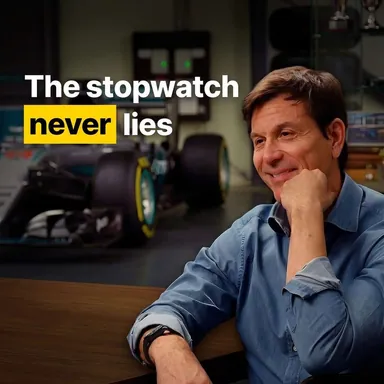
The ingredients of success that you can’t measure personality. How resilient are you to pressure? How much can you play the team game? When it comes to racing drivers, there are obviously similar KPIs, the stopwatch. The stopwatch never lies. But put them in the same car, the stopwatch is going to decide whether you’re being judged good or not.
But underneath the stopwatch, there needs to be technical ability to set your car up in the right way, interact with the engineers, have some kind of social competence of making sure you have sponsors, treat them well. There have been extremely talented kids that never went anywhere because they were just simply bad people or not intelligent enough.
Then there is the overwhelming part, and that is what we call speed. What is speed? All of your cognitive abilities and neurosensors, the sheer billions of sensors that a human has, that give you an ability that not many have. It’s actually to feel what the car does underneath of you. You can see with the extraordinary drivers, they feel much more. They feel more connected to the car on the road than anybody else.
One example is an old friend and driver of mine, Lewis Hamilton. You have two axles—a front axle, a rear axle—and you have the chassis in between. When you call a car understeer,7Understeer — when a car turns into a corner less than the steering wheel asks it to and runs wide. It's usually put down to the front tires losing grip. it means when you turn the wheel and it goes straight. That happens over the tires and the front axle. It’s pretty normal.
But Lewis once said something when talking about the car: “The car understeers from the front axle to where I sit.” That’s the middle of the car. How can that understeer? The engineers couldn’t really identify what he meant, but that is what his body told him or his brain told him the car is doing. If a driver is able to have that underlying layer of ability, then that becomes unbeatable. But that is genetics.
The great drivers strap the car onto themselves. They don’t sit in the car and there’s a connectedness.
Absolutely. Connectedness is the right word. It’s actually being one with the car and with the road.
How did you decide that you weren’t good enough to be a professional driver, on this topic of talent identification? That’s one decision.
Talking about humiliation and trauma as ingredients for later success. When I was a child or a teenager, there wasn’t really anything differentiating me or outstanding, be it academically or in sports or socially. When I was 18, by sheer coincidence, I ended up with a friend on a racetrack watching an F3 race,8Formula 3 — one of the junior single-seater series on the ladder to F1, with simpler, slower cars. Today's usual path runs karting, Formula 4, Formula 3, Formula 2. which is a junior formula.
When I stepped into this paddock,9Paddock — the restricted area behind the garages where the teams' trucks and motorhomes are parked; you can only get in with a pass. it’s like I’ve gotten my identity. This is what I wanted to be. I wanted to be a racing driver, someone that is able to tame this machine. This is when I started... Basically my career as a driver, but I came too late to the party. I didn’t have all of this karting background that teaches you the fundamentals of the physics of how to position your car in the race.
But I became a pro. I went through the various stages of junior Formula Racing into what we call GT cars,10GT (gran turismo) — racing for closed-body sports cars based on road models, as opposed to open-wheel formula cars. touring cars or sports cars with a certain amount of success. It is like you do about your business, I guess. What I’m doing today is I... Woke up with that desire and I went to bed with that desire. That lasted for quite a few years.
022,500 people and "no dickheads"
Mercedes picks engineers the way it picks drivers: values beat genius, and the team has no superstars.
The other, maybe less talked about part, obviously, there’s a huge amount of fixation on driver selection and who will get the next seat and everything like that. Presumably, a lot of what you spend time on is recruiting the right engineers and aerodynamicists and things like that. How does spotting that kind of talent work? Are you trying to pull people from other Formula One teams or from other industries and outside? Just what have you learned about talent outside of drivers?
When you look at the Formula One team from outside as a fan, you see two drivers. You see then a guy like me who is sitting in front of a screen, and then you see the mechanics, and sometimes the engineers on the pit wall.11Pit wall — the barrier between the pit lane and the track with the team's command post, where the team principal and engineers sit during the race. This is what you expect to be the racing team.
But this is just the tip of the iceberg. It’s about 150 people that go to the tracks, including marketing. It’s 90 technical, operational people. But we are two-and-a-half thousand. Here in the UK, we have two hubs, one that does the engine, the other one, what we call the chassis. That is the works team.12Works team — a team run by the manufacturer of the cars and engines itself, as opposed to a privateer. Mercedes builds its chassis in Brackley and its engines in Brixworth. We are 2,500 people in an organization that is quite vast if you look at the two cars.
For me, the selection process of the people that I want to work with is the same or is similar in terms of the pattern for racing drivers. I always say there’s not two superstars in the team. There’s two-and-a-half thousand, and I treat all of them equally. We’ve learned from the All Blacks,13All Blacks — New Zealand's national rugby union team, three-time world champions. The "No Dickheads" rule was made famous by James Kerr's book Legacy (2013) about the team's culture. 10 or more years earlier, and they have a saying, which is on their training ground, that says, “No dickheads.” And we have continued to run that motto.
The extraordinary scientist or engineer that hasn’t got the right values of humility, integrity, honesty, enthusiasm will have no future in the organization. We’re trying to filter that out pretty early. Sometimes you find out later, but no place for the genius asshole.14Genius asshole — a variant of the "brilliant jerk," Silicon Valley's name for a strong performer who poisons the work of the whole team. Netflix put the line that a dream team has no room for brilliant jerks into its famous culture memo.
03The cost cap
The spending limit cut long-term science but brought back competition, and Wolff, who opposed it, was given no choice.
You’re describing a lot the need for people to collaborate within the organization and the teamwork. But what’s interesting is you have these different domains where you have the aerodynamics, and you have the battery systems, and you have the internal combustion powertrain15Power unit — since 2014 an F1 car's power unit has been a hybrid: a 1.6-liter turbocharged V6 plus electric motors with a battery. Under the 2026 rules electricity supplies roughly half the power. and traction and everything.
The R&D almost entirely goes towards cars where you know the rules. There isn’t much room for general R&D because you just don’t know. You’re not going to work on batteries before you know what exactly will be permitted when it comes to batteries and things like that. You have to know the target that you’re designing against.
We did it a long time ago, but Formula One introduced the cost cap16Cost cap — in force since the 2021 season: initially $145 million a year, rising to $215 million by 2026. It excludes, for example, driver salaries and marketing. a few years ago. Every resource that you deploy into engineering is being counted for in the cost cap, which is $200 million and a bit a year. Therefore, long-term R&D work, lab work, is actually, unfortunately, very limited because you need to decide between deploying compute power in a front wing that you might have in three months against some long-term feature.
For all F1 teams, one of the things the cost cap changed is speculative R&D just had to go because ultimately you have fixed dollars, and you have to put absolutely everything you can towards this season and next season.
I wouldn’t say all of it had to go. You still need to find the right balance between what you think future cars are going to benefit from, value the lap-time effect it can have versus the current cars. Unfortunately, that percentage of R&D development, of science and lab work, which I love, has a more limited scope.
You have not only the overall cost cap, but you have things like limits on the number of wind tunnel runs and CFD simulations.17Wind tunnel and CFD limits — since 2021, wind tunnel time and the volume of CFD (computational fluid dynamics, computer simulation of airflow) are restricted on a sliding scale: the higher a team finished in the Constructors' Championship, the less testing it gets. Isn’t that a bit weird that you can’t spend your R&D budget exactly as you want to?
There are two sides of that coin. The first one is to say, Formula One was always unlimited budget and therefore ultra-sophisticated machinery, which led to a situation that the big teams—Mercedes, Ferrari, Red Bull—were leapfrogging all of the other teams. Because for us, we had those big motherships behind us that benefited from either a shareholder that was extremely keen, like Red Bull,18Red Bull Racing — the team of the energy drink maker Red Bull, whose "extremely keen" shareholder was its cofounder Dietrich Mateschitz. It won the Constructors' Championship in 2010–2013 and 2022–2023. or Mercedes that said, “This is a huge branding exercise for us, and the spending is relatively low in comparison to all of our marketing.”
What happened is only these three teams actually won races. So Formula One said, “We want everybody to compete on the same budgets.” That was the reason why it was introduced. Now, you can see that limited very much the science aspect of Formula One, but it brought also more competition. That’s one of the positive effects.
The other one is that Formula One, back in the day, Chase Carey,19Chase Carey ran Formula One after Liberty Media bought it, as chairman and CEO in 2017–2020. The cost cap was agreed on his watch. who was the CEO, said, “We need to protect you from yourselves.” Because obviously, I was against the cost cap, because I knew that Mercedes, we had might, and that probably the worst case scenario was to lose against a Ferrari or against a Red Bull, but not against a McLaren20McLaren — a British team, one of the oldest and most successful in F1. When the cost cap was being debated it was a midfield team; it went on to win the Constructors' Championship in 2024 and 2025 (Wikipedia, "McLaren"). or Williams or anybody else. He said that to me. Eventually, it was take it or leave it.
04Gray areas in the rules
Mercedes puts a borderline innovation through a mock trial and then brings in the FIA early, because a fair loophole usually gets banned only from the next season.
You are investing, trying to eke out tiny advantages in the car. One of the things that’s interesting is that there are the rules, there are things that are clearly against the rules, there are things that are permitted, and then there’s a spectrum between those of the gray areas. One of the challenges is you defend something that you think is great and clearly allowed, but then it’s banned mid-season, or it’s banned in the next season. Was it really worth all that effort to get a trivial advantage? Maybe, maybe not.
I think the lesson we’ve learned is that it needs the dialogue with the governing body. If you feel you have an innovation that passed the first red face test within the organization, that means the leading engineers, sometimes myself on the table, we are having a mock trial. The people that have invented the loophole or the opportunity play the prosecutor, so they need to fight their own argument. On the other side, there are the engineers that defend the innovation, and then there’s our general counsel, Carrie,21Carrie Donahue — general counsel and company secretary of Mercedes-AMG Petronas F1. and myself who are the judges.
You try to see how convincing the defense is?
Yeah, exactly. How convincing is the defense, and how can you destroy the argument that is actually legal? That would be an extreme case where there’s something that we struggle with in the engineering community to define. But obviously, the dialogue with the FIA22FIA (Fédération Internationale de l'Automobile) — motorsport's international governing body, which writes F1's technical and sporting regulations and enforces them. is important and bring them on very early.
If you have a very secret proprietary improvement that you don’t want to unveil, it will be totally top secret within Mercedes, but you will also bring the FIA into it?
If we think it’s 100% defendable, crystal-clear defendable, then we will deploy it on the car, and then we will make the argument why it’s right. Normally, the FIA will say, “We don’t like it.” They could say, “We like it, but it circumvents the principle of the regulation, so we’re going to ban it because the principle of regulation is the most equal competition.” If they’re fair, they’re going to say, “Ban it next year.” If they believe it’s really very powerful, and it’s not what they wanted to see or intended to define, then it could be banned much earlier. This is where the politics come into play.
Basically, if they think it’s a fair loophole, they’ll give you one season of advantage.
I would say this is, call it the experience that we have because they are innovators and the engineers, too, and they will respect if something comes up like this. One example was the system that we call DAS,23DAS (Dual Axis Steering) — Mercedes revealed it at preseason testing in Barcelona in February 2020. By pulling the steering wheel toward or pushing it away from himself, the driver changed the toe of the front wheels, the angle at which they point relative to the car's centerline. The system was legal in 2020 and banned from 2021. which was, you have the various dimensions of the steering wheel, what you do. I don’t know if you heard about it. You can steer to the left, and you can steer to the right.
That part I know. I’m with you so far.
That’s like in an airplane. No, in an airplane, you can also go forward and back.
Exactly. It’s actually nothing like an airplane.
Here, it becomes interesting. What we did, we created another dimension with the steering wheel, actually to push and to pull the steering wheel in a Formula One car. What it did, it changed—
Yes, I do remember this.
It changed the way the front wheels were operating in terms of its toe effect. What it did is we were able to turn... We created a toe effect which helped us to heat up the surfaces of the tires by basically dragging them along—
You were running them inefficiently.
They respected the innovation. I remember the first test, Sky had an onboard24Sky — Sky Sports F1, F1's main broadcaster in the UK. and said, “What’s happening here? They’re pushing and pulling the steering wheel.” When it was shown to me four or five months before we actually produced it, they called me to a rig in test and development, and there was the steering wheel, and they said, “Now, turn to the left and turn to the right.” I was a driver.
Then they said, “Now, push it and pull it.” I said, “That doesn’t go.” It’s like I’m used to it in order to fix the steering wheel to where I wanted to have it. But it feels deeply uncomfortable actually to have this additional motion in the steering wheel. The Formula One drivers got in and said, “No, we’d like to try it.” And it really worked.
Come back, I think if you want to be… You want to have the exchange with the FIA to make sure that you’re not on the wrong side of the argument.
With that, did they end up banning it, or they ended up permitting it on the team?
They banned it after a year.
Why did they ban it after a year? Why didn’t they say, “Okay, this is one of the things that F1 cars can do now?”
I don’t know. Maybe we lost the political argument that it was good. Other teams said it would cost so much to replicate it, and they could. But, is that really the intention of the regulations?
Why did you do it as a push-pull rather than a button on the steering wheel? Or why was the push-pull the control mechanism?
I think there was a regulation that allowed to have a mechanical system that was… The rule is the driver must drive the car.
So it needed to be deployed for the driver through a mechanical system. I believe that was the reason.
I see. That was the best way to have it defensible.
Yeah.
That’s so interesting. Where would you categorize the compression ratio kerfuffle,25Compression ratio — the ratio of a cylinder's full volume to the volume of the combustion chamber; the higher it is, the more power you get from the same fuel. The 2026 engine rules capped it at 16:1 and specified a static measurement at ambient temperature. Rivals suspected the Mercedes engine ran a higher ratio when hot. In the end the FIA decided to check compression on both cold and hot engines from June 1, 2026, and only at operating temperature from 2027. ambient temperature versus measuring a temperature? Where does that fit on this spectrum?
This was just other teams feeling sore about not having read the regulations in the right way. Today, on any vehicle in the world with a combustion engine, you measure compression ratio in a cold state because how else would you measure it? What does hot state even mean at a certain temperature with other ambient factors that matter? It could be a manipulative value that you have.
The other teams said, “Quite unfair. The rules say it needs to be measured in the cold environment or cold engine. What Mercedes has done is once it’s running hot, it basically grew in size and therefore extracted more power.” And, we didn’t confirm that.
You had more thermal expansion than other engines did?
Exactly.
Because you engineered in more thermal expansion.
I can’t really confirm that. Sorry, I must rewind.
Okay, but that’s what people say.
That’s what people say because the measurement was clearly identified to be in a cold phase of the engine. Was it a loophole? Was it a shortfall of the other teams? I think it was a shortfall of the other teams. It became quite a political argument, and then some compromise was found in how the measurement worked. Actually, the funny bit is it didn’t make any difference for us. It was a months-long argument going back and forth, and we fought it for the sheer principle of innovation.
05Leaks and the perfect rulebook
Secrets eventually walk out the door with people, and fully open rules, in Wolff's view, would kill the racing.
Is it hard to keep these top-secret improvements a secret?
Yeah, it is because there is a natural fluctuation of personnel between the teams.
Would you compartmentalize? It’s like the Manhattan Project.26Manhattan Project — the US program to build the atomic bomb during World War II. Access to information was strictly compartmentalized: each participant knew only what they needed for their part of the work. You need to firewall things.
We firewall certain things, and I’m maybe more on the extreme side within the organization. Not everyone needs to know everything, but eventually, you will always have a group of what do you call it, 20, 25 people—
Who need to be in the know.
Who need to be in there, and they may change teams, and then that obviously leaks.
Can you prevent people from changing teams within a season?
There is the regulatory environment of every country. How long can you actually prohibit someone to work for another team?27Garden leave — the British term for a period after resignation when an employee is still paid but doesn't work and can't join a competitor. F1 teams use it to hold back senior engineers leaving for rivals. With our contractual frameworks and in the UK, you can do it up to 12 months. But there are countries like Switzerland, for example, where it’s three months.
You got to be careful who you hire in Switzerland.
We haven’t got our Audis in Switzerland,28Audi — the manufacturer's works team, which grew out of Sauber; it is based in Hinwil, Switzerland, and has raced in F1 since 2026. Mercedes' bases are in the UK. for example. You got to be careful who you hire elsewhere. But you always need to account for the fact that people may change teams because of personal reasons. Absolutely fair argument. That’s why, how can you make sure that things are not leaking too easily? But they will eventually always come out.
If you could write the rules, how would you change them?
Well, I’m in two minds. The innovation part in me and listening to my engineers is free rein. We have a budget cap that is 200 million, and then make it as open as you want, because that would be magnificent from a scientific standpoint, an engineering standpoint. But what would happen is the best engineers with the most capability also in terms of infrastructure will come out with a car that is much superior than some of the other teams. It would create a field where the leading car could be five seconds quicker than the next one. That is not what Formula One wants. It’s becoming more and more restrictive.
Is that good or bad? I think it needs to be sensible because this is still the fastest laboratory in the world. That is in our DNA, and I think that is still happening. Obviously, engineers will always say, “Well, it’s not as much fun as it was in the past,” but it’s still a lot of fun.
06Managing technical risk
Allocating resources across ideas is easier in F1 than at Stripe, because every part's contribution can be measured and the customer is known.
You were describing one set of risks in developing new technical changes, which is the regulatory risk. Will you be allowed to have it even for one season or certainly multiple? But the other risk is just technical risks. Will it work? I think in any R&D organization... We have this at Stripe29Stripe — the payments company John Collison founded in 2010 with his older brother Patrick; John is its president, Patrick its CEO. where we only have so much time, we only have so much money. We have only so much engineers, and we need to put them... Towards the projects that are most likely to work.
You don’t know upfront what’s going to work. So part of the special sauce is that ability to predict this product direction is a good one versus this one is just… It’s not awful, it’s just not the best. You’re fundamentally playing this game of where you spread the poker chips. How do you manage technical risk? How do you think about allocating those very precious chips? Again, they’re even more precious now in the new cost cap era.
So, the unfortunate part of it is that your business is far more complex, in my opinion. Why? Because you deal with the end customer or whoever the customer is, an organization, an entity, or a person. You can define technical specifications that you believe make the process better or more efficient or successful. But there is someone at the end that actually needs to buy your product, and that person or that organization is going to measure whether the humans that are actually his customers or her customers are going to like it. How can you predict that part? With us, it’s all data and the simulation.
It’s much more measurable.
It’s much more measurable. At a very early stage, we will define what is the lap time contribution that we imagine of that part. That all starts in the virtual world. It’s all simulation, whether it is CFD, whether it’s the wind tunnel in the way we measure it, or we attribute downforce30Downforce — the force with which the oncoming air presses the car onto the track, thanks to the wings and floor, letting it take corners faster. The flip side is drag, which costs speed on the straights. and drag, or whether it is mathematical models that we have. All along the process, you continue to correlate with your expectations.
And, there are rare occasions where you believe that something eventually, when it ends up in the car, it’s going to be a 10th of a second31A tenth of a second per lap — a significant margin in F1: in qualifying, neighboring grid slots are often separated by hundredths. in average, over a lap, quicker, and you realize it’s not, or you realize that the driver doesn’t feel comfortable with it and isn’t feeling safe enough to drive it. We need to consider also if the end customer, which we know exactly, you maybe not, will be able to extract from that virtual, let’s say, theoretical lap-time benefit. But it’s much more measurable.
Engineers like to fall in love with their ideas and, “I just need one more simulation run,” or, “I just need one more—”
We don’t have that.
But you have to kill people’s ideas because they’re in love with them, but they’re just not going to work, or you just don’t have the resources to staff it.
I think we had people like this who, if they are also forceful, they might put the organization under pressure to actually continue with the experiment beyond a reasonable point, but they are not part of the organization anymore. This is one of the personality traits that we hold dear, that it needs to fundamentally contribute to the overall target of lap time rather than what we discussed before to the department’s target. There will be a decision within the group and then in the wider technical management to say, “We’re stopping this now.”
If I was to talk to an engineer at Mercedes, I would find them surprisingly dispassionate and analytical where they’re not falling in love with a particular technical approach, or they’re not falling in love with their idea. It’s either it works or it doesn’t.
Exactly. You fall in love with the result. It’s that these extreme emotions and gratifications that you feel when you win a race or a championship, and therefore, the rational part of the engineer, I would hope, is superior against, let’s say, an emotional falling in love with your development part.
07The dot-com era and sms.at
After racing, Wolff helped German-speaking internet startups raise money, and one of them went from nothing to a 250 million sale in two years.
I want to ask a bit about your investing background, because obviously, that is how you ended up in the position that you’re in in racing. First off, were you a private-equity or a venture-capital investor?32Private equity vs. venture capital — private equity funds usually buy large stakes in mature companies, often with borrowed money, while venture capital funds back young startups, counting on a few of them growing many times over. I’ve heard it described as both in accounts.
None of that, I would say, because how it all started is that when I decided to stop my racing, I had a short period of time where I was an employee in a steel manufacturing company. Didn’t like that, and then ended up reading about internet companies in the US. I know you had Marc Andreessen33Marc Andreessen — a co-creator of the Mosaic browser and cofounder of Netscape, later cofounder of the venture firm Andreessen Horowitz (a16z). He has been a guest on Cheeky Pint. here. One of the first companies that I got interested in was Netscape.34Netscape — Marc Andreessen and Jim Clark's company, maker of the Navigator browser. Its IPO in August 1995 is generally seen as the start of the dot-com boom. Then you had Yahoo!, AOL.35Yahoo! and AOL — stars of the 1990s internet: a search portal and the biggest US internet service provider. AOL's merger with Time Warner, announced in January 2000, became a symbol of the dot-com bubble.
These were the star companies of the time.
The star companies of the time, exactly. I lived in Vienna, and I thought, “I understand now what they were doing.” I looked at, let’s say, the German-speaking countries to say, “Who is doing that in Austria, in Germany, and in Switzerland?” I found out that... That existed, but sometimes it was just little startups that weren’t even in a legal entity.
Young people walking out of their children’s room or kid’s room.
Then obviously, the effect of the Nasdaq36Nasdaq — the US exchange where most tech stocks trade. The Nasdaq Composite peaked on March 10, 2000, and by October 2002 had lost almost 80%. started to kick in with absurd valuations for no-revenue companies. In Germany, it was the Neuer Markt,37Neuer Markt — a segment of the Frankfurt Stock Exchange for young tech companies (1997–2003), Germany's answer to Nasdaq. It was shut down after the dot-com crash. which was the equivalent, but even crazier in terms of process of being able to list. There were no boundaries, you can call it like this.
I found out about all of these companies, got myself into my car, went there and said, “I like your business. I want to help you to raise some equity or list your company on the stock exchange.” If it was successful with the first or the latter, I would like to have 10 or 50% of your company. That led to some shareholding because some of the people said, “Why? My business is worth €10 million.” I knew it was not worth it, but I said, “If it is €10 million, and I’ll raise €5 million for you, or we IPO38IPO (initial public offering) — a company's first sale of shares to the public, its debut on the stock exchange. for €20, can I have half of the company?” They said, “Of course.” That was a win-win.
You were almost like an investment banker to some of these dot-com companies. You probably wouldn’t have described it that way, but you were helping them with financing.
I was wearing cuff links, a Hermès tie, and a pin-striped, double-breasted suit, but eventually... Put it in a cave and never wore it again. There was another experience. But no, it wasn’t. It was actually a hybrid between sweat equity,39Sweat equity — a stake in a company earned through work rather than money. An equity kicker is an extra stake that pays off if the deal succeeds. early-stage microinvestments, and equity kicker or options related to success. That’s how it worked at the beginning. Eventually, we raised capital, not fund-like structure. It was still my company, but we got two private equity, two venture capital companies that each owned 10%, so we got real money and then deployed some of that.
You also, importantly, had good market timing, right? Because for people who weren’t around, the ‘99, 2000 period was crazy, where, as you say, the valuations just became fairly disconnected from reality, and then they crashed hard shortly afterward. A lot of the people who did well in that ‘99, 2000 era were people who were optimistic enough to get into these companies, but then skeptical enough to sell some of the proceeds rather than just watching the account balance go up and then down.
And lucky. In our case, within two years, we went from actually me pitching an idea to an entrepreneur that didn’t have a company around him to an IPO, which was crazy. We found ourselves in the after-IPO party, which we used to do back in the day, and we thought that had zero value three months ago, and now €100 million. One of those companies that I pitched I found out that there was a web portal, free SMS web portal. It was called sms.at. What you did, basically, you wrote your SMS on the interface at no cost. Austria back then had around nine million people, and two million were using this because SMS were expensive.
SMS cost money back then.
It cost money back then.
9 cents a message.
It was a lot. I found out that this was run by a teenage boy in Austria in Graz, visited him, and basically with the model, “I’m going to raise money for your company,” which then was very successfully, wrapped it into a legal entity. When I said to him, “How do you do that?” He said, “I’m hacking. I’m hacking into the SMS servers of the big telcos.” I said, “Okay, and then?” He said, “Well, eventually, they find out that the data volume was bigger than, let’s say, on normal days, and they shut me down.”
I said, “Okay, and if that happens, what do you do?” “Well, I have a plan. For example, today, I’m running on Nigeria Telecom, and next week it’s going to be Norway.” We put it in an entity, and I started to visit Telekom Austria40Telekom Austria — Austria's former state telephone company and the country's largest carrier. and T-Mobile then, the two biggest Austrian telcos. They said, “We hate sms.at. We absolutely hate it, but we can’t shut it down. What is it we can do together?” Eventually, within two years, that nonexistent company was sold for 250 million to T-Mobile.
For 250 million?
Yeah.
Wow! People forget. 2000. This was the year 2000?
That is obviously the… Yeah.
It was a different era.
Different era. Maybe the 250 million today, when you look at the AI situation, that’s going to be 25 billion.
But on a relative basis.
Relative. It was unbelievable enormous money and valuation. This was the lucky moment, actually.
They bought it to shut it down?
No. They bought a large part of it and took over the customers and integrated it in their systems. What happened is we signed the deal in Bonn, which was Deutsche Telekom41Deutsche Telekom — Germany's largest carrier, a former state monopoly headquartered in Bonn; T-Mobile was its mobile arm. back in the day. T-Mobile was a subsidiary of Deutsche Telekom. I flew back with my CFO, Austrian Airlines. He was 15 years my senior and was running the M&A department of the Austrian national steel company.
We were sitting in Austrian Airlines and got a glass of cheap bubbly, and I said, “That was a good transaction.” He said, “Something is going wrong here.” I said, “Why?” He said, “That business with literally tiny revenue, but with a large customer base. That means with lots of potential, but no way of actually knowing how to monetize it or how to repay the CapEx investment.”
There’s quite some correlation to the current markets now. It was valued at this absurd amount compared to my specialized alu business that he had that was generating 30 million in EBIT. Something’s going wrong. I said, “Nothing’s going wrong. The internet is going to dominate,” and, “Can’t you see the amount of customers?”
“It’s a new paradigm.42"It's a new paradigm" — a stock argument of the dot-com era: the old yardsticks of value supposedly didn't apply to the "new economy." You’re old-fashioned.”
Exactly. He said, “No, I’m sure this is going to collapse. The valuation is absurd.” Then we listed another company on the stock exchange, which was between pitching it to the bankers that scratch the eyes out of each other to do this to the day of listing in three months. He said, “I promise you we need to look at that. I don’t think this is sustainable.”
That impulse that he gave me from this 1-hour flight from Bonn to Vienna was enough to look at our whole portfolio of nine investments. We decided to exit all of them. That started end of ‘99 and went all through 2000. Obviously, when the market collapsed in spring 2000, people were still hoping for a rebound. It was just a glitch. The market never came back.
We exited all of those investments, bar one, an Israeli startup that we couldn’t exit, and we were out. What remained was a skeleton of a venture capital company, very much downsized, to continue to look for opportunities whilst having the philosophical idea of this is not going to come back for a long time.
08Knowing when to get out
Selling at the right moment is an underrated investing skill, and Wolff found it easier because he grew up poor and the money was his own.
I think this is an underrated aspect of good investors is knowing when to sell. I think there’s an incentive in the investor ecosystem where they all like talking about, “We found this founder very early, and we bought the stock, and it grew and grew and grew, and we want to be on the journey forever.” I think all of the myth-making tends to be about getting in early and being a very long-term partner.
I notice a thing that doesn’t get talked about but is a very common trait amongst the most successful investors is they have this spidey sense for… It’s like the movie Heat.43Heat (1995) — Michael Mann's film in which the robber Neil McCauley (Robert De Niro) lives by the rule: don't get attached to anything you can't walk out on in 30 seconds flat if you feel the heat around the corner. You got to know when to get out. And, a lot of the very good investors have this very commercial sense for, again, you’re in this period, like ‘99, 2000, and it’s an important moment to sell. It doesn’t get talked about because it sounds cowardly, or it sounds like you don’t believe in this company that you made a lot of money from because you’re now a seller. But it’s an interesting aspect.
I came from a very financially or generally poor family background. No money. Financial safety and opportunity was always a very strong driver for me. I owned 90% of that company. It wasn’t a fund. I wasn’t managing anybody else’s money.
It was a corporate entity. You had your own venture investors, but it itself was all holdings.
Yeah. It was a private limited company from which I owned 100%, sold 20% to venture-capital companies, and all of the 80% or most of it, we had some of my dear friends and colleagues had a few shares. All of it... I owned. When the opportunity came of actually exiting and generating a vast amount of money, which was life-changing, generational wealth opportunity, it became easier for me to do that because I thought, “Okay, I never had any money. Now suddenly, I was able to generate so much that I couldn’t even spend it.” At the time, I made the call. I think it would have been probably more aggressive if it would have been other people’s money...Generating management fees, potentially carry upside.44Management fees and carry — managers of venture and private equity funds usually earn a management fee of around 2% of assets a year plus a share of investors' profits (carried interest), typically 20%.
But the fact was your money allowed you to be pragmatic.
Exactly. And, have a certain sense of safety also... Or a desire for being on the safe side.
What was your best performing investment before the racing era?
Mercedes, the F1 team. But before the Mercedes era, I was invested in Williams, which was pretty successful. Before that, a company that I loved forever called HWA,45HWA — a German racing company from Affalterbach founded by Hans Werner Aufrecht, cofounder of AMG; for many years it prepared Mercedes' DTM cars. Wolff bought 49% of HWA in 2006 (Wikipedia, "Toto Wolff"). which was…
Sure. These were all racing companies?
That was all racing companies. Before that, I would say probably... That, the SMS company. It was called UCP.
Yes. SMS entrepreneur turned racing entrepreneur.
No, I was a race driver before, actually.
Racer turned SMS entrepreneur turned racing entrepreneur.
The exact sequence is: racer turned banking intern in Warsaw, turned steel sales manager in Eastern Europe, turned venture capitalist, although it was more venture than capitalist, and then turned young driver manager once I sold all of these investments, and then I started to invest in motor racing companies.
This is Toto’s new Twitter bio, just for you guys. Obviously, that—
I have no social media.
You have enough exposure. I think people know what you think without tweeting.
09How Wolff came to Mercedes
Daimler concluded that a corporation couldn't run an F1 team, so it asked the entrepreneur Wolff to run Mercedes and helped him buy in.
Do you get to manage the team in a different way because, I don’t know, you’re less worried about job security, you can take bigger swings, or just how is Toto managing the team different from all the other F1 team principals46Team principal — the head of an F1 team, responsible for results, budget and people, who represents the team before the FIA and Formula One. managing the team?
I have had this opportunity, an immense opportunity given to me by the board of management of Daimler47Daimler — the German carmaker that owns the Mercedes-Benz brand; renamed Mercedes-Benz Group in 2022. back in the day, led by Dieter Zetsche,48Dieter Zetsche — chairman of Daimler's board of management and head of Mercedes-Benz from 2006 to 2019. the CEO, but actually all of the board members were very supportive of the idea. What happened is they bought a small team, Brawn,49Brawn GP — Ross Brawn's team, created in 2009 from the team bought out from Honda. In its only season it won both championships with Jenson Button, and at the end of 2009 it was bought by Daimler and Abu Dhabi's Aabar fund; it has raced as Mercedes since 2010. Its first win as Mercedes came from Nico Rosberg at the 2012 Chinese Grand Prix. that won the championship in 2009, expecting it to be a dominant force in Formula One. It was the first Mercedes Grand Prix-owned team50Fact-checkWolff calls it the first Mercedes-owned team with its own engines and chassis. But there had been one before: in 1954–1955 the Mercedes-Benz works team raced in F1 with its own cars and won two championships with Juan Manuel Fangio (Wikipedia, "Mercedes-Benz in Formula One"). with its own engines and its own chassis. It underperformed. Year after year, the results were really not satisfactory. Until 2013, they won a single race only. I was at the time running Williams with the founder,51Williams' founder — Frank Williams (1942–2021), who set up the team in 1977 with engineer Patrick Head. Wolff bought into Williams in 2009 and became its executive director in 2012 (Wikipedia, "Toto Wolff"). and we also won a race.
One of the board members approached me and invited me to Stuttgart, and he said, “How can it be that your private little team can win a race, and we, Mercedes, we can’t do any better than that?” I said, “I don’t know.” They gave me the opportunity to look at their setup, their numbers, and everything. I came back and said, “What is your aspiration?” They said, “Winning World Championships because we bought the team that did that.” I said, “Okay, then one of us is wrong because I’m working on the same budgets, and I’m thinking about finishing in the top six.” They said, “No, it’s not the same budget.”
“Look, we spend 100 million more.” I said, “Yeah, those 100 millions, you spend on Michael Schumacher52Michael Schumacher — seven-time world champion. Returning after a three-year break, he drove for Mercedes in 2010–2012 but never won a race with the team. and Nico Rosberg,53Nico Rosberg — German driver who raced for Mercedes from 2010; in 2016 he became world champion and immediately retired. I have a pay driver54Pay driver — a driver who gets a seat largely thanks to the sponsorship money he brings. from Venezuela,” who won the race, by the way, Pastor.55Pastor Maldonado raced in F1 from 2011 to 2015, backed by the Venezuelan state oil company PDVSA. His only win was the 2012 Spanish Grand Prix for Williams. “That’s the main difference.” They didn’t like that situation at all. I said, “I’m just a messenger, and I’m going to go back to Williams.”
Eventually, they came back and said, “We think our model, a corporate running a Formula One team, doesn’t function, because it needs to be much more entrepreneurially led, you need to be empowered to make decisions on the spot, and we want you to run this.” And I said, “I need to pinch myself because being the head of Mercedes Motorsport is probably one of the best jobs in the industry, other than being the Ferrari guy.”
I had to say no because I was a shareholder in Williams, and I have been always an entrepreneur. They said, “Funny that you say that because we’ve just bought 40% of the Abu Dhabi Sovereign Fund.56Aabar Investments — the Abu Dhabi fund that got 40% of the team when it bought Brawn GP with Daimler in 2009. Daimler bought that stake back in November 2012, and in January 2013 Wolff bought 30% of the team and became its executive director. We bought it back, you can buy that.” I said, “I did well in my life, but I won’t be able to afford it.”
But they helped you finance it, right?
Exactly. They said, “How much can you afford?” I said, “I’m always on the conservative side, I’ve gone through financial hardship, and I don’t want to end up there.” “How much are you prepared to put into this?” I said, “That’s the amount.” They said, “We’re going to help you finance the rest.” Here I was.
Until today, with the change of management now led by Ola Källenius57Ola Källenius — Swedish executive, chairman of the board of management of Daimler, now Mercedes-Benz Group, since 2019. and his colleagues, the CEO of Mercedes, they give me a framework that I can act in the best interest of the racing team outside of that corporate structure, and I couldn’t wish for a better co-shareholder, partner, and brand, mighty brand that I’m associated with. The decisions that we make are quick, they are in the best interest of the team whilst thinking about the consequences for the brand, and I run it like a 20-people organization.
10Owner, not hired manager
An owner can't be fired, so Wolff can make decisions without escalating them and think ten years ahead.
How is how you run it different from just hired team principals, how they run teams?
Every team is different. For example, when you look at Ferrari, the team principal is one of 10 direct reports to the CEO, so the marketing person in the racing team is going to be on the same level that a team principal. You have other... Very much shareholder-led organizations like Red Bull, where you would have an employed team principal that’s reporting to a group of shareholders. Then you have a strictly corporate structure like Audi, where you have people from the group and from Formula One are being hired to run the team, they have a salary, they might have a bonus.
That long leash that I was given. Today, there’s no leash because we are partners, but the ability of taking decisions that was given to me was extraordinary because all of these people, they need to fundamentally report to someone. There’s always the risk that if you take a decision without having actually escalated it through the hierarchy, you might be exposed and lose your job. Where I am, until I really badly screw up, I’m responsible for my decisions, and I’m very clear about that, but I can’t be fired.
That’s what’s interesting, right? You see this in Silicon Valley, where companies run by founders often have different strategic degrees of freedom available to them than other companies. You look at, say, with Meta,58Meta — formerly Facebook. Zuckerberg controls the company through shares carrying ten votes each: he holds a majority of the votes with a minority of the shares. The "previous wave" is the metaverse, for which the company changed its name in 2021. it’s not a company that’s just run by the shareholders, it’s run by Mark, and he has a strong view that being on the forefront of AI is very important. There’s been previous waves where he’s had strong views, and now they’re doing very well in the AI space, where maybe a professional management team would not have had the license by shareholders or the board to spend so much money on that, and it took a long time to prove out, and things like that. You see that effect oftentimes. Mercedes is the only founder-run F1 team.
But it’s a little bit like you and your brother around Stripe. You are able to take decisions that in a dynamic environment may prove to be false or misjudged after a few years. When you look at the ability that… The way Mark Zuckerberg leads the company is quite amazing, because you can decide to pour quite some investment in a certain field, and then say, “That hasn’t developed in the way I thought.”
Dietrich Mateschitz,59Dietrich Mateschitz (1944–2022) — Austrian entrepreneur and cofounder of Red Bull, which owns the F1 teams Red Bull Racing and Racing Bulls. the founder of Red Bull, said something quite interesting to me one day, he said, “As an entrepreneur, you need to be like a downhill ski racer, but you need to be able to stop and walk back up the hill.” I think as an entrepreneur, you can do that. You have the long-term horizon also. A manager will probably be short-term incentivized. You have a three, or you have a 5-year contract, you have stock options, you want to maximize the value of these.
And there’s a fear of failure. There’s a fear of doing something that looks bad to the people who are grading you, because you’re always being graded.
Exactly. That’s what I meant at the beginning. My time perspective has changed, it’s 10 years, it’s not one year.
People know that you’re a large owner of the team. I don’t think quite as many people know that Jim Ratcliffe60Jim Ratcliffe — British businessman, founder (1998) and chairman of the chemicals group INEOS and co-owner of Manchester United. of INEOS is also a major shareholder of the team. What’s he like?
That was a real opportunity back in the day for Mercedes, and for Jim. He’s built an empire of an organization. This is a chemicals conglomerate. There are three shareholders, they run it in the way they think it’s intelligent. Back in the day, Niki Lauda,61Niki Lauda — Austrian driver and three-time world champion; from 2012 he was non-executive chairman of Mercedes F1 and owned 10% of the team. He died in May 2019. unfortunately, passed away, he was my best friend. And those shares went back into the pool.
Jim Ratcliffe and INEOS started to sponsor us, quite extensively, actually. We ended up sitting on the table with the CEO of Mercedes, Jim Ratcliffe, and myself talking about the sponsorship. It was just before COVID hit. Teams had no valuations, we were all loss-making, the sport wasn’t anywhere near where it was today.
Jim said, “I’m prepared to commit X hundred million as a sponsorship if I can have a stake in the team.” We said, “Well, that makes sense.” I increased my stake a little bit, and then we were all one-third.62One-third each — the deal was announced in December 2020: INEOS took a third of the team alongside Mercedes-Benz Group and Wolff, and the arrangement took effect in January 2022 (Wikipedia, "Mercedes-Benz in Formula One"). Today, Jim is a great resource that I use if I need to have a contrarian view, someone that is highly experienced but also shrewd in the way he looks at his businesses, and a very enjoyable co-shareholder that isn’t really interfering, but because I guess we do well, enjoys the ride and is a resource that we can utilize.
11Why teams got so valuable
F1 teams aren't just scarce trophies anymore but profitable businesses, and by that measure Mercedes' valuation is conservative.
F1 teams have become radically more valuable. This transaction valued Mercedes F1 at 4.6 billion pounds.63The George Kurtz deal — in late 2025 Wolff sold 15% of his holding, about 5% of the team, to George Kurtz, CEO of CrowdStrike. The team was valued at roughly £4.6 billion, or $6 billion. And that’s a 7x increase from even just a few years ago. That phenomenon has also happened in other sports like NFL,64NFL (National Football League) — the American football league, with 32 teams, the richest sports league in the world. and teams like that.
There are two explanations you could have for the increase in value. One is a monetary theory that you have more rich people who want to buy into teams, and so the businesses are the same, but you just have more demand to become a sports team owner, and more dollars chasing fewer assets.65More dollars chasing fewer assets — a twist on the textbook definition of inflation: "too much money chasing too few goods." The other is that you can say, and obviously this is somewhat true for F1, they’ve become better businesses. The audience has grown so much, and you have Drive to Survive,66Drive to Survive — Netflix's behind-the-scenes documentary series about F1, running since 2019; each season covers one championship. and things like that.
As you think about the increase in value in Mercedes and F1 teams, how much of it is F1 teams have become a more desirable asset, and how much is it that they’re actually just very good businesses now?
When you buy a car today, you justify it with sometimes rational decisions, like lots of horsepower, or good design, or it’s EV, because I want to have an efficient car. The truth is, it’s an emotional decision why you buy a car. The emotional decision is how you want to be perceived. Do I want to be perceived progressive? Do I want to be perceived affluent?
All of this. That is going to be a longish answer.
Sports teams are scarce assets today. In F1, there’s just 11 of us.6711 teams — since 2026 F1 has had an 11th team, America's Cadillac; from 2017 to 2025 there were ten. You could potentially have another one that’s within the regs, but nobody’s really keen. It’s the biggest global sport in the world today. The Olympics and the football World Championship are bigger, but they’re only every 4 years. This is the biggest global sport in the world.
Then you look at the NFL, very scarce asset too. For US-American, it doesn’t go any bigger than the NFL. I think, how much? Thirty-two teams or something around that. The scarcity of the asset can be a... Rational decision to own it, and hope for a value increase because of that factor.
Then there is the trophy asset angle.68Trophy asset — something bought for prestige rather than returns: a famous painting, a mansion, a sports team. There’s many very wealthy people that love the sport and say, “I always dreamt owning an NBA69NBA — the National Basketball Association, the top basketball league in the US and Canada, with 30 teams. or NFL team, or Formula One team, and I enjoy going to the races, giving my input, and I can afford it now.” Very valuable. It’s a win-win.
But then there is the people that have so much money and feel in a way, maybe not recognized enough, because you could have earned 10 billion with a business that doesn’t have as much visibility, and you’re saying, “Actually, I’d spend a large chunk of money just for the courtside seat and be more prominent.” It’s also a decision that you can understand, maybe. That is that aspect of investing.
The other part is fundamentals. You look at the landscape, and you can say, “Do I believe that this sport is going to continue to grow? What’s the demographics of the sport? How much income potential has the league? How much does the team earn?” And that today—these fundamentals have become reality.
In Formula One before, we were all loss-making. It was a marketing exercise. But today, few of us are generating very healthy profits in our business, more than 30% EBIT margin.70EBIT margin — operating profit (earnings before interest and taxes) as a share of revenue. We are distributing dividends. It’s not like the US-American teams, or the tax structure71Tax structure — in the US, the buyer of a sports team can write off most of the purchase price, including player contracts, over 15 years, reducing taxable income by that amount. Such purchases are also often made with debt. where you basically live in a debt environment. We don’t have a lot of CapEx, because we don’t own the stadium. Obviously, also miss some of the revenues.
When you invest in a Formula One team today, you can attribute multiples72Multiple — a company's valuation expressed as a multiple of an annual figure: profit (for example, EV/EBIT) or revenue. to your investment decisions. When I sold part of the team last year, those multiples justified the valuation you just stated. Today, I’ll probably be able to generate 30% more. But I got the right partner, so that’s okay. Those multiples are also valid for most of the US-American teams.
What are the last publicly released financial figures for Mercedes?
We’re generating around a billion dollars in revenue, and 30% profit margin.
Okay.
It’s a very healthy margin.
Sorry, 300 million of EBIT, and so the $4.6 billion valuation is 15 times EBIT multiple? Warren Buffett73Warren Buffett — American investor and longtime head of Berkshire Hathaway, known for buying durable, profitable businesses at a sensible price. To "underwrite" here is to vet a deal and take on its risk. could underwrite this business.
Exactly. Back in the day, it wasn’t a billion, and it wasn’t 300 million. It was considerably less because we’re growing very strong, and the sport is still growing strong. But we are Europeans, we don’t talk so much about valuations and money. But as a matter of fact, like you said, these multiples are actually on the conservative side.
Actually, that’s very different from, say, an NBA or an NFL team, where I think every time one transacts, it’s wackadoodle valuations that can only be justified by tax structuring, or courtside seats.
But also, when you look at the valuations of the US teams, you have fundamentals for some of the teams, but then there are some which are being dragged along that are having valuations that are not real anymore. And, if you look at Mercedes, we are probably generating, other than the Dallas Cowboys,74Dallas Cowboys — the Texas NFL franchise, according to Forbes the most valuable sports team in the world. the most profit of any sports team in the world. We have a USP in this world.
When we compare our multiples to the NFL or the NBA in its latest crazy uplift of valuation in, I don’t know what the multiple is, the revenue multiple, which is crazy. I’m a fundamental guy, fundamental figures, so I would never value a business on revenues. I would value it on return on investment, fundamental cash flow, and profits. That would value us at 10, 12 billion if you look at the Lakers sale,75The Lakers sale — in 2025 the Los Angeles Lakers were sold to Mark Walter at a $10 billion valuation, at the time a record for a sports team. for example, whatever else happened in this frenzy.
But that’s not the point. My horizon is so long term that I’m a long-term bullish investor with all the ebb and flow that can happen in this sport, that it becomes irrelevant to actually strive for high valuation because it’s just on paper. But we could value the business today much more than it was a year ago.
It’s interesting. There can be an effect in tech where, say, if you look at the AI space, some of the most enduring businesses in AI, like a TSMC76TSMC — the Taiwanese company that is the world's largest contract chipmaker, producing chips for Nvidia, Apple and others. or an NVIDIA,77Nvidia — the American designer of the GPUs on which most AI models are trained and run. that have these very long-term advantages, actually trade at quite reasonable multiples despite the fact that they’re growing very quickly. And similarly, the best team in the biggest sport trades actually at one of the most sensible multiples.
Yeah, and that’s okay. We want to be perceived as the serious people in there, because we are not particularly interested in the trophy investor where we could maximize our valuation. The most important point, none of us is actually interested in selling any shares here, because we believe in the long-term development of the company and the sport, particularly in this environment of AI.
Humans watch humans, and the driver in the car is irreplaceable, not because a robot couldn’t go any quicker. By the way, that’s a different discussion, I don’t believe in that. But because we want to go through the drama and the glory of the individual. I believe that live sports, generally are very resilient to whatever technological developments we see at the moment in the market.
12The stock market and Drive to Survive
A team doesn't belong on the stock market, and Drive to Survive worked because there's credible sport behind the soap opera.
Will we see any of the F1 teams as public companies? Isn’t that the next logical step? Because there are lots of people who would like to be a part of them.
I don’t think... We went public with Williams,78Williams on the stock market — Williams Grand Prix Holdings listed on the Frankfurt Stock Exchange in 2011. In 2020 the American investment firm Dorilton Capital bought the team and the shares were delisted. and that was not a success. Because in a way, you’re reporting 20 times a year with each of the races. In this sport, it goes from mania to depression within a week.
But that was a very different era. F1 was much smaller, it would have been a different shareholder base. Could it work now?
I don’t know. If somebody wanted to monetize, or raise capital by just being public, maybe. But I don’t think being public as a sports team is the right long-term structure. You want to be in control.
Because you just get whipsawed so much.
Exactly. I would also want to be in control of that business, not because I think in legacy terms, that has no interest for me, but it’s about creating the best sports team in the world in the time I run it.
Drive to Survive has been a smashing success for Netflix, and a big success for F1, where it’s brought lots of new people into the sport. People talk about women, especially… You don’t associate F1 with women, but the show is very popular with them. Netflix has tried a very close copy of Drive to Survive with cycling and tennis79Netflix's cycling and tennis series — Tour de France: Unchained (2023–2025, three seasons) and Break Point (2023–2024, two seasons, then canceled). Both were made by Box to Box Films, the producers of Drive to Survive. and all these sports, and it hasn’t really worked. You don’t hear anyone talking about those shows. Why does the format work particularly well for F1?
There are some shows that I personally found quite okay, the cycling was okay. But why? I didn’t believe it would work. Back in the day when Formula One pitched it to us, Netflix didn’t really pay any money, very little. We were fighting a World Championship against Ferrari, so I sat down with my colleague of Ferrari80The Ferrari colleague — in 2018, when the first season was filmed, Ferrari's team principal was Maurizio Arrivabene. and said, “Are we doing this?” And he said, “We are here to win a Formula One Championship and not play Cirque du Soleil.”81Cirque du Soleil — a Canadian company that stages animal-free circus shows built on acrobatics and storylines. Here it stands for entertainment as opposed to sport. Ferrari and Mercedes decided not to participate in Series One.82Season one of Drive to Survive came out in 2019 and covered the 2018 championship; Mercedes and Ferrari appeared from the second season on.
Yeah, famously.
Famously. That was maybe important for the success of the series, because it allowed Drive to Survive to look at smaller teams and less—
It was like an underdog.
Underdog, exactly. COVID came, people stayed at home. Generations watched Drive to Survive from the granddaughter to the grandparent, grandchild to the grandparent. We started to race as the only sport83Fact-checkWolff says F1 was the only sport racing. In fact, Germany's Bundesliga, for example, resumed its season behind closed doors on May 16, 2020, while F1 only started its season on July 5 with the Austrian Grand Prix (Wikipedia, "2019–20 Bundesliga," "2020 Formula One World Championship"). because we were able to contain our traveling circus84Traveling circus — a jokey nickname for F1, which moves from race to race around the world with all its teams, cars and staff. very closely. We were live for it. I think this is where we made a big step forward in terms of growing our audiences and demographics.
Why the sport is so strong today? I think it’s not only because of the Netflix factor. It’s also because we entertain. We have great characters that are very active on social media, younger drivers. We provide a great narrative, controversial situations, the politics outside of the sport. That is basically a 12-months live reality show. But with the—
F1 already is a soap opera, and that’s why it works well in TV format.
It is, but with a fundamental difference to other soap operas. We are credible sports. We have rules. We race based on those rules. If you win, the best car, the best machine wins. This is the fundamental base of the sport. This is why the reality show around fits well. This without that wouldn’t work.
Entertainment follows sport, not the other way around for Formula One. We’ve stayed true to this DNA, and that’s why we’ve attracted audience in sheer size that we didn’t expect before. Our strongest growing demographic is young women, 15 to, I don’t know what the bracket is, but 15-25 years. We have 42% female fans, which is an awesome—
Unthinkable for a motor sport.
Unthinkable. Obviously, my wife Susie85Susie Wolff — Scottish racing driver who competed in DTM and was a Williams F1 test driver. runs the female series, F1 Academy,86F1 Academy — an all-female junior racing series launched by Formula One in 2023 to prepare women drivers for the higher categories; Susie Wolff is its managing director. which is going very strong with young women driving those cars. What she sees is that her demographic very much obviously buys in into Formula One’s demographic, and they became an aspirational series for young women, not only that want to be racing drivers, but also engineers, or marketing people in a racing environment, or sheerly inspiration that a woman can actually succeed in a male-dominated environment. All of this universe buys into the credibility of Formula One.
I personally find Drive to Survive a little too soap-opera. I always want more of the technical details and more of the race craft. I think maybe there will be the opportunity over time for different sub-shows or something like that because I understand why they make the choices they do. I think what they have is probably has the most mainstream appeal, but they’ll probably find that there are sub-emphases that would be successful, too.
13Fans and stakeholders
F1's audience still has room to grow, and Wolff sets his priorities by a "customer theory" that runs from his wife down to social media followers.
It’s a good point we actually haven’t thought about. Because we tried to develop, and Stefano Domenicali,87Stefano Domenicali — Italian sports executive, Ferrari team principal from 2008 to 2014 and president and CEO of Formula One Group since 2021. who runs Formula One, is excellent at that, to grow it in the right demographic. We are still niche in some parts of the world. We have a large group of fans in every continent. But when you look at the United States, it’s very much big cities and affluence. I can see that when you go to New York, Miami, San Francisco, LA, Austin, the sport is very present. People recognize you.
I was invited to the Super Bowl in Arizona88Super Bowl — the NFL's championship game and the most-watched broadcast of the year in the US. Arizona (Glendale) hosted it in 2008, 2015 and 2023. a few years ago, no recognition. We are not developed in the middle of the United States, which is NASCAR.89NASCAR — American racing in cars that look like production models, mostly on oval tracks; especially popular in the South and rural US. This is very much the current demographic that Stefano is aiming at because it’s niche, it’s high-tech. How can I say? It’s very European and glamorous to a certain degree.
We have these hardcore fans. Interestingly, many of the young ones follow free practice on Friday.90Free practice — the Friday sessions of a race weekend, ahead of Saturday qualifying and the Sunday race, when teams set up their cars and test upgrades. They will know everything about the updates on the car, the aero updates. They also know about the WAGs,91WAGs (wives and girlfriends) — a British tabloid term that caught on during the 2006 football World Cup, when the papers followed the partners of England's players. the wives and girlfriends of the drivers, and all of these influencers and blogs that are existing.
Yes. We’re getting into, what does it mean to be an F1 fan these days, because it’s interesting. You have this pyramidal structure where you can be extremely engaged and follow the team around, or you can go to one race when it comes to your town, or you can watch Drive to Survive, or maybe you just come across YouTube clips in your feed occasionally. Now there are all these different layers. How has that changed from a Mercedes strategy point of view, the fact that you have so many different types of fans now versus the old paradigm of you turn up to a race, or you don’t?
As a team today, we have so many different fan groups. Not only fans, but stakeholders. You have, obviously, Mercedes. What is it we do for the car’s brand to enhance reputation and fundamentally selling cars? What is that? What can we do for…
I have this customer theory. A customer is someone that makes your life better. My number one customer is Susie, my wife. Whatever I will do and say is always focused on, is she going to like that or not? Because that has an effect on my life quality. My family, very important. The people that work for Mercedes, my employees, if I have them in a good space, then the car is going to go faster. The relationships matter.
Then it’s sponsors and co-shareholders. What is it I need to do for them to say that this is a good investment or a good platform? You can trickle that down. It’s the fans, and then it might be the social media followers. You can trickle that down. What I’m trying to do is, in my priority list of customers, to identify the objective to achieve the best outcome. That is what I’ve always done in any of the way of looking at a life. It sounds a bit rational and brutal, and maybe the reality is it’s not like this—
No, you’re ranking who’s important to you—
But I’m ranking the priorities. Exactly.
F1 is interesting because you have the teams, you have F1, the organization, the company itself, and then you have the FIA, which people might not realize is different. What are the tensions between all of those groups?
I think tensions have been very limited... Recently, in recent times. Because there was this pressure always between Formula One as being the commercial sides of it and the commercial rights’ holder, the FIA being the governing body, making the rules, policing the rules, and then the teams. There was, let’s say, an umbrella contract between all three stakeholders, which is the famous Concorde Agreement,92Concorde Agreement — governs relations between the FIA, the commercial rights holder and the teams, including revenue sharing. The first was signed in 1981 at the FIA's headquarters on the Place de la Concorde in Paris; the current one covers 2026–2030. because it was signed on the Place de la Concorde in Paris many, many 10s of years before.
The teams, we don’t own the league, contrary to the NFL, for example. But, we are getting quite a large percentage of the profits that Formula One does. Liberty and public shareholders,93Liberty Media — John Malone's American media holding company, owner of Formula One since 2017; its shares trade publicly, hence the "public shareholders." retail, or institutional investors own Formula One, and we get the profits. The FIA is being paid by Formula One for their services. But the FIA is also the one that granted the rights to Formula One in a 100-year agreement.94The 100-year agreement — in the early 2000s the FIA granted the championship's commercial rights to Bernie Ecclestone's company for 100 years, starting in 2011. So, they need to be respected as a stakeholder and not only as the policeman. I think that was where cracks appeared a few years ago, or even before, you must say, but today, it’s more aligned. We’re gelling more, the three entities for the benefit of the sport.
But if there is a disagreement, what will it likely be about?
What could the disagreement look like? How does the profit split, for example. These contracts are being renewed every five years.
The age-old debate.
Yeah, exactly. Or where are we? Which countries are hosting races?
14Madrid and Monaco
The new Madrid track is spectacular but hard to overtake on, so it will be reworked, while nobody will touch Monaco.
Was that new Spanish circuit95Madring — the new Spanish Grand Prix circuit around the IFEMA exhibition center in Madrid, which debuted in 2026. Its signature is the banked La Monumental corner. The first race saw only four overtakes, and the organizers announced they would change three sections of the track by 2027. that nobody likes a mistake?
I’m a traditionalist, I love going to the old circuits because they represent history for me. But also the racing is based on these. For whatever reason, the layout of the old tracks, which had vast areas, that they were available because places were not as developed as today, provide great racing. Overtaking, cars being able to go side by side.
That’s the criticism of the new Spanish track.
Exactly. That there wasn’t a lot of overtaking. But. Madrid did have, and I’m not saying this to make anybody look good, Madrid as a city is spectacular. The track that is built in this area is spectacular. I must say the job that they did over the few years since they got the contract is nothing but outstanding.
But I think where it didn’t work is that the track is so spectacular in terms of for the drivers and the camera positions with this long banked corner, but it didn’t account too much for the new generation of cars96The new generation of cars — under the 2026 rules the cars became smaller and lighter, got movable wing elements, and an electric motor supplies roughly half of their power unit's output. for the difficulty to overtake. For next year already, I think they’re going to change the layout of the track because it’s not a permanent track to provide more straights.
It’s not a permanent area?
They can just re-jigger it?
Exactly.
How configurable is it?
When I spoke with the CEO of the track on the weekend, and he just mentioned a few corners that he thinks can be adapted or should be adapted. They are open-minded about it.
That’s cool. There’s fundamentally this tension between you’re creating a destination, and you’re designing a racing track, and there are some slight tensions between them. Maybe you don’t have as much room as you want to work with, but you can break that trade-off a little bit where you can improve the track even once the location is set.
I don’t think there are tensions. I think fundamentally, all stakeholders, including the host, wants to have a great Grand Prix, and that means having attractive racing whilst having good spots for the public.
There’s sometimes a tension. Monaco, famously,97Monaco Grand Prix — a race through the narrow streets of Monte Carlo, held since 1929 and part of the F1 championship since its first season in 1950. Overtaking there is nearly impossible, but it's the most prestigious race on the calendar. you would not design it that way as a racing track, but Monaco is not going anywhere, and it’s the…
I think Monaco needs Formula One, Formula One needs Monaco. But Monaco is such a traditional track that nobody actually wanted to change the layout because it’s like breaking with the rules or breaking the legacy. But fundamentally, I lived there many years. I wouldn’t know how to make it very different. I have some idea for a longer straight.
Also, Monaco, they keep building new land,98New land — Monaco has long reclaimed land from the sea: the Fontvieille district rose on landfill in the 1970s–1980s, and in December 2024 the Mareterra (Le Portier) district opened on reclaimed land (Wikipedia, "Le Portier"). and so you could extend the track out into the Mediterranean.
Yes, and that has been a great commercial success. I doubt that extending a racetrack into the sea is going to generate some return.
15Life after Toto
Wolff is preparing the team to live without him: his job will be split among two or three people, and he doesn't want to run things from the grandstand.
Last question. How do you set Mercedes up for succession? How will it work post-Toto? How can you prepare for that?
I’ve seen examples of entrepreneurs that were either so selfish or believed in their own... Eternity and... Forever life, that they didn’t look after, not only their families, but also the company. For me, it is not important to leave a legacy and call the building the whatever, Toto building or so, which I hear some people are doing nowadays.
You already have the toilets named after you.99TOTO — the Japanese plumbing company, one of the world's largest toilet makers. It also makes ceramic electrostatic chucks that hold wafers in chipmaking equipment; its shares soared on the AI boom, and in 2026 the activist fund Palliser Capital took a stake, calling TOTO an undervalued AI beneficiary.
Yeah, exactly. I wish I would own the call on this business.100Call option — the right to buy an asset in the future at a pre-agreed price. Wolff jokes that, since the name is the same, it's a shame he has no claim on the soaring TOTO. That’s massive.
Especially now with AI.
Exactly. We should ask them for sponsorship.
Exactly.
For me, it’s important to do what’s best for the family and to do what’s best for the team. That means looking at the structure going forward where this team can live without me. Probably it’s not going to be the same because I have the credibility as an entrepreneur that’s leading my own businesses, but there will be a solid management structure. I believe that my job is going to be divided between two or three people that I’m vetting at the moment that I believe are already doing a great job with all of their strengths in these various areas. It’s going to be different, but it will be a successful team.
Do you think you will set things up where maybe you move to executive chairman101Executive chairman — a board chair who takes part in running the company; a non-executive chair only leads the board and stays out of day-to-day affairs. type of role where you don’t have to be there every race weekend, you let the new person set their direction, but you can help with personnel and be there for advice? Or do you think it’s important to have a clean break, and you get out, and it’s their show now?
I think clean break is probably not possible if I continue to own it with my family. That executive or non-executive chairmanship is something that may happen, but it needs to happen in a very, very precise way. Because you can’t be on the sidelines and interfere into the daily business. I also don’t want to end up in a situation that I believe the family can run it the best way and then be just mediocre. You have to earn your spot in running it and you have to contribute. My children also don’t have any interest.
I believe that if you are a chairman, non-executive or executive, you need to exactly know your role. And that doesn’t mean shooting from the outside and being the one that sits on the grandstand and says, “You’ve screwed up, and you’ve screwed up, and this is how I would have done it.”
You’re calling the drivers directly.
You can call the drivers directly if it’s about keeping the contact, but it’s not about interfering into the daily business. That’s how I would aim to be in the future. But I’m still enjoying it too much running it, actually.
That makes sense. Theoretical for now. Toto, thank you.
John, thank you for having me. Congratulations to what you have achieved. We haven’t talked about it enough, but I can only take my hat off.


