

Acquired
Chapters
Ferrari sells cars to almost no one, yet the whole world knows it and it's worth more than the auto giants, because, as Ben puts it, this business isn't about transportation but about selling dreams.
Read the chapter- Ferrari ships about 14,000 cars a year, roughly what Toyota sells every 10 hours, and even Porsche ships 22 times as many.
- Ford makes 160 times as many cars, yet Ferrari, Ben notes, is worth more than Ford, Volkswagen, Honda, Stellantis and Mercedes-Benz.
- Only about 180,000 people own a Ferrari, while Ben would argue over a billion know what one is, the highest ratio of awareness to ownership of any company in history, in his view.
- About 80% of the cars are earmarked for people who already own a Ferrari, which leaves fewer than 3,000 new customers a year.
- Hermès makes 10 times more Birkin and Kelly bags each year than Ferrari makes cars, and Rolex makes 70 times more watches.
Enzo, who survived the deaths of his father and brother, failed as a coachbuilder and fell short as a driver, but found his calling in a private team racing for Alfa Romeo.
Read the chapter- Enzo's father ran a metalworking shop and gave him a rule he kept for life: a company is perfect when the number of partners is odd and less than three.
- During World War I his father and his older brother Dino both died of pneumonia, leaving Enzo with no family business and, as David puts it, no discernible skills.
- Fiat turned down his job application, his coachbuilding business Carrozzeria Emilia went bankrupt within two years, and as a driver, David says, he was good but not great because he was too afraid to die.
- When Alfa Romeo cut its racing budget, Enzo, by then an Alfa dealer in Modena, offered to run its races with his own private team, Scuderia Ferrari, scuderia being Italian for "stable."
- David notes that the line between a garage that prepared race cars and a carmaker was thin at the time, and Enzo had the Maserati brothers across town in Modena as an example.
Enzo builds his brand long before his first car, and the legend of a man who cared only about racing, Montezemolo says, is false.
Read the chapter- The mother of Francesco Baracca, Italy's top World War I ace with 34 victories, urged Enzo to paint her late son's black prancing horse on his cars, and Enzo set it on a yellow shield, Modena's color, under the Italian tricolor.
- Montezemolo confirmed to David that Enzo was a natural-born entrepreneur and marketer, Italy's Steve Jobs, and Enzo described himself as "an agitator of men."
- Rosso Corsa was Italy's assigned national racing color, but David says Enzo made it Ferrari's color, to the point that Lamborghini today uses every color but red.
- In 1933 Alfa made the Scuderia its official racing operation, but it kept losing to the Hitler-backed Mercedes and Auto Union teams, and in 1938 Alfa and Mussolini took it over.
- Fired in 1939, Enzo lost the right to his own name in racing for four years and built machine tools at Auto Avio Costruzioni, the company that, David points out, now trades on the New York Stock Exchange as RACE.
After the war Enzo returns to cars and creates something no one else had: a racing team, a race car constructor and a service operation for private clients under one roof.
Read the chapter- In 1943 Enzo moved his operations away from the bombing to Maranello, about 15 kilometers south of Modena, which is why Ferrari is still there.
- Luigi Chinetti, a former Alfa mechanic and driver who spent the war in America, convinced Enzo that wealthy Americans with European tastes would pay a king's ransom for his cars.
- Enzo didn't sell a single car until he was 49: the first was the 166 MM Barchetta of 1948, and early buyers included Fiat patriarch Gianni Agnelli.
- In 1949 Chinetti and Lord Selsdon won Le Mans in a privately owned 166 that Enzo didn't think was ready, which David calls the perfect illustration of the business model.
- Enzo liked to say he sold engines and threw in the car for free, and Ben says he was a deliberate late adopter of ideas like the mid-engine layout because the old ways fed the myth.
In the 1950s Ferrari builds some of the most beautiful cars ever made while losing drivers, an heir and spectators, and the tragedies, David argues, only make it more coveted.
Read the chapter- Ferrari is the only F1 team that has raced continuously since the championship began in 1950.
- The 250 series of 1952 was the first real production Ferrari, its bodies came from Pininfarina, and that partnership, David says, lasted 61 years.
- Alberto Ascari was killed practicing at Monza in 1955, Enzo's son and heir Dino died of muscular dystrophy at 24 in 1956, and his illegitimate son Piero couldn't inherit under Italian law.
- At the 1957 Mille Miglia a Ferrari flew into the crowd, killing the driver and nine spectators, Enzo was charged with manslaughter, and the Vatican's newspaper called him an "Industrial Saturn."
- David says that, paradoxically, all this tragedy was great for business: by 1962 Ferrari was making 500 cars a year.
Enzo blew up the Ford deal to keep the final say over racing and to signal that Ferrari was for sale, then, when illness struck, sold half the company to Fiat for very little.
Read the chapter- Henry Ford II wanted Ferrari to get into racing and negotiated the price from $18 million down to $10 million, but Enzo killed the deal at the finish line once he saw Ford would have the final say on racing.
- An incensed Ford poured in an unlimited budget, brought in Carroll Shelby and Ken Miles, and in 1966 Fords finished first, second and third at Le Mans.
- Ben argues the failed deal gave Enzo a double win: it fed the myth and showed the market that Ferrari was for sale, on his terms.
- In 1969 an ailing Enzo sold 50% to Fiat for a little under $3.5 million, and a secret agreement gave Fiat another 40% and Piero 10% on his death.
- David thinks the myth that Enzo cared only about racing was born right here: Enzo believed he was dying, yet he lived another 19 years.
Young Luca di Montezemolo brings the titles back within a couple of years, but after he leaves, Fiat nearly ruins Ferrari by ramping up production.
Read the chapter- Enzo heard a young rally driver who grew up almost as one of the Agnellis passionately defend motorsport on a call-in radio show, and hired him as his assistant and spy inside the company.
- As team manager, Luca bet on aerodynamics and chassis, recruited Niki Lauda, and in 1975 Ferrari ended a 10-year drought by winning both championships.
- Enzo's last car, the 1987 F40, with no leather and a string for a door handle, had every flaw of the Enzo era, Ben says: it was a race car rather than a luxury supercar.
- Enzo died in the summer of 1988 at 90, and Fiat bought the remaining 40% at a valuation of $192 million for all of Ferrari.
- Under Fiat, output grew from 2,200 cars in 1982 to 4,500 in 1991, and Ferrari built 7,000 Testarossas while Lamborghini made 2,000 Countaches over twice as long.
In 1991, with cars going unsold, Agnelli "puts Ferrari in the hands" of Montezemolo, who sets out to fix three things: the team, the technology and the myth.
Read the chapter- Luca bought a 348, the flagship at the time, called it "a shit car," and got beaten off the line by Volkswagen Golfs, while a Honda NSX blew Ferrari away on the test track.
- Luca assembled the dream team of Jean Todt, Ross Brawn and Michael Schumacher, and from 2000 to 2004 Ferrari won both championships five years running.
- By 1993 Luca had cut output from 4,500 to 2,300 cars, and the $127,000 355, Ben says, became the workhorse of the turnaround and 70% of sales by 1997.
- David credits Luca with realizing that Ferrari was a luxury company and with introducing waitlists, delivery ceremonies and fitted luggage.
- Licensing the brand helped Ferrari climb out of its 1992–1994 losses, but by 2009, Ben notes, the prancing horse had ended up on an Acer netbook.
Ferrari deliberately gives up efficiency, building every car to order on any line, and grows by entering new countries without diluting its rarity in old ones.
Read the chapter- Since 1994 Ferrari has started building a car only after a customer orders it, and no two are identical.
- Ferrari casts its own engines from aluminum ingots in Maranello, and any model can be built on any line, with people doing manual work at every station except the one that fits the windshield.
- No Ferrari shares a platform with another car, whereas a Lamborghini Urus, David says, is essentially a Volkswagen Touareg.
- Ben explains that selling in China and other places where flaunting wealth became fashionable doesn't change how Ferrari is perceived in existing markets.
- For family use, Ferrari took Maserati under its wing, which David compares to Rolex and Tudor.
Sergio Marchionne saved Fiat and, to pay down the debt that came with Chrysler, took Ferrari public after firing Montezemolo, who stood in the way.
Read the chapter- After Gianni Agnelli died in 2003 and Umberto in 2004, the debt-laden Fiat was taken over by Luca, 27-year-old John Elkann and Marchionne.
- Fiat was saved by the new Fiat 500, which sold a million units in five years, by $2 billion that GM paid to end their partnership, and by getting Chrysler almost for free.
- Chrysler pushed FCA's debt above $11 billion, Marchionne promised Wall Street to bring it under $1 billion by 2018, and he turned to a Ferrari IPO for the cash.
- In September 2014 Marchionne fired Luca, citing poor F1 results, and Bernie Ecclestone said Luca leaving was like Mr. Enzo dying.
- In 2015 Fiat floated 10% of Ferrari at a $9.8 billion market cap and moved another $3.2 billion of Fiat Chrysler debt onto Ferrari.
As a public company Ferrari makes more cars and adds new series, yet ends up even further from Fiat than before.
Read the chapter- Marchionne's sudden death in 2018 led to a parade of caretaker CEOs until 2021, when Ferrari hired Benedetto Vigna, a semiconductor executive.
- Licensing was narrowed to Luxottica, Montblanc, Richard Mille and Puma, women make up 35% of buyers of Ferrari's own lifestyle line, Ben says, and theme parks opened in Spain and Abu Dhabi.
- Piero Ferrari owns 10% and the Agnellis' Exor a little over 20%, but together they control about 49% of the votes.
- Ben sorts the cars into four types: the range (85% of units), the Special Series (10%) at $500,000 to $1 million, the Icona at about $2.3 million, and supercars at $3.5–5 million.
- Clients invited to buy an Icona or a supercar, Ben says, already own at least 10 new Ferraris.
Ferrari holds on to clients with a pyramid of models, programs and clubs that always leaves somewhere to climb, while the rare supercars drive a big share of profit.
Read the chapter- The Purosangue, with its naturally aspirated V12, is capped at 20% of production, even though SUVs are over 60% of sales at Porsche and Lamborghini.
- The average Ferrari sells for about $500,000, up from $350,000 in 2022, and the cars are sold out through the end of 2027.
- By Ben's math, 799 F80s at about $4 million each will bring in about 15% of a year's revenue and perhaps 30% of profit, and the Icona series smooths out the years without a supercar.
- Over 90% of all Ferraris ever made are still on the road, dealers keep 100% of the economics on resales, and the Classiche program certifies a car's authenticity for $6,000 to $10,000.
- Ben relays Brian Lum's insight from Baillie Gifford: new models, clubs and programs, up to buying a former F1 car, exist so every client always has somewhere to graduate to.
The electric Luce, designed with Jony Ive's LoveFrom, is a risky bet with almost no demand for electric supercars, but it could win Ferrari an entirely new kind of customer.
Read the chapter- Ferrari unveiled only the interior, the buttons, dials and steering wheel, at the top of the Transamerica Pyramid in San Francisco, and hasn't shown the outside yet.
- Ben points out that there's essentially zero interest in electric supercars, and Lamborghini switched its own model to a plug-in hybrid.
- Speed, Ben says, no longer matters, much as in watches after the quartz crisis: a Tesla Model S Plaid hits 60 mph faster than the F80.
- Four motors plus extra motors for steering and suspension, Ben says, are meant to make a heavy battery car feel light and balanced.
- Ben sees the Luce not as a new layer of the pyramid but as a new pyramid, for people like him who never wanted a traditional Ferrari.
The market values Ferrari like Hermès rather than a carmaker, even though management itself expects growth to slow.
Read the chapter- Ferrari delivered 13,640 cars in 2025, with 81% going to existing clients and 48% to people who already owned several Ferraris.
- Revenue was $8.2 billion and EBITDA $3.2 billion, a 38.8% margin.
- Ferrari's gross margin is 50%, against 7% at Ford and 15–25% at Porsche, and profit per car tops $170,000.
- Sponsorship, commercial and brand bring in 11.5% of revenue, and David says Forbes values the F1 team at about $6.5 billion.
- Ferrari trades at about 35 times earnings, even though management said at its October 2025 Investor Day that revenue growth will slow to 5% a year.
Ben's takeaway: Ferrari marries the exclusivity of a luxury brand with the inclusivity of a sports team, and that is a business cheat code.
Read the chapter- Ben measures brand power against Lamborghini: people pay about a third more for a Ferrari, but David counters that a Ferrari still has to deliver "racing thrills," so branding drives margins less than at Hermès.
- David calls Ferrari's scale Goldilocks, big enough but not too big, and says the tifosi and the owner community give it network economies.
- There are no other Ferraris, David argues, because the myth has run unbroken since 1947, and Ben adds that Lamborghini lacks racing heritage, Aston Martin has been badly run and McLaren keeps changing owners and strategy.
- When you buy a Ferrari, David says, you buy passion and the chance to feel maximally alive.
- In the closing segment David calls the story of Ferruccio Lamborghini's clutch quarrel with Enzo a myth, and the carve-outs include Ford v Ferrari, Maison Wheat sweaters, Craighill scissors, Amazon Grocery and a Travelpro backpack.
Quotes
On how Ferrari got rich while selling almost no cars
“Well, the answer is bloody. It is half a century of death and speed and love and feeling alive.”
Ben GilbertRead from 04:38On Ferrari's business strategy since Enzo
“Ferrari will always deliver one car less than the market demand.”
Ben GilbertRead from 56:42Luca on racing and selling cars
“The myth of Ferrari is based on competition, on cars. In the competition, you can win or you can lose, but you cannot only lose.”
David RosenthalRead from 1:37:36On why the auto giants can't copy Ferrari
“The thing that makes you successful at scale prevents you from being able to execute Ferrari's strategy.”
Ben GilbertRead from 3:06:58On how Lamborghini differs from Ferrari
“Lamborghinis are the most garish side of Ferrari minus the racing heritage.”
Ben GilbertRead from 3:16:44On how much Ferrari makes on a single car
“The profit per car average exceeded $170,000. That is more than the entire retail price of your average luxury sedan.”
Ben GilbertRead from 3:20:46Ben's quintessence
“Ferrari is both inclusive and exclusive. It has the exclusivity of a luxury brand, but the inclusivity of a sports team.”
Ben GilbertRead from 3:37:52On what you're buying when you buy a Ferrari
“Like, buying a Ferrari, you are buying a weapon that you can use to, you know, fight against death and scream into the void should you so choose.”
David RosenthalRead from 3:43:38
Summary
Ferrari makes about 14,000 cars a year, roughly what Toyota sells in 10 hours, and yet more than a billion people know it. It's worth more than Ford or Volkswagen, and about 80% of its cars go to people who already own a Ferrari. Ben Gilbert and David Rosenthal tell how this paradox came about: a story of two families and three generations, with death, betrayal and very fast cars.
Enzo Ferrari lost his father and brother, never became a great driver, but turned out to be a born marketer. He started with the Scuderia, a semi-official Alfa Romeo team, took the emblem of the fallen ace Francesco Baracca, and didn't sell a single car until he was 49. From the first road Ferraris of 1948, a works team, a race car builder and a service for private customers lived under one roof. A privately entered 166 winning Le Mans in 1949, Formula 1, the deaths of drivers and of his son Dino, and the Vatican's accusations only fed the myth. After walking away from a deal with Ford, Enzo sold half the company to Gianni Agnelli's Fiat in 1969 for about $3.5 million.
The second hero is Luca di Montezemolo. In the 1970s he brought the team back to winning titles with Niki Lauda, and in 1991, when under Fiat Ferraris had stopped selling and the factory had ground to a halt, he returned as chairman. He cut production in half, assembled the "dream team" of Todt, Brawn and Schumacher, and introduced the luxury strategy: waiting lists, build to order, new markets. Sergio Marchionne, who had saved Fiat, fired him in 2014 and in 2015 took Ferrari public at a market cap of $9.8 billion; it later reached $90 billion.
Today Ferrari has a gross margin of about 50% and makes more than $170,000 in profit per car; by Ben's estimate, a single supercar, the F80, may account for about 30% of a year's profit, and a pyramid of models, clubs and programs always leaves the customer somewhere to climb. Ahead are the electric Luce, made with Jony Ive, and growth slowing to 5% a year. The hosts' main takeaway: Ferrari combines the exclusivity of a luxury brand with the openness of a sports team with 400 million fans, and that's a business cheat code.
Advice
If you want a brand the whole world lusts after, build infrastructure around the product: new and ever rarer models, clubs, programs, events. Every customer needs somewhere to climb; shipping very few units doesn't make anything simpler by itself.
If you're building a luxury brand, tie it to heritage, to something important and emotional that people passionately want to be part of, and give it time. For cars that anchor is racing: without a racing heritage, even Lamborghini didn't become a second Ferrari.
Mentioned
- Ford v Ferrari00:31the film about how Ford beat Ferrari at Le Mans in 1966
 Ferrari01:48the subject of the episode
 Porsche01:48the main point of comparison for volumes and margins
 Hermès02:58the comparison with French luxury
Show 55 more mentionsShow fewer mentions
 Rolex02:58production numbers compared; "Porsche is Rolex"
 Enzo Ferrari05:57Ferrari's founder, the hero of the first half of the episode
 Luca Dal Monte07:13author of the biography of Enzo, the episode's main source
- Enzo Ferrari: Power, Politics, and the Making of an Automotive Empire07:13the biography of Enzo the story is based on
 Fiat10:53turned Enzo down for a job, and in 1969 bought half of Ferrari
 Stellantis10:53Fiat Chrysler's successor, controlled by the Agnellis
 Alfa Romeo13:18the team Enzo raced for, out of which the Scuderia grew
 Maserati20:46an example of a garage that became a carmaker; later run by Ferrari
 Francesco Baracca25:25the ace whose prancing horse became Ferrari's emblem
 Luca Cordero di Montezemolo26:37Ferrari's chairman from 1991 to 2014, the hero of the second half of the episode
 Steve Jobs28:48Enzo as "the Italian Steve Jobs"
 Luigi Chinetti36:06brought Ferrari to America and won Le Mans in 1949
- Ferrari 166 MM40:33the first Ferrari for customers, winner of Le Mans in 1949
- The Luxury Strategy: Break the Rules of Marketing to Build Luxury Brands42:25the "anti-laws of marketing"
 Gianni Agnelli43:13one of Ferrari's first customers, bought it for Fiat
 Formula One50:44Ferrari has raced in it since the first season
 Alberto Ascari51:48Enzo's "surrogate son," killed at Monza in 1955
- Ferrari 25055:10the first true series-production Ferrari
- Ferris Bueller's Day Off55:10the car in the film is a replica of the 250 GT California
 Pininfarina57:35the coachbuilders who designed Ferraris for 61 years
 Jony Ive1:00:00"the Jony Ive to the Enzo Steve Jobs"; designer of the Luce
 Piero Ferrari1:06:01Enzo's illegitimate son, owns 10% of the company
 Ford Motor Company1:13:38tried to buy Ferrari in 1963
- Go Like Hell: Ford, Ferrari, and Their Battle for Speed and Glory at Le Mans1:13:58the book Ford v Ferrari is based on
 Henry Ford II1:14:06vowed to beat Enzo at Le Mans
 Automobili Lamborghini1:25:18the main rival: Miura, Countach, Urus
- Luca: Seeing Red1:31:00a new film about Montezemolo
 Niki Lauda1:38:14the 1975 champion, came back to racing after his crash
- Rush1:40:45a film about the 1976 season
- Ferrari F401:43:28Enzo's last car and Ferrari's first supercar
 Arvind Navaratnam1:46:50found the price of the 1988 buyout of the 40% in old reports
- Ferrari 3481:52:08the "crappy" Ferrari Luca bought to see how things stood
- Honda NSX1:53:29the Japanese sports car that beat Ferraris on the test track
 Jean Todt1:55:04head of Montezemolo's "dream team"
 Ross Brawn1:55:04the dream team's engineer
 Michael Schumacher1:55:04five straight titles with Ferrari
- Ferrari F3551:57:58the workhorse of Ferrari's revival under Luca
- Acer Ferrari One2:03:05a netbook with the prancing horse, Ben's favorite example of bad licensing
- Lamborghini Urus2:08:18essentially a Volkswagen Touareg on a shared platform
 Tudor2:15:39Maserati is to Ferrari as Tudor is to Rolex
 John Elkann2:21:01the Agnelli heir, head of Exor
 Exor2:21:01the Agnelli family holding company
 Sergio Marchionne2:21:01saved Fiat, fired Luca and took Ferrari public
- Fiat 5002:22:43the hit that saved Fiat
 Bernie Ecclestone2:32:38compared Luca's departure to Enzo's death
 Benedetto Vigna2:39:00Ferrari's CEO since 2021
- Ferrari Purosangue2:48:50the FUV capped at 20% of production
- Ferrari F802:52:04a supercar at about $4 million, up to 30% of a year's profit
- Ferrari Luce3:07:36Ferrari's first electric car
 Liberty Media3:22:35turned Formula 1 into a profit center for Ferrari
- 7 Powers: The Foundations of Business Strategy3:29:53the analysis framework
 Patek Philippe3:34:36"Ferrari is Patek Philippe"
 Ferruccio Lamborghini3:45:33the founding legend of Lamborghini
 Julia Louis-Dreyfus3:49:38her grandfather raced a Ferrari at Le Mans in 1949
 Amazon3:52:16grocery delivery with your regular order, David's carve-out
Sponsors of the episode


Transcript
01The Ferrari paradox
Ferrari sells cars to almost no one, yet the whole world knows it and it's worth more than the auto giants, because, as Ben puts it, this business isn't about transportation but about selling dreams.
Okay, David. So the question, do you have a favorite Ferrari?
Ooh, that's a tough one. I would never actually want to get behind the wheel of it, but I think I gotta go with the F40.1Ferrari F40 (1987) — the supercar built for the company's 40th anniversary, the last model launched in Enzo Ferrari's lifetime. About 1,300 were made through 1992.
Of course.
I remember just being like a kid in elementary school and getting a model of one and thinking like, Oh my God, this is the most incredible machine that mankind has ever created.
Yeah, it's the defining supercar.2Supercar — the fastest, most expensive and rarest class of sports car, usually with the engine behind the driver.
Yes. Yes. How about you?
I actually have two. One is the car from Charles Leclerc's wedding.3Charles Leclerc — the Monegasque driver for Scuderia Ferrari since 2019. In late February 2026 he got married in Monaco and drove away from the wedding in a 1957 Ferrari 250 Testa Rossa, one of the most expensive collector cars in the world.
1957 250 Testa Rossa and the car from Ford versus Ferrari.4Ford v Ferrari (2019) — James Mangold's film with Matt Damon and Christian Bale about how Ford beat Ferrari at the 24 Hours of Le Mans in 1966. That 1966 330 P35Ferrari 330 P3 — Ferrari's 1966 endurance racing prototype, the rival of the Ford GT40 at Le Mans. is just beautiful. It's got these curves. It looks like a spaceship. It's gorgeous.
Ah, beauty and power. Story of Ferrari.
Yes. All right. Should we do it?
Let's do it.
Welcome to the Spring 2026 season of Acquired, the podcast about great companies and the stories and playbooks behind them. I'm Ben Gilbert.
I'm David Rosenthal.
And we are your hosts. Almost everyone needs transportation. It is a giant market serving a huge human need, and it is one of the top 3 things that households spend money on, along with their housing and their food. And the automobile has become the default way that humans move around the world.
And that is not what we're talking about today.
And this episode has absolutely nothing to do with any of that. Today's episode, listeners, is about selling dreams.
Oh, yes.
We are talking about Ferrari, one of the most paradoxical companies that we have ever studied here on Acquired. Ferrari ships very, very few cars, around 14,000 per year. That is approximately the number of Toyotas that are sold every 10 hours.6Toyota — the world's largest carmaker: in 2025 the group, together with Daihatsu and Hino, sold a record 11.3 million vehicles (Bloomberg), roughly 1,300 an hour. But of course, we know Toyota and Ferrari are a silly comparison. So what about a company that we have covered in the past? Porsche.7Porsche — the German sports car maker; it delivered 310,718 cars in 2024 and 279,449 in 2025 (Porsche data). Acquired's Porsche episode came out in 2023, recorded with the car YouTuber Doug DeMuro. Even Porsche ships 22 times the number of cars that Ferrari does. And yet, even though almost nobody owns a Ferrari, only about 180,000 people globally, they have among the highest brand recognition. I would argue that over a billion people know what a Ferrari is.
Easily.
Which means, David, that Ferrari has the highest ratio of people who know about their products to people who actually own their products of any company in human history.
I think we got to scope it to companies that make products that are nominally available for purchase by consumers, but yes.
Yes, like the space shuttle is a product, but you can't go, go buy a space shuttle. So I would say Ferrari is the only ultra-luxury brand that has reached mass cultural awareness. There's some fun numbers just to keep putting this in perspective. There are 10 times more Birkin and Kelly bags8Birkin and Kelly — the most famous bags of the French house Hermès. The Kelly is named after Grace Kelly; the Birkin appeared in 1984 after a conversation between Hermès chief Jean-Louis Dumas and the actress Jane Birkin. Both have had waiting lists for years. made each year over at Hermès than there are Ferraris, and there are 70 times more Rolexes9Rolex — the Swiss watchmaker; Morgan Stanley and LuxeConsult estimate it made about 1.18 million watches in 2024. Acquired has a separate episode on Rolex. made each year than there are Ferraris.
Yeah, it's wild.
The paradoxes continue. People are dying for their SUVs, and yet they limit them to just 20% of total volume.
Wait, what is this SUV of which you speak?
I'm sorry, Ferrari Utility Vehicle, because they would never—
Yes, the FUV, the Ferrari Utility Vehicle.10FUV (Ferrari Utility Vehicle) — a play on SUV. Ben corrects himself because Ferrari doesn't call its Purosangue (2022) an SUV.
Ford, here's another good one, makes 160 times the number of cars that Ferrari does, yet Ferrari has a higher market capitalization.11Market capitalization — the value of all of a company's shares at the market price: the price of one share times the number of shares. They're worth more than the Ford Motor Company and Volkswagen. And Honda and Stellantis and Mercedes-Benz. This company is worth so much more than most giant manufacturers. Ferrari makes all of their cars mostly by hand, inefficiently and one-off in a single town, Maranello, Italy.12Maranello — a town of about 17,500 people in the province of Modena, 18 km from Modena itself; home to Ferrari's factory and racing team. And they have the highest margins13Margin — the share of revenue a company keeps after costs; here, how much Ferrari earns on each car it sells. in the entire auto industry. Of the very few cars that they do make, this is my favorite one, David. About 80% of them are earmarked specifically for people who already own a Ferrari.
Right, right, right.
So that means there's less than 3,000 new customers buying Ferraris in any given year.
It's actually completely insane.
Right.
When you think about it.
This funnel14Funnel — the marketing metaphor: of everyone who knows a product, only some are interested and fewer still buy. Ferrari's narrows from a billion people who know it to a few thousand new buyers a year. narrows pretty tight. So how on earth did Ferrari manage to build this incredibly valuable business while selling their cars to almost nobody? Well, the answer is bloody. It is half a century of death and speed and love and feeling alive. And of course, there are some of the most clever business model mechanics that we have ever studied here on Acquired.
It really is very Italian, you might say. It's beautiful. It's tragic. It's romantic.
There's death, sex, betrayal, and very, very fast cars.
Well, listeners, if you are interested in the big takeaways from each episode in writing, you should join our email list at acquired.fm/email. You can also get past episode corrections, exclusive behind-the-scenes photos that we found during our research. We'll be sending some of those out for this episode. And you can vote on future episode topics. Plus, we will give away a little hint about the next episode each time. That's acquired.fm/email. Come talk about this episode with us in Slack at acquired.fm/slack or by clicking the link in the show notes. So with that, this show is not investment advice. David and I may have investments in the companies we discuss, and this show is for informational and entertainment purposes only. David Rosenthal, take us to Italy.
02Enzo: childhood, racing and the Scuderia
Enzo, who survived the deaths of his father and brother, failed as a coachbuilder and fell short as a driver, but found his calling in a private team racing for Alfa Romeo.
Ooh. All right. Well, we start in 1898 in the medieval Italian town of Modena.15Modena — a city of about 184,000 in Emilia-Romagna in northern Italy. Maranello, where Ferrari is today, is 18 km away. With the birth of our hero, Enzo Anselmo Giuseppe Maria Ferrari, better known, of course, either by the name of the company he would found that bears his last name, Ferrari, or to his hundreds of millions of fans around the world simply as Enzo. So Enzo is born here in 1898 in Modena, the second of two sons, and his mother Adalgisa is a beautiful young woman. His father Alfredo is 12 years older than his mother, and his father runs a successful metalworking shop and is kind of like a fairly well-to-do middle-class entrepreneur about town. And Enzo and his father are often at odds growing up. But part of his dad does rub off on him in this sort of entrepreneurial influence. His dad says something to him which sticks with Enzo for the rest of his life. A company is perfect when the number of partners in it is odd and less than 3. I.e., don't take on partners. Always be self-sufficient.
It's a great quote.
We should say that much of this history, this whole episode, comes from the fantastic, really definitive biography of Enzo called Enzo Ferrari, written by Luca Dal Monte, who worked at Ferrari and Maserati for many years, and then after he retired, dedicated about a decade of his life to researching and writing this definitive biography.16Luca Dal Monte ran Ferrari's press office in North America from 2001 to 2005. His biography of Enzo came out in Italian in 2016 as Ferrari Rex, and in English in 2018 as Enzo Ferrari: Power, Politics, and the Making of an Automotive Empire, nearly a thousand pages long. It's really excellent. So anyway, his mother and his father are always fighting. They're always yelling, arguing, swearing. And this has a very different effect on each of their two children. For Enzo's older brother, who is named after his father—he's also named Alfredo, nicknamed Dino to tell them apart—he, Dino, becomes like the golden child. He's the peacemaker, the pleaser, the striver, the smart and successful one. He's gonna make his parents proud, and he's gonna take over the family business. Enzo, on the other hand, as the younger brother, he just takes right after all the sorta less savory parts of mom and dad. He's mischievous. He doesn't apply himself in school or paying any attention. And why should he? His family's got money for the place and time. His older brother Dino, the golden child, is gonna make them proud. He's gonna take over the family business. Enzo can just kinda knock about town. He dreams of someday maybe becoming a journalist or an opera singer, mostly so that he can hang out with the showgirls.
Oh, what could have been a very different Enzo Ferrari.
Ah, well, his life is an opera, as we shall see. So there's one thing, though, that really captivates Enzo's spirit, which is the new modern sporting and leisure pursuit of automobile racing. And one blissful night when Enzo is a teenager, he declares to his best friend his true intention in life. I am going to be a racing driver. And that dream does indeed come true, but probably not in any way that Enzo expected that night, because very shortly thereafter, World War I breaks out and two tragedies happen to Enzo in quick succession. First, his father Alfredo contracts pneumonia and dies. Unrelated to the war, he just got pneumonia and suddenly died shortly thereafter. His older brother Dino, the golden child, goes off, enlists in the Italian army, where he also contracts pneumonia and dies. So Enzo is left alone with his mother that he needs to support. The family business is gone. And because Enzo has never applied himself, he has no discernible skills or ability to continue it or really do much else that would provide gainful employment for him here. That was supposed to be Dino's role in the family. Now, before Enzo can stop to really think, he too gets drafted into the army where he also comes down with pneumonia and nearly dies, but he survives. He's the one who survives.
He has a quote later in life where he sort of acknowledged this emotional burden and his life's work that he would go on to create, where he said, "I feel alone after a life crowded by so many events and almost guilty of having survived."
Yeah, I mean, the title of his memoirs is My Terrible Joys.17My Terrible Joys (Le mie gioie terribili) — Enzo Ferrari's memoirs, published in 1962. Tells you everything you need to know right there about Enzo's life.
Yep.
So when he comes back home to Modena at the end of the war, he has no hope, but he does still have his dream of motor racing. And remember, he's still like a teenager, basically, at this point, a late teenager, early 20-something. He starts making noise to his mom about selling the family house to finance buying a racing car and that he's gonna go out and race this car and win prize money to support them.
It's an audacious plan!
It's an audacious plan. His mom is like, "Uh, no. How about instead, how about this? Why don't you go try to get a job at a car company and see where things go from there?" Enzo's like, "okay, okay, fair compromise." So his mom arranges for him to travel to Turin, a big city in the northeast of Italy,18Fact-checkThe conversation puts Turin in the northeast of Italy; in fact it's in the northwest, the capital of Piedmont (Wikipedia, "Turin"). Fiat has been headquartered there since its founding in 1899. where he interviews for a job at Fiat. And Fiat is the biggest Italian car company at the time and will come back up many, many times in this story. It is, as you all probably know, essentially the Ford Motor Company of Italy and the family behind it, the Agnellis,19The Agnellis — the family behind Fiat from the very start: Gianni Agnelli's grandfather Giovanni was one of the company's founders in 1899. are the wealthiest and most important industrialists basically in the history of Italy. And today they own and control both Stellantis,20Stellantis was formed in January 2021 by the merger of Fiat Chrysler Automobiles and France's PSA (Peugeot, Citroën). The largest shareholder of both Stellantis and Ferrari is Exor, the Agnelli family's investment holding company. which is the merged result of Fiat Chrysler and Peugeot. And they also own and control Ferrari. Don't worry, we'll get there.
We'll get there. But not for, I mean, the better part of a century here.
Yes. Yes. So back to Enzo here in 1918. Fiat, of course, rejects his job application because, again, he has no discernible skills. But Enzo is persistent, and in 1919, he lands a job at a new startup automobile company called CMN.21CMN (Costruzioni Meccaniche Nazionali) — a Milan firm that, after World War I, converted trucks into small passenger cars. Enzo worked for it as a test driver and in 1919 lined up for his first race, in a CMN car. And there, he pledges his future salary, like the next several months of his salary, to purchase for himself one of the company's sports cars that he then goes off and takes racing. So he didn't have to sell his house to finance this dream. But he did pledge his future salary.
Now, this is an important point to land here. With very few exceptions, one of which we'll talk about in just a minute, motor racing at this point in time22At this point in time — David's signature phrase: telling a company's story, he says it up to ten times an episode. was a private individual sport. Drivers generally bought and raced their own cars, either because they were independently wealthy and successful and could afford their own staffs and mechanics to maintain these cars. These were folks known as gentlemen racers.23Gentleman driver — a wealthy amateur who races his own car at his own expense. In sports car and GT racing such drivers are still called that today.
That's right. I've heard that term.
Yes, and this is the group of people that ultimately once Ferrari gets founded, become Enzo's core client base. Or the other group of drivers at this time are like Enzo. They're these kinda like hustlers and dreamers who managed to glom on somewhere in the car industry and leverage that into entering races. But basically motorsport was this like passionate sort of privateer pursuit.
Not organized professional racers on highly paid teams.
Yes. So Enzo enters into this world and he does pretty well. Well enough not only to send some prize money back home to mom, but also to attract the attention of Alfa Romeo,24Alfa Romeo — a Milan carmaker founded in 1910; owned by Fiat from 1986, now a Stellantis brand. which is Italy's other large car company at the time, although much, much smaller than Fiat. And Alfa has one of Italy and Europe's few, if not only, in-house racing teams.25Works team — a team entered by the manufacturer itself, as opposed to privateers racing cars they've bought. So even though most racing that is happening is privateers, Alfa has their own racing team, which is pretty unique for Europe at the time. So they scoop up this young, hotshot, talented driver Enzo to come and race for them. Now, this is a huge coup for Enzo. Basically his whole dream as a teenager is coming true. He's racing, he's making money from prizes. He's part of this Alfa Romeo team that's going to support him, provide him great vehicles to race, and also mechanics and everything he needs. So he hatches a plan. That he's gonna cash in on this newfound fame and notoriety by starting his own business. He's gonna be an entrepreneur just like his dad. So at age 22, in 1920, Enzo starts his first company, a coach-building business in Modena called Carrozzeria Emilia.26Carrozzeria — Italian for coachbuilder, a workshop that builds bodies onto a finished chassis with an engine. The word comes from the carriage trade: carrozza is Italian for carriage. Now, what is a coach-building business? This is another really important point to understand about the car business at this point in time. For most companies, and especially car companies that were making sports cars, the actual bodies or the coaches were built and designed by third-party coachbuilders. The cars were just an engine and a chassis that the carmaker would deliver, and then the clients would go to a coachmaker like this one that Enzo is starting up and have them build the body to their taste and specifications that would go on top of, you know, the mechanics of the car.
Yeah, it reminds me of our Rolex episode where the movement makers were totally different than the case makers, which were totally different than the jewelry stores that sold them, not the sort of integrated way that we know it today of the movement maker is often the same as the case maker, and then you often just sell sort of pseudo-directly.
Yes, totally. In this case, it's actually a holdover from the horse-drawn carriage days where the coach builders built carriages, but they obviously didn't supply the horses. So the same thing starts to emerge here in the early automobile industry. So Enzo's admittedly pretty half-baked plan here is that thanks to his sure-to-come, you know, new fame and fortune as an Alfa Romeo race car driver, customers, Alfa Romeo customers and customers of other car companies are gonna come banging down his door to build their car bodies, to build their coaches. What the connection is between being a good race car driver and being a great coachbuilder? I'm not sure. And neither is the market because the business does not go well. It's a failure. And within 2 years, Enzo is bankrupt. Now, perhaps relatedly, Enzo's sort of mettle as a professional race car driver also proves to be good. But he's not great. He has all the talent, all the skill, but he comes to realize he doesn't have the one final thing that separates the true motorsport champions from everyone else. He's too afraid to die. He can't push himself and the car to the point that it's really, really, really on the edge.
The limit, as they say.
The limit. Yes. Part of this, of course, is his sort of haunted past. You know, the deaths of his brother and father. Death has had this huge presence in his life. But also, it's very much his present. So once he joins the Alfa Romeo team, there's two sort of senior drivers on the team who really take him under his wing as mentors, and they become friends. And Enzo watches them both die during races at the wheel, the first of which—Enzo was the first person to find him, and he actually literally died in Enzo's arms. And so after all these experiences, Enzo just—he can't push himself to do the same thing over and over like they did.
And that is the sick reality of racing, at least in this point in history, is it is the people who are absolutely willing to go right up to that line and maybe cross it.
Often cross it.
I mean, it kind of depends where you put the line. Those who win are the ones who are absolutely willing to die.
I mean, on our Formula 1 episode,27The Formula 1 episode — Acquired released it in January 2023 and an updated version in 2026. we talked about through the '70s, right? There was an average of more than one death a year in Formula 1 out of a field of only like 20 drivers. So yeah, that's the reality for a very long time in this business. And paradoxically, that's also part of the appeal. So in 1924, Enzo makes the decision to quit racing, cast off the coach-building business, and instead open an Alfa Romeo dealership in Modena.
Oh, I didn't know this.
Yeah, he's now married. He wants to have a family. His son naturally named Dino, would be born a few years later. Dino after his father and brother. Basically, he's going down the time-honored path of retired ex-athlete with some degree of notoriety opens local car dealership.
Pioneering.
Pioneering. Now, toward the end of his racing career, Enzo had also gotten more involved in the actual management of the team and gotten to know some of the managers of Alfa Romeo, the company itself. So he still has these close connections to the company, which are certainly gonna help him in becoming a dealer. And then the very next year, the Alfa Romeo board of directors makes the inexplicable decision to drastically cut back on their racing activities. And they're gonna keep the company team, but only gonna enter a few races and the budget is gonna be cut. And so Enzo's like, whoa, whoa, whoa, whoa, whoa, whoa. Hang on a sec here. I need the publicity from the Alfa Romeo racing team. That's my only connection to fame here and why people would come to my dealership and buy my cars. I kind of need to have Alfas racing on a regular basis. So he goes to Alfa Romeo headquarters in Milan with a proposal. I understand that you wanna cut the expense, you know, sorta day-to-day of running your own racing team. What if I take it over and all the races that you don't wanna run, you bless me, your dealer, Enzo Ferrari, as the official racing agent of Alfa Romeo, and I'll put together my own private team. I'll hire the drivers, I'll hire the mechanics, I'll cover the costs.
Right. It's like a fully outsourced racing team that's just kind of a contract relationship. You don't have to have this on your books. This is sort of loose affiliation.
And for Enzo, what better marketing activity could you imagine than to become the quasi-official racing agent, sort of second team of Alfa Romeo? Yep. And thus the first iteration of the Ferrari business is born. Scuderia Ferrari, which28Scuderia Ferrari — founded by Enzo in 1929 (scuderia is Italian for stable); at first it raced Alfa Romeo cars and was in effect Alfa's racing arm. is the name that he gives to his new racing team. Scuderia being stables in Italy. It's a stable of drivers and cars for Alfa Romeo. And the Ferrari racing team to this very day in Formula 1 and elsewhere is Scuderia Ferrari. That is the SF that you see on the Ferrari shield everywhere. Yep.
And for a team that would go on to adopt the prancing horse, I am loving the thick metaphor here with the stable and the—
Oh, Enzo, as we shall see, is a natural-born marketer. So important to note a couple of things here. The Scuderia Ferrari is very much intended to be a junior partner to Alfa Romeo, or at least Alfa intends it that way. But Enzo does, in the back of his mind, have broader ambitions, as we alluded to with the whole coach-building thing. Unless you're one of the few, you know, new at this point, really mass assembly line consumer car companies like Fiat or like the Ford Motor Company over in America. The line and the barrier to entry between being a, like, garage who develops and maintains racing cars and graduating to making your own cars that you sell to the privateers who go racing is pretty thin. And Enzo's always got this in the back of his mind. And he's got some examples out there. So there are other garages, for lack of a better word, out there in Italy at the time that have made the jump from developing race car versions of other cars made by other manufacturers to selling their own cars. The prime example being Maserati right there in Modena, right across town,29Fact-checkThe conversation says the Maserati brothers were right there in Modena, across town. In fact, in the 1920s and 1930s Maserati was in Bologna, where it was founded in 1914, and moved to Modena only in 1939–1940, after the Orsi family bought the company (Maserati website, "Maserati and Modena: 80 years of history, passion and cars"). the Maserati brothers.
In the video game world, this is modding.30Modding — fans reworking a finished game: new levels, characters, rules. Whole games have grown out of mods, Counter-Strike out of a Half-Life mod, for instance.
You're sort of taking someone's kind of basic game and souping it up into something really special for you that you're customizing.
Yep. So for Enzo, in the back of his mind, he's like, okay, this is my opportunity to build my own team, hire my own engineers and mechanics, use hopefully my team's success combined with the Scuderia Ferrari brand that I'm building. Maybe someday I too can launch my full-on car company like the Maserati brothers across town. So as he gets going with this grand master plan and, you know, developing the Scuderia, he knows that he needs to build up more than just his own operations. He also does need to build a brand if he's gonna sell his own cars someday. And specifically, he needs a logo and he's got the perfect one.
AdServiceNow
But before we tell the story of the legend of the Ferrari prancing horse…
All right, listeners, now is a great time to thank our longtime friend of the show, ServiceNow.aServiceNow — an American company that makes a cloud platform for automating workflows at large companies: IT support, HR, customer service, and now AI agents. So David, here's a question that I do not think most enterprise CIOs or CEOs could actually answer today if they were asked: how many agents actually run inside your business?
Yes, I don't think anybody really knows. And of course, then there's the harder questions, like, what can they access? And who gave them that access? And is any of this paying for itself?
ServiceNow has an answer to all those questions: the Super Intelligence Control Tower. As friend of the show, CEO Bill McDermottbBill McDermott — CEO of ServiceNow since late 2019; before that he ran Germany's SAP. says, it's the one place to see, secure, measure, and help govern your agents, models, and workflows across your entire business, no matter who built it.
Yep. So for example, it finds the agent that someone in procurement spun up on their own and then tracks what it's doing and its ongoing cost. When the CFO inevitably asks whether any of this is working and if there's ROI, you'll be ready with the number.
And importantly, if something goes wrong, it can detect and revoke access immediately. There's even a kill switch built into the product. And ServiceNow is uniquely positioned for this because they've spent the last 20 years building the operating backbone of the enterprise, from IT to HR, sales, service, and cybersecurity.
They know how work gets done, helping support over a hundred billion workflows a year across more than 90% of the Fortune 500.cFortune 500 — Fortune magazine's annual ranking of the 500 largest US companies by revenue, published since 1955. The world's most complicated businesses, like many that we've covered here on Acquired, already run on ServiceNow, and now they're running their AI there too. If you're trying to turn AI ambition into real outcomes, just go to servicenow.com/acquired and just tell them that Ben and David sent you.
03The prancing horse and the brand
Enzo builds his brand long before his first car, and the legend of a man who cared only about racing, Montezemolo says, is false.
Okay, David, so where does the famous, infamous, prancing horse for Scuderia Ferrari come from?
Yeah. How did all those Ferraris come to have a black prancing horse on them?
And I gotta say, it is the strangest thing looking at some of these old pictures because the first thing that the prancing horse went on was these Alfa Romeo cars.
Yes. Yes!
And so there's these old pictures of an Alfa Romeo badged car and the fender sort of in front of the door, there's a Scuderia Ferrari prancing horse.
Yes. It's bizarre to look at today.
Yeah. Listeners, we'll send that out in the email.
So back when Enzo was a promising young racing driver, one of his early fans and supporters was a noble Italian count and countess whose son, Francesco Baracca, had been Italy's number one ace fighter pilot during World War I, like World War I dogfighting. And Baracca had won 34 aerial victories before he was tragically, you know, killed in combat right before the end of the war. And on his airplane, he had painted as his symbol and a good luck charm: the black prancing horse. Now, he's like a national hero, and everybody in Italy knows about Count Baracca and his exploits during World War I. And his parents are fans of Enzo. And so one night after the war, the Countess tells Enzo, "Why don't you paint the black horse on your car? It will bring you luck." And to symbolize this gift, she gives Enzo a photo of her son in front of his plane before he was killed with the horse and with an inscription from her below it that Enzo should use this symbol.31Francesco Baracca (1888–1918) — Italy's top ace of World War I, with 34 confirmed victories; he was killed in June 1918. By Enzo Ferrari's own account, he met Baracca's parents in 1923 after winning a race near Ravenna. The prancing horse first appeared on Scuderia cars in 1932. In this photograph taken in Padua on April 10, 1918, the prancing horse is visible on the fuselage of Baracca’s SPAD XIII.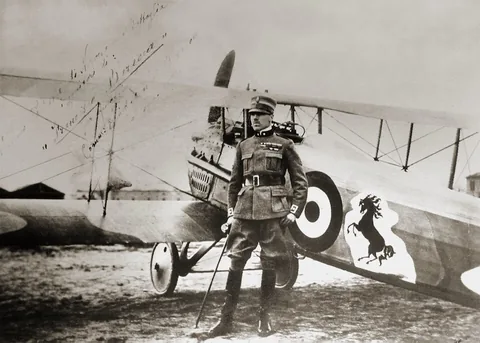
That's an official endorsement right there.
Absolutely. Oh, absolutely. So here we are now. Enzo is launching his, his Scuderia, his stables, you know, his horses. And he knows that this is the moment to put the gift to use as the Scuderia's logo. It's perfect. Stable horses. But it's more than that. This man had been a national hero. Everybody in Italy knows him and knows the symbol. And Enzo has had it bestowed upon him, not just with, you know, his mother's blessing, but with the explicit direction to put it on his race cars. So Enzo takes the prancing horse. He places it within a yellow shield, yellow being the city color of Modena, with the three colors of the Italian flag above. This is just a genius marketing move. The prancing horse reflects both the Scuderia and links Enzo and the team to this national hero. The shield reflects his intention to do battle on the racetrack, and the Italian colors reflect the ultimate ambition to establish this team, this company, and its future cars as the Italian national team, and sports car company. So in our research, I spoke to Luca di Montezemolo,32Luca Cordero di Montezemolo (born 1947) — chairman of Ferrari from 1991 to 2014, and also chairman of Fiat from 2004 to 2010. the legendary Ferrari chairman who would ultimately succeed Enzo, and really in many ways be his heir, as we will tell in this story.
Important to note, different Luca, than the Luca who wrote the book, David, that most of this narrative is based on.
And I asked Montezemolo, you know, you knew Enzo probably as deeply and as well as just about anybody who's still alive today. And there's this kind of popular legend that Enzo was just a racer. He only wanted to race. He didn't really care about business or road cars, and all the road cars only existed to fund his racing activities.
Oh, this is the biggest thing about people today. When I say, oh, we're doing an episode on Ferrari, they say, oh my gosh, yeah, it's such a crazy story because, you know, Enzo really just wanted to race cars and he built this car company. But really, that was just sort of to finance the racing. And he doesn't even care about those road cars. He's not really a business guy. He just wants to make great cars with great engines and send them racing.
Completely false. Montezemolo confirmed when I asked him. Enzo was a natural-born entrepreneur and marketer. He really was Italy's Steve Jobs in every aspect. I mean, think about it. What was Steve Jobs? Steve Jobs was not an engineer. He was a marketer, the same as Enzo. Enzo is not an engineer. He's not a car mechanic. He can't build the cars himself.
But they both had a sort of understanding and deep appreciation for the technical things that enabled their visions to be possible.
Yes. Enzo would say about himself when asked that, you know, he's not an engineer, he's not a car designer. He's no longer a driver, even though he runs this team. He is, quote, an agitator of men.33An agitator of men — in Italian, Enzo called himself agitatore di uomini; the full version was "of men and ideas." And that perfectly described Enzo. And I think, you know, perfectly describes Steve Jobs too. Yep. So if you think about it, what is Enzo doing here with the brand that he's building? There's the prancing horse. And then what's the other famous, you know, visual symbol associated with Ferrari? The red Ferrari red, Rosso Corsa, that he adopts34Rosso corsa ("racing red"). In early international racing, cars were painted in national colors: Italian ones red, British ones green, French ones blue, German ones white and later silver. here. And sure, you know, Ferraris are red because red was the assigned national racing color of Italy. But come on, Enzo is the one who embraced it and imbued this Rosso Corsa with so much more than just the national racing color of Italy. It's not Alfa Romeo's colors. It's Ferrari's colors.
Right. When you draw a picture of a race car today, let's say you're 10 years old, you're coloring it red and you're coloring it red because that is Ferrari red.
Yes. And what does red represent? It's passion. It's blood. It's desire. It's all of this that is all deeply wrapped up into a Ferrari. I mean, just look at Italy's other luxury supercar company today, Lamborghini.35Lamborghini — the supercar maker from Sant'Agata Bolognese near Bologna, founded by Ferruccio Lamborghini in 1963; part of the Volkswagen group through Audi since 1998. You know what their colors are? Not red. In fact, their color is every color but red because Ferrari has co-opted it. So back to the Scuderia here. After a couple of years, in 1933, the golden opportunity arrives for Enzo. Alfa Romeo finally decides that it is going to disband its official racing team entirely and designate Scuderia Ferrari as its official racing operation in all races all across the globe. So Enzo 'acquires' the entire Alfa operation—engineers, mechanics, everything. And his dream has come true. He is not only Alfa Romeo's official racing team. But by this point in time, Alfa had been nationalized by the fascist Italian state, by Mussolini.36Nationalized — Mussolini's regime set up the state holding company IRI (Istituto per la Ricostruzione Industriale) to rescue industry ruined by the Great Depression. Alfa Romeo came under its control in 1933. So he is Italy's official national racing team. There's just one problem, though, which is that Alfa got out of the racing business for a reason, because Hitler is coming to power in Germany. And one of Hitler's most, you know, kinda important national agenda items is making sure that his German auto industry is the best and that he proves it on the racetrack, just like, you know, the Olympics. So throughout the rest of the 1930s, the German state is supporting Mercedes and Auto Union, which would go on to become Audi today.37Auto Union was formed in 1932 by merging Audi, DKW, Horch and Wanderer; the four rings of the Audi badge come from it. The German racing cars of the 1930s were nicknamed the "Silver Arrows" for their color. And their cars are just dominating European Grand Prix racing.38Grand Prix racing — before the Formula 1 World Championship began in 1950, this was the name for the top circuit races for single-seat cars. So Enzo and Ferrari are like sent out there, you know, by Alfa and the Italians to compete. But it's a fool's errand. And so in 1938, Alfa and Mussolini, kind of fed up with losing, they actually acquired the Scuderia Ferrari and remake it, you know, as part of Alfa Romeo39Part of Alfa Romeo: from January 1, 1938, Alfa's racing was run by a new division, Alfa Corse, which absorbed the Scuderia, with Enzo as its manager. into this official sort of government entity.
So they decide actually we do want to put resources behind this. And now you're kind of the only game left in town since we shut down the other operations.
Yeah, I mean, at the end of the day, this is just rearranging deck chairs because the war is coming. So the very next year, Hitler invades Poland and World War II begins. Needless to say, European automobile racing is on hold indefinitely. During this period, Enzo gets into a fight with Alfa Romeo management and manages to get himself fired.
ExplainerThe Scuderia before Ferrari: 1929–1947
- 1929. At a dinner in Bologna on November 16, Enzo finds money from Augusto and Alfredo Caniato, heirs to a textile business, and from the wealthy amateur racer Mario Tadini. Scuderia Ferrari in Modena enters private drivers in Alfa Romeo cars; at its peak more than forty drivers raced for it.
- 1933. Short of money, Alfa Romeo shuts down its works team. The Scuderia gets the latest Alfa Romeo Tipo B race cars and in effect becomes the works team; Tazio Nuvolari, Achille Varzi and Louis Chiron race for it.
- 1935. The Scuderia's workshops build the Alfa Romeo Bimotore, the first car with the Ferrari badge on its radiator cowl.
- 1937–1938. Alfa Romeo buys out the Scuderia and from January 1, 1938, hands its racing to its own Alfa Corse division in Milan, with Enzo in charge.
- 1939. Enzo is fired. Under his agreement with Alfa he can't put his name on cars for four years, and he founds Auto Avio Costruzioni in Modena.
- 1940. AAC builds two 815s for the Mille Miglia, the first cars made entirely by Enzo, but without his name.
- 1943–1947. The factory moves to Maranello and is bombed in November 1944 and February 1945. On May 11, 1947, the 125 S, the first car bearing the Ferrari name, debuts in Piacenza, and on May 25 Franco Cortese gives it its first win, at the Rome Grand Prix.
Yeah, this is 1939. He cares about one thing and that's auto racing. It's just not the strategic priority for Alfa Romeo as a company or for the country. And so I think this, this friction kind of leads to it. The crazy thing is his separation agreement. I think he got paid to, to leave. But yes, you know, he—it's a firing—forbids him for 4 years from a) building cars to race them and b) using the name Ferrari associated with a racing team or a car builder. Like, he lost the rights to his own name for 4 years.
Well, I mean, you know, he gave them up to the Italian government, essentially. So speaking of which, during the war, Enzo creates a new company to feed the Italian war effort that he names Auto Avio Costruzioni, Auto and Aviation Construction. Which is funny. He sneaks that auto in there because-
-not really supposed to be building cars and racing them, but like, I'm doing other stuff too. It's not called 'Ferrari'.
It's not called 'Ferrari'. But this same company is better known today as Ferrari Società per Azioni, or Ferrari SPA, the Ferrari joint stock company that is publicly traded on the New York Stock Exchange under the ticker RACE.40RACE — Ferrari's stock ticker. The company listed on the New York Stock Exchange in October 2015; in January 2016 its shares also began trading in Milan.
Yes, best stock ticker ever.
Best stock ticker ever. Indeed. So what is this company doing? They're not making cars, even though auto is in the name.41Not making cars — still, in 1940 Auto Avio Costruzioni did build two race cars, the AAC 815, for the Mille Miglia. They couldn't race under the Ferrari name. They're making machine tools, in the workshops and, the essentially factory that Enzo has created there in Modena. And on each tool, throughout the war effort that they make, Enzo has them stamp the prancing horse, and the word Scuderia Ferrari Modena, clearly signaling his intentions after the war of, you know, what he's going to do.
I bet those are some very valuable collector's items if you can find them.
So anyway, Enzo and his factory are pretty good at making these machine tools and they become part of the war effort. So as the war wears on and the Allies push into Europe, Enzo and the government start to worry about them bombing the factory in Modena.
04Maranello, Chinetti and Le Mans
After the war Enzo returns to cars and creates something no one else had: a racing team, a race car constructor and a service operation for private clients under one roof.
So in 1943, he decides that he's going to move all of his operations out to a small little town in the countryside to avoid the bombing. He's going to go about 15 kilometers south of Modena to Maranello. And that's why Ferrari, to this very day, is in the small little hamlet of Maranello, not in the bigger city of Modena.
Yep.
So even despite the move to Maranello, the factory does get bombed twice during the last days of the war. After the war, that leaves Enzo kinda at a crossroads. The factory's not quite in ruins, but it's in— you know, it's been bombed.
Disarray. Significant disarray.
Disarray. And he's just spent the last 4 or 5 years building machine tools and gotten pretty good at it. And then Enzo gets a visit from an old racing pal, an Italian but one who spent the war not in Europe, but in exile in America. Luigi Chinetti, the man who brings Ferrari to America.42Luigi Chinetti (1901–1994) — Italian racer and mechanic, a three-time winner of the 24 Hours of Le Mans (1932, 1934, 1949); his last win came in a Ferrari 166 MM. He later became Ferrari's official importer in the US. So Luigi and Enzo met way back when Enzo joined the Alfa Romeo racing team as a driver, and Luigi was a mechanic on the team who also then became a driver, and he ends up in New York. And when the war is over, Luigi goes back to Italy to visit Enzo, and he tells him about America. So this is a quote here from Brock Yates's biography of Enzo. Brock Yates was the longtime editor of Car and Driver magazine.43Brock Yates (1933–2016) — American motoring journalist, longtime editor of Car and Driver and creator of the Cannonball cross-country race. His biography Enzo Ferrari: The Man, the Cars, the Races, the Machine came out in 1991. "Chinetti described the miracle that was America, the aggressiveness of its people, their childlike acquisitiveness, and their bourgeois credulities. Yet there was a rich upper class whose tastes were European. He had seen them, met them, gained their trust as he kept their aging European automobiles operating through the war years. He knew they would pay a king's ransom for Enzo's elite machines. And he, (Luigi Chinetti), meant to exploit that naive colonial lust."
What writing!
What writing! Enzo...agrees. Now, legends would say later, and Luigi, I think, would probably perpetuate this himself, that Luigi is the one who convinced Enzo to abandon the machine tools business and focus only on cars again after World War II. That's false. Enzo was planning to anyway. There's no way that he really was gonna go into machine tools.
I mean, by 1943, his non-compete44Non-compete — Enzo had agreed not to use the Ferrari name for four years after leaving Alfa Romeo in 1939. is up and he's allowed to use the name again. And so, you know, the clock's ticking.
The clock's ticking. But it is true. Luigi definitely convinced Enzo about America. And America was critical for Ferrari.
And you know what wealthy Americans are extremely interested in when they're considering if they're going to buy an extremely expensive, rare automobile? They love that cold shoulder of an artist, creating the car mysteriously in some small town in Italy who's just interested in racing. He's not interested in mass market cars. You're just lucky to get one of these racing cars and he couldn't even care less about you.
Oh yeah. Oh yeah.
That sells cars.
And boy, does Enzo know it.
Yeah, he totally leans into this. This is like part of the perpetrating of the myth. This is why everybody believes, oh, he wasn't really a businessman. He just wanted to race cars.
Yeah. I mean, oh, he, the whole persona of Enzo Ferrari, you know, the dark sunglasses.
Oh yeah. What's the tidbit you got on the sunglasses?
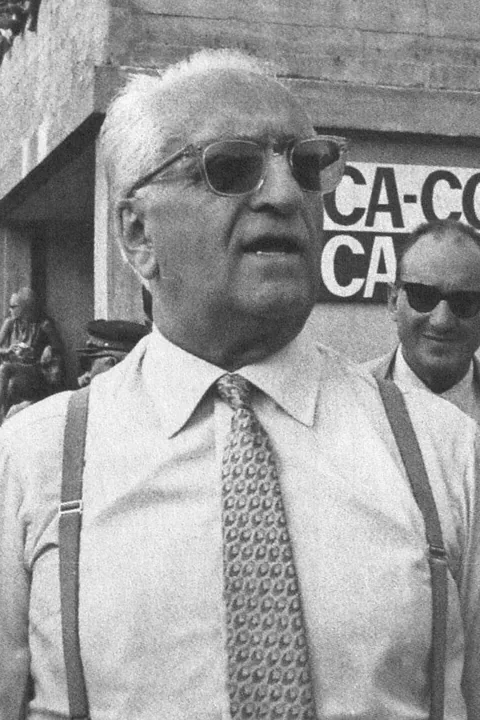
It was an act. You know, we would wear the sunglasses in public and in, you know, press interviews and in meetings with clients or whomever. And then everybody else would leave the room and he'd just take them off and put them on the table. He didn't wear sunglasses all the time, only when crafting his image. But yeah, he leaned into it. So one way or another, machine tool business is out the window, and Enzo is back in cars. 1947 is the first year that they get going with the newly renamed Auto Costruzioni Ferrari. Now that he can use the Ferrari name. In 1947, they build 3 cars just for team racing, just for the Scuderia, in which during the year, they enter 14 races and win 7 of them. Pretty good. 50% win rate for, you know, the newly rebuilt Scuderia Ferrari. They didn't sell any of those cars.
Yes. Enzo Ferrari, to this point in history, has not sold a car yet.
And how old is he, David?
He is, in 1947, he's 49 years old.
I mean, this is like this great classic sort of founder myth of the young hotshot who starts this thing. Ferrari, yes, it's a racing team, but it is a car company who sells cars to consumers. And by age 49, Enzo had never done that.
Yes. Now he has established the brand and the myth and put all the pieces in place to create Ferrari. But yes, he did not sell a single car to a customer until 1948 when they introduced the Ferrari 166 Barchetta45166 — the displacement of one cylinder of the V12 engine, in cubic centimeters. MM stands for the Mille Miglia, the famous Italian race on public roads, and barchetta is Italian for "little boat." at the Turin Motor Show. And Luca Dal Monte in his biography writes, for Enzo Ferrari, the 166 MM Barchetta was a declaration of intent, a sports car with a sensual shape, as fast and powerful as it was beautiful and elegant. It was the foundation on which from that moment on, he would build every road model. Cars capable of winning races on circuits and roads all over the world, and at the same time, being the protagonist of the most prestigious concours d'élégance46Concours d'élégance — a show where judges rate cars on looks and condition. The tradition goes back to 17th-century Parisian aristocrats who drove out to the parks on summer weekends to show off their carriages. in the four corners of the earth. What a great description of what a Ferrari is.
Absolutely. Enzo is really figuring out how to create desire here.
Yes. Yes. These machines are beautiful. And they're deadly. That is the point. You can enter them in a race. You can be competitive. You might even win, as we see in a second. And you can drive them around town and look beautiful and elegant when they work.
Yeah. The Ferraris in this era in history that we're talking about here, you know, the late '40s, '50s, the '60s, these were not the most reliable machines, especially the road cars.
I think you could also lump in the '70s and the '80s, large chunk of the '90s.
I mean, there's this fascinating thing about luxury that reliability is not actually a relevant part of the equation of how desirable, how much do I lust after this machine?
I think it's from the luxury strategy book,47The Luxury Strategy (2009) by Jean-Noël Kapferer and Vincent Bastien — a book on how managing a luxury brand differs from ordinary marketing. Its core is 24 "anti-laws of marketing." Anti-Law of Marketing number something or other, is ensure that your product has enough flaws.
Yes!
Boy, do Ferraris have a lot of flaws.
Yep. So this first Ferrari, the 166 Barchetta, they produce about a dozen of them that year in 1948, both to race themselves with their own team drivers and also sell them to wealthy private clients. Two of the very first models are sold to American clients through Luigi Chinetti. One to Tommy Lee, who is a wealthy Cadillac dealer in Los Angeles. And one to Briggs Cunningham,48Briggs Cunningham (1907–2003) — American racer and yachtsman who drove at Le Mans and in 1958 skippered the yacht Columbia to victory in the America's Cup. His fortune came from his father, a Cincinnati financier and one of the early investors in Procter & Gamble. who is one of the Procter Gamble heirs. Ah, you get a sense of like, who are the customers in America.
Right, they're setting the precedent.
Others are sold to various European racers and nobility, including Italy's own most celebrated industrialist, Gianni Agnelli,49Giovanni "Gianni" Agnelli (1921–2003) — grandson of one of Fiat's founders, head of the company from 1966 to 1996 and the most influential industrialist of postwar Italy. the patriarch of the Agnelli family, which owns Fiat. Some might say the Henry Ford of Italy.
The founding family of Fiat. Not only the owners, but the founders. He was one of the first Ferrari customers?
He was indeed. He bought a 166 Barchetta.
That's an amazing full circle. Poetic. We'll come back to that at the end of the story.
Oh, yes, we will. So then the next year, Luigi Chinetti, he's a real believer in the potential of these machines that Enzo is building to make a lot of money and generate a lot of desire. So he takes one of the 166s and he enters it in the first running of the 24 Hours of Le Mans5024 Hours of Le Mans — the endurance race held near the French town of Le Mans since 1923: several drivers take turns driving one car for a full day. One of the most prestigious races in the world. On June 26, 1949, Luigi Chinetti and Lord Selsdon’s Ferrari 166 MM took the checkered flag at Le Mans.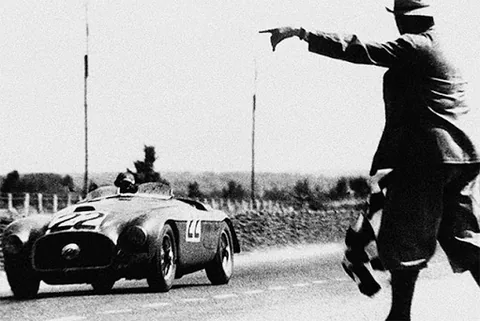 to be run after World War II, the first, you know, postwar running of Le Mans. And the car that he takes— Enzo doesn't think the 166 is ready for Le Mans. He doesn't want to enter. But Chinetti says, no, no, I'm going to go do it. So he takes a privately owned car owned by the British nobleman and gentleman driver Lord Selsdon.51Lord Selsdon — the British aristocrat Peter Mitchell-Thomson, 2nd Baron Selsdon. He bought this 166 MM after its win in the 1949 Mille Miglia; at Le Mans Chinetti drove almost the entire race, with Selsdon relieving him for only about an hour. And they win. They win Le Mans.
Oh, wow.
Like the whole thing.
Not endorsed by Ferrari the company, just a sort of gentleman driver.
It is the first major international race victory for a Ferrari car, but it's not run by the Ferrari team. So this is a big deal. This is the first time it's being run after the war. And here's this startup Italian— I mean, startup— everybody knows the heritage of Enzo Ferrari and who he is. But here's a Ferrari winning. And it's like the perfect illustration of the business model and Enzo's entrepreneurial genius. You know, he's got the brand. It's the Ferrari that won, but it doesn't even have to be his own racing team.
Right, oh, that's interesting. It creates just as much consumer desire for those cars, whether it's him entering the competition or not.
All anybody knows and all anybody in America definitely knows is a Ferrari just won Le Mans. And man, I got to get my hands on one of those things.
And it really validates the engine. I mean, this is famously Enzo Ferrari's reputation is he was an engine guy. He's got a few sort of great quotes on this. His comment is, I sell engines and the car I throw in for free.
Yes, such a great quote.
Another great one. Aerodynamics are for people who can't build engines.
That's like that one, the AMD guy, Real Men Build Fabs.52"Real men have fabs" — a line attributed to Jerry Sanders, cofounder and longtime head of AMD. In 2009 AMD spun off its fabs anyway, into a separate company, GlobalFoundries.
Yes. Yes. Eventually Ferrari would become very much about aerodynamics, in addition to engines.
Yes. But we know where Enzo's heart always was.
Yes. He also famously was a late adopter of new technology. This is very, very different today. But in the early days, I mean, we're going to talk about Formula 1 here shortly, but in those early days of F1, other teams figured out, hey, you should probably move the engine to be a mid-engine,53Mid-engine layout — the engine sits between the axles, behind the driver. In Formula 1 it was proven by Britain's Cooper: in 1959 and 1960 its rear-engined cars won Jack Brabham two titles, and by 1961 every car on the grid was built that way. Ferrari was the last to switch. sort of above the rear axle. Not in the front of the car. And Enzo is very, like, he's biding his time. He's like, well, wait and see. And he's got this idea that in a carriage, the horse pulls the carriage.
Yeah, God put the horse in front of the carriage. So the engine's going in front of the car.
Surely the engine should be in the front. Yes. And it took years to adopt the sort of correct, most balanced way to do it, because he not only wanted to be a late adopter of technology to sort of let other people prove it out. But also because he was in a position to do so as a very early sort of luxury pioneer here. He realized that it only helped build the Ferrari myth. To talk about the old ways of doing things.
This is the point. It's all about the myth building. Enzo knew exactly what he was doing.
He even— there's funny entries in the historical record here where in the same month that Enzo is out there talking about how the engine belongs in the front of the car, In Maranello, there are teams who are constructing next year's mid-engine car. So say one thing, do the other.
Yes. Yes. Very Enzo. It's worth a moment here to talk about what actually is Ferrari at this point in time after Le Mans and when they're selling the 166, because it's pretty pioneering. It's 3 separate things all under the same roof. It's its own professional racing team. It is a world-class racing car constructor that builds cars both for its own team and for private clients. And it's also all of the support infrastructure that you need to do both of those things. So it's not like Chinetti and Lord Selsdon could just buy a 166 and drive it up to France and like enter Le Mans. You got to tune these things for the race. That you're driving, and Ferrari is providing that for his own team and for his clients. This is pretty revolutionary. Nobody else had really created something like this before. You know, other car manufacturers, as we talked about with Alfa or Mercedes or even for a point in time, even Fiat had their own racing teams, but they were separate operations. Like, think about the Mercedes racing team today. You know, it is a completely separate operation.
Yes. Or most of the F1 operations today that carry the name of a constructor54Constructor — in Formula 1, a team that builds its own chassis; hence the Constructors' Championship, the team standings, contested since 1958. of a car brand. They're actually separate companies that happen to be owned by—
Yeah, separate locations.
Yes.
The whole thing. Like, yes, there is some tech transfer, I'm sure, from the Mercedes F1 team to AMG performance cars,55AMG (Mercedes-AMG) — the Mercedes-Benz division in Affalterbach that makes the most powerful versions of its cars. The Mercedes Formula 1 team is based in England, in Brackley and Brixworth. but like, it's a tenuous connection.
Whereas in Maranello, they're sitting there on the same plot of land.
For many decades. The early history of Ferrari, it's the same people. Same people making the same cars under the same roof. Pinnacle of motorsports, road cars that you can buy, built and maintained and serviced by the very same people. That is an incredible proposition as a client. I mean, and if you think about it, it's really not that different from any other luxury company heritage out there, like Thierry Hermès56Thierry Hermès founded Hermès in Paris in 1837 as a harness workshop making tack for carriages; the house has made bags since the 1920s. and his sons making saddles for the nobility and the new haute bourgeoisie on the boulevards in Paris, and also making saddles for the jockeys jumping and racing on the weekends. They're the same people making the same saddles. Enzo and his team are the same people making the same cars.
But I think you nailed this point that I think is a little bit lost today, which is even then in 1950-ish, you're not just going to go buy a Ferrari and then race it. This is a highly maintained, serviced thing that is not just like a product that you own. It is a bundle of product and services that get it ready for any given situation.
Yeah, we joked earlier about the, you know, you could drive these things on the street when they worked. That was part of the point. Like, they were built to be racing machines. Right. And a lot of clients didn't race them, or, you know, if they did race them, race them not very well. But the point was you could. This was a weapon. This is not a mode of transportation.
That's a trade-off clients were intentionally willing to make. This is not the most practical car. It's gonna have all sorts of issues if I want to use it as my daily driver. But it's an amazing race machine. And because I race, or maybe not because I race, I want to own a race machine. And so I'm buying it, trade-offs and all.
05Formula 1 and the tragedies of the 1950s
In the 1950s Ferrari builds some of the most beautiful cars ever made while losing drivers, an heir and spectators, and the tragedies, David argues, only make it more coveted.
Yes. Yes. So then in 1950, the pinnacle of motorsport arrives. The new Formula 1 World Championship57Formula 1 — the top class of open-wheel circuit racing; the "formula" is the set of technical rules every car must meet. The first World Championship race was held on May 13, 1950, at Silverstone. Series, as we talked about at great length on our Formula 1 episode. And Ferrari, of course, would become one of the founding teams and the only F1 team continuously operating from the beginning of the sport all the way through to today. But of course they are participating in the pinnacle of motorsport, as we've just been talking about, is integral to what Ferrari is. And if you buy a Ferrari as a client, what you are buying is a direct connection to that ongoing heritage in a way that you are not with any other auto manufacturer
At least not at this point in history.58At this point in history — Ben's riff on David's signature "at this point in time." In 1950, there have been many others who have tried that strategy since, obviously less successfully than Ferrari, and we'll talk about why. But yes, this is the Ferrari formula that they uniquely execute well on.
Yep. So as we continue the operatic life of Enzo Ferrari here, the reentry into the racing business and the new pinnacle of motorsport in Formula 1 unfortunately comes with renewed tragedy. Enzo would hire the young Alberto Ascari, who is the son of one of his two mentors who died when Enzo was racing for Alfa Romeo. And Enzo would take Alberto under his wing, treat him almost like a surrogate son. Until in 1955, Alberto is killed practicing in a Ferrari at Monza59Monza — the Autodromo Nazionale Monza near Milan, built in 1922; home of the Italian Grand Prix. at exactly the same age that his father died.60Alberto Ascari won the 1952 and 1953 world championships with Ferrari, the team's first titles. By 1955 he was driving for Lancia; he was killed at Monza on May 26 when he decided to take a few laps in a friend's Ferrari sports car, Eugenio Castellotti's. His father Antonio was killed at the 1925 French Grand Prix, also at 36. And Enzo vows that he will never become emotionally close to a driver again. He's witnessed too many deaths in his life. But unfortunately for Enzo, death during this time was only just beginning to reenter his life and his company.
And the next death is really the one that kinda defines the rest of his life going forward.
AdLegora
But before we continue this beautiful tragedy of Enzo Ferrari and his company…
All right, listeners, now is a great time to talk about one of our favorite companies, Legora, the agenticdLegora — a Swedish company founded in Stockholm in 2023: an AI platform for lawyers. In 2024, still called Leya, it went through Y Combinator; its main rival is America's Harvey. operating system for legal work.
Yes. Most of you have dropped a contract into a chatbot by now, but as a lawyer, how far can that really take you? It's never seen your firm's precedents. It doesn't respect confidentiality, and you can't check where its answer came from.
So Legora's founders approach this the way that great founders do. Early on, the team moved into the office of a big law firm in Stockholm and learned for months how the work actually gets done. A couple of thousands of enterprise customers and a hundred thousand users later, they still work that way. They employ a hundred legal engineers on staff. These are lawyers sitting inside of firms and legal departments to deploy Legora onto live situations, like the deal closing this week or the policy review due Friday.
The product has gotten very powerful in a short period of time. A year ago, the goal was a good answer from a chatbot. With the Legora agent, you hand it the work and it comes back with a plan. Tasks like running diligence on a data roomeDue diligence — checking a company before a deal: its finances, contracts and risks. A data room is the secure repository where the seller puts the documents for that review. or reviewing a new vendor contract get completed inside the tool you use every day, like Microsoft Word, and against your own precedents and playbooks. Every finding is sourced, the lawyer directs the work and signs off before the system executes any steps.
Every legal team can get access to the same AI models, so the models themselves do not give you an edge. What you can do with your own data, people, playbooks, that's the whole game.
Today, over a hundred thousand legal professionals at more than 1,800 law firms and in-house legal teams in over 50 markets use Legora. And when Legora goes head to head with its top competitor in a pilot, it wins 70% of the time.
A demo is one thing, but what matters most is an associate who reaches for it at two in the morning during a closing, or whether a general counsel trusts what it says before the board meeting. So if your legal team wants to check it out, whether you're at a firm or in-house, go to legora.com/acquired and be sure to tell them that Ben and David sent you.
All right. So here in the 1950s, the truly, truly beautiful and truly, truly tragic opera of Enzo and Ferrari continues. First, let's talk about the beauty— the Ferrari 250 Series,61Ferrari 250 — a family of models from 1952 to 1964 with a three-liter V12, including the 250 GT California, the 250 Testa Rossa and the 250 GTO. which for some of you means a lot. For the rest of you, we're talking about the Ferris Bueller car.62Ferris Bueller's Day Off (1986) — John Hughes's comedy. The characters joyride in a 1961 Ferrari 250 GT California Spyder; the cars on screen were replicas. Undeniably one of the most beautiful automobiles ever manufactured.
But David, did you know it is the Ferris Bueller car, but the car you see on screen is actually not a Ferrari?
Yes, it's a replica. And Ferrari sued the replica maker after the movie, right?
That's right. Believe it or not, it is essentially a retrofitted Ford.
Yes. Deeply ironic given what we are going to talk about in a minute here.
And then there's a second version of it that I think is even a less real drivable car that they used when it slid out the glass and fell down and smashed on the ground. So they did not wreck a real Ferrari. In fact, there is not even a real Ferrari in camera in that entire movie, or at least in that shot.
Yes, you don't need to worry. No 250s were actually harmed in the making of Ferris Bueller's Day Off. Yep. So as we talked about, the first Ferrari that Enzo sold to clients was the 166, but less than 100 of them were ever made.
Which must mean that there was demand for 101 because there's the famous Enzo Ferrari quote that is the business strategy today. Ferrari will always deliver one car less than the market demand.
I think that actually might be the strategy today. Back then with the 166, there was demand for a lot more than 101. But they could only make 100. So in 1952, Ferrari comes out with the 250 series. And this is the first real production Ferrari. And over the next set of years throughout the '50s, Ferrari manufactures a few thousand of them. So, you know, still a very, very boutique, you know, essentially handmade sports car manufacturer, but a lot more scale than the 100 or so.
Yeah, real production volumes.
Yeah. And as we were alluding to earlier, this car is just stunning. No matter which variant of it you're looking at it, the, the one in Ferris Bueller's Day Off is a 250 GT California. It is truly, truly beautiful. And it was designed not by Enzo Ferrari, or even anybody who worked at Ferrari. It was designed by Battista Pinin63Battista "Pinin" Farina founded his coachbuilding firm in Turin in 1930. Pinin is Piedmontese dialect for "the little one": he was the tenth of eleven children. In 1961, by decree of the Italian president, his surname was changed to Pininfarina, and the company was renamed too; since 2015 it has belonged to India's Mahindra.— was his nickname— Farina and his Pininfarina coachbuilders. So remember earlier when we talked about Enzo's first business venture was he was going to be a coachbuilder? Turns out that was not his calling in life, but that was the calling in life for Pininfarina. He was basically the Michelangelo of car body coachbuilders, and Enzo totally realized it, totally glommed onto it, and built this beautiful partnership with Pininfarina— first Battista himself, and then his son Sergio, and then multiple generations— that lasted 61 years. This was a multigenerational partnership that lasts all the way up until 2013.
The LaFerrari?
The LaFerrari Halo car64LaFerrari — the hybrid hypercar unveiled at the 2013 Geneva Motor Show: the first Ferrari flagship designed not by Pininfarina but by the company's own design center under Flavio Manzoni. 499 coupes were built. was the first fully in-house designed Ferrari. And during those 61 years, I believe every single road-going production Ferrari except for one,65The exception — the Dino 308 GT4 (1973): it was drawn by Marcello Gandini of Bertone, Pininfarina's rival, and Pininfarina took it as a betrayal. I think, was designed by Pininfarina.
Wow. It's quite the run.
It really is. So Luca Dal Monte in his book writes, Enzo was looking for someone who could complement the mechanics of his cars with their body designs. Body and engine, elegance and power had to go hand in hand and had to be born and grow together. He said that he was not looking for a tailor, but for a coachbuilder who worked at his side and conveyed in the shape of the body the power and philosophy of his cars. The coachbuilder, he said, must be involved from the beginning of the project not merely called upon to dress a finished project. It really was a partnership between Enzo and Pininfarina.
As much as Enzo would kinda make noise about, oh, I just make engines and then, you know, we slap some aluminum on. I don't really care what the aluminum is. No, these things were thoughtfully designed and built hand in hand.
Yeah. Pininfarina was like the Jony Ive66Jony Ive (born 1967) — British-American designer who led design at Apple from 1997 to 2019: the iMac, iPod, iPhone, Apple Watch; Steve Jobs's closest collaborator. to the Enzo Steve Jobs.
That's a great analogy.
And in fact, Jony Ive is gonna come back into the story later, as we shall see. It's probably also worth a quick moment here to talk about the sort of Italian nature of beauty and luxury versus the French nature of beauty and luxury that we've covered on Hermès or LVMH.67Hermès and LVMH episodes: Acquired covered LVMH, Bernard Arnault's luxury conglomerate, in early 2023, and Hermès in February 2024. In both cases, French luxury and Italian luxury, what you are buying when you are buying one of these products is a mixture of craftsmanship, and a dream that it represents. But the sort of nature of those two ingredients are different between French and Italian luxury. The primary ingredient in French luxury is the dream, and specifically the dreamlike connection to French royalty and this like mostly imagined past that, you know, if you buy a Birkin bag or if you buy a Louis Vuitton trunk,68Louis Vuitton started in 1854 as a Paris workshop making travel trunks; today it's LVMH's main brand. you too can be like the bygone French royalty.
Of the nobility. Yeah.
Yes. Exactly. Exactly. You can live that dream. You can live that life. And the beauty that's associated with that is, you know, very regal, very soft, very refined, very elegant.
And quiet. It's not yelling at you. Yes. There's no engines involved.
There are no engines involved, that is for sure. There are French carmakers, but we're not going to make any episodes about them, shall we say? Italy, though, doesn't have the same kind of history. As France. I mean, it's got like the Roman history and all that ancient history, but it doesn't have the same royal lineage and history. So with Italian luxury, the primary ingredient is the craftsmanship, and that's embodied in the design and the passion. The myth, the dream that you're buying is about reinforcing that passion, that emotion that went into the product. And the best way I can think of to illustrate this is just the centrality of the designers. Like, who are the designers at Hermès? If you really know the house, if you really know Hermès, you probably know who the designers are. But for most Hermès clients, it's just like, oh, this is Hermès. Yeah. In Italy, it's totally different. You could have Gucci, but it's like, well, which Gucci is that? Is that Tom Ford Gucci69Tom Ford — American designer, creative director of Gucci from 1994 to 2004; he is credited with reviving a brand that until then was seen as a dusty family leather goods maker. In 2005 he founded his own label, Tom Ford. or is that Gucci in the wilderness Gucci? Or name your other designer like Giorgio Armani or Donatella Versace or Valentino or Brunello Cucinelli today,70Giorgio Armani (1934–2025) founded his label in 1975 and died in Milan on September 4, 2025. Donatella Versace is the sister of Gianni Versace, founder of the house of Versace, with whom she built the brand. Valentino Garavani founded the house of Valentino in 1960 and died in Rome on January 19, 2026. Brunello Cucinelli has made logo-free cashmere clothing since 1978 and is held up as the model of "quiet luxury." like the actual people and the designers and their passion and their personality is much more central than in French luxury.
That's interesting. I'm not sure I totally agree with the distinction, but a thing that I will say is you go to Paris to absorb the history and look at the fine museums, and you go to Italy to feel something.
To live the good life.
To let loose, to live your life in the fullest, to let your hair down. I mean, it's a whole different side of life they are asking you to embrace. When you are doing something distinctively Italian.
Yes, it is a very different kind of thing. And in this era, right after World War II, the greatest designers and the greatest innovators in Italy were the car designers.
And these are death machines.
Totally.
You're on the edge. You're living every ounce of life that you possibly could to the fullest. These are death machines and they are being designed by the era and the country's most esteemed designers.
Yes, yes. They are beautiful death machines beckoning to risk it all. That is exactly on point. And thus comes the yang to the yin of beauty, which is this tragedy and death that is such a part of Ferrari and motorsport. So we talked about in 1955, Alberto Ascari, the sort of, you know, surrogate son, if you will, to Enzo, was killed at Monza. The very next year, in 1956, Enzo's own son Dino, who he's been grooming to take over the business—
He's the heir.
Continue the family lineage. His heir, his actual heir, dies at age 24 of muscular dystrophy.71Alfredo "Dino" Ferrari (1932–1956) died of Duchenne muscular dystrophy on June 30, 1956. Shortly before, he had suggested to his father building a 1.5-liter V6; Enzo named the cars with that engine Dino in his honor. So not in a race car, but a horrible, tragic disease.
I mean, and that's even more tragic.
Yeah. It's more romantic if he had died in a race car.
And Enzo has spent 24 years since Dino's birth keeping him safe. I mean, doing everything that he can control in his worldly power to not be around race cars.
Yes. Yes. It's such a great point.
I mean, he's not racing them. He's trying not to have Dino race them. He's not meeting the drivers anymore. He's trying not to get too wrapped up in the lives of the drivers. And yet his son is still taken from him in this horrible illness that he cannot control and is pure randomness and awfulness.
That's a great point. And it is truly shattering for Enzo. This is the shattering event among many shattering events in his life. Because it's, of course, the grief for his lost son, but it's also the grief for his empire. Like, it's gone. He has no heir anymore. The line won't continue. So, after Dino's death, Enzo stops going to races. It's sort of like a self-inflicted punishment that, you know, if Dino can't be here with me to go to the races, then I will no longer travel to and go to the races, to my great, terrible joys.
And it is both the end of his family line, or so he believes at this point in history, but also it's the end of sort of the inherited company that this is an old school era of capitalism where the company would be passed down through the male heir in the family. I mean, today Ferrari is a publicly traded company with multiple families and owners and parent companies and holding companies involved. Enzo's assumption here is that none of that is gonna happen in the far future. It is that Dino, my son, will own it and his descendants will own it.
Well, if you know anything about the, the shareholding structure of Ferrari today or its board of directors, you might say, wait a minute.
There sure is a Ferrari who owns it.
Yeah. Isn't there a current member of the Ferrari board of directors named Piero Ferrari who owns 10% of the company and is also the biological son of Enzo, who very much would have been alive at this time? So Enzo had an affair. Enzo had many affairs, but one of his affairs with a woman named Lina Lardi produced a son, Piero. And the just devastatingly cruel reality of Italy in that time and place is that illegitimate children by law did not exist. They were invisible. Piero was invisible at this point in time. So Enzo knows he has this other son whom he loves, but who will never inherit his empire.72Piero Ferrari was born in 1945. Enzo formally recognized him only after the death of his wife Laura in 1978, and Piero then took his father's surname. Today he owns about 10% of Ferrari and is the company's vice chairman.
And when you say invisible, he certainly isn't a Ferrari. Not taking that surname. Divorce was illegal at this point.
Yes, divorce was not legal in Italy until the 1970s.73Divorce in Italy was legalized by the Fortuna–Baslini law of December 1, 1970. Opponents forced a referendum on it in 1974, and about 59% of Italians voted to keep it.
So in the eyes of the law, like, not an heir. Not capable of being an heir.
A tragedy is the only word that I can think of to describe it. So that was 1956. And then in 1957, at the Mille Miglia race in Italy—
Which this race, this is this amazing, legendary race through Italy that ran 1,000 miles.74Mille Miglia (Italian for "thousand miles") — a race on ordinary roads around a Brescia–Rome–Brescia loop of about 1,600 km. Since 1977 it has been run as a leisurely rally for historic cars built before 1957. And it runs from 1927 to 1957. It is beautiful and bloody. Yeah. There is at least one death in every single year except 1927 and a small span, 1931 to 1934, and another 2-year span of '36 to '37. But basically, this was this race that everyone came out for and watched death. Yeah. And Enzo has a quote on this. He loved the Mille Miglia. He said, "It is the race of the people. One may say that the whole of Italy leans forward with her eyes on the tarred strip of road somewhere along the course on Mille Miglia Day. It is a day when I feel that my life is useful."
Hmm. Wow. I didn't realize that this 1957 race is the last one.
It is the last one.
ExplainerGuidizzolo: Enzo on trial and the end of the Mille Miglia
On May 12, 1957, about 70 km from the finish in Brescia, a front tire blew on the Ferrari 335 S of the Marquis Alfonso de Portago on a straight at about 240 km/h. The car took out a telegraph pole, flew over a ditch and plowed into the spectators. De Portago, his co-driver Edmund Nelson and nine spectators were killed, five of them children; about 20 more people were injured.
Three days later the Italian government ended the Mille Miglia as a race and banned competition on public roads; that year's Targa Florio in Sicily fell under the ban too.
Enzo Ferrari was charged with manslaughter on 11 counts. The trial dragged on until 1961 and ended in acquittal: engineering experts told the court the tire had most likely been punctured by a road reflector, a "cat's eye."
At one of the stops shortly before the crash, de Portago kissed the actress Linda Christian, and the photo, dubbed "The Kiss of Death," went around the papers. The race and the crash are shown in Michael Mann's film Ferrari (2023).
It ends with this. Wow. So at this race in 1957, again, 2 years after the F1 crash that killed his driver protégé, one year after the death of Dino, a Ferrari flies off the road and into the crowd, killing the driver and 9 spectators, including 5 children.75The de Portago crash: on May 12, 1957, near the village of Guidizzolo, the Ferrari of the Spanish marquis Alfonso de Portago crashed, killing him, his co-driver Edmund Nelson and nine spectators. After that the Mille Miglia was banned as a speed race. And after the race, Enzo is charged by the Italian authorities with manslaughter.
Was he even at the race?
I don't believe he was at the race, no.
But he's the owner of the company that made the car, and there's a high death count.
Right. Well, it's not just that he's the owner, it's that he is the architect of this slaughter, basically, which is exactly what the Catholic Church charges him with. So not only is the Italian state, the police, you know, charging him with manslaughter, the church, the Pope comes after him. So the Vatican's official newspaper76L'Osservatore Romano — the Vatican's daily newspaper, published since July 1, 1861. It belongs to the Holy See but isn't considered an official publication. runs a story after the race with the headline of "Industrial Saturn." Saturn, of course, being the Roman god who devoured his own children. And it calls Enzo, quote, "A modern Saturn become industrial tycoon. He continues to devour his sons, as in the myth, so unfortunately in reality." Ultimately, Enzo is acquitted after long process in the legal case, and he reaches a compromise with the Vatican that he can continue racing and Ferrari can continue to sort of exist as this sort of national champion within Italy.
Oh, is this as long as they're not Italian drivers?
As long as he agrees to never hire Italian drivers, you know, basically like, you can kill young men as long as you don't kill our young men.
Brutal.
Oh, man. But all of this, this whole era, this just weighs incredibly, incredibly heavily on Enzo.
And you might be wondering, like, why do the drivers— why are they okay with the death? Why is Enzo okay with the death? Enzo viewed this as a fundamental human expression of striving. His comment is that one drives at high speeds in order to transcend oneself. And many of the drivers would sort of echo this same thing. Ken Miles, who is a very famous race car driver, actually on the Ford and Shelby,77Carroll Shelby (1923–2012) — American racer, winner of Le Mans in 1959, then a car builder (the Shelby Cobra) and head of Ford's GT40 racing program. Ken Miles (1918–1966) — British racer and engineer; at Le Mans in 1966 Ford's staged finish left him second, and two months later he was killed in testing. the US side that we'll talk about about here shortly. His quote on this is, I'd rather die in a racing car than get eaten up by cancer. And it's this idea that, look, we're gonna die, but I get to feel like I live the most life by putting my life at risk and living right on the limit.
I mean, it's kind of actually like a way of fighting back against death. Yes. These cars are weapons to fight against death. You can come right up and you can like stare death in the face. And you can hopefully say not today or, or not. So again, paradoxically, all of this tragedy is just great for business. This is part of the attraction. It only makes Enzo and his Ferraris more globally known, more romantic, more coveted. It's like for Porsche when James Dean died in the Porsche 550 Spyder,78James Dean — the American actor, star of Rebel Without a Cause; he was killed on September 30, 1955, when a Ford collided at an intersection with his Porsche 550 Spyder, nicknamed Little Bastard. or in the modern era when Paul Walker died in the Carrera GT79Paul Walker — star of the Fast & Furious films; he was killed in California on November 30, 2013, as a passenger in a Porsche Carrera GT driven by his friend Roger Rodas. that made those cars legendary, that made people want them. Yeah. And here is Ferrari. It's even more. His cars are being labeled by the Pope as forbidden fruit. If you're a young man or if you're a more accurately a middle-aged man having a crisis, like, you know, what more could you desire?
And yeah, if the Pope says you just can't do this one thing, what's the one thing you're going to be interested in doing? It's like, it's like a toddler. No, as long as you don't have candy, you can do anything you want.
Exactly. So throughout the late '50s, sales of Ferrari 250s are just ramping. You know, they are flying out of showrooms across the world and particularly in America. By 1960, production reaches 300 cars a year. You know, they're making more or less one 250 every working day. And by 1962, it's 500 cars a year. And I believe at this point, distribution is sort of roughly divided a third, a third, a third between local Italian clients, American clients, and then the rest of Europe. And production just keeps growing by, call it, 50 to 100 cars a year throughout the early '60s, and there is plenty of demand. By 1963, though, Enzo's now getting older. He turns 65. He's had all this death. He publishes his memoirs, which, you know, as we said before, are aptly titled My Terrible Joys. His plan by this point is that he'd be getting ready to hand the company to Dino, but Dino is dead. At a press conference that's held, one of the journalists asks Enzo, you know, you're older now, what will happen to Ferrari when you're gone? And he replies with the famous quote from King Louis XV in France, après moi le déluge.80"Après moi, le déluge" ("After me, the flood") — the line is attributed to Louis XV or his mistress Madame de Pompadour (as "après nous," "after us"), but no one knows who actually said it. The Revolution began in 1789, 15 years after Louis XV's death. Chaos. You know, the French Revolution. It's all coming after me. It's all going to end with me. And of course, Piero at this point is already working in Ferrari. He's an employee at Ferrari, but it's a secret that he's Enzo's son. And he knows he can never inherit.
I didn't realize it was still a secret.
06Ford v Ferrari and the sale to Fiat
Enzo blew up the Ford deal to keep the final say over racing and to signal that Ferrari was for sale, then, when illness struck, sold half the company to Fiat for very little.
Yeah. I mean, people within the company know, but it's like you don't talk about, hey, Piero is actually Enzo's son. So the question that the journalist asked remains, though. What's gonna become of the company, right? Well, enter the Ford Motor Company and Ford versus Ferrari.
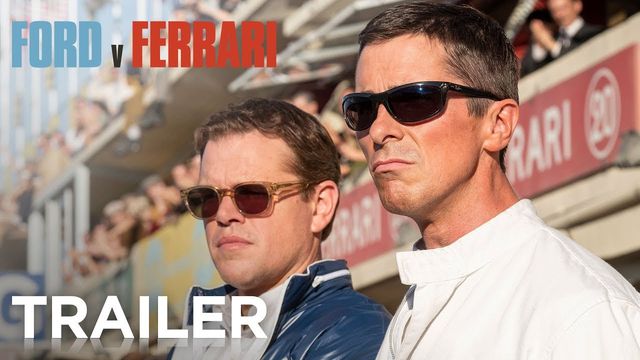
Yes. So listeners, most of this is from the book Go Like Hell,81Go Like Hell: Ford, Ferrari, and Their Battle for Speed and Glory at Le Mans (2009) — a book by the American journalist A. J. Baime. Ford v Ferrari came out in 2019. which is the book that Ford versus Ferrari is based on.
The movie. Yep.
So in 1963, Henry Ford II, which notably this is the grandson of Henry Ford I, there's Henry Ford, then Edsel, then Henry Ford II.82Henry Ford II (1917–1987) ran the Ford Motor Company from 1945 to 1979. His father Edsel Ford, the founder's only son, died in 1943. And he's, he's looking to make his mark. I mean, at this point, it's third-generation ownership. Ford is this great American company. There's a lot of people that are sort of throwing barbs saying, well, I mean, this is your grandfather and then that was your father, but like, how much of this is really you? That's starting to kind of weigh on him. He decides that Ford needs to be in the racing business to change their image and stimulate sales for the new generation. Now, over in the racing land of Ferrari, they're on a hot streak. We've been talking about their production at this point in time, but they had just won Le Mans in 1958, and then all in a row, 1960, '61, '62, '63, '64, '65. So if you are interested in entering racing, either you gotta beat Ferrari or you gotta own Ferrari. So the Deuce, as Henry Ford II83The Deuce — Henry Ford II was nicknamed "Hank the Deuce," for the II in his name. was known-
What a great racing moniker, the Deuce.
Right? Right? Oh, and Enzo's got some great ones too.
Yeah. I mean, ultimately in his older age, he becomes the Grand Old Man. But what was he before that?
Il Commendatore. And the Drake.84Il Commendatore — "the Commander," an honorary Italian title by which Enzo was known in Italy. The English called him the Drake, after the privateer Francis Drake. He's got some great ones. So the Deuce over in America gets word, weirdly through their German subsidiary, that a mysterious letter has arrived from the German consulate in Milan. That an internationally known Italian automobile factory was interested in selling. So already you should kind of—
There's something going on here.
Be a little suspicious of how this information comes to Ford. But Ford is not— Ford just goes, oh, this is interesting. Let's try and figure out who's thinking about selling. Well, it doesn't take them long to figure out that it is Ferrari. It's Enzo Ferrari. Yes. They begin sort of a process to try to buy it. And Ford at this point has basically no racing capability of its own. This is an entirely new muscle for them. So they make an offer to buy Ferrari. The asking price was originally $18 million, but somehow Ford manages to easily negotiate it down to $10 million.85$10 million in 1963 is roughly $110 million in today's money, and the $18 million asking price about $195 million (by the US consumer price index). So again, a little mysterious, a little suspicious, like maybe that was a little bit too easy. The agreement that is drafted and hits Enzo's desk. I mean, think about what could have been. This is the craziest pitch. There are two companies that are formed. One is called Ford Ferrari. It is 90% owned by Ford and it would make road cars. There's a second called Ferrari Ford that's 90% owned by Ferrari. That's the racing, the racing team. So this document is on Enzo's desk. He digs into it and he's looking through the fine print. And he kind of realizes, if I want to go racing and Ford does not want to go racing, who decides? And of course, Ford says, well, we're buying your company. We have the final say.
Ultimately, I control the budget.
Right. So Enzo, of course, hates this. And in dramatic fashion, he blows up the deal right at the finish line, all while the papers had been reporting, you know, the information leaked that the Americans were about to buy this Italian national treasure. Makes big headlines when the deal blows up. You can imagine why this is in Ferrari's public relations interest based on everything that we've been describing about their business strategy. Of course, then Henry Ford II is absolutely incensed and he has this great quote. In May of 1963, he goes to his lieutenants and he says, we will go to Le Mans and beat his ass. We're going to race him.
And Enzo is probably like thinking dumb Americans the whole time. There's this great quote in the Brock Yates book about Enzo and his opinion of the Americans, which is something like, he realized the fundamental truth to selling European luxury goods to Americans: treat an American like a hick and you'll own him for life.
ExplainerLe Mans 1966: how Ford "beat" Ferrari
Ford brought eight works GT40 Mk IIs with a seven-liter NASCAR engine and five simpler GT40s. Ferrari entered its new 330 P3s but hadn't had time to prepare properly: its workers in Italy were on strike.
Overnight, in the rain, the Ferraris overheated and dropped out one after another: of the 14 Ferraris that started, only two GT-class cars made it to the finish. Of the 13 Fords, three finished, and took the top three places.
For the sake of a nice photo, Ford told the race leader, Ken Miles, to slow down and cross the line side by side with the car of Bruce McLaren and Chris Amon. It didn't end in a dead heat: under the rules, a tie went to the car that had started farther back and so covered more distance, and McLaren's car had started 14 meters behind. Miles, who had already won the 24 Hours of Daytona and the 12 Hours of Sebring that year, was left second.
Two months later Miles was killed testing Ford's next car. Ford won Le Mans four years in a row, from 1966 to 1969; Ferrari answered in 1967 by finishing first, second and third in formation at the 24 Hours of Daytona.
Oof, that hurts, that hurts. So the whole Ford vs. Ferrari movie is what happens next, and it's, it's a great movie with Christian Bale and Matt Damon. And while it's of course dramatized, the bones of the story are actually pretty factually correct. So I highly recommend it. So what happens is Ford, who at this point says, we got an unlimited budget, we just gotta go beat these guys, enlists the help of Carroll Shelby and the driver Ken Miles and sort of a real crack team of American mechanics and racers. They actually do, after a few years, beat the Ferraris in the 1966 Le Mans race. Finishing with Fords in first, second, and third. It's this incredible story, but ultimately this is a complete sideshow.
Yeah. What's, what's really going on? What are Enzo's true intentions here?
So this is done, of course, to market the exclusivity of Ferrari and how they're the mark to beat. And it's a great tactic to sell cars, but it's also to signal that Enzo is willing to do a deal. He is willing to sell the company. That's why he wanted all the papers writing about the fact that he was. But it had to be on his terms with the right partner, and he had to be able to go racing.
Yeah, it's kind of like Enzo and Ferrari got a dual benefit out of this whole saga. One, as you said, like, this is only great for the myth and the legend of Ferrari of like, oh, we were going to sell to these big ugly Americans, but they wanted to take our racing from it. And we said, no, you'll have to kill us in order to take it.
Exactly. And it is this Italian national treasure. I mean, that's real. That is the cultural export of Italy.
Yep. And it was a way to signal to the market like, hey, I might be open to a deal.
Yes. So any last little misconceptions you have about Enzo Ferrari not being an excellent businessperson and negotiator, that should be completely dispelled at this point. So, David, what happens next?
So all the Ford versus Ferrari drama was going down between the years of 1963 and call it 1966, '67. Through all this, Enzo's doing great. He's in his late 60s at this point, but he's loving life as much as Enzo is capable of loving life. He's healthy. He's reinvigorated by this battle. Everything's going great. And then after all the Ford drama in 1968, Enzo contracts kidney disease. And it's pretty bad. Like, he thinks this is probably actually going to be the end.
And statistically, he was right.
Yeah. And it gets so bad, as we'll see in a moment, that shortly after this in 1970, he goes into organ failure and has to be hospitalized for months. Like, he really should have died at this point in time. But as always for Enzo, fate has other plans. So once he comes down with the disease, he gets serious about actually selling the company. And he sniffs around, he talks to his old buddies at Alfa Romeo, and they sort of work on a deal not to Enzo's liking. Really, at the end of the day though, there's only one correct buyer for Ferrari, and it's Gianni Agnelli. In the Fiat empire. So in 1969, Enzo strikes a deal with Gianni to sell 50% of Ferrari to Fiat immediately there in 1969 with a secret agreement that triggered upon Enzo's death, which again, he thinks is imminent, Fiat will acquire another 40% taking their stake to 90%, and 10% of the company will transfer to Piero. Once Enzo dies, his plan is to, as much as he can, legitimize Piero, give him the Ferrari name, and give him a 10% stake in the company so that the bloodline, to some extent, as much as it possibly can in that time and place, will continue. And part of the deal with Fiat, just like he wanted with Ford, is that Fiat, you can take control of the road car business, but I'm going to retain final authority over racing. You know, I know that my end is near and I want to spend my last days on this earth doing what I love, which is running the racing team.
The incredible irony was the end was nowhere near. Nowhere near. And actually, the world would change enough between this moment and when he would eventually pass that Piero is able to take over as Piero Ferrari, son of Enzo.
Yes, yes, yes.
So how many years was it between— 1969 is when the 50% sale to Fiat. He doesn't pass away until-
He lives another 20 years.
19 years.
1988. Like he lives until I was born. Where's the sort of the end of his life?
Well, he lives to launch the F40, which is the last car that Enzo launches.
So there are two really interesting things about this deal. One, Enzo started his career by applying for a job at Fiat and was turned down. So that's a total full circle moment there. The other full circle moment is that Gianni Agnelli was one of the very first Ferrari customers of their road cars. It's amazing. And when you look at the actual deal, this, this blew my mind, David. If you do the lira to US dollar exchange rate86Lira — Italy's currency from 1861 until 2002, when the euro replaced it. The 1969 valuation of $6.8 million is about $62 million in today's money (by the US consumer price index). in 1969, they ended up selling half the company for a little under $3.5 million, valuing all of Ferrari at $6.8 million. Wow. Oh my goodness. Enzo really wanted to do this deal, and I think he determined at this point in history— I've not seen this written anywhere, but I'm reading into this, you know, even Ford thought it was worth somewhere between $10 and $18 million earlier in the decade. Enzo basically had one bidder and he thought, I have no exit path other than this. This needs to land with Fiat and whatever the price is, it is. And so I think Fiat basically got a steal on this because it needed to stay in Italy and it needed to go to a strong, thriving car company-
Car company and family in the Agnellis. Well, all of this just underscores the most critical point here. I think this is probably the moment in history where the false legend that Enzo only cared about racing and wasn't a real entrepreneur emerges from. Because if you look at the fact pattern, it makes sense here. Like he wanted to spend his last days racing. He did this not great deal with Fiat. Yeah. The only reason this happened is because he truly thought he was about to die. Yep. And he really did just want to spend his last days on Earth running the racing team. And he wanted to ensure continuity for the company. And a role for his son Piero going forward. That's what happened here.
The state of Ferrari is kind of grim at this point, too. The factory needed investment. The racing program was unbelievably expensive. They're starting to face very real competition from Lamborghini. They were founded in 1963 specifically to challenge Ferrari, at least Lamborghini Motors, which we'll come back to. And there was manufacturing headaches happening because of Italian labor unrest.87Labor unrest — the "Hot Autumn" of 1969–1970, a wave of mass strikes at factories in northern Italy, with workers demanding raises and better conditions. And so asking someone to take on Ferrari's operations was a tall order in addition to needing to sell.
Yes, I'm glad you brought up Lamborghini. Lamborghini had just launched the Miura, the Lamborghini Miura88Lamborghini Miura (1966) — one of the first mid-engined production supercars. Automobili Lamborghini was founded in 1963 by the tractor maker Ferruccio Lamborghini. at this point in time, which was a truly excellent car. Yep. Like a better Ferrari than a Ferrari at the time. So there was real headwinds in the business. And this is really why Fiat and Gianni Agnelli had to be the buyer to steward Ferrari through this period. Now, as we said earlier, fate had plans other than death for Enzo. Right after the sale in 1970, Enzo does go into organ failure and is hospitalized. He's away from the business for many months, which really makes it incredibly fortuitous that he had already done the deal with Fiat. So there was management to keep the company running while Enzo is away. Miraculously, though, he recovers. And in the spring of 1971, Enzo, the grand old man, is back in Maranello at the head of Ferrari. But it's a Ferrari that he barely recognizes from when he left. Fiat has come in. And this is where he intersects with another young man who would go on to carry the legacy and the spirit of Ferrari for really the next 40 years and into the next generation and build Ferrari what it is today.
With a break in between.
With a little break in between. Luca di Montezemolo.
AdVanta
But before we tell Luca's story…
All right, listeners, now is a great time to tell you about longtime friend of the show, Vanta.fVanta — an American company founded in 2018 that automates preparation for security audits. In April 2026 it reported more than 16,000 customers. So David, I want to paint a picture that many founders listening will recognize. You're about to close your biggest customer yet. The product team has hit a bunch of milestones. The sales team built this fantastic relationship. Everyone at the potential customer is fired up. Your legal team has the contract done, but then an email comes in from the security team.
Ah, yes, it's usually a very polite email asking something like, "Before proceeding, could you share your SOC 2 report?gSOC 2 — an independent auditor's report on how a service company protects customer data, a standard developed by the American Institute of CPAs (AICPA). ISO 27001 — the international standard for information security management systems. Or do you mind sharing your ISO 27001?" If you don't have one, that deal just went from closing this month to closing next quarter, maybe. Now you have to go find an auditor, go through every system, write the policies, and then prove that you follow them.
Right. Or you could just use Vanta. They are the leading agentic trust platform, which means that you can connect it to your systems at your company and it automatically pulls all the relevant data, and it tells you exactly what's missing for a SOC 2, an ISO 27001, or whichever framework your customer asked for. Vanta gets you through the audit and then it keeps going. It watches your controls every day afterwards, so the report that you hand to the next customer is still true.
Yep. And even more impressive is the Vanta agent. It continues to run in the background, so it can find the issues and draft the fixes. This is the work that eats weeks of an engineer's time before an audit, and now it mostly just gets done before anyone has to ask.
And the results are super impressive. A recent industry report says that Vanta's customers see a 526% return over three years and that it pays for itself within the first three months. If you've ever had one of these security emails stall a deal, you know exactly how that math works.
More than 16,000 companies now run on Vanta.
16,000. Listeners, there were 2,000 when David and I started working with Vanta.
That's incredible what they've accomplished. And these are companies from large enterprises like Atlassian and Snowflake to the new guard like Ramp and Cursor.hAtlassian — the Australian maker of Jira and Confluence; Snowflake — a cloud data warehouse; Ramp — a fintech startup for corporate cards and expense management; Cursor — an AI code editor.
We've been fans of Vanta for years, and hundreds, like literally hundreds, maybe even at this point thousands of Acquired listeners have become Vanta customers over that time. If you want a thousand dollars off, check out vanta.com/acquired. That's V-A-N-T-A.com/acquired, and just tell them that Ben and David sent you.
07Montezemolo and the end of Enzo's era
Young Luca di Montezemolo brings the titles back within a couple of years, but after he leaves, Fiat nearly ruins Ferrari by ramping up production.
Okay, so David, Luca di Montezemolo, at least the first act of Luca anyway.
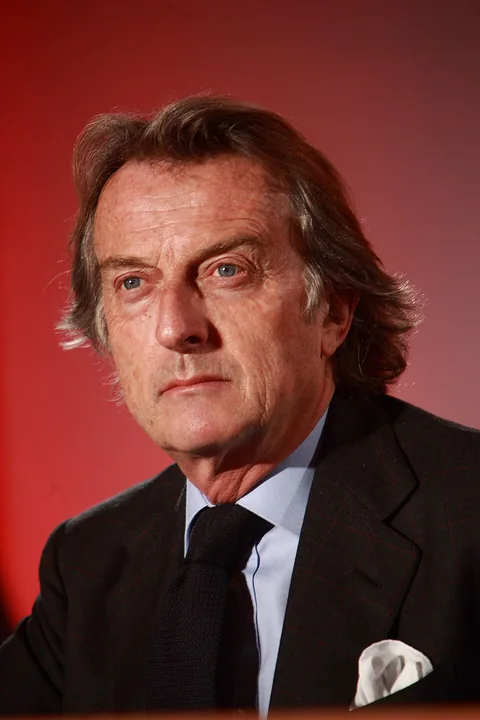
Of Luca's story. Yes. So in 1971, when Enzo gets back to the office in Maranello after his hospitalization, he tunes in to a fateful talk radio show where he discovers a young man who will bring a breath of fresh air into his life. Luca. So Montezemolo, to many of you listening, is already a living legend. I mean, as much as anyone in Ferrari history besides Enzo, Luca di Montezemolo is Ferrari. And as I mentioned, I was very lucky to get to speak with him for a few hours in research for this episode. And I also got to watch this great movie about him that has just been made. It's called Seeing Red. It's with Chris Harris, the Top Gear presenter.
Yeah. How did you get that? Because that's not out yet.
Yeah, it's not distributed outside of Italy yet, but I got a link to watch it. It's directed and produced by Manish Pandey, who wrote and produced Senna, the Senna movie.89Senna (2010) — Asif Kapadia's documentary about the three-time world champion Ayrton Senna; Manish Pandey wrote and produced it. It's really, really excellent when it's available in whatever geography you live in. Very, very, very much worth watching. So Luca was born in 1947, the same year that the modern Ferrari commenced operations.
Very poetic.
In Bologna, in Italy. But he moved to Rome as a child where his best friend growing up is Cristiano Rattazzi, who is the son of Susanna Agnelli,90Susanna Agnelli (1922–2009) — Gianni Agnelli's sister and a politician; in 1995–1996 she was Italy's first woman foreign minister. Gianni Agnelli's sister. So Luca grows up almost like a member of the Agnelli family. His best friend is, you know, one of the Agnelli heirs. And Luca comes to develop a close relationship with Gianni. And he would say Gianni was like a combination of an older brother and a father for me. So in 1970, young Luca moves to New York City to go off to study international law at Columbia Law School. Around the same time, though, he's also pursuing another career as a rally car driver.91Rally — racing on ordinary roads, often gravel or snow: crews run the timed stages one at a time instead of starting together as in circuit racing.
Really? Like, a rally car driver, right?
Yes, yes. I don't think I've ever seen a Ferrari rally car.
I don't think these two things have ever intersected. These universes are about as far apart as you could possibly get.
But this is how Luca starts in motorsport. And so that one fateful day in 1971, Luca, the rally car driver, is a guest on this popular call-in talk radio show, and an audience member calls in to basically accost Luca and chastise and criticize the entire motorsport industry, kind of much like the Pope in 1957, starts just laying into Luca, caller talking about how motor racing is evil, it's dangerous, it's bad for the environment. Like, this is a sport just for rich people. It has no value in society. And Luca, impassioned, rises to the occasion, and he gives this passionate defense of motor racing. He speaks eloquently, poetically. He shuts down this caller and really gives this incredible response. And who happens to be listening to the program? But Enzo Ferrari. Unbelievable. You just can't make this stuff up. You really cannot make this up.
And he's kind of this perfect person, because if Enzo is going to take a liking to him here, I don't know what you're about to say, but if he's kind of Enzo's guy, but he's also a pseudo-family member of the Agnelli family, it's kind of this perfect candidate pool of one.
Yes. So Enzo calls up the radio station and he's like, I gotta know who this kid is. I want to get in touch with him. Who is this rally car driver? And literally the quote Luca told me that this is what Enzo told the radio station. Enzo said, "This boy has big balls. I want to talk to him." Wow. So Luca and Enzo meet, and Enzo says to him, "I like you. You know, you've got big balls. I've been away from my business for too long, and I need some help. What I really need—" I need an assistant, but I need a spy who can go throughout the organization and report back to me what is actually going on in my company. Hmm. You don't have to ask Luca twice here. He takes the opportunity and goes to work for Enzo as his assistant here in the early '70s. Now, of course, at some point along the way here, Enzo also learns of Luca's connection to the Agnelli family. Which only makes him even more attractive. He's like, oh, now I can have a spy at Fiat and the Agnelli family too. So, great. So the first thing that Enzo assigns him to do is go figure out what's going on with sales of the road car business. Like, go spend some time with the distribution network, understand who the clients are, understand who the collectors are, who are the dealers. So Luca does. He comes back, he reports. It's not good, as you were alluding to, Ben. This is a pretty tough time for Ferrari here in the '70s. The oil crisis is underway.92The oil crisis of 1973 — the Arab members of OPEC imposed an oil embargo on countries that had backed Israel in the Yom Kippur War; within a few months the price of oil roughly quadrupled. Any car with an engine size over 2 liters was taxed at an incremental 40%93The big-engine tax: after the oil crisis, Italy charged 38% VAT on new cars with engines over two liters. Ferrari answered with two-liter versions for the Italian market, such as the Dino 208 GT4 (1975); the higher rate was abolished only in 1994. in Italy and throughout much of Europe. The whole sports car industry is basically in the dumps. So Luca reports all this back to Enzo, and Enzo's like, okay, great. You passed your first test. Things aren't good on the road car side of the business. But like, at the end of the day, that's Fiat's problem now. Okay. My real assignment for you. I want you to go to the next Formula 1 race. Just go. Just observe. Just tell me what you think is going on with the team. Now, at this point here in like 1973, '74, things are really bad for the Ferrari F1 team. They haven't won a driver's or constructor's championship for 10 years. A historic drought for Ferrari. So Luca goes, he observes a race, and he calls Enzo up and he says, hey, look, I advise that we just take the cars home and we don't race them. We have no chance of winning. And Enzo's like, okay, okay, well, we're not going to take them home, but we need to get competitive again. What are we going to do? And Luca's like, the issue is that the sport has changed. This isn't just an engine sport anymore, or power. We're now in the era of Colin Chapman and Lotus94Colin Chapman (1928–1982) — founder of Lotus and the engineer who brought the stressed monocoque to Formula 1 and, in the late 1970s, ground-effect cars. and aerodynamics. Aerodynamics and the chassis is way more important. And the Ferrari team is stuck focused 100% on the engine. Like, we have no chance of winning. So Enzo says, okay, here's what I'm going to do. I'm going to make you, Luca, the team manager of the Ferrari Formula 1 team, and your mandate is to fix this. I can't fix— I'm Enzo. I'm like the engine guy. You go in, you can be the new blood. You can fix this.
And this is amazing because this is quite the quick promotion for Luca. I mean, it's like a guy he found that he brought in to be his assistant. I mean, he was much more than an assistant, but that was his title. He's not even 30 years old yet. Then suddenly you're managing the Formula 1 team, which historically is the driver that creates all the lust that sells the cars. Like, this needs to start working.
Yes. Oh, Luca has this great, great quote on the nature of the connection between Ferrari's performance on the track and the business selling road cars. He says there is not a direct correlation between Ferrari victories on the track and the number of cars that you can sell. But if for many years you do not win, it means that you do not add wood to the fire of the myth. The myth of Ferrari is based on competition, on cars. In the competition, you can win or you can lose, but you cannot only lose. It's so perfect.
It is perfect.
So Luca comes in as team manager and he revamps the team. He brings in great chassis folks. He brings in great aerodynamics folks, and the most important thing, he goes out and recruits Niki Lauda95Niki Lauda (1949–2019) — Austrian racer and three-time world champion, in 1975 and 1977 with Ferrari and in 1984 with McLaren; founder of the airline Lauda Air. to come in as their number one driver. And in 1975, with the new team, the new approach, Luca as manager, Niki Lauda wins the Drivers' Championship for Ferrari, and Ferrari wins the Constructors' Championship, ending the 10-year drought.96The 10-year drought — before Lauda, Ferrari's last drivers' title had been won by John Surtees in 1964, the same year the team also took the Constructors' Championship. The photograph shows Lauda on the podium at Monza on September 7, 1975. Third place in the race secured the championship.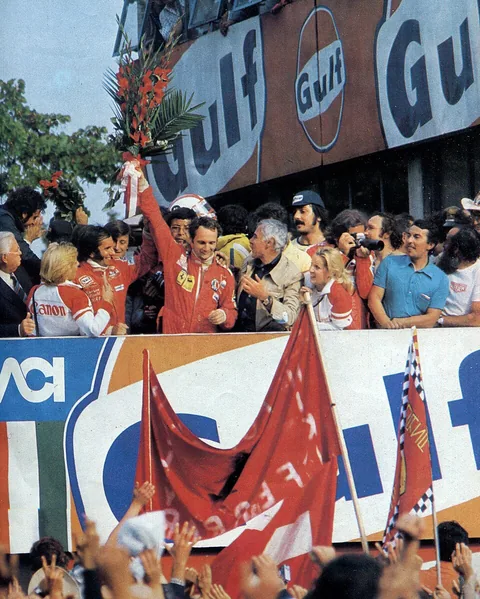 And there is great rejoicing. Luca is now revered across Italy. He's not even 30 years old yet. As this young hero who has come in and saved essentially the national team of Italy from this despairing period.
It's amazing. And the funniest thing is imagining, as you describe these conversations, that Luca's off doing stuff and he comes back and reports to Enzo. Where is Enzo's house in all this when he's sort of, like, recovering from the illness? It is around the corner from the Ferrari factory in Maranello. It's this farmhouse. And in this exact period, actually a couple of years before, in 1972, so after the illness, but before the Niki Lauda F1 victory, they actually build a full racetrack adjacent to Ferrari's headquarters that goes around Enzo's house. So Enzo can walk out of his farmhouse and watch them testing the cars on this, I mean, truly unbelievable custom racetrack only for Ferrari97Fiorano — Ferrari's test track, opened in 1972; Enzo's house stands right inside its loop.'s research and development.
Yes, it's incredible. But he needs Luca, the young guy, to come in and change the culture. Enzo can't do it. He's too bound. He's a prisoner of his own myth and his own legend. So all of this is great. Truly, truly great. There is rejoicing throughout the country. But there's just one problem, which is Enzo's pretty used to Enzo being the guy. So he starts to get a little jealous of young Luca. Now, they always have a great relationship. There's not, like, personal animosity here. But a couple things happen. The next year in F1, there's the truly crazy tragedy of Niki Lauda catching on fire.
Horrific.
Actually catching on fire at the Nürburgring.98Nürburgring — the circuit in the Eifel mountains of western Germany. Jackie Stewart nicknamed its Nordschleife, almost 21 km long, the "Green Hell"; the 1976 race where Lauda crashed was Formula 1's last on that loop. He's severely burned. He should have died. He does not die, and he wants to come back and race. He's in contention for the championship. He ends up not winning the championship that year, even through this great act of bravery to try to come back.
But almost does, remarkably. If you're interested in this, go watch the movie Rush.99Rush (2013) — Ron Howard's film about the rivalry between Niki Lauda and James Hunt in the 1976 season. Lauda crashed at the Nürburgring on August 1, came back to racing six weeks later and lost the title to Hunt by one point. It's awesome.
Yes. So good. Enzo, though, remember, he's very experienced with these race car drivers and their brushes with death. Enzo, I think, kind of loses faith in Lauda as a driver after that. He's like, "Oh no, he fears death now." Mm-hmm. Luca still believes in him though. So there's, you know, some conflict there. Again, it never gets personal. I think they truly do always kind of love and respect each other. But all of this combines. Luca can't stay at Ferrari, so they ultimately decide it's better if Luca leaves the F1 team, leaves day-to-day at Ferrari, and goes to work for Fiat. In turn, he remains on the board of Ferrari. Luca does, but he goes day to day to Turin and kinda closer to the Agnelli empire. And I think Enzo thinks that he's gonna still have a spy now in Fiat with Luca, which maybe he does, maybe he doesn't. But sadly, this is another tragedy. This is kinda the end of the glory for Ferrari in racing during Enzo's life. They had this great moment together, and for the rest of Enzo's life, there's some ups and downs, but mostly the Ferrari glory on the racetrack is gone and doesn't return until Luca returns after Enzo's death.
Much later. And there's this glorious, amazing return of Luca, and there's this unbelievable run in Formula 1, and the Ferrari road car business becomes stronger than ever. But basically none of it in Enzo's lifetime. In fact, the last 10+ years of his life is a real whimper in the history of Ferrari. The road car business falls on some real ugly times.
Yeah, it's funny. I had written in my script here about the last days of Enzo Ferrari. They do mostly end with a whimper, not a bang.100A whimper, not a bang — from T. S. Eliot's poem "The Hollow Men" (1925): "This is the way the world ends / Not with a bang but a whimper." But there is one little bang. There absolutely is. His last car, Ferrari's first official supercar halo car. There were unofficial GTO homologation versions101Homologation — approval of a car for a racing class. GT racing rules required a certain number of road cars to be built, and "homologation" series were made for that; hence the name 250 GTO, Gran Turismo Omologato. of race cars. And now those things sell at auction for like $40, $50 million or more.
One of them sold for $70 million.102Ferrari 250 GTO — only 36 were built. In 2018 one reportedly sold privately for $70 million; the public auction record is $51.7 million, at RM Sotheby's in New York in 2023.
Yeah. So those cars existed in Enzo's past, but there was never a model that was made just to be available for purchase by our best clients, but a true, true supercar. Until the F40, which fittingly is the last car that Enzo makes before he dies in 1988.
All right. So tell us about the F40.
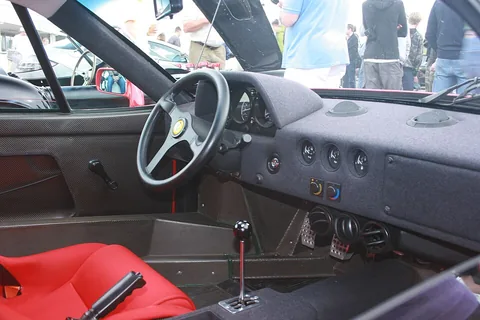
Oh, man. Talk about a death machine. The F40 was just this incredible raw beast. If you look at pictures or video of the interior of the F40, this is not a luxurious vehicle. There's no leather. The door handle is a piece of string. This is the rawest racing machine in its purest form.
It is. Can we throw out everything that is not absolutely required so we can have the lightest weight vehicle possible? And it's crazy. We'll put a photo of the interior of this cabin in the email. It is a lot of carbon fiber, but not like cool-looking carbon fiber.
No, like raw carbon fiber.
This is the absolute minimum that we could ship. And David, to your point, this thing, while it is a supercar the same way that the F50 and the LaFerrari and the Enzo and the F80 are supercars,103Ferrari's flagship supercars come out about once a decade: the F40 (1987), F50 (1995), Enzo (2002), LaFerrari (2013) and F80 (2024). Each is a limited run, sold first of all to the best customers. this is not a luxury supercar. When you're sitting in this car, you're not sitting in here thinking like, I'm a rich person. You're sitting in here thinking like-
This thing is trying to kill me at every angle.
I'm in some sort of test harness. Yes.
Oh yeah. I mean, the video is online of people crashing Ferrari F40s. Tragic, of course, because they're amazing machines. But if you get in this car and you do not know exactly what you're doing, you're going to crash.
It's interesting. The F40 sort of punctuated the end of Enzo's life or the end of the Enzo era in this really interesting way, because it is a supercar the same way that the modern cars are about supercars. They're these high-performance machines, but it had every flaw of the Enzo era of Ferrari. It wasn't practical. It was purely about being a race car and made every compromise possible to get there.
Yep. Ferrari will never make another one like it again. We should say also what F40 means. It was the 40th anniversary of the commencing of operations of the modern Ferrari. So from 1947 to 1987, when the F40 came out. So then the next year, at age 90, the grand old man does finally pass away. Enzo Ferrari dies in the summer of 1988. Poetically, just after his death, Ferrari, in the next Formula 1 Grand Prix that is run after Enzo's death, finishes 1-2, wins at Monza.
Oh my God.
The Italian Grand Prix. And that is the only race that Ferrari won that season. Either the gods were smiling upon Enzo in death.
Or Bernie Ecclestone's fix was in.1041988: McLaren won 15 of 16 races. At Monza, the leader Ayrton Senna collided with the backmarker Jean-Louis Schlesser two laps from the end, and Gerhard Berger and Michele Alboreto took a one-two for Ferrari. Bernie Ecclestone controlled Formula 1's commercial rights from the late 1970s until 2017.
Yes, the fix was in. Either way, it was poetic. For the next couple of years, though, oh man, the sort of slow-motion disaster at Ferrari continues unabated on both sides of the business.
Real quick before that, though, it's worth highlighting. So the Agnelli family ends up getting the 40%. Piero ends up getting the 10%. But an interesting thing to note, the valuation is extremely different this time around.
Yeah. You found detail on this? I couldn't find it.
So a good friend of the show, Arvind Navaratnam from Worldly Partners,105Arvind Navaratnam — an investor who founded the small fund Worldly Partners in 2020, run on Charlie Munger's principles. Acquired uses his long-form company histories as a source. scoured all of the old annual reports that he could find. And in the 1988 annual report, it reports the amount of lira to acquire the remaining 40% of Ferrari. Oh, I'm so curious. What was it? If you do the exchange rate at that time, it is $77 million, which valued the company at $192 million in 1988. Much different than the—What was it?
$6, $7 million in 1969. Yeah. I mean, two things are simultaneously crazy right here. One, how much the valuation increased from the first time. Second, that Fiat and the Agnelli family acquired 40% of Ferrari for a valuation of $192 million. Unbelievable.
Or that they acquired 90% of it for what, $72 million?
Yeah. In aggregate. Yeah. Wow. Wow. Wow. Wow.
Or that as recently as 1988, it was worth only $192 million.106$192 million in 1988 is about $520 million in today's money (by the US consumer price index). I mean, this is a company today that's worth recently over $90 billion, but today $55 billion. In 1988, $192 million!
Well, this really just highlights how different a company Ferrari was when Enzo died. And how much Luca di Montezemolo transformed it when he came back and became the chairman. But for the moment, when Enzo dies, the sort of slow-motion disaster just continues unabated. Fiat's attempt, their best solution to fixing the problem of the road car business, is to produce more road cars, which is the cardinal sin of luxury strategy management. Just as one example, Ferrari during these years before Luca comes back, Ferrari produced 7,000 Testarossas107Ferrari Testarossa — made from 1984 to 1991, 7,177 cars in all; the Lamborghini Countach was made from 1974 to 1990, about two thousand. over the 7 years that the Testarossa was in production. Compare that to Lamborghini. Lamborghini only produced 2,000 Countaches during a period twice as long. They made Countaches for 16 years. By any normal car company, we're talking tiny numbers no matter what. But when you're talking about something rare and exclusive and so special as what a Ferrari should be, and then you have a company that you don't even really consider your competitor over there making a more exclusive product and managing it better, that's not a good situation.
No, it is not. And another crazy frame on that, if you look at the production of total Ferrari cars, not just one model, but total cars in 1982, it was 2,200. If you look in 1991, that grew all the way up to 4,500. They just kept ramping, ramping, ramping and making more cars.
Yeah, not the right fix.
Not the right fix.
08Luca returns: the team, the technology, the myth
In 1991, with cars going unsold, Agnelli "puts Ferrari in the hands" of Montezemolo, who sets out to fix three things: the team, the technology and the myth.
So you mentioned 1991. And that was the last year of this interregnum period before Luca comes back. It's so bad. Demand has evaporated so much for Ferraris that for the first time in history, cars are going unsold. They have to furlough the factory workers and shut down the factory. And so when it comes to this, Gianni Agnelli finally calls up Luca and says, it's time for you to return. We need you to come back. We are, quote, putting Ferrari in your hands. And Luca di Montezemolo returns to become chairman of Ferrari. We should note it's going to be important here in a minute. In Italy, chairman of the company is actually the most important and powerful title, and the CEO reports to the chairman. So at this point, when Gianni calls Luca back, he's been gone from the day-to-day of Ferrari for almost 15 years. After Ferrari, he did a short stint at Fiat and then he stayed in the Agnelli empire. He became CEO of the beverage company Cinzano,108Cinzano — an Italian vermouth brand from Turin. Montezemolo ran Cinzano International in the mid-1980s. which is another Agnelli family company. And so he had gained CEO experience. And then the reason that Luca couldn't come back to take over Ferrari as soon as Enzo died was he had become the organizer and president of the Italia '90 World Cup.109Italia '90 — the 1990 FIFA World Cup in Italy; Montezemolo headed its organizing committee. West Germany won. So the World Cup in 1990 was in Italy, and that's right, Luca organized the whole thing. And there's great stories associated with that. My favorite is that he convened for the sort of final evening ceremony of the World Cup for the first time, the Three Tenors.110The Three Tenors — Luciano Pavarotti, Plácido Domingo and José Carreras first sang together on July 7, 1990, at the Baths of Caracalla in Rome, on the eve of the World Cup final. The Three Tenors didn't exist until the World Cup. And the way he convinced Pavarotti to join, because he was the big star, he didn't want to join, was he gave him an F40. And thus the Three Tenors were born.
That is awesome.
So once the World Cup is over, Gianni's like, okay, enough messing around. You got to come back, fix this. So the first thing Montezemolo does when he knows he's going to return to take over Ferrari after Enzo. He goes and he buys a 348,111Ferrari 348 — a mid-engined V8 sports car made from 1989 to 1995; the F355 replaced it. the flagship Ferrari sports car at the time, just to sort of see the state of things. Like, how bad was it really? I'm gonna go buy my own 348 and test it out. And Luca's actual quote on this is, the Ferrari 348 was a shit car. It was the worst car we ever made. Everything was missing. It had no personality. It had no technology. It wasn't state of the art in anything. It had no power. It was all missing. He talks about when he was driving it, he would pull up to stoplights and try and race the other cars off the line and see how it would perform, you know, kind of drag race at stoplights.112Drag racing — two cars racing from a standstill in a straight line, usually over a quarter mile (about 400 m): first across the line wins. He was like, I was getting beaten off the line by Volkswagen Golfs in a Ferrari.
Brutal. What do you attribute this to? What, like, Ferrari has deteriorated. It's fallen apart in this era. The cars have no personality, but they also have no performance and they're impractical and they're overmaking them and no one wants them. What's wrong? Like, why have the wheels come off the bus here?
It was Fiat. It was all they knew how to do. They came in of like, oh, the way we can fix this is we'll increase production, we'll cut costs. So let's share some parts with Fiat cars, you know, Ferrari road cars went from being the same thing built by the same people as the racing cars, as the F1 cars and the Le Mans cars in the same factory, to in this period with Fiat control, they're really not the same thing. You know, these are— it would be too far of a stretch to say they were repurposed Fiats, but they had lost that true connection to race machines. Hmm. And so Luca comes back and says, we got to fix this. So at the time, the Japanese sports car industry was on the rise and all the car enthusiasts were saying Ferrari's dead. The Italian carmakers are dead. The Japanese have taken over. Luca has the test drivers at Ferrari go out and buy a Honda NSX113Honda NSX (1990) — a mid-engined sports car with an aluminum body, developed with input from Ayrton Senna. and do like his own version of the Pepsi Challenge.114Pepsi Challenge — the ad campaign Pepsi has run since 1975: passersby are invited to compare Pepsi and Coca-Cola blind. Like, go out there, drive the NSX as hard as you can around the test track, drive our cars, drive the 348 as hard as you can around the test track. And they come back and they're like, yeah, I mean, there's no competition. The NSX just blows us away.
But how sad is that? It's a Honda, a Honda.
That's completely lost to history today. You don't hear anyone talking about— Ferrari is this sort of like untouchable apex brand. That it's hard to imagine that happening just, you know, as recently as the early '90s.
Right. I mean, it's one thing if Lamborghini is beating them. I mean, that's bad. That's really bad. But if Honda is making a better sports car than Ferrari, there's a real, real problem. So how's Luca going to turn this around? He comes up with 3 priorities: the team, the technology, and the myth. So number one, the team, the Formula 1 team. We have to fix the Formula 1 team. Going back to his great quote, you know, there's not a direct correlation between victories on the track and cars that you can sell, but the team feeds the myth. If you don't add wood to the fire of victories on the track, the flame of the myth will die. You cannot only lose. Yep. So the team hadn't won a championship since 1979.115Ferrari's titles. Ferrari's last drivers' title of that era was won by Jody Scheckter in 1979; the team also won the Constructors' Championship in 1982 and 1983 (formula1.com, "Ferrari — Year by Year"). Luca goes out and recruits the dream team. I think the greatest set of F1 team members that had ever existed in history. Jean Todt, team principal. Ross Brawn, race engineer. Michael Schumacher, Ferrari number one driver.116Jean Todt ran the Ferrari team from 1993 to 2007 and later was president of the FIA (2009–2021). Ross Brawn was Ferrari's technical director from 1997 to 2006; in 2009 his own team, Brawn GP, won both championships. Michael Schumacher drove for Ferrari from 1996 to 2006. And it takes a couple of years for Luca and the team to turn this around. But this is just absolute domination that they unleash on the field.
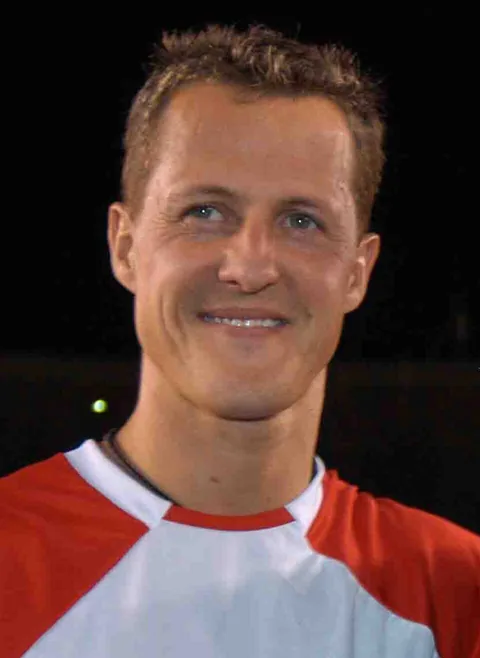
By the end of the decade, there would be 5 straight years, 2000 to 2004, where Michael Schumacher won every single Drivers' Championship 5 years in a row, and Ferrari won every single Constructors' Championship 5 years in a row.117Constructors' Championship — Ferrari actually won it six years in a row, from 1999 to 2004.
As we talked about on the F1 episode, it was a problem for Formula 1. The sport became too boring. Because Ferrari always won. In total, under Montezemolo's tenure, Ferrari wins 19 Drivers' and Constructors' Championships,11819 titles — Montezemolo's own count. Five came in 1975–1977 (Niki Lauda's drivers' titles in 1975 and 1977 and three straight Constructors' Championships): in 1974–1975 he was the team's sporting director, and from 1976 he ran all of Fiat's racing programs. Another 14 came during his chairmanship, 1991–2014: six drivers' championships and eight constructors'. which is more than Enzo. That's amazing. It's incredible how he turned the team around, just like he did back as Enzo's assistant back in the day.
All right, then the technology.
The technology. The cars. We can't have a Honda NSX outclassing a Ferrari. Ferraris are about our heritage and our myth, but they are also about looking ahead. We can't be selling 250s repainted for the modern era.
Yeah. And this is really where the feelings about technology change, where Ferrari went from a late adopter of technology when it's sort of proven to really pushing the bleeding edge. And today Ferrari spends a good amount more on R&D as a percentage of their revenue than most other car companies. It's become sort of a signature of the company.
Yep. And this absolutely was a hallmark of Montezemolo's turnaround. Enzo didn't really care that much about technology.
That's interesting. Yeah.
Yeah. So first thing they do, we got to fix the 348, the flagship sports car. So they revise it. They do some stopgaps. But ultimately, as soon as possible, they kill it and replace it with the 355,119Ferrari F355 — a mid-engined V8 sports car made from 1994 to 1999, replacing the 348. which was just a glorious car.
And this just checked every box. Amazingly, it was modestly priced, so it was $127,000.120$127,000 in the mid-1990s is about $280,000 in today's money (by the US consumer price index). So modest by Ferrari's standards anyway. It was much more sort of user-friendly to drive. It actually made sense if you weren't a track car driver to drive this car. It was really the workhorse of the turnaround. And by 1997, it accounted for 70% of sales. The 355, I would put it in the category of like a Rolex Submariner,121Rolex Submariner — the Rolex dive watch introduced at the Basel watch fair in 1954; a classic of wristwatches and one of the brand's most recognizable models. of this thing that is a signature of the brand, is perfect product market fit, is priced perfectly, and just deeply understands why the customer is buying it. The other thing to note before they launched the 355 is Luca massively cut production. So I mentioned that in 1991, Ferrari had made 4,500 cars, which is just this giant inflation. By 1993, just 2 years later, Luca brought this down to 2,300. So cut it almost in half in those 2 years. And production would start climbing again. You know, as I mentioned, the 355 was really well received and they started really building up their backorder list again. But interestingly, it would not eclipse that 1991 peak of 4,500 cars again until 2006, a full 15 years later.
Yeah, we need to not just fix the myth of Ferrari, but we need to protect it. And this was Luca's third and most important priority. The myth. Luca came from a very different background and life experience than Enzo. Luca is the one who realized that Ferrari is a luxury company. To Enzo, Ferrari was a racing company that sold a connection to that to its clients. And Enzo was a marketing genius, and he came up with the prancing horse and the red and the myth of Enzo. But you couldn't talk to Enzo about how Hermès was managing its business. You know, Enzo had no idea what Jean-Louis Dumas122Jean-Louis Dumas (1938–2010) — head of Hermès from 1978 to 2006; under him the Birkin bag appeared and the house became one of the most valuable luxury brands. was doing over in Paris. Luca knew exactly what Jean-Louis Dumas was doing over in Paris. Luca is the one who institutes wait lists. Luca is the one who institutes presentation ceremonies when your car is delivered. Luca is the one who institutes custom luxury leather luggage that comes perfectly fitted to your Ferrari. Luca institutes the luxury strategy at Ferrari.
Where did Luca come up with this strategy? Like, did he adopt the luxury strategy from somewhere else? Did he invent it from whole cloth?
I think it's just he comes from such a different background and world experience than Enzo. Enzo didn't know a Birkin from a Coach bag,123Coach — an American bag and accessories brand from New York, founded in 1941; unlike Hermès, it's "affordable luxury," sold in malls and outlets. right?
He grew up in Modena.
He grew up in Modena. And then after Dino's death, he never gets on an airplane again. He doesn't leave this one region of Italy, whereas Luca has lived all over the world. He's run the Italian Cup. He's been CEO of an alcoholic beverages company. He knows all the luxury families. He knows all the luxury companies, and he studies what they do.
Yeah, it's interesting. That makes total sense. The other big piece of his strategy is anytime you see a Ferrari, it needs to scream Ferrari at you. And in a way that was really exemplified by the 355. It looked like all the cool classic Ferraris and the race cars, but it was much easier to drive. So there should be sort of a unification between the stuff we're selling to people and the race cars.
Yes, this was another key understanding of Luca's. These cars needed to be drivable. In Enzo's day, you could get away with the excuse of, yeah, these cars aren't really going to function on the road because they truly are intended to be race cars. By the 1990s into the 2000s, that's not gonna fly anymore. The people who are the clients who are buying these cars, they wanna be able to drive them on the streets.
Yep. He does a handful of other tactics that I would say set the company up for success in the short term, but add risk in the long term. And there's a big need to. I mean Ferrari was operating in the red when he came in. They generated losses, like real income statement losses124Income statement (P&L, profit and loss statement) — the financial statement that subtracts all of a period's expenses from revenue to arrive at a profit or loss. from 1992 to 1994. And by '96, they were back to break even. And by '97, they were profitable. But I would say all the ways to generate profits were not the best long-term solution. And that took them time and a lot of effort to dig out of that hole, one of which was licensing the brand for merchandise.125Brand licensing — the owner lets other manufacturers put its logo on their goods and collects royalties, a percentage of sales; it has almost no costs of its own, hence the "100% margin."
Yes. Now there's a pro and a con here, but yes, I thought that's where you were going to go with this.
Yeah. So there were some smart things licensing the brand to put on luxury goods and some sportswear. They even started licensing it for toys. And when you're licensing the brand, that's basically 100% margin. I mean, it drops straight to the bottom line. So when you're in dire straits, it's really good. And so it has obvious allure, but they put the Prancing Horse on some real garbage over time. My favorite is by 2009. So, you know, this is a full 15 years later. They put the Prancing Horse on an Acer netbook.126Acer Ferrari One — a netbook in a red case with the Ferrari badge, released in 2009; Acer was then a sponsor of Ferrari's Formula 1 team.
Yes! Yes!
Remember netbooks, David?
Oh yeah. I was wondering if you were going to find this.
Just so destructive to their brand. It's the apex luxury brand of cars, like one of the greatest brands in the entire world. And they have licensed it to this like underclocked plastic little piece of crap computer.127Underclocked — a processor running below its rated speed to stay cooler and save battery. Netbooks, the small cheap laptops of the late 2000s, were notoriously slow. That is like the microcosm of brand destruction, like the reason to resist the heroin of brand licensing.
Yes. The Acer laptop was a real low point.
But there's a lot of crap that it's on.
There's a lot of crap that there's on. Now, there is some nuance here. If we were talking about Louis Vuitton or Hermès or Patek Philippe128Patek Philippe — the Swiss watchmaker founded in Geneva in 1839, one of the most prestigious brands in the world, owned by the Stern family since 1932. It deliberately limits output: about 62,000 watches in 2018. or Rolex, this would be all bad. There would be no good reason besides easy profit dollars to do this. Ferrari is a different thing. Yes, it is an apex luxury brand, unquestionably, in the same way as all of those companies. But unlike those companies, it also has a couple hundred million rabid fans that it needs to serve. And also, unlike those other companies, there's not actually a tension there. Ferrari clients and Ferrari collectors aren't upset by the fact that Ferrari has a couple hundred million, you know, commoner fans out there. In fact, they're happy about it.
Right. Ferrari is both a luxury brand and a giant international sports team.
Yes, yes, exactly.
They always talk about the Tifosi.129Tifosi (Italian; singular tifoso) — passionate fans. In motorsport the word means above all Ferrari fans, who flood the grandstands at Monza in red. Yes. You know, the hundreds of millions of people who are just fans of the brand and the spirit and the team.
Yep. Yeah. Hermès doesn't have a couple hundred million teenage girls around the globe that have posters of Birkins on their walls that they have to please.
Right. Ferrari is Hermès and Manchester United130Manchester United — the English football club, one of the most successful and popular in the world; its shares have traded on the New York Stock Exchange since 2012. smashed together. And that makes it super different. So I guess to your point, that does validate the licensing their brand for merchandise strategy. Yeah, much more worth it.
Hey, look, it doesn't validate the, you know, Acer netbook, but, uh, there is like some actual justification to the activity. So manufacturing, should we talk about how that changes under Luca's tenure?
09Built to order, and new markets
Ferrari deliberately gives up efficiency, building every car to order on any line, and grows by entering new countries without diluting its rarity in old ones.
Yeah. So I know a lot about manufacturing today. Did Luca really bring Ferrari's current manufacturing to life?
I think so. Or at least he started it. It was really important to him that the factories be first rate. So he brought in great architects131Rebuilding the factories — the Formula Uomo ("Formula Man") program, begun in 1997 to improve working conditions in Maranello. Its first project was Renzo Piano's wind tunnel; later came Massimiliano Fuksas's development center (2004) and Jean Nouvel's assembly buildings (2009). to redesign the factories. And this is when, if you look at video or photos of Ferrari factories today, they have trees in them. He brought in the trees.
Hmm. Yeah, they're absolutely beautiful. We'll link to some factory tours in the show notes. I think my favorite thing about Ferrari is the manufacturing process, and it's both because of how cool it is from a nerdy perspective, but also the business model that enables for them. So after 1994, Ferrari does not have a stock of cars. They're not just sitting there at dealerships. They're not just sitting there at the factory. They don't manufacture them and then find buyers. It's the other way around. So for every single car, they only start manufacturing it after you order and you customize it. And it's important to know that by this point in history, every Ferrari is unique. There's so much customization that starts happening that every one that rolls off the lineup is actually its own custom car. I mean, maybe just a little detail here or there is different, but you will not find two that are identical. Yep. So Ferrari factories are vertically integrated to the nth degree.132Vertical integration — a company makes most of what goes into its product itself, from castings to assembly, instead of buying it from suppliers. The opposite is a systems integrator, which designs the car and assembles it from bought-in components. Most car manufacturers these days are systems integrators. Kind of lame. They're just buying from a network of thousands of companies that make common parts that basically go in all of our cars as contracts to the big brands. And yes, the brands do some specification and then they take whatever it is, some long time frame, 5 to 10 years to actually build out the full supply chain, source the thousands of parts from all the suppliers, and then integrate them into a car. Not Ferrari. They have trucks that roll up to the factory with raw ingots of aluminum and they are casting entire engines themselves right there in Maranello. Everything happens on one plot of land. They build engine molds out of sand.133Sand casting — one of the oldest casting methods: a mold is packed from sand and a binder, metal is poured in, and once it cools the mold is broken apart. Complex parts like cylinder blocks are cast this way. They have 700-degree Celsius furnaces, and they operate an entire foundry right there on site. They do the same thing for body panel work and stitching the seats and more.
Yes, it really reminds me of Rolex in this regard. And there's another dimension that's different from just about every other car manufacturer out there. Most other car companies, even the Porsches and the Audis and the Lamborghinis, a lot of the models that they're making are based on shared platforms. So like, we'll get into this more toward the end of the episode here, but the Lamborghini Urus, the Lamborghini SUV,134Lamborghini Urus — built on the Volkswagen group's MLB Evo platform, the same one used by the Porsche Cayenne, the Audi Q8 and the Volkswagen Touareg. that is the same platform as the Porsche Cayenne, which is the same platform as the Volkswagen Touareg. When you buy a Lamborghini Urus, you are buying a car that is essentially a Volkswagen Touareg.
Or an Audi Q8? Is that right? One of the Qs.
Yeah. No Ferrari shares a platform with any other car. But you're right.
When you're a big family of brands like this, you are looking for economies of scale135Economies of scale — the more a company makes, the less each unit costs it: development, tooling and factories are spread over more cars. It's the first of Hamilton Helmer's 7 Powers, the framework the hosts use to analyze the company at the end of the episode. and ways to share more across your line. And you're right, not Ferrari. It's the complete opposite.
And some of this was starting to creep in, in the last years of Enzo and the interregnum period136Interregnum — here, the years between Enzo's death in August 1988 and Montezemolo's arrival in 1991, when Fiat ran Ferrari directly. when Fiat was taking control. There were some Fiat parts and switches that were making their way into Ferraris, and Luca stops all of this. It's like, no, no, no, no. The only things that go into Ferraris are Ferraris.
It's what makes us different. And because everything is so customizable, like we were talking about, every single one that rolls off the line is unique. They have left their manufacturing process to be very flexible and manual. They can make any car on any line. There's humans doing manual work at every station except for one, and that one is where they affix the windshield, because you, for safety reasons, don't want to have people doing that. But it is crazy and unheard of across the car industry to be able to make any car on any manufacturing line. Now, you might say, well, that's really inefficient. And it is. I mean, they don't invest in making an automated production line that can easily make lots of cars.
Efficiency is not the point for Ferrari. Right.
They would make for a terrible scaled car company. Ferrari can operate on a much shorter timescale between design and actually getting a car out to customers since there's less overhead in getting started. And it is— it's a double-edged sword. You would never want to do 100,000 cars a year with the Ferrari model. In fact, you barely want to be doing 14,000.13714,000 — roughly how many cars Ferrari ships a year: 13,640 in 2025 (Ferrari's reports). But the pro is that they can be really iterative and really responsive to new ideas. They could change their engine casting spec without involving a supplier and asking them to do a rebuild of something. And they can also get learnings from their F1 team quickly into cars since it's right across the street. Yep. I think this is like one of the interesting nerdy business model characteristics of the pros that come from a manufacturing process that sort of doesn't invest in overhead and doesn't allow for the cheapest incremental marginal car138Marginal cost — the cost of producing one more unit. Mass-market carmakers pour huge sums into automation so that each additional car costs as little as possible. to roll off the line. It's more about how do we maintain sort of the most flexibility at any given point because we're selling expensive cars and we've got the margin to absorb it.
Well, really, this is how bespoke handmade craftsmanship applies to a modern automobile company. You know, it's the same dynamic as the other luxury companies, as Hermès, or, you know, you think Hermès is investing in efficiencies in their factories? Like, hell no.
Right. And part of what you are buying, if you are interested in buying a Ferrari, especially, let's say you came into this, you didn't want a Ferrari, you leave this episode, you're like, actually, I do kind of want a Ferrari. Part of what you are buying is the lore that I just shared. You kind of like the fact that this is a, yeah, there's robots, but like a pseudo-handmade bespoke, inefficient manufacturing process to make it. It's wrapped up in the value proposition.
There is a team of artisans and experts aided by technology that is making my Ferrari.
Yes, that's exactly right.
Yeah, it's super cool. So that's manufacturing. We've talked about Luca's embracing of the luxury strategy for Ferrari. Let's talk about markets and growth. Yes. And international. Yes.
So when we're talking about caps on the number of cars they create, it's not that you can't produce any more units without diluting your brand. It's that you can't sell any more units into your current market without diluting your brand. New markets are perfectly allowed as long as it doesn't change the perception in the current markets that, oh no, there's suddenly lots of Ferraris zooming around the streets. And geographic segmentation can be a great luxury strategy. So he goes to start selling in China meaningfully for the first time, and the timing couldn't have been better since in Europe it was becoming less fashionable to display your wealth. China, it was perfectly—
Very fashionable! Extremely fashionable.
And this is a strategy that they then continued to run. Anytime a new geography sort of came up in global wealth or disposable income or was okay with becoming flashier, then suddenly that there's a whole new area where you can sell your Ferraris without changing perception in existing markets.
Yes. And there's another subtle point here that applies very specifically to Ferrari. They make so few cars and sell so few cars to a given geography that it really is a special experience every time you even see one on the road. And it's really important not to dilute that. Owning a Ferrari is a truly rare and special experience, but even just seeing one, even just being next to one, should be a rare experience. The minute that that stops being rare, part of the myth dies.
The funniest thing is, since a large number of Ferraris are owned by people with 10, 20, 30 Ferraris, they actually can soak up a lot of the units into garages that you never see anyway. So if you're Ferrari and you're trying to manage scarcity, you sort of have an incentive to continue selling to the same person over and over and over because it is a way to generate a sale without having the problem of a Ferrari out on the streets feeling commonplace.
Now, there is one other related thing that Ferrari takes on during this time, which is a lot of Ferrari clients, particularly American clients, really want a family Ferrari. They've got more use cases in their life for automobiles than Ferraris give them opportunity to use it for.
You mean to tell me that a 45-year-old man who really, really wants to be out on the track or sort of envisions himself out on the track actually has most of his time where he can't be on the track, but he wants to feel awesome and fast and risking his life and associate with a brand kind of like Ferrari. But gosh, that's actually just not the reality of his life these days.
Right, right. He might need to drive his kids to school, or he might need to be driven by your chauffeur to an important business meeting. Really, you would like a 4-door Ferrari for that.
Ugh, David, stop.
Ugh, I know, I know. Disgusting. No, I'm saying, well, it is disgusting. And that is why during this era, Ferrari takes on the Maserati brand under its wing. So the Maserati brothers that we referenced earlier in the episode, that company after their ownership had gone through a whole series of ownership changes and the brand had had its ups and downs over the years. It ends up in the hands of Fiat. In the late '90s, Fiat says, why don't we give Maserati management over to Ferrari? And then we can, you know, have this connection between the Ferraris and the Maseratis, and we can have models that are Maseratis that are not Ferraris. These are not Ferraris, but there is a connection. And, you know, we're happy to sell you a Quattroporte139Quattroporte (Italian for "four doors") — Maserati's executive sedan, made in six generations since 1963; the GranTurismo is a Maserati two-door coupe unveiled in 2007. if you want it, or Gran Turismo if you want it. And that's what they do.140Maserati — Fiat bought it in 1993. In 1997 half of the brand was handed to Ferrari, in 1999 all of it, and in 2005 Maserati went back under Fiat's direct control. And so this is when the Quattroporte, the Maserati Quattroporte launches in America, and to great demand. Unfortunately, in the beginning it was not a very good car. It took them a few years to iron the kinks out, at least on the reliability front. But it's a brilliant brand strategy. It's almost like Rolex and Tudor.141Tudor — a brand founded by Rolex's creator Hans Wilsdorf as a more affordable line; Rolex still makes its watches today. A Tudor is never going to be a Rolex, but you can have a great use case for a Tudor.
I was going to make that connection. I was thinking about it. But I don't think— I mean, Maseratis are not made in Maranello, right? No, they're not. So Ferrari gets the sort of market intelligence of what happens when we launch a Maserati in a market and kind of learnings from customers. But it's not like there's manufacturing synergies or on-campus learnings from prototyping new things. I think they're pretty separate in their sort of R&D. So they showed great restraint in never launching a Fiat Ferrari car or standardizing on platforms the way that the Volkswagen Group does.142Volkswagen Group — the German group that owns Volkswagen, Audi, Porsche, Lamborghini, Bentley, Škoda, SEAT and other brands; many of its models share platforms. Yeah, I think remarkably Ferrari has had the soul of a standalone company, even though it was for a very long period of time, 90% owned by Fiat.
10Marchionne, saving Fiat and the IPO
Sergio Marchionne saved Fiat and, to pay down the debt that came with Chrysler, took Ferrari public after firing Montezemolo, who stood in the way.
Yep. And Luca is a huge part of that, as is Piero too. Him having the 10% ownership stake and place on the board keeps that continuity to Enzo and the Ferrari family, even in a 10% minority ownership way in the company. Well, speaking of Ferrari also being part of the Fiat and Agnelli empire, something pretty big is about to change here as we enter the early 2000s, which is Gianni Agnelli passes away. And all of a sudden, the Fiat empire is now in crisis.
AdStatsig
But before we tell the story of what happens next there and how it incredibly ends up with the IPO of Ferrari… All right, listeners, now is a great time to talk about one of our favorite companies, Statsig.iStatsig — an American company from Bellevue, Washington, founded in 2021 by former Facebook engineering leader Vijaye Raji: a platform for A/B experiments, feature flags and product analytics. In September 2025 OpenAI announced it was buying Statsig for about $1.1 billion in stock; Statsig is a regular Acquired sponsor.
Yes. There is a reason why the best product teams rely on Statsig, whether they are iterating on their core product features or shipping AI-powered experiences at scale.
Yep. In the crazy speed of today's AI world, shipping fast is just table stakes now. It's basically trivial to build and deploy your app constantly. The real advantage is how quickly you learn what changes actually created value for customers and how fast you can use that signal to guide what you ship next.
This is where Statsig comes in. It brings experimentation, feature flags,jFeature flags — switches in code that let you turn a new feature on for only some users, or turn it off instantly, without shipping a new version. Experimentation here means A/B tests: one group sees the new version, another the old, and the metrics are compared. and product analytics into one unified system, so teams can ship safely, test rigorously, and directly link what they changed to how users actually behaved.
So if you want to make learning your competitive advantage, whether you're building new AI experiences or just evolving your existing core product, go to statsig.com/acquired to get started.
So in 2003, Gianni Agnelli dies. Tragically, the logical heirs to the Agnelli empire in the next generation had also already died young.143The Agnelli heirs: Gianni's son Edoardo died in 2000, and the designated successor, Umberto's son Giovanni Alberto Agnelli, died of cancer in 1997 at 33. Gianni died in January 2003, Umberto in May 2004. So when Gianni dies in 2003, his brother Umberto takes over,144Umberto Agnelli (1934–2004) — Gianni's younger brother, chairman of Fiat from 2003 until his death in May 2004. but he only lives for another year and then he passes away in 2004. When this happens, the empire is in chaos. Meanwhile, the Fiat business is really struggling. Sales have been falling off a cliff. The company has a mountain of debt and the share price is like trending towards scraping the bottom here. Hmm. So the last surviving Agnelli of Gianni and Umberto's generation is Susanna, mother of Luca's best friend growing up. She calls Luca after Umberto dies and asks him to take over as Fiat chairman and replace Gianni and Umberto, in addition to Ferrari. So Luca will stay at Ferrari, but he will now come and serve the Agnellis as sort of a steward and a bridge to the next generation while they get the house in order and hopefully try to save Fiat along the way.
So he's chairman of the parent company.
He's now chairman of Fiat and Ferrari, which they own 90% of. Yes. And at the same time, the chosen next heir in the generation below in the Agnelli family is a man named John Elkann,145John Elkann (born 1976) — Gianni Agnelli's grandson, CEO of the holding company Exor and chairman of Ferrari and Stellantis. who you might have heard of today, is a celebrated investor and head of Exor, the publicly traded holding company, which is the Agnelli family holding company. He's 27 years old at this point in time, though. He's a kid. He's like Luca back in the day when Enzo tapped him to take over Ferrari. So Luca and John Elkann have to work together to try to save Fiat. So the first thing they do is they turn to Sergio Marchionne, who is a turnaround expert and financial engineer extraordinaire146Financial engineering — creating value not through products but through deals: restructuring debt, spinning off divisions, mergers, IPOs. The label can be admiring or mocking. who has been CEO of SGS, which is a Swiss consumer products testing company that is also part of the Agnelli family investment empire. And he's completely turned around SGS and saved the company there. And they tap him to come in and help them do the same thing with Fiat. So he joins as CEO in 2004. With Luca as chairman and John Elkann as the Agnelli family representative.147Sergio Marchionne (1952–2018) — Italian-Canadian executive, CEO of Fiat from 2004 and then of Fiat Chrysler Automobiles; chairman of Ferrari from 2014 to 2018. SGS is a Swiss inspection, testing and certification company.
Which, it's interesting to note here, the Agnelli family empire is larger than just Fiat.
Yes. And this is how they really differ from, like, Ford and the Ford family. The Ford family was always focused on the Ford Motor Company. The Agnelli family—Fiat was the crown jewel, but they invested in and built many businesses over the years throughout the generations.
They really diversified out of just one company.
Yeah. So the three of them together miraculously turn around Fiat and save it from the abyss through the combination of a couple of things. First, they launch the smash-hit new Fiat 500,148Fiat 500 (2007) — a city car launched for the 50th anniversary of the classic Cinquecento; European Car of the Year 2008. The millionth was built in 2012. the mass-market platform, the city car for Europe. There was some precedent for this earlier. Volkswagen had relaunched the Beetle in 1997.149New Beetle — Volkswagen's retro model inspired by the classic Beetle, but with the engine in front and front-wheel drive; it was made until 2011. And so that was some of the inspiration. But the Fiat 500 truly was an amazing success.
Yeah, you've seen this car many, many times.
Yes. And especially in Europe, it was popular in the U.S., but if you live in Europe, you saw the Fiat 500 all over cities throughout Europe. It sells a million units in 5 years. It wins the 2008 European Car of the Year award. It's truly, truly a special car that saves the company.
I gotta say, it's so funny that we feel the need here on the Ferrari episode to extol the virtues of the Fiat 500, but it ends up becoming actually very important and path-dependent to Ferrari's trajectory from here and why a few things happen at Ferrari.
And it was designed by a man named Frank Stephenson,150Frank Stephenson — American car designer behind the new MINI (2001), the Ferrari F430 and the Maserati MC12; he led design at Ferrari and Maserati, then for all of Fiat, and later at McLaren. who had been Luca's in-house design guy at Ferrari when Luca was just at Ferrari. So there's a Ferrari connection and lineage there that gets pushed up to the Fiat 500. Now, the other thing that happens, and this is all Sergio's doing, he totally restructured the operations at Fiat. He was like an efficiency and cost-cutting specialist. And at a company like Fiat, that actually is like really, really important. The other thing he did is Fiat had an ill-fated partnership with GM. Them with General Motors. Sergio gets them out of the partnership and engineers GM paying $2 billion to Fiat in order to end the partnership.151The GM partnership: in 2000 GM bought 20% of Fiat Auto and with it gave Fiat a put option, the right to force GM to buy the whole company. In 2005 GM paid about $2 billion to cancel the agreement. And I think without that $2 billion, the company almost certainly would have died. Wow. He is a magician. He really is a magician. So Sergio, Luca, and John Elkann come into Fiat in 2004. Within 2 years, they have returned the company to profitability. They've got a handle on the debt. 2007, the Fiat 500 comes out. It's a massive success. 2008 hits, the financial crisis.152The 2008 financial crisis began with the collapse of the US mortgage securities market and the bankruptcy of Lehman Brothers in September 2008. Car sales crashed, and GM and Chrysler went through government-backed bankruptcies in 2009. All of the U.S. car companies are in really bad shape.
Man, it's crazy that Fiat just barely got their house in order in time. Just barely. Otherwise they could have been down with the rest of the global economy.
ExplainerHow Fiat got Chrysler
- April 30, 2009: Chrysler files for Chapter 11 bankruptcy. On June 10 a new company emerges, owned by the UAW autoworkers union's retiree fund, the US and Canadian governments, and Fiat. Fiat gets 20% not for cash but for technology, small-car platforms and management.
- 2011–2012. Chrysler repays its government loans and Fiat builds up its stake; by January 2012 it holds 58.5%.
- January 21, 2014: Fiat buys the remaining 41.5% from the UAW trust. In all, Chrysler cost it $4.9 billion plus $5.5 billion in pension obligations.
- October 2014. Fiat and Chrysler merge into Fiat Chrysler Automobiles (FCA), with shares listed in Milan and New York. Under a five-year plan announced in May, FCA's industrial debt would peak at €11 billion in 2015 and fall to €0.5–1 billion by the end of 2018; one of the ways to get there was the Ferrari IPO.
- January 2021. FCA combines with France's PSA (Peugeot, Citroën) to become Stellantis.
Well, Sergio says, we can play offense here. So he engineers a partnership with Chrysler, which had been quasi-nationalized, taken over by the US government at this point in time.
Right. They were in the worst of the positions of Ford, GM, and Chrysler.
The big three automakers153The Big Three (or Detroit Three) — the three largest American carmakers, from Detroit and its suburbs: General Motors, Ford and Chrysler. in the US. Yes. So they engineer a partnership in 2008. Sergio does with Chrysler and then fully acquires the company in 2014.154The Fiat–Chrysler alliance was announced in January 2009. After Chrysler's bankruptcy that spring, Fiat got 20% of the new company, and it bought the whole thing in January 2014.
And that creates FCA, Fiat Chrysler Automobiles.
FCA. And basically for free, Fiat paid either zero or almost zero in equity value155Equity value — the owners' stake in a company, what's left after debts. Zero equity value means Fiat paid almost nothing for the company itself and just took on its debts. for Chrysler. Wow. Yeah, it truly is amazing what they did and saved the company, too. I mean, Chrysler and Dodge and Jeep156Chrysler, Dodge, Jeep — brands of the former Chrysler Corporation, along with Ram; today they're all part of Stellantis. and all of its brands are a thing today and part of Stellantis today because of what Fiat and Sergio did during the financial crisis.
And Stellantis is the name for the merger between Fiat Chrysler Automobiles and Peugeot.
Peugeot. The French company. Yeah. One of those French car companies that, you know, we're not going to make an episode about. So as everything is stabilizing at Fiat and returning to success in 2010, Luca steps down from the Fiat chairmanship and returns solely full-time to Ferrari. John Elkann assumes the Fiat chairmanship. Then he's now ready to, you know, be the steward and heir of the Agnelli family and work with Sergio in running the Fiat empire. But there is one cost to taking over Chrysler, which was that in doing so, Fiat had to assume Chrysler's debt, including about $5.5 billion that it owed the US and Canadian governments for the bailout.157The Chrysler bailout: in 2009 the US and Canadian governments lent the company money to take it through a managed bankruptcy, and got stakes in the new Chrysler. Hmm. So when this happens, the combined debt load for FCA, Fiat Chrysler Automobiles, balloons up to over $11 billion. Fiat announces to Wall Street as part of the merger, though, Sergio does, hey, we've got a plan. And we are going to reduce that from over $11 billion to $1 billion or less over the next 4 years by 2018.
So they are forecasting a lot of cash flow that, hey, this business is going to be great, super profitable. We're going to eliminate $10 billion of debt.
They are forecasting a lot of debt reduction. Some of that will come from cash flow. And some of that might come from other places. So Sergio needs, you know, a lot of cash to meet his promise to Wall Street and pay down the debt. Where's an easy place to find it? He's going to IPO Ferrari and use the proceeds to help pay down the Fiat Chrysler debt. Now, we should note through all of this, if you couldn't already foresee it, there was a huge conflict and power struggle brewing between Luca and Sergio. These two guys were both incredible auto company operators, but like cut from totally different cloths. Luca is the ultimate car guy. He's a great businessman and he's a great executor of the luxury strategy for Ferrari. But in his mind, in his heart, the cars always have to come first. The great business decisions come out of the great car decisions. Sergio, on the other hand, is not a car guy. He came from a consumer products testing company. He is a financial engineer and an empire builder. And actually, the great tragedy to this act of Ferrari is it could have been a beautiful partnership-
And was.
And was between the two of them and was, truly was. They saved Fiat together. But ultimately, Luca and Sergio are not going to be able to coexist and share power within the same structure. And for a while, Luca going back to just Ferrari makes it work. Felt like it was— it was the solution that made sense. His passion was Ferrari. His history was there. He could go back to running it and be very happy, and Sergio could leave it alone and continue running the Fiat empire. But once Sergio needs the cash to pay down the Chrysler debt and turns to Ferrari, they're on a collision course because IPOing Ferrari is like completely anathema to Luca's way of being. Becoming a public company means you gotta deliver consistent, predictable growth, which means hitting a drumbeat of shipping more cars, making more models, adding more clients, raising prices. It's not like Luca doesn't wanna do these things in a vacuum, but he wants to do these things very thoughtfully and over an extended period of time, not on a Wall Street calendar.
And to have flexibility. Not opposed to any of those things, just the way that you and I aren't opposed to doing things with Acquired, but we don't wanna be locked in and committed. You want some organic-ness to how you run the business. You want the products to be these living, breathing things. You want to be able to rapidly change your mind in the face of new market conditions.
Yep. I mean, hell, one of Luca's very first actions when he came back to Ferrari after Enzo's death was to cut production by half.
Right, right. Can you imagine doing that as a publicly traded company?
Yeah. Making it announced to Wall Street like, oh, hey, we think the right thing to do next year is to cut our production by half. Hope you're with us.
Now, interestingly, at first, yes, they're publicly traded, but don't they only float 10%158Float (free float, public float) — the shares that trade on the exchange, as opposed to those held by the founders, a parent company or the state. of Fiat's 90%?
Yeah, well, so here's what happens. Thanks to the Chrysler acquisition, it's not an option not to pay down the debt. The company, Fiat, the empire has to get the money. So the choice is kind of made for them. They have to side with Sergio.
Because they have to go public, and he's kind of the guy to run it as a public company.
I mean, taking Ferrari public is part of the plan of how this whole thing is gonna work.
Yeah. Do you think Luca was not a public company CEO?
I think Luca probably had zero interest in taking Ferrari public, and I think he had even less than zero interest in using proceeds from the Ferrari IPO and the other financial engineering that we're about to talk about to save Chrysler and Fiat. Luca did not care about any of that.
Whereas on the other side, Sergio is kind of exactly the guy you would want to manage the street, to look for all the ways that the Ferrari business is quote unquote unoptimized, to realize the full value of the asset. He's like the sort of leader that investors salivate over.
Yes. Yes. So in September 2014, Sergio unceremoniously fires Luca as chairman of Ferrari. The pretext is that the Ferrari F1 team has performed poorly in recent years, but—
Which was true.
I mean, was true, but like, for God's sakes, just a few years earlier, Luca had engineered, you know, the greatest dynasty in Formula 1 history with Schumacher and Brawn and Todt. And like, you know, everybody knows what's really going on here. Also, part of the reason that the Ferrari Formula 1 team wasn't performing well at this point in time was that Formula 1 had switched to hybrid powertrains.159Hybrid power units have been used in Formula 1 since 2014: a 1.6-liter turbocharged V6 with energy recovery systems. Mercedes won almost everything in the first years of the new era. And Fiat never developed hybrid technology, so Ferrari didn't have anywhere to turn to to get a head start like some of the other manufacturers that could turn to hybrid technology. So it was going to take a while for Ferrari no matter what. At the end of the day, though, it's, it's sad. Like, this is not how Luca's time at Ferrari should have ended. So Bernie Ecclestone, you know, the Bernie F1 impresario who Luca did very much not always see eye to eye with, gives a quote to the press when Luca is fired that sums it up better than I can. Bernie says, Luca leaving is for me the same as Mr. Enzo dying. He has become Ferrari. You see him, Luca, you see Ferrari, you don't see anything else. You don't see Luca. The context that you need to know for this quote that makes it even more impactful is if you listen to our F1 episode, you know that there was the FOTA breakaway attempt160FOTA (Formula One Teams Association) — the association of Formula 1 teams, chaired by Montezemolo in 2008–2010. In the summer of 2009 eight of its teams announced a rival championship, but then reached a deal with the FIA and Ecclestone. of the group of teams that just a few years before this had tried to bust Bernie's hold on F1 and break away and start a rival formula racing league that was led by Luca. Luca was like Bernie's arch adversary just a few years earlier.
And so for Bernie to be this cordial—
Here's Bernie paying tribute to him like this. Yeah. So with Luca gone, the path is cleared to IPO Ferrari. And in 2015, Fiat and Sergio float, as you said, Ben, 10% of their 90% ownership stake in Ferrari on the New York Stock Exchange161Ferrari's IPO: the shares were priced on October 20, 2015, at $52, the top of the range, and began trading on the New York Stock Exchange the next day. Fiat Chrysler sold about 18.9 million shares and raised $982 million. for an initial total market cap of Ferrari of $9.8 billion, which raises just under $1 billion in cash that Fiat uses to pay down the debt.
So 2015, Ferrari publicly traded worth $10 billion. That is up from the $192 million figure that we had talked about back in 1988.
Right. But still nowhere near the heights that it would reach in the years to come.
But that is Luca's legacy, that delta.
That totally, that is turning Ferrari into a real business there. Yep. So a billion dollars in cash proceeds from the equity sale in the IPO.
That helps. That contributes to the total $10 billion that you need to reduce your debt by.
But yeah, to go from $11 down to $1. You know, it helps, but it's not a lot. Well, Sergio had another-
This one is ridiculous.
-bit of financial engineering coup up his sleeve. As part of the spinoff of Ferrari162Spin-off — turning a division into a standalone company with its own shares. After the IPO, the 80% of Ferrari shares still held by Fiat Chrysler were distributed to FCA shareholders in January 2016. and the whole transaction, they effectively transfer another $3.2 billion in Fiat Chrysler debt to Ferrari. So in total, Fiat Chrysler out of this transaction gets almost $4 billion in debt reduction. That'll make a dent.
That'll make a dent.
That'll make a real dent.
The interesting thing is it was perfectly fine to do this because Ferrari turns into a great, great business that is perfectly capable of paying down all that debt that was just transferred to them.
Yes. Yes, absolutely. You know, we're sort of telling the story from Luca's side here. From Sergio's side, this all makes total sense. There was very little risk involved in this transaction.
Right. It's actually quite genius. Right. It helped Fiat Chrysler become a real going concern, successful company, one that exists today. And Ferrari is a great little engine to pay down debt.
Yeah. And not just a little engine, like the value unlock163Value unlock — investor jargon: the market starts valuing an asset properly once it's carved out of a big group where it was hidden. that happens at Ferrari here, to use investor speak, is unprecedented. The company IPOs at a $9.8 billion market cap in 2015. Within a few years, it's trading at, you know, what, $90 billion, flirting with $100 billion market cap?
Yeah, as of a few years ago, they hit $90 billion.
Yeah, way, way, way higher than Stellantis market cap. Yes, if you're the Agnelli family, this was a great financial transaction for you.
It is interesting when you often hear investors talk about unlocking value by spinning something off and getting rid of the conglomerate discount164Conglomerate discount — the market usually values a sprawling holding company at less than its businesses would be worth separately: the group is hard to understand, and you can't buy just its best part. and isolating centers of value. That totally happened here. Ferrari was not appreciated by investors when it was nestled inside of Fiat for the real gem that it was. And as a publicly traded company on its own, reporting its own financials, people piled in.
Sure attracted a lot of investor demand. And still does.
11Ferrari after the IPO
As a public company Ferrari makes more cars and adds new series, yet ends up even further from Fiat than before.
So, man, like so much about this story. You can't script what happens next. All is going according to plan. The Fiat empire has never been better. Fiat is saved. Chrysler is saved. Value is unlocked at Ferrari. And then in 2018, just 3 years later, the same year that Sergio had promised to Wall Street that he would pay down all of the debt at Fiat Chrysler, he dies suddenly and unexpectedly.
This story— oh my God, again and again and again, those closest to Enzo himself, Ferrari the company— tragedy.
Tragedy. Sergio unexpectedly dies of cardiac arrest following complications from shoulder surgery.165Marchionne's death: he died on July 25, 2018, at a Zurich hospital where he had been admitted after shoulder surgery. Nobody expected that he was gonna die. So once again, the whole empire is thrown into chaos. It's in a much better and more stable place than when Gianni died. But still, within Ferrari, there ends up being kind of a parade of CEOs over the next couple years.
Caretaker CEOs.166Caretaker CEOs: in July 2018 Louis Camilleri, a Ferrari board member and chairman of Philip Morris International, became CEO. In December 2020 he stepped down unexpectedly "for personal reasons," and until September 2021 chairman John Elkann ran the company on an interim basis. Yes.
Culminating in 2021 when the current CEO of Ferrari, Benedetto Vigna, is hired. And he's a new choice for the company.
Complete outsider.
A tech guy.
A former, I believe, physicist. Or at least physics undergrad who ended up going into semiconductors. And if my memory serves, he holds the patent for the accelerometer. Or at least one of the patents for the accelerometer in the original iPhone.
Yes. In the iPhone and, you know, basically all mobile phones today, the accelerometers that are used there, that's Benedetto.167Benedetto Vigna (born 1969) — a physicist who joined STMicroelectronics in 1995, where he created and ran its MEMS sensor business: the company's accelerometers were in the Nintendo Wii and the first iPhones. CEO of Ferrari since September 2021.
A semiconductor guy!
Which actually makes a lot of sense for the direction that Ferrari and technology is heading. So the question is, what happens at the company after the IPO? Well, on the one hand, a lot of the things that you would expect. Ferrari does increase production. They go even further into the luxury retail goods market.
And in particular on this luxury retail goods market, it's interesting. They sort of bifurcate the strategy. The first thing they do is they clean up all the old crappy merchandising and they kind of narrow it to this brand licensing in very specific categories with very specific partners. So Luxottica for glasses, Montblanc for pens, Richard Mille for watches, and Puma for shoes.168The licensing partners: Luxottica, the Italian eyewear maker that owns Ray-Ban and Oakley, part of EssilorLuxottica since 2018; Montblanc, the German pen, watch and leather goods brand from the Richemont group; Richard Mille, the Swiss maker of ultra-expensive sports watches, a Ferrari partner since 2021; Puma has dressed the Ferrari team since 2005. So there's this like sort of cohesive, yeah, we're gonna make stuff for the Tifosi, but like there's a luxury associated with our brand that, you know, we have to stay true to. Then they go into a lifestyle category of their own of first-party products. David, what is this?
This is essentially Ferrari runway fashion.169Ferrari fashion: the company showed its first own clothing collection on June 13, 2021, with the runway set up right on the factory floor in Maranello. It was designed by creative director Rocco Iannone, previously at Dolce & Gabbana and Giorgio Armani.
That's one pillar of it anyway. But yeah, it's this acknowledgment of, hey, there's a lot of people that want to participate in the Ferrari brand who are very affluent and they don't want to go buy any of these things from our partners. They want products from us that aren't cars. And traditionally, most of our customers, I don't know, 90% are men and men in their 50s. I think the average age is 52 of a Ferrari buyer. I believe 35% of people who are buying the lifestyle merchandise they're creating are women. They're really opening up the aperture of Ferrari represents something. And can we give people more tokens to sort of adorn themselves in Ferrari and not just cars?
It's an interesting strategy. I'm not sure I would do it. I get why they're doing it. I'm not sure I would do it.
Yes. All that to say, certainly there are initiatives that come about as a result of Ferrari now being a public company and needing to show predictable growth and new avenues of growth to Wall Street.
Including theme parks.
Including theme parks. Yes.
They've opened two very different style theme parks, one in Spain and one in Abu Dhabi, right next to the F1 racetrack there.170Theme parks: Ferrari World on Yas Island in Abu Dhabi opened in 2010 next to the Yas Marina circuit, and Ferrari Land at the PortAventura resort near Tarragona, Spain, in 2017. From what I can tell, it's going well. I think they're totally outsourced to third-party partners the same way that you would treat a licensing deal. But I'd like to go to one at some point. Yeah. When I first read that this is what they'd done in the last 10 years, it was a little bit of a head-scratcher, but I get it that people want to experience the brand in a more visceral way. These products are so full of emotion and passion that merely seeing one drive by you once every few months on the street is not exactly the way to cultivate fandom.
Yep. So that's sort of one side of the ledger. On the other hand, a lot less than you'd expect actually changes. In fact, Ferrari becomes even more independent. You know, if you take as an axiom that the most important part of the soul of Ferrari is a Ferrari being a Ferrari and not being a rebranded Fiat 500 or Volkswagen Touareg, Ferrari today is even farther away from Fiat than it was before the IPO. It really kind of reestablished Ferrari as its own separate entity.
Yeah. So today it's still 10% owned by Piero Ferrari. A little over 20% is owned by the Agnelli family with their holding company Exor. But that 20% was 90%-
Right.
-before the IPO. And what, 81% right after the IPO. So they have really sold down that stake over time. 68% of it is now owned by public shareholders. I mean, that is an independent company. However, the voting shares are a different story.171Voting shares: Ferrari has a loyalty program under which a shareholder who has held the stock for three years receives special voting shares, doubling their votes. So as of March 2025, Exor had 21.2% of the shares but 32.2% of the votes, and Piero Ferrari's trust 10.6% of the shares and 16.1% of the votes (Ferrari website). So together, Exor and Piero have the right to vote about 49% of the voting shares. So it doesn't take much for them to control the vote on any given decision as long as they vote together. They just need to go sway 1 or 2% of the public float to vote with them as a bloc.
Yes, that's true. I think the really interesting thing to look at is how the Ferrari model range has evolved in the years since the IPO.
Yes. I'm so glad you took it here. So Ferrari effectively makes 4 types of cars that consumers can buy. 85% of units shipped fall into what they call the range. These cars are a few hundred thousand dollars each, of course, before any personalization or customization.
So this is the collection of sports cars and GT grand touring cars172Grand tourer (Italian gran turismo, GT) — a fast, comfortable car for long trips, usually front-engined with room for luggage. that have always been the core of Ferrari. Yep. You've got your mid-engine V8s and V6s.173V8, V6, V12 — the number of cylinders, arranged in two banks at an angle to each other, in a V. The very first Ferrari, in 1947, already had a V12. You've got your front-engine V12s. And you've got your hybrids that have been a relatively new addition.
Yep. This is your Amalfi, your Roma, your Testarossa, your 12Cilindri,174The range models: the Amalfi (2025) replaced the Roma; the 849 Testarossa (2025) is a plug-in hybrid that revived the name of the 1980s model; the 12Cilindri (2024) is a front-engined V12. these sorts of models. So that's 85%. And actually sometimes it flexes up even higher if they are not shipping a supercar at the moment. Because the supercar that we had talked about, the F40, the F50, the Enzo, the LaFerrari, and now the F80, these are not being made all the time. They just make them for, I don't know, 24 months, once a decade.
Special occasions, shall we say. So at the end of the Luca era, that was the product lineup. It was the core range and the occasional halo supercar. That was it.
Now 10% are what they call the Special Series.175Special Series — hotter, lighter and more powerful versions of range models, such as the 488 Pista or the 296 Speciale. These will run you between $500,000 and $1 million, again, before customization. David, what are these?
These are like the special versions of the range cars, the high performance. You know, if you take like BMW, you know, you've got your regular BMWs and then you've got your M Series176BMW M — the BMW division that makes sports versions of its cars (M3, M5 and others); at Mercedes, AMG fills the same role. or Mercedes. You've got the regular Mercedes, then you've got the AMG.
Ferrari people would scoff at you for making that comparison.
Part of me is dying by making this analogy for Ferrari, but it's telling, right, that this was added. This never existed before. And now there's, you know, essentially the M Series or the AMG Series of the Ferrari range.
Yeah. And they're a little more racy than the typical models. They're not track only. I mean, this isn't like the XX program177XX program — track-only versions of Ferrari supercars, starting with the FXX of 2005: they can't be driven on the road, the factory stores and maintains them, and owners drive them at closed events. Ferrari Challenge is a one-make series of races in identical Ferraris, run since 1993. or the Ferrari Challenge or any of these like cars that they make for racing in very specific competitions. But these are racier versions, higher-end versions in more limited production of the range cars, more or less.
Yep. And there's a lot of demand for them.
Yes. And the way I just described that, someone at Ferrari is very mad. Fans of the brand are gonna jump all over me for all the nuance that I missed there. But anyway, that's the Special Series. Then the remainder are the Icona series.178Icona series — limited runs in the spirit of classic Ferraris. The first, in 2018, were the Monza SP1 and SP2, inspired by 1950s race cars (499 cars at €1.58 million each before options), followed by the Daytona SP3 (2021, 599 cars at about $2.25 million). Yep. That'll run you about $2.3 million for the current one, this V12 Daytona SP3. And of course the supercar, which depending on the year is only 1 to 5% of the units that they ship. But it's extremely important to their profits given those supercars run $3.5 to $5 million. And we'll come back to just how important it is to their profits.
Yes. Yes. So basically what they've done is they've added a second series to each aspect of the core lineup before the IPO. They've kind of doubled the model range.
The Icona exists for a very particular reason, and I will explain that in a minute when we get to financials. Oh, okay. I think they kind of backed into it. The stated reason is that they pay homage to Ferraris from history, you know, the Daytona was this very famous one.179Daytona — the unofficial name of the Ferrari 365 GTB/4 (1968–1973): journalists gave it that nickname after Ferrari's one-two-three at the 24 Hours of Daytona in February 1967.
Or the Monza, etc.
But I'll hold my tongue for now on exactly how they backed into it.
Great. I think I know where you're going, but we'll see.
It is also worth noting, clients who were invited to the supercar or the Icona class, these people own at least 10 new Ferraris, maybe 20+ Ferraris in a garage. These people are tens of millions of dollars deep into buying Ferraris.
Yes, these are the Birkins and the Kellys. You don't just walk in off the street and buy one. You need to buy a lot of scarves,180Scarves — the silk carrés, among Hermès's best-known products. David is hinting that the right to buy a Birkin goes to customers who have already bought a lot from the brand. etc., before you get invited to buy an Icona or a supercar.
Yes, I mentioned earlier that every car that they make is unique as a part of their manufacturing process. They do take that to the most extreme. There are models that are literally called one-off.181One-off — at Ferrari this is the job of the Special Projects department: on a client's order it builds a car with a unique body on a production base, like the 2012 SP12 EC for Eric Clapton. Yes, so they will make you and not just like you can change the seat color, they will make you a custom car with a custom body style for very, very, very special VIP customers. And they never disclose them.
12Purosangue, supercars and the pyramid
Ferrari holds on to clients with a pyramid of models, programs and clubs that always leaves somewhere to climb, while the rare supercars drive a big share of profit.
Yep. Okay, Ben, one model that you didn't talk about is the FUV.
Yes. And you are not speaking with a lisp there. That is, it is the Ferrari Utility Vehicle.
The Purosangue. The pure-blooded.
Yes. So this is a delicious tidbit of Ferrari-ism. The market really wants an SUV. 60% of Porsches sold at this point are SUVs. They're expensive and beautiful soccer mom and soccer dad cars. And when you go upmarket from Porsche, even to Lamborghini, which looks a lot like Ferrari from a production volume standpoint, they only make 11,000 cars a year also.18211,000 — in 2025 Lamborghini delivered a record 10,747 cars; it doesn't break out sales by model.
And importantly is part of the VW, Volkswagen Group. Yes. Along with Audi.
Yes. Astonishingly, over 60% of Lamborghinis now sold are their SUV. Yes. I mean, the classic idea of like guy driving a Lambo around the street, 60% of that brand's cars are soccer mom and soccer dad mobiles.
It's the exact same thing that happened with Porsche. Porsche was the 911 company,183Porsche 911 — Porsche's iconic rear-engined sports car, made since 1964; the Cayenne (2002) and Macan (2014) are the brand's SUVs. and now they're the Cayenne and Macan company.
If I ever get a distastefully large amount of crypto winnings, I'm going to go buy a Lambo,184Lambo — a crypto community meme: the question "When Lambo?" became a joke about the dream of getting rich on rising crypto prices and buying a Lamborghini. but it's going to be an Urus just to —
Oh no!
-just for the irony.
I hope in bright green.
Yes, yes. Okay, so people really want one from Ferrari. So what does Ferrari do? They don't call it an SUV, they call it an FUV. They debut a low-top, 4-door, almost SUV called the Purosangue.185Ferrari Purosangue — unveiled in 2022: the first four-door production Ferrari, with a 6.5-liter naturally aspirated V12. The company announced in advance that it would make up no more than 20% of deliveries. And as you mentioned, it translates to Pureblood or Thoroughbred. And it's almost as if they're saying, yes, this is still a Ferrari. In fact, we're almost even overcompensating with the name and saying, we really insist it is as thoroughbred of a Ferrari as you could possibly own by naming it that.
And it has a naturally aspirated V12186Naturally aspirated — an engine without a turbocharger, drawing in air at ordinary atmospheric pressure. Such engines are prized for their instant response and sound. as its engine.
Yep. I mean, it is. It's a, it's a real Ferrari under the hood. Yes. The really disciplined thing that they did though, they capped total production at 20%. This ensures that when you see a Ferrari on the road, it will stay your classic idea of what a Ferrari is. It really protects the brand and it sacrifices a lot of short-term profits. And I got to say, I have immense reverence for the company for this sort of discipline.
And it keeps this core pillar of Ferrari that just seeing one should be a special event. They are not going to go sell 60,000 Purosangues. They're selling about 2,500 to 3,000 of them per year globally. You are not going to see one on the streets tomorrow or the day after that or the day after that.
Yes. I saw one this week, David, at an event that we were at, valet parked outside, and I thought, oh, I've actually never seen one of those before. Yeah. Which is exactly how it should be every time you see a Ferrari. Yes. So the other thing about their model range is they have become very diligent about their waitlist too. They're essentially sold out these days for the next 2 years. Most car companies could not tell you what their sales will look like next quarter. But as of today, Ferrari knows exactly what their sales will be and to who through the end of 2027, at least maybe into early '28. And if you want one sooner, you're going to have to buy a used one.
Yep. All right, Ben. So how much do these models cost? And what were you teasing earlier with the-
The Icona?
-thoughts on the Icona series?
Okay, so the average selling price of a Ferrari is about $500,000, up from $350,000 in 2022. So they have taken price a lot in the last few years. Now, the models technically start at $280,000, such as the Roma Spider,187Ferrari Roma — a front-engined V8 GT coupe unveiled in 2019; the Roma Spider (2023) is its open version. but A, that's on a 2-year waitlist, and B, that's before you do any customization. And customization adds anywhere from 20% to 100% of the price of the car. Even more importantly, in explaining that $500,000 number, that is an average. And averages hide the most interesting data. You know, you have to pull it apart and look at the distribution. So as we consider the Range, the Special Series, the Icona, and then finally the supercar, let's look at the distribution. Ferrari is incredibly top-heavy as a business. And I mean this in two ways. One is the obvious way. The most engaged customers obviously contribute an outsized amount to Ferrari's revenues. If you're a guy buying 20, you're a hugely, hugely important part of Ferrari's business. But two, more interestingly, the most expensive models provide a huge amount of the profits for the entire company. So let's look at just the F80, their current supercar. And by the way, all of these were sold out before the car was even announced to the public. That is how sold out it is. There are reasonable estimates that the F80 average selling price is about $4 million. They're making 799.188Ferrari F80 — unveiled in October 2024, a hybrid with a three-liter V6 and electric motors producing about 1,200 hp in total; 799 are being built. So that is $3.2 billion of Ferraris just in that car.
Wow. $3.2 billion of Ferraris in 799 examples.
Yes. Now that's retail. So let's assume a 10% retail margin that goes to the dealership. So $2.9 billion of F80 revenue to Ferrari. Let's assume those deliveries happen about over the course of 2.5 years, which means that give or take $1.25 billion of revenue in the first 12 months is going to Ferrari from that supercar. That's 15% of revenues for the year just from that one car model. But that is not the whole story. Ferrari has disclosed that the Icona and the supercar models have higher margins than the rest of the line.
Of course they do.
And I've seen lots of very credible estimates. They're way higher. Like, I've seen 80%, I've seen 90% gross margins189Gross margin — the share of revenue left after direct production costs: materials, parts, assembly line labor. Spending on development, marketing and management hasn't yet been subtracted. for the supercar. And this is intuitive. You can imagine when Ferrari throws an extra $10,000 of something nice in the supercar, they mark it up a lot more since the buyers are wildly price insensitive. So I think that it's not crazy to assume that while that car will contribute 15% to revenues in the first 12 months, it's more like 30% of Ferrari's annual profits just from that one supercar in its first year. It could be even higher than 30%.
Wow. Yeah. So it's critically important to the business.
The business is in the supercars. I mean, this isn't quite true, but it is funny to think about this framing. The Ferraris you see driving around occasionally, those are just peanuts for their business. And it's really all about the ones that are locked away in the garages that you don't see that actually make the money.
Right.
If you think about the F40 and where Enzo was in his life and where the company was when they released that, I think they had no idea the business model they unlocked with this limited-run supercar.
Yeah, that's totally true. And where I imagine you were going with the Icona series is like, boy, wouldn't it be nice if we had a whole another series with maybe not quite as good dynamics as that, but like pretty good dynamics.
And gosh, it's a real shame we only have supercars once a decade. Wish we had something that was still pretty expensive and still pretty desirable and still close to as good of margins to smooth out that pesky seasonality.190Seasonality — here, lumpy revenue: years when a supercar is on sale alternate with years when there isn't one. Investors prize smooth results more.
Those down years when we don't have the supercars.
Yeah, that's exactly right. So that is what you were looking at with the Icona.
Yep. Yep. That makes sense to me.
The other thing that you should know, listeners, when you're sort of thinking about Ferrari, because we've said a lot of model names here, and that is odd, right? Most car companies, over the course of 30 years, have very few car models. They run them for a long time. When we did our Rolex episode, you heard us talk about the Submariner from, I don't know, 1965, and the Submariner from today. It's one sort of continuous evolving line that maybe your grandpa had, and your dad had one, and you have one. Ferrari is the exact opposite. Over the next 5 years, they intend to launch 4 new models per year on average. That's 20 new model names in the next 4 years. And they discontinue models very quickly after launching them. So every 4 to 5 years or so, to really enforce each one of these things is very unique, very exclusive. Now, why doesn't everyone do that? Well, most people have to invest a huge amount up front in tooling,191Tooling — the dies, molds, fixtures and robots made for a specific model; they pay off only over a long production run. but Ferrari doesn't. They can bespokely spin up a brand new car that never existed because they can do their own really nimble manufacturing process.
Right. They have such a different manufacturing process than any other major or boutique super boutique auto manufacturer. And this is the thing that the super boutique hypercar companies like the Paganis or the Koenigseggs,192Pagani — an Italian company founded by Horacio Pagani in 1992; Koenigsegg — a Swedish one, founded by Christian von Koenigsegg in 1994. Both make hypercars by the dozens and hundreds. etc.
But those are like way, way— I don't know, Pagani is probably 1/50th the manufacturer of Ferrari or something like that.
Well, right. And those companies don't have all the tooling and manufacturing prowess that Ferrari does. So they can only make their models once a decade, or maybe not quite that long, but they can't turn around and make new models and keep the momentum going year after year in the same way that Ferrari can.
4 new models every year. And the really impressive thing about Ferrari is the cars are just different enough where they deserve different names. But a lot of the R&D and the components are carried over. When you look at the internals from some of these cars to the next generation, which carry a different name and have a different body style, they are different, but you can see the manufacturing learnings. I don't want to say they reuse components, but they're, they're heavily inspired by a lot of the fixed cost work that was done before.
Yep. Very interesting. Okay. So you mentioned dealerships a minute ago and their margin. How do dealerships work in Ferrari?
Yeah. So in the past, dealerships worked a lot more like the traditional model where dealers would have clients and they would get to allocate cars. Now the allocation is done centrally by Ferrari, and the dealerships really serve more as distribution operations and service. And I've been thinking about it less as a dealer network and more as a franchised service and delivery infrastructure193Franchise — a business that operates under someone else's brand and by its rules: here the local dealer sells and services Ferraris, but the customer belongs to Ferrari itself. with Ferrari owning the actual customer relationship. Yeah, it's like you get to own the local franchise in your city that takes care of this stuff. But they're Ferrari customers and not really your customers.
And Ferrari now centrally controls the waitlist.
Yes. Dealers do, however, play a huge role in the secondary market, and Ferrari knows it's in their interest to have a thriving secondary market since, given how few new cars there are, the entry-level Ferrari is really a used Ferrari. And so it's the way to sort of cultivate the next generation of owners. So they incentivize dealers to buy and sell by giving them 100% of the economics on a secondary market transaction rather than being involved in that in any way. So dealers often exist as a way to source used Ferraris for buyers.
And the secondary market for Ferraris is enormous. There's a crazy stat out there. Over 90% of all Ferraris ever made, going all the way back to 1947 and the 166 Barchetta, are still on the road. That's right. Nobody scraps a Ferrari. Like an ordinary car, it depreciates down to zero because it will eventually be scrapped. Ferraris only go off the road if they're involved in a terrible crash and, you know, can't be restored.
There have been 330,000 Ferraris ever made, and almost 300,000 of them are drivable.
Yes, still on the road, still owned, still operated. It's truly incredible.
It is incredible. Now, if you're Ferrari, it would be nice to participate in this whole secondary market somehow in sort of a tertiary way.
Yeah. Tell us about Ferrari Classiche.194Ferrari Classiche — the Ferrari department opened in 2006: it restores cars and certifies the authenticity of Ferraris more than 20 years old, and of racing and limited series regardless of age.
So let's say you buy a used Ferrari or you're getting yours ready for sale. It sure would be nice if there was a certificate from Ferrari saying that they looked it over and they looked at every part and it's genuine. Well, good news. There's a program for you called Ferrari Classiche, and for just $6,000 to $10,000, you can get it looked over and get just such a certificate.
Now, it's interesting here. Ferrari is militant about what meets the bar for Ferrari Classiche certification. Yep. It has to all truly be original with official Ferrari parts and specifications. Which also means, you know, a lot of these cars have been out there for a long time. Things happen, right? It means if you want to get it certified and you want to have it be officially blessed by Ferrari, you're going to have to pay Ferrari or your local dealer to restore it and return all the parts to official Ferrari parts.
And you really only ever get it serviced at a Ferrari authorized service center. I mean, you're not getting your oil changes at your local oil change place. If you're a Ferrari owner, you definitely intend to sell it at some point. Like either you're going to trade it for another Ferrari, you're going to sell it so you can buy another one. You can add to your collection. Even if you're going to die with it and pass it on, you still want it to be this appreciating asset or asset that holds its value. So you are going to get it maintained with meticulous records from Ferrari and from Ferrari service centers. So it's a nice little closed ecosystem that they have created.
Yes, indeed.
Okay, so why do they do all of this? And why do they launch 4 new models every year and rapidly discontinue models and have all these clubs and events and track days195Track days — days when a racetrack is opened to amateurs in their own cars; Ferrari runs them for its clients, with instructors. and Classiche and a robustly tracked secondary market? And there's all this infrastructure. Well, friend of the show Brian Lum from Baillie Gifford196Baillie Gifford — the British investment firm from Edinburgh, founded in 1908 and wholly owned by its working partners. had a great insight on this. This is a great mental model.197Mental model — a simplified scheme through which a person understands how something works. The psychologist Kenneth Craik introduced the idea in 1943; among investors and in business it was popularized by Charlie Munger. If you're going to create a brand that the whole world lusts after durably, you need to create a lot of infrastructure for fans to engage with, to sort of hang their Ferrari fandom on. And so you need to have ever more rare models so that every member of the Ferrari owners and future owners has a place to go. In luxury, you never want a customer to feel like they've done it all. You want a place for them to graduate to, maybe that second Ferrari or going from your first used Ferrari to your first new Ferrari, or getting invited to buy an Icona or participate in a race or buy the car that just came out with that brand new name that honors the model from 30 years ago. A lot of brands who wanna be like Ferrari don't make the investments to have that amount of infrastructure and models and programs. The illusion is, oh well, we'll just ship very few units and we'll have simplicity. But in fact, the opposite is true. You need to have all this uniqueness and mobility for every client to build a brand like this.
Yes. And this ultimately creates the Ferrari pyramid.
Yes. There always needs to be a place for you to sort of graduate up to in your Ferrari fandom. And there's all this stuff around it too. There's like a whole forest around the pyramid of different events that you interact with and community elements. And it is just very, very impressive and very high cost to just operate Ferrari day to day. Whereas I think a lot of product companies, they make a product, they ship it. And then yeah, there's some servicing, but then there's maybe a lightweight customer touchpoint. But operating the forest and pyramid and ecosystem that is the Ferrari universe is like a high-cost everyday thing.
Yep. And pyramid is such a great analogy, right? Because if you want to grow the pyramid, grow the business, and you want to do so sustainably, or as sustainably as possible as it is to grow a luxury brand, you need to grow in all dimensions. You need to grow the base, you need to widen out the base, and you need to grow the height, the vertical. So you need to be adding the Icona series and the Special series, etc., etc., if you also want to be expanding out the base. Everybody needs to have their place in the pyramid.
That's right. And adding layers beneath. I mean, you could argue the entire Tifosi, all 400 million Ferrari sports fans, are sort of the base that you sort of enter and then graduate up from. I mean, here's an example of the most absolutely insane top of pyramid experience. The most extreme clients can buy a former F1 car.198A former F1 car — Ferrari sells them to select clients through its F1 Clienti program: the cars are stored and maintained in Maranello, and owners drive them at closed sessions with factory mechanics.
Like an actual F1 car that was raced in prior seasons.
I was wondering if you were going to bring this up.
But of course, you can't just go drive an F1 car. And let's say you even store it in your garage. How are you going to drive it out of your garage? So what they do is they store it for you in Maranello.
It's like a library wine.
And they staff it with an engineering team and a set of mechanics and a whole events team. And then they build programs and say, hey, do you want to come race at our private racetrack on this day? Do you want to come race your car? We'll get your team ready to drive it around. And maybe if you want to race it somewhere else, we'll fly the whole team and the car there. So you just roll up and then you can drive your F1 car around that special track. I mean, the cost, the investment that I think most people don't realize to staff the full infrastructure is crazy.
It's astounding. And that has always been the core of what Ferrari is and why it is unique, going all the way back to 1947 and Enzo, like we've been talking about all episode. It is the combination of three things under one roof: a world-class racing team, a world-class racing car and racing car heritage construction company, and the suite of services and people needed to operate that available for hire to private clients. No other car company has that.
Yep, that's exactly right. And most traditional car companies actually can't do stuff like this. Their scale prevents them. So they can't have only limited edition cars and they can't have a super wide range that gets completely rebooted every couple of years. So they're missing an important piece of the pyramid. It's very easy to own all of the cars from a big company because most big companies make very few cars. The thing that makes you successful at scale prevents you from being able to execute Ferrari's strategy. Okay, so there is one car we have not talked about yet before we catch up to present day.
13Ferrari Luce
The electric Luce, designed with Jony Ive's LoveFrom, is a risky bet with almost no demand for electric supercars, but it could win Ferrari an entirely new kind of customer.
Well, it doesn't exist yet. Well, as of recording.
It's true. It's true. We are 6 weeks away from the unveil of the Ferrari Luce. What is the Luce, David?
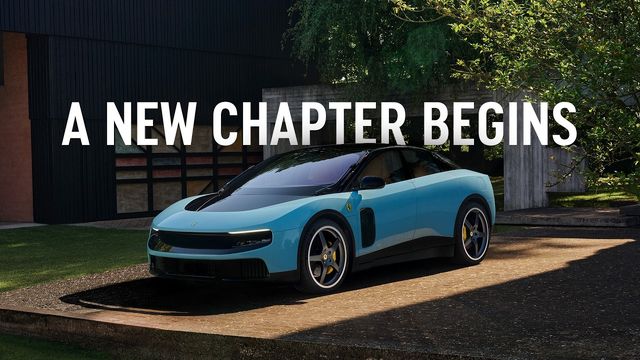
Ferrari's first electric vehicle designed in collaboration with LoveFrom from Jony Ive and Marc Newson,199Ferrari Luce: the car's name and interior were unveiled on February 9, 2026, in San Francisco; luce is Italian for "light." LoveFrom is the design collective Jony Ive and Marc Newson founded in 2019, after Ive left Apple. based in San Francisco.
And they unveiled this thing in a very unique way for Ferrari, clearly targeting a different demographic. They unveiled just the internals, like just the buttons and dials and tactile feel of everything and the steering wheel at the top of the Transamerica Pyramid200Transamerica Pyramid — a 48-story pyramid-shaped skyscraper in San Francisco's financial district, completed in 1972; the city's tallest building until 2017. in San Francisco. They have not revealed the outside of the car yet.
They wanted the tip of the spear of excitement to be, look at what Sir Jony Ive201Sir — Ive was knighted in 2012 for services to design and enterprise. would make with his hands in a workshop 20 years after he designed the iPhone. What would he do today with all that learning? And what would he do if it were a Ferrari? And it's the exact opposite of the previous universe that they lived in, which is let's show the body. Let's show the shape of the car. Let's appeal to the motorheads. Let's talk about the internal, the engine. What we are talking about here is the buttons and the clickiness of the buttons. I am so fascinated to watch what the rest of this car will look like in 6 weeks when they unveil it.
Yeah, this was incredibly daring because so many of the longtime Ferrari clients, the hardcore collectors, the petrolheads, the people who love the old-school small displacement V12s and worship at the altar of Enzo Ferrari. This is anathema to them.
Okay, so let's do a Bull/Bear analysis202Bull and bear case — investor jargon for the optimistic and pessimistic views of a company's future. Bulls bet on the stock rising, bears on it falling. just on what the Luce could be. And I want to start with, is the job to be done203Job to be done — Clayton Christensen's idea: people don't buy a thing for its own sake but "hire" it to do a job in their lives. His classic example is the milkshake bought in the morning to make a long commute less dull. by an electric vehicle compatible in any way with why people buy Ferraris? So there's essentially zero interest in electric supercars. I mean, truly, you look around the industry. When Ferrari and others started preparing for it 10 years ago, everyone sort of thought that new internal combustion cars would be banned soon, at least in Europe.
There were EU regulations204The EU regulation of 2023 requires all new passenger cars in the European Union to emit no CO2 from 2035. In December 2025 the European Commission proposed softening it to a 90% emissions cut and allowing hybrids after 2035; the amendments still have to be approved by EU member states and the European Parliament. saying that ICE cars would have to be phased out by 2030, 2035, you know, at some point in time.
But Ferrari has put all this work into building this car.
They built a whole new factory, the E-building.205E-Building — Ferrari's new facility in Maranello, opened on June 21, 2024, in the presence of Italian President Sergio Mattarella; the investment was about €200 million. It makes combustion engines, hybrid and electric powertrains, and batteries.
That's right. And they're going to go ahead with the launch. Lamborghini actually canceled theirs206Lamborghini's EV — the Lanzador. The electric version was canceled at the end of 2025, and in February 2026 CEO Stephan Winkelmann announced the model would come out as a plug-in hybrid, calling demand for electric supercars "close to zero." and has switched it to a plug-in hybrid electric vehicle207Plug-in hybrid (PHEV) — a car with a combustion engine and an electric motor whose battery can be charged from an outlet; it can cover part of a trip on electricity alone. instead. And I think the point I keep kicking around is, much like the quartz crisis208The quartz crisis — the collapse of the Swiss watch industry in the 1970s and 1980s, when cheap and accurate Japanese quartz watches stripped mechanical watches of their practical purpose. in the world of watches, speed is no longer relevant. Yep. I mean, the F80 goes 0 to 60 in 2.2 seconds. This is the supercar, this is the $3 to $5 million car. The Tesla Model S Plaid209Tesla Model S Plaid — the tri-motor version of the Tesla Model S sedan, released in 2021. The Model S itself was made from 2012; Tesla ended its production in 2026. does it in 1.99 seconds. So the reason that people buy Ferraris, just like watches, has shifted to be about expressing yourself and having a unique driving experience. In a sense, electric cars are incongruent with the reason that you buy a Ferrari, unless Ferrari can do something really cool and unique.
Yep. Yep. And that is clearly what they're trying to do.
Yes. So the, the bull case is we haven't seen this outside yet, but I mean, the internal components have been absolutely awesome. I looked over at my wife and, you know, I thought I just want to touch every one of those tactile buttons and dials and play with it. Ferrari could be expanding their audience here. I don't think it's a layer in the pyramid. I think it's a new pyramid. It's like a whole different— they're going to appeal to a set of people that would have no interest in owning a traditional Ferrari. I mean, like me, I have no interest in owning a traditional Ferrari, but gosh, I was like, oh, could I ever- well, would they ever take me as a client. But depending what this car looks like, I could be very interested.
Yes. And I think that is the daring element of it. They're creating something that kind of by nature has to exist in a parallel universe to their core client base.
Yeah. They have always appealed to the gearheads. I mean, the engineering innovations have always appealed to a set of people, but this is a whole different universe of engineering. Here's one that I think is really cool. It's quad motor, one on each wheel, plus additional motors on each wheel that independently do steering and suspension. And the effect that it has, apparently, I haven't driven one, is that it takes a super heavy battery-powered car and it makes it feel really lightweight and balanced. And so there's all these almost like illusions that they can do with technology to make the car just different than every other electric car that you've driven. And for Ferrari being a company that stimulates emotion, that relates passion, that provides a unique experience, they may have figured out how to do that in an electric car. And we may look at all the other electric cars and say, yeah, they're fast, but gosh, they just don't feel the way that this car feels. And we'll have to see.
Yep. Yep. All right. Well, while we wait here for the Luce to come out in 6 weeks or so, give us Ferrari by the numbers today.
14Ferrari by the numbers
The market values Ferrari like Hermès rather than a carmaker, even though management itself expects growth to slow.
Source: Ferrari key metrics
All right. So last year they delivered 13,640 cars.21013,640 cars — Ferrari's 2025 deliveries, slightly fewer than in 2024, while revenue grew 7% (Ferrari's reports). As we mentioned, 330,000 cars have ever been produced. Here's another way to frame that stat that is my favorite. This has been true all the way up until this year. This quote: Porsche delivers more cars each year than Ferrari has ever.
So for all the hand-wringing out there about increased production, etc., etc., Ferrari still is in a class of its own.
Small batch. Last year, approximately 81% of new Ferraris were sold to existing clients and 48% were purchased by customers who already owned multiple Ferraris.
Adding to the collections.
Yes, you should have the picture by now. Most Ferraris sit in garages because they sit among many other Ferraris, and occasionally some are driven on racetracks. So largely, this is gonna sound hilarious, but for a company that is all about the driving experience, Ferraris mostly are not driven.
Yes, yes, there's a deep irony here.
I would bet they have the lowest hours of use per car of any manufacturer in the world who produces at least, I don't know, draw a hard cutoff, 5,000 cars a year. Which makes for an interesting luxury good because there is zero way to subtly show off that you have a Ferrari. It's either silent because you have one in your garage and you're sitting there thinking, how can I bring up that I have a Ferrari? Or if you show up in it, it is really loud. It is, I have a Ferrari. There is no quiet luxury in the universe of Ferrari.
I actually think there's more nuance to that than it would appear on the surface. And this is a good time to bring up a couple points. The first is car collector and Ferrari collector culture. By and large, at least with the current/older generation, car guys are very different than, you know, Hermès collectors or, you know, LV fans or something.
There's a nerdiness.
There's a real nerdiness, and there's a real community to it. Cars and coffee meetups211Cars and Coffee — informal morning meetups of car enthusiasts in parking lots, usually on weekends. are a real thing, and you just go to them and you connect with other people there, and they accept anybody.
It's a way for adult males to make friends.
Yes, yes, yes. So there sort of is this other way to show off your Ferraris as part of a community where you can celebrate and appreciate them together with the community. And it's very opening and welcoming—this culture. If you're interested, even if you don't own any of these cars or have the means to, it's okay. You're still welcome in this community.
It is different. Like the watch world, when someone says, oh, what watch are you wearing? There's a little bit more ick to it. I ask people all the time because after the Rolex episode, I'm just infinitely fascinated by what's on your wrist, and I like hearing the stories. But if you're not careful, it can sound like, how expensive is your watch? And car culture doesn't feel like that in the way that watch culture does, or luxury handbags.
It's paradoxical in that these are the most expensive luxury objects out there, way, way, way more expensive than a watch. And way rarer. And way rarer. And yet it's somehow sort of less exclusive. At least in the community aspect of it. So that's sort of one point. The other point is that yes, Ferraris are loud and yes, Ferraris are designed to convey passion and an experience of being maximally alive and, you know, battling against death if you so choose. But they're not flashy, or at least traditionally they weren't flashy in the same way as, say, a Lamborghini. If you want to be a crypto bro, you buy a Lamborghini.
Yeah, well, Lamborghinis are the most garish side of Ferrari minus the racing heritage.
Yes, yes, that's a good way to put it. Yeah, it's not— certainly plenty of Ferraris can be garish, but there is both a legitimate history and culture that you're buying into, right? And many of the models are actually quite restrained, at least in styling.
Okay, relatively, yes. The last point on this is Ferrari has taken price up a lot in recent years. And so if you were, let's say you're a 70-year-old dude and you have a couple of old Ferraris that you collect and you like bringing to shows, they weren't that expensive until recently. I mean, they were always more expensive than other luxury cars. They were definitely ultra-luxury cars. But if you just look at how much the price has gone up in recent years, it stimulated the second market too. So I was talking to someone who bought a car in the mid-'90s just from the sort of bottom of the range, and he was lamenting the fact that he sold it 3 years ago, 4 years ago, and it's doubled in price since then. That sort of phenomena has happened all over the Ferrari universe, which adds to the mild ick of seeing one that I don't think you used to experience as much.
Yep. That's a great point.
Okay. So back to the numbers. They did $8.2 billion in revenue in 2025. In terms of profits, they did $3.2 billion in EBITDA.212EBITDA — earnings before interest, taxes, depreciation and amortization; it shows what the business itself earns. Ferrari reports in euros: in 2025 revenue was €7.15 billion, EBITDA €2.77 billion, and the EBITDA margin 38.8% (Ferrari's reports). So they've got a 38.8% EBITDA margin. Pretty good business.
Pretty good for a car company.
It's not a car company. That is the answer here.
Of course.
So how are they so profitable? This is the exact comparison I was going to. Well, let's look at their cost to make each car versus how much they can sell each car for. And we'll start by looking at other car companies to get a sense of what their gross margins are. Ford, 7%. That is 7% gross margin, not EBITDA, not net income, not cash flow margin. That is their gross margin when they create one unit of a car.
A new F-150,213Ford F-150 — a full-size pickup; Ford's F-Series pickups, to which it belongs, have been the best-selling vehicles in the US for decades. etc., etc.
Yeah. They make 7% before they sell it. For having to pay their overhead and their R&D and their G&A214G&A (general and administrative) — the cost of running the company: offices, accounting, lawyers, management. and any of their fixed costs. Yeah. GM, 10%. BMW, 14%. Wow. Volkswagen, 14%. Mercedes-Benz, 16 to 22%. Porsche, fricking Porsche, 15 to 25%. Toyota, that same kinda range, 18 to 21%. Toyota is exceptionally well run. Isn't that amazing that Toyota generates on the order of 3 times as much gross margin per car that rolls off the line compared to Ford?
Yeah, that is incredible.
Ferrari has 50% gross margins. That is a luxury brand.
And as you were pointing out earlier, that's average.
The supercars and the iconic cars are way above 50% gross margins.
I get the sense the range is like 30-ish percent, maybe 35%, and then the supercars are in the 80 to 90% gross margin range. So it is worth pointing out here, this average 50% gross margin, you might say, oh, it's a luxury brand, which is the assertion I'm making. They do have to make a bunch of complex, expensive, giant hunks of metal and safety and engineer the absolute crap out of them and truly innovate. So when you look at companies that don't have to do that, LVMH is 66% and Hermès is 71%. So, there exists a category when you don't have to do all of that hard engineering work where it's a good business just selling handbags.
Yeah. Yep. And this is where the technology element of Ferrari comes in that doesn't apply to many of the other luxury companies.
Yep. But still, Ferrari is able to sell their cars for twice what it costs them to make. Whereas if BMW spent $100 to make a car, they only get to sell it for $115. So perhaps more interesting though than all of this, than the gross profit percent, is the gross profit absolute dollars. The profit per car average exceeded $170,000. That is more than the entire retail price of your average luxury sedan. And even Porsche would need to sell 6 cars to equal the profit dollars that come from a single average Ferrari.
Wow. That is truly astonishing.
There's so many different ways to slice this. It's fun.
What other company or products can you think of that has a per-unit gross margin contribution of $170,000?
Well, this gets into how we opened the episode. That in terms of how people spend money in life, it's housing, food, and transportation. And if you are selling them something in the transportation category, one of their largest possible spends, and you're selling them the most expensive version of it, you've sort of spiked. You kind of have to— it's real estate is the only other thing you can really meaningfully start to compare this to.
All right. A little segment breakdown time. They've got three segments that they report. There's cars and spare parts. That's 84% of their revenue. 11.5%, though, is sponsorship, commercial, and brand.
The Formula 1 team.
Yeah, I was going to say the commercial and brand. This is sort of where their, their lifestyle stuff is, the fashion. But really the interesting bit here is sponsorship. Formula 1 for them is a profit-generating center that is also the single best marketing dollars they could ever spend.
Yes. Thank you, Liberty Media215Liberty Media bought Formula 1 in 2017. Under it the sport's popularity soared, thanks in large part to the Netflix series Drive to Survive. and their stewardship of Formula 1. Overnight, in the last 10 years, Formula 1 went from just a marketing spend for Ferrari to the best marketing activity they do and a real meaningful profit center.
Yep. The HP deal alone,216HP — since 2024 the title sponsor of the team, which has been called Scuderia Ferrari HP ever since. The parties don't disclose the amount; the press puts it at $90–100 million a year. the title sponsor of the team, is rumored to be $100 million a year.
And the latest Forbes valuations217Forbes valuation: in November 2025 Forbes valued the Ferrari team at $6.5 billion, the most in Formula 1; Mercedes came second at $6 billion. of F1 teams, I think Ferrari, they have the value of the team at $6.5 billion. Is that right?
Sounds right. Yeah, sounds right. Yeah. They don't produce the most profit, but they are the most valuable team because they're Ferrari and everyone pays a little extra premium for Ferrari and everything.
Right. So, of the current market cap, that's what, probably close to 10% of the current market cap is just the value of the team.
Oh, that's crazy. You're right. Yep.
And again, you can't really extricate one from the other. No, these are one thing. Ferrari is Formula 1. Formula 1 is Ferrari, but it's now a meaningful value and profit driver.
Yep. Then lastly, 4.5% of their revenue is financial services and some other random stuff, including selling engines to other Formula 1 teams. Right. So this is the money that the Cadillac team218Cadillac debuted in Formula 1 in 2026; for its first seasons the team runs Ferrari power units. is paying to Ferrari to put an engine in their car. All right. Multiples.219Multiples — ratios of a company's price to its financial metrics, used to compare how richly the market values different companies. P/E (price to earnings) is market capitalization divided by annual net income. For anyone who is not an investor, this is when you look at the current business, how many years of the current business would you have to pay them to buy the whole company from them. And there's a bunch of different ways to slice it. We're gonna look at the price-to-earnings ratio, or P/E. Ferrari trades at about 35 times their earnings. And until the luxury slump where LVMH and Hermès and all these other companies got hit too in the last couple years, it was trading around 50x for their last few years. Now, for reference, most automakers trade at 8 to 10x. Hermès trades at 35 to 60x, again, big swing the last few years, and LVMH sort of around 25x. So essentially the market agrees with management that this is a luxury company, not a car company.
And one of the very, very best luxury companies, not just a luxury company, but an apex luxury company, valued on a multiple on par with the two very best luxury brands in the entire world.
Source: Ferrari key metrics
Yes. The implication here with a very high price-to-earnings multiple is that investors believe that the profit streams are a lot more durable and certain compared to traditional automakers. Effectively, there's a high degree of certainty that all these profits will continue. The only other option when you're looking at why is a P/E ratio so high is if you expect it's going to grow, right? But that is super duper not what is happening here. That's when you would have a high P/E multiple for a startup that's growing 300% year over year, revenue growth is actually experiencing a massive slowdown at Ferrari. If there's a bear case at all for Ferrari investors, which, we've painted quite the bull case this whole episode, it's that Ferrari has reached the edge of their extreme pricing power220Pricing power — the ability to raise prices without losing customers. Warren Buffett called it the single most important sign of a good business. and their ability to keep ratcheting that up at the number of units that they're selling. Management said in their October 2025 Investor Day221Investor Day on October 9, 2025: Ferrari set a 2030 target of about €9 billion in revenue, roughly 5% growth a year, and halved its plans for the share of electric cars. The stock fell about 15% that day. that the era of double-digit revenue growth is over. Over. And over the next five years, they expect revenue to grow just 5% each year.
Yep. Which actually, for the long term, is probably healthy for the company and the brand. They've expanded the pyramid so much in recent years that a period of slower growth probably is the right thing to do in terms of luxury strategy management here. But yeah, the stock really took a hit after that Investor Day last fall.
It's funny, it took a hit, and people still think Ferrari's current revenue streams are so durable that they're willing to pay the next 35 years' worth of profits to buy the business today. And that is after getting crushed. The market cap went from $90 billion to $55 billion, and investors probably got a little bit excited about that 11% and 17% growth rates. And now that they're hearing 5%, that's why you're seeing this contraction,222Multiple contraction — a falling P/E: investors are willing to pay less for each dollar of earnings, usually because they expect slower growth. but a contraction to 35x price-to-earnings.
Yep. Well, one more thing before we get to analysis, powers, and quintessence.223Quintessence — a regular segment at the end of an Acquired episode: each host distills the main lesson to take away from the company's story. China. You mentioned it earlier, but what's going on for Ferrari in China?
So what's going on in the auto industry in China? It's probably the place to start. China's car market is being completely upended by inexpensive, high-quality electric cars. EVs domestically from BYD, Xiaomi,224BYD — the Chinese maker of electric cars and hybrids from Shenzhen; in 2025 it overtook Tesla as the largest maker of electric cars. Xiaomi — the Chinese smartphone maker that began making electric cars in 2024, starting with the SU7 sedan. and others. This is having a huge impact on brands that expanded into China in the last decade, as we talked a lot about on our Porsche episode. But China is only 7% of Ferrari's sales, down from 10% at its peak. Now, Porsche, on the other hand, China was 33% of their deliveries a few years ago. Which has collapsed all the way to 15% and continues to fall. So the question then is, is Ferrari any less desirable today in China than it was five years ago? And does it fill a different enough job to be done than the domestic supercars for them to weather that storm?
Hmm. Interesting. I don't know enough to say, but I would suspect it's probably about as healthy as you can be.
Yeah, I think my answers on this are there are domestic supercars in China. They're still not Ferrari level in terms of desirability, certainly not brand heritage. Yeah, they don't have the myth. Unless there's a sentiment change where people in China only want to buy domestic supercars. That's a risk to them. But I think the thing that you're buying, the signal you're trying to send when you buy a Ferrari is not really at risk. The job to be done by an EV— I keep coming back to this— is completely different than the job to be done by owning a Ferrari.
Yep, that's it. I'm glad we brought this up again here because I think this also is an important point of perspective to add to the Luce and why I really think it is bold and daring and important that they're doing it. It's easy for us sitting here in the US to have a perspective of why are they continuing this EV thing? Clearly they should just stay with combustion engines.
I'm not. It's the only one I want to buy.
Well, yes, good point. Okay. Easy for US-based collectors and petrolheads to maybe be upset about this and not understand it. If you look, certainly in China, but also in Europe where Chinese EVs are invading everywhere. In America, EVs are in a bit of a slump. But in much of the rest of the world, Chinese EVs are dominating. And clearly showing what the future should be. So is Ferrari gonna say, yeah, we're just gonna abdicate all of that and let the next supercar brands be built around EVs and probably be built in China? Or are they gonna step up and take their own swing?
Yeah, it's a swing. All right. Should we move into analysis?
157 Powers and quintessence
Ben's takeaway: Ferrari marries the exclusivity of a luxury brand with the inclusivity of a sports team, and that is a business cheat code.
Yes. And let's start with our traditional segment, 7 Powers. Borrowed from Hamilton Helmer's great book2257 Powers (2016) — Hamilton Helmer's book on the seven sources of durable competitive advantage; a "power" is a set of conditions under which a company can earn more than its competitors for a long time. and framework. What power does a company have? What are the things that give it a durable, sustainable, comparative profit advantage over its nearest competitors? And the 7 Powers are: scale economies, network economies, counterpositioning, switching costs, branding, cornered resource, and process power.226Helmer's powers: network economies — a product is worth more to each user the more users it has; counterpositioning — a model the leader can't profitably copy because it would undercut its own business; switching costs — what a customer loses by moving to a competitor; cornered resource — something only the company has; process power — a way of working rivals can't replicate for years. What you got for Ferrari?
All right. Well, should we just start with brand?
It's funny. Okay. I'm glad you started there because I think it's actually an interesting discussion. Go for it.
How much would you pay for a Ferrari that was badged as a Ford?
Well, there's probably a pretty good data point on this, which is the Ford GT.227Ford GT (2004–2006 and 2016–2022) — Ford's supercar, conceived as the heir to the GT40 that beat Ferrari at Le Mans in 1966. And I don't know what they sold it for MSRP, but I suspect it was less than a Ferrari.
Yeah. I mean, this is so hard because a Roma is not that much more expensive as the highest-end Corvette228Chevrolet Corvette — General Motors' American sports car, made since 1953; since 2020 it has been mid-engined, like a Ferrari. that you could buy. But an F80 is $5 million, and there are not cars from normal car companies that anywhere near approach that. So the question is kind of who is their direct competitor? Their direct competitor is probably Lamborghini.
Yeah, that's the closest. Yeah.
If you really want to go as apples to apples as possible. Yep. So Lamborghini, as we mentioned, makes about 11,000 cars a year compared to Ferrari's 14,000. Lamborghini has meaningfully increased volume. If you look back at the Ferrari IPO year, back then the average selling price was about even. It was about $300,000, whether you're buying a Lamborghini or a Ferrari. Today, Ferrari's average selling price, as we mentioned, is $500,000, whereas Lamborghini is about $340,000. So Ferrari has really flexed their sort of pricing power over Lamborghini, especially as Lamborghini has made more and more and more to kind of catch up to their volume.
And 60% of Lamborghinis are Uruses.
Yes, there's that too. But the point that is useful for our powers exercise here is how much more would you pay for a Ferrari than a Lamborghini?
Well, it's right there in the data.
Right. It's about a third more.
Yep. I was going to take the counterpoint. On the one hand, yeah, brand is of course the strongest power that Ferrari has, as with any luxury company. On the other hand, I think it's not quite as powerful in terms of driving profit margins for Ferrari as it is for, say, a LVMH or an Hermès. Because a Ferrari product, a Ferrari car-
Is really differentiated.
Still has to be a Ferrari.
Ferrari can't just stamp the prancing horse on a car and call it a Ferrari. A Ferrari has to elicit emotion from you. Yes. And it has to be cutting edge and it has to be incredibly powerful. So it's sort of like there's more cost that has to go into it.
Yes, there's a phrase they use called racing thrills. Yeah. And it's engineered over decades to provide a very specific racing thrill when you drive it, which is not something that you can throw another badge on. So I think if you were asking management, they would insist this is a fruitless discussion because there is no way to re-badge something and call it a Ferrari. That's not. It's intellectually impossible.
It's tautological. A Ferrari is a Ferrari.
Yes. Yes. But in reality, when they raise prices, people are willing to pay those higher prices because there is a shared myth that we all have, a belief in what the brand represents and means to us and the emotions that it gives us by owning and driving it that are quantifiable and worth something.
Yep. Yep. How does this compare to how you felt about watches at the end of the Rolex episode?
Watches don't provide racing emotions. So what matters, because all the performance is effectively identical at the high end, is who you are saying that you are to the world when you look down at your wrist. And when someone else sees your wrist.
A watch says something about you, but it doesn't provide an experience for you.
That's correct. And there's this interesting, perfect comparison here. Porsche is Rolex. I mean, they make an absolute crap ton of them. Rolex is a million a year, and Porsche— I don't have the numbers in front of me, but it's 300—
320,000 or so a year.
Exactly.
And it's an incredible brand. Just like Rolex is an incredible brand.
And I see them driving around my neighborhood all the time, and I think they are amazing polished pieces of engineering, and I respect them for the engineering. And the same way that I'm wearing a Rolex Explorer on my wrist, I could easily see buying a Porsche. It feels reasonably me. Could I see going out and buying a Patek Philippe? Not really. The same way that I say not really about Ferrari. If you're gonna make the analogy, the crude one, that Porsche is Rolex, I think you can make the analogy that Ferrari is Patek Philippe. It's much smaller production. It's an order of magnitude more expensive. The big difference here being that Ferrari is much sort of flashier than Patek is as a brand, and they also have the Tifosi, which adds this whole different element to it. So to directly answer your question, I think branding shows up more in luxury watches than it does in luxury cars for the— almost like the lack of experienceable intrinsic product characteristics, that it's just hard to experience the product in a watch, but it's easy to experience the product differences in a car.
Yep, totally agree.
So you rely more on brand in watches.
Yep. Okay, let's step through some of these others because I think some of them are quite interesting. Keeping with the Patek Ferrari comparison, I do think Ferrari has this really interesting sweet spot of scale economies that I don't think we've ever seen before, where-
They can do things Pagani can't, but they can also do things that Toyota can't.
Yes, exactly. Exactly. Exactly. They have power because of their scale economies and because they're like Goldilocks. They're just right. They're big enough, but not too big. And they're small enough, but not too small.
Yes. If they were any bigger, they would be sort of handcuffed by their overhead. And if they were any smaller, then they couldn't do some of the innovations that they do and design all the programs they design and all that sort of thing.
Exactly.
There's absolutely a scale economy to the community. I mean, the fact that they have all these racing programs and car meetups and factory tours, you need to be a certain scale to support all of those operations.
Yep. I totally agree with that. And that's part of being the minimum size. I thought you were going to go to network economies. Ferrari absolutely has network economies.
For sure.
100% with the Tifosi and the community and the nature of the community and being so open. And as you perfectly put it, it's a way for older men to make friends. Whether you're a member of the Tifosi or a Ferrari owner, a big part of what you were doing is making friends.
Yes, it's a network economy is by having a robust, rich community around your product or almost this free defensibility because there's just so much more predisposition to want to buy something with a Ferrari logo on it because of the network economy you were just describing, David.
Yeah, I mean, it's astonishing calling back to our F1 episode. Ferrari is the most popular F1 team in the world. By a large margin.
And hasn't really won much since Michael Schumacher.
Yeah. And sells the most expensive cars that the vast, vast, vast majority of their fans will never be able to buy.
Absolutely exclusionary.
I bet a lot of fans of the Mercedes racing team, one way or another, can find a way to buy a Mercedes. Almost none of the fans of Ferrari can find a way to buy a Ferrari.
All right. You just pulled forward my quintessence, so I'm just going to do it now. Great. Ferrari is both inclusive and exclusive. It has the exclusivity of a luxury brand, but the inclusivity of a sports team. I mean, it's this amazing marriage that— this is going to sound so self-serving, but I was just sitting there nodding reading their financials because this is exactly Acquired strategy. We are unbelievably exclusive about the companies that we are willing to do these editorial deep dives on. We're unbelievably exclusive about our sponsors, and yet we're as inclusive as possible for the community. It should be the best deal on the internet. We want to make tickets cheap whenever we have big live events. You and I have always talked about it as—
But really, we're just—
Ferrari figured this out first. Yes, it's so smart.
All right, well, we're gonna have to change how we talk about Acquired.
If you can marry a luxury brand with a sports team, it is a business cheat code.
Yes, yes, I love it. Oh, that's such a great quintessence.
All right, back to Powers?
Ah, it feels anticlimactic to come back to Powers. Well, let's run through it quickly. All right, so we did scale economies, network economies, branding, counterpositioning?
Did this even ever exist in the first place? Because this almost never exists when you're an incumbent. But trying to think if they didn't— if they use counterpositioning in the takeoff phase.
Yeah, I don't really think so. I think they were just doing something different, as we talked about, by having the team, the constructor, and the services all in one house.
Oh, they're counterpositioned against the houses of brands today. They can do stuff that Lamborghini can't do because of the platform sharing.
Yeah. Switching costs. There's no switching costs.
In fact, I think most people who own Ferraris own other cars and want to keep adding other cars.
Yep. Cornered resource. Absolutely. They have Enzo and the history and the myth and the legend of Ferrari. And that is not going anywhere, obviously.
And actually, for a while, their F1 team had an advantage because they have their own racetrack that no one else has. I mean, they have their own wind tunnel and everything, but like, they also own-
A racetrack. Yes.
Yes. Do they have process power?
Process power? I don't think they have any obvious or specific process power. Sure, there's institutional knowledge in the factories and they have their very unique way of building cars that is different than any other auto manufacturer. But I don't think that's quite process power. I think their power lies mostly in the other categories.
Yeah, I agree. So the question kind of becomes, what is the primary reason why imitators have failed to execute Ferrari's strategy as well as Ferrari? And the most obvious is McLaren. They're trying to basically do the same thing. There's Lamborghini that we've talked about. There's Aston Martin.229McLaren — the British Formula 1 team founded by Bruce McLaren in 1963; its sister company McLaren Automotive, founded in 2010, makes road supercars. Aston Martin — the British sports car brand known for James Bond's cars. Bugatti — the French hypercar brand, part of the Bugatti Rimac joint venture since 2021. It's a much smaller production, but there's Bugatti. I mean, why are there no other Ferraris?
I think I would posit that there are no other Ferraris because of the continuity. Even through all the crazy ups and downs and the wild story and the journey that we told on this episode, Ferrari has always been Ferrari. The core myth has always remained intact, and the products, as up and down as they have been over the years, more or less have always delivered on what it is that you are buying when you buy a Ferrari. And that has been unbroken all the way back to 1947. I mean, for God's sakes, they're the only F1 team that has been continuously operating.230The only team: Ferrari has raced in the Formula 1 World Championship since its first season in 1950 without missing one. For all of F1. That's my answer.
I think that is largely correct. It is interesting for all the people who complain, oh, you know, that model was crappy or this strategy was crap. It's actually a pretty narrow window where more or less they were still being Ferrari, even if you have a particular gripe.
Yep. And certainly if you compare it to the ups and downs of any other car company, it's quite continuous.
And my answer is different for each one of these. I mean, for example, Lamborghini, how do you build a company like this without racing heritage to tie it to. If you're going to build a luxury brand, you need time and you need heritage where you tie it to an important emotional thing that people lust for connection over. And in cars, it's racing. I'm sorry, it's just, it's the, it's the obvious thing to tie the emotion of your brand to. Aston Martin has fallen down because they've been terrible at running a business. McLaren, various changes in ownership and leadership and strategy. So different for different reasons, but no one has over, what is it, 80 years been able to run the Ferrari playbook.
Yep. All right. Quintessence, you already gave yours, which I love. The marriage of a luxury brand and a sports team. What could be more quintessentially Acquired than the marriage of a luxury brand and a sports team? I think for me, as I was thinking about quintessence, I sort of took the question that you and I posed each other at the start of our research journey here on Ferrari, which is what are you buying when you buy a Ferrari? And for me, it's two things that you're buying. You're buying one, passion. There's undeniable, purely quintessentially Italian and Enzo and Ferrari passion that goes into every one of these cars, from the Range to the Icona series, certainly to the supercars. And I think probably even the Purosangue, even the FUVs.
Certainly.
Certainly.
It's funny, David, you know this, but I talked with the CEO Benedetto Vigna yesterday and he told me, we don't sell a car, we sell a dream.
And I think that's an old Porsche line. But yes, yes, it's true. It's true. You know, and compare that to other cars and it's just, you know, most cars, there's, there's zero passion in them. So one, I think it's passion. And two, I really do think there's something to the ability to feel maximally alive in a Ferrari. And that comes right back to Enzo and his story and all the great tragedy and death that was part of it. Like, buying a Ferrari, you are buying a weapon that you can use to, you know, fight against death and scream into the void should you so choose.
And the one thing I will add to that, back on our Rolex episode, we threw out the idea of a functional alibi,231Functional alibi — a term from Acquired's Rolex episode: a practical reason to buy a luxury item (say, a watch's water resistance) that the buyer uses to justify the purchase to themselves and others. a reason you could claim that you need such a watch. For Ferrari, they have lots of incredible alibis. Most people do not experience the thing that you just described, feeling maximally alive and going right up to the edge, but that is one of several plausible alibis for why you can convince yourself that you are buying this thing. For me, it's the incredible engineering. I think for some people it's the racing heritage. I also think their cool manufacturing and their craftsmanship. These are all tremendous assets that the brand has that are extremely plausible alibis that you can tell yourself why you are buying this.
Yep. That's a great point.
Even if what you're really, really doing is social signaling. Or you have too much money and you truly don't know what to do with it and this seems fun.
Or you view it as an investment.
That's right.
Well, that is a great place to leave our story for today. We have a few fun things here before we wrap up the episode.
I've got a couple bits of trivia for you, David. I don't know if you know them.
All right. I've got a couple.
Is one of yours the Lamborghini story?
Yes. Yes. All right. We got to tell the actual Lamborghini story here.
Did you know? So the way that this story is out in the world, there is an issue of Thoroughbred and Classic Cars232Thoroughbred & Classic Cars — a British classic car magazine. Its January 1991 issue carried the interview with Ferruccio Lamborghini that is the source of the story about his quarrel with Enzo over a clutch. from January of 1991. And it is a quote from Ferruccio Lamborghini that is in this print-only magazine.
So this is the origin of the myth of the founding of Lamborghini is in this magazine. I did not find that. That's incredible. All right. Well, do you want to tell it?
You give your side of the story and then I'll give the quote.
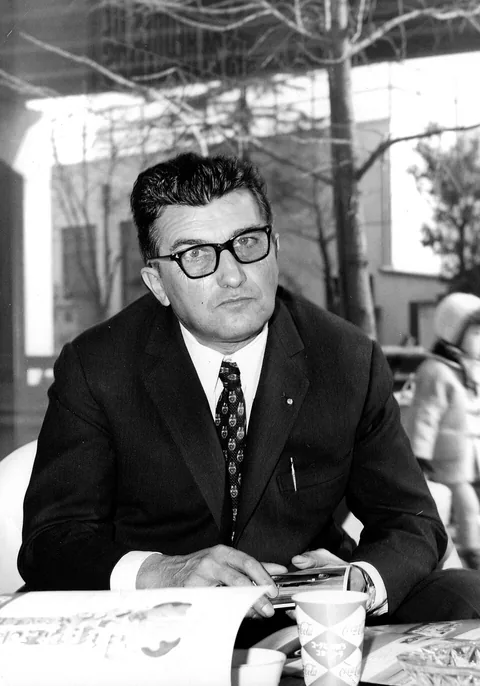
Okay. So the legend out there about the founding of Lamborghini is that Ferruccio Lamborghini was a wealthy Italian tractor magnate/manufacturer.
Yeah.
Who was dissatisfied with the clutch in his Ferrari that he owned, and he went to Enzo to complain about it.
And, and here's the quote: "The problem with the clutch was never cured, so I decided to talk to Enzo Ferrari. I had to wait for him for a very long time. Ferrari, your cars are rubbish! I complained. Il Commendatore was furious. Lamborghini, you may be able to drive a tractor, but you will never be able to handle a Ferrari. This was the point where I finally decided to make a perfect car."
Now, the reality is that was some— an intentional attempt at myth building on the part of Ferruccio. That never happened. The real story is that one of his tractor mechanics was repairing one of Ferruccio's Ferraris and found that some of the parts that were used in the Ferraris were quite similar to the parts that they used in the tractors and said to Ferruccio, like, hey, we could try making cars too. I bet we can be at least as good as this Enzo guy.
I don't know. Everyone involved in these stories is long dead. It could be some of column A and some of column B.
That's true. That's true. That is the legend of the founding of Lamborghini.
I love it.
All right. My second bit of trivia is not a confirmed fact, but it's something that I've been kind of thinking through. I had seen numbers floating around out there of the number of clients that Ferrari knows the name of. They say in their public reporting that they have 90,000 active owners and another 90,000 who currently own Ferraris but haven't bought in the last 5 years. I don't think these are estimates. If there's only 180,000 rows that they need in a CRM.233CRM (customer relationship management) — a system for keeping track of customers: who bought what, when someone last talked to them, what to offer them.
Yeah, it's completely reasonable that they know every owner of every Ferrari.
I think they have a giant spreadsheet with names mapped to serial numbers and who owns every single car.
Yeah, that's crazy to think about, but completely reasonable.
Because think about it, what are the ways in which they would not have your information? If you bought it new, they've got your information. If you bought it used from a dealer, they've got your information. If you bought it in a private sale at auction, pretty sure they can get your information. But if not, you probably want to get one of those $6,000 to $10,000 certificates here pretty soon.
Right. The Classiche. Yep, exactly.
Which is going to involve contacting the factory-
Getting their information.
You know, track days. There's like all these community programs. I think they know every single owner who owns every single car.
I bet they do. I bet you're right.
Isn't that awesome?
We'll have to ask them next time we chat with them.
That's right. All right.
My second and last one. I am so sure I'm going to get you with this one. The 1949 Le Mans that Luigi Chinetti won, first major victory for Ferrari, example of the business model, you know, private client car winning Le Mans, etc., etc. There was another privately owned Ferrari 166 that was entered by another Ferrari client in that very same race, the 1949 Le Mans. Do you know who that other client was?
Hmm. European or American?
European. French.
Is it a member of the Hermès family?
Good guess, but no. You're not going to get it.
I don't know.
Pierre Louis-Dreyfus of the—
Oh, Julia Louis-Dreyfus.
Yes. Yes. Of the famous Dreyfus family and Julia Louis-Dreyfus's grandfather, Elaine from Seinfeld,234Seinfeld — the NBC sitcom (1989–1998) by Larry David and Jerry Seinfeld about four friends in New York; Julia Louis-Dreyfus played Elaine Benes. her grandfather was one of the first Ferrari clients and raced in Le Mans.235Pierre Louis-Dreyfus (1908–2011) — a French banker from the family that owned the Louis Dreyfus trading house and a racer who competed under the pseudonym Heldé. At Le Mans in 1949 he and Jean Lucas started in the second privately entered Ferrari 166 MM and retired after a crash. His son Gérard is the father of the actress Julia Louis-Dreyfus.
Oh my God. That is awesome.
So awesome.
So side note, I think that is so crazy that she's like of the Louis-Dreyfus family and went on to be an incredibly successful self-made actress coming from a multibillion-dollar European generational wealth. I mean, it's just a-
Yep. This is incredible stuff.
It's just a crazy smash together of two worlds.236Two worlds — the hosts love unexpected links between characters from different stories and call them crossovers in the "Acquired cinematic universe."
Totally.
All right. Carveouts?
All right. Carveouts. Let's do it.
Go watch the movie Ford versus Ferrari. It's enormously fun. I have a few random shoutouts. Maison Wheat sweaters. I'm wearing one right now. I have a whole closet full and they have been the most pleasant. I can wear them to bed or to dinner. I'm wearing them to recording. They feel like the most flexible item that I own and they're unbelievably comfortable. So I, I can't recommend Maison Wheat sweaters enough.
Oh, nice. I'm in the market for some new sweaters. I'll go check them out.
Yeah, they're great. Craighill scissors.
Okay, wow, this is a deep cut. Scissors.
Sometimes I get tricked by Instagram, as my wife says, where I'm scrolling through and then I find like the perfect ad hitting me at the perfect moment for some product I didn't even know I needed. This pair of scissors, the ad is great because it says, how come your scissors are like some flimsy sheet metal? And when you cut something that's hard, sometimes the scissors split sideways. And don't you hate that when it doesn't actually cut and the little screw is actually not positioned in the place to give you maximum leverage? We've just gotten so cheap in how we make scissors. Don't you miss the scissors from your grandma's house when you were growing up from the '50s that were like metal and like really solid? Well, we have brought those back, but with the highest manufacturing quality, the best metals, this amazing grip. And I'll tell you, oh, and this, the way it slides when you squeeze them together to cut something is so unbelievably crisp, satisfying, smooth. And I bought them thinking like, we'll see. And they're expensive scissors. It's like $50 scissors or something. And they show up and it is everything I could have hoped for.
It is the Ferrari of scissors.
I'm throwing away all my other scissors. I'm only using Craighill scissors forever. It's a fantastic product. And after I bought it, I actually found out the founders are Acquired listeners. So thank you so much for making a delightful product.
Wow. Okay. I don't think I could top that. That's, that's great. That's an all-time carve-out right there. All right. Ben, Amazon grocery service has completely transformed groceries in my family. It launched in San Francisco a couple months ago.
Oh, like at the end of your shopping journey, you just randomly start clicking and adding things to your cart?
Yes. People have been trying to crack online grocery forever, including Amazon, you know, in a variety of different ways. And I've tried them all.
We get Amazon Fresh237Amazon Fresh — Amazon's grocery delivery service, launched in Seattle in 2007. every week.
Yeah. You know, Amazon Fresh or Instacart, or there's Good Eggs here in San Francisco,238Instacart — an American delivery service whose shoppers pick orders at ordinary stores (founded in 2012); Good Eggs — an online farm-produce grocer in the San Francisco Bay Area. and like they all have their pros and cons, but you know, at the end of the day, like I mostly still went to the grocery store. Amazon has cracked it with Amazon Grocery. You just click and add stuff on whenever you're ordering Amazon. I mean, as a parent of two small children, I'm ordering from Amazon multiple times a week and I'm just clicking and adding on stuff for my daughter's lunches, whatever we need, milk, you just add it on. There's no extra fees. There's no nothing. It just comes within a couple hours with your Amazon order. It's amazing. It is. I go to the grocery so much less now over the last couple months now that I can just click and add stuff. It's life-changing. It's awesome.
All right. I have a funny story about this. It just provides you like a little grid of pictures, right? It's like a little interstitial inserted before you finally get to the checkout page. Then you start tapping on the things that you want to just show up at your doorstep. I tapped the picture of a banana 5 times because I was like, oh, I need like 5 bananas, and I got 5 bushels of bananas.
Bunches of bananas. Good thing you have a toddler who, if he's like any other toddler, you know, I assume eats a lot of bananas.
A banana a day.
Yeah. My second carve-out is one that you mentioned a couple episodes ago. Travelpro had reached out239Travelpro — an American luggage brand. In 1987 Northwest Airlines pilot Bob Plath invented the Rollaboard, a two-wheeled suitcase with a telescoping handle that you pull behind you upright; modern roller bags descend from it. and sent you a bunch of, you know, great Travelpro luggage.
I bought the luggage first, long before they sent it. And they sent it because I got a lot more luggage because we used it as a carve-out, right?
Well, they also asked if I wanted some, and I said sure. And they said, hey, we want to, you know, also send you this backpack. I'm like, okay, I love travel backpacks, but I don't know that I need another one. I love this backpack, the Travelpro Altitude backpack. I've been using it a ton. I did a solo trip with my two girls while Jennie was away on a work trip for a weekend at Legoland, and I packed for all of us in my backpack. It was incredible. I love this thing, the Travelpro Altitude backpack. I consider myself a connoisseur of travel backpacks. I've been through many in my life, and I've never found one so perfect as this. So thank you, Travelpro.
There you have it. Well, a huge list of thank-yous that we want to give to all the great folks who helped with this episode. And as always, the sources, books, and everything that we did for research are linked in the show notes.
Yes. And speaking of, I owe just a huge, huge thank you to Luca Dal Monte, who authored the definitive biography of Enzo Ferrari and was super generous, spent many hours on Zoom with me talking through the nuances of all this history. We are incredibly appreciative of his help. Second, most importantly, to the other Luca, Luca di Montezemolo, truly a living legend who embodies Ferrari as much as anybody alive today. Thank you for taking time with us. To the also legendary Domenico De Sole-
Oh he's the best.
-the former CEO of Gucci240Domenico De Sole — Italian lawyer and executive, CEO of Gucci Group from 1995 to 2004, while Tom Ford was creative director; he then cofounded the Tom Ford brand with Ford and became its chairman. and business partner of Tom Ford's, who spent another good chunk of time with me helping me really understand the difference between French and Italian luxury. To Stephen Wilmot, who covers European autos at The Wall Street Journal and wrote a great piece breaking down how the waitlists work at Ferrari, that we'll link to in the show notes. To our friend Doug DeMuro, and to Chip Connor, who is one of the foremost Ferrari collectors in the world and gave us great perspective on the Ferrari collector community.
For me, to Arvind Navaratnam at Worldly Partners for his great, great write-up on Ferrari linked in the show notes. Worldly Partners, for those who don't know, is a highly concentrated long-term investment firm focused on multi-decade compounding businesses, very in line with Acquired's ethos. You can learn more at worldlypartners.com, and he's got the Ferrari write-up there. To my good friend Matt Shobe, Ferrari enthusiast and former Ferrari owner. To Brian Lum at Baillie Gifford, really, really thoughtful investor who helped me think through all of Ferrari and really woke me up to the idea of the pyramid of infrastructure. So thank you, Brian. To Neil Konzen, one of the OG folks at Microsoft here in Seattle, who then would have a second career actually working for Ferrari.
That's right.
Moving to Maranello, experiencing it from the inside, working on the F1 side of the house on their technology, which was really fun to get his perspective on how the company evolved over the decades. To Mike Miller, good friend of the show, former editor at the Wall Street Journal, who really helped us research and construct this episode. And to Benedetto Vigna, the CEO of Ferrari today. Thanks to Benedetto for taking some last-minute time yesterday to run through some final questions I had before recording. To Eddy Cue,241Eddy Cue — Apple's senior vice president of services; on Ferrari's board since 2012. who is actually a Ferrari board member and a good friend of the show. Thank you for helping us contextualize.
In addition to all of his work at, you know, Apple, the fruit company.
Yes. And lastly, to Daloopa for their models.242Daloopa — a New York company founded in 2019 that uses AI to extract figures from public companies' reports and build financial models for analysts. Much, much easier than digging through SEC filings.243SEC (Securities and Exchange Commission) — the US regulator to which public companies file their mandatory reports. So thanks to Daloopa. If you liked this episode, go check out our episodes on Porsche, Rolex, Hermès, and LVMH. You can join the email list at acquired.fm/email. That's where we will send our big takeaways from each episode, past episode corrections, exclusive behind-the-scenes photos we found in the research, and it's where you can vote on future episode topics. Plus, we will give a little hint each time about what the next episode will be. David, I thought your little Ferris Bueller nod last time was quite clever. So nice work with that.
A lot of people got it. I thought that, man, this is gonna be really obscure.
But you're gonna have to get more obscure in your hints going forward. acquired.fm/email. And after you finish this episode, come talk about it with the other smart members of the Acquired community at acquired.fm/slack.
With that, listeners, we'll see you next time.
We'll see you next time.


