

Acquired
Chapters
Acquired finally tells Walt's story, and tells it as a business story: Disney is the one Hollywood studio that earns far more than its peers.
Read the chapter- Ben calls feature film production a mediocre business, yet says Disney's profits today are in a different league from Paramount, Universal or Warner Bros.
- To Ben it's also a technology story: synchronized sound, the first feature-length animated film, the multiplane camera and a giant theme park in Anaheim, each a bet of the whole company.
- Disney, Ben says, invented the flywheel business model so many entrepreneurs try to copy, and David credits his main source, Neal Gabler's biography of Walt.
As a boy Walt fused art and commerce in his head, but both of his first ventures in Kansas City failed, and his uncle's advice was simply to skip town.
Read the chapter- In the story David tells, a neighbor in Marceline paid young Walt a nickel for a drawing of his favorite horse, and the two forces that drove Walt's whole life, art and commerce, came together.
- At a Kansas City ad art shop Walt meets Ub Iwerks, whom Ben calls the Steve Wozniak of Disney, and after both are laid off they start their own firm.
- At the Kansas City Slide Company they fall in love with animation, which David describes as art that is also technology, in an industry so young that Walt figures he can quickly become the best at it.
- Walt's Laugh-o-grams become a local hit, but by 1922–1923 the cartoon fad is fading: only 23% of theater managers say their audiences like cartoons, and Laugh-o-gram Films goes bankrupt.
In Hollywood the Disney brothers build a studio on the Alice Comedies and create a hit, Oswald the Lucky Rabbit, then lose him because Universal owns the character.
Read the chapter- After failing to land a directing job (Ben tells how Walt used fake Universal business cards to wander the lot for a day), Walt goes back to cartoons and sends Margaret Winkler his reel Alice's Wonderland.
- Under a contract dated October 16, 1923, which the hosts saw in the Disney archives, Winkler orders 12 Alice Comedies at $1,500 to $1,800 each, and the brothers found a studio with Roy on business and finance and Walt on creative.
- Winkler's husband Charles Mintz, behind the back of Felix's creator, asks Walt for something "like Felix, but not Felix" for Universal; Oswald becomes a hit, and the studio moves to Hyperion Avenue as the Walt Disney Studio.
- In 1928 Walt asks Mintz for a raise and is offered about $500 less per cartoon instead, and Mintz has already signed nearly every animator except Ub, leaving a studio that, in Ben's words, has no customer, no employees and no IP.
- David traces all of Disney's later enterprise value to this bitter lesson, and the hosts recall that Disney only got Oswald back in 2006, when Bob Iger traded Al Michaels to NBC.
Nobody wanted Mickey Mouse until synchronized sound gave him a personality, and Walt learned that audiences had to know the name Walt Disney, not just the mouse.
Read the chapter- According to David, Ub probably drew Mickey first, following the same brief that produced Oswald, and distributors turned down the first two Mickey shorts.
- Remembering The Jazz Singer, Walt makes a cartoon with sound tightly synced to the picture, and David explains that sound let animated characters have real personality for the first time.
- With distributors still hesitant, Walt pays the Colony Theater in New York $1,000 to run Steamboat Willie, and its November 18, 1928 premiere is a sensation.
- One distributor, turning Walt down, holds up a pack of Life Savers and says the public knows that brand, not Walt Disney or his mouse, so from then on every cartoon carries Walt's name.
- When Pat Powers lures Ub away in 1930, David says nobody cares: audiences want Walt Disney cartoons, and Disney has become "the Life Savers of animation."
Mickey spills out of the theater into clubs, newspapers and merchandise, and Disney stumbles onto the IP flywheel, which soon earns more than the cartoons themselves.
Read the chapter- A theater manager in Ocean Park dreams up the Mickey Mouse Club; theaters buy a $25 charter, and soon there are 800 clubs with more than a million members, more than the Boy and Girl Scouts combined, David says.
- The daily Mickey comic strip, in 60 US papers and 20 more countries, makes little money, but David points out it gives Disney free daily exposure to perhaps 100 million people.
- From 1933 Kay Kamen runs licensing: within two years merchandise sales hit $70 million a year, the Ingersoll Mickey watch sells 2.5 million units and saves the watch company from bankruptcy, and by 1934 royalties exceed film rentals.
- David breaks the flywheel into three steps: great animated IP, since a drawn character never ages and works for free; maximum distribution in the primary medium; and as many ancillary nodes as possible that reinforce rather than cannibalize the core.
- Ben, crediting a listener's email, notes that a real flywheel is an energy-storage device, not a positive feedback loop, but admits there's no better shorthand.
Walt went for broke on the first animated feature, and Snow White became the highest-grossing film ever made, though the box office mostly paid off debt and the real money again came from the flywheel.
Read the chapter- Hollywood called it "Disney's Folly" and Roy feared it would bankrupt the studio, but Walt insisted on "no compromise on money, talent, or time," spending $1.5 million over three years with 750 artists.
- Ben walks through the process step by step, from story sketches pinned to corkboards and exposure sheets to background paintings on glass, inbetweeners and cleanup artists, ink and paint on cels and a room-sized multiplane camera, and David calls Disney a three-way intersection of art, commerce and engineering.
- The film brings in $8 million in rentals and wins a special Oscar, one big statuette and seven little ones, but by Ben's reading of the IPO prospectus about $2.3 million of the studio's $4.5 million share went to repay Bank of America.
- Snow White produces the first movie soundtrack album ever and, David has read, 2,183 merchandise SKUs, and The New York Times wonders whether Snow White sales might be America's path out of the Depression.
- On the back of that success Walt builds a 51-acre Burbank campus for 1,200 people where every animator gets a north-facing window, which Ben calls the Googleplex before the Googleplex.
Walt put three costly features into production at once while building a campus, and when the war shut off Europe, Disney had to sell part of the company for the first time.
Read the chapter- The campus costs $3 million and Pinocchio, Fantasia and Bambi, each in a completely different style as Ben stresses, another $5 million or so, leaving Disney $8 million in the hole by early 1940.
- With no European box office, Pinocchio loses over a million dollars, and Bank of America won't lend any more.
- In April 1940 Disney sells $3.875 million of convertible preferred stock with a 6% dividend, giving up 30% of the company by Ben's account, and gets a real board of directors for the first time.
- Henry Ford tells Walt, "if you sold any of it, you should have sold all of it," and by year's end Disney raises pay for a few top animators while cutting it for everyone else, stirring unrest.
The 1941 strike and World War II were the darkest stretch of Walt's life: the studio never fully recovered, and Walt's bond with animation was broken for good.
Read the chapter- As the Screen Cartoonists Guild organizes Disney workers, Walt lectures the staff for nearly three hours on how "the strong shall survive and the weak must fall by the way," and a labor magazine said the speech recruited more members than a year of campaigning.
- Midway through the three-and-a-half-month strike Walt leaves on a trip to Latin America, and Roy, with federal mediation, recognizes the union and cuts headcount from 1,200 to under 700.
- For the rest of his life Walt blames communists for the strike, and after the war he testifies as a friendly witness before the House Un-American Activities Committee, naming people he believes are communists.
- Fantasia, with its new Fantasound system, cost $2.3 million and recouped just $325,000 in its first year, though David notes it now ranks 24th among Hollywood's inflation-adjusted top grossers.
- After Pearl Harbor the Army moves into the studio, most likely, David thinks, to protect Lockheed's Skunk Works next door, and Disney makes propaganda and training films starring Donald Duck while keeping Mickey out of the war.
Wartime cash pressure gave Disney the fourth piece of its flywheel, theatrical re-releases from the vault, and Cinderella brought the studio its first big postwar hit.
Read the chapter- In 1944 Disney re-releases Snow White and takes in $3 million on a few hundred thousand dollars of cost, and David explains that a roughly seven-year gap lets a new generation of kids grow into it without diluting the film.
- David says that cadence holds to this day, from Frozen in 2013 to Frozen 2 in 2019 and Frozen 3 slated for 2027, and Roy later told The Wall Street Journal, "Our product is practically eternal."
- After the war Disney tries cheap options, from packaged shorts and Song of the South to a live-action Treasure Island shot in London with money stuck in Britain and nature films, while Warner Bros. builds Looney Tunes and MGM launches Tom and Jerry.
- Walt gives Roy an ultimatum, get back to big animated features or sell the company, and in 1950 Roy gives in and raises $2 million for Cinderella.
- Cinderella is made on a tight budget, shot first in live action to lock each scene and with little involvement from Walt, yet it earns about $8 million in rentals on a $2.2 million cost, the company's biggest success since Snow White.
Disengaged from the studio, Walt fell for model trains, and Disneyland grew out of that hobby, not out of a hunt for new places to put Disney's characters.
Read the chapter- Walt sinks $50,000 into a one-eighth-scale backyard railroad, the Carolwood Pacific, with a 90-foot tunnel under his wife's garden, built with machine-shop chief Roger Broggie, later the first Imagineer.
- Disneyland starts as a $1.5 million plan for a 16-acre lot next to the Burbank studio, and when the board won't pay, Walt sets up his own company, WED, and starts poaching Disney animators, which David likens to going full Colonel Kurtz.
- The Burbank city council rejects a "carnival-like atmosphere," and the Stanford Research Institute finds 160 acres of orange groves in Anaheim by a freeway still under construction.
- In 1953 Disney's board gives Walt a cost-plus contract, the freedom to pursue outside projects and 10% of all merchandise for the use of his name, and the fight over it leads three directors to resign.
- Ben offers a striking stat: 99.95% of Disney's value today was created after Walt died, and in 1966 Buffett bought in at a market cap under $90 million with $21 million in pretax earnings.
While Hollywood feared television, Walt sold the struggling ABC network a show and a theme park in one package, and the Disneyland show paid for construction and advertised the park for a year.
Read the chapter- CBS and NBC want a show but not the park, while ABC, as Walt put it, needed the show so badly that it bought the amusement park along with it.
- ABC puts $500,000 into Disneyland Inc., guarantees $4.5 million in loans and pays $5 million a year for the show, which Ben calls the largest TV programming contract in history, with the July 17, 1955 opening date set in stone.
- Ben explains why a hit show was gold: the FCC froze new broadcast licenses from 1948 to 1952, while the share of homes with a TV jumped from 9% in 1950 to 65% in 1955.
- Disneyland becomes the second most popular show on television after I Love Lucy and the first ABC program ever to crack the top 25.
- The Davy Crockett miniseries sells 10 million coonskin caps and a No. 1 Billboard song, and by the hosts' math Disney nets about $7.5 million, more than it had made in total from first-run animated features by 1957.
Disneyland went up in 11 months, and despite a botched opening it was instantly America's most popular park, because people who enjoy a place stay longer and spend more.
Read the chapter- Ben describes the park as Walt's idealized America: a Main Street from his childhood, rivers, a castle, Autopia, the past and the future but nothing of the present, all walled off from the outside world by a 20-foot berm.
- The budget balloons from $5 million to $17 million, covered by loans, Davy Crockett money and corporate sponsors, which David counts at 65 in the first few years, from Bank of America and Pepsi to the NRA, which supplied the rifles for a shooting gallery.
- On July 17, 1955 fewer than half the rides work, the asphalt melts and the water fountains aren't hooked up, but 83 million people, nearly half of America, watch ABC's live broadcast co-hosted by Ronald Reagan.
- SRI's Harrison Price said Walt tripled per-capita spending by tripling the time people stayed, and today, Ben notes, Disney's parks and cruises bring in $36 billion in revenue and $10 billion in profit a year.
- Disney bought out its Disneyland Inc. partners by 1960, but only acquired the railroad, the monorail and the rights to Walt's name from his family in 1982, for $43 million in stock.
TV and the parks became the fifth element of the flywheel, turning Disney by the late 1950s from a movie studio into a stable entertainment company, and The Wall Street Journal drew the diagram.
Read the chapter- David points out that the parks don't just use Disney's IP but generate new IP, like Pirates of the Caribbean, and Ben notes revenue doubled in 1955 and kept climbing for decades.
- Disney lists on the New York Stock Exchange in 1957, but with 47% of the votes in the Disney Voting Trust, Ben says, Walt and Roy still effectively control the company.
- The famous flywheel drawing, the hosts confirmed in the archives, was not Walt's napkin sketch but a studio artist's illustration for a 1958 Wall Street Journal story in which Roy says, "Integration is the key word around here."
- Disney launches its own distributor, Buena Vista, in 1953, and Ben explains that it couldn't have done so earlier without the working capital to front the cost of prints.
- In 1961 the company pays off its last Bank of America loan, and a 1960 loss from the $6 million Sleeping Beauty and the break with ABC proves, in Ben's telling, only a brief blip in rising profits.
Walt's last dream was a city of the future in Florida, not a theme park, but he died before construction began, Roy built only a debt-free park, and Disney stopped taking big swings.
Read the chapter- At the 1964 New York World's Fair, Disney builds four sponsored attractions, from It's a Small World to Great Moments with Mr. Lincoln, uses them to develop audio-animatronics, and moves three of them to Disneyland.
- Walt's EPCOT is a city for 20,000 people with a domed downtown, monorails, underground roads and R&D centers for America's top companies, and Disney quietly buys 27,000 acres of swamp, which Ben says is the size of San Francisco.
- In October 1966 Walt films his EPCOT pitch, and on December 15 he dies of lung cancer; Ben, who never believed in the plan, suggests dying when he did may have protected Walt's legacy.
- Roy renames the project Walt Disney World and builds the Magic Kingdom and two hotels for $400 million with no debt, but no city, airport or industrial park, then dies two and a half months after it opens.
- By the early 1980s Disney Animation shrinks from about 500 people to 125, The Black Cauldron ties up the studio for a decade and flops, and by 1984 parks and consumer products make $250 million in operating income against $2.2 million from film and TV.
No one has copied Disney's flywheel in a hundred years because it rests on animation, owning every right, patience with re-releases and the coherence of the Disney universe.
Read the chapter- David puts animation at the heart of it, quoting Bob Iger's "As animation goes, so goes the company," since animated characters are timeless, always available and don't take a cut like stars do.
- Ben adds that Disney owns everything it has made and never sold its catalog, while David credits core Disney, Disney Animation and Pixar with metering out their main releases, with Marvel and, in Ben's view, Star Wars as the exceptions.
- Ben notes nobody has a favorite Paramount or Universal song but everyone has a favorite Disney song, and both hosts agree Nintendo is the only other company with this kind of flywheel.
- On 7 Powers they credit Disney with counterpositioning in making Snow White, branding, scale economies and network economies, but Ben says the real power is a cornered resource: a century of IP no rival can match in five or ten years.
- For his quintessence Ben picks a cohesive universe of timeless stories; David goes back to Marceline and the marriage of art and commerce in Walt's head, best expressed in the parks.
Quotes
On why Disney's flywheel needs animation
“You can create an eternal character through animation in a way that you just can't when you're using real people.”
David RosenthalRead from 1:13:03Walt on betting on Snow White
“We did not know whether the public would go for a cartoon feature, but we were darn sure that audiences would not buy a bad cartoon feature.”
David RosenthalRead from 1:23:45On what sets Disney apart
“What's happening at Disney isn't just the intersection of art and commerce. It's the three-way intersection of art and commerce and engineering, and always has been.”
David RosenthalRead from 1:39:10The New York Times on Snow White merchandise
“Sales of Snow White products might be America's path out of the Depression.”
David RosenthalRead from 1:51:28Henry Ford to Walt after Disney's IPO
“Walt, if you sold any of it, you should have sold all of it.”
David RosenthalRead from 2:02:33On what Walt's legacy is worth
“If you look at the company's market cap today compared to where it was in 1966, 99.95% of the value was created after Walt Disney died.”
Ben GilbertRead from 2:49:38Walt on the ABC deal
“ABC needed the show so badly that they bought the amusement park with it”
David RosenthalRead from 2:57:14On the idea behind Disneyland
“Disneyland is 100% about the past and the future and 0% about the present.”
David RosenthalRead from 3:13:21
Summary
The first part of Acquired's Disney history covers the Walt era, from 1901 to 1984, and tells it as a business story. Today Disney is the most profitable entertainment company in the world; under Walt it was a factory of crazy bets that mortgaged everything for the next project. It starts on a farm in Missouri, where a boy first sold a drawing, then two failed ventures in Kansas City, the "Alice Comedies" and the loss of Oswald the Lucky Rabbit: Universal owned the character, and distributor Charles Mintz took him away along with most of the animators. Ever since, Disney has owned everything it creates. Mickey Mouse, and synchronized sound, saved the studio.
Out of the Mickey Mouse Clubs, the newspaper strip and Kay Kamen's licensing grew the "IP flywheel." At its core are great animated characters who never age and never ask for a raise. Around them come maximum distribution, ancillary nodes (merchandise, comics, books, music), the "vault" that re-releases films roughly every seven years, and later television and the parks. "Snow White" (1937) became the highest-grossing film ever made and produced the first soundtrack album, but debts to Bank of America, the flops of "Pinocchio" and "Fantasia," the 1940 IPO, the 1941 strike and the war nearly destroyed the studio and estranged Walt from it for good.
His new obsession, model trains, turned into Disneyland. The board wouldn't pay, so Walt set up his own company, WED. The money came from the weakest TV network, ABC, which invested in the park and guaranteed its loans in exchange for a weekly "Disneyland" show. The park opened on July 17, 1955, the ABC deal proved the turning point, and in 1958 The Wall Street Journal published the famous diagram of the Disney flywheel. Walt's last dream was EPCOT, a city of the future in Florida, but he died in December 1966. Roy built Walt Disney World without debt, but the company stopped taking risks and by 1984 was living off the parks. In the analysis the hosts explain why no one has managed to copy Disney's flywheel: animation, owning all the rights, the discipline of re-releases and the coherence of the Disney universe.
Advice
When building a flywheel, start with the core: first create something your audience truly falls in love with, then distribute it as widely as possible, and only then expand into adjacent areas. Without a strong core there is nothing to spin.
Keep your core product scarce and its quality bar high, but be everywhere in secondary channels: releasing the main thing too often wears the audience out, while merch and comics only feed interest in the core.
Mentioned
 The Walt Disney Company01:20the company whose story the episode tells
- Walt Disney: The Triumph of the American Imagination05:44the episode's main source
 Walt Disney06:03the episode's protagonist
 Lillian Disney06:35Walt's wife, who worked in the ink and paint department
Show 92 more mentionsShow fewer mentions
 The Vanguard Group11:20Jack Bogle and "Bogle's Folly"
 Roy O. Disney12:22Walt's brother, who ran the business and the money
 Ub Iwerks13:13Walt's first partner, "the Steve Wozniak of Disney"
 Steve Jobs13:25Walt as "the first Steve Jobs"
 Universal Pictures24:21owned the rights to Oswald
- Felix the Cat25:03the top cartoon character of the 1920s
 Margaret Winkler25:37commissioned the "Alice Comedies"
- Alice Comedies26:15the studio's first series
 Charles Mintz29:54took the animators and Oswald
- Oswald the Lucky Rabbit31:26the character lost in 1928
- Walt Disney: An American Original32:02a biography of Walt
 Bob Iger39:14got Oswald back in 2006
 Al Michaels39:50traded for the rights to Oswald
- Mickey Mouse43:32the character who saved the studio
- Plane Crazy43:32the first Mickey cartoon, rejected by distributors
- The Jazz Singer46:19inspired the idea of a sound cartoon
 Pat Powers48:33the Cinephone sound system and distribution
- Steamboat Willie50:35the first Mickey with synchronized sound
 Kay Kamen1:03:17Disney's licensing agent
 The Walt Disney Family Museum1:06:56a museum the hosts drew on
- Silly Symphonies1:07:13the second series of shorts
- Mickey Mouse watch1:08:332.5 million watches in two years saved Ingersoll from bankruptcy
 Amazon1:10:15the other famous flywheel
- Star Wars1:13:03live-action characters age with their actors
- James Bond1:13:58a rare long-lived live-action exception
- Snow White and the Seven Dwarfs1:18:52the first animated feature
- Multiplane camera1:36:34the camera that gave "Snow White" depth
 Bank of America1:40:20the loans that kept the studio going
 RKO Radio Pictures1:46:00Disney's distributor
- Pinocchio1:57:42a flop because of the war in Europe
- Fantasia1:57:42the bet on Fantasound and its later acclaim
- Bambi1:57:46the third film in production at the same time
 Henry Ford2:02:33"you should have sold all of it"
- The Animated Man: A Life of Walt Disney2:05:43a biography of Walt
 Nelson Rockefeller2:09:28Walt's trip to Latin America
- Fantasound2:13:27"Fantasia's" sound system that exhibitors didn't take up
 Lockheed Corporation2:17:12the Skunk Works next door to the studio
- Donald Duck2:18:49the face of Disney's wartime films
- Frozen2:23:12a release cadence of six to eight years
- Song of the South2:27:36the film Disney won't re-release
- Looney Tunes2:27:36Warner Bros. cartoons, Disney's first real competition
- Tom and Jerry2:28:15MGM's cartoons, another competitor
- Treasure Island2:28:47a live-action film shot with money stuck in Europe
- Cinderella2:29:17the return to feature animation
 Frank Thomas2:30:34how "Cinderella" was made
- Alice in Wonderland2:32:47lost money on its first release
 Roger Broggie2:36:08the machine shop, the trains, the first Imagineer
- Carolwood Pacific Railroad2:37:23Walt's backyard railroad
 Ward Kimball2:37:47got Walt into railroading
- Walt Disney (American Experience)2:38:11the PBS documentary
- Disneyland2:38:44the park that grew out of Walt's hobby
 Walt Disney Imagineering2:41:12formerly WED Enterprises
 Elon Musk2:43:11"Elon before Elon"
 SRI International2:44:07found the site in Anaheim
- Mary Poppins2:48:01Walt invested in the film personally
 Warren Buffett2:50:29bought Disney stock in 1966
 American Broadcasting Company2:55:56invested in Disneyland to get the show
 NBC2:55:56aired Walt's first TV special
- Disneyland3:00:34the ABC show, second most popular on television
 Davy Crockett3:02:11hero of the hit miniseries
 Herb Ryman3:09:37the first drawing of Disneyland
- Tivoli Gardens3:11:03the model for Disneyland
 Ronald Reagan3:19:20one of the hosts of the opening broadcast
 Harrison Price3:21:21the SRI study and the park's economics
- Pirates of the Caribbean3:29:58the films that grew out of a ride
 The Wall Street Journal3:31:28the 1958 article with the flywheel diagram
- Sleeping Beauty3:33:12the flywheel in action, and the castle at Disneyland
- EPCOT3:42:21Walt's city of the future
 Mary Blair3:45:29It's a Small World and the look of "Alice"
 General Electric3:45:53the Carousel of Progress
- Audio-Animatronics3:46:16the robots Disney tried out at the World's Fair
- EPCOT (Florida Film)3:54:26the EPCOT pitch film recorded two months before Walt's death; the hosts recommend watching it
- Walt Disney World3:57:56built by Roy after Walt's death
- The Jungle Book4:01:45Walt's last film
 George Lucas4:05:24the new American myths
 Steven Spielberg4:05:24the new American myths
- The Black Cauldron4:05:24Disney Animation's flop
 Saul Steinberg4:08:16the raider who came after Disney
 Michael Eisner4:08:30will save Disney in Part 2
 Frank Wells4:08:30will save Disney in Part 2
 Jeffrey Katzenberg4:08:30will save Disney in Part 2
 Disney+4:13:48the "Disney-Plus-ification" of Marvel
 Nintendo4:16:23the only company with a similar flywheel
- 7 Powers: The Foundations of Business Strategy4:17:17the analysis framework
 Clarence Nash4:22:28the voice of Donald Duck
- Brooks Vanguard4:23:52Ben's carve-out
- Defunctland4:24:15Ben's carve-out
- Animagraffs4:24:34Ben's carve-out
- Volvo EX304:25:09David's carve-out
 San Francisco Symphony4:26:06David's carve-out
 Arvind Navaratnam4:27:47helped with the data
 Josh D’Amaro4:27:47Disney's new CEO, helped with the research
Sponsors of the episode
 JPMorgan Chase05:19J.P. Morgan payments infrastructure for companies "from seed to IPO"
 WeAreDevelopers41:32the WeAreDevelopers World Congress in San Jose, where the hosts will speak
 Vercel1:20:53the cloud and the eve framework for AI agents
 ServiceNow2:25:01AI Control Tower for managing all of a company's AI systems
 Statsig3:08:02experiments, feature flags and product analytics
Transcript
01Introduction
Acquired finally tells Walt's story, and tells it as a business story: Disney is the one Hollywood studio that earns far more than its peers.
Have I ever shown you my Mickey Mouse impression?
You've done your Mario impression for me in the past, but I have not heard—
Yeah, they're a little similar.
All right, all right. Give me Mickey. Give me Mickey.
Oh boy, will you look at that?
That is really good.
Haha.
You sound like Walt himself doing Mickey.
Right? Didn't he do Mickey for like 20 years?
Yep, yep, yep. He didn't at the very first, and then one of the animators convinced him to do it, and then yeah, he did it for 20 years.1Mickey's voice — Walt Disney voiced Mickey Mouse himself in the cartoons from 1928 to 1947, when the role passed to the studio musician and sound-effects man Jimmy MacDonald. From 1955 to 1959 Walt spoke for Mickey again in the intros to TV's "The Mickey Mouse Club."
Have I ever given you my Donald Duck impression?
Oh, wow. Okay. Well, now I— do I need to sit down for this one?
You might need to. All right, here we go.
Oh, that's about right. That's about right. I have a great Donald Duck trivia for you coming up, and I'm going to save it.
All right, save it. Save it.
You're going to be blown away. I'm pretty sure you didn't find it.
Great. All right, on to the episode.
Let's do it.
Welcome to the Spring 2026 Season of Acquired, the podcast about great companies and the stories and playbooks behind them. I'm Ben Gilbert.
I'm David Rosenthal.
And we are your hosts. Today, listeners, we finally tell the story of The Walt Disney Company. Unbelievably, in 11 years of doing Acquired, we have never told Walt's story. And it's been a glaring omission. It is the entertainment company different than all the rest. It's over 100 years old, and it has played a prominent role in almost all of your childhoods. And if you're a parent, likely your parenting journey too.
Oh, yes.
I'm looking at you, David Rosenthal.
Oh, yes. And it has played a prominent role in Acquired history, too. Our very first episode, Pixar. Done Lucasfilm, we've done Marvel, done ESPN.2Acquired's first-ever episode, in 2015, was about Disney's purchase of Pixar. Disney bought Pixar in 2006, Marvel in 2009 and Lucasfilm in 2012; ESPN has belonged to Disney since its purchase of Capital Cities/ABC in 1996.
Although those are a whole different version of Acquired, we may need to decanonize those and redo them the proper way.
Yes, yes, as part of this.
Listeners, since there are tons of biographies and documentaries and places analyzing Walt's psyche, we're gonna focus today on Acquired's sweet spot, which is the business. What is it that Walt's merry band did from the 1920s onward that made them succeed uniquely well in Hollywood? And when you look at Disney's profits today, it is in a whole different league than Paramount or Universal or Warner Brothers3Paramount, Universal, Warner Bros. — the oldest Hollywood studios: Universal and Paramount were founded in 1912, Warner Bros. in 1923. or any of the other sorta classic Hollywood studios. The business of feature film production is a mediocre one, especially by the standards of what we study on this show here with Acquired, except for Disney.
Yes, exactly.
And I will say, I am a huge Disney fan. I grew up on Aladdin and The Lion King.4"Aladdin" (1992), "The Lion King" (1994) and "Beauty and the Beast" (1991) belong to the so-called Disney Renaissance (1989–1999), when after a long slump the studio again made animated films that were both box-office hits and critical successes. It began with "The Little Mermaid" (1989). My first movie in theaters was Beauty and the Beast. I'm a huge Star Wars nerd and my wall was plastered with Toy Story posters5"Toy Story" (1995) — Pixar's first feature and the first feature film made entirely on a computer. Disney bought Pixar in 2006. growing up, but somehow I knew nothing about the company's early history before starting this research.
Oh, nor did I.
For example, it started in Kansas City. There was a character that was supposed to be Mickey Mouse before Mickey Mouse, but was lost in a contract dispute. Or that many of the movies I watched in my childhood are actually from 50 years before I was even born. Snow White was produced before World War II. Pinocchio, Bambi,6"Pinocchio" came out in 1940 and "Bambi" in 1942: Disney's second and fifth animated features, after "Snow White" (1937). these films are from the '30s and '40s. They even predate the existence of televisions in people's homes.
And importantly for Acquired's roots, this really is a technology story. Giant innovations that often bet the whole company on things like synchronized sound, or the crazy idea of a feature-length animated movie at all, or the multiplane camera7Multiplane camera — a camera rig in which layers of artwork painted on glass sit at different distances from the lens, giving a flat picture depth. Disney's version, built under engineer William Garity, was first used on the short "The Old Mill" (1937); the hosts describe it in detail later. to photograph the whole thing and turn it into a movie. And of course, building a giant theme park in Anaheim8Anaheim — a city in Orange County, outside Los Angeles, where Disneyland opened on July 17, 1955. when nothing else like it existed. And they really did invent the entire concept of the flywheel business model9Flywheel — business jargon for a self-reinforcing loop in which each part speeds up the next. Jim Collins popularized the image in "Good to Great" (2001); Ben explains later why the hosts dislike the word itself. that so many entrepreneurs are trying to copy.
Oh yes!
So today, listeners, is The Walt Disney Company, Part 1: Walt's Era.
Well, big news from here at Acquired HQ. This episode has a companion PDF with visuals, charts, tables, and illustrations of key concepts, including Acquired's version of the Disney flywheel. We did a pilot of the idea after our Vanguard episode,10The Vanguard episode — "Vanguard and the Index Fund Revolution," Acquired's episode of May 17, 2026. and we got such overwhelming positive response that we are doing it again. So you can get access and follow along by clicking the link in the show notes.
You might say we're building out our own flywheel here. We are eating our own episode cooking.
And we're taking this timeless IP11IP (intellectual property) — in the media business, the characters, stories and fictional worlds a company holds the rights to and can reuse again and again in films, games and merchandise. that we are developing and figuring out even more things to do with it.
That's right.
All right, so you can join the Acquired email list at acquired.fm/email. That's where we'll send our big takeaways from each episode, past episode corrections, exclusive behind-the-scenes photos that we found in our research, and it's where you can vote on future episode topics. Plus, we will give away a little hint each time about the next episode topic. That's acquired.fm/email. Come talk about this episode with us in the Slack. That's acquired.fm/slack.
AdJ.P. Morgan
And before we dive in, we want to thank our presenting partner, J.P. Morgan.
Yes, just like how we say every company has a story, every company's story is powered by payments, and J.P. Morgan is a part of so many of their journeys from seed to IPO and beyond.
So with that, the show is not investment advice. David and I may have investments in the companies we discuss, and this show is for informational and entertainment purposes only. David, take us in.
Well, first, a thank you to my main source for facts and Walt quotes on this episode, Neal Gabler's biography,12Neal Gabler — American journalist and film historian. His biography "Walt Disney: The Triumph of the American Imagination" came out in 2006. Walt Disney: The Triumph of the American Imagination. Gabler, I think, was the only author who had full access to the Disney archives, and all the research he did for that book is just incredible.
Yes.
02Childhood and early failures (1901–1923)
As a boy Walt fused art and commerce in his head, but both of his first ventures in Kansas City failed, and his uncle's advice was simply to skip town.
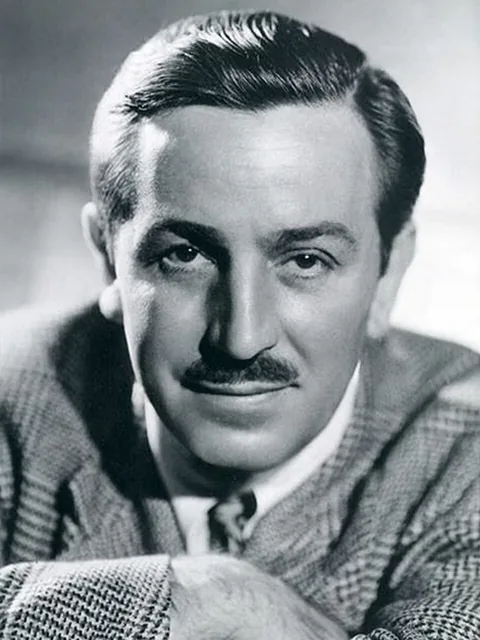
Well, with that, we start in Chicago in December 1901, where Walter Elias Disney is born. And the family lore is that the Disneys are descended from the French D’Isignys of Normandy.
How do you spell that?
D'-apostrophe-I-S-I-G-N-Y-S of Normandy, who came over to England with William the Conqueror in 1066.13William the Conqueror (c. 1028–1087) — the Duke of Normandy who conquered England in 1066 after the Battle of Hastings and became its king, bringing the Norman nobility with him. That's family lore, unverifiable.
Yes, at this point, lost to history.
Yes. So Walt's father Elias was sort of a frustrated entrepreneur. He was variously a carpenter, landlord, farmer, newspaper route owner, and eventually a failed jelly factory investor. But Elias's younger brother Robert—Walt's Uncle Robert—was the successful one in the family. He was a real estate speculator, among other things. And that is what brought the family to Chicago at the turn of the century. He had invested in a bunch of real estate in Chicago and the Midwest. And so Elias came also to seek his fortune there. Now, when Walt is 4, Elias moves the family out of Chicago to an idyllic farm town, also in the Midwest, where Robert had just purchased another tract of real estate, Marceline, Missouri. And Lillian Disney, Walt's future wife,14Lillian Disney (née Bounds, 1899–1997) — Walt's wife from 1925 until his death; before they married she worked at his studio in the ink and paint department. would say about Marceline, it was the most important part of Walt's life. He didn't live there very long. He lived in Chicago and Kansas City much longer. But there was something about the farm that was very important.
Elias moved the family because it was kinda like, let's get out of the dangerous city of Chicago and raise the kids right, so sorta somewhere small town. I think Marceline was actually created because they needed somewhere for the Santa Fe Railroad's division point15Atchison, Topeka and Santa Fe Railway — one of the largest railroads in the US. Marceline was founded in 1888 as a stop on its Chicago–Kansas City line.-
Yes, yes.
-like when it was going to maybe Chicago and Kansas City. And they were like, "And this place on the map looks good." And they started the town of Marceline.
Exactly, exactly. And Robert, the uncle, had bought real estate there, kinda speculating again that this is—
Hmm.
Marceline's gonna grow. So Marceline was, like, basically a Disney movie. There's orchards and ponds and animals and farmhouses. There's also this charming little town that the railroad had created with a Main Street, a Main Street USA,16Main Street, U.S.A. — the first themed land inside the main gate of Disney's parks: the street of an idealized American small town around 1910. Marceline was its model. you might say. But that's getting ahead of ourselves. So while the family's living there, Uncle Robert's wife, Walt's Aunt Maggie, every time that they would come visit Marceline to check up on their real estate investments, she would bring Walt gifts. And one year, when Walt is probably 6 or 7 years old, Aunt Maggie brings him a Big Chief drawing tablet17Big Chief — American tablets of cheap newsprint paper for children learning to write, with a Native American chief in a feathered headdress on the cover. and pencil set, and Walt is enraptured. He starts sketching all the time, drawing, sketching everything he can see. And as the legend goes, one day Walt's retired neighbor asked the young boy to draw him a picture of his favorite horse. And the neighbor loves what Walt draws so much that he pays him a nickel for it and he hangs it in a frame in his house. And Walt, his mind is blown. Young Walt, he's like, my hobby, my art, it can make me money. Now, whatever the exact truth of that story is, there is no doubt that somewhere in Marceline, in prepubescent Walt's mind, a connection is forged between these two great forces: art and commerce. And that would go on to drive not only the rest of his life, but the company, the studio, the movies. I mean, change America.
Absolutely. The thing about Marceline though, you said it's idyllic and like it's out of a Disney movie. The reality of living in Marceline and life on the farm is that it was very hard. All the kids are involved. There's not, you know, magical economic prosperity everywhere. It's sort of a tough life, even though he can sort of remember it as an idyllic childhood, which I also think is quite the foreshadowing of kind of the Disney-ification of things18Disneyfication — a sociologists' term for turning something into a simplified, sanitized, safe commercial version in the spirit of the Disney brand. in the future. It is both remembered as idyllic, but also was hard as the real world is.
Yes. And I think it's because of the age Walt was when he was there. So they lived in Marceline only from when he was, like, 4 to 8 or 9 years old, before he gets really put to work. So he gets to just enjoy, you know, all this bliss around him. Yeah, the reality is it's pretty tough for the family to make a living. And in fact, they can't. So Elias adds farming to his list of entrepreneurial failures. And when Walt is 9 years old, they have to move the family again out of Marceline to Kansas City, where Elias decides he's going to purchase a paper delivery route for the Kansas City Star newspaper.19The Kansas City Star — Kansas City's main newspaper, published since 1880 and winner of eight Pulitzer Prizes. And he's going to put the family to work delivering papers.
There are so many protagonists that we study on Acquired who started their career as newspaper boys.
I was gonna say, just like Jack Bogle from Vanguard20John "Jack" Bogle (1929–2019) — founder of the investment company Vanguard (1975) and creator of the first index fund for individual investors. delivering papers in his youth and having to get up at 4 in the morning and falling asleep at school because he has to work so hard, like, this is quite the reversal here for Walt from Marceline.
Yep.
But he never stops drawing, and he never stops making money from it. In Kansas City, he would draw frames for the local barber shop, who would pay him either a nickel or a free haircut for each. And that would, you know, be Walt's spending money growing up that he would earn from his art.
Yep.
So later, when Walt enters high school, Elias moves the family back to Chicago again, this time for the jelly factory, which ends up failing, where Walt becomes the cartoonist for his high school newspaper. But he's not there long before he leaves high school to go join the Red Cross and get shipped off to France as an ambulance driver during World War I. Where unfortunately he would acquire a chain-smoking habit that he would keep up for the rest of his life and eventually would kill him way too young.21At 16, Walt added a year to his age to get into the Red Cross Ambulance Corps, and he reached France in December 1918, after the November 11 armistice. He died of lung cancer in December 1966.
Yep.
But Walt's not in France for long before the war ends, and in the fall of 1919, he lands back in Kansas City where Roy Disney, his older brother who is, I think, 8 years his senior—
9 years, maybe?
8, 9 years older.22Roy Oliver Disney was born on June 24, 1893, eight and a half years before Walt (December 5, 1901).
Yeah, much older.
Yep. Is living. And Walt has a plan that he's gonna seek his fortune finally as a true professional cartoonist. So through Roy, he gets introduced to an advertising art shop23Pesmen-Rubin Commercial Art Studio — a small commercial art shop in Kansas City where Walt and Ub Iwerks worked in late 1919. that's looking for apprentices to help draw, like, flyers for the upcoming holiday rush. And Walt works there for 6 weeks through Christmastime and then gets unceremoniously laid off. But he gets 2 things out of this brief experience as an employee. One, he gets a credential. He can now say that he is a professional artist.
All you have to do is get paid to do something and then you become a professional.
Exactly. Exactly. And you get something else. A co-founder, another young apprentice from the art shop named Ub Iwerks.
I sorta think of Ub as the Steve Wozniak of Disney.24Steve Wozniak — co-founder of Apple with Steve Jobs and the engineer who designed the Apple I and Apple II. Jobs was the salesman and visionary of the pair.
Yes, absolutely. Walt is like the original Steve Jobs, and I think you can definitely make the case that Ub is the Steve Wozniak. Yes.
Although I think Walt was more hands-on.
Walt was also an animator. Ub was just a better animator, and Walt was a camera operator, and Walt was building stuff, doing things with his hand, and he was in the primary technology and artistic trade that his business was in.
So after the two of them get laid off, Walt suggests that rather than go look for jobs again, they should just start their own studio together. I mean, hey, they're professional artists, like, why not? So they create Iwerks Disney Commercial Artists Incorporated, supposedly in that naming order so that it didn't sound like an optometrist shop, like Disney Eyeworks.
How amazing is this? In the first Iwerks and Disney partnership, in Walt Disney's first business, he was not the main name on the door. At least he was not the first one.
Yes! Yes. Not the main name on the door, but he is the driving force-
Yep.
So he goes out. To pitch prospective clients around Kansas City for the services of this new Iwerks Disney commercial artist firm. And one of the clients that he goes to pitch is an up-and-coming company called the Kansas City Slide Company,25Kansas City Slide Company — soon renamed the Kansas City Film Ad Company. which happens to have become the country's largest producer of advertising slides and short commercials that would get shown in movie theaters. Before feature films. And the Slide Co. has so much work at this point in time as films and movie theaters are taking off around the country that they say, hey, you guys seem talented, we don't want to just contract with you, why don't you come work here full-time? So Walt and Ub's first entrepreneurial venture quickly comes to an end and they go join the Slide Company. Now the reason that they specifically wanted Walt and Ub is that they have a relatively new business line at the Slide Co, which is producing animated commercials to run in movie theaters before films. And this is what Walt and Ub end up getting put to work doing. And they both just fall in love with this new art form of animation. It's like everything that Walt and Ub love about drawing, but it's more than just art. It's technology. You know, you need cameras, you need film, you need all these new inventions to make animation happen.
Yeah, and at this point, animation was really primarily used in advertising, right? There wasn't really a successful, thriving industry yet of entertainment of its own based on animation.
It was like very, very early. And to the extent that it did exist as entertainment, and shorts, short films, cartoons on its own,
Yep.
It was all based in New York, like, not in Kansas City.
Right.
But the whole industry is only barely 20 years old at this point in time because you couldn't produce animation on any sort of scale until you had widespread commercially available film cameras and film projectors. This whole art form is brand new. It couldn't exist before the technological innovation of film.
Yep, it's exactly right.
So part of the reason that cartoons are working well in advertising right now for the Slide Co is that it's this novelty, almost a gimmick. It captures people's attention even though they have no color, no sound, no story. It's just a series of visual novelties.
Yep. It's something they'd never seen before. Of course it's interesting.
Yep. And in Walt's mind, who really is always thinking about how can I make a career out of this, this is also what makes it super attractive to him because the whole industry of animation is so new. He figures that he can quickly become as good or better than anyone else in the world at it. Unlike if he's gonna try and be the best commercial artist in the world, you know, good luck young Walt Disney in Kansas City, Missouri.
Oil painting is thousands of years old.
But right, right, right. But becoming the best cartoon animator-
Small pool.
Yeah, he and Ub might have a shot here.
Yep.
So Walt and Ub start experimenting on nights and weekends with their own work, just trying out, creating their own animations, using the Slide Co equipment and cameras. And Walt puts together a few short cartoons that he creates all by himself. He brands them as, quote, "Laugh-o-grams." And he ends up selling them on the side to a local movie theater chain to run before features. And the Laugh-o-grams became a hit in Kansas City. Audiences loved 'em.
I love that the thing that led to the Walt Disney Company is called Laugh-o-gram. It reminds me of what was the Rolex watch? The Turn-O-Graph.26Rolex Turn-O-Graph — a 1953 Rolex model with a rotating bezel.
Oh yeah, yeah, yeah. It's such a hokey name for-
Yes.
what ends up becoming. Well, this doesn't become Disney, but the spirit of which becomes Disney here.
And the thing that they're doing is so primitive. There's no sound, there's no voices, there's no color, there's barely any backgrounds.
Yeah, it's so different from what you're used to today because of those limitations. You can't create a story or a real sense of character for any of the characters that are in there. You can't build a relationship with the cartoons that are being made at this time like you can with Mickey Mouse or Donald or Goofy or Minnie.
Right. The only emotion you can invoke is humor, and the only real way to do humor is slapstick. So it's just these super exaggerated— they call them gags— things that a character does that isn't necessarily consistent with anything else that they've done within a few minutes of starting, a gag happening and ending. Or sometimes even a few seconds.
Yep. And honestly, that's actually not that different from film itself overall at this point in time.
Yes, great point.
Charlie Chaplin27Charlie Chaplin (1889–1977) — British comedian and director, the biggest star of silent film. In 1919, with Mary Pickford, Douglas Fairbanks and D. W. Griffith, he founded United Artists, which later distributed Disney's cartoons. is the big star in America and around the world, the big movie star right now in the silent era. And most of his movies are exactly what you described, Ben.
Honestly, it's all physical comedy, sort of slapstick. It's the stuff that my toddler laughs at. You could re-summarize every scene of every comic and most movies by going, "Oh, he fell down! Ahahaha!"
Exactly. So in May of 1922, at 20 years old, Walt decides that these Laugh-o-grams that he's making are having enough success that he's ready to leave the Slide Company, go out on his own again. And he founds Laugh-o-gram Films, Inc. And once again, he convinces Ub Iwerks to quit and come along too, along with a few other animators from the Slide Company. And it's another failure because despite the Laugh-o-grams' local popularity there in Kansas City, by the time we get into 1922, 1923, animation and cartoons in general around the country are starting to lose their appeal. The novelty is wearing off. The fad is dying down. There's actually a survey of theater managers right around this time in 1922 or 1923, where one of the questions is, "What filler options do your audiences like to see around the feature film that you're showing?" Because it also would be newsreels or live comedies or short serials.28Serials — multi-part films of the silent era: a new chapter played in theaters every week and broke off at the most dangerous moment, the cliffhanger. The best-known American one is "The Perils of Pauline" (1914). Remember, there's no television. There's not even really radio at this point in time. If you want to get news or any kind of entertainment, you go to the movie theater.
All right, I got a stat on this. In the 1920s, the average American went over 40 times per year to the theater.
This is what you did every week for entertainment.
Wow. Yeah. Compare that to today where maybe you go once a year-
It's two.
Maybe? Yeah. Two.
The average American goes to a movie theater twice a year now.
Yeah. I mean, back then it was like you could go to the movie theater. Or you could go see a live show, ballet or opera, or a sporting event, a baseball game, or you go to the movie theater. That's it.
And when you go to the theater, it was a bundle. I mean, yeah, you were there for a production, but I think the point you're trying to make is there were also these cartoons with gags. There were newsreels. There was the feature you're there to see, but it's sort of this bundle of, "All right, let's see what the theater has in store for me today."
Yeah, exactly. So this survey of theater managers, only 23% of respondents say that they show cartoons as part of the bundle and that their audiences like it, which is by far the lowest of any of the other filler options. So Laugh-o-grams can't really find a market outside of their local popularity in Kansas City. And in 1923, the company goes bankrupt and shuts down. And Walt is now this sort of 1.5 times disgraced entrepreneur here in Kansas City, back when—
Following right in his dad's footsteps.
Yeah, yeah, yeah, exactly.
And he raised money from people in Kansas City, friends and family.
Yeah, local folks.
He went and lost people's loan capital that they gave him.
Yep. So Walt goes to rich Uncle Robert for advice on what to do given his failure. And Robert says, "Kid, best thing to do if I were you, I would just skip town. Get out of there." Which actually was really sound advice for back then. People's reputations did not travel with them.
Nope. Your credit was the credit locally that you had with the people in your town, and no other way to find you otherwise.
03Hollywood, Alice and losing Oswald (1923–1928)
In Hollywood the Disney brothers build a studio on the Alice Comedies and create a hit, Oswald the Lucky Rabbit, then lose him because Universal owns the character.
Now, it just so happens that both Robert and Walt's older brother, Roy, have just also skipped town from Kansas City and moved out west to Los Angeles. So Walt packs his belongings, which is basically nothing at this point in time, hops aboard the Santa Fe train bound for L. A. And joins them in Hollywood. And when he arrives there in the summer of 1923, he's 21 years old. He stays with Uncle Robert. And initially, you really can't make this up. I couldn't believe this when I read it. Walt at first thinks that he's gonna come to Hollywood. He's gonna get a directing job in Hollywood at one of the studios there.
Well, yeah, he has abandoned the idea of animation. He basically thinks he's too late. He's seen some of the stuff that comes out of the New York cartooning scene, and he's like, well, I'll never be as good as them. So I need to go start over with something completely new.
Right, which is sort of, you know, silly and wrong in and of its own. But also like the hubris that he thinks that he could just show up in Hollywood with no directorial experience and become the next D. W. Griffith.29D. W. Griffith (1875–1948) — American silent film director, maker of "The Birth of a Nation" (1915) and "Intolerance" (1916) and one of the inventors of film language. That is Walt for you.
Do you know this story of the Universal lot?30Universal — one of the oldest Hollywood studios, founded in 1912; in 1915 it opened Universal City near Hollywood, then the largest film studio in the world. One of Universal's founders was Pat Powers, who will reappear in this story.
No, no, no.
So he rolls up to the Universal lot after getting there, having no job, no money, borrowing a bed, and he goes and has fake business cards made that said he was with Universal. He's just the Kansas City representative, so no one at Universal would really know who he is. And he gives it to the receptionist on the Universal lot, and he walks in. So he spends at least a day, from what I could tell, roaming around and learning as much as he could about film production and internalizes a lot of those lessons. Then he tries to come back in future days and say, "Oh yeah, I'm sorta with Universal, and now I have experience and can you give me a job?" He ends up running out of money and doesn't get a job.
That is amazing. I didn't know that story. So once he inevitably gets rejected at all the major Hollywood studios, he says later: "When things began to look hopeless, I got my cartoon things out again." And he sets up shop animating again. He's like, "Well," as you said, Ben, "this is the one thing I know how to do. I should try that." And at this point, pretty much the only popular cartoon left in the industry is Felix the Cat.31Felix the Cat first appeared in 1919 at Pat Sullivan's New York studio; animator Otto Messmer created and drew him. In the first half of the 1920s he was the most popular cartoon character.
Yep.
Which is created by Pat Sullivan out of New York and distributed by the pioneering Margaret Winkler,32Margaret Winkler (1895–1990) — one of the first women to produce and distribute animation in the US; she distributed the Felix the Cat cartoons and then Disney's "Alice Comedies." also in New York. So Walt has one thing, one asset left over from his failed Laugh-o-gram days, which is a reel of a hybrid live-action cartoon short that he had created with Ub right before he left Kansas City called Alice's Wonderland.33"Alice's Wonderland" (1923) — a pilot short in which a girl named Alice (four-year-old Virginia Davis) visits the Laugh-O-Gram studio and steps into a drawn world. The title nods to Lewis Carroll's "Alice's Adventures in Wonderland." About a real-life little girl who interacts on screen with cartoons that they've drawn over the film.
Which is completely pioneering technology. The other people who were doing animation this time were just doing cartoons. These Alice Comedies, as they came to be called, were a new process by which you could go and film a real-life actor and then have them interact on screen with cartoon characters and put them in the cartoon.
Yes, very cool. And also had the unique property of being cheaper to produce than full animation because you only had to animate the characters, not all the backgrounds and everything.
Right, right. Yeah, there is this funny, counterintuitive thing that live production is much faster and cheaper than animation. You just have a film camera and you point it at something in the world that exists, and you kinda get everything that you're pointing it at for free.
The actor is interacting with a bunch of stuff. And when you're making an animated film, you need to draw literally everything from scratch.
Yeah, the trees or the grass.
It's much harder, and you need to do it frame by frame by frame by frame rather than the world just sort of happening around you and you taking these exposures in a video camera.
Yep. So Walt sends Alice's Wonderland off to Winkler, and she likes it. So she commissions Walt to create 12 more Alice Comedies for like $1,500 to $1,800 each.
She does. And David, did you know we have seen this contract?
Was this in the documents that we saw in the Disney archives?
Yes. So listeners, for this episode, David and I went and spent a few days down in Burbank34Burbank — a city north of Hollywood. Disney's studio, which is also the company's headquarters, has stood there since 1940. looking through the corporate archives.35Walt Disney Archives — the company's corporate archive, founded in 1970 by archivist Dave Smith: documents, photographs, props, costumes, merchandise and everything connected with the history of Walt and the studio. And one of the things that the archivist pulled for us was this contract. And I have a photo of it. I'm looking at it right now. "Agreement entered into this 16th day of October, 1923, Walt Disney of 4406 Kingswell Avenue, Hollywood, California, blah, blah, blah, blah, blah." And yeah, you're exactly right. For 12 negatives of subject series, and then in all caps, "Alice Comedies."
Amazing.
And this, we, I also have a picture of this on the last page of this contract, because this is effectively the contract that puts Disney in business. I mean, this becomes the Walt Disney Company.
Yeah, this is the moment. This is the beginning of Disney.36The Walt Disney Company dates its history from October 16, 1923, the day the Winkler contract was signed, and celebrated its centennial in 2023.
You can see his signature, which is much less flowery than the version that you see in the Disney logo. He would sort of evolve it over time.
But yeah, this is the moment. Disney—Walt is in business. It's his first actual commercial big-time deal.
Yes, and I think when Walt sort of gets word from Margaret, he runs into his brother's room. His brother Roy actually has tuberculosis at this time and is in a hospital ward, and he sort of runs in, shows him the contract and says, "We got it, we got it, we got it. We're in business, we're doing it." $1,500 to $1,800 a film is a lot of money at this time. Roy talks through with him and says, "okay, let's get right to work," and he literally stands up and leaves the hospital ward. It's like, all right, my tuberculosis is behind me.
And the two of them founded the Disney Brothers Cartoon Studio right there in October 1923. As a true partnership between the brothers. Roy manages the business and the finances. Walt manages the creative, and they get to work.
Yep.
So Walt, of course, writes Ub Iwerks back in Kansas City and several of the other talented animators that they knew there and says, "All right, guys, I got it this time. Come on out to California. We finally got a deal. We're going to build a real company and a real animation studio."
And they do.
They do! It's crazy.
The behemoth we know as Disney today is the Disney Brothers Cartoon Studio and a whole bunch of Kansas City guys that moved out to join Walt to start cranking away.
Yep. And the Alice Comedies become a moderate success in the marketplace. Again, I think the novelty of cartoons plus live animation, audiences are entertained for a few years. Ultimately, the Disney Brothers Cartoon Studio produces 57 of the Alice Comedies from 1923 to 1927. And then in 1927, Winkler's relatively new husband, Charles Mintz,37Charles Mintz (1889–1939) — film producer and distributor; he married Margaret Winkler in 1923 and soon took over her business. who actually got to start working for her in the business—by this point, he has taken over as sort of head of the business—he is no longer getting along with Pat Sullivan, the creator of Felix the Cat.
It's a big opportunity.
Big opportunity. And he has brokered a little arrangement with Universal Pictures, the big New York film distributor, to on the sly create a new character to rival Felix. Now, mind you, he and Winkler are still the distributor for Felix for Sullivan, and they're creating a new character to compete with him on the side.
Sorta like they're building their own chips while still buying Nvidia.38Own chips and Nvidia — Google (TPU), Amazon (Trainium), Microsoft (Maia) and Meta (MTIA) design their own AI accelerators while remaining among the biggest buyers of Nvidia, the company they compete with.
Yeah, yeah. And so he turns around and taps Disney, says, "Hey Walt, can you make us a new series and a new character? You know, like Felix, but not Felix. Like maybe not a cat."
Right, we need it to be plausibly different while still having everything that made Felix successful.
Yes. So Walt and Ub cast about, what can we come up with? It's like a cat, but maybe shares a lot of the same recognizable attributes, like a lot of white fur, a tail, some big ears, easy to draw in black and white. And they come up not with Mickey Mouse but with Oswald the Lucky Rabbit.39Oswald the Lucky Rabbit — Universal released his first cartoon, "Trolley Troubles," on September 5, 1927; it was a big hit, and Oswald stayed Universal's main cartoon star for the next decade. And Oswald is a big hit. He's got the backing of Universal Distribution behind it. That's a big hit for Universal, big hit for Winkler and Mintz, and a big hit for The Disney Brothers Cartoon Studio.
And it's not surprising because if you give the creative brief to Walt and Ub, take something that's kinda working but apply your style. Their style was great. I mean, they were emotional animators. There's a great quote in the book Walt Disney: An American Original by Bob Thomas40Bob Thomas (1922–2014) — Associated Press Hollywood reporter, author of biographies of Walt (1976) and Roy Disney (1998). that says, "before Disney, cartoons were slapdash, two-dimensional characters in bizarre movement before elemental backgrounds. Disney insisted on rounded, humanized figures. He wanted the humor to come out of the character, not the outrageous action." So it's sorta like, hey, here's the template, but Disney-fy it or Iwerks-ify it in a way that really can speak to people.
Well, I think it really was the partnership of the two of them. I think Iwerks had immense artistic talent as an animator and was able to do that. And Walt had taste, like he recognized it and he knew when and where to apply it.
Yep.
So on the back of the Oswald success, the Disney Brothers Cartoon Studio grows pretty quickly from this ragtag group from Kansas City to a real operation, a real, at this point, bordering on major animation studio. They hire about 25 employees and start churning out Oswald cartoons.
Yep.
They move into a real studio building on Hyperion Avenue in the Silver Lake neighborhood of Los Angeles. And when they move there, Walt and Roy decide at unclear which brother's instigation, that they need to rename the company and the studio from the Disney Brothers Cartoon Studio to the Walt Disney Studio. So there are two stories about this.41The Hyperion Avenue studio operated from 1926 to 1940, when Disney moved to Burbank. The building was torn down in the 1960s; a supermarket stands on the site today. The Walt Disney Studio on Hyperion Avenue in Los Angeles, 1929.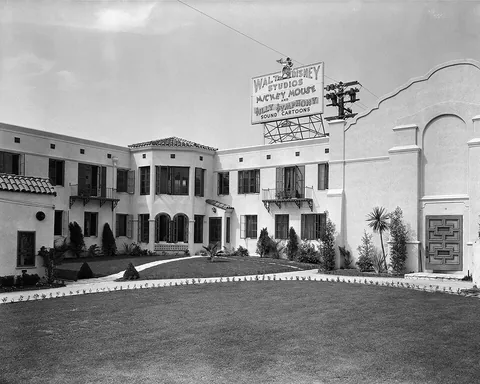
I was gonna say, I've seen both.
One is that it was actually Roy's idea-
Yes.
-because he's like, hey, you know, we need to start building a brand. People need to know who is making these Oswalds, and it should be the Walt Disney Studio.
And you're very clearly the frontman, you're selling, you're the visionary, you're the sort of creative talent. And this is a creative company. Of course, it should be you.
Yep. The other story is that Walt always had a dream since he got to Hollywood of having his name up on a neon sign. And now that they have their own real studio, he wants a neon sign constructed that says the Walt Disney Studio, which I think does happen.
Yes, we'll put the photo in the email. The Hyperion Avenue studio has this really cool sign, or did for a long time before it got knocked down, and I think it's a strip mall or something today.
And in that vein, now that the studio has become a real operation, Walt moves from actually doing a lot of the animation and camera work mostly to overseeing the studio, which you have to with an operation of 25 artists and creative people and camera folks. You need someone who has an overall vision and taste to drive everything.
Yep.
Now, as Walt is transitioning from, sort of doer to really studio head-
And worth knowing, the ownership of Walt Disney Studios that would become Walt Disney Productions, that would become the Walt Disney Company, was at this point 60% owned by Walt and his wife and 40% owned by Roy and his wife.
Yep. So Mintz, the husband of Winkler back in New York, who has sort of already proved his stripes by his dealings with Felix the Cat and Pat Sullivan, he senses another opportunity. He thinks that Walt has become superfluous and that it's actually just the animators who really matter. And because the Walt Disney Studio doesn't actually own the IP of Oswald the Lucky Rabbit, Universal does.
Although the Walt Disney Studio was acting like this was sort of their creation that they owned.
Yeah, I don't think Walt or Roy really read the fine print on the contracts here. So in early 1928, Walt and his wife Lillian, who Lillian also was an early studio employee-
In the Ink and Paint Department.42Ink and Paint — the department where animators' drawings were traced in ink onto transparent celluloid sheets and painted on the reverse side. Its staff was almost entirely women.
In the Ink and Paint Department. That's right.
And we'll get to that.
They make a fateful trip as a couple to New York where one of the items on the agenda is for Walt to go meet with Mintz and ask for a raise in the amount that the studio is getting paid per Oswald short. So Walt sits down with Mintz, and Mintz is like, Well, I don't know about paying you more. I don't think I like that idea. In fact, I'm not even really sure, Walt, what you are doing around here any longer. But I tell you what, I'm a nice guy. I'm willing to let you and your little studio stay involved here and keep making the Oswalds. But we're gonna have to pay you less, not more, like $500 per cartoon less.
Which my understanding is that basically wiped out the margin,43Margin — the share of revenue a company keeps after costs. Paying $500 less per cartoon meant the studio would just cover its expenses and earn nothing. and they were saying, "We'll pay you cost to make these Oswald cartoons."
Yeah, I think Mintz had basically calculated, "okay, if Walt takes this, then I'm willing to let his studio keep making it. And if he doesn't take it, then it's all equal to me. I'm just gonna steal his animators and go make it myself."
And crucially, before this meeting even happens-
He's already stolen the animators.
Mintz has an ace in the hole. He has, I think, signed contracts with nearly all the animators except Ub Iwerks.
He has sort of through an act of subterfuge gotten in touch with each of them individually and brought them over.
Yeah, only Ub and I think maybe 2 or 3 other animators refused to sign these secret deals with Mintz and stayed loyal to Walt and to Roy. Once Walt realizes this, there's nothing he can do. Like, it's a free country. He can't force his animators to stay. He doesn't have employment contracts with them, and he also doesn't have any control or rights to the actual Oswald IP. So he has no leverage.
He's got nothing. He's got no customer contract. He's got no employees. He's got no intellectual properties. Suddenly, the enterprise value—the entire value of Walt Disney Studios—is effectively zero.
Yep. It is an extremely bitter lesson for Walt and for Roy, and it is one that you can bet they never forget for the rest of their lives. And really, like everything in Disney's history and all of the enterprise value that Disney has built, that we will see all across the rest of this episode traces back to this moment.
It's a hard reaction to this lesson.
Totally. I have a fun bit of trivia for you, Ben. So as I think you know, Disney eventually does get the rights to Oswald back.
Ooh. Oh, this is gonna be my trivia for you.
All right, actually ask your question. We might have different takes on it.
Disney eventually does get the rights to Oswald back in 2006?
Bob Iger,44Bob Iger — Disney's CEO twice, from 2005 to 2020 and from November 2022 to March 2026. Before that he spent 22 years at ABC and came to Disney with it in 1996. one of his first acts as CEO, did the deal.
Yes. Do you know how Bob got Oswald back for Disney?
So let's see, by this point Disney had acquired ABC.
Yep. Which had acquired ESPN.
And who owned Oswald at this point? It was Universal, which was owned by NBC, which is now owned by Comcast.45NBCUniversal was formed in 2004, when General Electric, which owned NBC, bought 80% of Vivendi Universal's entertainment assets, including Universal Pictures. Cable operator Comcast has controlled the company since 2011.
Correct.
So there's an ABC asset that Bob effectively trades in exchange for Oswald. And I think that ABC ESPN Monday Night Football asset is Al Michaels.
Al Michaels, the Monday Night Football commentator, like a sports team trade to NBC in exchange for the IP rights to Oswald the Rabbit.46In February 2006 Disney released sportscaster Al Michaels from ABC and ESPN so he could go to NBC to call "Sunday Night Football," and got the rights to Oswald the Lucky Rabbit in return. "Monday Night Football" moved from ABC to ESPN that same year.
And Oswald is repatriated, and NBC gets Al Michaels, and all is right in the world.
Amazing. So back to 1928. Walt and Roy are basically back at square one here. They have not really just nothing. They actually have less than nothing because Mintz, ever the—well, really just kind of weasel is the right word.
Yep.
He makes Walt and Walt Disney Studios finish out the current Oswald contract, which still had a few cartoons left to animate on it, and pay all of the animators who had all betrayed him and were all about to defect. Mintz is like, "No, no, you've got a contract. You're going to keep paying these folks while they finish up the last couple shorts on this contract."
Just brutal.
Just brutal. Absolutely. Humiliating for Walt. And so then, as legend has it, on the long, long train ride back home from New York, Walt is struck by a bolt of inspiration, and he scribbles a sketch for a new cartoon character right there on his drawing pad on the train trip. A character that wouldn't just reverse all the woes of the Oswalds and turn around the company's fortune, but would maybe become one of, if not the most recognized figure in all of human history.
AdJ.P. Morgan, WeAreDevelopers
But before we tell the story of Mickey Mouse, now is a great time to thank our friends at J.P. Morgan.
Yes, our presenting partner. So today we are sharing a story from one of J.P. Morgan's partners and a company that you may know, Bill, which is formerly Bill.com.
Right. Bill is the financial operations platform for half a million small and mid-sized businesses, what they call the Fortune 5 Million. They help manage and maximize cash flow for SMB companies, and Bill's Divvy Card product is what employees at those businesses use to fund their operations day to day.
So here's a scenario that many listeners may have experienced. Someone on your team maxes out the credit line on their corporate card with an unexpected purchase. You send a wire to pay off the card so you can continue using it, but it takes two to three days to clear. Meanwhile, your team can't transact.
Yeah, Bill solved that for its half a million customers using an embedded payment solution from J.P. Morgan. With API-based sub-ledgering, they can manage millions of payments in real time on any platform, all with one bank account. Every Bill customer gets a unique virtual account number, so the moment a payment is received, the credit line is restored. The result is a way simpler way to receive and route payments at scale.
And the actual numbers are awesome. Payment posting went from two to three days to seconds. Inquiries dropped 83%. Even Bill's own treasury team reclaimed 20 hours a week from manual reconciliation. For decades, these were Fortune 500-only capabilities, but Bill and J.P. Morgan figured out how to deliver that same infrastructure to the Fortune 5 Million while also improving Bill's internal operations. You can read the full case study, as always, at jpmorgan.com/acquired.
And something else. If you want to join us and J.P. Morgan in person, we'll be on stage at the WeAreDevelopers World Congress in San Jose this September. Click the link in the show notes to learn more.
04Mickey Mouse and synchronized sound (1928)
Nobody wanted Mickey Mouse until synchronized sound gave him a personality, and Walt learned that audiences had to know the name Walt Disney, not just the mouse.
Okay, so David, how does this Oswald catastrophe lead to Mickey Mouse?
All right. So here's the story of Mickey Mouse as Walt would tell it. It's March 1928. He and Lillian are on the long train ride back home to LA from New York. He's struck by the bolt of inspiration for a new cartoon scenario about a plucky mouse named Mortimer47Mortimer — in the generally accepted version, Walt wanted to call the mouse Mortimer Mouse and Lillian suggested the name Mickey. who is attempting to fly an airplane just like his hero Charles Lindbergh.48Charles Lindbergh (1902–1974) — American aviator who in May 1927 made the first solo nonstop flight across the Atlantic, from New York to Paris. And this would go on to become the Mickey cartoon Plane Crazy.49"Plane Crazy" (1928) — the first Mickey Mouse cartoon made. The silent version found no distributor, and it was released only in 1929, with sound. So Walt shows his sketches that he's making to Lillian, and Lillian says, "I like it, but Mortimer? That's too sissy a name. How about Mickey?" And thus Mickey Mouse is born. Now, the real story is more likely that Walt and Lillian get back to LA and Walt is, like, sweating. So he and Roy and Ub and the couple other animators who stayed loyal to them hole up, and they start brainstorming ideas for some kind of new idea or new character that they can create to replace Oswald and turn around the studio's fortunes.
And also, when you see Mickey and you see Oswald, it's not hard to imagine where Mickey Mouse came from. It's like, kinda like, shorten the ears, make them circles. You know, they both kinda have this white face and the black outline.
I mean, it's really just the same brief that created Oswald. It was like, hey, take Felix and do something like Felix, except this time it's take Oswald and do something like Oswald.
Yeah. And make damn sure we own it.
Yes, exactly. So they land on the idea of a mouse.
And didn't Walt claim that he sort of like always had a fondness for mice because there were mice that would like jump in his trash can in Kansas City while he was animating?
Sure, whatever. You know, it's all just part of the Walt myth.
Yes.
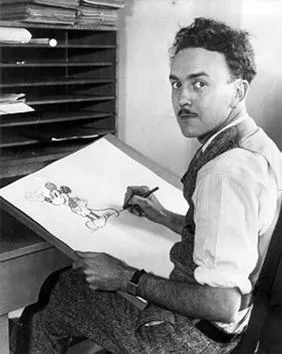
And at least according to the Neal Gabler book, most likely Ub is the one who first draws Mickey-
-not Walt, on the train. But either way, Ub definitely was the primary animator of the first Mickeys for the whole first series of Mickeys, including Steamboat Willie.50"Steamboat Willie" — the cartoon features the song "Steamboat Bill," and the title echoes Buster Keaton's comedy "Steamboat Bill, Jr.," released the same year, 1928. So by the summer of 1928, they finished out the Oswald contract, and Walt and Ub and the small little merry crew have gotten two Mickey shorts ready for production: Plane Crazy and The Gallopin' Gaucho.51"The Gallopin' Gaucho" (1928) — the second Mickey cartoon made. The silent version was finished in August 1928 but released only on December 30, with sound and after "Steamboat Willie." A gaucho is a South American cowboy. And Walt takes them around to distributors. You know, the Walt Disney Studio is well known at this point. This seems like it would be promising new IP. And none of the major distributors are interested. They're like, yeah, I don't know. Mickey is like Oswald but...
Without all the, you know, thousands or hundreds of thousands of raving fans for it. So...
Exactly, exactly. And then comes the eureka breakthrough idea. One of the gang recalls that The Jazz Singer, the famous first popular talkie,52"The Jazz Singer" — the Warner Bros. film released in October 1927, the first feature with synchronized recorded songs and dialogue. you know, movie with dialogue and sound that had just come out the previous fall, when they went to see it, that there was a cartoon screened alongside it. And Walt, when he hears this, puts the two ideas together in his mind of a cartoon and sound. And supposedly he says, "That's it! That's it! That's what we've gotta do! Stop all these silent pictures!" Now at this point, people had made cartoons with sound, but nobody had ever made a cartoon with sound like The Jazz Singer had sound.
Synchronized sound.
Synchronized, yes, exactly. Where what was happening in real time in the cartoon was then played in sound, exactly synchronized in the movie theater.
Yeah, the concept before was there's music that plays, but it's only loosely attached. And this is to the frame and to the beat of the music. Like if you see Mickey on screen bop into something, then you might hear a xylophone on the exact same downbeat, play a note.
Yeah, it's not just that, like, there's some music accompanying this cartoon that you're watching. It's that what is happening in the cartoon feels like it is producing the sound.
Yes. There's a great business model lesson in this, which is with the first two Mickeys flopping, if you just do the same thing as an existing competitor who already has distribution, brand, customers, it's not enough. You need to go do something leveraging a new piece of technology or a new platform. You gotta come at it from an orthogonal way in order to leapfrog and make people pay attention to you. Otherwise you're just a, like, smaller, worse also-ran.
Totally. And that could be anything. I mean, the only reason that the Oswalds worked, even though they were a ripoff of Felix, was because they came built in with the Universal distribution.
Yes. Yep.
But yeah, Walt taking out the Mickeys before bringing sound, like, he's got nothing to bring to the table here.
Yep.
So Walt lines up access to the Cinephone sound recording system from a character named Pat Powers,53Pat Powers (1870–1948) — film entrepreneur and in 1912 one of the founders of Universal. His Powers Cinephone sound system was essentially a copy of inventor Lee de Forest's Phonofilm. who had actually helped create Universal, you know, some number of decades earlier, and then had gone on to become a sound acolyte and entrepreneur developing a sound system for this new movie technology. And so Walt and Ub and crew animate a test sequence of a Mickey with sound, and they screen it for all their wives and girlfriends. And Ub writes later of what happened next when they screened the synchronized sound Mickey for the first time: I never saw such a reaction in an audience in my life. The scheme worked perfectly. The sound itself gave the illusion of something emanating directly from the screen. Walt kept crying, "This is it! This is it! We've got it!" It turned out that sound was the critical enabling technology for animation to go beyond a novelty and allow the characters that are on screen to actually have personality that audiences connect with.
So interesting. And it's not obvious at first.
Until you do it.
I mean, it's obvious in retrospect, but you can totally see how when Walt had this insight and then they made the investment, because doing a test animation and synchronizing the sound, like, even to show a little screener must have been really hard at the time because none of the tools existed. They sorta had to invent the way to synchronize the drawings with the music and the systems. It's sort of a big bet even to try and see if that creates personality.
Right, right. And sound did the same thing for live-action movies, but it's not that big a leap to have humans talking. Like, humans talk, you know. Sound just made it way better. Sound for cartoons was this giant leap. These characters, this art, can now be actual characters with personalities-
Yep.
-in a way that they couldn't before.
Non-obvious at the time, completely obvious in retrospect.
Yep, so they make Steamboat Willie as the third Mickey, but the first with synchronized sound.
ExplainerHow Disney got in sync
Warner Bros. scored "The Jazz Singer" (1927) with the Vitaphone system: sound was recorded on phonograph discs played in step with the projector, and if the film broke and was spliced, the sync was lost. Cinephone, which Walt licensed from Pat Powers, recorded sound right onto the film as an optical track beside the frames, so picture and sound could no longer drift apart.
But first the music and the action had to be matched while the cartoon was being drawn. Animator Wilfred Jackson, who knew music, suggested laying the tune out by metronome: each beat became a set number of frames, and the exposure sheets showed which drawing fell on which beat. At the recording session in New York in September 1928 the orchestra had to play to the picture, keeping tempo by marks on the print. The first session failed because conductor Carl Edouarde wouldn't follow the marks, and Walt had to scrape together money for a second one.
Which we're gonna skip over the whole headache nightmare of creating this thing, but it was like Walt constantly going back and forth to New York, betting every last dollar that he had, inventing all these new processes trying different ways to get an orchestra synced to the sound.
Oh yeah, they like animated a little ball on the screen that would sync to the orchestra as they were playing.
Yes, and he couldn't get the original conductor of the orchestra to actually use his method. The orchestra guy was like, "Eh, trust me," and then it was all out of sync with the screen. The net of it is it's a giant, painful operational struggle to get this thing out. But my God, does it hit.
Yes. Well, you know, this is the nature of the New York distributors. They get it made. Walt takes it and shops it around all the big folks in New York. And they're so conservative. They're like, well, this is cool, but I don't know how audiences are going to react to this. We kind of want to see a test first.
I don't want to be first in line.
Yeah, exactly. Exactly. Like VCs,54Like VCs — self-mockery: Ben and David come from venture capital and met at the Seattle firm Madrona Venture Group. VCs often don't want to invest first and wait for proof that the market likes a product. like, so Walt decides that he's going to take matters into his own hands and he goes directly to the manager of the Colony Theater in New York City and cuts a deal for $1,000 to run Steamboat Willie before the features that they're showing in the Colony Theater. So going around distributors just to get this in one theater as a test. And so Steamboat Willie premieres in New York City on November 18th, 1928, before the film "Gang War." Nobody really remembers "Gang War" because Steamboat Willie is a revolution. Critics love it. Audiences love it.55Disney celebrates November 18, the day "Steamboat Willie" premiered at the Colony Theater in New York, as Mickey Mouse's birthday.
Yeah. Isn't there some famous story of people sort of standing up and screaming, "We want Steamboat Willie again!" instead of playing the main feature?
Yeah, yeah, exactly, exactly. But still, you know, Disney now needs to find a distributor. And now he's got the proof point. These New York distributors, they're still so conservative. They're like, well, you had one hit. I don't know that, like, we can really trust that this isn't just a fad, that the future sound Mickeys are also gonna be a hit and that you can repeat the magic. And famously, one distributor, while Walt is meeting with him here and is trying to explain to Walt why he's gonna pass again on the Mickey deal, picks up a package of Life Savers candy.56Life Savers — American ring-shaped hard candies, made since 1912. And he says to Walt, the public knows the Life Savers brand. They know what these are. They don't know Walt Disney and they don't know your mouse.
Your mouse.
I mean, I can only imagine Walt sitting here just seething-
Yeah.
-but this makes a huge impression on him. I think this is an important thing about Walt. He definitely has a huge ego, right? But he is very willing to learn even from pretty obnoxious people. He's like, you know what? You're right.
Oh, I think he's motivated by learning.
He's motivated.
I think, I think he's an engineer. I think he's, he loves picking things apart and learning the way they work. I think he's motivated to make the best art he can-
-in addition to making the best business he can. So if someone's going to offer him-
A lesson.
-a way to learn something. Yeah.
Yeah, he'll take it. He'll take it even if he might be mad at the person. So he writes about this moment later. From now on, the audience was gonna know if they liked the picture, they were gonna know Walt Disney's name. Ultimately, what Walt does is he turns to Pat Powers, his partner in the sound technology, who had been one of the, you know, original Universal executives, and they cut a deal where Powers will be Disney's direct distribution agent in return for just 10% of the gross revenue57Gross revenue — all revenue before any costs are taken out. Here it was the share of Mickey's box office that Powers kept for distribution. on the Mickeys, which seems like a pretty good deal.
Yeah.
And indeed, it was kind of a too-good-to-be-true deal because Powers, like all these New York guys, was basically plotting to do the exact same thing as Mintz to Disney. He wanted to start working with Walt, give him a sweetheart deal, and then lure away the animation talent because Powers, remember, has the sound technology that he's given to Walt. So he's thinking, hmm, if I get the animators, what do we need Walt for?
Right, so this explains the sweetheart deal on distribution because that wasn't the real prize he was after.
And just a year later, in 1930, Powers does the unthinkable. He convinces Ub Iwerks to quit and leave Disney. He says, "Ub, we're going to get you set up with your own studio. You're going to work with me. We're going to create new characters." It's the exact same thing that Mintz did to Disney last time.58Ub Iwerks left Disney in January 1930 and opened his own studio with Powers's money; its main character was Flip the Frog. The studio never caught on, and in 1940 Iwerks returned to Disney, where he worked on special effects and technical development.
Absolutely brutal.
Except it plays out the exact opposite way.
'Cause Walt's learned his lesson.
Walt has learned his lesson. By the time this happens, over a dozen Mickey shorts with sound have come out, every single one of them branded prominently up front and at the end, a Walt Disney comic. And they had become huge hits. So even though Powers steals Iwerks away, nobody cares. Everybody still wants the Mickeys. Everybody still wants Walt Disney Comics. Disney has made himself the Life Savers of animation. Disney first switches to Columbia for distribution and then to United Artists, and audiences just keep loving Mickey. In fact, they love him so much that it leads to the discovery of a whole new business model for Disney and the company: the intellectual property flywheel. And it starts with The Mickey Mouse Club. This is wild. I had no idea about the origins of The Mickey Mouse Club.59Columbia Pictures distributed Disney's cartoons in 1930–1932 and United Artists in 1932–1937; then RKO took over.
05The IP flywheel
Mickey spills out of the theater into clubs, newspapers and merchandise, and Disney stumbles onto the IP flywheel, which soon earns more than the cartoons themselves.
Basically discovered by Disney by accident, right?
Totally by accident. So in the summer of 1929, just a few months after Steamboat Willie and the first sort of nationally distributed Mickeys, the manager of the FOX Dome Theater in Ocean Park, California contacts Walt with an idea. Why don't we partner to start a Mickey Mouse Club for kids? I've got like 1,000 kids who keep showing up here at the theater every weekend, and all they want to do is watch the Mickeys again and again and again. I think we should capitalize on this. We can create a club, like a kids club, and we can charge parents a membership fee. The kids will love it. The parents will get them out of the house every weekend. It'll be great. And we can pilot it here at the FOX Dome Theater. And then if it works, I think we can franchise this nationally. And so this is exactly what Walt and this theater manager do. The way it works when they take it national is that theaters would buy a, "Mickey Mouse Club charter60This movie-theater Mickey Mouse Club of 1929 and the 1930s shouldn't be confused with Disney's TV show of the same name, which premiered on ABC in 1955." from the company, from the Walt Disney Studio.
Hmm, it's like a franchise-type?
Yeah, like a franchise right.
Huh.
For $25. And then as part of the club, the kids and their parents would gain the right to buy exclusive Mickey merchandise.
I mean, it's kind of amazing, right? Pay to become a member of a club to dedicate yourself to fandom so you have the right to buy more things.
The right to buy more things. Yes. So like hats, buttons, banners, etc. And all of this revenue is getting split back with Disney. The $25 club charter and then all of the merchandise revenue. Pretty quickly there are 800 Mickey Mouse Clubs across the country with more than 1 million total members. That is more members than the Boy and Girl Scouts of America combined at this point in time.
Whoa, that's insane scale and insane speed of adoption pre-internet.
Right, right.
Pre-internet, pre-cable, pre-broadcast TV. The ability to get a million Americans doing something within a few years is, how did that even work? I mean, I'm trying to think how word could even spread that quickly. I guess through-
Is through the theaters.
-Disney's distributors to the theaters.
Well, this is like a no-brainer proposition for a movie theater operator. You're gonna take your Saturday or Sunday afternoons, which are probably reserved mostly for kids anyway, all your matinee showings.
Right.
You're going to convert it into a Mickey Mouse Club. Kids are gonna love it. They're gonna buy a bunch of stuff that you otherwise wouldn't have the opportunity to sell to them. Parents are going to love it because they get rid of the kids. And then for Disney, they're just getting this turbocharged distribution and brand recognition of Disney the company and Mickey Mouse the character.
Yeah, it's amazing. Okay, so they take the learnings from The Mickey Mouse Club, right? And they kinda lean into Mickey in a big way at the corporate level.
Totally. So just a few months after The Mickey Mouse Club kicks off, in January 1930, they launch a daily Mickey comic strip with King Features Syndicate61King Features Syndicate — the newspaper syndicate media mogul William Randolph Hearst launched in 1915. A syndicate sells comic strips, columns and puzzles to many papers at once: the paper doesn't need its own artists, and the author appears in hundreds of publications. in newspapers around the country. It gets published daily in 60 US newspapers and then also internationally in 20 more countries around the world. So Disney is getting paid to produce a Mickey comic strip, which only cost them the salary of the one animator that they have making it every day, a 24-year-old named Floyd Gottfredson,62Floyd Gottfredson (1905–1986) drew the Mickey Mouse newspaper strip from 1930 to 1975. who would do it every day for 45 years.
Wild. So not only are they getting revenue for this, they're getting free daily advertising and IP exposure to probably 100 million+ people through this newspaper comic. Distribution every single day.
Hmm. And even if they weren't getting paid for it, the marketing on that so that people go see Mickey films.
Exactly. Yeah, it never becomes a huge revenue or profit driver for them, but like that free daily marketing in most major newspapers around the country is incredible.
Yep. Interesting to know Oswald actually was on a candy bar back in the day. But when Walt, who at the time thought he owned Oswald, had the opportunity to monetize it, he was like, I didn't even consider it. It doesn't need to be an additional revenue stream. It's just really good for me if Oswald is on the candy bar.
Right, right, right, right, right.
So that's sort of, they're getting the seeds of like, okay, we're making some money on the comics, but it really is like a massive marketing engine.
Well, you're teeing up the big one here, which is merch and consumer products.
So pretty quickly after Steamboat Willie, Walt is walking the street in New York, and a man comes up to him— like, comes up to Walt Disney on the street— and offers Walt $300 to license the Mickey character to put it on a series of children's writing workbooks that he's producing there in New York. And this is, like, really early days. Mickey's just starting to work. The studio still needs money. So Walt's like, "Sure." Yeah, I'll take $300. Why not?
Hmm. And $300 in 1929, it's a lot of money.
I mean, this is the beginning of the Great Depression.63The Great Depression (1929–1939) — the deepest economic crisis of the 20th century; in the US it began with the stock market crash of October 1929.
Yes. Yes. Mickey takes off during the Depression. In fact, he sort of becomes like a national champion. It's part of his success that people view plucky Mickey's success as a mouse, as the underdog, as like something that Americans can identify with through the Depression.
And life is hard. I mean, having a way to dissociate a little bit, and just enjoy a like fun-loving, problem-free cartoon. I don't think people know this. Mickey's role in these early comics is exactly what you're saying, the underdog. He's getting himself into these tricky situations by someone that seems bigger and stronger, and he's able to figure it out and emerge. It's the American spirit.
Yep, yep, yep. So back to the writing tablets. They take off and do huge, huge sales. Disney doesn't even know how much in sales because all they have is 300 bucks-
300 bucks.
- and a handshake from this guy. So Walt and Roy figure, all right, we need to get smarter about merch. So they contact an ad man in Kansas City that Walt admired named Kay Kamen, who had owned an advertising firm. And they agree to do a deal where Kay becomes the exclusive commercial products agent for all Disney merchandise licensing. Beginning in 1933. And the deal they do is that Disney would get 60% of the first $100,000 in royalties64Royalties — payments to a rights holder for using those rights, usually a percentage of sales. Kamen collected royalties from manufacturers and split them with Disney. that Kay is able to generate from licensing Disney brands and mascots. And then after the first $100K, they would split every dollar of licensing revenue 50/50. And there would be a lot of dollars after the first $100K. This is a huge moment. I mean, there is a real case to be made that besides Walt and Roy and Ub Iwerks, too, but at least on the business side, besides Walt and Roy, Kay Kamen was the third most important person in the first, you know, half century of Disney.65Kay Kamen (born Herman Kamen, 1892–1949) ran Disney's licensing until his death: in October 1949 he and his wife were killed in a plane crash in the Azores.
All right. So make your case. What goes on to happen here?
So within 6 months, Kay takes Disney merchandising from this hodgepodge of random licenses of guys that Walt met on the street.
And many of which were a lot more than $300.
Yes, yes, yes. To a real professional operation doing $6 million of gross merchandise sales within 6 months. That then grows over the next 2 years to $70 million annually of gross merchandise sales all around the globe from over 40 separate super high-quality consumer product partners. So the most successful and famous example of this is the deal that Kay does in 1933, right after he takes over with the Ingersoll Watch Company.66Ingersoll — an American watch company famous for cheap watches: in 1896 it released the first watch sold for a dollar. More than 5 million Mickey Mouse watches were sold in their first 15 years of production.
This is crazy that within just a few years they can be at a $70 million level in 1935 of merch. I mean, there's so much pent-up demand to buy Mickey Mouse stuff that you can sort of explode out of the gate. I don't even really understand how Kay lined up 40 merchants and got all this stuff manufactured and distributed in such a short period of time.
Well, I think part of it though is that he's a real professional and well-respected in the industry with contacts. But yeah, to your point, Ben, there's just so much demand for Disney merch. So the $70 million is a gross sales to the end consumer number. So most deals that Kay would do would be for 5% royalties on the wholesale price of the goods. And the $70 million was retail. So if you assume 100% retail markup,67100% markup — the store sells an item for twice what it paid the manufacturer, a standard rule in American retail known as keystone pricing. Hence David's math: $70 million at retail is $35 million in wholesale revenue. that's $35 million in wholesale revenue.
Disney and Kamen are splitting 5% of that number between them. But even that is $1.75 million split 50/50 between Disney and Kay. This is an astronomical number, and it is a way, way bigger and better business than the cartoons themselves at this point in time.
It's funny, I, I found the comment on the Disney Family Museum site that by the late 1930s, royalty income from merchandise had exceeded revenue from film rentals, but-
It wasn't even by the late 1930s. It was 1934.
-it was quick and it was by a lot.
Yes. Yes. So just to illustrate the difference, the distribution deal that Disney does with United Artists for the Mickey films and for the Silly Symphonies,68"Silly Symphonies" (1929–1939) — Disney's series of musical shorts without recurring characters, on which the studio tested new technology, including color. which is the second cartoon series that Disney starts in the '30s, Disney gets an advance of $15,000 per film,69Advance — money a distributor pays a studio up front against its future share of the box office; until the advance is earned out, the studio gets nothing more. but Walt is always investing ever more and more in the production of the cartoons themselves. By this point in time, in the mid-'30s, he's investing $30,000-plus per cartoon. He's only getting a $15,000 advance. So it's not even guaranteed that each individual cartoon would be profitable. Usually they were. But they would have to earn out on the back end. Compare that to, you know, half of basically $2 million in pure margin, almost pure margin revenue coming in from Kay every year.
Right.
It doesn't even matter that Walt is investing everything back into the cartoons. He's got this money spigot coming in.
Right. So summarizing that, films are tens or low hundreds of thousands of dollars of profit coming in, and the merch is on the order of a million dollars.
Yep, and film profitability is highly dependent on a film-by-film basis. It's got to play out in theaters, etc, etc.
All right. So I cut you off on the Ingersoll Watch Company.
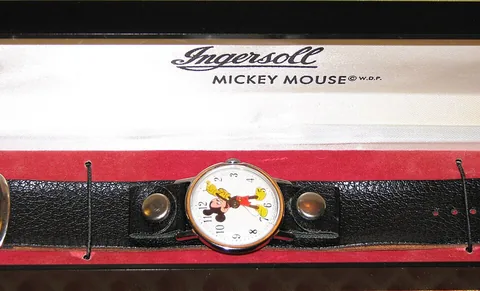
Yeah, just as one example of the deals that Kay is doing, in 1933, right after he takes over, he does a deal with the Ingersoll Watch Company to manufacture the famous Mickey Mouse watch. That watch would sell 2.5 million units over the next 2 years. The Ingersoll Watch Company was about to go bankrupt during the Depression. It saves the company.
Hmm. And wasn't it the most popular watch in America?
I think that's right, at least for some point in time during the '30s.
It's fascinating. And of course, the modern Apple Watch Mickey watch face is a reference to this because he's using his arms to point to the times-
Exactly.
-on that original Ingersoll watch. This is a whole different shape of a business than has ever existed before. I mean, it's funny, we started the episode comparing Disney to other Hollywood studios, but this is not a Hollywood studio. They're not shooting live-action films. They're making these cartoons. The rest of the industry is kind of doing slapdash ones. They're doing really high production value, sound-synchronized cartoons, and they're actually making more of their money from merchandise. They've got these Mickey Mouse Clubs. Like, this is a new thing that no one else is doing.
Yep. This is the birth of the Disney flywheel and nobody else has it.
So is this a point where, David, I could make my pedantic aside that I've been telling you about?
Yes, yes, yes, yes. Go for it.
All right.
We had a great email from a listener a couple of months ago about how flywheel, this term that everybody uses in business, is actually completely the wrong term for what you wanna describe.
So Disney is famous for this concept, as is Amazon, and it inspired a gazillion other founders to try and articulate their own flywheel and draw it out. But hilariously, David, as you say, it is a misnomer. It describes the wrong physics phenomenon. People are trying to describe a system that has a positive feedback loop where inputs into one element of the system are amplified and add energy to other parts of the system. But that is not actually what a flywheel is. A flywheel is a primitive battery. It is a way to store energy to be deployed later.70Legend has it that Jeff Bezos sketched Amazon's flywheel on a napkin in 2001, inspired by Jim Collins, author of "Good to Great."
Yeah, it's like a version of the same mechanism that a spring serves in a mechanical watch.
Right, exactly. But in reality, there's not really a better shorthand for system of integrated components that creates positive feedback loops. So we will continue, alas, to use the phrase flywheel. But the important thing here is that Walt really did sort of either discover or invent this business model of the intellectual property flywheel that we see replicated all over the place today.
I mean, I think it really revealed itself to him and Roy in these early years of Mickey. And it's probably worth taking a moment to talk about why this works so well. So the most important thing, and I don't think this was premeditated in any way by Walt, but it was just something he innately cared so deeply about, is to make the highest quality, genuinely most compelling new IP as possible that audiences can build a deep relationship with. This is what Walt was building to, and up to, through all of his early years in animation. All the technical innovations, every step was getting to a character that audiences can fall in love with.
Now, critically for Disney, and again, I think completely accidentally discovered by Walt, the IP that works best for flywheel dynamics almost has to be animated, i.e., not live-action, because with live-action characters, the characters are too bound up in the actors that play them. And that creates all sorts of problems. One, especially today, it makes your economics as a studio just way worse because you gotta pay the stars so much.
Right, there's wholesale transfer pricing. A huge amount of the margin you could get ends up getting paid out to effectively your partner in creating the character, the actual actor.
Right. Whereas Mickey works for free. Now, you gotta pay the animators and they get paid very well to animate them, etc.
That's on the value capture side, but on the value creation side, which I think is the more important thing, Mickey is always available to work.
Yes, yes.
And Mickey doesn't age.
Yes, exactly. You can create an eternal character through animation in a way that you just can't when you're using real people. I mean, Star Wars, as great as Star Wars is, and we'll talk about it later in the episode, is gonna have a problem when Mark Hamill and Harrison Ford die.71Mark Hamill and Harrison Ford — stars of the original "Star Wars" trilogy (1977–1983) as Luke Skywalker and Han Solo. Both returned to those roles in the films made under Disney. I mean, I guess unless AI gets really good.
And live-action is sort of dated to a time and place in a way that cartoons can sort of transcend.
Yes, yes.
Like Mickey can always exist in the present in a way that we're gonna talk about Davy Crockett later, but at some point it became completely uninteresting to watch Davy Crockett, even though he was like a complete heartthrob obsession that was great IP for the moment. It just wasn't as durable.
Yeah, live-action IP, with very few exceptions, tends not to have the staying power over decades-
Right.
-and generations that animation does.
Yeah. Few exceptions being like James Bond, but God, have they tried to do all sorts of crazy stuff in order to let that IP keep living. I mean, like there's been six, seven James Bonds,72Six actors have played Bond in the official film series: Sean Connery, George Lazenby, Roger Moore, Timothy Dalton, Pierce Brosnan and Daniel Craig. you know-
Right, right.
-and they have to keep rebooting the story over and over.
Exactly. Okay, so that's step one. Genuinely great IP that audiences fall in love with has to be at the core. Then step two, you need to maximize the distribution for that IP as wide and as far as possible.
In its primary delivery vehicle.
So like Mickey in those films, get those films into as many theaters as possible to just completely saturate the world. It's sort of a scale economies thing.73Scale economies — the more you sell, the lower the cost per unit: the huge upfront investment in a film is spread across every viewer. It is one of Hamilton Helmer's "7 Powers," the framework the hosts use at the end of the episode to analyze the company's advantages. If you're gonna invest a whole bunch in making it the very best you can, then you need to distribute it everywhere in order to maximize the impact from that huge upfront investment.
Which of course applies to any film and any IP. But for Disney and the flywheel business model, they're willing to make every sacrifice possible to maximize distribution because they know that they're gonna monetize through the flywheel in a way that nobody else can.
If they saturate all of America or all of the English-speaking world with a character, then that character, that movie can become a shared cultural memory.
Yes. So then that leads right into the third thing, which is the ancillary nodes of the flywheel itself. Once you've got the great IP, once you've distributed it as widely as possible, then you want to get that IP into as many other arenas as possible. And this is exactly what Disney was doing.
Right, other mediums.
Merch, clubs, comics, books, magazines. The beauty here and the discovery that Disney makes is that when you put the IP into these other ancillary nodes, it doesn't cannibalize the core IP.74Cannibalization — when a new product or channel takes sales away from an existing product of the same company. Like, you're not gonna oversaturate Mickey by having a Mickey comic strip and daily exposure in the way that if you released a new Mickey film every single day, people would get tired of Mickey. If you structure the nodes of the flywheel right, the additional exposure reinforces the core IP.
That's really interesting. So you do need some scarcity of the character in its main medium, where you need like a really high quality bar and not oversaturate there, but in your secondary mediums, then you can cover the Earth and be like everywhere all the time.
Exactly. And so then if you flash forward to today, and like the problems that Hollywood and most other studios have, and Disney too, especially with Marvel,75Marvel — Disney bought Marvel Entertainment in 2009. The Marvel Cinematic Universe became the highest-grossing film franchise in history, but in the 2020s its films and series earned less, and people began talking about "superhero fatigue." if you come out with sequels all the time at this like ever-increasing cadence of the core IP and the core delivery vehicle, people get tired of it.
Mm, that's super interesting.
But the flywheel lets you get that constant exposure without oversaturating the core IP. It's like absolutely brilliant business.
Not to mention, releasing films is actually not and never has been a great business model.
Like, it's just not that high margin. It's not that repeatable or predictable in its success. So you kinda-
You have to invest years ahead in production before you get any payout.
Right, right. Any studio that is purely a studio is in for a rough go, but if you're trying to basically create this durable platform of profit with all of these ancillary businesses, then you can focus on scarcity, quality, innovation in the kind of primary medium.
Yep, because you know you're gonna drive revenue basically in perpetuity out of it through the flywheel.
Do you think— I'm thinking about this as it pertains to Acquired. We're so obsessed with quality and just being in one medium. Do you think that it is okay to lower the quality bar outside the primary medium? Like, can Disney throw Mickey Mouse on all sorts of crap without diminishing the brand of Mickey Mouse as long as the primary medium of film stays really high quality?
Basically, I think the answer to that is yes, at least for Disney.
I don't know about Acquired.
Yeah. I don't know if it applies to premium brands or luxury brands, but...
You gotta be really careful about what the mediums are. This is why comics is so perfect for the flywheel because people are used to consuming a daily bit of content in a comic strip, and they don't have expectations that it's gonna be, you know, a great masterpiece like Snow White or Steamboat Willie each time.
Right, right. And when you read the non-canon Star Wars books76Non-canon books — the "Star Wars" Expanded Universe: novels, comics and games published since 1977. In April 2014, after Disney bought Lucasfilm, they were rebranded Star Wars Legends and declared non-canon.-
Yes, it doesn't detract from the canon-
-that's exactly right.
-from the films.
But it does deepen your fandom?
Yes, exactly, exactly.
06"Snow White" (1937)
Walt went for broke on the first animated feature, and Snow White became the highest-grossing film ever made, though the box office mostly paid off debt and the real money again came from the flywheel.
So all of this, as Walt starts to understand the business model, power of what they've created, leads him right to the natural conclusion that Disney should basically always invest as much time and money as possible in the creation of new core IP. And Walt is starting to get a crazy idea of how he might be able to do that, which is to create Hollywood's first full-length animated feature film: Snow White.
Yeah, and David, you put it in such a capitalist way there that it's to maximize the amount of dollars that you sink into making the quality so that it federates onto this flywheel. I'm sure there was an element of that; there also is an artist with Walt, where he's been creating these cartoons.
He's starting to really identify with the artistic community, with the fine artists of the time, build a lot of those relationships. And he wants to create something that is sort of seen as not only a technology breakthrough, but an art breakthrough. Can he create a masterpiece in this new medium? And can he play with your emotions? I mean, we know that cartoon characters in a slapstick way can make you laugh, but there is this total open question in the world of can you create animation so realistic and characters so compelling that you can make audiences cry?
That's the other side of the ludicrously capitalist big investment into Snow White.
You're totally right. I'm looking at it through a business model capitalist lens, and I don't think Walt was thinking about it that way specifically.
He did wanna build the most successful company that he possibly could-
-that could take bigger and bigger swings.
AdVercel
So listeners, before we tell you the story of Snow White and how it came to be, now is a great time to tell you about one of our favorite companies, Vercel. So building software in the agentic AI era demands a completely different kind of infrastructure. So that's exactly what Vercel has been building. Their tools in their agent stack have been huge for companies like Notion, Brex, and Neon for shipping agents to production. And they just made some really big announcements on stage at their annual conference called Ship, which David and I actually spoke at last year.
One of the biggest announcements is eve, Vercel's open-source agent framework.
Yep. eve is the glue that ties their agent stack together. Building an enterprise-grade agent used to take weeks. With eve, it now just takes minutes. Think of it as, like, the Next.js for agents: opinionated, open source, and it runs everywhere.
And Vercel uses it for their whole business. Their data agent gives the whole company on-demand analytics scoped to each person's permissions. Their sales agent nearly doubled pipeline coverage, and their autonomous AI sales rep performs in the top 10% of their human reps, you know, for only a few thousand dollars a year.
They also rolled out new support for enterprise apps and agents, because here's what every executive is realizing: once everyone can build an agent, the hard part is knowing who can access what and what every agent is actually doing. Wouldn't it be nice to run your agents and apps inside your own cloud so that everything you build stays within your own security boundary? Vercel does exactly that.
Vercel's your one-stop shop for the agentic era: tools, frameworks, infrastructure, all engineered to work together and built for enterprises. And one last cool thing, their Ship conference is hitting more cities worldwide. So you can find out more at vercel.com/acquired. That's V-E-R-C-E-L.com/acquired, and just tell them that Ben and David sent you.
All right. So David, before we tell the story of how Snow White came to be, we've gotta tell the nickname of Snow White, the project that was going around Hollywood. Do you know what that was?
Disney's folly.77Disney's Folly — Hollywood's mocking nickname for "Snow White" while it was in production. "Folly" is a classic American label for a costly project people laugh at: opponents of the 1867 purchase of Alaska from Russia called it "Seward's Folly," after the secretary of state.
Yes! Yes. I think it was maybe Walt's Folly, but either way, it's the exact same thing that people said about Trip Hawkins when he was working on Madden, about Jack Bogle with Bogle's Folly with creating the Vanguard index funds. We gotta start a folly tracker here on Acquired.78Trip Hawkins founded Electronic Arts in 1982; he spent years making the football game John Madden Football, which came out in 1988 and became one of the most successful franchises in video game history. Wall Street called the first index fund for individual investors, launched by Vanguard in 1976, "Bogle's Folly."
Yeah, folly tracker. But yeah, I mean, even for Walt Disney, as successful as he and the studio have become, the idea of a feature-length animated film was crazy in 1930s Hollywood.
And it had never been tried before.
I mean, Roy tried to persuade him not to do it. He argues that it's gonna bankrupt the studio.
Yeah, this is a multi-million-dollar undertaking when, David, as you were talking about before, the shorts were like $15,000, $30,000 undertakings.
Yep. Walt would say later about Snow White, "We had decided there was only one way we could successfully do Snow White, and that was to go for broke, shoot the works. There would be no compromise on money, talent, or time. We did not know whether the public would go for a cartoon feature, but we were darn sure that audiences would not buy a bad cartoon feature." So good. It had to be a masterpiece or the whole thing was gonna fall apart.
Okay, so why was this so expensive? Why was it such a giant undertaking to create an animated feature full-length film? Listeners, I thought it'd be fun on this episode to dive into the process and give everyone a little primer on what are the steps to create an animated film.
Yes, it's a true technical wonder. And you and I got to actually do it when we went to visit the Disney studio. It was so fun.
Well, one part of one frame of it.
One tiny part of inking and painting.
Listeners, we'll include some behind-the-scenes ink and paint photos of David and I in the email. So let's start with the goal. The goal is to create the illusion of motion with a series of still frames. Like a ton of still frames. 24 still frames per second. So that requires a lot of clever tricks to make it economically possible, to make it consistent, and to make it enjoyable. And if you really do your job, to make it emotional for the viewer.
And to be clear, live-action film is the same thing. It's an illusion. But as we talked about earlier, it doesn't cost anything to animate the humans.
And you get physics for free. So believability comes for free. You don't have to do clever things like figure out how do things stretch and squish when someone bounces on the ground. It all just sort of happens because you're shooting it in the real world.
So where does it all start? It starts with a good story. So there's something called the story department that kicks off the process with little sketches that are sort of pinned to corkboards.79Storyboard — a sequence of simple drawings that shows in advance what a film will look like. The modern storyboard was invented at the Disney studio in the early 1930s. And so these story meetings are great. You have people acting out alongside the drawings to illustrate their idea, how the characters move and interact and talk. And Walt was famously amazing to watch when he did this acting. So this then gets put into a story reel of static sketches,80Story reel — storyboard sketches filmed in order and timed to length, sometimes with rough sound; today such a cut is called an animatic. just kind of illustrating the main flow of the story. At this point, it is super easy to edit, reorder, change dialogue, anything.
I see where you're going with this at this point.
So— yes. At this point. So then the sound department gets involved, and that's both music and voice. So first you'll have oftentimes a temp voiceover,81Temp voiceover (scratch track) — a rough recording of the dialogue, often voiced by studio staff, that animators work to until the real actors are recorded. so the animators have something to animate to if you don't have the real actors laying down the vocal track yet. You also have the music scored and recorded at this phase. And the way that animation and sound are synced at this point is through something called bar sheets or exposure sheets,82Bar sheets and exposure sheets — charts that match every frame of the film to a syllable of dialogue, a beat of music and a drawing number. The exposure sheet (X-sheet) is still the animator's basic working document. where the entire film— this is gonna sound insane— is broken down by frame, by syllable of dialogue and by beat of the music, and these are mapped together. So this way the animator can do their drawings exactly to the music and dialogue. Now you can kind of understand the insanity of what Steamboat Willie was trying to do and why that was so difficult. The Disney studio kinda had to invent this process.
Yep. And that was what, 7, 8 minutes long?
Yes. Meanwhile, you have the layout department who is doing the staging, the camera framing, the composition of these shots, the lighting for every scene. Now, when I say things like staging, there's no stage. Camera framing, there is a camera, but that's not even the camera this is referring to. This is where the synthetic camera is aiming in the synthetic action. Composition, lighting, this isn't like lighting the way you think of lighting. This is this very abstract art of imagining what it would look like if these characters were real and there were real lights and figuring out how to draw that scene. Then this gets forked into two parallel processes where background painters are doing their work on these gorgeous watercolors on paper and oil paintings on these super wide panes of glass to allow for the panning across the scene. Whenever you go into the Disney archives, you can see these I don't know, 4-foot-wide by something like 8-inch-tall backgrounds because the camera has to pan around as the characters move around against the background. And then the other side of the fork is the animators who are doing their work on the characters themselves.
Yep. Yeah, the backgrounds are just beautiful when you see them in person. That was my favorite part about the archive, to get to see the backgrounds of Snow White or Cinderella or the other great Disney classics. You just look at them and think, Oh my God, these are right up there with Rembrandts or Picassos or Degas. They should be in a museum.
And they are basically in a museum. Disney has 11 rooms in the Animation Research Library,83Animation Research Library — Disney's archive of animation art, housed in an unmarked building in Glendale, California. The company estimates it holds about 65 million items: sketches, storyboards, animators' drawings and backgrounds going back to the 1920s. which are temperature-controlled and humidity-controlled, and they've got all these UV filters all over everything, and there's these drawers and drawers and drawers inside. It almost looks like data centers where they have all of these old background paintings and all the drawings we're about to talk about.
So the animation department then develops what's called a character model sheet84Model sheet — a sheet of reference drawings of a character from different angles, in different poses and with different expressions, so that every animator draws it the same way. that shows the character from several different angles and positions that are likely to be in throughout the film. This is distributed to each animator who works on that character because often, and by necessity, there are multiple since that character is going to exist on film for, you know, 80, 90, 100 minutes. There's a lot of drawing to do. Then there's the model department who makes something called a maquette. The animators who are drawing a character hundreds and hundreds or thousands of times or tens of thousands of times need a consistent physical reference that they can hold and rotate and examine under a lamp. So these are, you know, 8-inch-tall versions of the characters that are-
Yeah, little statues.
-right, they're perfect so that you can kinda say, how would they look from that angle? How would they look if I stood 8 feet away?
Then you have animation itself. So it starts with sketching on paper with a pencil or with charcoal, and they're literally sketching one frame at a time, and they are flipping pages on their pad of paper back and forth, back and forth, over and over again to get a feel for how the emotion of the drawing is coming through frame to frame. Does this character move like I think they should move? Are they consistent in their motion? Is their clothing sort of twirling the right way when they turn left? It's an insane art.
Are their mouths speaking correctly? Yeah.
Right. As the character drifts closer to the synthetic camera, are they getting big in a way that feels consistent with the laws of physics? My mind is so blown by the skill and talent of these people. So 24 frames per second means 12 to 14 drawings per second.8512 drawings per second — at 24 frames per second animators often draw "on twos," shooting each drawing for two frames in a row. Fast, fluid movement is drawn "on ones," one drawing per frame. So think 1,000-ish per minute. That's around 80,000 in a feature-length film of this era. And of course, that's if there's only one character doing one thing on one layer.
Yes, there's usually about what, double that?
Triple, quadruple, yeah.
So there's two ways that this can happen. One is the most clean and obvious one, straight ahead, which is where an animator draws every frame in order. Or there's something called inbetweeners,86Inbetweeners — assistants who draw the intermediate phases of a movement between the lead animator's keyframes. The computer graphics term "tweening" comes from in-betweening. where lead animators draw the keyframes with the essential poses or major character movements, and then the assistants or the inbetweeners go to the drawings and they sorta bridge between those frames. And the goal of doing this is to make the most efficient use of the skilled artists' time on the film. Now, over time, a division of labor started to emerge where, which kinda makes sense, a super-skilled animator would do work kinda fast and loose with sketches that had little extra lines hanging off everywhere. There'd be like revisions on top of their original drawing without actually cleaning up the mistakes underneath. And then it was handed over to a cleanup artist87Cleanup artist — an artist who turns an animator's rough sketch into a clean drawing with a single confident line, without changing the pose or the motion.-
-to trace their drawings with a single line versus the hairy mess to kind of get it ready for the next stage. But again, preserving the same correct emotion flow, bounciness, shape, form of the lines. Both the inbetweeners and the cleanup artists were kind of a result of the industrialization of the animation process versus the early days in the early Mickey ones of a kind of a single artist animating the entire thing.
Yep. By this point, as they're heading into Snow White, this had become a real scale production process. I mean, it wasn't quite like an assembly line. This is still art here, but it's a lot closer to Henry Ford88Henry Ford (1863–1947) — founder of Ford Motor Company; in 1913 his plants launched the moving assembly line, and his name became a symbol of mass production. than it is to Picasso in his studio.
Right. At least you do need to sort of synchronize and coordinate teams and make the highest use of the most valuable scarce resources, stuff like that.
So then there's ink and paint. So let's talk about inkers. Back in 1914, Earl Hurd89Earl Hurd (1880–1940) — American animator who in 1914 patented the technique of drawing characters on transparent celluloid sheets laid over a static background. had invented a concept known as cel animation (C-E-L), where you would draw with ink on the front of a piece of transparent plastic, or cel, in the business, short for celluloid, and that way you could keep redrawing just the character in each frame and the background could stay static. That essentially made animation possible at all in 1914. You could imagine if you had to just redraw every line on every frame every time, one, it would look crappy because things would sort of wiggle all over the place when the film was actually playing, but two, it just was economically infeasible to draw every line every time.
Yeah, it was not scalable.
So it had evolved since then where there were now armies of people, who were almost exclusively women at this point in history, who would literally duplicate every line that the animators drew on paper with pencil, and they would trace over their entire drawing with ink on cel. Every single frame.
So what you would see on screen in a film is actually not the direct work of an animator, but it's the painstaking work of an inker who traces over the animator's line on the transparent celluloid instead of on paper.
Yep. And then the inkers would flip the cels over and pass them off to the painters.
Yes. So this is how they get color in. You want your outlines on the front so it masks any colors that sort of overflow out of, you know, the Dwarf's shirt or Mickey Mouse's shoe. And then on the back, that's where you do your painting. You put all the colors on. And David, what you were referring to is you and I did some painting on a pre-inked Mickey Mouse-
Hey, we did a little bit of inking on the front side too.
-we did a little bit of inking.
Inking is harder than painting.
Inking's harder. Painting is forgiving.
But Disney has this room with thousands and thousands of colors of handmade on-site paint that is a production facility for paint color and applying that color to animation cels.
It used to be called the Rainbow Room. Those colors, that paint went into Snow White, Cinderella, Peter Pan, Alice in Wonderland.
Thousands of people each making thousands of drawings. It multiplies fast. So then you've got your special effects layer. So like Tinker Bell's wings use effectively spray paint, like a little paint gun so it can be partially translucent. Or the Dwarfs' glasses or sparkles. Or another thing in special effects is like water effects. What if you wanna make it look like there's a little bit of a ripple in the water or some depth of field on some leaves that are closer to the camera. So before any of this inking and painting, which was super expensive and time-consuming, they would do something called a pencil test where they would take the pencil sketch drawings on paper and put them all through the camera so the animators and Walt could look at the rough action and see if it felt right. See if it had the right physics, correctly represented each character's tone and emotions. It's almost like a higher fidelity prototype than the one that we first talked about that came out of the story meetings. It was a way to catch things that weren't working before you got all the way to full fidelity. Then camera. This is like the coolest part of the whole thing.
Oh, the multiplane. This is incredible.
So Disney and Bill Garity90Bill (William) Garity — Disney engineer who set up the Cinephone sound system at the studio, built the multiplane camera for "Snow White" and, in 1940, the multichannel Fantasound system for "Fantasia." The photograph shows the Disney studio’s 1937 camera. took the idea of a multiplane camera that had existed before Disney. Ub Iwerks actually built one of the first advanced multiplane cameras back in '33 while he was away from the company doing his own thing, using parts from an old Chevy.91The Iwerks camera — after leaving Disney for his own studio, Ub Iwerks built his own multiplane camera, partly from the parts of an old Chevrolet; it had nothing to do with Disney's camera.
Yes, yes. And then Walt rehired Iwerks later to come back and lead within Disney.
Yep. Like process improvement for how we do animation. So Disney created the first one to be used in a feature film. It is unbelievably cool. It has an entire massive room to itself. There's a team of operators to make it work. You had to climb a ladder to get all the way to the top. So here's how it works. There's a still frame photo camera mounted on the top of this thing, pointed straight down.
Yeah, it's like, what, probably 15 feet tall.
That feels high. 10, 12, but something like that.
There were up to 7 planes that you could use. So you've got these horizontal planes between the floor and where the camera is mounted. You know, up 12 feet in the air, typically with the character on the celluloid almost all the way close to the top of the camera, unless you had like special effects or some foreground obscuring the character or something like that. And then all the elements of the background at various sort of different depths away from the character are painted on panes of glass and paper below that. And you'd want the background broken out onto multiple panes so you could do things like a parallax effect92Parallax — the apparent shift of near objects against far ones as the viewer moves: from a train window, nearby trees rush past while mountains barely move. The multiplane camera imitates it by moving the layers at different speeds. if they were sort of panning by, or if you wanted to do like an establishing shot to zoom in on a subject from far away, you could progressively in every single photo that the camera took, every frame, bring the panes of glass closer to the camera at different calculated rates. So the distance between the planes could be adjusted to really sell the animation. David, you and I saw one of these in the corporate archives in Burbank. You've actually seen two of the three that exist, right?
Yes, yes. One of the other ones is at the Walt Disney Family Museum93The Walt Disney Family Museum opened in 2009 in the Presidio, a former army post in San Francisco that is now a park. It was founded by Walt's daughter Diane Disney Miller and tells the story of Walt as a person. in the Presidio in San Francisco, which is an incredible museum and resource that informed a lot of this episode.
Worth calling out, this is a photo camera, not a movie camera. So it would just photograph one frame at a time and then all the technicians would adjust all the knobs and layer placements for the next frame. So when you look at the level of invention required to create a multiplane camera and operate it, you kinda start to understand how these guys in the animation department could evolve into Imagineers.94Imagineers (imagination plus engineering) — the staff of Walt Disney Imagineering, who design and build Disney's parks and attractions. The division grew out of WED Enterprises, Walt's personal company founded in 1952.
Like, this— there's a lot of physicality involved in animation that I don't think I really understood until diving into this process.
You know what? What's happening at Disney isn't just the intersection of art and commerce. It's the three-way intersection of art and commerce and engineering, and always has been.
Yep, I think that's right. All right, so that's the animation process. That is why this is such a giant, difficult undertaking to create something like Snow White.
Yep. Absolutely enormous undertaking. So when all is said and done, it takes $1.5 million of investment over 3 years of studio work to create Snow White. Remember, this is at the same time as Disney is making short cartoons for like, I don't know, $20,000, $30,000. And even that is way above what anybody else in the industry is spending.
This is $35 million inflation adjusted.95Inflation adjusted — a Ben Gilbert signature: restating old sums in today's money to show their real scale. And yeah, movies are like $300 million budgets today, but imagine nobody's doing that and you have the first idea to create an animated movie and you're like, I'd like $35 million of budget to make that.
Right, right. When Roy said that he was worried it was gonna bankrupt the studio, like, Roy was being the rational one here.
They have to take out a whole series of loans from Bank of America96Bank of America — one of the largest US banks. It grew out of the Bank of Italy, founded in San Francisco in 1904 by Amadeo Giannini. in order to finance production, even with all the money they have coming in from the flywheel and consumer products and the Mickey Mouse Club, etc. Ben, as you were saying, all the art and the work that goes into it, 2 million sketches and 250,000 finished drawings and cels go into Snow White. This is at a scale so beyond what anybody else in the entire entertainment industry is doing. Gabler in his book uses the analogy of it was like a Gothic cathedral.
Yeah.
In animation. That is like the only kind of analogy that makes sense here.
They staffed up to 750 studio artists and did 3 years of nonstop work on production.
Yep. Incredible.
They actually went so far as to hire actors to play each of the roles.
And put them in full costumes so they could film them for inspiration, just so the animators could watch and see the natural motion so it would look as lifelike as possible to sell the illusion. This is so much different than animating a cartoon mouse. The massive investment in all the little details just to make the viewer buy in emotionally to these characters. My favorite one of these little tidbits is that the actress who played Snow White even wore a hair helmet. Since the drawn character's proportions were actually pretty different than a real-life woman, so that they could kinda get a sense from watching the test footage how the character moved around in the world.97The live-action model for Snow White was the young dancer Marjorie Belcher, later known as Marge Champion (1919–2020).
Yeah, I mean, you made the point a few minutes ago, Ben, that Walt Disney wasn't doing this because he was some capitalist. I think he really did recognize the incredible flywheel business model that he had sort of accidentally created and leaned into it. But like, that's not going to motivate him to film a whole live-action version in costume just so that they can make sure they get the spirit right.
Like, this is art. That they're creating.
An obsession with quality.
Absolutely. So the movie finally premieres in Hollywood on December 21st, 1937, and I mean, it's one of the greatest films ever made. The Academy Awards creates a special Oscar for Snow White, a special award-
Yeah, because they didn't think it could be eligible for Best Picture.
Right, right, right.
This movie, I don't want to bury the lead, it was the highest grossing film not only of the year but ever.
It did $8 million of rental revenue98Film rentals — the part of box office receipts that theaters pay the studio and distributor for the right to show a film; Ben explains a bit later how it gets split. on a $1.5 million production cost. And like, the category was so new and different that they were like, instead of being eligible to be nominated for Best Picture, let's just create a special new category for it.99"Gone with the Wind" (1939) overtook "Snow White" as the highest-grossing sound film. Shirley Temple presented Walt with the honorary Oscar, one full-size statuette and seven little ones, in 1939.
Yes. So the Oscar statue that they give Walt and Disney for Snow White is the only one that's ever been made. It is a large Oscar. It is Snow White and then seven little Oscars below it.
Walt personally would go on to win more Academy Awards than anyone in history.
Walt has 26 Academy Awards.100Walt Disney won 22 competitive Oscars and 4 honorary ones, from 59 nominations, a record for one person. The next highest is 13.101Oscar records. After Walt Disney, the most competitive Oscars belong to art director Cedric Gibbons, who designed the statuette itself: 11 (Wikipedia, "List of Academy Award records"). Where Ben's 13 comes from is unclear.
Yes. I mean, the audience reception was incredible. Like you said, Ben, it was the highest-grossing film ever made of any kind, animated or otherwise, in history to that point. The critics' reception is equally glowing. Time Magazine writes prophetically that Snow White is an authentic masterpiece to be shown in theaters and beloved by new generations long after the current crop of Hollywood stars, writers, and directors are sleeping where no prince's kiss can wake them. Of course, foreshadowing the Disney Vault.102The Disney Vault — a marketing practice: classic animated films were sold on home video for a limited time and then "put back in the vault" for years until the next re-release. Snow White is alive and well today, as my two young daughters will attest.
Yeah, an interesting thing about this story, I'm curious since you have daughters who watch it, David, is it's kinda dark and Walt did meaningfully change the Brothers Grimm stories.103The Brothers Grimm — German philologists Jacob and Wilhelm Grimm, collectors of folk tales. "Snow White" appeared in their 1812 collection; in it the wicked queen ends up dancing in red-hot iron shoes until she drops dead.
That he sort of adapted it from. It's very interesting that all of these early Disney cartoon movies, animations, are adapted fairy tales or adapted existing lore that Disney sort of changes. The film was not really made as a children's movie.
Yes, it was animated, but it's dark.
No. And in fact, a lot of those decisions, like giving each of the Seven Dwarfs personalities, in part were motivated to soften the darkness of the fairy tale. And Walt would always say that he didn't make movies for children, but of course he wanted children to be able to watch them too. But some of the decisions were actually made with the flywheel in mind, and the Dwarfs' personalities is one of these. They wanted to sell a lot of Seven Dwarfs merchandise, and what better way to do that than to give them all distinct personalities?
That is true. When you go to Disneyland, there's a lot of people walking around with like Dopey and Grumpy104Dopey and Grumpy — two of the seven dwarfs. Disney gave the dwarfs their names and personalities; in the Brothers Grimm they are nameless.-
Exactly, exactly, exactly. So as we said, the movie itself was extremely profitable. It does $8 million in film rental revenue against the $1.5 million production cost just in its first theatrical run.
Which dramatically changes the studio's financial position.
Yes, yes. Now, it is a bit of a misconception that the profits from Snow White, the film itself, would end up paying for the new Burbank studio that Walt is about to construct. That's not entirely true. I think most of the film profits from Snow White went to repay all the loans to Bank of America.
Yes. So listeners, it's worth diving into a little bit of the complexity of how each of the parties in the value chain of making and distributing movies work. There's the studio, like Disney, who makes the actual movie. There's a distributor, like United Artists or RKO,105RKO Radio Pictures — one of the five biggest studios of Hollywood's golden age; it distributed Disney's films from 1937 until the mid-1950s, when Disney set up its own distribution company, Buena Vista. who does a lot of stuff.
They take the finished film, they create all the prints that will go to theaters, they have the sales force that sells the film to theaters, they plan the film's marketing. They also ship the films and handle all of the billing and payments. And then of course there's the theater, or the exhibitor as they're called. And so Disney has this 1944 annual report for employees that David actually found when we were in the archives.
We were flipping through annual reports and you were like, What is this? There are two reports for 1944. What's going on here? And they actually had a different one for employees than for shareholders. The annual report for employees has this great graphic that says, where does the money come from? And it has a breakdown of if for a dollar spent at the box office, what are the splits? And so 65% actually gets retained at the exhibitor or the theater. 13% goes to the distributor and 22% goes to the studio. And so when we've been saying rentals, here's the interesting thing about that. The distributor and the studio come together and they actually rent their collectively owned film to the exhibitor.
So this $8 million is actually even higher than you think it is. The gross box office would be significantly higher than $8 million, like 2.5x or something. And that $8 million is the 13% plus the 22%.
Right. It's the share of Disney, the studio, plus their distributor.
That's exactly right. And so then I know I'm doing some financial gymnastics here.
Well, hey, all of this Hollywood accounting,106Hollywood accounting — opaque techniques studios use to inflate a film's costs so that on paper its profit shrinks or disappears, and with it taxes and payouts to anyone promised a share of net profits. even through to this very day, is so obscure and arcane, I think on purpose, so that neophytes to the business don't really understand the deals that they're making.
If you go look at what is really the source of truth here, the 1940 IPO prospectus,107Prospectus — the document a company publishes when it sells securities to the public: financial statements, risks, terms of the offering. which we are gonna get to, you can very clearly see that over a 1-year and 9-month period, they make $4.5 million in film rental income, the producer's share. So this is just Disney's from Snow White and the Seven Dwarfs. So that's our real source of truth that we know, $4.5 million. Now, they had about $2.3 million of debt from the $1.5 million of production costs plus the interest that they owed Bank of America.
Yep. So a huge portion of the net that they're taking home just from the box office of Snow White is going to repay the debt, let alone operating expenses for the studio, etc, etc. So yes, it's like great for the company, but it's not quite as transformative from the box office alone as people would think.
Right, so they, they effectively have $2.2 million left over after paying the theater, paying the distributor, paying back the principal on the loan, and paying the interest. Okay, $2.2 million in 1937 is still a lot of money, but they wanna go build a gigantic campus.
Yes, but Ben, of course Disney isn't just making $2.2 million in profits from Snow White. There's all that good, good flywheel revenue to come along with it. So, you know, if Walt thought that the flywheel worked well for Mickey Mouse, Snow White is like a whole other level. So before the film is even widely released around the country, they have their next major flywheel node, their next business model innovation already in market. The movie soundtrack. I couldn't believe this when I learned it. Snow White was the very first movie soundtrack ever created and sold to the public. It all started with Snow White. There were no sound movie soundtrack albums before then, and it is a huge hit both because, you know, it's a great soundtrack, but like before this album, there was never anything that audiences could take home actually of the picture that they saw in theaters. There's no home video, right? There's no streaming, there's no television.108The album "Songs from Walt Disney's Snow White and the Seven Dwarfs" came out in January 1938 on three 78 rpm records and is considered the first commercially released film soundtrack.
Right.
You go to see something in the movie theater. Sure, you could buy a piece of merch like a doll or a costume, and there were a lot of those out there for Snow White, but you couldn't take home the movie. Except in the form of the soundtrack.
And the songs are quite catchy— "Whistle While You Work"109"Whistle While You Work" and "Heigh-Ho" — songs from "Snow White" by composer Frank Churchill with lyrics by Larry Morey. and, yeah.
Yeah. Hi ho, hi ho, it's off to work we go, etc, etc. So the soundtrack is huge. Beyond that, there supposedly, I read, are 2,183 separate SKUs of Snow White merchandise that get pumped in the global markets by Kay Kamen's consumer products organization.
Unreal.
The New York Times actually writes this, that, quote, "Sales of Snow White products might be America's path out of the Depression."
That's how successful it was. I mean, this movie was such a grand success artistically for Walt, film-wise for the studio, for the whole medium of animation and legitimizing it right alongside live action. And for the flywheel business model of Disney.
So all of this enables Walt to pursue his next dream, which is that he wants to build a brand new state-of-the-art animators' paradise. Ben, as you alluded to, the new Disney Burbank animation studio, still the corporate headquarters of the company to this very day.
Right, he basically sees the success of Snow White and thinks, oh yeah, we're gonna do a lot, lot more of this.
A lot more of these.
Let's build all the infrastructure to like really do that right.
Yes. So Walt's goal with the new Burbank studio was to be able to house 1,200+ animators and staff, up from, call it, 300 before Snow White. And then, Ben, what did you say, 750 that the ranks had swelled to during Snow White?
And he thinks that with this new campus, everything that they're going to install there and all the additional staff, that Disney will now be able to produce 2 new feature animated releases every single year, plus shorts. So like it took 3 years to make Snow White. With all the learnings from that, all the innovations in the new campus, all the new staff, he thinks they're now going to be able to pump out great new feature films every 6 months.
Which was a complete pipe dream and they never were able to do.
Totally. Walt also, in his mind, I think, comes to see this Burbank campus as really a utopian-like place, kind of almost like a college campus. I mean, Walt didn't even graduate high school, let alone go to college, but he intentionally places it in Burbank, which back then was like the sticks. Outside of LA.
He wanted the Disney lot, the Disney studio, to be this special place, kind of away from all these other studios controlled by their distributor bosses back in New York. And he kinda, I think, really wanted to create this band of merry men and women-type feeling where they could achieve the impossible, like producing two feature animated films a year.
Well, the thing he sort of didn't factor in is that you might be able to make Snow White faster in the future, but every idea that you have is going to be a different new idea that's going to be more ambitious and have more cost and require more people. And so this Burbank studio was necessary even to keep-
The same pace.
-producing films every 3 years.
But the, the lot itself is unbelievable. It's 51 acres. There are sports fields, a cafeteria, there's art classes, there's massages available, there's sunbathing in the penthouse club. In many ways, this is like the Googleplex before the Googleplex.110Googleplex — Google's headquarters in Mountain View, California, famous for free cafeterias, sports fields and other perks that give employees no reason to leave work.
Yeah, this is 1940 when they opened this.
Yes, and you're right, it's, it's kind of designed to keep you there. Why would you need to go anywhere else? And really, there's nowhere else to go around here.
Right in Burbank at the time.
It reminds me a little bit of Epic Systems too.111Epic Systems — American maker of electronic health record software. Its huge campus in Verona, Wisconsin, with themed buildings, looks like an amusement park.
Yeah, yeah, yeah, yeah. Very similar. Very similar.

So here's an example of the lengths that they went to on this campus. So I was looking at Google Maps planning our visit, David, and it looks weird. It's offset from the Burbank street grid at an angle. And we asked the person who was showing David and I around, listeners, why this is. And he said that it was Walt's priority when they were building it to offer the exact perfect conditions for lighting to animators, which of course, David, you know the spoiler here.
Yes, to have offices that face north because northern light is true light.
Do you know why northern light is preferable?
No, I just know that that's what our very kind tour guide told us.
So if you are in the Northern Hemisphere, the sun moves across the south sky. So if you're north-facing windows, your window offers the most consistent and non-direct light. And so every animator got a window and they built the building shape so that there's a whole ton of north-facing sides. Like, the whole thing almost looks like a CPU heatsink. It's like got fins so that it's got all these north-facing windows. It's— for the time, it's an architectural marvel.
It's one of the first buildings with air conditioning in Southern California. The windows had custom-built sort of slats that were adjustable so the animator could let in the exact right amount of sunlight, indirect sunlight, that they wanted into that room. And once they sort of got this building architecturally laid out on the campus, they're like, yeah, let's build the entire campus around this.
And to me, it really symbolizes that animators are the crown of Disney in this era, in the way that at Google it's engineers and at Apple it's designers and at Microsoft it's PMs.112PMs (product or program managers) — the people who decide what to build and why, write the specs and connect engineers, designers and the business. At Microsoft the role has historically been central. The animators, to the extent that anyone but Walt has the power, the animators are sort of the most valuable resource.
Yes, yes, it's an animation-driven company.
Yes. So it's got this, like, utopian vibe, but there were trade-offs. I mean, this was huge compared to the old Hyperion site. People are more sectioned off to do their specific work. You had less access to Walt to know exactly what was going on upstairs if you were the rank and file. But to achieve all this, Walt does need capital.
Yes. Oh yes, he does.
07"Pinocchio," debt and the 1940 IPO
Walt put three costly features into production at once while building a campus, and when the war shut off Europe, Disney had to sell part of the company for the first time.
He doesn't want to give up any control. But eventually he and Roy decide, we've only ever taken on bank loans. Maybe we need another source of capital.
Yep. I've got the numbers on all of this. So the Burbank campus construction costs alone were $3 million. So that's more than the money they had left over from Snow White proceeds after they repaid the Bank of America debt. But obviously they had all the, you know, the revenue from the soundtrack and the consumer products and all the flywheel revenue coming in.
But still, they're, they're planning to do Pinocchio, they're planning to do Fantasia.113"Fantasia" (1940) — Disney's third animated feature: eight segments set to classical music conducted by Leopold Stokowski, seven of them performed by the Philadelphia Orchestra.
Right. So the $3 million is just to build the facility. Then they gotta staff it with 1,200 animators. So that's an extra 450 new animation staff they need to hire. And to feed Walt's vision of having multiple films in production at the same time, he greenlights production on Pinocchio, Bambi, and Fantasia all at the same time.
And all of these were completely different animation styles.
And completely different from Snow White. If you look at these films, we sort of have this notion today of like, oh, it's the Disney style. That is not really reflective in the darkness of Snow White in Fantasia's really experimental artistic vignette style set to classical music. And Bambi is again another completely different take of a very naturalist film. These are wildly different skill sets and bigger and bigger investments using completely new techniques. So you're not really just like making more Snow Whites, you're doing like discontinuous unknown high-risk bets.
Walt can't help himself.
So in total, between the $3 million for the campus and then these three movies that they all have in production, which collectively cost about $5 million in so-called negative costs114Negative cost — all the costs of producing a film up to the finished negative, not counting prints, advertising and distribution. before they get released, so before they earn a dollar of revenue. By early 1940, Disney's, yeah, in this new campus and set up for this next phase of the company, but they're $8 million in the hole. So Bank of America had loaned them another $4.5 million.
They just keep going to Bank of America over and over again, just remortgaging the company.
And then the hope was that Pinocchio, the first of the new films to come out, would be a hit and earn profits quickly. Unfortunately, World War II had started in Europe by early 1940 when Pinocchio gets released, so international box office is basically zero, and Pinocchio ends up losing money— like, a lot of money. Over a million dollars in losses on Pinocchio alone.
Yeah, in a scale economies business, if you lose out on potential eyeballs and potential revenue but your fixed costs stay the same, that's super, super bad news. I mean, there's no ability to retroactively scale back how ambitious you're being with investing in a film. You know, you've already spent all the money to create it, and now you find out that you can't distribute it to half the screens.
Half the world. Half of your audience.
Yeah, not good.
Yeah. Not to mention the impact on all the rest of the flywheel businesses. Like, not a lot of Pinocchio merch getting sold in Europe in summer of 1940.
So after Pinocchio is a flop, Walt and Roy decide they basically only have one recourse at this point because Bank of America is not going to loan them any more money. They need to sell equity in the company for the first time. So in April 1940, Disney retains investment bankers and sells $3.875 million of convertible preferred stock with a 6% dividend,115Convertible preferred stock pays a fixed dividend ahead of common stock and can be exchanged for common shares. A cumulative dividend means unpaid dividends accrue and must be paid later, before common shareholders get anything. which technically is Disney's IPO.
Is it technically? It doesn't go on a stock exchange. It's just over the counter.116Over the counter (OTC) — securities traded directly between parties, without an exchange and without a public price quote. It's a public offering, I guess, but it's a pretty small group of the public.
Exactly. Exactly. It is a non-exchange-traded public offering.
And it's got this 6% cumulative dividend attached to it.
So the expectation when you're investing is this company is going to pay me 6% of my investment back every year.
It's actually a pretty sweet deal for the investors. They sell 30% of the company to do this, to raise that. It's funny, you said $3.875 million. A little bit of that went to the bankers. There were some transaction fees.
Of course it did.
They only raised about $3.5 million directly to their balance sheet, but they give up 30% of the company to do that, and it comes with that 6% cumulative dividend to those shareholders.
Wow. So this means they're flying even closer to the sun than I realized because they've got the $8 million in sort of investments that they need to fund and they have $4.5 million from Bank of America. And then if they're only getting $3.5 million in proceeds from the IPO, that's exactly $8 million.
They are shaving off every piece of their current self and future cash flows to rebet the farm.
That is the way to think about this.
So that summer in 1940, Walt has a rather ominous get-together with Henry Ford of the Ford Motor Company, just sort of as like a friendly meeting of these two American business titans. And while they're together, Walt mentions to Henry about the IPO that they just did. And reportedly Ford tells him, Walt, if you sold any of it, you should have sold all of it. Ominous. Ominous. A real board of directors gets established for the first time as part of this, and the preferred get a director on the board. So an outside voice in the company who certainly is not going to share Walt's vision here. So by the end of the year in 1940, despite the capital raised from the stock offering, Disney's in a cash crunch. Walt, before the IPO, had even set up a kind of like proto-employee ownership system where they set aside 20% of the company's equity and used that stake's profit distribution to fund an annual employee bonus pool. They have to eliminate that like months basically after Walt institutes it. And what they end up doing as a result is they raise salaries of the few top animators in the firm, and then they keep the same or they lower salaries for everybody else in the Burbank lot. And this causes huge resentment and unrest in the animation workforce.
Yeah, I, I mean, I bet that's gonna make no one happy, but this is the like literal trade-off. This is, we spent a bunch of money on Pinocchio. We didn't have Europe. So we lost a bunch of money on that. We still have big ambitions. And like, this is Walt's implicit choice here with going out and raising all this debt, raising all this equity, betting the farm again.
Yep. This is the downside of Walt's always go for broke and shoot the works philosophy.
08The strike and the war
The 1941 strike and World War II were the darkest stretch of Walt's life: the studio never fully recovered, and Walt's bond with animation was broken for good.
And it leads probably to the darkest moment of Walt's life.
That would change his relationship with the company forever.
Forever and irreparably, his relationship with Disney Animation. The strike. So on May 29th, 1941, the Screen Cartoonists Guild,117Screen Cartoonists Guild — the union of Hollywood animators. The strike at Disney lasted from May 29 to mid-September 1941 and ended with the union's recognition. The dragon with Walt’s head and The Reluctant Disney placard on the picket line spoofed the studio’s film The Reluctant Dragon.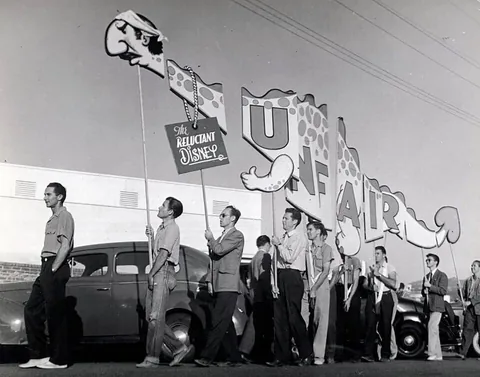 which is a union that had unionized every other major animation studio in Hollywood and New York over the couple years leading up to this.
Which there were several of at this point in time. We've been sort of very Disney-centric, but there is an industry around this.
Yep. Decides finally to target Disney employees. Now, there's a reason why the Screen Cartoonists Guild had stayed away from Disney despite it obviously being the leader in animation up until this point, which is I think Walt's utopian dream more or less was true, or at least true enough. Like, he established the bonus pool for animation. He constructed this campus, everything you were talking about earlier, Ben. But here with the cash crunch, that all comes crashing down.
Yeah, there's a great excerpt from the book The Animated Man by Michael Barrier.118Michael Barrier — American animation historian, author of the biography "The Animated Man: A Life of Walt Disney" (2007). In the spring of 1941, under pressure from the Bank of America and holders of preferred stock, Walt Disney Productions agreed to scale back its production cost to about $15,000 a week. Week. According to Walt Disney himself, that meant he had to hold the negative cost of new features to about $700,000, or one-third the cost of Pinocchio or Fantasia-
-which was also in development at the time. Since labor costs made up 85 to 90% of Disney's total costs, implementing such severe economies would mean laying off more than half the staff.
So you've got cost reduction in some of the people sticking around, and you've got big layoffs because Pinocchio didn't pay back.
Yep. Well, layoffs coming. They haven't happened yet. And this is part of why the organization and the strike happens. So hundreds of employees end up striking. They picket the Burbank campus. They march all day. They carry signs with slogans like "Snow White and the 700 Dwarfs." Or one is a drawing of Pinocchio with the caption, "No strings on me."119A nod to Pinocchio's song "I've Got No Strings," which the wooden boy sings after running off to the puppet theater. The strike lasts for 3.5 months, and it's a completely shattering event for Walt personally and for the company. As the union is organizing the employee base in the days and weeks leading up to the strike, Walt decides that he's going to make a speech and address the entire company, which he thinks, well, he will explain his position and the challenging state that the company's in, and it will resolve everything, and the employees will rally around him and the company. Unfortunately, it has the opposite effect. It is a complete disaster. He lectures the entire company for nearly 3 hours. Some of his lines from the speech, which he had written out ahead of time so it's preserved, are My first recommendation to the lot of you is this: put your own house in order. You can't accomplish a damn thing by sitting around and waiting to be told everything. If you're not progressing as you should, instead of grumbling and growling, do something about it. And then, don't forget this: it's the law of the universe that the strong shall survive and the weak must fall by the way, and I don't give a damn what idealistic plan is cooked up, nothing can change that. Probably not what you want to tell your employee base after you just slashed their salaries.
Yeah.
A labor magazine would write afterwards, Walt Disney's speech recruited more members for the Screen Cartoonists Guild than a year of campaigning. Ugh.
Yeah, yeah, about the worst reaction that you could possibly have. And Walt, I don't know if you found this in your research, but it seems like he's kinda deluded here into thinking, well, it's not actually my employees that are doing this. It's these communist, very few communist agitators who have undercover become my employees and they're riling up the rest of them. And Walt's kinda removed himself and he's in denial that this is actually what his workforce wants. The family atmosphere that we had at Hyperion is now a real corporate, you know, have and have-nots here-
Enterprise.
-on the big Burbank campus. Yeah.
Yeah, it's a mess. And then it gets worse. So in the middle of the strike, which again lasts for 3 and a half months, that hundreds of employees are gone from their jobs who are not working and marching and protesting outside the company.
While they're trying to make Bambi, which is equally ambitious.
Right. Walt is just so depressed and in denial and upset about the whole thing that in August of 1941, he agrees to go on a goodwill trip to Latin America with Nelson Rockefeller's Office120Nelson Rockefeller (1908–1979) — grandson of John D. Rockefeller, later governor of New York and vice president of the US. During World War II his office promoted cultural ties between Latin America and the US and countered Axis influence there. "Saludos Amigos" came out in 1942 and "The Three Caballeros" in 1944; the Gran Fiesta Tour ride with these characters runs in Epcot's Mexico pavilion. of the Coordinator of Inter-American Affairs. This is the trip that ultimately results in the Disney films Saludos Amigos and The Three Caballeros, if you've seen those or been to the Three Caballeros ride in Disney World in Epcot. It's actually great.
It also results in Roy having to resolve the strike because Walt is uninterested in dealing with it.
Yeah, the real reason Walt goes on this trip, and he would write about it, he would call it a, quote, godsend and say that it gives him a chance to get away from this god-awful nightmare in Burbank. Yeah, he basically just leaves the country and walks out on the whole thing and tells Roy to settle it.
I'm leaving for 10 weeks. Do your best.
Yep. So while Walt is gone in Latin America, Roy does settle the strike after federal mediation. Disney ends up recognizing the Screen Cartoonists Guild union. They raise salaries for the remaining employees. And they agree to a negotiated layoff of over 500 employees. So taking total headcount before the strike down from 1,200 to under 700. These are the layoffs, Ben, that you referred to. The studio would never fully recover from this, certainly not under Walt, and not for many years afterwards, really not at all in the period of classical animation before computer animation comes along.
And sorta equally as importantly, Walt would never recover from this as it pertains to his relationship with the company Walt Disney Productions.
It no longer feels like his family. It feels like a creation he's made that has sort of run away from his control.
Yep. He ultimately does decide that the company Disney and he, Walt Disney, have a creative and business future. But yeah, he never has the same relationship to the studio or animation after this.
Yep. He apparently, according to Don Lusk,121Don Lusk (1913–2010) — Disney animator who worked on the studio's classic features starting with "Snow White," and later a director of TV animation. who was an animator there, made a list of everyone who went out on strike and said that everyone on this list isn't true to Disney and one day will not be here.
Yeah. So Ben, you mentioned Walt's sort of anti-communist streak that comes out of this. Yeah, for the rest of his life, he would blame all of this on communist influences in Hollywood. He would actually testify after World War II in front of the House Un-American Activities Committee,122Walt Disney testified before the House Un-American Activities Committee on October 24, 1947. That fall's hearings led to the Hollywood blacklist: screenwriters, directors and actors suspected of communist ties were shut out of work for years. you know, HUAC, as a friendly witness123Friendly witness — the term for those who willingly cooperated with HUAC. At the Washington hearings of October 1947 there were 14 of them, including Walt Disney, Jack Warner, Gary Cooper and Ronald Reagan. corroborating communist infiltration in Hollywood.
He named names of people who he said were communists based on things he had heard about them, like no even proof. And you've got like a major figurehead of a big US corporation testifying. There's all this video of it, of him saying, "I believe so-and-so is a communist."
Yeah, and of course this would lead to the famous Hollywood blacklist and all the terrible stuff that comes out of that. One thing later sort of by association with this, people would accuse Walt of being anti-Semitic since much of the communist movement in the US and especially in Hollywood was in the Jewish community. Gabler investigates this pretty thoroughly in his book and concludes that there's not any evidence that Walt ever really was anti-Semitic.
I turned over every stone I possibly could on this company and we spent, I don't know, the better part of the year so far researching this and I found zero evidence of that.
Yeah, yeah, definitely anti-communist for sure. But anyway, so speaking of the war.
By the way, this is 4 giant blows to the company in a row. You've got Europe dropping even before the US enters the war. You've got the European distribution falling off. There's a thing we didn't talk about, which was Fantasia tried to make this giant bet in a new type of sound for movies called Fantasound.
Yes, Fantasound.
This alone almost killed the company. The budget for Fantasia was 50% bigger than Snow White. And in the first run at the box office, they tried to use Fantasound, this new sound technology they had invented, and distributors didn't pick it up to do a real first run. And so out of the $2.3 million budget in that first year it came out in 1941, they recouped $325,000.124Fantasound — the multichannel sound system Disney developed for "Fantasia" with RCA. The equipment was expensive and bulky, and only about a dozen theaters were fitted with it for the first run. "Fantasia" premiered in November 1940.
That is a giant loss on Fantasia. I think Disney was also funding the development and distribution of Fantasound. So you've got those two, then the strike. Now the US enters the war.
Yeah. One more note on Fantasia though, before we talk about the impact of the US entering the war. Do you know what ultimately ended up happening with Fantasia?
They made Fantasia 2000,125"Fantasia 2000" — the sequel to "Fantasia," first shown in December 1999 (in general release from January 1, 2000): new animated segments set to classical music. 60 years later? No.
Yes, that is true, but that is not what I was getting at. So yeah, the initial release of Fantasia, as you said, was a total flop. They couldn't exhibit it anywhere, lost tons and tons of money. Later, it has this huge resurgence. I mean, I remember when I was growing up as a kid, my parents loved Fantasia.
Yeah, I actually thought Fantasia was a modern movie. It's crazy to me that it was Disney's second.126Fact-checkIn the conversation it's Disney's second film; in fact "Fantasia" (1940) was the studio's third animated feature, after "Snow White" and "Pinocchio" (Wikipedia, "Fantasia (1940 film)").
Right, right, right. I think it was the '60s and the hippies127The hippies and "Fantasia" — for its 1969 re-release "Fantasia" was promoted with psychedelic posters, and it became a cult film among counterculture college students. that thought, oh, this is the coolest thing. So Fantasia, if you look today at the list of inflation-adjusted top films in history by box office gross, inflation-adjusted. Fantasia is the 24th highest grossing film in Hollywood history.
Unbelievable.
So it has a whole second life.
I mean, artistic masterpiece and kinda timeless.
Totally. It's an amazing, amazing production. I mean, the music, the symphonies, the sound. It's— go watch Fantasia if you've never seen it. It is well worth your time.
And now a hard cut over to World War II.
Yeah, right. Okay, so back to 1941. No sooner does Roy settle the strike than Pearl Harbor happens128Pearl Harbor — the US Pacific Fleet's base in Hawaii. Japan launched a surprise attack on it on December 7, 1941, and the next day the US declared war on Japan. and the U.S. now enters World War II. And unlike many of the other great American companies of that era that we've covered on this show before, where World War II was great for their business, like Coca-Cola or Mars or Lockheed.129Coca-Cola, Mars and Lockheed — Acquired has episodes on all three. During the war Coca-Cola, on the orders of its head Robert Woodruff, sold a bottle to any serviceman for 5 cents wherever he was stationed, Mars made M&M's for the army, and Lockheed built military aircraft. World War II is a disaster for Disney. Nothing of value gets built for Disney during the war. It basically breaks every single node in the flywheel. And on top of the strike, it just completely grinds to a halt all new core IP production for the studio.
Yeah, so the first thing that happens is within hours and then days of Pearl Harbor getting bombed, the U.S. military moves into the studio.
Yes. Yes.
They look at Burbank and they think this is a great asset.
Do you know why?
And so there are hundreds of troops. There are two reasons that set up shop using the sound stages to work on all the optical systems for anti-aircraft. Sound systems are awesome. There's no windows. It's a giant room. I mean, like it's, it's the, the thing you would want for stuff like this. The second reason that I suspect you're hinting at, David, is it is real close to Lockheed.
Yes, real close specifically to Lockheed Skunk Works department-
Oh ho!
-which is in Burbank. The secret Lockheed Skunk Works airplane hangars and department was in Burbank because Burbank was the sticks back then, and Disney is right next door. So that's probably the bigger reason why the military requisitions the Disney lot is to protect Skunk Works.130Skunk Works — Lockheed's advanced development unit in Burbank, officially formed in 1943; it later developed the U-2 and SR-71 spy planes and the F-117 stealth fighter.
Fascinating.
So you've got that happening. You've got you've got a whole bunch of the animators getting drafted.
I mean, so you're, you're, you're down manpower. You're just coming out of the strike. You have these huge failures in Pinocchio, Fantasia, and also Bambi. Again, you've lost European distribution.
And so the appetite for making more things like those three movies drops to like zero. I mean, at this point, there's a financial reality that Disney owes a dividend to these shareholders, which interestingly enough, it actually suspended in 1942. They actually didn't pay out the dividend, but they do have to pay Bank of America.
The films aren't going to be the thing doing it. And conveniently, they've got the U.S. government saying, can you help us with some propaganda films? Can you help us encourage people to pay their taxes and buy war bonds131War bonds — government loans from the public to pay for a war; in the US film stars, posters and movies promoted their sale. and support the troops? And so Disney kind of looks at everything, how it's all playing out, and says, yeah, that's what we're going to be doing for the war.
Yeah, so all of the studio production work during the U.S.'s time as an active participant in World War II. Yeah, basically. Just gets repurposed to propaganda and training materials for the government.
Insanely, they do use Disney IP. You see all these crazy old posters with like, Donald Duck holding a gun and stuff you sorta would never see with these characters today, but not only did Disney say, "We're work for hire," they said, "We can use the Disney IP." Interestingly, David, do you know about Mickey Mouse's role?
Oh no.
They really did not employ Mickey Mouse.
Hmm, interesting.
They protected Mickey Mouse from the war image, and Donald Duck sort of led the charge on all the war films.
Well, part of this is because canonically Donald Duck is a sailor,132A sailor by canon — since his first appearance in 1934 Donald Duck has worn a sailor shirt and cap. Still, in the wartime cartoon "Donald Gets Drafted" (1942) he was drafted into the army, not the navy. right?
Oh, okay. That makes sense.
Yeah, yeah, but then it makes sense to protect Mickey too.
And Donald's also the more like fighter of a character.
Yeah, yeah.
Mickey started off as this troublemaker, but then kinda became the nice protagonist.
The goody two shoes. And then Donald was the foil.
Yeah.
Yeah. So all of this, though, to our point earlier, does nothing either for the flywheel model or for generating new IP to feed it.
Or pushing the envelope of technology or pushing the bounds of creativity, all the things that contribute to Disney's core.
They are financially floated, though, by the war. I mean, the way that they make it through this period is they actually are generating net income reliably. Not a lot, but-
From the government work?
Exactly.
09The vault and the postwar years
Wartime cash pressure gave Disney the fourth piece of its flywheel, theatrical re-releases from the vault, and Cinderella brought the studio its first big postwar hit.
And there's one other big innovation, an actual bright spot that comes out of this back-against-the-wall moment during the war that the company's in financially. Do you know what that is?
Ooh. Oh, the Disney Vault.
The vault. Yes.
So in 1944, the company is so cash-strapped that they come up with the— again, at the time, crazy-seeming idea to re-release Snow White in theaters because, hey, we can't make new stuff, but people sure like that old movie. Let's just put it in theaters and see what happens.
And the thing you gotta remember is with no home video and no TV, no one had seen Snow White in 7 years. It truly vanished off the face of the earth except for the copies of the film that were held in the Disney Vault.
ExplainerHow the vault worked
The 1944 re-release became the rule. "Snow White" returned to theaters in 1952, 1958, 1967, 1975, 1983, 1987 and 1993, on average every seven or eight years, as a new generation of children grew up. The rest of the animated classics lived the same way: between releases a film sat on the shelf, and each return was sold as an event at almost no production cost.
With home video Disney moved the practice to cassettes and then discs: the classics were sold for a limited time and then "put back in the vault" for years, hence the name Disney Vault. The practice died with streaming: since 2019 nearly the studio's whole catalog has been permanently available on Disney+.
In the Disney Vault. Yes. So in 1944, they re-release Snow White in theaters, and it brings in $3 million in revenue to Disney. On just a, like, a few hundred thousand in cost. They basically just got to print a few new copies of the film and then distribute it out to theaters.
Right, the theaters get their normal cut, the distributor gets their normal cut, but Disney's cost to develop the film is like near zero.
Zero. Yeah, they've already developed it. It's already done.
This is an enormous boost for the company. And Ben, to your point about the 7-year gap since the initial release, it turns out, conveniently, that 7 years is just about the right amount of time for a new generation of children to come along and reach an age where they would be interested in consuming Snow White that haven't seen it before, and they discover it for the first time. And yet it's infrequent enough that it doesn't dilute the IP.
So Walt's got an amazing quote on this, actually from the second re-release in 1951 of Snow White: In the 8 years since then, our first re-release, our potential audience has been increased by 25 million children, who either were not born or were too young to attend a motion picture theater in 1944. You're an adult much longer than you're a kid.
It's so amazing. And they totally stumble into the 7-year thing. Like, it's not like they intended when they made Snow White to say, okay, we're gonna put it in the vault and then 7 years from now we're gonna take it out. It just happened that 7 years later they had a big cash crunch, they needed some easy profits, and they put Snow White back in theaters. And 7 years, you know, give or take a couple years, basically becomes the core Disney IP cadence to this very day.
And Disney could uniquely do it versus other studios because their IP was more timeless. It's animated and it's based on these timeless sort of lessons and these fairy tales of old. Like they're these simple but resonant stories.
And it carries through right to today. What is the cadence between Disney's Frozen movies133"Frozen" (2013) — a Walt Disney Animation Studios film loosely based on Andersen's "The Snow Queen" and, until 2019, the highest-grossing animated film in history. The sequel came out in 2019; the third film is expected in 2027. today? Frozen 1 comes out 2013, Frozen 2 comes out 2019, Frozen 3 slated for release next year, 2027. 6 to 8 years, like clockwork.
It's interesting they've applied it to sequels now too.
All right. So now we've got four components to the flywheel business, your original three. One, genuinely compelling new intellectual property with characters that you resonate with. Two, maximize distribution of each element in the primary delivery vehicle. You've got three, feed that IP into as many ancillary profitable flywheel nodes as possible. And now we've got four: the vault, the re-releases.
Strategically re-release it every 7 or so years, frequently enough to capture each new generation of children, but not too frequently lest you dilute its impact.
With effectively evergreen content.
Yep, Roy has a great quote that he would tell the Wall Street Journal134The Wall Street Journal — America's leading business newspaper, published since 1889. many years later: "Our product is practically eternal." And it's so true.
So despite this genuine innovation of adding the vault concept to the flywheel, by the time the war ends in 1945, Disney is not in a good place.
Yeah, yeah.
The flywheel is basically completely broken. There hasn't been any compelling IP generated for the past several years. And worst of all, Walt himself is disengaged and disillusioned.
Yeah, but clearly something happened because the Disney we know today is quite successful.
AdServiceNow
But before we continue the story...
Yes, listeners, this is a great time to thank our friends at ServiceNow, longtime friends of the show. So if you are managing a large enterprise today, you've got AI everywhere. You've got copilots and models and agents all running across every team.
And the promise was simple: add AI and the results will follow. But enterprises are now realizing that the hard part was never adding AI, it's making it work.
Right. It's got to have the right context and connect to the workflows that matter. Plus, it's got to be secure, stay governable, and still be able to take real actions. You get all that working together, and that's when magic happens.
Yes. And for those, like, two of you out there who've never been to Disneyland, the magic isn't just from one great ride. It's from the whole experience being seamless: the daily parades, the sightlines, the characters appearing exactly at the right moment. It looks effortless, but behind the scenes, thousands of moving parts are being coordinated in real time from a control center that nobody ever sees.
And that's what ServiceNow has been building for over 20 years, the foundation AI needs to succeed. And they've done it at scale: over 100 billion workflows, trillions of transactions, and the operational knowledge of how work actually gets done. That's why more than 85% of the Fortune 500 work with ServiceNow.
And as the AI Control Tower, they're giving companies a single place to manage all of it, not just agents, but every AI system across your business.
So listeners, if you are wrangling AI across your company, go check out servicenow.com/acquired, and just tell them that Ben and David sent you.
All right. So we're coming out of the war. There are sort of a few moving parts here at Disney right now. So the revenue from the government has dried up. So the thing that was putting them on sound financial footing is not there for the sort of quick revenue hits. The long-term stuff, other than the re-releases, they haven't stoked the fire in a while.
So the strategy over these next few years is to sort of kickstart, to try to do stuff that doesn't cost a lot of money but might have a lot of return.
And so they try a bunch of stuff. On the animation side, they do packages135Package films — features stitched together from several shorts, the studio's way of saving on production in the 1940s. "Make Mine Music" came out in 1946 and "Fun and Fancy Free" in 1947. where they take a bunch of shorts and they package them together as feature films. These are movies that you almost assuredly have never seen called like "Make Mine Music" or "Fun and Fancy Free." Not big successes. The other thing they try in animation is to go back to the original Alice's idea of combining animation and live action. The result of that is the movie "Song of the South."
Yeah, which historians look back on as racist and deeply problematic, and Disney has never released on home video or streaming. So, not a big success for the flywheel there either. And for the first time in animation, there's now actually real competition in the marketplace. So before the war, Warner Brothers had started Looney Tunes,136Looney Tunes — the Warner Bros. cartoon series shown in theaters from 1930 to 1969; its biggest stars were Bugs Bunny, Daffy Duck and Porky Pig. you know, with like Daffy Duck and Porky Pig and then Elmer Fudd and of course Bugs Bunny. Ironically, it's a former Disney story department employee, Charles Thorson, that does the initial designs-137"Song of the South" (1946) — a film based on the Br'er Rabbit tales and set on a plantation after the Civil War. It has never been released on home video in the US, and in 2023–2024 Disney rethemed Splash Mountain, the ride based on it, as Tiana's Bayou Adventure.
Oh, wow.
-for Bugs Bunny. And then in 1940, you know, same year it all started to fall apart for Disney, Joseph Barbera and William Hanna start working together. They produce Tom and Jerry for MGM.138MGM (Metro-Goldwyn-Mayer) — Hollywood studio founded in 1924; owned by Amazon since 2022. So the other major studios...139Charlie Thorson (1890–1966) — an artist who worked on "Snow White"; after moving to Warner Bros. he drew an early version of the rabbit for the cartoon "Hare-um Scare-um" (1939), from which Bugs Bunny grew. William Hanna and Joseph Barbera made the first Tom and Jerry cartoon in 1940, and in 1960, at their own Hanna-Barbera studio, "The Flintstones."
And The Flintstones!
Yeah, The Flintstones, of course. Yeah, the other major studios are starting to creep in on the animation game. And so by this post-war period, these other studios had grown in popularity and were really starting to rival Disney. Meanwhile, Disney, they go the other way and they get into live action.
Yeah, they somehow had a bunch of cash tied up in Europe that they couldn't repatriate, so they needed to spend it in London. So they went and shot a live-action film, "Treasure Island," in London, which did well for them. Live-action is far less expensive to create. You can do it fast, and they needed to do something with this cash. But, you know, you're not buying a lot of "Treasure Island" merch today. It's not durable like the animated stuff.140"Treasure Island" (1950) — Disney's first fully live-action film, shot in Britain with money British rules wouldn't let it take out of the country.
As we talked about earlier, live action doesn't feed the flywheel, at least for Disney, in quite the same way.
Yep, they started doing nature documentaries. They did one called "Seal Island,"141"Seal Island" (1948) — the first film in Disney's True-Life Adventures documentary series; it won the Oscar for two-reel short subject. shot in Alaska. They also started studying the emerging TV medium to see if they should do something here, but at this point in time decide, eh, basically not, but we'll watch it and see. We're very interested. But Walt's heart really was in animation. He wanted to get back to making animated feature films that pushed the envelope. Roy meanwhile hates this idea since the studio is not on good financial footing. It has lots of debt. Walt ultimately has to give an ultimatum that if we don't get back to this, then we should just sell the company. Like, what are we even doing here? In 1950, Roy capitulates and the company went and raised another $2 million to finance their next film, which was "Cinderella."142"Cinderella" (1950) — Disney's animated feature based on Charles Perrault's fairy tale and the studio's first big success after the war.
Mm, the first bright spot in a long time.
And their first full-length feature film in 8 years since "Bambi" in 1942.
And the way they made "Cinderella" was quite different, right?
Yeah, so Walt pounds the table to make this thing, and then he kinda realizes the way they are gonna make it feels compromised to him because the budget just can't be what they were blowing before in those early '40s to try to really push the envelope.
Yeah, there's a great quote from the animator Frank Thomas143Frank Thomas (1912–2004) — one of the Nine Old Men, Walt's lead animators; with Ollie Johnston he wrote the classic textbook "The Illusion of Life: Disney Animation." who worked on "Cinderella": We planned "Cinderella" more carefully and shot it all in live action first so we could judge it. This was without costumes or a set. Just go on a soundstage and see whether that scene's going to work. Walt said: "We can't afford to animate it and then change it. The animation has to be right the first time." Yeah, not the mindset that they took into Snow White.
Hmm. And this basically flips the live-action animation thing from a source of inspiration into a crutch. So they were filming every scene and then rotoscoping, effectively tracing the live-action footage out of the camera-
Right.
-to make it animated, which can lead to this much more rigid-feeling animation. Also, once you film it, you are completely locked into that view. It's not like you can move the theoretical camera because you haven't really built the muscle to animate in that style for the film.144Rotoscoping — tracing live-action film frame by frame. Max Fleischer invented the rotoscope in 1915.
So you're stuck with this, how it looked in the camera is how we trace it on paper. It just had less of the lavish detail that they put into Pinocchio and Bambi. All this ultimately leads to Walt's heart is just not in it. He kind of helps kickstart the whole thing, but then is not engaged during the production of this film. It does end up being a critical, and commercial huge success though.
Yes, I believe it makes basically the same amount of money as Snow White. I think it does $8 million in film rentals in the first year.
Yep, on a cost of $2.2 million. So really, this is the first big financial success for the company since before the war. It's the biggest success since Snow White. It got the company back on sound footing after a pretty gnarly time during the war.
Yep. Gnarly decade there. Yeah. But yeah, so Cinderella is a huge bright spot. It was a one-time financial boost to the studio that didn't solve all the company's problems, but it did get animation back on the right foot creatively. Even though Walt was no longer as deeply involved as he was in the Snow White era, it did turn things around enough that at least they were making quality work again. And obviously those films still hold up today.
Over the next few years, they then released Alice in Wonderland,145"Alice in Wonderland" (1951) — Disney's animated feature based on Lewis Carroll's books; it lost money on its first release and later became a classic. which, surprise, ballooned over budget and did not pay back. That is in part because a lot of historians say it's a film that Walt felt he should do because of his reverence for the source material.
But never quite had a clear idea on exactly what to do with it. So it's hard to put together these sorts of disjoint vignettes into one cohesive film. But artistically beautiful. So put a pin in that, we'll come back to it. But interesting comment on Alice from the 1951 annual report from Roy: 'Alice has not performed as well at the box office as Cinderella because of these circumstances, which were generally poor attendance at theaters.' He actually blames the macro, which is interesting. 'And because Alice in Wonderland is our highest cost feature, it is not expected to produce a profit from its first release. However, it is a classic property, which should be a valuable asset to the company indefinitely.'
And hey, he was right.
10Trains and the birth of Disneyland
Disengaged from the studio, Walt fell for model trains, and Disneyland grew out of that hobby, not out of a hunt for new places to put Disney's characters.
All right. So we've talked about Walt being disengaged here. What is he doing?
So Walt is playing with trains.
Yes, he is.
That's about the best way that I can frame this, is he's getting really into trains and really into miniatures.
Yes. Trains specifically. Model trains and miniatures, like miniature furniture and like rooms in homes, in miniatures.
Yeah, I mean, gosh, I said we weren't gonna dive into Walt's psyche on this episode, but I kinda think about this—this is me editorializing—as this like soul-searching half-decade where he's just looking for what he's gonna get passionate about next? Because he's sort of bored. Animation isn't doing it for him the way that it used to, and he's like reaching back into his childhood for inspiration.
And the way Walt would frame this is that he was developing these hobbies to keep his mind off of the problems at the studio. That's what he would always say.
Right, that these were nice things to do after a hard day at work.
But they became obsessions.
When I said reaching back into his childhood, there was a train that ran through Marceline, which is why Marceline existed. And there's this deep-seated psyche around trains and small-town America. He and some of the other senior animators developed this interest in large-scale model trains, which are 1/8 the scale of an actual railroad train. So like big, ones you could ride around sitting on top of. There's amazing old footage of Walt riding around on these, these 1/8 scale trains.
So Walt took this extremely seriously. He ends up traveling to the 1948 and 1949 Chicago Train Fair,146Chicago Railroad Fair — an exhibition held in 1948 and 1949 on the Lake Michigan shore to mark a century of railroads west of Chicago; 39 railroad companies took part. and he kind of dove into this community of fellow train enthusiasts. I was thinking this was strange. I kept reading about this and I was like, "This is wild." There were 6 million train enthusiasts, model train enthusiasts at the time. This was actually a pretty big hobby. Yes, and it was something that was really tangible for him to do with his hands.
Yeah, this isn't billionaire hobbies today. This is Walt hanging out with other enthusiasts, kind of a man-of-the-people style.
Yes. And it was something that was really tangible for him to do with his hands. I mean, he was building some of the train cars himself. He actually had a workspace in the machine shop in Burbank where he was building with the machine shop staff. There was a guy, Roger Broggie,147Roger Broggie (1908–1991) — the machinist who ran the Disney studio's machine shop; later one of the founders of Imagineering, he built trains and mechanisms for Disneyland. who led the machine shop team. He would go on to build a serious, serious model train for Walt. Roger would also become, just a foreshadowing here, the first Imagineer.
Yes, yes, yes. Well, just to foreshadow even more, all of this would lead to Imagineering.
Yes. So this team in the machine shop and Walt end up building this train. And David, you were saying "man of the people" style. In a very not man-of-the-people style thing, he ends up sinking $50,000, which is a giant amount of money at the time and a huge amount of his personal liquidity in 1950, into building a train in his backyard. There was a half-mile of track that went through a tunnel. That tunnel, which he dug under his wife's garden, on its own was 90 feet long.
Yes, when Walt gets obsessed with something, he goes to unreasonable extremes.
When he and his wife were looking at houses to figure out where, what property they were going to buy and build a house on, a major consideration was whether there was room for a giant train to be laid out. He ends up—it's on Carolwood Avenue, I believe, Carolwood Street, and he ends up naming it the Carolwood Pacific. The steam engine is named the Lilly Belle after his wife.148Carolwood Pacific Railroad — a miniature railroad built in 1950 at the Disneys' home on North Carolwood Drive in the Holmby Hills neighborhood of Los Angeles. The Lilly Belle locomotive was named after Lillian Disney. It's a whole thing.
Yep. And if you go to Disneyland or Disney World today, most of the steam engines of the railroads are named in callbacks to this period and this inspiration in Walt's life. So there's the Lilly Belle engine at Walt Disney World. There's the Ward Kimball,149Ward Kimball (1914–2002) — one of Disney's Nine Old Men, creator of Jiminy Cricket and the crows in "Dumbo." A passionate railfan, he kept a real narrow-gauge line, the Grizzly Flats Railroad, in his backyard. who is the original animator that gets him into this hobby. There's the Roger Broggie, as you say, and then there's also the Roy Disney.
Oh, nice. I did not know that. So this is a great quote in a PBS American Experience documentary by historian Nancy Koehn,150Nancy Koehn — Harvard Business School historian. The two-part "Walt Disney" documentary in the American Experience series aired on PBS in 2015. where she's reflecting on Walt in this moment. And her quote is, "I can't control my employees, turns out. I can't control the larger stage right now. I can't even completely control my company. So here's a world I can recreate down to the smallest detail that is mine and perfect."
And it would become something much bigger that would also be his and also be perfect.
Yes. So, out of this stew comes Disneyland.
Yes. Which is so funny because Walt would insist in interviews until his dying day that, "The idea for Disneyland came about when my daughters were very young. And as I'd sit there while they rode the merry-go-round, I felt that there should be something built where parents and children could have fun together. So that's how Disneyland started. It all started from a daddy with two daughters wondering where he could take them where he could have a little fun with them too."
It's also that.
You know, I'm sure that's part of it.
Yeah.
Some of both, but really the trains.
Okay, so how did Disneyland happen? Well, the initial thing was actually pretty small.
Yep, the initial idea.
Yes, there was a name floated, Mickey Mouse Village, that sort of quickly changed to Disneyland since it was much more about his new passions—trains, Americana, and miniatures—than it was about Mickey Mouse. And he started working with artists to sketch out what it would be. And the constraint that he had was, we've got this 16-acre plot of land that's adjacent to the Burbank studio lot, between that and the river. So that's sort of what we're working with here.
Yeah, and that's the natural place you would put this.
Of course, of course. So in March of 1952, Walt announces it: Disneyland to be constructed on that little strip of land for a cost of $1.5 million.
A Snow White.151One Snow White — a running joke: "Snow White" cost about $1.5 million to make, and David proposes measuring expenses in Snow Whites.
A Snow White.
If you will.
Yeah, we should speak in units of Snow White.
That's actually cheaper than a Snow White given the inflation since-
Yeah, right, right, right. Much cheaper than a Snow White.
-it's now been 15 years. So he decides, "I'd actually like to spend some money on a larger study for this because I've got a couple of artist renderings here that include cool little river and a train that runs on this. And we're gonna figure out, you know, attractions that go in this thing. But we really gotta jam a lot in here. So I'd like more money."
Roy and the board are none too enthused about this.
Yeah, think about everything that we have said over the last, I don't know, hour about the state of the company. And Walt is saying, "Hey, I found a thing I'm interested in. Can I have some money to explore building this kinda like inarticulatable idea?" Yeah, right next to the studio lot.
Yeah, kinda goes over like a lead balloon.
Yes. So The Walt Disney Company, at this time called Walt Disney Productions,152Walt Disney Productions — the company's name until 1986, when it was renamed The Walt Disney Company. does not free up the purse strings for this. So what does Walt do? He kinda talks to Roy about it and they figure out a path forward. He's gonna start his own company that would get formalized later in the year in 1952 that ends up being called WED Enterprises, W-E-D, Walter Elias Disney, his personal company that he can do weird personal stuff with.153WED Enterprises was renamed Walt Disney Imagineering in 1986, and that is still the name of the Disney division that designs parks and attractions.
So over the course of 1952, Walt starts poaching people from Disney to work on this thing.
And at first it's just like a half dozen people, and they're set up in a building on the backlot at Burbank. These would become the first Imagineers.
And the interesting thing is the people he's poaching, these are artists and they're animators. They're being hired to build a theme park, and like big physical trains. This gives you a sense of Walt's leadership style. He would take a talented creative person and he'd be perfectly willing to assign them to things that they've never done before and say, "Eh, you'll figure it out."
Yes. We also just gotta pause here for a minute and really underline what's happening here. This is Walt Disney.
Yes, by this point in history, he is the Walt Disney.
He is the Walt Disney who has come up with a crazy new idea based on his obsessive hobby with model trains that the board of Disney Studios has basically rejected. And so he has gone full crackpot, like Colonel Kurtz style,154Colonel Kurtz — the character in Francis Ford Coppola's "Apocalypse Now" (1979): an American officer in the Vietnam War who disappears into the Cambodian jungle and builds his own army. and started his own separate company on the Disney campus where he is poaching and recruiting some of the best Disney animators and artists to come over and stop doing animation and start working with him building a theme park. That is what is happening here.
I was about to make the comment, "Oh, this sounds a lot like Elon Musk," but none of Elon's companies have a board that would vote against him.
Right, right.
And so that's really the only difference here. It's kinda like Elon before Elon.
So there ends up being two problems with this plan. One is Walt and the architecture company that he hired kinda come to the conclusion that this plot of land, it's just too small. Even with all the clever ideas to be space efficient, there's just too much that he wants to do with this Disneyland concept. It keeps growing in scope to accomplish all of it in that little strip of land. The second problem is after provisional approval, the Burbank City Council starts to learn more and they decline the proposal since they do not want a, quote, "carnival-like atmosphere" right there on the side of the river.
You could describe Disneyland as lots of things, but carnival-like atmosphere? Clearly they did not get the vision.
Right. The magic is that it isn't!
Exactly.
Like, it very easily could have been. So they need to find a bigger plot of land and they need to work with a team that is really good at odd research-based tasks. And, you're never gonna guess, listeners, where he goes for this. It is like a crazy nugget of history. He goes to SRI, the Stanford Research Institute. If you've heard SRI before, it is one letter off from Siri, which was a spinout of SRI. Yes, that SRI.155Stanford Research Institute (SRI, SRI International since 1977) — founded in 1946 in Menlo Park. The voice assistant Siri grew out of one of its projects, became a separate startup in 2007 and was bought by Apple in 2010.
Indeed, that it was. I was just gonna say that you just triggered, like, you know, probably 2 million phones.
Some of which are running the betas, so they'll have the new Siri AI.
Yeah, yeah, yeah, yeah.
Yes, SRI.
That SRI is the research firm that Walt hires to go identify what ultimately becomes Anaheim.
The perfect spot. They absolutely knock it out of the park. But when you describe it, the site sounds completely nuts. 10 times bigger than the original site, a full 160 acres, 25 miles away from Los Angeles. It is currently just some orange groves. Anaheim itself was a small farming town. There wasn't even a highway connecting it to Los Angeles.
There was a planned highway.
Yes. So there's a quote from The Animated Man by Michael Barrier. "The SRI analysis from August 1953 took into account a large number of factors including likely population growth, freeway construction, and the effect of terrain on television transmission, since the idea was that TV will play an important part in the promotion and development of Disneyland. The study pointed toward a location southeast of Los Angeles in Anaheim, in Orange County just off the Santa Ana Freeway.156Santa Ana Freeway — one of Southern California's main freeways, linking downtown Los Angeles with its southeastern suburbs; today it is part of Interstate 5. That freeway was then under construction, but most of it between downtown Los Angeles and Orange County was scheduled for completion." The foresight of all the factors that they considered there.
Just incredible.
So there is one problem, though, which is great. We found the perfect site. It's 160 acres and we're going to do this much bigger and better than we were before. We're going to need some money.
We're gonna need a lot of money. So Walt goes back to the company.
Yes. And remember, they had no interest in pursuing this, which is why he had set up WED in the first place. It's becoming clear that this is happening. I mean, Walt Disney is a force of nature, and Roy becomes supportive, or at least as supportive as—
Gets strong-armed into supporting this.
Right, while still trying to protect the company. And so in 1953, in April, Walt Disney Productions' Board of Directors — this is a public company — agreed to a personal services contract with Walt and contracts with WED to design and build the Disneyland Park attractions. This is done as a cost-plus contract.157Cost-plus contract — the client pays the contractor all actual costs plus an agreed markup, so the risk of overruns falls entirely on the client. So WED and Walt personally don't have to take any risk, at least in this part of it. It is just like, we will pay you whatever it is plus your profit margin to go build stuff. And, you know, it's kinda a blank check. There are some pretty wild other terms in this personal services contract. According to a 1990s article decades later in the LA Times, Walt is allowed to pursue outside projects, which effectively gives him all the benefits of being a free agent while still drawing his $153,000 salary from Walt Disney Productions.
Another point: Walt argues that he should be compensated for the use of his name. He ends up getting it, again worked into this deal, and the contract awards him 10% of all merchandise.
Wow. I actually didn't find this. This is wild.
So here's the next bullet point: he will now get the right to invest alongside Walt Disney Productions in each live-action film project, which he would later do on Mary Poppins158"Mary Poppins" (1964) — Disney's musical starring Julie Andrews, based on P. L. Travers's books and combining live action with animation; it won five Oscars. and other films.
So why did he negotiate for this? I mean, my feeling about Walt after doing all this research is that he didn't actually really care that much personally about money. Was he trying to accumulate cash so that he could fund Disneyland?
Exactly, exactly.
There's also some like personal stuff tied up in here, his relationship with the company where he's like, it's not really mine anymore, so I kinda want more out of it. That's sort of the less generous take on it, but he and Roy definitely kinda came to this understanding of, well, if Walt is gonna have to fund a lot of this, then we need to figure out a way for Walt to get more cash so that he can do that.
I see. This is happening no matter what. So, we can do it the easy way or we can do it the hard way.
It is interesting on his relationship with money. He was interested in money, but for the sake of deploying it. I mean, hoarding money was never his thing. He did live extravagantly compared to most people. He had that train and a vacation house in Palm Springs159Palm Springs — a desert resort town in Southern California, a favorite getaway of Hollywood celebrities. and all that, but it's not what the other big Hollywood moguls were doing. Lillian Disney has a comment in 1956. She said, "I've always been worried. I have never felt secure. Never. He's always telling us how wealthy we are, how much we've got, and we haven't got anything." And she's kinda right.
Because he's always putting it back in.
Yes, and it's all tied up in the enterprise value of Disney, which he keeps sort of remortgaging and rebetting the farm.
So there's that angle. He also always believed in the park, just like he always believed that that animation, feature animation, had a long runway ahead of it. And I, I was trying to think of the best way to contextualize this. So to validate him there, this is a crazy stat on just how right he was about all of this. Walt built this company over his entire lifetime, from age 21 until he died in 1966. And if you look at the company's market cap today160Market cap — what the stock market values a company at: the share price times the number of shares. compared to where it was in 1966, 99.95% of the value was created after Walt Disney died.
There was just so much more running room with his concept than he had time on this earth to execute.
Do you know how I know the 1966 market cap? Is this ringing any bells for you, David?
So during the Buffett partnerships, Warren Buffett saw that Disney was an underpriced asset in 1966, right before Walt died.
So Buffett bought a bunch of the stock in '66 since it had a market cap under $90 million at the time.161The Buffett Partnership bought about 5% of Disney in 1966 for roughly $4 million and sold it the next year at a profit of about 50%. Buffett later called the sale a mistake.
Under $90 million?
The company was doing $21 million in pretax earnings. And at this point, because this is after Disneyland, this is after a bunch of stuff, it had more cash than debt.
Wow, this is like Ben Graham bargain investing.
Yes. And even more so like Charlie Munger investing, because it was a great business at a great price.162Benjamin Graham (1894–1976) — Buffett's teacher and the father of value investing: buying companies for less than they are really worth. Charlie Munger (1924–2023), Buffett's partner at Berkshire Hathaway, convinced him that it is better to buy a wonderful business at a fair price than a mediocre one at a bargain price.
Yeah, wow.
A $90 million company doing $21 million in pretax that has Disney's flywheel is the buying opportunity of a lifetime when Buffett bought it.
Wow. That's why he's the GOAT.
He did, of course, sell it.
Yeah, right.
So anyway-
Well, that was the right move after Walt's death, as we will see in a few minutes.
Anyway, that's sort of how I would characterize Walt's relationship with wealth and sort of what his goal was in this personal services contract. This whole thing ultimately becomes so contentious that three board directors actually resign from the public company. There's also a shareholder lawsuit163Shareholder lawsuit — in the US shareholders can sue management and the board if they believe those are acting against the company's interests, for instance by striking deals that benefit themselves. that gets brought, and for sort of strange reasons, it doesn't end up going through, but the remaining board members end up approving it. Essentially, it was Roy's way of saying, okay, the company doesn't want to be too tied up in this project if it fails, but we will provide you a way to get more cash flows from the company so you can figure out how to do more of the funding of this thing yourself.
Wow. Fascinating.
So like, just to reflect on this point in history, this is something I really never realized. The origin of Disneyland is, at least so far in the story, not about the company intentionally looking for more places to put its intellectual property.
No, it's very intentionally not the flywheel in the beginning.
Right! There are essentially zero synergies as conceptualized so far for Disneyland.
Yep. But all of that's about to change because Disneyland, even post all of the budget expansion after SRI and moving to Orange County and 160 acres, is getting so out of hand in its budget that it needs to actually come back to the company.
Sort of.
Sort of.
11Television and ABC
While Hollywood feared television, Walt sold the struggling ABC network a show and a theme park in one package, and the Disneyland show paid for construction and advertised the park for a year.
So here's the corporate structure. Originally, they thought they would need about $5 million for the Anaheim Disneyland. Spoiler, they would go way, way over that. But because they thought it was gonna be this expensive, Walt went back to the company again and said, look, I know we did this personal services contract thing, but like, I think it's better if this is actually a Disney thing, and let's figure out a way to really tie it all together here. At a $5 million price tag, the company cannot afford to fund this.
If you look at 1952 when planning began, Walt Disney Productions made less than half a million dollars in net income. So 10 times that for the park's budget is not gonna fly. There's not cash for it. But at this point, the company is kind of like, all right, the proverbial train is moving forward here. There is actually a good plan to integrate a whole bunch of Disney stuff into the park. This can be a Walt Disney Productions thing in one way or another. We're good for $500,000, but we need to go find the bulk of the $5 million somewhere else.
What can we do?
So in order to go get the bulk of the financing for the park, Walt comes back fully into the fold at the Disney studio and does something that no other movie executive is willing to do at this point in time. He embraces television. He goes to the TV networks for money.
Yeah, and the fascinating thing is, it's in part because they don't really want a pure financial partner for the park. They don't want to just go raise a bunch of debt that they'll then have to pay back. This has hamstrung them so many times. They're trying to think creatively of how can we do like a 1+1=5 thing here where we have this Disneyland Inc. joint venture and someone else is, you know, building this thing and funding it.
So yeah, at the time, the prevailing sentiment in Hollywood was that TV was a threat, that if Hollywood movie studios started putting their content on TV, it would steal audiences away from the theaters. It's just like in our NFL episode164The NFL episode — "The NFL," Acquired's episode of January 26, 2026. where baseball was deathly afraid of television. I think the quote was, "Radio whets the appetite for attending baseball games live, and TV satiates it."
But Walt realizes, just like the NFL did, that TV actually was a huge new opportunity. Walt says, "When television first hit, I went back to New York, and I spent a week in New York just to study television. I had the feeling then that it was important and that we ought to get in it." The feeling of the motion picture business was that television was something we should fight or we should ignore it and maybe it would go away or some darn thing. I said, television is going to be my way of going direct to the public, bypassing the middleman. I said, Roy, this television thing can be the greatest thing because we will be going direct to the public. And he also thinks it might be his ticket to financing the park.
So ABC had been wanting to do something with Walt. I mean, lobbying over and over and over again because Walt did this one special a few years before. I think it was on NBC, not ABC. And it was great. Like, there is something very compelling about Walt Disney and Disney stuff in a television special.165The TV special — Disney's first television program was the Christmas special "One Hour in Wonderland" on NBC on December 25, 1950, which promoted the upcoming "Alice in Wonderland."
Yes, yes. Avuncular Walt Disney beaming into living rooms around America. Yeah.
But ABC is the third place network.
They don't have as many affiliates.166Affiliates — local TV stations that carry a national network's programming under contract; the more affiliates, the greater the network's reach. They don't have as much reach. If you're gonna get a partner for something that you really wanna take advantage of the full reach of a television network, it's not ABC.167ABC dates from 1943: under pressure from regulators, NBC sold one of its two radio networks, the Blue Network, which became the American Broadcasting Company. ABC began television broadcasting in 1948 and long trailed CBS and NBC.
You really want CBS or NBC?
Yes. And so Walt actually goes to CBS and NBC with this pitch. I think it might be Roy actually flying to New York and doing this, but they're not interested, at least for the whole package that Walt is proposing.
Yes, they both say, "Hey, Walt, we would gladly do a regular television series with you, but I don't know about this park thing."
You're asking for the better part of $5 million so that we can build a theme park with you, and that's a bundled deal with doing a TV show. This is really weird.
Yep. ABC, though. You know, Ben, as you were saying, they're the newest of the networks and they're struggling to catch on. They need something like Disney and Disneyland to break out. So they say, yes, Walt's line on this was that ABC needed the show so badly that they bought the amusement park with it.
Do you know the structural thing with the television industry that was going on in 1952?
Source: US Census Bureau, Historical Statistics of the United States, Colonial Times to 1970, series R 105; as of June 30 of each year
So back in 1948, and I promise this is related, back in 1948, the FCC paused the ability to get a new broadcast license while the FCC was sorting out some technical and policy problems. It was supposed to last like 6 to 12 months, but it ended up lasting 4 years until 1952, a freeze on the ability to get a new broadcast license.168FCC — the Federal Communications Commission. The freeze on new TV licenses lasted from September 1948 to April 1952. The fourth national network was DuMont, which went off the air in 1956.
So the existing Big Four networks, which are about to be three, NBC, CBS, and ABC, became pretty entrenched. Meanwhile, the number of households with TVs was absolutely exploding. It went from 9% of households in 1950 to 65% just 5 years later in 1955.
Yeah. So all these networks now have a basically government-protected oligopoly169Oligopoly — a market split among a few large players that newcomers find hard to enter.-
Accidentally.
-in this massive new market.
Yes. So if ABC could put on a hit show, like there's not that many choices of stuff to watch at any given time because of this supply-demand mismatch on content. Suddenly a giant swath of Americans could pay attention instantly. So they're like really hungry for super compelling content. So Walt goes to ABC kind of knowing this and knowing they're in third place and says, "okay, I will make this show for you, but I'm A, you're doing the park with me, and B, I have complete say on what happens during the program, and I can change my mind anytime, and there's no part of the contract about what I'm making for you." And ABC says, yes, absolutely, that sounds fine, Mr. Disney.
Yes. So ABC ends up investing $500,000 in equity, into Disneyland Inc. You know, same terms and amount as Disney Productions. In addition, though, they also guarantee $4.5 million in bank loans. So boom, there's the rest of the financing that they think they need to get Disneyland off the ground, in debt guaranteed by ABC.
And they would televise the TV show, but Walt Disney Productions would have to produce it. But they're actually buying a pretty expensive TV show also. So in addition to this $500,000 and the $4.5 million, ABC is also gonna pay $5 million per year to Walt Disney Productions to make the show that they're gonna put on the air, and it was ABC's to air for 7 years, which made it the largest TV programming contract in history.
Yes, this is an absolutely over-the-top deal.
There is one other deal point, which is ABC negotiated to have the right to all the profits from Disneyland's food and beverage for the first decade.
They're like, hey, we need something else out of this.
Yes, yes. But a part of this contract that is completely set in stone is the opening date: July 17th, 1955.
Interesting. I didn't realize that the opening date was set in this contract with ABC. Either way, they do get the television show. And it works out to be a great deal for everybody involved because, Ben, to your point about supply and demand, it becomes a huge hit, like, instantaneously when it launches in the fall of 1954.
The content is basically a behind-the-scenes look at all the different lands and content for each. So Tomorrowland, Frontierland, Adventureland,170Lands — the themed areas of Disney parks, each its own world: at Disneyland, Main Street, U.S.A., Adventureland, Frontierland, Fantasyland, Tomorrowland and others. etc.
Yep. So pretty quickly, Disneyland, because of course they name the TV show the same as the park.171The "Disneyland" TV show premiered on ABC on October 27, 1954. Under various names, including "The Wonderful World of Disney," it ran on and off on American television into the 2000s.
Sure. I mean, if Walt gets to control all the programming, like why not just make it the most perfectly aligned advertisement every week for a whole year to get ready.
Yes. So it quickly becomes the second most popular show on television after I Love Lucy.172"I Love Lucy" (1951–1957) — the CBS sitcom starring Lucille Ball, the most popular show on American television in the first half of the 1950s. And it's the first ABC program to crack the top 25 shows ever. Like, it was all NBC and CBS. Until Disneyland.
Unbelievable. Also, ABC lets Disney run trailers inside each episode for their current theatrical release.
So it both promotes Disneyland and the current movie slate.
It becomes a whole nother node to the flywheel.
Yes. And for the first time they get repeat exposure. I mean, Disney only gets a touchpoint once every few years with a consumer with a movie, and maybe you watch their shorts, but with TV, it's this way to build a repeated relationship.
They had this in a certain way with the comic strip before, but this is like that on steroids.
So in that same fall and winter of 1954 into 1955, the show has its first big, like, viral moment even before the park opens. So in December of 1954, Disney begins a 3-part live-action miniseries on the show about the story of Davy Crockett. Davy Crockett.
Oh, that's right.
And America goes nuts for Davy Crockett. For listeners who don't know, Davy Crockett is like a historical American figure that fought and died in the Battle of the Alamo.173Davy Crockett (1786–1836) — frontiersman and congressman from Tennessee who died defending the Alamo mission during the Texas Revolution. In Disney's series he was played by Fess Parker. Fess Parker as Davy Crockett in Disney's series for ABC (1955).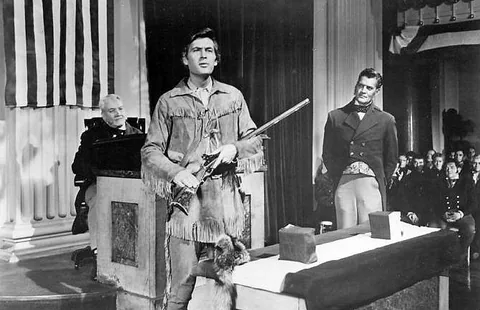 In Texas over a century before this.
Which Disney highly fictionalizes the character.
Yes, totally. But this miniseries becomes a massive flywheel moment for Disney, totally unintentionally. Davy Crockett coonskin caps174Coonskin caps — raccoon-fur caps with the striped tail hanging down the back, the trademark of Davy Crockett and other American frontiersmen. become the must-have kids' product of 1955. They sell 10 million caps in 1955.
Unreal.
Even better, the theme song, "The Ballad of Davy Crockett"175"The Ballad of Davy Crockett" — a song by George Bruns with lyrics by Thomas Blackburn; it was first heard on the first episode of the "Disneyland" show on October 27, 1954, and Bill Hayes's 1955 version became the hit. you know "King of the Wild Frontier," reaches Number 1 on the Billboard charts in America and sells 7 million records. In total, Disney would go on to do around $300 million of gross sales of Davy Crockett merchandise, which at this point they fully in-housed commercial products. Kay Kamen had tragically passed away in an airplane crash in 1949, after which they in-housed all of this within Disney. So if all that happened with the same splits we mentioned before at 5% royalties on that $300 million, assuming again 100% retail markup from wholesale, that's $7.5 million to Disney, which, you know, I think is more in actual revenue to Disney than they had earned from any film at that point in history.
And David, this is really gonna blow your mind. That is actually more than the amount of income they had received ever cumulatively from first-run animated features. If you add up all the pluses and all the minuses, by 1957, the money they had made ever in profit dollars from their first release films was a hair over $7 million. And they made, by your estimates, $7.5 million.
Yeah, they made more from coonskin caps and record sales than... Incredible. And what timing, right before Disneyland opens.
Insane.
Amazing.
Disney absolutely crushed the timing on switching their horse to TV or sort of embracing TV and embracing it in this huge way. And not just with programming, but directing all this attention at Disneyland. We gave that stat earlier, all the way in the '20s, that the average American went to theaters over 40 times. By 1947, that number was down to about 32 times, and by 1956, the year after Disneyland opened, it was down to 14 times per year.
Thanks to our friend Arvind at Worldly Partners176Arvind Navaratnam — investor who founded Worldly Partners in 2020; known for detailed decades-long company histories that the Acquired hosts use as a source. for gathering all this data.
So movie executives really had good cause to be concerned about TV.
Absolutely. Attention was shifting to television, and right as it was shifting in droves, boom, that is right where Disney showed up in this like multiplicative way, you know?
Yeah, man, incredible timing.
And Walt, as ever, had a quote on this. This is from the special that he did back in 1950 as an experiment. He said, "I regard television as one of our most important channels for the development of a new motion picture audience. Millions of televiewers never go to a picture theater and countless others infrequently. In these highly competitive days, we must use the television screen along with every other promotional medium to increase our potential audience."
Man, was he right.
Man, was he right.
And it's just so incredible that because he started playing with trains, Disney became a major force in television and of course opened the park.
Yes. Okay. So how does this all come together? We've got this like joint venture called Disneyland Inc. It's got $500,000 from Walt Disney Productions. It's got $500,000 from ABC. It's got $200,000 from Western Publishing who distributed their books.177Western Printing and Lithographing — a Wisconsin printing company that published Disney books and comics under license, including the Little Golden Books children's series.
And then Walt himself put in $250,000.
That's right, I did see that.
And then they've got the $4.5 million of debt guaranteed by ABC.
Exactly. So there's a total of $6-ish million that they have to spend to build the thing. Plus there was actually another $2 million of 10-year bonds that ABC was committed to if they really, really needed an extra $2 million to flex from a budget of $6 (million) to a budget of $8 (million).
So Ben, I've read a bunch of places this ended up costing $17 million.
Yes, that is correct. So the cap table is178Cap table (capitalization table) — the table showing who owns what share of a company; a staple of venture capital jargon. Walt Disney Productions and ABC each own 34%, Western Publishing owns 14%, and Walt himself personally owns 17%. And there's a contract between Disneyland Inc. and WED Enterprises, which Walt owns 100% of, to actually build it all. So all this leads up to July 17th, 1955, with the opening of Disneyland that would change the company forever, that would change American vacations forever, that would lay out a giant part of Disney's business model going forward. The opening of Disneyland.
AdStatsig
Yes, but before we do that, now is a great time to thank our friends at Statsig.
Yes. So Walt Disney had this idea that he would often talk about: plussing. Most amusement parks would be effectively complete at opening, and then they'd call it finished, but not Disneyland. Walt treated the park as something that you have to keep improving forever, and he constantly looked at how guests moved through it.
Yep. This idea, though, only works if you can see what's happening. You can't improve an experience on a hunch. What mattered was how guests really behaved, not what anyone assumed in a meeting, which is largely the same problem that product teams have today, just at speed and scale. You can ship faster than ever now, but the hard part becomes knowing which changes actually improve the product.
And now coding with AI only raises those stakes, because LLMs are non-deterministic, meaning that the same input doesn't always produce the same output. So a small change to a prompt or model can have surprisingly large downstream effects. Offline evals will really only get you so far, and you need to be getting signals from real users and making decisions on that.
And that's where Statsig comes in. They offer product teams experimentation, feature flags, and product analytics all in one place. You can ship quickly, roll out changes safely, and measure how those changes impact users, making your product actually better instead of just guessing.
Yes. So just like Walt continuously was plussing Disneyland, still today, Statsig is how you improve your product after you've shipped it. You can learn more at statsig.com/acquired, and just tell them that Ben and David sent you.
12Building and opening Disneyland
Disneyland went up in 11 months, and despite a botched opening it was instantly America's most popular park, because people who enjoy a place stay longer and spend more.
All right, so the development of the park. The team at WED had been getting inspiration and sort of concepting and iterating while all the ABC stuff is happening, while all the hype building around America is happening, and of course while the financial negotiations are happening. So in September of 1953, as legend goes, Roy is about to walk into meetings with television executives. And Walt famously locks himself in a room with Herb Ryman179Herb Ryman (1910–1989) — artist who worked at Disney in the 1930s on "Fantasia" and "Dumbo." His bird's-eye drawing of Disneyland, made over a weekend in September 1953, became the main visual for the financing negotiations. for an entire weekend and says, Herb, can you draw the first full drawing of Disneyland? And Herb looks at him and he's like, Disney what? This is the first time hearing of this. And he's like, the theme park. You're gonna come work on that with me. And he's like, I don't even work here. I used to work at Disney, but I don't work here now. And Walt was like, yeah, but you're the guy to do this. And so Herb kinda looks at him and he says, "Can you tell me a little bit more about this theme park?" Walt—this is metaphorical—kinda locks the door.
Yeah, he's like, great, I will stay here all weekend with you and tell you about the theme park.
And out of the weekend emerges this beautiful drawing that we will send out in the email, acquired.fm/email, that they can use as a sales tool for the first meeting with ABC. You've got a castle, you've got mountains, you've got the railroad, you've got the river. The bones are all there.
The core vision of what Disneyland is.
Yes, yes. Other WED employees meanwhile start traveling all over the US looking at the best existing theme parks. Walt and others travel overseas to places like Tivoli Gardens in Copenhagen180Tivoli Gardens — one of the oldest amusement parks in the world, opened in central Copenhagen in 1843. to get sort of a completely different take on how they could do a park with green space, much more pleasant, less carnival-like, safer, kind of a less seedy experience than you are getting in theme parks in the US. That is the goal. So this year leading up to the park, what we are about to describe is completely insane. Remember I said that the date was fixed in the television deal, in part because the TV show was going to culminate in a live broadcast of the actual park opening. And there was all sorts of like brand new technology and logistics and operations that ABC was going to bring to bear for that. So they were planning around that. And there are some sources that say that it was 366 days to build the park. If you actually look at physical construction, it was less than that, 11 months.
So they end up building Disneyland in 1/3 the time that it took to make Snow White.
Incredible.
This whole thing sounds like a fever dream when you describe it. A Main Street reflecting how Walt pictured the ideal small town from his childhood. Multiple rivers with different types of boats. There's gonna be multiple rivers? Robotic animals coming out of the water on the Jungle Cruise.181Jungle Cruise — a Disneyland ride since 1955: a boat trip down the "rivers" of Asia, Africa and South America past mechanical animals, with jokes from the skipper. In 2021 it was made into a film starring Dwayne Johnson. A castle. American Indians performing live shows of dances. Cars that kids, like 3-year-old kids, can drive around and crash into stuff.
Still my favorite part of Disneyland.
Autopia.182Autopia — a Disneyland ride since 1955: small gasoline-powered cars on a track that guests drive themselves.
An intense amount of greenery and trees that all had to be brought in. I mean, they're doing pine trees and they're doing palm trees, absolutely exquisite landscaping to reinforce how pleasant and safe of a place that it was. A passenger train built from scratch on real railroad ties that had to be laid down. This thing is like Walt's fever dream reflection of America, all in the most idealized, safe, clean, cheery way possible. They've got the past, they've got the future with Tomorrowland and Frontierland and Adventureland, but no sign of the present so you can be completely immersed and disconnected from your day-to-day troubles.
You know what, I actually never realized that, that Disneyland is 100% about the past and the future and 0% about the present.
And about the fantasy, you can go to Fantasyland. That's your other option if you don't want the past or the future. So the first part of construction is the 20-foot-high berm183The berm — the earthen embankment around Disneyland, variously reported as 8 to 20 feet high: from inside the park you can't see the city around it, and from the street you can't see the park. insulating all of Disneyland from the outside world, with the Disneyland Railroad sitting right atop it. To this day, I think the most impressive thing about Disneyland is the sightlines.184Sightlines — what a guest can see from every spot. Imagineers lay them out so that neighboring lands and service buildings stay out of view.
Despite several very, very different environments on a relatively small plot of land—I mean, from Star Wars today185Star Wars in the parks — the themed land Star Wars: Galaxy's Edge opened at Disneyland and Walt Disney World in 2019. to Frontierland, Adventureland, Tomorrowland, Main Street—you really only ever see what the Imagineers want you to, and it creates that unique experience where Main Street can feel nostalgic and wholly different than the jungle over at Adventureland and very, very different than the strip mall mania happening just a few acres away on any side of you. I'll just keep going on the insanity of building this thing. There wasn't yet any on-site buildings to fabricate the rides. So they did construction at Burbank.
That's right. And they trucked it all down.
That's a 50-minute drive if you don't hit traffic and the highway was still being built, so it's all on surface streets. It's crazy. Think of the scale of the stuff that they were building.
Halfway through construction, they discover that Rivers of America186Rivers of America — the man-made river in Frontierland around Tom Sawyer Island, opened with Disneyland in 1955; the Mark Twain sternwheeler plies it. almost doesn't work at all. When they filled it with water, the water just drained into the dirt underneath. And David, as you mentioned, cost ballooned from the original $5 million to a total of $17 million. But that's actually pretty cheap.
Totally.
I did the inflation math. That's $210 million today. You absolutely could not build anything remotely close to Disneyland today for $200 million or in a single year.
It is astounding how it all got built. Also very, very convenient for Disney that they sold a lot of coonskin caps as the budget was ballooning.
Yes, and found sponsors to sponsor lands and rides and drew on every ounce of debt they could.
Yes, this is the other just like absolutely galaxy brain Walt addition to the flywheel that he brings in with the parks. Corporate sponsorships.
Yes, yes.
There were 65 corporate sponsors in Disneyland within the first few years of it opening.
So at opening, there was Richfield Auto for Autopia,187Richfield — the California oil company Richfield Oil (1911–1966); in 1966 it merged with Atlantic Refining to form Atlantic Richfield (ARCO). Bank of America, of course they had to be there, a sponsor of Fantasyland, Coca-Cola as well. You won't believe this. In addition to Coca-Cola, Pepsi, they had a sponsorship in Frontierland. Coke actually didn't become the exclusive supplier sponsor until 1990.
Yeah, that's right.
American Motors, Santa Fe Railway, TWA for the Rocket to the Moon.188TWA (Trans World Airlines) — one of the largest US airlines, then owned by Howard Hughes. Rocket to the Moon was a Tomorrowland ride simulating a flight to the Moon. Monsanto was actually a sponsor.189Monsanto — American chemical company. From 1957 to 1967 Tomorrowland had its Monsanto House of the Future, a plastic house showing off what new plastics could do.
That's right.
Carnation,190Carnation — American maker of evaporated milk and dairy products, owned by Nestlé since 1985. Kodak, the list goes on. But I do have one favorite, David.
The National Rifle Association.191National Rifle Association (NRA) — the American gun owners' organization founded in 1871, today one of the most powerful lobbies in the US.
Oh, wow, Frontierland.
Yes. Inside the Davy Crockett Museum, there was a shooting gallery-
There you go.
-and it's unclear from the historical records if it is technically a sponsorship, but the rifles were provided by the NRA. Like, real rifles.
There you go, flywheel in action.
Yes. So I was trying to do some comparison on this $17 million, inflation-adjusted to $210 million. The Rise of the Resistance Star Wars ride192Rise of the Resistance — the ride in Galaxy's Edge: it opened at Walt Disney World in December 2019 and at Disneyland in January 2020. The ride lasts about 15 to 18 minutes and combines several ride systems. that they built in 2019, which is excellent if you've never been on it, was rumored to cost anywhere from $200 million to $450 million for just one ride.
Right. And they built the whole park for less than that.
Man, the things you could do back then.
Yes, right? I mean, permitting was pretty light back then.
So we get to opening day. How's it go? Well, less than half of the planned rides were open. And just to give you a sense of how down to the wire it came, Walt personally put on a mask and was helping to paint the 20,000 Leagues Under the Sea exhibit the day before it opened. Opening day comes, it's nearly 100 degrees in the middle of July in Southern California. That created issues with the newly poured asphalt, and there are legends of women's high heels sinking into the asphalt because of that. There are water fountains, but they don't yet have the plumbing finished to turn on. So if you want something to drink in this 100-degree heat, you can go buy a Pepsi.193Black Sunday — what Disney employees later called the troubled opening day of July 17, 1955. "20,000 Leagues Under the Sea" (1954) was Disney's live-action film of the Jules Verne novel.
Exactly.
The restaurants ran out of food. Rides were breaking down. Mr. Toad's Wild Ride194Mr. Toad's Wild Ride — a Fantasyland ride since 1955 based on Kenneth Grahame's "The Wind in the Willows": a ride in the car of the reckless Mr. Toad. went down because it was too much for the power grid. And the Mark Twain Riverboat began to sink since the operator let 500 people onto it, which was double the 250 that he was supposed to. But despite all of this, it is a giant, giant hit. That first day that was technically a preview day for press and invited guests. 15,000 people were invited, but it is believed that 30,000 attended.
And then that was in person.
Then there's the TV show.
Yes. So ABC rolls in with 22 live TV cameras and a giant crew to operate it all with 1955 technology. The viewership numbers are astonishing. It was the world's largest live telecast ever. 83 million people tuned in to watch from home, which means that nearly half of America watched this broadcast.
Watch this 90-minute commercial.
Right? And it's crazy, right? It's live coverage of this wackadoo amusement park opening. On the one hand, why would you wanna watch that? On the other hand, you've been conditioned over the last year by one of the most popular television programs in America-
It's all leading up to this.
-that this is gonna be a giant deal, so you better be watching when it happens.
Do you know? I'm sure you do, but do you know who the 3 anchors were that ABC hired to do the opening?
One was Ronald Reagan, right?
Yeah, Ronald Reagan is the big one. Art Linkletter, Bob Cummings, and future President of the United States of America, Ronald Reagan.195Art Linkletter (1912–2010) — host of popular radio and TV shows and a friend of Walt's. Bob Cummings (1910–1990) — film actor and star of a TV sitcom. Ronald Reagan (1911–2004) was then an actor and host of "General Electric Theater"; he was governor of California from 1967 to 1975 and president of the US from 1981 to 1989.
It's crazy. The TV strategy just absolutely knocked it out of the park. What does half of America tune into anymore? I mean, ever.
Yeah, I mean, even the Super Bowl today, which is the biggest television event in America, only gets about 40% of U.S. households tuning in.
And this was just to watch guys talk about what's going on behind them at an amusement park.
No, I think it was that America had been primed via the TV show for the whole past year that this was going to be the event of 1955.
Yeah. So cool. By the end of the first week, there was 160,000 visitors. Two months after opening, the millionth visitor walked in, and in the first year, there had been 3.6 million visitors.
Yep, in the second year of the park's operation, it does over 4 million visitors, which makes it more popular than both the Grand Canyon and Yellowstone National Park. It's like the most popular park in America is now Disneyland.
And today the park has over 900 million visitors since opening day.
My favorite little bit of trivia about Disneyland was learning about the original business model. So you used to have to pay to get on the rides. You would pay, I think it was a dollar for admission to the park, and then you could buy booklets of tickets that would get you admission to the various rides and attractions. And different rides and attractions would have different ticket grades and would be priced differently. It was this whole complicated business model that they obviously have drastically simplified since, and raised prices astronomically.196A to E tickets — Disneyland's attractions were graded from A to E, and the most popular required an E ticket, hence the American expression "E-ticket" for top of the line. A single admission covering all rides arrived in 1982.
Yes, absolutely. And I mean, the biggest sort of success of the whole thing is it just couldn't be farther from a carnival or a fairground. And that turned out to be a great, great business.
Harrison Price, who led the research at SRI for Disneyland, said Disney's rethinking of the American amusement park had striking and immediate business consequences. Because his park was such a pleasant place, people stayed there longer, and because they stayed longer, they spent more time. Basically, Price said, he tripled per capita expenditures because he tripled time.197Harrison "Buzz" Price (1921–2010) — SRI economist and later a site-selection consultant for many theme parks, including Walt Disney World.
Mm. And then of course, you know, fast forward to today at Disneyland or Disney World.
You go for like 14 hours, right?
Yeah, right. Per day. I mean, you, you're not going there for just a day. You're going there for multiple days.
Right.
You're making a whole trip out of it.
And if you're going to Disney World, then they're there a whole week.
So I promise we won't do too much Part 2 foreshadowing on this episode, but this is just one point I gotta drive home. Disney Parks and Cruises today does $36 billion in revenue and $10 billion in profit per year. That is twice the amount of profit that their entertainment division produces.
Yeah, also just wild to think about physical amusement parks having essentially a 30% net income margin. What other physical park operator is going to operate with those kind of margins?
And the fact that it's a bigger business for Disney than their movies.
Like twice as big of a business. And this is, you know, there's 160 acres in California, there's a big swath of land in Florida, there's five or six of them around the world, there's some cruise ships, and that spits off more profit, twice as much profit than all of the other Disney things you can experience anywhere, anytime.
Well, we're gonna get into this in a minute here. Really, the impressive thing is that Disney films are now great again and still the parks do more revenue. We're about to hit a period where the parks do a lot more net income than the films because the films suck.
Now, reflecting on all of this, Disneyland actually was not a bet the company move for Walt Disney Productions financially. It was cleverly structured by Roy to not be, but reputationally it absolutely was. I mean, people were willing to take these giant leaps on Walt because of who he was and what he had accomplished the same way that they do with Elon or Steve Jobs or Warren Buffett getting deals that no one else could get. So Roy was like great at making sure it wouldn't financially bankrupt the company, but Walt was sort of betting that reputation extremely publicly to half the households in the US. So not only was he betting the company, he was betting his own personal fortune too. Remember that $250,000 that he put in?
He sold his vacation house in Palm Springs.
He borrowed $100,000 against his life insurance,198Borrowing against life insurance — whole life policies in the US build up a cash value, and the insurer will lend against it. and he took on a personal loan to fund that obligation.
Yep. All true and all necessary because of how they had always operated the company. He wasn't taking lots of cash out of the company.
Until the sort of renegotiation of his employment contract.
So there is a fascinating coda to all this crazy corporate stuff on how the park was formed. You might be wondering, well, wait, doesn't the Walt Disney Company own the park outright now? I mean, when you visit Disneyland, don't you assume, hey, wait, this is just part of Disney? What about that weird joint venture thing and ABC and Walt personally? So here's how it all goes down. The headline is the Walt Disney Company would not actually own the park and everything within its borders for a full 27 years after opening in 1982. So here's the full story of who sold what. Pretty quickly, Walt Disney Productions exercised their right to buy out Western Publishing and Walt personally. So by 1958, three years after opening, they owned 66%. But the buyout right to ABC's stake, that wasn't pre-negotiated. So in 1960, when the company actually had enough cash to do it, that's when Roy negotiated, hey, we'll pay you $7.5 million to buy out your stake. So by 1960, the publicly traded company Walt Disney Productions did own all of Disneyland Inc, but that leaves WED Enterprises, which had been hired as a contractor to build all the stuff.
Yes, and WED Enterprises is Imagineering today: Disney Imagineering.
Yes, but WED Enterprises, the entity at this point in time, also owned rights to some elements in the park.
Right. And it wasn't consolidated into Disney the company yet, right? It was still this separate thing owned by Walt.
Right. So WED, which Walt is the 100% shareholder of, actually owned the railroad outright.
Of course he did.
It had been negotiated as a part of the personal services contract because it was like, 'Hey, I was already doing this side project and now I'm just putting it on Disneyland.' I should own it.
It all comes back to trains.
So he got ticket revenue from it as an annuity, basically.
Right, because all the rides cost money, so the railroad at Disneyland-
-was Walt's.
Same thing with the monorail.199The Disneyland monorail opened in 1959, the first daily operating monorail in the US. These were not owned by Disneyland Inc. They were owned by WED.
Amazing.
We also mentioned since WED was Walt's personal company, it owned Walt's name and likeness, which led to that 10% royalty on merchandise. In 1963, eight years after the park opened, Roy was getting very nervous that the public shareholders would sue over this admittedly very tenuous structure. So they reached a deal. WED would get sliced into two pieces: Imagineering, the architectural engineering department, and everything else. Disney Productions would buy the half of WED that was Imagineering. So they finally in-house Imagineering in 1965. The rest of the holdings would be renamed Retlaw, which is Walter backward.
Right, right.
And inside of Retlaw, Walt would get to keep the trains, the monorail, and his 10% royalty. This is in 1965. That would actually last all the way until 1982, nearly three decades after the opening, where the company says, 'Enough is enough,' goes to Walt's family, because this is after he passed away, and they bought out the name rights, the monorail, and the railroad in exchange for $43 million of Disney stock. Insanely, WED Enterprises, which would later be Retlaw, got a total of $75 million in checks from Walt Disney Productions for the Disneyland Railroad and for the monorail between 1953 and 1981, and another $46 million for name royalties.
Wow. So I guess the question as a Disney shareholder would have been, was it worth it?
Right.
And the obvious answer is yes.
There's all these conflicts of interest everywhere, and this would never fly today with modern shareholder and SEC and securities laws. But in practice, if you were a Disneyland shareholder then and you held through all of this, that worked out great for you.200SEC — the US Securities and Exchange Commission, the federal regulator of the stock market.
13The fifth element and the WSJ article
TV and the parks became the fifth element of the flywheel, turning Disney by the late 1950s from a movie studio into a stable entertainment company, and The Wall Street Journal drew the diagram.
Well, speaking of how great it would have worked out for you, after the launch of the TV show, the park, the company is just firing on all cylinders again. And Disneyland, the combination of the television show and the park, has really added a fifth element to the flywheel business model.
That's right, you've got One, compelling, great IP. Two, maximize distribution in the core vehicle. Three, feed the IP into as many ancillary vehicles as possible. Four, you've got the re-releases in the vault. And now Five, parks and television. This is television to amplify interest in all of the characters. You've got parks to do—it's almost like the extreme bottom of funnel,201Bottom of the funnel — a marketing term: the buyer's journey is drawn as a funnel, from broad brand awareness at the top to the purchase at the bottom. the way to experience the most Disney thing you possibly could experience every once in a while, but a huge monetization event. And of course you do that—I mean, I just got back from Disneyland. Guess what we're watching? A lot of Toy Story this week at my house. It's a refresher on your fandom.
Thinking about it more now, television was adding another node to the flywheel for sure. The parks are almost this like hybrid flywheel plus IP because all of the core Disney IP of course goes into the parks. I mean, you've got the Peter Pan ride, you've got the Star Wars rides today, but the parks are also not just a destination.
Right. They're a source of IP development, not just a sink of IP development.
And I mean, this would literally become true with Pirates of the Caribbean much later.202Pirates of the Caribbean — the ride opened at Disneyland in 1967, shortly after Walt's death. The film series based on it, launched in 2003, has grossed more than $4.5 billion worldwide.
I mean, that's gotta have grossed billions after all these sequels.
You actually have new IP generation coming out of Imagineering and the parks.
Right, a lot of stuff hasn't done as well. Like Haunted Mansion203The Haunted Mansion — a Disneyland ride from 1969. Two films have been made from it, in 2003 with Eddie Murphy and in 2023. has never really worked as a movie.
Yeah, it never really worked.
Jungle Cruise. But yeah, that is a great point, that the parks serve as a way to feed the rest of the flywheel, not just be a sink of it. So this year, 1955, with the park, with TV revenue from Davy Crockett, The Mickey Mouse Club, this is basically the inflection point for the company. Revenue doubled from '54 to '55, and it would just keep on climbing for decades from this point forward. Disney effectively stops being a movie studio and it becomes this new form of diversified, stable entertainment company.
Yes. In November of 1957, Disney finally lists its stock on the New York Stock Exchange.204New York Stock Exchange (NYSE) — the world's largest stock exchange. To be listed there a company must meet its size and reporting requirements; until then Disney's shares traded over the counter. Stock had obviously been held by the public ever since the 1940 stock offering, but it wasn't listed and traded on the New York Stock Exchange until 1957.
Interestingly, post-IPO, Walt and Roy do still effectively control the company. Forty-seven percent of the voting power of the company is held by the Disney Voting Trust,205Voting trust — shareholders hand the votes of their shares to a trustee so they vote as a single bloc, while keeping the dividends. and so you just don't need that many other shareholders for your votes to carry the day.
So even as a public company, it was still their sort of family company-
-for a little bit. That would sort of wane over the decades from here.
Yep. Once the company was listed publicly and people start to realize the incredible power of the business behind Disney. In early 1958, The Wall Street Journal runs a front-page story about Disney's unique business model. And this was one of the most fun things to discover in our research.
So the article's title is Disney's Land: Walt's Profit Formula: Dream, Diversify, and Never Miss an Angle.
And this article in The Wall Street Journal is where the famous Disney flywheel illustration comes from. Ben, you are holding up live what you have framed in your studio.
This has been on the wall of my office for years.
So the legend that's out there that everybody believes is that this was a napkin sketch that Walt himself drew. No, it was actually created by a Disney studio artist as an illustration for this Wall Street Journal piece—Disney confirmed this for us when we were visiting them in the archives, and then we asked The Wall Street Journal to pull the original piece out of their archives. We'll link to it in the show notes. So cool that this is the origin of where it all came from.
Yeah, it serves as an illustration for something that at the time was actually a pretty difficult-to-articulate concept of a business flywheel. I will say the word flywheel never appears in The Wall Street Journal article.
No, that nomenclature would get added later.
But it was like the Journal saying, "Hey, Disney, help us with some kind of illustration that makes this point that you have a wholly unique, new business model in the media landscape."
And it's a beautiful, beautiful diagram. The whole article is great. Roy has these amazing quotes within it. He says, 'Our diversified activities are related and tend to complement each other, helping us to do relatively fine business in the face of otherwise difficult times for the motion picture industry. Integration is the key word around here. We don't do anything in one line without giving a thought to its likely profitability in our other lines.' So spot on. And then they walk through the steps of the company's flywheel with their plans for their upcoming feature film release of Sleeping Beauty, which was still a year away from release at the time of the article.
In 1958, how crazy is this? At Disneyland, which opens in 1955, there is the centerpiece of the whole thing is Sleeping Beauty Castle. That movie wouldn't come out for another four years.206Sleeping Beauty Castle — Disneyland's castle is thought to be modeled on Neuschwanstein in Bavaria. The animated "Sleeping Beauty" came out in January 1959.
Right, right, right, right.
They were building hype for a movie that was basically in pre-production at this point. In fact, it was based on concept art that was effectively a German castle because it was so far from the film.
Yes. Incredible. So the article walks through. At Disneyland, they've installed animated dioramas as an attraction that they're charging a $0.35 admission fee for. These are animated dioramas of Sleeping Beauty, the upcoming movie. Next, Disney is producing and selling Princess Aurora dolls and costumes. They're working on producing and publishing books of the Disney version of the fable that will be told in the movie.
Of course they are.
And of course, there are segments in the Disneyland TV show about Sleeping Beauty. They're already preparing the soundtrack album to go on sale before the movie's released. And then finally, comics of Aurora and the Sleeping Beauty story are already starting to come out as part of the Disney Treasury of Classic Tales207Walt Disney's Treasury of Classic Tales — a Sunday newspaper comic published from 1952 to 1987 that retold new and re-released Disney films, in effect advertising the studio's releases. syndicated comic strip.
Fascinating.
Just amazing.
The other thing this article reveals is that Disney was intentionally making its TV shows in color even when TVs were still black and white because they thought it was likely TVs would go color soon and they knew that the IP they were making would stay valuable for decades. I mean, the foresight. They are so bought in on: we are just dumping valuable IP onto the pile and we want it to live forever.
Yep. Now there is one other thing we haven't talked about, which is that Disney in-housed their own film distribution right before the launch of Disneyland.
Yes. Yeah. And this actually comes up in that journal article too.
They create something called Buena Vista Distribution, and they left RKO Radio Pictures, who had been their distributor since, I think, 1936. Howard Hughes ended up owning it, and it had been kind of a train wreck as he spiraled out of control toward the end of his life. Disney didn't really want to be a part of that chaos. And at the same time, Walt had really started thinking about Disney as vertically integrated entertainment,208Vertical integration — a company owning several links of the chain from production to sale: here, both making films and distributing them itself. not just a film studio who would rely on others for distribution. So in '53, two years before Disneyland opened, they incorporated Buena Vista. The Living Desert was their first film. It's one of these nature documentaries.209Buena Vista was named after the street in Burbank where Disney's studio stands. Howard Hughes (1905–1976), billionaire aviator and film producer, bought RKO in 1948. "The Living Desert" (1953) won the Oscar for best documentary.
Then quickly thereafter, they did Lady and the Tramp,210"Lady and the Tramp" (1955) — Disney's first animated feature made in the widescreen CinemaScope format. and 20,000 Leagues Under the Sea's distribution through Buena Vista instead of through an outside distributor. It was kind of like a test: can we pull this off? They got pretty good at it pretty fast, with the exception of international, where they then had to rely on sub-distributors for a long time. But Disney had become such a household name, especially because of that weekly ABC show and because of Disneyland, where they were pretty uniquely well suited to actually self-distribute without a middleman. I mean, this is like Walt's dream from the early cartooning days.
It's kind of surprising that they didn't start doing it after Snow White. I mean, who's gonna turn down a Disney picture?
All right, you tee'd me right up because I was wondering the same thing. Cash flow.
Mm, yep.
You can't be a distributor unless you're on great financial footing because the cash flow cycle means that you are fronting money to print films, distribute them before you actually get paid by the theaters-
Right, by the theaters, of course.
-when tickets sell. Disney didn't have the working capital211Working capital — the cash needed for day-to-day operations while costs have been paid but revenue hasn't come in yet: for a distributor, money for prints and advertising until theaters pay up. to pull this off until their real strength in the mid-'50s.
That's such a good point. I always had wondered why more studios didn't vertically integrate and own their own distribution, and that makes sense. You need a lot of working capital to do so.
That's exactly right. In the long run, it's a pretty amazing strategy since they'd been paying I don't know, what is it, about a third of the total rentals to another distributor. And especially with these re-releases-
Yeah, it's an absolute no-brainer with the re-releases.
At this point Disneyland plus the merch and licensing provides this really stable foundation. They almost re-platformed the business, is one way you could put it, where it's the same spiritual entity, but instead of the business being in the films, they now have the business in this stable foundation, and they do the films to add new stuff to the pile, but the platform itself is Disneyland TV and merch and licensing. So then a few years later, in 1961, Walt Disney Productions, after 22 years of being in debt to Bank of America, finally paid off their last loan.
Mmm, Roy must have been so happy on that day, and Walt was already scheming how to blow some more money.
Yes. So one thing we foreshadowed is Sleeping Beauty. We talked about Sleeping Beauty Castle. You might be wondering what ended up happening with the film. This, like many of the other films we talked about, did not recoup costs. I mean, since then, it's done phenomenally well and made probably hundreds of millions of dollars in cumulative profit for Disney, but did not pay back at the box office.
Mm-hmm. Part of that was it had a really high production cost, right? After all the success of Disneyland and all the ballyhooing about the flywheel and everything in the Wall Street Journal article, I mean, they really went-
This and all the hype they're building around it.
-whole hog on this one.
Yeah, they spent $6 million making it. It was the most expensive to produce to date. But yeah, I mean, Walt was pretty distracted with Disneyland, so he wasn't that kind of authoritative voice to help the team find the great story in there. But yeah, if it wasn't such an extravagantly detailed animation piece, then it probably would have been profitable, right?
Yep. And hey, given the company's business model, they're happy to play the long game.
So the weird thing is the financial blip that happens in this year, 1959. Everything is true about this really stable platform, but if you look at that year, the financial year 1960,212Fiscal year — a company's reporting year, which doesn't have to match the calendar year; Disney's currently ends in late September or early October. the company actually shows a loss. Like, they flip briefly from looking increasingly profitable to suddenly net income negative because Sleeping Beauty had that hole. ABC canceled Zorro and Mickey Mouse Club, which were both TV shows that Disney was making, which was related to Walt Disney Productions blowing up the Disneyland deal and saying, 'eh, you guys are kinda difficult to work with now. We wanna buy you out of Disneyland.' And ABC's like, 'all right, then we're gonna stop paying you huge sums for your TV shows and giving you all this free marketing.' So that relationship ended there, at least for—213"Zorro" (1957–1959) and "The Mickey Mouse Club" (1955–1959) aired on ABC. After the break Disney bought out ABC's stake in Disneyland, and in 1961 it moved its anthology show to NBC as "Walt Disney's Wonderful World of Color," now in color.
For the moment. ABC would come back in the future.
Yes, but the takeaway is the company is actually financially stable now. This is okay.
Yeah, the last time that Walt and the company bet big on investing in production ahead of revenues was 1940 with the move to Burbank and having Pinocchio and Fantasia and Bambi in production all at once.
Any one of those almost killed the company on their own.
Yeah. Now, though, post-Disneyland, they've got this stable base that they can take these big swings.
Yeah, merch and licensing taught them to crawl, and then they walked and ran with Disneyland in terms of that stable platform. Just to illustrate this bounce-back point, here's the trend. 1957, they do $3.6 million in net income. Then the next year, $3.9 million. Then the next year, $3.4 million. Then, ah, 1960 happens. That perfect storm of badness, $1.3 million loss. Then they bop right back, 1961, 4.5, then 5.2, then 6.5, then 7, then 11, then 12. I mean, they just—stability.
14EPCOT and Walt's death
Walt's last dream was a city of the future in Florida, not a theme park, but he died before construction began, Roy built only a debt-free park, and Disney stopped taking big swings.
Mm-hmm. Mm-hmm. And then Walt decided that it was too stable and he needed to blow it all up again.
Or at least he wanted to.
So he starts wondering, how can I bet it all again?
And in a bigger way, right? Is Disneyland, is a theme park gonna really be my legacy? Are these animated films really gonna be my legacy? Shouldn't I do something actually meaningful to the world?
Yes. I mean, this idea of a physical Disney location worked really well. But what if we don't stop at an amusement park? What if the next time we build an entire city? Maybe an experimental prototype community of tomorrow, you know, Epcot.
And if you think you know what we're talking about because you've been to Epcot, that's not it.
This is not what we're talking about.
That's a theme park Walt Disney Park named Epcot, but Walt had this insane, insane vision that never got built, but got pretty far along in the process for, again, a fever dream, not just of a place that you go for a day, but a place where you live and you work and you are transported in futuristic transport mechanisms and all the most innovative companies locate their innovation centers all in one place together, and there's this beautiful tower in the center of it. I mean, this is the ideal future.214EPCOT — Experimental Prototype Community of Tomorrow. The theme park of that name opened at Walt Disney World in 1982 and bears little resemblance to Walt's city.
So this was Walt's final project, the Florida project215The Florida Project — the working name of what became Walt Disney World. Sean Baker's film "The Florida Project" (2017), about a girl living in a cheap motel next door to Disney World, takes its title from it. that never got built, as you say. And I think it all kinda stems back to Burbank and that brief moment before the strike, when the studio at Burbank really was this utopian physical place that was the perfect marriage of art and commerce. I really think that that's what Walt always wanted to realize in the world. And now, after the success of Disneyland, his ambition is restoked, and he wants to build it in this city.
To my mind, the most interesting part about this is how far it got.
ExplainerDisney's four attractions at the 1964 World's Fair
For the New York World's Fair (1964–1965) WED Enterprises built four attractions, and the sponsors paid for much of the development:
- It's a Small World (Pepsi and UNICEF) — moved to Disneyland in 1966;
- Great Moments with Mr. Lincoln (State of Illinois) — the first audio-animatronic human figure, at Disneyland since 1965;
- Carousel of Progress (General Electric) — at Disneyland from 1967, at the Magic Kingdom in Florida since 1975;
- Magic Skyway (Ford) — visitors rode in Ford cars past scenes of dinosaurs and cavemen; the ride itself didn't move, but in 1966 the dinosaurs were set up along the Disneyland Railroad in the Primeval World diorama.
Audio-Animatronics, which Disney first showed in 1963 in the Enchanted Tiki Room, ran off magnetic tape: control signals were recorded on tracks next to the sound, they opened the valves of pneumatic and hydraulic actuators, and the figures' movements matched the dialogue and music exactly.
Yes, yes, yes. So the way that Walt starts working towards realizing this vision is the 1964 World's Fair in New York. So Walt gets this great idea leading up to the fair that Disney, on the success that they have at Disneyland, can partner with other big American companies and institutions to create Disney-sponsored pavilions and exhibitions at the fair that they can then transfer into Disneyland. But even more than that, the New York World's Fair can serve as this sort of undercover testbed for this big idea of an East Coast city that will be a partnership between American industry, Disney, and the public. So the four exhibitions that they create for the 1964 World's Fair, many of which should probably sound familiar to you. It's a Small World, sponsored by Pepsi and UNICEF.216The 1964–1965 World's Fair was held in Flushing Meadows park in New York. It's a Small World is a boat ride past singing dolls of children from all over the world.
Which is actually designed by Mary Blair, who's this famous designer. She brought modernism to Disney. She's the one that basically did all the concept art for Alice in Wonderland-217Mary Blair (1911–1978) — artist whose bright modernist concept art shaped the look of "Cinderella," "Alice in Wonderland" and "Peter Pan."
That's right.
-which is why it looks the way that it does.
She's kind of responsible for that aesthetic, and she was one of the original team members of Imagineers that came over from WED, and I believe the first female Imagineer.
That's right. That's right. And then she's the one who does Small World, by far the most successful pavilion at the fair that makes its way to Disneyland. So that's One. Two, the Carousel of Progress218Carousel of Progress — a revolving theater with an audio-animatronic family showing how electricity changed home life. After the fair it stood at Disneyland, and since 1975 it has run at the Magic Kingdom in Florida. sponsored by General Electric. Three, the Magic Skyway sponsored by Ford. And then Four, Great Moments with Mr. Lincoln219Great Moments with Mr. Lincoln — a show with an audio-animatronic Abraham Lincoln made for the State of Illinois pavilion; at Disneyland since 1965. sponsored by the State of Illinois.
Yes, I was wondering if you'd catch that.
And that last of which is how Disney Imagineering develops audio animatronics for Abraham Lincoln.220Audio-Animatronics — a Disney trademark: mechanical figures whose movements are synchronized with recorded sound. They debuted in Disneyland's Enchanted Tiki Room in 1963.
Yes, this whole thing is this amazing test bed for audio animatronics, which Disney kinda invents and then popularizes in Disneyland and then in Disney World.
Yeah. And because it's Disney and part of Disneyland, we think, oh yeah, audio animatronics, like Disneyland. Like these are robots-
Right.
-that Disney Imagineering is inventing in the late '50s, early '60s.
Well, David, you and I have had the privilege of being at some pretty cool robotics conferences, and you meet these like PhD researchers who are sorta in and out of Disney.
Right.
Like that is still where a lot of cutting-edge robotics happens.
Yes. So all four of those rides after the fair get ported right over to Disneyland because of course-
Ah, 3 of the 4.
The Ford one does not. The part of the deal is that Walt says, you have to pay $1 million to use my name as a part of your attraction. Of course, in addition to footing the bill for building it. But I'll forgive that $1 million if you let us put it in Disneyland afterwards. 'Cause we wanna get some value of it out after the fair. And Ford says, 'We'll just pay the million.'
Poor decision on Ford's part.
I know, I know.
Okay, so 3 of the 4 get ported over to Disneyland, but all of it leads right into planning for the Florida Project.
And I think while the Florida Project initially is not a theme park and Walt very much is uninterested in building an East Coast Disneyland, he says it explicitly over and over again. He does have a nagging concern that an East Coast audience is more sophisticated than a West Coast audience, and there isn't demand for a theme park like Disneyland in Florida. And I always think he uses that as kind of his, like, emotional defense mechanism air cover for why he's like, oh, I don't want to just do the same thing again. I think it's like, I'm afraid it'll fail. And one of the big takeaways from the World's Fair is, no, people would absolutely love a Disneyland-type thing, especially with audio animatronics and all this cool new technology you're developing for the World's Fair.
Well, obviously, if Disney is gonna do anything on the East Coast, it should be in Florida. I mean, it has the warmest year-round weather and even more important-
Abundant cheap land.
-abundant cheap land all throughout the state.
So Walt, though, like you said, had no interest in just building another Disneyland. So what is this Florida Project? I had heard about this lore and legend over the years before doing the research, but diving in, it blew my mind and it will blow yours too, hearing about what Walt's vision for it was.
The ambition.
So One, it starts with a brand new airport of the future paired together with a vast entrance complex and park. Two, there will of course be a theme park, a new Disney World Magic Kingdom theme park221Magic Kingdom — the first theme park at Walt Disney World, opened with the resort on October 1, 1971. that was initially intended to be 5 times the size of Disneyland, just for, just for the theme park. Three, a 1,000-acre industrial park intended to house satellite R&D offices for America's greatest companies. Think everybody that Walt is partnering with at the World's Fair— Ford, GE, Pepsi, all the companies that are corporate sponsors back at Disneyland— he wants them to—
Monsanto.
Yeah, Monsanto— move their most advanced R&D teams to this new city in Florida. And then Four, most important, the heart of the whole project is EPCOT. But again, not the EPCOT you know today. So Walt's EPCOT was going to be, in his own words, a living blueprint of the future where people actually live a life they can't find anywhere else in the world, a showcase to the world for the ingenuity and imagination of American free enterprise. And basically it is a sci-fi city.
Meanwhile, I gotta say, they couldn't open most of Tomorrowland for 1955 when they opened Disneyland, and they're having a really hard time keeping up with the pace of technology. I walk through Tomorrowland even today and I'm like, this all feels really dated and nothing like tomorrow. I think Walt himself has a famous quip on this, which is tomorrow comes a lot faster into today than we can kinda keep up with. So you could imagine if they actually built this thing, it very quickly would not feel like the future. I mean, you plow a bunch of CapEx222CapEx (capital expenditures) — investment in long-term assets such as buildings, equipment and infrastructure, as opposed to running costs. into concrete and futuristic concepts, new stuff gets invented real fast, and then it's ugly and old.
That's a good point, but perhaps you haven't heard the vision for what this city is yet.
Please, please lay it on me.
Okay, it will have a radical radial design plan, so the city itself is going to fan out like spokes on a wheel from a domed central downtown hub. Yes, you did hear that right. A 50-acre enclosed climate-controlled, fully domed central downtown city that will have no surface streets, fully pedestrian walkways.
Monorails.
Well, yeah, yes, the only motorized forms of transportation will be monorails and this new concept of people movers.223People mover — automated transit for carrying people short distances, like trains between airport terminals. Disney opened its own PeopleMover in Disneyland's Tomorrowland in 1967. And then below ground, there will be a vast network of tunnels, multilayered tunnels underneath the ground for cars and industrial vehicles to circulate throughout the city. On the edge of this downtown dome, there'll be high-density apartment buildings. Surrounding that, there is a vast green belt of parks and recreation facilities. And then finally, in the outer ring of the city is low-density single-family home neighborhoods. And the plan is that 20,000 people will live here in this city with full self-governing infrastructure— so schools, public services, everything— and it is all going to be founded as a new city in the State of Florida. This is unreal.
Self-governing, but in a special district carved out and controlled lawfully by the Walt Disney Company.
I mean, it sort of sounds like a— I don't know if it's a utopian or a dystopian film or both. You know-
Yeah.
-it's definitely ambitious. So on November 15th, 1965, Walt, along with Roy, and the then governor of Florida, Haydon Burns,224Haydon Burns (1912–1987) — governor of Florida from 1965 to 1967 and before that mayor of Jacksonville. hold a press conference where they announce that Disney has been buying land in Central Florida.
Under various subsidiaries and obscured names225Shell companies — the land for Disney World was bought through firms with meaningless names: Reedy Creek Ranch, Latin American Development and Management Corporation, M. T. Lott (a pun on "empty lot"). That way sellers didn't guess who the buyer was and didn't drive up prices. so no one would catch on to what they're doing.
Yep. And that a very large new Disney project will be coming to the state, that planning has already begun, and they will be seeking public approvals.
They bought 27,000 acres. That is the size of San Francisco.
Yes, yes, twice the size of Manhattan. It's almost 40 square miles that they have purchased in the middle of Florida, and it's all swampland right now. It's uninhabitable. And so in May of 1966, so a few months later, they get government approval to drain the swamp and prepare to build Walt's vision.
Let's go!
Ah, if only.
So in late October of 1966, Walt records a film of a pitch, the full reveal for the EPCOT vision. We'll link to it in the show notes. You should absolutely go watch this movie. It is the second-to-last recorded appearance that Walt makes in his life, and he has no idea. The last one, I think, is a day or two later. And he ends the video with, "Speaking for myself and for the entire Disney organization, we're ready to go right now." Unfortunately, he dies about 2 months later. His death is both incredibly fast, incredibly unexpected, and of course kind of a slow-motion disaster that's been brewing his whole life ever since he started chain smoking in France when he was 17 years old.226The EPCOT film was recorded on October 27, 1966. Walt died of lung cancer on December 15, 1966, at St. Joseph's Hospital in Burbank, across the street from the studio.
I mean, he was notorious for his hacking cough. That is how people knew that he was approaching if you were in a building on the Burbank campus.
Yeah, you'd hear him hacking. So that summer in 1966, Walt had started experiencing pains in his body. He assumes that it's all the stress from, you know, these new projects that he's working on, or maybe it's old polo injuries227Polo — in the 1930s Walt took up polo along with other Hollywood celebrities. Around 1938, after a neck injury, he quit the game, but the pain stayed with him for the rest of his life. that he has, or maybe it's this nagging cough. But obviously it's cancer eating away at him. Finally, in November of 1966, so right after recording the EPCOT pitch video, he checks himself into the hospital where doctors find a pretty massive tumor in his lungs. They do emergency surgery to remove it. He comes back to the studio afterwards, and the company announces publicly that Walt is back. They say he's gonna recover, but the cancer has metastasized. And the doctors tell him, "Hey, you probably only have a couple weeks or months to live." His health goes downhill quickly, and on December 15th, 1966, just 10 days after his 65th birthday, Walt Disney passes away right in the middle of this EPCOT thing. I mean, like, what a sliding door moment.
But the thing is, David, he was always escalating bigger and bigger and bigger. It would have always been right in the middle of the biggest thing he's ever done.
That's such a good point.
I mean, Mickey with synchronized sound, Snow White with the first animated feature film, the Burbank campus, plowing cash into all the expensive failures after Snow White, Disneyland, every point in his life he was betting the farm over and over and over again, and he always pushed all his chips in. It would have always felt like this.
That's such a good point.
If they had pulled off the Florida Project, what would he have done next?
Right. Like a colony on the moon.
Yeah, I gotta be honest though. I will say I don't have the faith after watching a lot of videos and documentaries and reading about the Florida Project, it just doesn't make sense to me. And it may have protected his legacy that he didn't live another 10 or 20 years to see this through.
Mm, yep. I mean, even just building a domed city, like, how would you actually do that?
And look, I could be completely wrong. They invented, you know, amazing thing after amazing thing. But this one felt nuts.
I mean, it was. I think it's a totally fair point.
So immediately after Walt's death, Roy renames the whole Florida Project Walt Disney World in his honor, and Roy postpones his own retirement to dedicate himself to finishing this project. And in fact, just a couple months later, in May of 1967, Roy gets full approval from the Florida state legislature to build EPCOT, to build Walt Disney World.
And importantly, to carve out the Reedy Creek Development District, which gave the company a lot more autonomy over the area containing the land that they purchased than they ever had in Anaheim. And famously, Walt was very regretful that they didn't buy up all the land around Disneyland too, because he just hated all of the, you know, hotels and restaurants and crummy stuff around there.228The Reedy Creek Improvement District, created by Florida law in 1967, was in effect run by Disney for decades: it handled its own roads, utilities and building permits. In 2023, after Disney's clash with Governor Ron DeSantis, it was renamed and control passed to state appointees.
Yep, that they do.
And they run the show there in Florida.
But Roy is not Walt, and he's not willing to bet the company. Like Walt was. So he does see Walt Disney World through, but he dramatically scales it back, mostly because he doesn't want to take on any additional debt for the company. So he sets a goal that he's gonna get this thing constructed without raising debt for the company.
Which is unbelievable. They built the Magic Kingdom, the Walt Disney World-
The theme park part of it.
-copy-paste of Disneyland in Florida, for $400 million with 2 hotels and no debt.
Yes, that is an incredible achievement.
And it is absolutely not what Walt would have done.
Nope.
So it's just the Magic Kingdom. There's no city, there's no EPCOT, there's no airport, there's no industrial park.
It's more or less like, hey, we've got all this land and we're extremely confident that Disneyland is gonna work here, so we'll build it.
And it was extremely successful, but it's not betting the company and it's not blazing a new trail. I mean, look, like, how could you say Disney World isn't a success? Like, it's an incredible success.
And there's like so much cool innovation there. The underground tunnels, they took everything about Disneyland and made it better.
Okay, now we don't have to have people wandering around carrying trash bags. Okay, we don't have to have characters appearing in the wrong land because the only way for them to, you know, come quote unquote on stage is through a door that's inconveniently placed. We've got this network of underground tunnels where we can all do it exactly the way that we would have wanted to. I'm pretty sure the underground tunnels are actually street level and all of Disney World is up one story.
Mm. Yeah, I think that's right.
It's, it's this like whole insane concept of what if we could do Disneyland over again, but not as cowboys, as, as real planners and builders and engineers and a much bigger budget.
Which may actually be— to your point, it's probably just as likely, if not more likely, that Walt Disney's death, when it came, preserved his reputation, and that this, this might have actually been the better path for the Florida Project.
May have been.
Regardless though, what it is not is shooting for the stars. And after Walt's death, the company basically stops doing that in every dimension. Roy himself tragically dies 2 and a half months after opening Disney World at the end of 1971.229Walt Disney World opened on October 1, 1971. Roy O. Disney died on December 20, 1971.
It's kinda poetic. It seems like he, he said he was gonna see this thing through and he did.
And he did for his brother. Yeah. And then what follows is basically kinda 13 years of Disney becoming a parks company.
Yeah, I mean, if you look over at the film side of things, the last film that Walt worked on was Jungle Book,230"The Jungle Book" (1967) — Disney's animated feature based on Rudyard Kipling's book, the last one Walt worked on. which ended up coming out after his death in 1967. He was deeply involved in this one. It was a smash hit-
Grossing $23 million. $23 million in its first box office run, which implies a cut of about $11 million for Disney and Buena Vista on a budget of just $4 million. This though would be Disney's most successful film for the next two decades.
Yeah, yeah, that's bigger than Cinderella, certainly bigger than Sleeping Beauty, 101 Dalmatians,231"101 Dalmatians" (1961) — based on Dodie Smith's novel. On it Disney first transferred animators' drawings to cels by xerography instead of hand inking, saving a great deal. any of the other movies around that era.
So the financials of the company keep growing, but really it's all because of the parks. And you can see it when you look at the numbers. So in 1972, the first year of Disney World, films do $78 million in revenue and $44 million in profit. Parks do a whopping $223 million in revenue and $38 million in profit. And then all the rest of the flywheel— consumer merchandising, etc.— does $27 million in revenue and $13 million in profit.
This is before the corporate expenses.232Corporate expenses — head office costs (management, lawyers, accounting) not assigned to any division; division profits are counted before them.
Yes. Before the corporate expenses.
Okay. So what are the three profit numbers for each of those again?
So you've got in 1972, $44 million in profit from films, biggest profit engine.
Yep. It's actually a lot.
The IP of the company is still in good shape here in 1972. Parks do $38 million in profit, and other flywheel businesses do $13 million in profit.
Okay. So parks and movies are pretty comparable then.
Yes, pretty comparable right after Disney World opens. But then 12 years later, by the end of this period in 1984, parks and consumer products generate $250 million of operating income233Operating income — profit from core operations: revenue minus operating expenses, before interest and taxes. on over $1 billion in revenue, while film and TV barely breaks even with only $2.2 million in operating income.
Whoa.
So yeah, by the end of this period here, basically IP-wise, the company is creatively bankrupt, and they're running a parks and merch business.
No way. Okay, give me the profit numbers from 1984 again.
So together, parks and consumer products-
Uh-huh.
-generate $250 million in operating income. So quarter billion dollars from the parks and consumer products, and film and TV is $2.2 million. It really illustrates what happens to the company during this period.
It's funny because I only have the top-line numbers from all the annual reports that we took photographs of when we were in the archives. Revenue goes from $100 million in 1965 to $1.4 billion in 1984. Then over on the net income, after all the corporate expenses, in 1965 goes from $11 million all the way up to $97 million in 1984. So if you just look at the whole business-
Yeah, the consolidated financials.
-looks great. But, what you're illustrating is the core is rotting.
They're not contributing new IP onto the pile that consumers love. Otherwise, we'd be seeing that in the films division.
Name a Disney film from the '70s that you can even think of today.
They're just harvesting over in the parks.
Yes. So really, the biggest problem, what this comes down to, is that American myth-making moved on. It moved elsewhere. So this is the era when George Lucas makes Star Wars234George Lucas — director and producer, creator of "Star Wars" (1977) and, with Spielberg, of "Indiana Jones"; in 2012 he sold his company Lucasfilm to Disney. and Steven Spielberg makes Indiana Jones and E. T.,235Steven Spielberg — director of "Jaws" (1975), "Indiana Jones" and "E.T." (1982), father of the modern blockbuster. and these guys become the new American storytellers, not Disney and not Disney Animation. Disney Animation during this decade goes from a staff of roughly 500 at the time of Walt's death all the way down to just 125 by the early '80s. There's all sorts of problems. The films they do make are disasters. The worst example of this is The Black Cauldron. Did you read about this?
Oof. Yeah, wasn't it like 10 years in development?
10 years in development and production ties up the studio forever. And then when they eventually do release it in 1985, it's a total flop.236"The Black Cauldron" (1985), based on Lloyd Alexander's fantasy series, was Disney's first animated film rated PG and flopped at the box office, failing to recoup a budget of about $44 million.
And it's super dark, right? It's like a scary kids movie.
Yeah, it's a PG-rated Disney animation movie.
Oh right, it was the first one ever rated PG.
Yeah, yeah, yeah.
They do have some success with live action since 1964 with the massive success of Mary Poppins, which won five Oscars. They kind of leaned into that side of the house.
Yep, they start Touchstone Pictures, and that has a couple, you know, big hits. Like Splash is a big hit for them.237Touchstone Pictures — a label Disney created in 1984 for films aimed at older audiences. Its first film was Ron Howard's "Splash" (1984) with Tom Hanks and Daryl Hannah.
But animation, the core of the company, is dying. And of course Mary Poppins was made-
During Walt's life.
-with Walt's involvement before his death.
But to your point, all episode, you know, great, they started Touchstone Pictures. Great, they made 20,000 Leagues Under the Sea and Old Yeller and The Absent-Minded Professor238"Old Yeller" (1957) and "The Absent-Minded Professor" (1961) — Disney live-action family films. and—
They made a bunch of Herbie the Love Bug239Herbie — a Volkswagen Beetle with a mind of its own, star of "The Love Bug" (1968) and its sequels. live-action movies in the '60s and '70s.
And that's not to hate on any of these things on their own. Like, my parents loved Herbie. I remember them talking about it. They showed it to me when I was a kid. Is that durable IP that feeds-
The flywheel?
-the future of Disney?
No, no. So then in 1984, basically the inevitable happens. Wall Street corporate raiders240Corporate raiders — investors who buy a large stake in an undervalued company to take control of it, sell it off in pieces or get paid a premium to go away. come gunning for Disney. I mean, it's an easy target, right? The financials look great. There's a lot of net income here, and there's also a lot of hard assets between the parks, the real estate, the old films in the vault. This is easy pickings to come in, take over the company.
And it's super undervalued, right?
Yep. Yeah. I mean, the market cap of this company is only like $2 billion despite $1.5 billion in top-line revenue and call it $100 million in net income. But this would be super easy to break up Disney, sell off the theme parks, sell off the IP to other movie studios. You could come in and make a killing doing this.
And that's what Saul Steinberg241Saul Steinberg (1939–2012) — New York financier and corporate raider. In 1984 Disney bought back his stake at a hefty premium, a payment known as greenmail. tries to do. Come in, raid the company, break it up for parts. But, David, I think you're getting ahead of yourself. I'm pretty sure this should be how we start Part 2.
Hmm. Ah, yes, this is the story for next time. But just know for now, as a little teaser, that this period of the company ends improbably not with Disney being broken up, but with three complete outsiders coming in to run the company, none of whom have any history in animation, any familiarity with the flywheel business model, or any experience or demonstrated ability to operate anything outside film and television. So like running parks? Nope. Doing merch? Nope. Nothing. None of that. And those three men—Michael Eisner, Frank Wells, and Jeffrey Katzenberg—would pull off probably the greatest media company comeback in history.242Eisner, Wells and Katzenberg — in September 1984 Michael Eisner, formerly president of Paramount Pictures, became Disney's CEO; Frank Wells, a former vice chairman of Warner Bros., became president and chief operating officer; and Jeffrey Katzenberg, who had worked with Eisner at Paramount, took over the film studio.
So that's what, two Paramount executives and a lawyer turned Warner Brothers exec?
Yep, that's right.
It's like the other Hollywood studios' executives are gonna team up and come in and save Disney.
Doesn't sound like it's going to work-
But boy, did it ever.
15Analysis, 7 Powers and quintessence
No one has copied Disney's flywheel in a hundred years because it rests on animation, owning every right, patience with re-releases and the coherence of the Disney universe.
-but we'll have to tell that story on Part 2 because boy, did it ever. All right. Well, should we do some analysis?
Yes, absolutely. Do you still like the thing that we did on Vanguard, which is have one big question that we try to answer?
Yes. And I think the question should be, why has nobody else built an IP flywheel like Disney?
Hmm, is it as simple as Disney was the first IP flywheel company and so they've been the biggest? I mean, no, that's not it, but it is interesting they're the first and they're like the biggest, best IP flywheel company at that point in history, 1984.
Yeah, and I mean, really, like, even to today, I don't think any of the other movie studios out there, any of the other major studios, are anywhere near as good a business as Disney.
No, they're all terrible businesses.
Yeah, despite having at this point going on 100 years of watching Disney operate and seeing exactly how the flywheel business model works. I mean, The Wall Street Journal wrote that article in 1958. Why has nobody else copied them successfully?
To be fair, okay, the terrible business thing is not fair. The business of movie production on its own is a terrible business, but the other studios, like, you gotta give Universal a ton of credit.
And I guess that's my point. Universal is probably the closest, but even then it's not Disney.
I mean, isn't Universal running effectively the same playbook but with less valuable IP or IP that they don't own, so they have to sort of share it? Think like Harry Potter-243Harry Potter at Universal — The Wizarding World of Harry Potter lands have operated at Universal's parks since 2010 under license from Warner Bros., which owns the film rights.
-or just at smaller scale.
Yeah, still nobody else is Disney. And to me, I think it all comes back to when we first talked about the flywheel all the way in the beginning of the episode. I think animation is super, super key. I mean, Bob Iger, when he took over the company in 2005, had that famous quote of, "As animation goes, so goes the company."
There really is something unique about animated IP in its timelessness, in the ever availability of its stars. In the better economics of not having to share too much on the back end or in merchandising fees, etc, with stars. And then I think really just like the ability of people to form deep, lasting relationships with the characters versus live action. And because Disney's always had animation in its core, that's what creates all this special IP.
And it's all created in-house. You know, it's funny, I throw out Harry Potter. Universal doesn't own all of the rights to everything Harry Potter, but Disney for sure does own all the rights to everything Buzz Lightyear, and now that they own Pixar, or Aladdin, or Mickey Mouse. Like, this is true vertical integration.
Yes, yes.
There's also Disney, for all its ups and downs, made the decision to never sell its catalog so they could compound longer than everyone else. A lot of these other studios have sold their back catalogs, and some of them are worthless since it's live-action films in black and white that no one's ever gonna watch. But Disney hasn't. They own everything they've ever made, and that ties to Walt's Oswald experience.
Yep. And I think there's something else too that only comes when you really fully embrace the flywheel business model and the trade-offs that it involves. And it's the vault and the reissue strategy.
Yeah.
Disney— let's put Marvel aside for a minute. With the exception of Marvel.
You gotta put Star Wars in that pile too, because I know where you're going with this, and I—
Yeah, yeah, yeah, yeah.
-the way you feel about Marvel, I feel about the over-exploitation of Star Wars.
Okay, great. All right, let's put Star Wars aside in the pile too. Core Disney and Disney Animation and Pixar have been so disciplined over the years about metering out their content and the core delivery of that content on an infrequent enough basis that it doesn't dilute it. And Marvel, ironically, I think really is the counterexample here.
Yeah, yeah, it was on a great, great run. But honestly it feels like the Disney-Plus-ification of Marvel. We'll get to this in the next episode, but that my gripe would be the developing a lot of content to always have something fresh there. Maybe what the issue that we're both describing is actually a blurring of flywheel point 2 and flywheel point 3. Point 2 was to maximize distribution of each core IP's primary initial delivery vehicle, and your point 3 was feed IP into as many ancillary profitable flywheel nodes as possible. Kinda feels like with direct-to-consumer Disney+,244Direct-to-consumer (DTC) — a model in which a company sells its product to the viewer itself, without intermediaries: for Disney, streaming on Disney+ instead of theaters and TV networks. those two things got confused.245Disney+ — Disney's streaming service, launched in November 2019.
Mm, have blurred. Yeah, yeah.
And like, "Ah, what's the difference between ancillary content and primary content? It all ends up in the same place." And that's kinda how I feel when I watch some of the overexploited IP now.
Mm-hmm.
It goes all the way back to the point you made, I don't know, 6 hours ago or whatever, that you have to be really clear about giving a nice lane around your primary medium and delivery vehicle so that stuff still feels scarce, special, and canonical.
Yep, yep, yep. But I think for every other studio out there, their incentives have always been and are always going to be to release as much content as quickly as possible.
Yeah.
Especially once they have a franchise that's working. Get the sequels out as fast as possible and get the sure profits from them.
And Disney is playing a many-decade compounding game,246Compounding — growth in which returns are reinvested and earn returns themselves. Investors use the word for businesses that grow for decades, widening their advantage. which can take three decades to really kick in. And all these other studios change ownership every decade. And so there's really not the right, like, ownership incentive structure to play a three-decade game.
Yep. And I think this impacts the creative decisions too, because when you don't need to release content, you can keep working on the content and make sure that you only release it once it's truly great.
Yeah, there's one other point on this though that we haven't really touched on, which is universe cohesion.
Mm-hmm.
Here's my favorite way to make the point. What's your favorite Paramount song?
Right. Yeah. No idea. The Top Gun theme song?247"Top Gun" (1986) — the Paramount film starring Tom Cruise; its songs "Danger Zone" by Kenny Loggins and "Take My Breath Away" by Berlin (Oscar for best song) were hits.
What's your favorite Universal song?
Right. Yeah.
But like everyone's got a litany of answers to what's your favorite Disney song.
They actually managed to associate all of this love and heritage and fandom and universe interaction with the studio itself.
It's back to becoming the Life Savers of animation.
So, okay. As I was thinking about this, I was trying to ask myself, are there any other companies in the broader-
Nintendo.
-entertainment landscape-ah, you got it. I thought I was gonna get you. Which is so great because Nintendo and Disney, Nintendo started on the back of Disney, right? As we talked about on our Nintendo episodes, it was the Disney license for the playing cards in Japan that kicked off modern Nintendo.248Nintendo was founded in 1889 as a maker of hanafuda playing cards. In 1959 it got a license for cards with Disney characters, and their success helped the company grow beyond traditional cards.
But yes, they have this exact same ethos and flywheel.
But interestingly, they sort of don't play together now. I mean, that's the thing about vertically integrated companies is they don't really work together.
Right. And Nintendo is partnered with Universal now for their parks. I kinda suspect the way that a relationship between Disney and Nintendo, the only way it could work would be if one of them buys the other.249Super Nintendo World — themed lands that have opened at Universal's parks in Japan (2021), Hollywood (2023) and Orlando (2025).
Right. Yep.
Great. Seven powers?250"7 Powers" (2016) — strategist Hamilton Helmer's book on the seven sources of durable competitive advantage. Running a company through this framework is a standing segment at the end of every Acquired episode.
Great.
So listeners, this is the part of the show where we walk through Hamilton Helmer's Seven Powers framework, work that effectively helps analyze why does a business get to be more profitable than its nearest competitor and do so sustainably. And those seven are scale economies, network economies,251Network economies — a product becomes more valuable to each user the more people use it, like a telephone or a social network. counterpositioning,252Counterpositioning — a newcomer adopts a business model the incumbent can't copy without damaging its core business. switching costs,253Switching costs — what it costs a customer to move to a competitor: money, time, habits, accumulated data. branding, cornered resource,254Cornered resource — a valuable asset available only to this company on favorable terms: a patent, a deposit, a star, the rights to characters. and process power.255Process power — an advantage from the way work is organized inside a company that a competitor can't quickly replicate even when it can see it; the classic example is the Toyota Production System. And I think we're just analyzing this for pre-1984 Disney.
Yep. Well, easy one to start with. Counterpositioning for days. Being willing to invest in a feature-length animated picture. I mean, that was the peak of this relative to anybody else doing animation leading up to Snow White.
Right, because their competitive set would have needed to be people who have the talent of their animation staff, which is not zero people but few people, and who had all the cash from Mickey and the Mickey merch, which would have been almost no one. I don't know, actually, that's almost like a capitalism moat256Moat — Warren Buffett's image for a durable competitive advantage that protects a business from rivals the way a moat protects a castle. to go pursue Snow White because there was no one else who really could have done it.
Mm-hmm. You know what? You're right versus the other animation studios, but Disney was counterpositioned, I think, versus the big live-action studios-
Yeah.
-because they never would have made a 3-year, $1.5 million investment in a film when it was so easy.
Nor do they have the capability though, so. Let's see, early on, I mean, branding pretty quickly played a role.
As soon as Mickey Mouse was established-
Walt Disney production. Absolutely.
Yeah, yeah, you'd pay more for a Walt Disney production than otherwise.
Yep. And it was brand for Disney itself.
I wonder if there was process power. Reading in some of the old recollections of animators, it seems like there were people that kind of traded between studios and left and started rival studios, and they were able to produce great work. So maybe there's not process. I mean, the big two once it started to really kick in are scale economies and network economies.
Hmm. Yep, with the flywheel.
The flywheel is sort of all about that. These films are all scale economies. It's, "Can I go plop down $6 million and then get the entire world to care about my movie for a year and make as much as possible on that and then expand it out into the flywheel and take advantage of all those ancillary streams?" And of course, the network economies of if you have a big enough release, it is a cultural moment.
It matters to the world.
Right. Gosh, I see it with my girls now today buying, you know, the Aurora costume that their friends also have so that they can dress up and play together. Yeah. The flywheel is built on network economies. It's like a combination of scale economies and network economies.
Yeah.
Scale economies to enable the investment in the IP and then network economies across all of the nodes.
But the whole thing, if you were to go ask that question of why isn't another company able to replicate the success of Disney to any of the very smart executives and their great teams that work at competitive companies, they would say, "Oh, because Disney has the cornered resource of all that IP.
Right.
What do you want me to do? I can't devise a strategy that's going to work in the next 5 to 10 years to suddenly beat Disney." When they have 100 years of heritage and the world caring about their IP. The entire thing is predicated on that.
Yep, yep. Which really comes down to Walt always playing the long game and always being willing-
-to bet the whole farm and being right enough times and managing to survive through the times where he was wrong that it worked.
Yep. Yep. All right, quintessence.257Quintessence — a standing Acquired segment at the end of the analysis: each host sums up what he sees as the essence of the company.
Yes. So mine is Disney managed to take not only a set of IP and build their flywheel real, but a cohesive set of IP, an opinionated universe of timeless stories about durable emotional story arcs that are universally applicable, that work together as one. And that is something that can stay relevant and, of course, monetize for a very long time across generations. They can't fully avoid being a hits-based business.258Hits-based business — one whose revenue depends on rare and unpredictable successes, like film, music and book publishing. They are a movie studio, but they've gotten about as far away from it as they possibly can.
Mm-hmm. It's funny listening to you say that. I think that entire passage could equally apply to Nintendo-
Yeah!
-which really just shows how the companies—they are the two flywheel companies. They are the two intellectual property flywheel companies out there.
Yeah.
Okay, so my quintessence goes all the way back to the beginning of the episode and Marceline.
Of course it does.
Art and commerce, those two things got married in Walt's head. When he was a little kid, and that is Disney. It really is art. When Disney is at its best, what they make is not just a commercial product. It exists at a higher level than that, and it is married to this incredible commerce engine that is in and of itself beautiful. And like Disneyland and Disney World and all the parks are the most perfect expression of that.
And that sounds exactly right. The sightlines, man. The, the—I, I like going to Disneyland just to walk around. It's the craziest thing. The rides are free and I have just as much fun not going on them, even though I've already paid for them.
Any parent who's been to Disney with their kids knows exactly what I'm talking about, and it is like irreplicable at any other company or place in the world. All right, before we do carve-outs,259Carve-outs — Acquired's standing end-of-episode segment in which the hosts recommend anything at all: books, shows, gadgets. I've got one fun little thing that didn't make the narrative. So when Disney launched Donald Duck in 1934, they hired radio actor Clarence Nash to do his voice. Do you know how Clarence Nash got his start doing animal voices on the radio? You won't guess it, but it's an awesome Acquired crossover.260Acquired crossover — a running joke: the hosts delight in every chance link between subjects of different episodes, as if characters from one cinematic universe had met. He was the radio spokesperson for Adohr Dairy Farms in Southern California.261Clarence Nash (1904–1985) voiced Donald Duck for more than fifty years. Acquired devoted an episode to the Trader Joe's grocery chain.
Whoa, Trader Joe's!
Trader Joe's crossover.
That's awesome.
Trader Joe's Donald Duck. There you go.
Trader Joe's original milk supplier before they got bought by Trader Joe's competitor, 7-Eleven.
Yep, that's right. And of course, Trader Joe's itself was in part inspired by the Enchanted Tiki Room at Disneyland.
That's right. Which we didn't talk about, but Walt also owned that personally. It opened in '63. He put up the capital for it. I think WED owned it and it was ticketed separately. I think it was like an extra $0.75 or something to go to Walt Disney's personal Tiki Room, which is why it's named that.262The Enchanted Tiki Room opened at Disneyland in 1963 as the first attraction with Audio-Animatronics: mechanical birds and flowers sing in it.
Yep. Enchanted Tiki Room. That's right. All right, carveouts. What you got?
All right. Follow-up to yours from the Vanguard episode. The shoes, Brooks Vanguards,263Brooks Vanguard — a retro sneaker from Brooks Running that debuted in 1976 as a running shoe; Brooks has belonged to Warren Buffett's Berkshire Hathaway since 2006. are indeed great. I ordered a pair. They're excellent. I'm not wearing them today because they're not squishy enough to stand for whatever we're at, 9 hours.
Yes, but they are great shoes. I got two pairs.
I wear them around the neighborhood. They're awesome. I have 2 YouTube channels.
Ooh, nice.
One is Defunctland.
Oh yeah.
I used to watch this channel all the time. I forgot about it for a while and then I rediscovered it while we were doing research. It is the stories of either defunct or never-built theme parks, and it walks you through the insanity of Action Park in—where is that, New Jersey?264Action Park in Vernon, New Jersey, operated from 1978 to 1996 and became notorious for dangerous rides and visitor injuries.
Yeah, I think that's right.
Tons of great Disney ones, Disney parks that were never built. There's a great one on the Florida Project, so I highly recommend Defunctland. My second one is Animagraffs.
There's not a lot of videos on this channel, but they're all so cool. It is 3D models explained by a narrator of how really interesting pieces of machinery work. I've used it for at least 2 episodes that I can think of off the top of my head. One, how a mechanical watch works, and two, how a Formula 1 car works. I highly recommend the channel, Animagraffs.
Nice. I also have two carveouts. My first one is we got a new car, a Volvo EX30.265Volvo EX30 — a compact electric crossover made since 2023. In March 2026 Volvo announced it would stop selling it in the US after the 2026 model year, citing among other reasons tariffs on imported cars and the end of the federal EV tax credit (Electrive, Carscoops).
The little guy?
The little guy. A, it is awesome. It's like the perfect car for San Francisco. It fits in tight parking spaces, but it can hold my whole family, hold a bunch of gear. B, oh my God, Chinese EVs are incredible. So Volvo is owned by Geely, which is a Chinese company, and the EX30 is a Geely platform EV with Volvo branding, unlike the other Volvo cars. I mean, this thing is crazy. It only costs like $35,000 and it's awesome. Unfortunately, that leads to C, which is Volvo just canceled it in the US right after I got it.266Geely — the Chinese automaker that has owned Volvo Cars since 2010.
No way!
Yeah, I think because of tariffs.
Oh, brutal.
Yeah, it is an amazing car. You can no longer buy it in the US, but you can internationally.
It was a short window.
And like, man, I get Chinese EVs now. This is a really, really good car for not a lot of money. Okay, my second carve-out is the San Francisco Symphony. Jennie and I went the other night. They have a new music director coming in, Elim Chan,267Elim Chan — conductor from Hong Kong. In May 2026 she was named music director of the San Francisco Symphony (founded in 1911), the first woman in the post; she takes up the position in September 2027 (Classical Music, KTVU). and this was her first performance since being named music director. She's awesome. She's 39 years old. She's so much fun and so much energy. And going to the symphony, which I hadn't been in forever, made me realize that actually through classical animation, I got a ton of exposure to classical music growing up. I think more than anything else, like through Disney films and Looney Tunes and Warner Brothers, I was just sitting there like, man, I feel like I should be watching some animation right now.
Awesome. All right.
AdJ.P. Morgan, Vercel, ServiceNow, Statsig
Well, we have got some thank-yous to people who helped us with our research, but first, to our partners this season: J.P. Morgan, trusted, reliable payments infrastructure for your business, no matter the scale, jpmorgan.com/acquired. To Vercel, the developer tools and cloud infrastructure to build and scale fast, secure applications on the web, vercel.com/acquired. To ServiceNow, the platform that puts AI to work for people, servicenow.com/acquired. And Statsig, bringing experimentation, feature flags, and product analytics into one unified system for product teams, statsig.com/acquired.
Thanks to all four of these companies for being awesome partners with us this season as we wrap here with this finale and leave you with a cliffhanger here over the summer, when we'll be back for our fall season in August.
Disney Part 2, the Renaissance.
Yes, Ben and David will return.268"Ben and David will return" — a nod to the closing title card of the James Bond films: "James Bond will return."
As always, thank you to all of our sources, the books that we read for this episode. They're all linked in the show notes. And a special thank you to Arvind Navaratnam at Worldly Partners for his great write-up on Disney linked in the show notes. Arvind, for folks that don't know, is at Worldly Partners, which is a long-term investment firm focused on multi-decade compounding businesses. Very simpatico here with Acquired. Learn more at worldlypartners.com. He provided us with the data on the rise of televisions, actually some annual reports that we were missing even from our time in the Disney archives for the original offering document for Disney selling shares to the public. All sorts of awesome stuff. Personally, thank you to Jeffrey Katzenberg. We had a great breakfast when I was down in Burbank and helped us out a lot with research, and you'll hear a lot more about him on Part 2. To Josh D'Amaro,269Josh D'Amaro — before being named CEO he ran Disney Experiences, the division covering parks, cruises and consumer products. the new CEO of The Walt Disney Company, for his time chatting through some stuff that we were wrestling with and helped us with research. Also to Nancy Lee and all the Disney folks in the archives, animation research library, and all the other great folks in Burbank we met with on our research trip.
That really was incredible. Thank you to all of you.
To Mike Miller, former Wall Street Journal editor and now frequently helping us with Acquired episodes. Mike, you are awesome. To Graydon Hoare, who emailed us last year with the observation that the entire business community misuses the phrase flywheel.
Appreciate your help, Graydon.
Glad we finally found the perfect episode to bring this up.
Well, speaking of The Wall Street Journal, thank you to Ben Cohen and Emily Nelson over there who helped us track down the original flywheel article. We will link to that in the show notes. Can't wait to share it with all of you. To Mitch Lasky, our friend Mitch Lasky,270Mitch Lasky — former head of the mobile game publisher Jamdat (bought by Electronic Arts in 2006); in 2007 he became a partner at the venture firm Benchmark. former partner at Benchmark who helped me think through a whole bunch of the flywheel dynamics, to Ryan Scheer, who is Walt's great-grandson and is on the board of the Walt Disney Family Museum here in San Francisco, which really is an excellent museum. It's done by the family. It's about Walt the person. Highly recommend going to see it next time you are in San Francisco.
If you liked this episode, go check out our recent episodes on Vanguard, Ferrari, and Coca-Cola.271The Vanguard, Ferrari and Coca-Cola episodes — Coca-Cola came out in November 2025, Ferrari on April 12, 2026, and Vanguard on May 17, 2026. And back in the archives, our two-part series on Nintendo. I think a lot of that is gonna rhyme with Disney.
Indeed.
You can click the show notes to get access to the PDF companion with visuals, charts, tables, and illustrations of key concepts. You can also get it by joining our email list, acquired.fm/email. It's where we send out our takeaways from each episode, past episode corrections, behind-the-scenes photos, and it's where you can vote on future episode topics. Plus, we give away a little hint each time: acquired.fm/email.
And we are writing in The Wall Street Journal. You can get access to read the columns at acquired.fm/wsj. And if you sign up there, we will email you every time the column comes out, and we will make sure that you get an unpaywalled link. So whether or not you were a Journal subscriber, if you were on that list, acquired.fm/wsj, you can always be able to read our article.
Every time we make an episode, we write an article now.
And with that, listeners, we'll see you next time.
We'll see you back here this Fall for Disney Part 2.


