

Acquired
Chapters
Acquired is remastering its 2023 episode because the NFL has become even more of a juggernaut, built on owners who split revenue equally in a way no other league does.
Read the chapter- Ben gives three reasons: the NFL got bigger, Acquired's audience grew, and the league had its crossover with Taylor Swift, while David adds that the hosts are running the Innovation Summit at the Super Bowl in San Francisco.
- Football is more than three times as popular as basketball, over 100 million people watch the Super Bowl, and 82 of the top 100 TV broadcasts last year were NFL games.
- Ben calls the NFL communist capitalism at its finest: the owners made a bold long-term bet to divide revenue equally and grow the pie.
- Damar Hamlin's on-field collapse and the CTE epidemic among former players give Ben cognitive dissonance every time he tunes in.
American football began as a violent college rite of passage, which is exactly why playing it for money was long seen as disreputable.
Read the chapter- On November 6, 1869, about 25 Princeton students played a similar group at Rutgers in a game that Ben sums up as soccer with 25 players a side.
- After 19 deaths in college football in 1905 and a serious injury to his son at Harvard, Theodore Roosevelt threatened to outlaw the game, and the colleges responded by creating the NCAA.
- The new rules legalized the forward pass, which split American football from soccer and rugby and, in Ben's words, added the beauty of a ballet to the violence.
- Professional teams were barnstorming outfits, and the elite objected to the money, not the game, David explains, while professional sport in America meant baseball.
Founded in 1920 in a Canton car showroom, the league shunned college players and made Jim Thorpe its president to win legitimacy, but it barely scraped by until after the war.
Read the chapter- George Halas and the barnstorming team heads agreed not to sign current college players, to play to common rules, and to make Jim Thorpe president, the greatest athlete of his time and a double gold medalist at the 1912 Olympics.
- Of the roughly 15 teams of 1920, only the Decatur Staleys, who became the Chicago Bears, the Racine Cardinals and the Green Bay Packers survived, and Green Bay is the only small-market team still standing.
- The first champions, the Akron Pros, had a Black star player and head coach in Fritz Pollard, but in the mid-1930s, under George Preston Marshall, the league pushed Black players out.
- After the war, returning GIs formed a new middle class without the elite's college hang-ups, with disposable income, radios and soon TVs, and pro football became a business opportunity.
The rival AAFC taught the NFL its core lesson: fans want close contests, so no team can be allowed to dominate.
Read the chapter- Wealthy men the NFL wouldn't let in founded the AAFC in 1944, and its Cleveland Browns hired Paul Brown, whom Ben calls the first moneyballer for reviewing game film and giving players written tests.
- To play in the publicly owned LA Coliseum the Rams had to integrate, so they signed UCLA star Kenny Washington, with help from a young intern named Pete Rozelle.
- The Browns won all four AAFC championships and lost only four games in four years, and the games got boring at a time when ticket sales were the only business model.
- New commissioner Bert Bell, owner of the Philadelphia Eagles, made "on any given Sunday, any team in the league should be able to beat any other team" his mantra.
- Bell stacked the schedule so strong teams played strong teams early and created a draft in reverse order of the standings, and Ben adds that the league also began pooling part of the gate.
TV sets arrived just as the NFL became the only pro football league in town, and unlike baseball, football kept experimenting with TV instead of fighting it.
Read the chapter- Only the Browns, the 49ers and the Baltimore Colts joined the NFL when the AAFC folded, while TV sales went from 7,000 sets in 1946 to 25 million homes with a TV by the early 1950s.
- Baseball lived on the gate and clung to the saying "radio whets the appetite, television satiates it," while NFL teams kept experimenting and mostly televised away games.
- Home games were blacked out to protect ticket sales: when the Rams televised their games in 1950, attendance fell 50%, and the gate stayed the league's biggest revenue until 1977.
- Each team negotiated alone, so in 1959 the Giants made $200,000 from TV while the Packers made, by David's recollection, about $5,000.
- The 1958 championship between the Giants and Johnny Unitas's Colts, decided in sudden-death overtime and known as the greatest game ever played, drew 45 million viewers, including President Eisenhower.
Lamar Hunt's AFL sold the first national TV contract with revenue split equally, while the NFL, suddenly without a commissioner, couldn't even agree on who should lead it.
Read the chapter- Rebuffed by the NFL, young Dallas oil heir Lamar Hunt had a Eureka moment on a plane, called the other rejected would-be owners, and formed the AFL in August 1959.
- Hunt borrowed the idea of splitting one national TV contract equally from Branch Rickey's plan for a third baseball league, which David calls the epitome of the league first mentality.
- The big networks shrugged, but a young ABC executive named Roone Arledge signed a five-year, $8.5 million deal with the AFL, the biggest sports TV rights deal in history at the time, before a single game was played.
- After Bert Bell died suddenly, the NFL owners needed 11 days and 23 votes to pick a commissioner, and by the end none of the original candidates were left.
Compromise pick Pete Rozelle turned the NFL into a media machine within a few years and set its flywheel spinning: more fan interest, more TV money shared equally, a better game.
Read the chapter- Rozelle, the 33-year-old Rams general manager and former PR intern, moved the league office to Manhattan next to TV and Madison Avenue, fed stats and ready-made stories to newspapers, and was named Sports Illustrated's Sportsman of the Year in 1963.
- A court struck down his pooled CBS deal worth $4.65 million a year, but the Kennedys helped pass the Sports Broadcasting Act of 1961, and the day after signing it the president threw a White House party for the NFL.
- Ed Sabol, a Philadelphia suburban dad who shot home movies, won the rights to film the 1962 championship for $5,000 and made it like a real movie, and in 1965 his outfit became NFL Films.
- Through NFL Enterprises, Rozelle pooled every team's merchandise and split the money equally, so the Packers got the same check as the Browns.
- The next CBS deal paid $14.1 million a year, which meant every team got $1 million before the season even started.
NBC's TV money, Joe Namath's stardom and the ruthless Al Davis forced the NFL into a merger on terms that favored the AFL.
Read the chapter- Jets owner Sonny Werblin saw that NBC, having lost the NFL bidding, would want football, and the AFL signed a five-year, $37.5 million deal with NBC.
- The Jets used that money to sign Joe Namath, who David says was the first modern celebrity athlete and the first to appeal equally to men, women and children.
- In the fight for rookies the NFL ran a "babysitting program" that hid college stars in hotel rooms, and rookie contracts approached $1 million.
- While Tex Schramm secretly negotiated with Lamar Hunt, the Giants poached a kicker from the Bills, and new AFL commissioner Al Davis answered by going after NFL quarterbacks.
- The AFL paid $18 million over 20 years instead of the $50 million per team the NFL first asked, and Congress granted a new antitrust exemption after Rozelle promised Congressman Hale Boggs a team for New Orleans.
The Super Bowl was the first major sporting event invented for television, and its success did not depend on filling the stadium.
Read the chapter- CBS and NBC, which already held their leagues' championships, each paid $1 million to broadcast the new game and pledged another $1 million each to promote it, and over 65 million people watched live.
- Only 63,000 fans showed up at the 95,000-seat LA Coliseum, and as David puts it, it didn't matter at all.
- Rozelle invented media week, the commissioner's press conference and parties for partners, wanting everyone to leave saying it was a lot better than the World Series.
- The name, Ben recounts, came from Lamar Hunt watching his kid play with a Wham-O Super Ball, and Rozelle hated it.
- Before Super Bowl III Joe Namath guaranteed a win, the Jets beat the Colts as 19-point underdogs, and Rozelle told the sobbing Colts owner it was the best thing that had ever happened to the game.
Rozelle and Roone Arledge turned one prime-time game a week into a TV show, and the NFL invented new revenue and a weekly holiday.
Read the chapter- Rozelle first offered the package to CBS and NBC knowing they would pass, and ABC paid $8.5 million a season for exclusive rights, which Ben argues was smart because the best buy is the least content reaching the widest audience.
- The first Monday Night Football game drew 60 million US households, close to Super Bowl I's 65 million.
- Ben lists what the show invented: field-level, handheld and 20-yard-line cameras, a three-man booth with Howard Cosell, parabolic microphones, split screens and a theme song.
- NFL Films cut highlights of Sunday's games overnight and rushed them to the stadium for halftime, where Cosell narrated them, which Ben calls the predecessor of ESPN and SportsCenter.
- In 1973 Richard Nixon, tired of flying to Camp David to watch Redskins away games, asked Rozelle to televise playoff games locally, was turned down, and got Congress to pass the blackout ban.
By 2023 the NFL was, David believes, the largest single media property in the world, but local revenue at rich clubs is eroding the league first mindset, and fantasy and betting have driven new engagement.
Read the chapter- Ben calls the long blackouts one of Rozelle's few strategic flaws, because more people watching only speeds up the flywheel.
- Suites, stadium sponsors and stadium merchandise aren't shared, so by Forbes estimates the Cowboys made over $1 billion and the Lions $450 million, against about $350 million per team in shared revenue.
- Since 1993 players have had free agency and a salary cap tied to league revenue, so together they get about 48.8% of it.
- The 10-year TV deals total $112 billion, Monday Night Football is the priciest package at $2.55 billion a year for one game a week, and Sunday Ticket, David notes, resells content that has already been sold.
- Thirty to 40 million Americans play fantasy football and 46 million, or 18% of adults, bet on the NFL, but Ben says the league doesn't yet make meaningful money from betting.
The CTE cover-up and the blackballing of Colin Kaepernick broke trust in the NFL and showed that a league used to controlling the message doesn't understand the social media era.
Read the chapter- David says the NFL researched the long-term effects of concussions starting in the 1990s, sat on the data and then claimed no link, and Ben adds that it didn't acknowledge the link until 2016.
- The NFL is the favorite league of 33% of US adults but only 23% of Gen Z, with basketball close behind at 19% in that generation.
- The commissioner, Ben explains, works not for the fans but for the owners and does what the most powerful of them want, which is what Roger Goodell's $40-plus million a year pays for.
- Kaepernick took a knee during the anthem in 2016 to protest police brutality, no team signed him after that season, and David says flatly that the NFL blackballed him.
- Ben argues the league turned a minor matter into a months-long media mess that made Kaepernick an icon, and David sees it as proof the NFL doesn't get social media.
By the Lindy effect the NFL isn't going anywhere: its main Power is the cornered resource of all the best players, and the networks keep paying more because they have nothing else people want to watch.
Read the chapter- David sees the Lindy effect at work: football is bigger than ever, and now Google and Amazon pay for it too, close to $4 billion a year by Ben's count.
- Kickoff game audiences have hovered around 20 million for two decades while rights keep getting pricier, which David puts down to scarcity and Ben to networks with nothing else to show, competing away their margins like airlines.
- The average team went from $1.2 billion in 2012 to about $4.5 billion, and Ben calls owning a team a grown-up NFT while warning that value driven by social signaling can be a bubble.
- Both hosts see the cornered resource of the best players as the league's main Power, and Ben finds no branding Power, since people skip the XFL and USFL because the football isn't good, not because of the name.
- Ben's bear cases are the cooperative armor shattering, kids not playing, player safety and failed international expansion, while David's bull case is simply the Lindy effect.
In three years the NFL grew more than the hosts expected: streaming, legal betting and Taylor Swift brought records and new fans, while college football descended into chaos.
Read the chapter- The league now plays seven international games in five countries with a goal of 16, and YouTube streamed the São Paulo game free to the world.
- The regular season averaged a record 18.7 million viewers per game, the Super Bowl drew an all-time high of 127 million, Thursday Night Football on Prime averaged 15.33 million, and the Netflix Christmas games drew 30 million.
- An estimated 76 million Americans now bet on the NFL, up from 46 million, and Nielsen puts the league's indirect benefit from legal betting at $2.3 billion a year.
- The NFL is trading NFL Network and its fantasy app to ESPN for 10% of all of ESPN, which David says also helps create another digital bidder for future rights.
- In the first year of Taylor Swift and Travis Kelce's relationship the NFL added 4 million female fans, and Ben says flag football is now the fastest-growing youth sport in America.
The rushed sale of the Commanders showed that strict ownership rules had left the NFL with almost no buyers, so the league let private equity in on its own terms, and team values rose 62% in three years.
Read the chapter- The NFL's code requires a principal owner, a person or family, with at least 30% in cash equity, caps debt at $800 million, and allows up to 24 silent limited partners.
- When the owners forced Dan Snyder to sell the Commanders, a buyer needed at least $1.8 billion in cash, and David calls it a miracle that Josh Harris and his partners came up with a deal of more than $6 billion.
- In 2024 the league let in four approved firms, capped at 10% of a team, with no control, and with a cut of their eventual gains split among all 32 teams, which David calls the pinnacle of the NFL's collective capitalism.
- Forbes now values the average team at $7.1 billion, up from $4.5 billion, and the Cowboys at $13 billion on $630 million of operating income.
- The average team makes $127 million in profit and the least profitable only $21 million, and Ben worries that gap will test the league first mentality.
Quotes
How the NFL took over American television
“Of the top 100 TV broadcasts aired last year, 82 of them were NFL games.”
Ben GilbertRead from 02:56Why the rich clubs agreed to a pooled TV deal against their own interest
“And it really like speaks to the thing that has made the NFL successful, which is saying no to growing my slice of the pie to grow the greater pie.”
Ben GilbertRead from 1:12:02On Al Davis, the AFL's new commissioner
“Outside of Oakland, it was not certain where Al Davis would finish in a popularity contest among sharks, the mumps, the income tax, and himself. If the voters were the other American league football coaches, Davis would probably be third, edging out the income tax in a thriller.”
David RosenthalRead from 1:42:51Rozelle to the sobbing Colts owner after the Super Bowl III upset
“This is the best thing that has ever happened to the game and to us.”
David RosenthalRead from 2:04:07On the NFL's great paradox
“Everything is about the game on the field and nothing is about the game on the field. What it is about is making sure the game on the field is compelling. Whoever wins, they all win.”
David RosenthalRead from 2:04:41The owners, on players' complaints that the commissioner isn't neutral
“We pay him damn well to be neutral. The commissioner of the NFL is like the ultimate in shareholder responsibility.”
David RosenthalRead from 2:45:08Why legal betting boosted interest in the NFL
“Sort of like a lot of people use Napster, but then when you let people buy songs on iTunes, easy beats free, a hell of a lot more people started actually buying music than ever pirated it.”
Ben GilbertRead from 3:26:19On the terms on which the NFL let in private equity
“The NFL invented a way to charge carry on investor ownership on franchises in the league. It feels like the ultimate pinnacle of the collective capitalism mindset and ethos of the NFL.”
David RosenthalRead from 4:05:18
Summary
This is a remastered version of Acquired's January 2023 episode with a new hour-long section at the end. Ben Gilbert and David Rosenthal tell the story of the National Football League as a business. American football grew out of a brutal college game: in 1905 Theodore Roosevelt threatened to ban it, which led to the NCAA and the forward pass. Playing for money was considered disreputable, and the NFL, founded in 1920 in a car dealership in Canton, lost money for decades; of the small-town teams, only the Green Bay Packers survived.
Each time, it was competitors that pushed the league forward. The AAFC and its unbeatable Browns showed that fans want close contests, so commissioner Bert Bell introduced a balanced schedule and the reverse-order draft. Lamar Hunt's AFL was the first to sell a national TV contract and split the money equally. The answer was Pete Rozelle, a 33-year-old compromise commissioner: he moved the league to New York, won an antitrust exemption from Congress, turned Ed Sabol's amateur filmmaking into NFL Films, pushed through the 1966 merger after the war over players, invented the Super Bowl and, with Roone Arledge, Monday Night Football.
In the analysis the hosts describe the "league first" flywheel: more fan interest means more TV money, split equally, which raises the level of play. The risks are the growing local revenue of rich clubs, CTE, the Colin Kaepernick affair and the league's failure on social media. The league's main Power is a cornered resource: all the best players play only in the NFL, and the networks have nothing else to show.
In the 2026 section: record audiences, streaming on Amazon, YouTube and Netflix, the 76 million Americans who bet on games, the "Taylor Swift effect," and a deal in which the NFL hands ESPN its TV network for 10% of the company. The big news is private equity. When the Commanders had to be sold in a hurry for $6 billion, it turned out there were almost no buyers, and in 2024 the league let in four approved firms, with no more than 10% of a club and a share of their future profits going to all 32 owners. The average team is now worth $7.1 billion, against $4.5 billion three years ago.
Mentioned
 Taylor Swift01:03the "crossover" of the NFL and the Acquired universe
- America's Game: The Epic Story of How Pro Football Captured a Nation04:57the episode's main source
 Michael MacCambridge04:57author of "America's Game"
 Theodore Roosevelt08:16threatened to ban football in 1905
Show 50 more mentionsShow fewer mentions
 National Collegiate Athletic Association09:30created to make college football safer
 National Football League14:35the league whose business the episode examines
 George Halas14:52the driving force behind the league's founding
 Jim Thorpe17:28the league's first president
 Green Bay Packers20:11the only surviving small-town team, owned by its fans
 George Preston Marshall23:23pushed Black players out of the league
 Los Angeles Rams26:52the move from Cleveland to Los Angeles and integration
 All-America Football Conference27:24the rival league of the 1940s
 Paul Brown27:43the first modern coach
 Cleveland Browns27:43the AAFC team that was too good
 Bert Bell29:51"any given Sunday," the schedule and the draft
 CBS48:20the NFL's main TV partner
 American Football League55:22the most successful rival league
 Lamar Hunt55:38founder of the AFL
 Kansas City Chiefs57:50Hunt's team, and later Travis Kelce's
 American Broadcasting Company59:37the first national contract with the AFL, and Monday Night Football
 Roone Arledge59:37producer at ABC Sports
 Pete Rozelle1:03:36the commissioner who built the modern NFL
 Dallas Cowboys1:07:02expansion to Dallas; the richest team in the league
 John F. Kennedy1:14:02signed the Sports Broadcasting Act
 Ed Sabol1:17:01founder of NFL Films
 NFL Films1:20:21the league's film studio
 Sonny Werblin1:31:19Jets owner and the AFL's media man
 NBC1:32:40the five-year contract with the AFL
 Joe Namath1:33:04the first modern sports celebrity
 Tex Schramm1:40:40the secret merger talks
 Al Davis1:42:00the AFL commissioner who started the war over players
 Hale Boggs1:55:14passed the merger law in exchange for a team for New Orleans
- Monday Night Football2:09:44the weekly prime-time game
 Howard Cosell2:18:48Monday Night Football announcer
- Peyton's Places2:20:06ESPN series on NFL history, David's recommendation
 Richard Nixon2:23:45pushed through the anti-blackout law
 Jerry Jones2:27:42owner of the Cowboys
 Amazon2:32:38Thursday Night Football
 YouTube2:32:38Sunday Ticket, and later the free São Paulo game
- Thursday Night Football2:32:38Amazon's $1.3 billion-a-year package, with streaming audience records
 NFL Sunday Ticket2:32:38the package of every Sunday game, which moved from DirecTV to YouTube TV
- Madden NFL2:33:47EA's video game license, $1.6 billion over five years
- Concussion2:41:26film about how the NFL hid the link between football and CTE
 Colin Kaepernick2:43:37boycotted after his anthem protest
 Roger Goodell2:44:39the current NFL commissioner
- 7 Powers: The Foundations of Business Strategy3:09:24the analysis framework
- The Menu3:18:37Ben's recommendation
 Netflix3:32:26the Christmas games
 ESPN3:34:28NFL Network in exchange for 10% of ESPN
 Travis Kelce3:39:55Chiefs tight end, Taylor Swift's fiancé
 Instagram3:39:55the follower gap between NFL and NBA stars
 Washington Commanders3:56:59the forced sale of the club in 2023
 Dan Snyder3:56:59the owner forced to sell the club
 Josh Harris4:00:29the Commanders' new owner
Sponsors of the episode


Transcript
01Why remaster the episode
Acquired is remastering its 2023 episode because the NFL has become even more of a juggernaut, built on owners who split revenue equally in a way no other league does.
In my headphones I have, are you ready for some football?
Yeah, I was listening to that too, yes! Dude, it gets you so pumped up.
It totally does. I feel like I grew up on the Fox Sports theme.1The Fox Sports theme — the music of NFL broadcasts on Fox, which has aired the league's games since the 1994 season.
It always makes me think of Thanksgiving.2Thanksgiving — the NFL traditionally plays games on the holiday: the Detroit Lions have hosted one since 1934 and the Dallas Cowboys since 1966. They are among the most-watched games of the regular season. Wikipedia.
It makes me think of, I think it was a Jock Jams tape that I bought.3Jock Jams — a series of stadium music compilations released from 1995 by Tommy Boy Records and ESPN. "Are You Ready for Some Football?" is Hank Williams Jr.'s theme for Monday Night Football broadcasts.
Welcome to this special remastered edition of Acquired, the podcast about great companies and the stories and playbooks behind them. I'm Ben Gilbert.
I'm David Rosenthal.
And we are your hosts. Three years ago, in January of 2023, we released an episode on the National Football League,4NFL (National Football League) — the top professional American football league: 32 teams in two conferences, the AFC and NFC; the season ends with the Super Bowl. which David, I think, is absolutely an essential part of Acquired canon.
Totally agree. We took so much from that episode.
But listeners, a few things have happened since then. One, the NFL has become even more of a juggernaut. Two, Acquired's audience grew a lot, so many of you never heard that episode. And three, the ultimate Acquired universe crossover5The Acquired universe crossover — a running joke on the show: the hosts delight in every chance connection between the subjects of different episodes, as if they were storylines in one cinematic universe. happened between the NFL and Taylor Swift.6Taylor Swift has been dating Kansas City Chiefs tight end Travis Kelce since 2023; they announced their engagement in August 2025.
Yes, it was kind of a bad timing when we made this original, because it was right before that happened.
Yes.
But Ben, you forgot the most important thing, which is that this year in 2026, we are hosting the Super Bowl's Innovation Summit7Super Bowl — the NFL's season-ending game between the AFC and NFC champions. Played since January 1967, it is usually the most-watched TV broadcast of the year in the US. at the Super Bowl in San Francisco8Super Bowl LX was played on February 8, 2026, at Levi's Stadium in Santa Clara, in the San Francisco Bay Area. this year.
Yes, we are. Listeners, details on how and when you can watch that are in the show notes. So to help us come up to speed and prepare for that, and to help you get pumped for the Super Bowl, we decided to remaster our NFL episode to today's Acquired production quality standards.
We also decided to update the episode with everything that has changed about the league from streaming on YouTube and Netflix and Amazon and all those deals to our updated thinking on the international strategy for the NFL. How the influx of gambling being legalized has affected the league.
And at the very end, we have the wild story of how private equity has entered the league too. Make sure you stay tuned for that, because it is nuts.
Yes, we're going to put all of these updates in a special new section right at the end of the episode. So listeners, it is time to throw it over to myself from 2023 and onto our remastered episode of the National Football League. Football is America's favorite sport by far. In fact, football is more than three times as popular as the next highest sport, basketball.
The Super Bowl is watched by over 100 million viewers every year in approximately 2/3 of American households. My favorite Super Bowl stat is that it's the weekend with the fewest weddings planned of the year. It is the NFL's world and Americans are just living in it, especially the TV networks,9The networks — the national broadcast channels with their networks of local affiliate stations: the Big Three of ABC, CBS and NBC, and since the late 1980s Fox as well. which have been reduced from pillars of our nation in their heyday to largely distribution channels for the NFL today, plus some other lesser programming sprinkled in. Of the top 100 TV broadcasts aired last year, 82 of them were NFL games.
Wow, that is wild.
Totally wild. But how did we get here? How did this game become the most valuable media property in America? The story is one of incredible cooperation, of belief in growing the pie over a century. And just like our benchmark episode10Benchmark — Silicon Valley venture firm known for its equal partnership: its general partners split the firm's economics equally. of communist capitalism11Communist capitalism — the irony of private owners who compete with each other yet share revenue equally for the sake of common growth, as if under socialism. at its finest, the NFL owners have made bold long-term bets in choosing to divide their revenues equally in a way that no other sports league has.
The NFL hasn't been free of controversy from the horrible recent on-field collapse of Damar Hamlin12Damar Hamlin — Buffalo Bills safety: on January 2, 2023, after a collision in a game against the Cincinnati Bengals, his heart stopped, and he was resuscitated on the field. Hamlin recovered and returned to football. Wikipedia. to the epidemic of CTE13CTE (chronic traumatic encephalopathy) — a degenerative brain disease linked to repeated blows to the head; it can be definitively diagnosed only after death. Wikipedia. among former football players. Players are clearly putting their lives at risk. The modern fans' relationship with the sport is complicated. I personally love watching football. It has been finely tuned over the years to be maximally, maximally entertaining, but it comes with cognitive dissonance for me every time I tune in and I know many others feel the same.
Whether pro football is your favorite pastime or you think it's a societal ill, there is no denying the incredible role that it plays in all of our lives today. Now listeners, just like our NBA episode a couple of years ago, this is an episode on the business of football. It's not specifically about things I learned reviewing game film or the merits of the I formation.14I formation — an offensive formation in which the quarterback, fullback and running back line up one behind another, like the letter I. Today, we're talking about the business.
But we do have some sports thank yous to Michael MacCambridge, author of America's Game,15"America's Game: The Epic Story of How Pro Football Captured a Nation" (2004) — a history of the NFL by the journalist Michael MacCambridge. which provided much of the research for this episode and it's just like the definitive biography style history of the NFL.
Well, after you finish this episode, come discuss it with the other smart, curious, kind members of the Acquired Slack at acquired.fm/slack.
And listeners, this is not investment advice. David and I may have investments in the companies we discuss. All right, David, take us in, where are we starting?
02College origins and the forward pass
American football began as a violent college rite of passage, which is exactly why playing it for money was long seen as disreputable.
All right, we start on November 6th, 1869 on the campus of Rutgers University in New Brunswick, New Jersey. Just a very short train ride up from Princeton, New Jersey, as I know well from my time there, where indeed a group of about 25 or so Princeton students were up at Rutgers to visit a similarly sized group of Rutgers students. They were there to play a game of football.16The Rutgers–Princeton game of November 6, 1869, is considered the first game in the history of college American football; Rutgers won 6–4. Wikipedia. Now, what was football in 1869?
This is not someone dropping back in the pocket17Quarterback — the key player on offense, who takes the ball at the start of a play and throws a pass or hands off to a runner. The pocket is the space behind the offensive line where the blockers protect the quarterback. 70 yards is about 64 meters. and throwing a 70 yard bomb.
No, no, no, no. It was essentially what today is classified as mob football18Mob football — medieval English ball games, town against town or village against village, with any number of players dragging the ball by any means to a mark at the edge of the other side's territory. Wikipedia. or “medieval football”. This had been played for centuries in England. And basically the only goal of the game was for one side to get a ball to a certain spot on the other side. And that was it. There were no rules. Any number of people could participate on either side. You could do anything up to and including maiming and killing people on the other side or your own, which happened quite frequently.
I mean, keep in mind, this is four years after the end of the civil war.
Yes. Now why were these two groups of Princeton and Rutgers students so interested in playing this game?
This terribly violent game.
Well, back in England, it was quite popular among public school students. Now public schools in England are like private schools in America. And they were starting to adapt it into an actual sport. Like any sort of stepchild nation, these American college kids were kind of trying to keep up with the social elite back in the mother country and do the same thing, bring football in a codified way to schools in America.
There were 25 players per team, 50 people on the field, a round ball that could not be picked up and carried, couldn't be thrown. And the object was to kick the ball through the opponent's goal for which he received one point.
Okay, so a soccer with 25 people on a team.
Yes, but that was the start of what would become intercollegiate American football. And this becomes just like back in England, wildly popular. Over the next five to 10 years, it gets more and more codified and formalized amongst the Ivy League.19Ivy League — eight of the oldest private universities in the northeastern US, including Harvard, Yale and Princeton. The name comes from their athletic conference, formally created in 1954. It kind of comes to be seen as this integral part of the college experience, this character building experience.
It's also still wildly dangerous. There are like deaths, serious injuries, very, very common through this period. Finally, 1905, there are 19 fatalities in intercollegiate football in the US. And a serious injury at Harvard to one Theodore Roosevelt Jr., son of sitting president Theodore Roosevelt.20Theodore Roosevelt — 26th president of the United States (1901–1909), a Harvard graduate himself and a great champion of "the strenuous life." This is a major event. After that happens, Teddy Roosevelt calls the summit of all the major colleges and universities in New York City and says he's going to outlaw the game in the US unless they adopt major changes to make the game safer.
And you also have to imagine, of course it hits close to home for him with his son, but he's sort of viewing this as, hey, the people that are best and brightest are playing this game that is actually hurting the nation. We are cutting down people in their prime and we kind of have to do something about that.
Yeah, and it's a fine line, right? I think the violence is a critical part of this sort of rite of passage. And Teddy Roosevelt probably kind of likes it because this is a training ground for future–
Military.
Governmental and military leaders of America, so I had no idea until doing the research. This summit that Teddy Roosevelt calls and then he basically tells all the presidents of the universities, like, hey, you guys gotta figure this out or I'm going to outlaw this. In response, they create the NCAA. Like that is the beginning of the NCAA.21NCAA — the National Collegiate Athletic Association. After the 1905 meetings, colleges founded the Intercollegiate Athletic Association of the United States (IAAUS), officially on March 31, 1906; in 1910 it was renamed the NCAA. Wikipedia.
Oh, I didn't realize that.
Yeah, it was to regulate and codify and make the game of collegiate American football safer. Crazy, right? Following that, this new institution that becomes the NCAA, they institute the creation of a neutral zone.22Neutral zone — the strip the length of the ball between the offensive and defensive lines that no one may cross before the snap. They abolish the use of wedge formations.23Flying wedge — offensive players form a triangle around the ball carrier and crash into the defense at a run. Mass formations like this were why the game was so injurious. So they do make the sport safer. I mean, there's still a lot of injuries. There's not a lot of protective padding being worn here.
And a lot of this predates even leather helmets. People are just playing this in regular clothes.
Yes, but they also make a change to the rules after this summit that would become the defining element of American football and fully differentiate it from soccer and rugby, which rugby itself came from soccer. Rugby is the set of soccer rules that the English public school Rugby used. Hence why it's called rugby. And this rule that the NCAA institutes is legalizing the forward pass.
In 1905.24The forward pass was legalized by the rules in force from the 1906 season; the first legal forward pass was thrown by Bradbury Robinson of Saint Louis University on September 5, 1906. Forward pass.
And that becomes, obviously, the defining characteristic of football.
And to underscore how much this changed things, football was exclusively a violent game to this point in history, American football. But when we think about American football today, you're watching Monday Night Football25Monday Night Football — the prime-time NFL broadcast on Monday nights; it aired on ABC from 1970 and on ESPN since 2006. Wikipedia. and the beautiful popping color and all the lights and all the slo-mo, there's a beauty to the game. There's a romanticism.
There's a moment where you hold your breath. The world seems to move slowly. It's a ballet. This introduced what would become the counterbalancing force to the incredible violence of football, which is the true beauty of watching it.
Yeah, the beauty and the strategic element too. The offensive playbook,26Playbook — a team's collection of plays, with diagrams of who runs where on each one. The word has also passed into business jargon as a ready-made set of moves. the defensive coverages, the audibles,27Audible — when the quarterback, already at the line of scrimmage, changes the called play by voice after seeing how the defense has lined up. there's no way a casual fan can understand all of it. And yet the ballet, as you say, is mesmerizing to watch. Collegiate American football just becomes wildly, wildly popular and still is to this day. Like it is a huge part of the American sports landscape and it was even more so then.
The NCAA has formed. We've now got the forward pass. Modern football, does that lead to the NFL?
No, again, very specifically, we're spending a lot of time on the origins of football in college here, but it's so important for understanding the NFL. This is a college thing. This is an American collegiate experience that these elite young men go through this dangerous kind of war-like activity. There's the sacred element to it. So much so that while in the early 1900s, some professional teams do start to pop up around the country.
These are teams, not leagues. These are barnstorming teams that would go around. Like there's no organized schedule of play, but they're viewed not only just as second rate to the college game, they're dirty.
Why are you taking this esteemed thing that our best and brightest participate in and turning it into this entertainment act?
Yeah, it's even more than that. Many people, especially the elite viewed professional football as actually immoral because it was profaning this thing with money, the gripe that they had against it was the money. It wasn't the game. It wasn't how the game was played. It was the same game, often the same people who played in college.
Oh, I see. Like it's supposed to be amateur.
It's supposed to be amateur. This should not be a professional activity. This is a rite of passage for young men. It's through the teens and twenties, like that was very much the attitude. And for professional sports, there was one game in town and that was baseball. Michael MacCambridge has a great quote in the beginning of America's Game where he says, "To say that baseball was the number one sport in America is to imply a hierarchy where none existed.
Baseball towered above the sporting landscape like a colossus, the unquestioned national pastime, the only game that mattered. Most fans had come to accept baseball's primacy as something immutable, as much a part of the natural order of things as air and water." Of course, this is the era of the New York Yankees and Babe Ruth and Lou Gehrig28Babe Ruth and Lou Gehrig — New York Yankees stars of the 1920s and 1930s, the most famous baseball players of their time. and all these storied parts of American history.
Baseball is very much a professional sport played for money where the goal of teams is to make money and the business model is they sell admission to the games. It's not like professional sports were all looked down upon, not at all. It was that football was this very special thing.
Yes.
03The founding of the NFL
Founded in 1920 in a Canton car showroom, the league shunned college players and made Jim Thorpe its president to win legitimacy, but it barely scraped by until after the war.
Into this dynamic environment, in 1920, enters the American Professional Football Conference soon in a few years to be renamed the National Football League.
The founding of the NFL.
And started on August 20th, 1920, when the heads of several of these barnstorming quasi-professional football teams meet at the Jordan and Hupmobile Auto Showroom in Canton, Ohio.29The American Professional Football Conference emerged from the August 20, 1920, meeting at Ralph Hay's car dealership in Canton; on September 17 it became the American Professional Football Association (APFA), renamed the National Football League in 1922. History of the NFL. Now the driving force behind this meeting being called is one George Halas.30George Halas (1895–1983) — one of the NFL's founders: he owned the Chicago Bears for more than 60 years and coached them for 40 seasons in all. The NFC championship trophy bears his name. And he is currently in Decatur, Illinois, where he is an employee of the A. E. Staley's Starch Company.31A. E. Staley — American maker of starch and sweeteners; Britain's Tate & Lyle bought the company in 1988. Wikipedia. And his main duty is to organize and coach and be the star player for the company football team.
Which of course is called the Staley's.
The sponsorship is so deeply rooted in the NFL that the very first team was actually named the sponsor.
They weren't even sponsors. It was the employees of the company who played for the team. Now Halas sort of had a mandate to go out and recruit employees who happen to be good football players. These folks that come together at George Halas' instigation, they have a goal. They want to legitimize professional football in the eyes of Americans.
And they develop a plan for doing so. They think they can really separate the pro game from the college game, make it a legitimate thing. And they have three parts to the plan. One, they are not going to sign any current college players. There's going to be a strict, strict demarcation between the college game and the pro game. They will not try and get any current college players to come play for a pro team, which would happen under assumed names. You could imagine these college kids, they want to make money.
This is so ingrained in the NFL that it is basically still true 103 years later. Here we are in 2023. You still can't go to the NFL out of high school. You can only go with the junior year of your graduating class from college. You can go one year early in a hundred years. That's the one concession that's been made.32Draft eligibility: under current NFL rules a player becomes eligible only once at least three years have passed since high school, which usually means after his junior year of college.
Point one, they're not going to raid the college game. Point two, they're going to endeavor to play the game at a high ethical and rules-based standard.
Yeah, these teams that are coming together, some were independent, some were part of the Ohio league, some were part of the New York pro football league. They were sort of slightly different rule books and slightly different customs that are going on. And this is the idea that now we need to unify these things to set an expectation for fans.
Yep, standardize what the game is.
Yes.
And then number three, perhaps the most important, they're going to make Jim Thorpe the president of the league.33Jim Thorpe (1887–1953) — athlete from the Sac and Fox Nation and 1912 Olympic champion who played professional football, baseball and basketball. In 1920–1921 he was the nominal president of the league that became the NFL in 1922. Wikipedia. These guys are smart. Now, many of you probably know who Jim Thorpe was, but Jim was at that point in time, the leader of the Canton Bulldogs, one of the teams that was strategically included in this discussion. And the meeting happened at that Canton auto showroom, probably because of this. Jim Thorpe was the GOAT. He was the greatest athlete that had ever lived to that point in time.
Which is not to say like if you put him through the NFL combine34The NFL Combine — the annual pre-draft showcase where college players go through speed, strength and jumping tests, medical exams and interviews with teams. today, he would win. It's sort of handicapped with all of what we knew about modern sports science of his day.
The distance between Jim Thorpe as an athlete and any other athlete in the world at that point in time was greater than I think that distance has ever been since. Jim Thorpe was a Native American who was part of the Sac and Fox Nation and ended up playing college football at a small school called the Carlisle Indian Industrial School35Carlisle Indian Industrial School — the flagship US boarding school for Native American children, which operated in Pennsylvania from 1879 to 1918; more than 7,800 children from 140 tribes passed through it. Wikipedia. which happened to be coached by a guy named Pop Warner.36Pop Warner (1871–1954) — college football coach who devised the single wing and double wing formations and the three-point stance. The youth football organization Pop Warner Little Scholars bears his name. Wikipedia.
Who of course is the person that all of the youth football leagues are named after today, Pop Warner league.
He and Pop led this small tiny Carlisle Indian Industrial School to a national championship while he was playing there against all these big Ivy League powerhouses and Ohio State and others. And the deep, deep irony given what was about to happen with professional sports and the NFL becoming completely white. The first star player, the whole basis of the league, the first president of the league was a person of color.
In addition to playing professional football, the thing that is just unbelievable about Jim Thorpe, he won two gold medals in the 1912 Summer Olympics in Sweden in the pentathlon and the decathlon. He had never competed in the decathlon before.
Oh my God.
The first time that he competed in the decathlon was in the 1912 Summer Olympics and he won the gold medal.37The 1912 Olympics were held in Stockholm. A year later the IOC stripped Thorpe of his medals because he had played semi-pro baseball before the Games; the medals were restored in 1983, and in 2022 the IOC recognized him as sole champion. From 1913 to 1919 Thorpe played Major League Baseball, including for the New York Giants. Wikipedia.
Wild. Wasn't he also an outfielder with the New York Giants?
Yeah, and basketball and won gold medals, wild. This new league, proto-NFL formed in 1920 with 14 teams and about as much instant legitimacy as you could get from Jim Thorpe. They pretty quickly become the biggest professional football league in America. There's not a lot of stiff competition.
And they consolidated the smaller leagues to create this in the Midwest.
Yes, but that said, the '20s and really the '30s too, it's an uphill battle, shall we say.
Oh yeah, if you look at the, what is it, 15 teams or so that existed in 1920, there are three franchises that endured38Franchise — in American pro sports, a team as a slot in the league: the right to it is bought, sold and moved to other cities, and history and records belong to the franchise, not the city. out of all of those. The rest of them, the Columbus Panhandles, the Akron Pros, the Chicago Tigers all went under and the only ones that stayed the test of time are the Decatur Staleys, the Racine Cardinals and one we have not talked about yet, the Green Bay Packers.39Racine Cardinals — today's Arizona Cardinals: a Chicago team named after Racine Avenue that moved to St. Louis in 1960 and to Phoenix in 1988. Strictly speaking, the Green Bay Packers joined the league in 1921, so only two teams from the first season survive today: the Bears and the Cardinals.
The Decatur Staleys would become the Bears, Chicago Bears.
The Bears, yes, actually named after the Cubs.
That's right, because they played in Wrigley Field and Bears are bigger than Cubs.40Chicago Cubs — the baseball club; the Bears played at the Cubs' stadium, Wrigley Field, from 1921 to 1970.
Yep.
It was an uphill battle for a couple of reasons. One, even despite all their efforts, the stigma of professional football really does not wear off, especially in the '20s. After the NFL has formed and starts getting publicity, in 1922, then Michigan, sorry, Ben, Michigan, then Michigan head football coach Fielding Yost41Fielding Yost (1871–1946) — University of Michigan coach whose teams won six national championships in 25 seasons in Ann Arbor. Wikipedia. gives a very widely reported speech in New York City where he's talking about the new league and he says that, quote, “pro football robs the great American game of many of its greatest character building qualities. The ideals of generous service, loyalty, sacrifice and wholehearted devotion to a cause are all taken away.”
Now, of course, he's partisan because he's a college football coach, but this really was still the prevailing sentiment. The other problems the NFL face are most of these teams are based in kind of small towns. They're not in big cities.
100% of these teams either fold or move to larger cities except for the Packers. They're the only small market team42Market — in American sports, a city or region and its audience: market size determines ticket sales, local TV deals and sponsors. A small-market team is one from a small city. that stood the test of time.
Yeah, there was no TV, there was no internet. Like the market size was not unconstrained for these teams. The market size was quite constrained. They were filling a niche and a demand for football in these towns, but they weren't going to make that much money.
And they're massively loss-making. I mean, these teams last two to five years and there's another 15 teams that are formed between the Chicago Bears and eventually the New York Giants are formed around 1925 that stand the test of time. It's amazing all these teams that spin up and spin down within five years of each other in this decade.
It just became completely nonviable economically for small town teams to survive except for Green Bay and they all end up moving to the big city where they're very much playing second fiddle to the baseball teams.
Yeah, and most of these don't even end up moving. They just end up closing their doors.
The other important thing to say about the NFL during this time before World War II is that in the beginning there was Jim Thorpe who was the first president of the league. He's a figurehead, he's only president for a year and then they bring on a real administrator. But you know, obviously he was Native American. He wasn't a white person. There were several black players in the league at that point in time and it was like not a big deal.
In fact, the first NFL champions in that first season, the Akron Pros, the star player and the head coach was a man named Fritz Pollard who was black.43Fritz Pollard was the star of the 1920 champion Akron Pros, and in 1921 he became the NFL's first Black head coach. He was inducted into the Pro Football Hall of Fame in 2005. Wikipedia.
Wait, he's the star player and the head coach? I'd love that.
Unfortunately in the mid thirties, supposedly after George Preston Marshall comes into the league as owner of the Boston Braves that became the Boston Redskins and then moved to Washington DC. At his behest, they adopt the same policy as Major League Baseball44Major League Baseball (MLB) — the top professional baseball league in the US. Until 1947 it maintained an unwritten color line: Black players weren't signed. Wikipedia. and completely kicked blacks out of the league. It wouldn't be until after World War II and for the Redskins, not until 1961.45George Preston Marshall founded the Boston Braves in 1932, renamed them the Redskins a year later and moved them to Washington in 1937. His team was the last in the NFL to sign Black players: in December 1961, under pressure from the Kennedy administration, it traded for Bobby Mitchell, who began playing for it in 1962. In 2020 the club dropped the Redskins name, and since 2022 it has been the Washington Commanders. Wikipedia.
The Redskins commensurate with keeping that name for as long as they did. They were very, very, very late to integrate the team. I think they had some really big fan base in the South and there weren't a lot of NFL teams at that point in the South. It was both because he was racist and also because he realized he would probably lose a lot of his fan base who were also racist by integrating his team. Which is like a horrible thing that it was a strategic advantage for him to get that fan base by having a exclusively white team.
All this would continue kind of status quo. The league barely scraping along until after World War II when both America and the NFL would change forever and pretty radically. After the war, when all the troops come home and there's the GI Bill,46The G.I. Bill — the 1944 law providing benefits to demobilized servicemen: it paid for veterans' college education and gave them cheap mortgages and unemployment benefits. Wikipedia. there's this new middle class in America that didn't go to these elite private school Ivy League institutions or even the Ohio States of the world or the Carlisle Indian Colleges.
They're coming home from the war. They don't have college educations. They may be now getting them through the GI Bill, but they have jobs, they have disposable income. They increasingly have radios and soon to be television sets. They want entertainment.
You sort of have this opportunity to be a new thing in America that people do with their time and dollars. And keep in mind, every owner's experience to this point is subsidizing losses. If you're bringing on other people to try and be co-owners of a team with you, or you're deciding that your family's going to sort of carry the weight the whole time or that your company's going to carry the weight of the team, you're just subsidizing losses.
Every single person involved in pro football ownership at this point is not even lip service for the love of the game, like purely just for the love of the game. But now, interestingly, there's a business opportunity.
Yeah. And all these American GIs coming home from the war and their families, they don't have the same hang ups and preoccupations about the college football game that the elite did before the war. Because they didn't go to college during their younger formative years. There is this big opportunity now after the war for professional football and the NFL to become a much bigger thing. They probably would not have realized it, except their hand was forced.
04The AAFC and "any given Sunday"
The rival AAFC taught the NFL its core lesson: fans want close contests, so no team can be allowed to dominate.
In 1944, right before the end of the war, a lot of people could see this opportunity. Football was a very compelling game. The NFL was only in what I think eight cities at that point in time. To really realize it, you had to expand, you had to be in a lot more cities. And there were wealthy business people in cities all across America, East Coast, Midwest, the South, Florida, who wanted to add teams and come into the NFL. But the NFL owners weren't interested in expansion.
Right, and those eight teams, the Cardinals, of course they're in Arizona today. You got the Chicago Bears, you got the Green Bay Packers, the New York Giants, the Detroit Lions, the Boston Redskins had since moved to Washington. You've got the Philadelphia Eagles, the Pittsburgh Steelers. And at this point, and this is crucial, the Cleveland Rams.
Yes, the Cleveland Rams, owned by the forward-thinking Dan Reeves.47Dan Reeves (1912–1971) — owner of the Rams from 1941 until his death. In 1946 he moved the team from Cleveland to Los Angeles, making it the first major league club on the Pacific Coast. Wikipedia.
Yes, and this is the first Cleveland team that did not shut down, but instead moved.
The other potential ownership groups in other cities across America that wanted football leagues, at a certain point, come 1944, they were just like, well, to hell with you, NFL, we'll go start our own league. A new professional league gets founded, the All-America Football Conference in 1944.
The AAFC.
And it's got some pretty serious firepower. It's organized by one of the country's preeminent sports journalists based in Chicago.48The AAFC was organized by Arch Ward, sports editor of the Chicago Tribune. The league played from 1946 to 1949; in 1950 three of its clubs, the Cleveland Browns, San Francisco 49ers and Baltimore Colts, joined the NFL. Wikipedia. It's backed by some high-power ownership groups, including the famous Hollywood actor, Don Ameche,49Don Ameche (1908–1993) — radio and film star of the 1930s and 1940s who later won an Oscar for "Cocoon" (1985). From 1946 to 1949 he co-owned the AAFC's Los Angeles Dons with Bing Crosby and Bob Hope. Wikipedia. in Los Angeles, wealthy businessmen in San Francisco, New York, Chicago, Miami. They have reached a deal with the legendary Ohio State coach, Paul Brown,50Paul Brown (1908–1991) — coach and founder of the Cleveland Browns, named after him, and later the Cincinnati Bengals; his teams won seven league championships. Wikipedia. when he's coming home from the war, from his service, that he is not going to go back to the college game. He's going to come coach the new AAFC Cleveland franchise, named after him, the Cleveland Browns.
Yes, the man who transformed football, Paul Brown. And this is the very first time in sort of the modern NFL era, where you have this real threat of two professional football teams that people really want to see in the very same city, the Cleveland Rams, and the soon-to-be Cleveland Browns in the AAFC.
Yes, and in a head-to-head war between those two franchises, the writing is on the wall of who's going to win, and it's not going to be the Rams. Now, Dan Reeves thought that the NFL should be on the West Coast and should be truly national and he wanted to move the Rams to Los Angeles.
But the NFL owners, by the bylaws, you had to have 100% unanimous approval of all the owners to move a team and they didn't want him.
And it makes a lot of sense. These teams have lost money forever. It's like, we're just on the precipice of having a real business here. Don't make us figure out how to get these other seven teams to LA once every, whatever it is, six or seven games.
So now the war's ending, the AAFC and the Browns are coming in and then the dagger comes right before the 1946 NFL annual meetings in January. Dan Topping, who owns the NFL's Brooklyn Dodgers51Brooklyn Dodgers — here the football club, namesake of the famous baseball team; it played in the NFL from 1930. and also the New York Yankees, the baseball team, the highest profile, wealthiest owner in the NFL defects to the AAFC.
There's a major crisis. First thing they do in the January 1946 annual meeting is they boot out the then commissioner.52Commissioner — the league's top executive, hired by the club owners. The NFL created the post in 1941; its first commissioner was Elmer Layden. After Dan Topping defected to the AAFC, the owners didn't renew his contract, finding him too much of a gentleman and not aggressive enough. Wikipedia. The owners, they're like, okay, to lead this fight, we can't have somebody from the outside. We need to draft one of our own from the ownership group here in the inside, who's going to be able to marshal everybody together and lead a coordinated response to this existential threat. They install Bert Bell, who is the owner of the Philadelphia Eagles,53Bert Bell founded the Philadelphia Eagles in 1933 but from 1941 was co-owner of the Pittsburgh Steelers; on becoming commissioner he sold his stake. Bell remained commissioner until his death in 1959. Wikipedia. as the new commissioner of the NFL.
And he's tasked immediately with drafting a competitive response to the AAFC, and they decided it needs to be three things. One, they need to go meet the AAFC where they are, being nationwide and the West Coast and going to California. Two, the NFL, if they're going to win, they need to put out a superior product, a better game on the field than the AAFC. And then three, for the first time, they need to do a better job than the AAFC, or at least as good a job at actually telling America about it.
They have to go proselytize, they have to go win fans and win consumers' hearts and minds. Fronts one and three are basically all handled by Dan and the Rams. Immediately after Bell comes in as commissioner, he orchestrates approval for the Rams to move out to California. And it's a good thing they did because when play eventually starts in the 1946 season the new Browns in Cleveland, for their very first home game, draw 60,000 fans, which is more than the Rams did for the entire season the year before.
Yeah, Paul Brown was quite the anticipated figure in Cleveland. He had coached at Ohio State, he had coached one of the Navy teams and he was sort of known for knowing how to whip a football team into shape, who would have to know the intellectual side of the game as inside and out as the physical part of the game.
It was a huge part of his strategy to make people memorize the playbook and take written tests. And if they failed these written tests about the plays, about the rules, about Paul's strategy, he'd kick them off the team, no matter how good they were. And it's the first time someone really looked at the game and said, sure, it's a game, but actually this could be a science.
He was almost like the first money baller.54"Moneyball" (2003) — Michael Lewis's book about how the low-budget Oakland Athletics built a baseball team using statistics. One of the first innovations he did was he was one of the first coaches to really review film and recognize patterns in plays and statistically manually tally, here's what we have to do against this team and that team, and here's what worked for us last year, and here's what didn't work for us this year.
Paul Brown was the first modern, not just football coach, but I think sports coach period in America.
And you know, every human is flawed, we shouldn't make him out to be the Messiah or something, but he was basically the first coach to start racial integration of the team and recognize that if we have the best players, then we're going to win.
We just need to do whatever it takes to get the best players on our team. The other thing that he did, he employed an entire staff of assistant coaches year round. I think it was six people in addition to him. No other team did that.
And on the racial integration front, the AAFC was going to be an integrated league from the beginning.
That's counter positioning55Counter-positioning — one of the Powers in Hamilton Helmer's book "7 Powers," which Acquired uses to analyze companies: a newcomer picks a model the leader can't afford to copy because it would hurt its own business. right there.
The NFL, and especially the Redskins, didn't have a lot of interest in doing so, but moving the Rams to LA forces the league to integrate because the LA Coliseum,56Los Angeles Memorial Coliseum — the huge city-owned stadium opened in 1923; it hosted the 1932 and 1984 Olympic Games. where the Rams want to play, is a publicly owned building, and it's controlled then as now by the LA Coliseum Commission.
And when Reeves and the Rams come out to petition their case that they should come be allowed to play in the Coliseum, well, the commission says, okay, we'll let you play here, but we're not going to allow any segregated home teams to use our stadium as their home stadium. You're going to have to integrate the team. And this is where the public relations aspect of the Rams becomes clutch.
The Rams were so good at PR.
A, they agree right away. B, not only that, they say, great, we'll sign Kenny Washington,57Kenny Washington signed with the Rams in March 1946, becoming the NFL's first Black player since 1933; in May he was joined by Woody Strode. At UCLA both had played alongside Jackie Robinson. Wikipedia. who before the war had been a hero in Los Angeles. He was a huge star for the UCLA football team,58UCLA — the University of California, Los Angeles. and all this was helped out by a savvy young intern for the Rams, one young Pete Rozelle,59Pete Rozelle (1926–1996) — future NFL commissioner (1960–1989). As a student he worked part-time for the Rams, and in 1957 he became the club's general manager. who helps craft a lot of this strategy.
But put a pin in Pete Rozelle for the moment. For a quick review of where we are right now, you've got the NFL, it's an eight team league. The Rams have just moved from Cleveland to LA, and then you've got this AAFC that's starting to play. What year did they actually start?
1946, same year that the Rams moved to California.
And the roster of AAFC teams is the Cleveland Browns that we've talked about, the New York Yankees football team, the Brooklyn Dodgers football team.
Which defected from the NFL.
Yes, the Buffalo Bisons, the Miami Seahawks, which is interesting, that has nothing to do with the Seattle Seahawks. They just reused the same name. The San Francisco 49ers, the Los Angeles Dons. You've got two LA teams. Now you've got an AAFC team and a NFL team, and the Chicago Rockets.
You've got the NFL and you've got the upstart AAFC that would only last four years, but would change the game quite a bit. And by forcing this competition, they forced the NFL to do a bunch of things that really was in the NFL's best interest, but they wouldn't have done absent competition. And this is the first time where we really learned the lesson: the football that people will watch is the most entertaining game.
Yes, because this is something that would not be obvious, I think, for running this experiment. What is the most entertaining game? It's the most competitive game on the field. And for all that we were just lauding Paul Brown and he's legendary, the teams he coached, he was too good. His teams were too good. The Browns end up winning all four AAFC championships. They only lose four games in four years and the game becomes boring.
There's no drama. It's a foregone conclusion that the Browns are going to win. If your team is playing the Browns, the Browns do great at home, but when they're on the road, they're like, well, the fans like, why am I even going to go?
Right. Watch my team get destroyed by the Browns, why would I want to do that? By the way, those words have never come out of my mouth before growing up a modern Browns fan.
Well, the current Browns are not the same Browns as the old Browns.
They actually are the same. Importantly, the franchise and records stayed with Cleveland. The Baltimore Ravens60Baltimore Ravens: in 1996 Browns owner Art Modell moved the team to Baltimore. Under an agreement with Cleveland the club's name, colors and history stayed in the city: the Ravens are officially a new 1996 franchise, and the Browns resumed play in 1999. Wikipedia. are a brand new team that started in the '90s, not a relocated Cleveland team, despite the fact that they took the whole front office and team and ownership.
That's some serious rereading of history there by the NFL.
Yes. To your point, the NFL learns this lesson here of, oh my gosh, we've been sort of fortunate that this didn't happen in our league, but it's really nothing intentional that we did. There's nothing structural that we did to ensure there was no Cleveland Browns in our league. It sort of accidentally happened. And by observing the counterexample of boring football, where there's one dominant team, it kind of has to become a core tenet of our league now to fight these other guys of enough equality between teams that it is always very competitive.
And it's even more important back then because there was radio, but there wasn't really TV yet. Even though we're in the post-World War II era, these first few years, five years after the war, the install base of TV was just starting to roll out across America. This is still an in-person game. The business model of professional sports was ticket sales, in-person attendance at the games.
I don't think the AAFC model of the Browns being dominant would work, ever, but at least today, you could watch the games on TV. They'd be like, oh, I'm always going to see a show when the Browns are playing. That wasn't the case back then. You had to get butts in seats. That was the only way you were going to make money.
This becomes a feedback loop. If you don't make money as a team, you can't afford to put a quality level of play on the field, which further tips the competitive dynamic out of balance.
Totally. And if you have a league that figures out how to make sure that it's always competitive, and when I say always competitive, what that translates into it from a business perspective is, let's say every stadium has 40,000 seats and you have eight teams, that means you have the capability to sell 160,000 seats every weekend. And your goal is to sell 160,000 tickets every single weekend. What you basically need is to make sure that it's always a great game to come watch.
And to your point that the business model is around the gate or ticket sales rather than TV, that actually stayed the case until 1977. That was the first year that the NFL made more money from television revenue than from ticket sales. That is a full 30 years later than the time period we are talking about here.
I didn't realize it was that long because television's going to come in a big way. But back to Bert Bell, the newly drafted commissioner of the NFL, this is his great insight that he realizes as he's marshaling the NFL owners in the battle against the AAFC. He adopts this as his mantra that literally, they made a movie with this title.61"Any Given Sunday" (1999) — Oliver Stone's film about a fictional pro football team, with Al Pacino as the coach. On any given Sunday, any team in the league should be able to beat any other team.
And he pushes this through with the owners and gets them all to agree to this, like, hey, the only way we're going to survive and prosper is if we agree that none of our teams can get so dominant that we end up with a Cleveland Browns situation.
Yep.
AdServiceNow
All right, listeners, now is a great time to thank our longtime friend of the show, ServiceNow. So David, here's a question that I do not think most enterprise CIOs or CEOs could actually answer today if they were asked: how many agentsaAI agent — a program built on a language model that carries out multi-step tasks on its own: logging into company systems, gathering data, filling out forms. actually run inside your business?
Yes, I don't think anybody really knows. And of course, then there's the harder questions, like, what can they access? And who gave them that access? And is any of this paying for itself? ServiceNow has an answer to all those questions: the Super Intelligence Control Tower. As friend of the show, CEO Bill McDermott says, it's the one place to see, secure, measure, and help govern your agents, models, and workflows across your entire business, no matter who built it.
Yep. So for example, it finds the agent that someone in procurement spun up on their own and then tracks what it's doing and its ongoing cost. When the CFO inevitably asks whether any of this is working and if there's ROI, you'll be ready with the number. And importantly, if something goes wrong, it can detect and revoke access immediately. There's even a kill switch built into the product.
And ServiceNow is uniquely positioned for this because they've spent the last 20 years building the operating backbone of the enterprise, from IT to HR, sales, service, and cybersecurity. They know how work gets done, helping support over a hundred billion workflows a year across more than 90% of the Fortune 500.bFortune 500 — Fortune magazine's annual list of the 500 largest US companies by revenue. The world's most complicated businesses, like many that we've covered here on Acquired, already run on ServiceNow, and now they're running their AI there too. If you're trying to turn AI ambition into real outcomes, just go to servicenow.com/acquired and just tell them that Ben and David sent you.
All right, so David, Bert Bell, the new commissioner of the NFL adopts this mindset of, we have to keep the game competitive always. What do they do structurally?
Any given Sunday. Bert and the NFL do two things. First, he completely overhauls the way the schedule works. In the past, the schedule would be just like, yeah, whatever, we're all going to play each other in random order. He realizes that the schedule is actually an incredibly important strategic lever.
He looks at the results from last year's season and arranges the schedule such that the weaker teams from last year play the other weaker teams for the first half of the season and the stronger teams from the previous season play the other stronger teams for the first half of the season. That way he can come as close as possible to guaranteeing that roughly everybody's going to have statistically a relatively even 50/50 record going into the midway point in the season.
There's going to be drama about who's going to end up winning, even though the actual level of talent might diverge quite a bit within the league.
Yeah, even if you're a great team, if you've only faced great teams for your first several games, you're going to be a little banged up coming into the second half of the season.
And the NFL still does this to this day.62The NFL schedule is still partly based on the previous season's results: each team plays three of its 17 games against opponents that finished in the same place in their divisions. NFL schedule.
I didn't realize that.
Yeah, this is like a kind of critical sleight of hand in making the whole thing work. But this is kind of like camouflaging. If there is a competitive balance problem underlying everything, this is only camouflaging it. How do you fix it? Well, there's no free agency63Free agent — a player whose contract has expired and who can sign a new one with any team. at this point.
No, there isn't. And that's important because there's no way to just go sign a veteran player whose contract with another team is up to make your team better. You need to get brand new rookies into the league. It's pretty ridiculous. There actually wasn't a concept of free agency at all until 1993 in the NFL.
I know, which is ridiculous. And so the NFL and Bert come up with the idea of having a draft of college players64The draft — the annual selection of new players, in which teams take turns claiming the rights to college players. Bert Bell proposed it while still owner of the Eagles: the league adopted the draft in 1935, and the first was held in February 1936. NFL draft. and not just any draft, but a draft in reverse order of where you ended up in the standings in the previous season that the worst teams in the league get the first picks for the next season's draft.
And also in doing the draft, we just continue to see over and over and over again the pro game having reverence for the college game because America has reverence for the college game. It's this idea that we will watch the college football game very carefully and then we will create a day where on that day, that is when we will be eligible to go and pull the people out of that game and into our league.
And it's incredible the artifice that goes up around this.
Oh, 50 million people watch this thing today. I mean, we were watching YouTube videos and research of like Taylor Swift was at the NFL draft a few years ago when it was in Nashville, like it's a huge event. And it was actually the first big coup for ESPN65ESPN — American sports cable channel launched on September 7, 1979; today Disney owns 72% of it, Hearst 18% and the NFL itself 10%. when ESPN started in 1979 and 1980 was televising the NFL draft.
Genius.
These two elements stacking the schedule and then the reverse order amateur draft form the nucleus of Bert Bell and the NFL strategy that it's had ever since, which comes down to league first, league first, team second.
Yeah, and there is a structural thing that they did too, which was to create a shared pool of ticket revenue, 60% of that revenue I get to keep because I'm the home team. And at this point in history, super early on, it was that the other 40% would go to the visitors. Over time, the league would evolve a structural thing that 40% went into a shared pool that got divided among everyone else to sort of lean in harder to this shared mindset.
05Television arrives
TV sets arrived just as the NFL became the only pro football league in town, and unlike baseball, football kept experimenting with TV instead of fighting it.
And this is sort of before the TV revenues that are shared today. David, maybe this is a time to talk about television's impact on the NFL.
As we said, the AAFC only operates for four years. The Browns are too dominant. The AAFC folds after four years. Only three teams of the AAFC's eight come over to the NFL, the Browns, the 49ers and the Baltimore Colts.
Who are of course now the Indianapolis Colts.66Fact-checkThe AAFC's Baltimore Colts are not today's Indianapolis Colts: those Colts folded after the 1950 season, and the Indianapolis Colts are a different franchise, founded in Baltimore in 1953 and moved to Indianapolis in 1984. Wikipedia.
Here we are now, it's the dawn of the ‘50s and television installed base is here. TV set sales in America in 1946, the first year after the war were 7,000 TV sets sold in America. In 1947, there were 14,000 TV sets sold. The market doubled. In 1948, there were 172,000 television sets sold and it only grew exponentially from there.
Oh, I love that you looked this up.
By this point in the early ‘50s, there are 25 million homes in America with a television set. Man, did history turn on a knife point. For the NFL's sake from their perspective, like thank God the AAFC went into business and forced the NFL into a competitive response to expand, to change the game and to start to discover and understand this league first mentality.
And then also thank God they beat them by the end of the forties and the beginning of the fifties because now the NFL is the only game in town for professional football in America. And they're the only national league right as TVs are showing up. And really actually they are the only game in town for national sports television programming, period.
Because there are other sports, most notably baseball as we've been talking about, but baseball, if anything, they were a victim of their own success because it was the dominant professional sport. They made so much better attendance numbers. They had all the games, 162.67162 games: Major League Baseball has played a 162-game regular season since 1961–1962; in the early 1950s the season was 154 games. The gate, the ticket sales were so important to baseball that with the advent of television, the baseball owners thought television was bad and they ended up fighting it.
Well, so did the football owners for a while.
Well, so did the football owners, but they had a lot less to lose.
Well, yeah, because pro football is still an underdog sport here, even in the early fifties. They're up and coming. They're trying to get more people to go to games and baseball generates a ton of stadium revenue from filling their 40,000 person stadiums.
Indeed, baseball had a lot to lose. And to be fair to all of them, in the early days, and I think for a long time, local market home television airing of home games absolutely depressed in-person attendance.
Totally. When the very first NFL TV deals were signed, and of course these were individual local deals signed by team ownership and their local television broadcasting affiliate, it wasn't with CBS broadly, it was with whatever your local TV station is, they would black out all the home games68Blackout — a ban on televising a game in a certain area, usually around the stadium, so that fans buy tickets. because they would say, "We need to fill this stadium." because until 1977, the stadium, the gate was actually the biggest form of revenue.
Why on earth would we cannibalize our experience69Cannibalization — when a new product or channel eats into the sales of another product from the same company. when someone could just watch it from home? Absolutely not.
It would later take a presidential order from Richard Nixon to end the home blackouts. Even then, only if the home games were sold out would the blackout be lifted. It wasn't until after September 11th that blackouts were lifted, even if the home game wasn't sold out, but it's a mess.70Fact-checkHe says blackouts were lifted "after September 11"; in fact, in 1973, at the Nixon administration's urging, Congress passed a law allowing local broadcasts if a home game sold out 72 hours before kickoff. In 2014 the Federal Communications Commission repealed the rule that sports blackouts relied on, and since the 2015 season the NFL hasn't used them. Wikipedia. But Ben, as you say, in the '50s, these early television experiments are being run with sports, and it is pretty bad.
The LA Rams, they do an individual deal in 1950 with the Admiral Television Company71Admiral — Chicago maker of radios and TV sets, founded in 1934; in 1950 it produced more than a million televisions. Today Admiral is a Whirlpool appliance brand. to broadcast the Rams games. But they put a clause in the deal because they'd seen what had happened with baseball that Admiral would guarantee revenue back to the Rams for any loss in attendance. And this is a really bad deal for Admiral because attendance declines 50%, 5-0.
Which is crazy. Like for how bad the broadcasts were, the fact that that is a suitable replacement to going to the game. I mean, they would put like one camera up on the 50 yard line72The 50-yard line — midfield: 50 yards (about 46 meters) from each end zone. and they wouldn't do like any microphones and they would just be like, all right, this is the game. And maybe they'd have some commentators.
Oh, and it was in black and white on a tiny screen. Like, yeah, all of these things. But the industry was new. Everybody was figuring everything out, the TV set manufacturers, the networks, the content, the sports leagues. One of the big marketing messages was the game comes to you. You don't have to leave.
Buy this appliance, put it in your home and it's like a magical window. Like you have a seat at the game. And it really did depress attendance. A saying ends up being developed in baseball that sadly for baseball, they stuck to for a very, very long time. That radio whets the appetite, television satiates it. It's a new revenue stream, but it's hurting the golden goose of ticket sales.
All the way through the ‘50s, it wouldn't really be a particularly large revenue line. But as it did start to grow, everyone's negotiating individually. It ended up being the case that the New York Giants were making $200,000. This is in 1959 on their TV deal. The Packers were making zero.
I think the Packers were making 5K. They did have a TV deal, but I think it was $5,000. This is the thing. Football, even amongst the individual teams, kept experimenting through the early ‘50s. Whereas baseball basically shut it down and turned away from TV. And one of the things that they figure out is, oh, television broadcasts depress the gate at home, but there's strong demand in local markets to see the teams away games when they're traveling.
And so for the first few years, the main model of television broadcasts of the NFL is just showing away games. But there's like a lot of demand for that.
And it's funny because now we refer to this as a blackout, but at the time, because they were only selling to local affiliates, it's not that it was a blackout. It's that your local TV station only had the contract to broadcast the away games. There was nobody within your antenna's reach that was broadcasting that game when it was at home.
This becomes a pretty meaningful revenue stream, even though, as you say, it would be a long time before TV would surpass the gate in revenue for the NFL. By the end of the fifties, the league as a whole with all the 12 separate contracts was making over a million dollars in TV revenue annually. Whereas at the beginning of the decade, it was less than a hundred thousand dollars.
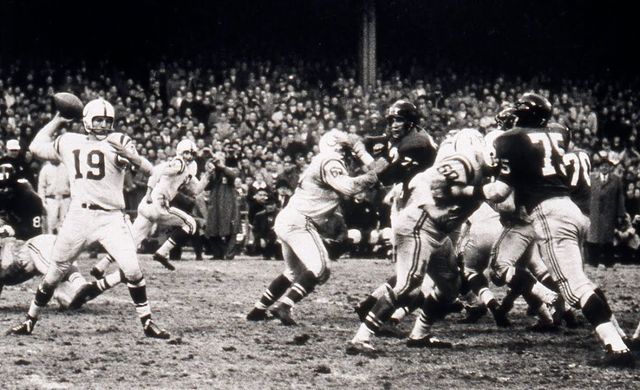
And it also becomes clear that certain football games, there's like a really big audience on TV for them. In particular, the 1958 NFL championship game known as the greatest game ever played between the Giants and the Colts led by Johnny Unitas,73Johnny Unitas (1933–2002) — Baltimore Colts quarterback from 1956 to 1972, one of the greatest in NFL history. a sudden-death overtime, dramatic win, garners 45 million TV viewers across the country, including President Eisenhower.74"The Greatest Game Ever Played" — the championship game of December 28, 1958, at Yankee Stadium: the Baltimore Colts beat the New York Giants 23–17. It was the first game in NFL history to go to overtime. Wikipedia.
Was this a national broadcast?
National broadcast of the NFL championship game that year.
Importantly, this is not the Super Bowl. David and I aren't being coy by not calling it that, like that is not what this was. And we're still missing about half the teams that will end up competing for the Super Bowl.
Right, but 45 million viewers, this was unprecedented. There is a huge opportunity for professional football and television.
Yes.
Which once again, the NFL was not the one to totally recognize.
Competition does create the best product and the NFL time and time again has had their hand forced and then reacted really well to a new upstart.
Totally, so in this case, as the 50s draw to a close, once again, just like towards the end of World War II and the end of the 40s, there were a whole bunch more cities and ownership groups that wanted in. There's a clear business opportunity and there are only 12 teams at this point in the NFL. But once again, the NFL owners are kind of dragging their feet, they're like, "We don't really want to expand. Maybe we'd be open to the Chicago Cardinals.
They're kind of struggling. If the ownership group that owns them were to sell, maybe we would allow them to be moved, but go talk to them."
I really don't think this is like a business decision of we don't want more people taking our pie. I think they sort of recognize that there could be more money made if you have more cities, but it was more that the NFL owners at this point are a tight knit fraternity of people who all think the same way, who respect the game, largely who own the teams when they were massively loss-making.
They kind of don't want to let anyone into their club, even if it would be good for business. The NFL, as we know it today, is a business. But at that point in history, it was really like each of these teams are kind of on their own island. They're deeply competitive against other players. They don't think of those people as fellow employees of the league. It's more like we each have our own club, but the owners of each club sort of have this thing with each other, this fraternal bond.
They're willing to submit to this league-first mindset because they know it's good for all of them, but that doesn't mean that they want to expand or change things.
06The AFL and the pooled TV deal
Lamar Hunt's AFL sold the first national TV contract with revenue split equally, while the NFL, suddenly without a commissioner, couldn't even agree on who should lead it.
And David, I am excited we are finally here, the birth of the American Football League.
The AFL.
Yes, their competition with the NFL and really the era of national TV contracts. This is the story of how the NFL became the league that we know today.
Let's go. The story goes that one of the potential new professional football team investors, a gentleman named Lamar Hunt,75Lamar Hunt (1932–2006) — son of the oil tycoon H. L. Hunt, founder of the American Football League and owner of the Kansas City Chiefs; he also coined the name "Super Bowl." who is a young heir to a very large Dallas, Texas oil fortune, kept trying to talk to Bert Bell, the NFL, do anything he could to get an expansion team or buy the Cardinals. He just wants to own a football team. He's flying back from seeing the Cardinals and having been rebuffed.
He has a Eureka moment on the plane. He's been hearing that there are all these other people who want to buy the Cardinals too and get in line and this person in this city and that person in that city. And Lamar says, "Wait a minute. I don't need the NFL. I don't need the Cardinals. I've got a list of all these other wealthy people who also want to have professional football teams. Why don't I call them and we'll start our own league?"
Yes, and thus begins the most successful attempt to challenge the NFL.
By far. In August, 1959, he and several other owners form the American Football League with six teams soon to become eight, the Dallas Texans, Boston Patriots, Buffalo Bills, Houston Oilers, Miami Dolphins, New York Titans, soon to be changed to the New York Jets, the Denver Broncos, the LA Chargers, and the Oakland Raiders.76The AFL was founded on August 14, 1959. Its first season, in 1960, had eight teams: the Dallas Texans, Houston Oilers, New York Titans, Boston Patriots, Buffalo Bills, Denver Broncos, Los Angeles Chargers and Oakland Raiders. The Miami Dolphins arrived later, in 1966. The Dallas Texans moved to Kansas City in 1963 and became the Chiefs. Wikipedia. You've probably heard of most of those teams.
Yes, this one ended very differently than the AAFC did.
Very, very differently. At first, Bell and the NFL.
They're sort of trying to be, pretend supportive until it's legit threatening.
Yeah, but then in 1959, right after the new AFL announces that they're going to start their league and commence operations, Bert Bell dies suddenly.77Bert Bell's death: on October 11, 1959, the commissioner died of a heart attack in the stands at Franklin Field during a game between the Eagles and the Steelers, two clubs he had once owned. Hall of Fame. Once again, just like back with the AAFC, the league is in crisis and forced to act. Unlike the AAFC, things are going to be a little different this time because of the television aspect.
Yes, and this is all being led by, you mentioned Lamar Hunt, who was the Dallas Texans owner.
People might know them better as the Kansas City Chiefs today.
Yes.
Hunt, he's been studying the NFL. He knows about the league first mentality. He's also been studying baseball. He's been meeting with baseball owners, including Branch Rickey of Brooklyn Dodgers and Jackie Robinson fame, who at that point in time was out of Major League Baseball and was trying to start a third independent league.
Independent baseball league.
A third independent baseball league, yes.78The Continental League, headed by Branch Rickey from 1959, never played a game: it disbanded in 1960 when Major League Baseball promised to expand to new cities. Rickey is famous for bringing Jackie Robinson to the Brooklyn Dodgers in 1947, the first Black major leaguer of the 20th century. With some pretty radical ideas, really borrowing from the NFL and the league first mentality, he wanted to embrace television in this new baseball league and have a radical solution where all the clubs in the league would share all of the revenue from a television deal.
Pretty crazy.
Lamar Hunt and the new American Football League, the AFL, they take this cast aside idea from baseball and they run with it. Hunt says, we'll just centrally negotiate one national television contract for the entire AFL and then we'll split the revenue completely equally amongst all the teams. This is like the epitome of the league first mentality. It will be great for us and it will help us compete with the NFL.
In some ways it's easy for the upstart to do this in counter-position because they have no existing TV contracts, but they do kind of get laughed out of the room. They go to the TV networks with this and each of the TV networks are like, oh, cool idea. But like, who cares about your league? No one's going to watch this.
We hear your pitch. We understand that this is very innovative and breakthrough and very different than what the different NFL teams are doing and we don't really care that much.
The two major networks at the time, CBS and NBC had deals with NFL teams, but there was another upstart TV network out there, ABC,79ABC — the youngest of the Big Three networks: it grew out of the Blue Network radio chain, which NBC sold in 1943 on regulators' orders, and began television broadcasting in 1948, later than the others. and they were the perfect match. Hunt goes to ABC and they find a young executive there. ABC doesn't even have a sports division at this point in time, but a young executive within ABC named Roone Arledge.80Roone Arledge (1931–2002) — TV producer, president of ABC Sports from 1968 to 1986 and of ABC News from 1977 to 1998; he created Monday Night Football, Nightline and 20/20. Wikipedia.
This is probably the fourth episode we've talked about Roone Arledge on.
What a legend. Roone would ultimately become Bob Iger's mentor81Bob Iger — twice CEO of Disney: from 2005 to 2020 and from November 2022 to March 2026. and Bob Iger would rise through the ABC sports ranks in the beginning of his career before taking over Cap Cities82Capital Cities — the media company that bought ABC in 1985 for about $3.5 billion. In 1995 Disney agreed to buy Capital Cities/ABC for $19 billion, and the deal closed in 1996. and then obviously all of Disney. This is Roone's big opportunity. It's obvious at this point in time in the late fifties that nationally televised football games, there's demand for it.
This is actually shocking. Like I know to everyone right now, we're like, well, of course, but it used to be the case that Sunday afternoons kind of had a hole in their schedule. Like CBS had no good programming. That's why they would originally agree to like, sure, we'll broadcast some NFL games, but no one expected the American public in their living rooms to take to football as an event, as an entertainment form delivered over the air to the living room the way that it did.
The NFL sort of rebranded Sundays in America and turned it into a completely different way that people spend their time. And that was shocking.
With those early NFL deals, it was like those were individual deals that teams made with networks and local stations. It was like a local thing. It wasn't football Sunday. It wasn't a national event. This was the first nationwide network-wide contract.
The networks now had signal that people did want to behave in this way and they could feel safe sort of signing business deals and pursuing this because even though it wasn't what they expected, turns out there is demand for this product.
ABC signs a league-wide five-year TV rights deal with the American Football League for eight and a half million dollars over five years. It was by far, far the single biggest sports rights TV deal in history at the time.
$1.3 million to the league per year.
And that was before the league had played a single game. Here we are now in January, 1960, back to the NFL. They don't have a commissioner. Their upstart rivals, the AFL, who haven't played a game yet.
They have a multi-million dollar contract.
An eight and a half million dollar five-year TV deal with a national network that the NFL doesn't have. This is a real existential crisis. And unlike last time where they're like, okay, great, we'll just draft one of our own, Bert Bell, owner of the Philadelphia Eagles, to come in and lead us through this. They can't agree on a new commissioner. It takes 11 days and 23 separate votes of the NFL ownership groups in a total knockdown drag out negotiation. There's multiple camps backing multiple candidates.
Yeah, the NFL has just gotten too big. Each of the owners has too many of their own interests to argue for. They're in dire need of something or someone to unify them.
Indeed, by the end of the process, none of the original candidates are still in it.
Right, so in some ways it's a tough position to be in because all the most qualified people are out. You kind of have to pick someone that nobody hates, but probably won't be very good.
07Rozelle builds the league
Compromise pick Pete Rozelle turned the NFL into a media machine within a few years and set its flywheel spinning: more fan interest, more TV money shared equally, a better game.
But fortunately for the NFL, they were very, very, very wrong about that.
Lucky, better to be lucky than good.
Yes, they choose as the compromise dark horse candidate, 33 year old general manager83General manager (GM) — in American sports, the club executive in charge of the roster: he signs players, makes trades and hires coaches. of the Los Angeles Rams, former public relations intern, Compton college graduate, Pete Rozelle, to be the new young commissioner of this league in crisis.84Rozelle's election: he was elected on January 26, 1960, on the 23rd ballot, and remained NFL commissioner until 1989. Wikipedia.
And create the NFL that we know today.
And it was totally brilliant. I mean, Rozelle grows into this just incredible leader, visionary who does so many things that we're going to enumerate now for the league, for the game, for television, for America. But it was not the owners' intention. They had to go to this compromise candidate and this young person.
Who most people hadn't heard of.
Anybody else they were considering would have been of a different generation, wouldn't have understood the new America in the late ‘50s and early ‘60s. These were old folks who were running the league at this point in time. But Pete, nobody better embodied everything about America in the fifties and sixties. Like young families, suburbs, West coast, Los Angeles, television, PR, advertising.
Yes, coming out of the PR background was the perfect positioning for him. Because he knew that every foot that we have to put forward has to be really polished. We're going to stop doing things that are confusing or cannibalizing each other, or send mixed messaging, or perhaps put a bad taste in Americans' mouths. We need to figure out the very best media strategy, the very best strategy to make it so all the newspapers and all the TV stations talk about us all the time. The NFL and our teams and our players need to be on the lips of Americans as much as possible.
And as GM of the Rams, for only two or three years, the Rams were not a successful team on the field, even during his tenure, but he makes them into the most profitable team in the league. They actually start making a lot of money because he gets it, right? They're in the second biggest TV market in America in LA, a very wide geographically spread out market where people want to watch football games on TV.
He opens up a Rams merchandise store. He partners with Roy Rogers Inc. The actor Roy Rogers85Roy Rogers (1911–1998) — singer and actor, a star of 1940s and 1950s westerns known as "the King of the Cowboys." had like a white label merchandise brand to bring actual high quality branded Rams, jerseys, hats, mugs, et cetera. That becomes a huge revenue line for the Rams that nobody else has. He's got the right background here and he comes in. This is pretty crazy. This is a very volatile charged situation with a lot of elder and opinionated folks around the league that he's going to have to deal with.
And within a year, he completely changes the NFL. The first thing he does when he comes in as commissioner is he ratifies an expansion plan for the NFL to meet the AFL. Remember, one of the big reasons why Hunt and the AFL owners started the league in the first place is they wanted to bring pro football to more cities. The NFL was dragging its feet.
Just like back with the AAFC now, they realized they gotta go meet the enemy on the field where they are. The plan is to expand to both Dallas and Houston immediately to meet the AFL there in Texas.86NFL expansion ultimately went to Dallas (the Cowboys, 1960) and Minneapolis (the Vikings, 1961). Houston got an NFL team only after the 1970 merger, when the AFL's Houston Oilers joined the NFL.
Oh, and meet Lamar Hunt head to head right on his own turf. I mean, he's leading the AFL effort and the idea of you're just going to open up a shop and say, we're going to give away the franchise to a new owner of the Cowboys right here in your backyard.
Yup, right down the street. Speaking of proximity and right down the street, the next move that Rozelle makes, remember he's from LA. He gets the importance of media, advertising, everything. At this point in time, the league offices were in Philadelphia because Bert Bell was in Philadelphia and he had been the owner of the Eagles. He's like, Philadelphia is not the place where we can run the modern NFL.
Bert ran it a very idiosyncratic way too. I mean, he had obviously no computer system, but like it was post-it notes and phone calls is how the NFL ran. Just not a professional organization.
Oh yeah, famously the stacked scheduling, he would do it with dominoes on his kitchen table. Rozelle's like, no, this is not going to work. We're going to move league headquarters to New York, to Manhattan, first to Rockefeller Center and then to Park Avenue where the league is to this day. We need to be right there next to the television industry, next to the media industry.
And just as important next to the advertising industry, these are relationships we got to cultivate with Madison Avenue.87Madison Avenue — the Manhattan street that has been home to the biggest advertising agencies since the 1920s; its name became shorthand for the American advertising industry. After he moves the headquarters to New York, Rozelle contracts the Elias Sports Bureau,88Elias Sports Bureau — New York statistics company, official statistician of Major League Baseball and, since 1961, of the NFL. Wikipedia. which did professional statistics for Major League Baseball. The NFL up to this point didn't have professional statistics arms that would distribute game stats and box scores out to all the newspapers across the country.
The only way anybody's going to write about us and give us space on the sports page is if we make their job easy and put the stats right in their hands every day.
Speaking of writing about the NFL and publishing, the other thing that Rozelle knows is, especially with a game like the NFL, which is a weekly drama, it's not just about like baseball with getting the daily box scores in the newspaper. You also got to create human stories and arcs and mythology around the game.
He intentionally cultivates a tight relationship with Time Inc. and specifically Sports Illustrated.89Sports Illustrated — Time Inc.'s sports weekly. Rozelle was named Sportsman of the Year for 1963 for expanding the league and for his toughness in the player gambling scandal; he remains the only league commissioner to receive the title. SI. Over the course of the sixties, Sports Illustrated really becomes the major advocate for the new modern game of the NFL. So much so that in 1963, just three short years later, Sports Illustrated names Pete Rozelle as Sportsman of the Year, the first ever non-athlete that it had ever named Sportsman of the Year. Think about that, the commissioner of the league being named Sportsman of the Year. That is just a huge mindset shift.
We should also say the end of the fifties, beginning of the sixties, baseball's still a dominant sport in the US. The dominant football franchises are college football franchises. The NFL's still an underdog, and now they're being challenged by this new upstart. They're sort of squeezed in the middle where like, people don't care enough yet, but they also have a competitive threat.
Rozelle is having to do some innovative things. David, didn't he hire writers in-house at the NFL to craft the storylines and then send those to all the reporters who were too busy to actually go to NFL games because they didn't respect the NFL enough. But maybe if we send them the stories, then they'll tweak them a little bit and publish them.
Famously, he did this starting back when he was with the Rams, even when he was a PR intern there, he would just write the stories for the reporters, which one, they would actually get in the papers, but two, he could control and craft the narrative. Man, you can totally still see this to this day in the NFL this ethos. It was so important and strategically advantaged for them. The NFL keeps such a tight grip on the narrative and all this starts with Rozelle.
One other thing that he does immediately after taking over and moving headquarters to New York that would end up paying huge, huge, huge dividends is he also starts cultivating political relationships and influence.
Yes. This is a perfect lead into what happens in 1961 right after Rozelle is on the job that would change the face of football forever.
It's obvious to Rozelle, once the AFL signs their big deal with ABC, that that's the path forward.
Their $1.3 million a year deal.
The league-wide revenue sharing national deal with the national network. Now this is not how the NFL operates at this point.
Nope.
Rozelle corrals all the NFL owners and gets them to realize that the NFL has to do the same thing. They have to give up their individual TV rights. They have to pull together and fight the AFL. Finally after wrangling and politicking with the ownership group.
The reason there's politicking is because Cleveland, Pittsburgh and Baltimore actually will end up losing money in the short term on this because Rozelle is pitching on, I'm going to go negotiate us a big group deal. They're all three saying, we already have very good deals locally. We're very popular teams. We're in great football cities. No, but ultimately they do say yes. And it really like speaks to the thing that has made the NFL successful, which is saying no to growing my slice of the pie to grow the greater pie.
Rozelle goes and negotiates with CBS, which was the dominant network both in the country and had the majority of the individual team NFL deals. He negotiates a two year deal with CBS at $4.65 million in rights per year to be shared equally among the teams.
Over 3X the AFL deal.
A huge shot across the bow to the AFL. Fortunately and unfortunately, they immediately encounter political pressure in response to this. This triggers the Department of Justice to start an antitrust violation process90Antitrust law — US laws against monopolies and collusion between competitors, above all the Sherman Act of 1890. Rival teams jointly selling TV rights looks like exactly that kind of collusion. against the NFL. This is like a clear use of monopoly power.
But this is the very first question where you say, well, what is a monopoly and what is antitrust? And what is the NFL and what are the teams? And in this situation-
Is the NFL the business or are the teams the business? If the teams are the business, then yes, this is antitrust. If the NFL is the business.
No, this is one entity acting on behalf of itself. There's no collusion. There's no monopoly. Plus in this particular situation, they actually are in a competitive landscape against the AFL. There's strong argument to be made that this is not antitrust. That argument does not carry the day.
No. Pretty immediately the courts strike down this deal and there's about, I think a one to two month period where it's all in limbo. And this is where the Kennedy relationships come in clutch for Rozelle and the NFL. Both the president and Bobby Kennedy in Congress91Fact-checkRobert Kennedy wasn't in Congress at the time: from 1961 to 1964 he was attorney general, and he became a senator only in 1965. Wikipedia. whip up enough support to pass through new congressional legislation.
A new congressional act specifically to advantage the NFL.
ExplainerThe Sports Broadcasting Act of 1961
Back in 1953, federal judge Allan Grim ruled, in a case brought by the Justice Department, that NFL telecasts were subject to the Sherman Antitrust Act. When the NFL followed the AFL's lead in the spring of 1961 and sold CBS a pooled package of all the clubs' rights, the same Judge Grim declared the deal illegal: a single network, rather than individual teams, would decide where games were shown.
The bill was introduced by House Judiciary Committee chairman Emanuel Celler on September 7, 1961; both chambers passed it within two weeks, and Kennedy signed it on September 30. The law lets football, baseball, basketball and hockey leagues sell all their clubs' rights as a single package and share the money.
The exemption comes with a condition that still shapes the NFL schedule: it doesn't apply to broadcasts on Fridays after 6 p.m. and on Saturdays from the second Friday in September to the second Saturday in December if high school or college teams are playing within 75 miles of the station that day. That's why in the fall the NFL plays on Sundays, Mondays and Thursdays, and the Black Friday game kicks off at 3 p.m. and ends shortly after 6. The São Paulo game on the first Friday of September doesn't break the law either: the restriction only starts on the second.
To allow for national sports contracts on a league-wide basis. It's called the Sports Broadcasting Act. It ends up getting passed towards the end of 1961.92The Sports Broadcasting Act, which allowed leagues to sell TV rights collectively, was signed by Kennedy on September 30, 1961. Before that, in July 1961, federal judge Allan Grim had ruled that the NFL's CBS deal violated a 1953 antitrust decree. Wikipedia. The day after the bill is passed and signed by John F. Kennedy, he literally hosts a party at the White House for the NFL. Which is like, just tells you everything you need to know right there. Pete Rozelle, all the owners, they are invited to the White House to celebrate this new antitrust exemption that has been passed through Congress to allow them to negotiate this landmark deal because the president wants to watch his football.
It's that, but Rozelle also makes the strong case that this is good for America. For a game that is growing in popularity and a game that unites communities. They're really starting to lean into this idea that this brings a lot of people together in a city. It is a shining example of teamwork and a shining example of hard work and celebrating sportsmanship.
This is a great thing that we should spread to more of America and make it easier for more people to consume. They're starting to make arguments about the economy around, it's good for people to have gathering points both at stadiums, but around stadiums with hotels for people to throw parties at their houses. All of this is goodness. And if you like the American economy, you should let us have a national TV contract for the NFL.
Yep. And at this point in time, I think a lot of those arguments hold water.
This actually was driving a lot of commerce for the nation.
Totally. Fun aside, I did the math on that $4.65 million per year deal, that value of that contract would grow 2,500x over the next 62 years.
Wow. Did you look at what it would be inflation adjusted?93Inflation-adjusted — Gilbert's signature move: he converts old sums into today's money to show what past deals were really worth.
Yes, inflation adjusted, it's about 250x.
Still pretty good. On the back of this landmark TV deal, Rozelle does two other really brilliant things. First comes as kind of another accident. The league every year sold the rights to the NFL championship game to make a movie out of it.
And they were always kind of bland.
Yeah, they were kind of hokey, a really rudimentary, highlight reel type thing. In 1962, they get a bid for the rights. The bidding is a sealed auction. They get a bid that comes in from a guy named Ed Sabol, who was a suburban dad in Philadelphia who liked to make home movies, particularly home movies of his son Steve's high school football games.
This guy, Ed, bids on the rights to make the NFL championship movie for 1962. The bids are unsealed and Ed had done a little homework. He found out that the company that had won the past few years only paid $2,500 for the rights. He's like, "Well, I can bid $5,000." He wins the auction and Rozelle's like, "Who is this guy with no experience, what's happening?" Rozelle goes to visit him and Ed pitches Pete on doing something completely revolutionary for the 1962 championship.
He wants to make it like an actual movie, not a hokey sports movie, a real movie with montages, with cuts, with professional Hollywood quality, cinematography–
Slow motion, voiceover–
Everything, sideline cameras, really a passion project to make this an incredible piece of content. Rozelle's kind of like, "Well, I mean, that sounds great. I don't know if you can do it, but it's like, what have I got to lose?" He lets Sabol go with it. And the movie he makes totally revolutionizes sports video content. I think this is another thing that we just take for granted today.
It's like air and water that sports content, sports video is not just like a fixed camera at the 50 yard line that pans back and forth.
Not only does this film get great acclaim, but it's a revolution to go and create recordings of sports not to be broadcast. The broadcasters weren't recording tapes of everything they ever broadcast. There's a lot of like baseball games and stuff that have been lost to history because there was no recording of it made. Meanwhile, the NFL for this championship game and for other things that Ed Sabol and his crew would film after this, it is high quality film, not videotape recording, not over the air broadcast, film stock recording from a bunch of different angles.
And some at high frame rate cameras and some at 24 frames per second cameras. You get this smooth, beautiful slow motion. It provides this unbelievable archive of the game for which other sports have no archive.
Yeah, well, and that's just the video aspect to it. But there's also something that Sabol gets intuitively is the same thing that Rozelle gets, the narrative. It's not just about showing what happened. It's about telling a story. And it just completely meshes with Rozelle's philosophy and what's going to carry the NFL into what it becomes today. We can't just show these games, we have to tell a story. This has to be drama. This has to be made for TV content.
It has to be super polished and it has to be super controlled. Ed Sabol's little outfit that would become NFL Films is the ultimate embodiment of Rozelle's mindset. I don't think Rozelle could have created this on his own, but when you watch anything from NFL Films, it has Pete Rozelle's personality oozing all over it in terms of what we are creating is entertainment and polish.94Ed Sabol (1916–2015) named his firm Blair Motion Pictures after his daughter; bought by the league, it became NFL Films. His son Steve Sabol (1942–2012) ran the studio for decades. Ed was inducted into the Pro Football Hall of Fame in 2011. NFL Films.
For two years, they do the championship game. Then in 1965, Ed comes to Pete with the idea of like, hey, let's make this a core in-house division of the NFL. They start NFL Films.
Yeah, you should buy my little film company.
What a radical idea. The NFL should become a movie producer. This is huge. Remember, there's no ESPN. There's not going to be an ESPN for 15 years. All of this content that we're just bombarded with today, it all starts here with the Sabols and with NFL Films.
Yeah, there's a couple of interesting things to note too. Once Rozelle green lights NFL Films, he basically says, okay, there's a lot of people in my organization that might want to do something with this at some point, but we want to be hands off. I just don't want your P&L to ever go negative. You can run as a break even business as long as you're fulfilling the mission of promoting the very best of the NFL and helping to create lore and story.
They build this completely full fledged film studio that is actually the customer who buys the most film from Kodak other than the US Army in the entire country. It's a super high volume film studio because they start sending full film crews to every single NFL game every single week. And it's this unbelievable operation to then overnight mail or drive themselves back all this footage to start editing it right away so that they can use it for what we will talk about soon, but for many purposes.
This is what's so amazing. They did all this as this investment, as a labor of love and passion on Sabol's part. On Rozelle's part though, the motivation, as you were saying, it's not about making money. It's about raising the stature of the league, about putting the most highest gloss sheen on the product that we are producing. And the product is the game on the field.
They couldn't even foresee how important this would become that we'll put a slight pin on and come back in just a minute. The other thing that Rozelle does in the next couple of years is the merch idea, the store that he was doing back with the Rams. He brings that in-house on a league-wide basis and starts NFL Enterprises.95NFL Enterprises was the name of the merchandise licensing program the league launched in 1959 with actor Roy Rogers's company; its first catalog of team-branded goods came out in 1960. In 1963 the league created its own licensing division, NFL Properties (Sports Illustrated, 1998; Wikipedia, "NFL Properties").
Again, totally radically, he goes to all the owners, all the teams and says, whatever you're doing on merch, whatever you're doing on branded opportunities, you are no longer doing that individually. We're going to bring it centrally, collectively in-house under NFL Enterprises. We're going to standardize the merch, the jerseys, the hats.
We're going to set a quality bar.
That anytime a fan, because it's all about the relationship with the fans. It's like a funnel.96Funnel — a marketing image: of everyone who hears about a product, fewer and fewer make it to a purchase and repeat purchases, and the job is to lead people down the steps. Bring them in from TV, get them to the game, get them to buy merch. They're just deepening the relationship. They have to have a great experience. They can't get some shoddy pennant from the Giants that looks like X and somebody else gets something from the Cardinals that looks like Y. It’s gotta all be the same.
And you gotta remember the way that the NFL is structured. Rozelle is not their boss. In fact, he works for the owners. They're all making money and he's going to them saying, hey, just like TV, I want you to give up the rights to make money on your own. Even though some of you are doing a pretty good job at it and we're going to do this thing as a league and we're going to cut it equally.
I don't care if your team's bad and their team's good. All the revenues can be equal just like TV. And he's so good at playing the politician with the owners that they keep agreeing to give up revenue generating parts of their P&L for the league to take over on their behalf.
Yeah, I mean, like let's take the Browns and Packers. How many pennants do you think the Browns sold? In the city of Cleveland with as big and storied as the Browns are versus the Packers in a town like Green Bay.
What is Green Bay? It's something like the 200th largest media market97Fact-checkHe says around 200th; in Nielsen's TV market rankings in the 2010s, Green Bay–Appleton was 68th–69th, though still the NFL's smallest market (Sports Media Watch; D Magazine, 2016). in the United States and they've got this NFL team.
And what Rozelle is saying is just like TV, I don't care how much merchandise you sell, the Packers are getting the same check from Enterprises as the Browns are.
Yep, we should probably take a 60 second aside but the unique structure of the Packers is totally amazing. They are owned by a publicly owned nonprofit corporation. What that means is rather than one individual who could just decide to uproot the team and leave them, the ownership of the team lies in this entity that is theoretically a publicly owned entity.
Anytime they want to raise money, they go and sell more shares, more stock in the Green Bay Packers. There's hundreds of thousands of people who have bought this stock. There's this very distributed ownership group of the Packers.98The Green Bay Packers have been owned by fan shareholders since 1923: the shares pay no dividends, can't be resold (only returned to the club), and no one may own more than 200,000 shares. After a 2021–2022 stock sale there are more than 500,000 shareholders. League rules bar other NFL clubs from this model. Wikipedia. The certificate shown is from the original 1923 issue.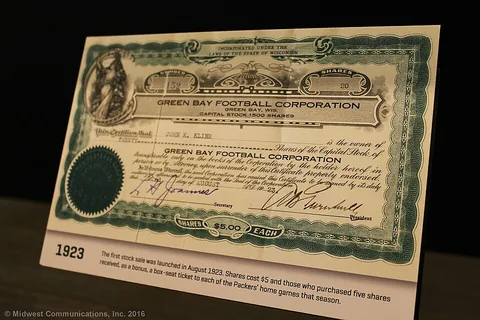
Not with any expectation of financial return, literally just so they can hold a piece of the Packers.
Or control because nobody can own more than a certain number of shares. But this mechanism has kept the Packers in Green Bay even while capitalist forces and individual whims of billionaires have moved many other teams around.
Yeah, it's such an amazing little quirk. Have you ever been to Lambeau Field?99Lambeau Field — the Packers' stadium, opened in 1957; in 1965 it was named after Curly Lambeau, the club's founder, player and longtime coach. Wikipedia.
I have not, I really want to.
I went once, not for a game, but I was at a wedding in Green Bay. And I was like, oh my gosh, I gotta go see the field. I took a run. Green Bay is this very quaint little town in Wisconsin. There's this giant NFL stadium in the middle of it.
It's wild. For a lot of the analysis we'll do later, the data comes from the Green Bay Packers annual report because no other team publishes their P&L, but the Packers do.
Okay, so the last thing Rozelle does in this miracle run in his first couple of years as commissioner is he creates the Pro Football Hall of Fame in Canton100The Pro Football Hall of Fame opened in Canton on September 7, 1963. It is not officially part of the NFL. Wikipedia. in 1963. I've never been, we gotta go. We should do an Acquired field trip.
We should.
That would be fun. There's this amazing flywheel,101Flywheel — the image from Jim Collins's book "Good to Great": each success spins up the next, and the system gains momentum on its own. like it really is like the Disney story102The Disney flywheel — a reference to Acquired's Disney episodes and Walt Disney's famous 1957 diagram: films at the center feed television, the parks, music, comics and merchandise, which in turn support the films. that he gets the most important thing. Everything he's doing is through the lens of how do we raise the stature of the league? Not a team, but the league, the NFL as a league. How do we add higher gloss sheen to the product?
To the shield,103The shield — the NFL's logo; "protecting the shield" is a common phrase for guarding the league's reputation. one might say.
Exactly, exactly. His logic is doing that will attract more fan interest and deeper fan interest. The more and deeper fan interest that you attract, the more TV dollars you're going to make. This is revolutionary too. Back in the day, you were limited to the number of seats you had in your stadium. If you're like a Major League Baseball team in a major market where you're selling out your stadium, there's not a strong incentive to keep adding sheen to the product.
You're at maximum revenue capacity. But with the NFL and now with the new TV model, there is no ceiling to revenue capacity. More fan interests, more TV dollars, more TV dollars shared evenly amongst all the teams, raises the level of play equally as the overall level of play goes up, as long as the competitive balance stays intact. Well, that improves the product, which then adds more sheen, which then drives more fan interest and it becomes this amazing flywheel. And there's so much more to the story, but that's the core of it. That idea is what leads to, what's the current annual national revenue for the NFL, like 10 billion, 11 billion?
That comes through shared agreements is $11 billion. Then there's another six or so that comes from local revenue that teams individually generate.
Yeah, that's per year.
Right.
Just to be clear, that is per year.
It is this flywheel that makes the NFL teams collectively worth something like $140 billion today.
Remember that initial landmark deal that they got the antitrust exemption from Congress for in 1961? For the 1962 season, that was two years. The AFL is locked up for five years. The NFL gets to renegotiate every two years. Rozelle opens up the bidding to all three networks. Of course, CBS wins again. Another two year, $28.2 million bid, $14.1 million per year up from 4.6 two years earlier. Every single team in the league now gets $1 million before the season even starts.
A cool three X from the last deal he negotiated two years before.
Pretty freaking incredible. And also just says so much about the commerce that the NFL was driving. The TV networks were getting a great deal here. These were landmark contracts, but the attention, the viewership that the games got, and then the advertising units that were sold, and then the ultimate products that were moved as a result of those ad units, this was a steal.
And you could argue that the TV networks were getting a great deal for many, many, many more years. And I think at the end I want to discuss when they get a good deal today, but everyone was getting a pretty good deal here because the fan base was growing so much more quickly. The number of viewers was growing so much more quickly than these deals could get renegotiated.
08War with the AFL and the merger
NBC's TV money, Joe Namath's stardom and the ruthless Al Davis forced the NFL into a merger on terms that favored the AFL.
Well, it just takes time for people to realize the power of a new medium. Okay, so Rozelle, unbelievable. First five years in office. Literally cannot imagine executing better. The NFL going from major crisis, death of its owner-commissioner, Bert Bell, to the place it's in in the mid sixties, incredible. What about the AFL? What happened to them?
They're doing pretty great too. They're thriving, and it's all because of television. Even though the NFL is doing great, there's still a lot of demand for football on TV.
The AFL, to put a finer point on what you're saying, they had a shoot the moon strategy. They wanted to come out of the gate with a bang. They wanted to burn real hot, and under the right circumstances, have that go really well for them. They had the exact right circumstances. It was the boom of TV in America. They could do things like go sign Joe Namath for the Jets to a gigantic contract, and just have New York and half of America fall in love with them, and turn them into a superstar that benefited the league.
The Jets in the AFL, formerly the Titans. They're owned by Sonny Werblin.104Sonny Werblin ran the television business of the MCA agency; in 1963 his group bought the bankrupt New York Titans and renamed them the Jets. Wikipedia. He was one of the co-heads of MCA, the big agency.
As discussed on our interview with Michael Ovitz.105Michael Ovitz — co-founder and head of the Hollywood agency Creative Artists Agency (CAA), and Disney's president in 1995–1996.
Indeed, indeed. Just like Rozelle gets what's going on in the NFL side, Sonny, he's the media guy for the AFL, and he totally gets it too. Sonny sees the big second NFL deal come across in 1964. All the other AFL owners are like despairing. The NFL just got this huge deal. How are we ever going to compete? They're going to have so much more money. We'll never be able to sign any players. This is the end.
Sonny's like, oh no, no, no, no, no. We're going to be just fine. We're going to be great because the NFL did this deal with CBS. Well, there are two other networks out there. There's ABC, who the AFL has the current deal with, and then there's also NBC. There are two bidders out there who are going to be very, very, very sad that they just lost out on the most compelling content on television, professional football, and who's there to give it to them? The AFL.
Yep. We'll take second place when there's a bunch of sad people willing to throw money at second place.
Throw a lot of money. The very next week, after Rozelle and CBS announced their deal, the AFL and NBC announced that they've just signed a new five year, $37.5 million deal. Bigger overall dollar number for a longer number of years.
Even though it's like less than half the per year amount.
Yeah, it's $7.5 million per year. But by this point in time, the NFL has 14 teams. The AFL still only has eight. On a per team basis, it's pretty close. For a five year old upstart league, this is a big success. Just like you were saying, right on the heels of that, Sonny and the Jets, they know what to do with that money. They turn around and they give a huge chunk of it to Broadway Joe Namath.106Broadway Joe — the nickname of Joe Namath, the Jets' New York star. Probably a lot of listeners are going to know the name Joe Namath.
I honestly, I only knew it because I saw him on a Brady Bunch episode.107"The Brady Bunch" (1969–1974) — a popular family sitcom; Namath played himself in a 1973 episode. It's like this cultural touch point where Joe Namath was so big that he actually appeared on a Brady Bunch episode. And that's super unusual for a sports star in that day.
Dude, I mean, he had his own talk show. It's not just that he was on the Brady Bunch. Everything we were talking about a minute ago with NFL films and Rozelle and all the brilliance there and how it was so important in this realization that football and the NFL would be made for TV. Joe Namath was the first modern cultural celebrity athlete.
He's also a heartthrob. There's like millions of teenage women in America and like throwing themselves.
That's exactly what I was going to say. He was the first professional athlete that appealed equally to men, women and children.
That's a great point.
He comes and he's playing in New York, right? In the biggest market, the brightest lights, right there with the TV industry, right there with the advertising industry. He knew exactly how to play it. He wore white cleats. Everybody else wore black high tops. Famously, he wore a mink coat on the sidelines. Just like amazing, amazing. Like he starred in movies in the off season. Broadway Joe was it.
Well, continuing that thread from earlier where I was talking about how CBS had this hole in their schedule and everyone was skeptical that sports would fill it. Everyone thought sports were like a very male thing. And especially as sort of brutish of a sport as football, they didn't think it would do well, certainly not in prime time,108Prime time — the evening hours with the largest TV audience and the most expensive ads; in the US, roughly 8 to 11 p.m. but not even sort of in the Sunday afternoon slot because it's just going to attract the husbands to come and watch it and it doesn't have a family appeal. And Joe Namath is the first big example where everyone realized, oh, football totally can be for everyone.
AdLegora
All right, listeners, now is a great time to talk about one of our favorite companies, Legora, the agentic operating system for legal work.
Yes. Most of you have dropped a contract into a chatbot by now, but as a lawyer, how far can that really take you? It's never seen your firm's precedents. It doesn't respect confidentiality, and you can't check where its answer came from. So Legora's founders approach this the way that great founders do. Early on, the team moved into the office of a big law firm in Stockholm and learned for months how the work actually gets done. A couple of thousands of enterprise customers and a hundred thousand users later, they still work that way.
They employ a hundred legal engineers on staff. These are lawyers sitting inside of firms and legal departments to deploy Legora onto live situations, like the deal closing this week or the policy review due Friday. The product has gotten very powerful in a short period of time. A year ago, the goal was a good answer from a chatbot. With the Legora agent, you hand it the work and it comes back with a plan. Tasks like running diligence on a data roomcDue diligence — checking a company, contract or asset before a deal. A data room is a secure repository of documents that the seller opens to the buyer for that check. or reviewing a new vendor contract get completed inside the tool you use every day, like Microsoft Word, and against your own precedents and playbooks.
Every finding is sourced, the lawyer directs the work and signs off before the system executes any steps. Every legal team can get access to the same AI models, so the models themselves do not give you an edge. What you can do with your own data, people, playbooks, that's the whole game. Today over a hundred thousand legal professionals at more than 1,800 law firms and in-house legal teams in over 50 markets use Legora. And when Legora goes head to head with its top competitor in a pilot, it wins 70% of the time.
A demo is one thing, but what matters most is an associate who reaches for it at two in the morning during a closing, or whether a general counsel trusts what it says before the board meeting. So if your legal team wants to check it out, whether you're at a firm or in-house, go to legora.com/acquired and be sure to tell them that Ben and David sent you.
The Namath signing is the first big post-TV money contract signing in the AFL-NFL war, but it starts a whole wave now of competition between the two leagues to go sign all the college superstars coming out.109Joe Namath signed with the Jets in January 1965 for $427,000, a pro football record at the time. Wikipedia. It gets pretty crazy. At one point, the NFL starts what they refer to as a babysitting program. This is literally a kidnapping program where they will send agents to top college athletes who are seniors about to graduate and literally keep them out of the hands of AFL teams, not allow them to sign contracts and pressure them into signing with the NFL first.
They just put them up in hotel rooms and then they don't tell anyone where they took them. Nobody can tell the AFL team rep, this is where you can find the star. It's just like, you got him captive till you sign him. The interesting thing too is that the leagues aren't respecting each other's drafts. It doesn't matter if you draft someone in your league, I'm signing him to a contract in mine and that contract is valid in the United States. I don't care what your draft says.
This is the battle front. It's with rookies and the draft. What they don't do yet is start signing each other's players. That's like hitting the nuclear button option.
Right.
They're keeping this to rookies, but still like pretty quickly contracts for rookies get into the close to million dollar range, which is way more than the veterans are making. It starts causing all these problems. By the beginning of 1966, the owners group in the NFL realizes that, hey, the AFL isn't going away. This is not going to be like last time. We're going to have to play ball with these guys literally.
It begins a super delicate dance of they're my sworn enemy, but there's some owners who see the writing on the wall very early and say, we're going to have to combine these. It's probably not actually legal for us to combine them, but we're going to kill each other if we both keep going. What do we do? It begins this multi-tiered negotiation where certain people at the top don't know they're negotiating.
Meanwhile, certain owners are forming side deals with other people who own teams in the other league. It's this fascinating spy game.
Oh, this is so fun. What happens next is like a Godfather film.110"The Godfather" (1972) — Francis Ford Coppola's film about the Corleone crime family. A few of the most influential owners come to Rozelle in 1966. They say, the way things are going with the AFL, we're not going to beat them. This draft situation with the rookies is out of control. The contracts we're paying, we're losing too much money. This is going to kill the league. If we keep the war going, we got to get to a truce, which means we're going to have to merge.
We're going to direct you Rozelle to start merger negotiations with the AFL. Rozelle doesn't want to do it. He thinks they can win. He wants to fight, but he's like, okay, I work for you. One of his superpowers, the way he's able to achieve all of this is he really is good at pleasing everybody, finding solutions that work for everyone.
And so he says, okay, I'll move forward. He drafts the Cowboys GM in Dallas, a guy named Tex Schramm, to secretly open negotiations with Lamar Hunt. Lamar at this point has moved the Texans to Kansas City where they become the Chiefs.
Also, how great is it that the first Cowboys owner is named Tex?
I know, so great. He was the GM. I don't think he was the principal owner, but I think he had an ownership stake.111Tex Schramm was president and general manager of the Cowboys from 1960 to 1989, while the club was owned by the oilman Clint Murchison Jr. Wikipedia. Tex approaches Lamar in early 1966, says, hey, I'm the emissary of the NFL. You know, Rozelle sent me, I'm here to talk merger, but we got to keep this under wraps because before it gets out, then like all hell's going to break loose.
They start working, discussing. There are no notes, there's no written notes. It's just like them chatting with each other for a couple months. As they start, the other owners don't know about it.
Which is hard because when you're not the designated representative, you can't say I'm coming to you with something I know will work. You're saying, hey, enemy, I know you can't know for sure that I can get this done, but you have to trust me enough that I'm pretty sure, I know my fellow owners enough that they would agree to this. If you and I can kind of get close to agreeing to something, then I can take it to them, but this is all subject to them blowing it up.
Yes, very delicate situation. And especially as the war and the TV money start escalating between the leagues, the AFL owners, they decide we need somebody who's going to kick some ass for us. They draft fellow owner, head coach, GM of the Oakland Raiders, Al Davis,112Al Davis (1929–2011) — Raiders head coach from 1963 to 1965, AFL commissioner in 1966, then co-owner and, from 1972 until his death, the club's de facto owner. Wikipedia. to become the new commissioner of the AFL.
All right, now we've got this cast of characters to pay attention to. On the NFL side, there's the commissioner, Pete Rozelle, and Dallas Cowboys GM, Tex Schramm. And on the AFL side, there's new commissioner and Raiders owner, Al Davis, and the Chiefs owner, Lamar Hunt. Lamar Hunt, of course, was the guy who started the whole AFL in the first place.
And Al Davis, legendary, there's a quote about him in America's Game: "Outside of Oakland, it was not certain where Al Davis would finish in a popularity contest among sharks, the mumps, the income tax, and himself. If the voters were the other American league football coaches, Davis would probably be third, edging out the income tax in a thriller." You can't trust Al Davis any further than you can throw him. And he is the perfect new head of the AFL in this war.
And basically the head, just to go beat him up in negotiation. I mean, at this point, it's like, hey, we understand we're in a negotiation, just like go get the best deal you can. And if you have to piss everyone off such that you have no working relationship with the rest of the owners, Al Davis is the kind of guy that's like, oh, I'm totally up for that. That's fine if for the next 30 years, everyone that I have to work with hates me.
They don't let him know about the merger negotiations. They don't actually want him to negotiate. They just want him to start a war and improve their negotiating leverage.
I see.
In literally one of the most incredible unforced errors of all time, the NFL fires the first shot in the new war as soon as Davis takes over. In May 1966, the Giants in the NFL break the gentleman's agreement.113The gentleman's agreement — the owners' unwritten understanding not to poach players from the other league. They go over and they poach a veteran from the Bills in the AFL. A kicker, literally a kicker.114Kicker — the player who kicks the ball: field goals, extra points after touchdowns and kickoffs. They start a war over a kicker.115Pete Gogolak — the kicker who moved from the Buffalo Bills to the New York Giants in May 1966. Wikipedia.
And it makes sense as the Giants, because they're the most harmed here. I mean, they have in their own city, the Jets with Joe Namath.
Once this happens though, the other NFL owners are just apoplectic to Giants owner Wellington Mara.116Wellington Mara (1916–2005) — co-owner of the New York Giants from 1959 until his death and son of the club's founder Tim Mara; in 1925, the Giants' first season, he was the team's ball boy. Wikipedia. They're like, you're throwing this all away over a kicker. The owner of the Colts,117Carroll Rosenbloom — the Baltimore Colts' owner at the time. quote, "God damn it, Mara, if you wanted a kicker, why didn't you just ask me? I'd have given you one."
Any of the 30 million Americans who play fantasy football118Fantasy football — a game in which fans build virtual teams of real NFL players and score points based on their stats in actual games; you have to pick a kicker for your team too. can relate to this situation.
Davis gets the news that the gentleman's agreement has been broken and the kicker has been signed. The kicker signing heard around the world. While he happens to be literally in the middle of meeting with the Bills owner, supposedly Davis, he just sits there in his chair and he leans back and he smiles and he says, well, we just got our merger.
The Bills owner is like, what are you talking about? Davis says, because now we're going to go out and sign all of their players and we will destroy them and they will come begging to the table.
Some Dr. Evil shit119Dr. Evil — the villain of the Austin Powers comedies (1997–2002), a parody of James Bond villains. right there.
Totally. That night, the New York Times asks Davis for his comment on all this, which by the way, you couldn't design better drama, especially during the NFL off season to keep America interested in football, amazing. The New York Times asks Davis to comment and he responds, “This is something I've been aware of and I anticipated the probability, but you don't make threats at a time like this. Our answer will be an action. This is not the time to speak”.
Ooh, I want to steal that word for word for something in the future.
His first reaction, he doesn't really want to go into all out war because he knows that's going to end badly for both sides. He wants to send a targeted message, like the equivalent of a fish wrap120The fish wrapped in paper — a scene from "The Godfather": the Corleones receive a fish wrapped in the bulletproof vest of their murdered enforcer Luca Brasi, a sign that he "sleeps with the fishes." to deliver it on the doorstep.
Or a horse's head in your bed.121The horse's head in the bed — the most famous scene in "The Godfather": a Hollywood producer who turned down the Don's godson wakes up next to the severed head of his prized racehorse.
Exactly, the horse's head that he decides to send is, he is going to target Rozelle's old team, the Rams, and he's going to sign their quarterback away.
We just went from a kicker to a quarterback. That escalated quickly.
Well, you're going to send a message. You're going to come at the king, you best not miss.122"You come at the king, you best not miss" — a line from Omar Little in the TV series "The Wire."
Within three days, the Raiders have signed away, veteran star quarterback for the Rams, Roman Gabriel.123Roman Gabriel (1940–2024) — Rams quarterback, the first NFL quarterback of Filipino descent and the 1969 MVP. In May 1966 he signed with the Raiders for the 1967 season, but after the merger he stayed with the Rams. Wikipedia. And the NFL makes another tactical error. They don't respond to that. They don't come to the table. A few days after that, Davis does unleash all out war. Talk about antitrust violations. He directs the GMs of all the AFL teams to go out and sign all of the quarterbacks in the NFL.
To do this is an economically negative move.
Of course, which is why he didn't want to do it.
They're already making the maximum amount you should be willing to pay them for what they're bringing to your team, or likely close to it.
And you're going to have to pay them a lot more to switch leagues. Lamar Hunt of course gets word of what's going on. Meanwhile, he's in secret negotiations with Tex and Rozelle for a merger. Hunt gets word from the Oilers from their GM that Davis just instructed him to go sign the 49ers quarterback.124John Brodie — the 49ers' quarterback in 1966.
Hunt is talking to the Oilers like, no, no, no, no. This is too far, stand down. I'm canceling Davis's orders, don't go do this. The Oilers GM gets off the phone with Hunt, calls up Al Davis and says, "Hey, Lamar just called me, heard about what we're doing. He told me to stop." Davis supposedly sits there for a second and asks, "Did you give Lamar your word that you wouldn't do it?"
The Oilers GM says, "Yes." Davis sits there again, thinks about it, then says, "F it, sign him anyway." So they do. The Oilers go sign the 49ers quarterback and that is what makes it all work. Davis hangs up with the Oilers, calls Hunt and he's like, "You dumb ass. Why on earth would you stop me from doing this? I know you're working on a merger. I am your best weapon that you have. I am giving you leverage. Of course I need to do this."
Right, I'm not being incendiary against you. This is a weapon for you.
Yes, I may be a thug, but I am your thug in this case. Within a couple of days, it's all over. On Wednesday, June 8th, 1966, the merger agreement gets announced in a press release. Unlike with the AAFC, this is a true merger. All of the AFL teams will join all of the NFL teams. Together, they promise to add at least four totally new teams and cities.
Right, there's 24 combined teams and they promise to expand to 28 over the next three, four years.
Yup, they announced that because of the separate TV contracts on the AFL and the NFL side, they will not begin a joint season immediately. They will let the new AFL TV contract play out, which will go through the 1969 season. The first fully combined season will be in 1970, but in the interim, they will start hosting a new pro football world championship game between the winners of the two leagues, starting in the 1966 season. And boy, that would be a super event for television.
This officially called AFC/NFC world championship game125Super Bowl I was officially called the AFL-NFL World Championship Game. Lamar Hunt came up with the name "Super Bowl," which was used officially from the third game, in January 1969. The first game was played on January 15, 1967, in Los Angeles: the Green Bay Packers beat the Kansas City Chiefs 35–10. Wikipedia. sounds like a doozy, sounds pretty cool to watch.
Some other points to the deal. There will be a single common college draft starting immediately, no more of these separate drafts, no more babysitting, no more ridiculous contracts, which the players hate this, of course. Rozelle will remain the commissioner and Al Davis is going to go back to running the Raiders, which Davis is fine with, that's all he really wanted anyway.
Not announced, but included, this I believe only came out much, much later. The AFL franchises did collectively pay the NFL owners $18 million to join the league.
Over a 20 year period.
Yes, this though was an enormous victory for the AFL for two reasons. One, the NFL obviously had the larger TV contracts, that's just like found money right there. B, they had all the apparatus, they had NFL Films, NFL Enterprises, et cetera, everything.
And by the way, immediately, even before they combined the leagues officially in 1970, they formed AFL Films for that three year gap.
Oh, I didn't know that.
And NFL Films hires twice as many people and they film every single AFL game too, starting immediately.
Those are both in themselves, huge reasons why paying only $18 million was a win for the AFL. The even bigger reason, when the negotiation started between Schramm and Lamar, the NFL's initial asking price was $50 million per team from the AFL as franchise fees. To go from 50 million per team to 18 total, paid over 20 years, all thanks to Al Davis. The AFL owners owed Al Davis a big glass of champagne, shall we say.
That's an incredible leverage shift over the course of the negotiations.
And it happened in like a couple of months.
Yeah, there are some other interesting deal points too. One of them is that the 18 million actually didn't go to all the NFL teams. They went to the Giants and the 49ers because those were the two teams most affected by now having another NFL team in their city.
Interesting, that makes a lot of sense.
Because the existence of this merger now causes one of the league ownership rules to be in violation, which is no two teams can be in the same media market. Well, we now have a problem and we need to compensate you for that. I think the Giants actually got more because Joe Namath was the other one in their city.
What you also start to see because of this deal is the real modernization of the NFL. They decided that anyone with less than a 50,000 seat stadium needs to change that. They said that for what football has become after this merger, modern NFL in America, that's not a suitable place to play football anymore. You either need to build a new stadium or expand your stadium.
And then the other final thing that is a consolation prize for the AFL is that they actually got to bring their records over. Whereas the AAFC, I don't think they did. I don't think those counted as NFL records. I did find this is linked in the show notes in our sources. I kept reading about the NFL records and the NFL rule book and I was like, does this exist? Or is this like theoretical? Every year the NFL publishes a 1000 page PDF of all of the historical everything, all the scores, all the games.
Oh, that's awesome.
It being in PDF form makes it pretty useless, but I assume it's a PDF of a physical book that exists with all the records in it. This announcement in June of 66, you would sort of think, okay, this now just clears the way. The next few decades are just laid out in front of us. There's one league, there's no real competitors. What could possibly challenge football?
The answer is yet again, the law of the land in the United States. In October, Congress actually passed a law to allow this merger and grant yet another antitrust exemption. This time, Lyndon Johnson signed it into law. And you might say, well, why did they need another one?
Well, the merger of two completely different organizations that were competitors, that's kind of a different thing than allowing one ownership group or one trade organization to negotiate on behalf of a bunch of sort of member teams. This actually is a different antitrust issue.
Right, it's actual monopoly versus collusion. The first one was collusion, right? This is creating a monopoly.
Rozelle and the NFL are calling on all the favors they can get, but the bill that will allow them to do this is stuck in committee. Here's the paragraph out of America's Game. Rozelle, seeking a way to break the log jam, called his friend, David Dixon,126David Dixon — New Orleans businessman who campaigned to bring an NFL team to the city, later drove the building of the Superdome and founded the USFL football league. to see if he knew a North Louisiana Congressman on the committee.
For someone as sophisticated as Pete, he was rather naive when it came to politics, said Dixon. He eventually finds his way to the House Majority Leader Hale Boggs, who is an old fraternity brother of Dixon's at Tulane.127Fact-checkIn 1966 Hale Boggs was not yet majority leader but majority whip; he became majority leader in 1971 (Wikipedia, "Hale Boggs"). The merger exemption was passed as a rider to a tax bill, bypassing the Judiciary Committee; Johnson signed it on November 8, 1966. The New Orleans Saints were founded on November 1, 1966, All Saints' Day. Wikipedia. And he said, "I can find the votes for this." I'm going to quote this again. "Walking up the stairs of the rotunda when the vote looked like a sure thing,
Rozelle was ever his usual humble self. 'Congressman Boggs, I don't know how I can ever thank you enough for this. This is a terrific thing you've done.' 'What do you mean you don't know how to thank me?' He said, 'New Orleans gets an immediate franchise in the NFL.' And Rozelle says, 'I'm going to do everything I can to make that happen.' At that, Boggs stopped and turned on his heels, heading back into the committee room.
'Well, we could always call off the vote while you…' Rozelle took two giant strides after Boggs, turned around him gently, and said, 'It's a deal, Congressman. You'll get your franchise.'"
Amazing.
It's like, how many presidents and how many congressmen and how many, like, the NFL requires this perfect storm of post-war America, technology, the growth of television, all these innovations, all this flywheel, and also the repetitive cooperation of the U.S. government.
09The birth of the Super Bowl
The Super Bowl was the first major sporting event invented for television, and its success did not depend on filling the stadium.
Once this passes Congress and the merger is approved. Remember, it won't actually happen until 1970. There's this little matter of the world championship game, this super matter. There had never been anything like this before. This is the wholesale invention of a new, major sporting event for the first time within the TV era. Nothing like this had ever happened. The World Series was created128World Series — Major League Baseball's championship between the winners of its two leagues, played since 1903. way before the TV era.
Totally. And you mentioned before, during the Johnny Unitas game, the greatest game ever played, that drew 40 million people. That was much earlier in the TV-ification of America. It wasn't really the NFL that we know. There's all these other teams. There's all these other markets. If we can sort of tailor make a game for national television as this entertainment event, it can be much, much more significant.
Not only that, these guys are smart. They're smart business people, they're smart media people. Even though the TV contracts are already in place on the NFL and the AFL side for their respective seasons, including their respective championship games, this is a new game. There's no contract in place yet for this. They re-bid it. The rights to this world championship game to all the networks. And CBS and NBC are livid, because they've already got the rights to the respective leagues.
They thought they both had a championship game, but it turns out they both had a semifinal.
What ends up happening? They both feel like they can't bear to not win the rights to broadcast this new game. They each end up paying $1 million for the rights to both broadcast it. This game now is going to be broadcast to the nation on both CBS and NBC. In addition to them each spending $1 million for the rights to this one game, they also both pledge to spend $1 million each in promoting it in the lead up to the game. This is unprecedented. There's never been anything like this in media history.
This ended up actually having a 79% share of American TV, whatever Nielsen measures.129Nielsen — the company that measures TV audiences in the US. A share is the percentage of TVs in use at the time that are tuned to a program; a rating is the percentage of all TV households. It's the share of all the TVs that are turned on at this point because it was on two networks.
Incredible. It ended up being watched live by over 65 million people.130Fact-checkHe says over 65 million; Nielsen estimated that about 51 million viewers watched Super Bowl I on CBS and NBC combined (Wikipedia, "Super Bowl I"). The crowd in the stadium was 61,946. Super Bowl I at the LA Coliseum.
You can't call it that, David. This is the AFL-NFL world championship game.
I apologize. The world championship game at the LA Coliseum. In like such a perfect symbol of the new world order, the new media landscape. Largest television event in history. Unprecedented, groundbreaking, live in the stadium. The LA Coliseum is pretty big. It seats about 95,000 people. Only 63,000 people showed up live. There was only two thirds attendance live at the game. And it didn't matter at all.
When I tweeted about Super Bowl I, some pictures from it the other day, and I didn't realize you can see there's an area that stands where people aren't sitting. I assumed it was too late or too early. That's like during the game, they didn't fill it.
That's during the game.
They didn't fill the stadium and everybody got rich anyway. Okay, so a few things leading up to this. Again, like, God, they're so good. Rozelle, they're just architecting all of this live. They know this is an incredible opportunity. Nothing has ever happened like this before during the age of TV.
They're creating a television event, whole cloth. They'll totally lean into it. Media week.131Media week — the week before the Super Bowl, when the players and coaches of both teams give interviews every day to the assembled press. That is a deliberate invention by Pete Rozelle and the NFL leading up to the Super Bowl. All the crazy interviews, everything that happens that we take for granted right now, like that was intentional, it was designed, it was created that way.
The commissioner's press conference the Friday before the Super Bowl, and it's about league business. There's all this news that comes out about the NFL and how it will be changing for the next year right before the Super Bowl to draw all this attention to the NFL right before the Super Bowl.
And that's just the public facing stuff. During the week leading up to the Super Bowl, they host parties, they host events, they host concerts, they host experiences, not for the public, but for their partners, for the TV partners, for the advertisers, for the press. It's all about adding the gloss and the sheen to the people who are going to add the gloss and the sheen.
Literally, Rozelle's directive to the NFL staff was he wants every media person and partner leaving the Super Bowl to be saying, "Man, this is a lot better than the World Series."
That's great.
So great. The game itself, the Packers end up destroying the Chiefs. The next year in Super Bowl II, the Packers again beat down the Raiders this time.132Super Bowl II was played on January 14, 1968, in Miami: the Packers beat the Raiders 33–14. It was Vince Lombardi's last game in charge of the Packers. Wikipedia.
It is worth saying, wow, the dominance of the Packers right around this time. Vince Lombardi,133Vince Lombardi (1913–1970) — head coach of the Green Bay Packers in the 1960s: five NFL championships in seven years, three of them in a row, and wins in the first two Super Bowls. Wikipedia. winning the first two Super Bowls.
There's a reason it's called Lombardi Trophy now.134The Lombardi Trophy: the Super Bowl trophy was named after Vince Lombardi in 1970, after the coach's death. Wikipedia. It wasn't for Super Bowl I or II. And then the one game we will talk about here, Super Bowl III.
Yes, by this point, the game is formally called the Super Bowl. The press had been looking for something to call it. And Lamar Hunt, I think, had been the one who observed his kid playing with a Wham-O Super Ball.135Super Ball — Wham-O's super-bouncy rubber ball, a hit of the mid-1960s. When the league discussions were going on about it, he proposed Super Bowl, but Pete Rozelle hated it.
I think Lamar was like, "Oh, it's just kind of a funny placeholder name." But then it just stuck.
But it came out in some press interview and then they just ran with it. And then it was out of the league's control.
Yep. Super Bowl III. The narrative leading into the Super Bowl is the old NFL, soon to be NFC teams.
That's real football.
That's real football. The AFL, you know, is fluff. There's like real bad blood between the coaches and the players on the field. Super Bowl III, the Colts versus the Jets. The old Colts, Johnny Unitas, the different era, the 1950s against Broadway Joe Namath and the Jets.
This is still Baltimore Colts, right?
Baltimore Colts, yes. In the lead up to the game, the Colts are 19-point favorites.136Point spread — the bookmakers' handicap: a bet on the favorite wins only if it wins by more than the spread. Nobody thinks the AFL can compete. They've been destroyed the last two years. And then during the media week, this is the reason we're talking about this sporting event here in the midst of this business podcast. It's just like, oh my gosh, you can't design this any better.
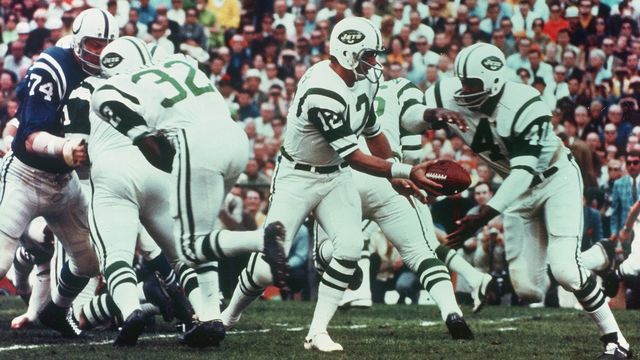
Broadway Joe guarantees an AFL victory137Namath's guarantee: on January 9, 1969, three days before the game, at a Miami Touchdown Club dinner honoring him as player of the year, Namath answered a heckling Colts fan: "We're going to win Sunday, I guarantee it." Hall of Fame. during media week, during a press conference. You can't make for better TV drama than that. There is this very famous photograph that we'll link to in the show notes138The photo: the show notes link to Sports Illustrated's oral history of the picture. Super Bowl III was played on January 12, 1969, in Miami: the Jets beat the Colts 16–7. of Broadway Joe at the pool during media week with a playbook in his lap, where, ever the sex symbol, he's like in his swim trunks.
And there's just all these press and cameras and all these women gathered around him, like staring at him. It was a moment like it was all over the news, all over television, all week, like what an incredible media event. And then during the game, Joe delivers on his guarantee, huge upset, beats the Colts, the first AFL victory over the NFL. At the after party, Carroll Rosenbloom, the Colts owner is totally desolate.
He comes up to Rozelle, he's sobbing, and Rozelle's like, oh no, no, don't worry. This is the best thing that has ever happened to the game and to us. He's so right.
That seems like one of the obvious playbook themes here is every time you think you just got beat by some other football team or entity or personality, it ends up being so good to raise the profile for the game that everybody wins. It turns out the answer is most of the time, everybody just keeps winning.
Yep, as long as there is drama, as long as there is competition, everybody wins.
I mean, this is the great paradox of the NFL. Everything is about the game on the field and nothing is about the game on the field. What it is about is making sure the game on the field is compelling. Whoever wins, they all win.
Well, and this is kind of the debate today between the new group of owners and the old group of owners. The original owners are so steadfast in, this is about football and we make a great entertainment product, but there's football at the core.
The thing that they're all a little bit nervous about with the new group of owners who are so excited about building these unbelievable businesses and taking on more and more sponsorships and sponsoring team jerseys and on-field sponsorships and building the spectacle around every game. What if we had a Super Bowl halftime show139The Super Bowl halftime show — a pop star concert during the final's long intermission, an event in its own right with a huge audience of its own. at every game? It's like, are we not a football product anymore? Are we some kind of entertainment franchise that has lost its way? I think that's the interesting dichotomy between owners these days.
Yeah, how far is too far? But at this point in time, they are nowhere near too far.
Yes, lean way into it.
The next year, the Chiefs beat the Vikings140Super Bowl IV was played on January 11, 1970, at Tulane Stadium in New Orleans: the AFL's Kansas City Chiefs beat the Minnesota Vikings 23–7. Wikipedia. and the pre-merger Super Bowl series ends tied two to two, two victories for the NFL, two victories for the AFL. Again, could not be better for pro football and the newly combined NFL because that leads right into the first joint fully integrated TV negotiations for the 1970 season.
This feels like it's going to be a big package.
Oh boy, the networks are going to have to pay up and pay up, they do. They decide to keep both CBS and NBC essentially with their same packages, CBS airing the NFC games141The AFC and NFC — the conferences of the merged NFL, created in 1970: the Baltimore Colts, Cleveland Browns and Pittsburgh Steelers joined the ten AFL clubs in the American Football Conference (AFC), and the remaining NFL clubs formed the National Football Conference (NFC). Wikipedia. and NBC airing the AFC games. The combined contract value is now a four year contract of $156 million. That is $40 million per year. That's a lot of money.
And this is where the genius starts of the NFL realizing we don't have to just sign one contract and for anybody who's looked at the contracts today, there's a lot of contracts and there's pretty much not a TV distribution company that is not distributing some little shard of what the NFL has carved up, but them realizing here in 1970, we don't just have one deal to sign. We have an AFC package and an NFC package.
We might actually be able to invent some more here too.
AdVanta
All right, listeners, now is a great time to tell you about longtime friend of the show, Vanta. So David, I want to paint a picture that many founders listening will recognize. You're about to close your biggest customer yet. The product team has hit a bunch of milestones. The sales team built this fantastic relationship. Everyone at the potential customer is fired up. Your legal team has the contract done, but then an email comes in from the security team.
Ah, yes, it's usually a very polite email asking something like, "Before proceeding, could you share your SOC 2 report?dSOC 2 — an independent auditor's report on how a company protects customer data; American corporate buyers usually require one from software and cloud vendors. Or do you mind sharing your ISO 27001?eISO 27001 — the international standard for information security management systems; certification follows an external audit." If you don't have one, that deal just went from closing this month to closing next quarter, maybe. Now you have to go find an auditor, go through every system, write the policies, and then prove that you follow them.
Right. Or you could just use Vanta. They are the leading agentic trust platform, which means that you can connect it to your systems at your company and it automatically pulls all the relevant data, and it tells you exactly what's missing for a SOC 2, an ISO 27001, or whichever framework your customer asked for. Vanta gets you through the audit and then it keeps going. It watches your controls every day afterwards, so the report that you hand to the next customer is still true.
Yep. And even more impressive is the Vanta agent. It continues to run in the background, so it can find the issues and draft the fixes. This is the work that eats weeks of an engineer's time before an audit, and now it mostly just gets done before anyone has to ask. And the results are super impressive. A recent industry report says that Vanta's customers see a 526% return over three years and that it pays for itself within the first three months. If you've ever had one of these security emails stall a deal, you know exactly how that math works. More than 16,000 companies now run on Vanta.
16,000. Listeners, there were 2,000 when David and I started working with Vanta. That's incredible what they've accomplished. And these are companies from large enterprises like Atlassian and Snowflake to the new guard like Ramp and Cursor.fAtlassian (Jira, Confluence) and Snowflake (a cloud data warehouse) are large public software companies; Ramp is a fintech startup for corporate cards and expense management, and Cursor is a code editor with built-in AI. We've been fans of Vanta for years, and hundreds, like literally hundreds, maybe even at this point thousands of Acquired listeners have become Vanta customers over that time. If you want a thousand dollars off, check out vanta.com/acquired. That's V-A-N-T-A.com/acquired, and just tell them that Ben and David sent you.
10Monday Night Football
Rozelle and Roone Arledge turned one prime-time game a week into a TV show, and the NFL invented new revenue and a weekly holiday.
David, take us to Monday night.
Oh, let's go to Monday night. They got CBS, they've got NBC. Remember ABC? ABC has been out in the cold for several years now.
Which is a real shame because you've got Roone Arledge there. He's a visionary. This is still before ESPN, right?
Still before ESPN, well, well before ESPN, 10 years.
That's still far off in the future, but ABC is clearly interested in sports.
Yes, clearly interested in something. Rozelle and Roone start chatting. Rozelle has always had the inkling that football and the NFL would do really well in a prime time slot. But this is crazy. You were talking about a little while ago, Sundays were perfect for football, Sunday afternoons, because the networks didn't have anything else to air. The accepted thinking at the time was like, oh, sports are perfect for Sunday afternoons, but like the core business of the television networks.
Sports is not prime time.
It's showing shows and news and entertainment, and that is not sports.
That appeals to the widest range of people. And that we still don't know for sure that the NFL is that.
It's very telling that all of these networks had separate sports divisions and that ABC didn't even have one until they got the first AFL deal. It was a separate thing.
And just to keep tracking our baseball versus football comparison, this moment in 1970 is right around the time where the NFL is eclipsing baseball to become America's favorite sport. It's been slowly gaining ground over the last 30 years, and the merger plus the creation of the Super Bowl really puts the NFL here squarely in the lead, making it the perfect candidate for this sports prime time experiment.
Indeed. Rozelle and Roone Arledge is like, yeah, I think this can work. They brainstorm and together come up with the idea for one single game every week with incredibly high production values broadcast in prime time in the evening on Monday nights after the full slate has concluded on Sunday.
And oh my gosh, many advantages to this. On the Sunday games, there always have been so many games that happened on Sunday. You can't watch them all at once. They're all happening concurrently. You're seeing different games in different markets.
There's not a national event to watch because the way the local affiliate works, it's still at this point in time where you can't watch a home game at home. Whatever is on TV in your city is wherever your team is playing, if they're playing an away game and no NFL on Sunday, if your team is playing a home game. Either you're going to the NFL game on Sunday, or it's a non-event for you that week.
Right. And that's on the viewer side from the production standpoint for CBS and NBC. They're sending each of them like five, six, seven TV crews out all across the country. Their resources are getting totally diluted every Sunday. They can't put all their effort into one prime time game.
The broadcasts other than the Super Bowl, and honestly like even kind of the Super Bowl at this point in time are pretty bad. We talked earlier about, they got better and they learned. They didn't learn much. They were still referred to around this period of time, 1970 as football in a cathedral.
You had no fun camera angles. You probably had three, maybe four cameras in the entire broadcast. Most of it really is just that 50 yard camera that sort of zooms in and out. And the announcers are kind of relying on the fact that you're watching the game.
They're not really commentating that much. They would just sort of help you know that there's audio associated with the broadcast you're watching.
Yeah. I mean, step back and think about the last NFL game you watched, the transitions between the camera angles, the music, the sound effects, the microphones, the analysis, the sideline reporting.
The lower thirds.
The graphics, none of this existed.
The notion that there's play-by-play and color.142Play-by-play and color — in American broadcasts the play-by-play announcer calls each play, while the color commentator, usually a former player or coach, analyzes the game and adds "color." This idea that there should always be someone talking, saying something interesting while you're watching a game.
Yes. This whole vision for Monday Night Football that Roone Arledge and ABC can make happen for the NFL and new media rights for the NFL to sell more revenue. They've got it all ironed out, all the details. And right before they're about to sign a deal, Rozelle's like, "Oh yeah, by the way, we have these partnerships with CBS and NBC. We got to offer this to our partners first”. Rozelle has this reputation and history treats him as like incredibly kind, incredibly accommodating.
And I'm sure that's true. But he had a little bit of Al Davis in him too. He knew exactly what he was doing here. He knew that there was no way that NBC and CBS were going to take this package.
Yep. He just wanted a stalking horse.143Stalking horse — a bid put forward to set a price floor and force the real buyer to pay up. He's like, "I don't want to leave any money on the table with this, whatever we're signing here. They have to fear that we're going to walk."
Totally. You know, Roone of course freaks out. This is his baby. This is his career within ABC.
He's been pre-selling this to his bosses. He looks bad if they lose this now.
So they come in with an over the top deal. ABC gets exclusive rights to Monday Night Football for a new deal, new product, $8.5 million per season.
And the other deal was?
The other deal was 40 per season for essentially 15X more content, I think.
Right. Each TV network is paying about 20 to have either the AFC package or the NFC package on Sundays. And ABC is coming in and now spending eight and a half just for one game on Monday nights. And you might say, "Whoa, that's terrible." They're way overpaying for the amount of content that is. But actually what you want to be paying for is the smallest amount of content possible that gets distributed to the widest audience possible.
You actually should be willing to pay up to 20 million as long as the aggregate number of viewers that you get on that day is the same. Because if I'm ABC, I'm like, "Wow, those guys, that really sucks for them having to produce four, five, six different games. I only have to produce one and it's nationally broadcast across all my affiliates. This is amazing. We're going to go hard on costs on the production side to make it the most dazzling possible experience."
We're going to make it back, boy did they ever. The first Monday Night Football game144The first Monday Night Football game was the Cleveland Browns against the New York Jets on September 21, 1970. Wikipedia. that airs that season is watched by 60 million U.S. households. That is like Super Bowl level. I mean, Super Bowl I was 65.
They invented a holiday out of nowhere and it's every week.
They totally invented a weekly holiday. It's amazing. CBS and NBC must've been pissed.
Seriously, because it's also, you know, they signed the contract thinking between the two of us, we basically have a lock on all the football and then they invented more football.
Exactly, and for the NFL, they invented more football. They invented revenue, amazing.
And by this point, the NFL is starting to wake up to this idea that, you know, they're still not willing to play with the blackouts at all, but maybe people watching on TV can be better than people coming into the stadiums. Maybe there's enough money in this for us to be nationally broadcast on a Monday night. I still think it was blacked out in the home market, but they recognize the value of everyone else watching and how that's even more important than the stadium itself.
Okay, so I made a list of things that Monday Night Football invented that was not a part of your typical football NFL broadcast before Monday Night Football. And it is astonishing. This is everything that you expect in every NFL and frankly, every college game that you watch now. It was brand new for Monday Night Football. And in fact, was Monday Night Football exclusive for 20 or 30 years in a lot of the cases.
But the overriding idea that we are going to cover a football game like show business. This is not a sport we're broadcasting. This is showbiz and we will make you feel like that. What are we going to do? We're going to put cameras at field level. We're going to put cameras on people's shoulder and they're actually going to get to sort of run around and get up close footage of people while they're celebrating touchdown dances or when they're running back in from the sideline.
We're going to put cameras on the 20 yard lines in addition to the 50 yard line so that we can get a straight down view when they're in the red zone.145Red zone — the last 20 yards before the opponent's end zone, where the offense has the best chance to score. It's not just sort of this weird sort of from the side angle on touchdowns, like we're going to get great footage head on during touchdowns. Instead of two commentators, we're going to have a three man booth and there's going to be real action oriented commentary there.
And of course we can't talk about Monday Night Football without Howard Cosell146Howard Cosell (1918–1995) — the voice of Monday Night Football from 1970 to 1983. In the first season he shared the booth with Keith Jackson and former Cowboys quarterback Don Meredith; in 1971 Frank Gifford replaced Jackson. and his unbelievably unique style of narrating and really injecting himself into the story of the broadcast rather than just being a sort of opinionless third party observer. He created a little bit of a foil to play off of for the other commentators where there was real relationship and you were tuning in not just to watch whatever the football was, but to watch these announcers. Who you sort of got to know over time and really observe their charisma with each other about the game.
That's exactly what I was going to say. It's the same dynamic with podcasts now. It's like, they became your friends in the booth.
Right, it's not just that you're listening to business stories, it's that you're hanging out with David and I while we talk about business stories. It's one of the first examples ever of realizing the power of that. They went from the four cameras that typically would cover a Sunday broadcast to nine cameras and then eventually up to 17 cameras.
They invented the parabolic microphone coverage that you always see on the sideline, those sort of clear plastic microphones that are aimed at gathering the sound from on the field. They had 40 engineers, they had 20 production people. They invented these split screens. You could watch two cameras concurrently cover the game.
They had on field interviews, shots of cheerleaders to add a little bit of a sex appeal to the game for the first time and they also used green screens, which is so funny to watch some of these early. I guess they didn't have room in the booth according to the Peyton's Places ESPN video147"Peyton's Places" — ESPN documentary series in which former quarterback Peyton Manning explores NFL history. David also recommends it at the end of the episode. that we watched about this, where for the three man booth, they needed more space than they had in the press box.
They ended up putting them out in the hallway and built a little custom room to do this in, but the background wasn't good. They put in a green screen and then they would put another camera in the press box. They would superimpose that the field was right behind them, but it actually wasn't. And it's so obvious watching it today.
They're like floating on the stadium, it's hilarious.
But this is revolutionary stuff.
Yes. There was one other really, really big innovation. This was a thing that would go on to be the predecessor for ESPN as a network, for SportsCenter as a program.148SportsCenter — ESPN's flagship highlights show, which debuted on the channel's very first day on air, September 7, 1979. Wikipedia. It would create billions and billions of dollars of enterprise value. And that is replays.
Yeah, the highlights. Before we talk highlights, did you say the theme song too?149The Monday Night Football theme: from 1970 to 1975 broadcasts opened with "Score" by Bob's Band, and since 1976 with Johnny Pearson's "Heavy Action," which is still used. Wikipedia.
Yeah, I thought actually that's where you were going with ESPN. I mean, the theme song is like, there were no theme songs before this.
Right, this notion you're actually tuning into a program that has an associated pump up song that is built for that franchise is unique. Okay, so let's talk about highlights. How could you have possibly watched highlights before Monday Night Football? Well, the games were on Sundays and that was really the only football that was on all week. We didn't have the internet, there wasn't ESPN, there wasn't SportsCenter.
There really was no place to go and watch highlights. Now football and all sports are unbelievably highlightable events that if you string together a bunch of the very best plays, it's really, really interesting and really entertaining, especially if they're covered by great cameras. Now compare this to baseball, where not only was there no place to go watch them, but there was no one capturing the footage to even highlight it, but NFL has NFL Films and using high quality cameras and film stock.
They are capturing great camera angles of every game. Between Sunday and Monday,
the NFL Films team would go and take all of the footage from the game the previous day, cut up a highlight reel and as soon as possible, get that to whatever city the Monday Night Football broadcast was happening in that they could play it at halftime.
Howard Cosell could give his commentary, often having never seen the footage while the highlight reel is playing in the background and really invents this idea of for the first time, we're going to watch highlights of yesterday's games.
I kind of imagine the highlight reel is literally being slid into the machine as they were getting ready to broadcast it because think about the logistics in that. You get the film stock back from all the games all around the country, back to NFL Films. They produce the highlight reel. They get that finished reel back to the Monday Night Football location, which is another location somewhere around the country.
Totally.
All within 24 hours.
It's really amazing. God, I can't believe we're only up to 1970.
I know. Well, you can't get any better from this. I mean, this is now the fully formed entertainment product of the NFL. They add stuff like Sunday Ticket150NFL Sunday Ticket — a paid subscription to all Sunday NFL games not broadcast over the air in the viewer's region. DirecTV satellite sold it from 1994 to 2022, and YouTube since 2023. and Thursday Night Football151Thursday Night Football — the weekly Thursday night NFL broadcast. It has aired since 2006, first on NFL Network and since 2022 exclusively on Amazon Prime Video. and everything else over the years. But the trajectory is set. There's some ups and downs in the 70s, but it's basically just like gonzo for the NFL.
There's one more presidential intervention in 1973. Nixon really, really, really likes watching the Redskins, but he's sick of taking the helicopter to Camp David to watch their away games, which he actually was doing, which is unbelievable.152Fact-checkHe says Nixon flew to Camp David to watch Redskins away games; in fact local stations already showed away games, while the 75-mile blackout covered home games. Nixon watched the home NFC championship game against the Cowboys in December 1972 at Camp David, the presidential retreat in Maryland about 100 km (60 miles) from Washington (Wikipedia, "NFL television blackout policies" and "Camp David").
He was a nut. Nixon literally phoned in a play for a Redskins playoff game153Nixon's play: in the 1971 playoffs against the San Francisco 49ers, Nixon suggested a play to Redskins coach George Allen, a reverse to receiver Roy Jefferson. The play lost yardage, and the Redskins lost the game 20–24. from the White House.
Maybe he should have been paying more attention to foreign policy and things like that. But Camp David is sufficiently 75 miles away. By the way, there was this whole cottage industry that sprouted up of hotels that were outside of the 75 mile radius, and there were buses. People would go to these hotels and they would get rooms for the day to go watch the games.
This dynamic formed like plot lines on sitcoms in the 70s and the 80s.
Nixon calls Pete Rozelle personally, the president, the sitting president of the United States, and says, "Hey, we're in the playoffs this year. I think it would be a good idea for you to air playoff games." Not every game, but playoff games locally. Pete Rozelle, even in 1973, is pretty dug in on this issue that it's a bad thing and it's cannibalizing our most important thing, our gate revenue, if we do that.
He says no to the sitting president. And so then Nixon goes to Congress and says, "Will you please draft legislation," which got known as the blackout ban. Because Rozelle denied the president, there is actually legislation that was passed in order to force the NFL's hand in broadcasting away games locally.154Fact-checkHe says the law forced the NFL to show away games locally; in fact local stations already showed them, and Public Law 93-107, which Nixon signed on September 14, 1973, lifted the blackout on home games that sold out 72 hours before kickoff (Wikipedia, "NFL television blackout policies").
11From Rozelle to today
By 2023 the NFL was, David believes, the largest single media property in the world, but local revenue at rich clubs is eroding the league first mindset, and fantasy and betting have driven new engagement.
This is one of the things that Rozelle got super wrong. The right thing was as soon as possible, the NFL to get as much distribution as possible because the TV rights would become the most important revenue line, but also the thing that most fueled the flywheel. The more people watching the games is better for everything, for continued fandom.
It's like how Disney wants you to consume the content so that you go to the parks and you buy the merch. It was one of his few strategic flaws, I think, was gating the content for too long.
Yeah, and I don't know if this is directly related, but I think so much of the '70s and the '80s and the '90s were also about just like the continued growth trajectory of the incredible marriage of the NFL and television. And the money just keeps getting bigger and the stage keeps getting larger and the viewership goes up and all the things.
Yeah, and this is probably worth saying that we aren't going to go blow by blow on the NFL timeline past 1970, the way we did during the Rozelle era. There's a bunch of stuff to skip like the USFL and all the teams moving cities and Deflategate155USFL — a spring football league that played from 1983 to 1985. Deflategate — the scandal over the New England Patriots' underinflated footballs in the AFC championship game in January 2015; quarterback Tom Brady was suspended for four games. to focus really on the strategic moments that created the conditions of the NFL's business today.
Yep, so probably the biggest decision that happens during the time. The league first mentality kind of gets diluted with the stadiums that you referred to because as all the teams start moving into the bigger stadiums, they start building amenities into the stadiums. The stadium experience totally changes, which it needed to as television became primary.
There had to be a reason to go to the stadium. Stadiums become all about the luxury boxes, the suites, the experiences, the corporate partners, the advertising, the drink sponsors, all of this stuff. That becomes huge money for the NFL, but it's not shared money, it's local money.
Yes, this is my biggest criticism. The thing that got them here, this league first mentality, is eroding because of the way that the revenue splits are happening. You look at the local stadium sponsorships. You look at every stadium is dedicating more and more real estate to luxury suites. The local merchandise sold in the stadiums is local revenue.
The teams are making more and more money locally. A greater percentage is coming from things the teams are doing on their own. You got to wonder if that individualistic, I'm Jerry Jones156Jerry Jones — oil entrepreneur who bought the Dallas Cowboys in February 1989 for $140 million. The Cowboys are the NFL's most valuable club, and Jones is one of its most powerful owners. Wikipedia. and the Cowboys deserve all the revenue, mindset will be the thing that eventually kind of causes them to get unseated in some way.
And I think the thing that keeps the competitive balance in place, even as revenue diverges is the salary cap.157Salary cap — the limit on what a team can spend on player salaries in a season. In the NFL it is a "hard" cap: it can't be exceeded under any circumstances, and it is the same for every team.
Yeah, this is a great place to talk about that. Let's go to 1993 and talk about the first time free agency and the salary cap comes into the NFL, how that's computed and how that impacts the sort of leverage going forward. The league has been negotiating with the Players Association158The NFL Players Association (NFLPA) was founded in 1956; it negotiates with the league on players' behalf over pay and working conditions. Wikipedia. for a while, I think since the sixties in various collective bargaining agreements.159Collective bargaining agreement (CBA) — a multi-year contract between the league and the players' union covering the players' share of revenue, the salary cap and the rules for the draft and player movement.
But the 1993 one is unique.160The 1993 agreement resulted from players' lawsuits against the league (the Reggie White case); the salary cap took effect from the 1994 season. Wikipedia. The NFL didn't really have free agency for a while. And in 1993, players finally got it, at least as long as a player had been in the league for four years. In exchange, there was a salary cap put in, capped at some fixed percentage of the amount of revenue that the league generates. That today is actually a pretty high number.
It's 48.8% or something like that.161The players' share under the 2020 agreement is at least 48% of league revenue from the 2021 season; with strong growth in TV revenue it rises to 48.5% or 48.8%. PFT. Players are effectively a partner in the league because the league's success ends up being their success, not necessarily evenly distributed among all players by any means, in fact, quite the opposite. But at least players are virtually guaranteed in whole to make close to half of the league's overall revenue.
ExplainerWhat money the NFL shares equally, and what it doesn't
Split equally among all 32 clubs, regardless of results, are the money from the national TV contracts, league-wide sponsors and merchandise licensing, plus 34% of ticket revenue. According to Forbes as of July 2023, national media rights accounted for about two thirds (67%) of the league's football revenue. In 2019 each team received $255 million a year from the TV contracts, more than that season's salary cap ($188.2 million).
A club keeps the local money for itself: the rest of the ticket revenue, suites and luxury boxes, stadium naming rights, local sponsors, food and drink. Hence the gap Ben talks about: the shared money is the same for everyone, but the Cowboys' local money is many times that of the small clubs.
The salary cap is calculated from the league's total revenue, local and national, and is the same for everyone. A rich club can't buy up all the stars, and a poor one has enough to pay: the shared TV money alone covers the whole payroll.
But how does that work with local and national revenue? Well, since it is based on the total revenue, if a team makes a whole bunch of local revenue, they're going to have no problem making the obligation that they have to pay the players.
And you're saying that that fixed amount is a league-wide aggregate, including all the local revenue from all of the teams.
This potentially could create a big imbalance.
Right, it's okay as long as the local revenue doesn't become too big of a part. But at some point, you have to imagine that what is 48.8% of league average could be 90% of what I make as a team in a small market with a crappy stadium. Then because I have to pay players so much, there's no way I can pay for other stuff.
My coaching gets hurt or the production for fans gets hurt or something that makes me a less competitive team, even if the players on the field are paid just as much as the players on the field from other teams.
And it's interesting, because I think in '93, when the salary cap first came out, it was just of the shared revenue. But now that in the more recent agreements, it includes all league revenue and local revenue is actually growing as a portion of the overall revenue for the top teams. Unshared revenue for teams grew from 12% in 1994 to 21% in 2003 and is over 30% today.
There's definitely a meaningful and ever-growing part of NFL team revenue that really does come from just the team itself and what it can do in its local market, not from that sort of locked brotherhood of we're all in it together league revenue.
Yeah. It is a serious threat to this magical flywheel that has made the NFL succeed well beyond any other sport on a revenue basis in the world. Even though football and the NFL is not the most popular sport in the world, it is by far the highest monetized and largest sport by revenue.
I think actually, I don't know if we said this upfront, I'm pretty sure the NFL is the largest single media business in the world. Not an aggregate diversified media business, but like if you consider the league as a single property, then I think it is the largest individual single property in the world.
It's a good question. The comps would probably be like Marvel or Lucasfilm.162Marvel and Lucasfilm — Disney's two most famous acquisitions: it bought Marvel Entertainment in 2009 for about $4 billion and Lucasfilm ("Star Wars") in 2012 for $4.05 billion. Wikipedia.
Yep. I looked at that bigger than Marvel, bigger than Lucasfilm.
Really?
Because the NFL does 18 billion a year in revenue right now, which is expected to grow to 25 billion by 2027.
Yep. I believe Marvel's not anywhere near that.
Wow. Yeah, that's wild.
Because it's an annual basis. That's every year.
I mean, this TV contract that they just signed, the 10 year deal is for $112 billion across all these entities.163The 2021 TV deals were signed in March 2021 and cover 11 seasons, from 2023 to 2033. In December 2022 the NFL announced that Sunday Ticket would move from DirecTV to YouTube from the 2023 season.
Just wild.
And just to share what that specifically looks like, CBS broadcasts a Sunday afternoon package for $1.85 billion a year. Fox has a Sunday afternoon package for $2 billion a year. They invented a new SKU, the Sunday night package,164Sunday Night Football — the prime-time broadcast of the week's marquee game on Sunday nights; NBC has aired it since 2006. and they invented this a while ago, but NBC has that for $1.7 billion a year.
Disney owns Monday Night Football, as we mentioned, for $2.55. It is a single game per week and it's the most expensive package. It's incredible. Amazon has Thursday Night Football for $1.3 billion a year. And of course, then we just got the news last month that DirecTV has lost NFL Sunday Ticket and that is moving to YouTube TV.165DirecTV — American satellite TV provider launched in 1994. YouTube TV — Google's subscription streaming service with broadcast and cable channels, running since 2017; Sunday Ticket is sold as an add-on to it and to YouTube itself. Wikipedia. NFL Sunday Ticket is also a genius move.
Because you're reselling the same content you've already sold.
It's the same content. It's the content that is exclusive to CBS, Fox, NBC, that those networks produce. I'm pretty sure it's even like their cameras, their on-air talent, all that. But the NFL, it has the exclusive right to bundle all that together and sell it as a package directly to a consumer if you want access to all the games, if you don't just want the ones that are on TV near you, if you want the ability to watch any game at any time.
And it is incredible to me that that is worth $2 billion given the NFL is actually not doing the work to produce it. The people who are doing the work to produce it are the people who are paying for the privilege to cover those games.
Amazing. Then there's more now. Let's catch us up to the present day. There's revenue from the NFL Films division. I think it's probably a couple of hundred million dollars. I would expect at this point in time. There's other licensing rights, particularly video games and Madden.166Madden NFL — Electronic Arts' football video game series, released since 1988; named after John Madden, the Oakland Raiders coach turned famous broadcaster.
I don't think it's public, but it was reported that the latest Madden licensing deal with EA was a total of $1.6 billion for a five-year rights.
Which, man, remember that episode we did with Trip on EA167Trip Hawkins — founder of Electronic Arts; Acquired recorded an episode with him on the company's history. The first game in the series, John Madden Football, came out in 1988. back in the day was so fun and talking about the origins of Madden.
That's a $300 million a year deal. That's like a sixth of what one of these channels pays to broadcast the actual NFL. That's what EA pays to just license the use of the player names and team logos and all that.
Yep. Then there's fantasy, both betting and non-betting.
Yeah, and this is a good point to fully bring us to today. I think it is totally reasonable to say that the things that powered the rise of the NFL were national TV, post-war prosperity, the rise of the middle class, the Madison Avenue explosion and the league first mentality. But all of this is in the fifties, sixties and seventies.
The thing that powered the NFL to be such a dominant force in society today is fantasy football and sports betting. Let's talk about fantasy first.
Great.
There's like 30 or 40 million people a year in the United States that play fantasy football, thus making it the way that the centerpiece of conversation with their closest friends and families and coworkers, which means you have to watch football in order to have those conversations with the people that are closest to you in your life.
Fantasy is such a great example of driving and adding to the Rozelle flywheel. Better products, deepen fan engagement, more viewership, more advertising, which really now translates to more revenue opportunities because there's revenue opportunities from fantasy.
Sunday Ticket, that whole package basically was to cater to two audiences, one, bars and restaurants, who want to be able to show multiple games within their establishment. But two and even bigger, the fantasy crowd, they're going to be willing to pay a lot of money to see all the games live. And then that feeds back into the product and the flywheel spins.
And of course, then there's sports betting, which is now becoming legalized in lots of states, but has been a force for a long time. Of course, you could bet legally in Las Vegas,168Betting in Nevada: a 1992 federal law (PASPA) barred states from legalizing sports betting, but Nevada's licensed sportsbooks, already operating, were grandfathered in. Until 2018 Las Vegas was the only place in the US where you could legally bet on the outcome of a single game. Wikipedia. but obviously tons of people have bookies that can just place bets for them no matter where they lived.
And I'm shocked, shocked to find gambling going on in this establishment.169"I'm shocked, shocked…" — a line from "Casablanca" (1942): Captain Renault shuts down Rick's café on the pretext that gambling is going on there, and is promptly handed his winnings.
And when you've got money riding on a game, you are absolutely going to tune in. I looked it up just to put a number on this. The current estimates are that 46 million Americans, or 18% of betting age US adults, bet on the NFL this year. And that number continues to grow.
That's just this year.
Yeah. People bet on the NFL more than any other sport in the US. Variety reports 81% of sports bettors bet on NFL games versus just over 50% for the NBA170NBA (National Basketball Association) — the top professional basketball league in North America. and 44% for Major League Baseball. Interestingly, the NFL doesn't generate meaningful revenue from betting yet, though I am sure they will in the future.
Yeah, you can probably bet on that.
Hey-ooh. I guess it's worth pausing to understand the shape of the NFL's business today and how the revenue breaks down. On average, about two thirds of any given team's revenue comes from shared national revenue that we talked about. The remaining one third comes from the local revenue, but again, this is just on average.
Some teams are very good at the local revenue, like the Dallas Cowboys, and some teams are very bad at this, like the Bills or the Lions. I have some numbers to put that in perspective. This past year, each team got right around 350 million from the shared league revenue, but that extra local revenue obviously can cause a gigantic swing in the team's total revenue.
Forbes has an estimate that the Cowboys made over a billion dollars last year, whereas the Lions only made 450 million, so not really much on top of the shared revenue from the league.
Wow, so much for the league first mentality from Jerry Jones there.
Right? It's also useful, I think, to slice it a different way rather than just the shared versus local. Here is how the NFL team revenue breaks down purely by product. This is essentially answering the question, how does the NFL make money? So 61% comes from media. Most of that is the TV from the shared league revenue. 10% comes from general seating, which is regular plastic seats. Another 10% comes from premium seating.
That's for the proletariat.
Yes, the premium seating that we mentioned is the suites and all that stuff. That's a big growing revenue line for the people with nice stadiums.
And most of that is corporate, right?
I think so, that's my best guess. It's super different city to city. This is probably the most variable, 10% comes from sponsorship and advertising. And then about 9% is other, which I'm guessing is where NFL Films and a lot of that stuff sort of lies.
Maybe the Madden deal is in there. I don't know if it'd be there or in media.
12CTE and Kaepernick
The CTE cover-up and the blackballing of Colin Kaepernick broke trust in the NFL and showed that a league used to controlling the message doesn't understand the social media era.
Yeah, so that's the shape of the NFL as a business today. Before we kind of finish that out and get into analyzing the business, I mentioned the complicated relationship that people have with football. In the 2000s, it became clear as day that CTE is very real and caused by playing football and causes shorter lifespans and immense physical harm to players.
And CTE, as many of you know, is chronic traumatic encephalopathy, which is a terrible brain condition that develops from the many repeated subconcussive hits to the head. And the symptoms are devastating.
Mental, emotional, suicides, everything.
I mean, the NFL settled a billion dollar lawsuit to pay out victims and families of CTE.171The concussion lawsuit: a class action by thousands of former players was settled in 2013–2015; the cap on payouts was eventually lifted, and the total was estimated at more than a billion dollars. Wikipedia.
Yeah, it's even worse than that. There's a bunch of dimensions here. Yeah, I played football all growing up, middle school, high school, college. My feeling, and this was in the 90s and early 2000s, my feeling on the matter was I'm for sure risking my body by playing, but the risk calculation on my mind was all short-term. I could tear an ACL, sure.
I could break my arm, sure. I could get a concussion, sure. But in my mind, those were all the same things. There was no broader understanding among general population, or there's been a bunch of research on this, or the NFL players themselves, that there was real long-term mental risk to playing the game.
ExplainerHow the NFL studied concussions
In 1994 commissioner Paul Tagliabue set up the league's Mild Traumatic Brain Injury (MTBI) Committee. It was chaired by Elliot Pellman, a rheumatologist rather than a neurologist or neuropsychologist, an appointment for which the league was later widely criticized.
In 1999 the committee reported that the number of head injuries had stayed "remarkably consistent" for four years. Then came a series of its papers in the journal Neurosurgery: in 2004 the committee wrote that NFL players' brains had "evolved" and become less vulnerable, and in 2005 that players who returned to the field on the same day after a concussion faced no additional risk.
In July 2005, in the same journal, the forensic pathologist Bennet Omalu described the brain of former Pittsburgh Steelers center Mike Webster, which is how the concept of CTE emerged. The committee's scientists demanded that the paper be retracted. The film "Concussion" tells this story.
Then here's what's really bad is the NFL knew it and they covered it up. The NFL started doing research into long-term effects of concussions and other head trauma from playing football in the 90s. Then they sat on the data for a long time. Then when they did release it, they claimed that there was absolutely no provable link, no evidence at all that head injuries from playing football led to long-term damage.
The NFL didn't acknowledge that until 2016.172The NFL's admission: in March 2016, at a congressional roundtable, NFL senior vice president Jeff Miller publicly acknowledged a link between football and CTE for the first time.
Super bad, I mean, there's the Will Smith movie Concussion173"Concussion" (2015) — the film in which Will Smith plays the forensic pathologist Bennet Omalu, the first to describe CTE in a former NFL player. about it. We don't need to go into a bunch of the specifics, but I think like from the Acquired standpoint and the NFL audience standpoint, this was a major, major trust-breaking moment.
Certainly it affected it enough for LeBron James174LeBron James — NBA star and four-time league champion. In November 2014 he told ESPN that because of the health risks he wouldn't let his sons play football: "Only basketball, baseball and soccer are allowed in my house." SI. to say, I don't want my son playing football. I mean, that was a huge cultural moment.
The second order effects are pretty large from this. One is what you said about parents allowing and wanting their children to play football.
Interestingly, all youth sports are down. I don't think football is down much more than other youth sports, but video games, social media, phones.
And the pandemic too.
But I think the real risk, and this is starting to be shown out in the data, is how are future generations going to view the NFL and football? And if you look at the data, U.S. adults as a whole, 33% say the NFL is their favorite professional sports league. But if you look at Gen Z,175Gen Z — people born from roughly the late 1990s to the early 2010s, who grew up with smartphones and social media. only 23% of Gen Z say that the NFL is their favorite professional sports. So 10 points less than the broader population. And basketball in Gen Z is 19%, right there pretty close to football.
From a revenue perspective, the NFL today makes twice as much as basketball, but that's a pretty damning trend looking at where Gen Z's interests lie.
Yeah, this whole thing was just bad, period, for the NFL.
How do you deny the existence of these things when people in your organization have been hired to commission this research and then you're burying it for decades?
And it's your players, it is your product on the field.
It's also interesting to note who wasn't producing content about concussions. I mean, this Will Smith movie came out that I don't think was through the media channels of any of the NFL's partners. I think the NFL wields a lot of influence and saying, oh, you may not be a part of the networks that get our broadcast in the next generation.
That strategy would have worked really well 30 years ago, but in the social media era where individuals have Twitter accounts, a lot harder to control the narrative.
Yep, speaking of hard to control the narrative, let's talk about blackballing Colin Kaepernick. I think an interesting place to start is the job of the commissioner. The commissioner is not the president or CEO of football. The owners are not their executives and the commissioner's obligation is not to the fans. The commissioner is hired to do one job and that job is speak for and do things that are in the best interests of the owners as a whole.
If the most powerful owners want something, that is what the commissioner does. That is what the message is from the NFL. The NFL itself is a very thin layer on top of a whole bunch of teams that are their own very large businesses. In fact, a lot of hay was made about the NFL switching in 2015 from a nonprofit to a for-profit.176The NFL's tax status: until 2015 the league office was a nonprofit association under section 501(c)(6) of the US tax code, which explicitly lists "professional football leagues" among organizations exempt from federal income tax. The clubs always paid taxes. Wikipedia. The NFL has very little net income. Who cares what its tax filing status is?
It all gets distributed out to the teams.
Right, the teams are their own tax paying entities and their own businesses. Roger Goodell177Roger Goodell (born 1959) — NFL commissioner since 2006, successor to Paul Tagliabue, who followed Rozelle in 1989. makes $40 plus million a year to do what the owners want and they hire him to do that and they will fire him if he doesn't do that.
Oh man, there are these great quotes in America's Game where the owners are talking about Pete Rozelle with the representative of the players at the time they're negotiating contracts and the players are complaining that Pete Rozelle isn't being neutral in these negotiations.
The owners are like, of course he's neutral. We pay him damn well to be neutral. The commissioner of the NFL is like the ultimate in shareholder responsibility. In fact, shareholder responsibility is his only responsibility.
Back to Colin Kaepernick. In the good old days of football, it was a bunch of reasonably young enterprising owners who loved football and owned teams. It wasn't clear if they were going to be good businesses or not but the league as itself and thus all the owners were cowboys trying to make it for themselves in the world. And those people all got old and didn't want to change at all.
Now most of those people are dead and it's their descendants who are also old who own these teams.
Yes, and so now there's these very interesting artifacts of the league being grown up, old and stodgy, the incumbent, something like that when they were once a startup, especially when it comes to just acknowledging that a guy can protest the national anthem.
Yup, I do think when that happened in 2016, it was a lot more of a radical act than it might seem today. And there were a lot of people at the time who were deeply offended by it.
He was using the NFL's platform to sort of make a very personal argument.
And there were a lot of people in the NFL who understood why he was doing it because 70% of the NFL is black. There was a lot going on here.
Right, and we should say what actually happened, Kaepernick in 2016 took a knee during the national anthem to protest police brutality and racial inequality in the US.178Colin Kaepernick — San Francisco 49ers quarterback. In 2017 he filed a grievance alleging collusion by owners who wouldn't sign him, and in 2019 he settled it with the league on confidential terms. Wikipedia. After that season, he was a free agent, zero teams signed him, and of course he had some disappointing seasons and injuries.
But let's be real here, the NFL blackballed Colin Kaepernick after this.
Oh, Kaepernick filed a grievance and eventually reached a confidential settlement with the NFL. I mean, the whole macro thing here is very strange of the owners to let this seemingly minor thing turn into the gigantic media mess the way that they did.
Yeah, and I think the interesting thing for the purposes of our discussion here about this, I don't think this ever would have happened or happened in the same way in the NBA. The NBA embraced both social media and the strategy of letting players have their own platforms be their own voices and promote the league through that. And the NFL was the opposite of that. They were the command and the control, we own the message. And there was no clearer example of this.
But bottom line, the NFL wildly mishandled this, let it get completely out of hand. This is the way that we know of Colin Kaepernick now. He's sort of like an icon for this thing. I mean, if what the NFL wanted to do was not amplify his protest by making him not able to play, it totally blew up in their face. He became a national headline for months and months and months.
Right, which is emblematic of the NFL not understanding the social media era.
Yup. All this to say, it was very compelling for David, you and I to spend a bunch of time talking about the NFL up through 1980 and the Rozelle era. But I mean, revenues have gone up. Team values have gone up. Games have gone from standard def to HD to 4K, but the end of the hero's journey179The hero's journey — the mythic story structure from Joseph Campbell's "The Hero with a Thousand Faces" (1949): the hero leaves home, goes through trials and returns transformed. Here it means the story of the NFL's rise is over. sort of happened at the end of the Rozelle era.
And it won't hurt their business for a long time. That's the interesting thing.
13Analysis
By the Lindy effect the NFL isn't going anywhere: its main Power is the cornered resource of all the best players, and the networks keep paying more because they have nothing else people want to watch.
I think this is a good point to transition into analysis and why don't we do playbook and then do power.180Playbook and Power — the two analysis segments at the end of every Acquired episode: Playbook covers lessons worth borrowing from the company, and Power analyzes its advantages using Hamilton Helmer's 7 Powers. One that just really strikes me through all this is the Lindy effect.181The Lindy effect — an idea popularized by Nassim Taleb: the longer something nonperishable, such as an idea, a technology or an institution, has already existed, the longer it is likely to keep existing. Despite everything you just said, football is bigger than it ever has been.
$12 billion a year in revenue from the TV deals alone.
A huge amount of revenue and now diversified those revenue sources. It's not just old line broadcast networks trying to hang on that are paying them this money. Like no, it's Google and Amazon that are paying them this money.
They're paying what? Close to $4 billion a year from the biggest tech companies in the world.
Yeah, the NFL is going to be just fine. And that revenue is almost assuredly going to grow at a very healthy clip. Even despite all this, people love their football. I still love watching football.
Totally, me too. I feel like I'm a slight apologist for still loving football as much as I do.
Two things, one, I mean, again, that just reinforces the power of the Lindy effect to me. The NFL is just fine and is going to be just fine for a very, very long time. Now I do think the younger generations thing is a real risk. I think related to that is one, basketball definitely won the social media era in a way, not as to as big a degree as the NFL won the TV era, but basketball's on the rise. And related to that is number two, the NFL has never figured out international, many fits and starts.
Have you read about these home marketing agreements?182Home marketing areas (International Home Marketing Areas) — an NFL program announced in December 2021 that gave 18 clubs exclusive rights to market themselves in eight countries. Mexico was split among nine teams, including the Cowboys; the program was expanded in 2022. NFL.com.
It's really weird. The NFL now, because there's zero international interest in the NFL, like zero. They go play these other games in other countries and the people who watch them are people from the US who fly to go watch their favorite team play somewhere exotic.
I mean, for God's sakes, baseball has a robust international presence.
Right. And as we talked about in our NBA episode, I mean, basketball's entire future growth and current sort of groundswell of popularity is young people and international. The NFL has tried NFL Europe,183NFL Europe — the NFL's spring league in Europe, which existed under various names from 1991 to 2007. kind of shut that down, couldn't get the owners to care about it. This home marketing agreement thing that they're doing is saying that teams have an exclusive right versus other NFL teams to market in certain countries.
Oh, no way. I didn't see this.
I think it's like the Cowboys can advertise the Cowboys in Mexico. It's that sort of thing because they want to try to build affinity for teams where there's like some theoretical mapping to that country based on ethnic groups in the area or proximity.
That does not seem like a sound international strategy to me.
No. The question kind of becomes how can the NFL continue to grow or can it? Because the average number of people who watch any given NFL game pick your metric. Is it the average Monday Night Football game? Is it the average kickoff game of the season? Is it the average Super Bowl? It's like up and down over the last 20 years.
It's amazing that it's as high as it is when people don't watch anything else on TV. But honestly, I'm having a hard time understanding how they grow the fan base.
Well, the core to growing the original NFL flywheel is increasing fan reach and engagement and that's no longer happening.
Right. Then you have this interesting question of is college football starting to pay players competitive to the NFL or additive? Because college football has fueled the growth of the NFL. I mean, think about it this way. The NBA and Major League Baseball teams have to pay to operate farm teams184Farm teams — minor league teams where pro baseball and basketball clubs develop their young players: the minor leagues in baseball, the G League in the NBA. In football, college sports play that role for free. that no one wants to watch or play in. The NFL gets all the benefit of all the development of all of these players in their college years for free.
Right.
They benefit from the storylines around them too. When someone comes into Major League Baseball and gets promoted out of the minors, everyone's like, who cares? I have no idea who that person is. Whereas the Heisman Trophy winner,185The Heisman Trophy — the annual award for the best player in college football. who you know about what their childhood was like comes out of NCAA football out of the, you know?
The storylines are fully baked and ready to go.
Yeah, college football has been the best thing to ever happen to the NFL for basically its whole existence.
Right, it was the worst thing for the first 20 years and then it was the best thing.
Good point, yeah. I think the biggest players getting paid in the NCAA right now with the sort of weird way that the booster stuff works186Boosters and NIL: since July 2021, college athletes in the US can earn money from their name, image and likeness (NIL). The money often flows through "collectives" funded by wealthy university fans known as boosters. is like $2 million. They're not competing for talent. I don't think the NFL will start trying to sign earlier college players. I don't think they'll be competing directly or in the same order of magnitude.
The revenue that big colleges make and that these conferences make isn't NFL size, but these are huge deals. The NFL for comparison has a $12 billion aggregate set of media rights that it sells. The Big Ten deal187Big Ten — one of the largest college athletic conferences in the US (Michigan, Ohio State, Penn State and others). In August 2022 it signed media deals with CBS, Fox and NBC worth about $7 billion. Wikipedia. is a billion dollars a year. They just signed a seven year deal at a billion dollars a year, which is twice their previous deal from 2016.
All this to say, the business of college football is still much, much smaller than the NFL, but it'll be really interesting to see sort of how it, as players start to get paid more where it finds its footing in the landscape. And if it changes at all from where it is today.
A thing in playbook here that I think is interesting to talk about is the relationship that the NFL has with its players as a supplier and with the networks as a customer. It got itself into this trap for a while where it was negotiating with the networks. It would sign a big deal to get a bunch of revenue and then would quickly have a negotiation coming up with the players.
And they seem to have switched to this thing now where they signed a collective bargaining agreement for a decade with the players. I think they did that in 2020, that last through 2030. Then in 2022, that's when they renegotiated the 10 year rights for media.188The 2020 collective bargaining agreement was approved by the players in March 2020 and runs through the 2030 season. The league signed its new media deals a year later, in March 2021. They seem to have switched to this, which is good business decision.
Before anyone knows what the big new revenue contract looks like, they go and they lock in all the pricing on their suppliers. Now granted, it's a rev share.
It's a percentage basis, yeah.
Right, in that respect, it's fair. But it is quite clever to have gotten off the tick-tock cycle of having the players have a bunch of leverage after seeing what the media deal looks like and doing it in this order.
The other thing that I've been sort of charting is the media deals go up dramatically in value, but the average viewers kind of stays the same. Like in 2002, the kickoff game had about 20 million people watch and it rose and it was in the mid 20s. Then it dipped back down below 20. Last year, about 20 million people watched the kickoff game.
We're in about two decades of audience stagnation.
Yeah, so why is it that the media rights are worth so much more when the number of audience impressions stays the same? I'm curious where your head is on that. I have some theories, but on a CPM basis,189CPM (cost per mille) — the main measure of advertising prices: what an advertiser pays for a thousand viewers to see its spot. it seems like the advertisers are all just paying more money now, or at least the TV networks believe that they can make more money from something. They're willing to pay more for the rights.
That's a great question. My first instinct is to say, I think it's scarcity value in that I don't think there's in the modern media world, anywhere else except live football, where you can hit a huge amount of people all at once across demographics.
Yep, I think that's definitely part of it. Another argument would be, well, they're finding a way to put more ad slots into the same amount of media, but that's not true. They've actually held flat, or in some cases, even decreased the number of commercials over the last 15 years in NFL broadcasts. You're thinking, okay, the audience size is about the same.
The number of ad slots is about the same. What else could be going on here? I think part of it is, you're right, that the networks are quickly getting into a place where they're like, we don't really have any other content that people want to watch. We kinda need this no matter what. And that advantages the NFL in the negotiation where they come in and they say, look, I know you used to be super profitable on buying these rights from us, and then your business on the back end was selling all these advertisements against it.
We think you should just compete against each other until your margins are zero, and we're going to accrue all the profit pool now, because there's basically nothing else that you'll put on that people want to watch.
I think that's probably right. For those networks, for the last decade, run the counterfactual of the networks no longer had football. They don't exist anymore. This has been life support for them for a decade.
Here's the interesting thing is you might say like, well, if the margins are razor thin, they need a ton of volume, because effectively what is happening here is the profit is getting reallocated to a different part of the supply chain. There's no more value in distribution, and all the value is accruing to the content creator. You could make an analogy to the airline industry where no one was willing to pay for a better experience on a flight.
All the margin got competed away between all the airlines, all the airlines had to merge, because you had to have a massive, massive scale. That's also what happened to these media companies that are distributing the content. I mean, AT&T/DirecTV, NBC/Universal,190AT&T/DirecTV — the telecom giant AT&T bought DirecTV in 2015 in a deal worth $67.1 billion and spun it off in 2021. NBCUniversal — the media group bought out by the cable operator Comcast in 2011–2013. Wikipedia. the companies that are buying their rights are massive combinations that can actually afford to generate any margin. What are the unit economics191Unit economics — revenue and costs per unit of a business; here, how much a network makes on each game it buys. of buying NFL rights and then selling a bunch of ads against them? But I have to imagine they're much worse than they used to be.
They have to be.
And it's pretty genius that the NFL doesn't do this themselves, that they rely on broadcast partners, because they've basically observed that they can get all these people to do all this work and pay them all this guaranteed money, and the NFL still gets to keep all the profits.
Right, and they can resell it like six times over.
Right, the NFL doesn't have to film the games other than NFL Films. They don't have to have the broadcast trucks. They don't have to have the relationship with the consumer and do all the direct marketing to the consumer to onboard to their direct video platform. They don't have to sell the ads to the advertisers. They somehow have outsourced and commoditized all of that.192Commoditize — to make a service interchangeable so that suppliers compete only on price. The NFL did this to the networks: any of them can shoot and sell a game, and only the football itself is unique. I think they get to keep the vast majority of the profits and will continue to shift that balance in their favor.
This is probably a good time to bring up the Amazon deal that we've referred to with Thursday Night Football and news is coming out. This is the first season that Amazon is the exclusive destination for Thursday Night Football, right?
Correct, yeah, they used to air Thursday Night Football also on Fox and on the NFL Network,193NFL Network — the cable channel owned by the league itself, launched on November 4, 2003. Wikipedia. which is the NFL's own channel to do mostly non-game programming, but some experimental stuff themselves like Red Zone194NFL RedZone — a channel launched in 2009 that on Sunday afternoons hops between games without commercials, showing every play near the end zone and every touchdown. Wikipedia. and alternate game broadcasts, but Thursday Night is just Amazon now.
And news is coming out now right at the end of the season that from a economics perspective for Amazon and an ad basis, it vastly underperformed expectations.
Then Amazon is having to do make goods with the advertisers195Make-goods — free ad slots a network gives advertisers to make up for falling short of the promised audience. because Amazon wasn't able to get enough people to watch the streams because frankly, I think a lot of people want to watch the NFL on TV. It's kind of complicated to figure out how to stream it and watch it through Amazon.
I know it can just happen on my little set top box and my Apple TV install the app and this, that and the other thing. But you know, it's easier for most people turning on channel three. It's totally fascinating watching the balance of power and the value chain. You might think, huh, well, is the packaging component that the NFL does of the talent and the coaches and creating the storylines actually where all the value lies.
It's interesting to me that the players, the NFLPA has managed to negotiate for half the revenue. Good on the Players Association for getting that big a piece of the pie because they've actually done a pretty good job of managing to shift some of the value from the NFL even further upstream to the NFL suppliers rather than letting it all sort of collect in the packaging component that the NFL has.
Yep. Doing this whole episode has made me really realize that there is a huge amount of value add that the NFL and their partners bring to the product beyond the players. Now, nobody should ever shed a tear for the NFL and the owners at the expense of the players ever. But if you were to make an argument that the players are everything, they are the product, the game on the field that they play is the product full stop, they should get much more. I don't think that's a fair argument. They play a football game, but the NFL's product is sports entertainment.
Yes, completely agree with that. There is a very interesting one, which is on a revenue basis, it's an $18 billion a year revenue business. The NFL actually owns way more mind share than its revenue would illustrate. A strange statement to make is, the NFL is an oddly small business for how large a role it plays in our lives.
To contextualize who else makes $18 billion in revenue, General Mills, Adobe, and Halliburton.196General Mills — maker of cereals and packaged foods (Cheerios); Adobe — developer of Photoshop and PDF; Halliburton — oilfield services company. The NFL's share of lips is way higher than any of those companies' products. I continue to think that networks are just on this treadmill where they're just going to keep paying more and more and more for NFL rights until it's actually non-economic for them to do so, but then they'll be in so deep that it's pretty hard to recover from that.
I've got one more playbook theme. Buying any professional sports franchise 10 to 15 years ago was an incredible trade for two reasons.
By the way, just to add some numbers to it, the average NFL team value, 1.2 billion in 2012. That's a decade ago, average 1.2 billion. Today is about four and a half billion for the average NFL team. We're not talking Cowboys, we're not talking Giants, if those were to change hands.
Yeah, those are based on Forbes valuations. You can't trust those valuations. I think any actual trade would have to be higher than that. Reason number one is just scarcity value. There are a finite number of these things and they're not making more. There are a lot of people that want to own them for a lot of reasons, not all of which are economic.
That's one, and that's never going to change.
The owning an NFL team, it's like a grownup NFT.197NFT (non-fungible token) — a blockchain record of ownership of a unique digital object; at the height of the craze in 2021, collectible NFTs sold for millions of dollars as status symbols.
It is the ultimate NFT.
If you are a gajillionaire and you want to flex on other gajillionaires, this is a way that at least is very likely to have a lot of durable value for you to get to keep doing that,
regardless of its underlying cash flows.
That is a net present happiness value198Net present value (NPV) — the sum of all future cash flows from an investment, discounted to today's money, minus the investment itself. A positive NPV means a deal pays off; "net present happiness value" is Rosenthal's joke. positive trade for a lot of billionaires.
But I will say when you have something that increases in value because of social signaling and desirability and not tied to underlying cash flows, that is a potential sign of a valuation bubble.
Not always, there's luxury watches that have kept their value for centuries, but it should make you wonder. I mean, team values have ballooned to the point where there are very, very few people who can buy one today.
Yeah, which means that a change in sentiment among that very narrow market will have a huge impact.
Totally.
But for now, I think the valuations are probably safe.
Ooh, all right. We'll have to see in a few years. I think they've reached a plateau. I don't think we're going anywhere north of 8, 9 billion in the near future.
Oh, I agree with that. I just don't think you're going to see these things.
You don't think they're going to deflate.
No, they're not going to trade at fire sale prices.
Yeah, the average revenue multiple199Revenue multiple — how many times a company's value exceeds its annual revenue; a way to compare valuations of businesses of different sizes. in 2012 of a team went from about 4x to about 8x between 2012 and 2022.
Wow, so yeah, multiple expansion along with the rest of the market. But I think this is going to be more durable.
Potentially justified by the fact that most people don't actually own these things for their cash generating characteristics anyway. It's a very fancy gem.
Yep, totally. Okay, so that's one. And point number two is I think there was a narrative around cord cutting200Cord-cutting — the mass migration of Americans from paid cable packages to internet streaming that began in the 2010s. 10 years ago that was, linear broadcast television is dead,201Linear television — conventional TV with a schedule, where shows air at set times, as opposed to on-demand streaming. live sports and especially football as the last bastion. But who knows how long this will last. And I think what I, at least a lot of people didn't see back then is that these leagues, the NFL especially are going to be totally fine in a post-linear TV era. And no further proof is needed than Amazon and Google are the latest people to pay boatloads of money to the NFL.
Yep, the NFL will make the transition to digital distribution. And it's pretty amazing that they didn't need to build it themselves. MLB did the whole BAMTech thing.202BAMTech — streaming technology that grew out of MLB Advanced Media, the baseball league's internet division. Disney took control of it in 2017 and built ESPN+ and Disney+ on it. The NFL has built basically no technology, basically no distribution and basically no direct relationship with the audience. And they'll still be fine.
They will still be fine.
They outsourced all the hard parts.
They also completely whiffed on strategy for the social media era, but they're still fine.
Yeah, it is wild.
We talked about this a lot on the NBA episode but just to recap here, because the story hasn't really changed. LeBron has well over 100 million social media followers.
Instagram alone.
And the two largest NFL players by social media following are OBJ203Odell Beckham Jr. — receiver who became famous in 2014, his first season with the New York Giants, for a diving one-handed catch; he later won Super Bowl LVI with the Los Angeles Rams. Wikipedia. and Tom Brady,204Tom Brady — quarterback and seven-time Super Bowl winner: he played 20 seasons for the New England Patriots and three for the Tampa Bay Buccaneers, retiring in 2023. both of which are in the low teens. A 10 X difference.
Isn't that interesting that people don't want to follow NFL stars the way they want to follow NBA stars on social media?
I think if I remember it, the core thesis of our NBA episode is what they got so right through the social media era was give the players the voice, give the players the platform. The individual person is the hero on social media. And that's so antithetical.
The NFL is control the message.
And that's also reflective of the sports themselves, right? NFL players wear helmets, basketball players don't wear helmet. That's little stuff, but it doesn't matter as a business, NFL's fine. They're totally fine.
Yep, while we're contrasting leagues, there's this pretty interesting thing that I've been thinking about, which is this cooperative capitalist communism thing that the NFL did.
It was really good at creating parity among teams to be the most competitive, but let's take it to the level of the players. Interestingly enough, the NFL has been the best of any of the leagues at creating the narrowest band of player compensation in the same philosophy that they applied to the league competition.
Now, of course, is nowhere near equal pay among players. Yes, it's a bummer that while Aaron Rodgers205Aaron Rodgers — Green Bay Packers quarterback; in March 2022 he signed a three-year, $150.8 million extension, becoming the highest-paid player by annual salary in North American sports history. Wikipedia. makes $50 million a year, there's a long tail of players that only play one to three years making league minimum206League minimum — the minimum player salary set by the collective bargaining agreement; it rises with the number of seasons a player has spent in the league. and then churn out, which I think is mid single digit millions of lifetime compensation from football.
Still, that's good money.
Yeah, lifetime though. Players are definitely variably rewarded based on their value to any given team, but the NBA and the MLB are way less equal than the NFL. The superstars in the NBA, like LeBron James, including sponsorships, makes $127 million a year. There is no one in the sport of football that comes close.
There are three basketball and three soccer players at the top of the list before any football players. The NFL has managed to sort of smooth the curve more than other sports have.
Well, I think this is also related to the social media thing. This is like the big divergence between the players and the sports and the leagues. NFL is a league, great, they're fine. But the players, I think other league players and especially the NBA have been able to build wealth and businesses and revenue streams much better than NFL players because they're the platform and the audience value accrues to them so much more.
Yep, agree.
LeBron, I think is already a billionaire.207LeBron's fortune: in June 2022 Forbes named LeBron James a billionaire, the first active NBA player to reach that status. In 2015 he signed a lifetime contract with Nike, whose terms were not disclosed. And especially once his playing days are over, he will be a multibillionaire because of the influence that he has.
Apparently LeBron James has signed some secret deal with Nike for the rest of his lifetime. That's something crazy high that is just not even accounted for in these numbers.
This is actually a good place to flip to power.
Awesome, for new listeners, this is the section we do an analysis based on the great book by Hamilton Helmer where we run through each of his seven powers208"7 Powers" (2016) — Hamilton Helmer's book on seven sources of durable advantage. Analysis based on it is the standing final segment of Acquired. that a business could have to earn long-term differential profits versus its competitors.
The seven powers are counter positioning, scale economies, switching costs, network economies, process power, branding and cornered resource.209Cornered resource — in Helmer's terms, an advantage from exclusive access on favorable terms to a valuable resource: a patent, a mineral deposit, rare talent. Here, the best football players in the world. All right, I think they definitely have a cornered resource. If you want to watch professional football played by this set of athletes, they are the only game in town.
Yep, they absolutely have a cornered resource.
Yeah, I think this is like maybe the most clear cornered resource that we've ever had on the show.
Yep, completely agree. Clearly this is why the fight with the AFL was worth it. We need the greatest players on earth to play this game and we can't have them spread across two leagues competing against each other. If we have all the best players, then we get to do all the incredible things that the NFL has gotten to do like the media rights negotiations.
Yep, I think during the dawn of the TV era, I think they were counter positioned against Major League Baseball in that while decline in revenue from the gate by adding TV certainly was a hit to them, it wasn't as much of an existential hit in the way it was for Major League Baseball.
The NFL was more able and willing to experiment with the new business model of TV as the primary revenue source than baseball.
Yeah, certainly. I think generalizing from that, I agree with even more that this for the greater good mindset was easier to do when everyone's individual franchise was smaller. But when you've got these teams that have already been around for a hundred years, like good luck talking them out of a machine that already works well.
Right, there's no way even in 1949 that the Yankees would have agreed to a league first mindset.
Let alone today.
When they have their own television network,210Their own network — the New York Yankees have a regional sports channel, YES Network, which began broadcasting in March 2002. Wikipedia. et cetera.
Yep, I've been thinking about branding. I actually don't think this one has branding power because the definition of branding power is if somebody offers you the same thing with a different brand on it, will you pay more? The thing about getting multiple congressional antitrust exemptions is that there isn't another game in town.
I mean, there's sort of a rebooted XFL.211The XFL and USFL merged into a single league, the UFL, in 2024. There's sort of a rebooted USFL. But it's not that people don't care about those because the NFL brand isn't there. People don't care about them because it's not good football.
It all comes back to cornered resource. They have the players.
Right, exactly.
You could maybe put the antitrust exemption. You could kind of shoehorn that into process power.212Process power — in Helmer's terms, an advantage from a distinctive way of organizing work that competitors find hard to copy, like the Toyota Production System.
Or a cornered resource.
Yeah, or a cornered resource. Like you said, no new league is going to have that.
It's totally fascinating that the government thinks it's good enough for the country to issue an antitrust exemption. Well, having a big popular sports league is good for us. Let's enable that to be as big as possible.
I think there's definitely scale economies here in the sports entertainment aspect of the product.
Yeah, there's no way you could spend the amount of money it takes to produce a good NFL game without the audience that they have to justify that level of cost.
Even a single Sunday game would bankrupt any startup league to put those kind of production values in.
Right, I think it's about $44 million per game is effectively what the average broadcast partner is paying the NFL just for like one single game.
Yeah, and just for the rights.
Right, if you're the NFL, if you can go make $44 million by making a game happen, and that doesn't include anything on the field, selling tickets or that's revenue just from piping that game to a TV network or they're not even doing the piping, allowing a TV network to come on the field.
To show up and produce the game, yeah.
Right, then you can afford to have a whole bunch of costs to make that experience happen. Value creation, value capture.213Value creation and value capture — a pair of strategy concepts: how much benefit a business creates for the world, and what share of it the business captures as money. The way that I want to do value creation, value capture here is of the value created by the NFL in the world, how much of it do they capture? There's a thing we didn't talk about which is taxpayer funded stadiums. All the research you read about new stadiums that are funded by taxpayers and not every stadium is funded by taxpayers.
The new Giants Jets one in New York is funded by the team and the NFL, whereas like the Bills one is going to be funded by the state of New York, largely.214MetLife Stadium (2010) in New Jersey, shared by the Giants and Jets, was built almost entirely with private money. For the Bills' new stadium in Orchard Park, opening in 2026, New York State and Erie County put up about $850 million. Every piece of research you read there is like, yeah, they're at best break even for communities unless it's part of some like larger economic redevelopment thing. I think the NFL has, they're now unbelievably extractive of the networks.
They've historically been very extractive of players but now the players seem to have a pretty good or at least better deal than they ever had before. NFL teams are very extractive of communities in the stadium deals. I think if you look at the $18 billion a year of revenue the NFL, if you include the players, captures as much value as it possibly can. They are unbelievably good at value capture.
I mean, they literally resell the same media rights like multiple times over.
Yes, value capture pioneers, I believe is a phrase that we used on another episode.
Okay, that's gotta be another Acquired merch star T-shirt.
But it is amazing how much mindshare the NFL does own in my opinion on top of the actual revenue number. They don't leave a lot of consumer surplus in dollars but given our earlier conversation that $18 billion isn't that much revenue compared to other companies we've covered on this show, maybe there is some kind of unquantifiable consumer mindshare that does exist on top of any of the revenue they generate.
How can you put a price on the fun of a Super Bowl party or texting about an amazing catch with your dad or there's all sorts of things that are hard to value.
Well, it's also a little bit similar to the trading value of NFL teams in like what price would they actually trade at. Even as the NFL has become this incredible business, they don't trade at rational economic prices because the people buying them are doing their present happiness value equations, not economic value.
Right, as we talked about, these NFL teams are valued more like scarce beachfront property more so than cash flowing businesses.
I'd be curious to hear anyone's thought on if the NFL generates more value than $18 billion a year. Interestingly, the NFL today is less about sort of what it was in the 40s, 50s and 60s, this team of guys who really hates another team and wants to destroy them at all costs. And they're led by this fearless leader who's probably also their owner and maybe a player on the team.
At this point, the players seem to recognize that they're all basically employees and the players are more in it together as coworkers than they are against each other, even for players who were on opposite teams, the way that before and after a game, they'll come and hug each other or rekindle a relationship with another player. At the end of the day, they all work for the owners.
It's probably a good thing for them to recognize that now, the real reality on the field. At least it means they're going to be better at arguing what's fair for them from a business that demands an immense amount and maybe even years off their lives for a lot of people. So let's not end on that note. Let's close with what's the bear case215Bear case and bull case — the pessimistic and optimistic outlooks for a company, after the market's "bears," who bet on prices falling, and "bulls," who bet on them rising. and what's the bull case for the NFL going forward.
We've talked about a lot of the bears, the cooperative armor that has got them here begins to shatter, youth not playing, player safety issues, the failure of international expansion, but I'm curious to hear your thoughts on a bull case for the NFL.
My bull case is what I've been saying here for a while now on analysis is the Lindy effect. I kind of think all this is noise from a business standpoint for the NFL and a staying power standpoint. It's not going anywhere. It's one of the most incredible cornered resources in the world. It's going to be completely fine.
I completely agree with you. And it's funny, all the negative stuff we've talked about, the NFL will continue to be a ginormous, successful and growing business for a long time, was my opinion. And of course we haven't even talked about the sports betting which is now legal in the United States.
But I just want to say too, like doing this episode, it was really fun. Just like on a personal note, I've had a, I think probably similar relationship to football with you over the years, more complicated too, because I played for many years.
I had, certainly a lot of mixed emotions over the past decade, including many years where I just stopped watching football altogether. And it was really fun doing this, like re-engaging with the game,
re-engaging with all the content around the game, all the entertainment content. Like it is great. I think the game is going to be fine. Clearly the business is going to be fine. I'm glad we did this.
All this to say, can't wait to watch the playoffs.
Me too. You ready for some football?
I am ready for some football. All right, 10 seconds carve out on my end. Go watch The Menu.216"The Menu" (2022) — Mark Mylod's satirical thriller about a high-end restaurant, starring Ralph Fiennes and Anya Taylor-Joy. It was a unbelievably fun movie, beautifully shot. That's all I have to recommend, David.
My carve out was going to be Peyton's Places on ESPN+,217ESPN+ — ESPN's subscription streaming service, launched on April 12, 2018, on BAMTech technology. Wikipedia. which I know we talked about, but it's so good. Nostalgia, Lindy Effect, it's right there. Go watch it.
It's true.
14What changed by 2026
In three years the NFL grew more than the hosts expected: streaming, legal betting and Taylor Swift brought records and new fans, while college football descended into chaos.
All right, listeners. Hello again from January of 2026. David and I are back.
Hello, Ben.
From the present in our time traveling NFL episode. We have some updates to where we left things here in our NFL episode. I am staring at a lot of notes that I've taken from a bunch of conversations that I've had over the last week and a half with folks in and around the league, reading a bunch of new stories and press releases of the earth shattering things that have happened that have really changed the NFL's trajectory over the last three years.
Me too. Can't wait to get into it.
We talked a little bit about international and we were very sort of negative and poo-pooing of the league's prospects internationally. I think when we recorded, there was just games in London and Germany, or maybe we were one year off from that, but there are now seven international games across five countries.218The NFL International Series: games have been held in London since 2007, in Germany since 2022 and in São Paulo since 2024, and in 2025 Dublin and Madrid were added. In the 2022 season there was also a game in Mexico City besides London and Munich. Wikipedia. And they have publicly stated that there is a goal to get to 16 international games per year.
They're not backing away from this.
Yes, this is full steam ahead on this strategy. And as we've seen in the past, when the NFL decides that something is its strategy, they tend to see it through.
And this past season, I think it was kickoff weekend, right, was the Sao Paulo game in Brazil,219The São Paulo game: the Los Angeles Chargers and Kansas City Chiefs played there on September 5, 2025; YouTube streamed it free worldwide. streamed by YouTube for free in front of the paywall globally.
Yes, exclusively on YouTube.
Yeah, that was huge. If you had told us in 2023 that that would be happening a few short years later, even with all we talked about, about how streaming and the tech companies and digital being ahead for NFL, I don't think we would have believed it.
Yeah, they are starting to build some local fan bases there.
Well, I think maybe next season, we got to do a boondoggle and go to one of these games.
For sure. Okay, my second one, viewership has hit an all time high. And we sort of talked about how it topped out and it flattened and the NFL is already saturated. It did grow. The regular season had its best TV ratings in 36 years.220Record audience: in the 2025 season the average regular-season game drew 18.7 million viewers on TV and online, up 10% from the year before. Only in 1989 was the average higher, at 19 million. Washington Times. The league posted an average delivery of 18.7 million viewers per game. That is a 10% gain year over year.
But if you look back 15 years to 2011, the number was 17 and a half million compared to the record 18.7 this year. If you look at it just over the last few years, it looks like this great growth rate. But if you look at it over the last 20, it kind of tells the story of, we've hit this saturation number.
Yeah, actually it dipped for a while and now it's back.
Source: Nielsen via Wikipedia, "Super Bowl television ratings"
Right. The Super Bowl though did legitimately hit an all time high, 127 million viewers.221Super Bowl LIX (February 2025, Philadelphia Eagles vs. Kansas City Chiefs) averaged 127.7 million viewers in the US, a Nielsen record; a year earlier Super Bowl LVIII drew 123.7 million. Wikipedia. And that is after the previous year was also an all time high. This is the ultimate appointment viewing thing to watch on TV. It is the premier TV flagship event and it only gets more and more and more premier each year.
Well, we might have a little more to say on this, but certainly the Taylor Swift crossover helped with Super Bowl viewership numbers over the last couple of years.
Yes. One other point that I did miss while we're in TV broadcast land on the episode. David, I don't know if you knew this. Structurally, TV networks actually get paid in two ways. When we were sort of talking about, oh, the viewership has sort of stagnated, why do they get to charge more and more and more for ads?
The networks buy the rights. Fox or NBC buys a rights package. They show the game, I assumed they were only getting compensated with ad revenue and then sort of indirectly for like retaining those viewers for whatever programming they also had on the network. There is a second very large revenue stream called retransmission fees. Did you know about this?
Ah, yes. Oh man, going back to my days as a media investment banker.
Yeah, so starting in the mid late 2000s, that's at least when they kind of got material, the networks started being able to charge cable companies for the right to retransmit stuff that they have the rights to.222Retransmission consent fees: the 1992 Cable Act gave the networks the right to charge cable operators for carrying their broadcast channels; the payments became large in the 2000s.
Yeah, this is NBC, ABC, Fox, charging the cable companies to bring those broadcast networks onto the cable companies, even though they are also available for free over the air to consumers.
Right, but if you have a cable package and in your cable package, you choose to go to the NBC station, then NBC gets paid by the cable company for bringing you as a viewer. I think that revenue stream was almost as large as the advertising revenue stream.
They have these two big pillars of their business, the direct subscription revenue that comes from retransmission fees and the advertising revenue. Obviously retransmission is sort of dwindling as cable dwindles, but the belief is, well, hey, with Peacock223Peacock — NBCUniversal's streaming service, launched on July 15, 2020. Wikipedia. or with Fox Sports or any of these apps, we have our own direct monetization, or even if we're included in YouTube TV.
One way or another, we're getting the equivalent of a subscriber fee for this too. Obviously that's a subscription that is paid for all of the network's programming, but as we talked about on the episode, basically it's the NFL that matters here.
Yeah, sports and in particular premium sports and in particular particular, the NFL is really where ad spend is sort of shifting on TV spend.
It's the reason consumers reach into their wallet.
Yes, and sports are sort of eating a larger percentage of the pie of TV ad revenue. You could make an argument they were sort of under earning for many years, but as the last thing that you actually watch on TV is these premium live sports, they are definitely commanding the revenues that they long deserved.
Why has viewership increased so much? Or why have people been really wanting to pay attention to NFL games over the last couple of years? What could have possibly changed that would make people pay attention? Well, we said earlier in the episode that if you got money riding on a game, you are much more likely to care about it, even if you don't care about any of these teams. Gambling. The Supreme Court decision came down, I believe made it a state's rights issue of what type of gambling, sports gambling to allow.224Murphy v. NCAA, May 14, 2018: the US Supreme Court struck down the 1992 federal law (PASPA) that barred states from legalizing sports betting. Wikipedia.
I think that's correct.
Many states made it legal. In the episode, we said 46 million Americans bet on the NFL three years ago. Estimates are that this year, that number has grown to 76 million Americans.
Yeah, I mean, this is a huge new revenue stream for the NFL and it drives the flywheel too. It's not just directly participating through their relationships with the gambling companies, but also this drives Sunday Ticket subscriptions, this drives engagement with the game.
Yes, it's a giant win for driving viewership.
Yeah, I mean, that's like another incremental 30-ish million people that are now betting on the NFL versus a couple of years ago.
Versus the 46 from a couple of years ago, yeah.
That's a lot more people that now care a lot more about what's happening on Sundays and Mondays and Thursdays.
Isn't it funny that if something is illegal, but people really want to do it, they do it, but then if you make it legal, a lot more people do it. Sort of like a lot of people use Napster,225Napster — the file-sharing service launched in June 1999 through which millions of people downloaded MP3 music for free; copyright lawsuits shut it down in July 2001. Wikipedia. but then when you let people buy songs on iTunes,226iTunes Store — Apple's digital music store, opened on April 28, 2003, which sold individual songs, usually for 99 cents. Wikipedia. easy beats free, a hell of a lot more people started actually buying music than ever pirated it.
Let's actually quantify it. The estimates are that the NFL's gambling-related sponsorships are about $200 million a year between DraftKings, FanDuel, and Caesars.227DraftKings, FanDuel and Caesars — the largest US sportsbooks. In April 2021 the NFL made them its first official betting partners. NESN. And then there's these companies that they don't have a partnership with, but obviously drive a ton of interest with Polymarket and Kalshi, these prediction markets that have popped up.228Polymarket and Kalshi — prediction markets where people trade contracts on the outcome of events, including sports; Kalshi is regulated by the US Commodity Futures Trading Commission (CFTC).
You might say like, oh, $200 million a year, that's nothing compared to the NFL's top line revenue. But Nielsen estimated the indirect impact like we were talking about on the league and in every way that it helps the flywheel to be about $2.3 billion per year that the league benefits from, from the legalization of sports betting.
I mean, that's basically what, like another Sunday Ticket package-ish on top of the existing revenue streams.
Each of the packages is in the sort of $2 billion neighborhood, so that's exactly right. And then while we're talking about revenue, revenue, it just grew even more than they expected. There's now, I think when we did the episode, we said something about $18 billion a year, the league now does over $23 billion per year across all teams that's on track to surpass $25 billion.
Which was their goal by 2027. They're going to easily beat this number. I thought when we were recording, wow, by 27, they really think they're going to surpass 25 billion, but if they're already at 23 billion, yeah, they'll beat it easily. The wild thing is Roger Goodell made that estimate in 2010.229The $25 billion goal was announced by Goodell at an owners' meeting in March 2010, when league revenue was about $8 billion a year. PFT.
Revenue was only $8 billion then.
I think the takeaway is the league is extremely good at predicting what this revenue is going to look like. And because of the structure that we've talked about all episode with the way that the salary cap and the TV deals interplay and the length of the TV deals, it's just extremely knowable what the future of the league looks like.
Also, we should say too, that is a superlative management performance to set a target like that and hit it.
Purely as a like business manager, management team, the owners collectively and Roger Goodell and the office of the NFL.
Yeah, they're good at their job.
They're very good at their jobs.
AdStatsig
All right, listeners, now is a great time to talk about one of our favorite companies, Statsig.gStatsig — Seattle platform for A/B testing, feature flags and product analytics. In September 2025 OpenAI agreed to buy it in an all-stock deal valued at about $1.1 billion. TechRepublic.
Yes, there is a reason why the best product teams rely on Statsig, whether they are iterating on their core product features or shipping AI-powered experiences at scale.
Yep. In the crazy speed of today's AI world, shipping fast is just table stakes now. It's basically trivial to build and deploy your app constantly. The real advantage is how quickly you learn what changes actually created value for customers and how fast you can use that signal to guide what you ship next.
This is where Statsig comes in. It brings experimentation, feature flags,hFeature flag — a switch in the code that turns a new feature on for some users, or off, without shipping a new build of the app. and product analytics into one unified system, so teams can ship safely, test rigorously, and directly link what they changed to how users actually behaved. So if you want to make learning your competitive advantage, whether you're building new AI experiences or just evolving your existing core product, go to statsig.com/acquired to get started.
Okay, so before I throw it over to you, I want to talk about streaming because we alluded to that. It has become much more prominent as a strategy for the NFL and as a way to consume games, and it has gone much better than we expected. We were sort of poo-pooing the Amazon Prime partnership and saying, oh, they weren't hitting targets and they had to do make goods.
No more of those.
That's not happening anymore. In the 2025 season, Thursday Night Football on Prime averaged 15.33 million viewers in the highest ever average for Thursday Night Games across its 20-year history. That's still slightly underperforming the average game viewership throughout the season, but it's Thursday Night and it's only available streaming.
Yeah, I mean, compared to the Thursday Nights on the NFL Network days, which we'll get into in a sec, it's a big increase.
Plus we had a century of training people that you watch football on Sundays and you watch it on a broadcast network, and the fact that we're already close to parity with this completely different channel is wild. 122 million unique people watch Thursday Night Football. That's up 50 million people since 2022.
On the Black Friday game on Prime,230The Black Friday game — since 2023 Amazon Prime Video has streamed an NFL game on the Friday after Thanksgiving, the biggest shopping day in the US. Wikipedia. that was up 21% year over year. Probably the biggest sign either that it's working or part of the reason it's working is Thursday Night actually has great games on now. I don't think I've missed a Thursday Night all season.
Yeah, same.
There was the YouTube exclusive game that we alluded to. This is just a very interesting prediction for the future. It was week one, it was their international game, and it was exclusively available on YouTube.
Globally.
Yeah, so that's the sort of big thing here is YouTube is an expansion opportunity for the NFL. It's the way to reach a global audience, and that is the NFL's ability to expand. We sort of talked about how they've saturated America.
It's all these new eyeballs in exactly the markets where they're trying to expand to. It's different demographics, skews younger. And again, David, your comment on the big bet to put it free in front of the paywall, that's sort of a tenet of the NFL is if you are a fan of a team, then you should be able to watch all of their games for free the entire year.
But this is even one step further, which is that everyone in any market can watch this game for free, which is very different than how they approach most of their media rights.
Yeah, I mean, if the NFL can figure this out together with YouTube and then also Netflix, now they have the Christmas games with Netflix.231Christmas games on Netflix: in March 2024 the NFL signed a three-year deal with Netflix: two games on Christmas 2024 and at least one holiday game in each of 2025 and 2026. Wikipedia. Netflix is also a global streaming platform.
It's going to make everything else look quaint. Fox or CBS in America, how many households is that going to? 100, 120, 130. How many users does YouTube have? A couple billion? That is a massive unlock.
Yep, and Netflix just announced they have 325 million paying subscribers.
Right, but yeah, I mean, if they can figure out YouTube and global, then Netflix of course will be part of that too. You can understand why they have been steadfast in investing internationally and investing in technology.
Yes, isn't it crazy to think that the growth governor for the NFL was the reach of the national television networks?
That's the thing holding them back from having more of an addressable audience. And now with these tech platforms, you actually do have a globally addressable audience, one single platform that aggregates all these people from all these different places.
And you can distribute your content wider. But I keep going back to the saturation point. It's nuts that CBS and NBC's reach was the problem with the NFL's growth targets.
Right. Amazing.
Last add on, you mentioned Netflix. The Netflix Christmas games averaged 30 million people.
Oh wow, yeah, that's significantly larger than an average game on network TV.
Yeah, the 18 billion figure.232The 18 figure: earlier in the episode the number was the average audience of a regular-season game, 18.7 million viewers. But the NFL completely overtook the NBA to be the Christmas tradition.
Right, right. Well, hey, NBA's got a new big media rights deal.233The NBA media deal: in 2024 the league signed 11-year deals with Disney, NBC and Amazon worth about $76 billion, running from the 2025–26 season. Nobody should shed a tear for them.
Well, speaking of networks and media rights, one thing that we touched on briefly in the episode was that the NFL owned and operated its own cable network.
Curiously, for a while. Sort of counter to their strategy.
Yeah, a little bit of strategy conflict there. Well, it looks like that strategy conflict is going to be resolved, I think, in a huge win way for the NFL. August 2025, the NFL reached a deal with Disney and ESPN to essentially sell the NFL Network, the NFL's cable network, and the NFL's official fantasy app to ESPN for a 10% equity stake in all of ESPN234The NFL–ESPN deal was announced in August 2025: ESPN gets NFL Network, the rights to distribute NFL RedZone to cable operators and the NFL Fantasy app, and the league gets 10% of ESPN. in return for this swap. This is awesome for all sides, assuming this deal goes through. It's in regulatory review right now.
And the strategy that they have with everything else is just so genius. Oh, we don't have to do the operational cost of producing the games. I saw an estimate that over the course of a season, a broadcaster spends over $400 million rolling out cameras, paying cameramen, and production trucks, and everything. And it is funny that the NFL a little bit got into that business and built out a TV studio and had commentators.
I think this deal is awesome, assuming it goes through. The NFL, like we're saying, realized they don't really want to be in the business of operating a linear TV channel. This is just pure non-strategic overhead costs that they're offloading. Similarly, though, it's not like Disney and ESPN are just taking this off their hands as a favor.
They also know that they need to shift out of the linear cable TV business. And so the timing of this coincided right with launching the full ESPN direct-to-consumer over-the-top streaming service, ESPN Unlimited.235ESPN Unlimited — the streaming service with all of ESPN's channels, launched on August 21, 2025.
For people who don't know, there used to be, or there is a thing called ESPN Plus, which actually was basically ESPN Minus.
Yeah, it was like a neutered version of ESPN.
It's like all the ESPN stuff except the stuff you want to watch, because you need to subscribe to a cable bundle for that, because we make so much freaking money on the cable bundle that we're not going to give it to you direct.
Yeah, no SportsCenter, no live NFL games, blah, blah, blah, no Monday Night Football.
And now they have like actual ESPN that you can get over-the-top in an app streaming.
Yeah, so this is now like a whole dumping all of the NFL media rights for some games, but also all of this ancillary content and NFL Films content right as Disney is now going out and making the pitch to consumers. Hey, in addition to Disney+ and Hulu, also subscribe to ESPN Unlimited and your new digital streaming cable bundle essentially.
Now here's where it gets really interesting for the NFL. Already their rights partners were moving to much more of a tech company digital mix than cable networks and broadcast networks, with Google, Netflix, with Amazon, et cetera. In doing this deal they're now essentially helping stand up another digital bidder for future media rights with this new ESPN standalone streaming service.
It is vastly in the NFL's interests for a standalone digital ESPN streaming service to be viable to then also be a bidder on their future media rights. They’re helping make sure that that happens and they're getting a 10% equity stake in the whole thing too. This is a great deal.
It is a great deal. I mean, giving a 10% ownership stake of ESPN to one sports league really does establish how important the NFL is to ESPN.
And to be clear, it's not like the NFL is just getting a 10% stake in the new ESPN streaming service. They're getting a 10% stake in ESPN, the whole thing.
Yeah, fascinating deal. Some other things I wanted to follow up on, we made some pretty hefty points around Gen Z and their love for the NBA and how the NFL doesn't really hold a candle. This is really messy data. I realize the only real way to do this is ask Amazon.
They stream the NBA, they stream the NFL, they have logged in accounts where they know people's demographic informations. That would be the real way to answer this question. But I do kinda want to walk back some of my concerns about the NFL's future because Gen Z likes the NBA more. I think the data is just actually not that clear on that.
We also talked a lot, even not with Gen Z, just about the rise of the NBA and popularity and fame and all this stuff. If you just look at the numbers, the Super Bowl draws 127 million viewers and that is growing. The NBA Finals per game draws just 10 million viewers down from its peak in the 25 to 30 million during the Michael Jordan era236Michael Jordan — the greatest basketball player of his era: six-time NBA champion with the Chicago Bulls (1991–1993, 1996–1998). in the 90s.
If you look at viewership during the regular season, that tells a similar story. We threw out the 18 million number for the NFL per game. Even the NBA's national broadcast, not just the regional sports networks,237Regional sports networks — cable channels that show local NBA, MLB and NHL teams' games in their region; national NBA broadcasts air on ESPN, ABC and (until 2025) TNT. but the national ones on ESPN and TNT, those average one to two million fans.
This is everything we talked about in the episode. The NFL is the most perfectly designed league, maybe with the exception of IPL238IPL (Indian Premier League) — India's professional cricket league in the Twenty20 format, founded in 2008. Acquired devoted an episode to it in March 2025. Wikipedia. now that we've done that.
That's right.
The most perfectly designed American league for a media product.
Listeners, even if you don't care about cricket, if you like thinking about the design of sports leagues, that episode was very fun to do.
Very, very fun. But that said, even now, a couple years later, and even now after the Taylor Swift crossover, the social media gap between players in the NFL and players in the NBA absolutely still persists. I believe Travis Kelce is the active NFL player for now with the highest number of Instagram followers these days. He has just under eight million followers on Instagram. Patrick Mahomes239Patrick Mahomes — Kansas City Chiefs quarterback, three-time Super Bowl winner (LIV, LVII, LVIII) and Travis Kelce's teammate. Wikipedia. has six and a half. Tom Brady has 15, obviously he's retired. LeBron James has 157 million Instagram followers.
And it's not just LeBron. Steph Curry has 60.240Steph Curry — Golden State Warriors star and four-time NBA champion, considered the greatest shooter in basketball history, who changed the game with his three-pointers. Wikipedia. There are a bunch of NBA players with 20 to 30. You can debate the value of all this, but it's wild that number one in the NFL is under eight and one in the NBA is 157 and number two is 60.
Yes, the difference is staggering. I bet this is true when you look at follower counts, but if you think about it a different way, which is how much social media stuff do I get about NFL versus about NBA. Most of the time when you follow LeBron, it's not like he's putting up game footage three times a day, so you're watching highlights.
But I bet if you try to look at football content on social media versus basketball content on social media, it becomes clear that the follower counts are more due to like celebrity status versus engagement around the game.
That's what I was going to say. Back when we originally made this episode, I think these numbers and the difference mattered a lot more. These days, whatever inning we're in in social media, we've shifted away from follower counts and more towards algorithm and more TikTokification of everything.241TikTokification — social networks following TikTok in switching from a feed of accounts you follow to an algorithmically chosen feed, where a video can get millions of views from people who don't follow its creator.
I think pure follower counts is not a great measure. I think also an unmeasurable thing is just cultural relevance. To me, it feels undeniable that the NFL's cultural relevance has grown a lot in the last few years.
Well, yes, anything that's extremely measurable is how much money people make and using that as a proxy. We were sort of ripping on the fact that LeBron makes 127 million a year in disclosed deals between his contract and all of his sponsorships.
No one in the NFL even comes close. That's just not true anymore. Pat Mahomes is making 90 annually. About half of that is his Chiefs deal. About half of that is other endorsements. State Farm, Adidas, Oakley, Head & Shoulders, equity ownership.
Then it's not just him too. You got Josh Allen242Josh Allen (Buffalo Bills, 2024 MVP), Lamar Jackson (Baltimore Ravens, two-time MVP) and Joe Burrow (Cincinnati Bengals, first pick of the 2020 draft) — star quarterbacks of today's NFL. at 75 million, Lamar Jackson, Joe Burrow, Aaron Rodgers. There's real comparable dollar amounts for sponsorships with these guys.
Even just to stick on Travis Kelce here for a minute. I mean, the New Heights podcast reportedly signed a hundred million dollar plus deal with Amazon.243New Heights — the podcast of brothers Travis and Jason Kelce; in 2024 they reportedly signed a deal worth more than $100 million with Amazon-owned Wondery. That's right there for one show, forget everything else that Travis and Jason are doing, et cetera.
That's putting a dollar amount on cultural relevance for sure.
Yes, exactly. I also just feel it in my life too. I mean, like my wife Jenny couldn't care less about football, but especially since Taylor and Travis, she knows whether Taylor's going to the games or not. She knows that Kyle Juszczyk on the 49ers, that his wife designed the jacket that Taylor wore to the playoffs last year.244Kristin Juszczyk, wife of 49ers fullback Kyle Juszczyk, makes team-themed jackets; Taylor Swift wore one to a Chiefs playoff game in January 2024. All of this might not be directly monetizable for the NFL, but it is growing the status and cultural relevance of the game.
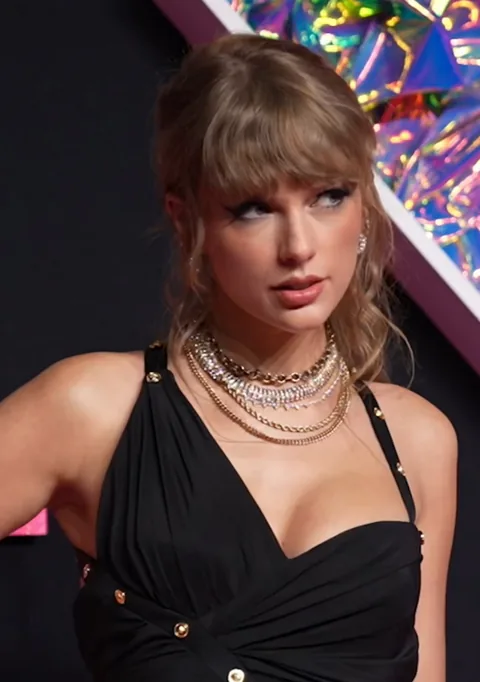
All right, so let's go to Taylor and Travis. I spent a long time really trying to find longitudinal, directly causal studies, data, anything on this. The answer is very, very likely. There was a massive increase from Taylor on the NFL in viewership and engagement and attention and new fans. But what we do know for sure is there's heavy correlation on lots of little data points. Here are a few of them just to throw around at your next cocktail party.
I love that you did this, by the way. I was wondering how quantitative you would get with this.
In the first year of the relationship, September of 23 to September of 24, the NFL added 4 million female fans. The Chiefs were 3.4 million of those.
Wow. Okay, that is the Taylor effect right there.
Again, correlation, but.
Yeah, I'm not a statistician, but I think that's significant.
The biggest demographic or sub-demographic of those 4 million is women under 35, which is a traditionally very weak demographic for the NFL, is one of the few areas of the US where they actually had room to expand. Another data point, Super Bowl 58245Super Bowl LVIII was played on February 11, 2024, in Las Vegas: the Chiefs beat the San Francisco 49ers 25–22 in overtime. It drew 123.7 million viewers, a record at the time. Wikipedia. in February of 24 had a 24% increase in 18 to 24-year-old women and a 9% increase across all women.
And then lastly, Clark Hunt,246Clark Hunt — chairman and CEO of the Kansas City Chiefs and son of Lamar Hunt. the owner of the Kansas City Chiefs, went on the Pat McAfee Show247Pat McAfee — former Indianapolis Colts punter (2009–2016) and host of The Pat McAfee Show, a sports talk show carried by ESPN. Wikipedia. and he said that before Taylor, the Chiefs fan base was about 50/50 male/female, which in itself is amazing. I mean, the league.
That's surprising, yeah.
Has just done a lot of work to make it a sort of family sport, a household sport. But post Taylor, the fan base at the Chiefs is 57% women, 43% men.
Oh, that's amazing. And obviously this is all really fun and it's like the ultimate crossover for us because we did our Taylor Swift episode on the business of Taylor Swift a couple of years ago. But having done our IPL episode last year, obviously we're not saying that the NFL strategy team designed this relationship.
Negotiated this relationship.
Right, right. But if you look at IPL, this strategy was part of their plans from the very beginning and it's how they made it a huge global sport and the biggest sport in India was make Bollywood an integral part of the product.248Bollywood in the IPL: from the start, the league's teams have been owned in part by film stars; Kolkata Knight Riders, for example, is mainly owned by Shah Rukh Khan. Wikipedia. I'm sure the NFL has been watching that and has leaned into this opportunity in a way that they might not have a decade ago.
I'm fascinated that the NFL tried to take kind of a hands off approach at first and the first couple broadcasts, there was a lot of heat for, stop showing Taylor Swift in the box and so they sort of leaned away but then the NFL definitely made a decision at some point that okay, we trust this now, we're in on this.
I mean, to me, that's one of the huge lessons from IPL is the more culturally relevant you can make your sport and your league, the better it's going to be for everything, including and especially media rights.
Yup. A thing that I paid zero attention to that was brought to my attention is the rise of flag football.249Flag football — a non-contact form of American football: instead of tackling, the defender pulls a flag off the ball carrier's belt. Wikipedia.
Have you seen any stats on this?
No, but I hear about it.
It's the way that a lot of women get into the game because girls actually play flag football now as kids and they were never playing tackle football before. The NFL actually has leagues or sponsors leagues like local flag football leagues where they all are named after NFL teams and it's getting a lot more kids into the game, especially as tackle football sort of wanes in popularity due to the concussion risk and injury risk.
From 2019 to 2023, tackle football decreased 5% for the youngest age group playing but flag football increased by 16%. This is, I believe, the fastest growing youth sport in America. It's growing really fast internationally as well, which this is the 30 year win for the NFL because if kids are playing flag football in other countries, it's only a short number of years before we see a meaningful presence of NFL stars who are not from America.
Because they sort of grew up playing flag and then when they hit 13, 14, 15, started playing tackle football. And that's going to be huge for the international growth of the game.
Yeah, I mean, that feels like one of the last, if not the last remaining big needle moving piece for the NFL. If you look at the NBA, if you look at MLB, if you look at Formula One, if you look at IPL, the fact that so many of the stars came from other countries and bring that fan base along with them is huge and that has never happened in the NFL.
Yep, but we're a short number of years away from, I think, seeing a giant breakout star who started in flag football because it was a part of their school or YMCA program250YMCA (Young Men's Christian Association) — a nonprofit network of community centers with gyms, pools and youth sports leagues, found in almost every American town. from another country. Also flag football is going to be in the Olympics.251Flag football at the Olympics: the IOC added it to the program of the 2028 Los Angeles Games. The NFL's all-star game, the Pro Bowl, has been played as flag football since 2023.
Yeah, and the Pro Bowl has been flag football for the last several years, right?
Well, speaking of lower levels of football, we made a big deal early in the episode about the origins of American football and being intertwined with this elite rite of passage, American collegiate experience. The NCAA is an absolute mess right now.
You could not have made it more disorganized and done more of a disservice to their sport, their game, than how this has all played out. I mean, if your goal is pay the players, there are a thousand better ways to do it than the way it has actually played out.
Seriously, so yeah, what actually happened?
Okay, so forever college football, it was illegal to pay players because they're amateurs and they can't receive gifts or cars or endorsement deals or anything. Then there was a Supreme Court ruling a few years ago252NCAA v. Alston: the Supreme Court's June 2021 ruling concerned education-related benefits, but soon afterward, from July 1, 2021, the NCAA let athletes earn money from their name, image and likeness, pushed also by new state laws. where name, image, and likeness became legal to monetize. What sort of ended up happening is these booster groups popped up where groups of-
Alumni or people with vested interests in the school.
Yes, would pool money, not through the school, completely different than the school. And they had funny sounding named organizations and LLCs and websites that looked a lot like the school's colors, but weren't actually affiliated. And they would do these weird deals where they would tell the AD, the athletic director,253Athletic director — the head of an American university's athletic department, who hires coaches and controls the budget of all the teams. or the coach of a team, hey, we've raised X money.
Go tell that high school recruit that if that recruit plays for you, then we will do a private side deal with them to pay them money while they come and play for your team. You have this strange structure happening at the very same time that they created the transfer portal,254The NCAA transfer portal appeared in 2018; since 2021 an athlete can switch universities once without sitting out a season. which for a very long time, the college game had this rule where if you're going to change schools, you have to sit out for a year. It was a big penalty.
You actually had people who are sort of like loyal to their schools, who would play for their schools for three or four years before going to the NFL, who would sort of build a reputation with that alumni fan base.
And with the transfer portal, every year, people just decide willy-nilly to enter it. I'm going to go where I'm going to either make the most money or have the best shot at NFL draft prospects by getting more playing time. The interesting thing is next year is when the schools actually will start being able to pay the players directly.255House v. NCAA: under a settlement approved in June 2025, from July 1, 2025, universities can pay athletes directly, up to about $20.5 million a year per school. And there's like a salary cap of sorts.
The reality is right now, I think it's all still too messy and in flux to definitively say what the impact of all this will be on the NFL. But to me, it's just sort of like the final formal nail in the coffin that football in America is the NFL these days in a way that when the NFL was starting, football in America was the collegiate experience.
That's interesting.
It's now like come full circle and fully flipped that, like the legitimate football league is the NFL. And the Wild West illegitimate who knows what's going on is the NCAA.
Uncoordinated, everybody just acting in their own short-term best interest, including the schools, the way that the super conference alignment256Superconferences — the Big Ten and SEC, the largest college athletic conferences, which in the 2020s lured away the leading football schools for the sake of lucrative TV deals. happened and the Pac-12 completely blew up.257Pac-12: in 2023–2024 ten of its twelve universities left the conference for the Big Ten, Big 12 and ACC. And it's just so sad to watch as someone that is a really big fan of college football. One interesting take you and I both heard from separate people is that it's actually been good for the NFL because now that players can make money in college, there's not as much of an incentive to get thrust into the NFL before they're ready.
They can sort of develop longer mentally and physically before coming to the NFL. We may have sort of better rookie classes out of the draft in future years as you sort of see more sort of mature players coming out.
Yeah, our teams can be more analytically confident in the draft choices that they're making as a result of this. That said, it's all still too chaotic right now to tell.
15Private equity
The rushed sale of the Commanders showed that strict ownership rules had left the NFL with almost no buyers, so the league let private equity in on its own terms, and team values rose 62% in three years.
Yes. All right, so our big ultimate thing here, team valuations have gone up way more than I would have predicted.
Yeah, it's funny. We spent the whole original episode and now this whole update section, talking about all the business drivers of the NFL and all the trends and all the things that are going on that theoretically should increase the value of the league and its teams.
It's ironic that probably the one really big glaring area in the original episode that we didn't cover at all was the dynamics of team ownership and thus collectively in aggregate league ownership of the NFL. Now this is actually probably good because this is also the single biggest thing that changed in the NFL since we made the original episode.
Right.
Okay, so what has happened over the last couple of years? The NFL has long had a pretty strict code around team ownership. Other sports leagues have regulations too about who can own teams and what ownership groups can exist, et cetera. But the NFL has always had the strictest set of regulations around this. With the one grandfathered exception of the Green Bay Packers, which are a publicly owned nonprofit corporation.
Sort of.
Sort of, except for them. Every other team in the NFL must be controlled by a single principal owner who is a natural person and not a corporation. And that person and their family must have a minimum equity stake in their franchise of 30%. And that must be pure equity, like funded with cash or by appreciation of the value of your ownership of the team by one person, one family. You are allowed to have debt in your capital structure, but the league imposes a ceiling. That ceiling is currently $800 million with one exception.
Oh, they denote it as a number.
Yeah, it's not a percentage because it's debt. In your capital structure, you can have a maximum of $800 million of debt that you carry. You can have about twice that if you are buying a team. They let you go double it in the process of purchasing to have more debt to finance the deal. But obviously still, double that to $1.5, $1.6 billion. That's not going to buy you a lot of an NFL team these days.
No, and we'll get to the real numbers, but at most, that's probably what a quarter of what a team would cost.
Maybe for like the Bengals or somebody, not for a real team, no, Bengals are great. Okay, so the principal owner needs this 30% stake funded with cash. In addition to the principal owner, that person is allowed to have up to 24 other minority owners as part of their ownership group.
But those 24 other people must be silent with no operational control. And the way they actually structure this is hilarious. They structure it like an investment fund. It's a GPLP entity.258GP/LP — the structure of venture and private equity funds: the general partner manages the money and makes the decisions, while the limited partners only contribute capital. The principal owner is the general partner. And then all the minority partners are limited partners.
Can they take fees and carry on their LPs?259Fees and carry (management fee and carried interest) — a fund manager's income: typically about 2% of capital a year and 20% of investors' profits, the classic "2 and 20." Or is it a?
Well, we'll get back to that in a minute.
Okay.
For a long time, this ownership structure and ownership code was actually, I think, a key part to the NFL strategy working. It might've actually been the single biggest driver of this whole architecture that we've talked about all episode working.
Permanent capital260Permanent capital — money with no return deadline: unlike a fund, which has to sell its investments and return the money to investors after about 10 years, an owning family can hold a club for decades. individually held by highly motivated, passionate individuals, not thinking like a pool of capital would.
Exactly. These are real flesh and blood people, not corporations. They have enormous skin of the game. A huge portion of their family's wealth is invested in the clubs. They run them personally. They make the decisions.
They are effectively the CEOs of these organizations. And you're able to get all 32 of these people, or 31 plus the Packers, into a room a couple times a year. And they can hash out and say like, hey, these are the things, collective capitalism. These are the things we're going to do that are going to be good for the league and putting team second, like negotiating central national media rights, et cetera.
Yeah.
All of this worked great until the summer of 2023. When the Washington Commanders, formerly until recently at that point known as the Washington Redskins, stumbled into a distressed situation. We don't need to get into all the details here, but most folks who are followers of the NFL probably know that then principal team owner, Dan Snyder, who had owned the team for almost a quarter century, essentially got brought down by a whole series of scandals.
There was sexual harassment. There was workplace harassment. There was financial improprieties. There was the fact that he steadfastly refused to change the name of the team for like a decade, even after it's kind of untenable what the name was.
You needed an ownership change and suddenly you needed it fast.
If you go to Dan Snyder's Wikipedia page, it literally says on his Wikipedia page, Snyder is widely considered to be one of the worst owners in the history of North American professional sports and has a whole train of citations after that. This ultimately ends up in 2021, two, three, in a US congressional investigation into the Redskins slash Commanders and Dan Snyder's ownership of them.
And at the end of 22, as these investigations are ongoing, the rest of the owners in the NFL finally decide like, enough, we need to kick this guy out of the league and force him to sell the team, which they can do by the NFL's bylaws. If there is a super majority vote of at least 24 of the other principal team owners, they can force one of the other owners to divest the team.
Now it doesn't actually come down to a vote, but just by virtue of having that leverage in 2023, Snyder finally steps down, stops fighting and says, okay, I will bow to the pressure and initiate a sale process here. Well, the good news, bad news for the NFL is that because they've been so successful and the Washington football team is a great franchise, great stadium rates, et cetera.
Key market.
This is an extremely valuable asset. Yes, on the one hand, that's great news. It's validation of the NFL's whole strategy for the past hundred years. On the other hand, they've kind of become hostages of their own success because of all the strict ownership rules that they have. They now need to come up with a new principal owner candidate who has enough liquid cash to cover an emergency purchase of 30% at least of the Washington football team.
And the most recent purchase was the year before?
When the Walton family bought the Broncos,261The Broncos sale: in June 2022 a group led by former Walmart chairman Rob Walton agreed to buy the Denver Broncos for $4.65 billion, a record at the time. Wikipedia. I think for 4.65 billion.
Yes, you already have this new very high watermark and you already found the family behind Walmart. You need to keep going down your list of where can we find liquid principal family owned capital?
Just put some numbers on this. The Commanders ultimately sell for just north of $6 billion. The minimum required cash equity check here is at least $1.8 billion that you need somebody who just has that liquidity lying around that they could in a fast process invest in an NFL team.
They also have to fit the Venn diagram of want to own an NFL team based in Washington, DC. This is not a large pool of buyers here. Ultimately they do find a buyer, Josh Harris,262Josh Harris (born 1964) — co-founder of the private equity firm Apollo Global Management (1990) and managing partner of the Philadelphia 76ers, the New Jersey Devils and the Washington Commanders. Wikipedia. who is the co-founder of the huge private equity firm Apollo and already owned the Philadelphia 76ers in the NBA and the New Jersey Devils in the NHL.
He comes in as the principal owner and the new ownership group of the Washington football franchise along with 20 other limited partners. That's the other problem here. You also need this person to have enough friends who are willing to throw in that can cough up another like three to $4 billion in cash here.
Yes, there's the 1.5 billion in debt, but that still means you need 4 1/2 billion in cash. It's kind of a miracle that this all happens. It started impacting the game too. It's like, because this is all during the off season that this is going down. What's going to happen to the Commanders? Are they going to continue operations? It's crazy.263Dan Snyder owned the club from 1999. In July 2023 the NFL owners unanimously approved the sale of the team to Josh Harris's group for $6.05 billion, a record for a sports team at the time. Wikipedia.
Uncertainty is not good for the league.
No, definitely not.
They forecast revenue 15 years in advance.
Once all the dust settles, the owners are like, all right, we can never have this happen again. We know we need to change something here. The next off season in summer of 2024, they vote to allow private equity into the NFL.264Private equity — funds that buy stakes in companies in order to sell them for more a few years later. In August 2024 the NFL owners allowed selected funds to buy up to 10% of a club.
Basically all the other major sports leagues around the world had already done this, and the NFL was the last holdout. And again, you can understand why, like having these strong principal owners that can all get in a room and negotiate, think long-term, have a huge part of their family's net worth be the team. It all makes sense.
But private equity desperately wants to get in, and more than ever, you now need private equity's money. But the NFL still has leverage. It's still the cream of the crop thing to own, and they've watched private equity go wrong in all these other sports leagues.
This is where the NFL proves once again that they truly are N of one. They meet with a bunch of private equity firms, talk amongst the ownership group, hammer out a new set of ownership regulations for NFL teams. Here are the four major rules that they drop.
Number one, the NFL will approve a set list of private equity firms, large private equity firms, who have the opportunity, the option, the ability to invest in league franchises. That list is vetted by the NFL, subject to change. And if you are not on that list, you are not allowed in. And that set of firms right now is only four, four very large private equity firms that have the anointed ability to invest in NFL teams.265The approved firms: in August 2024 the list included Arctos Partners, Ares Management, Sixth Street and a consortium that includes Blackstone, Carlyle and CVC.
Number two, those private equity firms are now allowed to own up to 10% of the equity in NFL franchises, but no more than 10% under any circumstances. That is the smallest cap of any major sports league out there, if they have caps at all on private equity ownership.
Three, these private equity firms will be fully silent, limited partners in the ownership group, with no control and no rights, pari passu, exactly the same effectively as all of the previous individual limited partners in the ownership groups.
If you're a random movie star who happens to own a little tiny bit of a team, you have the same rights as a PE firm who owns 10%.
Yep, you have the same rights as Ares Management, or Sixth Street or Carlyle or the small set of firms. And then number four, this is the kicker. Upon any eventual sale or monetization of the ownership stake that private equity would have in an NFL franchise, a portion of the returns on that investment get skimmed off the top and go back to the NFL and then get distributed equally among all 32 NFL team ownership groups. This is wild.
You texted me this, I couldn't believe it, but suddenly everything makes sense.
That's why there's an anointed set of four. It's not just there's only four PE firms we trust. There's four PE firms that we went and we did a deal with, where if they buy into our league, we effectively get carry on their investment because when they sell, we get some of the profits.
It's funny, you asked about carry in the ownership structures. I don't know mechanically and legally how this actually works, but in practice, this is exactly what it is. The NFL invented a way to charge carry on investor ownership on franchises in the league. It feels like the ultimate pinnacle of the collective capitalism mindset and ethos of the NFL.
Now, one interesting thing, a way to look at this is that it is the NFL pulling yet another lever at their disposal to achieve competitive parity. The league is using the fact that PE firms want desperately to be in as a way to redistribute the wealth from increases in these incredibly high value teams that private equity is buying into and distributing that out to all of the other 31 owners.
Yes, exactly. That's what I was going to say. I think this was one of the big sticking points that emerged in the owner meetings as they were contemplating how to do this, which is that only a subset of the teams are going to avail themselves of the private equity option, either through sales of the franchises or through minority stake investments that have been happening a lot.
If you do that, we all get paid.
Right, but it would have created an imbalance. Some subset of the teams have embraced private equity, gotten these big liquidity stakes, had their valuations get reset and the other set of teams hadn't, for whatever reason, they decided the family wants to keep 100% or near 100% ownership, et cetera, et cetera. This is just brilliant.
Yeah, so quick, interesting math. As of today, Forbes estimates the average team is worth $7.1 billion up from four and a half billion when we did the episode. Team valuations now are $228 billion in total up from 140 billion when we recorded the episode. That's up 62%. And again, these are estimates because these are mostly not liquid assets but interesting to know that.
Well, it's funny you say mostly not liquid assets. A large number of them have become liquid assets.
Have opened up sales to minority owners.
Yeah, because what's basically happened, there have been no full team sales since the Commanders transaction that precipitated all of this, but a large number of teams have used this as a way either with private equity or interestingly more often without private equity, usually with family offices266Family office — a private company that manages the fortune of one wealthy family. to sell minority stakes in the franchises and get liquidity for the ownership group.
But private equity being able to buy in since they're a bidder drives up the valuation. Even though they're opening up sales to all these individual people.
The prices are set by institutional capital. The Dolphins, Bills, Chargers, Giants, Eagles, 49ers, Raiders, Browns and Patriots have all sold minority stakes over the last call it two years and all at extremely higher valuations than they would have had this not happened.
I also heard from some wealth managers that advise people who are buying into teams that they are allocating this to people's fixed income portfolio.267Fixed income — bonds and similar investments that pay known, regular amounts, unlike stocks.
That buying into an NFL team, you almost treat it like-
Like an annuity.268Annuity — a financial product or stream that pays its holder equal regular payments, usually for life or for many years.
An annuity, yeah, I just know that it's going to spit off this much cash each year and it's like buying a bond.
I mean, everything we've talked about in this update have basically all been extremely positive developments for the NFL and its business, but nothing we talked about until now would have caused 60% asset value appreciation in three years, except for this.
Oh, multiple expansion is crazy. Forbes now estimates the annual revenue multiple in the NFL is 10.7x, which is up from 9x in 2024 and 6.4x five years ago. In five years, it went from 6.4x to 10.7.
It's funny how supply and demand will do that.
Yeah, investors either think there's much more durability and growth in these franchises than they did before, or they just don't care and they want to own a scarce asset.
Well, the NFL ownership group had so constrained the buyer investor market before it. Like such a tiny, tiny narrow window that buyers and investors actually had a lot of leverage. This has opened that window much, much, much wider.
It is funny to just do the quick math on what the sort of carry is on the carry type thing. At 10% stake of a team that's worth $8 billion, you're putting up 800 million as a private equity firm. Let's say that goes up 30% before you exit your position. That's a gain of 240 million.
I have no idea what the spiff is or the carry. Let's assume it's 10%. I don't know if that's conservative or not, but it's less than 20%. That 10% would be $24 million that the rest of the owners just get for free as a little thank you for letting private equity participate in our league here.
Which, hey, in the context of the revenue of the NFL, that's not a lot, but that's just for a transaction around an individual team. Collectively, the transaction potential is 32 of those.
Right. My last comment on valuations and how each of these teams are doing as businesses, give you a couple other data points here. Forbes now estimates the Cowboys are worth $13 billion. The Cowboys are the high watermark because the Cowboys have an exceptional amount of local revenue that they produce, as we mentioned earlier on the episode.
The estimated 2024 revenue of the Cowboys was $1.2 billion while posting an operating income of 630 million.
That's actually a reasonable valuation. You're talking about 10x revenue and 20x operating income?
But to my point on the disparity here between the most thriving team and the least thriving, sure, the Cowboys can spit off 630 million in profit. The average team spits off 127 million in profit and the least profitable team only generates 21 million in profit.
A couple points here. One, NFL teams are now just always reliably profitable businesses. That's not true in most sports and it wasn't true in the NFL's history, but if you own an NFL team, you are going to get, I believe get a dividend check every year since they're cash generative.
But two, this league first mentality is going to be really tested in the coming years with these enormously profitable teams at the top and these teams at the bottom. I mean, $21 million, that really illustrates why a $24 million payday coming from private equity, every individual million that you stack on top of that 21 is very impactful to your profitability as a business overall.
Even though valuations have become stratospheric and the NFL is a better business than ever, the team disparity, especially on the bottom line thing, I continue to be concerned about that.
That remains the bear case for the NFL going forward.
All that said, for the moment at least, communist capitalism is alive and well in the NFL.
And the answer to the question we had three years ago of could the NFL grow from here is resoundingly abso-freaking-lutely.
Yeah.
If by asset value, if nothing else.
Yep. And that is a great place to leave it. Well, we have some thank yous, especially to folks that helped us with the follow-up research. My biggest one goes to Jeff Dunn, the chief strategy officer of the Seattle Seahawks, who I spent a good amount of time with prepping for this, especially while we are here on our playoff run. We are recording this right ahead of the NFC championship.269The NFC championship: the Seahawks won it, and on February 8, 2026, they also won Super Bowl LX, beating the New England Patriots. So sorry, David.
Oh, he's driving the knife in, oh. Well, my thank yous are to all of our many friends in the 49ers organization who sadly I felt less bad about emailing this week after your Seahawks.
Yeah, they had some free time.
Yeah, yeah, yeah. Knocked us out of the playoffs last week.
They're great. Every single person we've worked with the 49ers and talked to to help prep and just gotten to know over the last few years has been great.
They've been immensely helpful, become good friends. And we also have them to thank for helping bring Super Bowl 60 back to the Bay Area and launching the innovation summit and having us be part of it.
I know, it's funny that we talked about the whole creation of Super Bowl Media Week as this big innovation and all the gloss and sheen that it adds to the game. And now we get to be part of the gloss and sheen.
Acquired as part of the gloss and sheen. If you had told us that three years ago, I don't know what we would have said.
Absolutely not. As always, all of our sources for this episode, including updated sources, are linked in the show notes.
And for any of our partners, you can click the link in the show notes to learn more about any of them. For the Super Bowl Innovation Summit, you will, after the Super Bowl, be able to watch everything that we did on stage at the Innovation Summit. Links to more information on that are in the show notes as well.
If you want to discuss this, please come to the Acquired Slack. That is acquired.fm/slack. We have a thriving, thoughtful community going there discussing this and every past episode. If you liked this episode, check out our episodes on the NBA, IPL cricket, and recent ones on Coca-Cola and Trader Joe's that were super, super fun.
And if you want to join our massively upgraded email list, where you get interesting behind-the-scenes photos from our research that we find, or our big takeaways from the episode, or the key numbers that, when you're trying to convince your friend you should listen to Acquired, the baffling stats that you learned, and things like help us pick future episodes by weighing in in the polls that we do each season, you can join that at acquired.fm/email. So thank you so much to everyone who is on that list.
And with that, listeners, we'll see you next time.
See you next time.


