

The Cal Newport Show
Chapters
Talking about technology has gotten hard because commentators have split into two extreme camps: pessimists are right about the harms but would rather stay put, while optimism pushed far enough turns anti-humanist.
Read the chapter- Cal's classic example of techno-pessimism is the Luddites of the early 1800s, who wrote in an 1812 letter signed by General Ludd that they would rather die than see hand weavers' children starve.
- The harms pessimists worry about are often real, Cal says, but sometimes we have to go through short-term pain to reach long-term innovation.
- The Industrial Revolution was painful for many professions, yet it delivered essentially all the wealth the modern world is built on, and Cal says we wouldn't want to live in a world without it.
- Techno-optimists are in love with a vision of a much better future, and to them the short-term cost is always worth it.
- Cal plays a clip of Elon Musk telling Peter Diamandis that humans are the "biological bootloader" for digital superintelligence, and calls where that view leads "pretty icky."
For the silent majority, Cal proposes techno-selectionism: keep heading toward a better future, but steer around the obstacles and take an active hand in which technologies get adopted.
Read the chapter- Cal introduced the term in a 2023 New Yorker essay, and on rereading it recently decided it's more relevant now than ever.
- On the map he drew, the pessimist circles the "current moment," the optimist makes a beeline for the "better future" through snakes, fire, thorn thickets and water, and the techno-selectionist goes around most of the obstacles.
- Cal reads the essay's definition: innovation can significantly improve our lives, but no popular invention is inevitable, and you can be enthusiastic about AI while taking a strong stance on settings where it should be blocked.
- You can marvel at the benefits of the social internet, the essay says, without surrendering your kids' mental lives to TikTok.
- Being a techno-selectionist, Cal says, means actively shaping how technology is adopted and developed, to maximize the good while avoiding as many harms as possible.
The first two of the "four C's" give you the right to decide which technologies to use and to set your own rules for the ones you keep.
Read the chapter- Just because a technology is popular or everyone on X is posting about a breakthrough, Cal says, doesn't mean you have to use it.
- Brad Stulberg, on the show earlier this fall, said that as a writer and coach he doesn't need LLMs: they get in the way of his best ideas and make him unhappy.
- When Cal gave up social media in the 2010s, people got upset and asked if he was Wendell Berry, and ten years later no one thinks it's crazy.
- In his 2019 book Digital Minimalism, Cal calls rules for using a technology "fences": members of a biking club, for example, configured Facebook so they saw only their groups.
- A visual artist checks Instagram only on Fridays, for 20 minutes with a glass of wine, and a fitness influencer shoots on a GoPro and hands the uploading to someone else in his company.
Starting to use a technology isn't a Faustian blood pact, and you can drop it once it starts making your life worse.
Read the chapter- It sounds obvious, Cal says, but a lot of people don't know they're allowed to do this.
- His clearest example is social media over the last four years: chasing TikTok, Facebook, Instagram and Twitter moved to an algorithmic feed and stopped caring about the social graph that used to be the whole selling point.
- Cal wrote about this in a New Yorker essay called "TikTok and the Fall of the Social-Media Giants."
- He sees something similar with AI: early adopters' excitement gives way to "full cognitive surrender," when they can't even put their thoughts into an email without it.
- Changing your mind is fine, Cal jokes, like backing away from a blind date once your companion brings out the binder of Pokémon cards.
Systemic change, Cal argues, starts with individuals telling their schools and communities "I don't like this."
Read the chapter- Cal calls the fourth C a bridge between the individual and the systemic: most cases where tech harms were curbed started with pressure from individuals.
- The 2025 bell-to-bell smartphone bans in schools, Cal says, came from parents who had read Jonathan Haidt's book, not from schools with new data.
- In 2026, Cal says, legislatures in 16 states proposed laws limiting how long kids can spend on edtech screens, all driven by parental pressure.
The AI debate has turned into a fight between two gangs, while most people want neither and are happy to judge each thing on its merits.
Read the chapter- Cal compares the sides to the Sharks and the Jets: one gang is engagement-pilled on X and lives on disruption, the other dislikes those people and everything going on, and each tries to claim you.
- Cal's example is the hype around "Black October": there are hundreds of PHP vulnerabilities that have been found for years with ordinary tools, and this one drew attention only because an AI model found it.
- The "swarms" supposedly breaking into banks, according to Cal, were individuals who sent personal AI agents like Muse and Dots to do their banking.
- Most people, Cal says, don't want to join either gang in this techno-discourse prison yard and are willing to say "that's cool, that's not," which is what techno-selectionism is.
- He closes by reading from his essay that productive evolution depends as much on subtraction as addition.
For Cal, a chatbot works best as the missing manual for poorly documented software, even though it is often wrong.
Read the chapter- At Jesse's request, Cal explains that he asks a chatbot how to do something in a program when he hits an error or can't figure it out.
- For a Halloween scene with thunder, lightning and electrical zaps, he uses the open-source tools of the synchronized Christmas light-show crowd, which aren't well documented.
- Chatbots invent menu items that don't exist, and with his Raspberry Pi network ChatGPT led Cal down rabbit holes until Gemini told him to unplug the Ethernet cable and plug it back in.
- A chatbot, Cal says, is like a friend who knows more than you but isn't your smartest friend, so you ignore its dumber theories.
- Cal jokes that every word of the episode is an AI script voiced by ElevenLabs, then admits ElevenLabs' sound effects for his Halloween display weren't very good, so he used free ones.
A chatbot can be configured to teach you rather than think for you, and Cal sees Robert's letter as a model of techno-selectionism.
Read the chapter- Robert writes that you can ask an LLM to quiz you or guide you without giving the answer outright, which is the whole premise of AI study tools.
- Cal recognizes this as the configuring C: rules for using a technology don't have to be all or nothing.
- As a mathematics professor, Cal finds chatbots good tutors for basic math when you go back and forth on problems with a clear right answer, such as an expectation formula.
- Instead of cognitive offloading leading to cognitive surrender, Cal says, you get smarter and do better on the test.
- Chatbots also give wrong information confidently, so Cal suggests pointing one to a page with an explanation and asking it to make that simpler.
Offloading hard things to AI can hurt not just your mind but your mental health, which is one more reason not to use a tool just because it exists.
Read the chapter- Augustino, a professor in a medical field, chairs the well-being committee for interns and residents who increasingly rely on AI for medical records.
- He writes that overcoming hard things makes us stronger and shows us we are capable of them, and that when everything comes easily and fast, mental health suffers.
- Cal calls this a good follow-up to his newsletter "The Good Thing About Hard Things," where he argued that offloading demanding work can cost you both the taste for it and the ability to do it.
- Just because a tool exists, Cal answers, doesn't mean we should offload tasks to it, especially if it makes our minds weaker or us less happy.
Jay's story, Cal says, shows someone choosing and reconfiguring his technologies until they stop pulling him into algorithmic rabbit holes.
Read the chapter- Jay quit Instagram and other social media in high school after reading Deep Work, and left Twitter after Digital Minimalism.
- Without social media he had no idea what was going on, so he started reading newspapers.
- He still had a lot of free time, and to keep social media from creeping back in, he picked up the habit of reading.
- Cal calls this a great example of someone taking control of their technological fate.
A slow paper system doesn't hold a writer back but helps, because the core of a book is long, hard work with ideas, not the speed of organizing research.
Read the chapter- James sent Bryan Curtis's Substack piece on Lawrence Wright, who believes living in Austin, away from the New York scene, let him focus on writing what really interests him.
- Cal shows a photo of Wright's filing cabinet for The Looming Tower: about a hundred tabbed folders like "Looming Tower: Osama bin Laden," filled with handwritten cards of quotes and notes.
- An AI agent with a RAG database and a JavaScript dashboard wouldn't have helped, Cal argues, because the slowness was probably part of the work.
- The publisher, Cal says, paid Wright for how good a book he could write, not for how quickly he could organize research.
- Jesse brings up Ryan Holiday, and Cal relays what Holiday told him: copying quotes onto index cards by hand files them away in his brain, while a chatbot would only offer a generic example.
Cal is changing his studio backdrop and runs through his five October books, which taught him that memoirs aren't about business strategy.
Read the chapter- On video next to a guest, the black backdrop looks like a black hole beside their bright scene and confuses Zoom and Riverside, so the studio needs a lighter one.
- Ari Emanuel's memoir Roll the Calls shares a ghostwriter with Andre Agassi's and Prince Harry's memoirs, but unlike Mike Ovitz, Emanuel barely talks about his clients, even though Entourage grew out of his client Mark Wahlberg's idea.
- From Dave Portnoy's memoir Cal hoped to learn how Barstool Sports bet on podcasts, but found stories for fans, like getting arrested at NFL headquarters after Deflategate.
- Cal also finished Telephone, a 1975 history of AT&T, and The Treeline, a very dense book about the tree line shifting with global warming.
- He is now listening to Warren Littlefield's memoir of Must See TV, prompted by Acquired's Seinfeld episode, but it isn't working well on audio.
Quotes
On techno-optimism pushed too far
“I mean, clearly we see why the techno-optimist view, pushed far enough, gets to these sort of anti-humanist, pretty icky places.”
Cal NewportRead from 02:36On who needs a third way
“I want to argue to you today that there is a third option for the silent majority of people who have a more nuanced, practical view of technology.”
Cal NewportRead from 03:26On the right to quit a technology
“Just because you started using something doesn't mean that you have signed some sort of Faustian blood pact, and now you have to stick with it no matter what happens.”
Cal NewportRead from 17:22On the AI debate
“It's basically a techno-discourse prison yard, and if you don't join, you know, either the white nationalist or the fascist group or whatever, you're going to get beat up in the cafeteria.”
Cal NewportRead from 26:27From Cal's New Yorker essay
“Just because a tool exists and is popular doesn't mean that we're stuck with it.”
Cal NewportRead from 26:57On AI systems for writers
“The publisher didn't pay Lawrence Wright for how quickly can you organize research. They paid him for how good of a book can you write.”
Cal NewportRead from 46:48On a writer's slow filing cabinet
“My filing cabinet slows me down enough that I can actually think and produce good work.”
Cal NewportRead from 47:21
Summary
Talking about technology keeps getting harder because commentators have split into two camps. Techno-pessimists, from the Luddites to today's critics, see real harms but would rather stay put; techno-optimists will pay any price for a shining future, all the way to Elon Musk calling humans a mere "biological bootloader" for digital superintelligence. Cal Newport offers a third way for the silent majority: techno-selectionism, a term from his 2023 New Yorker essay. Keep moving toward a better future, but steer around the obstacles.
Becoming a techno-selectionist takes four actions: choosing which technologies to use (as Brad Stulberg did in turning down LLMs); configuring them around your values (the "fences" of Digital Minimalism); changing your mind when a technology makes life worse (as social media did once it copied TikTok); and complaining to institutions, which is how parents won phone bans in schools. The third way is needed, too, because the AI debate has become a prison yard where everyone gets assigned to one of two gangs, as the hype around "Black October" showed.
In the second half, Cal describes how he actually uses chatbots, as a missing manual for his Halloween light show, answers questions about LLMs as tutors and the cost of avoiding hard things, and uses Lawrence Wright's filing cabinet and Ryan Holiday's index cards to show that a slow system can be exactly as efficient as it needs to be. He closes with his October books: memoirs by Ari Emanuel and Dave Portnoy, Telephone and The Treeline.
Mentioned
- Luddites00:00the classic example of techno-pessimism
 Elon Musk02:19"humans are the biological bootloader"
 Peter Diamandis02:19Musk's interviewer on the Moonshots podcast
- It's Time to Dismantle the Technopoly03:26the essay where Cal coined "techno-selectionism"
Show 50 more mentionsShow fewer mentions
 The New Yorker03:26Newport first used the term “techno-selectionism” in a 2023 essay for the magazine to describe choosing which technologies to adopt.
 Brad Stulberg12:55turned down LLMs for his work
 Wendell Berry13:39a byword for refusing technology
- Digital Minimalism: Choosing a Focused Life in a Noisy World14:33"fences" around technology
 Facebook15:07groups without the news feed
 Instagram16:18an artist checks his feed once a week
 GoPro16:52a camera instead of a phone for a fitness influencer
- TikTok and the Fall of the Social-Media Giants18:04Cal's essay on social networks imitating TikTok
 TikTok18:04an algorithmic feed with no social graph
 ByteDance18:04TikTok's owner
 Jonathan Haidt22:02his book convinced parents
- The Anxious Generation: How the Great Rewiring of Childhood Is Causing an Epidemic of Mental Illness22:02Newport says Jonathan Haidt’s book helped persuade parents to push for all-day smartphone bans in schools.
 PHP24:39vulnerabilities and "Black October"
 Muse25:53Meta's personal AI agent
 Dots25:53OpenAI's personal AI agents
- Technopoly: The Surrender of Culture to Technology26:57where the word "technopoly" comes from
 Neil Postman26:57Newport borrows Postman’s idea of a technopoly to explain why people feel unable to reject a popular technology.
- Raspberry Pi30:05the controller for the Halloween lights
 ChatGPT30:05led Cal down rabbit holes
 Google Gemini30:38had the right answer
 ElevenLabs31:13its sound effects didn't work out
- Deep Work: Rules for Focused Success in a Distracted World40:28the "Quit Social Media" chapter
 Substack42:28A listener sends Newport a Substack piece by Bryan Curtis about the working habits of writer Lawrence Wright.
 Lawrence Wright42:58his filing cabinet for The Looming Tower
- The Looming Tower: Al-Qaeda and the Road to 9/1142:58Newport introduces Lawrence Wright through his book on the origins of the September 11 attacks before discussing how he writes.
 Ryan Holiday47:59index cards with stories and quotes
 Zoom50:19can't handle the black backdrop
- Simplify: Do 50 Percent More with 50 Percent Less50:36a book by the founders of Axios
 Axios50:36Newport’s October reading list includes Simplify, a book by the founders of Axios.
- Telephone: The First Hundred Years50:36a history of AT&T
 AT&T50:36Newport finished a 1975 history of AT&T whose author, he says, was the first to gain access to the company’s files.
 Ari Emanuel51:10the super agent's memoir
- Roll the Calls51:10Newport liked how the narrative in agent Ari Emanuel’s memoir captures the way Emanuel thinks.
 Rahm Emanuel51:10Ari's brother
 J.R. Moehringer51:10the memoir's ghostwriter
 Michael Ovitz51:47a memoir full of Hollywood stories
 Mark Wahlberg52:19Emanuel's client and the model for Vince
- Entourage52:36the show about Wahlberg's entourage
 Jeremy Piven52:40played the agent Ari Gold
 Dave Portnoy53:40a memoir about founding Barstool
 Barstool Sports53:40Newport picked up the founder’s memoir to understand how Barstool Sports came to bet on podcasts.
- Cancel Me If You Can53:56Newport hoped Dave Portnoy’s memoir would explain his business decisions. One story that stuck was his arrest at NFL headquarters.
 Roger Goodell53:56the protest after Deflategate
 National Football League53:56Newport recounts Dave Portnoy’s story of protesting at league headquarters after the Deflategate controversy.
- The Treeline: The Last Forest and the Future of Life on Earth55:15a book about the northern edge of the forest
 Ben Rawlence55:35Newport discusses Rawlence’s book on how warming is shifting the northern tree line, from Siberia to Alaska.
 Warren Littlefield56:57a memoir of Must See TV
- Top of the Rock: Inside the Rise and Fall of Must See TV56:57The Acquired episode on Seinfeld prompted Newport to pick up Warren Littlefield’s account of making television at NBC.
- Seinfeld56:57Acquired's episode on the show
 NBC57:09Newport is listening to Warren Littlefield’s account of how NBC built its Thursday-night Must See TV lineup.
Sponsors of the episode
 Monarch Money09:16a personal finance app with a debt payoff simulator; Monarch Core's first year half off with code DEEP
 Superhuman09:16the Superhuman Go AI assistant, right in your browser tab
 Pipedrive31:52a sales CRM with AI briefs and notes, 30 days free
 Indeed31:52Sponsored Jobs to boost job posts, a $75 credit
Transcript
01Techno-pessimists and techno-optimists
Talking about technology has gotten hard because commentators have split into two extreme camps: pessimists are right about the harms but would rather stay put, while optimism pushed far enough turns anti-humanist.
Have you noticed that it's become increasingly hard to talk about technology? I think this is because a lot of commentators have divided themselves into two different groups, both of which can become pretty extreme. All right. So on one side, we have what we can call the techno-pessimists. Now, the techno-pessimists are worried about the harms that new technologies can cause and the things that we value that new technologies might make go away. I think the classic example of techno-pessimism would be the Luddite movement1Luddites — English weavers and textile workers who smashed the machines taking their jobs in 1811–1816. The name comes from a fictional Ned Ludd, "General Ludd." In 1812 Parliament made machine-breaking a capital crime. Today "Luddite" is shorthand for anyone who opposes technology. from the early 1800s, who were worried about new automated manufacturing technologies like the steam loom2The power loom was patented by Edmund Cartwright in 1785; in the early 19th century looms driven by steam engines and water wheels began to displace hand weavers. and their impact on artisan crafts.
They felt really strongly about this. I have a letter here from 1812 written by members of the movement and signed by the sort of fictional creation of General Ludd.3General Ludd's letter is dated April 12, 1812, and signed "G. Ludd"; text of the letter, linked in the episode description. And in this letter, they said they would rather die than see their children, which they called "your neighboring fellow creatures," starve, because hand weavers were going to be put out of business. Now, the thing about techno-pessimists is that they're often right, in the sense that the harms they're worried about are real, and they are harmful, and they do hurt. The issue with the techno-pessimist is that sometimes we have to go through short-term pain to get to long-term innovation that ends up making everybody's lives better. If we go back to the Luddite movement, let's zoom out to the Industrial Revolution writ large.
And what we see is, yes, for a lot of professions, the Industrial Revolution was very painful in the moment. Techno-pessimists of the time were right, but the Industrial Revolution also delivered essentially all of the wealth on which the modern world was built. We would not actually want to be living in a world today in which the Industrial Revolution never happened. Okay, on the other extreme, we have what we can call the techno-optimists, who really don't care about short-term harms or things we could lose right now, things we already value, because they are often in love with this vision of some sort of much better future that the technology will deliver, and the short-term cost in their mind is always worth it. This can get to pretty unnerving places. Like, let me play you a clip here.
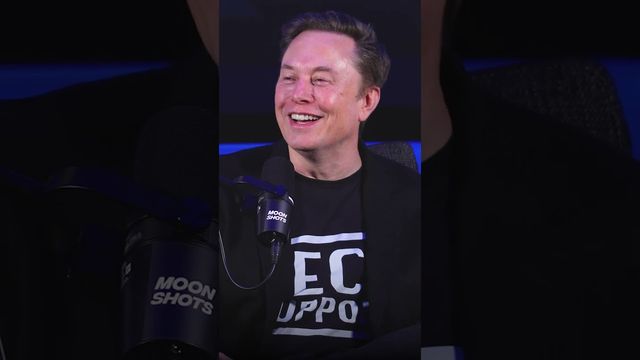
This is Elon Musk talking to Peter Diamandis4Peter Diamandis (born 1961) — American entrepreneur, founder of the X Prize Foundation and cofounder of Singularity University; he hosts the Moonshots podcast. about humankind and superintelligent AI.
I mean, several years ago I said humans are the biological bootloader5Bootloader — a small program that runs first when a computer starts, loads the operating system and hands over control. Musk used the metaphor as early as an August 2014 tweet: "Hope we're not just the biological boot loader for digital superintelligence. Unfortunately, that is increasingly probable." for digital superintelligence. Yes, we are a transitional — we are a transitional species. We're a bootloader.
So what they're saying in this clip is that humans right now are essentially what they called biological bootloaders, basically just a step that gets us to the technological utopia they really care about, which is one in which we have a superintelligent AI that delivers us some sort of mystical world where, you know, everyone is happy and our consciousnesses are uploaded into a Dyson sphere6Dyson sphere — a hypothetical shell around a star that captures nearly all of its energy, described by physicist Freeman Dyson in 1960.-powered celestial digital consciousness or something like this, right? I mean, clearly we see why the techno-optimist view, pushed far enough, gets to these sort of anti-humanist, pretty icky places. So where does that leave the rest of us? Those of us who recognize that we need technological advances to continue to improve the state of human existence, and yet are also not really interested in hanging out with the biological bootloader crowd.
02A third way: techno-selectionism
For the silent majority, Cal proposes techno-selectionism: keep heading toward a better future, but steer around the obstacles and take an active hand in which technologies get adopted.
Like, we actually do care about real humans who live right now and harms they might feel. I want to argue to you today that there is a third option for the silent majority of people who have a more nuanced, practical view of technology. I call this third option techno-selectionism. Now, techno-selectionism is not new. I actually introduced the term in an essay that I published in The New Yorker7The essay — "It's Time to Dismantle the Technopoly," published in The New Yorker on December 18, 2023. back in 2023, but I was rereading it recently and had this epiphany: this is more relevant right now than it has ever been before.
So that's what we want to talk about today. What is techno-selectionism? How does it differ from these existing, more extreme ways of thinking about technology? And what action can you take right now to become a techno-selectionist, and by doing so, regain control over technology and its influence on your life? All right, so we got a lot to get into. Let's get into it.
All right, so to start our discussion, I thought a visual metaphor would be useful. I'm going to bring a picture up here on the screen that I drew. For people who are listening, I'll explain it to you. It's a map. I would say a beautifully drafted map. I think Jesse8Jesse Miller — the podcast's producer and sound engineer; he also puts up on screen what Cal shows viewers of the video version. would agree with this. The dew on the leaves of the mountains summon a view of a New England fall day or whatever. So I have a beautifully drawn map.
Here's what's important about it. In the lower left-hand corner is a region labeled "current moment." In the upper right is a region labeled "better future." And there's a bunch of obstacles all around this map. I have, like, scary snakes, and there's fire, and I don't know, these X's, Jesse, I think are like thorn thickets, and we got some water or something like that. So we got a current moment, and then we see far away a better future.
All right, so there's two different ways to think about this, and I'll draw them. If you are a techno-pessimist — and I'll use a, I don't know, let's use a black line here — if you're a techno-pessimist, you're starting at the current moment. How are you going to navigate this landscape? You're going to stay nearby the current moment, because there's dangers out there.
So we'll sort of work on technologies similar to what we have, because we don't want to run into any of these dangers, which could cause pain or harm. So I represented that with this black path that just sort of circles around the current moment. On the other hand, if you are a techno-optimist, you say, "Who cares about that? Let's just make a beeline for the better future." So as I drew this line straight from our current moment to the better future, we went over all sorts of dangers. We hit a snake, we went over fire, we clipped over the water.
So we go through all sorts of different pains and obstacles on our way to get to a better future, right? So either we have the pessimist approach, where we steer near the current moment, or we have the optimist approach, where we go straight to the better future, but along the way we have all sorts of pain. Techno-selectionism is going to offer us a different route. Now, before I show it to you on this visual metaphor, let's take this down for a second, Jesse, because I'm going to load up that New Yorker article we talked about, and I want to read to you how I define techno-selectionism, and then we'll go back and we'll add it to our visual metaphor of a map. All right, so we bring up on the screen here a key quote from that New Yorker article.
ExplainerTechnopoly and techno-selectionism
Cal borrows the word "technopoly" from media critic Neil Postman. In Technopoly (1992) Postman described a society that has surrendered its culture to technology: innovation and greater efficiency become the unquestioned measures of progress, and doubts about chasing the new are pushed to the margins. A technopoly, Postman argued, doesn't ban alternatives; it makes them invisible.
In his New Yorker essay (December 2023), Cal argues that the age of technopoly is ending: keeping a smartphone from your kid or quitting social media no longer looks eccentric. What replaces it is techno-selectionism: embracing inventions that improve our lives and firmly rejecting those that do more harm than good.
I'm going to read this here from the article. "Techno-selectionism is a perspective that accepts the idea that innovations can significantly improve our lives, but also holds that we can build new things without having to accept that every popular invention is inevitable. Techno-selectionists believe that we should continue to encourage and reward people who experiment with what comes next, but they also know that some experiments end up causing more bad than good. Techno-selectionists can be enthusiastic about artificial intelligence, say, while also taking a strong stance on settings where we should block its use. They can marvel at the benefits of the social internet without surrendering their kids' mental lives to TikTok.9TikTok — the short-video app from the Chinese company ByteDance, available outside China since 2017. Its feed is built by a recommendation algorithm from what you watch, not from whom you follow." I'm going to jump down slightly, where I then say, "If we aggressively repudiate the technologies that are clearly causing net harm, while continuing to embrace those that seem to be more beneficial, we can direct our techno-social evolution much more intentionally."
All right, so that is how I describe techno-selectionism in the pages of The New Yorker. So to put that more plainly, it's saying the middle route is one where we say we want technology to advance, but we do not do so without curation. We do not do so without change or analysis. We do not do so without intention. So if we go back to our map here, what the techno-selectionist is trying to do — I'll draw their path as, let's say, an orange line here. What the techno-selectionist is trying to do is get from the current moment to the better future, but try to steer the path. Can we go around some of these obstacles?
And maybe we still clip a few, but if we're more careful, if we navigate our path, we can avoid more of the pain and the harm as we try to get to our destination. So for those who are listening, I drew a line that, you know, went around most of the obstacles, maybe clipped one here at the end. That's what we mean by techno-selectionism. Okay. So it means you are actively involved. Again, I'm going to keep hitting this point.
To be a techno-selectionist means you're actively involved in trying to shape the adoption and development of technology to maximize the good while avoiding as many harms as possible.
AdMonarch, Superhuman
Let's take a quick break to hear from some of the sponsors that makes this show possible. Now, look, I know a little something about debt. I took out a lot of loans to attend college. And when it finally came time to start paying them off, the amount had grown to something sizable, especially for a young postdoc,aPostdoc — a temporary research position after a PhD. Newport was a postdoc at MIT in 2009–2011 before moving to Georgetown University. which I was at the time. Now, do you know what tool I wish I had back then?
Monarch, the personal finance app that goes beyond just telling you what you've spent, but also helping you set goals, map out big purchases, and see if you're actually on track. In particular, Monarch now has a debt paydown simulator and visualizer that can show your exact debt-free date based on your actual activity. You can also test out different payment scenarios. You can simulate them side by side to see what the difference would be: if I paid this much or that, what would the impact be on how long it takes for me to pay everything off? That is exactly what I wish I had back when I was first facing my student loans. And this is just one of the many incredibly useful features offered by Monarch.
I know this because my wife and I recently started using it. We are carefully tracking our spending using Monarch so we can see if we're out of whack in one category or the other and make adjustments before we get to our monthly budget. One of our favorite tools, one of the cooler tools they have in there that we really like, is the AI assistant that you can ask anything about your finances. It's like having a financial advisor in your pocket. So write your own money story with Monarch. Use code DEEP at monarch.com to get your first year of Monarch Core half off, at just $50. That's 50% off your first year at monarch.com, code DEEP. That's 50% off your first year at monarch.com, code DEEP.
I also want to talk about our friends at Superhuman. You know, I try to slow down and protect my deep work,bDeep work — the concept from Newport's 2016 book of the same name: long, focused stretches on hard problems without distraction. but unfortunately, whether I like it or not, there are still countless docs and emails and meetings that can be hard to keep up with. AI has promised to solve this issue time and again, but ultimately, what I want out of an AI tool is simple: to spend less time on administrative and logistical efforts, so I have more time to focus on the things that move the needle. This is where Superhuman Go, from the makers of Grammarly,cGrammarly — an English writing assistant founded in 2009. In 2025 the company bought the email client Superhuman and then renamed itself Superhuman; the AI assistant Superhuman Go is one of its products. enters the scene.
It is different from the other AIs that I've tried, because instead of jumping from tab to tab and shifting your context from the tool back to what you're working on, or trying to go find where your AI lives and tell it what you're up to, Superhuman Go works along with you, in your tab, on the sites you are already using. It's there when you need it. Now, here's why I like Go in particular. It's built for what I already do on the websites I already use. No new tabs, no gimmicky nonsense. You get what you need without losing where you are.
So check out Superhuman Go from the makers of Grammarly and see what you've been missing out on. Find out more at superhuman.com. All right, let's get back to the show.
03Choosing and configuring
The first two of the "four C's" give you the right to decide which technologies to use and to set your own rules for the ones you keep.
All right. So then the question becomes, how do you do that? So how do we be a techno-selectionist? This seems like kind of a hard balancing act. Well, I'm going to argue that there are four things you can do to adopt a techno-selectionist mindset. Because I like alliteration, I start all the names with C. So I'm going to pull this up on the screen here. I have four C's up here on the screen, and I will fill them each in. So the first C, which represents the first action you could do to become a techno-selectionist, I will fill in as choosing.
You can choose what technology you do use or do not. Just because a technology is popular, or is a big part of the cultural conversation, or everyone on X10X — formerly Twitter. Elon Musk bought the network in 2022 and renamed it in 2023. keeps saying "holy expletive" and then has some sort of, you know, AI-written statement about some new breakthrough of the technology, that doesn't mean you have to use it. You are in charge of what technologies you use or you don't. Give you a couple examples. Earlier this fall, I had on friend of the show Brad Stulberg.11Brad Stulberg — American writer and coach, author of The Practice of Groundedness (2021) and Master of Change (2023). He was a guest on the show this fall. We were talking about what I call the AI resistance. And what Brad said, if you'll recall, is he said, "Look, I know there are use cases for LLMs.12LLM (large language model) — a neural network trained on huge amounts of text to predict the next word; ChatGPT, Claude and Gemini run on such models. Not for me.
For what I do as a living, as a writer and a coach, I don't need the supposed efficiencies that I've been told. And it gets in the way of me producing my best ideas, and it makes me unhappy. Not for me, I'm not going to use it." Let me give you another example. Back in the 2010s, when I came out and said, "I'm not going to use social media," people got really upset. There was a fervor. "What do you mean you're not using social media? I don't understand. Are you Wendell Berry?13Wendell Berry (born 1934) — American novelist, poet and Kentucky farmer, a well-known critic of industrial society. In the essay "Why I Am Not Going to Buy a Computer" (1987) he explained why he writes by hand, and he works his farm with horses. Where's your horse?" But I had done the calculus, and I said, "Yeah, there's benefits, there's harms. And for what I do, the harms outweigh the benefits. I don't want to use it."
And you know what? Now, 10 years later, no one thinks that's crazy, and a lot of people have actually joined me in that stance. So that's your first action available to you as a techno-selectionist: choosing what technologies you use or not. You're never required to use a technology just because a lot of people do or it's part of the cultural conversation.
All right, let's fill in the second C here, and that is configuring. I'll write that. So if you are using a particular technology, you're allowed to set the rules for how you use it or how you don't. You can place constraints on the usage of your technology that best reflect the things that you value. Now, in my 2019 book, Digital Minimalism,14Digital Minimalism (2019) — Newport's book on choosing technologies deliberately and putting "fences" around the ones you use. I get into this. This is one of the big things I suggest. The term we use in that book is fences.
You can put up fences around how you use particular technologies. So back then, in 2019, there were two big examples I gave. One involved Facebook groups. I don't know if it's the case anymore. I don't know, Jesse, what do people use today? I guess more like WhatsApp.
But it used to be the case that Facebook groups was a very popular technology: if you have a student group or volunteer group or community group, it's how you would organize, because the technology was easy to use. And there were a lot of people who were self-proclaimed digital minimalists who said, "I need to use Facebook for the groups, because my biking club organizes on there. But that doesn't mean I have to be on Facebook all the time." For the young listeners, Jesse, Facebook was a social network that used to be popular, and a lot of people actually used to use it. You read Digital Minimalism, it's everywhere. But a lot of these digital minimalists came up time and again.
In my research for that book, they said, "So I reconfigured Facebook so I only see groups." They would have it on their computer. They had different tricks they could use to make the news feed be empty, and so all they could see was what was in their groups. And so they were choosing — they were configuring, rather — how they were going to use the technology.
Another example was Instagram. I gave a story in that book about a visual artist, and he said, "Look, Instagram serves a purpose for me. I get inspiration by following the feeds of other visual artists, because I need to see a lot of ideas to spark my own creativity. But also, I don't want to be on Instagram all day." So they just configured their use of Instagram. They said, "Well, here's what we're going to do. It's Friday. That's when I look at it. I only follow artists. I check on everything they posted on Friday. I have a glass of wine, takes 20 minutes. It's, you know, inspiring and creative, and I don't touch Instagram otherwise."
Another person I talked to in that book was a fitness influencer, and he was like, "Oh, man, Instagram is so hard for me to get away from. It's very addictive, and you have to use the camera on your phone, so I can't get away from it, because I have to take pictures of my muscles, and then I'm on the phone with the app. It's hard not to use." You know what he ended up doing? He got a GoPro,15GoPro — American maker of compact action cameras that mount on a helmet, handlebars or body. and he would take the photos with that, and had someone else in his company actually do the interaction and uploading to Instagram. So you're allowed to configure how you use technologies.
04Changing your mind
Starting to use a technology isn't a Faustian blood pact, and you can drop it once it starts making your life worse.
All right, the third thing that matters here, third C, call it changing. You're allowed to change your mind about what technologies you use or don't use. Right? Just because you started using something doesn't mean that you have signed some sort of Faustian blood pact, and now you have to stick with it no matter what happens. It's completely fine to say, "This seemed cool. I wanted to test it out, because I like cool things. It's making my life worse now. Took a turn. I'm going to stop using it." You are allowed to do that. That sounds obvious, but a lot of people don't know that that's the case.
This has never been more clear than what happened with social media over the last four years or so, where essentially — and I wrote a piece about this, an essay about this for The New Yorker that I recommend, actually. It was a good piece. It was called "TikTok and the Fall of the Social-Media Giants.16"TikTok and the Fall of the Social-Media Giants" — Cal's 2022 essay in The New Yorker on how Facebook and Instagram, imitating TikTok, abandoned feeds of posts from friends for an algorithmic one." But basically what happened is we had these big incumbent social media companies, and it was Facebook, and it was Instagram, and it was Snapchat, and I don't know, whatever the kids were using, right? You had these, like, major networks. Then TikTok came along, right? Not a U.S. company, coming out of China, ByteDance.17ByteDance — Beijing internet company founded by Zhang Yiming in 2012; it owns TikTok and its Chinese twin, Douyin. TikTok comes along and starts eating everyone's lunch.
It's doing really well, it's very addictive. People are on it all the time, and it's taking users away from the existing legacy — oh, Twitter, I forgot to mention there. And so what did these legacy social media networks say? It's like, "Oh, we're going to be more like TikTok." And see, TikTok doesn't care about your friends, doesn't care about who you follow, doesn't care anything about any social graph18Social graph — the network of connections between users: who is friends with whom and who follows whom. Social networks used to build their feeds from it; TikTok shows whatever its algorithm thinks will hold you, regardless of whom you follow. that you created, which used to be the entire selling point of social media.
It's just an algorithm that shows you stuff, thing after thing after thing, that in its internal digital simulation of your reward center19Reward center — the brain's reward system, a group of dopamine-linked structures that reinforces what feels good and makes us want to repeat it. seems to generate a reward. And all it wants to do is generate that sort of neuro engagement, right? And that's very effective, because you look at the screen all the time. So Instagram, so Facebook, so Twitter, they all move towards this model of, "I don't care who your friend is, I don't care who you chose to follow. We're no longer going to just play the game where I show you stuff from people you said you wanted to see stuff from. Forget the social stuff. Put it in my veins, put it in my veins," right? Just boom, boom, boom, boom.
That made those services really bad for a lot of people. A lot of people said, "I signed up for Facebook to follow my friends. I signed up for Instagram because there's, like, these particular writers or fitness influencers or tradwives20Tradwives (from "traditional wives") — influencers who show life as a homemaker in a "traditional" marriage: cooking from scratch, kids, home, a breadwinner husband. or whatever, but, like, specific people I chose to follow, because I like to see what's going on in their lives. It's like my own TV network. And now I'm just getting these automatically fed, algorithmically curated things, which are very addictive. I can't put down my phone. They're making me miserable. It's not why I signed up for these services in the first place." You're allowed to leave. You're allowed to change your mind. "I signed up for this." You did that. "I don't like it."
I think we're seeing a lot of this with AI right now. Early adopters: "This is cool. I can talk to this thing like a person. I automated the spreadsheet task that I do. This is great." And then at some point they're realizing, "I'm in full cognitive surrender.21Cognitive surrender — the state in which a person stops thinking for themselves and hands even simple mental tasks to AI. Cal contrasts it with sensible cognitive offloading. I can't even do the most minor of tasks. Like, I can't even put my thoughts into an email without talking to the AI and having it write it for me. I'm losing my ability to think. I'm suffering from mild psychosis.22"AI psychosis" — since 2025 the press has used the term for cases in which long conversations with agreeable chatbots reinforced delusional beliefs. It is not a medical diagnosis. The line between fantasy and reality is being blurred." You're allowed to change your mind. Like, "Oh, that got bad fast. I think I'm going to step away from it." All right, you know, it's like you go on that blind date, and you're like, "Oh, this person's attractive," or "We're having, you know, pretty good conversation," and they bring out the binder of the Pokémon cards. You're like, "I kind of changed my mind about this date. I think I'm going to back away slowly from the table." All right, so you're allowed to change your mind.
05Complaining
Systemic change, Cal argues, starts with individuals telling their schools and communities "I don't like this."
All right, final C, fourth C: complaining. You have the right to speak up to the institutions and communities where you're involved about the technologies they're using, and to say if you like it or don't like it, and why. This is where we get a pretty important bridge between the individual and the systemic. Most of the major changes that we have seen in terms of negative techno impacts being curbed because of community or institutional rule changes, they come from individuals speaking up and saying, "I don't like this. I don't like this for me. I don't like this for my kids. Explain yourself." Pressure from individuals is what moves — that's what moves things in this country.
Why did 2025 become the year where we got smartphone bans bell to bell23Bell to bell — a phone ban for the whole school day, including breaks and lunch, not just during class. Phones are usually handed in or locked in pouches at the door. in schools across the country? It's not because the schools, you know, got some new data or had a change of heart. It was parents: "I don't like my kid being stuck on their phone all day. You got to do something about it. I read Jonathan Haidt's24Jonathan Haidt — American social psychologist at New York University. His book The Anxious Generation (2024) links smartphones and social media to rising anxiety and depression among teenagers and calls for phone-free schools; it became the key text of parents' campaigns for bans. book. The data is compelling. I don't want my kid on this all day at home. I don't want him on this all day at school." And that changed. What happened in 2026? A lot of people don't realize this yet, but there's been a giant groundswell of pushes coming out of legislatures and direct parental action about other types of tech in the classroom, so-called edtech:25Edtech — educational technology: school laptops and tablets such as Chromebooks, learning apps and online platforms where students do their assignments. the screens, the non-phone screens that students use.
16 different states had their legislatures propose laws limiting how much time kids in their state can spend looking at one of these edtech screens. This is all driven by parental pressure. Things are changing, right? So when you speak up and you push back, it has a big influence on the communities and institutions with which you're involved.
06Why a third way is needed
The AI debate has turned into a fight between two gangs, while most people want neither and are happy to judge each thing on its merits.
So this is what it means to be a techno-selectionist. You're not just looking at everything in terms of the harms and saying, "Let's just stay where we are, because beyond this is dragons and thickets and fires." But you're also not just saying, "The future is coming, we got to get there. Pain has always happened. Luddites, you know, they were wrong. Industrial Revolution was good. Let's just go, it doesn't matter. We'll destroy things left and right; pain left and right is worth it. TikTok is good because, I don't know, social media is the future, blah, blah, blah." We don't have to be either. We can try to navigate around the obstacles.
And so those four C's — choosing, configuring, changing, and complaining — those are four things that you as an individual can do that not only allow you as an individual to navigate the technologies available in a way that preserves benefits and minimizes harms, but it's the foundation on which we have our communities, our institutions, and our culture navigate those changes as well. The more we have that four-C techno-selectionist mindset, I think the better we can actually navigate this current moment.
So I think we need a term and a plan for those who don't like the extremes. Right? And I think this is a bad moment for it. I've really definitely experienced this, especially with AI. I think it's because of the engagement-pilling26-pilled — internet slang going back to the red pill in The Matrix: someone who has been "red-pilled" by an idea. Here, people who live for engagement and virality. of the people on X right now, who then influence a lot of other people, media and people in business or whatever. There's this mood out there right now where it's Sharks and Jets,27Sharks and Jets — the rival Puerto Rican and white American street gangs in the musical West Side Story (1957) and its film adaptations. right? And, like, the one gang is the engagement-pilled people who, like, the bigger the disruption, the more they feel like their life has meaning when otherwise it doesn't. And then you have, like, the other gang that, like, really doesn't like those people at all, or what's going on.
Explainer"Black October" and PHP2Shell
On October 21, 2026, PHP's developers shipped emergency fixes for two critical vulnerabilities, dubbed PHP2Shell, which allowed unauthenticated remote code execution on the server in every version of the language since 5.4. Both were found with AI models: one by the company Calif working with OpenAI, and both independently by Wiz.
PHP runs about 70% of websites whose server-side language is known, so governments and companies around the world took sites offline while they patched. "Black October" was the name given to a string of cyber incidents on October 19–22.
Cal isn't disputing that the threat was real, only the framing: vulnerabilities in PHP had been found before with ordinary tools, and the uproar came because this time AI was involved.
And everyone's trying to claim you from one side or the other. So if you come in — I speak from experience here, Jesse — but if you come in and say, "Hey, the way you're talking about this one thing that just happened, that's not quite right, and you're kind of scaring people. Let's, like, make that more realistic," then the Sharks are going to come in and be like, "You think the AI doesn't work at all? And look at this thing it did. So, like, you bad," right? And then, like, you have the other gang over there. You know, they find out that, like, oh, the numbers are bad, or this was kind of a hype, like Black Monday — Black October, this idea that there was this huge cybersecurity crisis because of a PHP bug28PHP — a programming language for websites; WordPress, for example, is written in it. More on "Black October" in the explainer above. that was — I mean, I don't want to get too much into it, Jesse, but this is important.
There was a lot of hype out there that AI was about to break the internet because it found the vulnerability in PHP, which a lot of websites use. Here's the thing: there's hundreds of vulnerabilities in PHP that we've been finding for years. Many of them have never been fixed. We found them the way we always did, with various computer tools. There were multiple vulnerabilities in PHP found earlier this year. But because an AI model was involved in this one, it caught a lot of attention. And then they're like, "And then the swarms are breaking into the banks."
These were individuals who got their hands on Muse29Muse — Meta's personal AI agent, launched in the US on September 8, 2026: it runs errands in the background, including purchases and bookings, from its own cloud virtual machine. or Dots,30Dots — OpenAI's always-on personal AI agents, unveiled on September 29, 2026: each "dot" has its own cloud computer with a browser where it carries out tasks. these new sort of personal AI agents, which I think you got to be super careful about, because, again, LLMs are very unpredictable, and LLM-driven agents — be very careful about using them. It was just individuals got their hands on these personal agents and sent them to do banking for them. And the banks were like, "We have agents trying to access their banks." Yeah, it's people being dumb. Anyways, I don't mean to belittle the cybersecurity threats of AI, but just all to say, like, this was a case where there's a huge hype around something that turned out not to be hype. But you have people on the — the Jets, in my metaphor here — be like, "See, I told you AI doesn't work."
So we're in this world where you got to be in one gang or the other. It's basically a techno-discourse prison yard, and if you don't join, you know, either the white nationalist or the fascist group or whatever, you're going to get beat up in the cafeteria. And it's enough. Most people aren't a part of any of these gangs, and they're willing to say, "That's cool, that's not. So why don't we do more of that and less of that?" That's techno-selectionism. So we need a third way. I think most people want a third way, so that's what I'm going to offer.
I want to end here by reading one more quote from my New Yorker piece. I actually don't have this one highlighted, Jesse, so I'll just read off my hard copy here. "Just because a tool exists and is popular doesn't mean that we're stuck with it. Given the increasing reach and power of recent innovations, adopting this attitude might even have existential ramifications. We have no other reasonable choice but to reassert autonomy over the role of technology in shaping our shared story. This requires a shift in thinking. Decades of living in a technopoly31Technopoly — media critic Neil Postman's term from his book Technopoly (1992) for a society that has surrendered its culture to technology. More in the explainer above. have taught us to feel shame in ever proposing a step back from the cutting edge, but, as in nature, productive evolution here depends as much on subtraction as addition."
So that's my suggestion. You don't have to be a super optimist or a super pessimist. You could say, "Show me the good, and I'm on board. When I see the bad, I'm going to call it out." Remember the four C's. Techno-selectionism, I think, is the right foundation for navigating our current technological moment. So there we go, Jesse, the four C's.
I like it.
I remember that article. New Yorker stuff. The term doesn't, like, roll off the tongue, but techno-selectionism, I think that's the right way to think about it.
07How Cal uses chatbots
For Cal, a chatbot works best as the missing manual for poorly documented software, even though it is often wrong.
Can you explain to the audience how you use AI for directions and stuff like that?
For directions? You mean, like, GPS? Oh, kind of how to do stuff. Yeah.
You gave me that tip a while ago, and it's actually really helped.
Yeah. Hey, okay. So people are always wondering, like, as a techno-selectionist, what uses of AI do I choose? Right? So I use it a lot. What it's really good for — and in particular, chatbots. There are a lot of different AI technologies out there, but there's a particular chatbot application I like, which is when you're essentially looking for a missing manual for some sort of piece of software or something like this, where you can say, "I'm using this software, I'm trying to do this, I'm getting this error message," or "I can't figure this out. What should I do?" It's pretty useful for that. So I use, you know, for my Halloween decorations — I got them all running, by the way, Jesse.
Well, we'll provide a picture to the audience.
We'll provide a picture on Instagram. Maybe after Halloween, so they can't track down the house. Maybe that would be better. But — and I'll just say this, because I think this is an important innovation — I'm using the open-source tools that the Christmas lights people use, who do those, like, synchronized music Christmas light displays,32Light shows set to music — the best-known open-source programs for them are xLights, for sequencing effects to a song, and Falcon Player, which often runs on a Raspberry Pi. where the lights dance while it plays, like, music or whatever, which is not my cup of tea. But I use their ecosystem to make immersive Halloween scenes, because now I can have, like, thunder and the lightning flash and zaps of electricity and stuff like this. But these aren't super well-documented tools; they're mainly open source.
So I use a lot of chatbots. They're not perfect, though, right? They hallucinate33Hallucinations — answers from an AI model that sound confident but are made up: nonexistent facts, links, software features. a lot, because this is not super well-documented software. So it does Google searches. Basically, with these chatbots, they do Google searches, and then they process them to try to give you your answer. Sometimes they hallucinate things a lot, like menu items that don't exist, or options, and you tell them, like, "Oh, you're right, that doesn't exist in the software, but try this instead."
I had some troubleshooting — a lot of issues when I was in the final push to get my display up and going. The issue is my controller, which runs on a Raspberry Pi,34Raspberry Pi — a cheap credit-card-sized single-board computer from the UK's Raspberry Pi Foundation (since 2012), a favorite base for homemade electronics. is on a local, isolated Ethernet network with a lighting controlling circuit. And then it's complicated, because the Raspberry Pi is also on a separate wireless network, so I can talk to it with my laptop. And I was just really having a hard time getting that local, wired, isolated Ethernet network to work. I just couldn't access the lighting controller on it. And I was trying to use ChatGPT to help me there, and it was kind of leading me down rabbit holes.
I was like, "I know this is wrong, I'm not going to do it." So I went over to Gemini,35Gemini — Google's AI assistant and family of models; unlike many rivals, it is closely tied to Google Search. and it had the right answer, which was — Gemini will more aggressively use Google searching — unplug the Ethernet and plug it back in to the lighting circuit; that's going to actually trigger a hard reset of the Ethernet configuration, because I had changed the static IP address. So I use it a lot for that, but, you know, it's hit or miss, basically. There's a lot of, like, "I don't think you're right about that." So it's, like, kind of having a friend that knows more about a lot of this, but is also not, like, your smartest friend. And, like, sometimes will come up with these theories for what to do, where you're like, "That sounds dumb, I'm going to ignore you."
And that's actually been a pretty productive relationship. So, like, my main two uses of AI is that Halloween lighting decorations. Also, I have it write — every word you're hearing here is an AI-generated script that's being made audible with ElevenLabs.36ElevenLabs — a company founded in 2022 that makes speech synthesis and voice cloning, plus a sound-effects generator. Cal is joking, of course. Is that an issue, Jesse? I haven't, as a person, written or spoken an actual human word into this microphone in two years. It's all AI scripts with ElevenLabs. I tried to use ElevenLabs, which is like a sound generator — it makes sound effects — for my Halloween display, and they weren't very good. And so I just went and bought free ones. They worked better. But there you go.
AdPipedrive, Indeed
I want to take another quick break to hear from some of the sponsors that makes this show possible. Now, here's a stat that genuinely shocked me. Sales teams spend about 50% of their time on admin work rather than selling, building relationships, and closing deals. So what if, instead, every sales rep could walk into calls briefed and stay focused instead of taking notes, and have their CRMdCRM (customer relationship management) — software that tracks customers and deals: emails, calls and the status of every sale. be updated the moment the call ends? That's where today's sponsor, Pipedrive, comes in. It's an intelligent, AI-powered sales CRM loved by growing sales teams. To save you time, Pipedrive remembers your deal history. You can create a pre-meeting brief that automatically pulls email records and previous conversations into one brief, ready before every call, so you always know exactly where things left off.
Their new AI notetaker is a game changer as well. During your meetings, it records and takes notes so you don't have to. You stay in the conversation; Pipedrive handles the rest. So switch to a CRM built by salespeople for salespeople, and join the over 100,000 companies already using Pipedrive. My link gets you an exclusive 30 days free instead of the usual 14-day trial. No credit card or payment needed. Just head to pipedrive.com/deep to get started. That's pipedrive.com/deep, and you can be up and running in just minutes.
If you're a small business, the right hire can be a make-or-break decision. Just hoping that the right people see your job posting isn't the best growth strategy. When the pressure's on and you need the right hire, this is a job for Sponsored Jobs. When you need to find the right talent with the exact right skills and qualifications, Indeed Sponsored Jobs can provide the extra visibility that you need. Here's how it works. Sponsored Jobs boost your job post in search results, so you can reach the people that can help your business thrive. Plus, with Indeed Sponsored Jobs, you only pay for results. People are finding quality hires on Indeed right now. In the minute that I've been talking to you, companies like yours made 27 hires on Indeed, according to Indeed data worldwide.
And Sponsored Jobs posted directly on Indeed are 95% more likely to report a hire than non-sponsored jobs. So spend less time searching and more time actually interviewing candidates who check all your boxes. Less stress, less time, more results. When you need the right person to cut through the chaos, this is a job for Indeed Sponsored Jobs. And listeners of this show will get a $75 sponsored job credit to help get your job the premium status it deserves if you go to indeed.com/podcast. Just go to indeed.com/podcast right now and support our show by saying you heard about Indeed on this podcast. So, again, that is indeed.com/podcast. Terms and conditions apply. Need to hire? This is a job for Indeed Sponsored Jobs. All right, let's get back to the show.
08Digital minimalism for LLMs
A chatbot can be configured to teach you rather than think for you, and Cal sees Robert's letter as a model of techno-selectionism.
All right, it's Monday.37Monday — the long episodes come out on Mondays: first a topic, then listener questions; the Thursday episodes are short. So after we do our deep dive, we like to open up the inbox and see what you have to say. Remember, if you have a question, a comment, or reaction, or something interesting to send to us, send it to podcast@calnewport.com. We got a few questions today. Jesse, what do we got first?
Our first question is from Robert, who asked about applying digital minimalism to LLMs.
Digital minimalism, LLMs. All right, this is going to be relevant. We can apply our techno-selectionism, maybe. Let's see, I'm excited about that. All right, here's what Robert said: "In your book Digital Minimalism, in the context of social media, you stressed how important it was to not simply run digital tools on autopilot. Overreliance on YouTube, Instagram, TikTok, whatever can easily be a time waster, but controlled and responsible access to it can make it very helpful." All right, so I'll pause here for a second. That's the configuring C I talked about in techno-selectionism, that idea of you can have rules about how you use technologies. It doesn't have to be all or nothing.
All right, back to Robert's letter. "The same principle applies to LLMs. Simply using them to answer questions and offload your cognitive abilities is harmful. However, you can control your use of LLMs and ask them to quiz you or guide you without directly giving you the answer. That's, in fact, the entire premise of AI study tools. When used carefully, just like social media, they can be really helpful for active recall,38Active recall — studying by retrieving material from memory without prompts, for example by answering questions instead of rereading notes; research ranks it among the most effective methods. creating more practice questions, or to repeatedly explain things in ways that can be exasperating for human teachers." Robert, that's a really good point. That's a perfect example of techno-selectionism applied to LLM-powered chatbots.
Instead of just saying, "If I'm going to use this, I'm going to use it for everything," you can say, "What uses do I think promote things I value and avoid harms? How do I move closer to a better future while avoiding the obstacles?" And this is actually a really good use. You could say, "Explain this concept to me. I don't quite understand that. Why doesn't this work?"
I know, as a mathematics professor,39Professor — strictly speaking, Cal is a professor of computer science at Georgetown University; his research is in the theory of distributed algorithms, which is essentially mathematics. that there's a lot of, like, basic mathematics — it's actually really good. If you don't quite understand something in your notes, it's a pretty good tutor: "Hey, I'm looking at this new expectation formula. I don't understand why this works." Or, "I tried this — let me show you my answer — and this didn't work." Like, if you go back and forth on things that have, like, a very logical or clear, like, right and wrong answer, and something it's trained on, you get tutoring out of it. And if you do that, instead of saying, "Just give me the answer," instead of cognitive offloading40Cognitive offloading — a term from cognitive psychology for shifting part of your mental work onto external aids: notes, calculators, GPS and now AI. leading to cognitive surrender, you're actually becoming smarter and will do better on the test and understand the information better.
So I think that's really cool. A cognitive tutor, though — as I keep encountering, be careful about what area in which you are doing this, because it will also confidently give you wrong information. So you need to be careful. It's helpful if you point it towards a page that has an explanation you don't quite understand and say, "I want you to make this simpler for me." It's more likely to follow the structure of that and get it right. But anyways, stepping back, Robert is right. That's a way to think about LLM-based chatbots right now. All about the configuring C: what makes my life better, not just what's easiest, not just "If I'm using this, I better use it for everything." All right, what else do we got?
09The cost of avoiding hard things
Offloading hard things to AI can hurt not just your mind but your mental health, which is one more reason not to use a tool just because it exists.
Our second question is about an overlooked negative impact of using too much AI.
Another one. All right, let's see what we missed here. This is from Augustino: "In your newsletter titled 'The Good Thing About Hard Things'" — "Your newsletter 'The Good Thing About Hard Things' was very interesting. I'm a professor in a medical field. I am also the chair of the well-being initiative committee for our house officers,41House officers — in American hospitals, doctors in internship and residency. the interns and residents. House officers are increasingly relying on AI for medical records and who knows what else.
My big question is that doing hard things is not only important for cognitive fitness, but also for mental fitness" — which he puts in parentheses, mental health. "When we overcome hard things, when we push our boundaries, we get stronger, more resilient. We realize we are capable of hard things. I am so worried that using AI will not only impact the cognitive function, but also mental health, because we're not able to do hard things anymore. Everything comes easily and fast." That is a really good point.
So, first of all, if you don't subscribe to my newsletter, you should. Comes out usually most weeks, and it's just me sharing ideas. They're often more like in reaction to something I just saw, so you sort of see my thinking in action, but ideas about this general topic of human flourishing in a technological world that we cover here on this podcast as well. So Augustino is talking about a recent newsletter called "The Good Thing About Hard Things," where I was making the case for — doing cognitively demanding things is good. And if you offload them, you can lose your taste for it, and you can lose your ability to do it. But this is a good follow-up point.
Avoiding hard things can also hurt your mental health. Again, this comes back to techno-selectionism. Just because a tool exists that we can use to offload certain types of tasks that we used to do doesn't mean that we necessarily should. If it's going to make our mind weaker for other tasks where we have to use our mind, or if it's going to make us less happy, as Augustino points out, then we don't have to use it. So this is, again, the techno-selectionist hat. These questions that we have, these first two, are trying to illustrate the sort of techno-selectionist mindset. All right, what do we got next? We're doing well here.
10How Jay got his time back
Jay's story, Cal says, shows someone choosing and reconfiguring his technologies until they stop pulling him into algorithmic rabbit holes.
Next we have Jay, who wants to share a story about how he reformed his relationship with social media.
I always appreciate such stories. Jay says, "First, I quit Instagram and all other social media four years before, when I was in high school and read your book Deep Work,42Deep Work (2016) — Newport's book on focused work. "Quit Social Media" is one of its four rules. especially that chapter called 'Quit Social Media.' Then I got a bit stuck with Twitter, but also left it after reading your book Digital Minimalism. And now I've started to fill that gap by reading newspapers, which also helps me keep up with the world with limited useful updates. In my free time that remained, I began developing the habit of reading, something which worked for me in different ways, and just wanted to share with you." I edited this slightly.
Jay was — English not his first language, so I'm sort of editing it slightly. But what Jay was saying here — he was just walking through an experience of reconfiguring, applying choice and changing his mind. He backed away from social media, but by backing away from social media, he had no idea what was going on. So he started reading newspapers. Now he had this, like, good setup where he would read a newspaper, he knew what was going on in the world, but still had a lot of free time. In that free time, social media still back in. So what did he do?
He picked up the habit of reading. And with the habit of reading, now his time is filled. It's fulfilling to him. So he's chosen a sort of landscape or menu of technologies here, that he's kept up with the world, he's encountering interesting things, and he's not falling into these rabbit holes of digital algorithmic curation that he was stuck in before. That's a great example of someone taking control of their technological fate and saying, "I'm going to reconfigure this into something better." You can do that. That's what I mean by the choosing step here. You can choose not to use this and to use this instead. You can configure how you use what's still there. This is all within your control. All right, I think we have time for one more. What else do we have here?
11Lawrence Wright's filing cabinet
A slow paper system doesn't hold a writer back but helps, because the core of a book is long, hard work with ideas, not the speed of organizing research.
Finally, James shares an article that he thought you might like.
I said Substack.43Substack — a platform for paid and free newsletters, founded in 2017. James says, "This covers many things you touch on: focus, writing spaces, New Yorker staff writers." All this is missing is professional Halloween decorations, Jesse. Someone did send me an article, by the way, about AI and professional Halloween haunted houses.44Professional haunted houses — paid Halloween attractions with sets and actors who scare visitors; in the US they are a whole industry. I was like, "Oh, that's a combination I love." They were complaining that a lot of professional haunted houses are using AI-generated graphics and flyers and stuff. And it's like, come on, make those look better.
All right, so let me load this article. It's from Substack. It's written by Bryan Curtis. It's called "Why Lawrence Wright45Lawrence Wright (born 1947) — American journalist, a staff writer at The New Yorker since 1992, who lives in Austin. Besides The Looming Tower, he wrote Going Clear (2013), about Scientology. Believes." It's about the acclaimed writer Lawrence Wright, longtime writer for The New Yorker, also the author of many acclaimed books, including The Looming Tower, about the origins of the 9/11 attacks. Okay, so there's a cool article here about Wright's story. There's some cool points in here, including the fact that living in Austin took him more out of the mainstream of what was going on, and events, and hanging out with other writers, like would have happened if he lived in New York. But he thinks that's what allowed him to basically just stay focused on just writing stuff that really interests him, which led to better writing.
There's one thing in here I wanted to show, though, which I found cool. All right, look at this, Jesse. This is his filing cabinet, and I think this is for The Looming Tower. So for those who are listening, this is the organizational system that Lawrence Wright uses for his research. It's a bunch of small folders. I don't know if these are, like, notebook size, or I'm not sure. And they each have just tabs on them. And there's, what, like a hundred different manila folders with tabs in here. Well, I can't zoom in on Substack, but, you know, I can see if I look closely down here, this is "Looming Tower: Osama bin Laden." And then the one next to it is "Looming Tower: al-Qaeda."
So this, like, whole row here on the right is just cards with information related to Osama bin Laden, as part of his research for the book The Looming Tower. So one says "Cave," another says "Jews" — probably not nice things to say there; I don't think Osama bin Laden was fans of the tribe. "Health," we got here "Syria," "Jihad." And Wright would actually just write quotations or notes or ideas as he came across them and file them in this filing cabinet. Okay, why am I pointing this out?
The Looming Tower was a magisterial book. It won major, major awards.46Awards — The Looming Tower won Wright the 2007 Pulitzer Prize for General Nonfiction. It was, like, a really important effort in understanding the cultural, political, and religious conditions that led to the 9/11 attacks. And this is a pretty old-fashioned organizational system. It's handwritten cards in folders in a filing cabinet. Here's why I bring that up: because it comes back to our thoughts about — we were just talking about the good thing about hard things.
This isn't a super efficient way to do things. And our current sensibility would be, "No, no, no," especially if you're, again, on X with the AI people. "You have to have an AI agent that is, like, categorizing the information automatically into some sort of cloud database that can do RAG-style47RAG (retrieval-augmented generation) — the model first finds relevant passages in a document database and then answers based on them. queries on it and get you the information as you need it, and put it in and polish it in a way that is easier for you to bring into your chapter that you're writing on." And you just spend days and days trying to get this thing working, using AI itself to vibe code48Vibe coding — programming in which a person describes the task in words, the AI writes the code, and the person barely reads it. Andrej Karpathy coined the term in February 2025. the various controls, with a dashboard that you make in JavaScript, and the whole thing is going to be great. And here's the point: none of that matters.
Because the core thing to writing a book is not how automated is your research management system. It's the long, hard effort of touching on ideas, moving ideas, putting them on paper, moving the papers around — when you're writing this section and Osama bin Laden's health is relevant, to go to that filing cabinet and find that and pull out those cards and look through them and find the perfect thing to say there. That's what you needed to do. And the slowness was probably part of it. The human brain is slow to adapt. That allows you to sort of reshift to what you're doing. It allows you to craft something important, to craft something original and something beautiful.
So to kind of put a bow on our whole discussion today of techno-selectionism: speed for speed's sake, who cares? Right? The publisher didn't pay Lawrence Wright for how quickly can you organize research. They paid him for how good of a book can you write. Efficiency for efficiency's sake, who cares? Automation because you can — that's great if it's your hobby, but don't lose sight of the things that actually matter: producing the things that are valuable, using your brain in a way that's sustainable and enjoyable, and meaningful to the people who are consuming what you produce. Techno-selectionism says, yeah, those things matter.
So when you care about technology, you might say, "I don't want to have an agent that's keeping, you know, embeddings49Embeddings — numerical vectors into which an AI model converts pieces of text so that passages with similar meanings land close together; a RAG system searches by them. of research in a RAG database. My filing cabinet slows me down enough that I can actually think and produce good work. That's good enough for me." Right. "But when I'm writing, maybe I do want to use an AI grammar checker, because I keep making the same mistake, or I put the semicolons in the wrong place." It's all about figuring out what matters most for doing the things that matter most to you, right? That's techno-selectionism. I thought this was kind of a cool example of that. So thank you, James, for the example.
Couple things about that. Holiday does the same thing, right? With his book creation process.
ExplainerThe writer's card file
Lawrence Wright keeps tabbed folders in a filing cabinet: he writes quotes, notes and ideas on cards and files them under the topics of the book he's working on. Ryan Holiday has described a similar system he picked up from his mentor, the writer Robert Greene: anything interesting from his reading is copied by hand onto a 4-by-6-inch index card with the theme in the corner, and the cards are kept in boxes by project. When it's time to write a chapter, the cards are laid out and rearranged until an order emerges. The slowness is part of the method: copying a quote by hand fixes it in memory, so the writer later recalls where it fits.
He does, yeah. He keeps index cards with stories and quotes on them from different individuals, because his form is story-based. When it comes time to write one of his books, he can take out and arrange index cards from all of his files and be like, "Oh, that's this chapter." And again, if you talk to Ryan,50Ryan Holiday (born 1987) — American author who popularizes Stoicism (The Obstacle Is the Way, The Daily Stoic). He gathers material for his books on index cards sorted by theme. he'd be like, "Yeah, I don't want it to be faster than that. Like, I need to sit with these." He's told me this before: "By taking the time to copy these quotes or ideas onto these index cards, they get filed away in my brain. So then when I'm working on something, my brain could be like, 'Oh, I think I know the perfect thing.'"
It's much better than asking a chatbot, and it's going to come up with some generic "Did you think about telling the story of," like, whatever. If we just want generic, like, obvious examples, we don't need to pay a lot of money to writers, right? We could just have sort of, like, generic examples. So he would say that that system is just exactly as efficient as it needs to be to actually be effective. You don't need an AI agent going through databases.
And then last week, I liked how, when you were talking to Haley about touching on ideas, like, on a weekly basis — it was a little different, but the same concept.
Yeah, I thought that was cool, right? Where she was like — I forgot his name, they're all pseudonyms anyways — but, like, one of our clients wanted to make progress on his most important projects every day, but it wasn't always reasonable to spend a lot of time on it. And they found, like, just doing a two-minute thing sort of satisfied his idea of "I haven't dropped the ball on this. Like, I'm touching base on this idea. Even if I just read it, opened it up, looked at it, shut it again, I haven't given up on it. Even if some days I can spend more time, other days I can't." The brain is a weird thing. You've got to be worried about messing around with it to automate this, offload that. You know, there be dragons. If you're in the business of using your brain to create value, you got to be very careful, which is what a techno-selectionist would naturally do.
12What Cal is up to, and his October books
Cal is changing his studio backdrop and runs through his five October books, which taught him that memoirs aren't about business strategy.
All right, I like to end with a quick update about what I'm up to. I mentioned I finally got my automated, my immersive Halloween scene up and going. That was a big deal. We're making progress here in the studio. There's going to be a new backdrop. So for those who watch, you know, be ready for that. We got to get rid of the black. I like the black, but it just doesn't work in almost any form.
Whenever I am next to someone else on a video, like I'm doing an interview, it's like a black hole and the bright light of their scene, and it just doesn't look right. It messes up Zoom. It messes up Riverside.51Riverside — a service for recording podcasts and video interviews remotely: each participant is recorded locally in high quality. It doesn't know how to deal with the black. We need a lighter backdrop. I'll miss it, Jesse. But that is what we have to do.
I was going to update you on the October books, the books I read in October. October's not over yet when we are recording this; I already finished my five books. I left the list at home, so let's see if I can do this off memory. So I think I already mentioned the book Simplify,52Simplify: Do 50 Percent More with 50 Percent Less — a book by Axios cofounders Jim VandeHei, Mike Allen and Roy Schwartz, published in September 2026. and that was written by the founders of Axios. I talked about it on the show. And then I think I mentioned at some point I was about to finish the book Telephone, from 1975,53Fact-checkTelephone: The First Hundred Years by John Brooks came out in 1976, for the telephone's centennial, not in 1975. Brooks wrote about business for The New Yorker for many years. Wikipedia. the history of AT&T,54AT&T — the American telephone company that for nearly a century headed the Bell System, which held a near-monopoly on US phone service; it was broken up under an antitrust settlement in 1984. the first book where the author got access to AT&T files. So I did finish that.

I read Ari Emanuel's memoir,55Ari Emanuel (born 1961) — Hollywood agent, cofounder of the Endeavor agency (WME after its merger with William Morris) and head of TKO Group, which owns UFC and WWE. His memoir Roll the Calls came out on September 22, 2026. Roll the Calls. Ari Emanuel's the super agent, brother to Rahm Emanuel56Rahm Emanuel — Democratic politician: White House chief of staff under Barack Obama (2009–2010), mayor of Chicago (2011–2019) and US ambassador to Japan (2022–2025). and Zeke Emanuel.57Zeke (Ezekiel) Emanuel — oncologist and bioethicist at the University of Pennsylvania; he was one of the Obama administration's advisers on health care reform. And pretty good. I thought — all right, it's good, right? Because he's using the same ghostwriter who ghostwrote the Andre Agassi memoir, and I think ghostwrote the Prince Harry Spare memoir.58J.R. Moehringer — American journalist and author, winner of the 2000 Pulitzer Prize. He ghostwrote Andre Agassi's Open (2009) and Prince Harry's Spare (2023) and wrote his own memoir, The Tender Bar (2005), which George Clooney made into a film. Very good ghostwriter. And he wrote The Tender Bar, right? Yeah, and he wrote his own book, The Tender Bar, right. So he's a good ghostwriter. And so I thought it was psychologically astute and written in the tone of the way his mind thought.
The main thing I noticed — because I know Hollywood books well — if you compare it to Mike Ovitz's memoir,59Michael Ovitz (born 1946) — cofounder of the CAA agency (1975), the most powerful Hollywood agent of the 1980s and early 1990s, and president of Disney in 1995–1997. His memoir is Who Is Michael Ovitz? (2018). which I also read, Mike Ovitz's memoir does something that I was expecting Ari's to do, but it did not. Mike Ovitz's memoir is all about, "Let me tell you stories about the specific celebrities and projects I was involved with." So, like, in Ovitz's memoir, it'd be like, "Let me tell you about working with Michael Crichton on Jurassic Park," and, like, that'll be a story. "Let me tell you about signing Julia Roberts. Let me tell you about, like, her ascent and what deals I brokered," or whatever.
Ari really doesn't get into the detail of his clients. He talks about his life and his career, but his style, for better or for worse, he does not tell a lot of Hollywood stories of, like, "Let me tell you about, like, Mark Wahlberg" — he's, like, one of his big clients — "Let me tell you about his rise and what role I had to play in it."
So Wahlberg was essentially the character in Entourage,60Entourage — HBO series (2004–2011) about young Hollywood star Vince Chase and his childhood friends, loosely based on Mark Wahlberg's early years in Hollywood. Jeremy Piven won three Emmys as the agent Ari Gold. right?
Yes. So Wahlberg was Vince. So Wahlberg was Ari Emanuel's client, and Wahlberg said, "I want to do a show about my entourage when I first got to LA." And so Ari brought that to HBO, and they did the show. And Jeremy Piven played the agent Ari Gold, who's based off of Ari Emanuel, which he said actually kind of became an issue, because they got so conflated with each other. And they really took a lot of things from Ari Emanuel's life for the Ari Gold character. So, but it was an interesting book.
I was listening to a podcast with Ari recently, because I'm sure he's promoting the book, but he said he makes, like, 100 phone calls a day or something like that.
Yeah, yeah. That's what's "roll the calls.61Rolling calls — Hollywood jargon for a string of back-to-back phone calls: an assistant holds the line and connects you straight to the next person." So, like, you have an assistant who's on the line, so you never hang up. It just goes from one call to another call. All he does is call. I'd be the worst agent. I'd be like, "Do we really need to work this year? Going to call someone back? What are we talking about?" I'd be the worst agent.
So then I read, in memoir mode, Dave Portnoy,62Dave Portnoy (born 1977) — founder of Barstool Sports, a sports and pop-culture media company that began in 2003 as a free newspaper in Boston. His memoir Cancel Me If You Can came out on June 30, 2026. who founded Barstool Sports, which I don't know much about, actually. Do you do any Barstool stuff?
No, I don't, but I know that he has a house on Nantucket.63Nantucket — an island off the coast of Massachusetts and an expensive summer resort.
Yeah, I learned that from the memoir. He bought that early on, and then he kept upgrading it as he did better. So I listened to his new memoir about starting Barstool Sports, because it has a huge digital component. So podcasts are, like, at the core of it. So I was hoping to get some sort of insights about what they thought about that industry, and, like, how they knew to make that pivot. But it was more just, like, stories about stuff that happened to him that his fans know about, and, like, he wanted to tell his story. Like when they got arrested for protesting Roger Goodell64Roger Goodell — commissioner of the NFL, the head of the league, since 2006. after Deflategate,65Deflategate — the scandal over the underinflated footballs the New England Patriots used in the January 2015 AFC Championship Game. On May 11, 2015, the league suspended quarterback Tom Brady for four games, and the next day Portnoy and Barstool staffers handcuffed themselves together at the NFL's New York offices and were arrested. Bleacher Report. and they handcuffed themselves together in the headquarters of the NFL, and they went to jail. And it's, like, a lot of stories like that, which I guess if you know who he is, you're like, "Oh." And then a lot of him, like, defending himself against various, like, charges and stuff like that. So it was interesting. Like, I went through it kind of quick, but it—
He owns High Noon, right?
I don't know. Yeah, he does the drink.66High Noon — a hard seltzer (vodka, juice and soda) made by E. & J. Gallo since 2019; Gallo advertised it on Barstool Sports shows. Yeah. That's popular. You know how many big podcasts came out of there? Because it was, like, Alex Cooper, Call Her Daddy,67Call Her Daddy — Alex Cooper's podcast, launched at Barstool Sports in 2018; in 2021 Cooper took it to Spotify. came out of his network. And then Pat McAfee68Pat McAfee — former Indianapolis Colts player and host of The Pat McAfee Show; in 2018 his show briefly ran on Barstool, and it is now on ESPN. came out of his network. And then Pardon My Take69Pardon My Take — a Barstool Sports podcast running since 2016, one of the most popular sports podcasts in the US. is still, you know, in his network or whatever. And there's a whole new book out just about that podcast. So maybe I should read that. But what I've learned is memoirs aren't really about business strategy. I got to learn this.
Like, this book does not get into how they surveyed the landscape of digital media and decided a shift towards audio was going to be whatever. So it was fun, but it didn't have the niche thing I was looking for. What else did I read? Oh, The Treeline.70The Treeline: The Last Forest and the Future of Life on Earth (2022) — a book by British journalist Ben Rawlence, who traveled the northern edge of the forest in Scotland, Norway, Russia, Alaska, Canada and Greenland. So that was a dense book. I like that book.
It's an environmental book from, like, 2022, 2023. My neighbor lent it to me. And this environmental reporter — and my apologies, I don't have his name offhand — kind of went around the world looking at the tree line, like, where the boreal forest,71Boreal forest — the northern conifer forest, or taiga, that circles the Northern Hemisphere from Scandinavia through Siberia to Alaska and Canada. or whatever type of forest it is, but, like, where the forest stops. You know, in Siberia at some point the forest stops as you get to the Arctic, or in Scandinavia at some point it stops, or in Alaska at some point the trees go away. And he goes around the world to the tree line all around the world. One place he couldn't visit because of COVID, but he visited virtually. And it's sort of about — I guess the tree line is shifting up because of global warming.
And so it's an environmental book about these different places. Incredibly deeply researched. Slow going, more so than, like, other environmental writers, like a Bill McKibben or Elizabeth Kolbert72Bill McKibben — American journalist and activist, author of The End of Nature (1989), one of the first books on global warming for a general audience. Elizabeth Kolbert — New Yorker staff writer who won the 2015 Pulitzer Prize for The Sixth Extinction. — the narrative spine will move more. This guy is voluminously researched, and it's in there. He's taking his time. You're going to learn about this type of tree and that, and this person, the history, and this and that. So it's a very dense book, but very well written, and just a momentous amount of research. So I think those are those. So does that add up to five? Yeah, yeah, there you go. Those are the October books. Finished October early this year — it was, like, October 20th or something. That was rolling, because the books on tape just rolled.
Got it. I did the two memoirs on tape. Those are, like, the only things I can listen to on tape. Now I started Warren Littlefield's,73Warren Littlefield — president of NBC Entertainment in 1990–1998. His book is Top of the Rock: Inside the Rise and Fall of Must See TV (2012), an oral history built from interviews. because I listened to the Seinfeld Acquired.74Acquired — Ben Gilbert and David Rosenthal's podcast on company histories; its episode on the business of Seinfeld came out in October 2026.
Oh, I just read the Wall Street Journal article about that.
Yeah, that's great. I might do a short podcast episode about an idea from that. So then I got Warren Littlefield, who was, like, the entertainment executive at NBC that was there, who started Must See TV75Must See TV — NBC's slogan for its Thursday-night lineup in the 1990s: Seinfeld, Friends, Frasier, ER. and, like, was there for Seinfeld — his memoir about how they made Must See TV Thursday night on NBC a big thing. But it's not going well on audio, because it's a lot of, like, transcript stuff. Like, they interviewed people, and they have transcripts of it: "So-and-so said this, so-and-so said this," as opposed to full-out narrative. And that works better in print, I think, than in audio. But I'm still kind of going. I'm learning a lot about making TV in the '80s.
So, all right, that's enough of this nonsense. We'll be back Monday with another flagship episode. Maybe — I'm trying to do more shorter episodes in between when I can, so maybe you'll see me before Monday. But until you see me next, as always, stay deep.76Stay deep — Cal's signature sign-off, a nod to his "deep work." Today's episode was produced and mastered by Jesse Miller. Nate Mechler provided research and newsletter support. The video was edited by Ben Crain and Rob Montz. The theme music is adapted from an original composition by Jay Kerstens. For weekly ideas from me to show up in your inbox, sign up for my newsletter at calnewport.com.


