

Anton Teaches Packy AI
Chapters
The data sets of the past were labeled by hand, and that route is closed for models trained on billions of examples.
Read the chapter- MNIST's handwritten digits, CIFAR, ImageNet, COCO and the self-driving set KITTI were built specifically for machine learning, and the biggest held hundreds of thousands of images.
- Even hand-labeled sets have errors: MNIST, Anton says, is full of sevens with clipped tails that could be ones.
- Google's captcha shows images to millions of people and uses their agreement to refine object detection for Street View; Packy complains he can't tell whether there's a bicycle in the background.
- There aren't enough humans for the labeling: LAION has five billion images against eight billion people, and everyone would also have to write a caption.
- Anton cites the Chinchilla paper: compute is useless without enough data, and every doubling of compute, he says, requires a doubling of data.
The web created big data, and Common Crawl made it open so that Google and Facebook wouldn't have a monopoly on it.
Read the chapter- People post millions of images a day across all kinds of services, and all of it ends up publicly accessible.
- Users, not Google or Facebook, created the data, so in 2007 a nonprofit set out to crawl the web the same way Google's search indexing does.
- Packy recalls Instagram updating its terms of service to say, as he puts it, that it owned all your images; Anton grants the anger but says the company had reasons.
- In Anton's view, AI progress was driven not just by GPUs but just as much by available data and internet bandwidth.
Models trained without labels learn from human writing, so in Anton's view they behave like people, but trained on their own generations they will go in circles.
Read the chapter- A generative model doesn't need "this is a cat" labels: it learns to predict what comes next in its data.
- Copilot needs code from GitHub, and, as Anton notes, it's already facing licensing issues.
- Packy jokes that if the LessWrong crowd is right, AI will learn to kill us from our own posts; Anton answers that the internet is mostly people talking about their favorite TV shows and cats.
- A model that predicts what people would do is, Anton argues, aligned for free, and it has no agency; what got closest to AGI wasn't an agent but a text model.
- A model trained on its own images, Anton says, falls into a "stable attractor," refining the same things over and over, so it needs fresh input.
OpenAI bought and cleaned its data, while Stable Diffusion used the open LAION, whose creators were never asked.
Read the chapter- For DALL·E, OpenAI made deals with stock photo sites and filtered out sexual and violent content, and, Anton notes, it has Microsoft behind it.
- LAION is only an index: links to Common Crawl images with their captions, encoded with CLIP, and LAION doesn't store the images.
- Most people, Anton says, learned that LAION and Common Crawl existed only when image generators appeared.
- Packy brings up OpenAI's tender at a $29 billion valuation, and Anton says the people he knows there are pretty happy.
- Attribution research is easier for Stable Diffusion, Anton says, because its training data is known, while OpenAI won't let anyone look at its data.
Nobody can look at five billion images, so other models screen out the junk, the ugly and the explicit, and they inevitably get it wrong.
Read the chapter- LAION, Anton says, has everything from an insane conspiracy-theory PowerPoint slide to macro shots of Michelangelo's David, and its captions often don't match or repeat.
- A separate model scores images for prettiness from 1 to 10, and you can train only on, say, 6.5 and up.
- A small slice of the set was labeled to train a safety model that removes NSFW images, and its choices are baked into the trained model.
- Stable Diffusion 2.1 loosened the threshold because the filter was too strict, and Anton notes that you can't exclude all of Renaissance art because of nudity.
Images posted for other purposes now train models with no credit, which Anton calls real plagiarism that technologists are wrong to wave away.
Read the chapter- Lensa is a hit app built on Stable Diffusion, while the people behind its training data aren't compensated and were never asked.
- haveibeentrained.com lets you ask to remove your image, but weights already released can't be changed, and some people deliberately scrape one artist's gallery to copy their style.
- Anton compares it to a scientific paper: lift someone's paper and the community smacks you down, artists must credit their influences, and models should too.
- The first weak argument from technologists is "you're against progress," when artists only ask for credit; without attribution, Anton says, a model launders their work.
- The second weak argument, over whether AI will replace artists, misses the point for Anton: a model is stuck with the taste of its training time while people crave novelty, and Packy notes the Adam Levine memes were stale after 24 hours.
A model almost never copies a whole image, but every detail comes from its training set, so the sources can be found; it's just a hard, unsolved problem.
Read the chapter- The model doesn't look up similar images and mash them together but moves through "caption space" toward an image that would fit the text; retrieval models, which excite Anton, work closer to lookup.
- The general idea of a head can't be traced to anyone, but fine details, Anton says, are pulled from specific images close to the caption.
- Anton points to the December paper "Diffusion Art or Digital Forgery?", which digs into how training captions relate to the images a model produces and how similar they are.
- The result depends on the random starting noise and the guidance strength, and with guidance cranked all the way up you often get the "fry" effect.
- Attribution is unsolved because the technology is at its dawn and many people are figuring out how to make money from it, but pressure from artists, Anton says, is pushing researchers to work on it.
Code disputes are legally clearer, with images it's unclear whom to sue, and Anton's biggest fear is stronger copyright.
Read the chapter- The class action against Copilot, Anton says, is over the model reproducing open source code verbatim.
- Anton is terrified of stronger copyright over derivative works, which would help only Disney and, he guesses, Microsoft.
- Packy worries that a random judge or "80-year-olds" on the Supreme Court will decide, and Anton hopes for the Oracle v. Google judge, who took the time to learn what an API was.
- Stable Diffusion's weights are open and its data comes from the whole internet, so, Anton says, it's unclear whom to challenge, and he thinks DRM in the weights would be terrible.
Getting a model to do something specific takes specific data, and AI has come back to where it started: data sets made by hand.
Read the chapter- InstructGPT and ChatGPT are fine-tuned on chats that literal rooms of hired people hold on assigned topics.
- Mostly they supply the structure of a conversation, but for math models, Anton says, some companies already hire people proficient in mathematics.
- Anton compares the circle from curated sets to "just ingest the internet" and back to the hardware cycle of moving RAM closer to the CPU and away again.
- Nobody knows how well such data works, nobody can yet tinker with the weights directly, and figuring out what the weights compute is what interpretability research is after.
- Anton calls prompt engineering and fine-tuning a big hammer we bash things with because it's all we know, but open source lets anyone with some computer knowledge experiment fast.
Packy floats the idea of AI-friendly unique names, and Anton is horrified: people already bend themselves to algorithms.
Read the chapter- There are plenty of Packy McCormicks, especially in Ireland, so, Packy says, a model wouldn't know whom to draw.
- Anton is scared by YouTube thumbnails that all show a surprised bearded guy, and Packy tells how a search for a high school acquaintance who died turned up only clickbait videos.
- The style of YouTube and TikTok videos, Anton says, comes from copying what works, while the algorithm adapts to people in turn.
- Next time Anton promises to show how Chroma is tackling attribution.
Quotes
On the limits of hand labeling
“I mean, think about it, right? Five billion images, there are eight billion people.”
Anton TroynikovRead from 06:11On what really drove AI
“No, the availability of data was just absolutely huge. And the ability to access that data efficiently as well.”
Anton TroynikovRead from 12:33On the people behind LAION's images
“People are very surprised to learn, wait a minute, my data is where?”
Anton TroynikovRead from 20:55On AI art without credit
“It's almost like laundering artists' work through a model. It's like, no, you didn't really make this.”
Anton TroynikovRead from 34:46Why models won't replace artists
“So basically, without fresh content, your model is going to get stuck in whatever the taste of whenever it was trained was. And humans crave novelty.”
Anton TroynikovRead from 36:58Why attribution is possible
“But at the same time, the reality is that the only way it can generate any image is from the data that was in its training set.”
Anton TroynikovRead from 39:16On today's fine-tuning methods
“I feel like, you know, we've got this big hammer and we're just kind of bashing stuff, because it's all we know how to do.”
Anton TroynikovRead from 53:57
Summary
No paper this time: the episode is about the data underneath every model the series has covered. Anton Troynikov traces the path from hand-labeled sets like MNIST and ImageNet to LAION-5B, five billion images pulled from Common Crawl without their creators' consent, and back again to people paid to write conversations for ChatGPT.
Anton's main point is that attribution, saying whose work shaped a generated image, is hard but possible, and that technologists turned artists against AI by brushing the problem off.
Advice
Build attribution into a generative product from the start: crediting creators turns artists from opponents into allies, while ignoring it breeds resistance to the whole technology.
If a model has to do one specific thing well, don't count on internet data: collect or commission data for exactly that task.
Don't wait for the next big model if you need results today: fine-tune an open model on your own data and share what you learn in public.
Mentioned
- MNIST00:35Anton starts the history of data here: a set made for one task, and full of labeling errors like sevens without tails.
- CIFAR-10 and CIFAR-10001:20Anton lists it among the first general-purpose sets built specifically for machine learning.
- ImageNet01:20Anton cites it as a large human-labeled set, typical of the era when data was assembled by hand.
- Microsoft COCO: Common Objects in Context01:20Anton names it among general-purpose sets, expanding the name as "collection of objects in context."
Show 41 more mentionsShow fewer mentions
- KITTI Vision Benchmark Suite02:20Anton's example of a bespoke self-driving set, collected by a car with special sensors.
- LAION-5B02:43The episode's main subject: Anton explains that nobody can inspect its five billion Common Crawl images and that their creators were never asked.
 LAION (Large-scale Artificial Intelligence Open Network)02:43The organization behind the set; Anton stresses that LAION stores only links and captions, not images.
 Stable Diffusion02:43Anton uses it to show how an open model learns from others' images and why attribution is easier for it than for closed models.
- reCAPTCHA04:39Anton cites Google's captcha as a way to label data with the help of millions of people; Packy complains about unreadable bicycles.
- Training Compute-Optimal Large Language Models07:14Anton invokes the Chinchilla paper to say compute is useless without data, and misstates its ratio.
 Common Crawl08:52Anton explains how this nonprofit built an open copy of the web so that user data wasn't controlled by Google and Facebook alone.
 Google08:52Anton's example of a company keeping user-created data behind closed doors and refusing it to researchers.
 Facebook08:52Anton points out that Facebook's data was created by its users, not the company.
 Instagram09:36Packy recalls the terms-of-service uproar over Instagram supposedly claiming users' photos; Anton later recalls its nudity rules.
 GitHub Copilot13:42Anton's example of a model that needs GitHub code and ran into licensing trouble because of it.
 GitHub13:42Anton notes that code licenses on GitHub are explicit, which makes the Copilot dispute legally simpler than the one over images.
 LessWrong14:30Packy jokes that if "the LessWrong crowd" is right, we'll regret twenty years of free data that taught AI to kill us.
 Reddit15:03Anton calls it a huge source of real conversation that can be used for research.
 DALL·E 219:31Anton contrasts DALL·E's data, bought from stock sites and cleaned, with the open LAION.
- OpenAI19:31Anton thinks OpenAI was more scrupulous about licenses but shows its data to no one; Packy brings up its $29 billion valuation.
- CLIP (Contrastive Language–Image Pre-training)20:33Anton explains that LAION filtered and encoded image-caption pairs with CLIP and that the first Stable Diffusion used its text half.
 Ludwig-Maximilians-Universität München20:55Anton names the LMU researchers who trained Stable Diffusion on LAION.
 Runway20:55Anton names Runway as Stable Diffusion's other developer.
- Doe v. GitHub, Inc.21:32Anton cites the programmers' suit against Copilot as the first fight over data used without permission or credit, and later expects its outcome to shape the future.
 Shutterstock22:54Anton thinks the stock site would have turned LAION down, while OpenAI could afford a deal.
- Stability AI22:54Anton recalls that before Stability's big funding, LAION had no money to buy licenses.
 Microsoft22:54In Anton's telling, Microsoft's money lets OpenAI buy data legitimately; later he counts Microsoft among those who gain from strict copyright.
 ChatGPT23:58Anton thinks its text data is cleaner than that of open models, and near the end explains that it was fine-tuned on human-written conversations.
- OpenCLIP24:38Anton explains that Stable Diffusion 2 switched from CLIP to the open OpenCLIP, trained on the same LAION.
 Lensa AI31:50Anton's example of a successful Stable Diffusion app whose training-data creators get nothing.
- Have I Been Trained?32:16Anton recommends the site for finding your image in LAION and asking to remove it, while warning that released weights can't be changed.
 Adam Levine36:52Packy brings up the memes about him to show content goes stale in a day, so a model without fresh data falls behind taste.
- Diffusion Art or Digital Forgery? Investigating Data Replication in Diffusion Models42:29Anton cites the paper as evidence that details of generated images can be traced to specific training images.
 Hugging Face43:49Anton explains the guidance parameter using the Stable Diffusion demo on Hugging Face.
 The Walt Disney Company46:47Anton fears stronger copyright would benefit only Disney, and spots Disney lawyers behind artists' petitions.
 William Alsup47:38Anton hopes a data case lands with this judge, who learned what an API is during Oracle v. Google.
- Google LLC v. Oracle America, Inc.47:38Anton recalls it as a rare case where the judge took the time to understand the technology.
- Training language models to follow instructions with human feedback48:09Anton uses it to explain that specific model skills need data written by people for that purpose.
- DreamBooth: Fine Tuning Text-to-Image Diffusion Models for Subject-Driven Generation49:46Anton's example of fine-tuning Stable Diffusion that needs special data.
 Anthropic52:59Anton names it as the most public researcher of what computations a model's weights actually perform.
- GPT-453:57Anton expects it "imminently" and allows that a bigger model might make today's fine-tuning tricks unnecessary.
 Elon Musk55:59Packy brings him up while joking that people will need unique names for AI to tell them apart.
 YouTube56:00Anton and Packy discuss identical thumbnails and obituary videos as examples of people bending to the algorithm.
 TikTok56:50Anton cites the TikTok delivery style as something that grew out of copying what the algorithm rewards.
 Chroma57:41Anton says his company has spent weeks on attribution and will soon show the result.
Transcript
01How data sets were built before the web
The data sets of the past were labeled by hand, and that route is closed for models trained on billions of examples.
Anton, happy New Year.
Happy New Year, Packy. Good to see you. Hope you had a good holiday.
You too, and to everybody out there watching and listening, happy holidays, happy New Year. Welcome back to Anton Teaches Packy AI, episode five. We are not talking about a specific paper this time, but we're talking about something that shows up in every single one of the papers that we talk about, which is the data set that these models are trained on and that they use. And so today we're just going to talk about data. Anton, where's the best place to start when we talk about the data that these models are using?
Yeah, I mean, let's start at the beginning, right? We've done a lot in this series so far to go over the history of AI and machine learning, and we've talked about data at sort of every step. But one thing that we've sort of left aside is how those data sets are created in the first place. So in the early days of machine learning, or what's now considered the early days, even though it's like 2012,12012 is usually taken as the start of the deep learning era: that year AlexNet, by Alex Krizhevsky, Ilya Sutskever and Geoffrey Hinton, won the ImageNet image recognition contest by a huge margin, 15.3% error against 26.2% for the runner-up. The third episode of the series covers it. the data sets that people used to train models were very specifically created for that purpose. So a great example of this is the digits recognition data set, MNIST digits,2MNIST — 70,000 handwritten digits of 28 × 28 pixels (60,000 for training, 10,000 for testing), put together in 1998 by Yann LeCun, Corinna Cortes and Christopher Burges from forms of the US National Institute of Standards and Technology, filled in by Census Bureau employees and high school students. The picture shows how differently people write the same digits. LeCun's site. which was created specifically for the purpose of solving this challenge of recognizing digits.
And then people sort of used this as a general test data set for a bunch of machine learning models. And MNIST is, you know, considered fairly out of date these days, but it was created specifically for these purposes. And then later on, other people created other data sets. There's a lot of relatively famous ones. There's like one where it's about flowers,3The flowers set is Oxford 102 Flowers (2008): 8,189 photos of 102 flower species common in the UK. Fourteen years later it was one of the sets used to test whether diffusion models copy their training images, in the paper Anton brings up near the end. University of Oxford. being able to categorize flowers based on images. And then people made more general data sets like CIFAR,4CIFAR — CIFAR-10 and CIFAR-100 (2009): 60,000 tiny 32 × 32 color images each, in 10 and 100 classes such as airplanes, cats and trucks, collected by Alex Krizhevsky, Vinod Nair and Geoffrey Hinton. University of Toronto. like ImageNet,5ImageNet — more than 14 million photos in some 20,000 categories, assembled from 2009 by Fei-Fei Li's group at Princeton and Stanford, with labels from Amazon Mechanical Turk crowd workers. AlexNet's 2012 win was on ImageNet. image-net.org. like COCO,6COCO — Microsoft's 2014 set of 328,000 photos of everyday scenes with outlined objects of 91 types. Anton slightly garbles the name: it stands for Common Objects in Context. cocodataset.org. which is collection of objects in context, which were all specifically created for machine learning.
And for a long time, these are the data sets that were used both for training and evaluation of most ML models. And the reason that they were used, in part, was building a big data set is hard, especially to make sure it's relatively clean, it's fit for purpose, it's got a good diversity of examples and content.
And so there were only a few. And then there's a big one for self-driving called KITTI,7KITTI — a 2012 data set from the Karlsruhe Institute of Technology and the Toyota Technological Institute at Chicago: a Volkswagen Passat wagon with stereo cameras, lidar and GPS drove around Karlsruhe. The name comes from the two institutes' initials. cvlibs.net. which was very specially collected by, you know, a special car driving around with special sensors on it, and that was used for a lot of tasks particularly interesting to self-driving and robotics. And so these were custom, bespoke data sets, very, very specifically built for these purposes.
But if we look at what we call, let's say, modern machine learning, and by modern machine learning I mean especially generative models like GPT, like Stable Diffusion, stuff that we've talked about recently, the data that those models are fed is very, very large, and it's infeasible for a human being to curate data sets of that scale. So for example, the Stable Diffusion data set called LAION,8LAION — a German nonprofit started by computer science teacher Christoph Schuhmann and volunteers. Its LAION-5B set (March 2022) holds 5.85 billion image-caption pairs; Stable Diffusion was trained on subsets of it. which is publicly available, you can go visit it, it's based on Common Crawl, and we'll talk about that later, has five billion images in it. It's not feasible for humans to efficiently inspect that entire data set, clean it up, make sure it has what you want in it. It's unstructured.
For the structured data sets that you're talking about before, how big were those? Pretty big?
Like, you know, order hundreds of thousands of images for the large ones. Or sequences, long sequences in the case of video data sets, which are very useful in self-driving, point clouds,9Point cloud — what a lidar produces: thousands of points with 3D coordinates from which a self-driving car "sees" the shape of the road, cars and people. things like that. But thousands, hundreds of thousands. I mean, they grew. They kept growing over time as people learned to leverage resources more. They're pretty big, but nothing on the scale of what's needed to train.
And there was a human checking each one of the images and saying, like, yep, this is what this image says it is? Or what was the human involvement then that we've now taken out?
Yeah, so at that time the data sets needed to be labeled,10Labels — the answers a person attaches to each example: "this is a seven," "there's a cat here," "a pedestrian in this box." A model learns to predict them and is scored against them. right? Both for testing and evaluation, because this is, you know, kind of classic machine learning. And so humans, not necessarily one person, but a group of humans using tools, would go in and annotate those data sets. And the thing is, you'd find that the data sets are noisy. Even looking in MNIST, there are plenty of errors in MNIST.11In 2021 researchers from MIT and Amazon automatically checked the test splits of popular data sets: MNIST had 15 label errors out of 10,000, and about 6% of ImageNet's validation labels were wrong. labelerrors.com. There are digits that are really ambiguous and you can't actually tell what the person had written down.
There are numbers with parts of them cut off. There's a lot of sevens in the MNIST data set where the tail is cut off, so it could be a one. There's a lot of errors. So even with human labeling, the data sets were not guaranteed to be perfect. But generally people would use a set of tools. Sometimes those tools would be cross-referenced. And you kind of see that even with the way Google does captchas12reCAPTCHA was created at Carnegie Mellon in 2007 and bought by Google in 2009. Solving it, people also recognized what machines couldn't: first words from scans of old books, then house numbers photographed by Street View cars, later traffic lights and bicycles. The picture shows one from that era: a word and a house number. now, where it's designed to help out Street View by showing you a little box and asking you which of these boxes contain a thing. That's a way to do object detection13Object detection — finding every object of a given kind in an image and drawing a box around each. For self-driving cars: cars, pedestrians, traffic lights. by showing it to millions of people and just finding out where the most correlated boxes are.
So will this get rid of that kind of cap— I'm so tired of that kind of captcha. Will the unstructured world of data get rid of that?
I doubt it. I think captchas have existed before machine learning and will continue to exist for a long time.
That particular kind, though, is just such a bummer, because it's that little corner. I mean, maybe it actually doesn't score me on whether I got that little corner right or not, but on if I'm actually responding like a human would. But I want to get it right. And so every time, like, I don't know if that's a bicycle or not. I can't even see it in the background.
It tries to show you things that it's confident of and a few things that it's less confident of, and it scores you based on the things that it knows are right, and then the other ones it can let you go kind of either way. This is, again, trying to refine an object detection.
So basically, back to our original point, the way those data sets were created was, one way or another, humans would go in and label the data at scale, either literally an effort to create a labeled data set or leveraging tools that scale like this, like a captcha system, or any number of things, right? And that's, again, no longer feasible, not for training a GPT or Stable Diffusion. You can't. It's just, five billion images is too many. I mean, think about it, right? Five billion images, there are eight billion people.14The eight-billion mark was brand new: by the UN's estimate, world population hit 8 billion on November 15, 2022, two months before the episode. UN.
Well, if we all do one, then we're good.
Yeah, well, if we all do one, we're good, but then we all have to write a caption for it as well. And we better hope that we all do it right, otherwise we get something very noisy. Yeah, I mean, maybe that's the future, we don't know yet. I think this is actually a really interesting open problem. You think the little self-driving captchas are bad, you wait until the captcha is "caption this image."
No, thank you.
Yeah, I mean, I don't see why not. As we learned, especially from the Chinchilla paper, data is all-important. It doesn't matter how much compute you have if you don't have enough data to back it. Every doubling of compute, as we remember, requires a doubling of data.15Fact-checkNot so: by the Chinchilla authors' math, when compute doubles, model size and data should grow equally, each by about 1.4× (√2). It's doubling the model that calls for doubling the data. The second episode of the series covers the Chinchilla paper. Hoffmann et al., 2022. So pretty quickly you get out of the realm of what humans even collectively can hope to really clean up and label. And that's before even the special things that you need for your data set, and we'll get into that in a bit too, for that kind of model.
02Common Crawl: an open copy of the web
The web created big data, and Common Crawl made it open so that Google and Facebook wouldn't have a monopoly on it.
All right, so that takes us back to where we are today, which is unstructured data, big five-billion-image data sets. What's going on in those big data sets right now? Like, when Stable Diffusion looks at this data set, what's happening?
Yeah, so I think it's interesting to talk about where those data sets come from and what changed. So the big thing that changed was the web. The web suddenly made a vast quantity of data available, essentially publicly. Because of the way the web works, you know, you display an image, it ends up on somebody else's computer through the internet, and people are posting millions and millions and millions of images a day across all kinds of different services. Suddenly there's this vast trove of data available. And so different data sets packaged up that available data in different ways.
So one of the earliest things, back, you know, a little while ago — Common Crawl16Common Crawl — a US nonprofit founded in 2007 by entrepreneur Gil Elbaz. Its crawlers visit billions of pages every month and publish the archives openly. Filtered Common Crawl made up 60% of GPT-3's training mix, and it has gone into nearly every large language model since. commoncrawl.org. has been around for a little while. I'll explain what that is. A little while ago, people realized that the big internet companies have access to all this data, and it's behind closed doors. It's theirs, right? They don't really want to give it to anyone, but that gives them a monopoly on business and research, despite the fact that that data came from, you know, people created it. Google didn't make it, Facebook didn't create that data, people on those services created that data. And so there was a big sort of call for, well, these companies shouldn't be the only ones who have access to something at that largest scale, because then only they will ever be able to do anything with it.
I think I remember, too, Instagram updated its terms of service at some point, or Facebook did, or both of them did combined, and said, like, we own all your images now.17Fact-checkNot so: in December 2012 Instagram did not claim to own users' photos. The new terms let businesses pay to show users' photos in ads without paying the users; after the uproar co-founder Kevin Systrom wrote, "We don't own your photos — you do," and the advertising section went back to its old wording. NPR. I mean, people were not happy.
De facto, there's a few good reasons why they had to say that. But yeah, people were definitely unhappy about that. And there was an effort put together to create data sets of a similar scale, but that were publicly available, so they're not hidden behind the walled gardens and in the servers of your Googles and Facebooks and so on. And one of those efforts was called Common Crawl. Common Crawl is a very large data set of links with metadata.
It's not perfect, again, but basically Common Crawl sent out scrapers to the web, crawlers to the web, just like Google does to create its search index, and collected a vast amount of information about the web, exactly the same way that Google search indexing does. And that's actually a complex problem. You might think, oh, I'll just write a little scraper, run it on my computer, but if you want to do this at truly web scale,18Web scale — an early-2010s buzzword for systems that can take Google- or Facebook-level load. It was famously mocked in the viral 2010 cartoon "MongoDB is web scale," in which a fan of the new database answers every question with that one phrase. Hacker News. which was a buzzword a few years ago, you have to be really smart about it. You have to make sure you have enough compute, you have to make sure you have enough storage to actually store the indices and then, you know, do something useful with them.
So Common Crawl did that. And Common Crawl became a very useful thing. It allowed people to bootstrap ideas and perform research that otherwise wouldn't have been possible, because otherwise you'd have to ask for Google's data, and Google would just say no. Because Google would really like to have Google's data.
Of course. And who, like, when we say Common Crawl, what is it? Who is it? How is it funded? Is it open source? Is it a team of volunteers from around the world? Like, what is Common Crawl?
So Common Crawl is a nonprofit. It's a 501(c) corp.19501(c)(3) — the section of the US tax code for charitable, scientific and educational organizations, which pay no income tax and whose donors can deduct gifts. And it's freely available. It's open source. And also their crawlers and everything are open source. The people who work there are paid to do it, but it's a nonprofit foundation. It was founded in 2007 as a 501(c)(3). And its purpose is, like I said, to make sure that large centralized web companies aren't the only people who have access to this kind of data at this kind of scale.
It's pretty cool that you needed the past 20 years or whatever of the internet, that we were able to upload photos, to get to this point, that you needed somebody in 2007 to say, like, if we're heading in this direction anyway, it'd be great if we had an open source database of all of these images. And then, I guess at that point, 10 years later, we get transformers,20Transformers — the architecture from Google's 2017 paper "Attention Is All You Need," covered in the first episode of the series. GPT and nearly all large models are built on it. and the thing just kind of keeps evolving. And here we are with all of the necessary pieces kind of in place. Maybe a different, you know, architecture wins if we don't have all the data that we need, or something different happens, but it is fun to look back and see how many steps were needed to get to where we are right now.
Yeah, and this is like, people point to compute and hardware, they say, oh, GPUs have improved a lot. No, the availability of data was just absolutely huge. And the ability to access that data efficiently as well. Internet bandwidth is a big deal for machine learning research, just because it's a way to get public data. It's a way to actually move it around and get it to where the compute needs it. So that's Common Crawl.
03Text from the internet: "free alignment" and the risk of feeding models their own output
Models trained without labels learn from human writing, so in Anton's view they behave like people, but trained on their own generations they will go in circles.
You know, people then started creating large data sets, which were not necessarily labeled. But as we've talked about, one of the great things about generative models is you don't need labeled data. Nobody needs to write down, oh, this is a picture of a cat. The form of training is called unsupervised or self-supervised training,21Self-supervised learning — training where the right answer comes from the data itself: the model hides part of a text or image and learns to restore it. That is how GPT learns, by guessing the next word, which is why it needs no labelers. where all the information that you need is in the data. All it's trying to do is predict what's next in its data set, or predict something from its data set. It's not trying to classify or return the correct label or anything like that.
There is still, though, the captions that might be associated with something on a website. But it's just not somebody going through the data set and manually saying, like, this is an orange striped cat with a bowl.
Yeah, so let's talk a little bit about that, right? So there's a vast amount of text online. That text is stored in very different places. It has different licensing, different availability. And so for getting the data for something like training a GPT or training a Copilot,22GitHub Copilot — a coding assistant that completes code right in the editor. GitHub and OpenAI built it on Codex, a model trained on public code from GitHub; it became a paid product in June 2022. you know, you need to have access to GitHub data. And there are licensing issues, and Copilot is facing some of those licensing issues right now. So where this data comes from is this vast amount of information that's been created and posted to the web. And then it's accessed in one way or another. And Common Crawl is an example of a vast index. It's an index of web pages scraped from the web.
So if the LessWrong crowd23LessWrong — the rationalist forum Eliezer Yudkowsky founded in 2009, home base for those who believe superintelligent AI could wipe out humanity. In 2025 Yudkowsky and Nate Soares published a book on it, "If Anyone Builds It, Everyone Dies." is right, we're going to really regret this 20-year period where we just created all of this data for free on the internet that the AI used to kill us all.
Oh, I don't know. I mean, I think most of the data on the internet is people talking about their favorite TV show or about how much they like cats.
So I know. I think if this is the 20-year period, though, in which we were just creating data without anything happening, and then, you know, 10 years from now or 100 years from now we all die due to that, I think we really would have wished that we would have kept those conversations maybe on the phone or offline.
Oh, like I said, I think actually most conversations on the web are pretty friendly. Like, my take on— or, like, Reddit24Reddit conversations have long been raw material for models: WebText, the set GPT-2 was trained on in 2019, was built from pages linked in Reddit posts with at least three upvotes. In 2023 Reddit started charging for its API, and in 2024 it began selling data to AI companies; according to Reuters, Google pays about $60 million a year. Reuters via The Star. is another huge source of actual conversational text. The Reddit database is of use, and they do let you use it for research. I think they have a snapshot of it that you can use. And there's other stuff too.
But I think generally I have this take on AI alignment25AI alignment — getting AI to do what people actually want and not pursue harmful goals of its own. Anton's claim is that a model which simply imitates human writing is aligned by construction. for generative models especially, which is, well, we're kind of already there. We got it for free, because the model just does what humans would do. All it does is generate. It doesn't have any agency. It doesn't have any volition, although I've been in debates recently where people say that it does. Not sure that I agree. I'll have to go into those arguments.
Like, current versions do?
Yeah, people have made the argument to me that fine-tuning with an external objective26Fine-tuning with an external objective — Anton means reinforcement learning from human feedback (RLHF): the model is trained not just to continue text but to earn high ratings. That's how InstructGPT and ChatGPT were made; more on them near the end. means the model has agency. I don't really agree with that. I think I need to see a really convincing argument. I haven't seen one. But anyway, going back to what I was saying, if AI alignment is "do what a human would do in this situation," that's exactly what we have. We got it for free.
True. Because we're training it on what humans have done in billions and billions and billions of situations.
Yeah. And all it does is try to predict the next thing that a human would plausibly do here. So it kind of seems like we just got alignment for free, which is kind of nice. In my opinion, that's really great. But also, I think that goes to show how much of an unexpected direction the thing that we think is now closest to AGI27AGI (artificial general intelligence) — a system that handles any intellectual task as well as a person. Building it is OpenAI's stated goal. came from. It didn't come from these agentic things trying to solve problems in the world.28Two years later the pendulum swung back: in 2025 the big theme was agents, language models that use a browser, write and run code and carry out multistep tasks, such as OpenAI's Operator (January 2025) or Claude Code. OpenAI.
It's like, just try to model text. We're fine. We're just going to model the text, predict it. It has no agency. It just does what we ask it to do. I actually think that the last 20 years of text on the web are mostly pretty friendly. Like, okay, there's political debates, but whatever. There's roughly an equal amount of nonsense content coming from everywhere all at once. It's hard to imagine that it would really cause a problem. It's also kind of nice that it's frozen in time.
One thing that we ought to talk about later as well is the fact that now AI content is getting posted. So the data sets of the future are maybe kind of going to be contaminated.29A year and a half later the problem got a name: model collapse. A paper in Nature (July 2024) showed that when models learn from text generated by earlier models, rare things in the data vanish and after a few generations the model produces repetitive nonsense — the "stable attractor" Anton describes next. Shumailov et al., 2024. And a few people are working on that problem. So we'll see.
Well, I was also going to ask about, you know, the same thing for images, and maybe we can get there. But if we double and double and double and double the amount of compute and we run out of internet images, are we going to just be creating synthetic images with AI? And does that work? Or do they need—
People are always going to be making images. We've been making images literally since prehistory, right? We're not going to stop. Just because AI models can create images based on what they've seen before doesn't mean humans are going to stop creating images.
No, I get that. I'm just saying, if we need like 100 billion images in these data sets and there's no way to get 100 billion images other than synthetically creating them, does that do anything to the data set if we just start throwing in AI-generated…
It does. You can think of it as, so the AI really can only create images based on what's in its training set. You can kind of regard an AI-generated image as a distilled version of something in its training set, or a set of things from its training set. Again, it's more complicated than that, but that's a good mental shorthand. And so if you're then taking those outputs and training a model on them again, all you're doing is kind of recycling the same data. And this idea in dynamics is called a stable attractor:30Stable attractor — a state a dynamical system returns to from any nearby point, like a marble at the bottom of a bowl. Anton likens it to a model trained on its own images: its output converges on the same thing. if you keep feeding the same data back in, you'll be in this loop where it just refines the same stuff over and over and over again until you can't really go any further.
But, you know, again, there's noise and stuff in the system that makes it stochastic. You'll get surprising stuff sometimes. But generally speaking, you need new input. You need to get it somewhere. And maybe the models in the future will also be able to go out and get it for themselves, which I think is closer to autonomy, closer to actual AI than what we have today.
04DALL·E vs. Stable Diffusion: licenses vs. LAION
OpenAI bought and cleaned its data, while Stable Diffusion used the open LAION, whose creators were never asked.
Okay, so Common Crawl, right? Common Crawl, great index of the internet. So then, now we want to train, you know, models that can do stuff with images. And you have, you know, DALL·E,31DALL·E — OpenAI's text-to-image model: the first version was shown in January 2021, DALL·E 2 in April 2022. Its data includes licensed Shutterstock images: in October 2022 the companies announced a partnership, and Sam Altman said the Shutterstock data OpenAI had licensed since 2021 was "critical" to training DALL·E. Shutterstock. and like I mentioned, there's all these different data sets lying around the web, and you need a lot of data. So for DALL·E, when OpenAI was doing that, they made deals with stock photo websites. They grabbed as many image data sets as they could find. They did a great job of also trying to clean them up as much as they could. And then, you know, they fed all of that to DALL·E.
ExplainerHow LAION-5B was built
LAION-5B isn't an archive of images but a table of links. LAION volunteers took every HTML image tag with alt text from Common Crawl's archives, around 50 billion image-address and text pairs. They then downloaded the images and ran each pair through CLIP, which scores how well a text fits an image. Pairs below a similarity threshold (0.28 for English, 0.26 for other languages) were dropped. That left 5.85 billion pairs: 2.32 billion with English captions, 2.26 billion in a hundred other languages and 1.27 billion with no detectable language. Each pair comes with scores for how likely it is to carry a watermark, how "unsafe" it is and, in the separate LAION-Aesthetics set, how pretty it is. The images themselves stay on other people's sites, so anyone training a model downloads them again, and some links die over time. The set came out in March 2022. In December 2023 the Stanford Internet Observatory found more than a thousand links to child sexual abuse images in it, and LAION took it down; a cleaned version, Re-LAION-5B, came out in August 2024. Schuhmann et al., 2022.
Now, Stable Diffusion, in comparison, used only publicly available data. And the way that they did this is there is a data set called LAION. And what LAION is, is images from Common Crawl. So this data set that was created to scrape the web, LAION took that data set and looked for images.
And they went to all the links, they pulled down the images, essentially.
Yeah, well, they didn't pull them down. Actually, LAION is also only an index. They don't store any images. LAION is only an index. So they went through as many images as they could find in the Common Crawl data set. They used, you know, they used CLIP32CLIP — an OpenAI model (January 2021) trained on 400 million image-caption pairs from the internet. It turns both images and text into vectors in one space, so matching ones land close together, which makes it possible to measure how well a caption fits an image. How it works is explained a bit further on. on them and their captions, they encoded them and created this data set to train Stable Diffusion.
So again, LAION is just a publicly available index. You can go to LAION and get it. And that's what the researchers from LMU used to train Stable Diffusion, LMU and Runway ML.33LMU and Runway — Stable Diffusion was made by Björn Ommer's CompVis group at Ludwig Maximilian University of Munich and the New York startup Runway, based on the latent diffusion paper covered in the previous episode. Stability AI paid for the compute and released the model in August 2022. Model card. But here's the thing: nobody who created those images in the first place really agreed to this. And in fact, I think most people, until generative art showed up, or generative image models showed up, didn't realize that LAION or Common Crawl actually existed. People are very surprised to learn, wait a minute, my data is where?
It's being used for what? And especially in art, but we've also seen this in code. People are putting a class action lawsuit together,34The class action against Copilot was filed on November 3, 2022 by programmer and lawyer Matthew Butterick and the Joseph Saveri Law Firm on behalf of anonymous developers, against GitHub, Microsoft and OpenAI. The trial court threw out most of the claims, and in September 2026 the Ninth Circuit upheld the dismissal of the main one, finding that Copilot's output is new code rather than a copy stripped of authorship information. Orrick. I think, because of Copilot. Because it uses, you know, open source code publicly from GitHub. But in many places, attribution is very important. And because there wasn't permission, and because there isn't attribution yet, it creates a really big problem. And I think this is something where technologists and creators are really talking past each other, especially in the art world right now. But that's where the data comes from. It comes from these vast web data sets of scraped data. And the captions come from either the image alt text,35Alt text — the description in a page's HTML that screen readers and search engines read but visitors don't see. These descriptions became the "captions" of LAION's images. or if it's really obvious in the metadata where the caption is, you can pull that out too for training Stable Diffusion.
And just for clarification: so the LAION set, that's publicly available data. People don't know their information is in there. What OpenAI used for DALL·E is some stock photos that those people have given permission for, some data sets from the… Like, is that less of an issue with DALL·E? Or is it the same kind of issue, because they used a bunch of data sets?
I think it's less of an issue for DALL·E, because I think OpenAI were more scrupulous in obtaining licenses and obtaining, you know, access. I'm sure there's stuff in there that's also gray. But they also did a pretty strong job, especially with DALL·E 2,36Before training DALL·E 2, OpenAI ran its data through classifiers that removed violent and sexually explicit images; the company said the filter was deliberately set to err on the side of caution. OpenAI. of filtering out sexual or violent content, as we've talked about before. So I think that OpenAI probably did a better job, but they also have the resources to do so. Like, you know, if LAION, back in the day before Stability really got all that funding,37Stability's money — in October 2022 Stability AI raised $101 million from Coatue and Lightspeed at a valuation of about $1 billion. Before that, founder Emad Mostaque had paid for much of the compute behind LAION and Stable Diffusion himself. went to Shutterstock and was like, "We'd like to do a deal with you to make this data set publicly available for machine learning," they probably would have gotten told no. OpenAI's got Microsoft38Microsoft put $1 billion into OpenAI in 2019, added more in 2021, and a week after this episode, on January 23, 2023, announced a new multiyear investment, reported at about $10 billion. Microsoft. behind them.
Sources: Crunchbase News, Bloomberg, NBC News, OpenAI
And today they announced they're raising money at a $29 billion valuation.39OpenAI didn't announce anything officially: on January 5, 2023 The Wall Street Journal reported that it was in talks to sell employee shares to Thrive Capital and Founders Fund at a valuation of about $29 billion, double its 2021 tender. The deal closed in the spring, with VCs buying just over $300 million in shares at $27–29 billion. Three years later OpenAI was valued at $852 billion. Crunchbase News.
That's right. Congratulations to them.
And it's a bold move and a strong move to just do that as a tender.40Tender offer — a deal in which investors buy existing shares from employees and early shareholders. The company gets no money, but people can sell part of their stakes without waiting for an IPO. "We don't need the cash, we'll just sell you some of our shares." Things are going pretty well over there.
Yeah, I think people are pretty happy, especially the people who I know who work at OpenAI are pretty happy right now. But anyway, yeah, I would say that OpenAI's data for DALL·E, and also its text data for GPT, ChatGPT, which is obviously huge right now,41ChatGPT launched on November 30, 2022 and, by UBS's estimate, reached 100 million monthly users in January 2023, faster than any app before it. Reuters. it's probably cleaner in that sense. It's probably not perfect. I think it would be easy to find examples if OpenAI ever let anyone look at their data, which they won't.
And could you do attribution, then, on DALL·E more easily because of that? Or is it still just, like, we know that because it's licensed and in these licensed data sets, at least it's above board, but it's still hard to do attribution?
ExplainerHow CLIP puts images and text in one space
CLIP (Contrastive Language–Image Pre-training) is two neural networks: one turns an image into a vector of several hundred numbers, the other turns text into a vector of the same length. They are trained together on 400 million image-caption pairs from the internet. At each step the model sees a batch of thousands of pairs and must make every image's vector closest to its own caption's vector and farther from all the others; this is called contrastive training. The result is a shared space of meaning: a photo of a dog on a beach and the phrase "a dog on a beach" end up near each other, and "a cat on a sofa" far away. Stable Diffusion takes only CLIP's text half: the caption's vector steers which image the model paints out of noise. LAION used CLIP to discard pairs where the caption didn't fit the image. That is where the attribution difficulty Anton describes comes from: the model memorizes not the images themselves but how captions sit in this space. Radford et al., 2021.
Attribution is a complex problem. And it depends on the model architecture. It depends on things like what encoding was used, what model was used for encoding, because we talked about CLIP last time, but there's a bunch of models that you can do that with. Like, Stable Diffusion 2 uses— Stable Diffusion originally used CLIP. So in other words, they used OpenAI's API42Fact-checkNot so: no API was involved. OpenAI released CLIP's weights openly, and Stable Diffusion 1.x ran the text half of CLIP ViT-L/14 inside the model itself. What OpenAI never disclosed was CLIP's training data. Model card. to create the embeddings43Embedding — a vector of hundreds or thousands of numbers a model uses to describe a word, image or text; things with similar meaning get similar vectors. for the images and captions. Now they use OpenCLIP,44OpenCLIP — an open reproduction of CLIP by LAION and University of Washington researchers. In Stable Diffusion 2.0 (November 2022) the text encoder became OpenCLIP ViT-H/14 trained on LAION-5B, so for the first time it was known what both parts of the model had learned from. Stability AI. which is an open source version of CLIP, again trained on LAION, because it's got the images and captions to do that encoding.
So all of these things make attribution kind of a tough, non-obvious problem to solve. It takes work. And the initial solutions won't be perfect, but attribution is necessary, so we'll work on it. But I don't think it actually makes the attribution easier. I think it's just as easy, so long as you know what is in the training set. And in fact, I would say that attribution publicly, for other researchers working on the attribution problem, is easier for Stable Diffusion, because we know for sure what it was trained on. Or at least what they claim. I don't think they have any reason to not tell the truth around that. I think it would be silly.
05What's inside LAION and how other models clean it
Nobody can look at five billion images, so other models screen out the junk, the ugly and the explicit, and they inevitably get it wrong.
As you've looked through the data, and I'm sure you haven't seen all five billion images, but…
Not yet.
Maybe you can tell: is there something for everything? Like, it makes sense that these images would have come from this data set?
LAION is a very general set of images. It's everything from, like, a PowerPoint slide from an insane conspiracy theory all the way up to macro photography of Michelangelo's David in high definition and high dynamic range, right? So there's trash in there. And also a lot of the time the captions don't really match the images, or there's a lot of redundancy. So one example of redundancy is it's the same picture, but it's got five different captions, because either it appears in different places on the web, or the captions are in different languages, or they're describing different properties of the same image, which creates problems for encoding and is one of the reasons that the data set is so noisy.
One other thing that LAION does is they provide an aesthetically filtered version of the data set,45LAION-Aesthetics — subsets of LAION-5B picked by a model that predicts a 1-to-10 beauty score from human ratings. Stable Diffusion 1.x was fine-tuned on images scoring 5 and up, about 600 million of them; the strictest cut, 6.5 and up, is a few hundred thousand. LAION. where they basically trained another model to score every image by "is this pretty or not?", using some human feedback on what people would say is pretty or not.
And is pretty actually what they were going for? Or is it like this PowerPoint slide can actually still be useful, because it's an image and we need to make images of PowerPoint?
No, just pretty. Like I said, it's impossible for a person to go through all five billion images, but we can train a machine learning model, which will very rapidly look at all of them and assign them a score from one to ten. And then you can kind of threshold it and say, okay, I'm only going to take six and a half and above into the data that I use to train my model.
And that's the other thing. There's a lot of not-safe-for-work imagery in there, because it's the internet.
Most of the images on the internet, I would imagine, are not safe for work at this point.
I don't know if that's true. I think most are, but I think it's really easy to run across.
Yeah, the internet bandwidth use of porn was a huge percentage, but I guess video takes up a pretty large percentage.
I also think that, realistically, that's a smaller subset of images that are just being viewed more often, rather than a large set of all images. That's how I would mentally model that. Not to discuss internet porn economics right now.
We're talking about internet images. I mean, that's part of the story.
That's true.
I'm surprised that AI hasn't, like other technologies, been more used for porn yet.
Oh, it's definitely being used for porn. Let's talk about—
It's not like the killer use case that maybe it was.
Oh, let's talk about that in a sec. I want to bring that up in a minute, because I think that's an interesting path. But what I wanted to get at was, the other thing that they did was they trained a model to detect not-safe-for-work imagery, or other content you don't want in there. It's called the safety model,46The safety model — a LAION classifier that estimates from an image's CLIP embedding how likely it is to be unsafe. For Stable Diffusion 2.0, everything above 0.1 was dropped from training, a very strict cutoff. Stable Diffusion 1.x worked differently: a separate Safety Checker screened finished images, and it could be switched off with one line of code. and they also turned that on for training Stable Diffusion. Similar to how OpenAI also tried to clean their data set, they also cleaned their data set by training another model and having that model look at the entire vast data set. So they labeled a small amount of the whole data set, and then they trained a model to go look. Both of them did that because, again, it's infeasible. So we've got models now curating the training data to feed the very large models, because no human can actually ever look at all the data.
And so, question.
Or I would say they could, it's just infeasible.
Yeah. Because Stable Diffusion's open source, when people are getting Stable Diffusion, the open source, everything that comes with it, can they turn on and off the safety model? Or is that something that's baked in?
It's kind of baked in. So it's baked in at training time. So once you download the Stable Diffusion model as it is, or you download a checkpoint,47Checkpoint — a file of model weights saved at some point in training. Download one and you can run it or keep training it. you get what you get. That's what's in there. That said, you know, the safety model is not perfect. It's a machine learning model, it's not going to catch everything. Because of that, you can still get it to generate unsavory imagery. If you find the right set of prompts or the right set of captions, you can probably still get it to do that.
But they tried, they tried pretty hard. One of the interesting things they found was, with Stable Diffusion 2.1, they actually reduced the safety threshold a little bit,48Stable Diffusion 2.1 came out on December 7, 2022: 2.0 was trained further on the same data, first with the filter threshold at 0.1, then at a far looser 0.98, removing only what the classifier considered almost certainly unsafe. Stability AI. because they were finding that it was filtering a little bit too hard.
What kind of things was it filtering out?
Oh, that's a good question. I think the reality is a lot of artistic imagery, especially throughout history, has been nudity-related and related to the human form. And I think cutting that out from a model intended to generate aesthetically pleasing images is a difficult proposition, because a lot of the time those things are also displayed in a context that you definitely want to appear in your data set. You know, you can't exclude all of Renaissance art because the safety filter has decided that nudity is bad.
Well, even on social media, you can tastefully post nudes. I mean, there's going to be a line there that even humans aren't exactly sure where that line is.
For sure. I remember the Instagram nipple controversy.49The nipple controversy — Instagram and Facebook remove photos showing female nipples, which the #FreeTheNipple campaign has fought since the mid-2010s. Instagram's rules make exceptions for breastfeeding and post-mastectomy photos, and for photos of paintings and sculptures — the very Renaissance nudes Anton mentions. Instagram. Anyway, so we have these data sets. They're so large that we need other machine learning models to filter them and to sort of understand them. And then that gets fed into Stable Diffusion. And of course, people are people, because they don't know this chain of custody, almost, where somebody at some point in history uploaded an image to the internet to share, to be like, "Cool, look at this," and never would have imagined that that image would end up being used to generate AI imagery, because it didn't exist at the time of the upload. And certainly because of what Common Crawl is for: it was designed for more freedom. It was designed so that these huge tech companies weren't the only ones with the monopoly on this data.
06Artists without credit, and the weak arguments of technologists
Images posted for other purposes now train models with no credit, which Anton calls real plagiarism that technologists are wrong to wave away.
And then now we have this chain of events where suddenly we've got these, like, Lensa,50Lensa — a photo editor from Prisma Labs. In late November 2022 it added "magic avatars": from a dozen selfies, Stable Diffusion paints portraits of the user in different styles. In December Lensa was the most downloaded app on the App Store for weeks; Anton and Packy discussed it in the previous episode. we talked about, right? Lensa is doing really well, but objectively, Lensa uses Stable Diffusion under the hood. And Stable Diffusion is trained on all of this content that people created, this art and photography and product photos and everything else, that those people aren't really getting compensated for, and they weren't really asked in the first place.
And the thing is, the genie's kind of out of the bottle too. That stuff's encoded in the weights. Even if… So there are services out there, I'll shout out haveibeentrained.com,51Have I Been Trained — a site from Spawning, the organization of musician Holly Herndon and Mat Dryhurst, launched in September 2022: it searches LAION-5B for an image and takes requests to exclude it. A month before this recording Stability AI promised to honor those opt-outs when training Stable Diffusion 3; by March 2023 Spawning counted opt-outs for 80 million images, mostly through partners such as ArtStation and Shutterstock. The Decoder. where you can go, you can put an image in, and they will tell you: is this image in the data set? And then you can request for that image and similar images to be taken out. But the genie's out of the bottle. Even if they train the next Stable Diffusion only opt-in, Stable Diffusion 2.1, 2.2, its weights are already out there. And people can keep adding to those checkpoints instead.
And people, of course, and you see this as well, which I think is a really rough thing to do: occasionally you'll see people deliberately scrape an artist's gallery to get the model to be able to emulate their style,52The best-known case came two months before this recording: a Reddit user fine-tuned Stable Diffusion with DreamBooth on 32 works by illustrator Hollie Mengert and released the model under her name. Mengert said she would never have agreed. Waxy.org. without any compensation, without any real recourse from the artist. And of course, because it's open source, they'll just spread the weights.
And attribution is important in the art world. You need to credit your influences. You need to especially give credit to living, working artists for their work. And it's a real shame, because it means there's a lot of resistance to AI. And, you know, I think technologists are kind of responsible for a lot of the resistance, because they've minimized this problem, when in fact it's a very real problem. I mean, to frame this in terms that maybe tech people would understand a bit better: when you write a scientific paper like Stable Diffusion, you've got a bibliography, because you have to cite other people's ideas.
And art is the same. If you use a living artist's work without crediting them, that's plagiarism. And in the scientific community, it's the same thing. If you lift other people's papers straight up, you're going to get severely smacked down by the community as soon as people realize. But technologists have kind of talked past that. But the fact is, these images, which artists put up or creators put up for completely different purposes, and of course they could never have anticipated this purpose, because nobody anticipated Stable Diffusion even five years ago, are now being used, and they're not being credited. And so, this is real.
Can you steelman the tech argument? Like, what would the technologist's argument be as to why this is not a big deal, or people shouldn't worry about it, or whatever argument they're making?
So I'll give you the weak arguments that technologists have made, and then I'll give you my version of the strong argument. The weak argument they've made is: if you're against this, you're standing in the way of progress. Which is really not the point people are making. They're like, "No, I just want credit." And that's very silly. It's a very silly thing for technologists to not try to assign credit, because then you get everybody kind of pulling in the same direction. You turn AI art models into something that amplifies the work of artists instead of subsuming it. It's almost like laundering artists' work through a model. It's like, no, you didn't really make this. The AI made it, but you couldn't have made the AI without the artist's work in the first place.
So you're kind of laundering it, in a way, and saying, no, this is made by this thing that we own. It's not made by you, because it's an image that doesn't exist, hasn't existed before. So anyway, that's one bad argument that technologists have made. The other argument that they've made is in response to an argument which many people have made, that, oh, this is going to replace artists. And then technologists are like, well, there's always new tools, we always find ways to adapt. It's like, well, again, in that argument, I really think both sides are missing the point.
I'm of the opinion that we won't really replace human creativity. One, because humans make images. Two, because the models are fundamentally bound by images that are created elsewhere. Fundamentally. So in order for those models to continue to make new things… And again, human preferences and tastes change. The architecture that we have today, for better or worse, is very different from the architecture we had even 50 or 100 years ago. Artistic styles come and go all the time. Even the sorts of TV shows people watch, even from five years ago, is totally different. I think the great example of this is how stale memes from five years ago seem now.
Even from a few months ago.
Even from a few months ago, like, how quickly they were stale.
Like, the Adam Levine memes53The Adam Levine memes — in September 2022 model Sumner Stroh said on TikTok that she'd had an affair with the Maroon 5 singer and showed his messages to her. Within a day the internet turned his awkward lines into a joke template. NBC News. were incredible for a good 24 hours, and then they were old.
Right. So basically, without fresh content, your model is going to get stuck in whatever the taste of whenever it was trained was. And humans crave novelty. So fundamentally, it's not a tool that can, in principle, replace humans until it, you know, somehow figures out how to create really original stuff. And we honestly don't know how to do that yet. Of course, people are working on it. It can only really take a snapshot of what exists today. So it won't replace people, certainly not in the near term. And I think in the far term, people will adapt to it and use it as a tool. In fact, I've already heard of working artists who are like, "Oh yeah, I use this to generate references for me."
"So that I don't have to use people's actual photos. I can be like, oh, I'll just type this in and get something that kind of looks like what I want to do, and then I'll do my artwork from that." And so that's kind of a weak argument as well. People are worried that it'll displace them out of their profession. Results are not really good enough yet, and when they do get good enough, I think we'll have had time to adapt, to the point where this is another tool in the working artist's toolbox.
And the technologists who are saying, "Oh yeah, this is going to be great"… Somebody said recently, like, "Oh, these artists and their elitism are keeping art gatekept." It's an insane thing to say, frankly. It's like saying that the Olympic weightlifters are keeping weightlifting gatekept from us. Like, I guess.
07The strong argument: attribution is hard but possible
A model almost never copies a whole image, but every detail comes from its training set, so the sources can be found; it's just a hard, unsolved problem.
What's the good argument?
So the good argument is this. This is a tough problem. The good argument is, because of the way Stable Diffusion and other generative models work, the attribution problem is not trivial. It's true that almost always the model generates an image that's nowhere in its training set. And the way that it uses images from its training set to generate a given image is indirect, because it's not like it goes and looks up, "Oh, you know, what's in my training set that's similar to this prompt? And then I'm going to mash them together." Although there is a type of model that I'm very excited about, called retrieval models,54Retrieval models look up relevant examples in an external database as they work and lean on them, like DeepMind's RETRO (2021) for text or Retrieval-Augmented Diffusion from the same Munich group that made Stable Diffusion. Anton's excitement proved prophetic: the idea grew into RAG, the standard way to plug one's own documents into language models, and by spring 2023 Chroma had become an open database for exactly this kind of search. Borgeaud et al., 2021. that do something very similar to that.
It's more like they learn that, okay, if you give me this text, if you give me this caption, I'm going to be in caption space, and using what I know of caption space, I'm going to iteratively create an image that gets closer and closer to an image that would have had that caption. So it's very indirect. But at the same time, the reality is that the only way it can generate any image is from the data that was in its training set. So attribution is generally possible. It's just a very difficult problem. And it's a problem that people have not really had an incentive to tackle, because we're so early in a lot of this. And I think that a lot of different ways of doing this have not really been tried yet.
This one's similar to the idea that you hear often, which is all art… And you say that, you know, when there is a direct kind of reference, it's important to cite your inspirations and your references. But a lot of art and creativity is just, like, I heard this song six weeks ago, and it got earwormed in me, and then I saw this piece of art, and then by myself I came up with this thing, but because all those other things were floating around in my head. Sounds like in this argument it's kind of close to that. It's close-ish.
It's close-ish, but I would say for the model, it's much more explicitly like that. It's much more explicitly, "Because I saw this, and this, and this, and this, this is what I'm going to create."
Yeah, it has a better memory of its sources than I do.
Yeah. And it's not even really a memory, because another way to think about it is like this. You can think of it as a hierarchy of concepts, right? So remember, the big innovation in Stable Diffusion and models like it is this idea that we can encode text and images in the same space.55The same space — after CLIP, an image and a caption become vectors that can be compared directly: for a matching pair they point almost the same way. The diagram shows a simplified two-dimensional version. So we want an image and a text to encode them somehow so that they encode to the same thing. That's the big innovation.
And so this is where this more explicit part comes in. So you have a hierarchy. The concept of head, for example, human head, right, appears in art almost everywhere. You can't say this head is definitely like this concept of head. If you just typed "a head" into Stable Diffusion, you would get a picture, it would be a head, but it would be very difficult to credit any specific or particular references to it, especially in the broad strokes.
Right. But in the fine detail, you can start pointing to things that are more direct influences, because of the way the diffusion process works, especially the guided diffusion process. So when it gets to the finer details, it's going to start pushing it towards specific things that it thinks are close to the text that you typed in. And it's going to start pulling more explicitly from them as it fills those details in. And there's a bunch of research going on on this right now. There's a great paper that's very recent, December '22. Let me pull it up here. This guy.
12th December, 2022.
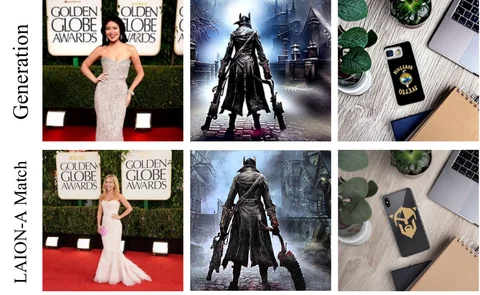
It's called "Diffusion Art or Digital Forgery? Investigating Data Replication in Diffusion Models."56The paper is by University of Maryland and New York University researchers led by Tom Goldstein. Its first version went up on arXiv on December 7, 2022, and the third, the one on Anton's screen, on December 12. The authors found Stable Diffusion images that repeat training images almost exactly. Six weeks later, on January 30, 2023, researchers from Google, DeepMind and universities showed that more than a hundred training images could be pulled out of Stable Diffusion and Google's Imagen nearly unchanged. arXiv, Carlini et al., 2023. And I'm glad somebody did this so I didn't have to, because their results are pretty great. They really take a deep look at this relationship between input text and captions in the training set, and what images are produced, and the similarity between those images. They do a really deep dive on this. And, anyway, long story short, to what you were saying: there are general concepts that the model learns, because they're evident in many, many examples. But then specific details are attributable to particular things in the training set that are associated as being in some sense close to the input caption.
Because remember, the way this is trained is you show it an image, you show it a caption, and you try to get the model to create that same image from the caption that you input. So another way to think about this is, if the model was perfect, in other words, trained without noise, and the data set was beautiful and clean, if you gave it a caption, it should generate the image that would have been in the training set to match that caption.
Or another way: even if there is that caption in the training set and you randomly stumble on that and type it in, you should just get that image back.
ExplainerWhat guidance does and where "fried" images come from
A diffusion model paints by removing noise from a random image step by step; the starting noise is set by a number called the seed, so the same seed with the same settings gives the same image. Stable Diffusion brings in the caption with classifier-free guidance: at each step the model predicts the noise to remove twice, with the caption and without it, then takes the difference between the two predictions and multiplies it by the guidance scale. At 0 the caption has no effect and you get "some picture in general"; at 1 the model follows the caption normally; Stable Diffusion's default is 7.5. The higher the scale, the harder the model pulls the image toward the caption, and the less variety is left. At very high values the steps overshoot, colors oversaturate, contrast blows out, and you get what people online call "deep-fried," after memes run through sharpening filters again and again. The method was described by Google researchers Jonathan Ho and Tim Salimans. Ho & Salimans, 2022.
Yeah, if the model was perfect. But it's not. And in fact, we probably don't want it to be perfect, because we like originality. And this is kind of like, you know how when you use Stable Diffusion on Hugging Face,57Hugging Face — the platform where open models and data sets are posted and their demos run in the browser. Stable Diffusion's official weights lived there, and the web demo was the easiest way to try it. there's that guidance parameter? That's how much to listen to the caption, basically. Because Stable Diffusion generates images: if you turn that guidance all the way to zero, it will make a picture for you. And the picture that it will create will just be its idea of a picture out of all possible pictures. It will just create a picture of some kind, right?
Will it create the same picture for everybody who puts it at zero? Or is it just going to pick something totally random?
So the way that Stable Diffusion works is it starts off with a random vector and it decodes it. Remember, it denoises it. So if somebody has the same random seed, it'll create the same picture for you. But if you add guidance… But the thing is, I don't know if you've noticed this effect: if you crank guidance all the way up, I think it goes to 50, sometimes you get a really good, clear, snappy image, but a lot of the time you get this fry effect. So that fry effect is from it really trying to land in that right part, but there's nothing there. So it's trying to diffuse noise.
And this is again why it makes it so complicated, because the caption doesn't necessarily determine the image that you get completely. The random vector that you start with also helps; the amount of text guidance that you apply changes what you get. But the reality is still, the detail and imagery that it generates comes from somewhere in its training set. It may not be directly related to the caption that you punched in, but it's coming from somewhere. And to a greater or lesser extent, different aspects of those things can be attributed. So it's not an impossible task. It's just really, really hard. And that's why people aren't working on it, because we're at the dawn of this stuff. People are figuring out how to make this useful, how to make it fun and interesting. And frankly, also a bunch of people are trying to figure out how to make money from this, because it's a new technology, and that's kind of what we do.
But it's hard. The steelman response is: the reason we don't have attribution yet is because it's a tough problem which is not yet resolved in ML research. But people are actively working on it in really important ways, not least because people have asked for it. People have said, "Listen, this isn't good enough. You know, you can't just kind of launder our work through these models. You have to give people credit, or let me opt out, or tell me that I'm in there, something."
08Data in court: Copilot, Disney and the judge from Oracle v. Google
Code disputes are legally clearer, with images it's unclear whom to sue, and Anton's biggest fear is stronger copyright.
You mentioned the lawsuit on the Copilot side. Are there lawsuits happening on the art side? Like, what are people doing in the art community to try to stop their work from being misappropriated?
Yeah, so the class action lawsuit against Copilot is because, I think, it's been shown to verbatim regurgitate code that is licensed open source.58GitHub itself wrote that its internal research found that about 1% of the time a Copilot suggestion contains a snippet longer than roughly 150 characters that matches the training set. Admins can turn on a filter that drops such suggestions. Copilot page, December 2022. And so there's a copyright issue there. We'll see how that shakes out. I'll be really interested to see, because one of the things, as I talked about, that I fear the most is an increase in the power of copyright law over derivative works.59Derivative work — a work based on someone else's: a translation, adaptation, remix or parody. The more broadly the law reads the term, the more new creative work needs the rights holder's permission. I'm frankly terrified of that. Bad situation for everybody except Disney,60Disney is the emblem of strict copyright: the 1998 law that extended US copyright terms by 20 years was nicknamed the Mickey Mouse Protection Act. Mickey's first cartoon, "Steamboat Willie," did finally enter the public domain on January 1, 2024. In June 2025 Disney and Universal sued Midjourney, and in December Disney invested $1 billion in OpenAI and let Sora users generate its characters. OpenAI. like I said, and I guess Microsoft. In art land, I think…
And is that… Wait, sorry, I'm sorry to interrupt there, but is this one that will end up going to the Supreme Court? It feels weird that whatever judge randomly gets this case is going to decide so much of what happens in the future with this technology. It feels like it has to be appealed up to the highest levels. And then at that point, do you want a bunch of 80-year-olds61Fact-checkExaggerated: in January 2023 the oldest Supreme Court justice, Clarence Thomas, was 74, and the youngest, Amy Coney Barrett, was 50. Supreme Court of the United States. deciding this either?
I don't know. I hope that it's the judge from the Oracle–Google case,62Oracle v. Google — the 2010–2021 fight over whether Google could reuse Java's interfaces in Android. Oracle sought about $9 billion. The trial judge ruled that APIs aren't protected by copyright, the appeals court reversed him, and in 2021 the case did reach the Supreme Court, which ruled 6–2 that the copying was fair use. because he took the time to learn about the technology and get a feel for it and understand what an API was before he made that judgment.63The judge is William Alsup of the Northern District of California, a hobbyist programmer. At trial he put Oracle's lawyers in their place by saying he had written code like the disputed nine-line rangeCheck function "a hundred times." Anton's wish came true almost literally: in June 2025 Alsup issued the first major ruling on AI training, in authors' suit against Anthropic. He held that training on purchased books was fair use but downloading from pirate libraries was not; Anthropic agreed to pay $1.5 billion, about $3,000 per book. JURIST. So I'm hoping we get someone like him to decide this case. But it is, like you said, important. I don't think it'll go to the Supreme Court, but it's very important and probably will decide the future.
The other thing that I want to add before we finish the episode is, so, there's a lot of unstructured data on the internet, but what people realized is, if you want the model to do a specific thing, you have to go out and find the specific data. And so that's how InstructGPT and ChatGPT are created. And there's actually people creating data for them, people who are having text conversations, which are then fed into the data set.
So with respect to copyright, right, it's really clear on GitHub what the licensing is. Software licensing is something that's been covered a lot. So the actual challenge is more structured and straightforward. There's a legal theory. Over in art land, there's two things. One, DALL·E 2 is proprietary. So you don't really know what's in it, but again, I feel like OpenAI have been pretty scrupulous about where they get their data from. And on the other side, with Stable Attribution64Stable Attribution — the slip gives away what Anton was working on: that was the name of Chroma's tool that takes a Stable Diffusion image and finds the training images that influenced it most. It came out a few weeks after this recording, in February 2023, and the sixth episode of the series is about it.— Stable Diffusion, nobody really owns that data set. It's publicly available stuff from the internet. "I don't know, it's your problem." And, like, do you want to go through the terms of service of every single website that might be in Common Crawl? Nobody's going to do that.
AI might at some point, but yeah.
AI might at some point, truly. So nobody's going to do that. So there's not really a legal challenge, because who do you legally challenge? The weights are open source. You're going to put DRM65DRM (digital rights management) — copy protection: the encryption on films, games and e-books that keeps a file from being used without the rights holder's permission. in there? That's terrible. So it's really hard. It hasn't really started, although there are petitions out there from people who are like, "Oh yeah, you need to lobby Congress." And then you look at who's behind some of those petitions, and it's, like, Disney. Disney lawyers.
We talked about this. Yeah.
09Hand-made data again: people writing conversations for ChatGPT
Getting a model to do something specific takes specific data, and AI has come back to where it started: data sets made by hand.
ExplainerHow ChatGPT was taught to hold a conversation
A language model trained on the internet can continue text but not answer requests: ask it a question and it may produce five more questions. In the InstructGPT paper (January 2022), OpenAI described three steps that fix this. First, about 40 hired contractors wrote model answers to roughly 13,000 prompts, and the model was fine-tuned on them the usual way. Then labelers compared several of the model's answers to the same prompt and ranked them from best to worst; those rankings trained a separate "reward model" that predicts which answer a person will prefer. Finally, the language model itself was trained with reinforcement learning (RLHF): it writes answers, the reward model scores them, and the model learns to earn high scores. ChatGPT was made the same way, except the examples were dialogues in which trainers played both the user and the assistant. Human labeling quickly became an industry of its own: in June 2025 Meta bought 49% of Scale AI, the largest supplier of such data, for $14.3 billion. Ouyang et al., 2022.
Yeah, so that's the thing. So we'll see how the copyright shakes out. So, you know, we talked about these unstructured data sets. We talked about how they're scraped from the internet, how they're pretty noisy. So one thing that we discovered is, if we want the model to do a particular thing, we need to go out and get specific data. So when people do DreamBooth,66DreamBooth — a Google Research method (August 2022) that fine-tunes a model on 3–5 photos of a person, pet or object so it can draw that exact subject anywhere. Avatars like Lensa's are built on it — and so are copies of artists' styles. or fine-tuning Stable Diffusion, they need specific data. And one thing that's surprising, which maybe a lot of people aren't aware of, is that models like InstructGPT or ChatGPT are fine-tuned on data that's not collected from the internet. There are literally rooms of people who are having chat conversations about different topics that they're given to have conversations about, to train the model to know how to have a conversation or to follow instructions.
And is there something special about those people? Like, when I ask about Aristotle, do they have an Aristotle scholar having a conversation? Or is it really just for the structure of how a human might have a conversation and answer questions?
It's some structure, some content. It's mostly structure. There are services out there who are very focused on providing very high quality data with domain experts. One example of this is models intended for mathematics. There are companies out there who were like, "Yeah, we're going to put math experts, or at least people proficient in mathematics, on these things to help create these data sets."67That's how it went: by 2024–2025 expert-made training data was a huge market. Scale AI, Surge AI and Mercor pay mathematicians, doctors, lawyers and programmers to write problems and worked solutions for training models, and in June 2025 Meta bought 49% of Scale AI for $14.3 billion. NBC Chicago / CNBC.
So we've gone full circle, almost, where it's structured data sets, very highly curated, people worked on this, to "nope, just ingest the internet," to "wait, we need highly curated data sets, which are created by humans again to feed the machine." I wonder if that's, you know, because there's this cycle in hardware, right? Where you put the RAM closer to the CPU, you take it away from the CPU because you get more RAM, then you put it closer to the CPU, and this just goes over and over and over again in computer hardware.68A similar cycle was described in 1968 by Ted Myer and Ivan Sutherland as the "wheel of reincarnation": graphics functions keep moving out to a separate display processor and back into the main one, around and around. Memory follows the same pattern: today's AI accelerators once again put HBM memory right next to the chip. I wonder if this isn't going to be a cycle in ML. We'll use all this contracted data to fine-tune it, and then we're like, okay, no, we need a lot more data for the next size models, so we just ingest everything again, and it'll give us these great capabilities. But then we'll be like, okay, no, now we want these new ones, so we better fine-tune it, create this new data. We'll see.
And is a way to think of that, like, OpenAI contracting somebody to fill in the gaps that it just can't find on the internet? Or how are they determining what to pay for, essentially?
Yeah, that's a big open question. Right now it's like, hope that it's good. What's happening with this human-created data is, you've got the model, you've got GPT, and then you want to weight the model to give more frequently… Because remember, we talked about it, all it's doing is predicting. So you want to push its predictions in a particular direction. And the way that you do that is show it more examples of the thing you want it to predict, making them more likely. But whether or not they're getting what they want, and if it's good, open question.
I've talked to a bunch of people who are working on this, and they're like, "Yeah, we really don't know. We give them guidance and we hope it's good." Because, again, the problem is you need so much data that no human can sit down and look at all of it. And you can't go in and just tinker with the… Wouldn't it be more efficient to just tinker with the weights, where you're like, "Yeah, we want more of that"? Nobody knows how to do that yet.
There is research on finding concepts. There was a great paper about finding concepts embedded inside large language models. In the future we might be able to go in and just tinker with the weights if we know what to do.69That arrived a year and a half later. In May 2024 Anthropic found millions of "features" inside Claude 3 Sonnet, concepts from cities to flattery, and showed they could be dialed up: amplifying the "Golden Gate Bridge" feature produced Golden Gate Claude, which steered every conversation to the bridge. Anthropic. But this is a dark art right now. And in fact, interpretability research70Interpretability — the branch of machine learning that works out how a model arrives at its answer inside. Anthropic's Transformer Circuits series, discussed in the first episode, is part of it. is mostly about: what are these weights doing? The stuff that Anthropic in particular very publicly works on, and other people too, is what computation is being performed by these weights. That's a question we don't know the answer to. What is it actually physically doing in terms of an algorithm?
That's interpretability research. It's an open question that we're working on. It's incredible, because, you know, it's easy to say, if you look back in 100 years, this will all look primitive. But that feels like a very clear place where it'll feel very funny and primitive, that the thing that we did was just hire a bunch of people to have conversations that are kind of more like what we wanted, because we had no other way of figuring out how to get the model to do that thing more often.
Yeah, and I mean, that's kind of how I feel about prompt engineering, and fine-tuning the way we do it now. Fine-tuning is like, okay, well, you find some more images of the stuff that you want more of, and then you train the model some more on just that stuff. And so I feel like all this stuff is so primitive, comparatively speaking. I feel like, you know, we've got this big hammer and we're just kind of bashing stuff, because it's all we know how to do. But look, maybe in the future, and with GPT-471GPT-4 came out on March 14, 2023, two months after this recording. In January rumors ran as high as "100 trillion parameters"; Sam Altman called that figure complete bullshit and said people were "begging to be disappointed." TechCrunch. kind of imminent, maybe in the future we'll find out that it doesn't matter. Maybe in the future we just have to wait for the next biggest model. But I think that for now, to move as fast as we want to move…
So it's like, I want a model that produces great human avatars today. I'm not going to wait for the giant release in a year or two of the next great image model. I want it right now, so I'm going to find ways to do that. And again, the thing the open sourcing has been great for is people just hacking with this all the time. Figuring it out in public, in a way where an average person with a little bit of knowledge of computers can figure something out and share it very quickly. Whereas before, this was very much the domain of research labs. And I think that's a really cool time to be working on stuff.
10Names for AI and living by the algorithm
Packy floats the idea of AI-friendly unique names, and Anton is horrified: people already bend themselves to algorithms.
This makes me think of just a bunch of weird stuff, one of which is… We talk about weird stuff here all the time.
It's all we do.
How low-fidelity a human name is. Like, Packy McCormick is kind of weird, but there's still a bunch of Packy McCormicks out there, particularly in Ireland, where I couldn't go into a search thing, into Stable Diffusion, even if it were better, and just say, like, "Make an image of Packy McCormick." It would be like, "Which one?" I wonder if our names have to adapt to be more unique. So it's like, are you making an image of, like, [unclear], to be more distinct to the AI? Unless we want to have to fine-tune the models on ourselves over time, then we have to at least have our own identifier that the AI knows.
That is a truly insane thing that you just said.
That's when we know we'll have lost.
Yeah, I hope to not live in that future. Like, I'm already…
Like Elon does.72Like Elon does — in May 2020 Elon Musk and singer Grimes had a son they named X Æ A-12. California doesn't allow numerals in names, so it was amended to X Æ A-Xii.
Yeah. I'm already scared of how people adapt their behavior to social media algorithms, right? Like, every YouTube video has the same thumbnail,73The surprised-face thumbnail — the author's face, mouth open in amazement, became the cliché of YouTube thumbnails, nicknamed "YouTube face." where it's a bearded guy looking surprised at something.
The worst, and I feel bad saying this, but, you know, a guy who was a few years ahead of me in high school just passed away, and I was trying to Google it and look it up. And for his name, nothing came up. There were no articles. For whatever reason it wasn't in the news, but there were 10 to 15 YouTube thumbnails of an image of a car crash that were just random Indian guys talking about him as if he were a celebrity having died.74Journalists later wrote about this: "obituary pirates" retell strangers' obituaries on YouTube, often with errors, to earn ad views from searches by family and friends. Marketplace. And you have to imagine, he wasn't famous. You have to imagine, anytime there's an obituary, there's 10 to 15 people in the world making these YouTube videos, because for whatever reason people click on them. It's wild.
Yeah, and so this is one of the things that does worry me. People are adapting their behavior to the algorithm, because engagement is very powerful. People want to be seen and heard. And, you know, the classic thing is YouTuber voice,75YouTuber voice — the recognizable delivery of video creators: a pushy, exaggeratedly excited intonation that stresses nearly every word to hold viewers in the first seconds. which I'm grateful that we don't have. TikTok, like, there's a certain presentation of content that's expected that would probably never have organically emerged if you asked random people to make a short-form video, for example, right? It's just because they see that that works, and so they copy it. And de facto, what's happening here is we're adapting our behavior to the algorithm, although the algorithm itself adapts to our behavior, which comes back to this indirect attribution thing we talked about before. It's like, well, it's kind of both.
All right. I guess next time we talk about exactly what we do about this issue right now.
Yeah, at Chroma we've been working pretty hard on the attribution problem76In early February 2023 Chroma released Stable Attribution. That spring the company changed course and released the open vector database for AI applications it's known for today; in April 2023 it raised $18 million. Chroma. for the last several weeks, because we think this is a really important thing. And we also think that these technologies ought to be working for people, as opposed to just creating yet more fire for people to talk past each other. And hopefully by then we'll have something pretty cool to show you.
I can't wait to see it. Anton, thank you for teaching me about data.
All right, Packy, great to chat. See you next time.


