

Anton Teaches Packy AI
Chapters
Anton found that what stung artists wasn't the threat to their income but that their work was taken without asking, and set out to see whether credit could be given back.
Read the chapter- Stable Attribution launched the week of recording, and Packy says the announcement tweet passed 6,000 likes and drew controversy.
- Anton and Jeff started the project at Chroma just before Christmas, when Anton himself didn't get the artists' objections.
- Anton describes a double shock: first the miracle of generation itself, then the discovery that the model learned from your work without consent, which makes people focus on what they stand to lose.
- Anton's first idea was that if a latent diffusion model learns to reconstruct images from its training set, you can ask how much of a generation each training image accounts for.
The generation is encoded the same way as the training set, and the nearest images are looked up, with duplicates merged from the start.
Read the chapter- Anton says they're nowhere near a final solution: some ideas run on the public site, others are switched off for lack of compute.
- The model is trained to reproduce an image's latent from its caption, so in Anton's reasoning an ideal generation sits where a real image would, and its neighbors are what it's built from.
- When he talks about neighbors, Anton heads off the Twitter gotcha in advance: he isn't claiming that models "interpolate."
- Duplicates, Anton says, are one of the main reasons models reproduce training images exactly; OpenAI removed them from DALL·E's data, and LAION is cleaning its set too.
Under the hood is a vector database holding every LAION-5B image, searched with approximate methods that trade recall for speed.
Read the chapter- The vector database holds vectors for every LAION-5B image, but not all captions are encoded, since that takes expensive GPU time.
- Exact kNN scales linearly with the data and is hopeless at 5 billion points, while approximate algorithms such as hierarchical small-world graphs are fast but miss some neighbors.
- Anton warns that models are alien: what the model treats as neighbors often looks unrelated to a person, a general interpretability problem.
- The team ran off-the-shelf open-source software on its own cluster so everyone could query it, and hopes to release the tooling it built around it.
Raw distances get three corrections: for duplicates, for mismatch between an image and its caption, and for the attention map obtained by inverting and rerunning the generation.
Read the chapter- The CLIP vectors of an image and its caption often diverge because LAION's captions are noisy, down to "cool awesome picture something something something."
- Anton's hypothesis is that matching pairs teach the model specifics and mismatched ones teach generalization, so matching pairs are weighted higher; it hasn't been rigorously tested yet.
- For inversion, a caption is generated for the image, the latent is recovered and diffusion is rerun; Anton notes that a generated caption recreates the image better than the real one.
- The attention map shows which parts of the latent matter for the generation, and the space is rotated and stretched by an affine transform before distances are recomputed.
- Packy notices there's no single "main" source image in the results, and the model makes big leaps; Anton says the model sees differently from an art history major, and stepping into the attention maps could make it more legible.
Leave-one-out retraining would give the honest answer, but it would mean retraining Stable Diffusion thousands of times per generation, so Chroma went with an approximation.
Read the chapter- Packy recalls that the first 50 or so quote tweets were glowing, then came the takedowns, and someone called Anton a liar.
- Leave-one-out retrains the model without the closest images until the generation changes "sufficiently much," and even then, Anton says, it's unclear what counts as contribution.
- Anton thinks there are enough GPUs on Earth to try, but that it isn't economically reasonable.
- Every DreamBooth run, Anton says, is essentially such an experiment, and collecting them would make great research data.
- Anton sees the weak spot of his own method in that it captures how the model reproduces images, not how it generalizes.
The goal is to show the problem is tractable; the main glitch is that the site accepts any image and lists "sources" even for a cat photo or an MS Paint doodle.
Read the chapter- Packy argues that if billions in payouts depended on attribution, precision would be essential; Anton answers that today the point is to show it's solvable, and the demand is obvious.
- Chroma planned to filter non-generated images by Stable Diffusion's watermark, but most hosted services don't add it.
- An uploaded MS Paint doodle is processed as if Stable Diffusion had drawn it, because "it will always try."
- Anton urges hosted services to watermark and mentions Scott Aaronson's work at OpenAI on detecting GPT text.
Some don't believe it's possible, some fear the legal fallout, some attack the technique; the artists Chroma talked to before launch were positive.
Read the chapter- The disbelievers, Anton says, call the results fake instead of discussing the limitations.
- Anton doesn't want a future where Disney crawls the web demanding takedowns of anything supposedly made from its IP, which is one reason the code stays closed.
- The site spent roughly a day at the top of Hacker News, with 52,000 unique visitors and about 12,000 uploaded images.
- Before launch the team spent a couple of weeks talking to artists, the response was positive, and the intro animation was their suggestion.
Attribution could align the people who create the data with the people generating images: surfacing obscure artists, finding makers, and building models where every artist has a fine-tuned version of their own.
Read the chapter- Anton's bad version is stronger copyright and Disney scrapers firing DMCA notices at every image online.
- Packy sees a way for obscure creators to be found by people asking for similar work, and recalls his differentiation essay arguing for being as weird as humanly possible.
- Anton adds that the model reproduces rare outlier images well because it knows nothing else in that part of the space.
- Sam Altman, Anton recalls, generated sneakers in DALL·E 2 and found someone to make them, and Stable Attribution's results are full of Etsy and Shopify links.
- Anton pictures a bland base model on Creative Commons data plus artists' own fine-tuned models that can be mixed, with attribution down the chain; the question of who owns the product of labor, he says, is at least as old as the Industrial Revolution.
People choose what counts as fair contribution, and an agreed-upon measure beats nothing; since "everything contributes to everything," income would be spread more evenly than on Spotify.
Read the chapter- Attribution becomes reliable either when compute gets cheap enough to retrain every time or when research finds a cheap approximation; Anton bets on the second because GPU demand will outrun supply.
- Optimality, Anton says, is defined by a measure people choose, and an automated measure beats experts swayed by who their friends are.
- Instead of a hard cutoff Anton prefers a probability distribution, so artists aren't sent trillionths of a cent.
- On Spotify, Anton says, income is Pareto-distributed, while attribution should give a lower Gini coefficient; he stresses the model isn't making collages and warns the system will still be gamed.
- Until something better comes along, Anton thinks it's fine to say "this is how we assign credit, take it or leave it."
The money would come from commercial models' revenue, or else creators will stop sharing and the models will go stale; for Chroma, Stable Attribution is an experiment built on its own technology.
Read the chapter- Models earn revenue that can pay contributors, and without them, Anton says, models will "suck forever," like the already dated Lensa avatars.
- Anton sees two bad outcomes: under "no rights to anything you post" people stop posting, and a heavy IP regime brings Disney's scraper robots.
- The algorithm runs on technology Chroma has built since its founding, and Packy is an investor in the company.
- The experiment is time-boxed, and whether to open-source it depends on the reaction; meanwhile the team learned to provision such a service in the cloud.
- Next time Packy wants to cover embeddings, while Jeff is busy posting a manifesto.
Quotes
On why artists took generative AI so hard
“And when you have that double thing piling on, it makes people extremely defensive. It makes them think about what they stand to lose more than what they stand to gain.”
Anton TroynikovRead from 01:11On how models differ from people
“And there's this interesting problem, and it's a general problem in machine learning interpretability work, which is that the models are pretty alien.”
Anton TroynikovRead from 09:21On attribution
“What attribution actually means is not a technical question, but you can use technology to help understand what you should do.”
Anton TroynikovRead from 21:47On an old argument
“It's a question as old as at least the Industrial Revolution: who owns the product of labor, the owner of the machine or the people who put in the work?”
Anton TroynikovRead from 36:29On a fair measure of contribution
“There is no objective attribution function, right? There is just some function that we perhaps could all agree, or most of us could agree, is sufficiently fair in the way that it determines attribution.”
Anton TroynikovRead from 38:05On gaming any system
“You know, look, human economic activity is the real paperclip maximizer.”
Anton TroynikovRead from 41:02Why AI needs artists on board
“Because if we end up in a world where everyone who creates new images that people enjoy absolutely hates and will not contribute to generative AI, then the models are going to suck forever, right?”
Anton TroynikovRead from 43:11
Summary
A week after launching Stable Attribution, Anton Troynikov walks Packy McCormick through how Chroma's tool takes an image made by Stable Diffusion and finds the LAION-5B training images that shaped it most: nearest-neighbor search in a vector database, then corrections for duplicates, for images that don't match their captions, and for the model's attention maps. The rigorous way, retraining the model without each image, is far too expensive, so the method is an approximation, and Anton says so plainly.
His bottom line: there's no objective measure of contribution, but an agreed-upon one beats nothing, and paying artists by attribution would spread income more evenly than Spotify does, because "everything contributes to everything."
Advice
If you run an image-generation service, watermark its output and publish what the watermark is: you can't stop people stripping it from open-source code, but in a hosted service it costs nothing.
Ship a controversial product early: the reaction in the wild teaches more than finishing the research first, as long as you're upfront about the limitations.
Before launching a tool for people your industry affects, talk to them: Chroma spent two weeks discussing Stable Attribution with artists and added the intro animation on their advice.
Time-box a side experiment and decide its fate by the reaction: even without a business model it yields data and builds infrastructure your main product will need.
Mentioned
- Stable Attribution00:00The Chroma tool whose launch the whole episode is about: Anton explains how it finds the training images behind a generation and answers the critics.
 Chroma00:26Anton's company, which built Stable Attribution on its own technology; Packy is an investor.
- Jeff Huber00:26Chroma's co-founder, with whom Anton started the project; at the end Packy and Anton pull up his tweets about embeddings.
 Stable Diffusion00:26The model whose generations Stable Attribution analyzes; Anton explains how it reworks an uploaded image.
Show 28 more mentionsShow fewer mentions
 Midjourney00:26Anton lists it among the generators artists were protesting.
- High-Resolution Image Synthesis with Latent Diffusion Models01:56Anton recalls that Stable Diffusion is a latent diffusion model, covered in an earlier episode, and builds the neighbor-search idea on its training objective.
- Extracting Training Data from Diffusion Models02:46One of the recent papers on when diffusion models reproduce training images; Anton draws on such work when he talks about duplicates and outliers.
 LAION (Large-scale Artificial Intelligence Open Network)06:08Packy asks whether LAION scrubs duplicates from its set; Anton says it has a project for that.
 OpenAI06:14Anton's example of a commercial company that deduplicated its training data.
- DALL·E 2 Pre-Training Mitigations06:14OpenAI's post explaining how it removed duplicates after finding DALL·E 2 regurgitated training images.
- LAION-5B07:26The data set whose image vectors fill Stable Attribution's vector database.
- Efficient and Robust Approximate Nearest Neighbor Search Using Hierarchical Navigable Small World Graphs08:16Anton cites hierarchical small-world graphs as the state of the art in approximate neighbor search, without which querying 5 billion points wouldn't be feasible.
- CLIP (Contrastive Language–Image Pre-training)13:48The model whose image and caption vectors Stable Attribution compares to weight training pairs.
- Stability AI22:07Packy asks whether it or OpenAI has enough GPUs to retrain the model for attribution.
- DreamBooth: Fine Tuning Text-to-Image Diffusion Models for Subject-Driven Generation22:56Anton suggests collecting data from DreamBooth fine-tunes as ready-made attribution experiments.
 Hugging Face25:16Anton says many Stable Diffusion services run on its libraries, which is why their images lack the watermark.
- Scott Aaronson28:28Anton brings up his work at OpenAI on detecting GPT-written text as an approach to content provenance.
 ChatGPT28:28Anton mentions research that can tell whether ChatGPT wrote a text.
 The Walt Disney Company29:06Anton's main example of the bad future: a rights holder crawling the web to demand takedowns of anything supposedly made from its characters.
 Hacker News30:54Packy pictures the critics as Hacker News commenters, and Anton says the project spent a day at the top there.
- Digital Millennium Copyright Act (DMCA)32:49Anton fears a future where scrapers fire takedown notices under this law at every image online.
- Differentiation34:22The essay Packy cites: to stand out from AI, be as different from everyone else as possible.
- DALL·E 234:42Anton recalls how, after its release, Sam Altman designed sneakers in it and had real ones made.
 Sam Altman34:42Anton cites his DALL·E 2 sneakers as a prototype of attribution as search: draw a thing, find who can make it.
- Etsy34:42Anton says Stable Attribution's results are full of Etsy and Shopify links and sees in that the seed of a way to find makers.
 Shopify34:42Shopify stores also show up often among the sources found, Anton says.
 Creative Commons35:36Anton proposes a base model on openly licensed data under its licenses, which each artist would fine-tune into their own.
 Spotify39:33Anton answers critics that attribution payouts would be spread more evenly than artists' income on Spotify.
 Taylor Swift40:48Packy contrasts her marketing money with a model that picks whose images contributed by itself.
- Paperclip maximizer41:02Anton jokes that the real paperclip maximizer is the human economy, which will game an attribution system too.
 TikTok41:38Packy cites TikTok videos converging on one template as an example of people bending to algorithms.
 Lensa AI43:11Anton points to its avatars as an example of how fast AI goes stale without fresh data.
Transcript
01Why artists were upset, and where Stable Attribution came from
Anton found that what stung artists wasn't the threat to their income but that their work was taken without asking, and set out to see whether credit could be given back.
Anton, welcome back. So we've taken a couple of weeks off here. You've been heads down sprinting on the release of Stable Attribution,1Stable Attribution — a website Chroma launched in early February 2023: you uploaded an image generated by Stable Diffusion, and it showed the images from the LAION-5B training set that, by its estimate, influenced it most, with links to the pages they came from. IEEE Spectrum, PC Gamer and others covered it. IEEE Spectrum. which came out earlier this week to a ton of fanfare. The last I looked, there were 6,000-something likes on the tweet. Obviously a bit of controversy. Anything that gets popular on the internet does that as well, and particularly in these kinds of areas, and we'll get into that, but how's it been? What is Stable Attribution? We've been teasing it for a while.
Stable Attribution is something that Chroma, Jeff2Jeff Huber — Chroma's co-founder and CEO; at the end of the episode Anton and Packy dig up his tweet about embeddings. and I started work on just before Christmas, where initially I had a lot of misconceptions about, first of all, the objection of creators to, you know, Stable Diffusion, to Midjourney, DALL·E. I, like, honestly kind of didn't get it, because I had certain assumptions around how these models were actually made, where the data came from. And then I looked into it in more depth, and I started actually investigating it, because I was like, well, something doesn't really square here. Started talking to people, and it was pretty clear that their objection wasn't, like, for most people at least, it wasn't like, oh, these models are threatening my livelihood, they're going to replace me as an artist. It was more like, first of all, a shocking development in their own right.
I didn't know that this was possible. And I think that that's, you know, fairly standard. Most people had that reaction when Stable Diffusion and DALL·E stuff came out. Like, it's pretty amazing. And then to have that shock then doubled with, like, wait a minute, you used my art to make this without really asking me, let alone, you know, forget even the compensation piece right now. You used my art without ever asking for my consent. And I definitely didn't put it up on the web for this purpose, because nobody knew that it could be used for this purpose a few years ago when I put up my stuff. Made a lot of people, like, honestly shocked. And when you have that double thing piling on, it makes people extremely defensive. It makes them think about what they stand to lose more than what they stand to gain.
And so that's what happened. And, you know, I was following discourse, and I thought to myself, okay, well, that's interesting. This is a question about how much can we attribute to the training data of latent diffusion models,3Latent diffusion — the method behind Stable Diffusion: an encoder compresses the image into a small "latent," the model learns to remove noise from latents step by step, and a decoder turns the result back into pixels. Anton and Packy covered the Rombach et al. paper on it in the fourth episode of the series, in December 2022. of which Stable Diffusion is a version, like we talked about in a previous episode. And I thought, okay, well, what is the first approach that I would try here? And we basically started development on that track, and we based our initial approaches off of publicly available open-source software. We can get into details in a minute, but yeah, happy to answer more sort of questions around what's going on and how things are.
02Version one: a generation's neighbors in latent space
The generation is encoded the same way as the training set, and the nearest images are looked up, with duplicates merged from the start.
So you tried the first approach. Is that the one that you ended up going with? How have you refined it over time? What's, like, the final approach to Stable Attribution look like?
So I don't think that we're anywhere near the final solution yet. There are ideas we've played with; some of them are deployed in the public version. We find that because we're pretty compute-limited, we can't really have all of them stood up all the time. But there's a lot that you can do with the internal structure of how diffusion models actually work. There's a lot of other empirical research and questions to be run here, and there's been, you know, some papers recently4Recent papers — Somepalli et al.'s "Diffusion Art or Digital Forgery?" came out in December 2022, and Nicholas Carlini et al.'s "Extracting Training Data from Diffusion Models" on January 30, 2023, a week and a half before this conversation. Both showed that Stable Diffusion sometimes produces near-copies of training images, most often ones repeated many times in the data set. arXiv. that kind of demonstrate under what conditions these models actually reproduce their input. So I don't think we're anywhere close to it. But going from vanilla semantic search5Semantic search — search by meaning rather than matching words or pixels: the query and the documents are turned into embedding vectors, and the closest ones to the query are returned. in latent space,6Latent space — the space of a model's internal representations: each image is a point in it, a list of hundreds or thousands of numbers, and similar images sit close together. we basically tried to add more of what the model is actually doing on top of that idea of finding neighbors in this latent space. So doing straight similarity search in a given latent space is fine, but the structure of that latent space isn't actually imposed by the diffusion process. You need to take the diffusion process into account, and you need to take the characteristics of the data set also into account. And so one of the very first things we did was to just look at duplication in the data set.
ExplainerHow Stable Attribution looked for an image's sources
The tool worked like a similar-image search with knowledge of how the model learns added on top.
- Encoding. The uploaded image is turned into a vector, an embedding, with the same CLIP encoder LAION had already used on all 5.85 billion images in its set.7LAION's embeddings — along with LAION-5B, its authors released precomputed CLIP vectors for every image and nearest-neighbor indexes, so the set can be searched for similar images without recomputing billions of vectors. LAION.
- Neighbor search. A vector database finds the images in the set with the closest vectors. Anton's reasoning: the model is trained to reproduce the very image from the set given its caption, so an ideal generation "sits" in the space where a real image with that caption would, and its neighbors are what it is made of.
- Data corrections. Copies of one image are merged into a single point with a larger weight. Images whose vector matches their caption's count for more: on Anton's hypothesis they teach the model specifics rather than generalities.
- Model correction. A caption is generated for the image, the noisy latent the model could have drawn it from is recovered, and the generation is rerun. The attention map shows which parts of the vector matter for this generation; the space is stretched accordingly and the distances recomputed.
The images closest by the final measure were shown to the user, with links to the pages LAION took them from.
So the original process was very, very straightforward. It was, you know, take a Stable Diffusion-generated image, encode it using the same encoding scheme, look for neighbors in the training set, right? This is the basic first alpha idea, literally the first thing I could think of. And the reason that we chose to do that is because the training objective8Training objective — what the model learns to minimize. A latent diffusion model is trained like this: noise is added to a training image's latent, and the model, given the caption, has to predict that noise, which amounts to recovering the original latent. of latent diffusion models is to reconstruct the input latent, or denoised versions at each time step of the input latent. So it's essentially saying, okay, given the encoding of this image, conditioned on the encoding of its caption, reproduce the same latent representing that image. So, you know, to me it kind of made sense.
And because of the way that this latent space is structured, because of the encoder-decoder pair, things that are visually similar tend to be close together. That's part of the effect of contrastive training.9Contrastive training — the model learns to pull together the vectors of matching pairs (an image and its caption) and push apart mismatched ones. That's how CLIP, Stable Diffusion's text encoder, was trained. And so the thinking was, okay, well, kind of analogously, the loss for the training objective of this model would be minimized if for every caption it reproduced the corresponding image exactly, every time. And so my kind of analogous thinking was, okay, well, if that were true, then we can say each generation of such a model would be as if it were an original data point in its latent space. But of course, those data points don't necessarily exist. So we say, okay, where would that data point be?
And that data point is going to be weighted according to its neighbors. And I hesitate to say "interpolate,10Interpolate — produce an in-between value from known points. Anton is heading off a gotcha: whether generative models merely "interpolate" their training data or make something new was argued over in 2022–2023 by researchers and on Twitter alike." because what people are going to do is, like, you're going to be like, "Haha, I caught you out, you say models interpolate, but they don't really do that." It's not really what I mean. All I'm saying is that the corresponding data point would be in latent space, and then we can say, okay, here are the neighbors that, you know, you would interpolate to it. And that's the starting point. And then we looked at, first of all, the fact that it's actually well known, there's plenty of literature around this, that duplicates in data sets tend to weight generations more heavily to be more perceptually similar. They are one of the main drivers of models being able to exactly reproduce images from their training set.11Duplicates and copies — in Carlini et al.'s work, many of the easiest copies to extract were of images repeated more than 100 times in the training set. In the paper's figure: on the left, a photo from the training set; on the right, what Stable Diffusion generated from just the evangelist Anne Graham Lotz's name.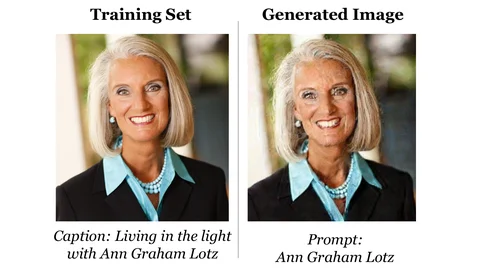
So, you know, we take something like LAION.12LAION — a German nonprofit that builds open AI data sets from image links found in the Common Crawl web archive. Stable Diffusion was trained on its data sets. Are they trying to scrub duplicates out?
Yeah, they have a project for that. Right now, I think, you know, there's a bunch of ways. I actually think that commercial deployments of latent diffusion models probably have already deduplicated their data sets, because I think that the cost-reward is pretty good. Certainly OpenAI with DALL·E, they even put out a — it's not even a paper, it's a blog post called "DALL·E Pre-Training Mitigations,13"DALL·E 2 Pre-Training Mitigations" — OpenAI's June 2022 post on preparing DALL·E 2's data: filtering out violent and sexual images, fixing the biases the filtering introduced, and removing duplicates after noticing the model sometimes reproduced training images almost unchanged. OpenAI." which explains how they deduplicated the data set, because they found that it was regurgitating inputs. So, you know, LAION really want a cleaner data set. They're working on it.
So that's the first thing we looked at. So we say, okay, well, when a generation ends up in this region of latent space where there's tons of duplicates of the same image, we'll collapse those duplicates and just weight them accordingly, and then we'll look at what else is nearby. And you can imagine this is starting to warp the latent space that we're actually doing the similarity search in.
03What runs on the server: a vector database and neighbor search
Under the hood is a vector database holding every LAION-5B image, searched with approximate methods that trade recall for speed.
I think, for an idiot like me, and maybe people who aren't as deep in this, when you're talking about seeing things kind of near each other in latent space and you're identifying them, what's happening on your computer? What are you looking at? What are you checking to make sure that this works or doesn't work? Take us behind the scenes of that piece a little bit.
So there's a thing called a vector database,14Vector database — a store that holds embedding vectors rather than rows and numbers, where the main query is "find the vectors closest to this one." Later in 2023 Chroma made exactly that, as open source, its main product. or vector index, running on our machine. It has the encoding of the entire LAION-5B data set15LAION-5B — an open set of 5.85 billion image–caption pairs that LAION assembled in 2022. In December 2023 the Stanford Internet Observatory found links to child sexual abuse material in it; the set was pulled and a cleaned version, Re-LAION-5B, came out in August 2024. Wikipedia. inside it, represented as the vectors for the images. We also have encodings for some parts — like, we don't have all the text captions from LAION-5B encoded. We just haven't run that yet, because it needs GPU, where it's expensive, so we didn't do it. And what you do is you basically query that vector database and you ask it, okay, here's a new vector, which may or may not already be in here: can you tell me what the nearest neighbors are? There's two kinds of nearest neighbor. There's, you know, k-nearest neighbor,16k-nearest neighbors (kNN) — for a query, find the k points in the database with the smallest distance to it. The exact version compares the query with every point in turn. which is giving you exactly the k nearest neighbors, right? It does exactly what it says in the box.
ExplainerExact and approximate nearest-neighbor search
Exact k-nearest-neighbor search compares the query with every vector in the database: on LAION-5B that's 5.85 billion comparisons per query. Approximate (ANN) methods build a helper structure over the database in advance and, at query time, look at only a small part of it.
- HNSW (2016) links the vectors into a "small world" graph, where each point has both close and distant neighbors, and stacks it into layers: a few points and long jumps at the top, every point at the bottom. Search descends from the top, like going from a country map to a street map, in a number of steps roughly logarithmic in the size of the database.
- The price is recall: the search can miss some true neighbors. It's tunable: the more points you examine, the more accurate and the slower it gets.
Vector databases are built on indexes like these. In spring 2023 Chroma released exactly that, an open-source vector database for AI applications, which became its main product.
But the problem with that is even the best kNN algorithms, exact kNN algorithms, scale linearly17Linearly — time grows in proportion to size: twice the images, twice as long per query. On LAION-5B, an exact search is 5.85 billion comparisons for one query. in the amount of data. So you can imagine, with 5 billion data points, you're in real trouble for every single query. Approximate nearest neighbor algorithms, of which there are a few — hierarchical nearest neighbor small world algorithms18Hierarchical small world — Anton slips on the name: the method is hierarchical navigable small world, HNSW. Yury Malkov and Dmitry Yashunin described it in 2016; it underlies most vector databases, Chroma included. arXiv. are pretty state of the art; there's a bunch of stuff right now, and there's increasing interest in this whole thing — allow you to scale sublinearly, but it means that the results you get back won't necessarily be accurate. So, you know, it gives you approximately nearest neighbor, but it means that you're able to query very large data sets.
And what's the difference in cost between those two approaches?
I mean, the trade-off is accuracy. The trade-off is recall.19Recall — the share of the true nearest neighbors a search actually finds. A recall of 0.95 means 95 of the 100 true neighbors were found. You'll miss some points if you use approximate nearest neighbor, but you can tune for your specific data set, and you can tune for your sort of query types as well. So we, you know, we do that, we grab the neighbors that they tell us, and we sort of take a look at, okay, well, what parts of the latents are actually important?
Why do these seem like neighbors? And of course, you know, we look at the corresponding images and we say, okay, well, do these kind of look similar? Why might these look similar? And there's this interesting problem, and it's a general problem in machine learning interpretability20Interpretability — the branch of machine learning that works out why a model gave a particular answer: which inputs and which of its internal parts drove it. Chroma started out building tools for exactly that. work, which is that the models are pretty alien. Even if you're looking at something and it doesn't look at all the same, or it looks pretty different, to the model those two things are very similar in some very specific sense, because the latent space of the model is, you know, nice and continuous, and you can pick any point in it and you can decode that point and you will get something back.
But the manifold21Manifold — the mathematical idea of a surface inside a high-dimensional space. "Meaningful" data such as photos are thought to lie on such a manifold, with most of the space around it being noise. of human interpretability, which is basically the surface where the points should sit, is different to the one that the model comes up with. And so things that a human might not say are the same or similar, the model will. But that's a common problem in interpretability. The model just perceives the world differently to how you do, because it's focused on different things. You've asked it to focus on different things. Classic problem.
So yeah, that was our starting point. Just doing that. And again, we just used off-the-shelf open-source software. We made sure that it ran in our little cluster. We made sure that we could query it remotely, so that we could work on it as a team instead of each of us having to have it on our individual machines, you know, route queries, see what we were getting, automate a large part of this. We built a bunch of infrastructure out around it, which we, you know, hope to open-source, because it's pretty useful if you want to host one of these in the future. So, you know, we've got ways to spin this up in a cluster now, as opposed to just downloading the repos as they exist today and running it on your machine. Yeah, so that was the first step. We looked at weighting stuff by duplicates to simplify the process.
04How the algorithm reweights the neighbors
Raw distances get three corrections: for duplicates, for mismatch between an image and its caption, and for the attention map obtained by inverting and rerunning the generation.
The other thing we noticed really early on, and a bunch of papers kind of confirmed this idea, is a lot of the time the encoded representation of the image differs from the encoded representation of its caption. And of course, you know, as a technicality, the encoding of images that the model uses is not the same space as the encoding of its text. That's because there's an additional projection step22Projection step — in CLIP, images and text are encoded by different networks, and only a final linear layer in each maps them into a shared space where they can be compared. Anton's caveat is right: the latent Stable Diffusion works with comes not from CLIP but from a separate autoencoder, and CLIP encodes only the caption. where they go to the same latent space.
That's not actually what's happening in latent diffusion models, but to close approximation, this is an interesting thing to note. A lot of the time there's actually quite big divergence between the image vector and the text vector, despite the fact that the encoder-decoder model is this contrastively trained language-image model,23CLIP — an OpenAI model (January 2021) trained on 400 million image–caption pairs to bring an image's vector close to the vector of the text describing it. In Stable Diffusion, CLIP's text encoder turns the prompt into vectors, and LAION used CLIP to filter the pairs in its data sets. so they should be as close as possible together. A lot of the time they're pretty divergent. And we found that really interesting. And so we computed that divergence for a subset — you know, what we found to be the most relevant subset, which was things with a relatively high aesthetic score24Aesthetic score — a rating from 1 to 10 that LAION assigned to images with a small model trained on human ratings. Stable Diffusion was fine-tuned on the LAION-Aesthetics subset scoring 5 and up. — computed across that subset, and we thought, okay, this is also an interesting way to weight things. We should take a look and see how the results change.
And the sort of trade-off we kind of intuitively make here is: data points where the image and caption end up being very similar in their embedding25Embedding — a vector of hundreds of numbers a model uses to represent an image, a word or a text; things that are similar in meaning have nearby embeddings. are going to tell the model about specific things, and things that differ strongly between their caption and image help the model to generalize.26Generalization — a model's ability to handle what it never saw in training: drawing "a cat astronaut as an engraving" though no such picture is in the data. And it's, you know, being treated almost like noise. And so because we wanted, with the attribution algorithm, to be able to say, okay, these images contributed in some sense — and we'll get to exactly what attribution and contribution means in a bit — we weighted things by that difference when it was available to us, when we had it computed. And that's all well and good.
And is that difference — is there a way to think about that in plain English, which is like, you know, the image, if you take it back out from latent space, the image is a picture of a cat holding a purple ball sitting on a couch, and the text is "a cat sitting on a chair holding a red ball"? Like, they should be similar, or can you not—
Yeah, there's a lot of reasons that happens. One of the reasons is the data set itself is noisy. So often the caption just simply doesn't match the image, as in the example you gave there. But the mismatch is actually a lot worse than the one you just described. Like, it might just be "cool awesome picture something something something," with no reference to what's actually in the image itself, right? It's actually much worse than what you described.
And so the idea is, when they're matching really well, that's going to help the model to reproduce, you know, more specifically, whereas if they're really not matching, that's going to help the model generalize instead. It's going to be able to think about broad ideas in the space of images, unassociated to text necessarily, and can learn all kinds of structures that way. It's a hypothesis. We haven't tested it rigorously yet, but we would like to. So we weighted by those differences. And images with better-matching CLIP vectors are weighted more highly.
And that's what we can do with the static data set. That's all stuff we could pre-compute. So that was nice. And the thing is, at every step of the way, we still get pretty unusual results. We get results that are perceptually strange to humans quite frequently, relatively frequently. But to the model, the similarity principle does apply.
The next thing we did was look at what we could do with the live model itself. And so we knew we would be getting these images after the fact. So, you know, we couldn't look into the model while they were being generated, but there are things you can do to basically recreate the generation process for an input image. This process is called direct image-text inversion,27Inversion — running diffusion backwards: from a finished image, recover the noisy latent the model would turn into it again. The standard technique is DDIM inversion; reconstructing the image accurately needs the caption or prompt it was generated from. "Direct image-text inversion" isn't a term found in the literature. but it requires you to have the caption — or a caption, or a prompt in the case of generated images — which, again, we knew we wouldn't be able to get most of the time. So because we wanted to see what the model does for a generated image — and these are, by the way, the more highly experimental features, which go up and down all the time.
This thing is held together by tape and shoestrings and wood glue. So what we do is we create a caption.28Caption — written by a separate model that describes the image in words. An uploaded image has no caption of its own, and the user usually doesn't know the prompt it was generated from. And from the papers that show, you know, duplication of the training set, we actually found that the model-generated caption is more likely to recreate the image than the actual data set caption for that image, which is an interesting effect. Also not quite sure what it means; worth more investigation, in my opinion. Generate a caption, you know, do this direct text-image inversion, get the latent back, and then we can run the diffusion process forward again to see what specifically the attention mechanisms are doing at each step. And then, using what the attention mechanism is doing, we can make a thing called an attention map.29Attention map — at each generation step, Stable Diffusion's cross-attention links the prompt's words to regions of the latent. The map shows which regions each word "looked at," that is, where each part of the image came from.
And what an attention map is, is basically a weighting over the latent vector that the model generates. And it says: these parts of the latent vector are more important for what I generated, these are less important for what I generated. These are the things that come from generalization, and these are the things that come specifically because I'm trying to fit the prompt, is a way of looking at them.
Yeah.
And so, you know, what a weighting on a vector is — it's basically what's called an affine transform.30Affine transform — a rotation, stretch and shift of space. Stretching the space along the directions the attention map marks as important makes distances between vectors depend mostly on them. You rotate and stretch the vector. And so that also allowed us to be like, okay, well, this is an additional computation we can apply to find things that are relevant to what the model generated. So now, instead of computing the raw distances, what we're going to do is we're going to grab way more neighbors, and then we are going to transform that latent space using the affine transform that we got from the attention map. And then we're going to compute distances, and then we're going to weight the distances by the stuff we pre-computed from the training set.
So yeah, that's the entire approach.
Now, before we get to objections, because we're going to go to a lot of objections — so in that process, the output, if you go to the website, is seven, ten, however many images that, you know, pop up once you drag and drop your image in. Is that the ones that have the highest weights, or what is the final selection, and the cutoff on which ones you're including and which ones you aren't?
Yeah, I mean, ultimately we return a finite set of the best results, and the ones that are closest in our new distance metric are the ones that we return as higher. And again, you get unusual results, because all these different steps are things that the model perceives, not things that humans perceive necessarily directly. And when you get down to individual contributing elements, this becomes pretty obvious a lot of the time.
And it's interesting, because I've done a bunch of these now, and in most of them there's not one where it's like, oh yeah, that's the one that it really, really looks like. Maybe there's different pieces from a bunch of it, and there's the nose here, or the color, and, you know, that's probably too human-readable, but I think that's good. So there's clearly a bunch of pieces, but it doesn't look like you just — it's not like a mosaic where you just cut out a bunch of different pieces. Sometimes you're like, wow, it made some leaps here to kind of get to this final image from the set that we have there.
When you're talking about the model kind of picking up different things than a human would, is that even things that we have language to describe, or that a normal art history major would understand, like shading, or is it totally different?
I would suggest that for this approach it's basically totally different and very difficult to make it human-interpretable, but it does suggest the possibility of creating a model which does pull in influences in a way that a human would, which are more interpretable. There's probably a possibility to do that here. Diffusion is this great little process, because it's a dynamic process, and you can step in and change what the model is doing at every step of that process. And things like, you know, cross-attention guidance31Cross-attention control — techniques that swap out the model's attention maps mid-generation. The best known is Prompt-to-Prompt (Google, August 2022): change one word in the prompt, keep the old maps, and the image changes only where it should. arXiv. do exactly that. It recomputes the attention maps instead of the ones the model generates on its own.
It's like, no, stick this in and reweight it the way you want. And so that gives a possibility of making generations much more human-interpretable. And also making the space of encoded stuff more human-interpretable are possible approaches in the future. What we're seeing now, again, is: this is what the model sees, for the approach that we're attempting to do.
05Perfect attribution: retrain the model thousands of times
Leave-one-out retraining would give the honest answer, but it would mean retraining Stable Diffusion thousands of times per generation, so Chroma went with an approximation.
Got it. So now we can get to the fun part. So, as happens on the internet, I think the first, like, 50 quote tweets that I saw on your original tweet about this were all positive, and "this is amazing," and kind of the things that we had talked about before, which is wanting to give artists credit for the work that they've done. I think people picked up on the fact that this is an important step towards that. And then, because it's the internet, you know, the comments — either replies or quote tweets or blog posts or whatever — started coming through and picking apart either, you know, the technical approach. And, you know, some people called you a liar. What were people upset about, and what even did that feel like?
ExplainerHow to measure one image's contribution
The honest answer to "how much did this image contribute to a generation" is counterfactual: train the model without it and see what changes. That's the leave-one-out method Anton describes. For Stable Diffusion it's out of reach: one training run of version 1 cost about $600,000, per Stability AI's CEO Emad Mostaque,32In August 2022, Stability AI CEO Emad Mostaque put the training of the first Stable Diffusion at about 150,000 A100 GPU-hours, or $600,000 at market prices. Model card. and the set holds billions of images.
So researchers look for cheap approximations:
- Influence functions (Koh and Liang, 2017) use gradients to estimate how the model's predictions would shift if one training point were slightly down-weighted, with no retraining.33Pang Wei Koh and Percy Liang, "Understanding Black-box Predictions via Influence Functions," best paper at ICML 2017. arXiv.
- TRAK (2023) makes such estimates feasible for large models using random projections of gradients.34Sung Min Park et al., "TRAK: Attributing Model Behavior at Scale" (MIT, 2023). arXiv.
- Ground truth from fine-tuning. In 2023, researchers from CMU, Berkeley and Adobe did exactly what Anton wishes for later in this conversation: they fine-tuned the model on a few exemplar images, DreamBooth-style, to get generations with known "sources," and used them to test attribution methods.35Sheng-Yu Wang et al., "Evaluating Data Attribution for Text-to-Image Models" (ICCV 2023). arXiv.
In these papers, embedding-space neighbor search like Stable Attribution's is the simple baseline that more precise methods try to beat.
Yeah, let me get to the technical objections first. So I think people assumed that I was, or we were, presenting this approach as the be-all and end-all, which it's not. This is an attempt. This is an attempt to demonstrate that this is a technically tractable problem. Now, we do know that there are in principle more optimal approaches for credit assignment36Credit assignment — in machine learning, the problem of working out how much each element — a weight, a step, a training example — contributed to a result. for elements of a model's training set, right? And the way to really do this, if you had infinite compute and however much time you wanted for each of these, would be something like: generate your image, and then make sure that you had the random seed37Random seed — the number the starting noise is generated from. With the same seed, prompt and settings, Stable Diffusion produces the exact same image. and the caption, and then basically do what's called leave-one-out, which is retrain the model leaving out — you know, starting with the closest things in latent space — leave that out, leave that out, leave that out, keep leaving stuff out, until the generated image you got from this constantly, iteratively retrained model differed sufficiently much, under some metric of "sufficiently much."
And this is why this is all human-interpretable in the end, or socially determined in the end. What attribution actually means is not a technical question, but you can use technology to help understand what you should do. But this is obviously intractable, because it would involve retraining Stable Diffusion thousands of times to figure out attribution for every single generation.
I was going to say, is this something that, like, OpenAI or Stability AI has enough GPUs to do, or is there not enough GPUs in the universe right now to do something like this?
I think there are enough GPUs on Earth to try to do this, but I don't think it's economically reasonable to do it. And certainly it depends on the rate at which you want to be able to do this. This takes a long time. Like, you literally have to retrain the model the same way you trained it in the first place, every time. You have to recreate it exactly, except missing this element from its data set, and then you say, okay, well, this is how much the image keeps changing from the thing that originally generated, so you can say this is the contribution to the actual generation. And then there's the argument: okay, well, it changed, but it changed into something else. Does that mean this has less attribution to those things? What does it actually mean?
So even this is technically feasible, but even this has arguments against its validity as an approach to assigning attribution. And we figured doing something's better than doing nothing. I think an interesting investigation here would be to play with this in a toy model setting,38Toy model — a small model on a small data set, such as CIFAR-10's 50,000 images, cheap enough to retrain hundreds of times. That's what Carlini et al. did: to study why models memorize images, they trained hundreds of diffusion models on CIFAR-10. where actually retraining it many, many times is not as computationally expensive. And I think that actually, if we could collect global information about people fine-tuning Stable Diffusion models, that's a very similar thing. Basically, every time someone does a DreamBooth39DreamBooth — a Google method (August 2022): fine-tune the model on 3–5 photos of one object or person, and it can draw them in any scene. Once an open implementation for Stable Diffusion appeared, thousands of people ran such fine-tunes. or something like that, if we could actually collect that information and watch the diffusion process, that would be really great research data, but I don't think anyone's recording that right now. So yeah, there's better approaches; our approach is fundamentally limited.
As I mentioned earlier, our approach takes into account the model's training objective, which is to minimize the distance between the encodings of the generated image and the training image. That takes into account the model's ability to recreate images; it doesn't take into account the model's ability to generalize, which is also a significant contribution to how latent diffusion models work. It's important that they can generalize, because that's how you're able to create images that don't exist. And this method that we've come up with, this sort of similarity scoring method, doesn't take into account generality directly anyway. I think that that's a really tough problem. But I think there's a really interesting case to be made to compare the two approaches, the very computationally intensive one and this one, which is, you know, similarity-based, and empirically just take a look: to what extent is this actually true? And in a toy model setting with enough compute, I think that can be done.
06Why ship an imprecise tool
The goal is to show the problem is tractable; the main glitch is that the site accepts any image and lists "sources" even for a cat photo or an MS Paint doodle.
It's interesting, it brings up a couple sets of questions. One, which is like, who's mad about, you know, the way that you all did it? And I guess a related question is kind of like, what is the purpose of this now, and what is it in the future, right? Like, if billions of dollars are on the line because artists are getting paid out automatically based on the fact that, you know, Stable Attribution is identifying them as one of the artists who contributed to the work, then I can see really needing to be very precise. If it's to draw awareness of this, to show that there's a solution, I can see doing this approach. So to you, kind of, what is the goal today, and then what is the goal for something like this in the future?
I think today the goal is to demonstrate that this is in principle possible. It's a tractable problem that we can make real progress on. And I think the response kind of demonstrates this is something that people sorely want. None of the responses have been like, oh, if this existed, we wouldn't care about it. All the responses have been, yeah, but this doesn't work, or it's not really doing what you say. Or — I think our biggest objection, and I think this is actually kind of a little bit our fault, is, like, you can upload any image you want into Stable Attribution. We had thought that because the open-source repo for Stable Diffusion contained the Stable Diffusion watermark,40The Stable Diffusion watermark — an invisible mark: the generation script in the official repository embedded the string "StableDiffusionV1" in every image using the invisible-watermark library. Invisible to the eye, readable by software. CompVis repository. we would be all right by detecting it. But we found that in most publicly available hosted versions of Stable Diffusion, and probably because a lot of them run on Hugging Face Transformers,41Hugging Face Transformers — Hugging Face's library for transformer models. Diffusion models, Stable Diffusion included, run on a different Hugging Face library, diffusers, whose standard Stable Diffusion pipeline didn't add the invisible watermark. that watermark isn't there, so we can't detect it.
And so what ends up happening is people upload an image of their cat, or scribbles that they did in MS Paint, and then it's on our website with that framing of "this AI-generated image from these source images." That could have probably been handled better. We do warn people, but there's a limited amount to what we can do, I feel.
Like, if I upload my MS Paint, will it find the things that are kind of most similar to my MS Paint, or that contributed to it?
So it would — it will do the full model round trip. When it does a full round trip, it would be like if Stable Diffusion had generated this MS Paint image: here's whatever, right?
Which is also kind of interesting. Like, you know, again, it's like a copy-on-the-website issue, and yeah.
I think it's also a lot less stable. Like, one of the things with this image inversion thing is it works for generated images. I think it works. I haven't actually really looked into this; I need to, if we continue research in this direction. If you stick your MS Paint image in, and then we do the thing where we generate a caption and then, you know, invert it and then run diffusion forward, you probably — I want to say you probably won't get the same MS Paint image back.
Interesting empirical experiment to do. Someone should do it. Someone with access to cheap compute ought to give that a shot and see what kind of results you get. But it's trying — like, the algorithm will always try. It will always try.
We love that it always tries. It's also amazing to me, like, the watermark is one thing, but that the thing that the model produces will be the same kind of file format and put together — I mean, I guess it's all just pixels in the end — but that it can't tell if this is AI-generated or not AI-generated.
There's research ongoing around this right now, about detecting watermarks or detecting common artifacts in generated images. I think it would be really nice if people just put watermarks in their hosted services. You can't stop people taking them out of the open-source repo, but if you have a hosted service, you might as well put a watermark in it and tell people what the watermark is. So there's work out there to assign provenance to models.42Provenance — the biggest effort to track it is the C2PA standard, developed since 2021 by Adobe, Microsoft, the BBC and others, which records in a file who made it and with what. OpenAI has added such credentials to its images since February 2024. C2PA. Someone DMed me a really interesting paper — I haven't dug into it yet — about how it's actually possible, apparently, or some researchers claim, to assign provenance, to know what model this came from.
So I'd be interested in looking at that. I think there's another really interesting thing that happened recently, where — I don't know if you saw this — Scott Aaronson,43Scott Aaronson — a quantum computing theorist at the University of Texas at Austin. In the summer of 2022 he took a year at OpenAI to work on AI safety and designed a statistical watermark for GPT text there: word choice is subtly nudged by a pseudorandom function with a secret key, and whoever holds the key can check a text. Aaronson's blog. who's been working at OpenAI for the last little while, and there was actually some research which preempted them a little bit,44Research that got there first — a scheme similar to Aaronson's, "A Watermark for Large Language Models," was published by University of Maryland researchers in January 2023: the model quietly favors words from a "green list," and the check counts whether a text has too many of them. On January 31, 2023, OpenAI released a classifier for spotting AI text, then shut it down in July for low accuracy. arXiv. which basically can determine whether or not text is ChatGPT-generated or GPT-generated. And there might be a similar information-theoretic approach here as well, although we haven't thought about that in much depth. I think our goal here really was attribution.
07Who's mad: three camps of critics
Some don't believe it's possible, some fear the legal fallout, some attack the technique; the artists Chroma talked to before launch were positive.
I guess then the second part of the question is kind of just: who gets upset that this is off, and who gets mad? What are the different sides of the debate here?
Yeah, there's like three, probably about three sides of the debate. The first side is people who basically either don't want to believe or can't believe this is possible. So they claim that the results are fake or that they don't make sense, instead of just kind of accepting in good faith that this has limitations, and let's discuss those limitations, we can improve upon them. There are groups of people who worry about what impact this will have legally, which is really interesting. The future that I want to avoid, and the future that I think most people want to avoid, is, like, Disney45Disney — Anton's example of the most zealous rights holder. His fear partly came true: in June 2025 Disney and Universal sued Midjourney, accusing it of drawing their characters on request — though the studios went after the generator's maker, not each user. Nieman Lab. web-crawling the entire web for images and being like, "Nope, that's generated using our IP. You need to take it down," whether or not it's actually generated using their IP.
One of the reasons that we haven't actually opened the code is so that people don't do that. We're already facing things like people using this to claim that an artist's work was AI-generated, for example. And that's, you know, we definitely want to avoid that. It's not something we want. Seeing what the response would be in the wild was another reason for launching early, as opposed to waiting until all the research was finally finished. So there's people — you know, people are mad, and then there are people who attack the project on its technical merits.
Again, I think we made engineering trade-offs. We're definitely not out to deceive anybody. I've been very upfront about how this is supposed to work and how it works. But, you know, people have, I think, expected us to launch only the most perfect version, when the reality is this will take a lot of research to get right. But I think it's important enough to do that research, and doing research in this direction is likely to improve our understanding of the training process of machine learning models, how they perform with respect to the training data.
So I'm picturing this group as kind of like the Hacker News46Hacker News — Y Combinator's news forum, where programmers vote on links and discuss them at length, often nitpickingly; the top spot there is the main gauge of attention from engineers. commentariat, or—
I haven't actually read the Hacker News thread. We were number one for roughly 24 hours, I think, which is great. Great response. People care.
Yeah. Wait, how many people have been using it?
We had 52,000 uniques, I think. I think people have uploaded probably 12,000 images. Haven't gone through all of them. I'm expecting to see pretty bad stuff in there, so I haven't really sat down and looked at what's gone through. I've been focused more on clearing up a lot of the misconceptions here. This is an experiment that I think in the short term will continue to run, and then we'll decide what we want to do with it based on the response, and then we'll see what, if any of it, we want to, you know, make open for other people to use. People have asked us for an API. Not sure we want to do that yet. We'll see. Because, of course, this topic is controversial.
ExplainerHow the training-data lawsuits turned out
In January 2023, weeks before this conversation, the lawsuits against image-generator makers were just starting. Here's what happened next:
- Andersen v. Stability AI — a suit by artists Sarah Andersen, Kelly McKernan and Karla Ortiz against Stability AI, Midjourney and DeviantArt (January 2023). In August 2024 the judge dismissed some claims but let the copyright infringement claims proceed.47Copyright Alliance.
- Getty Images v. Stability AI. The photo agency sued in the UK and the US. In November 2025 London's High Court rejected the main claim: the model itself doesn't store or reproduce Getty's photos, so it isn't a copy of them; Getty won only on trademarks, over Getty watermarks appearing in some images.48High Court judgment.
- Disney and Universal v. Midjourney (June 2025) — the first suit by major Hollywood studios against a generative AI company, accusing Midjourney of drawing Darth Vader, the Minions and their other characters on request.
- Authors v. Anthropic. In June 2025 Judge William Alsup ruled that training on purchased books was fair use but downloading pirated copies was not; in September the parties settled for $1.5 billion, about $3,000 per book.
The big generators never started paying creators by each image's contribution to each generation: stock agencies' contributor funds split money by the volume of data supplied. Attribution-based payouts are pushed by smaller companies such as Israel's Bria.
There's concurrent lawsuits. One thing we did do, though, which I really want to emphasize, is we spent a couple of weeks before launch, when it was clear that we were going to do this, talking to especially creatives and artists, and getting their perspective on what the real problem was and whether this tool was an approach that suited them. And the response there was positive, and that's another thing which pushed us to launch earlier rather than later. And it's actually kind of interesting.
Yeah, what was their feedback?
Yeah, I mean, they thought it was great. The kind of little intro animation you get at the start was based on feedback from artists or creatives who said, like, listen, a lot of people don't actually even know how this works or anything about it at all yet, so you need to educate a little bit. And so we had that graphic. And I think, yeah, they thought, okay, this is something that is a positive step forward. And then we sort of talked about the good versions of the future that this could help build.
08The good future: attribution as search and distribution
Attribution could align the people who create the data with the people generating images: surfacing obscure artists, finding makers, and building models where every artist has a fine-tuned version of their own.
And that's kind of another reason why we built this. There's the bad version where, you know, copyright law is strengthened, Disney decides that every single character anyone might ever want to draw is actually a derivative work49Derivative work — under US law, a work based on someone else's: a translation, an adaptation, a drawing of someone's character; making one requires the rights holder's consent. Disney is famous for guarding Mickey Mouse: his first cartoon, 1928's Steamboat Willie, entered the public domain only on January 1, 2024. of a Disney character and has these little scrapers that DMCA50DMCA takedown — a notice in which a rights holder tells a platform that content infringes its rights; to avoid liability, the platform usually removes it without looking closely. every image on the web, kind of like certain people have for YouTube.51As some have for YouTube — since 2007, the Content ID system has automatically matched uploads against rights holders' files, letting them block a video or take its revenue; it is also used for bogus claims. Don't want that at all. And we understand that people are threatened by that. But the other perspective is, something like attribution can align incentives between the people who are actually creating the data and the point at which it's being used to generate images. So I think you actually called this out. You said this changes these things into a distribution engine.
I think it's — I mean, that is a weird kind of futurey one, I would imagine, but if there's somebody who is — it's hard to even say their work is popular, right? But enough people are asking for things similar to the kind of work that they do, but they're kind of obscure and posting in random places on the internet, they can actually be discovered. I think that's a really fascinating kind of potential outcome of this.
Yeah. And you know what's interesting? One of the things that we found from the data set recreation papers is outliers also matter a lot.52Outliers — points far from the rest of the data. Carlini et al. tested this too: of the 500 most atypical images, Google's Imagen reproduced three almost unchanged, though each appeared only once in its training set, while Stable Diffusion yielded no copies among 10,000 atypical images. Outliers are points that the model tends to be good at recreating, because that's the only thing it knows in that part of latent space. So it's like, well, I guess I'm just going to get this stuff. And that seems to override generality in the same way that weighting does, which is very interesting. But yeah, like, as a search engine.
Yeah, and in the post a couple weeks ago on differentiation,53The differentiation post — Packy's essay "Differentiation: Or, why you should be a mutant": being different matters more than being better. Not Boring. essentially part of my argument was you kind of just have to be as weird as humanly possible and as different as humanly possible on things to stand out, or else — one, the AI can just recreate average well, but you're also just a more interesting input to the models if you're more different than anybody else.
Yeah, there's a few possible futures. So the search engine future, which you're talking about, I think is actually really cool. And the model for this kind of already exists. When DALL·E 2 dropped, Sam Altman generated a pair of sneakers,54Altman's sneakers — on June 22, 2022, the OpenAI CEO tweeted two pairs of sneakers drawn by DALL·E 2 and asked how to get them made. Tweet. and then he found somebody to make the sneakers, and now he occasionally wears the sneakers. And then, you know, the thing that we do is we find a lot of Etsy links,55Etsy — a marketplace for handmade and vintage goods. LAION was assembled from images all over the web together with the addresses of the pages they sat on, online shops included, which is why Stable Attribution turns up links to sellers. we find a lot of Shopify links. It's like, well, cool.
Imagine if you iteratively created a design that you liked, and then we showed you who could do that for you. That sounds pretty great. Or who's making similar things with aesthetic choices that you might like. Or, like you mentioned, discovering people. So besides the compensation part of this, discoverability, search, there's also a decentralization aspect to this as well. If you can do provenance and ownership after attribution, for example, one possible future is, instead of having big companies owning their generative models for the images they have rights to and then fighting each other —
Instead, there could be a model trained on a, you know, let's say Creative Commons,56Creative Commons — a family of free licenses under which creators let others use their work. Anton's idea of a bland base model on open data came true: in March 2023 Adobe released Firefly, trained on Adobe Stock and public domain images, and in October researchers at Cornell and MosaicML released CommonCanvas, trained only on Creative Commons images. arXiv. publicly available, or even donated data set. And that would be a very bland, vanilla type of model, probably. And then, you know, through fine-tuning, everybody could have their own generative model based on their art. It's like, okay, you like my art? Well, here's my generative model. Create more of it.
Do it, remix my art for me. And then you can imagine artists algorithmically collaborating, even in ways that you could say, like, okay, well, I like this artist's style and this artist's style, I'll bring them together, and it's going to create new images. And then we have attribution back to it. So everybody in this chain is working all towards the same objective. One other thing that I really want to bring up here, or note, is people say, oh, well, human artists go out and look at a lot of images, and they don't attribute their inspiration.
I don't know, I think a lot of artists do attribute their inspiration, like, here are my favorite illustrators and painters. You know, people talk about that all the time. But besides that, it's an age-old question. It's a question as old as at least the Industrial Revolution:57The Industrial Revolution — Anton puts the AI fight alongside the fight over machines in the early 19th century, when English Luddite weavers smashed the looms taking their jobs; the 1812 print shows their fictional leader, "General Ludd." who owns the product of labor, the owner of the machine or the people who put in the work? I think this allows us to actually ask that question properly, instead of just pretending there's not a problem here.
09No objective attribution, but flatter payouts than Spotify
People choose what counts as fair contribution, and an agreed-upon measure beats nothing; since "everything contributes to everything," income would be spread more evenly than on Spotify.
I mean, the technical piece of this is obviously compelling, and something that people are debating [unclear], but the philosophical piece of it is equally as interesting, and having this option out there to at least begin that seems like a good thing to me. I like the versions of the future that you're talking about here. Like, how much needs to happen, or how much does the cost of GPUs need to come down, or do they need to get more accessible, to get to a version of the future where you'd feel confident enough having an automated system doing a lot of this?
So either GPU cost and compute comes down significantly for us to be able to do this at retraining scale every single time, or we do research that allows us to approximate what we would get with that approach in a much less computationally intensive way. And I'm bullish on that second one. I think demand for GPUs is only going to rise in coming years, and it's probably going to outstrip, you know, supply for a while. At least that's my gut instinct here. But other approaches, computationally efficient approaches, might be able to approximate that sufficiently well. And again, I gotta stress this part.
The notion of optimality is ultimately under a human-chosen measure. It's optimal in some human-chosen sense. There is no objective attribution function, right? There is just some function that we perhaps could all agree, or most of us could agree, is sufficiently fair in the way that it determines attribution. And then we can automatically apply that function, instead of having humans with subjective impressions — which might change also according to who they might be friends with — doing it for us, right? Like expert opinion: is this a derivative work or not?
And even, you know, being able to describe, under this measure, this work is a derivative of this to this degree, is a lever. It's a tool we can use. Technology is a tool. It doesn't have its own objective reality. It doesn't have its own will, or it can't decide for us what we think is right or wrong.
Yeah, it doesn't have its own will. It doesn't have its own will yet. But yeah, it can't decide. I mean, one of the things that strikes me is, like, everything has a distance to everything, I would imagine, in the model. Are there some things that are just completely left out and, you know, had no contribution at all? Or do you have to just pick a cutoff point at some time, or else, you know, in this future where there's stablecoins58Stablecoins — cryptocurrencies pegged to the dollar; Packy, who came to AI from crypto, pictures artists getting micropayments in them. being sent, you're sending like 0.0000000000001 cents to an artist each time?
Source: Spotify, Loud & Clear 2023
Yeah, I think that threshold would have to be determined, or you could do it a little bit more probabilistically, which is my preferred approach, where you, you know, compute a probability distribution. You say, okay, well, this is in, like, the 10th percentile, probably, but this one is in the 91st percentile over the entire thing. So that's an actually interesting point, right? Some of the objections that I've had to one vision of the future, where it's like you get paid, you know, a fraction of the revenue of a generated image, is that Spotify does this. And on Spotify, for example, or, you know, any music service, the income that artists make on it is heavily Pareto-distributed.59Pareto distribution — a heavy-tailed distribution where a small share of participants gets most of the total, hence the 80/20 rule. Vilfredo Pareto derived it in the 1890s studying how land and income were distributed in Italy. Like, the top 1% of artists make 99% of the income,60Fact-checkExaggerated: per Alpha Data for 2019–2020, the top 1% of artists drew 90% of streams across services, not 99% of income. Per Spotify's report for 2022, 1,060 artists earned more than $1 million on it and 57,000 more than $10,000. Rolling Stone. right? And then there's this long tail.
But the difference between this and Spotify is exactly what you just described. Everything contributes to everything, which means in some sense the income distribution ought to be far more — like, it should have a lower Gini coefficient,61Gini coefficient — a measure of inequality from 0 (everyone gets the same) to 1 (one gets everything), proposed by the Italian statistician Corrado Gini in 1912. basically. It should be flatter. And that's interesting, because then it's like, if these models work better, suddenly everyone's income scales. It raises up. And that's really interesting. I don't think that's — I think that's actually something fundamentally different here. And it's the ability to, like—
Yeah, because it's not people saying, like, "We love Taylor Swift," and then Taylor Swift getting the marketing dollars behind her and whatever. It's just you asking for an image that you want, and the model going and picking the best — you know, the images that make the most sense to contribute. I hadn't thought about that, that's really—
Yeah, I mean, again, just to make sure, because someone's going to jump on me for saying this: the model is not doing collaging,62Not a collage — Anton is arguing with the central image of the artists' class action against Stability AI, filed in January 2023, which called Stable Diffusion "a 21st-century collage tool." it's not cutting and pasting stuff together, but it is in some sense reproducing information in its training data. That's the only place information for the model to use can come from. It doesn't come from the external world, for now. I think that may change very soon; I've been seeing some very interesting stuff happening. But yeah, this possible better outcome, even from that perspective. But I'm sure people will find ways to sort of optimize that system in unexpected ways as well. You know, look, human economic activity is the real paperclip maximizer.63Paperclip maximizer — philosopher Nick Bostrom's 2003 thought experiment: an AI told to make as many paperclips as possible turns everything, people included, into paperclips. It illustrates the danger of a system blindly optimizing one goal; Anton's joke is that the economy already works that way. We already have these, right?
Right. I mean, every TikTok video ends up going to the same thing. Every, you know, Spotify song is now shorter than old songs, because — you know, the YouTube videos go to the same length. I'm sure people will figure out a way to hack the system as well. But you're right, it probably isn't even as skewed a distribution.
It would be interesting to try. To your next question, which was, like, how long do I think this will take to get right? I don't know, a while. I doubt — like, certainly I wouldn't put huge confidence behind using our current algorithm directly. Although, because attribution is a human-defined thing, you can just say, this is how we're attributing work in the training set, take it or leave it, right? There's nothing wrong with doing that, because, again, it's like, what is correct attribution?
There is in some sense an optimal approach here, which is really, like, how much does one image influence the output of the training set, but you can also just say, yeah, this is how we're going to assign credit in our model. Right.
Better than nothing.
Yeah, it's better than nothing. We have to find some way to do it. This is reasonably principled. We might as well adopt it for now. It doesn't have to be the be-all and end-all for the entire future.
10Who pays the artists, and what Chroma gets out of it
The money would come from commercial models' revenue, or else creators will stop sharing and the models will go stale; for Chroma, Stable Attribution is an experiment built on its own technology.
Where do you think the money — like, assuming, and I know that there are different reasons besides economic, but just going down that thread a little bit — where does the money that ultimately pays the artists who get attribution come from? Is that games and movies and people paying for — like, is there going to be a pot of money here for people to get paid off from?
Well, we've seen that these models have commercial applications. I'm sure as they improve, they'll have even more commercial applications. And so people will pay for them, because they're economically valuable, and then, you know, from that revenue you can pay your contributors. And I think that's really interesting. Because if we end up in a world where everyone who creates new images that people enjoy absolutely hates and will not contribute to generative AI, then the models are going to suck forever, right? Like, I think this is actually happening with Lensa,64Lensa — a photo editor from Prisma Labs. In late November 2022 it added "Magic Avatars" — portraits of the user in different styles drawn by Stable Diffusion from selfies — and for several weeks it was the most downloaded app on the App Store. where there was this craze for AI avatars. It was really cool, but now it's a little bit dated already, because memes cycle very quickly.
Yeah, right, we talked about that last time.65Last time — in the fifth episode, on data, Anton said memes and tastes go stale within a few years, so training data has to keep being refreshed. Memes cycle very quickly. And so the corpus that you're ingesting into your models, and keeping them fresh and actually relevant to what's going on — and, you know, there's new world events, so you need to take all that into account. You want people to be aligned.
You want people to want to contribute their imagery. And so having a way forward where people want to do that is probably a good future, a better future than one where these two things are at odds, and, you know, people are coerced one way or another, right? If there's this decision like, oh yeah, you have no right to whatever you post on the web if it's going into a generative model, well, people are probably going to stop posting stuff on the web so much. On the other hand, if you have this heavily coercive IP regime, which is like Disney's evil scraper spider robots telling you that your thing is a derivative work because it was generated by this model, blah, blah, blah, blah, blah, take it down — both of those really suck. The thing to do is work on this problem, at least in my opinion.
So I guess, to kind of end this — I mean, we've talked about this before. You run a company, Chroma, with Jeff, and I'm an investor in the company. And I guess, with my investor hat on, one question is: how much longer are you working on this? Kind of, what's next for it? How much time does it take? How related to Chroma is this? Is this just your contribution to the world? Like, how do you think all this fits together?
Yeah, I think that's a really good question. The core technology for this existing Stable Attribution algorithm is based on core Chroma tech. This is stuff that we've been building out since we founded the company, and that's why we were able to develop it relatively quickly and be able to do the algorithms that we needed to do to recompute the latent space, et cetera. We had that basically ready to go, and we had the necessary experience to do it, so we did it. The timeline was able to be very short for that reason. Also — your other question is, like, why we did this.
And I think a big part of it was, okay, solving this problem requires technology that is well within Chroma's remit. So not only is it based on software we've already written, it's based on kind of our perspective on machine learning, which is that you can understand, or, you know, you can work to understand models based on their training data. And so this is an obvious thing for us to do from that perspective. We didn't necessarily have an idea about how to commercialize this immediately, but we felt that, given where things were going, it was a good idea to launch it when we did. So yeah, we did it partly because we could and we were right place, right time, and partly because it's, you know, a demonstration of the things that we're thinking about, partly because I think it's important to show people that you can actually work to solve these problems, instead of just ignoring them or assuming they'll never go away.
So yeah. And I mean, I guess also, to the points that you're making about the different ways that this can go, it is certainly in Chroma's long-term interest to make sure that it goes in a way that is not just all lawsuits or all people keeping their content offline. Like, the more models there are out there and the more usage there is, the more opportunity there is for the company as well. So it's a cool way to contribute and also kind of shape your long-term future.
Yeah. And, you know, we're time-boxing this as an experiment. I think gauging the reaction, seeing what parts of the tech work and which don't, all of that is valuable information for us for the future. And again, depending on the reaction, depending on what people seem to want to do with it, we'll open-source it or not. We'll see.
I've had a lot of fun playing with it. It's been very cool to kind of see the progress of the different versions and get to use it now. If you need any help at all dealing with the emotional side of getting trolled on the internet, I got you. I've had a lot of experience there. But I think that, you know, it's a good sign that there's both, you know, kind of strong positive and negative reactions. It means that you're in the middle of something important right now. And it's been cool to watch also you just kind of explaining the technical pieces behind it, and we'll link to the Twitter thread, and I'm sure we'll probably throw it up in the video at some point, but we'll link to that. We'll link to the papers that you kind of referenced. And so it's a good learning moment, if nothing else.
Yeah, I mean, it's been really good. We got to flex a bunch of infrastructure muscle, which we wouldn't otherwise necessarily have at this stage yet. So we're very familiar with cloud provisioning this kind of service now, for example. This is super relevant to what we're doing next66What we're doing next — in spring 2023 Chroma released its open-source vector database, and in April it raised an $18 million seed round led by Quiet Capital. SiliconANGLE. — you got that in our investor update. So I feel good that we did this, basically. I feel like it was still in the direction that we wanted to be going as Chroma.
Absolutely. Well, thank you, Anton. I think next time I'd love to talk more about embeddings.67Embeddings — that conversation never happened: this was the last episode of the series. I think we just got on right after Jeff had sent a tweet about people not understanding embeddings. So I think perfect timing to cover those. So if there's a paper that you—
What is he posting? What is he posting? Jeff is very online, but in a way that I'm not. And so everything that he posts is extremely cryptic, and you have to peel his tweets sometimes, whereas mine are very straightforward. I found it. He is posting a manifesto. That's the first I'm hearing of this.
I thought he said he wasn't gonna post the manifesto. He was just gonna post that little [unclear]—
"I will avoid posting a giant Twitter thread." All right, great.
Yeah. All right, perfect. All right, so next time we'll do embeddings. If there's a paper I should read, let me know, and we'll share it with everybody. Cool, let's do it. All right, good luck out there, Anton.
Thank you. Thanks, Packy. Bye-bye.


