

Anton Teaches Packy AI
Chapters
Researchers are holding their breath for the next breakthrough while the big labs grow secretive.
Read the chapter- NeurIPS drew thousands of researchers to New Orleans in person for the first time since peak COVID, and Anton ran into Yann LeCun there.
- GPT-4 is rumored to have much longer context windows or many more parameters, but nobody really knows, Anton says.
- There are rumors that some lab is secretly training a language model to improve by talking to itself, and Anton watches conversations at the conference for glimpses of who has something behind closed doors.
- Since the first deep learning breakthroughs in the mid-2000s the field was dominated by computer vision, but the pendulum has swung to text, and audio is tipped as the next space, with Whisper and generative music held back by data and copyright.
ChatGPT is the same kind of model tuned for dialogue: easier to use, but cautious, offline and short on GPUs.
Read the chapter- The tuning came at a cost, Anton says: the model avoids specific answers and trips its safety bounds easily, and Packy keeps hearing "I’m just an AI."
- ChatGPT doesn’t touch the live internet, so it’s no Google killer yet; Anton thinks OpenAI is working on a browser driver for retrieval, but that’s hard and expensive.
- There are now enough large models that the industry, Anton says, is bottlenecked on global GPU capacity, and ChatGPT puts users in a queue when demand spikes.
- Packy isn’t a programmer, but with ChatGPT’s help he built a program in Replit and is trying to train a model on his own writing, though Substack is blocking it from pulling his posts.
- Anton finds it perfectly reasonable not to want to learn the language of the computer, an "insane little goblin monster," and thinks models like this could give ordinary people an on-ramp to programming.
The paper’s author set out to describe thought with mathematics and, without knowing it, laid the foundation of neural networks.
Read the chapter- The paper came out at the height of the Second World War, when, Anton says, it had been accepted that the brain is a physical system, and mathematical logic and control theory were on the rise.
- It describes a network of units that fire on signals from their neighbors, one of the first formalizations of connectionism, and Anton calls the model the perceptron.
- The paper’s key claim, which Packy reads out, is that a brain built this way can compute nothing a Turing machine can’t, which to Anton means it could run on a computer.
- In 1943 all computers were secret, so the paper only explores the model’s properties in theory, and Anton thinks it took until the early 1950s to build it in hardware.
The model describes the brain poorly, and modern machine learning runs on experiments rather than theorems.
Read the chapter- Anton calls the model purely feed-forward, while the brain is clearly recurrent, but it turned out to be a great foundation for machine learning.
- Within 10 years, Anton predicts, machines will emulate everything we think of as intellect, while sensorimotor skills, per Moravec’s paradox, will take much longer.
- Claims used to be proved, but now, Anton says, it’s "here it is, it works, we’ll figure out why later," and even the scaling laws come from observation.
- What we built ourselves we now have to study empirically, as with steam machinery and powered flight, and neural networks may need their own statistical thermodynamics.
Anton reads history to understand why science is done so wastefully, and argues radical research could be funded very cheaply.
Read the chapter- Anton was born in Soviet Ukraine, emigrated to Australia, worked in Germany and lives in the US, and has read history voraciously since childhood to gain context nobody handed him.
- Most researchers, Anton says, would argue that sociological factors were what caused the first AI winter.
- Anton cites "The Bitter Lesson," that knowledge baked into networks loses out to scale, and "The Hardware Lottery," that research directions follow the available hardware.
- For the price of one junior software engineer in Silicon Valley, Anton says, you could fund 10 PhD students, and Donald Braben funded radical scientists at BP on vibes in the 1980s, and the program produced three Nobel Prizes before it was shut down.
AI’s promises in 1957 were part of a general faith that nuclear power and space were about to change everything.
Read the chapter- Packy reads Simon’s 1957 speech: within ten years a computer would be world chess champion, prove an important new theorem and write music critics would value.
- Anton recalls the zeitgeist of nuclear power, imminent space travel and ads for products "from the future," when interplanetary travel seemed inevitable.
- If a machine could learn a little, it seemed it would learn to learn, and Anton compares this to the logic of Kurzweil’s "The Singularity Is Near."
- For the first time machines were doing what only the human mind had done, and cybernetics, Anton says, promised to synthesize it all.
Short-run capabilities get overstated and long-run ones understated; in the 1950s the hype lived mostly among researchers.
Read the chapter- Packy asks whether he’s making the 1957 mistake when he writes about fusion, interplanetary travel and AI in the coming decade.
- The impact of any technology is hard to predict, Anton says, which is why worry about AI is justified.
- The average person watched rockets, while AI excited mainly researchers in the few places that had computers, Anton says.
- Programs were written on paper and handed to secretaries to type onto punch cards, which is why, Anton says, the first programmers were almost all women.
The military wanted machine translation and document reading, didn’t get them, and read Minsky’s book as a death sentence for neural nets.
Read the chapter- At the height of the Cold War, the Defense Department wanted automation, automatic translation of Russian and document recognition.
- As an example of computer signals intelligence, Anton cites Colossus, which he says was for cracking Enigma.
- Translation and recognition didn’t work, funding went cold, and fortunately, Anton says, the research didn’t die out completely.
- Minsky’s book "Perceptrons" showed that a single-layer perceptron can’t solve XOR, and although Minsky, Anton says, meant only to show its limits, it was read as proof that neural nets were hopeless.
Without Moore’s law, a smarter computer simply meant a bigger one.
Read the chapter- In 1957, Anton says, there were no integrated circuits yet, and AI seemed to require ever bigger, more power-hungry machines.
- ENIAC and MANIAC were programmed by plugging cables, and before that, Anton says, the computer simply was the program.
- Punch cards came from weaving, and Anton calls the Jacquard loom nominally the first programmable device.
- Anton retells the story of a beetle short-circuiting a machine and giving bugs their name, noting it might be apocrypha.
Neural networks went to the margins, and AI returned as if–then rules, because those worked.
Read the chapter- Many people went back to mathematical logic and control theory, where, Anton says, the Soviets did a lot of great work, while computers were simply made to calculate faster.
- An expert system turns what a person would do into a table of if statements in a computer, and by the 1970s such systems were automating insurance, banking and defense work.
- Philosophy doesn’t matter when you can point to a system that works, Anton says, though he disagrees with the line that AI is whatever doesn’t work yet.
- Hopfield nets were studied as a toy for their neat properties, understandable with tools from physics, not as a path to AI.
Expert systems won at chess but couldn’t encode a fractally complex world; symbolic AI survived as an idea.
Read the chapter- Anton calls Deep Blue an expert system with efficient search that, unlike today’s self-play AIs, didn’t play by "intuition."
- Japan poured huge sums into a supercomputer that would know everything, and it turned out, Anton says, that the world is fractally complex and can’t be encoded that way.
- Symbolic AI looks for the right symbols and rules for manipulating them, as in logic and the Turing machine, and Anton thinks this classical path is underrated in research right now.
- Rule-based machine translation, Anton says, failed on perfectly ordinary text, and the best it produced was digital dictionaries.
Cheaper computers, digital images and backpropagation let connectionists experiment, and in 2012 AlexNet crushed the competition.
Read the chapter- The post office wanted to read zip codes, and, Anton says, data sets of handwritten digits like MNIST appeared, while CCD cameras made digital images common.
- Backpropagation computes the derivatives of the loss with respect to every weight efficiently, and it made it realistic to run a two-layer perceptron on an actual computer.
- Just as a REPL keeps a programmer in flow, cheap experiments sped up research, Anton says, and problems like unstable gradients turned out to be solvable.
- Connectionism attracts people who love complex behavior arising from simple rules, and Anton himself did a project on neural networks as an undergrad in 2009.
- Image classification with a neural network in LeNet or AlexNet, Anton says, "beats the shit out of" everything else thrown at the problem.
After two winters connectionists are enjoying a summer, but language models still make things up, and the symbolists see limits.
Read the chapter- The hosts plan Whisper for the next episode and later the AlexNet era, with Hinton, LeCun and Schmidhuber.
- Critics have long banged on the walls of connectionism, but each new GPT release answers them with "it works," Anton says, and Gary Marcus thinks connectionism’s time is coming.
- GPT and Galactica readily generate nonsense because prediction can’t tell true from false, and the symbolists argue that logic has to be built in explicitly.
- Human feedback nudges a model in the right direction, but, Anton says, it gives no hard logical guarantees.
Machines were first built so they wouldn’t err like people, and future AI may combine neural networks with logic.
Read the chapter- From Turing to Norvig’s textbook, AI was built on logic, and, Anton says, it hasn’t gone away.
- Maybe we’re like the coyote over the edge of the cliff, Anton says, and GPT’s nonsense is the first sign that it’s time to try something else.
- Babbage designed the Difference Engine to rid logarithm tables of human mistakes, and a humanlike machine, Anton says, is a much more recent idea.
- Packy bets on a combination of the two approaches, and Anton reminds him that predicting the winning paradigm too far in advance gets you into trouble.
Quotes
On programming
“You’re learning to talk to the computer in its own language, and the computer is this insane little goblin monster who speaks inscrutable words and does things that, unless you know why it’s doing what it’s doing, you just don’t understand.”
Anton TroynikovRead from 11:29On modern machine learning
“Why does it work? Well, we’ll figure that out later. We know that it works today.”
Anton TroynikovRead from 22:49On why neural networks need experiments
“I think what’s unusual about it is, in principle, these things that we’ve built, these neural machine learning models, deep learning models, are things that we built ourselves, and now we’re forced to study them empirically.”
Anton TroynikovRead from 24:17On funding science
“You could fund 10 PhDs to work on whatever you want for the price of a single junior software engineer. Why aren’t we just doing this way more?”
Anton TroynikovRead from 30:34Herbert Simon in 1957
“But the simplest way I can summarize the situation is to say that there are now in the world machines that think, that learn and that create.”
Packy McCormickRead from 33:42On how "Perceptrons" was read
“People took it as, okay, we have mathematical proof that this isn’t going to work, we can stop now.”
Anton TroynikovRead from 47:24On why expert systems won
“It doesn’t really matter what your philosophical perspective is. Here’s the thing that works, and your thing doesn’t work.”
Anton TroynikovRead from 54:10The lesson of the AI winters
“I think if there’s anything we’ve learned from the history of AI winters, it’s that trying to predict the winning paradigm too far in advance gets you into trouble.”
Anton TroynikovRead from 1:18:23
Summary
Calling in from NeurIPS a few days after ChatGPT launched, Anton Troynikov walks Packy McCormick through Warren McCulloch and Walter Pitts’s 1943 paper, the first mathematical model of a neuron, written not to build AI but to understand the brain.
From there the conversation becomes a history of AI. Herbert Simon’s 1957 predictions, failed machine translation for the military and Minsky’s "Perceptrons" brought on the first winter; rule-based expert systems led to the second; neural networks came back only once data, compute and backpropagation arrived. Anton’s takeaway: the winters teach that betting early on the winning paradigm is dangerous, and critics like Gary Marcus don’t expect today’s "connectionist summer" to last forever.
Advice
Work on what genuinely interests you: research and startups are both hard, and only real interest gives you the energy to keep going.
To back breakthrough ideas, fund people rather than paperwork: a PhD stipend is a fraction of a junior engineer’s salary, so a handful of radical projects costs less than one hire.
Don’t bet everything on one technological paradigm: the AI winters show the winner can almost never be called in advance.
Mentioned
 NeurIPS00:00Anton hosts the episode from the conference in New Orleans, the first in-person NeurIPS since the pandemic, where everyone is guessing at the next breakthrough.
- A Logical Calculus of the Ideas Immanent in Nervous Activity00:00The paper under discussion: Packy calls it the oldest in the series and the first not written about AI; Anton calls it the bedrock of neural networks.
 Yann LeCun01:15Anton ran into him at NeurIPS the day before and later suggests covering him and Hinton in an episode on the AlexNet era.
 GPT-403:11Anton relays conference rumors: longer context windows and far more parameters.
Show 41 more mentionsShow fewer mentions
 ChatGPT04:33Out a few days before the recording: Packy is hooked, and Anton explains it’s a language model tuned for dialogue and why it’s so cautious.
- Whisper04:33Anton cites the speech model as a sign audio may be the next breakthrough and proposes it for the next episode.
- Riley Goodside07:19Anton praises his attempts to jailbreak ChatGPT and tries "enabling" its browsing himself.
- OpenAI07:55Anton guesses OpenAI is teaching a model to search the web, which is why ChatGPT isn’t yet a Google killer.
 Replit09:11Packy, not a programmer, uses ChatGPT’s help to build a program in Replit and install TensorFlow to train a model on his writing.
 GitHub Copilot10:51Anton names Copilot as the coding assistant that already exists and hopes for a real on-ramp to programming for ordinary people.
- Warren McCulloch15:52The paper’s author; Anton calls him a psychologist and explains how the paper tried to put the brain on a formal mathematical footing.
- Walter PittsMcCulloch’s co-author, a 19-year-old self-taught logician; not named in the conversation, he appears in the note on the paper.
- Alan Turing16:45Packy quotes the paper’s conclusion that the brain computes nothing beyond a Turing machine; Anton notes Turing himself thought about artificial intelligence.
- Colossus17:10Anton cites the secret British machines as the only computers of 1943 and later wrongly credits them with breaking Enigma.
- Scaling Laws for Neural Language Models24:44Anton’s example of AI knowledge derived from observation rather than theorems.
- Training Compute-Optimal Large Language Models29:18Anton frames the Chinchilla paper from the last episode as a check on whether the field should keep adding parameters.
- The Bitter Lesson29:18Anton sums up Sutton’s essay: knowledge hand-built into networks loses to simply making them bigger.
- The Hardware Lottery29:50Anton cites it to argue that researchers follow the available hardware rather than the best ideas.
- Donald Braben31:18Anton describes how Braben funded radical scientists "on vibes" in the 1980s, his model of cheap, risky science.
 BP31:18The oil company housed Braben’s unit; Anton says it was shut down after a change of leadership.
- Herbert A. Simon32:37Packy reads his 1957 speech promising a computer chess champion within ten years and calls it the greatest quote about peak hype.
- Allen Newell32:37Co-author of the Simon speech Packy reads.
- Heuristic Problem Solving: The Next Advance in Operations Research33:04The speech itself: Packy reads its four predictions and its line about "machines that think, that learn and that create."
- The Singularity Is Near36:12Anton compares the 1950s faith in learning machines to the exponential curves of Kurzweil’s book.
 Ray Kurzweil36:44Anton teases him over the book’s anniversary edition; Packy notes events are catching up with his 2030s predictions.
 Elon Musk38:30Anton cites his point that people care most about firsts and superlatives; Packy recalls his promises of interplanetary travel.
- Perceptrons: An Introduction to Computational Geometry45:57Packy thinks the book called the perceptron BS; Anton explains it proved a single-layer perceptron can’t do XOR, but was read as a verdict on neural nets.
 Marvin Minsky46:05Co-author of "Perceptrons"; Anton relays Minsky’s later claim that the book was misread.
- ENIAC49:12Anton’s example of a room-sized machine programmed by plugging in cables.
- Jacquard machine49:12Anton explains that punch cards came from weaving and that the first programmable device was a loom.
 John Hopfield54:30Anton cites Hopfield nets as neural network research that survived the expert systems era as a physicists’ toy.
- Deep Blue56:31Packy asks whether Deep Blue was an expert system; Anton explains it searched every move instead of playing by "intuition" like today’s self-play AIs.
- MNIST1:05:13Anton names the handwritten-digit dataset as one of the first for testing neural nets, mixing it up with a zip code database.
- LeNet1:08:58Anton names LeCun’s network, alongside AlexNet, as the moment neural nets were shown to work.
 AlexNet1:08:58Anton calls it deep learning’s breakout, and Packy suggests starting the next era with it.
 Geoffrey Hinton1:10:33Anton proposes discussing Hinton and LeCun in a future episode on the AlexNet era.
- Jürgen Schmidhuber1:10:33Anton jokingly adds him to that episode: big contributions, "as he likes to remind everybody constantly."
 Gary Marcus1:11:27In Anton’s telling, Marcus predicts the end of the connectionist summer because word-predicting networks can’t tell true from false.
- Galactica1:12:39Anton’s fresh example of a language model, Meta’s for science, confidently inventing papers and facts.
- Artificial Intelligence: A Modern Approach1:14:13Anton cites Norvig’s textbook, garbling its title, as the classic that treats logic as AI’s bedrock.
- Peter Norvig1:14:13Author of the textbook Anton cites when arguing logic is the foundation of intelligence.
 Charles Babbage1:16:07Anton explains Babbage built his calculating machine to rid logarithm tables of errors: machines were first meant to be more reliable than people.
- Difference Engine1:16:07The machine Babbage started building for error-free tables; Anton brings it up in the debate over whether AI can be truthful.
 Chroma1:18:54Anton’s company: he is recruiting for it at NeurIPS, and Packy closes by inviting listeners to apply.
- Jeff Huber1:19:09Packy recommends working with Anton and Jeff, Chroma’s other co-founder.
Transcript
01What NeurIPS is buzzing about after ChatGPT
Researchers are holding their breath for the next breakthrough while the big labs grow secretive.
Welcome to Anton Teaches Packy AI, episode three. Anton is live from NeurIPS,1NeurIPS (Conference on Neural Information Processing Systems) is the leading research conference in machine learning. In 2022 it ran in New Orleans from November 28 to December 9, the first in-person NeurIPS since 2019 after two online years. This episode was recorded in its first days, a few days after ChatGPT launched. which I’ll let him explain what that is in a second. Today we’re talking about "A Logical Calculus of the Ideas Immanent in Nervous Activity,2"A Logical Calculus of the Ideas Immanent in Nervous Activity" is a 1943 paper by neurophysiologist Warren McCulloch and logician Walter Pitts in the Bulletin of Mathematical Biophysics. It described the first network of formal neurons, and the "McCulloch–Pitts neuron" became the ancestor of every artificial neuron. The paper." which is the oldest paper by very, very far that we’ll have gone over. It’s a fascinating one. It’s the first paper that I don’t think was explicitly written for AI, and we can get into that as well. But Anton, first of all, how are you? How’s NeurIPS? What is NeurIPS? Let’s start there.
I’m doing really well. NeurIPS is probably one of the biggest ML AI conferences in the world. And this is the first one back sort of since peak COVID. So there’s thousands of people here in New Orleans attending. And so it’s been a pretty hectic few days catching up with researchers from all around the world, seeing what kind of work everyone’s up to, what people are thinking given, you know, the sort of advances over the last two years. And it’s particularly interesting because a lot of the really big advances happened in the last two years, which were pandemic years. So it was harder to meet up in person and, you know, sit down and discuss and get everyone’s perspective.
And of course, being hosted in New Orleans, there’s no shortage of things to do and places to go. So it’s been a really energetic time. It’s been really interesting. And yeah, it’s been great to see especially some of the work that’s come out over the last few years in context and be able to speak to the researchers and see how they’re thinking. And I mean, I ran into Yann LeCun3Yann LeCun, a pioneer of convolutional neural networks, was Meta’s chief AI scientist in 2022; he shared the 2018 Turing Award with Geoffrey Hinton and Yoshua Bengio. Anton comes back to him at the end of the episode, when the talk turns to his LeNet. yesterday. That was pretty cool. There’s a picture of me and him up on Twitter somewhere. Very cool. So that’s also nice. And I think Emmanuel Macron4Emmanuel Macron was on a state visit to the US in early December 2022 and stopped in New Orleans, a city with a French past, on December 2. is here for some reason today. I don’t know if it’s to do with NeurIPS, but he’s in New Orleans. I saw the picture of him and Joe Biden eating ice cream together.
So he’s in the country maybe just for ice cream and decided to swing by New Orleans. I’m not sure. I’ve been too busy playing with ChatGPT to do really anything else or to keep abreast of world events. But that’s been really fascinating. And we’re going to talk about today the history of AI winters,5An AI winter is a stretch when disappointment after inflated promises drains money and people from the field. "Crypto winters" are named by analogy, after the market crashes of 2018 and 2022. just like, you know, maybe people are familiar with the idea of crypto winters. There’s been a solar winter. There’s, you know, winters in any technology that people get sufficiently excited about. AI winters are pretty OG. We’re talking 1960s here. We’re going to go way back with the original technology winter. That’s what all the other winters are named for, is the AI winter. And that’s named after atomic winters,6Fact-checkNot quite: the phrase "AI winter" dates not from the 1960s but from 1984, when Marvin Minsky and Roger Schank warned at the annual AAAI conference that the expert systems boom would be followed by a bust. They did borrow it from "nuclear winter," but that term was itself brand-new, coined in 1983. Wikipedia. I think, I came across in the notes.
So yeah. I think nuclear winter was probably the root of that, given the 60s and, you know, the sort of things that were top of mind for people at that time.
Yeah, and now here we are 60 years later and it feels like some of the things that people thought were imminent back then are kind of starting to come true, and maybe not even fully now. What are you seeing at NeurIPS in terms of what are people excited about next? It feels like things are moving so, so, so fast. What are people excited about next?
Yeah, that’s a really good question. I actually think a large fraction of the community is more or less holding its breath to see exactly what the next breakthrough is going to be. AI research is in this state where it’s a little bit secretive right now. Like, GPT-47GPT-4 came out on March 14, 2023, a little over three months after this recording. The rumors were partly right: its context window grew to 8,000 and 32,000 tokens, against 4,000 for GPT-3.5 models, and OpenAI never disclosed its parameter count. OpenAI. is rumored, and nobody really knows what it’s going to be and what the difference is going to be between it and GPT-3. People are saying, oh, it’s going to have much longer context windows,8The context window is how much text a model can see at once — prompt, conversation and its own answer — measured in tokens. or it’s going to have many, many more parameters, or something like that. And then there’s always rumors about someone working on so-called language model self-play,9Self-play is training in which a model competes against itself; that’s how AlphaZero learned chess and Go without human games. For language models it was mostly a hope in 2022. The closest thing came with "reasoning" models like OpenAI’s o1 (2024), trained with reinforcement learning on problems whose answers can be checked automatically. which isn’t something we’ve seen too much of yet, although we’ve seen hints of it, where you get the model to improve not by just training it on a large corpus of text but actually to sort of talk to itself, and they have some kind of a score for how well it’s doing.
It’s an idea that’s been around. It’s very difficult. Nobody’s really sure how to do it, unless there’s a lab who’s doing it secretly. And so a lot of the conversations that I’ve been having are kind of, you kind of watch them suss out whether or not they have something secret behind closed doors, sort of catch glimpses of that a little bit by what people say they’re allowed to talk about and what they’re not allowed to talk about. I think overall people are waiting to see what the next breakthrough is going to look like. We are at probably peak LLM right now.
GPT-4 is probably going to push that a little bit further. And of course, like you said, ChatGPT10OpenAI opened ChatGPT on November 30, 2022, a few days before this recording. A million people used it in the first five days. just dropped pretty recently, which is a version of a large language model trained specifically to be conversational, whereas, you know, the sort of generic GPTs are just text completion. These ones are intended to put you in dialogue. So yeah, I think it’s a lot of anticipation. It’s a lot of excitement for possibilities. I think especially everyone’s been talking about how audio is possibly the next breakthrough space. We’ve seen a little bit of that with Whisper,11Whisper is OpenAI’s open-source speech recognition model, released in September 2022. Trained on 680,000 hours of audio from the web, it transcribes speech in dozens of languages. and people have been talking about generative music for a while.
The attitude that seems to prevail with music is it’s more of a data and copyright issue.12That is how it played out: the models arrived, and the fight was over data. In June 2024 the major record labels, through the RIAA, sued the music generators Suno and Udio for training on recordings without permission. I think people seem to think that we’ll probably figure out how to actually do it, it’s getting the data that’s hard. That’s kind of the mood. It’s also interesting, the swing. So for a long time, especially, you know, when the first deep learning breakthroughs happened in the sort of mid-2000s, this field was dominated very strongly by results in image processing, in computer vision. And now the pendulum has definitely swung the other way.
We’ve got lots of results in text and language. To some extent as well, sort of agentic stuff13Agentic systems act in an environment — play a game, drive a robot or a program — instead of just answering in text. Before ChatGPT, AI’s headline successes were of this kind: AlphaGo, AlphaStar. is around still, but it’s taken a back seat to "look at what these language models can do, look at how far we can move them." Along with a sort of bread-and-butter research, which continues to go, to actually understand and figure out the structure of neural networks and figure out how do we make them better, what kind of ideas or architectures or constraints might change their behaviors, things like that. There’s a lot of that going on still too.
02Why ChatGPT feels better than Playground, and where it stops
ChatGPT is the same kind of model tuned for dialogue: easier to use, but cautious, offline and short on GPUs.
And so you mentioned essentially, you know, ChatGPT is a shiny new interface on the same old model. And I’ve seen a few tweets of people saying, look, UI is really important in AI, because you need to be able to interact. It feels to me like the results are also better. Is that just Davinci 3?14Davinci 3 is Packy’s name for text-davinci-003, an OpenAI model from the GPT-3.5 series released on November 28, 2022, two days before ChatGPT. ChatGPT was built on a model from the same series, fine-tuned for dialogue. It feels like the actual content is better as well. It might just be that it’s easier and I can ask it more questions, and so I’m seeing good things, but there’s really not a lot of the stuff that we’ve talked about that happens when I go into Playground,15Playground is OpenAI’s web sandbox for its API models. Before ChatGPT it was the main way to "talk" to GPT-3: the model just continued whatever you typed and often got stuck repeating itself. where it repeats itself or, you know... It feels like it really knows what I’m asking for at this point.
Yeah, I think some of that tuning has definitely been put into it. I think some of that has come at a cost, where you’ll notice that it tends to not want to give specific answers to a lot of questions. It’ll be like, well, here are some categories you can think about that might be answers to your question. It tends to be very cautious. It’s very easy to trigger the safety bounds.
It is. I’ve gotten a lot of "Look, I’m just an AI. I’m here to help you answer specific questions. I don’t touch the internet."
Yeah, although, you know, Riley Goodside16Riley Goodside was one of 2022’s best-known prompt experimenters, showing on Twitter how to get around the limits of GPT-3 and ChatGPT. Scale AI soon hired him as one of the industry’s first staff prompt engineers. has been doing his usual good work trying to jailbreak it.17A jailbreak is a prompt that tricks a model into dropping the restrictions its developers built in. And I sort of played with that a little bit myself. I actually turned it to, like, browser settings to on.18The hidden instructions of the first ChatGPT, which users extracted with such prompts, included the line "Browsing: disabled." People tried "enabling" it in their own prompts; the model happily pretended to search the web but answered from memory. And I think, from what I found out, it only really, quote unquote, browses the corpus it was scraped on. It doesn’t actually go out to the live internet.
Why does it not go out into the live internet? Because everyone’s saying now that this is a Google killer, but if it can’t do things within the past two years that live on the internet, then it’s not a particularly great Google killer. It’s really not a trivial problem to go out and do that, right?
I think that’s an active area of research. I think there’s a number of companies who are looking into that specifically. I think OpenAI is also specifically doing a browser driver type of thing,19As early as December 2021 OpenAI showed WebGPT, a version of GPT-3 that searched Bing and cited sources. ChatGPT got web access in 2023: with plugins in March and Bing search in May. OpenAI. where it does information retrieval as well as this kind of pre-trained model. I think the answer to that is just, it’s hard. It’s not what this release is about. And also, of course, there are the usual concerns about, okay, well, now you’ve just given everybody a spam bot, right? The other part to not forget is, this seems like magic, but behind the scenes the GPUs are on fire.
Yeah. There’s, like... inference20Inference is running an already trained model: every answer is a fresh computation on GPUs. A few days after launch, Sam Altman wrote that a ChatGPT conversation probably cost OpenAI single-digit cents on average. for this model is very expensive.
We are now at a point where there are enough large models in the world that we’re getting bottlenecked on global GPU capacity. Fighting to find available GPUs is a big deal right now. And sometimes, you know, you’ll see that it’ll load shed21To load shed is to turn away some requests so the whole service doesn’t fall over. In its first months ChatGPT often showed the notice "ChatGPT is at capacity right now." if there are too many people trying to get onto it at once. It’ll, like, stall you and put you in a queue and stuff. Just doing the chat part is nontrivial, but you can imagine the sort of compute required for the current models that we have to go out there and do browsing on top of that, because now it’s all kinds of extra things you have to think about.
Yeah, right now... So yesterday I got it to take in really, really short blog posts, because I was token limited.22A token is a chunk of a word that a model works with; in English, 1,000 tokens is roughly 750 words. In December 2022 ChatGPT’s window held about 4,000 tokens including the answer, so long posts didn’t fit. If I’m asking it to summarize blog posts, then, for whatever reason, 500-word blog posts were kind of the max that I was able to ingest. But I did it, and I’m not a programmer, and, you know, I was able to copy something into Replit and build a program. Now I’m trying to figure out, can I get it to train on my writing so that I just don’t have to write anymore? And so it gave me something, you know, we’re installing TensorFlow23TensorFlow is Google’s open-source library for training neural networks. in Replit, and we’ll see if I can actually... Where I’m stuck right now, as of the time of writing, and by the time people see this I will either have figured this out or not, is just giving it my credentials for Substack, because Substack is blocking it from pulling my blog posts down.
Otherwise I need to figure out what file format to put it in. But if my dumbass could, by using this thing, in 10 minutes figure out how to train a model on my own writing, that’s insane. So yeah, I hope that they get the GPUs that they need, because this has been a ton of fun.
It does open up a lot of that for people. "How do you do something" is a good question to ask it. Unless it’s particularly technical, then it really likes to equivocate. Like, I’ve been trying probing it with math-related stuff, and it’s like, oh, you might consider X, Y or Z method. Like, well, okay, but tell me which one. And then it really doesn’t want to answer that. So it’s a weird, weird trade-off.
Which is great. So there’s still room for human excellence, but for, you know, me going to relearn the basics, it feels kind of silly, unless I want to make a career out of this and become excellent.
No, it’s really good. It’s good that you can just guide the average person through what they actually have to do. Sometimes you see these posts online about, "I’m trying to learn programming, but this stuff is so frustrating. I do things and it breaks in unexpected ways that I don’t understand." And I think models like this that can hold your hand, even if you’re the average person, and help you do what you actually want to do without having to, like you say, ingest everything, that makes it really valuable. And I’m looking forward to seeing... You know, we already have Copilot,24GitHub Copilot is GitHub and OpenAI’s coding assistant that completes code right in the editor; it launched in 2021 on the Codex model. In December 2022 it was the main example of language models helping people program. but something like an actual on-ramp to learn programming, or to just get certain jobs in programming done.
I think that would be a really valuable thing. In my opinion, it’s a completely reasonable reaction to be like, "I don’t want to learn programming, I just want to get a thing done." And programming, when you think about it, when you take a step back and look at what you’re actually doing, it’s kind of an insane activity. You’re learning to talk to the computer in its own language, and the computer is this insane little goblin monster who speaks inscrutable words and does things that, unless you know why it’s doing what it’s doing, you just don’t understand. So I think it’s completely reasonable for most people to just bounce off of that, and maybe this kind of model provides a better on-ramp.
I wonder if... This might be a dumb analogy, but, you know, the history of programming is adding abstraction layers. We’re not writing machine code to build programs, and this is another abstraction layer. I think that I’m learning as much seeing what messes up and seeing what it does as I’ve been learning when I was doing 100 Days of Code25100 Days of Code is Replit’s free Python course: one lesson a day for a hundred days. on Replit. And one of the cool things is just taking the full error message, dumping it in and being like, what does this mean and how do I fix it? And then it’ll tell me how to fix it, and then it works. And so that’s also a learning process too, as I’m going through and figuring out what’s broken.
Yeah, I think it’s really valuable and helpful for that. Now, I think that it can actually be valuable and helpful for that in other domains. I’d actually like to try it out with, like, "I tried cooking this thing, but it tasted bad. What did I do wrong?" You know, or something like that.
Try it out. I did ask it for a healthy, spicy chicken recipe, and it gave a really long answer with, you know, 10 different ingredients and nine different steps. I haven’t actually made the thing yet, so we’ll see how it turns out.
But yeah, be careful with that, because it’s kind of insane sometimes. It says stuff that’s pretty nonsensical, but it’s often difficult to catch why it’s nonsensical.
03The 1943 paper: the brain as a physical system
The paper’s author set out to describe thought with mathematics and, without knowing it, laid the foundation of neural networks.
So I’m looking for words like "arsenic" or whatever in the list, but if it doesn’t taste great, my palate’s not particularly sophisticated anyway, so that’s fine. But from the frontier, let’s go all the way back to the beginning. So we’re talking about "A Logical Calculus of the Ideas Immanent in Nervous Activity." When was this paper written? What was the point of it? I’ve come to expect that we’re reading AI papers here, and I got the sense that they were just trying to figure out formulas for kind of how the brain does things. And so was this like a neurology paper? How did this paper come about? And then how did it turn into the kind of beginning of everything that we’re seeing now?
Yeah, that’s a really, really great question. And like you said, this paper is basically from the prehistory. So, you know, this is a paper being published during the height of the Second World War. ’43 was arguably the peak year for that entire conflict.26In 1943 the war turned: in February the German army encircled at Stalingrad surrendered, in summer came the Battle of Kursk, and the Allies landed in Italy. What we’re seeing here is, like you said, an attempt to mathematically model a brain, or mathematically model how human cognition actually works, in a practical, physical, mathematical sense. It’s one of the first attempts to say, well, this is what’s actually going on, because we’re at a point in history where it’s been accepted that, okay, the brain is some physical system.
It’s not, you know, some magical device that gets signals from somewhere else. It’s not something that’s non-physical, it’s a real, existing part of the world. And so people have this idea now in their minds: okay, if it’s a physical system, and we’re getting better at modeling all these other physical systems, can we somehow model the brain to figure out what it’s doing? And in modeling the brain, once you have a model of something, of course, you can make predictions, which means you can understand how it works. And you can see why psychologists or neurologists would be interested in this, because if you get a handle on how thinking works, you can start to think about, well, how can we help people who might have something that’s going wrong with them? How can we make people overall happier, because we have this great little model of the brain?
ExplainerHow a McCulloch–Pitts neuron works
The McCulloch–Pitts formal neuron is a switch with a threshold. Its inputs are 0 or 1 signals from other neurons. The excitatory inputs are added up; if the sum reaches the threshold, the neuron fires and outputs 1, otherwise 0. An inhibitory input acts as a veto: when it is active, the neuron stays silent whatever the sum.
By choosing thresholds you can build logic out of such neurons: with two inputs and a threshold of 2 the neuron is an AND, with a threshold of 1 an OR. Hence the paper’s title, a "logical calculus": a net of neurons computes logical propositions, and a net with cycles can hold state, that is, memory.
What the model lacks is learning: the connections and thresholds are set by the designer. Neurons that learn by changing connection weights came later, with Donald Hebb (1949) and Frank Rosenblatt’s perceptron (1958).
And so this paper introduces what is now probably the absolute bedrock of AI systems, machine learning systems, which is the neural network, although it wasn’t called that yet, although they were referred to as neural networks in the paper. This introduces a little guy called the perceptron.27Fact-checkWrong: there is no perceptron in the paper. McCulloch and Pitts described a formal neuron, a threshold unit that doesn’t learn. The perceptron, the first neural network that learns, was invented by psychologist Frank Rosenblatt in 1957–58. Rosenblatt, 1958. And the perceptron is just probably the minimal neural machine learning model that it’s possible to have. And it takes what’s called the connectionist approach.28Connectionism holds that a mind emerges from many simple units and the connections between them, with knowledge stored in the strength of those connections. The opposing, symbolic approach looks for intelligence in rules for transforming symbols; the two camps take turns throughout this episode.
And the connectionist approach basically says, if you look at the structure of the brain, it’s these neurons, and they’ve got all these connections in between them, so whatever is happening in the brain is due to some combination of neurons firing along these connections, causing other neurons to fire. That’s the connectionist idea. And so this was the first attempt, or one of the first attempts, to formalize that idea in a mathematical framework. And again, it all comes from the scientific culture at the time, which says actually everything is a physical system, we actually can reason about it with all these great mathematical tools that we’ve been developing now, like mathematical logic, like control theory,29Control theory is the mathematics of feedback systems: regulators, autopilots, gun directors. It boomed on wartime problems, and in 1948 Norbert Wiener merged it with ideas about the brain and communication in "Cybernetics." Anton returns to it with anti-aircraft gunnery. which gave rise to all sorts of post-war stuff as well. And this paper, coming from a psychologist,30McCulloch wasn’t a psychologist: Warren McCulloch (1898–1969) was a neurophysiologist and psychiatrist, working at the University of Illinois in Chicago in 1943. His co-author Walter Pitts (1923–1969) was a self-taught logician with no degree, just 19 when the paper came out. Both later worked at MIT. is an attempt to model the brain, basically. It’s, let’s put the brain on a formal footing so we can analyze it with all this great formalist machinery that we have. That’s where the idea comes from.
So I think we’ll jump around between the history and the paper itself. What did it then take to turn this into the first attempts to build a neural network in the computer? Because I know at one point in the paper they say essentially that one of the realizations here is that the brain can’t do anything that a Turing machine31A Turing machine is the abstract computer Alan Turing described in 1936: an infinite tape, a head that reads and writes symbols, and a table of rules. Anything computable by an algorithm can be computed on it, which makes it the yardstick of computability. can’t do.
So it’s ’43. Most of the computers that exist... I think actually all the computers that existed at the time were secret. I think there was Colossus,32Colossus was the series of British electronic codebreaking machines at Bletchley Park. In 1943 the first one was still being built; it went to work in early 1944. Their very existence was kept secret until the 1970s. and I think there was maybe another one. But they were secret machines. Nobody knew they existed. They were used for code breaking in the UK, or used for computing various things for the atomic projects. But none of them are public knowledge, right? So the author is actually very prescient, even connecting this idea to computation, because this is a mathematical model. And then the author is already thinking about, well, how do I actually run this model? And it took until, I think, the early 50s33The first hardware neural network, SNARC, was built in 1951 by students Marvin Minsky and Dean Edmonds: 40 vacuum-tube neurons learned to run a maze. Eighteen years later the same Minsky co-wrote the book "Perceptrons," which comes up later. for somebody to instantiate this in hardware.
So this paper, as written, is purely a mathematical exploration of the possibilities of a model that looks like this. It’s completely different to what we do today, where it’s like, yeah, I’ve got some intuition, let’s plug it in, get some layers going, train it and see how well it does. This paper is much more about, okay, theoretically, what properties does this thing have, right? And what does that say about the brain, if the brain works like this? So purely just sitting there and thinking about it, as opposed to running it and seeing the output.
04What the paper missed, and why nobody proves things anymore
The model describes the brain poorly, and modern machine learning runs on experiments rather than theorems.
Yeah, "if the brain works like this" seems like it’s doing a lot of work, and they do make a bunch of assumptions in the paper. How does it all hold up? We obviously haven’t figured out how the brain works now.
How does it hold up? So the problem is it doesn’t really capture the function of the brain. The brain is very complex. For example, the model given here is a purely feed-forward model.34Fact-checkNot so: the paper also covers "nets with circles," that is, recurrent networks, in a section of their own. McCulloch and Pitts show such nets can hold state and serve as memory — exactly the passage Packy reads next. The paper. It’s pretty obvious that the brain is recurrent: waves propagate backwards and forwards and in between neurons in multiple directions, whereas this model just goes in one direction, right? So it doesn’t really capture the function of the brain too well, but it turns out that this is a great foundation for just machine learning in general.
It’s just we definitely didn’t know that at the time. That wasn’t the aim. The aim wasn’t to create these fantastic models that can learn about the world and then we can use for purposes. The aim was to really try to put this mathematical framework on the brain. So in that, it doesn’t work very well, although it was a start, it was the first idea that anyone had. But from a practical perspective, it’s been very, very useful, except it took a very, very long time to go from this to the modern neural models we have today. And there’s a lot of false starts. There’s a lot of things that went wrong between here and there.
Yeah. We can get into the AI winter, but here’s the quote that I was saying. They said, "It is easily shown: first, that every net, if furnished with a tape, scanners connected to afferents,35Afferent fibers carry signals from the senses to the brain, efferent ones from the brain to the muscles. "A tape and scanners" refers to the Turing machine: a net with external memory computes exactly what it does. and suitable efferents to perform the necessary motor operations, can compute only such numbers as can a Turing machine; second, that each of the latter numbers can be computed by such a net; and that nets with circles can be computed by such a net; and that nets with circles can compute, without scanners and a tape, some of the numbers that the machine can, but no others, and not all of them." So does the idea of the brain not being feed-forward, does that get thrown out there as well? Are there things that the brain can calculate that a Turing machine can’t, or does that still hold?
The paper’s claiming essentially that if the brain works like this, there’s nothing that a brain can do that a Turing machine can’t. That’s the claim that they’re making. And of course, it’s actually kind of interesting, taking a step back, the sort of sociology of science as well. That was the hot thing to be talking about at the time, right? Turing machines, mathematical logic, computability theory36Computability theory asks what an algorithm can compute at all. It peaked in the 1930s: in 1931 Kurt Gödel proved his incompleteness theorems, and in 1936 Alonzo Church and Alan Turing independently showed that some problems can’t be solved by any algorithm. were very, very, very interesting at the time. And, you know, it still is a very interesting field, but it’s definitely not the driving force, whereas in 1943 these were very important open questions, right?
Alan Turing himself was very interested in artificial intelligence37Turing wrote "Computing Machinery and Intelligence" (1950), proposing the "imitation game," later called the Turing test: a machine thinks if, in written conversation, it can’t be told from a human. and, you know, thinking about to what extent does our idea of mathematical logic actually entail all of the thought that humans can have, or not. And so this paper is making the claim that if the brain actually does work like this, then we can totally run it on a computer.
And today, would you say that at some point in the future we’ll be able to run everything that the brain can do on a Turing machine, or not?
Yeah, we’ve spoken about this briefly in previous episodes. I’ve touched on it. My opinion, which has changed in the last two years, is probably sometime within the next 10 years we’ll be able to emulate everything we think of as cognition or the intellect,38Anton made this forecast in December 2022, three months before GPT-4; his ten years run to about 2032. Two and a half years in, in July 2025, models from OpenAI and Google DeepMind reached gold-medal level at the International Mathematical Olympiad, working in natural language. Google DeepMind. sometime within the next 10 years, maybe. I think the part that we’re going to struggle with for a very long time is the parts of the brain that are responsible for sensorimotor function. We talked about Moravec’s paradox39Moravec’s paradox is the 1980s observation by roboticist Hans Moravec and colleagues that machines find easy what people find hard (chess, arithmetic) and hard what a toddler can do (seeing, grasping, walking). Evolution polished sensorimotor skills over hundreds of millions of years, abstract thought only briefly. a while back, I think, which just means that catching a ball in an arbitrary situation is going to be way harder for us than playing chess or composing poetry or anything like that. Anything we think of as intellectual, I think we’ll be able to do. Anything that requires interaction with the physical world, I think, will take considerably longer for us to solve.
Got it. That makes sense. In terms of the paper itself, are there things that we haven’t discussed that you think are important, or should we get on to kind of what came out of the paper? I know they list like nine theorems. Is there anything interesting in the math, or have we captured kind of all of that?
So the math is honestly fairly straightforward. It’s nothing that today’s undergrad couldn’t sit down with and really understand very thoroughly. It was unique at the time in the way it composed a lot of these ideas, and that comes from the aims that it was pursuing. And I think the most unique thing about it in today’s context is, like we talked about before, it was about doing proofs. It was about proving mathematically the properties of the system, whereas in modern machine learning research, it’s very rare that anybody tries to prove anything. It’s more like, here it is, it works.
Yeah.
Why does it work? Well, we’ll figure that out later. We know that it works today. Here are perhaps some intuitions about how maybe it works. And then two months later, some paper comes out which is like, no, your intuitions were wrong. But at the time that this was published, it was very much the... I don’t want to say fashion, but it was definitely the sociology-of-science expectation that you would prove your claims. You would at least have some strong mathematical evidence for your claims, which is something that we moved away from quite significantly, especially over the last probably 15, 20 years.
You have to remember that in the history of science, most discoveries, especially in the physical sciences, were preceded by empirical experiments, right? We did experiments, we observed something, and then we tried to come up with a theory for how it works. That only flipped relatively recently, you know, in the early 20th century, and I think the great examples of these are general and special relativity,40General relativity’s best-known prediction (1915), gravitational waves, wasn’t detected directly until 2015, a century later, by LIGO. which make these claims that it took us much longer to actually carry out experiments for, to test the full implications of, right? But the theory was right. Probably one of the best-tested theories, next to quantum mechanics: every single measurement conforms with the theory.
Yeah.
But for a long time before, it was more like we’d observe some phenomenon, test the phenomenon, poke it and prod it and see what variables matter to it, and then come up with some model, some theory. Electromagnetism is full of stuff like this. Even just unifying electricity and magnetism41Unifying electricity and magnetism took decades of experiments, above all Michael Faraday’s; James Clerk Maxwell’s equations of the 1860s summed them up and predicted electromagnetic waves. took a lot of empirical work. So I wouldn’t say that it’s better or worse. It’s just a different regime.
I think what’s unusual about it is, in principle, these things that we’ve built, these neural machine learning models, deep learning models, are things that we built ourselves, and now we’re forced to study them empirically. And that’s kind of unusual. And the other thing is that they’re pure abstractions. They’re abstractions that we invented in the first place, you know, and they run on computers. They only exist as ideas. They don’t exist in the physical world in the same way.
But now we’re sort of in this empirical regime again, where it’s like, well, we’re looking at them, we’re looking at what we’re doing, and we try to back something out, like the scaling laws,42Scaling laws are empirical regularities: a language model’s loss falls smoothly, as a power law, with more parameters, data and compute. OpenAI researchers (Kaplan et al.) derived them in 2020; the series’ previous episode covered the Chinchilla paper that refined them. right, which we talked about last time. We don’t necessarily have a theorem that says, yeah, this is the scaling you’ll get given the neural network and data. It’s more like, well, we observed this, we’re pretty sure it’s true, we might want to figure out why. And that’s where we’re at now. And, you know, I really want to reiterate that even in this thing where we’re studying things that we created ourselves, this keeps happening. The invention of powered controlled flight, the invention of steam machinery: we did exactly the same thing. We had to observe it and then come up with rules and principles and then back out the physical reasons why things are the way they are. So there’s nothing inherently unusual for us.
Yeah, there’s nothing inherently unexplainable about it. It’s just that we’ve had more time to explain all the things that have come before, and this is the new thing. And so now we have to observe and explain.
It’s also ridiculously complex. It’s got this complexifying property in it where it’s very difficult to sort of break these things down into their parts and study the parts and then have an explanation for the whole, right? If you look at one little ReLU unit,43ReLU (rectified linear unit) is the most common activation function in modern networks: negative input becomes zero, positive passes through. A "ReLU unit" is one such neuron, and on its own it says almost nothing about a network of millions. you can’t really learn anything about the network as a whole from just looking at that one unit. You have to sort of study its entire properties, and that’s always difficult from a scientific perspective. It took until the invention of statistical thermodynamics before we had really clear theories about a lot of thermodynamical processes, which are very, you know, important industrially and technologically, right? We had to have good explanations, but we couldn’t get to those explanations until we were able to deal with thermodynamic processes as more than looking at every single individual atom and looking at all the energies.
We had to come up with statistical approaches.
And I suspect that might be the case here, if we’re ever to back a law out for any of these things. We might have to come up with a statistical thermodynamics for neural networks.44This has partly happened. The 2024 Nobel Prize in Physics went to John Hopfield and Geoffrey Hinton "for foundational discoveries and inventions that enable machine learning with artificial neural networks." Both described networks in the language of statistical physics: the Hopfield network through energy, Hinton’s Boltzmann machine through the Boltzmann distribution. Nobel Prize.
05The history of science and the price of hype
Anton reads history to understand why science is done so wastefully, and argues radical research could be funded very cheaply.
This is a non sequitur, but I think, you know, if you’re going to be our teacher here, you have a wide knowledge of... It seems like all the science, the history... Where did that come from? What was your kind of education in all of this? It’s obviously not just focused on computer vision or AI. There’s the history of the sciences and all of that.
Yeah, history has always been something that I’ve been very interested in personally. My background is relatively unusual in that, you know, I was born in a country which de facto no longer exists, which was Soviet Ukraine. And then, you know, I emigrated to a completely different context, which was Australia, and then I went to work in Germany. Now I live in the US. And I think all throughout my lifetime I’ve always been interested in gaining context that I don’t necessarily have transmitted to me automatically, culturally, like people who’ve lived in the places they come from their entire lives. And so that’s always made me very interested... Ever since I was really a little kid, I’ve just voraciously read history, all kinds of history.
And then more recently, probably sometime in the last 10 years or so, roughly around when I was in grad school, I was like, okay, well, there are some things about how science is being done that I don’t agree with. I think that we’re doing a lot of things wrong here. We’re wasting a lot. And I set out to sort of understand why things are the way they are, how they got the way that they are. And for me, that meant looking back in the history and seeing, okay, well, we are where we are today, but I know from all of my other interests in history that there are reasons that we got to be the way we are. And so I went back and looked in that and researched all of this.
And it’s actually kind of interesting, and this might tie into our next topic, but the AI winter is one of these things which is heavily researched in sociology and understanding of science. It’s very interesting from a sociological and historical perspective, because it was sociological factors, most would argue, that caused the first AI winter, along with the technical things. But yeah, so that’s why I care.
Yeah, and we’ll get into winters in a second, because I have a follow-up question here, but it seems like it’s often sociological factors: humans just act predictably irrational, to use the Dan Ariely45Dan Ariely is a behavioral economist, author of the bestseller "Predictably Irrational" (2008): people err in their decisions not randomly but systematically, and so predictably. term. And they get overexcited and all that. I do want to ask one other thing, because I think it ties back into the beginning of the conversation, when we were talking about me just shortcutting everything and asking ChatGPT, and you going the opposite way: not just understanding the code, but understanding the history and how the science got here and all of that. How much does all that context... Is that a fascination, that you’re just happy that you know those things now, or how much does it actually play into the work that you do? How much are we going to be missing when we can get answers really, really easily?
Yeah, that’s a good question. There’s a few papers over the last few years that have tried to address exactly topics like this one, right? And arguably the scaling laws paper was an attempt to address one of these things, where it’s like, we’re all looking at putting more parameters in, but is that really what we should be doing? So you can even contextualize the Chinchilla paper46The Chinchilla paper (DeepMind, 2022) showed that for a fixed compute budget a model should grow together with its training data rather than by adding parameters alone. Anton and Packy covered it in the series’ second episode. like that. There’s this famous blog post called "The Bitter Lesson,47"The Bitter Lesson" is a 2019 essay by Richard Sutton, one of the founders of reinforcement learning: over 70 years of AI research, general methods that simply use more computation have repeatedly beaten clever approaches built on human knowledge of the task." which is about, like, yeah, we keep spending time on these methods where we try to bake more knowledge about the world into the networks, but that all turns out to be worthless whenever we make the networks larger. It’s just better to make them larger.
So that’s "The Bitter Lesson." And then there’s another paper called "The Hardware Lottery,48"The Hardware Lottery" is a 2020 essay by Google Brain researcher Sara Hooker: an idea in science wins not necessarily because it’s better but because it suits the available hardware. Neural networks, she argues, lost that lottery for half a century, until graphics cards turned out to be ideal for matrix multiplication. arXiv." which says, yeah, we’re doing the kind of research we’re doing because that’s the kind of hardware we have access to, but it might not be the right thing long term, right? And how can we possibly know one way or another? And it argues for or against that. I think the short answer is you have to pursue what you’re interested in, because that’s the only thing that will give you enough energy to keep doing it. Research work is really, really hard. And, you know, me doing a startup, it’s also objectively pretty hard. So ultimately I think people pursue whatever they’re interested in. And I think people get interested in hype, ultimately. And I don’t think that that’s the worst thing in the world. I think it’s just a fact of nature. You kind of want to be around people who are excited about something.
And if everyone’s excited about the same thing, that’s what gets worked on. It does mean that we miss things. And I have this overall idea about scientific production in general. And again, this is, you know, a huge aside, but I think that we could be funding much more radical research just across the sciences for very cheap. And the way that I always pitch this is, if you compare a PhD student stipend to a junior software engineer salary in Silicon Valley, it’s nothing. It’s minuscule. You could fund 10 PhDs to work on whatever you want for the price of a single junior software engineer. Why aren’t we just doing this way more? And I’ve been trying to encourage people to do it.
I had a conversation with a gentleman called Donald Braben,49Donald Braben is a British physicist who from 1980 to 1990 ran BP’s Venture Research Unit. It gave about £20 million to some thirty researchers and small teams in Europe and North America who challenged accepted thinking in their fields, with almost no formal proposals or reporting. RAND Europe. who did this back in the 80s. He basically ran this independent research organization as part of BP, where they essentially funded people basically on vibes, frankly. They were reasonably, like, scientists who had done some good scientific work, but they had some radical idea that was not in the mainstream. And so they funded them based on the personal relationships, which is essentially vibes. And there were like three Nobel Prizes that they got out of that program. It was some ridiculous return on investment, except it’s not quantifiable as ROI, and eventually BP had a change of leadership and they shut down the program.
But I think we should be doing just way more of that, to avoid falling into these pitfalls where the entire scientific edifice falls in one direction at a time. And we are seeing that a bit right now with AI and machine learning. The sort of trigger for me is always when I see other, slightly unrelated fields trying to shove their work into whatever the hype-y thing is. So right now that’s machine learning, right? "This is ostensibly a paper in engineering, but what we actually did was try to apply a machine learning algorithm to some mechanical engineering thing," right? A little while ago, everything was nanoscience50The nanoscience boom took off in 2000, when the Clinton administration launched the National Nanotechnology Initiative; "nano" went into grant proposals as eagerly as "machine learning" does now. for a while there. And then, you know, this happens also in startups, you know that, but it happens in science too.
06Simon’s predictions and the optimism of the 1950s
AI’s promises in 1957 were part of a general faith that nuclear power and space were about to change everything.
That’s fascinating. So let’s go back to this first AI winter, right? So this paper is written in 1943. Computers are top secret, owned by the government, used to fight the war. Finally in the 50s, people get their hands on them. And then I’m going to give you a quote from 1957, a speech delivered by Herbert Simon.51Herbert Simon (1916–2001) of Carnegie Mellon was one of the founders of AI and cognitive science; he won the Turing Award (1975, with Newell) and the Nobel Prize in Economics (1978) for his theory of decision-making in organizations. The speech was written by Herbert Simon and Allen Newell,52Allen Newell (1927–1992) was Simon’s longtime collaborator at Carnegie Mellon: together they wrote the first programs that proved theorems and solved puzzles, and together they won the Turing Award. talking about progress in the field that would later be called artificial intelligence.
Simon said,53Simon gave the speech on November 14, 1957, at the banquet of the Operations Research Society of America in Pittsburgh, six weeks after Sputnik. It was published in 1958 as "Heuristic Problem Solving: The Next Advance in Operations Research." Operations Research. "On the basis of these developments and the speed with which research in this field is progressing, I am willing to make the following predictions, to be realized within the next ten years." So by 1967. "One, that within ten years a digital computer will be the world’s chess champion, unless the rules bar it from competition. Two, that within ten years a digital computer will discover and prove an important new mathematical theorem. Three, that within ten years a digital computer will write music that will be accepted by critics as possessing considerable aesthetic value. And four, that within ten years most theories in psychology will take the form of computer programs, or of qualitative statements.54How Simon’s predictions fared. Chess: Deep Blue beat world champion Garry Kasparov in 1997, after 40 years rather than ten. A theorem: in 1996 the program EQP found a proof of the Robbins conjecture, open since the 1930s. Music and psychology as programs are still debatable. Packy stops the fourth item short: Simon wrote "or of qualitative statements about the characteristics of computer programs.""
"It is not my aim to surprise or shock you, if indeed that were possible in an age of nuclear fission and prospective interplanetary travel. But the simplest way I can summarize the situation is to say that there are now in the world machines that think, that learn and that create. Moreover, their ability to do these things is going to increase rapidly until, in a visible future, the range of problems they can handle will be coextensive with the range to which the human mind has been applied." And we’re talking maybe that’s like 20 years. So by 1977 they’ll be coextensive. That, I think, is like the greatest quote ever to capture what happens in the hype cycle and the peak of inflated expectations.55The hype cycle is Gartner’s 1995 model: a new technology’s "peak of inflated expectations" is followed by the "trough of disillusionment," then the "slope of enlightenment" and the "plateau of productivity." An AI winter is the trough. What was going on in 1957 that he could have thought that was at all possible, that all that would happen within 10 years?
I think first of all, we have to recognize that even in that statement, there are things going on outside of ML AI that made people very excited, right? He talked about nuclear power,56The world’s first grid-connected nuclear plant started up in Obninsk, USSR, in 1954; the first full-scale US commercial one, Shippingport, in December 1957, a month after Simon’s speech. which was coming online. It was definitely working. He talked about the imminence of space travel.57The USSR launched the first satellite on October 4, 1957; Yuri Gagarin flew in 1961, and Apollo 11 landed on the Moon in 1969. Since Apollo 17 in 1972 no one has gone back — which is Anton’s point. Okay, we hadn’t walked on the moon yet in ’57, but we were getting there, right? It really seemed like this was an inevitable wave that would just keep going. You know, the moon was next, but never before had humans gone somewhere and then just never gone back. We’ve always just gone and stayed there. And so it looked like we would have inevitable interplanetary travel over the next couple of decades, right? So these huge things, these fundamental changes in what humans are capable of with respect to the world, were just everywhere at the time. And it’s reflected in everything.
And if you look at the advertising material from the 50s, which I think is a good capture of the zeitgeist... You’re trying to get people to buy products by tapping into what they care about, and it’s all, like, space age. It’s all the future, right? It’s like, oh, this product, you know, it’s from the future, but you can have it today: that was the theme of a lot of advertising. So people were incredibly optimistic at the possibilities that technology would offer them. And so I think we have to contextualize the hype for AI as part of the broader hype cycle for technology as a whole. Nuclear power happened. Unfortunately, it wasn’t that exciting. You know, we didn’t get to planetary travel, for a variety of reasons. And AI didn’t pan out the way that he says it does in the speech. But I think in context, one of the reasons why that was so bullish was because of that: just everything going on around it.
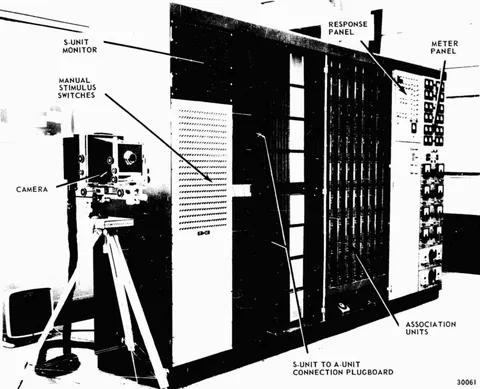
Now, the other part of that question is, why did it seem that AI could be capable of these things being promised? Well, this is ’57, so we had had the first hardware implementation of these learning machines, perceptrons.58Fact-checkInaccurate: in 1957 there was no hardware perceptron yet. Rosenblatt described it in a January 1957 report, ran a software model on an IBM 704 in 1958, and finished the Mark I Perceptron machine later, showing it publicly in 1960. The only hardware neural net by 1957 was Minsky’s SNARC (1951). Wikipedia. It’s kind of like today: it seems kind of inevitable. Like, if it can learn a little bit, why can’t it learn a lot? And then why can’t it learn to learn and just, you know, start some of these exponential growth curves, like "The Singularity Is Near"?
Yeah, "The Singularity Is Near.59"The Singularity Is Near" (2005) is inventor and futurist Ray Kurzweil’s book arguing that technology grows exponentially and that by 2045 machine intelligence will merge with and surpass human intelligence. In 2024 Kurzweil published a sequel, "The Singularity Is Nearer.""
By the way, not to sort of bust Ray Kurzweil’s balls too much, but one of my favorite things that I’ve ever seen on the internet was going on Ray Kurzweil’s website a little while ago and seeing "The Singularity Is Near," 10th anniversary edition, being advertised, which I got a really good chuckle out of.
Although he’s... We’ll see. It feels like things are catching back up to... He had some predictions that were like 2040, or, yeah, 2030s.60Kurzweil has long held to two dates: by 2029 a computer will pass the Turing test and match humans; by 2045 comes the singularity.
Look, again, I can’t bust his balls too much. I think it’s not unreasonable. I just found that really funny. Anyway, so yeah, it kind of seemed like, okay, well, we have a learning machine. We’ve never had a learning machine before, and surely if it can learn a little bit, it’ll just learn to learn better, or we’ll figure out how to get it to learn better, and then it’ll just inevitably learn until it’s on par with us and overmatches us. That was the mood at the time.
We were seeing a bunch of things at the time. This was the first time that machines were doing things that were previously exclusively the province of people alone, without sort of machine augmentation. Because in the past, what machines had mostly been for is augmenting human physical strength, first of all: digging a hole, moving heavy stuff around. And then they became useful for communication. So they simplified and extended the range of human communication through media technologies and radio. But this was the first time that, you know, the actual productive part of what humans do, which was understand the world and then do something about it, was being mechanized. And I think that’s the other reason that it got so exciting, to go, well, wow, this is happening for the first time.
Arguably it wasn’t the first time. Arguably the research in control systems theory, which was also happening around the Second World War, was an early approach to that, but all of these things were synthesizing into this one big thing, which eventually became called cybernetics,61Cybernetics is the science of "control and communication in the animal and the machine," as Norbert Wiener defined it in his 1948 book. McCulloch and Pitts were among its founders. In the 1950s and ’60s it promised a unified theory of brains, machines and society, but as a separate science it broke up into control theory, computer science and cognitive science. which also didn’t quite work out. Yeah, I think that’s part of the reason. Every time something happens for the first time, it’s incredibly exciting. I actually think Elon Musk talked about this recently, where he said the things that people care most about are firsts and superlatives. You want to be like, no one’s ever done this before, and also it’s the best thing in the world. And that’s kind of how it must have felt at the time.
07Are we as wrong as they were?
Short-run capabilities get overstated and long-run ones understated; in the 1950s the hype lived mostly among researchers.
Yeah, no, and it’s funny. I mean, as we are in 2022 now, some of this stuff might happen, but also nuclear’s making a bit of a comeback. People are getting early hype about fusion,62A week after this recording, on December 13, 2022, Lawrence Livermore National Laboratory announced that its NIF facility had, on December 5, produced for the first time a fusion reaction releasing more energy than the lasers delivered to the target. LLNL. although there’s a ton of debate about how far we are from that and whether it’s ever going to make sense. Elon says we’re going to be actually doing interplanetary travel63In 2016 Musk promised SpaceX’s first crewed flight to Mars in 2024. By the end of 2026 no one had flown to Mars. for the first time within a decade, or whatever his timeline is there. So it’s funny how much everything rhymes. And I think, you know, I write about this stuff all the time. I think we’re going to be able to do some of this stuff in the next decade or two, but am I as wrong as they were then?
Yeah, I think it’s possible if you look at the history. And, you know, it’s dangerous to just look at historical precedent, because today is not the same as yesterday, right? But I think inevitably what happens is the short-run capability gets overstated, and then the long-run capability gets understated.64This is Amara’s law, after futurist Roy Amara: "We tend to overestimate the effect of a technology in the short run and underestimate the effect in the long run." It’s very difficult to predict the impact of any given thing, I think, is what it comes down to. Which is justifiably why a lot of people are actually worried about AI: like, well, this is really hard to predict, but it does have this chance of going horribly wrong. So maybe we ought to spend more time with this than we have with other similar technologies in the past. But ultimately, I think it’s just hard to know what’s going to happen. But you’re right, the mood right now does feel a little bit similar.
It does, which is great. I want us to bring back, you know, a little bit of that optimism. But I do wonder if we’re... You know, people are kind of like, all right, AI is finally here. It finally arrived. And I’m sure, you know, that’s probably how a lot of people felt then as well. So it’ll be interesting to see how that plays out. How did, in the 50s, how did the hype manifest? So now it manifests through VC and through a lot of people talking about stuff on Twitter. How did it manifest back then?
Yeah, that’s a really good question. I think one of the big differences between now and then was the promise of AI was only one of several things that people collectively were promised. And I’m not sure how much attention the average person really paid to AI as opposed to all these other technologies, right? A rocket is a big, exciting, fiery thing that you can see. And AI is this kind of thing that nerdy computer guys talk about. Which one do you think is cooler, you know, as I drive my Thunderbird65The Ford Thunderbird, built from 1955, was a two-seat convertible and a symbol of the American ’50s. Anton’s picture of the era: a guy driving his Thunderbird to the malt shop is thinking about rockets, not computers. down to the malt house, right?
So I think mainly it was the research community which was most excited about these things, and there seemed to be so much useful, good work out there to just go out and do. And so people were trying stuff. They were thinking about it. They’re like, how are we going to make this work? It was also very concentrated in relatively few places. Computer science saw an explosion right around this time, but at the time it was still a relatively small number of people. Physics enrollment was much, much larger than CS enrollment at the time, because of course CS also belonged exclusively, or almost exclusively, to mathematical logic, because computers were not a machine that was in everybody’s house that anyone could play with. It was like, no, it’s this giant bank of wires and switches that you have to plug into, and a program was something you wrote out on a piece of paper and then handed off to your secretary, who would type it up into punch cards. The first programmers are almost all women66The six original ENIAC programmers (1945–46) — Kathleen McNulty, Betty Jennings, Betty Snyder, Marlyn Wescoff, Fran Bilas and Ruth Lichterman — were women: programming was then seen as clerical work, like typing. for that reason as well.
So it was mostly, I think, in the research community. But it was this great drive. It was almost like people took one step too far. They were like, well, it seems inevitable that we’re going to have learning machines, and this might be the learning paradigm. What should we do once we have them, since they’re obviously coming, right? I think that’s how it probably seemed at the time. And a lot of big promises were being made as well, and it kind of leads us into the first AI winter.
08The first winter: translation for the military and "Perceptrons"
The military wanted machine translation and document reading, didn’t get them, and read Minsky’s book as a death sentence for neural nets.
One of the other ways it manifested was that the DoD started spending. So instead of VCs rushing into whatever founder has an AI startup that wants to do X, Y or Z, it was the DoD saying, can you please translate all this Russian... I guess it was Russian at the time. Can you translate this Russian into English? And they’re like, yeah, of course, of course. And then they couldn’t really...67Machine translation started with the 1954 Georgetown–IBM experiment: an IBM 701 translated about 60 carefully chosen Russian sentences into English, and the organizers promised to solve the problem in three to five years. Funding came not only from the military but also from the CIA and the National Science Foundation. Twelve years later the ALPAC report found no results. Let’s talk about the AI winter a little bit. What actually happened?
So there were a lot of promises being made, and of course at the time, like you mentioned, a lot of the applications for these systems seemed to be in defense. So it’s the height of the Cold War. The Russians have put a man in space, the Cuban Missile Crisis has happened, the Berlin crisis68The order of events: the Berlin airlift, 1948–49; the Korean War, 1950–53; Gagarin’s flight and the Berlin crisis with the building of the Wall, 1961; the Cuban Missile Crisis, 1962. In October 1961 Soviet and US tanks faced each other at Checkpoint Charlie. has happened, which is one that people forget about, but, you know, there was a pretty big chance that that could have gone hot as well. You know, the Berlin airlift happened, the Korean War, all these things occur. So the DoD had needs for these systems, and so many other parts of defense were starting to be automated and mechanized. So, like I said, control theory, and control theory comes from around World War II, which was like, how do you aim an anti-aircraft gun so it actually hits its target?
How do you do that automatically? Because you can’t rely on a human gunner69Norbert Wiener worked on exactly this during the war: his anti-aircraft predictor was meant to calculate where a maneuvering plane would be when the shell arrived. His filtering theory and cybernetics grew out of that work. all the time. Or how do you get the plane to fly itself properly so that you can drop the bomb on where the bomb target is, right? So more and more of this stuff is being automated and connected into these communication networks, because pretty early on the DoD realized that whatever the war is going to be like in the future, it’s going to be much more complex and networked than it was in the past. And so for them, automating as much as possible was an important direction, and AI kind of slotted into that, right? And yeah, translation was this task they really, really wanted done.
Signals intelligence is something that computers had already been used for. Like, you know, Colossus was for cracking Enigma,70Fact-checkWrong: Colossus broke not Enigma but the Lorenz cipher, used for the German high command’s teleprinter traffic. Enigma was attacked at Bletchley Park with electromechanical "Bombes" designed by Alan Turing and Gordon Welchman. The photo shows a Colossus Mark 2 in 1944–45, run by members of the Women’s Royal Naval Service. Wikipedia. which was the German code machine in the Second World War. So this idea of automatic signals intelligence was already there. It was kind of imminent. Again, they wanted automatic translation, because if you have to wait for translation, that information may not be relevant anymore. There’s only so many people who spoke Russian, right? And so that was an application that they really, really wanted. They also wanted automatic document processing too. They wanted what we now call optical character recognition. They really wanted to be able to scan a document by a computer and then have it spit out English really quickly, because time matters in these loops.
ExplainerThe two AI winters
The first winter (roughly 1974–1980). In 1966 the ALPAC report concluded that machine translation was slower, costlier and worse than human translation, and the US government, after spending about $20 million, stopped funding it. In 1969 came Minsky and Papert’s "Perceptrons," and the Mansfield Amendment restricted the military research agency DARPA to work with direct military applications. In 1973 James Lighthill’s report to the British government nearly shut down AI in the UK, and in 1973–74 DARPA cut US university programs too.
The second winter (late 1980s into the 1990s). AI came back as expert systems, but in 1987 the market for specialized Lisp machines collapsed as ordinary workstations caught up for less; Japan’s Fifth Generation project closed in 1992 without reaching its goals; and expert systems proved brittle and expensive to maintain.
Neural networks lived on the margins all along and returned to the center only in the 2010s. Wikipedia.
And it didn’t work. It didn’t work, and other things didn’t work. And we ran into the first AI winter, where all the funding went cold and people stopped researching it. Not completely. Not completely. Fortunately, it didn’t completely die out. Otherwise we probably wouldn’t be where we are today. But certainly from its peak hype cycle, where these predictions were being made about being able to generate music by 1967, certainly that didn’t pan out. And we hit the first AI winter.
So what happens in the AI winter? I know there’s books being written that were like, "The perceptron is BS."
This is a really important book.71"Perceptrons" (1969) is the book by Marvin Minsky and Seymour Papert of MIT; Minsky had just one co-author. A mathematically rigorous analysis of what a single-layer perceptron can’t do, it is widely seen as one reason neural network research lost funding for years. In the expanded 1988 edition the authors insisted they had been misread. Actually, it wasn’t "the perceptron is BS." That wasn’t the aim of the book necessarily, but it was very influential for that. What the Perceptrons book from Minsky and the other authors actually said is that a single-layer perceptron by itself is limited in what it can do. And the reason that they were pointing this out was because multilayer perceptrons were computationally extremely expensive72Fact-checkNot quite: the main problem wasn’t the cost of computation but that nobody yet knew how to train multilayer perceptrons. The method that does it, backpropagation, became widely known only in 1986. Wikipedia. at the time. So they wanted to show that, yeah, fundamentally a one-layer version of this isn’t going to do great.
The thing that they brought up is this XOR problem. It showed that a single-layer perceptron of a certain topology, which by the way was not a fully connected one either, it was a so-called locally connected one, cannot solve what’s called the XOR problem. The XOR problem is, you know, you know what the exclusive-or operator is, but in case the audience doesn’t really know, it’s a logical operation where its inputs have to be different for the output to be true. So in other words, if you have two inputs, one, one would be false, zero, zero would be false, but zero, one or one, zero would be true.73XOR ("exclusive or") is true when exactly one of two inputs is true. A single-layer perceptron draws one straight line between "yes" and "no," and XOR’s four points can’t be split by one line: the "yes" cases lie on one diagonal of the square, the "no" cases on the other. For AND and OR such a line exists. A network with a hidden layer handles XOR easily.
And in this book they showed that, well, this kind of perceptron can’t learn that. And what Minsky has claimed since then to have been saying is, "No, listen, this limited type of perceptron, which is the thing that we know how to put in a computer, is fundamentally limited." And the implication is we’ll need more. But the way that it was read, and I think at the time things were being more disappointing than people had hoped for: translation wasn’t happening, OCR really wasn’t happening, or little toy things that they would try to put onto control systems didn’t really work much better than just writing down the physics equations in the first place. People took it as, okay, we have mathematical proof that this isn’t going to work, we can stop now.
09Room-sized computers
Without Moore’s law, a smarter computer simply meant a bigger one.
And they did, and they cut funding. And they also didn’t... So to your point about just how expensive it would have been to do it right at the time: they didn’t have the concept of Moore’s law.74Moore’s law is Gordon Moore’s observation, in a 1965 article, that the number of transistors on a chip doubles about every year; in 1975 he revised it to two years. It held for half a century. Did they have something similar, where they could assume that it was going to get cheaper over time, or was that not the way they were thinking about it?
At the time it was definitely thought that you had to make computers bigger to make them do more. In ’57, we did not have integrated circuits.75The integrated circuit was invented independently by Jack Kilby at Texas Instruments (1958) and Robert Noyce at Fairchild Semiconductor (1959), a year or two after Simon’s speech. They were on their way, and people were working on semiconductors very hard. But nothing like Moore’s law existed at the time. We thought we would have to build bigger, more complex machines, drawing ever more power, taking up ever more space, having an ever higher maintenance burden, to do more with computing.
It’s unbelievable that the same era that quote came from that we talked about earlier didn’t have semiconductors76Fact-checkNot so: semiconductors did exist in 1957. The transistor was invented at Bell Labs in 1947, and the first transistor computers appeared by the mid-1950s — TRADIC at Bell Labs (1954), TX-0 at MIT (1956). What didn’t exist was the integrated circuit, which is what Anton meant. Wikipedia. and thought that you just have to have these house-size computers to be able to do it.
But it was just... It’s what we had.
Oh, totally. It’s just crazy.
We had ENIAC77ENIAC (1945) was the first general-purpose electronic computer, built at the University of Pennsylvania for Army ballistics tables: 18,000 tubes, 27 tons, a room of about 1,800 square feet. It was programmed by replugging cables and setting switches, which took days. and MANIAC78MANIAC I was a Los Alamos computer (1952) built to John von Neumann’s design; it was used for hydrogen bomb calculations. and all these guys, and these were room-size machines, right? And making them programmable through plugging in different plugs, that was a huge advance. Because before that, it ran a program. The computer was a program. It didn’t do anything else. You couldn’t get it to do anything else. And then by using the plug switches, you were actually able to program it. You were able to give it a state transition table, and then later on punch cards, which, by the way, punch cards are a fascinating story in and of themselves, actually come from knitting looms. Sorry, weaving looms, weaving looms. From long ago, the Jacquard punch card79The Jacquard loom, demonstrated by Joseph Marie Jacquard in 1804, is driven by a chain of punched cards: a hole in a card decides whether a thread is lifted. Charles Babbage borrowed punched cards for his Analytical Engine, and Herman Hollerith later for his census tabulators. The picture is not an engraving but cloth: this portrait of Jacquard was woven in silk on a Jacquard loom in 1839, and it took about 24,000 punched cards. Babbage owned one. was one of the first automatic weaving machines.
That’s where the punch card came from, because you could program what pattern you wanted. Nominally, the first programmable device was a loom.
Anyway, so that’s what we thought we would have to do. And all this stuff was very, very brittle. Stuff would break. The word "bug"...80Fact-checkNot so: engineers used "bug" for a fault long before computers — Thomas Edison did in the 1870s. But the insect story is real: on September 9, 1947, operators of the Harvard Mark II found a moth in a relay and taped it into the log as the "First actual case of bug being found" — a joke that worked precisely because the word was already common. Wikipedia.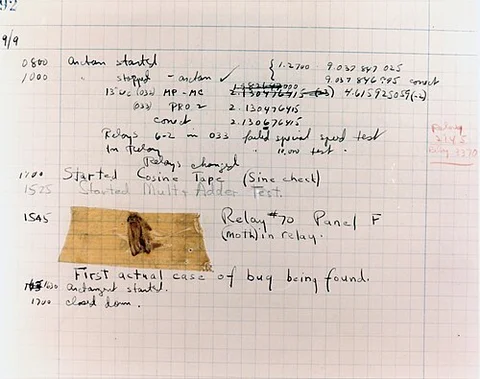 I’m not sure if this is true or not, it might be apocrypha, but the word "bug" comes from literal bugs. A beetle would crawl into the system and short-circuit it, and you’d have to find where a bug fully short-circuited the system.
That’s incredible. How many people were working in computers or CS or whatever you’d call the field?
That’s a good question. CS was two things at the time. One was really electromechanical engineering: how do you make a machine do this? And the other one was logic, which was like, okay, I’m going to think about how to encode a procedure into the language of the machine. And that was very mathematical-logic focused, because again, you couldn’t get computer time. You had to sit there and write your proof and then hand it off and hope somebody typed it up correctly. So not many. Certainly not even as a proportion of the total research effort compared to where it’s been directed today. If I was thinking of an estimate, I would say maybe several thousand people worldwide were working on versions of this. And the best work was concentrated in the places that actually had computing machines.
10Expert systems bring AI back
Neural networks went to the margins, and AI returned as if–then rules, because those worked.
Yeah. And so we hit the winter. It’s not for all of CS, but for kind of the idea of the perceptron, the idea of neural networks and computers thinking and making music and all of that. What did that do to the talent in the space? Where did people go, and then who held on?
That’s a really good question. Certainly it got winnowed down very significantly, and people found other uses for the computing machinery than trying to make artificial intelligence. Fortunately, computers stayed useful, and that led us to keep working on them, but no longer for the purposes of doing AI. Not that they were really for that purpose in the first place, but certainly it wasn’t oriented towards trying to make a computer think. It was more like, no, listen, we’re good, we know this calculation needs to get done. We’re going to make it do it faster, and we’re going to make it fit more memory so it can do bigger calculations for us, everything that we know how to write down and define. We’re not going to have it think, we’re just going to have it do mechanical operations much faster, right?
People focused on this kind of work. A lot of people returned to pure mathematical logic in CS, you know, just proving nice theorems and thinking about logic itself, and there’s a lot of really interesting math that came around. People went to work in more traditional control theory. A lot of really great work was done there, especially by the Soviets,81The best-known Soviet result of those years is Lev Pontryagin’s maximum principle (1956), the foundation of optimal control theory, used for example to compute rocket trajectories with minimum fuel. but also in the US. But AI as a unified discipline wasn’t really a thing that stuck around until, you know, this idea of expert systems showed up.82Expert systems were programs stuffed by hand with if–then rules elicited from specialists. The first came out of Stanford: DENDRAL (1965) inferred molecular structure from mass spectra, MYCIN (1970s) chose antibiotics. Commercial success came with XCON (1980), which configured DEC computers for customers; in the 1980s hundreds of corporations deployed such systems. And expert systems, of course, is the opposite approach.
It’s, you know, symbolic computation, where you have a bunch of rules. Basically you take what a person would do, transform it into a table of if statements, and then put the if statements in a computer. That’s symbolic, you know, it’s expert systems. And the thing about expert systems is they work. Expert systems did useful things for people, unlike neural networks, which never did anything useful for anybody at that time. And by now we’re in the 70s, right? And so we have this idea of rules engines, expert systems, but they’re doing things. They’re doing useful business processes for things. They’re doing useful things for the Defense Department, the government. Not automatic translation, but they sure can do a lot of things that otherwise a human would have to do. And so this whole paradigm of AI arose for the second time, which was now: okay, before, we tried to get them to learn; learning is way too hard. Now we’re going to encode every single piece of knowledge in the entire world in one machine, and that’s going to be...
Doesn’t feel as scalable or nimble. Were there debates back then between the two kinds of systems? Where now it’s like what we’ve talked about before: if it can functionally do everything that a human can do, then it’s artificial general intelligence, whereas this kind of feels like writing a really big script that does what a human might do.
Yeah, but it worked. That’s the thing. The thing is that it worked. And it’s really easy to keep going when you can point to something like, no, it’s working right now. It doesn’t really matter what your philosophical perspective is. Here’s the thing that works, and your thing doesn’t work.
Yeah. And what’s the line, that something is AI until it starts working, and then it’s no longer...83The AI effect is researchers’ complaint that whatever gets solved stops counting as artificial intelligence: chess, speech recognition, route finding. Historian Pamela McCorduck described it in "Machines Who Think" (1979), and engineer Larry Tesler put it this way: "Intelligence is whatever machines haven’t done yet."
I actually don’t agree with that. I still need to write something about that. But generally speaking, yeah, that’s what people would say. So the rise of expert systems kind of brought the idea of AI back: okay, you know, we can have machines that will emulate a human cognitive process. But it wasn’t on a connectionist basis, and it wasn’t on the idea that we’re going to plug neurons into each other and they’re going to have different weights and feedback signals and whatever. There was a bunch of work still going on in the connectionist paradigm, but more as a toy than anything else. It was a research effort, like Hopfield nets,84A Hopfield network (1982) is physicist John Hopfield’s recurrent network that stores patterns and recalls them from a distorted fragment, like associative memory. Hopfield described it as a physical system rolling downhill to an energy minimum, and in 2024 he shared the Nobel Prize in Physics with Geoffrey Hinton. because again, it was this idea of, okay, we have all this great mathematical machinery, which is intended for physics and math, but we can make statements about machines that behave like this.
And so people kept working on it as an object of interest, but not in the mainstream, not as a thing that you want to productize, not as a thing that gets you to AI. It was more like, oh yeah, here’s a Hopfield net, it has all these neat properties that we can, you know, use things from physics to understand. And the compute still wasn’t there. Yeah, that’s the other thing to remember: the compute still wasn’t there. It took a very long time to get us to where we are today.
And a lot of... On the expert systems, what were the types of things that they were doing?
Yeah, business process automation is the big one. Some kind of input comes in, it’s like, oh, it’s this form. Somebody types in the form, does data entry, and then the machine decides what should be done and spits out an answer. And that was based on rules, by just looking at what humans would do in any given situation and then encoding all the rules, and then it would automatically follow all the rules. That’s what they were good for. Things like insurance, banking, plenty of stuff in defense follows that thing. You need to follow a checklist and make sure everything is where it’s supposed to be, and it relies on, you know, data entry. It’s very difficult to do OCR with an expert system, although people definitely tried. So you have a human typing the input to the machine, the machine does the thinking part, and then it spits it out, and the human just carries out the task. So anything that looks like that, in principle.
11Deep Blue, Japan’s supercomputer and symbolic AI
Expert systems won at chess but couldn’t encode a fractally complex world; symbolic AI survived as an idea.
Was Deep Blue85Deep Blue was IBM’s chess supercomputer that in May 1997 beat world champion Garry Kasparov 3½–2½ in a six-game match. Custom chess chips let it evaluate about 200 million positions per second. It isn’t usually called an expert system in the strict sense: it was brute-force search with an evaluation function of thousands of features tuned with grandmasters. an expert system, or no?
Deep Blue is a really interesting case. Deep Blue is nominally an expert system. It is an expert system combined with a very efficient, for the time, search among the space of possibilities that the expert system could evaluate, basically. So yeah, it is, but it’s a special one. It’s a specially optimized one.
So going down the expert system path would have given up the four things that they predicted in 1957, except for kind of chess, if you count Deep Blue as an expert system.
I mean, you know, I think it’s reasonable to say that, yeah, chess was first. The first, at least, human-grandmaster-level-playing computers were expert-system-based computers. They encoded as many different rules as people could think of about good chess games, or how to play chess well, and then made it look ahead in a very efficient way and then evaluate what it could see in a very efficient way. It’s been known for a long time that the way especially very high-level chess is played by humans, it’s not that they think a hundred moves ahead, it’s that they only see the best moves. If you speak to grandmaster-level chess players, that’s what they’ll tell you. They’re like, yeah, I’m not predicting a hundred moves ahead.
It’s like, I don’t even think about the bad moves. But Deep Blue evaluated every single possible move for many, many moves ahead. So it wasn’t really playing like a human. And arguably most of our modern game-playing AIs play much more like a human does,86The clearest example is DeepMind’s AlphaZero (2017). It learned chess in hours of self-play, without a single human game, and beat the strongest program of the time, Stockfish, while searching about 80,000 positions per second against its rival’s 70 million: a neural-network "intuition" did the rest. Science. where they have, in some sense, an intuition. It’s not that they need to look so far ahead and figure it out. It’s more like, oh yeah, I’ve seen a board state like this before, here’s what I think.
Or they’ll do crazy stuff that I would imagine Deep Blue... Like, they’ll sacrifice pawns that a human wouldn’t, or a rook that a human wouldn’t. And Deep Blue was just saying, this is my best move based on every possible move from here on out in the game.
Yeah, and branch and bound87Chess programs prune hopeless branches of the search with alpha-beta pruning, a cousin of branch and bound. Which branches counted as bad was decided, in Deep Blue’s case, by an evaluation function written by people. as well. They’ll cut off obviously bad stuff, but according to human expertise, not according to a data-driven approach, which is how all the modern sort of self-play-based AIs work. So, expert systems. But expert systems kept the idea at least of AI alive. Huge investment in them as well. The Japanese government in particular, because at the time Japan was an economic, industrial powerhouse, right? And already a big part of, let’s say, Japan’s brand, for want of a better word, was, this is a country that’s in the future. Right? They have insane, crazy stuff that you just can’t get anywhere in the West. They’re decades ahead. And so they’re like, okay, well, why shouldn’t we build a supercomputer88Anton means Japan’s Fifth Generation Computer Systems project (1982–1992): the trade ministry MITI set out to build, within a decade, machines that reasoned logically over huge knowledge bases. It cost hundreds of millions of dollars, alarmed the Americans and Europeans into launching their own programs, and ended without reaching its goals. that knows everything in the world? And they invested huge amounts of money in this, and it turns out that you just can’t do it. You can’t do it because the world is fractally complex. You can’t encode everything about the world from an expert-system perspective.
I think the other thing that was sort of happening at the time, and still gets talked about today, and I think it’s actually kind of more important than we give it credit for right now in research, is symbolic computation.89Symbolic AI treats intelligence as transforming symbols by rules, as in logic and algebra. The first such program, Logic Theorist (1956), was written by the same Newell and Simon: it proved 38 of the first 52 theorems in chapter 2 of Russell and Whitehead’s "Principia Mathematica." So what symbolic computation is, is you have a set of symbols, you have rules for manipulating the symbols, but the symbols are interpretable as things that humans care about. So the classical, like, mathematical logic is exactly like that. Mathematical logic is just symbols and a bunch of rules for manipulating symbols, but it so happens that the rules and the symbols map onto concepts that we as humans care about.
They have what’s called an interpretation.90An interpretation in logic maps symbols to things in the world: "x" means Socrates, "P" means "is mortal." Inference rules work on the symbols alone, without looking at meaning; the interpretation is what makes the result meaningful to us. And so symbolic computation is variants of that, where you have symbols, you have rules for manipulating the symbols, and you start somewhere and you end up somewhere else. Symbolic computation, symbolic AI, was the thing that kind of was arising. It’s like, okay, well, what we have to do is not necessarily make a giant table of rules for everything that could possibly happen in the world. We just have to find the right set of symbols and the right rules for manipulating the symbols, and that’ll be AI. That was a fairly strong research direction. Which is actually probably the most classical approach to AI as well. A Turing machine, that’s what it does. And, you know, Alan Turing’s idea was like, okay, it’s symbolic computation. It’s not an expert system, it’s not this connectionist thing. It’s symbol manipulation, ultimately. That’s what people think goes on in their heads.
And there’s a lot of work in philosophy that is similar. Like, what is language? Well, is it symbol manipulation?91The best-known version of this idea is philosopher Jerry Fodor’s "language of thought" hypothesis (1975): thinking is computation over symbols in the brain’s inner language, not merely neurons firing. So that line stayed alive, but the connectionist approach was not popular. It wasn’t the thing that people were really working on for a very long time, except in these toy examples.
So where did the connectionist approach rise, and expert systems and symbolic crash?
Yeah, I mean, expert systems, again, kind of overpromised a bit. They didn’t overpromise quite as much, but this idea that, oh yeah, we’ll just encode the entire world in a set of rules, and then we’ll have a very efficient computer that can evaluate those rules very quickly: not workable, not really feasible. Not least because humans cannot perfectly encode rules about the world. We have never been able to do it.
So at this point, just for the same kind of context that we had before: the way that the hype has manifested is not just probably the DoD and international events, but it’s large corporations are also investing in this stuff now. Maybe not VC as much, but large corporations and governments.
Look, we have semiconductors now, right? We have mainframe processors that corporations can just afford. We even have minicomputers92The first mass-market minicomputer was DEC’s PDP-8 (1965): at about $18,000 it cost a fraction of a mainframe and fit in a cabinet. now, which is a computer that you have in your office instead of a terminal to something that’s living somewhere on site. A minicomputer that you might have on your floor: still the size of a refrigerator, but there, right? And you can afford it. And so people are trying to get useful things out of these things. And so the idea was like, okay, well, look, we’re solving all of these things, and again, they’re human things that traditionally a human has done. Now a machine is doing it. Surely it’s inevitable that soon everything humans can do will be done by machines, right? That’s the feeling that people got again.
I think in the 70s, you have to remember, there was the chip revolution:93In 1971 Intel released the first commercial microprocessor, the 4004, a whole processor on one chip; within a decade chips were in calculators, watches, arcade games and the first personal computers. more and more stuff became digital. And I think that’s sort of that parallel technological optimism about, oh, everything’s going to have a chip in it. It’s going to be chips, it’s all going to be smart, it’s all going to be miniaturized and smart. Miniaturization was the other way. Everything seemed to be getting miniaturized, everything seemed to be getting better and smarter. And so they were like, okay, well, something like Moore’s law might exist now, right? And I think Moore’s law was actually coined right around then,94Right: Gordon Moore stated the trend in 1965, and the name "Moore’s law" was coined around 1975 by his friend, Caltech professor Carver Mead. which is like, yeah, obviously the computers are inevitably going to get smarter, faster and smaller. And if we keep putting rules into them, and they’re getting faster and smaller, eventually they’re going to have every rule in the world, and we’ll have AI. It sounds great. Didn’t happen, didn’t work out.
Again, it was probably beating our heads against specific tasks. Like machine translation: you can’t do it in a rules-based way either. It doesn’t work. Every attempt at machine translation that has come from a linguistics perspective, a rule-based, linguistics-based perspective, has failed.95Machine translation finally moved when rules were dropped: from the late 1980s IBM translated statistically from huge parallel corpora, and in 2016 Google Translate switched to a neural network, a bigger jump in quality than in the previous ten years.
Are we talking about failed on edge cases, or things that a local person would know?
Yeah, like just normal translation.
Got it. Very often just produces gibberish.
The success cases were much, much rarer than the failure cases. The failure cases were very ordinary. The best we sort of could do was, like, digital dictionaries.
It’s funny too. Again, I get the sentiment that, of course, these curves keep coming down, and we’ll just get to the spot where it’s so cheap and ubiquitous and mini that we can just make all the rules. But I probably used a computer for the first time, call it, when I was in first grade or something, in the early, early 90s. And it was floppy disks, command line. It’s wild to think that 10 years, 14 years, 15 years before that, whatever the computers were then, people were like, yeah, obviously, inevitably, we’ll just be able to put everything in here, and it will be able to model the whole entire world well enough that we can use it to make predictions and all of that kind of stuff.
12How neural networks came back: data, backpropagation, AlexNet
Cheaper computers, digital images and backpropagation let connectionists experiment, and in 2012 AlexNet crushed the competition.
It didn’t come about, but computing hardware kept getting pushed forward until, you know, we had the personal computer. And then we went beyond that as well. And suddenly what started happening is, well, people were starting to be able to test out these connectionist ideas, at still very minimal scale, right? But sufficiently. We could run some algorithms now. We could test more of these ideas out, beyond these extremely minimal toy examples that didn’t really show you anything. Now we could try some stuff.
And the other thing that happened, of course, at the time was digital imaging became much more mainstream. It became possible to create these datasets. One of the first datasets was the zip code datasets, like MNIST,96Fact-checkNot quite: MNIST (1998) holds not zip codes but 70,000 single handwritten digits from US National Institute of Standards and Technology databases, written by Census Bureau employees and high school students. It was put together by Yann LeCun, Corinna Cortes and Christopher Burges. It was on zip codes supplied by the US Postal Service that LeCun first trained a convolutional network with backpropagation, in 1989. LeCun et al., 1989. The picture shows sample MNIST digits: note how differently people write the same digit. the handwritten zip codes, because the post office really wanted an automatic system for sorting mail, right? So they wanted an optical character recognition system to recognize zip codes, to route them. So they created this dataset, research worked on it. And so the fact that you could put images in a computer pretty readily at the time... CCDs97A CCD (charge-coupled device) is a light-sensitive chip invented at Bell Labs in 1969 by Willard Boyle and George Smith; early digital cameras ran on it, and its inventors shared the 2009 Nobel Prize in Physics. became much more common, digital cameras much more common. Digital cameras existed in research and defense way before you could take a photo yourself.
ExplainerBackpropagation
A neural network learns by adjusting the weights of its connections. First it produces an answer, which is compared with the right one by a loss function, a number that grows the more the network is wrong. Then, for each weight, you work out how much the loss would change if you nudged that weight — its derivative, or gradient — and move all the weights in the direction that reduces the loss.
Computing those derivatives naively for millions of weights would be prohibitively expensive. Backpropagation does it in one pass from the output back to the input: by the chain rule, the last layer’s error is split into contributions from the layer before, that one into contributions from the one before it, and so on to the start. So one training step costs only about two to three times an ordinary forward pass.
The method was discovered several times — by Seppo Linnainmaa (1970) and Paul Werbos (1974) — but it became famous with David Rumelhart, Geoffrey Hinton and Ronald Williams’s 1986 paper in Nature, which showed that a multilayer network finds useful internal representations on its own. Every modern neural network, from AlexNet to GPT, is trained this way.
And we had enough compute now to try some of these things, and backpropagation happened. Backpropagation is the next important advance in the connectionist paradigm of machine learning. And backprop is the algorithm that we’ve discussed in the previous two episodes, where basically the model has an output, you compare the output that you wanted with the output that you got using what’s called a loss function, and then you take the derivative of the loss function with respect to the weights, and then you update the weights of the model appropriately, basically. And backprop is that algorithm: it allowed you to efficiently compute each of those derivatives, going back through the network. So suddenly you were able to realistically run a two-layer perceptron on a computer which actually exists.
And so people were like, okay, we can go and try this stuff out, because, like I said, people had been working on this stuff as toy models for a while. And so now there’s at least a sliver, a tiny amount of research that you could do. You’ve done 100 Days of Code, so you know, you’re familiar with how important it is to have a REPL,98A REPL (read–eval–print loop) is an interactive console where you type a line of code and see the result at once. Replit even put the word in its name. how important it is to be able to write a piece of code and try it out and see. It keeps you in flow, right? Research is kind of similar like that. You can get fast iteration going, you can maybe get to a conclusion faster than you could before, versus sitting there for like five years thinking about it, trying to get it one hundred percent.
And so all these things come together, and you just have this slight, tiny, tiny sliver of progress, and you keep running into problems, and the problems keep getting solvable. So it’s like, the first thing is, okay, well, we keep having this problem of unstable gradients,99Unstable gradients plague deep networks: during backpropagation the error signal, passing layer by layer, either fades almost to zero or explodes, and the early layers stop learning. Sepp Hochreiter described the problem in 1991; the fixes included new activation functions like ReLU, careful weight initialization, batch normalization and residual connections (both 2015). we can’t really train especially deep networks. But if you do these two or three other things, if you regularize it in a particular way, here’s how you can... turns out you can totally train them. And then eventually you get to a point where we hit, okay, the connectionist approach is doing something, it’s not totally useless. People have acknowledged there might be a little bit of promise here. We don’t know what it looks like. And so more researchers are doing it.
Were there any leftover people from the first perceptron, connectionist run, or was this the young Turks reanimating this old idea?
I think mostly the latter case.100In fact there was continuity. Geoffrey Hinton had worked on neural networks since the 1970s, Kunihiko Fukushima built the neocognitron, a precursor of convolutional networks, in 1980, and Shun-ichi Amari and Stephen Grossberg kept at it through the winter. Rosenblatt himself didn’t live to see the revival: he died in 1971. My history on this part is a little bit fuzzy, about whose labs actually kept going with this. But the thing about the connectionist approach is it has kind of a magic to it. It’s this idea that you can get very complex behaviors from a set of very simple rules, and for a certain type of person that’s extremely appealing. Certainly when I first encountered neural networks, which was a long time ago, it was in 2009, actually in undergrad in 2009, I did a thing with neural networks, which were not at all popular. This is very, very early. I did some stuff with backpropagation on a thing, I wrote a whole presentation about it. But to a certain type of person it’s very appealing to have complex behavior arise from very simple rules.
And the connectionist approach is obviously very, very simple compared to the symbolic approach, the rule-driven approach, the expert system approach. And so I think, because it just attracts a certain group of people, as long as it can be worked on, it’ll get worked on by that kind of person. And, you know, I suspect that they definitely went back to the [unclear] and were like, listen, what’s really going on? What do you actually know? And they’re like, well, here’s some theorems. And then, because they were able to build on top of that, they just kept going. And I think the breakout moment for what’s now called deep learning was LeNet,101LeNet is Yann LeCun’s family of convolutional networks (1989–1998). LeNet-5 read handwritten digits on bank checks: by the late 1990s its systems processed more than a tenth of all checks in the US. or AlexNet,102AlexNet is the convolutional network by Alex Krizhevsky, Ilya Sutskever and Geoffrey Hinton. At the 2012 ImageNet contest its top-5 error was 15.3% against 26.2% for the runner-up, and that gap started the deep learning boom. which was like, wait a minute, image classification with a connectionist approach totally works. It totally works. It’s not superhuman performance, but it beats the shit out of everything else we’ve ever thrown at this problem. Not by a little bit: it dominates.
When was AlexNet?
13Is another winter coming?
After two winters connectionists are enjoying a summer, but language models still make things up, and the symbolists see limits.
Oh man, I have to look that up. Let me check. AlexNet, pull up Wikipedia real quick. September 30, 2012.
Wow. Should we... Because this feels like the beginning now of this next era. Should we do AlexNet next time? Because this is something I’ve heard of. Is it interesting enough? Where do we go to start off this next era?
Yeah, I think AlexNet would be good to start off the next era. I think our next episode could be another cutting-edge thing. I think I would actually like to cover WhisperNet103The model is just called Whisper. The series never did an episode on it: the fourth covered the latent diffusion paper behind Stable Diffusion, the fifth training data. and why it’s cool.
Ooh. Oh, okay.
Because Whisper is interesting in the field of audio. But I think covering the AlexNet era and everything that came just before and then what came just after is useful, because we’ve talked about the prehistory now, right? We’ve talked about the perceptron and the really early state. What we should talk about now is the proximal history, I think. And I think AlexNet and Geoff Hinton104Geoffrey Hinton co-wrote the 1986 backpropagation paper and supervised AlexNet’s creators; he won the 2018 Turing Award (with LeCun and Bengio) and the 2024 Nobel Prize in Physics. In May 2023 he left Google to speak freely about AI risks. and Yann LeCun, who I ran into the other day at NeurIPS, by the way. Yeah, it was really cool. I think that would be worth talking about in a future episode. And then I think AlexNet is really the thing that kicks off where we are today. Everything that exists now is from that time and probably owes some debt to it. I think also we should talk about Jürgen Schmidhuber,105Jürgen Schmidhuber is a German researcher at the Swiss lab IDSIA, co-inventor with Sepp Hochreiter of the LSTM network (1997), which carried speech recognition and machine translation before transformers. He is known for public priority disputes, insisting that many ideas credited to Hinton, LeCun and Bengio were proposed earlier by his lab or others — hence Anton’s joke. which we can also talk about in that era. He has a lot of contributions, as he likes to remind everybody constantly.
But yeah, we survived these two AI winters: we survived the connectionist AI winter, we survived the expert systems AI winter. And now we’re definitely in a connectionist summer. But how long is that going to last? It’s unclear. And if you ask Gary Marcus,106Gary Marcus is a cognitive scientist and deep learning’s loudest critic. In March 2022 he published the essay "Deep Learning Is Hitting a Wall," arguing that without symbolic methods neural networks won’t learn to reason reliably. its time is coming. So we’ll see.
Oh wow. That’s a cliffhanger. What’s the argument that the time is coming?
Well, it’s more of a feeling, right? For a long time, people have been banging on the walls of the connectionists. And the thing is, like with expert systems, right? It works. The best proof that you have for your thing being right is that it works. But for a long time now, people have been banging on the walls of the connectionist approach, being like, listen, you’re actually fundamentally limited. You’re fundamentally limited because it doesn’t have this, this, and this, and this. And those debates rarely get anywhere, because what happens is GPT-4 gets released, and it’s like, well, it works. Or ChatGPT gets released, and it’s like, well, yeah, you know, you can tell us we’ve got limitations, but we’re just going to do it, and we’re not really going to listen to you.
But here’s the thing. Remember how we’ve been talking about how GPT and its derivatives will readily generate nonsense? It will generate nonsense for you really easily. It’s not hard to get it. And we saw that with Galactica107Galactica was Meta’s language model for science, trained on 48 million papers, textbooks and reference works. Its demo opened on November 15, 2022, and was pulled three days later: the model confidently wrote plausible papers with invented facts and references. as well. When it came out, it was really easy to get it to generate fake science papers, or ask it for facts that are untrue, and it will keep predicting it. And these are right now possibly fundamental limitations, possibly not fundamental limitations in this approach, because they all rely on simple prediction without encoding any understanding of the world, except in some abstract sense, right? If you can predict something, you probably have some kind of understanding of it, but you can’t tell what’s true or false if you’re only making predictions.
And so one of the big arguments for the symbolic people is that, well, the only way you’re going to encode logic or deductive knowledge into these things, as opposed to inductive knowledge,108Deduction derives the particular from general rules and is guaranteed true if the premises are. Induction generalizes from examples: however many white swans you see, a black one may still turn up. A language model predicting the next word from what it has read reasons inductively. which is what prediction is, is by grounding them in some kind of affordances109Affordance is psychologist James Gibson’s term for the action an object offers to whoever deals with it: a chair affords sitting, a door handle pulling. Anton means knowledge should rest on interaction with the world, not just text statistics. that understand the world and the different viewpoints in it, instead of pure empirical prediction.
14Logic, truth and Babbage’s Difference Engine
Machines were first built so they wouldn’t err like people, and future AI may combine neural networks with logic.
Unclear, because, like I said, I was not expecting the symbolics to make a comeback here. If anything, because that one feels like it’s more like logic. We’re going back to the ancient Greeks and maybe earlier. Has something changed there that makes it more likely than it was 40 years ago or 30 years ago, whenever it was last hot?
Logic has, in a way, always been the foundation of artificial intelligence, because in a way logic is what we think of as intellect. It’s actually a really important question, where do we separate intellect from pure logic? If you look at AI textbooks, if you look at Norvig, which is still the classical textbook in AI, "Introduction to Modern AI,110Fact-checkInaccurate: the textbook is "Artificial Intelligence: A Modern Approach," and Peter Norvig has a co-author, Stuart Russell. The first edition came out in 1995, the fourth in 2020; hundreds of universities teach AI from it. Textbook site." if you look at even Turing, they considered logic a bedrock, because that’s what they thought most represents intelligence. Now we have these data-driven, empirical paradigms, but it doesn’t really go away. It’s more like we seem to be able to achieve more in the real world by not really thinking too hard about that right now.
Got it.
Yeah. So maybe we’re at a stage where we’re like the coyote over the edge of the cliff,111Wile E. Coyote of the Looney Tunes cartoons, chasing the Road Runner, keeps running off cliffs, hangs in midair for a moment and falls only when he looks down. right? And maybe these things where GPT routinely produces nonsense are the first glimmers of, well, maybe try something else. They’re okay, but there are still data-driven connectionist approaches to try to deal with that. A really common one is reinforcement learning from human feedback.112Reinforcement learning from human feedback (RLHF): people compare a model’s answers, a "judge" model is trained on their ratings, and it in turn rewards the main model for good answers. OpenAI used it for InstructGPT in early 2022 and then for ChatGPT. You just get people to tell you if you’re saying nonsense or not. And if you’re saying nonsense, we’ll try to stop you from doing that so much and boost the part of you that says good stuff. The problem is that stuff is fuzzy, and symbolics is not fuzzy. Symbolics is hard true-false, logical laws, logical predicates, which we don’t really know right now how to encode into the connectionist paradigm. We can’t guarantee anything; we think we can prod it in the right direction.
Spewing falsehoods feels way more human than logic and getting things right. I mean, we want to do better than that, obviously. We don’t want something that we trust spewing things that are false. But yeah, how do you encode truth when you don’t know what’s necessarily true?
Well, this is actually a really good point to make, and I want to go all the way back to the history of calculating machines for this one, to Charles Babbage.113Charles Babbage (1791–1871) was an English mathematician. He began building his Difference Engine for computing tables in the 1820s but never finished it, and later designed the programmable Analytical Engine. In 1991 London’s Science Museum built his Difference Engine No. 2 from his drawings — and it worked. Now, Charles Babbage is recognized as one of the first people to build a computer, or to think about mechanizing computation. He wasn’t the first, he wasn’t the only one, but certainly he was the one that is credited with a lot of work. He started building a thing called the Difference Engine. And the reason that Babbage built this thing was because in his time, tables of logarithms, which are very important for engineering, constantly had mistakes in them, because they were calculated by hand. And he was the sort of guy who really couldn’t tolerate that. So he was like, I’m going to mechanize these things, I am sick of people getting it wrong. He also really hated street music,114Babbage waged a years-long war on street organ grinders and musicians who, he said, kept him from working: he logged the interruptions and in 1864 devoted a whole chapter of his autobiography to them. New Orleans, NeurIPS’s host city, is famous for its street music — hence Packy’s joke. by the way.
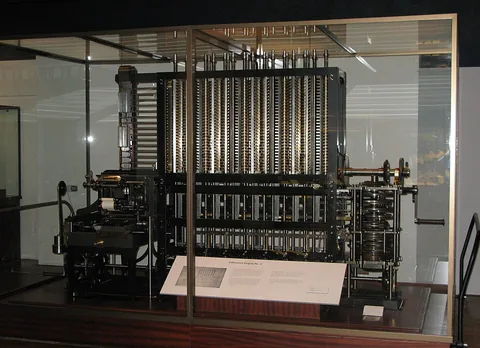
Definitely not. Well, Gary Marcus isn’t here either, so I don’t know. But yeah, Babbage created arguably the first mechanization of what we think of as logic or computation, in order to avoid the human mistakes that were being routinely made. And like you said, humans are prone to saying nonsense. So in a way, one of the original purposes for trying to build an artificial intelligence was to build a system that was not prone to the same propensity towards falsehood or mistakes that an ordinary human is. One of the core ideas of trying to mechanize the intellect is that we would have a machine that would help us so that we wouldn’t make mistakes. I think the idea that we want a machine that is very human and acts like a human and has the same things built in as a human is more recent than that.
Got it. And this is my dumb outside perspective, where I don’t have to think about how you’d combine things, but it feels like the ultimate approach in 10 years or 20 years or whatever will be some combination of the two,115Such hybrids are called neurosymbolic. The most prominent example came in 2024: Google DeepMind’s AlphaProof solved olympiad problems by generating proofs with a language model and checking each in the formal system Lean, where mistakes are impossible, and reached silver-medal level at the International Mathematical Olympiad. Google DeepMind. some way to make sure that you get the stuff that can be right, right.
Yeah. There’s plenty of stuff that you need to get in there that you can’t have a true-false on. I think time will tell. I think if there’s anything we’ve learned from the history of AI winters, it’s that trying to predict the winning paradigm too far in advance gets you into trouble.
Amen. Well, I think that’s a good place to wrap up. We will do Whisper next, and then we’ll go back, I think, throughout the series, into the history, but I like the idea of doing Whisper next. What do you have? Are you done, or is there a bunch of other programming this weekend?
Yeah, there’s a bunch more to do. I’m taking a bunch of meetings for Chroma.116Chroma is the company Anton co-founded in 2022 with Jeff Huber. At the time it built tools to work out which data to fine-tune a model on; since 2023 it has been known for its open-source vector database for AI applications. We’re out here recruiting at NeurIPS. And so yeah, still a bunch left to do, and I am going to go on an airboat on Saturday and hopefully see some alligators. That’ll be cool.
There we go. Well, if you want to work at Chroma, and somehow have made it through my dumb questions, but are also really, really good at this, then go check out trychroma.com. I highly recommend working with Anton and Jeff.117Jeff Huber is Chroma’s co-founder and CEO. Thank you for doing this. Enjoy the rest of the weekend, tell the alligators I said hi, and we’ll be back next week with Whisper.
Awesome. All right, thank you.
Good to chat, good to chat. Bye.


