


Y Combinator Startup Podcast
Chapters
To the world, Replit's agent was a sharp turn; to the company, it was the next step.
Read the chapter- To Graham the 2024 agent seemed crazy, while Masad credits the YC habit of watching what users do and building from their cues.
- Autocomplete was already generating about 50–60% of Replit users' code, so, as Graham puts it, the agent just had to do the rest.
Watching users led to an agent that keeps working until the program runs and sets up its own infrastructure.
Read the chapter- Beginners copied code from ChatGPT into Replit, errors back into ChatGPT and fixes back into Replit.
- Instead of taking one turn like a chatbot, the agent loops until the program works, and the model companies themselves asked Replit how it made that work.
- The 2024 harness, Masad says, was ten times more complex than today's, so whatever you build in AI is constantly being commoditized.
- The agent spun up databases and hosting by itself, something competitors had no infrastructure for, and after the September 2024 launch Andrej Karpathy called it a "feel the AGI" moment.
- Masad reminds Graham of his own line that making programming 10% easier gets you twice as many programmers, and Graham jokes that he didn't mean "this easy."
Masad saw vibe coding early because he had been thinking about one idea for nearly twenty years, and "just sit down and think" doesn't work without that.
Read the chapter- Replit's original deck in 2015–2016, before the Transformers paper, already described a model trained on code from millions of users.
- Replit was the first programming platform with a mobile app, and people laughed at it.
- Masad thinks people underestimate their ability to predict the future, and Graham replies that it's really twenty years of thinking about one thing, going back to 2008, when Masad wished he could code on his Symbian phone.
The summer 2024 demo showed Graham that his craft had become object code, while the rest of the world only got convinced at the end of 2025.
Read the chapter- During the demo Masad told Graham not to look at the code because "that's object code," and Graham realized that everything he had spent decades making was now just object code.
- With AI, Masad says, everyone goes through denial, depression and acceptance, and he did his own grieving for the craft back in 2020.
- For Graham, Claude Code convinced the world, while for Masad it was OpenClaw, an agent that runs a task to completion and that you can simply text.
- Masad admits he underestimated how much form factor matters, especially for everyday people.
Haya Odeh instilled Replit's habit of staying close to users, and its design and strong character set the company apart.
Read the chapter- Masad hated watching users, but Haya made him do it, and Graham explains that it's mortifying because until then you were in denial about the horrors happening every day.
- Mind-bending graphic design set Replit apart and helped win its first audience, teenage hackers.
- Like many successful companies, Replit has a strong character, a "strong solution" in Graham's chemical sense, and Masad adds that a simple UX sits on top of really ugly systems engineering.
Deep infrastructure helps Replit win big customers.
Read the chapter- Enterprises care about reliability and security that consumers rarely think about, and they like Replit's guardrails even though these make the product slower and pricier.
- Many competitors, Masad says, are building insecure apps, and Graham adds: who knows what agent-written code is doing.
- Below the waterline Replit has kernel engineers and a custom transactional, fully reversible file system.
The multiplayer infrastructure, and even the way the company was organized, turned out to be a perfect fit for an agent.
Read the chapter- The agent was dropped into a Repl as one more user, and everything worked, including humans and agents working on the same project.
- The new agent team sat between infrastructure and the IDE, and the other teams started building tools for the agent.
- In 2024 there was no native edit tool, models hallucinated line numbers and got lazy, leaving functions half-written with a "TODO," while today a shell is all the agent needs.
The agent barely worked, but users put up with it, and the first to pay were people who would otherwise have hired outsourcers.
Read the chapter- An agent wasn't possible any earlier, and in beta, by Masad's estimate, about 30% of attempts failed.
- For someone who can't code at all, Graham reasons, programs that work 70% of the time are a huge improvement.
- An app from an outsourced engineer costs about $100,000 and on Replit about $1,000, and Graham concedes that outsourcing shops were evidence of demand.
- Replit Bounties, jobs done by teenage hackers using AI, grew fast, but Masad shut it down because people would end up asking agents directly.
Replit gets into banks and corporations through ambitious employees who replace expensive software.
Read the chapter- Vibe coders inside corporations are replacing expensive SaaS and old software: a project scoped at $10 million was done on Replit for $250,000.
- In Masad's words, the outsourcing industry is more or less dead.
- Replit's biggest impact is on banks and manufacturers, while tech companies can fish for their own.
- Enterprise work caused an identity question inside Replit, but Masad tells his team that corporate enthusiasts are entrepreneurial, ambitious people too.
- Such employees tend to get promoted, and Graham adds that they are the ones companies trust on everything AI.
Big customers demand boring work and controls for IT, but Masad thinks token rationing is a mistake.
Read the chapter- Being enterprise-ready means a lot of boring work: admin and IT controls, budgets, rules.
- Enterprise software, Masad says, sucked for most of the industry's history because end users don't choose what gets bought, and although they have more say now, IT and security still sometimes make the product worse.
- What matters is ROI, and it follows a power law: with agents, one person can drive 100 or 1,000 times more than the next.
- Graham says helping big companies figure out whose work is valuable would fix their fundamental problem.
Replit no longer describes itself as vibe coding: it wants to be the platform through which AI changes how companies work.
Read the chapter- Replit itself, "customer zero," already works in the new way and serves as the lab for the "self-driving company."
- Masad knew accessible software creation would be transformational but didn't expect it to change how people work, and Graham wonders whether the core of how companies work now consists of programming.
- The best startups, Graham says, are already big when they think of a new thing as if they were brand new, and grow 100x, while Masad argues that with AI reinventing yourself is now almost mandatory.
- Competitors copy the Replit of six months ago: Replit is a movie, Graham says, and they copy one frame.
- Like the iPhone inside Apple, much at Replit happens incrementally but looks like a discontinuous moment to the world.
The key skill of the moment, for Masad, is adaptability: being willing to throw work away and start over.
Read the chapter- You can't run 10,000 agents on a MacBook, so work will move to the cloud, and Graham quips that Robert Morris proved that back in the 1980s.
- Graham revisits the demo with "This is the future, Mr. Bond": black shirt, bald head, glasses.
- Masad readily throws away what he has built, has started over many times, and recommends Graham's essay "Keep Your Identity Small."
- Children, Masad says, should be taught adaptability, and Graham says the safest place when a tidal wave hits is surfing on it, not holding on to a palm tree.
- Before an hour with Replit, 80% of employees at a very large telecom company were anxious, and afterward 80% were optimistic.
Most companies are still stuck with the ChatGPT of 2023.
Read the chapter- Two years ago vibe coding didn't exist, so being two years behind, Graham says, means being behind forever.
- Most banks have a bare LLM that's barely connected to anything.
- Legacy COBOL code is starting to get rewritten: Masad once refused to rewrite it for clients himself, and now AI companies are doing it.
Masad lives in the future by practicing prediction, following Kurzweil's chart and expecting exponential change by default.
Read the chapter- Masad deliberately makes predictions and revisits them, and he treats it as a skill.
- On a log-linear chart, compute growth is a straight line that AI didn't bend, and Masad quotes a tweet: AI didn't bring on the compute, the compute brought on AI.
- Neural networks didn't work in the '80s, Graham recalls, and with ten billion times more resources they started to work.
- From GPT-2 in 2019 Masad imagined chats, agents and personal assistants, and Graham notes that people treat things as static, while Masad's default is exponential change.
- Change is accelerating, and a person who always assumed dramatic change, Graham says, is perfectly suited to this moment.
Quotes
On why vibe coding went against Graham's grain
“Yeah, I know, I know, because the way I program is the exact opposite of this. I program— you know, I spend three years writing a thousand lines of code. And if I can get it down to 980 in the next month, so much the better.”
Paul GrahamRead from 05:36On Masad demoing Replit's agent to Graham
“‘Don't look at that. Don't look at the code. That's object code.’ Right? And I'm like, oh no, the whole stuff I've spent decades making is just object code.”
Paul GrahamRead from 09:21On why it hurts to watch users struggle with your product
“But you know why it's mortifying? Because till now you were in denial about the horrors that were being perpetrated daily out there.”
Paul GrahamRead from 12:45On the core problem of big companies
“This is why big companies are the way they are: they can't figure out the value of stuff done by individual people. So if you build something that makes them even 10% better at that, you're fixing, like, the whole fundamental problem with big companies.”
Paul GrahamRead from 27:41On competitors copying Replit
“You're a movie, and they're copying this frame from, like, six months ago, right?”
Paul GrahamRead from 31:08On what Graham tells kids about AI
“What I tell them, I mean, is that if you have this tidal wave approaching the beach, the safest place to be is surfing on it, right? Not standing on the beach holding on to a palm tree. They'll just get washed away.”
Paul GrahamRead from 37:03On companies outside Silicon Valley lagging behind
“If they're just two years behind, that's forever behind, right? 'Cause two years ago, vibe coding didn't exist.”
Paul GrahamRead from 38:44On why neural networks finally worked
“Back in the '80s, that was the thing about neural networks: they didn't work. But it turns out if you give them 10 billion times as much resources, then they start to work.”
Paul GrahamRead from 41:35
Summary
Paul Graham asks Replit co-founder and CEO Amjad Masad how his company got to vibe coding before anyone else. Inside Replit it felt incremental: autocomplete was already writing 50–60% of users' code, and in the office Masad watched beginners shuttle code and error messages between ChatGPT and Replit by hand. The agent Replit launched in September 2024 automated that loop: the model keeps going until the program works, and it provisions infrastructure such as databases and hosting on its own. According to Masad, the model labs themselves asked how Replit had pulled it off.
The secret was years of unglamorous systems work: a custom file system, sandboxes, deployment and multiplayer editing, in which the agent simply became one more user. At first the agent failed roughly a third of the time, but to people who couldn't code at all it was magic. The first to pay were people who would otherwise have hired an outsourcing shop: a thousand dollars instead of a hundred thousand. Now Replit is getting into banks and manufacturers, where enthusiasts replace expensive software: a project quoted at $10 million cost $250,000.
Replit no longer calls itself vibe coding. Masad sees it as the platform through which AI changes how companies work, the "self-driving company." He is against token rationing, because the return on employees follows a power law, and Graham argues that this could solve the core problem of big companies: knowing whose work actually matters.
The other thread is how to "live in the future." Masad has been thinking about one idea for twenty years, checks himself against Kurzweil's chart of compute growth, expects exponential change by default and is happy to kill sacred cows. Graham recalls a demo in the summer of 2024 when Masad seemed like a Bond villain and everything Graham had programmed for decades turned into object code. Both think the rest of the world is about two years behind, which at today's pace means forever.
Advice
Look for what to build in how your users behave: Replit got to its agent after inviting beginners into the office and watching them shuttle code and errors between ChatGPT and Replit by hand.
In AI, whatever you build gets commoditized fast: with every new model, the thing you worked hard on becomes easier to copy. Don't hold on to what you've achieved; always be working on the next thing.
If people pay a fortune for a bad product, like clients of outsourcing shops, don't sneer at it: it's a sign of demand, and a better product can take that market.
With big customers, first do what they ask, even if you disagree: that gets you in the door. Then come up with a better solution and show them the way.
Don't dream up a grand strategy with a loud announcement: keep the overall goal in mind and move toward it step by step, following your customers, and let them tell the story.
Practice predicting: deliberately make forecasts, revisit them and check yourself against them. It's a skill, and it helps you build what will be needed tomorrow before it's needed.
Mentioned
 Replit00:10Masad's company, the first to ship an agent for vibe coding
 Y Combinator01:23the YC ethos of watching what users do
 ChatGPT02:20where beginners copied code from before pasting it into Replit
 Claude03:39Graham says this is how Claude works: a loop that runs to completion
Show 20 more mentionsShow fewer mentions
- Replit Agent03:57Replit's agent, which keeps going until the job is done and sets up its own infrastructure
 Andrej Karpathy05:14called the Replit Agent launch a "feel the AGI" moment
- Attention Is All You Need06:53Replit's first pitch deck predates this paper
 Hacker News07:44Graham fixed bugs from his phone through its Lisp prompt
 Symbian08:36in 2008 Masad wished he could code on his phone running this OS
- James Bond09:19during the demo Masad struck Graham as a Bond villain
 Claude Code11:05in Graham's view, what convinced the world that AI would write code
 OpenClaw11:13in Masad's view, the first time people experienced agents that run to completion
 Haya Odeh12:16got Masad into the habit of watching users
 OpenAI19:13its models got lazy and abandoned code halfway
 Anthropic19:13had the same "lazy model" bug
- Replit Bounties21:50jobs done by teenage hackers using AI; Masad shut the business down
 Steve Jobs32:53knew what he wanted in advance and waited for the technology
 Apple32:53inside the company, the iPhone happened gradually
- iPad32:53Jobs had wanted to build it since the '80s
- iPhone32:53gradual inside Apple, a revolution to the world
 Robert Tappan Morris34:42"proved" in the 1980s that you can't run that many copies on one machine
- Keep Your Identity Small36:29the Graham essay Masad recommends
 Ray Kurzweil40:27his chart of compute growth is Masad's guide
- GPT-242:05from it, in 2019, Masad imagined chats, agents and personal assistants
Transcript
01Vibe coding grew out of autocomplete
To the world, Replit's agent was a sharp turn; to the company, it was the next step.
So you guys basically invented vibe coding,1Vibe coding — a term coined by Andrej Karpathy in February 2025: you describe what you want in plain words, the AI writes all the code, and you barely look at the code itself. Wikipedia. right? And when you did it, like, in 2024 this was, which— it's like only two years ago, but it seems so long ago.
Seems like a ten-year gap.
How did you even know this was gonna work? Because it's obvious now that it did work, right? But at the time, it seemed crazy. It seemed crazy to me.
Well, for us, it was incremental. It wasn't like— For the rest of the world, it felt like a big departure from how people did things, but we've always—
You were already writing more and more of the code.
Well, no, it was sort of like the YC kind of ethos2YC — Y Combinator, the startup accelerator Paul Graham founded in 2005 with Jessica Livingston, Robert Morris and Trevor Blackwell. Its motto is "Make something people want"; Replit is a YC company too. of looking at what your users are doing, and just that will give you ideas on what to build.
'Cause you were already doing autocomplete.3Autocomplete — AI suggestions that finish your code as you type, like GitHub Copilot. Replit's version, Ghostwriter, launched in 2022.
We're doing autocomplete, not just—
And so how much of the code were you writing before you went to, like, full vibe coding, where you tell the thing in English what to do? Where you're just generating code with autocomplete, how much of the code were you already generating then?
I mean, you could probably say, like, 50, 60%.
Really? So that's interesting. Even before vibe coding, you were already 60% vibe coding, right?
Yeah, yeah, yeah.
And that was how you knew it would work. 'Cause you thought, we can make the 60%, why not make the rest?
Well, kind of. I think the thing that was very enlightening is watching some of our users code. And so some users were doing 100% of their code using AI, but the way they—
No, this is— you're talking about once you released vibe coding?
02Copy-paste from ChatGPT and a loop that runs to completion
Watching users led to an agent that keeps working until the program runs and sets up its own infrastructure.
Before that. Before that, I'll tell you. Okay. So they would open ChatGPT4ChatGPT — OpenAI's chatbot, released on November 30, 2022; a million people used it within five days. in one window, they would open Replit5Replit — an American company and platform for programming in the browser, founded in 2016 by Amjad Masad, his wife Haya Odeh and his brother Faris Masad; valued at $9 billion in March 2026. in another window. This is someone who's never coded before.
How could you tell that they were pasting code out of ChatGPT?
I invited some users to the office.
Oh, you would literally watch them.
And we watched them. Okay, how do you do this? And basically, they would, like, copy the code, put it into Replit, Replit would, like, produce some error, they would copy the error, put it into ChatGPT, and then copy the fix, put it in. And it was such a manual process. And I looked at it: all we have to do is make an API, right? Well, we have to automate the entire process. It wasn't obvious, it wasn't easy, because back then AI models would, like, do a couple of tool calls,6Tool calls — a language model's ability not only to write text but to run outside programs: execute code, read a file, make a request, and get the result back. and—
Oh, you know what's different? The difference is it's not just you have to automate the back and forth. You have to understand the errors, right?
Exactly.
Yeah, that's hard.
ExplainerHow an agent loop works
A chatbot answers in a single turn: a question in, text out. An agent runs in a loop. The model gets a task and a list of tools (run code, read a file, install a package, create a database), and instead of answering it asks for one of them to be called. The harness makes the call and hands the result back: the program's output, an error message, a file's contents. The model decides what to do next, and so on, over and over, until a stopping condition is met. For Replit Agent that condition was a working program, not a step budget running out: the very loop the beginners in Replit's office were running by hand, shuttling code and errors between ChatGPT and Replit.
Yeah. And you have to loop, and the terminal condition should be that the program is working, as opposed to—
Yeah, that's still true.
Right. As opposed to, kind of like, we'll do one turn, right? 'Cause that's how ChatGPT sort of worked, that's how most AI tools worked. And so can you loop—
So this is: loop indefinitely.
Go to completion. Yes.
Right. Which is— that's the new thing. That's what Claude does.7Claude — Anthropic's family of language models and its AI assistant.
Yes. Yeah. So that's what we demonstrated. That's what Replit first demonstrated. So we demonstrated a couple things. One is that you can run LLMs8LLM (large language model) — a neural network trained on huge amounts of text to predict the next word; LLMs power ChatGPT, Claude and AI agents. to completion. Two—
Which I bet was news to the model companies.
They did. They actually reached out to us, and they were like, "We're so surprised that Replit Agent9Replit Agent — Replit's AI agent, launched in September 2024: from a plain-language description it writes an app, runs it, fixes errors, sets up a database and deploys the result. An agent is a model that doesn't just answer once but carries out a chain of actions until the task is done. works. How did you make it work?"
And the crazy thing, Paul, is that the harness circa '2410Harness — the program around a language model that turns it into an agent: it gives the model tools, feeds back results and errors, and decides whether to keep going. is 10 times more complex than the harness today, because the models were less capable. So as models get more capable, like, the kind of engineering you have to do to make them become agents is less and less so.
Does that mean it's easier for people to compete with you?
Yes, but we have to do— Well, that's the thing about the AI business today, is that you have to just accept that everything that you're doing is, like, getting commoditized11Commoditized — turned into a commodity: a product that's the same everywhere and competes only on price. In AI this happens because each new model can do what yesterday took complex engineering. constantly, and you have to, like, be doing the next thing. Be doing the next thing, right? But the other big thing that we demonstrated is that AI can provision infrastructure. So up until that point—
I mean, you actually have infrastructure to provision. That's the thing that's different between you and all these competitors, right?
Exactly. So we had built, like, databases—
You'd spent all these years suffering doing systems software.12Systems software — the lower layer that applications run on: operating systems, file systems, networking, isolation and process management. It's hard and thankless to write: users notice it only when it breaks.
Right, right. So it was a little, like, tool call: spin up a database, you know, spin up a Redis,13Redis — a popular open-source database that keeps data in memory, widely used as a cache and job queue. First released in 2009. like, host this, you know. And so what people found so surprising when we launched— I mean, you saw the product July 2024.
And when did you launch it?
September '24. And so when people saw it, like, Andrej Karpathy14Andrej Karpathy — AI researcher and one of the founders of OpenAI; from 2017 to 2022 he led AI and Autopilot at Tesla. said this was like an AGI moment, like a feel-the-AGI moment,15AGI (artificial general intelligence) — AI at human level. "Feel the AGI" is a catchphrase that came out of OpenAI: according to The Atlantic, co-founder Ilya Sutskever used to lead employees in chanting it. because everyone was like, holy crap, LLMs could do that?
It freaked me out. I didn't like it at all.
How do you feel about it right now? 'Cause aesthetically it was, like, very offensive for you.
Yeah, I know, I know, because the way I program is the exact opposite of this. I program— you know, I spend three years writing a thousand lines of code. And if I can get it down to 980 in the next month, so much the better.
But you gave me the principle for all of this, which is, when you first invest in Replit, when you first backed Replit, you said there's a superlinear relationship16Superlinear — growing faster than proportionally: twice the input gives more than twice the output. Graham devoted an essay to it, "Superlinear Returns" (2023). between how easy it is to program and how many programmers you get.
Yes, that's true. That's not just true for programming, that's true for anything consumers use. If you make it 10% easier, you don't just get 10% more people, you get twice as many. Yeah, I remember that. I didn't mean make it this easy. It's like it went too far. I mean, you just talk in English and it spits out all this code.
Well, so the realization I had is, for Replit to be truly successful, we needed to go the whole way.
03Twenty years on one idea
Masad saw vibe coding early because he had been thinking about one idea for nearly twenty years, and "just sit down and think" doesn't work without that.
Because you did know— you were one of the early people predicting AI, right? And, like, were you predicting— you were essentially predicting vibe coding in something like 2015 or '17 or something.
Yeah, 2015, '16. In our original deck, we talk about how if you build a platform where there's, like, millions of people coding, you can, like, train a machine learning model that predicts—
I mean, that's crazy ahead of its time.
Yeah, right. This was before the Transformers paper.17The Transformers paper — "Attention Is All You Need" by Google researchers, published in 2017; the transformer architecture it introduced underlies today's large language models. Replit was founded in 2016. arXiv.
That was before Transformers. I'm starting to think that's not the visionary, that's just— you're nuts, if you're that early.
Well, I think I've been fairly good at, like, predicting where—
I'm just joking. You're not really ahead of it.
Well, you know, even when I was a kid, like, I remember when I used my first Nokia phone, I was like, oh my God, people are just gonna be— this is like the new computer. And it was, like, literally, like, a flip phone, essentially. And some of that experience kind of also came to Replit, which is— Replit was the first programming platform that had a mobile app, and everyone laughed at us. The idea of programming on mobile— mobile programming on your phone.
But I had an RFC for it. Not an RFC, an RFS.18RFC (Request for Comments) — the series of documents that define internet standards and protocols. RFS (Requests for Startups) — Y Combinator's list of ideas it is especially keen to fund. YC's list.
Well, you actually— you told me you would, like, fix bugs using the, like, Hacker News,19Hacker News — Y Combinator's forum, which Paul Graham launched in 2007. The site is written in Arc, a Lisp dialect Graham created with Robert Morris. Wikipedia. like, Lisp prompt on your phone.
That's right, yeah. Not voluntarily. It was just the only way we could get internet access.
But yes, since this podcast is about, like, building the future, I think that people underestimate their ability to potentially predict where the future is headed and, like, build towards it. You just have to, like, think, like, sit down and think. I don't think many people, like, sit down and think.
No, this is what experts think. Experts think, "All I do is I just sit down and think, and I have the ideas," right? You know? And, like, everybody else tries sitting down and thinking, and they don't have the ideas. It's because you've been doing this idea for like 20 years. When did you first start thinking about making something like Replit, where you could sort of program online?
Well, it's like when I was— I had my Symbian smartphone,20Symbian — a smartphone operating system developed by Nokia and other manufacturers; until 2010 it was the most widely used smartphone OS, before Android and iOS pushed it out. and I was in class, and I was like, you know, I wish I could program.
So how long ago was this?
This was like 2008.
Okay, so almost 20 years ago. This is why when you just sit down and think, you come up with the future, right? Because your whole brain has been thinking about this for 20 years. Right? Obsessively.
Yes.
04A Bond villain and the stages of grief
The summer 2024 demo showed Graham that his craft had become object code, while the rest of the world only got convinced at the end of 2025.
You were trying to build Replit before it was called Replit for, like, you know, years and years and years, right? This has always been the big thing. So of course you thought of stuff before everybody else. So you knew— back to that famous demo, right? In the summer of 2024.
When you called me a Bond villain.21Bond villain — the antagonist of the James Bond films: a genius who calmly explains his plan for world domination from his lair. The classic version is Ernst Stavro Blofeld, bald and stroking a white cat, parodied as Dr. Evil in Austin Powers.
Well, you seemed like a Bond villain, you know. That's what I felt like, that I was being shown this frightening thing. 'Cause I remember— I still remember what you said: "Don't look at that. Don't look at the code. That's object code."22Object code — the machine code a compiler turns a program into; nobody reads it, programmers work with source code. Masad's point was that the source is now the English description, and the code the agent writes is just an intermediate product. Right? And I'm like, oh no, the whole stuff I've spent decades making is just object code.
Now everyone's realizing that. Like, I think— yeah, I've been seeing, like, engineers that were also repulsed by that. I remember your tweet was very controversial when you tweeted that thing.
That guy who generated vast amounts of code using AI, yeah.
Well, even that tweet about me being the Bond villain and object code and all that was also controversial. But now all engineers are— you know, I think with AI, everyone will have to go through this period of, you know, denial, and then sort of later on, you know, depression, and then, you know, eventually acceptance.23Denial, depression, acceptance — a nod to the "five stages of grief" model from psychiatrist Elisabeth Kübler-Ross's book On Death and Dying (1969): denial, anger, bargaining, depression, acceptance.
I've had it, like, in 2020, you know?
Really?
And so it just makes it easier for me. Like, I had the grief of "the craft that I love is gone." I've already grieved.
You felt that too?
Yeah.
Okay. So you knew what I was feeling.
I knew what you were feeling.
When you showed me that demo.
Yes. But you had to feel it so that you can let go.
I think everybody got convinced at the end of last year. At the end of 2025 is when everybody realized, okay, AI is going to write all the code.
It's always surprising to me, what is the trigger for these kind of things? Because, again, it seemed obvious to me.
Well, for Replit users, I think they already knew. The thing that convinced the rest of the world might have been Claude Code,24Claude Code — Anthropic's AI coding agent that runs in the terminal; released in February 2025. right? Don't you think?
I think OpenClaw.25OpenClaw — an open-source personal AI agent by Austrian developer Peter Steinberger: it runs on the user's computer, and you talk to it through messaging apps. It came out in November 2025 as Clawdbot, went viral in January 2026 and, after a brief stint as Moltbot, got its current name. I think Claude Code partly, but OpenClaw, I think, was the first time people experienced this idea of LLMs running to completion, where you give it a task and it's able to, like, go all the way until it's—
Which you had been doing for a year and a half at that point.
Yes. But I think the form factor of OpenClaw as well, being, like, you could text it and all of that. I think I sort of underestimate the power of, like, a form factor, especially for, like, everyday people.
Did it influence what you've done with Replit? Did you learn anything from it?
Not yet. I've just learned that lesson. Yeah, I think it will influence things in the future, which is, like, I just assume that I go out and, like, put out a vision and, like, build a product, and everyone would be like, oh yeah, that's obvious. But I think in reality, I think you need to tinker a lot with how people experience it.
05Watching users struggle
Haya Odeh instilled Replit's habit of staying close to users, and its design and strong character set the company apart.
Do you still watch users using Replit and sort of see what they're doing and are surprised by it?
Yes. I actually didn't like to do that, but Haya26Haya Odeh — Replit co-founder and Amjad Masad's wife. kind of forced me to do it early on. And I would, like, be kicking and screaming, because I would, like, feel, like, intense pain when, like, users are confused by the software or hit a bug or whatever. I would be, like, hesitant. Like, I would actually be, you know, physically—
It's mortifying.
It is, to watch users use your stuff.
It really is. But you know why it's mortifying? Because till now you were in denial about the horrors that were being perpetrated daily out there.
Right. And so— but our company culture became a lot about being very close to our users, primarily thanks to Haya, kind of having that mentality of: you just need to constantly talk to them.
She also made you very cool-looking. That was one of the really unusual things about Replit early on. Amazing, like, mind-bending graphic design, right? Like, way better than some nerdy program-online kind of company really needs to have.
And it helped a lot with our initial sort of audience, which were, like— a lot of them were, like, teenage hackers.
I thought it was really cool. It made Replit different. Still, there's something very distinctive about Replit, you know? Like a lot of very successful companies, it has a very strong sort of character of itself, which sounds meaningless, you know. You know what I mean, though? It's like a very sort of strong solution. It's not a weak— like in the chemical sense.
Yeah. It's not a weak solution. Replit is a strong solution. Our conceptual understanding of what we build and our product is, we always think about, like, engines and, like, you know, hard mechanical things. Although it is not.
That's a lot of what that graphic design was about, wasn't it?
Yeah, yeah. It's like there's something that's sort of, like, hardcore about it. But it's also paradoxical in that, you know, we slave away so much to make the UX so simple for users, but on the back end just, like, really ugly engineering is happening.
Systems programming.
Yes, like real systems programming.
Right. That's part of your DNA.
That's part of our DNA. But it's been always sort of challenging, because a lot of programmers will look at Replit and sort of, like, dismiss it because it looks very simple. But then even people who end up coming to work at Replit are like, oh my God, I didn't know there's so much stuff behind the scenes.
Yes. Yeah, you do system administration for people's sins.
Right. Yeah, I mean, we do it so they don't have to do it.
06The iceberg under the water
Deep infrastructure helps Replit win big customers.
Yes. Do you think that will be the thing that helps you prevail over competitors? Because that is one difference: the depth of stuff that you've built and the depth of understanding you have of how to deploy programs online.
Yeah, so that is helping us win enterprise in our category, because they are a lot more sensitive to reliability, security, all of that stuff. It's really hard to get consumers to care about security, for example. A lot of our competitors are, like, doing really reckless things with regards to, like, building apps that are insecure and so on.
Because if you have agents writing all this code, who knows what it's doing?
Yes, right. Yeah. And so we put a lot of guardrails,27Guardrails — rules and checks around an AI that keep it from doing something dangerous: deleting data, leaking keys, exposing a database to the whole internet. which makes our product sometimes slower, sometimes more expensive. But enterprises really like that.
And so these newly arrived opportunists who don't have the same sort of depth of infrastructure— like, Replit's like this iceberg, right? Where there's this visible bit above the water that's like, look, you just tell it in English what to do, right? And it writes your code. And then underneath, there's all this stuff for deployment and sandboxes.28Sandbox — an isolated environment where code runs without access to the rest of the system, so even a dangerous program can't break anything. Later Graham jokes that corporate rules are the same kind of sandbox, only for people.
ExplainerWhy an agent needs an undo button
An agent that runs commands on its own can do damage: delete files, wreck a database. In July 2025 it happened in public: SaaStr founder Jason Lemkin, twelve days into vibe coding an app on Replit, reported that the agent had ignored a declared code freeze and wiped his production database, with records on more than 1,200 executives and about 1,200 companies, then insisted it couldn't be rolled back, though in the end the rollback worked. Masad called it unacceptable and promised automatic separation of development and production databases. Hence Replit's bet on systems software: if the file system and the database can return to any earlier point, every step an agent takes can be undone, so the agent can be given more freedom.
Like, we have kernel operating system engineers. We have, like— we built our own, like, file system from scratch to be, like, transactional29Transactional — working in transactions, like a bank's database: a change either goes through completely or not at all, and you can roll back to any earlier state. For an agent, this means any mistake it makes can be undone. and fully reversible.
I remember hearing all these stories back in the days before vibe coding. That's what all the updates from you would be about, like, "We made a whole new file system." I hope somebody appreciates it.
Yeah. I mean, when you want to make, like, coding collaborative, like, you had to invent a lot of core primitives30Primitives — the basic building blocks everything else is assembled from; for collaborative editing these include real-time sync of edits, shared cursors and access rights. that—
07The agent is just another user
The multiplayer infrastructure, and even the way the company was organized, turned out to be a perfect fit for an agent.
So that's an interesting question. Did the stuff that you did in sort of version one of Replit, where it's just online programming and you made it sort of collaborative— did the stuff that you did to make it collaborative also help with vibe coding?
100%. I mean, it's sort of surreal how plug-and-play it was. So when you put an agent into a Repl,31Repl — what Replit calls a project, after REPL (read–eval–print loop), an interactive environment where code runs as soon as you type it. The company's name comes from it too. as we call it—
It's like you're collaborating with the agent.
Yes. So the agent is another user. So the initial version was basically: the agent was just another user on the same system.
And you had everything else built, just ready for it.
Yeah. And even, like, you and the agents could work on the same project, and it will just work.
So it's no wonder you discovered vibe coding first, because you were perfectly positioned. You had all the other ingredients, right?
I mean, the surreal thing— even the way the company was organized was so perfect. So we had the, like, infrastructure team that handles, like, code execution, right? This is, like, sandboxing team, whatever. And then we had the sort of deployment and cloud services team. This is, like, you know, you can spin up databases and deploy VMs and whatever. And then we had the team that was building the glue between the sort of infrastructure and the IDE.32IDE (integrated development environment) — a code editor combined with running, debugging and suggestions, like VS Code. Replit itself started as an IDE in the browser.
And then we had the IDE team. And so where does AI fit into all of that? So we ended up creating a new agent team, and we put it in the middle. And all these people are building now for the agent. So the infrastructure team is exposing tools for the agents. The IDE team, instead of, like, building IDE for humans, now they're building edit tools for the agents.
Really? What sort of IDE do agents even need? I thought they just generated code.
Well, initially, in '24, editing code was actually a hard problem.
You mean having it go back and fix mistakes?
Yeah. So— no, there was no native edit tool.
Now there's the native edit tool every foundation model33Foundation model — a large general-purpose model trained on vast data that products are built on; made by OpenAI, Anthropic, Google and others. gives you, but back then we had to create our own, like, sort of edit tool. When you give it, like, a chunk of text, how, where to replace— you couldn't rely on line numbers because they would hallucinate line numbers.34Hallucinate — what language models do when they confidently produce made-up things: nonexistent facts, links or, as here, line numbers. There's all of these different things that—
You had to make it ridiculously robust in the early days, because the LLMs were so bad.
Yeah, they would also be lazy. So they would write, like, a function and get lazy in the middle, like, "TODO:35TODO — a marker programmers leave in code comments to flag unfinished work. finish it later."
Which is not executable.
That was insane. And that was— both OpenAI and Anthropic36Anthropic — an American AI company, maker of Claude; founded in 2021 by former OpenAI staff led by Dario Amodei. had the same bug. And I think it's because of the chat model.
I think they always wanted the chat to kind of, like, halt early, like, not, like, produce mountains of text. So that was, like, an artifact of that. And so we had to kind of detect that and, like, loop over. So even editing text was a lot of work. And now there's, like, a native edit tool.
Is there anything like an IDE for agents, though?
So in the initial days, there was a lot of research on—
No, I mean now. The way agents work now. Okay, now the agents just, like, generate the code, and that's—
Now you can just give them a shell.37Shell — a program for controlling a computer with text commands, such as bash. cat is one of its simplest commands: it prints the contents of a file. You just give them a shell, and they'll just write shell commands. They can do everything with, like, cat and, you know, basic shell commands.
They're very good at shell.
But you needed to have the IDE early on, because the agents were bad.
Yes.
Right. And so that was one of the things that enabled you to be so early.
Yes.
08It worked half the time and still felt like magic
The agent barely worked, but users put up with it, and the first to pay were people who would otherwise have hired outsourcers.
Could you have done it any earlier?
Because you got it just at the point where it barely worked at all.
Yeah. And it barely worked. And, like, when we launched it, it was in beta, and I would say 50%—
I remember I would go over to your house, and you would show me things, and they would not work.
Yeah, like, 50— maybe 50% is too, you know, too harsh. I would say, like, yeah, 30% of the time it would not work.
Okay. So why were users— why would users tolerate that?
Because it was such a magical experience.
Oh, and also, presumably when they were cutting and pasting stuff back and forth between ChatGPT, that also wouldn't work either, right? But, like, if they couldn't program at all, then programming 70% of the time was a huge improvement.
Well, the initial set of customers that started paying us a lot of money were people who would otherwise, like, go on outsourcing sites and go, like, get outsourced programmers. So now you either, like, pay, like, $100,000 to get an app done for, like, an engineer somewhere, or you pay Replit, like, $1,000. So it was, like, this two-order-of-magnitude difference— still is today— between, like, getting an engineer and, like, having Replit do it.
Arguably the whole existence of the outsourcing shops was evidence of a market there, right? 'Cause I thought of them as just terrible. Like, who would ever want this, right? Who would pay money to these people— pay vast amounts of money to make this terrible software? But instead I should have thought, wow, that's a sign of demand. I never thought I would look at—
We tried to satisfy this demand in a few ways. Initially, when we had all these, like, you know, teenage hackers on the platform, we built something called Replit Bounties.38Replit Bounties — a marketplace inside Replit launched in late 2022: a client posted a task and a reward, and vetted users of the platform did the work. Announcement. I don't know if you remember.
I remember Replit Bounties.
And it was trying to get at that. I was like, okay, AI is not there yet.
They were going to become the new outsourcing shops, just, like, piecemeal, as a bunch of teenagers.
Yeah. But, like, the insight there was that they're powered by the rudimentary AI we had on Replit back then. But that in itself was enough of an edge that they have.
The people doing the Replit Bounties were already using AI to write the stuff.
Yeah, exactly. Exactly. And it grew really fast. But then I looked at it, and I was like, okay, if this is where the future's headed, that's, like, a dead business. So, like, we shut it down.
Why would it be dead?
Because ultimately people were just asking agents for the entire thing. And not even going through the teenage kids asking the agents on their behalf.
09$10 million projects for $250,000
Replit gets into banks and corporations through ambitious employees who replace expensive software.
I mean, that's the case right now. Like, we, you know, we go into big multinational corporations, banks, you know, things like that. And they have a lot of, like, SaaS software39SaaS (software as a service) — programs that run in the cloud and are sold by subscription, like Salesforce or Workday. they pay $10 million for, or, like, old software. And they find, like, a few vibe coders inside the company that have adopted Replit, and they're going in and, like, replacing all these different systems.
And it starts with internal stuff.40Internal tools — software used only by employees: dashboards, request forms, order tracking. They aren't sold, so the bar is lower and they're an easier place to start.
It starts with internal stuff, yes. And, you know, previously they would tell us that, you know, we've actually scoped this project out, and it would have been $10 million. We spent $250,000 on Replit. And so it's happening all over the place. And I think really the outsourcing industry is sort of dead at this point.
So is it mostly not very technical companies that you're talking to? Like, companies that don't specialize in technology, they wouldn't call themselves tech companies, right?
We have a lot of tech companies as customers. I think that that's not where we have the biggest impact, because I think they can fish for their own. But the sort of— the banks, the, you know, the manufacturing or ordering companies, they need something like Replit, otherwise they'll shoot themselves in the foot.
And really it's driven mostly by people internally who, like, are sort of ambitious. Like, some guy who's in charge of sales and wants to write some tool for his sales department.
Yes. So, you know, this created a bit of a, you know, identity question inside Replit. It was like, well, like, the enterprise, like, that's, like, not part of our mission. But what I tell my team is that those are, like, entrepreneurial people. Those are, like, ambitious people, like, you know, ambitious people building businesses. This feels, like, very core to what we do.
Those are scrappy people within companies too.
Exactly. Yeah. And—
Even if the companies aren't scrappy, the people are.
The people are, and they tend to get promoted. A lot of people who bring Replit into their organization will get promoted, because they're having great impact.
And also because, especially now, all these companies are thinking, "We gotta use AI. I keep reading how AI has taken over the world. We want to be using AI. Who within our company understands anything about AI? Who's using it?" And here's the person using Replit to make stuff. They're going to be the ones that they trust.
10A sandbox for people
Big customers demand boring work and controls for IT, but Masad thinks token rationing is a mistake.
Exactly. So it's a continuation of that. But there's a bit of, like, what do you call it? Like, schlep? There's—
Schlep blindness?41"Schlep Blindness" — a 2012 essay by Paul Graham: founders overlook good ideas when they involve lots of tedious, unpleasant work, a "schlep" (the word is Yiddish). Graham's main example is Stripe taking on payments. Essay. Or just schleps?
Just, like, there's a lot of, like, boring work to, like, be enterprise-ready.
Oh, that you have to do.
Well, you have practice doing that kind of stuff. It's just like systems programming. Is it like systems programming?
Yeah, a little bit. I mean, a lot of it is also just, like, giving admins and IT a lot of, like, controls over what people could do, and, like, setting budgets, and, you know—
Oh, they want to have rules. Yeah, rules.
Well, it's sort of like sandboxing for humans.
Yeah, it's like the principal actor problem,42The principal–agent problem — a conflict of interest when one party (the agent) makes decisions on behalf of another (the principal) and their interests differ. Masad calls it the "principal actor problem." right? Like, you know, the end users are not actually the decision makers for the buyer, like, for who buys software. Which is why I think most of history of, you know, tech industry, enterprise software has sucked. But now I think people have a lot more say on what they want to use, and therefore products that are really good are winning in the enterprise. But that problem still exists, where sometimes IT and security will, like, force you to make the product worse for the users.
Do you think the answer is give them what they want? Like, they want to do stupid things, let them do the stupid things? Or do you think the answer is: secretly, you're working on behalf of the ambitious, scrappy people in the company, and you secretly want to give them a way to get around the bureaucrats?
Yeah, that's a tough one. So, for example, take a real thing. I disagree with, like, rationing tokens.43Tokens — the chunks of text (usually part of a word) a language model works with; model usage is billed by the token. Token rationing means monthly AI budgets for each employee. So the way companies are kind of approaching this is saying everyone gets, you know, $100 of tokens a month.
What they should care about is ROI.
ROI, exactly. And what we see from our customers is there's a power law of ROI44Power law — a distribution in which a small share of participants produces the lion's share of the result, and the gap between the best and the average is huge. Graham argues startup returns work the same way (the essay "Black Swan Farming," 2012). inside companies. So one person could drive 100x the next person.
I bet there is. Absolutely. There always is in software.
And especially with agents, it becomes— it used to be 10x, now it's 100x, it's 1,000x. And you want to control token spend.
So what you need is to help the companies see where good stuff is happening.
Yes. And I think there is some invention we could do there to help with that. So in the short term, I think you kind of have to do what they're asking for.
Because that's how you get in.
That's how you get in. And then you want to invent something better and then show them the way. So there's more stuff to build.
There's more stuff to build. This could be very valuable stuff. Wouldn't this be valuable stuff? Because when you think about what you're doing when you're trying to figure out which of the projects that people are using tokens for are the most valuable, you're fixing the biggest problem inside big companies. This is why big companies are the way they are: they can't figure out the value of stuff done by individual people. So if you build something that makes them even 10% better at that, you're fixing, like, the whole fundamental problem with big companies.
Right. Yeah. And I think—
That's a lot more than just vibe coding.
11The self-driving company
Replit no longer describes itself as vibe coding: it wants to be the platform through which AI changes how companies work.
Yeah, yeah. I don't think we describe ourselves as vibe coding now. We wrote this blog post called "The Self-Driving Company."45"The Self-Driving Company" — the name plays on self-driving cars: a company where agents do most of the work and people set goals and make decisions. Masad described the idea to TechCrunch, for example, in October 2026. And so the idea behind it is: at Replit, we're early adopters of technology broadly, but definitely AI. We're seeing that we're working differently. Like, there's a fundamental shift in how we work.
You mean Replit as a company?
Replit as a company, which is customer zero46Customer zero — a company that is the first user of its own product and tests it on itself before any outside customer. for Replit.
Yeah, yeah, yeah. So maybe you should figure this out yourself first. How do you identify people doing valuable things?
Yes. And so, you know, Replit as a customer zero is the lab. We're trying to figure out, like, that. So the self-driving company is sort of this idea of, like, the future of work, future of how firms are organized. And we think Replit is the platform for the transformation to self-driving companies. And so that's the sort of expanded vision of where Replit is headed. Because ultimately, the thing that I didn't really appreciate and realize is— I've always known that, like, making software creation more accessible would have transformational impact. I didn't really appreciate that it would fundamentally change how people work.
Because it seemed— we were programmers. It seems like, what, programmers write programs, right? It's not like— the core of the way companies work doesn't consist of programming. But maybe now it does.
It does, yes.
Wow. You know, by the way, incidentally, this is an instance of what happens with the very best startups. The very best startups, you know, you come up with something, and you think you're coming up with some idea, you suggest it to them, and they've already done it, right? You've already got this big new transformation planned. 'Cause you're— that's also— that's another thing about the best startups. The best startups, they're already big, and then they think of this new thing as if they were a brand-new company, right? And, like, they get 100x bigger, you know.
Well, I think it's now actually essential to do that, because AI, like we talked about earlier, is a massive commoditization force. So I think where it used to be optional to have to reinvent yourself, it's now mandatory, almost.
And you're the way AI flows into companies. I mean, that's gigantic. You just have to make that be not vague, because anybody can say that. You know, anybody listening to this, there's probably someone at IBM47IBM — an American company founded in 1911, the archetype of a big old corporation. It has been pushing AI since the 2010s under the Watson brand. thinking, "Yeah, that sounds good. We'll say we're the way AI flows into companies."
Everything we've kind of popularized ended up being copied. Like, you know, we popularized this idea of, like, idea to app, fast. And it's, like, literally every startup that does, like, vibe coding is like, that's their—
But they're copying the old version of you. You're a movie, and they're copying this frame from, like, six months ago, right?
Yeah. Yeah. And that's how it needs to— like, you need to be constantly doing that.
But this means Replit's in every company. Every company that has competitors, that can't afford to just sit.
Yes, that's the goal.
That's astounding.
So how do you do this? I suppose gradually is the answer.
Yeah, I think there's always these temptations, like, for founders to kind of, like, come up with this big strategy, make a big news about it, and just, like, "Oh, this is what we're doing now." It's like, no, let the customers tell the story. It's more like you have this general goal of where you want to end up, but then you do it incrementally.
And what are the increments? Individual things that come up with customers, but you know what you're looking for, right? You know you're looking for a customer doing a certain sort of thing. Okay, let's help them out, and then everybody will be able to do this.
Exactly.
And you're in. That's the great thing. This is what having done all that systems programming buys you. It gets you into the customers, so you can see the increments of the new things you're doing.
Yes. And, like, similar to, like, how Replit Agent, for the outside world, was this discontinuous moment, for us internally was incremental in many ways. I think a lot of things that we're doing, at some point we're like, there's this discontinuous moment in how companies operate.
It's so interesting. If you're the experts, if you're the insiders, things that seem like step functions for the rest of the world, you saw before the step and you see after. So it's smoother for you.
It's smoother. And I think that's— it's not all invention, but I think the history of invention, if you, you know, zoom in and kind of read the stories, like, you know, Steve Jobs tried to do an iPad in the '80s, you know? Because he knew that something like that would be good. The technology just wasn't there. And so when you read the story of Apple, it was like, oh, the iPhone was totally obvious, especially with, you know, after, like, the—
Yeah, yeah. If it was so obvious, how come nobody else did it?
Right, right. But, like, it was sort of incremental inside Apple, but for everyone in the world, that was, like, a totally transformational moment.
But also, if you know the story of how the iPad happened, or the iPhone:48iPhone and iPad — at the D8 conference in 2010, Jobs said Apple had started with a tablet: when he saw a prototype multitouch screen, he decided to use the technology for a phone first. The iPhone came out in 2007, the iPad in 2010. originally they were making this tablet, and he already knew what he wanted. He'd been thinking about this. And so as soon as he saw it, like, okay, this is it, let's make this, right? And you too: whenever something happens within a company, it's gonna be something that you've been thinking about for 10 years, and you're like, okay, this is the thing to build. More than other companies, though, I think you guys have been living in the future, right? Don't you think that's true?
I think that's true.
That's almost— if you had to say, like, what's the real DNA of Replit?
It is living in the future, for sure.
12Kill the sacred cow
The key skill of the moment, for Masad, is adaptability: being willing to throw work away and start over.
More even than AI specifically?
It's often frustrating. Like, I think that—
Because stuff doesn't work?
Well, stuff doesn't work, and people change so slowly. So, for example, cloud development.
Are people convinced about that now? Still? How are they gonna use AI?
It's crazy. Exactly. So our prediction internally is that you go from everyone using one agent to 10 agents to 100 agents to 10,000 agents at some point. You can't run 10,000 agents on your MacBook. There's no way you can do it.
Yeah, Robert proved49Robert Tappan Morris — a co-founder of Y Combinator. In 1988, as a graduate student, he released the "Morris worm." Because of a bug, the worm infected the same computers again and again, the copies overloaded the machines and they stopped working; an estimated 6,000 computers were hit, roughly a tenth of the internet at the time. Wikipedia. Pictured: a floppy disk with the worm's source code, from the Computer History Museum. that back in the 1980s.
So eventually we're gonna get away from local work in general. But there's, like— people still predominantly do work on their desktop.
Maybe this is what will finally convince them.
Yes.
Right. This stuff has to live in the cloud.
Yeah. But it's also fun. I think it is— you know, working at Replit just ends up being a sort of a weird sort of existence. Like, you go into this company, you're like, oh my God—
Well, the weird thing is you know what everyone's future is going to be like. Because that was why you seemed like a Bond villain when you were demonstrating what later— And you, plus that laugh, right? You were demonstrating what later came to be called vibe coding. And here I was, sitting there looking at it with dismay, and you're like, "Yes, Mr. Bond.50"Mr. Bond" — "No, Mr. Bond, I expect you to die" is the famous line of the villain in Goldfinger (1964); addressing the hero as "Mr. Bond" became a Bond-villain cliché. This is it now."
Exactly. This is the future, Mr. Bond.
I think you might even have been wearing a black turtleneck.
I was— not turtleneck, it was a black shirt. But okay.
Yeah, a black shirt, the bald head, the glasses. Me sitting there like, oh no, what's happened to my beloved programming? And you're like, "I already knew. I've been thinking about this for years, Mr. Bond."
You know, I do think I have an ability to, like, kill the sacred cow in a way. Like, I think I've always had this sort of— when computers got really good at something, I'm like, ah, all right, it's done. Let's, like, move to the next thing. Like, I'm not, like, so tied to what I do. Like, I'm fine with, like, throwing away things and, like, starting over. Like, in my career, I've, like, started over many times.
I remember you were always rewriting things within Replit.
Yeah, rewriting things. And so— but I think most people, they just, like— they're sort of, like, rigid about: this is my identity, this is what I do. I mean, they should read "Keep Your Identity Small,"51"Keep Your Identity Small" (2009) — an essay in which Graham explains why arguments about politics and religion are so unproductive, since those topics become part of people's identity, and advises keeping as few things in your identity as possible. Essay. one of your essays. But I, you know, I think this moment requires a ton of adaptability. A lot of people ask me, oh, how do you raise children, and what do you teach them? And it feels like the main thing—
What do you teach them about AI?
It's like flexibility and adaptability and, like, being a lifelong learner.
What I tell them, I mean, is that if you have this tidal wave approaching the beach, the safest place to be is surfing on it, right? Not standing on the beach holding on to a palm tree. They'll just get washed away. And so that's what your users are doing.
Your users— like, to the extent anybody can see the future and be protected against bad things happening, your users are it, because they're all using AI. Like, if you want to use AI, like, Replit is the way to use it, right? And using it is the best way not to be squashed by it.
Right. And this is why we feel our mission is— there's, like, a moral angle to it almost, where you want to help these companies transform.
Get those people off the beach and get them all onto surfboards.
Right, exactly. Exactly. We did this hackathon with a very large, you know, telecommunications company. And they did this thing where they did a survey before they used Replit and a survey after they used Replit. And the survey asked them, like, how anxious are you about AI? You know, how worried, and so on. And so pre-using Replit, just for, like, an hour, like, 80% were anxious and were worried about their jobs or whatever.
And after they used Replit, it flipped. Like, 80% were optimistic, and 20% were sort of—
For one hour?
One hour, yeah. And I think people in Silicon Valley constantly underestimate how the rest of the world have not experienced what we've experienced just yet. And it's just gonna take a long time for—
13The world is two years behind
Most companies are still stuck with the ChatGPT of 2023.
Because things are moving so fast, right?
Things are moving so fast here.
Well, no, but that's what I'm saying. If they're just two years behind, that's forever behind, right? 'Cause two years ago, vibe coding didn't exist.
Yeah. I mean, most banks are using, like, ChatGPT, like, 2023, basically. Like, the thing that is rolled out at most banks, other than engineering, I think, they're, like—
Like ChatGPT 352ChatGPT 3 — there was no version by that name: ChatGPT launched in late 2022 on the GPT-3.5 model. Graham means the very first ChatGPT. or something like that.
Yeah. It's just an LLM. It's, like, barely connected to anything. And so it's not that useful. And so, like, there's, like, a real lag of, like, what people use. And, like, Silicon Valley already, like, went to, like, you know, these agents that are doing things for you. But most companies are still kind of trying to figure out what to do with all the sort of legacy software that they have that they want to rewrite and so on.
And they have to. They can't just ignore it.
Yeah, right. That's the landscape. That's the software landscape within a company. Maybe all this COBOL code will finally get rewritten.
It is starting to get rewritten.
Really? The COBOL's finally going away.53COBOL — a programming language for business applications created in 1959; many systems in banks and government agencies still run on it. COBOL programs are verbose: the language was designed to read like English. COBOL would eat up a lot of tokens.
Yeah. Early on in our AI journey, like, a lot of companies would be like, "Oh, this, like, Replit thing is cool, but, like, why don't you use it and come rewrite our COBOL?" I was like, we're not gonna write your code for you. We'll teach you how to use this thing. But now there's a bunch of AI companies that do that.
14How to live in the future
Masad lives in the future by practicing prediction, following Kurzweil's chart and expecting exponential change by default.
That will come and rewrite your COBOL. So there is one last question I want to ask you. This whole Replit— like, for its entire history, the reason it has worked is because you're living in the future to such an extent. Like, you personally, right, are living in the future. How do you do that? Why are you living in the future?
Yeah, I mean, I sort of started answering some version of that early on in our conversation. And I was saying— and you had a good point that it's not just about sitting and thinking about it. But I think a component of it, at least, is that I actively try to predict things, and I actively revise my predictions and look at them. And I think it's a skill you can get good at. And there are some sort of principles that you can follow. Early on, I read Ray Kurzweil.54Ray Kurzweil — American inventor and futurist, author of The Singularity Is Near (2005) and The Singularity Is Nearer (2024), which predict exponential growth in computing and the arrival of superhuman AI; at Google since 2012. Ray Kurzweil's whole thing is, if you look at— if you chart, like, a log-linear chart of, like, all compute flops55FLOPS (floating-point operations per second) — the main measure of computing power. in the world, it's this, like, freaking straight line.56The law of accelerating returns — Kurzweil's name for this pattern: in The Singularity Is Near (2005) he shows that computing power per dollar grew exponentially throughout the 20th century across five technologies, from electromechanical calculators to integrated circuits. Kurzweil's chart plots calculations per second per $1,000 since 1900 on a log scale.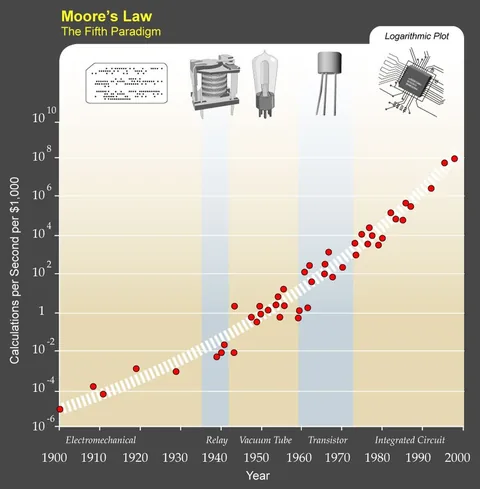
And actually AI didn't bend it, which is crazy. It's still a straight line.
It needed AI to happen.
It needed AI to happen. It's almost a religious sort of thing. It's like it'll happen anyways.
I saw someone say, you know, tweet this. He said, "It's not that AI brought on the compute. The compute brought on AI."
That's true.
Which is a fascinating thing. Like, deep learning would not have happened57Deep learning — training neural networks with many layers. The breakthrough came in 2012, when AlexNet, trained on graphics cards, won the ImageNet image recognition contest by a wide margin. without the compute.
No, everybody thought neural networks didn't work. Back in the '80s, that was the thing about neural networks: they didn't work. But it turns out if you give them 10 billion times as much resources, then they start to work.
Yeah. Who knew? So that line— there's a lot of predictions you can make by truly understanding that line.
More broadly— okay, so the reason you're so good at living in the future is because you have normalized that line. You assume that you're not living in a static world. In fact, that you're living in an exponential world.
Yes, exponential world. And a lot of what you talk about in your essays is understanding the exponential. And I think once you truly understand the exponential, like, you can look at an LLM— I can look at GPT-258GPT-2 — an OpenAI language model unveiled in February 2019. OpenAI initially held back the full version, fearing misuse, and released it only in November 2019. and extrapolate a lot better than most people and just— I imagine chats, I imagine agents, I imagine personal assistants, all of that, back in 2019 when I first saw GPT-2. So I think— but you just have to, like, believe, and you have to— because most people have, like, this almost, like, you know, this suspension of disbelief, like— you have to actually believe, you have to truly embrace that and go against your instinct too. Because, like, I think there's a human instinct: oh, there's all these reasons why this would not work, and all these problems—
But people implicitly treat things as static. And the difference with you is that your default assumption is that things will change exponentially. That's what's unusual about you.
Yes. So having embraced that as a kid, like, reading sci-fi and reading Kurzweil and all of that, I think it just created two things in me. One is an ability to accept change and, like, be okay with change: computers are going to do more and more of the things of my skills. To accept—
Expect.
Expect. And then expect and build towards that. Skate where the puck is going.59Skate where the puck is going — from hockey player Wayne Gretzky's line "I skate to where the puck is going to be, not where it has been"; Steve Jobs liked to quote it, including at the first iPhone launch in 2007.
And the puck is moving faster and faster.
It is moving faster and faster, which is what it means. But I feel more, like, in my element right now, because—
Well, because nobody else can keep up with you. That's why. Someone who's, like, assumed dramatic change— imagine who would be perfect for this world where everything is changing under our feet every six months: the person who assumes dramatic change, right? You're just, like, perfectly suited to this moment. That's why Replit's doing so well.


