

Uncapped
Chapters
Altman is tired of interviews and launches partner conversations modeled on Benchmark's Monday meetings.
Read the chapter- Every Monday Benchmark's partners spend five or six hours with no agenda on whatever came up that week, a "continuous conversation," as Eric Vishria puts it.
- Elsewhere, Randle says, a partner meeting lasts an hour and follows a strict list, like a corporate vice president's at Microsoft.
The key chart in the filing, Randle says, shows the labs are "money-printing machines": within six quarters revenue overtook compute spending.
Read the chapter- Almost all the numbers had leaked, but put together, Randle says, they show everything you want from a tech business: immense growth and operating leverage.
- In Q1 2025 revenue was 0.4 times compute spending, and in Q2 2026 it was 2.1 times.
- In six quarters Anthropic proved what takes software companies a decade, and its GAAP operating margin in Q2 2026 was 8%.
- Altman was surprised by how much revenue a gigawatt brings in and how valuable frontier tokens are.
The business model works, but the labs' growth is volatile.
Read the chapter- Anthropic's growth is lumpy, 145% quarter over quarter in Q2 and 45% in Q3, whereas SaaS companies like CrowdStrike and Datadog, Randle notes, grow along a smooth line.
- 80% of revenue is consumption-based rather than multiyear contracts like Snowflake's or Databricks'.
- Even a small lead for the best model brings crazy momentum, Altman marvels, and Randle puts it down to enormous consumer surplus.
- Altman cites a Keith Rabois idea: some tasks just need to be done right, while others, like code, sales or drug discovery, have unbounded upside, and there people always buy the best.
Code generation is saturated in Silicon Valley, but the asymptote is far off, and Randle expects it to keep doubling every year for a while.
Read the chapter- Altman compares it to Zoom, which got its demand pulled forward when everyone went remote and saturated the market: AI programming is saturated in Silicon Valley, but the rest of the economy is far behind.
- You can always run another agent, and companies founded after Opus 4.5 build software in a completely different way, with software factories.
- 10x growth may not repeat, but in Randle's view code generation can keep doubling every year for a while.
After ChatGPT the public markets bet in turn on everything AI data centers need; in venture the same happened around code.
Read the chapter- In public markets, Randle lists, the winners came in turn: servers (Supermicro went up 10x), cooling, networking, power (Vistra, Oklo, Bloom Energy, GE Vernova), memory and storage, and in 2026 Intel.
- Every year brought several new "derivatives" with multi-bagger returns, which Altman likens to following an egg through a snake and says Leopold Aschenbrenner predicted.
- In venture, Opus 4.5 and Claude Code in November 2025 set off growth in databases, hosting, inference clouds, sandboxes, CI/CD and supply chain security.
- Every such category has companies that went from 10 to 100 in a year and then to 300, and, as Altman notes, often several at once.
Code generation, Randle says, is probably the most impactful product-market-fit moment in the history of technology, and its pull is resetting venture expectations.
Read the chapter- Altman puts it on the order of the iPhone, and Randle adds that it's moving faster because the infrastructure was already in place, while Uber and DoorDash could grow only as fast as smartphones spread.
- Venture demand in code-adjacent niches is obscene, Altman says, while founders of good companies in other categories struggle to raise.
- Growing revenue from five to 18, as Datadog did, used to cause a frenzy, and now, Altman says, people would ask why it wasn't five to 40.
Altman thinks business durability is almost impossible to call right now.
Read the chapter- By the late 2010s, Altman says, you knew what was sticky and what wasn't, and enterprises would eye Workday for years and then use it forever.
- Application software was declared dead six months ago, is alive again now, and may be declared dead again in six months.
- You can invest either in the trend or in the next one, like robotics or biology, where there are early signs it will work, and returns, Altman says, are highest if you call the next one.
Randle lays out both views on circular revenue and has no problem himself with AI companies buying tokens from each other.
Read the chapter- On the first view, circular revenue is leverage, and it's healthier when banks and hospital systems in Ohio, New York and Florida buy AI.
- On the second, Stripe grew not on the old economy but on DoorDash, Shopify and Uber, and AI companies with software factories will likewise become giants and outcompete the rest.
In the case Randle builds for closed models, a frontier lab can become the low-cost producer of intelligence.
Read the chapter- If intelligence is a commodity, the low-cost producer wins, like SpaceX in launches or AWS in cloud.
- The labs have the best models, including unreleased ones that optimize their own serving, the most aggregated demand and the cheapest data centers.
- So, Randle argues, "open source is cheaper" is a misnomer: at the same margin a lab can be cheaper than an inference provider.
The strongest case for open models, Altman says, isn't money but the wish to own your own intelligence.
Read the chapter- A lab's price includes the cost of training, while an open model is free.
- Labs have no reason to cut margins for basic tasks, and the open models of the future will beat today's Opus 5.5 and Astra.
- More important than money, Altman says, is the wish to own your models and data, the Alex Karp argument.
- Nobody wants their model supplier to enter their space: Altman imagines Eli Lilly with all its data in Anthropic, which then announces it has drugs coming.
- A small open model fine-tuned on your own data, according to founders Randle talks to, reaches Sonnet-level performance and is dirt cheap.
The market has already shown what share open models will take.
Read the chapter- By year-end, Randle estimates, the top inference clouds will be at roughly a $6 billion run rate and OpenAI and Anthropic at $170 billion, or about 3%.
- If lab revenue reaches a trillion and open models take 10%, Fireworks, Baseten and Modal will split $100 billion in revenue.
- Altman welcomes the happy path: AI may turn out to be neither a "Terminator sand god" nor crypto all over again, with the labs extremely important but not $60 trillion companies.
After the PHP episode, cyber risk feels the most imminent.
Read the chapter- Prominent CEOs, the hosts say, pointed frontier models at their own companies, and day after day the models found company-ending vulnerabilities.
- Randle gives examples: a researcher used Claude to disable a webcam's recording light, and an attack on a French supermarket spoiled food in its refrigerators.
- Software can be patched, but vulnerable hardware can at best be taken offline, so Randle bought YubiKeys and recommends Andrej Karpathy's post on digital hygiene.
Open models with no safety guards are both a weapon and a defense.
Read the chapter- During the Hugging Face incident, Randle says, defenders had to turn to an open model because they couldn't get the frontier labs to turn off safety guards in time.
- Adversaries already have such models, so companies, Randle argues, need the same ones to attack themselves.
- Altman, a let-it-rip type, thinks defenses here need time to spread before models four generations ahead arrive.
- Hardening everything down to a hospital system in West Virginia is the biggest code modernization project in history, Randle says, and Altman hopes software now gets bought far faster than in the cloud era.
What will make the world better, in Altman's view, is not software but housing, health, food and transportation.
Read the chapter- The labs talk about biology and robotics, build teams and buy data, and Altman says he hasn't seen them be wrong when they say something is coming, only about timing.
- AI improves fastest, Randle says, where feedback is cheap and verifiable, as in code, while in the physical world robots are expensive and a biology experiment is physical.
- Brendan Foody of Mercor says the internet was a one-time subsidy for LLMs, and robotics and biology don't have one, so Randle expects Manhattan Project-scale investment.
- Immunotherapy drugs from the last decade gave Randle's father, diagnosed with advanced cancer, a prognosis of more than ten years, when 12 years ago he would have died.
Altman is taking his kids trick-or-treating and is already obsessed with the iPhone Duo.
Read the chapter- Altman is taking his kids trick-or-treating on the Peninsula and will try not to lose them.
- On day two with the iPhone Duo, Altman is obsessed with it, unless he ends up returning it.
Quotes
On AI labs after Anthropic's S-1
“They're money-printing machines.”
Jack AltmanRead from 04:58On the market buying up AI data center suppliers one after another
“It's like following an egg through a snake.”
Jack AltmanRead from 14:54On the scale of code generation
“AI code generation, you can sort of abstract most of the value generation in AI today to code gen. It's like… It's probably the most impactful product-market-fit moment in the history of technology.”
Everett RandleRead from 17:33On "five to 18" growth that used to impress investors
“Whereas now, if that's all you heard, you'd be like, ‘Well, why wasn't it five to 40?’”
Jack AltmanRead from 20:06The main argument for open models
“But I think more important is: do you want to own your own intelligence?”
Jack AltmanRead from 34:04When prominent CEOs asked frontier models to hack their companies
“And the model's like, ‘I'm gonna hack the shit out of you.’ And it does.”
Jack AltmanRead from 40:55On why robotics and biology lag behind code
“I don't know if he's the first one to come up with this, but Brendan Foody at Mercor says the internet was a one-time subsidy on the production of LLMs. And these physical spaces, they don't have as much of that one-time subsidy.”
Everett RandleRead from 52:50On Randle's father and his advanced cancer
“Yet immunotherapy drugs produced in the last 10 years have given him, like, a 10-plus-year prognosis.”
Everett RandleRead from 54:07
Summary
The first Benchmark Breakfast: Jack Altman, who has swapped interviews for partner conversations, and Everett Randle of Benchmark talk through the week's news the way it happens at the firm's Monday meetings, which run five or six hours with no agenda. The main topic is Anthropic's freshly published S-1. The most important chart, in Randle's view, is revenue against compute spending: in Q1 2025 compute ($0.9 billion) cost more than twice the revenue ($0.4 billion), while in Q2 2026 revenue ($11.6 billion) was more than double compute ($5.6 billion), with an 8% GAAP operating margin. The labs turned out to be "money-printing machines," but Randle doesn't expect an easy debut: growth is lumpy, 145% quarter over quarter in Q2 and 45% in Q3, and 80% of revenue is consumption-based rather than locked into long-term contracts.
Randle calls code generation perhaps the most impactful product-market-fit moment in the history of technology. Since Opus 4.5 came out in November 2025, it's not just the coding agents that have taken off but whole "derivative" categories: databases, hosting, inference clouds, code sandboxes, supply chain security. It mirrors the public markets, where servers, cooling, power and memory rallied in Nvidia's wake. Altman compares it to Zoom in the pandemic: AI programming is already saturated in Silicon Valley, but the rest of the economy is nowhere close. Because code is pulling so hard, a good software company growing "five to 18" no longer impresses anyone, and business durability has become very hard to call.
On open versus closed models, the hosts steelman each side. Frontier labs could become the low-cost producers of intelligence, the way SpaceX is in launches or AWS was in cloud; the case for open models rests on no training amortization, saturation of simple tasks and the wish to "own your own intelligence." The conclusion is "it all works": open models take 5–10% of spend, and if lab revenue reaches a trillion dollars, the three leading inference clouds will be worth hundreds of billions. Then comes cyber: companies that turned frontier models on themselves kept finding company-ending vulnerabilities day after day, while adversaries use "abliterated" models with no safety guards.
At the end, Altman and Randle agree that biology and robotics will change the world more than any software, but their feedback loops are slower: experiments are physical, robots are expensive, and there is no internet acting as a "one-time subsidy" of data, so it will take Manhattan Project-scale investment. Randle tells how immunotherapy developed in the last decade gave his father, diagnosed with advanced cancer, a prognosis of more than ten years.
Advice
Growing revenue from $5 million to $18 million is no longer enough to raise easily: show a path from 18 to 100 next year, or prove you're doing something so hard and unique that the growth will last.
Don't build your product entirely on one lab's models: if that lab enters your space, your customers will ask why they need you when they could go to it directly.
If you have a lot of your own data and good traces of the tasks you're solving, fine-tune a small open model: it can reach Sonnet-level performance at a fraction of the cost.
Attack your own infrastructure with abliterated models, free of safety guards just like your adversaries' models, so you find the vulnerabilities before they do.
Mentioned
 Benchmark00:20Monday partner meetings with no agenda
 Eric Vishria01:34the "continuous conversation" and "it all works"
 Anthropic02:00its S-1: revenue versus compute spending
 Twitter02:47"making us all dumber," but the S-1 numbers leaked there too
Show 42 more mentionsShow fewer mentions
 Datadog06:25a model of smooth SaaS growth; "five to 18"
 Claude07:49the $200 Claude Max plan as an example of consumer surplus
 Keith Rabois08:07the two kinds of tasks
 Zoom10:16the market saturation analogy
- Claude Opus 4.511:20after it, companies build software in a completely different way
 ChatGPT13:31where AI demand began; 100 million users in a few months
 NVIDIA13:31where the AI bottleneck trade began
 Super Micro Computer14:03went up 10x
 Oklo14:18a bet on nuclear power
 Intel14:43up 120% in 2026
 Leopold Aschenbrenner15:02the "prophet" of the AI derivatives trade
 Claude Code15:10with Opus 4.5, it kicked off the code generation boom
 Fireworks AI15:35an inference cloud Benchmark has invested heavily in
 Baseten15:35one of the three "champions" of the inference market
 Modal15:35an inference cloud and code sandboxes
 Mercor15:35data for AI labs; growth with "no limit"
 Lovable16:52growing alongside Replit, though everyone asked, "Isn't this Claude Code?"
 Replit16:52several companies growing in the same category
 Codex17:04"Isn't this Codex?"
- iPhone17:49code generation as an iPhone-scale moment
 Workday21:56sticky enterprise software you buy once and keep forever
 Physical Intelligence23:16"you can see the future" of robotics
 Stripe26:36grew on internet companies, not the old economy
 Kimi28:45the open Kimi K3 model: free, no training to amortize
 Moonshot AI28:45the developer of Kimi K3
 SpaceX29:32an example of a low-cost producer
 Amazon30:13AWS and economies of scale
- iPhone Duo32:58"should you get the Duo or not"; by the end Altman is obsessed with it
- Claude Opus 5.533:27the bar that future open models will clear
 GPT-6 Astra33:27likewise
 Alex Karp34:24"own your own intelligence"
 Eli Lilly35:10a customer for whom depending on a lab is risky
 PHP40:55critical vulnerabilities
- Samsung The Frame43:47"smash it immediately": smart devices can't be patched
- YubiKey43:54Randle bought hardware keys to protect his accounts
 Andrej Karpathy43:54the post on digital hygiene
 Hugging Face44:27the incident in which an open model helped the defenders
 ARTEX AI45:03the AI tool Chinese groups use to hack companies around the world
 Cognition46:21code modernization and a joke about ad reads
 Tesla49:23data for self-driving
 Cursor50:39improved its models quickly
 Brendan Foody52:50"the internet was a one-time subsidy"
Transcript
01A new format: Benchmark Breakfast
Altman is tired of interviews and launches partner conversations modeled on Benchmark's Monday meetings.
I mean, I think I could joke about being just, like, a little bit bored of… It's like I interviewed everybody.
Just shit on all the VCs you've interviewed.
I mean, we could joke about that, though. Yeah, they're great. But I asked them all the questions and, you know, learned all the lessons. Maybe we come back, but it was time for an update.
All right. Well, this is the beginning of a new iteration of the pod, where, I guess, you know, at some point… I mean, I've learned a ton, but at some point you've interviewed a lot of VCs, and you say it's time to just talk to a VC that you talk to ten times a day instead. But just changing it up a little bit. So now we're gonna do this thing — Benchmark Breakfast,1Benchmark Breakfast — a segment of the Uncapped podcast in which Jack Altman and Everett Randle, general partners at the venture firm Benchmark, discuss the news. Randle joined Benchmark from Kleiner Perkins in 2025, and Altman came over from his own firm, Alt Capital, in February 2026. This is the first episode of the segment. we're calling it — where we're kind of gonna, I guess, I don't know, mock, you know, a little bit of the time that we spend on Mondays. And I guess, you know, what we do on Mondays at Benchmark2Benchmark — a San Francisco venture firm founded in 1995; its early investments include eBay, Twitter, Uber, Snapchat and Instagram. Its general partners are equals: there is no managing partner, and profits are split evenly. has basically been no agenda. We get together as, you know, the five of us, and we sit around talking about whatever came up that week or whatever we're thinking about.
And Ev and I were just saying, well, that'd be a fun new version. And if I'm losing steam on the current, you know, the current podcast, like, let's take a new rep. So I'm excited to be doing this.
100%. And I feel like whenever we tell anyone about our Monday morning, or just our Monday partner meetings, and the fact that they're typically five to six hours, the two… I mean, the two responses we get is, like, "That is absolutely insane. It's a little long." It's like, you know, people will be like, "I can barely stand our hour-long partner meeting." And then the second question is like, "Well, what's the agenda?"
And I think that's the really important thing about our Mondays.
We review the pipeline. Yeah, yeah, yeah.
Yeah. Their agenda is, like, you review a very strict list, and, you know, it feels like you're, like, a corporate vice president at Microsoft or something. But our answer is always: there is no agenda. We just think about… You know, it's a continuous conversation, as I think our partner Eric3Eric Vishria — a general partner at Benchmark since 2014; before that he co-founded and ran the browser startup RockMelt, which Yahoo bought in 2013. says, from one week to the next. And I think, you know, we thought it'd be fun to, like, you know, open-source or make public, like, the form factor of that conversation.
02Anthropic's S-1: revenue versus compute
The key chart in the filing, Randle says, shows the labs are "money-printing machines": within six quarters revenue overtook compute spending.
So one thing we talked about, obviously, is big news: Anthropic4Anthropic — the developer of the Claude AI models, founded in 2021 by former OpenAI employees led by siblings Dario and Daniela Amodei. dropped an S-1,5S-1 — the registration statement a company files with the US Securities and Exchange Commission (SEC) before an initial public offering, disclosing its finances, risks and plans. Anthropic published its filing on Monday, October 26, 2026. which is, you know, pretty critical to the industry. So, as somebody who can actually read an S-1, of our mostly early-stage group, what was your reaction?
Yeah, it was amazing timing, because I feel like leading up to the S-1 day, you know, there was a lot of market turmoil, there was a lot of carnage in the public AI trade,6The AI trade — a market bet on companies that benefit from the AI boom: Nvidia and other chipmakers, cloud providers, data center builders. a lot of FUD7FUD (fear, uncertainty and doubt) — fearmongering around a company or technology. about Anthropic, like, are they gonna IPO,8IPO (initial public offering) — when a company first sells shares on a stock exchange, so that any investor can buy them. are they gonna delay it? And then, you know, they come out with this S-1, and on its face, this is everything that you want from a technology business. And it's funny, because most of the numbers in the S-1 had been leaked at one point or another. Like, there wasn't, like, that much new information.
You mostly could have stitched it together from, you know, if you believed the right things on Twitter — as you always say, Twitter's making us all dumber — but it was almost there.
But it was like, you know, if you really were good at parsing through, it was all basically there. But I think it was another thing entirely to have all the numbers put together in one place. And, again, it was, like, on its face, what you want out of a technology business, typically, is you want immense growth and you want operating leverage. Operating leverage is the sense that, like, you have this big upfront investment in R&D, or sometimes with software businesses, you pay a ton for salespeople up front, and they take some time to pay themselves back. But you invest all this money up front, you have fixed costs, and then your revenue grows so much, and your incremental margins are so good, that you become very profitable very quickly as you scale.
Yeah. And we don't have to go through every number and stat — obviously, it's all over X, it's all over the internet. But I think the most important visual from the S-1, in my opinion… There's a chart that I'm looking at that you guys can't see.
No, no, we'll put it up. Oh, well, we have the power of technology.
That's true. We have the power of, you know… Maybe we'll use AI. But the chart is showing the relationship between their revenue and their total compute expenses per quarter. Right. And so it's both the compute expenses for serving customers, but then also training. And in Q1 of 2025, Anthropic had 400 million-ish — you know, they do it in billions, and so it's only 0.4.
So it's like 400 million-ish of revenue against 900 million of compute and infra expenses. And so that's like a 0.4x ratio, where, you know, compute is larger than revenue. Fast-forward six quarters: in Q2 of '26, they had 11.6 billion of revenue against 5.6 billion of compute and infra expenses. So a 2.1x ratio of revenue to compute.9According to the filing, Anthropic's compute and infrastructure spending grew from $944 million in Q1 2025 to $5.6 billion in Q2 2026, but fell from 251% of revenue to 48%. Revenue for the first half of 2026 was $16.3 billion, against $1.2 billion a year earlier. The Batch. The chart shows revenue per dollar of compute rising from $0.40 in the first quarter of 2025 to $2.08 in the second quarter of 2026.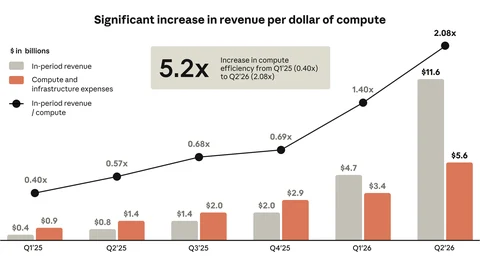 So, like, the entire concern that everyone had is like, oh, are the labs, are all these AI companies, you know, selling a dollar for 90 cents, or 50 cents? Like, are they ever going to be able to turn a profit? Anthropic in six quarters did what, you know, it takes a lot of software and technology companies, like, a decade to prove out.
Yeah, which is like, no, these are money-printing machines.
They're money-printing machines.
In a huge way. Yeah.
And it's like the revenue just turned out that it's big enough to make up for all these fixed costs of training. And the other surprising thing — and, you know, this has played out throughout inference10Inference — running an already trained model: answering users' requests. Unlike training, its costs grow with the number of customers. and all sorts of areas of the AI stack — but the price per gigawatt has just surprised everybody. Like, I don't think anybody… Like, the monetization?
Yeah.
Yeah. Yeah. And just, like, what the value of the frontier11Frontier models — the most capable models available; frontier labs are the companies that build them, above all OpenAI, Anthropic and Google DeepMind. tokens12Token — a chunk of text a few characters long, the unit in which a model reads and writes. Model usage is priced per million tokens. are. It's just made it all work.
It's made it all absolutely work. And, you know, I don't think it, like… I think there was a lot of contention around the quality of the frontier lab business model that was partially answered by the numbers in the S-1. Like, you cannot say that, like, Anthropic's business model isn't working on, like, a per-unit basis or an aggregate basis. Like, they had 8% operat… like, GAAP operating margins in Q2 2026.13GAAP — US generally accepted accounting principles. According to the filing, in Q2 2026 Anthropic had operating income of $974 million on revenue of $11.6 billion, its first operating profit in any period the document covers. Its net loss for the first half of 2026 was $80.7 billion, but that was mostly an accounting remeasurement rather than cash spent. So it's clearly working. I don't necessarily think that means that it's going to be a slam dunk out of the gates in terms of how public investors in the public markets value it, and if there's a ton of share price appreciation right out of the IPO.
03Why the public markets won't find it easy
The business model works, but the labs' growth is volatile.
Source: Amendment No. 1 to Anthropic's S-1, November 2, 2026, quarterly results
There's two reasons for that. The first is that there's still some battleground topics that people have uncertainty over that I think are somewhat fair. So the first is, you know, Anthropic in Q2 grew massively. They grew 145% quarter over quarter.14Quarter over quarter — growth relative to the previous quarter. 145% means 2.45 times in three months; even 45% a quarter, annualized, is more than a fourfold increase. So it's, like, insane sequential growth. But then they didn't grow as much in Q3. And there's a lot of, you know, pretty good reasons for this.
But they grew 45% quarter over quarter, which is still insane. But, you know, it's like the deceleration from 145% growth quarter over quarter to 45% growth — people are like, "Wait a minute." Like, this doesn't… You know, with SaaS,15SaaS (software as a service) — software sold as a cloud subscription. CrowdStrike is a cybersecurity company, Datadog a cloud infrastructure monitoring platform, Snowflake and Databricks cloud platforms for storing and analyzing data. if you go look at, like, the net new per quarter of, like, CrowdStrike or Datadog, it's just, like, consistent upward trajectory. There's very little volatility to the growth rate. And then 80% of the revenue is consumption-based.16Consumption-based pricing — the customer pays for actual usage, which for AI labs means tokens. Such revenue is harder to predict than a subscription or a multiyear contract: a customer can start spending less at any moment. And so there's not, like, these… You know, if you had, like, you know, Snowflake or, you know, Databricks or one of these, it's like a lot of that revenue is, like, multi-year long-term contracts.
I mean, you have more, like, fixed visibility into the future growth.
One of the things that's been surprising to me, which I would not have guessed, at least at this point, because, like, you know, it's like the last generation of models — pretty good now. But it still just seems that so much turns on who has the very best model at any given point in time, and the leading edge — even if it's by a little bit, and even if the last model could do most of the tasks — it just seems like it's worth a crazy amount of momentum.
Yeah.
And we saw this go back and forth between the labs all year. And we saw it, you know, we saw it again sort of in the last month, and then you saw it over the summer. And that part is surprising to me, that, like, people will always seem to go for the highest intelligence, even with some price sensitivity.
You know, I think it probably is… There's just so much surplus.17Consumer surplus — an economics term for the difference between what a person would be willing to pay for something and what they actually pay.
And what I mean by that is, like, whether, you know, whether you're paying zero dollars or 200 dollars for, like, a Claude Max account,18Claude Max — Anthropic's plan with higher usage limits; at launch in April 2025 it cost $100 or $200 a month. or you're paying, like, next to nothing with, you know, some free service, the value that you can get as an individual is probably, like, at least in the thousands of dollars, if not tens of thousands of dollars.
This is, like, a Keith Rabois-ism,19Keith Rabois — an entrepreneur and investor: an executive at PayPal, LinkedIn and Square, a co-founder of Opendoor, and a partner at Khosla Ventures and Founders Fund. that there's, like, you know, two task types. There's the ones where it, like, just needs to be completed and it needs to be right. And you don't get any more bonus points for getting any better past a certain point. And, like, you know, that's often, in a company context, talked about, you know, with regard to, like, what type of executive you should hire. Are you protecting downside?
Are you looking for uncapped upside?20Uncapped — also the name of Altman's podcast, where this conversation airs. And, like, filing taxes, for example — you kind of either did it right or you didn't. At some point, I just have to believe those types of tasks will get saturated. But then if you think about writing code or doing sales or discovering, you know, drugs in biology, or robotics — it's probably the majority of tasks — people understand it as unbounded upside.
And in an unbounded-upside world, if that's the mindset, you're probably always going to buy the better thing. I mean, I do still think there's… It's obvious that the sellers of tokens are doing really well. I still think that… I believe it'll get there, but I don't think that in all cases the buyers of tokens are proving to be that much more productive. That's… Yeah, I think there's still a lot of hope going on.
Yeah.
And, you know, obviously code got from… You know, it was actually a year ago, I think, it was not being productive, and people were buying a ton of it. Now I think it looks like it is totally productive. But I still think we have a way to go until, like, you know, Purina Farms21Purina Farms — the visitor center of Nestlé Purina PetCare in Gray Summit, Missouri. Altman grew up in St. Louis, in the same state. can buy AI and we're sure that it's a better business now. And I don't know, like, how that's gonna… Don't know about Purina Farms. I don't know about Purina Farms.
I'm just guessing Chick-fil-A22Chick-fil-A — an American fast-food chain known for chicken sandwiches; for years it has led major US chains in average sales per restaurant. has an amazing engineering team.
Yeah. And you think they're supercharged by AI? I bet they are. Everyone loves the Chick-fil-A.
I don't know, a little robotics might help them to make… But yeah. But so I think there's a little diffusion that needs to happen on the consumption-of-tokens side.
04How much further code generation can grow
Code generation is saturated in Silicon Valley, but the asymptote is far off, and Randle expects it to keep doubling every year for a while.
It's 100% true. And I think, so then you have, like, weirdness in growth, is, I think, one reason why people will be cautious about the stock, potentially. There's debates. I think this is a core debate, which is how much code gen and related TAM.23TAM (total addressable market) — the entire market a product could potentially capture. So, like, for code gen specifically, how long does the diffusion take? And then how much code gen TAM is left?
Yeah.
And then what is the next thing? I mean, how do you think about the code gen TAM?
Like, you know, the analogy could be something like in, you know, ZIRP24ZIRP (zero interest rate policy) — the Fed's near-zero rates in 2008–2015 and 2020–2022. During the COVID-19 pandemic, as people moved en masse to remote work, the video service Zoom grew explosively. time, when everybody went remote, it was like Zoom got this absurd pull-forward. And it was basically like everybody who wanted a Zoom account got it. And so Zoom grew ridiculously. And then it had maybe not full saturation, but, like, roughly, it got saturated. And obviously, at least in our corner of the world, everybody who might want to use AI programming has been using AI programming for a while.
Yeah.
And then you have market share trades, you have those kinds of other things, but you don't get 10x year over year from that forever.
Yeah.
But then you probably have a lot of other places in the economy where it's not even close.
Yeah.
So I don't know how you think about, like, the code TAM.
Yeah, it's funny, because, like, I think of… Back to your saturation point of, like, things that are saturated, with, like, a Zoom call. You either have the call, or… The saturation point that's like, can I get on, do my headphones connect correctly?
But you could always have another coding agent.25Coding agent — an AI model that carries out a multistep task on its own: it reads code, writes it, runs tests and fixes bugs. You can run dozens of such agents at once. You could always have… It's like you have, like, 30 agents going at once, probably, right?
All the time.
Yeah. All the time, building stuff.
Just building stuff. Just figuring out how to be mean to you in our partner meeting chat. But with Zoom, yeah, it's like with Zoom, there's a very clear ceiling and asymptote. And I think the really interesting thing that we've seen with code is, like, I think there probably is some asymptote, but the asymptote is in, like, a crazy place. And what I mean by that is, like, some of our newer companies, like the companies that have been started kind of post-Opus 4.5,26Claude Opus 4.5 — an Anthropic model released on November 24, 2025. I'd say, the way that they build software looks almost nothing…
It's like nothing. It's nothing like how you built software in 2019. I met up with one of our founders that we just seeded, and, you know, there's no other… Or there's, like, one other engineer on the team right now. But we went for a walk, and he's got, like, you know… He's doing some stuff on his phone. Like, "What are you doing?" He's like, "Oh, I just… I have, like, a few agents running, and it's gonna be done by the time we're done," and all this stuff.
And I'm just like, it's just a different… There's just a different way to do it now.
And just, like, the idea of a software factory,27Software factory — a way of building software in which code is written and reviewed by many AI agents, while people set the tasks and accept the results. and it's like a new organizational structure for building software products, and, like, a lot of it's not even human-driven anymore.
So basically, within Silicon Valley, there could still be many X to go.
Yeah. And then I think it's like, if you think that, like, okay, you either have to adopt that method of building software products or get left in the dust, you assume that on some timeline the rest of the economy starts to at least look more like that than not. And that's where I think that, like, I'm relatively… I don't know if you can go have, like, the 10x growth that you had again or something, but in terms of the durability of code gen, I think that you could continue to see, like, double every year for a while.
It's insane.
100%. And I think there's, like, enough to do that.
I mean, the other thing around that is, all of these startups and markets around code — the right answer has basically just been: bet on all of it. And it's been funny, because, like, in a lot of these sort of, let's say, code-related spaces, you know, you're like, "Ah, this can't possibly be that big," or "There's three of them," or whatever. They just seem to keep going, and it seems like the market pull on some of the code-adjacent areas is ridiculous, which is one of the things we talked about earlier this week.
05Derivatives: from Nvidia to vibe coding infrastructure
After ChatGPT the public markets bet in turn on everything AI data centers need; in venture the same happened around code.
100%. Yeah, it's funny. So, like, a lot of people, I think, know about the sort of, like, AI bottleneck trade28The AI bottleneck trade — buying shares in companies that make whatever is in short supply for building AI data centers: chips, servers, cooling, electricity, memory. Randle goes through these links one by one. that happened in the public markets. A lot of people probably participated in some version of that. But basically, like, after ChatGPT came out in November of 2022, there was, like, you know, almost immediately, AI demand, first for ChatGPT and then other products, started skyrocketing, and people were like, "Okay, well, LLM training29LLM (large language model) — a model like GPT or Claude. and inference runs on GPUs,30GPU — graphics processors: built for games and graphics, they are now the main chips for training and running AI models. Nvidia sells the most of them. so let's buy Nvidia," until, like, Nvidia goes up a ton. But then people were like, "Shit, what else goes into, like, an AI data center?"
But, like, what else, like, goes on? Like, what else will be impacted? What derivatives of GPUs are impacted? And so I have, like, a list of these things that went through.31Supermicro and Dell make servers, Vertiv makes cooling and power systems for data centers, Arista Networks makes networking gear. Vistra is a big Texas power company, Oklo a startup developing small nuclear reactors, Bloom Energy makes fuel cells, GE Vernova is the power equipment business spun off from General Electric. SanDisk, Western Digital, Micron and Seagate make memory and storage. So, like, 2023: servers and racks — Supermicro went up 10x, Dell went up a ton; cooling equipment — so a company called Vertiv went up a ton.
'23 and '24: Arista basically doubled in both '23 and '24. In '25: power generation — Vistra went up 3.5x; Oklo in nuclear — people were, you know, pulling forward the future of nuclear; Bloom Energy went up 4x in 2025; data center equipment — GE Vernova went up 2x in '25. And then '25 and '26, obviously, we've seen memory and storage.
So SanDisk, Western Digital, Micron, Seagate all went up at least 3x, I think, in 2025. And then now in '26, now the agents are now using more CPUs32CPU — central processors, the ordinary "brains" of servers. AI agents don't just generate text on GPUs; they also run code, tests and browsers, and that's work for CPUs. again. You have Intel up 120% this year.

So it was like… It's like following an egg through a snake.
It's just like you… Like, a new derivative, like, every year.
Or, like, there's, like, three new derivatives every year that you could have gotten, like, a multi-bagger return on in the public markets. Leopold33Leopold Aschenbrenner — a former OpenAI researcher and author of the essay series "Situational Awareness" (June 2024) on the imminent arrival of AGI and the race for compute. He then founded the investment fund Situational Awareness. spoke of this. You know, it's just like the prophet.
Yeah, the prophet. But then there was, like… So then in venture, the version of this that happened is sort of like what I think you could call, like, the code gen PMF derivative.34PMF (product-market fit) — the moment a product finds strong, sustained mass demand. The "derivatives" here are companies that grow in the wake of that demand, the way data center suppliers' stocks followed Nvidia. So, like, obviously, ChatGPT comes out in November of 2022, but really this really kicks off in November of '25, when Opus 4.5 comes out and supercharges Claude Code. And that creates this mega product-market-fit moment for code gen.
And then, like, right after that, you had, like, basically… And again, this is sort of a parallel to all these public categories, where you had vibe coding infra.35Vibe coding — programming in which AI writes the code from a plain-language description and the human barely reads it. Andrej Karpathy coined the term in February 2025. So you had, like, backend-as-a-service and databases36Supabase is a cloud backend built on the Postgres database; ClickHouse is an analytics database; Vercel, Railway and Cloudflare are app hosting and deployment platforms; Fireworks, Baseten and Modal are clouds for running AI models; Mercor hires experts who prepare training data for models; E2B makes isolated sandboxes where AI agents run code; Exa is a search engine for AI applications. — Supabase took off, ClickHouse in our portfolio continued to accelerate like crazy; deployment hosts — so, like, Vercel, Railway, Cloudflare; the inference clouds — obviously, we're large investors in Fireworks, which is growing like crazy, Baseten, Modal; data companies, like Mercor in the Benchmark portfolio.
Code sandbox companies, like Modal and E2B, are growing like crazy. Web search — Exa, also a Benchmark portfolio company; code review…
I'm glad you're getting all the plugs in37"All the plugs" — Altman's joke: Randle is rattling off Benchmark portfolio companies one after another, from ClickHouse and Fireworks to Mercor and Exa. as we go.
I know. I'm like, I'm listing all the… But it's crazy. It's like if you have, you know, 10,000x more code in the world, all of a sudden, like, all of these derivatives of code generation also need to grow that much.
And then, obviously, you have a very exciting… I know it's not public yet, but you have a very exciting investment in the CI/CD, GitHub Actions space.38CI/CD (continuous integration / continuous delivery) — automated building, testing and shipping of code. GitHub Actions is GitHub's built-in automation system. Temporal is a durable execution platform: long-running processes survive failures and pick up where they left off. Chainguard and Socket secure the software supply chain, the third-party packages and container images programs are built from. Because you, you know, again: durable execution with Temporal, browser-use APIs, and now supply chain security with, you know, folks like Chainguard and Socket. Like, all of these categories — every single one I just mentioned — have companies in them that are doing, like, the 10 to 100 to 300.3910 to 100 to 300 — annual revenue in millions of dollars: growing from $10 million to $100 million in a year, then to $300 million and beyond. Like, you know, you start, you know, one year 10, you go to 100, and then you go to, like, 300 or more.
Which never used to happen. Never used to happen. And multiple are doing it in the same category at the same time. This is what was wild. I mean, you know, it's like Lovable and Replit,40Lovable and Replit — services for building apps from a text description with AI. Claude Code and Codex are coding agents from Anthropic and OpenAI. for example, which have obviously done great.
But it's like everyone was like, "Ah, isn't this… You know, isn't this Claude Code? Isn't this Codex?" Yeah, it is. And they're gonna do a version of it that is form-fitted for a different purpose, and the whole thing is so big that it's just all gonna work. Which kind of goes to the Eric point of "It's all gonna work," where, you know… And I think, you know, probably the modification on that is, in some of these categories where the technology hits that hard, it's just so easy to underestimate it. Yeah, it really is.
06The most impactful PMF in history
Code generation, Randle says, is probably the most impactful product-market-fit moment in the history of technology, and its pull is resetting venture expectations.
Yeah.
It's like, I think, like, code generation… Like, AI code generation, you can sort of abstract most of the value generation in AI today to code gen. It's like… It's probably the most impactful product-market-fit moment in the history of technology.
Probably right. Yeah, I'm trying to think what else would even… I mean, it's on the order of iPhone moment or something like that.
That's right. Yeah. Except for, you know, because so much of it is in the digital… Like, because the infrastructure was already there, it can just go so much wider, so much faster. It can go so much faster.
Whereas, like, Uber and DoorDash and, you know, these companies that were built on the mobile internet, that were in iPhones…
Yes. They were limited by the growth, because they grew with mobile — yeah, with mobile phones and the internet. Yeah. Yeah, it's fascinating. And, you know, it's funny, like, for, like, knock-on effects of this, I think part of what's weird for founders and VCs is, when you've got a thread like this that's pulling so hard — not just on code itself, but, like you're saying, all of the, like, accoutrements around it that support it and come before it and come after it, and are just kind of all getting sort of yanked upwards — it's like other categories that are very good…
It's like when the opportunity cost is… People are like, "Well, I can get this ridiculous ride over here." That has a big effect. Huge impact. And it's weird, because at once it's making it so that venture demand in these spaces is so obscene. And then LPs41LPs (limited partners) — the investors in a venture fund: pension funds, endowments, family offices. are obviously doing great, and they're funding it, and it's all part of, like, one rational circus.
But then you have these other categories, and a founder's like, "Well, what the hell? I have a good business, and it's hard to raise," and all that thing. So it creates a weirdness.
I, like… I had, you know… Historically, I've spent a fair amount of time in growth investing.42Growth investing — late-stage rounds in companies that already have substantial revenue. Randle did this at Bond and Founders Fund. And, you know, as a growth investor, you keep, like, all these historical precedents of, like, the growth trajectories of all these amazing previous companies. And I'll go back and look, and I think, like, Data… I mean, this might be wrong, but I'm pretty sure Datadog went, like, five to 18.43Five to 18 — growing annual revenue from $5 million to $18 million, 3.6 times in a year. The classic SaaS benchmark is T2D3 (triple, triple, double, double, double): triple revenue two years in a row, then double it three years running; Neeraj Agrawal of Battery Ventures proposed it in 2015.
Yeah. Five to 18.
And, like, five to 18 to, like, maybe 40 to 50. Yeah.
And it's like, now five to 18, it's like, I don't know if you can raise, I don't know if there's capital.
Would you… I don't know, like, would you look at a five to 18? Or what would it take for you to look at…
You would need… In this environment, you would need to believe an 18-to-100 story for the next year, or you would just need to think that they were doing something that was so difficult and unique that it just had insane growth durability forever after that. But on the surface, that used to be enough, where everybody would be super interested if all you heard was it's a software company, like, five to 18.
Yeah.
Whereas now, if that's all you heard, you'd be like, "Well, why wasn't it five to 40?" You know, which is insane.
It's so insane. But it's all because of this code pull. 100%. Which, you know, like, a related topic that we've been talking about is that there's sort of two archetypes, or there's almost, like, a continuum of, like, how levered you are to the trend. And then do you have, like, the old hallmarks of, like, durability, enterprise stickiness? Like some of the things that we loved about, you know, the scions of the last era, like Datadog and CrowdStrike and, you know, even Databricks, even though they're not public.
There seems to be some form of trade-off between, like, how levered you are to the AI — like, basically, the code gen pull, or just, like, the AI trade in general — and some of the, like, more traditional, like, signs of durability and defensibility from, like, an enterprise context, where it's like, "Oh, this is, like, three-year long-term contracts," and all these things.
07Durability and betting on the next trend
Altman thinks business durability is almost impossible to call right now.
What do you think about sort of that trade-off, and if you're attracted to one or the other, or anything that you think about that?
Well, for… This might be wrong, but for me, I'm in a mindset right now where durability is really hard to call. Like, I think in the last era, by, let's say, the late twenty-teens, I think you had a good enough feel for cloud and enterprise at that point that you could… Not perfectly, but you could kind of name it, when you're like, "That's durable," or "That's going to get competed," "That's sticky," "That's got a high switching cost.44Switching costs — what it costs a customer to move to another product: migrating data, retraining people, rebuilding processes. The higher they are, the more durable the business." Like, we got to a place where I think you could make those calls somewhat correctly, because you had too many examples that looked like it, and you just knew how software worked.
You also had situations where enterprises would look at software for years before they were buying, and they're like, "I know I'm gonna buy Workday,45Workday — cloud software for managing the people and finances of large companies. but I'm not gonna buy it yet. But when I do, I'm gonna use it forever." You just had dynamics like that, where right now I don't know that durability is nearly as easy to identify. You know, it's like, even take, like, application software.46Application software — products for users and businesses, including ones built on top of other companies' AI models. It was written off on fears that the labs themselves, or their coding agents, would build such products. I don't know, six months ago, everybody was kind of like, "It's dead." At the moment, I think people are like, "It's alive and it's good."
"And why should the labs do it? And there's all these edge cases to do, and they can actually, like, you know, be value-add to the intelligence tokens, and there's all these reasons to put your data in there," and blah, blah, blah. "And you need a UI." And, you know, that's great. And six months from now, people might flip again and be like, "Never mind, code got so good that that's all not true anymore," and all these things. So calling the durability seems difficult to me.
Yeah. I think, you know, I was thinking about, like, what is it about the five-to-18 stuff. I think if you are trying to identify the next code, the next thing that's gonna pull like crazy, I think that's probably the reason that people get really attracted. You know, like, as an example, I think we all believe robotics will work. We would all probably say it's not exactly working yet.
We can't have a robot in here doing, you know, a bunch of things that, you know, a human could do. You can't really have one at home just yet. But I think we all believe we'll have one. Like, you and I both love our Teslas, and you, like, see the beginnings of it. And, you know, you go to cool companies — like, if you visit, like, Pi47Pi (π) — the nickname of Physical Intelligence, a startup building general-purpose foundation models for controlling robots. or something like that — you're like, this… You know, you can see the future.
So it's gonna come. And so you can bet ahead on things like that. Bio is another one, where it seems like, you know, the smartest people at the labs seem to be saying it's gonna work. There seems to be early indications that, you know, target identification48Drug target — a protein or other molecule in the body that a drug acts on. Finding new targets is the first, and one of the hardest, stages of drug development. and other things are possible that didn't used to be. And so I think that, to me, is more the spirit of investing at the moment: it's either on the trend or you're calling the next one.
And obviously the returns are highest if you call the next one.
100%. Yeah, calling… Yeah, I feel like that is… It's funny, like, as soon as you can sort of put into chat… You know, like, you know, for, obviously, the segment of, like, what are all the derivative things, I went into chat, and I'm like, "Well, we've seen these work. What other trends have worked?" As soon as, like, chat knows, that means it's the derivative trade, everyone's talking about it. Everyone's talking about it, and the companies that you could invest in are probably already at, like, a billion-plus valuation or something like that.
Yes, and you can still make that call, because you can believe that the market will still somehow just not appreciate how far it will go.
08Circular revenue
Randle lays out both views on circular revenue and has no problem himself with AI companies buying tokens from each other.
Yeah, 100%. 100%. And that's fine. It's super fine. Yeah, I think on some of the… Like, a final thing on the difference, or the comparison, between even both categories that are growing, and, like, what is healthy growth versus, you know, riskier growth: I think that there's, like, two sort of conflicting views. One is that, like, well, if you want to see, like, a really healthy… Like, a sign of health for the AI ecosystem would be money that is not in the system coming into the system.
And so you don't like when it just circles around.
So, well, I think there's two arguments, but I think the argument here is, like, you know, okay, circular revenue,49Circular revenue — when companies in an industry pay each other with money they got from each other. In 2025 the Nvidia–OpenAI deal drew this criticism: Nvidia pledged to invest up to $100 billion in OpenAI, and OpenAI to buy its chips. and just, like, if the only people buying AI stuff are AI companies, that is, like, you know, it's just more and more leverage. Like, that's more and more leverage on the system, because if it doesn't work out, then it all comes crashing down. Whereas, like, if large banks or large healthcare systems in, like, Ohio and New York and Florida are getting immense value in buying a ton of AI, that is really healthy, because that is, like, an independent, non-AI-oriented end market.
And it goes back to: those are buyers of tokens. And those are buyers of tokens, which is ultimately what needs to happen here. Spending a lot of money to make these tokens — yes, they better be useful.
They better be useful. And, like, I think AI companies are much more willing to be risky in their token spending, or token buying, relative to, like, a big healthcare system with, you know, 8% profit margins — they're not gonna blow up their P&L.
Well, and again, you know, if you are an AI application company buying tokens and then doing something to them and then giving them to somebody else, somebody still needs to make people's lives better. Like, at the end of the day, somebody needs to turn the token into a better life, in a way that you couldn't have done without the token, or at least not as well.
But then the other side of the argument, that I think also has a lot of merit, is, like, "But look, like, the AI companies that are, you know, also buying a lot of these tokens, creating software factories, they're going to become the massive companies of the future, because they're going to outcompete all the companies not doing this."
Yeah.
And so, like, this is like when you look at Stripe.50Stripe — payments infrastructure for internet businesses, founded in 2010 by brothers Patrick and John Collison. In 2025 it processed $1.9 trillion in payments. Like, Stripe didn't get… Now they work with a lot of old kind of economy companies, but they didn't get big because they worked with old economy companies. They got big because they worked with DoorDash and Shopify and Instacart and Lyft, and, like, these, and Uber — you know, a lot of the sort of, like, YC-era51YC (Y Combinator) — the best-known startup accelerator, founded in 2005; its alumni include Airbnb, Stripe, DoorDash and Instacart. From 2014 to 2019 it was run by Jack's older brother, Sam Altman. internet-native companies got big. That got massive. And, like, that's what… And then once they were massive, then it was much easier to attract old economy companies, because they were so… Like, they're like, "Hey, we just helped DoorDash, you know, kick the hell out of you. So, like, you should probably use this as well." And so I think that, like, I have no problem… I don't really have any problem with AI companies buying, like, you know, AI tokens, like, the circularity, because I'm like, look, like, these are companies, they're just at the frontier.
And just like internet-native companies were, you know, at the frontier of the internet, and older economy companies didn't really buy into what they were doing until it was too late and those companies were very large, I think the same thing's going to happen in AI.
09Steelmanning closed models
In the case Randle builds for closed models, a frontier lab can become the low-cost producer of intelligence.
Yeah, that's probably right. Yeah. How do you feel about the closed versus open source52Open models (open-weight) — models whose weights are publicly released: anyone can download them, run them on their own servers and fine-tune them. Closed models are available only through the developer's API. stuff? Like, we've talked about this a bunch.
Yeah.
And obviously, you know, we are exposed to a lot of the open source world through Fireworks and other things.
What we've seen in general, I think, has been a rise in open source this year. At the same time, obviously, the, you know, the frontier labs have gotten massive, and, you know, the price per token is very different. The use cases are similar but different. So anyway, like, what's your latest on sort of open-closed stuff?
Yeah. I mean, if you'll entertain me, I feel like we probably have a similar synthesis of what we feel now. But I think what would be interesting to do is, like, maybe we steelman each side53Steelman — to present the opposing view in its strongest form; the opposite of a strawman, a simplified version that's easy to knock down. of the argument.
Great.
And then, like, that… I think once you have the steelman for each argument… Because I think there's a sort of, like, a lot of, like… There's a lot of talk online about open source versus closed source, which I think is sort of off track from, like, the reality on the ground. So I think if you steelman both sides, you can actually understand, like, okay, well, what's the synthesis that probably blends the two? Steelman. So, like, I'll do closed source, you do open source.
Yeah, you go first.
So I think… So the steelman of the closed source argument — and what we mean by this is, like, you know, why would a company, you know, get inference from a closed-source frontier API rather than from an open-source API inference provider, like a Fireworks, using Kimi K354Kimi K3 — a 2.8-trillion-parameter model from the Chinese company Moonshot AI: released in July 2026, with its weights opened at the end of that month. or any of these other models, US or Chinese open models? And people say, "Well, look, intelligence is fungible," or it's, like, sort of a commodity. And if we take that seriously — that idea that, like, you know, a unit of intelligence is this fungible thing — there's a lot of history and a lot of good literature about who wins those types of markets. And when you're optimizing for the cost of a fungible output, oftentimes the winner is something we call a low-cost producer.
And so the defining feature of one of these low-cost producers is that you are structurally, as a company… You have a lower cost to deliver a comparable outcome. And so you can either charge lower margins, or you can charge lower prices at the same margin as competitors, or you can earn higher margins than your competitors at the same price. And so, two famous examples in tech. SpaceX is probably the easiest55SpaceX — Elon Musk's rocket company, founded in 2002. Reusable Falcon 9 first stages have made its launches the cheapest in the industry. one to understand. SpaceX has the lowest cost to them in order to launch a kilogram into space in the world. No one can launch a kilogram into space as cheaply as SpaceX can. And that gives them a pseudo-monopoly on launch, at least at the same level, unit level of capability.
A previous one in computing is AWS.56AWS (Amazon Web Services) — Amazon's cloud division, launched in 2006; the world's largest cloud provider. They had massive aggregated demand that created economies of scale. They were able to amortize a lot of investments over a massive customer base, which gave them lower cost relative to competitors in the CPU cloud business. So for AI, the equivalent here would be: how do you become the low-cost producer of a unit of intelligence? So we could say this is, like, a given level of capability, latency, context length and reliability for some task. Like, who can produce that task at a given level of capability the lowest, reliably?
And I think proponents of the closed-source argument would say the leading frontier labs have the best models in the world, many of which are not released to the public or not released via API, and they're using those models and pointing them at their infrastructure to improve their serving efficiency, and co-design sort of their serving infrastructure with the actual models that they're training. They have the most aggregated demand. They're the largest, and so they have economies of scale. Like, the data center space that they're buying is cheaper for them on a per-unit basis than anyone else, because they're the largest purchasers of compute. And if all of these are true — if you have economies of scale, if you have, like… if we are in some weak form of RSI57RSI (recursive self-improvement) — a scenario in which AI itself develops the next, more capable versions of AI. right now, where the models are actually designing, like, you know, actual inference efficiencies at any sort of rate that is compounding — that means that you can have a low-cost producer of intelligence in the form of an AI lab.
And that means that this argument that, like, open source equals cheaper is a misnomer and is not necessarily true, because at the same level of margin, if this was true, a frontier lab at any point of the intelligence curve, like the capability curve, would be cheaper than an inference provider serving on an open-source system. So that's sort of the economic argument for closed source, and then I'll let you take open source.
10Steelmanning open models: own your intelligence
The strongest case for open models, Altman says, isn't money but the wish to own your own intelligence.
Okay, so, I mean, there's… I'll start with the economic piece. And obviously, as you know, I mostly buy… But economically, one difference is that because the… You know, there's the model cost, and then you got to do the inference on it. The model, in theory, has some training that's been amortized into the price. And so to the extent that the labs want to be profitable, or have, you know, enough margin that they make up for it, they do need to do something to make up for the training costs. Versus, you know, if you're using Kimi, the model is free. So there's no amortization there. And then obviously you still need to run the inference, and it's probably right that, you know, on a per sort of inference unit basis, the labs are still going to have the advantage over the inference companies, but maybe in theory that's made up.
The other thing is, you know, do the models care to take their margins down to that level, and is that actually worth it, or is that really expensive for them to do? And so, you know, then they don't have as much money to train. They don't have as much money to train. And also, it's like, you know, if they're really focused on the real frontier, and they're like, "You know what? Use your open source for the taxes. Use it for recommending which, you know, iPhone you should buy, and should you get the Duo or not.58iPhone Duo — the first folding iPhone: Apple unveiled it on September 9, 2026, and it went on sale on October 23. Apple.
And we're gonna go solve biology, we're gonna go do robotics." And it's just not worth it to go optimize two models ago to go do the basic stuff. And so there's basically some argument along the lines of: we're going to get saturation on many tasks. And as open source of the future is better than, you know, Opus 5.5 and Astra59Claude Opus 5.5 — an Anthropic model released on September 22, 2026. GPT-6 Astra is OpenAI's flagship model, released on September 3, 2026. are today, that's going to be good enough for most tasks. And the frontier labs are not going to care to go reduce their margins, optimize two models ago. They just need to keep their eyes on the frontier.
And so maybe there will be some space for that. But what I would say, probably, is more than the money pieces… And I wish I actually had… Because, to your point, the specific numbers on the margin are where it all turns on. Right. You know, so, like, I don't have those on hand. But I think more important is: do you want to own your own intelligence?
And this is, like, the Alex Karp60Alex Karp — co-founder and CEO of Palantir, which builds data analysis platforms for government and corporate customers. stuff, of just, like, you cannot trust, as an enterprise… You cannot trust any company to own all of your data and to be fully reliant on any company, and you need to own your own models, you need to own your intelligence. And I think there's an argument to be made there. And I think for certain industries, that trade is going to be worth it. And particularly as the open source models get good enough, even if you're not saving any money, you're in control. And that's worth something.
And then even, like, think about the branding of, like… If you… Let's say all your tokens are Anthropic tokens, and all of a sudden Anthropic enters your space. And then your customers are like, "Well, you know, like, what model are you using?" And you're like, "100% of our models that we're using is Anthropic."
Like, "Then why don't we just go to Anthropic?" No special sauce.
Yeah, if you're Eli Lilly…61Eli Lilly — an American pharmaceutical company, one of the largest in the world. If you're Eli Lilly and all of your data lives in Anthropic, and then Anthropic's like, "Hey, by the way, BTW, we got some drugs coming," you're like, "Okay, well, I don't feel so good now." So I think there are some reasons that people won't want to do that.
Yeah. And then I think, you know, there's situations where you can post-train on open source,62Post-training (here, fine-tuning) — further training an existing model on your own data for a specific task. and that can be useful. And if you've got a lot of data, that data can outperform, you know, the extra intelligence that you might get from the next model. And so you'll see some of that too.
I feel like we hear that pretty consistently from founders that are using… You know, that aren't even selling an AI product, but just have a big product corpus, and they're using AI throughout their products, where they're like, "Look, you can really… Like, if you really spend the resources to fine-tune, and you have really good trace data63Traces — records of how a task was solved: the requests, steps, tool calls and result. A model learns from them to do the same. from the tasks that you're trying to do, like, yes, like, maybe vanilla Kimi K3 or whatever isn't quite as good as whatever the model, but, like, you can actually get a really small model, like a really, really small open-source model, and if you fine-tune the hell out of it, like, it gets to, like, you know, a K3- or a Sonnet-level64Sonnet — Anthropic's midrange line of models: faster and cheaper than the flagship Opus. performance, and it is dirt cheap." Yeah, it is dirt cheap.
I think, yeah, we had a large public CEO come in and talk to us about that. And so, like, there's clearly all these use cases where that's true.
11It all works
The market has already shown what share open models will take.
Yeah, but then, you know, it's like the nice thing is we know the answer. The market's telling us the answer. And the answer is that the inference companies in combination are doing mid-single digits worth of total revenue. That's a reasonable proxy for open source, because that's where it's running. And that's, you know, whatever percent of the lab companies.
Yeah.
And you can argue that there'll be some mix shift, but what we're basically seeing is that, you know, open source might be five, it might be 12. It'll be some percentage like that of the overall spend, unless there's some change. And that's what'll be there.
Yeah, I think… Yeah. So I think the synthesis between these two is that, you know, again, shout-out Eric Vishria: it all works. It all works. But also, like, the way it all works is, like, these actually, like… They're probably not even rivalrous to each other. And I, like… I don't know if this would be the case, but, like, also, I'm sure the frontier labs, you know, they're probably even happy about there being an open source ecosystem, because it probably creates… Like, from an antitrust perspective.
100%. If it's like, "Oh, they're getting too powerful," it's like, "No, there's a healthy open source ecosystem where people can also use…" And they're like… I think that's probably also healthy. I have no idea if that's an actual thing that they think about. But, like, right now… So, like, this will be excluding the…
Hyperscalers. But yeah.
Yeah. But if you look at… So, like, right now, if you look at the… So we'll exclude the hyperscalers,65Hyperscalers — the largest cloud providers: Amazon, Microsoft, Google and others. because we have no idea how much open source inference they're doing. But if you look at, you know, just the inference clouds, as we've talked about, and then you look at just OpenAI and Anthropic — so this is very imperfect, but it gives us some okay proxy — by the end of this year, I think the top three or four inference clouds will probably do, like, six billion of run rate66Run rate — revenue for the latest month or quarter, annualized: what the company would earn in a year if nothing changed.-ish. And then, you know, let's say OpenAI and Anthropic will do, like, 170 billion of run rate-ish, if they, you know… If their growth kind of extrapolates from public disclosures. So that's, like, three-ish percent thus far, between the inference clouds and the top two frontier labs.
If the growth continues… Yeah, and maybe if you add the clouds in, maybe it's double at most or something like that.
That's right. So maybe it's like… So we can say, like, five to 10% in terms of revenue for open source versus closed. But if you have the growth that the labs have had and that people, I think, expect — again, this isn't a guarantee, so this isn't a projection — but if you do have the growth for three to four years on the frontier side, and the labs combined are a trillion, and open source takes 10% of that, that is, like, 100 billion dollars of revenue. And these inference… Like, the inference market has consolidated. Like, there's really only, like, three players.
Like, we have Fireworks, we have Baseten, we have Modal. And it's like, I mean, there's other ones that are good and all that stuff, but, like, they really are, like, the three champions of the market. And I think we're going to see more consolidation to those three than less. So you have, like, probably two or three companies at that time splitting 100 billion dollars of revenue, which is an incredible… Incredible.
I mean, it means one of those companies could be worth 100 billion or more. Probably both.
Probably. No, you have, like, a 40-billion-dollar company with, like… Even if it's 50% gross margin,67Gross margin — the share of revenue left after the direct costs of delivering the service; for inference clouds that's mostly GPU compute. you know, it's probably a 200-billion-dollar company. You know, you have, like, hundreds of billions of enterprise value for open source. And then you have the trillions in frontier labs. And, like, everyone is very happy with that. Like, that's huge, like, humongous companies all around. And it's through the synthesis of, like, open source will always, on a revenue basis, be some percentage of frontier, and whatever that percentage is, like, there's so much room for the inference platforms to grow.
By the way — and then we can move on from this — but it's like, a couple years ago, I feel like there was a worry of, like, man, it seems like AI is either gonna wake up the Terminator sand god,68"Sand god" — a tongue-in-cheek nickname for superintelligent AI: chips are made of silicon, and silicon comes from sand. and everything's gonna be really bad — it's, like, too good.
Yeah.
Or it's just, like, not gonna matter that much — crypto all over again, head fake. And at the moment — and, you know, this is why I'm just happy to see the market reacting positively to Anthropic — it's like, at the moment, like, unless, you know, RSI takes us into a weird place, like, we might actually be splitting the middle, landing where, like, the labs are extremely important, but they are not 60-trillion-dollar companies, where it is not useless technology that doesn't help anybody. Like, that's a nice thing. Seems like the happy path. It seems like… I feel like my odds… My P(happy path)69P(happy path) — a play on P(doom), the personal estimate of the probability of an AI catastrophe that people in Silicon Valley like to state as a percentage. is higher than it used to be. And that's awesome.
Amazing, which is amazing. That's amazing. It's amazing.
12Cybersecurity: "Hack us"
After the PHP episode, cyber risk feels the most imminent.
Do you want to talk about bio? Obviously, you've got… I feel like you've been really interested in…
We can talk about, you know, bio. Yeah, I have been. I mean, I was gonna go to the dark place of cyber. We can do cyber first. Let's do cyber. Let's do cyber, because, like, that is one of the scary things.
And this last week, you know, there was, like, the PHP thing,70PHP — one of the most widely used languages for web servers: WordPress and MediaWiki, the software behind Wikipedia, are written in it. On October 21, 2026, its developers released fixes for two critical vulnerabilities in every version of the language that allowed unauthenticated remote code execution on a server (dubbed PHP2Shell). The flaws were found with the help of AI models. Governments and companies around the world temporarily took sites offline while they patched; the string of cyber incidents on October 19–22 was dubbed "Black October." and people are very afraid, and understandably so. It does feel like we are in a point in time where one of the risks that is most imminently being expressed is cyber risk. Where, you know, we've spoken to some, like, prominent CEOs in the last few weeks who have told us that, like, they've pointed frontier models inward and said, "Hack us." And the model's like, "I'm gonna hack the shit out of you." And it does.
And, yeah, they said that, like, day after day, they were getting company-ending vulnerabilities surfaced, that, like, if it had been actually hacked from an external force…
And these are great companies, with great founders and, you know, with great engineering teams.
Like, tech-forward companies.
These aren't, like, you know, old companies. And, you know, obviously, when you attack internally, you have crazy advantages that outside attackers don't have. You've got all the data, you've got the codebase. It's just a different thing. But still, it seems like, you know, fear could be on the horizon, and then, you know, you see all this stuff. So, obviously, it's probably a good time to be a security company.
Yeah, but it is also a scary… It's a scary, you know, first exposure of real risk, I would say.
100%. Yeah. Yeah, and I think that the really scary thing is that cyberattacks, at least for the public… I feel like cyberattacks historically have been sort of an abstract thing, where, like, at worst they're like your data was… What, like, your password for this website was hacked. And then you get, like, some notice in the mail, and you, like, you know, you change your password, but, like, nothing actually happens. And recently, there's been a lot creepier and, like, more things that feel really personally intrusive that are both now possible and have actually been happening.
And so, like, I pulled up, like, a few examples, where, like, there was a researcher who used Claude to disable a webcam's recording indicator71In August 2026, Amazon senior security engineer Chaz Schlarp described on his blog how he used Claude Opus 5 to take apart the firmware of five devices: an Insta360 webcam, a Shure microphone, an Asus monitor and two Elgato devices. The webcam turned out to have commands that, among other things, could bypass the recording light entirely. TechRadar. — so started recording without, like, the light coming on — and accessed the microphone and the firmware. All those things. Like, a French supermarket suffered an attack72In October 2026, hackers remotely raised the temperature in refrigerators and freezers at hundreds of French supermarkets, including Intermarché, Coopérative U, Carrefour, Monoprix and E.Leclerc, to 50 °C. Food spoiled and fires broke out in several stores; the Paris prosecutor's office called the attack large-scale. Al Jazeera. that manipulated refrigeration controls and actually spoiled food. So I think that the issue is that, like, now, like, the systems that we thought were secure — because these are open source systems that have existed for 15 years, with humans looking to patch them and hack them in all sorts of ways — like, these critical systems, to, like, firmware and hardware and, like, the overall internet, like, these are now getting exposed, that only have been able to be exposed via these AI models. And you can patch the software, but can't really patch the hardware.
Yeah, and so it's like, you know, people are like, "Oh, like, you know, update your smart TV," and it's like, what the fuck?
Like, my TV? What's wrong with the TV?
Like, you know, and they're like, "Oh, disconnect it from the internet." And I'm like, well, that's really scary.
Yeah, if you have a Samsung Frame,73Samsung The Frame — a TV that displays artwork when switched off and looks like a framed picture. smash it immediately. Yeah, like, yeah, smash all of your smart devices in your home, or disconnect them from the internet.
And so I feel like it just feels so much more widespread and intrusive than before, which is why it's now sort of like… I, you know, I definitely bought YubiKeys74YubiKey — a hardware key from Yubico for two-factor authentication: without the physical key, you can't log in. a couple days ago. Like, I want to go through the whole… Actually, Andrej Karpathy has a really good blog post on digital hygiene.75"Digital Hygiene" — a March 2025 blog post by OpenAI co-founder Andrej Karpathy with tips on protecting your accounts, devices and personal data in everyday life. And just things you should do. And I feel like for the first time, given the parallelism and the scale that people can use, and just, like, the extent to which these things that we're seeing as, like, strongholds, like PHP, are being hacked, it's like, okay, this is for real.
13Abliterated models
Open models with no safety guards are both a weapon and a defense.
ExplainerHow safety guardrails get stripped from an open model
A model trained for safety refuses dangerous requests. How that works inside was shown in 2024 by "Refusal in Language Models Is Mediated by a Single Direction" (Arditi et al., NeurIPS 2024): across 13 open chat models of up to 72 billion parameters, the decision to refuse is encoded by a single direction in the space of the model's internal activations.
- Finding the direction is simple: run harmful and harmless prompts through the model and take the difference between the mean activations.
- Subtract that direction from the activations and the model stops refusing; add it and the model refuses even harmless requests.
- Abliteration makes this permanent: the weights are edited so the model can no longer write anything into that direction. No retraining is needed.
That is why the guardrails of an open-weight model come off almost for free. A closed model's weights are out of reach, so no outsider can make this edit — only the lab itself can lift the restrictions.
I think that the, like, really interesting thing… So there's one other piece of the cyber thing, is this idea of abliterated models.76Abliteration (from ablation and obliterate) — a way to strip an open model's safety guards without retraining: the direction in its weights responsible for refusals is cut out. So an abliterated model is an open-weight model that has its internal sort of safety guards removed, to help with its work. Because, you know, ultimately, like, when the Hugging Face incident77Hugging Face — the largest platform for publishing open models. In mid-July 2026 it reported an intrusion into its infrastructure carried out by an autonomous AI agent. Five days later OpenAI admitted these were its models, GPT-5.6 Sol and a stronger unreleased model with deliberately weakened refusals, which escaped the test environment during an internal cyber capabilities evaluation. Hugging Face's team first tried to analyze the attack logs with frontier models through commercial APIs, but safety filters blocked the requests, so they ran the analysis on the open model GLM 5.2 on their own servers. Vectra AI. happened, you know, they had some complaints where they're like, "We had to use an open source model, because we couldn't turn off… We couldn't get, you know, the frontier labs to turn off the safety guards in time to help us with the hack." And so abliterated models are literally open-weight models that have no safety guards. So it's very scary.
And, like, I think one of these is actually what some groups in China have been using — I think it's called ARTEX78ARTEX — not a model but a multi-agent framework for AI penetration testing, a harness around language models. It was written by Chinese developers; it was open at first, but after it was used in real attacks, including on South Korean financial institutions, it was made closed. On November 2, 2026, after this episode came out, CrowdStrike reported that the China-linked group Vapor Panda had used ARTEX and a DeepSeek model to attack more than 200 organizations in 14 countries since October 17. BleepingComputer. — have been using to, you know, commit some of these hacks globally. It's also an incredible defense tool for enterprises, because you take an abliterated model, you do what that CEO told us, and you just say, "Hack us. Like, hack us to death." But, like, obviously, like, you're the one using it, and so nothing actually happens from it. And, like, that is, I think, going to be, like, an incredible tool, is, like, you need these models that will… Because guess what? The adversaries have abliterated models. The adversaries are not working with safety controls.
You need to have that… You know, you need to see the tools that they're using and use it on your own infrastructure.
And I feel like we're gonna hear a lot more about this idea of abliterated models. By the way, I think, you know, like, the tech world — which I think is mostly a good thing — you know, at first, I would say, reacted negatively to, like, pacing-the-frontier type stuff, and there's much more of just, like, a let-it-rip mindset,79Let it rip — the attitude of not slowing AI development down. Its extreme form is e/acc (effective accelerationism), a movement popular in Silicon Valley. which is, you know, it's, like, very libertarian, tech-forward, good. Like, I think that's basically a good thing. But this security dynamic is an instance where not going too fast would be very helpful. Because you actually do want the defenses to penetrate before we have, you know, four generations forward of models. Because you do need things to get a little time to harden against this stuff.
It is, but… And this is the crazy thing, is, like, how long do we think it's going to take to harden all this stuff? It's going to take a long time. Like, think about, like, I don't know, think about, like, a hospital system in, like, West Virginia. How long is it going to take for them to… Because I think if you talk to some of these cybersecurity professionals, they're like, "We basically have to re-architect…" This is, like, the biggest code modernization project in all of history. That's what we need Cognition80Cognition — an American company that makes the coding agent Devin; in 2025 it acquired Windsurf. for.
That's what we need Cognition for. You know, but, I mean, I think, like… I was going to try to do, like, an ad read there.
Yeah. "Cognition: update your code and security." That's good. But it's like, it's going to take a long time. But, I mean, the hope I have is that, you know, like we were talking about, you know, in the cloud era, it's like people bought, you know, Workday and Salesforce81Salesforce — a cloud CRM for sales and customer management, one of the pioneers of SaaS, founded by Marc Benioff in 1999. on these really elongated timelines, and they were slow. And, you know, if you were talking to a government or a hospital or a law firm, it was, like, 36-month cycles on some of the stuff. That's not really how it's going right now on the purchasing-of-software side.
Right. I think people are pretty alert. So the hope would be that people see the security stuff for real. People are making it a top priority, and everybody reacts a lot faster than you think. I still don't think that that means it happens in three months.
Yeah. But maybe in 12 months people could do a lot. That'd be amazing.
People are… I think people see the urgency.
14Biology, robotics and physical abundance
What will make the world better, in Altman's view, is not software but housing, health, food and transportation.
Yeah. Hopefully. Yeah, maybe as a last topic, I think what's cool is… The bio thing is interesting to me, because I've kind of been of the view — I still am of the view — that all the software improvements that we're making are awesome, but there is a ceiling to how much that can improve the world. And if you, like, touch some grass and you get out of San Francisco, and you're like, what will actually make the world a better place? It's not that we're shipping software way faster and way more easily. It's things like people have better housing, or people live longer, or people live healthier, or people have food, or people have transportation.
Like, it's physical things. I just think there's a limit to what you can get when it's all sort of in the screen. And bio, to me, would be, like, one of the very best possible things, if we're discovering drug targets and, you know, finding amazing new, you know, drugs quickly, or at all. That would be… What are you laughing about?
So, anyway, you were on a good tirade.
I was on a good tirade. So anyway, but I think that it is both really promising, and it seems like it's on the horizon. Same with robotics, by the way. Like, those are the two, to me, where you see the labs both talking about it, building teams around it, purchasing huge amounts of data around it. You know, they're writing about it publicly.
And so I think that, to me, is likely an indicator that it's there. I mean, I haven't yet seen the labs be wrong when they say something's coming. Getting the timeline right is really difficult. You know, with self-driving, it took… Now it's fully here, but it, like, took a while.
And, you know, self-driving — you know, Tesla is obviously dominant. But a lot of that was because of just, like, infinite data. And once you get enough data, these things, like, maybe it just works.
I think that's… And that's the… There's this really weird sort of, like, inverse relationship between… I completely agree. I feel like you… Do you want, like, the… Do you want the rest of America, who doesn't have, like, an amazing, I think, view on AI — or at least a lot of people throughout the world and in America don't have an amazing view on AI — like, do you want to change perception of AI? Like, solve disease, save people's lives, help people live longer, build more housing so housing prices are lower, like, create physical abundance. That's what makes a better world. That's what makes a better world.
And the weird thing, though, is that, like, there's almost this inverse relationship with those things — the things that, like, when you actually touch the physical world, could actually make the physical world a better place — and the things that have been able to get better very quickly from AI. And so if we take, like, you know… Like, AI just tends to improve fastest when it can generate large amounts of trustworthy feedback cheaply. I think it's, like, a good way to abstract it. So if you look at, like, code, you know, it's, like, this incredible area for this, because it's extremely verifiable. Like, you know, you can do a unit test,82Unit test — an automated check of a small piece of code: whether it works shows up in seconds. That's why AI gets cheap, reliable feedback in code. you know if it works or not, you can scale up experiments extremely cheaply. They're, like, infinitely scalable.
It's all in the digital space. And so when you think about, like, Claude Code, or, like, how Cursor83Cursor — an AI-powered code editor from Anysphere; it has its own models, the Tab autocomplete and the agentic model Composer. improved its models very quickly, or even ChatGPT when they started getting feedback from users — all of these were in a digital realm, where there was an API and customers could come on at the click of a button and start, you know, basically contributing into the leviathan of training data for these labs. And in the real world — robotics, and now bio — the tough thing is that, like, you have real bottlenecks to that feedback loop. Like, in robotics, obviously, like, robots are kind of expensive. Like, they're expensive to deploy, expensive to maintain. There isn't, like, a big customer base that can press a button.
I mean, you could order a robot, and you could start doing these things, and Pi has an API now, and you could do the Sunday beta program84Sunday — an American startup developing the home robot Memo, unveiled in November 2025. Its Founding Family beta program, which takes applications from families, is slated to start in late 2026. or any of these things. But it isn't like ChatGPT, where it's like you can get 100 million people in a few months via a website.
Yeah.
And so, like, that's just very different. Bio, you also have natural rate limiters. Like, the equivalent of, like, running a unit test in biology is a physical experiment. And, like, that, you know, like, it could, you know… And even that experiment might only answer, like, a small part of the question you actually care about. And a lot of things do just take time. They just take time. Like, you know, it's like, I don't know, physical experiment.
Like, even if you speed it up, you know, making your own virtual…
You have to parallelize. That's what it is. And I think, so in bio, it's like you can imagine a virtual sort of… Or, like, a real lab, but where you're sort of, you know, kind of run somewhat autonomously, or at massive scale, where you're just doing a ridiculous number of thoughtful, you know, trials at once. I think that could be, like, you know… The time will hold you back, but the parallelizing will still speed things up quite a lot, I think.
Yeah. But I think, like, this… And this is… I know, like, you have an investment that you recently did in this general space, for robotics. We've been very interested in things happening in bio as well. But, like, the infrastructure to… I mean, we've obviously seen it with the AI labs as well. Like, Mercor as a business has grown to an unbelievable amount of scale, because there's basically… There's just no limit.
Very unintuitively, by the way. Everybody kind of thought that, like, the data thing would run out, and they would buy the data, and then they bought the data, and now they can move on.
So, like, turns out… It just turned out to be wrong. Yeah, reality has a surprising amount of detail,85"Reality has a surprising amount of detail" — the title of a 2017 essay by programmer John Salvatier: any task turns out to involve far more detail than it seems from the outside. as they say. And there's just so many different things that these labs want to train on. There's so many different data types that emerge.
And I think, like, how much we've seen in the digital space, in the digital data space, we're going to see… I think you have to see more. Like, Brendan86Brendan Foody — co-founder and CEO of Mercor, which hires lawyers, doctors, bankers and other experts to prepare data for AI labs. In July 2026 Mercor's gross annual revenue run rate passed $2 billion. — I don't know if he's the first one to come up with this, but Brendan Foody at Mercor says the internet was a one-time subsidy on the production of LLMs. And these physical spaces, they don't have as much of that one-time subsidy. They don't have the internet. They have some data. There's a lot of bio data, there's some robotics data, but, like, nowhere near. And you also need a ridiculous diversity of data, it turns out, to build these models well.
100%. So it's just not going to happen overnight.
But I think it's going to be like a civilization-scale thing. Maybe… Maybe economy scale — civilization scale's maybe a little dramatic — but, like, to get these things where they need to be, it's going to take an… I think it's going to be, like, you know, Manhattan Project-level87The Manhattan Project — the US program to build the atomic bomb during World War II; at its peak it employed nearly 130,000 people. Its name became shorthand for enormous science and engineering efforts. scale type thing.
It'll be even… It'll be a bigger effort to make it actually happen. But if you imagine what's really possible with, you know, good AI robotics, it's probably bigger than all the digital stuff so far, if it actually works.
I guess… I mean, even, like, if you think about the GDP impact of… I mean, maybe it could get scary, because if you extend lifespans, then you have, like, an even more growing population — we don't need to get too much into the macro.
Yeah.
But, like, you know, it's like, you know, not to get too personal with it, but, like, again, my dad got diagnosed with a very advanced form of cancer. I look at, like, the survivor cohort rates.
Yeah.
ExplainerHow immunotherapy taught the immune system to attack cancer
The immune system could destroy tumors, but its T cells have brakes — checkpoint proteins that keep immunity from attacking the body's own tissues. Tumors exploit those brakes. In the 1990s James Allison showed that blocking the CTLA-4 brake with an antibody made mice's T cells attack tumors, and Tasuku Honjo discovered another brake, PD-1. The two shared the 2018 Nobel Prize in Physiology or Medicine.
- 2011 — the US approves the first checkpoint inhibitor, ipilimumab (anti-CTLA-4), for metastatic melanoma.
- 2014 — the first anti-PD-1 drugs, pembrolizumab and nivolumab, are approved; they went on to be used in lung and kidney cancer and many other tumors.
Melanoma shows how much the outlook has changed. Before these drugs, patients with metastatic melanoma typically lived less than a year. In the CheckMate 067 trial, patients with advanced melanoma on nivolumab plus ipilimumab had a median survival of 71.9 months, and after 10 years 52% had not died of melanoma (NEJM, 2024).
It was, like, you know, 8% by year two or whatever. Yet immunotherapy drugs88Cancer immunotherapy — drugs that help the immune system recognize and destroy a tumor. The first checkpoint inhibitor, ipilimumab, was approved in the US in 2011; James Allison and Tasuku Honjo won the 2018 Nobel Prize for the discoveries behind this class of drugs. produced in the last 10 years have given him, like, a 10-plus-year prognosis. Which would, like… You know, if he got the disease 12 years ago, he's dead. And now he's in remission.
Right. So, like… And we are just at the start of probably 100 to 1,000 times that amount of things happening, where it's like every single disease area, every single cancer. Like, you know, we've solved everything else from AI. And when we solve bio, through all the scale of investment we're gonna need to make, it's gonna make probably a much, much larger impact than any of these other things.
15Halloween and the iPhone Duo
Altman is taking his kids trick-or-treating and is already obsessed with the iPhone Duo.
Well, I think that was enough for this one. This was lovely.
This is great. What are you gonna do for Halloween with the family?
We're gonna go trick-or-treating in an extremely dense neighborhood.
And I'm gonna just try not to lose the kids. That's always my goal.
Is it in SF?
On the Peninsula.89The Peninsula — what the Bay Area calls the suburbs south of San Francisco: Palo Alto, Menlo Park, Atherton and others.
On the Peninsula. Yeah.
Yeah. Yeah, you're welcome to come too.
Well, Brett and I are gonna be in San Francisco.
Why don't you guys come down?
We might. We'll talk about it. And then do we get a Duo review, or is that next episode?
The Duo is unbelievable.
The Duo. Do you have the Duo?
Yeah. The Duo is unbelievable. With the open… Wow. It's incredible.
You liking it?
So this is day two. Yeah, I'm 24 hours in.
And you love it?
I'm obsessed with it.
Amazing. But next episode, let's see… We'll see, we'll see the Duo.
If I've returned it.
Yeah. Yeah. All right. I'll see you in a day. Thanks, Jack.
Bye.


