

Anton Teaches Packy AI
Chapters
Even the richest labs have finite compute, and the paper shows that giant models are undertrained: data has to grow along with parameters.
Read the chapter- Anton recalls that Kaplan et al., the 2020 OpenAI paper, kicked off a race for the largest language model, with everyone focused on parameter count.
- According to Anton, all those huge models are undertrained: if you add parameters for the same compute, performance only improves if you add data too.
- The paper measures compute in floating-point operations, and Packy adds that those translate into cost and energy.
- When Packy asks why OpenAI and DeepMind, with their deep pockets, should care, Anton says GPUs are finite even for them and you have to ship: train forever and someone will come up with a better architecture.
A smaller model trained longer on more data beat the larger Gopher, which proved the scaling laws the paper measured.
Read the chapter- Anton explains that Gopher was trained for the same amount of time as Chinchilla, with more parameters but much less data, and that Chinchilla outperforms it all the time.
- The paper, Anton says, is purely empirical: DeepMind trained a whole bunch of large models with different data and parameter counts, fit curves and reallocated Gopher’s compute budget to the optimum it found.
- Learning rate, batch size, optimizer and width-to-depth ratio were left aside, which Anton puts down to data and parameters being the easiest things to measure and vary.
- Depth, to Anton, is the number of layers and width is parameters per layer, such as more attention heads, and people are skeptical of the latest results on which is better.
Anton reads the paper as a move in the “great game” of AI: scientists want to publish, and companies keep their edge through compute anyway.
Read the chapter- Packy asks why DeepMind would tell the world it is wasting money, and Anton passes on industry scuttlebutt that other groups may not have wanted the world to know you can get by with less compute.
- Most scientists in AI, Anton says, are earnestly interested in progress and want to publish, and the holding company’s profit motive matters less to them.
- The optimum, Anton points out, is relative to your budget, so whoever owns the most compute still gets the best model, and driving costs down for the industry hurts weaker rivals.
- Packy suggests a pitch to government: fund startups, buy them GPUs and bring in chip manufacturing, and Anton mentions people talking to politicians in DC, “universal basic compute” and defense funding with an eye on China.
Nobody knows why the optimum is so simple, parameters and data in equal measure: the law was found by experiment, and there are no engineering principles yet.
Read the chapter- Kaplan, Anton says, believed in scaling parameters as hard as you possibly can, while the Chinchilla paper says to scale data in proportion or returns diminish very quickly.
- Anton ties this to interpretability: we don’t know how models get their performance except in the broadest terms.
- Anton has heard that the result was already known around 2020 and wonders whether there was a battle behind closed doors to get it published.
- Anton describes a mixture of experts as several models voting on a prediction and argues that a better architecture simply means better scaling laws.
Benchmark scores have stalled while models keep feeling better, so the benchmarks themselves are the problem.
Read the chapter- Developers control the loss themselves, Anton says, so they need outside benchmarks, and those no longer improve even as models qualitatively get better.
- A benchmark may have one answer for the tallest structure of the ancient world, the Great Pyramid of Giza, while a model might cover China, Europe and Africa, and it is unclear how to grade that.
- Anton sees a way out in adversarial benchmarks built from what an ordinary person clearly understands and models don’t, while checking that scores on older ones hold up.
- Packy mentions that the hundreds of evaluation tasks included high school chemistry, where the model scored in the 70s, and Anton notes the models weren’t fine-tuned and a human graded the answers.
- Packy asks how to judge a Murakami description of a café, and Anton says people’s ratings are simply aggregated, and tastes differ.
AI’s successes don’t move the goalposts but sharpen what we mean by intelligence, and Anton has become more bullish on AGI.
Read the chapter- Anton now reads “once it works it isn’t AI” as refining definitions that were too broad: a chess engine is simply a chess-playing AI.
- His timeline is about ten years to something that meets his criteria, and he says experts in the field are usually off by five to ten years on the cautious side.
- Packy compares this with solar, whose growth experts famously underpredict, and Anton adds aviation and cars after the Model T.
- Packy describes a paper on the ReAct method whose authors call their reasoning model, for all intents and purposes, AGI.
Anton’s criteria: know what you don’t know, find and verify new facts on your own, and run continuously instead of inside a context window.
Read the chapter- A model today is guaranteed to produce an answer, true or not, and Anton’s examples are Galactica writing about a Soviet bear in space and proving that irrational numbers don’t exist.
- Models, in Anton’s words, model language plausibly but reality very badly, and so they hallucinate.
- Packy imagines a council of trusted models for each subject, but Anton lays out a “cosmic horror” scenario: if the universe and the models are both incomprehensible, nothing they say can be verified, and a council won’t help if they’re all wrong the same way.
- Even an animal, Anton notes, checks under a rock for a snake, and a context window, even an endless one as in architectures like S4, is not how memory works.
- Anton expects something he will have to acknowledge as AGI on the order of ten years.
Available text is nearly used up, and the good data is locked up with its owners.
Read the chapter- Anton recommends a LessWrong post that estimates how much data and compute exist and how good a model could get even with infinite data.
- Packy remarks that the whole movement was canceled in the past week, and Anton puts it down to the FTX contagion while calling most people in that group sincere.
- Packy guesses Elon Musk will get a constant new stream of text by growing Twitter tenfold, and Anton jokes that tweeting is immanentizing the AGI advent.
- There are books Google has scanned, the Library of Congress, the Pile and GitHub code, but web text, Anton says, is heavily biased, and much scientific and technical data is locked up.
- Autodesk’s data on how people use CAD software could train a model to do CAD, Anton says, but it will never release it.
Data keeps arriving, but the best of it is locked behind rights, and no one knows how to share revenue with the people models learn from.
Read the chapter- Retraining models every year is too expensive, so, Anton says, they have to improve continuously without losing what they can already do.
- OpenAI trained a Minecraft-playing bot on YouTube videos, which Anton says was possible only because Microsoft owns the game, and music is harder still.
- Anton expects courts over the next few years to decide whether a model’s outputs are tied to the copyright in its training data, and what happens if a model trained on nothing copyrighted reproduces a copyrighted work.
- Packy wishes Greg Rutkowski got 10 cents every time his name is used in a prompt, and Anton answers that it is the same unsolved problem as apportioning creators a cut of Twitter’s ad revenue.
Anton fears not job losses but people hiding their own decisions behind “objective AI,” and there is no way to settle which norms a model should absorb.
Read the chapter- By AI washing Anton means “it’s not us, the AI objectively said so,” an excuse that gets easier to believe the more capable models become.
- Packy notes that Chinchilla came out less sexist than Gopher but just as toxic, and Anton says biases that authors work hard to remove come back with a slightly different prompt.
- The model with the best capabilities, Anton points out, will be used by the most people, so decisions about what it is fed affect a very large group.
- Big platforms, in Anton’s view, set average norms, but the average person doesn’t exist and everyone ends up mad, and Packy can only suggest a sham world vote.
Every new media technology brings upheaval and concentrates attention on a few, and generative AI is no exception.
Read the chapter- The printing press in Europe, Anton says, led to the Thirty Years’ War, and Packy, citing a 2013 Slate Star Codex article, adds the Reformation, the newspaper, the Renaissance, the scientific revolution and nationalism.
- Every new medium is promised as a tool for education, Anton says, but gets used for propaganda, entertainment and pornography, and AI can tailor propaganda down to the individual.
- Mass media make one best performer known to everyone, like Mozart, and Packy worries that models will draw on the five best people in each topic.
- Packy imagines the most popular teacher of a subject paywalling their work and selling OpenAI the right to train on it, and hopes paying for contributions could mint new billionaires.
- Anton’s advice is not to “hope for the best” but to be prepared, think about who you want to be, and not panic.
In seven and a half months the Chinchilla laws became the standard reference for anyone training large models, and the next challenge is data.
Read the chapter- According to Anton, nearly everyone training large models now justifies their data and parameter counts by the scaling laws, and he thinks many production models are probably already Chinchilla-optimal.
- Whoever breaks the scaling laws, Anton says, would keep it secret until launch, and it is hard to tell from the outside.
- You can’t open a PaLM playground the way you can a GPT-3 one, and Anton calls PaLM compute- and data-optimal, climbing higher on the curve than Chinchilla.
- Packy recaps the paper: scale parameters and data proportionately, everyone went too hard on model size, and now the question is where to get good data.
- For next time Anton proposes going back into history with the first perceptron.
Quotes
On the paper’s main finding
“And the importance of this paper is it basically says, okay, actually, you know what, all these models with these huge numbers of parameters, they’re undertrained, because we’ve discovered that what actually matters is, if you’re going to increase the number of parameters of your model, you also need to increase the amount of data that you’re feeding it for the same amount of compute, in order to actually increase performance.”
Anton TroynikovRead from 02:24On why you can’t train forever
“You do have to ship a model at some point. You can’t leave the GPUs running forever trying to make it better, because if you do that, by the way, other people will come up with new architectures and you will want to stop.”
Anton TroynikovRead from 04:23On the cosmic horror scenario
“So the cosmic horror scenario is: the universe is fundamentally incomprehensible, and we’re going to try to use these models to understand the universe. And then the models are also going to be incomprehensible.”
Anton TroynikovRead from 31:28On why a context window isn’t memory
“I’m not thinking about my entire life from when I was a baby to figure out what I’m going to say to you next.”
Anton TroynikovRead from 33:14On hiding behind AI
“Like, the argument that I would make if I was trying to swindle people, I’d be like, ‘No, it’s just math. It’s objectively true. You can’t argue with multiplication,’ right?”
Anton TroynikovRead from 45:43On every new media technology
“Historically, everyone says, ‘This is going to be a great tool for education.’ That’s what everyone says about every new media technology. And the reality of every new media technology is it gets used for propaganda, entertainment, and pornography.”
Anton TroynikovRead from 50:15On breakthroughs in scaling
“I think that if you found a way to break the scaling laws, you probably would want to keep it a secret until you were the first deployment of that model.”
Anton TroynikovRead from 57:58
Summary
Anton Troynikov explains DeepMind’s 2022 Chinchilla paper to Packy McCormick: the biggest language models of the day were undertrained, and for a given compute budget parameters and training data should grow in equal proportion. Chinchilla, a smaller model trained longer on more text, beat the larger Gopher, which means the next limit is not model size but data.
From there the conversation turns to where ten times more text could come from, who owns it and how to pay the people models learn from, and on to stale benchmarks, what would count as general intelligence, and AI as a new mass medium. Anton expects AGI in about ten years and worries less about lost jobs than about propaganda and “AI washing.”
Advice
Don’t train a model forever chasing the last bits of quality: while you polish it, competitors will come up with a better architecture. Find a sensible optimum for your budget and ship.
Don’t panic about AI and don’t just passively hope for the best: decide in advance what you want to do and who you want to be when these technologies arrive.
Mentioned
- Training Compute-Optimal Large Language Models00:00The paper the episode is about: Anton explains how DeepMind found the best split between parameters and data for a given compute budget.
- Attention Is All You Need00:34Anton recalls that the first episode covered the transformers from this paper, the basis of the models in the Chinchilla paper.
- Scaling Laws for Neural Language Models01:23Anton presents Kaplan et al. as the predecessor that started the race for parameter count, which Chinchilla then corrected.
 OpenAI03:44Packy wonders why a company that leads funding rounds and has Microsoft behind it should economize on compute; Anton says compute is finite even for the rich.
Show 34 more mentionsShow fewer mentions
 Microsoft03:44Packy cites its partnership as OpenAI’s source of money; later Anton says OpenAI could train on Minecraft videos because Microsoft owns the game.
- The Innovator's Dilemma04:58Packy recalls the classic disruption chart: whoever spends too long polishing for the high end gets caught from below.
- Chinchilla05:36The model trained on the paper’s findings: Anton explains how a quarter of the size and four times the data let it beat Gopher.
- Gopher05:36DeepMind’s earlier model that Chinchilla is compared against: the same compute, but 280 billion parameters on 300 billion tokens.
 Google DeepMind09:10Packy asks why the lab would hand its recipe to rivals; Anton sees it as one of the first moves in the “great game” of AI.
 AlphaFold09:10Packy cites the open-sourcing of AlphaFold as an example of DeepMind sharing its work and asks why it does.
 Noam Shazeer17:56Anton jokes that Shazeer would yell at him for his simplified explanation of mixtures of experts.
- Outrageously Large Neural Networks: The Sparsely-Gated Mixture-of-Experts Layer17:56Anton recalls it as “Absurdly Large Models,” the work that applied mixtures of experts to large language models.
- Haruki Murakami23:48Packy proposes comparing his own description of a café with Murakami’s to show that writing quality can’t be scored against a right answer.
 Lex Fridman27:31Packy jokes that he is turning into Fridman by steering the talk from the paper to AGI, and later admits he listens to him too much.
- ReAct: Synergizing Reasoning and Acting in Language Models27:40Packy describes the ReAct paper, in which a model reasons step by step, and asks whether we will stumble into AGI this way.
- Galactica28:56Anton cites Meta’s science model as proof that models don’t know what they don’t know: it wrote up a Soviet bear in space.
- Efficiently Modeling Long Sequences with Structured State Spaces34:02Anton calls S4 an exciting attempt at very long context windows but argues longer windows are not how intelligence works.
- John Carmack34:39Packy recalls Carmack telling Lex Fridman about levels that build themselves as you walk, as an image of a context window that moves with you.
- chinchilla's wild implications36:22Anton sends Packy this post in answer to where data will come from: it estimates how much text exists and what limit the Chinchilla formula implies.
 LessWrong36:22Anton apologizes in advance to anyone who cringes at a LessWrong link and defends the people in that community.
 FTX36:50Packy jokes that effective altruism was “canceled” after FTX’s collapse, and Anton predicts surprising effects from the contagion.
 Elon Musk38:38Packy guesses that by buying Twitter Musk gets an endless stream of fresh text to train models on.
 Twitter38:38For Packy a source of new AI data; later Anton cites it as a platform that doesn’t pay creators for the revenue they bring in.
 Substack38:38Packy jokes that as a Substack writer he is doing God’s work, and later asks whether paywalled newsletters end up in training data.
- The Pile39:36Anton calls this text collection the default everyone starts training from.
 GitHub39:36Anton says open code on GitHub made it possible to train coding models.
 Autodesk40:17Anton names it as the owner of vast data on how people use CAD, which could train an AI designer but which it will never release.
 YouTube41:20Anton calls YouTube a copyright minefield: plenty of video, but you can’t train on it.
- Video PreTraining (VPT): Learning to Act by Watching Unlabeled Online Videos41:42Anton cites OpenAI’s work teaching a bot to play Minecraft from YouTube videos as a rare case where video rights weren’t an obstacle.
- Minecraft41:42The game whose videos OpenAI trained its agent on; Anton explains that Microsoft owns the rights to it.
 Greg Rutkowski43:00Packy cites the artist as someone whose name is pasted into countless prompts while he gets nothing for it.
- Not Boring43:00Packy argues he should get a cent whenever a model commercially uses something he wrote in his newsletter.
- Slate Star Codex49:54Packy cites a 2013 article from the blog: the printing press brought on the Reformation, the scientific revolution and the rise of nationalism.
- GPT-451:21Packy wonders what happens if everyone uses the not-yet-released GPT-4 and it leans on the top five authors on every topic.
- Wolfgang Amadeus Mozart52:16Anton uses Mozart as an example of mass media making one musician known to every person on Earth.
 Sam Altman57:58Anton jokingly asks Altman not to come after him for guessing about OpenAI’s next models.
- PaLM58:47Anton calls PaLM Google’s big language model, closed to the public, and wrongly describes it as Chinchilla-optimal.
- GPT-358:47Anton contrasts the open GPT-3 playground with Google’s closed models.
Transcript
01Spending a compute budget
Even the richest labs have finite compute, and the paper shows that giant models are undertrained: data has to grow along with parameters.
Welcome to Anton Teaches Packy AI, week number two. I learned a ton last week. I think we got a bunch of feedback that this is something that people were interested in. I think I’m not the only person out there right now who’s seeing everything that’s happening and wondering exactly what’s going on at a level deeper than like, “Whoa, this is really cool.” So I’m glad that we’re back for number two. We teased the paper last time. We’re doing DeepMind’s1DeepMind — the London AI lab owned by Google since 2014. In 2023 it was merged with Google Brain into Google DeepMind. “Training Compute-Optimal Large Language Models.”2“Training Compute-Optimal Large Language Models” — a paper by 22 DeepMind researchers led by Jordan Hoffmann, posted to arXiv on March 29, 2022. It was almost immediately nicknamed the Chinchilla paper, after the model it trained. arXiv. Anton, what’s this paper about?
Yeah, so last time we covered transformers,3Transformers — the neural network architecture from Google’s 2017 paper “Attention Is All You Need,” the subject of the series’ first episode. GPT, Gopher, Chinchilla and nearly every modern language model are built on it. which are the basis of the large language models under discussion in this paper. And when those models came out, there was this big question: you know, I have so many GPUs, I have so much time or energy or whatever I want to dedicate to training these models. How do I optimally allocate that? Like, how do I figure out how long I should be training for? How do I figure out how much data I need in order to increase performance to the point, you know, that I’d like? Or how do I best utilize the compute that I have available, is the real question that people were asking.
This is actually not the first paper to tackle that question for large language models. There’s another paper back in 2020, and I have it here somewhere. It is…
Is that Kaplan et al that I’ve seen throughout the paper?
That’s right. Referring to Kaplan, the 2020 paper that was out of OpenAI, if I don’t have my wires crossed. It was called “Scaling Laws for Neural Language Models,”4“Scaling Laws for Neural Language Models” — a January 2020 paper by Jared Kaplan and nine OpenAI co-authors. A model’s loss falls as a power law with parameters, data and compute; OpenAI concluded that the best bet was to grow the model itself. Several authors, including Kaplan and Dario Amodei, later founded Anthropic. arXiv. right? And the Kaplan paper was sort of one of the first papers that was really investigating how do these things actually scale. Like, you know, if we add more parameters,5Parameters — the numbers (connection weights) a neural network adjusts during training. Their count is the main measure of a model’s size: GPT-2 had 1.5 billion, GPT-3 175 billion. does it get better? If so, how much better does it get? How does that scale with how much compute we run it for?
And so they came to a few conclusions, and what they kicked off was basically a race for the largest language model. So “large” here means like how many parameters does the model have, right? There’s a few things called out here in this paper, the “Training Compute-Optimal Large Language Models” paper, that point to these models of ever-increasing parameter count.6Ever-increasing parameter count — as the episode notes say, the largest models now exceed 500 billion parameters: Microsoft and Nvidia’s Megatron-Turing NLG has 530 billion, Google’s PaLM 540 billion. What’s interesting about it is like, okay, well, everyone was focused on the parameter count. Not many people were focused on the compute cost or the data. And you start running into these questions where you start wondering like, well, actually, there’s a finite number of GPUs in the world, and there’s a finite number of them that I possess.
Source: Table 1 of the Chinchilla paper
And besides that, these things are very energy-intensive to train. GPUs are not cheap to run in terms of power. And so, you know, people wanted to revisit this question. And the importance of this paper is it basically says, okay, actually, you know what, all these models with these huge numbers of parameters, they’re undertrained,7Undertrained — they have seen too little text for their size. By the paper’s estimates, a 175-billion-parameter model like GPT-3 needs about 3.7 trillion training tokens; GPT-3 saw 300 billion. because we’ve discovered that what actually matters is, if you’re going to increase the number of parameters of your model, you also need to increase the amount of data that you’re feeding it for the same amount of compute, in order to actually increase performance. So that’s kind of the importance of this paper. It introduced what are accepted to be today the scaling laws8Scaling laws — empirical formulas by which a model’s loss falls predictably as parameters, data and compute grow. They let labs work out on small models how to train a big one. for transformer-based large language models.
You anticipated the next question that I was going to ask, which is: it talks about the trade-off between making models bigger and training them more. And so just to set the vocabulary, bigger means more parameters, training them more means throwing more data into them. Do I have that right?
Yes. Yes. So basically what you do is you say, okay, we’re going to hold the amount of compute that we have fixed, right? And here the value for the compute, the way that they measure what compute is, is FLOPs.9FLOPs — floating-point operations, arithmetic on fractional numbers. Training Gopher and Chinchilla took about 5.76 × 10²³ of them each. It’s floating-point operations, right? So we’re going to do this many floating-point operations and train the model for that many floating-point operations. And so how much data versus how many parameters, given that we have this many floating-point operations to perform, should we use?
And floating-point operations, I think we touched on last time, but that then translates into cost and energy. Like, it’s one of the questions that I had when I was reading this: why does it matter, right? Like, if you’re OpenAI, you kind of have the ability… I mean, I’ve just seen them lead a couple of fairly big funding rounds.10Funding rounds — since 2021 OpenAI has had the $100 million OpenAI Startup Fund. In November 2022, for example, it led a $23.5 million round in the note-taking startup Mem. It’s not like money’s an issue at OpenAI. They have the partnership with Microsoft.11The partnership with Microsoft — Microsoft invested $1 billion in OpenAI in 2019, became its cloud provider and in 2020 got an exclusive license to GPT-3. In January 2023, after ChatGPT, the companies announced a new multibillion-dollar investment, reported at about $10 billion. And I guess DeepMind has even deeper pockets with Alphabet.12Alphabet — Google’s parent company, created in 2015. Google bought DeepMind in 2014, which is why Anton later talks about the paper as Google’s move. For these guys, why does it matter to have the optimal setting versus just throwing more parameters at it?
Well, at this kind of scale, even if you have extremely deep pockets, there’s a finite amount of compute you actually have access to. And also you are thinking about, like, how much energy am I actually using to train this? Is it worth it? You do have to ship a model at some point. You can’t leave the GPUs running forever trying to make it better, because if you do that, by the way, other people will come up with new architectures and you will want to stop. If you spend too much time on one thing, something else is going to catch up to you and just outpace you. Even if you hypothetically have access to as many GPUs for as long as you want, you probably still don’t want to train forever.
It reminds me of the classic disruption theory graph,13Disruption theory — Clayton Christensen’s idea from The Innovator’s Dilemma (1997): incumbents keep improving products for their most demanding customers, while a newcomer enters at the low end with something simple and cheap, improves faster and displaces them. On the classic chart the newcomer’s line is steeper. where if you spend too much time upmarket focusing on the fanciest customers with the most needs, somebody’s going to do something really, really well for the low end and then catch you just with a steeper trajectory.
Yeah, just as an example, right? And so you really want to know what optimal is. You want to make sure that you’re at least in the ballpark of what you should be doing given the resources that you have. And that’s the way that Chinchilla frames things. It says, you know, given the budget that you set, so you can set the budget, how much data and how much compute should you use to have an, in some sense, optimally trained model?
02Chinchilla versus Gopher
A smaller model trained longer on more data beat the larger Gopher, which proved the scaling laws the paper measured.
You mentioned Chinchilla there for the first time.
What is Chinchilla, and why is it so much better than Gopher?14Gopher — DeepMind’s 280-billion-parameter language model (December 2021), trained on 300 billion tokens. Chinchilla has 70 billion parameters and 1.4 trillion tokens: a quarter of the size and 4.7 times the data.
Right. Yeah, so Chinchilla, Gopher, we’re going to have to give a lot of context here, I think, so people don’t get confused. So a lot of people call this the Chinchilla paper15Chinchilla and Gopher — DeepMind named its language models after small animals: Gopher, Chinchilla, then Flamingo and Sparrow. for short, because “Training Compute-Optimal Large Language Models” is a mouthful and Chinchilla is pretty short. Chinchilla is the model that DeepMind trained based on the results that they got out of finding these empirical laws about scaling. And the reason that they relate Chinchilla to Gopher is because Gopher was trained for the same amount of time16Fact-checkNot quite: Gopher and Chinchilla were matched not on training time but on compute budget, about 5.76 × 10²³ floating-point operations each (paper, section 4). and has more parameters, but was trained on much less data. And what they found was Chinchilla, which is a model with many fewer parameters than Gopher, but was trained longer, on more data, outperforms it all the time.17Fact-checkOverstated: Chinchilla beat Gopher on the vast majority of benchmarks, not all of them. It lost on four of 62 BIG-bench tasks, and on MMLU scored 67.6% against Gopher’s 60% (paper, section 4.2).
And that’s because they chose the optimal point on these curves. So it kind of proved that these scaling laws that they came up with in this paper, or measured, I should say, in this paper, matter. They proved that a smaller model trained for longer can outperform a large model. And that was a big deal. It is still a big deal.
So in terms of just the flow of the paper, almost, and how they did the research and how they came up with the paper: are they doing mostly kind of theoretical work or data-based work? Because there’s a lot of graphs with a lot of curves and efficiency curves in there. So the first part is talking about all of that, and then when they get to the model, they’re actually building a model based on everything that they’ve discovered. Is that the right way to think about the whole process?
Right. That’s right, that’s right. So this is actually a very empirically motivated paper. And by that I mean they just did the experiment. They went out and trained a whole bunch of models,18A whole bunch of models — more than 400 models from 70 million to over 16 billion parameters, trained on 5 to 500 billion tokens. The optimum was estimated three different ways, and all three gave roughly the same answer. and that’s one of the things that you get to do if you’re DeepMind or OpenAI: you can train a whole bunch of models, like very large models, right? This is basically training a whole bunch of large models in different settings, like with more data or with more parameters, and seeing what kind of a curve that makes. And so they literally just went out and did the experiment, they measured where that point was, and, as you say, then they used that measurement to say, okay, well, given what we’ve learned, you know, we fit some curve to it, we get some constants, like we get some parameters out of those curves, and we say, okay, we’ll take Gopher’s compute budget and we’ll allocate it the way we have determined is now optimal. Do we get better performance? That’s the flow of the paper.
That makes a lot of sense. They also said that there were a bunch of things in there that they didn’t end up addressing. They mentioned learning rate, learning rate schedule, batch size, optimizer, width-to-depth ratio.19Learning rate, batch size, optimizer, width-to-depth ratio — hyperparameters, settings chosen before training rather than learned in it. DeepMind did handle one of them, the learning rate schedule: its length should match the length of training. Kaplan used one schedule for all runs, and the Chinchilla authors name this as one reason he overrated the payoff from size. Are any of those important to understand? And would a Chinchilla 2 that actually focuses on one or more of those lead to bigger improvements, or were they able to dismiss those as super valuable?
I think the most correct answer I could give here is they focused on the most important, most obvious things here, which is just data and parameters. Those are the most easily measurable things. You can vary them very easily, and this is probably the experiment that most people were interested in at the time. Since then we have seen research into some of those other things. So like wider versus deeper has been receiving some attention lately, although people are kind of skeptical about the latest results there.
And what is wider versus deeper? What is the width to depth that we’re measuring?
So depth is like number of layers, as we discussed last time. It’s just, you know, stack, stack, stack, stack. Whereas wider is more parameters per layer. Just go wider: maybe more attention heads, a wider MLP,20Attention heads and the MLP — the two parts of a transformer layer. Attention heads decide which words in the text to look at; the MLP (multilayer perceptron) is an ordinary fully connected network that then processes each word. anything like that. So that’s what’s meant by deeper versus wider.
03Why DeepMind gave away the recipe
Anton reads the paper as a move in the “great game” of AI: scientists want to publish, and companies keep their edge through compute anyway.
Got it. DeepMind, I think, open-sourced AlphaFold,21AlphaFold — DeepMind’s model that predicts protein structure from sequence. In July 2021 DeepMind released the AlphaFold 2 code and, with EMBL-EBI, opened a database of predicted structures; AlphaFold earned Demis Hassabis and John Jumper the 2024 Nobel Prize in chemistry. or they open-sourced a piece of it. They publish this paper. Is there a reason, if these different groups are competing, that DeepMind is saying like, “Hey, world, by the way, you’re all wasting a lot of money”? Instead of just not wasting a lot of money themselves, they’re going to tell you all to not waste a lot of money, compute, whatever else.
Actually, that’s a very astute thing to pick up on. And it kind of leans into a little bit of the politics of AI, or at least the things that go beyond the simple science of it, right? And like you said, a paper like this impacts what people think of and what they know about their ability to train this sort of model. And so in some ways this is Google saying, like, actually, you know, you could get away with fewer compute resources than we have. If you have access to this much, you can get pretty close to optimal. And I’ve heard industry scuttlebutt one way and the other way, which says that maybe this is something that other groups didn’t want the world to know about for that reason.
And so you can look at this as probably one of the first moves in this great game of AI,22The Great Game — the nineteenth-century rivalry between the British and Russian empires for influence in Central Asia. Anton applies it to the contest among companies and states over AI. which we’re starting to see play out with all kinds of new entrants and existing places and everything like that. It’s a really interesting time to be around.
Yeah, what do you think defines that great game? Because the next question, obviously, or at least the one that comes to my mind, is: if you’re willing to tell people how to do everything as efficiently as you’re doing it, and you’re owned by a company that has a profit motive, there’s a competitive battlefield somewhere else. Like, where do these people view the competitive battlefield to be? Is there just so much space that they don’t care yet? Or what’s the next level of that game?
That’s a really good question. There’s so many different factions with interests in this. So, for example, I would say that most scientists working in AI today are earnestly interested in AI progress and making AI progress happen. There’s other concerns also among scientists. There are safety concerns, for example: is deploying this model the right thing for the world? But ultimately the scientists are mostly interested in the science, right? They’re not actually as interested in the profit motive of the holding company.
And so they want to get the information out there. That’s the default scientific thing to do. On the other hand, if you are a company that wants to make profit, you kind of want to be the person who owns the model. So I still think there’s still a lot of value in just owning the most compute. And so you will probably have the best model, because remember, this is optimal relative to the amount of compute that you’ll have. It’s not optimal globally.
If you’re able to amass as many GPUs as, say, OpenAI or DeepMind, you might be able to also get an optimal model, but that seems very unlikely, especially in today’s climate. So they still have an advantage there, and they’re still happy to release these results, because they’re probably still going to have the best model. So from a competitive perspective, that’s another reason why you might want to put it out there. And you might want to apply more pressure on your competition, because you feel like you will make progress in other directions that you’re better suited for than they are, right? Like, if you’re driving costs down for the industry, that’s bad for your competition, and it could be good for you if you’re better and more efficient at getting margin.
Yeah. Is there a piece of this that is… You know, obviously there’s a fear about one or two companies ending up owning this space. And so you can point to the fact that, like, “Hey, we’ve actually published how we do all of this stuff. If you’re worried about that, government, go fund 100 startups and buy them GPUs and bring more chip manufacturing23Chip manufacturing — in August 2022 the US passed the CHIPS and Science Act, with about $52.7 billion to support domestic semiconductor manufacturing and research. to the…” You know, there’s other… We’re not completely locked in here, and we’re telling you how to do a lot of the stuff we’re doing.
Yeah, and I think you could look at this as a piece of that. It’s hard to imagine. This is a little bit inside baseball, right? I can’t really speak to how government is thinking about this, or in which direction, you know, the various groups want to push regulators. I know that a number of people have been in DC, in Washington, DC, lately, sort of talking to politicians about, like, this is how you need to start thinking about this. It’s really important that you start thinking about these large masses of compute all being in one place.
But it’s unclear which way that will go, or what to do, or if there will be universal basic compute24Universal basic compute — a riff on universal basic income: the government hands startups computing power instead of money. In 2024 Sam Altman floated a similar idea, giving everyone a share of compute instead of a basic income. out there for AI startups. I don’t know. Traditionally, the way the government has done this has been through defense funding as well. And I’m wondering if that’s not the lever that people are trying to push as well, with respect to sort of China and, you know, the chips25China and the chips — on October 7, 2022, six weeks before this episode, the US Commerce Department banned sales of the most powerful AI chips and chipmaking equipment to China. The restrictions were tightened several times afterward. and everything like that.
04A simple answer with no theory behind it
Nobody knows why the optimum is so simple, parameters and data in equal measure: the law was found by experiment, and there are no engineering principles yet.
I think we’re going to add this, where we do a little bit of inside baseball on the industry every week, because I really like that. Going back to the thing I think that struck me the most out of all this: as I was going through and trying to work my way through the formulas and all the charts and all that, the answer ended up being that they should just kind of scale the number of parameters and the data proportionately. Is that a coincidence, or what is happening there? There’s all this complexity, and then out comes this very simple answer.
ExplainerHow to split a compute budget
Training a transformer takes roughly 6 × N × D floating-point operations, where N is the number of parameters and D the number of training tokens. With the budget fixed, one choice remains: a bigger model that sees less text, or the other way around. From their experiments Kaplan et al. (2020) concluded that as the budget grows, the model should grow faster than the data: the optimal N rose roughly as the budget to the power of 0.73, D to the power of 0.27. In the Chinchilla paper DeepMind matched the learning rate schedule to the length of each run and got exponents of about 0.5 and 0.5: double the model, double the data. Hence the rule of thumb of about 20 tokens per parameter. By that measure a 175-billion-parameter model would need 3.7 trillion tokens rather than GPT-3’s 300 billion, and a 520-billion one 11 trillion.
Yeah. So again, these were very empirical experiments. Like I said, they just went out and actually measured it, right? I don’t think we have a way of arriving at that conclusion any other way than going out and doing the experiment right now, because, like I mentioned, in the Kaplan paper they believed something else. They thought, no, just scale parameters, just scale parameters as hard as you possibly can. And this paper, the Chinchilla paper, says, no, you have to scale data in proportion, otherwise you get diminishing returns very, very quickly.
I think it is kind of surprising, but at the same time, it’s intuitively correct. But I think what this really points to is the fact that we don’t have good engineering principles around this right now. We don’t know how we get to this law, if it is a law. We don’t know what causes it to be like that. We can guess, but we’re not sure. And that kind of points to this whole aspect of, you know, broadly speaking, this model interpretability26Interpretability — the research field that tries to understand what happens inside a trained neural network: which internal features and mechanisms produce its outputs. piece, where we don’t really know how we get the performance we do, except in the most broad terms.
And I feel like this work and other works that are coming out or have come out recently, which are kind of just doing the empirical testing, is maybe our first step to arriving at some of those principles, where we can actually start to make trade-offs in principled ways. But yeah, I think the answer is it happens to be that way. We don’t know why, and we don’t really even know enough to say if it’s a coincidence or not. Intuitively, I would say, okay, seems reasonable. But yeah, it seems reasonable to me too.
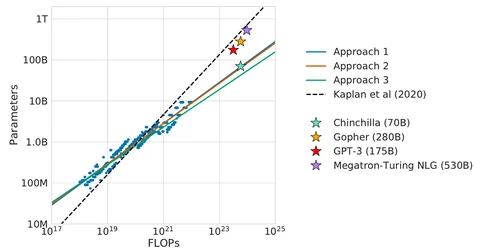
And just so that we’re very clear on this point: the reason that Kaplan was the thing that everybody was following, and then this paper comes out and is like, no, that was actually wrong, but we actually have more confidence in this one, is because Kaplan was just saying, like, what happens when you add more size. And so, like, yeah, they got better and so whatever, but this is actually trying to find the optimal point, and so you can trust that a little bit more because it’s making trade-offs.
That’s right. Yeah, I think that’s actually a good way to look at it too. Kaplan says, like, okay, how much does the marginal parameter improve our model performance, right? For a given, you know, for compute. And this one says, no, well, okay, how much does data matter with respect to that? Again, there’s some scuttlebutt out there that even around 2020 this was actually an already known thing. And I wonder if there was a battle behind closed doors to get this out, get this published.
The documentary on this one day is going to be very intriguing.
Yeah, you know, the AI is going to write it, and they can probably, you know, make it full 3D, and you can interact with the characters. It’s going to be sick.
Oh, I saw that now we can just think it, right? So, yeah, that’s great. I talked to somebody else, Alice Albrecht, who’s been in this space for a while too, and she’s like, “We can do this with an MRI since like 2008.27Since 2008 — that year Nature published work by Kendrick Kay, Jack Gallant and colleagues that used fMRI to tell which of 120 unfamiliar photos a person was looking at. In 2022–2023 several groups reconstructed the image itself from fMRI using diffusion models such as Stable Diffusion. Nature. We can read the brain.” It’s very cool now that you can turn that into an image, but, like, yeah, we’re not that close to being able to think up a movie yet, but I’m sure we’ll get there at some point.
There’s a new… We need like an alarm or something at this point: new model type or architecture alert that they mentioned here that I don’t think we discussed last time. So we talked about transformers. They said something else called a mixture of experts model. What is that?
ExplainerMixture of experts
An ordinary (“dense”) model uses all of its parameters for every token. In a mixture of experts (MoE), some layers are split into many expert subnetworks, and a small router network picks one or two experts to switch on for each token. Such a model has a huge number of parameters but spends per token the compute of a model several times smaller. The idea itself comes from a 1991 paper by Jacobs, Jordan, Nowlan and Hinton; Noam Shazeer and colleagues adapted it to large neural networks in 2017, and Google then built the 1.6-trillion-parameter Switch Transformer. After Chinchilla, mixtures of experts became the main architecture of large models: Mistral’s open Mixtral 8x7B (December 2023) and DeepSeek-V3 (December 2024: 671 billion parameters, 37 billion of them active per token).
Yes. Yeah, a mixture of experts model is actually a very classical idea from machine learning. So a mixture of experts model is, in broad strokes, again, a bunch of models that more or less vote on what the prediction should be, or like you average out what the prediction should be based on what this collection of models are saying. And again, this is at a very high level, and Noam Shazeer,28Noam Shazeer — a Google researcher, co-author of the transformer paper and lead author of the work that brought mixtures of experts to large neural networks. He left in 2021 to found Character.AI and returned to Google in 2024. if he was here, would be yelling at me, but at a high level, that’s about right. And so the mixture of experts that they mentioned here is this… I forget exactly what it’s called. I think it might be something like “Absurdly Large Models”29“Absurdly Large Models” — Anton is paraphrasing from memory “Outrageously Large Neural Networks: The Sparsely-Gated Mixture-of-Experts Layer” (Shazeer et al., 2017). arXiv. or something like that.
That’s where they introduce basically mixture of experts for large language models, and they’re like, look, it’s doing something. It’s absurdly large and it has an effect. And I actually think the thing that that is alluding to is more like, okay, these are scaling laws for transformer-based large language models. We maybe shouldn’t take it as gospel that this is always going to be true forever, or that other architectures won’t have different scaling laws. But I think another interesting way to look at this is, looking for better architectures, looking for better topologies, is about finding better scaling laws. It’s almost like a dual problem,30Dual problem — an optimization term: the problem “get the best result for a given cost” has a mirror image, “get a given result at the lowest cost,” and their solutions are linked. Anton’s point is that finding better architectures and finding better scaling laws are such a pair. one of the other.
So it’s like, how do you optimally use compute and data to get a better result? So if your architecture is better, it should have better scaling laws. It should have a better optimal point.
Interesting. So that’s like the thing that, if there’s a North Star, that’s kind of how you…
05Benchmarks fall behind the models
Benchmark scores have stalled while models keep feeling better, so the benchmarks themselves are the problem.
Yeah. There’s another problem kind of hiding here in plain sight, which is, and this has been going on for a little while now, we’re kind of starting to saturate benchmarks.31Saturating benchmarks — a benchmark saturates when scores stop rising and it no longer separates strong models. That later happened to MMLU: by 2024 top models scored around 90% on it, and in 2025 harder sets such as Humanity’s Last Exam appeared. And what I mean by that is model performance on the benchmarks that we have for these generative text models is, you know, it seems to be petering out, saturating, right? But qualitatively, the performance is definitely still improving. You can play with them and you feel that it’s getting better, right? You can tell as a human it’s getting better. And, you know, I was a bit skeptical of this at first, but then I kind of really paid attention myself, and I think that that’s true.
And that means that something interesting here is happening. It might be that the things that they measured for optimality here may also be being surpassed, and it might, at some point, need to be revisited. But how do we measure the performance of these models is a big open question now. On the one hand we have loss, and loss, which we talked about last time, is literally just the difference between your prediction and the target prediction. And most text models, you know, they’re trained on sequences of text, and then they need to predict and fill in the gaps. And that’s fine, and you can measure loss, but loss is kind of this thing that you already control.
So, you know, you can make the loss go up, go down, be a different value, whatever you want. The thing is, you need some benchmarks, you need some tasks outside of the model training to actually say if you’re doing well or not. And you can also proxy it by loss on some holdout set,32Holdout set — data withheld from training so it can later be used to check how a model handles text it has never seen. but that doesn’t actually proxy for the thing you want to do, like the actual performance. And so because we’re starting to saturate some of these text benchmarks… Even though the performance on these benchmarks is not like, “Wow, that’s earth-shattering.” They’re not saturated in the sense that they’re 100% completed. It’s more like it’s not getting better on these benchmarks, but it seems to be getting qualitatively better still. So what’s going on? That’s another thing to pay attention to here.
Like, what does optimal actually mean? What do you think… And knowing that maybe you’ll get yelled at for guessing, but what do you think is going on?
I think a lot of the benchmarks that we have are out of date. I think it’s very difficult to make a good benchmark, especially in this space, because so much of our feeling about what language is, is like this pretty fuzzy thing, right? Whereas a lot of the benchmarks are very specific things. And, you know, I’ll give you an example. It’s very hard in a text benchmark to measure something like… You want the model to give you a concrete answer, right? But it might give you an answer in a different way.
You know, it’s like, what is the tallest structure in the ancient world, right? And your benchmark might have one answer for that. It might say, oh, it was the Great Pyramid of Giza.33The Great Pyramid of Giza — the answer such a benchmark would expect: built around 2560 BC and about 146 meters tall, it stayed the world’s tallest structure for nearly 3,800 years, until the spire of Lincoln Cathedral in England passed it in the fourteenth century. But your model might tell you more things than that, or slightly different things than that. It might say, well, in ancient China it was this, in Europe it was this, in Africa it was this. And again, I actually haven’t seen it do that, it’s just an example. So it’s like, how do you even measure whether the answer was right or not?
So these benchmarks are very hard to put together. You need so much data as well that they’re difficult to generate in the first place. And then because you need to generate them at very large scale, it means that you now have this enormous pile of data that you now need to assess and evaluate, and so you’re not sure what’s even in the benchmark. It’s just a really, really hard problem. Although another thing that we’ve been seeing… There’s been a paper out just recently about this with respect to generative image models, which is like, here are some clear things that they can’t do. Like, we’ve created this benchmark by adversarially34Adversarially — by deliberately looking for examples a model gets wrong. Such a benchmark is assembled not from random tasks but from those that break today’s models. figuring out what stuff an ordinary person clearly understands that they don’t understand.
And that might be a way around it. It might be to just continue finding and creating these adversarial benchmarks and then beating them, while making sure we’re still doing okay on the previous ones. This is a tough problem in ML generally, not just in text modeling.
And I know in here they had mentioned a bunch of different, like, hundreds of evaluation tasks that they ran the models through, including things like high school chemistry.35High school chemistry — one of the 57 subjects of MMLU (Massive Multitask Language Understanding, 2020), about 16,000 multiple-choice questions from school subjects to law, medicine and ethics. It is the headline test in the Chinchilla paper. Is that as simple as they took a high school chemistry test and they gave it to the model and they saw what it did? 70s, which is pretty good.36Fact-checkNot so: on high school chemistry Chinchilla answered 58.1% of questions correctly (Gopher 47.8%). It scored in the 70s and 80s on other subjects, for example 80.3% on high school biology, and averaged 67.6% across MMLU (paper, table A6).
It’s pretty good. It’s pretty good. There’s a lot of stuff like that. And the other thing is, these are not fine-tuned versions37Fine-tuning — extra training of a finished model on a narrow set of examples for a specific task. Chinchilla was evaluated without it: the model saw only the question and sometimes a few solved examples. of the model either. There’s probably a little bit of prompt engineering38Prompt engineering — finding the wording of a request that gets a model to answer better: instructions, solved examples, an answer format. that goes on, and then it’s literally just the question from the test, and then a human grades the test, like they would a person.
And then, yeah, so that example, the tallest ancient building, is another one, but you can at least kind of find an answer. But you’re right, there’s another qualitative piece to language, which is like, you know, ask me to describe a cafe and then ask Haruki Murakami39Haruki Murakami — the Japanese novelist; cafés, bars and jazz are fixtures of his novels, and before writing he ran a jazz café in Tokyo. Packy uses him as an example of writing whose quality can’t be reduced to a right answer. to describe a cafe, and which one’s better?
And, you know, he’s obviously going to do it better in a way that I couldn’t describe why he does that better. And so I don’t know how in the world you begin evaluating that.
Yeah, and I mean, the way that people do evaluate that right now is just show it to a bunch of humans and then aggregate the score. But then if you don’t appreciate Murakami, you might not care for his description of a cafe. You might be like, well, that’s not telling me much about the cafe at all. It’s telling me about how I feel inside this cafe. It’s hard to evaluate. And I don’t know, at this point… I don’t want to go into the realm of philosophy of language here, but I think this actually points to something relatively deep.
06What intelligence is, and when AGI arrives
AI’s successes don’t move the goalposts but sharpen what we mean by intelligence, and Anton has become more bullish on AGI.
One thing that I’m excited for in our progress on what’s broadly called AI is it forces us to think more clearly about what intelligence actually is. It forces us to consider what intelligence actually is. There’s this old cliché, which is like, everything that works doesn’t get called AI anymore, and if it doesn’t, it’s AI,40“Everything that works doesn’t get called AI anymore” — the so-called AI effect. The thought is usually attributed to John McCarthy, who coined the term “artificial intelligence”: “As soon as it works, no one calls it AI anymore.” Wikipedia. right? For a long time I was like, yeah, that sounds right. But now I’ve been thinking about it: no, actually, what’s going on is we’re learning more about what we think of as intelligence and what isn’t.
That’s what I think is really happening. We’re actually figuring out what intelligence is. It’s not that we’re moving the goalposts, it’s that our definitions were too broad, and this doesn’t fit. For some intuitive reason, it doesn’t fit. And the arguments that we’re having back and forth are actually very valuable to have. Like, people say, oh yeah, you know, before, playing chess was an AI problem, and now that there are chess engines,41Chess engines — in 1997 IBM’s Deep Blue won a match against world champion Garry Kasparov, and chess gradually stopped being treated as an “AI problem.” it’s not AI anymore. I’m like, well, it is, it’s a chess-playing AI. What’s the problem? There’s no problem. I think general intelligence is the question.
Are there any recent examples of things with language models coming out that we thought were intelligence-defining before, that you don’t think are anymore, now that we know more?
Yeah, so you mean, have I gone the other way on anything, where it’s like, I thought this task had to be solved by an intelligence, and a language model did it, and I’m like, oh, I guess that didn’t really need intelligence? Honestly, I don’t think so. Over the last probably two years, since about 2020, I’ve been pulled more in the direction of AGI being42AGI (artificial general intelligence) — a system that can handle any intellectual task at least as well as a person, not just one, like a chess program. There is no strict definition, which is why Anton goes on to list his own criteria. a plausible existing thing, at least for the purposes of what I think of as cognitive tasks. I think it’s now possible. I don’t know how close we are.
My timeline is, you know, I’ve said like 10 years for something that’ll satisfy my criteria. Although the other thing about this field is, everyone estimates timelines, and those timelines end up being overestimates. It just keeps happening over and over again. Like, when will it be able to do this task? And everyone working on it says, oh yeah, you know… They’re usually off by like five to 10 years.
This happens in anything with steep learning curves.43Learning curves — here in the sense of experience curves: with every doubling of production a technology gets cheaper by a constant share. Solar panels have become more than a hundred times cheaper since the 1970s. The same thing happens in the performance of solar as well. Famously, any expert in the field underpredicts the growth rate of solar44Solar forecasts — the best-known case is the International Energy Agency’s World Energy Outlook: since the 2000s each edition drew annual solar additions as a flat line, while they grew almost exponentially; researcher Auke Hoekstra published the famous chart of these forecasts in 2017. pv magazine. dramatically.
Yeah. I mean, it happened in aviation. It happened even in motor cars, just how quickly we could build roads and get cars to people after the Model T especially. So it’s really exciting, but I’ve definitely shortened my timelines. And I think part of the reason that I have is because I’ve reflected a bit more on, like, okay, what is intelligence? What do I personally think is intelligence? What evidence would I need to see? And then backed out of that what I think is going to happen. I’m basically more bullish on AGI than I was.
So, a question on that too, and I feel like I’m becoming Lex Fridman45Lex Fridman — host of a podcast known for hours-long interviews; sooner or later he asks almost every guest about AGI, consciousness and the meaning of life. Hence Packy’s joke. a little bit here, and we’re veering away from the paper, but we’ll just ask as long as it’s interesting to people.
Amen.
So I read this paper today that was essentially about ReAct.46ReAct — a method from an October 2022 paper by Princeton and Google researchers: the model interleaves reasoning out loud with actions such as Wikipedia lookups and takes their results into account. The approach later became a foundation of AI agents. arXiv. Not the programming language, but I think they called the method ReAct, where they go through and do the step-by-step questioning47Step-by-step reasoning — so-called chain of thought: if you show a model examples with intermediate steps or ask it to “think step by step,” it gets much better at logic and arithmetic problems. Google researchers described the method in January 2022. that makes a model perform better, but then they combined a couple of other things, and it gets to the spot where the model can reason really well and make connections that you never thought it would have been able to make in the first place. And they were like, that actually kind of is, for all intents and purposes, AGI.
Do you think there’s a cutoff point, or do you think that we’re going to stumble into AGI in a bunch of different ways like that, where it’s like, well, yeah, that’s pretty much human intelligence?
07What a general intelligence needs
Anton’s criteria: know what you don’t know, find and verify new facts on your own, and run continuously instead of inside a context window.
Yeah, I’ve been meaning to write about this in depth, just to get my own thinking out. So you’re going to get partially digested thoughts here. My favorite kind. And so for me, I think there’s a number of criteria. I think that, first of all, anything we consider generally intelligent has to know that it doesn’t know something, and then be able to independently, autonomously go and get that information, and then integrate that information for the next time. So first it’s got to be able to know that it doesn’t know something. It needs to be like, oh no, this is missing in my knowledge, I’m not confident here at all.
Currently no large model does that, although there have been attempts, mostly just asking the model how confident are you actually in your answer. But a model is kind of guaranteed to generate a prediction right now, whether it’s true or false. Like, there was this model that just got released. It was intended to be for scientific knowledge or whatever. It’s called Galaxy, Galactus, something like that.
Galactica.48Galactica — Meta AI’s science language model, released on November 15, 2022, ten days before this episode. Its public demo was pulled after three days because it confidently produced plausible but made-up papers; one example that went viral was an article on the history of bears in space. I saw this, yeah.
That’s right, Galactica, that’s right. But you can make it make up nonsense science. Like, the one that I really liked that I saw was: when did the Soviet Union send a bear into space? It’s just really good. It created this Wikipedia page, which was fantastic, but obviously it never happened. So it’s like reading about science from a parallel universe sometimes.
Or the other really great stuff I’ve seen is, you ask it for mathematical proofs of things that are not true in math. Like, you can ask it to prove that irrational numbers don’t exist. And it kind of throws something that looks like math at you, but it’s nonsense. It’s complete nonsense. So being able to solve that problem, I think, is a key criterion. The way I’ve described it before is: what models can do now is model language.
So they can make things that read like language does. They very rarely these days make a sentence that doesn’t parse as language. It doesn’t start babbling or putting in random words anymore. They don’t do that. It’s plausibly language. But they don’t model reality very well at all. It’s really easy to find ways to make them say nonsense, things that are transparently either not true or implausible in the first place, or where it just copies other examples of the same fantasy. They fantasize, they hallucinate a lot.49Hallucinations — confident but false answers from language models: invented facts, quotes and references. ChatGPT came out a week after this episode, and the word went mainstream.
Sorry to interrupt here, but this is, I think, the point… When I saw the Galactica thread, the point that they were making was, we’re at this really dangerous spot where it’s believable that it could possibly be true, and then it’s not. And that’s the worst possible spot to be in. I’m imagining a future where I have my four or five trusted models, or 10 trusted models, that are specifically trained for each subject, and I can be like, “I read this really interesting thing on imaginary numbers not being real.” And then I would throw my math model at it and be like, “Is that math good?” Because I’m not going to know. You have to be an expert in everything to know when it’s really convincing.
All right. So do you want to hear something really scary? Do you want to hear something really scary? Do you want to hear the cosmic horror scenario50Cosmic horror — the genre that goes back to H. P. Lovecraft, where the terror is not a monster but the universe’s indifference and incomprehensibility to humans, and touching the truth drives you mad. here?
So the cosmic horror scenario is: the universe is fundamentally incomprehensible, and we’re going to try to use these models to understand the universe. And then the models are also going to be incomprehensible. And because they’re incomprehensible, we’re not going to be able to know if anything they’re saying is true or not. We’re not going to be able to verify it, right? That’s the cosmic horror scenario. I don’t think it’ll be like that. I think that the universe is understandable, but if it’s not, we’re in deep trouble.
But could you then use a council of models to understand… You know, like, if one model that you trust a lot makes up gibberish about the truth…
Yeah, but you trust it, you trust it, right? You trust it, but you don’t know how far you can trust it, especially when it comes to new facts.
Well, that’s what I mean. So if you think you trust it, but you just want to sense-check, couldn’t you run a bunch of different types of models at the same problem, and if they don’t all get to the same, you know, truth underlying the universe, at least you know not to trust any of them?
Well, I mean, unless they’re pathologically wrong all in the same way, right? Like, for example, a general intelligence should also be able to create new facts about the world on its own. That’s another thing that I think. It can go looking for something it doesn’t know. If the thing that it doesn’t know doesn’t already exist, like, it can’t read a book like you and I can, it should figure out how it can decide whether something is true or not. That’s important for a general intelligence.
Even animals do that, right? Animals figure out if something they believe is true or false. They’ll check under a rock, for example. They’ll sniff around for whether there was a snake or not, because they don’t want there to be a snake. They want to know, so they need to do an experiment. So a general intelligence needs to have that capability to sort of autonomously get facts about the world and ingest them and keep them in its memory.
ExplainerThe context window
A language model does not remember a conversation by itself: for every answer it is fed the whole text of the exchange again, and anything that doesn’t fit does not exist for it. The length of that text, measured in tokens, is the context window. GPT-3’s in 2020 was 2,048 tokens, a few pages; the model ChatGPT launched on in November 2022 had about 4,000. In a transformer the cost of attention grows quadratically with text length, which kept windows small for a long time. Then they grew by orders of magnitude: in February 2024 Gemini 1.5 Pro took a million tokens. But a window is still not memory: what falls out of it is not learned, and the workarounds, summaries of past conversations, searchable notes, “memory” features in chatbots, essentially do what Anton describes: compress the past and feed it back into the window.
The other thing that it needs to do is function continuously. So right now we have these models. They have, you know, what are called context windows. And as far as the model is concerned, the entire world exists in that context window. When you put a new thing in there, everything is gone. It doesn’t know anything anymore. It only knows what’s in the context window. And you can make pretty good progress by compressing and summarizing other things that it’s said and putting them back in the context window and doing another completion. But it’s not how intelligences work in the real world. You and I, okay, we have a context window over the length of our lifetime, but that’s not really how our mind works. I’m not thinking about my entire life from when I was a baby to figure out what I’m going to say to you next. It’s clearly not how intelligence works.
So any kind of general intelligence probably needs to have the capability to have this continuously shifting context window without losing its understanding of the world. People have been working on that. There have been approaches to making very large or even infinitely long context windows with a few new architectures. There’s a very exciting architecture called S4,51S4 — the structured state space sequence model, so the other S is for “sequence.” It was proposed by Albert Gu, Karan Goel and Christopher Ré of Stanford (2021); its compute grows almost linearly with text length rather than quadratically, as attention does. Mamba (2023) grew out of this line, and by 2025 IBM and Nvidia, among others, were releasing transformer hybrids with such layers. arXiv. which is, I think, called the structured state space, and I forget what the other S is for, model, which generalizes input sequences and does some really neat stuff, which is exciting. But I still think that it’s not how it works. Making the context window longer is not really how intelligence works.
It reminds me of listening to, speaking of AGI, John Carmack…52John Carmack — the programmer behind the Doom and Quake engines and former CTO of Oculus VR. In August 2022 he gave Lex Fridman a five-hour interview, and that same month announced that his new startup, Keen Technologies, had raised $20 million to work on AGI. And gosh, I listen to too much Lex Fridman, but, like, I think when he was talking about how they figured out how to make levels that you could just keep walking through, and then the wall just kept appearing. It doesn’t mean that you’re in the real world, or that that is now the metaverse or whatever, but it does feel like the idea of the context window just kind of moving with you, even if it’s not getting to real intelligence, you can at least get a little bit closer to that.
Yeah. I think these capabilities are active areas of research. So I’m pretty bullish. I think, you know, order 10 years,53Order 10 years — that is, by the early 2030s. Many in the industry have since named even shorter timelines: in 2024–2025 Sam Altman and Dario Amodei spoke of a few years, Demis Hassabis of five to ten, though no agreed definition of AGI emerged. we’ll have something that I have to acknowledge is AGI. That’s where I think we’re headed. That’s unbelievable.
08Where ten times more data comes from
Available text is nearly used up, and the good data is locked up with its owners.
And I think we need to save the implications, whether we think this is good or bad, whether we’re scared, for the next one, to leave people hanging a little bit. But I think there’s a good kind of entry point to this, which is, you know, if you’re talking about the model being able to go answer its own questions and find things anywhere, and going back to Chinchilla, the fact that they need a lot more data…
Yes, yeah.
The ideal thing, I guess, would be, although there’s questions that I’m going to get to as well, if you could just give it all of the data known to the universe, starting with everything that’s public on the internet, and then everything private on the internet, and then figuring out how to translate the real world into bits and bytes. But in the absence of that, when we want to make data sets 10 times bigger, where is that data coming from? Do you have diminishing quality of the data? That seemed like a big thing to me. It’s like, we need a lot, lot, lot more data. Where does that all come from?
Yeah, right now this is the question. So here’s something interesting. The thing that I just dropped in the chat, it’s this great post from a forum called LessWrong,54LessWrong — a forum on rationality and AI risk founded by Eliezer Yudkowsky in 2009, the core of the rationalist community, closely tied to effective altruism. Hence Anton’s caveat: many people in AI are put off by its style and alarmism. and, you know, cross-posted from the AI Alignment Forum.55AI Alignment Forum — a forum for researchers working on alignment, making AI do what people want it to do. It runs on LessWrong’s software, and posts are often cross-posted there. Some people are going to instinctually cringe at the fact that I’m linking out to LessWrong. I urge them to read this, because it’s actually really interesting.
I think that whole movement56That whole movement — effective altruism. Its best-known funder was Sam Bankman-Fried, the founder of FTX, and after the exchange collapsed the movement came under heavy fire. was canceled in the past week or so.
Yeah. Well, the FTX contagion57FTX — Sam Bankman-Fried’s crypto exchange, which went bankrupt on November 11, 2022, two weeks before this episode, after it emerged that customer money had been secretly funneled to his trading firm Alameda Research. Bankman-Fried was convicted of fraud in 2023 and sentenced to 25 years in 2024. is going to have surprising outcomes, I think. But, you know, to be fair, I actually think that most people in that group are very sincere, and some of them are quite smart.
As do I. So, you know, I don’t want to badmouth them. No, we’re going to overreact to it.
No, of course. Of course, it’s going to swing in the wrong direction. It’s going to be very silly. Yes. This blog post58The blog post — “chinchilla’s wild implications” by the pseudonymous nostalgebraist (July 2022). Plugging real numbers into the paper’s formula, it showed that data, not parameters, becomes the binding constraint. It is linked in the episode notes. LessWrong. that I’ve just sent you here covers a bunch of this stuff. They’re like, okay, well, how much data do we actually have? What’s the best model we can get, given how much data we know we have and given how much compute we know we have, globally available, right?
And where is it coming from? And, you know, they come to some interesting results. I won’t summarize them here, but it’s pretty interesting. They also do this thing where they’re like, okay, well, let’s just push data to infinity. Let’s just put D in the limit to infinity, but keeping compute constant: how good could we get in principle with infinite data? And, you know, they come to a conclusion. It’s actually really interesting. And they look at these different architectures, and they’re like, okay, well, infinite parameters or infinite data, just pushing out these things to the logical conclusions from the scaling laws.
And it’s nice, because there’s finite performance, because the way that the models are set up is it asymptotes.59Asymptote — a limit a curve approaches but never reaches. In the Chinchilla formula, loss consists of an irreducible part plus two terms that shrink as parameters and data grow, so even with infinite data the loss does not fall to zero. So on the one hand, more data has diminishing returns in these architectures as well, which is why, as we said earlier, we need better scaling laws, which means we need better architectures. But getting back to your actual question, what is the data and where are we going to get more data, this is kind of a problem at this point. In some sense, we’re starting to saturate the available data sets60Running out of data — at almost the same time as this recording, in late October 2022, Epoch AI posted the forecast “Will we run out of data?”: quality text could run out by the mid-2020s. Its 2024 update put the stock of public text at about 300 trillion tokens and expected models to use it up between 2026 and 2032. arXiv. as well. We’ve, like… all available text on the web, or very close to it.
This is what Elon’s doing.61Elon Musk bought Twitter for $44 billion on October 27, 2022, less than a month before this episode. Packy’s guess came true: in 2023 Musk founded xAI, whose Grok model trains partly on posts from X, and in March 2025 xAI absorbed X itself. Holy shit. So if you grow Twitter usage by 10x, there’s just a constant new stream of text data on every current thing. I’m doing God’s work as a Substack writer.
Yes. Tweeting is immanentizing the AGI advent.62Immanentizing the advent — a nod to “immanentize the eschaton,” to try to bring about the end times and heaven on earth by one’s own hand. The phrase comes from the philosopher Eric Voegelin, and “Don’t immanentize the eschaton!” was made famous by William F. Buckley Jr. Anton jokes that every tweet hastens the coming of AGI. Yes. You’re welcome, everyone. Tweeting will make the AI come faster. So we’re all doing good work out on these streets, online. So this is a big question right now. The other thing is, web text data is fine. It’s actually pretty heavily biased in a lot of ways as well, because it’s whatever people talk about on the internet.
And frankly, a lot of the things that people talk about on the internet are stupid bullshit. They’re fun to talk about, but they’re not interesting or serious. But what the contents of the data are do matter. I’ll get to that in a bit. There’s also a bunch of data that we can’t get to that’s locked up in other places. There’s still more to ingest.
We can ingest every book, because Google did a good job OCRing every book63Google Books — since 2004 Google has scanned and digitized tens of millions of library books. Authors and publishers sued, but in 2015 an appeals court ruled the scanning fair use. that they got their hands on, and the Library of Congress64The Library of Congress — the US national library in Washington, one of the largest in the world; millions of its digitized items are freely available. has a lot of stuff available. And there’s a data set called the Pile,65The Pile — an open 825 GiB text collection from 22 sources assembled by the nonprofit EleutherAI in 2020: papers, books, code, Wikipedia, forums. One of its parts, Books3, later turned out to be pirated books and was taken down after rights holders complained. arXiv. which I think is a meta-collection of a whole bunch of text data sets, which I think is the default for everyone right now. And then we have stuff like code, because GitHub, you know, brought code out, and people were able to use that to train code-based models.66Code models — above all OpenAI’s Codex, trained on public GitHub code, which powered GitHub Copilot from 2021. In November 2022, three weeks before this episode, programmers filed a class action against GitHub, Microsoft and OpenAI over Copilot reproducing code without honoring its licenses. And we have a bunch of text, but there’s a lot of data that’s locked up. A lot of technical stuff is locked up. A lot of scientific stuff is locked up or difficult to come by.
So getting at that data is a problem. The one that I always think about is Autodesk.67Autodesk — maker of AutoCAD, one of the most widely used CAD programs, as well as Revit and Fusion. Anton means the data it has accumulated on how engineers and architects work with drawings. They have tons and tons and tons of data sitting around about how people use computer-aided design, CAD software. And they’ll never release it. But we could, in principle, train a model to do CAD for us, and that would be huge, if Autodesk were so inclined.
I mean, a company that’s building a building model database…68Building models — building information models (BIM), digital 3D models of buildings with data on every element: materials, dimensions, utilities. Packy’s point is that a database of them could train an AI designer. And I think this is probably part of their long-term plan. They have a shorter-term monetization plan, but eventually, if you own the biggest database, at least on the architecture side… But then you need to do, you know, parts and all the other types of things.
09Copyright and paying creators
Data keeps arriving, but the best of it is locked behind rights, and no one knows how to share revenue with the people models learn from.
Yeah, it’s really tough. But the point is, a lot of this data is in principle there, but not available. And then there’s tons of data that’s not available. Then you have the other problem, which is that time keeps going forward. More data keeps getting created, even just web data, even Twitter, like you said. And so what are we going to do?
We can’t necessarily afford to retrain these models every year, especially not if we want them to get better, right? So we have to figure out a way to basically continuously improve them without losing any of the capabilities they already have. But the question is, where do you get data? YouTube, for example, is locked up. I mean, YouTube is kind of a copyright minefield, right?
OpenAI were able to do this thing. It’s called Video PreTraining.69Video PreTraining (VPT) — an OpenAI paper (June 2022) that taught an agent to play Minecraft from 70,000 hours of online videos. The keypresses in the videos were inferred by a separate model trained on 2,000 hours of play with recorded actions; the agent eventually learned to craft a diamond pickaxe. arXiv. It’s a very interesting paper for some of my other stuff, where they were able to use Minecraft videos from YouTube to train a Minecraft-playing bot. And it’s more complicated than that, but that’s what they did. But they were able to do that because Microsoft owns the copyright to Minecraft,70The rights to Minecraft — in 2014 Microsoft bought Mojang, the Swedish studio behind Minecraft, for $2.5 billion. And Microsoft is OpenAI’s main investor and cloud partner. so they own the Minecraft videos on YouTube. So Microsoft could just say, “Here you go, OpenAI, have the things you have copyright to.” You can’t do that with YouTube in general. It’s locked up behind IP laws. And Spotify… Like, this is the challenge with music, right?
Like, it’s not as much that it’s technically really, really difficult. It’s just that you can’t? Or is it both?
I mean, music is technically challenging. It’s really hard. Most music generative models are not great right now,71Music models — in 2022 they could do little, but by 2024 Suno and Udio were writing songs with vocals from text prompts. In June 2024 the major record labels sued them for training on recordings without licenses. but it’s unclear how much of that is just the data issue. And I think this ties into this really interesting problem, which we’re also going to see litigated over the next few years,72Litigated — and so it was: in 2023 Getty Images sued Stability AI and The New York Times sued OpenAI and Microsoft. In September 2025 Anthropic agreed to pay $1.5 billion to authors of books it had downloaded from pirate sites for training. which is: if you feed copyrighted stuff into your model, are the generations of that model somehow linked to the copyright or not? And then the other question is, what if you didn’t have any copyrighted things in your data set, but it produces something identical to a copyrighted work?
I had not thought of that one. That’s interesting.
What do you do? Strictly speaking, nobody made it.
To the first one, this is what UBI should be, almost, right? Over time, as these models do more things that humans do, based on the inputs that humans have put out onto the internet and whatever other data sources they’re ingesting, and there’s nothing left for us to do… And I think we always find new jobs and all of that, but as an extreme case, I should get a cent, or whatever my proportion is, every time my output is used commercially in a model, based on something that I’ve written on Not Boring.73Not Boring — Packy McCormick’s newsletter on technology and startups, on Substack since 2020. Packy figures his writing may have ended up in training data. And that’s a tracking nightmare, and there’s all those types of things, but I don’t love the battle between, you know, poor Greg Rutkowski74Greg Rutkowski — a Polish illustrator known for fantasy landscapes and game art. In 2022 his name became one of the most popular in Stable Diffusion prompts, more popular than Picasso’s, and images “in the style of Rutkowski” began crowding his own work out of search results. and all the people who are using his name in these prompts, where he’s not getting anything from this except a little exposure. It’s like, I wish there was just a way to pay Greg Rutkowski 10 cents every time his name is used in a prompt, and then…
But look, this is the same problem as how do creators get paid on platforms, right? It’s exactly the same problem. Like, I am generating Twitter revenue, but I don’t get paid to tweet. Some people would pay me not to tweet, I think. But I’m not getting paid to tweet, but I am generating revenue for Twitter, right?
You’re opting in a little. You know, you’re opting into that system.
You’re right, you’re right. But my point is more like, that problem is in part business, but also in part technical. How do you apportion me my cut of Twitter’s ad revenue, right? It’s very hard. You can’t do it, or at least we don’t know how. These days I hesitate to say we can’t do something, because two years later it turns out we can just do it.
So I’m not technical, so I assume all this stuff is easy, right? But Twitter also has every motive in the world to say, like, “That’s impossible. We have no idea,” of course, or whoever else. And it feels like if that were business-critical for them to figure out, they’d be able to come up with some attribution model that’s like, all right, I don’t know, people spend X amount of time looking at Packy’s stuff. And whenever we show people… There’s certain people that, when they show on my app, up top, that that person has tweeted, you know, they just show the little profile preview, and I’m definitely more likely to click. So there are ways, I am sure, that they could figure out who drives the time spent on Twitter.75Who drives time spent on Twitter — in July 2023, under Musk, X began paying creators a share of ad revenue, from ads shown in the replies to their posts, roughly what Packy and Anton are describing.
10AI washing, and whose norms a model learns
Anton fears not job losses but people hiding their own decisions behind “objective AI,” and there is no way to settle which norms a model should absorb.
Look, maybe we can ask the AI. In a couple years it’ll be like, “How do we divide our revenue between all the people?” And it’ll be like, “Like this.” And then we won’t be able to know if it’s telling the truth or not, but we might use its output. We’ll see. I don’t know. So that’s another thing, talking about the social implications of a bunch of this stuff. I actually don’t think that “oh, everyone’s jobs are going to get automated away” is the big thing to worry about. I worry about other things. I worry about… This is a media technology. But the thing that I was thinking about is, AI washing,76AI washing — Anton coins it on the model of greenwashing, when companies make themselves look greener than they are. The term caught on in another sense: overstating the role of AI in a product. In March 2024 the SEC fined two investment advisers, Delphia and Global Predictions, in its first AI washing cases. I think, is going to become a thing.
And what I mean by that is like, “No, it’s not us. We’re not evil. This is what the AI objectively said is true.” The thing is, as these things become more general-purpose, as they demonstrate more capabilities, it gets easier for the average person to believe that that’s true, right? Because it kind of sounds like nonsense. Like, the argument that I would make if I was trying to swindle people, I’d be like, “No, it’s just math. It’s objectively true. You can’t argue with multiplication,” right? If I wanted to swindle people. But that’s not the reality of it. It’s not actually how any of this works. And I think we’re going to see the first instances of AI washing in the next few years. I think we’re going to see people doing something bad but hiding behind “the computer did it.”
You anticipated a question, and this one’s a little philosophical as well, that came out of this paper, which somehow, and I don’t think they had planned for this to be the case at all… But Chinchilla ends up being less sexist than Gopher, but pretty much as toxic as Gopher.77Less sexist but as toxic — the paper tested Chinchilla on Winogender, which checks whether a model correctly links a pronoun to an occupation regardless of gender. Chinchilla did better than Gopher, especially on examples that go against stereotypes, while the share of toxic text in free generation barely differed between the two. And so one of the ideas is, how do you make sure that the data that you’re feeding it isn’t toxic or isn’t sexist or isn’t racist? It feels like a little bit of playing God, figuring out the right data to feed it. Like, how do you think about which cultural norms are okay for the AI to adopt? If you’re YouTube, or Twitter, you can say, like, “Look, this is just a mirror on humanity.” And you can even more clearly say that here. So where do you draw that line, or how do people think about it in the space?
It’s an incredibly tough problem, basically. This is a really important question, actually. And we can tie it back to the paper by noting, again, what we were talking about, right? If you have a lot of compute, you can build a model with better capability, which means that more people are likely to use your model, which means the decisions you make about what you’re feeding that model are going to affect a very large group of people. But we also don’t know the exact effects that balancing the input data one way or another, or filtering the model’s outputs one way or another, are going to have, even if we know what our objective is, right? It’s fairly straightforward to demonstrate, even for models where the authors have tried really hard to prevent a lot of these biases, that it’s still possible to make them generate those biases.
You can just prompt them slightly differently and still get the bias. We don’t really even understand the connection yet. And then even if we did understand the connection exactly, it’s like, okay, well, which ones do we choose now? And I think we can actually look at this in terms of what we already know from Twitter and Facebook and things like that. What tends to happen is the large centralized platforms tend to create norms that are average. And there’s this thing called the curse of averages,78The curse of averages — an idea popularized by Todd Rose in The End of Average (2016). His main example is a 1950 US Air Force study: Lieutenant Gilbert Daniels measured 4,063 pilots on ten dimensions and found none who fell within the average range on all ten, so a cockpit built for the “average pilot” fit no one. which is basically saying, if you do the thing for the average person, the average person doesn’t exist, and everyone’s going to be mad at you. Everyone’s going to be mad at you. You can’t win. So I don’t know what we’re going to do.
Impossible problem. Yeah, it feels like you almost have like a sham world vote, so people feel like they had an input on it or something.
11AI as a mass medium
Every new media technology brings upheaval and concentrates attention on a few, and generative AI is no exception.
But yeah, no, it seems like… Elections being what they are these days, I’m not sure people would agree with the results even if we had the vote, right? There’s so many questions. I think we’re in too deep, exactly. I honestly think that these are the kinds of issues that are really going to matter, not automating people’s jobs away. These are the things that are going to matter about AI. The thing that I always think about is, every new media technology that gets introduced, and you can look at text generation, image generation as a new media technology, creates some sort of social upheaval.
So the kind of deep example of this is the invention of the printing press in Europe creating some of the worst conflict that’s ever been seen, because things that ordinarily wouldn’t spread very far got spread very, very far, very quickly, and destabilized all kinds of political orders, and it led to things like the Thirty Years’ War.79The Thirty Years’ War (1618–1648) — a series of wars in Central Europe that began as a conflict between Protestant and Catholic states of the Holy Roman Empire. Estimates of the dead range from 4.5 to 8 million; in parts of Germany the population fell by a third or more.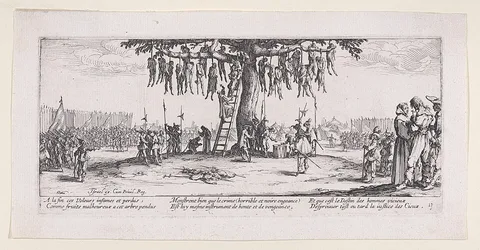
I wrote about this in the draft of the piece that I’m writing for Monday, from a 2013 Slate Star Codex80Slate Star Codex — the blog of the psychiatrist who writes as Scott Alexander, one of the central publications of the rationalist community; in 2021 it moved to Substack as Astral Codex Ten. article. He says that the printing press81The printing press — Johannes Gutenberg built his in Mainz around 1450. Seventy years later Martin Luther’s theses (1517) spread across Germany in printed sheets within weeks, and the Reformation is often called the first movement carried by print.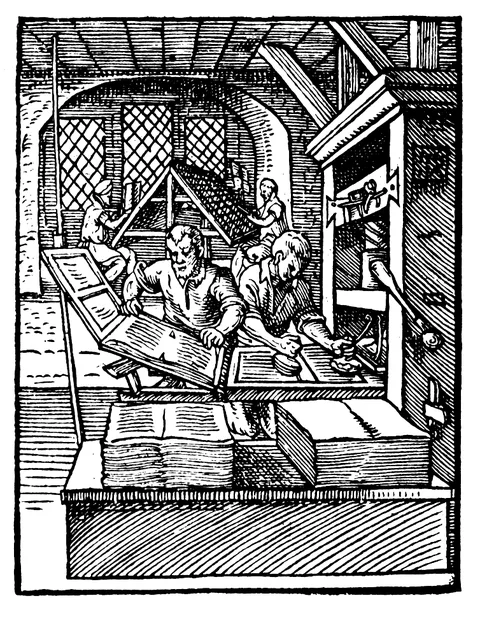 precipitated the Protestant Reformation, the newspaper, the Renaissance, the scientific revolution, and the rise of nationalism. Plus the things that you’re saying. The effects are still being felt today.
Mass media technologies do this, and you can look at text and image generators as a mass media technology. So the early wielders of these technologies, the people who are able to effectively use them to influence large groups of people, that’s a dangerous thing. Historically, that’s been a very dangerous thing. Historically, everyone says, “This is going to be a great tool for education.” That’s what everyone says about every new media technology. And the reality of every new media technology is it gets used for propaganda, entertainment, and pornography.
We would love to believe about ourselves as a species that we are animals that primarily love knowledge. But the reality is, most people just want to have a good time, or believe happy things. And that’s why propaganda is very effective. And I don’t know, we’re already starting to see algorithmic propaganda. You can use ad targeting to do this stuff. But now you put AI behind that, and you can fine-tune the AI where it can customize the propaganda stream down to the individual person. I don’t know what’s going to happen. It’s a little frightening.
I also don’t think that the AI is going to take our jobs. I think every time that fear has been had in history, it ends up not being true, and we end up doing cooler things. I do think what’s happened, to me, even with like a YouTube… I was reading this post the other day, that there’s just this decentralization mirage. You think that the internet’s a decentralizing force, but instead of a teacher being able to teach 20 people at a time, one person teaches 10 million people how to do something on YouTube. It feels like that gets amplified. If we all use GPT-4,82GPT-4 — in November 2022 OpenAI’s next model was still only rumored. It came out on March 14, 2023. and, you know, whatever it draws from on a particular topic, there’s five people that are the best… I don’t know if it even works that way, and you can tell me if it doesn’t, but over time you can see that if there’s just stuff that are inputs that are much, much, much better, then everybody’s concentrated on this one place. That gets even more extreme.
Yeah, so that’s the other thing with mass media technologies: because they reduce the distributional frictions to zero, you have these power laws over outcomes,83Power laws — distributions in which a few leaders take the lion’s share and the vast majority get almost nothing: book sales, video views, musicians’ incomes. right? Like, a thousand years ago, the best musician in the world, probably like a thousand people knew that person, right? A thousand years ago. And we know them, they’re popular today, because… This is actually funny. Some artists have become more popular than in their own time by orders of magnitude, even as a total fraction of the population of the earth, because we were able to preserve them in some way or another. So we have, you know, Mozart’s sheet music84Mozart’s sheet music — his manuscripts and editions printed in his lifetime survive and are still played from, and recordings, radio and film in the twentieth century made his music known worldwide. The manuscript shows the second movement of his Piano Concerto No. 21. or whatever.
And then the mass media technology later resurrects them. And then every human being on earth knows Mozart, whereas before, I don’t know, a few thousand people maybe. So what that ends up in is, okay, there’s one best person, right, in the entire world, and everyone’s eyes are just going to be focused on that one best person, or the top, whatever sliver of a percentage it is. That tends to happen whenever you have mass media. Attention gets concentrated, because distribution goes away, and you can think about it as the tournament for talent gets globalized.85The tournament for talent gets globalized — what the economist Sherwin Rosen described in “The Economics of Superstars” (1981): when technology lets one performer serve a huge audience, small differences in talent turn into huge differences in income. And then whatever the most popular thing is rises to the top, which is, by the way, not necessarily the best thing at all a lot of the time. But it is, in expectation, the thing that people think is best.
So I guess another just basic question that I have on these data sets. I would imagine my emails are not available and being used in data sets.
Maybe… I don’t think your emails are in there. Good.
All right. Maybe my Substack is, because it’s a free open newsletter. If I have a paywall, does it respect the paywall? Does it go behind the paywall?
I don’t know. You have to read the license agreement for your Substack. I don’t know.
The reason that I’m asking is, I wonder if there’s going to be a spot where, not me, but somebody with a much, much, much bigger audience, who actually is the most popular teacher of some topic, ends up just paywalling their stuff and then going to OpenAI to be like, “You can train a model on me.” Be like, “Train it on me, but you’re definitely not getting that shit for free.” Because I know that this is going to be a huge part of the output for this particular topic.86Train on me, but not for free — Packy’s guess came true for big text owners: from 2023 OpenAI signed licensing deals with the Associated Press, Axel Springer, Reddit and News Corp, and in 2024 Google began paying Reddit for access to its posts for training.
Yeah, it could be, right? Substack pays a lot of people. Instead of you paying Substack, Substack pays you money to write on Substack,87Substack pays you — in 2021 Substack launched Substack Pro, paying well-known writers advances to move to the platform while keeping a larger share of their subscription revenue in the first year. so more people come to Substack. So that’s very plausible to me. But the relationship between the input data and the output is not clear. It’s even less clear than on these creator platforms. It’s trained on billions and billions and billions of data points.
And even if it uses you as the best teacher to fine-tune on, how much of that is attributable to you, we don’t know. You can think of ways to try it out. You can say, okay, this is what the model does without Packy, and this is what the model does with Packy, and the difference is what we pay you.
I hope that they do end up figuring out a way to pay people for their contributions here, because I think that would be an incredibly great motivator for people to try novel ways of becoming the very best at a particular thing, in a way that the internet has already kind of done, but it would really incentivize people to try to leap over other people, because you could become a billionaire if your thing is very clearly driving the outputs of a model.
Which is, again, another facet of this power scaling in mass media technologies. You know, you’ve got billionaire YouTubers out there, right? It’s the same kind of thing. It’s like, I drive so much ad revenue for you that I can be a billionaire. It’s a possibility. I don’t know what the shape of it is. I think that it’s a very exciting time.
I think that we’re going to learn a lot. I think a lot of it is going to be dangerous, but survivably dangerous. We’ll just kind of have to see what happens. I don’t really think we have a choice at this point. We kind of have to strap in. And I hate to say “hope for the best,” because that makes people feel like they just have to take whatever’s going to happen. No, it’s like, be prepared. Think about it. Think about what you want to do and who you want to be with the things that are coming. Be aware of it, but also don’t panic. Don’t get outsized ideas, you know.
12What the paper changed, and a recap
In seven and a half months the Chinchilla laws became the standard reference for anyone training large models, and the next challenge is data.
Yeah, I agree. To wrap up here: so this paper looks like it was published on March 29th, 2022. So we’re about seven or eight months after the publishing of this paper, seven and a half months after the publishing of this paper. Feels like five years, honestly.
Well, that’s what I was going to ask. I was like, when did this come out?
So in terms of production models, where is this having an impact already? Is this shaping the next generation of things coming out? Are we using things that are based on Chinchilla? And what is the impact of this paper so far, and what do you think it will be?
ExplainerWhat became of the Chinchilla recipe
The rule of about 20 tokens per parameter quickly became the industry yardstick: in 2023 Google said PaLM 2 was smaller than the first PaLM but trained on more data under the same scaling laws. But Chinchilla computed the optimum for training only, while a model then serves millions of people for years, and every answer costs more the bigger it is. So from 2023 labs began deliberately training small models far past the Chinchilla optimum: Meta’s 8-billion-parameter Llama 3 (2024) saw 15 trillion tokens, nearly 1,900 per parameter. The other change was the source of growth: as quality text began to run out, labs added synthetic data and reinforcement learning, and with OpenAI’s o1 (September 2024) began spending compute not only on training but on the model’s “thinking” at answer time.
Yeah, I think that since the publication of this paper, pretty much everyone training large models of one kind or another has made references to whether or not their thing fits the scaling laws, or why they chose a certain amount of data, a certain amount of parameters, arguing for, you know, their amount of compute or whatever. Some people have pushed the boundaries a little bit and shown that for this architecture, this is a scaling law, for this other architecture there’s a slightly different scaling law. I think in many, many cases, the models that are in production right now are probably, you know, optimal with respect to the Chinchilla laws.88Fact-checkOverstated: in late 2022 the models in products were mostly from the GPT-3 family, which by Chinchilla’s standards is badly undertrained: a 175-billion-parameter model needs about 3.7 trillion tokens, and GPT-3 saw 300 billion (Chinchilla paper, table 3). I can’t speak to the next generation of what’s coming, because they may involve breakthroughs that take us off these rails. I don’t know. I can’t speak to that.
I’m under NDA with OpenAI.
No kidding. Well, yeah, I mean, if I did know, which I don’t, I wouldn’t be able to talk about it anyway. But I honestly don’t know. Please don’t come after me, Sam.89Sam — Sam Altman, OpenAI’s CEO. I seriously don’t know. Yeah, I can’t speak to that. I think that if you found a way to break the scaling laws, you probably would want to keep it a secret until you were the first deployment of that model. And also, it’s very hard to detect if you broke the scaling laws or not. That’s the other thing. From the outside, it’s hard to tell.
Right. Did DeepMind… And I guess I already told you “last question.” Last, last question. So I know they made Chinchilla as part of this paper. Are there any DeepMind models out there that just regular people are using, that leverage it, that came out first from DeepMind?
So that’s interesting. What regular people are using in practice is hard to say. I think the way that Google and DeepMind do things with their models, versus OpenAI, the way they do things with their models, is slightly different. So you can’t really open up a PaLM playground90PaLM — Google’s 540-billion-parameter language model (April 2022), built by Google Research rather than DeepMind; Google opened public API access to it only in March 2023. today, whereas you can open a GPT-3 playground.91The GPT-3 playground — OpenAI Playground, a web page where since 2020 you could type prompts to GPT-3. Five days after this episode, on November 30, 2022, OpenAI launched ChatGPT. And PaLM is compute- and data-optimal.92Fact-checkWrong: the 540-billion-parameter PaLM was trained on 780 billion tokens, about 1.4 tokens per parameter. By the Chinchilla paper’s estimates a model that size needs about 11 trillion tokens. PaLM beats Chinchilla because it was trained with roughly four times as much compute (PaLM, Chinchilla). It does, in principle, better than Chinchilla, like, climbs that curve.
PaLM is the big, big, big, big language model that Google has. So I can’t really speak to regular people, but definitely there are probably models in production that are being used in at least some products, maybe. That’s another part of the politics here. In a lot of cases, it’s difficult for product organizations to absorb a large model like this seamlessly and flawlessly. It’s just a difficult problem from an engineering perspective and from a product perspective. So it’s hard to say. I understand that that’s kind of a wishy-washy answer, but it’s hard to say.
No, the wishy-washy is good, as long as it’s the truth. All right, so I’m going to do my two-second “did I understand this” recap. Two-second “did I understand this” recap of Chinchilla. They looked back. They did a lot of analysis on existing models and did a lot of work on kind of what’s best practice before. They looked at Kaplan et al, which said just make the models bigger, and if you do that, performance scales with the number of parameters. And they said, great, but what if you have a limited compute budget? How do you get the balance right between parameters and the data, holding compute constant, or at different levels of compute?
And the way that they do that is you scale your parameters and your data proportionately, and that’s the best way to get a compute-budget-optimal model. And so now the question is, great, everybody went really hard in the direction of making the models bigger. Now, how do we get good data, to add more data to those models and balance that out?
Yeah, that’s right. That’s right. The way to think about that is, scaling parameters gives you diminishing returns in performance. For a given amount of compute, scaling parameters gives you diminishing performance without more data. And it turns out, if you measure those diminishing returns to parameters and data, if you increase both equally, such that your compute is optimally divided between training time and number of parameters, that’s in some sense optimal, in some sense optimal for the kinds of transformer-based large language models we have now.
Hell yeah. Well, Anton, thank you for teaching me about Chinchilla. Everybody, our huge and growing subscriber base, thank you for joining us here on another installment of Anton Teaches Packy AI. We’ll be back in about a week. Last time we teased this paper; this time we’re going to have to talk offline and figure out where to go next with this.
I have some ideas. I have some ideas. I think we’ve been sitting at the edge of AI research, you know, papers from 2022. I want to go into the history, where we came from, how we got here. And I think a really good paper to talk about is the first perceptron.93The perceptron — the first trainable model of a neuron, described by the psychologist Frank Rosenblatt in a 1958 paper with a long title: “The Perceptron: A Probabilistic Model for Information Storage and Organization in the Brain.” The next episode of the series ended up going back even further, to Warren McCulloch and Walter Pitts’s 1943 paper on the first mathematical model of a neuron. I think that would be a really interesting thing to talk about, as a platform for understanding how did we start down this road.
Is the paper called “The First Perceptron”?
No, I don’t know what it’s called. I have to go look it up, because back then papers all had really long titles, and the thing that they actually did was not in the title.
Got it.
So I have to go look this up. But I think taking a look at that, from the prehistory of AI, I think would be really interesting.
I love that. Let’s do it. And I’m going to just call the episode “The First Perceptron,” because that’s an incredibly cool name. So join us next…
Doesn’t Perceptron sound cool?
Perceptron sounds like the Eye of Sauron, kind of, but yeah.
Like Transformer.
Like, yeah.
All right, Packy, this was great.
This was awesome. Thank you, Anton.
Next time. Bye-bye.


