

Cheeky Pint
Chapters
Xu says DoorDash won because customers came back to it more often than to rivals, and a shortage of money forced it to grow through the product.
Read the chapter- A delivery service, Xu says, is judged at once on restaurant selection, punctuality, the condition of the order, price and what happens when it screws up, and it has to be good at all of it.
- Any consumer product, in Xu's view, comes down to retention and frequency of use: people can argue about whose app they like, but those numbers told DoorDash whether its ideas made a difference.
- In 2016–2018 DoorDash "barely was able to raise a dollar" relative to its peers, so it couldn't buy growth with coupons and discounts and had to find it in the product.
- Once it saw higher retention and frequency than everyone else and could raise capital, it went "pedal to the metal" on acquiring customers.
Xu reads customer obsession off what a company actually does, and he says Sequoia's Michael Abramson kept investing as long as the answers to three simple questions held up.
Read the chapter- The early crew, Xu recalls, all did deliveries and customer support, built menus, sold to restaurants and worked inside them.
- In the fall of 2013, with less than two weeks of runway, a Stanford football game produced a night when every order was late, and DoorDash refunded everyone, about a hundred customers and over 40% of the bank account, then baked cookies and delivered them at 5 a.m.
- Cultural norms, Xu believes, are 80% what you've already done: in COVID DoorDash, not yet profitable, cut commissions by 50% at a cost of over $100 million and bought national TV ads telling people to order from restaurants, even through competitors.
- The hard moments kept coming: the Series C and D in 2016–2018 were brutal, and in the first week of COVID the business tanked 80% before doubling the next week.
- Abramson, Xu says, asked the same three questions the founders had asked in Y Combinator: would consumers pay a premium for delivery, would merchants pay a commission, and would Dashers work for a wage DoorDash could afford.
Delivery is bigger in China because food and labor are cheap, cities are dense and restaurants are everywhere, which is why Xu warns that you can't simply clone that market.
Read the chapter- Eating out in China, Xu says, is about as affordable as cooking at home, and Collison concludes that as a result nobody cooks.
- Cheap and plentiful labor makes delivery almost as affordable as picking the order up yourself.
- China has dozens of cities of over a million people, some perhaps denser than Manhattan, and the market spread from the Eastern Seaboard to western cities as incomes rose.
- China has over seven million restaurants against about a million in the US, and they sell T-shirts, hats and cookbooks as well as food.
- Restaurants, Xu argues, are drifting toward one of two ends, a center of hospitality that AI won't replace or a manufacturing site, or as Collison puts it, "a third space and a factory all in one."
Xu sees perennial trends in the industry, from rising labor costs to endless new cuisines and the struggle to scale, and yet spending on eating out keeps growing every year.
Read the chapter- Staffing, Xu says, has always been the number one challenge, and because labor only gets more expensive, restaurants are choosing an end of the service-to-manufacturing spectrum, so the local spot that seats diners and also fills a few takeout orders is getting rarer.
- Innovation in restaurants means new cuisines, and census data shows only a couple of years in the last 60 when the US didn't have more restaurants than the year before.
- The big QSRs, which take almost 50 cents of every restaurant dollar in the US, want to keep riding their economies of scale.
- Even the hottest chefs in town, Xu says, struggle to raise capital and get permits for location number two.
- In the 1950s, by Xu's rough numbers, 75–80 cents of the food dollar went to groceries, while today almost 60 cents goes to eating out.
Permitting has gotten worse on average, but the fastest-growing cities make it easier, and DoorDash is lobbying in Washington to help small businesses open a second location.
Read the chapter- Collison finds food truck gardens in parking lots bittersweet: the concepts are often cool, but society has lost the ability to let people open restaurants.
- Xu says permits, like construction in general, have largely gotten worse, but restaurants grow fastest where cities do: around Phoenix, Scottsdale and Tempe, near Austin, in Dallas and Plano, across the South.
- Where it's easy to build apartments, Xu notes, it also tends to be easier to get a license for a restaurant.
- In Washington DoorDash argues for permitting reform and for labor law changes that take restaurateurs into account.
The biggest thing technology has done for restaurants, Xu says, is delivery and its incremental margin, while recognizing regulars is still an unsolved problem that DoorDash wants to take on.
Read the chapter- By Xu's rough math, about 30% of each dollar goes to food and packaging, 30% to rent and 30% to labor, leaving 10 cents, while a takeout order uses the same staff and rent and brings in 3–5x the incremental margin.
- Restaurants don't see the full picture of online and in-store orders, and their staff, Xu says, may turn over "every other day."
- Collison points out that airlines have locked in frequent travelers, while restaurants offer only the mass-market punch card or an owner who happens to recognize you and comp your dessert.
- Xu explains why it's hard: Collison eats even his favorite Taiwanese food once every month or two, and with 20–25 eating occasions a week, food isn't like coffee or travel.
- DoorDash bought SevenRooms, which handles in-store bookings, and wants to layer on data from its 100-million-plus annual customers so a restaurant knows John is a regular.
Ghost kitchens stayed small because a little restaurant can't attract enough customers and a big chain is better off opening another real location, and chains' true IP lies in process.
Read the chapter- A small business like his mom's Chinese restaurant, Xu says, has little name value outside its locale and still has to staff the kitchen.
- A big QSR's opportunity cost is opening another restaurant that serves both in-store and to-go orders, and for brands like Chipotle with expensive real estate, the space itself has a high opportunity cost.
- McDonald's fries taste almost the same anywhere in the world, which Xu calls an extraordinarily difficult feat, and he places big brands' innovation in process and consistent service.
- Small restaurants that have lasted almost a century, in Xu's view, share what makes startups special: a small group that believes in an idea and a commitment to some standard of excellence.
- Xu never forgot a rule from his Chick-fil-A hospitality training that floors must be clean enough for babies to lick, and he credits the chain's success to a loyal following, custom equipment and employees who stay for two or three decades.
Good chains are rare, Xu argues, because keeping quality up gets exponentially harder with scale and every new concept faces a thousand competitors.
Read the chapter- As the number of people you cook for grows, Xu says, keeping taste, temperature and speed consistent gets exponentially harder.
- There are over 1,000 pizza choices in the Bay Area on DoorDash alone, before you even get to staffing and permits.
- Collison pushes back that a good Neapolitan pizza isn't rocket science but a process, and that Chipotle thrives even in LA, full of great Mexican places.
- DoorDash launched a healthy-burger brand with a partner and sold lots of burgers over a weekend, but half the reviews called the quality inconsistent and it couldn't retain the customers.
- Reliability is underestimated in restaurants and at DoorDash alike, Xu agrees, and keeping it as dependable as electricity or running water is extraordinarily hard.
Before choosing a vehicle you have to know what items exist and where they are in a city, and DoorDash ended up building its own delivery robot because no one else would.
Read the chapter- Tens of millions of items in every city aren't cataloged, Xu says, and if you don't know where to get the right item, the right vehicle makes no difference.
- When DoorDash started its autonomy project in 2018–2019, it went looking for a partner, but everyone was building robotaxis and the sidewalk robots were too slow.
- Dot had to be fast enough, smaller than a car so it could cope with busy locations, and designed for loading and unloading, which in a robotaxi the passenger handles.
- An autonomous vehicle company, Xu says, is many companies in one, covering autonomy, hardware, manufacturing, operations, maintenance, regulation and supply chains, so DoorDash is testing Dot in one market, Arizona, to get it right.
- Drones suit longer-distance orders, and DoorDash has flown deliveries for a couple of years, mostly outside the US, in places like Australia.
DoorDash runs like a big state machine, and its hardest problem is offline fraud, where it has to invent its own signals.
Read the chapter- Xu compares DoorDash to a state machine from his freshman electrical engineering course: as the system degrades from green to red, other systems kick in, and at billions of orders a year the one-in-a-million incident does occur.
- DoorDash works with Stripe on online fraud, but offline claims such as "the order never arrived" or "the item is missing from the store" are hard to verify.
- SafeChat rests on the finding that over 90% of physical altercations are preceded by verbal ones, and DoorDash's alert system was the first to report a Manhattan office-lobby shooting to the NYPD.
- Collison describes "friendly fraud," where a customer gets the order but says it never came, and there's no proof either way.
- Against it, Xu says, DoorDash builds customer profiles and its own maps, because it cares about "the last two feet" to an apartment door.
A catalog DoorDash built for itself turned out to be valuable to others, and LLMs could be strong recommenders, though Xu doubts everything will happen through text.
Read the chapter- DoorDash Tasks began with Dashers collecting data on where items sit in stores, and then retailers, CPG companies, LLM labs and robotics firms wanting offline data started calling.
- AR glasses like Meta's could help Dashers inside stores, Xu says, but the bar is high because humans are already pretty good with their eyes.
- Collison observes that LLMs make good recommendations from a list of things you like, while the DoorDash app shows everyone the same categories.
- Xu agrees that consumer products will have their own ordering agents but isn't convinced text is the right modality: "We don't buy things through text."
DoorDash wants to deliver everything in the city, give businesses their own software and bring guests into venues, and in reservations Xu sees discovery as the bigger problem.
Read the chapter- DoorDash is "a long, long, long ways" from bringing you everything in the city, Xu says, and with each new category it becomes a smaller drop in the ocean.
- The second mission is B2B software such as DoorDash Drive, Storefront and SevenRooms, and the third is bringing customers inside stores, starting with Going Out and Reservations.
- Xu believes no restaurant should own its reservations technology and that restaurants should be able to take bookings on any platform.
- Tock's idea of a deposit against no-shows makes a ton of sense to Xu, but implementation is what matters, since it counts most for restaurants with limited seating and long seatings.
- Restaurants still struggle to generate their own demand and people to find restaurants, Xu says, and Collison's wife finds them on Instagram.
Deliveroo and DoorDash are fundamentally the same business, but London and Europe differ from the US in their cities, regulation, payments and retail concentration.
Read the chapter- London, Xu says, lacks the grid-like structure of many cities, so DoorDash there mostly delivers without cars and needs different signals and vehicles.
- Regulation varies country by country, and Europe has many more card types than the US.
- In the UK, Germany and France a few chains dominate each category, while the US has hundreds of big regional brands.
- Asked by Collison why Boots beats CVS and Walgreens, Xu points to concentration, which keeps standards higher and more consistent.
Xu's advice to a growing company is to solve customers' top problems rather than push what it wants to sell, and then Dot rolls into the studio.
Read the chapter- As companies grow, Xu says, they're tempted to impose what they want to sell instead of solving the customer's problem, advice he says the two companies could give each other.
- Dot has a screen and "eyes" for communicating with people, cameras and lidar, and a custom modular compartment for heating or cooling, and it can do hundreds of deliveries on a charge.
- It's about a tenth the size of a car, travels up to 20 miles an hour, and runs on roads, bike lanes and sidewalks.
- DoorDash's autonomous delivery platform decides which vehicle takes which order, so Dot can do the first leg and hand off to a Dasher.
- Dot brings John a non-alcoholic Guinness, and John gives Tony his first Tayto, "the Lay's chips of Ireland."
Stablecoins already work for cross-border payouts, and ordering through AI assistants only pays off if the delivery job is solved end to end.
Read the chapter- Collison says stablecoins are already the best way to send money to 100 countries, and Stripe's Tempo is being built as a scalable blockchain for payments, with agents in mind.
- Collison wants to tell ChatGPT, Gemini or Siri "let's just order again what we ordered on Sunday," and adds that you only earn the right to cool UI if the logistics are right, which Xu agrees with.
- Google's food ordering, launched in 2015 or 2016 by Xu's recollection, sent traffic from Maps and Search but couldn't retain customers, because Google didn't know what to do when a driver couldn't find you or an item was out of stock.
- Xu misses tea sandwiches and European prepared food in the Bay Area, and Collison says a Heathrow sandwich will be pretty good, while at JFK, "don't go there."
Quotes
On how DoorDash knew its product beat the competition
“I think it’s very easy to have differences in opinion about whose app do you like more or whether or not certain apps look similar or different. At the end of the day, though, if our app is performing at a much higher retention and frequency of use than others, that’s how we know whether or not the things that we say actually are making a difference to customers.”
Tony XuRead from 02:38On where DoorDash's "customer obsession" value came from
“when our backs were against the wall, and we had, I think, less than two weeks of cash runway, and we had a terrible night where every single order was late—this was a Stanford football game in 2013, and I had trouble raising the seed round—we made the decision to refund everyone. That cost us over 40% of the bank account.”
Tony XuRead from 05:02On why China has more food delivery than the US
“One of the first big differences is the eating out culture in China is very, very high and very, very affordable. Eating out in China is about as affordable as cooking at home.”
Tony XuRead from 11:34On what Chick-fil-A's hospitality training teaches
“I don’t remember everything on the checklist, but one of them that stands out is that the floors must be so clean that babies would lick them or could lick them.”
Tony XuRead from 37:26On what makes logistics great
“A lot of what I believe makes for great logistics is you need a great setup. Because if you’re always trying to figure it out on the fly, and you’re pulling some magic trick out of thin air, and you have to be the hero, that is not a system. That is an exception.”
Tony XuRead from 45:23On why a delivery robot has a hard time beating a courier
“Because you got to remember, back to opportunity costs, humans are very good at delivery, actually, it turns out. We’re also very good at driving, too. The bar is actually a fairly high bar.”
Tony XuRead from 47:51On what DoorDash learned about fights between couriers and customers
“we noticed that prior to any physical altercation that may, unfortunately, happen between audiences, 90-something percent of the time, it’s always preceded by a verbal altercation. Knowing that alone allows us to prevent a lot of tough situations.”
Tony XuRead from 53:50On the lesson of Google's food ordering
“There’s a lot of things that happen after the checkout button.”
Tony XuRead from 1:17:37
Summary
Tony Xu, cofounder and CEO of DoorDash, explains to John Collison why, of all the food delivery services the iPhone spawned, DoorDash is the one that won: it got more customers because they came back more often. A delivery service is judged on everything at once (restaurant selection, speed, the condition of the order, price, and how mistakes get fixed), and the only way to judge the product is by retention and frequency. In 2016–2018 the company could barely raise money, so it had to grow through the product rather than discounts. Xu says values like "customer obsession" should be read off actions: in the fall of 2013, with less than two weeks of cash left, after a night when every single order was late, DoorDash refunded every customer, more than 40% of what was in the bank, and delivered cookies to them at 5 a.m.
Most of the conversation is about restaurants. China has more delivery because food and labor are cheap, its cities are enormously dense, and it has more than seven million restaurants. Restaurants' biggest problem everywhere is staffing, so they are drifting toward the ends of the spectrum between hospitality and "factory"; yet the number of US restaurants grows almost every year, and eating out now takes almost 60 cents of every food dollar, whereas in the 1950s 75–80 cents went to groceries. A restaurant nets about 10 cents on the dollar, and a takeout order brings in 3–5x the incremental margin. Ghost kitchens never took off: a small restaurant can't attract enough customers, and a big chain does better opening another location. The real IP of chains is process, from McDonald's fries that taste the same around the world to Chick-fil-A floors clean enough for babies to lick; good chains are rare because keeping quality up gets exponentially harder with scale.
Then comes the future of delivery: first you have to work out what items are where in a city, and only then choose the vehicle. DoorDash couldn't find a partner for autonomous delivery and built its own robot, Dot: a tenth the size of a car, up to 20 miles an hour, for roads, bike lanes and sidewalks. The episode also covers offline fraud and DoorDash's own maps accurate to "the last two feet," DoorDash Tasks, LLMs as recommenders, reservations through SevenRooms versus Tock's deposits, the Deliveroo acquisition and what makes London different, stablecoins and Stripe's Tempo, and the lesson of Google's food ordering: low friction gets you nothing if you don't solve the job end to end.
Advice
Judge your product by retention and frequency of use, not by arguments over whose app is better: only those numbers show your ideas are actually making a difference for customers.
When money is tight, grow through the product rather than discounts, and only spend on acquiring customers once you've proven to yourself that your retention beats the competition: then every dollar you spend works for you.
Don't write your company's values in advance; derive them from what people do: cultural norms are mostly what the team already does, and a statement pulled out of thin air often doesn't match reality.
Early on, aim not to raise as much money as possible at the highest valuation, but to answer the core questions of the business: will customers pay, will partners accept your terms, and can you find workers at a wage you can afford.
As your company grows, don't start pushing on customers what you want to sell: keep asking which of their top problems you're solving.
A slick interface won't save you if you don't solve the customer's job end to end: Google's food ordering brought lots of traffic but didn't keep customers, because it couldn't handle what happens after the checkout button.
Mentioned
- Doctor Who00:00Dot gets compared to the TARDIS from the show
 DoorDash00:01Tony Xu's company
- iPhone00:24what kicked off the food delivery boom, in Collison's view
 Sequoia Capital08:56the firm where Michael Abramson, a steadfast DoorDash believer, worked
Show 21 more mentionsShow fewer mentions
 Y Combinator09:17the accelerator DoorDash went through
 SevenRooms29:44the reservations system DoorDash bought
 Chipotle Mexican Grill33:52the chain that never needed central factory kitchens
 McDonald's35:23french fries that taste the same around the world
 Chick-fil-A37:26hospitality training and employees who stay for decades
- Dot44:03DoorDash's autonomous delivery robot
- SafeChat53:50catches the verbal altercations that precede physical ones
- DoorDash Tasks58:25tasks for Dashers: collecting data on items in stores
- Ray-Ban Meta1:00:17Meta's glasses as a guide for Dashers in stores: Xu is skeptical
 Tock1:06:17reservations with deposits against no-shows
 Instagram1:07:55where Collison's wife finds restaurants
 Deliveroo1:08:31DoorDash's European acquisition
 Stripe1:12:03grew up alongside DoorDash; Tony's advice is to solve customers' problems
- Stripe Connect1:12:03a Stripe product DoorDash was an early user of
- Stripe Radar1:12:03a Stripe product DoorDash was an early user of
 Patrick Collison1:13:34with John, taught Stripe's customers to think beyond payments
 Tempo1:14:45the payments blockchain Stripe is working on with DoorDash
 ChatGPT1:15:16an AI assistant you'd want to order food through in one sentence
 Google Gemini1:15:16an AI assistant you'd want to order food through in one sentence
 Siri1:15:16an AI assistant you'd want to order food through in one sentence
 Google1:16:50food ordering in Google's services didn't keep customers
Sponsors of the episode
- Stripe Issuing30:35programmatically controlled virtual and physical cards
Transcript
Oh, wow.
We got Dot1Dot — DoorDash's autonomous delivery robot, unveiled in September 2025. It travels on roads, bike lanes and sidewalks at up to 20 miles (about 32 km) an hour; the first trials began in Tempe and Mesa, suburbs of Phoenix. coming.
It’s like a TARDIS.2TARDIS — the time and space machine from the British TV series Doctor Who: from outside it looks like a blue police box, but it's much bigger on the inside.
Tony Xu is the co-founder and CEO of on-demand delivery giant, DoorDash. He’s grown the business from a Stanford side project3A Stanford side project — DoorDash grew out of PaloAltoDelivery.com, a site launched in 2012 by Stanford students Tony Xu, Andy Fang, Stanley Tang and Evan Moore; they founded DoorDash in Palo Alto in 2013. into America’s dominant food delivery platform, and is now pushing into everything from grocery to retail to autonomous vehicles and financial products for gig workers.4Gig workers — people who take individual jobs ("gigs") through platforms like DoorDash, Uber or Instacart and work as independent contractors rather than employees.
Great.
Cheers.
Good to see you.
01Why DoorDash won
Xu says DoorDash won because customers came back to it more often than to rivals, and a shortage of money forced it to grow through the product.
As I think back to that era where you guys got started, what year was DoorDash founded?
Okay. As I think back to 2013 and those early days, the iPhone and the apps that were made possible by the iPhone was the defining tech trend of the era. Uber and Lyft5Uber and Lyft — American app-based ride-hailing services, founded in 2009 and 2012; Lyft is Uber's main US rival. in ride-sharing, Instacart,6Instacart — an American grocery delivery service founded in 2012: a shopper picks and delivers the order. On October 29, 2026, DoorDash agreed to buy Instacart for about $17 billion; the deal still needs regulatory approval. you guys, all of the magic wand apps that made your iPhone useful for bringing things to you and manipulating the wider world.
Loads of people were going after food delivery, and way more than are around now. As you look back on that journey from, again, it was really kicked off by the iPhone, in my opinion. Not that there wasn’t food delivery before the iPhone, but that really massively increased the market size. As you think about from then to today, why did you guys win?
Sure, but let’s have the five whys7Five whys — a root-cause technique associated with Sakichi Toyoda and the Toyota Production System: you ask "why?" of every answer until you get to the root of the problem. here.
I think these are very tough things to study because many things are happening in the same moment, but I’ll just talk about it from the perspective of things that I think we got right. When you think about something like restaurant delivery, you actually get judged on multiple dimensions as a service. We get judged on what restaurants we bring you, certainly, whether it showed up on time and the quality and condition you expect, how much did it cost, if we screwed up, what did we do about it?
It’s not one thing that you have to be good at, actually. It’s all of the above. Unfortunately or fortunately, this is literally the game that we’re playing where customers are judging us in all of these dimensions. I think getting that right better than anyone else as measured by whether or not people are coming back to the app and using us, using us even when we had no money to market to them or discount offers to them, things like that, I think was the tell.
Are you saying it was a very complex, multivariate challenge even from early on, and you guys just embraced that complexity and said, “Okay, this is going to be super complex to get right,” whereas maybe others took a bit more simplicity?
That’s what I like to do.
From the product perspective, yes, because at the end of the day, any consumer product is judged very simply by its retention8Retention — the share of customers still using a product a week, a month or a year after their first purchase; frequency is how many times they use it in a period. The two key metrics of a consumer product. and its usage. That’s how you know whether you have a differentiated product. I think it’s very easy to have differences in opinion about whose app do you like more or whether or not certain apps look similar or different. At the end of the day, though, if our app is performing at a much higher retention and frequency of use than others, that’s how we know whether or not the things that we say actually are making a difference to customers. Getting all of that right very, very early and then building the systems to actually instrument that as well as to repeat that over and again, I think was very, very important in the development of the company.
Do you think you guys were more focused on retention than others?
I don’t know if we were more focused. I could tell you, though, one of the things that was happening, especially when you see a competitive fight, is you see everybody race towards it. Everybody is going to try to make offers to customers, try to give discounts, try to give coupons, free this, free that. One of the things that we had looking backwards is we actually did not have a large budget. In fact, between 2016, ‘17, ‘18, we barely were able to raise a dollar relative to our peers. As a result of that, that made it a constraint.
One of the constraints is, okay, you can grow, but you cannot spend in order to do it. In order to do that, you effectively have to actually come up with ideas in the product to actually stand out and make a difference and have organic growth9Organic growth — growth driven by the product itself and word of mouth, without paid advertising, discounts or coupons. carry you. Then once we were able to demonstrate to ourselves first that we had a product with higher retention than other people and higher frequency, and then we were able to raise capital, then we actually made the decision to pedal to the metal and actually go and acquire customers because we had an unfair advantage.10Unfair advantage — startup jargon for an edge competitors can't easily copy or buy. Here, higher retention: with it, every dollar spent acquiring a customer pays back better than it does for others.
02Cookies at 5 a.m. and an investor who believed
Xu reads customer obsession off what a company actually does, and he says Sequoia's Michael Abramson kept investing as long as the answers to three simple questions held up.
Were you more customer-obsessed11Customer obsession — Jeff Bezos's formula, the first of Amazon's leadership principles. At DoorDash it's one of the company values, and Xu goes on to tell where it came from. than others?
I think it’s very difficult to measure us against other people because I didn’t really work at those companies. But again, I really just look at the early DoorDash crew and what were the things that we did that were very useful. We all did deliveries. We all did customer support. We all made menus. We all sold restaurants. We all customer serviced restaurants. We all worked inside restaurants.
I think at the end of the day, I think the term customer obsession can be fairly generic and vague and applied. It really just goes to show what actions actually demonstrate that? For us, some of the ones that came to mind, and frankly, the story that actually inspired the value in the first place was when our backs were against the wall, and we had, I think, less than two weeks of cash runway,12Cash runway — how many months or weeks the money in the bank will last at the current rate of spending if no new money is raised. and we had a terrible night where every single order was late—this was a Stanford football game13A Stanford football game — home games of the Stanford Cardinal draw tens of thousands of fans, and at the time DoorDash operated only in Palo Alto and neighboring towns, right next to the stadium. in 2013, and I had trouble raising the seed round14Seed round — a startup's first outside money, usually from angel investors and seed funds; it is followed by Series A, B, C and so on.—we made the decision to refund everyone. That cost us over 40% of the bank account. When you have 2 weeks of runway, 40% of the bank—
You issued a refund that was 40% of your funds’ runway?
Yeah, maybe a little over that. We baked everyone cookies and delivered them at 5:00 AM before everybody woke up. Look, this was maybe 100-ish customers or something like this. But I think it demonstrates that this was a real value. It’s actually my test, really, which is, what are the actions that are naturally occurring? What are the behaviors that are actually occurring inside of an organization? Then how do you actually articulate it versus the inverse, which is you start with maybe some articulation, and maybe some of the times it matches and other times it doesn’t.
I’ve always believed that these cultural norms or behaviors are really 80% of what you’ve done. I think that’s the best way to actually find what they are for your company. We’re the only platform today to take care of Dashers15Dashers — what DoorDash calls its couriers. They work as independent contractors, not employees. when there is these increasing gas prices and making sure that we have their back and that we’re actually trying to help them save $1.40 to $1.90 per gallon for Dashers. Or in COVID, we were the only company to cut commissions16Commission — the share of the order total a delivery platform charges the restaurant. DoorDash's US commissions range from 15% to 30%, depending on the plan. by 50% when we were not yet profitable as a company. That was an expense over $100 million.
We then, on top of that, spend millions of dollars buying national TV campaigns to tell people to order, whether it’s on us or our competitors, because restaurants have, on average, seventeen days of cash on hand.17Seventeen days — close to the JPMorgan Chase Institute's estimate (the 2016 "Cash is King" study): a typical small US restaurant has enough cash on hand to cover 16 days of expenses, less than in any other industry; a typical small business has 27 days. You need to order. This is do or die for them. I can give you many of those examples where I think at the end of the day, whether the actions first speak, and then you can articulate the actual words and norms and cultural behaviors that the company is trying to speak. That’s ultimately, I think, how I think about customer obsession.
If I try to draw what these values are, it seems to be a very clear-eyed focus on the best product experience and taking care of Dashers. I didn’t realize you guys had a time when you had only two weeks of cash in the bank account.
ExplainerDoorDash: from a Palo Alto website to 40 countries
- 2013. In the summer, Stanford students go through Y Combinator ($120,000 for 7%) and in June incorporate DoorDash.
- 2016–2018. The hard rounds Xu talks about. In March 2018 SoftBank's Vision Fund leads a $535 million Series D.
- 2019. By spring DoorDash overtakes Grubhub to become the largest food delivery service in the US by consumer spending.
- December 2020. An IPO on the New York Stock Exchange in the middle of the pandemic: the company raises $3.37 billion.
- November 2021. It buys Finland's Wolt for about €7 billion, its entry into Europe.
- 2025. It buys SevenRooms (about $1.2 billion) and Britain's Deliveroo (about $3.9 billion); with them, DoorDash operates in 40 countries. In September the company unveils the Dot robot.
We had several moments where we ran out of money. We had that moment, obviously, in the fall of 2013. We had three very difficult years, 2016, ‘17, ‘18, where we had two rounds of financing that were incredibly difficult for us, the Series C and Series D.18Series C and D — venture rounds are lettered in order: after the seed come Series A, B, C, D and beyond. The later the letter, the larger the company and the round, as a rule. COVID was interesting because COVID started actually… Again, I think it’s easy to forget these things because I think humans, we adjust very quickly. COVID, the first week, actually, the business tanked 80%. It tanked massively because everything was shut down.
Then the next week, all of the dining rooms were closed, but the kitchens were open. Boom, we see this massive doubling of the business in a week. There are a lot of these moments. You’ve seen this at Stripe, obviously, a lot, where you have these moments as an entrepreneur where you have very, very low lows. The highs don’t feel as high as maybe they get, but that’s what you get.
As I think about the funding rounds you mentioned being hard, one of the investors I know who has consistently had the most steadfast belief about DoorDash is Michael Abramson, who was at Sequoia19Sequoia Capital — one of Silicon Valley's oldest and most successful venture firms, founded by Don Valentine in 1972. Sequoia invested in DoorDash in 2014, leading a $17.3 million round. back in the day. Why was he so convicted? What was it?
Okay, yeah, we will. That’d be good.
But I think Michael always had a fairly simplistic view of the company, where if three things worked, the business works. When I met Michael, it actually reminded me a lot of our journey in Y Combinator,20Y Combinator — a Silicon Valley startup accelerator. DoorDash went through its summer 2013 batch. Demo day is the finale of the program, when startups pitch to investors. because I think in Y Combinator, I think we were just happy to be there, but a lot of people were really racing towards demo day where the objective function21Objective function — in mathematics and machine learning, the quantity being optimized. Here: the main goal everything is done for. was to raise as much money at the highest possible valuation.22Valuation — what investors value the whole company at in a round; it determines what stake they get for their money.
For us, actually, the objective function was answering three questions. It was, would consumers pay for this product, pay a premium for delivery? Would merchants actually work with us and pay us commission? And would Dashers partner with us for a wage that we could afford? I think Michael had a very similar set of very simple questions about the company. I think so long as those dimensions looked right to him, he kept on investing.
I think he said, “You have to do the math and work out that the economics of this business do work,” and they do, therefore, a more compelling product experience will win.
Yeah, that he believed that if the unit economics23Unit economics — the profitability of a single unit of the business, here a single order: what's left after paying the Dasher, discounts and other direct costs. were there, that we could secure enough Dashers. I think his third comment was really that we can continue executing into the market opportunity that things will work out. He turned out to be right.
03Why China has more delivery
Delivery is bigger in China because food and labor are cheap, cities are dense and restaurants are everywhere, which is why Xu warns that you can't simply clone that market.
Thinking more about this ecosystem, food delivery is very popular in the United States. It is even more popular in China.24Food delivery in China — the market is split between Meituan, founded in 2010 by Wang Xing, and the Alibaba service that was called Ele.me until 2025 and is now Taobao Shangou. Their couriers on electric scooters are a familiar part of the streets of any Chinese city. In the April 2024 photograph from Yanji, Meituan couriers wear yellow and Ele.me couriers wear blue.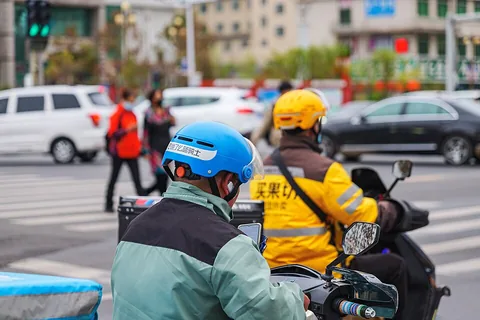 I feel like the experience of just being in a major Chinese city is one of seeing food delivery… You go to a restaurant and there’s mopeds, you’re on the roads and there’s just wild flocks of mopeds everywhere delivering food. The apartment buildings and the office buildings have dedicated zones to streamline it. Why is food delivery so much bigger in China than it is in the US?
Yeah, there are a few things. This is one where I’m always, on the one hand, so impressed by how far ahead sometimes behavior is in markets like China. Then on the other hand, I have to remind myself that there are differences and why you can’t just clone some of these markets.
One of the first big differences is the eating out culture in China is very, very high and very, very affordable. Eating out in China is about as affordable as cooking at home.
As a result, nobody cooks.
As a result, nobody cooks, exactly. There are a lot of reasons for this, and we can go super deep on retail history and grocery history in China. But anyways, that’s a huge phenomenon. I think second, because of labor market dynamics, both the availability as well as the cost of labor in the Chinese market, that’s allowed a lot of these businesses to make this activity almost as affordable as if you were to pick up the orders yourself.
I think third is that, especially it’s not every city in China, but more and more, the Chinese… It started really with the Eastern Seaboard cities, where the density just allowed a very easy delivery setup, almost like every city was like New York City. I think in America, we think New York City is very special.
There’s more mega cities in China.
It has millions of people. In China, there are many dozens of cities, over a million in population, and the population density is even perhaps higher than that of Manhattan.25Manhattan — New York's most densely populated borough and the densest county in the US: about 1.6 million people, roughly 27,000 per square kilometer. Now, that’s actually morphed to the Western cities, too. It’s not just the Eastern Seaboard cities. If you actually study this over a time series, whether it’s the ‘80s to the ‘90s and certainly to today, because of how fast China is able to manufacture things, city plan things, deploy things. I mean, literally, they can build a train station in an entire day. Because they can do things like this, the market potential has really expanded, even as people moved now from Eastern Seaboard cities to other cities.
ExplainerChina's 2025 subsidy war
Cheap delivery in China doesn't rest on cheap labor alone. In February 2025 JD.com entered a market split between Meituan and Alibaba's Ele.me: it lured restaurants with low commissions and promised couriers social insurance. Alibaba responded by folding Ele.me into its Taobao Shangou service, and the three companies showered shoppers with coupons: delivered coffee and tea sold for next to nothing.
Regulators summoned the companies several times and demanded an end to "irrational competition." By TechNode's count, in the second and third quarters of 2025 the three companies spent more than 100 billion yuan (about $14 billion) on subsidies and marketing. Meituan posted an operating loss of 19.8 billion yuan in the third quarter, its largest since going public.
By the end of the year the war had died down without a winner: analysts estimate Meituan holds about half the market, Alibaba about 42% and JD.com 8–10%.
You’re saying a big part of it is lower labor costs mean food delivery is quite inexpensive. Does that affect then—
The cost of the food, I would start with that, is a lot lower. Then you have lower labor costs, and you also have mass availability of labor. Then now you also have rising incomes because of how fast cities are getting developed. It used to be that most of the income for consumer discretionary spend,26Discretionary spending — what's left after necessities like housing, basic groceries and utilities: restaurants, entertainment, travel. if you studied as a percent of China’s GDP, was along the Eastern Seaboard, say take circa the early 2000s or even up to the 2010s. But if you looked over the last 15, 20 years, that has now become a lot more uniformly distributed, kind of like the US, actually, whereas this is not true in other parts of the world.
Where I was going with this is, does that then predict the behavior of other markets where is there also a lot of food delivery in other markets where food is cheap and labor is cheap.
And whether or not there are a lot of restaurants. People who can afford delivery, sure, but also the production of food. I think one of the things that I’ve always thought about is restaurants have two very special properties about them. I do think that more and more, they are almost going towards the ends of these two spectrums. Same thing with retail, and we can talk about that, too. But restaurants, on one hand I think are centers of hospitality. It’s incredible, the level of attention to service they have. I think that will never get replaced by AI, that human-to-human connection.
On the other hand, where technology and autonomous technology can make a difference is actually restaurants are almost like manufacturing production sites.
They’re a third space27Third place — the sociologist Ray Oldenburg's concept from his book The Great Good Place (1989): a place for socializing outside home (the "first place") and work (the "second"), like cafés, bars and barbershops. and a factory all in one.
It’s no different in retail. You have showrooms and warehouses. I think that in the case of, back to your point around China, China has a lot of restaurants. Over seven million restaurants versus what we have here in the US at about a million restaurants in comparison, for example. In China, you also have a very deeply capitalistic society in the sense that wherever there is opportunity, you’re going to see lots of people go and fill that. It doesn’t have to be a restaurant. It could be a kitchen. It could be coming up with different merchandising. If you’re a restaurant, you can sell not just food. You can sell T-shirts, and you can sell hats, and you can sell cookbooks. I think there’s a lot of that commercialism also in that industry in a way that is much more advanced than other countries.
Yeah. Restaurants are very hard businesses, and they’re one of the most common businesses that people start, and yet they’re incredibly sophisticated, even on a small scale.
Yes, and they are also incredibly sought after. In fact, if you looked at the census data in America now, and this is also true in China, but if you looked in America, in the last 60 years, I think there’s only a couple of years where the number of restaurants in the current year didn’t exceed that in the previous year. Even though they are such difficult businesses because of our love for food, for socializing, being with each other and what a meal represents and how it can connect different people, it continues to grow. In fact, it’s the number one type of establishment that malls and a lot of shopping centers want the most of.
04What's happening to restaurants
Xu sees perennial trends in the industry, from rising labor costs to endless new cuisines and the struggle to scale, and yet spending on eating out keeps growing every year.
Talk to me about the trends in the restaurant industry these days. If I think about what people talk about, there’s dark kitchens.28Dark kitchen (also called a ghost kitchen) — a kitchen with no dining room that cooks only delivery orders, often for several virtual brands at once. That was more a few years ago, people were talking about dark kitchens. There’s the fact that high-end restaurants can’t make any money these days because no one drinks.29No one drinks — in sit-down restaurants the markup on alcohol is much higher than on food, and wine and cocktails are the most profitable part of the menu. Young Americans drink noticeably less than earlier generations, and high-end restaurants are losing the most lucrative part of the check. There’s maybe the emergence of new fast casual30Fast casual — a format between fast food and a regular restaurant: you order at the counter with no waiters, but the food is fresher and pricier than fast food. The classic example is Chipotle. trends, but also some criticism of the slop bowls31Slop bowl — a dismissive internet nickname for the bowls served by fast-casual chains like Chipotle, Sweetgreen and Cava: grains, protein, vegetables and sauces mixed together in one bowl. and everything. But that’s just what people are… You’re in it. Tell me what’s actually going on in the restaurant industry.
One of the most difficult things is how do you actually staff your restaurant? This is the number one challenge. This has always been the number one challenge. There’s no easy ways around this, really. I think because the cost of labor only goes in one direction and only goes up, restaurants are increasingly making this choice of on the continuum of service to manufacturing. Where do I want to sit on that spectrum? I think that is one very big trend that more and more restaurants feel like they have to go towards the ends of the spectrum, whereas before—
You have a local restaurant that people were sitting and eating their dinner and also is fulfilling a few takeout orders. You’re saying that’s becoming less common?
Yes, because there’s a lot more pressure in order to make sure that everyone deservedly gets paid what is required to actually work there, especially inside some of these city centers. I think that’s a perennial trend. I think a second perennial trend, and this is why I think people love restaurants, is the innovation in restaurants is a little bit different than the innovation in, say, software, where innovation in a restaurant is just different types of cuisines and food. You’re always going to see the next type of restaurant.
I think this is best shown in what I was saying earlier around the number of restaurants. The number of restaurants always grows. That’s a perennial trend. That’s something that is not changing, even though the types of maybe food is changing or what’s hot, what’s not, that’s changing. What’s not changing is the consumer’s appetite for actually these restaurants.
I would say number three is restaurants are thinking about increasingly how to scale, and this takes on different forms. In the case of some of these large brands, the big QSRs32QSR (quick-service restaurant) — the industry term for fast-food restaurants: McDonald's, Chick-fil-A, Taco Bell and the like. that you’ve heard of, which represents almost 50 cents on the dollar of restaurant spend in a place like the US, they’re thinking about, how do I take my economies of scale33Economies of scale — falling unit costs as volume grows: per restaurant, a big chain buys food, equipment and advertising more cheaply. and just keep going? Because I have that as a big advantage.
You also see smaller restaurants who are trying to figure out, “How do I open up location number two?” It’s really difficult. It’s actually really, really difficult in a lot of cities, even for the most popular restaurants, the hottest chefs in town who you’d be shocked at how hard it is for them to raise the capital for location number two or even get the permits to start construction on location number two. I think that’s another perennial trend that you see happening in the restaurant ecosystem. Those are the ones that I think a lot about, which are what are the things that are not changing that are incredibly difficult that if you can solve these big rocks,34Big rocks — a metaphor popularized by Stephen Covey: if you put the big rocks in a jar first and then the pebbles and sand, everything fits; in the reverse order it doesn't. That is, the most important tasks, the ones to start with. you can unlock even more value.
I presented a lot of obstacles, but if you actually look at the totality of the data, you would see that the amount spent on restaurants or eating out has increased over the last 75 years, every single year. It used to be, these are rough numbers, but in the 1950s, when the government was measuring this,35The government was measuring this — data on how much Americans spend on food at home and away from home is kept by the USDA's Economic Research Service (USDA ERS). we would spend in this country, in America, maybe 75–80 cents on the dollar on groceries versus restaurants.
In present day, those numbers are almost reversed, where it’s almost 60 cents on the dollar on takeout and 40 cents on grocery. That number has only gone in these proportions or this direction. Even though it is so difficult to make it as a single restaurateur, especially when I think about the days of washing dishes in my mom’s restaurant,36Mom's restaurant — Xu's parents moved from Nanjing to Champaign, Illinois, in 1989. His mother, a doctor by training, worked in a restaurant, and Tony washed dishes there from an early age; she later opened acupuncture clinics. Xu cites her restaurant work as one of the sources of the idea for DoorDash. the totality of the industry continues to remain very strong, and they’re moving in one direction.
05Permits and small business
Permitting has gotten worse on average, but the fastest-growing cities make it easier, and DoorDash is lobbying in Washington to help small businesses open a second location.
When you talk about permits, famously, a lot of cities make it harsh to open a restaurant. San Francisco people have a lot of complaints. One of the innovations that you see these days in restaurant culture is the food truck gardens and food truck collections. I always find those bittersweet, where often you have really cool new concepts and stuff, but we have societally lost the ability to allow people to open restaurants and therefore, we’re reduced to a collection of food trucks in a parking lot somewhere. Are permits getting better or worse?
I think in general, similar to building things, they’ve gotten largely worse on average. That doesn’t mean there aren’t cities who are green-lighting and making it a lot easier. In fact, if you look at some of the fastest-growing cities in the country, they tend to also be the fastest-growing cities for restaurants. Not a shock. It’s probably not San Francisco.
Phoenix and Austin, these places are doing a good job of permits.
Yeah. If you look at places in Arizona, like the tri-city area, Phoenix being one of them, Scottsdale and the Tempe area there. You look at the tri-city area in Texas, near Austin, or you look at what’s happening in Dallas and the Dallas-Plano area, there’s these pockets. In fact, if you look at the country, a lot of this growth is happening in the south of the country.37The South — the so-called Sun Belt, the states of the southeastern and southwestern US: for several decades population and construction have grown fastest there, and Phoenix, Austin and Dallas are among the leading boom metros. That’s been true for a couple of decades now. They tend to be correlated, meaning if it’s easy for me to build apartment units and to build just construction in general, it tends to be a bit easier to also get the licenses to open up a restaurant.
That’s good. That there’s some bright spots amidst a nationwide, maybe negative trend when it comes to permitting.
I think when you’re in any business, certainly the restaurant industry or even our line of work, I would argue, you have to be an optimist. You have to see the silver lining on the way out of how to get there, but it’s a slog. I do think that one of the responsibilities we now have as a company, as we’re a little bit bigger now, is to help on behalf, particularly of these small businesses, to represent them almost as a class and actually try to even the playing field a bit and make it a bit easier to actually be a small business.
What do you argue for on behalf of small businesses? When you talk to someone in Washington, what are you saying?
One of the first ones is actually making it easier to actually open up location number two.
Permitting reform.
Permitting reform is one of those things that we certainly stand for. Making sure that labor laws are changed or when they are changed, that they take into account the restaurants. We’re talking about one of the largest sectors of job creation here that is always growing, by the way, every single year, which is a rarity, but a truism in every economy, to take into account what the restaurateurs have to say. Those are some of the big topics. Again, I look at the things that aren’t changing in terms of the difficult challenges of being a restaurateur, and we try to fight on their behalf.
06Technology and regulars
The biggest thing technology has done for restaurants, Xu says, is delivery and its incremental margin, while recognizing regulars is still an unsolved problem that DoorDash wants to take on.
Where has technology meaningfully changed how restaurants work? A very visible example to people might be in fast-casual restaurants, they have managed to change the labor equation, it seems. You might know the actual number is because it’s self-serve ordering and pick up at the counter and stuff like that. That’s much more common than it was, and so you need fewer people for the same volume of orders, or you can run much more scale with the same number of people. I’m guessing there’s supply chain stuff, but it’s less visible to us as people who visit restaurants, but you’d know. As you think about where tech has made the biggest impact versus 10 or 20 years ago with restaurants, what would be your top three list?
Not to speak our book,38Talking one's book — a Wall Street expression for an investor talking up securities he holds. Xu is acknowledging that, as head of a delivery company, delivery is naturally the first thing he names. but one of the first things that comes to mind is actually something like delivery. When you look at the economics for a restaurant, rough math... For every dollar of food that if you and I bought inside of a restaurant, from the cost structure, you’re going to have 30% of that in the food and the packaging, you’re going to have 30% of it in the rent, you’re going to have 30% of it in the labor, something like that. Rough math. On that dollar, a restaurant can net 10 cents.
On a takeaway order, you’re still paying for the food and the packaging, but you’re, largely speaking, using the same labor and you’re paying the same rent. There are some exceptions where some restaurants have become delivery only and things like that. But by and large, on average, you’re going to make 3-5x the incremental margin.39Incremental margin — the profit on each extra order beyond normal business: rent and staff are already paid for, so a restaurant keeps much more than 10 cents on the dollar from a takeout order. I think, number two, I think restaurants recognize that they need to build relationships with customers that are not just over the telephone or over in-person visits where they’re relying on their memory.
That area is still, I would say, somewhat incomplete, where there are products where you can manage your social media pages and maybe have a database of relationships that you recall. The challenge, however, though, is you don’t get to see everything. You don’t get to see the full visibility of your online orders, your in-store orders. Another challenge is your staff turns over. The average staff may turn over every other day. Not every other week, every other day.
I do think that there’s still a long road ahead there in both making that product a lot more robust for restaurateurs to be able to have those relationships. Back to one of the things we talked about in this conversation about the importance of retention in a consumer business, it is so important for a restaurant to build the concept of a regular, which is a retained customer. You and I, I know we travel a lot for work and so we wouldn’t always be great customers for a restaurant. What’s more important, actually, is if they knew that there was a regular that is actually coming that should be prioritized. Those are the kinds of things that I think, hopefully, we, DoorDash, can help and actually solve.
Don’t most restaurants do a bad job of recognizing regulars? You think about the airlines as an industry.40Frequent flyer programs — miles, status and perks that lock a passenger into one airline. The largest, American Airlines' AAdvantage, has run since 1981. They’ve made it where it’s highly irrational as a frequent traveler to travel not your preferred airline. They’ve really created a lot of lock-in there. Whereas as I think about restaurants, there is the super-mass market punch card, 10th coffee free stuff. Then there’s the really old-school restaurant where the owner might greet you and might comp your dessert or something, but it’s very sporadic and very dependent on the owner being there because as you say, when the new waiter or waitress is there, they don’t know you. But there’s nothing in between systematic, and it feels like some way of rewarding the regulars is missing.
Depends. At the weekend, we went and we got good Taiwanese food, and that was fabulous.
Once a month, once every two months.
Once a month, once every two months. That’s the challenge. Even your favorite food is probably not something you’re going to do every single day. When you’re talking about an activity like eating, which is 20–25 times a week—
It’s not like coffee.
Yeah, it’s not like coffee. It’s even different from travel where the product may be the same every single time. I think it is tough to create what you’re describing, which is this program in which you’d be known as regular. But that, I think, is the opportunity that at least we’re thinking about at DoorDash, because if you think about it, our product with now over 100 million-plus annual customers, tens of millions of monthly customers, they shop at various frequencies and they’re building relationships with all of these businesses, sometimes many times a day, sometimes once every other month, sometimes once a year.
I think because there’s 20–25 moments per week, I think that there is an opportunity in which we can create that. Now, we recently acquired, last year, a company called SevenRooms41SevenRooms — a platform for restaurants and hotels: table reservations, a guest database and marketing. DoorDash bought it in 2025 for about $1.2 billion. that manages a lot of the in-store bookings of restaurants, particularly of higher-end restaurants. If we can democratize that and give that to everybody, and then also layer on the DoorDash data set and actually tell you that John is a regular, and he tends to like the following things, and here’s other things that he tends to do, perhaps we can crack open that question.
You want to help restaurants take care of regulars?
Yeah, because that is how you build a great consumer business. You need the retention. That is true for every restaurant, every consumer business.
That’s interesting.
AdStripe Issuing
The core challenge for marketplaces like DoorDash is streamlining courier operations. Like letting their network of couriers and shoppers make specific purchases for customers. Think about it, you can’t use a traditional corporate card here. You don’t have the right permissions. You don’t actually get to interface programmatically with the card in real time. So Stripe Issuing is our answer to this problem.
With Stripe Issuing, you can use Stripe to create virtual or physical credit cards. They can be single use, single vendor, programmatically controlled, whatever your use case needs. People are even these days giving their OpenClawaOpenClaw — an open-source personal AI agent that runs on the user's computer and talks to them through messaging apps. It was created by the Austrian developer Peter Steinberger; earlier names were Clawdbot and Moltbot. a credit card so it can spend money on the internet. So if you need to create credit cards to manage spending in the real world, see what you can build with Stripe Issuing.
07Ghost kitchens and the secrets of chains
Ghost kitchens stayed small because a little restaurant can't attract enough customers and a big chain is better off opening another real location, and chains' true IP lies in process.
We were talking a lot about ghost kitchens, I don’t know, five or seven years ago. You don’t really hear about them that much. How big have ghost kitchens become?
People thought the model was going to take over, right?
Yeah, the model sounds really reasonable, and I think logical on face value where if you can, on that spectrum of restaurants where you have high-end service on one end and hospitality only to perhaps delivery only or more of a manufacturing concept on the other end, it seems reasonable that you can actually just borrow a small square footage of space, not incur a lot of not just the fixed cost,42Fixed costs — costs that don't depend on the number of orders: rent, equipment, utilities. but also the labor cost of actually running your “restaurant,” and then selling through a delivery platform or acquiring your own customers or doing something like both. It just turns out it’s extraordinarily difficult, however, unless you’re a large brand or a house of brands, someone like DoorDash, to be able to attract enough customers to make that math work.
Is another way of putting it that it’s hard for a ghost kitchen to be as efficient as a restaurant that is also churning out orders across both in-restaurant and delivery? It’s just hard for them to compete on the economics?
Yeah, it’s slightly different. Perhaps we can look at two types of examples. You can have one type of example, which is perhaps my mom’s Chinese restaurant. It’s an SMB where the name value outside of literally its locale isn’t that well known. It’s very difficult for that restaurant to acquire enough customers to make that math work because they still have to… Remember, I mentioned that staffing was the number one challenge that restaurants face. They still have to staff these kitchens. That’s one of the challenges.
You go all the way to the other side. Pretend you are a large QSR with a big brand presence. You certainly can attract lots of customers, but you’re going to have to think for yourself, “What’s my opportunity cost?”43Opportunity cost — the benefit of the best alternative you give up. For a space, it's what you could have done with it instead of a delivery kitchen, such as opening another regular restaurant. My opportunity cost might be to open up another restaurant. Why not do that and take my economies of scale and actually apply it to more orders, in-store orders as well as to-go orders? Because I can do that with a restaurant. Hard to do that with a delivery-only kitchen. I think because of that, it’s a tricky model to scale to every type of restaurant brand.
I think people maybe thought that big chains were going to do it more, where you’re right, the billboard effect44Billboard effect — a storefront works as advertising by itself: passersby see the sign and remember the brand. A ghost kitchen tucked away in an industrial zone gets no such free advertising. for an actual retail presence is hard to compete with, where you get this very cheap customer acquisition from the fact that people know your name from the high street or maybe have been to you, and as a ghost kitchen, you need to make up for that awareness gap. But if you’re Chipotle,45Chipotle — an American fast-casual chain of Mexican food: burritos, bowls, tacos. Founded by Steve Ells in Denver in 1993; its restaurants are company-owned rather than franchised. maybe people thought that the orders get fulfilled out of a dedicated Chipotle central factory, and then the retail space are separate. But also that hasn’t really happened that much.
That happens occasionally. I think these are not decisions where we’re accounting for all of the variables. One variable we’re not accounting for is “What else could I do with the space?” You have to remember for businesses like Chipotle who tend to identify real estate in fairly expensive areas, there’s high opportunity cost of what you do with that space. Yes, you’re right. One choice is to turn it into a kitchen or a delivery-only kitchen, and sometimes that happens, but there’s also a massive opportunity to recoup the expense. If you start introducing, for example, franchises.46Franchise — a model in which a restaurant under the chain's brand is opened and run by an independent owner (the franchisee), and the chain collects an initial fee and royalties, a percentage of sales. The vast majority of McDonald's restaurants work this way. Chipotle is not really franchised, but if you look at other types of brands where it is franchised, I think the economics become even trickier.
There’s a next best use math. Which restaurants have actually invented something that’s hard to copy?
I actually think any restaurant that’s been around for, let’s say, two-plus decades, probably has very interesting IP. Obviously, some of this information is not public. You can imagine when you go into a McDonald’s47McDonald's — the world's largest fast-food chain: more than 40,000 restaurants in over a hundred countries. Its frozen fries are supplied to a single standard by a few large producers, among them J. R. Simplot, Lamb Weston and McCain. around the world, that french fry, perhaps they don’t sell the same exact items in every single store in every country, every city, but the french fry almost always tastes the same. That is an extraordinarily difficult feat to accomplish.
There’s a lot that goes behind the scenes, just like there’s a lot that goes behind the scenes at DoorDash in terms of getting you one order on time to make that sentence true. The same can be said about a lot of other businesses that have been around for very long periods of time. That’s on the big brand QSR side where a lot of the innovation, if you will, is in the process innovation. Also, how do you run large groups of people and have very high and consistent standards of service? Extremely difficult. That’s the IP, I would argue, for a lot of these large brands.
On the other side, there are small restaurants, some of whom have been around for almost a century, actually. There aren’t that many of them. But when you look at what makes them special, it tends to be the same things that actually make startups special. It tends to be a small group of people that really believe in a certain idea, some commitment towards some standard of excellence. It could be excellence towards the food, the service, or takeout. There are some takeout-only businesses that have been around for many decades. As a result, they have high retention, high usage, and they’re very efficient.
Can you speak about any specific examples of the impressive IP that these chains have conducted over the years? It could be the McDonald’s french fry, how they actually make it taste consistent, I don’t know the answer to that, or any of your favorite restaurants?
One of the things that I’ll never forget was I went through a hospitality training at Chick-fil-A.48Chick-fil-A — an American quick-service chain of chicken sandwiches. For years it has led all major US fast-food chains in average sales per restaurant, even though its restaurants are closed on Sundays. I want to say it was 2017, maybe it was 2018. I don’t remember everything on the checklist, but one of them that stands out is that the floors must be so clean that babies would lick them or could lick them.
The babies will lick them regardless of how clean they are.
Is Chick-fil-A still the highest grossing fast-casual restaurant per square foot?
People talk about it. It’s up there.
Why is it so successful?
It actually goes back to, I think, the standard ingredients of a great consumer business. It has a highly retentive following, which it spends very little money acquiring, and they come back often. They’re extremely efficient with all of the scale economies behind the scenes around equipment, which is quite custom to that company, to the service training, to how they treat their staff. One of the most impressive facts about that business is that many people actually that I met with have spent over two, three decades of their careers at Chick-fil-A. We find that to be a novelty actually here in Silicon Valley or in technology.
And in the restaurant industry.
In the restaurant industry, one where we described all of the churn and the difficulty of staffing, Chick-fil-A has extremely high retention of staff. It has so many repeatable stories of where it gives somebody who comes from not a lot of means, frankly, to become the general manager of one of these stores and earns a really healthy living, pays their entire family through college and beyond. In many ways, a lot of these restaurant stories, Chick-fil-A being one of them, have a lot of the essence still of the American dream.
08Why good chains are rare
Good chains are rare, Xu argues, because keeping quality up gets exponentially harder with scale and every new concept faces a thousand competitors.
We’re talking a lot about QSR chains here, and people often like to ask the question of, why is there not a Chipotle of my preferred cuisine, where it’s slightly elevated versus regular fast food, very good, consistent quality, good execution? There is no chain that serves you really good Neapolitan thin-crust pizza49Neapolitan pizza — pizza in the Naples tradition: soft, thin dough with a puffy rim, tomatoes and mozzarella. Under the rules of the True Neapolitan Pizza Association (AVPN) it bakes for 60–90 seconds in a wood-fired oven at 485 °C; the art of making it is on UNESCO's list of intangible heritage. in whatever city you’re in or Indian food, or again, pick your favorite cuisine. Why don’t we have more chains delivering just a really good standard version of a cuisine?
Yeah, we cook, but not for huge groups.
One of the things I found is that as the number of people you have to cook for grows, the difficulty to keep the standard of service, whether it’s the taste, the temperature, the speed in which you receive the food, goes up exponentially. That is what’s so hard about exactly what you just said, around keeping that quality control really high.
It’s maybe easy to build you the Chipotle for one type of cuisine for one restaurant. That’s just on the skill perspective. Although I do have some ideas on how perhaps you can do that. But the second reason also is think about who you’re competing against. Let’s say that you want to make a Neapolitan pizza. You mentioned that. Or any kind of pizza.
I do.
Great. I can’t wait to taste it, John. Did you know that there are over 1,000 different pizza choices in the Bay Area50The Bay Area — the metro region around San Francisco Bay: San Francisco itself, Oakland, San Jose and Silicon Valley. Both DoorDash and Stripe are headquartered there. on DoorDash? Just on DoorDash. We don’t have all of the restaurants. That is just one of the many things that you’re going to have to do to be able to create this concept and actually scale it. Then don’t forget all the other challenges we talked about: the staffing, the permitting.
What determines whether chains succeed versus whether they don’t? Because there’s a lot of pizza restaurants in the Bay Area, but at the same time, there’s a lot of Mexican restaurants in LA that are really good, and yet Chipotle still has plenty of locations there. It doesn’t just seem to be, do there exist local options? Sometimes a chain can break through. I also don’t think it’s a skill issue because it’s very processable to make a good Neapolitan pizza. It’s about the ingredients and the temperature and humidity control in proofing the dough and then cooking it at very high temperature, but it’s not rocket science. You could make a process around this.
Potentially. I think the fact that there only exists so many of these QS... A countable number of these brands who have actually scaled to the size that we’re talking about, where they’re ubiquitous, I think should be some evidence—
It’s harder than you think.
That it’s a lot harder than you think. Because of what I just said, there’s a lot of process skills that you have to be extraordinarily good at. In fact, I remember we partnered with one brand where we launched this brand to great fanfare and sold a lot of burgers actually on a weekend, testing this idea, can you make a healthy-tasting burger if you put a brand name around it?
Because it’s too healthy?
No, because half of the reviews said, “Your burgers were great,” and the other half said that they were inconsistent in quality. It’s because it’s extremely difficult. That exponential challenge as you try to grow scale, and keep up the quality is very, very, very difficult. You have to get right the service, you have to get right the production, you have to get right the pricing, the packaging. There’s lots of things you have to get right.
Do you think reliability is the thing that people underestimate about the restaurant industry?
Yes, or about a service like DoorDash. I think when you have high volumes of activity, I think keeping the reliability as reliable as the electricity we have or the water inside of our buildings, that is extraordinarily difficult.
09The future of delivery and Dot
Before choosing a vehicle you have to know what items exist and where they are in a city, and DoorDash ended up building its own delivery robot because no one else would.
Can we talk about the future of delivery and how you see it playing out in 10 years time? There’s a few different modalities being discussed. There’s drone delivery, there’s sidewalk robot delivery,51Sidewalk robots — small six-wheeled carts that move at walking speed. They're made, for example, by Starship Technologies, founded in Estonia in 2014 by Skype cofounders Ahti Heinla and Janus Friis, and by the American company Serve Robotics. and you guys have Dot. I’d love you to talk about Dot. I don’t know how much you’re doing in drones. Maybe you can talk about that, too. Maybe there’s autonomous vehicles, like autonomous cars. People don’t talk about that that much, but maybe in the suburbs, it would kind of work. This is what we have at the moment. Just like, what’s the mix in 10 years time?
Even before we go there, I think the first question might be what might be delivered? Because I think that’s actually still not that well understood. Today, yes, DoorDash is probably most known for food, potentially now increasingly groceries and household items. But that is a fraction of the tens of millions of items inside every single city.
One of the biggest things that we’re going to have to do before we can just fulfill the items, which is what we’ll get to, is where are the items, and what are the items? There’s tens of millions of items literally inside these cities, whether it’s in the US or different countries within Europe, other parts of the world, they’re not cataloged. There’s no structured data that you can scrape in order to figure that out. I think that’s going to be a long journey.
Sometimes the inventory is not even close enough, and so you may have to house the inventory so that you can actually bring those goods and even have the right… A lot of what I believe makes for great logistics is you need a great setup. Because if you’re always trying to figure it out on the fly, and you’re pulling some magic trick out of thin air, and you have to be the hero, that is not a system. That is an exception.
I think great logistics or great reliability, they require building systems. You have the catalog, you got maybe the inventory close enough to where people live, now we can talk about the fulfillment. The entirety of that is what you have to build before we can get into the great technologies.
The staging of what it is that you’re delivering.
Because if you don’t know where to get the items or if you can’t get the right item, what difference does it make if you have the right vehicle?
You’re talking about the fact that you don’t actually know what’s on a supermarket’s shelves where the fact that you have to actually be able to predict when the restaurant will have the stuff ready, all that knowing what is ready to be delivered.
Yeah. Or take when the Cheeky Pint52Cheeky Pint — the name of this podcast: in Britain and Ireland, a pint you sneak in between other things. Host and guest talk over a beer, hence the joke about Cheeky Pint someday becoming a real bar. becomes an established bar, and maybe DoorDash can deliver from one day, what’s inside the Cheeky Pint? What’s on the actual menu? What’s off menu and actually, you can order? These are complicated issues before we even get to the fulfillment of the actual items.
Then you can get to fulfillment. I think that’s one where we’re still exploring. To me, the most important question we always ask on any, frankly, technology, but certainly a technology like this, where there’s long cycles of development is, what problem does it actually solve?
Obviously, in the case of drones, you mentioned it, it can cover a lot of ground very quickly. Longer distance orders, that seems to be a great job for it to solve. In a busy high-rise area where you got short, dense orders, which is the majority of these orders, maybe not the best solution for such product. This is actually what led us to the creation of Dot, which was when we started the Autonomy Project in 2018, 2019, we actually did not set out thinking that we needed to build anything, that we would… Surely there would be someone who would—
We’ll just pick the best one, and I’m sure we can buy some tech off the shelves.
Yes, we were out there raising our hand, asking for a partner to the dance, so to speak, and someone who could specialize in that, and we could specialize in the operations and things like this. It turned out that no one was that interested. A lot of people were interested in building Robotaxis,53Robotaxi — a driverless taxi. The first to carry ordinary passengers with no safety driver was Alphabet's Waymo, in October 2020 near Phoenix; by June 2026 it operated in 10 US metro areas. and obviously, we’ve seen that come to fruition. A lot of people did build, to your point, sidewalk robots, but we found those to be too slow. Back to what problems are you solving? Because you got to remember, back to opportunity costs, humans are very good at delivery, actually, it turns out. We’re also very good at driving, too. The bar is actually a fairly high bar. It’s not as simple as just saying, “We can make the technology, let it rip.”
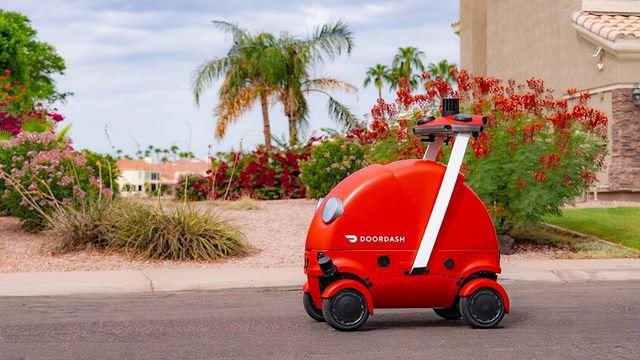
Then we said, “It has to be fast enough. It probably doesn’t need to be the size of a car because cars aren’t very good at parking inside these busy locations where a lot of these restaurants are.” We had to think about all these things. We had to think about how to load the vehicle. We had to think about unloading the vehicle because, unlike Robotaxi, the passenger solves all of those problems, but in our case, we have to solve that. That’s how we ended up on this.
Where are you in rolling out Dot?
We’re primarily testing right now. We really want to get it right in one market. We’re doing a lot of this in Arizona because it’s not just the technology. One of the things I’ve learned and come to appreciate about building something like Dot is that these autonomous vehicle companies are almost many companies inside one company, or certainly many different types of skills you have to be good at.
Yes, I think everyone obsesses over the autonomy, but there’s also the hardware, there’s also the manufacturing, there’s also the operations.
There’s hardware reliability.
There’s also the maintenance. There’s also the regulatory. There are a lot of different components that you actually have to be good at. Then we can talk about the stack required54Stack — tech jargon for the set of technologies and components a product is built from; here, the whole chain from hardware and software to suppliers and manufacturing. to actually build the inputs to some of these things. For example, there’s also understanding how to procure supply when you have sometimes geopolitical tensions or when you have supply chain disruptions.
Where do you do assembly versus where do you do construction? Not super obvious answers to some of these questions at times, especially when you have to make these decisions sometimes years out. I think that’s the stage that we’re in right now, which is, “We got to figure this out correctly before we can actually scale it.”
Where do drones fit in, if at all?
They definitely do. As I mentioned, back to jobs to be done, I think drones obviously can do a lot of these longer-distance orders. We’ve been doing drone deliveries actually for a couple of years now, mostly outside of the United States, outside of the US.
Whereabouts?
Places like Australia.55Wing — Alphabet's drone delivery company; since 2022 DoorDash has been delivering orders by drone with Wing in Logan, Australia. In Indian Trail, North Carolina, the drones wait for orders on charging pads outside a store. We’re going to bring them to Europe, bring them to the United States as well. Again, you have all of those problems you have to solve. The autonomy is a little bit easier. You still have a routing problem. You have hardware problems. Obviously, you still have permits and regulation, set up, loading inside different stores, things like that.
10Fraud and safety
DoorDash runs like a big state machine, and its hardest problem is offline fraud, where it has to invent its own signals.
Very interesting. We’re talking a lot about some of these scale tech problems, and one of the ones that people might not think about is fraud, but I feel like Stripe and DoorDash obviously work together in many ways, but one of the things we work together on is fraud. I feel like the number of potential fraud vectors is much more complex than people think. Maybe you can just talk about trust and safety56Trust and safety — the name tech companies give the teams that fight fraud, abuse and threats to users. at DoorDash, all the different ways that people try… You’re running this complex system that people try to game and what it takes to run that.
Many times I think about my freshman-year electrical engineering course on state machines,57State machine — a model of a system that is always in one of a set of predefined states and moves between them on specific events; a classic topic in electrical engineering and computer science courses. where DoorDash in some ways, is like a large state machine, where you have many systems in place, and they’re observing what’s happening. There are things that must happen when things are green to keep them green. But as we start degrading gracefully,58Graceful degradation — an engineering principle: when something fails, the system doesn't crash entirely but keeps working in a reduced mode. Exception handling — code that runs when the normal flow of a program is interrupted by an unexpected situation. from green to yellow to orange to red, something like fraud, as you mentioned, other systems have to kick in and do things like exception handling.
Obviously, you’re spending most of your time building prevention systems, but of course, it’s tricky. You also have to have the 911 response system that literally totally responds within minutes, because sometimes we’re talking about physical safety. We’re not just talking about fraud. Given the volumes that DoorDash carries, billions of orders per year, the one-in-a-million incident, unfortunately, does occur. That’s DoorDash as a system.
Now, in fraud, you’re right. We partner, for example, a lot on online fraud. You have the largest database of all of these transactions,59Stripe's transaction base — in 2025 Stripe processed $1.9 trillion in payments; its fraud protection system, Radar, learns from the data of this network. and therefore, you can give us lots of information that we ourselves couldn’t do on our own. On the flip side, there’s also offline fraud, which is very tricky to catch.
What do you mean by offline fraud?
For example, let’s say that a consumer suggested that an order was never dropped off. Let’s say that a Dasher said that an order at a grocery store was already shopped and picked, but we’re not sure. Or let’s say that a Dasher said an item is missing inside of a store, any store, maybe perhaps an apparel store. All of those, I would argue, have offline components that are difficult to verify. Building the eval,60Eval (short for evaluation) — in machine learning, a set of test tasks with known answers used to assess a model. Here: a way to check whether someone is telling the truth about what happened offline. if you will, for this set of conditions and use cases is actually extraordinarily difficult. A lot of what we’re trying to do is we have to build those signals ourselves. There is no perfect science here. I wish there were, but in many ways, we have to invent this. This is actually why… I’ll give you a few examples.
One of the things that we shipped, this is actually a couple of years ago, was called SafeChat,61SafeChat — a feature of the DoorDash app that checks messages between Dashers and customers for abuse and harassment. Since March 2024, in the SafeChat+ version, AI does this: if a message is flagged, the Dasher can cancel the order without hurting their rating. where we noticed that prior to any physical altercation that may, unfortunately, happen between audiences, 90-something percent of the time, it’s always preceded by a verbal altercation. Knowing that alone allows us to prevent a lot of tough situations. Or building alert systems.
For example, sadly, there are shootings, particularly in the United States. There was one shooting in Manhattan,62The Manhattan shooting — on July 28, 2025, a gunman with a rifle killed four people in the office tower at 345 Park Avenue in Midtown, including an off-duty police officer working as a security guard, and then killed himself. It was the deadliest mass shooting in New York since 2000. where several people died in the lobby of a large office building. Within minutes of a Dasher seeing the shooter walk in to the building, we have an alert system that doesn’t just alert all Dashers and consumers and merchants within that vicinity, but also all local law enforcement. Actually, we were the first to report that to the NYPD who try their best to respond in time. There are a lot of those events. It’s not always about fraud is what I’m trying to say, and that you have to build extremely responsive systems, and you also have to build as many signal-detecting systems, too.
You’re running a fairly large slice of the economy, and you’re trying to have everything run smoothly, and there’s quite a lot of failure modes that people might not think about that are possible when you’re just seeing so many economic interactions all day.
Exactly. We’re trying to be the digital representation of these cities, whether it’s a city, a suburb, a neighborhood, a rural area. Sometimes it’s not always of what’s transacting, but it’s just what activities are occurring.
One of the hardest kinds of frauds to prevent is the classic, say, credit card fraud, the one that people think about, is your card got stolen, and it’s actually someone overseas buying stuff for themselves rather than you buying it for yourself. That we’ve actually now got very good at detecting. It’s quite hard to do. There’s just so much data we can bring to bear on that problem.
A much harder one that we see that businesses face is the kind you’re saying… The industry term of ours, which is funny, is friendly fraud,63Friendly fraud — the payments industry's term for cases in which the cardholder made the purchase and then disputes it with the bank, claiming the goods never arrived or that they never made the payment. which is a bit of a euphemism. The customer buys something and just says it never arrived when it actually did, and they’re just straight up lying. You don’t really want to call them on it. You also don’t have proof that they’re lying, but it definitely does happen to some degree. How do you deal with… Maybe there’s a photo of the Dasher having delivered it, but I’m curious how you deal with people just defecting from the system.
There’s no one answer, as you know, with fraud, because as soon as you figure out how to measure the risk and contain the risk, obviously, the incentive for the fraudster goes towards the next axis of breaking in. Exactly. And so, I don’t think there’s a perfect solution to the problems that you’re describing, but you’re right. A lot of this is about... A lot of how you build systems, where obviously the metric is around reliability and consistency and great customer outcomes. The inputs are a lot of measuring things before things happen.
I talked about, I think one of the most important things about logistics is the setup. That happens even before a delivery, if somebody hits place order. The setup is extraordinarily important. Did you get the right catalog? Did you actually label correctly the catalog? Blah, blah, blah, blah, blah. A lot of that sort of stuff. In the case that you’re describing, we can track several things. We obviously can track what is happening with the Dasher. You mentioned some of these ideas, taking photos of receipts or orders being dropped off. We have our own mapping system, for example, that we built.
Why did we build our own? It’s because we care much more than any third-party mapping system of exactly where the last two feet,64The last two feet — a play on the logistics term "last mile," the final leg of delivery to the customer. Two feet is about 60 cm, 20 feet about 6 m, 200 feet about 60 m. forget, 20 or 200 feet of some apartment unit door is, for example. We know if we reliably deliver to that door and that we saw the pin actually hit exactly where, we have a little bit more fidelity on whether something was dropped off.
We build profiles of customers, I’m sure you do, too, of their behavior and what they tend to say. There’s lots of things that we’re trying to do behind the scenes to build these signals to figure out what is the likelihood here of fraud.
11DoorDash Tasks and AI
A catalog DoorDash built for itself turned out to be valuable to others, and LLMs could be strong recommenders, though Xu doubts everything will happen through text.
Makes a lot of sense. Tell me about DoorDash Tasks.65DoorDash Tasks — a program in which Dashers get paid for small tasks instead of deliveries: photographing store shelves, dishes and building entrances, shooting video to train AI and robots. DoorDash launched a standalone app in March 2026.
DoorDash Tasks is something that we shipped recently where… Actually it started with a project where we were trying to solve our own problem. It started with trying to figure out where is every item inside the city. We have millions of Dashers, and they’re usually frequenting different types of stores. We know that consumers move around items a lot, which makes it extraordinarily difficult for any store to track their own inventory. Dashers sometimes are collecting this information. That was one of the problems that we were solving.
Interestingly, while we were doing this, we started getting calls from people you probably would expect—retailers and CPG companies66CPG (consumer packaged goods) — companies like Procter & Gamble, Nestlé and PepsiCo that make packaged everyday goods. who might be interested in this information. Then especially as companies… I think it’s well known at this point that a lot of the large LLM companies67LLM (large language model) — a model like the ones behind ChatGPT, Claude and Gemini. They are trained on huge amounts of text from the internet, so developers are hunting for new sources of data. have been building lots of repositories of online information. What about the offline information to bolster some of those models, or just to help some of these companies building robotics and things of the sort? We said, “Interesting. We’re building a catalog for ourselves, but we ought to be able to help other people, too. If it’s an opportunity to help Dashers earn more or give them more choices to earn more, great. Why not build that solution?”
That’s really the story of DoorDash Tasks, which started organically probably a couple of years ago as we were solving our own problem. We started realizing that there may be other people who have similar tasks.
It’s a platform for having fairly small tasks done? You can give the task to DoorDash and you guys could complete it?
Do you get excited about an AR angle68Augmented reality (AR) — technology that overlays digital prompts on the image of the real world, on a phone screen or in the lenses of glasses. for DoorDash where… Are you one of the best use cases of the Meta glasses,69Meta glasses — smart glasses Meta makes with EssilorLuxottica: Ray-Ban Meta and Oakley Meta with a camera and AI assistant, and since 2025 Meta Ray-Ban Display with a screen in the lens. where now you can get directions within the store and everything? You’d actually speed things up quite a bit, rather than wandering around lost.
I think we definitely could be. Again, back to the question of asking, “What problem does this solve?” The human is pretty good with their eyes at some of this stuff. The bar is pretty high in order to do some of the things you’re talking about.
As I think through AI applications for DoorDash, one thing I’m struck by is that the LLMs are pretty good recommenders, just by tossing things into context.70Context (context window) — everything a model sees in a single request: instructions, the conversation so far, attached data. It's measured in tokens; in current models it reaches hundreds of thousands or millions of tokens. You don’t need to train a custom model. I don’t know if you’ve ever tried for book recommendations or TV recommendations. You just tell it a bunch of the stuff you like already. Restaurant recommendations, it’s like, “Here are 15 restaurants we like to go to. Give us other recommendations,” and it’ll do a really nice job. Yet within products, if I open DoorDash, it’s the same categories, and it’s less personalized to me than if I took my DoorDash history and put it into an LLM. Shouldn’t we be somehow using the fact that LLMs are pretty good recommenders within products? This is not just DoorDash, it’s every product I use, it feels like. Those recommender capabilities are underutilized.
No, I think you’re definitely right that there’s an opportunity here where… There’s almost like the traditional school of thought, which is to use the information that you have, and you build the best personalized models that you can. One of the things that LLMs obviously does is they throw efficiency out of the wall,71Throwing efficiency out — the same idea as Richard Sutton's essay "The Bitter Lesson" (2019): general methods that scale with compute have again and again beaten approaches built on human knowledge of the problem. and they throw as much compute towards it. Interestingly enough, one of the things that spits out when you put in enough tokens72Token — a unit of text for a language model: a word, part of a word or a character. Both the data a model learns from and its context are measured in tokens. and have big enough context windows is you’re right. It has actually better models because it’s just using much larger data sets.
And it’s a world model.73World model — an internal representation of how the world works that an AI learns from data. Collison means an LLM knows far more about restaurants and people's tastes than a narrow recommender trained on order history.
Exactly. I do think there’s an opportunity in what you’re saying, which is that products like DoorDash, like consumer products, will definitely have their own ordering agents.74Agent (AI agent) — a program built on a language model that carries out multistep tasks on its own: searching, comparing, filling in forms and placing orders for the user. I think we’re all trying to figure out what is that right modality, because it’s not obvious to me that everything’s going to be done through text. We don’t buy things through text. We don’t always get inspired through text either. I think it’s something that we’re all figuring out.
12New missions and reservations
DoorDash wants to deliver everything in the city, give businesses their own software and bring guests into venues, and in reservations Xu sees discovery as the bigger problem.
What else are you excited about these days from a product point of view? What’s the new part of the product that is close to your heart, or where do you want to take things?
We have a few missions that we’re on, and we talked about several of them, I think, in this conversation. One of them is we got to bring you everything inside the city, and we’re a long, long, long ways from that. We can go super deep on restaurants and food, but as you start going into category n+1,75Category n+1 — a mathematical turn of phrase: each next category of goods after the n already covered. we are just a smaller and smaller and smaller drop in the ocean. We got a lot of work to do.
A second mission is, obviously, we also want all of the businesses that we support to have their own software. DoorDash’s goal is not just to grow your business by sending you customers. We also want you to learn how to do it on your own—that’s why we have products like DoorDash Drive76DoorDash Drive — delivery by DoorDash couriers of orders a business has taken through its own channels; Storefront is an online ordering system for a restaurant's own website. or Storefront or SevenRooms, which are B2B products,77B2B (business-to-business) — products for businesses rather than for consumers (B2C). which is probably why consumers don’t think of us for them—and help you build your own omni-channel78Omnichannel — selling through all channels at once (in the restaurant, takeout, through your own website and app, through delivery services) with a single customer database. business. We have a mission in which we want to actually bring you inside stores. That’s actually something that we’re trying to do. We started that about a year ago.
I mentioned earlier that one of the perennial challenges or trends for restaurants is, how do you grow your own brand? If we can also help you with that, both by helping build for you a CRM79CRM (customer relationship management) — a system for keeping track of customers: purchase history, preferences, contacts. A "360-degree view" is the full picture of a customer across all channels. of a 360-view of guests where we can also send you customers inside stores, we’d love to do that. We’re starting with restaurants with two products. One is called Going Out, the other is Reservations. That’s a big mission that we’re on. We have several of these missions that I’m pretty excited about.
You mentioned reservations. There are a number of quite established companies in that space, and restaurants are famously not exactly eager to wake up and switch all their systems one morning. How do you plan to unseat the existing guys in reservations?
I think it starts with the idea that I believe that no restaurant should own their own reservations, ideally, technology. It starts with that. A reservations book,80The book — in restaurants, the whole plan of reservations and seating for the night (once literally a notebook at the host stand); "running the book" means allocating tables so the room is full and guests don't wait. we won’t get into super deep here. It’s actually quite complicated to run a book, actually. I mentioned earlier this idea that restaurants’ North Star81North Star — in product jargon, a North Star metric is the main metric the whole company steers by. really should be to build regulars, but that’s not how every reservation system is designed.
I think the most important thing is that restaurants can have reservations on any platform. That’s what I believe. That’s one of the main premises behind SevenRooms, too. It’s that it’s agnostic to who generates the demand for you. What it’s trying to do is to make sure it achieves your objective function. It may be to grow profits one year, it may be to grow locations the next year, or maybe to get a certain type of customer the next year, so on and so forth. I think it starts by building what’s best for the merchants.
Hopefully DoorDash can make a difference, too, where we just have more customers than people that play with restaurants, and also more information that we can supply to these restaurants on, how do you make more money to achieve whatever outcome you want? If we can help achieve a restaurant’s objective function better than anyone else, then hopefully we have a seat at the table.
Tock82Tock — an American reservations service with prepayment and deposits, founded in 2014 by Nick Kokonas, co-owner of the Chicago restaurant Alinea. Squarespace bought it in 2021, and American Express in 2024. in reservations carved out a successful niche in high-end reservations. I think about one of the beliefs that informed their products most strongly was that no-shows83No-show — a guest who books a table and doesn't come, without canceling. For a small, expensive restaurant that's an empty seat for the whole night. are terrible for restaurants, and a restaurant reservation should be like a flight reservation, where you don’t just get to decide you’re not going to go to the restaurant.
Exactly, you put a little deposit down. Do you subscribe to that philosophy? Do you think it’s maybe less relevant, they were really dealing with very high-end restaurants? Do you think it’s less relevant for regular restaurants? I’m just curious what you think of that viewpoint that we’re doing reservations all wrong, which was, I think, one of the founding insights of Tock.
I think it makes a ton of sense. The implementation of the idea is what’s difficult. Restaurants that have very limited seating and very long seatings, the opportunity cost for a cancellation is very high, versus a restaurant that may have infinite production capacity, if you will. So I think the implementation of the idea is what matters, but I think the idea itself makes a ton of sense.
How do you, with reservations, plan to ensure that people aren’t no-showing to restaurants?
We’re working on that problem right now, but I don’t think there is one thing. I think the first thing is we have to help you find reservations that you want to go to. I think there’s a lot of room left in the space to innovate there. I don’t think there’s been that much innovation in that area.
So discovery is almost a bigger problem?
I think discovery is very difficult. How do you find out about restaurants today? I’m curious.
My wife finds them on Instagram.
I think that’s right, because there are so many different sources now. Instagram is one. I’m sure other social channels are another. LLMs, you mentioned earlier about throwing things in there and getting something out. Friends, I’m sure. I think it’s really difficult still. No matter the sources of input, most restaurants still struggle generating their own demand. I think so long as that’s true, we have a shot at making a difference.
13Deliveroo and Europe
Deliveroo and DoorDash are fundamentally the same business, but London and Europe differ from the US in their cities, regulation, payments and retail concentration.
You talked about your European expansion. You just acquired Deliveroo.84Deliveroo — a British food delivery service founded in London in 2013 by Will Shu and Greg Orlowski. DoorDash bought it in 2025 for about £2.9 billion. A Deliveroo cyclist in London: in a city without a street grid, food travels mostly by bicycle and moped rather than by car.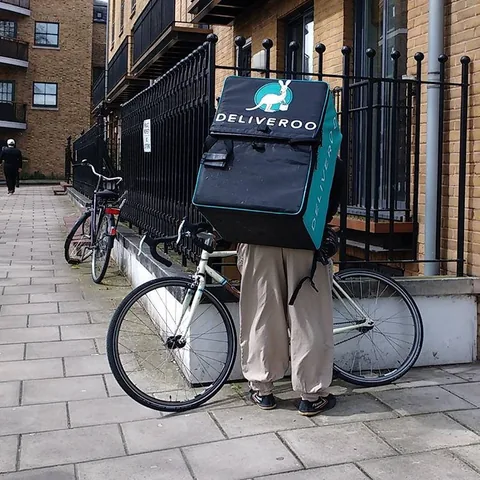 In what ways are the Deliveroo and DoorDash businesses different?
Hence, the acquisition.
Instead of the… We talked a lot about systems and logistics. Have you been to London? I’m sure you’ve probably been there many times. You probably know it better than I do. It is an interesting city in that it doesn’t actually have a lot of the grid-like hub-and-spoke85Grid and hub-and-spoke — two classic city layouts: a rectangular street grid, as in Manhattan, and a radial one, with roads spreading from the center like the spokes of a wheel. London grew without a single plan: even after the Great Fire of 1666 it was rebuilt along the old streets. properties of a lot of cities. There are a lot of reasons for that. We could go into the history.
It’s mostly age.
No, there are other cities that are actually designed differently in other parts of Europe. We can get into other countries and cities, but age is one of them. Obviously, it’s not meant to be a city where you drive a lot of vehicles. No vehicles advantaged.
I think it’s older than even a lot of other European cities.
Even as European cities go, London is really old.86London's age — the city grew out of Roman Londinium, founded around AD 47–50. Many European capitals really are younger (Madrid, Berlin, Warsaw), but Rome, Athens or Marseille are far older.
Yes. As a result, that alone makes the logistics problem very, very different. The logistics, not just the algorithm, which I think is just one part of the system, but the signals that you’d want to collect are very, very different. Vehicles are very different. We predominantly are non-autos in the City of London, which is very different in the States, as an example. That’s very different.
The regulatory setup is different. It has parts that rhyme with the US, but as you well know, each country is slightly different. Even though, I guess, the UK is not under the EU,87The UK outside the EU — after the 2016 Brexit referendum, the country left the European Union on January 31, 2020. but even within the EU, each country has their own local version of regulation. That’s very, very different. You know this probably better than anyone in the world. Payment processing is very different. There are many more card types88Card types — besides Visa and Mastercard, many European countries have their own national card schemes, such as Cartes Bancaires in France and girocard in Germany, and their own payment methods, like iDEAL in the Netherlands. in parts of Europe than, say, in the US. Industry dynamics on retail are very different. In the US, we have a fragmented retail industry that has a lot of different players.
That’s more concentrated in the UK?
Yeah, in the UK, in Germany, in France, in a lot of European countries, this is more the norm than the exception. Whereas in the US, you have maybe hundreds of different big brands that are strong in certain regions. But in Europe, that’s less true. Those are some of the immediate differences that come to mind.
A mystery to me is why the pharmacies are so much better in the UK versus the US. You go into a Boots89Boots — Britain's largest pharmacy chain, tracing its history to John Boot's shop, opened in Nottingham in 1849. CVS and Walgreens are the two largest pharmacy chains in the US. versus you go into a CVS or Walgreens, and it’s like night and day.
One of the things I would say, just as a standard matter, is because of the concentration. It’s really concentrated by category. Pharmacies, it could be a category. Apparel can be another category, et cetera. This is true in Australia, and this is true in Germany. The standards are higher, and they’re more consistent of that service. In the US when you have tens of thousands of supermarkets, hundreds of big brands, it’s different. If you look even more upper-funnel, say CPG, there are a lot more CPGs in the US market that are competing than in some of these other countries, which make things like inventory management, the SKU counts,90SKU (stock keeping unit) — the unit of inventory accounting: every flavor, size and package of a product is a separate SKU. the size of the stores, all of that, therefore is different.
14Advice for Stripe and Dot in the studio
Xu's advice to a growing company is to solve customers' top problems rather than push what it wants to sell, and then Dot rolls into the studio.
You referenced some of the stuff we’re doing together. I think of Stripe and DoorDash as almost having grown up together, founded very similar times, and then you guys were early users of all manner of products, be it Stripe Connect or Radar or Issuing for cards91Stripe products: Connect handles payments for marketplaces and platforms that take money from buyers and split it among sellers and service providers; Radar is machine-learning fraud protection; Issuing creates virtual and physical bank cards. or things. What would you like to see Stripe do that it doesn’t today, either because you guys would like to use it or just because you think it’s something we should be doing? I’ve been giving you all my silly product suggestions. This is where you get to turn the tables and give me yours.
I would always start with what our teams would say. Probably the first piece of advice always is, “What problems are you solving for us?” I think especially as companies grow in size, success, variety of products, there’s a natural temptation to start imposing what the company wants to do or wants to solve or wants to sell versus, say, “What problem does it solve for the customer?” I am sure one of the things that could be true is making sure that you’re solving our top problems, versus just introducing the range of products.
The next thing.
This is the… Awesome. This is Dot?
Wow! It’s kind of like a TARDIS.
It’s very cute, but I can’t believe that we actually have Dot with us today. It’s traveling backwards, but here you go. You can see it there.
The LED screen is for the delivery?
Is for person?
Exactly, where we can send different messages. We can even give messages through the eyes. We thought a lot about the eye contact between Dot and a human. You see part of the sensing stack there in terms of the cameras, the lidar92Lidar — a sensor that scans the surroundings with laser pulses and builds a 3D map of distances; nearly every self-driving vehicle has one. up there.
This is a lot bigger than I expected. It’s like a small car, not a big robot.
It’s like a Smart car.93Smart — a brand of ultracompact city cars; its best-known model, the two-seat Smart Fortwo, is less than three meters long.
Yeah, it’s like one-tenths the size of a car, but it can travel up to 20 miles an hour. When you think about how that compares to what a car travels in traffic, it’s about the same.
This is how we load it up. We got you some non-alcoholic Guinness.94Guinness — the Irish stout: Arthur Guinness founded the brewery in Dublin in 1759. The alcohol-free Guinness 0.0 appeared in 2020. Collison is Irish, and Guinness is what Cheeky Pint guests usually drink.
Have you had Taytos?95Tayto — an Irish brand of crisps. The company was founded in Dublin in 1954 by Joe Murphy, nicknamed "Spud," who invented the first flavored crisps: cheese and onion.
Ireland’s preferred. Here, have some of those.
These are the Tayto chips. Very good. That’s cool.
That’s awesome. The compartment is totally custom and modular, which means that depending on your needs or what we want to fit, whether it’s heating units, cooling units, all of that can be configurable as well as built modularly. But yeah, this is Dot.
Where will this first be most useful?
There are a lot of deliveries. You can think of almost suburban-like environments, where the deliveries are probably under 5 miles, and there’s some challenge for a Dasher, for example, parking. We talked a lot about earlier.
So it’s just literally suburbs is a great place for it?
Yeah, then I think certain city centers, depending on the actual area, though. Those are the two types that we’re thinking about, distance and the types of… One of the coolest things that we’re actually building in Dot, that’s actually not physical, is what we’re calling our autonomous delivery platform, which is basically the algorithm that talks about which orders goes to which type of vehicles. Dot, for example, obviously can also travel mixed routes with humans. For example, if it’s a longer distance delivery, but there is a part of that journey where Dot is more advantaged, say, parking, it can do the first leg96Leg — in logistics, a separate segment of a route between two handoff points. Here Dot carries the order part of the way, and a human Dasher takes it from there. of the order.
First leg and then hand it off to a Dasher?
Can it go on the roads?
And the sidewalks, too?
The sidewalk and the bike lane. It’s the only vehicle in the world that does that. Thinking carefully about the handoffs is very, very important to actually making autonomy work because this is very different from Robotaxis, where obviously a passenger can solve a lot of these “edge cases”,97Edge cases — rare, unusual situations where systems break: the door won't open, the address is wrong, the customer doesn't come out. but we actually have to think about all of it. I actually had no idea. This is cool to see Dot here.
How far can it go on a single charge? Or how many deliveries really is it?
Really?
Yeah, it really… We probably wouldn’t test it to failure, so to speak. A lot of this is making sure how do you actually build… We talked about one of the skills you have to do in building autonomous vehicles is you have to build it ready for mass manufacturing.98Ready for mass manufacturing — design for manufacturing, in engineering terms: a design is thought through in advance so it can be assembled cheaply and quickly in volume, not just so the prototype works. You also have to build it for easy operations. The swapping in and out of the right vehicle parts is very important.
Where is the battery? All the base is batteries?
Yeah. There’s some compute in there, there are some batteries in there, and there are some more sensors.
The autonomy is all local?
On the device?
Yeah. There are a lot of other things that we’re going to have to keep doing to test Dot in different types of weather.
This is much more sophisticated sensor stack than I expected.
If you’re traveling the road, and you’re going up to 20 miles an hour, there are some physical parameters that you’re solving for, which is what guides the development of the actual stack. You’re right in saying that—
Just when you see it, it’s surprising. It’s not a baby sensor stack.
It’s not a baby sensor stack. I guess we’re not trying to build any particular technology. We’re just trying to make it work.
Is the fan the fridge or the compute?
The compute. There are a lot of different versions that we’re working right now, both in terms of what the temperature settings could be internally, what the heating systems are, and making sure that we don’t overheat. There’s some interesting braking systems that we’re building as well, too, in Dot.
Why is the braking system interesting?
A lot of the question is, what type of brake are you going to make that makes sure that at different speeds or in different types of weather, that you can actually make sure that you stop on a dime, especially if you’re not going just on the road? For example, if you’re going on the sidewalk or when you’re making a turn.
You need to be able to stop much more suddenly?
Yes, because if you’re going to move from, say, the bike lane into the sidewalk or any quick turn like that, those are the types of things that are more sensitive.
Dot, you’re dismissed. You did great.
Good robot. That’s so cool.
They’re good.
Yeah, there you go.
This is Ireland’s…
This is Ireland’s potato chips.
Yeah, it’s the Lay’s chips of Ireland.
Very good. I’m introducing you to all my culture. We’re talking about… What are we talking about?
15Stablecoins, AI agents and the lesson of Google
Stablecoins already work for cross-border payouts, and ordering through AI assistants only pays off if the delivery job is solved end to end.
One of the things I’ll never forget talking to you and Patrick99Patrick Collison — John's older brother; together they founded Stripe in 2010. Patrick is the company's CEO. about is we grew up together in the years of building our companies. You’ve always had the idea that Stripe is a technology company that happens to be in payments. It’s not a payments company. You’ve always challenged, I remember, your customers to think about, “Don’t think about just accepting payments. There’s more that you can do.” I’m curious, what more can we do? Should we be doing with things like crypto or stablecoins?
Two topics that are on the minds of all our customers today are, yes, stablecoins100Stablecoin — a cryptocurrency pegged to an ordinary currency, most often the US dollar, and backed by the issuer's reserves. and then AI, specifically with respect to changing buying, agentic commerce.101Agentic commerce — purchases an AI agent makes on a person's behalf; a favorite topic of Collison's. In September 2025 Stripe and OpenAI introduced an open standard for it, the Agentic Commerce Protocol, which powers checkout right inside ChatGPT. On stablecoins, I think maybe DoorDash is not where I would start. Two places that we’re seeing tons of interesting stuff is, one, any cross-border use case where if you want to send money to 100 countries, it’s already the case that stablecoin is a much better way to do that than anything else. That’s where we’re seeing a ton of adoption where just that long-tail coverage,102Long tail — a multitude of small, rare cases that add up to a large volume. Here: countries and currencies where sending money the usual ways is expensive and slow. and they really work for that.
The second, and this is where Tempo,103Tempo — a blockchain for payments, above all in stablecoins, announced by Stripe and the venture firm Paradigm in September 2025. our new initiative that you guys were nice enough to work with us on, is coming in, is very scalable crypto payments. Obviously, agents is what we have in mind as we’re developing Tempo, where if you want to pay for your API consumption104API — a programming interface through which one program calls another. Paying "for API consumption" means paying per request, for example to a language model. or if your agent wants to be able to pay for things around the internet, you actually need a really good scalable blockchain for that. Okay, so that’s on the crypto side of things.
The other thing that we’re thinking about a lot is just how does commerce change? Now that people’s expectations are increasingly, they ask their AI for stuff. It feels like you should be able to ask your AI, whether that’s ChatGPT or Gemini or whether that’s Siri or whatever your interface is to AI, it’s like, “Let’s just order again what we ordered on Sunday.” You should be able to make that natural language query and have it take care of interfacing with DoorDash and payment and everything like that.
I’m curious how you guys think about the interface changing. I mean, you just had a lot. Do you want to enable people to order within the AI apps? Do you want to have just more of a natural language input to DoorDash? How is that going to happen given that that is presumably what people want in terms of the low friction AI experience?105Friction — product jargon for anything that keeps users from reaching their goal: extra steps, forms, waiting.
Well, I think what people want is definitely low friction, but I think people also want the products to show up on time and think they want—
You only get a right to do this cool UI stuff if the logistics is right.
Totally. The challenge with the product like a DoorDash is you have to do the whole thing end-to-end, or you have to have great coordination or communication mechanisms. We definitely agree with you that I think there’s definitely going to be a place where in the future, as these AIs develop their—whatever we want to call them—app ecosystems, relationships, I think, with companies like ourselves that can, exactly what you just said, do the jobs to be done in their regular life. I think that will be a source of top-of-funnel106Funnel — the customer's path from first hearing about a product to buying it; some people drop out at each step. The top of the funnel is the very first step, where a person discovers the product. for us.
I think the hard part is making sure that we can actually deliver on the promise. Sometimes, a cautionary tale of the past, I remember services, Google food ordering107Food ordering in Google — in May 2015 Google added a "Place an order" button to mobile search via Seamless, Grubhub and other partners, in 2016 to Google Maps, and in May 2019 checkout right inside Search, Maps and Assistant with DoorDash, Postmates and others. Google itself didn't deliver food: partners fulfilled the orders. launched in, I forget, 2015 or ‘16, and they allowed you to order delivery, for example, from various Google surfaces: Google Maps, Google Search, et cetera. While on the one hand, it was low friction, and they could send lots of traffic, they couldn’t get the retention. This is where we’re talking about consumer businesses and retention being the name of the game. The reason was because they didn’t know how to contact the driver, they didn’t know if the driver couldn’t find you, if something was taking a little bit longer, if something was out of stock.
There’s a lot of things that happen after the checkout button. I think this is one thing, back to what we were talking about earlier about what is the correct UI. It’s not obvious to me that it’s just a chat interface, that there are all of these different components that have to be solved. The way I think about it is, okay, regardless of whatever we ship, whether it’s on our own surface, other people’s surfaces, are we solving the end-to-end job? If we are not solving the end-to-end job, it’s not going to matter.
Last question. What is food that you can get in other places when you visit London, when you visit some other city that you wish you could get in the Bay Area, but you can’t?
Afternoon tea?108Afternoon tea — the British meal around four or five in the afternoon: tea, small crustless sandwiches (cucumber, for instance), scones and cakes on a tiered stand. The fashion for it in the 19th century is credited to Anna Maria Russell, Duchess of Bedford, though people drank tea in the afternoon before her.
Yeah, little cucumber sandwiches. I’m always looking for a healthy snack in the afternoon. Today, I had an awesome, thanks to you—
Healthy snack?
Have you done the proper afternoon tea with the three-level platters and the little cakes and everything?
I did it once. I took my kids a couple of summers ago. That was an experience, I think, in part because it was new to me and my kids, in part because I had kids with me playing with all the different things that they gave us. I think those… One of the things that’s really interesting about some of the grocery stores, for example, in European markets is prepared meals is a massive focus, massive. We have some of that here in the US, to be fair. But in London, I just found myself finding that in every store, as I went to shop, you would see so many.
There’s a few of these things that I find that are so much better back home in Ireland, UK, Europe. Prepared food is one of them. A sandwich you get in Heathrow will probably be pretty good. A sandwich you get in JFK, don’t go there. On a shelf in a shop. Some of the stores we have, the cookies, obviously, much better back home.
There’s some delicious cookies. The teas, there’s a lot more choices of teas inside restaurants, I found. I think one of the coolest part and greatest privileges, frankly, that I have at DoorDash is because we get to interface with all the businesses of all these different wonderful cities and really get to meet the people who are building the GDP of those cities. It’s not just the cool economic impact that they’re having, but you get to find out about all their passion projects.
Everyone is passionate about this stuff.
Everyone’s passionate about something. That’s one of the coolest things about my job where I don’t just… You asked me a bunch of questions about different IP and process and things like this. I promise you there is that for every single business inside every city.
It’s a cool job where you get to work with people who are incredibly passionate about what they do all day long.
Well, Tony, thank you.


