


Training Data
Chapters
Parallel is betting that agents will use the web a thousand times more than people, and Parag has to unlearn Twitter to build for a customer who isn't here yet.
Read the chapter- Parallel is built on the bet that agents will use the web 1,000x more than humans, which means search technology and business models both have to be reinvented.
- At Twitter, feedback came from hundreds of millions of users, and now Parag is building for a customer who doesn't exist yet.
- Andrew Reed, left without an introduction, makes his debut on the Training Data podcast.
Web search means crawling, indexing and ranking, which adds up to a billion-to-billion matching problem.
Read the chapter- People don't know where on the web an answer lives, and a search engine has to surface it in the most convenient place.
- The engine reads and organizes pages ahead of time so it doesn't have to load them when the query comes in.
- Through several stages of retrieval and ranking, hundreds of billions of pages are narrowed down to five or ten results, ideally one.
Agents and models have stripped the giants of their main advantages.
Read the chapter- What used to block competitors was access to human ratings and click data, but now experts can create rating data far more cheaply, and Parallel treats human click data as a bug.
- Models are good at compressing information, and the research that went into them can be applied to indexing and ranking.
- Instead of spending everything on infrastructure up front, Parallel grew its index as the number of customers grew.
The first product wasn't a search engine but an agent that crawls the web after the query arrives.
Read the chapter- In deep research an agent can spend a minute, even 10 minutes, crawling pages, so an index is mostly a latency optimization.
- Search agents replaced outsourced humans who gathered data from the web, and humans are easier to compete with than a search engine.
- Early customers built agents for insurance underwriting and claims processing, sales data enrichment, and data gathering for financial models.
Parallel does research but doesn't call itself a neo-lab, because its output isn't a model but something that multiplies a model's abilities.
Read the chapter- Every new model, Parag says, unlocks new use cases for Parallel, while for a neo-lab it raises the hill to climb.
- Rather than pre-training giant models, Parallel compresses things into tiny ranking models.
- Every query amounts to "give me the right thousand tokens out of a trillion pages"; that used to take three seconds, and the new product does it in 200 milliseconds.
An agent needs a precise excerpt from an authoritative source, not a list of links, and with Parallel's search it uses fewer tokens and gets better results.
Read the chapter- With Parallel Search an agent uses under half the tokens and works more accurately and faster.
- With an infinite appetite for information, everything comes down to optimizing quality, cost and latency.
- A lazy human types two words with a typo, while an agent sends a detailed, well-specified query.
- Fast SEO pages like Seeking Alpha beat a slow PDF filing with the SEC, while an agent can be handed the right excerpt from the authoritative source directly.
A cascade of models boils hundreds of billions of documents down to the thousand tokens with the strongest signal, and the work of improving it never ends.
Read the chapter- Parallel has a set of indexes, including a big index, a fresh-content index and a knowledge graph, and the query is rewritten separately for each.
- Retrieval and several layers of ranking take hundreds of billions of documents down to specific paragraphs.
- Different versions of the API spread compute differently along that path to meet different latency and cost limits.
- Search can keep improving as long as it pays off, and intelligence keeps getting cheaper.
Pre-training crawls are no use for a fresh index, so model companies will build, buy or partner for this kind of search, and Parallel is already a search provider on Google Cloud.
Read the chapter- Pre-training won't wait for slow JavaScript, but Parallel collects everything down to the last page because it wants what the model wasn't trained on.
- Almost every agent needs the web, nine use cases out of ten, so model companies will build this kind of search, buy it or partner for it.
- Parallel became a search and grounding provider for enterprise agents on Google Cloud, alongside Google Search.
A single human action turns into tens, hundreds or thousands of searches, and background agents are limited only by value versus spend.
Read the chapter- Even an ordinary ChatGPT answer means 5 to 10 searches, and the higher modes run hundreds or thousands.
- An agent that checks a credit portfolio of 10,000 small businesses every week runs hundreds of thousands or a million searches.
- Parag's agent in Notion runs tens to hundreds of searches for each meeting, and the only limit on such agents is value versus spend.
- For the first couple of years Parallel deliberately ignored speed, and once it had the best quality at every price point, it shipped Turbo.
Agent queries on the web, Parag thinks, don't yet outnumber human ones, but that's where things are heading.
Read the chapter- Outside the bubble, people haven't even heard the word Fable, so agent adoption is very early.
- Three years ago Andrew ran 20 or 30 searches a day, and Parag's agents run 100 to 1,000 times more.
- Parag cites Cloudflare's data showing that AI has roughly caught up with humans in web traffic, though that counts page reads, not searches.
The free internet runs on advertising, and advertising stops working when agents show up instead of people.
Read the chapter- Parag loves ads intellectually, because they are why Google, Twitter and a mass of web content are free.
- Ads excel at differential pricing: Google loses money on most queries, and a few, like shopping, make up for it.
- Publishers pay for SEO to bring in people and block agents, even though an agent acts on a person's behalf.
Fixed-fee deals with the labs are open only to the biggest publishers and don't grow with inference, so payment has to be differential.
Read the chapter- Of a thousand visitors, 20 become subscribers, and nobody knows whether agents lead to subscriptions at all.
- A fixed-fee contract with a lab is open only to the biggest players, and inference grows 50x in two years while the deals don't.
- What would work, Parag argues, is differential payment, by the value of the content and the value of the work done with it, at scale and with aligned incentives.
- As Parag understands it, the labs pay for fresh data for answers, training data, and protection against claims over training already done.
Parallel measures each source's contribution to an agent's answer with Shapley values, and by Parag's calculations content owners will start receiving meaningful money in 12 to 24 months.
Read the chapter- You can remove a source, run the agent and work out how much compute it takes to recover the quality, and that is what the source is worth.
- The Shapley value from game theory divides a shared gain so that everyone has a reason to cooperate.
- An exact calculation costs more than the agent itself, so Parallel trains models that estimate Shapley values.
- Unique data is worth more, and a read for high-value work pays more: a banker pays more for a read than Parag's retired dad.
- Allocating 2 to 10 percent of inference spending to web data would dwarf every web data business model outside walled gardens today.
The company is called Parallel because a parallel web for agents is emerging alongside the human one, and publishers now write for two audiences.
Read the chapter- The company was incorporated as Shapley Inc., but that was no name for a B2B product, so Parag's event badges said "NewCo."
- Anyone publishing a page now thinks about two audiences, people and agents.
- Andrew is confident that more earnings call transcripts are consumed through agents than directly, and Parallel tests its docs on agents.
Parag sees three levels of the future, from search as a tool for agents to a web that calls agents itself when something changes.
Read the chapter- At level one, simple agents use web search as a tool, and that is where most of the work is today.
- At level two come multi-agent systems with subagents, such as AI scientists.
- At level three, the web goes from pull to push ("call me if this happens"), and Parallel allocates compute across the entire web on customers' behalf all the time.
Quotes
On what Parallel trains search for agents on
“Our view at Parallel is that human click data is a bug. An agent doing work with search should rely on agent feedback, not human feedback.”
Parag AgrawalRead from 06:27On why Parallel started with a search agent, not a search engine
“So we said it seems like humans sitting on search engines are way easier to compete with than a search engine on day zero.”
Parag AgrawalRead from 07:52On how Parallel differs from a neo-lab
“A neo-lab, for example—if somebody else ships a better model, they have a higher hill to climb. For us, somebody ships a better model, they have now unlocked four more use cases where we can be valuable.”
Parag AgrawalRead from 10:56On whether humans can't write long queries the way agents do
“No, I think we can. We’re just lazy.”
Parag AgrawalRead from 15:38On big publishers' fixed-fee deals with AI labs
“And even for the head, it is a broken business model, because when AIs or inference grows, let’s say 7x this year and another 7x the next year, on this 50x, their deal size is not growing 50x.”
Parag AgrawalRead from 37:43On how Parallel wants to pay content owners
“If a banker in an expensive job reads your data versus my retired dad reads your data, the banker ends up paying more for that read, right?”
Parag AgrawalRead from 45:44On when Shapley payments will reach publishers
“It is a scalable approach, and as agents on the web grow an order of magnitude year on year, by my calculations, we’re 12 to 24 months from this math being able to give meaningful dollars for a very wide range of content owners on the web.”
Parag AgrawalRead from 46:59On who really reads earnings calls
“I feel very confident that more people are consuming earnings transcripts through agents than are actually certainly listening to the audio and honestly, probably reading the transcript itself.”
Andrew ReedRead from 49:36
Summary
Parag Agrawal, Twitter's former CEO, founded Parallel Web Systems on a bet that AI agents will use the web a thousand times more than people ever have, and that search built around human clicks is the wrong tool for them. At Parallel, click data is treated as a bug: search learns from agent feedback, and models now make rating results far cheaper than it used to be. Nor did the company have to build a full web index up front. Its first product was a search agent that could spend minutes crawling the web after a query arrived, and the index grew along with the customer base. Hosting are Sonya Huang and, in his podcast debut, Andrew Reed, both of Sequoia.1Sequoia Capital — the venture firm both hosts work at. In April 2026 Sequoia led Parallel's $100 million Series B, which valued the company at $2 billion. SiliconANGLE
Parag explains how an agent's query differs from a human's (longer and more precise, and what the agent wants is an excerpt from an authoritative source, not a convenient SEO page), how a search stack boils hundreds of billions of documents down to a thousand tokens, and why model companies are unlikely to build this kind of search themselves. For its first couple of years Parallel traded speed for quality and price; now its Turbo mode answers in about 200 milliseconds, and on the day of recording the company announced it had become a search provider on Google Cloud.
The main theme is economics. Advertising, which keeps the internet free, stops working when agents show up instead of people, and fixed-fee contracts with AI labs are open only to the biggest publishers and don't grow with inference. Parallel proposes paying content owners according to each source's contribution to an agent's result, using Shapley values from game theory; the company was originally incorporated as Shapley Inc. By Parag's estimate, within 12 to 24 months this will bring meaningful money to a wide range of publishers. To close, he lays out three levels of the future: agents that use search as a tool, multi-agent systems, and a web that tells agents when something changes.
Advice
Don't bring the habits of a big company that found product-market fit long ago into a startup: there, feedback comes from hundreds of millions of users, while you are building for a customer who isn't here yet and learning something new about them every week.
Don't spend all your money on infrastructure up front, before the first customers: find a path where you can build it up step by step as you solve problems for more and more customers.
If it's too early to take on a giant head-on, start where your rival is manual labor: Parallel first replaced outsourced humans who gathered data from the web, and built out its own index along the way.
Build a complement to models, not a competitor: then every better model opens new use cases for you instead of devaluing your work.
Tackle the problems that need unknown research first, and leave known craft like speed optimization for later: for its first two years Parallel deliberately ignored latency and went after quality and low cost.
Write and test your API docs with agents in mind: customers build products with AI, so your docs and SDKs are read first and foremost by their agents.
Mentioned
 Parallel Web Systems00:57Parag's company: search and web infrastructure for AI agents
 Twitter00:57Parag was its CEO, and that experience is what he has to unlearn
 Google Search13:39calling it for every agent query is worse than using Parallel Search
- Parallel Search13:39Parallel's search API: agents use half the tokens, and Turbo mode answers in 200 ms
Show 11 more mentionsShow fewer mentions
 Seeking Alpha16:55an example of a fast page that's more convenient than an SEC filing
 Google25:51Parallel became a search provider on Google Cloud
 Google Gemini25:51Parallel Search became a grounding provider for Gemini models on Google Cloud
 ChatGPT28:07runs 5 to 10 searches per prompt, and hundreds or thousands in the higher modes
 Sequoia Capital30:28the firm has its own meeting prep agent
 Notion30:36where Parag built his meeting prep agent
 Claude Fable32:53outside the AI bubble, people haven't heard of it yet
 Cloudflare33:24data showing AI traffic has caught up with human traffic
 OpenAI39:05Parag sold it Twitter data
 Lloyd Shapley41:02his values underpin the scheme for paying for content
 Stack Overflow47:26its traffic is plummeting: an example of the human internet going away
Transcript
01Search for a customer who isn't here yet
Parallel is betting that agents will use the web a thousand times more than people, and Parag has to unlearn Twitter to build for a customer who isn't here yet.
Parag, thank you so much for joining us today. We’re delighted to have you on the show. For those who don’t know, Parag of Twitter CEO fame, was the CEO of Twitter2Parag Agrawal joined Twitter as an engineer in 2011, became CTO in 2017 and succeeded Jack Dorsey as CEO on November 29, 2021. Elon Musk fired him on October 27, 2022, the moment his purchase of Twitter closed. Wikipedia before selling it to Elon and is now back on the founder arc. You founded a company called Parallel Web Systems, which is scaling up agentic3Agentic — having to do with AI agents, models that carry out multistep tasks on their own: searching, reading, calling tools and taking actions. The "agentic web" is an internet whose main visitors are such agents. search for the agentic web. We’re very excited to have you here today to talk about the future of search and the future of the internet. So let’s get started. What’s Parallel?
Thank you, Sonya, for having me. Thanks, Andrew, for joining us. I’m really excited about this conversation. At Parallel, we’re building a bunch of technology in order to allow agents to search and use the web. So just like humans forever have figured out how to use browsers and search engines and clicking and browsing around the web to access information, agents need to do the same things. We started Parallel with the bet that agents would do it 1,000x more than humans ever have. And as a result, we need to reinvent the technology that can power search for agents, but also the business models that go alongside it. And that’s what we are doing at Parallel.
Okay. I want to go back into what makes human and agent search so different. But before we get there, you’ve told us that you’re unlearning a lot of the lessons that you learned from running Twitter as you build Parallel. Why is that?
Listen, when I was at Twitter in leadership roles, Twitter was a post-product-market fit,4Product-market fit — the point at which a product has found its market: people buy and use it without being talked into it. Andy Rachleff of Benchmark coined the term (he credits the idea to Sequoia founder Don Valentine), and Marc Andreessen popularized it in the mid-2000s (Wikipedia, "Product–market fit"). extraordinarily scaled business where your feedback loops were from the hundreds of millions of customers5Hundreds of millions — in its last report before the sale, for the second quarter of 2022, Twitter counted about 238 million monetizable daily active users (mDAU), the people it could show ads to. using the product for 30+ minutes every day, right? In that world, you operate differently than a pre-product-market-fit company based on the premise that in a few years a new customer is going to show up on the internet, and let’s go build technology for the not-yet-here customer that we are all learning every day and every week.
Fantastic. Okay, let’s talk about Parallel.
I have a question actually. Can I jump in?
No, you cannot, Andrew.
I’m Andrew. I didn’t get an introduction, but I’m also happy to be an inaugural guest on the Training Data podcast.
Andrew is making his podcast debut on Training Data. We are honored to have you finally here.
02What web search actually is
Web search means crawling, indexing and ranking, which adds up to a billion-to-billion matching problem.
Thank you. I feel like all of us in Silicon Valley have a very surface-level idea of search. What is search? The job to be done6Job to be done — Clayton Christensen's theory: a customer "hires" a product to get a particular job done, so a product should be designed around that job rather than around its own features. is getting the answer; makes sense. But we all know that there’s crawling7Crawling — programs called crawlers, or spiders, follow links from page to page and download everything they find, so that a search engine knows what exists on the internet at all. and there’s an index8Index — a data structure built ahead of time, like the index at the back of a book: for every word (and in modern systems, for semantic vectors too) it records which documents contain it. With an index, an answer is found in a fraction of a second without reading the pages themselves. and there’s ranking.9Ranking — ordering the documents found by how well they answer the query: what to show first. But maybe let’s take a big step back and explain what is the problem of web search, be it for a human or an agent, and then we can dive into the differences.
The problem of web search—and we all know it and experience it— when we want to find something and we do not know where it is on the web, we go to a search engine like Google, and the search engine then hopefully surfaces the answer to us in the most convenient of locations. That’s the base problem.
Now in order to do this, what is the search engine doing? The search engine is going and crawling the web, which is finding every URL that’s out there, trying to read it, trying to organize that information in what might be called an index, so that by having all of this stuff in memory in one location, you don’t have to—once the query comes in, you don’t have to spend time loading up pages because you already have them. You’ve already done preprocessing to organize them. And then when the query does come in, you quickly understand the query, you find the most relevant results. And then there are many, many—because you’re essentially taking hundreds of billions of pages and narrowing it down to what, five or ten, or ideally one, in terms of what someone is looking for right now. So you go through these multiple stages of retrieval10Retrieval — the first stage of search: thousands of suitable candidates are pulled from the whole index quickly and cheaply, then ranked and winnowed by ever more expensive models. and ranking in order to surface the most relevant result. So that’s the broad problem.
One way to think about it is it’s a billion-to-billion matching problem, right? So you have hundreds of billions of pages and hundreds of billions of queries over time, and you need to figure out how to matchmake across these two.
03Why a young company can build its own index
Agents and models have stripped the giants of their main advantages.
That sounds like an enormously expensive infrastructure challenge. And I think for the longest time, basically only Google and Bing11Bing — Microsoft's search engine, launched on June 3, 2009, to replace Live Search (Wikipedia, "Microsoft Bing"). It is the world's second search engine by share, but with a few percent against Google's roughly 90%. had done full web-scale crawls and indices. Why did you think that you as a young company could go off and tackle that problem? It seems like a problem of the giants.
So it is expensive in the long term. So what’s actually interesting is that when I was starting the company three years ago, you could imagine a world where one, some of the reasons it was difficult for others to compete, which was not having access to great feedback, in terms of is this a better search result than this? To collect that feedback at scale, there was a problem around human ratings.12Human ratings — Google employs thousands of search quality raters who, following a detailed public guideline, judge how good search results are. Their ratings are used to test and tune ranking. There was a problem around click data.13Click data — which results people click, how long they stay on a page and whether they come back to the results. Search engines train ranking on it; the 2023 antitrust trial against Google revealed that the company uses a system called NavBoost that takes 13 months of clicks into account. You need to access those.
Now it is, of course, expensive to crawl the entire web and index it. But as you think about what agents and the large models that we now have access to have enabled, it’s the ratings data can be now created by experts way more cheaply.
Our view at Parallel is that human click data is a bug. An agent doing work with search should rely on agent feedback, not human feedback. We believe that these models are really good at compressing information, and we can benefit from a lot of the research that has gone into building models and apply it to search indexing and ranking. And so you can now make many, many arguments—and that’s the arguments we made back then—that actually now it’s way more tractable as a problem because of the existence of agents, not just as a technology, but as a distinct customer.
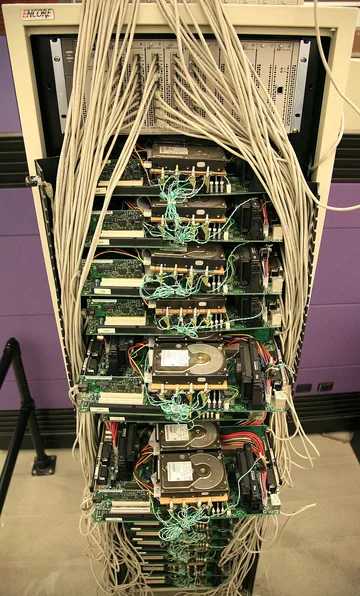
And then we figured out a way to go about building this business which did not require us to go spend all of the money on infrastructure upfront before we could service a customer, right? So if you can paint a path of incrementally being able to build an increasingly larger and more sophisticated index over time as you solve problems for more and more customers, that’s the insight that actually convinced me that this was a viable problem for us to take on.
04A search agent first
The first product wasn't a search engine but an agent that crawls the web after the query arrives.
And how do you make that happen? Because I imagine this is one of those things where customers want full coverage day one. So how do you go about making that happen?
When we first launched the product, we did not launch a search product first. We launched a search agent product first. Our search agent could go essentially crawl the web after a query arrived. So if you’re doing deep research,14Deep research — a mode in which an AI agent spends several minutes finding and reading sources, then writes a report with citations. Such features arrived in Gemini in December 2024 and in ChatGPT in February 2025. you have patience to the extent of a minute. And we’ve had products which sometimes take 10 minutes of research. That’s a lot of time to be able to crawl a lot of pages, if only you have enough of a map to know what to prioritize crawling, right? So you can make up for shortcomings. Like, index is oftentimes—you can think of it as a latency optimization.15Latency — the time from query to answer. A search engine has to answer a person in a fraction of a second, while an agent doing deep research can wait for minutes. So if you give up on that dimension, if you’re competing with humans—that’s why our search agents were competing with the alternative, being outsourcing to humans to curate amazing data, right? So we said it seems like humans sitting on search engines are way easier to compete with than a search engine on day zero. So by building a product that was a search agent to do real work on top of web data, we were able to incrementally go build our index.
What are some examples of what people built with your search agents?
In the very early days, there were search agents being built with us for doing some kinds of insurance underwriting16Underwriting — assessing risk before insuring a client or lending money: whether to take the risk and at what price. Claims processing is checking requests for payouts. workflows and claims processing workflows. People in sales were doing all kinds of sales data enrichment.17Data enrichment — adding outside information to records about prospective customers in a CRM: a company's size and industry, contacts, recent news. It helps salespeople decide whom to pitch and what. People in finance who would previously and historically go to build a model, collect data by sending it overnight to a set of humans who would curate data that would feed into a modeling exercise they would do, would start using us to do that instead. And so we were going initially after replacing where there was outsourced human work on top of web data, in order essentially to collect evals,18Evals (short for evaluations) — sets of tasks with answer checking, used to measure the quality of a model or agent. to run agents, to figure out what search for agents should look like in the first place with empirical use cases instead of theoretical evals.
I see. You’re trading off the crawl for inference time compute19Inference — the work of a model that has already been trained, that is, answering a query. Inference-time compute means buying quality by letting the model think longer or search more when it answers, rather than by training it more in advance. Sonya means that Parallel's agent didn't keep a ready-made index but crawled the web on the fly. effectively.
Yeah.
05Not a neo-lab
Parallel does research but doesn't call itself a neo-lab, because its output isn't a model but something that multiplies a model's abilities.
You guys were started before the term “neo-lab”20Neo-lab — the name for new AI research companies founded by alumni of the big labs, such as Ilya Sutskever's Safe Superintelligence and Mira Murati's Thinking Machines Lab. came into existence, and you have a web systems product, but you also have a bunch of AI people. From the outside, before we met for the first time, it wasn’t obvious to me how much of a web systems company or an AI company that you’ve built. The more time we spent together, the more clear it became that by some definitions, this is a neo-lab. Do you wanna talk about where the research side of what you’re doing comes in? Not just the infrastructure and system side of what you’re doing.
So we don’t categorize ourselves as a neo-lab.
Well, of course you would not.
No, because I don’t think our output is a model. Maybe my definition is broken. My definition of a neo-lab is an output is a model. I think our output is a complement to a model. What we build is something that multiplies on top of a model in order to give—either you can call it the model gets better, or the agent built with the model gets better and has superpowers, right? So we always want to be in a place where whenever someone ships a better model—a neo-lab, for example—if somebody else ships a better model, they have a higher hill to climb. For us, somebody ships a better model, they have now unlocked four more use cases where we can be valuable.
Now whether we need to do work that might be framed as research, that remains. So in that sense, we do have to do research, but we’re also not pre-training extraordinarily large models.21Pre-training — the first and most expensive stage of building a large language model: it is trained to predict the next word on trillions of tokens of text gathered from across the internet. In fact, our job is to compress things down into tiny ranking models, right? I think if you go back to my framing around this 100 billion to 100 billion matching problem, every query is essentially: Give me a thousand tokens22Token — a chunk of text that a model works with: in English, about three-quarters of a word on average. A thousand tokens is roughly 750 words, a page and a half to two pages of text. from a trillion web pages23A trillion pages — for scale: Google says its index holds hundreds of billions of pages, and as far back as 2008 the company reported knowing of a trillion unique URLs on the web. on the web, and make sure they’re the right thousand tokens. That’s the query that we are getting effectively to our search engine. And so now what you have to do—and until last week we would give ourselves three seconds to throw a bunch of compute at read time to do it. Last week, we shipped a product which now does it in 200 milliseconds,24Turbo — a Parallel Search mode released on July 13, 2026: median latency is about 200 ms, and the price is $1 per 1,000 queries. Parallel's blog right? So you have now that much time to go figure out how to pick those. We’re trying to organize information in memory across the memory hierarchy25Memory hierarchy — the levels of data storage, from fast, small and expensive to slow, large and cheap: processor cache, RAM, SSDs, hard drives. What's needed most often is kept higher up. in a way that we can access it fast. We’re trying to figure out how to train what model to select the best thousand tokens. And so there’s a large amount of research that goes into figuring out how to take a pre-trained model of some kind, adapt its architecture for this new problem, and allocate effectively compute in a way that produces the best output with a limited compute/latency budget.
06Agentic search versus calling Google
An agent needs a precise excerpt from an authoritative source, not a list of links, and with Parallel's search it uses fewer tokens and gets better results.
So a lot of these use cases seem like the deep research kind of shaped use case. And when I think deep research, at least in the earlier incarnations, it was effectively like an agentic loop26Agentic loop — how an agent works: the model reasons, calls a tool (search, say), reads the result and decides what to do next, round and round until the task is done. with the model reasoning and then basically just calling a search engine, calling Google or some proxy to Google27A proxy to Google — many AI apps got Google results through third-party services like SerpApi, which fetch the search results page and hand it to a program in machine-readable form.
Yeah.
Right? Why is that insufficient in your eyes, versus what I’m hearing from you is agentic search is kind of a net new capability?
So calling Google for every query in a deep research thing, it gets you somewhere, right? If you use Parallel Search, you will, for the most part, use under half the tokens in your agent. It will become more accurate and to be faster end-to-end. And so you can think of it as—but every time, if you use only half the tokens, if your model is context limited28Context window — how many tokens a model takes into account at once: everything it "sees," including instructions, the conversation and search results. The window is limited, and every token in it costs money and time, so the less noise search brings in, the more room is left for the actual work. or memory limited, you can now do more problems. You can do the same problems cheaper or faster.
So everything to me, when you have an infinite appetite for information and relevant information for all kinds of work, it’s at its core an optimization problem around quality, cost and latency. Every model advancement is about how do you squeeze out more intelligence, and then how do you distill it down29Distillation — training a small "student" model to reproduce the answers of a large "teacher" model. The result is a model many times cheaper and faster that keeps most of the quality. into keep most of it at a tenth of the cost, right?
And that applies to search as well. And every time you can produce all of the signal with less noise in your search results to give to a model, you now give the model the ability to do more. And so a lot of the bet here is intelligent compute allocation across the model layer and the agent layer down to the search layer.
The other interesting thing to observe is the interface actually changes when you think about serving agents versus humans. Humans rely on keyword search.30Keyword search — classic search: it finds documents containing the words of the query and ranks them by how often and how rare those words are (as the BM25 algorithm does). It handles short queries well but copes poorly with a long, carefully described task. With agents, we’ve had to innovate quite a lot on what does an agent tell our search engine? The more we know, the better we can do.
Interesting. So humans can only hold a few words in memory, basically, versus an agent?
No, I think we can. We’re just lazy.
Yeah.
Right? We can have a conversation, we can hold a lot of words. But when you start typing, we want to tell Google two incomplete words with a typo in there and hope for the best, or rely on some form of a dropdown autocomplete thing to avoid typing those three words in the first place. So we’re fundamentally lazy. Turns out, like, models are less so. Fewer typos, better specified queries, perhaps longer queries, less for the search engine to guess what the agent might want. So you get to solve a different class of problems.
One other thing about humans is I feel like we know how to decipher the pre-AI slop31Slop — low-grade content mass-produced by AI for traffic and money; Merriam-Webster named "slop" its 2025 word of the year (Wikipedia, "AI slop"). Andrew's joke is that such slop, SEO roundups of "best products," existed before AI. that populates many of the top-ranking Google results for best product for X, Y, and Z, and you get all the affiliate advertising things.32Affiliate links — a site earns a commission on every purchase made through its link. That's why many "best products" roundups are written to sell, not to compare honestly. And yet obviously they rank highly.
I’m very susceptible to it.
Are you? Yeah, I feel like I have this incredible—I can just see it coming a mile away. How do agents deal with things like that, right? Where these are well-trafficked pages, they have seemingly good answers, but you just know they’re not real.
Perhaps with Parallel agents, you have to deal a little bit less with that. Let me tell you why those pages exist in the first place, right? Let’s work through a simple example. If you ask for a public company’s most recent financials, like just the headline revenue number, we can sit here and know that there exists an authoritative filing with the SEC33SEC — the US Securities and Exchange Commission. Public companies report to it: quarterly reports on Form 10-Q, annual ones on Form 10-K. All of them sit in the open EDGAR database. which has that number—perhaps on page 73 of a PDF, but that is the authoritative number, right? Now imagine Google decided, like, I care about authority. And whenever you ask that query, that’s the first result you see, right? And then you click that. This PDF takes, what, like 3.5 seconds to load instead of the second that another page does. You’re already frustrated. And then you see an earnings page.
Seeking Alpha.34Seeking Alpha — an American site for investors founded in 2004 by David Jackson: analysis, news and earnings call transcripts of public companies.
That’s the alternative. But here you have to now grep your way to page 7735Grep — a Unix utility for searching for lines of text in files; programmers long ago turned it into a verb meaning to find something by searching text. to find your answer. We’re lazy. We’re not going to do the work, right? So now there exists an entire class of content on the web, which is like okay, this information is needed by a lot of people. It is worth putting it on a page that loads fast, where this information is above the fold. All of you can go there. It’s 99.99 percent right, so you’re not so skeptical when you go there that this is 100 percent wrong. And it’s added real value in the process because it identified out of the 300-page earnings report, 20 bits of information that should be above the fold.
Yeah.
Right? And so you can call it slop, pre-AI human slop, or you can call it catering to a lazy human and being successful at SEO.36SEO (search engine optimization) — tuning a site to rank higher in search results: choosing keywords, speeding up loading, getting links from other sites. The good news is with agents, we’re not making the agent click around and fumble around and grab a PDF, right? We’re taking an excerpt from the most authoritative place on the web and trying to bring it to the agent’s context window. And so we aren’t forced into this weird trade-off. And this trade-off existed with humans in the first place, because with standard browsers and protocols and everything, we just didn’t figure out how to have us point exactly consistently across everywhere on the web to the exact right highlighted tiny paragraph, right? With agents, we get to bring that to the agent’s context and then let it figure out what’s next.
07Inside the search stack
A cascade of models boils hundreds of billions of documents down to the thousand tokens with the strongest signal, and the work of improving it never ends.
Can you walk us through what actually happens when one of your developers sends a query off to your Agentic Search API?37API (application programming interface) — the interface through which one program talks to another. Parallel sells search not to people through a website but to developers: their code and agents send queries and get answers back in machine-readable form.
It’s in some sense pretty standard. So we run some models to figure out what this query is and enrich it to figure out how it will flow into the rest of our system. We have a bunch of indexes which organize different subsets of the web in different ways. And so the first layer will essentially craft queries for each of these different systems.
Each one of these systems perhaps is our sort of big index. One of these is perhaps our fresh index. One of these is perhaps—some people will describe it as like a knowledge graph.38Knowledge graph — a database of facts as entities and the links between them: "Parag Agrawal — founded — Parallel." Google launched its Knowledge Graph in May 2012; the answer panels next to search results come from it (Wikipedia, "Knowledge Graph (Google)"). Some people will describe it like a structured index. There are a bunch of these, right?
ExplainerThe search cascade: from hundreds of billions of pages to a few paragraphs
Each stage of search looks at fewer documents than the one before, but spends more compute on each:
- Retrieval. Thousands of candidates are pulled from the index in milliseconds. The classic tools are the inverted index (for every word, a list of the pages containing it) and the BM25 formula, which scores how well the words of a query match a document; today vector search works alongside it, turning queries and documents into embeddings, vectors of meaning, and looking for the nearest ones.
- Light ranking. A fast model working on hundreds of features (freshness, site authority, matches) keeps the best few hundred.
- Heavy ranking. A large model reads the query and the document together and judges whether one answers the other. A BERT-based reranker of this kind was proposed in 2019, and that same year Google began using BERT in search, at first on about one in ten English-language queries in the US.
- Excerpting. A person gets ten links; an agent gets the paragraphs with the answer, packed into a token budget.
That's what Parag means by versions of the API: under a hard latency limit the expensive stages are cut back, and when there's time, more compute can be thrown at each query.
So you’re now deciding which ones this query needs to go to. You’re figuring out what is the query rewrite for each of these. Then each of these has a big retrieval layer and then a ranking layer and then more ranking layers. So you’re going to try to boil down tens, hundreds of billions of URLs or documents down into thousands, tens of thousands, down into specific excerpts and paragraphs in those tens of thousands with more and more bigger models running at each stage with different architectures, pulling more features39Features — the numerical characteristics a model bases its decision on. In search they are properties of a query-document pair: word and meaning overlap, freshness, a site's authority and much more. to ultimately get down to here are the thousand tokens I want to bring back to this AI which has the highest signal, right?
And now if you look at our various versions of our search API, they just throw for different latency and cost constraints, different amounts of compute at various points in this journey to hit those limits. So in the abstract, it’s simple, right? What’s interesting is what each of these models that I described, how you curate and collect the training data for them, right? How you build those models and optimize them. The index itself, how you use the memory hierarchy to store it, to be able to hit certain cost, quality, latency thresholds.
What’s the north star from a quality perspective? Like, you know in Google, there’s that did you get the result you wanted in the first three answers or something? What is the equivalent north star for you?
So I think of—I don’t know if I’m right on this, but my take is that a billion-to-billion matching problem is a forever problem. And so the real question is at what point incremental optimization isn’t worth the squeeze, right? So I don’t think there is a thing as, like, okay, we’re done on improving this thing. The question is at some point it’s going to get harder and harder to improve this thing, and it just won’t be worth it. But I’m hoping that we don’t get there actually, because if you think of what we’re doing with AI, we will have more intelligence that gets cheaper every few months. And as a result of it, it will come down to having great models which are cheap, having great information, matchmaking across a need and all of the information available to you, whether it’s your own or on the web, and doing something unique and differentiated with it to produce more knowledge, right?
And anytime you can do something 20 percent better than somebody else, that might give you an edge. So why wouldn’t you? So in the super AGI40AGI (artificial general intelligence) — AI that matches humans at most intellectual tasks. Building it is the stated goal of OpenAI, Google DeepMind and other labs.-built worldview, it feels like if you can push on quality across web search and in the model layer, why wouldn’t you?
08Model companies and Google Cloud
Pre-training crawls are no use for a fresh index, so model companies will build, buy or partner for this kind of search, and Parallel is already a search provider on Google Cloud.
I’ve heard a point of view that this is so fundamental to the model companies41Model companies — those that train their own frontier models: OpenAI, Anthropic, Google DeepMind, xAI, Meta. that they’re just going to own it. And in part because as they’re collecting data for pre-training, that’s a very, very expensive infrastructure exercise. That kind of is your source of truth for the crawl. What do you think of that?
I don’t see empiric data on the ground to support that view. To build a fresh web index, I don’t think that crawl is particularly useful. And let me frame why. So if you think of what we are building, we’re building a complement to models. We like to crawl things that people don’t like to crawl for pre-training. Because if the model already was trained on it, it’s not useful. Model companies, for the training, aren’t patient enough to go in a completionist way, try to wait for really slow random JavaScript42JavaScript — many sites assemble their content right in the browser with JavaScript. To see the text of such a page, a crawler has to open it in a real browser and wait for everything to load, which costs far more than simply downloading the HTML. to load, because the number of tokens you get per amount of compute you throw at it is like one order of magnitude, two orders of magnitude. Too bad. And so is it worth the extra effort to get these tokens? For us it is because we’re completionists, right? For them it’s like, I’ll take X trillion tokens.43Trillions of tokens — for scale: Meta trained Llama 3 (2024) on 15 trillion tokens.
So that’s one. Now I do think this is a core part of every agent, right? My worldview is that if you’re buying LLMs44LLM (large language model) — a model like GPT, Claude or Gemini. for doing work, for nine out of ten use cases, you will want them to have access to the web and create search infra optimizing for agents. So it is a real adjacency for all kinds of LLM inference. And that supports your view that model companies could, should have the best-in-class infra for it. So now they can build it or they can buy it. And that’s the conversation. And we will see who builds and who buys and who partners and how things evolve.
Are you partnering with any of the model companies that you can share?
We want to. We will. I can’t share anything on that. We did announce—and I don’t know how your definitions of model companies—we announced today, actually, that we are working with Google Cloud45Google Cloud — Google's cloud platform (GCP, Google Cloud Platform). On July 16, 2026, Google announced that Parallel had become a built-in provider of grounding (tying model answers to data from the web) in Gemini Enterprise Agent Platform; the feature launched in preview. Google Developers Blog to be a search and grounding provider for their enterprise agent APIs. So if you think of grounding Gemini models46Gemini — Google DeepMind's family of AI models and the Google chatbot built on them. or other models available on GCP, when you build agents on GCP or chat apps on GCP or do any other inference with LLMs on GCP, when you attach web search to it, your options are Google Search or Parallel Search. And Parallel Search is product integrated, the integration is optimized. We’ve spent time with technical teams and training teams and product teams and commercial teams to make sure that when people use Gemini models with Parallel, they get exceptional and great results. So yes, there are these partnerships now emerging. I bet that there’ll be several of these. They will all look somewhat unique.
That’s a big deal from the search king. Congratulations.
Google’s the original neo-lab.47The original neo-lab — the joke is that Google is the oldest of the AI labs: the transformer, the architecture behind every modern language model, was invented at Google in 2017, and the company bought DeepMind back in 2014.
I don’t know how to frame Google as a model lab versus a hyperscaler.48Hyperscaler — the largest cloud providers, with data centers all over the world: Amazon Web Services, Microsoft Azure and Google Cloud. And I don’t know what precise lessons to learn from this one, whether it applies to other labs or to hyperscalers. And so we will see.
09Background agents, multipliers and Turbo
A single human action turns into tens, hundreds or thousands of searches, and background agents are limited only by value versus spend.
The way that I use voice agents—and I need to get reservations for dinner at night, what restaurant should I go to? And then that request gets fulfilled by the agent. When we talk to a lot of the Parallel customers, there’s this background agent,49Background agent — an agent that works on its own, with no human in the chat: on a schedule or on a signal, such as something important appearing on the web. whether it’s the monitor product,50The monitor product — Parallel has an API for monitoring the web: an agent specifies what to watch and is notified when something new turns up on the topic. these agents that sort of are always watching the world or watching the web, and when something happens, then they go off and take actions and do something with it. It might be worth—because if we think about what does 1,000x more mean, there’s the depth of research and then there’s just what is actually initiating the tasks. Is it a human initiating the search or is it the agent itself? You want to talk about that dynamic a little bit?
Yeah. So there’s a bunch of dimensions here. Let’s go back for a moment on search agents. If you run a typical search agent, even without doing deep research, it’ll do somewhere between five to twenty searches, even if it answers within a few seconds. Because why not, right? So already, if you transition from using ChatGPT Medium,51ChatGPT modes — in ChatGPT you can choose how much the model "thinks" before answering: in Instant mode it answers right away, and the higher the reasoning level, the longer it reasons and the more it searches the web. or—I know all the categories, but somewhere not on the high tier—Instant, Low, Medium—every time you write a prompt to it in ChatGPT, it will do five to ten searches. As you dial it up, it’ll do hundreds and thousands of searches.
So one interesting thing to observe is a human action to a multiplier on number of searches that happened, right? So just by using an AI app, you’re kind of multiplying your way to perhaps one order of magnitude more searches.
Now a lot of our initial takes on the product and the market were to go after bigger multipliers than even that, right? So we were much more interested when you said I have a portfolio of 10,000 small businesses where I have given out credit to. For all of them, every month I have this human process that runs to feel out how my risk is going up or down. Now can we—and it relies on a bunch of web data. We’re trying to use agents for doing this. So here a developer is effectively—the multiplier there is hundreds of thousands or a million in terms of the number of web searches that happen because a human goes and programs that instead of now doing this process every month, we can do it every week, right? So doing a lot of searches when this agent runs every week to create a dashboard on the portfolio and a collection of action items that somebody needs to look at. Now you can go to another example, which is even more interesting. I don’t know, do you use something to do meeting prep documents for you all that’s an agent?
There’s a Sequoia one. There’s a Sequoia agent.
Yeah, yeah. I was going to say James Flynn.52James Flynn — a growth investor at Sequoia. Andrew's joke: the "agent" that preps meetings at Sequoia is a young staffer. Profile on Sequoia's site He’s one of our great young guys.
So I use Notion’s agent53Notion — an app for notes, documents and knowledge bases. In 2025 it added AI agents that can be given multistep work across a company's documents and databases.—and you can build custom agents which look into all the internal data that we have at Parallel, plus all of the web data using Parallel’s APIs to create meeting prep docs.
One time I went and created one prompt to build this custom agent. Now it does tens and hundreds of web searches for every meeting I have. Every time I build a new agent for a new use case, that keeps multiplying. So I think the path to these background agents doing more and more and more work all the time for us, it’s only going to be bounded by value versus spend.
Mm-hmm.
You know, I don’t think it’s rational right now. I’m probably spending more on it than I should be, but it’s not too much, so I don’t care yet. So there’ll be some rationalization in all of these agents. But I think we will deploy background agents to the extent that there is incremental value in doing that compute.
And the same thing applies to searches. All of these background agents will do a bunch of searches. And so our first set of products were really obsessively focused on these, in part because we were building, growing the index, and we decided that our company was based on three dimensions: quality, cost, latency. And for the first couple of years, we said let’s focus, let’s ignore latency, and let’s just nail the other two, because optimizing systems distilling to smaller models is much more a known art than unknown research, right?
So once we achieved the best quality search and search agent products at every price point, we’ve started working on latency. And that’s what we shipped with a product we call Turbo now. It is the fastest, highest quality agentic web search on the market by a lot.
10Have agents overtaken humans?
Agent queries on the web, Parag thinks, don't yet outnumber human ones, but that's where things are heading.
Do you think there are more agentic queries than human queries on the web now?
I don’t think yet. I don’t think we’ve reached that point.
Just given some of the multipliers you mentioned and given the background agents, it seems ...
I think I don’t have to remind you, but we are early. We are very early in agent adoption. You go step outside of our bubble, people haven’t heard the word Fable.54Fable — Claude Fable 5, Anthropic's most powerful generally available model, released on June 9, 2026, about a month before this episode was recorded. So we are very, very early. I think there are now people like me who are probably operating at the 1,000x. I don’t know, what do you think? How many Google searches a day did you do three years ago before ChatGPT?
20 or 30?
Yeah, I would have guessed something like 20, 30. I think today, if you just look across at all of my agents, I bet they’re doing 1,000x more than that. Maybe 100 to 1,000. If you count some of the things that happen at my company which isn’t assigned to a human, it might easily be more than 1,000x. But I think we are the outliers rather than the norm. So I think we are very, very early on this journey. I do think—I recently saw, I think it was Cloudflare55Cloudflare — an American company that protects websites and speeds up their loading; about a fifth of all websites use it, so it sees a large share of web traffic. In early June 2026, Cloudflare CEO Matthew Prince said bots had overtaken humans: by the company's data, automated HTTP requests made up 57.5% and human ones 42.5%. Tom's Hardware that said that in their monitoring of web traffic, the AI traffic is about the same as human traffic in terms of page reads, which is slightly different from searches, because it includes perhaps all crawlers that are out there, and a bunch of other stuff. But I think it’s going to happen.
11Ads meet agents
The free internet runs on advertising, and advertising stops working when agents show up instead of people.
So maybe this is a good segue to talk about a topic that I know you are passionate about, which is the economics of the internet as we know them. Some of the fundamental assumptions there, you know, human eyeballs, scarcity of attention, seems to be falling right in front of us right now. Are the economics of the internet broken now, and what’s going to happen?
Yeah. No, I think this was perhaps part of the thing that totally convinced me that this needed to be done by me and build Parallel. I know most people hate ads. I used to do ads and build systems for ads.
I love ads.
Oh, wow!
I love shopping
Okay. Yeah, so you get good ads.
[laughs]
I don’t know if I love ads, but I intellectually love ads because ads are the reason that so much amazing content and technology is available for free to all of us, right? Like, Google Search wouldn’t be free without ads, Twitter wouldn’t be free without ads. And these are truly useful pieces of technology. A lot of content on the web out there that we can access for free wouldn’t be free if not for ads. And so ads are a very efficient monetization scheme. It’s a very efficient monetization scheme because it is exceptional at differential pricing,56Differential pricing (price discrimination, in economics) — different buyers paying different amounts for the same thing, according to what it's worth to them. Advertising does this by itself: in an auction, a click on an insurance query costs an advertiser far more than one on a pancake recipe, and most queries carry no ads at all. right? So most queries Google loses money on. Some of them make it up, and it’s an extraordinary business with extraordinary margins. Same with Twitter. Like, most users ...
Like for shopping.
Exactly.
You’re welcome. I’m subsidizing the free information you guys are getting.
You are subsidizing all of us. Thank you. But I think ads are extraordinarily efficient at differential pricing and monetization on the web, which is why it has been a dominant business model. Now the core assumptions, as you noted, going into it, around limited human attention to translate into outcomes, if humans don’t show up and agents show up on the web, what does this mean? How does the business work? And yeah, I think this was the—if we don’t figure out a new business model—we’re seeing it already, right? Like people are going to say, “Okay, I don’t want my content to be accessed by an agent, because I have a business model for humans. So I actually want to go pay someone to SEO optimize myself so more humans show up.” But then if their agent shows up, I’m going to cut it off, right? Which seems confusing and disconcerting. Ultimately this agent is acting on behalf of a human, but we haven’t found business model alignment.
Yeah.
In a way ...
We can’t monetize that visit.
You can’t monetize that visit.
Yeah.
12New incentives for content owners
Fixed-fee deals with the labs are open only to the biggest publishers and don't grow with inference, so payment has to be differential.
So let’s say you are in the business of subscriptions, right? So you get a thousand humans, and you convert 20 of them into monthly subscriptions. Right? You don’t know how that loop works yet with agents. You can’t distinguish, you don’t have statistics, you don’t know if these will lead to subscriptions or if they’ll just keep stealing your content as nameless agents.
ExplainerHow publishers sell content to AI companies
So far these have mostly been one-off, fixed-price deals, and almost only with the biggest players:
- The Associated Press (July 2023) and Axel Springer (December 2023) were the first to license their archives and news to OpenAI;
- Reddit sold Google access to its data in February 2024, for about $60 million a year, according to Reuters;
- News Corp reached a deal with OpenAI in May 2024 worth more than $250 million over five years, according to The Wall Street Journal;
- The New York Times, which is suing OpenAI, licensed its content to Amazon in 2025, for $20–25 million a year, according to the WSJ.
Small sites are left to defend themselves: since July 1, 2025, Cloudflare blocks AI crawlers on new sites by default, and at the same time it launched a beta of pay per crawl, which lets a site set a price for each crawler visit. The flaw Parag points to is that the price of such deals doesn't grow with how often agents read the content.
And so there are real challenges around the old business models breaking and us not figuring out real scalable new business models, right? So if you own high-quality content and you currently put it on the web, your one available business model pre-Parallel was to be in the head57The head — in a long-tail distribution, a few of the largest players (the head) take most of the traffic, while a huge number of small sites make up the tail. and be able to transact with a lab on some fixed fee contract.58Fixed-fee contracts — in 2024, for example, News Corp agreed to a deal with OpenAI worth more than $250 million over five years, according to The Wall Street Journal, and Reddit agreed to one with Google worth about $60 million a year. That’s literally—which includes some amount of training and liability59Liability — here, protection from lawsuits over the use of content in training. The best-known such suit was filed in December 2023 by The New York Times against OpenAI and Microsoft. and then inference time access, right? That was your one option. That option is not available to most content on the web. It’s a very head phenomenon. And even for the head, it is a broken business model, because when AIs or inference grows, let’s say 7x this year and another 7x the next year, on this 50x, their deal size is not growing 50x. None of them after signing a two-year deal believes that their share isn’t going to decline materially at renewal. And so these are fixed price constructs in the world of AI inference, which doesn’t drive for sustainability for all of these businesses.
Now our solution is trying to learn all the lessons from my work at ads on having transacted—like, I sold Twitter data to OpenAI,60Twitter data for OpenAI — in December 2022, after Parag had left, Elon Musk wrote that OpenAI had had access to Twitter's database for training and that he had suspended that access. having transacted on that side to figure out what actually might work and be incentive-aligned.
So what might work?
Efficient differential pricing. Paying differentially a lot for extraordinarily high-value content. Paying a lot for high-value work accessing the same content. So it’s differential on both dimensions, quality and value of work being done with it. And a way of doing this scalably and not just with bespoke deals. So those are the properties needed for any reasonable solution. And the biggest property of it all is incentive alignment, right? Like, at what point do people want to collaborate into this enterprise?
Why do the model companies need to pay anything at all?
You should ask them. My understanding is one, you want fresh data during inference time to be able to display it in products like ChatGPT or Claude. Two, you want training data. And three, you want some liability protection for training that you already did. And so the payments are some combination of these three things. And I can’t be sure of how they value each of these three.
13Shapley values
Parallel measures each source's contribution to an agent's answer with Shapley values, and by Parag's calculations content owners will start receiving meaningful money in 12 to 24 months.
You said even a very simple query will go do 10 searches. And so how do you do attribution61Attribution — dividing credit for a result among everyone who contributed to it. In advertising, credit for a purchase is split among marketing channels; here it's credit for an agent's answer, split among sources. between all the different sources that boil down to one paragraph response?
Yeah, at Parallel, we like to build models.
[laughs] I heard.
So no, I think it goes back to my point around incentive alignment. So before we try to build a model, let’s try to figure out if you were going to try to do this intellectually, theoretically, how would you go do it? So you have to ask the question of okay, how much incremental value did somebody’s content add? Right? So you can run all of these simulation exercises. You take one piece of content out of the corpus and then you say, “Let’s run the agent. Let’s see if the quality of our output declined, how much to claw back that quality? Perhaps if I threw a little bit more compute or a better model in some way, could I claw back that quality? Oh, I could. It cost me a cent. Huh!” I could get the quality I lost by not having this source. My alternative was to throw more compute, a cent worth of compute, to get that same quality. It might be a different result, but as far as the end customer value is concerned, it’s the same quality. And so you’re like, okay, this source is worth close to a cent, it feels like, right? That’s intuitive. Now the formalization of this kind of an intuition is the core framework we use. It’s called “Shapley values.”62The Shapley value was proposed in 1953 by the American mathematician Lloyd Shapley, who won the 2012 Nobel Prize in economics. A shared gain is divided by each participant's average contribution, calculated over every order in which the participants could have joined the coalition. Wikipedia
Yes, let’s go. What’s a Shapley value? Music to my ears.
It’s a game theoretic—you’re a game theorist?
I did a bunch of game theory, yeah.
Yes. Shapley value is this very theoretical mathematical concept. It is used in SHAP values63SHAP (SHapley Additive exPlanations) — a method that explains a machine learning model's prediction by breaking it down into the contributions of features, using Shapley values. Proposed by Scott Lundberg and Su-In Lee in 2017. Paper in feature importances for those who are ML folks here. Let’s say the three of us collaborate on something, and the whole is bigger than the sum of parts in that moment. But the theoretical question is okay, how do I divide up this sort of bigger pie that we created by collaboration so all three of us have incentive to collaborate, right? And Shapley values is a mathematical way of effectively answering this question.
ExplainerThe Shapley value with three sources
Say an agent builds an answer from three sources: A and B are two articles with the same news, and C is a unique industry report. Answer quality: A alone or B alone gives 0.6, C alone 0.3, A and B together still 0.6 (the second article adds nothing), A or B together with C 0.9, and all three 0.9.
The Shapley value is the average gain in quality a source brings, taken over all six orders in which the sources could arrive. C adds exactly 0.3 in any order, so it gets 0.3. A adds 0.6 only when it comes before B (in three orders out of six) and nothing otherwise: 0.3 on average. B gets the same. The total is 0.3 + 0.3 + 0.3 = 0.9, so the whole gain is divided, and the unique report gets as much as each article, even though on its own it's worth half as much: duplicates split their value between them.
Hence the cost of calculation Parag talks about: for n sources, quality has to be measured on all 2ⁿ subsets, which for 20 sources means more than a million runs of the agent. So the values have to be predicted by a model rather than calculated.
Now that sounds amazing, right? You could—if you’re co-founders, you could figure out how to divide equity. Unfortunately, it’s not that useful. It’s not that useful because in order to compute Shapley value, you need to simulate all worlds where some subset of the two of us collaborated but the third one doesn’t, and play out those realities to then impute back to today in terms of how we should divide the pie. Which in practice you can’t do in most places, right? In ML models, when you do feature importances, you kind of can. You can hold a feature back, run your model and see how well it did. In web search, we can run simulations of if we did not have access to this URL or this domain or this collection of them, how would the agent perform? We can—if you’re good at evals, if you’re good at assessing quality, you can build that data by running various scenarios, collect a bunch of this data, and then you can train models to ...
Your favorite thing.
Favorite thing. So the challenge with Shapley values is computing Shapley values in our context is way more expensive than the amount of dollars we spend on the agent. Forget the amount of dollars we want to pay a publisher, right? So to compute a content owner, to compute that a content owner gets a dollar, if I decide to do the full Shapley value computation, that might take several dollars.
So it doesn’t make any sense, except you can really well estimate them if you build the right kind of data and models around it. But we have confidence that our estimations are good and that this is sound theoretically, that if there was perfect information symmetry, people would want to collaborate.
So the same way in the old ads days, people did second-price auctions64Second-price auction (Vickrey auction) — the highest bid wins, but the winner pays the second-highest bid, so it pays each bidder to bid exactly their true valuation. Such auctions were long the standard in online advertising; in 2019 Google Ad Manager switched to a first-price auction. Wikipedia and believed, for better or worse, that people would reveal their true bids in an ad auction and end up paying less than that, once feedback loops get established in a market—today, everything is like an auto bid,65Auto-bidding — the advertiser sets a goal, such as a cost per purchase or a return on ad spend, and the ad platform's algorithm picks the bid in each auction. right? Most people are measuring ROI when they’re doing advertising and running on auto bid instead of making up bids.
I think a solid foundation based on incentive alignment that Shapley math drives will ultimately maximize participation of content owners into this, as well as content seekers via AI in an optimized system.
And we have some positive evidence to support it. We’ve had some interesting partnerships that we’ve been able to do and announce. And yeah, imagine sitting with content owners and explaining Shapley math—takes a moment. But ultimately, once you pull out the properties that you participate in the value, if you have unique differentiated data, you get paid more. If a banker in an expensive job reads your data versus my retired dad reads your data, the banker ends up paying more for that read, right? Because it’s a part of high-value work.
And the macro math also seems to work. If you’re going to spend a lot of money on inference on LLMs for knowledge work, if we allocated what, two to ten percent of it to data on the web, that’s way bigger than all web data business models today outside of walled gardens like Facebook and LinkedIn.
So the macro math supports it. It is a scalable approach, and as agents on the web grow an order of magnitude year on year, by my calculations, we’re 12 to 24 months from this math being able to give meaningful dollars for a very wide range of content owners on the web.
Source: Stack Exchange API, questions from May 1 to 31 of each year
That’s very exciting, especially at a time when you see the traffic data, the Stack Overflow66Stack Overflow — a question-and-answer site for programmers, launched in 2008. According to The Pragmatic Engineer, by May 2025 it was getting as many questions a month as in 2009, shortly after launch. The Pragmatic Engineer plummeting. You see a lot of the human internet as we know it going away because of incentives. It’s very exciting to see how you’re thinking about incentive alignment for people to keep publishing.
Yeah, it’s why we started the company.
14Why Parallel
The company is called Parallel because a parallel web for agents is emerging alongside the human one, and publishers now write for two audiences.
Why is the company called Parallel?
[laughs] The company’s original name was Shapley Inc.
Really?
It was. When ...
Did you know this?
I knew that, yeah.
Huh!
When I incorporated, I’m telling you, I was obsessing about everything to do with the problem space. So while knowing that the first set of—also, one, Shapley Inc. is a terrible name for a B2B product.67B2B (business-to-business) — products for companies rather than individuals. It was not going to be the long-term name. But I incorporated as Shapley Inc. for lack of a better word, and “shapley.ai”68.ai — the country domain of Anguilla, a British overseas territory in the Caribbean. The AI boom made it fashionable with startups: according to an Anguillan minister, domain sales were expected to bring in almost half of the territory's budget revenue in 2025 (Wikipedia, ".ai"). happened to be available. Shapley.com is a parked .com domain. So it was not going to be our name. I went around not talking about my company as Shapley, and my badges at all events used to call it “NewCo” or “Stealth Company.”69Stealth company — a startup "in stealth mode" is already operating but discloses neither its name nor its product. NewCo is a placeholder name for a company that doesn't have one yet. And it took us almost six to eight months to figure out what the real name of the company will be.
We ended up at Parallel in part because it’s one, at the time we were doing a lot more in parallel. And two, we started visualizing this sort of a parallel web built for AIs and how its properties are different. And this metaphor that when you publish, you’re now thinking of—as we all are now—of two audiences. Okay, I’m going to create a page. I know humans will read it. What should it look like to them? And then how should I make sure that agents can read it too? So it feels like you’re dual publishing to two audiences. And so we had this idea that a parallel web for agents will emerge. And so that’s why we started liking Parallel.
Love it.
I actually was thinking about this recently with things like earnings transcripts,70Earnings call — a conference call in which a public company's management walks through the results after its quarterly report and takes analysts' questions. Transcripts of these calls are published by Seeking Alpha, among others. right? Like, I feel very confident that more people are consuming earnings transcripts through agents than are actually certainly listening to the audio and honestly, probably reading the transcript itself. So there are these very high-value portions of the web that have flipped already to being agent first. And obviously, the communication has not yet flipped. But I think if I were a public company CEO today and I was doing an earnings report, I would make very clear that the thing that I’m saying will be transcribed and interpreted correctly by the agents, not just by the people listening, theoretically.
Yeah. Same for us when we’re publishing docs for our APIs. Our customers are building AI solutions. They are using AI to do it. It’s their agents reading our docs and code in our SDKs.71SDK (software development kit) — a set of libraries and tools that make it easier for a developer to build someone else's service into their own program. It’s not humans fumbling around docs pages for the most part. So in fact for us, the primary audience is an agent, and that’s how we test our docs.72Docs for agents — one idea for them is llms.txt: a file at a site's root with a Markdown digest of the documentation that language models can read easily. Jeremy Howard proposed the format in September 2024.
15Three levels of the future
Parag sees three levels of the future, from search as a tool for agents to a web that calls agents itself when something changes.
A parallel web for agents. That’s very cool. Maybe close us out. Tell us—just give us a snapshot of where Parallel is today, and if everything that you hope to build comes true, what does Parallel look like? What does the world look like? What’s your role in it?
I think of three levels in this journey. Level one is people are building simple agents that use the web more as a tool,73Tool — a function a model can call on its own: web search, a calculator, running code. Modern models are specifically trained to use tools. like a web search tool, because it’s familiar. Because the first set of agents we built, to your point, was just like, model and give it the same tools, because these models have been trained to use all the tools humans have been used to, and let them do work.
By and large, if you think of most work, it’s there today, or inference, it’s there today. We have now started seeing some subset of customers who are in this world where they’re building more sophisticated multi-agent systems, which use subagents74Subagent — an agent to which the main agent hands a subtask, such as researching one branch of a question. A subagent works in its own context and returns only the result, so a whole system of agents can be aimed at one big task. and have agents wake each other up or orchestrate in interesting ways, right? People are seeing that as subagents. The most familiar one is subagents within coding agent harnesses.75Harness — the program around a model that gives it tools, context and a working loop. Coding agents like Claude Code can launch subagents for separate subtasks. But we see a lot more of that. Like, if you’re building an AI scientist,76AI scientist — a system that comes up with hypotheses, runs computational experiments and writes papers on its own. The best-known example is The AI Scientist from Japan's Sakana AI (2024). some of those systems are very interesting, very sophisticated, very long-running, and just throw large amounts of compute and data at a really hard problem.
And I think the third layer for the web specifically is the web goes from pull to push.77Pull and push — in the pull model, a client requests data when it needs it; in the push model, the source sends data when something changes, like notifications on a phone. So today, by and large, across the first two modalities I described, either an agent is calling a tool or a sub-agent, but it is telling it a request saying, “Go find this for me right now.” And I think where we will end up in a couple of years is a variety of use cases will be the web, Parallel, call me if this happens, so that my agent can do some work or a human can do some work.
So I use this line with my team all the time, which is like, imagine agents are everywhere and they can do a lot of things, right? If there is something you can do today and it’s worth doing, and we still have GPUs available, we’ll just go do it, right? We won’t be like, oh, let’s just do this tomorrow for the sake of it. If it can be done today, do it. So what will we do tomorrow? We will do tomorrow work in response to something that circles through either another agent’s work or something changes in the world as visible in satellite imagery, or some customer commentary that happens, some agent finishing some compute, a human having a new insight to trigger work. But there are going to be a few feeds like this which will drive new agentic work tomorrow.
And one of those feeds is going to be everything that changed on the web, which is really exciting for me, because then you are framing not a point in time need, but a long-term here is what is actionable for me. If something like this happens as evidenced by all of the information on the web that is changing all the time, call me, right? And then I’ll run my agent on it. And so we get to then allocate compute onto the entire web all the time on behalf of all the customers. And that’s really exciting.
That’s awesome. Really ambitious vision. You’re clearly extremely passionate about this and exciting to see you building. Thank you so much for joining us today, Parag. And thank you for joining us, Andrew.
You’re very welcome, Sonya.
Thanks, Parag. Thank you, Andrew, for your debut.


