

Training Data
Chapters
Levie joins the show as Box's founder and an AI thought leader, and opens by joking about Doug Leone's root canal.
Read the chapter- Sonya introduces Aaron Levie, founder and CEO of Box, the enterprise collaboration and content management platform that AI has given a new life.
- Levie riffs on Doug Leone's root canal story and pitches recording the episode in a dentist's chair, Hot Ones style.
"Model wrappers" turned out to work because there's a vast bridge between a model and a real workflow.
Read the chapter- Enterprises need a bridge from model capability to their processes, and roughly a trillion dollars rides on whether that bridge is short or enormous.
- Once an application company has enough data and domain expertise, it starts building models too, and Box Labs, Levie says, already exists.
- Sonya says customers don't want the fox guarding the henhouse, with the seller of tokens deciding which token is best for their use case.
- Connecting to data, humans in the loop, idle time, change management and legacy systems are not what a research lab wants to do.
- Nobody looking at early AWS or GCP would have predicted Snowflake or Databricks, and Levie thinks intelligence will play out the same way.
Levie bets on the application layer: token subsidies are temporary, and even the labs are better off with real competition.
Read the chapter- Levie admits his bet is biased, but in 50 or 60 years of software history, banks, law firms and pharma companies have always needed a bridge from technology to their processes, and AI hasn't changed that.
- A universal chatbot won't ping you at the right point in a process or reach the right data, so someone has to come in and set things up.
- Even if everyone is perfectly benevolent, you want to hand the task to a company with no preference, one that doesn't care which of ten models performs it.
- Once public, the labs will answer to the laws of capitalism, while Meta, China, Nvidia and other non-economic actors keep pushing token prices down.
- A lab that is the only intelligence around risks being nationalized, so even the biggest labs are better off in a dynamic market.
After ChatGPT, Box pivoted the whole company to AI and went from a cloud file store to a platform for agents.
Read the chapter- Box began as a way to store and share files securely in the cloud and quickly moved into the enterprise.
- From 2015 it tried image classification and OCR, but every task needed its own expensive model, so the effort was shelved.
- After the ChatGPT moment, Box pivoted the whole company: it carved out a team of its best people, met every day and built its AI stack and the Box Agent.
- Hundreds of billions of files hold contracts, research and loan documents whose contents companies don't really know, and agents answer questions, extract metadata and automate workflows.
- For complex documents and presentations Box works with OpenAI and Anthropic, whose technology it considers frontier.
Today AI in Box shines at extracting data from huge piles of documents, and the next step is agents that run an entire process.
Read the chapter- Pulling structured data out of a million contracts or research documents and analyzing it is work that was always too expensive to give to people.
- Long-running agents, like coding agents, run a whole process, such as onboarding a bank client, and hand people only the steps that need review.
- The dream state of enterprise workflows, Levie says, is an hour instead of a one- or two-week back-and-forth: onboarding clients faster, finding data in research, responding to security incidents sooner.
AI-written code is welcomed because it's a utility, while AI-written documents trigger an allergic reaction because we judge their authors by them.
Read the chapter- For most of the world code just automates things, so a back end generated by an agent is not just acceptable but preferable.
- We judge people's trustworthiness by their decks, and workslop makes it impossible to tell how much is the person and how much is the AI.
- Everyone produces workslop for their own brainstorms but distrusts it from others, yet nobody objects to a financial model computed by a macro.
- Pangram rated the Druckenmiller op-ed 100% AI, yet Sonya loved it, perhaps because she trusts the author.
- Levie reads X articles both for substance and to guess whether he's reading a Claude prompt, and he would hate to be a college professor.
Box's own agent, tuned to its search and file system, is more accurate and faster than outside agents given the Box API.
Read the chapter- Box knows how people search Box and pick the right document out of ten, and built that into an agentic harness with search, file system access and on-the-fly embeddings.
- On Levie's tens of millions of files, the Box Agent is clearly more accurate and faster than Claude or ChatGPT given the Box API.
- Box tests models on two evals, the Complex Work Eval of domain-specific document tasks and an eval on Box's own data, and even half a point of improvement shows up.
- Box rolls out default models by cost and accuracy thresholds, and customers can pick any model they want from its model garden.
Models on Box's workloads are neck and neck and largely track coding rankings, and most customers stick with the default.
Read the chapter- Model rankings on Box tasks largely track coding, except that Gemini is disproportionately good at general knowledge work.
- Fable 5.1 is the best model Box has seen, but Grok, Muse, the Fable class and GPT-5.6 are close, and GDPval and Mercor's APEX also follow the coding models.
- Most customers use Box's default model, and most tokens flow through workflow and data-extraction agents, where FDEs help pick a model by eval.
Enterprises pick open-weight models partly for fashion and as a hedge, but mature workloads will move to them for economic reasons.
Read the chapter- Open-weight adoption, Levie estimates, is higher than people think, lower than enterprises want, and far lower than it will be in five years.
- Levie puts maybe 30% of the interest down to sexiness: CIOs want a hedge, even though Gemini, Muse or the discounted GPT-5.6 Luna and Terra would have done fine.
- As Jesse Zhang of Decagon argues, settled workloads will move to open models when that's cheaper or post-training improves quality.
- A closed model can orchestrate while cheap open models take the long tail, so spend might split fifty-fifty while open models handle ten times the tokens.
Permissions make it hard to bake company knowledge into the weights, so you need a rubric for what goes in the weights and what stays in context.
Read the chapter- Sonya notes that context lookup dominates today, while Engram works with customers to bake some of the context directly into the weights.
- A researcher sees everything, a lawyer sees five projects behind hard walls, and permissions change daily, which makes training weights per user hard.
- Levie thinks you should bake in what changes slowly but sharply improves accuracy.
- Eli Lilly wants its own drug-discovery model where there are few barriers, which is why Levie likes Trajectory, Applied Compute and Prime Intellect.
- Sonya recalls Karpathy's idea of keeping only reasoning in the model and all knowledge in lookup, and Levie doubts companies differ in how they think rather than in their IP.
A SaaS company has to both build the best agent for its own system and open that system to outside agents, while Box's applied AI team hunts for extra points of accuracy.
Read the chapter- Box's applied AI team hunts for another ten points of accuracy, for example using autoresearch to try to take a bank's loan documents from 70% accuracy with an off-the-shelf model to 97%.
- The name Claudeforce, Levie says, seemed funny for the first three minutes and then like a brilliant move, especially once Matthew McConaughey said it out loud.
- A SaaS company must build an agent 10 to 20 points better than off-the-shelf ones at its own system, and open its APIs to Claude, ChatGPT and other platforms via MCP.
- A Box customer imagined a background agent that warns employees before they break data governance policy, the kind of idea you only see from inside the product.
- Thanks to MCP, Levie uses Salesforce an order of magnitude more than before, and he'd pay ten times more for LinkedIn with MCP.
Chat will stay, but most agent work will move into the background.
Read the chapter- Everyone will have a universal chat box, like a search box, for one-off requests to an agent.
- Most of the enterprise is processes running behind the scenes, and they need dashboards, queues and task lists, not just chat.
- A horizontal product that absorbs everything gets heavy, while vertical companies, Harvey and Legora in law, Cognition and Factory in coding, build the right buttons and tabs.
- In five years, Levie bets, 90% of enterprise tokens will go to work the user never kicked off, and they'll just review the result.
Code is almost perfectly suited to automation, while the rest of knowledge work runs into outside constraints, scattered data and permissions, so diffusion will take much longer.
Read the chapter- The value of code is almost entirely in text, models are trained on it to the hilt, labs run coding evals themselves, and users fix their own integrations.
- Law is close to coding and already blowing up, while a sales rep is held back by outside factors: whether the customer replies, whether there's budget.
- A coding agent just needed "give us your GitHub," while knowledge-work data is scattered across on-premises systems and file shares with different permissions.
- The Valley, Levie says, should prepare for diffusion to take much longer, and that is a trillion dollars for the application layer.
Right now the winners are the ones who can get a product into the enterprise, and Box is rebuilding around AI on the strength of having all its documents in one place.
Read the chapter- 20 years of working with unstructured data made Box a natural home for agents, and Levie simply loves the technology.
- Levie learns from the Sequoia podcast, the Dwarkesh Podcast and, 95% of the time, Twitter, which he scrolls every night, and he urges college students to follow the right 20 accounts, because your feed decides whether you're a year ahead or a year behind.
- All of Box's documents live in Box, its CIO is very AI-pilled, it has an AI center of excellence, and a list of employees ranked by tokens is used to find tricks worth teaching everyone else.
- Levie envies young founders, two of whom now do what once took 40 people, while Box can't drop code review; but every idea now instantly has five competitors.
- When AI builds things this fast, the winner is whoever can get the product into the enterprise, and anyone who misreads that mandate, Levie says, will lose.
Quotes
On why the biggest AI labs benefit from competition
“at some point you'll just be nationalized if you're the only thing that exists as intelligence.”
Aaron LevieRead from 12:03On workslop, AI-generated work documents
“So we have this very weird collective issue, which is: I'm doing workslop for some of my brainstorms and decisions, but when I get it from somebody else, I'm like, should I trust you?”
Aaron LevieRead from 20:52On student work in the age of AI
“I would hate to be a college professor. I would totally quit, because you're just like, I don't know anymore what you did.”
Aaron LevieRead from 23:11On what still holds open models back in the enterprise
“Sometimes, randomly—I've heard stories—it'll just speak Chinese mid-chain. So you're like, okay, well, that'll be weird for a bank.”
Aaron LevieRead from 30:23On the future of enterprise AI
“Ultimately, five years from now, I would bet 90% of all tokens in the enterprise are things a user never kicked off and they just see a result.”
Aaron LevieRead from 47:08On why coding agents spread faster than anything else
“Remember, there was this period where when you launched a coding agent, there was no sign-up or register. It was just, give us your GitHub. That doesn't exist in knowledge work. There's no ‘give us your GitHub’ for knowledge work.”
Aaron LevieRead from 52:18On how long enterprise AI will take
“Silicon Valley has to prepare for diffusion taking a lot longer than they think. Or than we think—but I really think they, because I know how long it'll take.”
Aaron LevieRead from 53:36On what AI has given young founders
“I saw a product a week and a half ago. They did a demo of their product, and I was like, this would have been a 40-person project five years ago—or, especially when we were starting out, easily a 40-person project. And it was two people.”
Aaron LevieRead from 1:02:10
Summary
Sequoia's Sonya Huang asks Box founder and CEO Aaron Levie where the real value in AI will end up. Not only in the models, Levie argues, but in the bridge from a model's raw capability to the actual workflows of a bank, a law firm or a pharma company: connecting to data, permissions, humans in the loop, change management. That is how Snowflake and Databricks grew on top of AWS and GCP. Enterprises also want a neutral party that routes each task to whichever model is cheapest at a given accuracy, and the labs' token subsidies, he thinks, can't last.
Box bet the whole company on AI right after ChatGPT came out. Its agent works across hundreds of billions of customer files: it reads a million contracts, extracts structured data and runs long workflows like onboarding a bank client. A harness tuned to Box's file system, permissions and search beats simply handing Claude or ChatGPT the Box API on both accuracy and latency. Box tests every model on its own evals: the race, Levie says, is neck and neck, and open-weight models will gradually take over mature use cases. Along the way: workslop and the Druckenmiller op-ed, memory and continual learning, and why systems of record have to build their own agents and open up to everyone else's.
The big argument of the second half: coding diffused almost instantly because everything there is text, the code already sits in GitHub and users fix their own integrations. A lawyer or a sales rep has none of that: there is no "give us your GitHub," the data is scattered and access is fragmented. So Silicon Valley should prepare for a long rollout, and that is a trillion dollars of opportunity for the application layer. Five years out, Levie predicts, 90% of enterprise tokens will go to work no user ever kicked off. At the end: how he keeps up (95% Twitter), how Box is making itself AI-first, and why the winners now are the ones who can get a product into the enterprise.
Advice
If you run a SaaS company, do two things at once: build your own agent that works with your system 10 to 20 points better than off-the-shelf ones, and open your APIs to other people's agents via MCP. Pick only one and you lose.
Follow a couple of dozen key AI accounts on Twitter and read your feed every day: it decides whether you're a year ahead or a year behind.
Keep all company documents in one system and maintain good data hygiene: agents running on top of well-organized data make it much easier to become an AI-first company.
Start rolling out AI with the workflows where the payoff will be highest, and set up an AI center of excellence to help rebuild them.
Track who in the company uses the most tokens, not as a race but to find what works: have that person show everyone else at an internal demo.
Invest in a team that can get the product to enterprise customers: now that AI has sped up building, the winner is not whoever builds fastest but whoever gets the product to the customer.
Mentioned
 Box00:50Aaron Levie's company
 Doug Leone01:22the joke about a root canal without anesthesia
 Amazon Web Services05:18cloud infrastructure on which Snowflake and Databricks grew
 Google Cloud05:18likewise
Show 36 more mentionsShow fewer mentions
 Snowflake05:54software that grew on top of cloud infrastructure
 Databricks05:54likewise
 Anthropic07:01"put another billion dollars into Anthropic"; works with Box on document creation
 ChatGPT14:28the ChatGPT moment that made Box go all in on AI
- Box Agent15:07Box's agent, more accurate and faster than Claude or ChatGPT with the Box API
 OpenAI16:20Box's partner for creating documents and presentations
 Claude Code18:43in coding, AI is embraced
 Pangram18:52a detector of AI-written text
 Stanley Druckenmiller22:28his AI-assisted Wall Street Journal op-ed
 Claude25:34loses to the Box Agent when given the Box API; Levie uses it to reach Salesforce via MCP
 Google Gemini27:28disproportionately good at Box's workloads
- Claude Fable27:57Fable 5.1, the best model Box has seen
 Mercor27:57the APEX eval
- GPT-5.627:57in the model race; the discounted Luna and Terra
 Grok27:57neck and neck with Fable and GPT-5.6
 Muse Spark27:57Meta's Muse models are level with the leaders
 Zhipu AI29:54the GLM models
 Jesse Zhang30:59his post on mature workloads moving to open models
 Engram32:34continual learning, knowledge in the weights
 Andrej Karpathy35:49a model without memorized knowledge
 Trajectory36:38models tailored to a specific company
 Applied Compute36:38likewise
 Prime Intellect36:38likewise
 Salesforce39:21Claudeforce; Levie uses Salesforce via MCP
 LinkedIn44:01Levie would pay ten times more for MCP access
 Harvey47:08vertical AI for lawyers
 Legora47:08likewise
 Cognition47:08long-running coding agents
 Factory47:08likewise
 GitHub52:18"give us your GitHub"
 Dwarkesh Patel55:39his podcast is one of Levie's sources
 Twitter55:3995% of Levie's sources; his advice to students to join Twitter
 Instinct56:56the personal assistant Sonya recommends
 Cursor1:00:31the "everybody roll out Cursor" stage
 Slack1:01:25coworker agents you tag in chat
- Claude Tag1:01:29an agent in Slack as a form factor
Transcript
01Intro
Levie joins the show as Box's founder and an AI thought leader, and opens by joking about Doug Leone's root canal.
Today I'm excited to welcome Aaron Levie,1Aaron Levie (born 1985) — American entrepreneur, co-founder and CEO of Box. He started the company in 2005 with his childhood friend Dylan Smith after dropping out of the University of Southern California. founder and CEO of Box.2Box — American company founded in 2005: cloud storage and a platform for document collaboration and enterprise content management. It started as a consumer service, but many people used it at work, and around 2009–2010 Box switched to business customers (Wikipedia, "Box, Inc."). Its shares have traded on the New York Stock Exchange since 2015. Box is building a collaboration and content management platform for the enterprise that has now taken on new life with AI. I'm excited to chat with you today about Box and AI, about your general thoughts on AI—because you are such a thought leader—and about how founders can reinvent themselves for this AI wave. Thanks for joining us.
Thanks for having me. I'm a big fan of the podcast. I religiously watch every episode, so great work. I am wondering, though—I know this is a different podcast, but when do you talk about root canals on this one?
Oh my gosh. Are we going to call in Doug Leone?3Doug Leone — longtime Sequoia Capital partner who led the firm from 2012 to 2022. In early September 2026 a story he told on David Senra's podcast went viral: he had a root canal without anesthesia to test how tough he was.
Have we figured out how to weave that in yet or not? I mean, I'm happy to talk about a different kind of pain and suffering that I've been through.
We should just do this pod with a live root canal.
Let's do it. See how it goes. Actually, that would be like Hot Ones,4Hot Ones — interview show on the First We Feast YouTube channel: since 2015 host Sean Evans has questioned celebrities while they eat chicken wings with ever hotter sauces. but you get a root canal and you have to talk about your strategy while you're in a dentist chair. And Doug is just on the other end of it.
Amazing. Doug is so pleased with himself right now, by the way.
Have you seen every tweet?
Oh, yeah. He's very pleased with himself. Okay, good.
02Application companies are the new neolabs
"Model wrappers" turned out to work because there's a vast bridge between a model and a real workflow.
Let's start with—I'm curious your take on this: application companies are the hottest neolabs.5Neolabs — Silicon Valley's name for new AI labs that train their own models, such as Mira Murati's Thinking Machines Lab or Ilya Sutskever's Safe Superintelligence. Agree or disagree?
Two years ago, I think it would not have made that much sense—like, what does that mean? But very clearly, I think this is what's playing out in the market, and it's all working out mostly because of open source.6Open source — in AI talk this usually means open-weight models: their parameters are published for download, so you can run the model on your own servers and fine-tune it. The training code and data usually stay private, so strictly speaking this isn't open source. What's pretty amazing is right now, the whole concept of being an LLM7LLM (large language model) — a neural network trained on huge amounts of text to predict the next word. ChatGPT, Claude and Gemini are built on LLMs. wrapper, a model wrapper,8Wrapper — a dismissive name for a startup that builds a product on top of someone else's model, calling it through an API, without training its own. is actually working out. What I think people underappreciated was that in the real world, in the enterprise, what you need is some bridge from the model's capability to the actual workflow that the enterprise has. And on that bridge, probably $1 trillion has been bet on basically one of two outcomes: either that bridge is very limited, or that bridge is actually very vast and needs to be able to take on a lot of depth within organizations.
That bet basically looks like: are you only long9Long — trading jargon: holding an asset in the expectation that it will rise. Levie uses "I'm long…" several times in the episode to mean "I'm betting on…". the model itself and superintelligence,10Superintelligence — AI that far surpasses humans at almost every intellectual task. The philosopher Nick Bostrom popularized the idea in his book "Superintelligence" (2014). or are you long this application tier—or, maybe previously, it would have been just the pure neolab. But I think it's very clearly playing out that there's a lot of gap between the model and the workflow. And as you bridge that gap over time, you get to a point where you realize, oh, I should also do the model. Then you have enough data, you have enough domain expertise, where that becomes its own flywheel.11Flywheel — business jargon for a self-reinforcing cycle in which each turn speeds up the next, popularized by Jim Collins in "Good to Great" (2001). Here, data and domain expertise improve the model, and a better model brings more customers and data. So I'm very bullish on this idea. And what's cool is it's opening up multiple layers of opportunity for startups, because you could either be the actual applied company itself—i.e., the neolab—or you could be the infrastructure provider to the neolab. You have multiple layers of going and attacking that space. But I think it's a huge update for the market and everybody's views of it.
Box Labs, let's go.
We already have it. It's a little bit secret. We pay very close attention. Right now, the main focus is: let's make the agent really, really good on any model. But over time, obviously, you would peel off certain use cases, either on a per-customer basis or across the whole data set.
Yeah. It seems like there are two forces happening. One is people don't want the fox guarding the henhouse. They don't want the seller of the token12Token — a chunk of text (a word, part of a word, a punctuation mark): models read and write text in tokens. Labs also sell access to their models by the token, with prices quoted per million input and output tokens. to be the one that is also metering and gating what the best token is for each use case. And then the second is there's actually a lot of work to do on that bridge. There's real research involved in it, and it's pretty bespoke to the exact workflow and the exact end customer that you have.
Yeah. I think what I tend to see happen in the Valley—and for very good reason; it's actually why these companies have been so successful—is that everybody is so research-pilled.13-pilled (from the red pill in "The Matrix," which lets the hero see the world as it really is) — slang for "converted to" or "obsessed with" something. Later in the episode come AI-pilled, Slack-pilled and just pilled. Which is, again, totally awesome. Big fan. It leads to all these breakthroughs. But there's this sense that, okay, the model and the intelligence in the model is the only form factor that matters. And then you go to the real world and you see how intelligence actually gets rolled out in people's workflows. The model could be the most intelligent superintelligence in the world, but that workflow still requires you to connect up to other data systems. It still requires these moments where there's a human-in-the-loop14Human in the loop — a setup in which AI works on its own but hands decisions to a person for review or approval at key points. interaction. There are delays in the workflow, so the agent has to sit idle. There's change management15Change management — the management discipline of moving people and processes to a new way of working: training, redesigning processes, dealing with employees' resistance. of the actual business process. There are legacy systems that haven't been modernized.
So you go through these five or ten things that are much more operational, much more blocking and tackling, than just the pure superintelligence of the model. And the last thing a classic research organization wants to do is go attack every single one of those things. This is not a one-off in history. We've always had this relationship between infrastructure and application. Obviously AWS or GCP or Azure16AWS, GCP and Azure — the three biggest public clouds: Amazon Web Services, Google Cloud Platform and Microsoft Azure. They rent out servers, storage and compute, including GPUs for AI. have created trillions of dollars of market cap in infrastructure. But guess what? There are also trillions of dollars of value in software that only exists because of that infrastructure.
If you were to go back ten years ago and look at what was happening in the data space, and you looked at what early versions of GCP or AWS were building, I guarantee you would not have predicted Snowflake or Databricks17Snowflake (founded in 2012) and Databricks (founded in 2013 by the creators of Apache Spark) — cloud platforms for storing and analyzing data. Both run on top of the Amazon, Google and Microsoft clouds and have become large independent companies. existing. You would have been like, the infrastructure already does that. Why would you pay another $10 billion of revenue to all these other products that are just making it so you can work with your data? The same thing is going to be true for intelligence. The models will be insanely valuable, but the application of bringing those models into real workflows—in banking and life sciences18Life sciences — the industry label for pharmaceuticals, biotech, medical devices and related research. and healthcare and government—that's just going to be a lot of software.
Now, the challenge for the next, let's say, two to five years is: how much do the model providers need to move up that stack19Stack — layers of technology, each resting on the one below: chips, clouds, models, applications. "Moving up the stack" means taking on what companies a layer above used to do; here, labs building application products themselves. and also try to compete at that layer? Or do they leave open—intentionally or accidentally—that entire space for the application ecosystem? To some extent, this is a big strategic question for them, because on one hand, you want to be closer to the customer. On the other hand, you also want to have an ecosystem so people trust you. So that's going to be a really interesting tension over the coming years.
03Will the labs move up the stack?
Levie bets on the application layer: token subsidies are temporary, and even the labs are better off with real competition.
How do you think it'll play out? I feel like that's the question we spend every day wrestling with.
Yeah. I don't want to speak for Sequoia,20Sequoia Capital — one of Silicon Valley's oldest venture firms (founded in 1972), an early investor in Apple, Nvidia, Google and WhatsApp. Sonya Huang is a Sequoia partner; its investments include both OpenAI and Anthropic. but you can sense some of the existential dread of a VC right now, which is: should I just put another billion dollars into Anthropic? Or should I attempt to see how the applied layer is going to play out? So nobody's that envious of your position having to figure that out. But obviously, it's even harder for the entrepreneur.
I'm pretty long, obviously, the application layer. I'm also equally very biased. I have a very concentrated bet with very limited diversification on it working out that you still want to buy technology that understands your workflow and can get to the core enterprise data. But I just don't see a different event happening than all of history. We only have 50 or 60 years of computer software history, but basically, when you go to that law firm, and you go to that pharma company, and you go to that bank, they need something that bridges the core technology to their workflow and their business process. AI has not meaningfully changed the need or the shape of what that looks like.
The best manifestation of this is the chatbot versus agentic workflow21Agent — an AI system that doesn't just answer a question but carries out a multi-step task on its own: it searches, calls tools and programs, and checks the result. An agentic workflow is one where agents perform some of the steps. demarcation. The chatbot can be totally universal and totally horizontal.22Horizontal products serve every industry and profession at once (email, messaging, a chatbot); vertical ones serve a single industry or profession, such as AI for lawyers. Hence "vertical" as a synonym for industry. But all of a sudden you look at that and you say, well, my workflow needs something to ping me at the right time in the process, or it needs access to a certain kind of data that the chatbot can't natively get access to. So somebody has to go into that organization and get it set up, and somebody has to provide domain expertise to this model so it really understands our particular business process.
So then, unless you really just underwrite the big labs at—honestly, I'm not exaggerating—like 100,000 employees, if you don't underwrite that, then the diffusion economy23Diffusion — a term from the economics of innovation: how a new technology spreads across industries and companies. Inventing a technology and getting it adopted everywhere are different problems; the whole second half of the episode is about the diffusion of AI. is going to be massive. Every single one of those companies, whether it's a 50-person firm or certainly a multi-hundred-thousand-person firm, is going to need an army of people to go in and help them with that transformation, that change management. Whether it's the FDE phenomenon24FDE (forward deployed engineer) — an engineer who works on site with the customer and adapts the product to its processes. Palantir made the model famous, and in the AI era OpenAI, Anthropic and many startups adopted it. or just, again, understanding that domain expertise, that's going to be a very big deal.
And then you alluded to this point about the fox guarding the henhouse. That might actually be singularly the biggest reason this has to happen. Even under complete benevolence—nobody's actually doing anything sneaky—it just stands to reason that if I'm going to give a task to an agentic system, I want that task to be cost-optimized, with accuracy held constant. So who can do that? It's the company that doesn't care which of ten different models is performing that task. Definitionally, you would want that to be the company that does not have a preference.
And then the force you have going against that is that the model companies can subsidize their models or offer them at different rates.
I don't know how long that lasts, though, because when these companies become public, I think they will be held to basically the same laws of capitalism as everybody else. The subsidization is working very well up to a certain threshold of spend, and we might have exceeded that spend when you're at tens of billions of dollars of capital. In fact, if anything, it might even be worse, because eventually you have to pay for your training runs25Training run — training a new model on a cluster of thousands, tens or even hundreds of thousands of GPUs, which takes weeks or months. Along with inference, it is the main cost for AI labs. as well. So the subsidization of tokens, I think, just has to be a temporary phenomenon.
You mean from a gross margin perspective26Gross margin — the share of revenue left after the direct costs of the product. For AI labs the main direct cost is the compute their models run on. or from an antitrust perspective?
Entirely gross margin.
But they have such high gross margins on the inference27Inference — running an already trained model: every answer to a user is inference. It is contrasted with training, which is done once and paid for up front. right now.
But then what are they subsidizing? Then they're actually charging decent rates.
Yeah, but they can afford to price the API28API (application programming interface) — the interface developers use to call a model from their own programs, paying per token. "First-party products" are ChatGPT, the Claude app and the labs' other own services, paid for by subscription. higher than their own first-party products.
Totally fair. There's an interesting dimension, which is: well, if the API is the high-margin thing that is paying for the subsidization, but you've moved all your customers over to the applied product and there's no API revenue—there's an equilibrium you have to strike with this.
And then all the while, if you have some non-economic actors,29Why these four: Meta released the open Llama models, Chinese companies released open models like DeepSeek and Qwen, and Nvidia has its Nemotron models; cheap inference suits Nvidia because it sells the GPUs. SpaceX has owned xAI, the maker of Grok, since February 2026, and since August 2026 also Anysphere, which makes Cursor. or people with a totally different game theory in this—Meta being one, maybe SpaceX being one, China certainly being a giant one, even Nvidia being one—that changes the calculus as well. Those four cohorts don't necessarily need to make money on inference at the same margin structure that an Anthropic or an OpenAI needs. They might be fine bringing inference down to a 10% margin because they just want to pay for massive compute clusters. As long as that happens, and as long as there aren't insane, closely held proprietary secrets, then no matter what, you're going to have cost per token go down on a like-for-like basis. All of which means more value accrues to the application layer.
Which is a very long-winded way of saying I think there's value for everybody in the stack. The only thing I probably wouldn't bet on is: okay, one or two labs get 95% of the value creation. I think there's going to be a much more dynamic environment. And honestly, if I were one of the two or three biggest labs, I think I'd prefer this outcome too, because—back to your antitrust point—at some point you'll just be nationalized if you're the only thing that exists as intelligence. So you want a little bit of healthy competition in this ecosystem anyway.
04Box bets the company on AI
After ChatGPT, Box pivoted the whole company to AI and went from a cloud file store to a platform for agents.
Yeah, totally. Let's transition to talking about Box. I want to come back to tokens and Jevons paradox30Jevons paradox — when a resource is used more efficiently, total consumption may rise rather than fall. The British economist William Stanley Jevons described it in "The Coal Question" (1865): more efficient steam engines increased coal use instead of cutting it. In AI it comes up as tokens get cheaper: the cheaper they are, the more of them get used. and China and all this stuff, but let's talk about Box for a second.
I love that topic.
I'm guessing a lot of people who listen to this podcast use Box, but give people a brief explanation of the history of Box and how you're reinventing yourself with AI.
We started the company as a way to securely store and share data in the cloud. It was a very simple idea, but we cracked a nut or struck a nerve, and—for Doug out there—we were able to scale up quickly. We pivoted31Box's pivot — Box started as cloud storage for consumers and switched to businesses around 2009–2010. rapidly into the enterprise. The idea was that enterprises would be moving from on-premises systems32On-premises (on-prem) — servers and software a company runs itself, as opposed to the cloud, where everything is rented from a provider. to the cloud, and they would need a better way to store, share, collaborate on, and manage all of this unstructured data33Unstructured data — documents, emails, presentations, scans, images, video: anything not organized into database fields. That is exactly what Box stores.—their corporate documents, their financial documents, their marketing assets, their research materials—in the cloud, securely. So that was the company.
We had been flirting with AI products and experiences really since about 2015. If you remember the first rise of—at least in modern times—the AI winter34AI winter — a period when disappointment with AI leads to funding cuts and fading interest. The term usually refers to two downturns, roughly 1974–1980 and 1987–2000 (Wikipedia, "AI winter"); 2015–2018, by contrast, was a boom time for deep learning. that happened in the 2015 to 2018 period, where we thought it was going to happen and it didn't. That was a period where we were like, okay, these very early AI models are showing us signs that if you looked at an image and you could classify the image, that's pretty useful if you're in an enterprise. Now maybe you take all of your image data and label it, or maybe you'd OCR something and be able to pull out the text in there. That's enormously helpful. The problem was it was insanely expensive, and you had to have a model for every single use case. It required a hyper-trained model for each workflow you wanted to do. So we shelved it.
A few years later, we started paying attention to the GPTs.35GPT (generative pre-trained transformer) — OpenAI's language models. Before ChatGPT they were used mostly by developers: access to GPT-3 was offered through an API from 2020. We had some hackathons where people were like, oh, we could do type-ahead in one of our note-taking products. Those were early versions. We did some early work in text detection and classification, which helped with security use cases. But then, obviously, the ChatGPT moment36ChatGPT — OpenAI's chatbot, released on November 30, 2022. It reached a million users in five days and 100 million monthly users in two months, kicking off the current AI boom. hits, and that was the big head-exploding moment—if for no other reason than they figured out a form factor that opened up everybody's mind to, oh, these could be interactive systems where you just ask a question and get an answer back, of increasing complexity and length.
So we looked at that very quickly. We jumped all in. We did the whole company pivot. Everything was exactly like, academically, what you should do. We had a team carved out. We put the best people on the team. We met every day, looked at the updates, and slowly but surely built out what today is our AI stack, and then, basically, the Box Agent.
For us, the use case is very straightforward. We sit on hundreds of billions of files. Every single one of those files contains critical information for an enterprise. That could be their contracts, their research files, their marketing assets, their loan documents—all of this critical information. The problem is they rarely know what's actually inside of it. Unless you literally look at the document and search and find it, you just don't know what's inside of it. So now agents can be farmed out to answer questions about that data. They can pre-process it and extract metadata from those documents and turn it into structured data. You can use agents to automate steps in workflows. So we've built a platform that lets you deploy agents against all of that unstructured data, and that's been the core focus.
Are you using agents to create new content?
We are. There are a couple of modalities where that shows up. One is we have an online collaborative product that an agent can generate any amount of content in. And then we've done most of the—I think probably more exciting—work with OpenAI and Anthropic on how you do advanced document creation, PowerPoint creation. We've decided that their tech is, at this point, always going to be frontier.37Frontier models and labs — those that set the current bar for AI capability: OpenAI, Anthropic, Google DeepMind and a few others. So we have an agent that interacts with those systems to produce a high-quality PowerPoint, etc.
05A million contracts and long-running agents
Today AI in Box shines at extracting data from huge piles of documents, and the next step is agents that run an entire process.
Awesome. Your tagline: "Your business lives in content. Unleash it with AI." What are the hero, home-run use cases for how people are unleashing it today? And then, if you had to fast-forward a few years, what do you think people will be doing with AI in your product?
Probably the easiest hero for a more traditional enterprise to think about is as simple as: you have a million contracts, why don't you find out what's inside them? Or you have a million research documents—be able to pull out all of the critical structured data, put that into a database, and then be able to query, analyze, and automate workflows around that. That's the thing that knocks it out of the park every single time, because it's been a long-standing problem that people have never been able to apply human labor to. It's just too expensive to read every contract, every research document. Maybe you could do it if you had a loan document process, but most other data just never gets read at that scale.
And then I think the stuff that we're probably as much, if not more, excited by is really the equivalent of what we see with coding agents or other complex agents, which is long-running agents38Long-running agents — agents that work on a task for hours or days, planning their own steps, waiting for responses and coming back to the job. Background agents work without the user's involvement while the user does something else. that are executing your entire workflow or process. This would be in the form of: you go to a bank and you're onboarding at a bank,39Onboarding — here, a bank taking on a new client: checking identity and source of funds under KYC ("know your customer") rules, collecting documents, opening accounts. and they've automated every step that is possible to automate, and then it jumps out to a person at the steps in the process for extra review or extra verification. But now, instead of that one- or two-week back-and-forth, it just happens in an hour. That's the dream state of most of these enterprise workflows. What if we could onboard a client faster? What if we could discover critical data inside of our research much more quickly? What if we could alert to a security event much more quickly? To do that, you need these background agents or workflows that are pre-established for those processes.
Totally. It's the year of the long-running agent.
It is.
06Workslop
AI-written code is welcomed because it's a utility, while AI-written documents trigger an allergic reaction because we judge their authors by them.
I'm curious. You made the analogy to Claude Code.40Claude Code — Anthropic's coding agent, released in 2025: you describe a task in plain language, and it reads the project, edits files and runs commands itself. It seems to me that in the coding domain, using AI is not only accepted, it's embraced.
Yes.
In the content domain, which I think is where a lot of the content in Box sits, using AI to produce content—there's almost this allergic reaction to it. All the Pangram stuff41Pangram — a detector of AI-written text from the American company Pangram Labs. on Twitter.42Twitter — the network has been called X since July 2023, but many people, Levie and Sonya included, still call it Twitter. For the tech crowd, and the AI world especially, it is the main venue for news and arguments. There's this concept of workslop.43Workslop — AI-generated material that looks like good work but doesn't move anything forward. Researchers at BetterUp Labs and the Stanford Social Media Lab coined the word in a Harvard Business Review article (September 2025). I'm curious what you think about workslop, and will this still be a thing in a few years?
I'm going to separate the Box corporate hat and just riff as a consumer of—gosh, I wish there was a better term—workslop inside of an enterprise context.
I get board decks that are entirely written by AI these days, and it kills me.
ExplainerWhat the research found about workslop
The word workslop was coined by researchers at BetterUp Labs and the Stanford Social Media Lab after surveying 1,150 full-time US employees (Harvard Business Review, September 2025):
- 40% had received AI-generated work from colleagues in the past month that looked polished but didn't move the task forward; on average, 15.4% of everything they received was like that;
- workslop most often travels between peers (40% of cases), 18% goes from direct reports to managers and 16% from managers down;
- each incident takes an average of 1 hour 56 minutes to deal with, about $186 per employee per month, or more than $9 million a year for a company of 10,000 people.
The main cost is trust: about half of respondents came to see the sender as less creative, capable and reliable, 42% as less trustworthy and 37% as less intelligent.
So here's the difference, I think, on the acceptability. There's probably more symbolism to this topic than just the slop element. Actually, the diffusion of AI in general almost ties to this. Take code. Other than the top engineers that we hang out with—who have deep taste44Taste — a fashionable Silicon Valley word for the ability to tell a good solution from a mediocre one. It is often named as what will keep people valuable once models write the code. in the code, and the judgment is incredible, and for them it's as much an art as a science—take that group aside. For most of the world, code is a utility. It's just trying to accomplish something. You're just trying to automate something. You're just trying to put an interface up there so somebody presses a button and moves to the next step. For most of the world, the value creation of code has been to automate things and have it as a utility.
We'll probably still use the term slop for a while, because there's taste in front-end design and there's taste in systems, and you don't want vulnerabilities in your code. So that's going to exist for a while. But at the end of the day, if you can tell an agent, please go generate my entire back-end system or my front-end system, it's not only acceptable, it's preferable. That was the thing that was blocking us from moving forward, so we need to go do that.
At least the way society functions and the way our brains work at the moment—maybe this changes—when you get a presentation from somebody, there's still this association: I'm trying to decide if I can trust that person to execute on that thing, or deliver that result, or understand that topic. So when you see workslop, you're like, I'm losing my ability to know for a fact how much of the thought process was them versus how much was the AI. How much should I even care about that? Because I myself am doing the same thing. So we have this very weird collective issue, which is: I'm doing workslop for some of my brainstorms and decisions, but when I get it from somebody else, I'm like, should I trust you?
I don't know. It just might be a thing that, as a society, we have to keep cranking through over the next three to five years and end up at the other side. I hate to use these totally busted analogies, but obviously you don't care when you see somebody's financial model. You're like, yeah, that was clearly generated by a macro. You did not personally compute all of that. But you're showing it to me and we're talking about it. So why can't the same exist for a strategy deck or whatnot? I think right now we're going through this evolution of: what is the person's role? What is the content a proxy for? Is it supposed to be a proxy for how much that person knows? Is it a proxy for what we think they can execute on? We're just in this very messy period where we have to figure that out.
Totally. Did you read the Stan Druckenmiller45Stanley Druckenmiller — American investor, founder of Duquesne Capital. His op-ed "Let the Bond Market Speak," criticizing Treasury Secretary Scott Bessent, ran in the Wall Street Journal on August 24, 2026. Pangram rated it entirely AI-written; Druckenmiller confirmed he wrote it with AI's help, and the paper's opinion editor Paul Gigot backed him. The screenshot shows Pangram rating the August 24, 2026 column as “100% AI.” That is the detector’s assessment.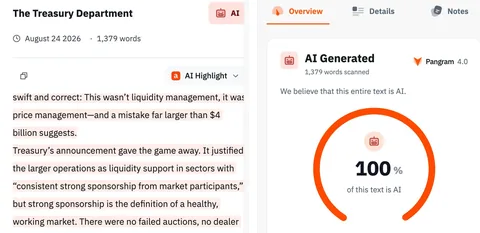 Wall Street Journal piece?
I read the discussion about it—the reaction to it—but I didn't read it. Was it very sloppy?
I don't think it was sloppy. I loved it. To me, it was a nice counterexample. I have this allergic reaction—
How many "it's not X, it's Y"s46"It's not X, it's Y" — a construction that, along with heavy use of em dashes, is considered a telltale sign of chatbot-written text. were in there?
I don't think there were any.
Okay, okay.
But it does show up as 100% AI in Pangram.
Okay. And dashes?
I think they're okay.
You can't do that.
But it was a nice counterexample to me, because normally I read something that's clearly written by AI and I just have this allergic reaction. Whereas with the Stan piece, I didn't. And I'm not sure how much of that was just, you know, it's Stan, therefore I trust in Stan, versus—
No, but it is psychologically weird, because I'll read these X articles and I'm now doing 2x the amount of work to read them. I'm reading it, one, for the substance, and I'm also reading it, two, for the calculation of: did the person write it, or am I just literally reading a Claude prompt? And then my mental processing is: does that upweight or lower my judgment of the person or the post? I think we're in for some weird times because of this. I would hate to be a college professor. I would totally quit, because you're just like, I don't know anymore what you did.
It does seem like the calculator is the closest analogy, though.
Yeah, except that was more finite in terms, and you still had to piece together so many more things. Some of these analogies are breaking down—"it's just a task"—because at some point this thing is doing at least ten tasks at once. But yeah.
07The Box Agent harness and evals
Box's own agent, tuned to its search and file system, is more accurate and faster than outside agents given the Box API.
Let's talk about harnesses.47Harness — everything around the model in an agent: the set of tools, system prompts, the think–call a tool–check the result loop, data access. The same model can perform noticeably better or worse in different harnesses. How does the Box—
Transition to harnesses. Okay, speaking of calculators, let's talk about harnesses.
This is back to the neolab, applied-layer thing. There's a bunch of things that we know about our file system, our permission structures, our search engine. And by all means, we'd love all the labs to train on our understanding of this, because it would only make external agents as good as possible. We always talk to labs like, hey, we'll give you as much data as you want about how the system works. But that aside, we have a lot of depth of understanding of: what do people do in Box? How do they search Box? When they look through ten files, how do they decide which is the one to pick? What is their internal calculus or heuristic for figuring out the most relevant document to look at?
We know all of that, and we've built an agentic harness that attempts to understand that set of domain understanding about our system. It obviously has access to our search system, our file system. It has a bunch of mechanisms for pulling out just the text of a document, pulling out chunks from the document, doing embeddings48Embedding — a representation of text as a vector of numbers in which passages with similar meaning end up close together. Semantic search is built on embeddings: it finds chunks of a document similar to the question in meaning, not just in wording. on the document on the fly. So there's a set of tools it can use, and effectively it's a harness for asking questions of a large data set.
In my Box account, I have—I don't even know the latest number, but on the order of tens of millions of files, just because it's everything that has ever accumulated over 20 years. I can now ask any question of all that data using the Box Agent, and it goes around, it does multiple searches in one, it ranks them, it very quickly pulls out the most relevant information, and then in some cases reads the full document. It does all the steps. Then we compare that against, well, what if we just gave Claude our API, or gave OpenAI our API? And we see meaningfully better results on accuracy and latency, because we know exactly how to tune it for our workflows. So that's effectively the harness we built out.
And then what evals49Eval (from evaluation) — a set of test tasks with known correct answers, used to measure how well a model or agent does a particular job. Widely used public evals for comparing models are called benchmarks. matter the most to you?
I have a couple of funny personal ones—I just keep track of my own use cases. But we have, I don't know, hundreds of different tests that we do on every single model. We actually have two evals at the moment. One is we put out a thing called the complex work eval, which is a set of domain-specific work in life sciences, financial services, public sector, tech, etc. It's exactly what you'd think of as a document-centric eval: given these five documents and this set of problems, what would your answers be? We test every single model against those with our agent. And then we have a holdout eval50Holdout — tasks kept separate and never used while tuning the system. Otherwise an agent can be quietly fitted to the test and score better on it than it does in real work.—actually, the first one is holdout also—but the second one is just our Box instance and how Box employees use their data. We eval every model again on that.
So we're able to roughly keep track of all the incremental progress. We see when things move by half a point in terms of model improvement. Then we roll out default models based on different cost and accuracy thresholds, and we let customers choose any model they want from, effectively, our model garden.51Model garden — a catalog of models from different developers on one platform, from which customers pick the one to use. Model Garden is, for example, the name of such a catalog in Google's Vertex AI cloud platform (renamed Gemini Enterprise Agent Platform in April 2026).
08The model race
Models on Box's workloads are neck and neck and largely track coding rankings, and most customers stick with the default.
What's your current view of the race and where all the horses are in terms of model performance on your use case?
They more or less closely correlate with code, with one exception, which is that in some of our use cases, Gemini is disproportionately better than what you would see from coding. It might be just better tool use52Tool use — a model's ability to call external tools (search, code, other services' APIs) and use the results. It is a key skill for agents.—given the Gemini ecosystem and what they need to build for, it solves a strong set of general knowledge work use cases as well. But I think mostly correlating to code.
So Fable 5.153Fable — a line of Anthropic models: Claude Fable 5 came out in June 2026 and Fable 5.1 in September. was clearly state of the art and the best model that we've seen. There are obviously rumors about other models, so we'll see how the race continues on this front. But by and large, when you look at GDPval, Mercor has their APEX eval54GDPval — an OpenAI eval (September 2025) built from real work tasks of professionals in 44 occupations in the industries that contribute most to US GDP. APEX (AI Productivity Index) is a similar index from Mercor, a startup that hires experts to prepare data for AI labs, with tasks from investment bankers, consultants, lawyers and doctors.—these things will all generally follow the coding models. And so I think we're just neck and neck on Grok, Muse, the Fable class, and GPT-5.655Grok — Elon Musk's xAI models. Muse — models from Meta Superintelligence Labs; the first, Muse Spark, came out in April 2026. GPT-5.6 — an OpenAI model family announced on June 26, 2026 (opened to all users on July 9): the flagship Sol, Terra and Luna.-slash-whatever they're building next. It's a total race right now.
And do your customers typically express a preference on which model they want to use, or do they just use your default?
By volume, they use our default, because it's just easy and it works extremely well and it's tuned. There are a few ways our agent manifests. The way you'd most commonly experience it as an end user is you'd just be searching and asking questions of your data. But by volume, the volume of tokens tends to go through more of our workflow agents or data extraction. That's where you actually have customers doing evals, and they're basically saying, okay, I want to make sure that at this cost profile, I can get 98% accuracy on data extraction. That's a place where we'll have an FDE that goes in and helps you understand your data environment and test against five different models. And then you're basically at the mercy of the eval.
09Open-weight models in the enterprise
Enterprises pick open-weight models partly for fashion and as a hedge, but mature workloads will move to them for economic reasons.
What are you seeing in terms of the adoption of open-weight models in your customer base?
Probably higher than people think, lower than what enterprises actually want, and much, much, much, much lower than what it will be in five years. Some mix of that would be the message.
And it's primarily cost that's driving that decision?
I have to probably attribute 30-plus percent to just the sexiness of—
"I want to try GLM.56GLM — open language models from the Beijing company Zhipu AI (Z.ai outside China)."
Yeah. I think there's that. I've heard CIOs of Fortune 500 companies57CIO (chief information officer) — the head of information technology. The Fortune 500 is Fortune magazine's annual list of the 500 largest US companies by revenue, published since 1955. say, "We're playing with open source here." And I look at that and I'm like, well, I know for a fact that Gemini or Muse would have been just fine at that particular cost profile you're trying to hit. Or probably even GPT-5.6 Luna or Terra,58Luna and Terra — GPT-5.6 models a tier below the flagship Sol. On July 30, 2026, about three weeks after GPT-5.6 launched, OpenAI cut API prices for Luna by about 80% and for Terra by 20%. or whichever one had the crazy discounting they just did. It probably would have been totally fine. But you want to be able to be like, okay, I'm a little hedged. It's cool. We're at that phase still.
Over time, I think it stands to reason that you'll see meaningfully different costs, because you'll be able to peel off workloads that only make sense when you're grinding down to the cost of inference, in which case open weights will have the economic advantage. Right now there's this challenge where sometimes it's more token-inefficient. Sometimes, randomly—I've heard stories—it'll just speak Chinese mid-chain.59Language mixing — a known quirk of reasoning models: midway through a chain of thought, a model may switch to another language. In DeepSeek's paper on R1 (January 2025), the authors wrote that the preliminary R1-Zero mixed languages and that they added a separate reward for reasoning in a single language when training R1. So you're like, okay, well, that'll be weird for a bank. We need to work on some of those things. But long term, I think it has to be the case that you're going to peel off those workloads.
One of the more interesting posts on this, that I totally subscribe to, is Jesse at Decagon's.60Jesse Zhang — co-founder and CEO of Decagon, a startup that builds AI agents for customer support. His post "Everyone is wrong about open source AI in the enterprise" came out on July 9, 2026; its main argument is that frontier labs will keep opening up new use cases while open models take over more and more production work. The post. You probably read that post—this paradox where you're going to see closed continue to go exponential, but what's going to happen is each use case that matures, you can peel off to open source. Once you have stability in that use case, it starts to make sense to veer it toward an open-weights model, assuming one of two things is true: one, that it's actually literally cheaper, or two, having some post-training61Post-training — training a finished model further on your own data and tasks after the main training run. With open weights you can do it yourself; with closed models, only within the limits the lab allows. gets you X percent more performance.
So I think you will be in a reality where—and this is going to be very confusing, probably for the press more than people in the Valley—you'll be like, wait a second, the revenue of Anthropic, OpenAI, etc. is off the charts, but somehow open weights is also growing exponentially. And you're like, how is this—
The pie is growing so fast.
Yeah. And it's like, the pie is growing so fast, but what's happening is actually there's an interesting duality. It's not even just "rising tide lifts all boats." It's like, no: we either use Fable or 5.6 for orchestration62Orchestration — a setup in which one "conductor" model breaks a task into parts, hands them out to other models or agents and assembles the result. and then farm out all these long-tail tasks63Long tail — the many rare and varied cases that are small individually but huge together. Chris Anderson popularized the term in a Wired article (2004). to a cheaper model. Or the opposite is true—you have some orchestration agent that by default does the cheaper stuff, but occasionally sees something that is just way too hard and pops it out to one of these heavier models. So you might have a blended 50% spend on each, but ten times the amount of tokens on the open-weights model. Everybody's winning, but there's an interplay between why they're winning.
10Memory, continual learning and weights
Permissions make it hard to bake company knowledge into the weights, so you need a rubric for what goes in the weights and what stays in context.

I'm curious how you think about memory and customization or personalization, and where that's going to go. It seems like today the dominant architecture is still RAG-based systems.64RAG (retrieval-augmented generation) — an approach in which, before answering, the system finds relevant documents and puts them into the model's context, while the weights themselves stay the same. You can get fancy on the RAG, but it's still context lookup, where the weights themselves65Weights — the billions of numerical parameters of a neural network in which everything it has learned is "recorded." Training means adjusting the weights; with RAG they don't change, only what the model is given as input. aren't fundamentally changing. If I listen to my friends at the labs, there's continual learning66Continual learning — when a model keeps learning after deployment, updating its weights from new experience. The main difficulty is not losing what it already knows: neural networks are prone to "catastrophic forgetting."—this idea that the model's weights should adapt as it gets to know you. We had Engram67Engram — a startup that teaches models to "remember" a team's knowledge by fine-tuning their weights. The Training Data episode with its co-founders Dan Biderman and Jessy Lin, "Memory and Continual Learning," came out on June 24, 2026. on the podcast. I don't know if you know Dan.
I just got introduced to him. I listened to the podcast. I would have loved to have been the fourth person in the room.
Amazing. I think they're working with customers to help bake some of the context into the weights themselves. What direction do you think this is going to go?
You're catching me right before I actually do my call with Dan, so I wish I could have talked to him first, and then I'd have a way more eloquent answer. I'm extremely fascinated by the approach. I have no reason for not wanting it to work and exist. We live in a world at Box where we see this high degree of complexity on permissions and access controls and data that tends to be the rub on a lot of these types of approaches. And I'm going to put them aside, because I'm sure they've already thought this through. So I'm going to talk more generically, philosophically.
I think sometimes you will talk to a researcher who imagines the world working the way they work, which is: I'm a researcher, I have access to everything. So if I had a model that was trained just on my world, this would be amazing. And then you're like, let me introduce you to a lawyer. The lawyer has this tiny little access point of just the five projects they're working on, because somebody one door over is working on the competitive project for another company in the space, and they can't have any overlap in what they see or what they know. There can't be a single document that passes between those two walls. They have to be hard barriers.68Ethical walls — in law firms and banks these partitions are called ethical walls or Chinese walls: teams working for competing clients must not share documents or information, or there is a conflict of interest.
So, sure, you could still train a model just for that one user. But what happens if every single day they get added to or removed from something that adds important context to what they need to understand? Again, I think there are probably going to be breakthroughs in continual learning that resolve all of this. But this is why previously there was no way you could pull this off five years ago—it would be insanely expensive, impossible to wrap your head around how those access controls are supposed to work. But obviously, as the cost curve goes down, as open weights get cheaper, smaller, faster, better, I think this becomes super interesting.
ExplainerContext or weights: how a model learns a company's data
- In context (RAG). For each request the system finds the relevant documents and hands them to the model; the weights don't change. Updates show up immediately, and permissions are checked on every search, so an employee only gets what they're allowed to see. The weak spots are context size and search quality.
- In the weights (fine-tuning). The company's knowledge and style are baked into the model itself: answers are more accurate and cheaper, with no need for long context. But the model can't selectively "forget" a document for one user: whoever has access to the model has access to everything in it, and every update requires retraining and risks forgetting what was learned before. Small adapters (LoRA), trained separately for a team or customer and plugged in on the fly, partly solve this.
- Continual learning is the bet of Engram and other startups: the weights adjust as the model works with the data.
Hence the rough rule Levie is looking for: what changes rarely and everyone needs goes into the weights; what changes fast or sits behind permissions stays in context. The extreme version is Karpathy's "cognitive core": only ways of reasoning in the model, all facts in search.
One thing on the podcast that I found very fascinating—and I just need a T-chart, honestly—is: what is the decision point of what goes in context and what goes in the weights? You have to be a little bit thoughtful about where the massive performance gain is that you get by baking it into the weights. There's probably some incredible calculation, like: when the rate of change of the data is not that high, but the upside of the weights dramatically changes the accuracy of the model. You'd have to land on some sort of rubric like that.
If you could wave a magic wand—I think Karpathy69Andrej Karpathy — an OpenAI co-founder and former director of AI at Tesla. He has repeatedly talked about a "cognitive core," a small model stripped of memorized knowledge but keeping the algorithms of thinking; for example, on the Dwarkesh Podcast in October 2025. said this in some prior interviews—if you could almost remove all the memorized information from the models and just have it encapsulate the specific reasoning capabilities, like the ethos of how we do things, for example, at Sequoia, and then you have all the actual content in a lookup system. If you could wave a magic wand, that almost feels like what the system would look like.
That one's super interesting. I think the question will be: how much are enterprises different at that level, versus it's actually their literal IP that makes them different? How many different styles of execution are there in the world, versus, no, it's the depth of knowledge about that particular legal case, and how do I apply it to this other project I'm working on? That's where so much of the value sits.
But again, if you can just wait till my Zoom call with Dan, then I'll really know the answer. I'm a fan, because no matter what—I've jumped right into the individual, but at a firm level there are probably ways to take this approach. I'm a big fan of what Trajectory or Applied Compute or Prime Intellect70Trajectory — a startup from Ronak Malde, Michael Elabd and Arjun Karanam: a continual learning platform on which deployed models keep training on users' edits and corrections. Applied Compute was founded in 2025 by former OpenAI researchers and builds specialized enterprise models based on open ones. Prime Intellect develops distributed training of open models. are doing, because there's no question that if you're Eli Lilly,71Eli Lilly — American pharmaceutical company from Indianapolis (founded in 1876), maker of the diabetes drug Mounjaro and the obesity drug Zepbound. In November 2025 it became the first healthcare company worth more than a trillion dollars. you want a model for how you do drug discovery. That probably does need to go farther or deeper or be more specific than what you're getting off the shelf. And there aren't a lot of church-and-state problems for drug discovery workflows. They probably want as much of that information available to as many people as possible. So I think it's going to be domain-specific. You're going to have different outcomes based on which vertical or type of use case, and where the firewalls need to be in that process.
11Box Labs and systems of record in a world of agents
A SaaS company has to both build the best agent for its own system and open that system to outside agents, while Box's applied AI team hunts for extra points of accuracy.
Okay, so you hinted at the beginning that there's a Box Labs. What type of work is Box Labs doing?
It's the equivalent of Box Labs—I don't know if we've used a capital L yet—but basically, it's our applied AI team.
And what research areas are most interesting to your team right now?
On the continuum of engineers, there's some cluster that is more on the research bent, and of that cluster, the things we spend time on are, again, at the applied layer. But it's a lot around: how do you take agents and get another ten points of accuracy improvement given X problem? How do you build a map of the problem set, with a given set of data, to best execute on that task? We spend a lot of time on that style of work.
We have a team, for instance, working on how you do, at the agent level, at the harness level, some form of autoresearch72Autoresearch — when an agent runs experiments on its own: it changes prompts, tools and settings, runs the eval and keeps whatever improved the result. on hill-climbing accuracy73Hill climbing — an optimization method in which a solution is changed in small steps and every change that improves the result is kept, like feeling your way up a hill. In AI jargon, to "hill-climb" an eval is to raise your score on it step by step.—answering questions or sets of problems on a given set of client data. If you're a bank and you have a bunch of loan documents coming in, and these are 100-page documents, whether you're getting 70% accuracy with an off-the-shelf model or 97% is, obviously, a world of difference in whether you can actually automate that process. So somehow you have to hill-climb from the base model to the 97%. There's a lot of work going into the system to pull that off.
Maybe zooming out—and this can be a Box question or a non-Box-specific question—the role of systems of record in a world74System of record — the core system where a company keeps its authoritative data: the CRM for customers, the ERP for finances, the HR system for employees. with agents. I'm sure you saw some of the Twitter discourse: every software company is trying to sell me their own agent right now. I don't want another agent from them. I want their system of record to work well with my agent. How do you think about that?
Hashtag Claudeforce.75Claudeforce — the expanded Salesforce-Anthropic partnership announced on August 26, 2026, a few hours before Salesforce's quarterly earnings: Salesforce data, workflows and actions became available directly in Claude. The ad starred Matthew McConaughey, the longtime face of Salesforce's campaigns.
Such a catchy name, by the way. Very catchy.
It's one of those things where for the first three minutes you're like, man, that seems funny. And then four minutes later, especially when you see the stock, you're like, brilliant move. This is great. We're doing this. And then—I think somebody said this best—when they heard Matthew McConaughey say it out loud, that sealed the deal.
That was the moment.
That was the moment. I was like, man, he can sell software. His voice is so good for selling systems of record and agents.
If you're in our contemporary group—you built a SaaS platform,76SaaS (software as a service) — software used over the internet by subscription instead of being bought and installed locally. Box and Salesforce are classic SaaS companies. and you have some set of data and workflow that your customers operate in—there are effectively two things you just have to do, and I think anybody attempting to do one over the other is going to lose. You have to build an agent that is insanely great at your product. That agent has to be provably 10 or 20 points better than an off-the-shelf agent at using your system—not because you've hobbled the other side, but because you are so eval-maxed77-maxed (from "maxxing") — internet slang for pushing something to the limit. Later Levie says "we don't token-max," meaning Box doesn't race to burn the most tokens. and so tuned to your particular workflow that you can improve your system. You have to have that. And because you understand your domain, unless you're totally asleep at the wheel, you probably have use cases that no one has thought to build products around, because you talk to customers every day and you see what they run into and you're like, oh, we could just have our agent do that for you. I probably talk to a couple hundred customers a year in a variety of capacities. I've had at least two dozen times where the customer has a use case that is a breakthrough moment for me, like, shit, that would actually be totally insane.
What's an example?
Unfortunately, since you put me on the spot, I don't know if my example will pay off the level of excitement I just had.
I'll put you on the spot.
The thing I was thinking of—I think it's going to be a womp womp for the podcast—but there was a customer who had this idea: they wanted an agent in the background figuring out when documents met their governance policies.78Data governance — a company's rules on what data is kept where, who may see it, how long it is retained and when it is deleted. A head of governance is responsible for them. Does something need to go into some kind of archive, or into some kind of legal hold,79Legal hold — a company's obligation to preserve all documents relevant to a lawsuit or investigation and delete none of them, even on the usual schedule. or whatnot? And see—exactly. That's exactly the voice I was worried about. You couldn't even pull it off. But in our world, this is awesome, because think about it: every company has a head of governance.
I meant that sincerely.
Okay, no, I believe you. Listen, you do enterprise, so I think it was at least half serious. Imagine you're an enterprise. You have a head of compliance and a head of governance. They can only oversee the whole enterprise. They've never been able to be everywhere at once. Now imagine if they could sit next to the employee and be like, oh, you're about to do something that breaks our governance policy. The idea was: what if there was just an ongoing agent that automatically said, nah, that's going to break your governance policy—instead of the user having to try to predict or understand this stuff.
Anyway, those are the kinds of things where, if you have an agent within your product, you're going to be able to identify them sooner and better than the rest of the market, and/or do things that maybe would be impossible to do off-platform. On the other hand, obviously you have to go headless.80Headless — a product without its own interface whose capabilities are available to other programs through an API. Here, so that outside agents like Claude and ChatGPT can work with the system directly. You literally have to make sure that your APIs are exposed to Claude and ChatGPT and all the different platforms, and you have to make sure you have either a direct way into deterministic APIs, so those agents can use your APIs and make calls via MCP81MCP (Model Context Protocol) — an open standard Anthropic introduced in November 2024 that lets AI agents connect to external services and data. or whatever, or at least make your agent headless and exposed in those systems.
The only reason this is even remotely a hard debate is you have to make sure, as a system of record, that you can find a way where commercially it makes sense on the other side and is valuable and interesting. The reason I think a lot of people who weren't in these companies got that wrong was underestimating the amount of new use cases that are just total upside—complete white-space opportunities for these systems of record. In the Salesforce example,82Salesforce — San Francisco company founded in 1999 by Marc Benioff and partners: a cloud CRM, a system for tracking customers and sales, plus other enterprise software. I use Salesforce more today, probably by an order of magnitude, than I ever have, because I MCP into it via Claude or ChatGPT. I'm always asking questions about the data inside of our CRM system.
Do you think that means the systems of record become more tollbooth businesses, then, to make sure they're capturing the opportunity?
I don't love that term, because no one's had a good experience at a tollbooth.
I love tollbooths.
Yeah, exactly. You love it more than governance agents. I would say that because they have a depth of purpose—organizing the workflow, managing the data, securing the data, providing guardrails—then, yeah, you have to have some kind of volume-oriented business model on that other side. And I just think if you're solving real problems for customers, it'll make money. This is so cheesy, but I've told LinkedIn product managers I'd probably pay 10x more for LinkedIn if I could just MCP into it—if I just had a way of always understanding, okay, the CIO is doing this thing and I need to reach out, or whatever. Take my money. So these systems actually have a tremendous amount of value based on the data they have, and customers will absolutely find some way to reward you for that value creation if you're doing the job.
12Will chat be the main interface?
Chat will stay, but most agent work will move into the background.
Super interesting. Maybe related—let's talk about product UI. The big generic chatbot, chat box, agent: is that going to be the dominant UI for how people use AI in the future, especially when it comes to the application layer?
This is why I think the applied layer has so much room to run. The universal chat system that you ask a question to and get an answer back, or it does some work in the background—that's going to be a mainstay. That UI will always exist. It'll be incredibly powerful. The horizontal products will have it, the vertical products will have it, everybody will have it. It's just like your product has a search box—obviously it does. So that's always going to be here for these one-off asks of an agent: go find this thing, answer this question, produce something for me on demand.
But most of the enterprise is made up of processes and workflows that are happening behind the scenes. Sometimes they're happening with computers running these things. Sometimes they're happening with other people doing these things. Sometimes they should be happening with people, but you could never afford to have them happen with people, so they just didn't happen. That's a slightly different metaphor than a chatbot where you ask a question and it comes back with an answer. It's more like, okay, I want agents in the background to do things for me. Read every contract. Look at every log. Triage every security incident. And then, instead of me chatting, maybe I'll chat as a means of catching up. I want a dashboard. I want a workflow. I want a queue. I want a task list.
So then the challenge becomes: does the horizontal product take on every one of those components and manifest every one of those experiences in one? In which case, I think you'll start to be like, man, that thing is pretty heavy. And then we'll start to be like, oh, this is no longer the simple, easy, delightful thing anymore. So then the vertical players, who actually understand the process, can manifest all the right buttons and tabs and names of things for that particular workflow.
As you have agents doing more work in the background, doing more async work—I've farmed out a bunch of agents to review things as they happen, or whatnot—that leans more toward the applied companies that understand those workflows and those processes. I think you're going to have these in every field. We already know how they're going to look in legal, with Harvey, Legora,83Harvey (founded in 2022 in the US) and Legora (founded in 2023 in Stockholm) — AI platforms for lawyers and law firms. etc. We're seeing them start to emerge in areas like security. We've seen them emerge in the long-running coding agent, with Cognition and Factory.84Cognition (maker of the Devin agent; bought the Windsurf code editor in 2025) and Factory (its agents are called "droids") — startups building AI coding agents. So I think that will be one of the bigger applied AI use cases. Ultimately, five years from now, I would bet 90% of all tokens in the enterprise are things a user never kicked off and they just see a result. They see a task show up and they have to review it. It's just happening.
13Why coding diffused fast and everything else hasn't
Code is almost perfectly suited to automation, while the rest of knowledge work runs into outside constraints, scattered data and permissions, so diffusion will take much longer.
Source: Anthropic Economic Index, September 2025 report; occupational groups follow the US Labor Department's O*NET classification
Makes sense. Okay, let's talk about AI diffusion. Coding agents—it was like, boom, January 1st, 202685The date is loose: the coding-agent breakthrough came around the turn of 2025–2026, shortly after the release of Claude Opus 4.5 (November 24, 2025), which Anthropic called the best coding model in the world. happened, and the fastest diffusion of anything into the economy we've ever seen has happened. The diffusion of the rest of the AI magic into the rest of our jobs seems like it's been a lot slower. What are your thoughts on that, and where are the areas where you think we're going to see faster diffusion, and how is that going to happen?
You always have to compare and contrast coding versus everything else to really understand the dissimilarity. In coding, essentially—and this is back to the utility point on slop—the utility of code is almost 100% represented by the amount of text that you can generate. Obviously, an insane amount of value went into the text, in knowledge and expertise and meetings and everything. But ultimately, the text is the thing that produces the program that is actually the thing you're trying to do. If you could have the world's greatest programmer who never had to sleep, never had to eat, could intuit what to build, and could just sit at a computer all day long, your value creation would be 100% correlated with how many hours they could sit at that computer and type lines of code. Ideally, good code is the thing most correlated to whether you produced software that people wanted.
So it's all text. The models are hyper-trained on it. Everybody in AI labs treats coding as a competitive benchmark to constantly try to exceed. They get to do their own evals on it every single day, because they are the ones coding the models themselves. And it's the most technical audience of all time, where when they deploy an agentic system and run into a bug, or a problem, or some MCP server comes back with "connection invalid," they fix it. They know how to triage the problem. They don't call IT. They're just like, oh yeah, I didn't open up that port. Sorry, I'll fix it. So that's five things. Oh, and maybe the sixth: it's a very, very high-paying vertical, so it's automatically valuable. If you could get a 10% or 20% productivity gain, let alone a 5x productivity gain—
So take those five or six things that coding has as beneficial properties for automation, and compare that to every other form of knowledge work. You'd probably have a histogram—I don't know if anybody's published this; maybe you can—of the similarity to coding, and what the domains are that start to look less and less like coding as you scale out. And lo and behold, legal is interesting, because there's a lot of value creation from somebody sitting at a computer reviewing legal documents, writing legal documents, processing large amounts of information. Okay, so that's blowing up.
Then you go down the list. Now take something like a sales rep—so much farther down the list in terms of likeness. The sales rep's value creation is basically convincing an external customer to buy software or technology or a Caterpillar truck from them. That is the value creation to the economy of the sales rep. Let's say we brought the world's best automation to them. First of all, again, they'd have to figure out how to technically wire it up. They'd have to make sure they give it all their data, all these kinds of things. But no matter what, they're still rate-limited and constrained by: did the customer respond to them? Do they want to meet? Can they meet next Tuesday, or can they meet today? Does the customer have budget? All these other things.
So that's maybe the entire continuum of knowledge work—and obviously this is not even touching working with atoms.86Atoms — in Silicon Valley, "atoms" is the physical world (factories, construction, logistics) and "bits" the digital one. Nicholas Negroponte popularized the contrast in "Being Digital" (1995). On one end, you have somebody rate-limited by so many external factors. On the other end, you have somebody who could sit at a computer all day long and just type text. Your ability to automate things is that continuum. For the real world, we have to bring intelligence to these workflows in ways that somewhat feel like the shape of their work, and then find a way to deliver the change management, deliver the implementation, and get data into a format and into an environment that actually works with these systems.
Asterisk: one of the other big things is, if you go to most engineers in 2026—maybe minus two months ago, given the latest phenomenon—the code's in GitHub. You just connect it to GitHub. Remember, there was this period where when you launched a coding agent, there was no sign-up or register. It was just, give us your GitHub. That doesn't exist in knowledge work. There's no "give us your GitHub" for knowledge work.
Give us your Box.
Well, Box customers have a much easier time with all of this, unfortunately. We're only $1.3 billion in revenue run rate,87Revenue run rate — the latest quarter's or month's revenue multiplied by 4 or 12. For scale: Box's revenue for 2024 was $1.09 billion (Wikipedia, "Box, Inc."), while Salesforce's is dozens of times larger. so that means there are a lot of people not using Box. What are they using? Their data is in on-premises systems, legacy file shares, legacy infrastructure, enterprise environments that don't talk to agents particularly well. So just think about that distinction between implementing coding agents versus everything else.
Even something you'll fall asleep about: access controls in the enterprise are totally different. I actually totally forgot that point about coding. In coding, you get access to basically most of the stuff ever relevant for your job. In knowledge work, you're like, hey, Sally, can you open up that file share for me? Can you open up that project, because I didn't get access to it? How do you make sure the agent has access to that set of things? All of that work has to get done.
So the thing I think we have to prepare for is two things. One, Silicon Valley has to prepare for diffusion taking a lot longer than they think. Or than we think—but I really think they, because I know how long it'll take. And the second thing—the good news—is this is all correlated to applied-layer value creation. The companies that will have the patience, the full domain expertise, the sheer work ethic—because it's not like everybody's just coming through the floodgates; you have to pound pavement and get out there—that will be the applied layer. So I think this actually represents $1 trillion of applied-layer AI value: how do you get the technology to the lawyer, or to the sales rep, or to the life sciences researcher, or to the person who runs the customer support team? That's all opportunity that exists right now.
14Staying current, AI inside Box, and what it takes to win
Right now the winners are the ones who can get a product into the enterprise, and Box is rebuilding around AI on the strength of having all its documents in one place.
Awesome. I'm going to close by asking for some advice for other founders. Let's start with founder advice, then company-building advice. On the founder side, it seems like you are in every AI cap table88Cap table (capitalization table) — a table of who owns how much of a company: the shares and options held by founders, employees and investors. Levie invests in AI startups as an angel.—every cool new company, like Engram. How did you get yourself in the middle of the AI conversation?
There are probably two parts. One, I was just very well primed for it. Working with unstructured data for 20 years, you can instantly see the benefit of agents on that. Honestly, it took longer than I would have wanted for us to get to have this conversation, because we tried to have this conversation eight, nine, ten years ago, and now it's finally happening. So first of all, just super well primed. Our product's shape, and what people do with our product, already lends itself extremely well to agents. Obviously, we had to bet the company on that. And lo and behold, we had the positive feedback loop of customers actually saying, yeah, that would be very powerful if I could read every document and answer any question. So that's the first, and certainly the biggest, by a factor of ten. And then the other is just that I'm extremely fascinated by the technology, and it's fun.
Where do you learn about it?
Your podcast. The Dwarkesh Podcast.89Dwarkesh Podcast — Dwarkesh Patel's podcast of long interviews about AI, history and science; guests have included Ilya Sutskever, Andrej Karpathy, Satya Nadella and Mark Zuckerberg. Twitter. Unfortunately for brain cells, it's probably 95% Twitter. I have a routine where at the end of each night, I just go through the feed. I probably look like some sad meme, just scrolling and scrolling and scrolling and attempting to triangulate all the information.
That's amazing, because it is the global town square90Town square — a nod to Elon Musk: in 2022, before closing his purchase of Twitter, he wrote to advertisers that he wanted the network to be "a common digital town square" (Wikipedia, "Acquisition of Twitter by Elon Musk"). for AI.
It is. And I want to send an emergency alert to everybody who's a sophomore or junior in college and just be like, follow these 20 accounts on Twitter—and also join Twitter—because this will just help your career. You're either a year ahead or a year behind simply based on your feed. And my feed is so wired in.
This is the number one advice I give to people when they're asking how to get current on AI. Follow these 100 accounts.
But unfortunately, first step: join Twitter. You'll still talk to 20-year-olds that are like, "Yeah, I see some articles," and I'm like, what do you mean? How do you see articles? I don't even know what that means. Do you just get lucky that somebody emailed you an article? Just join Twitter. What are you talking about? So you just have to be wired in. I enjoy it. It's a lot of fun. I play with everything.
What's your favorite new AI product? Please say Instinct.91Instinct — a personal AI assistant you talk to by text message, with no separate app. In September 2026 it was invite-only.
Okay, full disclaimer: I have not done the Instinct invite code yet, simply because I have a backlog of three other personal assistant products.
You gotta try Instinct.
I know. Everybody's—I'm very excited.
And I'm not an investor, so—
Oh, you're not? Okay, so this is totally genuine. Okay. I 100% will have—I don't know when this is going to run, but I'm sure I will have played with it by the time it runs. I'm in pre-release on a couple right now that I'm spending some time with. I think the personal assistant stuff is super exciting. At least in some of my use cases, it's still showing some of the limits of browser use,92Browser use — when an agent drives a web browser itself: opening pages, clicking buttons, filling in forms. It is still slow and unreliable, which is why Levie wants services to have a CLI. as an example. We still have some work to do there. Probably the entire internet needs a CLI93CLI (command-line interface) — controlling a program with text commands. For LLM-based agents this is far easier than clicking around a website. for their product. So there's still some blocking and tackling at the infrastructure level for these things to be totally awesome.
And then I look like your average AI-pilled knowledge worker: every day I'm asking one of five different AI systems 20 to 30 questions—doing research, looking for talent, looking for what a competitor is doing, what's happening in this market, how do you expand there. So kind of that.
On the company-building side—you're a 20-year-old company at this point—what's your advice for other people trying to reinvent their companies to make sure they have max adoption of AI, not just at the individual level but at the company level? How do you make your business legible for AI?
Some of this we have as a byproduct of how we've always thought about information systems in the company. To no exaggeration, if you have a question you'd like to ask about the business that has ever been documented in a form of unstructured data—a meeting note, a project plan, a roadmap, a presentation, a financial document, a financial planning session—it's 100% in Box. We benefit from a data architecture that is already insanely tuned for this, because this is how we've run the company. We didn't let anybody use anything else. So the data is very easy for us to work with at scale. And then, of course, we have Salesforce and all the other core canonical systems, and we've been able to have, I think, pretty good data hygiene. So agents running on top of that makes it a little bit easier to be AI-first94AI-first — modeled on "mobile-first": a company that designs its processes and products around AI before anything else. Google's CEO Sundar Pichai, for example, set the goal of making Google an AI-first company. in how we operate.
Maybe a couple of best practices or things we've seen. First of all, trying to figure out where the highest-leverage-impact workflows are going to be, and targeting those. Our CIO's very AI-pilled. We have a bit of a center of excellence on AI. We've hired some internal AI PhDs to help with these processes.
Do you have leaderboards?
We don't token-max. We do actually have—literally, we have a list of people by number of tokens—but it's usually to inspect: okay, do we think that's useful, or is there a learning there that we should take back to some other function? Of our top three AI users at Box, probably one of them is wasting half the tokens, and two of them are like, oh shit, whatever they're doing, we need to do an internal training session for everybody else. We had this thing two weeks ago where I was like, can you just get everybody in a room on this particular team and show them how this one person is using AI? And six hours later, they were in a room and the guy was doing a full demo of what he was doing. Shout-out to Mick. That's the kind of stuff we're trying to do—how do we show everybody what it looks like to work in this way?
But for as fast as we're moving—and we're shipping, at some parts of the stack, two or three times more actual customer-facing product; I don't care about how much code, but did we actually deliver more functionality that customers are asking for? Some parts of the stack, we're doing that—but then you'll talk to a friend at Anthropic, and you're like, oh my God, we still have a ways to go. The particular meta95Meta — gamer jargon for the set of most effective tactics at a given moment. Levie means how fast the "right" way to work with AI keeps changing. constantly changes. Two years ago, you'd be like, you're just using a plugin in your IDE?96IDE (integrated development environment) — a code editor with built-in tools, such as Visual Studio Code. The first AI coding assistants were installed in it as plugins, while Cursor is a whole development environment with AI built in, made by Anysphere (founded in 2022; owned by SpaceX since August 2026). We're not ready to fully be AI-first. And then, okay, everybody roll out Cursor, and everybody rolls out Cursor, and that finally happens. And then you're walking around and you're like, you're not only working from Slack, just at-mentioning bots doing your coding? What are you doing? We're constantly changing what the workflow paradigms are on this.
Do you guys have a Slack coworker agent, for lack of a better term?
We have a few that have that shape. I'm pretty excited about Claude Tag97Claude Tag — Anthropic's agent for teamwork, launched in beta on June 23, 2026 for Claude Team and Enterprise customers, starting with Slack: you tag it in a chat with @Claude and hand it a task. as a form factor. You still have to get the team construct right and the data right. But we have a variety of ways that people work with agents in Slack. I don't know if it's as Slack-pilled as Benioff98Marc Benioff — co-founder and CEO of Salesforce, which bought Slack in 2021 for about $27.7 billion. would like us to be, or as Anthropic or OpenAI are, but we're heading in that direction.
Yeah. I think history books will be written about the art of business in this time. I would love to read the new Art of War99"The Art of War" — the Chinese treatise on military strategy attributed to Sun Tzu (5th century BC), long read in America as a business strategy manual too. with everything that is happening here, because I think it's pretty extraordinary stuff we're seeing. What do you think it takes to win in AI versus pre-AI? What does it feel like to be a founder right now versus when you started Box?
I am both jealous of and also not jealous of the young founders you meet. You're just like, oh, to be young again. The whole world is your oyster. You can go in any direction, and the leverage you have—you'll meet with them and you're like, oh my God. I saw a product a week and a half ago. They did a demo of their product, and I was like, this would have been a 40-person project five years ago—or, especially when we were starting out, easily a 40-person project. And it was two people. You're just like, how do you have so many tabs that work? And they all seem to have stuff behind the tabs that all seem very functional. This is not fake.
So I'm very jealous of that. It's incredible, because you can start your company from scratch with that as the design principle. Now, we will get there, because we're just going to muscle through it. There are a couple of things we just can't do. We're very uncomfortable with the idea of removing the code review, and some of these things get talked about, because our customers can't possibly entrust us with their data security and compliance if we don't take that seriously. So we're always going to have a little bit of a discount on the productivity because of where we are in the stack and what we do as a business. But so jealous of being able to be fresh in that.
On the other hand, at the same time, for every great idea, it's instantly five competitors. We didn't have that problem. We had a good couple of years where we could just grind on our product and our experience. It wasn't like every three days you were like, oh, Sequoia funded this thing, and Benchmark funded100Benchmark — San Francisco venture firm (founded in 1995), an early investor in eBay, Twitter, Uber, Snapchat and Instagram; along with Sequoia, one of the best-known firms in the Valley. this thing. We weren't going nuts with that. Now, we had our own version of that—at the time, I probably was going nuts—but in retrospect, it was not worthy of going nuts. Now it's like, oh man, this is a real race in every one of these markets.
So I think I'm probably pretty consensus101Consensus — in venture jargon, what everybody already thinks. The most profitable bets are said to be non-consensus, so admitting to a consensus view sounds almost like an apology. on this: in a world where AI builds things so much faster, the shift probably moves to whoever can actually get it to the customer being in the best position. It's fun talking to founders who are pretty pilled on that. Scott or Matan102Scott Wu — co-founder and CEO of Cognition; Matan Grinberg — co-founder and CEO of Factory. Both companies build AI coding agents.—they get the mandate. They're just like, this thing is going to be an enterprise diffusion play, so you have to get it to the enterprise. Anybody who mistakes the mandate right now is just going to lose. It's game over. Sorry. There are quite literally trillions up for grabs at the applied layer, and the companies that know how to build the teams and get to the enterprise will be the ones that win. It's obviously guaranteed.
Well said, Aaron. This was a very fun conversation. Thank you so much for joining.
Thanks for having me.


