

Sharp Tech
Chapters
After jokes about it being take three, Andrew gets to the main topic: voters across the country came out against data centers.
Read the chapter- Local measures against data center construction won nearly everywhere, and the exception was North Dakota.
- Some mayors and board commissioners were recalled, which Ben thinks matters more than the votes themselves: now even decisions made without a referendum will be made with an eye on voters.
- Gina Hinojosa won the Texas governorship on a promise of a moratorium until the legislature acts, and that legislature, Ben notes, meets only once every two years.
- Texas, with its gas and its separate grid, was the presumed backstop where everything that couldn't be built elsewhere would get built.
Andrew asks whether the industry can turn sentiment around, and Ben wonders whether it can learn at all.
Read the chapter- The industry arrogantly argued over the facts about water and missed the sentiment.
- As with fake news, misinformation isn't the cause but confirmation of what people already want to believe.
- People are voting against the version of the future they're being sold: with globalization they had no vote, and now they do.
- If you love advertising, you're optimistic about AI, Ben says, but the industry can't show people which of their problems AI solves and treats them as replaceable cogs.
If this is a protest against technology in general, it will last, and the industry will have to pay people off.
Read the chapter- Ben ended his article by saying this issue will be on the ballot from now on.
- Corporate America reduced morality to legality, which leads to regulating everything and cuts off good outcomes along with the bad.
- Amazon's auction for its second headquarters is the model of the shamelessness with which the industry demanded incentives.
- Now local communities will shake down big tech themselves: if tech wants a transactional model, it will get one good and hard.
In the election both parties competed to dislike data centers more, even though they benefit local communities.
Read the chapter- In ads each side accused the other of supporting data centers, and there was no affirmative message anywhere.
- Even Greg Abbott, who had backed data centers, was cowed into opposing them in Texas, Andrew notes.
- Loudoun County in Virginia got rich on data centers and saw property taxes go down, but that's the result of a 30-year virtuous cycle.
- A data center that raises people's electricity prices and demands to be paid for the privilege is doomed.
What happens if the bottleneck holds: construction moves abroad and maybe into space.
Read the chapter- What's already under construction will come online in 2027 and 2028, and the concern is projects from 2029 on.
- Tech companies will go wherever conditions are best, like Google with $15 billion in Malaysia.
- Space means not warehouses in orbit but individual racks the size of a Starlink satellite, and the main challenge is cooling.
- If the bubble bursts, the power generation that got built will remain, after 50 years of power poverty.
Why what would be crazy for anyone else is rational for SpaceX.
Read the chapter- SpaceX treats launch capacity as a given, almost as if it were free, so cellular service and orbital data centers make sense for it.
- Shipping companies run accounting losses for years as long as they cover marginal costs.
- Verizon, AT&T and T-Mobile should fear a competitor that seems to act irrationally.
- For Musk, what matters is growing launch capacity, because the goal is Mars.
The irony is that discontent with big companies actually benefits them.
Read the chapter- Old data centers can hardly be converted for GPUs, but the hyperscalers already have the land, the power and the relationships with locals.
- Cash flow, cheap credit and the ability to issue equity: the hyperscalers have all of this in better shape than Anthropic and OpenAI.
- The AI labs aren't going anywhere, and the question is who will own their equity, perhaps hyperscalers they come to hat in hand.
- An external reason to slow down would ease capex pressure and give revenue time to arrive.
A power shortage reshuffles the picture for Nvidia and for the rivalry with China.
Read the chapter- In a power-constrained world the chips with the most tokens per watt are worth the upcharge, so relative to others Nvidia comes out ahead.
- China isn't short of power, and without CUDA lock-in, Chinese companies will simply build inefficient data centers with more chips.
- China may eventually outbuild the US in capacity, but Andrew, as host of Sharp China, isn't panicked.
- You can build abroad, but after Iran hit an AWS data center in Bahrain, Ben says, customers were told their data was gone forever.
After Alphabet's stock plunge, Ben recognizes Facebook's story in Google's earnings call.
Read the chapter- Shares fell more than 13% on disappointing search and advertising sales.
- Like Stories and Reels at Facebook, a new format first pulls users away from the ads, then starts making money.
- People spend more time on Google in AI Mode, but the ads are still on the old search results page.
- Chatbot ads will work, Andrew says, but the bar is the greatest business that has ever existed.
For Google, search is fuel for the real business: AI infrastructure.
Read the chapter- Ben has been wrong about Google before, and he agrees with Andrew that his benefit of the doubt is a bearish signal.
- Just as See's Candies funded Berkshire Hathaway's railroads, search funds AI infrastructure.
- Google is disrupting search itself, turning it into a chatbot and making it an agent, and Ben admires the gumption.
- Without the infrastructure and cloud bet, Andrew would worry about Google far more.
Search is moving into chatbots, and sites that lived on Google traffic are losing their audience.
Read the chapter- OpenAI says ChatGPT's search-like queries are now a fifth of Google's, and Andrew uses ChatGPT for 80–90% of what he used to google.
- Reddit shares fell about 30%, and Huffman insists it's in line with the strategy.
- Ben sticks to official names, but for Twitter he's willing to make an exception.
Ben returns to his article on the end of the internet as we knew it.
Read the chapter- The single market where scale decides everything is going away, and you won't vibe code an app and sell it to the world.
- One of the best social networks is a group chat: very small and very high-trust.
- Google indexed sites and sent them traffic, but the "Don't be evil" ethos has been chipped away.
- Reddit will have to make money from logged-in users, the 10% who post and respond.
A listener email about software for yourself and your friends.
Read the chapter- John writes about a program for his own work, an app for friends, and an app with the school lunch menu.
- At small scale, inefficiency, altruism and status pay off again.
- Google Play lets you publish apps just for friends and family, while Apple's TestFlight involves a lot of rigmarole.
- AI is a machine gun you can train on your weaknesses, and it's most useful for the secondary stuff.
- AI will multiply one-person companies making $100,000 a year, as Substack did for newsletters.
Quotes
On why Ben believes in AI
“You know, I'm very proud of this one; I might repeat this one every podcast for the next several: if you love advertising, you're optimistic about AI.”
Ben ThompsonRead from 09:14On what "AI will take your job" really says
“Implied in that is: all of you are worthless. All of you are uninteresting to us.”
Ben ThompsonRead from 13:06On how big tech's shamelessness will come back to bite it
“The community shakes down the big tech companies. If you want a transactional model, you're going to get a transactional model good and hard. And you're going to end up paying people off.”
Ben ThompsonRead from 17:59On why SpaceX wants data centers in space
“Starlink and SpaceX is the ultimate hammer-looking-for-a-nail company. They've developed this hammer, incredibly valuable hammer, which is this launch capability, regular cadences, tons of stuff. They need stuff to put in space.”
Ben ThompsonRead from 36:13Ben on his Google predictions
“You should always do the opposite of what I say about Google.”
Ben ThompsonRead from 1:07:51On Google turning search into a chatbot itself
“I think it's kind of amazing, and not what you would expect from a company being disrupted, the extent to which— who's done more to obliterate the search experience than Google itself? Search is basically a chatbot.”
Ben ThompsonRead from 1:09:54On why scale no longer works in the AI era
“But if you're out there being like, ‘I can vibe code, I can make an app and sell it to the world,’ it's like, yeah, no, that's not going to happen. 10 million other people— anyone else can do it.”
Ben ThompsonRead from 1:21:34Ben's advice to MBA students
“AI is like a machine gun you can train on your weaknesses. Take care of all this stuff, so that you can spend more time and attention doing what you're actually good at.”
Ben ThompsonRead from 1:35:52
Summary
The episode was recorded on the Thursday after midterms in which local measures against data centers won almost everywhere and Texas elected Gina Hinojosa as governor on a promise of a construction moratorium. For the industry, Texas was the fallback, with its own gas and its own grid, and now it's gone. Ben Thompson thinks big tech brought this on itself: arrogance, disregard for ordinary people, a single message of "AI will take your job," and a habit of demanding handouts, as in the saga of Amazon's second headquarters. People aren't voting against water and electricity use but against this version of the future, and now data centers will have to buy off local residents in a strictly transactional way.
A bottleneck in construction, Ben argues, plays into the hyperscalers' hands: they have sites, relationships, cash flow and cheap capital, while Anthropic and OpenAI may come to them hat in hand. A forced slowdown could even ease the capex pressure and give revenue time to catch up with spending. In a power-constrained world Nvidia wins relative to others, China may eventually build more capacity, and data centers in orbit no longer look crazy: SpaceX has launch capacity it needs to fill.
The second half turns to Google after its stock fell 13%. On the earnings call Ben hears a replay of Facebook's story with Stories and Reels: a new format first pulls people away from the ads and then starts making money itself. He also thinks Google is deliberately sacrificing search for its bet on AI infrastructure, and he admires the gumption. Reddit is losing traffic from Google and has to refocus on logged-in users. To close, a listener email about a "group chat era" for apps: small programs for yourself and your friends, where inefficiency and altruism pay off again.
Advice
Don't rush to monetize: first find the right product, get the experience right and scale it, and add ads once it's popular and polished; shoving ads into something that doesn't work yet is a mistake.
Don't count on vibe coding an app and selling it to the world: with AI anyone can do the same, so the payoff now is at small scale, in products for your own circle.
Double down on your strengths and use AI to cover your weaknesses: you get paid for your strengths, and AI is best at the secondary stuff you'd rather not do.
Mentioned
 Gina Hinojosa02:34elected governor of Texas on a promise of a data center moratorium
- AI on the Ballot14:40Ben's article on data centers being on the ballot from now on
 Amazon16:06the auction for its second headquarters, capex and deals with Anthropic
 Greg Abbott20:15came out against data centers under pressure
Show 29 more mentionsShow fewer mentions
 SpaceX25:32launch capacity and data centers in space
- The SpaceX IPO and Data Centers in Space25:50Ben's article on SpaceX's prospectus and orbital data centers
 Starlink26:18an NVL72 rack is the size of a satellite; cellular service from space
- NVIDIA GB200 NVL7226:18a rack the size of a Starlink satellite: the building block for data centers in space
 Craig Moffett30:48questioned why Musk would want a cellular business
 Elon Musk30:48thinks in terms of launch capacity and Mars
- Starship34:25will be able to launch much larger satellites
 Anthropic43:19needs money and new data centers, going public
 OpenAI45:29lacks the hyperscalers' cash cushion
 NVIDIA53:08wins relative to others in a power-starved world
 CUDA55:03the software Nvidia uses to keep developers in its ecosystem
- Sharp China56:45Andrew's podcast about China
 Amazon Web Services58:53its Bahrain data center: after the strike, some customers lost data
 Google1:00:05stock plunge after earnings and a bet on AI infrastructure
 Meta Platforms1:01:10how it monetized Stories and Reels
 Instagram1:01:10Stories and Reels: new formats that first pulled people away from feed ads
 Google AI Mode1:05:16the chatbot inside search, with no ads yet
- Google Search1:06:13"the best ad product in history," which Google itself is turning into a chatbot
- The Google Capital Company1:08:54Ben's idea of Google as a capital company
 Google Cloud1:12:27growth, margins and high barriers for future competitors
 ChatGPT1:13:20a fifth of Google's search-like queries
 Steve Huffman1:14:43explained the loss of Google traffic as Reddit's strategy
 Reddit1:14:43losing traffic from Google, shares down about 30%
 Twitter1:15:40Andrew's article on X and a digression about names
- The End of the Internet1:18:33Ben's article on the "group chat era"
 Claude1:27:43a listener used it to build a program for his work in three minutes
 Google Play1:34:22a section for personal apps you can share with friends and family
 TestFlight1:34:22Apple's way to share an app, with "a lot of rigmarole"
 Substack1:38:26the platform that made one-writer businesses easy
Sponsors of the episode

Transcript
01The election against data centers
After jokes about it being take three, Andrew gets to the main topic: voters across the country came out against data centers.
Hello and welcome back to another episode of Sharp Tech,1Sharp Tech — Ben Thompson and Andrew Sharp's podcast about the business and strategy of tech companies; running since 2022 and part of the Stratechery Plus bundle. presented to you by Stripe.2Stripe — an American company that processes online payments for internet businesses, founded in 2010 by Irish brothers Patrick and John Collison. I'm Andrew Sharp. Joining me in studio today, Ben Thompson. Ben, how are you doing?
I'm doing okay. I do need to know what is more annoying.
What?
I have a ranked choice list. Okay. Okay. Number one, your flight—
Voting's not over this week.
Here we go. By the way, ranked choice:3Ranked-choice voting — voters rank candidates in order of preference; if no one wins a majority of first choices, the last-place candidate is eliminated and their ballots go to the next choice, until one candidate wins. Alaska, Maine and New York City primaries use it, for example. terrible idea. But anyhow— number one— for another day. Flight delayed. Wait, we've got to get the list first. Number two, no Wi-Fi on the flight. Number three, this is take three, because we've been having— we had a couple good starts also.
So I'm going to go with number three there.
That is by far the most annoying. I can see it. You came in all chipper and cheery after no Wi-Fi, flight delay. Good rhythm. And now you're just getting madder and madder. I can see it.
Absolutely. Red as hell here on YouTube. In any event, I'm ready for a great show now that we're finally off and running here. I've got two Diet Cokes by my side. A lot of ground to cover on this episode, so we'll see what we get through. We will begin with the elections this week.
You may have heard: elections all over the country, and all over the country, everyone was voting against AI data center construction. Out of 44 local ballot measures that oppose data center construction, 43 of those measures—
Right. You said "everybody." You sounded like everyone on Twitter who's like, "Every single one failed."
No, we strive for accuracy.
North Dakota was pro data center.4North Dakota — the only exception. By Ballotpedia's preliminary count, on November 3, 2026, voters in 10 states decided 41 local measures on data centers, and in 40 of them the side favoring restrictions won. The one exception was the small city of Harwood, North Dakota, where voters rejected 325 to 105 a city charter amendment requiring independent review and public hearings for large industrial projects; it was tied to a data center planned by Applied Digital. Ballotpedia. We're going to have to pause for a fact check.
Maybe even more important than the—
Actually, can I add on that, though? It wasn't just that all these measures against data centers failed. In several different places, mayors or board commissioners got recalled.5Recalls — removing an elected official before the end of their term by popular vote. In 2026 recall campaigns against local officials who had approved data centers swept the US: Ballotpedia counted more than 40. In Independence, Missouri, for example, voters have already recalled several city council members over a decision on an AI data center.
Which I think is arguably more important than these measures failing, because that is a signal to everyone in office: your job is on the line. So it's not just that these measures passed. It's that future measures that don't go to the ballot, but just go to the mayor's office or just go to the board— exactly.
No, and look, there's been a groundswell of opposition even since we last podcasted about it. I think we talked at length about the data center opposition in April or May.
There's going to be a lot of "like I said," "like we talked about previously," but I do think this is one we were very much on the ball.
And then the acceleration has just been unbelievable to watch. And maybe even more important than the local ballot measures, Gina Hinojosa was elected governor6Gina Hinojosa — Democrat, a member of the Texas House of Representatives since 2017. On November 3, 2026, she defeated Greg Abbott, who was running for a fourth term, and will become the first Democratic governor of Texas since Ann Richards left office in 1995. Hinojosa promised to keep a moratorium on data centers until the legislature gives local communities a say, protects residents' utility bills and repeals data center tax breaks. She takes office in January 2027. in Texas. She ran on a promise to impose a moratorium on new data center construction until the state legislature can—
Right, the state legislature that only meets once every two years.7The Texas Legislature meets in regular session once every two years, in odd-numbered years; the 2027 session runs from January 12 to May 31. The rest of the time, laws can be passed only in a special session called by the governor.
Oh, I wasn't aware of that.
Oh, you don't know? This is a great thing about Texas.
Part of the bottleneck, okay.
Yeah. One great thing about Texas— or one of the unique things about Texas, maybe a better thing to say. Yeah, their legislature meets once every two years.
So this is more meaningful. And the other thing about Texas— you are right to say "more importantly," Texas.
Back in the spring, when we were talking about this, I went to a conference and I was talking to someone very senior in the data center game. He had been very heavily involved in the Wisconsin data center right up the road that we talked about in our previous podcast, that got canceled. But basically his take was, "It's fine. Everything's just going to get built in Texas."
Texas.
Yeah. Right? And it's Texas, it's not just the—
Is that just because of available land and power?
Power. Yeah. There is so much natural gas in Texas.
They set it aflame.8Flaring — oil wells also release associated gas. In Texas, above all in the Permian Basin, where pipelines are lacking, it gets burned off in flares. They're pulling oil out and there's just tons of natural gas coming out, and all that is there to be captured. There's a reason why there was a huge Bitcoin mining thing in Texas9Bitcoin mining in Texas — after China banned crypto mining in 2021, Texas, with its cheap gas, wind power and deregulated power market, became the biggest bitcoin mining hub in the US. before, because there's just all this excess energy. And it's its own grid, which has pluses and minuses, but in this case it's easier to get in a position to bring all this power online. You're not dealing with— in the US there's three grids:10Three grids — the power grid of the continental US consists of three largely separate parts: the Eastern and Western Interconnections and ERCOT, which serves most of Texas. ERCOT doesn't cross state lines, so it is mostly outside the jurisdiction of the federal regulator, FERC. On NERC's map, dashed lines mark the interconnection boundaries; the Texas grid is green.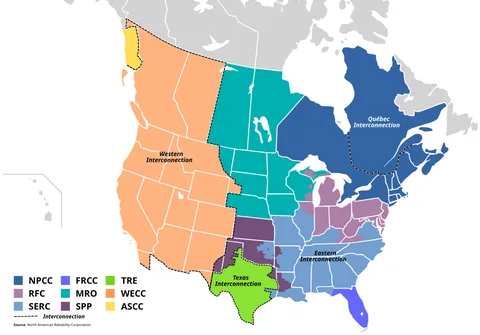 there's the East grid, the West grid and the Texas grid. It's its own thing.
I didn't know that. Oh, wow, this is a very educational episode.
That's right. So many fun facts here. No, but that's why that is the one that really matters, because the presumed backstop for all data center opposition has always been, "We'll just build it in Texas. Everybody's going to Texas."
Yeah. I mean, they were on track to be home to 25% of US data center capacity by 2030.
100%. In the long run, if you talk to anyone in it, the assumption is it was going to be way more than that. Like, just going forward: "Yeah, it's fine, New York's going to pass a moratorium.11New York's moratorium — on July 14, 2026, New York governor Kathy Hochul signed an executive order imposing a moratorium of up to a year on new data centers of 50 MW and up, the first state-level moratorium in the US." Even Ohio, which is a very significant portion of it— you know, might end up—
ExplainerWhy Texas has its own grid
ERCOT serves about 90% of Texas's electricity demand and is barely connected to its neighbors: only a few DC ties link it to the Eastern Interconnection and Mexico. That is by design. As long as power doesn't cross state lines, it isn't interstate commerce, so FERC, which draws its authority from the Federal Power Act of 1935, has little say over it; Texas and its Public Utility Commission write the rules. That makes hooking up a new power plant or a big customer simpler and faster in Texas than in neighboring markets. The flip side is that there is nowhere to turn in a crisis: during Winter Storm Uri in February 2021, more than 4.5 million homes and businesses lost power. And after a flood of data center requests, Texas passed SB 6 in 2025: new loads of 75 MW or more must disclose their backup generation, and ERCOT can cut them off in an emergency.
Well, we have 50 different states that can compete for these projects, but infrastructure-wise, Texas obviously has all kinds of advantages and may not be replaceable.
Well, and the assumption that it was going to have friendly government, and so that will take care of it.
02What big tech won't learn
Andrew asks whether the industry can turn sentiment around, and Ben wonders whether it can learn at all.
Well, that is out the window for now. We'll see what the state legislature says whenever they get around to meeting about any of this. So what should the tech industry actually learn from the midterms?12The midterms were held in the US on November 3, 2026: the entire House, about a third of the Senate and the governors of 36 states were up for election. Democrats won majorities in both chambers of Congress. Can they actually change public opinion on AI, AI data centers? Is that a lost cause at this point?
Well, the question is— the lost cause is: can the tech industry learn? We should probably start there.
Fair enough. Well, and looking at the market, it is a wipeout as we record this on Thursday afternoon. We had a little dead cat bounce on Wednesday13The week's market — on Wednesday, November 4, 2026, the Dow rose almost 1,600 points, and on Thursday, November 5, the Nasdaq Composite fell 5.5%, the S&P 500 4.4% and the Dow 1,833 points; AI and chip stocks fell hardest. to throw everyone off the scent. Now, who knows? Is the American growth story just cooked in light of all these developments?
Like, where's your head at as we process all this?
Yeah. I think we were right before: you're going to have to get a lot more transactional.14Transactional — in "Data Center Discontent, Understanding the Opposition, Fixing the Problem," published on Stratechery in May 2026, Ben argued that only one fix would work: simply paying local residents. Stratechery. The degree of arrogance around this data center thing has been pretty stunning, on multiple levels. Number one, just starting out and being like, "These people don't get it. They're dumb. There's not a water issue," et cetera, et cetera. Getting stuck on the details of what people were saying and not grasping the overall— like, why is it that people are grabbing onto this? It goes back to the whole fake news debate.
Everyone gets the whole fake news thing wrong, for ages and ages, in that they get cause and effect backwards. They're like, "People hear fake news, they believe it, therefore they support the wrong thing." And no, what the fake news thing is, is confirmation. It's feeding a confirmation bias. It's giving people ammunition for what they already want to believe.
And so you go back, way back when, to 2016, when the whole fake news thing was coined: you have to sort of zoom out and understand why is this getting traction. There's widespread resentment of all elites.
Right.
So it's not like— and, well, it's just so infantilizing. Wow, I wasn't really sure about that one. It's so infantilizing, yeah. Right? Where it just assumes people are stupid, and if we give them the right information—
We'll change their minds.
That's right. Right.
And— but you understand why people come up with the "people are stupid," because some of the fake news stuff— well, some of the misinformation surrounding AI data centers is just easily disproven, or refers to the way data centers operate.
Right, but the problem is you're operating on the wrong level, right? You're trying to refute facts when what you're actually dealing with is sentiment. And it's the sentiment that is attracting stories. And that's why people will discard— "Okay, fine, that's not true"— and they'll find another reason to oppose the data centers. They just oppose the data centers. And why do they oppose the data centers?
There is just a fundamental distrust and unease, I think, with technology generally, and certainly with AI specifically. That's why I do think this is— even though it's all about data centers and people are talking about the environmental costs and electricity, I think people are just voting against this version of the future. And why not, given the version of the future that's been sold? And this is where you go back to globalization:15Globalization — here, above all, the "China shock": after China joined the WTO in 2001, American manufacturing lost about 2 million jobs by economists' estimates, and many factory towns never recovered. people didn't have a vote.
The factories just closed. In this case, once people had a vote, they're not too happy about it.
Absolutely. I mean, if we go back to the spring, I said then, and I still feel now: it's an understandable human response, given what AI portends, the way it's been marketed, and the ongoing centralization of wealth among a handful of big tech companies. People just want a chance to stick their finger in the eyes.
And why not? I can't stand most of big tech and the way they talk about AI. You know, I'm very proud of this one; I might repeat this one every podcast for the next several: if you love advertising, you're optimistic about AI.
Because why do I like advertising? Because good advertising helps the customer realize they have a problem in their life, and then it gives them the solution to it. Now, sometimes that's very cynical. You're creating a problem that doesn't exist and then saying you'll answer it. We've seen lots of political ads the last few months. We know exactly how that works, right?
But sometimes it's true. It's like, "I actually— yes, I could actually use that thing. There's a problem I didn't have, and that's going to help solve it." This is very analogous to the AI question in two ways. Number one, everyone trying to create AI for consumers fails to do this.
The issue isn't that— you're not showing people what are problems you have in your life and how AI solves it. That's why the AI Show and Tell thing16AI Show & Tell — a Sharp Tech segment in which listeners describe how they use AI. we do— we got tons of responses. I appreciate— I saw you moved it up in the outline today, so we actually get some into the show. But there's an aspect of just realizing— the humans are so adaptable. And so we actually adapt to tons of problems in our lives. We just accept that's the way it is, and actually it could be better. So number one, AI has terrible marketing in the "it can actually make your life better," in part because it feels like no one in this industry has any sympathy or understanding for normal people. Which, why not? They're all crazy rich, all living on the coast, no conception of how normal people live.
Well, and I will also add that they're building a technology that is exceptionally expensive to build and doesn't have a clear application beyond saying, "Well, this can actually just replace wide swaths of the workforce."
No, exactly, because they can't articulate it, even though I absolutely think it exists. And then number two, where they fail is— again, this is where I think there's a relation to not appreciating advertising as a medium— they see humans as utilitarian cogs in the wheel that can be replaced, because their desires and impulses are all knowable and understandable—
And we can just design the perfect system.
Sure. No, this is where you get the alignment with this sort of Marxist view of the world, communist view of the world, of, "Look, we can design the system, because we know all the inputs, and humans are just reduced to an input in the system, and we can recreate the input with AI." And actually, no: the adaptability point isn't just that we can deal with discomfort; we can also generate new needs. Humans are need generation, desire generation machines. We come up with all sorts of crazy stuff we want or want to do, and then people rise up to meet those needs, or people figure out, "Oh, some number of people have this need, I'm going to figure out how to serve it. Wow, the capability I developed is scalable," or, "Other people could do this, we just need to let other people know they have this need." That is what good advertising is. And the whole industry— not the whole industry, but huge chunks of the industry— they have such a narrow view of the world. Humans fit in this column, and the measurement marks on that column are IQ points, and that's how they rank the whole world. And they're like, "Oh, well, AI's climbing up the column, going to wipe you all out. Think how much money we're going to send politicians," right? And so implicit in this isn't just the fact that the only message that is coming out of Silicon Valley is AI is coming for your jobs.
Implied in that is: all of you are worthless. All of you are uninteresting to us. And this is why I go back to—
All of us— I didn't vote against data centers, but all of Americans are raising their hand to the sky and flipping the bird to all these tech companies.
Absolutely, and why wouldn't they? And so now— that's not to say they're not going to get built, but it's one of those things: I'm in tech, and there's aspects of this industry that are just so disgusting to me, and—
And have driven you crazy for years.
03How long will this discontent last?
If this is a protest against technology in general, it will last, and the industry will have to pay people off.
Well, threshold question in all this, because I do want to get into the implications for a variety of players in this market: how durable and widespread do you think the backlash will ultimately be here? Because to me that remains something of an open question.
It is an open question. And some things sort of come along, and then they go away, and then it's not being a—
There's definitely been a memetic quality to the backlash and the opposition and the misinformation around data centers. And movements that have grown with that memetic quality over the last 10 years or so generally tend to peter out over the course of two or three years, but these are a pretty important two or three year stretch.
Well, that's the question: is this a data center question, or is this an anti-tech manifestation?
Right. Because I think that is probably going to be pretty real for a while.
I don't think that's going away. That's why I concluded the piece by saying, look, this is going to be on the ballot going forward.17"AI on the Ballot" — Ben's Stratechery article, published on November 4, 2026, the day after the election. So I do think this is going to be an ongoing thing. And it is going to— to your point, what does the industry learn? The sad fact of the matter is— maybe there is some sort of fantastical past where corporate America did things because it was the right thing to do, right? Multiple stakeholders:18Stakeholders — the idea that a company answers not only to shareholders but to workers, customers, suppliers and local communities. The Business Roundtable, a group of CEOs of the largest American companies, embraced it in 2019. our workers matter, our communities matter, we're sort of all in this together.
And one of my big critiques of America generally, corporate America— I think it really started on Wall Street, even going back to the '80s19Wall Street in the '80s — the era of hostile takeovers and leveraged buyouts, when the shareholder value doctrine took hold in American business: a company's purpose is returns for shareholders. Economist Milton Friedman had laid it out back in 1970 in "The Social Responsibility of Business Is to Increase Its Profits."— was the reduction of morality to legality. If it is legal, it is not a problem. And where I've come at that point before is, the problem with this, of not doing things because it's the right thing to do, is you're forcing more laws and regulations to be made. Because if you don't just naturally do the right thing, you're always finding the loophole and cutting corners.
You have to regulate everything. And once you regulate everything, the problem is that is severely limiting on your upside, because basically you're forcing regulation to curtail these downside outcomes. But when you cut off the downside, you cut off the upside: less room for innovation and ingenuity. And so that's why it's so important.
There is another angle on this here, where, you know, there was a world where the tech companies would have approached data centers not with the— it's just been very— what's been the big strategy? Go back to, say— remember the Amazon headquarters thing? Did they actually ever build any of that? And that's all by you, isn't it?
I think they built some of it, but not all of it.
It was embarrassing for the tech industry, that whole episode. So this is the episode where Amazon basically auctions off its alternate headquarters20HQ2 — Amazon's second headquarters. In September 2017 Amazon announced an open competition for the site of its second headquarters; 238 cities and regions applied, many offering billions in tax breaks. In November 2018 the company chose Long Island City in New York and Arlington, Virginia, outside Washington, but in February 2019 it pulled out of New York after local protests. The first phase of the Arlington headquarters opened in 2023, and construction of the second phase was paused that same year. Pictured: the Merlin and Jasper buildings of Phase 1 in Arlington, January 2026.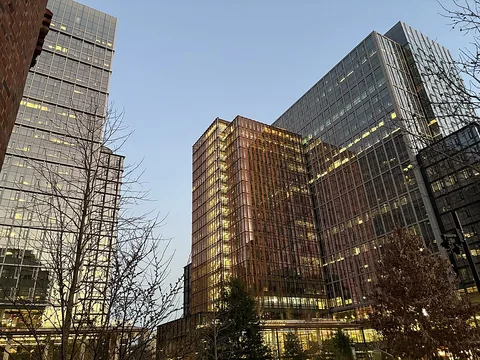 to various markets around the country, and all these cities are like— "Who's going to give us the sweetest deal?"
Sure. It was like one of the most powerful companies in the world is just basically saying, "We have a lot of economic impact. We don't want to pay taxes, we want all kinds of subsidies." And it was shameless, that entire episode. And that has characterized all of this stuff.
Everyone just assumed, "Okay, who wants to pay up for the data centers?"
Like, you know, it was baked into the business models of all these companies.
Absolutely. And the right thing to do would have been to not be so shameless; to have some degree of awareness of how normal people might think, in the full context of our messaging, people's overall increasing discomfort with tech, with social media, with all the sort of things that we've talked about. And to realize, "We need to get ahead of this." And we need to be making the case about the industry as a whole, and we need to be making the case to local communities about how these benefit you, instead of going to local communities and saying, "Right, pay up."
Shaking them down.
Shaking them down.
Or we'll go somewhere else.
Somewhere we get exactly what we want. And so what we're going to end up in is: fine, big tech. The community shakes down the big tech companies. If you want a transactional model, you're going to get a transactional model good and hard. And you're going to end up paying people off.
04Both parties' ads and the Loudoun example
In the election both parties competed to dislike data centers more, even though they benefit local communities.
That's what's going to happen. And the question is, will that work? Because there are still going to be community members who oppose these on philosophical grounds, or because they just resent tech generally, resent what tech has done to modern society. I think it's interesting going forward, because you mentioned there were bipartisan campaign ads that you saw.
Well, that was the crazy thing. There were so many data center ads. And both sides are trying to outflank one another and be more anti-data center. It was not like— you would think, zooming out, like, "Okay, the Democrats are nailing the Republicans on this. Republicans, generally pro-business," et cetera, et cetera.
And I think in general, overall, six months ago that's where we were. And then the Republicans were like, "Holy crap, people really don't like data centers. Well, then we don't either."
There was one race that was in the Madison market21Media market — the broadcast area of local TV stations, where campaign ads air. Madison is the capital of Wisconsin.— I don't even know who it was. And every single one, they would go back to back, of them attacking each other for data center support. They would just manufacture means by which they somehow had supported a data center at some point in the past. It was crazy. And the whole time in the run-up, I don't— this is some life advice— I don't pay hardly any attention to the election.
Once the election happens, then I will look at the results, think about what it means, and analyze it. Because guess what? The election's going to happen no matter what. You don't have control over the election.
Maybe the polls are predictive, or maybe they're not. Maybe the prediction markets22Prediction markets — exchanges where people trade contracts on the outcomes of events such as elections; a contract's price reads as a probability. The biggest are Kalshi and Polymarket. are on it, maybe they're not.
I'm just going to say, we have some people in our lives who are living in the crosstabs,23Crosstabs — a poll's results broken down by voter group: by age, sex, education, place of residence and so on. spend a lot of time that has basically no payoff. But, yeah, maybe it's entertaining for them. Well, fair enough. But the one thing that was in my head early on is, like, "Okay, this data center thing's unbelievable. I cannot believe how many ads there are." We talked about it before, and it's clearly way more potent. And again, the fact that there was no affirmative message for data centers, nowhere.
Everyone is sprinting away from them. That was a losing message this cycle, probably will be next cycle. By the time we get to 2030, I don't know whether there's still going to be this massive outrage about data centers. And what interests me is there's a difference between campaign incentives and governing incentives. And so over the past couple months, it wasn't surprising to me to see both parties fall all over themselves to be more opposed to data centers than the opposition. Even Greg Abbott,24Greg Abbott — Republican governor of Texas since 2015. On August 3, 2026, he ordered the state's Public Utility Commission and grid operator ERCOT to audit data centers in the queue to connect to the grid, and on September 21 he directed the Texas Commission on Environmental Quality (TCEQ) not to issue any permits to data centers until the audit is complete; ERCOT expects to finish it in December 2026. Office of the Texas Governor. who had been supportive of data centers, was cowed into opposing data centers in Texas.
But there is a big—
I mentioned the globalization angle before. At the end of the day— call me a big tech shill— a data center is great for a community. That's the thing.
And these are basically the cleanest and most profitable industrial projects in American history.
Well, not just that. Well, so this is a good example. So people would— including, I think I wrote this at some point, because it is true— point to Loudoun County.25Loudoun County in Northern Virginia — the world's largest cluster of data centers and, by median household income, one of the richest counties in the US. According to the county, data centers bring in almost half its property tax revenue; without them the tax rate would be over $1 per $100 of assessed value rather than the current 80.5 cents. Loudoun County. Pictured: data centers near Ashburn from the air, November 2025.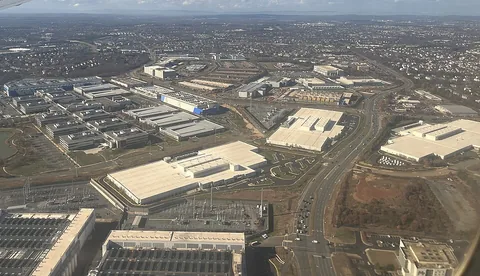
You screwed this up the first time we talked about Loudoun County. Loudoun County in Virginia.
Loudoun County in Virginia, richest county in the country.
Property taxes have gone down. I didn't even know that was possible.
I believe power prices have gone down. Every part of the already rich county has gotten better because of data centers. Now, why are data centers there? This actually goes back historically to— there was a major interconnect26The interconnect — in 1992 MAE-East, one of the first internet exchange points, opened in Northern Virginia. there from when the internet was built. It might even have been pre-internet, but because DC is— it actually is downstream from DC being close. And so AOL started there.27AOL (America Online) — the largest US internet provider of the 1990s. From 1996 its headquarters was in Dulles, in Loudoun County.
And just in general, that was clear. And if you were built there, you were relatively close to Europe. The most populous part of the US was on the East Coast. It's the most natural— and there was lots of power available. It was the most natural place to start building data centers, and you got this virtuous cycle, where you got more and more data centers, you got more and more power to serve the data centers, you got more and more connectivity, and you end up with—
It's a great example. You have an area that knows how to build data centers because of the industry that has—
Right. There's just— it's an entire ecosystem, right? It's like what you see in China around these manufacturing sites: everything sort of feeds on itself until there's nowhere else that's competitive. And it's still the largest place in the world. And by the way, it's phenomenal for everyone that lives close to there. They don't pollute, you have tons of power, your power prices are lower, you have amazing city parks and services and schools, right? And you don't pay anything in property taxes. It's unbelievable.
It's not a bad deal, relatively speaking. If you're governing one of these communities or states and watching these projects go somewhere else, there's going to be an interesting tension there, because jobs are on the line.
But big tech would— there's a tendency, when you're looking at things at scale, to look at it at the end state. But you have to get to the end state. Loudoun County— the data centers started being built there 30 years ago. So yes, you're seeing the outcome of a 30-year virtuous cycle. In the meantime, if you build a data center and you're not power neutral, and you're using the grid, guess what? Electrical prices are going to go up. Now, electric prices go up, more demand, they're going to build new power generation, so in the long run it will pay off. But there needs to be more cognizance of: you can't sell the long run if you're not mitigating the downsides for people who can vote against your project. And again, not just not mitigating, but demanding to be paid for the privilege of running up people's electrical prices.
Right, correct. And I would guess that the industry will be able to sort of accept that as a baseline for any of these projects going forward.
05If Texas stalls
What happens if the bottleneck holds: construction moves abroad and maybe into space.
Even if they do that, I don't know that that's a guarantee that the bottleneck will be removed in a place like Texas. We'll have to wait and see. For the sake of argument, though, let's assume that the bottleneck does remain in place over the next two or three years— and again, pretty critical two to three years as far as the buildout is concerned and the compute demands.
Maybe. So a lot of the stuff— so even in Texas, the moratorium is on new permitting. There's a lot of stuff under construction.
There's, I believe, 130 projects under construction.
Right. Which— so 2027, 2028, all that stuff is still coming online. I think where the concern is, is more about 2029 going forward. So there's a few things that might happen. Number one, going abroad. That is unfortunately something that is probably likely to happen. I think there's a huge big announcement of a new project in Malaysia by Google,28Google in Malaysia — on November 4, 2026, Google announced it would invest $15 billion in Malaysia in 2027–2028: in data center campuses in Selangor and Negeri Sembilan, clean energy, water supply and workforce training. I think—
15 billion for a data center in Malaysia.
Yeah. And so you're going to get— tech is shameless. Remember, tech is the industry that started globalization, getting Intel shipping chips to Hong Kong29Chip assembly in Asia — the first American chipmaker to move assembly to Asia was Fairchild Semiconductor, which opened an assembly plant in Hong Kong in the early 1960s. Intel built its first overseas assembly plant in 1972 in Penang, Malaysia. for test and assembly. And so, I'm sorry, you're not going to get "tech will do the right thing." When there is no other choice, they're going to—
Well, these are multinational corporations. That's the way they operate.
Right. And so yes, for sure, going abroad is going to be one thing, and playing countries off each other. So that should be a big concern, obviously. Number one. Number two: this was the whole thesis behind the SpaceX thing. Like, "We're going to outer space now."
We have to.
Well— or might have to, I don't know, it's in play. I mean, this was always a possibility, because even if you didn't have this backlash— well, number one, when I wrote about SpaceX and the S-1,30S-1 — the registration statement a company files with the US Securities and Exchange Commission (SEC) before an IPO. Ben's article "The SpaceX IPO and Data Centers in Space" was published on Stratechery on May 27, 2026. SpaceX listed on Nasdaq on June 12, 2026, raising about $75 billion, the largest IPO in history. Stratechery. it was when this backlash was already building, so I sort of built that into my analysis from the beginning. Number one, these are more viable than you think. It doesn't mean they're easy.
Can we go CliffNotes on that, in terms of the viability of space data centers?
ExplainerWhat stands in the way of a data center in orbit
In a dawn-dusk sun-synchronous orbit the sun almost never sets, so solar panels deliver power around the clock, and there is no land, water or local permitting to fight over. The hard part is heat: in a vacuum there is no air or water to carry it away, so it can only be radiated off, and the radiators grow with the power. A single GB200 NVL72 rack draws about 120 kW, while the ISS's external cooling system is rated at roughly 70 kW. Then there is radiation, which flips bits and degrades chips, the impossibility of swapping a failed GPU, and launch cost, which SpaceX is counting on the reusable Starship to crush. The first experiments are under way: in November 2025 the startup Starcloud put a satellite with an Nvidia H100 into orbit and ran a language model on it, and the same month Google announced Project Suncatcher, TPU-carrying satellites whose prototypes it is building with Planet.
Well, I think the big thing is people have in their head you're going to have big warehouses floating in space, and basically what you will have is individual racks. An NVL7231NVL72 — Nvidia's server racks (GB200 NVL72, GB300 NVL72), in which 72 GPUs are linked by NVLink into a single system. is about the size of a Starlink satellite today32Starlink — SpaceX's satellite internet service: thousands of satellites in low orbit. Since 2025 Starlink and T-Mobile have provided service directly to ordinary smartphones.— the current ones, not even the big ones that are adding all the cellular capabilities. So a bunch of individual racks, and redundancy built into the system. Well, I mean, the challenge is cooling.33Cooling in space — in a vacuum there's no air or water to carry heat away, so the only way to shed it is by radiation, which requires large radiator panels like those on the ISS. They have to have radiators, and the amount of cooling is like an exponential increase. They basically have these massive radiators going into space to dispel cooling. All this is fairly insane and nuts. But you already have Starlink up there. You already have the laser-based communication34Laser links — Starlink satellites exchange data with each other over laser links in orbit, without ground stations. for them to send data back and forth. You're going to have, in the long run, the shift to inference35Inference — the work of an already trained model, answering requests. Unlike training, it's an everyday workload that grows with the number of users. that happens independent of humans. And so—
So inference that's serving agents,36AI agents — programs built on language models that carry out multistep tasks on their own (searching, writing code, filling in forms) rather than just answering a question. and the time doesn't matter.
Right, or matters less. You don't need sort of the immediate response. Basically, the pieces are there. It's just, like, why would you do this if you can just build a data center?
You have a lot of land in this country.
Yeah, it's a fair question. Well, or in the UAE37The UAE — in May 2025 the US and the UAE announced a 5 GW AI campus in Abu Dhabi; its first part, the 1 GW Stargate UAE, is being built by OpenAI, Oracle, Nvidia and local company G42. or wherever. I mean, you have this escalation in bottlenecks, and the bottlenecks get solved, right? So we were short on chips, and— "We're going to make a bunch more chips." "Oh, now we're short on memory.38The memory shortage — since the fall of 2025 manufacturers have shifted capacity to HBM memory for AI accelerators, and prices for ordinary DRAM have soared." That will be resolved eventually. Then you're short on— we're going to be short on power. And by the way, I do think we're far enough along in power projects that when and if this bubble bursts— where maybe the bursting's happening right now as we're sitting here, who knows— that was always the question: what's the long-term payoff of the bubble? What stuff gets built that is economically nuts, but is actually worth it in the long run? And it's power generation. We've been living in power poverty for 50 years, since the oil crisis,39The oil crisis of 1973 began with an embargo by Arab oil exporters against the US and other allies of Israel; oil prices roughly quadrupled, and energy conservation became a national theme in the US. basically.
You know, it's funny, people go back and they're like, "Oh, do you remember the '50s and '60s, when America was dynamic and growing?" We had a lot of power. We treated energy as completely abundant. There wasn't a consideration for anything. Just build all the factories, build the beautiful long Cadillacs40Cadillacs of the 1950s — a symbol of American abundance: the 1959 Cadillac, with its huge tailfins, was about 18.7 feet (5.7 m) long. Pictured: a 1959 Cadillac Eldorado Biarritz.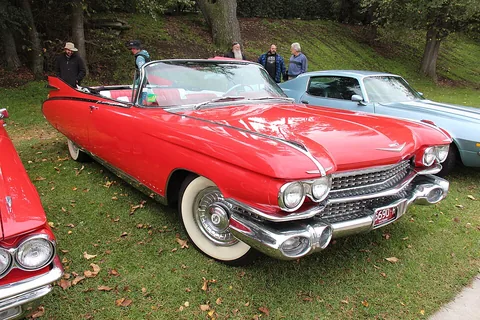 that are like 15 or 20 feet long.
Right. Build the crazy overpowered engines. Like, why? No one cared about efficiency. And it's funny, that sounds scandalous to anyone today, because we've all grown up in a world of efficiency and, you know, do more with less.
Yes. And it is— I think it's been such a limiter in what is possible. And I think it's been a limiter on imaginations. Like, what does it actually mean to have infinite power? This is why the nuclear thing41Nuclear power in the US nearly stalled after the 1979 Three Mile Island accident: for decades no new reactors were started, and the first in a long time, Units 3 and 4 at Plant Vogtle in Georgia, came online only in 2023–2024. is such a tragedy. We should have had infinite clean power by this point.
But if what happens is the bubble bursts, but we actually brought to bear tons and tons of new power, that is a long-term payoff that is going to be hard to calculate, what it was worth.
Right. And we're on the way to bringing on some of that surplus power, correct?
For sure. There's been a ton of new power projects, and I think more of this stuff, to your point, will get over the line. This is the difference with globalization. Globalization: the factory leaves, there's no upside. Right?
Again, there was no veto, but there was also no upside. In this case, there is a veto, and that's what we're dealing with right now. There is an upside.
And if the demand is there, there are enough people who will be incentivized to get some of these projects across the line that I don't really worry about it.
If you want to get a data center built, put checks— put money in people's pockets.
06A hammer looking for a nail
Why what would be crazy for anyone else is rational for SpaceX.
Exactly. And if that's what it takes, that's what will happen. On the other hand, the space example— I wanted you to give a CliffNotes of that, because when I first heard about that, I was envisioning a data center in space. And that concept sounds completely insane, would be completely impossible to maintain at that level. But the more atomized version that you lay out there, where you're talking about individual racks and the capacity to launch all those—
Well, that's the thing. That's the basic thing that's interesting about SpaceX. So with Starlink— we talked about the Craig Moffett interview,42Craig Moffett — telecom and media analyst and co-founder of the research firm MoffettNathanson. His interview with Ben ran on Stratechery as "An Interview with Craig Moffett About SpaceX and Bubbles." In September 2025 SpaceX agreed to buy wireless spectrum from EchoStar for about $17 billion. where he's like, "Why does Elon43Elon Musk — founder and CEO of SpaceX, CEO of Tesla and owner of X. want to get into the cellular game, which is a crappy business?" And that is correct if you're starting from zero. Like, "We're going to build launch capacity that is going to let us deploy satellites so we can be a cell phone company."
Crazy thing to attempt.
Sure. The launch capacity exists. It is coming regardless. And there is a lot about Starlink where you almost have to think uneconomically, in that if you think economically, you should think about the cost of all the inputs and figure out does it make sense. From a Starlink perspective, it's kind of like launch is free. Because— it's not really free.
That's not correct.
For anyone else who wanted to do this, it would be insane to attempt that capacity.
They built out this capacity, and they need to use it for something. Right. I mean, this is how you get— say, in the shipping industry, you'll have shipping companies that will run losses for years. And it's like, how do you operate at a loss? Well, it's an accounting loss,44Marginal cost — what it costs to make one more unit, here to ship one more container. The investment in the ship itself has already been made and doesn't affect that decision. because they don't ship if the marginal costs aren't covered. They don't ship. What are the marginal costs?
Fuel, port fees, crew, all of which pale in comparison to the depreciation cost of the ship itself.45Depreciation — the cost of an expensive asset, such as a ship, written off in the accounts in installments over its useful life. It's an expense on paper: the actual money went out when the ship was bought. So maybe their marginal cost to ship a container is like a thousand dollars. What that means is, if someone will pay $1,100 to ship a container, they'll ship the container, even though the cost on their accounting balance sheet— actually shipping that container costs $2,000. But a thousand dollars of that cost is depreciation, which is— it's not fake. That's real money that went out the door, but that money's been spent.
Yeah. So as long as you're making anything incremental over your marginal costs, you will continue to operate, even though from an accounting perspective you operate at a loss. This is a super important principle to understand, because it explains why companies will seem to operate at losses for ages. It's like, "Why don't you just shut down?" or "How are you surviving?" Well, their cash flow is still positive. Again, what happens is they end up not having enough money to service their debt, and then they go bankrupt.
That's how bankruptcy happens. Because to buy these assets up front, you take out loans, because you're going to have a 30-year useful life. So ideally you're paying it back over 30 years. Anyhow, but just the way money moves around, and how bankruptcies happen, how companies operate at paper losses for ages. But— because what happens with the shipping industry?
You get a period like COVID, where containers are now like $17,000 a container,46Pandemic freight — in 2021 the spot rate for shipping a 40-foot container from China to the US West Coast reached $20,000, against a usual $1,500–2,000. you're making so much money. This is the crazy thing about commodity markets.47Commodity market — a market for interchangeable goods where products don't differ and price decides everything: oil, freight, memory chips. In tech, becoming a commodity means losing differentiation and margins, which is how Ben later talks about "intelligence as a commodity." That's what's happening in memory right now, right? Same general sort of concept.
And so the reason why— and by then it takes too long for anybody else to bring it online.
Right. And so people will— "Well, wow, what an opportunity. Why don't you buy a bunch of ships?" And then it crashes. And then it's great for the incumbents, because they crash, they go bankrupt, suddenly cheap ships are available. Who has to buy new ships? So that's why in commodity markets— I admire people in commodity markets, because the way to succeed, it is the ultimate sell-the-top, buy-the-low sort of business.
You need to be in the muck, your business bleeding money: that's the time to invest, because then you'll be ready when it comes back, right? If you wait till it comes back, it's too late. But in these markets, the fixed costs are so high. Buying a ship is really expensive, building a fab is so expensive.
That's why you see TSMC48TSMC — the Taiwanese company that is the world's largest contract chipmaker, producing chips designed by others: Nvidia, Apple, AMD and many more.— we've talked about it— they don't want to expand too much, because they're the one holding the risk. And so where does this tie to SpaceX? It's not a perfect— I'm not saying this is an accounting thing, but there is almost a mentality thing, where, look, we've built launch capacity. Starship is coming.49Starship — SpaceX's super-heavy reusable rocket, the largest and most powerful ever built. Pictured: a Starship launch from the pad in Texas.
Starship can launch much larger satellites. It can launch a ton of them. What's this going to be used for? We'll find out. Well, no, but it's like— suddenly you start thinking about data centers in space from a marginal cost perspective. That marginal cost is building the space rack, deploying it, operating it, and you kind of treat the launch capacity— not just the overall cost of developing the Starship, but also the launching itself— because why?
You want to launch more, so you keep learning, keep improving. Musk companies in general are usually very good about their learning functions. And so, continually going on, you kind of treat that as a given. It's free. Now, it's not free, to be clear. I'm not saying this is an accounting calculation, but that's the reason why, if you're Elon, you're not thinking about building a cellular service and fully internalizing all the costs.
This whole cost, which is actually the biggest cost, we're going to pretend it doesn't exist. "Wow, what a big opportunity we have," right? Because there's a drive to use up this capacity. And I think there's a similar thing with the data centers in space. Would you start from scratch, build a new rocket, get launch capacity? Or even, would you consider the price of launch capacity?
I mean, Starlink looks very profitable, in part because they just pay the bare cost. There's no premium charged to them by— so SpaceX itself is actually much more profitable, and Starlink is much less profitable, in a true arm's-length50Arm's length — at market prices, as if buyer and seller were unrelated. Starlink is part of SpaceX and, according to Ben, gets launches at cost. sort of calculation of the cost. But all this is to say: Starlink and SpaceX is the ultimate hammer-looking-for-a-nail company. They've developed this hammer, incredibly valuable hammer, which is this launch capability, regular cadences, tons of stuff. They need stuff to put in space.
But that's why I said, we'll see in terms of how exactly they monetize this. And look, data centers in space sounds less crazy today than it did three days ago. Well, okay— you wrote that a few months ago. Do you want to pat yourself on the back here?
No, but that is why a Verizon or an AT&T or T-Mobile51Verizon, AT&T and T-Mobile — the three largest mobile carriers in the US. should be nervous. Because the most terrifying thing as a business is going up against a competitor that seems to be acting irrational, right? It's irrational for Starlink to build a cellular service.
But in a weird— which I was trying to explain here, I'm not sure if I fully explained it— in a weird sort of Elon-thinking way, it is rational. If your overall goal is increasing launch capacity, increasing, like— on the learning function— "I want to get to Mars."52Mars — Musk founded SpaceX in 2002 to make humanity a "multiplanetary species," and calls a colony on Mars the company's main goal.
I was going to say, his overall goal is going to Mars.
That's right. And so I think the stuff in space makes sense in that regard. And by the way, just from a purely strategic asset, you can see the value of that.
Absolutely. So, yeah. Well, I have more questions on specifics. That said, most of the data centers are going to be built on land, especially for the foreseeable future. That's more of a five to 10 to 15-year solution, as opposed to the next couple years, when the crunch is coming.
I don't know that that's going to be— there's still going to be a lot of data centers on Earth.
For now.
AdStripe
Today's show is brought to you by Stripe, the economic infrastructure for AI, and for Stratechery itself, and a company that processes digital payments for millions of businesses around the world. I learned that on Stratechery this week: the total revenue processed by Stripe is equivalent to 1.7% of global GDP. Just an astounding figure. We're going to be spending more time in the next couple months going into some of the Stripe data. Ben, you spent a lot of time analyzing individual companies and industries. Have you spent any time with the Stripe data thus far?
I have not, full disclosure. The— I mean, I think they have a Stripe blog that writes about— Stripe Economics, yes. Well, it's kind of funny, because one of the challenges in writing about the stock market, which, you know, again—
You do a little bit of that.
No, I don't, actually. Okay. It's actually pretty interesting. It is almost a challenge this week, where my assumption was there was going to be a big drop because of these things. Again, it was weird, it didn't happen on Wednesday. Then the Democrats decided to be like, "Let's investigate all the corporate leaders and ban data centers everywhere." It's like— it's almost like they're like—
Saw that as I was getting on the plane. Literally 24 hours of moderation, and now here we are.
It's like, yeah, it's like they were counting on the stock market drop. So they're like, "It needs a little nudge. Let's give it a boot over the edge." But so I assumed that would happen. But what I wanted to write about: what are the implications— what does it mean if there's real friction in data center building? And so that was the ten takes of, you know, good for the hyperscalers,aHyperscalers — the largest owners of cloud data centers: Amazon (AWS), Microsoft (Azure), Google (Google Cloud), plus Meta and Oracle. I think moderately good for the frontier labs.bFrontier labs — companies building the most powerful AI models: OpenAI, Anthropic, Google DeepMind and a few others.
We can sort of keep talking about it, but also there can be such a disconnect between what's happening on the ground and what's happening in the market, which is sort of anticipating things. So this week, the little factoid was— you know, this spring, everyone's mid-SaaSpocalypse.cSaaSpocalypse — traders' name for the crash in enterprise subscription software (SaaS) stocks in early 2026, when investors feared that AI agents such as Anthropic's Claude Cowork would make those products obsolete. That's right. Which, by the way— so that's happening. Meanwhile, Stripe's looking at their data: all these small companies, actually accelerating. Revenues are increasing, including new companies, which I thought was interesting in—
The Stripe notes.
Right. And so that's not to say the stock market has it wrong.
Like, I actually think for the— like, long-term pressure on the—
Well, there's a terminal value question.dTerminal value — the part of a discounted cash flow valuation that covers all of a company's cash flows beyond the forecast horizon. For growing companies it usually makes up most of the valuation. Like, I think, does this stuff go to zero? There's also how much growth is there. But it is interesting to see, when you get a widespread view that you would think— my assumption would be actually always stuff will be static, growth's going to go away. But the fact that it's actually been growing, the amount that companies are spending on SaaS, it just gives you pause. And it's like, because it's very easy to get in your head about theoretically what makes sense and is going to happen, and then reality can sort of be like, "Well, some good software products are still doing fairly well." So it's interesting. So Stripe does get a good view of that. I am looking forward to getting more, sort of—
I am too. That's sort of interesting. It offers kind of a complementary view of what's going on in the economy beyond, like, earnings reports.
And for— it's actually funny, for me, it's almost a little uncomfortable. It's like, it's more fun being in theoretical— what sounds good.
That's right. This is what's actually— here's some hardcore data. Yes, yes, Stripe Economics. It's a cool Substack. It aggregates all the macro data in a bunch of interesting ways. So, in any event, we'll put a link in the show notes if people want to check it out.
07Why big tech wins
The irony is that discontent with big companies actually benefits them.
Back to the show. As far as specific companies, it is sort of an ironic twist, based on what you wrote this week: considering much of the opposition to AI data centers is rooted in deep, abiding resentment for big tech companies, big tech companies may in fact be the beneficiaries of a lot of this opposition. Is that right?
I think so. Well, you know, when you think about the—
They always win.
They do always win. It's amazing. And where does value accrue, right? If you have the stack53Stack — the layers of a technology built on top of one another; in AI, chips, data centers, cloud, models and the applications on top.— I think it comes from integration: when you have different pieces you can put together, and what things can you integrate in the AI stack. So on one hand, you could say the frontier labs right now want to be on the leading edge, but you would say, is that a sustainable business? What if you're easily substituted out, if another model comes along that's better? That's a tough place to be. So one argument is they need to go up into more consumer-facing applications, so you're integrating the consumer-facing service with the model itself, and then that's how you win: you build a moat that way.54Moat — Warren Buffett's image for a durable competitive advantage that keeps rivals from taking a company's profits. Another thing is, maybe the frontier companies want to have the leading-edge model, and they're going to build their own data centers and design their own chips that are meant for their model, and they're going to be able to serve much more efficiently than anyone else. And so that's another point of integration that could happen.
But one of the challenges is they need money to do this. Number one. Number two, they need to build new data centers. They don't have an existing footprint. Anthropic is talking about it: they have this deal with Broadcom55The Broadcom deal — in April 2026 Anthropic reached agreements with Google and Broadcom for next-generation TPU capacity: through Broadcom it will get about 3.5 GW starting in 2027. to get chips. Those all need to be built. Meanwhile, you have the big tech companies, which have a ton of data centers already. They still have the best access to capital.
Can I ask you one question before you go on? The big tech companies with all their data centers that already exist: how many of those legacy data centers could be converted into AI data centers?
Not very many. So the issue— because previous data centers were by and large air cooled, whereas modern GPUs need water cooling.56Liquid cooling — an Nvidia GB200 NVL72 rack draws about 120 kW, an order of magnitude more than a typical server rack, and that much heat can no longer be removed with air: liquid is piped to the chips. Modern GPUs are much, much denser, whereas you have more sort of spread out, because you're using air cooling, you're trying to build it for the lowest cost possible. There's a lot of different assumptions. If you want to take an old data center and convert it, it's a significant— you're basically rebuilding it.
Yeah, you just knock it down.
But you already have the land, you already have the power, you already have the relationships. The community is used to you being there. And so I think you're just starting further ahead than trying to get a net new data center somewhere else.
Yeah. I read a Meta spokesperson this week said, in lieu of building new data centers, one of the things we're going to be doing is expanding the data centers that we already have to meet some of this demand. All of which is much easier to do if you're a Meta or you're an Amazon.
Right, so they already have lots of assets. Number two, you have the financing ability, right? They have free cash flow.57Free cash flow — the cash a company has left from its operations after capital expenditures. Now, that free cash flow— they don't have free cash flow, because it's all being consumed by the data centers.
They had free cash flow.
Source: Amazon's Q4 2025 earnings release: purchases of property and equipment net of proceeds, the gap between operating and free cash flow; the plan is "about $200 billion"
No, but the point is, if you're spending— what was Amazon's thing, like 200 billion dollars on capex?58Capex (capital expenditures) — spending on long-lived assets: data centers, chips, power plants. And, "Wow, that exceeds their free cash flow of 180 billion dollars." That's still 180 billion dollars, right?
So we're talking about 180 billion dollars ahead of Anthropic or OpenAI.
Who have— no, they have negative free cash flow, or— in the fullness of time. So number one, they just have this huge base. Number two, they get better credit, because they have other businesses that generate all that free cash flow, so their price to borrow is much lower. And that's why you end up with these deals where they're basically financing— they get these great deals with Anthropic, like Amazon does, because they can finance them. Even if Amazon has to ultimately finance it themselves, it's like an arbitrage opportunity,59Arbitrage — profiting from a price difference on the same thing; here, on the cost of money: a hyperscaler borrows cheaply and finances those for whom borrowing is more expensive. because my ability to finance is cheaper than yours. This ties into Nvidia and the neoclouds60Neoclouds — new cloud companies that rent out GPUs for AI: CoreWeave, Nebius, Lambda, Crusoe. and all that sort of thing as well. And then number three, they can issue equity. And if you're an Anthropic— Anthropic needs to get to market.61Anthropic's IPO — Anthropic made its S-1 public on October 26, 2026; the IPO is set for November 19. We'll see if that actually happens, which I think it will, but it might be a little hairy. All their equity is 100% on "will Anthropic succeed or not." When an Amazon issues equity, some amount of it is "will this capex be worth it," but it's also, there is an existing business that is very successful that you're getting a piece of. So of course it's going to be damaging to existing shareholders, because you're diluting them,62Dilution — when a company issues new shares, each existing shareholder's stake shrinks. and that money is going to this speculative thing that may or may not work out. But by and large, the support for their equity is much more than it will be for anyone else.
ExplainerWhy hyperscalers borrow cheaper
The cost of debt depends on the credit rating, and the rating on how much reliable income a borrower has beyond whatever it is borrowing for. On S&P's scale Microsoft has the top AAA rating, above the United States itself (AA+); Alphabet is AA+, Amazon AA, Meta AA-. Neoclouds borrow against the GPUs themselves and the contracts to rent them out: in May 2025 S&P rated CoreWeave B+, junk territory, and it pays interest to match. So a hyperscaler can borrow cheaply and pass the money on to a lab, as compute on credit or as an equity investment, and pocket the spread. Even the giants have limits, though: on October 30, 2026, S&P kept Meta at AA- but cut its outlook to negative.
And that's the funding of last resort, right? You just start giving away parts of the company to get more money. Which— we're in that stage. Everyone is issuing equity at this point. But in all those stages— more free cash flow, cheaper credit, more ability to issue equity— the hyperscalers are just in a better spot than anyone else, and they have more capacity to build data centers. They're going to be better at lobbying, they're going to be better at sort of getting these things over the finish line. And if you think about that, those aspects might end up mattering most. If data centers are going to be more expensive, because you have to pay off the local population, they're in a better place to fund that, to pay for it.
And yeah, big tech, I think— I mean, we talked about it last week, in terms of Anthropic and some of the pressures on them going forward: some of the equity deals that they did in the past in exchange for compute,63Stakes in Anthropic — Amazon invested $8 billion in Anthropic in 2023–2024 and became its main cloud partner; Google also holds a stake in Anthropic and supplies it with compute on its TPUs. and what those could look like a couple years down the line if Anthropic can't pay for the compute all by itself. I wonder, in a compute-constrained environment, where you've got Amazon and Google that have all this compute, does Anthropic, does OpenAI just go hat in hand to some of these hyperscalers?
Yeah, there's a good chance. I mean, I think one of the scenarios— OpenAI and Anthropic, I don't think will ever go away. The question is, who are the equity holders?
That's right. It's like, does Google just own Anthropic at some point?
Yeah, or Amazon. It's like a Google-Amazon joint, because there's—
Yeah. And it's funny, because Amazon— I mean, Andy Jassy—64Andy Jassy — CEO of Amazon since 2021, succeeding Jeff Bezos; before that he ran AWS from its founding. people were hating hard on Andy Jassy and Amazon after the earnings call65Amazon's earnings — on October 29, 2026, Amazon reported third-quarter results: AWS revenue grew 39%, but capital spending for the quarter reached $77.3 billion, and the stock fell more than 7% in after-hours trading. Back in February the company had said it would spend about $200 billion on capex in 2026. a couple weeks ago, and now they are sitting pretty in a world where no one else can build data center capacity.
Well, they're also sitting pretty in a world where everyone has to kind of slow down. That's the other bit. They will all tell you, "Oh, don't worry, we have buyers lined up," et cetera, et cetera. That's always the case until— this is like when you have all the crazy stock market things, like 2008.662008 — the global financial crisis. Banks held mortgage securities "insured" with credit default swaps; when home prices fell, the insurer AIG couldn't pay and had to be bailed out by the government. Everyone's like, "On paper, don't worry, there's a backstop, there's a guaranteed buyer." The problem is what happens when the backstop goes away and you get this chain reaction. You could see this risk still coming up, right? Like, "Yes, we have a guaranteed buyer," that buyer's OpenAI, you sort of go down the chain, all these sort of things. So, yeah— but they had to compete, right?
What if Amazon doesn't invest? Then Google's going to invest and take more and more. And Microsoft sort of briefly stepped on the brakes slightly,67Microsoft's pause — in early 2025 analysts at TD Cowen reported that Microsoft had walked away from some US data center leases and slowed other projects. Later the company repeatedly acknowledged that it lacked the capacity to meet AI demand. and then suddenly we didn't have enough compute, and it was a big problem. And so everyone's like, "I can't slow down if they're not slowing down." We've talked about this dynamic with the labs themselves. This is the problem with Anthropic's S-1.
The fact their inference looked so amazingly cheap should actually terrify you, because the part they have to keep spending—
A lot of money.
That's right— is out of their control. If they don't spend to be on the leading edge, OpenAI will, and they'll lose their position. Or Google, or Meta, or whoever it might be.
And in a world where everyone takes a breath amidst this murderous capex buildout here—
The shareholders love it, because, "Oh, we had a bunch of projects canceled. What a bummer. And so our capex is going to be flat." You'd imagine an earnings call like this,68Earnings call — a conference call in which a public company's management presents quarterly results and takes analysts' questions. right? And everyone sort of announces this. Investors are like, "Thank goodness."
Yeah.
Suddenly their stock goes back up. Now they can issue more stock to get more money. That currency is more valuable. Maybe the credit— the big question is, when does the revenue come? Once the revenue comes, all these things unwind themselves in a very positive direction. And so if there is an external force that forces a slowdown, such that revenue can get there in time to relieve all these capital pressures, everyone could win.
This could actually be a defusing—
Win-win-win-win-win, sure.
But especially the hyperscalers. And so, yeah, everyone thinking about AI jumps to the final state, where intelligence is a commodity. And that state— that implies infinite compute. And it just might be, the longer it takes to get there, the more analysis predicated on intelligence being a commodity isn't actually useful to understanding the world as it is.
In a world where there's infinite power, infinite compute, what does Nvidia do? There's going to be other chip products, right? In a world where you're limited in power, you have to repurpose your data centers, suddenly whatever margin you have to pay to get the most efficient, most powerful chips suddenly makes a lot more sense, right? And so the analysis in a market defined by scarcity versus a market defined by abundance is fundamentally different.
Completely flips.
Right. And I think the time defined by scarcity has probably been elongated.
Okay. Well, it'll be interesting to see whether there is ever a capex slowdown, because at this point, I'll believe it when I see it. Whenever we get there, it will be fun to look back at some of the capex we've seen over the last couple years and just how consistently insane it was. I think there was a stat where a couple of these companies were spending more combined than the Pentagon spends every year. And that's just where we've been living for quite some time now. So we'll see what it turns into.
08Nvidia, China and the Middle East
A power shortage reshuffles the picture for Nvidia and for the rivalry with China.
Nvidia, you just mentioned them. How should we think about Nvidia in a world where US data center construction is constrained over the next several years?
Well, in the short term, it's definitely a problem, because they're selling chips, there's nowhere to put them. Their market being limited. On the other hand, overall— and this has always been a counterintuitive point about Nvidia, which is the one I just made— in a world defined by insufficient power or insufficient data center capacity, the entity that delivers the most tokens per watt69Token — the unit of text a language model works with, roughly part of a word. "Tokens per watt" is how much output a chip produces per unit of energy.—
The best machine, the most efficient machine, will be worth the upcharge.
Exactly. Because at the end of the day, the tokens are going to be more valuable. This is also a weird thing with the neoclouds. All the existing neoclouds out there— if we reduce the rate that capacity comes online, all those are more valuable, right? But at the same time— and so it's kind of weird to think through what this means for the neoclouds. They're going to have a harder time getting new projects started, coming to market. Are they ever going to have sufficient scale?
But what they do have might be more valuable. And so I think in this world, there's a lot of these things where— do you mean better absolutely or better relatively?
Right? On an absolute basis, maybe this is worse for Nvidia; they'll sell fewer chips. On a relative basis, as opposed— their ability to hold back or withstand the push for ASICs70ASIC (application-specific integrated circuit) — a chip built for a single task; in AI, the hyperscalers' in-house accelerators: Google's TPU, Amazon's Trainium, Microsoft's Maia. and, you know, defined chips— maybe this is better.
Yeah. Well, and a future where compute is abundant is probably not great for Nvidia.
It's going to be challenging. It's hard to sustain margins71Nvidia's margins — the company's gross margin hovers around 75%: its chips sell at a huge markup over cost. in a world—
People inevitably come for their margins in that scenario.
Right. Well, I mean, you think about why was Nvidia so gung-ho about China?72Nvidia and China — because of US export controls, Nvidia sold cut-down chips such as the H20 in China. In April 2025 those sales were restricted too, and in August Nvidia agreed to give the US government 15% of revenue from such sales in exchange for licenses. Because China is not a country that's defined by lack of power, right? And so if they don't keep people locked into their ecosystem, using their software, using CUDA,73CUDA — Nvidia's platform for programming GPUs, released in 2007. Most AI software is written for it, and moving to other chips takes rework. defaulting to their chips, over time it's like, "Well, I'll just build inefficient data centers with more chips and not pay the Nvidia fee." Which I think they've resigned themselves to: more coal power over there in China.74Coal in China — China burns more than half the world's coal and keeps building coal power plants.
Well, that was going to be my next question. So how should we think about the competition with China in a world where data center construction is constrained?
I mean, it's a problem. We have a huge chip advantage, obviously. We've created the conditions where China has to figure out the chip thing on their side.75Export controls — since October 2022 the US has banned sales of the most advanced AI chips and chipmaking equipment to China; in response China is developing its own chips, above all Huawei's Ascend. When and if they do, they're going to have a lot more ability, I suspect, to build more data centers and more power than we will.
And in the fullness of time, how does this not look like the manufacturing world, where they just have so much more scale and are so much cheaper that they actually end up owning all the compute?
So they will have far more compute than the American side in the fullness of time, even if they're using less efficient chips that are inferior in a lot of respects.
Well, they'll move down the learning curve. Their chips will get better and better over time. Right. And so— but again, this is a huge timing question, right? The fullness of time.
Everything's possible in the fullness of time. That's where we're going to move to the dorm room, right? We should have a dorm room theme when we want to have a dorm room.
Honestly, it's tricky for me, because as the host of Sharp China,76Sharp China — a podcast about China by Andrew Sharp and Bill Bishop, author of the Sinocism newsletter; part of the Stratechery Plus bundle. who's reading news about China every week, I personally have never been less concerned about the competition between the United States and China. And China's always invoked as a stalking horse in these arguments. And everybody this week is like, "Well, voters just handed the future to China." And I don't know that I disagree with that, because obviously China will have advantages that it can bring to bear over time here. And we're going to build data centers. I'm not that panicked about it.
So I think this is more— this is a retardation.
If we never build another data center in the United States, then we can have a conversation about it.
Right, exactly. You know what, though? This is why I don't like to think about politics. This is like— I'm sick of this. I wrote an article—
And we've talked about it. Fair enough. Well, final question then, because we can move on to Google for you. Zach says, when people discuss building data centers—
By the way, maybe that is evidence of tech's disdain for normal people. I'm the problem that I've identified.
Well, I mean, I don't think there's any problem with not wanting to talk about politics. That sounds fantastic. I'm so excited to move back to only caring about basketball77Basketball — Andrew wrote about the NBA for years, including for Sports Illustrated, and co-hosts the basketball podcast Greatest of All Talk. for the next several years.
I'd say move back— move back to Washington, D.C. Well, you're already there.
It is— it's in my blood in DC, you know. I grew up with it. "When people discuss building data centers," Zach writes, "it seems to be either the US or in space. Why don't we just turn Mexico into a data center? Is it because it would be even harder to get the power, construction, and financing all set up in another country than it would be in space?" We alluded to this earlier. I mean, Canada has a lot of power as well.
Is there any reason we don't go that direction?
Well, I mean, they have to agree. It needs to be— you know, it wants to be a place that is safe and secure. So yeah, no, for sure, there's going to be a globalization aspect to this. I already mentioned the Malaysia deal. You're going to see this. Tech is going to go out and say, "Who's going to give us the best deal?"
Lots of data centers to be built. This one thing that is interesting— this does tie to the election, I guess, somewhat indirectly— I sort of assumed a lot of data centers would be built in the Middle East. Data centers don't do well with explosives. A little hairier over the last while. No, there's an AWS in Bahrain,78AWS in Bahrain — in early March 2026, during fighting between the US and Iran, Iranian drones hit two AWS data centers in the UAE, and an explosion near an AWS site in Bahrain damaged its infrastructure; in April the AWS cloud region in Bahrain went offline. Amazon acknowledged that some customer data in Bahrain and the UAE could not be recovered. I think.
They had to tell customers, like, "Your data's gone forever."
Oh, wow.
Oh, yeah.
I didn't see that.
Oh, yeah, yeah. Because there's some stuff— you might have a law, or you put it in your thing: "I only want it in this data center, only want it in this—" If you had your data in the Bah— Bahrainy?
Bahraini.
Yeah, I don't know— data center, it's gone. Turns out an explosive drone or missile or whatever Iran lobbed at it.
Well, it's funny, because I almost interjected earlier to say, a lot of power in the Middle East, you can build all the data centers you need. Security would be a pretty urgent concern.
Fairly urgent concern. Right. When you're dropping billions of dollars into these data centers, you would prefer they don't get blown up. So that will be a concern. Google has gone to Malaysia.
09Facebook déjà vu
After Alphabet's stock plunge, Ben recognizes Facebook's story in Google's earnings call.
All right. Well, speaking of Google, I'll read from Bloomberg last week: "Alphabet shares fell more than 13%,79Alphabet's plunge — on October 29, 2026, after third-quarter results, Alphabet shares fell about 13%, the company's worst day since its 2004 IPO, wiping out about $500 billion in market value. Revenue from search and other ads grew 12% to $63.3 billion, against expectations of about $65 billion; the previous quarter's growth had been 17%. Google chief business officer Philipp Schindler attributed the slowdown to users increasingly moving to AI Mode, which takes revenue away from ads next to regular search results. erasing more than $500 billion in its biggest-ever market plunge, after the company reported disappointing search and advertising sales that reinforced investor concerns about AI's threat to its core business. The Google parent reported sales falling short of analyst projections. Ad sales from search and other channels, a business line that accounts for roughly half of overall revenue and is critical to financing the massive AI investments, also missed forecasts, growing at the slowest pace in five quarters." So you wrote about these earnings on Monday. You wrote that the call, last week's earnings call, gave you Facebook déjà vu.
Can you unpack what you meant by that?
Well, this is a very optimistic read of Google's call, but there was the language they were using. I'm like, "I've heard this before."
I enjoyed your zag relative to every other analyst I saw reacting to Google's call.
So this actually goes back years for Facebook, but the two most prominent examples that I've written about were Stories and Reels.80Stories — posts that disappear after 24 hours; Instagram copied the format from Snapchat in 2016. Reels are short vertical videos Instagram launched in 2020 in response to TikTok. In both cases, you had this new format for social media that people loved. And so you open Instagram and there's the story of your friend; your friend posted the whole thing, your network's already on there.
Snapchat in Instagram.
So what people did was they clicked it, and they started just going through Stories all the time. What were they not doing? Watching ads. They were not scrolling through the feed. Where were all the ads? In the feed.
In the feed, right? And you had this thing with advertisers, where— if you talk to people, I think Eric Seufert81Eric Seufert — mobile advertising analyst and author of the Mobile Dev Memo newsletter; Ben has interviewed him several times for Stratechery. has talked about this— if you talk to people in the space that were doing advertising, people who would go in and do Stories ads got unbelievable return on their investment. But the problem is there weren't tools built around it to measure it. And so most companies, if they can't measure it— they're used to digital advertising.
So they would just spend where there were tools for. And so there was this crazy alpha for companies that would market into Stories, because no one was buying Stories ads. But they actually worked, because that's where all the people were, and there's an opportunity to make tons and tons of money putting ads in Stories, where the ad was way underpriced relative to what it was actually worth to you. So of course Meta, over time, they build an overall— so part of their whole AI ad platform, whatever it's called,82Advantage+ — Meta's suite of automated ad tools: the advertiser sets a goal and budget, and the system picks the audience, placements and ad variations. is you put an ad in and they will figure out where to put it and make sure you get the return. Part of that is to paper over this— advertisers choosing where to put their ads.
Like, "Let us take care of it for you." So— we'll get to Google, too. And then they also build measurement tools, and they build the sort of thing so that you can see how many people are looking at your ad, how is it converting, all this sort of stuff, such that Stories ads end up hugely successful. And that was a reason to buy Facebook: you want to buy a digital advertising company when their inventory is exploding.83Ad inventory — all the places a platform can show ads: impressions in the feed, in Stories, in Reels. When it suddenly grows, the price per impression falls. Because that causes prices to fall, and that sometimes cannibalizes what is their existing product, but in the fullness of time they'll figure it out, and now they have that much more space to make that much more money.
This was why the Reels thing was crazy. It happened all over again. The exact same thing happened. Turns out people freaking love Reels, right? We talked about this. What do you do if you're watching Reels on Instagram?
Just scroll. You're not looking at Stories, and you're not looking at the feed. So you have your existing surfaces suddenly monetizing less. Meanwhile, you have this surface— and, by the way, what happened in Reels?
Huge arbitrage opportunity for the early advertisers that got in there, before Facebook knew how to measure things and before everyone knew how to make the right ads and all this sort of thing. And so— Meta would talk about— so this is the dynamic, broadly. The way Meta talks about it is, "Well, first we figure out the right product, get the user experience right, then we scale it to the world, and then we monetize it." That's the story they tell, which is broadly correct. If you think about it, that's how you would want your company to operate, right? Do you want them to shove ads in something that doesn't work yet?
No, no. You want it to be popular and well-oiled by the time you start juicing the ads.
That's right. So I'm reading the Google call last week, and they're like, "We wanted to get this product right first. Then we're scaling it to the whole world, and now we need to monetize it." I'm like, "Oh, that sounds like Facebook." Now, the question is: Facebook has a proven track record of doing this. Google has just been shoving ads into search for 25 years, right?
So the question is, can they pull this off? But there is a very viable story here, which is, yes, actually, AI search is better. People are engaging more, which is a point they kept coming back to. They're spending more time, more queries— because it's kind of maddening: if you click more, you're now in this AI Mode,84AI Mode — a Google Search mode in which the Gemini model answers queries conversationally, with links to sources; rolled out to all users in the US in May 2025. and you're in a chatbot mode, which is kind of annoying if you just want the Google experience. But you can see why it's actually tricking people to use it more. The most used chatbot in the world is probably actually AI Mode in Google, or at least in the markets where it's fully rolled out. But the problem is— so they're spending lots of time on Google, right?
Google's going to make more money.
No, because the ads are in the old product. They're in the SERP,85SERP (search engine results page) — the familiar list of links, above which Google places its ads. the search engine results page, not in the AI Mode. And now the question is, can they actually make ads that work in that mode, that resonate? But right now it's—
Previously, Google search was basically the best ad surface that there's ever been.
Well, it's because, in part— well, part of this, it was so unfair, right? You had to buy your own brand name86Bidding on your own brand — if a company doesn't buy ads for searches of its own name, a competitor can, and its ad will appear above the company's own site. to put it at the top of search results. Three or four links are all ads at this point.
So— but chatbots, generally speaking, thus far, we haven't seen ads done anywhere near as successfully as that.
Yeah, I mean, ChatGPT, they're reportedly making87Ads in ChatGPT — in early 2026 OpenAI began showing ads in the free version of ChatGPT and on the cheap Go plan in the US. like a billion dollars or something. If there's a human there, and if there's attention involved, someone's going to figure it out.
I don't dispute that people can make money. Unfortunately for Google, the standard is literally the greatest business that has ever existed.
Right, no, exactly. So all those are fair questions, but I actually think the Facebook story that they told is totally fair and legitimate. They deserve more benefit of the doubt. Once they have AI Mode broadly, let's see what happens when they really start shoving ads in there. And I think there's a decent chance that it's actually going to make a lot of money, and this will have been a blip.
In sort of the— just like Stories ended up being a blip for Facebook, and Reels was the greatest blip of all time, when their stock was like $83 a share.88Meta's bottom — in November 2022 Meta's stock dipped below $90, its lowest since 2016; by 2025 it was trading above $700.
10The Google capital company
For Google, search is fuel for the real business: AI infrastructure.
So you mentioned Facebook. You've been right on Facebook over and over again, now Meta, for the last 10 or 15 years. And wrong about Google. So I'm wondering whether your benefit of the doubt is actually a bearish signal in terms of where Google is headed over the next couple years.
100%. You should always do the opposite of what I say about Google. So the question is, maybe this just doesn't come back. But this is the part two of the Google story, which I think I was right about. You want to pat yourself on— like, you're on the couch, I just reach back there.
We should have a gag, like a back patter. You can press a button and it just starts hitting me. I think Google is transforming as a company right in front of our eyes. And the reality is: where does search make sense in the future?
It's fascinating to me, because literally these were all the arguments we were having three years ago, and then everybody forgot about them. Google's stock went to the moon, and now it's like, okay, maybe the bears had a point in terms of the shape that all this would take. And maybe it was happening over the last couple years, and Google was sort of juicing some of the search revenue, but now it's definitely happening.
Maybe they were juicing the search revenue because they knew it was on its way out. And it ain't what it used to be. Tony Soprano.89Tony Soprano — the main character of HBO's The Sopranos (1999–2007). In the first episode he tells his therapist he feels he came in at the end, that the best is over. Well, this goes back to the Google capital company concept:90"The Google Capital Company" — Ben's Stratechery article, published June 2, 2026: his argument is that Google is turning from an aggregator that needs few assets of its own into a capital-intensive infrastructure provider. this idea that we're going to be the dominant infrastructure provider for AI, in a long-run world where we own all the data centers on Earth, and SpaceX is up in the sky. And by the way, we own a big chunk of SpaceX—
And we own a little bit of Anthropic91Google's stakes — in 2015 Google and Fidelity invested $1 billion in SpaceX. According to court documents released in 2025, Google owns about 14% of Anthropic. as well.
And more than a little bit, yeah. Right. And at the end of the day, we have our own chips, we're going to have our— the whole thing. The search business, in the fullness of time, was just the fuel to get the real business. Yeah, and doing the Berkshire Hathaway comparison: See's Candies92See's Candies — a candy company Warren Buffett's Berkshire Hathaway bought in 1972: it needs little capital and earns high margins, and its profits went toward buying other businesses. The BNSF railroad, which Berkshire bought in 2010, is a capital-intensive, lower-margin business with huge profits in absolute terms. creating the money to get into railroads. A much worse business on a relative basis. The margins in candies: amazing.
The margins in railroads are small. The absolute number is massive. Your profit margins are small, but there's so much money, your total amount of money is much larger. Is Google thinking about AI broadly that way? Like, "Okay, search is toast in the long run. Let's extract as much money out of this franchise93Franchise — in investor-speak, following Buffett, a business with an entrenched market position that earns high profits year after year; here, Google search. as we can. Let's do a two-course bet." Number one, we're going to completely change what search is. I think it's kind of amazing, and not what you would expect from a company being disrupted,94Disruption — Clayton Christensen's concept from The Innovator's Dilemma (1997): a new technology, at first worse and cheaper, displaces leaders who cling to a profitable old business. the extent to which— who's done more to obliterate the search experience than Google itself? Search is basically a chatbot. It's kind of annoying: you fall into the chatbot flow so obviously and simply, now you have to work to get out of it. And I also think this is their agent story. Everyone's like, "Where's the Google agent?" They have Google Spark,95Gemini Spark (Ben calls it Google Spark) — Google's always-on background AI agent, unveiled at Google I/O on May 19, 2026. they have Gemini,96Gemini — Google DeepMind's family of AI models and Google's chatbot built on them, since December 2023. they have something in the Workspace thing.97Workspace — Google's office suite: Gmail, Docs, Sheets, Drive, Meet. Search is going to be your agent. Search is going to go do stuff for you. You're going to go to Google, and it's going to book your thing for you. That's obviously where it's going to be. They have decided: "We're going to take our core asset, we're not going to protect the business model, we're going to use it as we are disrupting ourselves." Which companies don't do. This is why I find myself falling into, like— you admire the gumption. I do. Okay, I do. Everything about Google and AI has felt incompetent, except for search. The part of the company that seems most threatened is somehow the most capable of delivering, day after day, month after month. Do you know how much work has to go into developing models to do that at scale? How much money that takes, to be doing AI Mode everywhere? And they're just pell-mell straight ahead. But I think that's where this other bet comes in: "We're also going to be the infrastructure for all of this."
And does it make ultimate financial sense? I don't know. I think it's fair for their stock to be punished. I do kind of admire it. They feel, more than any other company, like a company that will live forever, in part because they're so hard to understand, in part because they're so undisciplined. Part of that is, it's the Blob.98The Blob — the shapeless alien mass from the 1958 horror film of the same name, which engulfs everything in its path. Bet against them at your own risk.
Well, if not for the Google capital company trajectory, I would be significantly more worried about Google's position today than I am. I mean, the cloud—
The numbers are incredible, and they're not stopping. The amount of money they're making, the profit margins are skyrocketing quarter after quarter, and the barriers to entry for future competitors are impossibly high.
And by the way, new participant in the call: Thomas Kurian.99Thomas Kurian — head of Google Cloud since 2019; before that he spent more than 20 years at Oracle, rising to president of product development. Oh boy. That's right, that's kind of a promotion right there. And I saw some people like, "Why is he on the call?" He's the reason that they're whatever it might be.
It's like, to me, business is about trade-offs, and Google, their trade-off has been, "This is our priority." And all the evidence points in that direction. And you know what? I admire a company making choices.
11ChatGPT instead of search, and Reddit's trouble
Search is moving into chatbots, and sites that lived on Google traffic are losing their audience.
Fair enough. Well, OpenAI says the volume of search-like queries in ChatGPT is now one-fifth that of Google,100A fifth of Google — in early November 2026 OpenAI said the volume of search-like queries in ChatGPT was about a fifth of Google's; the company didn't disclose its methodology, and outside estimates are lower, 7.5% to 12%. and that tracks with my own usage. And Max Anderson101Max Anderson — an advertiser who says he spends more than $500,000 a month on Google ads. In a thread on X he argued that Google's search revenue growth is artificial: the company charges more for lower-quality clicks, matches keywords more broadly and lets campaigns spend up to twice their daily budgets. on Twitter had a long tweet about what Google has been doing with its search business: "manufacture revenue growth via short-sighted, highly extractive tactics."
Yeah, this is a pretty old tweet, isn't it?
It was from a week ago.
No, it's from July 23rd, 2026.
Oh, okay.
No, it was a big thing over this summer. People were pushing back on some of this stuff: how much is it true, how is it not? So I don't know to the degree that this tweet is true or not, but it's not implausible that Google is absolutely— if they see the writing on the wall and say, "Well, get as much money out of it as you can."
No, it makes sense. And for me as a user, I just marvel at how much better ChatGPT is than Google these days. I now use ChatGPT for 80 to 90% of what I used to use Google for, like as I'm writing every week, when I need articles.
Even if you're looking for a specific link, where it used to be like— that's when I use ChatGPT.
It's like, I know exactly what I need, but it's impossible on Google.
Right. There was a while where it was like a Wikipedia-type thing, where it'd give you the answer, but it's like, "No, I need a link to get to this." Now it's like, "Can you give me the link about this thing?" Boom, here you go. There it is.
It's wild. So anyways, times are changing. Speaking of which, Reddit CEO Steve Huffman,102Steve Huffman — co-founder of Reddit (2005) and its CEO since 2015. on the company's earnings call last week, said Reddit is still a top search term in Google. "So this does not say anything about the internet consumers' demand for Reddit. People still want Reddit. It is just Google is not sending them to Reddit the way they used to."
"Given our strategy is to make Reddit a direct destination, this is actually in line with our strategy, because Google is teaching people that if you want to come to Reddit, you need to come to Reddit." So Huffman's valiant attempt at the end of that quote to spin the reality positively was unsuccessful. Reddit lost about 30% of its share value103Reddit's plunge — on October 30, 2026, after third-quarter results, Reddit shares fell 29%. Revenue grew 53% to $895 million, but the company warned that daily users could drop more than 10% from the current 130 million in the fourth quarter: in October, referrals from Google search were falling by more than a million a week on average. in the past week or so. Will the rest of the open internet experience an identical trajectory to Reddit as Google sort of resets its approach?
I mean, you know, it's always funny. I want to talk about the article you put on Sharp Text104Sharp Text — Andrew Sharp's site with weekly pieces on basketball, tech and US-China relations. this week, about X and— X.
Personally, it was very painful for me to call it X at various points in that article, but here we are.
You know, there was a VC that I was talking to a while ago that had some money coming from Saudi Arabia or something like that. And they were like, "Yeah, we debated a lot, and we realized, we're just going to say we're aligned with the US, with the federal government. If they see Saudi Arabia as an ally, fine, then they're an ally from our perspective." Now, is this very self-serving? Yes, of course it is. But also there is an aspect of just outsourcing to the official thing: just avoid the controversy.
At the end of the day, there are lots of trade-offs with these things, and it's the federal government's job to decide who our allies are, right? Not me individually. So in that vein, when it comes to naming things, I'm like, let's just align with whatever the official thing is. It's like— I just take off the federal holidays, right? I'm not going to make decisions.
This is like how Sam Hinkie105Sam Hinkie — general manager of the Philadelphia 76ers in 2013–2016 and architect of "The Process": the team lost on purpose to get high draft picks. had one outfit that he wore every day to remove that decisional anxiety. You can sort of remove the burden.
I'm going to control what I can control, and I'll defer to the others. Sure.
So I guess we'll call it X, whatever.
No, I'm just saying, let's violate this policy and just call it Twitter.
Okay, fair.
You know, the worst thing is— that one, it's definitely X. It's not Twitter anymore. There's some debate about, what is it, Gulf of America106Gulf of America — on January 20, 2025, Trump signed an order renaming the Gulf of Mexico the Gulf of America for federal agencies, and on September 5, 2025, another order allowed the Department of Defense to be called the Department of War; only Congress can officially rename the department.—
Gulf of—
Or Department of Defense versus Department of War. Can you change that via executive action, or does it have to be congressional action or whatever? So in those, you're more free to choose.
Other companies— I feel Meta is just Meta. Not that that's a good name, but they needed a new name, because Facebook was a product and also a thing. But Google— we don't call it Alphabet.107Alphabet, Meta and X — Facebook renamed itself Meta in October 2021. Google became part of the Alphabet holding company in 2015. Elon Musk renamed Twitter X in July 2023. We do call it Google. The thing about X and Twitter is just: Twitter's just such a good name.
Yeah.
Anyhow, digression.
Well, and there's no Alphabet; it's one product that's always been Twitter. So it is what it is. Well, and on the Reddit front, I only asked because it reminded me: what happened to Reddit, first of all, was inevitably going to happen to Reddit. So much of their traffic when they went public108Reddit's IPO — Reddit listed on the New York Stock Exchange in March 2024. was coming from Google; tracks with my experience. The only time I ever end up on Reddit is when I Google something and there's a Reddit link populated at the top, and I'll check it out. And so Google was always going to take that rug out from underneath them.
12The end of the internet
Ben returns to his article on the end of the internet as we knew it.
And now, the article you wrote a couple weeks ago, "The End of the Internet."109"The End of the Internet" — Ben's Stratechery article, published October 26, 2026: his argument is that AI undermines the safety of the open internet, and conversation is moving from public feeds into closed group chats. Stratechery.
So this is what I was— this is the other side of the coin, this is what I was circling towards. So you write this great article on X/Twitter, which I got— so there was a digression of the digression. Just to trace where we are: so, X/Twitter. And one of the things we were talking about in the article— I hope we talk about it in a moment— is it's hard to get a feedback mechanism from X.
We should call it X, because it's different than what Twitter used to be, where it's dominated by For You.110For You — the algorithmic feed that has been Twitter's (now X's) default since January 2023; it includes posts from accounts the user doesn't follow. I have numbers I can look at— subscriber numbers, website numbers— that are just doing very well. But sometimes there's discussion, sometimes there's not. Whereas the X algorithm is very tuned to: posts on X are what get pushed and promoted. If you wrote every Stratechery Update article111Stratechery — Ben Thompson's site and newsletter, since 2013. Besides free articles, it publishes the Stratechery Update, paid news analysis for subscribers. as a long tweet112Long tweets — since 2023 paid X subscribers can publish posts of up to 25,000 characters; unlike links, such posts keep readers on X.—
You would get 100x the engagement.
Right, which is, by the way, just a horrific user experience.
I hate those long tweets. And there's lots of thoughtful stuff, so it's extra painful, but it is what it is.
Yeah, whoever— yes, it drives me nuts. But it is what it is. This is the reality of dealing with the algorithm, which is one relevant point to this discussion. But one of the things that I have to take as feedback is subscriber email numbers, things like that. And also: is Andrew excited to talk about what I wrote about?
Okay, great. I'm glad I'm part of your process.
So a couple weeks ago, I write about the dying internet, or the dead internet,113Dead internet (dead internet theory) — an idea popular since the early 2020s that most of the content and activity online is generated by bots, not people. or what did I call it? I had a better— "The End of the Internet." Which I actually think was fairly optimistic: the sort of group chat era, not defined by doing things at scale. You know, did it make our rundown?
Didn't make it to our rundown. I forget what crowded it out, but we had covered a lot of that on the previous episode that we recorded. I did enjoy the article, to make you feel better, two weeks later. So, yeah. But "The End of the Internet," to circle back to—
Thank you for bringing it up just now, because that's where I was going to go with the Reddit—
Well, and I don't recall that being addressed in there, because a lot of that was about cybersecurity and sort of the erosion of trust that we've come to enjoy.
No, but part of it is also: everyone on the internet— when we talk about Google doubling down, extracting every last dime, or moving people to this new paradigm— they're screwed.
They're screwed, right? And so the entire economy that we have come to understand and experience as news consumers, that's all going out the window. And it's been headed that direction for quite some time, so it's not really news, but I feel like it's becoming more pronounced over the last six to 12 months.
Right. Now— that was a provocative title, what I called it, "The End of the Internet." It's like the end of the internet as we know it, which is one market, and everything is about scale. And so much of what strikes me about this AI thing is AI is so empowering on an individual level. But if you're out there being like, "I can vibe code,114Vibe coding — programming in which a person describes the task in words and AI writes the code; Andrej Karpathy coined the term in February 2025. I can make an app and sell it to the world," it's like, yeah, no, that's not going to happen. 10 million other people— anyone else can do it.
And so so much of these payoffs are actually very small-scale in nature. And by the way, a lot of the internet is— the internet is this weird bifurcation. I've called it the smiling curve.115The smiling curve — an image Acer founder Stan Shih proposed for the value chain in electronics. Ben applies it to media: the ends win, giant aggregator platforms and small niche publications, while the middle sags. On one side, you have these astronomical platforms that serve everyone. And on top of them, you can build little small gardens, like, say, a Stratechery, that is predicated on there being these big platforms, this free distribution to anyone, but it's its own little world. The analogy that I've talked about is group chats.
One of the best social networks in the world is actually very small, very high trust, all the benefits of the internet. You can be connected from anywhere, with anything, anywhere in the world, to anyone. So much better than the internet. Right. And it's so much better.
The challenge is all the companies that were predicated on reaching everyone and having this funnel feeding them, which was Google, right? And Reddit did very well in Google for the same reason it does very well in all the LLMs.116LLM (large language model) — the kind of model behind ChatGPT, Claude or Gemini. But on Google— this goes back to: Google was almost the last true altruistic, "do it because it's the right thing," part of the whole "Don't be evil" ethos,117"Don't be evil" — Google's unofficial motto from the early 2000s; in 2018 it was removed from the opening of the company's code of conduct. which, part of it was, "We're going to index your site. It's going to make our product better, but we'll deliver a ton of traffic. And by the way, we'll also build an ad network for you, AdSense,118AdSense — Google's ad network for websites, since 2003: Google places ads on other people's pages and shares the revenue with their owners. so you can help monetize your site."
And it's kind of funny, there's that lawsuit about the ad network,119The ad tech lawsuit — in April 2025 a federal court in Virginia, in a case brought by the US Justice Department and several states, ruled that Google had illegally monopolized the markets for publisher ad servers and ad exchanges. and are they monopolizing versus publishers, and things like that. And to some extent, I think the answer is no. Publishers' problems are not Google's ads. Have they acted somewhat in an abusive manner? Yes.
Probably. Well— but part of that is, it's that "Don't be evil" ethos chipping away. You got to hit a KPI. You got to hit a bottom line. You're going to tighten the screws a little bit more. I get that— that was going back an hour and 15 minutes.
These are all multinational corporations that behave in sort of a sociopathic way.
And still, at the end of the day, though, they're going to send you a lot of traffic. And it's like we've reached the end state of that. Like, Google: "We can't do that anymore. Yeah, sorry, guys. It's been a good run. We're rolling out AI Mode." Which kind of sucks, but it is what it is. And so, yeah, for a Reddit, for lots of companies, they need to shrink down to what I talk about in, like, a Stratechery-type world, where you maximize your revenue per user, knowing you're limited in the number of users you're going to have. Whereas most sites: "Yeah, we'll show ads to people who aren't logged in, who come in via Google." The assumption is you make that up in volume. Now you have to be logged in. Well, if you're logged in, it's easier to track you, easier to build a profile on you, show you more targeted ads. I don't think Reddit's going to go to a paid model, but they need to dramatically increase the monetization of the ads that they have, which means understand their customers better. If you're going to— people are going to at a minimum have to log in, so we can know who you are. If you have a logged-in experience, you can build as much of a profile about someone— so they'll do what they can.
But it doesn't sound like the future is all that attractive.
Well, they do still have the core user base, who generates content for them for free. Reddit still makes all this money from selling access to their data to LLMs,120Reddit's data — in 2024 Reddit signed licensing deals with Google (about $60 million a year, according to Reuters) and with OpenAI, which train models on Reddit posts and comments. which is super valuable, because it's continually fresh data.
And you remember, you go back to the general internet paradigm, right? 1% of people post, 9% of people respond, 90% just lurk.121The 90–9–1 rule — in online communities about 90% of users only read, about 9% contribute occasionally, and only about 1% create most of the content. Usability expert Jakob Nielsen described it in 2006. At the end of the day, the people who generate all the value for Reddit are the people who post and respond. Those people are already logged in. And so there's an aspect of: that other 90% actually aren't that core to what is the most valuable part of their business.
And so what are they really losing? And by the way, if people are logged in, maybe they're more likely to respond. Maybe they're more likely— so it's going to be a painful process, but it makes a lot of sense that they're going in the direction that they're going.
And it's just— well, and is it a situation where, because they're a public company now, they're beholden to growth statistics and engagement statistics?
No, but that's why— you said "a valiant attempt to spin the reality." I see it as a valiant attempt to state reality.
And, like, yeah, the stock took a hit because they have to fundamentally reorient the business and how they're measuring success.
It's reorienting for them. And so it's acknowledging what's happening, and shifting to what makes sense going forward.
13The group chat era for apps
A listener email about software for yourself and your friends.
Fair enough. All right, so we have about five minutes here. Do you want to talk about my article, or AI Show and Tell, or both?
I already predicted AI Show and Tell's going to be higher up in the post. Well, we've gone long.
It was pretty high in the post. We went long on data centers. Let's do AI Show and Tell. We can close with my article quickly. John says, "Hello, Ben and Andrew. In one of Ben's recent posts, he used the phrase 'the group chat era for apps,' which perfectly encapsulated so many recent experiences of mine.
"One: at work, I had a tiny software-sized hole in my workflow, and when I described it in detail to Claude,122Claude — Anthropic's AI assistant. Claude built me a solution in three minutes. It's not anything I'd ever share with anyone else, but it lets me adapt software to the way I want to work, rather than adapting the way I work to already existing software. Two: I also built an app that started as a way to help me with my last job search, turned it multi-user when friends noticed it and asked if they could use it too. Three: my wife downloaded an app on the App Store that acts as a front-end wrapper for the school lunch menu for the public schools where I live. The information is posted publicly, but it's hard to find. While parents could technically navigate to the page and add it to the home screen as a web app,123Web app on the home screen — a site can be "installed" on a phone from the browser menu, so it opens like an app, with no App Store involved. downloading an app and setting up notifications is the workflow that most adults know now.
"And this is in a major US city. It's not like the public school system couldn't build something like this. It's just, if it did, it would probably be pushed to do way more than just tell people what was for lunch the next day. In the same way group chats meet our social needs better than mass public social media ever promised it could, this new paradigm seems to be about building software that meets our functional needs better than mass apps ever could. But there does feel like there's a missing middle piece between 'I build stuff for myself' and 'a company builds stuff for the masses.' If I'm building software for myself and a small group of friends— aka the group chat of software— what do the payments, authentication, and security layers look like?
"And who is positioned to provide them? The big players like Google and Apple, the AI companies like OpenAI and Anthropic, the software stack builders like Vercel and Supabase,124Vercel — a cloud platform for deploying web apps and creator of the Next.js framework. Supabase is an open-source platform that gives apps a database, authentication and file storage. or some new, undeveloped part of the value chain?" Any thoughts on that?
Well, it reminds me— number one, the cool thing about when you're small-scale is, suddenly the urge and the payoff from acting altruistically returns. This is a benefit of being small. We talk about— I keep saying, "Oh, tech doesn't do the right thing." Like, "Well, they're multinational corporations." Yes, that's part of the problem. The bigger you get, the larger scale you operate— fiduciary duties125Fiduciary duty — the legal obligation of a company's directors and officers to act in the interests of its shareholders. to not do the right thing.
Right. And who can even define what the right thing is at the scale of billions and billions of users, right? But this is part of the argument for more sort of local control, local government: when you're dealing with your friends and family, or your neighbors, or people that are close to you, there's more scope for acting, quote-unquote, inefficiently, and because it's the right thing to do. And the payoff of the right thing to do is not just the self, "I feel good about myself." People see you're a good person, right? There's a status payoff.
All these things. And what's cool— the way to think, I think, generally, about some of these vibe-coded— not everyone's going to vibe code apps. You have to think about it, identify the problem, all these sorts of things. But to make apps for your local community that show the lunch menu— this isn't a money-making opportunity, but it is sort of a status-enhancing opportunity: "Oh, you made that app? It's so great." There's the optimistic part of "The End of the Internet": in the return to smaller-scale aspects, there's actually an increase in opportunities to do things from being more inefficient. There's a lot of money-making opportunities in inefficiencies. Usually we think about it as being, you sell efficiency, but sometimes an inefficiency is— take your local sports columnist. Back in the day, there used to be the sports columnist in every town of America. Then you get to the internet, and there's one sports columnist, named Bill Simmons,126Bill Simmons — sportswriter who made his name with a column on ESPN.com and founded the site and podcast network The Ringer. right? The internet at scale wipes out all these intervening layers. And by the way, I'm kind of curious whether that same sort of trajectory and shape will exist in the new reality. That's what's exciting. If you think about, "Oh, I vibe-coded this app. I don't want to be in this security environment, I don't want to publish this or be responsible for it. And by the way, there's no money to make anyway, because there's five gazillion vibe-coded apps, the competition is massive. But I have a group of friends: oh, yeah, you have the same problem here, you use this, I made this up, you can share this" sort of thing. And maybe at a very small scale there is money-making opportunities, or it's part of a business that you build. But you definitely worry about security in that scenario. So who solves security?
Well, all these things are to be solved. But I think, just, the shape of things— maybe the app that I make for my friends and family, everyone's making that same app for their friends and family. And it's like, that's so inefficient. It's inefficient, but also it's better, because it's made expressly tuned to your needs. In a world of AI doing all the stuff at scale for, quote-unquote, free— when we talk about humans creating needs, creating desires, it's kind of humans creating inefficiencies for each other, right? The most utilitarian thing is to wear the exact same— Hinkie— wear the same clothes every day.
Why is there a fashion industry? Because people are very inefficient about wearing clothes, right? You know what I mean? So to what extent does this new creation of new desires, new markets, which the tech mindset sees as so inefficient— actually, no, it's actually welfare-enhancing to have more inefficiencies, in many respects, in a weird sort of way to think about it. So I think the optimistic view of AI is it fits in this. Now, how is that all going to work?
TBD, for sure. All the AI companies are trying to build their own— you have cloud environments, you can host stuff. Part of that is lock people in. Part of it is just, it's a problem to be solved. That's part of integrating up the stack.
Because I don't personally feel the need to create many apps on my own, and I feel less than, sitting next to you, who's king app maker. But if my wife makes an app, I want her to be able to—
Queen app maker, from what I hear.
She is. She's referred to as the app queen at her consulting firm. If she makes something, I want it to be very easy for her to share it with me, and secure.
One interesting thing, as long as we're on the Google fanboy tour here: Google actually released this feature a couple months ago— I never got a chance to write about it. It was actually, no, a few weeks ago— where they created a whole part of the Google Play Store where you can publish your own apps just for your friends and family.127Personal apps on Google Play — on October 13, 2026, Google announced that Google Play would run personal apps built with AI in Google AI Studio, without a developer account. It promised to add the ability to share them with close friends and family in the coming months. With Apple, you can kind of do this with TestFlight,128TestFlight — Apple's beta-testing service: the developer needs a paid Apple Developer account, and testers are invited by email or link and install the app through the separate TestFlight app. but it's a lot of rigmarole.
You have to have a developer account, and people have to join and download. Whereas this is just part of the Google Play Store; it's sort of built in. I can publish my app, you can get access to it, the people that I define. And I think there's more and more opportunities, for sure, for Apple and for Google. I think Google is ahead on this point. I hope Apple sort of pays attention and catches up here. And that's great.
That's exactly what we need.
Well, then all this hosting stuff, right? I have my own hosting and security, and right now it's fairly insane. But it's jerry-rigged. These are all opportunities, right? And the fun thing about this era is— it's very disconcerting. You know, I was speaking to a bunch of MBA students129MBA — Ben himself earned an MBA from Northwestern University's Kellogg School of Management. the other day, and it's very disconcerting: what jobs are going to exist, et cetera, et cetera. Which I understand. My advice is: the way to think about AI is, if you see AI as an opportunity to do your job, you're in trouble.
The way they want— AI is an opportunity— what's my advice I always give? Double down on your strengths, and do the bare minimum to mitigate your weaknesses, because you're going to get paid for your strengths, not for your weaknesses. AI is like a machine gun you can train on your weaknesses. Take care of all this stuff, so that you can spend more time and attention doing what you're actually good at.
And it's funny: everyone thinks about AI and applies it to their primary thing. And AI is actually the most useful for all your secondary things. All the stuff you don't want to do. And so, you know— I forgot how I got on that point. The MBA students. But, yeah, I'm super optimistic about this possibility.
Oh— the MBA students. The good thing is that when everything's being shaken up, that means the opportunity to build something new. There's just way more opportunities in general to start. If you were building something on the internet in the Web 2.0 era,130Web 2.0 — the internet of the mid-2000s, where users create the content: blogs, social networks, YouTube, Wikipedia; publisher Tim O'Reilly popularized the term in 2004. there's so many possibilities. By the time you get to the late 2010s, not really an opportunity to build anything. It's kind of been done. The consolidation is beyond—
Exactly. But when something's new, it's easier to differentiate yourself, in part because the dominant players have wiped out everyone else. They've become so tuned to that paradigm— the App Store paradigm, the scale paradigm— sclerotic. Well, actually— not sclerotic at their core business. Okay, but incapable of doing anything else. Anything new, right?
Sure. So, yeah, they're unbelievably optimized for their actual core business.
Yeah. So, yeah, I mean, this email is cool.
I love the lunch menu thing. And it's such a great example of something that would make my life— I don't need a public school lunch menu app, but I can imagine how it's so much easier just opening an app than going to a website every day, or the day before school. And that's the sort of thing that a public school system, if they released their own app, I'm sure would junk it up with all kinds of different crap. And just simple, elegant, not trying to do too much. Hopefully we have lots more examples of stuff like that.
Well, I remember the local news business model131"The Local News Business Model" — Ben's Stratechery article, published in 2017. I wrote about ages ago. I'm like, why doesn't someone have a newsletter that is just about Madison city government, local stuff that no one's going to care about, doesn't scale, but they have a cost structure that actually makes sense? Unlike the newspaper that is still carrying printing presses and running just a terrible product, particularly the website. And part of the issue— on one hand, publishing was the perfect medium to do the one-person business, because you really can do it all yourself. Still, most people didn't want to do it themselves. And so that's why Substack132Substack — a platform for paid newsletters founded in 2017: the writer writes, and the platform handles delivery, payments and the website for a cut of subscriptions. was an amazing company to come along: make it super easy to get started. But that's evidence that there are markets that are much larger than you think, if people don't have to worry about costs, or they can operate with very low costs.
And so if you're a writer and you make $100,000 a year, you're making more than the median newspaper, particularly today. And so AI has the potential to do that for so many more areas. I don't know that I buy some of the talk about one-person company being a billion dollars.133A one-person billion-dollar company — in 2024 Sam Altman said that CEOs he knew had a betting pool on the year the first one-person company worth a billion dollars would appear. Maybe that's going to happen. What I do definitely buy is there being that many more opportunities for one-person companies that are $100,000 businesses.
There you go.
And so, yes, platforms for that is going to be an opportunity. It might be the case we need to see people succeeding by stitching it all themselves, like Stratechery did at the beginning, and then a Substack will come along that answers this question: "Oh, that's the platform that makes this easy." So it might be a timeline where people have to prove it out, and then people will see the idea and then make it easy for lots of people to do. But I think— you know, so many in tech, all these people that I'm annoyed at, none of them thought Stratechery would work. I myself thought about building a Substack; wasn't sure exactly how many writers are actually going to be able to make money. Turns out a lot. So, yeah, I think people underestimate the ingenuity and the market creation capability of humans: when you take costs out of the equation, you don't need to make that much revenue to make a living and make it all worthwhile. And there's more experimentation, more possibilities. So, yeah.
Well, I love the group chat era of social media. Pretty excited for the group chat era of apps. I thought that was a good construction by you. On that note, let's save the article. Let's save it for Sunday mailbag. What do you think?
Okay, fine.
Okay, we've gone long enough. Great to see you, as always. We will be back— if you're subscribed to Stratechery, we will be back in your feed on Sunday afternoon.
For now, Ben, we're going to take a little break and then get back to recording, but I will talk to you soon.
Talk to you later.


