



The Chopping Block
Chapters
Josh Lim blames the crash on capital rotating into other sectors, hidden leverage getting liquidated, and weekend selling concentrated in Bitcoin on Coinbase.
Read the chapter- Haseeb runs the numbers: BTC down to $65,000, minus 23% since November 4, more than $2 billion liquidated, the Fear and Greed Index at 10, and stablecoin supply down about $20 billion.
- According to Lim, some money is leaving over fears of AI-assisted hacks, while some is rotating into semis and positioning for the Anthropic IPO.
- Bitcoin open interest hit range highs because people hedged altcoin portfolios with Bitcoin, since altcoin liquidity is abysmal.
- On FalconX's desk, up to $40 million of premium went into year-end IBIT puts struck at the equivalent of roughly $55,000–60,000 Bitcoin.
- Military exercises around Taiwan sent clients back to hedging macro risk through Bitcoin, and FalconX's research shows weekend Bitcoin activity at two to three times normal, concentrated on Coinbase.
The prime suspects are indebted digital asset treasury companies, and while the Anthropic IPO is drawing out the most liquid risk capital, Haseeb doubts it explains the whole drop.
Read the chapter- Lim won't name names and points to Financial Times headlines about levered DATs; Tom guesses Strategy, Lim says no, and Tarun corrects Tom that Strategy faces removal from indices, not delisting.
- Lim adds that many people are still repositioning after the blue wave election, which keeps them from buying the dip aggressively.
- Haseeb thinks Nakamoto is the one with a lot of debt coming due, while Strategy has a relatively clean capital structure.
- Haseeb says the Xapo CEO sees clients selling Bitcoin to raise cash for the Anthropic IPO, but the whole offering is only around $60 billion, so he finds it hard to believe that explains much.
- AI names are already down 25–40% from their highs, and Haseeb sees crypto's slide as a delayed reaction after holding up surprisingly well.
Robinhood Chain coins have lost 80–90%, and perps on pre-IPO Anthropic sit near their lows, though venues price them in different units.
Read the chapter- Haseeb notes that TVL on Robinhood Chain has barely fallen, while many of its coins are down 80–90%.
- Tarun points out that the Anthropic contract on trade.xyz is near its all-time low since listing; Haseeb has heard the IPO is six times oversubscribed at $1.3–1.4 trillion.
- Robert reminds everyone that much of that is parking, since banks love to count the top end of soft commitments.
- Lim measures from the Binance perp, which topped out at $2 trillion on a basic share count and is now 43% off its high.
- Trade.xyz implies almost $1.7 trillion, but Lim explains that it uses a fully diluted share count, unlike Binance.
A 13F showing Situational Awareness down 92% rattles people beyond crypto, while Tom sees the real sign of a bottom in apathy: people have stopped even complaining.
Read the chapter- Tarun cites the fund's third-quarter 13F, down 92% from the peak, while noting it leaves out private positions like Anthropic and Fluidstack and may include redemptions.
- Robert calls it the most incredible number he has seen in a while, one that makes any of his own mistakes look like nothing.
- Haseeb compares the fund to Multicoin, which once lost 91% in a year, held everything through the bear and had an incredible year after; Tarun jokes that Haseeb will buy LPs' stakes on the secondary market.
- Tom says crypto lacks even shared gloom: the voices have left the room, and if they complain, it's about a Fidelity portfolio down 92%, not Bitcoin.
- Haseeb replies that this may be the worst kind of capitulation, when it hurts so much nobody talks about it.
Star blames Binance for the crash, but by FalconX's math Binance had to buy after the hack, and altcoins are being pushed down by North Korea selling stolen tokens.
Read the chapter- CZ blamed the drop on ETFs, hot inflation, the midterms, AI and security fears and the Anthropic IPO, and Star quote-tweeted asking whether anyone lies to the public more shamelessly, blaming Binance for both 10/10 and the current selling.
- CZ denies that Binance is selling and says he is buying with fresh stables, while Binance CEO Yi He showed she is down about $90 million on her personal account.
- Lim's team calculated that Binance needed to buy a couple hundred million dollars of assets on net to replace what was stolen, while altcoins suffer from rising float and from North Korea swapping the loot back into ETH.
- Haseeb recalls the old feud: CZ was once CTO at OKX, left and took Yi with him to found Binance, and now Star throws shade on Twitter all the time with the community largely behind him.
- Robert notes that nobody passes up a chance to throw shade at a competitor, and Haseeb jokes that FalconX will get its own conspiracy theory once it is more retail-facing.
HYPE's biggest holders had to sell it to save levered positions, and Lim expects a month of malaise before buyers return around January or February.
Read the chapter- Traders borrowed USDC against HYPE to top up long perp positions, and one $50–60 million position was close to liquidation at $58.
- Lim calls HYPE the most reflexive asset out there, because the largest traders on Hyperliquid are also the largest holders and have to sell on the way down.
- Liquid funds, for which HYPE has historically been a top holding, are using the drop to buy back in, Lim says.
- Lim's outlook includes Fed rate hikes at year-end and possibly in Q1, political uncertainty over what Elizabeth Warren wants to do, and at best a one-week Santa Claus rally in late December.
Haseeb and Lim think a healthy Anthropic is good for crypto in the long run, but they expect the stock to bleed after a first-day pop, and its staggered unlocks look like tokenomics.
Read the chapter- Tarun suggests a weak IPO might almost be better for crypto because portfolio weights would even out, and notes that $26 billion was sold to other public companies, including Nvidia.
- Haseeb counters that Anthropic's success would mean AI is diffusing through the economy, and that newly rich employees are more likely than 401(k)s and family offices to buy crypto and Bitcoin once they unlock, around April or May.
- Lim expects the SpaceX path: bankers will price it to pop on day one, and then the stock will slowly bleed as the market braces for employee selling.
- Robert explains that most IPOs lock everyone up for 180 days, while Anthropic, like SpaceX, uses its negotiating power for a schedule with many breakpoints that crypto knows well from token vesting.
Tom can't see where new money for crypto will come from, while Haseeb argues every bear market feels hopeless and expects existing things to simply keep growing.
Read the chapter- Tom notes that Anthropic's S-1 eased people's fears, yet its pre-market price has fallen since September, which points to a macro problem; the macro hedge, the gold analog and the ETFs have played out, and post-IPO employee buying is small.
- According to Tom, adoption has decoupled from prices: stablecoin market cap is falling while stablecoin volumes keep rising.
- Haseeb calls it revisionist history that past bears always had a narrative to pin hopes on; Tarun disagrees, recalling how in 2018–2019 L1 teams were shunned out of the US and raised money on roadshows abroad, like Polkadot in China.
- Haseeb expects more and more people to own Bitcoin, and gold, once it can be synthesized from mercury and mined from asteroids, to stop being the right store of value; Tarun jokes about a PoW coin called HG.
- Haseeb says Dragonfly invested in Pearl, an adaptation of proof of work for the AI era that doesn't waste energy.
As Washington steps up pressure on Nvidia, the tech industry and Trump want Jensen Huang back, and crypto Twitter is full of coup talk.
Read the chapter- Haseeb recaps the story: first an affair with Alice Huang, who was accused of being a spy, then one with a direct report, VP of healthcare Kimberly Powell, and reportedly a third; the investigation never concluded because Huang walked away.
- The CFO is now interim CEO, the Commerce Department has started restricting Chinese companies from renting chips in neoclouds in Malaysia, Singapore and Japan, and there are calls for congressional hearings.
- The Stand with Jensen petition has 180,000 signatures, including Elon Musk, Tim Sweeney and Garry Tan; Brad Gerstner and Gavin Baker want the board to keep his return on the table, and Trump would like to see him back.
- Haseeb tweeted that bringing Huang back is a little crazy, while many in crypto call it a deep state coup or one engineered by China hawks.
Robert argues that whether through foolishness or intent, Huang crossed a major line and has to go, even if the company may run better without him.
Read the chapter- Robert doesn't think Alice Huang was a spy, but believes she was a conduit for people who wanted the chips Huang could provide, and that he moved chips to China.
- Haseeb adds that the Megaspeed investigation was quashed from the very top of Nvidia.
- Tom and Tarun mock Robert's passive phrasing, "found himself in a relationship" and "got bamboozled," and Tom jokes that Robert is calling Huang unfit to stand trial.
- Robert calls Huang one of the greatest founders of all time, but says he deserves to go whether he was foolish or acted deliberately.
Robert and Tom oppose a return, while Tarun hopes for one but doesn't expect it, arguing that Nvidia survived its crises only through Huang's will.
Read the chapter- Robert is against it and recalls that he didn't think Apple would survive Steve Jobs's death; Tarun quips that they needed to bring Jobs back.
- Tom compares it to the Sam Altman saga: even if Huang returns, the damage to his reputation is permanent.
- Tarun lists how Huang pulled Nvidia through over 30 years: getting Sega to bail it out, making GPUs for crypto miners, and buying Mellanox, half of whose chips were defective, to beat AMD on interconnect, which kept CUDA in the race.
- Every suggested successor is mid, Tarun says, none will take big risks the way Huang did, and the CFO seems like the worst choice.
Tarun expects Nvidia to slowly lose share without Huang, while Robert points to Apple and Haseeb says losing share was inevitable anyway.
Read the chapter- Robert and Josh say that once you cross US strategic interests you don't come back, and Josh thinks the Alice Huang revelations alone were enough, before the second affair.
- Haseeb cites Polymarket, where before the second affair Huang was at 85% to keep his job.
- Tarun predicts that in five to seven years Nvidia will start thinking small, like hardware companies that hired Boeing and Northrop Grumman types; Robert replies that people said the same about Apple, and Tim Apple made it even bigger.
- Tarun says Nvidia's own customers are building competitors and Anthropic's filings say it can move everything to AMD much faster; Haseeb calls losing share overdetermined regardless of the CEO.
- Haseeb names Arm CEO Rene Haas as the front-runner and Ian Buck as second; Tarun scoffs that an IP licensing company won't figure out what to do next, and Tom calls that reductive.
Haseeb argues tech people are misreading the moment: Washington and voters who hate AI are united against Nvidia, and bringing Huang back would invite a revolt.
Read the chapter- With Altman it was the board's word against his, Haseeb says, while Huang potentially circumvented national security interests, protected Alice Huang and Megaspeed, and lied to the board about having only one affair.
- Tarun agrees he should have been fired, but argues OpenAI would have done no worse without Altman, while Nvidia will suffer without Huang.
- Tarun and Tom find the timing suspicious: the affair was known for a year, a short seller wrote about it six months ago, and Will DePue of OpenAI published a fingerprinting analysis claiming to prove DeepSeek 4.1 was trained on GB300s, two days after the news.
- Haseeb reminds them that Democrats take Congress in a month and that the midterms showed people hate AI and selling chips to China.
- Tarun stands by "mistakes were made in pants he controlled," Robert finds the mistake disqualifying because it shows bad judgment, and Haseeb says Huang ruined a perfectly good market himself.
Quotes
On the 92% loss at Aschenbrenner's fund
“It's the most incredible number that I've seen in quite a while. Like, it's made any mistakes I've made look like nothing.”
Robert LeshnerRead from 13:48On apathy in the crypto market
“I mean, maybe that's the worst kind of capitulation, is that it hurts so much that we're not even talking about it.”
Haseeb QureshiRead from 15:53On Anthropic's share sale schedule
“SpaceX bringing the weirdness back, Anthropic is really bringing the weirdness back.”
Robert LeshnerRead from 27:47On whether this bear market is like the others
“I've never been in a bear market that was like, this one is obviously short-term.”
Haseeb QureshiRead from 32:26On Bitcoin and gold
“And we're just going to realize that gold is not the right way to build a store of value for the 22nd century.”
Haseeb QureshiRead from 33:59On Huang's exit from Nvidia
“My view, very specifically, is: if he was that foolish, he deserves to go. And if he did it deliberately, he deserves to go.”
Robert LeshnerRead from 40:34On Huang's affair
“So, look, I'm not trying to say that there weren't mistakes made, but I'm still standing by ‘mistakes were made in pants he owned,’ just because it's a great one-liner.”
Tarun ChitraRead from 52:04On the consequences for Nvidia
“What's coming to Nvidia is the fury of the United States government, which is now united against you, united against China, united against billionaires.”
Haseeb QureshiRead from 54:08
Summary
Six red weeks in a row: Bitcoin has fallen to $65,000, more than $2 billion in positions were liquidated over the weekend, the Fear and Greed Index is down to 10, and for the first time in a long while the stablecoin supply has shrunk, by $20 billion. Guest Josh Lim of FalconX describes what his desk saw: leverage that had quietly built up, year-end hedges through puts on the IBIT Bitcoin ETF, capital rotating into semiconductors and into the Anthropic IPO, and a weekend sell-off concentrated on Coinbase, rumored to come from indebted digital asset treasury companies (DATs). The hosts discuss the 13F of the fund Situational Awareness, down 92%, and agree that the real sign of a bottom is apathy: people aren't angry, they've just left.
OKX's Star accuses Binance of dumping on the market; Lim answers that by FalconX's math Binance should have been a net buyer after the hack, and that it's North Korea doing the selling. Then the Anthropic IPO: Tarun suggests a failed offering might actually be better for crypto, Haseeb bets that newly rich Anthropic employees will put their money into crypto, and Robert notes that the staggered unlock schedules for Anthropic shares look like tokenomics. Tom asks what the next catalyst will be, and Haseeb and Tarun argue over whether past bear markets had a narrative of their own.
The second half is about Jensen Huang's exit from Nvidia. Robert thinks Huang crossed the line of US strategic interests and must not come back, and Josh agrees. Tarun defends Huang: by sheer force of will he dragged Nvidia through — from Sega's bailout money to the Mellanox acquisition — and every candidate to replace him is mediocre. Haseeb replies that tech people are misreading the moment: this is not a Sam Altman story, and Washington and voters, who after the midterms hate AI, are now united against Nvidia.
Mentioned
 Gauntlet00:43Tarun Chitra's company
 Superstate00:48Robert Leshner's company
 FalconX00:53where Josh Lim works
 Dragonfly01:00Haseeb Qureshi and Tom Schmidt's fund
Show 51 more mentionsShow fewer mentions
 iShares Bitcoin Trust (IBIT)04:52year-end puts
 Coinbase06:15the weekend Bitcoin sell-off
 Strategy (MicroStrategy)07:35removal from indexes
 Nakamoto (KindlyMD)08:08debt coming due
 Xapo Bank08:08clients selling Bitcoin for the Anthropic IPO
 Anthropic08:08the IPO and its effect on crypto
 Robinhood Chain09:36the network's coins are down 80–90%
 Hyperliquid10:39perps on pre-IPO Anthropic
 trade.xyz10:53where Tarun checks the price
 Binance11:43the Anthropic perp, Star's accusations
 Situational Awareness LP12:28a 13F down 92%
 Fluidstack13:36one of the fund's private positions
 Multicoin Capital13:59down 91% and back again
 Changpeng Zhao (CZ)15:53explained the market drop
 Star Xu (Xu Mingxing)15:53blames Binance
 OKX15:53Star's exchange
 Yi He17:17showed her losses
 Wintermute19:46also accused of pushing prices down
 Elizabeth Warren21:35political uncertainty
 NVIDIA23:33a buyer of Anthropic shares and the subject of the second half
 SpaceX25:19its IPO and unlock schedule
 Pearl (PRL)34:30proof of work for the AI era
 Jensen Huang35:09his exit from Nvidia and the debate over his return
 Alice Huang35:09the first affair
 Kimberly Powell35:09the second affair
 Colette Kress35:49interim CEO
 Elon Musk36:34signed the petition for Huang
 Tim Sweeney36:34signed the petition
 Garry Tan36:34signed the petition
 Brad Gerstner36:34open to Huang's possible return
 Gavin Baker36:34open to Huang's possible return
 Donald Trump37:19would like to see Huang back
 Megaspeed39:33the quashed investigation
 Steve Jobs41:06Apple after his death
 Sam Altman41:24the comparison with his firing from OpenAI
 Sega42:02bailed Nvidia out in the 1990s
 Mellanox Technologies42:41the acquisition that gave Nvidia its networking edge
 Advanced Micro Devices42:41lost out on chip-to-chip bandwidth
 CUDA42:41stayed in the race
 Polymarket45:05the odds of Huang being replaced
 Tim Cook45:54"Tim Apple"
 Satya Nadella46:04succeeded Ballmer
 Steve Ballmer46:04Microsoft's "lost decade"
 Rene Haas46:58front-runner for Nvidia CEO
 Arm Holdings46:58"a company that licenses IP"
 Ian Buck46:58the second candidate
 OpenAI48:55would have lost nothing without Altman
 Culper Research50:03the short seller that wrote about Huang
 Will DePue50:03his analysis of DeepSeek on GB300s
 DeepSeek50:03trained on banned chips
 Howard Lutnick52:04didn't enforce export controls
Transcript
01Six red weeks: what sank crypto
Josh Lim blames the crash on capital rotating into other sectors, hidden leverage getting liquidated, and weekend selling concentrated in Bitcoin on Coinbase.
IntroThe Chopping Block intro
Not a dividend. It's a tale of Do Kwon.aDo Kwon — co-founder of Terraform Labs and creator of the TerraUSD stablecoin and the Luna token; their collapse in May 2022 wiped out about $40 billion. In 2025 Kwon pleaded guilty to fraud in a US court (Wikipedia). Now, your losses are on someone else's balance sheet.
Generally speaking, airdrops are kind of pointless anyways.
Unnamed trading firms who are very involved.
ETH is the ultimate Ponzi.
DeFi protocols are the antidote to this problem.
Hello, everybody. Welcome to The Chopping Block. Every couple weeks, the four of us get together and give the industry insider perspective on the crypto topics of the day. So, quick intros. First, you have Tom, the DeFi maven1DeFi (decentralized finance) — financial services built on blockchain smart contracts: lending, trading and derivatives without a bank or broker in the middle. and master of memes.
Hello, everyone.
Next we've got Tarun, the gigabrain and grand poobah at Gauntlet.2Gauntlet — Tarun Chitra's company, which models the risks of DeFi protocols and sets their lending and liquidation parameters.
Next we've got Robert, the crypto connoisseur and czar of Superstate.3Superstate — Robert Leshner's company, which issues tokenized funds, such as a fund of short-term US Treasury bonds.
And joining us once again, we have Josh Lim, mastermind of markets at FalconX.4FalconX — an American crypto prime broker for institutional clients: trading, lending, derivatives.
Good to be here.
And I'm Haseeb, the head hype man at Dragonfly.5Dragonfly — a crypto venture fund where Haseeb Qureshi (managing partner) and Tom Schmidt work. We are early-stage investors in crypto, but I want to caveat that nothing we say here is investment advice, legal advice, or even life advice. Please see choppingblock.xyz for more disclosures. So Josh, we brought you back on because the people are hurting. It has been an absolutely brutal week. We saw a massive sell-off over the weekend.
BTC is now down to 65K, touched all the way down to 62K on Saturday night. A massive amount of liquidations,6Liquidation — the forced closing of a leveraged position: when the price moves against a trader and their collateral no longer covers it, the exchange sells (or buys back) the asset itself. Mass liquidations deepen a drop, since each sale pushes the price toward the next threshold. more than $2 billion that were liquidated, the vast majority of them being people who are long.7Long — a bet on a price rise: the asset is bought to sell higher. The opposite is a short, a bet on a fall. We've had six red weeks in a row, minus 23% since November 4th, which was a local high. And we've had $2 billion coming out of spot ETFs8Spot Bitcoin ETFs — exchange-traded funds that hold actual Bitcoin and trade like ordinary stocks; the US approved them in January 2024. Outflows from them are one of the main gauges of institutional sentiment. over the last session, which is one of the longest losing streaks we've had since the summer. Hot CPI,9CPI (consumer price index) — the main measure of US inflation. A "hot" CPI means inflation above expectations, and so a reason for the Fed to raise rates. we're now looking at Fed hike rates at 92%.10The Fed — the Federal Reserve, the US central bank. The market gauges the odds of its decisions from rate futures prices; higher rates make money more expensive, which is bad for risk assets like crypto. ETH is at 1,800. SOL is under $80.11SOL — the token of the Solana blockchain; ETH is Ethereum's. Along with BTC, they are the three most discussed cryptocurrencies.
The Fear and Greed Index is at 10.12The Fear and Greed Index (Crypto Fear & Greed Index) — a composite gauge of crypto market sentiment from 0 to 100, based on volatility, volumes, social media and Bitcoin's dominance. Readings below 25 mean "extreme fear." And to add to all of that, you know, one of the saving graces of this market cycle has been, well, okay, maybe the crypto prices are down, but the fundamentals are supposed to be good because stablecoins are growing.13Stablecoins — tokens pegged to the dollar and backed by dollar reserves (USDT, USDC). Their total supply is seen as a measure of crypto's "dry powder": growth means new money coming in, contraction means money leaving the industry altogether. Well, for one of the first times in a long time, we've seen a contraction in stablecoin supply. Stablecoins have contracted about 20 billion dollars. So with all of this going on, explain to us: why is this happening? Why is it happening now? And is it going to get worse, or have we seen the worst already?
Yeah, well, when you put it that way, it kind of makes me want to quit crypto altogether, but yeah, I mean, look...
Come on, not you. No, come on, come on. You can't open with that. Not on this show.
That's why we're all wearing black. We're having a nice little funeral.
Hey, hey, hey, no, not all of us are wearing black. Blue's got color.
That does look like an inmate kind of style, I will say.
You know, I'm always treading the couture line of homeless and inmate.
Nice. I like that. Josh, please give us something to be optimistic about.
Well, yeah, I mean, maybe the right way to frame this, I think, is like, look at what's happened over the last month or so, right? There's just been, like you said, a huge outflow of capital from crypto markets. Some of it is around, you know, the fears of AI-assisted hacks. And we've seen, of course, some of the largest ones that have happened in our space in the last couple of weeks. $20 billion of outflows from stablecoins. Surely some of that is related to de-risking from crypto, from on-chain strategies,14On-chain — activity that happens directly on a blockchain: trades in DeFi protocols, holding assets in your own wallet. The opposite is trading on centralized exchanges such as Coinbase and Binance. and, you know, removing assets from centralized exchanges as well. And then I think the other thing to note is that a lot of people are positioning for Anthropic, right?
We can debate on whether, you know, there's a huge amount of capital overlap between crypto holders and Anthropic. I mean, I would argue there probably is. But a lot of people are positioning for not just that, but also allocating into semis and other beaten-down sectors, now that we've seen the sell-off spread to traditional markets, right? So a lot of capital leaving our space, going into other sectors.
And then at the same time, I think we saw like a hidden buildup in leverage,15Leverage — trading with borrowed money: at 10x leverage, a trader bets ten dollars for every dollar of their own. Gains and losses grow in the same proportion. right? Just maybe one or two weeks ago, we saw Bitcoin open interest16Open interest — the total size of futures and options positions not yet closed. When it rises while the price stands still, leverage is being pumped into the market. reach kind of range highs. A lot of people were thinking that this is related to a buildup of hedges, hedges related to altcoin portfolios.17Altcoins, or "alts" — all cryptocurrencies other than Bitcoin (sometimes other than Bitcoin and Ethereum). Now, altcoin liquidity is abysmal these days, right? And I think a lot of it has to do with people being less willing to trade on exchanges directly, a lot of market makers bowing out18Market maker — a firm that constantly posts both buy and sell orders and earns the spread; market makers determine whether a large amount can be bought or sold without moving the price. of the market. But with liquidity so poor, a lot of people are basically putting on the beta hedges19Beta hedge — insurance for a portfolio against the overall market move rather than the risks of specific assets. If altcoins fall together with Bitcoin but can't be hedged directly because of poor liquidity, traders short Bitcoin. that they can put on for end of year, and a lot of that manifested in Bitcoin.
One very notable trade which we saw on the desk was on IBIT.20IBIT — the ticker of the iShares Bitcoin Trust, BlackRock's spot Bitcoin ETF and the largest in the world. Options trade on its shares, making it a convenient way to hedge Bitcoin. Really up to, I think, up to like 40 million dollars of premium was spent on puts into end of year.21Put — an option giving the right to sell an asset at a preset price (the strike); in effect, insurance against a drop. The premium is the price paid for the option. And those puts were struck at the equivalent strike of roughly like 55 to 60-ish range. So a lot of just hedging and de-risking happening in the last couple of weeks. So combine that with the sort of immediate, I would say, the proximate causes, right? So you've had a lot of these levered positions now getting liquidated on the downside. You saw $2 billion liquidated over the weekend.
You actually had people coming to our desk hedging macro risk again and using Bitcoin as that proxy. So I think over the last couple weeks, we've seen a lot of headlines around, you know, military assets being moved around, like China and Taiwan. There were some exercises over the weekend, and all of that is also being expressed in Bitcoin again. So, especially on a weekend like the one we just had, where there was a lot of movement, but not a lot of liquidity to access in traditional markets. So all of that really led to the events of the weekend. And I would say, like, we've also seen the hidden leverage extend to corporates.
So there were a couple headlines being circulated around DATs22DAT (digital asset treasury) — a public company that holds cryptocurrency on its balance sheet and buys more with money from issuing stock and debt. More in the explainer below. that had upcoming debt payments due. And, you know, I think we've seen a lot of that actually on our desk. We've seen a lot of folks come in to kind of put on hedges and restructure existing leverage that they have. And I think that's smart. Like, a lot of our clients are being proactive about that, but we've also seen some people put into a corner and kind of have to act on a weekend when there isn't that much liquidity. And I think a lot of people are pointing out it's mostly Coinbase, right?
Coinbase, and it's mostly actually Bitcoin. Our own research shows that it's roughly two to three times more activity on the weekend for Bitcoin, whereas alts were maybe like one to one and a half times as much. So it's really very concentrated on Bitcoin and on Coinbase. So that can lead you to your own set of conclusions around who the participants are that are selling, but that's kind of what we saw.
02Who's selling: DATs, indexes and the Anthropic IPO
The prime suspects are indebted digital asset treasury companies, and while the Anthropic IPO is drawing out the most liquid risk capital, Haseeb doubts it explains the whole drop.
What are the theories that you've seen promulgated about who might be selling on a weekend on Coinbase?
Yeah, I mean, I don't want to kind of get into specifics because these are public companies, but...
Give us a hint.
I mean, there's headlines all over the place, including in the Financial Times, just around, like, some of these levered DAT vehicles.
ExplainerDATs and index exclusion
A DAT (digital asset treasury) is a public company that holds cryptocurrency on its balance sheet and buys more with money from issuing stock and bonds; shareholders effectively get Bitcoin through an ordinary listed security. Michael Saylor's Strategy pioneered the model, and dozens of companies followed in 2025.
The model has two weak spots. The first is debt: if there's no cash to pay coupons and redemptions, the company has to sell the coins themselves, often at the worst possible moment. The second is indexes: in October 2025 MSCI put up for consultation whether to exclude from its indexes companies whose digital assets make up more than half of their total assets. Index exclusion isn't delisting: the shares keep trading, but funds that track the index have to sell them, which means a huge wave of selling.
He's talking about Strategy.23Strategy (formerly MicroStrategy) — Michael Saylor's company, the largest corporate holder of Bitcoin; it has been buying since 2020 and changed its name in February 2025. He's saying Strategy is selling a bunch of Bitcoin.
No, no, it wasn't Strategy. That's not what...
They are getting delisted,24Delisting — removing shares from trading on an exchange. Tarun immediately corrects this: the issue isn't delisting but removal from stock indexes, where the shares keep trading. I guess. So, you know, they're trying to not get delisted.
Removed from indices. Big difference.
Yeah, I mean, yeah. What the fuck? There's a huge difference between the two. One is a bankruptcy-level...
I misspoke. I misspoke. Like, yeah.
Yeah, I think that headline, and also, I think a lot of people are still repositioning post the blue wave election,25Blue wave — a sweeping win for the Democratic Party, whose color is blue. Here, the US midterm elections of November 3, 2026. right? So a lot of this is preventing people from stepping in and buying the dip aggressively, in my view.
The thing I think... what is it? Nakamoto, I think,26Nakamoto — a Bitcoin treasury company created by David Bailey, head of Bitcoin Magazine; in August 2025 it merged with the publicly traded healthcare company KindlyMD (ticker NAKA). was maybe the one that has a lot of debt that is potentially due that has to get restructured. But yeah, so it goes to the DATs coming back, especially... I mean, not Strategy. I think in this case Strategy is a relatively clean capital structure compared to some of the other ones that kind of YOLOed, and, you know, the bill for a lot of them is coming due. Now, all that said, if you look at the Anthropic IPO, I saw the Xapo CEO27Xapo Bank — a private bank licensed in Gibraltar that combines ordinary accounts with Bitcoin custody; it grew out of the Xapo Bitcoin wallet, founded in 2013. also came out and said that he's seeing some people selling their Bitcoin in order to raise cash for the Anthropic IPO, in large part because Bitcoin is just more liquid than a lot of the other stuff that they have in their portfolios.
It's like the most liquid risk capital that you have available. That said, you know, Anthropic, the total IPO is going to be like 60-something billion.28The size of the IPO: on November 10, 2026, Anthropic set a price range of $70–78 a share in its prospectus for 825 million Class A shares, an offering of $58–64 billion. So if it was 20 billion of stablecoins that was pulled, plus all this Bitcoin that's getting sold, it seems like, okay, that can't be that much of the explanation, because, you know, how much of that is really coming from Bitcoin? That seems hard to believe. But at the same time, what we've seen in the AI complex, obviously with everything that's happened with Nvidia, which we'll talk about shortly, a lot of names in AI are down 25, 30, even 40% from the highs just a few months ago. So it's not the only place where we're seeing a lot of flushing out of risk capital, but it seems like a little bit almost of a delayed reaction, where crypto is kind of moving more aggressively than what's happening in AI right now.
03Pain in the trenches and perps on Anthropic
Robinhood Chain coins have lost 80–90%, and perps on pre-IPO Anthropic sit near their lows, though venues price them in different units.
And maybe it was kind of holding on surprisingly well at the time when AI was just getting pummeled, and now it maybe has almost, in a way, caught up to the damage that we've seen in AI markets. So, I mean, one thing that we've also seen: a lot of the story over the summer has been about Robinhood Chain.29Robinhood Chain — a layer-2 blockchain on top of Ethereum that Robinhood built for tokenized stocks and other real-world assets; its mainnet opened in July 2026. Many people pointing out that Robinhood Chain, you know, the tokens that people were really excited about, the activity with respect to trading meme coins30Meme coins — tokens with no function of their own that run on memes, jokes and virality (Dogecoin, Pepe); trading them is pure speculation on attention. and trading stock tokens,31Stock tokens — blockchain tokens that track the share price of real companies and trade around the clock. a lot of that has just gotten absolutely decimated. And people obviously complain anytime that there's a bear market, and the pitchforks come out. But in this case, the TVL on Robinhood Chain32TVL (total value locked) — the sum of assets locked in a network's or protocol's smart contracts; the main measure of how much money actually "lives" in DeFi. actually seems to not have declined that much, but the coins on Robinhood Chain are down like 80, 90% in many cases.
So the trenches are hurting.33The trenches — crypto slang for the thick of on-chain trading in meme coins and fresh tokens, where retail traders chase 100x gains and lose everything. I mean, I just want to get a quick read from the guys around the room. Tarun, what's your read on what the vibe is right now on-chain? Is this just, like many people are saying, look, this was the last gasp and now it's over? Is that your read?
ExplainerHow pre-IPO shares get traded
A private company like Anthropic has no exchange-traded shares before its IPO, but crypto offers perpetual futures ("perps") on them: contracts with no expiry date that stay close to the underlying asset's price through regular payments between longs and shorts (funding rates). Until the company has a market price, there's nothing to anchor to, and traders themselves set the perp's price.
On Hyperliquid, such markets are launched by third-party teams under HIP-3 rules — trade.xyz, for example; Binance also has its own pre-IPO contracts. Venues convert a contract price into a company valuation differently — from the "basic" share count or from the fully diluted one including options — so the same price means a different market cap on different venues.
I mean, there's certainly a lot of that over the weekend, but also then I'm just looking right now, like, Anthropic on Hyperliquid,34Hyperliquid — a decentralized exchange for perpetual futures on its own blockchain; its token is HYPE. it's almost at an all-time low since listing. So I don't think this is just a...
The all-time low was at like 1.3, 1.4?
No, no, sorry, on the trade.xyz one,35trade.xyz — a venue built on Hyperliquid where perpetual futures on stocks, indexes, gold and pre-IPO companies trade; launched in October 2025. not the other one. The other one's kind of hard to read because they changed the units they used, so I kind of only use the trade one.
I see. Because it waited until the S-1,36S-1 — the registration statement a company files with the US Securities and Exchange Commission (SEC) before an IPO: financials, risks, share structure. right?
So... but it's at an all-time low since then. So, like, I don't think this is like...
What's the implied price right now? 1.6? 1.6 trillion. Yeah. Apparently the IPO is like six times oversubscribed at the 1.3 to 1.4 trillion range.37The valuation range: according to Anthropic's prospectus, at $70–78 a share the company is valued at roughly $1 trillion to $1.4 trillion, depending on how shares are counted.
Although a lot of that is parking. The banks always love to take the top end of soft commitments38Soft commitments — non-binding indications of interest that investors put into an IPO order book. Banks are happy to announce many times oversubscription, though some orders are inflated in hopes of getting any allocation at all — that's the "parking." to say how oversubscribed it is.
So the way it was, on Hyperliquid it was also like 1.8 plus prior to this bloodbath.
Yeah, actually, definitely over. It's like 43% off the highs if you look at the Binance perp,39Perp (perpetual future) — crypto trading's main instrument: a futures contract with no expiry date whose price is held near the underlying asset by regular payments between longs and shorts. which topped out at 2 trillion on a basic share count. Yeah. It's been an absolute bloodbath for people who are long, and I think it got even worse for people who were kind of managing that position through some of the margin freezes and the deposit-withdrawal freezes on Binance.40Binance — the world's largest crypto exchange, founded by Changpeng Zhao (CZ) and Yi He in 2017. But yeah, it's been a bear of a position.
Hold on, I'm looking at trade.xyz right now, and this seems to imply, yeah, like almost 1.7 trillion.
That's right, that's on a fully diluted share count,41Fully diluted share count includes options, employee grants and convertible securities, while the basic count includes only shares already issued. The same share price therefore gives a different company valuation. though. It's different than the way Binance does it.
Yeah. Got it. Okay.
04Situational Awareness down 92%, and apathy everywhere
A 13F showing Situational Awareness down 92% rattles people beyond crypto, while Tom sees the real sign of a bottom in apathy: people have stopped even complaining.
But anyway, this actually gets into a point of the RWA perps42RWA (real-world assets) — real assets on a blockchain: tokenized bonds, stocks, commodities. RWA perps are perpetual futures on such assets. being so inconsistent, it gives you this kind of annoying... Once you choose one, it might not really mean the same thing for another one. But I guess, like, yeah, the trenches are bad, but honestly, I think it's just more like everyone is like, everything is over. I think the everything-is-over vibe is there. I mean, I know this is only the 13F,4313F — the quarterly report US money managers with more than $100 million in assets file with the SEC: it shows only long positions in public stocks and options, without private companies, shorts or cash, and is filed up to 45 days after quarter-end. so for someone like this fund that has a lot of private positions, this doesn't really mark their NAV correctly,44NAV (net asset value) — the value of a fund's net assets, which determines investors' shares. because the privates aren't included. But the Situational Awareness 13F45Situational Awareness LP — Leopold Aschenbrenner's hedge fund, founded in 2024 and named after his essay series Situational Awareness; it bets on companies set to benefit from AI. coming out down 92% does not exactly inspire confidence outside of crypto also.
Down 90% this year?
92%. No, between second quarter and now. Peak to third quarter. Yeah, yeah, basically.
I see. Wow.
The third quarter reporting came out like today, I think.
So wait, so that means from Q2 to Q3, they're down 92, or the...
Down 92, but that could also include redemptions.
It includes redemptions and stuff too, right? It's not just like AUM is down.46AUM (assets under management) — a fund's assets fall not only from losses but also when investors pull their money.
And I don't even... the 13F also doesn't include their Anthropic position. Doesn't include Anthropic, Fluidstack.47Fluidstack — a British cloud company that rents out GPU compute for AI training; Anthropic is one of its major customers.
Oh, right, right.
So it's not... but it's still quite a number.
It's the most incredible number that I've seen in quite a while. Like, it's made any mistakes I've made look like nothing.
Sources: CoinDesk — down 91.4% in 2022, The Block — up 537% in 2023
I mean, they are a little bit like the Multicoin of AI,48Multicoin Capital — an Austin crypto fund known for its early bet on Solana. Its hedge fund lost 91.4% in 2022, when FTX collapsed, and gained 537% in 2023. I think, is the way I would put it, in that, you guys remember the Multicoin down-91% year, and then they ended up having an incredible year the next year because they held everything through the bear. I don't know. It's like ringing a bell, ringing a bell to me.
It's possible, but he's already had the big up, you know. Situational Awareness is like...
I mean, so did Multicoin. No, no, no, no, no. So did... I would not discount, now that the consensus has swung so far, that...
SALP LPs, SALP LPs,49LPs (limited partners) — a fund's investors, who provide the money but don't manage it. SALP is short for Situational Awareness LP. if any of you are listening, Haseeb is here, willing to buy secondaries50Secondaries — buying a stake in a private company or fund not from the fund itself but from an existing investor who wants out early, usually at a discount. of your stake in Situational Awareness right now.
I think that fund is actually pretty hard to get into. There are so many people who are...
As I said, I'm doing marketing for you, Haseeb. Yeah. Haseeb is willing to be a counterparty to you right now.
Tom, what's your read on the moment?
Yeah, I mean, I think there's just a general sort of... for every Situational Awareness, there's a dozen, couple hundred FinTwit traders51FinTwit — financial Twitter: the community of traders, investors and analysts who discuss markets on X. who are also down like 92%. And obviously a lot of that is, you know, from exposure to leverage. It's not like all the assets are down 92%, which is maybe kind of the contrast. But yeah, I think if anything, there's a general apathy in crypto. Like, yeah, you know, people are down and things feel bad, but I think generally it's like so many voices have just kind of left the room and they're doing something else. And so if they're complaining, they're complaining about, you know, their Fidelity portfolio being down 92%. They're not complaining about Bitcoin being down 50%. So that's kind of more what I see: people are preoccupied talking about other things, or, you know, they have their own little niche. It's not, hey, everyone is sort of commiserating together, and there's sort of, you know, maybe general doom and gloom in chats that I'm seeing.
05CZ vs. Star: is Binance to blame?
Star blames Binance for the crash, but by FalconX's math Binance had to buy after the hack, and altcoins are being pushed down by North Korea selling stolen tokens.
I mean, maybe that's the worst kind of capitulation,52Capitulation — the phase of a bear market when holders give up and sell at any price; it is often seen as a sign of a bottom. is that it hurts so much that we're not even talking about it. Well, some of the people who cannot stop talking about it include CZ and Star.53CZ — Changpeng Zhao, the founder of Binance. In 2023 he pleaded guilty to violating US anti-money-laundering laws, stepped down as CEO and served four months in prison in 2024; in October 2025 Donald Trump pardoned him. So there was a big exchange over the weekend where CZ was trying to explain why it is that crypto is down so much. He wrote this post that got a lot of attention, where he claimed that the reason why BTC is down is because of ETFs, hot inflation, midterms, some of the fears about AI and security, and, you know, overinvestment. And then, of course, about the Anthropic IPO, he also pointed out that that's pulling some capital out of the markets. Now Star...54Star — Xu Mingxing, founder of the crypto exchange OKCoin, which grew into OKX, and its CEO. Star, of course, is the CEO and co-founder of OKX.55OKX — one of the world's largest crypto exchanges and Binance's main rival; until 2022 it was called OKEx and grew out of OKCoin. Star quote-tweeted him and said, is there anyone who lies to the public more shamelessly than this?
He claimed that the reason why the market keeps going down and keeps crashing is because of CZ and because of Binance. Of course, last year, Star famously claimed that 10/10,5610/10 — October 10, 2025: after Donald Trump threatened 100% tariffs on Chinese goods, the crypto market crashed and about $19 billion in positions were liquidated in a day, more than on any day in crypto history. Some traders blamed Binance, where several tokens accepted as collateral temporarily lost their dollar pegs. the day that we saw the single largest day of liquidations in crypto history, was because of Binance and Binance's irresponsibility. Then, of course, it sounds like he is implying that the Binance hack has partially to do with why the market is down so much. And then, secondarily, that supposedly Binance is selling. He claimed that CZ is lying when saying that Binance is not selling. CZ, of course, denied this, that Binance is dumping any tokens.
He said, no, Binance did not sell crypto, and actually that he is buying with fresh stables into the market. And then you also saw Yi He,57Yi He — co-founder of Binance; in December 2025 she became the exchange's co-CEO alongside Richard Teng. who is the CEO of Binance, she showed that she was down like 90 million or something on her personal account of the crypto that she owns. So, thoughts on this claim, I guess. Josh, let's hear from you. Thoughts on this claim that Binance is pushing down the market and that perhaps they are to blame for the market downturn?
Yeah, I don't really find that that plausible. Like, I think, first of all, they have reserves that are denominated in Bitcoin, ETH, some of the assets that were stolen. So I think we ran some numbers, and it was like basically a couple hundred million dollars to buy on the event, like net to buy actually, not to sell, right? Because they need to recover the missing assets. So it wasn't really meaningful either way from our perspective. Now for alts, I actually think the net impact is pretty negative, and you've already kind of seen that: how many of the alts bounced off the lows on the day of, with people kind of anticipating that Binance would cover all the losses.
But I think a lot of people didn't factor in that there's going to be like an increase in float58Float (circulating supply) — the part of a token supply actually available for trading. If a project's foundation sells its reserves, even as part of a buyback, supply grows and the price weakens. for a lot of these things, because the buybacks are... they're buying it back directly from the foundation in many cases. So you're kind of increasing circulating supply, and it's already trickled through to a couple of the names that were notably top of the list for the hacked assets. So yeah, I think net maybe alts, but I mean, I don't think you can really blame... like, it's not Binance directly dumping those, right? It's really, like, the North Korea swapping it back for ETH.59North Korean hackers — according to the FBI, the TraderTraitor group (attributed to the Lazarus Group) stole about $1.5 billion in ETH from the exchange Bybit in February 2025, the largest theft in crypto history. North Korean groups usually swap stolen tokens for ETH or Bitcoin and then launder them.
And no one ever loses an opportunity to throw shade at a competitor.
Yep. Yeah, this has been a longstanding thing. I mean, a lot of bad blood between CZ and Star. For those who don't know, CZ originally worked as CTO at OKX60Fact-checkBack then it wasn't OKX but OKCoin: CZ was its CTO in 2014, and the exchange has been called OKX since 2022 (Wikipedia, "Changpeng Zhao"). way, way back in the day, left, took Yi with him to go and found Binance. So there is a kind of, you know, spurned business partners thing that goes way, way back. But I felt like it was largely pretty muted or under the table until the last couple years. Or maybe, I don't know, maybe it was only on WeChat or something that this was going on, but now it's like he's throwing shade on Twitter all the time.
Star is @-ing CZ. And he seems to largely have the community at his back. And anytime that you're spreading stories that, like, you know, the biggest player in the industry is evil and engaged in conspiratorial... Like, there was this thing also about Wintermute,61Wintermute — a London algorithmic trading firm and one of the largest market makers in crypto. that Wintermute was pushing down prices or doing something or other. I'm sure at some point there will be something for FalconX too. But right now you guys are not kind of retail-facing enough for people to get a real story kindling about you guys.
Yeah, thankfully.
Not yet, but soon. Soon.
06HYPE and the outlook until spring
HYPE's biggest holders had to sell it to save levered positions, and Lim expects a month of malaise before buyers return around January or February.
You know what's funny is there's so much focus on the OKX-Binance stuff. Like, the HYPE story over the weekend62HYPE — Hyperliquid's token, airdropped to users in November 2024. was quite meaningful too, right? Like, a lot of people were borrowing against HYPE positions, like borrowing USDC and then using that to top up their long positions, long perp positions. And I mean, one very large position, like 50, 60 million dollars' worth, was very close to liquidation at a $58 level. A lot of people were pointing to that as like the major overhang for HYPE. And obviously it's like the most reflexive asset out there,63Reflexivity — George Soros's term: an asset's price affects its fundamentals, which in turn affect the price. If HYPE's largest holders also trade on leverage against HYPE, a falling price forces them to sell, and the fall speeds up. because the largest traders on Hyperliquid also are the largest holders of HYPE.
So they have to sell it on the way down to fund their accounts. And yeah, you can see it now. It's really been like an outperformer on the way back up. A lot of the funds that we do business with are really taking this opportunity to buy back in. It's definitely historically been like a top holding for every liquid fund. So I do expect this month to be quite painful for a lot of people, but at least we're seeing people coming in to buy it.
Okay, so we've gone through many competing explanations for why everything sucks. Let's talk about: is it going to continue to suck? Is it going to get worse? Do we expect the next six months to improve? What's your read on what the next few months look like from here?
Yeah, I mean, the next couple of hurdles that we have to jump over are these rate hikes, right? End of year, maybe some in Q1 as well. We've already seen that the data is running hot, and the Fed really has no choice but to act. Like, our view is that, coupled with kind of the political uncertainty, and you just... it's like major headline after major headline around what, you know, Elizabeth Warren wants to do.64Elizabeth Warren — Democratic senator from Massachusetts and one of the crypto industry's toughest critics in Congress. I think it's gonna sort of play out closer to the Jan-Feb timeframe where people start to feel comfortable about getting back into the market. So I don't see how... I mean, maybe we have like a one-week Santa Claus rally65Santa Claus rally — a market rise in the last days of December and first days of January, often seen in the US stock market. end of December, when people are positioning for the new year, but I kind of feel like we have this kind of one-month malaise. People are digesting the Anthropic stuff as well. So it's gonna be a while before we rally back, in my view.
07The Anthropic IPO: employee money and unlocks
Haseeb and Lim think a healthy Anthropic is good for crypto in the long run, but they expect the stock to bleed after a first-day pop, and its staggered unlocks look like tokenomics.
Okay, I have a question for you then. Let's take the two outcomes: Anthropic IPO does well, and Anthropic IPO does poorly. What are the different outcomes depending on each of those in January and February? Because, like, Anthropic IPO does poorly almost feels better for crypto in some ways. Why? Because it's like equally weighted. Otherwise it's like, okay, we're going back even more weighted into AI. I don't know. I'm just asking.
That seems so like... no, no, no, no. Like, if the Anthropic IPO has gone poorly, so many other things are going poorly.
But that means the portfolio... the portfolio weights, so many other bad things. Portfolio weights are going to be about the same, closer in percentage, right? If it does so well, everyone's just going to keep piling into that, because everything else in the economy looks like shit.
It's like, I don't... well, so, I mean, so one, if people are buying a lot of Anthropic shares, they're buying them from employees and VCs and whatever, and they're distributing it back to their portfolio.
Like, it's not... there's a lot of... 26 billion dollars sold to other public companies.66The concurrent placement: according to amendments to Anthropic's prospectus, seven anchor investors are buying $26 billion of shares at the IPO price alongside the offering: Nvidia and Alphabet $10 billion each, with the rest from AMD, Broadcom, Microsoft, Micron and TSMC.
Right, right, sure.
Those probably including ones that might have reasons to sell right now. Yeah. Like Nvidia.
I guess I'd say... so obviously I'm not a trader, so Josh, you tell me if I'm way off base here. But it seems to me that, okay, if Anthropic does well, it's kind of a solve to the rest of the industry, because right now, with Democrats coming into power, it's very hard to be bullish on the rest of the AI complex, because almost nobody else is selling tokens. Everybody else is selling hardware or selling, like, compute.
I mean, everyone showed up to the Trump inauguration,67The inauguration: at Donald Trump's inauguration on January 20, 2025, the heads of the biggest tech companies — Elon Musk, Jeff Bezos, Mark Zuckerberg, Sundar Pichai, Tim Cook — had seats of honor. you mean?
That's correct. Yeah, that too, right? So there's a lot of other thumping that's going to go around over the next couple years. But Anthropic is very, very well positioned. And so if people are like, look, I don't want to own anything else, but I do want to own Anthropic, that actually seems like a pretty good world, because, one, it seems like, okay, people are pricing in a lot of wealth creation, they're pricing in a lot of growth in the economy, because if Anthropic is doing well, it's probably because AI is actually diffusing through the economy and things are growing, and people anticipate higher demand for this stuff. Those all seem correlated with a world where there is more demand for risk assets.
And also, I mean, I wrote a tweet about this a few months ago: all that money coming into the hands of Anthropic employees, they're probably more likely to deploy that into weird stuff like crypto and Bitcoin than the places where it's coming from, which is mostly, you know, coming from 401(k)s68401(k) — a tax-advantaged US retirement account through which workers save for retirement, most often in index funds. or coming from institutional investors or family offices, who are probably going to be less exposed to digital assets than an SF futurist who's worried about AI takeover or whatever. So I would expect... now, that doesn't happen immediately. That happens whenever they unlock, which is probably six months from the IPO. So that might be like April, May, something like that. Josh, curious what you think.
This is a lazy take, but I mean, I think it's just going to follow the same path as SpaceX,69SpaceX listed on Nasdaq on June 12, 2026, under the ticker SPCX, raising about $75 billion, the largest IPO in history. just as a trader. That's my intuition. Like, it'll pop because the bankers will price it to pop, right? And I think it'll take about six months for it to play out, where people are going to put on hedges and anticipate, you know, this whole flood of money having to buy back those employee shares. So I generally agree with your view that in the long run, a healthy Anthropic is probably good for crypto. Yeah, I think that is a correlated asset to us. But in the short run, I think we just see a slow bleed out of that stock after the first-day pop.
Also, I mean, they have, like, very liberal unlock policies, right? Like, all the officers are selling...
ExplainerLock-ups and post-IPO unlocks
A lock-up is a commitment by insiders — employees, founders, funds — not to sell their shares for some time after an IPO. The usual term in the US is 180 days: during that time the market mostly trades the shares sold in the offering itself, and then a huge block unlocks on a single day, which the market prices in ahead of time.
Companies with strong bargaining power are now moving away from this model: insiders are allowed to sell in tranches — after the first quarterly earnings, after the second, when a certain price is reached. Crypto knows this from token vesting schedules, where each group of holders has its own unlock schedule.
Yeah, yeah, yeah. Very aggressive. Like, more aggressive than most IPOs. Okay, so most IPOs have followed a playbook that has worked for a very long time, which is: in general, everybody's locked up for 180 days, and maybe some of the initial sales are secondary, right? If the company has a lot of negotiating power and it doesn't scare off the investors, it's like, okay, 90% of the sales will be by the company, 10% will be by the existing executives, you know, investors, blah, blah, blah, blah, blah. Therefore, once that's through, we all sit and chill for 180 days, and then eventually there's a big unlock, and everyone's liquid, and everyone sees it coming, and the whole thing prices correctly, you know, approaching that unlock. Obviously, Anthropic has a ridiculous amount of negotiating capability in the market.
So did SpaceX, you know. SpaceX also had some extremely aggressive unlocks, not as aggressive as Anthropic's, but, like, you know, based on the first earnings, based on the next earnings, all of these things, which theoretically were aligned with investors, right? If you've been working in crypto, seeing, you know, how tokens are created and released and distributed, no one in crypto is that unfamiliar or surprised by a variety of unlock schedules, right? This is something that we've been talking about for a very long time. What's the unlock curve? What's the vesting curve?70Vesting — gradually earning the rights to shares or tokens on a schedule (for example, four years with a one-year cliff). A vesting curve shows when and how many tokens will hit the market.
People talk about this on Twitter constantly, right? It's just not something that's as popular in traditional capital markets, right? SpaceX bringing the weirdness back, Anthropic is really bringing the weirdness back. I don't think it's going to become commonplace. I don't think every company is going to be like, oh, let's create these crazy schedules with 19 different breakpoints, you know, and triggers and conditions that frankly the investors aren't reading. I do think it will probably not be a problem for Anthropic. The demand is going to be overwhelming no matter what. But this is not a situation where the company is coming online in 180 days. It's really ramping.
08What will the next catalyst be?
Tom can't see where new money for crypto will come from, while Haseeb argues every bear market feels hopeless and expects existing things to simply keep growing.
Yeah, I mean, I think the kind of, you know, bear case would be there's something idiosyncratic about Anthropic. And I think, if anything, the weird story is that, like, all the kind of fears I think people had were kind of, you know, remediated or assuaged by the actual S-1. Like, it looks great. And yet still it's, you know, down, at least in the pre-markets,71Pre-markets — markets that trade contracts on stocks or tokens not yet publicly available, such as perps on Anthropic before its IPO. you know, pretty substantially since September. And so this speaks to just a broader kind of macro issue, right? Like, everything is pricing down.
This is part of it. Maybe you can tell a story around, you know, Anthropic being great in spite of all this sort of, you know, doom and gloom in kind of the AI industrial complex. But, you know, that doesn't really matter. I think the question is just, as Robert's kind of saying... The thing I kind of think about with crypto too is: what is the next catalyst going to be? I think for a long time, you know, the story was around macro, macro hedging, you know, people basically wanting the sort of, you know, gold analog. I think that kind of comes and goes.
And then obviously we had, you know, ETFs, tons of inbound. You know, that's the question: what is the next sort of catalyst going to be? Maybe it is, you know, some of these employees at, you know, large companies that are IPOing that are going to go buy some Bitcoin, but, you know, on a relative basis, it's still kind of small. And so that's the thing I kind of keep doodling on: what is the actual reason you are going to see more inflows? And I don't quite know. I think the kind of apathy thing is kind of what I think about. The flip side of that, obviously, is, to your point, that is almost always what you feel at the bottom of any cycle: people kind of stop caring.
People leave. How many people left, you know, at the end of, you know, 2019 or 2022?72Crypto winters — long bear markets: after the December 2017 peak, Bitcoin fell through nearly all of 2018, and in 2022 the market was sunk by the collapse of Terra/Luna and the bankruptcies of lenders such as Celsius and of the exchange FTX. And it feels like we're kind of like that in many ways, but it's hard to sort of project out and think, what is the next thing going to be? Because in those moments, there was sort of another story. There was a sort of break in the clouds. And I don't know when that's going to be this time around.
I do think it's a little bit revisionist history that there was always a narrative, you know, kind of riding sidecar, that people pinned their hopes on. Having been around for all of those bear markets, I don't remember people being like, yeah, you know, this is terrible, and the industry's full of frauds, and nothing was real, and it was all a sham, but just wait till tokenization.73Tokenization — issuing real assets (bonds, stocks, real estate) as blockchain tokens; one of the industry's main hopes in recent years. Like, nobody was saying that.
Wait, what are you talking about? I disagree with you. I disagree with you. People were always saying that. The 2018, 2019 bear market was filled with people doing that. They were just like, no... why is Polkadot raising in China?74Polkadot — a blockchain created by Ethereum co-founder Gavin Wood; in 2017 its Web3 Foundation ran an ICO that raised about $145 million.
Because everyone in the US was like, oh, this is a fraudulent L1.75L1 (layer 1) — a base-layer blockchain, an independent network with its own consensus: Ethereum, Solana, Polkadot. Unlike L2s, which are built on top of another network. And this is not to single them out. It's just more like everyone who was in L1s was basically shunned out of the US and then had to go on roadshows around the world to go raise money. And then a year later, post-pandemic, everyone's like, I love L1s, I'm marking them up 1,000x. There was a very weird thing going on then that I think is kind of not that different than what you're describing.
But to what extent is that...
I think the L1 narrative went on.
Right, but I think this is precisely my claim. There were no narratives.
I agree. It was people, I don't think, were sticking around or getting pulled up on, you know, tokenized assets or RWA perps or something like that. But I think there was a general sort of more conviction around, oh, well, eventually central banks are gonna buy, and pensions are gonna buy, and there's gonna be ETFs, and there are a bunch of other things, I think, people were getting excited about. Now it feels a little bit more kind of questionable, especially because we've seen the adoption of those has kind of decoupled from, you know, asset prices. And I think that's kind of the most unique aspect of this cycle: a very small number of outperformers. You know, we talk about the stablecoin market cap going down, but stablecoin volumes keep going up.
And so it's this very weird disconnect. And I think unless you kind of find a way to have a new narrative tie those back, it's just gonna be tough. It's like, who is gonna be the incremental buyer? You know, maybe you can argue there's still gonna be sort of some diffusion, but it's not as... oh, clearly there's some sort of line we have to hop over to get to sort of the next chunk of the population.
Yeah, I guess the thing that I resist is the idea that this bear market is different in kind from previous bear markets. I think every bear market feels that way. I've never been in a bear market that was like, this one is obviously short-term. Every single one of them felt like, oh my God, you know, it's over, a bunch of people are leaving, a bunch of people felt like they were betrayed, there's nothing interesting anymore, the interesting stuff is happening somewhere else. Pretty much every really deep recess of a bear market felt that way. And so if you try to look phenomenologically at what felt different about those bear markets versus this one, could you identify, from the outside looking in or from a third-party perspective, that, like, no, no, no, those times were false bears?
This one's a real bear, though. This one, there really is nothing to look forward to, and it will be darkness from here on out, and the industry has accomplished nothing, and it will just, you know, fall into the ocean of irrelevance. I don't, like...
Let's take the mirror. Let's point the mirror back at you. What are you looking forward to?
What am I looking forward to?
Yeah.
What are you looking forward to? I think within the industry itself, I mean, the stuff that I already have invested into, I think it's going to just keep growing and getting bigger. I think the difference, maybe, with what I would say in previous cycles is that I would say there'd be these net new things that would totally change what's happening. It feels to me increasingly like what we're going to see over the next decade is just everything that we're talking about getting bigger and bigger and bigger. I think Bitcoin is going to be owned by more and more people. And okay, we gotta get through quantum,76The quantum threat — a powerful enough quantum computer could use Shor's algorithm to derive a private key from a public one and steal coins, which is why the Bitcoin community is discussing a move to post-quantum signatures. we gotta get through all this crazy AI apocalypse stuff.
But over time, it's just, like, incredibly obvious to me. You know, there was a story not that long ago about people synthesizing gold out of mercury.77Gold from mercury: in July 2025 the startup Marathon Fusion proposed placing mercury-198 in fusion reactors: under neutron bombardment it would turn into mercury-197, which decays into stable gold-197. So far this is a calculation in a preprint, not a working machine. And it's like, yeah, that's gonna happen. We're going to be asteroid mining. That's going to happen. And when we do, we're going to find gold deposits eventually. That's going to happen. And we're just going to realize that gold is not the right way to build a store of value for the 22nd century.
Time to make a new PoW coin called HG,78PoW (proof of work) — Bitcoin's mechanism: miners spend electricity on computation, and the right to write the next block goes to whoever solves the puzzle first. Hg is the chemical symbol for mercury. for mercury.
Well, I mean, look, we're invested in Pearl,79Pearl — a layer-1 blockchain forked from Bitcoin's code, where miners multiply matrices, the core operation of neural networks, instead of hashing with SHA-256; the idea is that mining doubles as useful AI computation. In June 2026 researchers noted in an arXiv preprint that the protocol checks that the multiplication is correct, but not that it is useful to anyone. and Pearl's getting a lot of interest right now, because it's in many ways this adaptation of proof of work for an AI era. Where, you know, in the pre-AI era, you had Bitcoin mining basically competing with every other, you know, source of demand for electricity and power and computation. Now it's not so obvious that you really want to be betting on a security model that requires gobbling up and wasting energy. Yeah, there's not going to be a lot of energy that is willing to get wasted on mining Bitcoin as opposed to doing compute and creating value through AI.
09The Huang scandal and pressure from Washington
As Washington steps up pressure on Nvidia, the tech industry and Trump want Jensen Huang back, and crypto Twitter is full of coup talk.
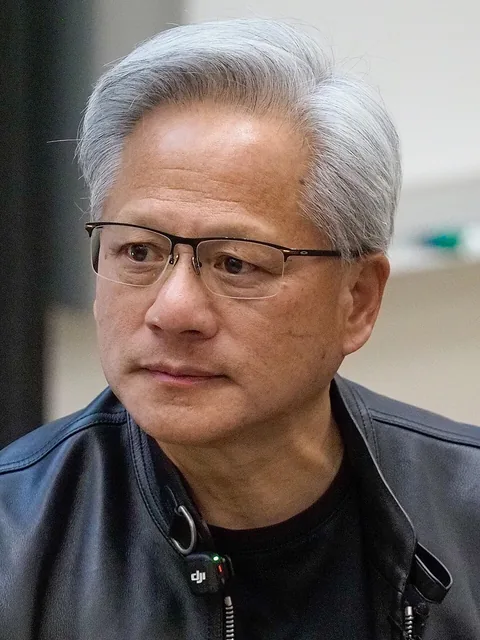
Unfortunately, we do have to talk about what's happened with Nvidia. So we talked last time about the resignation of Jensen Huang. So, Jensen Huang, I think everybody knows the story at this point. So originally he was accused of dating a spy, Alice Huang.80Alice Huang — a former executive at the Singapore cloud company Megaspeed; she is not related to Jensen Huang. According to the US press, American intelligence suspected her of working for China, but there is no public evidence of this. Now, the story about whether or not Alice Huang was in fact a spy has been called into some amount of question, but it turns out there was a second affair, this time with a direct report, Kimberly Powell,81Kimberly Powell — at Nvidia since 2008 and its VP of healthcare since 2017, in charge of applying GPUs and AI to medicine and drug discovery. who is VP of healthcare. Supposedly there's a third affair, and there may be others that have not yet been reported. We don't know. There was an investigation that never concluded because of the fact that Jensen ended up walking away from his role at Nvidia.
Just today, so the CFO has now been installed as the tentative leader, or interim CEO,82Colette Kress — Nvidia's CFO since 2013; after Huang's departure in November 2026 she became interim head of the company. and there's now a board search going on to find who the next CEO is going to be. Now, there's a lot of political pressure now coming out of DC, first to pass more extensive investigations, as well as regulations protecting the export of chips to China and/or to Southeast Asia. Just, I believe it was earlier today, that we saw the first restrictions come out of the Commerce Department,83The Commerce Department, through its Bureau of Industry and Security (BIS), runs US export controls, including bans on shipping advanced AI chips to China. which historically has actually been pretty protective of enforcement... It's kind of dragging its feet on enforcing a lot of these executive orders on restricting the dissemination of chips into Southeast Asia. But just today, they started enforcing some of the restrictions on rentals, which historically actually has not been illegal.
You can actually be a Chinese company, you can rent chips in a neocloud84Neocloud — a cloud company that rents out GPUs for AI, as opposed to general-purpose clouds like AWS: CoreWeave, Nebius, Fluidstack. in Malaysia or in Singapore or in Japan, but those are now being restricted as of today. You have calls for congressional hearings on all of this. So the pressure is mounting. At the same time, largely from the tech industry, there have been increasing calls for Jensen Huang to return as the CEO of Nvidia. There was recently a, I think, a, I don't know, a petition, I guess, called Stand with Jensen: 180,000 signatures, including Elon Musk, Tim Sweeney, Garry Tan, and supposedly 8,400 self-ID'd employees, as well as 90,000 shareholders. You also saw Brad Gerstner85Brad Gerstner — founder of the investment firm Altimeter Capital, co-host of the BG2 podcast and a longtime major Nvidia shareholder. and Gavin Baker86Gavin Baker — managing partner and CIO of Atreides Management, a well-known analyst of the semiconductor and AI industries. both call for the board to keep all options on the table, including a potential return of Jensen Huang.
And of course the big man, Donald Trump, said today that he would like to see Jensen return, or at least for it to be considered for him to return to his post. So I came out, wrote a tweet saying that I thought it was a little bit crazy for people to be saying that Jensen should return. But a lot of people, especially in crypto land, talking about how they think it's a coup, how they think this is a deep state operation, maybe the CFO engineered the coup, maybe it's China hawks engineering a coup. A lot of coup talk going around the timeline. Robert, I see you nodding. What do you say? Coup or not to coup? What's your take on the Jensen affair?
10Did Huang cross the line?
Robert argues that whether through foolishness or intent, Huang crossed a major line and has to go, even if the company may run better without him.
I don't have a strongly held insight, because I'm very far from the inner workings of the Jensen Huang situation. I'm very far from the inner workings of those who have potentially instigated it. My perspective is objective.
As a shareholder. You are a shareholder.
I'm actually not a shareholder.
You don't own any indices?
Oh, well, indices, yeah, fine. I guess indirectly, in some way.
There you go. As a shareholder.
As a stakeholder and delegated shareholder.
Yes. That's right.
I think clearly, intentionally or unintentionally, he somehow crossed a major line. Okay. Was he pulled across a line? Was he willingly going across a line? I don't know. I don't know if Alice Huang was a spy. I don't think she was. I think she was a conduit for business interests in China, right? Does that make her a spy? Maybe, maybe not, probably not, right? But I definitely think that she was a conduit for those who desired chips that Jensen could provide. He happened to find himself in a relationship with somebody who wanted something that he had.
And he moved chips to China, right? There's a lot of evidence that he moved chips to China, possibly violating some rules of the road. And maybe he was just dumb. Maybe he was foolish. Maybe he got bamboozled, okay?
I don't necessarily... he did quash the investigation into Megaspeed.87Megaspeed — a Singapore cloud company, Nvidia's largest chip buyer in Southeast Asia; US and Singaporean authorities investigated whether it diverted chips to China in violation of bans. On November 16, 2026, the US Commerce and Justice Departments confirmed a criminal investigation against it. So we know that that happened, coming straight from the top of Nvidia.
Correct. And it's possible that he made a mistake, and then it turned into leverage that businesses had over him, or that someone in China had over him.
I don't like all this passive language. He found himself in a relationship. He was bamboozled.
Like, I think the main Robert Leshner has shown up to the chat.
I'm not gonna say that he is the bad guy here. He could just be the dumb guy here, but he could be so dumb that he compromised... You're the CEO of the most valuable company in the world.
Yeah, it's like there's no, like, oh, whoopsie daisy, I accidentally protected my biggest supplier sending chips to Singapore, which, you know... whoa. Which I knew they were doing.
Yeah, yeah, he's not mentally fit to stand trial, I think, is what Robert's trying to say. Yeah.
He's just a boy. He's just a boy.
My view, very specifically, is: if he was that foolish, he deserves to go. And if he did it deliberately, he deserves to go. I think it's sad, because he is an incredible founder, one of the greatest of all time. Okay. But he's also built a company that honestly might run faster and harder and more successful without him after this.
11Bring back Jensen? The hosts vote
Robert and Tom oppose a return, while Tarun hopes for one but doesn't expect it, arguing that Nvidia survived its crises only through Huang's will.
Okay. I think you guys... are you guys team bring back Jensen?
Is anyone here team bring back Jensen? No? I didn't think that Apple would survive Steve Jobs dying.88Steve Jobs died in October 2011, two months after handing the CEO job to Tim Cook. Under Cook, Apple became the first company valued at $1 trillion, then $2 and $3 trillion. Okay.
They needed to bring him back.
Yeah, yeah. Rob... Robert, are you team bring back Jensen?
No, I am anti-bring-back-Jensen. I am anti-bring-back-Jensen.
Okay. Tom, Josh, Tarun, any of you guys?
I think it's tough at this point. It reminds me a little bit of the Sam Altman thing,89The Sam Altman affair: in November 2023 OpenAI's board fired Sam Altman, saying he had not been "consistently candid" with it; five days later, after an employee revolt and pressure from Microsoft, he was reinstated. where it's like, you know, independent of the facts, it's just kind of pure character assassination. Now everything Sam... it's like very shady, I think, in large part because of all the kind of leaks and sort of rumors that went around during that kind of thing. And so I think similarly, you know, even if you bring him back, there's been just so much permanent damage, you know, he's maybe not going to be as effective in the future.
I think of all of you, I'm the closest, but I'm actually on the middle ground of, like, I hope it happens, but I don't think it will. I don't think it'll get willed.
Yeah, so how are you not team bring back Jensen?
No, dude, 30 years. If you ever read the biography of Jensen,90Biographies of Jensen. Two well-known books on Huang and Nvidia have come out: journalist Tae Kim's The Nvidia Way (2024) and Stephen Witt's The Thinking Machine (2025). and also the history of Nvidia, and the number of times they went to zero and would have fucking died without that man flying into Taiwan and being like, I'm selling my company, or fucking going to Japan and getting Sega to bail him out,91The Sega bailout: in 1996 Nvidia's first chip, the NV1, flopped, and development of the NV2 for a Sega console stalled; Huang asked Sega to pay under the contract anyway, and the Japanese company invested $5 million in Nvidia, money that saved it from bankruptcy. finding all these random-ass suppliers who somehow didn't exist for some very nuanced hardware device, going into niche areas and being like, okay, these crypto miners,92Crypto miners bought up Nvidia graphics cards en masse in 2017–2018 and 2021, while Ethereum mining ran on GPUs; Nvidia even released dedicated CMP cards for them. After Ethereum switched to proof of stake in September 2022, miner demand vanished. everyone who works with me tells me it's a scam. I'm not gonna fucking make GPUs for them. Well, you know what? They're gonna pay me, so I'm gonna do it. You know, the guy has actually fucking willed them into existence.
InfiniBand.93InfiniBand — an ultrafast, low-latency networking standard for supercomputers; in AI clusters it links thousands of GPUs so they work as one machine. Buying fucking Mellanox94Mellanox Technologies — an Israeli maker of InfiniBand and Ethernet networking gear for data centers. Nvidia bought it for $6.9 billion: the deal was announced in March 2019 and closed in April 2020. at a time when everyone said Mellanox was an overpriced piece of shit. As someone who had to buy Mellanox hardware, I would have said the same thing. I fucking hated buying Mellanox and putting it in data center racks, because 50% of their chips were defective. I still had to do it, because it was the only way to do it. And by doing that, he won this fucking hardware match against AMD, where their bandwidth interconnect between all the chips was hundreds of times slower at that time. Now it's like a factor of five, but still, that hardware advantage is what kept CUDA in the race,95CUDA — Nvidia's platform for programming GPUs (since 2007). The millions of developers and libraries built on it are the main barrier for rivals like AMD. in the sense that alternatives were never able to compete. You didn't have to program as low-level and still got the same performance. So there's so much stuff that comes down to tactical decisions he's made.
And every person, every person who's been suggested is just kind of mid. None of them... the CFO seems like the worst. Obviously she's temporary. Now, if I look at all the other candidates, they also kind of seem like dog shit. Like, they're not gonna take some big risk in the same way that he does. And, like, I don't know, it's hard to imagine anyone fills those shoes. Granted, he did a terrible thing. Terrible things happened. So that's why I'm saying I'm weighing those two.
12Can Nvidia survive without its founder?
Tarun expects Nvidia to slowly lose share without Huang, while Robert points to Apple and Haseeb says losing share was inevitable anyway.
Once you cross the US strategic interests, I don't think you come back.
Yeah, but I think that company... how has it survived? I don't think there's anyone that...
No, it's so big. It has so much critical mass, Tarun. I think the whole point is, like, no.
There's... the five million competitors are...
Oh yeah, the $5 trillion company96$5 trillion: Nvidia became the first company in history to be worth more than $5 trillion, in October 2025. hasn't made it, you know.
Josh, what's your take?
I'm on the side of, like, he's crossed a line that can never be uncrossed, and there's no way to bring him back. But I also...
What's the line for you? What was the line that can't be crossed?
I mean, I think it's like, yeah, either knowingly or unknowingly, acting against national interests. And also, I mean, the subordinate thing, you know, I feel like that's pretty bad.
Although, I guess there's a lot of... actually, actually, let's clarify this. You think just with the Alice Huang revelations, he should have gone?
Yeah, I mean, I think before the second affair dropped.
I do. I don't think the affair is what matters. I don't care that he's horny. Okay. Yeah, it's not... like, it's not about him being horny, whatever.
So it's interesting, because I pointed out in my post that if you look at the Polymarket on the odds97Polymarket — the largest blockchain-based prediction market: users buy "shares" in event outcomes, and a share's price reads as a probability. of Jensen getting replaced, before the second affair dropped, he was at 85% to keep his job. The second affair boosted him to 20% that he would...
I think I should separate two things. I realize I answered two separate questions. The first question is: should he come back? The second question is: will they survive if he doesn't? And I think I differ from everyone else, and I think my answer to the latter is not really. Like, they'll be fine for two years, but in five years, in seven years, their strategic direction is gonna be like, okay, let's just do small. Every hardware company historically died when they fucking hired, like, the Boeing, Northrop Grumman guys,98Boeing and Northrop Grumman — giants of the US aerospace and defense industry, symbols of conservative management and government contracts. Tarun's point is that tech companies die when managers like that take over. and...
Go bankrupt?
No, no, no. As in, they're just gonna... they're gonna lose market share. They're gonna, like...
That's what everyone said about Apple, and Tim Apple99Tim Apple — in March 2019, at a White House meeting, Donald Trump called Tim Cook "Tim Apple," and the nickname stuck. On September 1, 2026, Cook handed the Apple CEO job to John Ternus and became chairman of the board. built that company even bigger. Okay.
Tim Apple. Yeah, yeah, yeah. But Apple's a very different story than this.
Bring Tim Apple back.
This is a much closer story, because consumer... the... you guys are thinking of this in a way where you're assuming, like, oh, the CEO doesn't matter. Satya was a replacement of fucking Ballmer,100Satya Nadella took over Microsoft in 2014 from Steve Ballmer (CEO 2000–2014). The Ballmer years are often called the "lost decade": Microsoft missed smartphones and search and its stock barely moved; under Nadella the company bet on the Azure cloud and again became one of the most valuable in the world. who tanked the company for 10 years. Like, fine...
Who was also a co-founder.101Fact-checkSteve Ballmer was not a Microsoft co-founder: Bill Gates and Paul Allen founded it, and Ballmer joined in 1980 as the 30th employee and first business manager (Wikipedia, "Steve Ballmer").
But once the co-founders were fully replaced, then the... My main thing is, Nvidia is actually in a kind of interesting place, where everyone, including all their customers, is basically making competitors to them. And in their fucking filings, like, Anthropic's literally listing, oh, we can replicate everything we do on Nvidia on AMD much faster.
Yeah, look, I think Nvidia losing market share is overdetermined. That was going to happen whether or not he stayed in the seat.
I think whoever they're gonna pick is going to be some conservative midwit MBA bullshitter who's not gonna do anything.
I mean, look, right now the front-runner is the CEO of Arm,102Arm — a British designer of processor architectures: it sells almost no chips itself but licenses its designs and collects royalties on every chip made. Rene Haas has been its CEO since 2022. Rene Haas, and then second, I think, is Ian Buck.103Ian Buck — Nvidia's VP of hyperscale and high-performance computing and the creator of CUDA: as a Stanford PhD student he developed Brook, a language for computing on GPUs.
Great. An IP licensing company is going to be really great at figuring out what the next thing to do is.
I think that's a little reductive, to say Arm is IP licensing, but...
Go, go, go look at their statements. Where is most of their revenue coming from?
Okay. Depends on how you think about the purpose of the business.
As someone who worked in hardware for a long time, I just have a lot of love for this guy, who really stuck with it and made a fucking good product, and even at the downs, at the worst, kind of kept people still really interested in trying this.
13This is not an Altman story
Haseeb argues tech people are misreading the moment: Washington and voters who hate AI are united against Nvidia, and bringing Huang back would invite a revolt.
I think here's my take: there's a little bit of tech people not reading the moment in this whole conversation. Like, this is not like Sam Altman. With Sam Altman, there was a he-said-she-said between the board and Sam Altman, right? And it was very unclear: what did Sam Altman do? What did he lie about? What was the actual misdeed, if there was one, or was it really just a breakdown in trust?
In this case, it is, one, potentially circumventing national security interests by selling, you know, selling chips to China. Whether or not Alice Huang is a spy, clearly, you know, whatever he was doing to protect Alice Huang and/or Megaspeed was inappropriate and/or potentially illegal. Second, he lied to the board about having just one affair. He lied to the company about having just one affair. And supposedly this third affair, he didn't even confess to the third affair.
Again, let's separate the two. It's kind of like... because you kind of conflated the question of should they stay, which, that part I agree. It's very hard to get around the fact...
You agree that he should have been fired.
Yeah, like, I think it's...
But now you say, but yes, he should come back.
No, I'm saying, like, if the board considered him to come back under some restrictions, I would certainly...
The boomerang theory.104Boomerang CEO — an executive who returns to a company after leaving: Steve Jobs at Apple in 1997, Howard Schultz at Starbucks, Bob Iger at Disney in 2022.
Well, here's the thing. Here's the thing I think. But if you're asking me who does better, right? OpenAI after firing Sam Altman: I actually think their outcome is no different. Literally zero difference. I actually think he is not that important there to them at all.
In fact, arguably...
A lot of developers might like them more if he left, right? A lot of their users might like them more if he left. Jensen's not the same way. Like, it's not even close.
So here's where I push back, okay? Remember that Democrats are coming into Congress in a month. All right? Like, they very clearly have been signaling... and, like, what Nvidia has been doing in DC has basically been bullying everybody who's been pushing back on the export of chips to China. Okay. All of those people in DC are fucking mad. And now they see, oh, you've been doing this the whole time while having an affair with a Chinese spy, or whatever the fuck she is, whether or not she's a Chinese spy, right? Clearly she was part of the...
I think we also have to talk about how this got leaked at a very convenient time. Yeah. Yes, okay. They've known for a year. They've known for a fucking year.
Yeah, I mean, famously, this short seller105The short seller is Culper Research: in May 2026 it published a report, "NVIDIA (NVDA): The China Problem," which mentioned Jensen Huang's overly close ties to Megaspeed's Alice Huang. was posting about it like six months ago. The other thing we also haven't talked about, again, I don't know if it gets conspiratorial, but timeline-wise: Will DePue from OpenAI106Will DePue — AI researcher and one of the creators of the Sora video model. In November 2026, by then a former OpenAI employee, he published an analysis of the weights of six open Chinese models and concluded from their initial weight distributions that their training had started on Nvidia Blackwell chips banned from export to China. put out this piece, I think on like Tuesday or Wednesday last week, basically saying, hey, we did some statistical fingerprinting of DeepSeek 4.1,107DeepSeek — a Chinese AI lab that releases open-weight models; its V4.1 family came out in September 2026. and we can prove that it was trained on GB300s.108GB300 — Nvidia's Blackwell Ultra superchip: two GPUs and a Grace CPU on one board. Selling these chips to China is banned. And it seems weird to me that literally this piece was ready to go, and it just happened to be ready to go now, like two days after the affair news came out. And so it seems like, you know, Anthropic and OpenAI are very happy to see, you know, Nvidia's downfall.
Well, no, Anthropic... or sorry, OpenAI was historically against the export controls. It was Anthropic that was pushing for them.109Anthropic and export controls: Anthropic has consistently pushed for tight export controls on AI chips to China; in 2025, for example, it backed the Biden administration's AI Diffusion Rule, and Dario Amodei wrote about the issue in his essay "On DeepSeek and Export Controls." Now OpenAI has switched. OpenAI is now in favor of export controls, having switched their position. And I think a lot of this was because of pressure from Jensen, and clearly the administration did not like this policy. That all being said, clearly the administration is out of step with the American public on this.
Very clearly, what we heard from the midterms is that people fucking hate AI. They do not like the idea of us going faster. They do not like the idea of us selling chips to China. They don't like the idea of China going faster on AI. All of this stuff of, like, oh no, no, obviously we should go faster, and obviously the billionaire brilliant CEO should keep his job at the most valuable company in the world that is potentially violating, you know, national security directives: that idea is a good way to get, like, a violent revolt. Oh yeah, let's just give him his job back because...
My main point is, I think this is, for Nvidia, kind of a death blow for a while. Like, I think the company will be fine, but...
But it was delivered by Jensen. It was delivered by Jensen. It was not delivered by the board.
Mistakes were made in pants he controlled.110"Mistakes were made" — the classic evasive formula of politicians, in the passive voice, without saying who made them; Ronald Reagan used it about the Iran-Contra affair, as did Bill Clinton. Tarun extends it to "mistakes were made in pants he controlled." But I understand...
But that's not even the problem. Okay, here's, again, here's my perspective on why that's not even the problem, and I think that's the red herring. Okay.
No, I know, it's the export stuff, right? It's like, okay, first of all, the Commerce Secretary shit111Howard Lutnick — US Secretary of Commerce since 2025 and former CEO of the financial firm Cantor Fitzgerald; his department is in charge of export controls on chips. is very sketchy. The other thing is, like, the visiting the factories with Alibaba there, that thing was also kind of scary. Like, if you read the short seller thing, their evidence on that was actually pretty good, because they found evidence from Chinese news sources stating that, and pictures of that. So, look, I'm not trying to say that there weren't mistakes made, but I'm still standing by "mistakes were made in pants he owned," just because it's a great one-liner.
Yes, but that mistake, okay, is, I honestly think, disqualifying. Not because he was horny, okay, but because it shows that he had such bad decision-making and such bad situational awareness and precautions to protect his own company. Okay, like, Tarun, you work in crypto. When you go to a crypto conference in a foreign country, okay, do you watch your drink? Do you let people who are attractive women come up and talk to you? Okay, like, there are obviously bad actors who are trying to exploit you, okay?
All day, every day. One thing about crypto is, you know, you're trained to do that after watching these exchange CEOs who are building an entire product around honeypotting their users.112Honeypot — a lure; in crypto, a project or contract designed to draw users in so it can take their money.
But you have the brains and the wherewithal not to be exploited such that you're hit over the head with a wrench,113Wrench attack — a physical attack on a crypto holder to force them to hand over their keys; the name comes from xkcd comic No. 538, where breaking strong encryption is replaced by a $5 wrench. or they take your keys, or they compromise...
The fight for chips is like a civilizational...
Yes. It's like the biggest thing. It's a hundred times...
...general in, like, this galactic war that we are basically... Like, that's what we've been told by everybody, by the government, by the president, by, you know, everybody in Silicon Valley. But if he wants to get his dick wet and he wants to go, you know, start feeding chips to China, don't worry about it. Bring him back. He's really good at building companies and negotiating deals. He's an arms dealer.
I'm saying this is war. I'm just saying this is more of a death blow for Nvidia than the other examples you gave.
Look, I don't disagree with you. It sucks that he did that. And now, what's coming to Nvidia is not, like, oh no, they'll be without Jensen. What's coming to Nvidia is the fury of the United States government, which is now united against you, united against China, united against billionaires.
Yeah.
Well, I mean, that too.
That too.
You had a perfectly good market going, and you had to ruin it. You had to ruin it. So yeah, I think the tech people who are arguing that Jensen should come back are just so miscalibrated in the calculus here.
Well, I do think there's no way they win that, right? Like, I think that even regardless of that, I just don't think it's possible at this point.
At the very least, let him go atone for his sins and, like, go find God or whatever. Like, give it a year, you know, let him cool off and do his thing and come back.
But you think there's going to be Operation Choke Point 2.0114Operation Choke Point — a 2013 US Justice Department operation in which banks were pressured into cutting off "risky" legal businesses. The crypto industry calls banks' refusal to serve crypto companies in 2023, after the FTX collapse, "Choke Point 2.0." here, or, like, Choke Point 3.0? Choke Point for chips?
Choke Point for chips... they're supposed to be... they're already supposed to be in there. It wasn't being enforced.
Like, we already passed... the craziest thing to me is, the three times in the last year since the US government has known about this affair, Lutnick was like, nah, we're just going to skip enforcing them. That was crazy to me.
This is what happens with Trump as president, you know. He's like, affair? Yeah, I mean, why would that be an issue?
Yeah, I thought that was... the US government reaction to the news was actually the bigger surprise to me, because it's like they've been sitting on this for so long.
Yeah, yeah, no, it's a bizarre... it's a bizarre story of, like, multiple levels of failure. All right, well, with that, we are up on time, so we have to wrap. But thank you, Josh, for coming on. Where can people find you? You want to give a quick...
Joshua. Yeah, Joshua underscore J underscore Lim on Twitter.
Cool. Okay, that is it from us. We'll be back next week. Thank you, everybody.


