

Conversations with Tyler
Chapters
For Tao, the beauty of a formula carries meaning: Euler's identity says rotation is multiplication, and quantum mechanics forces you to rethink what reality is.
Read the chapter- Cowen introduces Tao as arguably the greatest mathematician of his generation, a Fields Medal winner and UCLA professor with a new book out, Six Math Essentials.
- Euler's identity connects e, π, i, 1 and 0, but what Tao loves most is that e^(πi) = −1 says rotating something by π radians turns it into its negative.
- Quantum mechanics runs on Hilbert spaces and complex numbers, and its objects live in superpositions, like a cat that is neither alive nor dead.
- Tao recalls that many physicists at first refused to accept what the math was telling them, even though it explains the world better, especially at the molecular level.
The Riemann hypothesis is useful in its own right, and there is fresh progress on it, but the ideas came from AI and mathematicians don't understand them yet.
Read the chapter- The primes behind modern cryptography look random, and the Riemann hypothesis is a precise way of quantifying that random-looking behavior.
- A large chunk of number theory is proved only on the condition that the hypothesis holds, so unlike most puzzle-like problems it matters for its own sake.
- Just two days before the recording, Tao says, there was a significant advance on it, but the ideas were generated by AI.
- Progress on a hard problem used to require understanding it, while now insight has to be painstakingly extracted from machine answers, which Tao calls a strange era to be in.
Gödel's theorem once traumatized mathematicians, who got used to it and moved to pluralism, and now AI brings a new break in what proof means.
Read the chapter- Hilbert dreamed of settling every open problem ("We must know, and we will know"), and Gödel proved that any set of rules leaves statements that can be neither proved nor disproved.
- The statements Gödel showed undecidable aren't the ones mathematicians meet in practice, and when needed they add new rules to the foundations, as in a chess variant.
- There is no longer one true mathematics, Tao says, but a standard one plus a multiverse of alternatives with different number systems and geometries.
- With AI now generating proofs, "proving" and "understanding" have been decoupled, so Tao tries to keep an open mind and update his views on new data.
Math is stories and the soil the other sciences grow in: it gives them a common language and marks the limits of the possible, though its usefulness often shows up decades later.
Read the chapter- Tao recalls Galois frantically writing down his theory the night before his duel and regrets that classes strip out such stories, leaving equations, rules and recipes.
- In Tao's picture of STEM, math is the soil: it doesn't bear the fruit directly but sets the stage and gives scientists a common language.
- Engineering shows what is possible and math shows what is impossible: information theory tells you a protocol is already at 98% of capacity, so another $1 million spent on it is pointless.
- Shannon's information theory came out in the '40s, but it became essential only with cellphones and big data.
String theory has enriched geometry but found no confirmation, and Tao loves geometry partly because it doesn't come easily to him.
Read the chapter- Ideas from string theory, Tao says, have inspired mathematicians to solve many geometry problems, but there is still no striking confirmation that it models the real world.
- One objection Tao has heard is that the theory is too flexible and can explain trillions of other universes besides ours.
- Tao can't rotate shapes in his mind and needs blackboards and visual aids, which may be why the geometry he does understand feels so beautiful.
- His native field is analysis: what is big, what is small, and when waves interfere constructively or destructively.
Analysis was needed only once quantities grew huge and approximation took over, and zero is invisible, so it had to be inferred from the rules of arithmetic.
Read the chapter- Mathematics was long about exact numbers like 2 + 3 = 5, and approximation became necessary with astronomical quantities: nobody needs US GDP to the nearest penny.
- Math often gets simpler in the limit, Tao says, just as a fluid is easier to describe by pressure and volume than by trillions of particles.
- The Greeks already struggled with infinity, and Tao compares it to radioactive material: not all the laws of algebra work with it.
- Cowen notes that zero appeared in India around the 7th century AD, and Tao explains that people name what they see, so zero, negative numbers, fractions and square roots had to be inferred by trusting the laws of arithmetic.
Economics teaches you where models stop working, and Bayesian arguments like Bostrom's are limited by imagination.
Read the chapter- The definition of a limit, "for every ε there exists a δ," is easier to grasp as a game, Tao says, where your opponent hands you an ε and you counter with a δ.
- Tao uses Ricardo's law of comparative advantage to run his life, deciding what to spend his time on.
- Physics spoiled us with accurate models, Tao says, while in economics you have to understand when a model breaks down and how to adjust it.
- Black–Scholes rests on an "algebraic miracle" of Gaussian fluctuations, and without them it is dangerous, especially compounded into derivatives, as Tao recalls from 2009.
- Tao calls Bostrom's simulation argument a good attempt but warns that the true explanation may be a hypothesis you never considered.
Sometimes it pays to give up your options: in Newcomb's paradox, the prisoner's dilemma and chicken, the winner is whoever visibly ties their own hands.
Read the chapter- In Newcomb's paradox, Tao says, the winner is whoever has made it impossible to take both boxes, while overthinking gets penalized.
- Cowen brings up David Lewis's article arguing that the repeated prisoner's dilemma is a lot like Newcomb's paradox.
- Tao describes a talk where a prisoner's dilemma strategy is written as a program everyone can read, so other players trust it and it does better.
- In the "man or bear" debate many women said they'd feel safer with a bear, and Tao reads this as the bear being more predictable, while an intelligent counterpart adds risk.
- In chicken, the winning move is to visibly throw away your steering wheel, leaving the other driver no rational choice but to swerve.
Tao won't claim to fix schools: promising experiments don't scale, and the real skill math teaches is solving problems where mistakes are cheap.
Read the chapter- Tao cites a concerning UC San Diego report on students' basic readiness but can't say whether the cause is admissions (there's a debate about reinstating the SAT), COVID or social media.
- Flipped classes or tech bans can work wonders with enthusiastic teachers, Tao says, and then fail when deployed to 100 schools.
- Cowen's economist friends want less trigonometry and more statistics, and Tao agrees that big data makes statistics, probability and linear algebra more important.
- What matters most in math, for Tao, is learning to play with a problem where a mistake costs half an hour rather than a collapsed bridge.
- Olympiads, math clubs and Advanced Placement are good options, Tao says, but forcing them on a kid who doesn't want them will make the kid hate math.
Quant finance isn't a brain drain, in Tao's view: academia can't hire every math PhD, and finance pays well and does good as long as it doesn't chase the wrong metrics.
Read the chapter- Universities train far more mathematicians than they can hire, so Tao welcomes other industries that value them, and quant finance often pays better than academia.
- Used properly, quant finance gives markets accurate prices, signals and liquidity, but chasing the wrong metrics can destabilize economies and create crashes.
- Jim Simons made many billions at Renaissance Technologies, and his Simons Foundation is now a major sponsor of pure math, physics, astronomy and computer science.
- Academics need to leave the ivory tower, Tao says, and UCLA, for instance, has close ties to computer graphics and Hollywood.
Mathematics has moved from proof scarcity to proof abundance, and Tao is both excited by the possibilities and horrified by how abrupt the disruption is.
Read the chapter- Proofs used to be rare, so a few landmarks like the seven Millennium Prize Problems guided the field as people marched toward them slowly, picking up insights along the way.
- Now, Tao says, the currency of individual problems has been hyperinflated, because machines can brute-force masses of the old landmark problems.
- His math 2.0 works with datasets of thousands or millions of problems, where one AI handles 30% of them and a human's idea solves another 10%.
- Math academia, Tao says, is a pre-industrial economy being forced "almost at gunpoint" into an industrial one.
- An Industrial Revolution compressed into a month would have been far more traumatic, and a rushed transition loses things whose value you see only after the fact.
The paper as the unit of research is fading: AI has unbundled it from its author, the race for priority is degrading it, and live explanation is becoming the main output.
Read the chapter- A paper used to come bundled with an author who could give talks, train students and find new connections, while AI produces the PDF without any of that.
- Tao expects papers to show more of the process, the way behind-the-scenes material enriches a movie, and the literature to become a living database where humans and AIs collaborate.
- People race to dump a paper three minutes before someone else with an AI produces almost the same one, and Tao says priority as a metric has become over-optimized.
- Asked about his "journal" of video talks, Tao says there are 10 to 100 times more interesting papers than anyone can read, so the bottleneck is now human-to-human explanation.
Tao's favorite film is a parody of Hong Kong action movies, and now that any music is seconds away, he listens to less of it than in the CD era.
Read the chapter- Tao's favorite is Stephen Chow's Kung Fu Hustle, an over-the-top parody where the fights get ever more absurd and funny.
- Cowen recommends Jackie Chan's Drunken Master II and warns that the first Drunken Master is not that good.
- Tao loved Bach as a kid, now puts on epic soundtracks like Lord of the Rings to get into a working mood, and turns to familiar pop like Taylor Swift for comfort.
- The more abundant something is, the less you use it, Tao notes: he can find any piece of music in seconds yet listens far less than when he needed CDs.
Studying at his own level in a small university suited Tao, and failing an oral exam at Princeton changed his life.
Read the chapter- Tao's parents designed a custom track: he skipped five grades in math and science, enrolled at Flinders University at about 13 and still lived at home.
- He failed two courses: Introduction to Fortran, because he refused to give up BASIC, and Introduction to Quantum Mechanics, because he refused to write the history essay.
- At Princeton his fellow grad students knew far more math, and at his oral qualifying exam he couldn't convince his adviser that he knew the subject.
- After that failure, Tao says, he studied much harder and put real effort into explaining his work, and it changed his life.
At 51, Tao is learning to delegate to people and to AI, and he thinks the Collatz conjecture is true but doesn't expect to see it proved in his lifetime.
Read the chapter- Tao now trusts junior people to take the lead and says AI can let them run complex projects that used to need senior experience.
- He wrote about 99% of the posts on his blog for almost its entire history, then turned it over to the community, and now others write 95% of them.
- Tao admits he is exhausted a lot, but every moment of his day goes to something he chose to do.
- The Collatz conjecture is true, Tao says, and the first trillion numbers behave, but statistics can't rule out one exceptionally lucky hailstone that keeps floating up.
- None of today's mathematical ideas come close to ruling that out, and Tao doesn't expect to see a proof in his lifetime, even with AI.
Quotes
On the new ideas about the Riemann hypothesis
“Unfortunately, the ideas were generated by AI, and we don’t yet understand them. This is part of the new era now. We are getting answers without understanding, which is a very strange era to be in.”
Terence TaoRead from 04:27On infinity
“It took centuries to work out how to deal with infinity safely. It’s like radioactive material. Not all the laws of algebra work with infinity.”
Terence TaoRead from 14:20On what AI has changed in mathematics
“There’s so many changes, but in one sentence, we have moved from an era of proof scarcity to proof abundance.”
Terence TaoRead from 28:55On academic math in the age of AI
“We are not used to mass production of mathematics. We are still, in many ways, in a pre-industrial economy, math academia. We are forced, almost at gunpoint right now, to switch to an industrial or post-industrial economy, and this will take quite a bit of cultural change, but I think that’s what’s going to happen.”
Terence TaoRead from 30:14On the race for priority
“People are just racing to dump out a paper three minutes before someone else with an AI is generating almost exactly the same paper, and everyone is cutting corners and making the papers harder and harder to read just because they want the priority.”
Terence TaoRead from 34:41On research papers
“The bottleneck is now, what are the results that can be explained human to human? Papers are actually a very terrible way to communicate.”
Terence TaoRead from 35:52On Tao's student years
“The two classes I failed were Introduction to Fortran. I liked programming in BASIC. I didn’t want to switch to Fortran, so I refused to learn Fortran, and I failed the class.”
Terence TaoRead from 38:56On whether the Collatz conjecture is true
“It’s true, but we have no idea how to prove it, even with our fancy AIs.”
Terence TaoRead from 41:48
Summary
Tyler Cowen talks with Terence Tao, whom he calls arguably the greatest mathematician of his generation, on the occasion of his new book, Six Math Essentials. Cowen starts not with logic but with emotions: what Tao feels when he thinks about Euler's identity, quantum mechanics, the Riemann hypothesis and Gödel's theorem. For Tao, beauty is a meaningful signal. Euler's identity says that rotation is a kind of multiplication, and Gödel's theorem, which once traumatized mathematicians, led to pluralism: a "multiverse" of mathematics with different rules.
The main theme is AI. Mathematics, Tao says, has moved from an era of proof scarcity to an era of proof abundance. AI already delivers answers without understanding: the latest advance on the Riemann hypothesis came from AI, and humans don't yet understand it. Famous individual problems have lost their value as landmarks, and academic math is being pushed "almost at gunpoint" onto an industrial footing, with huge datasets of problems and shared living databases instead of individual papers. The paper has been unbundled from the author who understands it and can explain it, the race for priority is making papers worse, and live human explanation, such as talks, is becoming the main output of research. Tao is excited by the change but thinks the disruption is far greater than it needed to be.
Along the way: why real analysis and zero arrived so late, game theory inside the definition of a limit, the "algebraic miracle" of Black–Scholes, Bostrom's simulation argument, and Newcomb's paradox, where rationality hurts you; school math and quant finance. At the end it gets personal: favorite Hong Kong action movies, the Fortran and quantum mechanics courses he failed in Adelaide, the oral exam he failed at Princeton, delegation, and the Collatz conjecture, which he thinks is true but doesn't expect to see proved in his lifetime, even with AI.
Mentioned
- Six Math Essentials00:26Tao's new book and the occasion for the conversation
- Euler's identity01:18rotation as multiplication
- Riemann hypothesis03:13a recent advance proposed by AI
- Gödel's incompleteness theorems05:19the crisis in the foundations of mathematics
Show 16 more mentionsShow fewer mentions
 David Hilbert05:23"We must know, and we will know"
 Kurt Gödel05:51every system of rules is incomplete
 Évariste Galois08:29a theory written down the night before a duel
 Claude Shannon10:32information theory became indispensable decades later
- Black–Scholes model17:46option pricing and its limits
 Nick Bostrom18:25the argument that we live in a simulation
- Newcomb's paradox20:14when rationality hurts you
 David Lewis21:26the prisoner's dilemma as a Newcomb problem
 Jim Simons28:06a mathematician who got rich in finance and funded science
 Renaissance Technologies28:06Simons's firm
- Millennium Prize Problems28:43the landmarks of the proof-scarcity era
- Kung Fu Hustle36:29Tao's favorite Hong Kong action movie
- Drunken Master II36:52Cowen's favorite Jackie Chan film
 Fortran38:56Tao refused to learn it and failed the course
 BASIC38:56the language Tao loved programming in as a teenager
- Collatz conjecture41:42true, but no proof in sight even with AI
Transcript
01What a mathematician feels
For Tao, the beauty of a formula carries meaning: Euler's identity says rotation is multiplication, and quantum mechanics forces you to rethink what reality is.
Hello, everyone, and welcome back to Conversations with Tyler. Today, I’m very happy to be speaking with Terry Tao. He has a new and excellent book out, Six Math Essentials.1Six Math Essentials — Tao's first popular book, about six ideas that mathematics rests on: numbers, algebra, geometry, probability, analysis and dynamics. It came out in fall 2026 from Quanta Books, the imprint the Simons Foundation launched with Farrar, Straus and Giroux; in the UK it is titled Six Maths Essentials: How to Model the World. Terry is arguably the greatest mathematician of his generation. He is a Fields Medal winner, a professor of mathematics at UCLA,2Terence Tao (b. 1975) grew up in Adelaide, earned his PhD at Princeton in 1996 and has been at UCLA ever since; he became a full professor at 24. He won the Fields Medal, the top prize for mathematicians under 40, in 2006. Wikipedia. and he has done research in topics as varied as harmonic analysis,3Harmonic analysis — the branch of math about breaking functions and signals down into simple oscillations (Fourier series and transforms) and estimating the resulting sums. It is Tao's home field and the subject of his Princeton dissertation. partial differential equations, algebraic combinatorics, arithmetic combinatorics,4Arithmetic combinatorics, more often called additive combinatorics, studies the structure of sums of elements of sets of numbers, such as which arithmetic progressions they contain. It is also the title of Tao and Van Vu's textbook Additive Combinatorics (2006). Tao's best-known result in the area is the Green–Tao theorem (2004): the primes contain arithmetic progressions of any length. geometric combinatorics, probability theory, compressed sensing,5Compressed sensing lets you reconstruct a sparse signal from far fewer measurements than was thought necessary. Emmanuel Candès, Justin Romberg and Tao, along with David Donoho, laid the foundations in 2004–2006; the method is used, for example, to speed up MRI scans. analytic number theory, and he writes a blog,6Tao's blog, "What's new" (terrytao.wordpress.com), is one of the most widely read math blogs: he posts lectures, proof sketches and discussions of open problems there. Several of his books, published by the American Mathematical Society, grew out of its early years. and much more. Terry, welcome.
Oh, pleasure to be here.
Now, people often think of mathematics as about logic, but I’d like to start by asking you about emotions. I’ll name a few results in math, and you tell me what emotions they evoke in you, okay?
All right.
Euler’s identity.
That is a very pretty and neat identity. It connects all the fundamental constants of mathematics: e, π, i, and 1 and 0. Actually, to me, what is most beautiful about it is that what it’s really saying is that rotation is actually a type of multiplication. Euler’s formula, you can think of it as e^(πi) = −1. This is one form of Euler’s formula.7Euler's formula: e^(iφ) = cos φ + i sin φ, so multiplying by e^(iφ) rotates a point in the complex plane by the angle φ. With φ = π you get e^(iπ) = −1, or, in the familiar form of Euler's identity, e^(iπ) + 1 = 0. Wikipedia.
When you exponentiate, raise e to something, it’s like you’re multiplying something over and over again. Compound interest8Compound interest is how Jacob Bernoulli stumbled onto the number e in 1683: if 100% annual interest is compounded more and more often, the balance after a year doesn't grow without bound but approaches e ≈ 2.718 times the deposit. is one place where exponentiation shows up. The i shifts things from just multiplying to make things bigger or smaller, but instead, we’re multiplying at right angles and making it rotating. e^(πi) is saying that if you rotate something by π, π radians, you flip it. It becomes the negative of what you start with. It actually connects geometry and dynamics and algebra. It’s a very beautiful formula.
When you ponder quantum mechanics, what do you feel?
Oh, yes.
For me, it’s puzzlement, but you’re smarter than I am.
It uses very abstract mathematics, the mathematics of Hilbert spaces,9Hilbert space — a generalization of ordinary space, where you can measure lengths and angles, to infinitely many dimensions; named after David Hilbert. In quantum mechanics, the state of a system is a vector in such a space. which are these infinite-dimensional vector spaces, and complex numbers. You definitely need a fair bit of mathematical training to understand the mathematics. It also forces you to really change your idea of what reality is. It’s like how we used to think that the Earth was stationary, and then we had to change our perspective and think of the Earth as moving. Before quantum mechanics, we used to think of physical objects as always only being in one state. A light is on or off. The cat is alive or dead.
In order for the equations of quantum mechanics to work, you have to accept that, in fact, most of the time, objects live in superpositions. A cat is neither alive nor dead,10Schrödinger's cat — Erwin Schrödinger's 1935 thought experiment: a cat in a closed box, whose life depends on the decay of an atom, is by the formal logic of quantum mechanics in a superposition of "alive" and "dead" until the box is opened. Schrödinger devised it to show how strange that interpretation looks when applied to large objects. but a mixture of both. They interact with each other in funny ways, like how waves can interfere with each other.11Interference — the adding up of waves: where crests coincide, the waves reinforce each other (constructive interference); where a crest meets a trough, they cancel (destructive). In quantum mechanics particles behave this way too, as electrons do in the double-slit experiment. It is a very unintuitive way of thinking about reality because we don’t see ourselves in superpositions, but the math actually works out. Despite everything, it actually is a better way of explaining the world, especially at a molecular level. It is very mysterious, and it was very controversial when it first came out. A lot of physicists did not accept what the math was telling them.
02The Riemann hypothesis and answers without understanding
The Riemann hypothesis is useful in its own right, and there is fresh progress on it, but the ideas came from AI and mathematicians don't understand them yet.
The Riemann hypothesis, what do you feel?
Oh, yes. That is a really big prize in mathematics. Actually, recently we’re getting some progress on that. That’s another story. It concerns one of the most basic objects in mathematics, the prime numbers, which we now use prime numbers all over the place, like in cryptography. For instance, a lot of cryptographic protocols12Cryptographic protocols built on primes include RSA (1977): multiplying two large primes is easy, but factoring the product back is so hard that encryption can rest on it. that we use to encrypt our finances and whatever rely on properties of the prime numbers. We look at the prime numbers, and they behave very randomly. Sometimes they’re close together, sometimes they’re far apart.
The Riemann hypothesis is a very precise way of quantifying this random-looking nature of the primes,13The Riemann hypothesis (1859): all nontrivial zeros of the Riemann zeta function lie on the line with real part 1/2. An equivalent statement: the number of primes up to x deviates from its smooth estimate, the logarithmic integral, by no more than roughly √x·ln x. It is on Hilbert's list of problems (the eighth) and among the Millennium Prize Problems. Wikipedia. and it has many, many consequences. Any part of mathematics that touches the primes, if you know the Riemann hypothesis, normally your results get stronger. There’s a large chunk of results in number theory which are conditional. If you have the Riemann hypothesis, you get this good result. Otherwise, we can’t say anything.
Out of all the results, open questions in mathematics, most open questions in mathematics, they’re like puzzles. We don’t solve them for their own sake. They’re useful for gaining insight and help us eventually understand more realistic, real-world problems. The Riemann hypothesis is one of the few mathematical questions which is actually quite useful for its own sake. Knowing that it’s true would actually imply a lot of other things.
You think it will be proven, can be proven?
We are making progress. In fact, just two days ago, there was a significant advance on the Riemann hypothesis. We are still quite a ways from the full resolution, but now there are new ideas. Unfortunately, the ideas were generated by AI, and we don’t yet understand them. This is part of the new era now. We are getting answers without understanding, which is a very strange era to be in.
Historically, the only way to make a progress on a difficult mathematical problem was to understand it, and you could communicate these insights to others. Now we have these machines that can give us answers, but we have to really work much harder than normal to extract out the useful insights from them. It is a strange era. We now have these new tools, and hopefully we will have lots of mathematicians exploring both old methods and new methods, and we will find something. It will probably require a new idea which we haven’t seen before. We know the limits of many of the existing techniques.
03Gödel and the multiverse of mathematics
Gödel's theorem once traumatized mathematicians, who got used to it and moved to pluralism, and now AI brings a new break in what proof means.
Gödel’s incompleteness theorem, does it frustrate you?
Yes. Mathematics is going through a crisis right now. There was a similar crisis 100 years ago. David Hilbert, who was one of the leading mathematicians in the early 20th century, had this great dream finding that every single open problem in mathematics should be solved or unsolved. We should systematically try to answer all the questions in our subject. Here’s a famous quote in German: “Wir müssen wissen, und wir werden wissen,” “we must know, and we will know.”14"Wir müssen wissen — wir werden wissen": David Hilbert said it on September 8, 1930, in Königsberg; his list of unsolved problems, the "Hilbert problems," dates from 1900, from the International Congress of Mathematicians in Paris. The day before Hilbert's speech, at a conference in the same city, the young Kurt Gödel first announced his incompleteness result. Hilbert's words are carved on his gravestone in Göttingen. Wikipedia. Now, this was the rallying cry for mathematics in 1900.
Gödel proved this very, very striking result that no matter how you set out the rules of mathematics, there will always be statements that cannot be proven or disproven from those rules alone. That there is no fixed set of laws of logic that can answer every single question. They will always be incomplete.15Gödel's first incompleteness theorem (1931): any consistent formal system with an effectively specified set of axioms that can express the arithmetic of natural numbers contains statements that can be neither proved nor disproved. The second: such a system cannot prove its own consistency. Hilbert's program had aimed precisely to prove the consistency of mathematics by safe, finitary means. Wikipedia. This was very traumatic for mathematicians. It said that Hilbert’s program would never be finished in some sense. Over time, I think, we acclimatized to it.
In practice, many of the results that we do care about, we can prove or disprove. The specific statements that Gödel showed which were not provable or decidable are not the ones that we encounter in real life. Sometimes there are questions that you can’t answer using the usual axioms16The usual axioms — the standard foundation of modern mathematics, Zermelo–Fraenkel set theory with the axiom of choice (ZFC). The best-known statement that can be neither proved nor disproved in it is the continuum hypothesis: Gödel showed in 1940 that it can't be disproved, and Paul Cohen in 1963 that it can't be proved. or rules that you’re allowed to use normally, but sometimes we add new rules. There are other foundations of mathematics which can prove more things than the standard ones. Sometimes we do play with different rules, like when you play chess. There are some standard rules of chess, but sometimes we also consider other variants.
We’ve moved to a more pluralistic view of mathematics, where there isn’t just one true mathematics and one universal true and false facts. There is a standard one, but we do also consider more exotic alternate types of mathematics, where we have more rules or fewer rules, and there’s a multiverse of different types of mathematics to play with. We have different number systems. We have different geometries.
Mathematics has evolved over time to just a more pluralistic view of everything. We are comfortable with it now, but it was a very uneasy feeling to discover this result in 1930, that your worldview of mathematics changed. It’s as if you thought the Earth was stationary, and now you know it moves.
Is it fair to say your overall approach to the foundations of math is quite pragmatic? It’s not Hilbert, it’s not Brouwer.17L. E. J. Brouwer (1881–1966) — Dutch mathematician and founder of intuitionism: he rejected the law of the excluded middle for infinite collections and existence proofs that don't construct the object. His dispute with Hilbert over the foundations of mathematics in the 1920s was one of the fiercest in science. There’s really no result that could come along that would make you feel nihilistic. It’s just there’s different avenues to explore things. Is your view different than that?
Yes. I try to have some humility. There are certain mathematical models that I like, and I think they explain the real world. There have been revolutions in the past where quantum mechanics, you mentioned, was a very big philosophical transition in physics. We are currently going through a transition where most of mathematics was human-generated, and we’re now entering an era where proofs are being generated by AI.
This is also changing our philosophical foundations of what does it mean to prove something. What does it mean to understand something? As I said, these two statements used to be almost synonymous, and now they have been decoupled quite severely. I try to keep an open mind, which I think is part of what it means to be a good scientist. You don’t have a dogmatic view of what science is or isn’t. You update it based on events and new data.
04Stories, soil and limits
Math is stories and the soil the other sciences grow in: it gives them a common language and marks the limits of the possible, though its usefulness often shows up decades later.
How much do you read in the earlier history of mathematics, say, 19th century, early 20th century? Do you learn by doing that, or it’s just a fun thing you do as a hobby?
I think mathematics is about stories a lot more than is normally presented. If you take a math class, maybe you might hear some stories about there was a mathematician called Évariste Galois, who died in a duel.18Évariste Galois (1811–1832) was mortally wounded in a duel on May 30, 1832, and died the next day, before turning 21. The night before the duel he wrote a letter to his friend Auguste Chevalier setting out his results on the solvability of equations by radicals, the seed of Galois theory. Wikipedia. He was writing very frantically the basis of what we now call Galois theory the night before the duel because he was certain he was going to die, and he did. There are lots of wonderful stories that make the subject come alive.
Unfortunately, often when you present them in classes, you take out all the backstory and the side context, often because of lack of time. There’s a lot of math that you want to give to your students. Math often comes across as just a bunch of equations and rules and recipes. I do find that reading the histories makes it come alive. There are some really good stories in the history of mathematics, which, luckily, they make for great podcast stories and YouTube videos. Maybe they do get heard by the public, but not in classrooms so much.
How much of abstract mathematics do you feel is useful? Is it like a lottery ticket where maybe one in every 200 things is useful, but it’s clearly worth doing, or is your view that if we knew everything, explored all angles, it would all fit together, and every part of it would be a unified whole that could be used for something?
Right. I view STEM as a whole—science, technology, engineering, and mathematics—as an ecosystem, and mathematics is the soil. It’s at the foundations. It doesn’t generate the fruits, the things that are most directly useful for humans, but it sets the stage. Of course, it gives us all the formulas and recipes that other scientists use. It also sets limits. Most other sciences or engineering, they tell you what’s possible. You can build a rocket, and it flies, and now you’ve proven that it is possible for a rocket to fly.
If you want to show that something’s impossible, that there’s a limit, for example, if you want to communicate using a wireless spectrum, what is the maximum amount of bits you can stream from A to B? There’s a branch of mathematics, information theory, that tells you this, and it gives you limits. There’s a maximum theoretical limit, and you can’t discover this by engineering.
You can send more and more bits down a channel, but only mathematics can tell you that there’s a limit. This is useful because it tells you how close you are to perfection, and when to stop trying to develop an even better wireless encoding protocol because you’re already at 98 percent of mathematical capacity. There’s really no point to spend another $1 million trying to make it any better.
Mathematics unifies science. It gives a common language, so scientists get to talk to other scientists. Whether something’s useful or not, it often takes decades. Shannon’s information theory came out in the ’40s,19Claude Shannon published "A Mathematical Theory of Communication" in 1948. The limit Tao mentions is channel capacity: by Shannon's theorem, data can't be transmitted error-free any faster, and modern mobile codes operate close to that limit. Channel capacity. but it’s only when cellphones came along and big data that it really became so essential to the modern economy. Even if a topic is useless now, who knows in 20 years, 40 years.
05String theory and a favorite geometry
String theory has enriched geometry but found no confirmation, and Tao loves geometry partly because it doesn't come easily to him.
When string theory20String theory — a candidate "theory of everything" in which elementary particles are vibrations of tiny one-dimensional strings. To be consistent, the theory needs 10 dimensions of spacetime; the extra ones are assumed to be curled up so small they can't be seen, which is what Cowen is asking about. is presented to you, viewing it just as a mathematician, does it feel beautiful to you, or do you think this is strange and awkward, it’s not intuitive enough? What’s this higher number of dimensions doing here? Is it interesting math to you? What is it?
This is less of my field. The ideas from string theory have impacted geometry quite a lot.21Mirror symmetry is the best-known example. In 1991 the physicist Philip Candelas and his co-authors used it to count rational curves on a Calabi–Yau manifold, solving a long-standing problem in enumerative geometry. And the string theorist Edward Witten won the Fields Medal in 1990. The modern field of mathematical geometry already studies very high-dimensional objects and making them even higher dimensional by turning points into little strings, they’re very comfortable with that. My understanding is that the ideas proposed by physicists have inspired mathematicians to solve many geometry problems in their own field.
Now, my understanding also—I’m not really a physicist, though—is that while the theory is very beautiful, it could have been a good explanation of the real world, but we have not found a really striking confirmation that string theory really is a good model. One of the objections that I’ve heard is that it’s actually too flexible a theory. There are too many ways in which these strings can vibrate. While they can explain our current universe, they can also explain trillions and trillions of other alternate universes, and there’s no obvious way to explain why we live in this one and not in all the other universes that are compatible with string theory.22The string theory landscape is the name for this problem: by a common estimate, the theory allows on the order of 10^500 vacua, versions of the universe with different laws of physics, and no principle singles out ours. Wikipedia.
I don’t know to what extent string theory is still the leading proposal for, say, quantum gravity,23Quantum gravity — a theory, not yet built, that would describe gravity by the laws of quantum mechanics: general relativity and quantum theory in their current form are incompatible. The main alternative to string theory here is loop quantum gravity. which is one of the big goals of modern theoretical physics, to unify quantum mechanics and gravity. There was a lot of hope that string theory would do this. They’ve tried for many decades. I think that there’s still no really conclusive evidence that it’s working. I think people are beginning to explore other alternatives to string theory as well, but you may have to talk to a physicist for the latest on that.
Reading your book, I come away with the gut feeling, a purely subjective impression, but that you love geometry most. Is that justified?
I love all kinds of mathematics. Maybe I like it because I’m not as good at it as with other types of mathematics. There are mathematicians who are very visual, and they can see a complicated shape and rotate it in their mind. I can’t do that. I actually have to write things out and use visual aids, blackboards, to really see geometry. I have to put some real effort to understand geometric ideas. Maybe because of that effort, the ones that I do understand, I actually find quite beautiful.
My native field is actually more analysis. I like understanding what things are big, what things are small. If you add a whole bunch of small things together, can you get something big? When do waves interfere constructively, destructively? That type of mathematics feels very natural to me. I try to appreciate all kinds of mathematics. I’ve learned a lot by talking to fellow colleagues who think about mathematics in a different way. I’ve learned a lot from them, and hopefully, they’ve learned something from me.
06Why analysis and zero came late
Analysis was needed only once quantities grew huge and approximation took over, and zero is invisible, so it had to be inferred from the rules of arithmetic.
With respect to real analysis, why does that come so relatively late in the history of math? It doesn’t seem that difficult in a way, once it occurs to you, that there’s such a thing at all, even if some of the results are difficult.
Traditionally, mathematics was about exact formulas and numbers: 2 + 3 is exactly 5. It’s only when we started dealing with really large quantities, like astronomical scales of numbers or big data, whatever, that we needed to start working approximately. If you want to know the GDP of the United States, you don’t need it for the nearest penny. Just getting the first few digits is enough. It took a while to figure out what was the mathematics for orders of magnitude, and to talk about what happens in the limit.24Calculus as Newton and Leibniz built it in the late 17th century relied on intuitive "infinitesimals." Rigorous definitions of limits and continuity, in terms of ε and δ, came only in the 19th century, from Bolzano, Cauchy and Weierstrass.
If instead of working in a family of five people or a village of 100 people, you work with hundreds of millions of people, you actually really want to send the number of people off to infinity and ask, what is going on in the infinite limit? Often, the mathematics becomes simpler. It’s like if you want to model a whole bunch of particles of a fluid, you could model all the trillions of particles bouncing around, but actually, it’s easier to think of it as a continuous object25Continuum mechanics describes a liquid or gas not as individual particles but as continuous fields of velocity, pressure and density. The Navier–Stokes equations work this way; proving that their solutions always stay smooth is one of the Millennium Prize Problems. and talk about pressure and volume and macroscopic quantities.
Early mathematicians struggled a lot with infinity. The Greeks had all these paradoxes.26Zeno's paradoxes (5th century BC) are the best known of them, such as Achilles and the tortoise: swift Achilles can supposedly never catch the tortoise, because by the time he reaches where it was, it has crawled a little farther. They are resolved with the ideas of a convergent series and a limit. They didn’t understand how infinity worked. It was a very nontrivial task. It took centuries to work out how to deal with infinity safely. It’s like radioactive material. Not all the laws of algebra work with infinity. It really has to be handled with care, but it is very powerful once you know how to use it.
Zero as a number, that seems to come, in a way, late in mathematics. That’s what, the 7th century AD in India?
Yes.
Zero seems so simple to us. Why does that take so long?
Because it’s invisible. I think it’s human nature to only give names to things that you see. You see a sheep, that’s a sheep. You see two sheep, that’s two sheep. You see nothing, you don’t say, “I see zero sheep.” It is a conceptual leap. It requires some abstraction. People inferred the need for zero by manipulating the numbers that they could see. In fact, I think there are many languages where they don’t even have a name for one. The counting system starts at two. Even the idea that a single object you can attach a count, one, to it, that’s already a conceptual leap. You may think that if you see a sheep, you don’t need to call it one sheep.27One as not a number — the ancient Greeks had something similar: for Euclid a number is "a multitude composed of units" (Book VII of the Elements), so the unit itself didn't count as a number.
People had to work with numbers of two, three, four, five, and they started applying rules to these numbers. They discovered addition and subtraction and other arithmetic operations. Just by following the rules of what these operations were trying to do, they were naturally led to consider new numbers: one, zero, negative numbers, fractions, square roots. These are numbers that are not obvious. You can’t see −3 sheep or √2 sheep.
Once you trust in the laws of arithmetic, and you just accept that they are predicting other numbers to exist and be useful, then we found them. Now we teach them in our primary school classes, so it’s obvious to us. We’ve internalized things like zero. It was a major conceptual breakthrough back in the 7th century,28Zero: the rules for calculating with zero and negative numbers were first set out by the Indian mathematician Brahmagupta in his treatise Brahmasphutasiddhanta (628). Wikipedia. as you say. We shouldn’t mock these ancient mathematicians for not knowing what zero was.
07Economics, Black–Scholes and the simulation
Economics teaches you where models stop working, and Bayesian arguments like Bostrom's are limited by imagination.
When you look at mathematical economics over the last two decades, is it interesting to you as math, or is it just a bunch of people doing something different that, to you, is low level?
Oh, yes, I was always fascinated by economics. I love game theory, and actually often there are pure math problems where it’s actually good to think in game theory terms. In analysis, you have all these complicated statements, like for every ε, there exists a δ,29The definition of a limit: L is the limit of f at a if for every ε > 0 there exists δ > 0 such that |f(x) − L| < ε for all x ≠ a with |x − a| < δ. As a game: your opponent names an arbitrarily small error ε, and you answer with a δ that keeps you within it; the statement is true if you have a winning reply to every move. blah, blah, blah. It looks very intimidating, but if you phrase it as a game, your opponent is giving you an ε, you need to counter that ε with a δ of your own. If you view it as a game, then actually you can talk about strategies and who’s ahead, who’s behind. It actually activates really good modes of thinking.
I’ve used economic thinking in my own work. We talk about cost functions and minimizing loss. There are lots of concepts. Ricardo’s law of comparative advantage,30David Ricardo (1772–1823) set out the law of comparative advantage in On the Principles of Political Economy and Taxation (1817): it pays to do what you have the lowest opportunity cost for, even if you are better than others at everything. I use that to run my life. There are so many things I can do. What do I choose to spend my time on? It’s actually a very useful principle: comparative advantage.
Economics, I find it’s a very good arena to understand the difference between models and reality. Physics, we’re spoiled because we’ve had these great physicists who’ve created these very accurate models of the real world, classical mechanics, quantum mechanics, and they’re very well tested and very accurate. You can just go to town exploring their consequences and still predict reality. Economics is a much more mixed situation where you have models, and sometimes they predict the real world very well, but sometimes they don’t.
In addition to doing the math, you also have to do the modeling, and you have to understand the limits of when a model starts breaking down and what you need to do to adjust it. I find that fascinating. It’s somewhere between the hard sciences and the social sciences. There’s enough hard models that you can do math, but there’s also enough real-world messiness that you have to also grapple with the subjectivity. As an outsider, I find it a really fascinating subject.
When you looked at the Black-Scholes model,31The Black–Scholes model of Fischer Black and Myron Scholes (1973) prices an option by assuming the stock price fluctuates randomly with a normally (Gaussian) distributed logarithm. The surprising consequence: the formula doesn't include the stock's expected return, only its volatility, that is, the risk. In 1997 Scholes and Robert Merton won the Nobel Prize in economics for the method; Black had died in 1995. Wikipedia. were you shocked when the probability doesn’t matter? Was that beautiful to you?
Yes, yes, yes. There is a special feature of Gaussian fluctuations that you can price options32Option — a contract giving the right, but not the obligation, to buy or sell an asset at a preset price in the future. What that right is worth today is the problem the Black–Scholes model solves. just by knowing risk. There is one algebraic miracle that makes this work. Normally, predicting future costs of anything is just an intractable problem, and there just happens to be this miracle. If you have Gaussian fluctuations, then it is beautiful. This is actually a really good example of when you need to know when the models work and when they don’t work. If you don’t have Gaussian fluctuations, then actually Black-Scholes is somewhat dangerous to use, especially if you compound it into derivatives33Derivatives — contracts whose price depends on the price of another asset: options, futures, swaps. Stacking derivatives on derivatives carries the error of the underlying model through the whole structure. over and over again. Again, that’s an old story. You know what happened in 2009.342009 — the global financial crisis of 2008–2009, one of whose causes was complex derivatives built on mortgage debt.
Nick Bostrom has a famous argument using Bayesian analysis35Bayesian analysis — an approach to probability based on Bayes' theorem: each hypothesis has a prior probability, and new data turn it into a posterior one. That's what Tao means next by "prior belief" and "updating." that probably we’re living in a simulation.36Nick Bostrom made the argument in "Are You Living in a Computer Simulation?" (Philosophical Quarterly, 2003). It is a trilemma: either almost all civilizations die out before reaching a "posthuman" stage, or almost none of them run simulations of their ancestors, or we are almost certainly living in a simulation. The argument's website. I’m not sure if he believes it, but he doesn’t reject it. When you hear that argument, are you, A, convinced, or B, you think it’s somehow a misuse of mathematics?
I think it’s a good attempt. Bayesian reasoning is very subtle because, as I said, it’s already hard enough dealing with a model because you don’t know whether the model is accurate or not accurate. Bayesian reasoning, you’re not just dealing with one model of the world, but you’re dealing with multiple models of the world, and you have some prior belief as to how likely each model is, and then you’re updating them.
It could be that you may be considering two models, let’s say a hypothesis and a null hypothesis,37Null hypothesis — in statistics, the default assumption of "no effect" (the drug doesn't work, the coin is fair), which is tested against the data and either rejected or not. but there could be a third hypothesis that you’re not considering at all, which is actually the true explanation. If you focus only on the two hypotheses that you can think of, maybe it’s your lack of imagination, which is actually blocking you from seeing the real truth. You have to be aware of your own limitations when you do Bayesian reasoning.
That said, you can use some reasoning like this. There are certain models for the universe that you can refute by pure reasoning. In ancient times, people believed in prophecy and fate, that certain people were destined to have something happen 20 years from now, but this is very incompatible with free will and having laws of nature that are very predictable. It’s also incompatible, to some extent, to being in a simulation, for instance. You can do these thought experiments, and you can play off various grand philosophical ideas against each other. You can play off the idea of simulation against the idea of there being a creator.
One amusing thing I saw on the internet recently is that the fact that we can now create AIs that appear smarter than us has theological implications as to how intelligent our creator was compared to ourselves.
Yes.
It is entertaining to explore these thought experiments, but you do have to be very humble that we could be limited by our own imagination. We are comparing different models to explain the universe, but there are infinitely many other models that could also explain things and sometimes we are just completely off track.
08Newcomb's paradox: when smarts hurt
Sometimes it pays to give up your options: in Newcomb's paradox, the prisoner's dilemma and chicken, the winner is whoever visibly ties their own hands.
Newcomb’s paradox.38Newcomb's paradox was devised by the physicist William Newcomb and made famous by the philosopher Robert Nozick's 1969 paper. There are two boxes: a transparent one with $1,000 and a closed one with either $1 million or nothing. A predictor who is almost never wrong put the million in only if he predicted you would take just the closed box. Taking both is better whatever the contents (the dominance principle), yet those who take one box almost always walk away with the million. Wikipedia. Are you a one-boxer or a two-boxer?39One-boxers and two-boxers — philosophers' names for the two camps in Newcomb's paradox: those who take only the closed box and those who take both. The argument between them has run since Nozick's 1969 paper. You sound like a one-boxer so far.
Oh, okay. I have to be reminded—
That’s the Nozick problem from the—well, it comes from Newcomb, of course, but you can grab one box or two box, and you’re told by a potentially omniscient being that if you grab both boxes, you’ll end up with less. The dominance principle tells you to take both boxes. Expected utility maximization says only take the one box.
Right. One thing that this paradox shows you is that sometimes having more free will and agency actually hurts you. You may think that the more optionality and ability to think you have, the better you’ll be off in life. That seems intuitive. As I recall of Newcomb’s paradox, if you lobotomize yourself to say, “I will actually do surgery on my brain so that I cannot take two boxes, I will only be able to take one box,” then this being that is observing you will see that, and it will reward you. Whereas if you’re overthinking it, then you may actually get penalized.
Newcomb’s paradox is actually an environment where you are penalized for thinking too much. It’s an exception to the rule that being more rational is an advantage. It is a nice thought experiment, but it may have real-world implications. There are actually some scenarios where you don’t want to signal that you’re too smart.
David Lewis has this famous article, I think it’s 1982,40Fact-checkCowen dates David Lewis's paper "Prisoners' Dilemma Is a Newcomb Problem" to 1982, but it came out in 1979 (Philosophy & Public Affairs, vol. 8, no. 3). Lewis argues that the prisoner's dilemma is essentially Newcomb's paradox, with a partner who resembles you playing the role of the predictor. where he argues the repeated prisoner’s dilemma41The prisoner's dilemma — a game-theory model: two arrested suspects, held apart, each decide whether to stay silent or betray the other. Each is better off betraying whatever the other does, but if both betray, both end up worse off than if both had stayed silent; when the game is repeated over many rounds, cooperation starts to pay. is a lot like Newcomb’s paradox. This is a contested claim.
I can see that, yes. Actually, I saw a great talk about this recently, that if you automate your prisoner’s dilemma strategy with a computer program and everyone gets to see your computer program—it’s a very simple strategy, like maybe you cooperate unless you saw someone defect, and then you defect yourself.42Tit for tat is a close cousin of the strategy described: cooperate first, then copy your opponent's previous move. With it, Anatol Rapoport won both computer tournaments of the repeated prisoner's dilemma that the political scientist Robert Axelrod ran around 1980. If you signal in advance what you do and you remove your own free will, then you can actually do better in the game because people will see that you’re trusted.43Program equilibrium (Moshe Tennenholtz, 2004) is game theory's name for this idea: if players submit programs and each program can read the other's code, mutual cooperation becomes achievable even in a one-shot prisoner's dilemma.
There was this debate about a year ago: If you’re a woman, would you rather be with a man or a bear?44Man or bear: the question "Would you rather be stuck alone in the woods with a strange man or a bear?" went viral on TikTok in spring 2024; many women answered: the bear. Many women said they feel safer with a bear, and I think one of the reasons is that the bear has much less higher rationality. It’s much more predictable what the bear will do, and the fact that interacting with someone who is really intelligent actually adds risk. There’s lots of games like that. I think the game of chicken is another game where one of the strategies to win chicken is to actually disable your steering wheel and just go full speed ahead, but visibly throw away your steering wheel. Then the rational strategy for the other player is to swerve.
09How to teach math
Tao won't claim to fix schools: promising experiments don't scale, and the real skill math teaches is solving problems where mistakes are cheap.
Let’s say we put you in charge of math education in the United States. Put aside AI. We’ll get to that in a bit. How would you improve math education here?
Oh, that is a really complex problem. My main experience with education is at the university level. I’m at a fairly prestigious university where we are quite selective, so we get among the best students coming from both the American and overseas high schools. I don’t have the best view of what’s going on at the K-12 level. I talk to people, and I have two kids who have gone through the K-12 system, but that’s really a small amount of data.
Wasn’t there a recent report that UCLA faculty complained that a lot of the entering students didn’t even have great middle school math? Some do, some are excellent. I’ve taught in the UC system, but it’s high variance.
Yes. There was a report from UC San Diego45The San Diego report — a report by a working group of UC San Diego's Academic Senate and administration (November 2025): the share of freshmen whose math skills fall below middle-school level rose from about 1% before 2021 to roughly one in eight in fall 2025. Report, PDF. in particular that was quite concerning about the basic readiness of many of the students. I’m not sure whether it’s because our selection system needs fixing. There’s a debate to reinstate the SAT in the UC.46The SAT, like the ACT, is a standardized test for US college admissions. In 2020 the University of California stopped considering these test scores in admissions. Or whether it’s because of COVID. That could be a consequence. Some people say that social media has destroyed the attention spans of school kids. We don’t know. There are people who try to systematically study education quantitatively and try to see what types of pedagogy work best, but it is a very soft science. I think some of the findings are controversial.
I do think we need lots of experiments, and some way to scale up experiments that work on a single school to the whole system. I do know that there have been lots of little experiments. Let’s flip the classes.47The flipped classroom — a teaching model in which students learn new material at home, for example from videos, and spend class time solving problems with the teacher. Let’s ban technology, or let’s do things in a different way. When you do it on a small scale, it can be great. When you have some teachers who are really enthusiastic about this experiment and the kids are excited about trying something new, you can get these fantastic results. Then you try to deploy them to 100 schools, and suddenly it doesn’t work.
One big issue is getting from a prototype experiment to a large-scale deployment. This I don’t know how to solve. There’s some pragmatic realities of just how education works at a typical, let’s say, American high school, that you can’t ignore just because something works in some nice lab school experiment.
Many of my economist friends, they think we should teach less trigonometry and more statistics. Do you agree?
Yes, I think that is a tweak. Traditionally, the college math syllabus consists of a lot of calculus, because for the classic applications to physics and engineering and the hard sciences, calculus was almost the most important higher math skill that you needed. In the era of big data, statistics and now machine learning and linear algebra and probability are becoming more important. We are making some tweaks there.
Although mathematics is often not about the specific tools that you learn, but just how to deal with abstract situations and how to problem-solve. I view math as a good playground to think where the cost of failure is cheap. In the real world, if you do something in the real world and you make a mistake, it could be very expensive. If you’re a civil engineer and you’re tasked to build a bridge and you make a mistake and the bridge collapses, you made a very expensive mistake. If you’re a surgeon and you cut the wrong thing, you’ve made a very fatal mistake, perhaps. If you have a math problem and you solve it incorrectly, you just have wasted half an hour of your time, but you can go back and do it again.
The specific tools you learn in math are somewhat useful, but actually just the ability to play and try to solve problems when there’s some unknowns and things you don’t understand. How do you even start? How do you set up the model? How do you not get terrified of all the possibilities, and how to not get paralyzed when you’re faced with anything complex. That, I think, is the valuable skill, the most valuable. All the other stuff you can look up or even consult an AI now if you really wanted to.
You did a math Olympiad when you were 10.48The International Mathematical Olympiad: Tao competed three times, winning bronze in 1986 at age 10, silver in 1987, and in 1988, at 12, becoming the youngest gold medalist in its history. Should there be some kind of embedded calculus option in 7th grade that, if you want to do it, you can just learn calculus early on, and if kids don’t want to do it, they don’t have to?
There are Advanced Placement-type exams,49Advanced Placement — the College Board program in which US high school students take college-level courses and sit exams that many colleges give credit for. and there are math enrichment. There’s math clubs. I think it’s good to have a lot of options like this. They shouldn’t be mandatory. I think if a kid doesn’t want to do these things and you push them into this, they will just have a horrible time and end up hating mathematics.
Whether you want to formally include this in the standard school system, I think there could be special schools where they have experts, and they really make an effort to integrate these competitions and nonstandard classes into their framework. It can work, I think, when there is the supporting infrastructure—so qualified teachers, supportive administration, and just general rules for how a student can choose these activities in place of standard classes, but it may not scale to the average school.
There may not be enough qualified teachers. Some schools may have policies that are just somehow not compatible. There may be too many parents in one school that just do not like this type of education. I think these options should exist, and it should be possible for parents and kids to select among several school options, some of which would offer these and some of which don’t.
10Quant finance and the ivory tower
Quant finance isn't a brain drain, in Tao's view: academia can't hire every math PhD, and finance pays well and does good as long as it doesn't chase the wrong metrics.
How do you feel about quant finance?50Quant finance — trading and risk management built on mathematical models and algorithms; its practitioners are called quants, and many come from math and physics. Do you view it as a brain drain out of math, or the potentially high wages overall attract more talent into math, and some of the people still end up doing things in mathematics, so the net effect on math is positive? What’s your view?
On the one hand, mathematics, like academia in general, we don’t have enough positions in academia. Academia is a fairly small sector of the economy. We train many more students than can end up having academic jobs. As a very practical matter, we need other industries that also value mathematicians and can hire people with, say, math PhDs. Quantitative finance has been very good at that, so often they actually pay very, very well, better than academics in many cases. I think that’s fine.
There are many positive uses of quantitative finance. Used properly, you can price things well, you can get accurate market signals, you can get liquidity. If you pursue the wrong metrics too much, you can also destabilize economies and create crashes. It impacts the real world, so you have to be more aware of these issues than if you were just a pure mathematician.
There have been mathematicians who were very successful in finance and gave back to the math community. Jim Simons is one example.51Jim Simons (1938–2024) — mathematician and co-author of Chern–Simons theory in geometry. In 1978 he left academia for finance and founded the firm that became Renaissance Technologies; its Medallion fund is known as one of the most profitable in history. He and his wife Marilyn founded the Simons Foundation in 1994. Wikipedia. He founded Renaissance Technologies. He made many, many billions of dollars, and actually, he founded the Simons Foundation, which is now a major sponsor of pure mathematics and physics and astronomy and computer science. It works out.
I do think academics do need to get out of the ivory tower sometimes and engage with various industries—finance, the tech industry. Here at UCLA, we’re close to Hollywood, we had a lot of ties with computer graphics industries,52Computer graphics — for example, UCLA mathematicians worked with Walt Disney Animation Studios on the material point method used to simulate snow in Frozen (2013). In the researchers’ test scene, a ball of snow rolls downhill, picking up snow and leaving a track.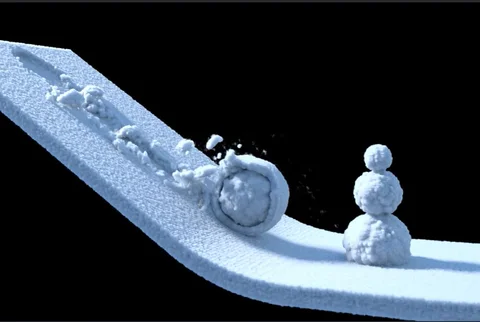 for instance, and the movie industry. There are many sectors of the economy now which are becoming more mathematized. They need people with good math skills, and we should engage with all of them, I think.
11From proof scarcity to proof abundance
Mathematics has moved from proof scarcity to proof abundance, and Tao is both excited by the possibilities and horrified by how abrupt the disruption is.
How long do you think it will be before AIs create the equivalent of new Millennium Problems53The Millennium Prize Problems: the Clay Mathematics Institute announced seven of them in 2000, with a $1 million prize for each. The prize for one, the Poincaré conjecture, was awarded to Grigori Perelman in 2010, and he turned it down. Wikipedia. for mathematics? Is that two years away, 20 years away? Interesting ones.
It’s extremely uncertain times now. I think a lot of assumptions about how mathematics operates is going to change a lot. There’s so many changes, but in one sentence, we have moved from an era of proof scarcity to proof abundance.
It used to be that proofs were really hard and valuable, and so we would create these open problems as these goals, these landmarks, and we would march toward these goals very slowly and deliberately, but we’d pick up all these insights and techniques and learn all these things along the way. We have these Millennium Prize Problems, and we have these targets that guided us, but they’re relatively few in number. There’s only seven Millennium Prize Problems. That was the way things worked in a proof-scarcity era.
I think going forward, the idea of focusing on individual problems, that currency has basically been hyperinflated. We now have machines that can just brute-force, basically solve massive numbers of the old problems that we used to use as landmarks, and we have to really switch to some sort of math 2.0. I think instead of dealing with individual problems, we may start creating huge datasets54Huge datasets of problems: Tao has already run a pilot of this kind, the Equational Theories Project. From September 2024 to April 2025, humans working with automated provers settled all 22,028,942 implications between 4,694 of the simplest equational laws for magmas, checking every proof in Lean. of thousands or millions of problems and try to sweep them out. With this AI, I can handle 30 percent of these problems. Using this idea that this human contributed, I can solve this 10 percent, but not pick out individual problems per se anymore as the goals, but work at a much higher scale.
I think that it will take a lot of cultural shift. We are not used to mass production of mathematics. We are still, in many ways, in a pre-industrial economy, math academia. We are forced, almost at gunpoint right now, to switch to an industrial or post-industrial economy, and this will take quite a bit of cultural change, but I think that’s what’s going to happen. Individual problems, even like Millennium-level, may disappear, and we will just have lots and lots of big datasets of problems.
On net, you’re happy? Unhappy?
That’s not the right word. It’s very complicated. I’m excited by the possibility of completely new types of mathematics that didn’t exist before, but I’m also actually quite horrified by the disruption, which I think was much more than necessary.
Of course, every revolution, like the Industrial Revolution, of course, is a famous example, it creates job displacement and so forth. I think there was some medium between status quo and transition to a new paradigm where you had more of the benefits of transition and fewer of the disruptions. If the Industrial Revolution happened within one month, it would have been much more traumatic, entire careers cut short with no ability to transition halfway through.
It would have been better overall, right? Like our standard of living, people might have had in the 1950s.
Yes, but a lot might have been destroyed permanently. There are still pre-industrial ways of handcrafting certain objects or doing things in a very old-school way. There are communities that keep these more artisanal types of craft alive, and they have cultural value. There was enough time in the revolution to preserve these culturally significant artifacts. It is possible that there could be some major disaster where we lose our power grid or something, and some of these antiquated skills actually become relevant again. Actually, from a strategic point of view, there’s actually some value in preserving what you might think of as obsolete skills.
Sometimes the historical insights of how an obsolete practice developed can inform the development of a modern skill. We talked about the importance of history and mathematics. It’s true. History is important everywhere. If you rush the transition too much and you just focus on just getting your productivity up or hitting some other benchmark, you may lose some of this less tangible value that you may only see after the fact what you’ve lost. It’s like everything. If you want to do urban development, you need to tear down old buildings to create new ones, but some buildings have actual historical value, and there is a way to develop sustainably.
12The future of the research paper
The paper as the unit of research is fading: AI has unbundled it from its author, the race for priority is degrading it, and live explanation is becoming the main output.
Will the individual paper still be the research unit for human mathematicians, or will that change also?
I believe that will change, especially since now AIs can generate that unit at a press of a button. First of all, that unit used to be bundled with other valuable things. Traditionally, when a mathematician created a paper, they also created a skilled author who could then give talks about that paper. They could go to conferences, they could interact with other humans, they could train students. Through that, they can discover new connections, new collaborations, new questions to ask.
Now we have these AIs that generate the paper, but without all that extra value. They have unbundled the PDF, the actual physical paper, from the penumbra of more social or intangible values of that paper. Also, when a human solves those and writes a paper, it came from first understanding the problem and getting some insights, and that you can communicate. The AI often does not communicate what it learned when it solves the problem. It just gives you the output, but the process is very opaque.
On the one hand, I think papers will evolve to show much more of the process. We have focused a bit too much in the past on just showing the finished product, but we’ve seen it in other disciplines. Movies are enriched when you see behind-the-scenes documentaries and lots of extra material. People enjoy that extra content, and I think papers will move in that direction.
I also think that we will also work at much larger scales than papers. We will see entire databases which are like the equivalent of thousands of papers networked together in a single spreadsheet, which you can query and you can update in real time, and you can get all these visualizations, which you just could not do with the old system. Or every time you wanted a new way to visualize the literature, someone has to write a new paper, and you have to wait a year before you get a different view. You should be able to see an entire field.
I think people will have to move to more collaborative, big math projects.55Big collaborative projects in math began with Polymath: in 2009 Timothy Gowers proposed on his blog solving an important problem collectively, in the comments. Tao later led several such projects. Instead of a small number of people working on individual papers and then contributing atomically to the literature, the literature itself would be a much more networked, living, collaborative entity where both AIs and humans can collaborate. I think this is the only way forward.
We’ve seen in recent months that brute competition between humans and AIs is becoming very counterproductive. People are just racing to dump out a paper three minutes before someone else with an AI is generating almost exactly the same paper, and everyone is cutting corners and making the papers harder and harder to read just because they want the priority. Priority used to be a very good way to organize our field and encourage people to produce results in a timely fashion. The metric has become way too over-optimized now,56An over-optimized metric is what Goodhart's law describes: "When a measure becomes a target, it ceases to be a good measure." The British economist Charles Goodhart made the point about monetary policy in 1975; the anthropologist Marilyn Strathern gave it this wording. and we need to switch, as you say, to beyond thinking at the scale of a single paper.
Now, you had started a new “journal,” if that’s the right word, where people submit video talks rather than printed papers. Does that now become more important or less important?
I believe exposition, in general, has been undervalued in mathematics. We used to let the papers speak for themselves. Proofs were scarce, and there were few enough difficult papers that it worked that, when a new result came out that was interesting, everyone dropped what they were doing and read those papers. Now, the flood of papers coming out, in every field, there are 10 times, 100 times more interesting papers than people can read.
The bottleneck is now, what are the results that can be explained human to human? Papers are actually a very terrible way to communicate. Most people have not had the experience of reading an academic paper, but it’s much easier if you can interact with a human expert and ask questions, use body language, use some visual aids. Talks have been one of the traditional ways in which we do that. We view these as secondary byproducts of research, but I think, increasingly, they will become one of the primary outputs, especially since papers can be generated now by AIs. Having the human-to-human experience is increasingly valuable.
13Hong Kong action movies and music
Tao's favorite film is a parody of Hong Kong action movies, and now that any music is seconds away, he listens to less of it than in the CD era.
Just for our last segment, a few questions about you. What is your favorite Hong Kong action movie?
Ha. It’s this half action movie, half comedy. My favorite is called Kung Fu Hustle by Stephen Chow.57Kung Fu Hustle (2004) — a martial-arts comedy that Stephen Chow directed, co-wrote and starred in. It came out about 20 years ago, back in the golden age of Hong Kong cinema.58The golden age of Hong Kong cinema usually means the 1980s and early 1990s, the era of John Woo, Tsui Hark and Jackie Chan, when Hong Kong action films were a worldwide sensation. I’ve not really followed the modern era, but it is hilarious. It’s an over-the-top parody of Hong Kong action movies. The fights become more and more ridiculous and absurd, but also just incredibly funny. It works best in the original Cantonese, but it holds up in English. I recommend it to everybody.
I like Drunken Master II,59Drunken Master II (1994) is the sequel to Drunken Master (1978); Jackie Chan stars in both. In 2000 the sequel was released in the US as The Legend of Drunken Master. with Jackie Chan. Do you know that one?
Yes, I watched it when I was a kid.
Sometimes it’s retitled as just Drunken Master. You have to be careful with the edition because the first Drunken Master is not that good.
Yes. The conceit is that he’s a martial artist who becomes better the more drunk he is. There’s this very weird style. This is very typical golden age Hong Kong action cinema. You start with some ridiculous conceit, and you just run with it, and you just play it straight. That’s also a very good one.
What do you find most beautiful in music?
I used to enjoy classical music when I was a kid, especially Bach, the very intricate patterns. Nowadays, sometimes I like epic instrumental music, like the Lord of the Rings soundtrack60The Lord of the Rings soundtrack (2001–2003) was written by the Canadian composer Howard Shore. It won him three Oscars: two for the score and one for the song "Into the West." or something. Sometimes it inspires me into a working mood. Sometimes I just need some random pop music that is very familiar as comfort, some Taylor Swift thing or something, something mindless.
Actually, it’s funny. I have access now. I can play any piece of music now just by searching on the internet very quickly. I actually listen to it a lot less than when I had to have CDs and things. It’s interesting. The more abundant something is, sometimes the less you use it.
14Adelaide, failed courses and Princeton
Studying at his own level in a small university suited Tao, and failing an oral exam at Princeton changed his life.
Now, as an undergraduate, you went to Flinders University in Adelaide.61Flinders University — a public university in Adelaide, founded in 1966 and named after the British navigator Matthew Flinders. Tao attended math classes there from age 9 and graduated with an honors bachelor's degree in 1991, at 16. That’s correct, in Australia?
Yes.
Do you feel you somehow would have done worse had you gone to Cambridge or Princeton? Is it part of your success that you had this unusual beginning?
Yes. My parents worked very hard to design an education track that suited me. I skipped a lot of grades. In fact, in math and science, I skipped five grades. Emotionally and in the humanities, I was not at that level, so I would also take classes in physical education and English in my regular year. I had this very complicated schedule where, when I was in primary school, I would take some classes in high school. When I was in high school, I’d take math classes at university. I enrolled in university at the age of 13, I think, but I still lived at home.
Flinders University was a small university, but it was a short drive from where we lived. I knew all the faculty, and we were in small classes. There was a particular math professor where we met every week just for an hour, just talking math, very casually. I took my classes, and actually, I even failed some. I wasn’t actually the best student, to be honest, but it was at my level.
This is in math you failed some?
Yes, yes. Actually, quantum mechanics is also a class that I failed. The two classes I failed were Introduction to Fortran.62Fortran — a language for scientific and engineering computing, created at IBM by a team led by John Backus; the first compiler shipped in 1957. Weather forecasts and physics models still run on it. I liked programming in BASIC.63BASIC — a beginners' language created by John Kemeny and Thomas Kurtz at Dartmouth College in 1964. In the 1970s and 1980s it came built into home computers and was many people's first programming language. I didn’t want to switch to Fortran, so I refused to learn Fortran, and I failed the class. Then Introduction to Quantum Mechanics, where the class was half solving differential equations, and that was fine, I liked doing the math, and half explaining the history of quantum mechanics. There was an essay component, and I just refused to do the essay, and I failed. I remember crying. I actually had to be escorted out of the exam room.
I think actually not being in a super competitive environment at the time, but in a small place where everyone knew everyone else, I felt on par with my other students, that worked well for me. Then I went to Princeton as a graduate student, and that was a much more elite institution. I was shocked at how much my fellow grad students knew a lot more math than I did. It was in grad school that I failed the first exam that I really did not expect to fail.
I failed two exams when I was an undergraduate, but these were classes I didn’t care about, and I expected to do badly. My qualifying exam64Qualifying exam — an exam in US PhD programs, usually within the first two years and often oral, before a committee of professors; passing it admits you to work on a dissertation. was an oral exam, and I actually learned I was terrible at oral exams. I could not convince my adviser65Elias Stein (1931–2018) — Tao's doctoral adviser at Princeton and one of the leading figures in harmonic analysis. that I knew the subject I was studying, and he was very disappointed with me. It actually changed my life. I actually started studying it much harder and actually putting real effort into explaining what I do. I tried not to disappoint my adviser ever again. It worked out for me.
15Delegation, fatigue and the Collatz conjecture
At 51, Tao is learning to delegate to people and to AI, and he thinks the Collatz conjecture is true but doesn't expect to see it proved in his lifetime.
That’s quite an unusual history. Today or more recently, what’s your most unusual successful work habit?
I am learning the power of delegation more and more now. I used to want to do everything myself, but I am finding that my research collaborations, trusting the junior people to take the lead, working with students. Nowadays, with the internet and AI, AI in particular, it can be a very dehumanizing technology, but it can also be a very empowering technology. It can enable junior people to take the lead in projects where traditionally only senior people had the experience to handle complex tasks.
I’m finding that people rise to the challenge, that if you give someone an ambitious task, and they’re bright and they’re motivated, they often can exceed your expectations and do things that you wouldn’t have thought of. I have a blog where, for almost the entire history of the blog, I wrote like 99 percent of the articles. Recently, I’ve turned over my blog to the community, and now 95 percent of the articles are written by other people, and actually they’re great. They offer points of view that I would not have thought of.
How do you think about your own level of stamina? I don’t know your age, but you’re not 23 anymore, and you’re still doing plenty and then some, right?
Yes. I’m 51 now, and yes, I am exhausted quite a lot. This is another reason why I’m learning to delegate. I have no choice. Delegating to humans, also delegating to AI some things. I am learning that you can’t do everything yourself. Sometimes you just accept that other people can do things better than you can. Every moment of my day, I’m doing something, but it’s something I choose to do, and I feel good about it, even though I’m always tired.
Very last topic, a very simple one. Collatz conjecture: Is it true or false?
It’s true, but we have no idea how to prove it, even with our fancy AIs. The Collatz conjecture is sometimes called the hailstone conjecture.66The Collatz conjecture was posed in 1937 by the German mathematician Lothar Collatz. The numbers produced by its rules are called "hailstone numbers" because they rise and fall like hailstones in a storm cloud. Wikipedia. You take a number. If it’s odd, you make it bigger, you multiply by 3 and add 1. If it’s even, you make it smaller, you divide by 2. Then you just iterate this over and over again, and the numbers go bouncing up and down like a hailstone. With hail, every hailstone eventually lands and goes down to Earth, and we think the same is true with Collatz, that every number, it goes up and down, but it will eventually hit 1, no matter what you do.
The first trillion numbers we’ve tested do this.67The first trillion is modest: by 2020 the conjecture had been checked by computer for all numbers up to 2^68, about 3·10^20, hundreds of millions of times more than a trillion. We also now know that, in some sense, almost all numbers either do this or come very close to this.68Almost all numbers is Tao's own result (2019): almost all Collatz orbits attain almost bounded values. More precisely, for any function that grows to infinity, however slowly, the orbit of almost every N (in the sense of logarithmic density) eventually drops below that function's value at N. We’ve made some statistical progress on this conjecture, but there’s always a chance that there’s this one very special hailstone that just somehow, instead of falling to Earth, just keeps floating up and up, higher and higher, or maybe in a loop.
There could be one special exception or a small number of exceptions, and we can’t rule this out. It’s like if you’re at a casino and you keep playing roulette, most of the time you will lose because the odds are in the casino’s favor.69The house edge in roulette is built into the wheel: European roulette has 37 pockets including zero, but pays out as if there were 36. Over the long run the casino keeps about 2.7% of all bets. There could be one special scenario where you just keep winning over and over again, and you just get richer and richer. Of course, at some point, the casino will kick you out. For Collatz, we can’t rule out that one exceptionally lucky hailstone. None of the ideas we have in mathematics come close to ruling out this very extra special conspiracy. I would love to know how to do that, but I don’t think I’ll see that in my lifetime, even with AI.
Just to plug your book again, Six Math Essentials. Terry Tao, thank you very much.
Thank you for having me.


