

The 3b1b Podcast
Chapters
Grant is reviving the podcast after five years because the math world is consumed by the question of what AI is doing to mathematics.
Read the chapter- In 2021 Grant spent a summer talking with mathematicians and content creators, then decided the world didn't need another podcast and went back to videos; in 2026, he says, the math world is "completely on fire" over AI.
- Mathematicians have been stepping back to ask what math is to them, what they want to keep about its culture, and where they're worried or excited, and Grant wants to share those conversations.
- Grant picked Steven Strogatz as the first guest of the revamp, and credits a new producer, Ashley, with helping make it possible.
Strogatz tells students this might actually be a wonderful time to go into math, because AI could be a great equalizer.
Read the chapter- Strogatz changes his mind every day between grief, exhilaration and uncertainty, but tries hard to be exhilarated so he doesn't tell young people math is over.
- Technical power used to be the number one strength a mathematician needed, he says; if AI does the lemmas and proofs, people strong in curiosity, taste, storytelling and making connections are in the game.
- His kids, 24 and 26, taught him the word rizz, and he argues it's in more and more demand because only people have it; his example of mathematical rizz is Grant, who found his own angle.
- Everyone should figure out what's fundamentally distinctive about them, Strogatz says, because now they can pursue it in a way they couldn't before AI.
Strogatz accepts that AI may eventually learn to ask questions and build theories, but for now it falls short of the best humans.
Read the chapter- Grant relays the most common reply to his post on Terry Tao's blog: what happens once AI is a superhuman expositor?
- Right now, Strogatz says, AI is superhuman at problem solving but subhuman at theory building and asking questions, which it was never trained to do.
- The questions a model drafted for his complex analysis exam were competent but pedestrian, like any textbook, though he admits that may be fine for a test.
- We teach grad students taste and the art of discovery, so in principle AI could learn them too, and Strogatz imagines it will, though many of his colleagues disagree.
- Jacob Tsimerman told Siobhan Roberts that AI will be better at everything and being a mathematician will stop being a profession; Grant disagrees.
Strogatz suspects that as AI dwarfs us intellectually, we'll grow fond of our own imperfection.
Read the chapter- Chess fans watching with an engine see the evaluation bar drop and know about a blunder before the commentators do, and Strogatz finds something sweet in it: we're people, we're not perfect.
- David Helfgott, the pianist in the film Shine, came back after a mental illness and played imperfectly but with so much humanity that it didn't matter; Strogatz loves Paul Simon even though, at 80-something, he can't sing anymore.
- Grant objects that math isn't a spectator sport and many were drawn to it as pioneers: people won't delight in marveling at your inability to solve problems.
- Strogatz expects artisanal mathematicians who refuse AI, like his friend the novelist J. Robert Lennon, while for others AI becomes a sidekick for tackling cancer, new energy sources and climate.
- He thinks it could be a golden age for applied math, where imagination and taste replace mathematical strength as the bottleneck, but reaching the summit first in hermetically sealed pure math will get much harder.
To Strogatz, understanding is prized because it's pleasurable, generative and a route to power, and the split between pure and applied math is a historical anomaly.
Read the chapter- Grant notes that many mathematicians eventually realize the communal side and simply knowing matter more than being first, in the spirit of Hilbert's "we can know and we must know."
- Strogatz lists three payoffs of understanding: it feels good, something like the "orgasm of understanding" from an article by Alison Gopnik, it generates new ideas, and it leads to power.
- One tribe of pure mathematicians, following Thurston, treats human understanding as the point and describes AI as wrecking the landscape, and the public, Strogatz says, is rightly confused about why they don't want their problems solved.
- Another culture, including Erdős's collaborator Joel Spencer and, Strogatz thinks, Jacob Tsimerman, values understanding insofar as it solves problems; Grant points to Tim Gowers's essay on the two cultures, Strogatz to Freeman Dyson's "Birds and Frogs."
- The greatest mathematicians always did both: Gauss tracked Ceres and mapped the earth, Riemann cared about electricity and magnetism, Hilbert about general relativity; the "pure mathematician," Strogatz says, is a 20th-century phenomenon.
Maxwell shows how understanding leads to power, but Grant asks whether the one who understands has to be human.
Read the chapter- Fluent in vector calculus, Maxwell, as Strogatz tells it, rewrote what Faraday, Ampère and Gauss had discovered into four equations and predicted from them an invisible wave moving at the speed of light.
- Recognizing the wave equation in his derivation, Maxwell became the first person to understand that light is an electromagnetic wave, which in time became the basis for radio, television and cell phones.
- There are endless stories like that, Strogatz says: Schrödinger's equation, Dirac's prediction of antimatter, the relativity corrections without which GPS wouldn't work.
- Grant asks whether it matters that a human brain built up the intuitions, or whether a machine that finds the solution could produce all the downstream applications just as well.
Playing devil's advocate, Strogatz argues the last few centuries may prove a brief interlude of understanding, and progress will continue without it.
Read the chapter- The fact that human understanding led to progress doesn't mean there's no progress without it, Strogatz says: an AI that can get the answer could also deliver the understanding and the spin-offs.
- Kepler saw patterns in the data, Newton explained them, and for 400 years we found and solved differential equations, but Strogatz thinks that window may be closing.
- Our neurons run at kilohertz, we can't picture the ninth dimension or track 50 moving objects, so soon there will be all kinds of things AI tells us that we won't understand.
- Gadgets and even cures are a narrow kind of progress, Strogatz says; love, kindness and happiness will persist, and his AI conversations always end up at the meaning of life.
Mathematicians cherish Fermat's Last Theorem more than Goldbach's conjecture because a whole new world of math grew up around it.
Read the chapter- Grant explains why the topic matters beyond math: AI has a spiky frontier, math sits at the start of one of those spikes, and so it's a microcosm of the broader world.
- The quest to prove Fermat, Strogatz says, produced ideals, number fields and modular forms and led toward the Langlands program, so the theorem itself was just a lighthouse.
- Goldbach's conjecture, that every even number is the sum of two primes, is simpler but hasn't been generative, so few mathematicians get weepy about it.
- Strogatz calls this a foreign culture: his people are Maxwell and Einstein, and he calls himself a physicist in mathematician's clothing, and a biologist too.
Grant argues math departments are sturdier than they look because teaching pays for them, and Strogatz notes that paid research is a recent invention.
Read the chapter- Strogatz points out that mathematicians also work as data analysts and cryptographers, and the NSA employs more mathematicians than anyone.
- A math department's most valuable externality, Grant says, is all the trained problem solvers who don't become professors and spill out into other fields.
- Unlike expensive lab sciences, math is funded mostly by teaching, and people value the human side of it; Grant cites COVID and Alex Kontorovich's point about how much people hated learning through a screen.
- For centuries universities were about teaching, Strogatz says, and paid PhDs came after World War II with Vannevar Bush's vision and the Cold War, so it's unclear how long that will last.
Grant tells Strogatz math is worth learning both for the unique joy of understanding and because math-trained people prove useful everywhere.
Read the chapter- Grant's artistic answer is the clicking moment: understanding brings a joy he gets from nothing else, and many mathematicians went into the field because they got addicted to that feeling.
- His utilitarian answer is that people with math training keep turning out to be unexpectedly useful in neighboring fields, such as data science, cryptography, machine learning and AI safety.
- Old proxies like the significance of the theorem in a PhD thesis are fading, and it's entirely up to the community, Grant says, to decide what deserves academic status.
- Strogatz thinks what will be valued is something like upvotes on social media: whether you gave others pleasure and made the case they should pay attention, which takes charisma, not novelty.
Strogatz concludes that life is precious because it's short, and that math is worth doing for its own sake.
Read the chapter- What to do with our blip of consciousness has always been the question, Strogatz says, and AI is forcing many people to become philosophers; he's been reading Ecclesiastes, the source of the Byrds' "Turn! Turn! Turn!"
- He calls the book unflinching: everything in it is vanity, from the Hebrew word for vapor or breath, which strikes him as modern and almost Buddhist.
- The glimmer of hope he finds is "everything is beautiful in its time": life is precious because it's transient.
- Terry Tao is already better than Strogatz, so being first isn't the point: if math is what gets you up in the morning, do it for that reason.
Grant suspects the sense of mathematical beauty depends on having wrestled with problems, and Strogatz agrees he'd have been deprived if an AI had handed him answers.
Read the chapter- Grant can't always convey the beauty of math to outsiders: they nod along and understand, but it's as if he sees a color and they see black and white.
- For Grant, beautiful often means "this could be useful later" or "a bolt out of the blue," like generating functions or an unexpected chess move.
- Asked whether his aesthetic would have suffered had a chatbot simply shown him the answers in his youth, Strogatz says "very, very much," and in a very negative way.
Math can't be appreciated without doing it, so Strogatz opens his course for non-majors with a puzzle they have to wrestle with themselves.
Read the chapter- Math Explorations is taken mostly by government, architecture and art history majors to meet a requirement, and many arrive with trauma from math class.
- Math appreciation doesn't work without doing math, Strogatz says; watching Grant or him talk about its beauty isn't the same.
- Folding the paper, everyone cuts out an equilateral triangle and a square with a single straight cut, but a scalene triangle stumps the whole room for half an hour, and some students refuse a hint.
- Strogatz himself got stuck on the scalene triangle in a teacher-training class while his colleague John Guckenheimer moved on to concave quadrilaterals, and felt what people who hate math feel.
- Over the weekend a student emailed that he had fiddled with it for hours, finally got it to work, and couldn't describe the feeling.
Inquiry-based teaching is slow but changes students' attitude toward math, even if the requirement it satisfies is badly named.
Read the chapter- Grant suggests that teachers stop grading homework and move practice into a communal setting.
- Strogatz answers that the approach is slow: by conventional measures students learn very little math in a semester, but they come to understand why people love it.
- His activities come from Discovering the Art of Mathematics, a free series from Westfield State with about 11 PDFs on math and music, dance and art.
- The requirement is called quantitative reasoning, though, as Grant notes, nothing in these activities is quantitative; Strogatz agrees it's a terrible name.
Strogatz has always been a teacher at heart, and did research largely so he could teach the way he wanted.
Read the chapter- Asked how teaching, research and writing fit together for him, Strogatz says he was a teacher, not a researcher, in his heart, and that research is teaching himself and the world.
- When students at one college didn't get what he was teaching, Strogatz decided he had to be a good enough researcher to end up where he could teach the way he wanted.
- At Princeton he had seen very good teachers denied tenure, in his mind because their research wasn't strong enough.
- He's had some 25 PhD students, including the rock climber Duncan Watts, and his lifelong friend and collaborator Rennie Mirollo, and for him research is going through life with people he cares about.
As the old proxies stop working, both agree a new PhD student has more freedom than ever.
Read the chapter- Strogatz won't be prescriptive: he wants people to put their heart, mind and maybe AI tools into math and express themselves in their own way.
- Precisely because the culture is in upheaval, Grant argues, this may be one of the best times to go into math: an entering student can plant a flag.
- Making something like 3Blue1Brown a pure math PhD thesis 10 or 15 years ago never would have worked, Grant says, but a younger him could probably make the case today.
- Grant imagines a future thesis where a student spins off AIs to discover thousands of theorems in a domain and acts as the tastemaker, writing a book that makes the new field compelling; Strogatz calls that a real vision.
Computers made visible what Poincaré held in his head, and making a concrete example can steer the debate over what counts as math.
Read the chapter- Grant notes that chaos theory needed millions of computations to be noticed, and Strogatz counters that Poincaré found it without a computer, but hardly anyone understood him until Lorenz put it on a computer 60 years later.
- Only Birkhoff could follow Poincaré, and they were doing classical mechanics just as relativity and quantum mechanics were being born.
- Poincaré couldn't draw the homoclinic tangle, a nightmarish shape, but now we can draw it and see he pictured it perfectly.
- Mandelbrot's computers at IBM, and then personal computers, let everyone see fractals and the Mandelbrot set, and Strogatz says visualization should not be underestimated.
- Grant suggests a grad student needn't wait for departments to decide what counts as a PhD, but can make an example that guides the conversation; Strogatz calls it putting facts on the ground.
Strogatz plans to step back from popularization for his family and be a perpetual student.
Read the chapter- Writing books has been hard on his family, Strogatz admits: he could be sitting in the room and not be there.
- He's done popularization in earnest since about 2000, 26 years, and doesn't plan to do much more of it.
- He wants to travel with his wife Carole, do crosswords with her and walk in the Cornell Botanic Gardens, quizzing ChatGPT about the trees.
- Big Math is his first book with a co-author, Alex Townsend, 28 years his junior, and the two years they spent on it were a great joy.
Quotes
On what counts when AI does the proofs
“If you can ask the right questions, if you can tell the good story, if you can make the cool connection, you're in the game in a way that you never were before.”
Steven StrogatzRead from 07:41Grant's objection
“Because it can't be that, like, people will delight in marveling at your inability to solve problems.”
Grant SandersonRead from 17:36On whether AI can supply understanding too
“So I don't think the argument for why human understanding is important is that it's because only humans can see all the connections and the spin-offs. I just don't believe that's true.”
Steven StrogatzRead from 34:54On the end of the age of understanding
“And so I feel like that's going to be the story, that we have this wonderful, glorious interlude when the lights went on, and then the lights are going to go off.”
Steven StrogatzRead from 39:34On Ecclesiastes
“I mean, it's because it's transient, because life is so short, that's what makes it precious.”
Steven StrogatzRead from 1:05:42On machines being better than us
“And so when I think of what are we doing when we do math if the machines are better than us, well, Terry Tao's already better than me.”
Steven StrogatzRead from 1:06:18On his course for non-math majors
“Math appreciation doesn't work without math. Doesn't really work without doing math.”
Steven StrogatzRead from 1:13:30On why Strogatz needed research
“And so I always felt I have to try to be the best researcher I can be so that I can teach the way I want to teach.”
Steven StrogatzRead from 1:25:08
Summary
With this conversation Grant Sanderson relaunches his podcast after five years, now focused on what AI is doing to mathematics. His guest is Steven Strogatz, the Cornell mathematician and co-author of Big Math. What do you tell a student who fears they're walking into a dead field? Strogatz's answer: this may be a wonderful time. AI is taking over the lemmas and proofs, and in doing so it levels the field: taste, curiosity, asking good questions and telling a good story — mathematical "rizz" — now count for more than raw technical power. And as machines dwarf us intellectually, human imperfection, like David Helfgott's piano playing or late Paul Simon, may only grow more precious.
Then the debate turns philosophical. Strogatz recounts how understanding has been a route to power — Maxwell saw light in his equations — but plays devil's advocate: an AI that can find the answers could supply the understanding and all the spin-offs too, and the last few centuries may prove a brief "interlude of understanding." Grant pushes back: math departments run on teaching and turn out people who go into cryptography, data analysis and AI safety, so the profession is sturdier than it looks, and what counts as valuable is for the community itself to decide. Strogatz admits he keeps arriving at the meaning of life and has been reading Ecclesiastes: everything is beautiful in its time.
The second half is about keeping AI from robbing students of the struggle with a problem. Strogatz shows how with the puzzle that opens his course for non-math majors — cut out a triangle with one straight cut after folding the paper — and confesses that research was always his way to teach the way he wanted. The conversation ends with what a math PhD could become, the story of Poincaré and Lorenz, and Strogatz's plan to stop writing books and walk with his wife in the Cornell Botanic Gardens instead.
Mentioned
 Terence Tao09:17his blog hosted the debate on valuing exposition in academic math
 Jacob Tsimerman12:34predicts AI will beat humans at everything and end mathematics as a profession
- Shine15:16a film about a pianist whose imperfect playing moves more than flawless playing would
 David Helfgott15:16the pianist who returned to the stage after illness
Show 42 more mentionsShow fewer mentions
 Paul Simon16:14loved even now that he can't sing
- Deep Blue16:58chess survived the machine's victory
 AlphaGo16:58Go survived the machine's victory
 J. Robert Lennon18:15a novelist who refuses AI
- Millennium Prize Problems22:53what solving one would give us
 Alison Gopnik24:17her article on the "orgasm of understanding"
 Alex Townsend25:48Strogatz's co-author; their New York Times piece on understanding
 William Thurston25:48understanding as the goal of mathematics
- On Proof and Progress in Mathematics26:49Strogatz's favorite essay
 Paul Erdős27:13the problem-solving culture
 Joel Spencer27:13a collaborator of Erdős
 Timothy Gowers28:01author of the essay on the two cultures
- The Two Cultures of Mathematics28:01problem solvers and theory builders
 Freeman Dyson28:09the essay on birds and frogs
- Birds and Frogs28:09a similar distinction between mathematicians
 Carl Friedrich Gauss29:14tracked Ceres and mapped the earth
 Bernhard Riemann29:14interested in electricity and magnetism
 David Hilbert29:14thought about general relativity
 Isaac Newton29:14mathematician and physicist
 Johannes Kepler29:14mathematician and astronomer
 James Clerk Maxwell30:04understood that light is an electromagnetic wave
 Michael Faraday30:04discoveries Maxwell put into mathematics
- Maxwell's equations30:04they imply electromagnetic waves
- Fermat's Last Theorem43:50a problem that generated enormous mathematics
- Langlands program44:42grew out of the ideas around Fermat
- Goldbach's conjecture46:01simple but not generative
 National Security Agency48:59the biggest employer of mathematicians
 Alex Kontorovich50:43on why learning through a screen can't replace the real thing
 Vannevar Bush52:38postwar federal funding of science
- Ecclesiastes1:02:57the book Strogatz has been reading
- Turn! Turn! Turn!1:02:57a song set to Ecclesiastes
- Fold-and-cut theorem1:14:25the one-cut puzzle in his course for non-math majors
 John Guckenheimer1:15:51the colleague who solved it faster than Strogatz
- Discovering the Art of Mathematics1:19:44free textbooks for the course
- Big Math: The Hidden Codes That Run Our World1:23:40Strogatz and Townsend's new book
 Duncan Watts1:27:12Strogatz's most famous student, a rock climber
 Rennie Mirollo1:27:12Strogatz's friend and collaborator
 Henri Poincaré1:33:31discovered chaos without a computer
 Edward Lorenz1:33:31saw chaos on a computer
 Benoit Mandelbrot1:35:13fractals drawn at IBM
- Mandelbrot set1:36:03the fractal on personal computer screensavers
 ChatGPT1:39:28identifies trees in the Cornell Botanic Gardens
Sponsors of the episode
 Patreon01:19memberships supporting 3Blue1Brown, with early access to new videos
- 3Blue1Brown01:31partner companies' job openings at 3b1b.co/talent
Transcript
01Relaunching the podcast
Grant is reviving the podcast after five years because the math world is consumed by the question of what AI is doing to mathematics.
About five years ago, I experimented with starting up a podcast, called it the 3b1b Podcast,1The 3b1b Podcast — Sanderson's interview podcast, started in the summer of 2021 with five episodes: Alex Kontorovich, Sal Khan, Steven Strogatz, Dianna Cowern and Tai-Danae Bradley. This episode opens its 2026 relaunch. and essentially I spent a summer having various conversations with a lot of mathematicians, a lot of content creators. And at the time, at the end of that summer, I remember reflecting, okay, this is fun, I could totally keep doing this, but does the world really need another podcast? And also I just kind of want to concentrate most of my time making videos. That was 2021. The world is pretty different here in 2026. In particular, the math world has been completely on fire describing what is happening to mathematics in the presence of AI.
And in particular, I think a lot of people have just been stepping back and reflecting on what is mathematics to them? What is valuable about it? What is it that they want to keep about the culture? Where are they worried? Where are they excited? And I've been having a lot of these conversations anyway, so I decided, hey, let's just spin up the podcast again and share these conversations with some of you.
For this first episode of the revamp, I had on Steven Strogatz,2Steven Strogatz — a Cornell mathematician who works on nonlinear dynamics, chaos and synchronization, author of The Joy of x, Infinite Powers and the new Big Math (with Alex Townsend). This is his second time on the show: he was the guest of the third episode in 2021. always a delight to talk to, always a great storyteller, and he always just has something completely unexpected that he says in any conversation that I have with him on or offline. So I think you're really going to enjoy this one. The other thing helping to make the revamp possible is that I've been taking on more of a team this year. And so in particular, this podcast comes to you much thanks to a new producer, Ashley, so many thanks to her.
AdPatreon 3Blue1Brown, 3b1b.co/talent
The conversation itself you're about to hear will be uninterrupted by sponsor reads, but if you do want to support 3Blue1Browna3Blue1Brown — Sanderson's YouTube channel of animated math explainers. The name comes from his right eye, which is three-quarters blue and one-quarter brown (sectoral heterochromia). and its associated projects, the Patreon pagebPatreon — a membership platform where fans pay creators monthly; a large part of 3Blue1Brown's budget comes from it. is the best place to do that. There's perks like early views of new videos.
Alternatively, if any of you are looking for new jobs or new careers, I have a set of partner companies you can find at 3b1b.co/talentc3b1b.co/talent — a 3Blue1Brown page listing openings at partner companies looking for people with mathematical training. who are actively recruiting and interested in hiring people like you, the kind of people who are deeply curious about and engaged with math and its surrounding fields.
With that, let's dive into the conversation with Steve Strogatz.
02What to tell a student afraid to go into math
Strogatz tells students this might actually be a wonderful time to go into math, because AI could be a great equalizer.
AI is the conversation among mathematicians.
It is, and we ought to talk about it. I'm very, I change my mind every day. I'd like to hear what you think.
Well, okay, how have you changed your mind? Like in the last year, what have been some things that have changed your mind?
Well, it's a question of whether grief is the right reaction or ecstasy or exhilaration or just massive uncertainty.
Right this moment, of those four that you just listed, what's the most salient in your mind right now?
I'm trying very hard to be exhilarated. I feel like I have some responsibility to encourage younger people to keep up the fight, to not, you know, like if you go too hard on grief, there's a sense that like, is the subject dead? Is math over? And if so, you know, I mean, imagine being even younger than you are. How would a person feel? Would they think, I can't, you know, I love this subject and now I can't go into it?
I don't want to send that message. On the other hand, I don't want to be unrealistic. If that's the truth, maybe we ought to face the truth. It's very confusing because no one knows the truth, right? There's so much uncertainty about what's going to happen.
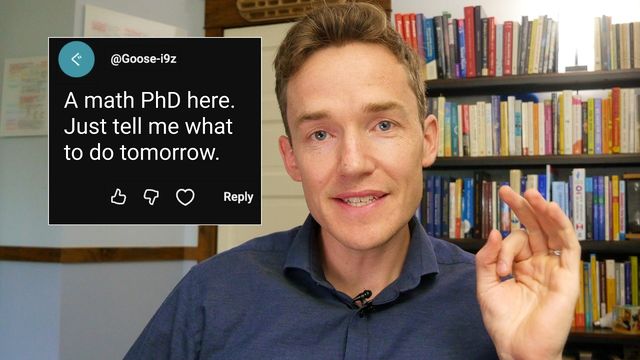
This is actually the first question on my list, is what are you telling students right now? Because I want to make a video,3The video came out on 3Blue1Brown in October 2026 as "There's never been a better time to go into math." like record some video that's basically just specifically addressed at those students who were maybe thinking of going into a math PhD.4PhD — in the US, students usually start a math PhD straight after college; it typically takes five to six years. And the hard part of it is like, I don't know the future. I'm not going to pretend like I do, but I also have some somewhat firm, like, predictions or opinions that I think lend a certain optimism there. But I don't want to lead the witness at all. I'm curious.
Student walks into your office, like, "Yeah, Professor Strogatz, I have loved math all of my life. I thought I wanted to be a mathematician, but I'm looking at everything that's happening now, and I'm wondering if I'm walking into a dead field." You in your office on the other side of that desk, what do you tell them?
What I'm telling them as of today is it might actually be a wonderful time to go into math. I don't want to put too definitive a... I can't say it with my full heart because there's so much uncertainty. But to the extent that I can figure it out, it seems like AI might be a great equalizer in the sense that there was a time when technical power was the number one strength that a mathematician needed. So if you are a really good problem solver, fast, deep, widely knowledgeable, able to follow intricate chains of reasoning, construct them, all those kinds of things that you think of as being good at math in the problem-solving sense. Those used to be like the quintessential aspects of being a strong, high-caliber mathematician. And I feel like those skills are less in demand now and probably in the years to come.
Not that they're nothing, but let's think of other things that make people good mathematicians or good researchers generally. Curiosity, taste, deciding what's interesting, the ability to tell a good story, to connect to the real world, to connect to other parts of math. Those kinds of things, if you are technically weak or average, you couldn't really play at a very high level. But now I think you can. And so the other day I was talking to a group of students. We have like the math club, and they've been asking professors to come and talk to them about what's happening.
And usually we have a panel of four or five people, and we all have different takes on this. And I don't know if I connected with the students the other day, but what I was thinking, I mean, I have two kids who are 24 and 26 right now, and I think about their futures all the time. They have taught me this word, which you will know, rizz.5Rizz — Gen Z slang, short for charisma: charm, the knack for winning people over, usually when flirting. Oxford named it its 2023 Word of the Year. You know where I'm going? Like charisma.
Yeah, yeah, yeah. Is it... okay, I think, tell me where you're going.
Have I said it wrong?
No, you said it as far as I... hey, we're talking below my generation at this moment.
Okay, I know, right?
But yeah, rizz. Commenting on whether the AI has rizz or not.
No, not the AI. That rizz is in more and more demand because it's something that only people have. And I'm starting to think what makes a future mathematician or a future math professor is your unique brand. I hate to say it that way. That sounds like business. I don't mean it that way. I mean your uniqueness as, like, think of, actually, you're a perfect example.
You have somehow... it may be too embarrassing to be pointing at you, but you picked something that you love. I mean, you're a... well, it will be too embarrassing. I'm getting embarrassed on your behalf saying it, but the things that you seem to like to do, explaining, crafting explanations, being visual, it's something that means a lot to you. You obviously love the subject, but you found your angle. And it turns out, I hope it's been very fulfilling for you, and it's a gift to the rest of the universe, what you have given us. And I think other people can try to do the same thing in their own way.
What is it that really moves them? Not just their passion, like what are they good at? What's their fundamentally distinctive thing? Whatever that is, you can now do that in a way that you couldn't before AI, because AI has been this equalizer in that it can do the lemmas,6Lemma — an auxiliary statement proved on the way to the main theorem. it can do the proofs. If you can ask the right questions, if you can tell the good story, if you can make the cool connection, you're in the game in a way that you never were before.
I love this take that, I mean, yeah, what we're selecting for is an element of mathematical rizz, and that the PhDs-to-be are not differentiated based on pure problem-solving abilities. I want to get back to problem solving later, actually, because I think there's something nuanced to get into there.
Yeah, okay.
But simply on the side of what is math or what is the practice of doing math outside of it, you know, pointing out, like you, I think you are very emblematic of one of the more charismatic mathematicians out there and deservedly, like, well respected for it. Just in that I think you have a way with a microphone. You have a way with people, you have a way on a stage, you have a way in your books that really comes out that's clearly not... you're an amazing problem solver, but it's clearly something more than that that's drawing people in. And so I think a natural response some people might have, though, would be, but surely all of that is something that you can distill,7Distillation — in machine learning, transferring the abilities of a large model into a smaller one; here, capturing the essence of charisma so a machine can reproduce it. and what's to say that, you know, the models aren't going to get better than that? You know, I've wondered about that a lot myself.
03What if AI becomes the best explainer?
Strogatz accepts that AI may eventually learn to ask questions and build theories, but for now it falls short of the best humans.
Yeah, so I had written up this post on, like, perhaps academic math should elevate the status of kind of the explanatory aspects of it. I saw this on Terry Tao's blog,8Terence (Terry) Tao — UCLA mathematician and 2006 Fields Medalist; his blog, What's new, is one of the main places where mathematicians discuss what AI means for their field. right, on Terry Tao's blog, and one of the most common replies on there was like, sure, but like, what happens once AI is a superhuman expositor? You know, it's superhuman at doing that. What role is that... I'm curious how you would respond.
Yeah, on that, my answer to that is, I think I basically accept the premise. First of all, let's talk about right now and let's talk about the future. Right now, the AIs are not good at asking questions. We're seeing this in math at the frontier, that they are not inventing new theories. You know, we make this distinction, problem solving and theory building.9The distinction goes back to Timothy Gowers's essay "The Two Cultures of Mathematics" (2000): some mathematicians mainly solve problems, others build theories. It comes up again fifteen minutes later. They've shown them to be superhuman in problem solving, and they're subhuman compared to the very best in theory building.
They're not... now you could say, no surprise, they're not trained to do that. In fact, I've tried to get them to make up test questions. I just gave a prelim exam10Prelim (preliminary exam) — a qualifying exam that US graduate students take in their first years before they are allowed to start research. today. And just for curiosity, I asked, you know, make up some questions for my complex analysis11Complex analysis — the theory of functions of a complex variable, a core course in a math education. exam. Not very good, not terrible.
In what way? How did it fail? Like, what was it doing that you wouldn't have?
Well, they were competent. I mean, they were pedestrian. They were like any textbook. They weren't particularly interesting, but maybe that's good, actually. It's usually a good heuristic that if the question is too interesting to the professor for a test question, that's a bad sign. It's going to be too hard.
And the students are under pressure. They don't want an interesting question. They want a straightforward question. So maybe I shouldn't say that they weren't good. They weren't interesting to me. They weren't juicy questions that would challenge my best students. They were very routine. But that really wasn't where I was trying to go. I mean, as far as research math, they're so far not very good at building new concepts. Now, maybe we haven't trained them to do it. We haven't trained them to ask questions. We've been training them to try to answer questions, and they've gotten good at that.
So those people who say, look, taste, even charisma, asking good questions, building theory, just like we teach our good grad students to do that. I mean, these are teachable skills. They're hard. There are very few people who know how to teach, for instance, the art of discovery. But there are people who have thought about it. And so presumably anything that you could teach a person, you could teach an AI. And at some point they will be superhuman at all of those things. And I think I sort of believe that. It's not happening yet. I do imagine it happening in the future.
I have a lot of good colleagues who would say, this is false. This is not going to happen. The storytelling. Yeah, so I don't know. This is open.
Yeah, let's take it as a postulate. Just, you know, maybe you don't believe it will happen, but it's interesting to engage with, yeah, what would happen in that future?
So in that scenario, yeah, if we stipulate that they will be, like Jacob Tsimerman12Jacob Tsimerman — a number theorist at the University of Toronto who, with co-authors, proved the André–Oort conjecture. has said that, right? In one of his interviews, the interview, he said it in a lot of his interviews, but in his interview with Siobhan Roberts13Siobhan Roberts — Canadian science journalist, author of Genius at Play (2015), a biography of John Conway; she writes about math for The New York Times and Quanta Magazine. for the Notices of the American Math Society,14Notices of the American Mathematical Society — the AMS's magazine of news, surveys and interviews, sent to all members. he says he thinks that they will just be better at everything. The AIs will be better at problem solving, at taste, at theory building, all of it. And then he goes on to say it will make being a mathematician not a profession in the future.
This is where I disagree. And I'm curious if I'm simply holding on to... I'm not even a, like, practicing mathematician in an academic sense, right? Like, I have a career that's pretty independent, but nevertheless, I wonder if I'm kind of biased by the love of mathematicians. And so one of the things I want to do, both in this conversation and others like it, is to kind of, like, see if I'm blinded by something, because I can get into why I disagree, but, yeah, what's your take there? In that "everything you can do, I can do better"15A nod to "Anything You Can Do (I Can Do Better)," Irving Berlin's duet from the musical Annie Get Your Gun (1946). future.
04Humanity grows more precious
Strogatz suspects that as AI dwarfs us intellectually, we'll grow fond of our own imperfection.
That's okay, right. So I just, to come to my punchline, and it's a very tentative punchline, like just about everything I'm gonna say on this broad topic of math and AI. But what I feel today and have felt for the past few days is that I think we're gonna find humanity more and more precious as we become dwarfed by the capacity of AI in intellectual matters, that our foibles, our fragility, our "to err is human," you know, those qualities, I think we're going to start to feel affection for that.
When I watch, let's take a few examples, music or chess, not perfect analogies, but let's just talk about those two. When I watch the great grandmasters playing at the World Championship caliber level, and there are many other chess fans watching them, you see them nowadays as they're playing with a chess engine running simultaneously, showing who's actually better in a given position. Sometimes a player will make a move and instantly the evaluation bar16Evaluation bar — the bar on chess broadcasts showing a computer engine's assessment of the position: who is better and by how much. will drop, someone has just blundered, and it's a very dramatic moment. Often the drama is heightened by the commentators not running the engines at the same time. So they don't know what has happened, but you in the audience know, oh my God. So then it's a question of, will the commentators realize, will the players realize? I think there's something very sweet about it because we're people. This is what happens. We're not perfect.
And likewise, I think of the movie Shine,17Shine (1996) — an Australian film by Scott Hicks; Geoffrey Rush won the Oscar for playing Helfgott. which may be well before your time, but Shine was a story of a pianist named David Helfgott,18David Helfgott — Australian pianist (b. 1947). He won competitions and studied in London, then, because of mental illness, barely performed for more than a decade; he returned to the stage in the 1980s and, after the film, toured the world to mixed reviews. who was a very promising, brilliant young pianist who won some international competition, if I remember right. And then something went wrong, like, maybe, I don't remember what his diagnosis was, but he had some sort of disorder mentally that essentially ruined his musical career and to a large extent his life. But at some point he came back and recovered and played after all these years, even after the movie made him famous, and his playing was not perfect, but it was so filled with humanity and so touching and passionate and marvelous that who cares, of course it's not perfect.
If I listen to Paul Simon sing19Paul Simon — American singer-songwriter (b. 1941), one half of Simon & Garfunkel. now at 80-something years old, I love Paul Simon. I don't care that he can't sing anymore. That's my guy, I want to hear him. So I'm starting to think, is that what's in store for us, that we are going to be these blundering, off-key mathematicians who are weak compared to the... right, I mean, obviously a machine could play everything David Helfgott could play perfectly. Do we want that? Do we really want that? Maybe, but we might also want the imperfection, the beautiful humanity. So maybe that's what's in store for us, that we're going to be second-rate mathematicians, but we can still love it, and I don't know.
Okay, so I'm going to be quiet. Let me hear your thinking.
No, no, no, no. I love that. Well, I'm going to continue on with this a little. I'll spare my thoughts for at least another minute or two. So, okay, one of the most classic sentiments that we share with students is that math is not a spectator sport. And so this sets a certain irony on the comparisons to chess or the comparisons to Go, where people will point out, hey, you know, chess was more than alive after the Deep Blue20Deep Blue — IBM's chess computer, which beat world champion Garry Kasparov in a match in 1997. moment, and Go stays more than alive after the AlphaGo21AlphaGo — DeepMind's program that beat Lee Sedol, one of the world's strongest Go players, in 2016. Go had been thought too hard for computers. moment. But one of the differentiators with math would be that I think a lot of people found this charm at the idea of being at the forefront of pushing forward, of being these pioneers.
And if it is going to be this emphasis on the humanity, and I absolutely agree that there is humanity to be had in math, and I'd love to, like, dig deep into where it is, what does that actually look like. Because I think, as stated so far, the view of "to err is human" and focusing on, you know, the stumbling nature of it... but there is, you know, we have this relationship with Paul Simon, so it doesn't matter if he's 80, because, you know, we're like... going from that, what is it that you can tell to a budding math PhD or prospective PhD on kind of what's in store for their future? Because it can't be that, like, people will delight in marveling at your inability to solve problems.
That's right. Right. And so I think what I'm talking about there, yeah, maybe I should sharpen this, because this is a work in progress, these ideas. I don't have a manifesto for you, but there's pure math, and of the purest type, where people will not use AI. I have a friend who's a writing teacher here, J. Robert Lennon.22J. Robert Lennon — American novelist and short-story writer who teaches creative writing at Cornell. He's a brilliant novelist. He hates AI for what it's doing to his art, which is creative writing, you know, fiction. And he thinks it has nothing to offer because writing is about what's in you, your life, what you bring to the page. So he doesn't want to look at AI, wants no help at all from that thing and doesn't want his students using it.
And I think there are going to be artisanal mathematicians who will feel the same way and they don't want to hear from AI. They're just going to work by themselves and with their... and also, you know, there's this whole social dimension. Me and you explaining things to each other, that's a big part of the fun of math. And it causes people to become close, to have friendships, to really connect. And they don't want anything impairing that.
Okay. Now, there's also, though, for your question about the young mathematician who wants to be at the frontier, and there are a lot of people who feel like that. And that's a really good motivation. I mean, I certainly remember being excited with the thought, I'm going to make a discovery. It's a very exciting feeling and very motivating. So I think that then the realistic view is you've got this fantastic new tool. You've got this superpowered artificial intelligence that's your C-3PO,23C-3PO — the fussy, loyal humanoid translator robot from Star Wars. that's hopefully not HAL, you know, in 2001: A Space Odyssey.24HAL 9000 — the ship's computer in Stanley Kubrick's 2001: A Space Odyssey (1968), which starts killing the crew. Certainly hopefully not, you know, Terminator 2.25Terminator 2: Judgment Day (1991) — James Cameron's film about a war between machines and humans started by the AI Skynet. Whatever this thing is, in this happy future that I like to think about for a minute, where it's your sidekick at your service, sort of like computers have been up till now, who knows?
The sky's the limit what you could do with that thing. You can ask questions, you can start a... like, you want to cure cancer? Go to it. You know, there may be all kinds of profound math that can help with biomedical problems, with new energy sources, with dealing with the climate problem, with AI safety26AI safety — research on making powerful AI systems avoid harm and do what people actually want. itself. I mean, there are whole fields that haven't even been mathematized yet, that people don't even realize there's math in this, in anthropology or, I don't know, make up something. So if the bottleneck in the past was mathematical strength, that's not a bottleneck. Now it's just what your imagination can do, what your creativity and taste and desires can do.
And so I happen to feel it might be like a golden age for applied math. I think for the most hermetically sealed pure math, if you also want to be a mountain climber and reach the top first, that's just not going to be that easy to do anymore. But I still think there's a lot of worthwhile mathematical endeavors that you can have fun and be the first, if you care about that, and really make world-shaking discoveries.
05The problem is solved — now what?
To Strogatz, understanding is prized because it's pleasurable, generative and a route to power, and the split between pure and applied math is a historical anomaly.
And I think realistically a lot of maybe people who had gone into the field with that anticipation of being, you know, the first to top the mountain, almost all of them reach some point of maturity on realizing that the most enriching parts of the field are the more communal aspects. And also a lot of people I talk to delight simply in knowing, right? They just, like, follow that Hilbert phrase on, like, "we can know and we must know,"27David Hilbert — German mathematician; "Wir müssen wissen — wir werden wissen" ("We must know — we will know") from his 1930 address is carved on his gravestone in Göttingen. Grant paraphrases it. and whether they're the first one to get there or not, they just delight at the idea of seeing what that truth is for something that they engaged with so long.
I mean, you touch on applied versus pure, which is one of the topics I wanted to hit here, because a lot of conversations with mathematicians that I'll have, it's almost as if the prospect of the solution to a problem being useful is not in the conversation. People will describe, like, oh, what people don't understand is, like, math is about much more than just the proof. It's all of the, you know, constructs that you make in the effort of the proof. The goal of math is to advance human understanding. That human understanding comes from the process, it doesn't come from the results. A lot of deep truth in there. But then if I talk to someone outside of math, they're like, I've been reading all these headlines about, you know, grand problems being solved.
Is that good? Is, like, are we able to do better things in the world now? Like, surely if the mathematicians cared deeply about this Millennium Prize problem28Millennium Prize Problems — seven famous open problems, each carrying a million-dollar prize offered by the Clay Mathematics Institute in 2000. Only one has been solved: the Poincaré conjecture, proved by Grigori Perelman. and it's solved, does that give us anything now? And it shines a light on this question of what was the purpose of those as being the goalposts. But then applied math maybe stands to be particularly interesting here, where I'm curious to hear your take on whether the solutions to problems are the point, or if even in an applied setting, not a pure setting, we have to be more nuanced about what is math, and that simply solving the problem as stated, you know, AI or otherwise, is not quite what people are getting at. And there's some more human, you know, pushing forward human understanding aspect of it.
In an applied setting, is it fair to say, hey, if you have a magical problem-solving machine, that is strictly good? That just pushes forward things as we want, pedal to the metal, let's let it start improving the world.
Such a rich vein you're tapping into here. This is tough. I find it hard to give an organized response to this. So let me just try flying out in a lot of different directions. And I'm gonna hope you can pull me back in if they get too... because there's so many things to talk about here. And I don't have a sharp formulation of this.
I've thought about this a lot. Okay, let's first talk about understanding versus results in both pure and applied math. All of us like understanding. Feels good. Aha moments, eureka moments. Okay, so there's, in fact, a friend of mine pointed out to me recently that Alison Gopnik,29Alison Gopnik — a Berkeley psychologist who studies how young children learn. The article is "Explanation as Orgasm" (1998): Gopnik argues that the pleasure of understanding is an evolutionary reward, like sexual pleasure, that drives us to look for causes. who I think is a psychologist, wrote an article with a title, can't remember it, but it involves the word orgasm. Something like problem solving as orgasmic or something like that. Maybe it's not problem solving, or maybe it's like the orgasm of understanding, something like that. That there's some kind of truly delightful feeling when you understand something, like right up there with the best feelings you can have.
So we like understanding for that reason. We also like understanding in both pure and applied math for its generative nature. When you understand something well or have insight, it leads you to new questions, to new ideas, to see connections, and it produces, it's fruitful, right? It creates more activity, more buzz in your own head, in the community's head, in your friends. So, okay, so understanding is pleasurable, it's productive in this generative sense, and it's been a route to power.
Understanding, this is what I recently, with my colleague and co-author Alex Townsend,30Alex Townsend — a Cornell mathematician working in numerical analysis, Strogatz's co-author on Big Math (2026). we wrote a New York Times piece just a few weeks... well, now, whatever. So it was in late September. We had an article explaining that, yeah, you know, for the people who are confused by the pure mathematician saying, boo-hoo, understanding is what we're after, not results. The machines are taking away the results. That was never the real purpose, à la Thurston.31William Thurston (1946–2012) — one of the most influential geometers of the 20th century, 1982 Fields Medalist; he spent his last years at Cornell. The purpose was human understanding, and you're wrecking, you're ruining, it's like, you know, you're destroying the landscape. You're blowing up the lighthouses, you're nuking... okay, there's been all this kind of language, very devastating language. And the public is rightly confused. Like, I thought you wanted your problems solved.
Actually, no, there's a tribe. There is a tribe within pure math that deifies understanding. As they say, this is what our subject is really about, following Thurston. I mean, I'm in Thurston's office. I'm breathing molecules of Thurston, I'm sure, every day. So, and I love his essay "On Proof and Progress in Mathematics."32"On Proof and Progress in Mathematics" (1994) — Thurston's essay arguing that mathematicians exist not to produce theorems but to advance human understanding of mathematics.
So absolutely there's a subculture, and maybe the predominant culture in math, that sees understanding... I'm talking about pure math. Understanding is the be-all and end-all, and to the extent that problem solving leads us to greater understanding, problems are worthy activities. Now, there is another culture, like an Erdős culture.33Paul Erdős (1913–1996) — Hungarian mathematician, author of some 1,500 papers with hundreds of co-authors, who spent his life posing and solving problems and put cash prizes on some of them. The archetypal problem solver. And there are disciples and former collaborators of Erdős, people like Joel Spencer.34Joel Spencer — a combinatorialist at New York University and a collaborator of Erdős. I just got an email from him the other day saying... and I think Jacob Tsimerman would be another one. There's a lot of great mathematicians, let's just focus on pure mathematicians, who think you got it backwards. It's that understanding is helpful insofar as it lets us solve problems, and that problems are the units of math.
ExplainerThe two cultures of mathematics
In 2000 Timothy Gowers, who had won the Fields Medal two years earlier, wrote the essay "The Two Cultures of Mathematics," borrowing the title of C. P. Snow's famous lecture on the gap between the sciences and the humanities.
- Theory builders value understanding: what matters is new concepts and general structures, and problems serve to test and push the theory. The classic example is algebraic geometry in the Grothendieck school.
- Problem solvers value the problems themselves: what matters is finding the move that cracks them, and general principles are more like accumulated techniques. The classic example is Erdős-style combinatorics.
Gowers defends the second culture: combinatorics has deep ideas too, only they live not in definitions and theorems but in techniques that travel from problem to problem. Freeman Dyson drew a similar line in "Birds and Frogs" (2009): birds fly high and see distant connections, frogs dig in the mud of particular problems.
If people haven't read it, Tim Gowers35Timothy Gowers — British mathematician, 1998 Fields Medalist. has an excellent post or essay on the two cultures of mathematics.36"The Two Cultures of Mathematics" (2000) — Gowers's essay on problem solvers and theory builders; the title echoes C. P. Snow's 1959 lecture "The Two Cultures" on the gap between the sciences and the humanities.
Yeah, the two cultures.
Yeah.
The problem solvers, the theory builders, is the way he phrases it. Freeman Dyson37Freeman Dyson (1923–2020) — physicist and mathematician at the Institute for Advanced Study in Princeton, one of the architects of quantum electrodynamics. has his wonderful essay on birds and frogs,38"Birds and Frogs" (2009) — Dyson's essay in the Notices of the AMS: birds fly high and see the big picture, frogs love the details of particular problems. Dyson counted himself a frog. which is also close but not quite the same thing to this distinction. But anyway, the truth is most mathematicians, either pure or applied, recognize that results and understanding are both important. And some people care more about the problem solving and some care more about the understanding. They're both really important and fun. Okay.
But then the public thinks, yeah, but so what? And so that's where applied math comes in, and also pure math, because all math becomes applied at some point. I mean, that's just an empirical fact. There really isn't any part of... also, this is why I say I'm going off in 10 different directions at once. This is such a historical anomaly, this specious distinction between pure and applied math. Don't forget, the greatest mathematicians of all time, until the past hundred years, always did both.
Yeah, pure mathematician is a very recent invention.
Pure mathematician is a... like, would Gauss have said39Carl Friedrich Gauss (1777–1855) — German mathematician known as the "prince of mathematicians," who also worked in astronomy, geodesy and magnetism. he was a pure mathematician? He was tracking Ceres.40Ceres — the largest body in the asteroid belt, now classed as a dwarf planet. It was discovered in 1801 and soon lost; Gauss computed its orbit from a few observations, and by the end of the year it was found where he predicted. He did, you know, this asteroid. He was mapping the earth, literally doing mapping when he was inventing differential geometry.41Differential geometry — the study of curves and surfaces with the tools of calculus. Gauss laid its foundations in the 1820s while leading the geodetic survey of the Kingdom of Hanover; that work also gave his Theorema Egregium, which says a surface's curvature can be measured from within the surface. Riemann was42Bernhard Riemann (1826–1866) — German mathematician, creator of Riemannian geometry, the mathematics of general relativity. He also worked in mathematical physics, including electrodynamics. very interested in electricity and magnetism, and, you know, Hilbert, even Hilbert was thinking about general relativity.43In November 1915 Hilbert derived the gravitational field equations almost simultaneously with Einstein; the action they come from is called the Einstein–Hilbert action. And obviously Euler,44Leonhard Euler (1707–1783) — Swiss mathematician who spent most of his life in St. Petersburg and Berlin; besides pure mathematics he founded much of fluid dynamics and rigid-body mechanics. you know, or Newton,45Isaac Newton (1643–1727) — author of the laws of motion and universal gravitation, one of the inventors of calculus. these people are absolutely top physicists as well as mathematicians. Kepler, too.46Johannes Kepler (1571–1630) — German astronomer who discovered the laws of planetary motion. Galileo, I mean, Galileo maybe not so great with math. He was pretty good. But anyway, world-caliber people, and they didn't make this distinction. This is a very peculiar 20th-century phenomenon.
06How Maxwell saw light in his equations
Maxwell shows how understanding leads to power, but Grant asks whether the one who understands has to be human.
ExplainerHow Maxwell saw light in his equations
Faraday described electricity and magnetism through "lines of force," with almost no formulas. Maxwell translated his picture into mathematics and added a missing term to Ampère's law, the displacement current: a changing electric field produces a magnetic field, just as a changing magnetic field produces an electric one (Faraday's law of induction).
In empty space, with no charges or currents, applying vector calculus identities to these equations shows that the electric and magnetic fields each obey the wave equation, the same one that describes a vibrating string or sound. The speed of these waves comes out of two constants measured in tabletop experiments with capacitors and coils, and it matched the known speed of light, about 300,000 km per second.
In 1865 Maxwell concluded that light is an electromagnetic disturbance. Twenty-odd years later, in 1886–1888, Heinrich Hertz produced such waves in the lab, and within a few more years came radio.
Okay, that maybe was a tangent. Let me come back off that tangential direction and back to the core, which is on this question of understanding and why does understanding matter. Pleasurable, yes, generative, yes, and a route to power. Just in case that argument is not familiar: if you understand, let's say, vector calculus or quaternions47Quaternions — numbers of the form a + bi + cj + dk, an extension of the complex numbers invented by William Rowan Hamilton in 1843. Maxwell used quaternion notation in his Treatise on Electricity and Magnetism (1873); vector calculus later grew out of it. at the level that James Clerk Maxwell48James Clerk Maxwell (1831–1879) — Scottish physicist. His 1865 paper had twenty equations; the familiar four vector equations were distilled from them by Oliver Heaviside in the 1880s. did in the 1800s, you can then rewrite what Michael Faraday49Michael Faraday (1791–1867) — self-taught English physicist who discovered electromagnetic induction. He knew almost no mathematics and pictured fields as "lines of force." and Ampère50André-Marie Ampère (1775–1836) — French physicist who found the law of force between electric currents; the unit of current is named after him. discovered, and Gauss too, about electricity and magnetism, into four equations. And then you can manipulate those equations using logic and using your brain, as Maxwell did around the time of the Civil War in the US. And you make a prediction of something that no one has ever seen: that there's an invisible wave of energy propagating at the speed of light that we now call an electromagnetic wave that, you know, give it a few years, becomes the basis for television and radio and cell phones and all kinds of wireless communication.
And that was only possible because he knew how to do, he recognized the wave equation, a partial differential equation,51Partial differential equation — an equation for a function of several variables, such as position and time. The wave equation describes a disturbance traveling at constant speed, like a vibrating string or sound. when he derived it from doing vector calculus identities on the four laws of electricity and magnetism. So my point is that the understanding that Maxwell had through math, and that Michael Faraday did not have, because he was a different kind of mind, led Maxwell to be the first person on the planet to understand what is the nature of light, that light is an electromagnetic wave. Nobody knew what light was before Maxwell. Not really. And so in that blinding flash of insight, he figured out something that turned out to change the world.
And we could give so many stories like that, whether it's Schrödinger's wave equation52Schrödinger equation (1926) — the basic equation of quantum mechanics, describing how a particle's wave function changes in time. or Dirac's prediction of antimatter53Paul Dirac's 1928 equation for the electron had "extra" negative-energy solutions; Dirac interpreted them as antiparticles, and in 1932 Carl Anderson discovered the positron. or whatever. I mean, it's endless. But all these things have turned into technology, right? So from understanding general and special relativity, you can figure out the corrections you need to make in the atomic clocks to make the GPS devices work as accurately as they do.54Because of special relativity (fast motion), GPS satellite clocks lose about 7 microseconds a day; because of general relativity (weaker gravity in orbit), they gain about 45. Left uncorrected, the 38-microsecond difference would make positions drift by roughly 10 km a day. If you didn't understand relativity, GPS wouldn't work.
And so a pertinent question then becomes, if the entity that is coming to those bits of understanding is not necessarily human, you know, the solution is found and it's not human. Either you say, hey, the benefit is lost, because it wasn't a matter of young Maxwell happening to solve a given random second-order differential equation. It was the intuitions about what wave equations feel like that he then had light up again when he was engaging with a certain physics context that actually mattered. And therefore, had he just been handed the solution out of the blue, it wouldn't have given us the value that was actually influential to the world, which was Maxwell's, as a human brain's, understanding. I think the other take could be like, well, why can't the same entities that are coming up with, you know, the solution to the next Millennium Prize problem, silicon though they might be, have that downstream effect?
Which you can have a very positive take on and say, like, amazing, wonderful. Like, well, we just sit back and wait for the usually decades-long delay between pure math discovery and application discovered to be compressed. Yeah, but between that dichotomy, I'm thinking you need, or it is beneficial for there to be, a loving human mind who is embraced with it in order to digest it into application, versus...
07Is understanding overrated?
Playing devil's advocate, Strogatz argues the last few centuries may prove a brief interlude of understanding, and progress will continue without it.
Is it true? Is it just a romantic thing that you just said? Like, I mean, it sounds nice, but I love that you're seeing all the same, I mean, you're following the same flow chart of thinking, well, not the same, I mean, you have your own version of it. But normally when I have this conversation with people, they're not seeing as far, as many moves ahead. Because I keep wondering, like in this argument, you know, say, sure, if I have this entity which can solve the problem, let's say it can give me answers, who says it can't also give me all the understanding along the way and all the spin-offs and all the applications? In other words, I think people get confused about the argument that is easy to make, that human understanding has led to power and progress, and they get confused by the converse, which is that they think, does that mean if humans didn't do it, like if the AIs did it, we wouldn't have the same amount of progress?
No, that doesn't follow at all. In fact, I think if the AIs could get us the answer, they would be so strong they could also get us all the side spin-offs and everything else too. So I don't think the argument for why human understanding is important is that it's because only humans can see all the connections and the spin-offs. I just don't believe that's true. I think the AI will be able to do all of it. So I really am very confused.
Here, let me put it starkly, if that last sentence or paragraph was too hard to follow. Here's the real question, and I would love to know what you think about this. Is understanding overrated? I think that this might be a real confusion that people... let me make this argument, and I don't know that I believe it, but just for the sake of, since you like having discussions, let's have this discussion. You could say that human civilization didn't have much understanding for, I don't know, how old are we as a species? 100,000?
I don't know the number. I should know my anthropology. Like, I know that 12,000 years ago we domesticated dogs,55Fact-checkThe date of dog domestication is uncertain, but it is well before 12,000 years ago: the oldest undisputed domestic dog remains (Bonn-Oberkassel, Germany) are about 14,000 years old, and genetic estimates range from 15,000 to 40,000 years (Wikipedia, "Domestication of the dog"). because I love dogs. So I remember that number.
I think there's sort of a 200 to 300,000 years. I'm not an expert here, yeah, of what people would carve out as our current species.56The oldest known Homo sapiens remains, from Jebel Irhoud in Morocco, are about 300,000 years old; before that find was published in 2017, the species was usually dated to about 200,000 years.
We've been Homo sapiens for 200,000. Neither one of us is an expert.
Hopefully understanding is overrated and this specific number doesn't matter for the... Yeah, we don't need this number.
That's not the point. The point is for a long time we didn't understand much. We were relying on instinct, we were relying on experience, but things didn't really make sense in the way that they started to, and now, again, some arbitrary number. Certainly since the Enlightenment, say, if you want to put it with Isaac Newton, we had a different level of understanding than we had before Newton. We really mathematized, we as a species. Like, take Kepler.
I mean, Kepler could see the elliptical orbits, the square and cube law about the planets, Kepler's third law.57Kepler's third law (1619): the squares of the planets' orbital periods are proportional to the cubes of the semi-major axes of their orbits. Newton derived it from universal gravitation. These are numerical patterns. He couldn't explain them. He just saw them in the data. And that was great. The math showed the pattern. But why? Okay, he couldn't understand them. And then the next, you know, a few generations later, Newton can explain that, not only what Kepler saw, but all of what Galileo saw too, from a deeper principle, set of principles, from his laws and universal gravitation. And so that is like a triumph, plus he has calculus in a more systematic, powerful form than those other people have. And so he can derive all kinds of stuff with logic and a few principles. So that is a very powerful advance in human understanding.
And that Newtonian framework of find the differential equations and solve them, more or less, gives us 400 years of progress all the way through the Schrödinger equation. Really, I mean, the Navier–Stokes equation,58Navier–Stokes equations — the equations of motion of a viscous fluid. Proving that smooth solutions always exist is one of the Millennium Prize Problems. Maxwell's equations.
So far this is sounding like a case for understanding being of utmost importance.
It has been of utmost importance for 400 years.
Okay.
And I'm going to argue temporarily that there has been a great interlude of understanding. Before this interlude began, we didn't have much. Obviously, we had some. We had Archimedes,59Archimedes (c. 287–212 BC) — Greek mathematician and engineer from Syracuse who computed areas and volumes by a method anticipating integral calculus and discovered the law of the lever and the principle of buoyancy. we had, you know, the guy whose name is translated as Alhazen, Ibn al-Haytham,60Ibn al-Haytham (c. 965 – c. 1040), Latinized as Alhazen — Arab scholar of Basra and Cairo, author of the Book of Optics, who showed by experiment that vision comes from light entering the eye and was among the first to rely systematically on experiment. great Islamic scholar. Okay, I mean, there were people, for sure.
Let's make some sweeping generalizations and just say, like, post-Enlightenment, there was a...
I don't have to do it with the Enlightenment, right? I mean, maybe the Egyptians with the pyramids. We had a few thousand years, let's say it that way. We had a few thousand years of really kind of building up our understanding.
But I think the window might be closing. That the interlude is coming to an end, because I think the AIs are going to get so advanced that even though they're going to be good teachers, they're not going to be good enough, because we're limited until we change our biology. Then we're not really human. I mean, if we're going to stay the humans that we are, with our kilohertz clock speed of our neurons,61A neuron can fire at most about a thousand times a second, usually far less; processors run at gigahertz, millions of times faster. Estimates of the number of synapses in the human brain start at a hundred trillion. with the number of, whatever it is, a hundred trillion synapses. I mean, whatever it is, we have limits. And we can understand up to a certain level, and that will be it.
We're just not going to be... like, we already know you can't picture the ninth dimension in space. There's only certain things that we can do. We can't picture 50 moving objects moving, you know, spinning around simultaneously. Psychologists have studied.62In multiple-object-tracking experiments, people can reliably follow only about four or five moving objects at once. So it's going to come soon that we won't understand all kinds of things that the AIs will tell us. And so I feel like that's going to be the story, that we have this wonderful, glorious interlude when the lights went on, and then the lights are going to go off.
And we're actually sort of lucky that we're living in a time when understanding is still meaningful, but progress will continue. We're going to have all kinds of fantastic results predicted, I mean, assuming we can survive this. Separate question. But if we can survive super powerful AI and all the other things coming to the planet, we'd have incredible progress.
When you say, or making the potentially devil's advocate case, "understanding is overrated," you mean insofar as progressing the welfare of humanity, or pushing forward, you know, a sense of ability in constructing the world around us, or however you want to measure progress, you're saying we are fast coming to the point where human understanding as a meaningful component of what determines that kind of progress is of waning significance.
Absolutely beautiful summary, yes. That it's overrated in that sense, that we think understanding is great because it's been so helpful to us, also because it's pleasurable, but it's going to stop being that helpful. No, it will still be pleasurable. Okay. I mean, just like people like to do crossword puzzles or other things that involve thinking, so there's that view of it. That math will always be here, just like playing the cello or, you know, I mean, singing, these things are just inherently fun. And actually I sort of flinched, although I don't know if I visibly flinched, when you spoke about welfare or progress, you know, because it's such a narrow construction of progress that we're talking about here, like building more gadgets, even curing diseases.
Fine, those kind of advances are a certain type of progress, but what about, like, spiritual progress or happiness or kindness or, you know, very soft things that are still very important in life, maybe the most important, love, being loved, those things. That is gonna persist forever, we hope. And I really find myself, in these conversations, I always end up wanting to talk about the meaning of life. I really think that's what's lurking here. I know we're supposed to talk about math with each other, but I kind of think that's what we have to talk about, is what are we doing? I mean, what are we here for, if anything, and what do we want out of our life? I do think that's what's at stake, and that's ultimately what we have to talk about.
08Fermat vs. Goldbach: problems that generate math
Mathematicians cherish Fermat's Last Theorem more than Goldbach's conjecture because a whole new world of math grew up around it.
It's so interesting you land there. I mean, I think the reason that the math in AI topic is so relevant even outside of the math circles is that people talk about a spiky frontier to AI.63Usually called the jagged frontier: AI abilities grow unevenly, beating humans at some tasks while failing at neighboring ones that look no harder. The term caught on after a 2023 study by Harvard Business School and BCG. There's certain things it gets good at faster than others. And insofar as math exists right at the beginning of one of those spikes, coding as well might be another one of them, it stands to be a microcosm of a broader world. And mathematicians are especially interesting because the thing that they are doing is both useful... You know, you mentioned three different things that are what we get out of understanding.
You have the orgasmic side of, like, it's just nice. You have a route to power, and then you also have the generative aspect of it, on, like, it brings you things. And if I'm hearing the argument correctly, it sounds like what you're saying is on the generative side that human understanding won't be as important on the route to power side. I mean, maybe we can get to that.
I mean, maybe I haven't clarified the distinction about generative versus power. So there's power in the outside world, there's also generative in the inside world. So generative of more ideas. Like, to me, pure math is about the orgasm and the generative math that keeps recreating new math, math that keeps posing new... like, say, let's take the quest to solve Fermat's Last Theorem, right?64Fermat's Last Theorem — xⁿ + yⁿ = zⁿ has no solutions in positive integers for n greater than two. Pierre de Fermat wrote it around 1637 in the margin of Diophantus's Arithmetica, adding that he had a "truly marvelous proof" the margin was too narrow to contain. Andrew Wiles proved it in 1994. To prove the Fermat conjecture. So pure mathematicians love that story, rightly, because, you know, along the way to try to solve this problem, they invent ideas like ideals,65Ideal — an algebraic notion: a subset of a ring closed under addition and under multiplication by any element of the ring. It grew out of the "ideal numbers" Ernst Kummer invented in the 1840s while working on Fermat's theorem. you know, in algebra, they discover number fields66Number field — an extension of the rational numbers obtained by adjoining roots of polynomials, such as numbers of the form a + b√−5. and examples where they don't have prime factorization being unique.67For example, among numbers of the form a + b√−5, six factors in two different ways: 6 = 2 · 3 = (1 + √−5)(1 − √−5), and none of the four factors breaks down further. This is what sank early "proofs" of Fermat's theorem.
And, like, there's a whole glorious imagined world that turns out to spring up around this question that is beautiful in its own right and actually arguably more beautiful and more important than Fermat's Last Theorem. I think most serious mathematicians would say that's not really... that theorem, or that conjecture, whatever, that was our lighthouse, right? I mean, to use the current metaphor that seems to be going around, that shines the light, and then we create all kinds of other ideas to try to solve it. And those ideas take on a life of their own. They gradually give rise to something close to the Langlands program,68Langlands program — a web of conjectures proposed by Robert Langlands in 1967 linking number theory with representation theory and harmonic analysis, often called a grand unified theory of mathematics. you know, like the really big stuff that ends up getting used in Wiles's proof.69Andrew Wiles — British mathematician who worked on Fermat's theorem in secret for seven years and announced a proof in 1993; he fixed a gap found in it in 1994 together with Richard Taylor. He received the 2016 Abel Prize for the proof. Modular forms,70Modular forms — functions on the complex upper half-plane with an enormous amount of symmetry. Wiles proved that elliptic curves of the relevant kind are tied to modular forms, which implies Fermat's theorem. I mean, I don't know Wiles's proof, but it sounds like a really absolutely enormous set of ideas gets used that is way more beautiful and powerful and generative in this sense, that it's math making more math and more understanding, and lots of other great results, and along the way, bing, okay, we get Fermat's Last Theorem, but that's not the point.
And this is why Gauss complained so much about Goldbach's conjecture, right?71Goldbach's conjecture — every even number greater than two is the sum of two primes, e.g., 28 = 5 + 23. It comes from Christian Goldbach's 1742 letter to Leonhard Euler and has been checked by computer up to 4 · 10¹⁸, but remains unproved. I mean, Goldbach's conjecture, that every even number is the sum of two prime numbers, still unsolved. Seems like, in a way, a better question than Fermat's Last Theorem. So simple. And yet very few mathematicians get all weepy and excited about Goldbach's conjecture, because it hasn't been generative. It didn't produce the same kind of surrounding superstructure of great math.
ExplainerWhy Fermat is generative and Goldbach isn't
Fermat's Last Theorem — xⁿ + yⁿ = zⁿ has no solutions in positive integers for n > 2 — resisted proof for more than 350 years, and almost every serious attempt left new mathematics behind.
- Kummer and ideals. In the 1840s Ernst Kummer tried to factor xⁿ + yⁿ by adjoining roots of unity to the integers. It turned out that in such number systems factorization into primes need not be unique. To rescue uniqueness, Kummer introduced "ideal numbers"; Richard Dedekind turned them into the notion of an ideal, one of the basic concepts of modern algebra.
- Elliptic curves and modularity. In the 1980s Gerhard Frey and Ken Ribet showed that a solution to Fermat's equation would yield an "impossible" elliptic curve unconnected to modular forms. In 1994 Wiles proved (with the final step done together with Richard Taylor) that for a broad class of curves such a connection always exists, a special case of the Langlands conjectures. Fermat's theorem fell out as a corollary.
Goldbach's conjecture — every even number greater than two is the sum of two primes — sounds even simpler, but work on it has not built such a superstructure: the strongest results (Vinogradov's three-primes theorem, Chen's "prime plus almost-prime" theorem) came from powerful but fairly specialized methods of analytic number theory.
It's like sort of peripheral. It's kind of out there, not connecting to the great body of other math. So in this certain aesthetic, I mean, Gauss had some quote, I don't remember the exact wording, but it's something like, ah, you know, it's easy to make up a question that you could neither prove nor find a counterexample to, and it's not connected to anything else. And that's of no interest.72Fact-checkGauss made this remark about Fermat's theorem, not Goldbach's conjecture: in an 1816 letter to Olbers he wrote that Fermat's theorem as an isolated proposition held little interest for him, since he could easily lay down a multitude of such propositions that one could neither prove nor dispose of (MacTutor History of Mathematics, "Fermat's last theorem"). So it was the peripheral nature of the conjecture, Goldbach conjecture, that turned off Gauss, and I think... now, it's not totally true. There is beautiful math connected to Goldbach conjecture too, but not as beautiful as the math and not as interconnected as Fermat's Last Theorem.
So according to a certain tribe, this is what pure math is all about. You know, look, this is me talking about a foreign culture. It's not really my people. The people I want to talk about are Maxwell, you know, or Einstein. I mean, I guess I'm a physicist in mathematician's clothing, but a biologist too.
09Where the money for mathematicians comes from
Grant argues math departments are sturdier than they look because teaching pays for them, and Strogatz notes that paid research is a recent invention.
I think I want to, like, stay drilled on the side, because what's salient in the minds of a lot of young people is just, what is the role... one, will human mathematicians exist?
Yeah.
You know, is it dead in the water to even, like, go into a PhD? And then two, what is the role if they do exist? And so maybe first, I've been trying to hold my tongue. I don't want to insert too many of my own opinions.
I want your tongue flapping, man. It's your show. Okay, you could be on that side of the microphone.
Well, so at the very least, please poke holes in this. I just want to at least lay out why I think, like, mathematicians will exist, but it's kind of this wide open question on exactly what they do. And then that might set the framing for how we think about this question of, you know, insofar as it's about being generative, like, to whom does that matter? So just from a side point of, why is this a job? Where does the money flow from for mathematicians? I think it's important for a young student to have a clear vision of that in their mind, because it is a very weird job compared to other portions of the economy.
Are we talking about an academic mathematician who's a professor, or are we... but there's so many mathematicians with jobs called data analysts.
Oh, what a wonderful Steve Strogatz answer. But it's true. What is a cryptographer?
Who employs more mathematicians than anybody? The National Security Agency.73National Security Agency (NSA) — the US signals intelligence and communications security agency. It describes itself as the largest employer of mathematicians in the country, needed for cryptography and cryptanalysis.
Okay, I love this.
Okay, you don't mean them. You want to talk about math professors.
And for the sake of clarity, let's first talk about professors, but actually we should zoom out. So first on the side of professors, then let's zoom out. Okay, the reason it's relevant, just to focus on the professors before the zoom out: who trains all the cryptographers, who trains all of the data analysts? One of the most valuable externalities74Externality — economists' term for a benefit or cost of an activity that falls on outsiders rather than on those who carry it out. from the existence of math departments are all of the people who, like, quote unquote, fail to go into academia, or, like, don't end up becoming professors. You have this just spilling over of mathematical talent and problem-solving ability out of people that maybe they pursued a PhD, maybe they just got their undergrad, who don't necessarily go into academia. But importantly, they spent a meaningful part of their formative youth, at least undergrad years, maybe grad years, in a math department or something adjacent to a math department.
And so the question of, like, do those math departments exist, and the people doing this training, do they exist, I think has bearing even on the broader-stroked definition of mathematician that I would agree with you on here. But just on the academic mathematician side, one, you've already kind of hit it, where I think if you follow the money flows, a ton of it is just teaching, I think, for a typical math department, which is unlike other forms of research, where sometimes, you know, harder sciences are quite expensive to do the research, and there's going to be more that leans on public funding or private philanthropic funding. And of course math also has that, right? There are, you know, in the US, like, NSF grants75NSF (National Science Foundation) — the US federal agency that funds basic research through grants, founded in 1950. that are a meaningful part of what will support mathematical research.
There's various private foundations, you have atypical institutes, like if you're a permanent faculty member at the Institute for Advanced Study,76Institute for Advanced Study in Princeton — an independent research institute with no students, once home to Einstein, Gödel and von Neumann; its permanent faculty do research only. like, teaching is not as big a part. The teaching side of it, this strikes me as something that's quite AI-safe as far as job security goes, insofar as if universities exist at all, if we have social structures at all like what we have now, people really will value the human-to-human side of that. And I mean, people have sort of written about this, on how, like, a pretty good case study on this is COVID and how much people hated education mediated through a screen. Even when it's just an... Alex Kontorovich77Alex Kontorovich — a Rutgers mathematician and the guest of the podcast's first episode in 2021; he writes a lot about formalizing mathematics and what AI will do to the profession. made this point in a nice, like, dialectical thing I was reading of his lately, where it was essentially like, look, you already... if you have the current status of education ability but mediated through a screen, and people hated it, you know, maybe AIs get superhuman such that even through a screen they're better.
But it's a very social thing going on, if we think of what's actually happening with education, where it's not about clarity of explanation, it's about what motivates you to learn. And if we think of what motivates people, it's their connections, especially peer connections, but also I think mentor connections and such. I will care about a topic more, knowing that you, Steven Strogatz, wrote about it, compared to just what the words on the page in and of themselves can do. Like, that little bit of human-to-human connection matters. So if we presume that teaching still exists, then the existence of, like, that as one of the funding sources towards what goes into math departments is kind of unaffected by whether or not AIs can, you know, solve problems better or set conjectures better or set entire programs like the Langlands program better. All of that is this ancillary thing of what the mathematicians choose to do with the surplus time, that is, you know, research.
And it's good that you see it that way, because after all, historically, I mean, it's been changing so much throughout history, right? Before there were really... I mean, universities are not that old, 1200, you know, AD or something, the first universities in Europe,78The University of Bologna is considered Europe's oldest (traditionally dated to 1088); Paris, Oxford and Cambridge followed in the 12th and 13th centuries. or somewhere about there. And for a long time it was all about teaching. Yeah, I mean, Isaac Newton or Isaac Barrow79Isaac Barrow (1630–1677) — English mathematician, the first Lucasian Professor of Mathematics at Cambridge and Newton's teacher; in 1669 he handed the chair to Newton. did do some, they did research, but they were teachers. And then after World War II, I mean, that's the big thing that really changes so much, because for one thing, computers start to exist, modern computers, but also because of this vision of this guy Vannevar Bush,80Vannevar Bush (1890–1974) — American engineer who ran US military research during World War II. His report to the president, Science, the Endless Frontier (1945), laid the groundwork for postwar federal funding of basic science. that we need research and we're going to pay with taxpayer dollars for these professors in math and physics and science to do research, with such generosity from the public that it's actually free to go.
You get paid to go to graduate school in the sciences to get a PhD.81In US PhD programs in the sciences and math, students usually pay no tuition and receive a stipend for teaching or working on research projects. It's really shocking. I couldn't believe it, that I didn't have to ask my parents for money to go get a PhD, that they would pay me to get a PhD. I thought that's just the greatest thing. Now, how much longer will it last, though? Because why did we get paid to go to grad school? Was it because of the Cold War? Because the country sort of thought we need a cadre of serious technical people so that we can stay ahead of the former Soviet Union.82The Soviet launch of Sputnik in 1957 shocked the US; in response Congress passed the National Defense Education Act of 1958, which funded the training of scientists and engineers, including graduate fellowships. I mean, it's a very cynical view of it, but I think that was actually a big... like, in Congress, they would say that's what science funding was about for a long time.
So this one is not a done deal, on whether public funding, like, continues to exist for mathematics.
But we may become teachers and do a little research on the side, like we always were.
Yeah, even if you subtracted it all away, the career does not die.
No, it doesn't die as teacher.
Yeah. Yeah. So if I had to predict, I would imagine public funding...
10Why learn math when AI can do it?
Grant tells Strogatz math is worth learning both for the unique joy of understanding and because math-trained people prove useful everywhere.
But let's ask the question, may I ask you then, since I know you wrote about this. So why does anyone want to learn math if, of course, the calculators to this right now can do all kinds of elementary math, calculating tips or balancing your checkbook? So, since we're doing the devil's advocate thing with each other...
Yeah.
You know, what's your argument for why anyone should learn math in the future, given that you can press the button on Wolfram Alpha,83Wolfram Alpha — Stephen Wolfram's online service (since 2009) that solves equations, computes integrals and answers computational questions. or now just ask Anthropic's Claude84Claude — Anthropic's language model and chatbot, a rival to OpenAI's ChatGPT. or ChatGPT? And so what would you say? Because people must be asking you all the time, why should I learn math?
I think there's basically the artistic answer and then a utilitarian answer. I think the artistic answer stays pretty stable into whatever AI future you get. And you sort of hit it earlier on, like, there is a very unique kind of joy and edification that is unlike anything you find almost anywhere else, that math has really cultivated an aesthetic around, that... joy isn't quite the right word for when you come to understand something. I think of a very specific clicking moment that happens for certain kinds of topics, and, like, that click that happens in the brain, I don't get it from anything else. And it's such a joy and it's so addictive. I think certainly there will always be people who have experienced that and just want more of it.
And actually I think many of the mathematicians I talked to, this is actually their motive for going into the field. It's not so much they wanted to be the first to discover something. It's not even yet the vibrancy of the culture and the shared community. I think it's that at some point when they were younger they got addicted to that feeling of, whatever, like, doing math meant for them, and they simply wanted to do more of it. That's what it is. Yeah, the most standard path for how to do that.
I mean, you'll remember, that was what, the last time we did this together, when I was on your podcast some years ago, I told that whole story about this certain triangle problem in high school.85On The 3b1b Podcast in 2021, Strogatz told how in high school he wrestled with a hard problem about a triangle and how the joy of solving it set him on the path to mathematics. Yes, that was it for me, and I wanted to reproduce that feeling. That will always exist.
There will be the people... these are the people I'm often trying to speak to with my videos. You know, they've already had that feeling and I'm trying to feed the addiction and give them a couple more of those clicking moments. Even better would be if it's somebody who hasn't yet experienced that and I can offer it to them for the first time in some form. So that's one answer on why to continue to learn math. And this is in the "anything you can do, I can do better" future of AI, where, like, there's just, look, there's nothing that you're going to be able to do that the AI couldn't. This is timeless.
It's permanent.
That is such a wild future to engage with. First of all, we have to do all the normal couching on, like, you know, humans are still alive, this is a good version of the future, not a bad version of the future. But, like, in that branch, of course we're going to focus on the human flourishing aspect, because what else is there to focus on? I think we have some years yet, though, that closes that gap on the "anything you can do, I can do better." And there's definitely been, time and time again, this recurring phenomenon where the people who learn these mathematical abstractions, come to appreciate the nature of what it looks like to sharpen your problem-solving abilities in that context, find themselves unexpectedly useful in neighboring fields. And this maybe gets to your point on, like, what is a mathematician?
Are all the, you know, the data scientists and the cryptographers and the machine learning researchers, everybody there... these are these people who have just spilled forth from the mathematics education system quite productively. And so, you know, everybody's writing their grants talking about these examples that you brought up on, you know, Riemann caring about non-Euclidean geometry that turns into general relativity later, or pursuit of Fermat's Last Theorem gives rise to things like elliptic curves,86Elliptic curves — curves given by equations of the form y² = x³ + ax + b. They were central to the proof of Fermat's theorem, and elliptic-curve cryptography built on them secures internet connections and cryptocurrencies. which are then useful later. That is one externality that comes from doing math research and that existing as an institution. There's a much more immediate one in my mind, which is this spillover of just all the highly educated, educated in the sense of capable at problem solving, understanding mathematical abstractions, fluent in that frame of thought, just going elsewhere.
Anything that's not academia that they're going into... well, not anything. Like, quite a few of the things are productive in these ways that are hard to capture in a direct sense, and therefore very good fruit for, you know, private philanthropic funding or public funding or whatever it might be. You know, maybe there is a future of AI so good at everything that all of that's obviated. All the cryptography is automated, all the data analysis is automated. But at the very least, in the meantime, you don't want to jump the gun on halting the system that produces all of the people fruitful there. And then, you know, whatever it is that you think is important for making sure we're on that good version of the future and not the bad one.
You know, I think of all the people who are jumping ship, so to speak, from the traditional math academic career paths, there's some I know that go into the AI safety side of it. And it's probably a very good thing that the, like, highly mathematically trained people are trying to bring those chops into, you know, these various problems that they frame there. Think what you will of, like, how well posed those problems are or not. It just seems like a very good thing to have people trained in this way, like, thinking hard about that. And so from that standpoint, it just seems clear to me, something like the institutions we have now, of a group of people that we call mathematicians who exist in departments that by and large are just training people in mathematical thought, some of them to be new mathematicians, but a lot of them not...
That as an institution strikes me as surprisingly stable compared to a lot of other things, where AI progress tends to potentially automate tasks within a job and then the job wholesale. And the question then becomes, what do those people within this group decide to do on the research side, on all of these things where we've come up with proxies in the past, you know, what's the significance of the theorem that you proved in your PhD thesis, and things like that. They have the choice for what to use as a proxy instead, to, you know, make hiring decisions, to decide on, is this a worthy topic for a PhD or not, to make tenure decisions.87Tenure — an open-ended appointment for a US professor that makes dismissal nearly impossible. It is granted after six or seven years, largely on the strength of research publications. Nobody else is making that choice for them. It is entirely within the community to decide what deserves academic status and not. And that, I think, is a very fruitful... I have no idea what the answer is, but I think that's a very fruitful question to ask.
I think, I mean, I do have a feeling about the answer there. It's that it's almost like upvotes on social media, that if I can do something that you find appealing, or that gave your neural circuitry a little shiver of pleasure just to think about it or to see something. And it's not because it was so earth-shatteringly new, like, any AI could have easily produced it at the push of a button. That's not going to be the test anymore. It's just, did you enjoy what I created, or even what I showed you, and what I made a case for, that you should pay attention to it? That's why I think it is related to a kind of charisma, salespersonship, something like that.
It's really about the social dimension, that we're giving each other pleasure. And you might say, for what real purpose? That's the purpose. I mean, some of it will be instrumental, like for really solving problems that matter to life or to human well-being or to the planet's well-being. But the AIs will be playing a very big role in that. Even just aside from that, like the pure part of math, I think it'll be a lot what it is now, which is, do we do things for each other that are interesting, or do we show each other interesting things? Can we teach each other? And can we have fun doing it together? Which again, I feel is very close to the meaning of life, like, for an academic person anyway.
11Ecclesiastes: everything is beautiful in its time
Strogatz concludes that life is precious because it's short, and that math is worth doing for its own sake.
But I really think we have to ask, what do we do with our blip of consciousness, you know, like ashes to ashes and dust to dust. Your atoms, and for a while you're organized in this astonishing way that gets to feel pleasure and happiness and love and sadness, and what are you going to do with that period of however many years it is? And that's always been the question. But I feel like it's forcing a lot of us to become philosophical who hadn't thought... I mean, I happen to like philosophy. I've always liked philosophy. I have not paid much attention to religion in the past, but I'm finding myself reading some of the great religious writings, particularly the Book of Ecclesiastes,88Ecclesiastes (Hebrew Qohelet, "the preacher") — a book of the Hebrew Bible traditionally attributed to King Solomon. It opens with "Vanity of vanities; all is vanity." which, you know, that's the one that gives rise to that song, the Byrds, "Turn! Turn! Turn!"89"Turn! Turn! Turn!" — Pete Seeger's song, its lyrics taken almost entirely from the third chapter of Ecclesiastes ("To every thing there is a season, and a time to every purpose under the heaven"). The Byrds' version topped the US charts in 1965. "To everything there is a season," turn, turn, turn. That's a line from Ecclesiastes in the Old Testament.
And if you haven't read it, I don't want to go on a whole evangelical thing here, but I had not read it until recently, and it's very unflinching and modern and not particularly easy to read as far, like, for a traditionally pious person. God doesn't appear in it very much.
What do you mean by unflinching?
I mean unflinching in that it says there is no meaning. It doesn't give you any comfort at all about the reason that you're here is because of love or because of doing God's work or about the works that you create. All of that is described as vanity. And it's vanity in a particular sense. It doesn't mean vanity like, oh, you're so vain, you're conceited. It means you're doing everything in vain. It's all pointless. It's all vanity. The Hebrew word is apparently the word for vapor or breath.90The word translated as "vanity" is the Hebrew hevel: vapor, a puff of air, breath. "Vanity of vanities" is havel havalim. It's sort of like the concept of dust in the wind.91"Dust in the Wind" — Kansas's 1977 song on the transience of everything: "all we are is dust in the wind." It's all vapor, it's all transient. It's really very Buddhist-sounding,92In Buddhism, impermanence (anicca) is one of the three marks of existence: everything arises and passes away, and clinging to what is transient causes suffering. roughly.
So what did you take away from it?
What do I take from it? Yeah, yeah. What I take from it, I mean, there are glimmers of hope in it, which are sentences like this idea that to everything there is a season. Everything is beautiful in its time, it says.93In the King James Version, Ecclesiastes 3:11: "He hath made every thing beautiful in his time."
Sorry, this is my new thing, crying on camera. But this idea, everything is beautiful in its time, that we get to have a moment in the sun. You know, when you get to love, you get to care, you get to be somebody, you get to live out your dreams, maybe, if you're lucky. And that's it. I mean, it's because it's transient, because life is so short, that's what makes it precious. These are not original thoughts. I mean, these are ancient thoughts, but they're right there in this several-thousand-year-old document.
And so when I think of what are we doing when we do math if the machines are better than us, well, Terry Tao's already better than me. You know, I mean, it's not about that. It's about what I get to do by having this conversation with you or with my students or my teachers. That's what we get to do while we're alive. And so, you're saying, I'm saying, that's why we're doing it. If math is the thing that gets you up in the morning, do it for that reason. If it's playing your guitar, if it's helping the person at the hospice, you know, whatever it is that gives your life meaning, that's what you've got to cling on to, because you're only here for a short time. I kind of think that's all there is.
And when I say it's unflinching, it's so unflinching that at the end of it, if you look at this Ecclesiastes, it has a paragraph which is clearly tacked on by later rabbis, which says, all that is all very nice, but in fact what you're really supposed to do is just do what God tells you to do.94The book's last verses (Ecclesiastes 12:13–14): "Fear God, and keep his commandments: for this is the whole duty of man." Many biblical scholars see the epilogue (12:9–14) as a later editor's addition: it speaks of Qohelet in the third person and softens the book's skepticism. Like, it, you know, gives a very traditional top-down kind of thing that is totally at odds with everything in the rest of the text. It's... okay, didn't plan to go there, but...
12Does mathematical beauty grow out of problem solving?
Grant suspects the sense of mathematical beauty depends on having wrestled with problems, and Strogatz agrees he'd have been deprived if an AI had handed him answers.
Well, no, I love everything about this, because essentially what you're getting at is human flourishing. And if you're saying, like, if math is what feels like a life best lived, you know, to do math, to engage with it, to find these clicking moments, that is the reason to do it. You need no justification even further than that. You don't need to rest on the fact that your particular contribution is, like, what the future hinges on as far as, like, later utility down the road. I do want to talk about that problem-solving component of it that I pushed back on a bit earlier. And connect it a bit: you referenced already the story you gave the last time you were on this podcast, of a particular problem you were given as a young student that was, you know, unexpectedly tricky, about triangles, and the pursuit and the joy that came from that. So I've had that... and this is going to be a little bit of a long thought, but I'll see if I can keep it somewhat short.
I've had this experience many times where, you know, I find math quite beautiful. I think you find it quite beautiful. There's a certain shared aesthetic among many mathematicians, but then every now and then I'm trying to communicate to someone else what it is I find beautiful in it. And I like to... you know, this is my whole job, to some extent. I'm supposed to be able to, like, convey the beauty of math, and I run up against a regular failure, which is that sometimes somebody who's quite outside of it, there's just nothing about it that's clicking the way that I would want. You know, maybe I talk about the Pythagorean theorem or a certain way of seeing it.95The Pythagorean theorem has hundreds of proofs; the most visual ones rearrange the same four triangles and squares into either the square on the hypotenuse or the two squares on the legs. And, you know, they nod along, and it's not that they don't understand it.
It's just something where it's as if I'm seeing a color and they see it in black and white, and they're like, look, that's true and everything, but I gotta be honest, I don't see why this is beautiful. And I've thought about this, and I think some of what's going on is my sense of what is beautiful is actually more tied to problem solving than it might seem at first, where I, you know, in my youth was good at math, or insofar as, you know, in the local environments where I was, enough to feel that way as a, you know, egotistic young man, as many of us might have been at some point. And sometimes when there's a given idea that I would see and think, like, oh wow, that's very beautiful, what that actually would translate to is, I can see how this might be useful later, or that is a real bolt out of the blue that helped solve this problem.
And, like, part of me can predict that maybe I can use that same kind of bolt later on, were I to come across another problem, and seem similarly clever. Something like generating functions, you know,96Generating function — a way to pack a sequence a₀, a₁, a₂, … into one power series a₀ + a₁x + a₂x² + … Manipulating the series lets you, for instance, find a formula for the n-th Fibonacci number or count the ways to make change for a coin. the first time you ever learn about generating functions, it's just like, where did that come from? You can sense the generality of it, and you can have the sense that, like, ooh, next time I come across this recurrence property97Recurrence relation — a rule expressing each term of a sequence through earlier ones, as with the Fibonacci numbers: each is the sum of the previous two. or something, like, that is a tool that I'm gonna be able to bring to bear. And the fact that it's both general and that it's unexpected, this is some of what makes it seem beautiful. I don't play as much chess as I think you do, but sometimes when I see people commentate on, like, a particular move being beautiful, some component of that is that it's unexpected.
And it's also that it's, you know, it's clearly useful, that was a good move to make. And if we say what makes that beautiful, I wonder if it's a sense of, it's like an intuition to tuck away that maybe can be applied in a future game. And if you try to take the problem solver out of the mathematician, or out of the student, and if they don't have the same kind of practice of really engaging with and struggling with problems in the same way, that all of these surrounding things that we're talking about, on, like, oh, it's math for human flourishing, it's this thing that gives you this unparalleled feeling, or mathematicians saying it's the lighthouse that's shedding light on this broader landscape, but it's the landscape that you care about... I kind of wonder how much of that landscape, or how much of that deeper clicking feeling, is dependent on being perceived by a problem solver, a person who at some point in their past really engaged with trying to solve hard problems and has, unconsciously or otherwise, collected a sense of what's going to be useful for that.
And this beauty that we're describing and this flourishing that we're describing is tied with that. And so this is a very long-winded way of kind of going...
But I think I'm following you. Yeah, go ahead. Ask the question, because I think I know where you're going.
If you had had a youth where you were given this triangle problem and you could just ask ChatGPT or something, and it kind of shows you what the answer is. Or, like, you mentioned Goursat's theorem98Goursat's theorem (the Cauchy–Goursat theorem) — the integral of a holomorphic function around a closed contour is zero. Édouard Goursat proved it without assuming the derivative is continuous by cutting a triangle into ever smaller triangles, so it too is a problem about triangles, in a way. in complex analysis or something. If that was something that, you know, it's just coming out as text from a chatbot, like, all of the problems that you could have engaged with, the mode of engagement, at least in principle, maybe also in practice, came from the, you know, quote unquote, all-knowing AI just giving you the answer.
Yeah, yeah.
Do you think your aesthetic for math would have been affected if that had been your youth?
Oh, very, very much. Yes. And in a very negative way. I would be deprived.
And how so? How do we preserve that? Like, how do we make sure...
13The one-cut triangle
Math can't be appreciated without doing it, so Strogatz opens his course for non-majors with a puzzle they have to wrestle with themselves.
Let me try to make this very concrete. I have taught three times a course called Math Explorations.99Math Explorations — Strogatz's course at Cornell for students outside the sciences. And it's a course for people who have a math requirement to graduate, and most of them don't want to be there. You know, these are government majors, architecture, whatever, they're art history. They're not interested in math. Not really. Some of them are, but most of the people who take it are taking it because their college says you have to satisfy a quantitative reasoning distribution requirement.100Quantitative reasoning — a common distribution requirement at US colleges: every student, whatever the major, must take at least one course in math or statistics. And this is thought to be one of the easier ways to do it.
Like, you could take calculus, but a lot of these students have already taken calculus and may have even gotten a good score on the BC calculus test.101AP Calculus BC — an exam US high school students take at the end of school; a good score counts as college calculus credit and helps with admission to selective universities. That's how they got into Cornell in the first place. But they don't see the point of math, or they hated math, or maybe they were perfectly good at it and they just, whatever. So they don't want to do calculus again. So they're in my course, Math Explorations. And just to come to the point, since I do feel so long-winded for some reason, maybe because I am: I think it's absolutely essential to give people the experience of doing math. Math appreciation doesn't work without math. Doesn't really work without doing math. You can appreciate math passively. You know, you could watch Grant or you could watch me talking about the beauty of math or blah, blah, blah.
It's not the same. It doesn't produce the necessary thing that makes a person get it unless they do it. Now, it doesn't have to be advanced math. It could be so basic. I mean, what I often use as the first activity is a problem where there's a triangle drawn in the middle of a piece of paper, and it's a triangle. Actually, the first activity is I would show you an equilateral triangle. And then I give you a scissors and say, your goal is to cut out the triangle, but you can only make a single straight cut. Have you ever heard this activity?
I don't think so. No.
Okay, so there's a triangle. I mean, I could draw one, but I give a blank piece of paper, except it's got a big fat triangle, it's equilateral. Here's your scissors. Cut out the triangle, but you have to cut in a straight line. And then a student thinks that's impossible. And then another student says, "Are we allowed to fold the paper?" And then you say, go ahead. So then the kids are all holding up the paper to the light and folding it to get the lines on top of each other. Then they cut, and everybody can do it, and the triangle drops out, and then you hand them another piece of paper that has a square on it. And then they kind of actually like it, because they did it. They do it again, the square drops out. Anyway, you do a few simple shapes, and everyone can do it.
But then you give them a scalene triangle. All three sides are different length, no symmetry, no obvious, you know, axis of symmetry or any obvious thing to do with it. And I did this myself in a class learning how to teach in this inquiry-based style.102Inquiry-based learning — a method in which the teacher doesn't lecture but poses problems, and students discover the concepts and patterns themselves. I had never been taught this way. And next to me was my colleague John Guckenheimer,103John Guckenheimer — Cornell mathematician specializing in dynamical systems, co-author of the classic monograph Nonlinear Oscillations, Dynamical Systems, and Bifurcations of Vector Fields (1983). who's very fast and smart. And John is doing something with the paper and he cuts it out and it worked. And I can't figure out what to do. And I feel myself getting embarrassed and my face is getting red, because I'm really slow and I'm always the slowest. And I start feeling what people who hate math feel. Okay, so it was really good to go through that. And then John is now doing a quadrilateral, and then he's doing a concave quadrilateral, and everything they give him, he could do it. And I'm still stuck on the scalene triangle.
Now, when I do this with the students and I give them the scalene triangle, after they've had several successes, nobody in the room can do the scalene triangle. And, like, a half hour goes by. And the interesting thing that happened the first time I taught this was, I'm, like, running out of time and the bell's gonna ring, and I think, okay, so I say, "Would you like a hint?" And then a bunch of students say yes, and then all the rest of the students say no. Hmm, that's great, because they are actually having a mathematical moment. They knew they should be able to do this, goddammit. They had done these other shapes. And so I thought, you guys are the best, because that's exactly... you're already on the right track. Now that you know that you want to do this, and there's no reason... this isn't going to do any important thing in the world. This is just a game.
ExplainerHow to cut out any shape with one cut
The puzzle goes back at least to a Japanese puzzle book of 1721; Harry Houdini performed a trick cutting out a five-pointed star with a single snip. The fold-and-cut theorem says that any polygon, even a non-convex one, and indeed any figure made of straight segments, can be cut out of a sheet of paper with one straight cut if the sheet is folded the right way.
For a triangle the solution goes like this. The bisectors of the three angles meet at one point, the center of the inscribed circle. Fold the sheet along the bisectors and along the perpendiculars dropped from that point to the sides, and all three sides of the triangle line up on one line, which is where you cut. The equilateral triangle and the square are easier: they have plenty of symmetry axes, and the lines can be matched by holding the paper up to the light. A scalene triangle has no symmetry, so you have to think of the bisector folds.
The general proof came in the late 1990s from Erik and Martin Demaine with Anna Lubiw and, by another method, from Marshall Bern, David Eppstein and co-authors.
I had a kid then write to me, and you have to understand, these are all traumatized people. On the first day we have them write on the board what's the first word that comes to mind when they think about math. I got responses like sick, ugly, hate it, embarrassed. You know, some people say beautiful, but mostly this is a class that has a lot of built-in trauma about whatever happened to them in math class. So, but over the weekend I got emails from one student saying, "I thought about this for hours and I fiddled with it and I finally got it to work, and I can't tell you the feeling I'm having right now." But of course he doesn't have to tell me, because it's the feeling you're talking about. So my goal in this class, Math Explorations, is to find some way to let them get that feeling, because that's the genuine mathematical experience. And it doesn't matter that it's such an easy... I mean, it's not a deep problem, but it gives them the deep experience.
14Homework and "quantitative reasoning"
Inquiry-based teaching is slow but changes students' attitude toward math, even if the requirement it satisfies is badly named.
That's great. And I think a perfect example of maybe how to use classroom time effectively for that. Because the other struggle, of course, every educator is having is what to do about homework, when... and in some sense, maybe I'm just a naive outsider. I feel like, why are we grading homework anymore? At the very least, stop grading it. And then the question is, you know, how do you motivate people to want to practice? Or maybe how do you shift that practice time to be in a communal environment, instead of relying on someone's, like, internal motivation to do that practice just for its own sake, or just for the sake of the proctored quiz that you'll take the next day. These kinds of experiences, though, this feels like just a much better use of time in the classroom...
Well, yes and no, because it's very slow. The students come out after a whole semester of doing this... I mean, I have all these... let me say, this comes from a series of books that you can look up on the internet. They're free, called Discovering the Art of Mathematics.104Discovering the Art of Mathematics — a series of free inquiry-based textbooks for liberal arts students, one topic per book: music, dance, art, games, infinity. All right. Discovering the Art of Mathematics. If you type that exact phrase into your search engine, you'll be led to a place called Westfield State College.105Since 2010, Westfield State University, in Massachusetts. And West... maybe you're doing it as we speak.
Yeah, I was curious.
They have, like, 11 PDFs of math and music, math and dance. It's all about art. It's for liberal arts students, and it's so many brilliant activities of this type that are really hands-on. You could do it at high school level, you could even probably do it at middle school level, but we use it at college, and it's meant for college students. And there's a whole psychology explained about inquiry-based learning. But at the end of the semester, you could ask, have the students learned... how much math have they learned? And by conventional measures, you would say very little. But I would say they've learned a lot. The main thing is I've changed their attitude. They're now ready. They're now ready. And some of them say, I still don't want to do math, but now I understand why people love math. They get it. They do get it. They all get it.
I mean, that strikes me as much more useful than whatever, because the major requirement you named, it's like quantitative reasoning or something.
Yeah, that's what it's called.
This is categorically not quantitative, at least the example.
It's a terrible name.
The word quantitative wouldn't apply there. And in fact, I actually think almost all of what happens in a math department at a college level, I wouldn't call quantitative reasoning. I mean, of course, some of it is, but if someone wants to justify, like, what is it that someone's getting out of the math classes, or a math major, or that kind of training that's brought into the rest of the world, like, everybody usually goes towards that word, quantitative. This is what makes it a transferable skill and everything. I think there's many better paths towards quantitative reasoning.
Well, we could do that. I mean, you could say, why am I not teaching them financial literacy? Well, that's useful too. But this is something else. I'm trying to teach them what they missed, and what it is that people who love math love about it. They do get that. Is that worth anything? I don't know. I think it is.
I agree. I agree. I also think this is a great way to get at it, where you, especially if there's trauma going in, you want to make sure to, like, put a balm over that trauma before you proceed forward in whatever it is that you're trying to get out, rather than just, like, hammering in more problems of a certain type. Yeah.
15Research in the service of teaching
Strogatz has always been a teacher at heart, and did research largely so he could teach the way he wanted.
I think this might have some relationship with the other questions on what is it that we're doing math for, or... in some sense this does not have direct bearing on what do the mathematicians of the future do, or a prospective student right now contemplating if they should go into a PhD and wondering if they should be optimistic or pessimistic. You know, a vision of teaching the liberal arts majors to maybe barely appreciate what they find beautiful by, like, folding paper in the right way. To some people that would be a, you know, a positive aspect of it. But I think some people maybe would fear, like, oh, if this is all about sharing the flourishing of math, and if this is an example of what that looks like, somehow that might not quite leave the taste in their mouth that they were hoping for, as far as, like, existing at the frontier and really, really wallowing in that and enjoying that side of it.
I'm a little bit curious for you, because you walk so many different lines. You educate in college, you have done phenomenal research, you have done various bits of popularization. Like, how do these weave together for you? How important is the education side, and doing classes like this, to more applied research that you might do? Or how important are, like... you just wrote this book, Big Math.106Big Math: The Hidden Codes That Run Our World — Strogatz and Alex Townsend's book, published by Little, Brown in November 2026, about the math and computation behind technology, from machine learning to quantum computing, and what happens when that math outgrows our understanding. You've written many excellent books through your past. How important is that act of writing and really turning math outward, and kind of, in some sense, stepping below where you could be as far as, you know, proximity to the frontier? How related are those other activities to the applied research that you will do or have done throughout your career?
Yeah, my answer is peculiar, literally peculiar to me. You know, it's idiosyncratic. It wouldn't be the standard answer, but I always wanted to be a teacher. That's, you know, if I have to start writing my own eulogy, or thinking about what goes on my gravestone: I was a teacher, not a researcher, in my heart. I mean, to do research is to teach myself and to teach the world whatever I discovered, or my colleagues and I discovered together. But I think of the fundamental activity as teaching and learning.
I did have this one experience where I was working at a college at one point where the students weren't getting what I was trying to teach. And I found that very disappointing. No matter any trick I used, it just wasn't working. And that made me feel I have to be at a place where the students can get what I'm trying to impart. And so for that reason I felt I have to be, I mean, this is going to sound very crass, I have to be a good enough researcher that I can end up at the kind of place I want to be at. And so I had seen very good teachers in college at Princeton who didn't get tenure because, in my mind, I thought they didn't publish enough. It probably wasn't exactly that. They probably didn't publish good enough stuff. But whatever, I knew that their research was what sank them. And so I always felt I have to try to be the best researcher I can be so that I can teach the way I want to teach.
That's very interesting. I had no idea.
It was such a twisted way of... what's the research for? So that I can teach good enough students. And that was really in my head. I'm not kidding. Now, I don't want to put too much of an emphasis on it, because I do love research. I don't want to oversimplify. I love the mystery. I'm deeply in love with math and science and the universe and, you know, all of it, all of learning, in fact. I mean, not just the science and math part. Just really loved being a student my whole life. And I just wanted a chance to do that, to teach, to learn. And research is a big part of that. And so is writing for the public, and so is doing this conversation. You know, I mean, it's all, to me, it's the thing I want to do with my life, with my short time. So that's it.
I mean, but the research has been really thrilling along the way, because I've had such good students. I mean, that's the other nice thing. When you work at a top-flight place, you get really brilliant, creative, ambitious, hungry, mountain climbing... in some cases, literally, I had mountain climbers. My most famous student, Duncan Watts,107Duncan Watts — Australian-American sociologist, now at the University of Pennsylvania. His 1998 Nature paper with Strogatz on small-world networks, a model of why any two people are only a few handshakes apart, is one of the most cited papers on networks. really was an outdoors person who would hang by his fingertips off of death-defying cliffs. I mean, he was, like, not quite the guy in Free Solo,108Free Solo (2018) — the documentary about Alex Honnold's ropeless climb of the 3,000-foot face of El Capitan in Yosemite; it won the Oscar for best documentary. but I mean, he's a crazy rock climber. And so I got to have adventures with people like him and, you know, had something like 25 PhD students and lots of postdocs,109Postdoc — a temporary research position after the PhD, usually two or three years, before a permanent job. and brilliant collaborators, my friend Rennie Mirollo,110Rennie Mirollo — a Boston College mathematician. His 1990 paper with Strogatz explains how pulse-coupled oscillators, such as fireflies flashing in unison, fall into sync on their own. my lifelong friend. I mean, we've had great adventures, which is what research is, but we had them together. I mean, it really is about going through life with people you care about. Keep coming back to that.
16What a math PhD should look like now
As the old proxies stop working, both agree a new PhD student has more freedom than ever.
Yeah, I mean, the fact that you keep coming back to that speaks to something, both in terms of just what you personally want mathematics to be, but what I expect a lot of other people would too. Yeah. I think the last line of questioning I want to get at here would be on this topic of, mathematicians kind of get to decide what the field might be. Or if we run with that for a moment. And it's in this tumult, because some of the traditional proxies are no longer as useful as they once were. I mean, you set a very good example here, on all of the other things that you can pursue while, like, in the service of valuing these more human aspects of math.
And it's not necessarily about the significance of a theorem that was proved. You know, can maybe focus on more application, but is what I'm hearing here is it's not even as much about that as it is you just wanting to wallow in the knowledge and help impart that to others, whether it's your students directly or the people reading your books. What if you were, you know, in charge of maybe one math department, or could sweep a magic wand and instill the culture with a sense of what to value? What do you think should be valued in making decisions around hiring, making decisions around tenure, deciding what people pursue, what is a math PhD, right? Just five years from now, let's say a student entering now, like, publishing the PhD. What does it actually entail? What comes to your mind as emblematic of all of these things that we want to value?
That's a very, very baffling question. I mean, I have an instinctive answer, and it's gonna sound evasive, but it's what clearly comes to my mind first, which is, I have a very profound respect for individuality of people's taste. I'm escaping really answering. I don't want to be prescriptive. I know it when I see it.111"I know it when I see it" — Supreme Court Justice Potter Stewart's famous line from a 1964 decision, admitting he could not define pornography but would recognize it. If a person is given the freedom to do math that's meaningful to them, whatever that means, and that's the part that's so nebulous. But if somehow their heart and soul and mind, and maybe AI tools, are all put in the most powerful way and the most incisive and penetrating and, you know, off-beat... I just want to see that person express themselves in their unique way, to do something with math. That's what I want. And I want to have everyone have the freedom to do that. Now, you could say that's not a requirement at all. I know, that's why it's such a bad answer, but that's actually what I would want.
It's actually a great answer, because I think it's one of the reasons for optimism in making the case, like, why is this... not only is it a fine time to go into math, I think it's arguable this is one of the best times to go into math, precisely because the culture is in such an upheaval, on people deciding, what even is this? Therefore, if you are an entering PhD student, you get to basically... you might not have infinite freedom, but you have more freedom than ever before to say, like, I'm gonna plant a flag that says this is what I think it should be. Like, had I decided, you know, when I was starting 3Blue1Brown,112Sanderson started 3Blue1Brown in 2015, right after graduating from Stanford. I want to do this under the guise of this being my PhD thesis in a pure math department, you know, 10 or 15 years ago, that just never would have worked.
It would have required a very peculiar department to even, like, consider that. I don't know if I could now, but if it was a younger version of me and I was setting out doing the same thing, I actually think I could basically take the kind of stuff that I've been doing and make a case for, like, hey, we're deciding what math really...
It's a very remarkable thing, actually. I mean, you did create a whole genre. I mean, you made a whole life. And I can remember when we used to talk about this near the beginning, and we were thinking about different ways for you to live this life that you were imagining. And you seem to be pulling it off, thanks to YouTube, thanks to the internet, and thanks to you.
I had various lucky things that happened such that this whole thing could exist outside of, you know, traditional funding mechanisms or academia or things like that. But as far as other things that being a mathematician can be, or pushing forward human understanding, whatever that means, can be... and maybe for some people, that really is, they want to stay at the forefront of knowledge, and what a PhD looks like: they spin off their AIs to discover, like, hundreds and thousands of theorems in a particular domain, and they are the tastemaker to decide what is the network between these. And their thesis looks like a book that is an entirely new field, and they are trying to, like, caress it into a sort of understanding that's compelling to others, but it covers a hundred times as much as what...
That's amazing. That is actually a vision. It could be that.
17Poincaré, Lorenz and the birth of chaos theory
Computers made visible what Poincaré held in his head, and making a concrete example can steer the debate over what counts as math.
It could be that. I think one analogy I often turn to is, and this is near and dear to your work also, is, like, the origins of chaos theory, where113Chaos theory — the part of dynamical systems theory that studies deterministic systems whose behavior is nonetheless practically unpredictable: a tiny difference in initial conditions grows exponentially. we think of that as being... you could have defined the theorems of chaos theory without computers existing, but somehow observing the phenomena required to even realize this is a theory worth defining required automated computation, such that you could run millions or billions of computations.
ExplainerWhat Poincaré saw: the homoclinic tangle
In 1885 King Oscar II of Sweden established a prize for solving the three-body problem: how three bodies attracting one another move. Henri Poincaré won it, but while preparing the work for print he found an error in it: the motion, it turned out, could be unpredictable in principle.
Poincaré studied the trajectories that leave an unstable equilibrium and those that approach it. If these two families cross even once, they must cross infinitely many times, ever more densely, forming a tangled mesh, the homoclinic tangle. Poincaré himself wrote that one would be struck by the complexity of this figure, which he would not even try to draw: the curves form "a kind of trellis, a fabric, a net with infinitely fine meshes."
Near such a tangle, arbitrarily close starting conditions lead to completely different fates: this is chaos. Drawing the tangle and seeing chaos "live" only became possible with computers: in 1963 Edward Lorenz found, in a simple model of atmospheric convection, that a tiny difference in initial data grows like an avalanche, later dubbed the butterfly effect.
And it's so interesting, this example, because it was invented by someone without a computer. I mean, Poincaré had this problem114Henri Poincaré (1854–1912) — French mathematician. In his 1890 prize-winning work on the three-body problem for King Oscar II of Sweden, he found chaotic motion, more than seventy years before it was seen on a computer. that it was in his head, and hardly anybody could understand what was in there. Even when he explained it, they still didn't get it. That's why it took 60 years115More than seventy years separate Poincaré's work (1890) from Lorenz's paper (1963); a bit later Strogatz says "60 or 70." till Lorenz116Edward Lorenz (1917–2008) — American meteorologist at MIT. In 1961, rerunning a weather simulation with rounded initial data, he got a completely different forecast; his 1963 paper "Deterministic Nonperiodic Flow" launched modern chaos theory. could put it on the computer, and now we understood what Poincaré was saying. But actually, Poincaré saw most of it.
We could see it in his writing. I guess maybe the case then is not so... like, the Poincarés might exist, but who is the Lorenz for a...
But he's a tree falling in the forest that nobody hears, right? That's the thing. Poincaré was so early and so far ahead that only Birkhoff117George David Birkhoff (1884–1944) — Harvard mathematician who carried on Poincaré's work on dynamical systems; in 1913 he proved Poincaré's "last geometric theorem" and later the ergodic theorem. could understand him. You know, I mean, those guys really... plus they were doing something that was so wrong in terms of... this was when relativity was happening, this is when quantum mechanics was being born. Nobody wanted to hear about classical mechanics. I mean, that was so yesteryear, but in fact, they were kind of inventing... Okay, sorry, I got distracted by... no, no, that's the history of this example.
Yeah, no, no. Like, I love it, getting near and dear to your particular field. I mean, so I think the analogy I'm making is not as entirely apt then, because, okay, what I would want to say is, whatever it is... No, no, no, it's actually good, because maybe we can shape it in. I think, you know, there's a thing that was unlocked by being able to do just millions of computations at a time. And here maybe it is bringing to life what Poincaré had already discovered. But insofar as maybe there are some other observations that not just Lorenz, but others following in his footsteps made, that would be much harder to make without the, like, well...
I mean, certainly Mandelbrot118Benoit Mandelbrot (1924–2010) — French-American mathematician who spent 35 years at IBM Research; he coined the word "fractal" (1975) and wrote The Fractal Geometry of Nature (1982). and fractals.119Fractal — a shape that repeats itself under magnification or stays equally complex at every scale, like a coastline or the Koch snowflake. A lot of the work on fractals, you really... and that was the problem that Poincaré had. The thing that he discovered at the essence of chaos, in today's language, would be a homoclinic tangle.120Homoclinic tangle — the endlessly intricate mesh formed by intersecting trajectories leaving and approaching an unstable equilibrium. Poincaré described it in 1899 in the third volume of New Methods of Celestial Mechanics and called it a "treillis" — the trellis Strogatz is reaching for. He even says in his writing that, I struggle to even describe what I'm picturing in my mind. And I won't attempt to draw. He says something like an infinite grid, an infinite lattice, or some kind of trellis. What word does he use? He's talking about something that's like this and like this. And if you ever draw a picture, maybe you could do it on 3Blue1Brown, of a homoclinic tangle. It's a really nightmarish shape. And without a computer, there was no hope of drawing it properly. But Poincaré was imagining it. Nobody else could understand it, and he didn't draw it.
So, like I say, for 60 or 70 years, nobody really knew what he was talking about. But now we can draw it and we could see he pictured it perfectly. But Mandelbrot, you know, when Mandelbrot can draw fractals with his technology at IBM, that opened up a whole universe, starting in 1985. Then people had personal computers, everybody was drawing the Mandelbrot set121Mandelbrot set — the set of points c in the complex plane for which the sequence z → z² + c, started at zero, stays bounded. An August 1985 Scientific American article made it famous, and people began drawing it on home computers. on their screensaver. I mean, the visualization should not be underestimated.
So broadly, whatever people want the math PhD to be, there's not infinite freedom, but there's much more freedom than there ever has been. There actually is. Yep.
If departments see it that way. And we're all wrestling with this. I mean, every department is asking itself, what should be our requirements? What does count as a PhD in this era? And we haven't really seriously had those discussions yet, but people are aware that we need to.
And sometimes people just need good examples to even look to. And I think, as a, you know, if I was a second-year grad student or something, I might be thinking, one of the things I can do right now is at the very least provide an example that can be an element of discussion happening here, rather than waiting for others to speculate, to tell me what to do. I'm just going to do a thing and then let them, you know, maybe they reject it. But you can guide a conversation through creation in a way that is often underappreciated, I think. Just the person to actually make a thing or do something new ends up just guiding how people even talk.
Rather than just... put the facts on the ground. We don't have to talk about it. Look at this. Yeah, something like that.
18What's next for Strogatz
Strogatz plans to step back from popularization for his family and be a perpetual student.
So as a very last question: all of this discussion around math, and a certain spotlight from the broader world turning to it, and whether, you know, people saying, like, oh, isn't math solved, and things like that, misconception or not. How does this influence the popularizations that you'll do? You know, you just wrote a new book, or if you're giving talks to the public, or if you're on podcasts, does any of that surrounding conversation recolor anything that you're writing or that you're saying?
Hmm. I don't know why I find it hard to engage with that question. Part of it, let me give the reason maybe that doesn't want to be named, which is that the labor of writing this book and all books before it has been so problematic for my family. And the time it takes and the lack of presence I show in my house. I mean, I could be sitting in the room, but I'm not there.
I shouldn't laugh. It's just too relatable, I think.
Okay. Oh, wow. All right. That's why you're laughing. Good. Well, it's made me a bad partner. My wife has enabled me to do this for so long. It's now getting to be, I mean, I started doing math popularization in earnest, let's say around the year 2000. So it's now, whatever that is, it's now 26 years. And that's a big fraction of my life up till this point. And I don't think I'm gonna do it anymore. Not much.
I mean, I have other things in my life that I care about more. I really want to be with Carole. I want to live in the youth of my old age, to travel with her and do crosswords with her and watch dumb TV and, you know, just hold hands and go out and... you know what we did? Actually, it does have a connection to AI. We're walking in the Botanic Gardens at Cornell,122Cornell Botanic Gardens — the university's garden and arboretum in Ithaca, called Cornell Plantations until 2016. which has marvelous specimens of every tree and shrub and flower you could imagine. And you could take a photograph of the, you know, a Norway spruce. And I don't know a spruce from a hemlock, but ChatGPT does. And I could get a guide, but I like to just take a picture of the tree that's right in front of me and do a little quiz to the machine and tease it and, you know, playfully joke around with it.
But Carole's right there. It's not just me and the machine. We're having fun with the machine, and we're looking at nature, and we're outdoors, and we're learning stuff, and it's fun, and we're doing it together. So it's not about math popularization, but it's about me being a perpetual student. I think that's what's next.
Well, you mentioned everything circles back to the meaning of life. I feel like that's a perfect note to end it on, that actually brought some tears to my eyes. Oh, I think that's just incredibly sweet as the...
That's what matters to me the most right now. So, yeah, I've written some other books. You could read those too if you want more.
I think as we all... yeah, as I'm sitting in a drought of wishing that I had more of your stuff to read, a part of me will smile knowing the reason for it. And so that is the reason.
Thank you. But yeah, I've sort of promised to not write anymore because it's too enervating. It takes too much juice. I mean, it's both enervating and energizing. I'm as happy as I can be when I'm creating that stuff. And in this last book, so Big Math is written with my really dear friend Alex Townsend. I mean, I have had such a good time. This is my first book with a co-author. He's much younger than me. He could be my son. He's 28 years younger. And we had the best time thinking about this subject together for the past two years. That's a whole new deal.
I never wrote a book with someone else. I've done papers with other people and that's been fun. But to spend that much time that intensely with one person for years... Carole's not that happy about it, because it's not her. It's me and Alex. And she's seeing me having so much fun making this thing with him, figuring stuff out. And it seems it never ends. There's writing it, there's publicizing it, there's talking about it.
Tell you what, let's end it here, Steven. This has been an utter delight. I could happily chat with you ad infinitum.
I'm sorry, I didn't mean that to be a shutdown, but okay.
On the contrary, nothing would bring me more joy than to let you go into the botanical gardens with Carole now and not keep you on the mic for one second more. So thank you so much for taking the time.
This was... you're a good man, Grant.


