

The 3b1b Podcast
Chapters
A high school problem his own teacher couldn't solve made Strogatz a mathematician: the six months he spent on it were his first genuine mathematical experience.
Read the chapter- Grant introduces his guest as a Cornell applied mathematician working on chaos and nonlinear dynamics, author of a textbook on the subject and of the popular books The Joy of x, Sync and Infinite Powers.
- In sophomore year his precalculus teacher, Mr. Johnson, an MIT graduate, mentioned offhandedly that if two angle bisectors of a triangle are congruent, the triangle is isosceles, and admitted he didn't know how to prove it.
- Strogatz thought about it in French class and on the JV basketball court, and after about six months he walked to Mr. Johnson's house one Sunday morning, where the teacher checked every line of his proof.
- Johnson sent the headmaster a note saying he had given the problem out for his whole career, Steven had solved it and had real talent, and Strogatz immediately wanted another problem.
The deepest learning, Strogatz says, is what you teach yourself by struggling with a problem whose difficulty is fine-tuned to you.
Read the chapter- Grant admits he spent too much time on the twin prime conjecture in high school and asks whether kids should get problems like the angle bisector one, solvable in six months, instead of famous open conjectures.
- Strogatz recalls the problem of four dogs in the corners of a square, each chasing the next and spiraling toward the center, which he heard at a math team banquet and thought about for a long time.
- The struggle has to be fine-tuned, he says: too hard and you get frustrated, too easy and there's no challenge.
- Both remember the problem feeling like their own rather than school's, with no grades or time pressure, though Strogatz's friends got irritated by "that problem again."
College math was largely discouraging for Strogatz: metric spaces felt dry, and he admits that science itself doesn't really interest him.
Read the chapter- Teaching himself multivariable calculus in senior year of high school, he reported to a Mr. Moran, who kept pushing metric space axioms on him while he wanted to learn the Maxwell's equations Einstein had praised.
- He didn't go into physics because he has no physical intuition and no curiosity about doing experiments; what he likes is the math underlying the physical world.
- Strogatz calls it heresy for an applied mathematician to say so, but science for him is a source of cool math problems: with fireflies flashing in unison, he cares about how a group gets itself organized, not about real fireflies.
A teacher has to help students love the question, and then the abstraction follows on its own: the axioms of a metric space came "tumbling out" once students had a question.
Read the chapter- Grant asks whether the rigor and formalism that make people say "I thought I liked math, and then I took a set theory class" are a necessary pill to swallow.
- Strogatz sums up his answer in one phrase: teachers and writers have to help the student love the question, or at least understand it.
- At a summer math camp at Hampshire College, he watched Ken Hoffman ask high schoolers for the distance between the sine and cosine functions, and they ended up inventing different metrics on the space of functions.
- Grant adds that axioms only make sense once you have a second example in mind, and Strogatz says that in school and in papers we give answers to questions nobody has thought to ask.
Strogatz could be inspired by pure math after all, but it took a masterful teacher like Eli Stein.
Read the chapter- Proving Cauchy's theorem for a triangle, Stein joined the midpoints of the sides and kept drawing smaller nested triangles, which looked to Strogatz like a fractal years before Mandelbrot's book caught on.
- The proof, he says, had the quality of the best music: a buildup, surprise, then inevitability, and a finale where everything cancels.
- Strogatz started clapping in the middle of the lecture, and every head, Stein's included, whipped around as if he were a lunatic.
- It was Goursat's proof, which Strogatz considers better than both Cauchy's and Gauss's.
There is no single way to make someone love a problem, but Strogatz finds intuition the most reliable.
Read the chapter- History, competition, real-world applications, beautiful logic: Strogatz tries every button in the hope of hitting each student's.
- His daughters never call math beautiful but satisfying, like a crossword where everything fits, and he warns that beauty is exclusionary, since those who don't see it feel doubly left out.
- Jaime Escalante, the teacher in Stand and Deliver, didn't talk about beauty but asked his students whether they wanted to flip hamburgers or work at an aerospace company.
- Showing why multiplication is commutative, by rotating a rectangle of dots, is close to sufficient, Strogatz says; in fourth grade he hadn't known that nine times two equals two times nine.
Strogatz posts his lectures because knowledge is free, and Grant wants to connect professors with young people who dream of making videos.
Read the chapter- Strogatz posted his nonlinear dynamics lectures for students in countries where they can't afford the book, and needed no permission: Cornell gives you the degree, but the knowledge is free.
- Taping a course used to cost $5,000 for a cameraman following him at the blackboard, while on Zoom it takes one button.
- Grant cites a survey of middle schoolers in which the most common answer to what they want to be is YouTuber, and suggests pairing such kids with great teachers, for example to animate Strogatz's lectures.
Strogatz nearly went into medicine, and he calls his mother's permission to just take quantum mechanics the most liberating moment of his life.
Read the chapter- Discouraged by rigorous linear algebra and honors calculus, he planned to major in physics, but Stein's complex analysis course gave him the confidence that he could do math.
- His parents hadn't gone to college, and his older brother, a lawyer, talked him into pre-med courses, where he found he liked organic chemistry and biology.
- The pre-med load left no room for the quantum mechanics he had dreamed of since boyhood; his mother saw how sad he looked, told him he could do what he wanted, and he burst out crying.
- Strogatz says he is slow and does badly on fast standardized tests, but he is good at seeing connections, such as between ribbons in differential geometry and DNA.
Strogatz's first research idea, that DNA can't be a continuous double helix, was shot down by a biochemist, but it led him into DNA.
Read the chapter- His thesis advisor proposed a problem combining geometry and biology: define what it means for a curve not to be tangled and prove DNA isn't, which Strogatz calls a PhD-level problem still unsolved today.
- Mathematician William Pohl at Minnesota argued that circular DNA strands linked thousands of times couldn't come apart when a cell divides, so the helix had to alternate right- and left-handed for a net linking number of zero.
- Strogatz himself says all of that is wrong, though in 1980 there was no clear proof yet that DNA is a right-handed helix.
- Biochemist Abraham Worcel told him a thesis on it would be "a laughable matter" and essentially kicked him out of his office.
Strogatz solved "the problem everybody is breaking their heads on" in an afternoon with a ribbon and a topological invariant, and it became his first paper.
Read the chapter- DNA wraps one and three-quarter turns around protein spools called nucleosomes, yet measurements gave a linking number of about one per nucleosome, and Worcel suspected the path DNA took in his model of the chromatin thick fiber.
- Strogatz remembered a Francis Crick paper showing that the linking number survives deformation, so he bought ribbon, wound it into Worcel's structure, laid it flat on the floor and counted the twists.
- Once he knew the answer from this experiment, a mathematical proof wasn't hard to find.
- The paper appeared in PNAS, and the department graduated him summa cum laude despite his B's in topology.
Teaching is the best way to finally learn what you didn't master as a student.
Read the chapter- When you have to teach, Strogatz says, there's a gun to your head, but no time pressure, and asking for help isn't cheating.
- Grant says any institution without a culture of working together on problem sets feels deeply problematic.
- Strogatz volunteered to teach real analysis without understanding it and taught it in historical order from David Bressoud's A Radical Approach to Real Analysis.
- Real analysis, he says, arose not from Newton's and Leibniz's infinitesimals but from Fourier series, which built discontinuous square waves out of continuous sine waves.
Newton had three ways of doing calculus, and his loose handling of infinitesimals, in Strogatz's view, caused little trouble.
Read the chapter- Not everyone accepted infinitesimals, Strogatz notes: Bishop Berkeley mocked Newton's "ghosts of departed quantities."
- Newton first used infinite series, inspired by Wallis and by decimals, then fluxions, ratios of infinitesimals thought of as velocities, and finally the geometric calculus of the Principia.
- He checked his series for practical convergence, and his notebooks show him computing the log of 1.01 to about 50 digits.
- People argued only over pathologies like the sum 1 − 1 + 1 − 1…, Strogatz says, while the real problems came from Fourier series used to solve the wave and heat equations.
History can inspire or confuse, and many of the "historical" stories teachers tell are fables.
Read the chapter- As a student Strogatz resented history in lectures because how things were really discovered is illogical and confusing, and his nonlinear dynamics book keeps the historical and logical overviews separate.
- The "do not disturb my circles" legend of Archimedes' death, he says, was traced by historian Alberto Martínez in The Cult of Pythagoras: Plutarch doesn't tell it, and it is a later embellishment.
- Pythagoras lived around 500 BC, but the first real accounts of him come nearly a thousand years later, and some doubt he existed at all.
The relationship between calculus's two inventors, Strogatz says, was more complicated than the usual story of their fight.
Read the chapter- Leibniz, as Strogatz sees it, admired Newton, while Newton considered him an annoying dilettante polymath and truly respected only Christiaan Huygens.
- In letters sent through an intermediary, Newton was at first sarcastic and withholding, but when Leibniz asked for explanations he turned almost sweet and pedagogical.
- When Leibniz proudly sent a series he had summed, Newton replied that he already knew three ways to do it and was delighted to see a fourth, which Strogatz calls "sorry, not sorry."
- Leibniz described himself as ugly and as making a bad impression, and Strogatz thinks he would have liked him.
Historians want the truth while teachers want to inspire, and Archimedes is the great mathematician Strogatz feels closest to.
Read the chapter- Grant suggests honestly framing folklore as folklore and still embracing it, and Strogatz agrees that historians and teachers have different aims.
- Archimedes, Strogatz says, "lets you in": he hoped that mathematicians after him would find theorems "that have not yet fallen to our share."
- In the Method, Archimedes found areas and volumes by imagining shapes made of material and weighing them on a lever in his mind; he was copied far less than Euclid, and most of his work is lost.
- Fourier, who worked on the heat equation, was always cold, Strogatz says, and wore a heavy coat even in summer.
Good exposition moves from the concrete to the general, while pure math culture prizes concision at the expense of how people learn.
Read the chapter- Grant notes that once you understand something you tend to start with the generalization, when examples should motivate it, as shuffling the roots of a quintic can motivate group theory.
- Grant says math seminars lose people more than those in computer science or physics.
- Strogatz says pure math culture prizes elegance and concision and is therefore anti-psychological, making no allowance for how people learn or get excited.
- Grant brings up a famous one-sentence proof of which primes are sums of two squares, elegant and utterly inscrutable, and Strogatz calls it "boneheaded aesthetics."
Mathematicians should give themselves permission to show "morally true" arguments like Euler's instead of hiding them.
Read the chapter- Following John Derbyshire's Prime Obsession, Strogatz describes how Euler got his product formula for the zeta function by knocking out the multiples of each prime, like the sieve of Eratosthenes, a proof that isn't kosher but is very clear.
- Mathematicians say "morally true" for what ought to be true, and Grant recalls that a Twitter question about what a normal subgroup is "morally" drew outstanding answers.
- Strogatz wants to blame Gauss, or perhaps Cauchy or Weierstrass, for making rigor the be-all and end-all and treating intuition as something embarrassing.
- Credit goes to whoever has the proof, but Strogatz also sees brainwashing: grad students read papers that begin "Let G be a finite-dimensional blah, blah, blah."
Strogatz has stopped going to colloquia and proposes making speakers talk about someone else's work.
Read the chapter- At a physics colloquium, Strogatz says, you can follow the first 15 minutes, but at a math one barely the first two.
- Grant advises students not to stick to the assigned textbook or sit through bad lectures, and Strogatz agrees that letting a talk "wash over you" is a waste of time.
- One on one, Strogatz notes, any mathematician can explain their work fine, but in talks ego and careers get in the way.
- He suggests banning colloquium speakers from talking about their own work and asking them to explain why they love a colleague's result.
Strogatz is heading to the Museum of Math in New York for a year, and Grant thanks him for his early support.
Read the chapter- Starting in September 2021, Strogatz will be a visiting professor at the Museum of Math in New York, and Grant has agreed to take part in its Meet a Mathematician series.
- Grant recalls how Strogatz retweeted him very early on and made the brachistochrone video with him.
Quotes
On an applied mathematician's heresy
“In my heart of hearts, I see those subjects as sources of inspiration for cool math problems. I don't really care, truly, about physics or medicine or biology.”
Steven StrogatzRead from 14:43On what really helps a student
“We spend so much time on answers, like we're doing someone a favor by giving them answers. That's not the favor. The favor is to help them think, help them love the question, so that they can come up with answers.”
Steven StrogatzRead from 21:40On Goursat's proof in Stein's lecture
“Is it going to work? Everything's canceling out — boom, it works. And I was so overwhelmed, I started clapping, really, in the middle of this lecture.”
Steven StrogatzRead from 25:44On why beauty isn't the remedy
“Beauty — look, a lot of me believes that, but beauty is very exclusionary. If someone doesn't get how beautiful something is, they feel doubly left out.”
Steven StrogatzRead from 28:48On the legend of Archimedes' death
“The whole story is baloney. It's all made up, because some guy at some point made this embellishment, and now we keep telling it because it's such a good story.”
Steven StrogatzRead from 1:15:59On how Newton answered Leibniz
“Newton says something like: you can't imagine what pleasure it has given me to see this series, that I've already found, you know, three other ways to do. I had no idea there was a fourth way.”
Steven StrogatzRead from 1:21:50On math colloquia
“Like, you can really understand the first 15 minutes of any physics colloquium. Now, maybe after that it gets hard. But in math, I can barely understand, usually, the first two minutes.”
Steven StrogatzRead from 1:43:37
Summary
Grant Sanderson talks with Steven Strogatz, the Cornell applied mathematician who works on chaos and nonlinear dynamics and is one of math's best-loved popularizers. Strogatz traces how he became a mathematician: in tenth grade a teacher mentioned, in passing, a problem about equal angle bisectors that he himself couldn't solve, and the six months Strogatz spent on it became his first real mathematical experience, the kind where you fall in love with a problem. Pure math at Princeton nearly drove him away: metric spaces felt dry until, at a summer math camp, he watched a teacher draw their axioms out of the question "what is the distance between sine and cosine?", and until Elias Stein's lecture on Goursat's proof left him applauding in class.
Then comes the road into research: family pressure and a pre-med year, tears of relief when his mother told him he could simply take quantum mechanics, and a first paper in PNAS, for which he computed the linking number of DNA in a model of chromatin with a ribbon bought at a fabric store. His central idea about teaching is that you have to help students love the question, and the most reliable way there is intuition, not beauty, which shuts out anyone who doesn't see it.
The second half turns to the history of calculus that Strogatz explored in Infinite Powers: how Newton handled infinitesimals, why real analysis grew out of Fourier series rather than Newton, which fables about Archimedes and Pythagoras teachers keep repeating, and what Newton's letters to Leibniz were like. They close on why math talks are so hard to follow: a culture that prizes brevity and rigor hides "morally true" arguments, like Euler's derivation of the product formula for the zeta function, and they discuss what could change.
Mentioned
- Nonlinear Dynamics and Chaos00:00Strogatz's textbook, which Grant recommends to students
- The Joy of x00:00Strogatz's popular book
- Sync00:00Strogatz's book on synchronization
- Infinite Powers00:00Strogatz's book on the history of calculus, discussed in the second half
Show 37 more mentionsShow fewer mentions
- 3Blue1Brown01:15Grant's channel
- Twin prime conjecture08:00the conjecture Grant spent too long on in high school
- Millennium Prize Problems08:00open problems that tempt high schoolers
- Collatz conjecture08:00the 3n + 1 problem
- Steiner–Lehmus theorem10:16the angle bisector problem itself
 Albert Einstein13:39the young Strogatz's idol
 Princeton University16:17where Strogatz was an undergraduate
 Eric Lander18:07taught at the summer camp before Strogatz
 Lisa Randall18:54one of the students at that camp
 Elias M. Stein22:34the complex analysis teacher who won Strogatz back to math
- Cauchy's integral theorem22:34the theorem whose proof Strogatz applauded
 Benoit Mandelbrot24:28the creator of fractal geometry
- The Fractal Geometry of Nature24:28the book that made fractals popular
- Stand and Deliver29:50a film about a teacher who taught math for his students' futures
 Jaime Escalante29:50the teacher from the film, some of whose students later studied with Strogatz
 Cornell University32:20where Strogatz teaches
 Francis Crick55:29his paper suggested the ribbon trick
 Carl Friedrich Gauss57:22guessed the prime number theorem from tables
- A Radical Approach to Real Analysis1:00:28the textbook Strogatz taught real analysis from
 Joseph Fourier1:02:01his series gave rise to real analysis
 George Berkeley1:03:09critic of Newton's infinitesimals
 Isaac Newton1:03:44his three ways of doing calculus
 Edward Lorenz1:11:10the story of his equations in Strogatz's course
 Archimedes1:12:52the legend of his death and the Method
 Alberto A. Martínez1:15:17the historian who debunks the myths
- The Cult of Pythagoras1:15:17his book on myths in math history
 Pythagoras1:16:33whether he existed at all
 Gottfried Wilhelm Leibniz1:18:52his relationship and correspondence with Newton
 Christiaan Huygens1:19:30Leibniz's teacher, whom Newton respected
- Epistola posterior1:20:33Newton's letter, about which Strogatz posted a separate appendix
- The Method of Mechanical Theorems1:26:33the treatise in which Archimedes all but invents calculus
- Fermat's theorem on sums of two squares1:33:00an example of an inscrutably elegant proof
- Leibniz formula for π1:33:27a series with primes hiding inside
 Leonhard Euler1:35:19a great teacher
- Prime Obsession1:35:19the book that retells Euler's derivation
- Sieve of Eratosthenes1:36:41the source of Euler's formula
 National Museum of Mathematics1:52:03where Strogatz will spend a year
Sponsors of the episode

Transcript
01The angle bisector problem that took six months
A high school problem his own teacher couldn't solve made Strogatz a mathematician: the six months he spent on it were his first genuine mathematical experience.
You're listening to the 3b1b podcast, I'm Grant Sanderson. Today my guest is Steven Strogatz,1Steven Strogatz (b. 1959) is an American mathematician and professor of applied mathematics at Cornell, known for work on nonlinear dynamics, synchronization and complex networks. With Duncan Watts he described the small-world network model in 1998, and he writes about math for a general audience, including columns for The New York Times. a professor at Cornell University2Cornell University is a private research university in Ithaca, New York, founded in 1865 and part of the Ivy League. who focuses on applied mathematics, in particular chaos and nonlinear dynamics.3Nonlinear dynamics studies systems that change over time where effect is not proportional to cause: double the push and the result does not double. Chaos is the part of it about deterministic systems that are still unpredictable in the long run, because tiny differences in starting conditions grow quickly. He's written an absolutely outstanding textbook on that subject,4The book is Nonlinear Dynamics and Chaos (1994), one of the most widely used introductory textbooks in the field. It grew out of a course Strogatz taught at MIT; a second edition came out in 2015. by the way, which I think any students among you should read, but he's also very well known for the popular books that he's written: The Joy of x,5The Joy of x (2012) is Strogatz's popular tour of mathematics from counting to infinity, which grew out of his column series in The New York Times. Sync,6Sync (2003) is Strogatz's book on spontaneous synchronization, from fireflies and heart pacemaker cells to wobbling bridges and power grids. and most recently Infinite Powers,7Infinite Powers (2019) is Strogatz's book on the history and ideas of calculus, from Archimedes to the present. again, all of which I would heavily recommend. I cannot tell you how much I enjoyed this conversation. It's difficult to find anybody out there who loves his field as much as Steven Strogatz does, and I mean love in a very emotive, authentic, bought-into-it kind of way, and that really shines through here. And in this conversation, you get to learn a little bit about how he fell into it, what got him sucked into the subject, and even more interestingly, some of the things that ran the risk of pushing him out when he was a student, and the things that didn't necessarily jibe as well.
And wrapped around all the biographical aspects here, one of the values is you get to listen to philosophies about math exposition from one of the world's best. I mean, he has quite literally won awards8Strogatz's awards include the 2007 JPBM Communications Award for communicating mathematics to the public and the 2014 Lewis Thomas Prize for writing about science. for his popular writing, for his teaching. His students clearly adore him and the public does as well. But before diving into this episode, which I enjoyed immensely, a brief word from this episode's sponsor.
AdBrilliant
This episode is supported in part by Brilliant.aBrilliant is an online learning platform with interactive, problem-based courses in math, science and programming, founded in 2012. Viewers of 3Blue1Brownb3Blue1Brown is Grant Sanderson's YouTube channel of animated math explainers. The name refers to his eyes: he has sectoral heterochromia, and one eye is partly brown. and listeners to this podcast are quite familiar with learning through listening and watching, but often the best way to learn is through solving problems yourself.
Brilliant is a website and app that lets you get started. Take their Infinity course, for example. It is full of tons of visual examples and mind-bending challenges that help you to understand the concepts and paradoxes around infinity. And that's just one out of more than 60 courses in math and science. You can check them out today at brilliant.org/3b1b for free, and if you use that particular link, letting them know you came from this podcast, you'll also get a coupon for 20% off their annual subscription. So that's brilliant.org/3b1b.
When did you know that you wanted to be a mathematician?
Hmm. I had a pretty pivotal experience in high school. I mean, I always wanted to be a teacher. So depending how you define what it is that I am, I always wanted to be a teacher from very young, certainly before middle school. But in terms of being a math professor or a mathematician, like, I didn't know about research at that time in my life. So I'm going to answer the question as if, like, when did I learn about research?
And I would say that was sophomore year of high school, when I had a teacher, Mr. Johnson. He was teaching precalculus, but he offhandedly mentioned a geometry question. He said: if the angle bisectors of a triangle are congruent, prove it's an isosceles triangle. And it sounded like every other question. You know, there are similar questions about medians or perpendicular bisectors9A median joins a vertex to the midpoint of the opposite side, a perpendicular bisector crosses a side at its midpoint at a right angle, and an angle bisector cuts an angle in half. Proving that a triangle with two equal medians is isosceles is easy; with angle bisectors it is famously hard. or whatever, and those are all pretty easy.
But he said, no, this question with angle bisectors is very hard, and I've never seen any student answer it successfully. And then he said — of course that got my attention — but then he said, actually, he didn't know how to do it either. Now, that was very surprising to me, because Mr. Johnson had been an MIT10MIT, the Massachusetts Institute of Technology in Cambridge, Massachusetts, is one of the world's leading technical universities. graduate. He had a beard, he looked like a mathematician, you know, he was kind of a severe but fair, nice guy, but, like, no worrying about your self-esteem or any of that stuff. He was just playing it totally straight, and he expected a lot out of his students. So anyway, he said he didn't know how to do this problem with the angle bisectors. And so I thought, well, okay, how hard could it be? And so I started thinking about it.
Maybe just to be clear on the question. If the — well, if the angle bisectors are congruent...
Should I say it again? Yeah. So you have a triangle, you look at two of the angles, two of the corners, let's say, you draw a line segment from that corner till it hits the opposite side, and you choose the line segment that cuts that angle in half.
So just two of them have to be congruent, or all three?
So if two of them have the same length.
Okay. Yes, this makes sense.
Like, the converse question is clear. If it's an isosceles triangle and you bisect the angles that are equal, you can by symmetry see that those, you know, those two segments will have the same length. But this is the question in the other direction. If two angle bisectors have the same length, that forces the triangle to be isosceles; in particular, the angles that are being bisected are the same. And it sounds very believable, but when you try to prove it... I take it you haven't done this question yet.
Yeah, I haven't, and now I'm curious. I almost don't even want the spoiler, but... so evidently...
I'm not gonna tell you how to do it. It's very hard.
So sophomore — were you, like, spending your nights then kind of scribbling away, hoping to impress the teacher?
Exactly. Exactly. And I'm not sure if it was to impress Mr. Johnson. I would say a certain part of me, yes, it was to impress Mr. Johnson, but part of it was that until that time in school, any math question any teacher asked me, I could eventually get it, you know, like in a matter of a few hours at the most. But this one, after a few hours of work, I saw a lot of things that almost worked, but I couldn't push them through. And so I found myself getting obsessed with it, because I kept coming close, but I couldn't finish. And so I started thinking about it in French class, you know, like when the teacher would have us conjugate verbs and it's going around the room, each kid having to conjugate some verb, and I can feel it's getting close to me, but I'm still thinking about the angle bisectors. Or I played JV basketball at that time, and guys would pass the ball to me and I wasn't totally focused on the game. So I really got... I was having a mathematical experience for the first time in my life, a true, genuine mathematical experience, where you love a problem.
It feels challenging enough that you can think about it, but maybe you could do it, but it's not so easy that you can do it trivially. So anyway, I kept thinking about it and trying many things, and after about, maybe I'd say, six months or so, I came up with an argument that I thought worked. And I asked Mr. Johnson if I could go to his house and show it to him. And it was a Sunday morning. I can remember it because he was in his pajamas, he had little kids, he let me into his house. So this was a boarding school,11Strogatz attended the Loomis Chaffee School, a boarding school in Windsor, Connecticut, graduating in 1976. and the teachers lived not far from the school. And so I walked, I don't know, half hour to get to his house. And anyway, he sat me down, he checked every line of the proof, and by the end he said, yes, it seems to be a correct proof. And that was it.
And what was the feeling at that point? Was it one of, like, elation? Were you disappointed he wasn't more excited? Did you want another problem?
Well, I thought it was very much like him, but what surprised me was that he wrote a little note to the headmaster of the school, which I still have. I could probably fish out a copy of it from somewhere. But he wrote this note that said: I've been giving out this difficult geometry problem to students throughout my whole career. Steven solved it. He has real talent. And I thought, oh boy, Mr. Johnson thinks I have real talent. It really meant a lot to me.
So he was writing this to the headmaster, but it came across your desk nevertheless?
They sent a carbon copy to me, in the days when carbon copy really was on carbon paper, you know? I mean, I really had a little, just a little slip, a little note. They had a special form that, you know, teachers sometimes make comments and send them to the higher authorities. And so he chose to do it on this occasion. And it was very, very thrilling, partly that Mr. Johnson said this nice thing, but absolutely what you already anticipated: now I wanted another one. You know, that feeling of exhilaration of finally getting this to work.
02Problems within reach and problems that tempt
The deepest learning, Strogatz says, is what you teach yourself by struggling with a problem whose difficulty is fine-tuned to you.
It seems like often these sort of difficult-to-solve problems, or the idea of solving something that, like, the smart person in front of you couldn't, is actually pretty motivating to someone who's young. And I almost feel like this is one of the appeals of the unsolved conjectures out there, you know, twin prime12The twin prime conjecture says there are infinitely many pairs of primes that differ by 2 (3 and 5, 11 and 13, 17 and 19…). It is unproved; in 2013 Yitang Zhang showed there are infinitely many prime pairs less than 70 million apart, and the bound was later lowered to 246. or any of the Millennium Problems.13The Millennium Prize Problems are seven problems for which the Clay Mathematics Institute offered a million dollars each in 2000; at the time of this conversation only one, the Poincaré conjecture, had been solved. It's so tempting for a high school kid to think about 3n plus 1, or the Collatz conjecture.14The Collatz conjecture, or 3n + 1 problem: take a natural number, multiply it by 3 and add 1 if it is odd, halve it if it is even, and repeat. The conjecture says you always reach 1. It takes a minute to state and has resisted proof since 1937. And I actually remember thinking more than I should have when I was in high school about the twin prime conjecture, and that kind of feeling. But it's a much hollower experience, because yours, you had the right level of difficulty, where you could get it after six months. Do you think we should downplay the classic unsolved conjectures and try to do more to dig up things of the same difficulty as this geometry one, and kind of broadcast those far and wide?
Interesting suggestion. Maybe so, because — I'd be curious what your take is on this — but I found in my own math education, the most instructive thing was doing work by myself on something that really interested me. Homework was fine, but I can remember going to math team competitions where sometimes at the end of the year there would be a banquet, and there would be some speaker, and the speaker would often talk about some hard problem. And those problems interested me. I remember hearing about a problem of four dogs in the corners of a square. Each dog starts in a corner, and each one runs with, say, unit speed.
ExplainerThe four dogs problem
Four dogs stand at the corners of a square with side a, and each runs straight at its counterclockwise neighbor at the same speed. By symmetry the dogs always stand at the corners of a square that rotates and shrinks, and their paths are identical logarithmic spirals converging on the center.
The length of the path can be found without any spirals. Each dog runs straight at its neighbor, while the neighbor at that moment runs perpendicular to the line between them, because the corner of a square is a right angle. So the neighbor neither approaches nor recedes, and the distance between them shrinks exactly at the chaser's speed. They meet when each has run a distance equal to the side a, even though the spiral winds around the center infinitely many times.
It is a classic pursuit problem; Strogatz works through it in The Calculus of Friendship, and The Guardian ran it as a puzzle in 2019.
They all move at the same speed. Each dog runs towards the one counterclockwise from it, but in such a way that it's always aiming directly at it. Okay, so as the dogs move along the side, then you come off the side to aim at it there. And then pretty soon you realize all the dogs are spiraling in towards the center on identical spirals, just all rotated from each other. And the question was: how long does each dog run by the time they collide in the center?
That's a great question.
How far has each dog gone? You know? So that was a really interesting question to someone, because I loved visualizing things, and this had motion, it had change. I mean, I was very, very excited by calculus when I first got exposed to it. But the book — there was no recipe for how you do a problem like this. It was just a very natural question.
And so anyway, the point was that I spent a lot of time thinking about that chase problem, as I called it. If you look these up, there's an official term: problems of pursuit.15Pursuit problems ask for the path of a chaser that always heads straight at its target; Pierre Bouguer studied the classic version in 1732. These are well-known problems, but I didn't know; it was new to me. Actually, the angle bisector problem is well known too. It's called the Steiner–Lehmus theorem,16The Steiner–Lehmus theorem: a triangle with two equal angle bisectors is isosceles. In 1840 Daniel Christian Lehmus asked Charles Sturm for a proof, and Jakob Steiner gave one of the first. It is famous because direct proofs are hard and most known proofs go by contradiction. L-E-H-M-U-S. So people could look that up, but they shouldn't. They should work on it themselves.
Do you think you had a benefit of not being able to readily Google the question then? Like, so, like, kids today — is there, I don't know, is it almost a problem that any of these questions can be readily found?
It is. I mean, that was the larger point I was trying to make. I mean, you already drove at it, that we teach ourselves. You know, I think a teacher can inspire us, but ultimately — I mean, yes, your teacher can teach you stuff, like how to do certain things, algorithms, or even cool ideas, but the deepest learning is what you teach yourself by struggling. And struggle has to be fine-tuned, the way you say: if it's too hard, you're gonna get frustrated. If it's too easy, that's no challenge.
I think also the fact that there's a sense of ownership — I mean, that resonates a lot, the idea of thinking about some math problem in French class when it's coming. Like, I definitely have memories of these sorts of things, where there'll be some problem that I'm contemplating, easily distracted from the other classes. But I think a part of it is you feel like: I'm not supposed to be doing this, right? I'm not doing math for school. This is just for me. And when it feels like a struggle, or when it feels like there's a lot of pressure that makes it a problem that you can't solve it, it's because you're in a timed environment, or it is part of the official regimen, or you're getting some score on it. Like, all of that that goes with the usual school machinery potentially robs it of that pure play. At least this was my experience with it.
Mine too. I mean, I was always good at the game of school, you know, getting grades and all of that. So I didn't mind that, but this was a different experience, because, as you say, there was no time pressure. I didn't tell Mr. Johnson I was working on the angle bisectors. I was just doing it on my own time. My friends knew I was, because it was irritating, because I would be unavailable. You know, they'd want to do something, and I'd say, I feel like thinking about the problem — oh God, that problem again.
You're in the outfield of a baseball game and you're just, like, head in the sky, not catching what you need to.
So yeah, I mean, I really did... Ownership is a good description of it. I felt like it was my problem.
03Why pure math pushed him away
College math was largely discouraging for Strogatz: metric spaces felt dry, and he admits that science itself doesn't really interest him.
And then, fast-forwarding, once you did end up in college and maybe starting to think more seriously about being a researcher, were there more problems like that that kind of struck you as pivotal experiences?
Very few in college, actually. College math was pretty discouraging to me, I would say.
Tell me more.
Well, yeah. First of all, I had never been trained to do pure math,17Pure mathematics studies mathematical objects for their own sake and is built on proofs, as opposed to applied mathematics, which tackles problems from other sciences. to do proofs. Our classes were mostly about calculating this or that. We did have proofs in geometry; like, after all, this angle bisector question was a proof. But in senior year of high school, I was teaching myself multivariable calculus out of the book by Thomas.18George B. Thomas's Calculus and Analytic Geometry, first published in 1951 and still in print as Thomas' Calculus. And the teacher who was supposed to be checking in on me — because there was no one else in the class; the school just bought me a book, and I worked on it myself, and I would report back to this certain teacher, Mr. Moran. But Moran was always trying to get me to learn about metric spaces.19A metric space is a set with a distance defined between any two of its elements that obeys a few axioms (more in the explainer below, where Strogatz tells the story).
He would write down the axioms for a metric space and try to get me to prove this or that. And I just wasn't interested in that. I wanted to learn Maxwell's equations,20Maxwell's equations are the four equations James Clerk Maxwell brought together in the 1860s to describe electric and magnetic fields; they predict that light is an electromagnetic wave. Einstein called the shift to field theory begun by Faraday and Maxwell the most profound and fruitful change in physics since Newton. because Einstein had said they were, you know, very important in his life, and I had a big Einstein fetish. So I wanted to know what Maxwell's equations were, which meant I needed to learn about divergence and curl.21Divergence and curl are operations of vector calculus: divergence measures how much a field flows out of a point, as from a source, and curl how much it swirls around it. They let Maxwell's equations be written compactly. So that's where my head was. I was a born applied mathematician, but I didn't know those words at the time.
Well, how come you never went into physics? Or, I mean, it almost seems like that mindset of "I love physics, you know, follow in Einstein's tracks."
Yeah, I love physics, but I didn't have a good head for physics, you know, in terms of physical intuition. I don't like to play with gadgets. I don't have any curiosity about doing experiments. I think I have a very impressionistic view of the physical world. I like the math underlying the physical world. I'm really not that interested in science, honestly.
Oh, interesting.
It's terrible to admit. I shouldn't... Nobody else is gonna listen to this conversation.
Steve Strogatz doesn't care about science.
Well, I mean, this is really heresy for an applied mathematician to say this, because in our culture, we're supposed to say we use math to solve, you know, important problems in physics, engineering, biology, medicine. In my heart of hearts, I see those subjects as sources of inspiration for cool math problems. I don't really care, truly, about physics or medicine or biology. Like, if I think about fireflies flashing in unison,22Synchronized fireflies are the central example of Sync: in Southeast Asia thousands of males on a single tree flash in unison with no conductor. I don't really care about how real fireflies do it. I like the abstract problem of how does a group get itself organized.
So the real world offers a grounding for interesting pure puzzles that the axiomatic approach never quite got for you.
Yes. Exactly. To me, metric spaces were dry. Why would I care about that? No, there are good reasons, but it wasn't presented to me that way. So that's why I say college was kind of a turnoff, largely.
04Loving the question: the distance between sine and cosine
A teacher has to help students love the question, and then the abstraction follows on its own: the axioms of a metric space came "tumbling out" once students had a question.
Well, again, that resonates a lot. And I think with a lot of people, the reasons that you like math a lot as a, you know, up-and-coming, bushy-tailed, bright-eyed high schooler feel very different from what comes at you in college, in terms of exactly what you're describing. I mean, everyone has it in some way. Maybe it's not metric spaces, but it's the abstract vector space definition, or it's that first group theory23Group theory is the branch of algebra that studies groups, sets with an operation obeying a few axioms; it is the mathematics of symmetry. For many students it is, along with set theory, the first encounter with axiomatic mathematics. class that you take, or the number of people who I've met who say, "I thought I liked math, and then I took a set theory class." And it's almost like there's this weird step back into: okay, we've really got to train you on the formalisms before you can do real math. Which maybe that is necessary; I'd be curious to hear your thoughts.
Is that level of rigor, and introducing people to the very framing of modern pure math, like a necessary pill that we all have to swallow, this chore that we should have to endure in order to appreciate what the modern field is? Or if you could wave a wand and reconstruct the, you know, Princeton24Princeton University is a private research university in New Jersey and a member of the Ivy League; its math department is among the strongest in the world. undergraduate math experience, is there a way we could make it better but accomplish the same goals?
I do think so. Let's talk about that. I love this question, because this gets into the larger themes I think you want to explore today about exposition. I mean, this is not just about education, but also how mathematicians talk to each other and to other scientists. And I think all of these things can be summed up in one little phrase, which is: it helps to love the question. You, as a teacher, as an expositor, as a writer, you have to help the student, the reader, love the question. Or even — I mean, that's a high bar — at least understand the question, but better, love the question. So let me give you an example of this, actually, with metric spaces.
Yeah, tell me.
Okay. So when I was a junior in college, after, you know, being probably like the worst math major in my cohort by the measures of grades — I loved the subject more than most of my fellow students, by the way, but I wasn't very good at pure math, which... I was at Princeton as, you know, an undergrad. Pure math was the only math. And I just wasn't ever understanding why would I want to think about, you know, if I'm doing a double integral and I have to prove that it doesn't matter, under certain conditions, which order I integrate.25This is Fubini's theorem: under suitable conditions a double integral can be computed in either order, first in x and then in y or the other way around, with the same result. Functions for which the order matters exist, but they have to be constructed on purpose. You know, like, things would have to be pretty pathological for that to be a problem. Why do I care about this?
So I never did, and of course I was lousy at real analysis26Real analysis is the rigorous, proof-based construction of calculus: limits, continuity, integrals and convergence of series of functions. with that kind of attitude. I didn't understand the delicacy of those questions. But as a junior, I was looking for a summer job, and I saw that a kid who was older than I was, who had just won a Rhodes Scholarship,27The Rhodes Scholarship, established in 1902 under Cecil Rhodes's will, funds graduate study at Oxford and is one of the most prestigious awards for graduates of American universities. a kid named Eric Lander,28Eric Lander (b. 1957) is an American mathematician and geneticist, a leader of the Human Genome Project and founding director of the Broad Institute. He was President Biden's science adviser and head of the White House Office of Science and Technology Policy in 2021–2022, resigning in February 2022. who went on to become a famous person — he's now the presidential science advisor to Joe Biden, but he's also a very great geneticist and, you know, like one of the world's top biologists. Anyway, he was a very brilliant mathematician, as well as later becoming all those other things. So he got a Rhodes Scholarship, and there was a write-up of him in the Princeton student newspaper that said he spent a summer teaching math at this math camp at Hampshire College.29Hampshire College Summer Studies in Mathematics is a summer program for mathematically gifted high school students at Hampshire College in Amherst, Massachusetts, running since 1971.
And I thought, that sounds interesting, because I always wanted to be a math teacher. Maybe I could teach at Hampshire College like Eric Lander did. So I applied for that job, and they ended up letting me be a junior staff member teaching high school, you know, little whiz kids, some of whom have themselves become famous people, like Lisa Randall,30Lisa Randall (b. 1962) is an American theoretical physicist at Harvard; with Raman Sundrum she proposed the Randall–Sundrum model of extra spatial dimensions. the theoretical physicist. She was one of my... Alan Edelman,31Alan Edelman is an American mathematician and professor of applied mathematics at MIT, an expert on random matrices and one of the creators of the Julia programming language. who's, you know, a professor in the math department at MIT now. Anyway, there were a lot of interesting kids there to teach. But what was so interesting is that the faculty, the senior staff, some of them were the best teachers I'd ever seen.
Very different from my professors at Princeton, a lot of whom were not that interested in teaching undergraduates. So here — so let me come to the point of the story. One of the teachers, a guy named Ken Hoffman, who was a Hampshire College professor, asked the students one day: what's the distance between the sine function and the cosine function?
Oh, that's delightful.
ExplainerThe distance between sine and cosine
A metric space is a set with a distance defined for any two elements: it is never negative and is zero only for identical elements, it doesn't depend on order (from a to b is as far as from b to a), and it obeys the triangle inequality, so a detour through a third point is never shorter. The elements can be functions rather than points, and then "distance" can be defined in several ways.
- Largest gap: the maximum of |sin x − cos x|, which is √2 ≈ 1.41, reached for example at x = 3π/4.
- Area between the graphs: the integral of |sin x − cos x| over a period, from 0 to 2π, is 4√2 ≈ 5.66.
- Root-mean-square distance: the square root of the integral of (sin x − cos x)² over a period; the integrand equals 1 − sin 2x, giving √(2π) ≈ 2.51.
All three satisfy the axioms but give different numbers and different spaces of functions, and functional analysis starts from exactly this question.
So isn't that a delightful question? Because you immediately think, what does that mean? Which is a good question: what does that mean? So then he got the students thinking, well, what does that mean? How would you measure the distance between sine of x and cosine of x? I mean, of course, at different x's, it's a different distance. But if I want to give one number, what should I do? Should I measure the area between them? Should I measure the maximum distance between them, you know, pointwise, or what? So eventually, by thinking about this question — how would you generalize the question of... you know, like, we know what the distance between two points is. Well, what's the distance between two functions? And so it led the students to all kinds of cool definitions, which basically, they were defining different metrics on the space of functions. And pretty soon all the axioms of a metric space were tumbling out, because we had a question to fall in love with.
Yeah. And so, like, that feeling of being the inventor rather than just being the consumer of a previous invention seems important.
Right.
And also what seems relevant here is, by the time you're wanting to give axioms to a metric space, you have at least a separate example in mind. Because if initially you go at it, and you know what space is, you know what distances are — like, why are we formalizing this? There's no reason until you have, oh, wait, we want it to apply to this separate thing. I remember a clicking moment for, like, fields,32A field in algebra is a set where you can add, subtract, multiply and divide (except by zero) under the familiar rules: the real, rational or complex numbers. Finite fields have finitely many elements, such as remainders modulo a prime; cryptography and error-correcting codes are built on them. like understanding why we had all these axioms around fields, in thinking about finite fields: that, oh wait, maybe it's not just — I care about, like, real numbers, or describing, you know, linear algebra on top of that. Oh, I guess a lot of computer science, like, it's not using real numbers, it's using this other thing, because, like, you don't have infinite space in your computer. Maybe we should really check, like, do the same rules apply? How do you check if the same rules apply? And it's only at that point that you go back and say, wait, what are the foundational rules?
Yeah. I mean, a similar comment to that earlier one, that you need to help people love the question, is — to phrase it in a more negative way — what so often we do wrong in school and in our math papers is we give answers to questions that the person hasn't thought of asking. We spend so much time on answers, like we're doing someone a favor by giving them answers. That's not the favor. The favor is to help them think, help them love the question, so that they can come up with answers. I mean, you could guide them to answers; I'm not saying everyone has to reinvent the wheel. Like, in the case of metric spaces, if you really understand why you would want these concepts, it really helps.
05The proof that got a round of applause
Strogatz could be inspired by pure math after all, but it took a masterful teacher like Eli Stein.
And so did you find yourself sitting there as, you know, one of the teachers for this math camp, with a different appreciation, once you went back to your undergrad, for what some of these terms were? Or was it more something that seeded you with a sense of what good teaching can look like?
Much more the latter. Yeah. Yeah, it was the second thing, because none of my teachers were using this kind of approach back at Princeton. They were just dumping, you know, one theorem after another on us, and the definitions were very unmotivated, and the whole thing was, for me, very unpleasant. But occasionally things would break through. So my complex analysis33Complex analysis is calculus for functions whose inputs and outputs are complex numbers. There, being differentiable turns out to be a far stronger property than for real functions. teacher, whose name was Stein — I mean, these are all great mathematicians. Yeah, this is Eli Stein.34Elias Stein (1931–2018) was a Princeton mathematician and one of the leading figures in harmonic analysis, winner of the 1999 Wolf Prize. His students include Fields medalists Charles Fefferman and Terence Tao. He was a really great teacher as well as a great mathematician. And when he proved the really, sort of, central theorem of elementary complex analysis, called Cauchy's theorem35Cauchy's integral theorem: the integral of an analytic function around a closed curve is zero. Augustin-Louis Cauchy published it in 1825, and almost all of complex analysis rests on it. — it was to show that the integral of an analytic function... So earlier in the course he defined what that means, basically that it has a derivative.36An analytic function of a complex variable has a derivative at every point of a region. Surprisingly, it follows that it has derivatives of all orders and can be expanded in a power series.
I don't know what I should say for your listeners, how much we want to assume.
Talk to me as me. And then if we want to delve down on details, we can do that.
So let's suppose you know what an analytic function is. I'll just continue with the story, then. The statement is that when you integrate an analytic function around a closed curve, if it's analytic on the curve and inside the curve, you'll get zero, no matter what the curve is or what the function is, as long as it's analytic. Okay. So Stein said, you know, let's prove this for a triangle. And, you know, I was willing to go along with that. First of all, it reminded me of things in fluid dynamics or in electricity and magnetism. It felt like doing no work as you go around the closed curve. So the idea that you could have, like, an irrotational flow37An irrotational flow is fluid flow without swirling: the curl of its velocity field is zero. For such a field the work around any closed loop is zero, which is the analogy Strogatz draws with Cauchy's theorem. or something, you know, or a curl-free field. Did Stein make those connections? Yeah, he might have. He might have said that. I don't know if he... He wouldn't have talked about applications, because he never really did.
I guess, well, there's an application, and then there's just, like, a metaphor, almost, or, like, an analogy.
Yeah. I don't think... I don't remember. But what I do remember is he drew the triangle, and I remember thinking to myself, how's he going to prove this? Like, there's not enough information. All he has is a triangle, and it's an arbitrary function. So then he started drawing a triangle inside the triangle. That is, he drew a dot at each midpoint of each side and connected them in a smaller triangle, and then he kept doing that, so that there was this nested family of triangles, shrinking down, triangles inside of triangles. And it really looked like a fractal, but this was the days before fractals were a thing. I mean, this was in the mid-'70s. So the fractal book from Mandelbrot38Benoit Mandelbrot (1924–2010) was a French-American mathematician, the creator of fractal geometry; he coined the word fractal in 1975, and the Mandelbrot set is named after him. didn't really catch on till around the 1980s. I think The Fractal Geometry of Nature39The Fractal Geometry of Nature (1982) is the book that made fractals widely known. It was preceded by the French Les objets fractals (1975) and its expanded English version Fractals: Form, Chance and Dimension (1977). is 1982.
ExplainerHow Goursat proved Cauchy's theorem
Cauchy's theorem: if a function of a complex variable is differentiable in a region (analytic), its integral around any closed curve in that region is zero. Cauchy proved it in 1825 assuming the derivative is also continuous. In 1900 Édouard Goursat removed that extra assumption, and his proof is the one Stein drew.
- Suppose the integral around a triangle is not zero but some number I. Join the midpoints of the sides and the triangle splits into four similar triangles half the size. The inner sides are traversed twice in opposite directions and cancel, so the integral around the big triangle is the sum of the four small ones, and at least one of them has an integral of size at least I/4.
- Repeat with that triangle again and again. You get a chain of nested triangles; the n-th has a perimeter 2ⁿ times smaller than the original and an integral of size at least I/4ⁿ. The triangles shrink to a single point.
- Near that point the function is a linear function plus a correction that is small compared with the distance to the point: that is what differentiability means. The integral of the linear part around a closed curve is zero, and the correction contributes something that shrinks faster than 1/4ⁿ. Contradiction, so I = 0.
Analyticity is used in exactly one place, step 3, which is why you can see it "by the end of the proof," as Strogatz says.
I was about to ask when that was.
Yeah, I think it's 1982. I think he had a smaller book on fractals that was around the mid-'70s, but I wasn't aware of it. I wasn't reading, you know, research monographs. That one was not so much for public consumption as the later Fractal Geometry of Nature. I think that's what it was called.
Yeah. In my head, I've always mixed it up, saying The Fractal Geometry of Nature or The Fractal Nature of Geometry. Very different things, but I really want the second book to be written.
Yeah. Well, anyway, the point being that Stein gave this beautiful proof, and by the end of it you could see exactly where the assumption that the function was analytic was getting used. And it was a proof that had a quality of, like, the best music: that there's a buildup, you know, there's a feeling of surprise, then a feeling of inevitability, you can see something coming. Is it going to work? Everything's canceling out — boom, it works. And I was so overwhelmed, I started clapping, really, in the middle of this lecture. Really clapping.
Did anyone else join you, or was this the single...
Every head in the room whipped around, looking at me like I was a lunatic. Including Stein looked at me like I was somebody strange.
That's outstanding.
I thought, this is the best proof I've ever seen. I mean, it was such a great... It is a fantastic proof. It's actually not Cauchy's proof; it's attributed to another mathematician named Goursat.40Édouard Goursat (1858–1936) was a French mathematician, author of a celebrated Cours d'analyse mathématique; in 1900 he proved Cauchy's theorem without assuming the derivative is continuous. So this is Goursat's proof of Cauchy's theorem, better than Cauchy's proof, and better than Gauss's proof, since Gauss discovered Cauchy's theorem before Cauchy.41Carl Friedrich Gauss stated the integral theorem for complex functions in an 1811 letter to Friedrich Bessel but never published it; Cauchy published in 1825. That's another story. But anyway, so I was capable of being inspired by pure math. It just took a masterful teacher.
06Beauty, satisfaction and jobs
There is no single way to make someone love a problem, but Strogatz finds intuition the most reliable.
And so let's talk about what constitutes a masterful teacher here. So you had some exposure in that camp, you had Eli Stein. If you could try to pass along a set of principles to educators out there, in, you know, trying to restructure how undergrad math is taught — I mean, you've said you have to love the problem, but that can maybe be unpacked into: what makes someone love a problem? Is it the applications? Is it the symphony-like beauty of Goursat's proof? Is it the enthusiasm of the educator themselves? Is that enough to instill love? Like, what are the different things that you would fill out in this list of principles to try to, you know, revamp how we do pure math?
I have a very broad attitude about the answer to that question. I don't know the answer to that question, because I don't think there is one. I think there are many. I think you've touched on three good things that work for some students. So for some people, knowing the history and the context is very motivating. Some people like the competitive aspect of math, you know, math contests, math team. As a little boy I used to love that. I loved getting a higher grade than my best friend. So, you know, back when I was in Mr. Johnson's class, the idea that I could make Mr. Johnson be impressed with me, or that I could do it and my friend can't do it, that was motivating at the time. That wouldn't be motivating to me today. Seeing real-world applications is exciting for some people; seeing beautiful logic is great.
You know what, though? When I ask my daughters what they like about math, they would never say it's beautiful. It's not beautiful to them. The word they use is satisfying. They say, I like it when it works. I like it that it comes out right.
And when they say that, is it in the spirit of solving something else, or just, it has its own little isolated package, that it's like you did a crossword puzzle and all the words fit? Yeah, no one would — or few people would maybe describe a Sudoku as beautiful, but...
Right. Sudoku or crossword, no one says it's beautiful. It's satisfying that it all fits and it works. And I think we forget, because we're constantly thinking, oh, beauty is the remedy. You know, like, we have to show students math is beautiful. Well, you know what? Beauty — look, a lot of me believes that, but beauty is very exclusionary. If someone doesn't get how beautiful something is, they feel doubly left out.
You know, that's actually helpful to hear, because I often do think about, almost kind of like a personal mission, as sharing the beauty of math. But of course... It had never occurred to me that there's something exclusionary about that.
Potentially. Except you're so good at it, I think that people, through your videos and your fantastic explanations... You know, plus they don't have to watch. They're not forced to be in your...
Well, honestly, I think that's a lot of it, right? Is that the context is already one of someone having opted in rather than being pushed in. And that, I mean, that just gives you so much freedom. So it's infinitely more challenging as an actual teacher in front of actual students who haven't opted in.
We also left out the thing that most parents would be thinking about, which is that the kid may be able to get a better job because of the math that they're learning. And so, for some people, the idea that, like... If you go back and watch Stand and Deliver42Stand and Deliver (1988), directed by Ramón Menéndez, tells the true story of teacher Jaime Escalante; Edward James Olmos was nominated for an Oscar for the role. and see how Jaime Escalante,43Jaime Escalante (1930–2010) was a Bolivian-born math teacher. From 1974 to 1991 he taught at Garfield High School in East Los Angeles, preparing students from poor Latino families for the AP calculus exam; in 1987, 83 Garfield students passed the AB exam and 12 more passed BC. the teacher in Stand and Deliver — I don't know if you've watched the movie; maybe some of your listeners may not have. Oh, you should watch it. I mean, this was a real guy. Jaime Escalante was an aerospace engineer who then left his job to teach, in East Los Angeles, kids who were written off as, you know, they have no potential for anything, just to be criminals. And I've had some of his students as my graduate students. And Mr. Escalante was a very, very inspiring teacher, but he wasn't going on about the beauty. He was going on about: you want to be flipping hamburgers, or you want to be working at an aerospace company?
That feels like a hard tightrope to walk, because if — let's say you're teaching the quadratic formula, and, you know, you've just got a lot of things: maybe you want to factor it, maybe you want to complete the square,44To complete the square is to rewrite x² + bx + c as (x + b/2)² − (b/2)² + c; this is how the quadratic formula is derived. maybe you're plugging into the formula, and the student raises their hand and says, am I really going to be using this in any job?
Yeah, but the answer is no, but you're gonna need this to get out of the situation you're in.
Okay, yeah.
I'm gonna help you out — I'm gonna help you change your life. So it's not an intrinsic thing. I mean, math doesn't have to be loved for math's sake. Math can be loved for that it will save you from the fate that you might be destined toward otherwise. I mean, it's crazy. We don't ever talk about this, but that's because there's a whole elitist... You know, like, a lot of us come from families where we don't have to think about stuff like that.
That's right.
And so I'm just trying to make the point that there are dozens of reasons why math might be meaningful or exciting to someone. And I don't think any one approach will work for everybody. So I try everything. And, you know, for some kids, the job-related explanation is very mercenary and uninteresting, whereas the beauty and the poetry is very exciting. Okay, I try everything. I just try to hit every button I can, in the hopes that occasionally I will hit your button.
And in your experience as a teacher, do you have some loose sense of maybe the pie chart there, of what's your first pass for what tends to work to try to get someone engaged with the material and loving it? And if that doesn't work, what's the second pass? Like, is it a majority of people who seem to like the beauty of it, a majority who are more into the application, or do you just look them in the eye and kind of, case by case, try to get to know them?
Yeah, that is the best. But for the students I have taught — which, you know, my job was mainly in an engineering college. So I was hired at Cornell to teach math to engineers, which I did for most of my time here. I've now recently moved into the math department, and so I have somewhat different students than I used to have, so the answer might have changed a little bit. But if I had to choose one thing, I think intuition is the most reliable way to get people to like math. If you give intuitive arguments, if you help them see why something makes sense, why it should be true, how to think — not the formal part, the intuitive part.
Well, that would seem to suggest it's the mere fact of understanding that serves as an inspiration.
I think it does. I think without that you can't be happy. I guess you could be a trained seal and just do what you're told.
But I think — well, it's clear that it's necessary. What's a little bit more surprising is if it's sufficient, or close to it.
Yeah, I think it's pretty close to sufficient. I think if you give people the intuitive feeling for anything — and it doesn't have to be a hard topic; it could be, you know, why is multiplication commutative?45Commutativity means order does not matter: a × b = b × a. For multiplication you can see it by turning a rectangle of dots by 90 degrees: 2 rows of 9 become 9 rows of 2. You know, like, to me, that was a big thrill when I was a little kid, to be learning the multiplication table. And I didn't know at first that two times nine was nine times two. In fact, it tripped me up in fourth grade. When I was in third grade, I was getting into trouble in class.
I was so bored, I used to do little jokey things to make my friend Rodney laugh, and then we would both get in trouble, and I would be sent to the principal, because I was so bored. So fortunately, someone in the school system said, you're not really a bad kid, you must be bored. We're going to put you in fourth grade tomorrow. So I just skipped the whole year of school in the middle of the year, and my teacher in fourth grade, I think, resented having a new student. And she gave us a multiplication quiz that day, with 25 questions, with very little time. You had to know your times tables by heart. And I didn't know any times tables. I only knew that nine times two meant that I had to do two plus two plus two plus two, nine times. And I couldn't add it up fast enough, and then she was on to the next question. So if I had known it was the same as the other way around... Anyway.
You found yourself, like, strangely motivated by this one.
Yeah, I mean, when someone showed me: look, take nine dots in two rows, and then rotate it, and it's the same as, you know...
What's funny there is that, like, the reason that that's inspiring is because you were doing it in such a hands-on way, and that you had skipped over the rote aspect of just memorizing the whole table to begin with — to, like, engage with it before... Like, you should memorize it at some point, but to engage with it at that level before memorizing — maybe, I don't know, maybe it was to your advantage to have skipped that second half of third grade.
I actually did memorize it before I understood it. So I don't remember when I learned that picture of rotating the rectangle of dots. But the thread was supposed to be intuition: that if you said what works better than anything, I think if we would slow down as teachers and not cover the material in such a rush, but give students an intuitive feeling for why each thing we're doing makes sense, why it's interesting, and, you know, why it is the way it is — like, whether that's a definition, or how to set up a proof, or how to finish the proof, or how to do a calculation. I'm all about intuition. If you look at my teaching reviews on, like, Rate My Professors or something — I'm not saying you should, but, you know, someplace that's publicly available — I think the students will talk about: I use a lot of humor. I'm very lighthearted, I'm not serious with them.
Well, this comes through in the lectures of yours that are visible online.
Well, I can't help it. That's who I am.
07Open lectures and kids who want to be YouTubers
Strogatz posts his lectures because knowledge is free, and Grant wants to connect professors with young people who dream of making videos.
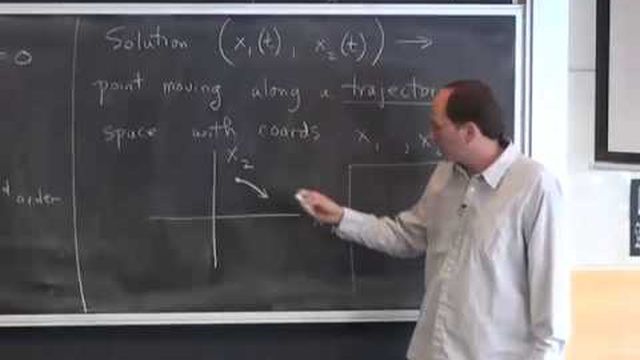
Well, can I ask a little bit? So you've posted these lectures for classes that you've taught onto YouTube. Is there a restriction for more teachers doing that? Is it just a matter of people being willing to? Are there logistical challenges with universities to publishing these things? Why is it the case that you're one of the exceptions?
I don't know. I did it just because during the pandemic, I was taping them anyway. So I thought, why not? But the ones — the nonlinear dynamics lectures that I posted, I just felt like the world might... some students out there might find it interesting, if they're in a country where they can't afford to buy the book.
Did Cornell — like, did you have to get permission from anyone associated with that?
No. No, anyone could do it. It's my intellectual property. What Cornell gives you is the degree. The knowledge is free. MIT already showed this with OpenCourseWare,46MIT OpenCourseWare, launched in 2001, puts materials from nearly all MIT courses online for free: notes, problem sets, exams and some video lectures. right? They're giving it all away.
I remember — and I'm gonna be hazy on the details, so maybe I shouldn't bring it up — there was some case where, because there wasn't sufficient captioning on some online lectures that were put out — it might have been from MIT, or maybe it was Harvard — the school got in a little bit of trouble, I think from, like, the hearing-impaired community.47In 2015 the National Association of the Deaf sued Harvard and MIT because their free online lectures lacked captions; Harvard settled in 2019 and MIT in 2020. After similar findings by the US Department of Justice, UC Berkeley in 2017 took more than 20,000 lecture videos out of public view, exactly the outcome Grant worries about.
That's reasonable.
That's reasonable, you know, you want to make it... Well, let's solve that. And solvable. But, you know, some people feared that it's this added bit of friction to put things up in the first place. What would make sense is put it out first, and then, like, work hard to make sure it's as accessible as possible. But if it would be an impediment to putting it out at all, then maybe making that a necessary requirement was... Again, maybe I shouldn't bring it up, because I don't remember the details, but there was fear of it being a little bit of a cause for someone to not even post it in the first place.
I don't know. That may have inhibited some people from posting. But if you would ask me why don't I videotape all of my lectures: it's expensive under the old model. Like, the one that I did, we had to pay $5,000 to have someone with a video camera who would follow me at the blackboard, going back and forth like that. And so, you know, it just was prohibitive in that sense. But now, with doing it on Zoom, where I just hit a button and it records it, it's easy.
Even then there's that little challenge, though, of: you gotta upload it, you've got a... There's a little challenge.
Maybe you set things up, and, well, Google will give you some motivation by paying you a few pennies for it. Although if you have millions of views, I guess it could be more than that. But for most of us, it's not for any financial reason you would do it. I love that about the internet. I've learned so much from your videos, from so many other people on the internet, and about all kinds of things. Just this morning, when I was playing tennis, my tennis partner said he's learning about art history, about Hieronymus Bosch.48Hieronymus Bosch (c. 1450–1516) was a Netherlandish painter known for crowded, fantastical works such as the triptych The Garden of Earthly Delights. You know, somebody has put up some cool... Yeah, so I think, you know, as gross as the internet can be, and often is, and a force for evil, it's also a force for good, and we might as well use it, you know, as much as we can, on the good side.
I recognize maybe I'm straying a little bit off the beaten path here, but I'm curious to hear your thoughts on... Like, I feel like there must be this high potential to pair together people who want to make videos and online content with academics and professors who are teaching it anyway and doing a great job and have the know-how. Like, you have one side of this equation of: so many people want to be YouTubers. You ask kids these days what they want to be when they grow up, and I don't know if this is disheartening or not, but by far the largest answer will be they want to be a YouTuber.
Are you serious?
Yeah, yeah.
That's real?
Yeah. It's unclear whether what they have in mind is an extremely generic sense of "I want a sense of creative freedom, to, like, do what I want to do," or if they're pattern-matching off of vloggers. Like, depending on what they have in mind, it's either kind of inspiring or incredibly uninspiring that they're...
Let me make sure I understand the claim. Is this something that comes from a reliable source? This is truly the most popular answer now?
So, okay, I should properly look this up. It was among middle schoolers. I can find the source for you and then throw it in the show notes.
Okay, I'm not challenging you, I just find it a shocking answer.
It's the right thing to challenge. But you say, like, what do you want to be when you grow up? And the top, the plurality, say YouTuber.49Fact-checkThe survey Grant has in mind was run by the Harris Poll for LEGO in 2019: 3,000 children aged 8 to 12 in the US, UK and China chose among five careers (astronaut, professional athlete, teacher, musician and YouTuber or vlogger); doctor was not on the list. Across the sample 29% picked YouTuber and 11% astronaut, but in China the picture was reversed: 56% picked astronaut and YouTuber came last (LEGO, 2019). And that falls above things like, you know, doctor or astronaut.
Yeah. Wow. Okay. All right, go on with the...
Take from that what you will, in terms of disappointment.
Well, no, it's interesting. It means you have the side of the equation of people that want to make content.
On another side is folks like yourself — or, let's not even say ones like yourself, but excellent educators who haven't yet put stuff out there, right? There's so much potential energy on both of those sides that it feels like adding some kind of connector is, in principle, a cheap way to get high bang for your buck on putting this out there. You know, the kid who wants to animate things — let's say he went and just animated a lot of your chaos and nonlinear dynamics lecture.
What value add would there be to that, right? It would be incredible.
Yes, there would.
It would be much better than him going off, like, making cartoons in the hope of amassing a following, which...
Well, I only was thinking very selfishly: yes, it would be incredible for me. I hope it would be incredible for anyone who wants to, you know, learn that material or is curious about it.
That's not even a question, just sort of throwing it out there.
No, it's not a question. I know. I'm sort of stunned by the whole thought of it. I do like the Wild West aspect of it, you know, that people with a good new idea... As you say, you spoke about friction. There doesn't seem to be that much friction for someone who's motivated to just start putting their stuff up. And so we're discovering a lot of cool, often young people around the world doing very creative, interesting stuff, often on YouTube, but it could be TikTok, whatever.
08Pre-med, quantum mechanics and tears
Strogatz nearly went into medicine, and he calls his mother's permission to just take quantum mechanics the most liberating moment of his life.
Shifting gears a little bit, back into a little bit of your path into all of this. So you're into this undergraduate program where maybe you're finding yourself less inspired about math research than you had been as a high schooler. What was the turning point back in the direction of wanting to be a researcher?
Well, it was a couple of things. In junior year of college I decided to be pre-med. There was family pressure. Yes. There was.
So, well, so I thought I was going to be a math major. I got very discouraged from my freshman rigorous linear algebra course. I thought, I'll try one more. And then I tried the rigorous honors calculus, like advanced calculus, proving the theorems of calculus and definitions of compact sets50A compact set in real analysis is one where every sequence of points has a subsequence converging to a point of the same set; on the line these are exactly the closed, bounded sets such as a closed interval. It is one of the first truly abstract notions students meet. and stuff like that. And I thought, oh God, this is as bad as the first semester. And so my advisor said, you don't have to take this, you could take the math with the engineering students. And so that was much more to my taste. I could do that with my eyes closed. I mean, that was fun and easy. So I thought, okay. But then I thought, I'll be a physics major. You know, so you already sort of suggested, why not be a physics major? I loved my physics courses, so I thought, okay, I'll do that.
But then I had Stein in complex analysis, and I thought, oh God, I do love that. So maybe I can do math after all. You know, like, if that's a turning point — Stein was very pivotal for me, because it gave me the confidence that it was possible for me to do math, not for engineers. I didn't take the complex analysis for engineers course. I took the complex analysis for math majors course, and I could do that, because it was calculus, just with z instead of x.
And it didn't have the messiness of real analysis.
Right. I didn't know about that yet. So then when I got back to real analysis, I was suddenly no good again. So I was kind of just stumbling around. But then differential geometry,51Differential geometry studies curves and surfaces with the tools of calculus: curvature, torsion, lengths and areas. I was great, because I could visualize everything, and it was calculus again, but now on surfaces or, you know, manifolds.52A manifold is a space that looks like an ordinary plane or space near every point but can be shaped intricately as a whole: a sphere, a torus, a Möbius strip.
What was the first bit of research you found yourself doing? Was it in undergrad? Was it in...
Yes, it was. It was as an undergrad. All right, let me try to speed up the story.
Don't rush it on my account.
Well, I mean, it's because it's all tied together here. So it's junior year. I'm enjoying the differential geometry course, but my family has said, you know, what are you gonna do with math? My parents had not gone to college. They didn't know much about, you know, like, what was out there for me, and they were very supportive of me. They were not tough that way. But my brother was a lawyer, my older brother, and he said, why don't you think about taking the pre-med courses? Because I know you're not that interested in being a doctor, but if you took those courses, you might actually like them. Like biology and chemistry — you like science, you might actually like that stuff.
And, I know you're resisting being a doctor because everyone says to do it, so you're just being stubborn. That's fine, but maybe you should just take those courses. It doesn't mean you have to be a doctor, but it's gonna be a lot easier to take them now than to take them later. I thought it was a pretty good argument. So I switched and started taking all those courses. And truth is, I liked them. They were very interesting. I liked organic chemistry, I liked biology. And I also liked my math courses. But then I started to realize, in my senior year, since I was being pre-med so late, I wasn't gonna be able to take quantum mechanics, which I had always dreamed of taking my whole life, you know.
I mean, I'd been reading about Einstein and Bohr and Heisenberg and Schrödinger53Niels Bohr, Werner Heisenberg and Erwin Schrödinger created quantum mechanics in the 1910s and 1920s: Bohr proposed the quantum model of the atom, Heisenberg matrix mechanics and the uncertainty principle, Schrödinger the wave equation. since I was a little boy. And I told my mother, I'm never gonna get to learn it, because I have to take vertebrate anatomy and stuff. And she said, what if you could just say, "God damn it, I just want to be a math professor, and I'm gonna take quantum mechanics"? Like, she didn't know what quantum mechanics was. Right. But I can see she saw my face. She saw I was so sad. She said, what's wrong? You look so sad. And I didn't know I was looking that way. But she said, you could just take quantum mechanics. You could do what you want. And I burst out crying. I mean, it was the biggest liberating moment of my whole life, I would say, to this day.
I have to say, I, like, admire and I'm almost jealous of the level of emotional investment you had in all of this. Like, that you're applauding for Goursat's proof, or that you're crying to be able to take quantum mechanics.
I really love my subject. Clearly. I just do. I really do. Yeah. I'm not very good at it, and I'm not saying it with false modesty. Well, okay, maybe the point is there's a lot of ways to be good, okay? The way that school tells you is good, I wasn't good that way. I was slow. I'm still slow. I can't do well on a fast standardized test. My GREs were lower than you would think. My SATs were lower than you would think.
09Why DNA can't be a double helix
Strogatz's first research idea, that DNA can't be a continuous double helix, was shot down by a biochemist, but it led him into DNA.
But I had certain other strengths. I like seeing connections. I mean, the stuff I was learning in my differential geometry class about curves and twists and ribbons and things reminded me of what I was learning about DNA. So that's — to come back to your question, what was my first research — I asked my senior thesis advisor,54Strogatz's Princeton senior thesis, The Mathematics of Supercoiled DNA: An Essay in Geometric Biology (1980), was supervised by the geometer Frederick Almgren. can you think of a problem that would combine geometry and biology? I like both. And he said, well, there are some questions about DNA, and how could it all fit inside of a cell, given that it's so long and it doesn't get tangled? Can you figure out what it means for a curve not to be tangled? And can you prove that DNA is not tangled? That turned out to be way too hard for a senior thesis.
Well, I mean, that has that flavor of, like, coming up with the right definition.
Yeah, it does. It does. No, it was a brilliant question, but he was really setting me up for something that was more of a PhD thesis. I mean, that problem is still not solved to this day, as far as I know. But it got me learning about DNA, and the differential geometry and elasticity theory of DNA, when it's this twisted, coiled molecule. And so I lapped it all up. Wouldn't have been possible without that pre-med year or without the differential geometry course.
That's interesting.
So I ended up doing really good research, in fact. The thing was, I had an idea. Someone told me there's a biochemist here who works on DNA geometry, you should go ask him about your idea. I talked to the guy. He was a very excitable Argentinian — I mean, it's not relevant about the country, but it felt relevant to me. He was very hot, jumping around, arguing, manic sort of personality. Professor Worcel was his name, Abraham Worcel. So I told him my idea, and he said... Well, I'll tell you the idea. The idea was that DNA cannot be a double helix.
Despite what you learn, it cannot be a double helix, because... You'll find this interesting, too.
Yeah, tell me, tell me. I'm so curious.
So, okay. So DNA — of course, we had reason to think it was a double helix since Watson and Crick,55James Watson and Francis Crick proposed the double-helix model of DNA in 1953, drawing in part on Rosalind Franklin's X-ray images; they shared the 1962 Nobel Prize. but think about what's going on. If you have a bacterial chromosome, there will be hundreds and hundreds of... You know, the two strands that make up the DNA backbone, they're winding around each other in this double helix. They often don't have free ends. The ends are often joined together to make a circle.56The chromosomes of most bacteria, as well as mitochondrial DNA and plasmids, are circular: both strands close on themselves, and the molecule has no ends. So then you have two curves that are very highly linked, in this sense. Like, that's a linking number of one.
Linking numbers.
That's the point. Their linking number57The linking number is an integer that counts how many times one closed curve winds around another. No continuous deformation can change it without cutting a curve. For circular double-stranded DNA it is roughly the number of helical turns, one per about 10.5 base pairs. is a thousand. So now think about what happens when the cell has to divide, and the two daughter strands have to come apart, so that they're open, so that you can copy each one.
Oh, so assuming that it's not cut at one of the ends, and that they stay kind of tied in that loop, you're saying, like, you can't actually disentangle the two strands.
Well, the daughter molecules will be linked 5,000 times also, but also even the two separate parental strands cannot disentangle from each other. They can't unlink from each other unless you cut them. So biochemists, of course, they know about this, and they say, no, but there must be an enzyme that cuts them. We haven't discovered the enzyme yet, but surely there's some enzyme that does this.58Such enzymes, topoisomerases, cut one or both DNA strands, pass another segment through the break and reseal it, changing the linking number. James Wang described the first, topoisomerase I, in 1971; Martin Gellert and colleagues discovered DNA gyrase, which cuts both strands, in 1976. Okay. So then a mathematician named Pohl, P-O-H-L, William Pohl59William Pohl was a differential geometer at the University of Minnesota; in 1978 he and Glen Roberts published a paper on topological constraints on DNA replication, and in 1980 he wrote a survey, DNA and Differential Geometry, in The Mathematical Intelligencer. at Minnesota, said, okay, that sounds plausible, but it can't work, because linking of molecules is a global property.
There's no local measurement you can do on a little piece of DNA that will tell you how much it's linked. You'd have to measure the whole molecule, and the enzyme is not big enough to make a global measurement of the whole extent of DNA. What's it gonna do, count up to 5,000? So he made a certain mathematical argument that, in principle, what's happening is that DNA is locally helical, but it has to be both right- and left-handed helices, so that the net linking number is zero.
So that, in fact, they can just unzip and come apart. That's the only way that could work. No, all of that is wrong. But in 1980, there wasn't clear proof that DNA was a right-handed helix. And actually, around that same year, left-handed DNA was discovered.60Left-handed Z-DNA was found by Alexander Rich's group at MIT, which solved its crystal structure in 1979. Ordinary B-DNA, the form in Watson and Crick's model, is right-handed.
Oh, that's so interesting.
So it is possible to have both senses of chirality61Chirality is the property of an object that does not match its mirror image, like left and right hands. A helix is either right- or left-handed. of DNA. But, you know, all the bio... Anyway, I told Worcel62Abraham Worcel was a Princeton biochemist who studied the structure of chromatin and how DNA is packed into chromosomes. this idea that I have: I've been reading these papers by Pohl, and he argues it's not a double helix. And he said, if you write your thesis about that, it will be a laughable matter.
Really?
That was a very vivid memory, of that adjective. "It will be a laughable matter." So he essentially kicked me out of his office.
Man. And did you find that discouraging, or did you say, well, I gotta just come up with that?
No, I liked his personality. I liked how hot he was, yeah, and how decisive he was. And I don't want to embarrass myself, so if it's really going to be laughable, all right. Look, I'm just a kid, I don't know what I'm doing.
Right.
I mean, he gave me arguments why Pohl was wrong, and, you know, the experimental evidence that the molecules do get tangled with each other. And so he just said, get out of here, that's a stupid idea. So a few months later I came back with another idea, and he said, that idea is better than the one you came with the last time, but it's still not that good. But if you want a good problem... And then he gave me a certain problem, and he said, this is the problem that everybody is breaking their heads on, and described a certain problem. And I said, I could do that problem this afternoon.
10A ribbon from a fabric store and a first paper
Strogatz solved "the problem everybody is breaking their heads on" in an afternoon with a ribbon and a topological invariant, and it became his first paper.
Is it too much to describe here what the problem was?
No, I can tell you. So, all right, so DNA doesn't just exist floating around in a cell. It's always wound around proteins called nucleosomes63The nucleosome is the basic unit of DNA packaging in eukaryotic cells: about 147 base pairs of DNA wrapped roughly 1.7 times around a spool of eight histone proteins. Roger Kornberg proposed the nucleosome model in 1974. that act like spools. Like, if you want to store a lot of thread, what do you do? You don't just throw it in a drawer. You wind it around a spool, where it's very organized. So nature does that too. It takes this enormous length of DNA and winds it around protein spools, which had just been discovered a few years before that time — it was in 1974 they found nucleosomes. But what was not known is... Okay, the DNA was known to wrap, like, actually, a confusing number, one and three-quarters turns around each spool. So what that means is — I'll draw with my fingers here — I come in, I wrap around a full turn, then I go around three-quarters turns and come out at right angles to the way I entered.
Bizarre.
And then I connect to another nucleosome — think of them as beads. They're like beads on a string, on a necklace. And so the DNA winds around — it just happens, that's what fits — one and three-quarters turns, then to the next one, one and three-quarters.
So you have all these, like, right angles for how it's coming out, fitting together.
Yeah. I mean, that's based on X-ray crystallography64X-ray crystallography reconstructs a molecule's structure from the pattern of X-rays scattered by its crystal, which is why the substance has to be crystallized first. measurements, where everything is frozen and rigid. It's made into a crystal. And, you know, in real life it's in the cell, and it's hotter and jiggling around, and so maybe it's not exactly right angles. But that was basically the amount of DNA wrapped on the proteins. So, okay, so that was a known fact. But what was not known is how do the different nucleosomes, these different beads, stack in relation to each other to make the next level? I mean, what we're trying to do is build a chromosome, right? Going from DNA, which is just DNA, to this mixture of DNA and proteins that makes up all chromosomes, which is where, you know, your genes live. How do you do that? What's the next level of structure above the DNA double helix and nucleosome combination?
So people had measured something called the thick fiber of chromatin,65The thick fiber of chromatin, about 30 nanometers (300 angstroms) across, is seen in the electron microscope as the so-called 30-nanometer fiber. How nucleosomes are arranged in it, and whether it exists in that form in living cells, is still debated. which, you know, under the microscope just looks like something thick, 300 angstroms across, or whatever it is. Not that thick, but on a molecular... I mean, it's much thicker than DNA. Yeah. So they always call it the thick fiber. So that was the big open question in biology at the time: what's the higher-order structure of chromatin? What's the structure of the thick fiber? And so Worcel said to me, I have a model for how the nucleosomes sit in relation to each other. And can you calculate the linking number implied by this structure? Because people had made a measurement of the linking number and found that it gave an effective linking number of one per nucleosome. And he said, that contradicts the one and three-quarters turns that each DNA makes around the nucleosome. So why isn't it one and three-quarters times n?
Why is it only one times n? Why is the linking number one n instead of one and three-quarters n? And he said, I think I know why. It's because of the complicated path that DNA takes as it winds around in this model that I've made, that I see in the electron microscope, but I don't know how to calculate the linking number of that structure. So I said, I could do it this afternoon. And he said, I don't believe it. And I said, I'll show you. I knew how to do it, because it was easy. Yeah, it was very easy, because I had read a paper by Francis Crick,66Francis Crick (1916–2004) was a British biologist and co-discoverer of the structure of DNA. In a 1976 PNAS paper, Linking Numbers and Nucleosomes, he showed how to count linking numbers with a ribbon and noted that you can find it by laying the ribbon flat on the floor. which said you could calculate linking numbers by just taking a piece of ribbon. You could buy ribbon at any dressmaking store. You literally get a piece of ribbon, you wind it in the pattern.
Right.
ExplainerCrick's ribbon and the nucleosome puzzle
The two strands of circular DNA can be pictured as the two edges of a long, narrow ribbon closed into a loop. The linking number of the edges (Lk) doesn't change under any deformation of the ribbon without cutting: it is a topological invariant. By the Călugăreanu–White–Fuller theorem it is the sum of two quantities: twist (Tw), how many times the ribbon turns about its own axis, and writhe (Wr), how many times the axis itself coils in space, like a telephone cord. Tw and Wr change under deformation; their sum does not.
Hence the trick Crick described in 1976: to find Lk for a complicated three-dimensional structure, wind a ribbon in its pattern and then, without cutting anything, lay it flat on the floor. A flat ribbon has zero writhe, so all that's left is to count the twists.
The puzzle was this: DNA wraps 1.75 turns around a nucleosome, yet measurements showed a change in linking number of about one per nucleosome. Part of the "missing" turns goes into twist and into the path of DNA between nucleosomes. Strogatz computed Lk for the chromatin model proposed by Worcel, and it matched the measurements; their paper, Structure of Chromatin and the Linking Number of DNA, appeared in PNAS in 1981.
Then, because it's a topological invariant,67A topological invariant is a quantity that does not change under continuous deformations without tearing or gluing: a linking number, the number of holes in a surface. you can just lay it flat on the floor, and you won't change the linking number.
Is that what you did?
I went and bought ribbon. I made Worcel's structure. I then laid it out flat on the floor and counted the number of twists. That's it. It was experimental math.
That's so delightfully, yeah, pragmatic. Because the mathematician is like, oh, what can I look at? What invariant will I, like, use to leverage this problem?
Well, Crick had said, because it's invariant, you can distort the structure into something much simpler and then just count that.
So, okay, when you're going to write this up as a, you know, undergrad honors thesis, can the write-up say, here's some pictures of me with a piece of ribbon?
Well, first I did it that way, but then I did a math proof.
Okay, okay.
Once I knew the answer, then it wasn't that hard to figure out a proof.
Oh, that's... Okay. So this seems like an interesting relationship between experimental math and pure math, where experimental math is to get you the answer, and then it's a lot easier to find proofs when you know what the answer is supposed to be.
But look, pure mathematicians do that too. They have examples. They sometimes... You know, I mean, right, we know that.
It's not — I wouldn't imply that experimental math is a thing that pure mathematicians don't do. I guess it's more a different...
Okay, okay. Ah, right. I mean, think of Gauss guessing the prime number theorem68The prime number theorem says the number of primes up to x is roughly x / ln x. By his own later account, Gauss noticed the pattern as a teenager in 1792–1793 while studying tables of primes; Hadamard and de la Vallée Poussin proved it in 1896. from — the maybe apocryphal story, probably true story — of him looking at tables of prime numbers. Anyway, that was my first published paper, this paper with Worcel.
Oh, wow.
And it was in the very big journal, the Proceedings of the National Academy of Sciences.69PNAS, the journal of the US National Academy of Sciences, is one of the most cited journals in the world. Worcel and Strogatz's paper on chromatin structure and the linking number of DNA appeared there in 1981. And the interesting thing was that the department gave me highest honors. They graduated me summa cum laude, even though I was getting B's in my topology course.
They recognized that, okay, if you let this kid do applied math, right, he can actually do good applied math. Like, nobody else was working with the biochemist. I found that guy on my own. I did something very original.
What a great lesson about how little grades matter if you're doing original work elsewhere.
Yeah. I mean, if you have enlightened teachers... I remember my advisor saying to me, why'd you have to get so many B's? Like, I had to really argue for you. But I couldn't help it. I do remember going into my — whatever they call it, the exams at the end, where they give you oral exams — and I was being asked something about stabilizers and centralizers70Stabilizers and centralizers are notions of group theory: the stabilizer of a point is the set of group elements that leave it fixed, the centralizer of an element those that commute with it. and something in group theory. And then I couldn't answer, and they were giving me hints, and I just felt like... I actually did say, you don't even need to give me hints. There's no way I'm going to answer this. Like, I don't understand this stuff. I never learned those things properly. And I would love to teach it. I think I could learn it now if I could teach it.
11Teaching as a way to learn
Teaching is the best way to finally learn what you didn't master as a student.
Do you use teaching as a means of learning things?
Yeah. Oh, yeah. Because then there's a gun to your head.
Certainly.
Right? I mean, you have to find a way. But then there's no time pressure. I can think about it my own way. I can ask for help. It's not cheating. Right? There's so many things in school that make it hard to learn. Like, you know, getting help is cheating.
That's true.
Of course, if you do it on... Well, that's the question. Are you allowed to collaborate? You should be.
There should be a good culture of collaboration about problem sets, at the very least. Maybe tests, that can make sense. But any institution that doesn't have a culture of working together on p-sets feels deeply problematic. What's the probability we find you teaching a group theory course in the future?
Well, it's pretty close to zero, because we have lots of colleagues who are real experts in it, who will be teaching it.
But are they expert teachers?
Yeah, I don't know. I could ask. I would like to teach it. I would like to learn it and teach it.
I mean, honestly, the fact that you weren't the student who was nailing the question about stabilizers in your oral exams might actually put you in a better position to teach it empathetically, because... I mean, it's like a lot of fields out there, where once you're bought into why it matters and what the whole framework is, then you just think about it a certain way. But so many students have that feeling with a group theory class of: wow, I thought this was supposed to be, like, what mathematicians care about, and people keep telling me it's beautiful, but that is not the feeling I have when I'm trying to, you know, prove this little lemma.
Well, I did have this experience fairly recently with real analysis, which was another hurdle that I didn't clear in undergraduate days. So I did volunteer to teach a real analysis course. But we have two flavors of it. So there's the one for future math graduate students, which I didn't volunteer to teach, and then there's one for people who want to learn real analysis but are gonna do math and physics, or math and biology, or computer science, or economics. So that's, you know, it would be regarded as the easier one, but it's still real analysis. And so I volunteered to teach that, knowing that I didn't understand real analysis at the time I began the course. And I used an interesting book by David Bressoud called A Radical Approach to Real Analysis.71A Radical Approach to Real Analysis (1994) is David Bressoud's textbook that builds the course around historical crises, above all Fourier series, which forced nineteenth-century mathematicians to become rigorous.
And so David Bressoud is an excellent teacher at Macalester,72Macalester College is a private liberal arts college in Saint Paul, Minnesota. a small college, liberal arts college in Minnesota, and his approach is radical in the sense that radical means from the roots of the subject, right? That's what a radical is, is a root. Like when you eradicate something, you rip it out by the roots.
I've never really thought about that etymology.
That's why we call them radicals, for square roots.
They're roots. My God. That's it.
To eradicate is to rip something out by the roots. I love words. So his book is a pun, his title. A Radical Approach to Real Analysis is: what if you go back to the roots? Why did people invent notions like uniform convergence?73Uniform convergence of a sequence of functions means they approach the limit at the same rate everywhere at once. With mere pointwise convergence, a limit of continuous functions can be discontinuous, as happens with Fourier series.
There's a very good reason. So — and also because I like history — I taught the course from Bressoud's book using history. We did things in the order that they were historically discovered, which is extremely motivating, because you care; you love the questions, because they were real problems. Basically, the short version of it is that when Fourier invented his way of doing Fourier series,74Joseph Fourier (1768–1830) was a French mathematician and physicist. In work on heat flow (1807, book 1822) he claimed any function can be written as an infinite sum of sines and cosines, the Fourier series. That continuous sine waves can add up to a discontinuous square wave forced nineteenth-century mathematicians to define function, limit, convergence and integral rigorously. it posed a lot of difficulties, because he was doing infinite sums of functions. And, like, does this really converge? How can you take continuous sine waves and make discontinuous square waves out of them? So Fourier created a lot of trouble, and that's what caused real analysis to happen. A lot of people think real analysis is a reaction to Newton and Leibniz75Gottfried Wilhelm Leibniz (1646–1716) was a German philosopher and mathematician who created differential and integral calculus independently of Newton; the dx notation and the integral sign are his. using infinitesimals. That was not a problem. That didn't cause any trouble.
12How Newton thought about infinitesimals
Newton had three ways of doing calculus, and his loose handling of infinitesimals, in Strogatz's view, caused little trouble.
I actually wanted to talk about this today a little bit. So maybe we should dive in, like, the history of calculus — and one, how that could play into how we should teach calculus, because so many people have a bad experience with it. But also, you've recently written a book meant to popularize the subject. I didn't really realize this, that infinitesimals weren't an issue, that the mathematical community was all right with that.
Not everybody. I mean, there was a famous guy named Bishop Berkeley,76George Berkeley (1685–1753) was an Irish philosopher and bishop. In his pamphlet The Analyst (1734) he mocked Newton's fluxions and called vanishing increments "ghosts of departed quantities." who wrote a very scathing attack on Newton for his, you know, "ghosts of departed quantities," as they were called.
Well, backing up a little bit — I don't have a good conception, and you know the history much better than I do. How was Newton thinking about... Like, I guess he wasn't writing df and dx; that was, like, a Leibniz...
That's Leibniz, yeah.
But was he thinking about infinitesimals in a literal sense, of "I'm adding this infinitely small quantity"? Was he thinking of that as a metaphor for something else? Do you have any sense of...
He wrestled with it a lot, as far as I can tell. I'm not a historian either, so I don't trust that what I'm going to tell you is exactly right. But it looks to me like there are times when he's thinking about infinitesimals. He sometimes writes a little o, which I think is supposed to remind him of a zero. It's not quite zero, but it's almost a zero. It's a little o. And he'll add little o to something, and he treats it like an infinitesimal, like the way Leibniz would use a dx. So Newton sometimes plays with infinitesimals, but he seems to have distrusted them. And so then he comes to the idea that he needs ratios of infinitesimals. That gives him finite results and nonzero results — well, it could be zero, but anyway. He looks at ratios of infinitesimals, and he thinks of those as, like, velocities. You know, a change in y over a change in t, or something like that.
So it's like a velocity of a particle with a position y of t. And so he calls these things fluxions.77Fluxions were Newton's name for derivatives: the rate at which a flowing quantity, a fluent, changes with time. He marked them with a dot over the letter, still the physicists' notation for a time derivative. You know, for him, calculus is at first very much about motion. I mean, it's interesting when you read him, which I have now, a lot: he has three ways of doing calculus, and they come at different times in his life. First, he uses infinite series, power series. You know, that's where he comes in as a student. He kind of invents what we think of as Taylor series and Maclaurin series.78A Taylor series expands a function as an infinite sum of powers of (x − a) with coefficients from its derivatives at a; a Maclaurin series is the case a = 0. They are named after Brook Taylor (1715) and Colin Maclaurin (1742), though such series were known earlier, including to Newton. He's doing all of that, that he gets from Wallis,79John Wallis (1616–1703) was an English mathematician and Newton's predecessor. In Arithmetica Infinitorum (1656) he computed areas with infinite products and series; he also introduced the symbol ∞. who has used ideas about infinity. And Wallis wrote a book that Newton studied very carefully as a student. And so he's at first very inspired by Wallis, and by the importing of the idea of decimal numbers from India — you know, what we think of as Hindu-Arabic numbers. But decimals were not that well, you know, known at that time.
And decimals basically represent real numbers as infinite series of numbers, right? How many powers of one-tenth, how many of one one-hundredth.
So in that time was everyone doing their math with fractions?
There was a lot of use of fractions.
Like, if someone wanted to think about pi, how would they think about what pi is?
Well, I'm not sure. I mean, decimals had been around for a while in Europe.80In Europe decimal fractions were popularized by Simon Stevin's pamphlet De Thiende (1585); the decimal point became standard in the early seventeenth century, helped along by tables of logarithms. So I may be garbling this a little bit. I mean, certainly people were using logarithms,81Logarithms were invented by John Napier (1614), and within a few years Henry Briggs published tables of base-10 logarithms, the main tool of calculation until the twentieth century. so they were working with decimals. So, you know, I'm probably exaggerating.
It's just that... But really thinking of it as, like, a power series.
It is a power series in powers of ten, or inverse powers of ten. And Newton thought to himself, why can't I do the same thing with a symbol x and have powers of a symbol x? And then it sort of acts like a decimal. So he did a lot of manipulations with infinite series, didn't think about convergence too much. But I'm sure he knew what the issue was, because he was calculating things, so he would check that he was getting good convergence in a practical sense. Was he getting good answers? I mean, he sometimes would work to 50 digits.
That's insane.
He's really... You can see it in his notebooks. It's wild. He calculates log of, you know, like, 1.01 to many, many — about 50 digits.82Newton's notebooks from the mid-1660s contain calculations of areas under the hyperbola, in effect natural logarithms, done with infinite series to more than 50 decimal places.
But anyway, so first he uses infinite series, later he uses fluxions, these ratios of infinitesimals that are like velocities. And then later he doesn't use any of that, and he uses his geometric version of calculus, which is what he wrote the Principia83The Principia (Philosophiæ Naturalis Principia Mathematica, 1687) is Newton's masterwork with the laws of motion and universal gravitation. Its proofs are written in the language of classical geometry rather than fluxions. in, where he's essentially using geometry, but he has notions of, like, triangles that are shrinking to slivers. He doesn't call them infinitesimal triangles, but he's using a geometric version of calculus.
But is he thinking in terms of: at all steps there's a finite thing, and we're doing some kind of limiting approach? Or would he have not even framed it in terms of...
I'm not sure. I think so, I mean, because when he talks about fluxions, anyway, he says — like, if he thinks of a ratio of what we would say, like, a delta y over a delta x, as they both become close to zero — he says you don't think about them before they're zero; you think of them at the moment they vanish.
Right.
Don't think of them before they vanish or after they vanish; think of them precisely when they vanish.
It's funny... Do you feel like, if you're teaching a student, would you frame it to them that way, or is that...
No, it's very vague. I don't like it.
It's a thing that you have to evolve past.
I don't like it, but that was his best attempt at the time. So anyway, I don't think that version of calculus posed much trouble for people.
Because they were actually solving astronomical problems, and it didn't really bother them that...
Well, what paradoxes do you get into? I mean, differential calculus doesn't lead to a lot of trouble. Like, where do you really go wrong? You could make up some cockeyed examples. There were things that people worried about. Like the infinite series one minus one plus one minus one,84This is Grandi's series, 1 − 1 + 1 − 1 + … The Italian monk and mathematician Guido Grandi argued in 1703 that its sum is 1/2, and Leibniz, Euler and others debated it. In modern generalized summation methods, such as Cesàro summation, the sum is indeed 1/2. alternating. Okay, that thing, which we would today say doesn't converge, because it alternates — its partial sums bounce between one and zero. That was still a live question in the early 1700s, after Newton was more or less done doing math. People were arguing, does that converge to one? I mean, they wouldn't have said converge. They would say, what is the sum? Is the sum one? Is it zero, or is it a half? Because there was a good reason to think the sum was a half.
And we have, like, formal notions — there are notions where it should be, with the right notions of convergence, yeah.
Right. So people, good mathematicians, were arguing about that.
But those were the pathologies, and it wasn't really where, like, serious inventors of calculus...
Yeah, it wasn't a big deal, for the most part. Whereas Fourier series really caused problems that had to be dealt with and couldn't be swept under the rug, as far as I can see, because they were using them to solve the wave equation,85The wave equation describes vibrating strings, sound and electromagnetic waves; the heat equation describes how heat spreads. Fourier invented his series precisely to solve the heat equation. and they were getting physical answers, the heat equation. So there was a lot at stake in making sense of those. Anyway, I don't know. I mean, that part of math is interesting, and I love teaching that course, that historical version of real analysis. How did the students like it? I don't think that all of them liked it.
13Myths of math history: Archimedes and Pythagoras
History can inspire or confuse, and many of the "historical" stories teachers tell are fables.
I remember I used to resent history when my teachers would do history, actually. Like, especially, I remember my quantum mechanics teacher spending a long time on the history of the early days of quantum mechanics, and I thought, I want to learn about Schrödinger and Heisenberg. I don't want to read all this junky stuff that we don't use anymore.
That's interesting, because, I mean, earlier you were talking about how you found yourself, you know, reading about the Schrödingers and the Einsteins and Bohrs. Was it the history of them that was intriguing you, or was it the strange bit of reality that they were exposing?
I mean, I realize what I'm saying probably sounds very contradictory. It does; I hear it myself. History is very confusing. That's the trouble. When you learn how things were really discovered, it's often very illogical and therefore very confusing.
So, I mean, it's an interesting question: how much should we emphasize the history of things in an initial course? It runs the risk of distracting.
It's very distracting in some ways. I know it's a hard problem. It's hard to be a good teacher.
I don't actually remember much in the chaos and nonlinear dynamics lectures — do you talk about the historical development of this stuff that much?
I have, like, a chapter zero or something, or a first chapter, where I try to give what I consider a historical overview of the subject and a logical overview. And they're very different. You know: this is the logical structure of what we're going to learn all semester; this is actually how it came about, and it's not at all the way it looks logically. So I do present both, but if I were teaching the course, I would only spend the first half of the first lecture on that. But then later in the course, when I'm talking about Lorenz's equations,86The Lorenz equations are a system of three differential equations that meteorologist Edward Lorenz derived in 1963 as a simplified model of atmospheric convection. Their solutions are chaotic and sensitive to initial conditions, the origin of the butterfly effect and the famous Lorenz attractor. I would tell you what Lorenz did and why he was interested in those equations, where they came from, what question he was asking.
So I don't feel like I want to be a slave to history, but where it is motivating and helpful, I'm happy to discuss it. But man, I got a lot of respect — I just was going to say, I got a lot of respect for the historians, in researching Infinite Powers. Like, you probably are aware that when our math professors or our physics professors talk about history, they often repeat a lot of mythology, a lot of folklore.
Yes, that's such a good word for it. There's folklore. There's, like, the folklore around Galois87Évariste Galois (1811–1832) was a French mathematician whose theory now bears his name. He died at 20 after a duel; legend has him frantically writing down his discoveries the whole night before. Historians think he had set out his main results earlier and spent that night revising and annotating his manuscripts. or something. You have these standard stories that, if you dig into them a little bit, are not necessarily well fact-checked. And I don't know if that makes it a problem necessarily.
It's a really interesting question. Is it a problem?
We could frame them as fables. Like, these are the math history fables.
They're fables. They often are very good fables, and you should be very skeptical of them.
Does any pop into your mind right now as a classic fable that the physics teachers or mathematicians were passing down that you later learned has no bearing in reality?
Well, okay, one of them is the story of Archimedes,88Archimedes (c. 287–212 BC) was a Greek mathematician, physicist and engineer from Syracuse. He found areas and volumes by methods that anticipated integral calculus, estimated π, and discovered the law of the lever and the principle of buoyancy. the "do not disturb my circles" fable. Do you know this story?
Tell me more.
I'll tell it. So Archimedes was murdered in the battle for his town. There was a siege. The Romans put a siege on his home of Syracuse. So Syracuse, on the island of Sicily, was being attacked by the Roman Empire, and Archimedes, according to legend — you know, we were told by Plutarch and other historians — Archimedes made fantastic war engines, they were called, which were like catapults, and big parabolic mirrors to make the sails of the incoming boats catch on fire by focusing a beam of light89In his life of Marcellus, Plutarch describes Archimedes' catapults and the "claw" that lifted ships out of the water, but says nothing about burning mirrors. That story appears in later writers and is told in detail by the twelfth-century Byzantine historians John Zonaras and John Tzetzes. on them. Sounds pretty fantastical.
Like, really? Is that really possible to do that? How would you manufacture mirrors like that? How would you get a mirror that good? How big would it have to be? There's a story in Plutarch about Archimedes making a crane that could lift the ships out of the water and shake the soldiers out of them, you know, and so on like that. So you have to think, come on, is this really true? But the story is that at the end of the battle, the end of the siege, when the town was taken, there was a Roman soldier sent to get Archimedes and bring him back to the general, to Marcellus, who wanted Archimedes — like, he would be valuable. And so he was not supposed to be killed; he was supposed to be taken alive and brought back, according to these stories. But according to the legend, Archimedes was doing a geometry problem in the sand that involved some elaborate construction with circles, and the soldier who's coming up from behind him steps in the sand and disturbs the circles with his foot, and Archimedes says, "Don't disturb my circles," and gets killed on the spot. You know, the soldier stabs him and kills him on the spot. So what part of that is true?
We know that Archimedes died in the Battle of Syracuse. Did he die because... A lot of people died for various reasons; maybe we don't really know. Was it true that the general wanted him captured alive? Maybe. But how do we know that Archimedes said "do not disturb my circles"? Who would have reported that? Would the soldier have said that?
So that's been traced. I mean, that has been looked at by Alberto Martínez.90Alberto Martínez is a historian of science at the University of Texas at Austin, author of Science Secrets (2011), on myths about Darwin, Einstein and others, and The Cult of Pythagoras: Math and Myths (2012). So Alberto Martínez is a historian of science at UT Austin, and he wrote some really nice books. One is called The Cult of Pythagoras. And there's another one with science in the title, maybe called, like, Science Secrets or something like that. But anyway, The Cult of Pythagoras is a debunking of many of these myths. And one of them is this story, and he traces back through the historical record: which historians wrote what about Archimedes? Where did this story come from? And it's interesting. Like, you know, Plutarch is not telling that story. He doesn't have anything about what the soldier said.91Plutarch gives several versions of Archimedes' death; in one he is absorbed in a diagram and refuses to go with the soldier until he finishes his proof, and the soldier kills him in anger. The famous line comes later: in Valerius Maximus (first century AD) Archimedes says "Please, do not disturb this," and the Latin formula Noli turbare circulos meos, "Do not disturb my circles," is later still. The Death of Archimedes mosaic in Frankfurt’s Liebieghaus was long taken for an ancient work. It is now dated to the 18th century.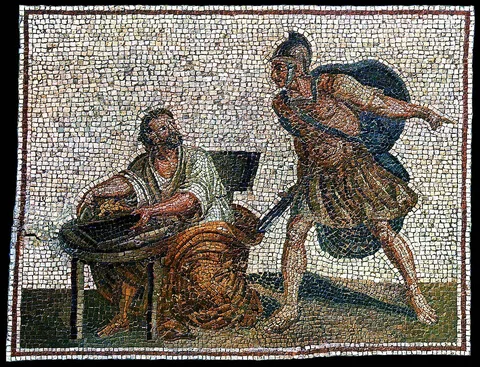
But everybody who tells these great stories feels the need to make the story, like I probably just did now. Like, the soldier kicks it with his sandal, you know. I don't know what he did. The whole story is baloney. It's all made up, because some guy at some point made this embellishment, and now we keep telling it because it's such a good story.
Well, I have to ask: in The Cult of Pythagoras, is the story about the person showing that the square root of two is irrational92An irrational number cannot be written as a fraction of two integers. The Pythagoreans proved that √2 is one, and for a school that taught that everything is number and ratio, it came as a shock. getting thrown off of a boat...
That's another interesting one. That one is also discussed in there.
And what's the resolution there?
There is some discussion of a particular person named Hipparchus,93Fact-checkThe name said here is Hipparchus, but the legend of a Pythagorean drowned at sea for discovering irrationality, or for revealing the school's secret, is about Hippasus of Metapontum (fifth century BC); Hipparchus was an astronomer of the second century BC (Stanford Encyclopedia of Philosophy, Pythagoreanism). who is the one — if anybody was thrown overboard at sea for discovering it, it's Hipparchus. So, but was he? It doesn't seem to be the case. I mean, remember, Pythagoras is very old. This is 500 BC that Pythagoras lives. And the first people really writing down anything about Pythagoras is close to a thousand years later.94The detailed lives of Pythagoras that survive were written by Diogenes Laërtius, Porphyry and Iamblichus in the third and fourth centuries AD, some 800 years after his death. Plato and especially Aristotle wrote about the Pythagoreans earlier, but their texts on Pythagoras himself survive only in fragments.
That's such a...
It's a long time. It's a thousand years later. Okay, it's not even a hundred years later. It's a really long time. We don't have records from 400 BC or 300. It's very long before anybody's telling stories. I mean, Cicero wrote some stuff.
Well, in that case, how did people even know about Pythagoras?
Well, he had disciples.
Was it an oral tradition from those disciples?
Yes. Yes, there's a school, the Pythagoreans; they really existed. The Pythagoreans existed. Some people doubt that there is a real Pythagoras, because Pythagoras was imbued with a lot of godlike powers. He really was some kind of religious figure, it seems. The Pythagoreans — there were various Pythagoreans who have left us documents. So there are people who wrote about Pythagoras, you know, like, a few hundred years later. And that's a whole interesting part of, you know, pre-Socratic95The pre-Socratics were Greek philosophers of the sixth and fifth centuries BC who lived before or alongside Socrates: Thales, Pythagoras, Heraclitus, Parmenides, Democritus. Their writings are known mostly through quotations in later authors. Greek scholarship.
I mean, the idea that he might not have been real is insane.
Well, that's what they say about Shakespeare, too, right? Or Shakespeare was someone else, or Homer didn't really exist.96Arguments that someone else wrote Shakespeare's plays (Francis Bacon, the Earl of Oxford, Christopher Marlowe) date from the nineteenth century; most historians consider Shakespeare's authorship settled. The Homeric question asks whether Homer was a single real person or whether the Iliad and the Odyssey grew out of oral tradition.
Right, right.
Or, I mean, yeah, so it's unclear that there really was a Pythagoras. But, you know, we're told, yes, he came from this certain island off the coast of Turkey,97Tradition says Pythagoras was born on the island of Samos in the Aegean, off the coast of present-day Turkey, and later founded his school in Croton in southern Italy. and blah, blah, blah, blah. So there's a standard tradition of who Pythagoras was. I don't know, maybe he really did exist. But was he a good mathematician? Did he... You know, I don't know. When you read Alberto Martínez and others, it seems like you can't trust much of what you read about Pythagoras.
14Newton and Leibniz: letters, not war
The relationship between calculus's two inventors, Strogatz says, was more complicated than the usual story of their fight.
Interesting. What are some of the other, like, interesting things that you found while researching Infinite Powers, about the history of calculus, that you didn't know before, but maybe shaped how you think about the whole field now?
Well, I didn't know that Fermat and Descartes had such a big fight.98In 1637–1638 Pierre de Fermat and René Descartes clashed over methods for finding tangents and maxima; Descartes, who had just published his Géométrie, was dismissive of Fermat's method, which was closer to the future differential calculus. You always hear about Newton and Leibniz having a big fight. And even that, I think, is not told correctly. As far as I can tell, Leibniz really admired Newton.
Oh, really?
He approached him, I think, in very good... Well, they were competitive. But, I mean, Newton was very narrow compared to Leibniz. Leibniz thought about everything. That guy was a real genius in a very broad sense. Whereas Newton — okay, yes, great at physics and math. He also did some stuff that we consider a bit flaky today.
Alchemy.
You know, the dates, alchemy, the dating stuff in the Bible,99Newton spent decades on alchemy, prophecy and biblical chronology; his Chronology of Ancient Kingdoms Amended appeared posthumously in 1728. and he was pretty religious in certain ways. And I think he probably had a certain amount of mental illness. He had some breakdowns100In 1693 Newton suffered a severe breakdown: he went months without sleep and wrote confused, accusatory letters to friends, including John Locke. and things. But Leibniz was fairly new to math. I mean, Leibniz was not devoted... Well, Newton also just got really strong at math in college, but Leibniz was a latecomer. He had Christiaan Huygens101Christiaan Huygens (1629–1695) was a Dutch physicist, mathematician and astronomer who invented the pendulum clock, discovered Saturn's moon Titan and its rings, and developed the wave theory of light. In Paris in 1672–1676 he taught the young Leibniz mathematics. helping him learn the basics. And Huygens was probably... I mean, Newton referred to Huygens as "summus," you know, like he was the highest.
He was the only person that I think Newton really admired as almost an equal. So we don't hear much about Christiaan Huygens anymore, but Newton thought of him as, you know, that guy had game. Whereas Leibniz, I think he thought of as kind of just an annoying gnat, you know, this dilettante polymath. Yeah, he's a dilettante polymath. And you can see it in the letters they write to each other. Leibniz writes letters that don't go directly to Newton, but they go through an intermediary,102The letters went through Henry Oldenburg, secretary of the Royal Society. In 1676 Newton sent Leibniz two famous letters on infinite series, the Epistola prior and the Epistola posterior; in the second he concealed the essence of his method of fluxions in an anagram. to be given to Mr. Newton.
And those letters are really interesting. We do have those letters back and forth between them. And he's kind of supplicating, like he really wants Newton to tell him some of his tricks. And Newton doesn't want to play ball at all. So at first he's very sarcastic and withholding, and all he does is send super impressive results that, like, this shows you how much better I am than you. You're never going to understand how I got this. And he doesn't explain how. But Leibniz is not really scared. And Leibniz says, I would like more explanation of this. Could you show me how you did this or that? And then Newton kind of changes his tune and is very, almost sweet and pedagogical.
And he gives very gentle explanations, some of which I quote in the book. Actually, some of them were too mathematical, so my editor didn't let me put them in the book, but I could give you a PDF, which you could post.103Strogatz posted this unpublished appendix, Newton on Infinite Series and the Epistola Posterior, on his website; the link is in the episode description.
Oh, please do. Yeah, yeah, yeah. Let's throw it in the show notes. That sounds great.
Yeah, because Newton really does explain things very well. And it's fun to see him in teacher mode. He could teach. He could explain very well when he wanted to.
That is very different than the usual caricatures we see of this, like, fierce battle between them. Or of Newton being kind of a jerk to a lot of the people that...
Well, he was, in some ways. So when Leibniz sends him something to try to impress Newton — you know, a certain infinite series that he's proud of, that he's figured out how to sum it104This is the Leibniz series, 1 − 1/3 + 1/5 − 1/7 + … = π/4, which Leibniz found in 1673–1674. In his reply Newton praised the result but made clear he knew several ways of getting such series. In India the series was known in the fourteenth and fifteenth centuries to the school of Madhava. — Newton says something like: you can't imagine what pleasure it has given me to see this series, that I've already found, you know, three other ways to do. I had no idea there was a fourth way. So, you know, he has a way of being polite, but sort of, like, sorry, not sorry. And he's got to flex a little bit. He's kind of passive-aggressive. Yeah, he's flexing. So he's not a very easy guy. I think I would have liked Leibniz. Everything I read about Leibniz, he seems funny, he seems like a real person.
Well, it sounds like he had an insane number of correspondences and was this, like, academic social butterfly of the era.
And you have to imagine you're at least a little bit likable to keep that up.
Although he says of himself — he's very self-deprecating — he says that he's not likable. He says that he always makes a bad impression.
Oh, the fact that he's even thinking in those terms tells you that he's... He's a good guy, right?
He is. He's very self-deprecating. He talks about how ugly he is and what a bad impression he makes. And yeah, I really think I would have liked him. Now, you have to keep in mind, too, that historians hate this whole thing we're doing right now. My friends in history of science that I've met through Twitter — you know, like, they would say... So I'm thinking of Michael Barany,105Michael Barany is a historian of mathematics at the University of Edinburgh who studies the twentieth-century mathematical community and writes about math on social media. for instance. He would say, you don't know what Leibniz was really like. That would take a lot of historical work to figure out. And you pretend... When you think you understand what Archimedes was like — because I really feel very emotional about Archimedes. He comes across, I think, in the book as the guy I love the most.
15Historians, teachers and a beloved Archimedes
Historians want the truth while teachers want to inspire, and Archimedes is the great mathematician Strogatz feels closest to.
This, I mean, this did shine through, how there's a high respect for just how sophisticated his math was.
Oh, yeah. But I don't know, I feel more emotional about it than that, because Archimedes lets you in. He tells you that he hopes that what he does will help mathematicians in the future find theorems, he says, that have not yet fallen to our share.106This is from Archimedes' preface to the Method, addressed to Eratosthenes: he writes that the method will be useful, since some of his contemporaries or successors may use it to discover other theorems "which have not yet fallen to our share." Meaning: the things that I haven't figured out, I hope you'll figure them out. He has a wistfulness to him, you know. And again, you could say, no, that's bull, I'm just making that up. Well, he wrote those words. I mean, okay, maybe they've been mistranslated, but I don't see any reason to believe that.
And honestly, even if there is a little bit of color dye of fiction that has leaked its way into the history that gets us there — if there's something humanizing about the person almost inventing calculus in the BC times, or if there's something humanizing about Leibniz — it cuts to what we were talking about earlier, where I don't know if it's a problem. I mean, the historians will maybe roll their eyes a little bit, but for the sake of getting someone, you know, engaged with the subject material and putting themselves in the position of an inventor of it and all that, I, you know, I don't know if the historical stickler is necessarily adding to that goal.
See, that's interesting. We have different aims. I like the way you phrase it. That if you're a historian, you want the truth. You want to get as close as you can. Well, I mean, I suppose some historians would say we can't know the truth. There's only, yeah, you know, different accounts, whatever. But for those who believe there is a truth, then we should try to figure out what it was historically, or approximately, as best we can. That's one aim, to get to the truth. But another is to teach and to inspire. And it's interesting that you say that, in the service of teaching, maybe pretending that we can think of Archimedes as a colleague, as, like, a big brother for us...
I don't want to insinuate that we shouldn't care about the truth either. Like, exactly what we were saying before, about framing it honestly as folklore, but then just embracing the folklore. Say: who knows what Leibniz was like? Maybe he was like this; we don't know for sure. But let me talk a little bit about what that dinner party would look like now.
Yeah, because it's not completely unknown. The ones that are closer to us did leave records, and we have them. You know, it's very different with Archimedes, where his stuff is written in Greek, and then the library at Alexandria107The Library of Alexandria, founded under the Ptolemies in the third century BC, was the largest library of antiquity. It declined gradually rather than burning in a single fire: it was damaged in Julius Caesar's fire of 48 BC and later in the wars of the third century AD. gets sacked, and a lot of stuff gets burned, and then it has to make its way across to Constantinople and all this. I mean, there's real adventure stories in these documents. We see — like, unlike Euclid, where every little schoolchild has to learn Euclid. You know, that's basic geometry. Actually, the truth is, Euclid is pretty deep too, but there's a bastardized version of Euclid that we think of as, like, elementary plane geometry. Euclid actually has 13 books,108Euclid's Elements (c. 300 BC) has 13 books: plane geometry, proportion, number theory, incommensurable magnitudes and solid geometry up to the five regular polyhedra. For two thousand years it was the main mathematics textbook. but we focus mostly on the plane geometry part of Euclid.
Anyway, Euclid is copied, they say, more than any other book in Western tradition except the Bible. So Euclid is very well reproduced, but Archimedes was hard. And so there was very little motivation to keep copying Archimedes. And so most of his stuff is lost. I mean, we know, because other people refer to this or that book by Archimedes. We don't have the book. We don't know what he did in that book. We only know secondhand. But we have some actual Archimedes that have been discovered. And so that's one of the stories that I tell in Infinite Powers: his book about the Method,109The Method of Mechanical Theorems is Archimedes' treatise in which he finds areas and volumes by balancing thin slices of shapes on an imaginary lever. It was thought lost until 1906, when the Danish philologist Johan Ludvig Heiberg found it in Constantinople in a palimpsest: a thirteenth-century prayer book written over an erased tenth-century manuscript. where he figures out volumes and areas by imagining shapes as being made of material, and he weighs them in his mind using his law of the lever. It's incredibly ingenious, and yet never something we would teach anymore.
And it's also — I mean, what surprised me so much is how much it looks like calculus. That he's slicing things up and thinking: you've got this hard-to-understand shape; what are all the, you know, the areas and masses of the slices along?
He totally understands calculus, absolutely. It was wild. And that's two millennia before. No, he's really incredibly good. I think he's one of the best ever, you know, with Newton and Euler110Leonhard Euler (1707–1783) was a Swiss mathematician who spent most of his life in St. Petersburg and Berlin; the most prolific mathematician in history, he laid foundations of analysis and graph theory and introduced much of our notation, including e, i and f(x). and Gauss. I mean, Archimedes is totally in the first rank. Yeah, he's really special.
Tell me about Fourier as a personality.
I don't know so much about Fourier. They always say that he was cold.
Ironic, for the man studying the heat equation.
Right, he was cold. He would wear a heavy coat even in the summer.
Oh, literally cold, not as a personality.
He was literally cold. He was always cold. He was always dressed in a heavy coat, one of his correspondents says.111Contemporaries recalled that after Napoleon's Egyptian campaign Fourier was convinced heat was good for his health: he kept his rooms overheated and went about bundled up even in summer.
16Concrete before abstract, and the cult of concision
Good exposition moves from the concrete to the general, while pure math culture prizes concision at the expense of how people learn.
So he's standing there in his jacket: "I really need to understand heat." He's thinking about temperature much more than the rest of us are, and has this itch to solve that problem. So, when you're thinking about all of these different things — incorporating the history into teaching, thinking of your own undergrad experience with some of the axiomatic approaches, the fact that you wanted to be a teacher since you were little — if you were mentoring someone on exposition right now, you know, they tell you either they want to be a teacher, or they're going to put up some online explainer, or it's someone who's a colleague of yours about to teach, you know, they're about to teach a calculus class...
What are the things that you feel like you've kind of learned really work well, that wouldn't have been obvious to you when you were just starting off, about exposition?
About exposition, yeah.
Are there... I'll give you an example. I feel like often, if I write something down once I understand the material well, I have this tendency to start with the generalizations. And here's this really powerful general tool, right? And then maybe as this side note at the end, you give some examples of how you apply it. But invariably it's better if you let those examples motivate the generalization. In the same way that, like, understanding the commutative nature of multiplication — you thinking of nine times two very directly: oh, I need to add up two nine different times, or I need to add up nine two different times — that is this very concrete example that leads your mind to want commutativity to be a thing, and maybe to better understand multiplication along the way. And I feel like that happens at all levels.
You know, you don't just start talking about the axioms of a group. You talk about different symmetries, and maybe wanting to ask certain questions of them. Like, I imagine, actually, there's probably a path to understanding group theory where you lead up to the proof of the unsolvability of the quintic,112The Abel–Ruffini theorem says the general equation of degree five or higher cannot be solved in radicals, that is, by a formula built from the coefficients with arithmetic operations and roots. Galois explained why by studying groups of permutations of the roots, and group theory was born. where you are shuffling roots around of a polynomial, and you actually need to ask a concrete question about the nature of those symmetries. And this is a very long-winded way of saying a principle that I think has emerged is: try to put the concrete before the abstract. And that it's worth actually having that in the forefront of the mind as an author, because once you understand something, the tendency is to go the other way around. And so it's not enough to, like, nod your head and acknowledge, like, yes, motivating examples are good. Something about our instincts upon understanding it leads us to do things wrong the first way.
And it also seems like a lot of math exposition culture — I don't want to say it's got a disease, but there is something going on with math exposition, where seminars tend to lose people in math more than they seem to in computer science and physics. Or this experience that you had as an undergrad, of liking the subject a lot, enough to even push through with it a lot more than others would have, but facing that friction — I get the impression that doesn't happen in other fields as much. So there's something going wrong in typical math exposition. And I'm an optimist that it can be cured in some way. And the lessons learned from the people who have become best at it — and you are definitely one of the best at it, if we look at not just the courses you've taught, but the popular books that you've done, or your contributions to the New York Times113Strogatz wrote series of columns on mathematics for general readers in The New York Times, The Elements of Math (2010) and Me, Myself and Math (2012); the first grew into The Joy of x. and everything like that.
Undoubtedly there are some seeds of wisdom that we can try to unearth, that it's transmissible, right? It's presumably a teachable skill, or a malleable culture. If we actually wanted math exposition to be better, you know, 20 years from now, what are those seeds that you start planting in the people who will go into that?
Well, yeah. So, of course, I don't have any monopoly on this, but there are great math writers. I think it would help to look for good role models. Now, what are those? Or who are those? I mean, there's a lot of negative role models. I think that's part of the problem. I think there is a collective taste that pervades the culture of pure math, is what I want to say, but I don't feel totally qualified to say that, because I don't really read much pure math. I've read a lot of math textbooks that are pure math textbooks, but I don't read pure math journals, by and large. But I think there is a culture that prizes elegance and concision. That it's good to be brief. Elegance is often associated with minimal, you know, use of words. Tighter arguments are better than longer arguments, that kind of thing.
A lot of those seem to me anti-psychological. Like, they treat a human being as something that is not what a human being is. They don't make allowance for the way that people learn or get excited.
Oh, there's such a good example of that that comes to mind while you're talking. There's this — it's actually a really elegant proof of the fact that... You're wondering which prime numbers can be decomposed into the sum of two squares. And, you know, so, like, five can be written as one plus four, but seven, there's no way to write it as a sum of two squares. And it is a useful fact in number theory that it's all of the primes that are one above a multiple of four.114This is Fermat's theorem on sums of two squares: an odd prime is a sum of two squares exactly when it leaves remainder 1 on division by 4 (5 = 1 + 4, 13 = 4 + 9, 17 = 1 + 16). Fermat stated it in 1640; Euler published the first proof.
But it's a tricky little thing to prove.
Yeah, no, it's this wonderful, wonderful little fact.
And then you can use this to do things. You can get to Leibniz's formula for pi, for example, by leveraging this fact about primes, in a way that seems unexpected.
This sounds good. I don't know any of this story.
Oh yeah, no, it's such a wonderful, like, story there. It's not how Leibniz found it, by any means. There's much easier ways to prove Leibniz's formula if you just throw a little bit of calculus at it. But this, you know, one minus one-third plus one-fifth, on and on, that it equals pi fourths, like, has this shadow of primes inside it. But that little fact, it's a little tricky to prove, but there's this very famous one-sentence proof115This is Don Zagier's famous 1990 "one-sentence proof that every prime p ≡ 1 (mod 4) is a sum of two squares." It relies on a clever involution on the solutions of x² + 4yz = p, based on an argument of Roger Heath-Brown. of it. And it was published as, like, a one-sentence proof that is absolutely inscrutable. There is no one who can... Maybe somebody with, like, preset deep intuitions of number theory could read it and maybe understand where it came from. But it's this absolutely out-of-the-blue function that's been defined as this, like, involution,116An involution is a map that, applied twice, returns everything to where it started, like a mirror reflection. If an involution on a finite set has exactly one fixed point, the set has an odd number of elements, which is what Zagier's proof turns on. and you say, because it's an involution, yada yada, this will only work if the prime is one mod four. And the concision of it is the elegance, but I cannot think of a worse proof of that fact in terms of intuition. And it's so... I mean, this is the extreme that maybe illustrates the point that you're making about what is rewarded as elegance, or what is lauded as a, you know...
That one might be a strange... No one would call that a great proof, but there is something great about it. And there is something almost, like, prizeworthy about being able to do it in a sentence.
Yes. Right. There's something charming about that. But it's a very nice example, because I think it's an example of boneheaded aesthetics. That's the problem. It's just — I mean, from the pedagogical standpoint. Maybe to a master, sure. Once you understand the subject, you would be charmed by what a beautiful, clean little argument that is, if you're familiar with that involution that comes into the problem or something.
17Euler's product and "moral" truth
Mathematicians should give themselves permission to show "morally true" arguments like Euler's instead of hiding them.
But let's talk about someone who's great. Euler actually is a great teacher. So there's an example that has to do with — since you're talking about prime numbers — Euler has a formula for the zeta function117The Riemann zeta function is ζ(s) = 1 + 1/2ˢ + 1/3ˢ + 1/4ˢ + … At s = 2 the sum is π²/6, another discovery of Euler's. The location of its zeros is the subject of the Riemann hypothesis, one of the Millennium Problems. in terms of an infinite product. All the prime numbers actually appear in this infinite product. And the proof of this formula linking the zeta function to this infinite product — there's a very nice version of that proof that's given in the book Prime Obsession118Prime Obsession (2003) is British journalist John Derbyshire's popular book about Bernhard Riemann and the Riemann hypothesis, alternating chapters of mathematics and history. by John Derbyshire, which he says is essentially Euler's proof, but it's not the proof you would find in any textbook.
I can try to say it. It'd be better if I could write it out in symbols here for you. But should I try to say it? It's a challenge for a podcast. But let me try saying it, and maybe you can animate it somewhere — maybe you already know it, or maybe you have even done a video of it. But so, let's see. So we're writing an expression that looks like 1 over 1 to the s, plus 1 over 2 to the s, plus 1 over 3 to the s, right? That's the zeta function of s. And then Euler says, so call that thing zeta of s. I don't really know what Euler said, but in Derbyshire's recounting, it's something like this. Let me see if I can remember how to do it.
ExplainerHow the sieve of Eratosthenes becomes Euler's product
The zeta function is the sum ζ(s) = 1 + 1/2ˢ + 1/3ˢ + 1/4ˢ + … In 1737 Euler noticed you can sift it the way the sieve of Eratosthenes sifts numbers.
- Multiply the series by 1/2ˢ: you get 1/2ˢ + 1/4ˢ + 1/6ˢ + …, only the terms with even denominators. Subtract this from the original: (1 − 1/2ˢ)·ζ(s) = 1 + 1/3ˢ + 1/5ˢ + 1/7ˢ + … All the multiples of two have fallen through the sieve.
- Do the same with three: multiply the new series by 1/3ˢ and subtract. What's left are denominators divisible by neither 2 nor 3: (1 − 1/3ˢ)(1 − 1/2ˢ)·ζ(s) = 1 + 1/5ˢ + 1/7ˢ + 1/11ˢ + …
- Repeat with 5, 7, 11 and every prime. Each composite number drops out at the step of its smallest prime factor, and in the end only 1 remains.
The result is a product over all primes p: ζ(s) = 1 / ((1 − 1/2ˢ)(1 − 1/3ˢ)(1 − 1/5ˢ)…). This is the Euler product, a formula tying all the natural numbers to all the primes. The argument becomes rigorous once you keep track of convergence (for s > 1), but even without that you can see where the formula comes from.
Then what we're going to try to do is a trick that is called the sieve of Eratosthenes.119The sieve of Eratosthenes is the oldest known algorithm for finding primes, attributed to the Greek scholar Eratosthenes (third century BC): write out the numbers, cross out all multiples of 2, then of 3, 5 and so on; what remains are the primes. Okay, so that's this trick for how to find prime numbers. So I could take this whole series and multiply it by the right thing, which in this case — what should I do? Maybe multiply it by 1 over 2 to the s times zeta, or something like that. If I do that term by term, I'll knock out the 1 over 2 to the s term, the 1 over 4 to the s term, the 1 over 6 to the s term. Like, did I do that right?
Well, if you take a copy of that series and you multiply it by the twos, and then you subtract off that copy from the original...
Right, then I will have knocked out all of those.
So if you multiply by 1 minus 1 over 2 to the s, like, that as an expression. Again, outstanding podcast material here, but yeah.
Well, sorry, but you have it in your head. Are you... Do you know this argument that I'm...
I think I know the one that you're...
Or you can picture it. Basically, it's the same. So, I mean, in the case of Eratosthenes, his move is: if I want to find prime numbers, first I knock out all the things that are multiples of two. So I knock out two, four, six. Those can't be prime, because they're all multiples of two. It's a sieve, because it's like those numbers have fallen through the sieve into the bucket. Then I do it with all the multiples of three. So now three is gone. Six is already gone, because it was gone in the last round. Now nine is gone, and so on. So all these numbers are dropping down, and as they all drop down, eventually I'm left with just prime numbers.
And the genius of Euler was he was able to take that process, which is very visceral to describe, like, metaphorically and visibly, but make it an algebraic process, and do this sort of algebra.
And he does, and it gives him his golden product formula, his Euler product. But the thing that's cool is that that is such a very understandable proof. Now, it involves working with infinite series in a way that's considered not kosher by the purest of the pure. So we don't teach it that way. But it's very clear. The proof is so clear when you do it that way. You see where the formula comes from; you see why anyone would discover it.
Well, it's the mathematical equivalent of you playing with your ribbon for the undergrad result, where you first figure out what's true, and then when you need to make it rigorous, that's a second step. But just intuiting, like, what do you want to be true? That should be treated as a step worth highlighting, and holding up as just as valuable as the rigorous follow-up.
Exactly. Exactly. And you know who did this? Archimedes. So I give an example in the book of Archimedes trying to weigh a parabola, to figure out the area under a parabola.120In The Quadrature of the Parabola Archimedes proved that a parabolic segment has 4/3 the area of the inscribed triangle. He first found the answer by balancing slices of the figure on a lever and then gave a rigorous geometric proof by the method of exhaustion. And he first does an argument that he says is not really a proof, but it's analogous to what Euler did. It shows you more... Like, in math, we use this adverb, or adjective: "morally." We say it's morally true.121In mathematicians' jargon, morally true means true in essence: it ought to be so, and an intuitive argument shows it, even if a rigorous proof needs caveats or has not been found.
It should be true. Oh, that's actually worth having as one of the principles, I think: like, asking what the moral truth of something is. Because almost always, if you... Oh, I actually remember, on Twitter, like, a couple months ago, someone just asked about group theory: what, morally, is a normal subgroup,122A normal subgroup is one you can "divide" a group by to get a new group, the quotient group. The formal definition, a subgroup preserved under conjugation, tells a beginner little, which is why people ask what it is "morally." right? And they put that word "morally" in there. And just with that one adverb, the quality of responses: outstanding. Just outstanding.
That's the thing. Isn't that interesting? We got to give each other permission to give the moral argument. Now, maybe you should say — or one of us should say — what do we mean by that, for anyone who doesn't know what we're talking about?
Strange. Yeah, someone outside of math, like: why are you bringing ethics into this? But I mean, it's the answer to the "should," right? Like, why should something be true? Or, like, sure, you've got this rigorous definition of, like, a normal subgroup, but what intuition is it trying to capture? You know, what's the way that you would describe it without those sorts of formalisms? And so, like, lots of pictures are drawn, lots of motivating examples are given in the kind of threads that follow there. Or, in the case of, like, Euler's product, you have a moral truth based on what you can do algebraically, without worrying about the infinities and the real analysis. And so, yeah, I don't know, I guess it's in the same way that moral is contrasted with exact in other sorts of philosophy, like the difference between ethical philosophy and natural philosophy.
I'm guessing, right? I'm guessing this is why we...
I don't know why we say "morally."
Right, but it's like you've got that sort of contrast between the "is" and the "ought."123The is–ought distinction was drawn by David Hume: from how things are you cannot logically derive how they ought to be. And, like, math is...
It's like that. It's what ought to be true. This is how things ought to work. If things were good, if there were justice in the world, this is how it would work. And sometimes there are annoying caveats, or little pathologies.
Sometimes what's morally true is not actually true.
Yeah, that's the problem. So I think giving ourselves permission to show those things that are morally true... Again, this is what I said earlier: I think intuition is the number one ingredient in being helpful. So, for some reason, I want to blame Gauss. I don't know if it's correct historically, but I often hear people say that Gauss was rigorous at a level beyond that of his predecessors. And I think Gauss — or maybe we should blame it on Cauchy or Weierstrass124Karl Weierstrass (1815–1897) was a German mathematician and the chief architect of rigorous analysis: we owe him the epsilon-delta definition of a limit and the famous example of a function continuous everywhere but differentiable nowhere. or somebody, the champions of rigor — gave us this culture that you then start to see, you know, like in the Bourbaki125Nicolas Bourbaki is the collective pseudonym of a group of mostly French mathematicians who from 1935 wrote the multivolume Éléments de mathématique. It builds mathematics axiomatically, from the general to the particular, with almost no pictures, and shaped math teaching in the mid-twentieth century. era, where it becomes a super-abstract version of rigor.
But rigor is the be-all and end-all. And this more intuitive side, the morally speaking side, often the visual side — these things are taken to be somehow soft, or, like, we're embarrassed by them. You know, we're not hard-ass if we show those sides of math. And to me, it's really just stupid, because anyone who is a mathematician knows that you have to operate with both parts of your brain. You do the examples, the intuition, the moral part; then you want to tighten it up and make it math. You want to have a rigorous theorem if you can, because then it will be true for all time.
18Why math talks are hard to follow
Strogatz has stopped going to colloquia and proposes making speakers talk about someone else's work.
One analogy that comes to mind is, it's a little bit as if the final output of math is like the machine code from a program, and the way that we, like, ought to teach it is more like the source code, or, even better, the comments around that source code. And there's rewards for the machine code output. But there seem to be... I mean, the rewards for good exposition are there, right? Like, people are recognized for it, but it's not necessarily how you're measured up as a researcher or an academic in the same ways. And maybe — do you think that plays into it? Like, the incentive...
That is part of it, yes. Yes, the incentive structure is that, you know, it's not done until it's a proof. We give the credit to the person who has the proof, even though somebody else may have opened up the whole subject with their ideas. So, yeah, there may be something about the incentive structure, but I think it's a lot of brainwashing. I think it's that you're told... You read a lot of papers as a grad student, and they sound a certain way. They begin, you know, "Let G be a finite-dimensional blah, blah, blah."
And that's not motivation. Why would I let G be that? Why am I even doing this?
So our culture is screwed up. And it's not because our subject is hard that it has to be that way, because theoretical physics is hard too. But if you go to a theoretical physics colloquium, they will always begin with a story of why this is a cool problem, and who worked on it, and what it's all about. So they have a different culture that I think is much healthier in terms of exposition. Like, you can really understand the first 15 minutes of any physics colloquium. Now, maybe after that it gets hard. But in math, I can barely understand, usually, the first two minutes. I mean, I'm really lost very quickly in almost every math colloquium I go to.
My colleagues tell me — I mean, in fact, I've stopped going. And I'm told by colleagues I really respect and admire that that sends a very bad message to the students, which I think — that's right, it does. And they say, come on, you're a high-status person in the department. You should be there. It's important to show that you're trying, and you're giving the speaker respect by listening to them, and they're trying to communicate the best they can. And all of that is true. And yet I still can't bring myself to go. I even said I promised I would, and I still don't go, because I get so fidgety and so cranky sitting there thinking, God damn it, why are you explaining it like this? You know, especially when it's a subject I understand, and I think you're killing it.
I think the fact that... There's something very refreshing about hearing that from someone like you, right? Because a lot of students, they might think that they're supposed to understand. And the idea that someone who has the status that you do, and the track record that you do, has the same impression, I think can be very reassuring.
Well, maybe. But it might be better if I would stay there and, like, use my status to give myself permission to ask the hard question of the speaker. You know, maybe I could be more valuable if I would say, hold on, this is really fascinating, but you haven't told us why you want to consider this particular group. I used to do that. When I first got to Cornell, I would do that to the speakers, and people were really mad at me, both the audience and the speaker.
Really?
Because I was too intrusive. I was interrupting the speaker, who had crafted a certain presentation. You know, and I was just making trouble.
Well, so — I'm pushing back against your colleagues — I'm not entirely sure that that does send the wrong message to your students. Because, you know, one approach to this cultural problem is to say, what principles can we give to the expositors? But another one is to say, you know, to the students: what do you engage with? And actually, one bit of advice I wish I had been given when I was starting undergrad would be: don't necessarily stay fixed on one textbook just because it was what was assigned to you. There might actually be better books on the topic.
I wish I had known that.
Kind of obvious in hindsight.
I didn't know that. That's very good advice.
Like, the idea that you can, for your own learning, basically shop around. And so let's say I'm reading some other complex analysis textbook; it doesn't work. I pick up Stein's, you know, I read this proof of Goursat's theorem, I'm like, okay, this works. Then the rest of your semester is a much better experience. In the same way: should a student sit through a seminar that's poorly given? Like, maybe they... You know, you gotta stretch yourself, so you can't say, like, don't do anything.
Right. The argument is that this is part of mathematical maturity.126Mathematical maturity is an informal notion: comfort with abstraction and rigorous argument, the ability to read proofs and to tolerate not understanding, which comes with experience. You have to learn how to just let a subject wash over you, and of course you're not going to understand it. It's so sad to me that the default assumption is we can't understand each other. But okay, just let it wash over you, and by osmosis, you'll, you know — if you do it enough times, you'll start to understand more and more. It's a waste of time, though.
It's such a waste. It's so inefficient. There was a topology class I had when I was an undergrad that I had this revelation halfway through. It was just terrible, like absolutely terrible. And so what I did with that hour is I went and read the book instead of showing up to the class. And I had such a better experience. Well, I don't know if I should necessarily recommend that, because sometimes you do want to push yourself, and maybe a better student would ask the right questions. But recognizing that, you know, time is not cheap. And if you're really just, like, not getting anything out of it, trying to wash yourself in confusion, I don't know if that is edifying to the soul.
I don't think it is. I don't think it is. I mean, maybe it is for some people. Like everything else, maybe there are a lot of different kinds of people, and it works for some. But here's something that I think we should say, in case it sounds like we're just bad-mouthing our fellow mathematicians and our culture, which so far we have been a little bit. But what I find remarkable is, if I talk to anybody one on one, it always works fine. I can get anyone to explain their thing to me. And they don't even find it that hard. They can adjust, and they like it. They can tell me morally what the thing should be, or why people are doing the problem. So we're all capable of it.
I think it would really help if we oriented ourselves to think: you're my friend, and you want to learn this, and I want to help you understand it. Let's talk. We could do it, instead of "let's show off." Like, a lot of it is conflated with job. You know: I have to get a job, I have to impress, I have to get you to approve my next grant proposal. I want you to not think I'm a trivial person.
Right.
You know, there's a lot of reasons, having to do with ego or professional things, that push people in perverse directions, pedagogically or expositorily. So here's one way, a concrete way to get around that. When you give a colloquium, if we said you're not allowed to talk about your own stuff — that's an interesting thing. You have to talk about your field. Talk about some beautiful work done by a colleague, not you, that you had nothing to do with: you didn't collaborate, you have no part in it. It's work that you admire by somebody else. Tell us why you love it so much.
I think that would probably help.
Do you do this when you give talks, ever?
No, I've never done it. Oh, do I myself do it? No. No, but I think that might help people get out of their own ego and just be a better teacher.
Because you're more comfortable describing the trivial stuff, and... Also, I mean, you can empathize with what the in was for you that got you interested in it, that wasn't the ownership. Man, that's such a good thing.
There are such things. I mean, seminars like that do exist, where people do that, but... I don't know.
You could actually do this, though. Like, you could... I mean, there's, you know, at the, like, JMM,127The JMM (Joint Mathematics Meetings) is the world's largest annual mathematics conference, held by the American Mathematical Society and the Mathematical Association of America. they'll have certain themes around kinds of talks given. Like, I saw the other day there was one series of talks that's going to be prompted by: all your slides cannot have equations or words. That was the prompt. Give a talk on whatever, but all of your slides cannot have equations or words on them.
And then — wait, what? Say that again. Am I not parsing it right? So you mean, what's on a given slide?
A picture, something visual.
It doesn't have any equations or any words.
No equations, no words, but there's got to be some visual that's backing up what you're talking about.
Something on a slide that's not a word or something. And that's the challenge, right?
And so then there's going to be a series of talks where that's, like, the challenge. But it's got to be something mathematically interesting, so very, very open to, like, different potential fields and such. But I wonder if you could do something like that, where you have as a prompt exactly what you just described: talk about something that you didn't do. It's in your field, but you didn't do it. And then just measure their quality, see how engaged people are.
Yeah. And I don't know that it would work. It's just my instinct that it might... It would eliminate some of the problems. You know, like, I've participated in workshops on math communication with other colleagues. And when we talk afterward, or even, like, in between the sessions, often there's this feeling, and people will say out loud: I wish we could give each other permission to be more intuitive, more vulnerable, to explain what we don't understand, and why that's part of the fun, you know, whatever. But we feel defensive. It's like we have our rigorous armor plate up all the time. Don't hurt me. And there is a culture of being obnoxious, too. There are people who will ask very antagonistic, penetrating, show-off questions that aren't even questions. "Oh, I just have one comment. It's more of a comment than a question." You know, I'll shut up. I don't want your comment.
19A year at the Museum of Math
Strogatz is heading to the Museum of Math in New York for a year, and Grant thanks him for his early support.
Well, don't hold back. Tell us what you really think. Well, I can — and if you let me, I would happily talk to you for an unbounded number of hours, but to be respectful of your time, I think I will wrap up here. But just as a very last question: what's next for you, in terms of what books you're thinking of writing, or what courses you're thinking of teaching?
Well, I'm spending this coming year at the Museum of Math128The National Museum of Mathematics (MoMath) is a hands-on museum in Manhattan that opened in 2012. In the 2021–22 academic year Strogatz served there as a distinguished visiting professor for the public dissemination of mathematics. in New York City.
Ah, very good.
So, yeah, I'm gonna be a visiting professor there. And please come by and visit us in New York.
I will.
Anyone listening, too.
When does that start, actually?
Starts in September. Now we're speaking to each other in August. 2021. So, yeah, so I'll be there for the whole year. We're doing various things. One of them is a Meet a Mathematician, and Grant has kindly agreed to be a mathematician in this.
Despite not being a research mathematician...
Well, I have a broad definition of... You know, you're certainly part of the mathematical adventure, and you've done so much, maybe more than a lot of, you know, certified mathematicians, whatever they are. You've really taught the world. People love you. I think my kids — I don't mean my children, but my students — would be happier that I'm talking to you than just about anyone else on the program. You're really an inspiration to a lot of people.
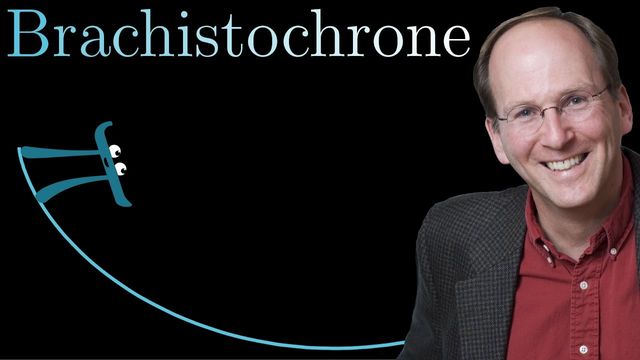
Well, flipping that around, I mean, I should emphasize what an inspiration you were to me when I was just getting started. And a lot of listeners might not know this, but I think you actually provided some very active encouragement, just through, I don't know, retweeting something when I was very early on, or engaging with me when I asked about doing some collaborative project, and we did the brachistochrone129The brachistochrone is the curve of fastest descent: the path along which a ball rolling under gravity gets from one point to another in the least time. Johann Bernoulli posed the problem in 1696; the answer is a cycloid. In 2016 Sanderson and Strogatz made a video about it together for 3Blue1Brown. thing. You might not have known it, but both of those actually meant quite a bit to me. And I think, really, little gestures like that actually can matter a lot to someone kind of just trying a wacky new thing that doesn't necessarily have an established groove in society. So, very sincerely, I want to thank you for that.
Oh, well, you're very welcome. Thanks for all you've done for our culture.
Well, with that...
This has been fun, Grant.
Yeah, this has been an absolute blast. Thank you for joining.
Thanks for having me.


