


Invest Like the Best
Chapters
Intelligence won't grow into a god: most interesting systems are chaotic, and past a certain point what you need is not more smarts but experiments and time.
Read the chapter- Cliff argues intelligence isn't an unbounded quantity like the height of a tree but more like a ratio, such as the roundness of a ball: a tool for interpolating between sparse facts about the world.
- The weather, cream mixing into coffee and the behavior of groups of people can't be solved in closed form, and in simulation the error inevitably builds up.
- Cliff tells how a man building an early weather model reran it with initial conditions rounded off by one decimal and got entirely different weather, which is where the butterfly effect comes from.
- Past a certain point, Cliff says, you need new information about the world, which means experiments and time.
- Meanwhile good-enough intelligence is rapidly falling in price and will soon be available to everyone essentially for free.
When intelligence is cheap and everywhere, the winners own its complements, and Meta is Cliff's model example.
Read the chapter- Everyone will have a team of 200 IQ people in their pocket picking up every penny, which is bad for businesses that live off customers' lethargy and bounded rationality.
- Cliff sees much software as crystallized intelligence and suggests assuming everyone has great intelligence and asking what's left.
- The complements to intelligence, in Cliff's list, are data, attention, love and affection, physical proximity, scale and, a little cynically, regulatory capture.
- Cliff says Meta spends roughly its $250 billion of revenue on data centers, inference, engineers and code, that is, on intelligence: when it gets 100 times cheaper, creators and advertisers win too, and Meta keeps the data and attention.
- Grindr, which Cliff doesn't own, is a small company with lots of attention and data, and cheap intelligence would give it what once took 10,000 of Google's best engineers.
Cliff expects diamond-shaped demand: super-elite intelligence has few uses while good intelligence commoditizes quickly, so it's unclear how big the labs' market is.
Read the chapter- In Cliff's view the frontier model unlocks ever larger markets while the tasks behind it commoditize, and nobody uses the best model for a customer service chatbot.
- Judging by the rise of Chinese models, the trend is rapid commoditization, and even a cost leader ends up in a shrinking commodity market.
- After coding the uses get narrower: how often do you really need a 300 IQ, Cliff asks, and curing cancer, he thinks, takes touching reality rather than more IQ.
- If good-enough intelligence is very cheap, rampant deflation makes it unclear how big the whole market is.
Cheaper doesn't necessarily mean a bigger market, and new discoveries will run into experiments that take time even when the lab is automated.
Read the chapter- Cliff calls Jevons paradox a special case of price elasticity: as the price approaches zero, the market shrinks, as it did for moving data, where Cogent Communications is worth only a few billion dollars.
- Models will read every paper and find what people missed, but then they run into the need for experiments.
- Cliff himself no longer knows which model he's using: he tells a Grok bot to build things, and it spreads the work across all his subscriptions.
- An automated lab speeds up learning, but mice take a year to grow up, and odds of success ten times better than the average researcher's are still 1%.
Cliff stays out of the build-out because he can't forecast inference supply or demand within several orders of magnitude, and looks instead for the long-term equilibrium.
Read the chapter- To profit from the build-out you have to guess inference demand, how cheap inference gets, and land at the bottleneck in the value chain where the rents are.
- Cliff has AI make his daughter 3Blue1Brown-style videos but wouldn't if each cost $5, which is why he sees AI demand as highly price sensitive.
- Asked by Patrick why the best entrepreneurs are building infrastructure, Cliff says the causality may be backwards: a build-out like this can't happen without a strong price signal and lots of talent.
- Rather than bet on which railroad tycoon makes money, Cliff looks for the long-term equilibrium, like the consumer brands that came after the railroads.
- With lead times and the winner's curse, the last one to stop will regret it, and TSMC has its own problem: its physical moat is hard for AI to copy, but the shortage has the whole world trying.
AI agents will move people to the lowest-cost provider, and the winners will be businesses with more volume and lower margins.
Read the chapter- Cliff would leave his deposit rate entirely to an agent, but not the choice of his favorite sweater.
- The first-order effect is that agents move people to the low-cost provider even where nobody used to bother switching garbage collectors, as when Patrick imagines a collector's agent offering his agent 50 cents a month in savings.
- The second-order effect is that a garbage collector with two customers on a street can offer all the neighbors a lower price and build a business with more volume and lower margins.
Cliff expects AI to compete investors like him out in the long run, but not to replace price: agents will only sharpen markets.
Read the chapter- In investing, as once in freestyle chess, a human with a model is still stronger than either alone, because people know things about the world that aren't on the internet.
- One day, Cliff says, adding a human to a model's forecast may be like adding his opinion to the chance of rain in seven days.
- Price, for Cliff, is a miracle, a signal wrapped in an incentive, and even unlimited intelligence would be hard-pressed to find a better system.
- Agents will sharpen markets, and lazily priced things like deposit rates and garbage collection fees will move day to day.
America's capital markets are underrated, Cliff says: no one else can redeploy about 3% of GDP into a speculative venture this fast.
Read the chapter- Nobody else in the world can move resources at this scale this quickly, and people are already heading to somewhere in Pennsylvania to build data centers.
- Fraud will surely surface when the water goes out, but compared with the railroad build-out, Cliff suspects this one is remarkably clean.
- In Cliff's pet theory, the most risk-seeking people came to America, and the culture of risk grew sensible bankruptcy laws, labor laws and venture capital.
- Investing in the future means consuming less today, and Cliff explains higher rates as what society pays people to save.
Cliff tells his portfolio companies to start with vibe coding for everyone and read-only access for the CEO's agent, and warns that it's years of work.
Read the chapter- Everybody from the board and the CEO down should vibe code in hackathons, and at Carvana they call them pizza parties.
- The CEO should demand that his agent can see every system in the company on a read-only basis, followed by write permissions and change management, which is four bullet points but years of work.
- So the question is whether the business has time for that before someone starting from scratch beats it, which is where a really good business helps.
- It's the best time to start a company "until tomorrow," Cliff says: agents let you do more with fewer people, but whatever is easy for you is easy for everyone, so you need a wedge for enduring value.
Cheap intelligence, Cliff thinks, will more likely push corporate margins down and break aggregation, while its effect on inequality could go either way.
Read the chapter- Cliff expects margins to fall and consumer surplus to grow, though analysts said the same about the internet in the '90s and were wrong because of Ben Thompson's aggregation economics.
- If your agent looks at every search result, ranking first on Google is worth nothing, and quality and price become more salient.
- AI could solve coordination and make full-stack companies possible, say from pet food to pet hospitals, and Carvana, in Cliff's telling, built one before this was easy.
- In one story, rent takers like the software company that charges bowling alleys get smoked and professional services get cheaper, which flattens incomes.
- In the other, returns to initiative and intelligence rise, and Cliff, recalling Truman's request for a one-handed economist, admits he has "two hands on everything."
AI will take over investing from the shortest time scales up, Cliff says, and he holds 80% in Carvana because it has few scenarios that end really badly.
Read the chapter- Patrick describes a friend's experiment in which an AI harness sizing positions among stocks the friend picked is drastically outperforming his own portfolio construction.
- Cliff expects AI to move in from short time scales, where there's a verification loop, and jokes that Renaissance Technologies may have "discovered a transformer before everybody else."
- The research on diversification looks at securities prices, while Cliff thinks like an owner: diversifying, you wouldn't have taken full advantage of Walmart, Home Depot or Fastenal, and he sees Carvana the same way.
- The history of concentrated investors is survivorship-biased, and diversification is right for those seeking average results, but Cliff isn't, and he takes an unusual risk knowingly.
Kids should learn foundational skills without models so they can direct models later, and then get assignments a hundred times more ambitious, Cliff argues.
Read the chapter- Talking with the head of his kids' school, Cliff arrives at a bimodal education: foundational skills without models on one side, ambitious work with models on the other.
- Without knowledge, the model ends up explaining in "crayon and Nerf," and you can't ask it to assume a stochastic process unless you know what one is.
- You don't need to do the math by hand, but without multiplication it's hard to understand matrix multiplication, and so what the model is doing.
- If kids cheat on Shakespeare essays, Cliff says, give them something a hundred times harder, let them use models to the fullest and make them justify the result.
Quotes
On why intelligence won't become God
“What you should really think about intelligence as is more like a ratio, like the roundness of a ball.”
Cliff SosinRead from 01:48On the limits of simulation
“And so ultimately, in the limit, if you want to simulate the whole universe, what you actually need is the whole universe.”
Cliff SosinRead from 05:47On Cliff's core investing conclusion
“And to follow this logic all the way through to the end: if intelligence becomes cheap and ubiquitous, what you want to own are the complements to intelligence.”
Cliff SosinRead from 08:14On why robot labs won't lift the speed limits
“But if that experiment requires breeding mice, and mice need a year to grow up and die, that experiment is going to take time.”
Cliff SosinRead from 22:41On why the best entrepreneurs are building AI infrastructure
“So you may have your causality backwards. Obviously these things work both ways. Could you imagine a telling of the story where nobody interesting who'd made no money was building out the AI, right?”
Cliff SosinRead from 26:14On why even AI won't replace prices
“Price is a miracle, because it's a signal wrapped in an incentive.”
Cliff SosinRead from 35:14On startups in a world of agents
“So it's very competitive, and the really great outcomes are the ones that make no sense. You shouldn't do it at all. But then it turns out there is a path, or the world turns.”
Cliff SosinRead from 45:29On kids using AI to cheat
“If the kids are cheating on their Shakespeare essay, give them something harder to do. Give them something a hundred times harder and more ambitious, and have them use models to their fullest extent.”
Cliff SosinRead from 59:07
Summary
Investor Cliff Sosin pushes back on the popular picture in which intelligence climbs from amoeba to Einstein and then goes "zoom" all the way to God. Intelligence, he argues, is less like the height of a tree than the roundness of a ball: it has a ceiling. Most interesting questions, from the weather to markets to how people behave, are chaotic systems in which errors in initial conditions inevitably compound, and learning more means running experiments and "touching reality," which takes time. Meanwhile good-enough intelligence is collapsing in price and will soon be available to everyone almost for free.
That leads to his main investing exercise: assume everyone has great intelligence and ask what's left. The winners own the complements to intelligence: data, attention, emotional attachment, physical proximity, scale and regulatory capture. Meta is his example: it spends almost all its revenue on what amounts to intelligence, so it gains as intelligence gets cheaper, while keeping its data and attention. The losers are businesses that live off customer lethargy, since AI agents will move people to the lowest-cost provider and undo Ben Thompson's aggregation economics. For the frontier labs Cliff expects "diamond-shaped" demand, with very few uses for super-elite intelligence and good intelligence quickly commoditized, and he deliberately stays out of the AI build-out because he can't forecast inference supply or demand within several orders of magnitude.
The second half covers whether AI will replace investors and prices as a signal, America's underrated capital markets, which redeployed about 3% of GDP into AI almost overnight, how a CEO should roll out AI inside a company, and two competing stories about AI and inequality. Cliff explains his 80% position in Carvana by how few scenarios there are in which it ends really badly. And children, he believes, should learn foundational skills without models, so they can direct models later, and then get assignments a hundred times more ambitious than a Shakespeare essay.
Advice
Run hackathons and get everyone vibe coding, starting with the board and the CEO: the software may not be useful, but people will see what's possible and change their expectations.
Get the CEO's agent read-only access to every system in the company, then write permissions and a change process: it takes years, so start before someone building from scratch overtakes you.
Find a wedge that creates enduring value, such as lock-in or proprietary data: in a world where agents switch providers every day, otherwise you'll simply be replaced.
Mentioned
 Edward Lorenz04:25discovered the butterfly effect with a weather model
 Meta Platforms09:10a company that owns the complements to intelligence
 Muse09:21Meta's agent; Cliff films his workouts with it
 Instagram09:30personalized TV
Show 20 more mentionsShow fewer mentions
 Grindr12:12cheap intelligence would let a small company do more
 William Stanley Jevons16:36Jevons paradox
 Cogent Communications17:49a market that shrank as it got cheaper
 Grok Bot19:46the agent Cliff has build things for him
- 3Blue1Brown24:44the style of the videos AI makes for Cliff's daughter
 SpaceX25:33an investor day about building out data centers
 NVIDIA28:39AI could commoditize even Nvidia
 Taiwan Semiconductor Manufacturing Company29:20a physical moat the whole world is trying to copy
 DoorDash30:08a business built on local density effects
 Uber30:08same
 Federal Deposit Insurance Corporation30:37with an insured deposit only the rate matters
 Carvana32:5080% of Cliff's portfolio
 Hilton Grand Vacations32:50his second-largest position
 The Economist37:21a story on American capital markets
 Ben Thompson47:54aggregation theory, which agents break
 Bank of America50:20an example of rents cheap intelligence will eat
 Renaissance Technologies53:50seems to have "discovered a transformer before everybody else"
 Walmart55:21an early find you wouldn't have fully captured if diversified
 The Home Depot55:21same
 Fastenal55:21same
Sponsors of the episode
 Ramp00:00corporate cards and spend management
 Rogo00:22AI agents for bankers and investors
 WorkOS00:58SSO, SCIM and audit logs via API for selling to enterprises
 Vanta20:25automated security audits, $1,000 off
 Ridgeline20:55a platform with built-in AI for investment firms
 Colossus1:00:23a quarterly magazine and private audio feed subscription
Transcript
AdRamp, Rogo, WorkOS
Ramp is the only platform built to make your finance team leaner, faster, and better, saving businesses 5% annually on average so you can stay focused on growth. Ramp customers grow 3.2 times faster than the average American business. Visa, Vercel, Cursor, Stripe, and 70,000 other businesses all run on Ramp. Mine does too, and so should yours. Learn more at ramp.com.
Rogo is the AI platform purpose-built for financial institutions, serving tens of thousands of bankers and investors at hundreds of leading firms worldwide. Rogo's AI agents autonomously execute large chunks of your firm's workflows. They can screen deals, draft CIMs,aCIM (confidential information memorandum) — a detailed description of a company that is up for sale, sent to potential buyers once they sign a confidentiality agreement. run buyer outreach, and do diligence on data rooms,bData room — a secure repository of a company's documents that a buyer or investor reviews during due diligence before a deal. all with full security and compliance handled. Every action feeds Rogo Intelligence, the firm's context layer, turning years of deal experience into a secure, governed institutional memory that makes each new transaction stronger than the last. To learn more, visit rogo.com/invest.
OpenAI, Cursor, Anthropic, Perplexity, and Vercel all have something in common. They all use WorkOS. And here's why. To achieve enterprise adoption at scale, you have to deliver on core capabilities like SSO, SCIM, RBAC, and audit logs.cSSO, SCIM, RBAC — what enterprise customers require of software: single sign-on with a corporate account, automatic provisioning and removal of users (SCIM), and role-based access control. That's where WorkOS comes in. Instead of spending months building these mission-critical capabilities yourself, you can just use WorkOS APIs to gain all of them on day zero. That's why so many of the top AI teams you hear about already run on WorkOS. WorkOS is the fastest way to become enterprise-ready and stay focused on what matters most, your product. Visit workos.com to get started.
01Intelligence as a tool with limits
Intelligence won't grow into a god: most interesting systems are chaotic, and past a certain point what you need is not more smarts but experiments and time.
You called me saying "it's just intelligence" was sort of the theme of our conversation. Describe that simple idea.
There's this idea that if intelligence starts in an amoeba and it gets better and better, and then it's like a monkey, and then it's like a person, and then it's like Einstein, and then it goes zoom and it becomes God. I think that that's something of an intellectual mistake. What people have wrong there is they're missing what are the real limits of what intelligence can do. And maybe another way to put it is, if you're thinking about intelligence as an unbounded scalar,1Scalar — a quantity expressed by a single number, such as height or mass. Cliff contrasts it with a ratio, which has a natural ceiling: a ball can't be rounder than round. like the height of a tree, that isn't correct. What you should really think about intelligence as is more like a ratio, like the roundness of a ball.
Intelligence is a gadget, and we use it to make predictions about the universe. And so we start with this thin scattering of facts about the universe, where we have relatively few of them, and the universe is complex, and we use intelligence to interpolate between them. So as your intelligence goes up, your ability to sort of color in the spaces gets better. And some domains are really amenable to that. In mathematics, you can solve those sorts of things, and in those areas you get to perfect. But for most of the interesting stuff, that is most of the questions in the world, the mathematical term is they're complex dynamic systems.
ExplainerWhy weather can't be forecast far ahead
The atmosphere is a chaotic system: its future state depends so sensitively on initial conditions that a tiny measurement error eventually grows until the forecast bears no resemblance to reality. Meteorologist Edward Lorenz discovered this in the early 1960s with a simple computer model of convection.
- Not a lack of brains but of precision. The equations of air motion are known, but they can't be solved in closed form; they are computed numerically, step by step in time, and each step adds rounding error.
- The error grows exponentially. The gap between two nearly identical starting points doubles within days, so extra computation buys less and less: extending a forecast by a day takes a much more precise picture of the starting state.
- The limit is about two weeks. Detailed weather can't in principle be predicted more than roughly two weeks ahead; today reliable forecasts reach 7–10 days.
- Ensembles instead of one answer. That's why weather services run dozens of forecasts from slightly different starting points and give not "it will rain" but a probability of rain.
So what that basically means is they're kind of like weather, in the sense that you can't just guess your way, you can't make a closed-form answer.2Closed-form answer — a ready formula you can just plug numbers into. When there is none, a system has to be computed numerically, step by step. You can try to simulate it, but if you simulate it, invariably your simulation will have some degree of error in your initial conditions or in each step going forward, because at a minimum your steps, for example, are going to be truncated. And so what happens is your error will build, and invariably, after the simulation runs for some period of time, you'll be off by some amount. And so for mixing cream into your coffee, or predicting the weather, or thinking about how groups of people who are all very complicated are going to interact with each other, intelligence just isn't that powerful.
And so my sense is that what you get is this increasing intelligence to the point where you are making all the predictions that something that's super smart could make, which it turns out is a relatively small set of all the interesting things you'd want to know about the world. To get past that, you then need to go out and get more information about the world, and that just takes time. You have to do experiments, you have to touch reality.
One interesting corollary to that is that the zoom actually becomes... one of the things you can turn your intelligence to is reducing the cost of intelligence, which we're seeing. So what you actually end up getting is everyone gets unlimited, really great, very round ball, so to speak, intelligence for essentially free. And obviously that's a limit statement, it won't actually be free, but the point is that what we're seeing is that really good enough intelligence is rapidly falling in price. And it turns out that really good enough intelligence will solve the vast majority of questions where people need to use intelligence.
Yeah, can you say more about why this notion of a complex adaptive or dynamic system means that actually even perfect intelligence, or whatever intelligence we have in a bottle 10 years from now, or pick your horizon, will still be limited in its applications?
Yes, nonlinear dynamic systems. The famous story here on how these were discovered, and this came into the branch of mathematics that became chaos theory, is that back in the day there was a guy3Edward Lorenz (1917–2008) — American meteorologist at MIT. In 1961 he noticed that rerunning his weather model produced a completely different forecast, and in a 1963 paper he showed how sensitive chaotic systems are to initial conditions. who was building a weather forecasting model, back on big computers that took up rooms and that sort of thing. So he runs the model and it makes predictions of pressure and temperature over some span of some forecasting period. And he's like, cool. And so then, just to make sure it's still working, they reset it and they run it again. And it starts out with basically the same results, but then the results start to diverge, and by the third, fourth, fifth day of the forecast, the results were entirely different.
And the guy thought some version of, darn, I must have a bug in my system, and begins the process of trying to figure out why the computer isn't producing the same results in repeated runs. And it turned out that the technician4Fact-checkThe technician — by Lorenz's own account, he re-entered the numbers himself: to avoid starting from scratch, he took intermediate values from a printout that rounded them to three decimals (0.506 instead of 0.506127). Wikipedia who had loaded the data into the computer in the second run had rounded off at some decimal, like one decimal less, all of the initial conditions for pressure and temperature and such. And you would have thought that, okay, maybe that would have produced a small but consistent error over the whole forecast period. But what had actually happened was that small error, through all of the repeated steps — you take your current conditions, you calculate your next set of conditions — they compound, and you had an entirely different forecast by some small distance into the forecasting period, and unrecognizable weather. One model said it was 70 degrees and sunny, and the other model said it was 20 degrees and pouring.
People called it the butterfly effect, because at least in principle, a butterfly could flap its wings in Africa and that could lead to a hurricane in North America or whatnot.5The butterfly — the image comes from Lorenz's 1972 talk "Predictability: Does the Flap of a Butterfly's Wings in Brazil Set Off a Tornado in Texas?" In Lorenz's version it's Brazil and Texas, not Africa and North America. And it just turns out that many systems that we're interested in have this characteristic. You can know everything about pressure and temperature, but you can't necessarily write down an equation that you can solve easily that would tell you that there's going to be a hurricane. You have to model it. And the model in turn is going to be grained at some level, unless you actually go to the step of actually having the whole universe. And so ultimately, in the limit, if you want to simulate the whole universe, what you actually need is the whole universe. You don't actually do that. There are many, many circumstances where simulation is super useful for approximations, and in those circumstances you can use intelligence to solve them, but there are many more where it doesn't work. And so intelligence is limited in that fundamental unknowableness, I guess, about the universe.
02What to own when intelligence gets cheap
When intelligence is cheap and everywhere, the winners own its complements, and Meta is Cliff's model example.
So back to this notion of "it's just intelligence." What does that mean about where you think we're going, from a more practical standpoint?
We're all going to have a team of 200 IQ people working full-time in our pocket, and that team will have a team that it can deploy of many more. And they're going to be trying to figure out all the little optimizations that we're too lazy to do. And every company will make similar teams available to their employees in order to do their jobs. There's just a lot of businesses where that's not good for them. Consumers are boundedly rational6Bounded rationality — economist Herbert Simon's idea that people lack the time, attention and information to make optimal decisions, so they settle for the first acceptable option. at present. They only have so much cognitive space. And so you go to a consumer and you say, look, we'll take your money, we won't steal it, we'll pay you a decent interest rate. You don't have to think about it, and you can go about your life. And the consumer doesn't say, look, if I think about this every day, I could save $400 a year, so therefore I'm going to think about this every day. The consumer says something like, eh, sounds good enough, I'm going to move on. But with an agent, you would think the agent will continuously optimize for them.
Then there's also companies where what they produce fundamentally is some sort of artifact that is just some sort of crystallized intelligence.7Crystallized intelligence — psychologist Raymond Cattell's term for accumulated knowledge and skills, as opposed to fluid intelligence, the ability to solve new problems. Cliff applies it to software: a program is someone's solution to a problem, frozen in code. I'm by far not the first person to realize that AI could be bad for certain software companies, but just this idea that what an AI model is, is it's kind of like this general-purpose intelligence tool. And what many software tools are are crystallized and hardened pieces, like projections of intelligence. And so as I've been thinking about companies and investments, I found it helpful to assume everyone has really great intelligence and ask what's left. The pushback is often some version of: but you don't understand how hard this is, you don't understand how complicated this is, and you don't understand how many smart people have had to think for so long about this. And my hand-wavy and approximately right response is, okay, sure, but that's all just intelligence.
And to follow this logic all the way through to the end: if intelligence becomes cheap and ubiquitous, what you want to own are the complements to intelligence.8Complements — goods whose demand rises when the main good gets cheaper: cheaper printers mean more ink cartridges sold. Cliff asks what becomes more valuable when intelligence gets cheap. And so the complements to intelligence are data, attention, love, affection, whatever sort of emotional attachment you want. It's physical proximity, it's scale. It's a little cynical, but it's regulatory capture.9Regulatory capture — when a regulator starts acting in the interests of those it regulates, for example by shielding incumbents from new competitors. The concept is associated with economist George Stigler. It's these sorts of things where, for some businesses, what happens is their finite ability to deploy intelligence — be it economics, just the cost of it, they're only a certain size company and they don't have access to 10,000 of Google's best engineers for 10 years, or be it just that the organization is behind or whatever — the ability to deploy way more intelligence to your business, and your competitors to deploy more intelligence to their business, and your customers to use lots of intelligence, it can work out to be better for you, if intelligence, the lack of it, is a barrier to you serving your customers. Or it can be bad for you, if your customers' lethargy is the fundamental element of your economic value.
Maybe pick Meta or something as the perfect example of a company that I think you believe owns perfect complements to ubiquitous cheap intelligence, just to bring the example to life.
I'm actually going to set aside for a moment Muse10Muse — Meta's personal AI agent, launched in the US in September 2026: it runs errands in the background, including purchases and bookings. and agents and that whole thing, and focus on the business. And the core business at Meta is personalized TV.
Personalized TV.
Source: Meta's quarterly results
It used to be social media, but now it's personalized TV. And it turns out that people really like watching Instagram or whatnot. It discovered that I love dark British humor, and it's great. People talk about the 10,000-foot view or whatever. Let's talk about Meta from space, the highest view. They have 250 billion in revenue and they spend 250 billion dollars a year.11250 billion — a round number. Meta's 2025 revenue was $201 billion; for 2026 the company guided to $162–169 billion in expenses and $115–135 billion in capital expenditures. Meta's results Some of it gets accounted for as costs, some of it gets accounted for as capex.12Capex (capital expenditures) — spending on long-lived assets such as buildings, servers and equipment. It isn't expensed at once but depreciated over years, so it's reported separately from operating costs. It doesn't really matter. They just spend it all. The question you might ask is, what do they spend it on? And a really reductionist view is that they spend it all on intelligence. What do I mean by that? Well, they're buying data centers. What is a data center? Well, it's kind of an intelligence-producing tool. What else are they doing? Well, they're actually literally buying inference.13Inference — running an already trained model to answer users' requests. Unlike training, it is paid for request by request. That's just intelligence. What else are they doing? Well, they're paying really smart people to write algorithms. That's intelligence. They're writing code, also intelligence. They're serving videos. That's intelligence-adjacent. Sure, it's intelligence.
And so in some highly reductionist sense — and you shouldn't take these things literally, but I'm just trying to highlight the really big directions here — all they buy is intelligence. And if you think forward with the fact that the price of intelligence is falling by a factor of 100 or something over the next five years, first principles, their costs kind of go away. And that's just thinking about the cost side of things.
On the revenue side of things, there are all of the creators. You are a creator. How much more quality creative can every creator that makes content for Meta make if they have access to intelligence that's one-hundredth the cost and 10,000 times more effective? The point is, probably better. And then Meta in turn, maybe they don't take their costs to zero. Maybe they spend more, or more than zero, and they do a far better job of picking the videos to show people next, which should make the content better targeted and more enjoyable. And then of course, on the ad side, advertisers could make far better designed, far better targeted personalized ads that Meta in turn can target much better.
And advertisers can also build much more slippery funnels14Funnel (sales funnel) — a customer's path from first seeing an ad to buying. A "slippery" funnel is one that loses fewer people along the way. or whatever to convert. The whole point of all this is that maybe instead of taking their costs to zero, with much better intelligence and much lower prices, maybe they can sell a few more ads. All of this is downstream of what they possess, which is not destroyed by ubiquitous intelligence, which is data and attention. They just have this enormous amount of data about all these people and how they view videos and whatnot, and they have an enormous amount of attention, and these things compound each other. And so I don't think that the availability of cheap and ubiquitous intelligence is going to cause people not to be interested in watching funny 20-second videos. And so if anything, they can win some time on the margin from other things people do with their time.
I don't actually own it, but a company that benefits in theory from having a lot more intelligence is Grindr.15Grindr — a dating app for gay, bi, trans and queer people, launched in 2009; one of the first to match people nearby by geolocation. Public since 2022. Basically, Grindr is the gay dating app, but it has been constrained over its life by the fact that it's just not that big a company. And it turns out they've got lots of attention and they've got lots of data, but their ability to build all the things that you could imagine building on what ultimately amounts to a finite-size team and budget and ability to create things has meant in some ways that Grindr can't be all the things you could imagine it could be. And again, I don't actually own any Grindr. I study lots of companies, and it just sort of occurred to me that this is another example of something where this mental model is: what if you had 10,000 of Google's best engineers to go work on your problem for five years, what could you do? And Grindr is one where maybe they could do more.
03Frontier labs: commodity or not
Cliff expects diamond-shaped demand: super-elite intelligence has few uses while good intelligence commoditizes quickly, so it's unclear how big the labs' market is.
I want to talk about the labs. So back to the original point, I think lots of great investors would say intelligence, specifically frontier intelligence, is not a commodity. Historically the conversation has been about the gap in intelligence between closed source and open source. Increasingly the conversation is about the gap between what's publicly available from the labs and what's privately used by them inside their own businesses. They seem to have figured out how to stop or slow distillation.16Distillation — training a small model on a large model's outputs, so the "student" picks up much of the "teacher's" ability at a fraction of the cost. Labs accuse rivals, especially Chinese ones, of distilling their models through the API. Lots of people would say that there's this escape velocity thing17Escape velocity — here, the idea that the leader in the AI race, speeding up its own research with its own models, will pull away from competitors for good. happening, and that the frontier token is going to be way more valuable and useful, and that the labs themselves can then distill their own models and provide the best version of the cheap intelligence too. I'm curious for you to riff on the labs as companies through this mind of an investor.
If they have models that are better and the ability to produce adequate intelligence at way lower costs than everybody else, and nobody can copy it, then it's going to be a great business. I guess I have a couple of thoughts. One is, as I've watched models get deployed, it feels like one way to think about it is you start out with these very inadequate models that are basically able to do a very small subset of jobs. And what happens is the models get better and they work their way up the stack. And with each successive step up, the frontier model has unlocked a larger, call it, addressable market.18Addressable market (total addressable market, TAM) — all the demand a product could in principle serve. But behind it, what's happening is that once the evals19Evals — test suites for evaluating models. An eval is saturated when models solve almost all of it and it no longer tells them apart. or whatever get saturated, you would never use a frontier model for a chatbot in a customer service application.
You'd be an idiot.
And so what's happening is those areas, they clearly commoditize. And so there's this wave of hard tasks where you really need a frontier model, and behind that you don't. So the friends I have who are big frontier labs companies bulls or whatever — and obviously these companies' financials aren't public, and they might have an information advantage over me — would say something like, don't worry, we can also, along the whole efficient frontier,20Efficient frontier — a concept from Harry Markowitz's portfolio theory: the set of best possible combinations of return and risk. Here, the best combinations of model quality and token price. produce cheaper tokens. And maybe they can right now, maybe they can't right now, maybe they will in a few years, maybe they won't. I find these to be very hard to think about.
Certainly the trend has been rapid commoditization of these things, if you would look at the rise of Chinese models21Chinese models — DeepSeek, Qwen (Alibaba), Kimi (Moonshot AI) and others. They usually ship with open weights and sell API access far more cheaply than American labs; in January 2025 DeepSeek-R1 nearly caught up with the frontier models of the time. and every step. And at a minimum, the cost has been collapsing. So even if they do have a position in the tokens necessary to do tasks that are well behind the frontier, it might not be a very big market, because it just doesn't cost that much in the scheme of things to deliver, and it is competitive, even if they are a cost leader in a shrinking commodity market.
And then the other thing is that I think that programming was this huge use of models. As you push forward, the question becomes, for the next, next, next layers of intelligence, do you still have bigger and bigger places to go after? And the bull story would be some version of yes, people will pay anything for a model that can figure out how to cure cancer. Maybe that's true, but to go to our prior conversation, I think figuring out how to cure cancer requires touching reality, and I'm not sure that more IQ gets you that. So if you don't believe that there's some super incredible use cases where you can just charge an enormous amount for more intelligence, then you start getting to this point where the next step up — you go coding and then maybe something else, but you get into smaller niches. It's like this diamond-shaped demand frontier, where initially you get wider and wider uses, and then actually it starts to get more and more rarefied. How often do you really need a 300 IQ, one might start to ask. And look, we're going to find out. And I don't want to be too dogmatic, but it strikes me as totally reasonable that what we end up with is some version of: there are very few use cases for super elite intelligence.
There are lots of use cases for very good intelligence. That very good intelligence is highly competitive and commoditized. And if these frontier labs can somehow become cost leaders in doing that, there's a margin to make in being a cost leader, but then there's also just rampant deflation. And then this question becomes, how big is the market? If good enough intelligence is very, very cheap, then how much good enough intelligence are people going to buy?
04Jevons paradox and the speed limits
Cheaper doesn't necessarily mean a bigger market, and new discoveries will run into experiments that take time even when the lab is automated.
I'll just keep playing the devil's advocate. So the two things people might say in this case are Jevons paradox,22Jevons paradox — English economist William Stanley Jevons's observation in The Coal Question (1865): steam engines grew more efficient, yet Britain burned ever more coal, because cheap energy found new uses. that as it gets cheaper, we're just going to want to use more of it. So I'm curious what you think about that. The second would be, historically, the new uses of intelligence have typically been discovered by highly intelligent people. My good friend says intelligence creates its own demand. What about that? What about the fact that, yeah, maybe it's diamond-shaped for humans, if humans are driving the new questions that the intelligence is set after to answer? But what if the thing itself is creating the new questions, and we train it to do that really effectively and just explore in an open-ended way, in the way that all of humanity would be doing, led by the people with 150-plus IQ or something historically?
Jevons paradox is just a narrow example of price elasticity of demand.23Price elasticity of demand — how much demand changes when the price changes. If demand is elastic, a price cut grows the market's revenue; if not, it shrinks it. In general, all markets are U-shaped.24U-shaped — as Cliff describes it, more of an upside-down U: the market's size in dollars first grows as the product gets cheaper, then shrinks as the price approaches zero. So initially, when the product is terrible, there's no demand. And then the product gets better and people will pay a lot, but they won't buy very much. And then as the price goes down, the size of the market will rise, because it becomes Jevons paradox, essentially. But then you get to a point where further price decreases don't actually drive enough demand, and the market shrinks. And eventually, of course, if you take the price to zero, then the size of the market goes to zero.
One example that I've thought about is the cost of fiber optic communication, or just communication. The cost of moving information used to be super high, and people moved very little of it. And then through a whole series of innovations, the cost of moving information went down a lot, and the amount of information moved went up a ton, and the market grew a lot for a long time. And then the market stopped growing, and the cost of moving information kept falling, and the market kept shrinking. And nowadays Cogent Communications,25Cogent Communications — an American backbone internet provider based in Washington, D.C., founded in 1999. It runs one of the world's largest IP backbones and is known for the cheapest traffic transit. I think, routes 30 or 40% of all IP traffic across the internet, and it's through one of its divisions, which is not even its biggest division, and Cogent Communications is a few-billion-dollar market cap company, which is not a very big industry. Now, I'm not saying that we're going to get quite that small in terms of intelligence, but Jevons paradox is a statement about a particular spot on a curve, which doesn't necessarily have to be true.
And as to your other question, about can more intelligence create more desire for intelligence? I mean, I have a couple of thoughts on that. Certainly maybe. I started out by saying you need to touch reality to answer questions. And so if you had a model and it was going to think more about physics, it could certainly think lots of interesting thoughts about physics, but eventually it's going to need to do experiments. And that's not to say we couldn't also do experiments, but now we're bound by our ability to physically do experiments. And so I think there's going to be this incredible time where there's going to be so many cool discoveries, which we're already starting to read about, where this paper was written and this paper was written and this paper was written, and if somebody had read all three papers and thought about it, they would have realized this, but nobody had. But it turns out the models read all the papers, and they'll figure that out. There's going to be all kinds of great stuff that falls out of that. But at some point, we're kind of finished with that.
And then it's going to be about, hey, there's some way to think about things that are outside of what we know. And we have a hypothesis, but a model, even a super smart model, won't be better at guessing that necessarily. It'll be better at guessing that than the smartest person, but the smartest person's odds are super low anyway. So it'll be able to come up with great ideas for experiments to do, and they'll be worth doing, but that'll limit our ability to expand.
The other thing I just think about is my own use of AI, on a lot of levels. One, just to go back to the commoditization thing, I've totally commoditized my use of models, for what it's worth. It's because I'm lazy about how I do a lot of my building for stuff. I'll tell a Grok bot26Grok Bot — AI agents from xAI (part of SpaceX since 2026), in beta since August 2026: each bot runs on its own cloud computer and carries out multistep tasks on its own. The bots run on a separate usage limit. to build things, and because I don't want to use up all my Grok bot weekly tokens, I then have it run all of them — I subscribe to all of the things — and I have it build using those subscriptions on a server. And so I actually don't know what model I'm using anymore. I used to know this model is better, this one's worse. I no longer know. All of this is being optimized on the back end for me, and all I know is that stuff is getting built and it's not using up my subscriptions. And so we're good.
AdVanta, Ridgeline
Vanta automates compliance so your team can spend less time on security reviews and more time getting customers. Vanta cuts audit prep by 82% and gives you instant, up-to-date proof of trust without all the manual work, so you can close deals faster and with less friction. Customers report a 526% return on investment, and more than 16,000 companies use Vanta, including Ramp, Harvey, and Snowflake. Get started with $1,000 off at vanta.com/invest.
Ridgeline is the first end-to-end system of record with embedded AI for investment management firms, running portfolio accounting, reconciliation, reporting, trading, and compliance on one unified platform. Firms are moving off legacy technology and onto Ridgeline because of how far ahead Ridgeline's AI features are compared to anything else in investment management software. I've been hearing from a lot of investment managers about AI, and they fall roughly into two camps, with some unsure where to even start and others convinced that they can build their own order management system over a weekend. The reality is that running an investment firm will always require governance, controls, and a single source of truth for your data, and no amount of AI enthusiasm changes that requirement. Ridgeline is built on exactly that foundation, which is why I believe that the firms that come out ahead in the AI era will be the ones running on Ridgeline's unified platform. If you're serious about your firm's AI strategy, Ridgeline should be part of that conversation. And you can request a demo at ridgeline.ai.
There's this batch of companies that I'm curious what you think about, which is effectively real-world experimentation companies that create a loop that's automatic. There's this happening in robotics, there's this happening in several places in bio, in bio labs and automated wet labs,27Wet lab — a lab that works with living cells, reagents and liquids, as opposed to a "dry" lab where experiments run on computers. automated testing labs. Any commentary on that brand of company?
Yeah. Super great idea. Closing the loop in the physical world is going to be great, and it's going to accelerate the process of learning, and this is a great idea. But again, there are speed limits. The thing I keep coming back to is some version of: this is amazing, and I'm super, in a sense, AI-pilled,28AI-pilled — convinced that AI will change everything. The slang grew out of "red-pilled," a reference to the red pill in The Matrix. in the sense of what I think these things are going to do and what they're useful for. But I'm also cognizant of the idea that things bump up against... The way I like to tell this to people is I say, look, you're really smart, so you must understand: being smart has limits. And so the ability to just think your way to solutions is limited.
And so if you're going to build an automatic biology testing laboratory, and you're going to connect it to a computer, and the computer's going to come up with an idea, and then it's going to run an experiment, and it's going to iterate, that's awesome. But if that experiment requires breeding mice, and mice need a year to grow up and die, that experiment is going to take time. And it might be a great experiment, you might learn a lot, and that's great. Still going to take time. And the lab's only so big. And so you might have 5,000 great ideas, you're going to pick 20, and the model may be better. Your odds of that experiment working might even be 1%. Turns out that might be 10 times better than the average researcher, and that's amazing. It's still 1%.
None of this is to be pessimistic. This is super amazing. Discovering all the things that we should know because it's already in our corpus, that we forgot, is awesome. Discovering all the things and better directing our research is awesome. Automating that research to move faster is awesome. We will learn, it will push the frontier, but this is not like suddenly the model looks around and says, you guys missed it, here's some new world that you guys can't comprehend or whatnot. I don't think that's where we're headed.
05Why Cliff stays away from the AI build-out
Cliff stays out of the build-out because he can't forecast inference supply or demand within several orders of magnitude, and looks instead for the long-term equilibrium.
It seems like the market has been, especially in private markets and the leading edge of investors thinking about AI, very focused on investing in supply-related stuff, like how are we going to build and serve all the intelligence, versus what I'll call demand-related stuff, someone watching their personalized TV on their Meta app or whatever. What do you think about that first batch of companies as investments?
Super hard. I've joked I've been willfully ignorant about them, and probably I'm sort of worse off for it, but there's this big build-out. And then you're trying to forecast inference demand. I can't forecast supply or demand within several orders of magnitude. This idea of how much more inference will people use as intelligence gets better and cheaper is a really, really hard thing. And equally hard is how much better and cheaper inference is going to get. And then even if you could somehow guess at those things, then there's the whole value chain, and you need to be at the bottleneck in order to capture the rents. And then of course, finally, you get to your actual competition with your competitors in that particular piece of the value chain. It's just a super hard thing.
As I think about my use of AI as a consumer, increasingly I'm doing stuff like, instead of having the AI chatbot talk to my daughter or text with my daughter about how to do math, now I have it make a 3Blue1Brown293Blue1Brown — mathematician Grant Sanderson's YouTube channel of animated math explainers, running since 2015. The animations are made with his open-source engine Manim, so an AI can put together a video "in the 3Blue1Brown style" too.-style video explainer, so that she can see a nice five-minute or 10-minute video on powers or area or circumference or something. It's super cool. I don't think I would do that if it was going to be $5. And so there's this thing where there's real price elasticity. The point I'm trying to make is, I'll film myself working out with my Muse app and it'll show me pointers on my form, and I'll do that for very little money, but I won't do that if the price point is real. And I'm probably much less sensitive to the price than most people. AI demand is going to be really sensitive to the price, which intrinsically, I think, does limit in some sense the amount in total consumers are going to be willing to spend on this.
Maybe this is a time to talk about capital cycles or something. It sure does seem like the smartest people in the world, and many or most of the best entrepreneurs in the world, are heavily personally invested in this supply build-out thing. If you watched SpaceX's investor day30SpaceX — Elon Musk's space company. In February 2026 it absorbed Musk's AI company xAI, and on June 12, 2026 it listed on Nasdaq; it is building data centers for AI, including plans to put them in space. yesterday, this is basically the theme of it. Arguably maybe the greatest entrepreneur of all time31The greatest entrepreneur of all time — Patrick means Elon Musk, head of SpaceX and Tesla. is dedicated to effectively doing this, building out the data center supply, et cetera. This is just a historical question. If that's all true, and there's so much uncertainty about supply and demand, and there are other ways to go build businesses, products, make money, why do you think so many of the best entrepreneurs, the smartest people, are so completely dedicating their lives to the build-out of the supply?
This is a huge infrastructure build-out of a huge and important technology. And it would be impossible for there to be a huge infrastructure build-out of a huge and important technology if there weren't a strong price signal and a ton of talent going at it. So you may have your causality backwards. Obviously these things work both ways. Could you imagine a telling of the story where nobody interesting who'd made no money was building out the AI, right? That's probably the best answer.
And to be clear, this is a huge and important project. It's only happening because super smart and talented people are focusing their lives on it. It's great that they are. They will have, and deserve, to make lots of money. It's just very, very hard from where I sit — and there are probably people who are smarter and figured it out — from where I sit, it is very, very hard to figure out where one would invest along this and whether or not you'll make any money doing it. It's not to say that there isn't plenty of opportunity potential there. I've just sort of decided to focus my attention more on the longer-term equilibrium results that come from what the world goes to. Instead of betting on which railroad tycoon32Railroad tycoons — Cornelius Vanderbilt, Jay Gould, Leland Stanford and other 19th-century magnates who made fortunes building American railroads. The railroad boom came with speculation, fraud and bankruptcies. is going to make money and how many railroads we need, I'm trying to think about, okay, once you have railroads, I'd love to have the foresight to figure out that CPG brands33CPG brands (consumer packaged goods) — everyday packaged products. Railroads created the national market on which national brands such as Coca-Cola, Heinz and Procter & Gamble grew up in the late 19th century. come next. That's the way I've been trying to think about it.
Can you riff a little bit about what you've learned about capital cycles and innovation cycles like this? I would love your perspective, having studied so much market history. If we're in the middle of one of these, maybe the biggest one ever, what does history teach us about these cycles and how they work that's interesting to you?
You could think about American society right now as a household that's saving money for a house. We're building a house, and we're all kind of feeling pinched, because all these resources are dedicated to building out this big AI infrastructure. All these electricians and plumbers and everything else are going to do these tasks, and as a consequence there's higher costs elsewhere in the economy. And undoubtedly we're going to get a lot of value for it. And we're going to keep pushing it, because no one really knows. We're going to keep pushing it until eventually we overdo it.
And along the way, people have to make tons of money, because otherwise people won't keep pushing it. And because things have lead times, and because it's a winner's curse,34Winner's curse — an auction effect: whoever overvalued the lot most wins, so winning often means overpaying. Here, whoever keeps building capacity longest risks building more than demand needs. invariably the last person to stop will regret it. And it's just so hard. It's just so hard. And then you combine that with the fact that there's just so much dynamism in the technology here, which I think was less true for other historic infrastructure build-outs. There's just so much change in terms of how you do these things.
I mean, other people have made the point, which I don't think is necessarily wrong — we talked about the models, but even at the chips level or whatever — that there's the potential for AI to commoditize even things like Nvidia, or for recursive self-improvement35Recursive self-improvement — a scenario in which AI improves the next versions of AI, and each version does it faster. everywhere. And a lot of it ends up being just intelligence. Nvidia quite literally makes flat files36Flat files — Nvidia has no fabs of its own: it designs chips and sends the finished layout as files (in the GDSII format) to the contract manufacturer TSMC in Taiwan; the industry calls this handoff a tape-out. that they send to Taiwan. Their flat files are very hard to make, but what they have is a lot of people who think really hard about it. And so in theory you could make them. And also, then the question becomes, what if you step back a little from the frontier? Then the cost of making something comes way down.
In that world, would your model be that physical and scale are the things that you'd want in a business that you were to back on the supply side of this equation? TSMC?
I don't want to carry myself around as some sort of TSMC expert.37TSMC — Taiwanese company, the world's largest contract chipmaker, founded in 1987. It makes chips to other companies' designs, for Nvidia, Apple, AMD and others, and produces practically all leading-edge AI accelerators. I mean, certainly what they do has better attributes, I think, in that regard. They've also got this sort of interesting problem where they did this super hard thing that requires all this process power38Process power — one of the powers in Hamilton Helmer's book 7 Powers: an advantage embedded in a company's organization and processes that rivals can't copy quickly even when they know what to do. Helmer's example is the Toyota Production System. built over many years, and is super hard to replicate, and much less amenable to an AI, just because it is so physical, and because it's all these little things, many of which aren't even legible to an AI. It's like some guy who is in the system kind of knows that you have to do this. Because there's so much demand, and because they haven't been able to meet it, they've basically caused everyone in the world to seek to copy their moat.39Moat — a durable competitive advantage that protects a business from rivals, as a moat protects a castle. Warren Buffett popularized the term. That's not a great fact.
06Agents and the low-cost producer
AI agents will move people to the lowest-cost provider, and the winners will be businesses with more volume and lower margins.
But I think more generally, stepping outside the AI build-out, if you think about businesses — we talked about the Meta example — just the idea of businesses that have physical proximity or physical scale might benefit if they can use intelligence to serve their customers better, or have lower costs as a consequence.
I want to go back through the natural complements to intelligence and just have you explain why it's a complement to intelligence, so that people can go away and think about, okay, what companies have this feature that might be interesting. Good example to go talk about: physical proximity. How would you think about DoorDash or Uber, or these businesses that have local density effects40Local density effects — the more orders and couriers or drivers in one area, the faster the delivery or pickup and the lower the cost per order. That's why DoorDash and Uber fight for market share city by city. that matter a lot? Does intelligence being ubiquitous sort of naturally magnify all of the scale winners of this type, where physical proximity is some sort of key advantage?
Well, so if you're the low-cost producer of something... I'll give a sort of stylized example. So if everyone has an AI agent, then what happens is many decisions get offloaded to the AI agent, because the AI agent helps you optimize, helps you pick up all the pennies and dollars and nickels and stuff that you were leaving on the ground. So I think about consumer choices in a spectrum. On the one hand is maximizing my bank deposits. This is something where I think I can almost entirely defer to the AI's judgment. As long as it's FDIC insured,41FDIC — the US Federal Deposit Insurance Corporation. It insures deposits up to $250,000 per depositor per bank, so for an insured amount only the rate matters. I just want the highest rate. On the other end of the spectrum might be picking my favorite sweater. This is something where it's just all of my judgment. The AI can source me things to look at, but in the end, I need to decide. I can't really delegate that judgment to it. And there's a spectrum. And so let's just pretend for a moment that garbage collection is something where I can defer the judgment. You might say no, I really care about the guy, and I trust the service, and they're driving to my house or whatever, but let's just set all that aside for a second.
So right now, if I'm in the waste collection business, I might be great at it, but it's still really hard to get people to bother to switch. I doubt you know what you pay for garbage collection off the top of your head. Many people do, but I doubt you do. And so what happens is you have to do all this work to get people to pay attention, to bother to switch garbage collection companies, even if you're offering a better service at a lower price.
You could imagine that the AI agent could talk to my agent, be like, hey, I'll save you 50 cents a month.
And the agent will say, will the garbage go away? And I'm like, yes, the garbage will go away, no problem, and I'll change. So the first-order effect is that you move to the low-cost provider.
But the general market effects are actually sort of interesting too, because now let's say that there's a street. And before, it would be more efficient for society if all of the people on my street had the same garbage collector, because the guy could drive the street and pick up the trash, and he could offer all of us a lower price and make more money. But it's really hard for us to coordinate that, because what happens is all of us are just lazy about switching garbage collectors. And so we all have one, and the guy with two guys on the street can't call everyone else up and say, hey, I've got two guys on the street, everyone else has just one, I'm the low-cost producer, let me roll this up.
So a second-order effect might be that the guy who has two people on my street can go to everyone else on the street and say, hey, I'll offer you a lower price on the garbage, and everyone will switch. And so everyone moves to the low-cost producer, who in turn gets to be the lower-cost producer. That actually creates, in some sense, a better business, where the low-cost guy wins a bunch more volume at much lower margins. As you study them, a lot of companies have mixed effects that point in different directions because of these things.
07Will AI replace investors, and prices?
Cliff expects AI to compete investors like him out in the long run, but not to replace price: agents will only sharpen markets.
What do you think the impact of agents is going to be on your world? What will be your role? How will it be different in five years? Will the best agent be able to build a portfolio of Carvana42Carvana — an American online used-car retailer founded in 2012; roughly 80% of Cliff's portfolio is its stock. The photograph shows one of these vehicle pickup towers in Tempe, Arizona. and Hilton Grand Vacations43Hilton Grand Vacations — an American timeshare company, spun off from Hilton in 2017. The second-largest position in Cliff's portfolio. and Meta in the same way that you would, because you trained it how you think?
Well, hopefully better. In terms of what I do, I think that in the long term we'll probably get competed out.
Pricing risk as the thing you do?
ExplainerCentaurs: humans and computers playing chess together
After losing to Deep Blue in 1997, Garry Kasparov invented "advanced chess": a human plays while consulting a program. The first such match took place in León, Spain, in 1998.
- Freestyle tournaments. In 2005 the Playchess site held a tournament where anything went: teams of humans, programs, supercomputers. It was won by two American amateurs with three ordinary computers, who beat both grandmasters with programs and the strongest machines.
- "Centaurs." That became the name for human-computer pairs. Kasparov wrote that a weak human with a machine and a better process beat both a strong machine alone and a strong human with a machine and a worse process.
- The end of the era. By the mid-2010s engines had grown so strong that humans stopped adding anything to their play, and AlphaZero (2017) and today's Stockfish and Leela play stronger than any centaur; human intervention only spoils the move.
Yeah. When computer-aided chess came along, there was this long span of time where freestyle chess was better, where the human working with the computer program was able to outcompete either the human or the computer by itself. And this is just because humans thought about things differently and computers thought about things differently, and they were synergistic. And I think in investing, for a while, we're in that era now. We're in that era. And that's because there are things that I understand in the world in ways that the model just doesn't, by virtue of being a person and having lived a life.
And there's information I have about the world that just isn't in models, because as much information as is on the internet, not everything is actually on the internet. While that's true, which is going to, I think, be a while, the ability of me to use models to assist me and then make judgments will make better judgments, working together. You could imagine a circumstance, though, in the future where that gap diminishes to the point where it doesn't matter anymore. And I don't think models will be able to predict the future — as we talked about, the future is in some ways very intrinsically unpredictable — but the model's distribution of outcomes may be the best that you can do, and adding a human to the forecast would be kind of like adding my judgment to whether or not it's going to rain in seven days. You just kind of would be like, Cliff, I don't really care what you think, I'm using the forecast, this is going to be better. However you fudge it, it's just going to make it worse. That day may come. It's sort of an interesting moment there.
There's a lot to investing. Think about judging management or something. But maybe the models will be able to judge management. They'll be able to interview them, they'll be able to figure it out. And then it gets really interesting: how do you raise capital? You'll be like, you know, I'd like to run an amusement park, and the model will say, sure, here are six locations that have a 51% chance of an amusement park working, as long as you're really committed to it. And I've assessed you, and you have a 51.2% chance of succeeding, because you're actually slightly below average. You'll be like, okay, well, what can I do better than average? And I'll say, well, you know, have you thought about running a go-karting park? Fortunately, I don't think it's going to affect my career that much, because I think it'll take a while.
What about replacing price as the organizing principle and signal that coordinates economic activity?
Price is a miracle, because it's a signal wrapped in an incentive. What does that mean? Price is an incentive. It causes you to want to buy more or less of something, because it goes up or down. And it's also a signal, because it says something about the relative value of something, and the scarcity of something, and the cost to produce something. It's a miracle of a mechanism to coordinate things. And I think you'd be really hard-pressed to find a better system, even with unlimited intelligence. It'd be pretty hard.
Maybe another way of asking the question is kind of like investing: if ubiquitous intelligence gets so much better and so much cheaper, and in some way it can replicate what you do, and you're really good at pricing risk... A friend of mine, Dan, was saying there's three levels to this. There's: I put in a prompt and I get something back. That's level one. Level two is I set up a watchtower. My instinct every night runs a set of tasks, and it happens in the background on a schedule. And level three, which produces the most use of intelligence, is it's just always on, proactive, figuring out its own way to use its own intelligence. And that just goes on forever, and it's unlimited in how much it can do. If I think about that level three applying to everything — what things should be priced, efficiencies, optimization, all this kind of stuff — does that add something interesting to the price?
Sharpens markets. There's a lot of stickiness to prices. It's a well-known macroeconomic phenomenon, this price stickiness.44Price stickiness — prices change less often than demand and costs do: rewriting price lists costs money, and buyers dislike frequent increases. There's a lot of lazily priced stuff. Think about deposits and such. I mean, it's a really competitive world out there, but it's actually not as competitive as in theory it could be. So I think if everyone has agents who are working on their behalf and constantly optimizing, I think the price of garbage collection will move around a lot more, as all the input costs of garbage collection evolve, and every garbage collecting company is constantly rerunning its financials and trying to figure out its true marginal cost and bid every customer where it could serve for more than marginal cost, and every agent is switching to the lowest-cost provider. You won't just pay $60 a month for 12 months and then have the guy come back to you and say it's a 5% increase, it's going to be 63 next year, and you don't even notice, they're just picking up your garbage. Your garbage collection will vary by day, and one week it'll be whatever. There'll be all this interesting, much more accurate, much more rapidly moving prices, I would imagine.
08America's underrated capital markets
America's capital markets are underrated, Cliff says: no one else can redeploy about 3% of GDP into a speculative venture this fast.
Have you seen anything interesting in capital markets innovation? There was this awesome Economist story talking about the behemoth that is American capital markets, and how good it is at adapting to new stuff and creating new instruments, new ways of financing things, and that that's been as much a part of the American story as the technology innovations. There's this amazing interrelationship between Wall Street and Silicon Valley, would be one way of thinking about it. Anything interesting percolating for you in markets, in capital markets, in ways of financing things, things like this?
Well, I mean, it's fun to take a moment to pause and maybe congratulate ourselves, as capital markets, for what we're doing with AI. People were worried about this decline in American dynamism.45Decline in American dynamism — since the 2010s economists have noted that fewer new firms are started in the US and people move and change jobs less often; Tyler Cowen's book The Complacent Class (2017) is about this. I think we just redeployed, what is it, 3% of GDP right into this highly speculative venture, basically on the turn of a dime. It's just this remarkable thing. Of course, who knows? Maybe it should be two, maybe it should be six, but it is amazing that we can redeploy resources at this scale this quickly.
And there's no one else in the world that's been able to do it. And certainly the inability to move investment in productive resources can be a binding constraint on productivity growth, even with, and especially with, rapid technological progress. And so, at least with regards to capital — and obviously we talk about capital, but the capital investments are tied to people doing different things. Americans are doing different things today, every day. People are waking up and going to someplace in, I don't know, Pennsylvania,46Pennsylvania — at an energy and innovation summit in Pittsburgh in July 2025, companies announced more than $90 billion of investment in the state's data centers and energy. and building a data center. And that wouldn't be happening if it wasn't for this whole infrastructure we have that's somehow been able to move this enormous amount of capital.
It's incredible. As deep innovation, I think the fundamental idea that people are taking risk on speculative ventures and slicing up the pie in different ways is irreducible. I think people come up with lots of different names for what are essentially the same things over time. I don't think that's deeply different, but it is incredible. I should also note that I'm sure we'll discover all kinds of fraud and bad behavior and stuff eventually, when the water goes out.47When the water goes out — a nod to Warren Buffett: "Only when the tide goes out do you discover who's been swimming naked." Said of fraud and risks that surface when a boom ends. But I think, given the magnitude of this, I suspect it's so clean.
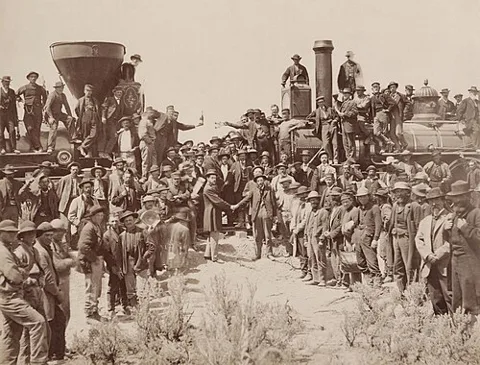
It's amazing. If you read about the railroad build-out or something, the amount of waste and fraud...48Fraud — the best-known case is the Crédit Mobilier scandal of 1872: Union Pacific insiders used a front construction company to inflate the cost of building the first transcontinental railroad and handed its shares to congressmen. Invariably there is some, but there's a lot of people trying to basically do the right thing here, and the governance parts that we just take for granted, it's incredible. America's capital markets, and the capital markets in general, I think are just incredibly underappreciated. The idea that any person can buy $100,000 of stock and get a portfolio of well-run, well-motivated teams building companies that are doing mostly the right things, and do it basically instantly and at basically no cost, and then sell it as soon as they're done, is amazing. And then the fact that all those companies, and other ways people invest, can then allocate society's resources pretty well in the scheme of things is just incredible. The whole system is just very underrated.
Why has America so dominated this, do you think?
My pet theory, and everyone has their own theories, is some sort of interplay between genetics, cultural evolution, and institutional evolution. So basically, the people who came to the United States were the subset of people who were most interested in taking risk, because going to the United States was very risky. And I think that risk-taking has a meaningful genetic component. And so I think that tendency is just more common amongst Americans. When you're in a place where risk-taking is more the norm, there's also a whole bunch of other things that come from that. It's more the norm. And then that leads to buildups of cultural and institutional things that reinforce that. It's understood that people can take risk and fail. That leads to bankruptcy laws that make sense,49Bankruptcy laws — in the US, Chapter 11 of the Bankruptcy Code lets a company keep operating while restructuring its debts, and a failed entrepreneur can start over; bankruptcy carries less stigma in the US than in many other countries. that leads to labor laws that support that, that leads to venture capital that supports that, and all of those things reinforce that. And then that leads to success stories. You get this whole soup, but that's my pet theory.
So if there's a moon base at some point, you're going to be bullish on that community's ability to do really well economically.
Yeah, actually, that's a great way to put it. The United States has been persistently innovative in a very amazing way. So if there's a moon base, I wouldn't be shocked if it's ours, even though the Chinese are brilliant and numerous, and the Europeans exist.
When you see rates go up — you see that great long-term chart of rates, let's say the 10-year rate in the US, and it just looks like this forever, basically our whole lives50The 10-year yield — the yield on 10-year US Treasuries peaked near 16% in September 1981, fell for almost 40 years to a low of about 0.5% in August 2020, and climbed back to 5% in October 2023. — comment on that chart.
Well, I mean, there's so much, and I'm certainly no macroeconomics expert, nor do I spend too much time thinking about it, but I'll make a couple of observations. One, obviously, is just in general, when you're a society and you're building, you're making a giant investment in the future, which means you're going to have to consume less today. Fundamentally, all of the resources going into this AI build-out are about the future. And fundamentally, the plumber building that today is not making consumption today. He could be making today's present consumption. Instead, he's making a data center, which is future consumption. So one piece of a very complex puzzle that I've thought a bit about is this idea that rates are higher because we're inducing people to save for the future. And the way you do that is you pay them.
09How a CEO should roll out AI
Cliff tells his portfolio companies to start with vibe coding for everyone and read-only access for the CEO's agent, and warns that it's years of work.
People would kill me if I didn't ask about your portfolio a little bit, which is so interesting to me. It's like 80% Carvana, Vacations,51Vacations — Hilton Grand Vacations. 5% Meta, is basically your portfolio. Rough justice, it's like five things. And one thing is 80%. So if you think about your portfolio and those companies, which obviously you know extremely well, and you were advising them on how to think about using AI to transform their businesses, what's that speech look like?
Well, it starts by making sure that everyone is vibe coding.52Vibe coding — programming in which a person describes in words what they want and an AI writes the code. Andrej Karpathy coined the term in February 2025. Starting at the board and the CEO, everybody needs to have hackathons. And of course I brought this to Carvana, and they said, yeah, we call them pizza parties. I don't mean the developers. I mean everybody needs to have hackathons. And it's not so much that you're going to build hugely useful software necessarily that comes out of these hackathons, but it's that you're going to teach everybody what can be done. And that's going to change their expectations, I think, for what can be done.
And then the second thing which I tell them is the CEO needs to basically turn to the head of IT and say something to the effect of: so I want my Grok bot, Meta Muse, agent, whatever, to be able to access every system in the company on a read-only basis. Everything I could look up if I asked somebody, I want to be able to get that in a prompt. And the guy's going to say, that's really hard, we have 18 trillion problems with that. And he's going to say, that's my point. I want that. And that's a big process, and it's system by system and all the rest. But if you can get to that, then that gets you read-only access.
To the starting line.
Yeah, to the starting line. That gets you read-only access. And then the next logical thing is the CEO needs to use this everywhere, and everyone's going to get jealous, and you're going to say, oh, you can have it too, but we need to work out your permissions. And then that, in theory, percolates down, and now you've got permission for read-only access. And then invariably someone is going to say something like, I'd really like to put data into the system. And you're going to say, that's fantastic, we've got to work out write permissions.
And then someone's going to say, I'd love to change a system, because we just did this vibe coding thing and I'm confident we could do it. And you're going to say, that's also fantastic, we need to work out a process by which we're going to manage changes to the system. And what I just described, sure, it's four bullet points. That's like years of work. It's like impossibly hard. So the question is, are you in a business where you have time for that to happen before someone who starts from the jump ball, someone else that starts from go, beats you? Exactly. And so it's good to have a really good business.
It seems like one of the conclusions from that is it's the best time ever to start companies, both because of capital market conditions, that people will fund at fairly low cost of capital highly experimental things, but also just because with these tools, if you start without the baggage, you can go so far so fast. Do you think that's roughly right?
I mean, yeah, it's the best time to start a company until tomorrow. So I agree. It's amazing. I'd also just say that, just thinking from my perspective, people are such a pain in the butt if you're running a company. They're such a pain in the butt. And the idea that you have all these agents and stuff, it makes it so you can do so much more with so many fewer people. Of course, one of the challenges always is, if you can easily do something, then so can everybody else.
So there has to be some wedge53Wedge — the product or advantage a company uses to break into a market and dig in before expanding. by which the thing you build produces enduring value. Does it have a path where you end up with some sort of lock-in54Lock-in — when switching to a competitor is too costly or troublesome: data, integrations, habits, contracts. or proprietary data? In this world where all the agents are happily changing providers every day, what gives you any enduring economics? But then of course there's the further thing, which is that obviously if you do the thing where it seems like there's an obvious path to enduring economics, then that's a bad thing to do, because everyone is trying to do that. So it's very competitive, and the really great outcomes are the ones that make no sense. You shouldn't do it at all. But then it turns out there is a path, or the world turns.
AdRamp, Vanta, Ridgeline, Rogo, WorkOS
Your finance team isn't losing money on big mistakes. It's leaking through a thousand tiny decisions nobody's watching. Ramp puts guardrails on spending before it happens. Real-time limits, automatic rules, zero firefighting. Try it at ramp.com/invest.
As your business grows, Vanta scales with you, automating compliance and giving you a single source of truth for security and risk. Learn more at vanta.com/invest.
Ridgeline offers one unified platform that automates away the complexity across portfolio accounting, reconciliation, reporting, trading, compliance, and more, all at scale. Schedule a demo at ridgeline.ai.
Every investment firm is unique, and generic AI chatbots don't understand your process. Rogo is built by finance professionals. It's connected to your data, learns your process, and quickly produces client-ready outputs. Check them out at rogo.com/invest.
The best AI and software companies, from OpenAI to Cursor to Perplexity, use WorkOS to become enterprise-ready overnight, not in months. Visit workos.com to skip the unglamorous infrastructure work and focus on your product.
10Margins, aggregation and inequality
Cheap intelligence, Cliff thinks, will more likely push corporate margins down and break aggregation, while its effect on inequality could go either way.
What do you think are the most underrated sources of future competitive advantage, then? If ultimately good businesses need sustainable edge, sustainable competitive advantage, to have great profits.
Anything underrated?
Underrated. We talked about attention and data and physical proximity. These are examples of things that might be super, or more, valuable in the future than they are today because of cheap intelligence. Is there any type of... maybe it's regulatory capture? Are there any types of edge that you think are underrated?
I get the sense that a lot of these are appropriately weighted. I guess one interesting question I've had — two other questions. One is, if you think of corporate margins in aggregate, do they go up or down?
Down, like this.
ExplainerAggregation theory, and why agents could break it
Ben Thompson laid out aggregation theory in Stratechery in 2015 to explain why Google, Facebook, Amazon and Netflix win on the internet.
- Before, power belonged to whoever controlled scarce supply or distribution: newspapers had printing presses and delivery trucks, TV networks had the airwaves.
- The internet made distribution free, and power moved to whoever owns the relationship with users. An aggregator offers the best experience, attracts the most users, and suppliers follow them to it on their own, becoming interchangeable.
- The key is attention: users are lazy and pick the first thing shown, so a spot at the top of Google or in the feed is worth a fortune in itself, and suppliers pay the aggregator for access to customers.
- Agents could break this: if software chooses on a person's behalf, comparing every option on price and quality, the top search result loses its value and the advantage of buyers' old laziness disappears.
Right. Do they go up or down? And I think everything we're talking about would argue down. There's many businesses where they make margin because... More consumer surplus.55Consumer surplus — the gap between what a buyer is willing to pay and what they actually pay. When competition squeezes corporate margins, the gain goes to buyers. More consumer surplus everywhere. What's interesting is if you go back and read a lot of the research reports from the '90s, when the internet was coming along, they said the same thing. So the base rate56Base rate — how often something has happened before in similar situations. Here: the 1990s forecasts that the internet would crush margins didn't come true. here might not be great. Maybe we're wrong, but I think the main reason they were often wrong was this aggregation economics, the Ben Thompson57Ben Thompson — American analyst and author of Stratechery, a paid newsletter on the business and strategy of tech companies; he came up with aggregation theory. aggregation economics. So maybe, absent that, maybe it wouldn't have been so wrong. And I do think that a lot of aggregation theory breaks down, because that basically relies on the idea that consumers only look at the first thing on Google.
But it turns out, if your agent looks at everything on search, then being ranked first doesn't matter. And all the core things, like quality and price and everything else, service, become more salient. But the other thing is that maybe another downstream effect of this is you'll be able to build more complicated businesses. Right now, a lot of industries are more horizontal in structure, because the complexity of running your slice is very high, and that makes it hard to also do what's above and below you and not have undue complexity. With AI agents and basically cheap and ubiquitous code and intelligence, you could build the whole vertical stack.58Vertical stack — vertical integration: one company controls the whole chain from production to sale and service, instead of each link being a separate business. People try to do this, I think, in other countries, but you can have a full-stack pet care business that does everything from make pet food all the way up through pet insurance and pet hospitals and pet vets, and all these things that historically were multiple layers. But now, because you can solve the coordination and reduce the principal-agent problems59Principal-agent problem — a conflict of interest between whoever assigns the work (the principal) and whoever does it (the agent), such as owners and managers or a company and a contractor. by having AI do it, maybe those sorts of businesses are possible.
And then maybe those businesses are higher margin in the end, and more efficient, and more consumer surplus. Carvana is an example of that, built before this was easy to do, but maybe people can do it in other verticals, in which case maybe margins go up and there's consumer surplus.
The other one, one of the fun things here, is just how this affects wealth and income distribution. I can tell two stories. On the one hand, I think a lot of people have talked about this idea that it concentrates income distribution. You've got all these people who made money on various labs and whatever, data, Nvidia, and this idea that there are increasing returns to small groups of people.
But the counterargument is, if we have cheap and ubiquitous intelligence, a couple of things happen. One is there's all these rent takers60Rent takers — in economics, rent is income beyond what it takes for a resource or service to be offered at all: it comes from market position rather than a better product. in the economy. Think, you're the software company that charges bowling alleys, and those guys all get smoked, which sucks for them, but it does lower the cost of bowling. And so then that increases living standards for everyone who bowls. And that's flattening, because my spending on bowling is a small proportion of my income, but people who make less money spend more, in proportion to their income, on bowling. And so that's a flattening effect on income.
If all these little rent pieces go away — the decline in corporate profits, all the money that the average American is giving to Bank of America goes away from Bank of America — the capitalists lose, the average consumer wins. So that's leveling. The other piece is there's a whole professional class who basically, you could define their role as intelligence. They take big corpuses of information and apply them to certain circumstances in a fairly straightforward way.
And if those all get commoditized, one, everyone gets the best, ubiquitous, which is good for everybody. But two, it's particularly good for people who can't afford the best right now, or any. But then three, those individuals, they earn these extra rents because they were smarter. They then have to drop to their next best alternative. And in theory, then, that might flatten the curve. Now, the counterargument to that might be something like, well, yes, but returns to initiative and ambition and intelligence could go up, because now I can do so much more, because these models are like a bicycle for the mind61Bicycle for the mind — Steve Jobs's image: on foot, humans are not very efficient movers, but on a bicycle they beat any animal; the computer is "a bicycle for our minds." on steroids. They give people who are smart and have initiative the ability to accomplish so much more.
Maybe that actually causes increasing returns to that subset of people, and it steepens the curve. Truman asked for a one-handed economist.62One-handed economist — according to a well-known story, President Harry Truman asked for a one-handed economist, because all his advisers answered "on the one hand... on the other hand." I seem to very distinctly have two hands on everything. I think that's a big, interesting question. There's super interesting questions, and I've found that in a lot of situations I look at, there's a lot of cross currents. We started the conversation with the AI build-out.
On the one hand, I can see all these incredible ways to use AI, and I use a gajillion tokens, and I can see how I could use a gajillion more. And obviously I'm in the far right end of the distribution. If everyone uses as many tokens as me, we are so short. It's going to be this huge thing that's going on forever, and everyone who's in the build-out is going to make a fortune. On the other hand, the amount I get per token is like going to the moon, and it turns out I'm a pretty unusual guy in a lot of senses, and people are going to adapt more slowly, and the cost per token is going to collapse. And so maybe actually we're totally overbuilt. I can tell both stories with equal certainty.
11An AI-built portfolio and 80% in Carvana
AI will take over investing from the shortest time scales up, Cliff says, and he holds 80% in Carvana because it has few scenarios that end really badly.
I have a good friend who has been running this very cool experiment. If you break investing down into picking what to own and then how much to own of each thing that you've picked — overly simplified, but an interesting way of thinking about it — he's been running this experiment where he continues to pick the things to own, but then runs his own portfolio construction63Portfolio construction — deciding what share of a portfolio to give each holding, taking into account risk, correlations and expected returns. as he would have in the past in one lane, and in a second lane is just completely handing that off to an AI harness64Harness — the software around an AI model (tools, data, instructions and an action loop) that turns it into an agent for a specific task. thing that he's built, and says, you do all the portfolio construction, but stick with the stuff that I've picked. And what he's found so far is that that is drastically outperforming his version of portfolio construction, which itself is quite sophisticated. And the simple argument that he would make is, well, AIs are just really good at optimization.
And they've read every paper on portfolio construction and all this kind of stuff, and bet sizing, and the Kelly criterion.65Kelly criterion — a formula derived in 1956 by John Kelly of Bell Labs: what fraction of capital to put on a bet so that capital grows fastest in the long run. Investors use it to size positions. They know it all. And that in the future, perhaps we make that transition where the investor's job is just picking what to own, and not how much of each to own. And I ask you this question — what you think about this idea and the future — because you have such an unusual portfolio where, again, 80% of it is in one specific asset. And my guess is, if you were in lane two, AI would weight your portfolio very differently than you have chosen to do it.
I'm underweight.
So I'm just dying to know what you think about this idea.
That's clever. Underweight Carvana. Should be 90. Time scales probably are interesting on that to think about too, as I think about how AI is going to encroach into this business. I think it's going to start at shorter time scales and work its way up to longer time scales, because one of the challenges is that there's no verification loop. Your friend's ability to say that is based on results over — I mean, certainly not 20-year results. I strongly suspect that the march of AI into markets... and I mean, it's already started. I don't know how Renaissance Technologies66Renaissance Technologies — an American investment firm founded by mathematician Jim Simons in 1978 that trades on mathematical models. Its Medallion fund is considered one of the most profitable in history. did it, but I assume... Seems like they might have discovered a transformer67Transformer — the neural network architecture proposed by Google researchers in the 2017 paper "Attention Is All You Need"; all modern large language models are built on it. before everybody else.
It's like, I'm not kidding. It wouldn't shock me if people who invest over shorter time scales, starting with seconds and working their way out to minutes, hours, weeks, months, find themselves delegating more and more to models. Makes perfect sense. And you could definitely imagine bifurcating that, between trying to enrich the model... I think other people do things like this already, and this is just a more sophisticated version, but you can have a fully quantitative strategy, and then you can enrich it with what you think is qualitative, human-designed analysis, and then you can have a quantitative strategy to incorporate the qualitative. I think many of these multi-strats68Multi-strats — large hedge funds such as Citadel and Millennium, where dozens or hundreds of teams run different strategies under common risk control. do these sorts of things. And what he's doing is just a slightly different flavor of that. Makes perfect sense. There are so many ways to be successful, and models have just added more dimensions of freedom.
But what about your own portfolio? Say a word more about how you feel comfortable having a position — forget the company that it is — that's that big, in the face of so much research that would suggest that's a crazy way to build a portfolio.
A lot of that research, I think, is more looking at price changes in terms of securities prices, and less focused on thinking about it the way someone who owns a company might think about it. I mean, we're talking about Carvana. Were it not for my sense that Carvana's infrastructure and brand and everything else is just so differentiated that there are few scenarios where it works out really badly, then I wouldn't feel so comfortable owning so much of it. It might just be as simple as that. That portfolio approach would have worked, absolutely, but certainly if you discovered Walmart or Home Depot or Fastenal69Fastenal — an American distributor of fasteners and industrial supplies from Minnesota; since its 1987 IPO, one of the best-performing US stocks. Like Walmart and Home Depot, a classic example of a company whose stock multiplied many times over the years. or something back in the day, you wouldn't have taken full advantage of it. And that's kind of my sense with Carvana.
If you read history, of course, all the people who did really great tended to be very concentrated. But of course the history is literally survivorship-biased.70Survivorship bias — drawing conclusions from those who "survived" while ignoring those who dropped out. Stories of concentrated portfolios are written about the lucky ones; nobody remembers those who lost everything on a single bet.
Yeah, you don't read the history of the ones who didn't.
I also think that a lot of that literature is what most people who are looking for average or slightly better than average results should do. And it's totally the right thing to do, but that's not what I'm looking for. I like Carvana a lot. It wouldn't upset me any if the stock went up a bunch and I felt compelled to diversify. That would also be okay. It's just more of a trade-off between expected returns and knowingly taking an unusual risk.
12Educating kids in a world of infinite intelligence
Kids should learn foundational skills without models so they can direct models later, and then get assignments a hundred times more ambitious, Cliff argues.
What do you think about education? You and I have kids of roughly similar ages. Comment a little bit on how you're thinking about their educations, the institutions that have driven education in this country, that have been really important in that whole path-dependent story71Path dependence — when the shape of the present depends not only on current conditions but on the path taken to get there. Earlier Cliff described how America's risk-taking culture grew institutions to match. you've described. What do you think the present and future of education looks like, or should look like?
I've been talking to the head of my kids' school about this, and more and more it seems to be that his thinking and my thinking are heading in this direction of: the way you're educating kids is getting more bimodal72Bimodal — a distribution with two peaks. Here: education is pulled toward two poles, basic skills without models and ambitious work with them. in terms of what you're looking for. Let me step way back. What is the benefit of intelligence — personal intelligence, like your own intelligence — in a world where there's infinite intelligence from models? You might say, oh, it's useless. Doesn't matter. Someone with a 50 IQ can navigate the world just as well as someone with a 150 IQ.
And I don't think that's quite right. And intuitively it doesn't feel right. But I think to nail down where it is: the more intelligence you have, and the more crystallized intelligence you have, which would be sort of education, the better you are at communicating with a model and telling a model what you want. I would have a very tough time having a deep conversation with the model to create leading quantum physics experiments, because I don't know anything about quantum physics. And the model could try very hard to explain things to me, but in the end it would be explaining things in crayon and Nerf, and it would be very hard to get to the leading edge and get the best out of what the model has to offer. Whereas in an area where I do have some expertise, the model and I can communicate effectively, and I can direct the model to my will much better.
And so to direct the model to do your will, which I think is going to be an important skill in the future, you do have to understand something about the world. And smarts help for that, and education helps for that. You can't ask it to assume this is a stochastic process unless73Stochastic process — a process that evolves randomly over time, such as a stock price or the weather; it is described in terms of probabilities. you know what a stochastic process is. It could teach you what one is, but that's a lot of friction in figuring this all out. You don't have to work out the math, but you have to know what it is.
And so when I've been thinking about education, there's this idea that you're teaching your kids a bunch of foundational skills that build on one another, where I think, in the end, the sum total of those, they have to be able to do them without models. Not because they're going to do them without models in the future, but because if they don't know how to do multiplication, it's going to be really hard to understand matrix multiplication. And if they don't know what matrix multiplication is at a high enough level... They don't have to be able to do it really well, but they have to be able to understand what the model is doing when it's doing it. And that's so they can direct the model. And so increasingly I'm of the view that we should spend a bunch of time with kids basically separated from these models, teaching them basic skills that we think are important — and what those are is a really hard thing — but the idea being that yes, the model can do it, but you need to know it so that you can tell the model what to do.
And then, on the flip side, some English teacher is like, I don't like models because the kids just cheat on their Shakespeare essays. I'm like, you're not being ambitious enough. If the kids are cheating on their Shakespeare essay, give them something harder to do. Give them something a hundred times harder and more ambitious, and have them use models to their fullest extent. Have them bring the work product back, and then make sure that they didn't just give a prompt to the model to do the homework. Make sure they own it, ask them why it's like this, force them to justify it. And I think that's another really important thing, because kids need to be good at using them, and they also, frankly, just need to be taught that they can do anything.
You and I get to talk every so often on the phone, and every time I wish it was recorded so that other people could hear it, because I learn so much. And I think this particular conversation today, which is sort of a version of a call we had several months ago, is just such a valuable set of food for thought about the future of intelligence and what that means for markets and companies. And it's a little bit not in opposition to, but a different perspective than, the most common one that you're hearing, which is unlimited build-out forever, short everything forever, no cap on the demand for intelligence. And I love talking to you about it, both on the phone and today, so thank you so much for your time.
Thank you.
If you enjoyed this episode, visit colossus.com. You'll find every episode of this podcast complete with hand-edited transcripts.
AdColossus, Ramp, Vanta, WorkOS, Ridgeline, Rogo
You can also subscribe to Colossus, our quarterly print, digital, and private audio publication featuring in-depth profiles of the founders, investors, and companies that we admire most. Learn more at colossus.com/subscribe.
Patrick O'Shaughnessy is the CEO of Positive Sum. All opinions expressed by Patrick and podcast guests are solely their own opinions and do not reflect the opinion of Positive Sum. This podcast is for informational purposes only and should not be relied upon as a basis for investment decisions. Clients of Positive Sum may maintain positions in the securities discussed in this podcast. To learn more, visit psum.vc.
You know how small advantages compound over time? That's true in investing, and just as true in how you run your company. Your spending system is your capital allocation strategy. Ramp makes it smarter by default: better data, better decisions, better economics over time. See how at ramp.com/invest.
As your business grows, Vanta scales with you, automating compliance and giving you a single source of truth for security and risk. Learn more at vanta.com/invest.
The best AI and software companies, from OpenAI to Cursor to Perplexity, use WorkOS to become enterprise-ready overnight, not in months. Visit workos.com to skip the unglamorous infrastructure work and focus on your product.
Ridgeline is redefining asset management technology as a true partner, not just a software vendor. They've helped firms 5x in scale, enabling faster growth, smarter operations, and a competitive edge. Visit ridgelineapps.com to see what they can unlock for your firm.
Every investment firm is unique, and generic AI doesn't understand your process. Rogo does. It's an AI platform built specifically for Wall Street, connected to your data, understanding your process, and producing real outputs. Check them out at rogo.ai/invest.


