

Latent Space
Chapters
Theis says the virtual cell is an old idea that is taking off now because data on how cells respond to perturbations finally exists.
Read the chapter- RJ notes that attention and money have gone to structural biology and molecule design, yet Biohub just announced a $1.8 billion collaboration with the DOE, NIH, Meta and Google to produce open data for virtual cells.
- Theis cautions that his view is an academic one and names data generation as the main driver.
- His lab predicted perturbation responses back in 2019 with scGen, but the data and the questions were too simple for the approach to take off.
- Predicting how a cell behaves under any perturbation is, in his words, a holy grail of computational biology: you understand a system when you can predict its outputs for different inputs.
- Startups in the space are exploding, including in China, and Theis hopes the reason is pharma's need for cell-type-specific screens rather than AI hype.
Theis explains how cell data grew from a handful of samples to 10 million transcriptomes in one experiment, and why he counts anything done to a cell as a perturbation, not just a knocked-out gene.
Read the chapter- He started with single-cell qPCR and a few bulk RNA samples; the eye-opener was Parse Bio's GigaLab, which measured 10 million transcriptomes in a single experiment.
- The perturbation space used to be sampled far more sparsely than the cell space; now labs run full Perturb-seq across a hundred cell lines or add batteries of a thousand drugs.
- A transcriptome is a 20,000-dimensional vector of messenger RNA counts per cell; clusters in the cell cloud are called cell types, and elongated "sausages" are differentiation trajectories.
- Brandon compares genes to ingredients, cells to dishes and transcriptomics to working out a dish's recipe, and Theis promises to borrow the metaphor.
- When RJ offers a CRISPR knockout as the example, Theis calls it the most hardcore perturbation; the full space includes signals from neighboring cells, hormones, media conditions and Yamanaka factors.
Theis sees organoids as a far richer model than a cell line, but says nobody has really settled how to model such multicellular systems.
Read the chapter- Researchers grow mini brains from human cells that connect and can even compute, and heart organoids that beat in a dish.
- Mini brains grown from skin cells make it possible to study neurodegenerative diseases whose tissue is hard to obtain, though organoids often lack immune cells and anything that feeds them.
- For dissociated cells there is a convenient human metaphor, the cell type, but there is no comparable categorization language for local cell niches or H&E slides.
- His group currently treats tissue as distributions of cells, though he thinks something more subtle, such as graphs, is possible.
Theis argues that hybrid models are right while perturbation data is scarce, but data eventually beats human-made concepts, and scaling is already starting to show in single-cell models.
Read the chapter- RJ sets the bitter lesson against the data-poor regime and recalls John Platt's distinction between predictive and descriptive models: a scientist wants a simplification that works for apples and planets alike.
- Theis answers that strong a priori assumptions cost predictive power and cites AlphaFold, whose later versions learned rotation symmetry from data.
- After the foundation-model hype came a wave of papers showing that near-linear models do fine; logistic regression is enough for cell types, but harder tasks, like predicting the gene expression of a cell's neighbors in the Nicheformer paper, need nonlinear models.
- scConcept was trained on about 30 million cells in the paper, while the version on Hugging Face covers 350 million cells with about 100 million parameters, and scaling behavior is emerging.
- Theis describes the virtual cell as a world model, f of x and a, state plus action, built as a flow-matching generative model (CellFlow) on top of the scConcept latent space.
Theis traces the linear-model story to sloppy baselines and metrics, and says the real winner of the Arc competition, once metric exploitation is removed, was nonlinear.
Read the chapter- Brandon calls Arc Institute's Virtual Cell Challenge a glass of cold water in the field's face and asks why it made everyone pivot.
- Theis says the rush toward the virtual cell sometimes ignored proper holdouts, and recalls his lab's paper showing that deep learning is not needed for cell type prediction within an organ; across organs, the nonlinear scTab does beat the baseline.
- The Arc metrics, in his view, were not single-cell specific and could be exploited, which is why the Open Problems consortium at NeurIPS asked participants to submit their own metrics.
- He tells his students that for drugs the hardest baseline can be simply predicting the mean.
- RJ adds that a Nature paper by Bo Wang and collaborators found the metric was to blame in some cases where linear baselines won; Theis suggests that once agents search over algorithms, formulating the metric may be the main human contribution.
Theis describes the Helmholtz Association as a federally funded research network somewhat like NIH, and argues that Germany is good at starting companies but falls behind at scaling them.
Read the chapter- The Computational Health Center he built has about 45 group leaders and professors and 500 to 600 people working on DNA models, protein design and patient-cohort representations, with the virtual human as a goal.
- Helmholtz centers have no undergraduates, only PhD students and postdocs, with affiliations at the Technical University of Munich and LMU Munich, which Theis calls the two top-ranked universities in the EU.
- Brandon, who expects to get German citizenship soon, asks about the startup ecosystem; Theis calls Munich a startup capital but says founders still look to the US for big Series A and B rounds.
- EU regulation sometimes helps, as with USB-C for every phone, while the AI Act complicates things; hospital data is best connected in Finland with FinnGen and in Denmark, and the European Health Data Space is meant to open it across borders.
- He expects every group leader in his department to produce at least one spin-off within three years, and students are pushing for startups on their own.
A virtual-cell platform on its own is not yet a business, Theis says: companies either pivot to drug development or win by pairing the model with unique data.
Read the chapter- Startups pitching a "foundation model of biology" point to OpenAI and Anthropic, which also didn't know how to make money at first, while open tools like Scanpy and scverse don't turn into revenue.
- European investors, he says, understand one thing: that someday you will develop a drug; and there is a fear that Astra 2.0 will take over part of the work anyway.
- RJ agrees that model companies have usually ended up building drugs because selling tools to pharma is hard, but this year Boltz and Chai in structural biology show the opposite path.
- Theis points to Noetik with its own data generation and to the Cancer Organoid Perturbation Atlas consortium, which pharma joins for early access to perturbation data.
At the Munich School for Data Science every PhD student has two advisors, one for methods and one for the domain, and Theis says that over eight years this brought his lab new topics and gave graduates an unusual profile.
Read the chapter- Two PIs propose a project together, and the student below them forms a Y; with two students, "Y plus Y equals H."
- Students attend two lab meetings, turn the loosely formulated problems of biologists into metrics and models, and become experts in their biological topic.
- The approach has spread beyond RNA: Theis mentions a Science paper on single-cell proteomics and work on spatial data.
- European students arrive after a master's and often don't yet know what interests them, and the school lets them sample different domains.
- Graduates go into pharma, data research, startups and pure AI; NVIDIA hired two of Theis's people in a single month.
Theis names the closed loop, where a model proposes the experiment, as the next frontier, and says the hardest part is not the model but a culture in which experimentalists trust it.
Read the chapter- Brandon asks how co-advising will change if agentic AI lets any wet-lab biologist do their own computation.
- In Theis's telling, the field went from mapping cells in atlases to prediction with world models, and can now steer the next experiment instead of ending a paper with a model and moving on.
- Lab Compass is an inverse generative model: given a forward world model, it suggests what to do to reach a desired cell state; with a Cambridge colleague who studies blood formation, the team ran three or four cycles.
- Convincing experimentalists to invest in a long experiment on a strange cell proposed by a model is harder than in molecule design, where the stakes are lower; Theis thinks robotics is premature while assay cycles are long.
- The ultimate goal is reinforcement learning in the loop, though for now it is active learning; RJ compares this with Lila's thesis that the lab is part of the RL environment.
Quotes
On understanding a system
“I think you understand at least you model a system very well when you sort of predict its output behavior given different inputs.”
Fabian TheisRead from 04:58On cell types
“We have this beautiful metaphor of what we humans call a cell type, which you know nature doesn't care about, but this is just us putting categories on top of stuff.”
Fabian TheisRead from 15:04On the lesson of big machine learning
“At some point data beats human-made additional concepts in these models.”
Fabian TheisRead from 19:07On advice to students
“I know you want to do the most fancy deep learning thing, but please, please, you know, have the baseline.”
Fabian TheisRead from 29:53On what is left for scientists
“At some point we're gonna have agents sort of trying out all kinds of combinations of whatever algorithmic thing you can come up with.”
Fabian TheisRead from 30:35On the Bay Area
“Recently I was visiting, I believe maybe Genentech or colleagues and we went to a restaurant and then one of the waiters was asking us, hey, are you guys talking about AI and bio?”
Fabian TheisRead from 32:41On a target for group leaders
“Every PI, every group leader would expect you at least to have one spin-off in the next three years.”
Fabian TheisRead from 36:55On where biology is heading
“Where before, you know, we built these human cell atlases, we had sort of this mapping aspect. Then we talked about the world models prediction problem, right? So from mapping we went to prediction.”
Fabian TheisRead from 46:56
Summary
Fabian Theis, who built the Computational Health Center at Helmholtz Munich and whose lab gave the field Scanpy and scGen, tells RJ Honicky and Brandon Anderson how single-cell data grew to tens of millions of cells per experiment and why the virtual cell is now best thought of as a world model: a cell state plus an action gives the next state. While perturbation data is still scarce, Theis bets on hybrid models and insists that his students beat an honest baseline, but he expects data to win over human-made assumptions in the end. The main takeaway: the field is moving from mapping cells and predicting their behavior to steering experiments, and his lab's inverse model Lab Compass has already run three or four lab-in-the-loop cycles with collaborators in Cambridge.
Advice
Understand your baselines well before building a complex model; otherwise you can spend a long time spinning your wheels and fooling yourself.
For young researchers: compare your model with the simplest baseline, which for drugs can be just predicting the mean, and make sure you beat it; with data this noisy, that is far from easy.
What a tech startup needs most is the best team; lab heads should nudge people toward spin-offs by giving them a clear target.
For heads of PhD programs: give every student two advisors, one for methods and one for the domain, so they learn to turn biologists' fuzzy problems into metrics and models.
In job interviews, show not only a fancy model that improved 2% in a paper, but also work on a real, complex application for which you helped find the use case.
Mentioned
- Scanpy01:17RJ calls Scanpy and the AnnData format tools nearly every computational biologist has used; at 00:38:56 Theis cites them as an example of open tools that are hard to monetize.
- scverse01:17According to RJ, this collection of open tools with many contributors grew out of Theis's work on Scanpy and AnnData.
- Helmholtz Munich01:17RJ introduces Theis as leading AI and computational biology efforts here; at 00:31:15 Theis describes building its Computational Health Center of 45 group leaders and 500 to 600 people.
 OpenAI02:02RJ says its biopharma initiative focuses on molecule design; at 00:38:28 Theis notes that startups pitching a "foundation model of biology" point to OpenAI, which at first didn't know how to make money.
Show 42 more mentionsShow fewer mentions
 Anthropic02:02RJ cites its biopharma initiative as a sign that attention has gone to molecule design; at 00:38:28 Theis names it alongside OpenAI as a company that didn't know how to make money at first.
- Xaira Therapeutics02:02RJ offers it as a counterexample to the claim that the virtual cell gets little attention, and at 00:05:51 recalls a recent conversation with Xaira about its perturbation screens.
- Noetik02:02RJ names it as another counterexample and at 00:40:48 wishes its approach drew as much activity as structural biology; Theis replies that Noetik has a nice scale of data generation and data access.
- Biohub02:02RJ reports that Biohub announced a $1.8 billion collaboration with the DOE, NIH, Meta and Google to collect and open-source multi-scale data for a new generation of virtual cells.
 National Institutes of Health02:02RJ lists NIH among Biohub's partners, and at 00:32:41 Theis compares Helmholtz centers to the NIH model, only distributed across Germany.
- Human Cell Atlas02:56Theis says the Biohub initiative is closely tied to this worldwide consortium pushing the next level of data generation; at 00:46:56 he calls cell atlases the mapping stage the field started with.
- scGen03:34Theis says his lab began predicting perturbation responses with this 2019 model, nonlinear but essentially a linear shift in latent space, always benchmarked against simple linear models.
- Parse Biosciences06:46Theis recalls the company's GigaLab, which measured 10 million transcriptomes in one experiment, as an eye-opening moment.
- Perturb-seq07:17Theis says full Perturb-seq across a hundred cell lines makes the perturbation space truly rich; at 00:27:50 he recalls that such data was first analyzed with linear models on pseudobulk.
- Human Genome Project08:25Theis opens his public-talk explanation of transcriptomics with it: the genome is nearly the same in every cell, yet there are many cell types.
- Shinya Yamanaka11:48Theis cites Yamanaka factors as a "cocktail" that turns skin cells into near-embryonic ones, Nobel-level work and one of the perturbations a virtual cell should cover.
- The Bitter Lesson16:04RJ sets an "anti bitter lesson" against the essay: with little data you have to add inductive bias; at 00:19:07 Theis calls it the honest learning of big-scale machine learning.
- John Platt16:04RJ recalls Platt distinguishing predictive and descriptive models in a recent conversation and asks Theis which simplifications could reduce cellular complexity to a tractable model.
 AlphaFold19:07Theis's example: early versions built in rotation invariance by hand, while later ones found the symmetry themselves with more data.
- Deep-learning-based gene perturbation effect prediction does not yet outperform simple linear baselines20:44Theis mentions the wave of papers showing that near-linear models predict perturbation responses well, and at 00:25:48 Brandon calls the episode a big moment for the community.
- Nicheformer21:25Theis says the paper on his lab's spatial omics model introduced a hard task, predicting the gene expression of a cell's neighbors from its state, which needs nonlinear models.
- Joint Embedding Predictive Architecture22:50Theis says there are many JEPA-style approaches in single-cell models now, while his lab uses contrastive learning.
- scConcept23:22Theis uses this contrastive model to show scaling: about 30 million cells in the paper, and a 350-million-cell, 16-species version with about 100 million parameters on Hugging Face.
- Geneformer23:22Theis explains that the scConcept paper stopped at 30 million cells to compare with Geneformer.
- CellFlow25:13Theis says the paper was just accepted at Nature Methods and that the flow-matching approach reproduces perturbation effects much better; at 00:29:05 he says the real winner of the Arc competition built on the same idea.
- Arc Institute26:14Brandon recalls its open competition as a glass of cold water for the whole field.
- Virtual Cell Challenge26:14Brandon asks why the challenge made the field pivot; Theis answers that its metrics weren't single-cell specific and could be exploited, and without exploitation a nonlinear model won.
- CellTypist26:59Theis cites it as an example that even near state-of-the-art cell type annotation is essentially logistic regression, which works fine for that task.
- scTab27:20Theis says his lab's nonlinear tabular model adds real lift over the baseline across organs.
- Open Problems in Single-Cell Analysis27:50According to Theis, this consortium of labs ran regular NeurIPS competitions on single-cell data and asked participants to submit their own metrics.
 NeurIPS27:50Theis recalls the competitions at the conference, and at 00:45:39 contrasts "a model that improved 2% in a NeurIPS paper" with work on a real, complex application.
- Bo Wang30:16RJ cites a new Nature paper by Bo Wang and collaborators: where linear baselines beat complex models, the metric was sometimes the problem.
- Helmholtz Association31:15Theis answers Brandon's question about funding models: perhaps Europe's largest research organization, putting federal money into long-term research.
- Technical University of Munich32:06Theis says his center's researchers are mostly affiliated with TUM and LMU, the two top-ranked universities in the EU.
 Ludwig-Maximilians-Universität München32:06The other university where, according to Theis, his center's researchers hold affiliations; together with TUM he calls it top-ranked in the EU.
 Genentech32:41Theis tells how, visiting Genentech or colleagues, a restaurant waiter asked whether they were talking about AI and bio, as an example of how the Bay Area lives this.
- EU AI Act35:56Theis cites the law as EU regulation that makes things a bit more complicated, though not yet for research.
- FinnGen36:18Theis calls Finland with FinnGen a fantastic example of describing a population in detail: samples linked to medical records.
- European Health Data Space36:55Theis says that under this regulation health data should start crossing EU borders within the next two years.
- Boltz39:54RJ cites the company as an example of the opposite path in structural biology: this year such companies aren't pivoting to drugs.
 Chai Discovery39:54RJ recalls talking to Chai as another example of model companies that aren't pivoting to drugs this year.
- Munich School for Data Science42:07Theis says he set up this school, where every PhD student is co-advised by a methods PI and a domain PI; it has run for about eight years.
- Mapping early human blood cell differentiation using single-cell proteomics and transcriptomics43:48Theis mentions "a very nice paper in Science" on single-cell proteomics as an example of his lab's approach extending beyond RNA.
 NVIDIA45:39Theis says NVIDIA hired two of his people in one month, for computation and for the biology effort it is building up.
- Lab Compass48:22Theis presents his lab's new work: an inverse generative model that suggests what to do to reach a desired cell state, tested over three or four lab-in-the-loop cycles.
- Bertie Göttgens48:35Theis doesn't name him, but speaks of a good friend and colleague at the University of Cambridge who studies hematopoiesis and whose rapid cycle system let them test Lab Compass in the lab.
- Lila Sciences49:51RJ compares Lab Compass with Lila's thesis, discussed with its team, that the lab is part of the RL environment.
Transcript
01Why the virtual cell is getting funded again
Theis says the virtual cell is an old idea that is taking off now because data on how cells respond to perturbations finally exists.
Welcome to the Latent Space AI for Science podcast. I'm RJ Honicky, CTO of MiraOmics. I'm joined by my co-host, Brandon Anderson, who develops RNA therapeutics at Atomic AI. I can't emphasize enough how much Fabian Theis and his labs and companies have contributed to the development of systems biology and various iterations of the virtual cell concept.1A virtual cell is a model that takes a cell's state and an intervention (a gene knockout, a drug, a signal from neighbors) and predicts how the cell will change; ideally it could stand in for part of the lab work. The position paper "How to build the virtual cell with artificial intelligence" (Cell, 2024) was written by dozens of authors from academia and industry, Theis among them. Papers and models come out of his lab faster than I can read them, and the lab is consistently moving the ball forward on our understanding of how to observe and model the behaviors and interactions of cells.
Just as importantly, his work often focuses on creating the tools that researchers and scientists actually use in their day-to-day work. Most computational biologists have probably used Scanpy and AnnData at some point, and this work has led to the creation of scverse,2Scanpy is a Python library for single-cell analysis released by Theis's lab in 2018 (Wolf, Angerer and Theis, Genome Biology); AnnData is its storage format, a cells × genes matrix together with cell and gene annotations. In 2022 scverse grew around them as an open community and a suite of interoperable tools for single-cell and spatial omics (scverse). which is an amazing collection of open tools that has attracted many, many contributors. Of course, Fabian is one of those academics who has way more honors than you can possibly list, but suffice it to say that he leads a bunch of the AI and computational biology efforts at Helmholtz Munich3Helmholtz Munich, the German Research Center for Environmental Health, is part of the Helmholtz Association, Germany's largest scientific organization. Theis directs its Computational Health Center and is also a professor at the Technical University of Munich. and related institutions, and participates also in many other industry efforts. Fabian, it's really great to meet you. Thanks a lot for joining us.
Thanks for having me. I'm really looking forward to the discussion, man.
Yeah, I've been tracking your work for a long time, and so it's a great honor to finally get you on the show and talk to you. Let's kick things off with some of the hype happening right now. There's a ton of interest right now in structural biology. Anthropic and OpenAI biopharma initiatives focus heavily on designing molecules right now. On the other hand, virtual cell and systems biology approaches really haven't gotten as much attention recently. Maybe Xaira and Noetik4RJ names startups that do bet on cell biology. Xaira Therapeutics came out of stealth in April 2024 with more than $1 billion in funding; it is led by neuroscientist Marc Tessier-Lavigne, the former Stanford president, and runs large perturbation screens in-house. San Francisco's Noetik trains models on its own tumor data, spatial omics and histology slides, to match cancer patients with immunotherapies. are good counterexamples there, but Biohub just announced a $1.8 billion dollar collaboration with the DOE, NIH, Meta, and Google5Biohub is the nonprofit research institute of Priscilla Chan and Mark Zuckerberg. On October 7, 2026, its Virtual Biology Initiative, launched in April with $500 million, was joined by the US Department of Energy (more than $500 million over five years), NIH (datasets already collected with federal money), and Google DeepMind, Isomorphic Labs and Meta ($300 million together). The $1.8 billion is the sum of money, data and compute, not only new cash; sponsor companies get the data a year before everyone else, after which it is opened up (US Department of Energy). to collect and open source multi-scale biological data that can be used to develop a new generation of virtual cells.
So my question, do you think that we're about to see renewed interest from the pharma industry in virtual cells based on the activity that we're seeing in academia right now?
I should disclose before I sort of go to the answer that obviously my opinion is quite academic in the sense that whenever I talk to my friends and colleagues that really sort of day by day sit in the startups, they have like what I sort of have as an overview and sort of a bit of intuition what the different research labs do. They have the same thing for the startups and they know this is sort of the hot big thing that you know this and these investments are happening. I don't really have that on that scale. But having said that, for example, you mentioned a Biohub's initiative, which by the way is also heavily coupled to Human Cell Atlas, which is sort of this international, really worldwide consortium that sort of pushes this next level of data set generation.
I do think that there's a whole bunch of reasons why we're gonna see that sort of scale up from all these models working well in terms of being generative, but also sort of lab in the loop6Lab in the loop is a closed cycle: a model proposes experiments, the lab runs them, the results retrain the model, and it proposes the next ones. Genentech champions the term and uses the approach to design antibodies, for example; Theis's point is that a method proven on molecules is moving up to the level of whole cells. on the molecule level now being exported and sort of really working one level up on the cell level. And I think there's a bunch of reasons for that. The first one, I think, and maybe the most important one, which you really hit here, is the data generation. I think we had that concept of a virtual cell for a while. Like my lab, we started this perturbation prediction modeling and using machine learning in 2019 with a paper we called scGen7scGen is a model from Theis's lab (Lotfollahi, Wolf and Theis, Nature Methods, 2019), one of the first to predict cellular responses to perturbations with deep learning. A variational autoencoder maps cells into a latent space, where a response is a single shift vector: it is learned on cells where the perturbation was measured and added to cells of another type. Hence "a nonlinear model, but essentially a linear transformation" (Nature Methods). at the time, which was like it was a nonlinear model, but essentially sort of in the latent space did some linear transformation.
And it was actually quite okay. And even nowadays, many of these sort of pseudo-linear type of things are still doing a good job, but the reason for that being that I think the data sets and the questions that we asked on top were just sort of still on the simplistic side. That's why also sort of it didn't yet take up. So whenever people talk about virtual cells, maybe also your question, I think what you actually ask is, how does, can you predict how a cell would behave under all kind of perturbations? And that's sort of, I think, a quite deep question. If you really think about it, that's maybe even a bit of a holy grail in computational biology, systems biology, sort of this input-output system that is a cell with memory and like with all the specifications and with all the different sort of levels of molecules and so on, not just RNA.
I think being able to map this out, what does even understanding mean? And I've been the sort of bit of a meta problem, but I think you understand at least you model a system very well when you sort of predict its output behavior given different inputs. So I think it's a very good question. And this is why often people nowadays equate a virtual cell with perturbation prediction. I think it's a bit too simplistic, but I think these perturbation prediction type of models, and that sort of being maybe what you mean by virtual cell is taken off a lot. And the startup landscape, I think, is a bit exploding there.
We talk, I think, a lot about US, Europe, but also in the Chinese ecosystem, there's a lot of these additional efforts now happening. And I hope that these are not just sort of now a kindling of a flame because everyone sort of adds AI to their things, but because pharma is really desperately needing to be cell type context specific in their screens, which at the moment they can't do yet on that scale.
02Transcriptomes, perturbations and recipes
Theis explains how cell data grew from a handful of samples to 10 million transcriptomes in one experiment, and why he counts anything done to a cell as a perturbation, not just a knocked-out gene.
Maybe you could expound a little bit on what does this, so perturbations right now, like we talked to Xaira recently, they're doing these perturbation screens. What does that unlock? And then what do you think the next generation of data is going to unlock in addition to that?
I mean, for me, if I may, stop me when I'm sort of getting too much into these old stories. Like, you know, I've been trained machine learning scientist for the longest time doing all kinds of things, but you know, I started with single cell early on, qPCR. Maybe initially, if I'm really honest, not so much because it was like the biology that I was interested in, but because we had high sample numbers purely for that, right? Because even early on, it was sort of clear that the number of qPCRs at scale, but then of course transcriptomes, was just getting really big. And you know, when I started my career early on, we had like a few bulk RNA.8Bulk RNA-seq sequences RNA from a whole piece of tissue, giving an averaged profile of millions of cells in which rare cell types get lost. Single-cell methods, starting with qPCR that measured a few dozen chosen genes in individual cells, look at each cell separately. Now we sort of had thousands of them or whatever, right?
So this is like early times. But now, you know, we go into a regime. And that was sort of one of these eye-opening moments when Parse Bio had, I think they call it the GigaLab9GigaLab is Parse Biosciences' production-scale single-cell sequencing operation, launched in October 2024. Its showcase dataset was about 10 million PBMCs, peripheral blood mononuclear cells (the lymphocytes and monocytes from an ordinary blood draw), from 12 donors treated with 90 cytokines in a single experiment; Theis's lab wrote the tutorial notebooks for it (Parse Biosciences). or something like that. And you know, there's sort of similar ones from competing companies now, but when they had like in a single experiment, 10 million transcriptomes measured, right? I thought that was like next level stuff. And, you know, this step from just getting more PBMCs as a control tool, like let's actually do something at scale to it, sort of having here the cell space, but then having here the perturbation space, which typically was very scarce.
It was like control versus disease or so. So this sort of number of points what you had here in terms of sampling on the perturbation space was typically much, much more scarce than the number of observations in terms of cells that you had. But now this is exploding. Now you sort of have, I don't know, hundred different cell lines where you do sort of full Perturb-seq,10Perturb-seq is a 2016 method: CRISPR knocks out different genes across a pool of cells, each cell carries a barcode for its perturbation, and single-cell sequencing reads both its transcriptome and which gene was knocked out. In 2022 a single project used it to perturb every expressed gene in a human cell line. like full CRISPR, or you have like batteries of a thousand drugs or so added, and suddenly this space gets really rich, right? And then you can sort of start doing all these fancy perturbation prediction type of things. And this is currently happening.
It's crazy what scale is happening. We are ourselves involved in a whole bunch of things where we actually go beyond cell lines and do organoid perturbations. And maybe if we have time we can talk a bit more about that, because I'm quite convinced that we need to go to multicellular systems to have actually really interesting readouts. But I think everyone is scaling these levels up and at some point, you know, we're going to go maybe even to human genetics as a perturbation.
Can you just like explain what is a perturbation? What do you mean by that? Just for the people who are not familiar.
Yeah, yeah.
Yeah, actually, would you mind maybe backing up even one step more than that? Like what do we even mean by like measuring transcriptomics? And you were talking about like PCR-based and then also Perturb-seq and…
When I give sort of public talks, I typically say, you know, human genome project, we sort of have the genome for the body, but it's pretty much the same everywhere, right? So like why do we have all these different cell types, right? What's sort of happening specifically? And so first level, what we typically have, one of the first levels is that, you know, per cell different stuff is being read off of the genome, right? And these messenger RNAs, which then sort of encode the various downstream proteins, while these are sort of differently expressed, as one says, in different cells. And to say in a human, maybe it's just something like 20,000 different types of these.
With splicing11Splicing cuts out parts of the RNA copied from a gene. Alternative splicing stitches different sets of segments (exons) from the same gene, so humans have several times more distinct messenger RNAs than protein-coding genes. many, many more, but that's sort of the rough level. So what you de facto have is per cell a 20,000 dimensional vector that has a whole bunch of zeros and stuff is not there, but then a whole bunch of sort of numbers, how many of these counts of these messenger RNAs you have. Because these things are called transcripts, right? This is called then the transcriptome. Yeah, and de facto then you have this sort of 20,000 dimensional space that we very often encode in a sort of nicer latent space that sort of has like a sub-manifold,12A manifold here is a low-dimensional surface inside a huge space. Cells are not scattered across all 20,000 dimensions: their states lie on a much "thinner" surface, which is why they can be compressed to a few dozen coordinates and plotted in two dimensions. like sort of this subspace where these actual cell cloud lives, right? And if the cell cloud then sort of like this sort of 20,000 dimensional vectors, each point then being one cell, right?
If they sort of cluster up, then we call these things cell types or something like that. And if they sort of go into a sort of sausage or whatever, right, we call them trajectories,13Trajectories are continuous paths through the cell cloud along which cells mature or specialize; a cell's position along such a path is called pseudotime. Theis's lab introduced some of the standard methods for them: diffusion pseudotime (Nature Methods, 2016) and PAGA (Genome Biology, 2019). like a cell differentiation, like the fertilized egg cell then making all the cell types in the body or something like that.
So like DNA is sort of like a recipe book, or maybe it's a bunch of genes or a bunch of ingredients. And then as you each cell is its own sort of meal or dish or something, which is a combination of different ingredients. And now the transcriptomics is sort of figuring out, taking different meals and then sort of decomposing them like, oh, what ingredients went in to make this meal? So is that a dumb analogy?
I have a bunch of foodies as kids. I will use this metaphor a bit more often. I like it. Thanks, Brandon.
I love it. And then perturbations is when you somehow perturb the genome or the transcriptome so that it has different transcripts in it. And then typically that's done with a CRISPR knockout where you remove a gene from the genome and that causes it to not express that gene, obviously. And then from there then you see what are the phenotypic or the actual changes in the physical biology that occur because of a perturbation. Is that more or less right?
Maybe I can take a step back there because I think RJ you're fully right, but this is sort of one of the hardcore type of perturbations, right? Like fully knocking out a gene sort of in evolution happens a bit, but mostly these things are sort of a tad more subtle. But of course, in order to understand the system, it's a good idea to take out bits and pieces. I think what happens sort of on a normal development or normal sort of us being in homeostasis is of course that these cells sort of talk to each other all the time. You know, they sort of live in these complex multicellular states, right? So there's all kind of communications happening between cells.
So they always have stuff coming from the outside and then sort of doing something to them. So for me a perturbation space, in fact, is just an input space to stuff that happens to a cell, just maybe because it just sits to another one and there's like some signaling happening, right? Or some gradient, some hormones coming in, whatever, right? And all this stuff, of course, you cannot sort of tune up or tune down. Maybe even something as basic as when you go these in vitro systems where pharma does drug screens, when you sort of put them in a dish, you know, you can do different what's called media conditions and they have so much impact, right?
And it's like a bit of for me still like a bio-driven, maybe even like an alchemy, what type of cocktails people come up with to then sort of maybe take, you know, skin cells and turn them into more or less embryo like state cells, right? Where you can then sort of make new cells to heal different stuff in the body or these what are called Yamanaka factors,14Theis's example of a "cocktail" that radically changes a cell. Yamanaka factors are four proteins (Oct3/4, Sox2, Klf4, c-Myc) that turn adult skin cells into induced pluripotent stem cells, nearly embryonic ones. Shinya Yamanaka discovered them in mice in 2006 and shared the 2012 Nobel Prize for it with John Gurdon. for example, you know, these were Nobel laureate type of stuff, right? So I think having a space of perturbations, essentially of things that you can do to a cell, this can be a very rich thing. It can go on as much as actually changes in the gene, which would be like a full knockout or something more subtle, right? Which is sort of human genetics.
And I think all of that we need to put in a big space of stuff that we can do that has an influence of cell state and like a virtual cell model should take all of it, right? And also combinations thereof, of course, and maybe you know disease happening, time, whatever, right? That then impacts that.
03Organoids and tissues without a shared vocabulary
Theis sees organoids as a far richer model than a cell line, but says nobody has really settled how to model such multicellular systems.
That's a great connection to the organoids idea. So can you talk a little bit about, okay, so an organoid is what and how does that connect to this concept of perturbation space and what do you do to it in addition to just this context?
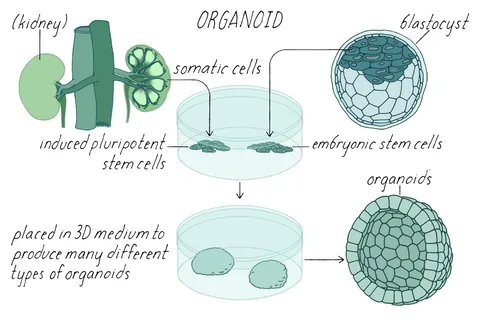
Dude, when I first heard about, learned about this concept, I should say, you know, I'm not a trained biologist, so I typically learn about things when I read a bit or when I talk to colleagues and friends. And when I first saw that people are able to take essentially cells out of a body, of a cancer cell or whatever, right? And let them then grow into small multicellular systems that actually sort of start connect and do things. I was super impressed.
So, you know, people can now, for example, take some cells, put them in a dish, and then grow little mini brains, essentially set of neurons that essentially really start connecting, talking to each other, and people have shown that they can get those sort of mini brains in a dish to compute.15Theis is probably thinking of Brainoware (Nature Electronics, December 2023): a brain organoid on a multielectrode array served as a computing reservoir and learned to tell which speaker was pronouncing Japanese vowels, with accuracy rising from 51% to 78% during training (Nature Electronics). Similarly, people can take heart cells, grow them into little heart organoids, and we have a bunch of local collaborations with fantastic partners that actually start beating.
Like you have beating little heart cell clumps in a dish, right? And then of course once you have these, and the same thing is I spoke about brain, there's even simpler systems like the colon where this works very well. There's a whole bunch of cancer systems, but you know, also for let's say if you want to study diseases with hard-to-acquire material, let's say you want to look into the genetics of some type of neurodegenerative diseases or so, like typically it's very hard to get access to tissue, right? So you take stem cells from the skin, you take cells from the skin, differentiate them, make, turn them into these mini little brains, and then you can potentially study some things there. So I think this concept of replicating little bits of organs, that's why they call organoids, in a dish is very fascinating.
There's all kinds of limitations, obviously. Often immune cell is, immune system is missing. There's like no maybe feeding them or something like that. So there's all kinds of problems, right? But it's much, much more than just a cell line, which is like one cell type.
Moving to the modeling side, how does, how do you model that?
So that's, I think, but the research frontier. So I don't think people have agreed on what the optimal way to model is, particularly also because there's not as much data as one wants. Jay, right? You're involved, if I understand correctly, in a whole bunch of spatial omics16Spatial omics measures gene or protein activity directly in a tissue section, keeping track of where each cell sits and who its neighbors are; Nature Methods named spatially resolved transcriptomics its Method of the Year for 2020. Theis's lab maintains Squidpy, the scverse library for such data. slash also sort of H&E17H&E staining (hematoxylin and eosin) has been the histology standard for over a century: hematoxylin stains cell nuclei blue-purple, eosin stains cytoplasm pink. Hospitals hold millions of such slides, which is why Theis says pathology has so many samples.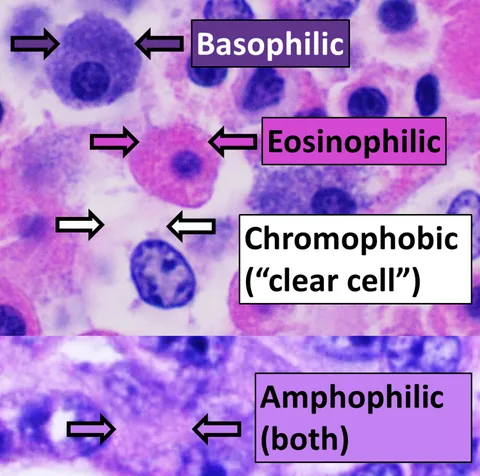 sort of pathology type of effort. So like pathology, there's like so much samples available, right? And now increasingly we sort of do a bit more spatial omics.
So I think how we even represent spatially connected data sets. And then you sort of break it down on an organoid level and so on, people are not as clear as it is with disassociated cells. So again, taking this a bit simpler, I think if we look at the space of disassociated cells and we look at these groups, we have this beautiful metaphor of what we humans call a cell type, which you know nature doesn't care about, but this is just us putting categories on top of stuff. But it helps us understand this complexity. I don't think we have a similar metaphor for local niches of cells, maybe a little bit, but also in H&E, right? Whenever I talk and see what pathologists do, it's often very qualitative and it's maybe not at that level yet.
So I think we need to develop a bit of a categorization language for us. Maybe computationally maybe we don't need this so much, but computationally we also need to sort of think a bit how we deal with this. At the moment, we essentially deal with this as distributions of cells. So this is sort of the solution at the moment. But I think it can be much more subtle, like graphs or something like that.
04Inductive bias versus scale
Theis argues that hybrid models are right while perturbation data is scarce, but data eventually beats human-made concepts, and scaling is already starting to show in single-cell models.
So on the one hand, you have the bitter lesson18"The Bitter Lesson" is Richard Sutton's 2019 essay: throughout AI history, general methods that scale with compute have repeatedly beaten approaches built on human knowledge of the task (essay). Inductive biases are exactly such built-in assumptions about the data, like a convolutional network "knowing" in advance that a cat is still a cat in any corner of the image. and, you know, sort of you remove inductive bias and you end up being able to have a larger data set that's applicable to your problem and then that helps you to get more accurate models because your distribution is wider and whatever. So that's like the one and then but then there's this like countervailing tendency, which is like maybe you could call it the anti bitter lesson, or like the other the flip side of the bitter lesson where when you're in data poor regimes, for one thing, then you have to introduce a lot of inductive bias to get enough statistical power to make good inferences. But there's also a second side of that, which I think John Platt19John Platt is a Google researcher known for classic machine learning methods (the SMO algorithm for support vector machines, Platt scaling) who in recent years has worked on AI for science; he was a guest on an earlier episode of Latent Space's science series. in our discussion with him not too long ago brought up was that you have these like predictive and then descriptive models.
And what you really want as a scientist is to get to a simplification, a descriptive model where you can say, oh, well, I've tested all the apples and the gravity works in such a way on apples. And then, but I'm modeling this as a universal concept simply so that we know that it works on planets as well. Right. And so that I want to understand from you, what are the simplifications or, you know, sort of maybe simplifications, maybe insights, maybe actual mathematical or otherwise scientific models that are becoming apparent that are going to help to reduce all the complexity so that we're able to actually make meaningful, gain meaningful understanding from these really large data sets.
Yeah, that's a very important, very I think kind of deep point, which I think sort of breaks the field into maybe sort of a bit two different groups of people with answers, right? So how much do we need to put inductive biases maybe priors into a model to maybe make it better explainable, right? But potentially also more robust in going out of distribution?20Out of distribution means on data unlike the training data: for example, cells from a tissue, a species or a perturbation the model never saw in training. Inductive biases trade some expressiveness for that kind of robustness and interpretability. Or how much are we gonna just rely on bigger data to sort of have the model be more expressive and so on? And I think, and there I need to be very clear before we may go into the philosophy, I think literature has really clearly shown over I think now decades, at least for all the very main data sets, that if we build in a priori inductive biases too strongly that we might lose predictive power, right?
So it comes at a cost. So and if you're now, let's say, a physician and you just want to or maybe even if you're a patient and you know you maybe you might have cancer or not, maybe you want to have the best model as a predictor. Maybe if you're getting treated, you want to have a model that is maybe a bit less good, but you understand it a bit more. But for the prediction, at least I think you want to have the best. And this is I think not entirely clear. And I think in our field with this perturbation space scale,21A perturbation is whatever the experimenter does to a cell to see how it responds: knocking out a gene with CRISPR, adding a drug or a combination. Atlases hold hundreds of millions of cells, but possible perturbations vastly outnumber those tested: pairwise combinations of roughly 20,000 human genes alone come to about 200 million. the cell scale I think is big, but the perturbation space scale, like the stuff that we do to it not being as big, I don't think we're yet in this super data rich regime.
So I think in our case, these hybrid models might be still the thing to go for. But more and more, of course, and this is, I think, this, I don't know if you can call it sad, but the honest learning from from big-scale machine learning is that at some point data beats human-made additional concepts in these models. And I have this one simple example I often put is AlphaFold,22AlphaFold is Google DeepMind's system for predicting a protein's 3D structure from its sequence. In AlphaFold 2 (2020), invariance to rotations and translations is built into the architecture (the Invariant Point Attention module). AlphaFold 3 (2024) dropped it: structures are simply randomly rotated and translated during training, and the model learns the symmetry from data (Nature). where, you know, the first models sort of made this extraordinary effort to make, you know, the molecules rotation invariant, they sort of build it into the learning process and only in later versions, you know, sort of rotation symmetry was automatically found by the model just with more data and was a bit more flexible because whatever physical constraint you put in, it's not always as rigid.
And then you sort of you gain something if you let the model learn from this. So I think in the future, the bigger part, at least of the sort of more used models, will be those more flexible, very much data-based ones, where you then a posteriori put the interpretation on top.
This also brings up the question for me. So you actually, I think, recently wrote or co-authored a paper on the statistical power that the current generation of virtual cells have in terms of the data that the lift that you get from additional data in those current generation of virtual cell models. And I think you had said basically that the objective function or the training methodology is potentially the problem there and not necessarily that the information is not in the data. So like, can you explain that a little bit and why you think that maybe there's plenty of untapped information in the information and then like what where does that get us and what do we need to do to get further?
Yeah, I think it's fair to say that, you know, early on we had some sort of very small, sort of more limited prediction models of learning, let's say, latent spaces first, and then also sort of perturbations on top. And then, you know, when like this really large-scale foundation model representation came out, everyone was sort of buying into the hype and maybe potentially sort of a bit overbuying. Then, you know, obviously after this, you know, comes what's it called, the sobering up value23Theis is reaching for the Gartner hype cycle: after the "peak of inflated expectations" a new technology falls into the "trough of disillusionment," then climbs the "slope of enlightenment" to the "plateau of productivity." Gartner has drawn these curves for emerging technologies since 1995.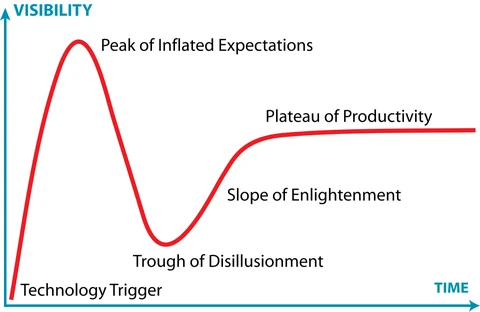 or something like that. Yeah. And then there were a whole bunch of papers coming up where they were saying, you know, hey, maybe even more or less linear model were doing a good job.24The best known of these papers is "Deep-learning-based gene perturbation effect prediction does not yet outperform simple linear baselines" by Constantin Ahlmann-Eltze, Wolfgang Huber and Simon Anders (Nature Methods, 2025). Five foundation models and two other neural networks failed to beat deliberately simple baselines: "no change" and an additive model that sums the effects of single perturbations (Nature Methods). And actually in our scGen paper early on, we had already some of these benchmarks showing you that it's not so super easy and simple tasks to improve on that.
I think there's a truth to it that particularly in the current data state, for some things, let's say you want to predict the effect of a CRISPR in a cell and you might not need the most fancy model. Whereas if you ask a bit or if you want to predict a cell type or something like that, you know, for that, mostly logistic regression is fine. But if you want to predict something a bit more difficult, for example, in our Nicheformer25Nicheformer is a foundation model from Theis's lab trained on both dissociated single-cell data and spatial data, where each cell's location in the tissue is known. Its SpatialCorpus-110M contains more than 110 million human and mouse cells. paper, which is a foundation model for spatial omics, we showed we had a new task which we introduced where you say you have the gene expression, you have sort of this state and latent space of a single cell, can you predict the gene expression state of its neighboring cells?
Because, you know, they're always in communication, or maybe the other way around. So like they're always in communication. So because you know they talk to each other, you sort of see a remnant of that sort of cell state in this one. And actually this is harder to do. And if you sort of have these harder tasks, you need these stronger, more non-linear things, and you particularly need to look for more subtle data. So your question, can you sort of find out more sort of information, rich type of things, I think very much depends on what you sort of ask at the end of it.
Of course, like in the self-supervised learning phase, I think we're definitely not there yet with the best way how we represent, how we learn these things. There's a lot of copying of what happens in NLP type of LLMs, right? And like masked autoencoders,26A masked autoencoder learns by reconstructing a hidden part of its input, the way BERT guesses masked words in a sentence. Single-cell models such as Geneformer and scGPT hide some of a cell's genes and ask the model to predict them. so was the typical way to go. But the type of losses, the type of representations I think people are still debating, maybe because you know this is sort of often kind of tabular data. So even just like tabular foundation models27Tabular foundation models are pretrained on many tables so they can predict on a new one right away, without lengthy training; the best known is TabPFN (Nature, 2025). Single-cell data is a table too: rows are cells, columns are genes. are now sort of being tried out.
There's a lot of JEPA28JEPA is an architecture Yann LeCun proposed in 2022: the model learns to predict not the hidden data itself but its abstract representation. Unlike a masked autoencoder, it doesn't have to reconstruct the value of every gene. type of approaches now because it's like we have one thing where we use contrastive learning. So just people playing around with the losses, but also with the representations. And I think nowadays reviewers, and at least I've been advocating this for a long time, are really much more closer looking that you really properly show scaling laws.29Scaling laws are power-law relationships between model quality and the amount of data, parameters and compute; for language models they were described in 2020 by OpenAI researchers led by Jared Kaplan. Theis wants the same proof in biology: that a model really gets better with every additional million cells. This was what has missed from the early papers of the foundation models. And so people haven't really shown that you need this complexity to actually sort of really scale up. But if you go really, if you can really demonstrate at scale, like across examples and samples that you have this sort of scaling behavior, then I think you have this buying into these models.
And for these, of course, there's not so much at least inductive biases in these uses. And so I do think we're gonna hit this regime actually quite soon, and we do see this also in a few papers. So for example, in our contrastive learning paper, we call it scConcept,30scConcept is a model from Theis's lab (bioRxiv preprint, October 2025): a transformer trained contrastively, pulling together representations of several "views" of the same cell and pushing apart those of different cells. The preprint's corpus is over 30 million cells. For its successor, scConceptX, the NeurIPS 2026 abstract gives slightly different numbers than Theis: 360 million cells from 16 species and 200 million parameters, perhaps already the next version of the model (bioRxiv, NeurIPS). we do show already quite strong scaling behavior. In the paper, we had something for going because we compared with Geneformer31Geneformer (Theodoris et al., Nature, 2023) is one of the first single-cell foundation models, pretrained on about 30 million transcriptomes (the Genecorpus-30M corpus). That is why the comparison with it was run at 30 million cells. going to maybe 30 million cells, but on Hugging Face now we have a 350 million cell model with, I think, going up to maybe 100 million parameters, so really going to the big scale for us. And we do see nice scaling behavior already starting to emerge.
Just to be clear, then at a hundred million parameters and you said I think 300 million cells or something like that, that you get a lift in what kinds of applications in these sort of the Nicheformer kinds of questions where you're saying, what is my environment based on the my transcriptome?
Yeah, I mean, you know, the ultimate thing, of course, we want to do is we want to be doing this perturbation prediction better, because that's sort of what people nowadays understand by virtual cell, right? And for this, I would not claim that pure representation learning is the right way to go. Sorry for making the subtlety again, but I think typically you learn the state space with these foundation models, but then sort of the way how they behave under an action, under perturbation, this is where you need this more world model-like type of approaches.32A world model predicts the next state of an environment from its current state and an action; robots and game-playing agents are trained this way. Theis carries the idea over to the cell: the state is its transcriptome, the action is a perturbation. World model being the very hip term, I'm sure you had this already at some point in your podcast, so it's been on all over machine learning conferences in last year, but de facto a perturbation prediction model like a virtual cell is kind of a world model in terms of transcriptome or other type of omics space, right?
So it's not just a model that is sort of f of x, but f of x, comma a, right? So the state X plus the action, right? And then sort of predicting the next state, X prime or something like that. And I think for this, you might need other combinations. So what we typically do, we learn the representations with, for example, scConcept, but then we put a generative model for the push forward33Push forward is a measure-theory term for carrying a distribution through a map. The model moves not a single cell but the whole cloud of control cells to where they end up after the perturbation. along the action. So for this we use something like flow matching34Flow matching is a way to train generative models (Yaron Lipman and colleagues, 2022): a network learns a vector field that smoothly transports one distribution into another. Here those are the distributions of cells before and after a perturbation. or something like that.
And in our CellFlow35CellFlow is a flow-matching model from Theis's lab (Klein et al., bioRxiv preprint, 2025): it transports control cells to perturbed cells and encodes the conditions, such as drugs, knockouts, their combinations and cell type, into a shared vector (bioRxiv). paper, this is not just got accepted for Nature Methods. We actually really show that these approaches are much better generating the effect of perturbations, but they're very much dependent on a good latent space. And you know, on this scConcept latent space, in this case, for these 350 million cells, we actually went into multi-species. So you have now like 16 different species where you can potentially look for similarities. Suddenly, here you can maybe ask some evolutionary questions that you couldn't before. Not that we can do this so well, it's not our core expertise, but you know, sort of you can start doing these fancy sort of cross-species, cross-tissue type of latent spaces.
05Do your baselines first
Theis traces the linear-model story to sloppy baselines and metrics, and says the real winner of the Arc competition, once metric exploitation is removed, was nonlinear.
I'm kind of curious about the history of some of these different models. I think you just gave us a sort of a rapid version of them. One of the things that like I think was like somewhat famous in the community was this thing about linear models being kind of a big point. Can you explain specifically what was the like key point here? Because I think this is like one of those things in classic machine learning, make sure you always understand your baselines well. You know, otherwise you spend a lot of time spinning your wheels and fool yourself.
I think there was specifically a famous open competition through the Arc Institute36This is the Virtual Cell Challenge, an open competition run by Arc Institute in 2025: models predicted how gene expression changes after individual genes are knocked down. Entries were scored on three metrics (DES, PDS and MAE), the winners were announced at NeurIPS in December 2025, and more than 300 teams submitted final entries (Hugging Face). Arc is a nonprofit biomedical institute in Palo Alto founded in 2021 by Patrick Collison, Silvana Konermann and Patrick Hsu. that was a sort of a glass of like cold water on everyone's you know faces. Can you maybe give a little bit of history about that and like why we thought this was exciting and then where why this had us pivot a bit?
It sounds like such an obvious learning, right? Do your baselines properly, but in a field that is rushing towards the gold part of the virtual cell, people sometimes maybe were not as careful with the baselines. And there's a whole bunch of subtleties with respect to holdout and so on that, you know, wasn't always fully observed and why some of these things happen. So one of the first observations there was in a thing as basic as cell type prediction, okay? So nothing super fancy.
Okay? Basically you give me a new transcriptome, tell me from which cell type it is, right? Maybe even from which organ or something like that. And it turns out that even nowadays, I think some close to state of the art models are really just logistic regression, right? So for such a simple categorization, you know, this is actually not so bad. There's one thing called CellTypist,37CellTypist is an automated cell type annotation tool from Sarah Teichmann's lab at the Wellcome Sanger Institute (Science, 2022). At its core is logistic regression trained on immune cells from many tissues. for example, which is doing a good job.
And I think we had a paper maybe five or six years ago where we had the title very plain, deep learning is not needed for cell type prediction.38This is probably the preprint "Deep learning does not outperform classical machine learning for cell-type annotation" (bioRxiv, 2019): for cell type annotation, neural networks did not beat logistic regression or support vector machines (bioRxiv). This is true if it's within an organ. If you sort of go cross-organs, suddenly it gets a bit more subtle because, you know, sort of cell types reoccur in different organs and immune cells sort of subtle change depending which tissue they are. Suddenly, you know, there you need to do a bit more. And we like for us, there was one paper called scTab,39scTab is a model from Theis's lab (Fischer et al., Nature Communications, 2024) for cell type annotation across many tissues at once. The authors showed that here a nonlinear model beats linear ones and that quality grows with both data size and model size. like a tabular foundation model, a predictive model type of thing. We actually showed that this non-linearity was really adding beyond the baseline.
So that was sort of for that class. For the perturbation models, which then you were asking Brandon similarly, like early on, many analyses, particularly Perturb-seq, were done with classical linear models in pseudobulk.40A pseudobulk profile sums all cells from one sample or condition as if the RNA had been measured in bulk. This lets single-cell data be analyzed with ordinary linear models, but the differences between cells are lost. We had then our scGen that was like something around 2019, where we started introducing linear shifts, but in the latent space, so sort of non-linear encoded and we always compared with subtle, sort of simpler linear shifts. But then the field getting complex and, you know, sort of data sets popping up, people started asking more and more perturbation type of questions. There have been a whole bunch of these early on competition for like a regular one run, for example, by MIT. We've been running a regular NeurIPS competition41These competitions are run by Open Problems in Single-Cell Analysis, a community for open benchmarking of single-cell methods in which Theis's lab takes part; he names it a little later. At NeurIPS 2021 the task was multimodal data integration; in 2023, on Kaggle, it was predicting blood cells' responses to drugs. on prediction problems in single cell data, sometimes for integration data, also for perturbation prediction.
That was very well attended. And the cherry on the cake was most definitely that Arc competition which called the thing not just perturbation prediction challenge, but Virtual Cell Challenge. to sound a bit cooler, right? We picked up very well, and but with metrics that are robust were maybe but maybe not that easy. So for actually our solution in this consortium where a lot of labs contributed called Open Problems was actually that people need to submit their own metrics in addition, so in order to really quantify maybe subtle things that you might not have thought before.
The Arc one sort of fixed a bunch of metrics that weren't even so single cell specific and they could be just exploited. So actually I think the winning model that was then in the end actually sort of crowned as the actual winning model, but essentially it's a flow matching based thing. So based on this idea that you know people put forward with this flow, with this CellFlow type of idea, I think shows you that some nonlinear things are in this case needed. So that the actual real winner, so if you sort of remove the exploitation was actually something that is this is taking some non-linearities. And I think nowadays we do see that just linear or additive type of models are not cutting the cake for more complex things, but for I think even nowadays, if you go in a simple few cell lines and you have sort of gene knockouts, then particularly when the effects are a bit subtle, all these sort of more complex models are sometimes a bit overfitting, and that's why linear baseline is always very good.
So I always tell my students, guys, I know we are we are guys, I mean guys and girls, we always need to do, I know you want to do the most fancy deep learning thing, but please, please, you know, have the baseline. And like say for drugs, you know, a baseline as simple as just predicting getting better at the mean, You know, like that's like the hardest base, like not even linear model, like better than the mean. Sometimes not as hard if there's so much noise in the data. And this stuff is super noisy.
I just wanted to add one point that Bo Wang42Bo Wang is a Toronto-based researcher in AI for biomedicine and a co-author of the single-cell foundation model scGPT. RJ probably means the paper he co-authored, "Diversity by Design" (ICML 2025): metrics computed relative to control cells reward a model for an averaged answer, which is why simple baselines looked stronger (arXiv). and some of his collaborators actually just had a Nature paper on how the metric was actually the problem in some of the those linear baselines beating some of the models as well. So it's clearly it's not only metric hacking, but also just that the asking the wrong question leads to the wrong answer.
Or choice of the metric. Yeah, and I think that you can discuss it. At some point we're gonna have agents sort of trying out all kinds of combinations of whatever algorithmic thing you can come up with. In fact, we actually do have some collaborations with some of those sort of AutoML43AutoML automates the search over architectures, hyperparameters and the whole machine learning pipeline: the machine, not the researcher, tries out the variants. type labs to try this out. So maybe what is left sounds a bit too harsh, right? But like, boy, maybe our biggest ideas go into it is actually this metric formulation, RJ, right?
06Helmholtz and German startups
Theis describes the Helmholtz Association as a federally funded research network somewhat like NIH, and argues that Germany is good at starting companies but falls behind at scaling them.
So one thing I've been really interested in is the different models of funding and research academia. I think Germany has a different structure fundamentally from the US. How is your institution set up and like how does this give like distinct opportunities versus like a US-based research model?
I very much agree that these funding models very much matter for the flexibility, but also the set of teams that you can set up and like the long-term vision that you can have. So Helmholtz,44The Helmholtz Association comprises 18 research centers across Germany, including Helmholtz Munich, where Theis works. About 90% of its core funding comes from the federal government, the rest from the states. this is not just Germany, but I would say maybe Europe's largest what's called research organization in terms of funding. It has different set of areas that it focuses on, health being one of the big ones, but then it has sort of material, information, sciences, physics, and so on. And it's essentially getting federal money to put into a deep research question. I've been building up what's called the Computational Health Center at Helmholtz Munich, which I think has now something like maybe 45 group leaders, professors, and maybe 500 to 600 people now. So we are, I think, the largest academic place for health AI type of research in Europe where we have people really working on all scales.
Like, you know, I'm sort of focusing on the cellular scale, but you know, there's people doing DNA foundation models, there's people sort of doing interesting things on protein design. There's people doing like, you know, patient cohort type of representation, genetics and so on. And now you sort of can start putting them together. And one of our big visions is sort of to intersect and sort of go virtual human and so on. But having said that, the key thing is in contrast to universities that even though we all have affiliation to universities, mostly to the Technical University or the University of Munich,45The Technical University of Munich (TUM), where Theis holds the chair of Mathematical Modelling of Biological Systems, and Ludwig Maximilian University of Munich (LMU). the two top-ranked universities, interestingly, in the European Union. So we have this sort of place where we have these affiliations at universities, right?
But we don't have undergraduate teaching. We essentially just have PhD students and postdocs, but we interact very much with the universities and in particular also the clinics because you want to have sort of this translational thing in there. And increasingly, and that's maybe an interesting link so this is maybe a bit similar to NIH46The US National Institutes of Health not only award grants but also run their own labs, mostly on the Bethesda campus outside Washington. Helmholtz centers work similarly, only spread across Germany. type of models, like in US, but sort of distributed all over the country, not just sort of in one place. And maybe the one interesting link is that increasingly the government and this sort of realization also in Germany is sort of dawning that there needs to be much stronger transfer component, not just by going into translation to universities, but also into sort of value creation outside of the academic realm, which is obviously going so more more into startups and so on, which I think the Boston environment has always been one of the key examples, but now of course, more so now also the Bay Area when, you know, recently I was visiting, I believe maybe Genentech or colleagues and we went to a restaurant and then one of the waiters was asking us, hey, are you guys talking about AI and bio?
You know, I have been also interested. So like everyone's sort of thinking about this startup ideas and so on, and I kind of felt that it's a good environment. And this is something I think our PhDs are now more and more doing and we're sort of learning there. And I think also in terms of sort of value creation, Munich in particular is actually, at least in continental Europe maybe the prime place now for VC capital, but also sort of deep tech, particularly the bio and defense area, sort of really exploding. So this stuff starts to work.
One thing, the thing we're talking about startup, I think, is really fascinating. I've heard that Germany has had some issues with their startup ecosystem. It's difficult to create a startup there compared to even other places in Europe. How like, what is the competitive landscape for startups right now in Germany and specific and how does Germany become more competitive broadly? I have a vested interest in this because I'm probably gonna get my German citizenship soon.
Welcome. Let me know if you come by Munich. So I think traditionally Europe, but I would say definitely Germany is quite bureaucratic and processes are far from as digital as you would expect in different places. Not that I'm saying that US is maybe the best example for fully digitized processes, but stuff is definitely faster. The thing is people have realized that now and I think the particular startup creation and implementation is, I think, more than competitive in Germany versus Europe. It's actually sort of the prime number and in particular like some hotspots, Berlin, but in particular Munich sort of the, I think, is the capital for an highest number of startups47Fact-checkMunich leads in new startups per capita, not in total: according to the German Startups Association (Startup-Verband), 19.3 startups per 100,000 residents were founded there in 2025, versus 16.8 in Berlin, but Berlin still leads in absolute numbers (Munich Startup). Munich is also home to the defense AI startup Helsing, valued at €12 billion in summer 2025. and I think even nowadays if you look into European Union there's equally as many startups being created as in US.
The thing is where Europe and particularly also Germany drops off is at the scaling part. So you know, early VC and also sort of non-dilutive type of money,48Non-dilutive funding means grants, subsidies and prize money that founders get without giving up equity. In Germany, university spin-offs can tap the federal EXIST program; at the EU level there are EIC Accelerator grants of up to €2.5 million. this is there. But then when you go into scaling, these big VCs that sort of take these bigger risks are, I think, not closely as present. So I saw this again and again that, you know, if you want to sort of really go into the sort of bigger tickets, sort of series A and so on, series B, people start going more into US also for that. But maybe I'm sort of bit simplifying here, but this is at least my current learning, Brandon.
Okay. You are on the board or I guess part of several local startups, right? What does it take to go from, you know, idea to creating a new startup in Germany?
I don't know if you heard that the European Union tries to regulate a whole bunch of stuff and that can be sometimes an advantage. You know, it's kind of cool, like you know, all across Europe we can now go with a mobile phone. You might have heard that everyone needs to have USB-C things now for their mobile phones. These are kind of cool stuff. So there's some good stuff coming. But then of course there's something like things like the AI Act49The EU AI Act entered into force on August 1, 2024, and is being phased in; requirements depend on a system's risk level, and AI-based medical devices count as high-risk. Systems and models developed solely for scientific research are exempt, which is why Theis says research has been lucky "not yet" to be affected. and so on that make things a tad more complicated.
Luckily not yet for research, but you know, for data access across hospitals and so on, there's some, you know, and we were talking about health, deep tech type of stuff, right? So there's some systems that, I think, fantastic in Europe. And I'm thinking about Finland, you know, FinnGen50FinnGen is a Finnish research project launched in 2017 that links the genomes of 500,000 biobank participants to national health registries recording every resident's diagnoses, hospital stays and prescriptions over decades. In Denmark such registries have been linked through the unique CPR personal number since 1968. and Denmark and so on with this sort of very detailed description of the population in terms of sampling, getting medical records connected, far better than, I mean, US is also similar to a mess like Germany in terms of sort of getting all the systems sort of to talk to each other. Like when patients, you know, sort of go to different states in US is similar as in Germany when they go to different places, it's like very hard to build patient trajectories, right?
But there are some places that know how to do this, and there's a thing like the European Union tells you, it's called the European Health Data Space,51The European Health Data Space is an EU regulation that entered into force in March 2025. From 2029, patients will be able to share a summary health record and e-prescriptions with doctors in other EU countries, and researchers will be able to request anonymized data through national access bodies; imaging, lab results and discharge reports are to follow by 2031. where like maybe next two years, these things need to be sort of going across boundaries. You need to sort of start building these health record type of combinations. So I do think the visions are starting to happen, but the scale is not as fast. So I think what you need for a tech startup, what I noticed is always the biggest thing is you need to have the best team for that. And you know, we have professors and PIs that really think about this. So for example, for the department that I called it, I said, guys, every PI, every group leader would expect you at least to have one spin-off in the next three years.
Let's see how that works, right? But you sort of need to sort of get people a bit on that track. But I think this is happening very much from the bottom up nowadays, anyway, where the students are actually pushing for that. They do realize that there's a whole bunch of opportunities at the moment, particularly with this sort of computational angle getting, yeah, I would say pushed even more on the forefront that we can now start actually guiding experiments. We haven't really spoken so much about it, right? But once you have these perturbation world models, you can actually go back and drive the experiments, right?
So I do think computational startups can be very good also data generation. And I think this is what will be also turned not just into nice papers, which is sort of mostly our business, but also I think in this next generation of startups. And you do see a few of these popping up where you actually get the lab in the loop really implemented.
07Where the money is in the virtual cell
A virtual-cell platform on its own is not yet a business, Theis says: companies either pivot to drug development or win by pairing the model with unique data.
What do you see as some of the most promising areas for commercialization of sort of these virtual cell adjacent ideas?
It's interesting, right? Like if you looked at earlier, and of course this is what people always reflect to, what OpenAI, Anthropic, and so on wanted to do, like they didn't really know how to make money.52The textbook example is Sam Altman in 2019: OpenAI had no plans for revenue and no idea how it would make money; once it built general AI, it would ask the AI to figure out how to give investors a return. And some people might argue they don't even know nowadays, right? And there's a few startups that, you know, got really quite strong investment that also said we build a foundation model of biology, we decode biology and so on, without actually saying what you want to do with it. And I've been seeing this again and again that these platform type of ideas are super attractive. You know, they sort of fit into what we know.
I mean you spoke about some of the tools and platforms that we build like Scanpy and scverse and so on, right? But turning this actually into a monetary thing is not as obvious. I mean there might be some sort of consulting business, but if you say you build a virtual cell platform, typically what investors understand, and this is maybe even more so in the more conservative VC ecosystem in Europe than in US, is that at some point you develop a drug and then you know it's a clear thing.
So I saw so many of these platform companies pivoting at some point to we make a drug and yeah decide of course we have our sort of virtual cell, whatever business, but you know, we have two drugs that we found and now this so if we put a lot of money in, maybe you have some other counting sums and there's a few companies that sort of still stick with the scaling up of the AI business, but it's not as clear how you would sort of directly turn this into a viable, sort of really scalable business model. And if there's even room for many of these, and of course then there's also this angst that at some point like Astra 2.053What Theis means by Astra 2.0 is unclear from the recording. It may be GPT-6 Astra, OpenAI's flagship model released in September 2026, and its future versions. The fear is that general-purpose models will take over part of the work virtual cells are being built for. might be doing parts of this already anyway. Yeah.
Yeah, I mean, I think that it's actually this has been a thesis of mine that up until recently every single company that builds a model and builds a something ends up just building drugs because that's the path to monetization over time, right? And that like whereas you have to like land sales with pharma that's very difficult or some other big pocket spender if you're a tools company, if you say, I'm going to build a port, like an asset54In biotech an asset is a drug candidate together with the rights to it. It can be licensed or sold outright to pharma, which makes it easier for investors to understand than revenue from selling tools. and then I can sell that off. That's really attractive to an investor. But we've seen actually the opposite happening this year, right? So you have like you have in structural, you have a couple, you have Boltz,55Boltz and Chai are examples of the "opposite" path: they sell models to pharma rather than drugs. Boltz grew out of MIT research that produced the open structure models Boltz-1 and Boltz-2; in January 2026 the company, set up as a public benefit corporation, raised a $28 million seed round with a16z participating and announced a collaboration with Pfizer. Chai Discovery's models have been bought or licensed by Eli Lilly, Pfizer and Novartis. you have Brandon will know them better, but there's a couple of those. And then Chai is one that we talked to, and then we've interviewed a few that are doing this, doing reinforcement learning environment plays56A reinforcement learning environment is a sandbox with a task and automatic grading where a model learns by trial and error. Since 2025 AI labs have been buying such environments from startups en masse to post-train their models. as well.
I would love to see the activity level in structure that we see in structural also doing things like what Noetik57Noetik doesn't buy data, it produces its own: its lab runs spatial transcriptomics, proteomics and histology on tumor samples from thousands of patients. In 2024 the company raised a $40 million Series A to expand this atlas. is doing.
I mean, I think Noetik is a good example in the sense that they also have, I think, a rather nice scale of data generation. And a big part of that is also access to data. So, you know, we talked before about these organoid perturbation type of things. And we've been setting up actually in collaboration with a whole bunch of pharma, a consortium which we call the Cancer Organoid Perturbation Atlas, where then pharma actually buys in because they want to get early access to some of these sort of perturbation type of data sets, right? And I think some of these deals sort of go in this direction. So I think if you couple it with data generation, not just with the modeling part, I think this is where a sweet spot hits where then also actually pharma gets buying.
I think more and more of the companies I see, they sort of build their moat not just around a virtual cell model, but in combination with sort of unique so specific data, this is then of course also more value creation.
08The Y model: two advisors per PhD student
At the Munich School for Data Science every PhD student has two advisors, one for methods and one for the domain, and Theis says that over eight years this brought his lab new topics and gave graduates an unusual profile.
I don't know if this is exactly correct, but I read that you said somewhere that you have your students follow what you, I think, call the Y model, in which you have to have a methods and a wet lab advisor. That sounds super interesting, super relevant to the conversation we're having right now about data being so important and all the attention on lab work and that being moat for a lot of companies. Can you talk a little bit about that?
Yeah, thanks for raising this. So I've been setting up and since then it's been sort of become quite a big thing what's called the Munich School for Data Science,58The Munich School for Data Science (MUDS) is a graduate school founded by Helmholtz Munich, the Technical University of Munich, LMU Munich, the Max Planck Institute for Plasma Physics and the German Aerospace Center; Theis was its coordinator, with a budget of €12 million over six years. Besides biomedicine it covers plasma physics, Earth observation and robotics, and every PhD project is proposed by two partners, one for methods and one from the domain (TUM). right? So this is beyond just bio. So we had a whole bunch of other disciplines. And there we had this supervisor model that is always two PIs needed to come together to make a proposal and sort of proposes to the students and a graduate student type of model, which has this Y. So there's like a methody, more domain one, right?
And then a supervisor student. And sometimes we had two students under the Y model, so Y plus Y equals H.59The joke is about letter shapes: the two arms of the Y are the two advisors, the stem is the student; two students under the same pair of advisors make an H. You get it? But I think this idea, it's somewhat even nowadays a bit trivial, right? But I thought it was good to bake this in so hard so that students really ideally go to two lab meetings, one lab meeting where they need to really sort of learn and understand some deeper biological problem, understand the language maybe of a medical setup or something like that. Then they go to a computational.
Typically they're all computation data science type of students, right? But then they go to the computational one and they sort of get to push the method aspect of it and thereby sucking up a whole bunch of problems that are sort of not exactly precisely formulated in that bio lab that sort of can't directly put yet in a function, but then because they are sort of methody, right, and they're quantitative, they can actually put this into a metric or whatever that then turns into a model and in a paper. And I think this is a way how, I mean, we've been doing this now for maybe eight years or so, this type of school, I really a whole bunch of papers came out where I learned about systems that I had no idea about this before, right?
You know, people approaching me, you know, could we do something like this? And then, you know, I learned something about the lung or the brain that, you know, I had no idea about. But then I said, oh, hey, cool data. I think our model types could fit. Let's build a project around it. And then those students became the experts in my lab for that sort of detailed biological thing together with a partner.
And then we drive this forward. And this actually nowadays extends also across the data types. Early on, a lot of things have been around just RNA, but, you know, since then, you know, we had a very nice paper in science last year on single cell proteomics.60This is the Science paper of August 2025 (first author Benjamin Furtwängler) that used protein and RNA measurements from single cells to trace how early blood cells mature in human bone marrow. Counting proteins in a single cell is harder than counting RNA: they can't be amplified like nucleic acids, so everything rests on the sensitivity of the mass spectrometer (Science). We've been extending things to spatial observations. You know, there's sort of all these additional modalities and things that you can measure. And I think then interesting questions come up in the particular domain where, you know, these assays work very well.
Yeah, I mean, this is my natural inclination is to like gathering cross-domain stuff. I think it's all often ripe for a good generation of really good and interesting ideas. Have you, just as a follow-up, these you've been doing this eight years now, I guess. So what kinds of, you know, sort of longer term outcome benefits have you seen from this?
I think one thing that this is also, I think, how we got students to even join in this, maybe initially, it sounds like more work, right? You kind of need to learn two things and you go to two lab meetings and so on. But I think once your students are done in Germany, Europe, I think in general, but I think in Europe in general, people sort of typically do a master's first before they go into a PhD, right? So not just a bachelor's in US, right? So you do like one or two years more of master. And then they sort of know science a little bit, but they don't exactly know what sort of interests them.
So in this combination type of thing, you know, they can sort of sample a bit because in this grad school they get different proposals and so they can sample a bit what they're interested in in terms of domain, but then they can also play around a bit with the method side. So I think that was kind of attractive. Yeah, I think with this sort of trying out different things, I had the impression that this sort of turned the students into very good data analysts, but then also modeling people. And then downstream, you know, the sort of areas where they went into was also equally diverse. You know, so some people went like now in the biomedical domain into pharma, but you know, some obviously data research, some went more into some sort of startup direction, some went into very pure AI type of work.
I think NVIDIA just a few months ago were hired in one month two of my people going very much into sort of the computation aspect and also a bit of a biopart that NVIDIA is now building up61NVIDIA's biology effort centers on BioNeMo, a platform for training and running models of proteins, DNA and cells. The company also builds computing infrastructure with pharma: in 2025 it announced a supercomputer for Eli Lilly. and there are similar other of the big companies. So I think it gives them an interesting profile. I think nowadays when you get interviewed, you know, it's a good idea to say, you know, I didn't only do like this fancy model that improved maybe 2% in a NeurIPS paper type of thing, but you also sort of had the real sort of more complex, deeper application that like, you know, I had to help find as a use case.
09Lab Compass: a model that picks the next experiment
Theis names the closed loop, where a model proposes the experiment, as the next frontier, and says the hardest part is not the model but a culture in which experimentalists trust it.
There's been a movement amongst agentic AI. Like several guests we've had or we've had a blog post about how the wet lab scientists have started basically becoming computational thanks to agentic AI. I don't know if this is — I'm kind of curious like as this evolves, as basically now agentic AI enables any scientist to be now become their own computational, what do you think the evolution of this sort of like co-advising strategy is? And also what do you think the evolution of like integration between wet lab biologists and computational teams are. I mean, I also can think of like I've heard several you know famous CEOs say things like, our strength is integration between computational and wet lab teams. So I'm curious to see how you think that evolves and how you also like set up culture to exploit, you know, these new technologies.
Let me maybe sort of keep the culture part a bit out because I think it's a hard one to answer, but a very good one. So let me first sort of talk about the, I think very cool point that I think you asked about where these things happen sort of goes with deep integration. I think one of the most exciting frontiers we currently face, and I think maybe have as an opportunity is we can really now start guiding the experimentation. So where before, you know, we built these human cell atlases, we had sort of this mapping aspect. Then we talked about the world models prediction problem, right? So from mapping we went to prediction.
But now we can go to actually steering the next experiment, right? And this has always been the scientific method, you know, sort of putting our hypothesis in the loop and then doing something with it. But quite frankly, very often the papers ended with some model, right? Maybe some sort of concept figure, maybe had a little bit validation. But then typically you start the next project, right? And of course you learn a bit, but it's not like a continual learning type of thing.
But now, you know, I think we can actually really loop back more and more. This is happening very much so in molecule design, or material design and so on, you know, sort of the lab in the loop is really working out. And even though some big pharma has been putting this out as sort of a general big theme,62Genentech, part of Roche, is the loudest proponent of the lab in the loop: its head of research, Aviv Regev, a co-founder of the Human Cell Atlas, made "lab in a loop" the motto of the company's research program. there's not many examples yet where really people do multiple loops of this integration of an experiment, a computation model, then going back, whether this is now two person or one, right? But like this integration is hard to set up and it's hard to set up once because of modeling because actually sort of once you have a model, actually deciding what's an optimal next question is not trivial.
ExplainerForward and inverse models
A forward world model answers the question "what happens to the cells if I do this": knock out a gene with CRISPR, add a drug, change the dose. The inverse question, "what do I need to do to get the cells into the state I want," matters more for experiments, but no lab can test every combination of genes, drugs and doses.
Lab Compass, as one of its authors describes it, couples a generative model of experimental plans with a forward model of the cells' response: the desired phenotype guides generation, while a learned prior keeps the plans within the plausible.
And we actually brought out, I think it should be on bioRxiv today or tomorrow a new thing which we call Lab Compass, which is an inverse generative model that actually allows you, once you have a forward world model or whatever, to tell you what you need to do in order to reach a certain state. So it's
super exciting for us, right? And I think a big part of the work was not just the model, but actually the work with experimental people. In this case, a good friend and colleague from University of Cambridge63The Lab Compass preprint Theis describes was done with the group of Berthold (Bertie) Göttgens at the Cambridge Stem Cell Institute. Göttgens is a professor of molecular hematology and the institute's director; his lab studies how blood stem cells choose their fate, combining experiments with single-cell genomics and computational models of blood formation (Cambridge Stem Cell Institute). who was doing hematopoiesis in addition had a sort of a rapid cycle system where we actually set up three, four lab in the loops where we iteratively improved on a model. And this is, I think, a really hard thing. And this sort of goes into your second question, Brandon, right? Like how do you bring up a culture where once your computational person or model or whatever predicts something, that you actually get to convince experimental people to put their lifetime in, because these experiments often take some time, right, to actually buy into and actually measure some of these follow-ups.
And sometimes, you know, this works a bit better if it's sort of molecules, because then, you know, so the stakes are not as high. But you know, if you like say, you know, you need to do this new cell and you need to add these very strange things, do you really want to do this? Like shouldn't we maybe not take a bit of our gut feeling and then you know this sort of these intermediate solutions come? So I think really setting this up is far from trivial. That needs culture, and it might be the same person doing it. A lot of people then start throwing around robotics64Theis means robotic self-driving labs, where robots run the experiments a model proposes. They are furthest along in chemistry and materials science: in 17 days of operation, the A-Lab at Lawrence Berkeley National Laboratory synthesized 41 of 58 targeted new compounds, according to a 2023 Nature paper (Nature). and so on as well, but I think this is a tad too early because the cycle times in terms of our assays are still a bit on the long side, but I do think this will come.
ExplainerFrom active learning to RL in the loop
In active learning, after each round the model picks the next experiments itself, the ones whose results would most reduce its uncertainty; the lab runs them and the data goes back into training. That is how Theis's current loop works: three or four rounds, each time the model proposes and the experimentalists test. Reinforcement learning goes further: the model is an agent that plans whole chains of experiments to earn a reward (say, producing a cell of the desired type), and the lab becomes its environment. The obstacle is cycle time: a cell experiment takes days or weeks, while RL needs thousands of attempts.
And you know, obviously the ultimate vision being that we want to RL everything. We want to do RL also in this loop. It's a bit out there, but you know I think we're slowly getting that. The moment it's more maybe active learning.
I think that very much like we talked to Lila,65Lila Sciences is a startup founded in 2023 by Flagship Pioneering, the firm that created Moderna. It is building "scientific superintelligence" in autonomous "AI Science Factories": models generate hypotheses, robots run experiments, and the results feed back into training. In July 2026 RJ and Brandon recorded an episode with its CTO Andy Beam and Rafa Gómez-Bombarelli, "The Lab of the Future Should Feel Like a Data Center" (Latent Space; Fierce Biotech). that is their kind of their core thesis is that basically the lab is part of the RL environment.66Lila's thesis is that a real lab can serve as the reinforcement learning environment: the instruments are the model's tools and the reward is the experimental outcome. Kind of sort of yeah. No, that's great, Fabian, it is late at night for you now. I really appreciate you taking the time out of your evening to talk to us. Look forward to watching your research. And when I say you, I mean your lab and colleagues and you as well. I really look forward to watching this progress and keeping careful track of the things that we talked about today.
Yeah, thanks so much, RJ, Brandon, for having me. I think these links are important, this sort of looking beyond what maybe you do like in your own sort of smaller disciplines. And these discussions helped me a lot. I really enjoyed the discussion. Had a lot of fun.
Thanks. Great. Thanks. Take care. Thank you.


