

Latent Space
Chapters
Ball explains that an S-1 is a routine filing and an IPO is “a fundraise on steroids,” and rumor has Anthropic raising $75–100 billion in it.
Read the chapter- Clouded Judgement has run for six and a half years and has close to 100,000 subscribers, and Ball has missed one Friday in that time; swyx puts him in a line of VC bloggers after Fred Wilson and Tomasz Tunguz, Ball’s former colleague at Redpoint.
- Ball discloses that Altimeter has a big position in Anthropic and that he speaks for himself, not for the firm.
- After the S-1 is filed there are about 15 days before the roadshow and then a week and a half of pitching investors, so trading should start in mid-to-late November, before the dead zone between Thanksgiving and Christmas.
- swyx brings up Bill Gurley’s view that if a stock pops 50% on day one, the company could have sold its shares higher and taken less dilution.
- Companies used to float 10–15% of themselves in an IPO, and Ball says bigger companies may now float less.
Ball thinks the main reason is not equity, which private companies can now raise in huge amounts, but debt: a public company finds it easier to get a credit rating and borrow more cheaply.
Read the chapter- Employee liquidity and an acquisition currency matter less, because stock in OpenAI, Anthropic and Databricks is already viewed almost as cash and tenders happen regularly.
- Raising $100 million used to require an IPO; now, Ball says, “you sneeze and raise a series A,” and OpenAI raised a round of about $120–130 billion.
- Lenders to the neoclouds that build data centers for Anthropic underwrite Anthropic itself and want full “open kimono” financials; SpaceX, Ball notes, got rated very quickly after going public.
- The labs’ leadership wants everyday Americans, not just accredited investors, to share in the upside, and swyx warns of social unrest if they don’t.
- Rates are rising: many data center debt deals, Ball says, now get done above 10%.
The S-1’s biggest surprise for Ball is profitability: revenue per dollar of compute grew so fast that Anthropic turned cash positive far earlier than software companies usually do.
Read the chapter- The S-1 shows 85% gross margins, over 20% free cash flow margins and 8% GAAP operating margins; Anthropic has raised $141 billion and holds $134 billion, so its lifetime burn is about $7 billion.
- Only 27% of compute goes to serving models; over a year that spend grew 2.3x while revenue grew 14x, which Ball reads as a 7x gain in inference efficiency: a megawatt now brings in $70–100 million instead of $10–15 million.
- The free cash flow margin went from negative 4,000% to 21% in the latest quarter, and Ball expects it to dip negative again once Anthropic starts investing in compute.
- Even counting stock-based compensation, free cash flow stays at about 8% of revenue by Ball’s math, and swyx says that never happens at a software IPO.
Ball sees a lot of room to grow: big companies spend a fraction of a percent on Anthropic, and almost all of its revenue comes from the newest models.
Read the chapter- Half of the Fortune 500 uses Anthropic, but those companies spend 0.1% of their expenses on it; John Collison, Ball recalls, expects tokens to go from 1% of Stripe’s expenses to 15–20%.
- swyx suggests tracking token spend against spend on knowledge workers: the median AI company is at 50%, and a person at Anthropic uses 10x more in tokens than in salary.
- In the three months ending in September, 80% of Anthropic’s revenue came from models six months old or younger, and Ball expects frontier models to take most of the dollars and open weight models most of the tokens.
Ball thinks revenue will more than cover the compute commitments, and swyx adds that the labs would sign up for a trillion if they could.
Read the chapter- Annualized, the question is not $855 billion but whether Anthropic can pay about $100 billion a year, and part of the payments is back weighted.
- If Anthropic doubled the share of compute that serves revenue from today’s 25%, Ball says, it could in theory double revenue without adding capacity; its compute margin has already climbed well past 50%.
- swyx says to wait for OpenAI’s S-1, since OpenAI is now buying TPUs, and Ball lists OpenAI’s Jalapeño chip, Anthropic’s own chip team and the hyperscalers’ chips.
- Building data centers in the US is getting harder because of noise, water, power bills and fear of AI, Ball says, but with no “dark GPUs” there will be no bubble, and the world will stay compute constrained for longer than it thinks.
Asked whether the 7x gain was a one-off, Ball answers that the frontier keeps accelerating and that, by the Jevons paradox, cheaper tasks only grow the market.
Read the chapter- swyx suspects it was a one-time optimization of the inference stack, which has a physical limit.
- Ball shows Mark Chen’s chart: the internal OpenAI model that solved Navier–Stokes is far stronger than the released Astra, so in his view the gap between open weight models and the frontier is wider than it seems.
- The cost of completing the same task falls 25–40% with each Anthropic model family, from Fable and Opus to Fable 5.1 and Opus 5.5.
- S3 and EC2 prices have fallen 99% since launch while the clouds grew exponentially: Google Cloud, Ball says, is growing over 100%, Azure almost 50% and AWS 39%.
- swyx recalls that his hedge fund was not long Amazon, out of worry about AWS margins, on the day Amazon broke out AWS.
For Ball everything comes down to one question, whether Anthropic stays at the frontier, and its summer revenue slump shows what happens without a leading model.
Read the chapter- The IPO price can’t be called in advance: stocks also move on market beta, and had Anthropic gone public a month earlier, the recent rout in semis and the AI trade would have hit it too.
- Ball puts no weight on trackers of private shares, but Ramp data shows spending on Anthropic reaccelerating with the release of Opus 5.5.
- Over the summer, when Astra, Google’s models and the open Kimi K3, GLM and DeepSeek came out, spending on everything other than Opus 5.5 and Sonnet 5.5 halved or more in two to three months.
- swyx notes that the labs are building up reserves of unreleased models again and could release a new Fable the day before the IPO; Ball points to safety and alignment as reasons for the delays.
Ball says AI has collapsed the time between discovering a vulnerability and exploiting it to zero, so a patch has to ship the moment the vulnerability is announced.
Read the chapter- The PHP vulnerability found through Patch the Planet, Ball says, came from a model that wasn’t frontier; swyx specifies that it was GPT-5.6 Sol.
- Attackers use powerful open weight models too, and Ball reads OpenAI’s announcement as hinting at vulnerabilities more serious than one in PHP, which touches 70% of the internet; swyx replies that “70% of the internet” is just a proxy for “old.”
- swyx jokes that nation-state hackers who sat on zero-days for ten years lose out, and spins a “Straussian” version in which a Saudi decoy puts a device behind a TV to draw attention away from the real spy.
Ball carries a lesson from semiconductors over to AI: the winner is not whoever made one strong model but whoever built a factory that turns out new ones every year.
Read the chapter- swyx says a billion-dollar model lasts six months, and a failed run like GPT-4.5 can wreck the ROI on the whole thing.
- A veteran chip investor, Ball recounts, held that a startup can build one competitive chip but not the machine that turns out a new one every year, and that is why NVIDIA is king.
- Smart people Ball cites say a neolab can’t trail the big labs by more than an order of magnitude of compute, and the big labs themselves are on a treadmill: if Anthropic stops, its revenue falls off.
- Anthropic has doubled its compute spend on building models and grown revenue 14x, and Ball, calling himself hyper optimistic, doesn’t see what would stop the trend; OpenAI, meanwhile, is going after the low end with cheap Luna models.
Ball calls Anthropic’s focus a “compute innovator’s dilemma”: there is only enough capacity for the most lucrative work, coding, and other areas are left to startups.
Read the chapter- swyx lists what Anthropic doesn’t have: a decision model, a standalone voice API, images, while OpenAI tries everything and shuts down Sora and Gemini explores everything.
- Coding generalizes best, in Ball’s view: when he uses Claude Code he isn’t coding, and both labs are already pushing into life sciences and drug discovery.
- The labs’ soft underbelly is visual reasoning, where Elorian works, and decision models like Jev: you don’t need a Ferrari engine to drive to the grocery store when a Toyota will do.
- Altimeter barbells, investing early and late, because the best founders need late-stage capabilities early on, and companies grow so fast that the CFO may have to be hired almost before incorporation.
Ball expects Anthropic and OpenAI to move into vertical applications, while swyx so far sees no serious intent from Anthropic to do it.
Read the chapter- Ball once had a hypothesis that the labs would stop releasing models and build applications on their best unreleased ones, crushing the likes of Harvey or Cursor.
- That is why leading application companies are in-housing their models, Ball says, and he only invests where strong product and research teams improve each other.
- In swyx’s thesis, model labs revere the model and AGI while agent labs revere the customer, and both have a market.
- swyx notes that Claude Design is a tab inside Claude, Claude legal is a set of markdown files, and a $2 trillion company has three SKUs; Ball puts it down to sales inertia and the ability to focus, since OpenAI competes with NVIDIA, Google, Meta and Anthropic all at once.
Ball takes on two debates around the S-1 and shows that the $108 billion of “debt” on the balance sheet and the $80 billion net loss are the revaluation of convertible notes that Amazon and Google got at an old valuation.
Read the chapter- Strategic investors, Ball guesses, took notes to stay under ownership thresholds that would force them to report Anthropic’s losses, and Anthropic may not have wanted to give them voting shares.
- The notes totaled about $11 billion: $5 billion has already converted to equity, and the remaining $6 billion is worth $108 billion at market value; the $11 billion is already part of the $141 billion raised.
- Since the liability went up and assets didn’t, equity, retained earnings and net income have to go down: of the $81 billion loss in the first half, $72 billion comes from the notes for AWS and Google and $9 billion from SAFEs and other notes.
- Had Anthropic simply sold equity, the loss wouldn’t exist, and it goes away once the notes convert; nobody handed out discounted shares, Ball says, since the money was raised years ago.
A profitable Anthropic, in Ball’s view, gives the whole industry confidence: as long as the revenue shows up, the compute obligations will be met and supply chains will stay saturated.
Read the chapter- Ball calls himself a student of finance and says a doomy S-1 would have given everyone downstream a lot to worry about.
- swyx points out that 48% of revenue comes through cloud partners and that sales and marketing cost $3 billion; Ball replies that the cloud rev share is booked in sales and marketing and gross margin is rising anyway.
- Both find forward projections too hard, and swyx wants an analyst to work out the physical limits, such as inference efficiency, pricing and locked-in GPUs, rather than drag past performance to the right in a spreadsheet.
Big GPU debt deals aren’t getting done right now, Ball says: lenders look through the neoclouds to Anthropic and OpenAI and are “feeling full” of their risk.
Read the chapter- Building is limited not only by chips from NVIDIA, Cerebras and TPUs but also by land, power and permitted shells.
- A project can be delayed by supply, the developer or local pickets while the interest is already due; credit default swaps are getting more expensive, and lenders find it harder to take on new risk.
- Anthropic and OpenAI, Ball thinks, are happy for neoclouds to take the balance sheet risk: a balance sheet business is cyclical, like the fintechs that blew up when rates rose after 2020.
- If OpenAI and Anthropic each grow to 30 GW over five years and that is 40% of all capacity, Ball’s napkin math gives about 100 GW at $50 billion each: $5 trillion, roughly a trillion a year and 5% of GDP.
- Big models keep growing, and Kimi K3 needs a whole rack to serve, while swyx says the size of open models is capped by the memory of current GPUs and will grow with Vera Rubin.
In an uncertain world Ball falls back on his core beliefs, that the world will consume more models, power, compute, networking and storage and will need many more data centers, and looks for businesses that follow directly from them.
Read the chapter- Among his recent bets he names a chip company still in stealth, American Terawatt with its industrial power grid, Elorian and Glimpse.
- swyx talks about compute trading: raising GPU utilization from 30–40% to 60% is the same as doubling the number of GPUs.
- In Altimeter’s triangle, apps have the biggest TAM in a mature market and hardware and infrastructure early in the cycle; swyx notes that the biggest app-layer outcome, Cursor, is worth $60 billion, while Anthropic is worth $2 trillion.
Ball’s favorite Brad Gerstner story is his years of work on Invest America, which grew into government investment accounts for newborns.
Read the chapter- Ball has worked with Brad for six years and met swyx back at Redpoint, when swyx was at Netlify.
- Every newborn gets $1,000 in the account at birth, and parents, employers and philanthropists can add to it: Michael Dell donated $6 billion, and Elon Musk, Ball says, pledged a share to every kid.
- Brad, Ball says, points to 529 plans, which mostly the wealthy use, and direct contributions to individual accounts skip the middlemen who, swyx says, eat up charity money.
- The main thing now is getting parents to claim the accounts; swyx adds that many people have unclaimed money sitting with the government, and Ball suggests handing the search to agents like Muse or Instinct.
Quotes
On inference efficiency
“A 7x increase in efficiency of serving tokens, if you were monetizing, you know, a megawatt at 10, 15 million dollars, now you're monetizing it at 70 to 100 million dollars.”
Jamin BallRead from 18:22On the compute shortage
“I think we're gonna be compute constrained for far longer than the world thinks.”
Jamin BallRead from 34:53On the chip factory
“It's very different to tape out a chip that is competitive with the leading chips at the time from building a machine that can continuously tape out chips…”
Jamin BallRead from 53:08On the labs’ treadmill
“If Anthropic stops, OpenAI and Gemini will continue and then… you'll see revenue fall off.”
Jamin BallRead from 55:20On cheaper models
“You don't need to drive the Ferrari engine to the grocery store. Hey, maybe… a Toyota will do just fine.”
Jamin BallRead from 1:00:49On building companies
“It's almost as hard as ever to build a good company and maybe more importantly to build a durable company, which is, I think, what everyone aspires to do.”
Jamin BallRead from 1:03:04On Anthropic’s loss
“If Anthropic never issued converts to Amazon and Google, just did straight equity, that loss wouldn't be there.”
Jamin BallRead from 1:14:59
Summary
Jamin Ball, a partner at Altimeter who writes the Clouded Judgement newsletter, walks swyx through Anthropic’s S-1 ahead of its IPO. The biggest surprise for him is a business that is almost accidentally profitable: over a year, revenue grew 14x while compute for serving models grew 2.3x, the free cash flow margin reached 21%, and the $108 billion of “debt” and $80 billion net loss in the filing are just the revaluation of Amazon’s and Google’s convertible notes. Everything, Ball argues, comes down to whether Anthropic stays at the frontier: if it does, revenue growth will cover $855 billion in compute commitments, and the compute crunch will last longer than the market thinks.
Advice
Measure profitability by whether your cash balance is going up or down: at the end of the day, cash is what counts.
Work out what you spend on tokens relative to what you spend on knowledge workers, and watch that ratio grow.
Don’t fixate on one number out of the 2,000 in a company’s filing: it’s easy to lose sight of the bigger picture.
When investing in an application company, check that its research team is as strong as its product team and that the two improve each other: without its own research, an app will struggle to survive over the long haul.
When forecasting an AI company’s revenue, work out the physical limits, such as inference efficiency, pricing and contracted GPU supply, instead of dragging past performance to the right in a spreadsheet.
Mentioned
 Claude Mythos00:00Ball says OpenAI and Anthropic have models far more powerful than the ones they’ve released; Mythos, which gives the episode its title, is such a model at Anthropic, open only to partners.
 Anthropic01:11the subject of the conversation: Ball goes through its S-1, its profitability, its compute commitments and the debates over its debt and loss.
 Substack01:18swyx recalls that he met Ball before Ball started his Substack.
- Clouded Judgement01:27Ball’s newsletter: swyx calls it one of the top ones, and Ball cites close to 100,000 subscribers and one missed Friday in six and a half years.
Show 87 more mentionsShow fewer mentions
- Fred Wilson02:42swyx names him, the author of AVC, as the go-to VC blogger of earlier days, and Ball as today’s “king of charts.”
- Tomasz Tunguz02:55next in swyx’s line of VC bloggers; Ball says Tunguz was a huge inspiration and they worked together at Redpoint for a long time.
- Redpoint Ventures03:03the firm where Ball worked with Tunguz; swyx jokingly asks whether it’s okay since everyone is leaving, and Ball says he owes everything he learned to it.
- Theory Ventures03:09the firm Tunguz started after Redpoint; swyx supplies the name for Ball.
 Altimeter Capital03:57Ball’s firm: he discloses its big position in Anthropic and later explains that it barbells, investing from early rounds to public stocks.
 Cerebras Systems05:27swyx’s example of a company that filed an S-1, didn’t go public and then filed again.
 Bill Gurley06:01swyx brings up his view that a 50% first-day pop means a failed IPO, since the company could have gotten 50% more.
 Stripe07:27swyx asks why Anthropic didn’t stay private like Stripe; later Ball recalls that Stripe expects token spend to grow from 1% to 15–20% of expenses.
 Databricks07:27the other company that, swyx says, chose to stay private; Ball lists it among those whose stock is already viewed almost as cash.
 SpaceX11:19Ball notes it got a credit rating very quickly after its IPO; later swyx brings up the SpaceX compute deal Anthropic can walk away from in 90 days.
 Bloomberg L.P.13:15swyx asks whether Bloomberg is the only place to look up data center debt rates.
- Federal Reserve13:36Ball mentions that the Fed had just decided not to hike while risk-free rates are going up.
 John Collison23:28Ball retells his conversation with Sam Altman: tokens are 1% of Stripe’s expenses, and Collison expects 15–20% in a few years.
 OpenAI32:57Anthropic’s main rival: swyx says to wait for its S-1, and Ball goes over its chips, its Luna models and its attempt to compete with everyone at once.
- Tensor Processing Unit32:57Google’s AI accelerators, which, swyx says, OpenAI is now buying, “a cold day in hell.”
- Jalapeño33:16OpenAI’s own chip, which Ball says has rave reviews; later he suggests OpenAI may build its own data centers for it.
 Taiwan Semiconductor Manufacturing Company33:29swyx says the only winners of the compute race are the suppliers: TSMC, NVIDIA and ASML.
 NVIDIA33:29swyx names it among the winners of the race, and Ball explains that NVIDIA is king not for the best chip but for the best chip “factory.”
 ASML33:29the third supplier swyx names among the winners of the compute race.
 Ilya Sutskever37:05Ball recalls the “Ilya moment”: internet data is a fossil fuel and pretraining is hitting a plateau.
 Mark Chen37:47Ball shows his chart, in which an internal OpenAI model far outscores the released Astra.
- Navier–Stokes existence and smoothness38:15the problem that, Ball says, an internal OpenAI model solved; for him it shows the labs have models stronger than what they’ve released.
- GPT-6 Astra38:15the released model on Chen’s chart; later Ball says many people switched to Astra over the summer and Anthropic’s revenue dipped.
- The Bitter Lesson39:31swyx expected Ball to argue about the bitter lesson and gives him kudos for not doing it.
- Claude Fable40:25Ball shows the cost of a task falling 25–40% with each Fable and Opus family; swyx imagines a new Fable released the day before the IPO.
- Claude Opus 5.540:25according to the Ramp data Ball cites, spending on Anthropic reaccelerated with its release.
 William Stanley Jevons40:25Ball explains cheaper tasks and growing revenue with the Jevons paradox and admits no AI podcast goes without it.
- Lewis Strauss41:10Ball repeats his phrase “too cheap to meter” about the price of moving bytes over the network.
 Jev42:03the decision model Ball cites as a cheap substitute for a language model in tasks like binary classification.
 Amazon Web Services42:19Ball notes that S3 and EC2 prices fell 99% while the business grew exponentially; swyx recalls the day Amazon broke out AWS.
 Google Cloud42:19growing over 100%, Ball says: an example of cheaper compute only speeding up the clouds.
 Microsoft Azure42:48Ball cites Azure growing almost 50% among the latest cloud results.
 Amazon43:14swyx says his hedge fund was not long Amazon on the day of the AWS breakout because of margin worries; later Ball explains why Amazon took convertible notes from Anthropic.
 Ramp45:31Ball uses Ramp’s company spending data to show how customers switch between Anthropic models.
 Gemini 4 Carbon46:49Ball brings up Google’s newest model, and swyx gripes that Google announced it but hasn’t released it.
- Gemini 4 Argon46:49the other Google model Ball names with Carbon while listing what took revenue from Anthropic.
 Kimi47:12Ball names Kimi K3 among the open weight models that got good quickly, and later as a model that needs a whole rack to serve.
 Zhipu AI47:12the developer of the GLM series, which Ball lists among the open models that took share from Anthropic.
 DeepSeek47:12another open weight lab Ball lists alongside Kimi and GLM.
- GPT-5.647:55swyx says that around its era the labs released everything as soon as they had it; later he specifies that GPT-5.6 Sol found the PHP vulnerability.
- Patch the Planet48:52the OpenAI initiative Ball cites as using super powerful models to find vulnerabilities.
 PHP49:04Ball says its vulnerability was found by a model short of the frontier and that PHP touches 70% of the internet.
- Calif49:04its team found one of the PHP vulnerabilities Ball and swyx discuss, using GPT-5.6 Sol.
- Trail of Bits49:04the security firm OpenAI launched Patch the Planet with.
 Sarah Guo51:50swyx says he has discussed with her whether models are the fastest depreciating assets in history.
- GPT-4.552:32swyx’s example of a big OpenAI run that didn’t work out and can wreck the ROI.
- GPT-6 Luna56:03Ball says OpenAI uses its Luna class models to go after the low end of the market.
- GPT-6.1 Terra56:58swyx calls it pretty successful.
- Sora57:23swyx’s example of OpenAI’s “we’ll do everything” approach: it was the number one app in the US and then got shut down; Ball ties the shutdown to the compute shortage.
- Google Gemini57:44swyx says Google explores everything the most and appreciates it for that.
- The Innovator's Dilemma58:10Ball coins a “compute” version of it: capacity goes to the most lucrative work, coding.
 Codex58:10Ball asks whether OpenAI would give Codex compute to Sora videos if Sora demand exploded.
 Claude Code58:53Ball says Anthropic built the best coding harness in it and that when he uses Claude Code he isn’t coding.
- Claude Science59:59Anthropic’s product for scientists: an example of the push into life sciences that Ball and swyx discuss.
- Elorian1:00:49Ball’s example of a great visual reasoning model in one of the labs’ soft spots; Altimeter invested in it.
- TypeSafe AI1:00:49the developer of the Jev decision model, which Ball names as another soft spot of the big labs.
 Ferrari1:00:49Ball’s metaphor: you don’t need a Ferrari engine to drive to the grocery store.
 Toyota1:00:49the other half of Ball’s metaphor: for simple tasks a cheap model will do, just as a Toyota will.
- Glimpse1:01:18Elorian’s model, which swyx covered in an interview; Ball lists it among his recent bets.
- Andrew Dai1:01:18the Elorian cofounder swyx interviewed about his benchmark.
 Poolside1:03:17swyx recalls interviewing the company and its pitch for a “model factory,” which matches Ball’s point.
- Claude Cowork1:03:32one of the products swyx sees in the S-1 instead of the usual business segments.
- Claude1:03:32swyx asks whether Claude.ai, the consumer business, is a separate business or all one revenue bucket.
 Harvey1:04:42swyx’s example of an app a lab could kill with its own legal product.
 Cursor1:04:46Ball imagines a lab telling Cursor it will have the best coding agent; later swyx calls Cursor, at $60 billion, the biggest app-layer outcome.
- Claude Design1:06:30swyx says it is just a tab inside Claude, not an Adobe replacement.
 Adobe1:06:30swyx compares Claude Design to it and notes it’s far from a full replacement.
 Meta Platforms1:07:39Ball names it among the giants OpenAI competes with; earlier swyx praises Meta for its work with the communities where it builds data centers.
 Google1:09:26Ball explains why Google, like Amazon, funded Anthropic with convertible notes and wanted to stay under ownership thresholds.
 CoreWeave1:23:58Ball names it among the neoclouds whose lenders are “feeling full” of debt tied to Anthropic and OpenAI.
 Nebius Group1:23:58another neocloud in Ball’s example of lenders who no longer want to take the risk.
- Volta1:23:58Ball’s example of an upstart neocloud whose lenders already have enough AI lab debt.
- Dell Technologies1:24:24in Ball’s example a neocloud has Dell package the hardware, and then local protests delay the project.
- Stargate1:28:27swyx notes it was the first stage of OpenAI’s plan to get to 30 GW.
 SemiAnalysis1:29:54Ball says its number for new capacity next year is about 50 GW; swyx credits its influence to its work on supply chain constraints.
 Brad Gerstner1:29:54Altimeter’s founder: Ball recalls his back-and-forth with SemiAnalysis over gigawatts and, at the end, tells of his work on Invest America.
- NVIDIA Vera Rubin1:32:05swyx says open models will get bigger once Vera Rubin rolls out.
- American Terawatt1:33:17one of Ball’s recent bets: a company that wants to build an industrial power grid for big users.
 Anjney Midha1:33:51swyx says he spent time with him on compute trading and National Compute.
- National Compute1:33:51Anjney Midha’s company, which swyx cites as an example of a compute market.
- SF Compute1:33:51another compute trading marketplace swyx names while explaining how to raise GPU utilization.
 Netlify1:37:01where swyx worked when he met Ball.
- Trump Accounts1:37:18the children’s investment accounts that grew out of Invest America: Ball explains how they work and why they need to be claimed.
 Michael Dell1:37:57Ball cites his $6 billion donation to the children’s accounts as an example of private contributions.
 Elon Musk1:37:57Ball says Musk pledged one share to every kid in America, about $10 billion.
 Muse1:41:53Ball suggests having this agent look for unclaimed money.
 Instinct1:41:53the other agent that, Ball says, could search for unclaimed money by name and prior addresses.
Transcript
01What an S-1 is and how Anthropic’s IPO will go
Ball explains that an S-1 is a routine filing and an IPO is “a fundraise on steroids,” and rumor has Anthropic raising $75–100 billion in it.
Okay, we're here in a studio with Jamin Ball from Altimeter. Welcome.
Thanks for having me. Excited to be here.
Anthropic is IPO-ing. I was thinking of who do I know would be the perfect guest to cover the S1. You're the guy.
Oh, I appreciate it.
You're the guy. We met before I think you started your Substack. I maybe was just starting mine. How old is it?
Six and a half years now.
Okay, actually no, you're older. So Clouded Judgement is like one of the top. Like what are the brag statistics about Clouded Judgement?
Ooh, brag statistics. Probably getting close to 100,000 subscribers, you know, every week. I think in six and a half years I've missed one Friday. Yeah, I try to be pretty consistent.
And the general, like my takeaway is like here's like public markets comps for the startup investing that you do, but Altimeter is like does everything, right?
Yeah, the idea was, hey, how can I provide some commentary on metrics around software companies and, you know, the universe of companies that typically has public metrics or public companies, as a way to kind of not guide, but provide a blueprint to early stage companies and founders of like, hey, here are some of the metrics required to be public one day. And so there's lots of tables and charts and graphs on public metrics and valuation multiples.
And maybe three, four years ago I kind of started writing a little ramble up front, which is more of a, I kind of treat it as a personal journal, like what's on my mind? What have I been thinking about? What's top of mind? And that'll range from anything from, you know, some macro commentary to market commentary to, you know, trends in AI or whatever's trending at the moment.
Yeah, I think every generation there's kind of a VC blogger who is like sort of the guy to cover what's going on. It used to be Fred Wilson,1Fred Wilson — cofounder of the New York venture firm Union Square Ventures (2003), an early investor in Twitter, Tumblr, Etsy and Coinbase. Since 2003 he has written AVC (“A VC”), one of the first and most widely read venture capital blogs. if you're back in the day. He used to write AVC, I think.
Yeah.
And then more recent, like Tomasz Tunguz.2Tomasz Tunguz — Ball’s former colleague: for many years a partner at Redpoint Ventures, known for a chart-heavy blog on SaaS metrics. In April 2023 he left Redpoint and founded Theory Ventures with a $230 million first fund (Tunguz’s blog). I mean he's still active, but like, I feel like you are the king of like charts and public stocks right now.
I appreciate it. I mean Tomasz was a huge inspiration. So I was at Redpoint for quite some time with Tomasz and, you know, and now you started…
Theory.
Exactly. And yes. Exactly.
Is Redpoint okay? You guys are all leaving.
No, Redpoint's great. They're great. I mean I owe everything I learned to those guys and I have a ton of respect for them.
Yeah, yeah, amazing. Okay, so we're gonna get right into Anthropic and you have a sort of some spiel, you've had some public dust ups with people that we won't name. People are just generally very confused because they, a lot of them have never, a lot of our audience are engineers and researchers. They've never seen an S1. They've never been through an IPO process. They don't know what a roadshow is. They don't know how this is done. But more importantly than that, just the, that's the mechanics. More importantly than that, what does it mean about our general state of AI, right? Like this is the most visibility we've ever gotten into Anthropic. And like, well, now we know a lot more things than we used to.
Yeah, totally, totally. And just to say it up front, because I've been asked to say this. So these are, I work for Altimeter. We have a big position in Anthropic. Everything I say is, you know, these are all my personal views versus my firm views. But yeah, it's a big deal.
I think, you know, the big labs, OpenAI and Anthropic, seems like every quarter their numbers leak, but it's a subset of the numbers. It's not everything. And now we kind of get a full open kimono view of the financial profile of, you know, one of the most important and iconic companies maybe of our lifetime. And just kind of a quick process refresher. They'll file an S1, probably wait about 15 days.315 days. A company that files confidentially with the SEC must make the filing public at least 15 days before the roadshow begins. Anthropic published its S-1 on October 26, and its shares began trading on November 19, 2026, inside the window Ball gives. There's usually a minimum until they'll start a roadshow.
The roadshow is when they actually start and they pitch investors, IPO investors that travel across the country, across the world to pitch the IPO. That'll usually last a week and a half and then it will start trading publicly. So we're probably looking at end November. Yeah, like mid-end of November, you know, kind of 15th to 20th, 10th to 20th of November of when it actually starts trading publicly.
Yeah. Do people IPO past Thanksgiving?
That's like a weird dead zone, you know, between Thanksgiving and Christmas is kind of a dead zone. I would say, you know, post Labor Day to Thanksgiving is generally a kind of like a hotbed time for companies to go public. People are around, people are engaged.
And it's Anthropic.
The reality is, I think people would make time.
I'll go to work for Anthropic.
Yeah, exactly. Exactly.
Yeah, so okay, that's the normal mechanics. I think, and that's it, right? So off the top of your head, you know, people should understand that an S1 is just a filing that you have to do. OpenAI has done theirs as well, confidentially and then [unclear] public. People have filed S1s and not IPO'd. Cerebras famously did that.4Cerebras — maker of wafer-scale AI chips. It filed an S-1 in September 2024, but the listing stalled in a CFIUS review of the investment by the Emirati group G42; in October 2025, right after a $1.1 billion private round, the company withdrew the filing. It refiled and listed on Nasdaq on May 14, 2026, raising $5.55 billion. That's right. And then they did it again. And it's just part of the routine process. And you have investor day and you have whisper rumors and all these things, right? So as someone who is, unless you're literally a banker or fund manager, that's all you need to know, basically, right?
There's not, there's no this, is part of the process. And there's a lot of indication to try to make it a successful IPO. Successful is a mixed or loaded word these days because typically you'll hear things like IPO was so successful the stock popped 50% on the first day. That's actually potentially a failure if you're Bill Gurley.5Bill Gurley — venture investor, longtime partner at Benchmark and a vocal critic of how banks run IPOs. His argument: if a stock pops on day one, the bank sold it to its clients too cheaply and the company “left money on the table.” He has long pushed direct listings without underwriters instead.
Yeah, exactly. Exactly.
Who is like, well, you could have got 50% more.
Yeah, exactly. And, you know, and just for the audience, what that mechanism is, is in an IPO it's like a fundraise on steroids. You're gonna go out, you're gonna raise a bunch of money at a certain price.
How much are they raising?
I don't think that's been, okay, I don't think they've decided yet. I think the rumors are like 75 to 100 billion.6In the end Anthropic priced on November 19, 2026, at $83 a share, above the marketed range of $70–78, and raised about $81 billion, the largest IPO on record (SpaceX raised $75 billion in June). Trading on Nasdaq under the ticker ANT opened at $111.50, 34% above the offer price — the very first-day pop Gurley argues about (AP / ADN). Fuck. It'll be a big raise. I mean typically what you used to see…
Jesus Christ.
I know. What you used to see in normal IPOs was companies would float about 10 to 15% of their company, which means like what you would sell into the IPO would be 10 to 15%.
And there's an employee lockup.
Exactly. Now it's maybe as the companies get bigger and bigger and bigger, they might float less of the company because hey, you can take less dilution. It's no different than a company raising a series A, B, or C. It's, you're going to raise money at a certain dilution. And yeah, the Bill Gurley thing is, well, if the stock pops 50% on day one, why wouldn't you have just raised money at a higher price? You've taken on less dilution.
And that's a whole separate topic. Yeah. Lots of nuance to public markets and IPO.
02Why Anthropic is going public
Ball thinks the main reason is not equity, which private companies can now raise in huge amounts, but debt: a public company finds it easier to get a credit rating and borrow more cheaply.
There's tradition, there's conflicting incentives, and then there's the chance that you actually, you don't pop. So all that, let's put it at a high level, why now? Why IPO now, right? They could do a Stripe, they could do a Databricks, right? They're not. They're IPOing. Why?
Yeah. I mean, I think there's a couple reasons. Well, one, it's all speculation. It's hard to know, but I think there's a number of reasons why companies have historically chosen to go public. There's kind of the obvious, let's provide liquidity to our employees and our investors in like an unrestricted way. Because of course, you know, now big companies, Databricks, Stripe, OpenAI, Anthropic, kind of like tenders7Tender offer — an organized buyback of shares from employees and early investors of a private company at a single price, run by the company itself or by new investors. That is how Stripe and Databricks have given people liquidity for years without going public, but only up to a set share of holdings. are pretty regular.
Like once a year you'll get like, well, if you want to cash out, here's the…
Yeah, but you'll be limited in how much you can sell. Now once a company's gone public, once they've gone through the lockup, which is anywhere from, you know, it used to be just 90 days, 180 days, six months, and now it's kind of like every company has a bespoke lockup that's like dribbled out. Some are shorter, some are longer. But it's kind of like unrestricted access and you can generate liquidity for your employees, help morale, whatever. Or you need a liquid currency for acquisitions. And hey, a company might be more willing to take an acquisition from a public company because the currency you're getting back is liquid, versus in a private company, maybe it isn't.
You don't really know the value. Yeah. It's monopoly money. I would say these quasi-public companies, you know, OpenAI, Anthropic, Databricks, I think their currency has almost started to be viewed as cash, not monopoly money, because they're very high quality, they're very late stage. That effect probably means less. I would say a bigger reason to go public because it used to be companies went public because now you could access much larger quantums of capital. You know, if you wanted to raise $100 million, it used to be the only way to raise $100 million is to go public.
You know, now you sneeze and raise a series A or a seed, a seed of more than that. And so it's not necessarily the quantum of capital. I think whether it's US institutions getting bigger, maybe folks who used to act as LPs, large pension funds and endowments, acting as direct investors in a company themselves, or kind of the emergence of big sovereign international funds investing direct in companies, there's a huge capital base available to private companies. And so like I don't know if the argument necessarily holds, hey, you if you want to raise a lot of money, go public. I think OpenAI raised a round of like 120, 130 billion, you know, some…
Biggest of all time.
Yeah, exactly. I think maybe a more important angle is more of like the debt piece. And so once you go public, actually, let me take a step back. If you want to raise debt, or if you want someone else to raise debt, not on your behalf, but like as a neocloud,8Neocloud — a cloud company that rents out GPU capacity only: CoreWeave, Nebius and the like. They build data centers with borrowed money, and lenders look mainly at who will rent the capacity, Anthropic for example. a neocloud might want to raise debt to build a data center for Anthropic to use. Debt providers are going to look at Anthropic and they're going to underwrite Anthropic's credit worthiness. And how it works is they'll go, they'll say, hey, we're going to syndicate however many billions of dollars of debt for you, Anthropic, or via a neocloud for you. But we're going to need like full open kimono on your financials.
We're going to need to know exactly how this business is doing so that we can underwrite you. And then everyone we syndicate the debt to on the back end, they also need to see it. And I'd say historically companies have just been hesitant to go full open kimono with their financials to the debt and credit markets because they don't want them to be fully public. But if you want to be rated by the rating agencies who basically they'll give you a credit rating, investment grade is the highest, your credit rating will kind of impact the rate with which you can raise debt at. And the higher your credit rating, the lower the rate that you'll receive. But you, you know, have to be open kimono with your financials.
So going public is a great way for companies to basically, you're going to get rated. I think SpaceX very famously got rated very quickly after going public.9SpaceX listed on Nasdaq on June 12, 2026, and by June 18 had investment-grade ratings from all three major agencies: Baa1 from Moody’s, BBB from S&P and BBB+ from Fitch. Investment grade starts at BBB− (Baa3 at Moody’s); below that are “junk,” speculative ratings (Euronews). Now you can tap into, yeah, arguably too, I mean there was a lot of people who said it was, hey, it was too fast. They need to season more as a public company.
And added to the S&P 50010Fact-checkNot so: SpaceX did not join the S&P 500. In early June 2026, after a consultation, S&P Dow Jones Indices declined to fast-track large IPOs and kept its existing requirements, including profits over the last four quarters. Under new fast-entry rules SpaceX joined a different index, the Nasdaq-100, on July 7 (Axios). too, something like that?
Yeah, new rules. Exactly. And so I think, hey, a lot of these companies, they will be capital intensive, whether it's for training or building out compute clusters, and you want to tap into the credit markets. And I think if you want to tap into the credit and debt markets, you can do that much more efficiently as a public company. And so again, it's probably a confluence of all those things added up to, hey, why go public? I think there's also just, if you ask these executive teams and management teams, hey, they want the everyday American to be able to participate in the equity upside of these companies.
I was going to bring that up. Yeah, up to including giving shares to everyone.
Totally, totally. And hey, the reality is private markets are more of like a cabal. It's a small subset of the population. Either qualified purchasers or accredited investors11Accredited investor, under SEC rules — a person with income over $200,000 a year ($300,000 with a spouse) or a net worth over $1 million excluding their home; most private deals can be offered only to them. The bar for a qualified purchaser is higher, $5 million in investments, and opens up the largest private funds. or, you know, big funds and pensions and endowments get to participate in the equity appreciation of these businesses, but you know, your doctors and dentists and your everyday American doesn't. And there is just something that doesn't feel right about that, right?
Like I mean straight up you'll get social unrest, right? And straight up you'll get voted regulation because like, well, those guys have their AI and I'm gonna vote against it. I have my…
That's right. That's right. That's right.
And so like that is like a really interesting governing mechanism of democracy versus capitalism. Where like capitalism encourages centralization and democracy encourages decentralization somewhat. Anyway, so there's all that, I think it's very valid. I'll point out for people who don't know about capital structure that equity is junior to debt.12Equity is junior to debt: if things go badly, lenders are paid first, and losses eat into the value of the shares first. The more the equity is worth, the safer the debt. “Two trillion” is roughly what all of Anthropic’s shares, including options and the employee pool, were worth on the first day of trading; shares outstanding came to about $1.5 trillion. And so it's nice to have two trillion in junior…
Yeah, exactly. Exactly.
In your enterprise value, right?
Exactly.
And that's like, well, that's public. And I think part of that also, I'll throw in the why now, which is a little bit more advanced than people know, is interest rates are spiking for data center debts globally, right? Like is there a source to look that kind of stuff up? Is it just Bloomberg or is…
Yeah, I mean there's just charts that people tweet around, but most of these big debt deals will price and there'll be, you know, like an interest rate, an OID,13OID (original issue discount) — a discount at issuance: the lender pays, say, 97 cents per dollar of debt and gets the full dollar back. It is a hidden add-on to the interest rate that shows what the loan really costs. you know, there'll be a bunch of things associated like with the price. And like oftentimes those will be public once they've priced. But yeah, rates are going up. Risk-free rates are going up. The Fed paused14The Fed’s pause. On October 28, 2026, the Fed held its rate at 3.75–4% after a quarter-point hike in September; two committee members voted for another hike (OPB). or decided not to hike yesterday or earlier this week. I don't know if that's necessarily a reason to go public, but it's part of the why now.
If it does help with debt, that if my debt went from like, I don't know, 3% to 5%, that is billions of dollars. And if I can keep a lid on that, that's very important to me.
Yeah. I mean a lot of the data center debt deals now are getting done over 10%. And so it's getting expensive.
03A business that is almost accidentally profitable
The S-1’s biggest surprise for Ball is profitability: revenue per dollar of compute grew so fast that Anthropic turned cash positive far earlier than software companies usually do.
Okay. Yeah. And so, and then the other, that's the other part of this discussion, which is the ROI on a data center, right? Because that, there are a lot of AI skeptics who are like, this is the biggest build-out in human history. And we are throwing money after this illusory dream of AI. And then on the other side, the AI pro people are saying, well, your payback period is one year. Why is there such a huge difference?
This was kind of the best thing about the Anthropic S1, which is a lot of the metrics that were leaking were your ARR, your this or your that, but you didn't really get to see a lot of below-the-line. That's not ROI, yeah. You didn't get to see the cash. How much are they burning? It's not profit. Are they profitable? Are they not?
And like that, I think was one of the biggest surprises of the S1, right? Here's a business that showed 85% gross margins, over 20% free cash flow margins, 8% GAAP operating margins.15Three margins. Gross margin is the share of revenue left after the direct cost of serving customers (for an AI lab, mostly inference compute). Free cash flow margin is the share of revenue left as actual cash after all expenses and capital spending. GAAP operating margin is profit from core operations under US accounting standards, which count non-cash items like stock-based pay as expenses. And so even on a GAAP basis, highly profitable. And maybe my favorite stat of the whole S1 was $141 billion of capital raised to date. That's inclusive of equity, converts, and SAFEs, and a $134 billion cash balance today.
And so cash and cash equivalents, but yes.
Exactly. And so you think, okay, well, you've raised this much, you have this much in the bank. That means you've burned seven billion dollars to get to, you know, the Q3 numbers16Q3. In an amendment to the prospectus filed on November 2, 2026, Anthropic disclosed third-quarter revenue of $16.96 billion, up from $11.56 billion in Q2, and an operating loss of $567 million. The company attributes the loss mainly to $5 billion of compute bought on short-term contracts and $2 billion in non-cash donation program expenses (S-1/A). that aren't in the S1, but that were kind of like broadly reported a few weeks ago. $16.8 billion of quarterly revenue off of $7 billion of lifetime burn, which, and the burn we should get into because like that was a huge debate on like, well, have, well, it looks like they did raise debt or are they really profitable? What is this net loss on the P&L? There's, I'd say lots of, yeah, so lots of things out in the world that aren't fully true.
That is important. I do want to cover it. There's a little bit more in the weeds than at the start of this conversation. But like that overall efficiency is by far, if you've been following the relative fates of let's call it SpaceX, Anthropic, OpenAI, the ones that are going public, they are the most efficient lab in the world by like order of magnitude. And so when I wrote up the S1, I was like, okay, well, this is the mystery. Why, what's going on? Like, how are they so much more efficient? And they, in their S1, they attributed it to the loops, the improvement loop, the investment loop, something like that.
Yeah, exactly.
So people can go read that up. I already wrote it up. But like, you know, maybe they're just smarter.
Yeah. Well, I think here, like, one of the best numbers to look at is like what is their growth relative to their, what is the change in growth relative to the change in serving compute spend. And they do, they break out their compute spend into more like training and internal use.
And by the way, if you have charts to—
Yeah, let's play. We do have, I do have a chart on that. So here is a chart that shows the—
Let's do full screen on this one.
Yeah, yeah, yeah.
Just so, yeah, it's perfect. It's a little small.
Yeah, exactly. All right, here's a chart, and this is broken down in their S1 that shows the percent of their compute that goes towards basically serving models, so inference revenue generating, or internal R&D kind of training or maybe safety and alignment or, you know, non-serving of tokens. And what's interesting is you can see now, I mean, they're at 27%, only 27% of their compute today is going towards serving models. Here's why this is so interesting. If you compare the dollar spend in compute a year ago versus today, their compute that went towards serving models has gone up by 2.3x. Their revenue over the same period of time has gone up 14x.
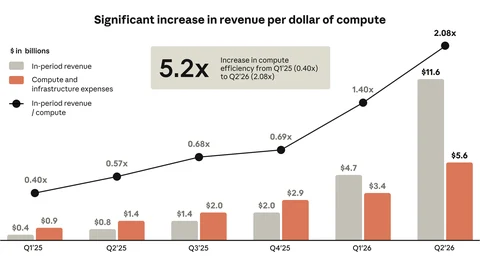
So embedded in that is basically a 7x efficiency gain in serving inference,177x is rounded up a bit: 14 / 2.3 ≈ 6.1, so revenue per dollar of serving compute grew about sixfold. Anthropic gives a similar series in the S-1 itself: revenue per dollar of all compute and infrastructure spending rose from 0.40 in Q1 2025 to 2.08 in Q2 2026. which, I mean, this is a business that I think is almost accidentally profitable, right? Where, I mean, a 7x increase in efficiency of serving tokens, if you were monetizing, you know, a megawatt at 10, 15 million dollars, now you're monetizing it at 70 to 100 million dollars. And here's, this is a little bit of like a random rant, but software companies have historically told the world and told investors, hey, we're an annuity of cash flows. Once we acquire a customer, our net retention18Net retention (net revenue retention, NRR) — what customers who signed up a year ago pay this year as a percentage of what they paid then, including upsells and minus churn and downgrades. Above 100% means existing customers alone produce growth. is high and they'll stick with us.
Customer lifetime value.19Customer lifetime value (LTV) — how much money a customer brings in over the whole time they stay with a company. SaaS companies compare it with customer acquisition cost (CAC): as long as LTV is well above it, burning cash for growth pays off. “Harvest mode” is when a company stops investing in growth and earns from the customers it already has.
Exactly, exactly. And we're going to be burning a lot of money early on, but we're just in growth mode. We're in customer acquisition mode. Once we exit growth mode, we'll be more in harvest mode. And that's when we'll start to become, we'll flip profitable, because we're not spending a lot of money on customer acquisition costs. But, you know, the general model of a SaaS company was unprofitable over time, then profitable. What's happened with Anthropic, and let me pull up another chart here. I believe I have their, ah, here are their free cash flow margins.20Free cash flow margin — free cash flow (operating cash flow minus capital expenditures) as a share of revenue. Negative 4,000% means that in early quarters, when revenue was tiny, the company spent 40 times more cash than it brought in.
Oh my God, it's so negative.
Which I had to cut the chart, right? Like negative 4,000%, negative 1,500%, you know, super, super negative. If I actually drew the axes to scale, it wouldn't look real. And so yes, the axis is broken. But this is the free cash flow margin of Anthropic, right? 21% free cash flow margin in their most recent quarter.
And so what you're seeing is a business that all of a sudden, because they were able to drive such efficiency in their compute, that's kind of why I went on that like compute ramble, they've been able to monetize at much higher rates and actually deliver positive free cash flow margins pretty early on. And so this is a business that says, hey, we've proven that we can operate highly profitably. What we've probably done is underinvested in compute and compute build out, and we need to be more aggressive on it. And so my guess is that you're actually going to see this level off and maybe go negative again as they say, hey, we're going to reinvest and we're going to invest in a lot of compute. We're going to build out a lot of compute. Because now they've shown themselves and the world that, hey, if we need to, we can flip the switch and be profitable.
Yeah. And for listeners, a couple of things on the accounting side, just because I, we got it like educate people, right? FCF is typically like the most honest version of what profit looks like. But in this case you can mostly just regard it as what an operating margin would, profit margin would look like, because basically FCF just focuses on cash. And so there's less tricks to play with accrued receivables21Accrued receivables — under accrual accounting, revenue is recorded when the service is delivered, even if the customer hasn’t paid yet, and the unpaid amount sits on the balance sheet as receivables. Free cash flow counts only cash that actually came in and went out, so it can’t be massaged by the timing of revenue recognition. and offsetting your liabilities and what have you. And so like that is the roughly rough thing.
And but also the reason people have adjusted revenue and adjusted profit22Adjusted metrics (non-GAAP) — revenue and profit from which a company chooses to exclude some expenses: stock-based compensation, one-time charges, amortization. A US public company may present them only alongside GAAP figures, with a reconciliation between the two. is because of nuances in the running the business like this, right? Like GAAP, which is the official generally accepted accounting principles that you have to report, doesn't record, doesn't regard how you want to run the business and split out investment. It doesn't have investment decisions versus like sort of profitability of core business decisions, but it all gets smushed into this decisions, right? It's like, so basically what I'm trying to sort of guide people towards, if you do see a change in this margin profile, it is a conscious choice. And actually you should probably split it out further between what is actually the core business and, you know, is that actually inflecting, or is this more investment, therefore FCF went down?
Yeah. And look, I mean, at the end of the day, cash is king. And like your measure of profitability should be is your cash balance going up or is your cash balance going down? Now, if you wanted to poke holes at this. The reality of GAAP accounting is there's two forms of, well, very broadly, there's two forms of expense. There's the cash and the salary that you pay people, and then there's also the equity and the non-cash that you pay people.
So non-cash, stock-based compensation,23Stock-based compensation (SBC) — shares and options granted to employees. In the cash flow statement it is added back to profit as a non-cash expense, hence the complaint about free cash flow. The best-known version of that complaint comes from Warren Buffett’s 1992 letter to Berkshire Hathaway shareholders: “If options aren’t a form of compensation, what are they? If compensation isn’t an expense, what is it? And, if expenses shouldn’t go into the calculation of earnings, where in the world should they go?” (letter). equity compensation, that doesn't show up in free cash flow. It's actually added back because it's a non-cash expense. So there are a lot of people who look at the free cash flow metric and say, well, it actually overstates your profitability because the reality is, is if you didn't grant equity to your hires, they wouldn't join you. And so like it is a real expense, treat it as a real expense. I don't have a chart for this, but if you were to adjust free cash flow for stock-based comp, you're still at an 8% free cash flow excluding stock-based comp. And so you're even profitable if you include the big equity.
By normal rules.
Yeah, exactly. And so like—
If you've never seen a software IPO, this never happens.
Yeah, it's very rare. I mean, I think there are a lot of software companies that are free cash flow positive today, but if you factor in—
Not at IPO. Never at IPO.
But even today, the mature ones, even if you factor in stock-based comp, most of them are free cash flow neutral or negative if you treat stock-based comp as a cash expense.
So all those companies are dying and everyone's just buying Anthropic, right? Is the conclusion?
I think there's a, well, they're not quite that, but certainly, why would you, like, anything else?
04How much of the market is still ahead
Ball sees a lot of room to grow: big companies spend a fraction of a percent on Anthropic, and almost all of its revenue comes from the newest models.
I mean, look, here's a crazy stat. In the S1, it's like a breadth versus depth one, they called out 50% of the Fortune 500 is using Anthropic. However, if you look at what that cohort, the Fortune 500, is spending on Anthropic as a percent of their expenses, it's 0.1%. And so you ask yourself, where's that headed? I think John Collison on, he had Sam Altman on his podcast24John Collison — cofounder and president of Stripe and host of the Cheeky Pint podcast. In his October 29, 2026 episode with Sam Altman he said tokens are now roughly 1% of Stripe’s operating expenses and that he expects 5, 10, 20% and, in steady state, tens of percent (episode on Shownotes). the other day. I think he mentioned 1% of Stripe's expenses are on tokens today, but he expects that to go to 15 to 20% over the next few years. And so obviously Stripe is a very forward-leaning tech company. Your average business in the Fortune 500 isn't going to show that level, but it could show a same order of, or a same magnitude of growth.
So if Stripe is saying we're going to 15 to 20x the spend on tokens relative to other expenses in the org, maybe you see something similar and the Fortune 150025Fact-checkNot so: there is no Fortune 1500 list. Fortune publishes the Fortune 500 and the expanded Fortune 1000. From context, Jamin misspoke and means the same Fortune 500 he mentioned a minute earlier (Fortune). go from 0.1% to 1%. But I do think it's, you know, ultimately, where do you think that settles out? How deep can they penetrate their TAM? It's kind of like an important question that, you know, folks should think about. But to me at least, what it demonstrates is they really haven't, despite, I mean, despite the insane ramp in revenue, you know, growing over a thousand percent year over year in the Q2 quarter, there's probably still a lot of room left for them to kind of continue to penetrate their TAM.
Yeah. And, you know, I think the word is virtual collaborators.26Virtual collaborators — the S-1’s term for AI that does multistep professional work alongside people, with the access and tools an organization grants it. swyx offers the phrase as a friendlier replacement for “agents.” You know, I say agents, but you gotta make it a friendly term for people. And you know, I really start to tell people, you should just start thinking about it in terms of like what your employee spend versus your token spend is, and most people are at, let's call it, 0.1 or like 1 to 5%. The median AI company is at 50%, and the top AI companies, you know, let's say 90th percentile, Anthropic person is like 10x tokens to salaries. And so that is probably the right comp of like, well, what are you spending on humans? And like probably 30%, right?
Yeah.
And well, okay, so—
Could be more even. I mean, yeah, humans could be like forty, you know, total head count could even be more.
Yeah, it depends what kind of business you're running, right?
Yeah, exactly.
And so like if you're a physical business, fine, that's like until we have good robots, then that's not getting happening. But what are you spending on knowledge worker humans? What is, and a knowledge worker humans, that includes coders, but also just admin and ops and what have you, and legal and whatever, and all that. And some part like that percentage, the ratio of tokens spent to human spend was zero to whatever. And now it's going to rise. And well, how far can it go?
Yeah. Totally, totally. It can go a lot. I mean, look, I think there's a lot of like hyperbolic statements being made, both positive and negative, about OpenAI, Anthropic, the big labs. I think it really boils down to three main questions. Can Anthropic stay on the frontier? Is there a business and a durable business to be built at the frontier? And if so, how much is it going to cost? And then in reality two and three kind of like relate to each other, can it make enough money to cover all the costs to be at the frontier? And that's the one where I think I actually have a couple, I think I have one chart on this.
Let me see which one. What did I want to bring up? This one, yeah, let me pull up, no, let me pull up this one. This is a good one. So this is kind of the second question, like how much will it cost to be at the frontier? Or even maybe let's go to like, what, can you build a business at the frontier? The other interesting stat that Anthropic had in their S1 was for the three months ending September, 80% of their revenue was driven by models that were six months old or younger. And so what does that tell you?
The vast majority of their revenue is coming from their most recent, most powerful models. And that's something that I kind of expect to continue. I think, you know, when it comes to frontier tokens down to open weight tokens,27Open weight models — models whose weights are published for download: they can run on anyone’s servers, and their tokens are usually much cheaper. Kimi, DeepSeek and GLM are examples. Frontier models are the strongest models from the leading labs, available only through their APIs and apps. I think there'll be a massive market for both. I think the trend will continue to be on a, as a percent of tokens, open weight kind of continues to eat share, but as a percent of wallet share in dollars, Frontier continues to take the lion's share. So I expect Frontier tokens to be the most economically valuable to capture the most market share. I expect open weight and cheap tokens to capture the most market share in terms of total tokens.
05Paying for $855 billion, and why compute is still short
Ball thinks revenue will more than cover the compute commitments, and swyx adds that the labs would sign up for a trillion if they could.
And I think kind of this stat on 80%, which is much bigger than I would have expected, just in models six month old or less, kind of demonstrates the value of being on the frontier. Okay, so then let's go next, go to the second question, which is, well, what is it going to, or the third, like what is it going to cost? And here's a chart. I think, and there's, I'll have to caveat this chart. But a lot of people look at the Anthropic S1 and say, oh my gosh, there's a $856 billion dollars28Committed deals — according to the first S-1 amendment, filed November 2, 2026, about $895 billion in total under purchase and lease agreements, nearly all for compute and infrastructure; for $213.8 billion of that, the parties have termination rights or special terms. These are payments under signed contracts for capacity not yet delivered: they don’t appear as debt on the balance sheet and are disclosed in the notes to the financial statements (sec-api.io). of off the books, of like not even off, but like committed deals that they've signed. How are they going to pay for it?
You know, they're at whatever, whatever their ARR is, something in like, I don't know, 70, 75, 80, you know, whatever, I think the last number was 65, the Q3 number was 16.8, but whatever, 70 plus or minus.29“70 plus or minus”: quarterly revenue times four comes to about $68 billion a year. A year earlier, in Q3 2025, Anthropic brought in $1.38 billion (S-1/A). How are you gonna pay for 855 billion?
And like, have you read the rest of the S1?
Well, what I tried to do in this chart is I broke down the, because they broke down their commitments. They didn't do it by year.
Is this normal, by the way, that you would have year by year?
No. I feel like this is, so this year by year, this is a little bit of the Jamin best interpretation.
[unclear] Oh, no, I've seen variations of this.
Yeah, yeah, yeah. It's, and so I think what you have to ask yourself is in the commitments that they've made, and I've tried to annualize the commitments. If they said this is a five-year deal, I've just made it—
This is, by the way, every banker in the world has done this already. Like they did this on the night of the S1, right?
So you have to ask yourselves, can you pay for it? Okay, well, at a fixed basis, and then the gray bars is maybe kind of like less hard commits, but commits they want to make.
So the SpaceX one is in there, right?
Yeah.
That's the one they can walk away from in 90 days.30The SpaceX deal — per the S-1, between May and October 2026 Anthropic signed agreements with SpaceXAI, Elon Musk’s former xAI, which became part of SpaceX in 2026, for compute on NVIDIA GPUs worth up to $120.5 billion through 2029. After the initial terms either side can terminate with 90 days’ notice; Musk himself has described the deal as a short-term rental.
Exactly. Will they be able to fund 100 billion a year? And so it isn't 850 billion a year. It's can they fund a hundred billion a year? Now, there's a couple ways they could do that. Well, one, do you expect their growth to continue, which is a question of like, will there continue to be a business at the frontier?
Or you go back to the, well, only 25% of their compute today is allocated towards revenue generating or kind of inference serving use cases. If they were to just double that and add zero compute, they would, they could in theory double their revenue. And so like you look at the headline number of 855 billion, you're like, oh my gosh, that's a huge number. How are you going to do it? Some of that is very back weighted. But I think when I think about the trajectory of the business, the TAM that's been penetrated today, I don't think it's far-fetched at all to say, hey, like the business trajectory will more than cover, the revenue will more than cover the expense.
And I think I have another chart in here. This is another great one. This is the compute margin.31Compute margin, as Jamin calculates it, is revenue minus all compute spending, including training and research, as a share of revenue. Gross margin is narrower: Anthropic’s cost of revenue is mostly compute for serving customers, 14.6% of revenue in the first half of 2026 versus 87.6% a year earlier, while training and research go to R&D expense (sec-api.io). So this looks at if you were to take their revenue and subtract all compute, internal models, training—
Same quarter matched, right?
Exactly. So even as, what you're seeing is even as they've shifted more of their compute to non-revenue generating use cases, they've still scaled their compute margin to well over 50%, which, what you're, so what you're seeing is they're getting hyper efficient at the compute they bring online. The compute they decide to use for revenue generating use cases is becoming, it's become 7x more efficient over the last year. I think you have to ask yourself, will they continue to ramp compute and capacity? I think the answer is yes. I think if you ask anyone at Anthropic, again, this is all speculation, they'd probably say, we wish we started doing it sooner. We wish we were more—
They're trying to commit to more compute.
That's right.
If you don't talk to any of these guys, you come away with like, oh my God, they're, you know, these guys are absolutely crazy and being fiscally irresponsible. But I think if you have any confidence, or if you see up close the demand for intelligence that people are snapping up and immediately consuming whatever you give them, then like, yes, actually you're trying to get more compute, and the game is not to reduce the commitments, it is actually to get more commitments. They would have a trillion if they could.
I don't think I've spoken to anyone in the AI industry, certainly not anyone at the big labs who has said, yeah, we're, you know, I feel good, we're at the compute we have. It's almost always, and I think a underrated factor on compute demands in the future will be compute that's used for safety alignment and verification. Like I think more and more compute is going to go towards those functions, whether that's on research or just on verification and alignment that happens at inference time, that will be an increased compute demand for all of these.
But we're probably not going to break those out, you know, but like it'll be like maybe 5% now and 20% in future.
Of course, of course.
Yeah, I think, you know, I would just tell people like if you think this is bad now, wait till you see the OpenAI S1.32OpenAI’s S-1 isn’t public yet: OpenAI filed its prospectus confidentially in June 2026. And then like it's not bad. It's like that's the whole point. It's like they're actually really trying to get compute from every source they can get, and like OpenAI is buying TPUs.33TPUs — the AI accelerators of Google, OpenAI’s main competitor. According to The Information on October 27, 2026, OpenAI plans to buy them from Google; the companies haven’t confirmed a deal. Since 2025 OpenAI had been renting TPUs through Google Cloud (TechNews).
Like, yeah.
Like, there was a cold day in hell, and that happened.
They're buying TPUs, right? They have their own chip initiative, Jalapeno,34Jalapeño — OpenAI’s first in-house inference chip, developed with Broadcom and unveiled on June 24, 2026. At Hot Chips in August, OpenAI reported that in its tests a Jalapeño system drew 1.18 kW versus 2.55 kW for a comparable NVIDIA GB300 setup; SemiAnalysis, which tested the chip with OpenAI engineers, gave it a glowing review (SemiAnalysis). which has pretty rave reviews. Anthropic staffed up a compute team to build their own chips. Obviously the hyperscalers are building their own chips.35The hyperscalers’ chips — Google (TPU), Amazon (Trainium), Microsoft (Maia) and Meta (MTIA) design their own AI accelerators while remaining some of NVIDIA’s biggest customers.
It's a, I mean, mad dash.
It's a mad dash. Only, you know, only winners are TSMC, NVIDIA, and ASML, whatever in the supply chain stack.
Totally. And then I think, look, it's getting harder and harder, especially in the United States. You have a lot of pushback. I mean, you have all kinds of pushback. Data centers are too noisy, don't want them in my neighborhood. They add a lot of air pollution. The water, don't want it. Oh, my God, the water, the water — it uses too much water, which it doesn't. It's the electricity, it uses a lot of electricity. It's gonna increase my electricity bill if I live in close proximity. Or it's just the simple AI is going to kill us and I don't want to enable that, which again, you have all kinds of pushback.
It's become hyper, hyper political. But I think the unfortunate thing is it has become a lot harder. You do see a lot more pushback. Midterms36The midterms took place on November 3, 2026, five days after the recording: the entire House and about a third of the Senate were up. Democrats won majorities in both chambers; the new Congress convenes in January 2027. are coming up, right? Who kind of like takes control in like the House and the Senate, like could have a big impact on regulation or lack thereof around data center and intelligence center buildouts. And the good thing is that it's getting harder and harder to build these data centers, behind the meter37Behind the meter — a data center’s own generation on site (gas turbines, engines, batteries), bypassing the grid: that is how projects skip years-long interconnection queues. Ball says this route is getting harder too. is harder and harder.
And so you do have a natural governor on the build out, and I think we're a lot less likely to overbuild too quickly. That leads to a supply glut, right? Kind of the internet bubble analogy of the early 2000s, where we built way too much fiber. There wasn't as much demand for the internet. There was a lot of dark fiber,38Dark fiber — cable that has been laid but carries no signal. In the late 1990s telecoms laid so much fiber that after the dot-com crash of 2000–2001 most of it sat unused for years. Ball contrasts that with today’s GPUs: none are sitting idle. right? Fiber that had no bits and bytes traveling over it.
We have no dark GPUs today. And so it's probably a good thing that there's some rate limiter. It will stop us from entering a huge bubble, but it's also bad because we need, you know, the industry needs more compute, especially as these models get more and more powerful, you know, the security concerns go through the roof. You also need a lot more, like the defenders need more compute. The defenders need more capabilities. Which, you know, I don't know, personal belief, I think we're gonna be compute constrained for far longer than the world thinks.
Yeah. I mean, I'd be curious if what the markets price the world as thinking and then doing the work on like what do we actually think and have the delta is probably, you know, could be three years, could be thirty years. And that's a very material thing to figure out.
Yeah, of course.
06How much efficiency is left
Asked whether the 7x gain was a one-off, Ball answers that the frontier keeps accelerating and that, by the Jevons paradox, cheaper tasks only grow the market.
I think one thing to guide people towards is, well, there's all this political stuff. And honestly, I would say Meta does a lot of work. And I think increasingly OpenAI does a lot of work in like, well, here's how we make sure we're a positive presence in the communities that we're in, right? Yes, you do need to take care of that. But I think like coming back to again research relevance, ROI, and what it means about the industry. This profit move here, I do wonder sometimes, and this is a thing that has come up in our other podcasts, particularly tying in the research side, is how much left is there to improve, right?
So was this kind of like a one-time upgrade of our inference stack, which you noted was like something like a 7x improvement in our inference efficiency? Because like you can't, like, probably, like, there's no improvements for ever until the end of time in our inference stack. Like unless we fundamentally change the chip, we probably started out pretty unoptimized and we are now a lot more optimized than we were two years ago. Okay, well, there's a limit to how optimized you can get, just like physical, like, joules moving around and bits and bytes moving around. So that is my question in terms of like the how much efficiency there's left to squeeze. And maybe there it might cap out, you know, in terms of like that year on year growth.
Yeah. Well, look, I think I have a chart I'll get to in a second, but I think this is a debate that's existed for quite some time. Right. You had, you know, the, I don't remember when this was, two years ago. You know, like the Ilya moment39The Ilya moment — Ilya Sutskever’s talk at NeurIPS in December 2024: data is “the fossil fuel of AI,” compute keeps growing but we have only one internet, so pretraining as we know it will inevitably end. Among the next directions he named agents and synthetic data. of like, hey, the data and the internet is a fossil fuel. We've exhausted it. There's no more data left to train on and like we're hitting a plateau. Yeah, that was years ago. Then we hit inference time reasoning, inference time compute and reasoning models, you hit a new paradigm. But I think maybe embedded in your question is, what is the gap between the frontier and the leading open weight models, is that shrinking? Like, is the gap that the frontier—
Yeah, I don't mind the gap. It's not something I talked about.
But I think it's interesting because like what the real way to think about or to answer that question is not the gap between the best leading open weight models today and the frontier models today because the reality is OpenAI and Anthropic, they have far more powerful models that they've developed that they just haven't released yet. Like this is a chart that Mark Chen published from OpenAI, actually, switching gears from Anthropic to OpenAI.
Yeah, he's been on the pod, cooking pod.
Oh, nice.
We made some soup for researchers.40Soup for researchers — a nod to a story Mark Chen, OpenAI’s chief research officer, told on the Core Memory podcast in December 2025: Mark Zuckerberg hand-delivered soup he had made to OpenAI researchers he was trying to poach for Meta, and Chen in turn brought soup to people OpenAI was recruiting from Meta. In Latent Space’s episode with Chen, he cooked a Korean tofu stew (Fortune).
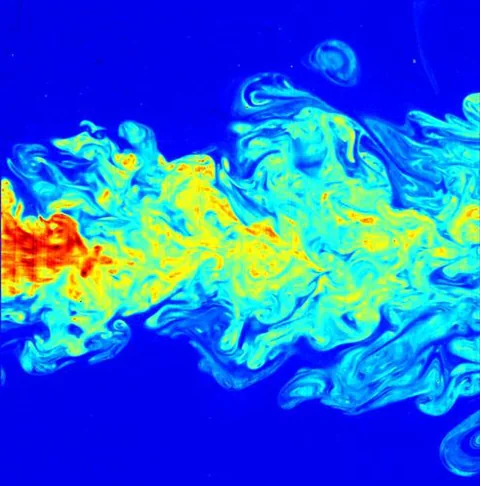
Amazing. Amazing. I love that pod. But you know, when they solved Navier–Stokes,41Navier–Stokes — one of the Clay Mathematics Institute’s seven Millennium Prize Problems, worth a million dollars: prove that the equations of viscous fluid flow always have a smooth solution for smooth initial conditions, or find a case where the solution “blows up.” On September 8, 2026, OpenAI announced that about 10,000 agents running its internal model had solved the problem in 88 hours; the Clay Institute has not yet recognized it as solved, since its rules require a published solution to withstand scrutiny for two years (OpenAI). that big math problem, you know, Mark came out and said, hey, here's a model. It may be dark blue, light blue is harder to see, but like the top bar is an internal model we used to solve that problem. The blue bar is Astra.42Astra — GPT-6 Astra, OpenAI’s flagship model, released on September 3, 2026. On Chen’s chart it is outscored by the internal model that worked on Navier–Stokes.
Hey, look at how much more powerful the internal model is to what's publicly out there, which on some ways that like could scare you a little bit, right? Like, hey, these labs have even more powerful models. So if you think about what's the gap between open weight and frontier today, I think it's actually far wider than people expect because there are just far better models at the frontier that haven't been publicly released yet. Either whether that's safety, testing, alignment, some combination of everything, you know, unclear. But I do think you're still seeing the frontier accelerate, even if it may appear that what's released is plateauing. I'm not even sure if it does look like what's released has been plateauing.
No one's saying it is plateauing today. We're all discussing could it plateau in the future. Right? Because that is a pretty important thing to figure out for your investing, which is part of the deal here.
Totally.
Yeah, so that is a very well-phrased point. I thought you were going a different area where you were going to argue about bitter lesson43The bitter lesson — Richard Sutton’s 2019 essay: over 70 years of AI research, general methods that scale with computation have again and again beaten approaches built on human knowledge of the problem. swyx expected Ball to invoke it as an argument that progress depends on compute, not cleverness. and you didn't. So kudos on that. And like I think that's a very, very fair point that I think we've got still every generation, model generation, it still shows quantum leaps. This is only in math, but OpenAI has a pretty good track record of generalizing beyond just math or coding.
And so I do think that is. My point was a little bit more as on the financial analyst hat on, which is you had this one time 7x improvement in revenue efficiency or whatever, and it's not like they raised prices. So like where is it coming from? Oh, here's another good one. I mean, they didn't raise prices.
Here, oh, I think I have—
So you know what I'm saying, right?
Yeah.
They have a hundred, they have one.
Yeah, it's actually the opposite. This is an awesome chart. This shows the cost to complete—
They're charging less.
Yes, exactly. The cost to complete a task with each model family. And so what you see is with whether it's Fable44Fable and Opus — two Anthropic lines. Claude Fable models are the most powerful generally available (Fable 5 came out on June 9, 2026, Fable 5.1 on September 1, and, after the recording, Fable 5.2 on November 9); Opus is a tier below. Claude Opus 5.5 came out on September 22: by Anthropic’s account it performs at the level of Fable 5.1 on most tasks and costs 40% less than Opus 5. or Opus, and then you have Fable 5.1, and Opus 5.5, you see about a 25%, 25 to 40% reduction in cost to complete the same task with each successive model family. And so it's kind of like, yes, the costs are going way down. Their compute efficiency is going way up. And I think a lot of that just demonstrates, I mean, again, it's gonna sound a little like VC cliche, but like Jevons paradox.45The Jevons paradox. In The Coal Question (1865) the English economist William Stanley Jevons observed that more efficient steam engines increased coal consumption rather than reducing it: the cheaper a resource is to use, the more of it ends up being used. Ball applies this to AI: a cheaper task means more tasks and more revenue. Like as things get— I know, I know, I know. You can't have a podcast on AI without that coming up.
Yeah, no, it is. This is the appropriate time to bring it up.
And as things get, you know, you go back to like the early days of the internet. Like how many bytes were traveling across the internet in 2000, how many bytes are traveling across the internet today, like many, many, many, many orders of magnitude more, and guess what, the price to transfer bytes over the network has like dropped. Like many, I mean, it's too cheap to meter.46“Too cheap to meter” — from a 1954 speech by Lewis Strauss, chairman of the US Atomic Energy Commission, who promised that nuclear power would make electricity too cheap to bother metering. The phrase has since been used for any resource whose price falls close to zero. It's literally too cheap to meter. It's P and Q,47P and Q — price and quantity, the two terms of revenue: revenue equals P × Q. If price falls more slowly than quantity grows, revenue goes up. right? Price has gone way down, quantity has gone way up, and I think you're gonna see the same thing with people buying and serving models and tokens.
Yeah, so generally pro-support of that, I do want to remind people that that is a true objective fact. This is not like VC bullshit, like this is actually how the businesses are running and it is surprising to us that, like, while, yeah, we read about this in theory, but like to actually see this in financials is like really ridiculous.
You'll continue to see it. Think about like Jev48Jev — a decision model from the US company TypeSafe AI, released on September 15, 2026: instead of text, it quickly returns a typed decision (yes or no, a choice from a list, a score on a scale) along with a probability estimate. Ball uses it to show how simple tasks get cheaper: a binary classifier doesn’t need a language model. and decision models. You know, and like the price point of, hey, instead of you want a binary classifier, you don't need a language model to do that. Just go use a decision model. Super cheap, super efficient. I think you're gonna continue to see efficiencies like that.
You know, I go back to S3 and EC2, AWS's big initial product, storage and compute. You've seen, you know, 99% price reductions in both of those services from the day they were launched. But like what's happened to the EC2 and S3 business or just the broader storage and compute, you know, more CPU compute, it's gone up exponentially. I mean, all the hyperscalers reported today, they're all over $100 billion run rate businesses today, if they were individual companies. Google Cloud's grown over 100%.49Cloud results. Alphabet reported on October 28, 2026: Google Cloud revenue for July–September grew 103%, to $30.7 billion (9to5Google). Amazon reported on October 29: AWS grew 39%, to $46 billion for the quarter, its fastest growth in nearly five years (Cord Cutters News). It was just crazy.
Azure's growing almost 50. Amazon reported today, we're recording on Thursday, 39, almost 40%. Like these businesses are just accelerating and growing at— it's crazy.
You should drop everything you're doing and just go start one of these things. Yeah, yeah, it's October 29th for those keeping track. And in, yes, a fun personal anecdote, I was in my hedge fund when the day they broke out AWS from Amazon.50The AWS breakout. Until 2015 Amazon did not disclose the cloud’s revenue and profit: AWS was first broken out in the results for Q1 2015, released in April. Investors saw that the cloud was profitable, and Amazon stock rose.
No kidding.
And at the time we were not long Amazon because we were worried about AWS margins and also like, oh, is it just startups? And what if like, you know, we go through a startup winter and like all that? Yeah, it was so nonsensical. So like the funny thing about finance is that you can do all these works and make worse decisions. We definitely did that.
Totally, totally. I mean, that's the thing. Like market timing is impossible. Like—
And also fixating on the wrong thing, which a lot of people are having to encounter for the first time. You have 2,000 data points that were released in this thing and you'll fixate on one thing and it'll be like that is everything you need to know and like, well, no, like you lost sight of the bigger picture.
07Why you can’t step off the frontier even for a season
For Ball everything comes down to one question, whether Anthropic stays at the frontier, and its summer revenue slump shows what happens without a leading model.
Yeah. I mean, that's for me. I mean, again, there's a lot of things that I believe that others would disagree with me on, but I believe there's one question that matters, and that's can Anthropic stay at the frontier? Yeah. And to me, if I believe the answer to that question is yes, and I think everything they've done historically has demonstrated that, I think they'll build a great business and will continue to.
But okay, but then there's a right price for that.
Of course, of course. And this is not like will it be priced right or this or that. That's more of, hey, if you're able to take a longer term view on will the business be successful over time, I think to me that's the most important question. Now, whether you think the IPO price is cheap, expensive, just right, I mean, we don't even know what that's going to be yet. Prices can change of public companies for idiosyncratic reasons, reasons based on individual company performance, or they could change for macro correlated risk. Like the reality is if Anthropic went public a month ago, you know, the big rout that you've seen in public markets recently, especially in semis and the AI trade, Anthropic would also be down, even if the business is doing well.
So stocks can go up and down based on individual company performance, as well as just market beta. Exactly. Exactly. Exactly.
So, you know, you should be prepared for those kind of discussions if you're getting into this. I think actually just as a side question, there's a lot of these like non-public market trackers of the stock, like here's my proxy of OpenAI stock, here's my proxy of Anthropic stock. Do you guys put any weight into that or like zero?
I don't. Yeah, I don't.
Yeah, I'm just, I'm wondering if I should pay attention to those things more closely because they do give some indication of like, well, here's the stock price reaction when a model just released.
I mean, it might show some market sentiment, yeah, right. But I think Ramp had some data.51Ramp data — the fintech company Ramp uses its customers’ card and bill spending to publish how much US companies spend on AI services and with which vendors (the Ramp AI Index). Ball uses it to show how spending on Anthropic splits across its models. I think I copied a Ramp chart the other day. I mean, this was Anthropic spend on some of their most recent models. The dark blue is Opus 5.5. And like, hey, what the Ramp data shows is people switch. Yeah, exactly. And with Opus 5.5, you saw some reacceleration. And so would it surprise me if you saw a re-acceleration of revenue and run rate in October, and October won't be in Q3. That's the first month of Q4. No, it wouldn't surprise me because I do think a lot of the third party data is showing and suggesting that.
Yeah. Well, so okay, let me— this chart is super interesting, right? Because you just said like when you say stay at the frontier, there's different levels of that. Stay at the frontier meaning we're one of the top two, one of the top six, we're in the top 20, whatever. Usually people mean top two. Usually, but sometimes you can expand and say top six. Google now has a claim to be a number one in some metrics. Meta doing super, super well. SpaceX doing super, super well. Not at not number one, right? But number three, number four. You can say that. Yeah. So look at that like summer slump in Anthropic revenue. Was that because OpenAI was briefly ahead?
Yeah. I mean, I think Astra was a great model. And I think a lot of people started using Astra, and it wasn't just Astra, right? It was, what was Google's models? What was the one they just released? Carbon or Argon?52Carbon and Argon — two different Google DeepMind models in the Gemini 4 family. Gemini 4 Argon, built for long multistep tasks, was unveiled on September 30, 2026. Gemini 4 Carbon came on October 28, the day before the recording; cyber defenders got access first, which is why swyx complains it “hasn’t been released yet” (Google blog). Carbon, yeah, Carbon Argon.
Yes, yes, yesterday. They haven't released it yet. This is my gripe with Google. They never release anything. They just announced a wait list and then like, goddamn it.
I think it was also you saw a massive explosion of, you know, Kimi K3, the GLM series,53Kimi K3 and GLM — Chinese open weight models. Beijing-based Moonshot AI unveiled the 2.8-trillion-parameter Kimi K3 on July 16, 2026, and released the weights on July 27; on popular benchmarks it was ranked alongside Fable 5 and GPT-5.6 Sol. GLM models come from Beijing’s Zhipu AI, which operates abroad under the Z.ai brand. DeepSeek models. You saw open weight models get really powerful and get good quickly. So I think you kind of saw all of that, but it's crazy. Like the far right bar, like what was non-Opus 5.5 or Sonnet 5.5, like that has gone, that's halved or more, maybe more, you know, in what is that? Two, three months. And so like you do imagine if they didn't have Opus 5.5 or Sonnet 5.5, right? Like who knows what the revenue growth and trajectory could have been. And so like that's kind of why I do think it's important to be have a frontier class style model.
And so I will say from watching these labs for the past three, four years, they used to have more of a reserve. Yeah. Like I will have internal models that I can just release whenever I feel like it. And then I think they towards the GPT-5.654GPT-5.6 — an OpenAI model family in three tiers, the flagship Sol, the mid-tier Terra and the fastest, Luna, unveiled on June 26, 2026; at first it was opened only to about twenty trusted partners. In September it was succeeded by the GPT-6 family. era, everyone just released whatever they had when they had it. Now I feel like the reserves are building up again. I don't know why, but it definitely seems like, like as you saw with the internal model, it seems like they have more wood behind the shed for stuff like this. Like I can really, I'm sitting on Fable 5.5, I can release it the day before I IPO. Yeah. And like, yeah, like that'll make my IPO go well.
I mean, look, I think there's good reasons, you know, that the models aren't released right away. You know, on one hand, there is just a lot of like safety and alignment and all that.
But as a PM, as an executive playing this game, I can play it pretty well if I have a backlog.
08Vulnerabilities found by models
Ball says AI has collapsed the time between discovering a vulnerability and exploiting it to zero, so a patch has to ship the moment the vulnerability is announced.
ExplainerPatch the Planet and the PHP vulnerabilities
Patch the Planet is an OpenAI initiative under its Daybreak program, announced on June 22, 2026, together with the security firm Trail of Bits: OpenAI’s strongest cybersecurity models hunt for vulnerabilities in critical open source software, and human experts verify the findings and help maintainers ship fixes. The first wave included cURL, Go, Python and other projects; HackerOne and Calif also joined as partners.
On October 21, 2026, OpenAI disclosed two critical vulnerabilities in PHP, the language most websites run on. One of them was found through Patch the Planet by the Calif team using GPT-5.6 Sol, not the flagship GPT-6 Astra; the company Wiz independently found and reported both. PHP’s maintainers prepared and shipped the fixes, while Wiz and Cloudflare helped get protections ready before disclosure (OpenAI).
I mean, and it's also, think about, you know, OpenAI's Patch the Planet initiative, which is basically, hey, let's use these super powerful models to go find vulnerabilities.
Not even. It was 5.6. It was 5.6 Sol.
They found the PHP vulnerability. It wasn't frontier. Yeah. Which is crazy.
It was just a spam a bunch of like a last gen model.
ExplainerWhy the patch ships the moment a bug is announced
Under coordinated disclosure, whoever finds a vulnerability first reports it privately to the developer and gives them time to fix it, and the details are published once the patch is out. But a patch itself gives the bug away: by comparing the old and new versions of the software, an attacker can see exactly what was fixed. So it matters that the fix ships at the same time as the announcement and gets installed before anyone writes an exploit. When models find bugs and write exploits in hours, that head start disappears.
Exactly. Exactly. And then let's find all these vulnerabilities like the PHP one. Let's go create the patches so that we can instantaneously release the patch by announcing the vulnerability. The challenge is attackers are using these models, are using really powerful open weight models and they're finding these vulnerabilities themselves.
Yeah, it's a race.
And it's, it's a race. And it used to be, you know, you had weeks, months from like vulnerability discovered to like exploit. I mean now it's collapsed and it's basically zero. You know, it's zero days.55Zero-day — a vulnerability exploited before the vendor knows about it or has fixed it, leaving “zero days” to patch. Ball says AI has shrunk the gap between finding a bug and attacking with it to nothing. Like vulnerability announced or discovered, exploit available, like it's almost negative. And I think in, you know, OpenAI's announcement of the PHP thing, I think hidden in there was, I think they basically said like, oh, and we, there are more serious vulnerabilities that we know about that we're working on patching right now. Which, I mean, more critical than you know something that touches 70% of the internet is it's pretty serious.
Like the 70% of the internet is just a proxy for old.
And like of course it's older and it's going to be more vulnerable. That's right. Yeah, of course. That's a good way to phrase it.
I think there's a couple of takes. I'm not that interested in like dwelling on that stuff only because there's going to be smarter people than me on that. There's one angle of this which is kind of funny, which is like, well, we're spending a billion tokens, finding all the vulnerability, and we're going to spend a billion more to fix the vulnerabilities. What if we just didn't do either? And it would go like net the same position as we were at.
Yeah, yeah, yeah. Well, I think cat's out of the bag. You can't put the toothpaste back in the tube.
So, but that is one argument people make, like, blame the AI instead of blame the… kill the messenger. Right. The other part which is interesting is like, and this might actually be an issue for basically nation state actors who actually had all these exploits already.56Intelligence agencies stockpile vulnerabilities unknown to the public for their own operations. The best-known case is the NSA’s EternalBlue exploit for Windows: in April 2017 the Shadow Brokers group leaked it, and in May the WannaCry ransomware spread using it (Wikipedia). And now like, well, you know, civilians are finding them. God damn it, now I have to work harder.
Yeah, exactly.
Like all my zero days are gone. Like I had that for 10 years. Like whatever. But anyway, so these are fun anecdotes or consequences of this. If you want to really do super Straussian57Straussian — after the political philosopher Leo Strauss, who argued that past thinkers hid their real meaning between the lines for initiates. In Silicon Valley a “Straussian” reading is one that looks for the hidden meaning behind the official story; the economist Tyler Cowen popularized the term. and Machiavellian, if you're a nation state actor, what do you do to preserve your edge because like you cannot have the channels that you're relying on lock up. So then you send the Saudi decoy58swyx is referring to the case of Abdulrahman Alfozan, an OpenAI engineer and Saudi national. According to the charges, he hid a recording device behind a TV near where closed-door meetings took place: it was plugged into the TV’s USB port and wrapped in toilet paper. Employees found it on September 30, 2026, and Alfozan was arrested on October 9 (The Record). The idea of a “decoy” distracting from a real spy is swyx’s own speculation. to put the thing behind your TV.
That was crazy.
So that they get distracted by that so that your real spy gets in.
That's just some war games.
Yeah, I watch too much TV to think that what we are told is the full story.
Yeah, yeah. I think that's fair, right? I think that's fair. Too much is at stake.
09The model factory matters more than one model
Ball carries a lesson from semiconductors over to AI: the winner is not whoever made one strong model but whoever built a factory that turns out new ones every year.
Yes, too much is at stake. Okay, so coming back to the actual again finance, like I really want to be a primer for everyone who are new to the economics of models and model labs and what have you. One thing that people have said is that the R&D per model, let's say like what does Fable 5, Sonnet 5, Opus 5 cost, let's call it a billion dollars. That lasted me six months, right? Because you just said the depreciation, it lasted six months. And so isn't that worrying, right? Like, about like, well, these things are the fastest depreciating assets in history. This is something that me and Sarah Guo have talked about before.
And I think the net is no, but like it's a qualified no of, well, as long as my next model run is better than the current state-of-the-art, we're good. But it's a little bit of a house of cards if the next one doesn't work out. Which briefly affected OpenAI. So a lot of people know by now that, you know, like GPT-4.5,59GPT-4.5 — the OpenAI model released on February 27, 2025: the company’s largest model at the time, a bet on scaling pretraining rather than on reasoning. It proved expensive and not much better than its predecessors, and in April OpenAI announced it would remove it from the API. the big run wasn't that successful. And they, you know, they've since fixed it. But like that a slump in a run or failed run can really really screw with the ROI on the thing.
And look I think there's a really good analogy to the chip industry. And I remember speaking to someone, you know, much older and much smarter than myself who did a lot of semiconductor investing and you know in the 80s and 90s about all these chip companies they've seen it all and you know they've seen it all and they were highly skeptical and you know sometimes you have industry vets that are highly skeptical and, you know, they miss the next big opportunity because they never think the incumbent can be disrupted. But the point of view they had was it's very different to tape out60Tape out — to hand off a finished chip design to the fab for photomask production: the last step of design, after which a mistake can be fixed only with a new, expensive run. The name dates from the days when designs were shipped on magnetic tape. a chip that is competitive with the leading chips at the time from building a machine that can continuously tape out chips that compete with, you know, the model factory, the chip factory.
And so he was like, this individual's point of view was maybe a chip startup can build one chip but guess what they're not gonna have the machine to constantly pump out a new chip every year and stay at the frontier from the chip standpoint and that's why NVIDIA is king it's not because they have the best chip now, it's they have the best factory, process for chips.
Exactly, exactly. It's the machine that builds the machine.61“The machine that builds the machine” — Elon Musk’s phrase: in 2016 he told Tesla shareholders that the company’s real product is the factory itself, not the car.
And so it's kind of one of these, I mean, this is the bear case on all these neolabs,62Neolabs — new AI labs founded by alumni of the big ones: Mira Murati’s Thinking Machines Lab, Ilya Sutskever’s Safe Superintelligence and others. They raise billions of dollars before shipping a first product. which is, you know, and you talk to many smart folks and what they might tell you is, hey, if you want to really compete and be have like a SOTA model at the frontier, you can't go more than one order of magnitude of compute less than the labs.
You just can't compete if you don't have, you know, one order of magnitude of compute of the big labs. And so as a neolab, you know, the question isn't can you build one model? It's can you attract compute and talent required to continuously pump out new generations of models every year to ultimately compete in your domain. And so I think for the labs, the reality is, is I think it's very hard for anyone, unknown players, to catch up to kind of like the generalized frontier big models. I think you'll continue to see domain specific models, or models or like new types of models, decision models like Jev. But I think the big labs, they are on the treadmill of continuously pumping out new models because guess what?
If Anthropic stops, OpenAI and Gemini will continue and then you'll just kind of see revenue you'll see revenue fall off, which is why I do think it's so important to stay at the frontier. Now, what do I expect? And like what have I seen from Anthropic now in the data? It's as their model families get better and better, they get more efficient, but they also capture more revenue. That could be because they're doing more economically valuable work or they're doing the work faster. But what you're seeing from now kind of black and white is, hey, as Anthropic has 2x'd their compute spend to build and train these models, they've 14x'd their revenue.
And like I'm not really sure what would cause that trend to stop. I think models are only gonna take on longer running tasks, more economically valuable tasks. And if you can't tell, I'm a hyper optimistic person. And so maybe I'm just drinking the Kool-Aid too much. But I do think we're nowhere close to hitting a limit of the dollar kind of like economic value that leading models can capture. I think what's maybe more interesting is, you know, OpenAI, you know, Luna class models63Luna — the smallest and cheapest tier in OpenAI’s lineup (in ascending order: Luna, Terra, Sol, Astra). GPT-6 Luna came out on September 22, 2026, together with GPT-6 Sol, and costs 10 cents per million input tokens and 50 cents per million output tokens (The New Stack). kind of also trying to capture and compete at the low end of the market with much smaller, much cheaper models, you know, and kind of span everything from frontier to, you know, distilled versions64Distillation — a way to get a small, cheap model: it is trained to reproduce the outputs of a large “teacher” model and picks up much of its quality at a far smaller size. of their own models that are smaller in and, you know, cents per million input output tokens, not dollars.
10What Anthropic leaves to others
Ball calls Anthropic’s focus a “compute innovator’s dilemma”: there is only enough capacity for the most lucrative work, coding, and other areas are left to startups.
Yeah. Cosign all of that. I think that is a good way to think about it. I think, you know, fun, I'll just comment this because it's in my head. 6.1 Terra65GPT-6.1 Terra — OpenAI’s mid-tier model, released on October 26, 2026, with a focus on computer use and visual reasoning, priced at $1 per million input tokens and $5 per million output tokens (The Register). has been pretty, pretty successful, 6.1 Luna, like that whole series is very interesting. The approaches of the different labs is also super interesting. Anthropic to this day has no decision model and they're like, well, we're good. Like we'll go use TypeSafe, whatever.
And like, well, they don't have a standalone voice API, right? They have a voice model. They just don't market it. Right. They don't, they've never done images. Right. You know, it's a lot of enterprise focus and coding focus. And OpenAI has been a little bit more of like we'll do everything and we'll try Sora, we shut down Sora.66The Sora app, a feed of short generated videos, launched on September 30, 2025, and topped the US App Store in its first days. On March 24, 2026, OpenAI announced it was shutting down the Sora app and API to focus its people and compute on core priorities (Axios). Remember when Sora was like the number one app in the US?
Yeah, exactly.
And then Gemini has been the most like we will explore everything. And so like we appreciate them because if they didn't try it, no one else would, right? Like they have the funds for it. But like I think often about Anthropic in terms of like, well, okay, enterprise and coding. And they're first to it, they nailed it, they still continue to nail it, right? And everyone's chasing after them. Is that the story going forward? Is it just more of the same or like how, what should we expect?
I think it's, I think a lot of this boils down to like a new type of innovator's dilemma,67A reference to Clayton Christensen’s The Innovator’s Dilemma (1997): market leaders lose because they invest in their most profitable customers and miss cheap innovations coming from below. Ball’s “compute” version: there isn’t enough compute for everything, so it goes to the most lucrative work, coding, leaving other areas to others. you know, which I almost call like the compute innovator's dilemma. Like let's say you're OpenAI and you have Sora, you have many different model families, you have image models, you have everything. Well, the reality is, is how do you choose what to serve? Maybe Sora demand explodes. Are you going to allocate a lot of your Codex compute?
To Sora videos, yeah.
Because you probably will have to. Like if you actually want to make the Sora, I mean, that's exactly why they shut down Sora, yeah, experience good, you need to. And at the end of the day, what a lot of people have decided is, well, guess what? A lot of the highest ROI, most economically valuable work has been in coding. So it's hard to prioritize anything else other than that.
It's why there's probably opportunities for other companies and startups to build models and build products in those domains. Because guess what? What is OpenAI and Anthropic chasing? They're not chasing the incremental $10 billion market cap. They're chasing the next trillion. And so the reality is, is for a startup or a neolab, great, you could go build a company, build a product, build a model where you exit for 10 billion dollars and it's a home run grand slam, that's awesome and simultaneously it's too small for OpenAI and Anthropic to matter and so like what is Anthropic done just a bang up job at, they said coding is our thing, we're gonna be great at coding, we're gonna build the best coding harness68Harness — the software around a model: tools, access to files and the terminal, context management, the plan–act–check loop. How well the same model handles a task depends heavily on its harness; in Claude Code, Anthropic writes the harness itself. in Claude Code, and we're going to continue to nail it.
I think everyone is kind of starting to ask themselves, well, when do we, maybe you asked a version of this earlier, when do we tap out the coding TAM? I think one point of view is I have asked very, very many times this question, but I think one point of view is, hey, coding is actually the best generalizing model and framework. And like that can be applied. You know, you think of it as coding, but when I use Claude Code, like I'm not coding, but I'm using Claude Code. When you use Codex, are you coding?
No, these are they're generalizing, and coding is a good framework for generalizing knowledge work. I do think you're seeing a big push by both OpenAI and Anthropic into life sciences and drug discovery.69In June 2026 Anthropic released Claude Science, a standalone product for scientists (MIT Technology Review), and in late October reported early results from its own drug development programs for rare genetic and tropical diseases (Anthropic). I think they've both been quite public about their interests to kind of like capture that domain as a new field. And I do think those are just different.
It would seem like Anthropic is investing more than OpenAI on specifically the life sciences stuff.
Yeah, I'd agree. I'd agree. But now I can't remember the question you asked. But I do think you're starting to see these companies evolve the scope of what they want to go after. And it has been very targeted on coding, given it's been the best generalizing, you know, you want to generalize knowledge work. These models have generalized the best as they've been stronger in coding.
But it also can give it some a soft underbelly to other areas. Maybe it's visual thinking and reasoning. You're seeing great models there like Elorian.70Elorian — a startup founded in 2025 by Andrew Dai, a former Google DeepMind researcher, and Yinfei Yang; Ball says Altimeter is among its investors. Elorian’s first model, Glimpse, came out on October 16, 2026: as it reasons, it goes back to the image, cropping and zooming into parts of it, pulling frames from video and measuring what it sees with code (VKTR). Maybe it's decision models like Jev and TypeSafe, right? Like there's a lot of different soft underbellies they may have, which is opportunity, which is great. It's opportunities. Like you'd love to see better, cheaper models in other domains. You know, you don't need to drive the Ferrari engine to the grocery store. Hey, maybe you a Toyota will do just fine. And I think that will continue.
And good Elorian shout out. We just interviewed Andrew on his benchmark71Elorian’s own visual reasoning benchmark is called Humanity’s Sixth Sense. According to the company, Glimpse scored 46.36 on it versus 53.6 for GPT-6 Astra but beat Astra at reading scientific charts and describing short videos (VKTR). and Glimpse, I think Glimpse is the new… Are you guys invested or? We are. Oh yeah, shameless promotion. Wow. Okay. All right. Yes. It's weird to like, this is a whole different discussion, but ultimately I don't get, as like, well, you will lead the giant rounds in like, you know, the Anthropics of the world, but you also care about Elorian. It's like way smaller and like, you know, probably worth like a minute of your time.
Yeah. Well, no, like we're worth a ton of my time. I mean, I would say like we barbell.72Barbell — a strategy popularized by Nassim Taleb: put the weight at both ends, in the safest and the riskiest bets, and avoid the middle. For Ball it means Altimeter leads giant Anthropic rounds and also backs young startups like Elorian. I mean we're life cycle investors. We invest early, we invest late, and we invest in the public markets. And I think there's a lot of value. Like the way we think about it is some of the best founders today, they need late stage capabilities early on.
And late stage capabilities isn't just capital. It's relationships with execs. It's relationships with public companies. I mean it's companies are built on hyper mode now, right? It's not let me go raise a round and let me, you know, add 10 million of ARR in 18 months and I'll go raise my next round and then two years later. It's like you're growing to a hundred million super fast. You're raising nine figures of money super quickly and it's hard. I mean in many ways you like you have to like break the laws of physics to how like cultures can be maintained.
Lawyers are not set up for this. They're like, what do you mean when we come here on a weekend to because like Monday might be different?
Yeah, exactly. Exactly. I mean, it's, you know, you used to think about as a board member or an investor, hey, let me think ahead. Like next quarter. Let me make sure we hire the VP of sales and the CFO, you know, six months before we need to, so we're not behind. Now it's like, hey, six months before you need to may have been before the company was even incorporated, you know? And so how do you, how do you do that? Like when do you hire the right execs so you're not doing it too late? How do you hire ahead, but not too ahead? I mean it's I feel like the pressure of building companies has never been greater. Now the size of the prize has never been greater.
But it is, it's just, you know, it might appear as easy as ever to build a company, but I actually think it's the opposite. It's almost as hard as ever to build a good company and maybe more importantly to build a durable company, which is, I think, what everyone aspires to do.
Yeah. I'll also shout out on the model factory thing. We also interviewed Poolside, which was acquired by NVIDIA.73Fact-checkNot so: NVIDIA did not acquire Poolside. In August 2026 it paid $6 billion for a non-exclusive license to Poolside’s “model factory,” the pipeline Poolside used to train coding models run after run, and hired 109 of its employees; in substance the deal resembles an acquisition (The Next Web). They were pitching this model factory really hard. And I do think like the business that builds the business is kind of like the general takeaway that I want people to know.
11Will the labs move into applications?
Ball expects Anthropic and OpenAI to move into vertical applications, while swyx so far sees no serious intent from Anthropic to do it.
One of the things I wanted to, I was diving towards, I didn't quite start it yet, but I'll start it now, which is typically when you have an S-1, you have a clear sense of the business, let's call it market segments, product segments, the org chart, the whatever. And we got Claude Code. Claude Cowork. Miscellaneous. Or platform, whatever. And I'm like, okay, what about legal? What about design? Like all the stuff that you've had. Claude.ai, the consumer business. For a while that was a thing. Do we care? It's just all like one revenue bucket? You know?
I think we do care.
Like the products, right? Like this Claude Code, and what else?
I, and this is where I do think, and there was a section of the S-1 where they broke out some of these like vertical applications they want to go after. I mean it's kind of funny you bring this up. Like I had a hypothesis, you know, years ago that like, hey, maybe the labs will stop releasing models and instead they'll just build applications and products powered by their models. And if they're powered by the best models that are never released publicly. Hey, maybe they have the right to build all the best applications.
That you kill Harvey74Harvey — a US startup founded in 2022 that makes an AI platform for law firms and corporate legal departments. swyx uses it as an example of an app a lab could crush by keeping its best model for its own legal product. by only using Claude Fable 675There is no model by that name: swyx makes it up as an example; at the time of recording the latest was Fable 5.1. legal.
Right. Or it's, hey, you know what, Cursor?76Cursor — an AI code editor from the company Anysphere: it runs on the labs’ models, including Anthropic’s, while competing with their own agents such as Claude Code. Since August 2026 Cursor has been owned by SpaceX. Guess what? We have, well, you know, years ago, we got the best model and we're not releasing it. So guess what? We're gonna have the best coding agent because our model that's the most powerful isn't released publicly.
And I do think it's why some of the leading application companies today are moving towards in-housing their models.77For example, Cursor released its own coding model, Composer, in October 2025 (Composer 2, in March 2026, is built on the open Kimi K2.5), and Windsurf released its SWE-1 family back in May 2025. They want to control their own destiny. You need to. I think it's going to be really hard as an application company over the long haul to survive without a research team internally. It's one of the investment theses that I have that if, you know, investing in applications, like I want to believe there's two things, really strong product org, but also a really strong research org. And I also want to believe that they're aligned.
And as the research gets better, the product gets better, which sounds counterintuitive, but there are a lot of research orgs that are just doing research for the sake of research versus closing the loop and actually like having a positive cycle of product improvements with research improvements.
I'm not, you know, I'm not at Anthropic, but I have the benefit of being friends with a fair amount of people at Anthropic, and I would say research is king at Anthropic.
Yeah, totally. Totally.
By far. And so part of my whole thesis around model labs versus agent labs78swyx’s thesis from his Latent Space essay “The Agent Labs Thesis”: model labs (OpenAI, Anthropic) mainly research and sell models and aim for AGI, while agent labs (Cursor, Cognition and the like) research and sell agents, take others’ frontier models and fit them to the needs of enterprise customers. is model labs will, you know, respect the model and AG and try to build AGI and product will be a final last mile. So the delivery mechanism, whereas the agent labs will respect the customer the most and build whatever they need and they'll backwards integrate to models as and when, but they'll never be probably never be at the frontier for those things. And both can coexist. Both have a market.
Totally. But I mean, maybe to your question. I do expect to see a much bigger push by both labs, Anthropic and OpenAI, into vertical applications and kind of like diversifying out of just delivering models.
I think the actions of Anthropic show so far have shown no serious intent at it. Because Claude Design79Claude Design — an Anthropic product launched on April 17, 2026, in Anthropic Labs: from a conversation with Claude it builds interface prototypes, mockups, slides and marketing materials (TechCrunch). is just a tab inside of Claude. It's not like a whole Adobe, you know, replacement. Claude legal80This is the legal plugin for the Claude Cowork agent that Anthropic released in early February 2026, along with plugins for sales, marketing and data analysis: essentially a set of instructions for the model. Even that was enough to send Thomson Reuters shares down 16–18% and RELX down 14% on February 3 (Morningstar). is a markdown file, you know, markdown repos, which like that is the AGI pill.81A riff on the red pill from The Matrix: in AI slang, someone “AGI-pilled” has swallowed the pill and seriously believes strong AI will soon change everything. swyx means that instead of building a separate product, the lab gives the model text instructions, a bet that one model can handle everything. If research is king and like, you know, one model does everything, that is what you do.
Yeah. So there's classic enterprise and org management. You have a cash king product that your sales reps, what do they want to sell? The thing they know how to sell that they've been selling, that is crushing it. What's harder to sell? Like new things, new SKUs. And so it's inertia, it's momentum. And this is just classic like big company boring stuff.
But it's just like, you know, I think for someone like I've been through maybe 15 years of IPOs and for an IPO stage company, much less a $2 trillion company, you've never seen like, well, we have three SKUs.
Yeah, yeah, exactly. Exactly. But I think to Anthropic's credit, they've been really good at focus. And like they haven't been, you know, enamored with the next thing or no robots.82Anthropic doesn’t do robotics, while OpenAI has been rebuilding a robotics team since late 2024, led by Caitlin Kalinowski, who previously ran development of Meta’s Orion AR glasses.
Yeah. No images.
You know, it's and again, you look at OpenAI, it's tough. Like, who are they competing with? They're competing with NVIDIA, they're competing with Google, they're competing with Meta, they're competing with Anthropic,83OpenAI’s fronts: against NVIDIA, its own Jalapeño chip and a deal with Broadcom for 10 GW of such chips (October 2025); against Google, search and the ChatGPT Atlas browser; against Meta, the consumer AI assistant (ChatGPT versus Meta AI); against Anthropic, coding models and agents. you know, like they have different lines of business that are all competing with giants, like the biggest tech company in the world. And it's like it's a tall task to take on one at a time, let alone all of them at a time. But hey, that's the game you take on if, you know, when you're a trillion dollar company, you know, the stakes are just higher.
12The phantom debt and the phantom loss
Ball takes on two debates around the S-1 and shows that the $108 billion of “debt” on the balance sheet and the $80 billion net loss are the revaluation of convertible notes that Amazon and Google got at an old valuation.
Yeah. Okay, I want to round out the Anthropic discussion and then we can go to general commentary on other stuff. We've cheated a bit with Elorian and TypeSafe, but have we covered the main debates that you've been engaged in?
There's two others. So this is going to be very like financially in the weeds. There, if you look
You're gonna talk about convertibles.84Convertible notes in the financial statements: until a note converts into shares, it is carried as a liability, not equity, which is what the argument over whether it is “debt” is about.
Yes, exactly. Yes. Okay, so on the balance sheet, you know, earlier in the episode we talked about, hey, 140 million85A slip: he means the $141 billion discussed at the start of the episode; Ball gives the right figure himself later on. of cash raised, capital raised, 134 billion of cash. That's what the balance sheet shows you. What the balance sheet also shows is a, I might mess up the exact numbers because I don't have them in front of me, but I think about 108 billion of convertible notes payable as a liability. And so the question is, was that debt? Did they raise debt? And what you also see is a huge portion below the operating income line of like other income and expenses that makes it look like they have a huge net loss. They're both related.
And let me explain. So any company and any startup founder listening to this would understand and appreciate this. Like there's different ways to raise capital. You can raise preferred equity,86Preferred equity — the usual form of a venture round: holders get priority in a sale or liquidation of the company and often special rights in later rounds. you can raise converts, you can raise safes. There's a whole different host of options to raise money. Anthropic, just like every other startup, did everything.
They raised some preferred equity, they raised some converts, they raised some safes. And along the way, there's different reasons that certain investors of the company might prefer one or the other. When it comes to strategic investors, there's even more reasons why they might prefer one or the other. And I think it's very well known that some of the strategic investors, Amazon and Google in particular, were very large investors and very big owners of Anthropic early on, right?
Yeah, okay, go ahead, sorry.
And so early on, Anthropic and Google,87A slip: he means Amazon and Google. Amazon invested $8 billion in Anthropic in 2023–2024, initially through convertible notes, part of which converted into equity in March 2025 (GeekWire). Google put in $2 billion in late 2023, also as convertible debt. 23, 24, 25, a lot of the dollars that they provided the company were in the form of converts and safes and notes. The value that those converted at at the time was pegged more towards the valuation those companies were raising at at the time. Why might they prefer a convert? Well they're public companies, Google and Amazon. If they have an ownership in a third party that exceeds a certain limit, they now have to start reporting more on that look through ownership, right? If you own 20%88Under US accounting standards, 20% is the rough threshold for “significant influence”: above it, an investor uses the equity method and reports its share of the company’s profit or loss in its own earnings. Full consolidation, which swyx mentions, starts with control, usually over 50% (Investopedia). of another company, you almost have to
It's consolidated financial statements.
Exactly. And that company's losing a lot of money. You now have to report that loss on your books. And so it's, they did, you know, strategics don't want to hit certain ownership thresholds. So hey, give us a convertible, give us an out, we'll give you cash. You haven't given us shares yet.
And so we don't have that equity ownership. We don't, we haven't gone above those thresholds. Maybe Anthropic didn't want to give them voting shares. I don't know, right? Let's have your shares convert into non-voting shares89That is the case with Google: according to court documents seen by The New York Times in March 2025, Google owned about 14% of Anthropic, with no voting rights, no board seats and not even observer rights, and it may not own more than 15% (DCD). because we don't want the governance of a supplier or a strategic. Like I'm totally speculating and hypothesizing. These are all reasonable reasons to do it, reasonable reasons why, hey, they were converts, but the conversion price was at a much lower valuation relative to what it is today.
Okay. And so when you look at the balance sheet, what, and balance sheet have to balance. You have assets equal equity plus liabilities. They have it has to balance. And so when you raise a convert, you get cash. Your assets go up. Well, if your balance sheet's gonna have to balance, your liabilities also have to go up. And it makes sense. A convert is a promise for shares in exchange for cash. And so Anthropic took on that liability. And at the time, the liability matched the cash raised. Now what's happened to Anthropic's valuation since 2023 and 2024? It's gone way up.
And so now what happens is the dollar value of your liability, because you promised shares at a price. The dollar value of that liability has skyrocketed because the valuation of the business has gone up. What does that mean? Okay, now the liability looks big. It looks like $108 billion debt that Anthropic raised.
The reality is they didn't raise $108 billion of debt. There was about $11 billion in those combined convertible notes. About $6 billion has already been, or no, $5 billion has been converted to equity. There's $6 billion outstanding. The market value of that $6 billion is 108 billion because the company's value has appreciated meaningfully. And so there's this debate of like, well, they have 108 billion of debt on the balance sheet, they haven't raised 141, they've raised 141 plus 108. That debate is just misguided. There is no debt on the balance sheet and the 11 billion of converts is inclusive in the 141 billion of total capital raised.
And so debate one of, well, have they really only…
Can I just say, good job summarizing this?
Yeah, but it actually goes deeper. That's just the balance sheet. Okay, now let's look at the income statement, the P&L. They have an operating profit. You could say, great, GAAP operating profit, but what comes below operating profit? Net income. Someone could say, well, in the first six months of 2026, they had negative $80 billion of net income. So you could say, and this is a debate, this is what people are saying, again, it's very misguided, they're losing $80 billion. Like, it's true. What a terrible business.
Technically, by GAAP accounting, it is. But okay, let's go back and I'm gonna go back to the balance sheet. The liability has gone way up. That liability is now 108 billion. Okay, let's think about the balance sheet. Assets equals liabilities plus equity.
As liabilities have gone up, two things have to happen. Either your assets have to go down or your equity has to go down. Well, your assets haven't gone down. That means your equity, the value of your equity has to go down. This is where it might get a little complex. But how the three statements link is
Yeah, people can take accounting 101.
It's net income on the P&L flows to retained earnings on the equity value of your balance sheet. And so what has to happen as that liability has gone up, retained earnings has to go down by the same amount, which basically means net income has to go down by the same amount because net income on the P&L flows to retained earnings on the balance sheet.
It's all mathematically linked. You can't break it.
Yeah. It's all mathematically linked, you can't break it. But what's happened is in order for those statements to link and for those statements to tie, you need a huge decrease in value on your income statement. And what happens is guess what? Anthropic's value has just skyrocketed recently. They've raised big rounds over the last nine months. And so as those converts have appreciated in value, the value that those notes have appreciated shows up as a loss on the P&L.
And of the $81 billion of loss in net income on the first six months of this year, $72 billion is from a series of converts for Anthropic, for AWS and Google, and 9 billion is for a separate set of safes and notes. And so 100% of the loss in the first six months is just the value appreciation of their converts. If Anthropic never issued converts to Amazon and Google, just did straight equity, that loss wouldn't be there. And so it's kind of one of these like technically from GAAP accounting, they do show an $80 billion net loss. Do I view that as an accurate representation of the business? No, because the reality is 100% of that loss is just the appreciation of their equity, which everyone would say is a good thing.
And as those notes convert to equity, those go away because you no longer have this dynamic of your liability going up as your stock price goes up, which means your net income has to go down over here. So, you know, all the financial statements tick and tie. And I, yeah, sorry if that got too like financial
No, that was a really good recap of the discussion. That should be a definitive answer for anyone who has come across that topic. There's another discussion about the circular financing90Circular financing — the charge that cloud investors get their money back: Google and Amazon give Anthropic money, and Anthropic spends it on compute from them. In October 2025 Anthropic agreed with Google on access to up to a million TPUs in a deal worth tens of billions of dollars (The Register), and it also trains models on Amazon’s Trainium chips. of Google and Amazon. We don't have to go into that. I mean, I think that is small in comparison to the numbers we're talking about today. And in general, like, you know, book value accounting is not that relevant compared to overall enterprise value.
Oh, and maybe one other thing related to this. I think there are a lot of people that say, okay, well, the only reason the liability has gone up is because the value has gone up. Well, does that mean that Anthropic issued shares today? And did they give Amazon and Google $108 billion worth of value?91The investors see the same revaluation as a gain: in Q3 2025 Amazon reported $9.5 billion in pre-tax gains from its Anthropic investment (Amazon), and in Q2 2026, $53.4 billion in non-operating income, mostly from the same stake (TheWrap). But did they give them those shares at the price from four years ago? Did they just give them shares at a huge discount?
It's like, no, that didn't happen. What happened is they raised that money years ago in normal financings like a normal startup would. And over time it's just appreciated in value.
So, you know, I think a lot of people if they're just not financially educated to that level because they've never had that exposure. So yeah, it is what it is. You're just educating. What was the second debate that you were referring to? You said you had two debates.
Oh, those related. Yeah, so it was the other one. The balance sheet, oh, wow, have they raised more debt? And then it was the income statement. Are they actually losing money?
13What Anthropic’s profits mean for the industry
A profitable Anthropic, in Ball’s view, gives the whole industry confidence: as long as the revenue shows up, the compute obligations will be met and supply chains will stay saturated.
As an investor, why do you get involved in these kinds of things?
Oh, this is more of like, I mean, I'm
You're just having fun.
Yeah, I think, look, Altimeter is a firm. We do venture investing, growth investing, and public investing. And I spend a lot of my time on the venture investing, the early stage. However, I just I consider myself like a student of finance and Anthropic is such an iconic company.
You shouldn't have to educate people on the three statements of accounting. Like that's like
Yeah, yeah, yeah. But like, hey, I mean, I think a lot of people look at the balance sheet, the income statement, the P&L. But the reality is there's a lot to learn from the balance sheet and the cash flow statement too. And so this was more of a, hey, as just someone who's intellectually curious, I mean, Anthropic is a really important company to understand. I think if the Anthropic S1 came out and the financial profile that was pictured was doomy and it didn't look like a good business, I think we have a lot to be worried about. Yeah.
Because if they're not delivering profits and high ROI, what does that mean for everyone downstream of them? Like that's it's I think it's really important to understand the Anthropic P&L. But what I understood from the Anthropic P&L, let me just rip through these really quickly. Here's what you're seeing about their gross margins. Lots of leverage in the gross margins. They're improving rapidly.
Which, one nuance on this is this is the half that is not through cloud partners.92Claude is sold not only directly but also through cloud marketplaces: Amazon Bedrock, Google Vertex AI and Microsoft. According to the prospectus, about $2.16 billion, 47% of revenue, went through them in 2025; Anthropic books the full amount as revenue and the clouds’ share as a marketing expense (Business Standard).
Exactly. This, no, this is just the GAAP gross margin.
Right.
Is that okay?
I don't know. I read something about like how obviously cloud partner margin would not go into gross margin at all. And that's 50% of revenues.
How they account, I believe, is a lot of the costs that they pay out the rev share is in sales and marketing, which is below the line, which I think what you're saying.
Which, by the way, $3 billion of sales and marketing.93According to the prospectus, sales, marketing and partner expenses rose to $3.2 billion in the first half of 2026 from $120 million a year earlier, mostly because of payments to sales channels, chiefly the clouds, which rose by $2.7 billion (Business Standard).
I think it's like 40 something percent of the revenue comes from cloud partners. It's not a trivial amount.
48? Okay. Yeah. Yeah. I was close. Insane. So you see gross margin profile improving. And sure, maybe it'd be lower if you kind of factored in the third party, you know, the cloud providers, but like the trend is going up. You see operating margin going up, positive GAAP operating margin. You see free cash flow margin going up. And so to me, what I see is a highly profitable business that is probably going to flip to reinvest in compute and build out, I think the way compute gets built is going to look different in the future.
It's going to be expensive. There's going to be more upfront payments, right? Like I do think you should expect to see the profitability profile of these labs kind of go the other way in the short term as they shift to investing in growth and investing in compute. But the biggest takeaway for me was it's a highly profitable business that's still operating in growth mode, that's seeing some reacceleration probably, you know, in the third-party data from the new models, which gave me a lot more confidence for the rest of the industry. So long as the revenues show up, the compute obligations will be hit, the supply chains will, you know, continue to be saturated and constrained, and companies will continue to perform. And OpenAI and Anthropic, the reality is they're a huge percentage of the overall AI revenues.
And so everyone looks to them as a proxy for the rest of the industry. So if they keep growing, which again, I think a lot of the bears would say they're going to stop growing because open weight models are going to eat their lunch, like this, this, and that. But I think those are the important kind of questions.
Yeah. Very important, very good questions. I think like, yeah anyway, do you dabble in like forward projections of numbers like what, like we, what should we expect from FY27, what is the… Oh, I think it's too hard.
Yeah, I think that's too hard.
Because the delta is very high, right? And given the year they just had.
It's a business that is so hard to project because the future is so like unknown and unknowable. You know, they'll go public. The sell-side research analysts94Sell-side — analysts at banks and brokerages who write reports, forecasts and recommendations on companies for clients; after an IPO, the banks that underwrote the offering are usually the first to start coverage. The opposite is the buy side: analysts at funds that buy the stock, like Altimeter. at all the banks will build their models, we'll kind of have a forward number. I don't know where that's going to shake out.
But I do think you'll, you know, you'll see a lot of optimism about what the future of this business could look like. But again, it's, would it surprise me if it was much higher than expected or something, you know, anything could happen. It's anyone trying to predict the future, especially in the short term, it's as hard as ever. I think businesses at the frontier are the most predictable because they're the least likely to be disrupted. But I don't know, we live in a highly uncertain time.
Yeah. The kind of A plus financial analyst as a PM in my hedge fund I would have wanted is to do physical limits calculations on like, okay, you have all these inference optimizations. Where like how much juice is there left on the current thing? Let's say the next gen has this level of inference. How much can we charge on that?
And given the competitive profile and exhibited pricing history of these things. And then finally how much GPU supply has been locked in and secured so that that translates to this number of tokens and that's what it can sell for. Because that's like the physical limits of where these things can go. Because I think a lot of the financial analysts, and I used to do this, you would just kind of had this spreadsheet of like here's the past performance and you can click the right corner and just drag it out.
Yeah, exactly.
That's not how it works. Can't do that. I mean, there's not good analysis, right?
14Who will finance the gigawatts
Big GPU debt deals aren’t getting done right now, Ball says: lenders look through the neoclouds to Anthropic and OpenAI and are “feeling full” of their risk.
Totally. I mean, it's, I think there's limitations everywhere. Everyone knows, like, hey, NVIDIA can only produce so many chips, you know, challengers, Cerebras, TPUs can only produce so many chips, but I think there's other constraints. There's only so much land, power, shell95Shell — in data center jargon, a powered shell: a finished building with power hooked up, where the tenant installs its own server racks. Ball lists what limits construction besides chips: land, power, and shells with approvals and permits. that's approved and permitted.
Correct. So you do that build-up, right? And then you're like, okay, who has what share?
We talked a little bit about like debt and credit markets. Like right now, you want to go raise multi-billion dollar debt for GPUs? No bid. No bid. They're like, debt markets are closed. They're, you know, big debt deals that aren't happening, right? Almost the equivalent of like an IPO getting pulled, big debt deals.
Why is there 100 billion in equity but no 100 billion in debt?
Well, I think right now I'm going to turn around and do those, put those money right in the big credit funds, they're all looking at the look-through exposure, and any neocloud or a hyperscaler that's raising debt is the biggest question the credit providers are going to say is, well, who's the offtake?96Offtake — a long-term agreement under which a buyer commits in advance to purchase a project’s output; in project finance, the loan is underwritten against the offtaker’s creditworthiness rather than the borrower’s. That is why credit funds look at “look-through exposure”: they see through the neocloud to the lab renting its capacity (Wikipedia). Because the reality is that's actually who I'm underwriting, because that's the customer. That's the one paying, that's the end payer of the bill. And if the end payer of the bill does poorly, the bills don't get paid. And right now, the end payer of the bills are Anthropic and OpenAI. So many of the data centers and the… being built by the neoclouds are for OpenAI and Anthropic.
And a lot of the credit providers are saying, I'm feeling kind of full. You know, I just did a ton of debt for either one of these. And didn't matter if it was CoreWeave or Nebius or an upstart like a Volta97Volta — a neocloud that came out of stealth in August 2026 with a $10 billion contract for a 133 MW data center in Norway for Anthropic; its investors include NVIDIA, Dell and a16z. In the fall its $5 billion debt deal became a test of exactly this “feeling full”: lenders already loaded with data center debt demanded higher yields and more protection (Semafor). or someone else. It's like, hey, I'm feeling full. And I think debt markets just are going to go through a little bit of indigestion. They need to figure out, well, do I feel good? Do I feel great? Hey, some of these projects that were promised, are they being built on time? Is the revenue flowing back to me?
And I do think the credit and debt markets will ebb and flow, because there are just a thousand reasons why, you know, a project could get delayed, right? A neocloud could go sign a contract with OpenAI, they could sign with NVIDIA, they could go have Dell package them up, they could raise the debt, and then you know what? There could be local community uprising and picketing.98Local protests against data centers are not a figure of speech: by Data Center Watch’s count, local opposition blocked or delayed about $200 billion worth of US data center projects in the first half of 2026 (Gizmodo). I'm not even being kidding. And then it's delayed. Then what? Well, the debt was raised. Someone's got to pay the interest. What happens?
You know, and you have creative delayed draw facilities99Delayed draw facility — the lender commits the money up front, and the borrower draws it in tranches as construction proceeds, paying only a small commitment fee until then. That softens the delays Ball describes: no interest accrues on money not yet spent. where you don't, you know, you, the debt is committed, but you don't draw it down. But like all of these have limits, you know, like, and you get super in the weeds on like SLAs and who was responsible for it. Was it a delay in the supply chain? Was it a delay in the construction, you know, the data center developer? Was it a delay by the operator? Was it, you know, something else like community unrest?
And, you know, that's everything that, you know, credit markets are thinking through. And then there's a lot of other super technical reasons, you know, that we don't need to get into, that, you know, make it difficult, with credit default swaps100Credit default swap (CDS) — insurance against a borrower’s default: the buyer pays an annual premium and gets compensated if a default happens. In the fall of 2026 protection on AI infrastructure debt got sharply more expensive: in mid-October CoreWeave’s five-year CDS cost more than 11% of the amount a year, and the price of protection on Oracle hit a record (Semafor). and hedges going through the roof. And so now it's, for debt providers, it's tough to hedge the exposure they have. And so as the hedges get more expensive, your willingness to take on more risk goes down, because you can't hedge out of it.
Like it's, this is all the function, this is all symptoms of the debt market running out of money.
Yeah. Well, I don't know if debt markets are super deep. I think it's more of like an appetite. And of course there's a price for everything. Hey, great. You know what? Go take out 5 billion of debt at 20%.
But you don't see this, you see this at the equity layer again. How come there's $100 billion of equity that's going to go into Anthropic, and Anthropic cannot raise $100 billion or $50 billion?
I think I would be, I don't know if I would say they can't do it. Yeah. I don't know if, well, one, they need to be rated. Do they want to? You know, my guess is Anthropic and OpenAI are happy that neoclouds exist to take the balance sheet risk. Maybe they don't want to take that balance sheet risk because, again, it could be things out of their control that blow them up.
You have a huge debt stack in your cap table and things out of your control go wrong. Someone else's problem. Yeah. Like you don't, you're not the one holding the bag. And again, this is like the beauty and the curse of why neoclouds can be great businesses, or they could be brutal businesses if the contracts aren't airtight, if things aren't structured well, your balance sheet business,101Balance sheet business — a company that holds income-producing assets on its own balance sheet and finances them with debt, so its profits depend on the cost of money: for a neocloud the assets are GPUs, for a fintech lender the loans it has made. Upstart is an example: its stock, around $400 in the fall of 2021, fell more than 90% by the end of 2022, after the Fed raised rates. you know, and just like fintech balance sheet businesses can ebb and flow, you know, there was a ton of… Oops, my computer may have died.
It's fine. We'll edit, we'll edit.
Okay, you know, balance sheet businesses, right? Like there were a ton of fintech companies in 2020 that did super well when interest rates were low, that got blown up when interest rates were high. And balance sheet businesses can be really tricky and very cyclical. And you don't want to own a balance sheet business when a market cycle tips over. So hey, on some level, I'm sure, you know, especially for internal chip efforts, right? Like the OpenAI team will, might, may want to develop their own data centers for their Jalapeño chips, right?
And Anthropic, same thing for their chips. But I'm sure they're also very happy for other people to take on that risk, because it's someone else's core competency. And, you know, a lot of debt could add a lot of blow-up risk. There was no debt on the Anthropic balance sheet. Now they have facilities in place that they could draw down. And so would it surprise me if you start to see debt on their balance sheet in the future?
No. I mean, but again, it's like you want to build a gigawatt, right? 50, 60, $70 billion. That's not a trivial amount just for… and that's just one gigawatt. I think both OpenAI and Anthropic have said they kind of want to get to five by the end of the year. Who knows if it's that or something more or less than that.
Are they about equal?
I don't know.
Okay. That's interesting to me, because I think OpenAI was ahead.
Correct. Yeah.
Right? By a lot.
Yeah, exactly.
But I think Anthropic closed the gap a lot. And OpenAI at least started, like, Stargate102Stargate — the joint project of OpenAI, SoftBank, Oracle and MGX announced in January 2025: $500 billion and 10 GW of data centers in the US. That fall OpenAI added deals with NVIDIA (10 GW), AMD (6 GW) and Broadcom (10 GW), and Sam Altman was already talking about roughly 30 GW of commitments (Wikipedia). was a plan, the first stage in a plan to get to 30 gigawatts.
And so, like, 2030.
Yeah. So and so I was like, okay, well, that's, I haven't heard that plan from Anthropic.
But again, like, let's do some fun math really quick on the fly. Let's see if I can do it. Getting tired. OpenAI, let's say, I think when they came out with that, it was maybe a year ago and they were, what, like one and a half gigawatts, something like that. So whatever, round that down to zero for just the sake of the argument. Let's say OpenAI and Anthropic each want to go from zero to 30 over five years.
So you're gonna add 60 gigawatts of AI capacity, just the two labs. What's a good assumption for their total capacity? I don't know, 40, 50%. Let's say it's 40%. And I don't know, now we're getting too tough and math in my head, but you know, let's say that gets you to, I don't know, 110, 120 gigawatts of total capacity brought online over the next five years. Let's say 100, just so the math is easier.
And let's say it costs $50 billion to build out a gigawatt. That's $5 trillion. $5 trillion dollars over the next five years, right? And so call it a trillion a year. You're talking about a non-trivial percent of GDP, you know, real GDP. That's like 5% plus or minus of GDP. Like, that is a massive, bonkers… Massive build-out, you know, rivals the real world build-out.
You know, I think I've seen some charts somewhere that kind of compare those expected numbers, but like, you know, when you're measuring things in like whole number percents of GDP, you're, that's huge. And so like the credit markets, debt markets need to be super, super, super deep and super, super open for that to happen. You need global build-out. You know, it's kind of funny. You know, SemiAnalysis number for next year is like 50, and, you know, I think Brad at the All-In Summit103Brad is Brad Gerstner, founder of Altimeter, where Ball works. The All-In Summit is the annual conference of the hosts of the All-In podcast; the argument with SemiAnalysis was over how many gigawatts of AI capacity would be added in a year. said, oh, maybe it's lower. And I think there was some trolling going on back and forth.
And I think the end result of that was like, hey, maybe the 50 gigawatt number, I don't want to speak for anyone, was more of like what's constructed. You know, Brad was more of what's constructed and live generating tokens, because there can be a gap in what's constructed and ready to go versus what's actually live and generating tokens. But I think it's like a real debate in the world, you know, and you could see a pretty wide range of outcomes. You know, do we really add 50 gigawatts of capacity next year as an industry, or is it 20 or 30, you know, like, who knows. I just know everyone you talk to in the supply chain is saying, you know, we have orders or indications for orders that are well over 100% of our capacity. And like, I don't have line of sight to that slowing down for the next few years.
Yeah. And yeah, and the limit, like land, shell, power, all these, but also silicon, like, straight up. Like compute, memory, every part of the supply chain. That's the work. That's why SemiAnalysis is so powerful right now.
I mean, look at these recent Kimi models, Kimi K3. You know how much memory? You need gigabytes of memory104Fact-checkNot so: it’s terabytes. Kimi K3, which Moonshot AI released as open weights in July 2026, is the largest open model: 2.8 trillion parameters, needing about 1.4 TB of memory to run (NYU Shanghai RITS). just to serve that. You're not running that on your laptop. You know, you need like a rack to serve one model. You know, again, that's, those are just the big models, right? Like you're also going to have tons of small models. But I know the big models are getting bigger, which only require more memory, and more compute to run.
I used to say they were capping out. I used to say like the max size is one to two, and then like we would just optimize from there. Yeah. I've been wrong.
What's interesting is it does feel like the open weight models are capping more around like 100 billion active parameters.105Active parameters — in mixture-of-experts models only some of the weights work on each token: memory is needed for all the parameters, but compute only for the active ones. Kimi K3 activates about 104 billion of its 2.8 trillion parameters per token, right at the ceiling Ball describes (Wikipedia).
That's right. Yeah. It's mostly like an inference speed thing. But like, I think it's actually really interestingly tied to the generations of GPUs that they have.
Yeah. Right. Because it's like you, you like…
Wait for the Vera Rubins106Vera Rubin — NVIDIA’s platform that succeeded Blackwell: each Rubin GPU has 288 GB of HBM4 memory, and it entered volume production in early 2026. swyx says the size of open models is fitted to the memory of the GPUs their developers have: models on Vera Rubin can be bigger. to roll out, and like whatever China has. And well, then they'll get it, you know? So they're really memory constrained at the inference layer, and that actually shapes the model architecture, which is like kind of cool.
Totally.
Oh, so that is Anthropic.
15Ball’s six core truths
In an uncertain world Ball falls back on his core beliefs, that the world will consume more models, power, compute, networking and storage and will need many more data centers, and looks for businesses that follow directly from them.
Powerhouse tour. Congrats. I don't know how you felt coming into this, but you did great.
Oh, this is fun.
And like there were obviously more to do and more to analyze, but I just definitely wanted on the podcast to do this. Because I know you.
Yeah, of course. No, it's been fun. Like, when else… We've been meaning to do this for a while, when else were we going to finally make it happen?
Yeah, exactly. Exactly. Any other commentary, when you don't spend time on, you know, the labs, what do you, what are you spending time on?
Ooh, man, it's, again, in a world that's highly unknown and unknowable and uncertain, I kind of fall back to what are my core beliefs that I do have conviction in. And that is the world's gonna consume more models, world's gonna consume more power, world's gonna consume more compute, networking and storage, and we're going to need to build a lot more data centers to serve the intelligence we're building. Those are kind of like my six core truths. And so like a lot of what I'm looking for are what are businesses that are a direct derivative of one of those core beliefs that I have.
Yeah. And any other expressions of those core beliefs that you've done recently?
Done recently. Yeah, certainly. There's a chip company still in stealth that's super exciting. Maybe we can talk about later. There's, you know, power company, American Terawatt,107American Terawatt — a San Francisco startup and one of Ball’s recent bets: it builds high-voltage direct current lines to deliver hundreds of megawatts to large industrial users, data centers included. they want to build a new grid, an industrial grid to serve industrial offtake, big, huge, bold vision. You know, we talked about Elorian and Glimpse and kind of the visual thinking.
Anything on the compute market side? So effectively, like, slicing out compute in order to increase the efficiency, and trading futures. Trading futures on compute.
Oh, I haven't spent as much time there.
Yeah. I haven't spent as much time there. Yeah, you know, we spent some time with Anj,108Anjney Midha — one of Anthropic’s first angel investors and founder of AMP, a company with a shared compute network; in March 2026 his team created National Compute. SF Compute is a marketplace where GPU clusters are bought and resold by the hour and week, as on an exchange. who's doing National Compute and AmpGrid, and SF Compute and all those guys. In New York we launched the compute trading track, where we're like, mostly it's just the increased utilization is the broader goal. But that's how you can magically create a whole bunch more compute, which is better use the ones we already have. And so, you know, if the MFU,109MFU (model FLOPs utilization) — the share of the accelerators’ peak compute that a model’s training or inference actually uses. Hence swyx’s math: raising it from 30% to 60% is like getting twice as many GPUs. whatever choice of utilization, is at 30 to 40% right now, taking up to 60%, you've doubled the number of GPUs you have.
Yeah, totally. I mean, I think there's going to be so much cool innovation. It's why, like, this is the most exciting time to be in tech, to be investing, to be around all these startups. Cause like you're just, you're seeing innovation at the silicon layer, you're seeing innovation at the capital markets layer, you're seeing innovation at the product layer. I mean, like, it's like every creative destruction everywhere.
I notice you're not doing much on the application layer.
You know, look, I would say the agent layer. No, certainly are. Again, like, I mean, I'm speaking more personally than necessarily on the Altimeter behalf. Wanna believe there's a strong product research org combo. There's certainly a lot of great teams, and we think, you know, early on in market cycles, you know, we kind of use these like triangle analogies, where you have compute or infra, like hardware infra, software infra, software apps, and in a mature market, the biggest TAM is the apps. And, you know, the smallest TAM is the hardware.
Early on in cycles, it's inverted. And, you know, the biggest markets are at the both top or bottom of the triangle, more of the physical hardware and then the infrastructure and then the apps. And like eventually the triangles invert. And so hey, at some point in the future, I think the apps and the agents will be the biggest part of the TAM. We're just early on and there's lots of opportunity in the other parts of…
Objectively, that is correct. I do feel like, and by the way, you can see various versions of this in all of computer history. Right down to like the Western micro, West, like the, like when hard disks were getting built out or whatever. Anyway, so I don't think those are the best examples. Western Digital?
Western Digital.
Right. Yeah, yeah, yeah. Anyway, so there, yeah, I think that is true, but to me, domain specificity is very interesting, and to me the app layer, the agent layer is supposed to capture that.
Yeah.
They're just like, the biggest outcome here is Cursor110Cursor — swyx uses it as the biggest app-layer outcome: in June 2026 SpaceX agreed to buy Anysphere, Cursor’s developer, for $60 billion in stock (TechSpot). “$2 trillion” is the scale of Anthropic itself: earlier in the conversation swyx called it a $2 trillion company. right now. And that's 60 billion. We're here talking about $2 trillion.
Yeah, exactly. It's very, very different. Yeah, totally. I think I also just skew a little bit more infra than, yeah, you know, just personal bias.
Yeah, yeah, we're infra guys at heart.
Yeah, exactly.
16Brad Gerstner and the baby accounts
Ball’s favorite Brad Gerstner story is his years of work on Invest America, which grew into government investment accounts for newborns.
Okay, great. My closing question was gonna be favorite Brad's story.
I mean, Brad's a character. Yeah.
And you've worked with him for like, I don't know, three, four years now.
Six years.
Six years. Yeah. Okay, so Clouded Judgement ends. Okay, all right.
Right around. Yeah. Yeah.
I feel like I'm getting my time, either my timeline is wrong or I met you way earlier than I thought I met you.
No, I think we met earlier because I was, I would think I was still at Redpoint.111Before Altimeter, Ball worked at Redpoint, and before Latent Space, swyx ran developer relations at Netlify, Temporal and Airbyte, in the order he recalls them.
Oh my God. Okay, all right, yeah.
You were… where were you? Netlify? No.
Airbyte. No, no, before that. Before that was Temporal.
Before that?
Netlify.
That's when we met.
Really?
Yeah.
Jesus, that's ancient history. Yeah. Anyway, Brad's a character. I just think he's interesting, and, yeah, like, what's a good story you have.
Oh, man, you put me on the spot. Honestly, I would say favorite Brad's story, just how much he's worked at Invest America.112Invest America — Brad Gerstner’s initiative that grew into Trump Accounts: under the 2025 tax law, every American child born from 2025 through 2028 gets $1,000 from the government, invested in an index fund (Wikipedia). Like, and I don't know if people know this initiative. It is the idea of like, how can we get people invested in capitalism early on in their life? I think like right now in the world, right? I mean, you survey, you know, America, you know, most people have a negative view of capitalism because they haven't participated in it. And like a lot of people view capitalism as a great thing, and it's the people who've participated in the equity upside of America and have kind of compounded into capitalism, but most people don't have that luxury.
And so how can we educate people with firsthand experience about the benefits of capitalism by helping them participate early on? So the whole idea is an investment account funded by the US government at birth that can be funded by anyone along the way. That could be philanthropists like Michael Dell, who made a $6 billion donation.113The Dells’ pledge — an example of private money going into the children’s accounts: in December 2025 Michael Dell, founder of Dell Technologies, and his wife Susan pledged $6.25 billion, $250 each into the Trump Accounts of 25 million children aged 10 and under in ZIP codes with a median income of $150,000 or less (NPR). I think Elon Musk has pledged one share114A share for every kid — on October 19, 2026, Musk announced that next year he would give every child in America one of his SpaceX shares, about $10 billion in all, calling it “the first of many.” He didn’t say how the shares would reach the children; Trump Accounts are the likely route (Semafor). to every kid in America, which is, I think $10 billion.
Anthropic has some version of like the public benefit fund115Anthropic’s public benefit fund — swyx brings it up because it was announced in October 2026, in the same days as Musk’s share giveaway, and the press compared the two approaches to AI-era philanthropy: Anthropic pledged 5% of its shares to the new fund and named the labor market among its possible focus areas (The National). or something.
Exactly. And so I think just seeing him work on that behind the scenes for years, and kind of seeing it come to fruition all very quickly. You know, it's the classic overnight success. And so there's not like one specific story. It's more of just seeing the grinding that goes on. Yeah, exactly.
And is it done by the way? I actually don't know that.
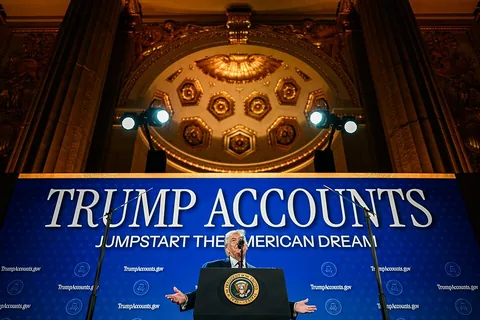
So what like if I have a kid now they get, you open an account?
Yeah, yeah. You open an account. Any new kid born gets a thousand dollars at birth. Parents can contribute to it, employers can contribute to it, friends can contribute to it.
It's like a baby 401(k).
Exactly. Exactly. And, you know, you have people like Michael Dell who say, hey, here's my donation and I want it to be gifted to, I can't remember the exact specifics, but I think it was like, hey, bottom 75% income by zip code. And the money…
That's better.
Yeah. Exactly the money just because as Brad would say, look, 529 plans,116529 plan — a tax-advantaged education savings account named after Section 529 of the US tax code: investment gains are tax-free if the money goes to education. The tax break is worth more the more a family can put away, which is why Gerstner cites these plans as a benefit that ended up going to the wealthy (Wikipedia). which are kind of education plans, like, hey, I can fund money that can be used to for my kids' education one day. Like the reality is, is the people using 529 plans are generally like the wealthiest part of the country. Like 529 plans and the tax advantage wasn't made for the wealthy part of the country, but that's who uses it the most. What he wanted to do was, hey, let me create investment accounts for the people who actually need them. And I think it's, you know, it's an awesome initiative that's just getting started. I think you're going to see a lot more direct philanthropy.
What's a big issue people have with philanthropy is well, you're going to donate a bunch of money and then middlemen are going to take half of it.
I have seen and literally directly this tons of loss. It's used for corruption.
Exactly. But what's better? Direct contributions, direct to bank account of people who need it most. No middleman, direct accounts that then people can see appreciate in value over time. Can't touch it till you're 18 years old. And so you get to see the appreciation happen over time, maybe learn and participate in the upside of America along the way.
And I think it's really like it's caught on and just seeing how passionate he is about it has been kind of inspiring to see.
Okay, my one pushback is like I'm, you know, homeless on the streets, food stamps, everything. I have a thousand dollars sitting there. You then like, well, give it to me.
Yeah. Well it's made more for kids now. And so hopefully you're not, well, maybe there are plenty of homeless kids. Yeah.
Exactly. Right? Like, so like that's the thing. Like, it's like, well, you know, did you know you have a bank account and you're participating? So that's growth of capitalism.
ExplainerHow Trump Accounts work
The children’s investment accounts were created by the One Big Beautiful Bill Act in July 2025 and went live on July 4, 2026. A parent or guardian opens the account by filing IRS Form 4547; a child without an opened account won’t get the seed money, which is why Ball says the accounts need to be “claimed.”
- For citizen children born from 2025 through 2028, the Treasury makes a one-time $1,000 deposit.
- Family and employers can add up to $5,000 a year, and philanthropists and states can give on top of that limit: that is how the Dells’ donation and Musk’s pledge work.
- The money can be invested only in US stock index funds and can be withdrawn from age 18, when the account starts following the rules of a retirement IRA.
That is the biggest thing. I don't care, you know, like so that's the biggest thing now, which is people need to claim their accounts. The government opened up accounts for every kid in America and parents need to claim them. It is sitting there. Now, the money is sitting there for newborns. You know, if you're 15 years old, money doesn't show up in your account.
I think donations will. And so you could be a 15-year-old that does have a $250 donation from Michael Dell117Fact-checkNot so: the Dells’ money goes only to children aged 10 and under who were born before 2025 and didn’t qualify for the government’s $1,000; a 15-year-old won’t get the $250 (NPR). sitting in your account, but they need to be claimed. And so like now the, I would say the focus has gone from let's get this passed into law, let's get it up and running. Let's get the infrastructure set up so people can donate. Now it's let's go convert those created accounts to claimed accounts. And that's just a that's like a grassroots word of mouth game because there are people whose accounts are sitting there with money in it and it just needs to be claimed.
Yeah. Yeah. By the way most people have money sitting in the government that has not been unclaimed. You can look it up.
Yeah, unclaimed property.118Unclaimed property — forgotten bank accounts, deposits, overpayment refunds, insurance payouts and paychecks: if the owner doesn’t come forward for years, the company is required by law to hand them over to the state, which holds the money until someone claims it. You can search every state at once by name for free at MissingMoney.com, run by the association of state unclaimed property administrators. It's like a great use case for like Muse and Instinct.119Muse and Instinct — personal AI agents you could hand such a search to: Muse is Meta’s agent that runs errands in the background, including purchases and bookings; Instinct is an assistant you talk to by text message, with no separate app. Have an agent go look up your name.
Exactly. You probably have a few thousand dollars sitting somewhere that someone returned to you.
And it's just you just need to know your address, your prior addresses and then go have Instinct or Muse.
Highest ROI on this podcast. Not the Anthropic…
Exactly, exactly.
Cool. Thank you so much for spending your time with us.
Yeah, of course. This is great.
We'll have you back. We'll see how the IPO goes. This was fun. Thanks for doing it.
Thank you.


